The blog for Mets fans
who like to read
ABOUT US

Faith and Fear in Flushing made its debut on Feb. 16, 2005, the brainchild of two longtime friends and lifelong Met fans.
Greg Prince discovered the Mets when he was 6, during the magical summer of 1969. He is a Long Island-based writer, editor and communications consultant. Contact him here.
Jason Fry is a Brooklyn writer whose first memories include his mom leaping up and down cheering for Rusty Staub. Check out his other writing here.
Got something to say? Leave a comment, or email us at faithandfear@gmail.com. (Sorry, but we have no interest in ads, sponsored content or guest posts.)
Need our RSS feed? It's here.
Visit our Facebook page, or drop by the personal pages for Greg and Jason.
Or follow us on Twitter: Here's Greg, and here's Jason.
|
by Greg Prince on 18 May 2022 2:38 am Did I want a pencil, the fella who sold me my program/scorecard asked me. Since the pencil was free and the paper bag with handles was a nickel, of course I said yes to the pencil with no eraser and not even NEW YORK METS written across it. Rule No. 1 of ballpark retail customer etiquette is never turn down even the most useless trinket, no matter how useless, not if it’s free. The pencil could have been useful if I’d planned to keep score; was too nervous to use my pen; yet was confident I would make no erasable mistakes.
Because I did not keep score, I didn’t total up the LOB the Mets accumulated in their Tuesday doubleheader. My impression is that over 18 innings they left 54 runners on base. That’s just my impression, though. I know that’s incorrect because a) they didn’t bat in the bottom of the ninth of the opener, so it’s only 17 innings and therefore only a possible 51 LOB and b) I like to exaggerate for effect.
As long as I’m doing that, let me tell you there’s nothing better than a 3:10 start for a baseball game. Nothing. Move over ice cream and intimacy — you’ve been topped! Honestly, I couldn’t say every 3:10 start clicks as the one in Game One did, but I’ve rarely enjoyed an almost empty ballpark more than I did when the Mets got their makeup doubleheader underway. Citi Field wasn’t comically empty as it or any facility can be when something previously unscheduled suddenly springs into action, but the population was pretty sparse. It turned out to be a great way to make my 2022 debut. I’ve avoided April in Flushing since 2017 because fighting the crowds on Opening Day and the chill the rest of the month leaves me cold. Then there was the little matter of no baseball in the early part of 2020 and reduced capacity as 2021 found its footing. Witnessing the first weeks of the season in person is a habit I’ve lost.
Sooner or later, though, ya yearn to get back on that horse. Tuesday afternoon, with its acres of empty seats and pastures of plentiful tickets priced to move brought me to Promenade, just about the same spot where I took in the final home game of last year. It was really cold that night. It was really cold this night, too, but that came later, well after three o’clock. Don’t blame my precious 3:10 start for the sun going down several hours after.
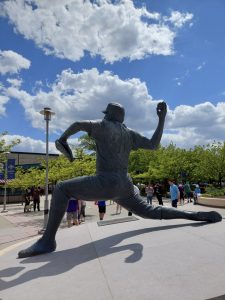
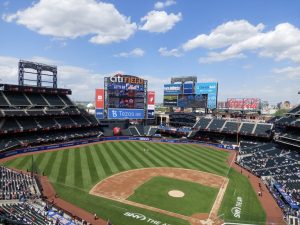 I’m gonna wait ’til the three o’clock hour… In the three o’clock hour, Citi Field was scrumptious in its solitude and quietude. You could take in a baseball game and all the post-Wilpon aesthetic upgrades (a better out-of-town scoreboard and a sharper ribbonboard presentation) without the PA blaring at you. It’s like they know enough to not bother anybody who just wants to revel in what amounts to secret innings. A little before three o’clock, the premises had something to recommend them as well: a tranquil Mets Plaza and a chance to get to properly greet Big Tom. I’d only seen the Seaver statue on TV, just as I had the 2022 Mets. I couldn’t wait to meet him, imperfect 4 in his rear 41 and all. Sure enough, he was right where I’d suspected he’d be, just across the way from the good old Apple. The Mets have two monuments, one to exquisite pitching, the other to fruitful offense. If only their ideals could have been replicated all afternoon and evening within the park.
For those who haven’t had the pleasure of approaching Big Tom, there’s a lengthy inscription on the plaque that adorns his granite mound. Here’s what it says about GEORGE THOMAS SEAVER:
Tom Seaver arrived in Queens and turned around the fortunes of the New York Mets, leading to the nickname “The Franchise.” Named the 1967 National League Rookie of the Year, Seaver led the Miracle Mets to the club’s first World Series championship in 1969. One of the most dominant pitchers in major league history, Seaver was a three-time Cy Young Award winner and a member of the exclusive 300-win club, finishing his career with 311 wins. He set franchise records for wins (198), strikeouts (2,541) and complete games (171) and was honored by the Mets in 1988 with his induction to the Mets Hall of Fame and the retirement of his uniform number 41. Seaver was inducted into the National Baseball Hall of Fame in 1992.
Try writing all that down with an eraserless pencil…a short eraserless pencil, at that. I took a picture.
The statue had me in a good mood. The start time had me in a good mood. The view from 518 was solid. Did I mention the ticket was a bargain? The first-place Mets and the nationally recognized Cardinals could be had for three digits, two of which followed a decimal point. I couldn’t resist. I found a spot at my LIRR station (not easy in the afternoon). The commute was smooth. My opened bottle of water eluded security. This year’s yearbook and program are now in my baseball library. A 60th Anniversary pennant graces my office wall.
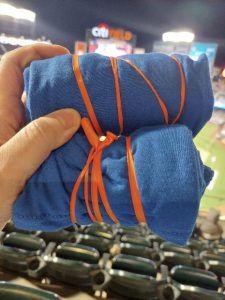
 Terrific from every angle. Oh, and two t-shirts! Not t-shirts I bought but t-shirts I caught from the Citi Perks Patrol. This was the benefit of planting oneself in 518 on a day and night when not that many did, though I didn’t plan it with shirts in mind. In the sixth inning of the first game, a Patrolperson came up with a bag of shirts and asked, in so many words, who wants one…REALLY wants one? Checking just enough of my dignity at the Rotunda door, I waved heartily. She tossed me a shirt. My lucky day! As if being at a ballgame and practically having a section to myself wasn’t lucky enough.
Fast-forward into the darkness and the stiff breeze it brought. It’s the sixth inning of the nightcap. More people are in 518, but not that many more. A different Patrolperson shows up. He also has a bag of shirts. He also wants to know who wants one…REALLY wants one? I haven’t gotten any prouder in the interim. Sure, I figure, I’ll communicate my desire to have another free shirt that won’t fit (they never do). The gentleman tossed me his first shirt. I was so surprised it was happening — aren’t there other sections? — that I dropped it into the row in front of me. The row was unoccupied, making my retrieval of it a foregone conclusion.
Two shirts to go with two games for less than ten bucks. What more could one ask?
Two wins, of course. We were halfway home after the lidlifter, a 3-1 success that felt in peril intermittently but never fell away. Trevor Williams upended my recently stated lack of faith by giving the Mets four shutout innings. Jake Reed walked a tightrope in the fifth, but somehow maintained a zero-laden toegrip. The Mets’ three runs, gathered in the second and third, held up. Nolan Arenado, villain from the Battle of Busch, was booed a lot. Yadier Molina was booed by me. I attempted to give him a “nice career, guy” round of applause as his retirement finally looms, but I still can’t stand him for 2006. I was prepared to stand and ovate in acknowledgement of Albert Pujols at twilight, but he must’ve been warming up in the bullpen the whole time.
Like Pujols to the plate, the second Met win never came. Just lots of runners left on base. It only seemed like 27. The actual number was 9. The Cardinals stranded more, but if you win, 4-3, nobody much cares you outLOB’d the competition, 12-9. The Mets were undermanned in the nightcap, having used their prime relievers Lugo, Smith and Diaz to seal Game One. The absence of bereavement-listed Starling Marte resonated and losing Brandon Nimmo temporarily (we hope) to a ball he batted off his right quad in the seventh further hollowed out our depth. Nimmo’s mishap apparently looked worse than it actually was. It looked bad.
 You can’t have two of everything. Yet the Mets tied the game in the eighth and had two on in the ninth after giving up the tie in the top of the inning. By then the breeze had become full-blown wind, the meditative spirit of the opener had dissipated into frustration with not being able to put away the Cardinals and I mostly wanted to take my shirts and make my train. A second win would’ve been nice. I’d have taken it over a second shirt. You don’t necessarily get offered that perk in Promenade.
by Greg Prince on 16 May 2022 10:31 am Pete Alonso just swung by to remind us that not every Met ending that oughta be happy winds up that way, nor do even the most promising of post-1986 Mets teams always play baseball like it oughta be. Or maybe Pete Alonso just swung — again. Last we saw him, he couldn’t help himself.
It was the bottom of the ninth inning. The bases were loaded. Two were out. The score was Mariners 8 Mets 7. The score had been Mariners 8 Mets 5. The score had also been, at various intervals, Mets 1 Mariners 0; Mariners 4 Mets 1; and Mets 5 Mariners 4. Once it grew to Mariners 8 Mets 5, I was resigned to a soft loss landing. The first series defeat of 2022 was on approach, but it was going to be to the Mariners. Our undefeated series streak (not really a thing) was still intact versus National League opponents. Same for not having lost a series to a team I could possibly give less of a damn about. Sooner or later we were gonna lose two out of three to somebody. Strangers from a strange land would do.
Except for Paul Sewald. Acquired by Jerry Dipoto, he’s the new Jerry Dipoto in my personal frame of reference. In August of 1997, after so much had been going right for the Mets for months, we pulled into Colorado and got swept by the nothing-special Rockies, whose closer was former futile Met Jerry Dipoto. It’s one of those curses of a lengthy and detail-laden memory to maintain simmering grudges against middle relievers who ruined games for you ages ago and then got in your way when they materialized in another uniform. Dipoto mostly sucked as a Met in 1995 and 1996. The Mets sucked as a whole most of Dipoto’s tenure, so the grudge against future GM Jerry shouldn’t be any more sizable or enduring than it is against similarly bad news bullpenmates Doug Henry or Blas Minor, to name two arms from the distant past I hadn’t planned on invoking this week. But then Dipoto goes west, finds himself, and cuts us down in three consecutive games. I had high hopes for those 1997 Mets. That series at Coors Field was the first signal I processed as nope, this won’t be our year.
Except I don’t remember Dipoto cupping a hand over an ear after recording his saves as if to say, “Let’s hear it for your doubts about my abilities now, Mets/Mets fans.” No, Dipoto taunted us much, much later by taking a flier on Sewald and Sewald finding himself en route to his return to Citi Field. Sewald pitched in 125 games as a Met, winning one and losing fourteen. Won-lost records can be deceptive where relief pitchers are concerned. I don’t know that 1-14 meant Sewald sucked or was slowly growing into a big leaguer. Jerry Dipoto went 7-2 in 1996 and still sucked. I grew to disdain Dipoto (and Henry and Minor). Conversely, I never had it in for Sewald as a Met. I mostly experienced sadness when he entered a game between 2017 and 2020. Sadness for what Sewald’s presence indicated about the state of the Mets’ competitive aspirations. Sadness that he attracted Ls and repelled Ws. Sadness that he was, as often or not, bound for Las Vegas or Syracuse when a roster crunch required an option to chew up and spit out. That part was human empathy, which a fan can sometimes conjure for a person when not dismayed by a player. I got a glimpse of Sewald the person at the January 2020 FanFest and determined he seemed more 14-1 than 1-14 when it came to character.
The person who is a fan reserves the right to reverse impressions regarding people who are players. Paul Sewald succeeded at his craft Friday night in a one-run Mariners win over the Mets. That’s what he’s supposed to do. He indicated afterward how much satisfaction it gave him. That’s OK. He’s entitled to tell whoever runs the Mets now, in so many words, “no more shines.” Little Paulie, all grown up and doing the town. Whatevs. Congrats. We have different management ensconced since those who “gave up on me” saw enough of Sewald, but environs are environs and orange and blue mean something different to the reliever whose 125 outings in said colors weren’t enough to prove himself by his reckoning. Have your moment, Sewald.
Two is one too many, though. The cupping the hand over the ear, all “how ya like me now?” surpasses Winker in wankerdom. Jesse Winker as professional Citi Field heel is performance art. I’d almost admire his horsespit if in the mood to like anything at all about the Seattle Mariners other than their having defeated the Yankees in the 1995 ALDS.
The grist of the gripe with the Mariners isn’t the flourishes. It’s that they wouldn’t go away quietly after being absent without anybody noticing since their last Queens visit fourteen years earlier. That 1-0 lead, built on Francisco Lindor second-decking Robbie Ray in the first, was whisked away all too easily, as Carlos Carrasco entered Didn’t Have It territory. Ah, but in the fourth, the 2022 Mets showed their contemporary stuff, featuring a pair of triples that each plated a pair of runs, one from J.D. Davis, the other from Brandon Nimmo. That tandem of unicorniness (the Mets had never before produced two two-run triples in the same inning) vaulted the Mets into the 5-4 lead that was definitively More Like It. More Like It is far preferable to Didn’t Have It.
But More Like It didn’t last. Carrasco gave way to Chasen Shreve, whose general effectiveness this season surely had a YA GOTTA BE SHREVE t-shirt on some clever entrepreneur’s drawing board. The garments went on backorder once Julio Rodriguez went deep (torpedoing the A-CHASEN METS iteration as well). The next heretofore dependable arm to display fallibility was Drew Smith, who gave up a two-run homer to the capital of North Carolina, a.k.a. Cal Raleigh. Joely Rodriguez got in on the unrequested action a little later, permitting the eighth Mariner run. The only Met pitcher who escaped with a zero where it counted was the only Met pitcher we didn’t know would be in our sights when Sunday dawned. Colin Holderman, who planted himself on the organizational radar with a nifty Spring Training, replaced Tylor Megill on the roster when it was announced Megill was dealing with some right biceps inflammation, which is one of those maladies a fan repeats calmly while thinking, “WHAT?” An MRI showed Tylor is dealing with tendinitis. “WHAT?” also, but in the realm of all that could bother an arm, maybe it’s not so bad. Except for being without Tylor Megill in the interim.
Sewald clowned his way through the bottom of the eighth. Holderman held ’em in the top of the ninth, keeping the M’s from oozing any further ahead than 8-5. I didn’t want to lose to the Mariners (or anybody), but you gotta take the occasional lump in middling humor. Come the bottom of the ninth, I decided, the Mets would conduct the last of their dismal business for Sunday quickly, I’d shrug it off as I’ve shrugged off each intermittent Met loss this year, and then I could move on to my cooking — curried chicken, in case you’re wondering.
Except the Mets, after one out, had other ideas as they took on Drew Steckenrider. Eduardo Escobar awakened from his offensive slumber and tripled. I would’ve been delighted with a double. I was mortified he was going for three down three runs. The rule about not getting thrown at third as the first or third out also extends to the second out in the ninth. Y’know what? Just make it if you’re gonna go for it. Eduardo did. He was surely due. Jeff McNeil, who spent 2020 and 2021 due, continued to make up for lost time with a single to make it 8-6. Patrick Mazeika…
Listen, I love a feelgood story as much as the next Mets fan, but, oh brother, am I not confident in Patrick Mazeika. Did I learn nothing on Saturday night when his homer made all the difference? I did not. James McCann does not light the world on fire (unless his surfeit of double play grounders are soaked in gasoline and his bat is a Bic lighter), but a team losing its No. 1 catcher — even its 1A catcher in the prevailing McCann-Nido combo — is a team that’s asking for trouble. We’ve withstood the loss of deGrom. We’ve gotten by without May. Megill, we’ll see. But I have a really bad feeling about finessing however many weeks it will be without McCann. The Mets of the early 1970s were doomed whenever they were bereft of Jerry Grote. Duffy Dyer was the Tomás Nido of his day, but depth gets shallow fast behind the plate. And unless somebody’s gonna drop a Mike Piazza in our laps, don’t get me started on the 1998 Mets without Todd Hundley.
So, no, I wasn’t all “Mazeika Magic!” when Patrick came up to continue the rally. And maybe the Nido-Mazeika platoon will run short on durability soon enough. But on Sunday afternoon in the ninth inning, the kid somehow did his thing, slapping a ball where no Mariner could effectively lay a glove on it, placing Jeff on second and himself on first. Brandon Nimmo was a different story in terms of inspiring confidence. Nimmo is in that Mookie zone right now, that “he does it all and he’s doing it again!” mode Mr. Wilson used to inhabit for significant stretches every season. Nimmo had already tripled and extended his on-base streak to 26 games. Brandon, I was convinced, was gonna do something good here.
Brandon doubled. McNeil raced home. Mazeika made it to third (catchers rarely race). Second and third! Eight-seven! No series has been lost yet! My man Starling Marte is up! I love Starling Marte!
I love Starling Marte a little less since I felt that emotion yesterday, for Starling gave us one of the two worst at-bats I’ve ever seen in my life. Three pitches from Steckenrider’s sudden replacement Diego Castillo (with the infield in) led to three of the dumbest strikes I can recall. My database for “I’ve ever seen” and “I can recall,” by the way, is not to be considered exhaustive. In the moment, however, it was accurate. WTF, Starling?
Ah, but that’s OK, because Lindor, he of the high and handsome home run, is coming up and he’s gonna…be walked intentionally? Just waved to first like Jesse Winker waves to his jeering section? I’m beginning to think there’s a reason the Mariners have missed the playoffs for 21 years. Not my problem. Seattle’s problem was more the matter. Their 8-5 lead was whittled to 8-7. Their none-too-reliable reliever had to pitch with the bases loaded. His manager, Scott Servais, told him to face Pete Alonso with nowhere to put him. And the game I’d been content to shrug off now sat heavily on my shoulders.
So it was my problem, too. I could’ve dealt with an 8-5 loss. An 8-7 loss is a different story. How can it not be? There’s nothing implicit in a score of 8-7 when you don’t have the “8” that isn’t aggravating. You gave up too many runs and scored not quite enough. It’s a one-run loss, but it’s hellishly different from 2-1, which is how we lost Friday night. When it’s 8-7 in the other team’s favor, you have to get it to 8-8 at the very least. Surpassing 8-8 is even better, but one antsy thought regarding outcomes that are completely out of your control at a time. My mind was operating like J.B. Smoove’s in one of those Caesars commercials, everything zipping around in a digital display.
Can we really come back like this again?
Is this almost too easy?
Is thinking it’s almost too easy going to make this even harder?
DON’T ASSUME THE BEST!
But don’t assume the worst.
Is 2022 our year of destiny?
Will Pete fuck this up?
If we don’t win today, are we somehow doomed?
Seriously, are we gonna get another catcher?
Who thought not having Tylor Megill might be a linchpin?
Have faith in Trevor Williams if he takes Megill’s start.
I have little faith in Trevor Williams.
Don’t even worry about that right now.
Don’t worry about the catching.
Just have faith in Pete.
Maybe there’ll be a wild pitch.
How did Pete swing at that?
“How did Pete swing at that?” was the most operative of thoughts, especially but not solely on three-and-two with the still unreliable Castillo tempting Alonso one final time to swing at a slider away. If Pete’s bat remains still, it’s ball four and we’ve got a tie game and all the momentum and all the magic and Canha coming up and what a year! Instead, Pete can’t help but swing, and though the first base umpire has to be consulted, it’s strike three. Diego Castillo didn’t do much well, but neither Marte nor Alonso was willing to let him beat himself. The two worst at-bats I’ve ever seen (don’t hold me to that) sandwiched an intentional walk, resulting in an 8-7 loss that sounds about as bad now as it was when it unfolded.
Not knowing what else do to, I grabbed the objects nearest to me and threw a couple of throw pillows to the ground, thus learning why they are called throw pillows. Then I grabbed a few paper napkins and threw those to the ground. Paper napkins don’t make for very emphatic throwing in disgust. I stalked around like Max Scherzer for a spell; fumed at every mention of how noble it was that the Mets didn’t quit (are they supposed to quit?); attempted to take succor from Buck Showalter’s reminder that the opponents are an assemblage of competent professionals or whatever he said; snarled at Sewald; rationalized that somehow a loss like this was healthy in the long run because ninth-inning comebacks can’t be wished into existence on an almost daily basis; realized anew that you can be having a splendid season yet a loss that sucks is a loss that sucks; catalogued several of society’s genuine ills for perspective; and eventually turned my attention to my cooking to take my mind off what I just saw, which was Pete Alonso swinging at fucking ball four with the bases loaded and two out and the Mets down by one in the bottom of the ninth and it would’ve been so much better had he taken a pitch there.
Sometimes you just have to grab a big knife and slice the hell out of some carrots.
by Jason Fry on 15 May 2022 1:15 am What a strange game.
The Mets and Mariners — those foes from so many past epics — met again under bottom-of-the-aquarium conditions, getting started late because of rain and squinting their way through the final innings because of fog. The meteorological strangeness was matched by plenty of the on-the-field variety, with Chris Bassitt looking frustrated with newly recalled backstop Patrick Mazeika and the Mariners looking frustrated with their own suddenly tenuous grasp on the fundamentals of fielding and baserunning.
Bassitt has quickly emerged as one of my favorite Mets: He’s got the same eat-broken-glass intensity as Max Scherzer but substitutes a cyborg-assassin death stare for Mad Max’s can’t-be-arsed hair from hell and dugout pacing, and behind the affect is the same sense of a smart, driven athlete engaged in an ongoing colloquy with his craft — how amazing would it be to play fly on the dugout wall while Bassitt and Scherzer are having one of their frequent conversations? (And imagine the added dimension when Jacob deGrom can join those sessions.)
Yet it was obvious from the jump that Bassitt and Mazeika were having trouble getting on the same page — a developing situation nipped in the bud in the first, when Eugenio Suarez inexplicably strayed too far from second and got himself picked off to short-circuit both a potential Seattle rally and a minor New York firestorm. But the respite was brief: Bassitt looked out of sorts all night, departing in the sixth after giving up just one run but having put in a lot more work than his stat line would suggest.
Meanwhile, the Mets put three runs on the board against young George Kirby and his substantial hometown rooting section, though that was less on Kirby than on the abysmal defense behind him. Kirby looks like a keeper on a Seattle staff that has no shortage of them, with excellent control and a precocious grasp of how to keep hitters befuddled — in that sense he reminded me of Marco Gonzales, Friday night’s starter, though with much better stuff.
Kirby’s early nerves and that porous defense sent him packing after four innings and the Mets handed a 4-1 lead to Seth Lugo, but a sense of creeping unease never left the proceedings. And indeed, Lugo allowed two of the first three Mariners to reach in the seventh, setting the stage for Chasen Shreve to surrender a long home run to Jesse Winker, whose trip around the bases would have been only slightly more theatrical if staged by the WWE. (Which didn’t particularly bother me aside from the effect on the scoreboard — baseball’s too much fun to be played like a slightly more aerobic version of Sunday Mass.)
But Winker was barely done flexing and mugging for the fans in left field in the bottom of the seventh when a considerably less likely hero entered the fray. That would be Mazeika, who somehow jerked a high 97 MPH fastball on the outside of the plate into the right-field stands to give the Mets back the lead. Fireballing M’s reliever Andres Munoz looked astonished, which made him a subset of everyone else — how, exactly, had Mazeika done that?
Whatever the secret, he had done it, and so the game rolled inevitably on to the ninth, ending with a perfect bit of theater: Former Mariner wunderkind Edwin Diaz facing Winker, the self-proclaimed antagonist, as the final out but also the tying run. Their mini-drama didn’t disappoint, with Diaz mixing sliders and fastballs and Winker refusing to fan on that evil slider as the two Mariners ahead of him had. But then Diaz came up in the zone with a fastball at 100 — his hardest pitch of the night — and Winker swung through it and the Mets had won. Won in unlikely fashion on a very strange night when everything felt vaguely upside down, but won nonetheless. And that will make up for a lot of resentments and oddities.
by Jason Fry on 14 May 2022 12:01 am The Mets have now played the Mariners 16 times in their history, but such a matchup will always feel a bit like a videogame showdown with a weird little cousin. “You want to be the Mariners? C’mon, really? It’s the AL West — I don’t know any of those names. Hell, half of them look made up.”
Still, a surprising (at least to me) 103 Mets have also been Mariners, going back to original M’s Leroy Stanton, Doc Medich and Tommy Moore. Robinson Cano and Edwin Diaz, inevitably, are the most famous members of Club M&M, though for fans of a certain age John Olerud will always the one who hurts the most. And some recent Met discards have had success out in Seattle, most notably Chris Flexen and Paul Sewald.
A bunch of Mariners possibly fictitious and apparently real showed up at Citi Field Friday night, minus former Met prospect Jarred Kelenic and his .140 batting average, to face Max Scherzer and the Mets. What followed was a taut, entertaining and ultimately frustrating game.
Scherzer put on what we’ve come to take for granted as his usual show — doing unspeakable things to hitters with his four top-flight pitches, stalking around in the dugout with his performatively terrible hair, and putting his team in position to win. He saved the best for last: After walking new Seattle import Mike Ford on a 3-2 changeup that sure looked like it dented the bottom of the strike zone, a more-infuriated-than-usual Scherzer went back to work with the bases loaded and one out against Steven Souza Jr., one of those Mariners I’m not sure wasn’t invented by a EA Sports intern. Scherzer’s final pitch of the night was a slider that Souza spanked to Eduardo Escobar who converted it into a tidy 5-4-3 double play.
That just meant the game was tied, though — the Mariners had broken through for a lone run against Scherzer in the fourth, when chaos avatar and outfield provocateur Jesse Winker slashed a cutter that got too much plate for an RBI single. Meanwhile, the Mets were stymied by Marco Gonzales, a soft-tossing lefty who kept changing the eye levels of their hitters, allowing him to throw 88 MPH fastballs past them up high. It was an impressive performance — Buck Showalter would probably call Gonzales a low-heart-beat guy — marred only by the fact that it came in service of the wrong team.
Drew Smith replaced Scherzer and hit his first bump of the season, losing the strike zone and then (it turned out) the game on an RBI single to Ty France. The guy on the long side of that score? None other than Paul Sewald, about whom my feelings are somehow complicated in a single direction. Sewald was ill-used as well as unlucky as a Met, forced to work against his strengths, and became immediately more effective under a different coaching regimen. Good for him. But still — that was Paul Sewald out there. Doughty but doomed Paul Sewald, Jonah of the RMS Bullpen, forever tricking you with stretches of mild competence until he hung another slider and reminded you who he was and apparently always would be.
Sewald didn’t hang a slider Tuesday night, but he did leave a fastball in the middle of the plate to Pete Alonso in the eighth. Alonso tattooed it. He demolished it. He vaporized it. The only problem was that the ball shed about 50 feet of expected trajectory in flight, somehow coming down in a Mariner glove on the warning track.
The same thing had happened to Jeff McNeil against Gonzales — a home run transmuted into a long out.
Now, a rational person would blame the fact that the Mets and Mariners were playing in conditions typically found at the bottom of an aquarium, with every ball leaving the bat with a wet blanket over it. But I am not at the moment a rational person — not after watching Paul Fucking Sewald, who lost his 14 first fucking decisions as a Met, pick up the fucking win in his debut as a Citi Field opponent. Of course he did, because baseball is relentlessly weird, but get in my way during this rant and I’ll go Full Scherzer on you.
No, I choose to blame the ball, which Rob Manfred has apparently dictated should now have a core of lead instead of springy stuff. Or perhaps Manfred has messed up the Earth’s very atmosphere as part of his endless quest to inflict additional problems on baseball while doing nothing to address its actual ones. I mean, I wouldn’t put it past him.
It’s also possible that the Mets just dropped a close game because stuff happens. But I’d rather blame Manfred.
by Greg Prince on 12 May 2022 6:00 pm Taijuan Walker looked to be experiencing back discomfort on the mound and in the dugout throughout Thursday afternoon at Nationals Park. He pitched seven shutout innings while fielding his position like an athlete who happens to be the pitcher. We should all experience such discomfort. “A little tight, nothing serious,” was Tai’s postgame self-diagnosis.
The National League East race is also nothing serious, with the Mets at the moment leading the pack by 6½ games. It’s not even a little tight. Your first-place New York Mets continue to reign over their division with the greatest of ease, though I’m sure it’s not as easy as it’s appeared playing ten series to date in 2022 and losing none of them. The closest thing to a complaint one could muster is there hasn’t been a Met winning streak that’s exceeded three games. There also hasn’t been a losing streak that’s exceeded two games, and there’s been only one of those. So you’ll forgive the complaints department if they hear your gripe; shut their window; and knock off early for the week.
The matinee victory that bumped the Mets up to 22-11 was mostly methodical. They didn’t hit a ton, but they got on base effectively and crossed the plate enough so that sweating wasn’t in the forecast. Thanks primarily to three ribbies from Mark Canha (two in the first on a single, one on a solo homer in the ninth), the Mets filled the runs column sufficiently. Thanks to Walker achieving adequate looseness, they were covered for run prevention. And thanks to the Nationals traversing the bases without regard for likely outcomes, we can add a sparkling web gem to the season’s developing highlight reel.
We’d call the defining defensive play of the season thus far a breathtaking double play, except the official scorer says it was a pair of outs that just happened to occur in the wake of the same batted ball. However you scored it, the Nationals got lost in the agate type. In the fourth, Juan Soto was on second after a leadoff double. Josh Bell grounded sharply to the third base side. Soto, having heard Bell, responded like Pavlov’s baserunner and took off for third, salivating for the treat he was convinced awaited him. Luis Guillorme noticed and chased Soto back toward second, tossing the ball to Francisco Lindor like Luis does everything — professionally. Soto responded with a 180 toward third. Lindor calmly beat him there with a throw to a fundamentally sound Walker. Prodigy Juan tried to take the pitcher out with a slide that would have fit better during Washington Commanders blocking drills. Whatever sport Soto was playing, he reached neither the end zone nor the bag. One out.
But wait! Taijuan saw Bell making for second and alertly threw over. This part wasn’t pretty until it was. Walker wound up flinging the ball into right field, but maybe that was intrinsic to some greater plan, for Bell, not satisfied by simply replacing Soto on second, took his own shot at third. Unfortunately for Josh, Starling Marte, not satisfied to be a spectator, backed up the throw, grabbed it, and whipped it in to Lindor, who had Bell beat by the approximate length of the Washington Monument if you were to lay it on its side. Speaking of notably placed statuary in the nation’s capital, Soto was still loitering facedown in the dirt in front of third while Francisco was tagging his wayward teammate. The Nationals entered the day 11-21. Maybe the three-year plunge from winning the World Series to/through the NL East basement is taking its toll on Washington’s wunderkind.
You really wanna mark those two outs 5-6-1-9-6, but, for the record, it was 5-6-1, then 9-6. However it gets put into the books, it was paving the way for the rest of the game to arrive there eventually. Seth Lugo pitched the eighth without incident. Soto got a shred of revenge by taking Edwin Diaz deep in the ninth, but at that instant, there was a four-run lead, there was nobody on base, there were two out, and not even the tableau of the most menacing of Nats homering off our formerly beleaguered closer in what used to be his personal house of horrors could ruin a pleasant afternoon. The Mets finished their Acela jaunt with a 4-1 win, having taken four of six from the Phillies and Nationals, with last weekend’s rain the only truly vexing opponent they encountered along the way. Next, in a vagary of Interleague scheduling, they welcome the Seattle Mariners to Citi Field for the very first time.
These Mets seem to engage in the business of the unprecedented quite often of late.
by Greg Prince on 12 May 2022 8:57 am Ah, look at all the long relievers
Ah, look at all the long relievers
Stephen Nogosek
Picks up his glove in the pen
And he starts to get warm
Buck likes his form
Waiting since Sunday
Stretching in back with the pack
Of the arms seldom used
Tries to stay loose
All the long relievers
Patience is their key
All the long relievers
The score is eight to three
Megill didn’t have it
Getting lit up by the Nats
Who swung bats with no fear
They kicked his rear
Then Trevor Williams
Holding the fort in a sport
Where pitchers don’t hit
Thus pinch-hitters sit
All the long relievers
Their job’s to mop up frames
All the long relievers
To get us through these games
Ah, look at all the long relievers
Guys never once considered Seavers
Stephen Nogosek
Waxes his ’stache
Soon he jogs through the gate to the mound
He’ll stick around
Throwing three innings
Keeping it close to avail
That would fail to appear
No comeback here
All the long relievers
Whose roster stays are brief
Options make them yo-yos
We’ll see Steve in a week
The latest episode of National League Town takes us to a time before the Beatles, welcoming as its first-ever guest Dave Bagdade, author of the all-new revised edition of A Year in Mudville: The Full Story of Casey Stengel and the Original Mets. Listen to the show on your trip back to Syracuse or wherever you might be headed.
by Jason Fry on 10 May 2022 11:20 pm I had a lousy Tuesday.
No need for condolences — nothing of any real consequence went wrong, just a dog’s breakfast of bureaucracy and mischance and annoyances waiting at every turn. But it was enough to leave me in a foul mood, one that I tried to shake walking home over the Brooklyn Bridge, hopeful that watching the Mets would help me snap out of it if nothing else could.
For the first half of Tuesday’s game, that didn’t seem like a particularly good bet. The Mets kept hitting in lousy luck, with J.D. Davis particularly snakebit, allowing Patrick Corbin to spit the hook again and again. Meanwhile, Carlos Carrasco was pitching well but gave up a run on a Maikel Franco double, though Brandon Nimmo, Jeff McNeil and James McCann cut down a second run on a relay so picture-perfect it should have been immediately ported into an instructional video. Still, it was 1-0, and then it was 2-0 when Riley Adams demolished a slider that in no way resembled its description. (No pitcher has ever called something in their arsenal a tee-sitter, for related reasons.)
It’s amusing how quickly fan arrogance returns once your baseball team plays well for a little while. My mother texted me from Virginia and I assured her it was a frustrating game so far “but they’ll get em,” and since she’s the one who made me a baseball fan and a Mets fan, there was no need to define who was who in that equation. But would it be so? Baseball will reliably make a fool of those who traffic in certainties, the worst team is perfectly capable of pasting the best team on a given night, and even those best teams are going to endure 20-odd frustrating losses a year in which things go repeatedly and perversely wrong for nine innings.
But finally the Mets broke through, or the Nats broke, or maybe it was a little of both. With the bases loaded and one out in the sixth, McNeil spanked a hard grounder to Josh Bell at first. Bell is a Pyrite Glover and I suspect was also screened slightly by Eduardo Escobar on the play; some combination of that or simple bad luck turned what looked like a 3-6-3 double play into a tie game as the ball went up and over Bell’s glove and down the line. The next batter was McCann (who had a very good game on both sides of the ball), who got one in the air, deep enough to give the Mets the lead.
Things somehow felt safe, though I knew they weren’t (there’s that arrogance again), and when my attention stopped wandering it was because Juan Soto was up with the tying run on first and more dangerously the go-ahead run contained within himself. In came Joely Rodriguez, and I steeled myself for a long, grinding confrontation.
The famously patient Soto swung at the first pitch — a changeup high and inside, out of the strike zone — and popped it up to Escobar in foul territory. Then he stood there for a moment, staring over at where the out had been recorded with a look at once faintly puzzled and mildly disgusted — the expression of a man who just stepped out of his apartment in his bathrobe to get the paper and inexplicably let the door shut behind him. Why did I do that? What do I do now?
The answer to the first part, most likely, is that the Nats are horrible, whittled down to Juan Soto and a flag that will fly forever but is no help right now, which has left Soto trying to do the work of three or four hitters, something not even he can do. Someone buy Soto a drink and lend him a sympathetic ear, because he looks like he needs both.
The Mets added another run, which was enough for Edwin Diaz to go to work. Diaz didn’t look quite as sharp as he has of late, giving up a one-out single to Nelson Cruz and having to work a deep count against a determined Yadiel Hernandez. Frustration was still entirely possible — this was the park where Kurt Suzuki once did something unspeakable against Diaz, after all.
Ah, but frustration for whom? Hernandez slapped Diaz’s ninth pitch at McNeil, and two seconds later the Mets had won. And you know what? I even felt a little more cheerful.
by Greg Prince on 9 May 2022 12:29 am A Sunday doubleheader! Doesn’t that sound great? Not a split doubleheader (which isn’t a doubleheader; it’s just two games in one day). Not an abundance-of-caution seven-inning doubleheader (which would actually be a fourteen-inning doubleheader, but let’s not return there). A real settling in, beginning with a regulation game, pausing for a breather, then continuing with another regulation game. The baseball starts earlier than usual on the Sunday afternoon that is doubly blessed and it keeps going as long as it needs to and nobody is charged twice for admission. That’s the ideal.
The platinum ideal, of course, is a Sunday doubleheader that’s scheduled in advance just because can you imagine a better deal to anticipate? I don’t believe the Mets have scheduled a Sunday doubleheader in advance since 1988. They haven’t played a straightforward, unplanned Sunday doubleheader at Citi Field since a wet weekend in May of 2014. It takes an unforeseen circumstance to get you a doubleheader anywhere these days, especially Sundays. It took two days of rain in Philadelphia and the Phillies’ flight to Seattle to keep the home team from pulling any of that Sunday night add-on nonsense. They had to fit two games into daylight and they had to let people in with one ticket. The Mets fan watching in New York could simply sit back and enjoy.
Well, that’s not universally accurate. This Mets fan watching in New York found himself a touch antsy during Game One, up and pacing about so as to coach Max Scherzer through a few luck-deprived rough patches. Max gave up one extremely socked sphere that left Citizens Bank Park and a bunch of halfhearted hits that had the temerity to fall in. Scherzer’s customarily fearsome efforts added up to three runs in six innings. It was quality enough in the “give your team a chance to win” sense. Given that Max’s successors Joely Rodriguez and Adam Ottavino did their part to maintain order, all the Mets had to do was score three runs to even things up, and if they evened things up, you knew in your bones, they’d score however many more runs were required to ensure victory.
They could do that, especially with me lending the offense my encouragement on my feet. Maybe it’s a doubleheader thing that had me wandering around the living room rather than plopping down on the couch. I guess I needed to catalyze the lineup, since nobody else was really doing it until the top of the sixth. The Mets put together their lone successful rally of the opener then via a Starling Marte double, a Luis Guillorme single, a productive James McCann double play grounder (the most productive McCann can be sometimes), a Brandon Nimmo single and a Francisco Lindor double off the base of the right field wall. A Francisco Lindor homer over the right field wall would have been preferable, but something about delivering an extra-base hit off the base of the wall is so resounding that it’s almost more satisfying. When Marte put the Mets ahead with such a blow in their seven-run ninth a few nights before, I liked the message it sent. I could’ve hit it out, but that wouldn’t have been as sporting. Oh, I’m on second base now and might very well be driven in by a teammate. There was a lot of action in the top of the sixth. Seems like there should have been more than two runs from all of that action. Seems like there should have been more runs in the other innings the Mets batted, too. There weren’t.
When the opener closed, the Mets had lost, 3-2, snapping what felt like a winning streak at one. The one win was Thursday, but it was so resounding and so uninterrupted, thanks to the May showers that drenched the Mid-Atlantic region, that I could swear we’d gone unbeaten for days. I guess we did. I could swear we were capable of overcoming any deficit. We were. We are. We were down, 3-0. We got to within a run. The capability was there. The execution fell a bit short, as did Scherzer of escaping the ignominy of his first ‘L’ in practically a year.
Ah, but this Sunday wasn’t over, because this Sunday featured a Sunday doubleheader! If we couldn’t win the first game and thus guarantee we wouldn’t lose twice, we could win the second game and know we didn’t lose twice. Confidence abounds within possibility when you have a team like these Mets taking two turns on your behalf any day of the week.
In the nightcap, the Mets validated that confidence. No fancy comeback needed to be strategized this time, because the Mets scored twice in the top of the first and never trailed once Pete Alonso homered with Lindor on base. Later, in the fifth, Pete homered with a new combo — Nimmo and Mark Canha — trotting home ahead of him. Same basic principle. Pete’s up, Pete homers, multiples cross the plate. The Mets were ahead, 5-1. Chris Bassitt was in control for 5⅔. Chasen Shreve, Drew Smith and Seth Lugo took the wheel from there. Me, I sat back and enjoyed the undramatic denouement, a 6-1 triumph for one win out of two on the day, but the more important one, to be sure. Why am I so sure? Because I’m in a great mood after the second one and barely remember the mild disappointment from the first one. That’s how you do a Sunday doubleheader if you can’t plan in advance on a sweep (which you can’t). You win the second game and you move on to greater things.
That’s how you watch the 2022 Mets — with confidence. You can pace. You can lounge. Mostly you can be confident, however your body language chooses to express it. The Mets are 20-10, in first place by six games, and have won or tied every series they’ve played. They win from ahead. They win from behind. They lose once in a while, but they don’t look lost doing it. If the season to date is not the ideal, it’s extremely close.
by Jason Fry on 6 May 2022 1:50 am Well, well, well.
That wasn’t what I thought for most of Thursday night’s game against the Phillies, but then that’s always the case with a classic comeback — you need to trudge through the vale of despond before getting sherpa’ed up Mount Probability to giddily plant the most unexpected of flags.
That mountaineering metaphor’s less random than most of mine — the game’s win expectancy graph looked like this, courtesy of MetsAnalytics on Twitter:

That kind of sheer vertical face doesn’t get climbed very often, and certainly not when you’re down 7-1 in the ninth.
But back to the vale of despond part.
I was late reporting for duty because it was a pleasant spring night, Emily needed a cocktail and I almost never don’t need a cocktail, and since we were having cocktails we might as well eat something, and then I remembered it was a weird 6:45 start and looked at my phone and saw a 3 in a place I didn’t want there to be one.
“Ah hell,” I muttered, wondering what had gone wrong and deciding to figure it out a little later.
What had gone wrong, primarily, was a double-play ball that Francisco Lindor had botched, and that wasn’t good, not with Lindor’s hot start having turned lukewarm and even a little chilly. By the time we got home it was 4-0 and the Mets were looking dispirited against Aaron Nola and pretty soon it was 5-0 and I was spending more time with my phone than with the game, because while what was on my phone was making me grouchy, what was happening on my TV was making me grouchier.
I did the Wordle, getting a yellow R and an E at the tail end of my starter word and then a ERM in the middle of my next guess, all yellow. While I was pondering that, Bryce Harper reduced a ball to scraps of flaming yarn and cowhide. I watched the ball cease to exist with a sour expression, looked back down at Wordle, and … oh.
Another ingredient of a classic comeback is you don’t want to be the guy or gal who gives up in disgust and winds up saying “wait, what?” the next morning. Fortunately, I consider my duties as a given night’s Faith and Fear recapper sacred I got lucky. I decided I’d go downstairs in the middle of the sixth, most likely to find a book or a better use of my time, but then Starling Marte golfed a solo homer into the left-field seats — after Phil Cuzzi called a close 3-1 pitch a strike, no less.
While a much-ballyhooed offseason acquisition, Marte hasn’t lit the blue and orange world on fire just yet — particularly not on the bases. But I’ve enjoyed watching him despite that. He plays the game with an air of palpable menace that demands you pay attention, has taken to new outfield duties without complaint, and generally goes about his business in a way I approve of. A little earlier, Marte had hustled to make a play in the outfield in what looked like a lost game; now he’d homered to at least put some lipstick on this pig. If Marte hadn’t given up, surely I could handle the low-impact duty of continuing to be a spectator.
There was also the SNY app, which has definitely improved my quality of life, allowing me to watch games in my study without wrangling a TV-via-Internet feed that’s balky, to put it kindly. The Mets were down there on my sideways cellphone while I dealt with email and sundry digital things, and it didn’t really matter if I had to squint at them because I had Gary Cohen and Ron Darling talking to me, which is pretty good company no matter how small your screen is. And while things weren’t getting any better for the Mets they also weren’t getting any worse — Chasen Shreve and Adonis Medina had shut the barn door, which was good news even though conducting an inventory of horses didn’t seem like a particularly wise idea.
When all was done (sorry, spoilers), the statficionadoes determined that the Mets had been on an 0-for-330 streak when trailing by six in the ninth inning. The game before the one that started that bleak count came on Sept. 13, 1997, and the vale of despond had been even despondier than Thursday night — the Mets had tallied a lone single before the ninth and wound up down to their last strike before they scored a run.
But Roberto Petagine hit a two-run single, Luis Lopez and Matt Franco singled to load the bases, and Carl Everett — who’d had a troubled season for unfortunate reasons beyond the existential ramifications of dinosaurs — hit a grand slam off Ugueth Urbina. Bernard Gilkey then won it with a walkoff homer in the 11th.
That game is remembered as the Carl Everett Game — Greg’s written about it here, and revealed that it was actually Stephanie who led us to victory. But I missed the part that made it a classic. I was at a friend’s wedding and if memory serves (which it probably doesn’t), I left my Motorola SportsTrax in a motel room because the Mets were getting creamed, then peered blearily at it hours later while horrifically drunk and stripping off the battered, grass-stained tuxedo pieces I hadn’t already lost. NYM 9 MON 6 (11). Wait, what?
(If you don’t know what a Motorola SportsTrax is, it was a pager that came with a subscription plan allowing you to dispatch a message to wandering monks, who’d journey to your abode collecting alms and then inform you of the current score of a baseball game, albeit in Latin. What we have is way better now.)
(Oh wait, I’m confused. The Motorola SportsTrax looked like this and bleeped and stuff. The point is, it was a long time ago.)
The sequence of those impossible comebacks should always be preserved for posterity, so here’s what happened in the ninth 25 years later: Marte led off against James Norwood with a grounder to Johan Camargo that he beat out for an infield hit — another play where Marte could have opted for half-speed and no one would have clucked but the Back in My Day crowd. Lindor then clubbed a Harperesque homer into the stands, making the score 7-3 and at least giving the pig some mascara and rouge. Pete Alonso scorched a double down the third-base line over Alec Bohm‘s glove. Eduardo Escobar lined out, but Jeff McNeil poked a single through the right side of the infield.
A general rule is not to get too excited about ninth-inning scratching and clawing, because most of the time (330 out of 331 times if you’re down by six) that yields at best a moral victory, which is also known as a loss. A more specific rule is to not get too excited unless the tying run is at the plate, because the moment you let yourself get into ankle bone connected to the shin bone and shin bone connected to the thigh bone hypotheticals, someone will line into a double play. And Mark Canha wasn’t the tying run, but one tally shy of it.
Joe Girardi summoned Corey Knebel, which is another one of those moral-victory things. (“They won but we made them use their closer and he was probably extra sweaty so he drove up the water bill in the shower haha Phillies!”) Canha grounded a ball off Knebel, who sprang off the mound, picked it up and threw to first too late as Alonso scampered home.
It was 7-4, and now Dom Smith really was the tying run, and even though this probably wasn’t fated to work out, it had at least become pretty fun. Dom worked the count to 3-2 … and struck out on a disappearing Knebel knuckle-curve.
That brought up pinch hitter J.D. Davis, who ripped another ball past Bohm into the left-field corner, scoring McNeil and advancing Canha (still one shy of being the tying run, because Rob Manfred hasn’t messed around with that part yet) to third, where Joey Cora wisely opted for something short of his usual level of aggression. Now the tying run was at second, and this was definitely fun. Now the Mets didn’t need a whole sequence of good things but just one more good thing.
That’s usually when the supply of good things runs out, but hey, hope’s free. Travis Jankowski replaced J.D. at second and the game would come down to Brandon Nimmo against Knebel and that knuckle-curve. Just the game, I reminded myself — not the season or my eternal happiness or the fate of the cosmos. Knebel threw a curve for strike one, then a fastball high and tight, and then went back to the curve — leaving it right in the middle of the plate. Nimmo slashed it over the infield to chase home Canha and Jankowski and tie the game.
Which, if you’ve watched enough baseball, leaves you simultaneously cackling with glee and worried that your team will now get walked off in the bottom of the ninth to make everyone involved wonder why they bothered. Except Marte smashed Knebel’s first pitch off the fence in left-center — gone on a summer night or with a differently constructed baseball — to bring home Nimmo as the go-ahead run. UNBELIEVABLE! crowed Gary Cohen, while Knebel lurched around on the mound looking like a man trying to wake from a nightmare.
With the Mets improbably and astonishingly up 8-7, on came the suddenly possibly trustworthy Edwin Diaz, a phenomenon I still find stranger than anything I just used a few hundred words to carefully chronicle. With Phillie fans looking on in shock, Diaz struck out Roman Quinn, coaxed a grounder from J.T. Realmuto and then struck out Rhys Hoskins on three pitches, using that deadly slider as the coup de grace.
That’s one you should bottle — a mental vintage you’ll want to savor should the rain wash away the rest of this series, or during the next 330 games in which being down six in the ninth turns out as you’d expect. In a quarter-century you’ll proudly tell fans who take their neural implants for granted that you were at the Brandon Nimmo Game (or the Starling Marte Game, whatever works) or kept the faith and watched the whole thing on TV or at least squinted at it on your cellphone. Or maybe you’ll admit that you did something more sensible with your night and didn’t know until morning, when your reaction was, “wait, what?”
by Greg Prince on 4 May 2022 9:10 pm The Mets met up Wednesday afternoon with four “old friends,” one of those baseball phrases meant to refer to players who used to be on your team and are now trying to defeat your team. The four old friends all wore Braves uniforms. The parties did not lunch together.
Travis d’Arnaud, a Met from 2013 until 2019, albeit hardly at all after 2017, walked with the bases loaded to begin the Braves’ scoring in the sixth. It had been 0-0 until then. Tylor Megill was throwing his usual shutout through five, his customary no-hitter through four. Then Megill loaded the bases and left, replaced by Adam Ottavino. Was Ottavino, pitching for a third consecutive day, the right choice? The right choice was not having the bases loaded.
Some choices aren’t yours to make. Ottavino walked d’Arnaud, gave up a double to Adam Duvall and then threw a wild pitch to score d’Arnaud. Quickly, old friend Travis made a trip around the bases, his RBI and his R sandwiching four runs. And the Braves weren’t done dining out on our matinee largesse.
Guillermo Heredia, a Met for literally a week in 2020, walked in that same sixth inning. By then, it was 5-0. Heredia would come around as d’Arnaud did, making the score 7-0. The Mets might have been on the board had Guillermo not climbed the right field wall and taken away what looked like it could have been a home run from Jeff McNeil in the second. Maybe McNeil’s ball wouldn’t have left the yard. If it hadn’t, it wouldn’t have hit the wall and put Jeff on base. The only thing it hit was the pocket of Heredia’s glove. Guillermo made a one-handed catch. The defender’s other hand was busy clutching the top of the fence to ensure he’d steady himself while committing highway robbery in broad daylight. It was one of those catches, the kind that demands a surfeit of clichés.
Later, in the eighth, Heredia, who wasn’t scheduled to be in the Braves’ lineup until practically the last minute, whacked a two-run homer than no fielder — not even himself — was going to catch. That made it Braves 9 Mets 1. You might say he did in a day against the Mets more than he did in a week for the Mets (though he did have a pretty decent stretch that fleeting week that quiet year).
Ian Anderson did most of the pitching for Atlanta. He didn’t used to be a Met. Two relievers Brian Snitker deployed did. Collin McHugh, who wore the orange and blue in 2012 and 2013 (traded before d’Arnaud was promoted), faced seven batters, retired five of them and gave up no runs. Darren O’Day, a Met in April of 2009 who was packed off for distant precincts before May of 2009, finished up. He allowed a home run to Luis Guillorme, which is something hardly anybody does, but Darren was protecting an eight-run lead in the ninth, so he didn’t have to stress his gopher. O’Day has been a big leaguer since 2008. He hasn’t lasted this long sweating the small stuff. He overcame Luis’s blast and survived on the mound to receive a “nice game” handshake from his catcher d’Arnaud the instant it ended.
The Braves, featuring their four former Mets, whacked the Mets but good, 9-2 splitting their four-game set at Citi Field and showing enough of a pulse not to be written off after one-sixth of a season. Then again, the Mets still haven’t lost a series, still lead the division by a bunch and, save for the bullpen experiencing its intermittent moment of fragility (both Sean Reid-Foley and Travis May are on the IL and neither Ottavino nor Trevor Williams was impressive) and nobody besides Guillorme (three career home runs in five seasons) showing much power in the homestand finale, they’re doing all right.
Which is to say Atlanta can have our former Mets. I’ll stick with our current Mets.
|
|






