The blog for Mets fans
who like to read
ABOUT US

Faith and Fear in Flushing made its debut on Feb. 16, 2005, the brainchild of two longtime friends and lifelong Met fans.
Greg Prince discovered the Mets when he was 6, during the magical summer of 1969. He is a Long Island-based writer, editor and communications consultant. Contact him here.
Jason Fry is a Brooklyn writer whose first memories include his mom leaping up and down cheering for Rusty Staub. Check out his other writing here.
Got something to say? Leave a comment, or email us at faithandfear@gmail.com. (Sorry, but we have no interest in ads, sponsored content or guest posts.)
Need our RSS feed? It's here.
Visit our Facebook page, or drop by the personal pages for Greg and Jason.
Or follow us on Twitter: Here's Greg, and here's Jason.
|
by Greg Prince on 8 November 2021 3:15 pm The alliteration was irresistible, but Pedro Feliciano wasn’t so much perpetual, per the clever nickname tagged on him by the SNY booth, as he was constant. Granted, the two words work in adjacent cubicles at Roget’s, but perpetual implies something that goes on forever. Constant — in noun form — is something that is always there, at least as long as you can ask it to be.
Pedro Feliciano at his peak was the constant of the Mets bullpen and maybe the Mets experience overall. Perhaps if Pedro’s parents were partial to Carlos or Camilo or Kenny or any baby boy name that leads with a hard “c” sound, Gary Cohen would have alerted us like clockwork that Constant [Insert Alliterative Name Here] was warming up in the bullpen. As it happened, his parents liked “Pedro” and so did we.
We’ve learned the limits of presumed perpetuity with the news that Feliciano, the Mets’ lefty relief specialist whose solid work in orange and blue spanned a dozen seasons, five managers and a pair of home ballparks, has passed away at 45. It goes without saying that 45 is far too young to go.
It’s also far too soon to lose a Met who called Citi Field his professional home. Perpetual Pedro is the first Citi Field Met to leave us. Citi Field has been in operation for all of thirteen seasons. A decade hasn’t gone by since Pedro Feliciano was retiring batters there. For a while, particularly in its infancy, you could be pretty certain that if you planned a day or night at the Mets’ red-bricked crib, you would see Pedro Feliciano pitch. Maybe slightly before you clapped along to “Lazy Mary”; maybe a half-inning after. You knew you’d hear the song. You were fairly sure you’d see the southpaw. Was the game close? Did the other team have a dangerous lefty hitter looming? Pedro was available.
The final game at Shea Stadium included among its festivities Pedro Feliciano pitching. The first game at Citi Field was no different. Coming and going and Pedro. All were constants of the era. The Mets could be very good when Feliciano was on call — he was intrinsic to the fortunes of the 2006 National League East champs and their uncommonly effective bullpen. The Mets could miss expectations and postseasons, as was the case when the entire bullpen collapsed from overwork in ’07 and ’08. The Mets, quite frankly, could be quite frightful, which was their story most of the other years Pedro was around (2002-2004; 2009-2010; 2013).
But, boy, was he around and on call and constant. Eighty-six appearances in 2008. Eighty-eight appearances in 2009. Ninety-two appearances in 2010. Pedro led the league in games pitched all those years. He set standards no Met reliever has touched since. And his managers didn’t keep finding opportunities for him out of sheer curiosity. Pedro Feliciano tended to take care of the batters against whom he was matched. His mix of poise, resilience and offspeed stuff was effective enough so that he achieved the rare status of 21st-century Met reliever who you remember well and without rancor.
Pedro’s time, in all those games not all that long ago, is part of our time. We’re not remembering somebody from the sepia-toned past. Pedro Feliciano’s last year as a Met was 2013. Jeurys Familia, of the 2021 Mets, was a Met in 2013. Jacob deGrom and Noah Syndergaard were Met minor leaguers on the rise then. Feliciano the constant was improbably in his third tenure with this organization that season. Pedro left the Mets twice — to pitch in Japan in 2005 and to take the Yankees’ money in 2011 (after which injury shelved him for two years) — yet never wore any uniform other than the Mets’ in official MLB competition. He wound his way through other affiliations, but that left arm answered only calls from our dugout. Feliciano’s name resides in the upper tier of Nothing But A Met rankings: Ed Kranepool, David Wright, Michael Conforto (pending free agency), Ron Hodges, then Pedro, at the moment claiming six games more as Nothing But A Met than Brandon Nimmo. Nimmo, like Dom Smith, was a 2021 Met who was gaining seasoning in our system in 2013.
So, no, it wasn’t that long ago that we glanced toward right field and saw Pedro get his last toss in and jog through that gate at Citi Field. He predated SNY, but not by that much. He predated this blog, but became a prominent bullpen option while we were watching and writing. My two strongest memories of Pedro Feliciano of the New York Mets aren’t of him challenging Ryan Howard (7-for-38 off Pedro) or Prince Fielder (1-for-10), but of Pedro making himself available in ways not every Met did. There was a Hispanic Heritage Night late in the 2009 season when I was meeting some friends outside the ballpark, and hustling as if from the cornfields and onto Mets Plaza to the delight of pregame loiterers like myself was none other than No. 25, making an appearance Elias didn’t notch. Somebody needed him to pose with a sponsor. Pedro was happy to head outside and do it. He smiled for the camera. He smiled for and waved to the Mets fans who recognized him (the only person in full uniform, he was easy to spot). Barely a couple of weeks later, during the final weekend that season, amid a loooooong rain delay, a knot of fans nestled in the Bullpen Plaza was greeted by a Met who usually claimed the vicinity as his home turf. It was Pedro again. He wasn’t coming to chase us away. He came out to say hi and offer autographs and make fans feel good they rooted for this guy’s team.
I was reminded as I scrolled through social media after learning of Pedro’s passing that he was around again this September, for the most recent Hispanic Heritage Month. A native of Puerto Rico, Feliciano was on hand to represent his homeland and say hi one more time. He posed for pictures and signed whatever items were handed him and brightened the night for those who probably couldn’t believe it had suddenly been eight years since Pedro pitched here. He always pitched here, it seemed.
by Greg Prince on 5 November 2021 6:54 pm Newly nominated as the Democratic candidate for president in 1972, George McGovern suddenly needed a running mate. He didn’t clinch his berth in the November finals until his party’s July convention, so a nicety such as pursuing a vice president weren’t a priority well in advance the way it is today when primaries take care of top-of-the-ticket business relatively early. Further, McGovern trailed incumbent Richard Nixon by a lot in the polls, so the honor McGovern was ready to bestow wasn’t necessarily seen as much of a stepping stone in the world of politics.
It was said of the United States Senate that every one of its members (when it was almost exclusively a boys’ club) saw a president in the mirror when he set out to shave in the morning. Yet, as historian Rick Perlstein recounts in Nixonland, three of McGovern’s colleagues from that august body — Ted Kennedy, Abraham Ribicoff and Gaylord Nelson — declined to see themselves as a vice president and demurred when McGovern asked each of them to join him on his ticket. Nelson at least was helpful and recommended a possible alternative: Senator Thomas Eagleton of Missouri. It was getting late, so McGovern’s people thought about it for a couple of minutes and extended the invitation. Eagleton wasn’t well-known enough to worry about his reputation being damaged on the wrong end of a possible landslide and said yes.
Great…except then not great, because in the rush to find a vice president, the McGovern campaign didn’t thoroughly vet Eagleton, and soon enough Eagleton revealed publicly he’d encountered bouts of “nervous exhaustion and fatigue” for which he was treated with psychiatric help, “including electric shock”. This was quite a bite of news for the body politic to digest nearly a half-century ago, as was the realization that McGovern’s advisers didn’t know about it or ask about it before offering Eagleton to the convention for nomination. It didn’t take long after the story broke for McGovern to inelegantly nudge Eagleton off the ticket and commence on another search for another potential vice president.
Ribicoff resisted a second chance to step in. As did Nelson. As did rising “New South” governor Ruben Askew of Florida. As did Maine Senator Ed Muskie, who’d been No. 2 on the Dems’ ticket in ’68. Muskie had run with Hubert Humphrey, who’d been an unhappy vice president under Lyndon Johnson. McGovern reached out to Humphrey (who, like Muskie, was one of the candidates McGovern beat out for the presidential nomination) to see if maybe he’d like to try it again. No thanks, Hubert said. Beloved consumer advocate Ralph Nader wasn’t buying, either. Oh, and Ted Kennedy turned down McGovern anew.
But there was Kennedy’s brother-in-law, the former director of the Peace Corps, Sargent Shriver. He became what amounted to the Mikey from Life Cereal candidate. Shriver tried it. The vice presidential nomination, that is. In August, McGovern-Shriver replaced McGovern-Eagleton on ballots and buttons across America. McGovern still lost by a lot, but at least he got the job filled. Of course he did. Somebody was going to take it and the ticket would get through the election, win or lose.
The fact that McGovern-Shriver went down in a 521-17 electoral college rout (or that neither Richard Nixon nor Spiro Agnew served out their re-elected term) is neither here nor there. What is here is sooner or later, no matter how many people turn it down, a high-profile job that needs to get filled gets filled.
The Mets don’t have a newly minted president of baseball operations for 2022 in the first week of November 2021, which wasn’t exactly how they planned to light their Hot Stove. They have been rejected — respectfully, quietly, but definitively in reported account after reported account — repeatedly since the season ended. At first they were rejected by the biggest names they coveted.
Epstein to Beane to Stearns
None cared what a Cohen exec earns
Epstein to Beane to Stearns
Queens doesn’t automatically appeal, a Met-lover learns
Epstein to Beane to Stearns
The Braves were on fire whilst our void still burns
We didn’t get the baseball brains we’d heard of. Theo Epstein reached two previously unreachable stars and didn’t need to go for three. Billy Beane is very comfortable in Northern California. David Stearns is under contract in Milwaukee. Fair enough. They aren’t the only fish in the sea.
Nor are a slew of names I don’t feel like looking up after they’ve all turned us down. Every front office would-be Grand POBO from Boston to Los Angeles and myriad stops in between has passed on the chance to step up in Flushing. Their loss, perhaps. Or our loss, perhaps. I can’t sweat it. I have no control over the situation. I have no control over whether an individual Met gets a hit or makes a catch or throws a strike, but at least I can sit in Promenade or my living room and yell at them and feel I gave my input. I can look at OPS and ERA+ and think I have a clue. The labyrinth that composes a baseball franchise’s power structure is essentially what I read and hear after the fact. Frank Cashen was a brilliant architect because we won a World Series. Everybody since Frank Cashen less so because we didn’t.
I do know I’m no longer invested in the cult of the extremely bright assistant general manager or whatever title they held from somewhere else. We were told Jared Porter was one smart cookie. He didn’t make it to Opening Day. We were told we were lucky to have a shiny penny like Zack Scott in reserve. He didn’t make it to Closing Day nor out of administrative leave. Every name floated during this postseason has had somebody in the know to vouch for his or her potential brilliance if only we could get that person. Maybe the one that got away was The One. Maybe not. Either way, they’re not joining us.
Somebody will. Somebody will take Steve Cohen’s money and Sandy Alderson’s direction and run with both. Somebody will make clever trades and questionable signings. Somebody will pursue this free agent but not that free agent. Somebody will make a tough decision that will pay off on the field or regrettably backfire.
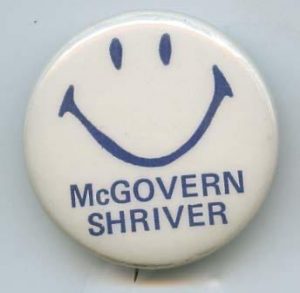 As Pete Alonso said in another context, smile — we’ll get our POBO. Yet we’ll have somebody collaboratively calling shots eventually. Somebody will be the right hire in retrospect or be replaced by the next hire. I hope for the best person available — the best person who opts to be available. We’ll find our Sargent Shriver.
Sargent Shriver died in 2011, so he’s not available.
by Greg Prince on 3 November 2021 4:27 pm
Amid sixteen consecutive playoff appearances, it could have been the Atlanta Braves’ year. It was the Atlanta Braves’ year prior to that particular run, in 1995. It could have been again real soon, as soon as 1996. But it wasn’t. It wasn’t in 1997, either. Or 1998. Or every year the Braves kept winning the National League East without pause, which took them (and those held hostage to their numbing excellence) through 2005. A whole bunch of years became not their year. Later, a whole bunch more years that could have been their years also weren’t. Five times after 1995 Atlanta won more than 100 games and it didn’t lead to a world championship. The same flag that flew permanently over the NL East from the mid-’90s to the mid-’00s was raised anew in 2018 and stayed aloft as the decades changed, but as of October 2020 it wasn’t augmented by any other banners of note.
Yet somehow in 2021…when the Braves dragged their mediocre, injury-compromised carcasses across the halfway point of the schedule…as they represented just one more shade of gray in baseball’s drabbest-performing division…it became their year. Not immediately, but eventually. It’s rarely anybody’s year immediately. Eventually is what counts. Wire-to-wire can be electric, but several wires remain after the 162nd game of a regular season. You not only gotta get to October, but you gotta traverse three, maybe four obstacle courses. You look at a team that won 107 games like the Giants or won 106 games like the Dodgers or won by 13 games like the White Sox or pulled down 17 consecutive wins like the Cardinals or boasted an unmatched historical pedigree of 27 previous world championships like I forget their name now and you might think it’s their year.
Or you might go with the Braves and how their going-nowhere-fast momentum steered its way out of a cul-de-sac and took off in the diamond lane. You have to have enough passengers to do that. The Braves picked up a slew of them and picked up speed. They whizzed by the Mets, whizzed by the Phillies and whizzed their way past Milwaukee (who finished the regular season 6½ games better), Los Angeles (who finished the regular season 17½ games better) and, at last, Houston (who finished the regular season 6½ games better). The world champions became the 88-73 Braves, who remade themselves in late July and catapulted themselves to an 11-5 postseason.
You might not have seen them coming, even after they engineered transaction after transaction that rearranged their roster for battle, but the rearview mirror indicates it was obvious all along. That’s how it works when it becomes somebody’s year. It was the Year of the Braves. It says so right there on the list of World Series winners that, when you read the 2021 entry, is always going to say Atlanta Braves. We didn’t know it in July. We know it now and forever more, whether we’re thrilled to or not.
Braves fans, whose elation is not our utmost concern, waited long enough in diehard years. Twenty-six seasons without fullest reward is a stretch. Andy Dufresne did nineteen at Shawshank before having had enough and busting out. Being teased those sixteen cigarless Octobers was probably its own brand of torture. The Mets have been to the postseason only nine times total. It’s been infrequent enough so that we cherish each and every one of our clinchings the moment the champagne pours. Our combined total of seven NL Wild Card, NLCS and World Series shortfalls sting into perpetuity because we understand that, historically, our chances are so scattered. We go to the playoffs once, maybe twice in a given era and then we go on hiatus. We’ve never torn the wrapping on the gift of autumnal constancy. We don’t know what it’s like to be frustrated this late in the calendar year after year, again and again.
When I couldn’t be in front of a television, I listened to portions of a couple of this year’s World Series games over Astros radio on the At Bat app. I like their announcers. I’ve come to know their announcers because the Astros have been in the playoffs five consecutive years and were in the World Series three of those years. Robert Ford and Steve Sparks are comfortable voices for me because I keep bumping into them in October (and November). The postseason is familiar terrain for them. I don’t listen to Astros games during the regular season, yet I feel I know them a little. It struck me how amazing it is that I hear these guys welcoming their listeners to the ALCS or World Series on an annual basis. I get that same vibe from exposure to Dodger Stadium on TV. There it is again, I think. It’s a fixture this time of year.
That must be great if the Astros’ announcers or the Dodgers’ ballpark are your voices or venue. I wouldn’t know. I had a taste of that sort of in-crowd vibe when the Mets went to two World Series in five years when I was a kid, and two sets of playoffs in three years when I was in my twenties, and those back-to-back instances in 1999-2000 and 2015-2016. In the back halves of those veritable twofers, I loved the sense of knowing what I was doing. 1973 seemed natural because I had experienced just enough of 1969 to know how the playoffs worked if the Mets were in them. 1988 was picking up where 1986 left off. 2000 and 2016 continued longform stories that began in 1999 and 2015.
Then, in all those cases, it was over. We didn’t get another opportunity any time soon (with 2006 disconnected from what came before and orphaned by what came after). It was a shock to the system to return to the playoffs whenever we did once the would-be Reigns of Metsdom fizzled away. You never got used to seeing Shea Stadium or Citi Field in the network spotlight. You never counted on hearing Bob Murphy or Gary Cohen or Howie Rose welcome us to Game One of this series or that.
The Braves had that from 1996 to 2020: sixteen times in twenty-five years, most of that built on astounding continuity. Every year for a decade. Clusters of years thereafter. No going home at the very end of September or very beginning of October. Extra games. Extra merch. Extra angst, too, but that’s baked into diehard fandom. You gladly give over your sanity if it means a CHAMPIONS t-shirt.
What you don’t sign up for is falling short again and again, and that was the Braves’ story. The Astros won in 2017 (however they won). The Dodgers won in 2020 (however brief the season that preceded it). After a while, getting to the business end of October over and over had to seem at least as much curse as blessing to those who lived, died and died some more with the Braves.
Until 2021 when it was all blessing. When it was the additions of Soler, Duvall, Rosario and Pederson, all emblematic of front office genius. When it was Freddie Freeman cashing in his Wrightlike long and meritorious service. When it was Ozzie Albies stealing a taco and then some. When it was a shutdown bullpen making up for not enough starting-pitching innings and Ian Anderson and Max Fried intermittently throwing enough innings so the bullpen didn’t break. When it was the deliverance of Brian Snitker to the promised land; and that left side of the infield that apparently doesn’t kill just the Mets; and that catcher we know from somewhere — has a lower-case letter where a capital is supposed to go, plus an apostrophe in a weird place — leaping toward the mound when all was said, done and jubilant.
It became the Braves’ year. Nobody knew it all along. You never do. And you never turn down the chance to find out. You might go home empty-fingered in 1996 and 1997 and 2004 and 2005 and 2010 and 2013 and 2018 and 2019, but then you earn a ring for that finger and it identifies you for the rest of your life. Recently reading Art Shamsky’s sweet-natured book (written with Erik Sherman) drove home for me how much it meant to Art and his teammates that they are still the 1969 World Champion Mets. Listening to Lenny Dykstra’s foul-mouthed musings on the ESPN documentary I was proud to be a part of drove home for me how much it meant to Lenny and his teammates that they are still the 1986 World Champion Mets. And watching Travis d’Arnaud spring into Will Smith’s arms after the final out of Game Six drove home for me how players getting to call themselves world champions is what it’s all about.
Same for being fans of those guys and their teams when it applies to the likes of us who are simply watching, listening and angsting.
The way the Braves arrived at their 2021 triumph put me in mind not only of our playoff years and our Series victories but of a season when we went exactly as far as we went this year in terms of wins and losses. Ten years ago, we were having a surprisingly decent 2011. Little was expected of those Mets. Actually, almost nothing was expected of those Mets, but under new manager Terry Collins, they little-engined as much as they could and found themselves on the periphery of the playoff race in July. But nobody took them seriously — not us, not them. Hence, there were decisions to be made of a contractual nature and the standings weren’t of paramount consideration. Francisco Rodriguez was living up to his elite closer billing, but if the Mets used him too much, he’d have an enormous payment kick in and, well, these were the days when Wilpon-Madoff shadowed everything. We couldn’t be paying Francisco Rodriguez that much money. Also, Carlos Beltran’s seven-year pact was in its seventh year. There was no chance he’d be getting another deal from us, so with him playing very well in his Met twilight, our general manager, Sandy Alderson, looked to ship him for somebody who’d be around in seasons to come. That made perfect sense in the realm of what we appraised the Mets to be in late July of 2011. For that matter, Jose Reyes and his league-leading batting average might have been tantalizing trade bait, seeing as how he had free agency looming, but we didn’t go there.
But we did swap out Beltran’s last two months for whatever future was contained within the right arm of top Giants prospect Zack Wheeler, and we did offload Rodriguez on the Brewers for what amounted to salary relief. Those were smart things to do. We as Mets fans almost universally applauded Alderson for proceeding intelligently. What was the point of holding on to trade chips for a team that at its peak — four games over .500 on July 29 and 6½ games out in a six-team Wild Card scramble where they placed sixth — was a certifiable long shot?
While the Mets sans Rodriguez and Beltran withered away to their 77-85 finish, the Cardinals surged in 2011 in a vein similar to how they surged in 2021, storming past the Braves on the final night of the year to take the Wild Card (there was only one then) and convert it in the weeks that followed into serial upsets of the Phillies, the Brewers and the Rangers, bringing them what is, at this date, their most recent World Series championship. When we were at our peak, the Cardinals were all of one game ahead of us.
Could what the Cardinals became have been us had we not quit on 2011, the way the Braves, who trailed the Mets substantially if not decisively in late July, didn’t quit on 2021? Probably it was improbable, but it’s also an unknowable. We do know that not quitting on a season when it’s even remotely conceivable that sticking with it might be worth it always looks good when it pays off handsomely.
Nobody looks better at the moment than the 2021 World Champion Braves. Congratulations to a team that until further notice defies begrudging.
by Greg Prince on 26 October 2021 1:40 pm But — I said to myself — I want to get in. This is a World Series opener. I’d never seen one. There is nothing in baseball equal to it…
—Arnold Hano, A Day in the Bleachers
Maybe you’ve heard the old saying, “If you keep letting the Braves make the playoffs, sooner or later a pennant is gonna fall their way.” Alas, it is true. They earned postseason entry a dozen times between 2000 and 2020 yet went home before the World Series. Because the last World Series they made was at our expense, it had been satisfying ever since to watch them depart the stage with their tomahawk between their legs no later than the NLCS.
So much for satisfaction. The Atlanta Braves are the National league champions. Our champions, so to speak. Yeech, of course. But it was bound to happen eventually. The reason I didn’t think it had much chance of happening this year, as late as late July, was they were missing Ronald Acuña, Jr., and they were missing Mike Soroka. No best player. No best pitcher. While I never fully rule out a mathematical contender, it didn’t seem likely to me they’d step up, never mind step over us. No Acuña. No Soroka. Little chance.
I kept leaning on that, sort of like I leaned on the Cubs couldn’t win the NL East in 1984 because they were the Cubs who hadn’t won anything since 1945, or the Nationals couldn’t storm through the 2019 postseason because the Nationals had never won a single postseason series before 2019. The Braves lost eight consecutive NLDSes between 2002 and 2019 plus the inaugural NL Wild Card Game in 2012. They also coughed up a playoff berth down the stretch in 2011 and crumbled like a Drake’s coffee cake in September 2014. All of that would have been enough for an instinctual advertisement for not believing in them in October 2021 — that and the blowing a 3-1 lead to the Dodgers in the 2020 NLCS — but I wasn’t even going there in July. In July, they were without Acuña and Soroka. Being in shouting distance of first place in the East wasn’t going to do them much good if they were missing a couple of their primary vocal chords.
The Braves got themselves a larynx transplant via a fistful of trades that brought them Adam Duvall, Jorge Soler and Eddie Rosario, who in NLCS play proved a latter-day Eddie Perez. As sometimes happens, the team trailing in late July becomes a somewhat different team by early August. We kind of remember that being our case six suddenly going on seven years ago. It’s more fun when it happens for us than for somebody we go from leading to trailing. On July 28, the night Michael Conforto gunned down Abraham Almonte at home plate to secure a save for Edwin Diaz, the first-place Mets led the third-place Braves by five games. The Braves beat the Mets the next night and the trade deadline the next day.
By August 14, the Braves were slightly ahead of the Mets. By August 21, the Braves were farther ahead of the Mets than the Mets had been ahead of the Braves before those transformative trades. While we kept straining to glimpse glints of daylight as the California darkness descended upon us, the Braves’ immediate future turned so bright they should’ve worn shades. Atlanta (or wherever they play) finished 6½ ahead of the Phillies in second and 11½ ahead of us in third. That the Braves of Travis d’Arnaud and Guillermo Heredia won a mere 88 games didn’t matter. They were a division champion. Now they’re a league champion, having brushed aside the 106-win Dodgers like they were the 77-win Mets. The cauldron that is the National League East apparently toughened them up good.
I don’t hate the Braves like I hated them in 1999, the last time they went to the World Series. It would be physically impossible to hate the Braves like I hated them in 1999 or 2000 or up to the late-July weekend in 2006 when we definitively ended their divisional dynasty. After that, the Braves receded from archrivalry. Hate became dislike, sometimes deep, sometime de facto. It was, as noted, satisfying to see them fall short. It wasn’t life or death.
It still isn’t. They beat the Brewers in this year’s NLDS, and it didn’t particularly bother me, probably because I was preoccupied by the Giants and Dodgers. Then they took on L.A., and I didn’t really have a side. I don’t like either team as a rule. My contemporary dislike for the Dodgers traces mostly to the presence of Chase Utley on the basepaths in 2015. Utley hasn’t been a Dodger since 2018, but as long as there remain active players in Dodger uniforms who gave Utley an approving pat on the ass for taking out Ruben Tejada at second, he’s still spiritually one of them and they are essentially one of him.
Nevertheless, I didn’t life-or-death the Dodgers’ demise in the NLCS because that would have entailed getting behind the Braves, and being behind the Braves — from a standings perspective — was something I’d experienced too lately for comfort. And I couldn’t life-or-death the Braves’ demise because, yeesh, Utley. So I let it play out and found myself not wholly unhappy that the Braves of d’Arnaud and Heredia were heading to the World Series and at least a little delighted the Dodgers weren’t, though I think had their series gone in the opposite direction, I would have come out of it in a similar mood. The Dodgers of Albert Pujols (who I could swear was already inducted into the Hall of Fame) would have seemed admirable. The Braves would have been done, which is forever satisfying.
Either way, I watched. I’m not one of those Mets fans who ducks out on the postseason when the Mets aren’t anywhere near it. You don’t have to be absorbed by a Metless postseason like it’s 1986, but you shouldn’t take a bow for taking a pass. You’re entitled to sit on your high horse or apathetic alpaca, but I can’t endorse your celebration of not watching or not caring. I’m also not one of those Mets fans who replaces “Meteor” for “Mets” in LGM at every unpleasant October turn. Yankees-Phillies in 2009 was meteorworthy. Yankees-Braves in 1999 was meteorworthy. Perhaps you spot a throughline. Dodgers-Braves was good, survivable baseball. Even if it had been lousy baseball, it was postseason baseball. It was baseball. Come back to me in no more than ten days and tell me that’s not worth something. (Come back in December and you might really be jonesing.)
Over in the American League, I would have preferred the Red Sox as champion, but got the Astros. With the most recent 30 for 30 still playing in my head, the best part of the 2021 ALCS may have been it wasn’t a rematch of the 1986 World Series. It certainly wasn’t life or death for me. I got my life-or-death out of the way in the AL Wild Card Game. Everything after that among Boston, Tampa Bay, the South Side of Chicago and Houston was Not the Yankees, which is all I can ever ask out of the American League.
Granted, the Astros have an elephant in the video room, and one can’t watch them for more than a couple of pitches without remembering they were nefariously identifying the pitches to win a World Series not too many years ago. The Astros, however, are pretty good at being chameleons. They were the Colt .45s at birth. They were baseball avatars of the Space Age with their next chosen identity. They settled in and blandly occupied the Astrodome during the Eighth Wonder’s first decade, rarely being abysmal, never being spectacular, usually thwarting the Mets. They dressed in horizontal rainbow stripes and at least looked exciting. They rose up in spurts, threatening our Once Upon a Time in Queens fairy tale at their peak. Then they ditched the rainbow stripes; disappeared from the top of their division; ditched the residual rainbow accents; changed divisions; and eventually succeeded on a consistent basis, albeit with relatively few noticing.
The Astros kept going to the playoffs in the late ’90s and early ’00s with barely a lick of readiness for prime time. Or perceived readiness. They went 0-for-4 in NLDSes when they started making them almost annually and went almost unseen even as they got the hang of October. For those who miss the golden days of afternoon World Series contests, consider the Braves and Astros met in the NLDS five times between 1997 and 2005, and they were almost exclusively a matinee attraction: 16 day games in 19 dates. ESPN, Fox and whoever else was involved back then would have preferred to show a test pattern in prime time than spotlight the best baseball the Sunbelt had to offer.
Toward the end of the Killer B’s run, the Astros of Bagwell, Biggio and import Beltran — playing on the site of an old train station and dropping the Space Age motif from everything but their name — neared the World Series in 2004, losing the NLCS to the Cardinals in seven. Then, with Carlos B. ensconced in Flushing, they reached the World Series in 2005, only to be swept out of it by the White Sox from the American League. Eight years later, after intentionally falling through the competitive floor, they were in the American League. A couple of blinks later, their process of losing a ton morphed into winning a lot, then winning it all in 2017. It was a great story until details emerged rendering it considerably less great.
Yet here they are in the World Series in their latest incarnation, America’s Anti-Team. The Astros’ roster has mostly turned over since ’17, but the cream of their crop remains and they haven’t missed a single postseason since winning it all, no matter how they won it. Their manager is possibly the most sympathetic figure in all of baseball, Dusty Baker. Baker wasn’t a part of the Astros’ analytical process nor on hand for the surfeit of strategically aimed cameras and voluble trash cans. He’s the lifer who came up under the wing of Henry Aaron and paid more than a half-century’s worth of dues, winning almost everything with almost everybody, save for a World Series ring from the helm of the dugout. Maybe the only feelgood story that comes close to Baker’s is that of his Fall Classic counterpart Brian Snitker, an organization man in the best sense of the phrase. The Braves gave their mostly unknown minor league fixture a shot in 2016 and aren’t they glad they did? Snit has guided Atlanta to four consecutive postseasons, inspiring love and loyalty along the way. And he’s done it in a Braves uniform, for goodness sake.
I adore a postseason when a team I don’t follow comes along and sweeps me up on its journey. This hasn’t been one of those postseasons, and as this postseason pulls to within four to seven games of a conclusion, I don’t have a pennant-winning dog in its ultimate fight. I’m just looking to be optimally entertained and fleetingly engaged. Don’t tell the fans of the remaining playoff teams. It’s life or death to them.
There’s plenty to root against if that’s your jam. There’s something to root for if you let yourself. There’s the pair of teams that survived the gauntlet of a full season and the heat that gets turned up in October. The Braves and the Astros have played some wonderful baseball to get here. It’s wonderful that baseball is still being played. Hell yeah, I’m gonna tune in. This World Series may pit two teams we’re not crazy about, but it’s the World Series. It belongs to us all.
by Greg Prince on 15 October 2021 4:20 pm Other than Wild Card Games, the 2016 National League version in particular, I don’t recall watching a postseason showdown and thinking it absolutely needed to continue beyond its agreed upon parameters. But I have now.
The Dodgers just defeated the Giants in five, but five wasn’t enough. It was the Dodgers in too soon. This National League Division Series needed to be allowed to go seven games, perhaps nine. Perhaps nineteen. It also needed to be allowed to complete its fifth and deciding contest instead of having an umpire end it at least one pitch prior to its organic conclusion. I’m not saying this as a Giants sympathizer or a Dodgers disdainer. I’m saying it as a baseball fan.
I’m not sure what you do about the Giants and Dodgers being done head-to-head before we get to seven-game territory. The two fiercest rivals in baseball history made the mistake of being the two best teams in baseball this year while combating one another in the same division. The one that didn’t win the NL West won a Wild Card and then a Wild Card Game. The team with the best record in a given league automatically plays the Wild Card winner. That’s how you get the 107-55 Giants squaring off against the 106-56 Dodgers in what amounted to the sport’s quarterfinal.
Reseed? You could do that, in which case L.A. would have played Milwaukee, and San Fran would have taken on Atlanta, and then, had form held, you’d have the Giants and Dodger for the pennant. Except would have form held? Form didn’t hold in the other NLDS, where 88-win Atlanta subdued 95-win Milwaukee. Form didn’t hold in one of the ALDSes, where the AL East champion Rays (100-62) fell to the Wild Card Red Sox (92-70). The first rule of postseason is you never know, and that’s for the series and games that are actually played. The second rule of postseason is you can only imagine, but you do so at your own risk.
Unless you haven’t wondered once or twice what would happen had Carlos Beltran swung.
It never occurred to me that reseeding was necessary in baseball. It doesn’t now occur to me it’s necessary, unless it’s narrowly defined. Should a league’s Wild Card a) complete its regular season with more than 105 wins and b) maintain with its division’s champion a historic rivalry that dates back a century or longer…
Discerning a path to facilitate the behemoth Dodgers and the powerhouse Giants playing for as many marbles as is conceivable is a noble goal. But the slight chance that you’ll get this scenario again probably doesn’t merit overhauling an otherwise decently designed system. Five-game LDSes are generally a substantial enough appetizer to seven-game LCSes. Wild Cards aren’t division winners, with all that implies about the value of the 162-game season. The 2015 Mets (90-72) maintained home field advantage over the 2015 Cubs (97-65) because the Mets won their division and the Cubs didn’t. We would have treasured a hypothetical seventh game taking place at Citi Field rather than Wrigley Field.
Of course the Mets of six Octobers ago swept the Cubs for the National League championship and I don’t remember thinking four games wasn’t the perfect length.
Before leagues were cleaved into divisions, you didn’t have postseasons. The National League did wind up in a couple of noteworthy ties in 1951 and 1962, you have may been reminded recently, and that brought the Giants and Dodgers into bonus conflict, with three-game tiebreakers to determine pennants. Each of those emergency series went three, each went to the wire, and each went to the Giants on the Third of October. In the era of two divisions per league, when East champs faced West champs, you couldn’t have a Dodger-Giant postseason series, seeing as how each rival sat in the same division. This period, 1969 through 1993, also coincided with me, born not long after October 3, 1962, growing up and growing ever more fascinated by the collision of October 3, 1951. I didn’t dream of a Giant-Dodger postseason meetup because the mechanism didn’t exist.
Then came realignment, three divisions, a Wild Card, and possibility. Yet the Dodgers and Giants, who’d intermittently battle it out for the NL West crown, didn’t land in the same postseason until 2014 and then again in (grrr) 2016. Yet they missed each other each time, one or the other succumbing in an LDS against somebody who wasn’t their ancient foe, leaving us close-but-cigarless to a best-of-seven LCS. When we got to 2021 and a five-game series pitting this year’s New York-rooted National League West titleholder versus the Brooklyn-born victor from this year’s National League Wild Card Game — where they overcame the disgustingly not to mention bafflingly extant Wainwright/Molina combo — I didn’t think five games was better than nothing. I thought these five games would be better than anything (well, any Met thing).
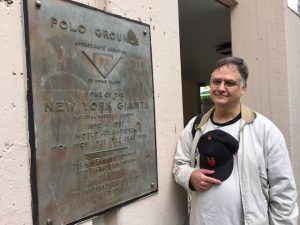 October 3, 2021: The author takes a quick jaunt uptown to pay homage to some orange-tinged roots. And it was, even if it came up two games shy of a best-of-seven, even if the side where my affinity is planted won only two games of five. Because my immersion in New York Baseball Giants culture is deep and because I was a gleeful October tourist for the San Francisco Giants’ ride to World Series glory three times in the 2010s, I thought I’d take a five-game loss to the Dodgers to heart. But SF-LA, it turns out, was less my affair than my sidepiece. I was into it because of what it represented to baseball. These two teams co-existed fiercely in the same league and city for generations; pulled up stakes (eternal BOO!! on both of them for that); relocated to polar-opposite towns in the same state on the other end of the country; feuded across millennia as divisionmates; and finally wound up in a regularly scheduled playoff round.
How could you not want that go the limit? How could you not want the limit to be unlimited? Games One and Three were exquisite manifestations of 2021 Giant execution, with shades of what made San Fran so magical in 2010, 2012 and 2014. Logan Webb pitched like he could’ve lined up among Bumgarner, Lincecum and Cain. Buster Posey busted out his opposite-field whooping stick. Brandon Crawford leapt as if the second coming of Buddy Harrelson in the Channel 9 opening montage of yore. They were spine-tingling in their excellence. Meanwhile, Games Two and Four attested to the enormity of L.A.’s winning ways and how they’d practically perfected the methodology that had brought them eight consecutive division flags, three recent pennants and last year’s world championship. They are as fully loaded and decadent as really awesome potato skins. The Giants posted their victories by scores of 4-0 and 1-0. The Dodgers took theirs by tallies of 9-2 and 7-2. After four games of the NLDS, counting everything the two teams had done that counted, this was where they stood:
SF 109-57
LA 109-58
You wanted a fifth game. Then a sixth and seventh game. And then, if they didn’t mind, Games Eight through Infinity, at least until it was time for the mere mortals to gather for Pitchers & Catchers.
But we settled for a fifth game, in San Francisco, and, yes, what a fifth game it was. The Dodgers threw an opener and a bridge guy in advance of unleashing their 20-game winner as bulksman. The Giants stuck with the fella who pitched them to a series lead in the first game. Everybody’s pitching strategy was essentially sound through five, as nobody within the cohort of Corey Knebel, Brusdar Gaterol, Jose Urias and Logan Webb gave up a run. The Dodgers’ intrinsic Dodgerness broke through in the top of the sixth. Mookie Betts — whose absence from the Red Sox hasn’t prevented them from advancing to the ALCS, but, even still, who lets go of Betts? — singled. It looked like it might be a double, but Mookie was cautious. Besides, why risk getting thrown at second when you can steal it on the next pitch? With Betts on second, Corey Seager, last year’s World Series MVP (almost every Dodger has a major award in his past), doubled him home. The tie was broken. The ice was broken. The plot was thick.
To this do-or-die stew, add the unlikely thickening agent of Darin Ruf. Darin Ruf is a name familiar to Mets fans mostly from conflation with Cameron Rupp on the mid-2010s Phillies. Needless to say, Ruf wasn’t appearing in any postseason action for Philadelphia as the last decade wore on. Ruf left the City of Brotherly Love and its perennial futility to improve his game in Korea. He slugged 96 home runs for the Samsung Lions over three seasons in pre-pandemic KBO, when nobody in the US was tuning in. He returned to the States in 2020, to a Giants team there was little reason to notice. In 2021, for a ballclub that won nearly two-thirds of its games, Ruf played 117 times, put up an OPS+ of 143 and, in the sixth inning of the deciding game of a League Division Series versus the Dodgers, swatted a three-two pitch from Urias 452 feet, beyond Oracle Park’s center field wall.
Three innings of regulation remained, which set in as a damn shame. Webb’s final frame of pitching kept it 1-1. Blake Treinen’s entry in the bottom of the seventh did the same. A Dodger threat off Tyler Rogers in the top of the eighth — two singles sandwiched inside two outs — was snuffed by nasty if previously unheralded San Fran closer Camilo Doval. “Nasty if previously unheralded” pretty much describes the 2021 Giants in toto. Los Angeles closer since forever Kenley Jansen took care of business in order in the bottom of the eighth.
In the ninth inning, the Dodgers got to Doval. One Dodger in particular got to the getting — Justin Turner. Naturally Justin Turner. With Clayton Kershaw sidelined, Justin Turner is the longest-running, non-bullpen postseason constant of the L.A. would-be dynasty. They’ve definitely been dynastic in the West since 2013. Turner arrived at Chavez Ravine in 2014. We’re vaguely aware of where he played the handful of seasons before he emerged as a key cog, then a star for that divisional dynamo. Every autumn, the leaves turn colors and Justin Turner appears on TV. That, along with flaming red hair that seems to get redder with age, is probably why we can never quite forget our erstwhile benchwarmer.
Justin Turner you noticed in Game Five because he managed to get himself hit by Camilo Doval pitch with one out in the ninth. Didn’t you just know he’d come around to score in a matter of batters? You remember Justin Turner Met Utilityman becoming Justin Turner Dodger Constant, so that’s a rhetorical question. It would fall to Cody Bellinger to drive Justin in, from second after a Gavin Lux single had moved Turner up a base. Cody Bellinger this season batted .165. Cody Bellinger was the 2017 National League Rookie of the Year and 2019 National League Most Valuable Player. All these decorated Dodgers inevitably live up to their trophies.
We for whom the orange and blue DNA runs more to orange didn’t think it could end this way. Somewhere in that home dugout had to be a Bobby Thomson. A break had to go the Giants’ way to set up something that would swipe that 2-1 L.A. lead right back, something that would push at least one run across and keep the NLDS matchup of a lifetime alive. Sure enough, with one out, it was Justin Turner getting involved again. This time, it was ex-Met Justin Turner bobbling a grounder from Kris Bryant, the E-5 placing a runner on first. LaMonte Wade, Jr., stepped up to pinch-hit. Wade is known as Late Night LaMonte, and not from hosting an 11:30 PM talk show. LaMonte Wade, Jr., if you hadn’t been devoting yourself to Giant doings all year (and I surely wasn’t) is a ninth-inning savant. In 24 ninth-inning plate appearances in 2021, Wade batted a typographically correct .565. Of course you’d invest faith in Late Night LaMonte, no matter who the Dodgers had pitching.
Except did we mention the Dodgers had Max Scherzer pitching? Max Scherzer’s résumé not only speaks for itself, but it just keeps talking. He was a starter moonlighting as a do-or-die closer, but Max Scherzer wasn’t going to be easy to fit with goat horns in the classic style of Ralph Branca (himself, à la Julio Urias, a onetime 20-game winner for the Dodgers). Max is not an easily scalable mountain in any season — even in his fourteenth — in any inning — even in Wade’s.
LaMonte took Scherzer deep but foul in the course of his at-bat, but ultimately got rung up on strikes. With two out, then, the Giants’ season came to rest on the shoulders of Wilmer Flores.
Naturally Wilmer Flores. You want to chat ninth-inning avatars, you have to invoke the player who conjured walkoff RBIs as a Met ten separate times. Four were in the ninth inning. Six came in extras. If you were rooting for Wilmer — and who among us, regardless of temporary alignment, wasn’t? — you knew the moment was holding out its fist for a bump from the man for whom it was made. Alas, you also probably learned, as Wilmer readied to transport his Met magic to another sphere, that Flores had never done a darn thing against Scherzer. He was 0-for-17 lifetime. This, though, loomed as the time of Wilmer’s life. This was Tears of Joy Redux incubating. Different context, momentous vibes. This was a shot waiting to be heard, seen and consumed around the world.
Or waiting just to keep the ninth inning going. To get on base. To get it to Evan Longoria. Something, Wilmer. Anything. Eighteenth time’s the charm…maybe.
Wilmer takes a slider for strike one. He fouls off a fastball for strike two. Max Scherzer, he of the three Cy Youngs as a Tiger and National and spotless record down the stretch as a Dodger, delivers another slider. It’s low. it’s away. It’s clearly off the plate. Flores begins to swing but checks before he goes around.
This is what has happened. It is not, however, what is seen by home plate umpire Doug Eddings, who isn’t certain enough to call ball one, so, at catcher Will Smith’s behest, Eddings confers on appeal, from ninety or so feet away, with first base umpire Gabe Morales.
Morales raises his right fist to indicate strike three, game over, series over. A dog raising his leg would have had the same effect on the resolution of this NLDS.
Game Five ended on about as bad a judgment call as you would have refused to imagine. Flores should have still been up, one-and-two, Bryant still the runner on first, Longoria on deck. Who knows what would have happened had the combined judgment of Eddings and Morales hewed to reality? It’s quite possible our beloved Wilmer Flores — who struck out looking to complete with a whimper the 2015 World Series (we were behind by five runs to the Royals, so it’s not as iconic as Beltran looking in 2006) — might have gone down on strikes one pitch later. Or it’s possible, because he had a bat in his hands and he’s Wilmer Flores, that he finally connects safely off Max Scherzer.
We’ll never know, which is too bad. We should have found out, which makes it worse. Highly questionable calls can be a part of the most compelling of games, which is the worst. Don Denkinger. Jim Joyce. Gabe Morales. It’s not a roster an umpire wants to join.
The Giants take their 107 wins home without a single postseason round captured. The Dodgers fly to Georgia to continue on as overqualified Wild Card versus the Eastern Davison flagbearer Braves in the NLCS. Somehow, two tiers of playoffs remain. Somehow, the Dodgers and Giants settled only the championship of each other. If five games in their private cauldron drained the Dodgers of energy and purpose, the Braves might yet take the pennant. For now, though, the Braves seem immaterial in the wake of Giants-Dodgers — and Scrappy Wild Card Los Angeles Fights On Toward World Series Berth doesn’t seem like a viable narrative.
The 2021 Dodgers endure. The 2021 Giants expire. It is not an illegitimate outcome. Sudden death just came a beat too soon was all.
by Greg Prince on 6 October 2021 2:27 am The 2021 Mets are behind us. The 2021 postseason is ahead of us. As baseball fans, let’s enjoy that. Let’s enjoy the top-notch baseball teams we’re going to see, starting tonight, when the Dodgers host the Cardinals in the National League Wild Card Game, the winner of which will take on the Giants, whose 107-55 record is the best over 162 games of any NL club since 1986 (ahem). A Giants-Dodgers NLDS would be lit — lit! — but you can’t overlook the Cardinals and their recent 17-game winning streak.
The other Division Series in the senior circuit should be pretty good, too, featuring a team that used to live in Milwaukee versus the team that took its place. Braves. Brewers. Brace yourselves for a bruiser.
Over in the AL, America’s Team the Astros returns to the October stage, perhaps motivating boatloads (or should we say garbage scows) of the unaffiliated to pull for the White Sox, the class of the Central. The managerial matchup is literally one for the ages: Dusty Baker versus Tony La Russa. Both men have had their critics, but dudes who last as long as they have must know a few things.
Tampa Bay is the one-seed in the junior bracket. As ever, they loom as an inscrutable opponent, forever leaving you wondering how they keep doing it. The next team to have to unravel that mystery will be the Boston Red Sox, the American League Wild Card representative in their LDS.
Let’s see…one, two…five, six…eight, nine…yup, that’s it. Nine teams in the MLB postseason starting tonight.
I didn’t leave anybody out, did I?
by Greg Prince on 5 October 2021 1:37 am The Mets’ announcement that they would not retain their manager should have constituted a five-alarm bulletin. Wire machines across the city should have shaken. Daytime programming should have been interrupted. This is traditionally head-of-state transfer-of-power stuff. The helicopter is on the south lawn. San Clemente awaits. Somebody grab a bible and swear in our next presumably fearless leader to preserve, protect and defend the sovereignty of 41 Seaver Way.
Except it didn’t feel that way at all Monday when Metsopotamia learned via tweet (certainly not on Facebook) that the Mets would, not unexpectedly, decline the option on Luis Rojas’s contract. Dry corporate language for bloodless times. Sandy Alderson issued a statement of gratitude before acknowledging “a change is needed at this time”. Rojas’s cordial response was helpfully embedded in the very next paragraph. No spouting off to favored beat guys at the contemporary equivalent of Toots Shor’s for this deposed manager. He could even return to the Mets in some “yet to be determined capacity” if he chooses, per the release.
Maybe it’s because of the professionalism of the process that the end of the Rojas run (222 games managed, 119 games lost) landed as almost agate type, rating a line above so-and-so being activated from the 60-day IL. Or maybe it’s because we’ve been through so many of these kinds of announcements of late that they’ve lost their ability to stir even the most engaged of Mets fan souls. In about four years’ time we’ve witnessed the offing, by whichever euphemism was handy, of Terry Collins, Mickey Callaway, Carlos Beltran and now Rojas. We also watched Sandy Alderson step aside as general manager in the middle of 2018 for health reasons; an ad hoc front office structure fade away a few months later; Brodie Van Wagenen make a splash in the fall of 2018; Brodie Van Wagenen’s splash transform into a puddle by the fall of 2020; Alderson re-emerge as Mets president; would-be whiz kid Jared Porter not reach Opening Day; Zack Scott go on administrative leave in his first and presumably only interim season handling what had been Porter’s GM job; and, oh yeah, the team go through the machinations of being sold, not sold, then finally sold. You can only stop the presses so many times before the presses shrug.
We used to name eras for managers. Except nominally, I’m guessing we won’t be doing so for Luis Rojas, pilot of the New York Mets across one short season and one practically endless slog. There was undeniably a Stengel Era; a Hodges era; a Johnson era; a Valentine era. I’ve occasionally referred to the Art Howe Era, probably ironically, but not without belief those 2003 and 2004 teams were Howeish to their core.
Because COVID protocols continued to limit most media-player interaction to virtual, it was hard to divine if the Mets of 2020 and 2021 bore the indelible stamp of Rojas. Nobody’s ears reached the clubhouse to be whispered in. Nobody reported with regularity on what One Met Said or had the chance to make close-up observations and inferences. We who pay attention from the outside heard just about everything uttered for public consumption as it was broadcast by the TV and radio rightsholders, while little else appeared to be passed along privately. Nobody’s gripes were recounted juicily if anonymously. There were few surprises filling out the game stories.
If any Met didn’t love Luis Rojas, that Met didn’t mention it over Zoom. If any Met didn’t love anything — besides not being relentlessly cheered as the club slid from first to third in the National League East — that Met didn’t let on. The bulk of the postgame talk was about how positive everybody remained, lose or win (mostly lose after a while), and how everybody was thrilled to be a teammate of everybody else.
A happy clubhouse. A content clubhouse. Come October, a dark clubhouse.
Was the complacent tenor of the team the doing of the manager? It’s difficult to tell. Maybe it’s irrelevant now that Rojas is no longer the manager. My sense is Luis pursued his responsibilities as directed by whatever internal consortium decides how a ballclub is to be managed these days. The year before he took over for the trash-canned Beltran, Rojas was the nebulously titled quality control coach, liaising between the c-suite and the bench, and probably one of the people who weighed in on how the Mets should be managed in a given situation and/or generally speaking. Being promoted to manager likely didn’t empower him to act solely from instinct.
You will read no 1969 retrospective without being reminded every five pages that Gil Hodges’s leadership was that season’s true MVP. When you watched Once Upon a Time in Queens, you understood anew that Davey Johnson framed the 1986 “we’re gonna dominate” attitude we continue to idealize. Bobby V was Bobby V and we never forgot it between 1996 and 2002. Yet we’ve been informed for close to twenty years — roughly since Valentine’s swashbuckling style fell out of fashion in Flushing — to forget our romantic image of what a manger is or does. Alderson was a modern hero in Moneyball (the book) for calling out the antiquity of the skipper as Leader of Men. Nope, Sandy told Michael Lewis, the field manager is essentially a middle manager, an apparatchik to whom “the fate of the organization” should not be left. When Rojas entered the family business in the mid-2000s, he surely knew which way the wind was blowing. He might have aspired to be as admired a manager as his dad was. He likely discerned that earning admiration within the industry as it evolved from Felipe Alou’s heyday wasn’t going to stem from being a singular figure.
Luis Rojas indeed never gave the impression he was a lone wolf. He matured as a minor league manager in what had become a collaborative enterprise. Sure enough, nearly every decision he explained for two years was delivered as something “we” decided. I never thought he was deflecting responsibility for what didn’t work or being modest about what did. He had coaches by the fistful surrounding him and an expanding analytics department besides. The manager is one among “we” these days. I doubt Rojas chafed at carrying out instructions rather than being trusted to his own devices. His rise through the ranks indicates he fit baseball’s prevailing ethos.
Whatever portion of the most recent Mets manager’s job it was to relieve a starter or implement a hit-and-run, it was, by all indications, less than the share of mind he gave over to taking the temperature of the room. Keeping talent happy and hopefully productive seems to be what a major league manager is hired to do. Winning may not have topped the list of Career Objectives Luis presented when he interviewed for the role he held. The Mets of 2020 and 2021 appeared to be enjoying themselves, if nothing else. They rarely appeared bothered by their collective shortcomings. Everything was about “just trying to stay positive” when it wasn’t about disseminating playful (and maybe not so playful) hand gestures.
I honestly don’t know how much emphasis Luis Rojas placed on winning when addressing his troops. I don’t know how much troop-addressing a manager really does. I assume the idea of baseball players as “troops” is hopelessly outmoded, but it’s language we’re used to. Did Rojas try to fire up his charges? Or did maintaining an even keel supersede all emotional concerns? This is the man who said managing late in the season required no change in approach from managing early in the season. The arc of the season — and the Mets’ fortunes as it careened toward its end — suggested otherwise.
Those who claim to be somewhat in the know praise Rojas as a “good baseball man”. Does anybody get ostracized as a terrible baseball man? I take it to mean a good baseball man in 2021 doesn’t make enemies and communicates effectively within the realm of saying what people up the collaborative chain wish to be said. I used to think being a good baseball man meant teaching a light-hitting middle infielder how to bunt for a base hit when the third baseman is playing back. Maybe Luis did that, too. While I wasn’t sorry to learn he won’t be the Mets manager in 2022, I took no particular glee in his dismissal from the dugout. If he agrees to be reassigned within the organization, that’s fine. He’s not a pox on the Mets. He just wasn’t the right individual to guide or motivate a group that underachieved during his two seasons at what we still call the helm, no matter that the helm probably doesn’t exactly exist.
The Mets will name a new head of baseball operations. The baseball operations executive, with input from Alderson, Steve Cohen and whoever else gets listened to, will choose a manager. The business of state will resume. We’ll just try to stay positive.
by Greg Prince on 4 October 2021 2:41 pm Late in Sunday’s season finale at Atlanta, Gary Cohen mentioned Braves pitchers had faced two over the minimum. When the 162nd game of 2021 concluded, that count had held. There’d been 29 Mets up and, with the assistance of a couple of double plays, 27 Mets down.
Barely above the minimum similarly described the year of Mets baseball of which we willingly partook. Barely above the minimum synchronized with the mood the Mets had wrought as a rule between the first pitch of the season’s first game and loss, 5-3 at Citizens Bank Park on April 5 (Kevin Pillar took ball one at 7:05 PM), and the last out of the season’s last game and loss, 5-0, at Truist Park on October 3 (Francisco Lindor grounded out, third to first, at 5:47 PM). The hours, days, weeks and months burrowed from one end of the schedule to the other. Flashes of excitement and episodes of intrigue spiced our daily lives, but mostly these Mets went on and on until there was nowhere left for them to go.
I’d call the final afternoon an anticlimax, but there was little climactic about the afternoons and evenings that preceded it. The Mets boosted their record to ten games over .500 on June 16 after winning 14 of their previous 19. It was a pretty satisfying spurt, but it never felt as if the Mets were riding a wave of unstoppable momentum. The Mets led the National League East by five games on June 26. Leading the pack was certainly preferable to being stuck in its middle, but it never felt as if the Mets were preparing to leave those who trailed them in a cloud of dust. They held a good record until they didn’t. They held first place until they didn’t. They finished eight games under .500, falling five games behind the runner-up Phillies and 11½ in back of the yet again division champion Braves.
Continued exposure to these Mets over at least the final two months of this season, maybe all six months of it, renders these results utterly unsurprising. When the club was performing small miracles, it was via the wizardry of understudies to the original Bench Mob. Well, we reasoned, if we can stay aloft on the wings of the Mazeikas, McKinneys and Maybins, just wait until the REAL Mets come back! The Real Mets trickled into the lineup as summer heated up and the Real Mets wilted. Mind you, the C-team that kept us going was not sustainable as a unit. I developed one of those “you know who my favorite player is right now?” crushes on Jose Peraza for a couple of weeks, but Jose Peraza hit .204.
When the stretch of not believing how much we’d gotten out of the contingency corps was over, we drifted toward not believing how little we were getting out of the main cast. So much of August and September, for me, became about inspecting the batting order and wondering how the hell we were doing this badly. Isn’t Conforto better than this? Isn’t Lindor better than this? Isn’t McNeil? And so on. Average out all you could possibly have hoped to have gotten from the backups and the backups’ backups; add in all you didn’t get from the front-facing Mets; and toss in the usual bout of groping for an identity at the season’s start (we were 9-11 as of April 30), and a final record of 77-85 resembles something barely above the minimum you could have expected.
I just looked up the vaunted PECOTA projections for this season. Its formula pegged the 2021 Mets as finishing first, with a record of 96-66. I’m almost done laughing about it myself. Knowing what we know now, what addled algorithm, no matter how catchy its acronym, picks this team to go 96-66? Knowing what we knew then, why did we think these Mets resembled anybody eligible to be playing beyond October 3?
Plummeting 18 games from your high-water mark and 16½ games in the standings tends to disappoint. But it didn’t devastate, exactly, did it? That’s because, as I personally began to come to grips with in early August, these Mets were never that good to begin with, with the beginning of “begin with” dating to our hopes being raised by an invigorating second half of 2019. That team’s core was this team’s core, except this team’s core was enhanced by the presence of Francisco Lindor and, later, Javy Baez. This team’s core, however, delivered next to nothing down the stretch. There were a few bodice-rippers, so to speak, when the walkoffs were wild, the jerseys came off and the stimulation shot through the ceiling for a day or two. But then it was back to the doldrums of what the Mets have been since baseball came out of COVID hibernation in July of 2020.
The Mets weren’t much good last year, when Fred Wilpon owned them and Brodie Van Wagenen ran them. In case you’ve forgotten, they weren’t much good before that thrilling finishing kick in 2019 propelled them to a winning record and the shores of Wild Card contention under the dugout stewardship of Mickey Callaway. Come to think of it, they were mostly godawful in 2018, which is relevant in 2021 because Callaway’s first campaign — when the previous Sandy Alderson-helmed regime was winding down — landed at 77-85, just as Luis Rojas’s legitimate first (and only) full year did on Sunday. The Mets played only 60 games in Rojas’s initial go-round; he and they managed to finish eight games under in 2020, too.
77-85.
86-76.
26-34.
77-85.
In a span of four seasons, we’ve gone nowhere fast. Managers changed. General managers of a permanent, interim and de facto nature cycled through. Ownership was transferred to an entity sporting deeper pockets. Players streamed in. Players streamed out. But there was that core of players that began to coalesce a little in ’18 and seemed to forge something genuine in ’19. You look at it, you still wonder how the hell it did so badly in ’20 and ’21. Maybe it’s because the core was, in fact, never that good to begin with.
Oh, also Jacob deGrom missed the second half of this season. That will take the starch out of your PECOTA not to mention dim your prospects every fifth day. It will also inevitably tumble dominoes upon the four days between would-be deGrom starts. Let’s not overlook the absence of the world’s greatest pitcher in explaining why preseason expectations missed being Met by a long shot. Maybe deGrom’s stable health and presumed continued brilliance would have lifted the Mets higher than 77-85 and third place. Maybe? Probably. How high it could have lifted them, however, cannot be pinpointed. But even while Jake was still striking out most comers, the Mets were already slipping from their modestly impressive peak.
When you can’t convince yourself that even Jacob deGrom could have saved your season, your season probably wasn’t capable of being saved.
___
So that wasn’t as much fun as we wished it to be. Except for it being Mets baseball and all that implies to Us. Not to Them. To Them, which is to say not Us, Mets baseball is likely something to dismiss lightly. To Them, Mets baseball must appear to be a perennial exercise in mediocrity, punctuated by spates of embarrassment. If the They who make up Them haven’t laughed at Us lately, it’s probably because They’ve forgotten about Us altogether.
The hell with Them, of course. We’re not here for Them. We’re here for Us. We’re here for each other, Mets fans for Mets fans. We understand the mediocrity. We understand the embarrassment. It’s Ours. We are compelled to own it if not endorse it. We advocate for a time it no longer defines the going state of affairs.
But the downside isn’t why We’re here. And maybe the upside is too conceptual at the moment to say that’s why We’re here. We’re here for Mets baseball. The constancy. The familiarity. The occasional shocks to the system. The commonality of it to Us. This is what We do. If it wasn’t, We wouldn’t softly mourn the passing of another season, even it was quite obviously a season that needed to go away ASAP.
Faith and Fear is Flushing is what we here do. Jason and I have blogged seventeen seasons of Mets baseball. As a point of comparison, Lindsey Nelson announced seventeen seasons of Mets baseball. Lindsey Nelson was a part of the Mets forever. Still is. Yet seventeen seasons was it for him.
Seventeen seasons sounded like a lot when Lindsey left for San Francisco. It sounds like a lot to me right now, but for someone who has just completed chronicling the same baseball team through every series it has played through seventeen seasons, it really doesn’t seem to have taken that long. I sat down in the spot where I’m sitting as we speak and started typing on February 16, 2005. I haven’t stopped since. Except to, you know, watch the games.
This is what I do, and I wouldn’t have it any other way. I don’t know that I would know how to have it any other way. Bob Murphy broadcast the Mets for 42 seasons, Ralph Kiner for 52. They probably would have understood where I’m coming from.
Nelson noted in his memoir that the last bunch of Mets he covered, the 1978 Mets, weren’t very good — they finished last, with a record of 66-96 — “but I had done their games when they had played worse.” For him, it was just time to move on. Me, I’ve written about and rooted for the Mets in far more morose years than this one. Better ones, too. I’m not going to say it doesn’t matter how they do. I’d be loads happier speculating about the Mets’ postseason chances today than I am simply saying goodbye to another sub-.500 regular season. But I’m here no matter what. So, yeah, maybe it doesn’t matter.
I suspect on some level, no matter how you huff and puff about how you can’t take this team anymore, you feel the same. You’re here, after all. You’ve made yourself an essential part of Mets baseball, same as I have. There is no “Mets baseball” without Us. We’re not the ones who leave the runners on base, but We continue to take the shortfalls to heart. We’re not the ones who go on the injured list, but We ache for any Met who ails. Our voices rising in support or occasional derision of the players doesn’t go unnoticed. They tried to have Mets baseball without Us in attendance in 2020. It was as dreary as it was silent.
Somehow in the lingering aftermath of a pandemic, We got all 162 games of Mets baseball in this year. More of the games let Us down than lifted Us up, but as Lindsey and I already said, what else is new?
We had 162 chances to be Mets fans, 162 instances of not knowing at first pitch what We would discover by last out.
We had Us through travesties of truncated doubleheaders and inanely executed extra-inning affairs in which a guaranteed runner on second base did not necessarily guarantee a runner would cross home plate.
We had Us with Quadruple-A substitutes lighting up the scoreboard and marquee names flickering like bulbs in dire need of replacement.
We had Jacob deGrom start only three games more for Us than Rich Hill did; no more often for Us than David Peterson did; and three games fewer for Us than Tylor Megill did.
We also had Us ready to root no matter who pitched, or who didn’t; who scored or who didn’t; or how long it took to discern if We were gonna win or We were gonna lose.
In the case of this blog, we had us ready to write. And we had you, a part of us, ready to read.
Mets baseball doesn’t always work optimally or function logically, but We do have this and I have you. It’s no small thing to me.
Thank you for the seventeenth season. Thank you for all of them.
by Jason Fry on 3 October 2021 11:52 am Saturday night’s penultimate Mets game of 2021 had a little moment near the end that will swiftly be forgotten, given the meaninglessness of the contest. Which is only natural. But if things had been different — if, say, the Mets had avoided their August swan dive and been playing for a postseason berth — that little moment would have discussed and remembered and bemoaned for years to come.
The prelude: Carlos Carrasco started and for once wasn’t cuffed around in the first inning. This time, however, he was battered in the middle innings. It’s a shame: Carrasco arrived in New York with expectations that he’d be a rotation mainstay and a fan favorite, but instead he was hurt and then he was bad and we never really got to know him beyond the indignities that first innings brought him. That needn’t be the end of his Mets story, but it sure wasn’t the beginning anyone wanted.
Down 5-0, the Mets fought back to 6-3 going to the top of the ninth, and then things got interesting. James McCann doubled, moving to third on a wild pitch after Luis Guillorme lined out. Kevin Pillar tripled him in, then came in himself on an RBI single by Brandon Nimmo. Hello, the Mets were down by only a run with the tying run on first and one out.
Francisco Lindor — who’d collected his 1,000th hit a little earlier — hit a deep but not actually dangerous fly to center for the second out. Enter Jacob Webb, who walked Michael Conforto, moving Nimmo to second and putting the tying run in scoring position with Pete Alonso at the plate.
And then that little moment happened: Webb spiked his first pitch to Alonso into the dirt, moving the runners to second and third. Now the go-ahead run was in scoring position too.
And so Alonso was intentionally walked, loading the bases and bringing Jonathan Villar to the plate instead.
Webb’s game plan against Villar was both obvious and effective: Show him the fastball, then tease him with changeups right below the strike zone. It’s easy to say, “So don’t swing at those,” except none of us is Villar trying, in a split-second, to tell pitches apart that are designed to look the same. Villar swung over two changeups, took one for a ball that was probably a strike, and hit a little tapper to second for the ballgame.
Two on, two out, Alonso at the plate, and a wild pitch moves the runners up. That’s good! Except wait, it isn’t. In fact it was the furthest thing from good, bringing a less dangerous hitter to the plate and turning Alonso into a helpless observer. A little thing in a game not destined to be remembered, but pennant races have turned on similarly little things in more high-profile games. And what’s a baseball season, except a big sprawling collection of mostly little things?
by Jason Fry on 2 October 2021 1:18 pm The Atlanta Braves are going to the playoffs, which meant on Friday night the Mets faced a lineup that featured a handful of Atlanta’s young frontline players but not its older ones — a sop to hangover recovery times, perhaps. That made the game meaningless multiple times over, with no chance for the Mets to play spoiler or otherwise do anything of note beyond our own parochial circles.
But to quote noted baseball aficionado Bilbo Baggins, it is no bad thing to celebrate a simple life. The Mets were playing, with only two more days left on which you can say that. And they played the kind of encouraging game one wishes they’d played more often in 2021.
Sure, never trust what you see in April or September, with October grafted on to the second half of that statement. But there are mild exceptions. For instance, Tylor Megill has looked spent in recent weeks, no sin for a pitcher who wasn’t on the Mets’ radar screen for 2021 and was pushed far beyond his allotted innings, with the league given a chance to size him up and start punishing him. That’s a lot of alibis available for the taking, but Megill was great on Friday night, pitching aggressively and even chipping in a long double.
And he got support, most notably from Pete Alonso and Brandon Nimmo. Alonso was relentlessly upbeat even as the Mets’ season crumbled, shrugging off the grumbling and mockery that came his way for that. But his walk kept pace with the talk, as he’s kept socking hits off and over walls and working tirelessly on his defense. Alonso recently insisted he sees himself as a potential Gold Glover at first, and while that strikes me as something of a reach, it’s preferable to a player offhandedly agreeing that adequacy is about his limit. Nimmo, meanwhile, clubbed two homers, motored around the bases with his usual pep (another source of occasional mockery in the past) and got about as close to a smile as one can on a sub-.500 team from which much more was expected.
The Mets won, a young pitcher dug in and showed us something, and his teammates looked on point doing the same. Sure, we’d hoped for more at stake on this final weekend. But the simple life has its pleasures too. Here’s to them.
|
|






