The blog for Mets fans
who like to read
ABOUT US

Faith and Fear in Flushing made its debut on Feb. 16, 2005, the brainchild of two longtime friends and lifelong Met fans.
Greg Prince discovered the Mets when he was 6, during the magical summer of 1969. He is a Long Island-based writer, editor and communications consultant. Contact him here.
Jason Fry is a Brooklyn writer whose first memories include his mom leaping up and down cheering for Rusty Staub. Check out his other writing here.
Got something to say? Leave a comment, or email us at faithandfear@gmail.com. (Sorry, but we have no interest in ads, sponsored content or guest posts.)
Need our RSS feed? It's here.
Visit our Facebook page, or drop by the personal pages for Greg and Jason.
Or follow us on Twitter: Here's Greg, and here's Jason.
|
by Greg Prince on 15 September 2021 9:35 am Luis Rojas might as well be loping along with a rod and reel over his shoulder, ambling to the creek down yonder to see if the catfish are biting. That’s how much urgency he seems to commit to managing in a game in the middle of September, a game in which his team’s chances are not so slowly drifting out to sea.
No more than six innings out of an effective Marcus Stroman? No more than one inning from any reliever who’s getting the job done? Freshly recalled rusty Jake Reed in the top of the eleventh? Albert Almora in the bottom of the eleventh with two out and somebody else (anybody else) on the bench?
Well, shoot, if we don’t get ’em this month, I reckon we’ll get ’em next month…or the month after that.
Snuffy Smith in the dugout seems very concerned about preserving his players’ energy for the Rock ‘n’ Jock classic or some such event to be held at a later date. They don’t hold the Rock ‘n’ Jock anymore as far as I know, but you know who excelled in that celebrity softball extravaganza of yore? Roger McDowell. You know who once threw five innings of shutout ball in relief in a must-must-MUST win National League Championship Series Game Six? Roger McDowell. There’s a whole second half of a tremendous documentary about it airing on ESPN tonight. I hope somebody records and shows it to Rojas. He might not believe that pushing a pitcher who is recording out after out was and is not illegal.
I was and am too distracted to delineate all that went wrong in the Mets’ eleven-inning 7-6 loss to the Cardinals from Tuesday night. It went so long I was able to slip away for two hours of much more satisfying viewing and come back and still find nearly two more hours of live baseball. Well, the Cardinals were alive. The Mets’ pulse was barely audible.
Rojas’s decisions were baffling. His explanations were infuriating. His ballclub drifts ever farther from the shores of contention. But, boy, will everybody be well-rested.
by Greg Prince on 14 September 2021 2:13 pm The Mets have guaranteed they won’t win 90 games in 2021. They’ve guaranteed it quite a bit by their play in the second half, but they clinched not reaching a win total generally associated with playoff participation on Monday night by losing at Citi Field to the Cardinals, 7-0, and nailing down their 73rd loss. If the Mets win their next 17 games, the most wins they can total (barring an unforeseen play-in situation) is 89. Also, if these Mets win their next 17 games, you may not notice, what with pigs flying.
Because 90 wins are not an automatic qualifier for the playoffs, the Mets aren’t exactly out of hope for making the postseason. You and I are probably out of hope, but the numbers say go ahead and calculate if not dream. They’ve dropped to 5½ behind Atlanta in the division, though if they can close the gap to three when they reach the final weekend in Atlanta, it’s not impossible to imagine a series sweep, a one-game playoff and swine in the sky. You may remember the Mets angled their aspirations late in 1987 and 1990 on similar scenarios when those Mets, each lodged in second place in September, aimed at final sets of games in St. Louis and Pittsburgh, respectively. Just stay close enough to sweep, we told each other. The Mets were mathematically eliminated literally the day before those series started both times — and those Mets teams both won more than 90 games.
Then there’s the Wild Card, initiated in the mid-1990s as the mid-September refuge of not altogether abysmal also-rans. If you arrive at this juncture of the season with a Card in the hand, you don’t worry about what’s going on at the Busch. The Dodgers have a Wild Card in hand. They may still be able to trade it in for a less stressful ticket at the top of their division, but they’re gonna make the playoffs either way. So are the Giants, who have already clinched a spot, if not the NL West. The division title is preferable because it grants you an entire series in October, an entire series in which losing Game One doesn’t immediately push you out the door. It’s known as the League Division Series. It could be marketed as the Margin for Error.
Wild Card designation grants you exactly one game against another Wild Card designee. Win it and move on to a best-of-five. Lose it and go home. That game this year will pit some lucky not altogether abysmal also-ran the chance to test their mettle against either the Dodgers or Giants for all of nine innings. The Giants and Dodgers have each already passed 90 wins, and both are capable of hitting a hundred. Win an all-or-nothing game against one of them and you’ve earned the right to move on.
What’s left beyond the geographic boundaries of the East (which theoretically isn’t out of reach from us or Philadelphia despite Atlanta sitting 4½ clear of the mangy pack) and the Central (where Milwaukee can chill at Arnold’s Drive-In between now and the NLDS) is the second Wild Card. Let’s upper-case that since it’s now sort of our target: the Second Wild Card. Currently in what we’ll call the not altogether abysmal also-ran race, the Reds lead the Padres and Cardinals by a half-game apiece. The Padres were hyped as a contender all along. The Reds were a surprise for a while but have ensconced themselves as too legit to be dismissed since July. The Cardinals’ rise has been stealthy as hell, yet the Cardinals, as we saw Monday night, are never to be counted out. The birds on the bat on the chest are sneaky devils. They always have been. If we didn’t learn that in not good enough 92-70 1987 (or go home anyway 98-64 1985), we learned it for sure in 97-65 2006 at the hands of Adam Wainwright, Yadier Molina and the 83-78 Cardinals as they absconded in Game Seven with what we just assumed was our National League pennant.
Ah, Wainwright and Molina, a couple of terrific old-time competitors from another era. I wonder if St. Louis management has thought about bringing them in down the stretch drive to maybe make a pregame appearance, fire up the crowd, give a little pep talk to the modern players about what it was like way back fifteen years ago. It might be fun to see what those two are up to now.
Also involved in the grab for the Second Wild Card are the Phillies, 2½ in back of the Reds while we’re 3½ back in this ad hoc division. Whether divining our faint opportunities in the NL East or for the Second Wild Card, we keep discounting Philadelphia’s presence. We want to catch Atlanta. We want to catch Cincinnati/St. Louis/San Diego. Philadelphia we figure we’ll just sort of step over or around. Why wouldn’t we? We’re New York. They’re an enormous metropolitan area practically next door to ours and if it weren’t for sports many of us wouldn’t be conscious they exist because, you know, we’re much more enormous. That’s the benefit of being New York in the broad sense. The drawback of being New York in this particular playoff push, is that Philadelphia is not so much practically next door but practicably above us, north rather than south. They’re one game ahead everywhere we look. Maybe it’s better we don’t look too hard.
Alas, we have nowhere left to look but up. At passing the Phillies, then the Padres and Cardinals, then the Reds as we steam along on our hypothetical seventeen-winning streak when not distracted by flying pigs. Or pulling past the Phillies to within a three-game series sweep of the Braves. Those are your possibilities when you’ve proven statistically incapable of winning 90 out of 162 games.
Which is to say not very possible, but not yet impossible. The Mets have twice clinched playoff berths with fewer than 90 wins. We won the First Wild Card in 2016 with a spirited 87 wins (which left us no Margin for Error) and we won the NL East in 1973 with a legendary 82 wins. When we get around to invoking 1973 this time of year, it usually means things are getting desperate in the September standings. It was a long time ago, but I’m pretty sure pigs flew. They don’t do that very often.
by Greg Prince on 13 September 2021 11:12 am Francisco Lindor’s first home run as a Met came in Spring Training. I’m not thinking of anything he launched in Grapefruit League competition, but rather when he showed up at the complex in St. Lucie wearing what we’ll call the Eddie Murphy Mets jacket from the Coming to America sequel. In terms of presenting his face as that of the franchise, it was an out-of-the-park shot. Sure, Lindor donning the jacket was product placement to promote something about to stream, but it was also perfect. The movie itself was meant to evoke an overwhelmingly successful production from the late 1980s. In 1988, Murphy as Prince Akeem wants to wrap himself in New York, in Queens. Of course he puts on that jacket. Of course it fits, just as he’s going to fit in New York.
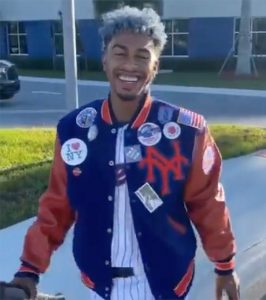 At last, the jacket fits. “Good morning, my neighbor!” Lindor greeted us in the viral video that resulted, just as Akeem did in Coming to America. It set just the right tone for the season ahead.
Then the season arrived and most everything surrounding Lindor went atonal. That’s the problem with working without a script. On the other hand, improv can be pretty fun, too. Sunday night in New York, in Queens, without any lines penned in advance, Francisco Lindor starred in an even better viral video. He hit a home run. Then another home run. Then a third home run. The third home run was the biggest and baddest. It broke a tie and put the Mets ahead, 7-6, in the bottom of the eighth inning versus the Yankees. The second home run, particularly its trot, is what was destined to go viral, as Lindor let the Yankees know he and his teammates knew what the Yankees were up to with stealing signs and signaling via whistling the night before.
Lindor earned his varsity letter Sunday night. Earned both of them, the N and the Y. He stood up for dear old Payson State. He stood up for the righteous side of town. He stood up against the Yankees, which is all we ever want out of our Mets in these Subway Series spectacles. He did it in the spotlight game of the week, presumably interrupting the nonstop narrative devoted to the interlopers from another borough. I say presumably because the MUTE feature is very handy when watching Sunday Night Baseball. Couldn’t miss the camerawork finding Yankees fans in the stands, though. Except once Lindor took over, there was way more of him than there was of them.
On Saturday night, I — who can only pick up on what a pitcher is about to throw after an announcer tells me what I just saw — said as Taijuan Walker was giving up home run after home run, “He’s tipping his pitches.” If I can figure it out from my couch, professionals on location are surely all over it. Walker’s legally changed his last name to Gopher in the second half, but belting everything over the Citi Field fence was coming too easily, even for the Bronx Bombers. He had to be tipping his pitches. Sure enough, Jonathan Villar called time and trotted to the mound to clue in Walker/Gopher that something was up, besides a plethora of Yankee longballs. I didn’t know at the time that somebody in the visitors’ dugout was whistling as part of the communications process. I had Fox on MUTE by then. Also, Villar at third base was a lot closer to the situation than some occasionally intuitive home viewer.
There are implicitly approved ways to relay comprehension of what’s about to be thrown and there are ways you don’t do it. The best antidote is not allow it to be picked up, but Walker had already let that cat slip from its eco-friendly reusable shopping bag. The Yankees apparently figured it was cool to whistle loudly enough so that Villar, not to mention their batter at a particular moment, could hear it over a sold out house. It may not be cameras & trash cans, but it crosses a line if you’re on the other side of it. I’ve always said when it comes to nodded codes of conduct and unwritten rules, if the Mets do it, it’s fair game. If it’s done to the Mets, it’s foul play.
The Mets called foul. Specifically, Lindor called foul as he rounded the bases that second time Sunday (you have to delineate which time; he did so much bases-rounding). He made a whistling gesture. The Yankees took offense because how dare the Mets not put up with their nonsense? Don’t they watch national telecasts with the sound up and hear how the Mets are merely pawns in the grand Yankee chess game to which we are all privileged to witness? The Yankees also have offense, embodied late Sunday night — Sunday night was nothing but late — by Giancarlo Stanton, who homered off Brad Hand to tie the game. I doubt Hand needed to tip his eponym for Stanton to smack one far in Flushing. Stanton was doing that when his first name was Mike and his tint was teal. What he hadn’t done before was bark at the Mets while in mid-trot. How dare you question our Yankee ways?!?! That’s what it looked like he said on TV. I had the sound muted.
Players left their benches and congregated without choreography on the field for a spell. There was some fuming. There was some delaying, because what would Sunday Night Baseball be without extending itself even later? There was Lindor as Dee Snider, leading his band in a chorus of we’re not gonna take it. No fists flew, nor should they have to in a game of baseball, but it felt like indeed we weren’t gonna take it anymore. Not the Mets of Lindor, which is likely how we would be perceiving the Mets had Lindor not struggled at the plate most of the season and missed a chunk of it injured.
It’s September now. The Mets’ playoff possibilities are thin and hang by a thread that’s thinner. There’s no time for being aggravated at April-through-August Lindor, though you’re welcome to carry a thumbs-driven grudge. I’ve magically purged that memorable gesture from my consciousness. Javy Baez has hit like crazy since letting off his steam in a questionable fashion (2-for-4 this Sunday, continuing his special relationship with the supposed day of rest). His partner in simmering alienation has similarly shaken off his personal blanket of fog. Francisco was supposed to come to New York from Cleveland and overwhelm our airwaves with what made him a star from whence he came. So was Pete Franklin.
I’m thinking Lindor is a better fit for the marketplace than the raspy sports talk host who swung for two years on WFAN but never really connected. Of course I’m thinking nothing but wonderful thoughts of a shortstop who just hit three home runs; drove in five runs; channeled Tanner Boyle from The Bad News Bears by telling the Yankees they can take their whistle and shove it up their asses; secured a game that seemed intent on getting away; led us to a 7-6 triumph that kept our pulse beating faintly in our quest for a division title or Wild Card berth; and, because it shouldn’t go unnoted, made sure we won the 2021 Subway Series four games to two.
Because we see only one or two Mets per night sitting down in front of a Zoom camera, we don’t get the panoply of reactions we used to after a game when reporters filed into the clubhouse. Maybe Michael Conforto or Pete Alonso had something insightful or leaderly to say in the wee hours of Monday morning once the four-hour, six-minute nine-inning contest was complete. We didn’t hear from them. But we heard from Lindor postgame. I had the sound up for that. Francisco in the Met-managed media session sounded like the guy whose team this is, the guy who believes himself responsible for what this team can be. I don’t know if he was genuine, but he sure as hell seemed genuine. It was the Yankees now who were weaving tales of rats and raccoons (claiming their Saturday night whistling was just innocent energetic cheerfulness). It was Lindor acknowledging that while the great game was no doubt great, he and the Mets have a long way to go. That may not have been exactly what he said, but that’s how it came off. Mature. Realistic. Our team’s leader.
Admittedly, I’m still high off Sunday night and the three homers, but I like this Lindor. I think it’s the Lindor we got before he put on the NY jacket, before he realized what the NY on the jacket was getting himself into, before he fully grasped that New York ain’t just a bigger Cleveland. He’s an been an extraordinary ballplayer for years who’s played below average much of his first year in a new situation. When it was necessary for him to be extraordinary again…well, it’s been necessary all year, but he picked a good night to save it for in case he was waiting to remind us why we were delighted to trade for him and sign him into the next decade.
Welcome to the neighborhood, Francisco. Like you, we’re really not so bad once you get to know us.
___
Tuesday and Wednesday night at 8 PM ET, ESPN will show under the 30 for 30 umbrella Nick Davis’s epic story of the 1986 Mets Once Upon a Time in Queens, two hours each evening. Set your DVRs accordingly. Talk about evoking an overwhelmingly successful production from New York in the late 1980s. I saw the first half at a Citi Field screening two Fridays ago. For Mets fans, it’s the cinematic equivalent of somebody in orange and blue blasting three home runs in a Subway Series finale. (And, as evidenced by the ESPN commercial that’s run during recent Mets games, I’m in it, portraying the lone New Yorker who didn’t party the ’80s away — well, me and Gary Carter.)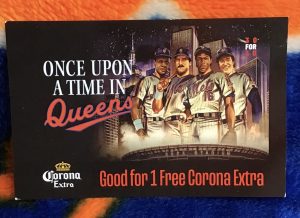
Dave Loggins beseeched his girlfriend to please come to Boston for the springtime, please come to Denver for the snowfall, please come to L.A. to live forever. That’s a lot to ask. I’m merely suggesting you (please) come to Freeport, L.I., to hear me talk about writing about the Mets this Thursday night at 7 o’clock, the Freeport Memorial Library, 144 W. Merrick Rd. The Mets aren’t playing, Yom Kippur will have ended and monumental documentaries aren’t premiering. Honestly, I can’t think of an excuse not to come.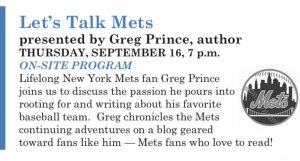
There is not only a deep-dive podcast devoted to Curb Your Enthusiasm — titled, appropriately enough, Pretty Pretty Pretty Good — but it’s produced by Mets fan Av Sinensky, which means when they got to the 2011 episode featuring Bill Buckner, Av called on another Mets fan he knows to delve into the significance of this Buckner character. You can listen to me speak to that particular time in Queens here at approximately the 2:14 mark. That’s two hours and fourteen minutes in, or the equivalent of five innings in Sunday Night Baseball terms.
by Greg Prince on 12 September 2021 1:18 pm Amid the myriad personnel moves the Mets have made this year, it’s easy to overlook the contributions of three players in particular. Dale Late has put his stamp on the starting rotation; Buck Short has become a presence in the middle of the order; and before being relegated to part-time duty, Mo Mentum looked to be a real factor. Indeed, the Mets were ultimately defined in their Saturday night game against the Yankees by the actions of the aforementioned trio.
Dale Late wasn’t sharp early, and allowed the Mets to fall behind by a substantial margin, but then he found his groove and gave the Mets enough innings to call it a good start.
Buck Short loomed as a threat all night, particularly as the Mets threatened to retake the lead they’d battled so hard to take after trailing, but his last big swing came up a little shy of making the crucial difference.
Mo Mentum? Frankly, I thought this might be the night we’d see Mo Mentum earn an everyday slot, but I’m sure those who analyze and strategize have their reasons for keeping Mo Mentum from really developing into the kind of player who can help the Mets sustain consistent winning.
As it was, there were several players who came through and kept the Mets in the game, but in the end, the club came up a day late, a buck short and had no momentum, falling, 8-7. Each of the Mets’ last eight losses has been by one run, coinciding with the additions of Late and Short to their roster and the subtraction of Mentum from their lineup.
***
Prior to Saturday night’s game, Citi Field hosted what appeared to be thoughtful and well-done ceremonies to commemorate the twentieth anniversary of the September 11 attacks (“appeared,” because Fox kept cutting away from the ceremonies in order to yap and advertise). Manager Bobby Valentine, first base coach Mookie Wilson and eleven members of the 2001 Mets were on hand, as were hundreds of people with a specific connection to the events, aftermath and ongoing commemoration of 9/11. The current Mets broke out special home white NEW YORK jerseys to emphasize their bond with the city; wore the caps of the FDNY, the NYPD, the PAPD, the Department of Sanitation and the Department of Correction to honor those who gave so totally of themselves in the wake of the tragedy; and lined up alongside their interborough rivals to stress two opposing sides can sometimes come together. Even a person who isn’t particularly excited to see another New York team visit Queens under any circumstance considered it a nice touch.
The pregame production echoed that of the first game back at Shea Stadium in September of 2001 as well as the tenth-anniversary remembrance of September 2011. When it comes to reaching out to their community, the Mets organization indeed never forgets.
by Greg Prince on 11 September 2021 12:38 pm I resent the Yankees. I’ve always resented the Yankees. I resented them from the first time I became aware of their existence. I understood neither the purpose nor appeal of their existence. It was 1969. New York had the Miracle Mets, the baseball team about to be certified world champions. I met the Mets as they surged into first place and I fell in love. Why wouldn’t everybody around here do the same? For what did New York need this additional, wholly irrelevant baseball team nestled in fifth place a million games behind Baltimore? Why would New York divert as much as a scintilla of its affection from the Mets to any other baseball team?
My resentment has alternately simmered and boiled for more than a half-century. Boiled a lot for a very long while. Simmers now. These days, out of sight, out of mind. I’ve trained myself to pay them as little mind as possible. For 156 to 158 games of a regulation season, it’s not that difficult. Don’t tune into that channel you don’t want to watch. Don’t listen to that station you don’t want to hear. Don’t click on the content you don’t want to consume. Live in New York, and some Pinstriped propaganda inevitably filters in, but I try to let it flow out. I’m not beyond monitoring standings in the interest of a stress-free October. Big picture only, however. I don’t dabble in their details. I don’t care to know.
This was mostly impossible in the years leading up to and out of 2001. The Yankees had won four of the five most recent World Series, including the last three. They won the 2000 World Series as visitors to Shea Stadium. It was an uncomfortably homey visit for them. Those Mets were an outstanding team in those days. The pennant in 2000. The ride of a lifetime in 1999. Those Mets weren’t as outstanding as those Yankees, though. An invigorating evening there, a delightful afternoon here, but never for more than a blip. The receipts don’t lie. We weren’t outstanding enough.
New York’s attention, except for that belonging to those of us bound to be classified as social misfits, was inevitably theirs. 1969 was ancient history. 1986 was slightly less so. Our version of 1999 and 2000, with its 97 wins one year and 94 the next and postseason dramatics both years, was rendered a footnote. I knew this was deep down a National League town, a town whose highs were never higher than when the Mets did the elevating. But that knowledge, like those ever fainter veins of orange and blue, was too deep to matter by 2001. Nobody called New York an American League town. It was an overwhelming success town, populated by millions, yet large enough only for pervasive winning. There was next to no room for the nicest of tries. We who didn’t flock to the ritual parades and dutifully celebrate the overwhelming success in our midst were dismissed as The Other. There were Yankees fans and there were The Other people — buncha weirdoes — who for some strange reason opted not to be Yankees fans. That was the extant dichotomy served up to us dally and nightly c. 2001. It was that framing I resented far more than however many rings were being counted, added and brandished.
You don’t need me or anybody to admonish you to never forget September 2001 in New York from a topline perspective. I think that’s covered. From a baseball perspective, in case you’ve forgotten, it was business as had been usual. The Yankees were cruising toward another division title. The Mets were fighting furiously to catch up to the Braves. I resented the Braves, too, but only situationally. The prevailing situation was the Braves won the National League East annually. I didn’t question the Braves’ existence. I just wished to finish a season ahead of them.
Then September 11. You remember that. The date nobody is going to forget led to six days of no baseball and me personally not caring when baseball came back. But baseball did come back on September 17. For two days I barely cared that it was there and questioned why I should care at all. By the third day, with the Mets completing a sweep in Pittsburgh, I began to care in earnest again. Began to. I wasn’t all the way back yet. The Mets had won 20 of their previous 25 games and had picked up eight-and-a-half games on first place in the process. It was hard not to begin caring again. The Braves — the first-place Braves — were next on the Mets’ rearranged schedule. Home games. At Shea. I was going to the first of them and third of them.
Short version: the Mets won the first of those games, on September 21. Mike Piazza hit the deciding home run in the eighth inning. That’s a very short version. You know about the home run. You’ve likely been reminded of the home run this week along with that game and its significance marking the first time a load of New Yorkers came together to do anything other than be despondent since September 11. I’ve read and heard several Braves from 2001 admit in 2021 it didn’t bother them to have lost to the Mets in New York that night, among them T#m Gl@v!ne, who told the Atlanta Journal-Constitution, “It’s probably one of the only games in the big leagues that I was part of the losing team and really didn’t care.” (We can guess one of the others.)
I wonder if the Braves really felt that way at the time or if they’ve revised their view of events twenty years after the fact out of empathy with the city that had just endured unspeakable horror. I wouldn’t hold it against them if in the course of competition they were legitimately bothered they lost that game. They’re not supposed to want to lose to the Mets in New York any more than in Atlanta. From all I could tell in Mezzanine, they were trying to win. It took Mike Piazza hitting an eighth-inning home run to beat them.
Helluva home run. A lot of people divined a lot of meaning from it, and I’m glad it gave them the boost they needed. I understood what it looked like as it soared out of Shea, but what it meant to me was Mets 3 Braves 2 and the Mets having lopped a little more off the Braves’ divisional lead. Despite my presence in the ballpark, I still wasn’t all the way back. I still wasn’t convinced baseball was of passing let alone paramount importance in New York in September of 2001. Even a Mike Piazza home run that was destined to endure as his signature swing wasn’t enough to more than nudge me.
The Mets won the second game of that series and whittled the Braves’ NL East edge down to 3½. Then, with me in attendance, they blew a three-run ninth-inning lead and lost in eleven in that third game. Brian Jordan, one of the 2001 Braves who says he “didn’t mind losing a game” in New York on Friday, wasn’t going to let it happen again on Sunday. Or the following Saturday, in Atlanta. Brian Jordan killed us and our comeback aspirations twice in a six-day span, each time with a lethal home run in the decisive inning. In September of 2001, I doubt I would have used “killed” and “lethal” for something as silly as a baseball game played in the shadow of unspeakable horror. But after Jordan took his first deadly swing against the Mets, I knew I was back because I was far more devastated by his home run than I had been uplifted by Piazza’s. The Mets mattered to me in full again. The Mets going to Montreal and sweeping three from the Expos in between Jordan’s hatchet jobs mattered to me. The Mets having one last gasp at Turner Field (and that gasp being smothered) mattered to me. I knew it only mattered infinitesimally in the scheme of much graver things, but I let it matter to me. There was no way it wasn’t going to eventually.
I was so proud of the Mets that September. Disgusted by them once Jordan unleashed his grand slam on John Franco to seal the 8-5 loss of September 29, but proud nonetheless. Proud of the late run they’d put on to salvage their season (25-6), and proud that they allowed us to briefly imagine a baseball miracle that might have made 1969’s seem ordinary, but proudest of how they conducted themselves. They came back from Pittsburgh on a bus once their games the week of September 11 were postponed and they put themselves to work as best they could. Perhaps all that blending into the New York background in the late 1990s and earliest 2000s imbued them with an additional layer of humility. Maybe they were just all good guys. They pitched in at the Shea Stadium staging area as if they weren’t big-time big leaguers. They visited the rescue workers who needed desperately, if only for a minute, to see something besides piles of rubble. They exchanged caps with members of one service agency after another and they wore the caps they received to represent them on the field of play. They’d won a slew of games down the stretch. They were winners regardless that the slew wasn’t adequate to the task of taking down the Braves.
And then the Yankees went to the World Series in October and a little of November and were lauded far, wide and singularly for being the focal point of what New Yorkers could at last cheer about.
The fall of 2001, particularly in New York, was a time for unity, for nobody being classified as The Other. I felt it in many ways, but not this one. I felt resentful. I felt like a clod for feeling resentful under the circumstances, and I tried to rein in my resentment, but resentment reigned in my heart. It wasn’t a contest, I kept telling myself. It was the aftermath of unspeakable horror and whoever and whatever could bring a little light into people’s lives should be welcome.
But I did not welcome the Yankees into this framing, certainly not at the expense of the Mets and what they did and how they represented themselves and their city. All the never forgetting, and the 2001 Mets were forgotten in a matter of a month. I would have been thrilled had anybody beaten the Yankees in the ninth inning of a seventh game of any World Series and stuck a spoke in the dynastic wheel that had run roughshod over New York’s baseball narrative for a half-decade. This stick, stuck as it was by the Arizona Diamondbacks in the ninth inning of the seventh game of the 2001 World Series, was a stick whose existence I exulted in without shame. The way I rationalized it, everybody got what they came for. Those who liked the Yankees and needed something to take their minds off of everything else got to keep watching their team for the extent of an entire postseason. The rest of us who resented the Yankees and needed something to take our minds off of everything else (if not the bleeping Yankees being in another bleeping World Series) got the pleasure of watching their arrogant ass vault forward from the haughty seat of their self-satisfied ten-speed.
Something for everybody.
If scheduling the two New York teams to play one another on the twentieth anniversary of September 11, 2001, was meant as a throwback gesture of unity, it hasn’t performed its magic on me. Not on September 10, 2021, at any rate. I always resent the Yankees coming into Citi Field just as I always resented the Yankees coming into Shea Stadium. I resent their fans and their caps and their sense of entitlement occupying any space inside our physical environs. I continue to resent the existence of the Yankees in any context, including that of Interleague opponent on a symbolic weekend. I’ll craft my own symbolism, thank you very much.
Nonetheless, on Friday night the stumbling Mets walloped the slumping Yankees, 10-3. It was beautiful, despite my misgivings that this opponent and this matchup existed. The Yankees, who I grant you are still a better bet to make their playoffs than the Mets are to make theirs, made too many egregious errors in execution and judgment to accurately aggregate. Jeff McNeil laid down the most gorgeous drag bunt with the bases loaded. James McCann delivered his first clutch hit since Queen Elizabeth let her subscription to Tiger Beat lapse. Francisco Lindor homered. Javy Baez made all kinds of defense-flummoxing contact. Tylor Megill was sharp for seven winning innings. Jonathan Villar, about to be out by the proverbial twenty feet, was safe at home on the most hilarious non-tag from Gary Sanchez you’ve ever witnessed. The play so defied credulity that you couldn’t scoff that it took the injection of replay review to overturn the initial incorrect call by Ted Barrett. Unless Sanchez was inhabited by the 2001 Bravelike spirit of believing it wrong that the Mets lose on this Friday night in Flushing, it was unfathomable to infer what was going through his mind as Villar almost accidentally slid under and past him.
We can differ on particulars as we go along, but we should all be united in kindness to one another; in acceptance of one another; in wishing well-being to one another; in acting in ways that don’t harm one another; in not unnecessarily and obnoxiously obstructing one another from living our best, healthiest and freest lives.
And we should all be able to resent the Yankees as much as we want and feel fine about it.
by Jason Fry on 9 September 2021 10:33 pm The New York Mets are worth your time. They’ve got a rich history, by turns tragic and comic and occasionally even triumphant, that’s fun to be a part of. And one year, maybe even a year pretty soon, they’ll add something to the triumphant part of that history. And that’ll definitely be worth your time.
But the 2021 Mets? Not so much.
This year’s team can’t get out of its own way. It can’t beat good teams, as it made abundantly clear last month, but it can’t beat bad ones either. Remember a week ago, when this stretch against the Nats and the Marlins was going to be their springboard back into competition? Well, that stretch is done and they went 4-4. When you go 4-4 against the bottom of your division’s barrel, you’ve shown anyone who’s paying attention exactly what you are.
Meanwhile, look around you. Odds are you aren’t in a gulag. (And if you are, well, good on you for finding one with Internet access.) This is the sweet part of September, when the days are still kind enough for shirt sleeves and some of the nights are starting to turn pleasantly cool. Those are nights for languid dinners and romantic strolls and gentle reminiscing and making big dramatic plans. (Though hey, bring a mask.) Make the most of them, because in a blink of an eye the wind will bite and it’ll be dark early and you’ll want each and every one of those nights back.
My advice? Don’t waste the precious remaining ones on terrible ballclubs that can’t get out of their own way. On misbegotten outfits that can play down to any level of competition. On organizations that have rotted from the top and need pruning. On the 2021 Mets, who don’t deserve your belief or your hope, having rewarded neither.
Another incarnation of the Mets will show up pretty soon. Save your passion for that one, because maybe it will love you back in a way this version can’t.
That’s what I’m doing, or at least the mini-version of it. Tomorrow I’m heading to Rome, which means eight and a half blissfully Met-free days await me. That wasn’t the point of the trip — once upon a time I even cringed when I saw I was missing the Subway Series — but all of a sudden it feels like a Get Out of Jail Free card. In my absence be nice to Greg, whose patience with my vagabond ways has probably never been as sorely tested as it’s about to be. Be nice to each other. And don’t forget to be nice to yourselves. Whether that means more baseball or less of it … well, I suppose that’s up to you.
by Greg Prince on 9 September 2021 2:00 pm Ten years ago this month, Mets fans hung on the statistic of batting average. Never mind that analytic understanding had taken its toll on the popular utility of what used to be considered the defining standard of hitting excellence. Never mind OPS. Never mind WAR. A Met was competing for the highest batting average in the National League. He could win the Batting Title! He could win the Batting Crown!
And so he did. Jose Reyes edged out Ryan Braun, .337 to .332, with Matt Kemp falling back at .324. Though it ended a little inelegantly, the batting title race was incredibly absorbing in September 2011, especially considering there was really nothing else at stake for the Mets as Terry Collins’s first term at our helm wound down.
I don’t remember batting average much infiltrating the Metsian discourse in the seasons or Septembers since, at least until September of 2021, when, on Wednesday night, every Mets fan grew hyperconscious of the grand old stat. Every Mets fan had to, not because there were a couple of batting averages that were close, but because there were a couple that were distant…very distant.
It was the bottom of the tenth inning in Miami. Sandy Alcantra had kept every Met off the board for nine innings, save for Michael Conforto, who had homered in the seventh. Alcantra, who just turned 26, allowed only four hits and struck out fourteen in the span of a regulation complete game. He dominated the Mets on Wednesday night like the Reds’ Jim Maloney dominated the Mets that night in 1965 when Maloney, then 25, held the Mets to no runs and no hits while striking out fifteen through nine. Because it was 1965, Maloney went back out to the Crosley Field mound for the tenth and struck out two more Mets while continuing his no-hitter.
But just as the Mets had Frank Lary in 1965, they have Rich Hill in 2021, and now as then, the old veteran in New York gray was a match substantively if not stylistically for the younger home team hurler. Lary, 35, went eight and gave up no runs, supported by Larry Bearnarth, who maintained the shutout for those usually futile Mets into extras. These Mets of today, ensconced for an evening in Hill country, were enjoying similar success in the tops of innings. Hill went six and struck out eight, giving up only a single run. Rich Hill is 41. Six innings is pretty much his ceiling. In 2021, six innings is almost every starting pitcher’s ceiling. In 2021, Alcantra going nine amounted to a miracle.
Hill was succeeded to the hill by Jeurys Familia, Aaron Loup and Seth Lugo. None was perfect. Each permitted at least one Marlin to reach scoring position. Lugo loaded the bases. None gave up a run. The Mets arrived in the tenth inning in a 1-1 tie.
While the Mets and Marlins were stuck at 1-1, the Braves and Nationals were dueling at 2-2 and the Phillies and Brewers were deadlocked at 3-3. Everybody in the National League East chase was essentially batting .500 for the night. None had ever been far enough above .500 for the year to put the other two away. The Mets, at 70-69, enjoyed contender’s privileges entering the tenth inning Wednesday night because of favorable league and geographic alignment. You don’t want to take 70-69 to any other division. It wouldn’t get you past the velvet rope. In the NL East, it had the Mets four games out and aspiring to meaningfully reduce that margin.
First, though, they’d have to score on the Marlins in the tenth. Even with a runner plopped onto second base to start the half-inning, that’s easier said than done. Done, as it turned out, proved difficult, then impossible. The Mets, despite no longer facing Sandy Alcantra, pushed their unearned runner, Conforto, no farther than third base against the presumably less imposing Anthony Bender.
Following Familia, Loup and Lugo out of the bullpen for the bottom of the tenth was Edwin Diaz. As the setting wasn’t Washington, perhaps a Mets fan could breathe a sigh of relief. As the situation wasn’t save — and a free runner was granted by Manfredian fiat to the Marlins — a Mets fan could only sigh. Whatever Diaz was dropped into, it was his task to guide us out of it.
He could’ve used some help from the dugout. What was it Al Pacino as supersalesman Ricky Roma said to Kevin Spacey as office manager John Williamson in Glengarry Glen Ross?
“What you’re hired for, is to help us — does that seem clear to you? To help us, not to fuck us up. To help those who are going out there to try to earn a living.”
Then Roma calls Williamson an epithet I’m not comfortable repeating, before labeling him a “company man”.
With Jazz Chisolm having materialized out of the imagination of Rob Manfred on second base, Magneuris Sierra bunted the unearned runner to third. It was a sacrifice; one out. Edwin Diaz then K’d Jesus Sanchez; two out, with Chisolm still percolating on third. First base was extraordinarily open in a tie game in which a hypothetical runner at first was of no consequence to the potential final score.
Now what? Now it was a choice for the dugout, for Luis Rojas. And it was where batting averages rose to hyperconsciousness. The next batter up for Miami was Bryan De La Cruz. De La Cruz, though he doesn’t have nearly enough at-bats to qualify for the Batting Title, stood on deck with a batting average of .336. The Marlin in the hole was Lewin Diaz. Lewin’s batting average at that moment was .108. Lewin Diaz was 4-for-37 on the season and 0-for-4 on the night. Bryan De La Cruz was 39-for-116 on the season and 2-for-4 on the night, having doubled in the second, singled in the fourth and looked good each time up. On the other hand — or in terms of hands — De La Cruz bats righthanded, while Lewin Diaz bats lefthanded. Edwin Diaz, you’ll recall from your familiarity with his form, is righthanded.
All things being equal, conventional wisdom suggests you have the righthander pitch to the righthanded batter. That wisdom goes back to the days when America leaned forward with baited breath to learn who was where in the battle for the Batting Crown. Then again, the righthanded batter in question had a very high average and the lefthanded batter was still working on descending into a bathtub with little guarantee that he might hit water. All things were not equal.
Rojas, a respected baseball lifer from the esteemed Alou baseball family and not someone who requires remedial schooling in such matters, could have instructed his Diaz to put De La Cruz and his .336 average on first base and pitch to the other Diaz and his .108 average. Righty-lefty be damned, 228 batting average points separated the manager’s choices. Not that anybody in the majors is incapable of hitting anything with a bat in any hand, but some percentages are too blatant to ignore. You gotta help your reliever here, especially one whose psyche may not be made of the sternest stuff after too many late innings pitched without a net.
Or as Roma said to Williamson, “I don’t care whose nephew you are.”
Luis Rojas, a valued company man within the Mets organization since 2006, had Edwin Diaz pitch to Bryan De La Cruz, he of the .336 batting average. Within three pitches, Bryan De La Cruz owned a .342 batting average, having lined a fly ball far over the head of Albert Almora until it banged off the center field wall. Chisolm crossed the plate quite safely. The Marlins, now twenty-three games below .500, had defeated the Mets, now exactly .500, 2-1. The third-place Mets’ six most recent losses have each been by one run. That will earn nobody looking to move up a set of steak knives, let alone a new Cadillac.
The contests in Atlanta and Milwaukee managed to go the Mets’ way. The Braves lost. The Phillies lost. The 70-70 Mets didn’t lose ground, except to the calendar, on which a day disappeared and the Mets didn’t close ground. They are still four games out of a division lead despite being absolutely average when it comes to wins and losses.
Which isn’t likely to cut ice, even in the glacial NL East of 2021.
(PS: In case you aren’t aware of how the game of June 14, 1965, ended, Johnny Lewis homered in the top of the eleventh to break up Maloney’s no-hitter. Bearnarth proceeded to hold the Reds at bay to preserve the 1-0 lead, saddling Maloney with an eleven-inning, albeit eighteen-strikeout defeat. It’s not recent, but by appearing in the final sentence of this essay, it constitutes the only happy Met ending readily available.)
by Jason Fry on 8 September 2021 12:17 am Hope springs eternal if you’re a Mets fan, but even springs can lose their sproing. Come Tuesday evening, I have to admit I wasn’t particularly feeling it — if you’d shown me a flash card that said METS, I most likely would have responded by having a tantrum about Edwin Diaz and demanding to know why everything has to suck beyond endurance. But the games go on and so do I, so I sat down, albeit a bit grumpily, and watched Pete Alonso connect for a gigantic home run to give the Mets a 2-0 lead in the first inning.
Once that would have been heartening. But after watching the Mets lose a lead 4.5 times that big, not so much. If I had a medical chart, it would have read LACK OF SPROING.
Sometime after Carlos Carrasco turned in his usual inept first inning, my phone rang. It was our handyman, without whom our apartment would collapse into a pile of drywall and regret. For the next half-hour or so he clucked sympathetically as I showed him damage from Ida and details that needed to put right after a window installation, and every so often I could hear Emily upstairs, making noises. They didn’t sound like crows of triumph; more like disgust mixed with disdain.
That was about what I’d expected, but eventually I couldn’t take it any more.
“What’s the score?” I asked between bouts of assessing broken stuff.
“4-2.”
“4-2 good or 4-2 bad?”
“4-2 good.”
Emily told me that the Marlins’ pitcher had walked three guys in a row and then hit two guys in a row, which sounded so unlikely that my brain refused to process it and I needed it verified again later, to her consternation. It was that kind of game — six errors, too many other instances of dopey baseball to count or countenance, and a couple of thousand fans scattered around New Soilmaster Stadium who sounded unsure about whether being there meant they’d made good choices in life. (They hadn’t.)
Oh, and there was some doofus dressed as a fucking piece of toast or something. (Don’t tell me what it was in the comments, because I don’t care.) I hope that guy got paid. Actually, I hoped Jeff McNeil would find a reason to take offense at the thing’s presence (not impossible) and start pummeling it (less likely but also not impossible).
Honestly, isn’t this the way we should have known this deeply weird, deeply stupid Mets season would gutter into darkness? Our team’s fate was never to be on the last-weekend stage as gladiators bound for death or glory, much as we tried to wish that finale into being. It was to wind up in front of a tiny, bored crowd throwing haymakers at the Marlins and receiving the same, like a pair of blindfolded drunks.
It sounds tragic, but the 2021 Mets never flew high enough to deserve that word. “Farcical” doesn’t make sense either, because that implies some higher purpose squandered, and I don’t think that ever existed.
Honestly, the Mets and Marlins should play all 162 games against each other, every year. They’d make several errors a night; Pete Alonso would club 75 homers; some combination of Gary, Keith and Ron would sigh about the latest Marlins who don’t know how to pitch; McNeil would finally cold-cock that stupid piece of toast; and 54 different Marlin infielders with microscopic career OPSes would do Marlin things that left Edwin Diaz to glumly explain what he think went wrong this time. Some years the Mets would go 85-77 and some years they’d go 77-85 and none of it would matter much less than anything matters now.
Why not? We’d even win a few. Let’s do it. New Soilmaster awaits. Catch the torpor.
by Greg Prince on 6 September 2021 11:42 pm “L’shanah tovah,” give or take the “L’” (and maybe the silent h’s), is a greeting that’s passed back and forth when the Jewish calendar changes, as it has from 5781 to 5782. The Mets could use a new year themselves. One-hundred thirty-eight games in, this 2021 business can’t quite work the kinks out.
On Monday afternoon, a few hours before sundown, the Mets labored the day away in Washington, rapping out a dozen hits, making several impressive plays in the field, riding the sixth-starter high-wire act of Trevor Williams for five innings, feeding off the thirtieth home run from Pete Alonso and nursing a 3-2 lead until the bottom of the ninth. With twelve hits, there should have been more than three Met runs, but the Nationals hadn’t made more out of eleven hits than two runs, so just take what the LOBs will give you and hand it off to Edwin Diaz for safe keeping.
Or, on second thought, don’t do that. Edwin Diaz has had many fine outings in 2021. He’s also made a terrific commercial for suite rentals at Citi Field. The best part of it is he’s not pitching in the ninth inning at Washington when he’s in it. On the mound at Nationals Park in the ninth inning, let’s just say Edwin Diaz will not win any awards for acting. Or closing.
Diaz stood sixty feet, six inches from Alcides Escobar and fed him four balls to lead off the bottom of the ninth. At that point, you understood the 3-2 lead was likely short-lived. “Oh look,” you might have thought, “there’s Juan Soto in the on-deck circle. I guess I can get on with my barbecue/synagogue plans now.” Except Soto was retired on a leaping two-handed grab by Jeff McNeil in foul territory just beyond the left field line. McNeil is not a left fielder by trade, but he seems more dynamic when untethered from second base, his usual position.
So we escaped the obvious dagger Soto represented. All Diaz had to do was, honestly, not be Diaz for a change. Look, we’re trying. We’re really trying not to be that hairtrigger fan who spouts fatalistic four-letter exclamations at the sight of our imperfect closer. We try to believe every upbeat stat meant to convince us that the Edwin Diaz we think we knew in our first horrifying year together isn’t automatically the Edwin Diaz who emerges from the bullpen in the present. We want to love Edwin Diaz or at least not cringe at the sight of Edwin Diaz. But Sugar, ya gotta meet us three-thirds of the way in a ninth inning like this. We need you to get three outs and not give up a run — certainly no more than a run with a one-run lead — when it’s Labor Day and we fancy ourselves playoff contenders.
At two-and-two on Josh Bell, Diaz almost had Bell struck out. Bell checked his swing, which it seems for decades wasn’t acknowledged by umpires as a thing. You moved your bat a little, you swung. Here, Chris Conroy wasn’t so stern and called it a ball. But James McCann asked for help from Pat Hoberg at third base. Hoberg, too, was lenient. The ball to Bell stood and now the count was full.
Two pitches later, Bell walked, Escobar was on second, and Andrew Stevenson was up. Andrew Stevenson has been trouble to the Mets since late in 2020 when he fluffed up Jacob deGrom’s ERA (albeit from 2.14 to 2.38). Stevenson was trouble on Saturday converting the nah, they can’t possibly blow all of a nine-nothing lead to wow, they blew all of a nine-nothing lead. Monday was no holiday, secular or otherwise, for Stevenson’s darker instincts. He fell into an oh-and-two hole, yet climbed out, singling to right. Escobar, still on our spit list from the 2015 World Series, motored home. Michael Conforto heaved a decent throw to McCann, but it was too late to prevent a tie.
Except, wait a sec — did Escobar touch the plate? It sure didn’t look sure. He definitely missed it on the front end, but the back end was tougher to tell. An umpire’s review (different from a challenge) was instigated. Our best hope, previously thought to be Diaz’s slider, was now on the replay shadow docket.
We got no relief. Like Bell’s checked swing, I didn’t think what we needed to go our way actually went our way, but maybe somebody in authority would see it differently. Somebody didn’t. The run stood, the game was tied.
Had there been a Players Weekend promotion this season with players wearing darling nicknames on the backs of their jerseys, Carter Kieboom’s could have been A MATTER OF TIME. Once Diaz began not getting Nationals out, it was a matter of time that some National with a bat in his hand would end the ninth with something other than a trudge back to his home dugout. Kieboom rapped a ground ball up the middle that a playing-in Francisco Lindor couldn’t smother (and probably couldn’t have pivoted to throw home if he had). Bell wrung the last iota of hope out of the ninth, indisputably touching home plate and saddling the Mets with their second 4-3 loss of the five-game series.
Now we’re four games out with 24 to play, which isn’t as swell as being three games out with 24 to play. The loss in D.C. wasn’t fatal, but it wasn’t helpful. Diaz leaving the mound with the door ajar is essentially a cookie-crumble in June or some earlier month. Buck up, go get ’em next time! In September, the same missed opportunity to preserve a win resonates more deeply. And now that he’s got this mini-disaster to go with his blown save from Friday night and the 11-10 implosion from September 2019 on his ledger, I think it’s fair to say we never want to see Edwin Diaz in Washington again. He could run for Congress unopposed from our district and we wouldn’t vote for him.
Not the happiest way to end what we think of as summer. Not the happiest way to usher in Rosh Hashanah, either. There’s another game Tuesday night. That’s not intended as a threat.
by Greg Prince on 5 September 2021 8:35 pm Baseball teams need only one more run than their opponent when the game is over to be declared the winner. I’m pretty sure that’s how it works. Only pretty sure, because I have come to believe the Mets could find a way to lose a game in which they have the greater number of runs at its end. I don’t know how such a result would manifest itself, I’m just not ready to rule it out.
After Saturday’s 9-0 lead became a 9-9 tie, nothing feels off the table of possibility. That the Mets snuck two additional runs onto the board in a so-called extra inning didn’t keep me from wondering if claiming the “11” in an 11-9 final would necessarily earn them the W. They indeed were ruled to have won it in nine — evidence exists they scored their tenth and eleventh runs in the ninth without reflexively allowing a tenth, eleventh or worse run themselves — but the game was supposed to go only seven. “Supposed to” in the sense that seven innings was predetermined as regulation for half of a Manfred-rigged day-night doubleheader, and “supposed to” because the Mets led, 9-0, in the middle of the fourth. The overness of it not being over until it’s over is “supposed to” have a limit.
But it wasn’t over until it was extras on Saturday afternoon, therefore informing the way one was bound to process the doings in Washington come Sunday afternoon. With Saturday fresh in the mind’s eye, there was no we way we ever had enough runs on Sunday.
Not when we scored four in the top of the first (the Nats scored three in the bottom of the first).
Not when we led, 6-3, in the middle of the fifth (the Nats scored three to tie us in the bottom of the fifth).
Certainly not when a single Met run crossed the plate in the top of the eighth to push the Mets ahead, 7-6 (incidentally, when did Nationals Park, heretofore not known as one of those “no lead is safe” havens, move ten blocks from Lake Michigan and elevate 5,280 feet above sea level?).
Heading to the ninth, how many additional runs did you think the allegedly contending New York Mets would need to fend off the cellar-dwelling Washington Nationals?
Would one run do it? Francisco Lindor led off the ninth with a homer, securing us that usually All-Important Insurance Run. Yet we surely felt no more secure at 8-6 than we had at 7-6. Not after Saturday.
Would two runs do it? Between a Pete Alonso double and a Michael Conforto single, we added a second ninth-inning run and were staked to a three-run lead of 9-6.
Not enough. Not after Saturday.
Javy Baez singled for his fourth hit of the game. Jeff McNeil walked. The bases were loaded. Nobody was out. Kevin Pillar, the closest thing we have to Roy Kent, stepped up. Our indefatigable grizzled veteran (“he’s here, he’s there, he’s everyfuckingwhere — Kevin Pillar! Kevin Pillar!”) ripped into the best Austin Voth could throw him and sent it toward Capitol Hill. The Mets had amended their run total six times in the ninth and led by seven. Was lassoing a 13-6 lead enough?
Not really. Not after Saturday. Not in our gut. But in reality, yes. At some point, you have to stop not believing, at least in the scoreboard when the scoreboard blinks its big F at you and your seven-run advantage.
Do you gotta believe in the Mets at 3½ back with four weeks to go in a season that has seen them look intermittently unbeatable and nothing but beatable? We have one more with the Nats, whose players haven’t quite given up as much as their front office did, then three with the Marlins, who are always a pain. That’s the pillowy part of the schedule. Then come five consecutive series against teams with better records than our team. Our belief system will have to be fortified on a nightly basis.
One thing I believe might be beneficial would be to adjust every clubhouse calendar to make the Mets in general and Baez in particular believe every day is Sunday. Consider the last four completed Sunday games the Mets have played (worded as such to include this past Wednesday’s completion of the Sunday April 11 game, which is officially a Sunday game, which is inane bookkeeping, but never mind that right now). In those four games, this is what Javy Baez has done:
• Collected eight hits in thirteen at-bats
• Scored seven runs
• Driven in six runs
• Doubled twice
• Homered twice
• Stolen a base
• Run daringly
• Slid brilliantly
• Said something really stupid about the fans
• Lost a very expensive earring
• And, most importantly, contributed heavily to four Mets victories
Give Javy and the Mets a month of Sundays, and it could get 1973 as hell up in here across these final 25 games. Even without the calendar magically self-editing on the fly, we do have close to a month left in a year in which the Mets’ fate somehow remains to be determined. Is it enough?
We’ll see.
|
|






