The blog for Mets fans
who like to read
ABOUT US

Faith and Fear in Flushing made its debut on Feb. 16, 2005, the brainchild of two longtime friends and lifelong Met fans.
Greg Prince discovered the Mets when he was 6, during the magical summer of 1969. He is a Long Island-based writer, editor and communications consultant. Contact him here.
Jason Fry is a Brooklyn writer whose first memories include his mom leaping up and down cheering for Rusty Staub. Check out his other writing here.
Got something to say? Leave a comment, or email us at faithandfear@gmail.com. (Sorry, but we have no interest in ads, sponsored content or guest posts.)
Need our RSS feed? It's here.
Visit our Facebook page, or drop by the personal pages for Greg and Jason.
Or follow us on Twitter: Here's Greg, and here's Jason.
|
by Jason Fry on 2 July 2021 1:07 pm Give this much to the Mets during their current run of troubles: They’re finding new ways to lose.
But then that’s appropriate for the ballpark they were trapped in Thursday night: White Flight Stadium (or whatever the Braves are calling their shameful taxpayer-extorted shrine to suburbia these days) may not quite be the house of horrors that Miami’s Soilmaster Stadium is for the Mets, but it’s awful close. Bad things happen here if you show up wearing orange and blue: walkoff homers, walkoff bunts, inexplicable errors, and a host of other mishaps and mischances.
On Thursday the bad things came early and then they came again late. Jacob deGrom, the Met most resistant to the Cobb County blues, was handed a 1-0 lead but gave up a leadoff triple to Ehire Adrianza, who came home on an Ozzie Albies single. (Adrianza is rapidly ascending the fraternal ranks of Braves Who Are Pains in the Ass.) DeGrom put Austin Riley in an 0-2 count and threw him a four-seamer on the outside edge of the plate — the pitch he wanted and the desired location pretty much dotted.
Riley hit it over the fence for a 3-1 lead, causing deGrom to rail at the cosmos in the relative privacy of the dugout.
(Let’s note here that Riley is another member of the BWAPITA corps.)
It looked like a night where deGrom might have committed the sin of pitching like a mere mortal — in the second, he allowed a leadoff double to Abraham Almonte, who should have scored on Kevan Smith‘s single but only advanced to third. But DeGrom, at this point no doubt stewing, then did what he does best in this park, fanning Ian Anderson, Adrianza and Freddie Freeman to extinguish the threat. From there he was all but unhittable, at one point striking out eight in a row. So much for flirtations with mere mortaldom.
The Mets drew closer thanks to a Dom Smith homer, then tied the game in the top of the ninth with another Smith longball off Will Smith. (It’s obligatory for me to note that the Braves’ pitchers for the night were Anderson, Chris Martin and Smith, three frontmen for a rather strange music festival. Fortunately, the Mets left Kenny Rogers by the side of the road somewhere.)
At this juncture we should consider an age-old baseball-fan quandary: If your team’s down 3-1 on a bleak evening, would you rather they go gentle into the night or claw back furiously only to lose ungently? Because the Mets opted for the latter, and the disaster came quickly.
It started with Seth Lugo, who two nights ago danced through the raindrops and came out dry but wasn’t so lucky this time. To open the Braves’ ninth, Lugo turned a Guillermo Heredia swinging bunt into man on second, nobody out by throwing a ball past Pete Alonso that he should have put in his pocket.
(What did the Mets do to Heredia during his brief time with them to make him such an enthusiastic member of BWAPITA?)
It looked like Lugo might get out of it: He retired Pablo Sandoval, with Heredia crossing to third, and struck out Smith for the second out. Ronald Acuna Jr. was given first base for free, which was only wise, and it looked like the regulation game would come down to Lugo vs. Ender Inciarte, whose BWAPITA credentials are impeccable. Lugo got ahead of Inciarte 0-2 and then tried to pick him off with everything in his arsenal, dotted on the edges of the strike zone. It was an approach that would have retired 90% of enemy batters, but Inciarte turned in a terrific at-bat, somehow resisting a nearly perfect 3-2 sinker just off the outer edge for an eight-pitch walk that loaded the bases.
Then, on the next pitch: fatality with a side of you gotta be kidding me. Freeman — not a member of BWAPITA because that’s reserved for guys who don’t scare the shit out of us in the first place — spanked Lugo’s first pitch off the pitcher’s foot, sending it caroming to Luis Guillorme on the grass in front of third. Guillorme threw it to first, Freeman beat it, and the Mets had lost.
In hindsight, Guillorme’s only play was a force at third — Acuna’s been slowed by injuries and got a bad break off second, and Guillorme might have beaten him to the bag. And yes, Lugo and Luis Rojas were screaming at him to make that play. But they could see what Guillorme couldn’t. Acuna was behind Guillorme as he was charging towards home for the first necessary ingredient of any play — the ball. To make the play at third, you’re asking Guillorme to register that Acuna has gotten a bad break behind him, secure the ball, arrest his homeward momentum, spin, locate third, and beat a by-now-accelerating Acuna to the bag. Guillorme’s one of the best Mets defenders I’ve seen in the last decade, but that’s asking too much even of him. He took the only play he had, and he made it as close as a fielder could. It wasn’t enough.
It wasn’t enough, and now the Mets get to play the Yankees for what will undoubtedly be three delightful evenings of low-stakes baseball with no additional emotional freight. If things go badly — or even if they go well but you find your anxiety spiking — just remind yourself that at least we’re not in Cobb County anymore.
by Greg Prince on 1 July 2021 1:48 pm Elton John’s “Levon” was “born a pauper to a pawn on a Christmas Day when the New York Times said, ‘God is dead, and the war’s begun.’” What exactly does that mean? As Jimmy Rabbitte said in The Commitments regarding the lyrics to “A Whiter Shade of Pale” in the imaginary interview he conducted throughout the movie with Eurovision host Terry Wogan, “I’m fucked if I know, Terry!” But I do know it sounds like a pretty depressing beginning to a person’s life, fictional or otherwise.
Thomas Szapucki seemed destined for a better start than Levon, certainly Metwise.
The young man himself was born in Toms River, breeding ground for the eventual major league careers of Al Leiter and Todd Frazier. As identified with the town as Al and Todd are, they didn’t more or less share a name with it. Further, Thomas Szapucki was born on June 12, 1996. The perpetually overmatched Mets won for a change on June 12, 1996. They topped the perennial powerhouse Braves, 3-2. You might think if anybody was born to give birth to a Baseball-Reference page full of immediate ebullience, it might be Thomas Mathew Szapucki, especially given that he was wearing a Mets uniform upon MLB arrival and was facing the very same Braves franchise that fell to the Mets the day he was born.
The reality was not even close to that. So let’s call what Szapucki delivered Wednesday night in Atlanta a work in progress. But it was a start. And as Jimmy Rabbitte’s mystical foil Joey “The Lips” Fagan wisely intoned after the Commitments’ unpromising first rehearsal, “I believe in starts.”
Technically, Szapucki’s start to MLB statistics-keeping came in relief. Relief was desperately needed on a night that went awry long before young Thomas got loose in the visitors’ bullpen at Truist Park. Starter David Peterson didn’t have it, unless you want to count a sore right side as “it”. Why was David Peterson’s right side sore? Tests were to be conducted after the game. If David Peterson’s right side was watching the game rather than participating in it, we’d understand the getting sore…at least until falling frustratingly far behind gave way to falling laughably far behind.
Peterson and his right side left in the midst of an inning when the Braves scored seven runs on top of the four they already had. Those first four enemy tallies wiped out the blip of promise that began the night. Pete Alonso had homered in the top of the first, another “I’ll show you” swing apparently directed at me for suggesting the once-celebrated slugger mostly hits singles nowadays. That was Pete’s second homer this week (you’re welcome, everybody). Alas, the early 2-0 lead was gone with the wind provided by a hurricane’s worth of Atlanta offense.
Peterson exited, Sean Reid-Foley entered, and perhaps Sean Reid-Foley suffered from vertigo attributable to the half-dozen times he’s been sent down and called up this season. Reid-Foley’s latest recall was in response to a three-day roster opening that arose when Marcus Stroman went on bereavement leave. That opening is about to close, and likely with it, SR-F’s latest window to major league meal money. Between David and Sean, the Mets recorded ten defensive outs and allowed ten runs.
Exit Reid-Foley, enter Szapucki. No pressure, kid. Your team is down eight runs. Relax and have fun!
Also, nothing but pressure, kid. You’re in the big leagues now. You’ve been in pro ball since 2015, but this is where you’ve been aiming toward since those days at William T. Dwyer High School in West Palm Beach when you caught enough of the attention of the Mets to have them draft you in the fifth round. You climbed the ladder from the lowest rungs of the Gulf Coast League and made your way north slowly. You had to pause for Tommy John surgery, yet got back on those pegs, and finally it was your moment. You were put on this earth to skip the light fandango and turn cartwheels ’cross the floor.
On June 12, 1996, when the Mets edged the Braves at Shea Stadium, five of the players who represented New York could claim something in common with the just-born Szapucki. They could each go back into their archives of choice — the Internet was just learning to walk, so the library was probably the best bet — and find a box score recording the Mets’ doings the day he was born.
• Center fielder Lance Johnson went 1-for-4 and scored a run. On the day he was born, July 6, 1963, the Mets were beaten at the Polo Grounds by the Pirates, 11-3. Al Jackson fell to 6-9. The Mets fell to 29-54.
• Left fielder Bernard Gilkey went 2-for-4, drove in two runs and stole a base. On the day he was born, September 24, 1966, the Mets were nipped by the Reds, 4-3, at Crosley Field. Hawk Taylor singled in Ron Hunt in the top of the ninth, and Greg Goossen came up with the tying and go-ahead runs on base, but made the final out.
• Catcher Todd Hundley took an ohfer. On the day he was born, May 27, 1969, the Mets sprayed a dozen hits around Shea, but scored only a pair of runs en route to a 3-2 loss to Al Santorini and the expansion San Diego Padres. It was the Mets’ fifth consecutive defeat, a matter of probably no concern in the Hundley household, where Todd’s dad and catching mentor Randy could easily shrug off his Cubs dropping a 5-4 decision in San Francisco. For one, Randy had himself a new son (he played that night at Candlestick; times were different). For another, Chicago led the newly formed National League East by a whole bunch — 5½ over the Pirates, 8 ahead of the Cardinals, and nine over the two teams tied for fourth, the hapless Phillies and the ne’er-do-well Mets. Little did Randy Hundley know that the very next day the 1969 Mets would give birth to an eleven-game winning streak…or that his infant boy would grow up to set slugging records as a Met catcher in 1996.
• First baseman Rico Brogna went 2-for-4, singling and doubling before leaving for a pinch-runner in the eighth. On the day he was born, April 18, 1970, the Mets won, thrashing the Phillies, 7-0, at Shea. Nolan Ryan struck out a club-record fifteen, walked six and went the distance on a one-hitter that defied pitch counts (again, times were different).
• The starting pitcher for the Mets against Atlanta the night Thomas Szapucki entered the world? It was Mark Clark. Not a lefty like Szapucki, but let’s consider Mark the rookie’s patron saint. Clark, born on May 12, 1968, when the Mets split a doubleheader with the Cubs, set a fine example for the youngster, not only going eight and striking out nine when striking out nine wasn’t something a pitcher did every day, but outdueling Greg Maddux, merely the winner of the previous four National League Cy Youngs. Mark Clark gave the 1996 Mets their most consistent starting pitching, racking up fourteen wins for an outfit that posted Ws only 71 times in all. You could do worse for Met pitching in any year than Mark Clark.
You couldn’t do much worse for Met pitching in any year than what the Mets got Wednesday from Peterson, Reid-Foley and, sad to say, Szapucki. Thomas neither pitched particularly well nor fielded his position with aplomb. The first Brave to score on the rookie’s watch came home when a potential rundown imploded because Szapucki didn’t think to pursue the dead-to-rights Dansby Swanson between third and home. That runner was inherited from Reid-Foley. The rest that scored between the time Szapucki escaped the fourth down, 11-2, and before succeeding pitcher Albert Almora, Jr., (you read that right) surrendered a three-run bomb to Ozzie Albies, which was posted to Thomas’s ledger. Luis Rojas had hoped to ride his spanking new southpaw clear to the end of the horror show. As a minor league starter, Szapucki was positioned to give the Mets length. But in the ninth, it was fair to infer he was feeling kinda seasick as the crowd called out for more.
Still, he threw his first 82 pitches in the big leagues. He got those out of the way. True, seven of them became hits…and three more put a runner on base via ball four…and the three-and-two-thirds innings he pitched yielded six earned runs and inscribed a maiden ERA of 14.73 onto his Baseball-Reference page…and his team was down by fifteen runs when Rojas finally and mercifully pulled him…but it was a start.
The ending was Braves 20 Mets 2. How, you might wonder, are the Mets still a first-place team after a pounding of such epic proportions?
Fucked if I know, Terry!
***
Only slightly more stunning than an eighteen-run loss is the Mets’ embrace of their distinguished 1990s alumnus Bobby Bonilla. Our former third baseman/right fielder/goodwill ambassador joined with the Mets to promote sleeping in a suite at Citi Field. What a way to celebrate Bobby Bonilla Day, eh? Want a better way? Listen to this swell episode of the Hey Buddy! podcast in which I join co-host Ari Ecker to lovingly remember the Bobby Bo 1.0 era at Shea. (OK, maybe not that lovingly.)
by Jason Fry on 30 June 2021 12:43 pm James McCann sure has some strange at-bats.
I’m not talking about the crotch readjustment before every pitch, which I really want Steve Gelbs to inquire about one day. (Did his Little League coach try to get him to stop? Has his mom and/or wife ever wished he wouldn’t?) I’m talking about the fact that the Mets’ primary catcher has a fair number of at-bats where he looks absolutely hopeless for the first few pitches, so much so that you briefly wonder if he’s holding the bat upside down. There’s often a whiff on a ball past him, a wild swing at a ball out of the strike zone, and then either a desperate flick foul or a half-swing at bait that winds up barely held in check.
McCann had another one of those ABs in the seventh inning Tuesday night against Charlie Morton and the Braves, with the Mets down 3-0: He swung through a cutter on the outside corner, whiffed on a curve below the strike zone that he couldn’t have hit with an oar, and then managed not to be lured by a cutter in the dirt. There were no outs and McCann was the tying run, following a single by Dom Smith (on a curveball, no less) and a walk to Kevin Pillar. But it looked hopeless — so hopeless that I turned to Joshua, sitting next to me on our couch, and opined that it would be kinder if McCann just struck out.
And yet, McCann also has a fair number of ABs that start like the above, but end with him grinding more pitches out of the guy on the mound, evening up the count or staying alive until he gets something he can handle and puts it in play. It’s almost like another guy takes over at the point of no return and starts a salvage operation, one that often goes better than you’d expect.
On Tuesday night, ahead on McCann 1-2, Morton threw another cutter. This one was low in the strike zone but had too much plate. McCann made contact and I thought it was a fly ball to the warning track — not ideal but at least not fatal. Instead, it carried over the fence and the game was tied. I looked at the TV for a moment and then threw up my hands and laughed at the futility of trying to predict a cosmos ruled by whimsy and chance.
Like that McCann at bat which had gone from hapless to heroic in a single pitch.
Like the Mets once again doing absolutely nothing for the first six innings, then awakening from their offensive nap, looking at their bats with belated realization as to their purpose, and getting to work.
Like the team’s strange inability — in defiance of recent history, career statlines and basic sense — to hit pitches with a wrinkle, regardless of spin rates, artificial assistance or the CV of those throwing them. (The Athletic’s Tim Britton digs into this curious problem today, which should be your latest reminder to subscribe.)
Like Tylor Megill‘s second straight impressive/disappointing start against Atlanta. You could basically have photocopied his debut, minus the offensive support from teammates, subbing a three-run homer by Ozzie Albies for a two-run homer by Ender Inciarte as the only blemish.
While we’re talking randomness, add the amoeba-shaped strike zone of home-plate ump Andy Beck, who I kept expecting to pull up his mask and reveal himself as Angel Hernandez on a Coals to Newcastle vacation. That was a little too much whimsy and chance for me, actually. (To be mildly fair, Beck seemed to get better acquainted with the boundaries of the strike zone in the final couple of innings.)
Anyway, McCann hit the ball over the fence, sending Morton packing in favor of A.J. Minter, who gave up a scorching double to Jose Peraza and a go-ahead hit to Francisco Lindor. The Mets, perhaps startled by this sudden change of fortunes, scored no more runs and handed the game to Seth Lugo and Edwin Diaz. Lugo somehow wandered through a fair-sized rainstorm without getting wet, giving up hard contact all over the place with no damage, and I held my breath as Diaz began his labors — it’s statistically unsupported as well as spiritually unfair, but I don’t think I will ever trust Diaz, no matter how deeply he buries the disaster that was 2019.
Diaz, indeed, almost blew the game with a fastball that caught way too much plate and was socked down the right-field line by Ehire Adrianza, missing the foul pole by a couple of feet. Somehow, though, that was the extent of the damage: Diaz retired Adrianza on a less frightening flyout, then coaxed first-pitch outs from Pablo Sandoval and Ronald Acuna Jr.
The Mets had won, though I still wasn’t quite sure how they’d done that. After Tuesday night’s game, I’m not quite sure about anything.
* * *
Here’s a Twitter moment that crystallized something for me. Todd Radom, the ace designer of team logos and identities who’s also a first-rate baseball historian, tweeted out this description of Mets’ colors and logo from an early media guide:

I’d seen that before, and so I added my own little amplification, which is that New York City’s official colors come from the Dutch Republic’s 17th century flag, which is derived from the flag of William of Orange, the father of Dutch independence, who died in 1584. I love the historical connections there, and the odd fact that it gives quite a pedigree to an expansion team that can’t hurt curveballs.
But that’s not why I added this little bit you’re reading now. It’s that I realized something new. I grew up reading the story that the Mets took Dodger blue and Giant orange as their colors, but after re-reading that blurb from the team, I doubt it’s true. I think the connection is a bit of opportunistic, after-the-fact sis boom baa added by an astute PR man — that note about “further significance” has, well, further significance — and the real story is simpler. Blue and orange were chosen because they were New York City’s colors (beating out the pink and black of the Payson family’s stable silks), the NY logo was nicked from the Giants (in an era when logos were reused and shared in ways that wouldn’t happen today), and that’s a wrap.
Hey, even if I’m right, it still counts as a happy accident. The cosmos does allow those, even for Mets fans.
by Jason Fry on 29 June 2021 1:19 pm The Mets were supposed to be off Monday night, but instead they wound up in D.C., playing another one of their COVID makeup dates. Jerad Eickhoff was ambushed by the crazed baseball-destroying cyborg formerly known as Kyle Schwarber and the Mets continued to espouse their philosophy of nonviolence at the plate and before you knew it the seventh inning had rolled around and it was 5-0 Nats.
And then things started happening. Jeff McNeil drove in an apparent lipstick-on-a-pig run in the seventh, but Pete Alonso mashed a no-doubter of a two-run homer in the eighth and Billy McKinney followed with a laser beam into the right-field seats and hello it was Nats 5, Mets 4. Up stepped Kevin Pillar, who scorched an errant Justin Miller fastball high and deep down the left-field line. Gary Cohen and Ron Darling studied the ball’s trajectory from whatever Citi Field utility closet they’d been stashed in (why the heck is this still a thing?) while we did the same from our couches and 50-odd uniformed Mets and Nats did the same from their dugouts and positions. For three glorious seconds or so, I figured that when Pillar’s drive came down the Mets would have hit back-to-back-to-back homers and the game would be tied.
And then it came down foul.
It’s a baseball truism that a hitter who sends a ball screaming past one of the foul poles will not, in fact, be able to recalibrate that swing subtly and hit a homer a pitch or two later. Which isn’t the same as saying it’s a law of physics — I remember Cliff Floyd pulling off said recalibration in the Marlon Anderson Game, for one — but it sure feels that way.
Pillar struck out. The Mets didn’t score. Miguel Castro came on in relief and walked Gerardo Parra with one out, but got a tailor-made double-play grounder from Starlin Castro. Tailor-made except it was to Travis Blankenhorn, playing an unfamiliar position and shifted in a way he’s most likely not used to. Blankenhorn was positioned more or less at shortstop, which of course is where Francisco Lindor (on record as not a fan of the shift) has spent the bulk of his adult life intercepting baseballs.
Lindor instinctively moved hard towards the ball. Blankenhorn, already navigating unfamiliar waters, felt him coming and flinched, winding up with two errors on a play not made. Up came Ryan Zimmerman, the last Washington National anyone wanted to see in that situation who wasn’t named Kyle Schwarber.* Castro’s first pitch was an unsinker, which pitching coaches don’t teach because it has a tendency to wind up where Zimmerman’s bat redirected Castro’s. Just like that, the Nats’ lead was restored and the ballgame was effectively over.
It was a crummy demoralizing loss on a night the Mets should have been putting their feet up, and maybe there’s nothing more to be said about it than that. But I can see a silver lining. I suspect that lost chance will lead the Mets to make the next, much-needed tweak to their new defensive philosophy, which is to adjust how they employ the shift in double-play situations. After the inning mercifully came to the end, Lindor walked over to buttonhole Gary DiSarcina, which is the kind of thing you’d hope to see there, and not a guarantee when someone’s making $341 million. And ace baseball thinker and Faith & Fear pal Mark Simon immediately noted that the Diamondbacks faced a similar reckoning in their own defensive overhaul.
Gary and Ron, to their credit, used the misplay as fodder for a pretty interesting conversation about what had gone wrong and what needed to change. I say “pretty interesting” because the conversation was nuanced and began with the starting point that the Mets’ defensive rethink has catapulted them from the depths of the stat board to near the top, which we should all remember. (More here from Tim Britton of the Athletic.) I also say that because the vaunted SNY booth has made its own much-needed overhaul on this point: A couple of years ago, most of its conversations about shifts were derailed by confirmation bias and quickly devolved into Not in My Day grumbling; now, more often not, you’ll learn from their observations and debates. That kind of shift (ahem) is hard for any of us to tackle in the private space of our own heads, let alone in public with a nightly audience of thousands of armchair critics.
Here’s hoping a couple of weeks from now we’ll see a double play pulled off because the Mets tweaked their defensive pattern; that Gary, Keith and Ron will spot it and break it down, with Steve Gelbs asking the relevant follow-up question in the postgame; and of course that the Mets will never have to face that night’s Ryan Zimmerman and they’ll actually win. That last change would be the best shift of all.
* Speaking of confirmation bias, Mark also pointed out that Zimmerman’s pre-homer OPS against the Mets was actually 56 points lower than his career OPS, and not “higher by infinity,” which is what I would have very confidently predicted. Huh.
by Greg Prince on 28 June 2021 1:31 pm MLB announced its All-Star finalists on Sunday. No Mets were mentioned. No Mets came close to being mentioned. Off all the choices that could be ranked, no critical mass ranked enough Mets for the runoff. A first-place team in the nation’s largest market has gone so under the radar on a positional basis that even one of its longtime fans who’s never missed the opportunity to a) vote for the All-Star teams and b) find a shred of an excuse to vote for at least one Met among catchers, infielders and outfielders if it was remotely defensible never got around to virtually punching out names. Hence, I can’t complain that no Met position players have a chance to be elected in 2021. I promise I won’t complain. There isn’t a 1971 Harrelson, a 1987 Strawberry, a 1999 Piazza or, for that matter, a 2019 Alonso in the bunch.
The “VOTE METS EVEN IF THEY ARE FEEBLE AND IT IS UNMERITED” campaigns of recent decades have rubbed my inner seven-year-old the wrong way. My inner seven-year-old objects to the rampant homerism. The actual seven-year-old I used to be didn’t have the opportunity to vote — no trip to the ballpark for bunches of ballots for me in 1970 — but as a kid, I took it very seriously. I wrote in “Rico Carty” in theory because he was on his way to a batting crown, and I never held it against the Brave that he wasn’t a Met. I celebrated Carty’s election as a write-in the way only a seven-year-old whose only interest is baseball would. I’d like to think I’m at least as sophisticated a fan as I was when I was seven.
The fan I am today doesn’t necessarily hang on day-to-day statistics like I did in my youth or my earlier let’s say middle age. Competing for a batting title will get my attention. In 2019, Jeff McNeil was competing for a batting title in his first full year in the majors. As a result, I had a clue what Jeff McNeil’s batting average was on any given Sunday just I was on top of Pete Alonso’s minute-by-minute home run total. I didn’t need an excuse to vote for both of them two years ago, and I cheered their richly deserved ascension to stellar status heartily.
This year, before I mostly forgot All-Star voting was in progress, I wondered what Met could earn my vote on a shred of merit. There was a brief “MOB THE VOTE” movement instigated by the Mets to get us to Carty our unlisted reserves to Denver. Write-ins are longer-shot efforts now than they were in the ’70s, but it’s all by app, so it’s not that hard to do. I wouldn’t have blushed at the idea of writing in either Jonathan Villar or Kevin Pillar. There may be worthier third basemen and outfielders in the NL, but all I need is a shred of an excuse to be a little shameless in my selections. Villar and Pillar, whose combined initial calling card was appearing to rhyme but not actually rhyming, have probably been the Mets’ co-MVPs within the non-deGrom division of the roster. They’ve each saved our season on a periodic and going basis. Each is an example of a veteran player who’s easy to dismiss as excess baggage until you spend some time watching them and you realize you’d be somewhere below your current standing without them.
Though it was too late to vote, I checked the Mets’ stats on Sunday night, just out of curiosity. How high was Villar (before he detoured to the IL) and how high was Pillar batting anyway? Must be pretty high by now, I intuited. Turns out my intuition was waaay off. Villar: .246. Pillar: .231. I was pretty sure they weren’t pounding down the door to .300, but I was surprised neither had cracked .250.
Less surprising, yet still bracing, is that almost no Met who has batted more than anecdotally and come to the plate in the past eight weeks has what you’d call a pretty decent average. Even acknowledging that batting averages are not the be-all/end-all they were in the days of Rico Carty, it’s still a little dispiriting to have no Met averaging encouragingly. Nine Mets have as many as 100 at-bats. The highest average from any of them is .261. Patrick Mazeika (18 ABs) is at .278, though his primary offensive weapon is clutch fielder’s choices. Brandon Nimmo and J.D. Davis are well above .300, but their sample size is smallish and encased in dust. Jacob deGrom is batting .414. Of course Jacob deGrom is batting .414. Alas, Jacob deGrom bats only every fifth day, and sometimes he’s instructed not to swing so much.
Alonso leads the Mets’ relative regulars at the aforementioned .261, on a par with where he finished his breakout rookie season (.260) and blessedly above his mostly slumpbound sophomore sag (.231). On Sunday, Pete singled three times. Singles are always welcome in that they aren’t outs; one of them drove in a run. “If a walk’s as good as a hit, then a hit’s as good as a walk” is a perfectly valid sentiment for most species. Alonso is one of two Met regulars/semi-regulars with an OPS+ above 100 (Villar is the other). If Pete is still finding out exactly who he is as a hitter, particularly in a year where balls aren’t flying out of ballparks at dizzying rates, well, okey-doke, the Polar Bear doesn’t go as deep as he once did. Homers aren’t everything.
Though when it comes to Pete Alonso, homers by the bushel are why we decided to fall in love with the Polar Bear and residually treat him like E.F. Hutton still, listening closely whenever he publicly shares his thoughts. Last week, Pete said he’ll be competing in the Home Run Derby at Coors Field. He earned the invitation by being defending champ from 2019, a belt he did not abdicate when the 2020 schedule completely overshot the All-Star break. Nevertheless, when I think of Pete showing up to compete in the 2021 Home Run Derby, I think of Rudy from Rudy attempting to board the bus for the trip his high school has arranged to Notre Dame for students interested in attending the prestigious university, an institution clearly out of reach for a student with Rudy’s grades. A very condescending priest with a clipboard asks Rudy, in essence, how in heaven’s name does he think he deserves to be on this bus with numbers like his.
Maybe returning to an atmosphere of swinging and soaring will snap the 11 HR Polar Bear out of his slugging hibernation. Until he’s on the power prowl again, I have to admit I find it a little dissonant to consume Pete’s discussion of derbies or watch him “working out” with Diesel Donnie Stevenson. Pete doesn’t have to be designated for assignment to the the Brotherhood of Life monastery upstate where Brother Lou will monitor his vow of silence, lest he have to rise at 4 AM to bake the bread for all the other Brothers, but until he’s rounding the bases four at a time, maybe Pete is best suited to board the singles-hitter’s bus.
McNeil won’t compete for a batting title in 2021. He’s missed a mess of time and he’s rolled over to second when he’s attempted to hit. Jeff’s excused for rustiness or creakiness or an internal watch that doesn’t offer Carl Douglas-authorized expert timing when he swings. He had four hits in his first four games off the IL after being out more than a month. He’s had no hits in the four games since, including Sunday’s, when he wasn’t alone among Mets as regards ineffective hitters.
Francisco Lindor went 2-for-4 with a double, raising his average to .219. Michael Conforto, whose long stretch of inactivity can’t be dismissed any more than McNeil’s, took the collar and sunk to .220. James McCann was an oh-fer, too; he’s at .240. So is Dom Smith, an unsuccessful pinch-hitter for a day. Beloved sparkplug Luis Guillorme’s at .233. Esteemed replacement part Billy McKinney’s at .216. Pillar homered to get our hopes up late — our Mets never give up, even if never giving up sometimes just gets us more aggravated when we fall one big hit short — but as mentioned, he’s down in the average dumps with all of his teammates.
On Sunday, the lack of hitting throughout the lineup added up to a frustrating 4-2 loss to the Phillies. So did the Citi Field presence of Zack Wheeler in gray and red, Marcus Stroman going only three innings and a couple of Met errors. Wheeler’s the one who got away (a bad idea in 2019, a worse idea now). Stroman’s given the Mets far more splendid outings than not. Defensive Runs Saved has become a statistic we now speak of fondly, thus a couple of balls that aren’t thrown (Guillorme) or scooped (McNeil) cleanly have to be chalked up to just two of those things on one of those days where we get on our knees and thank our maker for a long reliever like Corey Oswalt (4 IP, 0 R)…and little else.
On July 8, 1969, as the second-place Mets were emerging from a lifetime of futility into sudden contention and moving up in class to take on the first-place Cubs, Ron Santo was said to look at New York’s lineup and sniff, “I know Los Angeles won with pitching, but this is ridiculous.” Indeed, a few years earlier, the Dodgers hung consecutive pennants and a World Series flag on the strength of Koufax, Drysdale and a lot of pinging from base to base. This year, the Mets are in first place on the strength of a few arms and an array of gloves. The hitting has been, more often than not, ridiculous, and not in that way TV anchors would use “RIDICULOUS!!!!” to describe the fantastic feats of your younger Tatises and Guerreros. Even the 1969 Mets Santo meant to denigrate included Cleon Jones, hitting .354 when Chicago came to Shea, and Tommie Agee, brandishing a robust .283. And that very Tuesday afternoon, Ferguson Jenkins would be bested in the ninth inning by Ed Kranepool, who’d come in at .227. Batting averages weren’t everything then, either.
Our offense at the moment, a moment that stretches back almost without pause to Opening Day, has been woebegone. But we’ve been in first place all by our lonesome since May 9, despite players physically unable to play and hitters apparently unable to hit. If MLB was holding an election to choose finalists for the postseason, I’d definitely vote for us and I’d do it on merit. I hope we still have more than a shred of an excuse to VOTE METS by Closing Day. Hitting more — a lot more — will go a long way toward ensuring we sweep that ballot by acclimation.
by Jason Fry on 27 June 2021 1:33 am For my birthday I went back to Citi Field, and that was wonderful, even with zip-tied seats for social distancing and vaccination checks and mandatory masks. Last week I went to my second game and it was even nicer, because those three things were gone and the only strange note was how normal all the old routines felt. (It helped that the Mets won both games.)
But something was missing from this year: I hadn’t been to see the Brooklyn Cyclones, in their ballpark by the sea on Coney Island.
Emily and I had tickets for the end of May, but rain scotched those plans and then the usual complications of life (which all seem to be back too) got in the way. Until Saturday night: The Cyclones were playing the Jersey Shore Blueclaws at 6 p.m. We’d be there.
We started going to Cyclones games in their inaugural 2001 season, a giddy ride that screeched to a halt when 9/11 canceled the winner-take-all finale of the championship series between the Cyclones and the Williamsport Crosscutters. (It had been scheduled for the evening of Sept. 11.) That year the Cyclones were a hot NYC ticket, with jaded Manhattanites and Brooklyn hipsters trekking out to the beach to watch new draftees led by heartthrob center fielder Angel Pagan play baseball (with wildly varying proficiency) and gape at the antics of Sandy the Seagull, their cheerfully shambolic Big Lebowski of a mascot. Over the years Emily and Joshua and I watched good Cyclones teams and bad ones, learned about the pitiless realities of life in the New York-Penn League, and got used to the idea that this year’s players would be mostly gone next year, with the successful or favored ones moving up in the organization and the unsuccessful or overlooked ones moving closer to a return to civilian life.
I was there in 2019 as the Cyclones played another winner-take-all game for a title, this one against the Lowell Spinners. I was in the stands as the Cyclones came from behind and held off the Spinners and celebrated on the field, with skipper Edgardo Alfonzo in the middle of the happy scrum. I had no way of knowing I’d watched the last pitch in the 80-year history of the New York-Penn League (and that of the luckless Spinners); that the Cyclones would be idle for all of 2020, with their ballpark repurposed as the Mets’ alternate site, to use the creepy terminology of pandemic ball; or that when they did return they’d have moved up a minor-league level as part of a league called — with all the originality bureaucrats can muster — High-A East.
A lot would be different. But it would still be baseball by the sea, with neon rings around the stadium lights and the Parachute Jump coruscating in the darkness and the wind off the ocean making home runs to center or right all but impossible and all the other wonderful little things I’d become used to over nearly two decades.
The only problem was that the Mets were playing the Phillies that same afternoon — and Jacob deGrom would be on the mound. Not a big deal, I figured — I’d navigated overlapping Mets and Cyclones games before, so I figured I could do it again. What I hadn’t thought through was that Saturday would also be our first visit to Coney Island since the pandemic. Emily and I were overjoyed to be plunged into its ragamuffin charms, once again strolling down the boardwalk, putting our hands up and screaming on the Cyclone, biting into a Nathan’s hot dog, and lolling high above it all in a car (swinging, of course) on the Wonder Wheel.
We were having such a good time that I did the unthinkable: I forgot all about deGrom, the Mets and the Phillies, and the opening act of our baseball evening.
When I came to my senses it was 1-1 in the second, which seemed impossible. DeGrom had given up a run? It was like hearing that Einstein had muffed long division. That’s simultaneously a tribute to the extraordinary things the Mets’ ace of aces has done in 2021 and a hideously, horribly spoiled thing to find yourself thinking. I did a little math in my head and realized if deGrom went nine and gave up just that one run, his ERA would still go up, which was self-evidently absurd. In fact, it would do up even if he went 18 innings and gave up just that one run, for which I have no words whatsoever.
DeGrom didn’t go 18 innings, or even nine. He departed after six, having given up two runs — a strong game for most any starter, but not for him. Less shocking was seeing that the Mets weren’t scoring runs, news I absorbed from Gameday with weary disgust. By the seventh we were in our seats at the rechristened Maimonides Park with the Cyclones and Blueclaws preparing for hostilities, and I turned on the WCBS feed, letting Howie and Wayne burble up at me from my drink holder (and hoisting them up to my ear at critical moments) and wondering why the Mets and Phillies kept insisting on playing the exact same baseball game.
Kevin Pillar homered to get deGrom off the hook and the game ground along in my ear while I sized up the new Cyclones with my eyes. The current team is in the cellar, yet features a trio of bonafide prospects in Ronny Mauricio, Brett Baty and Francisco Alvarez, the 3-4-5 hitters on Saturday night.
Mauricio is rangy and grasshopper-legged, with a million-watt smile and an easy grace no matter what he’s doing. I wonder if he’ll outgrow shortstop, particularly if he bulks up, but for now he’s a superlative fielder there, with a rifle arm, phenomenal range and soft hands. Baty made less of an impression, at least until he scalded a ball to left for a home run late in the game, showing off quick hands and plus power. Alvarez then followed with a blast of his own to much the same spot, but I was already riveted by him: He carries himself with an easy confidence and a swagger that we’re going to love, approaching every pitch like it’s a chance to do something extraordinary.
It was early for the Cyclones, but late for the Mets — and seemed about to get downright dark when Edwin Diaz came in to hold the fort and pitched like he does too often in non-save situations, a recurring problem that makes me want to shake Luis Rojas and scream at him to stop doing that and undoubtedly makes Rojas want to shake Diaz and scream at him to stop doing that. Diaz turned a HBP and a lack of interest in holding runners and a walk and a wild pitch and a sac fly into a one-run Phillie lead, and was saved far worse by the wizardry of Luis Guillorme, who jammed his foot between Luke Williams‘ shoe and the third-base bag, turning yet another stolen base into a critical out once the Mets challenged the call.
Guillorme also provided a priceless moment, which I caught on video on the subway and then revisited via MLB.tv. Here he is as captured by WPIX’s cameras as the umpires talked to New York (not so far away for once) about what had or hadn’t happened:
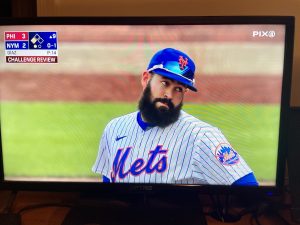
Guillorme already knew, because he’s Guillorme. Also very Guillorme: that bit of sly deadpan as he waited for the rest of the relevant personnel to catch up with him. My goodness do I love him.
Guillorme is always involved, and would play a key role in the bottom of the ninth as well. So would the Phillies’ star-crossed bullpen and execrable defense, which are so chronically terrible that I want to feel bad, except for the fact that we’re talking about the Phillies. I can muster this bit of empathy: There’s nothing that torpedos fan enthusiasm more completely than a chronically terrible bullpen, because even when your team’s ahead you feel like you’re being set up to be the butt of the joke once again.
The maroon perpetrators this time were Hector Neris and Rhys Hoskins. Hoskins began the ninth by fielding a hot shot from Travis Blankenhorn with his knee and fumbled for it just long enough for Blankenhorn to beat Neris to the bag. Neris then walked Billy McKinney and surrendered an infield hit by Pillar that caromed between Williams and Ronald Torreyes, loading the bases with nobody out.
A chronically terrible offense isn’t a lot of fun either, and about now I told Emily that I didn’t know why I did this to myself and announced I was going to throw my phone into the sea to avoid further torment. Instead, I listened as Guillorme walked on a splitter from Neris that was low and inside by an eyelash each way, tying the game. Francisco Lindor then struck out in an AB that was both ineffective and weirdly panicky, sending my anxiety spiking once more. With the sea too far away, I declared that I was going to smash my phone underfoot.
I didn’t do that either; a couple of minutes later Michael Conforto socked a hanging splitter to center, deep enough that McKinney could slide across home on his belly, looking for all the world like Robin Ventura having fun on the soaked Yankee Stadium tarp a generation ago. The Mets had won, even on a day that had seen me be shamefully negligent and deGrom dare to be merely excellent.
The Mets had won, and a little over an hour later so had the Cyclones, powered by those back-to-back homers from possible future Mets. It wasn’t so long ago that I was keeping an ear on the Mets while watching Conforto in a Cyclones uniform; perhaps not so long from now I’ll listen to Baty and Alvarez win a game at Citi Field while watching Cyclones I’ve not yet heard of continue the baseball cycle. That would be a nice thought on any evening; it was an even sweeter musing after a year without nights like that.
by Greg Prince on 26 June 2021 12:41 pm Perhaps you’ve heard or at least heard of the classic Jack Benny bit in which the comic entertainer who cultivated a notorious tightwad persona is held up at gunpoint. The robber makes clear he wants Benny’s wallet, and he wants it now.
“Your money or your life.”
There’s a pause.
The pause extends.
The pause simply will not end.
The robber grows exceedingly impatient.
“YOUR MONEY OR YOUR LIFE!”
Benny finally responds.
“I’m thinking, I’m thinking!”
That was basically me as Aaron Nola was rolling up strikeout after strikeout after strikeout after strikeout of the New York Mets in the opener of Friday’s doubledip (so named for Rob Manfred’s commissionership being twice as dippy as Bud Selig’s, which wasn’t thought possible). Nola was unstoppable. Not seemingly unstoppable, but unstoppable. The Mets couldn’t hit him. The Mets couldn’t lay a shred of wood on anything he threw, save for a few foul balls. The record for consecutive strikeouts, established by Tom Seaver on April 22, 1970, was clearly on the endangered species list. With a bullet.
This was where I got to dealmaking, at least in my own head. Would I trade a guaranteed Mets loss in order to keep the strikeout record in the family? Your record or Tom’s record? Would I be OK with the Mets getting flattened by the Nola steamroller as long as we could mix in a popup or a groundout and keep this interloper from laying his hands on one of our most precious heirlooms, a priceless performance that we have been trusted to maintain under a collective Mets fan conservatorship for more than 51 years?
As Nola got up to 7…8…9 strikeouts, I was ready to sign for being no-hit as long as some intermittent fair contact was made. Never mind that the Mets had a hit (along with a hit by pitch) to open the affair before Nola commenced his de facto game of catch with J.T. Realmuto. It felt like a no-hitter. It felt like the wrong side of perfection. It felt hopeless.
In the bottom of the fourth, Michael Conforto came up as prospective consecutive strikeout victim No. 10, the Al Ferrara of the 21st century. Conforto’s job was simple. Don’t strike out, Michael. Can ya do that for me? Can ya do that for all of us? Can ya do that for Tom, who I’m pretty sure ya never met, but ya work at 41 Seaver Way and his number is on your sleeve?
No, Michael Conforto couldn’t do that. He struck out, just as he had in the bottom of the first, just as every batter in between his two at-bats had. With Conforto going down on strikes a second time, Aaron Nola had struck out ten batters in a row. Ten Met batters in a row. Aaron Nola had just tied Tom Seaver’s most sacred record.
My trade offer of an eventual Met loss for something other than another consecutive Met strikeout was no longer valid. Technically, it never was. Fans know that, but don’t acknowledge it in the moment of cosmic bargaining. All I could do was instinctively grit my teeth, grudgingly tip my cap, and cease concocting no-win deals.
A batter later, Pete Alonso put an end to the immediate sacrilege by doubling, halting Nola’s streak at 10 Ks, meaning that for the rest of time — or until later today when Jacob deGrom pitches — the consecutive strikeout record will be referred to as having been set by Tom Seaver in 1970 and tied by Aaron Nola in 2021. Or “the record belongs to Tom Seaver and Aaron Nola”. Or something like that. Shared. Not solely Seaver’s. Seaver and somebody. As if Tom has a peer.
I guess he does, for this, if little else. It’s better than “…broken by Aaron Nola on June 25, 2021.” Most records are meant to be broken. This one wasn’t meant to be touched, yet Nola’s philthy Phillie phingerprints are all over it. He earned it (with help from an egregious called strike three on Dom Smith, but that’s a rabbit hole whose plumbing will cast only more gray area on Great Moments in Mets history). To be disgustingly decent to Aaron Nola, he’s no bum. A man with an accent — Egyptian, I think — who worked at a local gas station would tell my parents that about my sister after she’d recently pulled in to fill up our other car. “Your daughter — she no bum!” It was apparently the highest of high-test compliments the fellas at the Exxon dispensed. That’s as high as I’m willing to go with Nola. He was part of the thrilling three-way Cy Young derby of 2018, the one where he and Jacob and Scherzer headed for the final turn neck and neck and neck until Jake pulled away in the home stretch. Jake still hasn’t looked back.
Until now, that’s what I thought of when I thought of Aaron Nola. Now I think about Tom Seaver, too. If deGrom and Seaver are your company, who am I to begrudge you your half of statistical immortality? To Nola’s credit, he did tell reporters it’s “pretty cool being in a category with Tom.” Indeed, though he should’ve referred to him as Mr. Seaver.
Mr. Seaver would likely not begrudge his new junior partner the accomplishment. On the other hand, I can hear the Franchise inserting the needle. Listen, big boy, in my day we went nine. Oh, and on my day with the ten straight strikeouts, I won the game. Also, let it be known, from the office of the conservatorship, Tom Seaver posted a 27-14 record against the Phillies lifetime…and that the Mets beat the Phillies in the 1966 drawing out of a hat for the services to one George Feaver.
On Aaron Nola’s day with the ten straight strikeouts, neither Nola nor the Phillies won the game. Not that game, specifically. As noted, there’d be another game of the “decibet” variety later. The decibet, in case you don’t remember the SNL sketch from Season One (in which case, citing Jack Benny may represent a generation too far to bridge), was the new metric alphabet, introduced to America by Dan Aykroyd as a smilingly efficient bureaucrat in 1976, the year the USA was briefly gripped by metric system fever. The hook was the standard alphabet of 26 letters was now too long and the government would be smushing it down to 10 — or as many San Diego Padres as Tom Seaver had struck out consecutively six years earlier.
LMNO will be condensed to single letters. Incidentally, a boon to those who always had trouble pronouncing LMNO correctly. And “open” would then be “LMNOpen,” as in, “Honey, would you LMNOpen the door?”
Our Manfred-mandated doubleheaders still have the first four innings, just as the decibet started with A, B, C and D, but by the fifth, you’re convinced you’re in the seventh, because my the seventh, you’re effectively in the ninth. Got that? Also, Wednesday is Sundae at Carvel.
The Mets and Phillies honored the legacy of Tom Seaver, Steve Carlton and other aces of yore by hardly scoring in Gamelet One. Nobody was throwing balls out of play and passing them to the MLB authenticator for Taijuan Walker, but Walker was magnificent for five innings (experientially seven, but the stats still say five). One run snuck across the plate on his watch, driven in by Nola, whose Bizarro deGrom act was quite unwelcome in Flushing.
Nola’s pitches eventually met Met bats, but they had no useful greetings to return. Joe Girardi removed the man who had just tied Tom Seaver and replaced him with Jose Alvarado with one out in the sixth. Somewhere Tom laughed. “Hey Gil, come look, you’re not gonna believe this.” Alvarado squirmed out of trouble in the sixth, but in the seventh, the first-place Mets lived up to their descriptor by taking advantage of a Phillie error — Luis Guillorme was involved; he always is — with a Francisco Lindor RBI single. This Lindor can play a little, we are learning.
The seventh, having been the spiritual equivalent of the ninth, meant we were going to the eighth, better understood as, in essence, the tenth, which comes with a runner on second no pitcher put there. In circumstances that render numerical labels useless, Seth Lugo proved a strikeout machine in his own right, thus setting up the Mets’ own unearned runner, Lindor, to bring home the winning run following an intentional walk to Alonso and a single by Smith. Dom had convincingly threatened he would bunt, further phlummoxing thoroughly phlummoxable Phillie phielders. (If you don’t do the “ph” thing when Philadelphia’s in town, you’re just not living.)
With the Mets come-from-behind, demi-miraculous 2-1 win in the opener, we felt as unstoppable as Nola. Nola had a swell no-decision for himself, though his team — like Carlton’s Cardinals in 1969 when Steve struck out 19 Mets — lost. Lugo had a win to go with his 3 Ks, just as Seaver did in ’70 when he took care of 19 Padres in all, 10 in a row to end the game. Tom’s records are Tom’s records, no matter who else has a piece of them. And our momentum was our momentum after a thrilling eight-/extra-inning win.
Then came the second game, which presented itself with the same general leitmotif. Like Citi Field lacks a moderately priced tier of seating between the aspirational seats and the upper deck — wherefore art thou, Mezzanine? — these decibet games continue to miss their middle innings. So once again, we had a pitcher’s duel developing, this time David Peterson vs. Matt Moore, and it was as gripping as all get out until, in the sixth, a ball off the bat of Bryce Harper got out and it was 1-0. But wait! The Mets stitched together a nifty little rally off Philly’s bullpen and Philly’s gloves — Luis Guillorme was involved; he always is — and we had a tie and we had an eighth inning masquerading as a tenth. Sadly, we had Lindor and Guillorme not quite handling balls they usually absorb straight into their respective Roombas, and we were a run behind. And, sadder still, we didn’t get it back and had a 2-1 loss to go with our 2-1 win, which indicates intuitively this pair of one-step-up/one-step back games didn’t really have to happen, and if they hadn’t, the consecutive strikeout record would still belong to Seaver and Seaver alone.
But it doesn’t. Hence, I grit my teeth, I tip my cap, and I take the split. There’s no other deal to be made.
by Greg Prince on 24 June 2021 12:45 pm Purposefully preparing the game bag.
What to leave in, what to leave out. Two factory-sealed beverage containers? In. Two masks? In. Two phone chargers? In. Transistor-style radio because what if the phone chargers aren’t effective? Also in. I bow to progress where progress institutionalizes itself, but am, at heart, against the winds of change. It was hard enough for me to switch from mini-duffel to tote when so mandated by the Manfreds and Wilpons who made security theater the convenience fee of physically entering the ballpark. Yet preparing the game bag in the Age of Cohen remains essential and invigorating. Left over from the last time I had cause to tote it were 4,000 napkins, tissues and paper towels (mostly unused) and a 2019 pocket schedule. Wednesday afternoon I ditched about 2,000 of the napkins, tissues and paper towels. I kept the pocket schedule. You never know when an old baseball season will suddenly break out.
Intrinsically understanding the commute.
Stand here and wait for the train where you can grab a better seat, which is to say away from strangers. It’ll cost you some walking time when you get off at Jamaica, but you’ve got a lengthy enough wait at Jamaica. Position yourself for the car at Jamaica that you know will leave you off near the staircase to the 7 at Woodside — but it’s always crowded in that car. The LIRR now has diagrams to confirm that. Thus, stay up the platform at Jamaica. Get a seat. Relax. The game isn’t going anywhere without you and your lovely bride who you are so happy said, “sure,” to your suggestion of a Wednesday night ballgame. To be technical, the game has gone on without you for 633 days (59 home games) since you last did this. But commuting to it is a skill never unlearned. True, we wind up with a longer-than-average stroll to that staircase where we transition from suburban rail riders to gritty subway warriors. But we’re not in any rush. Except of course we are because who doesn’t rush to the staircase to the 7 because at any moment, the express could come rolling in. And here it is! Move! That extra burst of speed returns to my 58-year-old feet. I return to the 7 Express, mask and all. Mask furtively inches above my mouth for an instant so i can catch my breath from that extra burst of speed. I’m in a crowd for the first time since god knows when. I’m not as worried about that as I thought I might be. Everybody is masked. I’m vaccinated. What did I get a shot for twice if not for this?
Hearing my name, and not from being called in from the waiting room to see my doctor.
Other than my wife, my cat and professionals who intermittently examined my well-being, I haven’t been intentionally near a specific individual since the middle of March in 2020. Stephanie is with me for this first trip to Citi Field since two months before that (the January FanFest) and first game there since four months before that (September 2019’s Closing Day). Avery is presumably napping away at home. Like the game bag and the transit journey, this is old hat. Yet it’s new hat when you haven’t done it at, we hope, the tail end of a pandemic. New hat in 2021 was putting on my old hat as I descended the staircase from the Mets-Willets Point stop. I was so engrossed in this ritual of pulling my Mets cap from my game bag that at first I missed my name being called out. Then I caught it, but didn’t recognize the source. It was only the person I write this blog with for the past sixteen-plus years. I knew Jason and his family would be at this game. I didn’t know we’d be on the exact same staircase an hour before this game. Hence unfolds our not entirely random yet mostly unplanned reunion. It’s also the first time I’ve been intentionally near a specific individual outside the home since…well, you’ve lived the same calendar I have, I imagine. Jason and I do a double bro-hug. Maybe a triple. We’re both vaccinated, what the hell. I greet Emily and Joshua with something similarly bro-ey but, I assure you, just as sincere. I can’t bring myself to shake anybody’s hand.
Enhancing my baseball library.
I understood Citi Field didn’t want my cash. They wanted my money, but not my cash. I don’t understand cryptocurrency, but that’s not this. Just, you know, give us your card. It’s not a baseball season without a yearbook and a program. Even in 2020 I scrounged a yearbook, albeit by mail. I love that every year where I’m allowed inside the ballpark it’s my first purchase. The digging into the wallet and passing over the bills to the full-throated man announcing his inventory. “YEARBOOKS! PROGRAMS!” Such a man was on the job in 2021. He had both (nowhere in sight: printed media guides or current pocket schedules). I hand him my card. He hands it back to me with the latest additions to my baseball library, along with a useless pencil that will sit by my bed for the rest of eternity. The pencil never has an eraser. This time it doesn’t even say NEW YORK METS; did the warehouse finally run out? Before I turn for the escalator, I have to ask: “Hey, how much was that?” I’d request a receipt, but it’s the “YEARBOOKS! PROGRAMS!” man. I can’t imagine he gives receipts.
Choosing from the greatest menu in all of sports, maybe all of human existence.
I’ve been jonesing for a Hebrew National frank from the kosher stand. What is it Humphrey Bogart said? “Hebrew National at the ballgame beats roast beef at the Ritz…and leaves what passes for Nathan’s in the dust.” The stand is right there when we come up from the Rotunda (where yesterday’s lineup’s oversized baseball cards are still posted because who has an enormous picture of Tylor Megill handy?). But Stephanie and I are going to walk the perimeter of Field Level, and I don’t want to eat on the run or drag it with me until I sit down. Our traditional first stop is World’s Fare, but World’s Fare isn’t open. Citi Field is open, but not quite every inch of it. No Mama’s of Corona. No Daruma of Great Neck. But no worries for we gallivanting gourmands of flushing. Arancini Brothers has no line. We stop for an assortment of risotto balls. The Chasins turned Stephanie on to them a few Augusts back. I’m along for the ride on this one. Blue Smoke also has no line. Brisket! Can’t ever go wrong with Blue Smoke brisket. No pickles included in the clever little Mets To Go bag, however. No dispenser for barbecue sauce. Hey, I’d forgotten there’s a third base side kosher stand, too! Hot dog! Literally! No sauerkraut, unfortunately. No condiment stands whatsoever at the tail end (we hope) of a pandemic. Nevertheless, the hot dog dressed by its humble packet of Heinz mustard is glorious. It’s what I was jonesing for. “I know it’s a cliché,” I tell Stephanie. “But I really wanted a hot dog.”
Emoting.
My emotions are pretty much in check until we land on Excelsior. I pictured my first game back ensconced in the 500s of Promenade, but Section 327 is Stephanie’s and my special spot, usually for Closing Day, and I only wanted to go to a first game in forever if I could go with Stephanie, the only person I’ve seen willingly in forever. The special spot is worth it for a special occasion. Special occasions don’t come along every day (thus the phrase). I wasn’t overwhelmed when we approached Citi Field by train. I wasn’t overwhelmed having my bag searched or buying $21 worth of content-free Mets publications or haggling with cashiers for my receipt after giving them my card for risotto balls or brisket, but the Proustian sense of being enveloped by the portion of concourse that borders Sections 330, 329, 328, just as we were in 2019, 2014, 2009…this is where a manly man makes an allusion to slicing onions. I’ve sliced quite a few onions, especially during quarantine when cooking replaced going to a baseball game as the thing I looked forward to doing on a Wednesday night. Onions really do produce tears. No condiment stands. No onions for the hot dog, either. Where was I? Right. Overwhelmed to be back.
Streaming consciousness instead of streaming Netflix.
This is the first time I’ve seen Francisco Lindor as a Met.
This is the first time I’ve seen Kevin Pillar as a Met.
This isn’t the first time I’ve seen Michael Conforto as a Met, but I haven’t even seen him on TV for more than a month.
That’s what Tylor Megill looks and throws like.
Kevin Pillar, Jeff McNeil and Luis Guillorme all use walk-up songs from before they were born. I approve.
The trumpet entrance for Edwin Diaz isn’t nearly the riot they make it out to be on TV. I approve anyway. Blowing a trumpet is preferable to blowng a save.
This is what it’s like to cheer out loud in the company of others for the Mets in 2021.
This is what it’s like to bear witness to the Mets taking a five-run lead in 2021.
This is what it’s like not being convinced in person a five-run Mets lead is altogether safe. It’s not much different from lacking that conviction while watching on TV.
This is the first game I’ve been to in the 2020s. It doesn’t feel much different than it did in the 2010s or all the decades stretching back to the 1970s. This is what I’ve done for close to a half-century. I still know how to do this. I still like to do this.
The Braves fans in attendance aren’t really bothering anybody but their presence bothers me on principle.
Shut up presumably cute little girl shrieking a couple of rows back; and large not-so-cute man somewhere to my left, as Gary Cohen is likely ignoring your bellows of I LOVE YOU GARY COHEN!! so maybe stow your shtick already; and family in front of me, you’re neither the Incredibles, nor the Invisibles, so tell your kids to sit down when somebody’s pitching or batting; and how many bleeping beer and cocktail-in-a-jar runs do Stephanie and I have to literally stand for — I still have a knack for making people getting up in the middle of an inning generate two seconds of guilt for disturbing a fellow like me who’s just on hand to watch the ballgame and sip from my previously factory-sealed beverage containers.
Are we really still measuring noise by noise meter? Like these people around me need encouragement?
Yet I still like this, being here, being with the Mets and other Mets fans. I wasn’t sure I would, and if I couldn’t like being with the Mets and other Mets fans, where was I gonna like being at all?
I’m near people. My mouth opens at will. Theirs, too. What’s going into the air? Are we still worried about transmitting droplets and aerosols and whatever else? Geez, I sure hope these vaccines are as good as advertised. My masks are in my bag and so are everybody else’s.
Nice night. Very nice night. Slow game, though. Very slow game.
Fan appreciation.
Tylor Megill delivers thirteen Acuña-free outs in support of the Mets’ five early runs. He gives a couple of runs back because he’s Tylor Megill and not Dick Rusteck. We weren’t demanding a shutout in his major league debut like Rusteck crafted 55 Junes ago (still the only Met neophyte to have performed that feat). We weren’t demanding anything from Tylor Megill. Just use your arm, kid, and keep us from the bullpen for a while. That the kid did. Callup’s just another word for nothing left to lose. Good enough for me and my Tylor Megill. When Luis Rojas removes the rookie, we savvily applaud heartily for those thirteen outs in a first start. You don’t get to participate in that from home. Cardboard cutouts didn’t clap once in 2020. This is what being a baseball fan is all about. So is booing the umps for checking Tylor Megill for what, his baggage claim ticket? He just got here! We boo blue until they are done harassing our young man. Then we return to cheering Tylor until he’s in the dugout. Too many people play with their phones, too many people get up for beer, too many people are inane drones and made you fleetingly sorry you’re near them, but enough people are into the game at a game that you are so glad you’re with them at a game.
Cross-pollination as spring turns to summer.
I pledged I’d make minimal use of my phone, my chargers, even my radio. You came to the game to be at the game. You can distract yourself at home. It took me an inning to realize Ronald Acuña, Jr., was missing from the Braves lineup, yet I didn’t lunge for a device to search out why. Once in a while, though, I wanted an Islanders score. It was do-or-die Game Six in Uniondale. If I’d been home, I could have watched the entire second period between any two pitches. It was a reasonable tradeoff to get this night at the ballpark. Late in the baseball game, I gleaned that the hockey game had tied up. A highlight was beginning to be shown on CitiVision. If a local team is succeeding in the playoffs, the news is shared widely. If a local team is losing, why stoke discontent? Indeed, it was two-all by the time the 27th out was recorded. It was, we learned from crosstalk on our way out, headed to overtime. As we found seats on the 7 Super Express, we picked up on the Isles’ lightning-quick OT victory. They, too, would be on the 7, so to speak, in Tampa Friday night. I loved the result. I loved just as much that it infiltrated my baseball night out, good news bro-hugging good news. In 1983, when Joel and I were driving home from the Mets-Padres game at which Darryl Strawberry hit his first Shea Stadium home run, we listened to the Islanders clinch their fourth straight Cup. Mets won then, too.
Impatience.
This game in 2021 would last 3:42. That’s three eons and forty-two millennia. Maybe it’s not 2021 anymore. Maybe Tylor Megill is telling his grandchildren about his thirteen-out debut. Yeesh, what a slog. But the Mets slogged to a 7-3 win, so, you know, we’ll take it. Stephanie, a champ in every way, particularly sitting next to me during sporting events I’ve osmosised her into caring about, hung in there. The trains connected on the way home as they did on the way there, “there” being where our heart was even when we weren’t. We’re Mets fans. It was there right where we left it.
Piano Man.
If Faith and Fear was a CBS sitcom, the director would have cut from Jason in right field griping about what a crime against humanity the Billy Joel singalong represents, to me somewhere above third base heartily singing along to Billy Joel. I’d all but forgotten we do “Piano Man”. I’d been anticipating “Lazy Mary” after “Take Me Out to the Ball Game”. Still hadn’t bothered learning the lyrics despite 633 days of solitude to study, yet bouncing in place and hoping the stands will move in time like they would at Shea doesn’t require mastery of the Eye-talian language. Stephanie and I don’t need a translator for “Piano Man,” though maybe we could have used an explainer when we were kids. When I first heard it at age eleven, I thought people were stuffing literal slices of white bread in a jar atop the narrator’s piano, and this was long before I knew someday the Mets would sell cocktails in jars. Stephanie assumed “nine o’clock on a Saturday” meant 9 AM, which as a child struck her as a tad early to be going out for drinks, “but maybe I just didn’t understand bar culture,” she confesses now. “Piano Man” at Citi Field has added a sponsor, which detracts from whatever organic charm it’s supposed to emit as a singalong. It also doesn’t have Luis Rojas’s head popping up on the big screen when “the manager gives me a smile” as it did for Terry Collins (they should use Terry’s head and see if anybody notices). But it has this line I never fully appreciated until I’d been gone from Citi Field and Mets games for 633 days: “…to forget about life for a while.” I was at Citi Field. I was at the Mets game. My only existential issue was fully trusting that Edwin Diaz would allow us to make 11:20 at Woodside. I forgot about life for a while. For as long as it took to prepare my game bag until plopping it down in the living room, with its new yearbook, its new program, its additional couple of dozen or so newly acquired napkins and the win I’d get to inscribe in the steno notepad I call The Log II upstairs. This was regular-season Game 277 at Citi Field, on top of the 402 games at Shea Stadium in The Log I. The Log II had been stuck on Game 276 for basically ever. Eventually, as Wednesday night drifted into Thursday morning, I took care of that little detail, half in pen, half in eraser-equipped pencil.
6/23/21 W Atlanta 19-15 Megill 1 155-122 W 7-3
I missed having the chance to do that more than I realized.
by Jason Fry on 23 June 2021 12:35 pm A review of some emotions we were feeling not so long ago: amazement at the tenacity and resourcefulness of the Mets’ “bench mob,” pinch-me gratitude that the team was in first place, and perhaps even a little optimism that the starting rotation’s continued excellence would see it through such ancillary difficulties.
The Mets are still in first place, believe it or not, but the rest of those emotions have drained away, replaced by foreboding, depression and gloom.
The bench mob has produced far fewer miracles as its various Plan B players have been either exposed by too much playing time or reverted to statistical norms (take your pick), with the Mets losing six of their last eight and being shut out in four of those games. On Tuesday night, they got their first hit on an excuse-me swinging bunt by pinch-hitter Jerad Eickhoff (there’s a sign of trouble right there) and didn’t tally another until James McCann doubled in the ninth.
The Mets have also been swamped by yet another wave of injuries. Robert Gsellman tore a lat muscle and may not be heard from until fall, while Jeurys Familia has been shelved with a hip impingement. Joey Lucchesi, who’d seemed to figure things out and enjoyed a run of success, tore his UCL and won’t throw a pitch in anger until late next season at the earliest. Then, on Tuesday night, it was Marcus Stroman at the center of a concerned group on the mound and eventually walking off and heading down that dark tunnel with the trainer, a phrase that’s taken on the air of a tragic Homeric motif, the baseball equivalent of clattering shields and faces in dust. The Mets didn’t seem too concerned about Stroman after the game, and the man himself tweeted that “everything’s gonna be okay,” but the Mets weren’t terribly concerned about Lucchesi at first, either.
And it’s not just the pitchers — Tomas Nido got hit in the hand, necessitating a hasty return for Patrick Mazeika, while the invaluable Jonathan Villar is dealing with a calf strain. Even the good injury news comes with you-must-be-kidding caveats: Michael Conforto returned earlier than expected but wasn’t available Tuesday because Syracuse had to do contact tracing after a Covid outbreak.
On Tuesday the Mets improvised after Stroman’s departure by calling on Yennsy Diaz, Drew Smith, Aaron Loup and Trevor May. Diaz didn’t warm up sufficiently (a frequent malady for young pitchers summoned in emergencies) and loaded the bases on an infield single and a walk, but somehow got out of it, fanning Ender Inciarte, opposing pitcher Charlie Morton and big bad level boss Ronald Acuna Jr. It was a heroic stand, encouraged by infield whip Francisco Lindor and then celebrated with emphatic Lindorian fist pumps, but Diaz’s luck ran out an inning later as Dansby Swanson crushed a pitch through the wind into the left-field stands for a 3-0 lead that was all the Braves would need. Smith, Loup and May were nothing short of heroic in following Diaz, but moral victories mean little beyond word count in recaps like this one. Meanwhile, the Mets could do nothing against Morton, a well-traveled journeyman who bedeviled and frustrated them with a seemingly infinite number of variations on sweeping curves for his 100th career victory.
Reinforcements? The Mets picked up Robert Stock on waivers — you may recall him as the big, action-figurelike Cubs hurler they beat last week, though perhaps you’re unfamiliar with his very entertaining Twitter account. They’re calling up Tylor Megill to make his major-league debut tonight, assuming he escapes Syracuse’s Covid woes. (Megill will also join Eickhoff in the ranks of Mets Who Frequently See Both Their Names Misspelled, if that’s a stat you track.) Nick Tropeano and Thomas Szapucki are down there at Triple-A, presumably doing something other than having swabs stuck up their noses. One figures all of these pitchers will have a role to play at some point soon; one also feels duty-bound to note that the list features no name to make you sigh with relief that the cavalry’s coming. Meanwhile, Noah Syndergaard remains idle and Carlos Carrasco isn’t throwing off a mound yet, with his hamstring injury having entered the realms of Lowrie-esque surrealism.
The Mets will have to endure these misfortunes, just as they endured the slings and arrows of May. Will they? Hell, if I could predict that with any degree of confidence, we’d have ads or be some kind of fancy subscription newsletter. I can’t and so we don’t. Stir the tea leaves, peer at the MRIs, and make your own forecasts. Share the optimistic ones with us; we’ve got the gloomy ones more than covered.
by Greg Prince on 22 June 2021 10:08 am This town is called Splitsville. It was created by an act of Manfred. Splitsville measures seven innings wide and seven innings long — and seven innings wide and seven innings long all over again. Some folks say there’s a couple of innings missing on each side of town. I don’t know about that. But if we get through seven and it absolutely has to be any longer, we put a runner on second and see what happens.
In Splitsville, we take our coffee with half-and-half. Our bakery’s best-selling cookie is the black & white. The middle school math department has been recognized for excellence in division. There isn’t a self-respecting Splitsville jukebox doesn’t offer two plays of “One Way Or Another” by Blondie for the price of one song…even if both times it’s the short version.
We also have the dadburn hummingest MRI tube in the state. I’d give you a brochure to read more about it, but everybody who picks it up seems to get the nastiest paper cut or ligament tear or lat strain or hip impingement or calf strain and has to miss work for at least ten days, so you’ll just have to take my word for it.
Or you could ask Joey.
Or Robert.
Or Jeurys.
Or maybe Jonathan.
Between you and me, I can’t keep track, but I sure wish I had the MRI concession.
This is Splitsville’s busy season. We opened for business last weekend and will repoen for business this weekend. We were open for business yesterday, too.
We had a win. We had a loss. Upon reflection, it was neither wholly satisfying nor altogether gratifying. But it could have been worse.
Could have been better, too. As we say in these parts, “That’s Splitsville for ya.”
On this side of town, we have our ace starter, Jacob deGrom. We just call him ol’ Jake. He’s practically perfect. He’s the best.
On this other side of town, we have our contingency starter Jerad Eickhoff. We’re still checking on the spelling. At best, he’s perfectly adequate.
Ol’ Jake gets us nervous, but only in the sense that he might hurt himself and need the MRI tube. When he doesn’t, there’s nothing to be nervous about. Oh, maybe we’ll fret that he’ll give up a hit or, less likely, a run. That’s hardly a problem to get nervous over, but you know how folks are. Really, the fretting about his ERA ticking up a notch or notching up a tick is just for appearances — sort of like the town cops searching ol’ Jake up and down for so-called illegal substances. The men in blue are just doing their job. Another act of Manfred, I guess. What we don’t much fret is that ol’ Jake might give up too many runs. It could happen, but it hasn’t happened in so long most folks on this side of town barely remember what it’s like.
Jerad gets us nervous, but mostly because we just met him, we’re not confident we can spell him and we know he wouldn’t be here if we had somebody more obviously qualified to do what he does. He calmed us down eventually, but we definitely had the feeling he and we got lucky. He’s welcome to come back soon. It’s not like we won’t have room for him.
On this side of town, with ol’ Jake, we had ourselves a nice late afternoon and early evening with just enough clutch hitting and no overtly deleterious bullpen doings. Everybody was so pleased that some folks lobbied to change our name to Pleasantville. “Hold your horses,” the old-timers said. “It’s pleasant now, but let’s see what it’s like later.”
On this other side of town, with Jerad, the night wasn’t so pleasant. The bullpen doings weren’t quite undeleterious, the clutch hitting that was supposed to arrive before 10:30 PM must’ve gotten held up in shipping, and hoo-boy, you don’t want to know about the baserunning. Splitsville’s known for several things, but fancy baserunning oughtn’t be one of ’em. The visitors sure liked how it worked out for them, but while we do appreciate the tourism, the folks who live around here were pretty unsatisfied and ungratified. In fact, they lobbied to change our name to Doomsville. “Hold your horses,” the old-timers said. “We feel doomed now, but it was pretty pleasant earlier.”
In Splitsville, we always want more, but we’re glad we didn’t get less.
|
|