The blog for Mets fans
who like to read
ABOUT US

Faith and Fear in Flushing made its debut on Feb. 16, 2005, the brainchild of two longtime friends and lifelong Met fans.
Greg Prince discovered the Mets when he was 6, during the magical summer of 1969. He is a Long Island-based writer, editor and communications consultant. Contact him here.
Jason Fry is a Brooklyn writer whose first memories include his mom leaping up and down cheering for Rusty Staub. Check out his other writing here.
Got something to say? Leave a comment, or email us at faithandfear@gmail.com. (Sorry, but we have no interest in ads, sponsored content or guest posts.)
Need our RSS feed? It's here.
Visit our Facebook page, or drop by the personal pages for Greg and Jason.
Or follow us on Twitter: Here's Greg, and here's Jason.
|
by Jason Fry on 14 July 2025 10:40 am And on the last day of the first half,* the Mets presented us with a fan’s oldest philosophical conundrum: Is it better to come back and lose, or not to come back at all?
The philosophy lesson came at the very end: Before that, the Mets followed one of their more frustrating 2025 scripts, in which ducks on the pond are some sort of ASMR thing that puts the rest of the lineup into a blissful doze. A one-out Mark Vientos first-inning triple yielded nothing. Ditto for Ronny Mauricio‘s single leading off the second. First and second with one out in the fourth? Nada. I could list all the souffles that fell, but you get the idea.
Alternate narrative, because sometimes it’s not always about us: Young Kansas City hurler Noah Cameron was electric, fanning eight Mets and stepping up when needed, and he got superb infield defense behind him. (The Royals’ outfield? Not so much. In fact, yikes.)
Meanwhile, Clay Holmes was fine for the Mets and Sean Manaea was better making his season debut in a piggyback role: Manaea gave up a single to the first batter he faced, Bobby Witt Jr., but then fanned five of the next six.
In the ninth the Mets dug in against Carlos Estevez, who by now must be seeing Mets in his nightmares, and rose up in self-indignation — assisted by whatever it was the Royals were doing out there in the outfield. Mauricio doubled to left over the head of Nick Loftin, whose Cedeno-esque route around the ball made you want to cover your eyes, Jeff McNeil tripled just past the glove of Kyle Isbel in center, and Jared Young brought McNeil home on a sacrifice fly that was just long enough.
Just like that the Mets had tied the game, and all they needed was for Manaea to keep the Royals in check for another half-inning. Francisco Lindor would be the Manfred man in the top of the 10th, with Vientos, Juan Soto and Pete Alonso behind him, and…
…and not so fast. Manaea got the first out of the ninth on another strikeout, but modern-day Herb Washington Tyler Tolbert served a pretty good pitch to right and then stole second. Loftin then hit a well-placed slider at the bottom of the zone just over the infield, and just like that the Mets had gone into the break with a loss.
Manaea pitched well for a club that could really use what he brings to the starting rotation. Neither of the pitches that undid the Mets were ones he’d want back. The Mets pulled off another late-inning comeback. All of these are good things.
And yet they lost. So what do you think? Better to have watched Royals outfielders do what they don’t do enough and go down 2-0? Or better to have fought back and still been dispatched? The scribes have argued this one ever since town ball took shape on some long-forgotten English village green; they’ll be arguing about it when baseball is played on Mars and aboard space stations. Sunday was just another stitch in the tapestry of what-ifs and OK-buts, with so much left to weave.
* They’ve actually played 97 games, which is 60% of a season, but nobody needs to hear from That Guy.
by Greg Prince on 13 July 2025 12:53 pm The Mets are a half-game in first place as the final action before the All-Star break approaches. That seems appropriate, given that so much of the Mets’ good fortune seems to depend on opposing baserunners being the equivalent of no more than a half-step off a base while a Met fielder’s tag is touching him. Actually, a half-step would be a generous measurement. Try a half-inch, if that much.
The latest example came Saturday afternoon in the bottom of the eighth at Kauffman Stadium. The baserunner was the Royals’ Bobby Witt, who had walked with one out. Edwin Diaz is having a glorious season, but he still walks guys, and the guys he walks tend to run. Luis Torrens knows that. Francisco Lindor knows that. Harrison Friedland knows that. You probably know several of those Met names intimately and one in passing. The name Harrison Friedland passes through our consciousness every time there’s a close play on the basepaths, usually at second.
Witt was heading there in the eighth, where Lindor was waiting for Torrens’s throw. Friedland, the Mets’ analyst of video replays, was the most interested of observers, at least as interested as second base umpire Alan Porter. Porter thought Witt was safe. Couldn’t blame the ump. The Royals’ superstar looked supersafe.
 Hey VR, we’ve got your Sportsperson of the Year. But our replay supervisor has super vision. Witt, he divined, might have breathed just enough to have removed some scintilla of his body from the bag in the process of sliding onto it. Challenge the call, Friedland advised bench coach John Gibbons over the replay hotline. Gibby passed the word to Carlos Mendoza. Mendy made with the earmuffs motion. Say what you will about the replay rule, but it has given us a wonderfully silly gesture that carries within it the power to alter the course of innings, games, and seasons.
Our favorite gesture, however, is the fist pump we make when an opponent’s stolen base is microscopically examined and eventually overturned. We may feel a little less than clean if he’s ruled out on the tickiest-tackiest video judgment call, but is it our fault MLB hasn’t instituted some kind of force field mechanism that proclaims, He was on the bag for 99.99% of that slide, don’t be swayed by the 00.01% that’s clearly incidental to the play? They wanna call runners out for the teensiest bit of daylight, provided a ball gets to the base and a tag stays on the guy, we’ll take it.
Good execution as always from Luis and Francisco. Outstanding microscope peering yet again from Harrison. Witt gets erased. Royals have two outs. Diaz gets the third, and then comes back for the ninth. By then, the 2-1 lead he was protecting is 3-1, and his two-inning save he’s attempting is en route to completion.
Great second game of a three-game set in Kansas City. Juan Soto blasted a home run that turned their fountain into a wading pool. Frankie Montas was Montastic for five innings. Middle relief in the sixth and seventh, from Reed Garrett and Chris Devenski, respectively, warded off Royal spirits. Tight defense from Tyrone Taylor and Luisangel Acuña prevented leaks. Jeff McNeil, when he knocked in Pete Alonso with a ninth-inning run insurance run, could have bumped Flor Cawley as State Farm Agent of the Day. And, perhaps most helpful of all, we had our video guy working marvelously within a system that allows for a video guy to do a thing we wouldn’t have guessed would exist when we fell in love with baseball.
Yet there he is and there it is. The Mets are first-place team by a half-game because sometimes a half-inch makes all the difference.
by Greg Prince on 12 July 2025 1:15 pm Surely you’ve been told at some point in your life, “Get some rest and you’ll feel better.” I felt fine in the bottom of the sixth Friday night, though I’d felt better before the Royals tied the Mets at one apiece. The part of the rain-delayed game in which Kodai Senga pitched four scoreless innings in his return from the IL made me feel superfine, actually. The lone Met run coming across on a bases-loaded walk issued by Old Friend™ Michael Wacha to Pete Alonso in the third felt OK, though just OK. Pete belting one would have felt fantastic. So would have Juan Soto doing something of that nature, except he struck out prior to Pete’s at-bat. A Mets fan always feels the heart of the order should beat more loudly.
Mostly in the bottom of the sixth, I felt sleepy, thus I closed my eyes and missed the seventh inning, the top of the eighth, and however the bottom of the eighth started. Not that I knew the bottom of the eighth was in progress as I stirred. All I knew when I roused to consciousness was a commercial was on TV. I didn’t know what time it was, because the clock I rely on to tell me that at a glance after I nod off — the clock that has centered three separate living rooms of ours over the past almost 34 years — recently stopped operating. Changing batteries hasn’t worked. Tapping it purposefully hasn’t worked. Sweet-talking it back to ticking and/or tocking hasn’t worked. The clock was a wedding gift from a relative on my father’s side of the family. Its sentimental value is a product of its longevity. It’s our clock. Other methods of accessing the time are easily available to us, but we like our clock. Now it’s an ornament, perched atop a standard-definition television whose purpose these past two baseball seasons is to sit quietly behind the high-definition model we installed so we can consume media like modern folks do. The SDTV, acquired in June 2004, still worked as of January 2024, but it didn’t do enough, so we finally moved on to the kind of thing most people look at. Ol’ Boxy behind it is too heavy to move without calling a coupla guys. That dependable television of yore has therefore become a shelf for a clock that no longer tells time.
 And maybe Vientos got fixed. The commercial I woke to was for a car. I don’t know what kind of car (I can’t stress how not up to date I am when it come to cars), but it was high-end enough to hint that I wasn’t watching in the middle of the night. If it was the middle of the night, an infomercial would be on. More likely there’d be a message on my HDTV to PRESS ANY KEY, because energy-saving mode would have shut off active programming. It couldn’t be terribly late, I figured. Maybe the game is still going. Or we might be in the postgame show. The car commercial would drive off into the sunset, and then Gary Apple would speak in the past tense. I’d hate to think I’d slept through the conclusion of the game. Or maybe I’d hate to find out how the game turned out.
Rewinding the DVR struck me as an option. Or just grabbing my phone. Welcome to the second quarter of the 21st century, pal. It’s all right there on your device. You’re staring at clocks that aren’t running before figuring out how the Mets should make you feel. Get with the times.
Royals 3 Mets 1. Bottom of the eighth. Like Mr. Magoo in A Christmas Carol, I learned it wasn’t too late. But I did learn the Mets were losing, and that didn’t feel great. Bobby Witt had homered while I napped. Ouch.
Commercial break ends. Eyes open a little more. Steve Gelbs speaks. Carlos Estevez is on for the Royals with the bases loaded. Hey, Steve nudges Ron Darling, remember Carlos Estevez from last October? Carlos Estevez…I’m still sleepy, Steve…just tell me. He gave up that grand slam to Francisco Lindor. Good sign, maybe.
Alonso strikes out. So much for signs. Mark Vientos is up with one out. Mark Vientos up hasn’t been a good sign at all this year. Earlier in the game, when I was fully awake, Mark struck out and took it out on his bat at home plate. They showed that replay multiple times. It was dramatic video. But not as dramatic as what Vientos did against Estevez, doubling into the right-center gap. All three Mets on base, including dashing when he wants to be Soto, score. We go from down, 3-1, to up, 4-3. I go from wanting to turn the TV off and fall back asleep to determined to stay up.
The Mets were determined to make awake the way to be. In the ninth, against Taylor Clarke, Lindor launched a fly ball that just cleared the fence between center and right. It counted as a three-run homer. And as I debated whether this was a secure enough lead that would allow me to snooze in peace, Soto did something very similar. His fly ball was to the left of center, but it also went out. Now it’s 8-3. Now I don’t want to sleep quite so soon. I hang in there with Chris Devenski getting the final three outs and stick around for Vientos smiling with headphones on (Gelbs has to interview him from the booth since SNY didn’t spring to station an auxiliary Gelbs in KC), then treat my drowsy self to Apple’s postgame show. My favorite part is when Other Gary goes to commercial by saying, “More to come,” and I reflexively respond, “Mordecai.” I doubt it’s anybody else’s favorite part. The more that came, Mordecai, was Carlos Mendoza agreeing with reporters that it was a big game for Mark, then Kodai Senga and his interpreter assuring the same scrum that all is good on the ghostforker’s end. Plus the Phillies lost and the Mets are only a half-game out, and at least for a night, all is well. Either all is well or not at all well when it comes to these Mets. Take the good night’s rest when the Mets provide it.
by Greg Prince on 11 July 2025 12:59 pm I would like the Mets to be loaded with nothing but stars who win every game by lots of runs, pitched daily and/or nightly to victory solely by stalwarts of the starting rotation. Sounds ideal enough.
Now for reality.
The Mets don’t win every game. Nor does anybody else, but the Mets have gotten out of the habit of winning most of their games. Four Fridays ago, they entered their weekend series 21 games above .500. On this Friday right here, they are twelve games above .500. In nearly a month’s time, they’ve gone 8-17, including Thursday’s afternoon and evening losses at Camden Yards. That’s roughly a sixth of the season played at a pace that would win you 52 games out of 162. Good thing the part where they went 45-24 counts just as much (more, actually) toward their overall record of 53-41, but this is not a positive trend. The Mets are not only a game-and-a-half out of first place in a division they once led by five-and-a-half, they are no longer the National League’s top Wild Card, and their edge over the nearest provisional non-Wild Card contender is a mere two-and-a-half games.
Keep losing as often as they have for the past month, and 162 games may be all the Mets play in 2025.
This is despite the Mets being relatively star-spangled. Before getting swept by the Orioles, they were going to be represented in Atlanta next week by three All-Stars. After losing the daytime portion of the split-admission doubleheader, they learned they’d send four. In addition to Pete Alonso, Edwin Diaz, and Francisco Lindor, we’ll see David Peterson make the Midsummer Classic scene, a surprise in that he was overlooked in the initial knighting phase, yet very reasonable given how he’s pitched. Congratulations are in order for the fifth Met to earn a first-time nod in his sixth season as a Met. (To find out who the others were, check out this comprehensive rundown.)
Peterson gave the Mets one of his better performances of the year in Thursday’s opener, taking a shutout into the eighth inning, nursing a 1-0 lead. The one run was provided when Tyrone Taylor doubled home Brett Baty from second in the fifth. Taylor had helped make certain the Orioles would still be carrying a zero at that point when he gunned down Jordan Westburg attempting to go from first to third on a Ramon Laureano single in the fourth. Taylor’s no star, but he is capable of playing like one a hit or a throw at a time. That’s the kind of contribution you need when your stars disdain clutchness for an entire game. The recently branded Fab Four of Lindor, Alonso, Brandon Nimmo, and Juan Soto combined to go 2-for-14.
It was a little surprising to see Peterson start the eighth. Not unwarranted, just surprising. David had thrown 87 pitches through seven. For some pitchers, this would be enough. For some managers, this would be cause for a handshake and an ass slap. For Carlos Mendoza, it was gray area. He wanted Peterson to keep pitching in the eighth, but he didn’t want to fully trust him. When Petey gave up a well-placed single to start the eighth, Mendy’s trust dissipated. Could the man who scattered five singles and walked nobody get out of a one-on, no-out situation? The manager decided to not find out.
Ryne Stanek was the new pitcher. Gunnar Henderson was the pinch-hitter. Orioles 2 Mets 1 was the score after Henderson, in for the Orioles because Mendoza had gone to a righty, swung and connected for a two-run homer. A splendid day of All-Star work had flown practically into a vat of Boog’s BBQ sauce. Fortunately, Stanek didn’t give up any more hits. Unfortunately, he walked four, which, with a sac fly mixed in, led to another run.
Baltimore carried a two-run lead to the ninth and kept it, winning, 3-1. The Mets are a pretty good 18-12 in one-run games in 2025. I forget whether that’s supposed to mean the Mets are gritty or lucky. There’s a school of thought that says teams that win more one-run games than they lose show the intestinal fortitude and superior talent to be champions. There’s another school of thought that suggests every close result speaks to the random nature of baseball and perhaps life. Whichever it is this week, I’ve come to lumping together one- and two-run games as pretty much the same thing. Each kind is close. Each kind feels as if it can turn on one swing or pitch or bounce or judgment call or managerial decision. This kind of two-run loss felt like it turned on just enough going wrong to stick the Mets with the L.
In two-run games this season, the Mets are now 8-10. In one- and two-run games this season, the Mets are now 26-22. You’re welcome to Rorschach that data as you wish. Me, I see too many potential wins that have wound up losses. A few more swings or pitches or bounces or calls or decisions that go the Mets way — some within the Mets’ conceivable control, some the product of this or that going here or there — and the Mets are still in first place, still comfortably planning with an eye toward October.
The second game Thursday did not have a close final score. It went Orioles 7 Mets 3. Not a blowout loss, but not so competitive that one or two pivot points gnaw at you. Perhaps the game was decided when the Mets opted to start Brandon Waddell. I’ve just cast an aspersion Waddell’s way, but didn’t mean to. Brandon Waddell has been useful in middle and long relief this season when given the chance. I applaud anybody who is useful in middle and long relief. I applaud anybody given the chance to flourish in that role being given more of a chance. Brandon Waddell has been optioned three times this season. It’s tough to build up momentum when you don’t know how long you’ll be around.
After four relief stints totaling 9.2 innings spread out over 11 games between June 25 and July 6, the Mets handed Brandon the ball to start the nightcap on July 10. By my count, this marked the eighth time in 2025 that the Mets have gone with what I’ll call an unplanned starter. You have your rotation. You have what you consider your rotation depth. Then you have instances when pitchers fall out of your rotation, usually from injury, and pitchers you thought would provide you depth get hurt or prove too ineffective to try again. That’s when you roll the dice that one of your steadier relievers (Huascar Brazoban thrice) can be as effective in the first and maybe second inning as he usually is later. That’s when you tap a less than fully ripe prospect (Blade Tidwell twice) to get here ASAP and try his luck. That’s when you all but shrug and hope you can get a handful or more of outs from a Justin Hagenman or a Chris Devenski or a Brandon Waddell, and by then, there’ll be fewer outs to get, and maybe somebody else can get the bulk of those. If the lineup is hitting, you’ll make it through the day. If the lineup isn’t hitting, the day will be over eventually.
The Mets are 2-6 in games when they’ve turned to unplanned starters, including Waddell’s attempt to plow through innings at Camden Yards. Brandon notched three of them, giving up three runs in the process. If the Mets were producing, the shrug would have paid off. The Mets weren’t much hitting. In the first inning, they were. Nimmo singled, and Lindor doubled to put Nimmo on third. What a perfect setup to get things going. True, in the first game, the first inning began very similarly. Nimmo had singled, Lindor had walked, and a passed ball advanced them each a base. In that first inning, 41-year-old Charlie Morton sipped from the fountain of youth prior to striking out Soto and Alonso and popping up Jesse Winker. And that, except for Taylor doubling in Baty, was that for the Met offense.
But that was the first game. Doubleheaders, like baseball seasons, are packed with opportunities for redemption. Second games need not follow the trajectory of first games. And in the second game, the Mets did not leave the first inning emptyhanded. Versus Tomoyuki Sugano, Juan Soto and Pete Alonso each drove in a run. Huzzah? Well, a run is a run, and the Mets had two of them. But to killjoy the buzz, Soto’s RBI came about via a groundout and Alonso’s arose from a flyout. Jeff McNeil made the third out. The rally was over. The threat evaporated. Its likes would be seldom seen again.
Waddell left after three, trailing, 3-2. In the fourth, the Mets pieced together a tying run. A walk. A steal. Another walk. An honest-to-goodness two-out single with a runner in scoring position, from Baty. That was something.
That was all. Another dribble of activity, in the top of the fifth, culminated in Alonso leaving runners on first and second. Hagenman, in his second inning of work, gave up two runs. In the sixth, Justin, Dicky Lovelady, and Rico Garcia — unplanned relievers are a given with this team — combined to allow two more. The Mets stopped bothering Sugano by the sixth, and the rest of the Oriole bullpen didn’t have to sweat a whole lot en route to Baltimore’s 7-3 win.
It’s tempting to pin Met shortfalls on those paid the most to come through the most. In the first inning, the Fab Four functioned adequately. Later, maybe not so much. Overall, however, it takes a village to drop a doubleheader, whether day-night or traditional. The Mets went 2-for-19 with runners in scoring position across eighteen innings of futile baseball. No, not enough production from Nimmo, Lindor, Soto, and Alonso. But also not enough anything on a consistent basis from anybody else. The Mets are not solely a starshow. What’s been nagging at me is there’s a hollowness to the supporting cast this year. When everybody’s healthy, which isn’t now (Winker seems destined to join Starling Marte on the IL), the Mets offense appears plenty bolstered by above-the-marquee bona fides. The NL didn’t say so this year, but Soto is a star. The NL has never said so, but Nimmo qualifies in our eyes as a star. Alonso and Lindor have those stellar credentials. McNeil and Marte have had them in reasonably recent memory.
That leaves three other categories of Met position player: those who are working their way up to whatever their level will be; those who have found their level somewhere south of stardom but north of disposable; and those who are clearly reserve types. A fourth category is fringe player, but the fringe player (à la the DFA’d Travis Jankowski) isn’t really intended to be here any more than Brandon Waddell is intended to start games let alone salvage nightcaps.
As they continue to work their way up to whatever their level will be, patience will be required to shake out the fates of Baty, Ronny Mauricio, the lately returned Luisangel Acuña, and the mostly flailing Mark Vientos. You can throw starting Syracuse catcher Francisco Alvarez into that stew, too. Baty was the most promising and productive of the kids — yes, they’re still kids — on Thursday. Mauricio has looked the liveliest in all facets of the game, though that shipment of polish he desperately needs must be tangled up by supply chain issues. Acuña is tantalizing, but his role is murky in the present. Alvarez’s Broadway revival is TBD. Vientos is the true enigma of the bunch. So good when it mattered most in 2024. So invisible in 2025. When Winker had to sit with a tight back in the opener, Vientos was thrust into sudden DH duty, and all at once, he was stinging the ball. Maybe this was the push he needed to get back to where he once belonged. In the second game, he was a nowhere man.
But let’s leave the kids be for a moment, and think about the roster’s hollow middle. You have Taylor, who’s the best defensive center fielder the Mets have brandished since Juan Lagares. His RBI double in the first game was especially encouraging because it felt practically unprecedented. Even following his spiffy Thursday afternoon, none of the components of Tyrone’s slash line are flattering; his OPS of .575 reflects that he’s very much in there for his glove. His bat is why McNeil is so frequently a center fielder.
Anybody else in the middle? Winker (2019 All-Star selection notwithstanding) comes to mind when healthy. He hasn’t been. Jose Siri comes to mind when healthy, but when was the last time he was healthy? Luis Torrens does wonderful defensive things behind the plate, but in the best-laid Mets-hatched plans, he’s clearly a reserve type. Given the job full-time, or as full-time as any catcher can be, you’d get used to his Tayloresque .583 OPS in exchange for all those runners he throws out and tags, especially if most among the eight other guys in the lineup were responding to runners on base consistently.
They’re not. So Torrens’s and Hayden Senger’s shortfalls when batting can’t be easily dismissed. Or Taylor’s. And that’s the extent of the Met middle class on the current roster, assuming Winker will be out a while. Like America, the Mets’ middle class is shrinking, and there’s not a lot the elites are doing to raise tides and lift all boats.
My attempt at analysis is a response mostly to getting swept by an underachieving Orioles team on a Thursday, and partly the other realities cited. The Mets haven’t been awesome at winning close games since the season commenced. The Mets haven’t been awesome at deploying confidence-inspiring starting pitchers from the get-go, but enough of them won us over to let us forget the depth wasn’t that deep. The healing of Kodai Senga and Sean Manaea might change attitudes fast on that count. They, with All-Star Peterson, mostly consistent Clay Holmes (pending his innings ceiling), and semi-dependable Frankie Montas reads like an actual rotation. Still, the Mets haven’t been and still aren’t awesome at driving in baserunners, whatever the caliber of the batter not coming through. And bullpens are bullpens. Some days you’re thrilled that a Ryne Stanek pitched. Some days you’re satisfied that a Brandon Waddell got a chance. Other days you’re left to rationalize that bullpens are bullpens, especially days when your All-Star closer is not asked to further burnish his reputation. Falling behind by two in the eighth in the first game. Losing by four heading to the ninth in the second game. No rising to meet the moment in either game. Diaz will be well-rested for Kansas City.
Of late, it’s been a bit of a mess. On the whole, it’s a team that’s done very well sometimes, can be doing better other times. In the long term of 2025, we wait to find out for sure who the Mets really are. It’s like that as most seasons creep toward the break. Promotions percolate. Trades loom. Unknowables get known. We know that, yet we also kind of want to know in advance how everything is going to turn out.
by Jason Fry on 9 July 2025 12:18 am So you want to be a big-league pitcher?
Baltimore’s Brandon Young entered the game sporting an ERA north of seven — hmm, come to think of it that’s less “sporting” than “lugging” or “enduring.” But there’s a reason they actually play the games: Young looked terrific against the Mets, allowing just a pair of hits in the first four innings and posting an immaculate inning in the fifth — nine pitches, three strikeouts, no fuss.
So of course Young came out in the sixth and gave up a Ronny Mauricio home run, a Brett Baty double and a Brandon Nimmo double, which is pretty much the opposite of an immaculate inning. Before Young had quite figured out what had happened, he’d been undone over the course of seven pitches and was out of the game on the short side of a 2-1 score.
That 2-1 score was also on the ledger of Clay Holmes, who’d looked solid through five though pitch counts in the 80s are still relatively new terrain for him. Holmes’s sixth wasn’t exactly immaculate either: hit batsman, single, single, two-run double, two-run single. He departed the game having turned a one-run lead into a three-run deficit, with the dreaded line “pitched to 5 batters in the 6th” appended to the box score.
The air looked like it had come out of the Mets’ balloon, with newcomer Alex Carrillo surrendering a Jackson Holliday lead that made the gap a little wider. Carrillo’s journey is a bizarre one, particularly in today’s digital- and scout-heavy game: Before this season, his experience in organized baseball consisted of 4 1/3 innings of rookie ball in the Rangers’ organization back in 2019. After sitting out the Covid year, Carrillo sandwiched stints in indy ball around two seasons in the Mexican League. None of those tours of duty were particularly successful, but he worked with a pitching lab and got in shape, and was throwing triple digits in Venezuelan winter ball when someone tipped off the Mets. They signed him, like what they saw in Binghamton and during a toe touch at Syracuse, and now here he is.
(For those of you worried about which baseball card represents Carrillo in The Holy Books … well, I’d like to put your mind at ease, but it turns out Carrillo has never had one.)
Carrillo got a little scorched in his big-league debut, but Bryan Baker got burned. Facing the Mets in the eighth, he gave up a single to Nimmo, a two-run homer to Francisco Lindor, a single to Juan Soto and a game-tying two-run homer to Pete Alonso — the most impressive showing from the Mets’ Big Four this season, and a reminder of the damage this lineup was constructed to do.
With the game tied, Reed Garrett escaped a heavily trafficked inning with help from a nifty double play started by Mauricio. Edwin Diaz navigated the ninth on just 10 pitches and the Mets immediately cashed in Lindor as the Manfred man, as Soto hit Yennier Cano‘s first pitch through the infield to bring him home. Alonso singled and Travis Jankowski (pinch-hitting for Mark Vientos, hmmm) bunted the runners over to second and third, but the Mets stubbornly refused to add to their one-run lead — and Carlos Mendoza then opted not to send Diaz back out, instead opting for Huascar Brazoban with the speedy Holliday as Baltimore’s ghost runner and the middle of the Orioles’ order coming up — pretty much the same setup Cano had inherited.
Hmm, I said from my seat next to my mom in her apartment. Hmm, you probably said from wherever you were sitting — or perhaps it was a more emphatic expression of doubt. After all, Brazoban has elite stuff but replacement-level confidence in that stuff, and a whole parade of the night’s pitchers were on hand to remind him of the perils faced from the mound.
So of course, baseball being baseball, Brazoban fanned Jordan Westburg on a mean changeup, coaxed a foul pop from Gunnar Henderson, and got Ryan O’Hearn to hit a room-service grounder to Jeff McNeil at second. Holliday only moved from his post near second to trot disconsolately into the dugout with the game over while the Mets did their circle kick line and grinned and took pride in a solid night’s work. Pitchin’ ain’t easy; it ain’t predictable either.
by Greg Prince on 8 July 2025 2:13 pm Let us not move into this final week before the All-Star break without acknowledging we have three All-Stars. Congratulations to Pete Alonso, Edwin Diaz and, most of all, Francisco Lindor. We extend most-of-allness to Francisco because this is his first time he’ll go to an All-Star Game as a New York Met — as the NL’s starting shortstop, no less.
It took the selection process long enough, right?
Of course right. Of course there were a couple of years back there when Lindor could have represented the Mets. He had a shaky start as one of us in 2021 in terms of persona, and some slow starts in terms of performance, but numbers games have done him in too often. You know numbers games. More than a few shortstops are tearing it up. More than a few bottom-dwellers require representation. What’s the solution? Annually, it’s been let’s leave Francisco Lindor off the National League All-Star team.
Not the case this year, as the fans made sure he’d start. His smile figures to light up Atlanta. He has a recent history of lighting up Atlanta.
Realizing it took five Met seasons for Francisco to regain the status he held with Cleveland, I wondered if Lindor had waited longer than any Met in terms of Met seasons to make it to the Midsummer Classic. So I broke out the all-time All-Star Met roster and broke it down to satisfy my curiosity.
The answer is no, Francisco has not waited longer than any other Met, but he is in the upper echelon of those who’ve waited.
METS WHO FIRST MADE THE ALL-STAR TEAM AS METS IN THEIR FIRST SEASON AS METS
At the risk of having glossed over Pete Alonso’s fifth career selection, way to go Polar Bear on making it again! This is delightfully old hat for Pete. He was an All-Star as a rookie in 2019. That was an exciting season for him and, eventually, us.
Three other Mets have made the ASG ASAP as pure rookies. Tom Seaver served notice the Mets were good for more than laughs in 1967; Dwight Gooden hung out his shingle to industrywide notice in 1984; and Kodai Senga, an experienced pitcher in another land, immediately made what was considered his neophyte mark in 2023.
Two Mets barely waited to become All-Stars as Mets, as they were traded to us in May and were starring in July. Willie Mays in 1972 had been showing up at All-Star Games since 1954, so no surprise he carried the habit forward from San Francisco to New York, just as he done when he took it from New York to San Francisco. Mike Piazza had been an All-Star every season since his first full campaign in 1993, thus little wonder he glided onto the NL team in 1998, within two months of his Shea arrival. Plus, Piazza set such a good example of erstwhile Dodger/Marlin catchers remaining stellar at Shea, that Paul Lo Duca — who’d been an All-Star for L.A. once and Florida once — made it for us in his first Met season of 2006.
Richie Ashburn had the good sense to be the very first Mets All-Star representative, in 1962, the Mets’ first year, ensuring he’d chronologically lead off this category. When the man known as Whitey retired, Duke Snider came over to take on the status of Future Hall of Famer on a Godawful Team Still in its Infancy in 1963 and therefore gets credit for turning Ashburn’s solo project into a budding band.
Big off-season trades sometimes pay off in the first half of a first season as a Met. Witness Gary Carter in 1985, voted in as NL catcher the way he so often had been in Montreal. Witness as well John Franco, whose All-Star résumé from Cincinnati got burnished in New York in 1990. Free agency, forever a mixed bag, also has been known to yield occasional All-Star gold in a first Met season. The Mets made a big push to attract both Carlos Beltran and Pedro Martinez in 2005, and both made the All-Star team in 2005. Similar out-of-the-luxury-item-box success came packaged with Francisco Rodriguez in 2009 and Starling Marte in 2022. (Juan Soto in 2025? You might have thought so, but powers that be decided differently.)
Two relatively unassuming acquisitions, which is to say players who had never made an All-Star team before becoming Mets, immediately ascended to another level as Mets: Lance Johnson in 1996 and Taijuan Walker in 2021. Johnson, who played through 2000, never made another such squad, and Walker, still active, hasn’t had had his summer vacation interrupted again.
METS WHO FIRST MADE THE ALL-STAR TEAM AS METS IN THEIR SECOND SEASON AS METS
This grouping deserves asterisks and denotations, given that we’re identifying first seasons as Mets as whichever season the player first appeared as a Met, even if that means he came over in a second half; or was called up in September; or didn’t stick throughout what would have been his official rookie campaign. For simplicity’s sake, a second season as a Met is a second season as a Met.
That means that when Jerry Koosman made the All-Star team in 1968 as a rookie, we are taking into account that he also pitched in nine games in 1967. Either way, Kooz was on his way to going 19-12 in his first full season and clearly deserved his All-Star selection in The Year of the Pitcher, when competition was implicitly stiff. Jerry wound up the Rookie of the Year runner-up in ’68 to some guy on the Reds (Bench something). Similar silver-medalist honors went to Ron Hunt in 1963 when he finished behind another guy on the Reds (Rose something). Ron was rewarded fully in his second big league year by starting for the NL at second base in the 1964 All-Star Game, played at new and beautiful Shea Stadium.
A recent Rookie of the Year who’d been swapped for a previous Rookie of the Year — though we never think of the Tom Seaver trade that way — represented the Mets as an All-Star in his second Met season, his first full Met season. That mystery guest, who was just another guy on the Reds until he wound up here, was Pat Zachry, having his best Met year in 1978.
The first time fans got a gander at the name Darryl Strawberry on an All-Star ballot, in 1984, they couldn’t help themselves from electing him, having met the Met when he turned his May 1983 callup into the NL Rookie of the Year award. Darryl was joined at Candlestick that summer by somebody he became a teammate of in June 1983, Keith Hernandez.
Dave Kingman slugged his way into the hearts of Mets-lovers in 1975, but it took until 1976 for him to speak softly and carry his big stick to the All-Star Game. Another couple of belters would pick up an ASG designation in their second Met seasons as well: Bobby Bonilla in “we’ve gotta take someone” 1993 and Yoenis Cespedes in 2016. Bobby Bo’s first Met year of 1992 imploded. Yo’s, in 2015, exploded, but didn’t start at Citi until August 1. Another August debuter, rookie Jeff McNeil, began making enough of a splash in 2018 to earn his league’s attention and win selection in 2019.
David Cone was a stealth steal in 1987, an All-Star in 1988. Frank Viola was a trade-deadline get in 1989, an All-Star in 1990. Nobody saw Rick Reed coming in 1997. His arc continued to All-Star status in 1998. T#m Gl@vine grew comfortable enough to resemble his old Brave self in his second Met season of 2004. Another free agent lefty, one T#m can chat up at Cooperstown later this month, got into the All-Star groove in 2007 as a Met. Welcome to the Hall of Fame now and your first All-Star berth that was of interest to us then, Billy Wagner.
Here’s to a few pitchers you wouldn’t have bet against making the Hall when they were making their first Met All-Star teams in their second Met seasons. Johan Santana was recognized as ASG material in 2009, having been so designated three times prior for Minnesota. (Shame on BBWAA voters’ shortsightedness in not deliberating more than one winter on Johan.) Matt Harvey held the world in his right hand after his tantalizing 2012 debut and built on that momentum through the first half of 2013, all the way to the mound at Citi Field where started Queens’ second-ever All-Star Game. Noah Syndergaard had wrested ace responsibilities on the Mets in his second season in 2016, his first full season after a pretty promising 2015 break-in.
And speaking of promise, how about 2014 National League Rookie of the Year Jacob deGrom serving as the only the representative from 2015’s NL pennant-winners? DeGrom has been named to his fifth All-Star Game, his first as something other than a Met. Based on how he’s pitching in 2025, the Hall of Fame isn’t out of the question for Jake’s future. (Racking up a few more wins would be helpful to his cause but that’s not our problem anymore.)
METS WHO FIRST MADE THE ALL-STAR TEAM AS METS IN THEIR THIRD SEASON AS METS
The Mets stole a young defensive gem of a catcher from the Astros ahead of 1966. By 1968, that backstop, Jerry Grote was an All-Star. In 1975, Grote’s heir apparent would make his first appearances behind the Met plate. Come 1977, John Stearns would be another All-Star Met catcher. Ron Darling grew from exciting September 1983 callup to July 1985 National League All-Star, just as Sid Fernandez needed a little less than a two-year span to leap from callup (July 1984) to All-Star (July 1986). Man, we’ve had some pretty good catching and pitching.
Bret Saberhagen had problems staying healthy as a Met when he arrived from Kansas City for the 1992 season. All that stopped him in 1994 was the strike. Fortunately, the All-Star Game, with him named to it, came before ball ceased being played. Al Leiter was on his way to an All-Star pick in 1998 when a DL stint derailed his selection. He got what had been coming to him all along in 2000. Inevitability was always on the side of 2004 callup David Wright; it had its day when David made his first of myriad All-Star teams in 2006.
No Met story ever carried more element of surprise than that of R.A. Dickey, who journeyed to us as a journeyman in 2010 and made the trip to Kansas City as an All-Star for us in 2012. No Met’s story seemed to get more embellished than that of an ageless stalwart turned absolute legend named Bartolo Colon. Being a Met in 2014 made being Bartolo something else altogether, including being an All-Star in 2016. Few Met stories got off to a more portentous start than the one we thought was being written by Michael Conforto. Up in 2015 one year after he was our first-round draft pick, he was in the World Series within a few months and on the NL All-Star team in his third season, 2017. Things haven’t quite clicked for Scooter since leaving New York, but being a Dodger isn’t a bad consolation prize.
METS WHO FIRST MADE THE ALL-STAR TEAM AS METS IN THEIR FOURTH SEASON AS METS
Among those Mets who made their first All-Star teams as Mets in their fourth Met season is someone who is making his second All-Star team as a Met this season, Edwin Diaz. It’s so nice to see him back where he belongs. Only eight Met relievers have ever been named All-Stars, and only three have been named All-Stars as Mets twice. In that little cohort, Diaz has gone longest between selections. True, it’s only three years since his initial Met selection in 2022, but after he missed 2023 and groped for his form in 2024, it feels even longer.
Ed Kranepool’s first Met season consisted of three September games in 1962, but that sprinkling meant we’d forever refer to Ed as someone who was a part of the Mets from practically the beginning and forever. Hell, he was only 17 when he came up. In what therefore qualifies as his fourth season, 1965, Ed fulfilled the prognostications of stardom — or All-Stardom — that surrounded a kid who rose to the majors when he was so incredibly young. Hell, he was only 20 when he made the All-Stars. Another youngster, a 19-year-old named Jose Reyes, bowed as a Met in 2003. He had to persevere until a month past his 23rd birthday to make his first All-Star team as a Met, in 2006. (He’d make three more.)
Jon Matlack got some innings in amid the middle of 1971; won the NL Rookie of the Year award in 1972; excelled during the postseason of 1973; and got noticed in Midsummer Classic fashion for the first time in 1974 (he’d be noticed the next two Julys as well). Lee Mazzilli ousted Dave Parker’s Pirates from the NL East pennant race when Mazz was a September callup in 1976. Parker got his revenge by nabbing the All-Star Game MVP in 1979 despite Lee making a valuable case for himself that night in Seattle (game-tying homer; tiebreaking RBI walk). The bigger point is Lee Mazzilli made the All-Star team alongside the likes of Parker in a year when there was little stellar about the Mets.
Another young Met who was on the sad Shea scene in ’79, only to spend the next season in the minors, made it back to the majors to stay in 1981…and stuck around the bigs through 2003. But Jesse Orosco was at his best in his fourth Met/MLB season, making his first of two All-Star teams, not to mention finishing third in the NL’s Cy Young balloting. After 1984, Jesse would go about his business without any outsize honors. Somehow he survived.
METS WHO FIRST MADE THE ALL-STAR TEAM AS METS IN THEIR FIFTH SEASON AS METS
We don’t know if they bestow Mets Five-Timers Club smoking jackets when a player plays in his fifth season as a Met, but we do know six Mets had to wait until their fifth season as Mets to make an All-Star team as a Met. We’ve already Met Francisco Lindor in this regard. Now it’s time to meet his five predecessors.
In the wake of the Midnight Massacre of June 15, 1977, when we were trying to sort out the damage of having traded nine-time Met All-Star Tom Seaver and his 1976 All-Star teammate Dave Kingman, we may not taken stock of the infielder-outfielder we’d acquired in the evening’s quietest trade. From St. Louis came Joel Youngblood. Youngblood would play for the Mets the rest of 1977; all of 1978; all of 1979; and all of 1980. In 1981, he’d play like an All-Star and get recognized for it, right after the strike that pushed the Midsummer Classic into August. When you’ve waited five seasons, what’s another month?
Howard Johnson played like an All-Star in 1987, but the defending world champions, despite their troubles, were loaded with names bigger (if not more colorful) than HoJo’s, so Johnson, who’d been a big bat for the Mets since 1985, had to wait until 1989 to be called an All-Star. He was also called the NL All-Star starting third baseman, in deference to both his gaudy first-half numbers and the fact that perennial electee Mike Schmidt had just retired.
Fresno always could be counted on to produce All-Star Met pitchers. Well, there was Tom Seaver, which should be enough for any Mets fan’s lifetime, but then there was Bobby Jones. Seaver comparisons may stretch the limits of geographical commonality, but Jones, who made his Met debut in August 1993, steadily worked his way toward acedom by 1997, when a spectacular couple of months catapulted him onto his first (and only) All-Star staff.
You know who could be really unhittable? The same pitcher you learned also had a way of missing the strike zone, or leaving the ball over a little too much the plate. Still, when he was on, Armando Benitez absolutely had All-Star stuff. In the middle of 2003, nobody else on the Mets was showing much of that (which is to say Piazza was injured), so Armando, who’d been striking out batters and giving up enormous hits at prodigious rates since 1999, made his first All-Star team. The Mets were so impressed with his status that they traded him before the break was over.
A Met closer who also displayed a degree of feast-or-famine was in feast mode come 2016, his fifth season as a Met. Jeurys Familia earned his way onto his first All-Star team that year, and with his manager at the helm of the NL squad, no way he wouldn’t get to pitch in baseball’s showcase event. Except Terry Collins didn’t use Familia, or, for various reasons, any of the other Mets — Syndergaard, Cespedes, Colon — named that summer. No, I’m not still incredibly ticked off about that.
METS WHO FIRST MADE THE ALL-STAR TEAM AS METS IN THEIR SIXTH SEASON AS METS
Cleon Jones sipped from the last pot of coffee ever brewed at the Polo Grounds in 1963; went back to the minors for all of 1964; set foot in Shea’s outfield for the first time in 1965; settled in as a starter in 1966; and grew into an All-Star in 1969, his sixth season wearing a Mets uniform. From time to time on social media, I’ll see a photo of that year’s NL All-Star starters lined up. Hank Aaron is there. Willie McCovey is there. Johnny Bench is there. And my reaction is always the same: “Cleon Jones and others.”
Another youngster who’d begin getting reps in the mid-1960s — 1965, in his case — would begin proving Casey Stengel had been a prophet when he touted that the perpetually downtrodden Mets would one day rise on the wings of the Youth of America. That day would be 1969. The year after, that youngster who’d been around since ’65, Bud Harrelson would make the 1970 NL All-Star team. In 1971, Buddy would be its starting shortstop.
Another infielder who knew what he was doing needed six season to ascertain that everybody outside New York knew what he was up to. Edgardo Alfonzo was a part-timer upon his 1995 debut. He was a full-timer by 1997 and, if we’re being truthful, a star-level third baseman. Yet it took until 2000, and a switch to second base, for Fonzie to gain the recognition we knew he deserved. Like Lindor, Edgardo would tip his cap as a Met All-Star in Atlanta.
Then there’s Murph. Daniel Murphy didn’t have a position, per se, when he broke in as a 2008 Met. He didn’t have much luck in 2010, getting injured in spring (and again while rehabbing in the minors) and missing the entire season. In 2011, he came back and began to work out at second base. He soon took over the job. Murph hit more than he fielded, but he fielded enough to keep on hitting. By 2014, he was a good enough hitter on a ballclub where nobody else was particularly excelling (deGrom was just getting going), that he became that season’s lone Met All-Star. Daniel’s boldest Met mark would be made in 2015, particularly its postseason, but let the record show that Murph was a Met All-Star, six seasons in the making.
METS WHO FIRST MADE THE ALL-STAR TEAM AS METS IN THEIR SEVENTH SEASON AS METS
Two Mets waited longer than any Mets to be named All-Stars. One was All-Star caliber previous to attaining his nod, but his position didn’t usually inspire managers when it came to filling out rosters. The other slogged along before bursting through. Together, they compose the battery of Mets who waited the longest to be Met All-Stars.
Tug McGraw first came up in 1965. He beat Sandy Koufax in August. There wasn’t a lot else to be excited about in terms of results that year, not for the Mets and not for the ebullient lefty. Starting wasn’t going to be his bag, so, after spending 1968 in the minors, Gil Hodges judged him a late-innings specialist. Beginning in 1969, Tug was really good at it. Come 1972, the impact firemen like McGraw were making couldn’t be any longer ignored, and he was named to his first All-Star team and was the game’s winning pitcher.
Todd Hundley was up for a bit in 1990, didn’t stick until 1991, and didn’t maintain undisputed hold of the starting catcher’s role until 1993. He began to hit for power in 1994 and average in 1995. In 1996, Todd put everything together and earned his first All-Star berth, backing up Mike Piazza in Piazza’s hometown of Philadelphia. Mike won MVP honors at that year’s All-Star Game, but Mets fans hardly noticed him when we had Hundley to swoon over. Had we been told how we’d view the world just two years later, we wouldn’t have believed it.
Situations can change quickly or slowly. Sometimes it takes two months for a Met to become an All-Star, sometimes it takes a seventh season. But once someone is named a Met All-Star, you always get to say, “hey, that guy was an All-Star for us.” With Lindor making this year’s team, that can now be said of 63 Met players across 64 Met seasons. Some of those fellas made it multiple times, but there’s no time like the first time, however long that first time takes.
by Jason Fry on 7 July 2025 7:20 pm Funny what a week can do. Last Monday, we were all grateful the Mets didn’t have to play baseball following a long weekend’s disaster in Pittsburgh — and not terribly distressed when Tuesday was also a washout. Now, it feels a little irritating to not be tuning in to watch them.
On Sunday the Mets battled the Yankees in what turned out to be a perplexing, frustrating finale, but one that also yielded some valuable context.
The forces of good put themselves behind the eight ball from the start, ad-libbing a bullpen game against Max Fried. That was unavoidable; some of the in-game decisions, however, were not: Why not bring in a lefty to face newly minted Met Killer Clay Bellinger? Why pitch to Aaron Judge when the worst-case scenario is anything other than a solo homer?
Those stuck in the craw, as the Mets wound up in a 5-0 hole. But they fought back, showing a quality that had been lacking during their June swoon, drawing within a single run and nipping at the well-gashed heels of the Yankee bullpen for the rest of the game. In the end, they were undone by a trio of double plays: Hayden Senger grounded into one in the sixth with the bases loaded and nobody out, Juan Soto lined into one in the seventh (more on that in a bit), and Brett Baty lined into another in the eighth. Three golden or at least potentially shiny opportunities turned to dross before our eyes in three straight innings, which is the baseball gods not being particularly subtle about telling you it isn’t your day.
The middle double play was another sign from those baseball gods: With nobody out and Francisco Lindor on first, Soto hit a seed into left that Bellinger somehow caught a whisper off the grass, the ball almost behind him. Most of the time, a ball like that skips by the left fielder, with announcers bemoaning not playing it safe once all the enemy runners have stopped pell-melling their way to the farthest base they can reach. But nope, Bellinger caught it — and had the presence of mind to spot Lindor too far off first and make a remarkable throw to double him off. That’s quite enough from you, Clay.
(Yeah, there was a ninth-inning AB by Luis Torrens that made you want to give John Bacon a cane and a tin cup. Robots umps now and all that, but it didn’t tip the game.)
Still, perspective. Here we are grumbling about not sweeping the Yankees and about how Soto isn’t an All-Star (just wait, there’s invariably roster-shuffling ahead of the event), when a week ago we were all pushing and shoving each other to see who got to be first to swan-dive off the nearest ledge.
I’m reminded of something Joe Sheehan wrote earlier this year: “A team projected to play .550 ball doesn’t go exactly 11-9 every 20 games. I keep hammering this point because it’s critical to not overreacting to every four-game winning or losing streak: Whatever you think the in-season variance of a team’s performance is, it’s higher than that. The Angels started the season 9-5, then went 9-18. The Braves followed up 5-13 with 14-8. Last year, the 121-loss White Sox had a stretch in which they won eight of 12. Back in 2023, the A’s were 12-50 when they ripped off a seven-game winning streak that included a sweep in Milwaukee over the playoff-bound Brewers.”
(BTW, you should subscribe to Joe. You’ll be a smarter fan and thoroughly enjoy the education.)
Granted, there’s no being stoic about 3-13. But while we have no idea what this year’s Mets will turn out to be, that stretch is no longer a black cloud spitting gouts of rain and bolts of lightning while we run around in frantic circles beneath it. It’s behind us and today is just a Monday, one which we find ourselves faintly bummed to discover comes without a game.
by Jason Fry on 5 July 2025 10:45 pm The Mets and Yankees spent Saturday afternoon wailing away at each other like concussed prizefighters, as balls were flying out of Citi Field and pitchers took the mound looking like they were bracing for impact.
The Mets struck first, with Brandon Nimmo connecting for a grand slam off Carlos Rodon in the bottom of the first. (After Juan Soto had bunted, which there’s no earthly reason for him to be doing.) Establishing a pattern, the Yankees punched back, though their top of the second only netted them a single run. It wasn’t until the ninth that the pattern broke down: The Mets scored in five separate innings and the Yankees answered back in four.
It wasn’t exactly a game for fans of nuance and small ball: The teams scored 18 runs total, 12 of them via home run — with each team hitting three. The difference was all three Yankees round-trippers were solo shots (Jazz Chisholm Jr., Austin Wells, Anthony Volpe), while the Mets’ homers were a grand slam (Nimmo), a two-run shot (Pete Alonso) and a three-run shot (Alonso again, off luckless major-league debutee Jayvien Sandridge).
The good news, beyond the final score being tilted in the direction of righteousness, was that the Mets finally looked like they’ve shaken off whatever malady wrecked the second half of June. They hit, they played crisp defense, they pitched … well, they pitched better than the other guys.
More on that in a minute; first, though, I have to brag about my predictive powers. Before the bottom of the seventh, I suggested the Mets might make the bullpen’s job easier by scoring, say, four runs. They immediately did so. I also suggested Alonso look for Sandridge’s first pitch and wail on it if he liked it; he did and did. (Rest assured the ~900 times I’m dead wrong before the next winning prediction will go unchronicled.)
Back to the pitching: Frankie Montas pitched better than his final line — he was removed in the sixth after getting nicked by an infield single and a pair of bloops, yet another reminder that baseball is fundamentally unfair. Before that he was both aggressive and effective, washing away the bad taste of the debacle in Pittsburgh. And after Montas’s departure, the Mets survived. Richard Lovelady got nicked for a homer but also advanced the Mets three outs closer to a win; Ryne Stanek and Edwin Diaz then finished up, with Stanek allowing a run but Diaz only contending with a single.
The presence of Stanek and Diaz stuck in my craw, though the braintrust did have an reason, which we’ll get to. Given how hard Stanek’s been worked recently, it was galling to see him come in with the Mets up six; and indeed Stanek’s stuff looked less than crisp and he wound up struggling through a 37-pitch inning, which almost certainly will leave him unavailable on Sunday. (The Mets’ plan for Sunday is to open with Chris Devenski, hand the ball to Brandon Waddell after that, and hope for the best.)
Nor, in isolation, did it make sense for Diaz to defend another six-run lead in the ninth, which might take him out of consideration for Sunday.
But “in isolation” is doing a lot of work here. Both complaints ignore when pitchers started warming. Stanek started throwing with the Mets up just two and searching for six outs; yes, they stretched the lead to six — but by then Stanek was already warm. The same Catch-22 then ensnared the Mets with Diaz, who started warming with Stanek leaking oil and the Yankees a long ball away from cutting the lead back to a perilous two.
So OK, the Mets had their reasons, and fell into a bit of bad luck. But we had our reasons for nervousness too. If it feels like the the Mets are looking no further than the game at hand, it’s probably because that’s exactly what they’re doing, frantically mixing and matching relievers and tapping anyone who can start and saving worries about tomorrow for tomorrow. The good news is that both reinforcements and a reset aren’t too far away: Kodai Senga and Sean Manaea may start before the All-Star break, and the break will let everyone in the beleaguered bullpen rest and reset.
Granted, that break is seven games away. Until those games are in the books, well, scoring 12 runs a game would paper over a lot of problems. It generally does.
by Greg Prince on 5 July 2025 1:36 pm Friday’s late-afternoon sun bathed Jeff McNeil’s chin in enough of a glow to make the touch of gray in his beard quite noticeable to me. Live long enough, and that kid who had torn up Binghamton and Las Vegas so much that he forced a callup and a trade of the veteran in front of him becomes kind of an old player.
Of course McNeil wasn’t exactly a kid when he first crossed the general Mets fan radar in 2018. At 26, he’d never been hailed as a comer the way the various erstwhile Baby Mets we’ve been waiting patiently to emerge into full-blown stardom were. At 33, he’s had his brushes with above-the-marquee prominence, but few have been the enticements to come out to see Jeff McNeil and the Mets. When healthy, he’s usually in the “and the Mets” part of the package, positioned as needed, transcending Super Joe-type utility, if not ever completely releasing his inner Zobrist. Slumps and snits and injuries sometimes get the best of him. There’s a reason “Happy Jeff” arose as a meme. Happy Jeff isn’t always visible. Jeff McNeil as an idea is usually one step shy of Jeff McNeil the ideal.
On Friday, however, good ol’ Jeff McNeil was the first Met you thought of when you considered how the Mets topped the Yankees, 6-5, at Citi Field. The Fourth of July game featured several heartening performances, but it was our very own Squirrel putting us the hell ahead and keeping us the hell there. You always brace for Jeff McNeil to raise a little hell on the baseball field. He’s a carrier.
McNeil at the bat launched a no-doubter of a home run to right in the seventh inning, no doubts detected as long as its flight path remained fair. It did. The Mets were down, 5-4, before Jeff swung. The New Yorks flipped on the scoreboard as soon as he touched home plate, where he was embraced by the runner who’d been on base when he batted, Pete Alonso. Pete Alonso has sat above the marquee ever since he arrived in Flushing, temporally a little behind McNeil. They were having a great run in Triple-A together seven years ago. You tend to forget they’ve been together all this time.
Mets 6 Yankees 5 was hard earned. Yankees 2 Mets 0 was immediate. Our starter, Justin Hagenman, gave up back-to-back homers to Jasson Dominguez and Aaron Judge to commence the very first inning. You don’t want to extrapolate what the “at this pace” will work out to from there, but Hagenman, who had the ball because there was essentially nobody else to give it to, changed the calculation. Making his first start in the majors, Justin adjusted and stopped giving up home runs to Yankees. That’s our idea of stepping up. Soon after, a former Mets starter, Marcus Stroman, gave up a two-run homer to a former Yankees star, Juan Soto, and we had a clean slate as of the bottom of the first.
We haven’t missed Stroman since his departure following 2021. That was another Mets era. But Jeff McNeil was here then. Jeff McNeil has played with a lot of Mets we haven’t missed as well as a few we remember fondly. The veteran who McNeil bumped from second base in 2018 was Asdrubal Cabrera. Cabrera we remember primarily for one bat-flipping, arms-raising home run amid the crescendo of 2016’s Wild Card surge. Cabrera will be back for the Alumni Classic. Jeff and Asdrubal overlapped a little. Hell, Jeff and David Wright overlapped for approximately a minute. Those touching images of Wright waving goodbye at the end of his final September, when David manned his signature base for a few precious innings, steps away from his baseball brother Jose Reyes? It was Wright at third, Reyes at short, and Jeff McNeil on second that night. The rookie was making his bid to join the 2006 division winners.
Reyes will be at that Alumni Classic on September 13, and at Wright’s number retirement ceremony and team Hall of Fame induction on July 19. David and Jose were two above-the-marquee Mets in their day. Their day was long, and stands as eternal, but their apogee was ages ago. Yet they were teammates of Jeff McNeil in the first of Jeff’s thus far eight Met seasons. That will happen around guys who’ve been here forever. In Metsopotamia, eight seasons qualifies as forever.
Some guys you want to be here forever. Someday we’ll say Juan Soto has been here forever, assuming contracts hold and catastrophes hold off. We are in the part of Soto’s extended stay when we are delighted that he’s on the books to be a Met into eternity. The National League’s Player of the Month for June put an early stamp on July with that tying homer in the first, then an authoritative double in the third, which set up the first go-ahead Met run of the day, when Alonso singled to make it Mets 3 Yankees 2. Juan as baserunner read the situation perfectly and slid home ahead of a throw that might have nabbed a less cognizant pair of legs. Juan Soto in July isn’t Juan Soto from May, when the Subway Series all but crashed on his head. Juan Soto is head and shoulders above the crowd these days.
I know, we were talking about Jeff McNeil, but Jeff wasn’t alone in taking down the Yankees the day after the Toronto Blue Jays took the Yankees down from first place in the AL East. We’re not supposed to care too much about what the Yankees are down to, but since they were up next on our schedule, I felt it was due diligence to observe they’d been swept four in Canada. They’re still the Yankees, whatever that means, and these games against them are still what they are, whatever that means. In practical terms, it means Aaron Judge comes to bat once every nine men. We don’t have to ruminate on what that can mean.
Hagenman struck out Judge to end the third, right before Soto and Alonso teamed up to create a Met lead. Hagenman also gave up the home run to Cody Bellinger that retied matters in the fourth, but in light of many a Mets fan likely thinking “Justin Whogenman?” when the game began, he did all right for himself by going four-and-a-third and leaving it at 3-3. Unfortunately, his final baserunner, DJ LeMahieu, trotted in on Dominguez’s second homer of the day, surrendered by Austin Warren. If you’re lining up your pitching for the Subway Series, your plan isn’t Hagenman until the fifth, then Warren, but you don’t make pitching plans if you’re the Mets. You just ask for volunteers.
Warren didn’t give up anything else of substance. Neither did Stroman, though there was another Soto single on his ledger in the fifth. If you were optimistic, it appeared the day would be all about what Juan Soto did next. If you were pessimistic, Aaron Judge’s name would be in that spot. Above-the-marquee names elbow their way into your consciousness during a spotlight series.
With thoughts floating from Soto to Judge and back, here came Ian Hamilton to pitch the bottom of the sixth, and here came Brett Baty, one of those erstwhile Baby Mets, growing up a little more and homering to tie the game at four. The Mets of Hagenman and Warren would arrive in the seventh even. The Mets of the relievers you know better would take over. Those Mets are their own challenge.
Son of a gun, though, Huascar Brazoban returned to the land of the viable in the seventh by pitching a scoreless inning that included a strikeout of Judge. And in the bottom of the inning, we had McNeil performing that aforementioned heroic deed of his, homering off Luke Weaver with Alonso on first.
A most heroic deed, indeed,, but not the most heroic deed the old gray Squirrel would come up with. In support of Reed Garrett — himself struggling to emerge from a Brazobanian zone of purgatory — we’d take notice of McNeil at second. That’s where he was playing on Friday. Sometimes he plays center. We’ve seen him in left and right over the years. Third, too, though lately, what with all the erstwhile Baby Mets learning to crawl as major leaguers with the Hot Corner as their playpen, venerable Jeff prowls other environs. McNeil was a second baseman when we first made his acquaintance. McNeil will be a second baseman when we rush to embrace him when Friday is over, à la Alonso’s greeting for Jeff after that seventh-inning homer. But we’ll get to that.
First, Reed Garrett, huh? On Thursday night, Carlos Mendoza required the services of Ryne Stanek and Edwin Diaz to quell the Brewers. That was an important game to win, just as Mendy needed Ryne and Edwin for Brewer-quelling on Wednesday night. Oh, that was an important game, too. When you’ve very recently been a team losing fourteen of seventeen, every win in your grasp is important. Every grasp at a win figures to merit your two main relievers. But the Mets, so rarely within win-grasping range over the previous three weeks, somehow retained the institutional memory to remember you can’t run out to the mound every single day high-leverage relievers who each give it their all every appearance, necessity notwithstanding.
So no Stanek, no Diaz. Instead, two innings of Reed Garrett, a righty who had less hype when he arrived in our midst in 2023 than Jeff McNeil did in 2018. We reflexively dismissed Garrett as another arm that had fallen off the churn-it truck. Garrett persevered to make a back-end staple out of himself, a circle-of-trustee, if you will. A little off and on, a little up and down, the way almost all relievers are, yet in bullpen parlance a Mets fan considers the highest praise available, he never totally sucked so much that you automatically groaned at the first sight of him warming up.
Though, lately, he has come close to totally sucking. But this was the Fourth of July. This was the opener to the Subway Series. This was a time to believe in our guys. This was a time for our guys to deliver. This was a time for Reed Garrett to face four Yankees in the eighth inning, retire three of them, and allow no runs. It took him fourteen pitches, all of them pressure-packed. But he did the job of a setup man, setting up somebody to protect a lead in the ninth.
What he did was set himself up, because there was no way Reed Garrett was coming out of the ballgame. The bullpen depth chart was in tatters. Go be a closer, Reed. That one-run lead is still a one-run lead in the ninth. Make like Randy Bachman and Fred Turner and take care of business.
Oh, and if you don’t mind, kick it into overdrive and face only three batters in this inning because the fourth Yankee up will be Aaron Judge. Nothing personal, but we don’t want you to face him. We don’t want any Met to face him. He’s Aaron Judge. You understand, don’t you, Reed?
Assignment clear, Reed lined out 2022 NLWCS nemesis Trent Grisham to Brandon Nimmo in left for the first out. Then he teased something of a bouncer out of former batting champion LeMahieu. Oh, it was something, all right. DJ, himself an almost-37-year-old second baseman who’s made himself useful at other postings around the diamond, earned a crown in each league when he was quite a bit younger. Jeff the Queens Army Knife earned his own Champion of Batting title in the senior circuit three years ago. Maybe these two understand one another intrinsically. Maybe it’s why LeMahieu directed his full-count bouncer in the vicinity of McNeil. Maybe it’s why McNeil recognized the bouncer as anything but simple.
The ball, didn’t take its one solitary bounce until it was on the edge of the right field grass. Shifts having been outlawed, Jeff was stationed on the infield dirt, where a second baseman is supposed to be. Unfortunately, the ball was headed well to his left. Fortunately, Jeff recognized its trajectory as it remained in the air. A diagonal dive toward right and an informed lunge smothered the would-be liner after its blessedly brief bounce. Then Jeff was the one doing the bouncing, to his feet, as he grabbed the ball from his glove and fired it to Alonso to cut down LeMahieu.
Two out. If Garrett gets the next batter, Hammerin’ Yank Aaron’s last swing of the day is in the on-deck circle. On Reed’s 29th pitch, Dominguez grounded out simply to McNeil to make it so. The game was over. Mets 6 Yankees 5, see Judge tomorrow.
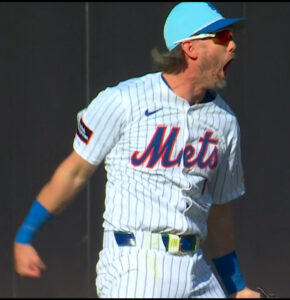 The old gray Squirrel, he is what he used to be. See McNeil and appreciate a lifelong Met. We expended so much anxiety on Alonso’s decision to stay a Met last winter (and might resume contemplation of his destination again this winter, opt-out pending), that it probably didn’t cross our minds that Jeff McNeil was going on his eighth season as one of us, one of ours. He signed an extension a few years ago. Our 2B-CF of the moment is under contract through 2026, with a club option for 2027. He’ll have ten seasons as a Met by then should nothing derail his presence among us. He encounters approximately one significant ding per year, so his statlines tend to get interrupted by trips to places he assumed he outgrew by his mid-twenties. Fans in St. Lucie, Brooklyn, Binghamton, and Syracuse have all grabbed glimpses of the rehabbing Squirrel. He received a special dispensation to get up to speed in the Arizona Fall League last October because he had been hurt prior to the playoffs, and the Mets wanted him back for the NLCS. He drove in a few runs against L.A., but wasn’t really himself.
Jeff McNeil was himself and then some on Friday. Jeff McNeil hit the lead-taking homer, made the lead-preserving play, and earned himself a piece of above-the-marquee Subway Series history. You know The Dave Mlicki Game. You know The Matt Franco Game. You know The Mister Koo Game. You’ve just met The Jeff McNeil Game. It’s not like you haven’t met Jeff McNeil before, but it’s always nice to remind ourselves who he can be.
by Greg Prince on 4 July 2025 2:40 am Two out of three from Milwaukee…where have we heard that one before? If it wasn’t quite October 2024 at American Family Field in July 2025 at Citi Field Thursday night, at least it wasn’t any more of the second half of this June seeping into this July. Maybe this July will tell a different story from what we were sadly getting used to. Or get us back to where we thought we were going until the middle of June.
It always helps to have your most reliable starting pitcher on the mound. It could be argued the Mets had their two most reliable starting pitchers of the past calendar year toeing that rubber, as David Peterson dueled Jose Quintana. The erstwhile lefty teammates carried much of the 2024 load from midseason onward. Jose then left to join our Wild Card Series enemy, but will always merit Old Friend™ affection. David, meanwhile, continued to emerge as Ace Peterson, Met Corrective. Two subpar starts haven’t detracted from his status, not when there’s been nobody else to challenge him for it. We’d welcome a challenger. We’d welcome anybody remotely capable to join the rotation. These days it’s Peterson, Clay Holmes, and fill in some blanks. Sean Manaea (a fairly reliable 2024 southpaw himself) supposedly isn’t far off from making his return. Nor is Kodai Senga. But they’re not here yet.
Few are.
Before Thursday night’s series finale, which your correspondent covered as credentialed media (meaning a furtive fist pump here, a silent boo of Rhys Hoskins there), the Mets announced Paul Blackburn was going on the IL with a right shoulder impingement, not as serious as the right elbow sprain that is also IL’ing Dedniel Nuñez. Missing Paul Blackburn will mean missing a warm body, based on his performance to date. The next three scheduled Met starters — for the Subway Series, oy gevalt — will be Justin Hagenman, Frankie Montas, and Brandon Waddell. Warm bodies are having a moment.
I found it most instructive to sit in on Carlos Mendoza’s pregame presser and listen to him retrace Blackburn’s steps from last weekend, when the righty tried to give the Mets a little more length after waiting out a rain delay in Pittsburgh. The Mets wanted, and the pitcher did his darnedest to deliver, “another 35 pitches,” which Mendy equated to “asking a lot”.
That, it occurred to me, is what this current season has come down to: somebody, anybody, please give us 35 pitches. Then maybe somebody else can throw another 35 pitches. However many innings that adds up to, just get us there, and maybe somebody else can come in, somebody we’ve heard of. Or somebody whose identity we can learn as we go along. After the Mets made their nightly flurry of moves besides the injured list additions (Hagenman and Rico Garcia are up; Blade Tidwell is down; Austin Warren, designated 27th Man on Wednesday, sticks around), it was reported the Mets signed to a major league deal reliever Zach Pop.
My reaction was, “I’ve never heard of Zach Pop.” I’d also never heard of most of the additions the Mets have made to their bullpen these past few months, even though most of them could claim anywhere from a smidgen to a modicum of MLB experience. Zach Pop has more than that; since 2021, he’s pitched in 162 games, a full season’s worth, despite my failing to notice a very noticeable name clearly destined to join our roster of very noticeable, if preternaturally obscure names. My childhood devotion to absorbing the names and faces on baseball cards notwithstanding, I’m coming to believe that just because somebody is a professional big league pitcher, it doesn’t automatically qualify him as famous.
 The view from the other side of the glass. David Peterson, on the other hand, should have his name up in lights for the way he escorted us from the darkness. In this era’s version of Koosman versus Seaver at Shea, August 1977, or perhaps Pedro versus Ollie at Citi, August 2009, this time it was the Met who remained besting the Met who went away. Quintana was pretty darn good for the Brewers, the way he was often pretty darn good for the Mets. From the first to the fifth, the only damage he incurred was a Brandon Nimmo solo home run that bounced giddily off the Cadillac Club roof in right in the second. His undoing in the sixth was of the mythic Wee Willie Keeler variety, as the top of the Met order — Starling Marte, Francisco Lindor, and jersey-giveaway inspirer Juan Soto — all hit balls where Brewer fielders weren’t. Soto’s well-placed single drove home Marte to give the Mets a 2-1 lead and chased Quintana. Versus Q’s successor, Pete Alonso immediately banged one where the left field fence most definitely was, driving in Lindor to put the Mets up, 3-1. Four consecutive hits constituted a rally straight out of magical 2024. Huzzah that it took place in hard-bitten 2025.
All Peterson had allowed through six was one unearned run, in the fourth, the result of the kind of dripping you’d expect on a night that began with a 37-minute rain delay. Nothing was hit terribly hard. Nothing fatally impeded Peterson. Having reached the point where if we can’t count on Peterson, we can’t count on any starter, we were able to count on him to get us into the seventh.
The seventh! No Met pitcher pitches into the seventh! Except for David Peterson, who’s done it a few times this year. This was a great time to do it again, despite his giving up a two-out solo home run to Andrew Monasterio and, with the last of his 103 pitches, an infield single to Sal Frelick. The good news is when your starter has taken you into the seventh, you can skip over the Poches and Pintaros and Pops and proceed directly to the back of your bullpen. That meant Ryne Stanek to get us out of the seventh and through the eighth before handing it off to Edwin Diaz for safe keeping in the ninth. Stanek and Diaz pitched Wednesday night as well. “They won’t be available Friday,” I thought. Then I added to my thoughts, “There is never any tomorrow with this team and this bullpen. Just take care of tonight, and we’ll bring up three more mysterious arms to deal with what comes.”
Stanek did his part to keep it Mets 3 Brewers 2. Diaz struck out his first batter before giving up a Wee Willie special to pinch-hitter Christian Yelich, who made soft but clever contact. Yelich being on first implied Yelich might very well be on second, given that Diaz isn’t a fanatic about holding on baserunners. Fortunately, he’s been working on getting the ball to the plate sooner, and, more fortunately, he had Luis Torrens catching and throwing once Yelich took off; he had Lindor catching and tagging once Yelich slid; and he had replay review seeing how many stitches on a baseball can dance on the head of a pin.
Yelich was initially called safe on a very, very close play. Lindor was adamant the Mets challenge. The Mets did their own due diligence and went along with their shortstop’s judgment that he tagged Yelich’s leg before Yelich’s hand touched second. The challenge was on. I watched replays on the enormous screen in distant center as well as the nearby monitors in the press box. I saw nothing that indicated there was any reason the out call wouldn’t stand.
But somebody in Midtown saw something. What appeared too inconclusive to overturn got overturned. Yelich went from being the tying run on second to the second out. An instant later, Diaz resumed striking out Brewers to end the game in the Mets’ favor.
On nights the Mets have just enough pitching, just enough hitting, and an extra dollop of defense, it’s as if they’re the Mets again. Not the Mets we’ve been thinking they were, but the Mets we were thinking they were before that. I realize it can be difficult to tell them apart. The Mets they were Thursday are the Mets who have a handful of relief pitchers you couldn’t pick out of a sellout crowd, but aren’t compelled to use them.
|
|






