The blog for Mets fans
who like to read
ABOUT US

Faith and Fear in Flushing made its debut on Feb. 16, 2005, the brainchild of two longtime friends and lifelong Met fans.
Greg Prince discovered the Mets when he was 6, during the magical summer of 1969. He is a Long Island-based writer, editor and communications consultant. Contact him here.
Jason Fry is a Brooklyn writer whose first memories include his mom leaping up and down cheering for Rusty Staub. Check out his other writing here.
Got something to say? Leave a comment, or email us at faithandfear@gmail.com. (Sorry, but we have no interest in ads, sponsored content or guest posts.)
Need our RSS feed? It's here.
Visit our Facebook page, or drop by the personal pages for Greg and Jason.
Or follow us on Twitter: Here's Greg, and here's Jason.
|
by Greg Prince on 21 August 2020 5:24 pm Welcome to A Met for All Seasons, a series in which we consider a given Met who played in a given season and…well, we’ll see.
I got the horse right here
The name is Paul Revere
And here’s a guy that says
If the weather’s clear
Can do
Can do
This guy says the horse can do
—“Fugue for Tinhorns,” Guys and Dolls
Psst…over here. Yeah, you. You with the Mets cap on your head and the fistful of hope practically jumpin’ outta your heart. I know your type. You’re a good fan lookin’ for a reason to get excited about the Mets in 2010, aren’t ya, Mac? Ya wanna feel the way ya felt before they opened that Citi contraption, before they tore down your beloved Shea, before those collapses ruined your last seasons there. You want a little taste of what it was like when your guys Reyes and Wright were coming up. I saw your eyes light up when I said that. Homegrown stars. That’s the stuff, ain’t it?
I got a tip for ya, then. Some real ground-floor intel. I’m not givin’ it to everybody, but you, my friend, you should have this, and here it is:
Put your hope and your heart — all of it — on Ike Davis to go all the way. I’m tellin’ ya, pal, he can’t miss.
Ya look skeptical, but buddy, I got the straight dope here. This Ike Davis is a born winner. Bats left, throws left, does everything right. Ya don’t believe me? Check out the background. The Mets took him in the first round out of Arizona State — same school as Reggie Jackson — in 2008 with the pick they got when the Braves signed T#m Gl@v!ne back where he belonged. That guy, right? The Mets sent him to Brooklyn, where he began to feel his oats, and then as he got higher up the chain, in St. Lucie and Binghamton, the kid began to really pop. Twenty homers in all in 2009. Did ya see anybody at Citi Field hit twenty homers in 2009? Besides Chase Utley?
Mac, ya like batting average? Then get a gander at this number: .341. That’s what Ike hit in the Arizona Fall League last year. Led the entire circuit, mi amigo. Played a sweet first base, too. If that don’t sound like enough, get a load of his bloodlines. Ike Davis is the son of Ron Davis. That’s right, the Ron Davis who pitched for the Yankees and Twins. Time flies, huh?
 Could it possibly matter that Ike Davis was a Jewish major leaguer? Couldn’t hurt. Say, pal, you wouldn’t happen to be of the Semitic persuasion, would ya? No offense, none! The reason I’m asking is if you are…you are? Well, you’ll love this. Ike Davis is Jewish! Technically, half-Jewish, on his mother’s side. The one that counts off the field, right, my man? Or should I say right to left? Listen, I know you only care about hitting and fielding, but it’s a nice little bonus, don’t ya think? Your whole face is lighting up. I’ll bet you were pretty excited when the Mets traded for Shawn Green. No trade necessary for Ike.
Now you might be wondering why the Mets haven’t announced Ike Davis will be starting at first base as soon as the 2010 season commences. After all, both Baseball America and Baseball Prospectus have him in their Top 100 prospects, and Amazin’ Avenue — you ever read them? — says he’s already the Mets’ No. 6 prospect, just five spots behind Fernando Martinez, and I know you know about him. Lemme tell ya why you’re not gonna see him from jump:
Because that Omar Minaya is a smart cookie, that’s why. Omar knows if he starts the season with Ike Davis on the roster, I mean on Opening Day, Ike becomes a free agent that much sooner. These GMs today, they take all that stuff into account. It ain’t like when you and I were comin’ up and they just put the best players on the team and let the chips fall where they may. Right, like Kelvin Chapman. So maybe you’ll be hearing that Ike Davis is going to Triple-A, to Buffalo, that they’re bringin’ back Mike Jacobs for some reason, but have a little patience. Ike’ll be on the Mets before long, as soon as Omar counts off the days that’ll keep him on the team a whole year longer down the road — and believe you me, my friend, you’re gonna want a whole other year of Ike Davis.
I’m tellin’ ya, brother, you want in on Ike Davis. Talk about a sound investment. Gonna be the best all-around first baseman our Mets have had since John Olerud. Wait, did I say Olerud? I meant Hernandez. Yep, Keith Hernandez — Mr. Seinfeld himself. I bet ya loved Keith Hernandez. I bet in your heart of hearts you don’t think the Mets have ever truly replaced Keith Hernandez.
Well, this Ike Davis is the sure thing, Mac. The bat. The glove. The personality. Wait ’til you listen to the kid speak. He’s a natural! And you don’t even have to hope the Mets’ll trade Neil Allen and Rick Ownbey for him. He’s on his way — it’s in the bag. Whaddaya say, how about putting down your heart and your hope on some of this Ike Davis action I’m lettin’ you in on.
Oh, you won’t be sorry you did. I’m promising ya, pal, you’re gonna flip for Ike Davis.
***Psst…over here. Yeah, you. Don’t ya remember me? From last spring. I’m the guy who turned you to on to…that’s right. I’m the Ike Davis guy.
 An Ike Davis guy. How did that work out for ya, pal? Pretty nice, huh, just like what it says on that shirt you’re wearin’. “WE LIKE IKE.” Bet ya couldn’t wait to run into the team store and pick up that beauty. Ya got exquisite taste there, chief. And you’re smart, because ya listened to me. I told ya all about Ike Davis before he even came up and you were there the night he debuted. April 19, 2010, Jackie Robinson Night at Citi Field. The Mets were off to a murderous start. Four and eight and the word was out about the first baseman at Buffalo. Even the nimrods calling the FAN were demanding Ike. Mike Francesa was tryin’ to get out in front of the bandwagon, and you know if that jamoche was on the case, it was only a matter of time.
But you were on top of all those jerks because you went in hope and heart on Ike Davis before everybody else was done asking what the deal was with Mike Jacobs being back. You listened to the information. You got it right from the source, right here. Ike wore No. 42 like everybody else when he made his first appearance, but you, pal, you could pick him out of a crowd. Something different, and not just because he was Jewish on his mother’s side. Whoa, no offense.
Ike had that certain something you loved. Whether in 42 or 29, he just looked like he belonged, like the majors were waitin’ for him, not the other way around. You loved the hitting. You loved the fielding. You really loved the three times he went rear end over tea kettle to grab them foul balls. Hey, I meant it when I said you’d “flip”. OK, he was the one who flipped. Ya got me with the grammar.
And the team, while it didn’t exactly light the world on fire, they seemed like Ike’s team whenever they did, right? Did ya see how his teammates greeted him at home plate that night in June when he beat the Padres? That was no ordinary walkoff reception. Rookie or not, he didn’t mind gettin’ in an umpire’s face, wasn’t afraid to pat a teammate on the butt, grew a little facial hair, started a charity in memory of his friend. Little things, but ya notice ’em. He didn’t seem afraid of anything. Sure, there were a few more strikeouts than you’d care for, and the average wasn’t exactly out of the Arizona Fall League, but c’mon, he has to save something to get better at. What is it they say about really good TV shows these days? “No spoilers,” that’s it. We’re gonna wanna see how he improves every year. You wouldn’t want me to give away the plot to Breaking Bad, would ya?
Listen, as long as we’re talkin’ chemistry, ya must’ve loved how Ike held down that infield. Around the horn: Wright, Reyes, the pup Ruben Tejada and Ike Davis. All homegrown, all young. Even David and Jose, who it seems like have been around forever, are under thirty. That’s a dream come true for a Mets fan like you, I’ll bet. No coming and going, only orange and blue, through and through. I don’t know why it matters, either, but you’re right. It’s just better that way. And last year Davis, Tejada, Reyes and Wright started together 39 times, more than any totally homegrown Met infield ever did, even the ones with Eddie Kranepool and Buddy Harrelson.
Amazin’, as fellas like you and me like to say, right? And think about this, my friend. Reyes can be a free agent after the upcoming season. Loyalty is as loyalty does, hmmm? For all we know, the Mets will trade him before he walks. I know, I know, it’s unthinkable that he leaves the Mets, but with this Madoff business, you can’t necessarily trust these owners to keep their best players. And if Reyes can leave, who’s to say Wright won’t? What, you think just because he’s a good Tidewater boy that he won’t shop his services around? Not for nothin’, but Chipper Jones isn’t gonna play third base in Atlanta forever, and Georgia is in the south just like Virginia. I’m just sayin’. I’m not tryin’ to upset ya here — it’s just us two Mets fans talking — but who’s gonna be the next captain if David bolts? Can’t you see Ike taking charge? Admit it, you’ve already thought about that and he doesn’t even have a full year of service time.
 You wouldn’t have guessed that by the middle of 2011, you’d be more likely to see an Ike Davis bobblehead at Citi Field than see Ike Davis. In the end, the Mets won only 79 games in 2010, yet Ike hit nearly 20 homers and drove in more than 70 runs. These were practically Strawberry numbers! And ya can’t forget those catches over the railings. That’s a trademark move. The boys in Brooklyn made a bobblehead out of one of ’em. I hear the Mets are making a giveaway for the upcoming year, though it probably won’t be as cheeky. It never is with them. Anyway, our man had a heckuva introductory campaign, wouldn’t you say? Finished seventh in the Rookie of the Year vote. Sure, the Giants had Buster Posey and went to the World Series, and the Braves had Jason Heyward and went back to the playoffs, but we had Ike Davis, and what I’m sayin’ pal is Ike’s not gonna be a free agent for that whole extra year, not ’til after 2016. That’s ages from now.
By then, you get the feeling Ike’s gonna be as big a star as Posey or Heyward. Listen, I got a tip that Albert Pujols is gonna be pullin’ outta St. Louis after this year, maybe chase some of that designated hitter money in the junior circuit. Then who’s the perennial All-Star first baseman in the National League? Freddie Freeman? Joey Votto? Nice players, sure, but c’mon, we have Ike Davis. What’s it say there on that garment of yours? Yeah, we do like Ike.
So whaddaya say, pal? Ya listened to me last year and it paid off handsomely. How about you go all in this time? All hope. All heart. All head, even. Ya can’t argue with the results and the potential. Take a look, I got an advance glance at this 50th-anniversary book by Matt Silverman — good writer — and the last player picture in here is of none other than Ike Davis. Y’know why? Because they always end with the future in these books. Nobody’s more the future for this team after 2010 than Isaac Benjamin Davis, if I may use his full and proper name. Seriously, start him up, he’ll never stop.
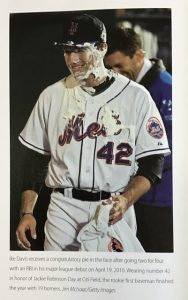 Have a pie, the future is here! This is a once-in-a-lifetime opportunity for a Mets fan of your ilk. Homegrown slugger, charismatic, a landsman…you know what I’m talkin’ about.
All right, all in. Pal, ya won’t be sorry.
***Excuse me? No, I don’t know you. Ike who? Listen, Mac, move along, I’m tryin’ to conduct honest business here. I don’t know what you’re talkin’ about.
All right, fine, ya got me. Yes, I’m the guy who turned you on to Ike Davis all those years ago. So it didn’t work out. So the homegrown infield of your dreams never started together again after 2010. So he collided with Wright on the mound at Coors Field and missed most of 2011, which I didn’t think looked that bad, but it was apparently a turning point for the worse. So he contracted the valley fever in 2012, which I’d never heard of before Ike got it, but I know it was probably worse than anybody let on and he never really fully recovered. So he kept striking out and his average kept dipping and he never made another catch over a railing again. So they sent him to Las Vegas to find his stroke and it proved irretrievable. So they traded him to Pittsburgh in 2014 and he was basically never heard from again except when he played for Israel in the WBC. So like with Shawn Green the fact that he was a Jewish Met was nothing more than a pleasant footnote when he wasn’t producing. Still, lemme guess: you were more fired up about the idea of voting for Ike Davis in 2010 than you were about Joe Lieberman in 2000.
I know neither one of them was ever elected to start in an All-Star Game. Just an observation to lighten the palpable tension.
Listen, whaddaya want from me, pal? This happens. Sometimes you invest your hope and your heart and even your head in a guy and you’re sure it adds up to a winner, and then it doesn’t. I’m pretty sure you’ve been around the block a time or two with this franchise. You know you don’t always get the Mets you want, just the Mets you get.
Yeah, yeah, it was gonna be different with Ike. Ike was gonna be here for the long haul. Ike was gonna anchor the infield. Ike was gonna be captain, maybe. Ike was gonna be our Moses and lead the Mets to the promised land, yet when they finally got close, in 2015, Ike Davis wasn’t within a shofar’s blow of the action. Hey, amigo, not every player who thinks about taking off Yom Kippur is Hank Greenberg. Kapeesh?
Sorry you lost your proverbial shirt on this one, friend. Oh, you still have the “We Like Ike” shirt? Well, good for you. At least ya got something. And, hey, ya got your memories of 2010, don’t ya? Well, that’s something. It was fun hoping and being sure you were on the ground floor of the next Met superstar, wasn’t it? A little, at least, right?
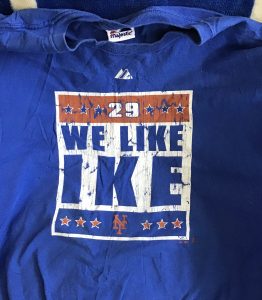 Still got the shirt. What can I tell ya, pal? The prospects come, the prospects go, not that many make it to the big leagues, and among those who do, precious few stick around. If they all did, then ya wouldn’t have shed a tear when David Wright called it a day. But if you’re in the market for a real sure thing, I’ve got the inside word on another first baseman. Lots of power, lots of personality. A real horse, yet, get this, they call him the Polar Bear. No, I’m not sure why, but it’s catchy, right? Kid’s gonna be the best at the position the Mets have had since Mr. Seinfeld himself, Keith Hernandez. Maybe better.
Whaddaya say, Mac? C’mon, it’s only hope.
PREVIOUS METS FOR ALL SEASONS
1962: Richie Ashburn
1963: Ron Hunt
1964: Rod Kanehl
1966: Shaun Fitzmaurice
1969: Donn Clendenon
1970: Tommie Agee
1972: Gary Gentry
1973: Willie Mays
1977: Lenny Randle
1978: Craig Swan
1981: Mookie Wilson
1982: Rusty Staub
1983: Darryl Strawberry
1986: Keith Hernandez
1988: Gary Carter
1990: Gregg Jefferies
1991: Rich Sauveur
1992: Todd Hundley
1993: Joe Orsulak
1994: Rico Brogna
1995: Jason Isringhausen
1996: Rey Ordoñez
1998: Todd Pratt
2000: Melvin Mora
2001: Mike Piazza
2002: Al Leiter
2003: David Cone
2004: Joe Hietpas
2005: Pedro Martinez
2008: Johan Santana
2009: Angel Pagan
2012: R.A. Dickey
2013: Wilmer Flores
2014: Jacob deGrom
2019: Dom Smith
by Greg Prince on 20 August 2020 7:09 pm Seth Lugo did not make his first start since 2018 on Thursday night. The Mets did not go for the four-game series sweep in Miami on Thursday night. Dom Smith did not take further aim at the National League RBI lead on Thursday night. Luis Guillorme did not get as much as one swing in toward raising his batting average even higher on Thursday night. The Mets did not move within a game of .500 or fall three below the break-even mark on Thursday night, the eve of their first Subway Series matchup of 2020 on Friday night.
Scratch whatever there might have been to say about that first Subway Series matchup on Friday night, too.
Just when you thought it was safe to get back into baseball, COVID-19 reminded us it signs off on the schedule last, and the virus decided, nope, no Mets game at Marlins Park and, nope, no next game at Citi Field. Two members of the Mets’ traveling party — a player and a staffer — tested positive and, for at least a couple of games, that’s all she wrote for our baseball team’s attempt at routine.
The identities of the player and the staff member haven’t been revealed as of this writing. All we can do is wish them very well. Same for anybody with whom they might have interacted in more than a passing way. We’re not experts. We’re just trying to be human.
It took not quite a month to get to a Mets postponement. They’re not the first team affected. The longer baseball soldiers on, the likelihood is they won’t be the last. For twenty-six games, the almost-nightly presence of the Mets on SNY and WCBS grew incrementally more normal. Come the twenty-sixth night, despite the abomination of the designated hitter (nothing personal, Met DHs), the complete lack of attendance and all the other abnormalities MLB accommodated to put their product forward, it had reached a point of normal enough. Not normal enough to meet one’s preferences, but normal enough to kvell from deGrom, plotz from Diaz and experience deliverance via Conforto. Normal enough to take seriously a baseball team in a time when so much else feels dire. It wasn’t perfect. Maybe it wasn’t even appropriate. But it was the Mets.
For the moment, it is not. Having postponed their Thursday and Friday games, they’re flying most of their personnel back to New York “with recommended safety precautions” and will “conduct testing with the entire traveling party”. The two people who tested positive, “along with those traced to be within close contact,” are remaining in Miami for now.
This is certainly different from announcements that this pitcher is experiencing nothing worse than shoulder inflammation and that catcher is moving to the 45-day IL, with surgery to remove a bone spur slated. We already knew basically everything about this season would vary wildly from what we consider standard. Why should baseball differ drastically from the world in which it’s attempting to play?
Being normal, however abnormal the normality, intermittently approached recognizable levels of fun for four weeks. The pitching when it was good. The hitting when it was timely. The kvetching when it was merited. The routine when it was humming along just about like always. You almost forgot how incredibly abnormal everything is.
UPDATE: Saturday’s and Sunday’s game have also been postponed.
by Greg Prince on 20 August 2020 12:22 pm The Mets got the win Wednesday night in Miami, as they scored more runs than the Marlins for the third consecutive night. That’s the key indicator right there. So we’ll go W-NYM.
We shall credit Michael Conforto with the save. He came up in the ninth with Brandon Nimmo on first and bashed a two-run homer to put the Mets up, 5-3, after several of Conforto’s relief-pitching teammates conspired to transform a 3-0 Met lead into a 3-3 tie.
Nimmo gets what we’ll call an offensive assist because his single preceding Conforto’s homer came with two outs, making his hit critical to Conforto’s crucial shot.
I get the satisfaction of having thought, just as Brandon Kintzler threw to Michael, “I have a feeling he’ll homer here,” but that doesn’t show up in the box score.
Edwin Diaz gets nothing, not even a “way to go” for recovering from walking in the tying run with two out in the eighth and striking out the final four batters he faced. That he was the “pitcher of record” when Conforto went deep is purely incidental. That he preserved a two-run lead to close the game is the least he could do. Join me in satisfaction for the team winning, Edwin. It’s better than nothing.
Dellin Betances, who set up the house of cards for Diaz to knock down, gets to pick up the cards. And those he can hold if he wants a hold. Holds, still somehow an actual statistic, should be held in abeyance in general.
Jeurys Familia and Justin Wilson, they of the leadoff walk and the wild pitch that gave the Marlins their first run, get to come back tonight, but only because the world’s largest bullpen never has enough lukewarm bodies.
Seth Lugo gets Thursday’s start because we’ve had eight starting pitchers already in 26 games and we’re forced to turn to our most valuable reliever to save us from the first inning on. We no longer have a rotation. We have a pile of laundry we sort through in quest of a reasonably clean shirt.
Edwin Diaz gets more ninth innings, apparently. He’s slowly regained a portion of our trust. No way he’ll let us down.
Luis Guillorme and his .464 batting average, which encompasses his seventh-inning run-scoring single, gets a temperature check, because, brother, he’s hot.
Dom Smith, with this two doubles, including the one that extended the Mets’ lead to 3-1 in the eighth, gets a shot at leading the league in RBIs, provided he plays daily and that impudent Fernando Tatis, Jr., abides by the dusty custom of not swinging at pitches he can drive for grand slams with large leads (the nerve of that kid!). Current NL runs batted in leaders:
Tatis 29
Blackmon 22
Betts 21
Smith 21
Tatis has 104 at-bats; Charlie Blackmon, 94; Mookie Betts, 98; and our Dom has 65. Unless there’s an unwritten rule about making certain your best RBI guy isn’t in there every day, Dom — slashing .323/.403/.754 — does have a shot. Let’s keep giving him every shot. He’s earned it.
And Jacob deGrom gets our usual heap of gratitude for him being him and profound apologies for the Mets being the Mets when he is being Jake. Six innings of shutout ball after a blistery finger and a neck scare, the latter of which kept him from starting his last turn — four scattered singles, no walks, one mild error-induced jam from which to wriggle — is worthy of a W, but that letter technically went to Diaz, though we’ve opted to assign it to the team as a whole. DeGrom, with his ERA down to 1.93, said he felt “rusty”. Fathom what he’ll be like feeling free and easy.
Man, when you get that singular figure coming off the sidelines, addressing the most transcendent concerns of the day and delivering the message you really need to process, you get the feeling that maybe, just maybe, if everybody does their part, things are going to eventually work out. You know, like when deGrom pitches and the Mets somehow come back and get through their foibles and emerge in better shape than you imagined.
Stay safe. God bless.
by Jason Fry on 19 August 2020 10:30 am “Don’t hold the ball so hard, OK? It’s an egg. Hold it like an egg.”
So says Crash Davis to Ebby Calvin LaLoosh. It’s good advice for us all.
The Mets suddenly look … OKish? They’ve remembered how to hit, the defense has been reasonably sound, and the bullpen offers depth, and not just because of the additional roster spots. (Though those help too.) On Tuesday night Brandon Nimmo, J.D. Davis and Amed Rosario all went deep, with Rosario’s drive particularly impressive — a no-doubter into the second deck in left field, with accompanying bat flip — and desperately needed to soothe the young shortstop’s psyche. Dom Smith continues to look locked in at the plate, and Robinson Cano is playing with a fluidity and ease we’ve never seen from him, even in his brief September renaissance. On the pitching side, Justin Wilson, Jared Hughes and Dellin Betances contributed solid relief, and Edwin Diaz finished his lone inning looking sharp after starting it looking less than that. Is that too generous? When you win you can afford to be generous.
What the Mets can’t afford is any more blows to their already rickety starting pitching, and that’s how Tuesday began, with news that David Peterson was hitting the IL with shoulder fatigue. His replacement was Corey Oswalt, who looked better than he had in previous Mets tours of duty but still got cuffed around the third time through the Marlins’ order. Say what you want about Luis Rojas, but he’s not sentimental: He pulled Oswalt two outs short of qualifying for a win, handing the ball over to Wilson.
“Shoulder fatigue” is one of those vague baseball maladies that can mean everything from “needs to skip a start” to “career in jeopardy,” so let’s wait for more information about Peterson before freaking out or conclusively not doing the same. On Wednesday Jacob deGrom will pitch, and then after that, well, no one will say. Thursday’s starter will probably be Steven Matz, since even his current gopherball-prone, deeply-frustrated/ing incarnation is likely better than Starting Pitching Plan D or E or whatever the Mets are up to by now.
The thin starting pitching should be a hard pump to the brakes for any optimism you can muster about the Mets — the old expression “momentum is as good as the next day’s starting pitching” isn’t just about staffs full of aces, after all. But, I dunno, squint a little and you can at least imagine the extra bullpen depth taking up some of the innings slack, the Mets toying with openers, and the offense overcoming some of their teammates’ messes. Hope’s free, and in this topsy-turvy year you can get by with a modicum of it: grab one of your league’s extra playoff slots and then play small sample size/short series roulette for as long as the scoreboard indicates you can keep going.
Maybe that’s not squinting a little but squinting a lot. Maybe deGrom grabs at his neck tomorrow night and Matz gets shellacked on Thursday and on Friday we’re all trying to hang ourselves with our masks. We’ll find out soon enough. In the meantime, hope’s an egg. Don’t hold it so hard.
by Jason Fry on 18 August 2020 7:29 pm Welcome to A Met for All Seasons, a series in which we consider a given Met who played in a given season and…well, we’ll see.
One day in the spring of 1987, I chatted on the phone with my mom.
This wasn’t noteworthy — I was a senior in boarding school, and in the era before cellphones we’d take turns cramming into the cubby that held our dorm’s lone pay phone to check in with parents. But this time my mom had a story to tell me.
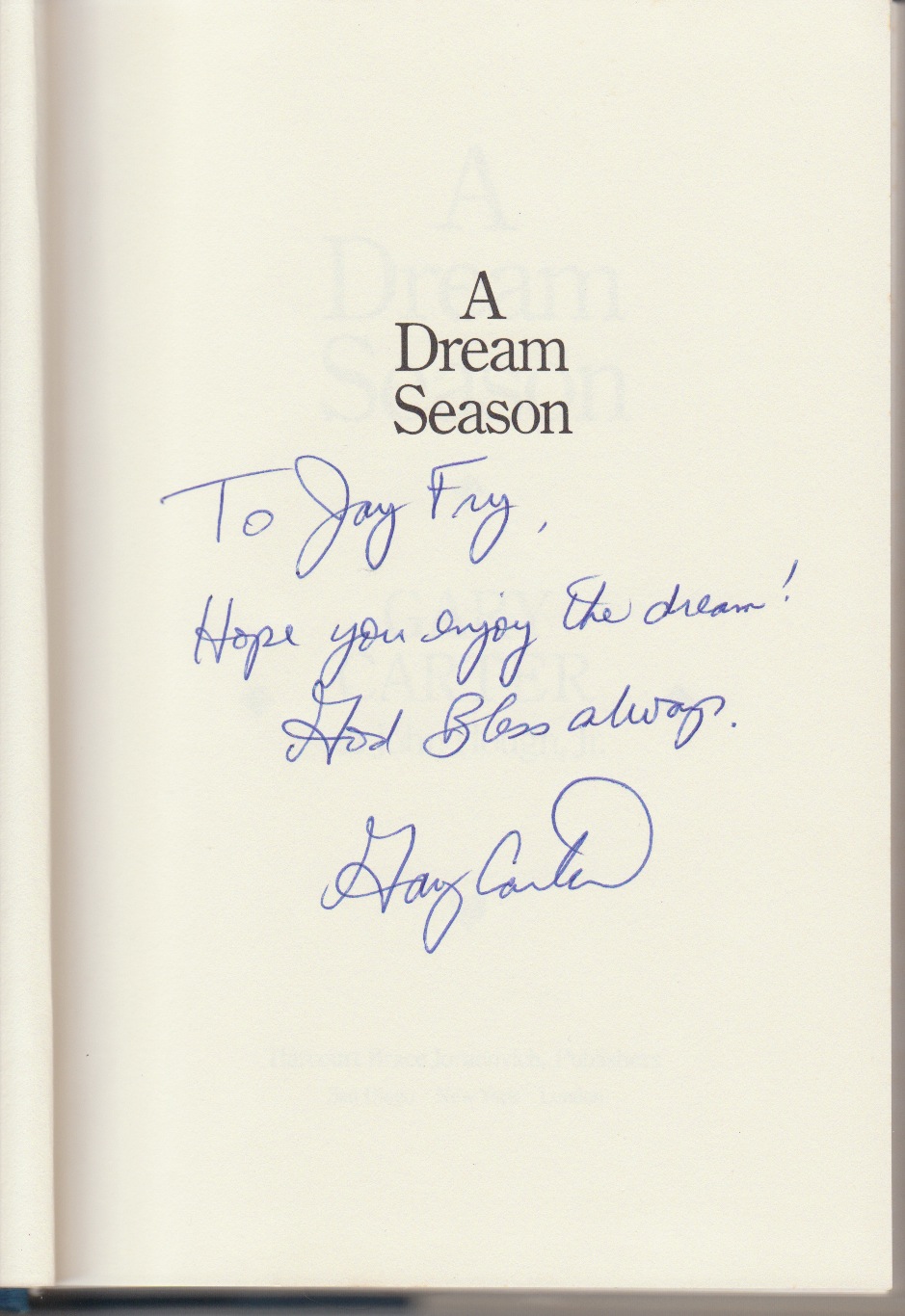
Gary Carter’s book about the ’86 championship, A Dream Season, had just hit stores. She’d heard that Carter would be at Haslam’s Book Store in central St. Petersburg, Fla., and driven over to get me a signed copy. St. Petersburg had been the Mets’ spring-training home since their birth in 1962, and so the town had a certain affection for the team. Knowing this, my mom left plenty of time to wait in the long line she expected.
But there was no line. While St. Petersburg has since become a reasonably interesting town (with its own major-league team, at least for now), back then it was still disparaged — sometimes affectionately, sometimes not — as God’s waiting room. Haslam’s was in the middle of nowhere, the afternoon was hot, and not even the presence of the All-Star catcher of the World Champions of baseball was enough to draw a crowd. There was just Gary Carter, looking bored and a little wan.
My mom felt sorry for him, and so she stayed and chatted for a while — about the Mets and their season (she has always been a huge fan), but also about her sometimes wayward son and his writing ambitions and where he might go to college the next fall.
As this story unfolded over the phone, I had two reactions:
1. Oh God, mom, you didn’t.
2. Please don’t let this story end with another rich athlete being curt or dismissive with a fan. Not when the athlete is Gary Carter and the fan is my mom. Because that really might break my heart.
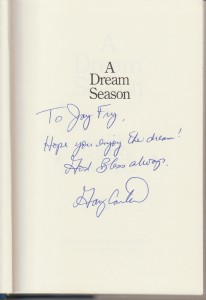 Of course I had nothing to worry about. Carter couldn’t have been kinder. He signed my book — To Jay Fry, Hope you enjoy the dream! God bless always, Gary Carter — and my mom left, a fan who’d met a baseball hero and come away thinking better of him. Of course I had nothing to worry about. Carter couldn’t have been kinder. He signed my book — To Jay Fry, Hope you enjoy the dream! God bless always, Gary Carter — and my mom left, a fan who’d met a baseball hero and come away thinking better of him.
I remembered that conversation in February 2012, when I heard Carter had died after a yearlong battle with brain cancer. My son Joshua was nine years old, and after I picked him up at school I gave him the news and we talked about Carter on the walk home. Our family had spent that offseason watching Ken Burns’s Baseball, which had led to conversations about athletes, and how it was both tempting and unfair to take their successes or failures on the field and turn them into judgments of them as people. What I was trying to get across was that most athletes, like most people, were neither heroes nor villains, and our stories about them were too simple. We’d talked about Ty Cobb and the horrible things he’d done, but also about how Cobb had been damaged by a cruel and horrifying childhood. And we’d discussed how Barry Bonds could be a cheater and a superstar and a jerk and a sad, even tragic figure all at the same time. I suppose it was my version of editor Stanley Woodward’s famous advice to the great Red Smith: “Don’t god up the players.”
Given all that, as we walked home in the dark it was a relief to be able to talk about Gary Carter. It was a relief to be able to tell my son that I’d never heard anyone speak ill of him as a teammate, husband, father or friend. It was a relief to say that he was by all accounts something simple to describe and unfortunately easy to mock, probably because it’s so hard to achieve: a good man. Not because of what he’d done behind the plate or at bat, but because of how he’d lived his life and how he’d treated others.
Carter was more complex than that, of course. His relentlessly sunny enthusiasm came with a whiff of self-aggrandizement, and he was embarrassingly wrong-footed about politics, with a bad habit of campaigning for managerial jobs that were yet to be vacated. I didn’t talk about that with my nine-year-old, but if I had, I would have said those things didn’t make Carter a bad person, just human. All of our obituaries, if fairly told, will include a but here and a to be sure there and a few things we would have preferred struck from the record.
In the days after Carter’s death, the memories from his teammates were heart-breaking — and raw in a way I’d rarely if ever heard from pro ballplayers. Keith Hernandez — Goofus to Carter’s Gallant, as saluted in our previous A Met For All Seasons, responded with grief so raw that listening to it made me feel like an intruder. But the words that really got me came from a sadder, wiser Darryl Strawberry: “I wish I could have lived my life like Gary Carter.”
That life began in 1954 in Culver City, Calif. Carter grew up a quintessential California kid, a star quarterback and outfielder at Fullerton’s Sunny Hills High. He signed a letter of intent to go to UCLA, where the Bruins wanted him as a QB, but opted to sign with the Montreal Expos after they selected him in the third round of the 1972 draft. The Expos turned him into a catcher, though he also played right field early in his career, and gave him a September callup in 1974. He made his debut against the Mets in the second game of a Sept. 16 doubleheader, grounding out in his first at-bat against Randy Sterling. Carter went 0-for-4 that day, but collected his first hit two days later, a pinch-hit single off Jon Matlack. He kept going from there, hitting .407 in his September cameo and becoming a National League All-Star the next season, the first of 11 such honors.
He was beloved by fans in Montreal, but not by his teammates. They resented his rapport with the media, his ever-present smile and his gift of gab. They made fun of his faith — which he’d discovered with the help of Expo teammate John Boccabella, and never shied from expressing. They sneeringly called him Teeth, and Camera. Even the nickname that stuck, “Kid,” was a put-down, bestowed after Carter had the temerity to run hard in spring-training drills. As Pete Rose had done with the derisive tag “Charlie Hustle,” Carter embraced the insult and turned it into a positive.
In the 1984 offseason, the Expos’ ownership tired of Carter and his big salary and traded him to the Mets for Hubie Brooks, Mike Fitzgerald, Floyd Youmans and Herm Winningham. The Mets were young and exciting but a work in progress, having run out of gas trying to catch the Cubs the year before. Carter was the missing piece they needed — a potent bat in the middle of the order and a mentor behind the plate. He was a brick wall in home-plate collisions, a masterful pitch framer before the concept existed, and a skilled pitcher whisperer when needed.
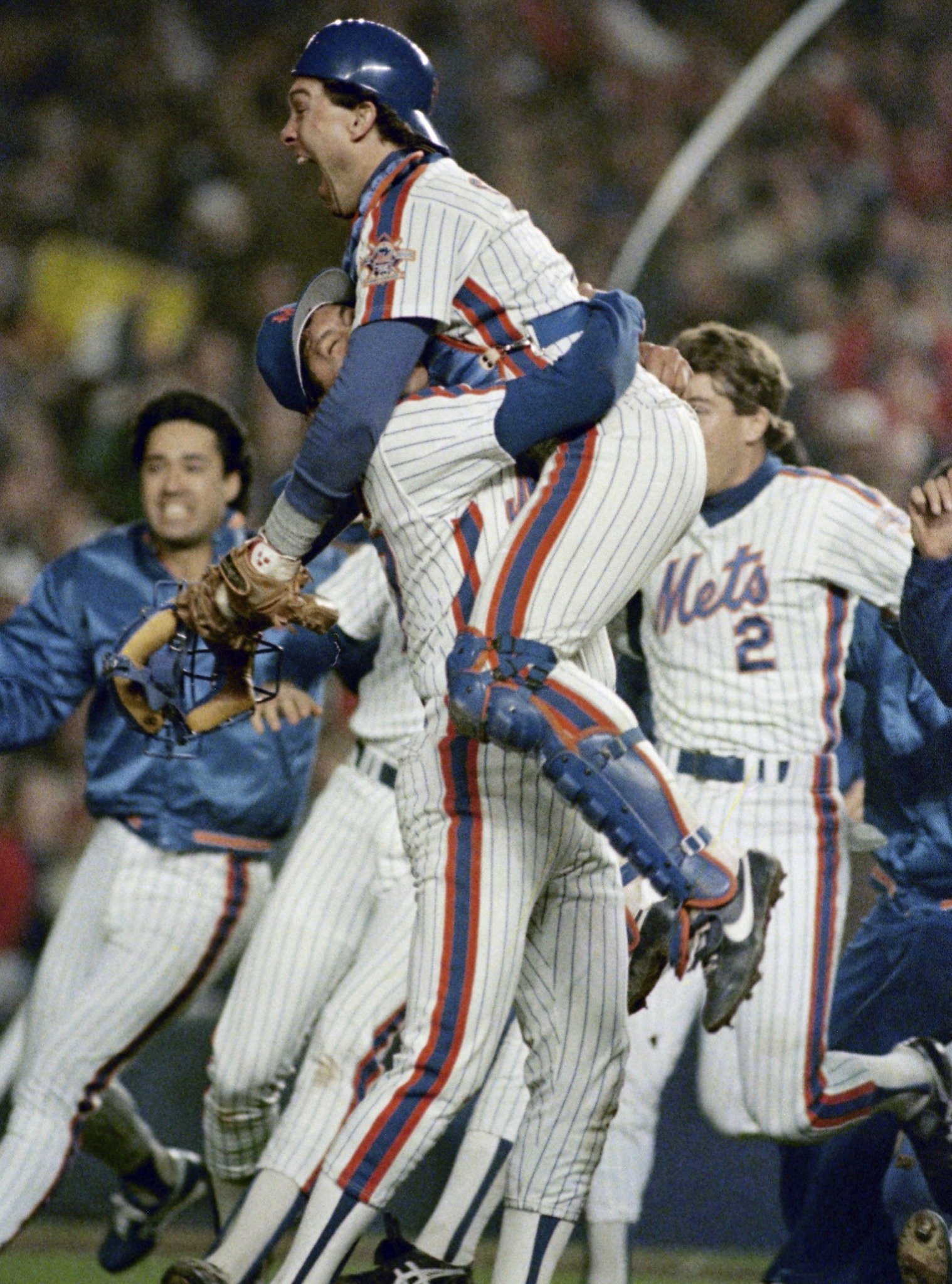
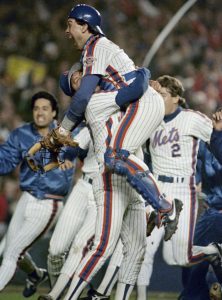 The view from Cloud Ten His impact was immediate. Introduced to the press, he noted that his right ring finger was reserved for the World Series ring he intended to win with the Mets, which must have driven his detractors in Montreal crazy. On Opening Day, he bashed a 10th-inning homer off Neil Allen to give the Mets a 6-5 win over the Cardinals, and all but invented the curtain call with his jubilant fists-raised celebration. (They hated that in Montreal too — in time they’d hate it all around the National League.)
The Mets would fall just shy of the Cardinals in ’85, but the next year they made good on Davey Johnson‘s promise that “by God, nothing is going to stop us.” Carter was front and center, of course — in the playoffs, he was mired in a seemingly unbreakable slump, and suffered the indignity of Astros reliever Charlie Kerfeld showing him the ball he’d just grounded back to the mound in yet another big spot. Three days later, in the 12th inning, Astros manager Hal Lanier walked Hernandez with one out and the winning run on second to let Kerfeld face Carter and his 1-for-21 streak. Carter lashed a ball up the middle, nearly undressing Kerfeld, to bring home Wally Backman and win the game. As Kerfeld stalked off the mound to stew about it, Carter celebrated by hugging every teammate in range, then threw his arms skyward like Atlas holding up our baseball world. Up in Massachusetts, I was certain I’d just seen a modern-day parable, a lesson that hard work and self-confidence would be rewarded.
In some other, lesser universe, Carter made the last out of the 1986 World Series, ending a meek 1-2-3 inning against Calvin Schiraldi and the Red Sox. But in this universe, he stroked Schiraldi’s fourth pitch into left for a single. Carter was so averse to profanity that he’s sometimes said to have coined the term “f-bomb,” but according to legend he arrived at first base and told coach Bill Robinson that “I’ll be damned if I’m gonna make the last fuckin’ out in this fuckin’ World Series,” a story I simultaneously don’t believe and find delightful. A few improbable minutes later the Mets had won Game 6; two days later, Carter had that ring he’d vowed to wear.
The next year, the mileage started to catch up with him — and 1988, the year he represents in our series, was a slog, with Carter laboring through a three-month pursuit of his 300th homer, a milestone that became a millstone. My last memory of him from ’88 was him dourly packing his catching gear amid the wreckage of Game 7 against the Dodgers, the smile for once stripped from his face. In ’89 he stumbled to a .183 average and in the offseason the unimaginable happened: The Mets released him. He’d play for the Giants and the Dodgers, then return to Montreal for a last go-round, one that let the frustration of his autumn seasons dissipate and drift away. His final at-bat, on Sept. 27, 1992, was baseball perfection — a double just over the head of Andre Dawson, once one of his chief underminers in the Expos’ clubhouse. It drove in Larry Walker with what proved to be the winning run; the standing ovation almost brought down Olympic Stadium.
In the last A Met For All Seasons I posited that there are Gary people and Keith people, and declared that I’m a Keith person. Which I am. But you can declare for the one without diminishing the other. I was naturally drawn to Keith’s ferocity and brains and, OK, the fact that he succeeded despite a long list of flaws and foibles. But I also beamed in response to Gary’s buoyant curtain calls, and I admired his bedrock stoicism, crouching behind the plate night after night in pain and dust.
Carter’s Met teammates rolled their eyes at his faith, but I always sensed that what rankled them most wasn’t his unshakeable faith in a higher power, but his unshakeable faith in himself — and how that compared with their own doubts and shadows. The other Mets respected him to a man, but few of them seemed to like him. But by the time Carter died, something had changed. The remorse his teammates shared was genuine — in finding themselves older and grayer and thicker, they’d come to think differently of square, uncool Gary Carter from California.
I’d never so much as met him, but my feelings had changed too. As I’d grown older and grayer and thicker myself, I’d learned that the person you show yourself to be in dealing with others is the person you really are, and how you’ll be remembered. Living your life like Gary Carter? We should all have such courage of our convictions.
Twenty-five years before he died, Gary Carter was kind to my mother. It was a little thing, but most of our lives are little things, and we determine whether they’re done well or poorly, graciously or indifferently. He wrote God bless always in a book for me, but he was a blessing in his own right. That was true on the field, at a time when baseball meant everything to me, and in time it was true off the field as well. He was a blessing, for me and so many others. His memory still is.
PREVIOUS METS FOR ALL SEASONS
1962: Richie Ashburn
1963: Ron Hunt
1964: Rod Kanehl
1966: Shaun Fitzmaurice
1969: Donn Clendenon
1970: Tommie Agee
1972: Gary Gentry
1973: Willie Mays
1977: Lenny Randle
1978: Craig Swan
1981: Mookie Wilson
1982: Rusty Staub
1983: Darryl Strawberry
1986: Keith Hernandez
1990: Gregg Jefferies
1991: Rich Sauveur
1992: Todd Hundley
1993: Joe Orsulak
1994: Rico Brogna
1995: Jason Isringhausen
1996: Rey Ordoñez
1998: Todd Pratt
2000: Melvin Mora
2001: Mike Piazza
2002: Al Leiter
2003: David Cone
2004: Joe Hietpas
2005: Pedro Martinez
2008: Johan Santana
2009: Angel Pagan
2012: R.A. Dickey
2013: Wilmer Flores
2014: Jacob deGrom
2019: Dom Smith
by Jason Fry on 18 August 2020 2:09 am A laugher is always welcome as a team trudges through the long march of a baseball season — and, as it turns out, as it sprints through an unexpectedly curtailed one. And a laugher is particularly welcome when that team has recently made you wonder if it will ever play sound baseball again.
The Mets, after being stomped by the Philadelphia Phillies over a lost long weekend, arrived in Miami to play the jury-rigged Marlins, which is my least favorite part of any season. The Marlins are annoying in teal and in barfed-up neon and while wearing home uniforms that inexplicably say MIAMI. They’re annoying in converted football stadiums and when playing under a giant Pachinko machine and when playing in front of nobody in a weirdly silent cavern. They’re annoying when Wayne Huizenga is involved and when Jeffrey Loria is involved and when Derek Jeter is involved. They’re annoying because whatever the specifics, they’re dependably tasteless and tacky and nihilistic and misbegotten and, also, because no matter how rickety and low-rent their current incarnation, they give the Mets fits.
Not Monday night, though. Oh, it didn’t start well — Robert Gsellman looked rusty and ran out of gas in the second, leaving the Mets’ bullpen needing to get 22 outs. But then the Mets got to hitting, in ways that have been in distressingly short supply this year. That was Robinson Cano hitting two balls out, the second an absolute missile into the second deck. And yes, that was Pete Alonso having a big day at the plate, complete with two homers of his own. It’s too early to declare the Polar Bear off the endangered sluggers’ list, not with the frustrating year he’s having, but it was gratifying to see him looking like he was actually enjoying himself out there.
We all were, as the Mets socially distanced themselves from the Marlins on the scoreboard — well, unless you wanted a crisply played game that showcased the beauty of the baseball. If you showed up expecting that, sorry — there was a lot of dopey baserunning, questionable use of challenges and Mark Wegner serving as MLB’s latest walking advertisement for Robot Umps Now. And the game was a dreary slog, finally ending on the wrong side of the four-hour mark when a weary Franklyn Kilome got Jonathan Villar to lift a fly ball to mercifully fieldable right.
Kilome didn’t pitch particularly well but did yeoman duty in sparing the bullpen further harm, if you don’t count Seth Lugo having to warm up. (I bet Lugo would say that counts.) Kilome got the save; Chasen Shreve got the well-deserved win for saving the collective blue and orange bacon by capably relieving Gsellman. Meanwhile, the Marlins were a mess, culminating with poor Logan Forsythe pressed into duty to throw Guillormesque gas in the ninth. (Forsythe didn’t fare as well, surrendering a run.)
The Mets are … an odd club. The starting pitching we figured would be their strength not so long ago has been shredded, but the bullpen looks improved, there are actual defenders available for infield work, and the hitters have been unlucky enough that a simple regression toward the mean ought to bring better results. It would be odd if the Mets slipped into the lower ranks of the playoffs because of their bullpen arms instead of those of their starters. But everything’s odd this year, isn’t it? Why not hope a little oddness could actually be a good thing?
A reminder: Share your tale of Game Six!
by Greg Prince on 17 August 2020 12:49 pm A blink ahead of midnight on October 25, 1986, the lights nearly went out on the New York Mets’ quest for their second world championship, as Dave Henderson launched a home run that clanked off the Newsday sign above the extreme left field fence at Shea Stadium. It was the top of the tenth inning of the sixth game of the World Series. The score was suddenly Red Sox 4 Mets 3. Within the first few minutes of October 26, the Red Sox would add another run to their lead. Given that Boston was ahead three games to two, and the World Series was a best-of-seven affair, you might say darkness was upon us.
Wally Backman led off for the Mets in the bottom of the tenth. You could always count on Wally, yet he popped out.
Keith Hernandez was up next. You could always count on Keith, yet he flied out.
If you couldn’t count on Wally and you couldn’t count on Keith, what could you count on? The Red Sox were up, 5-3. There were two outs. Dark didn’t begin to describe the Metsian mood. The entire epic season of 108 exhilarating wins, a searing NLCS triumph, and the delightfully atonal “Get Metsmerized” record were about to be consigned to the “nice try” ash heap of history. Despite what George Foster had rapped in April, the Mets were not going to qualify as “better than the Red Machine” if they couldn’t make the clock stop, keep the darkness from blanketing the end of 1986 forevermore and, you know, score at least two runs, preferably three.
Just as we reached that unthinkable interval when even the most faithful of fans might have crossed a toe across the border into the land of Giving Up (ahem), Gary Carter singled. Then Kevin Mitchell singled. Then Ray Knight singled, scoring Carter and sending Mitchell to third. Then, with Mookie Wilson batting, Bob Stanley uncorked a wild pitch, allowing Mitchell to race home and Knight to rush to second.
Wilson continued batting. One pitch after another. A plethora of foul balls. A tie in place. Nothing assured.
Then Wilson made contact, producing the slightest of ground balls heading up the first base line.
This is where you come in.
 There would be half as many pennants in this corner of my office had it not been for one particular tenth inning. If you were a sentient Mets fan in the first hour of October 26, 1986 (and an anecdotal interpretation of our blog’s demographics suggests that you were), you are invited to tell your story regarding Mookie Wilson, Bill Buckner and the outcome of Game Six. Extending the invitation is Nick Davis, director of the upcoming 30 for 30 multipart documentary commemorating the 35th anniversary of the 1986 World Champion New York Mets and a deep dive into the city and era they so deeply defined. Nick is a Friend of FAFIF, and I can vouch for the dedication he and his crew are putting into this project.
So here’s what Nick is asking:
1) Remember where you were, what you went through, how you felt, how you still feel.
2) Film yourself telling your distinct Tenth Inning Story on a smartphone or laptop, with the camera positioned horizontally, a.k.a. “landscape” mode. Keep the camera steady, keep background noise to a minimum, choose a simple background (avoid windows) and get yourself close to the camera. The Mets were the stars of that Series, but you, after all, are the star of your story.
3) Include everything you remember about the moment and use all the colorful language you consider appropriate. It was an emotional episode. Feel free to let it out.
4) The briefer the better. Three to four minutes to tell your tale, tops.
5) Send the video you’ve created to 86MetsFilm@itv.com. From there, it will be considered for inclusion in a film likely to be a touchstone for baseball and cultural scholars for decades to come. Or at least get downloaded, streamed and repeated a lot.
Nick can answer any other questions you have at the above e-mail address.
“We’ve got the teamwork to make the dream work,” all the Mets (other than erstwhile teammate George Foster) insisted in August of 1986. Be part of the team here and share how the Mets at least once in your life helped make your dream come true.
by Greg Prince on 16 August 2020 5:29 pm I’ve had one conversation with Zack Wheeler in my life. It came after his rookie season, two years after the Giants had traded him to the Mets for two months of Carlos Beltran. When I asked him about that July 2013 game — seven three-hit innings, one run allowed, plus his first double and RBI en route to a fairly easy win over San Francisco — he didn’t mask his spiteful glee from having reminded them who they gave up on when he was merely a minor leaguer. Zack smiled and told me he really wanted to “shove it against ’em”.
I never forgot that remark and I surely remembered it Sunday afternoon. If I were the type to bet on baseball, there’s no way I wouldn’t have put whatever I had available on Zack to keep on shovin’ against teams he used to pitch for.
Wheeler left the Mets as a free agent following the 2019 season. Brodie Van Wagenen and the ownership he represents didn’t exactly try to block the door with any kind of competitive offer. The Phillies lured Zack with a lot of years and a ton of money. It was a sensible deal to make only if you like knowing you’re likely to have a very good starting pitcher on your ballclub for something resembling the long haul.
The Mets, at the moment, are down in the starting pitcher category. Health, slumps, career arcs…none of it suggests a rotation that Wheeler would have trouble cracking let alone helming at this precise moment. Most of whatever the Mets had going for them entering Sunday — on-base streaks for Brandon Nimmo and Michael Conforto, a home run streak for Dom Smith, encouraging outings after rough first innings for Rick Porcello — all opted for a day of rest. Nimmo and Conforto neither hit nor walked or took one for the team. Smith stayed in the yard. Porcello had his usual first-inning stumble (in five first innings this season, Rick is pitching to an ERA of 12.60), seemed to recover (his second-inning ERA is down to 1.80), but eventually got tagged for four earned runs on ten hits in six innings, the tipping-point blow coming from Andrew McCutchen via a tie-breaking two-run homer (Rick’s ERA in all innings currently stands at 5.76).
A couple more runs crossed the Citizens Bank Park plate to give the Phillies six in all. Six on Friday. Six on Saturday. Six on Sunday. That’s 6-6-6 in case you were playing the numbers. Throw in an extra 6 for the quantity of hits the devilishly effective Wheeler scattered over seven innings in the 6-2 Mets loss, and you can draw your own satanic conclusions
by Greg Prince on 16 August 2020 12:58 am In the bottom of the eighth Saturday night, with the Phillies leading by more runs than were worth counting, the Mets employed an extreme shift against Didi Gregorius that sort of worked and sort of didn’t. It sort of did because third baseman J.D. Davis, stationed in right field, fielded the ground ball Gregorius pushed through the infield. It sort of didn’t because Gregorius beat Davis’s throw to Pete Alonso from what amounted to medium right field.
Yeah, I guess it didn’t work.
As SNY ran a couple of replays, Hernandez criticized Davis (or whoever directed Davis to set up where he did) for playing far too deep to get a runner as speedy as Gregorius, which was a reasonable point. Keith then raised an intriguing question, if not necessarily one that could be addressed through defensive heat maps: was what Gregorius just achieved an infield hit? It was, after all, handled by an infielder who threw it to the first baseman a shade late for what would have been scored a 5-3 force. If a batter beats out a would-be 5-3 force, that, intuitively speaking, gets marked an infield hit in ol’ Henry Chadwick’s scorebook.
The MLB app’s play-by-play summary described the action as “Didi Gregorius singles on a ground ball to third baseman J.D. Davis.” Over on the ESPN app’s version of what happened, “Gregorius singled to shallow right” was the call. I’ll have to see what Baseball-Reference has to say in the morning*. According to B-R, Gregorius entered Saturday night’s game with two infield hits for 2020. If his total is twice that when his splits are updated (he had an infield hit in the fifth), we’ll have further evidence that a ball to an infielder standing undeniably in the outfield isn’t exactly what it appears…whatever it appears to be, since I suppose an observer could make a case for either. It was hit into the outfield, but it was hit to an infielder. In the age of the shiftiest of shifts, the intrigue is positioned here and there.
*Sunday morning update: Didi Gregorius is indeed now listed by Baseball-Reference as having four infield hits for 2020, with his eighth-inning at-bat noted as producing a “Single to 3B (Ground Ball)”.
Two pitches into the next Phillie at-bat, Phil Gosselin grounded to Luis Guillorme for the third out of the inning, and the production had to move into commercial, compelling Gary Cohen to follow in the best tradition of Jesse Jackson and rule Keith’s question “moot”. The Mets would come up in the top of the ninth at Citizens Bank Park down, 6-0. Dom Smith would homer for a fourth straight game to make the matter at hand a modestly more appealing/less appalling 6-2. That’s how it ended, with a final that made the game appear closer than it really was.
From the first until the middle of the fifth inning, the game was legitimately close, with Long Island’s Own Steven Matz having dueled Aaron Nola to almost a standstill. Nola had given up nothing but baserunners Met batters couldn’t drive in. Matz had allowed only a solo homer to Jean Segura. What an encouraging progression from the recent Matz habit of falling behind early and plummeting precipitously from there.
Ah, but in the bottom of the fifth the game stopped being as close as it could possibly appear and grew sadly distant. Matz’s inventory of offense-facilitation included a hit; another hit; a walk; a lineout; a bases-loaded walk to Andrew McCutchen; a very deep bases-clearing right-field double to Rhys Hoskins (where no infielder or outfielder could have wrangled it); and another double somewhere in right to Bryce Harper. Presto, it was Phillies 6 Matz 0, Jeurys Familia on his way in from the bullpen. Steven’s ERA now stands at 9.00, but nobody’s better at getting first dibs on the hot water the nights he pitches.
LIOSM appeared equal parts dejected and frustrated through the filter of postgame Zoom, which couldn’t help but elicit empathy for a familiar fella whose difficulties have been more than virtual. “I really do think I improved a lot on my stuff today, commanding the ball,” Matz said, which sounds encouraging coming from a professional who knows more about pitching than you the home audience ever will. “Good pitches” got hit. “Hard-fought” at-bats became bases on balls. Yet once your starter has given up five runs in an inning and your team is not assisted by the other starter giving up any at all, it’s Moot City, whether the game is being telecast from Philadelphia, announced from Flushing, or both. This entire Mets season, at 9-13, has a moot vibe at present. That is, “deprived of practical significance,” for you devotees of “the dictionary defines moot as …”
In practical terms, Gregorius reached first base in the eighth. In practical terms, Dellin Betances left him on first base. In practical terms, neither mattered much because Matz buried the Mets three innings earlier and, Smith’s power surge notwithstanding, the Mets were not coming back. In practical terms, a crummy Steven Matz, layered atop a sore-necked Jacob deGrom, an unstretched Robert Gsellman and whatever other uncertainties circle the rotation next, figures to doom the Mets in a season that isn’t far from over despite having only recently begun. But practical terms don’t really seem all that relevant to a season that pleads not to be taken seriously, even in the realm of the fun and games sports ought to be providing in These Challenging Times.
The Mets are in a virtual tie for last place? Weren’t they just more or less lined up to make the playoffs a couple of nights ago? They were. Maybe they’ll be again in a couple of days. Or not. The Cardinals are back on the field after quarantining for more than two weeks. The Reds are now off it for the same reason the Cardinals were absent. This is not a season to be grabbed by the shoulders, shaken purposefully and told to get real before it’s too late. This is barely a season in any sense of the word except someone said it is and therefore we are conditioned to tune in and treat it as one.
Treat it as you will. Contemplate the philosophical puzzles about trees falling in right field forests and being cleared away by wayward third basemen rather than stress over what’s wrong with Steven Matz if that’s your jam. If the Mets go nowhere, as they appear headed, chalk it up to all of these games being played under shaky, shady circumstances and help yourself to a large bowl of mulligan stew for 2021, knock wood. If Matz gets it together; if Smith keeps smoking; if deGrom can turn to his left and right without debilitating discomfort; if the Mets win three in a row for the first time since the last decade, go with that and call it a roll, a race, a ride, whatever you like. Believe me, I’ll be right there with you (well, six feet from you) in October should we somehow get a crack at a 61st game and then some.
For now, from here, the whole 2020 deal strikes me as moot, save for the parts we choose to define as better than nothing.
by Jason Fry on 14 August 2020 11:15 pm The Phillies played the first half of Friday night’s game like they were recreating a Benny Hill skit. The Mets once again showed resilience, losing a lead and promptly regaining it on back-to-back homers. Luis Guillorme continued to reward the Mets for finally giving him playing time. Walker Lockett — summoned when Jacob deGrom was scratched with neck stiffness — pitched pretty well all concerned, with the glaring exception of one pitch to J.T. Realmuto, the wrong guy to make a mistake to in 2020.
It all went for naught, thanks to two moments where events were poised on a knife’s edge and then came down against the Mets.
In the sixth, with two outs and runners on first and second, Pete Alonso slammed a first-pitch fastball from Blake Parker. The ball sailed on an arc towards center, the deepest part of a not particularly deep park. Gone, I thought. So did Pete. It wasn’t gone. Roman Quinn snagged it just short of the fence. The Phillie fan cutouts kept smiling their cardboard smiles. Inning over.
In the ninth, Seth Lugo got into immediate trouble, surrendering singles to Quinn and Andrew McCutchen. But he fanned Rhys Hoskins and battled Bryce Harper, saddling him with an 0-2 count. His fourth pitch was a slider, low and on the inside edge of the plate. Harper smacked it into right field just in front of Michael Conforto, who fired a perfect strike to Wilson Ramos. Ramos caught it ahead of the plate, slung his hand back, and tagged Quinn’s fingers — about a second and a half after those fingers touched the plate. Ballgame.
There was more than that, of course. There was Billy Hamilton stealing second, then being far too aggressive in trying to advance to third, getting gunned down by an alert Didi Gregorius. There was the parade of Mets leadoff hitters who never came home, despite the Mets being loose in the Phillies’ normally less than dominating bullpen.
It stinks. But then, if you didn’t know baseball was an unfair game by now, I’m not sure what to tell you. It’s cruel and unfair and sometimes darkly comical, with virtue often going unrewarded and sloppiness often going unpunished.
It’s not much comfort, but I suspect this is the type of game that bothers fans more than players. By the time they’re big leaguers, players have been on the short end of such games dozens of times, if not hundreds. They get good at having short memories, at cultivating the ability to wash games like this one away and start anew.
We’re not so good at that. We look back at Alonso’s drive coming up short and Hamilton being too aggressive and Ramos being a touch too slow and we mutter and grumble — and then we look ahead to homer-prone Steven Matz vs. Aaron Nola in a teeny ballpark, and we mutter and grumble some more.
Wash it away. Start anew. If you can. Good luck.
|
|