The blog for Mets fans
who like to read
ABOUT US

Faith and Fear in Flushing made its debut on Feb. 16, 2005, the brainchild of two longtime friends and lifelong Met fans.
Greg Prince discovered the Mets when he was 6, during the magical summer of 1969. He is a Long Island-based writer, editor and communications consultant. Contact him here.
Jason Fry is a Brooklyn writer whose first memories include his mom leaping up and down cheering for Rusty Staub. Check out his other writing here.
Got something to say? Leave a comment, or email us at faithandfear@gmail.com. (Sorry, but we have no interest in ads, sponsored content or guest posts.)
Need our RSS feed? It's here.
Visit our Facebook page, or drop by the personal pages for Greg and Jason.
Or follow us on Twitter: Here's Greg, and here's Jason.
|
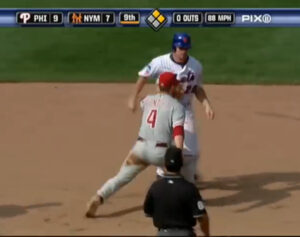
by Greg Prince on 9 June 2025 4:21 pm Maybe you remember The Game-Ending Unassisted Triple Play Game, or TGEUTPG. If a game earns its name from a particular event within, it stands a pretty good chance of maintaining notoriety, with “notoriety” in this case being used correctly.
TGEUTPG concluded with Luis Castillo on second base, Daniel Murphy on first, and Jeff Francoeur batting in the bottom of the ninth inning at Citi Field in one blink and then all of them out the next. Francoeur shot a liner up the middle. The runners took off. Stepping into the picture was Eric Bruntlett, who, unlike the aforementioned players, wasn’t a member of the New York Mets. The second baseman for the Philadelphia Phillies grabbed Francoeur’s liner; stepped on second to erase Castillo; and then tagged an unelusive Murphy. There we had it: an unassisted triple play to end the game at Phillies 9 Mets 7 on August 23, 2009.
The significance of TGEUTPG nearly sixteen years later is apparent only if you keep the table that I keep. Under the table’s heading LAST TIME THE METS WERE THIS MANY GAMES UNDER .500, I have charted the most recent instance that the Mets were precisely one game beneath the break-even point as a franchise; two games beneath the break-even point as a franchise; three games beneath the break-even point as a franchise; and every juncture on down until I can tell you the last time the Mets were 503 games beneath the break-even point as a franchise. Five-hundred three games below .500 is the low-water mark for this exercise. It was reached on September 25, 1983, at Wrigley Field after the Cubs conked the Mets, 11-7. It had been 11-3 heading to the ninth, but George Foster and Gary Rajsich homered; Wally Backman tripled in Brian Giles; and Junior Ortiz doubled home Backman. That’s a helluva rally under most circumstances.
Most circumstances haven’t reflected well on the Mets’ all-time record. Through that Sunday afternoon in Chicago, the Mets had posted 1,493 wins in their nearly 22 years of existence against 1,996 losses. The Mets had been falling from .500 from the end of the ninth inning on April 11, 1962, first without interruption — the Mets were 0-9 after nine games of life — and then as a rule. That will happen when you don’t win more games than you lose in any of the first seven seasons that you play ball.
And even when you begin to get it together in your eighth season, I mean really get it together as the Mets did in their eighth season of 1969, you still face quite a climb upward. Because you don’t win ’em all, you can register only net gains. The Mets netted +38 in their first world championship year of ’69 when they finished out their schedule at 100-62. The Mets netted +54 after going 108-54 in their second world championship year of 1986. Those are impressive gains. But those great years and the very or pretty good years in their proximity couldn’t make up the torrent of ground that was lost early on when the Mets were going 40-120 (-80) and 51-111 (-60) and so on, especially when you eventually cease to be great, very good, or pretty good, and begin to backslide.
As of August 23, 2009, the Mets were in the early stages of what grew into a substantial backslide. That was the first year of Citi Field, the year when everything that could go wrong did go wrong. The franchise had made net gains via annual won-lost records for the preceding four seasons, the final four seasons at Shea: 83-79; 97-65; 88-74; 89-73. It didn’t always result in postseason opportunity (or postseason satisfaction), but things appeared on the right track for the long term.
On May 31, 2009, a Sunday at Citi, the Mets beat the Marlins, 3-2. There were no triple plays, though the Mets turned one DP and weren’t harmed by hitting into two. When the game was over, the Mets’ record sat at 27-20, a good start to what had been a shaky season to that point. Maybe this team was resilient enough to overcome the injuries that had befallen Carlos Delgado and Jose Reyes, among others, not to mention the distant dimensions of their new home. Too many of the longballs the Mets were hitting at Citi weren’t flying over fences. They hadn’t played that well on the road, either, but here they were, seven games above .500, not to mention a half-game out of first place. Maybe everything would work out for the 2009 Mets.
Nothing worked out for the 2009 Mets. That much was evident by August 23. Delgado was out for the year. Reyes was out for the year. Carlos Beltran had missed the previous two months. Even iron man David Wright was in the midst of sitting out a couple of weeks after he took a Matt Cain fastball off his batting helmet. From the game of June 1 to the moment Bruntlett tagged Murphy for the TP (u), the Mets had gone 30-47. The wrong direction continued to beckon for the remainder of 2009, a season that saw the Mets plunge to 70-92, commencing a six-year run of records when the club never reached 80 wins.
If you view Mets baseball as a vast expanse rather than as a string of anecdotes, ending a game by hitting into a triple play, unassisted or otherwise, turns out not to be the most portentous event to occur on August 23, 2009. Losing to the Phillies that day left the Mets, as a franchise, at 3,642-3,956, 314 games below .500. There’d be bad times ahead. Then good times ahead. Then a mix of bad times and good times. Add them all up, and the New York Mets wouldn’t again be as close to .500 overall as they were on August 23, 2009, for almost sixteen years.
But they got there on Sunday, June 8 of the current campaign, in Colorado.
 The Mets had been working their way back from this moment for nearly sixteen years. When the Mets completed their season sweep of the Rockies by pummeling their asses with baseball bats, 13-5, it brought the 2025 Mets’ record — the one of most interest in the present day — to 42-24. The Mets lead second-place Philadelphia by 4½ and their other traditional nemesis, fourth-place Atlanta, by fourteen. The Nationals, who are in next at Citi, are the division’s third-place team, and their double-digits in back, too. Everything’s coming up Metsie, which you know if you watched them in Denver this weekend, particularly in the finale, which featured six Met home runs and a four-inning save. Two of the Met homers were off the bat of Pete Alonso, which gave the bat’s user 243 for his career, one more than Wright totaled, or second-most among all Mets ever, leaving him within nine of Darryl Strawberry for ownership of a glittering milestone. Veteran Jeff McNeil also hit two, with next-genners Brett Baty and Francisco Alvarez slugging the others. Juan Soto didn’t go deep, but he did reach base six times (three hits, three walks). Tylor Megill went five innings for the win. Paul Blackburn sopped up the rest to earn his first MLB save.
Even if we allow ourselves to remember the 12-53 Rockies are making the 40-120 Mets of 1962 look like the 108-54 Mets of 1986, it was still an impressive showing by an impressive 2025 Mets team. Five and two on the road trip. Twelve and three over the past two-plus weeks. And, in case you’re wondering, 1,216-1,216 following Francoeur’s liner into Bruntlett’s glove (and 4,858-5,172 since Richie Ashburn stepped in to lead off against Larry Jackson 47 years, four months, and a dozen days before that).
For the first time since the close of business on August 23, 2009, the Mets, as a franchise, are precisely 314 games under the break-even point. The losing that picked up steam as the 2009 Mets rolled downhill has finally been nullified. It’s not as if they’d been on a sixteen-year losing streak, exactly, but on a net basis, despite some legitimate spikes in the right direction, they lost more than they won over the course of 2,431 games, at no point winning more than they lost from August 24, 2009, forward and inclusive.
On the 2,432nd day, the Mets got it all back. They weren’t only clobbering the Rockies on Sunday. They were statistically kicking Francoeur’s ball out of Bruntlett’s glove. The ball is tricking into the outfield! The Phillies are phlummoxed! Castillo scores! Murphy right behind him! Here comes Frenchy!
Technically, the unassisted game-ending triple play remains on the books. Cosmically, the call has been reviewed and overturned.
In that table I keep, certain long-term inflection points have stood out, dates when we can see with hindsight that the Mets definitively stopped losing more than they won, or stopped winning more than they lost. The former is preferable to the latter. Both have happened and made their impact felt.
• Once they got it together in 1969, the Mets as a franchise relentlessly gained ground on their dismal beginnings until one day in June of 1972 when they would plateau without knowing it.
• Then, despite a memorable positive blip down the stretch in 1973, losing overtook winning for the long haul. More losing than winning became the overarching trend from June of ’72 through that September afternoon at Wrigley mentioned above as 1983 was winding down.
• From the ashes of 1983, until July of 1991, the trajectory pointed skyward, like it would pierce the clouds and never end.
• It ended; without warning, one loss became another and the historical progress that buoyed us reversed itself until nadiring in April of 1997.
• A long-term bounceback, encompassing high ups and low downs, brought the Mets to May 31, 2009, and that win against the Marlins when everything seemed fine and dandy.
• Time revealed everything in 2009 to be cruddy and miserable. A ten-season net-negative spiral — with two playoff spots and a pennant tucked within — ensued until the Mets had fallen 381 games below .500 on July 12, 2019.
• It may not have always felt like it on a continual basis these past six years, but the Mets have been on the rise ever since, going 456-389 between July 13, 2019, and June 8, 2025, which brings us to the present.
This has been a franchise in search of an enduring era for quite a while. A good era, of course. There have been good seasons since 2009’s darkness set in. There have also been dreadful seasons to make you forget how good the Mets have managed to be in relatively brief bursts. The composite record doesn’t lie. Across 64 seasons and counting, the Mets as a franchise haven’t sustained a winning record. Ever. They’ve never been at, never mind above, .500 as a franchise. It doesn’t matter within the confines of an outstanding individual season, but over time, it tells you something about what you’re spending your years rooting for and contributes to a sense of wondering what it’s all been for.
We are, this year, rooting for a team at the top of its game, a team continuing to rise, a team poised to shatter the grass ceiling of its checkered past. Its past, as illustrated in its all-time record of 4,858-5,172, indicates how hard it is for the Mets to win more than lose and keep winning more than losing. You never know when the losing will begin to prevail anew. You never want to know.
The best way to avoid knowing is to keep winning like the Mets have been winning.
METS LONG-TERM FRANCHISE UNDER-.500 INFLECTION POINTS
Most recently 1 game below .500: April 11, 1962
(Closest Mets have ever been to .500)
—
Most recently 277 games below .500: September 3, 1966
Most recently 278 games below .500: June 6, 1972
—
Most recently 283 games below .500: July 15, 1972
Most recently 284 games below .500: July 21, 1991
—
Most recently 296 games below .500: August 12, 1991
Most recently 297 games below .500: May 31, 2009
—
Most recently 313 games below .500: August 22, 2009
Most recently 314 games below .500: June 8, 2025
—
Most recently 381 games below .500: July 12, 2019
Most recently 382 games below .500: May 17, 1998
—
Most recently 403 games below .500: April 26, 1997
Most recently 404 games below .500: September 15, 1986
—
Most recently 503 games below .500: September 25, 1983
(Furthest Mets have ever been from .500)
—
NOTE: The longest active span of .500 baseball the Mets have played dates to August 28, 1967. The Mets have played 9,098 games since then and have logged a record of 4,549-4,549, including Sunday’s 13-5 victory over the Colorado Rockies.
by Jason Fry on 8 June 2025 9:27 am There’s a lot one could say about Ronny Mauricio‘s third-inning home run in Denver Saturday night, starting with the fact that it went 456 feet and came down in the third deck.
That’s … a long way. The third deck is a place where fans sit contentedly expecting not to be involved in the proceedings way down there on the field — in the replay from the camera behind home, the spot where the ball came down isn’t even in frame.
It was the longest home run hit by a Met this year … and Mauricio’s teammates, you will recall, include Pete Alonso and Juan Soto. And it’s not the first time Mauricio’s elbowed aside notable personages on the Hitting Superlatives leaderboard: In September 2023, his first big-league plate appearance yielded a 117.3 MPH double at Citi Field, the highest exit velocity recorded for a Met that season.
What struck me was that Mauricio has easy power. He doesn’t look like he’s swinging that hard — he uses his long arms to kind of flick the ball into the air, only to have it come down in another county. There’s a lot still to refine in Mauricio’s game — he chases too much and talk of his defensive versatility is a nice way of saying he’s not ideally suited to any position — but the bat speed and the easy power will carry him a long way.
Mauricio’s drive was the headline, but it had some company as the Mets shoved the Rockies aside: Jared Young and Jeff McNeil also homered, Brandon Nimmo contributed three RBIs, Luis Torrens tallied a pair and Francisco Lindor had three hits and two steals on a broken toe. (Long night for German Marquez, who came into the fifth having given up just one run but then saw everything come crashing down.)
The Rockies, meanwhile, had one of those quietly bad games that contribute to a terrible season without being particularly notable: plays not made, pitches not executed, bases not taken, games not won. Did Clay Holmes show admirable fortitude in allowing nine hits but just one run, or did the Rockies just fail to capitalize? Hey, why not both?
Anyway, the Rockies packed the house and so added bulk to Dick Monfort’s already bulky wallet, which is a Pyrrhic victory. At least they looked better in taking aim at their own feet: Those daiquiri City Connect 2.0s from Friday night are still branded on my retinas.
The Mets moved 17 games over .500, their high-water mark for the season (their high-water mark so far, says the optimist), and expanded their NL East lead over the suddenly flailing, battered Phillies to three and a half games. All good things ahead of one more game with Colorado and then a day off that should give the relief corps (newly expanded with the acquisition of two pitching-lab subjects in Justin Garza and Julian Merryweather) a badly needed breather.
Let’s not get ahead of ourselves, but maybe the Mets too can go a long way.
by Jason Fry on 7 June 2025 1:27 am The Mets played a strange game against the Greater Denver Daiquiri Machine Operators Local nine, who were sure spiffy in uniforms designed to look like the libations they serve so cheerfully. Oh wait, those were the Colorado Rockies, who inexplicably retired the best City Connects in the program and now look like human slushies. Their sub-.250 record is historically bad but my God, so are those uniforms.
The game was really two games in one: six innings of maddening frustration followed by three innings of madness.
The first six innings saw Kodai Senga give up just a solo homer to Mickey Moniak while trying to figure out which pitches he could make work a mile above sea level, though in the fifth he got an assist from Pete Alonso, who made a nifty throw home to nab Ryan Ritter — or at least he did once Chelsea overruled home-plate ump Chris Conroy’s safe call.
But the game went to the seventh with the Mets down 1-0, as they stubbornly refused to drive in runners in scoring position. The sixth was particularly infuriating: The Mets loaded the bases with nobody out against Antonio Senzatela and then Jake Bird on a pair of walks and a hit by pitch, or perhaps it was a near-HBP sold as one by Tyrone Taylor. But Conroy then added an inch or two to the outside corner, turning Brett Baty‘s AB into a farcical strikeout, and Francisco Alvarez and Ronny Mauricio then struck out against Bird without Conroy putting his thumb on the scale.
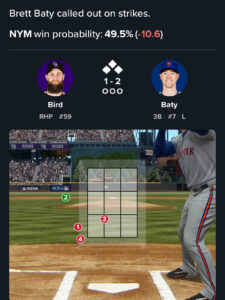
Seriously, if you can look at that GameDay snapshot and still not be on Team Robot Umps Now, I don’t know what to tell you. And an ABS system with challenges isn’t the answer — that will just slow games down and add another level of NFL-style bureaucracy to a game that used to be refreshingly free of it. Instead, implement a Hawk-Eye-style system and use it for every pitch, not just a selection of the home-plate ump’s most egregious failures. Every single game has ABs that are turned by umpires getting the strike zone wrong; sometimes that leads to tantrums like the one I’m currently throwing, but most of the time we don’t even notice, because we’ve accepted a certain level of inaccuracy and even sentimentalized it as “the human element.”
Which is nonsense. The human element is indeed a wonderful part of baseball, but it should be discussed when we marvel at clutch hits and heads-up plays and gutsy pitching performances, not when we’re hand-waving away the fact that umpires aren’t good enough at a critical part of their jobs.
Anyway, I was mad. Robot umps now.
Still, let’s not put all this on Conroy. He had nothing to do with Mauricio grounding out in the first or Alonso striking out in the third or Jeff McNeil flying out in the third or Alvarez grounding out in the fourth or Mauricio flying out in the fourth or Alvarez striking out in the sixth or Mauricio striking out in the sixth. The Mets were 2 for 15 with runners in scoring position on the night, that came on the heels of Thursday’s galling failure parade in LA, and it’s wearying to say the least.
But let’s talk about those two successes — and about the madness of the final three innings in Denver.
In the seventh the Mets put runners on first and second with one out, with Alonso digging in against slider specialist Tyler Kinley. Kinley had Alonso pulling off sliders off the outside corner but then missed his location on an 0-2 count, leaving a hanger in the middle of the plate. Alonso didn’t miss it, spanking it up the left-field gap to give the Mets a 2-1 lead.
Huascar Brazoban surrendered a run in the bottom of the seventh to let the Rockies tie it and in the eighth disaster seemed imminent: Ryne Stanek gave up a single to Jordan Beck and a double to Thairo Estrada, with Colorado third-base coach Andy Gonzalez inexplicably throwing up a stop sign as Beck came around third. Stanek then walked Hunter Goodman and had to face Ryan McMahon with the bases loaded and nobody out.
So of course McMahon hit a hard liner down the third-base line, seemingly ticketed for the left-field corner and two RBIs, maybe three. Except it thudded into Baty’s glove at third and he lunged to tag out Beck for an unassisted double play. Stanek then struck out Brenton Doyle and the Mets had somehow escaped the hangman. (A fun moment: a still-amped Stanek hugging Baty in the dugout afterwards.)
In the top of the ninth, Juan Soto singled and Alonso walked with one out against Zach Agnos. With two outs, Carlos Mendoza sent Francisco Lindor to the plate, broken pinkie toe and all. Agnos’s second pitch was a cutter that Lindor served down the right-field line, sending Soto home with Alonso chugging along behind him. Alonso looked like he’d be out by three feet, but pulled an okie-doke on Goodman, switching hands as he reached for the plate and getting in just ahead of the tag. (Conroy got that one right.) Lindor trotted off the field in favor of Luisangel Acuna, to be mobbed by his happy teammates, and Edwin Diaz offered a blissfully drama-free one-two-three inning to secure the win.
A classic? Let’s not overdo it, given the scores of runners left on base and the two-thirds of the game that was grinding and frustrating. But the Mets overcame the Rockies, the home-plate ump and themselves to win, and that’s pretty satisfying.
by Greg Prince on 6 June 2025 11:05 am Sure, it was horrible and painful like it was horrible and painful some 66 hours before, but at least it didn’t happen at one in the morning. So we had that going for us.
Otherwise, Thursday’s West Coast matinee beamed east with something approximating the atrocious ending that marred Tuesday’s late-night implosion. The revised edition encompassed some new wrinkles — Starling Marte getting picked off third; Brett Baty picking up a ball near third but not knowing quite what do with it once he did; Michael Conforto rising from the depths to luxuriate in a moment in the sun at the expense of his former employer — and some old standards. The Dodger bullpen (featuring spurned Unicorn shepherd Jose Ureña) went into shutdown mode. Met runners were stranded as if they’d chartered the S.S. Minnow. A steady lead became a sudden deficit became a loss that stuck deep in the craw.
 From the Department of Small Favors. Dodgers 6 Mets 5 twice in three games takes some of the shine off splitting four in L.A., even if it doesn’t reverse the season series result that finished Mets 4 Dodgers 3. A once trivial note is now considered an essential edge. We saw last year what a tiebreaker can do for a team after 162 games. First, of course, there’s the matter of the 162 games. All caveats and superstitions implied, the portion the Mets have played of their full slate indicates the Mets will wind up in the same tournament for which the Dodgers maintain a standing reservation. This early-summer set-to felt more like a showdown between National League titans than a proving ground for us upstarts. We’ve made strides since the Sunday three Junes ago when we crossed our fingers tight and invested our faith within the intestinal fortitude of Adonis Medina. We’ve made strides since October of 2024 when their talent smothered our vibes.
We’ll take our chances most days/nights with a late lead in Los Angeles. We’ll take our chances with a torrent of hits and the likelihood they’ll turn into a sufficient quantity of runs. We’ll take a lump or two while a pinky toe (Lindor’s) or not as bad as it looked hamstring strain (Vientos’s) heals. We’ll move on and hope the craw specialists in Colorado can get our fleeting discontent from California removed without incident. The Rockies, however, just won three in a row in Florida, reminding us anything can happen amid 162 games.
We simply prefer only good happen. When such a state of perfection feels within reach, it’s jarring to remember the impossibility inherent in achieving that ideal. Coulda swept. Shoulda taken no fewer than three of four. High-caliber expectations resume despite two episodes of being brought temporarily low. As a baseball lifestyle, it’s the one to which you aspire.
Winning most of ’em is fantastic. Not winning ’em all will never not suck.
by Jason Fry on 5 June 2025 11:25 am We all love a dramatic game, but there’s nothing whatsoever wrong with winning 6-1 — particularly when that margin of victory comes the night after a gut-punch loss.
Wednesday night’s game was the Griffin Canning and Pete Alonso show, what with Canning’s near-flawless pitching (six innings, three skinny singles allowed) and the Polar Bear homering twice and driving in five.
Canning has never looked better as a Met, which had to be extra sweet considering he’s a California kid, had seen his star fall as a member of the little-brother team in town, and been pummeled in his only other Dodger Stadium start.
Canning kept the Dodgers off-balance all night, with a number of ABs standing out as showcases for his craft. In the first inning, facing Mookie Betts, he put four pitches in more or less the same location, down and in, but kept Betts off-balance by switching between his four-seamer, change-up and slider, culminating in a strikeout.
In the second inning, Canning simply dismantled poor Michael Conforto, who got a big one-year deal from the Dodgers that’s going miserably so far. (The Dodger Stadium crowds have been surprisingly gentle; in New York Conforto would have been booed back to Syracuse or into an asylum by now.)
And then the piece of resistance, as my late grandmother liked to phrase it: Canning vs. Ohtani in the bottom of the fifth. Recall that at this point the Mets led 3-0, which is perilously little against the Dodgers’ carnivorous lineup. Canning started his former teammate off with five straight sliders — a pitch he hadn’t shown him in previous ABs — and you could see the best hitter on the planet trying to regroup. (And possibly wondering, “Where was this Griffin Canning in Anaheim?”) Canning then switched from the outside of the plate to the inside, and from slider to change-up; Ohtani was frozen and had no chance.
Extra credit in the pitching department goes to Jose Castillo, another Mets reclamation project and one that’s yielded excellent results so far. In the seventh Castillo yielded a one-out double to Andy Pages (a dangerous hitter who somehow gets lost in this lineup) and hit Conforto with a pitch, bringing Dalton Rushing up as the tying run. Jeremy Hefner came out to the mound to unplug Castillo and plug him back in; the reliever responded by erasing Rushing and the loathsome Kiké Hernandez, fanning both on six pitches.
And then there was Alonso.
The Mets got off to a fast start against Tony Gonsolin — always welcome but particularly gratifying with the taste of Tuesday’s defeat still in the mouth. Gonsolin hit Francisco Lindor in the foot, then watched Kiké turn a Brandon Nimmo double-play grounder into an error. Nimmo stole second, a Juan Soto groundout brought in Lindor, and then Alonso demolished a first-pitch slider for a 3-0 lead.
That was fun, but the Polar Bear outdid himself in the eighth against luckless newcomer Ryan Loutos, redirecting a middle-middle sinker 447 feet into the pavilion. The Dodgers’ reactions were priceless: Behind the plate Rushing flipped his hands up in consternation; Loutos’ hands went to his knees before the ball cleared the infield; and Freddie Freeman stared into the void as Alonso trotted happily around the bases mugging and gesturing.
That was more than sufficient, making the ninth-inning homer surrendered by Ryne Stanek a cosmetic blemish. The Mets have now claimed the season series regardless of what happens in a couple of hours, and they’ve delivered a critical message we needed to hear after last October: We can play with these guys. Be not afraid.
by Greg Prince on 4 June 2025 1:30 pm Be glad that the first-place Mets compete on the same elite level as the first-place Dodgers.
Be glad that the Mets play close, compelling games versus the defending world champions.
Be glad the Mets can show up at Dodger Stadium and grab a quick 1-0 lead off future Hall of Famer Clayton Kershaw.
Be glad Tylor Megill can shake off a rough four-run first inning and go six without giving up anything else.
Be glad Juan Soto continues his extra-base hit streak.
Be glad Pete Alonso is driving in far more many runs this year than last.
Be glad Brandon Nimmo hustles down the line.
Be glad video replay review is not blind.
Be glad Kershaw isn’t quite in his prime anymore and can be chased before he gets out of the fifth.
Be glad Brandon Waddell is capable of more than soaking up spare innings of lost causes.
Be glad Waddell pitched well enough in the seventh to make one wish he had stayed in for the eighth, therefore saving Reed Garrett for the ninth and leaving the bulk of the recently deployed bullpen be.
Be glad Garrett pitches out of eighth-inning jams, especially when adequately rested.
Be glad Ronny Mauricio is healthy again and knows how to instigate a successful rundown between third and home.
Be glad Luis Torrens has the power to drive a ball to the wall as a pinch-hitter for a pinch-hitter for the designated hitter, a skill that might come in handy under more amenable circumstances.
Be glad Huascar Brazoban maintains the recuperative powers to strike out three consecutive batters after giving up a game-tying leadoff ninth-inning home run.
Be glad Soto and Alonso proved earlier in the game they are capable of markedly better at-bats than those they executed in the tenth.
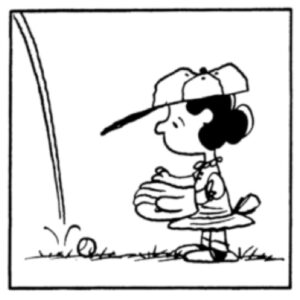 Artist’s rendering of game-losing play. Be glad Nimmo has the perspective and articulateness to explain in detail and depth how a ball that dropped to the ground a few feet to his right in left — thus ending what instantly became a horrible and painful 6-5 loss — turned distressingly unplayable for an experienced major league outfielder who seemingly makes comparably difficult catches three times per month.
Be glad the Mets play close, compelling games against the Dodgers that would fit well in a postseason rematch between the two combatants.
Be glad this wasn’t a postseason game and therefore doesn’t carry an outsize impact on the Mets’ fortunes.
Be glad this game took place very late at night Eastern Time when relatively few people figured to be alert for its ending and even fewer figured to lie awake thinking about it too much.
Be glad there are more than a hundred games to go.
Be glad there’s another Mets-Dodgers game late tonight.
Be glad the Mets don’t lose in such horrible and painful fashion very often.
by Jason Fry on 3 June 2025 2:37 am It didn’t exactly strike me as the best idea for the Mets to play the Rockies at home, fly across the country and then go toe to toe with the Dodgers the next night, but MLB has an unbroken record of not asking me what I think.
That’s what the Mets did, and at least for once it was worth staying up after midnight, with the two clubs linking up for a taut, thoroughly satisfying game that ended up with the forces of good triumphant … albeit by the thinnest of whiskers.
Things got off to an excellent start, as Francisco Lindor hit the second pitch of the game over the fence for a 1-0 lead, made even sweeter by the fact that he connected off Dustin May, whom I’ve never been able to stand. May’s nimbus of red hair and oddly pale face remind me of Pennywise if that ghoul had taken up pitching instead of eating Maine children, and I recoil instinctively at the sight of him. I also dislike his histrionics — not because baseball ought to be dour and cheerless but because starting pitchers ought to know the karmic wheel that lifts you up this inning may roll over you the next.
The Mets led 1-0 and then 2-0 on a Brandon Nimmo double, with a third run denied them when the ball hopped over the fence for a ground-rule double, mandating that Francisco Alvarez be sent back to third. (I’ve never quite made up my mind whether this is a charming anachronism or a stupid rule that ought to be struck.) Meanwhile Paul Blackburn was razor sharp in his 2025 Mets debut, showing off a curve with a lot more bite than I remember from his brief 2024 tenure.
Blackburn departed after five and the Mets were left to figure out how to find 12 outs against the Dodgers’ relentless lineup. Huascar Brazoban was first up and quickly put the lead in jeopardy, giving up a single and a pair of walks and facing October tormenter Tommy Edman with the bases loaded and two out — and on Edman’s bobblehead night, no less. Brazoban got Edman to chase a changeup off the plate, the Mets had survived the first test, and I earnestly suggested Edman use his bobblehead to do something rude.
Next up in the securing of outs was Max Kranick. Balls were dying in the outfield all night, with Mark Vientos left in disbelief after a solidly struck ball barely reached the warning track and Tyrone Taylor looking like he was out there conducting a survey of the warning track, pulling balls out of the air all along his patrol area. (Taylor is more impressive every day, with his lightning-quick first step on balls to the gap turning doubles into long outs and difficult plays into ones that look routine.) But then Shohei Ohtani connected with a hanging curve offered by Kranick, and this one did not die — in fact, it’s probably coming down about now.
Kranick escaped further harm and Ryne Stanek navigated the eighth, with a scary-looking Max Muncy drive proving all trajectory and no oomph. And so the game came down to Edwin Diaz protecting a one-run lead against Edman and the bottom of the order, with Ohtani up fourth.
Edman singled, dismantling the hope that Ohtani might be left a forlorn spectator; with one out Lindor saved the lead by keeping a Hyeseong Kim grounder on the infield, but that brought Ohtani to the plate with the tying run on third and the winning run on second. Home-plate ump Andy Fletcher completely missed the first pitch, calling an obvious strike a ball; two pitches later Ohtani served a fastball down the left-field line, more than deep enough to tie the game but thankfully not deep enough to end it.
Diaz struck out Teoscar Hernandez to keep the game tied, the kind of development one welcomed provided the Mets somehow won, seeing how midnight was in the rearview mirror already. And in the 10th the Mets struck quickly, with an RBI double from Alvarez followed by an RBI single from Lindor. All hail the Franciscans! But the Mets couldn’t bring in a third run, with Vientos looking like he might have hurt a hamstring coming out of the batter’s box, and Jose Castillo was sent out to defend a two-run lead with the ghost runner poised to cut that lead to one.
Castillo looked a bit nervous, because of the situation or the enemy lineup or both, and it was hard to blame him. He walked Freddie Freeman, then surrendered a single to Andy Pages that cut the lead to 4-3, with Freeman on second.
Dave Roberts, strangely, left Muncy in against the lefty despite the three-batter rule ensuring Castillo had to face one more hitter; Muncy was enticed by a slider below the zone and struck out. Roberts then pinch-hit Will Smith for Michael Conforto (who’d already reached the plate) even though the Mets now could change pitchers.
They did, summoning Jose Butto to face Smith. Butto doesn’t always inspire confidence, but he got Smith on another long drive to nowhere, with Freeman moving over to third. But now Edman was up again. Butto’s fourth pitch was a slider that Edman spanked right back up the middle. If it got through Butto it might have found Luisangel Acuna‘s glove and Acuna might have had time to get Edman, but it’s more likely it would have found the outfield grass, with Freeman home and Pages on third and Edman bobbleheads being lofted happily all over Dodger Stadium and then oh boy.
But it didn’t get through Butto. He made a nifty play on it, tossed it to Pete Alonso and the Mets had won and we could all go to bed. Which your chronicler will now do posthaste.
by Greg Prince on 2 June 2025 11:58 am Some ballgames elude complexity. Sunday’s had on one side of Citi Field the team that was tied for best record in its league, and on the other side of the divide the team with the worst record in all of baseball. The team with a best-record claim had three world-class sluggers. The team with the undisputed worst record had to pitch to them.
Here’s what each of the three world-class sluggers did in a given at-bat in this game:
Pete Alonso homered.
Francisco Lindor homered.
Juan Soto homered.
Here’s what the worst team did in response:
Not enough.
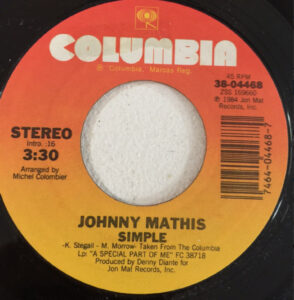
Simple, the recently retired Johnny Mathis sang in his final Hot 100 hit, easy as 1-2-3. Alonso in the fourth with two on. Lindor in the fifth and Soto in the eighth in solo fashion. That made for five runs versus the three Clay Holmes allowed over seven innings — given the adequate support and his ongoing transition from reliever to starter, the seven was way bigger than the three — along with the pair of zeroes posted amid the usual stellar setting up and closing from Reed Garrett and Edwin Diaz. A straightforward 5-3 Mets victory over Colorado was present and easily accounted for.
 That’s how three-game sweeps should be. The Mets played up to their own level throughout the weekend sweep, while the Rockies stayed as averse to altitude as we needed them to be. Composite run totals: New York 17 Visitors 7. The team that dropped from 9-47 to 9-50 across the three-game series didn’t appear to be mind-blowingly horrible, just not very good. Meanwhile, the team that retook sole possession of first place in the NL East made the most of its schedule. The Mets got the Rockies. The Mets rolled the Rockies further downhill. All it took was a few concerted taps.
If your team has Alonso, Lindor, and Soto, and the other team has no such power trio available to it, chances are you wonder why every game from Friday to Sunday wasn’t won by a score of Crush, Kill, Destroy. But chances are better you understand baseball doesn’t really work that way. The Mets won their three games without a lot of muss or fuss, pitching well, hitting amply, and getting each contest over with in under two-and-a-half hours. Muss and fuss will be well-rested for the four-game set versus the Dodgers that begins tonight too late (when rest will be too little and facets of the opposing offense can be too much).
The Mets’ Big Three, if we’re calling them that, haven’t meaningfully synced their hot spells since their bats were conglomerated into a single unit. Two were on fire in April, noticeably chillier in May. One among them hasn’t yet truly generated palpable heat. Yet on the first Sunday in June, Alonso, Lindor, and Soto got together and unloaded as needed, and it was, simply wonderful, wonderful.
by Jason Fry on 1 June 2025 1:26 am Saturday’s game against the Rockies, the last tilt of May, was observed by your chronicler via a kaleidoscope of information sources from way out here in Tacoma, Wash.: looking down at MLB.tv on my phone during one of the Pacific Northwest’s never-quite-remitting rainstorms, via MLB Audio when the bandwidth pipe was a little too narrow for video, or via the marionettes of GameDay when neither medium was available.
The game was never particularly in doubt after the first inning, when a 1-0 Colorado lead popped like a soap bubble thanks to a three-run triple off the top of the wall struck by Brett Baty, with a Tyrone Taylor single to follow. As Antonio Senzatela trudged around behind the mound you could see the Rockies sag, a collective oh no not this again. The Mets extended the lead on back-to-back homers from Brandon Nimmo and Juan Soto and then a late, cherry-on-top round-tripper from Jeff McNeil. Meanwhile Kodai Senga was untouchable until tiring in the seventh, with Jose Butto putting down a last little flurry of Rockie resistance.
With the Rockies mustering little resistance for most of the game, it was the kind of day that lent itself to miscellaneous reflections:
So much purple: The purple in the Mets’ City Connects is a nod to the 7 line and has nothing to do with the Rockies, but the combination was still an odd one, and left me thinking that at least for a day it was better that the Mets had hedged their bets a bit on how much purple to highlight. (But seriously, the City Connects would pop a lot more if the NYC, player numbers and names were purple outlined in white instead of black.)
My mom and the mouth breather: I have a long tradition of taking an irrational dislike to certain Mets, declaring them Jonahs whose presence casts a pall over the entire team. This is apparently genetic, as my mom is on at least year two of a jihad against Brett Baty. She watches every game and texts me out of joy or frustration, and those texts have become a record of her (perhaps slowly evolving) opinion about Baty. “Chew that bubble gum, Brett,” she’d scoff last year, when Baty had once again failed to come through or misplayed a ball in the field, and yes, Baty did have a habit of chomping on his gum in consternation after failures.
This year my mom’s favored dart has been to scorn Baty as a mouth-breather … and yet there’s been a slow warming as he’s finally shown signs of emerging. “OK Brett, but you’re still a mouth-breather,” my mom texted me after Baty homered off Jameson Taillon a few weeks back. Days later, Baty was the key to the Mets edging the Pirates, and my mom offered the texted admission that “I’m eating crow.” (With an accompanying corvid emoji.) Baty helping beat the Dodgers earned him an “yes to Mouthbreather,” a mixed verdict but no longer a completely negative one. Today, after Baty gave the Mets all the runs they’d need against Colorado, I texted mom to point out that Baty was determined to win her over. Her response? “Let him keep trying!”
Little by little, Brett.
We’re all Jetsons: So I was walking in a drizzle outside the Tacoma Mall when I did the time-zone math and realized the game had started in New York. I reached for my phone and a moment later I was watching SNY in HD, and over a cellular signal no less. I wish I could have told my younger self — the one who spent endless money and time on fanciful antennae and tin-foil origami extenders to make a faint radio signal a little clearer — what was coming. These really are the days of miracle and wonder, and we all get to be Jetsons.
A messy month: Saturday’s win meant the Mets posted a 15-12 record in May, which really sums that month up perfectly: Not as bad as you thought, perhaps, but still not all that great. Here’s to the calendar turning.
Little things: One of my favorite oft-repeated sequences in baseball is the little dance between the runner at first and the first baseman on a pickoff. The throw arrives from the pitcher, the runner dives back in safely, and then the runner scoots himself clockwise around the bag 180 degrees before putting a foot on it and popping up, making sure never to break contact between his fingers and the base … because the first baseman is looking for a little daylight and a chance to pounce. It’s the product of a perfect little arms race, and it always makes me smile.
Pity: The Rockies may or may not surpass the ’62 Mets and ’24 White Sox in terms of futility, but they certainly have the look of a team stalked by disaster. They lose in ways big and small, expected and not. They’re the antimatter version of a good team you figure will win whether the formula demands a bit of small ball or big inning or a well-executed relay — you expect the Rockies to fail in whatever way necessary on a given day, and you can see they expect that too.
I’ve endured Mets teams like that, and it’s dreadful — a near-daily lesson in defeat that corrodes your fandom. What’s truly disheartening is the Rockies’ core problem isn’t fixable: Dick Monfort is the worst owner in baseball, a head-in-the-sand relic who fantasizes that the coming labor war will serve as his own personal time machine. He’s tops on the MLB Bad Owner leaderboard, edging out Pirates cheapskate Bob Nutting and loathsome nepo baby John Fisher. As those of us who survived the post-Madoff Wilpons can attest, there’s nothing a fan can do in this situation: No one’s firing the owner, he never shows his face so you can boo him, and the other owners aren’t going to lift a finger against one of their fellow lords. All you can do is wait for the world to change.
Old friends: We’re in Washington because my kid is a student at the University of Puget Sound; with the Mets having concluded their business, we went to Cheney Stadium to watch the Tacoma Rainiers take on the Salt Lake City Bees, a battle between the Triple-A squads of the Mariners and Angels.
Cheney Stadium is charming, in a little dip surrounded by pines, and it’s rich in history: Its Hall of Heroes includes nods to Jesus Alou and Ron Herbel, as well as Wayne Garrett‘s brother Adrian. And the light stands turn out to be from Seals Stadium, the San Francisco park that was home to the Giants before Candlestick.
Starting at third base for the Bees was old friend J.D. Davis; late in the game he wound up facing Adonis Medina, his 2022 teammate. If Medina struck out J.D. we’d all get a free Chick-Fil-A sandwich. (Medina retired him on a hard grounder.) With the Rainiers clinging to a 5-4 lead, J.D. hit into a double play against Zach Pop that ended the game.
Two other former Mets were in uniform: Yolmer Sanchez for Salt Lake City and Trevor Gott for Tacoma. (Deploy an asterisk and you could also count Tacoma’s Rhylan Thomas and Shintaro Fujinami, never Mets but teammates at Syracuse last year.) Neither Sanchez nor Gott got into the game, which was fortunate because I told my family that I was booing the shit out of Gott if he made an appearance, regardless of what the hometown fans thought of that. (Remember the discussion of Jonahs? Boy was Gott ever one.)
That’s the wonder of baseball — you go to a minor-league game on the other side of the continent and find players bound up with your own rooting interests. The connections aren’t always as obvious as they were at Cheney Stadium, with a beloved ex-Met facing down a one-day hero with a sandwich on the line, but dig through any roster on any night and you’ll find them — and all the delights they bring.
by Greg Prince on 31 May 2025 10:48 am A staple of postgame postmortems, specifically in the games where leads got away within sports whose rigidly timed action flows back and forth, is that the team that lost played not to lose rather than to win. Their defense wasn’t aggressive enough. Their offense wasn’t opportunistic enough. Winning wasn’t the priority. Not losing was, and therefore ya lost. Such a balance of ying and yang is what has lit up the switchboards of call-in shows for generations.
I’m not sure the “they played not to lose” dynamic applies much to baseball, where the players don’t run east to west in an effort to score, then west to east as they attempt to prevent scoring. Managerial tactics can be questioned — why not a pinch-hitter in a go-for-the-throat situation; why not a better reliever even if it’s not a save situation — but there isn’t really that sense of intentionally sitting on a lead or laying back oblivious to a change of the competitive tides. The one clock that’s come into baseball isn’t one that can be run out in the strategic sense. Scoring another run for yourself isn’t something you’ll pass up if readily attainable. You might trade a run for an out, but you’re always gonna seek outs when you’re the ones in the field.
Baseball is a game designed to be won rather than not lost — except, perhaps, when you’re watching your team play the 2025 Colorado Rockies. Then all you can think on behalf of your team is, “Don’t lose.” Faced with this very challenge on Friday night at Citi Field, the Mets didn’t lose. They won, 4-2, though not losing loomed as the greatest win of all.
Individually, the Mets committed the acts of winners. Francisco Lindor socked two home runs (one righty, one lefty) and leapt to grab a line drive. Starling Marte showed his bat still has pop. Juan Soto stuck the ball well twice to outstanding effect and patrolled his position with élan. David Peterson bent without breaking. Reed Garrett was dominant. Edwin Diaz was untouchable. As a unit, there was no doubt the Mets played winning baseball.
But mostly they didn’t lose. The Rockies entered Friday’s series-opener at 9-47. Nobody who isn’t competing in an NBA tankathon enters anything at 9-47. Not last year’s White Sox. Not the Original Mets. But these Rockies have cracked the code on historic proportions of losing. Whether or not it was their goal, they’ve achieved it thus far. From 9-47, they’ve dropped to 9-48. The fact there’s a “9” before the “-“ indicates they are not a sure thing to lose every game they play. Nor did observing them hint that they are wholly incapable of intermittent victory. I recognized a bunch of Rockies. Some of them were on Colorado last year when the Rockies didn’t lose two of the six games they played against the playoff-bound Mets. Everybody who makes the majors maintains an ability to throw, catch, connect, prevail. The Rockies on Friday night made some good plays and some effective pitches and some hard contact. Garrett and Diaz shut them down in the eighth and ninth, but there was no reason to think producing one more run than the Mets totaled was beyond their skill set.
Usually, there would be no reason to think that would be a big deal. You might have heard in your life that you can’t win them all, especially when “all” encompasses 162 games. Lesser teams rise up with regularity to defeat those who have no conceivable business losing to them, because baseball allows anything to be conceived. Any game in the long march from 1 to 162 is just one game. Everybody loses now and then. If it happens to you, you get ’em tomorrow. It’s all so comforting and all so true.
Except if you’re playing a 9-47, now 9-48 team. In that case, just don’t lose to them. Friday, the Mets didn’t, which they couldn’t. I mean they could have, but that would have invited more shudders than rationalizations. However they approached it, taking their assignment of not losing to the Rockies to heart was the way to go.
And they won, which was also nice.
|
|