The blog for Mets fans
who like to read
ABOUT US

Faith and Fear in Flushing made its debut on Feb. 16, 2005, the brainchild of two longtime friends and lifelong Met fans.
Greg Prince discovered the Mets when he was 6, during the magical summer of 1969. He is a Long Island-based writer, editor and communications consultant. Contact him here.
Jason Fry is a Brooklyn writer whose first memories include his mom leaping up and down cheering for Rusty Staub. Check out his other writing here.
Got something to say? Leave a comment, or email us at faithandfear@gmail.com. (Sorry, but we have no interest in ads, sponsored content or guest posts.)
Need our RSS feed? It's here.
Visit our Facebook page, or drop by the personal pages for Greg and Jason.
Or follow us on Twitter: Here's Greg, and here's Jason.
|
by Jason Fry on 2 June 2014 11:56 pm The 2014 Mets have their problems, goodness knows — tepid hitting, shaky defense, ever-shrinking payrolls, changing stories and omnipresent drama.
But at least they aren’t the 2014 Phillies.
My word. The snarky term in vogue for what the Phillies are is “tire fire,” and it’s a good one — tire fires are gag-inducing, visible for miles and hard to extinguish and clean up. But that doesn’t really do the current incarnation of the Phils justice, and I’m not sure what would.
The Phillies are the backed-up commode on a transcontinental bus with no air conditioning.
How’s that? Hmm. No, the damage is too limited.
The Phillies are a full sewage pumper truck overturning on the hill above the town reservoir.
That’s better. But it still doesn’t really capture the scope of the problem.
The Phillies are $178 million in contracts — more than twice the payroll of the Mets — for a 70-win team. Where’d that money go?
Ryan Howard is 34, helpless against lefties and will get $25 million each of the next two seasons, with a $10 million buyout after that.
Cliff Lee (age 35) is due $25 million next year, with a $27.5 million 2016 Omarpalooza option and the right to reject a trade to 70% of MLB teams.
Ill-advised shit-talker Cole Hamels is 30 and owed $22.5 million a year through 2018.
Chase Utley, a 35-year-old betrayed by 70-year-old knees, is owed $10 million next year, with some kind of option that made me too dizzy to process.
Jonathan Papelbon is 33, about as reliable as a meth-addled babysitter, and owed $13 million next year.
Yipes! Let’s give it one more try.
The Phillies are baseball Chernobyl, a man-made disaster that will render their surroundings uninhabitable for years to come.
Yep. There it is.
We should keep this in mind for a few reasons.
First off, of course, because it’s fun — the Phils’ brief renaissance was singularly unpleasant to live through, particularly since it coincided with the Mets becoming the Kansas City Royals East.
Second, because it’s a useful reminder that there are worse things than watching raw kids and reclamation projects fail and be discarded in favor of other raw kids and reclamation projects. Sandy Alderson repeating Jeff Wilpon’s tale du jour isn’t fun to witness, but I’ll take it over Ruben Amaro Jr. trying to create a time machine at the center of a vortex of money, or whatever his plan is.
Third, because beating the Phillies four out of five might otherwise make us think that the Mets are good, when the actual answer is just that they’re better than the Phillies.
Don’t get me wrong — tonight was fun, particularly because it didn’t take an absurd number of innings. There was Matt den Dekker stepping in for the injured Juan Lagares and proving himself a very capable understudy. The Phillies seem also to have signed the wrong scouts: The moment den Dekker scooped up Ben Revere‘s single in the third, I was screaming that he was going to throw Reid Brignac out, which den Dekker did by approximately a ZIP code. There was Bartolo Colon ambling through the enemy lineup with his usual Hakuna Matata shrug and even hitting a couple of respectable-looking foul balls. There was Bobby Abreu continuing to show me that I was wrong about him and his bat is young even if the rest of him is not. There was Daniel Murphy with one great goofball moment, overrunning home plate and then nearly corkscrewing himself into the dirt turning back to unmiss it. There was Phils skipper Ryne Sandberg, inexplicably positioning his fielders in to transform double-play grounders into Met hits. And finally, there was Wilmer Flores simply unloading for an unMetsian grand slam, parking the ball in a spot that would have been out in a normal-sized park too.
It was all fun, of the stress-free variety for a change. But I’m not going to take it too seriously. For that, I need the Mets to keep playing well against lousy competition and hold their own against mediocre foes, to say nothing of taking on the big boys of the NL. I need to watch a lineup that scares somebody other than me. I need a whole lot that this team shows no signs of delivering quite yet.
The Mets aren’t there yet. They may never get there in this incarnation. But I am certain of one thing: By the time we figure out what this Mets team might realistically become, the Phillies will still be what we saw tonight, only even older and more bloated with disappointment. I’d much rather be us than them, and around here that’s progress.
by Greg Prince on 1 June 2014 8:18 pm Aesthetics aside, the Mets’ extended residency in Philadelphia is going pretty well: three of four games have been captured, with one still waiting to be bagged. We’ve seen what Jonathon Niese can do for eight innings when his bullpen needs as much of a blow as he can provide it, we’ve seen how far Lucas Duda can belt a ball in order to prevent a contest from winding its way to a seemingly inevitable fourteenth inning (this baby took only eleven) and we’ve seen an area where the fourth-place Mets definitively outclass the fifth-place Phillies.
We have the better mascot.
Mr. Met hasn’t joined his team at Citizens Bank Park for these five dates, yet he wins by default. He kicks the ass of the overexposed Philly Phanatic, if in fact the Phillie Phanatic has an ass. Who knows what that thing’s packing down below?
The Phillie Phanatic is a certifiable superstar among mascots, though like Derek Jeter, you sometimes wonder what all the fuss has been about. TPP is expert at drawing attention to himself, but Howie Rose may have nailed it on Saturday when, in describing the large green fella’s pregame prop-driven antics, he termed the Phanatic the Kenny Bania of his trade. Seinfeld viewers will recognize the reference as something less than flattering.
Mr. Met, however, is the thinking fan’s mascot and certainly no hack comic. He’s the mascot for fans who use their head. With a head that size, Mr. Met is an aspirational figure for would-be baseball intellectuals everywhere.
The Mr. Met who meets and greets us at Citi Field can trace his roots back practically to the dawn of the franchise. He was a face on rainchecks, a model for merchandise and personified in paper mâché by industrious Shea Stadium ticket-seller Dan Reilly, but his modern iteration is celebrating his twentieth-anniversary season this very year.
By 1994, Mr. Met had been in mothballs, figuratively and literally, for quite a long time. The Mets as a franchise weren’t much more in evidence. The 1994 Mets were actually a feisty, youthful unit that played respectable baseball most of its strike-shortened season, finishing 55-58 and giving habitual diehards like myself a hint that life could go on even in the wake of the Mets’ spiritual demise of 1993. Yet most of New York didn’t notice they existed, not after the 59-103 debacle of the year before, not in the shadows of so much else of a sporting nature going on. The Rangers were skating toward a Stanley Cup, the Knicks were dribbling into the NBA Finals and the Mets hopped up and down shouting ineffectually to anyone who bothered to listen, “HEY! OVER HERE! WHAT ARE WE — INVISIBLE?”
For all practical purposes they were, so they needed something that was going to make somebody stop and do a double-take. They needed AJ Mass.
AJ Mass picked up the Mr. Met gauntlet and ran with it…or walked as best he could given the constraints of the costume he was issued. He explains how the sacred responsibility of being Mr. Met fell to him in the engaging memoir/instructional, Yes, It’s Hot In Here: Adventures in the Weird, Woolly World of Sports Mascots.
You might think, in light of how depressingly out of fashion the Mets had fallen after 1993, that the best minds Mets management could gather would come together, research the resources at their disposal, consider the depth and breadth of New York National League heritage and revive Mr. Met because there was no greater touchstone of true Metsiana. But, no, that’s not exactly how it happened. The Mets had gotten themselves aligned with the Nickelodeon cable channel to build an amusement park behind the outfield fence at Shea Stadium. Nickelodeon Extreme Baseball, it was dubbed, a proposition alluring enough for a young, unemployed Mass to audition to take part, for $7.50 an hour, in its ambitious distraction of a sideshow.
The whole thing was such an overwhelming success that it was gone by 1995, but the one enduring element of its slime-slathered legacy delights fans young and old to this day. There would have been no Mr. Met redux without Nickelodeon prodding the mascot out of the attic and it’s fair to argue Mr. Met wouldn’t have kept delighting fans had not Mass so committed himself to inhabiting the role.
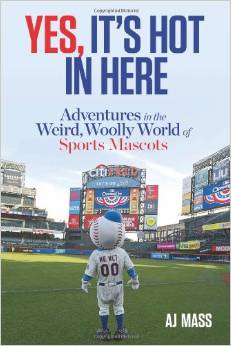 Twenty years later after springing back to life, Mr. Met is still hot stuff. Mass was Mr. Met from 1994 to 1997, though at first he wasn’t quite the Mr. Met we know today. The costume (which matched his body type, allowing him to get the gig over others who tried out) was a more complex bundle of “wires, springs and levers” that one would imagine. And Mr. Met’s awkwardly constructed self wasn’t permitted to show his oversized face at Shea on a given day or night until the seventh-inning stretch, when he and a troupe of dancing baseball gloves — a feature even I don’t remember — strutted their stuff to steadily increasing audience approval.
That was all Mr. Met did in 1994. Maybe it was for the best that the strike came and washed away the Nickelodeon slime from Shea. The “Extreme” business disappeared, but Mr. Met stayed. His costume became less onerous, he was given more flexibility and the Mets…well, the Mets kind of didn’t know what an asset they had on their hands, according to Mass. Reading the author’s recollections of how he was left to essentially fend for himself — his wallet was stolen from his unprotected locker; he was directed to stick his head in a Hefty Bag and ride a bus to the All-Star Game at the Vet; he was regularly spoken down to by his so-called superiors as if there wasn’t a fully cognizant human being inside his uniform — you can’t help but think of how the Mets still don’t know what to do with their most valuable properties. Look at how they stubbornly sat Juan Lagares a few weeks ago.
Mass’s Mr. Met grew the brand, as they say in Corporate America, but he didn’t always get to take the character where he thought it could flourish. One vignette he tells is about the time he thought to wave a broom when the Mets swept a series. His supervisors told him, no, don’t do that, it’s not the Met way. What wasn’t, he wondered — being happy about a Met winning streak? Conditioned by Mr. Met’s scrupulously classy behavior these past two decades, I find it hard to imagine Mr. Met brandishing a broom in those rare sweeping circumstances (whereas such a gesture and then some would surely come instinctively to the Phanatic), but, really, what would be the harm? Firing up the defeated opposition as it filed into its clubhouse? Getting some 0-3 Rockies mad that somebody in an enormous baseball-shaped head was basking in his club’s success which also happened to be their fleeting failure? Planting the seeds of horrible revenge the next time that team came to town?
As you can tell from my philosophical mulling, Mass has produced a thought-provoker for any Mets fan given over to thinking through what everything that makes the New York Mets tick. But if you’re just sort of curious about how the mascot world operates or you’d just like to lap up a little furry gossip, Yes, It’s Hot In Here has you covered, too. There’s much beyond Mr. Met to this book. We learn, among myriad other things, that the Phanatic is actually a most solid citizen; the San Diego Chicken would be more accurately classified a Southern California jackass; soccer matches don’t represent a natural habitat for mascots; and (as has already been publicized quite thoroughly) when the Secret Service is protecting the head of state, it displays no sense of humor whatsoever…whatever the size of the head you’re wearing.
Mr. Met keeps his thoughts to himself. Mr. Mass lets them fly on every page. They embody two different personas and two different approaches, yet both show they know plenty about pleasing a crowd.
by Greg Prince on 1 June 2014 3:06 am “It doesn’t work that way,” I had to explain to my sister over dinner out when she inferred I must really be enjoying how long these baseball games my baseball team has been playing, including the one I was listening to while she was talking.
“You probably wish they’d last eight hours!” she said, as innocent of nuance now as she was the 1979 afternoon she clicked a photo of the Shea grounds crew because she assumed they were the players.
No, I replied. I do not wish for eight-hour baseball games. I don’t care for four-hour baseball games. Nobody does. One nineteen- or twenty-inning test of wills per generation is a novelty to be treasured, but clunking and plodding again and again is no way to go through a season.
I was listening to my baseball team’s latest long game during dinner out because the Mets don’t know how to vanquish an opponent quickly anymore. Let’s get together on Saturday, I had previously suggested. Game’s at 3, let’s make it 7.
Folly. Sheer folly. The game got itself tied just before 7. The game kept itself tied through the drinks, the ordering, the appetizer, the salads, the main course. It got itself untied a little before the check arrived. The desired last out was recorded in the parking lot.
I heard just about all of it despite the game infringing on a familial get-together because a Familia couldn’t keep the Phillies from scoring in the ninth. Jeurys’s teammates stopped producing runs long before, however. Can’t blame a lone reliever for a lone tally when the offense that should’ve made his appearance academic didn’t put the result out of reach when given ample opportunity. You can blame Familia if you must, but it seems misplaced. The Mets remain viable in games that last fourteen innings and more than five hours because their bullpen hangs tough. They are enmeshed in these affairs in the first place, I believe, because their hitters hang their pitchers out to dry.
The same could be said on the Phillie side, I suppose, but they’re the Phillies. We don’t care if the scrapple grows cold in King of Prussia. Let them eat funnel cake. I made dinner plans here on Long Island, where we assume a scheduled 3:05 first pitch should get you to your 7:15 seating, win or lose, with Seth Everett’s signoff a distant memory and maybe Pete McCarthy taking calls.
But why would we assume that? Why would we assume what used to be considered the stuff of Sudolian legend emerge with the infrequency of the figurative blue moon? Recent sample sizes indicate it materializes every night and day in Metsopotamia. If they’re not playing forever in fourteen, they’re neverending in nine. It’s not crisp. It’s not dazzling. If it weren’t baseball, it wouldn’t be tolerable.
It is baseball, but it’s overestimating its welcome. It’s mistaken to assume we want to devote close to a quarter of our day every day to it. What’s more, it’s rude to interrupt my dinner. I’m not concerned about being rude ignoring my family during dinner, mind you. What’s family if not the people to whom you can be rude without repercussion? Then again, who are the Mets if not the entity that keeps you preoccupied at all hours without apology?
Friday night, despite the 14-inning loss, I was charmed that the Mets would marathon their way past midnight. They were commemorating the 50th anniversary of the longest Met day ever. It was appropriate that a half-century removed from those 32 innings that first made Shea Stadium famous on May 31, 1964 — primarily the 23-inning madcap nightcap that has fended off all challenges to continue to reign as the longest game by time in National League history (7:23; it may still be going on) — May 31, 2014, commenced with the Mets and Phillies still plowing through from May 30. It wasn’t an artistic success, nor was it delightful where the standings were concerned, but it was sweet that the Mets, somewhere in their bones, paid homage to the Sunday when Willie Mays was shoehorned into a shortstop, Orlando Cepeda banged into a triple play, the home team overcame a five-run deficit…and the Mets still lost.
Saturday afternoon, I was drained of the capacity to be charmed. I could’ve gone for a nice, brief three-and-a-half hours of endless regulation baseball activity. Better yet, I could’ve gone for Jacob deGrom mowing down the Phillies so completely that the Mets’ failure to pile run upon run wouldn’t haunt them. Despite employing two hitting coaches plus an assistant hitting coach these past few weeks, the Mets haven’t managed to score more than five runs in a single game since May 13. Saturday it was Abreu, Duda and Tejada (!) doing the damage and then, basically, nobody.
A 4-0 lead looked cushy. A 4-3 lead looked tenuous. A 4-4 tie looked inevitable. Buddy Carlyle looked not at all familiar. In a series featuring not just broiling Bobby Abreu, veteran of the last game ever played by Andre Dawson, but the pitching stylings of A.J. Burnett — who in 1998 was traded by the Mets for Al Leiter, who played on the same team as Tommy John in 1987, who played on the same team as Early Wynn in 1963, who played on the same team as Ossie Bluege in 1939, who played on the same team as Walter Johnson in 1922 — Buddy Carlyle fit the theme of longevity quite nicely. Like Abreu’s and Burnett’s, Carlyle’s first major league experience came in the previous century, in a game won on a sacrifice fly pinch-hit off the bat of Dave Magadan, a name you’ll likely recognize from his role in helping the 1986 Mets clinch their division.
The 1986 Mets reigned 28 years ago, or approximately the day this current Met-Phillie series got underway, so, yeah, Carlyle’s been around. To be fair, though, ol’ Buddy wasn’t expecting to see us, either. Yet when the big club plays hour after hour and inning after inning — and there’s neither a Galen Cisco nor a Gaylord Perry on hand to suck up enough of both — journeyman minor leaguers are rechristened major leaguer stoppers overnight. Thus it was for erstwhile Las Vegan Carlyle, who gave the Mets three unexpected shutout innings, allowing them to outlast four perfect frames from Jeff Manship, whose only mistake was tweaking a quad while running to first in the thirteenth.
Forlorn fourteen from the wee hours of Saturday morning transformed into fortunate fourteen on Saturday night when Antonio Bastardo wasn’t flawless and David Wright personally broke his team’s RBI boycott. Carlos Torres held on in the bottom of the inning, and the Mets made their five-run maximum work for them, winning 5-4 in 5:32 on the heels of losing 6-5 in 5:20 50 years after falling to San Francisco, 8-6, in 7:23 in the second half of a twinbill that lasted a record 9:52 altogether.
The May 31, 1964, doubleheader’s first game, a rather routine 5-3 loss to the Giants, required a mere 2:29. Nine innings used to get played that fast, a pace, dear sister, I find far preferable to how they do things these days.
Speaking of baseball gone by is exactly what Sam Maxwell and I were doing on the Bedford & Sullivan podcast between Met-Phillie endurance contests. Listen in if you need something to do amid the next eight pitching changes.
by Jason Fry on 31 May 2014 12:56 am Time of game: 5:23.
The Mets struck out 19 times, which in such circumstances normally evokes Steve Carlton. The Phillies struck out nine times.
Mets pitchers walked nine Phillies. Phillies pitchers walked 10 Mets.
A park that normally showcases offensive fireworks didn’t provide much. The Mets scored their runs on a flurry of second-inning hits and a later Bobby Abreu double, brief uprisings all but lost amid the surrounding futility. The Phillies scored theirs on a groundout set up by Abreu’s inability to play the outfield, a Domonic Brown homer that would have been a flyout in most parks, another groundout and finally on the aftermath of Chris Young pulling a Luis Castillo in right field. Suffice it to say that so far this year the Chris Young experiment isn’t one for Sandy Alderson’s trophy case.
Rafael Montero was terrible; he’s young, so he’s excused this time. A.J. Burnett was pretty terrible too; he’s old and hung in there, managing to survive it. The Mets’ bullpen was great until Jenrry Mejia — perhaps dispirited by the knowledge that none of his teammates could play right field — threw Reid Brignac an unnecessary strike that let everybody go home. The Phillies’ bullpen was pretty good too, though perhaps it was just that the Mets couldn’t hit.
Honestly, when Brignac connected I wasn’t that mad — this game was a hot mess, a slog that was alternately irritating and boring and threatened to last forever. The only mercy was that it ended.
Oh, the managing was inept too. In the top of ninth, Terry Collins gave the Phillies a free out and decreased the Mets’ chance of winning by having Juan Lagares bunt. Ryne Sandberg, determined not to be out-dumbed, walked Daniel Murphy to let a lefty face David Wright. Wright, of course, popped up a hanging slider he normally hits to Portugal. Baseball, man.
The umpiring? It was horrible as well — Cory Blaser couldn’t figure out where the outside corner was, and threw in random strikes and balls just to keep everybody guessing.
When SNY put up the final score, it first said 5-5. Which was factually wrong but spiritually accurate: Those of us who watched this flatulent parody of actual baseball till the end got what we deserved. Rather than play to a win, both teams should have been handed an L and made to go stand in the corner until tomorrow afternoon.
Now let us never speak of this game again.
by Greg Prince on 30 May 2014 8:06 am I saw mention of the sports fan pejorative “bandwagon” last night in the wake of the New York Rangers skating their way into the Stanley Cup Finals. Those who are not inclined to root for the Rangers scoffed at the onslaught of their opposite numbers who weren’t necessarily so bold and brassy when shots on goal weren’t being stopped so regularly regally. Simultaneously, those who long ago made the suddenly successful Broadway Blueshirts their lifelong cause are instinctively repelled by apathetics and onlookers they sense are pledging only the most fleeting of fealty now that Ranger rally towels are de facto fashion accessories..
To both camps I would suggest pull for whomever you want; enjoy or disdain the result as much as comes naturally to you; and react as you will to the unusual phenomenon of hockey in June in the borough of Manhattan…but don’t get overly worked up over the emergence of so-called bandwagon fans.
Are there such creatures? Of course there are. Winning at its highest level attracts attention, spikes enthusiasm and draws in the less than normally loyalty-oathed. Getting caught up in something exciting of a local nature is fine, fun and — to put it in seasonal terms appropriate to ice hockey — sure as hell beats an early trip to the golf course.
I hopped on board the Mets bandwagon in the late summer of 1969 and have remained stubbornly moored to it for four-and-a-half decades, a period encompassing some long, lonely (and recent) stretches when the bandwagon’s been up on blocks in some shady Iron Triangle garage. When, at some unforeseen future juncture, the parts it’s been missing finally come in, I will, in whatever capacity I am empowered, invite any and all who desire admission to hop on up and soak in the sensation of cheering on a team bound for or at least approaching glory. There may be pride in private pain, but there is ecstasy to be had in broadly shared adulation.
It’s all rather pie-in-the-sky at the 25-28 (though 3 GB) moment, but should our dormant vehicle ever pass inspection, that ol’ Mets bandwagon will commence to roll in earnest probably because it is fueled by starting pitching like that delivered by Zack Wheeler Thursday night, won’t veer off course as long as it receives relief pitching on the order of what its formerly maligned bullpen provided and shouldn’t stall as long as it converts slightly more than enough of its scoring opportunities into actual scoring.
The theoretical Mets bandwagon will whoosh! ever so delightfully down Legitimate Contention Lane should the offense truly kick it into high gear. Thursday in Philadelphia, its output merely sufficed, producing four runs in support of a starter who gave up only one and three relievers who gave up none. Two bases-loaded Met innings manufactured but two runs (one of them brought in by Wheeler himself via Zack’s Excellent Adventure of surprise single, advancement to second on an error, third on a fielder’s choice and home on a sacks-juiced walk), or as many as Chris Young himself generated by that sporadically effective weapon known as one swing of Chris Young’s bat.
The offense is a work in progress. So is the pitching. So is everything about this franchise, but the pitching is further ahead of the offense and everything else about this franchise. Pitching is why the Mets have won three in a row, edged to within three games of first place and a fan can allow himself to puzzle out the components to a potentially reliable winning formula.
Wheeler pitching into the seventh with command, control and nine strikeouts is the main ingredient. Everybody plays the fool when they’ve decided a pitcher who is today celebrating his 24th birthday and still stands three weeks from completing a full major league season is a cause for concern when his nights are less stellar than last night. Zack hasn’t exactly lit up 2014, in part because he’s barely 24 and he hasn’t yet completed a full major league season. Wheeler vs. the Phillies yielded a Met victory, but the real struggle for a while is going to be Wheeler’s talent vs. the learning curve. The former figures to outlast the latter.
We haven’t seen too many lines as sparkling as Zack’s 6.1 IP, 4 H, 0 BB, 9 K & 1 lousy solo cheapo Citizens Bank Park HR surrendered to old buddy Marlon Byrd, but we have seen comparable pitching performances undermined by inadequate hitting and/or arsonistic reliving. Offensive sputter notwithstanding, four were enough Mets runs last night. I think back to the halcyon days of good pitch, no hit consortiums that called Flushing home and all the times Seaver, Koosman, Gentry, McAndrew and later Matlack would make a single mistake and leave the mound screwed. In that context, four runs is a bounty. Should the Mets score four runs a night in service to starting like Wheeler’s, we’ll stop noticing the propensity they have for not properly unloading bases.
That’s assuming we continue to get Scott Rice, Vic Black, Jenrry Mejia and their bullpen brethren to maintain the pace they set Thursday, which was simply perfect. Three wins in a row, three outstanding games from the pen. What makes this current streak so encouraging is none of the pitchers are squeezing a few last miles from not so gently used arms. You get a couple of good outings from a Farnsworth or a Valverde and you’re just waiting for the bottom to fall out or, more likely, fly over a distant fence. You watch the likes of Black, Mejia and Jeurys Familia develop, and suddenly your team having a lead in a late inning doesn’t seem like an automatic disadvantage.
Add all this uncharacteristic optimism up and you probably still don’t have the makings of a full-steam Mets bandwagon just yet, but you also don’t feel as if it will be folly to continue to keep up spiritual payments on your personal seat license.
by Jason Fry on 29 May 2014 12:59 am Sometimes the jokes write themselves: Wednesday was Dinosaur Education Day at Citi Field, which led me to imagine a Jonah Hill type patiently explaining to Terry Collins why bunting is often a bad strategic play and urging him to use his best reliever in the most critical situation instead of when the eighth inning was over. Plus there was Bartolo Colon, who rumor has it came up as a rookie hurler for Gondwanaland to notch several victories against their hatred rival Laurasia.
Or, given recent events, perhaps Dinosaur Education Day was a warning to cue the “Jurassic Park” music and wait for ownership’s cheapness to trigger a preventable tragedy involving paying customers being devoured.
But today no T. rex appeared to chomp fandom’s jeep. Terry didn’t do anything tactically indefensible, the kids yowled and screeched happily through an afternoon so cool you wondered if soot from an asteroid impact was blocking the sun, and the Mets played like sprightly adaptable mammals while the Pirates galumphed about uselessly and then politely expired.
Which, like Tuesday night, was a useful reminder that baseball is a pleasure even in dark times, and that winning is a mute button for most controversies.
On Tuesday night, heartily sick of the Mets’ recent nonsense, I swore that I would watch the game and tweet only positive things — if bad stuff happened, I’d grit my teeth instead of typing. The Mets obliged by winning an interesting little game filled with highlight-reel plays, and today had its pleasures too — there was Colon coolly forcing the Pirate hitters to play his game, the madcap adventures of Daniel Murphy scampering around the bases, an encouraging relief outing by Jeurys Familia and a no-doubt home run by prodigal son Lucas Duda. It was fun. And more than anything else, baseball should be fun.
Which isn’t to say that what’s happening down there between the white lines is a cure-all — if you show up at Citi Field these days happy for whatever’s given you, you’re exactly the kind of rube the Wilpons want as a customer. It’s impossible to assess the Mets’ roster decisions these days unless you understand this crippled franchise’s financial constraints and dysfunctional chain of command, and ownership is doing everything it can to prevent you from understanding those things. That’s breaking an implicit compact between ownership and fans; much as we wish it were otherwise, being a knowledgable Mets fan today means you can’t ignore unpleasant off-field matters.
But you can follow the off-field tragicomedies without having to dwell on them when there’s a game to watch. That’s what I’ve decided to try to do. For three hours at a time, I’m trying to let the game be the thing, asking myself questions that have nothing to do with who ordered a coach’s firing or if payrolls will ever rise:
- Can Juan Lagares catch that? (Of course he can.)
- Wasn’t it neat to see balls come out of play for Colon’s 2,000th strikeout and Familia’s first hit? (Yes.)
- Was his “Little League triple” the most Daniel Murphy play ever? (No — if Murph had been called out for stepping on Jody Mercer’s glove instead of second base, then it would have been the most Daniel Murphy play ever.)
- Did you see the way the ball exploded off Duda’s bat on its way to the Shea Bridge? (Oh boy yes.)
Even if it’s only a respite from the other stuff, that state of mind really is baseball like it oughta be.
by Greg Prince on 28 May 2014 3:09 am 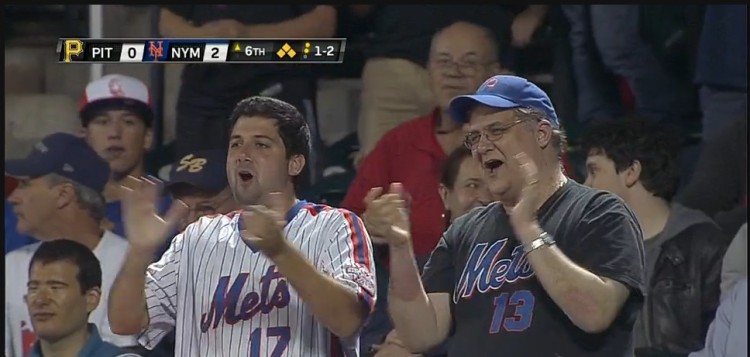 Can ya hear us, Pittsburgh? After spending a slice of my Tuesday afternoon listening to Dave Hudgens complain about “negativity” and Sandy Alderson indicate he can’t spend more money on players until it is liberated from True New Yorkers’ pockets, a dispassionate consumer of Mets baseball might have been ready to devote his time and resources to something more satisfying — say, a good bang of the head into the nearest wall.
But we are not dispassionate consumers when it comes to our ballclub…our ballclub that doesn’t understand how much we love them even when we get the feeling they are programmed to repel us…our ballclub that transmits a message whose essence is, “We need more of you to buy tickets and less of you to respond to how we play when you buy tickets.” Yet the Mets can’t stop Mets fans. They can only hope to maintain them.
I was on my way to Citi Field Tuesday night no matter what truths and opinions the deposed batting coach spoke on a pair of radio programs, no matter how much spin the general manager put on his own reply. That Hudgens seemed to resent both us and our beloved proxies in the broadcast booth and that Alderson continued to sing the same budgetary tune (one little doubt penned for him by his real estate mogul employers) was immaterial when it came time to catch the 5:11 to Jamaica, change for the 5:49 to Woodside, dash upstairs for the 7 Express and glide down to ye olde Home Run Apple by 6:15. I was going to the game.
Going to the game. The Mets can’t curb that enthusiasm. I didn’t sit for six months and stare Rogers Hornsby-style out the window waiting wait for spring just so that when the evenings finally grow summery, the Mets frost my horsehide.
True, they don’t win much at home. They don’t hit much at home. They change coaches in that department because, for all the high-minded huffery about poor Hudge the scapegoat, what exactly was he doing to deserve continuing in his role? Under the current front office, they don’t direct what dollars there are effectively at the major league level. Give Alderson all the pass you want for having to operate under the constraining yoke of Wilponnery, and dream all you want about the paradise pitching rotation his cleverest trades thus far are in the process of facilitating (good eventual health willing), but we’re on our fourth substandard major league roster in four seasons. There have been few finds on the open market up to the standards of people we were led to believe are geniuses at mining undervalued assets.
We are keenly aware of all this. We are reminded of it regularly because we pay attention to it. We pay attention to it because we apparently signed on to Rod Stewart’s assessment of more than three decades ago that I need passion; you need passion; we need passion; can’t live without passion; won’t live without passion.
Our passion is stored at 126th and Roosevelt. Regardless of the latest round of oy! the Mets teased from us the last couple of days, I wasn’t going to deny myself access to my passion. I was heading for that Apple at 6:15. Waiting for me was my friend Ben, no lacker of passion he. Ben has a motto about rooting for his team: Real fans cheer real loud.
Ben, you have to understand, is approximately 30 years younger than me and probably 300 times more energetic. He’s pouring himself lately into every home game he can because he’s not going to be in the New York area for very long. Ben’s passionate about the Mets. Ben’s out at Citi Field practically every day. Ben invited me to go to this game, then briefly apologized profusely when he thought he couldn’t make it because of a family obligation, then offered to skip the family obligation before realizing he had his Tuesdays mixed up and all was clear for us to attend (though I wouldn’t be surprised if really he told his brother to show some consideration and graduate high school some night when the Mets are on the West Coast).
Point is Ben was ready to cheer real loud and I decided to keep up with him as best I could. From the wonderful seats he obtained not all that far beyond the Met dugout, we urged everybody in a Mets uniform onward and upward, whether we approved their wearing of the orange and blue or not. This wasn’t about budgets or management or postmortems. This was about real fans of their surreal team determined to do what we could for them.
I think I got a letter on that subject a month or so ago, but I can’t remember.
We cheered our heads off for every Met, 1 through 9 in the batting order and then some. Dave Hudgens couldn’t believe Mets fans booed Curtis Granderson? We didn’t know what he was talking about. We cheered Granderson. We cheered Juan Lagares, whose jersey Ben is thinking about buying and whose LAGARES 12 t-shirt is still overpriced for my taste, but yeah, I’m gonna get it eventually. We cheered Jon Niese, no matter how much he normally makes me yearn for a nap. We cheered the reviled Ruben Tejada and the overused Bobby Abreu and the waste-of-millions Chris Young and the not yet settled in Vic Black and the two-inning ingénue Jenrry Mejia. (Hell, we even clapped for a cameo by Ike Davis and a catch by Andrew McCutchen.)
I don’t mean we tacitly approved of these fellows. I mean we shouted encouragement and applauded continuously and stood and yelled and baffled much of Section 113 and drew the attention of some Pittsburgh camera operator who beamed us aboard the Pirate broadcast for a couple of seconds. Most of the night we were pretty much alone in our demonstrativeness — Ben could sense the ire of a guy behind him who was more interested in making a phone call than urging a third strike — but we didn’t succumb to social graces. This was the Mets game. This was the Mets ballpark. We were the Mets fans.
We would be heard from. And we would win.
Long before sending the Pirates to their watery doom, back on that first train ride I had to take to reach the Apple, I noticed a fellow passenger in a Mets shirt and a Mets cap with headphones on and eyes closed as we pulled into Jamaica. I got his attention, fearful that he was sleeping through his stop.
“Excuse me,” I said. “Are you going to the game?”
“No,” he answered. “I wish I was.”
For everybody who still aspires to be part of the Mets crowd…for everybody who roots as hard as he or she can at whatever volume he or she sees fit to muster…for all the real fans, the True New Yorkers, the genuinely passionate partisans whatever their locales…for those who calibrate so-called negativity with heartfelt positivity…we wished were going to the game, too. It’s just that our wish happened to come true.
Why wouldn’t you make a lot of noise about that?
by Jason Fry on 27 May 2014 1:39 am Some things that don’t matter:
* Ike Davis vs. Lucas Duda. Ike’s doing a lot better in Pittsburgh. That’s great. He was a mess in New York, capable of spending months looking unsure which end of the bat was up. Ike wasn’t going to get fixed here, so I wish him the best there. Duda came up as a scary-looking hitter who couldn’t play defense and now strikes us as an average defender who can’t hit. Can he get fixed here? My reaction is increasingly to sigh.
* Jacob deGrom being snakebit. Josh Lewin said this on the air while I was sitting on a ferry with my own Joshua fuming about my shitty baseball team, and I shook my head. I like Lewin — he’s genuinely funny, obviously enjoys baseball and has coaxed Howie Rose into poking his head out of his Get Off My Lawn shell. But he was wrong about that one. Jacob deGrom’s problem isn’t that he’s snakebit, but that he has too many teammates who are bad at baseball. Slight progress was made in this regard, at least, as the Mets finally stopped pretending not to notice that Jose Valverde was pitching with a gigantic fork in his back — he got Farnsworth’d after undoing deGrom’s first career win. Valverde will be replaced by Vic Black, who at least has a possible future as an effective big-league reliever. Too bad reaching this obvious conclusion cost the Mets several games. Why was Valverde on the roster in the first place? We’ll get to that.
* Whether or not fans should boo. The sports-radio trolls will beat this one to death tomorrow, because people like fighting about it and so it will drive ratings. Whatever. It’s stupid. No, seriously: It’s stupid. I don’t care and neither should you. Most fan booing is free-floating anger looking for a target because team owners are smart enough not to appear in public, and so it lands on whomever’s doing badly at any given moment. Does it affect players? Until a stats-minded man or woman shows me a real effect, I’ll dismiss it as the Clap If You Believe in Fairies theory of baseball — Tinker Bell thanks you for your faith, but to Daniel Murphy you’re a civilian and he could give a shit what you’re doing up there in the Promenade.
* Dave Hudgens vs. Keith Hernandez. I love Keith, but the danger of playing the crazy-uncle role is the actor winds up trapped in the part. Over the last three decades I’ve read thousands and thousands of words about Keith Hernandez, more than enough to convince me that he was a brilliant student of hitting and a smart cookie away from the diamond too. This is a guy who earned respect sitting in on academics’ Civil War seminars, for Pete’s sake; he’s far too smart to play the Neanderthal role he’s fallen into when discussing hitting philosophies, defensive shifts and other studies of the game he once would have found illuminating. Keith has grown close-minded about the game he loves, and it’s a shame to see. In other words, I agree with the just-departed Dave Hudgens on this one — the Mets’ hitting problems aren’t a reflection of a poor philosophy, but of lousy students. It will be interesting to see if Lamar Johnson can be a better teacher, and that might actually have a short-term impact on the Mets’ fortunes. But what Keith Hernandez thinks of it and what Dave Hudgens thinks of Keith Hernandez’s opinion is just more talk-radio bullshit.
* Those hats. Actually those hats were a fucking atrocity. But they don’t matter either.
Here’s the one thing that really does matter to the fortunes of the Mets: The front office never knows what its budget is, and so cannot plan.
Write that one down and stick it above your computer screen. Put it in your sig file. Turn it into an acronym. FONKWIBICAP. It’s even catchy.
Hudgens himself gave us a peek behind the curtain on his way out in chatting with the New York Post. First he conspicuously left “ownership” off his list of people who’d given him a fair shake. Then he said that “I have nothing but respect for Sandy and no doubt he will turn things around if he’s allowed to.”
If he’s allowed to. In other words, if Sandy Alderson is given an actual budget he can plan against instead of being misled by ownership and having in turn to mislead others.
Too bad that hasn’t happened since Sandy arrived.
This is the fundamental thing wrong with the Mets. All the rest of the stuff that drives us crazy is a sideshow, a symptom of the real problem. The Wilpons keep their finances secret, telling their employees to say things that contradict the things they were told to say earlier. As a result, the front office must play a difficult strategic game while ignoring ever-moving goalposts. Is it possible to win this way? Yes — perhaps Matt Harvey recovers from Tommy John surgery and the team’s surplus starting pitchers are traded for hitters and enough guys have good years and because of all that the Mets are contenders next year, or the year after that. But there’s no margin for error — everything has to break right. It probably won’t — not because the Mets are star-crossed or cursed, but because this stuff is hard and there are 29 other teams run by mostly smart people seeking the same goal, except those teams’ owners give their front offices a budget written in ink.
Or, put more simply, FONKWIBICAP.
Greg and I did a podcast last week and someone asked when this will change. I kind of laughed and asked how long the questioner expected Jeff Wilpon to live.
To be clear, I hope Jeff Wilpon lives a long time — I have nothing personally against him or his father. The point is there’s no obvious solution to the Mets’ fundamental problem. The singularly useless Bud Selig doesn’t care if the Mets are run like a third-rate orphanage. The next corporate fox picked to guard baseball’s henhouse won’t either. When will the Mets once again be run the way the National League’s New York franchise should be run? The answer has more to do with the real-estate business than it does with baseball. Maybe another real-estate bubble will save the Wilpons and revive the Mets. That would be nice. But maybe they’ll hang on, continuing to refinance loans and pushing both the day of reckoning and the Mets’ window of competitiveness into the future, as commissioners say they aren’t concerned and GMs give up or are sacrificed to sate the bloodlust of fans too dim to look behind the curtain.
The life of a dug-in owner is a lot longer than the career of a Jacob deGrom or even a Bobby Abreu. Ask Blackhawks fans how long it took to stop being a pathetic joke. Ask Clippers fans how long their nightmare has lasted. Until something changes, expect a lot more losing, a lot more sideshows, and a lot more ignoring the only problem that matters.
by Greg Prince on 26 May 2014 10:40 am When your team has been immersed in an era of losing, your main ambition for them is that they start winning. Or at least stop losing more than they win. Nobody aspires to be .500 unless you can’t get and stay there. We haven’t gotten there and then beyond it for keeps since 2008. Hence, .500 looks pretty darn aspirational in 2014.
On Sunday, thanks to rain on Friday, we got to take .500 out for a little spin. They handed us the keys to a vintage doubleheader, which comes standard with three settings: sweep, swept or split. When you win the first game, you only care about the sweep. The Mets didn’t win the first game, making avoiding the “swept” the overarching desire of what remained of the day. That’s also not a very uplifting goal, but when you’re trying to raise yourself from a potential seven hours of total futility, a .500 day is a million times better than one expressed as .000.
Back when doubleheaders were less often contingencies than regularly scheduled treats, Ralph Kiner drummed into me that winning the first game is paramount. Winning the first game meant you had one victory in your pocket and they couldn’t take it away from you. When the first nine innings of Sunday were over, the Mets had expertly pressed that win in the Diamondbacks’ palms instead. They wasted six fabulous Rafael Montero innings — 10 K, 3 BB, an early solo homer and only one other hit — because they couldn’t touch April’s eminently touchable Bronson Arroyo.
They poked at their old recurring nemesis, but only in the feeble Weeble sense, which is to say Arroyo wobbled but the Mets could never discern a way to make him fall down. There were three initial hits that generated a run in the very first inning and then there was nothing but frustration. Before Arroyo’s six frames and his bullpen mates’ three more were over, the Mets would leave 10 runners on base and erase five more on double plays hit into. Not only did this offensive inefficiency writ large render Montero’s promising start irrelevant (for the purposes of winning the opener, that is), but it compressed the immediate margin for error into almost nothing.
So when Daniel Murphy — not a second baseman or any kind of defensive player by nature — couldn’t hold on to a baseball thrown into his glove during a 5-4 force attempt, which allowed the Diamondbacks to score the go-ahead run in the top of the ninth, doom was spelled out as clearly as any word on any banner paraded pregame. A Mets team that wasn’t struggling to return to .500 might have found a route to winning in the bottom of the inning or pushing the game to extra innings, but the Mets are indeed struggling to return to .500. They took their last licks and sucked up a 3:09 2-1 loss as quickly as they could.
The Mets disregarded Kiner’s advice (just as the Banner Day judges disregarded banners paying tribute to Ralph…and most of the other well-done banners) and dug themselves a doubleheader hole. There would be no sweep. There now needed to be no swept.
Thrilling or not, a split was attained. Daisuke Matsuzaka emerged from the bullpen to give the Mets a start just as good as those with which he finished September 2013. As dependable as Dice-K has been as a reliever, starting is what he does and he seems better suited to being one-fifth of the Mets rotation than does Bartolo Colon, except Bartolo Colon was fronted a two-year contract to take up that space and Dice-K came to camp on a minor league deal. Neither Colon nor Matsuzaka figures to be around when .500 finally becomes a rearview-mirror memory, but in the interim, the Mets might be missing the boat on which veteran they’ve assigned the inevitable inning-eating role.
Dice-K devoured his six splendidly, especially considering it was his first start of they year: only two runs on three hits and a walk, plus six strikeouts. Not only did he pitch, but he hit! Dice-K flared a single to left and drove in the Mets’ first run of the second game. See? The bat meeting the ball can produce marvelous results sometimes.
The Mets tied the game in the fifth on a double from Bobby Abreu — a second game of a doubleheader lineup entry if ever there was one — and took the lead when pinch-hitter Ruben Tejada succeeded at his unlikely role with a single. Murphy would later complete his penance for his drop by registering his third hit of the nightcap (Ravishing Recker had four) and put the Mets up, 4-2, a score expertly protected by workhorse closer Jenrry Mejia.
It felt good to win the second one even if it felt worse to lose the first one. It felt no more than OK to have gone 1-1 altogether. That, in case you’ve forgotten during these seasons mired in the .400s, is precisely how .500 works.
by Greg Prince on 25 May 2014 3:07 am Three weeks ago in our time, 45 years ago in their time, Freddie Rumsen directed his bottom-of-the-bottle pal Don Draper to get off the booze and “do the work”. On Saturday, Zack Wheeler did the work, which is to say he labored so hard through six-and-two-thirds innings that Howie Rose repeatedly invoked the P-word to describe his process: Pelfrey.
It took 118 pitches for Zack to not quite complete seven innings, which definitely gave Saturday a retro Big Pelf feel. The Diamondbacks wrung no more than three runs from Wheeler, but with every Met not named David Wright or Curtis Granderson merely tickling Josh Collmenter — and nobody’s bat even gently brushing against the uniforms of three Arizona relievers — three might as well have been thirty.
And Don? The last time we checked in from here on the Mad Men universe, it was April 22, 1969, and we kvelled from learning just what a Mets fan our favorite exiled creative director was. He’d retacked Lane Pryce’s pennant to his office wall; he invited recovering alcoholic Freddie to Shea; he belted out an inebriated chorus or two of “Meet The Mets”; and he woke up the next morning hung over but not so hung over that he didn’t think to ask Freddie if the Mets won the game they never made it to. (They didn’t.)
We haven’t heard much about the Mets from Don since then, immersed as he’s been in helping Peggy Olson craft the appropriate strategy for potential client Burger Chef. But I have a feeling that in tonight’s midseason finale, we will circle back to the true subtext of Mad Men: Don Draper’s accepting and embracing his Metsian destiny.
If you didn’t get burnt out on too many pitches from Wheeler on Saturday, here’s a look at one more pitch: the one I predict Don is going to make tonight to Burger Chef.
***
Gentlemen, you have a very successful fast food chain, and you’re in a growing field, but you also have some serious disadvantages. It’s very competitive, what with McDonald’s having taken over the “big sandwich” segment with its still-new Big Mac and Burger King expanding at a breakneck speed.
You have a good product, but I need to look you in the eye and tell you it won’t be enough if you want to last. The Burger Chef name is evocative but it’s not enduring. Not in our space age. Not when your target customer is either consumed by live TV footage of astronauts eating freeze-dried food and drinking Tang or, counterintuitively, their sudden desire to get back to nature.
Now I can’t suggest Burger Chef’s future is in space. We can’t put a restaurant on the moon just yet — I once had to break it to a very headstrong man that you couldn’t put a hotel there, either — but I think the other direction is just as intriguing for you.
You’ve probably read in Life magazine how the kids today are turning away from the cities and the suburbs and seeking a kind of authenticity in the country. The draw may be the communes and their admittedly enticing living arrangements, part and parcel of the so-called “free love” movement, but I don’t have to tell you one unassailable fact of life: nothing is free, not even love. I grew up in circumstances that proved that — but I also spent some of my formative years on a farm. I can tell you from first-hand experience that while the idea of bucolic beauty is powerful, the reality can be depressing.
You, on the other hand, can make the experience a joyous one. Burger Chef isn’t imperial. It’s not a “King” and it’s certainly not mass-produced on the scale of a McDonald’s. It’s not part of some overbearing computer-generated nightmare manufactured by IBM and leased to companies desperate to appear if not actually be modern. Burger Chef is something simpler. It’s like a Hershey Bar on a bun in its appeal. You have a sweetness your competitors can’t match, and I’m not talking about sugar content in your delicious milkshakes.
You can take that capacity to generate genuine affection and you can stake out new ground in your category. You have the opportunity to demystify the increasingly offputting restaurant experience with something that’s pure and basic to America’s roots. Your lead item, though, isn’t the burger. It can’t be. You need to differentiate. And your standard retail outlet shouldn’t be a foreboding building filled with Formica tables and plastic chairs. It should present itself as humble, communal, accessible and, above all, real.
You’re not Burger Chef. You’re Shake Shack.
People will line up for what you offer no matter what distractions are put in front of them and they will remain lined up for what you offer no matter what they’re ostensibly missing as they queue up, no matter what they might be hearing between visits to your uniquely situated locations.
Gentlemen, if you rebrand Burger Chef as Shake Shack now, you will reap the rewards well into the next century. There’s a saying we true New Yorkers have amused ourselves with since 1962: man will walk on the moon before the Mets win the World Series. I know you know man is about to walk on the moon and I imagine you’ve checked the sports page enough to know the Mets aren’t that far off from joining our brave astronauts in reaching for and attaining a foothold in the stars.
I have a newer, more accurate adage for you to mull over: long after man stops walking on the moon, long after the Mets finish winning World Series and long after “Burger Chef” is little more than a faint, nostalgic memory best left to the storytellers of tomorrow, everybody who populates the future will still want to go to Shake Shack.
I’d stake my very own name on it.
|
|






