The blog for Mets fans
who like to read
ABOUT US

Faith and Fear in Flushing made its debut on Feb. 16, 2005, the brainchild of two longtime friends and lifelong Met fans.
Greg Prince discovered the Mets when he was 6, during the magical summer of 1969. He is a Long Island-based writer, editor and communications consultant. Contact him here.
Jason Fry is a Brooklyn writer whose first memories include his mom leaping up and down cheering for Rusty Staub. Check out his other writing here.
Got something to say? Leave a comment, or email us at faithandfear@gmail.com. (Sorry, but we have no interest in ads, sponsored content or guest posts.)
Need our RSS feed? It's here.
Visit our Facebook page, or drop by the personal pages for Greg and Jason.
Or follow us on Twitter: Here's Greg, and here's Jason.
|
by Greg Prince on 20 July 2024 9:08 pm There’s a lot of disinformation circulating out there regarding current events. We would like to use this platform to help you sort out reality from fiction in one area of interest.
MYTH: The Mets always lose to the Marlins.
FACT: The Mets occasionally lose to the Marlins. They also occasionally beat the Marlins.
MYTH: The Mets never win at the Marlins’ soulless ballpark, whatever it’s called.
FACT: The Mets occasionally win at the Marlins’ soulless ballpark, an edifice officially known as the Marlsoleum.
MYTH: The Mets left a small village on base in Saturday’s game at the Marlsoleum.
FACT: Small villages usually have a population greater than 10, which is how many runners the Mets left on base Saturday.
MYTH: The Mets can’t win if they’re going to leave 10 runners on base.
FACT: Although it is quite challenging to win a baseball game in which 10 runners are left on base, the Mets did win Saturday’s game.
MYTH: The Mets can’t win if they’re going to score only run.
FACT: The Mets scored one run on Saturday and won.
MYTH: No team can win if it scores only one run.
FACT A team can win by a score of 1-0.
MYTH: Scoring one run allows no room for error.
FACT: The Mets committed one error, yet won, 1-0.
MYTH: The Mets never take advantage of scoring opportunities.
FACT: In the fourth inning on Saturday, the Mets loaded the bases and proceeded to score one run on Francisco Alvarez’s well-placed fielder’s choice ground ball.
MYTH: Met starting pitching always exits early.
FACT: Saturday’s Met starter, Luis Severino, lasted six innings.
MYTH: Luis Severino will look good for a while but eventually crack.
FACT: Severino gave up no runs while stranding six runners.
MYTH: The Mets’ bullpen will inevitably find a way to blow it.
FACT: Jose Butto, Dedniel Nuñez and Edwin Diaz each threw a scoreless inning. Among them, they stranded four runners.
MYTH: Nobody leaves as many runners on base as the Mets.
FACT: Both the Mets and the Marlins left 10 runners on base Saturday.
MYTH: Everything is home runs today.
FACT: No home runs were hit in this game.
MYTH: You just don’t see low-scoring games anymore.
FACT: The Mets won on Saturday, defeating the Marlins, 1-0. It was their first 1-0 victory over anybody in 2024, but it does happen now and then. It just did.
MYTH: Mets fans can’t believe when good things happen to and/or for the Mets.
FACT: For the most part, this is factual.
by Greg Prince on 20 July 2024 11:31 am Prior to the All-Star break, it was most every Met except Jeff McNeil powering the Mets into playoff contention. Directly after the midsummer pause, it was mostly Jeff McNeil attempting to restart the Mets’ engine.
Things work better with more than one player revving us up, apparently.
We can certainly celebrate indications that Jeff McNeil’s ability to hit the ball and hit it with power are back, having returned in tandem with the season’s so-called second half. Three hits and two home runs attest to the Squirrel’s offensive capabilities being alive and well and spending the weekend in South Florida. A couple of nice catches in right indicate intermittently superb fielding remains another McNeil tool. There was a throwing error, but let it not overshadow the versatility we are occasionally reminded Jeff brings to the table when a manager decides to let him show it. We already know he can run. What we want to know is how far he can run from his .622 OPS.
McNeil’s out of the blocks in fine fettle. The rest of his team got kind of stuck in the mud at the sponsored facility that houses the Miami Marlins. The Fish swam by the Mets, 6-4, on Friday in a game that did not satisfy the yearning any Mets fan had to see baseball again following too many days off. Marlin home games, ever since they drained their port of call of its personality, inevitably bore from an aesthetic standpoint. Toss in the Mets trailing early and continuously (and my personal need for a nap that spanned the seventh and eighth innings), and it wasn’t quite the picking up where we left off we would have planned. Of course, we left off last Sunday with a loss, but it didn’t diminish the era of OMG feeling we carried into the break. A couple more like the non-McNeil portion of Friday, however, will have an impact, and not for the best where our interests are concerned..
By some miracle, we’ve come to view the 2024 Mets as this incredibly fun enterprise that has surprised and delighted us for about a month-and-a-half. I’ve rooted for several Mets teams whose best days unfolded in the middle of their campaigns. Started not so great. Ended not so brilliantly. But my gosh, the chewy center was delicious. They don’t hang banners for those campaigns. Whatever happens this year, I’ll remember it. That’s what I do. However many other Mets fans will be able to distinguish 2024 from its surrounding seasons will probably depend on whether this season’s center holds.
I’m moved in purely non-political terms to think of an answer President Biden gave at his post-NATO summit press conference when he was asked about his legacy. “Look,” he said, “I’m not in this for my legacy. I’m in this to complete the job I started.” Different campaign context, but a single season’s baseball team doesn’t usually leave behind an easily recognized legacy without winning something extraordinary (or losing like crazy). Remember that year the Mets were really good in June and half of July? We were really into it, and there was a new meme we all latched onto pretty much every week to celebrate it while it was going on…no? Oh c’mon you HAVE to remember!”
Or maybe you don’t. Winning something extraordinary will help jog your memory. But that’s for later. The 2024 Mets aren’t in this for their legacy at the moment. At 49-47 and in a virtual tie for the third Wild Card, the job does go on.
by Greg Prince on 15 July 2024 8:11 am On Sunday morning, I read the Mets had lost their final game before the All-Star break the previous seven years there had been an All-Star break (which is to say not including 2020). Hence, I kept my hopes in check that the Mets would extend their momentum to a six-game winning streak and burnish the sense that they have become unstoppable. The surprise in the short term wasn’t that they lost to the lowly Rockies, as any team can lose to any team at any time. The surprise in the context of a season that once appeared anything but promising is that there were hopes to keep in check.
The Mets have given us a license to realistically hope. They pull into the break — despite bowing, 8-5, in their “first-half” finale — in playoff position. The slight lead on the pack of Wild Card wanna-bes is gratifying, but even better is the knowledge the Mets are in it until they’re out of it. It’s quite a step up from trying to rationalize, as we attempted in 2023, that maybe if they get lucky they still have the slightest chance to get close to not being altogether done.
Sure would have been nice to have swept the Rockies. I thought we might once Pete Alonso remembered he’s an All-Star and a Home Run Derby participant. Pete, who’s definitely a star in any season if not an indisputable All-Star this season, belted his nineteenth long ball on the year, his first in nearly two weeks. That blast knotted affairs at two apiece in the fourth. A subtler rally — a single and three walks — put the Mets ahead several batters later. Jose Quintana had settled down from a shaky first, and here came that segment of the game where the decidedly good team takes over decisively from the decidedly bad team.
But that business about any team losing to any team at any time rang a little too true. The Rox, who entered Sunday thirty games under .500, retied the score in the fifth and continued to add on in every frame through the eighth. While Jose Iglesias was rapping out four singles, Michael Toglia produced the biggest sounds with three home runs, while Ezequiel Tovar backed him up with a pair that also popped. OMG, you can’t win them all.
Still, it wasn’t wholly one of those sleepy Sunday-before-the-break losses that feels characteristic of an Amazin’ letdown, the kind that serves as prelude to the Mets predictably wandering off a competitive cliff once the schedule resumes. A good fight was put up in the bottoms of the eighth (two runs) and ninth (two baserunners). Reaching the middish-season pause with a 5-1 homestand encourages us to anticipate rather than dread. If you can’t cheer a win in your final game before the break, at least you can feel like you’re rooting for a winner.
by Jason Fry on 13 July 2024 11:56 pm We’ve all said it. Made it a mantra, even. Enemy runner on first, maybe other bases too, maybe they’re loaded. Outs? Not enough of them. Maybe just one. Maybe none.
C’mon, get a ground ball.
It’s been called the pitcher’s best friend for a century or more — the ball put in play that yields two outs (occasionally even three), turning danger into relief. In its purest form there’s a kinetic poetry to it: one hard hop right at the second baseman or shortstop, letting you can see the play unfold before it actually does. A quick shovel to the other infielder, the enemy baserunner sliding in too late (that’s one!), then the ball thudding into the first baseman’s glove (that’s two!), with the added cruelty of the batter turned runner having to watch his best-laid plans gone awry.
Tailor-made, they call it when it unfolds like that. “Just get me a little love,” Kevin Elster used to say during meetings on the mound with spooked Mets pitchers, by which he meant, “you supply the ground ball, we’ll do the rest.”
Saturday’s matinee against the Rockies? It was a story of pitchers’ best friends, and three fateful ground balls.
The first one came in the bottom of the second. Colorado starter Ryan Feltner had struck out the side in the first but seemed to lose his way an inning later, loading the bases with one out. Luis Torrens hit a grounder to second, but Brendan Rodgers (a Gold Glover, no less) bobbled it and then threw it into left field. Instead of the inning being over with the game still scoreless, the Mets were up 2-0; three pitches later, a Jeff McNeil double gave Christian Scott a 4-0 lead.
Scott would need every bit of that lead, as he looked out of sorts all day. Perhaps it was that the Mets’ Citi Connect alts look kind of like Colorado’s uniforms — there was a lot of purple-on-purple crime in deciding a winner Saturday. Up 4-1, Scott got the first out in the fifth but then gave up a single, a homer, a double and a walk, making the score 4-3 with the deficit threatening to vanish entirely. Carlos Mendoza went to get Scott, whose first win will have to wait yet another turn of the rotation (ah pitcher wins, oft derided and yet still so avidly pursued), with the manager calling on Jose Butto.
Butto’s first assignment was Elias Diaz, the Rockies’ powerful catcher. Diaz hit a grounder — which, it must be said, wasn’t exactly tailor-made, but a ball hit at Pete Alonso, who flung it to Francisco Lindor, who fired it back to Butto covering first. The Mets executed a tricky play and Butto was out of the inning with the lead still at 4-3.
Butto got the Mets through the sixth and seventh and was sent back out for the eighth, only to immediately run into trouble: a single and a walk. Enter Dedniel Nunez, among the most junior of the Mets’ relief corps and also one of its most trusted members, though that could be damning with faint praise. Nunez’s assignment? Yep, Elias Diaz. After a tough battle, Diaz smacked a ball to McNeil at second, who started a 4-6-3 double play. That moved Ezequiel Tovar to third but left the Rockies with just an out to play with. No matter: Nunez got Brenton Doyle to hit a foul pop to Alonso and the Mets were three outs away.
Three outs away, but up by a skinny run. Who would protect that slim lead? Edwin Diaz, whose last pitch to Tovar on Friday night was a slider that hung in the middle of the plate but was somehow swung over? Nope, it turned out to be Nunez — and to be a lot less of a nail-biter, as Lindor smashed a three-run homer off the launch tube of the apple to increase the Mets’ lead to a more exhalable four. (Nyet, Victor Vodnik, nyet.)
If a pitcher’s best friend is the ground ball, what’s a three-run homer in support of his cause? That has to count as a acquaintance to be cheerfully greeted, right? And definitely as a little love.
Postscript: It was fun to see Bill Pulsipher in the stands being interviewed by Steve Gelbs. For those who don’t know, Pulse’s big-league debut was also the first time your recappers met live in person. Pulse gave up five in the first — a heck of a crooked number even if it isn’t your maiden voyage — but the seeds of this blog were planted. Greg tells the story here.
by Greg Prince on 13 July 2024 12:03 pm I wanted to go home from Friday night’s game sick of “OMG”. I wanted it to be forced down my throat and stuck in my ear. I wanted it to be played to within an inch of my life. I want the Mets’ home run song to be blared incessantly because I want the Mets to homer incessantly.
There was indeed a ton of “OMG” at Citi Field, but we never reached the saturation point. Close enough, however, will do for now.
The Mets bashed five home runs Friday. Jose Iglesias therefore belted out his chorus in a veritable loop, including within two self-serenades. There was also the matter of his walk-up accompaniment, which happens to be the very same smash hit. Bring it, Candelita.
Between repeat airings of “OMG” and the eighth-inning karaoke crowd choice of “Dancing Queen,” I was ascending simultaneously toward musical and baseball heaven. Stephanie and I, ensconced in lovely Field Level seats down the third base line alongside our ever thoughtful friends the Chapmans (Sharon and Kevin, the undefeated couple of Mets baseball in any season), always perk up to ABBA, especially on a Friday night when the lights are low. Looking out for a place to go? Try over the fence, repeatedly.
Met noise. Bat noise. Fan noise. It’s a beautiful noise. Little remembered is the Colorado Rockies grabbing a 2-0 lead on a home run of their own in the second inning. Hard to forget is the Rockies nearly causing a fatal avalanche with four late runs, almost crashing our baseball party until it was on the verge of shattering. But in between, it was a Met gala the likes of which I’ve rarely experienced in July at Citi Field. Vientos goes deep! Iglesias goes deep right after! One out later, it’s Bader! All in the bottom of the second. So much for the Rockies jumping ahead early.
See that team, watch that scene, digging the big Mets lead. Once it got to be 7-2 in the fifth — another homer apiece for Jose and Harrison — it was unimaginable any harm could be done to the spectacular vibes. The only real mystery remaining was how many kids in the rows below us were going to reach out and touch Mr. Met. Yet my inner karma barometer told me the Citi A/V squad was pouring it on a bit too thick with the psych-out light & sound spectacular they unleashed on the scoreboards and ribbon boards every time the visibly downtrodden Coloradoans made a pitching change. Sure enough, close calls began going against us and the Rockies rose from the dead to nip Sean Manaea for another homer to dent his otherwise superb seven innings. Then they did to the Met bullpen what every team does to the Met bullpen. Versus Jake Diekman and Phil Maton in the eighth, they turned a laugher into a beseecher. We went from singing “Oh! My! God!” to thinking “oh dear God…”
Edwin Diaz and his blast-from-the-past entrance music became necessary for the ninth. Then Diaz became nerve-inducing. A couple of walks. A surfeit of preemptive grumbling. Ultimately, the vibes survived as the Mets hung on, 7-6. We’re still a playoff team months before the playoffs. Everything about this team is still fun as hell. But maybe next time you’ve got them where you want them, let sleeping Rox lie.
by Greg Prince on 12 July 2024 10:46 am You know the old baseball saying: The team that has the sixth-best record in the league, assuming it’s at least the third-best non-first place record in that same league, is a lock to go to the postseason. And if it’s not an old saying, let’s repeat it enough so it becomes one.
Congratulations to our ceaselessly beloved 2024 New York Mets, in whom we’ve never expressed a scintilla of doubt, for moving into playoff position with a mere 70 games to go in the regular season. Keep winning, and this thing is in the bag.
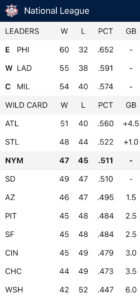 If the playoffs started today…alas they do not. Who would engage the services of one of those MLB-approved tout services that advertise during broadcasts and bet against these Mets right now? Right now, they’re barely stoppable. Against the Washington Nationals this week, rolling through Thursday afternoon, they were truly unstoppable, sweeping away the perpetually pesky Nats in their series at Citi Field and adding an exclamation point by shutting them out in the finale.
That part was particularly nice, considering the Mets hadn’t shut out anybody all year. The zero drought hadn’t gone on long enough to develop into an albatross, but it was getting there. All it required to become a trend was its continuation. The Mets hadn’t no-hit anybody for 91 games in 1962. The next thing you knew, we were waiting 50 years for our first no-hitter.
By the time mopup man Adam Ottavino was called on to not give up a run in the top of the ninth — he did everything but — the bottom-line result was as secure as one could hope. The Mets were up, 7-0, which indicates eight innings of superb pitching supported at some point by robust hitting. The Mets did their scoring in two frames — five runs in the fifth, another pair in the eighth. Brandon Nimmo, apparently one of the best players to never be recognized by any awards voter in any realm ever, delivered the key blow, as Brandon Nimmo has been doing most every game. The Mets loaded the bases in the fifth in that admirable way they have when they’re being their best. Their backup catcher Luis Torrens doubled off MacKenzie Gore to lead off, vouching for depth that attests to the ability to give Francisco Alvarez an occasional blow. Beleaguered Jeff McNeil, who has fallen so far in popular esteem that one could discern a collective sigh from Flushing when it was realized Jose Iglesias was not available to play second base Thursday, gritted out a walk. OMG, the Squirrel still has some life left in his bushy tail. Superstar who avoids being chosen for games with stars in them Francisco Lindor also worked a walk, one of those acts of patience and selflessness that tingles our spine when it means a rally is gaining tumescence.
Then Nimmo goes Wham-O, with a dart of a double to the center field wall that brings in all three baserunners. Brandon had homered in the three preceding games, but this half-a-homer seemed more authoritative than any of his dingers. Home run streaks are freaks of nature. Hard hitting that finds gaps just keeps coming. Getting Nimmo across the plate would make the inning that much better…and, would ya look at that? J.D. Martinez drove him home, and Pete Alonso did the same solid for Martinez.
David Peterson was making his 72nd career start Thursday. The first 71 indicated little definitive about his future, other than to hint that once you’ve been on the scene quite a while taking semi-regular rotation turns and it’s still not certain what to make of you or your role, you have tangibly less future than you used to. Peterson has been around since 2020, the season none of us went to the ballpark to watch him pitch. On the current active roster, only Nimmo, McNeil and Alonso predate him. He’s coming up on his 29th birthday, transmitting a perceptible signal that calling him one of our “young starters” is a misnomer. He’s been in and out of the Mets plans for five seasons now, judged neither discardable nor indispensable. Good starts. Bad starts. Indifferent impressions. As a first-round draft choice, he didn’t have the benefit of sneaking up on anybody. As a perennial contingency option every season dating back to the COVID campaign, he hasn’t overwhelmed opposing hitters, let alone organizational decisionmakers.
In his 72nd career start, David Peterson pitched for the first time like he was an indisputably vital component of the New York Mets staff. The circumstances demanded it. On July 11? We can read a calendar, but the same ballclub reasonably left for dead in late May had revived itself to the point where it could pass every also-ran and move, if only for a day, into position to look down on all of them. Once he was staked to a 5-0 lead, Peterson had to hold it in place. Had to pitch one more scoreless inning. He’d struggled a bit earlier, but had righted himself with no runs permitted. He’d outlasted Gore. Now he’d have to outlast the Nat bats altogether. The Mets would be eligible to win if Peterson went only 5.1 IP, or had he let the score become 5-2, but this wasn’t a day for dithering or dilly-dallying. Shut out Washington in the sixth. Post a sixth zero. Establish yourself as best you can amid the more veteran starters Quintana, Severino and Manaea, who aren’t about to be dislodged; the rookie Scott who hasn’t given anybody a reason to return him to Triple-A; and the nearly rehabilitated Senga, who is on track to pitch in the majors again soon (no, really). Do everything you can to make sure that when this day is done, the Mets are a playoff team, never mind that the playoffs are more than two-and-a-half months away. Do all that, and you’re locking yourself into everybody’s plans in these parts.
David Peterson did what he had to in the sixth on Thursday. He threw three ground ball outs around a single walk and didn’t give up a run. He kept the Mets ahead, 5-0, as did bullpen import Phil Maton for an inning, as Maton gave us hope that he can be this summer’s version of Rick White. We needed more relief help in July of 2000. We need more relief help every July. That July, we had our eyes on the postseason. We don’t always look that far down the road. We acquired White from the Rays when they were the Devil Rays. White, among others, pitched us into October and acquitted himself there splendidly. Erstwhile Ray Phil put down a marker of his own with a spotless seventh. Danny Young didn’t display his stealth magic in the eighth, but Dedniel Nuñez did. Another zero. Two more runs came around in the bottom of the inning to make the Met lead surely immune to implosion. Then Otto came on to test that assessment. Lord knows he did what he could to poke holes in budding presumptuousness, loading ’em up with one out and compelling the simultaneous loosening of Edwin Diaz and tightening of our chests. We were pretty sure we were gonna win. But we really wanted that shutout.
Adam reached down to remember he’s no mopup man at heart. He struck out James Wood looking and Jesse Winker swinging. Ottavino escaped any damage. The Mets, 7-0 victors, left behind the notion they can’t shut out any opponent. They also rose .001 above the pack that crams the also-running portion of the Wild Card derby.
Sixth-best record in the league. Third-best among teams not in first place in one of the three divisions. There was a time that and correct fare would get you on the subway. These days, it could very well take you for a ride on the express track.
by Jason Fry on 11 July 2024 1:40 am Some random observations from the Mets’ cudgeling of Patrick Corbin and the Nationals:
I’m going to get the complaining out of the way first: Dear God, what did they do to the black uniforms? Eliminating the white drop shadow was a dreadful idea; without it, the tops look murky and muddy, with the orange and blue muted and lost. I’m only mildly annoyed by this, as I think the black unis are best left on the shelf save for an occasional nostalgia night, but every time I see them I’m taken aback all over again.
On the other hand, how is it that the Mets have never screwed up their original uniform, given everything else they’ve shown they can’t be trusted with over the years? Sure, they stuck racing stripes on it for a while and there was the year with the tail and the dopey off-white seasons, but they’ve never veered too far from the fundamentals. The pinstripes are simple and solid and iconic, and it’s amazing that they’ve escaped a thorough overhaul. May it always be so.
It’s appropriate that Jose Iglesias‘s “OMG” has become the song of the ’24 Mets, because Iglesias has been such a critical part of their renaissance. When they recalled him from Syracuse on May 31 they were 24-33; since then they’re 22-12. Iglesias was front and center once again Wednesday night: His two-run single in the sixth gave the Mets the lead, one of three hits he collected on the night. He’s been deadly in the clutch, reliable in the field and brought a certain intensity to the proceedings that looks like it’s rubbed off on the rest of the lineup.
It made me smile every time Gary Cohen reported on what the Padres and Cardinals were up to, with an eye on the Mets moving on up in the wild-card standings. (For the record, they’re now half a game back of the third wild card.) It’s only July, and there’s a lot that can and will happen given the scrum of so-so teams fighting for the MLB-mandated extra playoff spots. But however overengineered some of us traditionalists think the wild card is, baseball is more fun when you have a reason to scoreboard-watch. And Gary’s excitement was contagious; fundamentally, he’s one of us.
Next time Francisco Lindor‘s walk-up music ends, keep listening to the crowd. They reliably finish the verse of “My Girl” on their own, a cappella, and it’s adorable.
We didn’t see new addition Phil Maton, who’ll become the first Met player to wear 88, but we did see Jose Butto finish the game, relieving Danny Young, who’d followed an actually effective Jake Diekman. Maybe Butto can be the next piece of spaghetti to stick to the wall; I worry about interrupting his development as a starter but the team is desperate and he sure looks like a solid option. On the other hand, Reed Garrett has a date with an MRI machine to peer into his inflamed elbow. I’d assumed Garrett had been stuck on the IL with some vague malady so he could recover from being cruelly overused, but there seems to be genuine concern here.
Still, let’s not gather little black clouds just because we’re Mets fans. They won, and they won with Grimaces dotting the stands next to OMG signs, two phenomena that would have had us shaking our heads in disbelief if you’d told us about them back in May when everything was so endlessly dreary. A McDonald’s character threw out a first pitch and now we’ve all adopted him as a good luck charm? We’re in love with a backup infielder who spent all of 2023 in the minors? There’s a hit song? There was a postgame concert after a win? Wait, I’m confused: Who sings this hit song, Grimace or Iglesias?
Sounds thoroughly unlikely, but it’s all true. The summer’s been fun, after I’d given up thinking this incarnation of the Mets was capable of delivering anything but misery. To be proved wrong feels like a little miracle, and despite our reputation for gloom and heartbreak, we’re not unacquainted with those.
by Jason Fry on 10 July 2024 12:32 am The basics of Tuesday night’s game all look good in the recapping.
The Mets scored seven runs, powered by homers from Brandon Nimmo and Francisco Lindor, All-Stars in our hearts even if they aren’t accorded that status next week. Nimmo’s homer was a summer-night special, an apparent fly ball that got high up into the humid air and just kept going until there was nowhere for it to go that didn’t involve souvenirs; Lindor’s was a laser beam over the fence in right center, one AB after he just missed a prodigious blast into the upper reaches of the Coca-Cola Corner. Harrison Bader chipped in three hits as the Mets treated Jake Irvin and his suddenly ordinary curveball rudely. On the pitching side, Jose Quintana stymied the Nats for seven sparkling innings … or OK, six sparkling innings and one that was a struggle but turned out fine. Even more impressive was that it was Quintana’s second straight start against Washington, continuing an extended run that’s seen him quietly go from another exasperating nibbler to rotation stalwart. Edwin Diaz needed four pitches to lock down the save.
So why the air of dread? It’s because of what happened between Quintana’s departure and Diaz’s arrival. The eighth inning was handed over to Adam Ottavino, who gave up a double and then a homer, recorded a flyout and then was excused further duty after hitting a batter. Dedniel Nunez cleaned up Ottavino’s mess, but the ninth inning was basically a carbon copy of the eighth, only with Reed Garrett on the mound: double, homer, strikeout, groundout, walk. That walk was what got Diaz summoned on a night the Mets had led 6-0 and it seemed unlikely that their closer would have to throw a pitch in anger.
Except it didn’t seem that unlikely, now did it? The bullpen has imploded, and it isn’t one thing so much as it’s everything. There are guys pushed up the ladder higher than they’ve ever been because other guys are out for the year. There are young players who aren’t ready. There are veterans struggling to find the right formula. There are guys whose pitches have lost their crispness because, well, their arms are falling off. And then there’s Diaz himself, a cracked vessel from which multiple dramas are leaking.
Nunez is the pitcher to be trusted right now, but that’s setting ourselves up for disappointment: He’s never done this before and is being sorely worked. For where that can lead, look at Garrett, who was so dependable before excess mileage took a bite out of his splitter. Perhaps Phil Maton can help: He was just acquired from the Rays and has seen success under the playoff lights in his days as an Astro. On the other hand he walks too many guys, a bullpen quality the Mets aren’t exactly lacking.
Perhaps Maton is the answer. Perhaps Ottavino can figure something out. Perhaps Nunez keeps it up. Perhaps a more judicious workload helps Garrett and Jake Diekman find their way. Perhaps Jose Butto steps up into a more essential role. Perhaps Adrian Houser‘s up-and-down season is headed for another up. Perhaps Diaz exorcises his demons. Perhaps Eric Orze shakes off his star-crossed debut and winds up with a non-infinite ERA. Perhaps Matt Gage is the answer, even though none of us could pick him out of a police lineup.
Perhaps perhaps perhaps. So much spaghetti, so much wall. What we know right now is the Mets face a nightly quest for precious outs. On Tuesday night they needed six, and getting them was hair-raising. Some nights they need nine, or 12, or 13 or 14. Sometimes their quest ends happily, as it did Tuesday night. Sometimes it doesn’t. Whatever the outcome, it’s a source of constant peril.
We need a hero. But those can be hard to find, and even harder to keep.
by Greg Prince on 9 July 2024 8:37 am The following is an excerpt from an article slated to be published in a forthcoming edition of The Metropolitan Journal of Sports Medicine, detailing critical work in the field of preservation of pitchers’ health.
The veritable plague of pitching-related injuries and subsequent Tommy John surgeries encountered a most serious challenge as the result of advances put forth in the summer of 2024 by a combined team of Drs. Stearns, Mendoza and Hefner when they prevented their patient, who we shall refer to as Christian S., from throwing more than 77 pitches in a given baseball game. The “organization,” as the consortium of doctors labeled themselves, determined in advance of Christian S.’s forthcoming outing that he would be removed from his starting assignment at roughly 75 pitches, no matter how well he was doing. Pitchers prior to this start routinely approached 100 pitches, indicating a pitcher pitching well could be left to proceed as if nothing was wrong with him.
As it happened, Christian S. was doing very well, having pitched five-and-two-thirds innings and giving up only one hit, a two-run home run to Oneil C., and walking only one opponent. Christian S. appeared vital enough to continue pitching without restriction and face at least one more batter, the dangerous Bryan R., an All-Star performer Christian S. had retired twice previously in the same contest. A similar outcome would have required only a handful of additional pitches from Christian S. to complete six full innings and position the organization for immediate success.
This is where the breakthrough work of Drs. Stearns, Mendoza and Hefner came into play. Adhering to their notion that approximately 75 pitches should be all Christian S. — then 25 years old and showing no physical ailments — be allowed to throw, Christian S. was removed in favor of Eric O., a then unknown reliever being asked to make his first appearance at the highest level of his profession in a tie game at the end of a road trip that would be described either as “winning” or “.500,” depending on the outcome of the game in progress.
In the short term, the decision to remove Christian S. in favor of Eric O. proved deleterious to the competitive health of the organization, as Eric O. (who did not pitch altogether badly) failed to set down any of the required three batters he faced and allowed the even score he inherited to become a deficit. Eric O. gave way to Adrian H., and things got inalterably worse from there.
While pitching machinations are the focus of our study, it should be noted that the organization’s offensive interests weren’t served by any member other than Brandon N., as none of Brandon N.’s colleagues found a way to counter the strengths of familiar organizational impediment Mitch K. (see “Finger of Starling M. and Fate,” September 2022). All of this is to say that the game was lost in multiple fashions.
While an 8-2 defeat and a dispiriting end to a road trip amid a highly charged playoff-berth pursuit dominated the thoughts of those who were invested in the fortunes of the organization in the summer of 2024, the long-term effects of the removal of Christian S. potentially proved beneficial, as throwing only 77 pitches, when to all observers he had the capability to throw a few more, conceivably guaranteed not only continued health for Christian S. but might have provided a road map for all young pitchers forever more.
“It turned out it was just that simple,” according to a statement issued under the names of Drs. Stearns, Mendoza and Hefner. “We pick a specific number of pitches; the pitcher is not permitted to exceed it by much regardless of game situation; and then everything is fine. Clearly it’s as easy as all that, because we’re pretty sure nobody had ever thought to put a young pitcher on a pitch count before. If they had, none of them would have been subject to injury, right?”
by Jason Fry on 7 July 2024 11:05 pm When your team’s going well, you call a game like Sunday afternoon’s things like “an inspiring win” or perhaps “proof of resilience.”
When your team’s going badly, you just laugh at being randomly atop karma’s wheel for a day.
I’m not sure what to call Sunday afternoon’s game, because I’m not sure what the Mets are.
One of the joys of baseball — which was a lot more joyous before they stuck a football-style clock on the proceedings — is the way good games unfold with a surface lack of action that hides the tension being ratcheted higher and higher, until boom! that tension is released in a hurry and anyone who’s been paying attention realizes that was the payoff of all the apparent quiet.
So it was Sunday, when Sean Manaea and Luis Ortiz traded zeroes for six innings and then handed it over to their bullpens. Both teams emerged from the seventh unscathed, but the eighth was another story: Things were about to happen in a hurry. In the Mets’ half, All-Star snub Brandon Nimmo laced a double off former teammate Colin Holderman to chase home Francisco Lindor and give the Mets a 1-0 lead. In the Pirates’ half, Dedniel Nunez was removed after getting two outs (and allowing two hits) in favor of Edwin Diaz. Diaz? With four outs to get? After working the night before? (Admittedly, with relatively few pitches thrown.) Without a clean slate?
Cue mutterings from the large contingent of visiting Mets fans at PNC Park and all of us on our couches farther away. And, indeed, Diaz walked Joshua Palacios on four pitches and his fifth pitch was a slider that sat in the middle of the plate, and which Nick Gonzales spanked into center for a two-run single and a Pirates lead. That sent the Mets out for the ninth a run in arrears with Aroldis Chapman — he of the fastest reasonably documented pitch ever thrown — filling in as the Pittsburgh closer.
Chapman got two quick strikes on Francisco Alvarez, but this year Alvarez has developed an ability to fight his way back into counts that brings to mind Edgardo Alfonzo and a young David Wright, as well as current specialist Nimmo. Alvarez worked the count to 3-2, spat on a slider that was just low, and was replaced at first by Ben Gamel. Harrison Bader fought his way to 3-2 and singled, putting speed on the bases and bringing up Mark Vientos.
Hope? It’s a delicate thing — a little bird to hold gently on your palm while it dries its wings, perhaps assisted by some gentle exhalations to speed the drying process up and accompanying assurances that the sky is wonderful and little feathered friends will love it up there. Vientos went down 0-2 on a pair of sliders, worked the count full … and got caught looking at a slider when he was expecting a fastball.
One out, ugh — and the ughs were compounded when Luis Torrens went down on three straight pitches, having clearly been looking for the exact opposite pitch of what Chapman had given him three times in a row.
Jose Iglesias was up as the Mets’ last hope, and I allowed myself to think he was exactly the kind of hitter I’d want there — possessed of a good eye and a reputation as a battler. And Iglesias did battle, fouling away putaway pitches at 101 and 102 before walking on a 101 MPH four-seamer a hair below the zone.
Chapman’s pitch count was rising steadily, and here came Lindor — who can look hopeless at the plate in one AB and like a wizard in the next one. Chapman’s third pitch was a slider that got too much plate; Lindor squared it up and a moment later it was touching the outfield grass and the Mets had the lead back.
Hope was flapping happily around at treetop level tweeting that the world was a wonderful place, but I was holding my breath because I knew what it didn’t: there are hunters lurking in the sky that a little bird doesn’t want to meet. Diaz went back out to the mound after nearly half an hour of sitting and, one feared, marinating in his own unhappiness about what had transpired. His first pitches to Oneil Cruz weren’t exactly reassuring, either: sliders getting too much plate and fastballs missing a bit of crucial juice.
But Diaz got Cruz looking on a slider at the knees and his pitches then seemed a lot crisper against Rowdy Tellez. He grounded out and Diaz went to work on Jack Suwinski, who worked a full count but tapped a ball harmlessly to Iglesias. It nestled in Pete Alonso‘s glove and the Mets had … enjoyed the rotation of the karmic wheel? Yanked one out through pluck and grit?
Damned if I know — every time I think I do, the Mets try and convince me of the opposite. What I do know is they won, and they’re about the most interesting .500 team one can imagine, even if you have no idea where that’s taking them.
|
|






