The blog for Mets fans
who like to read
ABOUT US

Faith and Fear in Flushing made its debut on Feb. 16, 2005, the brainchild of two longtime friends and lifelong Met fans.
Greg Prince discovered the Mets when he was 6, during the magical summer of 1969. He is a Long Island-based writer, editor and communications consultant. Contact him here.
Jason Fry is a Brooklyn writer whose first memories include his mom leaping up and down cheering for Rusty Staub. Check out his other writing here.
Got something to say? Leave a comment, or email us at faithandfear@gmail.com. (Sorry, but we have no interest in ads, sponsored content or guest posts.)
Need our RSS feed? It's here.
Visit our Facebook page, or drop by the personal pages for Greg and Jason.
Or follow us on Twitter: Here's Greg, and here's Jason.
|
by Jason Fry on 6 July 2024 11:57 pm In the early going Saturday, it sure looked like the Mets had reverted to the unholy mess they were throughout May. In the first inning they followed second and third and nobody out with a pop-out and a pair of Ks; in the second they wasted a leadoff single and then a one-out double. In the third, they loaded the bases with nobody out against Bailey Falter, who threw ball one to Pete Alonso and then departed with arm discomfort.
On came old friend Dennis Santana, whom you may have forgotten was a Met for nine games last year. Santana, throwing nearly all sliders, went to 3 and 2 on Alonso and I exhorted the Polar Bear not to swing at a bait slider.
The Polar Bear swung at a bait slider.
Up came Mark Vientos, who didn’t see a single pitch in the strike zone and struck out. (To be fair to Vientos, Santana’s slider was a lot sharper by now.)
The Mets were doing it again, weren’t they? Enter Luis Torrens, who wound up pitching in Friday night’s debacle, when he was the most effective hurler the Mets had to offer.
Santana threw a bait slider, which Torrens ignored in a sign of Metsian progress. Then Santana left a slider in the middle of the plate and Torrens didn’t miss it. He drove it into that funny nook in PNC Park’s center field, the only place where that distance wouldn’t yield a grand slam. It was a three-run double instead. “Finally!” said Gary Cohen, speaking for us all.
The game trundled along from there, with Oneil Cruz hitting a two-run homer into the river that glanced off the foul pole and might possibly have gone through it, leaving one of those cartoon bore holes, and Jose Butto relieving David Peterson in the fifth, which meant more rounds of reliever roulette.
The break point came in the seventh, when Reed Garrett struggled with his control, loading the bases with one out. He got a lineout from Ke’Bryan Hayes and then faced Jack Suwinski as a pinch-hitter.
It gives me no joy to say that Suwinski had to overcome not only Garrett but also home-plate umpire John Tumpane, who lost the strike zone in sync with Garrett. Garrett threw a sinker below the strike zone on 1-0; Tumpane called it a strike. On 3-1, Garrett missed low again; Tumpane called that sinker a strike as well. As Suwinski blinked in disbelief, Pirates skipper Derek Shelton emerged from the dugout red-faced with rage and was quickly tossed. On the next pitch, Garrett struck out Suwinski to end the inning.
It went our way, but it was nonsense. And this kind of nonsense swings games all the time — the Suwinski AB was glaring because of the game situation, but look carefully and every night you’ll see see 2-1 counts transmuted into 1-2 counts and vice versa because umpires miss pitches. Those blown calls tip the balance between hitters and pitchers and change outcomes — just not under the same spotlight as bases loaded, two out and a game on the line.
I’m all for the human element in baseball. But the human element should be a pitcher trying to dot the outside corner or a hitter outguessing the pitcher and zoning in on his pitch. It shouldn’t be a referee failing to do his job and so distorting the proceedings. Robot umps now!
Anyway, with Garrett having gotten an assist past Suwinski the game wound up in the officially ruled not inappropriately sticky hands of Edwin Diaz, returned from his 10-game suspension. Diaz started off by hitting Cruz, then drew a pitch-clock violation, and that sound was thousands of Met-fan heads going into Met-fan hands.
But then Diaz found it in a hurry. He struck out Pittsburgh folk hero Rowdy Tellez and got a grounder to short from Andrew McCutchen that became a game-ending double play. Seven pitches after we were all like, “Oh God not this again” the ballgame was over and the Mets had won — won on a day when everything kept looking like it was about to become unbearable but somehow, to our infinite relief, did not.
by Greg Prince on 6 July 2024 11:54 am Congratulations to the New York Mets of July 5, 2024, for doing something no Mets team had ever done before in a blowout loss so bad that a position player had to pitch. On Friday night, the Mets, whose last call to the visitors’ bullpen at PNC Park would summon catcher Luis Torrens, actually stayed close until fairly late. They trailed only 4-2 as the black & gold-clad crowd rose for the seventh-inning stretch, giving every indication they were very much in a game they had led as recently as the top of the fourth and were tied as recently as the top of the fifth.
Losses so resounding that they result in a Plawecki, a Recker or a Torrens staring in at somebody crouching where they usually find themselves tend not to be backloaded in their defining momentum. In the twenty previous episodes of You’re Not Gonna Believe Who’s Pitching, including the affair of August 15, 2021, when Mets fans resorted to that line twice (the night Kevin Pillar had to relieve Brandon Drury), the Mets were pretty well out of the game before everybody was in their seats, though there were a few first-inning Met leads that melted quickly, starting with the progenitor of all such improv embarrassments, Mets at Pirates, September 26, 1992. That Saturday afternoon, New York jumped ahead via the kind of attack that, if you knew nothing else except the game right in front of you, validated the signing of Vince Coleman two winters prior. Vince singled on a three-two pitch from Bob Walk to lead off the festivities; stole second while Walk worked to Chico Walker; cooled his heels while Walker worked a walk off Walk; and came home on Daryl Boston’s single to left. The Buccos were on the verge of clinching their third consecutive NL East title and the Mets were playing out as disappointing a string as they had ever unfurled, but in the moment, Jeff Torborg’s team was playing smart, heads-up baseball, running the opposition ragged.
The moment ended when the Pirates came to bat in the bottom of the first. They scored six runs. Four were on a grand slam belted by ex-Met farmhand Lloyd McClendon. Two were doubled in by Walk, who shook off the top of the inning pretty easily. Then came six more runs in the bottom of the second, featuring the final home run bopped by Barry Bonds in a Pirate home uniform. Then, in the bottom of the eighth, Met infielder Bill Pecota scaled the mound. He wasn’t there to pep-talk his pitcher. He was there to be the pitcher, the first time a Met position player had ever assumed that responsibility. The first Pittsburgh batter, Andy Van Slyke, homered to change the score from 18-2 to 19-2. Pecota held the line from there.
That’s usually how these position player/pitcher games go. By the time the manager gets super desperate, the game’s been a foregone conclusion for ages. Take the three games in this category started by Steven Matz…please. Matz could do some fine pitching in his Met day, but he also had a tendency to implode. Once in 2018 and twice in 2020 (a season that had only sixty games total), Matz took the hill only to have the Mets running for them. They were down to the Nats, 7-0, in the first on July 31, 2018; down to the Nats again, 5-0, in the third on August 10, 2020; and down to the Braves, 5-0 in the second on September 18, 2020. The respective finals in those Met losses were 25-4, 16-4 and 15-2. The respective closers for the Mets? Jose Reyes, Luis Guillorme and Todd Frazier.
Met annals are punctuated with these oddities that unfortunately aren’t as infrequent as they used to be (none between 1962 and Pecota; thirteen since 2017). Friday night’s incident may have been the oddest of them all in that it did not appear to be a candidate for cataloguing under Blowout That Blowed Up Real Bad. The Mets hit the ball hard a bit versus rookie phenom Paul Skenes when Skenes — 7 IP, 8 SO — wasn’t throwing the ball past them quite a bit more. Jeff McNeil homered in the third. Pete Alonso doubled with authority to lead off the fourth and came around to register the second Met run. Even after Luis Severino gave up a pair of solo shots in the bottom of the fourth, the Mets were level with their hosts. For a decent spell after Bryan Reynolds parked another Sevy serving with a man on in the fifth, the game stayed within reach. Down 4-2 going to the bottom of the seventh is hardly a death sentence.
The next sound you heard was the Mets walking the plank. First, Severino tumbled into the drink with nothing left: double; single; walk; exit. Next, for reasons best known to Divine Providence, Jake Diekman, the lefty who has still not taken our well-intentioned advice to fling his glove into the stands in order to inspire a designation for assignment à la Jorge Lopez (the Mets could hold a team meeting afterward as well). Nope, Diekman, the old pro, conducted himself with utmost comportment after surrendering a grand slam to Reynolds, putting the game that had been within the Mets’ grasp all night completely beyond the longest of their fingertips.
Because the rules say the Mets must suffer the consequences of their mysterious decisions, Jake had to hang around for two more batters. He gave up a single and a walk, or the least damage one imagines Diekman can do. The veteran gave way to a less-heralded journeyman type, Ty Adcock, who slithered out of his inherited jam thanks primarily to Oneil Cruz necessitating an interference-tinged double play by running directly at third baseman Jose Iglesias while Iglesias was in the act of fielding a ground ball. Thank heavens for dim favors.
Adcock would get his chance to know the confluence of the Allegheny and Monongahela in the bottom of the eighth, as three different Pirates sent three of Ty’s pitches toward the mighty Ohio. Three homers for Three Rivers, thrusting Pittsburgh ahead, 14-2, or ten runs better than it was barely an inning before. The last of the dingers, bashed by Rowdy Tellez, was the Bucs’ second grand slam of the game, not to mention the seventh of their franchise record-tying home runs. Worse, somehow, was that amid all the cannon blasts (PNC literally ran out of fireworks), Adcock couldn’t mix in a third out.
Ergo, Torrens, who got his man (0.1 IP, 1 BF, 0 R). If you’re looking for a Rolaids Fireman of the Game candidate on the Met side, you could do worse than the backup catcher. You couldn’t possibly do any better.
Oh, and welcome back, Edwin Diaz. Wash your hands, clean your glove and start getting warm.
by Greg Prince on 4 July 2024 6:38 pm I loved watching the great victory today, a shutout for our side, with New York coming through toward the end. I am referring, of course, to my annual viewing of 1776, a film I still find worth watching every Fourth of July, my custom since 1991 and something I hope to do as long as the American Experiment continues to produce net-positive results.
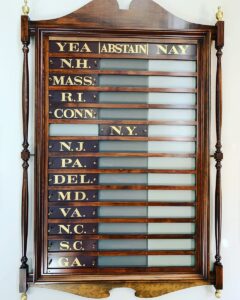 Some late-inning Fourth of July box scores are more promising than others. Before the movie, I watched New York not come through toward the end nor at any point of the proceedings, resulting not in a suspenseful 13-0 blowout for the forces of independence, but in a 1-0 drubbing in Washington, a town where good things have been known to intermingle with the other kind. The best part of this particular blanking was it was over with early, a function of the game staring at 11:05 AM. My pregaming, as it were, consisted of a nap. Continuing it rather than disrupting it so I wouldn’t miss too many pitches likely would have been more satisfying.
The game in a nutshell: it’s nothing-nothing at the outset of the bottom of the eighth. I wander into the kitchen, half-listening to the TV audio from the living room. I hear Gary Cohen identify a Nationals batter as someone who has hit five career home runs off Adrian Houser. I do a quick calculation and assume he’s talking about ex-Red Jesse Winker, since who else on the Nats would have faced ex-Brewer Houser often enough to hit five home runs off him?
A moment later, I’m watching Winker Dinger No. 6 fly over a fence. I not only saw it, but I saw it coming…as, I imagine, did every Mets fan who processed the foreshadowing.
Kudos to Jose Quintana for preventing more than a bullpen cameo. Seven shutout innings ain’t nothing in the land of double-negatives. Thanks to Jeff McNeil for assuring we wouldn’t be no-hit, though some days it doesn’t feel as if avoiding highlight infamy matters. When you’re not hitting, being one-hit is only one hit better than being no-hit — y’know? Jake Irvin quelled every non-McNeil Met completely for eight innings and Derek Law took care of the rest. There’s something about a 1-0 Met loss put in the wrong side of the books in under two hours that’s as American as apple pie. It’s part of summer the way you remember it from when you were a kid, kind of like getting bitten by a mosquito.
by Greg Prince on 4 July 2024 9:19 am I gotta tell ya, I was really rooting for Jake Diekman on Wednesday night. More than I was behind Tyrone Taylor when he confounded the left field foul pole for his home run to lead off the third; more than I cheered Mark Vientos making the shrubbery beyond the center field fence at Nationals Park his personal meditation garden in the fourth; more than I applauded Francisco Lindor turning the disappointment of Ben Gamel’s near-home run moot by belting a two-run home run of hiw own with Gamel on second in the fifth; more even than I was delighted to have Christian Scott back in the major league rotation, I was all in on Jake Diekman.
“C’mon, Jake,” I urged, “I know you can do it. I have confidence in you. I BELIEVE in you! Go get ’em, Jake!! You’ve got this!!! This is YOUR moment!!!!”
But, alas, Jake didn’t do what I truly wanted him to do. He did not follow the example his former teammate Jorge Lopez set weeks earlier and he did not fling his glove into the stands in disgust after a terrible outing. I so yearned for Diekman to commit an unprofessional act and thereby compel the management of the New York Mets to designate him for assignment on the spot, meaning he’d never come out of the Met bullpen again and throw another inning like he did in the seventh, when he gave up a ten-pitch walk, a double and a single in succession and allowed a slim 5-4 Mets lead to transform into a 6-5 Nationals advantage en route to a 7-5 Mets defeat.
I thought you could do it, Jake. Next time (and it appears there will be a next time), remove your glove from your right hand and aim for the fans behind the dugout. Or, in your case, somewhere near them. Just be as bad coming off the mound as you routinely are on it and give the front office the nudge it needs. I still believe you can do it.
by Jason Fry on 2 July 2024 11:39 pm This recap’s headline is a term we’ve heard a lot in the sabermetric age, as front offices search for previously overlooked and/or undervalued traits in players. The last two nights, I’ve found a new market inefficiency as a fan: You don’t need to watch the part of the game that doesn’t matter.
I don’t recommend this strategy, because a) it’s hard to pull off consistently; and b) the fun of baseball is the journey and not just the destination. But for two nights in a row I have to admit it’s worked.
On Monday night I arrived for duty in the sixth; once I had the Mets drew even, blew the Nationals’ doors off in extra innings, and then survived a harrowing bullpen meltdown to win. (Whoops, sorry, I meant to type “another harrowing bullpen meltdown.”)
Tonight a dinner out in Brunswick kept me away from my station, save for a couple of under-the-table glances at Gameday. (I kept getting caught because Face ID doesn’t work that way.) I saw the Mets were down 1-0 and then down 2-0 — the stuff of resigned sighs back in May, but not quite so worrisome now.
I saw that, but I missed the Mets drawing even on a Francisco Lindor homer and an RBI single from Brandon Nimmo, apparently recovered from the scare he got fainting and gashing his head in a D.C. hotel room, and in the game because of a scare Harrison Bader got crashing into the outfield fence. (Stay tuned.) I figured out those details later; when I turned MLB Audio on for the drive back up the coast all I knew and all I needed to know was it was 2-2.
Which it stayed until the top of the 10th, thanks in large part to Francisco Alvarez gunning down speedy rookie James Wood. That meant the Mets were looking to drive in their Manfred man, suddenly a nightly occurrence in these parts.
(I know you’re expecting the giddy part of the recap, but nope, I’m climbing up on this here soapbox.)
One of the things I dislike about the free runner — besides the fact that I enjoyed baseball pretty thoroughly before all the impatient tinkering — is that it spotlights failure rather than success. With nobody on and nobody out, you’re hoping for a series of successes to put your team in the lead — say two singles sandwiched around a steal, or a pair of guys-swap-places doubles, or one of many other winning formulas.
But with a free runner on second and nobody out, you don’t need much in the way of success to grab the lead. A grounder to the right side and a medium-distance fly ball will suffice, with the same equation holding for the other team. And because the odds favor that run scoring, rather than hope for two or three good things in close proximity, you’re dreading that your team will fail. A run coming home isn’t a success to savor, but a disaster avoided. It usually takes a lot less time, which MLB’s committees of MBAs consider a plus, but it’s an upside-down, faintly sour experience, one that isn’t going to make anyone yell, “Free baseball!”
That was running through my mind in the 10th: I exulted behind the wheel as Jose Iglesias drove in Tyrone Taylor and replaced him at second, then despaired when Jeff McNeil popped up a bunt — because, again, the assumption is the other team will cash its own gimme run, meaning anything less than a two-run inning is perilous. Lindor grounded out, and there was that dread again, despite the Mets being up by a run.
Fortunately the roof was about to cave in on Robert Garcia and the Nats. Boom! Nimmo doubled in Iglesias. Pow! Mark Vientos brought in Nimmo. Zip! Pinch-runner Ben Gamel stole second. SOCK! Pete Alonso drove one over the fence.
The Mets had scored five runs, though of course being Mets fans we were all thinking that the night before they’d scored six and before that one ended we were all wondering if scoring 60 would have been enough. But this time there was no meltdown: Dedniel Nunez (whose arm has got to be feeling a little dedniel by now) set the Nats down 1-2-3, with their Manfred man left standing useless and disconsolate at third.
It was fun — a half-inning that features your team and goes on for 15 minutes or so is almost always fun. But I kept thinking that innings like that used to be more fun, back in the days before everything got fixed.
by Jason Fry on 1 July 2024 11:05 pm The Mets and the Nats, sheesh. I guess it proves that for every Nieuwenhuis there’s a Suzuki. And for the critical stretches of Monday night’s mildly bonkers game, it wasn’t clear whether the compass was going to wind up pointing to N or S.
And I missed the first five innings! I mean, so sue me — we were eating lobsters on the dock with Emily’s parents (actually I was eating fish and chips, due to a shellfish allergy) and I’d forgotten it was a 6:45pm start. Not to deflect attention from my lack of said, but isn’t that a little early to start a game anyway? 7:05, 7:10, even 7:40 I get … but 6:45 is just weird.
Fortunately, all I’d missed was the Mets being frustrated by MacKenzie Gore. I’d just gotten the TV on (accompanied by a gorgeous Maine sunset) when the Mets rose up in indignation, with Mark Vientos singling in Harrison Bader to bring the Mets within one, Tyrone Taylor reaching on a CJ Abrams error and Francisco Alvarez lashing a Derek Law cutter that didn’t cut into the gap for a 3-2 Mets lead.
It looked like the Mets might hold that lead, with Dedniel Nunez taking over for David Peterson and collecting four outs, leaving the Mets with four to get. But then Nunez walked Jesse Winker and Joey Meneses smacked a single to right field that took a strange bounce, startling a perhaps not completely attentive Taylor. Just like that, the Nats had tied it, and the ghosts of the last two days were suddenly romping around, cackling predictions of doom.
Nunez survived when Ildemaro Vargas inexplicably tried to bunt for a hit (seriously, WTF?); Jake Diekman came in for the ninth and immediately put the Mets in harm’s way when he threw away a ball, allowing newcomer James Wood to reach second with nobody out. The Mets survived when Taylor just barely corralled a drive by Jacob Young and we were on to extras, with Francisco Lindor once again the Manfred man.
This time, the Mets unloaded: Down 0-2 against Hunter Harvey and mired in an 0 for 12 funk, J.D. Martinez got a splitter that hung in the middle of the plate and drove it over the fence for a three-run homer. Alvarez brought in Taylor with a triple, and Jose Iglesias followed with a two-run blast. The Mets had driven in six runs, and Gary Cohen was exulting about putting the hammer down and cappers.
To be fair to Gary, so was I and quite possibly so were you. But Tyler Jay gave up a pair of walks and a pair of doubles and looked like he couldn’t get enough air out there, despite Alvarez trying to cajole, entreat and bully him across the finish line. (Alvarez is must-see TV, whether he’s show-ponying his way around the bases after another big hit or behind the plate tending to a reliever who’s become a spooked horse.) Jay was excused further duty in favor of Reed Garrett, who hasn’t been scintillating of late and was facing the tying run in Keibert Ruiz.
Ruiz singled in a run and the Nats were a drive down the line away from tying it and a home run away from showing the Mets the Full Suzuki, and if you were confident, well, I want to have what you were having. So of course Garrett made short work of Luis Garcia Jr., erasing him on a splitter to secure the victory. The lesson, as always: Never try to outguess baseball. The Mets had won despite playing reliever roulette with four or five rounds chambered; they’ll now undoubtedly make a slew of new moves in hopes that a few more of those chambers come up empty around 8pm Tuesday.
We won. Was it fun? It was at times. Were there times when I thought the best course of action was to slip into the other room and turn my stomach inside out? Yes there were. And that was not fun.
Let’s just say it … was a lot.
by Jason Fry on 30 June 2024 10:20 pm Since we’re Mets fans, we all knew the bullpen had issues. Since we’re adults, we all know progress isn’t always or even usually a smooth arc — it comes with fits and starts.
A day after blowing a big lead because of a nightmarish inning of relief, the Mets endured a bunch of bad luck, came back to tie it, had the game gift-wrapped for them, failed to capitalize on it, and saw another nightmarish inning of relief.
Oof.
I’m up in Maine, and the first half of the game was glimpsed during and between chores — which meant lots and lots of shots of Luis Severino looking perturbed and trudging around after yet another Houston hit felled in. I was at my station when the Mets launched a furious comeback, with Brandon Nimmo’s swing and a drive the exclamation mark.
And then? Weather delay. A very long weather delay — a whole game’s worth, in fact. The game came back while we were in the car seeking dinner, and proceeded as an animated Gameday rectangle in the pub we like a few towns over.
We shrugged when the Astros cashed in their Manfred man, then exulted when Nimmo immediately switched places with Francisco Lindor. A bunt and a sac fly, a grounder to the right side and a contact play … there were so many ways to emerge with a victory, and yet none of them materialized. J.D. Martinez’s bat has cooled from incandescent, as will happen; he struck out. The Astros walked Pete Alonso. Harrison Bader grounded out, moving up the runners for Mark Vientos. Vientos has had a helluva month, but this is baseball, where even the hottest hitter fails more often than not.
Vientos grounded out and the Mets had missed a layup. They brought in Matt Festa, whom I’d never heard of before today and learned was a Met around 4 pm. The roof caved in on Festa: three singles, a pair of lineouts, a double. Gameday’s version of this was a steady drumbeat of IN PLAY, RUN(S).
The Mets lost. They fell back below .500. A sour note to end one of the best months in franchise history, but in stoppering our ears lets not forget that last part. The conversation’s different. Summer baseball need not be pointless and obligatory. And the arc of the season may yet point skyward.
by Greg Prince on 30 June 2024 7:52 am In this new upbeat era of Mets baseball in which we only grimace ironically, let’s catalogue our positives.
Ty Adcock not only made his Met debut, but sparkled in it. Mark Vientos went about as deep as one can to dead center at Citi Field. Before Mark hit his mark, the Mets made the most of their luck in one particular inning (the second) and posted five somewhat improbable runs. The organization found space on its uniform sleeves for patches honoring the memories of Jerry Grote and Willie Mays as they continue to remember Buddy Harrelson the same way. And “OMG” continues to worm poppily in the ear of those who can’t help but be charmed by the Jose Iglesias experience.
So it’s not like Saturday was totally unpleasant.
I don’t know that I’d watched a game in 2024 brimming with expectations the way I did this middle contest Saturday. I expected the Mets to win. I expected the Mets to hold their 6-1 lead. I expected the Mets to push back on the Astros’ aspirations of catching up and going ahead. I thought about the standings and expected the Mets to gain ground.
Then I tempered my expectations bit by bit until I accepted that not every day is our day, even when for weeks almost every day has been.
If we’re looking for root causes, I suppose Edwin Diaz’s gunky hand and glove and the way the suspension they wrought brought about a reduced/diminished pitching staff sticks most. It’s a miniature 2023 out there in the bullpen, with everybody moving up a notch to compensate for Edwin’s absence, except we’re not allowed to fill in at the far back end of the relief corps, which is an issue when your starters throw a surfeit of pitches early and practically none by the sixth inning’s end. You really miss those marginal Syracuse arms when you are reminded they are better than nothing.
So, in the realm of faint praise, is Tylor Megill, who spells his first name with an ‘o,’ vowels his last name with an ‘e’ and an ‘i,’ and continues to have a career best described as Quadruple-A. As part of my newfound optimism, I thought Megill would shine against Houston if just to compensate for the cloud his previous performance cast over Chicago. I stand corrected. Megill gutted out five-and-a-third. The fourth was the discouraging one, with three painful Astro runs cutting the Mets lead to 6-4, and a sense emerging that, nope, this one wasn’t going to be as easy as everything to that point had looked.
Once Tylor was lifted after 101 stressful pitches, the bullpen shorts were showing. In the latter part of the twentieth century, where I lived until the millennial odometer turned, a seven-man pen was a luxury. Mostly it was unnecessary. Today I’m still shocked at how high and dry it can leave a team, especially if, god forbid, enough of the relievers in captivity have pitched lately. This one is unavailable. That one is unavailable. The safety net feels preemptively shredded. Even if you get an Adcock to come in out of nowhere and preserve order (we did), you still have innings to go before you can sleep.
And it becomes a nightmare.
I was under the impression Jake Diekman was one of those veteran lefties who would be über-dependable à la Brooks Raley. Alas, not all southpaws who’ve been in circulation forever are created equal. We miss the contributions of Raley. We’re still waiting for some on a consistent basis from Diekman, who was characteristically wild before giving way to Reid Garrett. Garrett faced three batters. It felt like three-thousand. Before Jake and Reed were done missing the strike zone, the Astros were ahead and I was missing more than ever Raley, Sean Reid-Foley and the likely Tommy John-bound Drew Smith. Goodness knows I’ve tensed up at the sight of Drew across his up-and-down tenure since he alighted in Flushing in 2018, but whoever isn’t coming in in the seventh typically looms as the much better option than whoever did enter, especially on a day like Saturday.
In the end, the Mets lost, 9-6, to a quality opponent, much as the Astros lost the night before to a quality opponent, which was us. We’re in that league now, safely removed from the ranks of Rockies and Marlins and anybody judged chanceless, but we haven’t ascended to the circuit where we never lose. We’re not yet that good. Nobody is, though I was at the precipice of believing our June ascent would proceed without pause clear to July. We were gong to win our fifth in a row in a fifth different jersey (I was even getting used to the City Connects). We were going to slip ahead of the Cardinals by a percentage point or two and hold the third Wild Card spot, for whatever that was worth. We were going to start breathing in the vicinity of the Braves’ necks, even. Didn’t happen. Or it hasn’t yet.
This taking the Mets seriously as a good ballclub is different from how I was expecting the balance of the season to play out. It’s more fun than what I figured we’d be relegated to. But it doesn’t preclude angst and disappointment on a given day when expectations aren’t shall we say Met. I vaguely recalling seasons working this way. Thanks for the emphatic reminder?
by Jason Fry on 29 June 2024 10:04 am I won’t claim it’s high on my lengthy list of Selig/Manfred era outrages, but it annoys me that the Astros are in the American League. They’re our expansion siblings, after all, arriving along with us in 1962 as the Colt .45s.
We began as a novelty act to salve the still-fresh wounds of Dodgers and Giants fans, fielding an Old Timers’ Day lineup complete with taking the Polo Grounds out of mothballs; they started life as the Colt .45s, a mildly shameless bid for a business tie-in that would lead to a more shameless (and more enduring) rebranding based around Houston’s ties to the astronaut program. In our first go-round we finished 10th and became synonymous with baseball futility; they were merely bad and finished eighth.
(Side note: Holy cats were the ’62 Cubs horrible.)
Rusty Staub and Jerry Grote were early Colts/Astros. Later, the likes of Ray Knight and Mike Hampton passed through the Astrodome before becoming Met heroes. John Franco and Dwight Gooden played in Houston at the tail end of their careers, cameos that would make you go “oh yeah that’s right” when looking up their stats years later. Donn Clendenon didn’t want to play for the Astros at all, a drama that eventually led to his becoming a critical ’69 Met. We faced them in ’86, when their rotation was anchored by scuffballing former Met Mike Scott and ’69 hero Nolan Ryan, and prevailed in an exhausting sixseven-game Gotterdammerung.
All that has become so long ago that I feel like I just put an onion on my belt and gave a stemwinder about bees and quarters. The Astros have been in the American League for more than a decade now and become synonymous with cheating; opposing fans will be making jokes about trash cans decades after Jose Altuve is a white-haired Hall of Famer visiting a suite to glad-hand with oil executives. These days, sadly, I hardly think of our ’62 siblings at all — they’re far away and play in that jumped-up arriviste beer league, so why would I?
But 2024 has offered more parallels.
The Astros have exhausted their fans with a season of stops and starts and ups and downs, navigating injuries and tough personnel decisions, but they’d heated up of late and arrived for Friday night’s game with a record of .500 — not exactly world-beating stuff, but cause for celebration given where they’d been.
That’s our 2024 bio as well.
Baseball specializes in these something’s gotta give meetings, and momentum favored the Astros immediately: Five seconds into the game, Altuve had whacked a Jose Quintana sinker that didn’t sink into the stands for a 1-0 lead. But as has been a Mets hallmark of late, Quintana staggered out of the first inning weary but whole, giving up only the one run. The Mets loaded the bases with nobody out in their half of the first against Ronel Blanco and came away with only one run, but hey, that did tie it.
Houston took the lead again in the third, lost it in the fourth on a Tyrone Taylor solo shot, and then the roof caved in on Blanco in the sixth: Pete Alonso‘s overly aggressive first-inning AB had not exactly been a highlight, but now he hit a no-doubter to left to give the Mets the lead; four batters later Jeff McNeil golfed a ball into the right-field corner for a three-run homer and the Mets were up by four, on their way to winning by five.
McNeil would wind up three for four on the night, continuing a run during which he’s looked at least a little like his old self. Maybe that’s too little too late; maybe the knowledge that Brett Baty is playing second in AAA and tearing it up has concentrated the mind wonderfully. If nothing else, McNeil can look around and see plenty of teammates who’ve extracted themselves from the fan scrap heap and revitalized their seasons.
The Mets, at least for the moment, look thoroughly revitalized: After the game, Jose Iglesias AKA Candelita offered the Pride Night crowd a mini-set formally unveiling “OMG.” Watching a backup infielder perform his latest single in his stadium accompanied by adoring teammates is a new one for me, but it’s this week’s second never-seen-that-before video to have me laughing happily: During Wednesday night’s monsoon delay, fan video caught Grimace on the Shea Bridge, up on people’s shoulders shotgunning a beer before a cheering throng; as I stated on former Twitter, if that doesn’t lead the 2024 World Series Champions video, we riot.
That’s getting ahead of ourselves, of course, which leads me back to what exactly, this smidge-over-.500 team is.
Two perspectives may be at least mildly helpful.
The first comes from Joe Sheehan, to whom you should absolutely subscribe: “[T]he 2024 Mets are this year’s best argument for one of my guiding principles: Let the season breathe. This is what baseball teams do, they look good for a while, look bad for a while. The in-season variance of a baseball team’s performance is bigger than whatever you think it is. The Royals backed up 34-19 with 8-18. The A’s went 17-17, then 12-37. The Yankees have dropped ten of 13 after a 49-21 start and bodies are piling up in the Harlem River. Breathe. It’s not football.”
That’s excellent advice. And yet I’ve also thought back to something Greg said a few years ago. At the time I’d decided I needed to be better at analysis and was unhappy with how many of our recaps were essentially reactions. Greg heard me out quietly, then said: “We’re fans. That’s what we do. We react.”
Indeed we are, and indeed we do. There’s a value to understanding that a night’s bullpen meltdown doesn’t foretell doom just as a walkoff, come-from-behind three-run homer doesn’t print its own playoff tickets. But in the moment that’s not going to be anyone’s reaction. Nor should it be.
We’re fans. We react. Right now we get to react to rain-delay Grimace appearances and postgame concerts. That’s extraordinary; let’s just enjoy it.
by Greg Prince on 27 June 2024 10:10 am They’re probably not this good, are they? How could they be? Fifteen wins in nineteen games seems to give us all the answer we need, a stretch that’s unfurled since their last pairing of consecutive losses, not to mention the active streak of three victories during which the most recent ascension or explosion feels it can’t be topped, yet the next day it is. The odds say sooner or later the Mets who are making a science out of finding ways to win will accidentally lose a game, and from there a few balls will bounce in their opponents’ favor, and suddenly…
Welcome to the inversion. The above paragraph was written just over a month ago, except on Opposite Day, when every positive about the Mets now was a negative about the Mets then, meaning we used words like “bad” and “lose,” if you can remember back that far. There were a lot of Opposite Days for the 2024 Mets, who once relentlessly depressed us, which seems impossible, since we now know them only for relentlessly uplifting us. You know how the temperatures have been in New York lately. The Mets are playing at a crisp 180 degrees from where they were in May when we decided they were going to stay ice cold for the duration.
Instead, they’ve burned a path through June. From a nadir of 24-35, they have risen to 39-39. It’s a plateau that looked like Everest when they gathered at base camp to make this particular climb. Surely .500 wasn’t their goal. It was too high. Yet here they are, planting a flag for the moment atop Mount Break Even.
How did we get here? Why ask how? Team meetings, licensed characters, progression to the mean…take your pick. I choose to process what’s happening without questioning it too much. When the Mets were dreadful, that looked like what the Mets were. Now that the Mets are marvelous, I think I’ll just marvel at them.
Wednesday night, the only thing the Mets did wrong was get rained on. Shocking to realize they can’t overwhelm the weather as they do their opposition, but give them time. The 87-minute precipitation pause probably cost callup Ty Adcock his Met debut (he was warming in the pen when the tarp rolled out at Citi Field) and it made staying awake a challenge for some watching from home (I snoozed through the seventh), but the club’s momentum never dampened. Up 4-0 on the Yankees in the bottom of the fifth in what was already an official game, the Mets came back once the grass was sufficiently dry and ground their municipal rivals into the dirt. Eventually, it became an official ass-kicking, with a final of Mets 12 Judge 2.
Sean Manaea walked a few too many of the nettlesome neighbors, but that’s what double plays are for. Sean threw three pitches that each turned into a pair of outs. “Just the Two of Us,” indeed. With the lead up to 7-0 following the weather delay, Danny Young did what pitchers everywhere do: he gave up a home run to Aaron Judge with Juan Soto on base. As long as Judge couldn’t hit an eight-run homer — and not even he can do that — we were gonna be OK. We’d already had a long ball from Francisco Alvarez and were going to get one apiece from Tyrone Taylor and Harrison Bader, although I napped as the latter flew. There were all kinds of other runs and runs batted in, and there was Adrian Houser, once upon a time the internal bane of our existence, now closing out a three-inning save and a Subway Series sweep.
Could a person want more than a ten-run throttling of the so-called Bronx Bombers, described to us by the best booth in town? Well, I always want to add to the all-time Met roster, and though I was deprived of typing in the name “Ty Adcock,” I did get to expand the mothership of lists to include outfielder Ben Gamel, who checked in for defense in the ninth to become Met No. 1,240 overall. And will ya look at that: a “24” right in the middle of Gamel’s chronological ranking, apropos of Michael Mays, amid a group of dignitaries (including Cleon Jones) wearing Mets No. 24 jerseys, throwing out the first pitch Wednesday evening in memory of his father Willie. Isn’t it beautiful how the Mets’ institutional amnesia that the Greatest Ballplayer Ever played for them has lifted and stayed lifted?
Isn’t everything beautiful about the Mets as we speak? Is it baffling that such sentences are being composed? From the perspective of earlier in the season, absolutely. But the season went on and the Mets did, too, becoming something wholly different from what we were sure they were. Emotional cost certainty is in flux as a result. That’s the potential downside of any surge from nowhere to somewhere. I read something in April about fans of really good teams and fans of really bad teams being able to deal with losses better than fans of .500 teams, because if your team is really good, one loss is a veritable little fish within a great big pond of wins, while if your team is really bad, one loss is just one more loss that doesn’t surprise you in the least. The fan of the .500 team, however, sees any given loss as a referendum on the course of the season. Are we really this bad? Are we really this good? We don’t know. The finding out suddenly has stakes.
Which, we are beginning to be reminded, is why they play the games. The Mets’ arrival at .500 coincides with the recognition that there are definitely teams in this league and, for that matter, the other league who appear not quite as good as them, but very few who seem all that much better. The Yankees are the latest powerhouse we’ve faced that is obviously headed to the postseason, yet clearly isn’t impervious to injury or imperfection. All among the Braves, Phillies and Dodgers have struck me the same way. Incredible talent at the core, but if they’re dinged up enough, they have depth issues like anybody else. Of teams against whom the Mets have gone head-to-head to date, only the Brewers, who we played so long ago it was March, and the Guardians have come across (to me, anyway) as in a league of their own. Teams get hot, teams cool down. We’re about to welcome in the steaming Astros, who were twelve under .500 in this very season, ebbing lower than even us. They’re now where we are.
Can our .500 club, having passed a passel of NL wheel-spinners to become what would have to be objectively considered a playoff contender, actually continue to be, you know, this good? We are not impervious to injury or imperfection. We are still without our closer. We are also without two other bullpen mainstays in Sean Reid-Foley and Drew Smith, the latter having gone on the IL Wednesday, which explains why somebody like me is closely monitoring the movements of Ty Adcock. Ben Gamel is here because Starling Marte isn’t. Yet we’re not really missing anybody the way we’ve been playing as a whole. No Edwin Diaz amounted to no problem for two nights as we constructed leads so tall not even Hammerin’ Yank Aaron could completely cut them down to size. Everybody but Jeff McNeil is hitting consistently, and McNeil’s bat, as evidenced by the deep lineout that brought home a run in the New York-New York finale, is showing a bit of a pulse, too. Yet the collective sizzle will at some point fizzle. That’s not glass half-empty fatalism talking. It’s simply what happens in every season. The collective fizzle turned to sizzle. It was bound to happen, regardless that there was no sign it would.
Every season it’s like this, if not necessarily in a fashion as extreme as 0-5 followed by 12-3 followed by 12-27 followed by 15-4 to get to 39-39. Downs. Ups. Frustration. Elation. Not knowing exactly what comes next. Not knowing exactly how we’ll handle it. Not knowing if we’re really as bad or as good as we’re certain we are or if we’re just prone to taking a wildly divergent route to middling. Again, that’s why they play the games.
|
|






