The blog for Mets fans
who like to read
ABOUT US

Faith and Fear in Flushing made its debut on Feb. 16, 2005, the brainchild of two longtime friends and lifelong Met fans.
Greg Prince discovered the Mets when he was 6, during the magical summer of 1969. He is a Long Island-based writer, editor and communications consultant. Contact him here.
Jason Fry is a Brooklyn writer whose first memories include his mom leaping up and down cheering for Rusty Staub. Check out his other writing here.
Got something to say? Leave a comment, or email us at faithandfear@gmail.com. (Sorry, but we have no interest in ads, sponsored content or guest posts.)
Need our RSS feed? It's here.
Visit our Facebook page, or drop by the personal pages for Greg and Jason.
Or follow us on Twitter: Here's Greg, and here's Jason.
|
by Greg Prince on 13 June 2024 11:13 am It’s gonna get away, you tell yourself when an early 2-0 lead becomes a 2-2 tie. When the lead is rebuilt to 5-2, you figure maybe — maybe — the scenario developing won’t be worst-case. Then instead of remaining 5-2, the lead shrinks to 5-4, and you can sense where this is going. Yet when it goes in the other direction a little, to 6-4, you’re willing to believe (a little) that your harshest instincts might be a little too quick to come to the fore. I mean, yeah, they’re probably gonna blow it, but only probably.
Then you get 8-4 and you think, “I’d feel better if it were 9-4. At 9-4, I’ll stop with the doomsaying. There’s nothing magical about a five-run lead as opposed to a four-run lead, but if we’re up five runs going to the ninth inning, given that we haven’t given up a run since the fifth inning, then perhaps this is an evening destined to be defined by good rather than ill fortune.”
And the lead becomes 10-4 and the ninth inning is at hand, and you remember what it’s like to watch the end of a Mets game in something resembling psychic comfort.
Ergo, Zeiles of Approval® all around for the eight Mets who recorded fourteen hits, especially Tyrone Taylor, who registered four of them. Taylor had been so quiet with the bat for so long, I’d kind of forgotten that he can hit. And let’s power-pack a few Zs of A for our three homer-hitters from Wednesday night: Harrison Bader in the two-hole with a two-run blow to get us off on the right foot in the first; Starling Marte, who went very deep in the fifth; and Francisco Lindor, who led off the eighth with his eleventh of the season.
If we’re tipping hats, lids doffed to Carlos Mendoza or whatever analytical algorithm is responsible for jostling the lineup just enough to make a difference versus the preternaturally pesky Marlins. There was Bader batting second, J.D. Martinez third, Pete Alonso cleaning up, beloved-in-Belgium Jeff McNeil in the ol’ Nido nine slot, and Brandon Nimmo sitting and watching for a night against lefty Braxton Garrett. Garrett was pretty hapless for his not quite five frames of rubber-toeing. That wasn’t necessarily a function of not benefiting from Nimmo’s icy hole in the order, but we’ll never know. Lineup shaken, offense stirred.
David Peterson didn’t go much longer than his mound opponent, but he survived a full five, and though he gave up four runs and didn’t qualify for the all-important quality start designation, every out matters, especially within a staff where too many of them are dumped on the bullpen. Mendoza could call on Dependable Dedniel Nuñez to begin the sixth fresh, and Nuñez could begin polishing his acceptance speech for when they hand him the Nobel Prize in Relief Pitching. Dedniel faced seven batters and presented each with a gold watch, retiring one after another on the spot. Alas, it’s more likely Nuñez was thinking of how to say “see you soon” for committing the twin sins of having pitched two-and-a-third and possessing a minor-league option on the eve of Edwin Diaz’s reactivation, but the man deserves his own Approval Zeile.
The path cleared by the only Dedniel we’ve ever known did not grow cluttered by the efforts of either Jake Diekman or Reed Garrett. The Marlin defense didn’t do its pitchers any substantial favors. And did we mention ten Met runs on fourteen Met hits?
Relax, you told yourself when it was over. We won, which doesn’t happen as often as the alternative does. We won with minimal stress other than the kind we inflict upon ourselves, which almost never happens. We drifted off into dreamland not thinking the worst of our team. I’m not sure if that’s happened in months.
by Jason Fry on 12 June 2024 7:40 am So the Mets came home fresh off a heady, game-saving final play by Luis Torrens … and looked pretty much like the Mets we increasingly have no interest in watching.
Francisco Alvarez returned from the IL, which seemed heartening, and Tylor Megill pitched well in the early innings against the Marlins, looking like a young hurler who’d kinda sorta maybe figured some things out. But then came a fifth-inning implosion in which Megill was shoved off a cliff by his defense. With runners on first and third and one out, Bryan De La Cruz hit a ball to the gap that went off Harrison Bader‘s glove as Brandon Nimmo strayed into Bader’s airspace, bringing in Tim Anderson with the tying run. (But not Jazz Chisholm Jr., because he is fundamentally unsound as a ballplayer in addition to being selfish.) No matter: After a flyout Mark Vientos didn’t take his time on a hard grounder to third from Jake Burger and made an errant throw to first, giving the Marlins the lead.
You can put asterisks on things if you like: The play Bader didn’t make was one of those “two center fielders” misplays that will happen until guys sort things out, and Vientos only made a throwing error because he first made a great stop on a hard smash. But that’s cold comfort: The Mets forced Megill to get two extra outs, it cost them the lead, and in another hour or so it had cost them the game, with an insurance run coming in following an Alvarez throwing error and the Met bats slumbering against whatever Marlin reliever was sent out to shush them.
Jet lag? The Phillies looked just fine in beating the Red Sox, though I suppose it’s true that Boston is closer to London than Queens is.
Nope, chalk it up to Met lag. You’ll know you’re a sufferer if the doctor finishes his examination, sighs, looks you in the eye and says, “Maybe you’re just not very good.”
by Greg Prince on 10 June 2024 2:42 pm Some wins you’ve got to have. You traverse an ocean and lose the first of two scheduled high-profile games, you’ve got to come home with the second contest in your carry-on. You catapult ahead from what the odds termed prohibitively behind, you’ve got to remain ahead until the end. You’ve got this reputation for inevitably finding a way to lose any game whose outcome is in doubt, you must discover a method that secures you victory. The Mets’ need to win on Sunday had nothing to do with the standings and transcended the concept of self-esteem; we sent our self-esteem to the cleaners weeks ago. There was nothing to gain, nothing to lose. But we had to win. Nobody who cares about the Mets was going to be well-served by a reminder that there goes this team they love Metsing it up again, despite all of us knowing that this team we love is capable at any moment of Metsing it up again. And again.
The ocean’s distance the Mets journeyed to absorb Saturday’s defeat and then attempt avoiding an encore result on Sunday was no small matter; baseball in London will grab your attention like no ten trips to Citizens Bank Park. The opponent was inconvenient for a team that usually stumbles into and out of ninth innings. The Phillies entered the series with the best record in the sport, even if they generally appear more talented than special. Although I’ve attempted to mute the echoes of 2022, I look at Philadelphia and I sense a bunch the Mets outclassed repeatedly just two years ago, with casts that at their core haven’t changed that much, yet here are the Phillies earning superteam status…and here are the Mets being the Mets most days. I saw on social media waves upon waves of Mets fans sending their greetings home from England because they took it upon themselves to represent the orange and blue five time zones east of Citi Field, then I see (and hear) little but scarlet and powder blue during the telecasts. We sent Mr. and Mrs. Met over there. I think the Phanatic devoured them.
Yeah, a win had to be had by the Mets on Sunday, and the Mets took it. Or accepted it with modest conviction when it was handed to them late. Maybe the Phillies decided they didn’t have room in their luggage for another one.
History was made as soon as Old Friend™ and designated home side twirler Taijuan Walker threw the game’s first pitch at 10:11 AM New York time. As outlined here, there aren’t many ticks on the 24-hour clock when the Mets haven’t been in action at least once. There are now 24 fewer minutes on that clock such can be said about. Thanks to extra innings in Tokyo in 2000, we watched/listened to/napped through the Mets on the job between 5:05 AM and 9:00 AM. Thanks to a lot of extra innings in Los Angeles in 1973, when games regularly started after 11 PM EDT, the Mets worked until nearly dawn: 4:47 AM back in New York. A Forbes Field doubleheader between the Mets and Pirates on July 4, 1969, commenced at 10:35 AM, beginning the Mets baseball day the earliest it ever had sans the Japan business. Now London on June 9, 2024, has usurped that distinction. For those keeping time, there are now only blocks of 18 minutes (4:47 AM to 5:05 AM) and 71 minutes (9:00 AM to 10:11 AM) that the Mets haven’t trod upon.
All this adjusting of Sunday morning routines seemed to be nonetheless steering us to a typically dreary loss, with Walker shutting down his opposition without sweat, and Jose Quintana providing less length than a yardstick. The corollary between starters going shallow and bullpens being overworked doesn’t require a trip across the Atlantic. We’ve already seen that formula play out from coast to coast in America, and boy is it played out. Quintana’s 3.2 IP Sunday on top of Sean Manaea’s 3.2 IP Saturday ensured too much relief and probably not enough relief.
The venue certainly didn’t help on Saturday. Odd sightlines from the vantage point of the outfielders. Bouncy turf at all points. The good news was those factors were in play for both sides, and on Sunday, you could see it hinder the Phillies some. You could also detect a quick hook performed on Walker, who was one out from getting through six scoreless, albeit with runners on first and second. Taijuan had thrown 79 pitches and given up no runs, one walk and two hits to that juncture. The walk and one of the hits had come in the sixth. Still, sometimes you beat back your albeits and leave your starter alone.
Rob Thomson opted to open his bullpen gate a little early. The Mets crashed through. Gregory Soto quickly whittled Walker’s 3-0 lead to 3-1 on a Brandon Nimmo double, then erased it entirely on J.D. Martinez’s two-run single. When it was 3-1, ESPN’s “win probability” graphic explained it was 88% probable the Phillies had this thing in the bag. Getting the game tied at three indicated they’d keep playing, regardless that mathematics suggested the Mets board their charter ASAP.
The Mets couldn’t push any more runs across whatever the British call the plate in the sixth, and they let a rally wither on the vine in the seventh. The overworked bullpen’s effectiveness — nothing surrendered between Quintana’s exit in the fourth and the close of the sixth — suffered a ding when David Dahl led off the bottom of the seventh with a home run off Dedniel Nuñez. Jake Diekman and Reed Garrett got the Mets through the rest of that inning no worse off than down, 4-3. If only you could ask relievers to do that every day and have them respond in kind.
A one-run deficit was still in place as the ninth unfolded. Jose Alvarado was on. Let me rephrase that. Jose Alvarado wasn’t on at all, but he did throw. He threw nine pitches to Tyrone Taylor who converted four of those into a leadoff walk. He threw two pitches to Jeff McNeil, the second of which became a Squirrely single that pushed Taylor to third. Mark Vientos bounced a ball to Alec Bohm at third, the bounce tricky enough on that turf to handcuff the barehanding third baseman and let Tyrone score the tying run. Then Alvarado walked the greatest catcher few among us knew two weeks ago, Luis Torrens, to load the bases. I don’t believe it was intentional, but it was all happening so fast, who could tell?
Let’s see: McNeil, mostly shunned these days, was at third; pinch-runner Jose Iglesias — who would pick up for Vientos at third a couple of innings after Mark did the same for Brett Baty (three third basemen in one day, with one making his club debut at the position, equaling a very Metsie thing) — at second; Torrens at first. How could you not love the Mets’ chances with the heart of their order coming up?
Because you know what the heart of this order can be like sometimes. Francisco Lindor struck out. Pete Alonso had the good sense to get hit and not get hurt, producing the go-ahead RBI. Brandon Nimmo followed by cleverly stepping aside as one of Alvarado’s 35 pitches went wild. Hey, 6-4, Mets! But then Nimmo struck out, Alvarado was replaced, and the Mets did no further damage.
They’d be granted the opportunity to do damage in the bottom of the ninth, with the caveat that the damage would be to themselves. Garrett, still in there, would take a turn at playing Met closer in the absence of rehabbing Edwin Diaz (whose lockdown properties were AWOL even when he was physically present). Reed allowed a leadoff single to Cristian Pache, elicited a foul pop from Kyle Schwarber (caught by All-Time Met Third Baseman No. 190 Iglesias) and hit J.T. Realmuto. Enough with Garrett, onto Drew Smith, forever the reliever I forget is on the roster. Bryce Harper recognized Drew and singled to right the first pitch he saw. Smith’s delivery was addressed with such authority that the Phillie runners already on first and second couldn’t advance more than one base, and Harper didn’t have time to make like Jamie Tartt and perform a soccer-style celebration. A modicum of Phillie exultation would have its chance five pitches later, when Smith completed a bases-loaded walk to Bohm.
It was now 6-5, Mets. The bases were still philled with Phillies. There was still only one out. Genuine power threat Nick Castellanos was still due up. Drew Smith was still Drew Smith. I neglected to check the Win Probability calculations, but counting on the Mets getting out of this jam rated as folly. But if you were feeling lucky, perhaps you wished to wager a quid or two on the Mets’ good fortune. It’s only some other country’s money, right?
The savvy gambler, however, noted that Luis Torrens lurked behind the plate. If we’ve learned anything of late, it’s never bet against Luis Torrens. Thus maybe we shouldn’t have been surprised that when Castellanos got the slightest piece of the last pitch Drew threw and it traveled only the slightest patch of dirt from home out toward the field, Luis a) pounced on the ball; b) turned around and step on the plate ahead of an onrushing Garrett Stubbs, pinch-running in Realmuto’s stead, for the inning’s second out; c) fired a dart to Alonso; d) nailed Castellanos for the inning’s third out, with agile Pete proving he’s in there as much for his glove as his bat by performing a neat pick of his own.
Maybe we shouldn’t have been surprised, but, oh, we were. We don’t see too many game-ending 2-2-3 double plays to preserve one-run leads with bases loaded. We don’t see the Mets execute rather than get executed that often, either.
The Mets held on, 6-5. The Mets held off the Phillies, 6-5. The Mets made watching baseball while we withstood both drowsiness and Michael Kay ultimately worthwhile, 6-5. The Mets weren’t that team that always finds a way to lose. That’s a departure from the routine welcome on any continent.
by Jason Fry on 8 June 2024 10:59 pm Back in the offseason, my mental calendar had a circle drawn around June 8-9: Mets in London!
A trip could be fun, particularly if Emily and I convinced our Phillies-fan friends to join us. That plan got kicked around with vague seriousness for a while, was downgraded to maybe and then died a quiet death before Opening Day, as too many things got in the way. But I was still intrigued by the Mets playing baseball on another continent. What would the park they played in be like? What reception would they get? Would the English find the whole thing as baffling as we find cricket?
Alas, my plans weren’t done being scrambled. I was scheduled to be in Maine for the series, which wasn’t a big deal: There are plenty of flights, we now have Internet, etc. But then things started to happen.
First my Thursday night flight got cancelled, a victim of storms at the midpoint of the route. (A route Delta seems to cancel at the drop of a hat, but let’s not get cynical.)
As I waited for Friday night’s do-over, I learned a storm had pulled the power lines’ mast off the house at some point since I last saw it in September. But I was assured that while an electrician’s services would be required and one should tread a little carefully, there was power.
Turned out there was power, but the Internet hookup hadn’t proved as resilient. It was toast.
Not ideal, but 5G is really robust in this part of Maine, so I was confident I could watch the game on my phone. Heck, I could probably even send the picture to the TV with a little fiddling.
Except the game was blacked out.
And there it was. I’d fussed and fiddled my way to a dead end. Even if everything had worked out as originally planned, I would have been experiencing a flashback to my AOL dial-up days.
Experienced through the radio feed, Mets-Phils in London was just another Mets game. I checked in on Bryce Harper‘s football-style celebration later and read about Francisco Lindor‘s Union Jack glove, but mostly I got Keith Raad and Pat McCarthy being genial about English vocabulary. (Nothing against those two gentlemen, but I really wanted to hear Howie Rose thrust into his own remake of A Connecticut Yankee in King Arthur’s Court, complete with Howie reminding everyone that he is absolutely positively indubitably not from Connecticut.)
Deprived of visual pomp and circumstance, all I got was a Mets game — and a very typical 2024 Mets game at that. Sean Manaea was really good until he really wasn’t. His implosion was assisted by some iffy defense, with Starling Marte‘s deterioration as a defender front and center. There was some bad relief, not enough hitting, and a familiar result, an intervening ocean notwithstanding.
I was miffed I didn’t see any of it, until about the middle of the fourth. Then I decided that had most likely been a kindness. Funny how some plans work themselves out.
by Greg Prince on 6 June 2024 10:28 am Welcome to the United Kingdom. Before you enter the country, you must fill out this customs form.
NAME: New York Mets
OCCUPATION: Major League Baseball Team
PRIMARY DESTINATION WHILE VISITING: London Stadium
REASON FOR VISIT: Baseball Games (2)
WHAT DO YOU HAVE TO DECLARE?
(please answer in detail)
• We declare we have swept our three most recent baseball games, from the Washington Nationals, in Washington, DC, USA.
• We declare that we are hitting very well, having scored nine runs in the series finale we played on Wednesday, June 5, and 23 runs in the series overall.
• We declare that for the first time in ages, our previous three starting pitchers have posted wins, with the closest thing we have to an All-Star candidate, Luis Severino, accomplishing his win most definitively, lasting eight innings on Wednesday and allowing only a single run.
• We declare that our 9-1 win on Wednesday was unusually rousing for us, as we usually have to either creep from behind or hang on with all our might.
• We declare that on Wednesday, just as on Tuesday, every member of our starting lineup registered at least one base hit.
• We declare our top of the sixth inning on Wednesday made our fans overlook our standard shortcomings, as it started with Luis Torrens’s second home run of the game, continued on the very next pitch with a home run from Francisco Lindor and then resulted in six runs in all.
• We declare we are quite happy with what are often referred to as “scrap heap” finds: Torrens, who has already erased the unconditionally released Omar Narváez from the Mets fan collective memory; and Jose Iglesias, who at second base has gone from providing reserve depth to elbowing disappointing Jeff McNeil to the bench versus lefthanders.
• We declare Iglesias is hitting .389 and Torrens is batting .300, all caveats regarding sample size duly noted.
• We declare that after a dismal start, Lindor appears to have come alive, even if we reflexively brace for backsliding.
• We declare Mark Vientos is developing a stranglehold on the third base job, though we might have thought that was the case with Brett Baty earlier in the year.
• We declare Pete Alonso, not noted for his defense, made several sparkling plays at first base on Wednesday.
• We declare that, although we maintain the contracts of many higher-profile relief pitchers, if we have to ring the bullpen, lately we most hope Dedniel Nuñez or Danny Young answers the phone, or even Adrian Houser!
• We declare we are heartily anticipating the return of Francisco Alvarez once we are back in the USA, but we are also kind of hoping our “taxi squad” catcher Joe Hudson gets into a game while we’re in London if for nothing more than a Met making his team debut on the other side of the Atlantic.
• We declare that while Londoners might mind the gap between our baseball team and that of the first-place Philadelphia Phillies who we are coming to your country to play twice, we couldn’t have more momentum, especially compared to how we’ve been playing most of this season.
• We declare we have exactly 100 games to go in 2024, and while our record remains abysmal, we can’t be considered completely dead for the balance of the schedule, given the spongy playoff picture in the National League.
Please add any further information that might be relevant to your forthcoming stay in the UK.
We’ve got to admit it’s getting better, a little better all the time; it can’t get no worse.
by Greg Prince on 5 June 2024 9:10 am A relatively stress-free win in which the Mets executed most facets of the sport at a higher level than their opponent for nine innings…was that too much to ask for?
It was not.
The Mets defeated an amorphous blob of unrefined talent better known as the Washington National Tuesday night, 6-3. They didn’t have to accidentally stumble from behind to ahead. They didn’t have to totally hang on for dear life. A little gripping the sides of the bed was required in the bottom of the ninth, but it wasn’t technically a save situation and the closer du nuit did not reach a point where he needed to be rescued. Let’s call it a triumph.
One Met home run (Harrison Bader’s two-run job in the fourth) build the foundation. A second Met home run (Pete Alonso’s wake-up blast in the ninth) provided the insurance. Slammin’ Starling Marte (two-RBI triple) and Hard Hittin’ Mark Vientos (an out lined deep to right with Marte ready to tag from third) came through in between. The McNeil-free lineup could have been thrown off course by the unforeseen challenge of facing callup lefty DJ Herz, a late replacement for scheduled but injured Old Friend™ Trevor Williams (who, in the midst of a stellar season, was a decent bet to flummox his erstwhile workplace proximity associates), but they waited out the kid and then took advantage of the Nats’ bullpen, just as a good team might.
Hipper-than-ever David Peterson went six-and-two-thirds serene innings, followed by Dedniel Nuñez for four key outs of trust-gaining. You never saw a Dedniel before this season, but now you want to see him get more clutch-type opportunities, right? When a four-run lead was turned over to formerly revelatory Reed Garrett — he was the Nuñez of the pen in April — for closing purposes, easy breathing seemed possible if not utterly advisable. Garrett did walk Jesse Winker and allow a run-scoring single to Jacob Young and have two on with two out when he ran a full count to Lane Thomas and the popup to short right Garrett elicited from Thomas nearly created a collision between Marte and an overeager Bader, but Starling’s version of “I got it!” proved true, and the Mets completed their rounds with a victory that clinched them the series with one game to go, plus a dash of professional credibility besides. They looked like a team that could best another team without the result seeming accidental.
Nice to see for a change.
by Jason Fry on 4 June 2024 2:18 am This time, somehow, they didn’t blow it.
Oh, how they tried. True to my prediction of reliever Mad Libs, this time Drew Smith was fine and Adam Ottavino was really not — oh boy was Ottavino not fine, which would have been infuriating except he was so much more disgusted with himself than you could be — and so the Mets turned back to Jake Diekman, asking him to get two outs with the bases loaded, the tying run on second and the winning run on first.
Somehow, Diekman did. It sure didn’t look like he would — he started off throwing three straight balls to pinch-hitter Joey Meneses, raising the prospect that the Mets would walk in their second run of the night. But Diekman got two strikes and coaxed a fly ball from Meneses to make it 8-7 but secure that critical second out, setting up a confrontation with Drew Millas for the entire sad handful of chipped and cloudy marbles.
This time Diekman got two strikes, but in my mind’s eye I could see a ball buried in the dirt skipping past Luis Torrens for an agonizing tie, and so on the couch I was giving Diekman useless advice — throw it out of the strike zone but not too far out of the strike zone, that sort of thing.
Instead, Diekman threw his best pitch of the night, a fastball at the bottom of the zone that froze Millas for strike three and an improbable Mets win.
A win’s a win, but this wasn’t exactly a showcase for baseball: The Mets hit a lot but so did the Nats, as Tylor Megill was lousy, and both teams kept wailing away at each other like drunks in a fistfight whose proximate cause no one can recall. In the late innings Gary Cohen brought up the fact that the Mets and Expos/Nats were tied in the record books when playing each other and also tied in all-time runs scored. I think Gary meant that as a chance to marvel at baseball symmetry, but I just thought it was very Mets-Nats to go to 55 years worth of trouble and somehow not have settled anything.
The Nats scored two more runs but the Mets won, so we have now won one more game, while they’re ahead in the runs tally by two. So there, says one combatant. So there, says the other, and now the fists are cocked and our combatants have staggered to their feet again, and if there’s a higher purpose to any of this it seems to have eluded us all.
by Jason Fry on 3 June 2024 11:30 am Reed Garrett and Adam Ottavino were good, but Jake Diekman was not — handed a 4-3 lead in the ninth, he surrendered a pinch-hit double and a home run (Ketel Marte‘s second of the afternoon) to put the Mets in their familiar behind-the-eight-ball position before an out was recorded. How familiar? Since May 1 the Mets have coughed up six leads after leading through eight, which is the kind of thing that turns casual fans into ex-fans and sends the diehards back into therapy. (Particularly when the game ends with the sight of perennially irritating Met Jonah Paul Sewald triumphant on the mound.)
For me, the real issue isn’t Diekman’s failure, but my sinking feeling that you can rearrange the above three Met names as a Mad Libs of purposelessness, throwing in Drew Smith and other bullpen colleagues as you see fit. Maybe tonight Diekman and Ottavino will be good but Garrett will fail, or maybe Smith and Dedniel Nunez … you get the idea.
Such are the serial failures of junky enterprises: Something different breaks every day, until consternation gives way to bleak assessment.
At least if you were at the park you got a nice day, a Darryl Strawberry bobblehead (if you came early enough) and a J.D. Martinez triple — back-to-back triples, in fact! All neat, but soon it’ll be hot as blazes, the Mets have gone about as deep down the nostalgia well as they can, and J.D. triples are as rare as Met relievers converting saves.
Ahead lies D.C. and then a trip to London, which one fears will amount to giving hapless English fans an object lesson in how baseball shouldn’t be played. Though perhaps, as our Twitter buddy D.J. Short cracked, “it’s actually good timing for the Mets to go to London. Maybe they just take the summer off and backpack through Europe.”
by Greg Prince on 2 June 2024 12:44 pm I got chills several times on Saturday afternoon. The weather was beautiful, but there was something else in the air. A distinct hint of Strawberry.
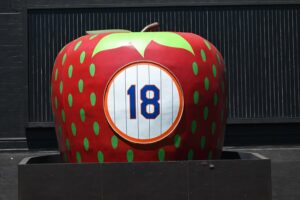
Darryl Strawberry’s No. 18 was retired by the New York Mets, the sixth time in the past nine seasons that the franchise has raised a number to the rafters. In the first decade of this blog, we bemoaned the Mets’ inaction when it came to honoring their own history and the greats who made it memorable. In our second decade, we grab a seat for festivities and jump out of it to applaud this streaming acknowledgement of the past and discern what it might say about the present.
The present will give a Mets fan a case of the blahs. Saturday’s game, the one that followed 18’s rise high toward the sky (an area once crowded by Darryl’s home runs), brought the Mets down to earth from their modest two-game winning streak over their erstwhile Flushing patsies the Arizona Diamondbacks. It was the kind of game when the Mets starter, Sean Manaea, could strike out ten over five-and-two-thirds, and two fans in particular — my pal and podcast co-host Jeff and me, ensconced in the first row of Promenade boxes in left field — didn’t even notice, because what are ten strikeouts against ten runs? Manaea didn’t surrender all of them, but you might say he contracted a bit of the Steve Carlton bug by way of Arizona’s version of Ron Swoboda. In 1969, it was Swoboda’s two home runs that blotted out Carlton’s 19 K’s in a legendary Mets win. Saturday, it was Christian Walker belting a third-inning grand slam that made Sean’s striking out of the side in that frame glow not so much.
The Diamondbacks wound up winning, 10-5, with the Mets posting four ninth-inning runs the way their opponents did the night before: for show. The best part about the Met offense was Mark Vientos and Pete Alonso each raised the Home Run Strawberry. Kudos to whoever decided to transform the Apple’s identity for an afternoon. A nice touch in a day defined by making a Mets fan feel something.
 Darryl did most of the reaching out and touching, and not like he did to National League pitchers when doing damage to their self-esteem and earned run averages. He spoke to us — and he really did address his audience — about realizing he never should have left New York as a free agent. It’s easy to say now, and he’s said it a lot, but his words had the impact of a confessional. We, certainly those of us who came to Shea to cheer him and maybe hint to him he could be doing a few things a little more effectively when he played, were the best part of his Metsdom, he said. We got him going, kept him going, made him, albeit after the fact, wish he hadn’t gone. Darryl did most of the reaching out and touching, and not like he did to National League pitchers when doing damage to their self-esteem and earned run averages. He spoke to us — and he really did address his audience — about realizing he never should have left New York as a free agent. It’s easy to say now, and he’s said it a lot, but his words had the impact of a confessional. We, certainly those of us who came to Shea to cheer him and maybe hint to him he could be doing a few things a little more effectively when he played, were the best part of his Metsdom, he said. We got him going, kept him going, made him, albeit after the fact, wish he hadn’t gone.
The Straw Man kept bringing us back into his talk. When he turned his attention to the current Mets, progenitor of all the blahs, he didn’t simply encourage them to play better. He told them that we, the people in the stands, were the best fans they were every going to play in front of, and they should appreciate that. We were outstanding as fans in the Strawberry Era because his team gave us something to get behind, but, yes, we did bring a certain spark to Shea that I can’t imagine other NL ballparks were quite as electrified by. We still do it, if more modestly. Darryl slipped something in there toward the end about making us great again (a loaded phrase in these times). Yes, we were, are and will forever be “faithful,” to use the pastor’s word, but the whole enterprise requires lifting. You can’t look at the standings and not realize that.
Still, Darryl wouldn’t have us singing the blahs. He praised Steve and Alex Cohen, namechecked David Stearns, and declared better days were coming. He should know from better times on the field, just as he knows from bottoming out off it. Darryl was the first undisputed sign that there would be a promised land. He wouldn’t take the credit for powering us there. A slew of his 1986 teammates surrounded him as he spoke, and he was grateful for their support, then and now. Keith Hernandez, Straw said, was the best and most intense player he ever played with, teaching him to hit lefties. Gary Carter (represented, as he was in April for Doc Gooden’s day, by his wife Sandy) and Mookie Wilson were the men modeling the life he realized he needed to live if he wanted to keep living and do it righteously. He had love for everybody, and we who stood for him tried our best to return it.
My chills came from realizing how glorious it is that so many world champion Mets from 38 years ago continue to come around. On Saturday it was Darryl, Keith, Doc, Mookie, Hojo, Ronnie, Raffy, Jesse, Mitch, Gibby, Lyons, El Sid plus Mrs. Carter (they were joined by later Met addition John Franco and Straw’s childhood chum Eric Davis). We do see some combination of these guys a lot, and it might be tempting to be blasé about it. We shouldn’t be. For decades, the 1969 Mets were regulars at Shea Stadium, so regular that maybe it didn’t seem special to realize they were down on the field being introduced one more time. Suddenly, you’re inside Citi Field and you don’t see too many 1969 Mets too often. Two years from now, we’ll reach the 40th anniversary of 1986, with 2026 marking what 2009 did for 1969. When our first world champions came back for that reunion, their appearance took on a little extra emotional oomph. “Oh, them again” transformed into “look — it’s them!” When their 50th-anniversary meeting arrived in 2019, fewer of them were available for our adulation.
So I had chills from understanding that. I had chills from a shot on the enormous video board of the 1986 banner, the marker for what remains our most recent world championship. Damn. I’d really like another one, as would anybody reading this with a home book bias, but taking in the Metscape that had emerged on this day, I was reminded a world championship is not easy. If it was, we’d have a third by now. We haven’t had Doc and Keith and Gary and Darryl and everybody else as active Mets for a very long time. They only made it look readily attainable. I got chills not just for the gratification that 1986 brought me as a Mets fan who’d already been at it quite a while by then, but also because I remembered watching Darryl Strawberry swing successfully for the fences in the company of my mother and father, temporarily diehard Mets fans in that age of miracle and wonder. We, like Mets fans all over the Metropolitan Area, talked about what Darryl had done or what Darryl had said or what Darryl might do next practically every day of our right fielder’s seasons. My father died in 2016. I miss him most every day. My mother died in 1990, a few months before Darryl departed for the West Coast. For a moment in my mind Saturday, we were all together again, with no tension evident, except wondering what the score in the Cardinals game was, and that was tension I could embrace.
Because I’m a fan of a team and the players therein, I mostly had chills for Darryl Strawberry, an individual whose existence was unknown to me before Sports Illustrated informed me he was ripe for the picking as he was finishing high school in Los Angeles, which coincided with the Mets holding the No. 1 pick in the nation. When the Mets selected accordingly, this young man from Crenshaw High (he’s the reason we know what Crenshaw High is) became my cause. Every Mets fan’s cause, I suppose, but I felt an affinity based on the shared year of our birth. Darryl was born in 1962. I was born in 1962. The Mets were born in 1962. We had a chance to collectively forge a path in the years ahead. My way of looking at it was Darryl Strawberry would be a great baseball player, the Mets would become a great baseball team, and I, their fan, would be happy as a result. That’s pinning a lot on factors out of your control, yet somehow it worked.
Now, in 2024, with 18 secured next to 16, just two doors over from 17, I listened to a man who is 62 and aware of how fortunate he is to have made it there. In his voice, I heard not an “old man,” but someone who has aged and, I was convinced, picked up the wisdom said to gather from aging. Me, I’m 61 and still seeking happiness from baseball players and baseball teams, with much of the outcome of the rest of my life as up for grabs as it was when I saw “Strawberry” in SI and hoped the Mets wouldn’t choose anybody else first.
They didn’t. The happiness where the Mets were concerned proceeded to pour over me. Me and wisdom as I approach 62? If I’m lucky, I still have time to garner some. In between, I’ll keep watching the Mets. Like Darryl said, I’m faithful.
by Greg Prince on 1 June 2024 11:04 am The alchemy of desperation works in mysterious ways. The Mets…
say their murky goodbye to Jorge Lopez;
have an accountability meeting;
decide they can do better for part-time catching and hitting with Luis Torrens than they any longer will with Omar Narváez;
opt to provide regular reps for Christian Scott at Syracuse rather than let the rookie’s momentum stall amid a flurry of off days before and after London;
squeeze out Opening Day third baseman Brett Baty in the name of bench flexibility;
make up some new base hit gesture;
collect oodles of base hits allowing them to demonstrate the slapping or whapping or whatever it is they do to celebrate themselves;
and win two games in a row at the end of a month when they hadn’t done any such thing in more than weeks.
“Go figure” will work as a nutshell summation here.
The Mets of backup infielder Jose Iglesias (a little rusty with the glove in his start at second base, assuringly frisky with the bat), Chief Accountability Officer Francisco Lindor (two hits to go with the four from the night before), looking-alive Starling Marte (a three-run triple that will have you jumping out of bed seven mornings of every seven), plug-in professional hitter J.D. Martinez (another no-doubter over another fence) and new full-time third baseman Mark Vientos (three hits and two ribbies while not splitting a position with his bud Brett) brought an onslaught upon the Arizona Diamondbacks that suggests Whacking Day is a federal holiday. The D’Backs are defending National League champions, though the mere sight of Citi Field rattles them to their core. That old chestnut about calling your team meetings when your ace is pitching could also apply to the eve of a series versus the one opponent you’ve been handling in your ballpark for years on end.
The Mets have taken 17 of 19 from Los Serpientes in the borough of Queens since May 18, 2018. Little besides Brandon Nimmo connects the Mets from then to now, so let’s not bother trying to figure what’s up with this. Let’s just be glad the Mets poured on ten runs and built a sturdy enough fortress to protect themselves from Snakebites. Four of those nipped at their seemingly impenetrable lead in the ninth, vaulting a semi-laugher into Damn Thing territory. Yet the Mets held on, 10-9. First they ripped, then they gripped, albeit barely. Whatever nervousness rippling through our anxiety receptors as Reed Garrett did not smoothly pick up for Sean Reid-Foley (who had succeeded an adequate Luis Severino and sharpies Dedniel Nuñez and Jake Diekman) didn’t match the frustration D’Back boosters felt in falling short in Flushing yet again.
Even the black uniforms didn’t quite get in the way of a Friday night victory. Go figure, indeed.
***
A proposal was put on the table more than four decades ago. “Here,” it was said, “is the deal — you be the best player we’ve ever come up with, because we’d really, really like that to happen. Just be mind-bogglingly great from the first day of your career and then get better all the time. It will make us extremely happy and possibly satisfied. Sound good?”
The counterproposal: “Well, I don’t know if I can do all of that, certainly not right away. What if I’m far above average most of the time with bursts of the spectacular sprinkled within? I might sort of stop and start in terms of my progress, but I’m going to be worth watching, and definitely more productive than just about anybody you’ve seen from the beginning. I’ll frustrate you now and then, and it will take me a while to mature, given how young I am and all, but you’ll look up one day and realize I’ve put up numbers hardly anybody else wearing this logo can touch and given you memories you’ll always cherish. Does that sound good?”
Negotiations broke off with, “We’ll get back to you.”
We’ve gotten back to Darryl Strawberry by putting up the number from his jersey where those associated with the cream of this franchise’s legends reside. It sounds good and I believe it will look splendid this afternoon when we see 18 slide in next to 16, 24, 17, 36, 31, 41, 14 and 37. The annals of New York Mets baseball at its best are uniquely Strawberry-flavored. Might as well adorn the rafters to reflect reality.
The stupendous presence and production of Straw from 1983 to 1990 was rarely quite enough to sate those who watched him. “More, please” was what we implored from the time he broke in at age 21 to the time he packed his stuff and took what was left of his prime home to Los Angeles. Darryl has said over and over going home to the Dodgers was a mistake, that Shea Stadium was really home. I don’t know how much of this is revisionist people-pleasing, given that the people who ask Darryl to retrace his path are generally coming at him from a Met perspective, and how much of it was arrived at organically. He says it now, though, and we’ll take him at his word. He did enough as a Met and has been through enough as a person that he can say what he wants.
Leaving the Mets was a mistake, of course. I say that from a Met perspective. The Mets were never the same after Darryl left in November of 1990. Of course, they were never the same as they’d been once Darryl arrived in May of 1983. The man was a difference-maker. You knew you were watching somebody making a difference when you watched him do anything on a field, even if it was just standing in deep right field (when maybe he should have come in a few steps). What he did at the plate is most of what we remember. I can think of 252 baseballs that were never the same.
One element of Darryl Strawberry’s reign as all-time Met lightning rod and power source that I think gets overlooked is how much of a winning player this guy was. Darryl showed up on a team that had been stuck in losing forever. Darryl settled in, and the team began to win chronically. Darryl left, and the team essentially disintegrated. Darryl didn’t do the winning alone, but the team didn’t win without Darryl.
Straw homered in 221 games as a Met, sometimes twice in a game, once thrice. The Mets’ record in those games was 156-65. How good is that? It factors out to a winning percentage of .706. In 162-game season terms, that’s equivalent to a mark of 114-48, or six games better than 1986. Difference-making at its finest. Again, you had Keith, you had Doc, you had Kid, you had so many Mets doing so many Amazin’ things while Strawberry was in full bloom. But let’s not deceive ourselves. You had Darryl Strawberry homering, and when that was happening, you had the Mets winning a lot.
You had those first-inning homers that notified the opposing pitcher it was going to be a long night.
You had those second-at-bat homers that had the manager in the other dugout turning his head toward the bullpen phone.
You had those midgame homers that broke ties and put leads out of reach.
You had those late-and-close homers that alerted one and all it was later than they thought and it was no longer that close. The Mets were winning, and the Mets were about to win.
Maybe Darryl lashed a double or stole a bag or leapt a little to rob a would-be version of himself or gunned down an ambitious baserunner who would have been wise to stop at third. Maybe just the sight of Strawberry was enough to rattle a reliever into four balls. The next Met in the lineup automatically got more dangerous. The Straw Man contributed in small ways, too.
But, oh, the big ways. Every home run Darryl Strawberry blasted, launched and/or sent into orbit was big because it was a Darryl Strawberry home run. If you saw him hit one, it was like you got to show everybody you knew the next day that you’d caught a foul ball. This was better, though. Nobody got the ball when Darryl hit it a mile. We all got the thrill.
That cliché about a superstar carrying a team on his back may never have been invoked in these parts as much as it was when Darryl lifted the Mets. He would tear through National League pitching staffs for a couple of weeks and we’d jump on for the ride. He’d do damage. We’d win games. We’d rise in the standings. We’d be sure we were unbeatable. For a couple of weeks, maybe a month, we would be. One year we absolutely were. Another couple of years Darryl could have used a little help.
The career as a Met didn’t last forever. The impact from his Met career lives on. The number being retired reminds us, in case never fully grasped it, that Darryl Strawberrys don’t grow on trees.
|
|






