The blog for Mets fans
who like to read
ABOUT US

Faith and Fear in Flushing made its debut on Feb. 16, 2005, the brainchild of two longtime friends and lifelong Met fans.
Greg Prince discovered the Mets when he was 6, during the magical summer of 1969. He is a Long Island-based writer, editor and communications consultant. Contact him here.
Jason Fry is a Brooklyn writer whose first memories include his mom leaping up and down cheering for Rusty Staub. Check out his other writing here.
Got something to say? Leave a comment, or email us at faithandfear@gmail.com. (Sorry, but we have no interest in ads, sponsored content or guest posts.)
Need our RSS feed? It's here.
Visit our Facebook page, or drop by the personal pages for Greg and Jason.
Or follow us on Twitter: Here's Greg, and here's Jason.
|
by Greg Prince on 15 March 2010 4:33 am Rod Barajas is getting the treatment a Wise Veteran Catcher usually gets in Spring Training when he’s new on the team. He’s leading by example and changing the tone and offering guidance, which is exactly what we want to read this time of year after having just experience that type of year last year. He’s the “adjunct professor of catching,” according to David Waldstein of the Times, leading daily tutorials for the benefit of his brothers in shinguards. Mets take a bus across the state only to get rained out? It wasn’t for naught, Barajas told Waldstein:
“We got to talk and have fun and get to know each other. We watched The Hangover and laughed together.”
We fans love stuff like that. If the Mets get off to a fast start in 2010, we’ll be falling all over ourselves praising The New Togetherness and how Rod Barajas, all head and heart (if not, by the looks of him, wheels), played a major role in eradicating the isolation of 2009, by teaching, by talking and by DVD selection.
Though if the Mets suck, nobody will remember any of that.
Thing about Barajas is whatever he does, he’s probably going to have do it right away. He signed a one-year contract as an obvious stopgap measure. Nobody else (and there were plenty of bodies around when camp started) was deemed suitable for starting behind the plate more than now and then or, in Josh Thole’s case, now. Rod Barajas could ingratiate himself to the organization and stick around, but he seems destined, if he and we are lucky, for six-month rental. Thus, this is shaping up as the Year of Rod Barajas.
Literally.
Barajas is the most obvious candidate to join an unintentionally exclusive club, that of the New York Mets who have been One-Year Wonders. They are Mets players who meet the following criteria:
• On the active roster for exactly one calendar season and, if applicable, postseason
• Never off the active roster while the Mets are playing baseball
• No Disabled List trips
• No being sent down to the minors
• No military reserve duty (for when that was an issue)
• No being a Met in any prior year
• No being a Met in any succeeding year
For Barajas to join the club, he’d have to hold steady as a Met from April 5 through October 3 through, theoretically, whenever the Mets finish their playoff and World Series run (from our mouth to Rod’s ear). He gets put on the shelf, it doesn’t count. He gets released or traded, it doesn’t count. He sticks around in 2011, it doesn’t count.
If Barajas fulfills the terms of his contract to a tee and never signs another one, then he’s a member of a most eclectic order in Met history. Only 41 Mets have qualified as One-Year Wonders in 48 Met years. Some of them distinguished themselves quite memorably. A few of them veer more to notoriety than notable accomplishment. Unless you were around in their particular years, a few more you’ll probably be familiarizing yourself with here for the first time. Some you’ll surely remember. Some you’ve completely forgotten.
The first One-Year Wonder dates to Year One, 1962, and he was a most legendary Original Met: Richie Ashburn. He was the first Met to come to bat; the first Met to hit .300; the first Met to make an All-Star team; the first Met voted team MVP (most valuable player on the worst club imaginable); the first teammate to convince Marv Throneberry to be Marvelous rather than morose; and the first Met to understand the notion of quitting while ahead. Whitey retired after 1962 and became the sixth Met to be inducted into the Hall of Fame.
But he wasn’t the only One-Year Wonder to gain that honor. Ashburn was preceded into Cooperstown by a second-year One-Year Wonder, Duke Snider, the Mets second-ever All-Star. Duke’s single-season stay as a Met, however, wasn’t quite as stellar as Richie’s, or at least not as relatively rosy. True, Duke came back to New York (albeit one borough over from where he made his mark), launched the 400th home run of his career as a Met as well as a walkoff blast for his 399th — and, as all viewers of Mets Yearbook: 1963 know by now, he was given a night at the Polo Grounds. But Snider’s Met tenure wasn’t what he wants to be remembered for. He finished the season 38, gray, out of shape and, the Duke would likely agree, out of sorts. Visiting the SNY booth in advance of one of Shea’s Jackie Robinson tributes a few years ago, Snider was happy to recall his Brooklyn teammate but took a pass on remembering his one year as a Met. It wasn’t even the end of the line for Snider, as the classic Brooklyn Dodger hooked on with the (gasp!) San Francisco Giants for one more go-round in ’64.
There were loads of Brooklyn Dodgers on those early Mets, yet, until Willie Mays was brought home in 1972, former New York Giants shareholder and original Met owner Joan Payson employed only one pre-1962 Polo Grounds denizen as an active player. He was Eddie Bressoud (rhymes with “et tu?”), a One-Year Wonder from 1966. Unlike Snider and Gil Hodges or, to a lesser extent, Clem Labine and Don Zimmer, the lone New York Giant to play as a New York Met in the 1960s arrived with no nostalgic overtones. But that didn’t stop him from making a little history for his new New York club. Eddie’s 10 home runs in his one year as a Met were the most by an Amazin’ shortstop until Jose Reyes slugged 19 in 2006.
1966 was quite a year for One-Year Wonders, as Bressoud had company behind him and in front of him on the diamond. Billy Murphy played 41 games in center, 84 games in all for manager Wes Westrum. Lefty Bill Hepler pitched in with 37 appearances (34 in relief). Both Bills came due in ’66 because they were each Rule 5 draftees in December ’65, Murphy from the Yankees, Hepler from the Senators. Rule 5 means you stay even if you don’t play — and if you don’t stay on the drafting team’s major league roster, you are obligated to be offered back to your old team for a pittance. Whatever talent the Bills had, each was young and each wasn’t ready, not even for the 95-loss 1966 Mets (who were, by far, the best team in Mets history to that point). Neither would be back in ’67 on the Mets’ or any other Major League roster.
Rule 5 explains the presence of several One-Year Wonders, including 1967 catcher John Sullivan, 1967 outfielder (and emergency catcher) Tommie Reynolds and 1991 southpaw fire hazard Doug Simons. Their lack of production presumably explains why there was no second Met year for any of them, though they each resurfaced in other venues.
Hard to explain, however, why neither Bill Wakefield nor Randy Tate ever got a second big league look from anybody else. Righty Wakefield was a One-Year Wonder and workhorse for Casey Stengel in 1964. His 62 appearances (58 out of the pen) established a Met pitching record that stood for 13 seasons. They’re also the most by any pitcher who spent no more than a single year in the majors. Tate, also a righthander — and nearly the first Met to throw a no-hitter — was the fourth starter behind three pretty fair arms in 1975: Tom Seaver, Jon Matlack and Jerry Koosman. Wakefield pitched two more years in the Met system before leaving the game. Tate gave pitching three more years, hanging ’em up in 1978. For his trouble, Wakefield, along with 1964 teammate Steve Dillon, was tabbed to throw out a first ball at Citi Field last July (once the Daily News nudged the Mets enough). Tate, meanwhile, remains an object of fascination for obsessive Mets bloggers of a certain age.
It’s hard to think of Tommy Davis, the outfielder who was the embodiment of the phrase “well-traveled ballplayer,” as a One-Year Wonder. Davis’s distinguished career encompassed parts of 18 seasons and stops with 10 different clubs. One of his postings, however, was all of 1967 with the Mets. Davis made the most of his season in the sun, leading the Mets in almost every offensive category and earning, as a tenth-place Met, an eighth-place National League MVP vote.
The Brooklyn native was the kind of guy you’d have wanted the Mets to have kept a little longer, but he went away in a good cause, traded to the White Sox with Jack Fisher for a couple of Miracle workers to be, Tommie Agee and Al Weis. As Agee and Weis acclimated themselves to New York, they played alongside lefty reliever and One-Year Wonder Billy Short, one of the handful of mainstay 1968 Mets (34 appearances) manager Gil Hodges and GM Johnny Murphy decided they could do without as they set their strategy for 1969.
While it seems that the lesser-accomplished Mets teams are the squads that generally harbor One-Year Wonders — infielder Felix Mantilla of the 40-120 1962 Mets; catcher Norm Sherry of the 51-111 1963 Mets; and outfielder George Altman of the 53-109 1964 Mets, to name three — OYWs have dotted a few Met postseasons. None did so with more impact than the Most Valuable Player of the 2000 National League Championship Series, Mike Hampton. Mike was money in clinching the pennant on a three-hit shutout of the Cardinals, which is appropriate, since it was money that made him a Met in the first place. He had one year left on his Houston contract, and the Astros’ thrifty owner, Drayton McLane, had no intention of re-signing him.
The Mets attempted to secure Hampton’s services beyond 2000, but the lefty’s legendary fealty to excellence in education led him to Denver…and Steve Phillips to take a break from his sex addiction to sign Kevin Appier to a bloated four-year, $42 million contract. That Appier pitched for the Mets only in 2001 hints at how that worked out.
Hampton was preceded as a postseason One-Year Wonder by Orel Hershiser in 1999. Anybody with any memory of 1988 knows Orel’s gutty innings against Atlanta in the NLCS led the league in irony. In 2006, two relievers who solidified a reliable bullpen were One-Year Wonders clear through to third week in October: righty submariner Chad Bradford and lefty long man Darren Oliver. Oliver’s six innings in relief of the ultimately useless Steve Trachsel in Game Three of the ’06 NLCS was a particular lifesaver. Both men were unsung components of a division champion. One wonders what might have happened after 2006 had GM Omar Minaya whistled Oliver’s and Bradford’s tune a little longer.
Instead, Minaya hummed a few bars of righty journeyman Aaron Sele, a One-Year Wonder whose fault the collapse of 2007 wasn’t — but who didn’t contribute any answers across 34 mostly uninspiring relief appearances. His blueprint for inconsequential Metdom was perfected four years earlier by Jay Bell. Bell, like Sele, had been a two-time All-Star but was far removed from that stature when he incongruously finished up as a Met. Bell’s One-Year Wonder year was 2003, a 66-95 debacle that while not defined by Jay’s .181 average in 72 games wasn’t exactly enhanced by it either.
Three other One-Year Wonders made their One Year their last year as well: third baseman Bob Aspromonte, 1971 — the last Brooklyn Dodger in the majors; pinch-hitter Mike Cubbage, 1981 — seven-game manager at the end of 1991; and infielder John Valentin, 2002 — of whom I have to confess I didn’t fully realize wasn’t the same guy as Jose Valentin until we got one and then the other.
At the conclusion of 1976, it appeared Mickey Lolich would fall into the retirement subcategory of One-Year Wonders, but Lolich fooled us. Instead of leaving baseball, he just left the Mets. After sitting his doughnut-making ass out in 1977, Lolich resurfaced as a Padre for two bonus seasons. And to think, all he cost us was Rusty Staub.
Some One-Year Wonders were conceived as solutions for long-running problems. Instead they became short-term headaches. Aspromonte, for example, was supposed to solve third base. He didn’t. Nor did the third baseman before him, Joe Foy, who throughout 1970 gave the Mets every reason to regret trading Amos Otis to land him. At the other end of the decade, third base was still a problem, so the Mets acquired the eager-to-please Richie Hebner in 1979. Foy and Hebner were more One-Year Poxes than Wonders, but we don’t have a separate category for those.
We do have a separate category for Lost Boys Found — Met minor leaguers who had to leave the organization to become major leaguers but then got a second chance to be real, live Mets. Two LBFs became OYWs: outfielder Jerry Morales in 1980 and infielder Fernando Viña in 1994. They both played in seasons when One-Year Wonders were on the prowl at Shea.
No Met pitcher won more games in 1980 than righty Mark Bomback, though Bomback’s total was 10, which takes the edge off win leadership, and his 191 hits allowed in 162.2 innings didn’t exactly represent a hallmark of triumph. In 1994, utility infielder Luis Rivera spent one full season as a Met, though he might deserve an asterisk, since 1994 ended abruptly when the players struck on August 12. Rivera was used so infrequently (7 appearances in 52 games from June 21 to August 10), that it’s wholly plausible he might not have lasted as a Met into September. Then again, grudge-holding manager Dallas Green could bury a player pretty deeply without ever removing him from the roster, so we’ll consider Rivera legit.
Several One-Year Wonders did a pretty nice job and, in hindsight, were just as well on their way before a second year could besmirch the our vague positive impressions of them. Desi Relaford was an all-around valuable utilityman in 2001 and managed to throw a beautiful inning of relief against the Padres in an otherwise dispiriting twelve-run loss; Mark Guthrie ran counter to two nettlesome Met trends by getting lefthanded batters out as a Met lefty specialist and by being any good at all as a 2002 Met; Tony Clark popped 16 homers in 2003 as a part-time first baseman but truly connected when he gallantly ripped the 00 off his uniform in deference to Mr. Met; and Brent Mayne forever became a Prince household name when the Daily News ran a Sunday piece detailing how the backup catcher of 1996 regularly rode the 7 train to Shea and other trains elsewhere around the city. To this day, I say “Brent Mayne” to my wife, she says, “The guy who took the subway.”
And, nowadays, the guy who writes a pretty good blog.
Dwight Eisenhower famously said of his vice president in 1960, when asked what major policy idea GOP presidential nominee Richard Nixon had contributed to his administration, “If you give me a week, I might think of one.” Well, I’ve had 32 years, and I’m stumped when it comes to telling you anything Tom Grieve did as a spare Met outfielder in 1978 other than endure as a One-Year Wonder. But I can tell you that he spent quality time on the bench next to another of Joe Torre’s generally untapped reserves and they became fast friends. Seven years later, Grieve was general manager in Texas and gave his old buddy his first managing job. So on some level, we have Tom Grieve to thank for the best parts of the late ’90s and early ’00s…a.k.a. the Bobby Valentine era.
On the other hand, we have nothing for which to thank 1975 One-Year Wonder Gene Clines as far as I can tell. Clines was going to bring the Met outfield and offense much-needed speed. After one season (4 stolen bases, 4 times caught), he sped out of town. And we owe even less gratitude to 1989 One-Year Wonder righty reliever Don Aase, who gave up the killing blow of his year, a top-of-the-ninth, season-altering home run to the Dodgers’ Willie Randolph on August 20. If it’s not as remembered or reviled as Terry Pendleton in 1987 or Mike Scioscia in 1988, it’s because even Mets fans can only remember and revile so much.
We’ve penciled in Rod Barajas as our best bet to be our next One-Year Wonder — or the first One-Year Wonder since the already exceedingly forgettable Jeremy Reed in 2009. He’s the guy who, while attempting to man an unfamiliar position, made one of the worst plays of last year, yet it wasn’t even the worst play of the game in question. Barajas will not want to have a season like Reed’s, specifically as it pertains to his manager’s deployment of him. Reed played in 126 games in ’09 but started in only 24 of them, or about 19%. From what I can tell, no Met who has ever played in that many games in a season has been a starter so rarely. Considering how few consistently healthy outfielders Jerry Manuel had at his disposal, it’s very strange that Reed was almost strictly limited to second-line duty. He wasn’t a pinch-hitter deluxe and there was no immobile slugger in front of him who regularly merited a spot in the lineup, complete with his own defensive caddy. The more I think about it, the less it says about Reed’s 2009 (which was fairly indifferent) and the more it hints at how Manuel tends to write off his personnel.
The template Barajas is most likely to follow was that crafted by Rick Cerone during his One-Year Wonder-ful stay as catcher in 1991. Cerone was, à la Barajas, the grizzled backstop who would instill the Mets with that certain something. Truth be told, Cerone, who turned 37 that May, didn’t instill a whole helluva lot during his 90 games receiving and pinch-hitting, but he did have one shining moment.
It was August 21, a twinight doubleheader against the Cardinals at Shea. In the preceding months, the Mets had altogether stopped being the Mets as we had known them, falling from contention with a thud. They spiraled from 53-38 to 57-60 and looked worse than their 4-22 record indicated. They made it 4-23 by dropping the opener of that twinbill. At last, in the nightcap, the Mets poured on six runs in the seventh and took an 8-0 lead on St. Louis. Pitcher Willie Fraser, who had just surrendered in succession an intentional walk; an RBI single; a three-run homer; and a solo homer, took out his frustrations on the next Met batter, Howard Johnson. HoJo was hit and made a move toward the mound. But that’s all it was: a move — a feint. Just like the 1991 Mets, it appeared HoJo might do something but, in reality, was content to settle for nothing.
Not Rick Cerone. As captured by Bob Klapisch and John Harper in The Worst Team Money Could Buy:
Rick Cerone…sprinted out of the dugout. […] Now here he came, racing toward the mound, with both teams in pursuit. Cerone wasn’t particularly big or strong, but he was so angry that when Pedro Guerrero stepped in front of him, Cerone bowled him over. He reached Fraser and connected with at least one good punch before disappearing in a sea of players. “Had to do it,” Cerone would say later. Sometimes you just have to do it. We’ve just lost eleven games, we’re finally winning one, and some guy is going to throw at our best player? You can’t let that happen.”
One good and purposeful punch…a pretty decent metaphor for a One-Year Wonder.
***
In case some names have occurred to you with the thought that surely they should be included in this categorization…
• Derek Bell, who came to the Mets in the same Astro-nomical salary dump as Mike Hampton, was on the roster all of 2000 but suffered an injury during the NLDS and was removed for the NLCS and World Series. By having a longer year than most Mets, he missed out on One-Year Wonder status.
• What do Mark Bradley (1983), Dick Schofield (1992) and Doug Linton (1994) have in common? They were added to the roster very early in their Met seasons and persevered the rest of the way, but were not here on Opening Day. No One Year Wonder-ing for them.
• There are Mets who make it out of Spring Training but at some point are redirected to the minors before bouncing back up, and alas, away once their season ends. A few examples of this phenomenon: Mike Bruhert (1978), Paul Wilson (1996), Satoru Komiyama (2002) and David Newhan (2007).
• Kevin Mitchell’s seven games as a September 1984 callup disqualified him from becoming the only World Champion One-Year Wonder after he was traded for our own good in the wake of his helping us win the 1986 World Series. (He is, however, a Comma Met in good standing — a Met whose years played cannot be properly punctuated with only an en dash…but that’s another category for another time.)
• As we learned in 2009, the Disabled List can be a killer, not just of Met seasons but of One-Year Wonder status. J.J. Putz, Gary Sheffield and Tim Redding will each forever be associated with the 2009 Mets (until you forget them completely), but none is a One-Year Wonder because all were removed from the active roster at some point. Others whom you may associate with a given year but spent time on the DL: Miguel Cairo (2005); Doug Mientkiewicz (2005); Kurt Abbott (2000); Bill Spiers (1995); Pete Smith (1994); Mike Draper (1993); Bill Pecota (1992) and the not quite One-Year Wonder granddaddy of them all, Elio Chacon (1962).
• To learn about Mets who make One-Year Wonders look like Ed Kranepool in terms of Met longevity, I recommend a visit to Moonlight Graham Mets, which is devoted to profiling Mets who played in only one game as Mets.
Yes, there is somebody else out there who thinks a lot about this type of stuff.
by Greg Prince on 14 March 2010 4:52 pm Wonderful profile from Brian Costa of the Star-Ledger on the more than humble background of dream closer (or perhaps starter) Jenrry Mejia:
Six years ago, Jenrry Mejia did not own a glove. He did not have a bat. He had no use for a ball.
The tools of his trade were a brush, a piece of cloth and a container of shoe polish. That was all Mejia needed when he left his house in Santo Domingo each morning and walked 30 minutes to the downtown cafe where he made his living.
On an island where baseball is like a religion, Mejia preferred shining shoes for 300 pesos a day, the equivalent of about $8.
Jenrry Mejia may appear to be The Natural reincarnated, but he didn’t start playing ball until he was 15 years old, a mere five years ago. There was no money in baseball when he was kid. He had to shine shoes to make a living.
Mejia grew up in a neighborhood called Herrera, near what was once Santo Domingo’s primary airport. He lived with his parents and his younger brother.
“Mucho pobre” is how Mejia described the area. Very poor.
Mejia started shining shoes when he was 11. He didn’t necessarily enjoy the work, but he took pride in earning money when other kids he knew were picking pockets.
“I didn’t want to steal,” he said.
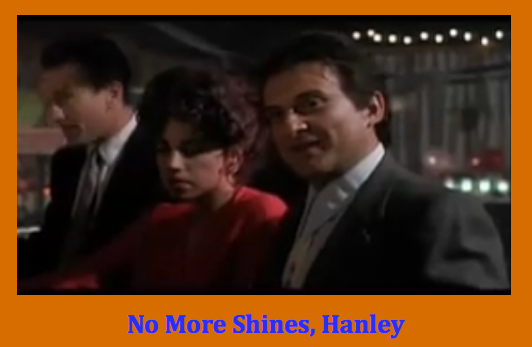
He may not and maybe should not make the Mets as soon as I want him to — which is right this very minute — but he’ll be earning plenty before long if all goes right with our world (for a change). And when it does, and our good fella is facing, say, the Marlins, I look forward to him delivering a salient message to the first big Fish he sees.
by Greg Prince on 13 March 2010 4:35 pm This talk of Jenrry Mejia starting the season as the setup man for K-Rod is ridiculous. If the season starts today, Mejia’s my closer.
Oh, if talent only made it so.
It won’t happen that way, but Jenrry is looking inevitable. It will take a bad case of evitablity — or yet another wave of Prevention & Recovery — to keep him off this team, assuming the way Mejia’s pitches move isn’t a mirage. Only an OutKast among Mets wouldn’t say, “I like the way they move.”
I sure hope I’m not seeing Julio Machado or Josias Manzanillo or Ju-ever out there when I look at Jenrry Mejia. I penciled those fellows in as oughta-be closers in their day based on larger samples. Alas, their day never really came. Jenrry Mejia Day is coming, though, and April 5 is as good a date as any to hold it.
Frankie Rodriguez needs to work the pink out of his eye. Let him set up Mejia like he set up Troy Percival long ago, back when K-Rod was unhittable (back when K-Rod was Jen-Mej). Let Parnell work the seventh. Let Sean Green park cars.
by Greg Prince on 12 March 2010 8:00 pm Welcome to Flashback Friday: Take Me Out to 34 Ballparks, a celebration, critique and countdown of every major league ballpark one baseball fan has been fortunate enough to visit in a lifetime of going to ballgames.
BALLPARK: Jack Murphy Stadium
LATER KNOWN AS: Qualcomm Stadium
HOME TEAM: San Diego Padres
VISITS: 1
VISITED: June 20, 1996
CHRONOLOGY: 16th of 34
RANKING: 33rd of 34
I think it would be pleasant to go to a public park, find something to eat, watch some guys play ball and maybe wander around a bit. It was pleasant, actually. Stephanie and I did that at Jack Murphy Stadium.
Pleasant beats unpleasant every time. But pleasant’s not the same thing as big league, and there was something about seeing a Padres game in their original home that felt less than major. It wasn’t bad — pleasant can’t be bad — but it didn’t fill me with anything approaching awe.
Did I mention the pleasant factor was off the charts?
In my travels, I’ve had my expectations unmet and I’ve had my expectations exceeded. At the Murph (which it was still called in 1996, thankfully), I had few expectations. I’d had only one strong image of the place from all those years of staying up late to watch the Mets on the unglamorous stop of their West Coast road trips. It was the night in 1986 when Kevin McReynolds, then a Padre, was batting and he fouled a ball straight back into a square cutout in the backstop. I think it was there for a camera, but it appeared empty, much like the Murph all those late nights. Channel 9 played the disappearing foul over and over again to much McCarver and Zabriskie laughter. McReynolds remained stoic, hinting at the vibrant personality he’d bring to the Mets a year later.
Jack Murphy Stadium was that black, square-shaped hole to me. A mystery, and not one on which I’d expended much concentration as soon as the Mets would leave town. When I formed a squishy goal of someday seeing every major league ballpark, I wondered what on earth I’d be doing in San Diego to get Jack Murphy taken care of. It would have to be part of something bigger.
And it was. The previous December, as an all-encompassing birthday/holiday present to Stephanie and me, my sister and brother-in-law thoughtfully favored us with some of their frequent-flier miles and use of their Los Angeles-area apartment (a.k.a. their de facto West Coast office). They even threw in a few gift certificates to some local restaurants. Truly they are sweethearts that way. Natch, as non-fans, they’d been camping out in Southern California a few times a year for several years by then, and it’s fair to say they never particularly noticed there were three baseball teams operating in the general vicinity.
For us, that was the attraction. It never even occurred to them that was the only reason we graciously accepted their generous gesture. I mean, really, is there something else to do in Southern California?
I studied schedules, found a week when the Angels, the Padres and Dodgers would all be home and put in for vacation time. We flew out in the middle of June for the only reason I can think of spending more than a couple of days anywhere: to visit three ballparks.
San Diego was the middle of the itinerary, a Thursday afternoon against the Cubs. We started out from L.A. in the morning, in unusually fine driving fettle. It looked a little dreary on the way down. Rain in San Diego? Unpossible, as Ralph Wiggum would affirm. That was the notorious Marine Layer we were facing. Ralph Kiner — who is no Ralph Wiggum — informed us that was a staple of San Diego existence, and that it burns off by noon.
Ralph Kiner, former GM of the old Pacific Coast League Padres, was absolutely right. It was sunny and warm in Mission Valley. The stadium was kind of tucked away, but we found it with little ordeal. Security said I couldn’t keep my bottle of water, an accessory I’d begun to carry as a matter of course. I grumbled but dutifully tossed it. Concessions said they couldn’t rustle up a program. I grumbled some more, as I always bought a program in a new ballpark. There were a couple of glitches, but we were in the place with the square hole.
Per usual, I was wearing my Mets cap, which drew the attention of an usher who said something mildly disparaging but harmless, like “Mets? Why?” I explained we were New Yorkers on a baseball tour, that we had been in Anaheim the day before. “It would be nice if the Cowboy could win one of these years,” the usher volunteered. Nice of him to worry about Gene Autry, I thought. Nothing, he said, was going well for the Padres. Indeed, San Diego had gotten off to a fast start in 1996, but losing had set in: the Pads had lost 15 of its last 17 as a 6½-game lead in the West had become fourth place, two games out. Same old Padres.
But it was all new to us. I feigned concern to the usher and we went about our usual stance of rooting for the home team as long as it had no adverse impact on the Mets.
There was some color to the Padres now, and it wasn’t the drab brown that had been their trademark in the McReynolds days. They had a guy walking around dressed as a Friar, and we cheered his appearance. A couple more guys wore skinhead wigs to approximate Wally Joyner’s pate. Wally World had taken his act down the coast in ’96 and was batting .321 before his recent injury (which coincided with the 2-15 skid). We cheered for them, too. We got behind Tony Gwynn (.326 at the start of play) and Rickey Henderson (16 steals in his first year as a National Leaguer) and Chris Gomez (someone I kind of adopted a few years earlier in Toronto, but I’ll save that for the SkyDome entry). We were temp Padre fans.
It was all good fun. After a while, though, it just fell…flat. You know, like watching Kevin McReynolds for too long. Palm Trees had recently been potted over the outfield fence, which was the one architectural distinction to the venue. After a while, you stared at the palm trees and they seemed out of place at a baseball game. That’s when it began to feel like a public park. That’s when we decided to get up and seek out a snack bar.
I’d prepared for this trip as I usually did, with a ballpark guide of some sort. The one I had in 1996 said you’ve gotta try the fish tacos at Jack Murphy Stadium, they’re a local specialty. I try to do the When In Rome things, so off we went in search of fish tacos.
To reel in fish tacos, you went to a special stand, Rubio’s. You could buy ’em and bring ’em back to your seats, but there was a patio full of tables and chairs at which you could enjoy ’em. I’d read about that in the guide book as well. It was rather unorthodox to be at a baseball game and sit somewhere that wasn’t facing the field — the tables and chairs offered a view of the parking lot, with monitors for game action — but we tried it. I didn’t care for not watching the game. And I didn’t really like fish tacos.
Back at our seats, I noticed two more things I’d never before seen at a ballgame. One was a pitch count on the scoreboard. Very big letters and numbers telling us just how many balls and strikes Tim Worrell, Jaime Navarro and the relievers who succeeded them had thrown. At first I was mesmerized. Then I was distracted. I could live without knowing pitch counts.
The other thing was the out-of-town scoreboard which, during the latter stages of the game, began posting notes about the Mets’ game in Cincinnati. The hell with the Padres and Cubs. What were the Mets doing? It wasn’t the first time I eyed an out-of-town scoreboard to keep up with the Mets, but it was the first time I had done so at three time zones’ remove. I was so incredibly confused. The Mets are playing a night game, but it’s bright and sunny and the middle of the afternoon here in San Diego. It’s 4 o’clock? How can that be, when my internal alarm is set to Met Standard? And why won’t they tell me anything beyond the fact that Bobby Jones is facing Dave Burba?
My attention wandered to the banks of the Ohio River, but we still rooted for the Padres, but with less and less conviction. Joynerless and punchless, the locals didn’t score until the eighth, pulling to 3-2 on an eighth-inning two-run blast by pinch-hitter Marc Newfield. The Friar and the Joyners and we applauded heartily. Gwynn led off the bottom of the ninth with a single, stirring things further, but the Cubs brought in that crazy Turk Wendell and he retired the final three Padres. Chicago held on 3-2. San Diego had lost 16 of 18.
We filed out, counterintuitively bought a program by the exit, got in our rental car, checked into the nearby Holiday Inn, grabbed some Chinese Food at the strip mall next door and sprung for The Birdcage on hotel pay-per-view. Next day, we visited the world-famous San Diego Zoo and, in the immortal words of Lobo, motored stately into big L.A.
It was all very pleasant. It was Jack Murphy Stadium.
by Greg Prince on 11 March 2010 3:39 pm Jose Reyes is not running. He’s not swinging. He’s not fielding or throwing. He’s not functioning as a baseball player. We understand today he’s resting. With any luck, he’s healing.
But he’s a Met, so I wouldn’t go that far.
Reyes’s thyroid condition has sidelined him for a truly Metsian prognosis of two to eight weeks. Nobody is sidelined from two to eight weeks. Nobody is projected as out from doing anything — not just playing — within a range of 14 days to 56 days. What this means, I’m going to guess, is nobody really knows what exactly is wrong with Jose Reyes or, more pertinently, what it will take to get him back to being a fulltime Met.
Right now, he’s a ghost, hovering over this organization. He and Carlos Beltran, both still on the roster, neither by any means active, each allegedly en route at some point. When 2009 became 2010, we were told this team would be better than the team before it because we’d have, once again, two of our three indispensable men in the lineup every day. “Don’t count on it,” the little Met voice in my head said. “Don’t necessarily count on guys who played 81 games and 36 games the season before.” I wasn’t ready to count on anybody who missed significant time due to injury, including Santana, Niese, Nieve, whoever. In Beltran’s case, it was the knee then, it’s the knee now. In Reyes’s case, nobody could have seen the thyroid coming. We were worried about hamstrings. The hammies are supposedly fine. The thyroid?
The thyroid?
My mother had a thyroid condition. I don’t think it was overactive; quite the opposite, actually. Reyes is a damn sight more athletic than most people’s moms (and dads). Jose Reyes is as athletic a Met as we’ve ever seen. We look forward to seeing him again, on the run, turning the DP, lashing one into the gap that was theoretically created for him. We look forward to him being as healthy a human being as he can be and, because we’re Mets fans, we’d like that to translate into a permanent return that begins to shape up 14 days from now rather than 56…or never.
In the meantime, I looked at the early innings of today’s exhibition game. Cora was at short, just like a lot of last year. Pagan was in the outifield, just like a lot of last year. Castillo…to be fair, he’s supposed to be at second this year, but he reminded me of 2009, too. It was raining and it was 2009 on SNY. Then the rain got to be too much and they put a tarp on the field and the 1963 Yearbook on the air. It cheered me up. That team won 51 games and was a signpost of progress relative to 1962. Then the rain ended, and 2010 is back on the screen, and it’s just minor league scrubs per Spring Training usual, yet I can’t escape the sense that 2009 is in the clubhouse, getting ready for Opening Day.
It’s a lot closer than Jose Reyes is right now.
by Greg Prince on 10 March 2010 6:20 pm What are you doing Sunday, March 21 and Saturday, March 27? You ought to be getting to better know New York’s baseball heritage. And you can, thanks to our friend historian Peter Laskowich starting up his truly marvelous tours once more.
As we’ve mentioned on several occasions, Peter will bring you directly into the DNA of New York with intertwined journeys into its baseball and into its history. You show up, you take a walk, you take a train — and you end up going places you didn’t know exist.
It’s well worth the time (a few hours that fly by) and the investment (25 bucks — a fair price in general and a bargain by Citi Field standards) to learn where we came from as New York baseball fans and Mets fans.
Peter is an engaging educator and excellent companion (and a Mets fan from the New Breed days). “Tour guide” does not do him justice. He will take you on a tour all right, but it goes beyond “…and on your right, you see a bridge.”
You will see a bridge. And you will see where it leads. And you will follow the trails beyond that. You will understand as you never have before why things are where they are and how they are. You’ll get a good bit of why answered as well.
You’re a Mets fan. You read Faith and Fear. I know you’re ball-curious. Feed that curiosity. Get together with Peter Laskowich over the course of a couple of weekends — the 21st in Brooklyn, the 27th in Manhattan. You’ll be glad you did.
Visit New York Dynamic for more information.
by Jason Fry on 9 March 2010 8:45 pm The 2010 Citi Field promotional date that has me most excited? It’s gotta be the retiring of 76 and 78.
Sure, we’ll be disappointed to learn that Ike Davis and Jenrry Mejia have bowed to the world-wide clamor and agreed to curtail their electrifying rookie seasons and report for immediate induction to Cooperstown, but we’ve known since about mid-May that they already belonged to the ages, and we were merely borrowing them for the briefest of times.
Ike Davis is 11 for 21 with two very long home runs and an increasingly Paul Bunyanesque legend. (I saw him with the Cyclones a couple of years back and he looked huge and immobile. I’m no scout.) Jenrry Mejia has thrown 33 Grapefruit League pitches and watched 27 of them get recorded as strikes. Small sample size? Pssht. Take it somewhere else, Bill James. You can stack our young heroes’ ages one atop the other and not get one El Duque? Age and experience hasn’t gotten us anywhere except the DL. We’re ready for a summer of ESPN riffs on Mets fans declaring I LIKE IKE and copy editors and play-by-play guys driven to drink by the first name of a pitcher who’s not old enough to join them. Besides, if we weren’t talking about Ike and Jenrry we’d be exchanging hosannas about a suddenly resurgent Fernando Martinez or the supernatural Chris Carter, he of the two home runs in one inning. Or how about that Hisanori Takahashi, who may not be young but is Japanese, which has been the only faster ticket to Met disaster for a decade or so.
You’d think those who live by small sample size would also die by small sample size, but the happy hypocrisy of spring training doesn’t abide such logic. A good couple of days is enough to vault a prospect to “promising,” “eye-opening” or “major-league ready,” but a veteran hitting a bump or two or four is inevitably focusing on his basics, knows to take it slow, or will be ready when the bell rings. Witness Johan Santana today — his pitches were up, he got cuffed around, and everything’s fine.
I’m just trying to enjoy it. It’s what March is for, ideally: kids with quick bats and lightning arms, second- and third-year guys who’ve turned corners, veterans with things to prove, and all the other gleeful cliches of the Grapefruit League. I like my glasses when they’re not just half-full but the products of a pause in pouring. Besides, like we want to talk about pink eye or wrecked shoulders or overenthusiastic thyroids, or the fact that it’s a good stretch when Oliver Perez spreads 27 strikes over 33 batters, or anything that happened in 2009.
It’s March, man. Don’t be a bringdown. That’s what April’s for.
Remember: Amazin’ Tuesdays will return on March 23 at 7 p.m., at Two Boots. Details here.
by Greg Prince on 9 March 2010 3:30 am Mark your calendars, your Blackberries and your whatever ya got for March 23 at 7 PM and the return of AMAZIN’ TUESDAYS to Two Boots Tavern, the Lower East Side’s foremost bastion of Metsdom.
The Mets-themed reading and venting series that was infinitely more successful in 2009 than the team on which it focused makes its 2010 debut just as Spring Training will be growing interminable and the wait for Opening Day will be passing intolerable. We — that’s Jon Springer of Mets By The Numbers and I — are pleased to reignite our regular Metsfests by welcoming two distinctly Metsian voices to the Two Boots stage: the Mets Poet, Frank Messina, author of Full Count; and Edward Hoyt, a major contributor to the must-have 1969 tribute volume, The Miracle Has Landed. Both are gifted Met writers and sincere Met thinkers. You’ll enjoy hearing from them both.
In addition to bringing a Met baseball card and having Two Boots proprietor Phil Hartman buy you a beer, you will have the opportunity to purchase a copy of the brand new paperback edition of Faith and Fear in Flushing: An Intense Personal History of the New York Mets, signed by the author (me again), for 10 bucks. All proceeds from FAFIF sales at Two Boots on March 23 will go to Sharon Chapman’s marathon fundraising efforts on behalf of the Tug McGraw Foundation and its fight against brain cancer — more about which you can learn here. The paperback edition includes an epilogue on the first season at Citi Field, in case you were wondering if it’s the same exact book you already read.
(I’m not 100% sure right now how many copies I’ll have on hand, but you can contribute to Sharon’s and Tug’s cause that night and I’ll be sure to mail you out a book, inscribed any way you like, shortly thereafter.)
Great pizza, fine beverages and an evening of Mets talk while they’re still 0-0. Who can ask for anything more? We look forward to seeing you in two weeks.
Two Boots Tavern is at 384 Grand St., between Norfolk and Suffolk. You can take the F to Delancey; the J, M or Z to Essex; or the B or D to Grand. Phone: 212/228-8685.
by Greg Prince on 8 March 2010 4:14 am The Academy would like to pause for a moment to remember those Mets who have left us in the past year…
Casey Fossum, 2009
Who says the Mets don’t honor their heritage? Tuesday night they went to St. Louis, where they played their first National League game just over 47 years ago, and paid homage to the 1962 Mets by dropping a game below .500 and appearing en route to 40-120. […] A feller named Casey was right in the middle of it…looking approximately 71 years old.
—April 22, 2009
Emil Brown, 2009
When you think back over the first third of this season and the way Mets have regularly fallen down in the outfield, stepped gingerly around third base and not slid into home, the only surprising part of Luis Castillo going this-a-way and Emil Brown going that-a-way in their “morning, Sam…morning Ralph” homage is that something like it hadn’t happened sooner…and perhaps that Daniel Murphy wasn’t involved.
—June 7, 2009
Lance Broadway, 2009
By entering in the sixth and pitching three meaningless and not particularly effective innings, Lance Broadway became the 51st different player to play for the New York Mets in 2009. This means we’re three players away from tying the record for most Mets in one season. For that you can thank whatever voodoo takes down three different shortstops, 60% of a rotation and…well, mostly everybody.
—August 30, 2009
Brandon Knight, 2008
I saw a pitcher I’d never heard of until like a week ago throw the kind of first inning generally reserved for Hall of Famers when their teams need them most: a horrible one. But Brandon Knight, unlike he who shall not be named, pulled himself together after throwing a number of pitches (39) higher than the number on his uniform (28).
—July 27, 2008
Jon Switzer, 2009
Jon Switzer made an instantly persuasive case that he is not the answer to the search for that other lefty in the pen.
—June 12, 2009
Angel Berroa, 2009
“Fellas, forget it. You can’t shut down an Angel Berroa in clutch situations.”
—July 30, 2009
Darren O’Day, 2009
Darren O’Day looked stunned; I was not. No, I was numb, waiting with the dull, sour expectation I imagine (though this is unconfirmable) is shared by veteran skydivers when the reserve chute doesn’t open either.
—April 10, 2009
Ken Takahashi, 2009
Ken Takahashi welcom[ed] himself to the big leagues with a custom-made 1-2-6 DP (FYI, Jerry Manuel thinks his name is Takahishi).
—May 2, 2009
Cory Sullivan, 2009
For posterity: Mike Pelfrey was bad. Cory Sullivan was briefly good. Mets lost in Florida. None of this matters.
—August 27, 2009
Tony Armas, 2008
Pitched OK in winning his first start against the Cardinals, threw a scoreless inning against the Phillies, then got bombed in the 10-9 win the Mets recorded against the Phils in homage to Bob Murphy’s “They win the damn thing” call. And that was his year. U&H card, God knows why.
—November 22, 2008
Wilson Valdez, 2009
Wilson Valdez seeks a new assignment, having been designated for exactly that.
—June 22, 2009
Robinson Cancel, 2008-2009
Most of our 2008 grace notes have been delivered by the likes of Nelson Figueroa and Nick Evans and Fernando Tatis. Why shouldn’t Robinson Cancel join the parade of Mets who will never adorn the cover of the pocket schedule but can at least claim to have attached themselves to one of its squares? Or in Robinson Cancel’s case, the unscheduled half of one.
—June 16, 2008
Ramon Martinez, 2008-2009
[T]he steady veteran hand of Ramon Martinez plugged the hole and wisely, calmly threw to first for the ballgame, while callow youths Jose Coronado, Ruben Tejada and Jonathan Malo each gained valuable experience on the farm.
—May 24, 2009
Jeremy Reed, 2009
Except the first baseman is a leftfielder whose literal lack of a glove has been a running storyline for days and he’s not terribly accustomed to his surroundings. Jeremy Reed makes like it’s stoopball except without a stoop. He throws the Spaldeen as hard as he can, well out of Ramon Castro’s range, Loretta scores, the night and the morning are over, the misery lingers. Whoa. What a tragicomic event.
—May 19, 2009
J.J. Putz, 2009
Intimidating AC/DC fanfare notwithstanding, J.J. Putz failed to leave the Marlins thunderstruck.
—April 29, 2009
Tim Redding, 2009
Could Tim Redding throw the Mets’ first no-hitter? No, I soon found out…
—September 20, 2009
Argenis Reyes, 2008-09
But here’s the thing you’ve got to know: Argenis Reyes’s team won the first ten games in which he played. I can find no evidence of any other Met in 48 seasons being able to say the same thing. I looked.
—January 12, 2010
Liván Hernandez, 2009
First, you gotta start with how it ended, which was with Liván Hernandez, the human petrol pump, dispensing every last pitch the Mets’ tank would require. How many? I heard 127. Did it matter? Not really. Honestly, what does Liván Hernandez have to do but pitch? Everybody else’s arm is always being saved for a next start. Liván’s not about conservation. Liván’s about mileage.
—May 27, 2009
Duaner Sanchez, 2006; 2008
[W]hat the fudge is up with Duaner Sanchez? Last year we discovered Duaner, Duaner discovered Queens and all was good with the world until Cecil Wiggins discovered his car keys. We enter these seasons taking several things for granted based on widely held assumptions. One of them was that Sanchez overcame the car wreck, the surgery, the winter and now he’d be ready for Opening Day. It appears very much that he won’t be. And that’s cool, because who the hell are we to tell a guy who’s been through that kind of trauma to get his body in gear exactly when we want it? But Duaner, you can get to camp on time every morning. That’s big with managers and coaches.
—March 10, 2007
Brian Stokes, 2008-2009
Brian Stokes [was recognized as] August Pitcher of the Month — and ponder, if you will, what kind of month rates as its flagship pitcher Brian Stokes…
—September 23, 2009
Gary Sheffield, 2009
Maybe Gary Sheffield isn’t a 2009 Met come the middle of 2009. Maybe. But on April 17, he was. His 500th homer as a Met in black felt fair. Maybe he should have been here all along. Maybe he and Doc should have played together as Mets; maybe, in the mythology we fans like to construct for our would-be heroes, they would have kept each other on their respective straights and narrows.
—April 18, 2009
Ryan Church, 2008-2009
Will Ryan Church be the Mets’ regular starting rightfielder in 2009? Jerry Manuel says yes. Recent and even distant history say absolutely not. He probably won’t even be here come 2010. Why so fatalistic where Churchy is concerned? Because after carefully studying the relevant pages of baseball-reference, I have concluded there is no such thing as a regular starting rightfielder on the New York Mets.
—February 24, 2009
Brian Schneider, 2008-2009
By dialing up his first dinger, BriSchnei killed my private statistical notation in which every individual Met’s home run total could be expressed as Schneider Plus, as in, “That was Gary Sheffield’s eighth home run of the year, or Schneider Plus Eight.” Oh well, I imagine I’ll find something else to carp about with him.
—June 20, 2009
Marlon Anderson, 2005; 2007-2009
Yet there’s the ball, not being picked up. And there’s Marlon, running hard every gosh darn step of the way. He easily has a triple. Easily. If he can get to third, he’ll be there with one out…and right, he better keep going. No way a Met brings a runner home from third. I sure hope Manny Acta is thinking the same thing. He is! Marlon has this look on his face that says “Really? Well, if you insist.” And his unremarkable body keeps chugging. Finley has the ball. He hits the cutoff man. Marlon’s run 340 feet…350 feet…357…358…he slides…another Molina awaits. Here’s the throw, there’s the play at the plate…Holy cow, I think he’s gonna make it!
—June 12, 2005
Ramon Castro, 2005-2009
Ramon Castro’s blast off Ugueth Urbina will surely stand the test of time as a touchstone in Mets history. It was a game-, season- and life-altering event. Unless we lose the next two.
—August 31, 2005
Billy Wagner, 2006-2009
In the top of the ninth, I realized the season could very well be over in a matter of seconds — and no wonder. We suck! We can’t get anybody out! Why didn’t we score more runs? Why did we sign this guy for…how many MORE years are we STUCK with him? COME ON BILLY!!! I never stood eight innings at Shea Stadium only to end the ninth slumped in my seat as a Met win was secured. I couldn’t stand and I couldn’t cheer. After spending the preceding 24 hours doing my Metsian best to Believe, I couldn’t believe we actually won.
—October 19, 2006
Carlos Delgado, 2006-2009
Amid the hand slaps, fist knocks and hip bumps the victorious first place Mets exchanged with one another after the final out of this afternoon’s game, there was an embrace. David Wright hugged Carlos Delgado. David was hugging Carlos for all of us. There isn’t a Mets fan I know of who doesn’t owe Delgado a hug. Hindsight being what it is, the time for the hug was a couple of months ago when Delgado was dragging and taking the team, we were sure, down with him. We’re not that pure of heart. We are, bottom line, results-oriented. We are often not as smart as we think we are. We saw a washed-up ex-power hitter who couldn’t or wouldn’t move around first and we were ready to trade him, release him, place him in the blue and orange bin that goes by the curb. We sure like him now.
—July 24, 2008
by Greg Prince on 6 March 2010 5:24 pm Next week the clocks spring ahead. Silly clocks — we’re already there. We’re running on Jenrry Mejia Daylight Savings Time. Mejia was so lights out in his exhibition debut Friday that the umps called the game on account of darkness.
This is a great time to be a Mets fan if you ignore thyroids, pink eyes and god knows what else is being prevented or recovered from. Veterans who are out have time to come back. Rookies who aren’t ready look pretty darn good right now. Guys who we may never hear of again — Mike Hessman is batting every time I turn around — are helping to rack up the runs.
It’s the hour of Mejia, the day of Hessman, the weeks of Ike Davis and Kirk Nieuwenhuis and Jason Pridie and Mike Cervenak and old man Fernando Martinez, 21 years old and slugging his way across the comeback trail. It would be surprising if any of them is lining up for an Opening Day apple. A few will probably see us later in the season or in their careers. Some will be “Mike Hessman…why does that name sound familiar? Was he in Spring Training with us one year?”
In one sense, that’s all the season preview I need on March 6. It’s fun to contemplate these names, bookmarking some for later, knowing we’ll forget a few when they don’t stick around. The only thing anybody is able to tell me for sure about the 2010 Mets is that they’ll be 0-0 on April 5. I don’t know how much I derive from these much enjoyed spring broadcasts is going to enhance my understanding or appreciation of a bunch of games that don’t count. But I am enjoying them.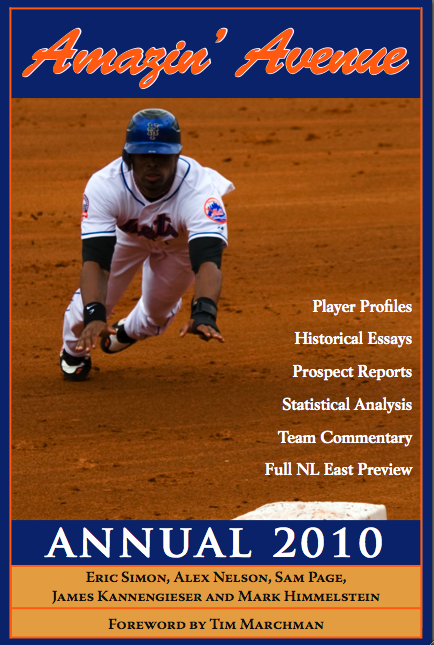
 In another sense, I am mainlining anticipation. I need to be immersed in who’s on these Mets, who will be on these Mets, who has been on these Mets. I need to keep getting stoked. That’s why I read blogs. That’s why I write blogs. That’s why I’m excited about two excellent products that I think you’ll enjoy as well. In another sense, I am mainlining anticipation. I need to be immersed in who’s on these Mets, who will be on these Mets, who has been on these Mets. I need to keep getting stoked. That’s why I read blogs. That’s why I write blogs. That’s why I’m excited about two excellent products that I think you’ll enjoy as well.
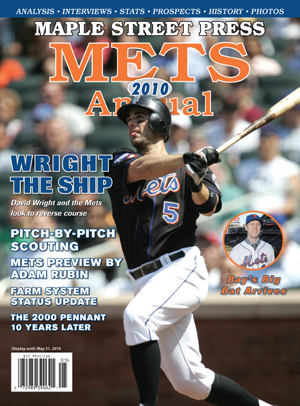
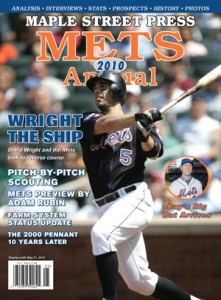
First, there’s the Maple Street Press Mets Annual, full of great perspectives on everything Met. It’s got this year, it’s got the years to come, it’s got — because it has to — last year and it’s got the years from before that bring us our present and future. This is the third year MSP has published Mets Annual, and it keeps getting better. You can find it on New York-area newsstands, or you can order it here.
Then, there’s a new entry in the preview category, and it will knock your virtual socks off. It’s the Amazin’ Avenue Annual, which brings the concept of “labor of love” to a whole new level. Perhaps you read AA on a regular basis. If you don’t, you should. It’s written by a team of Mets fans who take nothing at face value and aren’t shy about drilling right past the superficial deep into the Metropolitan brain. They decided the world needed a publication that just wouldn’t quit. The AAA never ceases — instead, it keeps amazing, it keeps delighting and it keeps informing. It makes you think plenty, with a forecast for 2010, an autopsy on 2009, a sense of 2011 and a satisfying trip into the time before. The book — and it is a book — is available for free downloading here; a printed and bound copy for those who take their baseball library literally will be made obtainable at cost shortly.
I should point out Jason and I contributed* to both publications, and we’re each excited to have been a part of them. But that’s not the only reason I strongly recommend both previews. They were conceived and edited by Mets fans, they contain the insights of Mets fans, they were published with the best interests of Mets fans at heart and they will have you, my fellow Mets fans, roaring right past March into April.
*Jason covered the world of Mets blogging, and I offered a fan’s eye view of living with Citi Field as well as a tenth-anniversary appreciation of the 2000 National League Champion Mets for the Maple Street Press book; my partner and I collaborated on an examination of “When the Mets Got Good Again,” the four seasons in which the Mets rose from 90+ losses to a winning record, for the Amazin’ Avenue preview.
|
|