The blog for Mets fans
who like to read
ABOUT US

Faith and Fear in Flushing made its debut on Feb. 16, 2005, the brainchild of two longtime friends and lifelong Met fans.
Greg Prince discovered the Mets when he was 6, during the magical summer of 1969. He is a Long Island-based writer, editor and communications consultant. Contact him here.
Jason Fry is a Brooklyn writer whose first memories include his mom leaping up and down cheering for Rusty Staub. Check out his other writing here.
Got something to say? Leave a comment, or email us at faithandfear@gmail.com. (Sorry, but we have no interest in ads, sponsored content or guest posts.)
Need our RSS feed? It's here.
Visit our Facebook page, or drop by the personal pages for Greg and Jason.
Or follow us on Twitter: Here's Greg, and here's Jason.
|
by Greg Prince on 18 September 2023 10:29 am Freddie Freeman having doubled 55 times in 2023 without networks breaking into prime time programming even once to issue bulletins on his chase of 60 — a two-base hit total not reached since the 1930s — has got me thinking doubles are baseball’s most underappreciated hit. Ralph Kiner said home run hitters drive Cadillacs. Tim McCarver thought triples were better than sex. Singles are the currency of the realm, accepted anywhere no-hitters are broken up. Nobody talks about doubles despite the descriptiveness they inspire in the moment.
Bottom of the third Sunday at Citi Field. The Mets have just tied the Reds at one on a bases-loaded wild pitch. Thus, Francisco Alvarez is batting with two ducks on the pond. On the mound once the count goes full, Brandon Williamson, no doubt thinking “I don’t want some New York blogger calling me Wild Willie”, throws Alvy a strike. Alvy swings. The ducks scatter, for down the left field line, Francisco has shot a RINGING double. Here comes Brandon Nimmo with the go-ahead run, here comes Francisco Lindor with the go-ahead-by-some-more run. There standing on second, having rung the bell of the playoff-chasing team managed by David Bell, is Francisco Alvarez with his 12th double of the year, or about half his home run total of 23. Is a double really only half as good as a home run? Is it twice as good as a single? Sunday in the third, it was plenty good in its own right.
Bottom of the sixth Sunday. Tim Locastro leads off versus Carson Spiers. Spiers is the nephew of 1995 Met Bill Spiers. Carson’s skipper is the grandson of 1962 Met right fielder Gus Bell. Locastro relates to Spiers by lofting a fly ball above short right field. It doesn’t fly that much, but it stays in the air a spell and it has its eye on No Red’s Land. It falls in. Tim, a burner, sees he can take advantage of the ball’s elusiveness and hustles. It’s a HUSTLE double! A BLOOP double! No such thing as a bloop homer, and you pretty much have to be Marlon Anderson and receive a lot of luck to Van McCoy your way into a home run if you didn’t clear the fence. Triples have to go far, too. Doubles don’t have to travel all day if the right fellow hits the ball in just the right spot. Alas, Locastro didn’t score, as nobody drove or wild-pitched him in. The Mets were leaving a few too many of their crew to fend for themselves on the bases as the day progressed.
Bottom of the seventh Sunday, one inning after Locastro and two other Mets were left on base, a trio of stranded castaways there on LOB Island. Mets are up, 4-2, the contours of the score not having changed much since Alvarez’s ringing double four innings earlier. Jose Quintana’s own version of few-doubles defense — just one, by Joey Votto, to lead off the top of the seventh — has held Cincinnati in check. Now it’s the Mets’ chance to perhaps double their lead and then some.
Jeff McNeil singles.
Mark Vientos gets on via Spiers’s less than effective throw to first.
DJ Stewart walks.
The bases are loaded, and hustling blooper Locastro is up next, but Buck Showalter sees the same ironic opportunity he spied the night before. Batting for Locastro will once again be Daniel Vogelbach. Locastro usually pinch-runs for Vogelbach. Now Vogelbach will pinch-hit for Locastro. If Yakov Smirnoff had been watching the game, he might have thought, “now, how do I get Russia into this situation?” We don’t know about that, but we do know that in Flushing on Sunday, Vogelbach hit for Locastro and belted a BOOMING double off the center field fence. In Russia, double BOOM you!
All the Mets who could score did score. Vogey even made it to second. An instant after he arrived, he was trotting toward the first base dugout, as he knew there had to be another Locastro in there somewhere. Rafael Ortega indeed emerged to pinch-run for the pinch-hitter who hit for his regular pinch-runner, who started and doubled earlier and played until he was pinch-hit for by the guy for whom he’s made a side hustle of pinch-running for. Also, Rafael Ortega is his own grandpa. Furthermore, Ronny Mauricio drove Ortega home, with a single, singles accepted worldwide.
The final would be the Mets doubling up the Reds, 8-4, with doubles serving their understated purpose of providing extra bases, extra cushion and the spice of life. Ringing! Hustle! Booming! So many different kinds! What variety! Even Sunday’s guest of honor, Bartolo Colon, on hand to “retire as a Met” five years since his last major league pitch, stood as emblematic of the power of the double. The 2016 home run in San Diego is the climax of every Colon highlight reel, but it was when Bart kept his batting helmet affixed to his head long enough to double at St. Louis in 2014 that we’d collected enough evidence to believe all those affirmations of Bartolo’s athleticism. Colon doubled four times as a Met, each instance a little less surprising, because, hey, Bartolo was quite an athlete, which is something they rarely say about Daniel Vogelbach.
Pete Alonso is quite a slugger. He has homered 191 times since coming to the majors. His next home run will tie Howard Johnson for fourth on the all-time Met list. When the season began, Pete sat seventh on said chart, behind Carlos Beltran (149) and Dave Kingman (154). It already seems impossible he was behind anybody but a handful of powerful Mets in the same year in which we sit now, and contract-extending fingers crossed, every Met ever will soon be behind him.
Yet when it comes to doubles, Pete is uninterested in a half a loaf. The fifth-most prolific slugger in Mets history is currently tied for 28th on the franchise’s all-time doubles list, sharing space with Joel Youngblood. If you’re busy hitting home runs, you don’t have as much time for doubles, but the Mets’ reigning home run king, Darryl Strawberry is ninth in doubles; their No. 2 home run man David Wright is No. 1 in doubles; and No. 3 circuit clouter Mike Piazza stands eighth in doubles. Hojo? Fourth in home runs, fifth in doubles, and ranking anywhere you care to place him in the hearts of his countrymen.
Pete’s thrilled us with 45 homers to date in 2023. With two weeks to go, his total will pale only in comparison to the 53 he whacked as a rookie in 2019. You don’t look askance at dollars because they’re not 50-cent pieces. BUT…and it’s not a big but…Pete just does not hit doubles at a rate commensurate with what one would intuitively expect from someone who also hits scads of homers, certainly not this year. To go with his 45 home runs, he has 18 doubles.
Is that not a lot? Historically speaking, it’s not. Beset by curiosity, I punched into Baseball-Reference’s Stathead tool a request for every Met who has ever hit at least 30 home runs in a season. There have been 37 such seasons since 1962. In 33 of those seasons, the slugger who’s gone deep 30 times or more has doubled at least half as often. Sometimes they’ve doubled more than they’ve homered (Bernard Gilkey’s team-record 44 doubles in 1996 were accompanied by 30 homers). Sometimes they’ve homered just as much as they’ve doubled (Beltran recorded 33 doubles and 33 homers in 2007, three years after Mike Cameron opened his own distinct version of the 30-30 club). It’s generally a pleasing proportion no matter how you measure it. In 2019, Pete rang and boomed 30 doubles to go with his 53 dingers. In 2021 and 2022, when Pete was homering 37 and 40 times, respectively, each of his double sums was 27.
Four times, a Met has homered 30 or more times but not doubled at least half as often. Once, barring a sudden and sustained reversal of personal trends over the final 13 games, it will be Pete in 2023. Once, it was Darryl Strawberry doubling “only” 18 times versus his 37 homers in 1990, which is pretty close to half (plus Darryl, perhaps feeling a little light in the two-base hit category, tried to make up for it by stealing 15 bags). Twice, it was Dave Kingman, who was famously all-or-nothing in his approach and results. The two years Sky King blasted exactly 37 homers, he took the under on 18½ doubles: 14 two-baggers in 1976, the year he missed just enough time to just miss leading the National League in home runs; and 9 in 1982, the year he missed the ball altogether a league-leading 156 times. Those 156 Ks tied the Mets’ single-season record for strikeouts in the era when hardly anybody struck out so often. In this century, three Mets have exceeded that number, including Pete, who set the Met strikeout record by a wide margin, with 183 in 2019 and not a soul complaining, given that the Polar Bear was homering 53 times and doubling 30 times.
Nobody necessarily ought to be complaining about Pete’s paucity of doubles in 2023, though it does seem symptomatic of what the 2023 Mets aren’t doing as a whole. Sunday excepted, they’re not doubling all that much. Every single year from 1962 through 2022, the Mets have doubled far more often than they have homered. More midsize cars on the road than luxury models are what one would anticipate seeing, right? Yet in 2023, the numerical comparison is closer than it’s ever been. The Mets have hit 196 home runs versus 206 doubles. “Versus” may be the wrong way to put it All those extra-base hits, including the 19 triples Mets have managed, are working together for the greater Metropolitan benefit.
Brandon Nimmo has 26 doubles, which is three more than his 23 homers. Last year he doubled about twice as much as he homered, although homering wasn’t as much a part of his game as it’s become. It’s never occurred to me to yell STOP AT SECOND as he circles the bases. Francisco Lindor leads the team with 33 doubles, though most of the attention he’s elicited is for his 26 homers and 26 steals. When Jeff McNeil won his 2022 batting title, it was largely on the back of his 39 doubles. This year, with his average down more than 60 points, he has 16 fewer doubles. Tied for fifth on the team in two-baggers, behind Pete’s 18, are Mark Canha and Tommy Pham, each with 15. Given that they stopped wearing Mets uniforms in late July, they’re probably not gonna catch Alonso.
The Mets’ sum of 206 doubles is dead last in the National League. Next-to-last are the Milwaukee Brewers, who, with Mark Canha on their side, are en route to winning a division title. David Stearns put together those Brewers and therefore may not take the Mets’ relative inability to double consistently as a sign that anything is off in his new place of employ.
In 2022, when the Mets won 101 games, they doubled 272 times and homered 171 times.
In 2021, when the Mets won 77 games, they doubled 228 times and homered 176 times.
In 2020, when the world conspired to deprive Pete Alonso of several hundred at-bats in which to hit what has become his usual Herculean amount of home runs (what an inconsiderate pandemic), the Mets went 26-34 with 106 doubles and 86 homers. It’s not the representative sample size to which we’ve become accustomed, but even then, doubles were pulling ahead of homers by a comfortable margin after 60 games.
In 2019, the first year of the Bear, the Mets were pretty good — 86-76 — and doubles (280) outlasted home runs (242), even though the Mets, behind prodigious Pete, set their club mark for most homers in a year.
The most doubles the Mets ever socked in a season were the 323 they pulled or slid into second with in 2006, a year that also encompassed a then-team record 200 homers, plus 97 wins. The home run record was surpassed in 2016, when the Mets belted 218. It was the year when it began to be noticed the Mets either scored by homer or not at all, yet they also added on 240 doubles and went to the playoffs. They hit more homers in playoffless 2017 — 224 — and also more doubles — 286. In 1980, when the Mets notoriously could only match Roger Maris with 61 home runs as a team, they still pounded out 218 doubles.
Good years, bad years, all years the Mets double more than they homer, usually with room to spare. This year, a bad year, it will be close. I don’t know what it says, but I do know it was fun to see them double a bunch on Sunday.
They didn’t homer at all. They won, anyway.
***Sunday commenced with a blot of bad news, as Jay Horwitz announced the passing of his former deputy Dennis D’Agostino, who was only 66. D’Agostino worked for the Mets in the 1980s, following it up with a long term running public relations for the Knicks. He moved to the West Coast somewhere along the way and served as statistician for SNY’s telecasts when the Mets would travel to Southern California. The man did a lot in sports and, judging by the reaction of people who work in the business, made a lot of friends.
I came to know of Dennis in the very early Eighties when he would visit his alma mater’s radio station, WFUV-FM at Fordham. One on One was their late-night weekend sports show. Three hours of baseball talk in the middle of summer. I couldn’t believe such a thing was on the air, even if you had to stay up until two in the morning to enjoy all of it. Annually, around the All-Star break, they’d do a marathon trivia show and have back alumni. One of them was Dennis, who it was mentioned had a book coming out soon: This Date in New York Mets History.
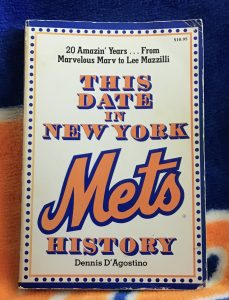 Treasured. My tongue hung out at the notion. A book about the Mets? With what happened every day across the not quite two decades they’d been around? I had to have it! Yet I could never find it. Never is a mighty long time when you’re 18, which is what I was when it was published. My soon-to-be brother-in-law tracked it down for me in time for my 19th birthday. I treasured it then. I treasure it now. You know how you can look up pretty much anything about the Mets today, including all kinds of doubles information? Before This Date in New York Mets History, you could keep every newspaper, magazine, almanac, what have you, maybe figure out a way to get your hands on media guides, comb through yearbooks, arrange trips to libraries…
No, you couldn’t look up all that much outside of the Baseball Encyclopedia, which I didn’t have. Besides, that was just numbers. This Date was as anecdotal as it was statistical. It was informed with heart, soul and warmth that you knew was true orange and blue. Reading it, I instantly understood the author was one of us. He didn’t write about the Mets from any level of journalistic remove or vaguely ironic distance. He wasn’t on holiday from loftier pursuits. Dennis D’Agostino created this volume of everything you’d want to know as a Mets fan because he was a Mets fan who wanted to know everything and was kind enough to share it. He watched the games we watched. We wondered the things we wondered. He found us the answers. He put it one place. The title undersells all that rests between the covers of This Date in New York Mets History.
Dennis wrote other wonderful books and clearly did many things in a life that didn’t last long enough. He also took the time to reach out to this reader many years ago when he learned I said something nice about This Date in one of my books. “For however I might have helped or influenced you,” he wrote, “I truly appreciate it.”
Consider my appreciation toward Dennis D’Agostino doubled.
by Jason Fry on 16 September 2023 11:40 pm Saturday night’s game between the Mets and Reds was one of those close affairs you’re not sure whether to call taut or merely indifferent. The Mets harried Andrew Abbott but couldn’t inflict substantial damage on him; the Reds tormented Tylor Megill but couldn’t put him away either. For the second game in a row, matters turned on a two-run blast by a Red — Jonathan India last night, the prodigiously monikered Christian Encarnacion-Strand tonight.
Though this time the margin was tighter, and so if you were feeling masochistic you could look to a misplay featuring a pair of Baby Mets: Francisco Alvarez loves to make snap throws to the bases, and Ronny Mauricio either didn’t get the memo or couldn’t read it quite fast enough. Alvarez’s throw sailed down the third-base line, TJ Friedl scampered home, and in the end the Mets lost by a run.
Lost, but hey, it’s garbage time. Megill was out there working on things, just like David Peterson was the night before, and those lessons may prove fruitful in some better season down the line. Mauricio got some time at third — albeit with some bruises — and his bat still looks live. Alvarez had a fine game at the plate, which shouldn’t be overlooked in the closing weeks of a season that’s taxed him physically and mentally as never before.
And your recapper spent the afternoon and early evening in a house without power, courtesy of the winds of Hurricane Lee blasting by to the east of Maine. Besides bringing down a critical power line somewhere, those winds felled a big pine that settled across the dirt road to the house.
As an ax wielder, I’m a heckuva blogger. Still, this unanticipated mission was eventually accomplished, and though I braced for a couple of nights of eating Pop-Tarts in the dark, the power kicked back on right after 7 pm, just in time for baseball.
Losing a meaningless game to the Reds? Not really so bad.
by Jason Fry on 16 September 2023 1:56 pm A habit I’m trying to break as a baseball fan is the assigning of blame. If the Mets don’t win – even a stripped-down, playing-out-the-string version of the Mets – it can’t be that the other team won or something went wrong or an unlucky event occurred. No, it has to be someone’s fault.
For instance: Grant Hartwig hung a pitch to Jonathan India, who hit it over the fence, and the Mets lost. That practically has the elegance of a mathematical proof, and hey, it isn’t wrong. I could write that and then follow it up with a lot of grousing about Hartwig, which would probably open the door to complaining about Trevor Gott and Drew Smith as well. If particularly exercised, I might go on to note that David Robertson hasn’t exactly been lights out down in Miami, turning the recap into a lamentation about relievers in general. Note the presence of Alexis Diaz closing the game for Cincinnati while Edwin Diaz watched from the Mets’ dugout and we’d have a full circle of misfortune, regret and simmering annoyance.
And again, none of this would be wrong.
Just maybe … incomplete? Too easy? Pointless?
Buck Showalter was even-keeled when asked about Hartwig after the game, a stance that was probably wise even if it is his job. He noted that Hartwig has had some success and some lack of success and is working on things, learning at a level where he’s never been before. Which isn’t as satisfying as angry postgame lamentations about relief, but also isn’t wrong.
Hartwig relieved David Peterson, another guy whose had some success and some lack of success and is working on things. For Peterson it’s been his slider, which was sharp against the Reds on Friday night. That alone wasn’t enough to get Peterson a win, let alone put his promising turned puzzling career back on track, but Peterson’s quietly been pretty good since rejoining the rotation. And what are 2023’s dregs for, if not Peterson locking down that slider and learning (or relearning) how to make his other pitches work in conjunction with it?
The Mets got even after Peterson fell behind thanks to a three-run bolt from Pete Alonso off the hulking Cincy starter Hunter Greene, one of those homers that’s so immediately and obvious gone that you just beam at the TV and wonder what it must be like to be able to do that. Alas, it was all the offense the Mets could muster, despite a string of pretty good at-bats for garbage time.
The Mets made some mistakes – in the field, and most glaringly with Hartwig’s pitch location against India. They did some good things too. The Reds made fewer mistakes and did more good things. Maybe that will suffice, and the blame game can wait for another day.
by Greg Prince on 15 September 2023 12:28 am Tell me if any of this sounds familiar to your experience regarding your favorite baseball team of late:
• Sometime in early Spring: YAY, BASEBALL!
• A little later this Spring throughout this summer: Does it have to be this baseball?
• Now, as summer blurs into fall: Sigh…there goes baseball, just when the baseball is getting kinda good…
That, I believe, serves pretty accurately as the inverted bell curve charting one’s fondness/tolerance for Mets baseball in 2023. Start out reasonably high; plummet; maybe start climbing anew as events warrant. We’ve won three in a row. That’s the trajectory we’ve been missing.
Another dip is possible over the final sixteen games, because these are the 2023 Mets, and when it comes to going for a dip, they sure do know how to pack a swimsuit. But let’s go with the vibe of the moment, which corresponds to being a little shy of a week from the autumnal equinox. The weather has gone schvitzless, and the Mets have become hitful. Or maybe they’ve just been enjoying the company of the Arizona Diamondbacks.
It was fitting that the Wild Card-contending (a.k.a. a little over .500) Diamondbacks furnished the opposition for the 9/11 commemoration game, because I couldn’t think of another non-New York team that gave a great deal of New Yorkers — not all of them, but plenty of us — more joy when it was needed in the fall of 2001 than the ballclub from Arizona. Bless you, Luis Gonzalez, wherever you are. Letting the D’Backs grab one win all these years later, as they did on Monday night, represented an appropriate gesture of appreciation. Then, with our eternal thanks for saving Mets fans from any further pinstriped deification twenty-two Novembers ago registered, we could return to the present and our uncanny knack for whacking those desert snakes. I don’t know why the Mets usually take it to the Diamondbacks. I’ll just enjoy that they have in nineteen of their last twenty-three meetings, including Thursday afternoon’s 11-1 stomping of the visitors from the West
Ten minutes after four o’clock on a Thursday afternoon isn’t necessarily the most convenient time to commence a baseball game when there are so few remaining in a season and a person might have other tasks looming, but if 4:10 PM starts yield 11-1 wins, well, bring on the inconvenience, not to mention the shadows. This was the last weekday afternoon game we’ll know this year. Everything else is either at night or on the weekend. Everything else is invited to work ten runs in our favor.
I saw some of the game, listened to more of it, missed a little of it, managed to revel in all of it. Deposed champion of batting Jeff McNeil hit another home run. Jonathan Araúz received a rare opportunity to step to the plate and made four bases and three ribbies out of it. DJ Stewart did not add HR to his initials, but he did knock in a couple of his fellow Mets, as DJ is known to do. Brandon Nimmo did something similar. Saving some of that for Kodai Senga‘s next start was not possible, so the Mets piled it on in support one of the league’s best pitchers. Our very own Rookie of the Year and Cy Young candidate struck out ten while giving up no runs, two hits and two walks. His ERA has taken the best dip of all, under 3.00. BBWAA voters take note.
Senga is known more for his forkball than his curve, but the curve the Mets are riding is a most pleasant upward slope. Paying attention to this team any time of afternoon or evening has been something of a sap’s errand this year, but this week will make a person with a selective goldfish memory forget all about that. For example, on Wednesday night, it barely crossed my mind that the Mets have been mostly horrible in 2023. Wednesday night, you see, was when I was fortunate enough to be tapped on the shoulder by a hand from the past.
The hand belonged to Skid.
And by Skid, I mean SKID! You can’t invoke the man’s name without a requisite level of excitement.
Skid Rowe was the prophet of good times to come at the outset of 2015, when this Mets fan from Northern California decided his life wouldn’t be complete unless he spent an entire baseball season in New York going to every single home game the Mets played, and, it turned out, crossing paths with myriad Mets fans who felt blessed to get to know him (I was one of them). He and his experience were both a blast, especially when 81 games at Citi Field proved not enough to suit his proximity to everything orange and blue. Skid showed up, blended in, and the Mets won their division, won their division series, won their league championship series, and went to the World Series. We didn’t win the World Series, but Skid rooted us into November. Pretty good for an out-of-towner.
That was eight years ago. Skid went home to California following the Fall Classic. Long story short, he remained a Mets fan, if not the kind who’d uproot his existence for seven months for the sake of immersing himself in Metsdom. As the late 2010s morphed into the early 2020s, you might say Skid became a Mets Fan Emeritus. Still with us in spirit, just not as all in as he was through the last pitch of 2015. It would be hard to keep up that pace into perpetuity from 3,000 miles away.
Then I felt Skid’s hand on my shoulder. Technically, it was a text and a followup phone call. Through machinations that aren’t vital to recount, Skid found himself with a bunch of seats in his name in the Hyundai Club for Wednesday night, September 13, 2023. It was too long a haul from Northern California for him to be there, roughly an epoch removed from the September days of 2015 that involved counting down a magic number. Yet the seats had Skid’s name on them. Skid’s name is also imprinted on the Mets fan soul of all who consider him synonymous with our most recent pennant.
Skid asked me (plus some other folks from way back when) if…
a) I’d like a couple of those tickets; and
b) I could do my best to see some more didn’t go to waste.
I didn’t want to detail that the September he remembers from 2015 shaped up as nothing like the September at hand when he got in touch, or that a lot of people who love the Mets for better or worse have had their fill of the latter in 2023. Filling those seats, I was thinking, might be a challenge akin to Terry Collins filling out his lineup card pre-Cespedes trade.
Instead, I responded…
a) yes, thank you; and
b) yes, absolutely.
And ya know what? Mets fans answered the call. I was at Citi Field on Wednesday night with others who knew Skid, either from 2015 or by reputation. We filled his seats. All except one he told me he personally hadn’t found a taker for. That’s all right, I thought — you’re supposed to keep a chair open for Elijah the Prophet.
Imbued by the spirit of Skid, we who were there to partake of his largesse had a spectacular time in this, the most dismal of Met seasons. Granted, it helped these seats were in Skid’s favorite section of the ballpark, the Hyundai Club, and the Hyundai Club includes a buffet, and who doesn’t like great seats with great food included? But it’s September 2023 and the Mets haven’t contended for anything but disdain since April; even the most loyal Mets fans could be forgiven for choosing to make their own fun and their own dinner as this season winds down.
 This meeting of the Skid Rowe Alumni and Appreciation Society is declared a success. Nope, we members of the Skid Rowe Alumni and Appreciation Society decided, we wanted the fun of being with one another; being with our team, their so-so nature notwithstanding; and thinking aloud about one of us who wasn’t with us on Wednesday night, but we knew he was out there following along via Gamecast, when not checking in with us via a device or two. We wanted a soft summer evening on the cusp of fall. We wanted to watch the Mets stomp the Diamondbacks as they had done the night before, as they would do the afternoon after.
We know a little too well that Hyundai might as well be Korean for aberration. We won’t be playing the Diamondbacks this weekend. Maybe that won’t matter. We won’t be throwing Senga against the Reds. Maybe that won’t matter. The forecast looks good, but you never know with weather. Mets baseball will be gone in a tad over two weeks. We’ll probably be glad to be done with it. It’s not as if a three-game winning streak is suddenly upending standings that have sat on our head without pause.
Yet a few good days after a ton of bad ones, especially when one of the good nights is enriched by so many good friends — and enabled by one who was there in every sense but physical — are to be treasured if you value what loving baseball oughta be all about. We can go back to dismissing these Mets and this season soon enough. Sticking around has its rewards.
National League Town relives the Mets’ journey through the American League, from Oakland to Minnesota and everywhere in between. What a long, unprecedented trip it was. Take it yourself by listening here or anywhere you pod.
by Jason Fry on 13 September 2023 11:57 pm Who are these Mets, anyway?
Joey Lucchesi was terrific, Mark Vientos homered, Pete Alonso drove in three on a homerless night and — in the most astonishing development of all — Trevor Gott and Drew Smith were allowed to pitch and didn’t fall apart like cheap watches. There was a nifty flying slide home by Jeff McNeil, some dopey D-Backs’ baserunning — really, there wasn’t much to complain about.
Not that it was complaint, exactly, but in our living room we fell into a discussion of players, at bats and the law of averages. After Francisco Lindor finished a second dogged, tough at-bat, I remarked idly that it felt like Lindor looked hopeless in a surprisingly large percentage of the outs he made. That wasn’t meant as a dig, but as a point of puzzling contrast — I was trying to explain my confusion about a player whom I think of as a genuine star in terms of both production and leadership (witness his huddle with Alonso and DJ Stewart to offer a scouting report on one of the Arizona relievers), but also as a guy who can look bizarrely lost at the plate. We talked about confirmation bias and things evening out, both of which were fair points, and I was challenged to name Mets who I remembered as never having the kind of ABs like the ones I was attributing to Lindor. Keith Hernandez came to mind, as did David Wright — or at least Wright as he was before he got hit in the head. In hindsight, I’d put Brandon Nimmo in that category, at least before he started selling out for power a bit more. I don’t know what the answer is there — probably it’s simply that memory plays tricks — but still, I find Lindor a confounding mix of superstar and question mark.
Back to Lucchesi: An old baseball adage is never to trust what you see in garbage time, but he’s looked pretty good in his last two starts, even if those two mark his only big-league outings since May. And, oddly, he’s been no great shakes at Triple-A. That last note is a flashing yellow light I ought to heed, but I like Lucchesi’s non-nonsense demeanor and his simple, rock-and-fire motion. It feels like the Mets could do a lot worse than offering him another short-term deal and seeing what he can do as a rotation regular. Just like they could do worse than seeing what Stewart might accomplish as a fourth outfielder/DH.
I doubt Lucchesi and Stewart are at the core of a championship team. But that’s not the sole measure of success — being useful complementary players would be victory enough. Maybe that’s not the stuff of stirring reveries, but let’s let garbage time have its pleasures.
by Jason Fry on 13 September 2023 7:44 am Like other varieties of stopped clocks, every so often the Mets are just right.
On Tuesday night they hit a barrage of homers, with Ronny Mauricio’s inaugural blast the most impressive; they got good starting pitching; and they survived the inevitable bad bullpenning to take a game away from the Diamondbacks.
Jose Butto provided the good starting pitching, quietly picking up his first big-league win — I say quietly because Butto’s run of competence has kind of snuck up on us while we’ve been busy bemoaning the Family Circus “progression” of David Peterson and Tylor Megill and looking over to see how Max Scherzer and Justin Verlander are doing with their new employers. (Last night the answer was “not good,” as Scherzer left with a triceps injury and Verlander got beat by the A’s.)
Butto fell behind 1-0, but the Mets got even on a bad-hop triple from Brandon Nimmo and the first of Francisco Lindor‘s two RBIs. An inning later, Mauricio untied things with a prodigious blast to the very back of Sodaland, startling some of the numerous hounds in attendance — at least those whose doggy gaze hadn’t already been diverted by Mauricio’s impressive bat flip. After that it was on, with the Mets adding homers from Pete Alonso and Francisco Alvarez. That last homer was particularly welcome, coming after Grant Hartwig and Sam Coonrod sandwiched a competent inning from Phil Bickford by doing what the bullpen does seemingly every night these days. Hartwig and Coonrod were nice stories for about five seconds earlier this season; now when you see either of those young men you consider hiding behind the couch before remembering that a) what the hell, the season’s already lost; and b) at least they’re not Trevor Gott or Drew Smith.
Coonrod’s disastrous eighth let the Diamondbacks draw within two with the tying run lurking on second, but the Mets were playing this night’s game of bullpen roulette with only five bullets chambered: Adam Ottavino coaxed a ground ball from Corbin Carroll that was hit just hard enough and right at someone to become a very welcome inning-ending double play.
The rest of the evening? A couple of quick observations should suffice:
- By the late innings the SNY broadcast had become the baseball equivalent of wackadoodle free jazz, with Gary Cohen goading Keith Hernandez to turn the dials of Keithness way past even 11 and putting Steve Gelbs on the couch about the misery of giving one’s heart to the Jets. And you know what? That’s exactly what SNY broadcasts should be these days. Wackadoodle free jazz all the way to Oct. 1 and start again next year!
- It was nice to see Ron Hodges in the park and on the broadcast. Hodges is a deep cut for Mets fans, a journeyman noted for his longevity and for spanning two very different eras of team history, and it’s been wonderful seeing the Mets reconnect with that history by giving less-celebrated players from their past well-deserved moments in the spotlight. And it was fun hearing Hodges talk about catching Tom Seaver, for all the obvious reasons. But it got less fun when Hodges was asked about the modern game and started yelling at clouds. It’s never a good idea to ask men in their autumn years if the world were made of purer and better stuff in their youthful springs and summers, and the folks who call the shots at SNY ought to know that by now.
- The Mets hired David Stearns! This is great, and I can’t wait for … you know what? Nah. I am pleased, and I do have hopes that this will let blueprints be drawn up in relatively short order for the next great era of Mets baseball. But I’m also tired of winning offseasons. If there were flags for that, Citi Field would be so festooned with flapping banners that the stadium would be in danger of taking flight in a high wind. I’d prefer some real ones, the kind given out for in-season accomplishments.
by Greg Prince on 12 September 2023 2:08 pm What had been a bad week regarding saviors of professional sports franchises in New York is now a promising week regarding saviors of professional sports franchises in New York. At the very least, nobody should be sacking and tearing David Stearns’s Achilles tendon in the days ahead.
Never mind Aaron Rodgers and never mind the 2023 Mets, save for the nineteen games from which we pledge to not pull ourselves away unless something important happens (like we suddenly remember to get a life). Your 2024 and then some New York Mets President of Baseball Operations is en route, per multiple reports that we are delighted to help disseminate.
David Stearns is coming! David Stearns is coming!
Old news? Feels like it. It seems Stearns has been talked about as the next/first Mets President of Baseball Operations — or POBO, as in what can a POBO do, except sing for a rock ‘n’ roll band? — since the day Steve Cohen entered the picture. There’ve been so many days and so many introductions of potential front office saviors since then, including current and not-going-anywhere general manager Billy Eppler. But none of them was an upper-case President. None of them was David Stearns.
Stearns we’ve heard is responsible for the continual success of the Milwaukee franchise and grew up loving the Mets. Most of grew up loving the Mets. None of the rest of us built the Brewers into an NL Central perennial contender. We thought the Mets had already solved the perennial contender part when they topped 100 wins last year and loaded up to maintain their status atop the riff-raff of the NL East. Turns out we riffed and raffed our way toward the bottom of the division as quickly as we scaled to its almost heights. How the hell did that happen?
Seriously, how did it? During the rain delay that preceded Monday night’s loss, SNY aired Mets Yearbook: 2022. I caught the last few minutes, the part where everything looks rosy for the 2023 Mets, what with the signing of Justin Verlander and everything else. We know Verlander’s no longer here. Whatever became of everything else?
I’ll stop asking questions until David Stearns — more than a year younger than Aaron Rodgers but sage enough to ply his trade in street clothes — completes his ride to Flushing and begins Presidenting Baseball Operations. Word has it he will be officially appointed following the end of this season that can’t end soon enough. When Mets Yearbook: 2023 debuts, we’ll likely see a segment devoted to the appointment of our POBO and how this augurs well for the future. I sure hope some future rain delay proves it a most prophetic segment.
by Greg Prince on 12 September 2023 10:23 am I watched the victorious Jets quarterback stand before the football press late Monday night and extol the virtues of never getting too high or too low, which I’m pretty sure I’ve heard an athlete or two or two-million mention before, but since the victorious Jets quarterback Monday night was Zach Wilson rather than Aaron Rodgers, perhaps the young man knows from what he speaks. The Jets couldn’t have been any higher coming into their season opener at the Meadowlands; any lower once their designated savior Rodgers went down with an injury almost immediately and gave way to the guy he was imported to replace as starter; any higher after coming together to prevail — on a punt return by an undrafted rookie — over the Bills in overtime; or any lower once they learned Rodgers was likely out for the season (though at least he got a few more regulation snaps in than Edwin Diaz before Diaz received what amounted to the same prognosis).
Back on the side of the river where we usually focus our attention, the Mets in their first-responder caps kept their highs and lows in check. Big home run for Jeff McNeil. Walloped double by Ronny Mauricio that drove in two and had Ronny racing successfully for third on the throw. Very pretty to watch, and a 3-2 fourth-inning lead as a result.
Big game for Tommy Pham, too! Oh wait, he’s on the Diamondbacks now. Can’t get too high about that.
Pretty good start for Jose Quintana — a lotta pitches through five, also a lotta bearing down to allow only a pair of runs — eventually gave way to pretty Gott relieving. Drew Smith got involved, though the key hit he gave up was not a Trevor-Drew style home run, but a bloop double to left that caused trouble for slugger McNeil in the corner, which facilitated the Diamondbacks pushing across the go-ahead run in the ninth. Mauricio and the Mets threatened in the bottom of the inning, getting as far as second and third, with Paul Sewald — also no longer a Met — on the mound. Omar Narváez worked a helluva walk, I tell you what. Alas, Brandon Nimmo flied out to end the game, limiting dramatic comebacks in the Metropolitan Area to one for the evening.
Can’t get too low from losing, 4-3, to the Wild Card-contending Diamondbacks. Wouldn’t have gotten too high from figuring out a way to edge Arizona, either. Just another Monday night in Flushing, where they play only baseball, and, pretty soon, nothing.
by Greg Prince on 11 September 2023 10:51 am During Saturday afternoon’s telecast, Ron Darling recalled a moment of frustration from early in his career when he was so fed up with receiving no-decisions for his pitching efforts that he said he’d rather take a loss than another ND. Older and wiser (and by way of slapping the Mariners’ George Kirby on the wrist for expressing dismay that his manager kept him in Seattle’s game longer than he would have preferred Friday night), Darling in 2023 couldn’t believe the Darling of way-back-when could articulate a thought so half-baked.
In the vein of the less old, less wise Ron Darling, as happy as I am that the Mets beat the Twins on Sunday afternoon, I just as soon this wasn’t a game that was theirs to win. On the other hand, I just as soon it wasn’t a game that was theirs to lose. I’ve felt that way about all 46 games the Mets played against American League teams this season.
If I could, I’d subtract the Mets’ 19 wins from the likes of Oakland and Cleveland and the Mets’ 27 losses from their brethren in Detroit and Baltimore and all the Interleague results in between. This is not for competitive gain, although if you subtract that 19-27 from the Mets’ overall record of 65-77, you’d have 46-50, which implies that with 46 better-placed and better-played games, perhaps These Mets could have…
Nope, this has nothing to do with weaving fantasy Third Wild Card scenarios in which These Mets could have knocked a little harder on the door to the foyer to the entryway to the barrier to the race for the sixth-best record in the National League had the schedule been calibrated differently. The 2023 Mets could have played the 2023 Mets 162 times and not won as many games as they lost. This is about 46 games against American League teams where there used to be no more than 16, maybe 18 in a given year, and before those were splattered onto our calendar, there used to be none.
As a National League entity, the Mets played other National League entities for 162 games. Should they have been as successful as they could have possibly been, they would play one more extended National League series, then, if they prevailed in that setting, they played an American League team. It was called the World Series. Also, anywhere from one Met to five might be selected to dress up in their uniforms in the same clubhouse with a member or few of the Reds and Astros and Pirates and Expos and so forth to form a National League All-Star team, and that ad hoc unit would play a similar outfit from the American League in the middle of July. Throw in Spring Training and the odd in-season exhibition, and that was that. The National League played the National League, and the American League played the American League, meaning the leagues determined their champions wholly internally before dispatching their respective champion to uphold the honor of the league against the other league’s champion.
 For starters, 162 games against your own league. It worked great for nearly a hundred years. It still works great in the mind of a person who knew this as the norm. Norms that weren’t troubling anybody are hard to dislodge in perception. Interleague play was something that would come up in the occasional fantastical article describing how in the future we’d all be parking our hovercrafts at the EnormoDome en route to seats where we’d wave down our robot vendor for hot dog protein pills, but, yeah, right, the National League would play the American League in the regular season someday.
Then came the June night in 1997 when the San Francisco Giants visited the Texas Rangers, followed by the next night, when the New York Mets hosted the Boston Red Sox, and the novelty was on. The following week started with a Mets road trip to the Bronx, not for a one-off Mayor’s Trophy showdown but for three games that actually counted in the standings for each team, same as the Mets-Red Sox series over the weekend at Shea, same as would happen when the Mets took on the Tigers in Detroit, the Blue Jays in Flushing and the Orioles at Camden Yards. It was a little fascinating, a little offputting. Games were games, even if your hovercraft was in the shop.
The norm was disturbed, but ya got to play where Ty Cobb played, and ya got to see Cal Ripken for yourself. The novelty wore off as novelties will. The setup was rejiggered here and there. For the first five years, it was East versus East, confined to particular weeks before playoff chases truly kicked in. Then, once it was determined the market would bear only so many Mets-Devil Rays contests, there was some NL East vs. AL Central or NL East vs. AL West (plus Mets vs. Yankees, always Mets vs. Yankees, lest the golden goose go untapped). A couple of years the pattern unspooled and you’d have the Mets playing the Orioles and Indians, or the A’s and Twins, rhyme and reason taking those weeks off. When Houston fans, for the purposes of flattening out the circuits at fifteen franchises apiece, were alerted that they were no longer rooting for a National League team, it was Interleague O’Clock somewhere everyday.
At last, we arrived in 2023, with almost every distinction between the leagues blurred until you couldn’t make any out. The DH is there and here. The Twins are on the Mets’ schedule in September not as an aberration but because who haven’t we played yet? No biggie, just as it wasn’t out of the ordinary that we recently spent nine days welcoming to Queens the Angels, the Rangers and the Mariners, just as our post-trade deadline agenda was three in KC, three in Baltimore. Next week we’ll see the Marlins for the first time since early April. That’s the gist of the tradeoff. Less intradivisional action. We played the Marlins what seemed about a hundred times a year most years, nineteen times a year in reality. Same for the Nationals, Braves and Phillies. Now we see them thirteen times each. Determining a division champion (an exercise Atlanta admittedly made academic ages ago) has become incidental. Win enough games against the Red Sox and White Sox and perhaps you’ll forget you didn’t get an additional crack at the team directly in front of you.
Twenty Twenty-Three might not make the best case for Met opportunities lost. The Mets’ most nettlesome opponent in 2023 was themselves. They met the enemy, and it was them. Sunday they accounted for themselves all right. They had DJ Stewart, which made the difference. If we did have that hypothetical 2023 Mets vs. 2023 Mets season alluded to above, whichever version had the good sense to promote and retain DJ Stewart would have to be favored. He drove in the only two runs in the Mets’ 2-0 win in Minneapolis. Met starting pitching, in the person of Tylor Megill for five innings, yielded zeroes. They weren’t as pretty as the eight ex-Marlin Pablo Lopez posted (featuring 14 Ks), but keeping an opponent off the board is keeping an opponent off the board. The relievers who followed Megill — Messrs. Bickford, Gott, Raley and Ottavino — maintained scorelessness. Stewart’s two-RBI double in the ninth broke the longstanding 0-0 tie and averted the sweep.
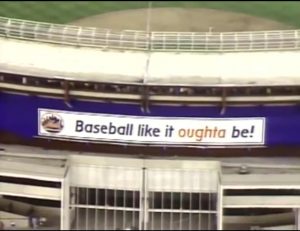
So we took one out of three from the first-place team in the American League Central, which was theoretically one-third good news for the Cleveland Guardians, though that’s not really a race at this point. The Mets’ hovercraft is parked just above Washington’s, so we’re not quite positioned to scoop up one of those six lottery slots for the absolute worst finishers in baseball (nobody cc’d DJ on the benefits of avoiding any trace of success). Now, at last, we are done with the American League for this year. The final twenty games will be Diamondbacks, Reds, Marlins and Phillies. Lots of Marlins and lots of Phillies down what would be the stretch if we were stretching for anything. It will serve as a reminder of scheduling like it oughta be.
by Greg Prince on 9 September 2023 6:16 pm All games have their highlights, even the Mets’ Saturday afternoon 8-4 loss to the Twins in Minneapolis — if you watched or listened to it, choose YOUR favorite highlight!
• David Peterson delivered the very definition of a quality start!
• Brandon Nimmo, Pete Alonso and DJ Stewart each homered!
• The 2023 season is one game closer to over!
Got your favorite? Great! Enjoy thinking about it for the next 30 to 60 seconds and, if you like, check out the Mets and Twins again on Sunday!
Thanks for stopping by!
|
|






