The blog for Mets fans
who like to read
ABOUT US

Faith and Fear in Flushing made its debut on Feb. 16, 2005, the brainchild of two longtime friends and lifelong Met fans.
Greg Prince discovered the Mets when he was 6, during the magical summer of 1969. He is a Long Island-based writer, editor and communications consultant. Contact him here.
Jason Fry is a Brooklyn writer whose first memories include his mom leaping up and down cheering for Rusty Staub. Check out his other writing here.
Got something to say? Leave a comment, or email us at faithandfear@gmail.com. (Sorry, but we have no interest in ads, sponsored content or guest posts.)
Need our RSS feed? It's here.
Visit our Facebook page, or drop by the personal pages for Greg and Jason.
Or follow us on Twitter: Here's Greg, and here's Jason.
|
by Greg Prince on 30 December 2021 4:03 pm Because The Tonight Show was taped in beautiful downtown Burbank, it didn’t seem odd that one summer night in 1979, Johnny Carson would include Tommy Lasorda while doing his Carnac the Magnificent bit. Playing to the Southern California studio audience was one of Johnny’s staples, and Chavez Ravine was certainly within driving distance. Carnac listed the Los Angeles Dodgers manager among three beleaguered figures in the news. One of the others was either Jimmy Carter or a member of the Carter administration. The other I don’t remember. After Ed McMahon repeated the trio — and Carnac gave him the side eye — the Magnificent one tore open his envelope and revealed what they all had in common:
They were three people who’d be out of a job by next year.
On the Carter front, Carnac nailed his prediction. Maybe the other person, too. But Lasorda, despite a subpar ’79, wasn’t going anywhere. And why should he? Tommy won a pennant in his first full year managing the Dodgers, in 1977. He did the same in 1978. After the aberration, already in progress, Lasorda would go on to steer the Dodgers into a one-game playoff for the NL West title in 1980, take them all the way in 1981, to the final day in 1982, another pair of NLCSes in 1983 and 1985 and, for his signature scene, a second world championship in 1988.
When Johnny Carson bowed out of The Tonight Show in 1992, Lasorda was still managing the Dodgers. He’d remain the man visibly in charge clear into 1996, officially retiring a week after The Daily Show debuted.
For 20 baseball seasons, Lasorda was himself a daily show, and it’s not like he went into syndicated reruns after stepping down as manager. Tommy Lasorda never really left the Dodgers or baseball. Even with his passing at the outset of 2021, you don’t think of him as gone. No manager alive, and hardly a handful of them less so, remains as famous.
We don’t have managers normal people have heard of anymore. We barely have managers baseball fans have heard of. Lasorda everybody had heard of. He wasn’t just baseball famous like, say, Whitey Herzog or Earl Weaver (or Buck Showalter). He was Johnny Carson famous. Famous enough for Johnny Carson to weave into his sketches. Probably as famous as Johnny Carson.
He earned it, not just by managing successfully for a long span in a large market but by making himself too big to ignore. Him and baseball. “Ambassador” is kind of a catch-all for the role Lasorda served to promote baseball, the Dodgers and, one supposes, himself. It may not be specific enough. Tommy was an entire diplomatic corps.
After managing the Dodgers, he coached the U.S. Olympic baseball team to a gold medal in 2000. He coached third base for Bobby Valentine at the 2001 All-Star Game. He starred in MLB commercials in 2006 coaching fans of teams that didn’t make the playoffs to watch the postseason anyway because it was still baseball. He was around Dodger Stadium a lot. In 2020, in failing health, he made it to the new ballpark in Arlington, home of the neutral-site World Series. If the Dodgers were on-site, and Tommy was present, there was nothing neutral about it. He wasn’t gonna miss the Dodgers winning their first world championship in 32 years, the first world championship in Dodgers history won under the guidance of somebody who wasn’t Tommy Lasorda or Tommy Lasorda’s direct predecessor Walter Alston. The first season the Dodgers won one, Tommy pitched for them. That was 1955. He never left the organization.
Alston had Lasorda on his coaching staff during the 1974 World Series. Alston didn’t call attention to himself from taking the reins in Brooklyn in 1954 forward. That wasn’t a problem for his third base coach, who was mic’d up and gave the producers of the official Fall Classic film something to amplify. They talked about him during the NBC broadcast that October. The network of Carson and Garagiola knew a star when it saw one. The following spring, in a preseason special, Tommy was featured preaching the gospel of Dodger Blue at Spring Training in Vero Beach. He bled it, the coach told the minor leaguers. When he died, he’d hoped somebody would tack a Dodgers schedule to his tombstone. Come to his gravesite, pay your respects, divine whether the Dodgers were in town, decide to catch a game.
That’s the life Tommy Lasorda extolled. That’s the life Tommy led.
Maybe you remember Tommy’s appearance in the movie Fletch. It came in a framed photo, the kind of brag-wall shot Lasorda lined his own office with. Chevy Chase, as Fletch, notices his nemesis Joe Don Baker (the police chief) with his arm around the Dodgers manager.
“Hey,” Fletch says, “you and Tommy Lasorda.”
“Yeah.”
“I hate Tommy Lasorda!” at which point Fletch punches the glass loose from the frame.
That’s sort of how I felt about Tommy Lasorda after all the Big Dodger in the Sky proselytizing had taken its toll on me, but as I figure it, we owe Tommy Lasorda at least partially for four indelible Mets.
There was, most obviously, Mike Piazza, who the Dodgers drafted as a personal favor to their manager in the 62nd round 10 years before Mike became a Met and 28 years before he became the second player to be portrayed with a Mets cap on his Hall of Fame plaque. If Lasorda isn’t pals with Vince Piazza, and Lasorda doesn’t have the sway of a Lasorda, Vince’s son goes unselected in 1988 and Mets history doesn’t have a chance to change for the better.
There was Bobby Valentine, one of his most eager protégés while Tommy L and Bobby V both worked their way through the minors, manager and player, in the late 1960s. Lasorda would be managing in the majors by 1976 and in the World Series four times; Valentine would skipper at the highest echelons, too, most notably with the 2000 National League champion Mets of Piazza.
There was also Tom Seaver, the first Met to be portrayed with a Mets cap on his Hall of Fame plaque. Lasorda heartily recommended the Dodgers draft the righty out of Southern Cal in 1965 after scouting him, but lowballed the righty so badly in terms of a bonus — $2,000 — that Seaver opted to continue his studies. “Good luck in your dental career,” Lasorda told him. A year later, the Braves would draft Seaver, there’d be a glitch in the transaction, the pick was voided, Seaver’s name went into a hat, and a lucky team from New York had its destiny called. (Dentistry would have to get by.)
And there was Sid Fernandez, the pitching prospect Lasorda signed off on trading away in the offseason following 1983, underestimating the durability of the beefy southpaw. “Everybody felt he was kind of overweight,” Lasorda explained in 1986 as El Sid was pitching his way to the All-Star team and adding however many ounces a World Series ring weighs to his frame.
We won a few because of the influence Tommy Lasorda had on the course of events. We lost a few to Lasorda’s Dodgers in the two decades he managed, especially four games of seven in the 1988 NLCS that still stings Mets fans of a certain age. But you couldn’t miss Lasorda if you were a baseball fan all those years he ambassadored for a sport he never stopped believing was the National Pastime. When he died in 2021, even if you didn’t bleed a drop of Dodger blue, you sort of missed the man whose veins flowed with the stuff.
One of the many aces Lasorda had at his disposal when he took over from Alston at the tail end of ’76 was Don Sutton. Had Sutton been more amenable to a trade proposal on the table the previous Spring Training, Lasorda would have known right away what it was like to have his team face this future Hall of Famer. M. Donald Grant was already mad at Tom Seaver for Seaver being not thrilled at being underpaid, so a swap was engineered: Tom to the Dodgers, Don to the Mets. Sutton, though, wasn’t too hot on coming to New York and, while potential sweeteners were being worked out to change the West Coast righthander’s mind, the blowback in the press back east brought the trade tumbling down. A few years later, Sutton would hit the free agent market and the Mets, under new ownership, made a run at him. Don listened, but opted to sign with Houston. We never wanted to trade Seaver, but we could’ve used a guy like Sutton.
Lasorda, Sutton and Hank Aaron were three full-fledged baseball immortals who left us in 2021. I wrote about Aaron in January. I wrote about the Hank Aaron of the feline set, Avery the Cat, in December. Through the years, when I’ve made the time, I’ve tried to acknowledge the passings of those who touched us as baseball fans or me personally. As the season and other matters distract a person’s attention, sometimes I don’t say what should be said right away. Not everybody who leaves us is a legend. Everybody leaves a little something behind.
Ed Lucas, who I met once, was a remarkable man. Blinded as a child, he worked as a baseball writer the rest of his days and authored an incredible life I recommend reading about. Jazz musician Dave Frishberg’s gift to baseball fans was “Van Lingle Mungo,” a song I swear you can’t hear enough (and I couldn’t resist attempting to pay my own brand of homage). Stephen Sondheim scored more than a few of my baseball days and nights, regardless that he was writing for the theater rather than the stadium. After my Mets won the World Series in 1986, fate doubled down and allowed me to experience my Giants winning the Super Bowl, with John Madden’s buoyant analysis intrinsic to watching them at last conquer the NFL. With Pat Summerall, Madden did every Giants playoff game to which CBS held rights from 1981 to 1993. There’s so much more to Madden’s impact on football, but having him be the voice detailing why your team is suddenly the best there is is a thrill unto itself.
Roland Hemond was a revered baseball executive. To me, he’s the White Sox GM who plucked Tom Seaver off an unprotected list on Super Bowl weekend 1984; in his defense, at least he valued obvious talent more than Tommy Lasorda did. LaMarr Hoyt won a Cy Young for the White Sox and started an All-Star Game as a Padre. To me, he’s the pitcher who took an Opening Day start while being on the same pitching staff as Tom Seaver (only three other pitchers could say that) and won one of the four decisions Dwight Gooden lost in 1985, driving in a pair of runs off Doc in the process. Richie Lewis, a reliever for seven MLB seasons, learned just how much Doc appreciated good hitter-pitching on the final day of the 1993 seasons when he surrendered a triple to Gooden, who was serving as a pinch-hitter (something Doc remembered well when I asked him about it a mere 23 years later).
Ray Fosse was an All-Star behind the plate and tremendous behind a mic….but through this Mets fan’s eyes, he’s always going to be the catcher who didn’t tag Bud Harrelson in Game Two of the 1973 World Series, even if Augie Donatelli was sadly mistaken in ruling he did (we won despite the blunder in blue). Julio Lugo, who’d bat .269 over 12 years in the big leagues, and I, who never made it out of tee ball, were briefly corporate teammates. He was a Houston Astro. I worked for a publication owned by the man who owned the Astros. The Astros let Julio go. Lugo left behind his bats. I know this because at an event my magazine staged at Minute Maid Park, I got to take batting practice with one of Julio Lugo’s abandoned bats. His name was etched into it. Despite the lumber’s pedigree, I didn’t hit .269.
In 2021, we lost nine men who at one time or another played for the New York Mets. We remembered Willard Hunter, Randy Tate and Pedro Feliciano in this space earlier this year. The other six deserve a tip of the cap as well.
Norm Sherry was a top-flight defensive catcher. He helped Sandy Koufax harness his talent in Los Angeles. He brought his wisdom to bear coaching Gary Carter in Montreal. And, let’s face it, it had to have been his defense that appealed to Casey Stengel in 1963 because Norm spent the entire season with the Mets, came to bat 161 times, and batted .136. No position player with as many as 100 plate appearances has ever recorded a lower season’s batting average as a Met. Twice Tom Seaver logged a lower BA with 100 or more PAs, but six times within those parameters Tom hit higher. It’s worth noting, however, a) Norm played with a bad back much of 1963; b) the 1963 Mets weren’t exactly bulging with better all-around catching options; and c) Sherry bounced a grounder over the head of Jimmy Wynn — playing shortstop — to bring home Rod Kanehl and beat the Colt .45s in walkoff fashion one fine July afternoon at the Polo Grounds. Norm managed all of 20 hits across a full campaign. One won one of 51 games the Mets won all year. That’s called making the most of your OPS+ of 13.
Duke Carmel was Norm Sherry’s teammate on the 1963 Mets. He began the season as Stan Musial’s teammate on the 1963 Cardinals. A midseason trade may have represented a precipitous drop in the standings, but the Mets’ second Duke — this was the year Snider was our All-Star representative — dealt the Cards a little regret about as soon as he could. In the first series in which St. Louis made their erstwhile first baseman/outfielder’s reacquaintance, they watched Carmel go deep off Bobby Shantz in the eighth inning to break a 2-2 tie and give Al Jackson all the support he needed to complete a rare Mets victory. “I’m getting a chance here,” the hero of the moment exulted afterward. Duke’s opportunity with the Mets wouldn’t last long, but his legacy still shimmers on two fronts. First, he became the first former Met to join the Yankees, which perhaps said a little something about where both franchises were heading once New York (A) deigned to acquire somebody New York (N) wasn’t hanging onto in the Rule 5 draft of 1964. Second, and of more lasting importance, he was a good man. My source? A gentleman who recently passed along a few tidbits about Carmel’s post-baseball life because “the guy deserves to not be forgotten”. Per our polite correspondent, Mr. Carmel “worked in the liquor business with an old friend and I met him a few times and he was great.” Good enough for us.
Bill Sudakis became a Met in 1972. I was excited we were getting a recent Dodger All-Star. Maybe I was conflating Bill Sudakis with Billy Grabarkewitz, the L.A. infielder Gil Hodges added to the National League squad in 1970, because this Bill had never earned such accolades. Nevertheless, I was reasonably familiar with Sudakis and welcomed him with open arms. Bill played a little first, caught a little, came off the bench to pinch-hit a little. During one of his starts, at San Diego, Bill’s two-run single in the top of the first, with Willie Mays and John Milner scoring on Sudakis’s hit to center, held up via the pitching of Gary Gentry and Tug McGraw to manufacture a 2-1 win on a starry Saturday night in July. When Sudakis reached again in the eighth, Yogi Berra pinch-ran for him with Tom Seaver.
Mike Marshall, the free-thinking reliever who won a Cy Young for the Dodgers after pitching in 106 games in 1974 (man, we sure do get or try to get a lot of ex-Dodgers), landed on the Mets after play resumed post-strike in 1981 and bolstered a bullpen that was a major reason the club hoisted itself into Second Season contention. By August of ’81, Mike had been inactive in the majors for more than a year, but at age 38 he picked up where his 188-save career left off and made a difference in Flushing. On August 27, Marshall threw a scoreless inning to keep the Mets within a run of the Astros, watched his teammates take a one-run lead, and then shut down Houston in the ninth to seal the deal at Shea, ensuring the Mets would remain barking in the NL East dogfight and raising his own record to 2-0. The Mets were surprising the National League in the wake of the strike, but Marshall wasn’t surprising Joe Torre. “Marshall is really what I wanted,” Mike’s manager said, “because he can still throw physically. And he’s got experience. That’s what we need with so many young pitchers,” an assortment that included Neil Allen, Jeff Reardon and, after rosters expanded, Jesse Orosco. “If you don’t love going out,” Marshall said of the mound where made his living for so long, “you can’t pitch.” Mike toed the rubber professionally for close to 20 years.
Dick Tidrow was another battle-scarred veteran who the Mets added to their bullpen, in 1984. His experience contrasted vividly with the rookie whose first major league start he took over for on April 7. Dwight Gooden, 19, gave the Astros a preview of what the rest of the NL would be looking at in ’84 by striking out five of them and holding them to one run in five innings. With Davey Johnson deciding young Dr. K had shown them enough, he handed the ball to the 36-year-old Tidrow, who held the lead for an inning and paved the way for Doug Sisk and Jesse Orosco to take care of the rest of that Saturday night’s business. The decision, a 3-2 Mets win, went to Dwight, his first in a career that was about five minutes from taking off for the stratosphere. Tidrow’s pitching days, however, were about at an end. The Mets released him a few weeks later, but he’d stay in baseball for decades succeeding wildly as part of San Francisco’s front office in the 2010s and receiving due credit for helping to construct the team that won three World Series titles in five years.
Phil Lombardi was a catcher in the Yankee organization who must have gotten a lot of local press in the mid-1980s, because when the Mets got him as part of the trade that sent Rafael Santana to the Bronx in December 1987 (sorry, Raffy), I was pretty pumped. We got their big-deal catching prospect? Perhaps I overestimated Lombardi’s potential once he joined the Mets’ organization, but he gave me and the Mets one big night. On June 28, 1989, in his first start as a Met, Lombardi led off the eighth inning at Olympic Stadium and crushed a Mark Langston pitch to somewhere amid the distant precincts of Quebec. I had just walked in the door from one of my first business trips as a trade magazine editor when I witnessed the blast. It was quite the welcome home.
Speaking of Canada, one of the best baseball expatriates the Mets ever picked up from the Great White North was former Blue Jays batting champion John Olerud. John had raked for Toronto until he didn’t. When he came to New York in 1997, he found his stroke again, with significant assistance from hitting coach Tom Robson. Bobby Valentine’s lieutenant was someone Olerud thanked mightily for reviving his sweet swing. “He was the perfect hitting coach,” John once reflected. “He helped save my career. We came from the same philosophical school of hitting — hit the ball where it’s pitched — and we really hit it off.”
One of my coaches, you might say, was a journalism professor named George Meyer (not to be confused with the Simpsons writer of the same name). Unlike Olerud and Robson, I had no deep personal relationship with Meyer. I had him for one semester of News Editing my junior year in college. By the time I was a senior, I’m convinced he would have no idea who I was if you mentioned my name to him. But damned if, as the years have gone by, I haven’t continually found myself remembering something specific Meyer taught in class and applying it to something I was writing, something I was editing or something I was thinking. I had several instructors in the Mass Communications department at the University of South Florida. George was in the distinct minority of those who left an impression I feel to this day (I’m holding up two fingers). He was also a mensch when I realized I’d totally misinterpreted an assignment as I was handing it in and asked him if I could do it over now that I figured out what he was looking for. “Sure,” he said, rescuing me from my own unforced error. More prepared for any eventuality than his addled student, George Meyer even wrote his own obituary in advance. There’s a person who understood an assignment.
The year I took News Editing was the year I hung out with John Pazman. John, you might say, is here on a do-over. My close friend from my dorm my junior year died in 2014, but I didn’t learn about his passing until a little curious Googling in 2021. Somehow the subject of clove cigarettes came up — John is the only person I knew to have smoked them — and I got to thinking about him. I’m sorry to learn he’s been gone all this time. I’m delighted I got to know him as I did when I did. We were down-the-hall neighbors, each of us with roommates who ghosted, so we visited each other frequently for company. He was kind of a surfer type, though I can’t recall if he actually bothered to surf. Maybe he just liked soaking up the rays (there was a lot of that going on at a college not terribly far from Clearwater Beach). I don’t necessarily remember much we had in common other than a fondness for Steely Dan and disdain for certain residents of our floor. Despite being from Pittsburgh, he had no interest in the Pirates, though the Steelers were sort of cool, he decided, because when they’d won all those Super Bowls, he got to go downtown and party.
John moved out of the dorm the following fall, and we remained friendly when I was a senior, but we were already drifting apart. The reason I’m moved to mention him here is the letter I received from him in the waning weeks of 1986, more than a year-and-a-half from the last time I’d heard from him. The line he dropped was to congratulate me on the Mets having won the World Series. He didn’t go in for baseball, but my room with all its Metsaphernaila had stuck in his mind, and he figured I must be very happy and he wanted me to know he was very happy for me.
One time our dorm had to clear out into the parking lot because of a false alarm, John took note of some scaffolding on the side of our high-rise building. Hey, he mused, we should get up in that thing and pull ourselves back up to our floor — everybody will see us and we’d be the coolest people here. Then he thought about it and decided, “Nah. We’re already the coolest people here.”
One of us was, anyway.
Conversely, there wasn’t much cool about Todd Feltman, which is what made him such a warm character to be around. I met Todd on the first day of fourth grade. Our teacher told us to introduce ourselves to somebody sitting near us and get to know each other. Todd and I shook hands and exchanged vital information: I was a Mets fan, he was a Yankees fan. This was 1972, when Yankees fans on Long Island were in short supply, so I assumed he wasn’t putting on airs. Despite our core difference, we hit it off and stayed, in some form or fashion, hit off for the next nine years of public school, then friends from afar while we were in college, then in touch sporadically for a pretty good while thereafter. Upon learning from an old mutual friend in September that Todd died this past spring, I found myself mentally opening my “Feltman, Todd” file. The memories filled a warehouse.
When I say Todd wasn’t cool, I don’t mean he wasn’t capable of wearing a stylish shirt. He just put himself out there with limited self-awareness. No pretenses. He didn’t care how he came across so much as he cared that you felt good about yourself. I mentioned we shook hands in fourth grade. We shook hands a lot. Todd was one of those gregarious guys who’d shake your hand every day if you saw him every day. When we were older, he’d want us, with our significant others, to meet up so we could “cocktail”. It was his approach and it was genuine. He was delighted to see you, to ask how you were doing, to listen to the answer. It didn’t matter that your cause wasn’t his. He wanted your cause to succeed for you. And yes, I’m talking about the Mets, but it applies to everything else. I’ll stick with the Mets here, though.
Monday afternoon, September 20, 1976. Eighth grade. Todd was coming over after school. On the way to my house, we stopped by the Lido Deli to pick up a snack. I don’t remember what I ordered. He asked the counterman for a seltzer and a sour tomato. He was 14 years old and ordering like his grandfather would. But it’s what he wanted, so why not? We take the food and drink back to my house, sit down at the kitchen table and I turn on the radio. The Mets are finishing up a series with the Pirates. I don’t know that every 14-year-old would have planned an afterschool get-together around the final innings of a Monday matinee, but it’s what I wanted, so why not? Todd, whose team was soon to go to the playoffs for the first time in his sentient baseball life, may not have been thinking this was the most fun activity, but he went along with it and he joined me in rooting for the Mets. It wasn’t a big game for them. It was a big game for the Pirates, who were chasing the Phillies, so the Mets were at least playing spoiler if they could come from behind.
With two out in the bottom of the ninth, trailing by one, John Milner singles off Kent Tekulve, Leo Foster runs for Milner and September callup Lee Mazzilli gives Tekulve’s final pitch the ride of its life, taking it over the right field wall for the 5-4 Mets win, or a win that I’m still talking about 45 years later. Todd and I celebrated. The high-five had yet to be widely disseminated. We probably shook hands.
Todd was living out of town when Stephanie and I got married fifteen years later, which is now thirty years ago, so he sent his parents in his place. He was back in the area when he got married five years after that, in 1996. We went. He and I not only shook hands a lot, but embraced. “We’ve got to get together more often,” he told me with utmost sincerity, the only sincerity in his portfolio. “I’m serious.”
We never saw each other again. I looked for him on Facebook, but remembered he was inevitably the kid who didn’t know to order the sixth-grade autograph book or that today was the day to show up for the yearbook photo. No, I never found him on social media. I didn’t need to. My mental file is blessedly crammed with silly, sincere and authentic interactions with Todd Feltman that spanned nearly a quarter-century and have lived with me for another quarter-century since.
I’ve still never “cocktailed” with anybody. Or seen anybody else order a seltzer and sour tomato.
by Greg Prince on 29 December 2021 1:27 pm The last two instances of the Baseball Equinox, marking the spot when we sit equidistant between the final out of last season and the scheduled first pitch of next season, were rendered inoperative in retrospect once COVID had its way with them. The opening of the entire 2020 baseball season was pushed back to July and the Mets had their first three games of 2021 postponed when too many Nationals tested positive. We can do the math, but we can’t control the science.
But, if you choose to believe that lockouts will be settled and variants will be tamed, this year’s Baseball Equinox arrives in our midst on Saturday, January 1, 2022, at 3:28:30 AM Eastern Standard Time. If you are in the greater New York Metropolitan Area, you’re forgiven in advance for possibly sleeping through it. But maybe you’re the type who saves it all up for New Year’s Eve and you’ll be partying deep into the morning. Or, if you’re like me, you’ll be digging on the WLNY 10/55 Odd Couple marathon (Felix and Oscar will be finishing their stint as mismatched hospital roommates just before 3:30 AM).
If you’re in another time zone in the Continental U.S., you stand a better chance of still being up when the enticing promise of the 2022 season becomes temporally closer than the lingering disappointment of the one from 2021. And if you’re in Hawaii —perhaps hanging with Benny Agbayani or Sid Fernandez as one imagines all Hawaiian Mets fans might — by all means, make the Equinox a part of your extended countdown to midnight.
Offer good in all fifty states and the District of Columbia.
by Greg Prince on 28 December 2021 1:34 pm Later this week I’ll be along with the Tenth Annual awarding of the Oscar’s Caps, recognizing the year in Mets Pop Culture. But one Mets pop culture sighting in particular was too big to confine to a sentence or paragraph amid a catalogue of other, albeit worthy sightings (all Mets pop culture sightings are worthy), so we’re going to dwell on it by itself here for a spell. And we’re going to start, as the Mets did in 681 regular-season games during the 1980s, by leading off with Mookie Wilson.
Mookie Wilson has never seen Do The Right Thing, at least he hadn’t when the Los Angeles Times asked him about it for a story regarding Mookie Blaylock joining the Dodgers. Most every high-profile Mookie came up, including the Mookie director/star Spike Lee played in his landmark 1989 film. “I’m not a moviegoer,” Wilson told LZ Granderson. “I heard people talk about it and I know it’s Spike Lee and he’s from New York, but I haven’t seen it yet. I have no idea if he named the character after me, but it sure seems that way, doesn’t it? I’m sure there were Mookies before me, but I didn’t know of any…definitely not one who was doing the things I was doing when I was playing. It’s just one of those funny timing things, I guess.”
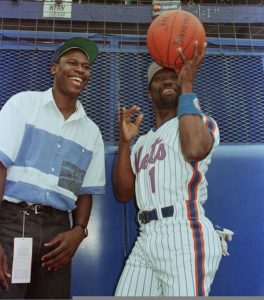 Can you ever have too many Mookies? Funny timing, says Mookie? The L.A. Times article appeared on February 11, 2020, five days after I met the Mets fan who a) would soon be spending a decent amount of time himself speaking with Mookie Wilson and b) when asked if he has a particular favorite Metsian pop culture moment, replied, “I love that Spike Lee’s character was named Mookie.”
Timing says the Mookie who delivered pizza in Bed-Stuy while wearing Jackie Robinson’s 42 and called out hypocrisy when it stared him in the face in the summer of 1989 was not only trying to do the right thing, but he was in the right place at the right time. Mookie Wilson was in his tenth and final season as a New York Met. The New York Mets were in their sixth of seven seasons as a National League East powerhouse. The Mets of the era were a totem Spike latched onto while making or promoting movies during this period — TV appearances, trailers, dialogue or background in at least three features. Meanwhile, the nearby New Jersey Nets had just drafted, in June of ’89, Mookie Blaylock, pretty much the second (or third, depending on when you went to see the movie if you were a moviegoer) Mookie most folks had heard of. Wilson would be traded to Toronto by August and propel the Blue Jays to the playoffs, making Mookie an icon in two nations, but he’d retire from baseball in 1991 and inevitably fade a bit from the collective consciousness outside of Flushing.
Our Mookie was no longer the Mookie who leapt universally to mind when you mentioned a Mookie as the 1990s rolled on and the 21st century was born. He was for us, of course, but Blaylock would have his day in the sun as a 13-year NBA guard (and brief moniker for Pearl Jam before Pearl Jam was Pearl Jam); Lee’s film with its lead character maintained enormous cultural staying power; and then, in 2014, came All-Star-to-be Mookie Betts, and all wagers were off as to whom a later generation would point as the Mookie of record. When he was a Red Sox rookie, the newest Mookie — Markus by birth — explained his parents started calling him by that nickname from watching the Mookie who played basketball, not baseball.
But the guy I met in person on February 6, 2020, a New York-bred movie director in his own right, has done his best to keep the original Mookie atop the Mookie marquee — even if William Hayward Wilson wasn’t necessarily the lead character in his screen gem.
Nick Davis is the auteur behind Once Upon A Time in Queens, the four-part film documenting the ascent and ascendancy of the 1986 New York Mets, how they rose from the ashes of the lowest point in franchise history nine years prior to reach the heights of the baseball world for a moment that both ended too soon and lasts to this day. Soaring in approximate tandem with the ballclub was the city it represented. When we met New York at the outset of Davis’s story as it aired on ESPN as part of the 30 for 30 series in September, it was still smoldering from the great blackout of the night before, July 13, 1977, a Wednesday that clocked in exactly four weeks after June 15, 1977, the aforementioned franchise low point for the Mets.
New York was in rough shape that summer. The Mets’ shape was rougher. Tom Seaver was traded. Dave Kingman was traded. Last place was held on a long-term lease. And rooting for the Mets, despite M. Donald Grant doing the wrong thing, were kids like Nick Davis in Manhattan and me on Long Island. We didn’t know each other then, but we might as well have been each other. Every Mets fan of a certain age in the late 1970s was, when it came to the object of our baseball affections, determined to do the unpopular thing. We were all one. We were all alone. We couldn’t imagine there were any longer many of us constituting us.
We’d rooted for the Mets before Seaver was traded. We’d keep rooting for the Mets after Seaver was traded. We’d hope for the best. The hoping was laced with waiting, because there was a ton of waiting to be done. The Mets were down and were not getting up in 1977. Or 1978. Or 1979. A glint of light shone through in 1980 — the franchise was sold, a Magical slogan fleetingly resonated — but prone remained the default position for the Mets. As it did in 1981. And 1982. And well into 1983. Every one of those years lasted no more than 366 days and every one of its baseball seasons no more than 163 games (I’m a stickler for counting ties), but if you were Nick or me or perhaps you, every minute when the Mets were dismal and we were sure there were hardly any other Mets fans besides our hardy handful, lasted an eternity.
Then eternity turned around. You say “1983” differently from the years that immediately preceded it, last place or not. Then you say “1984” and “1985” and it’s an entirely new ballgame. Which gets us to 1986 and the rest of the story Nick had in his bones and was ready to cinematically spill by 2020.
Which is what got Nick and me together face-to-face for the first time that February. We had been in touch via e-mail and phone in the months prior as Nick, a faithful FAFIF reader for a few years to that point, let me in on this project he was working on about the 1986 Mets and asked if I would I like to be, in Ken Burns’ The Civil War terms, his documentary’s Shelby Foote, its voice of historical perspective.
He had me at “1986”.
I never watched The Civil War, but got what Nick meant. The difference between the epic battle for the American soul and the Mets marching through the National League East, it would occur to me later, was Burns couldn’t interview the principals who were around from 1861 to 1865. Davis would have access to plenty of alive & well veterans of the Mets of the 1980s, no matter how astounding it is that so many of them had survived to 2020 despite putting their minds and bodies through the wringer way back when. But there was a role for me, nonetheless. I was the guy who — with no cameras rolling — paced around his living room late at night when not sleepy and talked to myself about the Mets, usually while a cat ignored me. Not just about the 1986 Mets, but surely a lot about those halcyon days. They represent the Mets’ most recent world championship, you might have heard.
I’m also the guy who, unlike so many real-life characters testifying in Once Upon a Time in Queens, went back to my room, so to speak, after the final out. The 1980s in New York on display in Nick’s movie was one I knew about from a distance of an hour by train and 180 degrees by inclination. Maybe I’d go out for a couple of beers with my friends on a Saturday night, but not until Jesse or Roger nailed down the latest win (if, in fact, somebody didn’t pitch a complete game). That was about it for my nightlife. My priorities in 1986 were pretty much the priorities that would remain my priorities. My memory of the Mets leading up to and all throughout 1986 was intact. The recollections I relished recalling to myself remained accurate and vivid. Nick, sensing this was who I was and what I remembered, invited me to sit in front of a camera in somebody else’s living room that was doubling as a documentary set.
I was asked to keep my involvement quiet because the project had not yet been officially, officially been signed off on by its eventual network partner. After I spent what turned into a very long day in that other living room, somewhere in Crown Heights, I dutifully bit my tongue. The pandemic would fully hit a month later, so the interview between Nick and me lingered as The Last Fun Thing I Did outside the house for quite a while, yet could tell nobody about. Once it was announced as set to air on ESPN and had been given its name, I was delighted to mention to others that it would be on but felt reluctant to make too much of a personal to-do about my being included. Pop Culture Week here is my excuse to more than whisper about it.
Nick’s framing device notwithstanding, I wasn’t Shelby Foote. And I wasn’t Mookie Wilson or any of the actual 1986 Mets who were going to make this thing fun for everybody who watched it. I’d be me, though, and that would have a purpose. I’d be what Nick called “foundational,” the head talking with first-person plural affinity for the subject — we/us/our are my Met pronouns — but with the remove of someone who understood he was not a player, but a fan. Fan with benefits, you might say, activating my fan superpower of delineating between what a moment felt like one veritable minute before the moment changed. I’ve watched a lot of Mets, I’ve read a lot of Mets, I’ve written a lot of Mets and I remember a lot of Mets. If that adds up to a hint of authority judged valuable enough to contribute a little foundation to what would become the definitive retrospective on the most spectacular team in New York Mets history, ask away. I’ll give you what I’ve got in complete sentences. I won’t pretend to know what I don’t.
When I arrived at the house in Brooklyn where the filming would commence, I assumed I was the eleven o’clock appointment, with other Shelby Footes, or perhaps Shelby Feete, slated for 1:30 and 4:00. There was a large crew and loads of equipment. I’d done other talking-head shoots over the years, but never with this much heft to it. They were set up for one interview, however. Just me. I was also the first project-dedicated interview they had scheduled overall (though Nick had the foresight to grab the opportunity to record a 1986-themed chat with a fellow named Roger Angell a couple of summers before). I think I was sort of the guinea pig for how they planned pre-pandemic to go about approaching other sessions.
 Two people talked. A lot of people preserved it. The day boiled down to two people talking and a lot of people preserving it. Camera person. Light person. Sound person. Persons of job titles I couldn’t tell you, but everybody who had taken over this handsome house in Crown Heights was a stone pro at what they did. They put such care into the shooting. The windows were covered so thoroughly that there was less light coming into our set than there was Shea Stadium before de Roulet sold to Doubleday. If a car rumbled down the street, “cut!” might be ordered. And this was all so Nick could ask me to talk about what it was like when Darryl Strawberry was called up to the majors.
It was an exhausting late morning, afternoon and early evening, but exhausting in the extra-inning doubleheader-sweep sense. You want to be exhausted by something like that. Without even knowing COVID was about to wreak havoc, I couldn’t have asked for a more fun Last Fun Thing. It was work for the crew. It was work for Nick (during our lunch break he learned George Foster was declining a chance to participate). It was a blast for me. Somebody who truly cared was asking me to meander through Mets history, a little in 1962 and 1969; then to dig into the dark times without fear; and then, as my reward for reliving our state of Seaverlessness, to come out of the tunnel on Field Level, with Darryl and Keith and Doc and Kid waiting to greet me on the other side.
To get from where kids like Nick and me sat, nursing our Wednesday Night Massacre wounds from June 15, 1977, to the top of the mountain on October 27, 1986 (and the crush of parade humanity I threw myself into downtown the next day) was what being a Mets fan was all about in the time span covered by Once Upon a Time in Queens. Someday it would stop hurting so much. Someday it would stop sucking so much. Someday we wouldn’t be practically the only Mets fans we knew. Someday we’d have the best young player in the game and the best pitcher of any age in the game plus a couple of superstars we used to root against because they were always beating us when they were a Cardinal and an Expo, but somehow they’d become ours. Hell yes, I’m down to talk about those Mets days all day in somebody else’s living room. I’d do it with almost anybody. But I couldn’t have asked for a better Mets fan to do it with than Nick Davis.
Nick and his editors took my interview and a few dozen other interviews — whose logistics might have been hampered by COVID, but the impact of their content went unharmed — and a torrent of period footage and game footage and created four incandescent hours. His original cut clocked in closer to seven. I would have watched that many, but the four minus commercials that made it to air take care of their business beautifully.
There’s New York after the blackout. There’s Sergio Ferrer not reaching base. There’s Nelson Doubleday and Frank Cashen coming into our lives. There’s Keith Hernandez going deep and personal. There’s the throbbing nightlife in which Mets would indulge but to which they would not (yet) succumb. There are National League opponents who would succumb to the Mets. There’s Lenny Dykstra worming his way back into our hearts. There’s two people I know who sent in their own “here’s where I was” stories from Game Six — the second Game Six — when Nick put out an APB for fan anecdotes. There’s Kevin Mitchell crooning. There are snippets from local news and other evidence of how we consumed the ’70s and ’80s. (One of my kibbitzing suggestions — a clip I recalled of Johnny Carson poking fun at Dodger World Series goat Bill Buckner in 1974 — wound up just missing the final cut, much as John Gibbons would be the last player removed from the postseason roster a dozen years later.)
All of this was for the Mets. All of this was for us. The 1986 Mets earned themselves and us this treatment. Nick and I wouldn’t have guessed it was possible in 1977 and 1978 and so on that a Mets team could or would. Nick, like me, savors Mets pop culture sightings. He treasures, as he did as a kid, any evidence that the Mets exist anywhere outside the basement of the NL East. “It always makes me very happy and feel very seen when the Mets enter pop culture, because there was this period when we were so bad,” he told me when we last spoke, right before Thanksgiving, “Those years, coming of age as a fan between the Seaver trade and 1983, it was just so bleak, and any time at all that they entered the national conversation, it was just thrilling. You were just clinging to these things where they’d get to be on Monday Night Baseball or Mazzilli would hit a home run in the All-Star Game, it was like, ‘Oh my god!’ [and] ‘Hey, we’re in the major leagues, too!’”
Then Nick allowed himself a 42-year-old gripe that “of course they’re not gonna give him the MVP because somebody made a good throw from right field,” because Nick, like me, was a Mets fan in 1979 and that inner Mets fan from 1979 is always going to be a little bit bitter about Dave Parker being voted hardware that could have just as easily gone to Lee Mazzilli.
I theorized to Nick that being from New York probably makes us a touch myopic in our thinking that our two world championships are absolutely among the two biggest World Series achievements in baseball history. Well, he replied in so many words, it is New York, no doubt gaining him fans in the so-called heartland. I asked him if he thought he could make the same sort of film if ESPN or MLB came to him and proposed that Minneapolis in 1987, especially but not only the Twins, really symbolized something enormous about their moment. They, after all, won a World Series some 35 years ago, just like the Mets (then, unlike the Mets, won a second a few years later). Nick played along — Prince, Paisley Park and the Minneapolis sound were certainly influential, he reasoned — but maybe “Kent Hrbek, for all his wondrous qualities,” wouldn’t resonate for multiple hours for a national audience as a testament to his times.
I might not be as invested in it if I weren’t in it, but I believe that no matter my involvement, Once Upon a Time in Queens emerged on ESPN not only as compelling and entertaining but as Met canon. It’s going to be embroidered into the telling of our larger story the way Can’t Anybody Here Play This Game? and The Bad Guys Won and The Worst Team Money Can Buy are. Hell, it could be up there with Kiner’s Korner. There’ve been other programs and films that have examined 1986, enough that the reflex reaction to this one might have been, “what, another?” but this one is the one you put in the time capsule for all time, right alongside your VHS copy of the presciently titled A Year to Remember. The way we saw the 1986 Mets in Once Upon a Time in Queens will define how we remember that year — especially for Mets fans who weren’t lucky enough to experience the 1986 Mets first-hand.
The first time I saw Nick in person after our day on the set in Brooklyn was September 3, 2021, at Citi Field, the evening he publicly screened the first two hours of the movie. The first thing he asked me with no cameras recording us was whether I thought we still had a chance to win the division. Yeah, we were still essentially the same person. Mookie Wilson was also there, joining Nick and Bobby Ojeda in a little pre-movie Q&A conducted by Colin Cosell. This was a movie Mookie didn’t mind going to see. He and Bobby O, much the way their 1969 world champion predecessors do, confirmed that Mets fans never get tired of bringing up their exploits to them. It’s fair to say they don’t mind the attention. Mookie, however, implored us to not live in the past — except when it came to remembering him, in which case, he was OK with it.
As were we in the crowd once CitiVision lit up with parts one and two and when we tuned in a couple of weeks later to take in the entire production on ESPN. My god, Nick and his crew captured those Mets and those times. At first, I looked for myself on the screen. Then I basically forgot I was in it because I was too caught up in the story and the sound (Tears for Fears was never put to better use). I’ll take the word of the likes of Tama Janowitz and Chuck D for what New York c. 1986 was like after dark, away from Shea. I worked in the city then, but took the LIRR home by sunset. If it was baseball season, I wanted to get myself in front of a television by 7:35. Kurt Andersen was capable of putting the raised financial stakes of the Go-Go Eighties in context without my two cents, which is roughly what I had relative to the “Greed is Good” goons down on Wall Street. The only place I aspired to go-go was to an occasional game.
The reach of Once Upon a Time in Queens was staggering in that my sister watched the whole thing, and not just because her brother was in it. After the first installment, she wanted to tell me what a thrill it was to see me on television. After the fourth, she demanded to know why the Mets would ever trade Kevin Mitchell. She wasn’t asking me such questions in 1986.
Talk about feeling seen. I heard from my doctor, who is not a baseball fan; he saw me in a commercial and bragged on it to his other Mets fan patients (uh, confidentiality?). I heard from my mechanic, who is not a Mets fan, but he takes good care of my ancient car, so I’m respectful of Gerrit Cole when we’re not talking brake lines. I heard from a guy who was one of the few determined souls I knew in high school who stuck with the Mets. I’m pretty certain we hadn’t spoken since 1986. He saw me in this. I was grateful to connect again. I was grateful to all who said they enjoyed seeing or hearing me in it. I’m glad, quite frankly, that I never ran across any criticism of a “who the bleep is Greg Prince and why is he on there instead of so-and-so?” nature.
When I caught up with Nick in late November to ask him how it all felt now that it was done and so many had seen the result of all the work he put in, he reminded me I was on his get-list all along. He couldn’t get every player he wanted, but he had no problem getting me. When I asked, ostensibly on behalf of my curious sister, why the background for my segments was so dark that the bookshelves in the background weren’t visible (I wondered if my lack of telegenicism had to be compensated for, or if a network suit urged my face be obscured as much as possible), he explained the choice: “This man has the weight of Mets history behind him.” I’ll buy that.
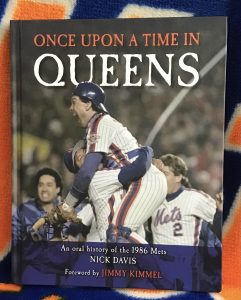 Oral history like it oughta be. I also bought the highly worthwhile companion volume to Once Upon a Time in Queens, an oral history version of the same time period with much the same cast as the documentary. Leafing through it, it hit me just how amazing it is that I somehow slipped into what stands as the definitive retelling of 1986. Being on TV was indeed a fun thing. Print is where I live. On page 79 of the book, there is a string of remembrances that are from, in capital letters, BOBBY OJEDA, WALLY BACKMAN, DWIGHT GOODEN, GREG PRINCE and DARRYL STRAWBERRY, as if Bobby, Wally Doc, Darryl and I always hung out together.
I blush just thinking about it.
by Greg Prince on 24 December 2021 2:51 pm In Bicentennial Detroit, when Mark Fidrych was in full flight, The Bird was the word. On TV in the 1950s, a duck delivered the $100 prize to contestants on You Bet Your Life who used Groucho Marx’s secret word. Frankie Valli ruffled few feathers when he informed us repeatedly in the summer of ’78 that “Grease” was the word.
For us lately, –ward has been the word. Not ward as in “the Mets have so many guys on the injured list they must have their own hospital ward,” but –ward as in the homophonic suffix that attaches itself to other words or word parts to form new words that indicate a direction something or someone is taking. Where something or someone is going is good information to have, particularly if we’re contemplating something or someone we care about.
Other than streaming to the IL, where the Mets were going was a question that demanded asking even if it elicited no lasting answer. This is why, as 2021 reaches its final week, Faith and Fear in Flushing chooses Trajectories as our Nikon Camera Mets Player of the Year, an award presented annually to the entity or concept that best symbolizes, illustrates or transcends the year in Metsdom. Where the Mets were going was of paramount interest to us who root for the Mets, yet elusive in terms of pinning down.
Or did we just not like the answers the duck dropped off? Let’s revisit some of the –wards where the Mets went in ’21 and try to figure this out.
UPWARD
It’s understood that the Mets ascended through the National League East standings fairly early in 2021, climbed into first place, and maintained their grip on the top for quite a while. Having spent 103 days in first place only to finish with a losing record — most ever for that distinction — became their calling card, much as the 1984 Mets are remembered for being in first place until the Cubs blew by them or the 2007 Mets are remembered for being in first place until they themselves plummeted with neither pause nor grace. Neither ending was optimal, but if you clear your head, you can recall the exhilaration of ’84 and, even if there was a lingering sense of discomfort all summer, the satisfying divisional hegemony of ’07. It was our year, we were pretty certain, until it wasn’t.
Was this one? “If you’re going to be in first place for a hundred days,” Steve Cohen said in November when asked about what he learned in his first year as owner, “try and do it at the end of the season and not the middle.” Nevertheless, most years with significant days logged in first place will leave an impression of how much fun it was until it wasn’t. If you remember the momentum the 2021 Mets projected or how we as their rabid supporters fed off their energy, you’re a better fan than I am, Gunga Din. I can look up on Retrosheet when we took first without letting go of it (May 8) and check our archives to see what I thought of their status (I called them “stealthy”), but less than eight months after it happened, I don’t have a strong recall of what it was like to stand back and say, “Wow, the Mets are in first place!”
I did it in 1984. I did it in 2007. I did it in the years the Mets actually completed the job of being in first place. I’ve done it almost any year by the second week of a season when the Mets led their division. But in 2021, the trip north from meandering beneath .500 in late April and early May to surging past their competition and then consistently fending them off was…oh, what’s that very complex term analysts use?
Meh. Yeah, that’s it. It was meh.
Despite preseason predictions that several enormous bundles of talent were going to battle it out at a high level, the whole division had revealed itself rather quickly to be rather middling. The Mets were the best of the so-so lot. It was better than not being better than Atlanta, Philadelphia, Washington and Miami, but I don’t think it was capable of captivating us.
How many teams that stay in first place for multiple months without pause leave you waiting for them to finally get on a hot streak? The Mets, at their 2021 best, were perpetually lukewarm.
I’ll also allow for the possibility that I’m getting old and whatever that implies. Maybe I’m incapable of remembering every step in a season the way I used to. Maybe, after you’ve been around nearly six decades and living with your team more than five, things don’t pop the way they used to. I used to listen to Ralph Kiner tell the same stories about Casey Stengel in sparkling detail, yet, by his own admission, not remember what he had for breakfast that morning.
In February 1984, there was a spate of 20th-anniversary stories commemorating the Beatles’ arrival in America. Can it really be 20 years since 1964? One of the stations I listened to at the time, while I was in college in Tampa, featured an interview with Louise Harrison, George’s sister. She was local, living in Sarasota. Louise and the host marveled at what a time it had been two decades earlier, how it all seemed so vibrant, how it all stayed with them, not like today. Louise invoked 1978, which at the time was only six years ago, and asked rhetorically, who even remembers 1978?
“I do,” I replied in my head. I remembered Frankie Valli defining Grease as the word, and a thousand things besides. I was 15 years old in 1978. I suspected in 1984 that my youth was being memory-holed by my elders. I didn’t know how old Louise Harrison or the DJ on The Wave 102.5 were as they spoke, but it hit me that at some point this is what happens with everybody. There’s the stuff that stays with you, then the stuff that doesn’t stick quite as much, then less and less. I mean the Beatles were the Beatles, but if you were 15 in the summer of ’78, whatever was big then will have groove, will have meaning six or more years later.
Maybe baseball (and everything) gets like that for all of us. The Beatles can only come to America once. The Grease soundtrack can only dominate the airwaves once. The thrill of the Mets commandeering first place can only resonate with profound resonance so many times. After a certain point in a person’s life, maybe everything else just becomes noise.
But I don’t really think that’s the case here, for me at any rate. Give me what’s memorable and I pledge to remember it. I still have my AccuWeather certification when it comes to tracking the microclimates of a season. Honestly, that’s my Mets fan superpower. I can tell you, for example, what it felt like the dizzying July weekend the Mets blew an enormous lead in Pittsburgh on Saturday night; overcame an enormous deficit the next afternoon; then both allowed and scored tons of runs in Cincinnati the night after that. I can gripe with specificity about ice cold early August and tumbling off a cliff in Philadelphia. I can dwell for effect in the barren September faceoffs against St. Louis (0-3), Boston (0-2) and Milwaukee (0-3), each miserable series emblematic of how the Mets performed against playoff-bound teams as it became apparent they wouldn’t be one of them (5-22 down what passed for the stretch).
What I don’t remember so vividly is the part before the All-Star break when the Mets got on a roll and we rolled with them and everybody was smiling, laughing and bumping virtual fists over our wonderful first-place team. Probably because, Bench Mob heroics notwithstanding, it wasn’t much like that.
But they were in first place for a while. So there ya go.
WAYWARD
Diesel Donnie Stevenson. Rat or raccoon or a double play combo not exactly meshing. “Just smile and know that we got this.” Tweeting highlights of oneself in the minutes after a loss, having it noticed and then rather predictably crying poo-poo take at the reporter who dared mention the juxtaposition of personal celebration and collective defeat. Thumbs down.
To invoke another –ward, Awkward!
If we didn’t already love the Mets as an entity/concept, these Mets would have made themselves hard to love. They did, actually. Hard to watch as they slid under .500 and hard to take as they, at various intervals, couldn’t handle not just their opponents, but their teammates, their chroniclers, their coaches, their loyalists and their reality. The lingering sweetness of 2019’s stirring if ultimately doomed Wild Card lunge — when the Mets were the team that I swore loved us back — dissipated by the end of 2021. Their best players (among those who were on hand, thus excusing Jacob deGrom) could be the toughest to take. I came to really dig the way Javy Baez played but questioned my self-esteem for doing so, which perhaps calls for looking inward. I really wanted to want Marcus Stroman back, but was not feeling jilted when he left. I went from adoring everything about Pete Alonso toward consciously separating his shtick from his bat. I’m not quite sure what to make of Francisco Lindor other than knowing he’ll be making whatever he makes here for quite a while. I’m not terribly invested in erstwhile All-Star Jeff McNeil being here or gone.
Bubble was a word Gary Cohen mentioned when the most telling if correspondingly goofy of the contretemps, the players booing their fans with their thumbs, flared. These guys, the announcer discerned, had been physically separated from those who covered them and had taken on a harsh us-against-the-world mentality that wasn’t playing well when they weren’t. Accountability was a word I read quite a bit after the season ended, and not because the Mets led the league in it.
WESTWARD
The Mets played the San Francisco Giants and the Los Angeles Dodgers thirteen consecutive games in August. They won two and lost eleven. Many of the contests were close, but the difference between the elite of the National League West and the standard-bearers of National League East mediocrity couldn’t have been more stark. In “The Stranger” Billy Joel advised, “Don’t be afraid to try again, everyone goes south, every now and then.” The Mets won their season series against Miami and more or less held their own versus Atlanta. Going south in the literal sense was a better idea than getting involved with the West.
ONWARD
Even as the season oozed away what modicum of zazz it contained, damned if we weren’t still a part of it all. Fans stay. Some of my fellow fans relish telling me in an almost boastful fashion once campaigns are all but mathematically lost how they’ve “checked out,” yet they keep coming by to confirm that they don’t care. There’s probably a little more caring going on there than meets the ear.
I’m a chronic carer. I cared about the Mets in September. I cared that they still sort of, kind of had a shot entering the final month. I cared that if they could just do this, that and the other thing, and a half-dozen clubs cooperated on a nightly basis by not doing this, that and the other thing…no, they weren’t going to make a run let alone run through the tape and into Dodger Stadium to roll the Wild Card dice…but I couldn’t be absolutely sure they wouldn’t. So I kept caring and kept watching, and even when mathematics took over, I kept caring and kept watching.
What the hell else was I going to do — not care and not watch?
FORWARD
In 2015, the most successful year the FAFIF Awards Committee has ever had to consider for Nikon purposes, we warned against getting too hung up on precedent. Similarities can be noteworthy, but the distant past isn’t retroactively predictive of the future. Which isn’t to say noting noteworthiness can’t be fun — or eerie. With that grain of salt poured, consider that, in retrospect, Mets years that end in “1” seem to take place because they have to. Mets years that end in “2” are then constructed in immediate response to obliterate what we just saw in Mets years that end in “1”. The Men in Black would appreciate how efficiently the Mets attempt go about it.
Every season that has ended in a “1” has been a major disappointment. The Mets dropped out of contention in 1971 after logging time in first place with much the same team that had won the World Series two Octobers earlier. Nascent signs of life were doused by a severe lack of talent in 1981. The imperial phase of Mets baseball abdicated for good in 1991. Defending league champions in 2001 spent nearly five months indulging in pacifism. In 2011, the Mets showed up just long enough to disappear. The collective reactions of the franchise that let us down on the 1s was to cut loose by one method or another Nolan Ryan, Lee Mazzilli, Gregg Jefferies, Robin Ventura and Jose Reyes, to name a handful of Mets who were sacrificed on the altar of erasing our memories of very recent sour times. Here came Jim Fregosi, George Foster, Bobby Bonilla, Roberto Alomar and Frank Francisco with the ambition of raising expectations. Managers would change. General managers would change. Records tended to stay static. At least when we turned the calendar from 1961 to 1962, we eventually picked up 40 wins.
The reboot has come around again. Goodbye manager Luis Rojas, every coach but Jeremy Hefner, acting general manager Zack Scott, 2021 stalwarts Stroman and Baez, MVM Aaron Loup, old friend (who was totally stoked to return until he wasn’t) Noah Syndergaard and — probably for certain once the lockout is lifted — erstwhile 2015 pennant-winners Michael Conforto and Jeurys Familia via free agency plus 2016 playoff-push godsend Robert Gsellman, non-tendered just before the Hot Stove gate slammed shut. Goodbye to a whole lot of the 77-85 Mets of the year past. We used 64 players last year. Fitting them all into another team picture would require a lens too wide.
The year that ended with a “1” and a thud is history from a baseball sense. The year that will end with a “2” is antsy to shove it aside. New players like Mark Canha, Eduardo Escobar, Starling Marte and Max Scherzer, the latter with, among other distinctions, a Tigers pitching ledger more astounding than even that of Mark “The Bird” Fidrych. A professional general manager in Billy Eppler. And a manager, Buck Showalter, who’s been around the block a few times and seems raring to take Seaver Way by storm. Showalter met the media anew a few days ago via Zoom. He held up a Mets jersey, donned a Mets cap and talked Mets like he’ll be watching everything and caring more than we do. He used phrases like “magic sprinkle dust” (he doesn’t have any) “spongeable” (he soaks up information) and “connectivity”. Buck will seek to connect all the assets of the organization and create a winner. We, despite the desire for a fresh start, will connect what we see to what we’ve seen.
We long to see something spectacular, something we will remember without remorse, something that will continue to catapult us forward rather than having us trudge along through our own intense personal histories with this team. It looks promising. Years ending in a “2” always do before they start. One of these years ending in a “2” is bound to follow through and deliver.
FAITH AND FEAR’S PREVIOUS NIKON CAMERA METS PLAYERS OF THE YEAR
1980: The Magic*
2005: The WFAN broadcast team of Gary Cohen and Howie Rose
2006: Shea Stadium
2007: Uncertainty
2008: The 162-Game Schedule
2009: Two Hands
2010: Realization
2011: Commitment
2012: No-Hitter Nomenclature
2013: Harvey Days
2014: The Dudafly Effect
2015: Precedent — Or The Lack Thereof
2016: The Home Run
2017: The Disabled List
2018: The Last Days of David Wright
2019: Our Kids
2020: Distance (Nikon Mini)
*Manufacturers Hanover Trust Player of the Year
by Greg Prince on 20 December 2021 4:12 pm  Avery the Cat, not acting as if he’s doing the author any favors. Avery the Cat, who said goodbye to Stephanie and me on Saturday night after more than 16 years of lighting up a room in ways Fred Wilpon and Art Howe could only imagine, hung in there long enough to learn the identity of the new Mets manager. Steve Cohen tweeted that Buck Showalter was his choice. I looked over to Avery after relaying the news. Avery seemed comfortable with Buck. You might even say Avery got to see Showalter manage the same number of games he saw Carlos Beltran manage.
Avery, the fourth of our cats overall but the first of our cats to choreograph an offseason departure, showed up at the Prince abode on a Friday night in September of 2005. Pedro Martinez was pitching for the Mets and shutting out the Braves while Avery acclimated himself to his new surroundings. Pedro needed two hours and four minutes to dispose of our rivals. Avery needed about two hours and three minutes less than that to feel at home with us. When we adopted Avery’s future brother Hozzie three years prior, we followed expert advice and quarantined Hozzie for about a week-and-a-half before intermingling him with reigning Prince cat Bernie. It was sound advice and it worked for Hozzie.
It wasn’t the script to follow for Avery. Avery would not be contained to one room for ten whole days or, really, ten whole minutes. We gave up on the futile quarantining by Saturday afternoon. Released from kitten purgatory, Avery bounded into the living room and commenced taking up residence. He lived rent-free in Hozzie’s head. And anywhere else he damn well pleased.
The arrangement was ideal for everybody. Even Hozzie got on board with having a little brother. They formed a cordial working relationship in 2005 and maintained it until Hozzie’s farewell in 2017. When we were down to one cat previously, as happened when Casey left us in 2002 and Bernie said au revoir in ’05, our instinct was to begin the process of pairing up anew. Our first pair of cats could never be replaced, but, we reasoned, they could be succeeded. We didn’t do that post-Hozzie. Stephanie and I agreed Avery preferred life as a solo act, the total focus of our feline-directed attention. He wasn’t looking to add “welcome a new kitten into my sphere” to his portfolio of eating, sleeping and running around like a kitten himself. We knew that not having a spare on hand might come back to haunt us — and maybe it has (“solo act” is almost an anagram for “cat loss”) — but from July of ’17 to Saturday night, it was the right call. We were cat people, singular.
Now we are catless people. Avery’s still here in every sense but the physical. You don’t stop having Avery with you just because you stop having Avery with you. I sense his presence everywhere. I imagine that will wear off somewhat, but not for a while. Avery stayed close to Stephanie and stayed close to me and stayed close to us. He was better at proximity — laps, chests, heads, rides on my right shoulder like I was the driver from Kitty Uber — than any cat we’ve experienced. He was as interactive as he was wired. He never acted like he was doing us a favor, either, for Avery the Cat didn’t do us any favors intentionally. He just happened to be warm for our respective forms and if we happened to like that he liked us, good for us.
Great for us, actually.
In baseball terms, Avery was Hank Aaron. Bernie, you see, was Babe Ruth (forgive me for invoking Pinstripe mythology here). Bernie, Stephanie’s and my first cat together, actively roamed our hearts for nearly 13 years, set what seemed like unbreakable records and changed the game completely. Before I met Bernie on Halloween 1992, I didn’t realize I was a cat person. For his deeds, of which we still speak in awe today, Bernie earned the nickname The World’s Greatest Cat.
Then comes Avery to succeed (not replace) Bernie, and Avery, quite frankly, surpasses the records set by Bernie. He was, after a while, clearly the No. 1-ranked cat in the world. Our world, anyway. He put up bigger numbers than the Babe. He’s Hank Aaron, in other words. What was it Hank Aaron said about trying to withstand the pressure of chasing and bettering the all-time career home run mark?
“I don’t want people to forget Babe Ruth. I just want them to remember Henry Aaron.”
Needless to say, we remember all our cats fondly and thoroughly. And we’ve loved all of them equally. But, per George Orwell, some animals are more equal than others. Avery earned that top ranking of his. No cat was smarter, whether he realized it or not. No cat was more fun, whether he meant to be or not. No cat was better equipped for having his people shelter in place during a pandemic. Avery might not have gone for quarantining when he was a kitten, but he was delighted to discover Stephanie and me planting ourselves on the couch, presumably for his playing pleasure, in the spring of 2020. Presence made everybody’s hearts grow exponentially fonder.
I’m a cat half-full person. I don’t notice the effects of cats getting on in years. I don’t notice when a cat’s shape isn’t quite what it was. I didn’t notice Avery losing weight at a precipitous rate as 2021 progressed. Stephanie would point it out to me with a raised eyebrow. I’d point out Avery was just on my shoulder this morning…and on my shoulder again twenty minutes after that for another ride. He had his medical conditions, but we were treating them. He’d outlasted all his predecessors. Let’s not question his longevity.
In late November, we took him to the vet for a checkup. The weight loss I’d looked past…the litter box-related discomfort I’d looked past…this thing the doctor was feeling that was probably something…there was no looking past all of it. Winter had arrived. Without much drama, we were told Avery was on the clock. Maybe he’d be around long enough to learn the identity of the next manager. Spring Training was listed as doubtful.
Last week it became apparent Avery’s ninth inning was underway. By Saturday morning, I was insistent that he was still fouling off pitches, stepping out of the box (so to speak), adjusting his wristbands, looking to the third base coach — delaying the game. I wanted it to go on a little longer, but that was probably me being selfish. Avery had given us all he had to give over the 16 years and three months since entering our home and hearts as a kitten with a Kitler mustache that I must admit I found offputting, but he grew out of it soon enough. I just wanted him to last the weekend, not to soak in the news of Buck Showalter, but to extremely reluctantly get him to the vet when the vet was open and the vet could do that “make him comfortable” euphemism for euthanasia — because, I swear, I thought Avery had a couple of more days in him. We could’ve made that trip Saturday morning, but he seemed to me in relatively decent shape Saturday morning. He was drinking water. He was visiting with us a little. Cat half-full. I’m not taking Avery out of the game before he’s ready to go.
Avery’s final swing came Saturday night, shortly before nine o’clock. He wandered around the house in strange ways. He sought refuge in a closet where Hozzie regularly hid but Avery almost never frequented. He prodded himself upstairs, which was usually too much of a schlep for him in recent weeks. He was being a cat, and cats nearing their end go off by themselves. They do that in the wild to elude predators, Stephanie reminded me…and they do that in a duplex where he was vulnerable only to our petting and stroking and telling him, in so many words, that he was our Hank Aaron.
He settled in under the dining room table, just off the kitchen. That had become one of his two spots of choice of late. There was a blanket on a recliner that became his and there was under the table, which he cultivated as his de facto office after Stephanie had taken to using the table for doing her job from home. Day after day, she’d be on her laptop, he’d be at her feet. When she’d shut down her workplace, he’d follow her to the couch and drape atop her lap. Or my chest, if it, too, was nearby. We were a full-service Avery buffet.
Saturday night, it was the table. His people gathered around him — two fiftysomethings sitting cross-legged on the floor like kids — each of us trying to soothe him, each of us failing miserably. Blessedly, there weren’t too many minutes of this, though it lasted too long for comfort. We had SiriusXM ’70s on 7 on in the background. I wondered what song what would be playing when the inevitable occurred, what song I’d hence never be able to hear again without associating it with Avery. Though it wasn’t the last number we’d hear with him, the one that has now become Avery the Cat’s song was delivered to us by Diana Ross: “Touch Me in the Morning”. Avery touched us in all dayparts. We never walked away.
After the final pitch — Pedro Martinez to Buck Showalter via Hank Aaron, if you will — well, we still had Avery in our midst, and no matter what was playing on our favorite satellite radio station, he wasn’t what you’d call the life of the party. That would be a bit of an issue on a Saturday night when your friendly local vet, who’s equipped to handle such details, is closed until Monday morning. Stephanie ferreted out some Hefty bags from under the sink and brought our handy Coleman cooler out of storage, I ran to the Superfresh for a couple of bags of ice, and…let’s just say Avery was one cool cat.
This morning, we brought him to the vet, where they handled the last detail. Maybe Buck Showalter would be proud to know we were detail-oriented. Or perhaps he’d fine us for not having prepared for every last eventuality. I can assure Buck that in our minds, we did. But you never want the game to be called until you’re absolutely certain your Hall of Famer can’t play any longer.
by Greg Prince on 18 December 2021 5:06 pm Buck Showalter and the other, now irrelevant candidates for the Mets’ managerial opening were reportedly summoned to Steve Cohen’s home in Connecticut for their respective face-to-face interviews. They probably didn’t travel in quite the style that Casey Stengel did when he was accepting the keys to the Polo Grounds dugout sixty years ago. “We arrived in New York,” Edna Stengel recalled in Joe Durso’s biography Casey, “and were driven from the airport in a Rolls Royce. Casey wondered about it, so I said to him, ‘You’re returning to baseball in New York, Casey. We might as well go first-class.”
Of course Casey already had the job. He was the only candidate. New Mets president George Weiss, his partner in dynastic crime in the Bronx, had the call and he planned to make only one. “It was the fifth time in nearly 50 years that Stengel had marched on New York,” Durso reflected in a book published shortly after Casey’s retirement. “In 1912, eagerly, to join the Dodgers; in 1921, jubilantly, to become a Giant; in 1932; gratefully, to coach the Dodgers; in 1948, solemnly, to take over the Yankees, and now in October 1961, apprehensively, to direct the Mets.”
Five times back in town. Other than Billy Martin, that’s not something many a New York baseball man can say. Showalter is back for only a second time, although he does have one leg up on his original Mets predecessor. Casey Stengel, as you may have inferred if you weren’t already aware, had been around forever. When Casey managed his (or anybody’s) first Mets game, it happened 28 years after he first managed in the major leagues — or two fewer years than the epoch that spans the inaugural and next chapters of Buck Showalter’s managerial career.
Anything to be apprehensive about there as the Mets turn to someone who’s been around close to forever to take them to their next and hopefully gratifying era? Probably not. Not for us, who have been lately ill-served by trust placed in neophytes, and probably not for Showalter, who returns to the Big Apple with vast experience and all that confers, yet no doubt also totes serious hunger. His MLB résumé is impressive, what with generally positive results piloting the Yankees, the Diamondbacks, the Rangers and the Orioles, but it’s also incomplete. Stengel had won seven World Series prior to taking over the Mets, or seven more than Showalter has won.
The world changed plenty between Stengel getting promoted to skipper in Brooklyn in 1934 and the Mets first taking the field in 1962. The Ol’ Perfesser was 71, which was a number of years that was perceived in those days as absolutely ancient. Twenty-eight years was probably a longer time then that it is now, too, what with no YouTube clips making everything measurable by decades feel fairly recent.
Buck Showalter started doing what he’s going to do for the Mets in 2022 in 1992. It was a while ago. Six of his contemporaries are now in the Hall of Fame. One of them, Tony La Russa, shook himself loose from the plaque gallery in Cooperstown to lead the White Sox anew last year. He led them to a division title. Tony, who earned his first big league managerial spur in 1979, turned 77 during the playoffs. That’s older than Stengel ever was when he managed.
Vastness of experience is a detriment only if it goes stale. Showalter managed as recently as 2018 and had stayed in the game on the TV side. He wasn’t looking to step back from baseball. Buck was a young first-time manager in 1992 — 35 when he succeeded Stump Merrill on the other side of town, 39 by the time we learned he had succeeded in slowing if not stopping the Steinbrennerian revolving door from whirling. Buck did a good enough job in the Bronx that a person who didn’t care for the Yankees wasn’t sorry to see him go because maybe George would follow Showalter’s dismissal by hiring somebody who couldn’t carry Buck’s clipboard. He hired Joe Torre; Joe’s in the Hall of Fame now.
We took on Showalter’s D’backs in the 1999 NLDS and beat them. We had Bobby V. A smart manager — who has Todd Pratt — is a good antidote to somebody else’s smart manager. Thirty years before, Gil Hodges took it to Earl Weaver; they’re both in the Hall of Fame now, too. Buck, it is generally agreed, has been a smart manager and a prepared manager. His vastly experienced profile may have fallen out of favor for a few years, with the Joe Espada and Matt Quatraro types more likely to be chosen for openings in many markets. But we saw Dusty Baker contest Tony La Russa in the ALDS this year, and Brian Snitker best Baker. Those young bench coaches Cohen, Sandy Alderson and Billy Eppler passed on might very well have their day, but for these Mets in this offseason, it’s the day of proven veterans, none more veteran and few having proven as much as Buck Showalter.
Will he prove the right fit at Citi Field? Vast experience will tell.
by Greg Prince on 16 December 2021 1:06 pm It’s been the year of Jacob deGrom so often for most of the past decade that you’d think it would be hard to discern when it isn’t the year of Jacob deGrom. Jacob deGrom was named by this blog as the Richie Ashburn Most Valuable Met of 2014, 2017 and 2018. Jacob deGrom wasn’t named the Richie Ashburn Most Valuable Met of 2015, 2019 and 2020, but had he been, it wouldn’t have been a strenuous stretch. Considering his body of work from 2014, when deGrom snagged the National League Rookie of the Year award, through 2020, when deGrom vied valiantly right up to the end of the truncated season for his third consecutive National League Cy Young award, co-naming the MVM for Ashburn and deGrom wouldn’t have lunged beyond the limits of appropriate designation had we gone in that direction. Jacob deGrom had been that good for that long.
This year, though, 2021…this was really the year of Jacob deGrom.
It was the year Jacob deGrom was not only better than every other player on the Mets and every other pitcher on any team and perhaps every other player in the majors, it was the year Jacob deGrom immersed himself in the process of redefining “best” Metwise. Jacob deGrom in 2021 might have ascended to the status of the best Met there ever was. Gathering steam in the April cold and continuing past Independence Day, I was close to convinced that no Met — none — had ever been better. Consider deGrom’s second, third and fourth starts of the season, which are as emblematic of his pitching as his erstwhile flowing locks used to be of his silhouette.
• April 10: 8 innings at home versus the Marlins; 5 hits, 0 walks, 1 earned run allowed; 14 strikeouts.
• April 17: 6 innings in a Coors Field doubleheader of 7 innings apiece in the Rocky Mountain cold; 3 hits, 1 walk, 0 earned runs allowed; 14 strikeouts.
• April 23: 9 innings back at Citi Field against the Nationals; 2 hits, 0 walks, 0 earned runs allowed; 15 strikeouts, after which his ERA measured 0.31…and his batting average was .545.
The only thing that kept deGrom’s 2021 from donning a red cape and leaping tall buildings in a single bound thereafter was uneasiness about allowing it to take flight unencumbered. Jacob pitched as many as seven innings only three times following his trilogy of aforementioned masterpieces and topped 90 pitches only once in the process. Abundances of caution rather than opposition batsmen were the main obstacles deGrom faced from April until July. There was a brief detour to the IL in May and a couple of starts that definitely would have gone longer had the most precious natural resource in Flushing not been thought at stake. Fine, fine — you don’t mess around with Jake, we all agreed.
Had Jacob deGrom traveled to Denver for the All-Star Game to which he had been sanely selected, I had ready to go, at least in my head, an essay daring to assert that the Met we were about to watch step forward from a foul line and tip a cap to represent us at the Midsummer Classic might as well also be acknowledging that he was a Met practically without peer. A “today I am the greatest of all time” Rickey Henderson-style greeting is not Jacob deGrom’s tempo, yet by the middle of 2021, there was Jacob deGrom and, I swear, there was nobody else keeping him ethereal Metsian company a figurative mile above sea level.
Except for Tom Seaver, of course, whose transcendence as a Met is and always will be peerless, yet whose peak performance over an extended period of time in a Met uniform might very well have been on the verge of a teeny bit of eclipse.
For consistent episodic brilliance, maybe it had already been overshadowed.
Caveats like crazy should be applied in deference to the differences in the sport a half-century apart, particularly how pitching is managed, but consider that entering 1970, Tom Seaver was well-established as the ace of his staff and, across the next two seasons, ’70 and ’71, went out and threw 577 innings, yielding an earned run average of 2.29; and from 2018 through his final start of 2021, Jacob deGrom, well-established ace of his staff, threw 581 innings and yielded an earned run average of 1.94.
Caveats! Two seasons for Seaver versus four for deGrom; 40 complete games from Seaver versus two from deGrom; strikeout incidence in general way up fifty years later (774 for deGrom, 572 for Seaver); shifts; velocities; bullpens…
Even still.
I grew up idolizing Tom Seaver, but even as a starry-eyed kid, I understood it was possible that Tom Seaver might now and then have a slightly subpar start, was capable of giving up a couple of runs at the wrong time, could once in a great while be outpitched. At a much more advanced stage of my life, I couldn’t think the same of Jacob deGrom. I knew he didn’t win as often as Tom Seaver, I knew he rarely stayed in games for as many innings as Tom Seaver routinely did, and I knew there was only one Tom Seaver. But I also knew there was only one Jacob deGrom, and in my fifty-plus years of hanging on every pitch every Met throws, I never felt as continually confident that a Met was going to throw strikes and get outs as I had come to feel about Jacob deGrom.
That’s how good Jacob deGrom had been almost without pause since he came to the big leagues in 2014, since he had elevated himself above the crowd in 2018, since he somehow soared even higher in 2021. The numbers would have to take care of themselves over time, but in the moment, in the midst of an individual’s career arc and season like none other I’d experienced as a Mets fan, I was ready to admit to myself and out loud that even if no Met could ever be greater than Tom Seaver, maybe no Met had ever been better than Jacob deGrom.
***But then it was no longer the year of Jacob deGrom.
His last start was on July 7. He wouldn’t be going to the All-Star Game on July 13. Despite our desire to display our jewel and remind the baseball world we had something nobody else could claim, his demurral made sense. Why waste energy on an exhibition? Rest up, Jakey. Be strong for the second half. With his recusal, my impetus to evaluate his stature diminished, so I held off.
After the All-Star break, Jacob deGrom’s next start was to be determined. His status was to be announced. His condition, inevitably, was to be confounding.
July 17: Jacob deGrom is experiencing tightness in his right forearm and has been shut down. An MRI didn’t show any structural damage.
July 18: Jacob deGrom goes on the 10-day injured list.
July 25: Jacob deGrom throws off a mound and is feeling good.
July 30: Jacob deGrom is shut down after additional inflammation is detected in his right elbow.
August 3: Jacob deGrom tells reporters his elbow inflammation is unrelated to his forearm tightness, adding he doesn’t believe he’ll miss the remainder of the season.
August 13: Jacob deGrom’s shutdown will continue at least two more weeks, according to Luis Rojas.
August 20: Jacob deGrom is transferred to the 60-day IL, retroactive to the middle of July, making room for the newly acquired Heath Hembree and implicitly acknowledging deGrom won’t be ready to come back until mid-September.
September 4: Jacob deGrom is reportedly 10 days away from beginning bullpen sessions after having played catch at a distance of 75 feet.
September 8: Jacob deGrom’s right UCL had the lowest-grade partial tear, according to Sandy Alderson, but the team now considers it “perfectly intact” after two months of not pitching.
September 9: Jacob deGrom releases a statement that pronounces his UCL “perfectly fine,” and indicates he will “continue to throw and build up and see where we end up,” even as it’s reported only “an outside chance” exists he will pitch again in 2021.
September 12: Jacob deGrom is scheduled to throw off a mound “maybe this week,” Rojas says.
September 26: Jacob deGrom reportedly might make one appearance before the season ends, given that a recent bullpen session went well.
***The season ended on October 3 without Jacob deGrom returning to the mound. His first half would stand as his whole: a 7-2 won-lost record (among the league leaders in winning percentage for a change); 146 strikeouts recorded in 92 innings; an ERA of 1.08, a legitimate challenge to Bob Gibson’s modern mark of 1.12 from 1968; and an ERA+ of 373, or 165 points better than his league-leading, relative-to-the-pack metric was during his phenomenal 2018. In 2021, deGrom faced batters 324 times. He concluded those opposition plate appearances 272 times by recording an out.
Yet Jacob deGrom couldn’t properly end his season.
Nor could the 2021 Mets, I suppose, but they did have to keep grinding. Somebody had to keep pitching, and somebody did. Several bodies in particular. In more than one of every three games, five pitchers each kept showing up, kept taking the ball and kept the Mets as competitive as they could have possibly been. Collectively, they were in our faces nearly daily and nightly, but their successes were easy to look past. It’s their less frequent failures that more readily grab our attention.
Hence, with deGrom sidelined through the second half, Faith and Fear in Flushing makes a call to the bullpen and chooses as its Richie Ashburn Most Valuable Met of 2021, Aaron Loup and the Oft-Used Troupe. Our winners are advised (as Corbin Burnes upon capturing the Cy Young should have been), to take a page from the winter 1976 night a self-aware Paul Simon won the Grammy for Best Album — “I’d like to thank Stevie Wonder, who didn’t make an album this year” — and send a note of gratitude to Jake for having ceased pitching on July 7.
To clarify, this year’s Ashburn goes primarily to Aaron Loup, who appeared on a Mets mound 65 times and recorded an ERA lower than deGrom’s, but with ample space on the plaque for his band of bullpen brothers who, like him, pitched in well over one-third of all Mets games in the past year: Miguel Castro (69 appearances), Trevor May (68), Jeurys Familia (65) and Edwin Diaz (63). Loup is the headliner here, but his comrades are also worthy of commendation. They worked through adversity, they persevered often against popular opinion, they handled multiple roles as asked and they did quite a bit of coming through.
In a day and age when every relief pitcher is considered by management a fungible token, ready to be exchanged at a moment’s notice for whoever else has options or happens to be spotted on a waiver wire, these five were relied upon as individuals from season’s start to the season’s end. Only Familia served a standard IL stint, and he returned within two weeks. Castro spent a couple of days in COVID protocol and then was back. Diaz took a couple of days to celebrate the birth of his second son. Loup and May were the only two Mets to never leave the active roster.
The Mets played 162 games. In 143 games, one to five of these relievers who pitched between 63 and 69 times were part of the box score. Sly Stone would have dubbed them everyday people. The Mets were a winning team when we saw one or members of the Troupe in action, going 73-70. In only 19 games did none among Loup, Castro, May, Familia or Diaz appear. When all five members of the quintet cooled their limbs, the Mets’ record was 4-15.
On May 18, all five pitched (Castro opened). The Mets won.
On May 21, all five pitched (the game went 12 innings). The Mets won.
So why not just make the whole team out of these five? The 73-70 Mets with them involved were statistically better than the 77-85 Mets in toto. It’s understood team wins don’t exactly work that way; a clean seventh inning does not a victory make. Even from a bullpen perspective, more factors than “give the ball to one of these five” enter play. Days of rest inevitably come due. The threat of overuse — a symptom of the prevalence of the dreaded “up-down” in modern baseball parlance — becomes lodged in the organizational brain. Sometimes you’re not going to bring in a specific reliever or five if the game doesn’t fit their skill sets. That night in April when deGrom so thoroughly went the distance over the Nationals that the Nationals tweeted their admiration, you’d have incited a riot had you removed Jacob.
Your own starting pitcher’s excellence, however, isn’t usually the reason you don’t unleash your most trusted relief pitchers in this era. On August 15, the Mets trailed excellent starting pitcher Max Scherzer and the Dodgers, 9-4, in the eighth inning at Citi Field. Geoff Hartlieb was on in relief of, in order, Carlos Carrasco, Jake Reed and Yennsy Diaz. It was conceivable that if Hartlieb or somebody could hold the fort, maybe the Mets could mount a comeback on the Dodger pen, with Max having left after six. It may have been barely conceivable that these Mets could make up five runs on these Dodgers, but the game was not over.
It was getting close to over, however. In the top of the eighth off Hartlieb, there had been an infield single; a flyout; a walk; another flyout, which moved the first runner to third; a wild pitch, which moved the second runner to second; and…
“Now the three-oh — outside for ball four, and that loads ’em up for Will Smith, who has homered in every game of this series,” Howie Rose informed those of us who turned the sound down on ESPN that Sunday night. “Jeremy Hefner is gonna stroll out to the mound. Nobody throwing in the Mets’ bullpen, and I wonder if that’s an indication that if Hartlieb can’t finish…”
Howie checked his scorecard: “The only remaining pitchers out there are Loup, Diaz, Lugo, May, Familia and Castro…”
Only? As I heard that list of the Mets’ six most reliable relievers, any of whom figured as a better bet than Hartlieb at that moment, I also heard Principal Seymour Skinner reliving the trauma he brought home with him from Vietnam for Bart Simpson:
“I spent the next three years in a POW camp, forced to subsist on a thin stew made of fish, vegetables, prawns, coconut milk and four kinds of rice. I came close to madness trying to find it here in the States, but they just can’t get the spices right.”
Rojas, Hefner and whoever contributed to Met decisionmaking decided that rest for your best relievers outpointed the chance to stifle the Dodgers and give the Mets a chance to win a game they badly needed (they badly needed every game by mid-August). Thus, no fish, no vegetables, no prawns, because, as Howie explained after the briefest pause — when he, too, must’ve thought how strange it sounded to imply the Mets had no more relievers available to them despite having a half-dozen relievers who hadn’t been used that night — who it wouldn’t be ideal to “use in a game that’s right now nine to four, which could get even bigger in disparity, with the Dodgers having the bases loaded here and one out in the eighth inning. So could we be looking at a position player taking the mound for the Mets in the ninth inning? I wouldn’t rule it out.”
Hartlieb stayed on. He gave up a two-run single to Smith and an RBI double to Chris Taylor. In the ninth, trailing by eight runs, Brandon Drury came in, gave up two more runs, reloaded the bases and handed the ball to Kevin Pillar. The second position player got the Mets out of the inning. They’d lose, 14-4, and drop 2½ games behind Atlanta.
The Mets never did get the spices right, but at least the ingredients remained fairly fresh. That Sunday night game was a bracing reminder of how bewildered the Mets could get when they rested their best bets. No doubt it was tempting to ride Loup & Co. for all they were worth, but the Mets exercised restraint. None of their pitchers landed in the Top Ten in appearances in the NL, a far cry from the days of Perpetual Pedro Feliciano, Ubiquitous Aaron Heilman or Tick Tock Turk Wendell, three relievers who their managers didn’t mind going to like clockwork. None of the 2021 stalwarts posted a season that ranks within the Top Forty of most appearances in a season by a Mets reliever.
Although it seemed the Oft-Used Troupe — or OUT — was up and throwing all season long, their deployment was staggered so they didn’t stagger, even as the Mets’ rotation lost deGrom in the second half, Taijuan Walker lost his way in the second half and Marcus Stroman was the only starter who maintained his spot competently and consistently all year long. There were surely downs enmeshed with the ups, but each of those who composed OUT kept getting outs from early April until early October. It didn’t keep the Mets in first place and it didn’t get the Mets back to first place, but their composite presence in those 143 games seemed to make the Mets viable most middle and late innings, especially after Met starters couldn’t last as anticipated, frequently as Met hitters didn’t produce as desired.
***Loup, the only lefty in the Troupe, didn’t have the luxury of facing one batter and hitting the showers as his LOOGY predecessors did before rules were altered to speed up games (how did that work out?). If he started an inning, he needed to face at least three opponents. Not working as a specialist, Loup held righthanded batters to a .211 batting average in 109 ABs and lefthanded batters to a .167 batting average in 93 ABs. Mastery of this nature helps explain Aaron’s signature stat, his 0.95 ERA. That’s lower than deGrom’s in the year deGrom’s was lower than Gibson’s, never mind that deGrom threw about 35 innings more than Loup (and Gibson threw more than three times as many than deGrom). Reliever ERA only tells you so much, as does a stellar won-lost record — Loup’s was 6-0 — but it certainly tells you somebody was having a historic year if after 56.2 innings is that somebody wasn’t giving up as many as one earned run every nine innings.
A few Loup days and nights stand out in particular.
There was the Sunday afternoon in Pittsburgh in mid-July when Walker and Rojas melted down in tandem in the first inning, as the Pirates took a 6-0 lead after winning from way behind Saturday night. Suddenly it was a bullpen game and nobody penned a more satisfying pair of stanzas than Loup, as the Louisianan lefty retired the Buccos with a double play in the fifth and three consecutive Ks in the sixth, the latter coming with the bases loaded. The 0-6 hole eventually became a 7-6 victory.
There was the Saturday night as July ended when Loup entered with runners on first and third, two out and the Mets trailing the Reds by one. Loup didn’t retire a single batter in traditional fashion. Instead, he picked the runner off first, instigating a 1-3-5-2 out at the plate that cleaned up the mess Seth Lugo left him. It went into the books as one-third of an inning pitched, which one guesses it was, even if Loup’s only pitch of consequence was fired to Pete Alonso.
And there was the weeknight in late August that stands as something of an exception to the rule that Aaron Loup’s assortment of sinkers and cutters was infallible because, well, there’s always an exception to the rule and nobody’s infallible. Walker was having perhaps his best game of the second half, a half when he had few good games. Tai arrived in the seventh up 2-1 over the Giants. He’d allowed only one hit, a home run to Kris Bryant, over the first six, and one walk, to Alex Dickerson with two outs in the fourth, which he made moot by striking out Brandon Crawford immediately after. In the seventh, however, Bryant reached on an error, and Dickerson singled very softly. Crawford was up next. Walker had thrown 74 pitches. It was more Walker’s night than any night all season, and that includes the first half when he earned the right to replace deGrom on the All-Star roster.
Yet Rojas couldn’t resist taking him out and putting Loup in. Loup had reached favorite toy status with his manager. Every manager has one at some point in a season. And who wouldn’t want to play with a toy that works so well and brings so much joy? Aaron was uncommonly well-rested, having last pitched four days earlier. In the seven appearances leading up to this Giants game, he faced 18 batters and gave up only one hit. None of the seven runners he inherited scored. It wasn’t crazy to trust Aaron Loup in this situation more than Taijuan Walker or maybe anybody amid a first-and-second, nobody-out scenario.
Except somehow you knew it was the wrong call. And it was. Crawford, the lefty, lined a double to right, scoring both runners and giving the Giants a lead they would not relinquish. Fallibility, thy name was Loup’s. But not for long. The next night, Loup bailed out Lugo. Three nights later, he shook off a leadoff homer to Juan Soto (no shame in that) and mowed down the rest of the Nats in his inning. And when he pitched again, a couple of days later, he extricated Trevor Williams from a jam by stranding two of the starter’s runners and one of his own.
***
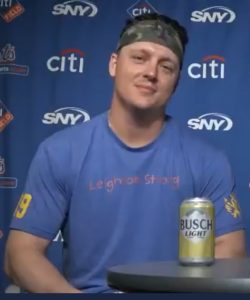 Just a beer before he goes. If we received the pleasure of Loup’s company in a postgame media session, we learned one thing that was as indisputable as his sub-1 ERA and his 1.000 winning percentage. The man liked his beer. Specifically, he liked Busch Light. Give him a chance to open, he said in Spring Training, and he’d take it because, “Who wouldn’t want to be the guy to start the game and then get to sit in the clubhouse and drink a few brews on the back end and watch the rest of it?” Loup successfully opened games twice, coming through with the necessary 10 Minute Head start the Mets ordered both times.
Most of his opening was of cans of Busch Light after pitching in a more customary role, evidenced by his usually bringing one with him to the Zoom room and giving it prominent product placement. The lefty developed a taste for it in 2019 when he called San Diego his professional home. It was a clubhouse thing, Loup explained to Justin Toscano in September. Keith Hernandez was known to have a bucket of Michelobs waiting at his feet postgame in his Met heyday, but that was the 1980s. A beer after the game didn’t elicit much notice in those days. These days we see what social media shows us and respond as if we’ve never seen it before. Loup and his Light became a bit of a thing.
So did Aaron’s honesty, which could be as bracing or refreshing as any cold one. Just before the direction Met players’ thumbs took drew everybody’s attention, Loup was asked about the booing that no Met was immune from — including him the night he gave up that momentum-turning double to Crawford. His ERA was still in the low 1s, yet that didn’t cut ice with the crowd after his aberrational bad outing. “It’s tough,” he admitted. “We definitely hear it. You try to drown it out and not pay attention to it the best you can, but we definitely hear it and it makes it tough. We’ve been struggling and not playing well and then when you come home and you kinda get booed off the field, it definitely doesn’t make it any easier.”
As for leadership in the contention-receding period when the Mets could have used a pair of broad shoulders on which everybody else could have figuratively jumped atop, Loup told Devin Gordon in September, “I think that’s probably the one guy we might’ve been missing this year,” somebody with the seriousness and stature to step up and say, “‘OK, that’s enough, it’s time to get down to business.’ Because we all know everybody’s trying, and you always get the rah-rah, ‘next game, you got this’ stuff. But at some point you need, ‘OK, enough. It’s time to go, now.’”
Lefty relievers — unless they’re carrying within the clubhouse the cachet of a McGraw, a Franco or a Wagner — probably don’t have the gravitas to be that guy. Too bad. But in light of being a journeyman on a one-year contract, it was enough that Loup cut his figure as he did, responded as best he could to the challenge at hand when his entrance music blared (“Unapologetically Country As Hell,” which my wife thought sounded a lot like the Li’l Sebastian song from Parks & Rec) and shared his beer and thoughts with us as he saw fit.
***If you partook of the 2021 postseason, you know that it wasn’t only the Mets who leaned on their bullpen to the point where starting began to feel somewhat irrelevant. With the exception of scattered gems, you’d be forgiven for thinking every game was a bullpen game, which was almost shocking seeing as how these were the best teams in baseball competing for a championship. Yet if you partook of the 2021 regular season, the sensation of managers scrambling to string together three outs en route to collecting twenty-seven of them actually felt pretty damn familiar.
In 57 games, or more than one-third, the Mets’ starting pitcher failed to go at least five innings. In 40 others, the starter went no more than five. Loup and Castro each opened two games on purpose, and rainy skies had their impact now and then, but most of the nearly 100 starts that didn’t reach a sixth inning were not by design or circumstance. It was because there wasn’t enough solid starting pitching to get the Mets through what you’d call a traditional rotation. Just get us some outs seemed to be the marching orders to whoever wasn’t deGrom or Stroman.
That’s what you usually tell your relievers. The Oft-Used Troupe listened closely and fulfilled their mission. Not flawlessly, but regularly. Enough to be trusted. Occasionally the trust felt misplaced, because who wants to pat a reliever on the back after a bad inning when all we needed was a good inning, but they kind of earned the trust. We as fans maintain the right to reserve our trust and disburse it in miserly fashion; we’ve earned it and aren’t shy about pointing to the mental scars that prove it. There’s a legitimate push-pull of compassion and derision when it comes to reacting to relief pitching. We are entitled to get annoyed when outs aren’t recorded, even preemptively annoyed that outs might not be recorded. Booing, actually or virtually, is definitely an option.
Yet fair is fair, and I have to tip a cap to one of Loup’s Oft-Used Troupemates, Trevor May — in whom I refrained from investing my trust more than once — for tweeting truth to fandom as the lockout set in and the topic of thumbs-down resurfaced:
“I owe you my very best version every time I take the field. My most prepared, competitive version. All the effort I have in my body. I give that, every damn day.
“I’m not a monkey that dances in proportion to the amount of nachos you buy at a game.”
Asking somebody new to do what Loup did for us, lefty or righty, is an enormous request. You’d settle for a Feliciano type to pick up the slack Aaron left in his free agency wake. We will need the toughness of May, the resilience of Diaz and the electric stuff of Castro to generate continually in 2022. They, like Familia and unlike Loup, rode a rollercoaster in 2021, but they all had spurts when they were only lightly hittable — and none of them fully imploded into a state of uselessness. If bullpen management under new dugout management reflects baseball broadly, we’ll need a cast of dozens filtering in and out of the pen. The Yennsy Diazes, Jake Reeds and Geoff Hartliebs, by their or somebody else’s names, will likely be getting up in a fourth inning near you.
DeGrom, we who are known for our faith have been led to believe, will be healthy and ready to go whenever the gates to Spring Training are unlocked. Scherzer, we’re pretty sure, is going to be Scherzer. That still leaves a day of hoping hard that first-half Walker vanquishes second-half Walker and two other days in the zone of uncertainty (Carrasco, Peterson, Megill, Williams, Lucchesi, whoever) where praying for rain will only get you so far. That’s three days when you’ll be glad to have a bullpen that functions as well as the Oft-Used Troupe of 2021 did. And, if we’re being honest, deGrom’s and Scherzer’s starts may project as brilliant, but they’re probably not gonna go nine.
No, we won’t have Aaron Loup around being as country and effective as hell, given that he converted his 0.95 ERA to two-year deal with the Angels. And we won’t have Jeurys Familia, whose modest renaissance — there were times his sinkers sunk batters like it was still most days in 2015 and 2016 — will win him a free agent shot somewhere. Jeurys already said his goodbyes through Instagram on the final weekend of the season. “[E]very day that I get out of bed, one of the first things [to] cross my mind is what to do to be better and give the best to the best fans in the world of baseball,” Familia posted. “For the fans, despite all the boos, bad words and everything bad that they may think of me or wish me, I put myself in their chair and I understand it perfectly. They have been waiting for a championship for many years.”
It is not to jab at how Jeurys pitched in 2021 to say this might been his most effective delivery in ages. The least we can do is return his pitch in kind and tell Familia, Castro, May, Diaz and MVM avatar Loup, hey, thanks for giving us your best, which is often pretty damn good. And when your best doesn’t always translate as great once the ball leaves your hand…well, we’ll do our best to trust you to try it again.
FAITH AND FEAR’S PREVIOUS RICHIE ASHBURN MOST VALUABLE METS
2005: Pedro Martinez (original recording)
2005: Pedro Martinez (deluxe reissue)
2006: Carlos Beltran
2007: David Wright
2008: Johan Santana
2009: Pedro Feliciano
2010: R.A. Dickey
2011: Jose Reyes
2012: R.A. Dickey
2013: Daniel Murphy, Dillon Gee and LaTroy Hawkins
2014: Jacob deGrom
2015: Yoenis Cespedes
2016: Asdrubal Cabrera
2017: Jacob deGrom
2018: Jacob deGrom
2019: Pete Alonso
2020: Michael Conforto and Dom Smith (the RichAshes)
Still to come: The Nikon Camera Player of the Year for 2021.
Thanks to Baseball-Reference and MLB Trade Rumors for their assistance in compiling data for this article.
by Greg Prince on 5 December 2021 9:24 pm I no longer have to tell you why Gil Hodges belongs in the Hall of Fame, and you no longer have to tell me why Gil Hodges belongs in the Hall of Fame, and we no longer have to tell anybody why Gil Hodges belongs in the Hall of Fame.
That’s because Gil Hodges is in the Hall of Fame.
Gil Hodges is in the Hall of Fame. There are no better eight words a New York Mets fan could utter, no better eight words a Los Angeles or Brooklyn Dodgers fan could utter, no better eight words a Washington Senators fan could utter. Nobody who loves what baseball feels like when baseball is at its best could utter eight better words than Gil Hodges is in the Hall of Fame.
Gil Hodges is in the Hall of Fame. My, that feels good to write, to say, to think, to know. For Joan Hodges, widowed nearly fifty years, living for this moment. For Gil Hodges, Jr., who has carried the responsibility of speaking for his father through so many disappointing selection processes. For everybody in the Hodges family. For everybody who feels like a not-so-distant relation to the Hodges family because of who Gil Hodges was, what Gil Hodges did and how Gil Hodges carried himself.
For the Mets who played under and with Gil and have sworn by his example and influence. For the Senators of the ’60s who got the first taste of Gil as a manager. For those Dodgers who’ve remained to tell their true-life tales of a peer they revered. For those wrote about him while he created a Hall of Fame candidacy via his actions and deeds. For those who continued to amplify and elaborate his bona fides after he was gone. For those with whom he served overseas. For those who understood first-hand his generational legacy, whether they learned it in Petersburg, Indiana, or within (or proximate to) any of the five boroughs of New York City.
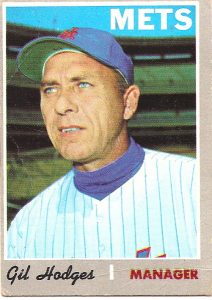 Baseball Hall of Famer Gil Hodges. This is a great moment in the life of the National Pastime. This is what happens when the words keep flowing and the passion bubbles over and we don’t stop talking about why a man who transcended a specific honor deserved the honor nonetheless. We kept it up because it meant the world to so many in this world that he got it. And, at last, he did.
Gil Hodges is in the Hall of Fame.
As are, not incidentally, Buck O’Neil, Bud Fowler, Jim Kaat, Minnie Miñoso and Tony Oliva. Six new plaques representing six people and six sets of stories whose impact on baseball was immeasurable in their day and for the years, decades and centuries that followed. O’Neil many of us met through Ken Burns. Once we met him, we would never forget him. We can never forget Fowler, who, like O’Neil, withstood the curse of institutional racism to play the game he loved. Miñoso came along much later than Fowler (1858-1913) and a little later than O’Neil (1911-2006), but not so late so that segregation didn’t unfairly separate his talents from what were considered the major leagues. Miñoso was a major player for the New York Cubans before having the opportunity to join the Cleveland Indians. His career coincided with that of Hodges and overlapped with those of Oliva — a preeminent hitter — an Kaat — a pitcher who succeeded at his craft for a quarter-century.
Every one among those six makes the Hall of Fame look good for hanging markers in their honor. The Hall would look even better with a few more from those its committees considered this year, but, as the 1969 Mets led to the promised land by Gil Hodges taught me when I was young, one miracle at a time.
It shouldn’t have taken what felt like a miracle for Gil to get in. He earned election through a big league playing career that extended from 1943 (before it detoured into World War II) to 1963 and was burnished by a managerial career that lasted from the moment he retired as a player until a heart attack felled him in 1972. He was the indispensable power-hitting cog of the Brooklyn Dodgers’ pennant factory, a plant whose production reached its peak on October 4, 1955. Hodges drove in the winning runs and cradled the last out on the afternoon the Dodgers became world champs. Hodges was already Brooklyn’s favorite son, never mind that he was born and raised several states to the west. It was no accident he was in the first Opening Day lineup the Mets ever fielded. George Weiss and Casey Stengel knew that no matter who else they put on display at the Polo Grounds, fans from this National League town would come out to cheer for Gil.
Few hit more home runs or drove in more runs or better handled chances at first base when he played. Nobody inspired more loyalty when he managed. Think that’s hyperbole? His players are still loyal to him. Ballot after ballot, his name would appear for consideration, and ballot after ballot, the Swobodas and Shamskys and Seavers vouched for him. Vin Scully, who called Gil’s games in Brooklyn and Los Angeles, took the time as he approached his 94th birthday to author an essay asserting that Gil needed to be selected this time. Mind you, Gil was selected in all but name almost thirty years ago. He got the support of the necessary number of votes in the 1993 Veterans Committee balloting, but one of those votes belonged to Roy Campanella, who phoned it in from a hospital bed. Ted Williams, the manager who had to follow in Hodges’s immensely popular footsteps in Washington, chaired that committee and, for reasons best known to him in those pre-virtual communications days, wouldn’t accept Campy’s call, or at least his vote.
That’s the sort of detail that had vexed us every winter Gil Hodges was eligible for selection. That and all those hundred-ribbie seasons that went disregarded; the 370 home runs that stood, when he belted his last, as the most by any righthanded National League slugger, yet had never impressed enough writers from 1969 to 1983; the three Gold Gloves that would have been more except they didn’t invent the award until Gil’s tenure as a player was more than half over; and the unforeseen, overwhelming success of the 1969 Mets, who didn’t show up in Gil’s statlines but reflected his contributions to the baseball landscape as well as any home run record reflects anybody’s achievements. All that plus the torrent of admiration for the man and the absolute lack of criticism beyond analytical esoterica. His Wins Above Replacement could be debated if that was your bag. His character was unimpeachable.
As noted, we don’t have to do this part any longer. We don’t have to state Gil’s qualifications for Cooperstown. They are about to be etched on a plaque for everybody to see. We can travel upstate if we choose and read it for ourselves. We can simply know it’s there and feel good that the right thing sometimes eventually happens.
Gil Hodges is in the Hall of Fame. I know you know that, but I really do enjoy typing it.
The literary subgenre devoted to articulating Gil’s credentials for Cooperstown now goes out of business, but if it had to take more than a half-century to finally elect this worthiest of candidates, I’m glad that the wait lasted just long enough to include this marvelous piece of research, reporting and writing rendered by Friend of FAFIF James Schapiro. Treat yourself to what amounts to the closing argument on behalf of Gil Hodges for the Hall of Fame.
by Greg Prince on 3 December 2021 10:47 am When your team picks up a player or three at the trade deadline, you bank on capturing lightning in a bottle. Maybe three bottles. An arm or two to get you over. A quick bat attached to some quicker legs and surer hands. Come on over and lift us up. Yesterday we were strangers. Today we are comrades. Tomorrow…who knows?
The current version of tomorrow has arrived with resounding silence. That invigorating spate of Hot Stove arrivals and corresponding departures suddenly halted, a cacophonous crescendo transforming instantly into a locked out void. In the hours before Major League Baseball latched the door on the Major League Baseball Players Association, we were so busy virtually embracing our four fresh potential impact players that we barely had a breath to spare to note the au revoirs of those who had gained our devotion briefly, maybe longer.
Rich Hill, acquired (a great baseball word) from the Rays on July 23, signed with the Red Sox — one year, $5 million. He’s signed with the Red Sox seven times in a professional career that’s spanned nearly two decades. It’s as if Hill and Boston have one of those sitcom marriages that leads inevitably to a compulsory episode of “let’s renew our vows,” and the network keeps rerunning it. Hill has pitched for more than one out of every three major league teams. We were his eleventh. He made twelve starts for us. Most of them were competent. None was lengthy. One was a win for him, his last. I felt good that Rich got on the board for us. I wouldn’t have minded having him back so we could receive one of his five-inning specials every five days, but didn’t expect it. Hill will turn 42 when Spring Training is supposed to be in progress. Even our youthless movement has its limits.
Javy Baez, acquired from the Cubs on July 30, signed with the Tigers. I saw a picture of Baez trying on his Detroit cap. The look on his face suggested a thought bubble of “oh, so that’s what that D stands for.” Upon making the acquaintance of ye olde English logo, Javy said, “I’m really excited to be a Tiger now,” which probably syncs up with his excitement to accept six years for $140 million. I found myself excited when Javy hit, ran and fielded as a Met. I’d hoped he’d stick around, especially since getting him acquired required the trading of the previous season’s first-round draft pick. A couple of months with Baez flashing his ability in the middle infield turned the thought of second base without him rather drab. The striking out that he’s done most of his career? The bit with the thumbs down? I defer to Carly Simon’s approach regarding her bad news boyfriend Jesse: “I can easily change my mind about you.” That’s what happened with Javy. Like good ol’ Rich, he didn’t lead us to the playoffs after the deadline, but it was, in its way, a fun fling.
Marcus Stroman, acquired from the Blue Jays on July 28, 2019, signed with the Cubs. Marcus did stick around, long enough so that you forgot he was brought in as a difference-maker for a playoff push that didn’t push all the way through. Stroman was tantalizing in talent in ’19, and if he didn’t pitch the Mets to the Wild Card, he surely wasn’t the reason they fell short. Then came a COVID opt-out, which could have ended his stay at Citi, given that his contract was expiring in 2020, but the Mets made him a qualifying offer and Marcus smartly accepted. After a year of inactivity, he was the most active of Mets starters: 33 games, 179 innings and an ERA that ticked barely above 3. While deGrom went down and Walker blew up, Stroman stood sturdy. I found myself convinced as 2021 proceeded that Marcus was mostly using the Mets as a marketing platform for his brand, but once you realize franchises use players as a marketing platform for their brand, well, touché. A rotation that included deGrom, Scherzer, Stroman and others would have been more promising than whatever 2022 holds without him, but I never had the sense Marcus wasn’t going to test his worth (three years, $71 million) and discover it elsewhere — and I didn’t get the inkling that the hometown kid and the hometown team were meant to last. He was from Long Island and he succeeded in New York, but attachments are lately becoming more and more detachable.
Syndergaard, Loup, these three, all outta here! in a matter of weeks. Yet life, if not further offseason activity, is scheduled to go on. Compelling evidence of such a transitory existence could definitely make you pause to mull the comings and goings of people set against the mysterious backdrops of time and place had we not acquired those swell new Mets who will magically slide into our affections and replace the departed five in our concerns. We have Scherzer and Marte and Escobar and Canha. Chances are strong we’ll grow attached to these four, at least for a while, as soon as MLB reopens its doors and allows us the chance to legitimately latch on.
by Greg Prince on 29 November 2021 3:55 pm So far, the highlight of Max Scherzer’s career as a New York Met is he has agreed to a contract of $130 million over three years to be a New York Met. It won’t show up in the main statistical body of Scherzer’s Baseball-Reference entry, but it’s more than a lot of recent Mets have done to elevate our mood.
It’s November. Scherzer can’t pitch for us yet. But he can goose our outlook, and oh boy, has he. Yes, the multiple Cy Young winner will take Steve Cohen’s generous offer and join our other multiple Cy Young winner Jacob deGrom and form a one-two punch that should have visions of being on the right side of knockout after knockout dancing in our heads.
DeGrom and Scherz’
Before the bullpen stirs
DeGrom and Scherz’
As the K board whirs
DeGrom and Scherz’
Poke the other teams’ nerves
DeGrom and Scherz’
The high holy duo a Mets fan observes
DeGrom and Scherz’
Here’s hoping Steve keeps funds in reserves
Twenty-four other players will fill out the roster most days. We know who a lot of them are. A few holes remain. Maybe more than a few. Y’know what? They’ll be taken care of. Steve’s got this. He got us three legitimate players on Friday and a future Hall of Famer still riding his extended prime on Monday. I’m not interested at the moment in what hasn’t gone right in the past or what might go wrong in the future. I’m interested in rooting for a team that added Max Scherzer as co-ace to Jacob deGrom on the other end of a weekend that began with adding Starling Marte, Eduardo Escobar and Mark Canha to our lineup and general depth of being.
This is better than wondering what, if anything, the Wilpons can or might do.
Scherzer’s leanings were first reported in earnest Sunday night. He kept getting closer, we were told, without the deal being closed. I wondered what else he needed beyond the $40+ million a year for pitching a baseball. I was reminded of Joseph Hewes, delegate to the Continental Congress from North Carolina in 1776, who, upon hearing the first reading of the Declaration of Independence, expresses grave concern to Thomas Jefferson that “nowhere do you mention deep sea fishing rights.”
For $40+ million a year, Max Scherzer can buy himself an ocean. Or lease whichever one Steve Cohen owns.
Max landing on the shores of Flushing Bay felt too close to not reel in as Sunday night became Monday morning. Average annual value, the reporters said, had hit $42 million. If this was an elaborate prank, it was an expensive one, at least as measured in the toll it would take on our collective sanity had fruition proved elusive. No, this couldn’t be a tease. Scherzer didn’t have to be a Met when Sunday began. He had to be one before Monday grew dark.
And so he became one. He hasn’t pitched. He hasn’t tried on a jersey and smiled for the Zoom screenshots. If he’s taken the physical that makes everything official, word hasn’t leaked. But he’s here in all but physical presence ahead of the expected lockout (in a sport where megacontracts are being issued from coast to coast). He’s here because the Mets go after big names with big track records with big money and, lo and behold, such an approach works.
It will work even better when Max Scherzer pitches for the New York Mets. Soon enough he will.
|
|






