The blog for Mets fans
who like to read
ABOUT US

Faith and Fear in Flushing made its debut on Feb. 16, 2005, the brainchild of two longtime friends and lifelong Met fans.
Greg Prince discovered the Mets when he was 6, during the magical summer of 1969. He is a Long Island-based writer, editor and communications consultant. Contact him here.
Jason Fry is a Brooklyn writer whose first memories include his mom leaping up and down cheering for Rusty Staub. Check out his other writing here.
Got something to say? Leave a comment, or email us at faithandfear@gmail.com. (Sorry, but we have no interest in ads, sponsored content or guest posts.)
Need our RSS feed? It's here.
Visit our Facebook page, or drop by the personal pages for Greg and Jason.
Or follow us on Twitter: Here's Greg, and here's Jason.
|
by Jason Fry on 31 August 2020 1:35 am Shot. Chaser.
If I were a kind recapper, this paragraph wouldn’t exist. All you need to know is right up there, and why do you want to get riled up all over again? Go outside. Pet your dog. Call your mom. Do something else. Do anything else.
All right. The rest of you weird masochists can keep reading and absorb the earthshaking analysis that no one connected to the New York Mets had a good Sunday.
Even those whose statistics say they didn’t do anything terrible had a lousy day — that’s what happens when you drop both ends of a doubleheader, the first game in jaw-droppingly excruciating fashion, the second more mildly but still pathetically. Those blue and orange uniforms had some extra stink on them by the time the Mets got on the bus taking them the hell away from Yankee Stadium, or trudged through the streets of the Bronx ashamed of themselves, or whatever it is they had to do to go home and play the Marlins again (oh boy) tomorrow.
Rick Porcello, unexpectedly, was not one of the Mets who had a day to be embarrassed about, unless you count the company he kept, in which case yes, he probably should rethink his life choices. Porcello wasn’t great, exactly — the Yankees missed some pitches you’d expect them to barrel — but there are more mistakes than you might guess in nearly every start a pitcher makes. Once upon a time this blog post was going to be a deep dive into how Porcello is trying to return to the sinkerballer he was before growing deeply confused about his strengths, and ponder whether his 2016 Cy Young award caused everyone to overlook the fact that he wasn’t very good in Boston otherwise. I’ll save that one for a future post, should I or anyone else still care; for now, suffice it to say that Porcello actually showed signs of improvement. The Mets could sorely use that, given that this is an organization suddenly lamenting that the immortal Walker Lockett had to be DFA’ed.
But the seventh, oh boy the seventh. It started with an error by Andres Gimenez, whose bat has cooled but whose fielding skills seemed impervious to slumping. Not a good start, but Jared Hughes got the next two hitters and all seemed well — the Mets were up 7-2 and their winning probability was a cool 99.8 percent.
Unfortunately, there are no awards for getting the first 26 outs — oops, make that 20 outs — and all hell was about to break loose. A walk and a hit batsman brought up Luke Voit, who checked his swing but hit a little bleeder straight to where the second baseman is normally stationed, except Robinson Cano was covering the bag. The ball trickled through and was scooped up by Michael Conforto, who noticed Thairo Estrada chugging rather nonchalantly towards third, and not sliding. Conforto fired the ball to Gimenez with Estrada — the final out — still a couple of steps from the bag.
Gimenez didn’t field it. He most definitely did not have a good day.
The Mets brought in Edwin Diaz, whose first pitch was wild and brought in a run. Diaz squared off against Aaron Hicks, worked a 2-2 count and threw a bait slider. It was not just low but in the dirt, which seemed to rattle Diaz. Much as he did on the season’s second day, against Marcell Ozuna, Diaz retreated to the fastball, which had too much plate — and just as Ozuna did, Hicks hit it over the fence for a game-tying, possibly season-destroying home run. In a development that surprised absolutely no one, Diaz then blew the game the next inning, as Gio Urshela‘s single fell in front of Conforto, whose throw home was a bit too far up the third-base line for Wilson Ramos — who’s increasingly a statue on plays at home as it is — to turn into a putout on Mike Tauchman. Disaster complete. Diaz didn’t have a good day, but is anyone shocked?
Between games — because this was definitely a day you wanted to play two — Luis Rojas was asked why he went to the heavily used Hughes with the Mets up five, instead of opting for Drew Smith, who’d been recalled from Brooklyn to give the Mets another bullpen arm. Rojas said Smith had just been recalled and hadn’t been in games for a while, while a tired sinkerballer can be a good thing. I’ll skip ahead and note that Smith was called upon in the nightcap with the game tied and gave up a grand slam to Gary Sanchez, whose season has been so miserable the Mendoza line looks like the peak of Everest. Nope, Luis Rojas didn’t have a good day either.
(You know who did have a good day? Deivi Garcia, the young, Stroman-statured Yankee rookie who made his big-league debut in Game 2. He was very impressive, combining a solid arsenal with admirable poise. He didn’t get the win, thanks to a Voit misplay that let the Mets tie the game, but he certainly deserved it. I may instinctively snarl at the mere sight of a Yankee uniform, but my love of this game is big enough to appreciate what must have been a thrilling day for a pitcher whom I suspect has more thrilling days to come.)
The crowning joke of all of this is this is a year where a .500 record probably gets you a National League playoff spot — the Mets would have qualified for one if the season had ended Saturday morning, which given everything that’s happened this year isn’t the kind of meaningless statement it usually is. Even amid the rubble of Sunday, it’s not impossible to imagine them scratching and clawing their way into the postseason despite habitually aiming at the gun at their own feet. And if they do manage that, they’ll be in short-series, small-sample-size territory, where anyone can be king.
It’s not impossible. And if it happens, I will cheer and run around and say silly things and look back on it from some happily mundane maskless future and smile. But it seems far more likely that the Mets will have more days like Sunday, days in which the machine jams and smoke starts pouring out of the vents and BOOM! you wind up staring saucer-eyed at the world out of a faceful of soot, like Wile E. Coyote after his latest misadventure. The Mets have already had too many facefuls of soot during this strange little season. It seems wildly optimistic to think they won’t have more.
by Jason Fry on 30 August 2020 2:12 am Friday was, thoroughly unexpectedly, one of the better days in recent Mets history. The Mets beat the Yankees twice in one day, coming from behind both times, and Steve Cohen was left as the last man standing in the competition to purchase of the team, despite repeated Wilpon hissy fits thrown in an effort to create another endgame where none could be created. Cohen isn’t across the finish line yet, as there are owners to convince, and his CV has a few things that make you wince, but it’s possible the dead hand of the Wilpons will be lifted from this team by next season, whatever form that season may take, and I’m willing to do more than a little wincing to get to that day.
But after every great party comes a hungover morning where you have to get back to the workaday world, and so Saturday came and the Mets went back out to play the Yankees again. This time we got a nine-inning game, with no confusion about who was the home team, which would have been mildly refreshing except COVIDball and its inherent wackiness had worked out pretty well for the Mets the day before. Saturday’s game unfolded under leaden skies, with the feel of a hot stormy summer day minus the rain, and Robert Gsellman heading to the mound to square off against J.A. Happ.
Gsellman gave up a first-inning homer to Luke Voit but then settled in nicely before tiring in the fourth. It looked like the roof would cave in, but the Mets saved themselves thanks to glovework from J.D. Davis and Wilson Ramos, which is what exactly no scouts would have predicted. With a runner on third and one out, Clint Frazier smacked a grounder that Davis came in on, firing to Ramos to nail Mike Tauchman at the plate. The next batter, Brett Gardner, hit a long drive to center that almost went out but came back to Billy Hamilton, who threw the ball in to Amed Rosario, who threw home to get Frazier by the slimmest of margins and keep the score 1-0.
Gsellman was pretty good but Happ was better, mixing his pitches, dotting the outer margins of the strike zone and keeping Met hitters befuddled — a performance to be admired, except for the fact that the performer was the wrong guy and wearing the wrong livery. As Happ rolled along, seemingly invincible, the Mets countered with a kitchen sink of relievers. Steven Matz looked sharp — a welcome change from pretty much all of 2020 — but only contributed a single inning, departing with shoulder discomfort and forcing the Mets to improvise. Jared Hughes used his sinker effectively for a lone frame and passed the baton to Brad Brach, who didn’t have it. He got two outs but also walked three, with a wild pitch thrown in for good measure, and was excused further duty in favor of Jeurys Familia, called upon with the bases loaded and D. J. LeMahieu, the best hitter in a suddenly diminished Yankee lineup, at the plate.
Their battle was a mini-classic in its own right. Familia immediately ran a 3-0 count, which definitely had the stomach acid churning, but an optimist might have noted he was just missing the edges of the plate. He got a OK-do-that-again strike on a fastball, threw a perfect sinker to get to strike two, got a foul on the next pitch, and then threw LeMahieu a slider. It was up a bit, but the difference in speed was enough to spoil a dangerous hitter’s timing. LeMahieu tapped it to Davis.
This, I thought to myself, is quietly a heckuva ballgame.
It deserved a packed house, of course, with 40-odd thousand living and dying on every pitch. Instead, it was played in warehouse-like conditions, with tarps covering the superpriced Yankee Stadium box seats usually occupied by smirking hedge-fund bros, oil-state potentates ducking extradition treaties, flinty-eyed cluster-bomb manufacturers and whatever other varieties of Yankee fans exist in the world. Citi Field’s cardboard cutouts and energetically fake crowd noise are a bit cheesy, granted, but I’ll take it over the void that surrounded this game. It felt like the teams were playing in a mausoleum.
Happ got Robinson Cano to ground out leading off the eighth and then departed with 90 pitches thrown, which felt like a gift — the more so when Ramos banged Adam Ottavino‘s third pitch off the left-field foul pole. We were all even, and I started wondering how this would end. Would the Mets hurriedly sign Steve Bieser to be their designated runner in scoring position for the top of the 10th, bunting him to third and waiting for him to cause chaos? Would the Yankees sign Luis Castillo and make him our second baseman through some dastardly COVID loophole that had gone undetected? What ghost of Subway Series past would materialize to put its spectral stamp on this one?
The answer was none of the above. Dellin Betances came in against his old team in the ninth and had nothing. He was unarmed — not just a guy who’d brought a knife to a gunfight but a guy who’d brought a knife to a gunfight and discovered that — whoops! — the knife was actually one of those switchblade novelty combs. With runners on first and third and one out, Betances’s second pitch to Erik Kratz was of the Hit the Bull variety, sailing over Ramos’s head and allowing Frazier to scamper home unmolested.
A walkoff wild pitch, hooray. So much — at least for a day — for reaching the relatively mundane promised land of .500. (Which really is a promised land given the National League standings right now, but that’s a post for another time.) So much for continuing this unlikely party on enemy turf. The record came off the needle and that was that. I shut the game off immediately, neither wanting nor needing Keith or Todd Zeile to tell me that unfortunate things were unfortunate.
Still, it really was a heckuva game — taut and tense, well-pitched and unpredictable. Well, if I may borrow a line from my long-ago review of Our American Cousin, at least until that happened.
by Greg Prince on 29 August 2020 10:44 am When the 2020 season was in the uncertain talking stage — after Spring Training, before Summer Camp — I was pretty sure of one thing: other than for historical perspective purposes, I would never want to see highlights of whatever transpired on the field once the Mets started playing, if they started playing. And once they started playing, little occurred to change my mind, not so much because of how stubbornly mediocre the 2020 Mets were insisting on being, but because there was little I’d want to relive about what 2020 looked and sounded like in the baseball sense.
Or most other senses, but for the moment, let’s stick to our sport.
I didn’t want to see video of the empty stadiums ever again.
I didn’t want to hear audio of the synthetic crowd noise ever again.
I didn’t want to listen to clips of even our outstanding announcers hesitantly crafting calls of plays taking place in one ballpark while sitting in a booth in another ballpark ever again.
I didn’t want sift through designated hitters in every single game ever again.
I didn’t want to reckon with runners trotting to second base to begin any extra inning ever again.
I didn’t want to make sense of a surfeit of road teams playing as home teams in myriad makeup games ever again.
I didn’t want to revisit the dubious contingency plan of doubleheaders in which no more than seven innings of baseball per game were scheduled ever again.
Turns out I might want to see again a little of some of the above…particularly one of those dopey shortened doubleheaders…especially the way it concluded.
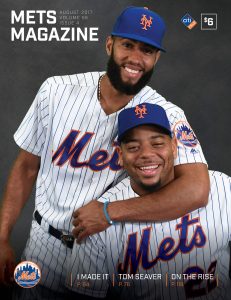 Belated congratulations to the Met rookie class of August 2017. On Friday night, the Mets swept the Yankees at Yankee Stadium in one of these new fun-sized twinbills, coming from behind late in both ends, doing so in their final at-bat in the second game. If you’re a Mets fan fortunate enough to not be dead outside, you’d have to be dead inside to not want to relive that kind of outcome at least a couple more times in your life.
The top of the sixth inning of the opener will likely make for fine repeat viewing as well, what with the Mets trailing, 4-1, before proceeding to open three drums of industrial-strength whoopass on Chad Green, one of those components of a Yankee bullpen generally considered to be unwhoopable. His ass told a different story after the sixth.
Free with every drum of Met-brand whoopass comes a compelling narrative.
• There’s the one that has erstwhile all-world freshman Pete Alonso emerging from his sophomore doldrums to blast a three-run homer to socially distant center to tie the game at four.
• There’s the one that has Dom Smith, whose pain and cause became that of his teammates 24 hours earlier, launching the home run that put the Mets ahead, 5-4.
• There’s the one, manufactured in limited-edition form, that has Jake Marisnick, recently of the injured list, stepping up directly after Dom and going essentially as deep off Green to make it 6-4.
The last time we saw ex-Astro Marisnick, it was for approximately a minute in July before he limped off into presumed Lowrie-like oblivion. Unlike with good ol’ Jed, we’ve been suddenly reminded Jake is both alive and well. The last time the Yankees had seen him, Marisnick was on deck during Jose Altuve’s shot heard above the trash can din. Maybe the sighting spooked them.
Terrific stories, each and every one of them. Collect them all! And top it with Sugar! Yes, we’ll use Edwin Diaz’s sweet nickname because we have no reason to be sour on our once and present closer. Sugar poured some heat on the Yankees in the seventh/final inning, facing three batters and striking out three batters, following in the reliable relief footsteps of Dellin Betances from the sixth and Walker Lockett from the fourth and fifth. As Lockett had been the last Mets pitcher to leave the mound before the sixth-inning onslaught, he picked up the W. As this is 2020, when rosters churn without end, Lockett was also handed a DFA. If we don’t see Walker again, we thank him for his service (same for the also-shuffled off to nowheresville Juan Lagares, last listed as No. 15 for one game after having been No. 87 for one game after having been No. 12 for seven years). When see Edwin again, we promise not to cringe in advance.
That was a great first game. You could forget that Michael Wacha was ineffective in his first start off the IL. You could forget that doubleheaders in which seventh innings act as ninth innings are literally bush league. You could look past the dark clouds that were going to widen the already expansive between-games break deemed necessary for the players to safely prepare themselves to play a second game. Of course it rained amid the interregnum. Does it ever not rain on 2020, literally or figuratively?
Taking that first win and going home didn’t sound bad, actually. When has any good ever come of playing a second Subway Series game in a day? The Mets and Yankees had forged four previous twinbills in their shotgun shared history, all necessitated by inclement weather. The Mets were 0-3-1 overall — 0-4 in nightcaps. There were no fans at Yankee Stadium and there were few stars in pinstripes, but why push our luck at the usually braying tar pit?
Why? Because sometimes luck is there to be pushed. The Mets pushed theirs in the second game in the Bronx. David Peterson, like Wacha, was back from a brief injury respite. Like Wacha, Peterson couldn’t quite shake off the rust, though he gave his team a little more than his predecessor (4 IP, 3 ER vs. 3 IP, 4 ER). The Mets survived a Familia Fifth, in which Jeurys loaded the bases but declined to let them unload on his head, and made optimal use of two doubles to create one run in the bottom of the inning to pull within 3-2.
Reminder: the bottoms of innings were when the Mets, in road grays, batted. They were the home team despite being away because… oh, you know. Because 2020.
After Brad Brach and Jared Hughes each provided Luis Rojas with a perfect inning — our bullpen was nothing but solid for seven scoreless doubleheader frames; that is not a misprint — the Mets still trailed by a run heading into what we used to automatically consider their third-to-final opportunity. It was the bottom of the seventh. The presence of Aroldis Chapman pitching meant it was the ninth somewhere. Last chance and all that.
Jeff McNeil led off determined to not make the first out. I’m sure all batters leading off innings maintain that sort of preference, but this was different. This was, nah, I’m getting on base, I don’t care who you are on the mound. Perhaps it was the icky surroundings and the flipping of which team was granted last-est licks, but damned if McNeil wasn’t playing Paul O’Neill to Chapman’s Armando Benitez in my mind. In Game One of the 2000 World Series, you just knew that if O’Neill somehow got on versus Benitez, something dreadful would occur to the team in the field. He did and it did. I picked up almost the same vibe in almost the same ballpark twenty years later (different facilities, similarly charmless). I was sure that if McNeil bested Chapman, we were going to win.
I should interject that in the 31st game of this season — the halfway point, we now call it — it was the first time I’d found myself having an overriding feeling about a game other than feeling baseball in 2020 is virtually pointless. For thirty games, up to and including the pleasant result in the first game of the doubleheader, I was mostly “I guess I hope the Mets win, but this whole thing is a farce, so whatever.” During McNeil’s at-bat, I was so invested in what he’d do that I had to tell myself to stop thinking positively on his behalf lest I jinx him to perform negatively.
And I only do that when I’m convinced what the Mets are doing matters.
For eight pitches, it mattered to me that Jeff McNeil reached base. On the eighth pitch, Jeff McNeil took ball four. At that instant, I was convinced the Mets would win.
Before I could fully weigh the detrimental impact of my unspoken thoughts on the course of events in an athletic contest taking place on my television, Billy Hamilton came in to pinch-run for McNeil. Before Chapman could fully process the danger Hamilton’s two legs encompassed to the work of his left arm, Billy was off to second base. Because Chapman threw to first base as Hamilton ran, it can be said, technically, that the pitcher had the runner picked off first. But, no, not really, because Hamilton — whose already indefatigable speed seemed kicked up a notch by the presence of 42, twice Billy’s usual 21, on his back — was pretty easily safe. He was now a runner in scoring position. Most nights, having one of those doesn’t fill a Mets fan’s confidence coffers.
But this night was different from most other nights. This night was the night after the Mets took their stand, standing with Smith and Hamilton and a whole lot of people who wish everybody can simply live a fairer life in this country we love, no matter how anybody appears to the uninformed eye. And this night, Jackie Robinson Night across Major League Baseball, was the night Smith had continued to excel as a Mets batter, not only with that homer in the first game, but via two more hits in the second, including one that drove in the Mets’ first run; and the night when Hamilton, entering for the express purpose of moving the Mets forward when they needed it most did exactly that; and the night Amed Rosario pinch-hit for Luis Guillorme with Billy Hamilton taking a lead off first…make that second.
Guillorme (.419 BA) started at short in the second game. Guillorme has raked enough to keep all five boroughs leaf-free. Rosario’s season has mostly dangled pathetically from a branch; he was batting .207 through the opener. But Luis is a lefty, Amed’s a righty, Chapman’s a lefty, and some percentages outplay some other percentages, thus it was Rosario at the plate while Hamilton rushed into scoring position.
Then it was Rosario following Hamilton across the plate, for it turned out that with Amed hitting off Chapman, he, too, was in scoring position. He sent a slider flying over the left field wall, turning a 3-2 Met deficit into a 4-3 Met win. Amed’s swing created a rousing walkoff two innings before that sort of thing is usually possible, a transfer at Grand Central shy of such an ending being normally imaginable. But, as you know, normal stepped out for pack of masks five months ago and has yet to be spotted since.
It was the first home run Chapman had surrendered since the one Altuve hit to snatch the pennant for Houston. Given how quiet it was at Yankee Stadium, you could have heard a trash can banging, but no such sound could be detected. Just a burst of happy yelping from a bunch of jubilant Mets.
Friday’s finale was a win all Mets fans who hadn’t rashly declared being “done” with their team the night before could fully revel in. It had that Cookie Club energy, that taste of 2019, maybe the slightest soupçon of comparably good if not better days ahead…days that will maybe soon feature a pinch-owner who will come in to run with this franchise’s fortunes like Hamilton went whoosh on that first pitch. One miracle at a time where Steve Cohen is concerned, perhaps. It’s still 2020. Rain is in the forecast for Saturday, and 2020 has mostly done nothing but present itself as all wet.
In event of precipitation, grab a towel and rewind Friday night’s doubleheader. It’s worth experiencing over and over for a change.
by Jason Fry on 28 August 2020 10:30 am Welcome to A Met for All Seasons, a series in which we consider a given Met who played in a given season and…well, we’ll see.
“People like to see human error when it’s honest. When people see you swing and miss, they start to root for you.”
— Paul Westerberg
I became a Mets fan in 1976, when the team had perfected an imperfect formula: combine superb pitching and defense with no offense and finish third. Miracle Met stalwarts Tom Seaver and Jerry Koosman were still around, as were Jerry Grote, Wayne Garrett, Buddy Harrelson and Ed Kranepool, who’d always been around and one assumed always would be. Joining them were representatives of the Little Miracle — guys like Jon Matlack and John Milner and Rusty Staub.
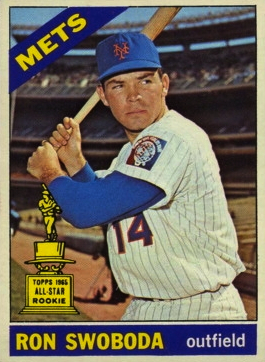
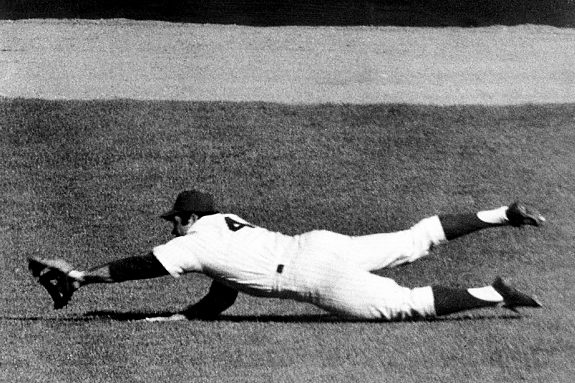
Staub was my favorite player, though of course I loved Seaver, rooted for Harrelson and appreciated Kranepool. But as a newly minted Mets fan with a dorky, proto-blogger’s bent, I hungered for history. Desperate to know what I’d missed, I inhaled books about my team — if the Emma S. Clark Memorial Library had a quickie book about the ’69 or ’73 team (or any other year), I read it and then immediately wanted to read it again. With DVDs and online video yet to arrive, I got most of my postseason lore from the written word and static pictures, from descriptions and reminiscences and snapshots and sportswriters’ flights of fancy. Tommie Agee in awkward mid-stride, a plume of white at the end of his arm. The unhurried way Gil Hodges strolled from the dugout to visit Lou DiMuro with a baseball in one big hand. Tug McGraw dodging and diving and weaving and bulling his way to the dugout. Willie Mays on his knees in vain supplication. Koosman jackknifed in Grote’s arms, with Ed Charles in the early stages of liftoff nearby. And, of course, Ron Swoboda — fully outstretched and parallel to the right-field grass, approaching an uncertain intersection with the ground and a baseball.
Swoboda was gone by 1976, but in every account of the ’69 Mets he loomed large. Not just because of The Catch, but because he was smart and funny and reflective and complicated. Which, though I didn’t know it yet, made him my prototype for what I wanted every baseball player to be.
The lore was pretty thick around Swoboda even before 1969. He signed with the Mets for $35,000 in 1963 as a 19-year-old from the University of Maryland. (Ironically, given what came later, Swoboda was born and raised in Baltimore and had played high-school exhibitions in Memorial Stadium.) His last name is Ukrainian for “freedom.” In 1964, he caught Casey Stengel’s eye — the young slugger reminded Casey of Mickey Mantle — and was hyped as part of the Mets’ about-to-arrive Youth of America.
Casey pronounced his name Suh-boda, which stuck with fans. Teammates called him Rocky, a reference to his mental lapses in the field and his ability to say the wrong thing at the wrong time off of it. He came to the Mets to stay in 1965 — a callup he would come to regret — and became a fan favorite. Writers loved the fact that he had a Chinese grandfather, which wasn’t really true — his grandmother had married the owner of a Baltimore Chinese restaurant. Fans loved his ability to hit long home runs and sympathized with his outfield misadventures — you were never quite sure what Swoboda might do out there, but you were pretty sure it would be memorable. In his first big-league at-bat, a terrified Swoboda fell into an 0-2 hole against Don Drysdale, and considered it a triumph that he lined out to second. (“I felt like a fish that had been dragged into the boat and somehow managed to flop back out,” he’d remember.) Two days later, his second big-league at-bat produced a home run. RON SWOBODA IS STRONGER THAN DIRT, fans proclaimed at Banner Day.
In one game, Swoboda forgot his sunglasses, misplayed a Dal Maxvill fly ball into a triple, returned to the dugout in a fury, and stomped on a batting helmet. The helmet got stuck on his cleats and left Swoboda hopping around trying to dislodge it while Stengel turned the color of a ripe tomato. Casey pulled Swoboda from the game, asking, “Do I go around breaking up his property?” Another time, Casey groused that Swoboda “thinks he’s being unlucky, but he’ll be unlucky his whole life if he don’t change,” a bit of baseball wisdom I recycled later in life for Come to Jesus conversations with wayward journalists. Yet for all his misadventures, Swoboda hit 19 home runs in 1965 — a Met rookie record that stood until Darryl Strawberry eclipsed it 18 years later.
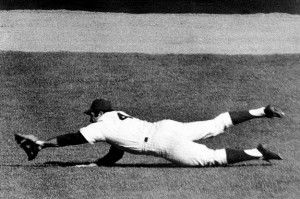
Swoboda managed the difficult and dubious feat of hurting his development as a ballplayer by alternately thinking too much and not at all. (Years after he retired, he admitted he still had nightmares about facing one of the great hurlers of the ’60s and not being able to get set in the batter’s box.) He wasn’t always popular with teammates, who were annoyed by his on-field mistakes and his off-field gift of gab. When reporters entered the clubhouse after a Met win, it wasn’t uncommon to hear someone yell out “Tell them about it, Rocky!” It should come as no surprise that one of his best friends on the team was the irrepressible, quotable McGraw. (The other was Kranepool.) But Swoboda was pretty quotable himself: In ’69, he was booed after striking out five times in one game, and opined that “if we lost, I’d be eating my heart out. But since we won, I’ll only eat one ventricle.”
1965, the year Swoboda represents in A Met For All Seasons, was a template for everything that followed — heroic moments mixed with ignoble ones. Four years later, it was still true: On Sept. 15, Steve Carlton struck out 19 Mets, with Swoboda accounting for two of the Ks … as well as the two home runs that beat Carlton. And, of course, there was The Catch. It wasn’t a particularly smart play — obviously he should have played it on a hop — except for the fact that hey, he actually caught it. “I had no time for conscious thought or judgment,” he’d recall. “The ball was out there too fast. I took off with the crack of the bat and dove. My body was stretched full out, and I felt as if I was disappearing into another world. … Somehow it happened. Somehow I got it. A miracle? Wasn’t the entire season a miracle?” In that one play the ignoble and the heroic did battle, the heroic came out on top, and because of that Ron Swoboda was a baseball immortal. As Tigers manager Mayo Smith put it, “Swoboda is what happens when a team wins a pennant.”
Two years after the Mets’ champagne celebration (“they’ve sprayed all the imported and now we have to drink the domestic,” he griped cheerfully, which became one of my go-to lines as a child even though I had no idea what it meant), Swoboda was traded to Montreal after one complaint too many about playing time. He hung around for a bit with the Yankees, failed to catch on with the Braves and was out of baseball by 29. He then began a long career as a broadcaster, one that would take him to New York and Milwaukee and Phoenix and New Orleans.
He was a sportscaster in New Orleans when I arrived there in 1989 as a pathetically green Times-Picayune intern, and a lot of people I came to know at the newspaper knew him. This finally registered with me when the woman I was dating mentioned in passing some bantering exchange she’d had with him. She had no idea that I was a Mets fan, and must have wondered why I stared at her in amazement. She knows Ron Swoboda. Which means I could meet Ron Swoboda.
The idea terrified me — I was a kid, and incapable of thinking of him as a fellow journalist. I’d read about him and looked at pictures of him since I was seven years old. He was a Met, a World Series hero, the man who made the Catch. He was Ron Swoboda. Meet him? And then what? It would have been like chatting with Zeus. (I did meet him a couple of years ago, after a ’69 Mets panel in midtown, and while he was perfectly nice, it was brief and dopey. In an uncharacteristically wise move, I didn’t mention having avoided him in New Orleans.)
When we grouse that ballplayers don’t seem smart, most of the time what we’re really lamenting is that they aren’t much for self-reflection. There’s an entertaining W.P. Kinsella story called “How I Got My Nickname” in which the ’51 Giants are all hyperliterate gents given to pondering the cosmos, a story that works because it’s immediately and obviously a fantasy. Back in ’92, Kelly Candaele (Casey’s sister) penned a great piece in the Times in which, among other things, she wondered about the fact that her brother and his teammates didn’t lie awake thinking about their purpose in life. When she asked Astros shortstop Rafael Ramirez about that, his answer was, “When I wake up in the middle of the night, it’s because I want a sandwich.”
I don’t assume baseball players are dumb — I’m amazed at how many of them can analyze pitch sequences and find little tells during the game, and how they remember at-bats in vivid detail years later. Beyond their superhuman physical talents, many of them have an extraordinary ability to focus that most of us don’t know enough to understand we lack. But self-reflection? I suspect most of them are like Ramirez, and probably better for it. When you make a living playing a supremely difficult, maddeningly unfair game, self-reflection isn’t necessarily an asset — better to let the moment go and start fresh.
There are exceptions. Players like Seaver or Darling or Keith Hernandez can dissect baseball like generals or prize-winning academics and focus that same lens on themselves. The 2000 Mets had three such players in Al Leiter, Mike Piazza and Todd Zeile — all smart, complicated guys who weren’t afraid of being interesting. But those players are exceptions that prove the disappointing rule.
The first Met I knew of who was exceptional like that? It was Swoboda.
It’s clear that he spent his share of middle of the nights lying awake, and not because he wanted a sandwich. He isn’t just a good quote, but also bracingly honest about himself. (You’ll find great interviews with him — the sources of many of this post’s quotes — in Stanley Cohen’s A Magic Summer and Maury Allen’s After the Miracle.) He’s talked wistfully about he never got along with Seaver, admitting that he was the one who sabotaged any chance at friendship. “I wanted to be the best in the game at my position; I wasn’t,” he said. “He just made it look so easy, was so good — and it just frustrated me so much.” And he’s told the story of confronting Hodges in the clubhouse bathroom over his use of Kranepool — after which, feeling his manager’s glower on his back, “I was standing against the urinal and I couldn’t pee.”
Of course, Swoboda will always be bound up with 1969 and the Miracle Mets — a bit of typecasting he has accepted cheerfully. (“How long am I going to make a living off of one catch? How long have I got left?”) That’s no surprise, but Swoboda’s reflections on ’69 have almost invariably been interesting, too. “We were ingenues,” he recalled once. “We had that wonderful, clear-minded innocence of not having the responsibility of winning it, of not having to doubt ourselves if we stumbled, and that’s a marvelous state to achieve.” Another time, he said that 1969 “wasn’t destiny. I don’t believe in destiny. What I believe is you can get to a state where you are not interfering with the possibilities.” That’s a long way from taking them one game at a time, pulling together as a team and all the other rote nonsense players have been taught to say so that reporters go away as quickly as possible.
And Swoboda has always understood what that summer meant to the fans, and refused to see what he did and what we did as disconnected. He has always been willing to bridge that gap, and make us feel like it doesn’t have to exist, even though he and we know better. “I never felt above anyone who bought a ticket — I just had a different role than they did,” he’s said. “We were part of the same phenomenon.”
The ’69 team was heralded at Citi Field during its first summer, and I of course cheered for all of them. I applauded the McAndrews and Gaspars and Dyers, cheered for the departed Tug and Gil and Donn and Don and Cal and Tommie and Rube, and gave Seaver and Koosman and Ryan their due, as one must. But the player I cheered longest and loudest for from that team?
It was Ron Swoboda. It always has been.
If you’re a veteran reader with a sense of deja vu, no, you’re not going crazy — this post appeared in much the same form back in 2010. Hey, I got it right the first time.
PREVIOUS METS FOR ALL SEASONS
1962: Richie Ashburn
1963: Ron Hunt
1964: Rod Kanehl
1966: Shaun Fitzmaurice
1969: Donn Clendenon
1970: Tommie Agee
1972: Gary Gentry
1973: Willie Mays
1977: Lenny Randle
1978: Craig Swan
1981: Mookie Wilson
1982: Rusty Staub
1983: Darryl Strawberry
1986: Keith Hernandez
1988: Gary Carter
1990: Gregg Jefferies
1991: Rich Sauveur
1992: Todd Hundley
1993: Joe Orsulak
1994: Rico Brogna
1995: Jason Isringhausen
1996: Rey Ordoñez
1998: Todd Pratt
2000: Melvin Mora
2001: Mike Piazza
2002: Al Leiter
2003: David Cone
2004: Joe Hietpas
2005: Pedro Martinez
2007: Jose Reyes
2008: Johan Santana
2009: Angel Pagan
2010: Ike Davis
2012: R.A. Dickey
2013: Wilmer Flores
2014: Jacob deGrom
2019: Dom Smith
by Jason Fry on 27 August 2020 11:45 pm The Mets and Marlins didn’t play Thursday night.
After some milling around in front of both dugouts, the Mets ran out to their positions, led by Dominic Smith and Billy Hamilton. Miami’s Lewis Brinson stepped to the plate. Caps came off. The other players on both teams came out of the dugouts to stand in a line. After 42 seconds of silence, both teams left the field, leaving behind a Black Lives Matter shirt on home plate.
It was a powerful moment, covered with care and, yes, grace by SNY. Afterwards, Michael Conforto, Smith, Robinson Cano and Dellin Betances addressed the media, masks on as per COVID necessity. SNY threw it to Gary Apple and Todd Zeile, who spoke from the heart. Brodie Van Wagenen talked to the media — more on that in a moment — and then Steve Gelbs conducted a poignant, sometimes raw interview with Smith. It was surreal and confusing and moving all at the same time.
The Mets being the Mets, there had to be a sideshow. Last night, people started sniping at each other on Twitter over Smith’s decision to take a knee Wednesday night and the Mets’ having tweeted the message UNITED FOR CHANGE. That’s the tagline that’s been handed down by Major League Baseball, but it made for an awkward show of support: How united could the Mets be if Smith had acted alone?
Then, a couple of hours before the game that wasn’t, video somehow went out to the world of Van Wagenen having a private conversation with two people off-camera in which he said Rob Manfred, citing scheduling concerns, was pushing Jeff Wilpon to have the teams to walk off the field at 7:10 but return at 8:10. Van Wagenen reacted with a mix of incredulity and exasperation, saying that Manfred doesn’t get it “at that leadership level.” I was simultaneously embarrassed that someone with Van Wagenen’s CV would get tripped up by a hot-mic moment and struck that it was most honest and genuine that the Mets’ general manager had ever sounded. After the game was postponed, Van Wagenen issued a statement saying the idea for an hour’s delay was Wilpon’s and not Manfred’s, and apologizing to the commissioner. I don’t believe for a second that’s what actually happened (though Wilpon-Manfred isn’t exactly the Thrilla in Manila of credibility bouts), but I also thought it was an adept way to save face.
As for the Mets, they seem to have been caught off guard by Smith’s gesture on Wednesday, but more than made up for it a day later, supporting him and his efforts to call attention to the racial injustices he’s spoken about with candor and vulnerability and passion. Wednesday’s tweet may not have matched what we saw before the game, but a day later it was a perfect fit. The Mets also reached out to the Marlins to create a shared moment, with the 42-second hold an idea that came from Miguel Rojas. And all involved — from the players in the press conference to Van Wagenen — spoke eloquently about the need for change in ways I wouldn’t have dreamed possible from baseball just a couple of years ago. The execution might have been both messy and Metsy, but in the end I was proud of my team.
After the game, because I can’t stop myself from touching hot stoves, I waded into the dumpster fire of replies on Twitter. While cathartically blocking people I wish weren’t Mets fans, I kept seeing the same complaint — that the teams had created a spectacle.
Well, that was the point. Not a tweet or a press release that you might wave away, but a moment where you had to pay attention because you were expecting a first pitch and instead got something you had to engage with. That’s how protest works — it disrupts routines so the gesture can’t be ignored. This is what those still complaining about Colin Kaepernick and those he’s inspired either don’t see or refuse to see — that a protest is ineffective and frankly means a lot less if it’s done when no one’s watching. The goal isn’t disrespect — Kaepernick started taking a knee after talking with a former Green Beret who’d objected to his initial decision to sit during the anthem — but discomfort, as a means of generating awareness, sparking conversation and driving change. However strangely the Mets and Marlins arrived there, they certainly reached that goal.
I was also reminded that while there’s a segment of fans who reliably bray for athletes to stick to sports, sports have always been arenas in which we’re forced to confront questions about race relations, fair labor practices, freedom of association, safety standards, gender attitudes and a whole lot else besides. Sure, part of sports’ lure is that they let us put aside the cares of the day and watch a simple morality play — I want this team of obvious gentlemen to beat that team of thorough evildoers. But to treat sports only as that morality play is to be willfully blind to so much around us, and to denigrate the athletes we just got done exalting. Telling athletes to “shut up and dribble” or to “stick to sports” is to dismiss them as hired help. (For the last couple of generations they’ve been extravagantly well-paid hired help, which adds a queasy note to the proceedings without changing the underlying issue.)
Whether we like it or not, the larger world is always present — and sometimes it comes smashing through the frame. The biggest story of baseball’s 20th century was Jackie Robinson‘s bravery in breaking racial barriers that had impoverished the game, and what that lonely effort cost him. The second biggest story of the century was the players’ long battle to be treated as something other than chattel and paid accordingly, a struggle that cost Curt Flood dearly as its pioneer. And we haven’t seen the last such story — there are gay players on big-league rosters today, but you don’t know who any of them are, because they know stepping forward would cost them dearly. One of these days one of those players will decide they’ve had enough and speak up while still in uniform, and you better believe it will be intensely political. One of these days a female amateur athlete will show off a hellacious knuckleball or some other monetizable talent and get signed, and the furor will be both exhilarating and exhausting.
The Mets have been a part of this, because how couldn’t they be? There’s a plausible case to be made that Reggie Jackson was never a Met because he dated outside his race, which was most certainly and shamefully political in the mid-1960s. In 1968, the Mets refused to play after the deaths of Martin Luther King Jr. and Robert F. Kennedy, with the latter decision causing a showdown with Giants owner Horace Stoneham, who wanted the big gate that came with Bat Day. Tom Seaver caught hell for having an opinion about Vietnam, and I guarantee someone told him to shut up and pitch. Rusty Staub and Seaver were traded away for being union activists, with M. Donald Grant demanding to know where Seaver got the temerity to think he could join the Greenwich Country Club. That’s a small sample — hot-button political issues, charged assumptions, unfortunate prejudices and societal fears have shaped our team’s history just like it has every other team’s.
This morning, before so much happened, I read the terrific SABR biography of Donn Clendenon. (Whose A Met For All Seasons entry is here — and will be joined by a salute to a teammate on Friday.) If you don’t know much about Clendenon besides his having been a Pirate and homering after the shoe-polish play, you should read it. A few of many highlights:
- Clendenon’s mentor at Morehouse College was Martin Luther King Jr.
- He was tutored as a ballplayer by the likes of Satchel Paige, Nish Williams (his stepfather), Roy Campanella, Robinson and Joe Black
- Clendenon was interested in playing football for the Cleveland Browns, but steered back to baseball by his stepfather, who arranged to seat him between Robinson and Branch Rickey at an Atlanta awards banquet.
- The general manager for Pittsburgh’s Grand Forks, N.D., affiliate set Clendenon up with the daughter of the only black family within miles so he’d stay away from white women; Clendenon turned the tables when he agreed to take on the clubhouse duty of shining shoes and doing laundry, tasks he promptly subcontracted to high-school kids for a profit.
- The next season, Clendenon was demoted from the Pirates’ Wilson, N.C., affiliate because it was their second year as an integrated team and they were seen as having too many Black stars. He quit, threatened to jump to a Canadian league, and had to be coaxed into returning.
- Determined to have a career after baseball, Clendenon attended Duquesne University’s law school while playing for the Pirates, winning a senatorial scholarship and clerking for a judge. He recalled that there were two other Blacks at the law school: his con-law professor and the janitor.
- One offseason, Clendenon worked for the Scripto Pen Company, where he led a union drive and brought in Dr. King and Stokely Carmichael to stiffen the workers’ resolve.
- Clendenon has two 1969 baseball cards — one as an Expo, the other with “Houston.” That happened because he was traded to the Astros but refused to be reunited with his old manager Harry “The Hat” Walker, viewed by many Black players as an incorrigible racist. Clendenon insisted he’d retire, and the teams worked out a deal to keep him an Expo — at least until he was traded to the Mets.
- One I’d never heard before — according to his SABR biography, Clendenon was given 22 as a Met (he’d worn 17 for his two earlier teams) because the equipment manager told him he was a “double deuce,” derived from “number two” being slang for a Black person. With the Mets Tommie Agee wore 20 while Cleon Jones wore 21. Hmm.
Clendenon played before free agency and taking a knee, but his baseball career and his life were shaped by both racial attitudes and hot-button politics. And you don’t have to be a fiery progressive to guess how many indignities and injustices his capsule biography must leave out. He died of leukemia in 2005, when Dom Smith was just 10 years old. I wish they could have had a conversation about the issues of both their careers — and that we might have been allowed to listen in. I think we would have been illuminated and challenged and inspired, as Mets fans and as people. Even if that conversation didn’t stick to sports.
by Jason Fry on 27 August 2020 12:56 am You know the thing about moral victories in baseball, right? Namely, that they don’t exist. You were down 8-1 and gallantly came back and showed fight and lost 8-7? Here’s a pat on the head, because that’s called a loss.
Well, Wednesday night’s game against the Marlins, because of course it had to be the Marlins, was an immoral victory. The Mets won, but it felt like they’d lost and I was thoroughly mad at them despite the final score.
Jacob deGrom started, because of course this disaster had to involve poor Jacob deGrom, to whom pretty much the exact same thing happened last start. And he was … I don’t know, we’re running out of superlatives for deGrom by now. I could wax lyrical about the power and the command, I could strain myself invoking Seaver and Gooden and Santana, and your eyes would glaze over because you’ve heard it and read it before. Yeah yeah, you’d think, I get it. He was Jacob deGrom. And there it is: He was Jacob deGrom, which in this case meant 14 Ks in seven innings and nary a sweat broken. By now the man is his own superlative.
The Mets followed one of their more embarrassing twin bills in team history by actually scoring runs — first one, then another, then somehow two more, and I actually made the mistake of feeling like the game was safe. Oh ho ho. Ah ha ha. Justin Wilson, normally one of the reliable relievers, came in and promptly gave up three straight singles while getting one out. The last single was a bit unlucky, a little parachute just over Jeff McNeil‘s glove, but the other two came on balls that were supposed to be down and stayed up. Wilson was excused further duty and on came Edwin Diaz, who once upon a time was an elite closer.
“Diaz is gonna fuck this up, isn’t he?” I tweeted, and told myself that was a clever reverse jinx, and in a minute I’d be able to retweet myself mockingly but happily. But my heart wasn’t in it. I figured he really was going to fuck it up, and he did. Diaz fanned Jesus Sanchez, yielded a scorching infield single to Jesus Aguilar that nearly put a baseball-sized hole in J.D. Davis and made the score 4-2, then walked Corey Dickerson to force in a run and make it 4-3.
By now the cardboard cutouts had come to life and were booing — even the dogs were howling for blood in a corrugated way — and Luis Rojas was growing more gray and stooped by the second where he stood morosely in the dugout. It was 4-3, Diaz had already fucked this up, and one skinny bit of further fuckuppery was all that separated deGrom from looking a little stern yet philosophical in his postgame Zoom and being deprived of another win by his teammates’ chronic ineptitude.
INTERIOR — COURTROOM
Judge: All rise.
[hubbub, rising and what-not]
Judge: Mr. deGrom, you are accused of taking a two-by-four to your co-workers in a disturbing workplace incident. How do you plead?
Lawyer: Your Honor, Mr. deGrom is a New York Met, and we have a short video montage we’d like introduced into evidence.
[said evidence is displayed]
Judge: Case dismissed.
With a 1-1 count on Brian Anderson, Diaz spiked a slider into the dirt and came off the mound a little gimpily. The trainer and Rojas came out, Diaz argued to stay in the game, trainer and Rojas correctly noted that he’d done enough, and he departed with some injury for which I haven’t yet seen a diagnosis, and the nature of which I honestly couldn’t give a shit about.
In 40-odd years as a baseball fan I have (mostly) learned to be reasonable and understand that everyone is trying, injuries and simple buzzard’s luck can affect outcomes, and one should never reach moral conclusions based on the outcome of anything so maddingly fickle as hurled balls and swung bats and lunging gloves. But eventually even the most rational fan has had enough, and I have had enough of Edwin Diaz. The ground is salted. He should become someone else’s problem to fix, or no one’s problem, and I do not particularly care which. Diagnose him with inability to pitch and put him on the 45,000-day IL. Edwino delenda est.
Poor Brad Brach inherited Diaz’s 2-1 count and threw two more balls, walking in yet another run. The walk and the blown save go on Diaz’s ledger, and in this one case baseball’s quirky rules are inarguably fair. Another deGrom masterpiece had been covered in fingerpaint and crayon, and I huffily folded my arms and waited for the rest of the disaster.
Which somehow didn’t come. Robinson Cano singled, Billy Hamilton replaced him, Wilson Ramos singled Hamilton in, Brach went back out there and got three outs, though one of them came when Jonathan Villar — who’s an excellent player except when the Mets are involved — slid head-first into McNeil’s foot instead of second base. He was called safe, but a crew-chief review showed he was out, since opponents’ shoes only count as bases on alternate Sundays under 2020’s let’s-all-shrug-and-do-shit COVID rules. It was kind of bullshit, the sort of injustice that one would have just grumbled mildly about in the pre-replay era, but I was willing to take it, and a couple of minutes later Miguel Rojas hit an initially scarily trajectoried but ultimately harmless fly ball and the Mets had somehow won.
The Mets had somehow won, but it sure didn’t feel like they had. Certainly they hadn’t deserved to. I still felt like booing.
The best thing to do, probably, is draw a curtain across this one and never think of it again. It didn’t make any sense, and your insisting it should have won’t make any difference. It’s just baseball, it’ll drive you crazy if you let it, and 2020’s already got that more than covered.
by Greg Prince on 26 August 2020 9:40 am If it had been at all delightful, Tuesday’s twi-night doubleheader at Citi Field could have been billed a Berra’s Delight. Anybody who could make sense of the nonsense at hand would have been admitted free. Or admitted at all.
Nobody is admitted to baseball games in 2020, of course. After fourteen innings of futility, nobody who somehow still continues to like the Mets should mind the stringent admission standards. If anything, security should be more careful about letting people who claim to be major league ballplayers enter the facility.
The ones dressed as Miami Marlins would have made it in based on this rigorous standard, never mind how unfamiliar or inexperienced they chronically strike us as. They played like big leaguers for the two seven-inning games that for this season constitute a doubleheader. They’re the ones who were worth the price of non-existent admission. They shut out the Mets not once, but twice. Not that any of us would have knowingly paid for such a result, but they looked pretty good.
The Mets looked the opposite. The Mets looked like not big leaguers. The Mets didn’t even look like the home team, not in the sense of a team that automatically gets last licks, though by the last of the second game, they sure looked licked.
We understand why the Mets batted first in the second game of the sweeping shutout the Marlins inflicted on them. It was the makeup for last week’s postponement in Miami. Was it last week? Maybe it was last year. The Mets were on a three-game winning streak. Yeah, that can’t be this year or this team. Either way, the Mets batted in the top halves of innings and wore their home pinstripes, yet otherwise looked unsuited to any professional baseball field. To be fair, when they batted last in the first game, they also didn’t look like they had the slightest clue regarding what to do while their runners stood on or near bases.
Also, it rained, just in case you wished you were there.
Game One was the one that got soaked and interrupted. Rick Porcello gave up four runs in three innings before the heavens tired of his efforts. When the skies cleared, Corey Oswalt was nearly flawless for four innings of relief, but it was for naught in the context of winning the opener. The Mets attempted to hit with runners in scoring position ten times. They were successful in none of those attempts.
Without ever leaving town, the Mets became the visitors in the second game, but we could recognize them easily. They were the guys still not hitting with runners in scoring position. This time they had fewer opportunities, but they made exactly as much of them. Just as Oswalt, a nominal starter, displayed hypercompetence in relief in the first game, Seth Lugo, the Mets’ most essential reliever for a couple of years, emerged as a top-flight starter. Or re-emerged, for those who can remember Seth keeping the Mets afloat in their last successful charge toward October, way back in 2016. Seth looked like he never left the rotation, setting down the Marlins in order three times over three innings.
Then, because it’s 2020, Seth was done for the night. There was some outstanding newspeak explanation for why Lugo, at 39 pitches and on more than a week of rest, couldn’t go out for the fourth. Too many “ups and downs,” Luis Rojas said. The phrase didn’t likely apply to the Mets as a whole, for they were noticeably lacking ascent Tuesday night.
Downs, however, they displayed in abundance. Recently reliable Jared Hughes allowed two runs in the fourth, which was like allowing four runs in the sixth-and-a-half, I guess, considering we had only seven innings to forge a tie. In the top of the sixthish, the lone semi-convincing Met threat of the nightcap went awry when pinch-runner Juan Lagares — oh, Juan Lagares is back (and wearing No. 87) — was doubled off first base; Luis Guillorme’s sizzling liner was caught by Miami first baseman Lewin Diaz with Juan on his way to second. Diaz was much closer to first base by then, so, yeah, double play.
After Rojas deployed multiple defensive machinations entering the bottom of the sixth — Lagares to center after running for Cano, who had pinch-hit for Rosario; Nimmo from center to left; McNeil from left to second; Guillorme from second to short — inept defense cost the Mets another run. To be fair, the ineptitude was a product of those Mets who hadn’t changed positions during the inning and it was revealed via the hyperaggressive offensive tactics of a single Marlin.
First, with Jeurys Familia pitching, Jon Berti walked. Then Berti stole second, as Ali Sanchez, starting his first major league game, couldn’t get a handle on the pitch Berti ran on. After an out was recorded (when Lagares neatly reminding us his glove is still golden), Berti sensed an opening at third base and took it. J.D. Davis was not playing close to the bag, thus, the Marlin reasoned, why not steal it? It wasn’t just that he stole it. He hopped a couple of times as Familia threw to Sanchez then dashed to his destination. A delayed steal. If you didn’t have a rooting interest, you would have admired the ingenuity of it all.
But you hadn’t admired nothin’ yet, for Berti soon took off on his third base-stealing romp of the sixth inning. Once more, Davis was nowhere within range of the baserunner, who by now had traipsed down the line toward home. When Sanchez, a 29th man on a 28-man roster in a makeup doubleheader necessitated by positive tests for a pathogen if ever there was one, took his sweet time lobbing a return throw to Familia, Berti had his cue. He took off for home. Then he stumbled. Then he barely kept his feet. Then he clumsily maintained his forward motion.
Then he scored, because that was the kind of night it was for the Mets. The Marlins didn’t hit with this particular runner in scoring position, yet he crossed the plate unimpeded, and did so damn entertainingly. Empty stands notwithstanding, the last segment of Berti’s journey cried out for the swelling strings of “The Gathering Crowds” and inclusion in the closing credits of This Week in Baseball.
Berti’s posterizee Sanchez was in the picture because Tomás Nido was on the nebulous injured list used for COVID-19. Though nothing specific was announced, it is easily inferred that either Nido or Andrés Giménez tested positive while the other player was determined to have been in close contact. Same equation for coaches Gary DiSarcina and Hensley Meulens, neither of whom is currently with the club. The collective absence of these four individuals reminded us of the serious undertones of the 2020 season. The bottom of the sixth reminded us how farcical baseball can appear these days when you’re on the wrong end of three stolen bases by one opponent.
No offense to Sanchez, who was transferred over from the Alternate Site for a day. That’s another 2020 thing. Nobody is called up to the majors, exactly. You’re sent over from shipping to help out in receiving. Well, Sanchez didn’t much help with receiving, but perhaps he’ll have better days. Or half-days. If it wasn’t him and his three innings of previous big league experience pulling caddy duty for Wilson Ramos in the nightcap, it would have been Patrick Mazeika, also called in from the branch office in Brooklyn to stand by and be ready in Queens. In a public health crisis, your usual backup catcher suddenly becomes the indispensable man.
Perhaps had this been a doubleheader of what we used to call normal proportions — nine innings apiece; team at home serving as the home team; it not getting late early (even with the second game starting at 9:40) — the Mets might have shaken off their dampness and stormed from behind in dramatic fashion. We might now be praising their eighth-inning thunder, their ninth-inning lightning, their indefatigable gumption no matter the weather. But this doubleheader, like all 2020 doubleheaders, was brought to you by 7 and 7, the official cocktail of improvised contingency planning. In these two seven-inning games, the Mets were downed twice, 4-0 and 3-0.
Whatever the Mets did Tuesday would have qualified as history, given that this was the first Met doubleheader of its kind, but it was also a throwback to a shade of darker franchise lore, for it was the first doubleheader in which the Mets were swept while zipped in 45 years. Because institutional memory is nowadays like a starting pitcher pitching into the fourth inning — something you don’t see much anymore — this fact was repeated robotically without context once it was shared by Elias or whoever provided it to the media. Here’s your context if you’re curious: when it last happened, on August 5, 1975, the Mets’ manager was Yogi Berra. When next the Mets played, the Mets’ manager was Roy McMillan, which is to say getting shut out twice in the same day (by the Montreal Expos, each time by a score of 7-0; also in a Tuesday twi-nighter, also in Flushing) used to get a manager fired. Well, that and his team stumbling along aimlessly…as opposed to stumbling along purposefully, which is what Berti did in the bottom of the sixth.
Berra’s Met legacy is not getting canned on top of getting swept while getting blanked. He’s Yogi Berra. He’s the manager who pronounced the Mets’ season not over in 1973 when it appeared to be and then presided over a startling rebirth. But that was 1973, which, it turned out, didn’t cut endless amounts of ice. The Mets weren’t good in 1974 and, though they were better in 1975, they weren’t what you’d objectively term splendid (56-53), and they weren’t remotely close to where they needed to be in August to compete for the division title, which was the only ticket a league punched for postseason in those simpler times. Despite how well Yogi’s best-loved lines hold up (“this is the part of our homestand where we go on the road,” you can imagine him explaining as the “visiting” manager Tuesday night), there isn’t always an adorably repeatable phrase to guide a skipper of a sinking ship around icebergs of mounting frustration and stubborn underachievement.
When Berra was fired, the Mets trailed first-place Pittsburgh by 9½ games with 53 games to go. McMillan was exactly the man to turn the ship around for a few weeks (his first win, on August 6, was shortened by rain). Then he wasn’t; the 1975 Mets finished 10½ behind first-place Pittsburgh. The 2020 Mets trail San Francisco for the final NL final playoff spot by 1½ games with 32 games to go, as all it takes to advance this year is claiming the second-best non-first/non-second place record…and completing the season with non-infected players. The Giants are the target today. Last week it was the Reds, I think. The playoff race is more fluid than a 7 and 7 whose rocks have turned to water. It not being over until it’s over still applies to Met seasons that aren’t over.
But if even the sainted Yogi Berra can be called out at home, I’d suggest Luis Rojas do whatever a manager can do with a compromised coaching staff and drill into his lads a few things about how to compete in every baseball game they play and how to win a bunch more than they have. At the very least, Luis, maybe let Lugo get up to set down more batters when he’s proving himself unhittable. What was it your predecessor from 1972 to 1975 said again? “When ya got one thing goin’ right when everything is goin’ wrong, ya don’t want everything to go wrong, especially when the top of the seventh is already the bottom of the ninth, and if you’re playin’ the ninth, there’s already a runner on second, and then ya know you’re never gonna get the hit ya need.”
Something like that.
by Greg Prince on 25 August 2020 6:23 am Welcome to A Met for All Seasons, a series in which we consider a given Met who played in a given season and…well, we’ll see.
One must wait until the evening
To see how splendid the day has been
—Sophocles
In the film Defending Your Life, Albert Brooks stars as Daniel Miller, a Californian who dies in a car accident and is sent to an odd place called Judgment City, a town that, if nothing else, lives up to its name. While in Judgment City, Daniel will be judged for how he used his lifetime on Earth, with a tribunal examining ‘x’ number of the days he lived, before determining whether he moves forward in his existence or goes back to start over as another person. In Daniel’s case, he will have nine of his days critiqued.
Having just laid out the premise, I realize that if you haven’t seen Defending Your Life, you might not get a sense of how funny this movie is. Spooky, thought-provoking and suspenseful, too, but it was written and directed by Brooks, so there’s no issue classifying it as a comedy if you need to apply a label.
If I need to apply a label to Jose Reyes, I have no issue going with “my favorite player,” certainly during the bulk of his playing career, including today’s spotlight year of 2007 (speaking of spooky). From 2003 through 2018, in a Mets uniform and to varying extents when he donned other, more transitory garb, he carried the banner and I carried a torch, sans pitchfork. I adopted him as My Guy when he was barely out of his teens and I stuck with him in that role until he approached the age I was when I first heard of him. There’s roughly a twenty-year difference between Jose and me. Had I stopped to consider the incongruity of someone around 40 getting proprietary about the fortunes of someone around 20 — someone I’d never met and someone, at least to date, I never would meet — maybe I never would have grown so attached. But sports doesn’t have to add up. It just has to offer the promise of happiness
Deciding Jose Reyes was My Guy usually did that. This was a kid who I can’t imagine as anything but a favorite player, if not mine, then that of those innately delighted to get excited. Jose came to us, on the last day that he was 19, with a set of wheels we were told would steal our breath as he stole us bases. If I could keep up with him, I could get on board with that.
I did. I cheered his arrival on June 10, 2003, in about as cheerless a year as the Mets have managed in this century. Not too many weeks into his career, I swung by the Mets Clubhouse Shop on 42nd Street in search of a pick-me-up, which for me meant a player-number t-shirt. Those are my speed. Jerseys have always struck me as extravagances, even in their natural habitat, the ballpark. Perhaps it’s because I didn’t grow up at a time when regular people wore them. It was a big deal to see the drummer in some rock band wearing one. Otherwise, they were for players. By the late ’90s, however, they became popular to the point of de rigueur. Yet they didn’t connect with me. No pockets in this, the cell phone age, seemed impractical. If it’s cold, the jersey’s gonna be under my coat and nobody will see it. If it’s hot, I’m gonna take it off and stuff it in my bag. Others may enjoy their jerseys, and, as my mother might have said, wear them in good health.
The player-number t-shirt (don’t call it a “shirsey”) is of greater utility to me. I don’t need a game to wear it. I like when one comes up in rotation. A good, random wearing can create a conversation out of nowhere in most any situation. And should the player in whom I invested a fraction of the cost of a jersey be traded, leave as a free agent or somehow lose my favor, I simply take it out of rotation. Or not. Some t-shirts have been in my rotation three times longer than Jacob deGrom has been in the Mets’. (I’ve had a deGROM 48 since 2016.)
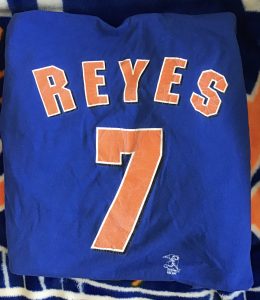 That afternoon in late July of 2003, expanding my lunch hour as long as seemed feasible, I made my way toward the back of the Clubhouse Shop. Past the discounted stacks of ALOMAR 12s and VAUGHN 42s and other detritus of an era that never did take off. I needed to publicly affiliate myself with a fresh Met. VENTURA 4 I discarded in 2002 when he showed up at Shea wearing steel gray with “NEW YORK” across the chest and beat us a game. I did the same to HUNDLEY 9 in a 1999 show of loyalty to PIAZZA 31. PIAZZA 31 remained a stalwart in my t-shirt drawers as of ’03, but it needed contemporary company. REED 35, BAERGA 8, ORDOÑEZ 10, OLERUD 5 had all been retired to the folded piles where I direct all shirts I deem no longer operative…and yes, I liked Carlos Baerga enough to wear him for a while. ALFONZO 13 was, of course, timeless (and is still in rotation to this day), but Fonzie was masquerading as a San Francisco Giant in 2003. That afternoon in late July of 2003, expanding my lunch hour as long as seemed feasible, I made my way toward the back of the Clubhouse Shop. Past the discounted stacks of ALOMAR 12s and VAUGHN 42s and other detritus of an era that never did take off. I needed to publicly affiliate myself with a fresh Met. VENTURA 4 I discarded in 2002 when he showed up at Shea wearing steel gray with “NEW YORK” across the chest and beat us a game. I did the same to HUNDLEY 9 in a 1999 show of loyalty to PIAZZA 31. PIAZZA 31 remained a stalwart in my t-shirt drawers as of ’03, but it needed contemporary company. REED 35, BAERGA 8, ORDOÑEZ 10, OLERUD 5 had all been retired to the folded piles where I direct all shirts I deem no longer operative…and yes, I liked Carlos Baerga enough to wear him for a while. ALFONZO 13 was, of course, timeless (and is still in rotation to this day), but Fonzie was masquerading as a San Francisco Giant in 2003.
“Excuse me,” I asked the clerk, “do you have any Jason Phillips t-shirts?”
My nascent affection was up for grabs a little. Phillips had been a Met a little longer than Reyes to that point and had earned my admiration in a season when I mostly grumbled at every other Met. Jason Phillips had played a competent first base. He was hitting over .300. He modeled the Goggles Paisano specs. I thought PHILLIPS 23 deserved first shot at my wallet.
There was no PHILLIPS 23 in stock. I can’t say if much was ever manufactured. Ah, but REYES 7, the latest shirt for the latest thing, that they had.
Sold.
***By the dawn of 2007, my judgment concerning Jose Reyes was a) he was the most wonderful player in baseball, and b) I really liked wearing REYES 7 on my back. My Guy. My shirt. My, my, how he could hit and field and run, especially run. No Met had ever put together the speed game as Jose had, especially once he shook off the injuries that conspired to slow his departure from the starting gate in 2003 and 2004. When not assigned to the DL (usually with a hamstring problem, the burden of a fast player, I figured), he was out there doing when they said he’d be doing when word surfaced from Binghamton in 2002 that he was gonna come up and blow everybody away. The natural shortstop even overcame an unnecessary shift to second base amid the misguided Kazuo Matsui experiment and retained his potential. Not every Met of promise overcame the obstacles the Mets inevitably placed in his path.
Come 2005, Jose Reyes broke through in earnest. After shaking off a case of acute unfamiliarity with the strike zone (his first walk came in his 120th plate appearance), he began rounding into the offensive threat the Mets had in mind when they signed him at age 16 out of the Dominican Republic. Jose turned 22 in 2005, a year when he played in all but one game, leading the National League in stolen bases and the majors in triples. These are the most fun things a baseball player can lead a league or two in. It means you’re fast, which is far more fun than slow (my affection for the plodding Jason Phillips, who’d since been traded, had mostly faded). It mean you’ve gotten on base regardless of your comfort with taking four balls. It means you certainly got to first base and you didn’t feel confined to it. Quite possibly first base was merely the first third of our your immediate journey, in which case you were three-quarters home after hitting the ball.
Steals and triples. It’s impossible to not smile at those. It’s impossible to not smile when creating them. Jose Reyes smiled a lot in 2005. He smiled way more in 2006. We all did, as the Mets raced to a divisional lead in April and put the field behind them for good. As June arrived, Jose was on the cusp of stardom. Before June was over, he lit up the galaxy.
June 2006 was the month of The Road Trip. There’ve been many Met road trips since 1962. This, however, was The Road Trip, the 9-1 romp through L.A., Phoenix and Philadelphia that eliminated all Phillies, Braves and doubt. What made The Road Trip singular above all road trips in Mets history was the way the Mets went to town on all these teams they visited. In their nine wins, the Mets scored in the top of the first every day and/or night; perhaps both.
Say, do you recall who was the Mets’ leadoff hitter in 2006? The Met who would have gotten just about every first inning off to a rollicking start? Why, yes, it was prototypical 1970s/1980s leadoff hitter Jose Reyes, the switch-hitter who could steal and triple better than anybody, relatively modest accumulation of walks notwithstanding. In every game Jose played on The Road Trip, he scored. In every game Jose played on that trip, his team won. By the end of the week The Road Trip concluded, Jose shared National League Player of the Week honors with David Wright.
Then Reyes went right out and had an even better week. It was the week when Jose tucked a cycle into a massive hitting and scoring streak, and the cycle was almost beside the point. I mean, sure, a leadoff homer, a double, a triple that became a run on a wild pitch and a single is a big effing deal. But it was what happened after the single, in the bottom of the seventh against Cincinnati at Shea on June 21, that was bigger.
What happened was…
JOSE!
JOSE-JOSE-JOSE!
JOSE!
JOSE!
It caught on that Wednesday night, the soccer-style singing in honor of our striker, the player whose job it is to score. Fútbol and béisbol may operate quite differently, but this beautiful player playing as beautiful a game as any Met ever had over a stretch of weeks had Mets fans spanning the globe in search of the most appropriate way to say, ¡Gracias, José! What a kick.
The National League named Jose Reyes its player of the week for a second consecutive week. All the weeks seemed to be his. Before the Mets embarked on The Road Trip, on June 4, Jose was batting .248. By the time they were traveling men again, specifically after they took their second of three in Toronto on June 25, Jose was batting .302. In 18 games, he recorded 37 hits and crossed the plate 25 times. The slash line was .468/.512/.785. The Mets went 13-5. Jose was going to the All-Star Game for the first time.
The joie de Reyes of it all transcended the numbers and the honors. The energy. The excitement. The idea that if Jose got up, Jose could get on, and that if Jose got on, Jose could get us where we wanted to go and give us a joyride the whole way around the bases and up the standings.
Of course Jose Reyes was my favorite player. I was stunned he wasn’t everybody’s favorite player.
***Before 2006 was over, Jose Reyes would homer thrice in one game, produce an inside-the-park homer in another game, and rack up all the Jose Reyes numbers a person would expect after prolonged exposure to the most wonderful player in baseball. Tops in triples again, with 17. The most steals, with 64. Way more than 100 runs. A little shy of 200 hits. Significant MVP support. And, oh yes, the acknowledged catalyst for the National League East Champions. The Mets hadn’t won a division title since 1988. Jose Reyes was five then. It had been a while.
With Jose leading off, Paul Lo Duca batting second and the demolition firm of Carlos, Carlos and David up behind them, it seemed impossible to imagine a pitching staff capable of stopping the 2006 Mets from capturing their first World Series since 1986. Jose Reyes was three then. It had been a while. The Dodgers couldn’t stop the Mets. We swept them in the NLDS. Next, Fox hyped, it would be “Albert Pujols and the Cardinals” versus “Jose Reyes and the Mets”. Those other guys we had were solid. A fistful of them were stars. I had a name/number shirt for three of them. But Jose Reyes was our headliner as we became national prime time programming, the Met above the marquee. I’d had his shirt since 2003, when we lost 95 games. Three long years had streaked from home to third in almost no time at all. Four more wins, and we’d be in the World Series. “Jose Reyes and the Mets” versus whoever was leading whoever from the American League. Bring ’em on. It seemed almost academic that Jose Reyes and the Mets would be there and win all of it.
It’s still been a while since we won the World Series, as you know. Still since 1986. There needed to be more to the Mets in October of 2006 than a hellacious first five hitters — and there was…but not enough, as it turned out. The last time the Mets won in ’06, in Game Six of the NLCS, it was Jose Reyes who put them on top ASAP with a leadoff homer versus Chris Carpenter. That win kept us alive. Jose went 3-for-4 in the Game Six that rarely gets mentioned in the annals of glorious Met Game Sixes. As clutch performances go, it was pantheon-worthy as anything Jose’s Met predecessors posted in the must-wins of 1986, 1988 or 1999.
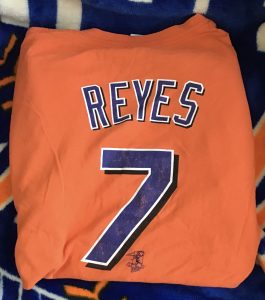 We fell short in Game Seven, but that was, to my Jose-ish optimistic outlook of the moment, almost OK. To clarify, it wasn’t OK in and of itself, and it still isn’t OK. I really wanted the Mets to go that World Series and win that World Series. It’s still the one in my heart of hearts that got away more than any of our now seven cigarless postseason appearances. Yet it was OK in the sense that, clearly, we were too good to not be back in 2007. We had won 97 games. We had all that power in Beltran, Delgado and Wright. We would have our starting pitching healthy again, which we didn’t in the playoffs. And, of course, we would have Jose Reyes leading off. With ESPN choosing our Opener at St. Louis as its Sunday Night showcase, Jose would be the very first batter of the entire next baseball season. Talk about having a leg up on the competition. No, two legs. The two fastest, most dynamic legs anywhere. We fell short in Game Seven, but that was, to my Jose-ish optimistic outlook of the moment, almost OK. To clarify, it wasn’t OK in and of itself, and it still isn’t OK. I really wanted the Mets to go that World Series and win that World Series. It’s still the one in my heart of hearts that got away more than any of our now seven cigarless postseason appearances. Yet it was OK in the sense that, clearly, we were too good to not be back in 2007. We had won 97 games. We had all that power in Beltran, Delgado and Wright. We would have our starting pitching healthy again, which we didn’t in the playoffs. And, of course, we would have Jose Reyes leading off. With ESPN choosing our Opener at St. Louis as its Sunday Night showcase, Jose would be the very first batter of the entire next baseball season. Talk about having a leg up on the competition. No, two legs. The two fastest, most dynamic legs anywhere.
I was gonna need another shirt. The first REYES 7 was kinda worn by now and the thick name-on-back lettering from 2003 never bothered mimicking the Mets’ font. In 2003, the Mets and high quality didn’t really mesh. My next REYES 7, for 2007, would be orange fabric, thin blue printing. Sleek, just like Jose.
***Until 2007, there is no need for judgment beyond routine approval and extraordinary serenading. Jose Reyes has been a big leaguer for four seasons, two when he was just getting going and two when he was all go. Why would 2007 not be a continuation, an acceleration of the Jose Reyes who had overtaken the baseball imagination, the Jose Reyes who was every bit as fantastic as I decided he was going to be?
Yet this is where I am compelled to detour to Judgment City. It’s The Road Trip I’d rather not take. I’d rather continue to list Jose Reyes accomplishments and punctuate them with grand anecdotes. Here’s all Jose Reyes did in all the years to come, here’s how marvelous it felt, try not to trip over the trophies.
That’s not quite what happened. I’m not sure I understand what happened. He still compiled some pretty shiny numbers and I can still point to some pretty impressive accomplishments and, if you cover one eye and read the chart with as generous an interpretation as you can muster, you’ll notice the Mets of the seasons directly following 2006 were quite the contender, pursuing their collective goal clear to the very end of their schedule, and who doesn’t relish a smashing pennant race?
Both eyes open, it wasn’t nearly such an unfettered success story, not for the Mets and, despite my never wanting to give an inch, not for Jose Reyes. As clear-eyed a fan as I believe I’ve always been, I’m reflexively blinded my loyalty to my inner-circle absolute favorite players. There’ve been only a handful of those in my more than half-century of rooting for the Mets. Jose Reyes is one of those.
In 2007, I finally accepted that my favorite player could do wrong. And it grudgingly occurred to me, as Jose Reyes neared the quarter-century mark himself, he might not always get better. There might be a ceiling for Jose Reyes. In fact, I might have already experienced it.
What a drag it is getting old.
***In the spirit of Albert Brooks’s conception of Judgment City, I will now examine seven days from Jose Reyes’s 2007 season — seven for No. 7 from ’07. It is not up to me to pass judgment, exactly, but maybe I can get a better grip on where things began to go at least a little awry.
DAY 1: APRIL 6
Jose leads off the Mets’ series opener at Turner Field by tripling. He scores on a Lo Duca fly ball. It’s what we call a Reyes Run. The Mets are on a run already, having swept the Cardinals for a measure of revenge and now they’re sticking it to the Braves. Jose triples twice, scores twice, collects three hits and drives in four. The Mets win, 11-1. They’re 4-0. See, not quite going all the way in 2006 really was sort of OK because these Mets are too good to not be back; let’s call Game Seven a teachable moment. Jose is too good to not be back. When April ends, Reyes is batting .356. The leadoff hitter none other than Bobby Cox terms the best since Rickey Henderson has 18 RBIs to go with his 17 steals, 9 doubles and 5 triples. Sextuple that to reflect an entire season…well, let’s not get ahead of ourselves. Let’s just revel in April. For this first 2007 month of production, Jose Reyes is named National League Player of the Month. It’s the award he wasn’t given the previous June. He lost that one to David Wright, so we’ll allow it.
DAY 2: MAY 29
The Mets are actually a little choppy as April becomes May. Their solution is to chop off their hair. As a team-building exercise, they almost all opt for crewcuts. (Guys, huh?) Jose is a little late to the barber party. He has such nice curls, but eventually he gets in on the noggin-shaving, and whether one thing has anything to do with another, being shorn at Shea seems to do the trick. By late May, the 2007 Mets are rolling like their 2006 predecessors. The Giants find out how hairy it can be facing off against Jose when he has nothing extra up top weighing him down. In a game that enters the bottom of the twelfth, with San Francisco ahead, 4-3, Reyes leads off against the closer of blown leads past, Armando Benitez. Seven years since J.T. Snow and Paul O’Neill convinced us to cringe, it is surprising to realize somebody is still trusting Armando Benitez with save situations, but at this point in his managerial career, Bruce Bochy is not yet a certified genius. Armando is his man. Fortunately, Jose is ours. Benitez walks the shortstop with whom he briefly shared a clubhouse four years earlier. The count had gone to three-and-two and…yeah, we recognize Armando Benitez. We also recognize Reyes on first. First? Make that second, for Jose has goaded Armando into a balk. Endy Chavez then bunts Jose to third. Carlos Beltran grounds out, and Jose has to stay put, but since when does Jose Reyes stay put? He dances off third. He is Lola from “Copacabana”. She would merengue/and do the cha-cha… And while Armando Benitez tried to concentrate on getting a third out, Jose Reyes has teased from Benitez’s ever-tender psyche a second balk. Jose can dance home. The game is tied. Moments later, Carlos Delgado homers, and the Mets have won, 5-4. Jose Reyes and the Mets are 33-17, five games up on the Braves, eight ahead of the Phillies. Who the hell is going to stop Jose Reyes and the Mets?
DAY 3: JUNE 15
As temporally dissonant as it is to grasp Armando Benitez is still around in 2007, how about getting a load of that load Roger Clemens? Clemens’s major league career dates back to Jose Reyes’s infancy. His infamy needs little introduction to Mets fans. We might have thought we were done with him when he stopped pitching for Houston after 2006. But the Rocket was always retiring and reneging. Little wonder that Suzyn Waldman bleated on an otherwise lovely Sunday afternoon that Clemens was returning from Texas to pitch in the Bronx (“of all the dramatic things I’ve ever seen!” she shrieked upon spotting the heretofore inactive 44-year-old in “George’s box”). It was too late in the season for Joe Torre to steer his delicate ace away from Shea Stadium; we’d already taken two of three in the civilized portion of the Subway Series. We were getting him on the other side of the Triborough. Perhaps, having been out of New York since 2003, Roger was looking forward to coming up and in on Mike Piazza again. Alas, Mike was in Oakland and the Mets he was encountering had already given themselves their own close shave. Leading off the first game of the second part of the 2007 intracity six-pack, Jose Reyes informs Roger Clemens much of the Metropolitan Area isn’t nearly as worked up over his presence as Waldman was. Jose singles. He doesn’t score, but neither do any Yankees taking on Oliver Perez, who demonstrates an uncanny knack for confounding the Braves and Yankees (where were you in 1999 and 2000, Ollie?). It’s nothing-nothing until the third when speed kills and thrills. The more the better for the Mets. Jose now has a running mate, Carlos Gomez. The rookie’s not as skilled as Jose with the bat — Jose received a Silver Slugger the year before — but he can bunt, which does to get on, and he can run, which he does to steal second. Jose then singles home this third Carlos in our arsenal to break up the Rocket’s shutout. In the fifth, Jose homers. Ollie goes eight. The Mets win, 2-0. In case there’s one more Series between these teams four months hence, Roger can take note that the Mets have a couple of players who can run rings around him.
DAY 4: JULY 6
The first-place Mets are a little sluggish. It happens to the best of first-place teams. Maybe the Mets haven’t been playing like the best of first-place teams, but they are in first place. The All-Star break is almost here. A Friday night in Houston may not be the best spot to keep one’s energy up, not even for the player who’s usually the most vibrant in the land. It’s the eighth inning. There are two out. Jose Reyes is up, with the Mets trailing by four. He grounds to third baseman Mike Lamb. Jose runs toward first not exactly like a lion. It’s too hard to not notice. A fan might choose to look the other way. A manager does not. Willie Randolph removes Jose Reyes for not hustling. The hustle is a dance we are sure Jose knows better than Lola knows the merengue or cha-cha. No, no runner should take a ground ball for granted (Lamb bobbled it but had an easy play), yet, a fan could rationalize, perhaps Jose has to take his breaks where he can get them. He’s not going to have the All-Star game off.
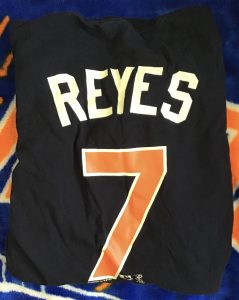 DAY 5: JULY 10 DAY 5: JULY 10
Jose Reyes is indeed back at the All-Star Game. It’s cause enough for me to order a black REYES 7 tee from the event, replicating the NL’s batting practice jerseys (it never really fits). For a second consecutive year, he is voted the starting shortstop. For the first time, however, he will play. In 2006, ex-Met Mike Jacobs had stepped on Jose’s foot in the series before the break and, out of an abundance of caution, Reyes’s services were withheld from the Midsummer Classic in Pittsburgh. Not this time in San Francisco. If Jose is not front and center, he is appropriately adjacent. The star of the pregame proceedings is the player for whom it is said All-Star games were made, Willie Mays. Willie was a Giant in San Francisco, you know. After he was a Giant in New York, before he was a Met in New York. He was an All-Star the whole time. Willie, naturally, had the honor of throwing out the first ball. Actually, the honor belonged to the ball. Anything Willie Mays touched was elevated. And to whom did Willie decide to deliver that first pitch? Who of all the All-Stars available to him did the once-upon-a-time speedster/slugger from the National League team in New York choose as his personal catcher? Why, Jose Reyes, of course. Who else? In the middle of 2007, with Jose Reyes presumably in the midst of a career path that could conceivably land him on a plane with some of the greatest all-around shortstops to have ever played the game, it doesn’t seem incidental to see the 24-year-old paired with the No. 24. Not only does Jose catch the ball from Willie, Willie signs the ball for Jose. “I’ll save that ball all my life,” Jose says. I’ll save the image from that night comparably long.
DAY 6: AUGUST 22
In the fifth inning against the Padres at Shea Stadium, Jose Reyes singles with one out. He takes second when recent acquisition Luis Castillo grounds to first. David Wright walks. Then, with Carlos Beltran at bat, they execute a double steal. Wright can run, you know. Reyes can run, we definitely know. The swipe of third is Jose’s third steal of the night — and his 67th of the season. “JOSE! JOSE! JOSE!” and then some resonate in the Flushing night. We are giddy to be present for the setting of a new one-season record. Roger Cedeño had stolen 66 bases in 1999. It was the most by any Met until now. Now, it’s Jose establishing a new mark with 37 games to go. Who knows how high the record will sit by year’s end? When Carlos drives in both Jose and David, we’re more concerned that the Mets have closed the gap on the Padres to 4-2. It’s a shame we’re losing this game and will lose it, 7-5, despite Jose’s exploits. The Mets still haven’t fully broken free of their competition. The Phillies are in second place, five games out. Atlanta’s right behind them, six out. Still, we’re in pretty good shape. And with Jose batting over .300, keeping his OPS over .800 and piling up those bags, any glitch detected in the program to repeat as division champs and exceed 2006’s accomplishments certainly isn’t his fault.
DAY 7: SEPTEMBER 15
This thing is in the bag. Basically. There was a scare in late August, when the Mets went down to Philly and Jimmy Rollins made like the Devil in a Charlie Daniels song to instigate a four-game sweep, but we’d recovered since then. We’d gotten Pedro Martinez back from a five-month DL stint and at Shea on a beautiful Saturday afternoon, Pedro’s nursed a 3-1 lead through six. We beat the Phillies today and everything will be fine. We should have beaten them last night, but there was a bad call, and the bullpen didn’t do us any favors, and, well, c’mon, get over it. We came into Saturday 5½ up on the Turnpike interlopers. Just take care of business every day. Most days that means Jose doing Jose things. I wonder, though, if Jose is pressing. Fouled out in the first. Popped out in the second. Singled in the fourth, but got himself thrown out trying to steal. The average is below .300. Seemed impossible in April to fathom that it would take that kind of dip, but it’s a long season. Just relax. Jose is Jose. The Mets are the Mets. We have a Magic Number. In the bottom of the sixth, Jose walks. He can do that, pitchers are discovering. Then Jose steals. That’s something pitchers discovered back in 2003, with ex-Met Kane Davis, now of the Phillies, the latest to be reminded. Jose has well over 200 steals in his career. He’s second to Mookie Wilson all-time among Mets, and it’s only a matter of time before Jose passes Mookie for a career like he passed Cedeño for a season. Anyway, we have a 2-1 lead, we have Reyes on second, after which we have Castillo walking, which paves the way for Wright to bat in this inning. David’s been hot as a pistol. This is a terrific situation to build the lead, to get a little insurance. The great thing about Jose being on second is he doesn’t need to be on third to score when a superb RBI man like David is batting. I love watching them ply their respective crafts together, whether on the left side of the infield or from various stations on the basepaths. David at third, Jose at short. David at the plate, Jose on second. The two of them doing their thing in sync. This is as optimal as it gets.
***And that’s where I wish Day 7 goes blank, but it doesn’t. I know what happens next. Jose Reyes, a five-year veteran, a two-time All-Star, the best in the game at what he does, takes off for third base on the first pitch David Wright sees. Chris Coste grabs it and fires it to Greg Dobbs. Reyes is out easily. Threat over. Inning over. Pedro Martinez gives way to the bullpen.
The simple invocation of the Mets’ bullpen in September underscores that if one is anxious to parcel out blame for what was about to happen to the rest of the 2007 Mets’ season, one would have to bring plenty of postage. Wright was awesome in September. So was Beltran. Moises Alou defied time and crafted a thirty-game hitting streak. They’re absolved. Nobody else is. The Greatest (or Worst) Collapse in Baseball History was underway. We didn’t know it on Friday night when we lost to the Phillies, but we began to sense it on Saturday when the 3-1 lead became a 5-3 loss. It was followed by a 10-6 defeat on Sunday, and the hinges were clearly coming loose on the Mets being a prohibitive favorite to return to the postseason because all bets were off.
From seven games ahead with seventeen to play on September 12, the Mets finished one behind on September 30. It would be convenient to say it all turned on Jose Reyes’s misguided attempt to steal third base in the sixth inning on September 15, but it would also be a stretch. Jose Reyes and the Mets spent most of 2007 in first place as team; Jose Reyes and the Mets fell out of first place at the end of 2007 as a team.
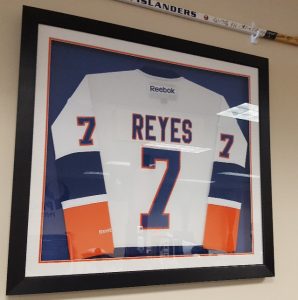 Jose’s September was April’s inverse. He would steal again on September 15, in the ninth. It was his 78th bag of the season. It was also his last. The speed game went into hibernation. Then again, it’s impossible to steal second (or third) when you don’t reach first, and Jose basically stopped doing that. His September 2007 numbers were dreadful: a .205 batting average; a .279 on-base percentage; one triple; five steals after five months when he never stole fewer than ten bases. Jose’s September was April’s inverse. He would steal again on September 15, in the ninth. It was his 78th bag of the season. It was also his last. The speed game went into hibernation. Then again, it’s impossible to steal second (or third) when you don’t reach first, and Jose basically stopped doing that. His September 2007 numbers were dreadful: a .205 batting average; a .279 on-base percentage; one triple; five steals after five months when he never stole fewer than ten bases.
Yet, for me, it wasn’t his contribution to the descent from first place to second, his personification of the collapse itself, that bugged me. It was that when he took off for third in the sixth on the Fifteenth, I was livid with him for the first time in his career. What kinda stupid…? He was no longer Jose Reyes above reproach. He wasn’t running from pedestal to pedestal, inevitably safe in my mind. He had become, incrementally, just another Met letting me down. Mind you, I didn’t drop him from his slot as my current favorite. I didn’t even care that he danced too enthusiastically for the Marlins’ taste in Game 161 that year, allegedly firing up the opposition during a Met blowout, first inciting a weird-ass brawl (with coach Sandy Alomar getting involved), then stoking the Marlins to jump ugly on T#m Gl@v!ne in Game 162 because motivation is so effortlessly easily converted into runs. I didn’t even notice the dancing from my seat in Mezzanine. Lastings Milledge had just homered and Jose was happy for him and, as I understand it, the two of them tangoed in front of the home dugout instead of inside it; something like that. They’d be scolded for their violation of unwritten rules, for waking up the somnambulant Fish, for noticeably enjoying an uplifting moment amid what had been a crisis atmosphere.
Today that sounds even more ridiculous than it struck me in 2007. It may have been the first instance of Jose Reyes having been born too soon.
***September’s dive notwithstanding, Jose Reyes’s overall numbers for 2007 were outstanding, as they were again in 2008. One of those Met injuries that doesn’t get solved in the span you think it will sidelined him most of 2009, but he was back in 2010, making his third All-Star team. In 2011, when his hamstrings didn’t nag, he was otherworldly, winning the first batting title any Met had ever won. The Jose Reyes of June 2011 was what you would have expected to see had you been asked to project five years forward from June 2006. Sadly, the Mets weren’t anywhere near as good as they’d been in 2006 and, sadder to me, Jose wouldn’t be around Citi Field, except as a visitor, for nearly a half-decade after 2011. He and I were older, maybe wiser. He was definitely richer. The Marlins got over that fight with him and signed him for a ton of money. Every time he came back to Flushing in 2012, I applauded him heartily and only sort of hoped the Mets would get him out.
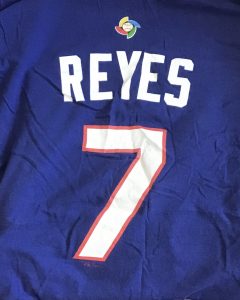 The only thing Miami didn’t give him was a no-trade clause (they’re notorious for that), and after a year, Jose was a Toronto Blue Jay, which he didn’t seem to mind. We saw him in Interleague play in June of 2015, then as a Colorado Rockie that August. He seemed to mind that next identity, but by then, with the Mets in first place for the first time since 2008, I’d mostly moved on from thinking about Jose Reyes. I still had my REYES 7 t-shirts, five in all, but none of them was as go-to as any used to be. I had two HARVEY 33s and still sported WRIGHT 5. I even threw a TEJADA 11 into the mix as part of my shortstop separation process post-Reyes. (It also never fit.) The only thing Miami didn’t give him was a no-trade clause (they’re notorious for that), and after a year, Jose was a Toronto Blue Jay, which he didn’t seem to mind. We saw him in Interleague play in June of 2015, then as a Colorado Rockie that August. He seemed to mind that next identity, but by then, with the Mets in first place for the first time since 2008, I’d mostly moved on from thinking about Jose Reyes. I still had my REYES 7 t-shirts, five in all, but none of them was as go-to as any used to be. I had two HARVEY 33s and still sported WRIGHT 5. I even threw a TEJADA 11 into the mix as part of my shortstop separation process post-Reyes. (It also never fit.)
In October of 2015, while we were ensconced in a World Series state of mind, Jose Reyes allegedly threw his wife into a shower door at a resort in Hawaii. I say “allegedly” because a criminal case was dismissed, but it was widely acknowledged what happened. Maybe not why it happened, but what difference did that make? Who does that?
Who clings to a favorite player after that? “Not me,” I’d like to say, though I do have a talent for compartmentalization. I still loved the Jose Reyes who hit and ran and made sizzling, on-target throws from deep in the hole. I still loved the Jose Reyes who made me want to buy those shirts and keep wearing them. The Jose Reyes who absorbed a domestic violence rap from Major League Baseball I wasn’t crazy about. I certainly wasn’t processing his release from the Rockies and suspension from baseball as an ideal avenue to a reunion with the Mets.
But David Wright’s back gave out and the Mets needed a left-side infielder. Surprisingly if somehow not shockingly, here we were again in the summer of 2016, the Mets and Jose, me and Jose. And it was weird. For some Mets fans, it was repulsive. I respect that. If someone who threw his wife into a shower door is who you never stopped seeing when Jose Reyes came to bat, I’m not gonna suggest covering one eye. I mostly saw that character for a while myself.
When the Mets played the Marlins at Citi in late August four years ago, just as they were improbably reconstituting themselves as a Wild Card contender, there was a play at the plate in the bottom of the eighth. Jose Reyes was sprinting from third on a wild pitch unleashed by AJ Ramos. J.T. Realmuto rushed to retrieve it off the backstop, which, as you know, isn’t a great distance from the plate. The two men collided. Reyes was called safe, but it looked bad for him. He was down on the ground for a while, appearing to writhe in genuine pain.
And for the only time in my life when a Met was in that state, I thought to myself, instinctively, “Good. You deserved that.”
I guess that was my moment in Judgment City. I wasn’t proud of myself, so I made sure to add a thought.
“Now get up and be OK.”
***Jose got up. He was OK, and he and I were cool again. Not that he knew. Like I said, we’ve never met, but I could get back to not finding his presence on the Mets totally weird. It was something I’d wanted on and off for four years, and when it happened, it felt slimy. Now, with Jose having served the time MLB mandated and undertaking whatever other steps they and the Mets insisted on; and his wife sticking with him; and thumbs up from his teammates, it began to feel like baseball. If I was watching Jose Reyes play baseball for the Mets, I was gonna root for him. I didn’t know how not to. I had too many shirts with his name and number not to.
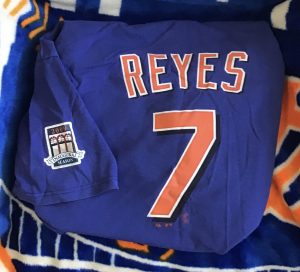 Reyes contributed positively to the 2016 Mets’ playoff push as much as he had a hand in the collapse of 2007. On a roster constructed by Mad-Libs, he was not only crucial, he was considered a leader. We got to the postseason, all one of game of it, because Jose Reyes came back. He held down third competently. He belted the home run that tied what would eventually be the Asdrubal Cabrera Game. He was home. After that September, I found it odd to come across 2015 highlights and not see him involved. I caught myself mentally Photoshopping him in. Reyes contributed positively to the 2016 Mets’ playoff push as much as he had a hand in the collapse of 2007. On a roster constructed by Mad-Libs, he was not only crucial, he was considered a leader. We got to the postseason, all one of game of it, because Jose Reyes came back. He held down third competently. He belted the home run that tied what would eventually be the Asdrubal Cabrera Game. He was home. After that September, I found it odd to come across 2015 highlights and not see him involved. I caught myself mentally Photoshopping him in.
He’d hang around a couple more years, his skills deserting him in rapid fashion by 2018. His head, attached as it was to an unproductive 25th man’s body, was called for as the Mets plunged through the floor in June. I logically knew there wasn’t much benefit to his presence on the field, but I also didn’t think that with the Mets as far gone as they were by summer that it much mattered. Let Jose have his emeritus phase. Let Jose pitch in a blowout. And when the final weekend rolled around, let the starting lineup include leadoff hitter Jose Reyes at short, while batting third and playing third, No. 5, David Wright. Wright worked his stenotic spine off to return to the diamond one final time. He and Jose belonged together out there. For them, the self-described baseball brothers. For us, too — at least the segment of “us” that didn’t have an existential problem with the Mets’ all-time shortstop playing out his string where he’d begun unfurling it fifteen years prior.
It was emotionally outstanding seeing those two as one one more time. As Natalie Cole dueted with Diana Krall, it was “better than cream cheese and bagels,” and what two New York staples went better together than Reyes and Wright? I could have watched Jose and David in tandem forever. Circa September 2006, I thought I would. By September 29, 2018, all I wanted was for them to embrace on the field one last time and for me to embrace them through the television while they did.
On September 30, the very next afternoon, Jose started again at short. It was his de facto farewell. He hadn’t announced he was retiring (that would take nearly two more inactive years), but his contract was up, he’d batted under .200, and the last teenage Met had passed 35, so, yeah, the last game of the year wasn’t subtle in its symbolism. I was there. When it became clear that we were seeing Jose Reyes play in a Mets uniform for the final time, I stood and applauded his ceremonial removal. The ensuing “JOSE! JOSE! JOSE!,” nudged with a cue from Citi Field’s A/V squad, couldn’t have sounded any less spontaneous — akin to what Charlie Brown said about hot dogs and baseball games, JOSE! JOSE! JOSE! doesn’t taste right without a cycle — but how could you not score this departure this way? When Jose left as a free agent in 2011, the exit was atonal even before anybody realized nobody extended him a substantive offer to stay. Jose made a right turn from first base in the first inning after elevating his average to .337, secure enough for a batting crown, and left his fans wanting more. Seven years later, he couldn’t be accused of doing the same. Some Mets fans had seen all they’d wanted before he returned in 2016. Some were volubly astonished he’d avoided designation for assignment let alone unconditional release throughout 2018. But he had returned and he had survived, and now he was saying a proper goodbye, just as David had the night before. It was less of a moment, but, despite my five-to-one Reyes-to-Wright t-shirt ratio, I have to admit WRIGHT 5 earned the more spectacular sendoff.
Yet, to me, there was no doubt Jose earned that last round of JOSE! JOSE! JOSE!s. The way he hit. The way he ran. The way we sang. It was, per Ms. Cole and Ms. Krall, better than anything except being in love.
PREVIOUS METS FOR ALL SEASONS
1962: Richie Ashburn
1963: Ron Hunt
1964: Rod Kanehl
1966: Shaun Fitzmaurice
1969: Donn Clendenon
1970: Tommie Agee
1972: Gary Gentry
1973: Willie Mays
1977: Lenny Randle
1978: Craig Swan
1981: Mookie Wilson
1982: Rusty Staub
1983: Darryl Strawberry
1986: Keith Hernandez
1988: Gary Carter
1990: Gregg Jefferies
1991: Rich Sauveur
1992: Todd Hundley
1993: Joe Orsulak
1994: Rico Brogna
1995: Jason Isringhausen
1996: Rey Ordoñez
1998: Todd Pratt
2000: Melvin Mora
2001: Mike Piazza
2002: Al Leiter
2003: David Cone
2004: Joe Hietpas
2005: Pedro Martinez
2008: Johan Santana
2009: Angel Pagan
2010: Ike Davis
2012: R.A. Dickey
2013: Wilmer Flores
2014: Jacob deGrom
2019: Dom Smith
by Greg Prince on 21 August 2020 5:24 pm Welcome to A Met for All Seasons, a series in which we consider a given Met who played in a given season and…well, we’ll see.
I got the horse right here
The name is Paul Revere
And here’s a guy that says
If the weather’s clear
Can do
Can do
This guy says the horse can do
—“Fugue for Tinhorns,” Guys and Dolls
Psst…over here. Yeah, you. You with the Mets cap on your head and the fistful of hope practically jumpin’ outta your heart. I know your type. You’re a good fan lookin’ for a reason to get excited about the Mets in 2010, aren’t ya, Mac? Ya wanna feel the way ya felt before they opened that Citi contraption, before they tore down your beloved Shea, before those collapses ruined your last seasons there. You want a little taste of what it was like when your guys Reyes and Wright were coming up. I saw your eyes light up when I said that. Homegrown stars. That’s the stuff, ain’t it?
I got a tip for ya, then. Some real ground-floor intel. I’m not givin’ it to everybody, but you, my friend, you should have this, and here it is:
Put your hope and your heart — all of it — on Ike Davis to go all the way. I’m tellin’ ya, pal, he can’t miss.
Ya look skeptical, but buddy, I got the straight dope here. This Ike Davis is a born winner. Bats left, throws left, does everything right. Ya don’t believe me? Check out the background. The Mets took him in the first round out of Arizona State — same school as Reggie Jackson — in 2008 with the pick they got when the Braves signed T#m Gl@v!ne back where he belonged. That guy, right? The Mets sent him to Brooklyn, where he began to feel his oats, and then as he got higher up the chain, in St. Lucie and Binghamton, the kid began to really pop. Twenty homers in all in 2009. Did ya see anybody at Citi Field hit twenty homers in 2009? Besides Chase Utley?
Mac, ya like batting average? Then get a gander at this number: .341. That’s what Ike hit in the Arizona Fall League last year. Led the entire circuit, mi amigo. Played a sweet first base, too. If that don’t sound like enough, get a load of his bloodlines. Ike Davis is the son of Ron Davis. That’s right, the Ron Davis who pitched for the Yankees and Twins. Time flies, huh?
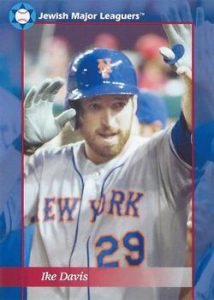 Could it possibly matter that Ike Davis was a Jewish major leaguer? Couldn’t hurt. Say, pal, you wouldn’t happen to be of the Semitic persuasion, would ya? No offense, none! The reason I’m asking is if you are…you are? Well, you’ll love this. Ike Davis is Jewish! Technically, half-Jewish, on his mother’s side. The one that counts off the field, right, my man? Or should I say right to left? Listen, I know you only care about hitting and fielding, but it’s a nice little bonus, don’t ya think? Your whole face is lighting up. I’ll bet you were pretty excited when the Mets traded for Shawn Green. No trade necessary for Ike.
Now you might be wondering why the Mets haven’t announced Ike Davis will be starting at first base as soon as the 2010 season commences. After all, both Baseball America and Baseball Prospectus have him in their Top 100 prospects, and Amazin’ Avenue — you ever read them? — says he’s already the Mets’ No. 6 prospect, just five spots behind Fernando Martinez, and I know you know about him. Lemme tell ya why you’re not gonna see him from jump:
Because that Omar Minaya is a smart cookie, that’s why. Omar knows if he starts the season with Ike Davis on the roster, I mean on Opening Day, Ike becomes a free agent that much sooner. These GMs today, they take all that stuff into account. It ain’t like when you and I were comin’ up and they just put the best players on the team and let the chips fall where they may. Right, like Kelvin Chapman. So maybe you’ll be hearing that Ike Davis is going to Triple-A, to Buffalo, that they’re bringin’ back Mike Jacobs for some reason, but have a little patience. Ike’ll be on the Mets before long, as soon as Omar counts off the days that’ll keep him on the team a whole year longer down the road — and believe you me, my friend, you’re gonna want a whole other year of Ike Davis.
I’m tellin’ ya, brother, you want in on Ike Davis. Talk about a sound investment. Gonna be the best all-around first baseman our Mets have had since John Olerud. Wait, did I say Olerud? I meant Hernandez. Yep, Keith Hernandez — Mr. Seinfeld himself. I bet ya loved Keith Hernandez. I bet in your heart of hearts you don’t think the Mets have ever truly replaced Keith Hernandez.
Well, this Ike Davis is the sure thing, Mac. The bat. The glove. The personality. Wait ’til you listen to the kid speak. He’s a natural! And you don’t even have to hope the Mets’ll trade Neil Allen and Rick Ownbey for him. He’s on his way — it’s in the bag. Whaddaya say, how about putting down your heart and your hope on some of this Ike Davis action I’m lettin’ you in on.
Oh, you won’t be sorry you did. I’m promising ya, pal, you’re gonna flip for Ike Davis.
***Psst…over here. Yeah, you. Don’t ya remember me? From last spring. I’m the guy who turned you to on to…that’s right. I’m the Ike Davis guy.
 An Ike Davis guy. How did that work out for ya, pal? Pretty nice, huh, just like what it says on that shirt you’re wearin’. “WE LIKE IKE.” Bet ya couldn’t wait to run into the team store and pick up that beauty. Ya got exquisite taste there, chief. And you’re smart, because ya listened to me. I told ya all about Ike Davis before he even came up and you were there the night he debuted. April 19, 2010, Jackie Robinson Night at Citi Field. The Mets were off to a murderous start. Four and eight and the word was out about the first baseman at Buffalo. Even the nimrods calling the FAN were demanding Ike. Mike Francesa was tryin’ to get out in front of the bandwagon, and you know if that jamoche was on the case, it was only a matter of time.
But you were on top of all those jerks because you went in hope and heart on Ike Davis before everybody else was done asking what the deal was with Mike Jacobs being back. You listened to the information. You got it right from the source, right here. Ike wore No. 42 like everybody else when he made his first appearance, but you, pal, you could pick him out of a crowd. Something different, and not just because he was Jewish on his mother’s side. Whoa, no offense.
Ike had that certain something you loved. Whether in 42 or 29, he just looked like he belonged, like the majors were waitin’ for him, not the other way around. You loved the hitting. You loved the fielding. You really loved the three times he went rear end over tea kettle to grab them foul balls. Hey, I meant it when I said you’d “flip”. OK, he was the one who flipped. Ya got me with the grammar.
And the team, while it didn’t exactly light the world on fire, they seemed like Ike’s team whenever they did, right? Did ya see how his teammates greeted him at home plate that night in June when he beat the Padres? That was no ordinary walkoff reception. Rookie or not, he didn’t mind gettin’ in an umpire’s face, wasn’t afraid to pat a teammate on the butt, grew a little facial hair, started a charity in memory of his friend. Little things, but ya notice ’em. He didn’t seem afraid of anything. Sure, there were a few more strikeouts than you’d care for, and the average wasn’t exactly out of the Arizona Fall League, but c’mon, he has to save something to get better at. What is it they say about really good TV shows these days? “No spoilers,” that’s it. We’re gonna wanna see how he improves every year. You wouldn’t want me to give away the plot to Breaking Bad, would ya?
Listen, as long as we’re talkin’ chemistry, ya must’ve loved how Ike held down that infield. Around the horn: Wright, Reyes, the pup Ruben Tejada and Ike Davis. All homegrown, all young. Even David and Jose, who it seems like have been around forever, are under thirty. That’s a dream come true for a Mets fan like you, I’ll bet. No coming and going, only orange and blue, through and through. I don’t know why it matters, either, but you’re right. It’s just better that way. And last year Davis, Tejada, Reyes and Wright started together 39 times, more than any totally homegrown Met infield ever did, even the ones with Eddie Kranepool and Buddy Harrelson.
Amazin’, as fellas like you and me like to say, right? And think about this, my friend. Reyes can be a free agent after the upcoming season. Loyalty is as loyalty does, hmmm? For all we know, the Mets will trade him before he walks. I know, I know, it’s unthinkable that he leaves the Mets, but with this Madoff business, you can’t necessarily trust these owners to keep their best players. And if Reyes can leave, who’s to say Wright won’t? What, you think just because he’s a good Tidewater boy that he won’t shop his services around? Not for nothin’, but Chipper Jones isn’t gonna play third base in Atlanta forever, and Georgia is in the south just like Virginia. I’m just sayin’. I’m not tryin’ to upset ya here — it’s just us two Mets fans talking — but who’s gonna be the next captain if David bolts? Can’t you see Ike taking charge? Admit it, you’ve already thought about that and he doesn’t even have a full year of service time.
 You wouldn’t have guessed that by the middle of 2011, you’d be more likely to see an Ike Davis bobblehead at Citi Field than see Ike Davis. In the end, the Mets won only 79 games in 2010, yet Ike hit nearly 20 homers and drove in more than 70 runs. These were practically Strawberry numbers! And ya can’t forget those catches over the railings. That’s a trademark move. The boys in Brooklyn made a bobblehead out of one of ’em. I hear the Mets are making a giveaway for the upcoming year, though it probably won’t be as cheeky. It never is with them. Anyway, our man had a heckuva introductory campaign, wouldn’t you say? Finished seventh in the Rookie of the Year vote. Sure, the Giants had Buster Posey and went to the World Series, and the Braves had Jason Heyward and went back to the playoffs, but we had Ike Davis, and what I’m sayin’ pal is Ike’s not gonna be a free agent for that whole extra year, not ’til after 2016. That’s ages from now.
By then, you get the feeling Ike’s gonna be as big a star as Posey or Heyward. Listen, I got a tip that Albert Pujols is gonna be pullin’ outta St. Louis after this year, maybe chase some of that designated hitter money in the junior circuit. Then who’s the perennial All-Star first baseman in the National League? Freddie Freeman? Joey Votto? Nice players, sure, but c’mon, we have Ike Davis. What’s it say there on that garment of yours? Yeah, we do like Ike.
So whaddaya say, pal? Ya listened to me last year and it paid off handsomely. How about you go all in this time? All hope. All heart. All head, even. Ya can’t argue with the results and the potential. Take a look, I got an advance glance at this 50th-anniversary book by Matt Silverman — good writer — and the last player picture in here is of none other than Ike Davis. Y’know why? Because they always end with the future in these books. Nobody’s more the future for this team after 2010 than Isaac Benjamin Davis, if I may use his full and proper name. Seriously, start him up, he’ll never stop.
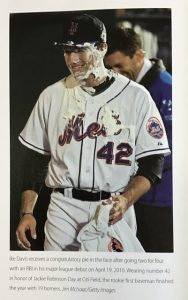 Have a pie, the future is here! This is a once-in-a-lifetime opportunity for a Mets fan of your ilk. Homegrown slugger, charismatic, a landsman…you know what I’m talkin’ about.
All right, all in. Pal, ya won’t be sorry.
***Excuse me? No, I don’t know you. Ike who? Listen, Mac, move along, I’m tryin’ to conduct honest business here. I don’t know what you’re talkin’ about.
All right, fine, ya got me. Yes, I’m the guy who turned you on to Ike Davis all those years ago. So it didn’t work out. So the homegrown infield of your dreams never started together again after 2010. So he collided with Wright on the mound at Coors Field and missed most of 2011, which I didn’t think looked that bad, but it was apparently a turning point for the worse. So he contracted the valley fever in 2012, which I’d never heard of before Ike got it, but I know it was probably worse than anybody let on and he never really fully recovered. So he kept striking out and his average kept dipping and he never made another catch over a railing again. So they sent him to Las Vegas to find his stroke and it proved irretrievable. So they traded him to Pittsburgh in 2014 and he was basically never heard from again except when he played for Israel in the WBC. So like with Shawn Green the fact that he was a Jewish Met was nothing more than a pleasant footnote when he wasn’t producing. Still, lemme guess: you were more fired up about the idea of voting for Ike Davis in 2010 than you were about Joe Lieberman in 2000.
I know neither one of them was ever elected to start in an All-Star Game. Just an observation to lighten the palpable tension.
Listen, whaddaya want from me, pal? This happens. Sometimes you invest your hope and your heart and even your head in a guy and you’re sure it adds up to a winner, and then it doesn’t. I’m pretty sure you’ve been around the block a time or two with this franchise. You know you don’t always get the Mets you want, just the Mets you get.
Yeah, yeah, it was gonna be different with Ike. Ike was gonna be here for the long haul. Ike was gonna anchor the infield. Ike was gonna be captain, maybe. Ike was gonna be our Moses and lead the Mets to the promised land, yet when they finally got close, in 2015, Ike Davis wasn’t within a shofar’s blow of the action. Hey, amigo, not every player who thinks about taking off Yom Kippur is Hank Greenberg. Kapeesh?
Sorry you lost your proverbial shirt on this one, friend. Oh, you still have the “We Like Ike” shirt? Well, good for you. At least ya got something. And, hey, ya got your memories of 2010, don’t ya? Well, that’s something. It was fun hoping and being sure you were on the ground floor of the next Met superstar, wasn’t it? A little, at least, right?
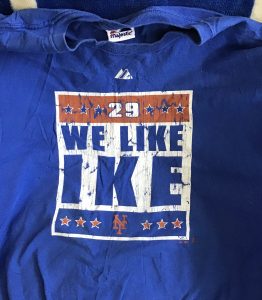 Still got the shirt. What can I tell ya, pal? The prospects come, the prospects go, not that many make it to the big leagues, and among those who do, precious few stick around. If they all did, then ya wouldn’t have shed a tear when David Wright called it a day. But if you’re in the market for a real sure thing, I’ve got the inside word on another first baseman. Lots of power, lots of personality. A real horse, yet, get this, they call him the Polar Bear. No, I’m not sure why, but it’s catchy, right? Kid’s gonna be the best at the position the Mets have had since Mr. Seinfeld himself, Keith Hernandez. Maybe better.
Whaddaya say, Mac? C’mon, it’s only hope.
PREVIOUS METS FOR ALL SEASONS
1962: Richie Ashburn
1963: Ron Hunt
1964: Rod Kanehl
1966: Shaun Fitzmaurice
1969: Donn Clendenon
1970: Tommie Agee
1972: Gary Gentry
1973: Willie Mays
1977: Lenny Randle
1978: Craig Swan
1981: Mookie Wilson
1982: Rusty Staub
1983: Darryl Strawberry
1986: Keith Hernandez
1988: Gary Carter
1990: Gregg Jefferies
1991: Rich Sauveur
1992: Todd Hundley
1993: Joe Orsulak
1994: Rico Brogna
1995: Jason Isringhausen
1996: Rey Ordoñez
1998: Todd Pratt
2000: Melvin Mora
2001: Mike Piazza
2002: Al Leiter
2003: David Cone
2004: Joe Hietpas
2005: Pedro Martinez
2008: Johan Santana
2009: Angel Pagan
2012: R.A. Dickey
2013: Wilmer Flores
2014: Jacob deGrom
2019: Dom Smith
by Greg Prince on 20 August 2020 7:09 pm Seth Lugo did not make his first start since 2018 on Thursday night. The Mets did not go for the four-game series sweep in Miami on Thursday night. Dom Smith did not take further aim at the National League RBI lead on Thursday night. Luis Guillorme did not get as much as one swing in toward raising his batting average even higher on Thursday night. The Mets did not move within a game of .500 or fall three below the break-even mark on Thursday night, the eve of their first Subway Series matchup of 2020 on Friday night.
Scratch whatever there might have been to say about that first Subway Series matchup on Friday night, too.
Just when you thought it was safe to get back into baseball, COVID-19 reminded us it signs off on the schedule last, and the virus decided, nope, no Mets game at Marlins Park and, nope, no next game at Citi Field. Two members of the Mets’ traveling party — a player and a staffer — tested positive and, for at least a couple of games, that’s all she wrote for our baseball team’s attempt at routine.
The identities of the player and the staff member haven’t been revealed as of this writing. All we can do is wish them very well. Same for anybody with whom they might have interacted in more than a passing way. We’re not experts. We’re just trying to be human.
It took not quite a month to get to a Mets postponement. They’re not the first team affected. The longer baseball soldiers on, the likelihood is they won’t be the last. For twenty-six games, the almost-nightly presence of the Mets on SNY and WCBS grew incrementally more normal. Come the twenty-sixth night, despite the abomination of the designated hitter (nothing personal, Met DHs), the complete lack of attendance and all the other abnormalities MLB accommodated to put their product forward, it had reached a point of normal enough. Not normal enough to meet one’s preferences, but normal enough to kvell from deGrom, plotz from Diaz and experience deliverance via Conforto. Normal enough to take seriously a baseball team in a time when so much else feels dire. It wasn’t perfect. Maybe it wasn’t even appropriate. But it was the Mets.
For the moment, it is not. Having postponed their Thursday and Friday games, they’re flying most of their personnel back to New York “with recommended safety precautions” and will “conduct testing with the entire traveling party”. The two people who tested positive, “along with those traced to be within close contact,” are remaining in Miami for now.
This is certainly different from announcements that this pitcher is experiencing nothing worse than shoulder inflammation and that catcher is moving to the 45-day IL, with surgery to remove a bone spur slated. We already knew basically everything about this season would vary wildly from what we consider standard. Why should baseball differ drastically from the world in which it’s attempting to play?
Being normal, however abnormal the normality, intermittently approached recognizable levels of fun for four weeks. The pitching when it was good. The hitting when it was timely. The kvetching when it was merited. The routine when it was humming along just about like always. You almost forgot how incredibly abnormal everything is.
UPDATE: Saturday’s and Sunday’s game have also been postponed.
|
|