The blog for Mets fans
who like to read
ABOUT US

Faith and Fear in Flushing made its debut on Feb. 16, 2005, the brainchild of two longtime friends and lifelong Met fans.
Greg Prince discovered the Mets when he was 6, during the magical summer of 1969. He is a Long Island-based writer, editor and communications consultant. Contact him here.
Jason Fry is a Brooklyn writer whose first memories include his mom leaping up and down cheering for Rusty Staub. Check out his other writing here.
Got something to say? Leave a comment, or email us at faithandfear@gmail.com. (Sorry, but we have no interest in ads, sponsored content or guest posts.)
Need our RSS feed? It's here.
Visit our Facebook page, or drop by the personal pages for Greg and Jason.
Or follow us on Twitter: Here's Greg, and here's Jason.
|
by Greg Prince on 13 August 2020 5:44 am In doing my nightly postgame statistical rounds, I noticed that the score by which the Mets beat the Washington Nationals on Wednesday, 11-6, had been gathering dust for quite some time. Until Wednesday, when the Mets exploded with practically unimaginable amounts of offense and it still seemed barely enough to fend off one particular precocious Nat, the Mets hadn’t won, 11-6, against anybody in slightly more than sixteen years, making it the 22nd-least recent winning score on the Met books. Now it’s the most recent.
Perhaps it appeared the Mets would require sixteen years or at least that many pitchers to get out of the top of the first inning at Citi Field when Robert Gsellman, starting for the first time since the Mets’ final home game three years ago, put two runners on and then discovered one more competitive innovation baseball has introduced since September 27, 2017: the advent of Juan Soto. True, he’d faced the kid in relief a few times, but this had to feel different. This was his whole night set out in front of him, a night Gsellman’d been craving in his starting pitcher heart all those nights he found himself reluctantly warming up in the middle innings. Sixty feet, six inches away was Soto, 21 and regularly evoking mentions of Mel Ott slugging — and not just because they both bear nifty crossword puzzle solutions as last names.
In case Gsellman forgot what it was like to be planted in the bullpen, Soto reminded him, as the home run he swatted flew well over it…and everything else at Citi Field. I’m sure the ball got a decent view of everything below its own stitches, though binoculars were probably required. When the 466-foot journey of Soto’s three-run welcome-back-Bob bomb completed its statistical rounds, the ball could be seen bouncing way in the back of the soft drink-sponsored pavilion far above right field. I think it knocked on the men’s room door to the left of the stand where they usually sell cola.
I’m sure Gsellman contemplated a quick trip to the facilities himself. The only thing that got him out of the first was Soto wasn’t due up again right away. And then, contrary to recent home team custom, he was presented with a lead by his friends in the Mets batting order. If they weren’t his friends already, they should be by now. The Mets’ batters, reputed for their courtesy in not disturbing Met runners in scoring position, learned the benefits of rudeness. Brandon Nimmo skipped the whole “runners on” thing when he led off with a homer against ancient Anibal Sanchez. Sanchez, 36, threw a no-hitter in 2006. It was so long ago that it had been only two years since the Mets had last won an 11-6 game; Soto was 7.
Nimmo, who’s too nice to come off as rude, nonetheless set a useful example for the batters who followed him to the plate, most of them turning impolite toward the opposing pitcher.
After Sanchez hit Michael Conforto, Pete Alonso hit Sanchez, doubling in Conforto. Dom Smith, listed as playing some alien position that has no business in National League baseball, doubled in Alonso. Wunderkind Andrés Giménez, who is somehow six weeks older than Juan Soto, singled in Smith. The Mets and Gsellman were out in front. Gsellman didn’t last but two innings as he reacclimated himself to his old role (“Man, I was so nervous,” he said afterward. “I felt like a little kid.”), but the Mets were generous to his myriad successors, adding a run in the third — which was countered by another Juan-ton act of slugging — and five in the sixth. Michael doubled with two on. Pete homered with Michael on. Dom homered immediately thereafter. The Mets hit with runners in scoring position and hit deep with bases clear of occupants. They collected thirteen hits and put them to excellent use to create eleven runs. Soto could produce only four on his own, with his teammates chipping in just two.
That’s how we got to 11-6 in one game. Why it took sixteen years to get to 11-6 since the last 11-6 Mets win is one of those little mysteries that make doing one’s nightly statistical rounds such an enigmatic delight. Historically, 11-6 hasn’t been a wholly uncommon score for the Mets to win by. From 1962 through 2004, the Mets had beaten an opponent, 11-6, eleven times in regular-season play. Maybe not a “normal” baseball score, but not so crazy that you think you’d need a decade-and-a-half and then some to see it again. Hell, Game Two of the 1969 National League Championship Series, wound up 11-6 for the Mets over the Braves on a day Jerry Koosman didn’t quite have his best stuff, but Messrs. Agee, Garrett, Jones and Shamsky blessedly did. It was the second postseason game the Mets ever played and 11-6 already represented half their postseason wins.
I don’t know why some scores simply fall out of fashion, as if there are tastemakers who determine how much a team wins or loses by and whether the combination can be considered chic enough to gain a measure of mass-market popularity. When the Mets beat the Red Sox, 8-3, a couple of weeks ago, it was their first 8-3 regular-season win since the last day of the 2014 season. There’s nothing remotely Unicorn-ish about an 8-3 score — the Mets had won a regular-season game by an 8-3 score 46 times over the first 53 seasons of the franchise’s history, but then more than five years passed before another 8-3 regular-season win. The Mets did beat the Cubs, 8-3, on October 21, 2015, but that was the clinching game of the NLCS (just the pennant, that’s all), so it doesn’t quite count under this exacting statistical umbrella I’m brandishing. And even if it does, that means it still took more than four years, until July 28, 2020, to produce another 8-3 win. An 8-3 win is a lot closer to “normal” than 11-6, yet it was wholly elusive for quite a spell there.
I’d say, “go figure,” but you can’t. All you can do, if you’re so inclined, is record that it happened.
The previous game the Mets won, 11-6, took place on August 5, 2004. I remember it clearly specifically for having not seen it or heard it. I had business in Washington that Thursday afternoon and was on an Acela back to New York when I was able to tune in on my trusty tiny radio the staticky news of what the Mets had done in their matinee in Milwaukee. Victor Zambrano made his Met debut a victorious one (four earned runs in a five-and-a-third innings, but he left with a large lead); David Wright drove in six runs to raise his career RBI total to ten; and the city I was putting behind me probably couldn’t have cared less that the Mets were romping in Wisconsin. In August of 2004, the Washington Nationals were still the Montreal Expos.
That was the last game I missed altogether in 2004, a fact that sticks with me because when the next season began, I wasn’t just watching or listening for me, but for whoever was reading this blog. I wouldn’t miss another Mets game until August of 2006 and have rarely missed one since. Yet at no time until August of 2020 did an 11-6 Mets win enter the current-affairs segment of our ongoing conversation here. Now it has.
I’ll say it: go figure.
***In the realm of rituals related to keeping track, I’ve been part of a foursome that has attended the first mutually available and amenable Tuesday night game at Citi Field for ten years. This tradition dates back to August 10, 2010, when my wife Stephanie and I met up with Ryder Chasin and his father Rob to see the Mets take on the Rockies. It was our first game together if not our first time together at Citi Field. About a year earlier, the Chasins had gotten in touch with us and invited us to Ryder’s forthcoming Bar Mitzvah, November 14, 2009. Ryder, 12 going on 13, was a Mets Fan Who Liked to Read; his coming-of-age celebration would be at the Acela Club (now known as the Porsche Grill despite Acela rating two product placements in today’s column); and, well, would we like to join them?
Would we? It was too intriguing to pass up, and that was with only knowing Ryder and Rob from one letter apiece. Long, oft-told story short, Stephanie and I attended, we all stayed pals, and we consecrated our Metsian bond with a Tuesday night game the following August. Why Tuesday night? I don’t remember, but it became our thing. Ten Augusts, ten Tuesday nights, the four of us. Ryder, a couple of years the senior of Juan Soto and Andrés Giménez, graduated everything there was to graduate and is now a professional writer himself, 23 going on 24. Like that pitch Gsellman threw to Soto, time really flew.
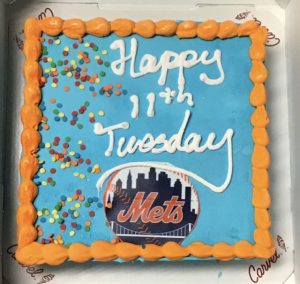 Who’s gonna argue technicalities with a cake? It landed in August of 2020, when there’d be no going to Citi Field for any of us or anybody else. No going anywhere, for the most part. Our Tuesday night tradition could have been pardoned for pausing in deference to These Challenging Times, but Rob and Ryder thought better of it and did the best they could to make it eleven in a row. Thus, on Tuesday night, August 11, 2020, our friends the Chasins arranged to Zoom Stephanie and me shortly before 7:10 first pitch. Rob even had a specially decorated Carvel cake simultaneously delivered to our address to mark the continuation of our indefatigable occasion. As that element was intended as a surprise, I at first opted not to answer when a gentleman bearing frozen gifts rang, because, geez, I’m on a Zoom here, who the hell is suddenly bothering us? Good thing I was clued in so I could run to the door and accept the incredible gesture. Ice cream cakes in August don’t lend themselves to contact-free delivery.
Stephanie and I spent about two hours on our respective screens with Ryder and Rob, catching up about baseball and whatever else infiltrated our collective consciousness. (I resisted the temptation to blurt to Ryder, “My god, you’re like TOTALLY an adult now!”) Our eyes naturally darted to nearby televisions to keep up with the Mets and Nats, though the game wasn’t much more than an unobtrusive backdrop after a while. Still, it was the reason we’d virtually gathered, which led to a perplexing philosophical quandary.
Did this count?
Everything about baseball is about counting. It’s why we’re watching this short season that in so many ways feels like it shouldn’t be taking place in a pandemic. It counts. The games count. The scores count. Every run. Every run given up. We who can’t miss a game that counts unless we have to be on a train before the advent of apps adhere closely to counting what counts. The 11-6 win on August 12, 2020, counts like the 11-6 win from August 5, 2004 counts. The 11-6 win from October 5, 1969, counts, too, but like the 8-3 win from October 21, 2015, it counts differently. Counting what counts is what separates from the animals who don’t keep count.
I held up to the camera for Ryder’s and Rob’s edification the notebook in which I write down the result of each game I go to. I call it The Log II. The Log was filled with my Shea Stadium games. The Log II covers Citi Field. Every one of our August Tuesday night games are in there. The six wins. The four losses. The starting pitchers. The opponents. It’s all inked in. Despite the spirit of the Zoom and the affection baked into the cake, could I, in all good counting consciousness, pick up my pen and write down the spare but essential details of our eleventh consecutive Tuesday night in August if it wasn’t exactly our eleventh consecutive Tuesday night in August at Citi Field? I don’t count in The Log II games I don’t physically attend.
But The Log II doesn’t track everything about the games I go to. It certainly hasn’t recorded the heart of those ten August Tuesday nights with the Chasins.
Not written down in my spiral-bound steno pad is that we greeted each other heartily outside Citi Field ten times.
That we embraced as people who were close to one another did until 2020.
That we grumbled our way through security; me, mostly.
That once safely within the circular walls of the Jackie Robinson Rotunda, Ryder and I immediately wandered deep into “what’s wrong with the Mets?” (or a couple of times the inverse) territory while Stephanie and Rob presumably talked about other, less pressing matters.
That we decided what we were gonna get to eat and, if it differed, where we were gonna meet so we could eat it together and talk some more between bites.
That one time Rob amazingly managed to get us on the field for batting practice and Ryder snagged autographs from Jordany Valdespin and Justin Turner.
That another time we wound up sitting behind some thin blonde woman who never once looked up at the game because she was too busy tweeting literal Fox News talking points at all who dared argue with the positions she steadily tapped out, spectacularly oblivious to the big league baseball unfolding not too many rows in front of her. Shocked that somebody could care that little for the Mets or their foes, I squinted over her shoulder at her phone and deduced the disinterested filler of this perfectly good ballpark seat was Fox News talking head Kayleigh McEnany. I had never heard of Fox News talking head Kayleigh McEnany until then, but I looked her up when I got home and learned she was dating or maybe already engaged to Met reliever Sean Gilmartin, which I guess explained why she was there. They later married despite her apparent lack of emotional investment in his profession (I understand she holds a government job these days).
That last year Rob furnished a tenth-anniversary scoreboard message for the Mets to include among their various midgame Happy Birthday greetings.
That I’d keep score for a stray half-inning if Ryder was racing to and racing back from the concessions.
That Rob, Ryder, Stephanie and I would conduct a version of musical chairs a couple of times per game so everybody could talk some to everybody else.
That even when the score fell in the Mets’ favor, we were a little sad the game was over because we did this only once a year and now it was done, but we were inevitably cheered that we knew we’d be back out here same time next year, more or less.
Much less, it turned out this year, but the Zoom was the next best thing. As we wound down our video meeting, we discussed whether it counted, if it could in fact enter The Log II. The provisional decision reached was maybe in pencil. It’s not ink, but it’s not nothing.
That was Tuesday. I haven’t written it down yet. I don’t know if I will. Really, I don’t think I have to. We know we kept our thing going. Eleven in a row, just like it says on the cake.
Next year? Twelve in Flushing. I won’t count on it, but I will hope.
by Jason Fry on 12 August 2020 10:30 am Perhaps I should put a SPOILER WARNING on this one, but I received a special media preview of the Mets’ 2020 highlights video, and it’s 23 minutes of Jeff McNeil screaming “FUCK!” after making an out and five minutes of Andres Gimenez smoothly fielding hard grounders.
And you know what? I’m strangely OK with it.
The Mets lost Tuesday night, 2-1, with Max Scherzer outdueling Rick Porcello. The Mets turned in some nifty defensive plays, with Gimenez and possible Wednesday starter Luis Guillorme front and center in the infield, but (shockingly) couldn’t find the big hit in the clutch they desperately needed, and so it goes.
Maybe this is just me bargaining, but I’m in a better place than I would have guessed.
Part of that is having baseball back at all, something I figured wouldn’t happen, and that you could argue shouldn’t happen given the current problems with the Cardinals, not to mention the Marlins having to essentially come up with an entire B-team to keep going. The Mets have been hale if not hearty so far, and even though the results haven’t been there, their presence has made summer feel a bit more normal.
Tonight we sat in a backyard and drank with old friends (socially distanced of course), during which the Nats jumped out to a 1-0 lead and a 2-0 lead. We returned to our rented beach house and saw the Mets draw within 2-1, then turned up the TV so the Mets could be our company during dinner on the deck. Everything was pleasant except the score — this was one of those games that didn’t feel anywhere near as close as it was — and I was happier to have the Mets present but on the short side of the outcome than I would have been to have a night with no baseball at all.
There’s Gimenez, of course, whose fluid fielding and superlative baseball instincts are a reminder of baseball’s balletic perfection. There’s the steady parade of new Mets — the Mets were pummeled mercilessly Monday night, but I still smiled to see Ali Sanchez escape becoming the 10th Mets ghost. Sanchez had the greatest night of his baseball career despite seeing one pitch which became a double play, which makes sense when you consider the alternative. Similarly, it was fun watching Guillorme retire three straight Nats with 63 MPH non-gas, going so far as to ask for the ball from the first batter retired.
Even Marcus Stroman is a part of my unexpected equanimity, somehow. I don’t blame Stroman for opting out — I don’t presume to know anything about what’s going on in someone’s family — any more than I blame him for possibly manipulating his way to free agency through service time, given how routinely baseball teams manipulate service time for their own advantage.
When Stroman arrived last summer, I was happy to see him while dreading what his arrival might mean — I assumed the Mets had imported him as precursor for trading Noah Syndergaard or Zack Wheeler. They kept both Syndergaard and Wheeler for the season, but then let Wheeler become a free agent in the offseason, with nary a hint of interest or a peep of protest, making my prediction ultimately accurate if not timely.
In late July of 2019 the Mets’ rotation was Jacob deGrom, Syndergaard, Wheeler, Steven Matz and Stroman. A little over a year later, it’s been reduced to deGrom and Matz, and the latter has been giving up home runs with frightening frequency. When Stroman opted out, I could all but hear the Mets’ playoff window slamming shut — yes, they have a corps of young and effective hitters, but if Matz has lost his way, where do the arms come from? But rather than blame Stroman for a decision I couldn’t be privy to, I blamed the Mets for letting a potentially great rotation become hollowed out and vulnerable to injury and mischance.
It doesn’t make me happy to contemplate such things. But the ebb and flow of team fortunes are nothing new. And in this weirdo improv season, I’d rather obsess about that ebb and flow than stare at a year of nothing.
Once again, is that bargaining? Maybe it is. But we’re all bargaining this year, constantly reassessing what scares us and how much and what plans we should and shouldn’t make. Baseball has been my faithful companion in years both fruitful and barren; I’m glad to have it again for a year where uncertainty colors each and every day.
by Greg Prince on 11 August 2020 3:38 pm Welcome to A Met for All Seasons, a series in which we consider a given Met who played in a given season and…well, we’ll see.
On the telephone, Andy Pafko said that it would be nice to get together, but that he didn’t belong in a book about the team. “I wasn’t in Brooklyn long enough,” he said. “I don’t rate being with Snider and Furillo. I wasn’t in that class.”
—Roger Kahn, “The Sandwich Man,” The Boys of Summer
If I didn’t know what Joe Orsulak was doing here, I wouldn’t know what Joe Orsulak is doing here. Every other Met whom we’ve spotlighted as A Met For All Seasons to date makes a certain kind of contextual sense. Either they were around for a very long time or an ostentatiously short time; they achieved great feats or were known for slighter but indelible achievements; they’re somebody who inevitably gets talked about if the conversation is headed in the direction of an era with which they are instinctively identified; there is a story around them begging to be told; there is a statistic attached to their career that deserves enhanced awareness; there is something relentlessly Metsian about them.
I don’t believe any of the above apply to Joe Orsulak, yet I chose him as A Met for All Seasons. And of all seasons, I chose him for 1993, inarguably among the worst of all Met seasons. Mind you, I don’t associate Joe Orsulak with “the worst”. Honestly, although I’ve tended to very closely match players with seasons throughout this series, I don’t really associate Joe Orsulak all that much with 1993. I associate 1993 with Met misery. I don’t hold Joe Orsulak the least bit responsible for any of it.
Trust me, though, this isn’t some kind of thought exercise, or an effort to be contrary to the spirit of whatever it is we’re doing here, or ironic about picking a player who doesn’t quite fit the ur-Met mold in some category or another. I suppose I could have made a case for Joe Orsulak as the avatar of ordinary players who’ve played for the Mets after playing for a couple of other teams and before playing for a couple of other teams besides, the way I think of Harold Baines as a Hall of Fame player bearing the standard for all players who weren’t judged quite good enough to make the Hall of Fame yet maybe we oughta have one from their ranks in the Hall. I like that angle for Joe Orsulak now that I’ve thought about it (“The Master of the Middling”; “The Sultan of So-So”; “The King of Basically Just OK”), but I’d be retrofitting it inauthentically.
No, Joe Orsulak is my choice to profile here because at any point over the past quarter-century, if you were to ask me to name my all-time favorite Mets and you gave me the leeway to work my way down into a second tier, I would absolutely name Joe Orsulak ahead of many other bigger-deal Mets. And, indeed, nestled within that fistful of Mets I’ve really, really liked, just beneath the handful of Mets I’ve really, really loved, Joe Orsulak is right there. He is one of my favorite Mets ever.
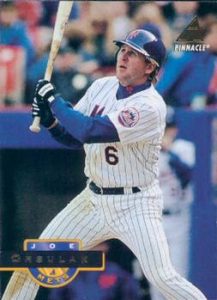 When a fan loves a player yet has little idea why. Which leads me to wondering about something else: why did I decide, somewhere toward the end of his perfectly representative but objectively unremarkable three-year tenure in our midst, that Joe Orsulak is one of my favorite Mets ever?
Honest to god, I really don’t know. But just as honestly, he really is.
***In the 2001-02 Judd Apatow sitcom Undeclared, essentially the college-set sequel to his previous series Freaks and Geeks (both shows lived utterly brilliant if unfathomably brief prime-time lives), Seth Rogen as dorm denizen Ron Garner bonds with his Australian roommate by, among other things, discussing favorite movies. To maintain a properly badass facade, Ron reveals, “I tell people it’s Red Dawn. But in actuality, my favorite movie is You’ve Got Mail.”
I can’t determine whether Orsulak is my Red Dawn or my You’ve Got Mail in this allegory, but I think of the scene when I think of Joe. It’s not like I’m hiding my sentiment on his behalf, but I also have the feeling it says something about me that I must want to be known, or otherwise I wouldn’t put him out there as one of my favorite Mets.
Who, me? Why I’m a Seaver man! A Gooden man! An Orsulak man!
How’s that again?
Uh, never mind. I really like Keith Hernandez, too.
During Orsulak’s first year as a Met, I don’t think he made more than the most perfunctory of dents in my consciousness. I wasn’t at all excited to see him on Opening Day 1993, which, for our purposes today, raised the curtain on the Joe Orsulak Era. For the Mets’ purposes, Opening Day 1993 was supposed to bring down the curtain on two astonishingly embarrassing years. In 1991, our veritable Empire of the Eighties — finishing first or a reasonably strong second for seven consecutive seasons — crumbled suddenly and thoroughly, as the Mets without Darryl Strawberry proved lightweights in a division where everybody but the Expos was better than them (and the Expos had to play their last few weeks on the road when Olympic Stadium’s infrastructure collapsed nearly as badly as the Mets’). In 1992, remade to contend for a title with the additions of Eddie Murray, Bret Saberhagen and Bobby Bonilla, the Mets somehow got even worse, not to mention exponentially less pleasant.
Ah, but this was a new year. Opening Day is always a new year. In 1993, you could forget the plunge from 91-71 to 77-84 to 72-90. You could forget Jeff Torborg turned from the American League Manager of the Year you couldn’t believe the Mets snagged out of Chicago to the hapless steward of the S.S. Disaster in New York. You could forget how Bonilla had been no Strawberry, how Saberhagen was no workhorse, how the Vince Coleman-catalyzed chemistry was all wrong. This was a bright, brisk day at Shea Stadium. Everybody was getting a mulligan.
And we were getting Joe Orsulak starting in center field instead of Ryan Thompson, because Thompson was nursing a sore hamstring, which amid all the promise and pageantry of Opening Day (the first I’d ever attended and the first anywhere ever involving the Colorado Rockies) disappointed me. Thompson had been obtained the previous August with Jeff Kent for David Cone. If that trade was going to work out in the slightest, it would take Thompson living up to all the five-tool hype he toted with him from Toronto. C’mon, let’s see Ryan Thompson do his thing. Instead of the biggish-deal prospect potentially putting on a show, we got Joe Orsulak.
Yup, that’s what we got ever since bringing him aboard to little notice late in 1992. As the Times reported this earth-stilling event in December, “The Mets yesterday effectively completed their 1993 roster with the signing of Joe Orsulak, a versatile, free-agent outfielder who came cheap and who could wind up playing a lot.”
The Mets’ advertising slogan entering 1992 was “Hardball is Back.” Now it was “Orsulak is here and it didn’t cost much”? As for Joe, he expressed his excitement succinctly: “We didn’t have any other serious offers. No one came up with serious dollars.” Al Harazin extended the sense of suppressed jubilation when he added, “We’ve added interesting people. They may not be headline people. But they help you win.”
Yippee?
Perhaps I should have learned my lesson from headline people not helping us win in 1992 (the book The Worst Team Money Could Buy had already been excerpted and was being released right after Opening Day), but I found it hard to get particularly excited that the Mets had Joe Orsulak batting behind Murray, Bonilla and Howard Johnson versus the Rockies. Nevertheless, Joe did register a base hit and, after shifting to right once Dave Gallagher came in for defense, he did catch the final out of Dwight Gooden’s Opening Day shutout of expansion Colorado. A “9” on the scorecard in a fairly stealthy debut for the latest to wear No. 6. I’d just seen Doc! I’d just seen an franchise born! I’d just seen a season start! As I left Shea Stadium, I didn’t find myself thinking or saying, “That was great, except for the presence of Joe Orsulak.”
***I went to sixteen games in 1993, the most I’d ever been to in a single year to that point. After none of them did I leave Shea Stadium and find myself thinking or saying, “That was terrible, except for the presence of Joe Orsulak.” The Mets were, in fact, terrible across the frozen tundra of 1993. Whatever was spent on “interesting players,” on top of whatever was owed to the “headline people,” did not produce a champion, except in the ranks of even worse teams money could buy. Everybody you thought you were paying to see imploded. Everybody to whom you paid attention made you regret your focus. From 91-71 to 77-84 to 72-90, now to 59-103…and they had to win their final six to make it even that respectable.
None of it was the fault of the versatile, free-agent outfielder who came cheap and, in fact, wound up playing a lot. Maybe anybody who plays a lot in a season that inarguably stands (or cringes) among the worst of any Met campaigns shouldn’t be considered blameless, but Joe Orsulak didn’t bother anybody. No firecrackers out a car window in a stadium parking lot filled with fans. No bleach pumped toward reporters doing their job in the clubhouse. No tours of the Bronx generously offered to one media member in particular. Joe was not the reason you covered your eyes that summer. In 134 games, Orsulak batted .284 while starting 95 times. Not that a person really put a lot of 1993’s sins on Ryan Thompson when Vince Coleman, Bret Saberhagen and Bobby Bonilla were leading the high jinks out in Flushing, but Thomspon and his tools didn’t exactly explode onto the scene, either (though perhaps that’s a less than ideal phrase to invoke when discussing the year of Coleman’s penchant for making things go boom).
Whatever glamour was attached to the image of the New York Mets entering 1993 had dissipated completely exiting 1993. House was cleaned and disinfected as best as could be arranged under the auspices of GM Joe McIlvaine and manager Dallas Green. Their predecessors Harazin and Torborg, much like the Mets’ dignity, didn’t survive 1993.
***Joe Orsulak survived. Joe had been in professional baseball since 1981, selected in the sixth round from New Jersey’s Parsippany Hills High School the prior June by Pittsburgh. It was the same draft in which the Mets took Darryl Strawberry first in the nation. Straw and Joe made it to the majors in the same year, 1983. Straw was the object of everybody’s attention and won the Rookie of the Year Award. Joe saw seven games of action in September and was back in the minors most of 1984. His official rookie season was 1985. He hit exactly .300 for the last-place Pirates and finished tied for a distant sixth with Roger McDowell in ROY voting; Vince Coleman won. Orsulak grabbed little of my attention until September when, with the Mets engaged in a death struggle with Coleman’s Cardinals for the NL East crown, he pretty much killed us.
The Pirates lost 104 games in 1985, yet went 8-10 against the Mets. Three times in September, they took games that to my biased 22-year-old mind belonged to the Mets. In each of those games, this Joe Orsulak whom I’d basically never heard of or at least never noticed from previous Mets-Bucs encounters delivered a key hit in a decisive inning. In the last of those games, the Friday night when much of Long Island was without electricity after Hurricane Gloria, Joe Orsulak produced four hits, drove in two runs and scored twice. The Mets blew a lead and lost, 8-7. The lights appeared out on them, too. They’d rally to win Saturday and Sunday to set up their last stand in St. Louis the next week, but we finished three games behind the Cardinals — same quantity as the three games we lost to the stupid Pirates and Joe Orsulak.
Then, except for the occasional late-night ruminating on how did we not win in ’85?, I pretty much forgot about Joe Orsulak. In 1988, he joined the Orioles, who proceeded to lose their first twenty-one games with him on the premises. But he survived the worst start in baseball history and hit .288. The next year the Orioles shocked the portion of the baseball world that wasn’t preoccupied shaking its head at the Mets’ having traded McDowell and Lenny Dykstra for Juan Samuel and very nearly won the AL East. Orsulak was a big part of that monumental turnaround, too, batting .285. Maybe he wasn’t a power hitter, but he could sure rip his share of base hits. He rarely struck out and he had a knack for gunning down runners from whichever corner of the outfield he was stationed. In 1991, he led the American League in assists from left field. In 1992, he landed in the AL Top Five for assists from right field.
This is mostly stuff I’m looking up now. I didn’t know any of this soaring into 1993 and wasn’t conscious of it limping toward 1994. I knew Joe Orsulak killed us in 1985 and then disappeared from my consciousness until the Mets acquired him. Then I knew he was perfectly all right and that it was perfectly fine he’d survived the worst Met year imaginable, give or take one that includes a mule named Mettle.
***“Fans, the Mets are going nowhere but up!”
That rosy forecast emanated from a letter Joe McIlvaine sent to season ticket holders in November of 1993 (somebody posted it to Facebook a while back). If the hardiest among us were tempted to desert our sunken ship, it was Joe Mac’s job to suggest our feint toward the life boats might be a little on the hasty side. “We will work to improve our Major League club for 1993 and beyond,” McIlvaine pledged, “and feel strongly that our farm system will have a mother lode of talent ready to harvest shortly.” The GM didn’t name names of those who weren’t already in the bigs, but he did spotlight the members of the Mets’ suddenly burgeoning youth movement whom we’d seen a bit in ’93. There was Jeff Kent, “who led National League second basemen in RBI’s”; there was “starting pitcher Bobby Jones”; and there were not one but two “promising outfielders in Jeromy Burnitz and Ryan Thompson”.
Thompson was still a selling point. Orsulak went without mention, but come Opening Day 1994, Joe was out there in right at Wrigley Field. He hadn’t started, but he did finish. Just as at Shea versus the Rockies, he caught the final out, this time tumbling to the ground as he fought off the winds of the Near North Side. He was in the lineup the next day, and the day after. Nobody was selling season tickets off the glove, arm, bat or amiably unkempt hair of Joe Orsulak, but the Mets were going nowhere but up, albeit without an exclamation point, and Joe was surely part and parcel of the rebound. Granted, it would have been close to impossible to have gone down after 1993, but this was a legitimate turnaround. Maybe not Oriolesque c. 1989, but close enough for my tastes.
The 59-103 Mets of 1993 had morphed into the 55-58 Mets of 1994. Orsulak played in 96 of the 113 games they got in before the strike lopped off the back end of the schedule. Joe’s average dipped to .260, but there were a couple of big hits in there. On May 17, he led off the sixth inning at Shea against the Marlins with a game-tying homer. In the ninth, with the Mets down by one, he stroked a single into right to drive in two and win the damn thing. No Gatorade buckets were emptied and no jerseys were torn, but Joe kept the Mets above .500 at a juncture of the season and maybe the Mets’ overall journey when it seemed imperative to win more than lose for a change.
Ryan Thompson socked eighteen homers, but batted .225 and struck out nearly a hundred times in fewer than a hundred games. Jeromy Burnitz inspired Dallas Green’s enmity and was earmarked for an offseason trade. Joe Orsulak finished fifth among National League right fielders in assists.
He survived some more.
***It took a while to get the Mets and baseball back on the field for 1995. The strike called for August 12 lasted into April. MLB tried to substitute replacement players for the ones with whom it couldn’t reach bargaining accord. In parlance as yet unfamiliar to us, Joe Orsulak had been statistically what would eventually be termed a “replacement level player” in 1993 and 1994. Yet once they cleared out the shall we say real replacement players and brought back the real Mets, Joe Orsulak proved relatively irreplaceable.
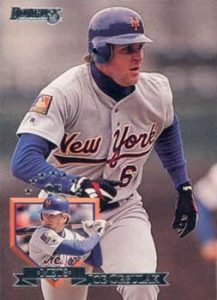 Still there. He was still here, at any rate, and that wasn’t the easiest thing for him for reasons that had little to do with his offensive production or defensive skill set. Just as actual Spring Training was getting underway that April, Jennifer Frey wrote in the Times about the extra burden Orsulak was operating under. His wife Adrianna had been diagnosed with an inoperable brain tumor the previous summer, just before the strike. While the rest of us missed baseball, Joe was glad to have the extra time with Adrianna and their kids. Once in a while as the season approached, he would figure to have to miss a game now and then. Life could be bigger than baseball that way.
“Part of the reason we feel special about him is the way he is handling it,” Dallas Green told Frey. “He’s being typical Joe. He appreciates the thoughts, but I think he just wants to approach the work like he always has and contribute where he can.”
“She’s doing so well right now, she wanted me to come and play,” Orsulak said. “If things were different, health-wise, I wouldn’t be here.”
For maybe the first time since he’d joined the Mets, I really took notice of Joe Orsulak.
***Joe beat the Cardinals with an eleventh-inning single on the first weekend of the 1995 season to raise the Mets’ record to 2-2. It would never again be .500. By the time he beat the Marlins with a tenth-inning single on June 15, we were ten under and miles from either first place or the recently instituted Wild Card. The mid-June box score reflected the churn that the Mets had undergone since 1993 — it was dotted by names like Brett Butler, Chris Jones, Jose Vizcaino, Rico Brogna and Edgardo Alfonzo — but Orsulak was still a Met and the Mets were still seeking respectability. Knowing the grace with which Joe was handling the balance between baseball and family was plenty respectable, but it was one of those things that didn’t exactly show up in the box score or inform the standings. This era of his and everybody else’s in the Mets’ various uniforms (which kept changing yearly) may have had nowhere to go but up, but it was certainly taking its sweet time getting there.
Somewhere along the way, without warning, the time to rise was at hand. It was too late to do anything about a playoff race in 1995, but the Mets transitioned when almost nobody but we hardy souls who survived the competitive wreckage of 1993 and the labor strife of 1994 with our interest intact was looking. The Mets were 35-57 on August 5. The next day, the Mets won. They won six in a row. They had traded Bonilla to Baltimore and Saberhagen to Colorado. They would trade Butler, a quick fix in center, back to Los Angeles. The young Mets were finally taking hold. Young Mets who win are the best Mets who win when you’ve gone years without winning. These were indeed the young Mets of Kent and Thompson, of Alfonzo and Brogna, of Carl Everett and Butch Huskey, of Todd Hundley finally coming of age behind the plate, of that “mother lode” of pitching, featuring Bill Pulsipher and Jason Isringhausen. Damon Buford, who’d come over from the Orioles in the Bonilla trade, was seeing a lot of playing time. The main piece from that swap with Baltimore, Alex Ochoa, was going to be up soon as well.
Continuing to survive in the mix, unobtrusively serving as de facto clubhouse elder among the position players, was Joe Orsulak. Joe was 33 that summer. I was 32. As I was getting to know my online friend Jason, I recall telling him I was born “the same year as Joe Orsulak”. He was a touchstone now. I also remember something else about those nascent AOL “you’ve got mail” days, when it became habitual for me to go on a Mets message board the weeknight after the previous night’s game (it was the only time I had access to the one computer that was properly wired at work). I remember somebody on the board took a shot at Joe Orsulak. I don’t know what, if anything, Joe did to merit it or if it was just one of those inventories of the current roster a fan conducts to remedy what must be done to achieve a championship ASAP.
“Joe Orsulak,” this person wrote, “is deadwood.”
Damned if I know why, but I was moved to immediately respond, “JOE ORSULAK IS NOT DEADWOOD.”
I didn’t care that capitalizing was tantamount to shouting. I was angry in that way I get when somebody insults one of my favorite players. Except I don’t recall concluding at any point prior to that one that Joe Orsulak was one of my favorite players.
Yet there I was, defending him as if he was. So, yeah, I guess he was.
Maybe I was being a little ironic at first. “Orsulak” tripped off the tongue a bit like “Shlabotnik,” Charlie Brown’s perpetually futile Joe of choice, but though I probably lightly made the comparison to my AOL pals, Orsulak was no Shlabotnik, no schmendrick, no readily replaceable cog. From 1993 to 1995, only Jeff Kent played in more games and for the Mets than Joe Orsulak. Constancy wasn’t as exciting as youth but it wasn’t nothing. Keeping it together while your spouse is enduring an incurable disease surely wasn’t nothing. Grace under pressure, survival instincts, a .283 average with a few more outfield assists thrown in…blended with whatever makes a fan a fan and, gosh, maybe that’s how you arrive at an all-time favorite.
***The Mets’ August tide kept rising through September. They finished the year on a 34-18 roll. I couldn’t stay away from Closing Day, an event I hadn’t attended since 1988. I sat, by myself, as the Mets battled the Braves one scoreless inning after another. The Mets were doing the battling. The Braves were due in the postseason in a couple of days and were probably just fulfilling their obligations. However it happened, it was zero-zero in the eighth and Joe Orsulak led off against ex-Met and non-personal favorite Alejandro Peña. Earlier in the game when Joe batted, I overheard a guy sitting nearby tell his girlfriend, “this guy is no good.” I resisted the inclination to turn to him and shout, “JOE ORSULAK IS NOT DEADWOOD,” but kept it to myself.
Orsulak tripled. I thought about saying something. I think I just smiled.
The Mets stranded Orsulak on third and played past the ninth. Green double-switched Joe out of the game in the top of the eleventh. Tim Bogar walked with the bases loaded in the bottom of the eleventh to win it for us, 1-0. We finished the season 69-75, tied for second place. It was nowhere near first place except on paper, but we had just picked up a half-game on 1996, a season none of us who stood and cheered at the end of 1995 could wait another second let alone six months for.
***Joe Orsulak would not survive the wait. That sounds a bit on the morbid side, so let me rephrase that. Joe Orsulak left the Mets as a free agent after the 1995 season and signed with the Marlins. On May 8, 1996, he came back to Shea and instigated a come-from-behind rally to beat his old team, which had regressed without him. In 1997, the still-youthful Mets recaptured the spirit of ’95 and built on it, emerging at last as a contender for a playoff spot. Orsulak was in his final MLB season by then, playing for the Expos. As he’d been doing when he wasn’t helping us, he was still killing us. There was a game at the Big O in late May, just as the Mets were demanding to be taken seriously, in which Orsulak doubled off Mark Clark with the Mets ahead by a run in the fifth. Before the inning was over, Joe scored what proved to be the winning run for Montreal.
In 129 career at-bats as a Pirate, a Marlin and an Expo, Joe Orsulak recorded 35 base hits versus the New York Mets. I’m convinced at least 32 of them were lethal to our fortunes.
Orsulak wouldn’t play in the majors after 1997. He tried to make a team in the Spring of 1998, however. That team was the Mets. I was quietly ecstatic that he was coming home to me. It was just a matter of winning a bench role. How hard could that be for good ol’ Joe? We had a different manager and a different general manager from the end of Joe’s first tenure, but Steve Phillips and Bobby Valentine had to see what Joe’s lefty bat and dependable arm could bring to our team as it rose. In one exhibition game televised on Channel 9, Joe homered. Gary Thorne practically fainted from surprise. Joe Orsulak, he said, was only with the Mets this Spring as a favor to Cal Ripken, Jr.
HUH? I hadn’t read that anywhere before Thorne opened his mouth and I didn’t read it anywhere afterwards. It seemed rather uncouth to mention it if it were true. Joe’s wife was still battling cancer, he’d given the Mets three solid years, he’d given professional baseball close to twenty, and now you’re telling a television audience he’s not good enough to get a look except that somebody asked somebody else for a favor? And since when were in the Mets in the business of doing favors for Cal Ripken, Jr.?
Joe Orsulak hit .213 in Spring Training of 1998 and was released. The Mets were plagued by injuries a few weeks into their season and I hoped Phillips had saved Orsulak’s phone number (or could ask Ripken for it), but no dice. As far as I can recall, Joe Orsulak was never heard from again where the Mets were concerned. He was certainly never mentioned prominently in Queens or St. Lucie.
***A tad of Internet research on my part uncovered a “where are they now?” article in the Baltimore Sun from 2008 that found Joe Orsulak was living in Maryland and doing all right. He’d done some assistant high school baseball coaching as a favor to a friend — not Ripken — but had given it up after a few years. Adrianna had died in 2003, and by 2008, Joe was remarried and mostly taking care of his growing kids. “I’m not doing anything in baseball,” he said, “and frankly, I don’t miss it.”
Nevertheless, he looked happy to be back in his element at Camden Yards in 2019. The occasion was a reunion of those 1989 Orioles who almost won their division. It was a big enough part of Baltimore lore (and Baltimore hadn’t had much else to get amped up over lately) that the Orioles chose to commemorate their thirtieth anniversary the way I wish all teams would commemorate all their delightfully surprising squads who don’t necessarily go all the way. Joe’s amiably unkempt hair was mostly a memory, and he did not appear ready to take a few fly balls, but you could tell he was still Joe Orsulak. He told the Oriole pregame hosts about how much he loved throwing out runners — more than hitting home runs, he swore — and what it meant for the survivors of the 1988 last-place club to have come together and make their run in 1989; it bonded them forever, he said. In my mind, I substituted 1993 for 1988, last two months of 1995 for 1989, and Mets for Orioles
It was obvious that Orsulak, by dint of the bird on his polo shirt and his inclusion in this reunion, likely considers himself an old Oriole when he considers himself an old ballplayer. Yet that won’t stop me from considering him an old Met, or at least a veteran Met from when he and I were at an age that wasn’t quite indicative of a youth movement. And it won’t stop me from continuing to consider him one of my favorite Mets ever, whatever the reason I do.
I still really don’t know why. But he remains right there.
PREVIOUS METS FOR ALL SEASONS
1962: Richie Ashburn
1963: Ron Hunt
1964: Rod Kanehl
1966: Shaun Fitzmaurice
1969: Donn Clendenon
1970: Tommie Agee
1972: Gary Gentry
1973: Willie Mays
1977: Lenny Randle
1978: Craig Swan
1981: Mookie Wilson
1982: Rusty Staub
1983: Darryl Strawberry
1990: Gregg Jefferies
1991: Rich Sauveur
1992: Todd Hundley
1994: Rico Brogna
1995: Jason Isringhausen
1996: Rey Ordoñez
1998: Todd Pratt
2000: Melvin Mora
2001: Mike Piazza
2002: Al Leiter
2003: David Cone
2004: Joe Hietpas
2005: Pedro Martinez
2008: Johan Santana
2009: Angel Pagan
2012: R.A. Dickey
2013: Wilmer Flores
2014: Jacob deGrom
2019: Dom Smith
by Greg Prince on 11 August 2020 2:08 am Monday wasn’t a good day for Mets pitchers hailing from Long Island. Long Island’s own Marcus Stroman (LIOMS), heretofore rehabbing his torn calf and presumed to be returning to the Mets’ disturbingly depleted rotation soon, announced in the afternoon he was opting out of 2020 due to his family’s COVID-19 concerns. Come nightfall, Long Island’s own Steven Matz (LIOSM) opted out of competitive pitching versus the Washington Nationals, giving up eight earned runs in four-and-a-third innings, a harrowing echo of last week when he was strafed for five earned runs in three innings in D.C.
Maybe somebody should check on Frank Viola from East Meadow, Pete Harnisch from Commack, Hank Webb from Farmingdale, Ray Searage from Freeport, John Lannan from Long Beach, Paul Gibson from Southampton and John Pacella, who was born in Brooklyn but graduated from Connetquot High School in Bohemia (no word whether his mortarboard fell off as he accepted his diploma). Like Stroman, none will be pitching the rest of this season. Like Matz, all would be advised not to.
I can’t blame Stroman of Medford for taking a good, long look around Major League Baseball not to mention the country it’s played in and taking a pandemic pass. If he calculated the declaration of his decision for it to coincide with the accrual of enough service time for him to qualify for free agency, well, gosh, whoever heard of a baseball team manipulating a player’s calendar to gain a financial advantage? I liked Stroman fine when he pitched for the Mets, which was eleven starts last year and none at all since. I don’t know in retrospect that I loved giving two pitching prospects to the Blue Jays for what turned out to be a grand total of eleven starts, but that slight sum couldn’t have been foreseen entering 2020. Nothing much could have been foreseen entering 2020.
Matz of Stony Brook is a sympathetic figure, too. Always comes across as polite and sincere. His Tru32 foundation admirably supports first responders. He has a sandwich named after him at a deli in East Setauket and we all remember his grandpa going nuts at his smash debut. Once upon a time, Steven could hit as well as he could pitch. Now he doesn’t get to hit at all and his ERA should only be somebody’s slugging percentage. Based on his last two starts, it might be the Nats’ versus Matz.
The most dynamic pitcher the Mets offered up versus the defending world champs, albeit as a ninth-inning human sacrifice, was Luis Guillorme. He’s not from Long Island and he’s not a pitcher. Well, he is now. One bullpen-preserving frame hurled (because a ten-man relief corps apparently isn’t enormous enough to survive a blowout), one earned run average of 0.00. Andrés Giménez may have Luis’s path to playing time blocked in the infield, but no way Guillorme doesn’t rate the call over Paul Sewald the next night we’re en route to a 16-4 rout.
This, therefore, is what 2020 has come to. Seventeen games in, we’ve had a position player pitch, yet our National League franchise hasn’t had a pitcher hit.
Guillorme’s catcher was Ali Sanchez, who came in to relieve subdued birthday celebrant Wilson Ramos when the score was a million to nothing or whatever it was by then. Sanchez became the fifteenth new Met of the year, which is almost as many runs as the Washingtonians walloped. We doff our mask to Met No. 1,106 for coming into our world under the bleakest of circumstances and presumably coming back for more.
And, hey, since it wasn’t close anyway, why not a hat tip amid the offensive onslaught from the other side to modestly beloved alumnus Asdrubal Cabrera, who went 4-for-4 with two homers, two doubles and five runs batted in? Asdrubal was a Met longer than Marcus, not as long as Steven. For a spell he was one of my favorites, thus I can’t get utterly sore that he has apparently taken the ex-Met Met-killer baton from Adeiny Hechavarria, who took it from Daniel Murphy, who took it from Justin Turner. All of them in recent years have come back to Citi Field to rake against the Mets and each of them has socked balls into Long Island Sound. The splash was loud enough to wake the Stromans and the Matzes all the way out in Suffolk County.
by Greg Prince on 9 August 2020 9:50 pm This season, however it turns out, whether it turns out, will probably be remembered for other storylines, but churning beneath the surface of Mets Baseball 2020 is the churn itself. Have you noticed just how many players we’re going through a mere sixteen games in? When last season ended, the all-time Met count was up to 1,091. Barely two weeks into this one, we’re up to 1,105, or practically a new Met every day. So many Mets to have met, and we seem to have plumb forgotten to make formal introductions. Allow us, then, if you please, to stand on ceremony and present the new guys.
Outfielder Billy Hamilton is a Met. We’re his fifth club in three years, counting San Francisco, with whom he signed but never played.
Infielder Brian Dozier is a Met. We’re his fifth club in three years, counting San Diego, with whom he signed but never played, should you find yourself detecting a pattern
Reliever Hunter Strickland was a Met (fourth club in three years) and, for all we know, might be again. His ERA in three appearances ballooned to 11.57, which will make you an ex-anything awfully quick. Strickland is currently off the 40-man roster but at the Alternate Site in Brooklyn. That’s where relievers with 11.57 ERAs are sent to consider the error of the their ways.
Chasen Shreve is thus far a pretty good Met reliever, which we are conditioned to believe is a species no more actual the Loch Ness Monster, but lately has, in fact, existed and thrived in a land called The Bullpen.
Speaking of imposing pen presences, Dellin Betances is also a Met reliever, sometimes pretty good. Likewise Jared Hughes. He’s been uniformly very good.
Let’s remember that Ryan Cordell was here; he’s an outfielder currently joining Strickland in Coney Island exile.
Michael Wacha became an important enough component of the starting rotation that he’ll be missed now that he’s on the injured list, though that’s as much because for all the Mets we’ve had, we don’t seem to have a genuine sixth starter (that was gonna be Wacha) as it is that Wacha has been wowing batters. Getting many of them out while dealing with shoulder inflammation is plenty admirable in 2020.
Franklyn Kilome got twelve batters out in his one outing, yet was optioned to Elba, but that transaction was primarily a function of churn. Go four innings as a reliever one night and you can’t be used for a couple of days, so go ice your arm by the beach, kid. Kilome might be back by Wednesday in time to take what had been Wacha’s turn, which comes after that of Rick Porcello.
Rick Porcello is not only a Met, but he grew up a Mets fan in New Frazier, also known as New Jersey. Mets fan Rick Porcello had to like what he saw from Mets starter Rick Porcello in his last start, whereas Mets fan Rick Porcello might have been on the phone to the FAN to complain about Mets pitcher Rick Porcello after his first two starts. Surely Porcello the pitcher would understand.
Jake Marisnick and Eduardo Nuñez have been on the injured list for a spell now, even though the season hasn’t been going on all that long. Time is mostly untrackable in 2020. The season is sixteen games old yet more than a quarter over, and we’re supposed to keep track of Jake Marisnick and Eduardo Nuñez? Next thing you’re going to want to know is whatever happened to Jed Lowrie.
Jed Lowrie’s on the IL. But you either already knew that or didn’t really want to.
Yes, lots of coming and going beyond the most noisy of noiseless disappearances. Ali Sanchez has been called up twice and hasn’t played at all. Daniel Zamora was called up; was witnessed warming at least once; and was sent down. Tyler Bashlor had a similar story, except he was sent away, to Pittsburgh. Nobody’s much mentioned the status of Corey Oswalt since he imploded, but then again, nobody’s really asked. You may have missed the end of the Jacob Rhame era; like Ed Wynn as Lou Bookman, he was last heard to be making a pitch for the Angels. It’s all something of a blur.
Yet a pair of debuts have truly stood out here in bumper-to-bumper 2020, like a news chopper hovering above rush hour traffic. One is that of former No. 1 draft choice and current No. 4 starter David Peterson. As if his first-round credentials and three promising starts to date somehow don’t impress, Peterson, upon his July 28 debut, became the 1,100th Met ever, or the eleventh Milestone Met. How impressive is that? It must be very impressive, or there’d be more than eleven.
In honor of Peterson being the eleventh Milestone Met, let’s take a moment and re-meet the previous ten.
100. Jimmie Schaffer
The catcher from Pennsylvania pushed us into all-time triple-digits on July 28, 1965, in the midst of Ron Hunt’s reign as the Mets’ first star, or precisely 55 years before Peterson arrived at Fenway Park. Schaffer played in only 24 games as a Met, but surely made a mark in baseball history as minor league mentor to future Hall of Famer (and Met No. 455) Eddie Murray. You know how Murray is considered one of the greatest switch-hitters ever? It was Schaffer who helped convert him to hitting from both sides. That was at Double-A in 1976. The two of them have remained close.
200. Bill Sudakis
Sudakis, previously a Dodger, gave us eighteen games after joining our ranks on July 11, 1972, five of them as a catcher the year Jerry Grote missed close to a hundred.
300. Phil Mankowski
Mankowski, whose Met debut came April 11, 1980, honestly didn’t play a very good third base (three errors in seven chances), but he was, at least on paper, the replacement for 1979 incumbent Richie Hebner, who couldn’t wait to get out of Flushing. Hebner was traded to Detroit for Mankowski and Jerry Morales. For helping to show Richie the Shea exit he so visibly craved, Mankowski received a forty-year grace period. I’m officially renewing it.
400. Randy Milligan
Milligan got his feet wet on September 12, 1987, the afternoon after Terry Pendleton dumped cold water over the Mets’ heads. The first baseman played in only three games as a Met before embarking on an eight-year major league career, but he got somebody’s attention on the way up the ladder. David Wright regularly pointed to Randy as his favorite Tidewater Tide when he was growing up in Virginia, and if you somehow influenced a young David Wright, then you’re an extremely important Met. And if you’re the scout who signed a slightly older David Wright to a Mets contract, you’re even more significant. The scout who signed Wright? Right — it was Randy Milligan.
500. Pete Smith
The extraneous Brave starter from Atlanta’s rather adequate rotation of Maddux, Gl@v!ne, Smoltz and Avery looked for a bigger role in New York. On April 5, 1994, Pete had the honor of starting a milestone game in Met history while becoming a Milestone Met himself. It was the first game in which everybody who played for the Mets was born after the Mets were on April 11, 1962. Was it a sign of franchise maturity? That we as a people were getting old even as the players were getting relentlessly younger? However it is viewed, let the record show Smith scattered nine hits over seven innings to beat the Cubs at Wrigley Field, 6-2. Was it possible the pitching-savvy Braves blundered by not keeping Smith, a 7-0 starter for them in 1992? Smith finished 1994, his only Met season, at 4-10, with an ERA of 5.55, and the Braves won every division title in every season that was completed through 2005, so probably not.
600. Lenny Harris
Hey, it’s a Milestone Met who needs next to no introduction! Lenny Harris earned a measure of immortality when he broke Manny Mota’s career pinch-hit record late in the 2001 season, but that was at the end of his second term as a Met. His first go-round began in the heat of the Mets’ first epic Wild Card chase, on July 4, 1998. The next day was the dreaded Angel Hernandez Game (there’ve been a lot of those, I suppose, but this was the one that begat the rest). Harris lasted the rest of 1998 with us, left as a free agent before 1999, but returned via trade in 2000 in time to anchor the National League champs’ bench.
700. Rey Sanchez
After there was Rey Ordoñez and before there was Jose Reyes — I mean for what amounted to a Sudakisian minute — there was well-traveled Rey Sanchez, starting at shortstop on Opening Day at Shea on March 31, 2003. Reyes was deemed ready in June; Sanchez would be gone in July. The lesser-remembered Rey attracted attention mostly for allegedly taking a haircut in the clubhouse during a game, which is considered nearly as bad in baseball as not calling in sick en route to opting out during a pandemic. Sanchez’s barber was Armando Benitez, which made the story that much juicier. Benitez was also gone by July of 2003.
800. Moises Alou
It’s not true that Alou’s chronological Met rank matched his biological age nor how many days he spent on the DL as a Met. Debuted for us on April 1, 2007. Gave as much as he could at ages 40 and 41 through June 10, 2008. Ancient or not, the old man could still swing, as evidenced by his team-record thirty-game hitting streak down the otherwise unfortunate stretch in 2007. (I’m older than Moises Alou — and older than every Met since Julio Franco — but inherent in being a longtime fan is the privilege of referring to people inevitably younger than I am as “old” and perhaps “ancient”.)
900. Scott Hairston
Like Alou, Scott Hairston became a Met on April 1— 2011 in his case. By then, no foolin’, Moises was long gone, just as all the other Milestone Mets never met as Mets. Schaffer never played with Sudakis; Sudakis never played with Mankowski; Mankowski never played with Milligan…you get the idea. And despite two valuable years as a sometimes starter and always dangerous slugger, Scott was out of the Met picture well before July 24, 2015, which is when we met…
1,000. Michael Conforto
Yeah, you know this guy. Not only is he still around five years following his numerically noted debut, he’s the first Milestone Met to play with the Milestone Met who came after him. Conforto has been in right field for each of Peterson’s starts this season. Conforto has been in right field for everybody’s starts this season. Michael’s been the rock for this unsteady team, the only fella to be in the lineup sixteen times at the same position. He’s gotten on base in every game, too, including Sunday’s.
Ah, yes, Sunday’s game, the one that included not only the 1,000th Met ever but the first new Met of 2020, No. 1,092 overall and the one who we saved for last because, due respect to David Peterson and the other dozen newbies, he’s been the pick of the litter.
When the Mets announced their thirty-man roster prior to Opening Day, there was a little surprise tucked in among the infielders. The Mets were conferring major league status on Andrés Giménez. There had been no buzz that the youngster was about to make the team, but there he was, assigned No. 60 and available to…what? Maybe pinch-run? Get an inning or two behind Amed Rosario if necessary? He’d been highly touted for a little while now, but until July 24, 2020, he didn’t seem to be on the immediate radar. Figure Giménez would be optioned once the thirty-man roster needed to be trimmed to twenty-eight on August 6.
That deadline has passed. Giménez is still here. There is no reason to send him down for more seasoning, even if the seasoning is taking place one borough away this year. Giménez has emerged without imminent warning as the most dynamic player the Mets have, and you’ll note the Mets have several players we consider fairly dynamic.
On Sunday, however, no matter the presence of slightly older, slightly more tenured dynamos, it was basically the Andrés Giménez Show at Citi Field, where the eternally pesky Marlins might have regained their Friday night form had it not been for the hitting (3-for-4 with a double), running (a stolen base in the third to set up one run; a first-to-third dash in the sixth to set up another) and fielding (zipping into right field from second to limit the damage from a Pete Alonso error to one base) of young Giménez. Andrés, who’s thus far demonstrated himself a wiz at three positions, scored three times. Jacob deGrom, who’s the best at what he does, started. Put together AG + JdG and, gee, the formula had to = win, right?
We know no outcome equation is so easily calculated when Jake is on the mound getting bit by whatever snakes his teammates have in store for him, but this time it added up. Mind you, it wasn’t the greatest Jacob deGrom start in the world. Most of that was likely due to what he termed a “hot” right middle finger — not a blister, but maybe the beginning of one; it would certainly bear monitoring (trust us to all keep an eye on it). Also, the strike zone was a bit of a moving target under the auspices of home plate ump Mark Carlson, and the second inning was frightening. Jake walked two and then gave up a single. The pitch count was rising, the bases were loaded, the trainer was visiting. Could anybody get out of such a jam?
Why, yes, Jacob deGrom could. It’s what he does when he bothers to put runners on at all. All scoreless innings are logged equally, but this one deserved a bold-faced zero. Eventually Jesus Aguilar did get to Jacob, tagging him for a very deep two-run homer in the fifth, but by then Andrés had catalyzed the Mets to a 3-0 lead. DeGrom left after five with only those two runs surrendered from 98 stressful pitches and with one finger in particular that persevered with the best of them.
Jacob’s been the best of them since he came up on May 15, 2014, as the 978th Met. Nobody on the current roster has been here longer without leaving to play somewhere else. Nobody anywhere is measurably better. Despite not qualifying for that Schaffer circle of sorts, you can’t claim Jacob deGrom isn’t a Milestone Met.
You also can’t claim the Mets never win when Jake is pitching; or never get Jake a win; or, for that matter, never win on a Sunday at Citi Field. DeGrom may have only gone five, but he had help for a change. Giménez and the Mets crossed the plate four times in all, while four relievers — newcomers Hughes and Betances along with holdovers Edwin Diaz and Seth Lugo — blanked the Fish for four innings. The game therefore became a 4-2 win, elevating deGrom to 2-0 and the Mets to 7-9, neither of which sounds like business as usual for an ace and his ballclub on August 9, but this is 2020. Business is highly unusual these days, but at least for the last couple of them…one hot middle finger notwithstanding…and two fast feet willing…it’s also finally looking like something worth watching.
by Jason Fry on 8 August 2020 11:20 pm Hello from Long Beach Island, which has been our summer getaway every year but one since 2003. We booked this trip back in the spring, reasoning that this part of the Jersey Shore is normally pretty socially distanced anyway and the restaurant scene has never been the draw for us, so perhaps it wouldn’t be too different come August? And then we crossed our fingers as New York, New Jersey and New England struggled to get their footing against the coronavirus and figure out how to let people get at least some part of their lives back.
It’s odd down here — no surprise, since it’s odd everywhere. But on our first day it was a relief to find things mostly normal, or at least normal enough — as adaptations to a pandemic go, replacing ice cream cones with curbside pickup of pints and toppings seems pretty minor. And it was a relief to turn on the MLB app and then SNY and find the Mets taking on the Marlins when and where one expected them too.
There was an odd undercurrent to that bit of familiarity too, of course. These Mets aren’t a presence familiar from 100-odd spring and summer games, but a club we’re just getting to know. They’re playing in front of cardboard cutouts, cheered on by canned noise. And the anonymous improv Marlins are a handful, despite their lack of big-league experience or impressive CVs.
Actually that last part isn’t new at all. Put a couple of dozen ballplayers in Marlins uniforms and odds are they’ll bedevil anyone wearing the uniform of the New York Mets. That’s proved stubbornly true for nearly 30 years.
Let the record show that these Mets finally stopped these Marlins. Credit to the three-headed beast of Pete Alonso, Michael Conforto and J.D. Davis, all of whom smacked home runs for the good guys. I’m not going to consult Elias, but I’m willing to bet the Mets’ winning percentage is high when those three guys go deep. An excellent plan!
David Peterson wasn’t as good as he was in his first two starts — he inexplicably lost the strike zone a couple of times — but he was good enough, battling through trouble and showing once again that he’s a pitcher, not just a thrower. Peterson thinks out there, adjusts to what is and isn’t working, and doesn’t lose his cool — a lesson still ahead of plenty of good pitchers during their rookie year.
Peterson was helped by Miami’s Jonathan Villar, who had two inexplicably dumb at-bats when the Marlins needed smart ones. In the fifth, Peterson surrendered a leadoff homer to Logan Forsythe to cut the Mets’ lead to 4-2, walked Monte Harrison on four pitches, and went 3-0 on Villar. Villar, inexplicably, swung at the next pitch and flied out to center, allowing Peterson to exhale and regain his footing.
In the sixth, Villar somehow did that again. Jeurys Familia was horrible and Drew Smith was unlucky, allowing the Marlins to draw within 5-4. Up came Villar with Marlins on first and second and two outs. Smith started him off 3-0 and then threw him a cutter at the knees — maybe ball four, though who really knows, because the strike zone was a ludicrous undulating amoeba all night, which I’m pretty sure it’s not supposed to be. Villar swung and missed. Smith changed his eyeline with a fastball up and in, which he also swung at and missed. Then he went back to the cutter in the same spot. Swing and a miss, strike three. I’m glad the Mets won, but it’s galling to see players who ought to know better play baseball terribly, even when it helps out cause.
As for the rest, well, it’s bullpen roulette these days. You heard about Familia and Smith; Robert Gsellman returned from a long run of triceps trouble and looked good, and Seth Lugo and Justin Wilson finished up mostly blamelessly. It’s reliever roulette these days — the other day it was Lugo who blew up while we were looking for signs of a resurgence from Familia. Today Familia couldn’t get out of his own way and his teammates picked him up. And tomorrow?
But if this surreal year has taught us anything, it’s not to get too obsessed with tomorrow. The Mets played a ballgame, they won it, and a first day of vacation that might never have come actually felt relatively normal. The Mets will take ’em one day at a time. So will we.
by Greg Prince on 8 August 2020 8:42 am Friday night’s shoddy Met loss to the Miami Whodats (as in, who dat say dey gonna play for dem Marlins?) was mostly decided in the second inning when Michael Wacha gave up four runs. Considering the final score was 4-3, that was pretty decisive. But the inflection point was probably in the eighth, which encompassed a two-part doozy for fans of the scales of justice, if not so much for fans of the Mets.
We were losing, 4-1, going to the bottom of the eighth. We’d been losing, 4-1, since the end of the second, when Dom Smith answered the aforementioned four-spot with a solo home run. Then the game just froze in place, moving along glacially and drizzily. Humberto Mejia and I’m gonna say nineteen relievers put Met batters in a trance for a few hours. Wacha recovered, too, but how are ya gonna come back from a three-run deficit when you’re facing whoever we were facing?
In the eighth, the Mets began to rally a bit. Amed Rosario, shortstop of future past, doubled. Brian Dozier, a Met I will be trying to convince you was once a Met by 2022, was granted an iffy walk on a three-and-two count. Then Jeff McNeil comes up and lines a ball above the second baseman’s head, and…
NO! IT WAS CAUGHT! DAMN IT!
Nice play, though. Eddy Alvarez leapt and snared a sure base hit, probably a sure RBI single. At worst, the Mets would have had the bases loaded with nobody out for Pete Alonso, whose bat seems to be stirring just in time for his E:60 profile on ESPN Sunday at 5 (set your DVR to relive the halcyon days of 2019). As it happened, Alonso singled and the Mets did load the bases.
Next up was Michael Conforto. Unlike McNeil, he hit the ball to the right side of the infield. Unlike McNeil, he hit the ball weakly. Unlike McNeil, he hit it on the ground. The third baseman, Brian Anderson, picked it up, steadied himself, clutched a time or two and threw home for the forceout.
That was his intent, anyway. The throw sailed low and away. Rosario scored to make it 4-2. The Met momentum that was taken away by Alvarez was given right back by Anderson. You could no longer righteously fume that McNeil had been robbed, because, honestly, Conforto’s at-bat seemed destined to accomplish nada. The Mets shoulda found themselves saddled with at least two outs for the inning on Scooter’s indifferent ground ball…except the Mets shoulda had no outs when he batted because McNeil’s line drive shoulda cleared the infield.
Baseball is best consumed as a shoulda-free sport. Too much shoulda isn’t good for the soul. Charlie Brown knew it deep down when he retroactively beseeched the gods for a line drive three, no TWO inches higher from Jeff McNeil. Or maybe it was feet, not inches. And McCovey, not McNeil.
Either way, rats.
From a Met standpoint, Conforto’s vengeance — a.k.a. Anderson’s compensation — for the injustice done unto McNeil by Alvarez could have been the real worm-turner at Citi Field. Having wrested Big Mo from Miami’s band of misfits, fill-ins and fortunately uninfected, it was time for the Mets to make hay (which isn’t just an expression, you know). J.D. Davis singled to left to score Dozier, who was not only still in the game but still mysteriously a Met. It was 4-3, bases continuing to be loaded. If this were last August against the Miami Marlins, the Mets would have kept pushing, kept rallying, kept scoring and been on their way to victory. Also, there would have been fans in the stands and masks only on the catchers and home plate umpire. Yeah, a lot is different lately.
Smith, the power hitter from the second inning and previously the progenitor of a dramatic blast or two, was up. Whaddaya think? Would a grand slam be too obvious? We’d take a double for the lead. A single to tie would be acceptable. Dom seemed the right man in the right place.
Alas, until further notice, it’s the wrong year. Dom flied out. Then Wilson Ramos, who never didn’t get a base hit during last August’s surge, didn’t get a base hit during this August’s void. Alvarez mishandled Wilson’s grounder but the Buffalo roamed too slowly toward first to make more of that hoped-for hay. Ramos was out. The Mets were out. An inning remained, but it was all over but the lack of shouting.
Miami’s revolving personnel door, necessitated by a torrent of positive tests for COVID-19, has somehow spun them into first place with a authentic-appearing East-leading record of 7-1. Authentic for April more than August, but even still. It would indeed be a feelgood story except:
1) There’s not much to feel good about when a major league team, the Marlins included, resorts to replacement after replacement because too many of their relatively permanent of defense feel bad.
2) I’m not crazy about what the sudden success of a stream of temp types says about all of us being replaceable cogs in a faceless, uncaring corporate machine.
3). Whoever they are, they’re the Marlins.
The Mets, meanwhile, are 5-9 and in last place — also in the thick of the fight for the eighth and final National League playoff spot. Seriously. I looked at the standings and, based on my understanding that all that is required to enter the postseason, besides verified healthfulness, is one of the two best records that isn’t a first-place or second-place record in one of the three divisions, I believe we are, technically, very much a contender for whatever there might be to very much contend for, should there be anything to very much contend for, which is unknowable in a season that started way late and may never finish.
If you’re showing symptoms of pennant fever, please have your sanity tested at once.
by Greg Prince on 7 August 2020 3:35 pm Welcome to A Met for All Seasons, a series in which we consider a given Met who played in a given season and…well, we’ll see.
Well you’re a real tough cookie
With a long history…
—Pat Benatar
In 1962, the Mets promised their fans that Shea Stadium would be ready for 1963. It wasn’t. So instead, they invited them back to the Polo Grounds for one final madcap Manhattan season and, as a voucher redeemable immediately, gave them Ron Hunt.
It was a good deal all around. Although Queens had been beckoning since the Metropolitan Baseball Club of New York had been conceived as an entry in the Continental League in 1959, it was best that the spanking new facility be constructed as close to specifications as possible, all nuts and bolts properly fastened and tightened, each of its restrooms living up to the good name of Flushing, each carefully installed escalator gliding upward or downward as pedestrian traffic flow dictated. The Mets had invested $300,000 to spruce up the largely dormant, totally ancient Polo Grounds to make it inhabitable for ’62, thus it would be a shame to let such a historical site go after a single summer in the sun. And what better farewell gift to the urban grit from which the franchise rose than a middle infielder who heartily embraced the dirt beneath his feet?
When the first edition of the Mets had printed yearbooks and scorecards featuring an artist’s rendering of Shea Stadium on their respective covers, Ron Hunt was nowhere in the picture. The kid from St. Louis was sharpening his skills in the Milwaukee farm system in 1962, same as he’d been doing since 1959. For Austin in the Texas League, Hunt hit .309. True, it was Double-A, but nobody at the Polo Grounds (other than those with the visitors) was hitting .309. The Braves may not have been impressed enough to have promoted young Ron any higher in his fourth professional reason, but the Mets brain trust had taken notice and, on October 11, 1962, purchased the 21-year-old’s contract for a reported $30,000 — a tenth of what they’d spent on renovating their temporary ballpark. The transaction was termed conditional in case the Mets wanted to return him.
They wouldn’t. They brought him to Spring Training and, despite his being no kind of Depth Chart Charlie, they learned Ron Hunt was a keeper. You didn’t necessarily have to be Casey Stengel to look past the more experienced hands on deck and see what the Mets had gotten for their 30 grand, but it was indeed Casey Stengel who saw that he had in his midst a second baseman after his own heart. Not big, not fast, not a power-hitting threat, but not daunted. “Exactly the kind of hard-driving, eager young man that Stengel loved most,” Leonard Koppett reported. Hunt, now 22, cursed an orange and blue streak in his quest to make the team. “I’ll make this ballclub,” he declared matter-of-factly when few were sure who he was and nobody thought he had a chance. The cockiness fit right in with his manager’s Caseyness. Ron indeed jumped from the Texas League to the National League.
Six games into the season, the rookie sat. Six games into the season, the Mets lost. Every game, that is — two at the Polo Grounds, four at County Stadium, where a certain former Braves farmhand might have enjoyed making his erstwhile employer regret its “conditional” decision of the previous offseason. It felt eerily similar to the launch of the Mets the year before, when the Mets commenced their existence at 0-9. As Stengel wasn’t getting any younger, there was no sense in the Ol’ Perfesser courting precedent. He inserted Ron into the starting lineup in the seventh game of 1963, in Cincinnati. The Mets lost it, but Hunt had a pair of hits and a .667 lifetime average. Hunt and the Mets both took an ohfer the next day at Crosley Field, but Casey stuck with his new second baseman for the team’s return to the PG.
The opponent, again, was the Milwaukee Braves. The feller they gave up on was ready for them. In his second home at-bat, Hunt singled. In his third, he tripled, driving in Jim Hickman, who’d tripled ahead of him. And in the ninth inning, with the Mets trailing, 4-3, and facing a sophomore start every bit as futile as the one that buried them when they were only freshmen, Ron Hunt doubled. Choo Choo Coleman scored from third. Hickman scored from second. The Mets were 5-4 winners, in the W column for the first time in 1963, and Hunt, a 3-for-5 walkoff hero, could have been forgiven had he sent a serving of crow over to the visiting clubhouse.
Instead, Mets owner Joan Payson expressed her appreciation by sending a bouquet of roses to the Hunt homestead, an assortment for Mrs. Jackie Hunt to enjoy. Perhaps Mrs. Payson should have checked the personnel files before her lovely gesture. Ron Hunt, a player whose calling card would eventually become total fearlessness about being bruised by baseballs, was deathly allergic to those pretty flowers.
***Hunt also had a physical aversion to losing, or certainly played like it on a ballclub for whom defeat was a chronic condition. “When he tags anybody,” Leonard Shecter observed, “he leaves a black-and-blue mark. He ought to have a great season if somebody doesn’t ram a set of spikes down his throat.” The 1963 Mets conjured some memorable wins, but only when compared to the 40-120 Mets from the year before could have they been considered an improvement. They still finished tenth. They still lost well over a hundred games. They still had as their primary selling point a ballpark under construction; “Shea Stadium, Baseball’s Newest and Best” headlined a speculative but completely objective article in the ’63 scorecard. But they did have one thing that elevated them from their immediate predecessors, an element that gave their already loyal and Metsochistic fans an idea that there might be something to see at Shea besides “54 public rest room installations conveniently located on all levels”.
 We had Ron Hunt. They had Ron Hunt. “A scrapper who would do anything to win a game,” Jack Lang wrote. He wasn’t washed up and he wasn’t wishful hype. In 1963, Ron Hunt was a player. The Mets had themselves a player. Not one to remember from distant better days or mock or pity or grow as old as Casey Stengel waiting for to develop, but one you could pay your money to enjoy right now and soon thereafter. This flirtation with eptitude grabbed attention throughout the Metropolitan Area and well beyond.
Gauged by OPS+, Hunt was clearly above average (110), and gleaned from his birth certificate, he was below 30. That made Ron a Venn diagram unto himself on the Mets. His conventional baseball statistics — batting .272, playing 143 games and reaching base when the pitcher hit him 13 times (only Frank Robinson took more for his team) — earned him runner-up status in National League Rookie of the Year voting behind another second baseman, Pete Rose of the Cincinnati Reds. Rose, celebrated for doing anything to help his team win, absorbed eight fewer HBPs than Hunt in 1963.
With Mets fans, Hunt was No. 1 in a landslide. They voted him Most Valuable Player on the 111-loss squad. The prize in ’63 was an amphibious car, which was definitely a thing back then. You could drive it on the land, you could drive it through the water. It wouldn’t sink, as the boat given to 1962 Met MVP Richie Ashburn had. Most Valuable Hunt drove it from the Polo Grounds to the foot of Dyckman Street, then plunged it into the Hudson en route to his home across the river in Fort Lee. Just as he demonstrated at the plate, Ron knew there was more than one way to get where you wanted to go.
***Depending on your point of origin, you could theoretically transport yourself via amphibious car to Shea Stadium without bothering very much with dry land. Shea, finally completed, had its unveiling just as the 1964-65 World’s Fair was getting ready to welcome the planet to Queens. As such, Robert Moses modernized the old boat basin, a product of the last Fair in ’39, to accommodate seafaring visitors. With the right conveyance, you could dock at the World’s Fair Marina and walk the last few steps to Shea. You could take the IRT out from the city or in from downtown Flushing. The Long Island Rail Road was another mass transit option, via the Port Washington line (as a generation began to learn to change at Woodside). Mostly Moses anticipated everybody would want to drive, which is why he placed his answer to the Roman Colosseum hard by the Grand Central Parkway, accessible to the Whitestone Expressway, not far from the Van Wyck Expressway.
There were many ways to arrive at Shea Stadium in 1964. The best way was to ride a streak of momentum from the Polo Grounds as Ron Hunt did. The World’s Fair included a Carousel of Progress. Hunt embodied the concept. The scorecard sold at Shea that first season in Queens let guests know that in addition to the 21 escalators, the 24 “wide and gradual” ramps and, yes, those 54 public rest rooms, you could witness “a scrapping, scrambling, hustling second baseman” who emerged as “The People’s Choice” before the ballclub packed up and moved east.
“His headlong slides into third, his spikes high slides into second, his club-leading 13 hit-by-pitches last season all reflect his intense desire to lead the Mets to victory,” the program calmly elaborated. “With the Mets, he has stung the ball in crucial situations and has learned to make the double play with the best of them.” With Stengel serving as its high priest, the article concluded, “the Hunt Fan Club is a growing cult.” By the sound of things in the spring of ’64, Ron was Mets fans’ answer to John, Paul, George and Ringo all rolled into one.
Teammates and opponents may not have wanted to hold his hand —Hunt admitted he wasn’t one for making friends and he seemed to have a knack for inspiring enmity in other dugouts — but he surely earned a measure of respect. When it came time to choose the National League All-Star starting lineup, which was left up to the players after 1957 and before 1970, it was Ron Hunt who was selected to trot to second base. This was a first in Mets history. Not that Mets history was particularly lengthy at this point, yet it was a shining milestone visible from every car jammed onto every highway, every straphanger balancing himself on every elevated line and every sailor navigating every ship on Flushing Bay. The players who represented the Mets at All-Star Game in 1962 and 1963, Richie Ashburn and Duke Snider, were stars on the wane. Future Hall of Famers, to be sure, but on hand at the Midsummer Classic mostly because somebody in a Mets uniform had to be.
This was different. This was a 23-year-old Met elected by his peers as the best at his position. “Best” and “Met” had rarely visited one another in the same sentence. Now Ron Hunt was to be introduced alongside Roberto Clemente, Dick Groat, Billy Williams, Willie Mays, Orlando Cepeda, Ken Boyer, Joe Torre and Don Drysdale. Six of the nine men who started for Walter Alston on July 7, 1964, were destined for Cooperstown (as was Alston). One who wasn’t, Groat, had been NL MVP a few years before. Another who wasn’t, Boyer, would be NL MVP that year.
And batting eighth, every bit their equal for the occasion, was Ron Hunt of the New York Mets. That he was doing it at what the 1964 Mets’ program humbly referred to as “America’s newest, most beautiful ball park” made the moment exponentially sweeter. With Shea hosting and Hunt starting, the “tremendous ovation” noted by radio broadcaster Blaine Walsh was enough to spiritually rival whatever the Beatles elicited five months earlier at CBS Studio 50 when Ed Sullivan formally introduced the Fab Four to America.
Hunt took a .311 average into the All-Star Game and maintained his level of performance, going 1-for-3 until being pinch-hit for in the ninth inning by benchwarmer Hank Aaron. Huntmania extended even to the live commercial reads over network radio. New York’s National Leaguers, Dan Daniels explained, “obtained their All-Star infielder Ron Hunt for just $30,000…an investment really paying off for the Mets — and if you want to invest in shaving comfort and save money, too, here’s news about a Gillette Bargain Special.”
The big news to come out of Shea Stadium’s first (and only) All-Star Game was the designated home team coming from behind to beat its juniors, 7-6, when Johnny Callison of the Phillies popped a three-run homer off Dick Radatz of the Red Sox. Callison wore a Mets helmet while batting, but it was the guy who wore a Mets cap the whole game who emerged as an even greater fan favorite in Flushing. Hunt would finish the season batting .303 for another last-place team. As important as his performance was his comportment with those making the turnstiles whir. Take it from none other than Mr. Met.
Like Ron Hunt was the first Mets star, Dan Reilly was the first man to wear a baseball as a head for the Mets. He was, as his 2007 memoir identifies him, The Original Mr. Met, and through cut-out papier-mâché eyes he saw it all. One of the indelible images he retained from Shea’s first year was an All-Star second baseman whose head never got too big for his britches, so to speak.
“Ron,” Reilly recalled, “always stayed after batting practice to sign autographs and talk to the fans. As a result, he was a very popular player.”
“I just hope I can hang around here until we get into the World Series,” Hunt said in 1964, not so much for himself but for those who cared enough to crave his signature. “Look at the way these fans are now. Can you imagine what it would be like if we ever won the pennant? They wouldn’t let us go home. It would be wild.”
All they needed was pitching, hitting, fielding and a couple of dozen players reaching the heights Ron Hunt was scaling. Love they had.
***Time would reveal that if there was a Beatlesque allegory to the Ron Hunt story, it was Pete Best, the drummer John Lennon, Paul McCartney and George Harrison ousted in favor of Ringo Starr before the group really made it big. Best was deBeatled in 1962. Hunt lasted longer as a Met, playing second and third in New York through 1966, but it was never quite the same as it had been in ’63 and ’64.
The Mets didn’t get any better in 1965. If anything, they got worse. Their carousel of progress couldn’t help but stall when, on May 11, the first time they faced the defending world champion Cardinals, St. Louis baserunner Phil Gagliano slammed into Hunt at second as Hunt was attempting to field a ground ball off the bat of Lou Brock and wound up separating the Met’s left shoulder. Hunt had been praised regularly for going full-throttle on offense, akin to what admirers away from New York would say about Chase Utley decades later. One hard slide of Hunt’s, into Milwaukee catcher Ed Bailey the year before, instigated what Bob Murphy called a “real Pier Six brawl”. Here Ron was on the Ruben Tejada end of an infield collision and didn’t particularly care for it. “I wanted to get in front of him to make the play,” Hunt said as he began recuperating from shoulder surgery. “Then I got hit. I don’t think he could help but see me.”
Hunt missed three months and finished ’65 with a batting average more than sixty points off what he achieved in ’64. Still, he maintained his status as avatar of a brighter day at Shea, whenever that day was due. “A few more like him,” his new manager Wes Westrum opined on the eve of the ’66 season, “and the ol’ Mets could beat anybody.”
The Mets did, in fact, beat a few more opponents in 1966, decreasing their loss total to fewer than a hundred and elevating their standing to ninth. Hunt made his second All-Star team, as a reserve (he didn’t play), and was still the beacon of what might be. That June, as the Mets were haltingly attempting to accelerate their youth movement while coping with the dizziness attendant to breathing the rarefied air above the National League cellar, Jack Mann made a not terribly bold prediction in Sports Illustrated: “The only player the Metropolitan Baseball Club, Inc., can be absolutely sure it would like to have on its payroll in 1969 — which should be first-division time — is Ron Hunt.” At that juncture, Mann’s statement made all the sense in the world. The Mets were coming along slowly. They were playing kids who were not quite ready. They were mixing in veterans who were not quite done but had surely peaked. Three years since meeting Hunt, who was now 25, why would you believe that three years hence it wouldn’t be Hunt who would lead the Mets toward the promised land?
On September 30, 1966, Larry Dierker of the Astros carried a perfect game into the bottom of the ninth inning of a scoreless affair at Shea Stadium. Eddie Bressoud, an old New York Giant, broke up the perfecto with a leadoff double. Westrum sent Hunt up to pinch-hit for Danny Napoleon. Dierker uncorked a wild pitch, sending Bressoud to third. He then delivered the pitch that lost the game for Houston and won it for New York. Ron drove it into right field for a walkoff triumph. In the category of it “it couldn’t be known at that moment,” it wasn’t up there with what Jack Mann had to say in June, but there was symbolism embroidered into this Friday night victory in Flushing.
The first win Hunt ever participated in for the Mets, back at the Polo Grounds in April 1963, was captured because the rookie drove in the run that ended the game. This game in September 1966 became that game’s bookend because it was the last win Hunt ever participated in for the Mets. It was Shea Stadium. It was a full four seasons into a career whose ups had been tempered by downs, but it was another win that was ended because Ron Hunt drove in its deciding run.
Almost exactly two months later, on November 29, the Mets traded their first star, Ron Hunt, and their last Original Met, Jim Hickman, to the Dodgers primarily for veteran outfielder Tommy Davis. Hunt had been the first Met to ever garner even a point of MVP support from National League writers. Davis soon became the second Met position player to do so. Tommy had a good enough 1967 to attract interest from a bona fide contender, the Chicago White Sox. The Mets and the Pale Hose worked out a deal, with Davis heading to the Midwest and New York receiving center fielder Tommie Agee and infielder Al Weis. Agee, Weis, Tom Seaver (who also received token MVP support for the last-place 1967 Mets) and a whole lot of young players not widely ascertained as world-beaters were about to coalesce and make Hunt’s vision of what Shea Stadium would be like with a pennant hanging from its flagpole come true.
 Things were about to get better, with or without Hunt, though you, too, would have bet on with. “Of all the Mets who passed through in those first few years, Hunt seemed closest to the ideal of a World Series ballplayer,” George Vecsey reflected in the wake of the Mets’ 1969 championship. “He couldn’t know it at the time, but it would take a series of trades, beginning with him, to build the Mets to the fantasy level of contenders.”
***Ron Hunt’s major league tenure wound through 1974. As a Dodger, a Giant, an Expo and a Cardinal, he never made the postseason. He was never an All-Star again, either, though he became very well-known for being hit by a pitch 50 times in 1971 for Montreal, setting a modern record that nobody has since approached. His 243 HBPs are fourth among players who came along post-1900. No Met surpassed the franchise standard of 13 he established in 1963 until Lucas Duda was dinged 14 times in 2015; Brandon Nimmo is the current recordholder, with 22. Only Duda (48) and David Wright (45) were hit more as Mets than Hunt was (41). Duda played parts of eight seasons as a Met, Wright parts of fourteen. Ron collected all his bruises in four years’ time.
Injuries and allergies took a toll on Hunt’s game, but as Bill James noted, “his trick of leaning into the inside pitch…got him back to regular status, and extended his career by about five years.” In The New Bill James Historical Baseball Abstract, published in 2001, the father of analytics took a generally dim view of Hunt’s career, even while ranking him the 57th-best second baseman of all-time to date. “He was an arthritic second baseman with a poor arm,” James wrote, “not well liked by fans or by other players.” After running Ron down for most of three paragraphs, the author did throw in the humanizing quote from his subject that “some people give their bodies to science. I gave mine to baseball.”
During his Met years, Hunt didn’t necessarily furnish a stream of pithy insights for the media, perhaps leading them to portray him as a cold fish with a hot head. Nor did he seem to court amiable relationships among those with whom he clubhoused (let alone the guys in the other dugout…which is where he figured today’s teammate could be sitting tomorrow). Even Stengel, his patron and booster, acknowledged, “He ain’t what you would call the lovable type.” But among the fans at the Polo Grounds in 1963 and the fans at Shea Stadium in 1964, it’s impossible to say he was not well-liked, let alone adored. Maybe, as we’ve seen recently, diminishing returns from unsatisfying performance will lower affection for a player on the downswing and inadvertently shorten memories, but Ron Hunt was the Mets’ first star and, ultimately, that was not to be forgotten. Consider a sampling of sentiment volunteered in the early 2000s at Ultimate Mets Database:
• “He should have been a Met his entire career. You had to love his win at all costs style of play.”
• “Tough as nails guy; uniform always dirty.”
• “For the rest of his career, Phil Gagliano would be booed loudly whenever his name was announced at Shea Stadium, even long after Ron Hunt had been traded.”
• “Ron Hunt may just be my favorite Met player of all time. No, he didn’t have all the tools nor was he one of the ‘greats,’ but he had heart and hustle. His desire was second to none. He made things happen on the field and he wasn’t afraid to get dirty or hurt. The game was interesting when he was around.”
• “Ron Hunt was by far and away my favorite Met player when I was a kid. He was like a ‘mini Pete Rose’…always hustling. What was really exciting for me was that when I opened my very first pack of baseball cards, there was Ron Hunt’s 1965 card! I also remember that Rick Wise was in that pack. My first trip to Shea (in 1966) as a 10 year old was a bit disappointing, as Ron didn’t play that day. The Giants pitched 20 game winner Gaylord Perry, and Chuck Hiller, a lefty batter, played second. I wish that Ron had played longer with the Mets, so he could have shared in the great 1969 season!”
• “Hunt was THE Mets franchise player back then, and was as revered as Mike Piazza has been in recent years. He was every bit as good as his rival Pete Rose in the early years and unlike Rose was always a credit to the game. It really was a shame that the Mets traded him away. If he had been around for 1969, he’d be remembered as a better, earlier version of Wally Backman.”
During this period, as the Mets’ fortieth anniversary approached, Hunt was happy to remember how he felt about the fans for Peter Golenbock’s oral history Amazin’. It was as if nearly forty years hadn’t passed.
• “Maybe I wasn’t playing for the best team in the National League, but I sure was playing for the best fans in the National League, and you owed them something, and I never did forget the fans in New York.”
• “I never missed a Banner Day. I always sat in the dugout and watched the fans parade by. I thought, by God, if they could do something like that, I could pay them a little respect by sitting there and watching. Some of them were so clever. I was amused by it. Anyone who wasn’t had to be dead or stupid.”
• “The New York Met fans were good to me on the field, and they were good to my family off the field.”
By dint of tender age, I wasn’t at the Polo Grounds or Shea Stadium between 1963 and 1966 to see what it was like between Ron Hunt and Mets fans in his prime. But I was there in 2019 when the two parties came together one more time.
Everybody was still good to one another. Everybody was still in their prime.
***One of the less covered encouraging developments of the last full baseball season in Flushing is that the Mets reached out to their old players as they never had before. Jay Horwitz, after 39 years as head of public relations, was given a new responsibility by Jeff Wilpon, running alumni affairs. Prior to 2019, the role didn’t exist, and the Mets, quite frankly, acted as if they had no responsibility to maintain a bond with most of those who had worn their uniform. They were good at reuniting their champions every ten years and certainly made a few chosen favorites feel like family, but mostly they proceeded with benign neglect. It was as if nearly sixty years of Mets baseball hadn’t really happened.
That changed when Horwitz took on his new job. I had seen it online or heard it during broadcasts when a couple of alumni would visit Citi Field at the start of each homestand. On a Friday afternoon, Jay would bring in a couple of contemporaries, like Turk Wendell and Rick Reed from 2000, or maybe a couple of distant temporal relations, like Jack Fisher and Felix Millan who never played together, and set them up at a table in the Mets Hall of Fame and Museum to meet and greet fans who remembered them fondly or maybe never heard of them before. In between, the players might receive an SNY drop-by from Steve Gelbs or sit for a YouTube interview with Howie Rose. Stuff like that is how you stoke interest in what a franchise is all about. Stuff like that is what the Mets didn’t much bother doing prior to 2019.
Somehow I had gotten to August last year without attending a Friday night game. I wanted to witness the phenomenon of the Mets doing something absolutely right up close. So I asked someone in the Mets’ communications office if I could get a press credential for the next available Friday and maybe hang around Jay Horwitz and the alumni and see how it all unfolded from slightly behind as well in front of the scenes. My contact was very gracious and very agreeable. I don’t think too much had been written about the alumni initiative.
As it happened, I also didn’t write too much about the alumni initiative despite my excellent view of it. My excuse is the night that I went, last August 9, suddenly practically a year ago, was a night that ended with a four-run rally in the bottom of the ninth inning — home run from Todd Frazier; walkoff double from Michael Conforto; shirt removal from Pete Alonso — that propelled the surging New York Mets to a 7-6 win over the Washington Nationals. You know the game. It was unbelievable then, legendary now. I watched it unfold from the press box, sitting on my hands and biting my tongue because in the press box, even in the bottom of the ninth of probably the most exciting game of the season, you can’t be a fan.
But in the media availability room, hours before first pitch, after the manager and most of the beat writers have cleared out, you can let your guard down a little. It was there I got to spend a few quality minutes with Jay Horwitz. It wasn’t the first time he and I had spoken, but it was just as surreal as it sounds. Jay Horwitz is as much legend in these parts as any Scooter or Polar Bear. He was a presence in Flushing well before any of the current Met stars were born. If anybody is going to give a Mets fan pause in the “I can’t believe I’m having a normal conversation with…” sense, it’s Jay Horwitz.
Jay and I had a normal conversation about what went into creating this alumni affairs department of his, which consisted of mostly him, his contacts and a very capable assistant named Devon Sherwood. There was a lot of reaching out to players who were convinced the Mets had completely forgotten them. Hobie Landrith, for example, told Jay that when he called him, it was the first time anybody from the Mets had picked up a phone or written a letter since 1962.
Paramount, according to Jay, is “showing guys we care” and, implicitly, letting fans know the Mets are aware of this stuff. We never forgot our heroes, and now the Mets were getting over their institutional amnesia. It was partially about celebrating 1969 and 1986, but not only about those most golden of Met years. Thus, Jay said, we were seeing Joel Youngblood and Doug Flynn at Citi Field, just as we were seeing Jack Fisher. Later in the season, we’d be seeing Hubie Brooks. And tonight, August 9, 2019, we’d be seeing 1975-1979 Mets closer Skip Lockwood and 1963-1966 Mets infielder Ron Hunt.
We’d see them in the dugout briefly, which seemed the place to listen to a couple of old ballplayers share their thoughts, except by the time the handful of interested media members like myself gathered around Skip and Ron, it had begun to pour. The availability was moved back indoors, to the room where Mickey Callaway had a little earlier updated us on his lineup and such.
While it was the first time Ron Hunt was in at least half of a Citi Field spotlight, he hadn’t been out of the news completely in New York. The previous November, the Post’s Ken Davidoff had traveled to Wentzville, Mo., to the Hunt family farm, to visit with Ron, his wife Jackie (continually grateful for those Mrs. Payson roses) and the rest of their family. It was no standard “where are they now?” piece. Davidoff’s story was how Mets fans learned Ron was enduring Parkinson’s disease, a condition whose underlying causes likely included all the hits to the head he took as a batter.
Ron Hunt wasn’t kidding when he said he gave his body to baseball. He gave a lot more, too. Longtime listeners to WFAN recognized Ron as a recurring guest of Howie Rose’s in the ’80s and ’90s, where he talked up his no-nonsense baseball camp. He taught the game and a few life lessons along the way. Now life was pitching him inside, but he wasn’t seeking sympathy let alone prayers. It wasn’t in Ron’s nature.
To Davidoff, he said, “Just tell them I said hi.”
It was better that he got the opportunity to do it himself. First he spoke to those of us with dangling credentials, answering media types who didn’t cover him in the 1960s, who maybe only remembered him as a former Met in the 1970s, and then only because Ralph Kiner, Lindsey Nelson and Bob Murphy unfailingly mentioned it whenever the Mets played Hunt’s Expos. Taking Q&A turns with Lockwood, Hunt slowly but steadily told us, among other things…
that he got hurt taking part in the 1964 All-Star Game;
that “Casey was good to me”;
that Casey Stengel didn’t remember names “but he remembered numbers,” thus to No. 37, Ron was inevitably No. 33;
that he didn’t like Stengel’s successor Westrum;
that he learned he’d been traded to Los Angeles “from a sportswriter,” which understandably annoyed him still;
that he was determined to get four years in the big leagues in (“one day less, no pension”);
that “Duke Snider took me under his wing” during their one season together in ’63;
that the Polo Grounds was “tough on parking” (the amphibious car wasn’t mentioned);
that “I loved Shea”;
that, in response to a question about the Mets-Yankees dynamic in his day, the American League was “a minor league”;
that “I was a Met all my life” until he was traded, and that point, “I became a player for the team that hired me”;
and that “I liked the fans. They treated me good.”
***I’d be fortunate to see the fans and Ron Hunt continue their mutually amenable treatment a little while later. Horwitz, the Lockwoods and the Hunt family entourage (they seemed myriad in number) made their way through the tunnel behind the playing field, with me tagging along. On the walls most fans don’t see are a number of stylish murals saluting the men who’ve had their numbers retired by the Mets. When we passed the one for No. 37, Jackie Hunt, as elegant a baseball wife in retirement as I imagine she was when her husband was active, took a hand and patted the picture of Casey Stengel on its cheek. He’d treated them good.
The tunnel, if one knows their way around the sanitized bowels of Citi Field, leads a person or group through a side entrance to the Mets Hall of Fame. Ron, 78 last summer, arrived at the secret door in his wheelchair. But he decided he wasn’t going to greet his public any way but standing. Pitchers could knock him down, but Parkinson’s couldn’t keep him there. With the aid of a cane, he made his way a few presumably difficult feet to the autograph table and took a seat next to Skip. A line of several dozen fans was already in place. It would replenish over the next 45 minutes or so.
Ron was unable to offer his autograph one at a time, but he came prepared, with pre-signed black & white photos of himself in his 1964 glory, showing off the batting stance that earned him a starting All-Star nod. The World’s Fair patch from that season and the next is clearly visible. He is able to share a few words with each well-wisher, and he does. He doesn’t tell anybody no if they want a selfie. Nor does Skip. Nor, for that matter, does Jay, who is off to the side looking customarily fretful. For all of Ron Hunt’s and Skip Lockwood’s exploits at Shea Stadium, there’s no doubt Jay Horwitz is the most famous among them at 21st-century Citi Field.
But the fans are indeed queued up for the ballplayers. Some of these Mets fans have been lined up in their heart since 1963. Affection for Ron Hunt is not merely anecdotal. Ken Davidoff reinforced that notion in February of 2019 when he wrote about the special relationship between Louise Martone Peluso and Ronald Kenneth Hunt. Though there was competition at the Mets Hall of Fame this Friday evening, it would be fair to say Louise, who had just passed at the age of 98, was Ron’s biggest fan, and Ron was pretty keen on her. Displayed at the lady’s funeral was a pinstriped jersey, the kind the Mets wore in ’63, except it had a name on the back: AUNT LOUISE. The number was 33. The two of them had stayed in touch for a long time. Louise’s niece Laurie Martone told Davidoff, “Ron has been so devoted and giving. He still calls me at least once per day. I would like more people to know how giving Ron has been to Aunt Louise and to others.”
 He did it for the fans. While Ron met and greeted, I had a chance to chat with Ron, Jr. “He thought he’d be a Met forever,” he said of his dad. “He just ‘played’ for other teams.” While Hunt, Sr., kept up the give-and-take (wearing a 2013 All-Star Game polo, from the first one the Mets hosted after 1964), Hunt, Jr., told me this right here was what it was all about, regardless of the physical stress it put on his father. “He wanted to go see the fans. You don’t play for the teams. You play for the fans.”
The fans were here to affirm that assertion. Ron’s fans had made a habit of feting him whenever he came to town. They’d had dinners for him and with him. One fellow named Joseph was up from St. Lucie in August of 2019 full of anticipation for this latest interaction. He was a Mets fan in 1964. He was a Mets fan in 2019. He was a Ron Hunt fan indefinitely. “This,” Joseph told me, “is getting me back from being 67 to 12 years old.” Another fan, named Charlie, was happy to fill me in on Ron’s career OBP and how it was higher than that of a couple of second basemen in the Hall of Fame. He and Ron had become friends over the years. “He played the game the right way,” Charlie told me. “He sacrificed his body.”
I’d read Davidoff’s heartbreaking stories revolving around the Parkinson’s. I’d read another recent profile, by Benjamin Hochman in the St. Louis Post-Dispatch, that delved into the old ballplayer’s physical state. I was aware it was absolutely not easy for Ron Hunt to be at Citi Field, but I had the real sense that it would have been harder for him not to be at Citi Field. This hadn’t been his home park, but for close to an hour, it was his living room. The stuff about playing for the fans — about playing for the Mets fans — wasn’t just one of those things somebody says to be nice. Not more than fifty years since he last played. Not for a guy who, by contemporary accounts from his playing days, didn’t exactly let on how nice he could be. I don’t know the astronomical technicalities associated with how long a star shines, but I was convinced that the first one the Mets ever had wasn’t going to simply flicker and disappear.
The line to meet the alumni was cut off around 6:20. Marcus Stroman would throw his first pitch in a Met home uniform at 7:10. It was time to clear everybody away from the VIPs and get the Hunts and Lockwoods upstairs to the press dining room for a meal with Horwitz. At last, if only for a moment, Ron Hunt sat alone. I went up to him and asked how he thought it went. I guess I meant this event. He meant something more in his reply.
“The Polo Grounds, Shea Stadium,” he said, “Four years. I gave them my best.”
PREVIOUS METS FOR ALL SEASONS
1962: Richie Ashburn
1964: Rod Kanehl
1966: Shaun Fitzmaurice
1969: Donn Clendenon
1970: Tommie Agee
1972: Gary Gentry
1973: Willie Mays
1977: Lenny Randle
1978: Craig Swan
1981: Mookie Wilson
1982: Rusty Staub
1983: Darryl Strawberry
1990: Gregg Jefferies
1991: Rich Sauveur
1992: Todd Hundley
1994: Rico Brogna
1995: Jason Isringhausen
1996: Rey Ordoñez
1998: Todd Pratt
2000: Melvin Mora
2001: Mike Piazza
2002: Al Leiter
2003: David Cone
2004: Joe Hietpas
2005: Pedro Martinez
2008: Johan Santana
2009: Angel Pagan
2012: R.A. Dickey
2013: Wilmer Flores
2014: Jacob deGrom
2019: Dom Smith
by Jason Fry on 6 August 2020 1:24 pm Who were those slick-fielding ballplayers on display in blue and orange Wednesday night, and what have they done with the New York Mets?
The Mets’ current incarnation is not heavy on “leather guys,” to use Davey Johnson‘s mildly disparaging phrase — the strategy in recent years has been to limit enemy runs with good, strikeout-heavy starting pitching and then outhit what they give away in the bullpen and on defense. That’s how they’ve wound up with J.D. Davis and Dom Smith stumbling around out there in left, with everyone from Michael Conforto to (yikes) Yoenis Cespedes pressed into service in center and with Robinson Cano anchored (all too literally at times) at second. When Cespedes opted out, some saw a silver lining: The Mets had plenty of other options for designated hitter who would benefit from more playing time. Well, OK, but it would have been equally accurate to say, “This team sure has a lot of guys best suited to DH.”
With the starting pitching eroded by injuries and the Wilpons’ unwillingness to spend, the Mets have turned to groundball guys such as Marcus Stroman and Rick Porcello instead of strikeout machines to fill holes. That’s put more pressure on the defense and turned the spotlight on that defense’s limitations — and what can go wrong. For Exhibits A and B, see Porcello’s first two starts as a Met, in which errors by the normally reliable Jeff McNeil and the normally, um, hard-working Davis opened the gates for damaging innings.
On Wednesday night, though, necessity forced the Mets to give Porcello a different supporting cast, and it worked out wonderfully.
With Cano, McNeil and Amed Rosario (who’s much improved as a defender, to be fair) on the shelf, the Mets’ infield was Pete Alonso, Luis Guillorme, Andres Gimenez and Davis — with speedy new acquisition Billy Hamilton in center. And what a difference that made.
As a hitter, Gimenez will have to face a reckoning soon as pitchers finish assessing him and start poking for weaknesses — a process every young hitter goes through, and which we should regard with whatever patience we can muster. But he’s a plus defender right now — smooth afield and with the kind of baseball instincts that are either there or aren’t, and can’t be developed.
With one out in the fourth and the Mets clinging to a 1-0 lead over Washington, old pal Asdrubal Cabrera smacked a single into right field that seemed destined to send newly activated Juan Soto to third. But Conforto — miscast in center but able as a corner outfielder — fielded the ball well in right and threw a perfect strike to Gimenez covering third. Gimenez saw Soto’s momentum coming into the bag and knew there was an opportunity there, so he kept the tag on Soto as he slid through third and came slightly off it. There wasn’t time to strategize; Gimenez simply knew the chance was there, and reacted accordingly, getting the out and short-circuiting the inning. He’s quickly become a player you trust to do the right thing in the field; too many of his teammates are not.
One pitch after Gimenez’s tag play, Eric Thames smacked a hard grounder to Davis’s right at third. While J.D.’s never going to be Brooks Robinson, he does better on plays where he doesn’t have time to think, and he turned in a nifty play here, smothering the ball and heaving the ball from his knee to Alonso to end the inning. If things go a little bit differently, that’s two outs not quite made and a Nats’ team that’s up 2-1 and looking for more. Guillorme, a defender with the same sound instincts as Gimenez, also made a couple of smooth plays at second as well to help keep the Nats at bay.
This isn’t to say Porcello was saved entirely by his defense — he was far better Wednesday than in either of his first two starts, with a more reliable sinker and change-up. He pitched aggressively, working quickly, throwing strikes and generating ground balls. You can play Tetris with cause and effect there however you like, but I don’t think that was an accident: Porcello is a veteran who knows what gives him the best chance to succeed, and the defense behind him fit his strengths.
The rest of the game was “just enough,” with a couple of strange notes. Max Scherzer left after a 27-pitch first, felled by a tender hamstring that disrupted his mechanics. The Mets got key hits from Guillorme and Smith to grab back the lead and get insurance, and a six-out save from Seth Lugo, looking more like himself after a poor outing in Atlanta.
The game also featured a couple of milestones with asterisks: Porcello’s win was the 150th of his career, while Hamilton stole his 300th base. The asterisks, of course, are because neither player had won or stolen anything as a Met. The smiles were real and the congratulations from teammates were presumably heartfelt, but they were somewhat sheepish milestones from a Mets perspective — think Gary Sheffield‘s 500th home run (after 499 hit wearing other uniforms), Eddie Murray‘s 400th dinger, or the 300th victory by a certain pitcher who will go nameless.
And now the Mets get that rarest of things in the improv pandemic season — an actual day off, before they return to New York to play the ever-shifting assemblage of guys dressed as Miami Marlins. Wear your masks, fellas — and bring your gloves. That’s always a good idea.
by Greg Prince on 5 August 2020 2:21 pm The great Pete Hamill, whose death at the age of 85 was announced this morning, expressed a necessary baseball truism during Spring Training of 1987 within the essential profile of Keith Hernandez that he wrote for the Village Voice. After revisiting the instantly legendary mound summit among Hernandez, Gary Carter and Jesse Orosco from the sixteenth inning of NLCS Game Six (“if you call another fastball, I’ll fight you right here”), Hamill jerks us back into the then-present:
“That was last season. This is the new season […] When you are a champion, you have to defend what you’ve won.”
In the Spring of 1987, the Mets were indeed a champion, dating back to October 27, 1986. They would always be the World Champions of 1986. No, that couldn’t be taken away from them. Or us. But the concept of defending the championship, as the season approached, began to perplex me as I realized that once the flag was up the pole and the rings were distributed on Opening Day, they weren’t exactly defending what they’d won in 1986. They were out to win anew in 1987.
We haven’t had any relevant experience with that sensation since, but during baseball’s long March-July delay I found myself thinking about the concept from the other side. The Mets were supposed to play the Washington Nationals on Opening Day and the Nationals were the reigning world champs. We would have been reminded heavily that our division rivals had attained what we wanted, ripped the bandage of awareness off our thin skin and gotten on with the season. But with no season for so long, the Nationals’ championship lingered in the baseball atmosphere. Sooner or later, we’d confront their recent success and…
And what? If there wasn’t much utility to being a defending world champion once our team took the field in 1987, was there any in 2020? And as the team that isn’t defending anything, how would it matter to the Mets? Has it ever mattered?
So I looked it up. From 1962 through Tuesday night, the Mets have taken on the defending world champs 32 times. That is, they’ve played the team that won the year before for a first time the season after that team won it all. Obviously they would go on and play a series of games against that team and, usually, multiple series, but I figured there’s something to the first time you come face to face with the title holder. Or I wondered if there was.
Was there? Depends on the title holder, the time of the season, the relationship between us and them, how good a job the defending champion was doing defending its championship, if one can be said to be defending a championship.
The first time the Mets punched up at the reigning world champions in a regular-season game, the Mets lost. The year was 1964. The opponent was the Los Angeles Dodgers. The Mets lost a lot c. 1964 to everybody, but the Dodgers were a particular obstacle to progress. We’d gone 4-32 versus the erstwhile Brooklynites (the ballclub that abandoned Pete Hamill, among others). In the aftermath of their 1963 World Series sweep of the Yankees, the Mets wouldn’t project to present much of a challenge for L.A. And they didn’t. The Mets lost at Dodger Stadium on May 19, 1964, 6-4. They fell behind early and fell short late. It didn’t matter that the Dodgers weren’t en route to repeating (they came into the game 14-19 and would finish under .500). It didn’t matter that Koufax and Drysdale had the night off (Phil Ortega was the starting and winning pitcher). It didn’t matter that the Mets were facing the champs (the Mets wouldn’t win a season series from anybody in 1964).
The Mets lost their next initial encounter with a reigning world champ, on May 11, 1965, to the Cardinals. Future Hall of Famer Bob Gibson outlasted future Hall of Famer Warren Spahn en route to a 4-3 St. Louis win at Shea. Like the Dodgers the year before, the Cardinals were wallowing in eighth place, so there wasn’t much recent past glory propelling them to present success. Still, the Mets weren’t ready to take anything away from the defending title holders and, worse, it was the Cardinals who took something away from the Mets. It was in this game that Redbird baserunner Phil Gagliano ran into Ron Hunt and knocked the All-Star second baseman out of action for the next three months.
Overall, the Mets lost their first four matches with a defending world champion (including a second shot at the Dodgers, which resulted in a 4-0 defeat on May 27, 1966), though the fourth time they took their best shot, they were showing progress. It couldn’t have been known that the pitchers’ duel of May 6, 1968, was another Hall of Fame preview: Gibson versus Tom Seaver. The game went eleven innings. Both pitchers pitched complete games. When it was over — St. Louis persevering, 2-1 — both starters’ ERAs were microscopic. Gibson was down to 1.31, Seaver to 1.56. It wasn’t only the Year of the Pitcher, it was the year before the Mets’ pitchers would take the next step.
When the Mets finally beat a defending world champion in the next season’s first meeting, it was literally the season’s first meeting. Opening Day 1972 had the Pirates visiting Shea Stadium. A little (very little) like this year, Opening Day was delayed, to April 15, 1972. Then, it was a strike holding back baseball. Then, it was Seaver on the mound, blanking Dock Ellis and the Bucs, with three frames of relief help from Tug McGraw. It was the first time the Mets were challenging a world champion from their own division, divisional play not coming into existence until 1969 (the year that set the Mets up to be others’ world championship target in 1970).
Before Interleague play disturbed the rhythms of the schedule, you knew you weren’t going to play the defending world champions if the World Series trophy had fallen into American League hands, thus there wouldn’t be another regular-season matchup for the Mets with the reigning champs (the 1973 World Series notwithstanding) until 1976. It was the Mets and Reds, and a piece of franchise history was made by the Met who’d been making history longer than any Met. In the seventh inning of the Mets’ eventual 5-3 win over Cincy at Shea on May 4, 1976, Ed Kranepool recorded his 1,189th hit for the Mets. That put Ed one ahead of Cleon Jones on the all-time list. Ed would elevate his total to 1,418 over the next three-plus seasons and stay Mets hit champion until 2012.
Fans of foreshadowing had to admire the doings of May 20, 1977, even if they weren’t likely to admire what was foreshadowed. The Reds were again the defending champs. Unlike in ’76, they weren’t on their way to repeating. Sitting in second place in the NL West, four under .500 and a dozen behind the surging Dodgers, Cincinnati knew it had to make an enormous move. Perhaps it was on this particular Friday night at Riverfront that they were sold on the idea of trading for the opposing pitcher from New York. True, Gary Nolan beat Tom Seaver, 6-2, but if you could add the Franchise to your franchise, why wouldn’t you? Fewer than four weeks later, they did. (The Reds’ last run on the evening was driven in by Doug Flynn, maybe giving Joe McDonald an idea as well.)
The 1979 Pittsburgh Pirates were Fam-a-lee, per the Sister Sledge song they adopted as their theme en route to winning the World Series. The first time the Mets faced them in 1980, television viewers got to meet a new member of our family. He’s someone who’d endure on the level of Ed Kranepool. During a rain delay at Three Rivers Stadium on May 30, 1980, with the Mets ahead, 5-1, in the sixth, Ralph Kiner and Steve Albert invited the club’s recently hired PR director into the television booth. His name was Jay Horwitz and it is no exaggeration to say the man was a trip. Jay, formerly the sports information director at Fairleigh Dickinson University, burst through the screen with enthusiasm for the slate of players he wanted the world to know about. Craig Swan, I’m pretty sure he said, was big into gardening. Kiner and Albert were speechless but not laughless. Later in the season, Albert referred to this rainy night in Pittsburgh as “the night the earth stood still”. If it produced Jay Horwitz, still going strong as Mets director of alumni affairs and author of the memoir Mr. Met, it was certainly a momentous night. Meanwhile, the rain kept falling and the Mets were declared winners. Talk about good PR!
The world championship stayed in the NL East for a second consecutive year in the fall of 1980 (the only time that’s happened), meaning that in 1981, when the Mets took on the world champs from the year before, it would be a familiar foe in their line of sight. Enter Pete Rose’s Phillies, debuting on the schedule relatively late, on May 25, 1981. The Mets apparently had used the long lag time to prepare for them, for the Mets ambushed the world champions at Shea, 13-3. Every good thing the Mets could muster in the first half of 1981 was on display. Dave Kingman blasted a grand slam. Rookie sensations Mookie Wilson and Hubie Brooks chipped in four runs apiece. Ambidextrous Greg Harris put his arms to good use in pulling down his first major league win. Jeff Reardon pitched enough innings for a save. It would be his last as a Met. He’d be traded to Montreal later in the week and have a spectacular career ahead of him. The Phillies would recover from the shellacking and go back to the postseason because they were in first place on June 12, when a players’ strike hit, touching off the circumstances that gave us the split season that was, until 2020, the most bizarre setup in modern baseball history. Anyway, it was always fun to cream Pete Rose’s Phillies.
A golden age of National League World Series play was underway. The senior circuit would take care of business twice more, extending the NL streak to four (we haven’t had that spirit here since 1982). The Mets got a semblance of revenge for all those beatings they took in the 1960s by beating the defending champion Dodgers in Los Angeles on May 3, 1982. It took twelve innings to subdue the Angelenos, but it was worth it. Less worthwhile was the early-season revival of hostilities between the Mets and Cardinals on April 9, 1983. (Hadn’t we just seen these guys at Al Lang?) Between steady raindrops that postponed games at Shea on Friday and Sunday, the Mets and Cardinals got their Saturday game in, much to the detriment of Mike Torrez, who gave up five runs in the seventh inning. Joaquin Andujar went the distance for the 5-0 win. Little noticed was St. Louis first baseman Keith Hernandez singling as part of the winning rally. The next time the Redbirds alighted in Flushing, Keith would be on the scene, but he’d be in a different nest.
From 1983 through 1987, the World Series was either won by the American League or, most delightfully, the Mets. Therefore, the next time the Mets took on the champs, it was May 15, 1989, with the Dodgers again presenting the challenge at hand. That was a familiar sensation, not only because it had been Mets vs. Dodgers in this circumstance three times prior, but because it had been Mets vs. Dodgers in the NLCS the October before. It could be argued the only reason the Dodgers were the defending champs was because the favored Mets weren’t. In the first postseason rematch between the Mets and a team that had gone through them to win it all, the final result was a cruel reminder, with the Dodgers winning, 3-1. We would take the season series, seven games to five, but neither we nor they would make it back to October.
Come June 4, 1991, the momentum that spurred the Reds from wire to wire to win the 1990 World Series was a memory. When the Mets took on these defending champs for the first time, the Reds were a .500 club and the Mets had problems of their own. One of them shouldn’t have been David Cone. Coney went eight innings, struck out thirteen and lasted 147 pitches (there were five walks at the dawn of the pitch-counting era) en route to a 4-2 win. But manager Bud Harrelson wasn’t too crazy about Cone shaking off a pitchout call and Cone barking back in the dugout. As the Times captured it the morning after, “Televised replays showed Harrelson and Cone screaming at each other, and in the ensuing escalation, Harrelson was seen violently poking his finger into, and apparently even shoving, Cone in the chest more than once.”
With such emotion boiling to the surface, perhaps the Mets needed a few years before collecting themselves to face a defending world champion. They waited five seasons (the strike that cancelled the 1994 Series didn’t help) until they had another opportunity. It came on June 3, 1996 at Fulton County Stadium. Atlanta was preparing to host the Olympics. Before turning over what would become Turner Field, the Braves made predictable use of their almost-extinct ballpark to beat the Mets, 5-4. The Mets had taken a 4-1 lead over John Smoltz, but the Braves rallied in the seventh, with young Chipper Jones igniting the trouble with a single. Another name we’d come to know, albeit in a happier context, would appear in the box score as the winning pitcher. Or have you forgotten Brad Clontz?
Facing the defending world champions became a whole other task starting in 1997 when Interleague play materialized and, wouldn’t you know, it was the first year since 1979 that the defending world champion came out of the Bronx. Just in time for this unasked for wrinkle, too. Ah, but those who rooted the Mets on in so-called meaningless Spring Training victories and Mayor’s Trophy triumphs over the Yankees would be rewarded with something so tangible you could taste it. June 16, 1997, it was the Mets beating the defending world champion Yankees, 6-0, at Yankee Stadium. We know and cherish it as the Dave Mlicki Game (an eight-strikeout shutout). Though the outcome was treated as a surprise by the pinstripe-blinded press, it should have been remembered the Mets beat the Yankees in their very first Spring showdown in 1962 and that inaugural Mayor’s Trophy exhibition in 1963; both those times the Yankees were defending world champions, too. Having gone three-for-three in dispatching the Bronx Bombers as they occupied their laurels, we really should have refused any further intracity entanglements, for it was never gonna get any better.
When the Mets played the defending champion Yankees, the status of New York (A) was mentioned a time or two-thousand. When the Mets played the defending world champion Florida Marlins on May 26, 1998, the technical status of the Fish was for the birds. The Marlins had traded away practically ever player who carried them to the 1997 world championship, so the Mets were taking on a shell of the title holders at Pro Player Stadium. The most intriguing element of the matchup, won by the Mets, 10-5, was the presence of an ex-Marlin on the Mets: Mike Piazza, who hadn’t been part of the world champions but was essential to dumping several ring-bearing contracts. Piazza had been a Marlin for about a week. When the Mets visited Miami, he’d been a Met for a few days. But the Mets hadn’t lost since he’d arrived and, we’d learn, he wasn’t going anywhere soon.
No Marlinesque downturn in fortunes for the Yankees of the late ’90s. They returned to the World Series in 1998 and won it, meaning that when we were granted another Subway Series audience on June 4, 1999, it was another scuffling Mets vs. the reigning champs storyline. Damn thing played out that way, too, with the Metsies blowing a 2-1 lead, the Yankees going up, 4-3, and Mariano Rivera locking it down. Those with long, specific memories took note that the Yankees’ starting pitcher was the Mets’ starting pitcher eight years earlier when the Mets took on the champs. David Cone was no-decisioned, but didn’t get shoved by Joe Torre.
Bleeping Yankees were the defending champs on the Mets’ schedule on June 9, 2000. Bleeping Roger Clemens was their starting pitcher. As it happened, the Mets kicked the ever-loving bleep out of him and them at bleeping Yankee Stadium, 12-2, fueled by a Mike Piazza grand slam and assisted by three hits apiece from Derek Bell and Jay Payton. In the realm of what we were saying in the 1997 paragraph, we really should have stopped playing them in 2000 after the first encounter. It wasn’t gonna get any better.
It’s June 15, 2001. The Mets are not only taking on the defending champion Yankees again, they’re taking on the team that beat them in the World Series. It doesn’t go well, with the Mets losing, 5-4. Let’s get a new defending champion on the schedule already.
Hey, it’s Arizona Diamondbacks, favor-doer to the civilized world from the fall of 2001! Bless you, boys! But first, on April 30, 2002, you have to be on the wrong end of some history. Al Leiter will defeat you in Phoenix, 10-1, supremely noteworthy in that Leiter becomes the first pitcher to beat every one of the current thirty major league franchises. Piazza launches two homers. Roberto Alomar and Mo Vaughn each connect for three hits. The 2002 Mets are another endorsement for quitting while ahead.
In the pantheon of early-2000s American heroes, we should not overlook the Anaheim Angels, winners of the 2002 ALDS and, like their D’Backs predecessors, bouncers of notoriously unpleasant October guests. To thank the Angels in 2003 for knocking out the Yankees the fall before, we more or less repeated how we showed our gratitude the Arizonans in 2002. We beat them. The score on June 13, 2003, was 7-3. Jeromy Burnitz, Timo Perez and Mike Bacsik starred. No, really, they did.
Trivia question: what is the only National League East franchise to have captured two World Series titles over the past quarter-century? If you said “Florida Marlins,” you know your NL East history. If you assume the Marlins of 2004 pulled a 1998 after 2003 the way they did after winning it all in 1997, then you don’t know your NL East history as much as I gave you credit for. Contrary to popular myth, the Marlins remained a competitive entity for a couple of years following their second World Series championship. When the Mets took on these teal title holders on May 28, 2004, the Fish were still for real. They were in first place and everything, and they added to their bona fides by beating the Mets, 2-1, Dontrelle Willis outdueling a then-conventionally spelled Tom Glavine. Most notably, ex-Met Armando Benitez nailed down the win with a save. Before 2004 was over, Benitez recorded eleven saves versus his former team, compiling a tiny 0.68 ERA in 13.1 innings. Armando Benitez never got anybody out is another popular myth.
It was such a big deal that the Mets were to open the 2007 season against the defending world champion Cardinals that ESPN placed their game on the Sunday night before everybody else’s Openers. This, like the Mets and Dodgers in 1989, was another NLCS rematch, except ASAP. With the wounds still fresh from a certain bases-loaded situation in the ninth inning of a certain Game Seven, the Mets flex their muscles on April 1, 2007, hammering the Cardinals, 6-1. We couldn’t beat them as defending champs in 1965 or 1968 or 1983, and we couldn’t beat them for the pennant in 2006, but we beat them this time.
The cockiness that marked the beginning of 2007 would disappear over the way the succeeding two regular seasons would end. By May 1, 2009, not only had the Mets not been back to t he postseason since October 19, 2006, they had a new bête noire in their lives. The Phillies had overtaken the Mets for the NL East titles in ’07 and ’08 and, distastefully, won the World Series in 2008. When we took them and their championship on for the first time in 2009, we were ready to show them what was what, building a 5-0 lead by the third inning at Citizens Bank Park. What turned out to be what was a 7-4 Philadelphia win. They would also win another division and pennant in 2009 plus another couple of divisions directly after that. The Mets of this era, too, would play baseball.
The only good thing one can say about the 2009 world champion Yankees is they knocked off the 2009 National League champion Phillies in the World Series. That cut little ice on May 21, 2010, when the defending champion Yankees visited Citi Field to renew the Subway Series. It was a 2-1 loss for the Mets. I could provide additional details. I shan’t.
Instead, let’s shift our sights westward to a franchise that shifted westward in 1958 yet hadn’t been a defending champion since 1955. Enter the San Francisco Giants, bearing a banner on their return to New York on May 3, 2011. The Giants prevailed in a back-and-forth affair in ten innings, 7-6. The timing was notable in that this was the first game in New York since news of Osama Bin Laden’s death, at the hands of SEAL Team Six, was reported during the Mets-Phillies game of May 1. At Citi Field, the Mets attempted to rev up patriotic fervor reminiscent of the mood on September 21, 2001, when Mike Piazza hit that home runs was never to be forgotten. It didn’t really take.
On June 1, 2012, the Cardinals were back in their role as defending champions. Given that the season was nearly two months old and the Redbirds weren’t exactly roaring through the NL Central, their lofty status from the October before might not have been top of mind entering play this Friday night. By the time the game at Citi Field was over, it felt monumentally irrelevant, for on June 1, 2012, Johan Santana threw The First No-Hitter in New York Mets History. That he did it to the defending champs would have escaped my immediate notice had Ron Darling not added this factoid as a coda to Gary Cohen’s extremely recap at SNY. But, yeah, in addition to defeating five decades’ worth of Quallsian ghosts, Johan no-hit the defending champs. If you’re gonna obliterate a curse, might as well do it in style.
Until 2020, the Mets never waited as long as they did in 2013 to take on the defending champs. Yet the schedule didn’t have our boys playing the big boys, the Giants, until July 8, 2013, in San Francisco. And when we got there, waiting long was the watchword. During a stretch when seemingly every game the Mets played was either an extra-inning marathon or a contest encompassing endless rain delays, this one baked and took yet another cake. It went sixteen innings, outlasting a marquee duel between Matt Harvey and Tim Lincecum and enduring until the AT&T Park seagulls took over the outfield. The Mets used seven pitchers in all, the Giants eight. The seagulls were too numerous to count. The Mets won, 4-3, in sixteen. The gulls did not go hungry.
On June 9, 2015, the Giants were back in their role as defending champions. Given that the season was nearly two months old and the Jints weren’t exactly roaring through the NL West, their lofty status from the October before might not have been top of mind entering play this Tuesday night. By the time the game at Citi Field was over, it felt monumentally irrelevant, for on June 9, 2015, Chris Heston pulled a Johan Santana. Yes, another no-hitter as the Mets took on the defending champs, albeit at the expense of the Mets this time. We lost, 5-0. The lack of hits (our entire offense was three HBPs) seemed somehow predictable given this was the portion of 2015 when the Mets had zero attack, which is why they’d go on to trade for Yoenis Cespedes, who would eventually carry them to a division title and help them to a pennant.
That darn Yoenis Cespedes had the nerve to push the Mets toward a World Series they didn’t win (neither he nor his teammates were particularly sharp in the five-game set), which meant that the Mets all but guaranteed themselves another Sunday night Opener on ESPN to kick off 2016, facing the defending world champion Kansas City Royals. Boo! Hiss! The wound was still open on April 3, 2016, and the outcome — Royals 4 Mets 3 — didn’t help us heal. But a few days later we’d be home raising the NL flag, and that was pretty good.
The 2016 Mets got only as far as the NL Wild Card game, where we’d lose to the Giants, setting up the Giants to lose in the NLDS (it was an even year, after all) and clearing the stage for either a brand new or very old world champion, depending on how you viewed things. The Chicago Cubs won their first World Series since 1908, meaning that on June 12, 2017, the Mets were experiencing a first. They, like every other expansion franchise, had never faced the defending world champion Chicago Cubs. The Mets did so at Citi Field and they did it very well, defeating the champs (and their invading fans), 6-1. Going all the way that night was Jacob deGrom, whose five-hitter was also a sigh of relief. Jake had entered the night with an ERA of 4.75 following two uncharacteristically godawful outings versus non-champions. The stiff competition apparently straightened Jake out. Staring with the start against the Cubs, Jake would pitch to a 2.85 ERA over his final nineteen starts, offering a Cy preview of sorts for what was to come in 2018 and 2019.
The Cubs still haven’t won since 2016. But the Washington Nationals confounded mid-season expectations and took the whole ball of wax in 2019, stampeding the feisty Mets along the way. So finally, on August 4, 2020, for the 32nd time in franchise history, the Mets were taking on last year’s champs for the first time the next year.
The Mets lost, 5-3. Steven Matz, from the 2015 National League champions, got lit up. Jeurys Familia, from the 2015 National League champions, looked better than he had all this short season. Michael Conforto, another 2015 alum, homered. But it was the Nationals, with those obnoxious gold numbers on their backs, who played the part of defending world champions to a tee. Howie Kendrick, the 2019 World Series difference-maker, rapped out four hits, including the home run that gave Game Seven winner Patrick Corbin a lead the Nats would never relinquished. As at Three Rivers in 1980, it rained for a while and, as is custom in 2020, nobody was at Nationals Park (or any park), but it went in the books as the 32nd of these punch-up affairs. The Mets are now 16-16 in the first games of the next year against defending champions from the previous year.
And 0-for-33 at entering the succeeding season as defending champions since 1987.
|
|






