The blog for Mets fans
who like to read
ABOUT US

Faith and Fear in Flushing made its debut on Feb. 16, 2005, the brainchild of two longtime friends and lifelong Met fans.
Greg Prince discovered the Mets when he was 6, during the magical summer of 1969. He is a Long Island-based writer, editor and communications consultant. Contact him here.
Jason Fry is a Brooklyn writer whose first memories include his mom leaping up and down cheering for Rusty Staub. Check out his other writing here.
Got something to say? Leave a comment, or email us at faithandfear@gmail.com. (Sorry, but we have no interest in ads, sponsored content or guest posts.)
Need our RSS feed? It's here.
Visit our Facebook page, or drop by the personal pages for Greg and Jason.
Or follow us on Twitter: Here's Greg, and here's Jason.
|
by Greg Prince on 21 June 2025 10:08 am It’s the top of the sixth at Citizens Bank Park on Friday night. Blade Tidwell, a rookie pitcher carrying a parcel of promise along with a name one can picture Carnac the Magnificent working into one of his curses after an audience doesn’t respond as he wishes to one of his prognostications (“may your Blade Tidwell turn Blade Tidrotten”), is no longer in the game. But he has given the Mets about as much as could have been hoped for, considering he wasn’t so much on their immediate depth chart as he was in somebody’s phone’s address book. The kid who was sitting in Syracuse looking forward only to playing video games the night before looked capable for three-and-two-thirds innings, giving up only two runs during his emergency start. Every Met start is an emergency these days.
Zack Wheeler was Zack Wheeler in the sense we know him as a Phillie ace and the sense we knew him as a Met comer. He shut down the Mets for five innings but did so with a pitch count that went untamed. Five innings equaled 98 pitches, so he wasn’t around to shut down the Mets when the sixth commenced. Instead, we saw another ex-Met on the mound, Taijuan Walker. Taijuan had his successes as a Met. They were a while ago. His results as a Phillie haven’t haunted us the way Wheeler’s have. We saw why as the sixth got going.
Three pitches in, Pete Alonso hit a ridiculously long home run, and the Mets were on the board. Three pitches after that, Jeff McNeil hit a less long home run, but still a home run. Two runs off Walker meant the Mets had dashed back into business. The game was tied at two, and for one of the rare innings since their losing streak had begun, Met bats had tangibly responded to adversity.
The week before, in the Friday night game against Tampa Bay — if you can remember back that far — the Mets carried a 5-1 lead to the top of the sixth. This was back when the Mets were on a six-game winning streak. They had initially fallen behind, 1-0, but brushed aside the deficit with their usual aplomb. In the sixth, however, they fell behind, 7-5, and haven’t stopped falling. The plunge has been without pause because the Mets have shown next to no resilience within games.
After they fell behind the Rays for the second time last Friday, they never scored again. A losing streak was on and the ability to dispel doubt was slipping from their grasp.
On Saturday versus the Rays, they twice briefly remembered how to bounce back. Down, 1-0, in the bottom of the third, they responded with two runs. Trailing, 7-2, in the bottom of the fifth, they scored twice more. They never scored again.
On Sunday, in the Rays series finale, they didn’t score at all.
On Tuesday, at Atlanta, they jumped out to a 4-0 lead in the second inning. They never scored again, but the Braves did, clear through to the winning run in the tenth.
On Wednesday, in the middle game of the Braves series, they didn’t score at all.
On Thursday, as they ended their interminable three-day stay down south, the Mets scored the game’s first run in the second inning, and then sat back as the Braves scored seven runs across the fifth, sixth, and seventh innings.
To sum, since they fell behind for good in that first Rays game, the Mets had scored while trailing in only two innings total, none since the second Rays game. So when we got to this second Friday night in this skein, a person watching the Mets tie the Phillies in the sixth after they had fallen behind the Phillies earlier was overcome by a dormant sensation, the sensation associated with a comeback.
A comeback?
A Mets comeback?
Where the Mets are behind but not only make an effort to catch up but actually do?
Get to a point where they’re tied rather than behind?
They can do that?
They could and they did and it was bracing. My god, we were back in this game!
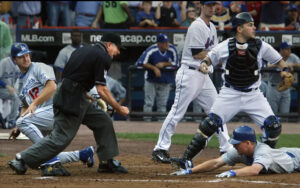 Plays like this used to work for us. That was in the top of the sixth. Taijuan Walker didn’t stick around to see the inning end. Neither did the Mets offense, not really. And in the bottom of the seventh, with the game still tied at two, the tide that had briefly turned against the Phillies tsunamied all over the Mets. There were some softly hit balls that fell in. There were some forcefully hit balls that could have drilled holes. At one point, there were two Phillies sliding into home plate inches apart without Shawn Green, Jose Valentin, and Paul Lo Duca present to nail them as a tandem. Nick Castellanos was safe. J.T. Realmuto was safe. I was surprised Jeff Kent and J.D. Drew weren’t ruled retroactively safe from the 2006 NLDS.
The Mets were now behind, 8-2, and things would get only more rotten, if not Tidrotten, from there. On this Friday night, the Mets lost their seventh consecutive game, 10-2. For a moment, it seemed we wouldn’t. For a moment, we had picked our selves up, dusted our selves off, and seemed poise to start all over again. The moment didn’t last, and the exhilaration was fleeting, but it was ever so slightly better than nothing.
by Greg Prince on 20 June 2025 12:53 pm I don’t know if it’s a repressed memory that suddenly burst through my consciousness or simply a detail that didn’t hold my attention for long when it was fresh, but after the Mets’ losing streak reached six games Thursday night in Atlanta, I thought of the 2024 National League Championship Series, specifically the Mets’ starting pitching in those six games against the Dodgers and how we hardly had any.
Game One: Kodai Senga 1.1 IP
Game Two: Sean Manaea 5 IP
Game Three: Luis Severino 4.2 IP
Game Four: Jose Quintana 3.1 IP
Game Five: David Peterson 3.2 IP
Game Six: Sean Manaea 2 IP
Not one quality start, only one quantity start, each game a puzzle to be put together with tired, unreliable pieces. The bullpen was stressed. The starters were gassed. If the Mets didn’t hit, the Mets couldn’t stay close, which the Mets didn’t in any of their four losses. I had more or less put how the Mets lost the NLCS out of my mind in the aftermath of the 2024 postseason because everything about the Mets getting to and succeeding in the 2024 postseason prior to the NLCS was so rewarding. I was depressed for maybe two days that we’d come within two games of the World Series, and concerned that a chance like that doesn’t necessarily come around very often, but then I shrugged that the Dodgers were the Dodgers, and was back to being happy that so much happened rather than being sad that something was over. Soon, it was the offseason, and we were gearing up for the year to come, which looked promising before it began, and began delivering on its promise soon after it began.
But now our starting pitching is in 2024 NLCS mode, which is to say we are letting our shot at a pennant slip away.
Six games don’t give a team much space to work through the kind of pitching woes that befell the Mets at the wrong time last October. Eighty-seven games, which is how many remain in 2025, provide a vastly wider berth to fix what appears broken. Thus, the way things are currently going can be turned around. Yet the way things are currently going feels at least temporarily intractable because when it comes to starting pitching, suddenly we hardly have any.
Game One: Clay Holmes 5 IP
Game Two: Tylor Megill 3.2 IP
Game Three: Griffin Canning 4.1 IP
Game Four: David Peterson: 7+ IP
Game Five: Paul Blackburn 3.2 IP
Game Six: Clay Holmes 4.2 IP
You can scratch Megill from an imminent turnaround, as he is on the IL with an elbow sprain. You know Senga isn’t a part of any of this, thanks to a hamstring strain. You’re left leaning on Peterson for an extra couple of batters in an eighth inning when maybe he should have been deemed done for the night. You’re hoping Holmes isn’t bumping up against an organic innings ceiling in his first full year of starting; lord knows the fifth inning Thursday night looked like one too many for him. Canning and Blackburn have reverted to looking like the journeymen they were before the Mets’ pitching brain trust went under the hood and tinkered with their mechanics.
Now you land on a Friday in Philadelphia planning to start Blade Tidwell, returned from the minors, not because he has progressed nicely since his unsuccessful cameo in St. Louis last month, but because you have nobody else to pit against Zack Wheeler. You were going to try your luck with Justin Hagenman for a few innings, but Hagenman was needed Thursday to back up Holmes and Huascar Brazoban — one of the many Yeomen of the Bullpen getting buried by extra work — and is therefore unavailable.
So except for Peterson, knock wood, we have about as much starting pitching to count on in the week ahead as we did the week we faced the Dodgers for all the NL marbles. And nobody in the bullpen feels like a sure thing for a given out or inning, let alone multiple outs and innings. And, oh by the way, nobody’s really hitting, not the big guys who you figure will come around as a unit soon, not the mid-level guys who you figure will respond consistently to the big guys getting on base and driving in runs in front of them, and certainly not the young guys who, neither individually nor collectively, are showing anything at all.
The first-place Mets are still the first-place Mets, except now they share first place, and for the first time all season, I’ve looked at the Wild Card standings with more than vague curiosity to see how the other half lives. At this rate, the other half beckons. Rates change over time. Personnel changes over time. We know there are pitchers coming back soon or soon-ish from injury. We don’t know what they will provide as they ramp up to full speed. We don’t know what full speed will encompass.
We do know time within a season can be long. Eighty-seven games’ worth of time qualifies as long. Though if the next 87 games are a whole lot like the last six games, that’s not comforting.
by Greg Prince on 19 June 2025 2:52 pm The late, great Dennis D’Agostino had a forthright way of handling blank space in his seminal 1981 volume This Date in New York Mets History. For any date on which nothing discernibly Metsian had yet occurred (understandable, in that there hadn’t yet been two decades of official franchise operation), Dennis wrote, simply, “Nothing of importance happened on this date.”
That is how I choose to address the events of June 18, 2025, a.k.a. Wednesday Night’s game in Atlanta; process the significance of the Mets’ 5-0 loss at the hands of Chris Sale, Ronald Acuña, and reverse momentum as you wish. But as long as I have This Date open, allow me to turn to and share the entry for February 10, 1967:
“Mets purchase pitcher Ron Taylor from Houston’s Oklahoma City farm team.”
Now that’s something of importance Metwise. That innocent-sounding transaction heralded the building of a bullpen that would serve as a cornerstone of a world champion. Taylor had become a world champion for the Cardinals two years and four months before the Astros decided they didn’t need to hold onto him, and he’d become a world champion for the Mets two years and eight months after they took a flyer on him.
When you consider the credentials of the righty reliever who was available for a song and where he would help take his new team, February 10, 1967, towers like one of the skyscrapers in the Met logo over the Met calendar.
Dr. Ron Taylor passed away on Monday at the age of 87. He wasn’t a doctor when he was a Met, no matter how he operated in and around the strike zone. The medical certification came later, as did his longtime association with the Toronto Blue Jays as their team physician. Ron was Canadian, the Jays are Canadian, it was a relationship that clicked as well as Ron’s with the Mets’ elevating aspirations in the 1960s. Whenever Ron was introduced at a ’69 Met reunion, he always received his honorific. “Welcome back DOCTOR Ron Taylor!”
Mr. Ron Taylor did very well by the Mets across five seasons. Being Dr. Ron Taylor made him a little more special. In A Magic Summer, in which Stanley Cohen visited with 1969 Met after 1969 Met to see how they were doing nearly twenty years on and what they remembered about that championship season, Ron made time for the author while on the job at Exhibition Stadium, the Jays’ pre-SkyDome nest. Their interview took place during a game, meaning the doctor was on call all evening. He had to keep an eye on the action in case he was needed. Cohen noted Ron had “apparently mastered the technique of following the progress of a game while focusing his attention elsewhere.” For the former pitcher, it was just the way his weeks — which included a private practice and other sports medicine commitments — wound down.
“I always set aside Friday night for doing interviews with people writing books,” Ron told Stanley.
That line and that image have always stayed with me, the idea that writers were queuing up to hear the story of the 1969 Mets from the perspective of its ace fireman. That’s what a reliever used mainly at the end of games was called in those days. Closing was not beyond the realm of the pitchers who did the starting. The Mets’ staff completed 51 games in 1969. That still left 111 in which assistance was required. Some of those games were tight. Some of those results hung in the balance of what Ron Taylor and his penmates could do. Fires got put out with regularity. The future doctor had a knack for providing necessary aid.
The first time Ron Taylor notched a save for the Mets it was in relief of Tom Seaver, specifically Seaver’s first big league start. That win, in the game of April 13, 1967, went to the pitcher who worked between them, Chuck Estrada, but Seaver-Taylor would prove an effective combination. When the Mets traveled to Atlanta for the first game of the initial National League Championship Series — October 4, 1969, a date when something of unquestionable importance happened — it was Seaver going seven for the Mets’ first-ever playoff win and Taylor nailing down the first save anybody had seen between the end of a regular season and the beginning of a World Series. Taylor would work the next day, and earn the W in relief of Jerry Koosman. We were not only one win from a pennant, we could claim the very first full-fledged NLCS bullpen ace, a role said ace essentially invented on the fly.
Ron would lend a hand in the World Series as well, culminating in his second postseason save, again in support of Koosman, in Game Two at Baltimore. In the moment, it was enormous. In a few days, it became a component of a world championship. It would take 37 years for a Met to surpass Taylor’s saves output for a single postseason. He likely thought he was just getting critical outs in critical games. He was actually setting a standard at the dawn of the relief age. As sports medicine would be for him post-pitching, standard-setting was his specialty.
Ron Taylor saved 50 games between his arrival in 1967 and departure following 1971, not counting those clutch performances in the playoffs and the Series. He saved games when the Mets weren’t good, were getting good, had gotten great, and were doing their best to stay great. The Mets’ club record for saves in a single season is 51, set by Jeurys Familia in 2016, when times had very much changed (Jacob deGrom threw one complete game; no other Met threw any). Context is everything when tempted to juxtapose contemporary closing with firefighting way back when. Those 50 saves of Taylor’s in those five years represented the most for any Met reliever during the first ten years there were Mets. Tug McGraw was second, Cal Koonce was third. They were all 1969 Mets.
A combination of visionary strategy — Gil Hodges and Rube Walker embracing their bullpen members’ skills rather than seeing relievers as failed starters — and the assembled abilities of the non-starting arms in Flushing gave pitching’s evolution a kickstart. “Hodges did one of the greatest jobs of managing in the history of the game,” Ron reflected for Cohen. “We were given what amounted to job descriptions, like in industry.” Taylor led the Mets in saves four consecutive years, though never with more than fourteen. Three times, however, he ranked in the National League’s Top Ten in the category that was just gaining a foothold in baseball’s consciousness. He was in on the start of closing. His role in the development of the reliever holds up to this day. Ron Taylor stands fourteenth among all Met pitchers ever in saves, ninth among all righties coming out of our pen.
 He certainly got my young attention, whether it was for earning the win that was the Mets’ 100th as 1969 was ending; or the first that ever accrued in the Mets favor on an Opening Day, in 1970; or for his stoic pose at Shea Stadium on his 1970 Topps baseball card. Beyond our announcers telling me he was coming into a game and the box scores summing for me exactly what he did, it was that card that really introduced me to Ron Taylor. It told me, on the back, that he’d been around a while. Other Mets had space for a biographical cartoon. Ron’s rows of numbers, dating back to 1956 in the Florida State League, precluded cheekiness. Topps did manage to note Ron “holds a degree in engineering,” which is why I didn’t think anything of it when I learned from one of the 1969 anniversary celebrations that he was a doctor. Good at science was good at science in my mind. He certainly got my young attention, whether it was for earning the win that was the Mets’ 100th as 1969 was ending; or the first that ever accrued in the Mets favor on an Opening Day, in 1970; or for his stoic pose at Shea Stadium on his 1970 Topps baseball card. Beyond our announcers telling me he was coming into a game and the box scores summing for me exactly what he did, it was that card that really introduced me to Ron Taylor. It told me, on the back, that he’d been around a while. Other Mets had space for a biographical cartoon. Ron’s rows of numbers, dating back to 1956 in the Florida State League, precluded cheekiness. Topps did manage to note Ron “holds a degree in engineering,” which is why I didn’t think anything of it when I learned from one of the 1969 anniversary celebrations that he was a doctor. Good at science was good at science in my mind.
Good at pitching is what concerned me as I was becoming a fan in 1969 and digging in as a fan in 1970. The card made mention of his 13 Saves (capitalized) in the same blurb that informed us of his engineering acumen. While saves didn’t yet rate a column all their own, his yearly wins and losses definitely got compiled and printed. He was 9-4 in 1969, and I didn’t need any kind of degree to recognize that his .692 winning percentage (also listed) was outstanding.
As indicated by all those rows of minor and major league experience and, I suppose, his birthday of December 13, 1937, Ron was kind of old as Mets of that vintage went. I was seven in 1970. Every ballplayer was a grown-up to me, but that picture on the front of card 419 did project a touch of No 42 having seen plenty. He had seen life the minors since ’56; the majors since coming up with Cleveland on April 11, 1962, the same day the Mets got going; a World Series in ’64 when he and the Cards decked the Yankees — I’d find out about that later and be retroactively grateful. The card told me he was from Toronto, a tidbit I tucked away and didn’t read anything into until I read Wayne Coffey’s They Said It Couldn’t Be Done in 2019.
In this book about the ’69 Mets (aren’t you glad Ron left his Friday nights open for authors?), Taylor explained he was Canadian because his mother, from Wales, had attempted, with her siblings, to emigrate from Wales to Australia but missed her boat by minutes. She asked the dockmaster where the next ship was going. Canada was the answer.
“Can we get on that one?”
Be glad the Astros missed the boat on Taylor in 1967, and be glad Maude Evans missed the boat she missed, or Maude doesn’t meet Wesley Taylor in Toronto and have two kids, one of whom caught onto baseball adjacent to the country where the Mets would someday play. Maybe a kid born in Australia with a different father would have found his way to Queens — the Miracle Mets were a team of destiny — but Ontario was surely a lot closer. And the Mets got a lot closer to their destiny because of the man who was, effectively, their prototype closer. No, the save totals don’t compare with the ones that were accumulated by others later, but, as Joe McDonald, who was the farm director in 1969, put it in Coffey’s book, “Unfortunately, they don’t have stats for guts. Ron Taylor had guts. He wanted the ball no mater what the situation, and he was never scared.”
He certainly wasn’t scared of the Braves or the Orioles. He wasn’t scared by what he saw when he went to Vietnam on a goodwill tour during the war. He was, instead, inspired by the wounded soldiers striving to recover from literal battle scars, inspired enough to become a doctor. His life after baseball was coming. In 1970, though he continued to be Hodges’ main righty out of the pen, age began to catch up with Taylor as the season wore on. Ron didn’t pitch after September 14, despite no reported arm problems and the Mets attempting to repeat as division champs. Danny Frisella became Tug McGraw’s righty fireman complement, as Hodges decided Ron wasn’t any longer up to the role the veteran had filled for the manager since 1968. Such changes happen in industry, too.
Jack Lang, as plugged in a reporter on the Met beat as there ever was, figured Ron would be a goner in the offseason, but he returned for 1971, pitching less than he had in any of his preceding four years as a Met. Quick stops in Montreal, where he didn’t pitch, and San Diego, where he made a handful of appearances, followed. Ron Taylor was done as a major leaguer by 1972…and on to the rest of his life, which lasted a helluva long time. Some of it was devoted to telling anybody who asked about 1969 what they wanted to know. He sure devoted a lot of Friday nights to keeping the story going.
Ron’s passing represents a tipping point of sorts in the 1969 Mets as a going entity. Twenty-five players were on that World Series roster. Only twelve are still with us — slightly less than half. Thirty-five players participated in the course of what is known as the regular season, though there was hardly anything regular about 1969 where the Mets were concerned. Eighteen of those players are still around — barely more than half. Unfortunate statistics of that nature are inevitable. Nineteen Sixty-Nine was also a helluva long time ago. Yet it’s still a going entity for us.
Thank you, Dr. Taylor, for extending its life as you did.
by Greg Prince on 18 June 2025 2:32 pm Fishing around my desk for something or other as I prepared to pen a screed about the absolutely loathsome baseball game I watched Tuesday night, I came across the following document, dated and notarized September 30, 2024:
“I the undersigned agree after today’s baseball game of New York Mets 8 Atlanta Braves 7 at Truist Park, the baseball game that clinched a playoff spot for the 2024 New York Mets and capped a fantastical ride from ‘oh and five’ to ‘OMG,’ I will accept, without issuing vociferous complaint, the outcome of exactly ONE future horrible baseball game between the same teams at the same facility.
“Such a future horrible baseball game may include one or all of the following conditions as they pertain to the New York Mets:
“wretched baserunning;
“wretched pitchcalling;
“wretched defensive decisionmaking;
“wretched defensive execution;
“wretched lead protection;
“and wretched collective offensive performance by a string of players attempting to bat in succession late but failing miserably.
“The disgust and anger associated with this ONE future horrible baseball game and all its wretched Met aspects, even if it and they occur on the heels of a three-game sweep inflicted by some baseball team besides the Atlanta Braves and therefore extends a modest losing streak to a skid encompassing something approximating genuine concern, is to be emotionally dismissed in deference to the absolute joy that emanated directly after the events of this date, the Thirtieth of September, this Year of Lindor, Two-Thousand Twenty-Four.
 They earned one. Just one. “This agreement acknowledges that by punching their ticket to the playoffs in the fashion they did versus the opponent they did and at the venue they did, the New York Mets generated ONE free pass, a pass that may be considered valid, processed, and effective until the first pitch of the next baseball game between the New York Mets and Atlanta Braves at Truist Park following the type of horrible game and wretched aspects described above.
“The New York Mets will be instructed to thereafter not do that again, ‘that,’ referring to the horrible and wretched parts of the ONE future baseball game that will be excused.
“This agreement further acknowledges a Mets fan can only attempt to overlook the disgust inherent in having watched a game like that against an opponent like that at a place like that ONCE, no matter what great thing happened against that opponent at that place the year before.”
I can’t make out a signature beneath the accumulation of blood, sweat, and tears that must have dripped over it, but I’m pretty sure I agreed to it last September 30…or would have had anybody asked me to.
by Greg Prince on 16 June 2025 2:54 pm BAZ was on the back of the jersey of the pitcher on the mound for Tampa Bay on Sunday. For a moment, I let myself believe BAZ was an icon on the level of CHER. Just one name. Just one syllable. All you needed to know was that BAZ was in town. No wonder Citi Field was sold out. People must have been lined up at dawn to get in for an up close and personal glimpse of BAZ. If BAZ was truly as bold-face as all that, it could have been the biggest road show to come to Flushing since Fernandomania was at its height.
Then I remembered BAZ was not a global sensation, not the hottest ticket since The Bird talked to the ball, just a pitcher for the Rays — Shane Baz. Nothing against Shane Baz, the Texas-born righty who turns 26 on Tuesday and came into Sunday’s game with an ERA of 4.97, but unless he had relatives who flew in specifically to see him pitch as a pre-birthday surprise, I don’t think Baz qualified as a marquee attraction for anybody in Flushing.
Unfortunately for the home team, he pitched like one. Maybe not Jim Bunning on Father’s Day 1964 level, but close enough for six-and-two-thirds. Baz and three relievers shut down the Mets, whose starter Griffin Canning elicited no mania and whose four relievers included Jared Young, who you’ll remember from his occasional swings as a designated hitter. All the elements of a 9-0 loss coalesced to take the edge of Hawaiian Shirt Day (which explained the sellout) and make even drearier an overcast Sunday.
The Mets were swept three games for the first time in all of 2025 over the weekend. In case we needed a reminder of how dispiriting a trio of consecutive losses to the same opponent can be, we had it. We didn’t need it. The Phillies swept their three-game series versus their American League East opponent in the same time frame, so our division lead that was 5½ games before we played the Rays and they played the Jays is now 2½.
When your lead grows to substantial proportions by the middle of June, it’s never too early to be gleeful. When it shrinks, it’s too soon to worry. Still, not a great showing from any angle as the Mets head to the general Atlanta vicinity, home of the thirteen-out Braves. Dismiss the records when these two teams meet, right? I don’t know about that. The Braves are still the Braves in the sense that they’re the Braves — a statement that makes all the sense in the world if you know your Mets — but we do lead them by thirteen games, a function of what had been excellent play by the Mets until very recently and all the stopping that has surrounded Atlanta’s attempts at starting. The Braves are always beatable. We just haven’t always beaten them. Last time we absolutely had to, we did. That’s a confidence-booster for the ballclub that leads them by thirteen games.
David Peterson starts us off on Tuesday. I doubt he’s someone baseball fans in other markets plan their ticket-buying around the way they did for Mark Fidrych in 1976, Fernando Valenzuela in 1981, or BAZ in my imagination, but he is, at this moment, the only member of the Mets rotation I metaphorically rub my hands together over in anticipation of him toeing the rubber. Up to last Thursday, that cohort definitely included Kodai Senga, but all we’ve got going where he’s concerned right now is his hamstring strain isn’t considered too bad. I’ll attempt to reboot my faith in the other Met starters, but, honestly, they’re not exciting. David, or “Petey” as his manager and teammates call him presumably to create clubhouse confusion, has grown into his role. He’s Ace Peterson, Met Effective. He’ll deliver the keynote in the series-opener. If it’s anything like the shutout he threw at the Nationals the other night, it will be rousing. Shutouts by complete game are pretty rare, but we’d probably settle for something BAZlike out of Petey.
Short of a CG (never mind the ShO), we will see the Met bullpen in action, and they’ve been, more or less, Met Effective, too, provided this one pitches only this much, and that one pitches only that much, and if somebody is needed two days in a row, all bets are off. You may have noticed amid the general miasma of the weekend that the Mets actually used the same pitcher one day and then the next. Justin Garza, a recent pickup from the Giants, went two innings on Friday night and an inning Saturday. He gave up no runs on either occasion. Handy guy to have around.
Barring some injury we sure as hell prefer not happen, don’t look for a hand from Garza in Atlanta this week, as he was optioned to Syracuse Sunday in favor of Ty Adcock. Was Adcock a better bet than Garza for the long haul? Or was Adcock’s arm “fresh”? You know the answer. You always know the answer these days. The Mets seem to plan their bullpen usage meticulously, but when the real world of baseball intrudes, everything teeters on the brink of hell. Limit Clay Holmes to five innings in deference to his previous start in Colorado taking a bit out of him? That’s fine. Slot in Paul Blackburn behind him to ramp up his innings for when he needs to enter the rotation? That’s wise. Blackburn blows up and needs to be pulled? And Max Kranick ain’t what Max was Kranicked up to be earlier this season?
Suddenly the bullpen’s built on shaky ground, and the only thing that’s going to steady it is Tylor Megill giving the Mets a lengthy outing on Saturday, and…nope, that doesn’t happen. It’s not unlike that Friday night a few weeks ago against the Dodgers. Nobody saw a thirteen-inning game coming, and nobody is Chris Short or Rob Gardner when it comes to going extra deep these days. Hardly anybody is David Peterson. Starters almost never go as long as you wish, and relievers have to be handled with an abundance of caution.
An answer? You want an answer? Besides building outward from the DNA of Turk Wendell so you have relievers who can pitch day after day and not have their arms fall off from slamming the rosin bag? The answer I stumbled upon was visible in the Rays’ bullpen this weekend. Three different ex-Mets who passed through New York only long enough to qualify for our annual Hot Stove and Spring Training features are alive and well in Tampa Bay. We saw Edwin Uceta, Eric Orze, and Cole Sulser. None got more than a glimpse as Mets. Each had to be treated like a shuttlecock (or an Adcock) in order to manage whatever numbers game was weighing on the front office the week he was optioned or waived. We saw something similar when Jose Ureña had one extended outing as a Met. When next we saw him, he was a Dodger, getting Mets out.
None of the aforementioned relievers has blossomed into a stopper, nor might they wind up as anything better than replacement level. But how often do you wish an additional replacement level reliever was available to Carlos Mendoza on a given day? This can’t possibly be a Mets-only problem. Guys like these bounce around, or up and down, because they don’t have options or do have options. Garza did nothing that merited a demotion to Triple-A. Brandon Waddell wasn’t necessarily throwing like a minor leaguer, but he’s there right now. Options exist for a player’s protection as well as an organization’s convenience, but they sure have a way of destabilizing the back ends of bullpens.
My solution, that admittedly just passed through my head à la my image of BAZ, is a larger roster. The 25-man roster was so sacrosanct that it was expanded to 26. On days with previously unplanned doubleheaders, it’s 27. During COVID, it was 28. During September, it’s 28. Enough pussyfooting. Just make it 30. Keep another couple of pitchers on hand. Throw in a third catcher so you’re not wondering what you’ll do in an emergency and, if you’re not blessed by a Luisangel Acuña-type already, a pinch-runner. If you want to create an eligibility system — last night’s starter and two obviously overworked relievers are “scratched” tonight — go ahead. Nobody really wants to see one reliever after another trudge out of the pen until we’re down to DHs willing to give slinging a shot, but that’s what you’ve got, anyway, save for the rare David Peterson complete game. What nobody needs to see is the pitcher who pitches for an inning or two, pitches perfectly well, and is sent down or offered up because, gosh, his arm isn’t fresh anymore. Why pretend an eight-man bullpen is sufficient for contemporary baseball? Why skimp on the fringes of the roster in a multizillion-dollar industry? What’s the cost — meal money and service time? Think how much you’ll save on airfare between LaGuardia and Syracuse.
Or just put on another Hawaiian Shirt Day. Those things really get the fannies in the seats.
by Greg Prince on 15 June 2025 12:02 pm As it’s Father’s Day, allow me this recollection of the night, over dinner, my father decided he needed to read us a poem written by Rudyard Kipling.
What, this type of thing didn’t happen in your kitchen?
This was when I was in seventh grade, so perhaps the impetus was me mentioning, only because I was asked, that we were studying poetry in English class. If so, Dad insisted, I had to go upstairs and find that ancient volume of literature gathering dust in the sloped room. Bring it down, you have to hear this. I did as told. My father opened up the book, found his Kipling, and read aloud, the way he would when he wanted to share something he considered amusing from that day’s Wall Street Journal.
’What are the bugles blowin’ for?’ said Files-on-Parade.
‘To turn you out, to turn you out,’ the Colour-Sergeant said.
‘What makes you look so white, so white?’ said Files-on-Parade.
‘I’m dreadin’ what I’ve got to watch,’ the Colour-Sergeant said.
For they’re hangin’ Danny Deever, you can hear the Dead March play.
The Regiment’s in ’ollow square — they’re hangin’ him to-day;
They’ve taken of his buttons off an’ cut his stripes away,
An’ they’re hangin’ Danny Deever in the mornin’.
It went on as such for another three stanzas. Not a good day to be Danny Deever, obviously. I remember asking my father what a Files-on-Parade was (a corporal, he said). I didn’t ask why he considered this a great poem. He just said it was a great poem, so I accepted it as a great poem. I think I used it for whatever assignment spurred his presentation. “‘Danny Deever’ by Rudyard Kipling is a poem that…” I probably turned in the assignment late. For two years, every grade I received in English arrived with ten points removed for lateness. Perhaps it was a reaction to the fate of Danny Deever. If they can’t find me in the mornin’, I won’t be subject to hangin’. Or maybe I was just an all-district procrastinator.
I’ve rarely thought of the poem since junior high, but I thought of poor ol’ Danny Deever Saturday night in the wake of poor ol’ Tylor Megill getting proverbially strung up by the Tampa Bay Rays at Citi Field. Two reasons, I’m guessing.
1) Tylor’s outing, like Danny Deever’s fate, was pretty sad.
2) My dad would have liked the name “Tylor Megill”.
The name is Megill, not McGill, but knowing my dad, he would have impishly pronounced it with an Irish accent. “Ah, poor ol’ Tylor McGill, strafed for so many runs in so little time.” My dad had a thing about Irish or very Irish-sounding names. When he rallied his baseball consciousness one final instance for the 2015 pennant drive, it was Daniel Murphy more than any Met who got his attention, not because Murph hit all those home runs, I’m convinced, but because he grew up around a lot of Muprhs and the like in Jackson Heights. One of the few Jews in his neighborhood, he became good friends with some of the Irish kids. Some other Irish kids also became his worst enemies. Either way, he seemed to maintain a strand of fascination with those who were or might be Irish.
Until the mid-’80s Mets pulled both my parents into their orbit, Dad generally didn’t watch enough baseball to gather awareness of too many players of any background. Yet he managed to take notice of the emergence of benchwarming rookie infielder Brian Doyle in the 1978 postseason when, unfortunately, the Yankees were too big a story to ignore. Thrust into a starting role after Willie Randolph was injured, Brian hit like crazy for the Yankees the way Al Weis hit like crazy for the Mets in the 1969 World Series. Every time Brian Doyle did something, the announcers would mention that Brian Doyle was the brother of veteran major leaguer Denny Doyle, and with their other brother Blake Doyle, they ran a baseball school in Florida in the winter. My father had never heard of Denny Doyle before all this, but the idea of the Doyle Brothers tickled him no end. “Dinny” Doyle, he called him, as he effected his idea of an Irish brogue, the way he had for Danny Deever: “After the season, Brian Doyle and his brother Dinny Doyle will get together with their brother Blake Doyle and teach others to hit like the Doyles.” It was a running joke in our house that lasted clear to Thanksgiving.
Had Dad lived long enough to know of Tylor Megill, I’m confident he would have conferred honorary Irishness upon Saturday’s losing pitcher…or more of it in case Megill is already Irish. Whether Tylor is or isn’t (I have no idea), he surely didn’t have the luck of the Irish with him versus the Rays. Nor the luck of any ethnic group. Against Tampa Bay’s band of Yandy and Junior and Jonathan and Jake and Kameron with a K and two guys spelled L-O-W-E but they pronounce it differently, Megill didn’t make it through four innings. By the time he could no longer be left to fend for himself, our beleaguered righty received ten well-meaning but ultimately mournful “get ’em next time” taps to the butt.
I counted. Three from the glove of shortstop Francisco Lindor. One from the glove of second baseman Brett Baty. Three from the glove of third baseman Ronny Mauricio. Two from the mitt of first baseman Pete Alonso. And one, ungloved and more of a slap than a pat, from Carlos Mendoza, as the skipper came to ceremoniously remove the ball from Tylor’s glove and Tylor from the game altogether. Megill seemed utterly unconsoled by his infield’s and manager’s ritual show of empathy. The fans in the stands on this gloomy late Saturday afternoon that had become an even gloomier early Saturday evening showed nothing of the kind as Tylor made his long march to the Met dugout. A traffic jam of boos in Flushing was backed up to Jackson Heights.
‘What’s that so black agin the sun? said Files-on-Parade.
‘It’s Danny fightin’ ’ard for life,’ the Colour-Sergeant said.
‘What’s that that whimpers over’ead?’ said Files-on-Parade.
‘It’s Danny’s soul that’s passin’ now,’ the Colour-Sergeant said.
The fight hadn’t exactly gone out of the Mets by then, but they lacked a certain life. They hit Tampa Bay’s starter Drew Rasmussen well, but to not enough avail. Four relievers — one of whom, Cole Sulser, once wore a Mets uniform the way his penmates Edwin Uceta and Eric Orze had (briefly and without distinction) — scattered hits and walks, but no runs. The Mets lost, 8-4, outdoors, after a rain delay, to a team that only recently got the hang of hosting home games somewhere other than indoors. The Rays are always sneaky good. The Mets have chosen this weekend to be openly bad. It had been such a splendid week, too.
Still, with the Mets holding a reasonably robust lead in the National League East, I’m confident my father would have maintained enough whimsy to have gotten a kick out of Tylor Megill, or at least his aura. My mother, on the other hand, would have wanted only to have kicked Tylor Megill for pitching as he did. But it’s not Mother’s Day today, is it?
by Greg Prince on 14 June 2025 9:09 am Except for the top of the sixth inning, Friday night at Citi Field was a pretty good game. The Mets scored five runs versus the Tampa Bay Rays and received five solid innings from Clay Holmes. Gotta like things of that nature occurring.
It’s a shame the top of the sixth, when Paul Blackburn and Max Kranick gave up the six runs that negated the 5-1 lead the Mets had built and essentially undid Holmes’s splendid limited-by-design start, had to happen. Otherwise, though, good game.
Well, maybe the bottom of the seventh inning lacked whatever makes a game good, as the bottom of the seventh wasn’t much of a half-inning from a Mets perspective. Loading the bases was excellent. Leaving them loaded — against Edwin Uceta, an ex-Met you blinked and missed in 2023 — was less excellent. Earlier, the Rays deployed Eric Orze out of the bullpen. You might have blinked and missed Eric when he was a Met last year. Anyway, good game, except for the top of the sixth and the bottom of the seventh.
Actually, the bottoms of the eighth and the ninth weren’t so great, either. In the eighth, Juan Soto rocketed a ball to right that somehow neither went out nor fell in. Looked promising off the bat, but it was just a third out. And the ninth was promising, too, right up to Ronny Mauricio striking out looking with the tying runs on base. Those could have been good innings for the Mets. Real good. But they weren’t.
Friday night wound up Rays 7 Mets 5, with the Mets stranding a dozen and going 2-for-16 with runners in scoring position while middle relief absolutely imploded. So maybe it wasn’t a good game. After winning six in a row, it’s hard to remember the Mets sometimes play games that qualify as less than good.
by Greg Prince on 12 June 2025 7:54 pm All wins are created equal in the standings. Some wins are a little less equal emotionally. Some wins take a back seat to other events surrounding a given game. It doesn’t happen often, but it happens.
Mets fire a manager but win as a going-away present to their suddenly erstwhile skipper? The win doesn’t resonate.
Mets raise a white flag by trading a perfectly good player because their sagging record indicates a diminishing need for perfectly good players the rest of the year? The win gets less of your attention than who we got in exchange for the perfectly good player.
Mets blow a seemingly unblowable lead late but get it back after you’re overwhelmed by so much Sturm und Drang you barely notice that everything turned out OK? Depending on the severity of the nonfatal gag job, the win can feel like an undeserved consolation prize — you’ll take it, but you feel a little skeevy about the whole thing.
Mets suffer an injury while in the midst of everything going well, and go on to win while waiting to announce the nature of the injury? You’re absolutely happy to have the win, especially since you lately find yourself addicted to chronic winning, but the injury rather than the victory rides in the front seat of your thoughts.
The Mets on Thursday afternoon at Citi Field notched one of those back seat wins, topping the Nationals, 4-3. No managers were fired; no players were traded; a lead was nearly blown late but never actually got away, so we’ll let that brush with fallibility slide. Thursday, however, was one of those days when a Met — a key Met, at that — had to leave the game less than healthy, and true solace wasn’t readily attainable from the final posted on the scoreboard.
Oh, we’ll take it. We’ll take Jeff McNeil’s three-run homer in the first and Brandon Nimmo’s solo shot in the fifth and Tyrone Taylor’s Tommie Agee impression in the outfield in the sixth. We won’t overlook, either, that Luisangel Acuña made a very heady play in the top of the ninth to make sure a bullpen meltdown soaring toward Level 7 never reached the stage where you’ll want to avoid locally sourced milk for a generation. When it was over, the Mets do what they do when they win. They gathered in a circle and choreographed a celebratory kick. Having won six in a row en route to mounting, the best record in baseball, they’ve become very practiced in victory celebrations.
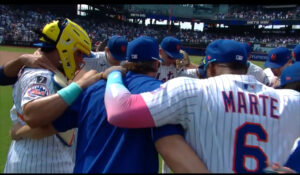 Winning is always a kick, even if a strain to the hamstring is tantamount to a kick in the head. We definitely appreciated all the positives that turned the Mets into Rockettes, but we couldn’t and didn’t stop thinking about Kodai Senga, who was humming along with a shutout in the sixth, reducing his microscopic earned run average to a nearly indecipherable dot, when, in the process of covering first base on a grounder to Pete Alonso, had something happen to his right leg. A cramp? A strain? A what? We didn’t know while Senga knelt on the ground nor when he rose and walked off without assistance to exit the field. The last act of his 1.47 ERA season to date was a leap in the air and a step on the bag after hauling in Alonso’s less than ideal toss of CJ Abrams’s relatively routine groundout. Senga said he’d felt something before exerting the extra effort to reel in Pete’s fling. Pete said he felt “awful” about perhaps exacerbating an injury in the making. Carlos Mendoza reported afterward the early diagnosis is hamstring strain. A trip to the IL and the MRI machine, in that order, are prescribed. Everything else is TBD.
It was a 3-1 putout that overshadowed a 4-3 win. The Met rotation with Senga, even as it’s required the insertion of random sixth starters from time to time, is stronger by multitudes than what we deployed 161 of 162 games last year, and last year’s starting pitching was pretty darn good. It would have been better had Kodai been available before and after July 26, his one regular-season outing of 2024, the one that was also going swimmingly, the one that was also interrupted by the covering of first base, the one that also had us wondering what just went wrong. Eleven months ago, it was a left calf strain that negated his comeback from the shoulder injury he endured in Spring. Never mind the DH. Let’s get this man a designated fielder.
The Mets maintain the depth to deal with a starting pitcher missing a thus far indeterminate period of time. Last season’s anchor, Sean Manaea, is rehabbing. One of last winter’s acquisitions, Frankie Montas, is doing the same. Last summer’s insurance policy, Paul Blackburn, is alive and well and on the active roster. Somebody will pitch and, I’m willing to say while we exist in an era of confidence rather than panic, pitch well. Still, the man we’ll be missing is Kodai Senga. We’ve got a lefty ace in David Peterson. We’ve got a stretched-out Clay Holmes proving the Mets were right to see in him someone who belonged at the front rather than the back of a game. We’ve got Griffin Canning emerging successfully from the alchemy of the Met pitching lab. And we’ve got gritty Tylor Megill forever hanging in there. But it was the right arm of Senga that signaled every day in six could be and usually was something extra special. We scrapped for a playoff spot last year. We are cruising as the best team in baseball this year. I’m not gonna say the definitive difference has been having Kodai Senga, but, boy, has it not hurt.
Losing him hurts. Winning without him around at day’s end didn’t feel as good as if he’d kept pitching, kept fielding without incident, kept within kicking distance of the club’s victory huddle. Yet it was still a win. That never hurts. Nor will getting him back.
by Jason Fry on 12 June 2025 7:54 am In the early days of Citi Field, there was an attempt to start a first-inning Yankee Stadium-style roll call. Thankfully wisdom prevailed and the attempt got shelved — that tradition belongs in the Bronx, just like “Sweet Caroline” belongs in Fenway. But there’s no rule that we can’t do it here.
Juan Soto: I heard Soto’s third-inning blast via the audio feed as I was putting away kayaks down in Brooklyn Bridge Park. Howie sounded excited and impressed, and the footage didn’t disappoint once I finally got to see it for myself — a majestic arc of a home run against his original team that came down to the right of the Mets’ bullpen, with a nifty catch by a young fan on the other end.
Brandon Nimmo: We sometimes judge Nimmo’s performances against our memory of him as the table-setter he was a few years ago, a top-of-the-order slash-and-dash hitter who drew walks and stole bases while chipping in ~10 homers a season. He isn’t that player any more, having traded on-base percentage and average for power while moving from center to left. We should move along with him: Two home runs — the first an opposite-field slice that almost looked accidental, the second a more conventional drive pulled to right — will play just fine.
Tyrone Taylor: It took a weirdly long time for the second-line umps to confirm that Taylor had thrown out Luis Garcia Jr. at home in the eighth, preserving David Peterson‘s shut-out and along with it, most likely, his chance at a complete game. Out in center, Taylor looked serene and unruffled, waiting for Chelsea (it’s now Midtown but so what, Chelsea sounds better) to declare that nothing supported the Nats’ oh-why-not challenge of the call. And why wouldn’t Taylor be serene? He’s not tearing the cover off the ball (no one ever is, come to think of it) but he’s playing impeccable defense, and somehow always does something that gets his name in the recap.
Luis Torrens: One of baseball’s pleasures is that it’s primarily a game of individual endeavors, yet one that adds up to collective victory or defeat. In the middle of that, though, are partnerships, duos that have to work in sync. Pitcher and catcher, for one; outfielder and catcher, for another. No Peterson complete game without Torrens thinking along with him, no Peterson shut-out without Torrens’ smooth tag at home. And note that the play didn’t end there — after tagging out Garcia, Torrens lost the ball on the transfer because he was looking to throw behind an unwary Nats runner. The man knows what he’s doing back there and we’re lucky to have him.
Carlos Mendoza: If Ryne Stanek had come out for the ninth, it would have yielded a postgame question or two for Carlos Mendoza about whether Peterson had wanted to go nine and if he could have. But it would have been a momentary, nostalgic aside and not a serious interrogation: The game has changed and it’s safe to say that Tom Seaver‘s franchise complete-game records (21 in 1971, 171 overall) are safe. Mendoza knew Peterson wanted to try, talked through the plan with Torrens, and gave Peterson his chance.
John DeMarisco: Kudos to SNY for staying with the game after the eighth inning was concluded, letting us see Peterson heading out to the mound alone (nice touch, Mets) and letting us hear the crowd’s jubilant welcome for him. That was the kind of moment those of us watching at home generally miss because of business considerations, and have come to assume we’ll miss. The Mets’ broadcast director gave us a chance to see it.
David Peterson: Well of course. Early last year I had a mild fit about “feckless nibblers” in the Mets’ rotation, a criticism that’s pretty much out of date as the pitching braintrust has encouraged Met hurlers to simplify their arsenals and trust their stuff. On Wednesday Peterson was anything but feckless and anything but a nibbler, throwing first-pitch strikes, pitching aggressively and trusting his defense. It wasn’t so long ago that we’d consigned Peterson to the prospect-turned-suspect column, wondering if he’d ever stop getting out of his own way. Time to abandon that idea: His hip is healthy and he’s made great strides in the part of the game that a starting pitcher wins or loses above the neck. Ron Darling did a good job on the broadcast talking about this element of pitching, referring to a long-ago Mets teammate whom he said had better stuff but less conviction. Darling likes to poor-mouth himself as a pitcher so I didn’t pay much attention to the first part; I did spend the better part of an inning on the second part, reviewing old Mets rosters in my head and wondering whom he was talking about.
Us: The Mets are 26-7 at Citi Field, the best home record in the game. (And the inverse of the poor Rockies’ home record, if you were wondering.) That’s overwhelmingly a result of their being really good, but let’s give at least a rounding error’s worth of credit to the big crowds that have come out all year. In the eighth and ninth my eyes were on Peterson, but also on the stands, where a significant percentage of the rooters knew what was at stake and were determined to give Peterson whatever lift they could. Cardinals fans? Bah. Fenway partisans. Meh. Wrigley rooters? Whatever. Mets fans are a wonderful combination of wary and paranoid, defiant and hopeful, history-haunted and dreamily optimistic. They also always know what’s going on.
by Jason Fry on 10 June 2025 11:07 pm Emily and I watched the first couple of innings of Tuesday night’s Mets-Nats tilt somewhat distractedly. First we were down in Dumbo at L&B Spumoni Gardens, a satellite of the classic ur-Brooklyn Sicilian-pizza joint that’s finally open after a long permitting saga. Then we were walking up the hill for home. We’d peeked at SNY, sans sound, during dinner and then switched to Howie as we strolled through Brooklyn Heights.
Somewhere around Cranberry Street a young man turned around as he passed us and asked, “Mets?”
I nodded and he said, “2-0 Nats I think.”
“3-0 now,” I told him, for we’d just heard CJ Abrams double in a run, with the Nats giving the Mets a break by sending Jose Tena home to be thrown out by a good measure. (Off a pitcher who looked less than sharp? With James Wood coming up? Why in the world would you do that?)
“Plenty of time,” I added as our temporary neighbor took in the updated score. “We’ll get ’em.”
“Plenty of time,” he agreed.
And the funny thing is that this wasn’t fannish bravado on either of our parts. I meant it; so did he. It was 3-0, and that wasn’t ideal, but the Mets had eight frames to make up that deficit. Did I know they would do it? Of course not — baseball doesn’t work that way. But I knew they could — and with so much game left, that was sufficient.
These are strange days, when Mets fans are reflexively confident, even bordering on serene. I could get used to it.
Griffin Canning never looked particularly sharp, but he hung around into the sixth; meanwhile the Mets cut that three-run deficit to two and then one before it edged up to two again, courtesy of an Abrams homer hit too high for Brandon Nimmo to pluck from the sky. The Mets looked frustrated by MacKenzie Gore, who used a sharp curveball as a putaway pitch. But they got into the Nats bullpen while Jose Butto and Jose Castillo and newcomer Justin Garza held the fort.
In the eighth, the Nats got a little unlucky. Starling Marte doesn’t always turn in the most dogged ABs, but he refused to chase against Jose Ferrer‘s sinker and worked out a walk. Juan Soto then smoked a slider to right with a lot of English. Robert Hassell III could have played it on a hop but thought he could catch it. Instead it wound up behind him, scoring Marte and sending Soto to second. (Soto would have been on third but didn’t run hard out of the box, something I thought we’d sorted out.)
The Nats called on closer Kyle Finnegan, whose second pitch was a splitter at the bottom of the strike zone that Pete Alonso somehow sliced into left, past Wood. Soto scored; coming into second with the ball already there, Alonso tried the same switch-hands okie-doke that worked in Colorado … which actually worked again, at least until the Polar Bear came off the base and was tagged out.
Still, the Mets had tied it. Edwin Diaz worked a spotless top of the ninth, Finnegan recovered to do the same in his half-inning, and it was time for a little Manfredball.
The Nats got off on the right foot in the tenth before a ball was even put in play, as the speedy Abrams was their ghost runner. Wood moved him to third, but then Reed Garrett erased Nathaniel Lowe on three pitches and got Andres Chaparro to fly out to Nimmo.
It was the Mets’ turn, and if you came back a little late from the john you missed the whole thing: Jeff McNeil smacked the first pitch over the infield to score Luisangel Acuna, with poor Cole Henry getting the loss in appearance that maybe lasted nine seconds and McNeil grappling Steve Gelbs to ensure they both got a victory bath from the cooler.
“This is a thing now?” asked an amused-because-he-has-to-be Gelbs, with McNeil informing him that yeah, it’s a thing.
Plenty of time, we’ll get ’em.
Strange days, but maybe it’s a thing now.
|
|






