The blog for Mets fans
who like to read
ABOUT US

Faith and Fear in Flushing made its debut on Feb. 16, 2005, the brainchild of two longtime friends and lifelong Met fans.
Greg Prince discovered the Mets when he was 6, during the magical summer of 1969. He is a Long Island-based writer, editor and communications consultant. Contact him here.
Jason Fry is a Brooklyn writer whose first memories include his mom leaping up and down cheering for Rusty Staub. Check out his other writing here.
Got something to say? Leave a comment, or email us at faithandfear@gmail.com. (Sorry, but we have no interest in ads, sponsored content or guest posts.)
Need our RSS feed? It's here.
Visit our Facebook page, or drop by the personal pages for Greg and Jason.
Or follow us on Twitter: Here's Greg, and here's Jason.
|
by Greg Prince on 25 February 2025 11:45 am Spring Training, you gotta stop making real news. Frankie Montas’s lat last week. Nick Madrigal’s shoulder over the weekend. Sean Manaea’s oblique as the Monday surprise du jour. We’re here for bright skies and optimism and megastars presenting vehicles to would-be stars in exchange for jersey numbers. That’s the news we can consume and smile about.
All injuries come at the wrong time. All injuries are unfortunate. Some come at a worse time than others. Some are more unfortunate than others. Aesthetically, Spring is a bad time for injuries. As a practical matter, the earlier an injury occurs, the longer there is the opportunity for recovery or, if necessary, replacement. If you lose for a while a player who rates as replaceable…well, let’s not treat human beings as commodities if we can help ourselves. Still, as Anthony DiComo pointed out, the Mets have 68 guys in camp; plus there are a couple of familiar fellows out there who are still unengaged by any organization; and we just picked up an outfielder named Alexander Canario from the Cubs, which, I suppose means we have 69 guys in camp. Nobody’s a commodity, but it’s nice to have alternatives.
Montas goes down for a while? Good thing we have pitching depth. Manaea goes down, likely for less while, but still a while? The depth isn’t as deep, and Manaea is inarguably most vital to the Mets’ pitching plans. Clay Holmes looked good Saturday, Max Kranick pretty solid on Sunday. People step up. People earn closer looks. We’re better off with Manaea’s oblique clearing up. But somebody’s gonna have to pitch in his stead for a spell. No wonder reports of Jose Quintana withdrawing from Colombia’s WBC qualifier team raised multiple antennae Monday night.
Madrigal we barely know except that he was brought in as an infield backup instead of Jose Iglesias. Something about options and flexibility. Now Madrigal’s out “for a long time” with a fracture, per Carlos Mendoza, and you’re left to wonder when Iglesias stopped being an excellent defender and reliable hitter. Then you remember, oh right, options and flexibility. Youth as well. I, too, would like to see more Luisangel Acuña. Not sure bench guy is his ideal role from jump in 2025. Or maybe sitting behind major leaguers in April beats starting every day in Syracuse.
Here I am, immersed in actual Met news and its impact before March. No, that’s not what you want a lot of in Spring. You want stories about numbers on the backs of jerseys and what it takes to shift them to the backs of other jerseys.
Saturday, Juan Soto homered the first time ever we saw him swing as a Met, a cause for instant celebration for those of us tuning in from anywhere for a taste of Spring. Further down the lineup in that very same inning, we could be pretty happy that Brett Baty beat out an infield grounder by motoring to first base. Of course he motored. Brett Baty has a sweet new ride, a situation directly related to Juan Soto not having to get confused when he dresses. Win-Win!
Soto, who’s worn 22 at every major league stop before arriving at what we hope is his last and most glorious, came to a team where that number was assigned to a former first-round draft choice whose development has stalled like he trusts his sweet new ride won’t. Baty’s worn 22 since he was 22 and hinting that he’d be the Mets’ third baseman for the foreseeable future. That was in ’22. Times, it is said, change. Numbers, it should also be said, players need to be malleable about.
Before Christmas of 2024, there was Soto trying on 22 at Citi Field, as clearly his as it was Donn Clendenon’s and Ray Knight’s while they were proving themselves Most Valuable in the cause of the Mets winning World Series. Donn hit .357 with three homers in 1969. Ray hit .391 with an enormous Game Seven dinger in 1986. Clendenon and Knight earning their respective WS MVP honors wearing the number that they did has given 22 a little extra historical oomph in Met annals. It also belonged to as valuable a performer as the Mets had in another Fall Classic, Al Leiter: two starts, one hard-luck no-decision in Game One, one heartbreaking defeat in Game Five, a combined 268 pitches’ worth of blood, sweat and tears trickling across two boroughs’ mounds in his wake. Things go a little better in 2000, we probably have three 22s getting presented an October MVP.
For the record, Juan hit .333 with three homers in a World Series his team won, and .313 with another longball in a World Series his team lost. Think hard before betting against 22 when fall comes to Flushing.
The same digits Clendenon, Knight, Leiter and Soto have made memorable also made a habit of gracing the backs of players who engendered high hopes unmet somewhere between various Aprils and Septembers. Witness mid-’90s five-tooler Alex Ochoa; future closer of the 2000s Royce Ring; 2013 top pick Dom Smith. Ochoa cycled through a few moments in 22 before getting shipped to Minnesota for Rich Becker. Ring as 22 notched no saves for us, or anybody else in any number. Smith, in 22 between 2017 and 2019, produced some big hits before dropping a 2 in deference to former Cy Young Award winner Rick Porcello. Got a few more wearing just 2 until fading from our scene in 2022. Dom put a lot together as a Met, but fell a little shy of putting it all together.
Like any number, 22’s success rate has depended on who’s been wearing it when. Few Mets could be more rewarding to watch than No. 22, Kevin McReynolds, at his 1988 peak. Few could be more disappointing to watch than No. 22, Kevin McReynolds, as he descended from that peak. We experienced Porcello long past his Cy status, in 22 in what there was of 2020; Willie Harris after he was done robbing us with regularity, in 22 for the duration of 2011; Ender Inciarte after he was done robbing us with regularity, in 22 for two pre-Baty weeks in 2022; and Brett Butler, four years after signing him as our leadoff hitter would have been a capital idea, in 22 for not quite four months in 1995. Jose Valentin was awesome all year in 18 in 2006, less so after switching to 22 in 2007, a year he got injured in July and never played again.
Conversely, Jack Fisher was sturdy as hell for 133 starts over four seasons in 22. Eric Young, Jr., swiped a stolen bases crown in 22. Mike Jorgensen did defensive wonders at first base and once won a game on a walkoff grand slam in 22. If forces hadn’t conspired to send Duaner Sanchez out for a late-night cab ride in Miami, I’m convinced Xavier Nady would have worn 22 in the 2006 World Series. Instead, he was traded to Pittsburgh because we needed Roberto Hernandez to reinforce the bullpen in Sanchez’s absence. The next time we were in the World Series, the Met in 22 was Kevin Plawecki, who caught only ceremonial pitches through three rounds of postseason inaction in 2015, suggesting that betting on 22 when fall comes to Flushing can be a bit of a crapshoot.
All those ups and downs for 22, from Bob Moorhead in 1962 to Brett Baty in 2024, but Soto had to have it. Juan wasn’t signing a record-breaking deal with the Mets to feel the slightest bit uncomfortable. Fortunately, Baty, whose grip on his number grew more tenuous than his grip on his roster spot, wasn’t going to be made to feel discomfort, either. Should Brett actually be a Met in the season ahead (third base is otherwise occupied), he will do it as No. 7, a selfless selection Brett said he went for in deference to his youthful affinity for one Met legend and one Hall of Famer.
Had things worked out perfectly, those would both identify Jose Reyes, but the Hall of Famer in Baty’s esteem is Joe Mauer. Before Baty’s switch, good ol’ 7 was out of circulation in these parts for several seasons. Marcus Stroman last wore it for the Mets, in 2019, then said it didn’t seem proper because it truly belonged in Queens to his former Blue Jay teammate Reyes — by then no longer playing — and switched to 0. With numbers being retired with surprising frequency in recent years, I wondered if 7 was being set aside for its own day of honor, whether for Jose, or our all-time avatar of tenure Eddie Kranepool, or the two of them in tandem Berra-Dickey style. Now it’s back on the field, and, honestly, it looks good on Brett.
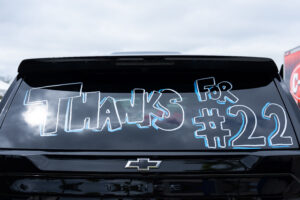 Even better-looking from Baty’s perspective is what resides in his parking space: a spanking new Chevy Tahoe, courtesy of the newest 22 in camp. The SUV is Soto’s “thanks, dude” to Baty for being so accommodating with his digits. Brett has until now been driving what he considers a hardy old Toyota, specifically a 4Runner. It’s a 2016. I drive an old Toyota that’s proven plenty hardy, despite it being smaller than Brett’s vehicle and considerably older than Brett himself. I’d say we Toyota guys have to stick together, but there’s the kid moving into his new model. Good for Baty. Good for Soto. Good for us. As baseball fans, we are primed to love numbers and cherish camaraderie. Whatever makes our guys happy and brings them together and revs them toward a winning season, right? Even better-looking from Baty’s perspective is what resides in his parking space: a spanking new Chevy Tahoe, courtesy of the newest 22 in camp. The SUV is Soto’s “thanks, dude” to Baty for being so accommodating with his digits. Brett has until now been driving what he considers a hardy old Toyota, specifically a 4Runner. It’s a 2016. I drive an old Toyota that’s proven plenty hardy, despite it being smaller than Brett’s vehicle and considerably older than Brett himself. I’d say we Toyota guys have to stick together, but there’s the kid moving into his new model. Good for Baty. Good for Soto. Good for us. As baseball fans, we are primed to love numbers and cherish camaraderie. Whatever makes our guys happy and brings them together and revs them toward a winning season, right?
Wright.
David Wright just pulled into the alumni parking lot of my mind, because the last time I gave uniform numbers much thought was last month when David was humbly conducting his media Zoom call regarding the forthcoming retirement of 5, a number beyond even the compensatory powers of Juan Soto. Naturally David did his press availability humbly. It’s how he’s forever done everything.
Had David been left to retire 5, he would have done it for Ed Charles or Davey Johnson or John Olerud or Chico Escuela. There are barrels of fun 5s in Mets history. David might not know of everybody to have worn it before him, but to listen to him reflecting on his career, he’d believe anybody would deserve the highest honor a franchise could bestow before he should receive it.
“I don’t think it’s hit me,” he said on the cold afternoon of January 8. “I don’t think it’s ever gonna hit me. I truly feel like it’s a bit undeserved, given the skill and accomplishments of some of the numbers I’ll be amongst up there. I joke that I think there should be a special section for my number because it’s probably not deserving of being amongst the really, really good players in the organization.”
In Wright’s world of accomplishment, he somehow fancies himself Wayne and/or Garth. “I’m not worthy! I’m not worthy!” You can’t read a list of Met career totals in just about any offensive category and not run into WRIGHT right away. But that’s the same David who stood in front of his locker after wins uninterested in burnishing his base hits or runs batted in because all that mattered was the team won, the same David who took losses upon himself, never mind that baseball is a team game and too often his team was stocked with players not on his level.
 Now his level will be up there “amongst” Seaver and Strawberry and the rest of the Metropolitan immortals. I could name them all, but reciting Met numerical retirees now takes a minute. Live long enough, huh? I lived too long with the Mets ignoring their past to not adore them embracing it. It’s how we show our respect, and I have affection for the acknowledgment. Whether they rediscovered 36, remembered 24 or took care of the teens, 5 was a gimme from the time it was hung up by The Captain in 2018. As of July 19, David Wright, age 42, will be the youngest Met to have his number retired. He still had to wait too long. Now his level will be up there “amongst” Seaver and Strawberry and the rest of the Metropolitan immortals. I could name them all, but reciting Met numerical retirees now takes a minute. Live long enough, huh? I lived too long with the Mets ignoring their past to not adore them embracing it. It’s how we show our respect, and I have affection for the acknowledgment. Whether they rediscovered 36, remembered 24 or took care of the teens, 5 was a gimme from the time it was hung up by The Captain in 2018. As of July 19, David Wright, age 42, will be the youngest Met to have his number retired. He still had to wait too long.
It was five accompli, wasn’t it? They never gave out Wright’s number, just like they never gave out Stengel’s, Hodges’s, Seaver’s or Piazza’s once they were done (whereas 36 was issued to 27 different Met players plus Mickey Callaway in the four decades following Jerry Koosman’s departure from Shea). We didn’t have to dwell on it too long while it wasn’t happening or stew about its worthiness once it did happen. This was pretty close to old school number-retirement, fitting for an old-school player.
Another fitting juxtaposition from my early-January perspective was that Wright was directed to sit and be reminded by reporters of how marvelous a career he’d conducted one day before the nation had the privilege of being reminded what a person we once elected president.
In baseball, when appropriate, we retire a number. In America, when a prominent individual’s time arrives, we conduct a state funeral. It’s how we show our respect and, unless we’re made of stone, express our affection. Circumstances presented an intersection of aspects of both rituals in deepest winter. They each got my attention. A day after David of Virginia delivered his eternally sincere aw-shucks self-appraisal, national remembrance for President Jimmy Carter concluded. One Southern gentleman given his flowers in his forties, another passing at a triple-digits age and being remembered warmly in the aftermath of a remarkable life.
Both men always exuded graciousness in their time in the spotlight. Carter wasn’t as humble as Wright, but who is? Also, Jimmy Carter rooted for the Atlanta Braves, which may have been the only policy position of his I viewed as beyond the pale. He came by it honestly, however, being from Georgia and all. The man could count Henry Aaron as a friend. Pretty classy company when those two Peach State icons got together.
 No doubt somebody who shows up to applaud Wright in July will have grumbled way back when that he couldn’t lift a simple fly ball with a man on third and nobody out. The strikeouts and popups of yore are easily obscured in a toast to the long run. Politics can be a tougher sell for the act of forgiving and forgetting, which is what makes a state funeral such an stupendous occasion. People who had no more than modest use for you in life say nice things about you. People who are on record as saying terrible things about each other come together in comity. It’s like we’ve all grabbed a stool at Cheers and George Wendt has walked in. Norms! They can come off as a tad hypocritical if you have a memory. They can also come off as a civil and comforting. No doubt somebody who shows up to applaud Wright in July will have grumbled way back when that he couldn’t lift a simple fly ball with a man on third and nobody out. The strikeouts and popups of yore are easily obscured in a toast to the long run. Politics can be a tougher sell for the act of forgiving and forgetting, which is what makes a state funeral such an stupendous occasion. People who had no more than modest use for you in life say nice things about you. People who are on record as saying terrible things about each other come together in comity. It’s like we’ve all grabbed a stool at Cheers and George Wendt has walked in. Norms! They can come off as a tad hypocritical if you have a memory. They can also come off as a civil and comforting.
Our 39th president died on December 29. Ceremonies at different sites commenced within a week and continued through January 9. Seems like ages ago this happened in Washington. It was only last month. The goodbye was long, as was the nation’s preparation, given that Carter was announced as going into hospice care nearly two years before. The life was incredibly long in every sense. Jimmy lived to be 100, long for anybody, record-breaking for a president. The post-presidency beat everybody else’s, too. It went on for nearly 44 years and it was packed full of initiative and accomplishment. We should all make the most of our second, third and however many acts we get.
In the same way David Wright’s career pushed temporal boundaries for a Met, Jimmy Carter’s stay in the public consciousness outdid just about everybody’s as a going concern. Among the several touching eulogies delivered at the National Cathedral were a pair prepared by men who preceded President Carter in death. When the next generation is sent in to read the words of their fathers, that says something about how long the deceased hung in there.
Steven Ford, for his late father, President Gerald Ford:
“Inspired by his faith, he pursued brotherhood across boundaries of nationhood, across boundaries of tradition, across boundaries of caste, in America’s urban neighborhoods and in rural villages around the world. He reminded us that Christ had been a carpenter. And in Third World villages, he successfully campaigned, not for votes but for the eradication of diseases of diseases that shame the developed world as they ravage the undeveloped one.”
Ted Mondale, for his late father, Vice President Walter Mondale:
“Towards the end of our time in the White House, the president and I were talking about how we might describe what we tried to accomplish in office. We came up with a sentence which remains an important summary of our work. We told the truth, we obeyed the law, and we kept the peace. That we did, Mr. President. I will always be proud and grateful to have had the chance to work with you towards noble ends.”
Other eulogists were able to speak eloquently for themselves. There was plenty nice to say from the pulpit. There was plenty nice to feel from afar. Scheduled with little notice but planned to a tee, every state funeral for a president, even the presidents I wasn’t necessarily crazy about, I allow myself a generosity of spirit while they’re in progress. It’s a moment to be an American rather than a partisan. Nixon was a complex thinker; Reagan radiated sunniness when the cameras rolled; Ford was a tonic for our collective soul when we needed it; the first Bush really adored his grandchildren and threw out a couple of first pitches at Shea.
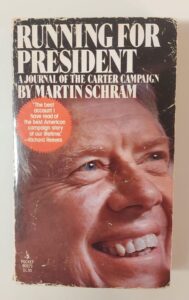 Carter I actually was crazy about, handing out campaign literature on his behalf on Election Day 1976. I have a poster from that fall somewhere in a closet along with a couple of campaign buttons. He wasn’t my first choice in ’76 — I was a Scoop Jackson kid, initially — but I could see why his bandwagon rolled and I was happy to jump on board in summer. As his tenure in the White House wore on, I maintained my loyalty to and confidence in him to the end, sort of like I did for someone else whose reviews turned mixed after taking office in 1977: Met manager Joe Torre. The only thing I was running as they took on what I perceived as the two most important jobs in the world was a high school newspaper. I think I looked up to each of the commonalities implicit in their leadership styles, which seemed to amount to, “I know you’ve got problems with the results right now, but trust me, I know what I’m doing here.” Neither stayed in his role past 1981, the year I graduated from managing the Tide. Carter I actually was crazy about, handing out campaign literature on his behalf on Election Day 1976. I have a poster from that fall somewhere in a closet along with a couple of campaign buttons. He wasn’t my first choice in ’76 — I was a Scoop Jackson kid, initially — but I could see why his bandwagon rolled and I was happy to jump on board in summer. As his tenure in the White House wore on, I maintained my loyalty to and confidence in him to the end, sort of like I did for someone else whose reviews turned mixed after taking office in 1977: Met manager Joe Torre. The only thing I was running as they took on what I perceived as the two most important jobs in the world was a high school newspaper. I think I looked up to each of the commonalities implicit in their leadership styles, which seemed to amount to, “I know you’ve got problems with the results right now, but trust me, I know what I’m doing here.” Neither stayed in his role past 1981, the year I graduated from managing the Tide.
They each generated far better press for themselves in the decades that followed. Former President Carter won the Nobel Peace Prize and global admiration. Torre’s in the Hall of Fame for non-Met reasons, though it says NEW YORK N.L. somewhere on his plaque if you look closely.
Keep an eye on those next acts. The Mets will begin theirs before March ends. In the meantime, enjoy Spring and hope its remaining news rarely exceeds the trivial.
by Greg Prince on 19 February 2025 6:13 pm “Welcome everybody to Kiner’s Korner, brought to you by Mitsubishi Motors. I’m your host, Ralph Kiner, and today we have three very special guests. My producer told me they would be No. 7, No. 6 and No. 5, so I had my questions ready for Eddie Kranepool, Al Weis, and the Glider, Ed Charles, but apparently we got our signals crossed.”
***7. 1970
6. 1975
5. 1980
“I have to confess I feel a little like one of our previous guests, Marvelous Marv Throneberry, in those beer commercials. I’m still not sure what you’re why you’re on this episode of Kiner’s Korner. Maybe one of you seasons can help me out. 1970?”
“Happy to, Ralph. Greg thought it might be instructive to get the three of us together to talk about our seasons at once, since we all have so much in common in terms of how he’s telling his MY FAVORITE SEASONS, FROM LEAST FAVORITE TO MOST FAVORITE, 1969-‘PRESENT’ (with 2024’s slotting TBD) story. Isn’t that right, 1975?”
“Yeah, I think you got it. Greg’s been doing all the talking about all the seasons, so today we get to tell it from our perspective a little.”
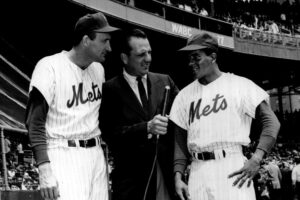 “Well, we’ve had Choo Choo Coleman on and I managed to understand him, so I guess I understand this. Why don’t we start with you, 1970? You went 83-79, finished in third place, six games behind the Pittsburgh Pirates, which is not bad, but it was kind of a comedown from the year before, when the Mets won the World Series. Yet Greg has you ahead of 1969 in his estimation?” “Well, we’ve had Choo Choo Coleman on and I managed to understand him, so I guess I understand this. Why don’t we start with you, 1970? You went 83-79, finished in third place, six games behind the Pittsburgh Pirates, which is not bad, but it was kind of a comedown from the year before, when the Mets won the World Series. Yet Greg has you ahead of 1969 in his estimation?”
“That’s right, Ralph. I’m No. 7, just ahead of 1969 at No. 8.”
“Why do you suppose that is? It kind of goes against the grain.”
“Ralph, for Greg, 1970 was something of an extension of 1969. In a way, it was his 1969.”
“1970, I feel like I’m listening to you in Stengelese.”
“It’s like this, Ralph. Greg was only six in 1969 and experienced only a little bit of that year, which is the first year he watched the Mets. He loves what he remembers, but he doesn’t remember that much. So really, I was his first full season. Six to seven makes a big difference.”
“I don’t usually incorporate sabermetrics into these chats, but it is a difference of only one year.”
“Correct, Ralph, but it was a big year. Greg came into my season ready to be a Mets fan from beginning to end and make it his way of life. He caught on to Opening Day, the All-Star break, that you stay tuned after the game for your show,. It was the first time he saw how all 162 games play out. He began to know all the players.”
“Many of whom were still Mets from 1969.”
“That’s right, Ralph. What really helped seal the deal for Greg was he really got into baseball cards in 1970, which had the 1969 statistics on the back and pictures of the players wearing the MLB patch on the front, which he figured out meant they were photographed in 1969. Between the cards and Channel 9 showing highlights from the previous year’s World Series and the Mets being ‘defending world champions’ and all the afterglow and popularity that carried over from ’69, to Greg it was all one long, unbroken thread in a way. He was completely captivated.”
“Even though the 1970 Mets came in third.”
“In a weird way, I think that helped. Greg understood instinctively that 1969 was incredibly special. My year, 1970, we contended, but we came up short. Greg didn’t love that we didn’t finish first or go back to the playoffs, but it was ultimately OK with him. He knew we won more than we lost, that we were in it, that there was always next year.”
“We’re gonna get to our next year right now, which for us is 1975. 1975, you went 82-80 and tied for third place, 10½ games behind Pittsburgh, which won the National League East again. Those Pirates were much better than when I was there. Their stars got paid more than I did, too, probably because Branch Rickey was long gone. Anyway, 1975, why do you suppose you’re No. 6 on Greg’s list?”
“Great to be on your show, Ralph. I feel a little like 1970 in that I may rate as high as I do because of how Greg experienced a previous year, in my case 1973.”
“That was the year the Mets came from last place at the end of August to win not only the division title but the National League pennant against Cincinnati. Greg ranked that as No. 9, yet you’re three spots ahead and you didn’t win anything.”
“Well, like 1970 vis-à-vis 1969…”
“Vis-à-vis? Have you been talking to Le Grand Orange?”
“Good one, Ralph. Let me put it in plainer English. Because Greg saw how the Mets could come on late in a season and do unbelievable things in 1973, he got it in his head that a good Mets team — and mine was pretty good — could turn it on in September and pass teams like the Pirates or whoever was in front of them and again win the East.”
“So why not rate 1973 higher?”
“You gotta remember, Ralph, that Greg was distracted by other things when he was ten years old in ’73. By the time he gets to 1975, he’s twelve and he’s narrowed his focus. He’s all about baseball and all about the Mets. Plus he’s old enough now to read everything in sight. He starts reading the Sporting News. He’s reading Baseball Digest every month. He’s loading up on preseason magazines. And as far as baseball cards are concerned, he collects them all in 1975. Commitment is a big part of Greg’s story where my year is concerned.”
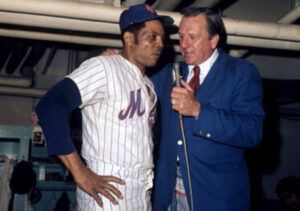 “Sounds like somebody could be committed for worrying so much about the Mets, which brings us to our final guest today, No. 5, 1980.” “Sounds like somebody could be committed for worrying so much about the Mets, which brings us to our final guest today, No. 5, 1980.”
“Hi Ralph.”
“1980, your record was 67-95, which was good for fifth place, 24 games behind another Pennsylvania team, the Phillies this time. Listen, 1980, I played on some bad Pirates teams in my day, and I don’t know if anybody besides Joe Garagiola was talking them up a whole lot of years later. These other seasons sitting next to you at least finished over .500. What does Greg see in you to rate you as high as he does on his list of all-time favorite seasons?”
“You got a minute, Ralph?”
“My producer says we don’t have any commercial breaks.”
“Funny you should mention commercials, Ralph, because an advertising slogan has a lot to do with Greg’s love affair with the 1980 season.”
“My beer is Rheingold the dry beer.”
“Not that one, Ralph.”
“No, my producer just let me know I had to say that so we didn’t have to go to commercial. Please continue, 1980.”
“Maybe you remember ‘The Magic is Back,’ the slogan the Mets used in their ads when my year began.”
“I do. Bob Murphy, Steve Albert, and I had a good laugh about it off-camera when we first saw it.”
“You weren’t alone, Ralph. A lot of people thought it was a joke, what with the Mets having been so terrible for the few years before 1980 and then not getting off to a very good start.”
“Yet I seem to remember there was more to the ‘Magic’ thing than misleading advertising.”
“You’re as sharp as your suits, Ralph.”
“You should have seen Lindsey’s.”
“He wasn’t here when I was, Ralph. The Magic was, though. See, that little tagline was about hope coming to Shea Stadium, that the Mets might be good again. The club had been sold that winter…”
“From the de Roulets to Abner Doubleday.”
“Nelson Doubleday, Ralph. And his friend Fred Wilpon.”
“Nice men.”
“Folks were just happy that maybe something was going to change. What they couldn’t have known was that in the middle of May, the Mets started playing really well, and all of a sudden, Greg didn’t feel like such a sap for loving the Mets as he did.”
“If I could just chime in here…”
“Go ahead, 1975.”
“When Ralph reads our records and how far we finished out of the top spot, it kind of misses what our seasons were about, especially from Greg’s perspective. My year was in the race until September. 1970 hung in there until the second-to-last weekend. And you, uh…were you ever actually in the race, 1980?”
“Yes and no. I mean, not in the traditional sense. We were kind of close in July, and not all the way out of it as of mid-August, but the point about that is Greg was thrilled we were decent at all. To him, the fact that we were winning more than we were losing for a few months, and the fact that a lot of those games were come-from-behind victories, made the Magic theme come to life.”
“My producer is telling me that in 1980, Greg was seventeen years old. Do you mean to tell me that at age he believed in Magic?”
“In a baseball sense, Ralph, yes.”
“Seventeen seems a little old to be that involved in baseball unless you’re a prospect being scouted by a major league team. Was Greg a player of any sort?”
“Just in gym class and nothing special, to put it very charitably. But he loved the game, Ralph. And he loved the Mets. He loved being old enough to go to games on his own. He loved that he understood so much more about the Mets and their history than when we was seven or twelve. Those were great years for him, but he felt now like he was a new level of his life, his next level of fandom. Kind of like that shot in Goodfellas where you’re introduced to Ray Liotta and Joe Pesci as the adult versions of their characters you’ve only seen as kids to that point.”
“I met a lot of movie stars during my career. I even dated Elizabeth Taylor.”
“To Greg in 1980, the Mets were movie stars.”
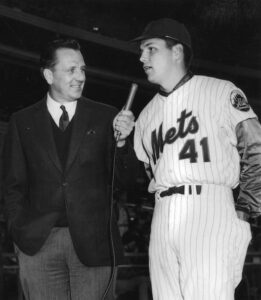 “Let’s talk about that, specifically Greg’s favorite player from each of your years. We’ll start with you, 1970.” “Let’s talk about that, specifically Greg’s favorite player from each of your years. We’ll start with you, 1970.”
“Tom Seaver. Greg idolized him.”
“1975?”
“Tom Seaver. Greg still idolized him.”
“1980?”
“Tom Seaver. Greg didn’t care that he wasn’t on the Mets by then. Greg never stopped idolizing him.”
“Tom was on my show many times, so I can see why Greg grew so attached to him. He was a Hall of Fame pitcher and one of the all-time greats. His number was the first the Mets retired for a player. But were there any players who weren’t especially great who Greg gravitated to in 1970, 1975, and 1980? We’ll start this time with 1980.”
“Greg really liked when you had Lee Mazzilli and Steve Henderson on your show, Ralph. He actually did a passable impression of both them talking with you in high school.”
“I’m glad he had such an active social life as a teenager. What about you, 1975?”
“Greg got really excited about Mike Vail toward the end of my season. He hit in 23 consecutive games shortly after being called up from Tidewater.”
“Tying Richie Ashburn for the National League rookie record, Richie being an Original Met. And you, 1970, any Greg favorites who weren’t Tom Seaver?”
“He had an affinity for Ray Sadecki, who went 8-4 my year. I think Greg liked that your partner Murph pronounced Ray’s name as one word. ‘Raceadecki.’ Somehow, in 1971, Greg was even more impressed that Ray went 7-7, which, to his eight-year-old mind made him ‘consistent’.”
“And they say I’m prone to malapropisms. What about big moments from each of your years? Let’s start with 1975.”
“September 1, Ralph. Seaver shuts out the Pirates and closes the gap to four games. Tom strikes out his 200th batter for the eighth consecutive year, a record. Vail homers for the first time. And Buddy Harrelson comes off the Disabled List, as it used to be called. Greg was sure 1973 was in the process of being reincarnated, but with better power. Kingman had all those home runs, Rusty all those RBIs, Felix Millan played every day and set the club mark for hits. It was all coming together.”
“Quite a day. Does Greg have one to match it from your perspective, 1970?”
“He’s got five of them, Ralph — the five-game sweep of the Cubs at Wrigley Field in late June, somewhere between school ending and day camp starting. They were all day games on the Near North Side of Chicago, of course, so that accounted for Greg’s afternoons over the better part of a week. By the time the series was done, the Mets had overtaken the Cubs for first place. What a way for a seven-year-old to start his summer.”
“Five-game sweeps are very rare. Was there anything like that in 1980?”
“To be honest, Ralph, my year had a tough time putting together winning streaks, though for Greg, the 47-39 stretch from the middle of May to the middle of August felt like one long climb to the top.”
“Did the 1980 Mets spend any time in first place?”
“Unless you count Opening Day, no.”
“Longtime Mets fans will remember the Mets didn’t win on Opening Day until 1970, and then they won most every year to start the season.”
“Thanks for pointing that out, Ralph. But even though the Mets didn’t get any closer to first place in the heart of the season than three-and-a-half out on July 5, there is one game that resides in Greg’s heart and mind as a veritable pennant-winner.”
“Veritable?”
“Greg was studying for the SAT in 1980.”
“I see.”
“But like 1970, the memory that Greg cherishes from my year came from right around the end of school, with a Regents exam or two left. It was a Saturday night, June 14. The Mets were losing all night. Getting no-hit, in fact. Then they roared back from 6-0 and pulled it out in the ninth, 7-6, over the Giants.”
“Oh, I remember that one. It was The Ken Henderson Game.”
“Steve Henderson, Ralph.”
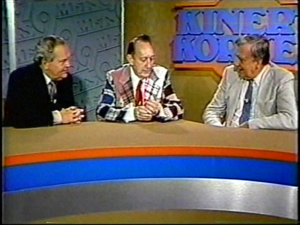 “Either way, Hendu did do, and it was a great night for the New York Mets, and Greg was indeed lucky to have experienced the games you seasons are talking about. Still, he also saw 1969 and 1973 and later successful seasons. I guess I’m still a little baffled he remains especially fond of years that, with all due respect to some of the players and some of the games, came up shy of a big payoff.” “Either way, Hendu did do, and it was a great night for the New York Mets, and Greg was indeed lucky to have experienced the games you seasons are talking about. Still, he also saw 1969 and 1973 and later successful seasons. I guess I’m still a little baffled he remains especially fond of years that, with all due respect to some of the players and some of the games, came up shy of a big payoff.”
“Well, Ralph, if I may speak for my older friends 1970 and 1975, I think we are what we are to Greg because he’s able to reflect back so many years later and see what each of us meant to his future as a Mets fan.”
“Interesting assessment, 1980. You agree with that, 1970?”
“Oh, absolutely, Ralph. I’m noticing a trend, actually. 1975 is five years after my year, then 1980 is five years after that. It’s like Greg was learning, synthesizing, advancing, almost renewing his license to root every five years. And correct me if I’m wrong, 1980, wasn’t your year the year Greg got his driver’s license?”
“Absolutely right, 1970.”
“Does all of that sound right to you, 1975?”
“Sure does, Ralph. Remember, in my year, away from baseball, Muhammad Ali was the heavyweight champ. Right after the season, he and Joe Frazier fought the Thrilla in Manilla. Ali liked to rhyme, so I’ll say there was something ‘formative and normative’ about our seasons for Greg.”
“Joe Frazier, of course, managed the New York Mets at one time.”
“Different Joe Frazier, Ralph.”
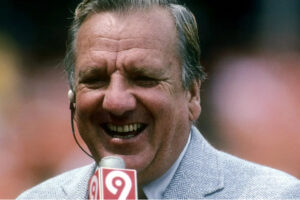 “The Mets have always had colorful managers going back to Casey Stengel and of course the great Gil Hodges. 1980, you look like you have a final thought.” “The Mets have always had colorful managers going back to Casey Stengel and of course the great Gil Hodges. 1980, you look like you have a final thought.”
“Just that our respective roles as significant seasons in Greg’s life weren’t just about memories he’s held onto and emotions he can summon in a second. It’s that after our seasons, both immediately after and decades after for him and the Mets, there was always more to come.”
“And there’ll be more to come tomorrow as the Mets take the field and hit the airwaves. Our guests have been three of Greg’s favorite seasons, 1970, 1975, and 1980. They’ll receive Getty Gasoline gift certificates, as all guests of Kiner’s Korner do. You’ve come this far. Getty can help you go even further. And if you can’t make it out to the ballpark, we imagine we’ll see you right here. Seriously, we do a lot of imagining on this show.”
PREVIOUS ‘MY FAVORITE SEASONS’ INSTALLMENTS
Nos. 55-44: Lousy Seasons, Redeeming Features
Nos. 43-34: Lookin’ for the Lights (That Silver Lining)
Nos. 33-23: In the Middling Years
Nos. 22-21: Affection in Anonymity
No. 20: No Shirt, Sherlock
No. 19: Not So Heavy Next Time
No. 18: Honorably Discharged
No. 17: Taken Down in Paradise City
No. 16: Thin Degree of Separation
No. 15: We Good?
No. 14: This Thing Is On
No. 13: One of Those Teams
No. 12: (Weird) Dream Season
No. 11: Hold On for One More Year
No. 10: Retrospectively Happy Days
No. 9: The September of My Youth
No. 8: First Taste
by Greg Prince on 18 February 2025 7:17 pm For years, I never forgot where I was when J.C. Martin laid down the bunt that led to the winning run that gave the Mets Game Four and a commanding Three-One lead in the 1969 World Series. I was in the Cozy Nook, the all-purpose luncheonette where I bought most of my baseball cards, magazines and occasional Milky Way bars. My mother was in a booth that afternoon with a friend of hers, the two of them no doubt drinking coffee and one of them surely smoking cigarettes. I got bored and wandered up front toward the cashier. Then I rushed back to tell them what I had just learned happened in Game Four: Martin bunts, the Orioles pitcher picks up the ball and throws, the throw flicks off J.C.’s wrist, the ball bounces away, and Rod Gaspar scores. What a memory.
Except it never happened that way. Oh, I was in the Cozy Nook, along with my mother and her chimney of a chum Betty when I saw Martin in the 1969 World Series, and the Mets did win Game Four that way…except what I was remembering for the longest time was the day in 1970 that I opened a pack of baseball cards I had just purchased at the cash register and was so delighted to find the card with the Sporting News logo on top and the caption “MARTIN’S BUNT ENDS DEADLOCK!” on the bottom that I was compelled to dash back to the booth and announce it to Mom, while Betty puffed away. Further details — Gaspar on second, pinch-running for Grote; Grote having blooped a double into left to start the rally; Pete Richert making the errant throw; Martin running within the baseline, possibly illegally on a path then immune to the vagaries of yet-to-be-fathomed replay review — came together in the early 1970s as I studied further accounts and descriptions. Eventually, I filled in all the gaps of what I may not have been cognizant of at the moment I pulled the World Series card. It was Moratorium Day. Vietnam protests intertwined with Tom Seaver starting at Shea. Seaver pitched ten innings. Donn Clendenon homered. Ron Swoboda made a catch that he said was “as big a surprise” to him “as it was to anyone in the stands”. I did my 1969 homework diligently from 1970 onward. It’s the kind of homework I didn’t have to be nagged into doing. Somehow I convinced myself I saw everything when everything happened.
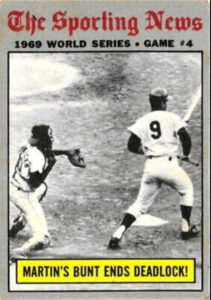 As for what I really remember about Game Four of the 1969 World Series in real time, I remember nothing. Nothing at all. I was six then. I had just discovered the Mets in the weeks prior to the World Series. I remember a little of this and a little of that directly from 1969. I don’t remember a whole lot of anything from having experienced it. Yet before I neared adolescence, I decided I was fully Met-conscious for one of its signature moments, and treasured knowing that I was. But I wasn’t. As for what I really remember about Game Four of the 1969 World Series in real time, I remember nothing. Nothing at all. I was six then. I had just discovered the Mets in the weeks prior to the World Series. I remember a little of this and a little of that directly from 1969. I don’t remember a whole lot of anything from having experienced it. Yet before I neared adolescence, I decided I was fully Met-conscious for one of its signature moments, and treasured knowing that I was. But I wasn’t.
Sociologists refer to this phenomenon as the J.C. Martin Effect.
***8. 1969
If I’d been born a few years earlier, 1969 probably would be way the hell up in this countdown. WAY the hell up. If I’d been born even a year earlier, I bet I’d remember Game Four, not to mention Games Three and Two, plus a lot of what led up to October. A birth of a few months earlier likely opens my eyes to the Mets a few months sooner, and my reminiscences of 1969 are ‘x’ percent more tangible now and forever.
Instead, I was born when I was born, and I don’t regret that, because if a butterfly flaps its wings in South America, maybe I think baseball is stupid. I was born right on time, just in time. I opened my eyes to the Mets whenever I opened my eyes to the Mets, sometime in late summer of 1969, to the best I can determine. I love telling the story. My dad would bring home the Post from the city, where he worked at some job that required riding a train, wearing a suit and carrying a briefcase. There was a recurring cartoon on the back page, the Mets as a lovable duck, the Cubs as a fearsome bear. There were standings inside providing a geographical and numerical explainer: Chicago (the bear) ahead of New York (the duck, and where I knew we lived), but the gap was closing daily. That was enough to pique my interest so that I wanted to examine the paper every night. Things begin to get specific in September. The Mets pass the Cubs. The Mets clinch the division. The Mets play the Braves. The Mets win the pennant. Then come the Orioles, with my lived experience of Game One and Game Five that I recall from reality, and the ultimate World Series outcome that certified the 1969 Mets as the best, and me as hooked for eternity.
I knew what was going on, kind of. I caught on to what it meant, sort of. I loved it all at once, truly. Still, my personal 1969 Metwise is scant in the mind’s eye. I can’t help it. I was six. I didn’t know enough to take notes. I didn’t even know how to take notes. Did I mention I was six? I was as present for the 1969 Mets as Ed Kranepool was for the 1962 Mets. Eddie played three games at the end of the Mets’ first year, but for the rest of his days, he didn’t correct those who identified him as an Original Met.
Presence is presence. I’ll always tell you I’ve been a Mets fan since 1969. Geez, look at the title of this series: MY FAVORITE SEASONS, FROM LEAST FAVORITE TO MOST FAVORITE, 1969-‘PRESENT’ (with 2024’s slotting TBD). This all had to start somewhere. Could it have started anywhere better?
It feels odd as a lifelong Mets fan, never mind a self-styled Mets historian, to rank 1969 at No. 8 among MY FAVORITE SEASONS, because, c’mon, it’s 1969! It was always 1969 from the instant I adjusted my antenna toward Flushing. Details I had to piece together, but the headline was always the headline. The Mets won the World Series! The Mets were the world champions! People were thrilled! I was thrilled! That I remember with clarity. That is actual. Everything that came after 1969 for me materialized because 1969 arrived first.
The Miracle Mets — not that I understood why they were called that while they were being called that — contained all the qualities that make for a personally dear season. It was influential. It was formative. It was meaningful. I’ll throw in historically resonant and, obviously, quite Amazin’. Yet eighth is where it must rank for me. My 1969 is light on counting stats. To rate it any higher, given the seasons I’m going to write about from No. 7 to No. 1, would amount to stealing valor. I lived the bejeesus out of those later seasons. In 1969, I wasn’t doing more than dipping my first toe, hence I can’t tell you much about it first-hand. I feel almost guilty about that. Maybe if I were more like Marilu Henner (even more, I mean), I’d remember more about 1969 for myself rather than through books and such. “For God’s sake, Alvy,” a classmate told young Woody Allen in Annie Hall, “even Freud speaks of a latency period.” Fifty-six years later, I’m still grappling with mine.
I didn’t take stock of Gil Hodges’s projections in Spring Training that we were gonna be a much better team this year, or have any notion of what the Mets had been before this new, promising year.
I wasn’t watching or listening when the expansion Expos came in for Opening Day and therefore didn’t cringe that we lost to them, 11-10.
I didn’t exult in us climbing to .500 after thirty-six games, something no previous Mets team had done after two games.
I didn’t faint from joy at the Oedipal eleven-game patricidal winning streak that came mainly at the expense of the Giants and Dodgers; I also didn’t know the backstories of those teams from San Francisco and Los Angeles.
I didn’t pump a fist at the news that we acquired a legitimate slugger in Clendenon.
I didn’t jump up and down when Don Young didn’t catch two fly balls.
I didn’t feel my heart break when Jimmy Qualls singled to left-center.
I didn’t begin to lose hope when the Astros spanked us so hard that Hodges had to take star left fielder Cleon Jones out to send a message to his entire squad.
As I began to wade into the shallow end of my duck pond in September, I wasn’t granular enough to absorb the 19-strikeout game in St. Louis or the pair of 1-0 wins versus Pittsburgh. The black cat may been genuine to Ron Santo and Leo Durocher, but it was merely mythic to me. I could LOOK WHO’S NO. 1, but not elaborate on why that was so astounding, only grasp that NO. 1 was a big deal.
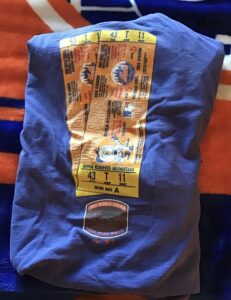 I’m missing the depth, texture and personal context to process 1969 as a season I lived through with my heart and soul. I know it was A Magic Summer, even if my version was not much more than a sneak preview of the summers that would highlight my years ahead. When I look at who’s No. 7 through No. 1 on my MY FAVORITE SEASONS list, I’m grateful I lived through those with my heart and soul, something I can’t imagine would have happened without coming in where I came in. My heart and soul were invented on the spot in 1969. No runway, no preamble. Just an inner voice urging me on. This is your favorite sport, this is your favorite team — GO! I’m missing the depth, texture and personal context to process 1969 as a season I lived through with my heart and soul. I know it was A Magic Summer, even if my version was not much more than a sneak preview of the summers that would highlight my years ahead. When I look at who’s No. 7 through No. 1 on my MY FAVORITE SEASONS list, I’m grateful I lived through those with my heart and soul, something I can’t imagine would have happened without coming in where I came in. My heart and soul were invented on the spot in 1969. No runway, no preamble. Just an inner voice urging me on. This is your favorite sport, this is your favorite team — GO!
Gladly!
PREVIOUS ‘MY FAVORITE SEASONS’ INSTALLMENTS
Nos. 55-44: Lousy Seasons, Redeeming Features
Nos. 43-34: Lookin’ for the Lights (That Silver Lining)
Nos. 33-23: In the Middling Years
Nos. 22-21: Affection in Anonymity
No. 20: No Shirt, Sherlock
No. 19: Not So Heavy Next Time
No. 18: Honorably Discharged
No. 17: Taken Down in Paradise City
No. 16: Thin Degree of Separation
No. 15: We Good?
No. 14: This Thing Is On
No. 13: One of Those Teams
No. 12: (Weird) Dream Season
No. 11: Hold On for One More Year
No. 10: Retrospectively Happy Days
No. 9: The September of My Youth
by Greg Prince on 17 February 2025 5:16 pm Ah, the rites of Spring. Two, specifically…
1) The first press availability of the year with players who rate a full-blown sitdown with the assembled St. Lucie media. Francisco Lindor one day, Juan Soto the next, Pete Alonso today. Revelations? They’re thrilled to be back, or here, or back here. Why shouldn’t they be? They’re all well-paid Mets on a Mets team that they (in the company of their teammates) will attempt to elevate higher than the Mets team of last year, a thrilling unit that featured two of the aforementioned three. I’m thrilled to see them back, or here, or back here, even in the goofy smiling Mr. Met in shades caps they’ve been issued to remind us that Spring Training is supposed to be fun.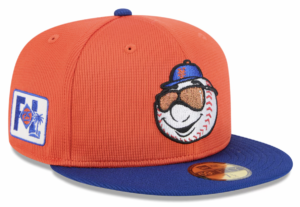
2) A starting pitcher is out. Well, that’s less fun, but not altogether unexpected. A starting pitcher is inevitably out this time of year, wrecking all the clever rotation spins we’ve already worked out in our heads. Frankie Montas is this year’s reverse-lottery winner of the Pang of Spring. High-grade lat sprain. PRP injection. Out six to eight weeks. I don’t necessarily understand the diagnosis or the treatment, but I repeat them the way Mets fans repeat whatever they’ve been told about whichever pitcher who is out in a given Spring. I understand six to eight weeks, though from there there’s a murky forecast for what that means about a return. Maybe May. Maybe June. A little before or after the All-Star break always projects as a safe bet, regardless of actual malady, because it’s far off enough to not feel like recovery and rehabilitation is being rushed, near enough so that it’s neither too late nor next year. Plus you have the trade deadline comp when a pitcher comes back in July: “It’s like trading for a Frankie Montas.” Over the last three years, we traded for a Kodai Senga (2024), a Jose Quintana (2023) and a Jacob deGrom (2022). We already had them, yet such deals!
Get well, Frankie Montas. Get some more pitching, David Stearns. Stay thrilled, Mets fans. It’s Spring Training. All the Mets who aren’t Montas are rarin’ to go. No wonder Mr. Met is smiling.
by Greg Prince on 16 February 2025 4:54 pm To borrow an opening line from an impeccable source, it was twenty years ago today that Faith and Fear in Flushing began to play. With a little help from our friends who’ve read us, contacted us and been an essential part of us, we’ve kept playing. Just like the Mets. Just like some other players.
It feels appropriate that we mark exactly two decades of Faith and Fear on the very same day that an institution that’s been around in its field a lot longer is celebrating a half-century of itself. Tonight, NBC airs Saturday Night Live’s 50th-anniversary special. You know it will be special because it will be on a Sunday and in prime time. The first Saturday Night (when Howard Cosell still owned “live”) was constructed from the talents of famously Not Ready for Prime Time Players. They turned 11:30 PM into its own primo slot on the network schedule.
 On February 16, 2005, Jason and I began FAFIF. On February 17, 2005, in my second-ever post for this blog, I made my first reference to SNL. That was a Thursday. On the ensuing Saturday night, the Mets showed up on the show. Fred Armisen played a Weekend Update correspondent named Tom Jankeloff interviewing people in Central Park about The Gates, the art installation that was, to the Mets fan eye, lots of orange in search of a dab of blue. Jankeloff did his filmed piece in a Mets hoodie, a small No. 31 visible. That was the extent of the Met content in the episode of February 19, 2005, but perhaps it was a sign of some sort regarding our potential staying power. On February 16, 2005, Jason and I began FAFIF. On February 17, 2005, in my second-ever post for this blog, I made my first reference to SNL. That was a Thursday. On the ensuing Saturday night, the Mets showed up on the show. Fred Armisen played a Weekend Update correspondent named Tom Jankeloff interviewing people in Central Park about The Gates, the art installation that was, to the Mets fan eye, lots of orange in search of a dab of blue. Jankeloff did his filmed piece in a Mets hoodie, a small No. 31 visible. That was the extent of the Met content in the episode of February 19, 2005, but perhaps it was a sign of some sort regarding our potential staying power.
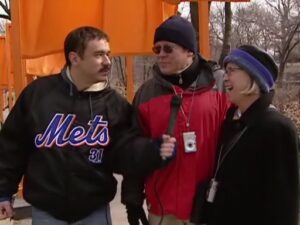 Or perhaps it just meant I’ve always been one for staying up late. I watched the second Saturday Night live, a seventh-grader who didn’t have school the next morning. Paul Simon hosted. The show, just like this blog in its early weeks, was still figuring out what it was. Within a few weeks, it found its voice and its pacing and has stuck around ever since. Thanks to the development of VCRs and DVRs, I have, too, as a Saturday Night viewer. Invoking it on these digital pages has been second-nature for me. SNL’s been in my head since October of 1975, or only six Octobers fewer than the Mets have. Of course they’re going to intersect. Or perhaps it just meant I’ve always been one for staying up late. I watched the second Saturday Night live, a seventh-grader who didn’t have school the next morning. Paul Simon hosted. The show, just like this blog in its early weeks, was still figuring out what it was. Within a few weeks, it found its voice and its pacing and has stuck around ever since. Thanks to the development of VCRs and DVRs, I have, too, as a Saturday Night viewer. Invoking it on these digital pages has been second-nature for me. SNL’s been in my head since October of 1975, or only six Octobers fewer than the Mets have. Of course they’re going to intersect.
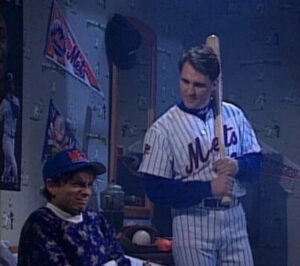
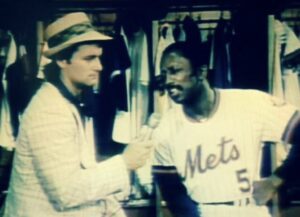
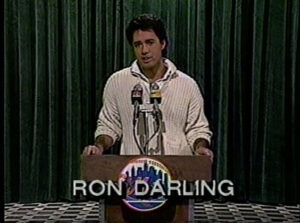 The Mets as an institution and Saturday Night Live as an institution share common ground beyond where they’re live from. It’s not so much that the Mets infiltrate those 90 minutes all that regularly, though you will see a jersey or a cap now and then, and a handful of our icons have appeared there for authenticity purposes: Tom Seaver when he was an off-season NBC broadcaster, describing a 1983 in-studio rain delay; Ron Darling when he was a world champion, apologizing that Game Six of the World Series ran long and therefore dared to pre-empt SNL on 10/25/86; Todd Hundley leading a flotilla of active 1997 major leaguers invading young Chris Kattan’s bedroom. Some topical Weekend Update references or cheap shots will also grab a sleepy Metophile’s attention. The Mets as an institution and Saturday Night Live as an institution share common ground beyond where they’re live from. It’s not so much that the Mets infiltrate those 90 minutes all that regularly, though you will see a jersey or a cap now and then, and a handful of our icons have appeared there for authenticity purposes: Tom Seaver when he was an off-season NBC broadcaster, describing a 1983 in-studio rain delay; Ron Darling when he was a world champion, apologizing that Game Six of the World Series ran long and therefore dared to pre-empt SNL on 10/25/86; Todd Hundley leading a flotilla of active 1997 major leaguers invading young Chris Kattan’s bedroom. Some topical Weekend Update references or cheap shots will also grab a sleepy Metophile’s attention.
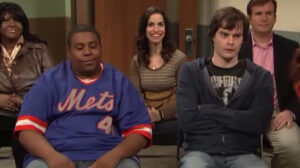
 This past December, Marcello Hernandez played Juan Soto as a free agent considering signing with the Mets in order to help — as Dana Carvey’s resuscitated Church Lady suggested — “the needy and less fortunate”. Within 24 hours, Soto was accepting Steve Cohen’s contract offer and we could all agree, per Chico Escuela, SNL’s most indelible contribution to the Met pop culture canon, that baseball had been berry, berry good to Juan Soto. This past December, Marcello Hernandez played Juan Soto as a free agent considering signing with the Mets in order to help — as Dana Carvey’s resuscitated Church Lady suggested — “the needy and less fortunate”. Within 24 hours, Soto was accepting Steve Cohen’s contract offer and we could all agree, per Chico Escuela, SNL’s most indelible contribution to the Met pop culture canon, that baseball had been berry, berry good to Juan Soto.
 Where SNL meets the Mets conceptually is as a widely beloved thing that just keeps going. Lorne Michaels has said his show goes on not because it’s ready, but because it’s 11:30. Sound like any ballclub you know some summer weeknights at 7:10? The casts change. Stars break out. Utility types chip in. Rookies don’t get a full shot and wind up cut. Bits recur because they go over big — then they’re run into the ground. Backstage gossip leaks. We’ll never survive somebody’s exit. We’ll never see this be as good as it used to be. Maybe you keep tuning in because you think it’s gonna be great. Maybe you tune in because it’s what you’ve always done at the appointed hour. But you do tune in. Where SNL meets the Mets conceptually is as a widely beloved thing that just keeps going. Lorne Michaels has said his show goes on not because it’s ready, but because it’s 11:30. Sound like any ballclub you know some summer weeknights at 7:10? The casts change. Stars break out. Utility types chip in. Rookies don’t get a full shot and wind up cut. Bits recur because they go over big — then they’re run into the ground. Backstage gossip leaks. We’ll never survive somebody’s exit. We’ll never see this be as good as it used to be. Maybe you keep tuning in because you think it’s gonna be great. Maybe you tune in because it’s what you’ve always done at the appointed hour. But you do tune in.
 At every stage of my life since seventh grade, I can remember getting into conversations in the weekdays ahead with classmates, coworkers, friends, and family about what happened on Saturday Night, no matter who and what Saturday Night was in a given season. It’s the same way I’ve shared the Mets since first grade. Different pitchers, different catchers, different newcomers, different old-timers, but always making it about the Mets: their exploits, their foibles, their utter Metsiness and however we chose to interpret it at that moment. For twenty years, I’ve shared the Mets here with you, or whoever was “you” before you yourself came along. I could just talk to myself about the Mets, but having an audience adds another dimension. At every stage of my life since seventh grade, I can remember getting into conversations in the weekdays ahead with classmates, coworkers, friends, and family about what happened on Saturday Night, no matter who and what Saturday Night was in a given season. It’s the same way I’ve shared the Mets since first grade. Different pitchers, different catchers, different newcomers, different old-timers, but always making it about the Mets: their exploits, their foibles, their utter Metsiness and however we chose to interpret it at that moment. For twenty years, I’ve shared the Mets here with you, or whoever was “you” before you yourself came along. I could just talk to myself about the Mets, but having an audience adds another dimension.
Thank you for continuing to read Faith and Fear in Flushing. Good night and have a pleasant tomorrow.
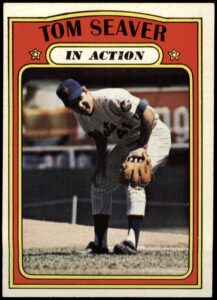
by Greg Prince on 15 February 2025 1:07 pm Topps created 787 different baseball cards for 1972. I don’t remember how many of them I collected, but at least until the final series I’d say “many,” if not most. With the questionably titled In Action subset; the Awards — what kid doesn’t want to stare at a plaque?; the Boyhood Photos of the Stars; and the updated, stenciled TRADEDs that captured Jim Fregosi at Spring Training (where they could have left him), the ’72s sprawled like nothing I’d experienced. It never occurred to me I could have collected them all.
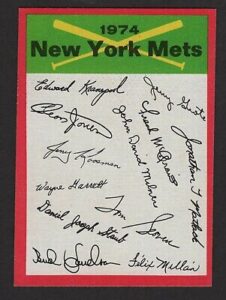
Topps created a more concise 660 baseball cards for 1974 and released each of them into the world at once. Plus airbrushed TRADED cards, which were however many, and the individual team checklists, which were 24. Give or take some WASHINGTON “NAT’L LEA.” variations, I collected every 1974 Topps card eventually, the vast majority of them in the moment by ripping open pack after pack. This is what a kid who was a baseball fan did when he was 9 and 11, respectively.
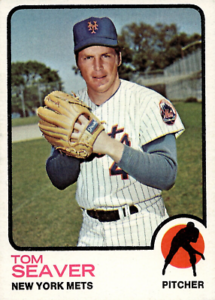
 So I have scads of 1972s and stacks of 1974s. But, I wondered a while back, why didn’t I accumulate more 1973s? An exact count has never been calculated, but I know I have some 1973s. Not a slight amount, but no quantity competing with the year before or the year after or, for that matter, most of the years when I was a kid. I was 10. I loved baseball. I loved baseball cards. I very much liked the 1973 Topps design. I found it space-agey in a good way. Yet my primary goal as a 10-year-old wasn’t to collect the cards that came out that year. So I have scads of 1972s and stacks of 1974s. But, I wondered a while back, why didn’t I accumulate more 1973s? An exact count has never been calculated, but I know I have some 1973s. Not a slight amount, but no quantity competing with the year before or the year after or, for that matter, most of the years when I was a kid. I was 10. I loved baseball. I loved baseball cards. I very much liked the 1973 Topps design. I found it space-agey in a good way. Yet my primary goal as a 10-year-old wasn’t to collect the cards that came out that year.
 In my sixties, the answer came to me: 45s and Wacky Packs. Those seven-inch records in the spring, those stickers that spoofed name-brand consumer goods in the summer. Those were what my allowance went toward in 1973. I was up to four bucks a week by then. It could have been subconscious budgeting that directed my funds toward one obsession rather than another, or it could have been my first experience with the concept of bandwidth. If I was interested a lot in something, it would figure I was less interested in something else. Even when you’re 10 and your life outside school or camp and whatever you’re being told to do at home to amass your weekly four bucks is whatever you decide it is, your brain and your instincts are going to take you to only so many places. In my sixties, the answer came to me: 45s and Wacky Packs. Those seven-inch records in the spring, those stickers that spoofed name-brand consumer goods in the summer. Those were what my allowance went toward in 1973. I was up to four bucks a week by then. It could have been subconscious budgeting that directed my funds toward one obsession rather than another, or it could have been my first experience with the concept of bandwidth. If I was interested a lot in something, it would figure I was less interested in something else. Even when you’re 10 and your life outside school or camp and whatever you’re being told to do at home to amass your weekly four bucks is whatever you decide it is, your brain and your instincts are going to take you to only so many places.
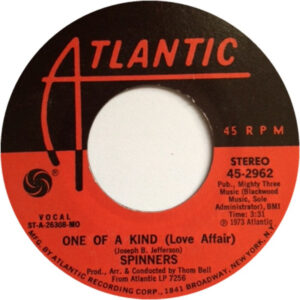 First, at the age of 10, to the record store, because in the spring of 1973, I was all about Top 40 radio. When I put together that the songs I heard and grooved to could be mine for less than a dollar (such bargains that they even came with flip sides!), I was all in. “The Night The Lights Went Out In Georgia” by Vicki Lawrence. “Stir It Up” by Johnny Nash. “Out Of The Question” by Gilbert O’Sullivan. “I’m Doing Fine Now” by New York City. “Shambala” by Three Dog Night. “One Of A Kind (Love Affair)” by my beloved Rock & Roll Hall of Fame-inducted The Spinners. I could go on and often do. First, at the age of 10, to the record store, because in the spring of 1973, I was all about Top 40 radio. When I put together that the songs I heard and grooved to could be mine for less than a dollar (such bargains that they even came with flip sides!), I was all in. “The Night The Lights Went Out In Georgia” by Vicki Lawrence. “Stir It Up” by Johnny Nash. “Out Of The Question” by Gilbert O’Sullivan. “I’m Doing Fine Now” by New York City. “Shambala” by Three Dog Night. “One Of A Kind (Love Affair)” by my beloved Rock & Roll Hall of Fame-inducted The Spinners. I could go on and often do.
 Locked into WGBB, then WXLO, then WPIX, my radio kept playing in 1973. One August weekend, I discovered American Top 40 with Casey Kasem, and I was hooked on the countdown concept for life, in case you hadn’t noticed. Though come summer, I had eased up on record store visits and turned back toward the familiar surroundings of our neighborhood candy stores, where I bought my baseball cards. Except the items in wrappers I sought were Wacky Packs. Wacky Packages seems to be the correct term, but everybody called them Wacky Packs. Locked into WGBB, then WXLO, then WPIX, my radio kept playing in 1973. One August weekend, I discovered American Top 40 with Casey Kasem, and I was hooked on the countdown concept for life, in case you hadn’t noticed. Though come summer, I had eased up on record store visits and turned back toward the familiar surroundings of our neighborhood candy stores, where I bought my baseball cards. Except the items in wrappers I sought were Wacky Packs. Wacky Packages seems to be the correct term, but everybody called them Wacky Packs.
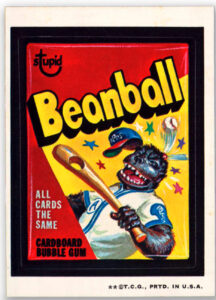 These were essentially retro items for me. I was 10 and getting nostalgic for something from when I was younger. Wacky Packs had first come out a few years earlier, when my sister was in elementary school. They were issued on cardboard stock, like differently shaped baseball cards. She and I bonded over their hilarity. Tide was Tied. Cracker Jack was Cracked Jerk. Chock Full o’ Nuts was Chock Full o’ Bolts. Gravy Train was Grave Train. I’m pretty sure you get how it worked. Like her ’67 and ’68 baseball cards, I inherited these from Susan (before she respelled as Suzan) as she matriculated through junior high. Like football cards, Partridge Family cards and other oddball flotsam that entered my collecting sphere, they weren’t baseball cards, but they filled gaps. These were essentially retro items for me. I was 10 and getting nostalgic for something from when I was younger. Wacky Packs had first come out a few years earlier, when my sister was in elementary school. They were issued on cardboard stock, like differently shaped baseball cards. She and I bonded over their hilarity. Tide was Tied. Cracker Jack was Cracked Jerk. Chock Full o’ Nuts was Chock Full o’ Bolts. Gravy Train was Grave Train. I’m pretty sure you get how it worked. Like her ’67 and ’68 baseball cards, I inherited these from Susan (before she respelled as Suzan) as she matriculated through junior high. Like football cards, Partridge Family cards and other oddball flotsam that entered my collecting sphere, they weren’t baseball cards, but they filled gaps.
Out of nowhere, Wacky Packs were back in the general preadolescent consciousness in the summer of ’73, in sticker form. I didn’t see the point of them as stickers, because how were you supposed to collect them like cards, but that’s how they came. Everybody was into Wacky Packs — Jail-O; Gadzooka; Skimpy — and I was no different. “You know, these used to be cards,” I’d start to mention to my fellow 10-year-olds before allowing them the pleasure of discovering the charms of Hostage Cupcakes in whatever form was accessible to them. Each generation is entitled to thinking it is onto something for the first time ever.
This was me and my interests in the summer of 1973. Wacky Packs I stuck carefully to sheets of paper. Music in my ears and on lists. Maybe a glance at the Watergate hearings. Not so many new baseball cards, but all the ones I’d already gathered not going anywhere as long as my mother didn’t make good on her threat to throw them out if I didn’t clean up my room.
And somewhere in the background, a little obscured due to bandwidth limits, my favorite baseball team.
9. 1973
In the primordial ooze from which was conceived MY FAVORITE SEASONS, FROM LEAST FAVORITE TO MOST FAVORITE, 1969-‘PRESENT’ (with 2024’s slotting TBD), I had what amounted to a Top Seven list. As a Casey Kasem Connoisseur, I knew there was no cachet to a Top Seven, so I needed to stretch it out a bit. Eventually it became a Top Ten in my mind, and then all of the Met seasons I’d experienced on this blog. I will present No. 7 through No. 1 in due order in due time. The Top Seven within MY FAVORITE SEASONS makes total sense to me.
What wasn’t making sense to me as the Top Seven grew into a Top Ten was articulating to my satisfaction how 1973 missed the initial septet cut. It’s my touchstone of a season. It’s the season I’m almost certain I’ve referenced either directly or indirectly more than any season in Mets history across the one day shy of twenty full years we’ve been blogging. It’s the season that defines so much of what it means to be a Mets fan, especially if you were growing up back then. I was definitely growing up back then. I was definitely a Mets fan back then. My veins course with the blood of the 1973 Mets. My blood type is YGB+. My DNA reveals torrents of You and Gotta and Believe. I counter every rational discouraging thought about the trajectory of every rationally discouraging Met season with “1973,” and whatever I’m trying to decide about the immediate fate of the contemporary Mets becomes no worse than a coin flip. “Sure we suck, but so did the 1973 Mets, and they…”
All of that, and it’s No. 9? Huh? American Top 40 was based on record sales and radio airplay. MY FAVORITE SEASONS, especially amid its upper echelons, is based on touch and feel and personal perception of what made this Mets fan this Mets fan. Hence, I can offer two explanations for why my reverence for the 1973 Mets can’t elevate their year any higher than No. 9 on my all-time list.
1) The stuff about limited bandwidth, which explains why for the first five months of the season, maybe I just wasn’t as engrossed in the Mets at the age of 10 as I usually was.
2) Nineteen Seventy-Three wasn’t an endpoint in my Mets fandom. It was a booster rocket. Once it took off, there was no telling where it was going to take me. As Gary Cohen might say, 1973 was one of my seminal seasons. I Believed then so I could Believe more later — or maybe 1973 walked so other seasons could run, even if they wound up running into a wall.
Rankings can be incidental when most everything on your list is something you label FAVORITE; they are things you really love. We’re in the Top Ten. I love what’s at No. 10. I love what’s at No. 8. Love is all around, no need to fake it (I watched my share of sitcoms then, too). No. 9 is plenty lofty, appropriate enough, as by September of 1973, my Met head was in the clouds.
Ah, September, the month that catapults 1973 into a league of its own. The Wacky Packs fad had faded. The radio volume was lowered, unless WHN was needed for non-country music purposes. September was when 1973 became 1973, and my bandwidth was tuned to one frequency.
The Mets re-emerged as the overwhelming priority of my 10-year-old life. So what if I didn’t have that many 1973 Mets cards? I kept the 1973 Mets here (points to head) and here (points to heart) and here (points all over). The same Mets who were kind of a drag in the middle of summer…the same Mets who couldn’t get out of their own way or last place in July and August…the same Mets who were without significant segments of their frontline attack due to injuries…they weren’t the same Mets anymore. They were “the 1973 Mets” now and “the 1973 Mets” forever more. We still know exactly what that means.
Every day of September, I was flush with the realization that this team could do and was doing the possible. I knew there was a kind of precedent for it, having come along late to the 1969 rise from utterly unlikely, but I also knew this was singular and sensational. It was getting done. The last-place team became a fifth-place team. The fifth-place team became a fourth-place team. The margin from the middle of the pack to the top of this chart was dwindling to infinitesimal. Fourth became third. Third became second. Games Above .500 wasn’t the barrier to entry it was in other divisions. We did things differently in the National League East in September 1973. If I understood the word “mediocre” at 10 years old, I didn’t bother to investigate its nuances. Besides, my team wasn’t mediocre. It was winning practically every day with a phalanx of players who were living up to their best selves.
Second became first and stayed there. The first-place New York Mets of September 1973 nosed out in front and fended off what was left of all comers. It took until October 1 — honorary September 31 — to make it official. We Gotta Believed all the way to the NL East title that was on nobody’s radar less than five weeks earlier, unless you studied the standings intently and had an aptitude for math. I loved math as a kid until it got hard. It wasn’t hard to Believe the 1973 Mets, 6½ out on August 30, could hop, skip and jump over the combined shortcomings of the Phillies, Cubs, Expos, Pirates and Cardinals. The math checked out. The Mets finished with three more wins than losses, and a game-and-a-half better than anybody else.
Our team earned us the right to watch three to five more games of baseball with a genuine rooting interest. The Cincinnati Reds awaited us in the playoffs. I was too hyped up to notice they had 99 wins to our 82. I had Seaver and Matlack and Koosman on my side. I had Tug as my spiritual guide and the immortal Willie saying Goodbye to America but not to his bat just yet. I had Cleon and Rusty and Garrett hot as hell, as Grote having come back and Hodges having performed a mini-miracle in Grote’s stead and the likes of Bud Harrelson and Felix Millan up the middle all at once reminding us that they had been All-Stars not so long before.
Rose? Bench? Perez? Morgan? We had us. It didn’t occur to me that these Mets beating those Reds would be an upset. I just watched the Mets overturn five teams’ playoff hopes in a month. What was one more inside a week? The Reds squeaked out two wins by a run apiece. The Mets took the other three games by five, seven and five runs, respectively, Haiku-style. Our victories weren’t generated without some fuss, but we were in the middle of making a fuss over the 1973 Mets, so what was a little more?
You had to Believe
Great pitching beat great hitting
The New York Mets ruled
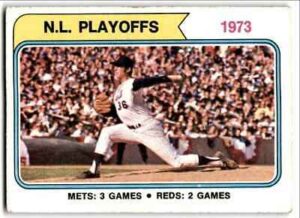 We won the pennant. We were in the World Series. We were about to face the defending world champions, the A’s. I didn’t think Oakland was unconquerable, and they weren’t. We just didn’t conquer them. A ground ball here, a passed ball there, maybe a managerial decision or two…ah, I don’t sweat it that much a half-century or so after the fact. A little, but not to excess. Not winning everything at the very end in October 1973 couldn’t blemish what September 1973 gave us and gave me. September 1973 gave us and gave me our and my template — Septemplate? — to deal with daunting seasons and daunting months in the decades ahead. Even daunting innings. You Gotta Believe has never sounded off-key. That it rarely worked as well as it did in September of ’73 didn’t detract from the power of the original month from heaven. We won the pennant. We were in the World Series. We were about to face the defending world champions, the A’s. I didn’t think Oakland was unconquerable, and they weren’t. We just didn’t conquer them. A ground ball here, a passed ball there, maybe a managerial decision or two…ah, I don’t sweat it that much a half-century or so after the fact. A little, but not to excess. Not winning everything at the very end in October 1973 couldn’t blemish what September 1973 gave us and gave me. September 1973 gave us and gave me our and my template — Septemplate? — to deal with daunting seasons and daunting months in the decades ahead. Even daunting innings. You Gotta Believe has never sounded off-key. That it rarely worked as well as it did in September of ’73 didn’t detract from the power of the original month from heaven.
Somewhere inside me, I’m living every month I’ve ever been a Mets fan. But my default setting is one month in particular.
If you’d like to take a deeper dive into the glorious 1973 Met weeds, check out what Len Ferman has created here and see what Jacob Kanarek has recently revised here.
PREVIOUS ‘MY FAVORITE SEASONS’ INSTALLMENTS
Nos. 55-44: Lousy Seasons, Redeeming Features
Nos. 43-34: Lookin’ for the Lights (That Silver Lining)
Nos. 33-23: In the Middling Years
Nos. 22-21: Affection in Anonymity
No. 20: No Shirt, Sherlock
No. 19: Not So Heavy Next Time
No. 18: Honorably Discharged
No. 17: Taken Down in Paradise City
No. 16: Thin Degree of Separation
No. 15: We Good?
No. 14: This Thing Is On
No. 13: One of Those Teams
No. 12: (Weird) Dream Season
No. 11: Hold On for One More Year
No. 10: Retrospectively Happy Days
by Greg Prince on 12 February 2025 6:15 pm The distance from No. 11 to No. 10 on any list is both incremental and immense. Top Ten implies a level above all others. Therefore, with all due respect to all others, welcome to the Top Ten portion of MY FAVORITE SEASONS, FROM LEAST FAVORITE TO MOST FAVORITE, 1969-‘PRESENT’ (with 2024’s slotting TBD), where things are getting more serious, which is to say more favorite.
Or does it say something else? I’ll stand by “Favorite” as the unifying adjective of this series, as the idea when I kicked it off on the final day of 2023 — when 2023 encompassed all the present we knew about — was to work my way up from Met seasons I didn’t enjoy a ton (but I was determined to say something nice to say about each of them), through Met seasons that struck me as evocative blends of fun and futility, straight up to those seasons I clearly love more than any others. You know: the Top Ten.
Except maybe favorite isn’t the most operative word as we rise to the upper tier of this extended exercise in Met reflection. The seasons about to be entered here were, for me…what? Meaningful? Influential? Formative? Each of the above — but without the anger and regret and that informed other meaningful, influential and formative seasons further down the chart. With happiness the prevalent mode in each season remaining to be counted down, I guess ‘favorite’ still works, but it seems worth noting, as we eventually visit certain years that weren’t conventionally successful and find them ranking higher in my very personal esteem than years that earned banners, that favorite encompasses so much more than wins, losses and flags.
It’s the Mets. It’s never obvious.
That said, it is indeed Top Ten Time. On with the countdown, and an authentic banner year.
***
10. 2000
It is now slightly over a quarter-century since we heard the word “century” used more than any of us will likely ever hear it again. And forget about a future surge in “millennium” — it crested for the duration of our lifetimes and the lifetimes of dozens of generations ahead of us back then. Occasionally I see a business that carries the name “Millennium” in its title, and I think it must have served as a better short-term attention-getter than long.
Yet the century and millennium whose border we drifted across in 2000 (“but there was no Year Zero” protestations notwithstanding) are still here. Just as are the Mets, who were as much the focus of my existence 25 years ago as they’ve ever been.
 You don’t essentially build your life around a team you don’t love, and you don’t do it in a season you don’t love. I loved the Mets in 2000, and I loved the 2000 Mets. Those might read as identical statements, but I believe there’s a delineation to be divined. Truly loving the Mets at any given moment indicates your fandom is turned up high, no matter who’s on the Mets. My fandom for this enterprise, this going concern, this (as Tony Soprano regularly referenced Sunday nights at nine) thing of ours was already ratcheted skyward as the previous century closed its books. I saw no reason to diminish my fervor when the chronological odometer flipped over. You don’t essentially build your life around a team you don’t love, and you don’t do it in a season you don’t love. I loved the Mets in 2000, and I loved the 2000 Mets. Those might read as identical statements, but I believe there’s a delineation to be divined. Truly loving the Mets at any given moment indicates your fandom is turned up high, no matter who’s on the Mets. My fandom for this enterprise, this going concern, this (as Tony Soprano regularly referenced Sunday nights at nine) thing of ours was already ratcheted skyward as the previous century closed its books. I saw no reason to diminish my fervor when the chronological odometer flipped over.
The 2000 Mets as individuals coalescing into a unit was a slightly different story. Years After, as recently discussed in this space, can be a hard internal sell, because Years After are inherently Not The Same. The Year Before 2000 was a banner year in its own right, one that couldn’t help but end. Kenny Rogers made sure of that. So did John Olerud and Masato Yoshii and Orel Hershiser and Octavio Dotel and Roger Cedeño and Pat Mahomes (and Bobby Bonilla, when he said “sure” to a sweet deferral deal). A few players take off your uniform and put another on every year, even years you cherished. It takes a minute or more to embrace their replacements.
So hi, Todd Zeile; and hi, Mike Hampton, and hi, Derek Bell, and hi, whoever else wasn’t here last year. You will wear orange and blue and an uncomfortable quantity of black, and you will mesh in your own way with Mike and Robin and Fonzie and Al and Reeder and so on, but you’ll be a different group. You might be welcome as you join us, but you can’t blame us if we consider you to be strangers before you emotionally become some of our own.
Eventually, the 2000 Mets become a group to have and to hold and to root as hard for as we did the 1999 cast. They maintain the general standards that have been established here in recent seasons. They are quality players and quality people, from what we can tell, and drama can’t help but swirl about them. Bobby Valentine is still managing, so, yeah, it’s never dull. That’s mostly good.
Somewhere past the middle of the season, something quietly happens. The 2000 Mets grab hold of a playoff spot in the standings on July 27 and they never let go. That’s what the 2000 Mets do. They win more than they lose and, given the experience enough of them garnered in the late 1990s (whether as Mets or whatever they were before becoming Mets), you mostly trust them to keep on keeping on.
 Given who I am, I do the same. “Act like you’ve been there before” is usually brandished as a cudgel toward any player who flips a bat and pumps a fist too excessively after whacking a ball clean out of sight. One of the pleasures of 2000 for me was having “been there” in 1999. The Mets were a playoff team working toward being a playoff team again. They legitimately worked at it. They were mature that way. Part of their innate likability was that they were a solid citizen of baseball. They weren’t leading the Wild Card pack and staying on the Braves’ divisional heels by luck or accident. Even if the soul of the team came off a little more muted than the ’99 version’s, they still had that Amazin’ something about them. It was just a year older. Given who I am, I do the same. “Act like you’ve been there before” is usually brandished as a cudgel toward any player who flips a bat and pumps a fist too excessively after whacking a ball clean out of sight. One of the pleasures of 2000 for me was having “been there” in 1999. The Mets were a playoff team working toward being a playoff team again. They legitimately worked at it. They were mature that way. Part of their innate likability was that they were a solid citizen of baseball. They weren’t leading the Wild Card pack and staying on the Braves’ divisional heels by luck or accident. Even if the soul of the team came off a little more muted than the ’99 version’s, they still had that Amazin’ something about them. It was just a year older.
Me, too. I’d lived and died (and resurrected repeatedly) as Mets fan in 1999. Now I’d landed in this new year/decade/century/millennium with an enhanced sense of knowing what I was doing as a fan. A fan in full. I’d ascended to a certain Peak Mets state of being. It wasn’t only that I went to a lot of games — though I did — and it wasn’t only that I hardly missed an inning — though I didn’t. The agency I nurtured and the commitment I forged were born of an incandescent passion. My Met light was never off. My Met heart never stopped beating. I can honestly say I didn’t go a waking hour without organically thinking about the Mets. Maybe that’s still the case, but it felt deeper then.
If everything was 162 games of smooth sailing, the mind might have wandered. Dissecting what it was really like to live then, no, nothing was a sure thing. There were losing streaks and there was frustration and there was doubt. There were the Mets being the Mets, which even in the best of times eludes serenity. But there really was an inner confidence to rooting for the 2000 Mets. It could go off the rails, but I’m gonna stay on board and trust whoever’s driving this train. I think it’s gonna be OK. At least that’s how I opt to remember it.
It was pointed out amid the 1950s nostalgia infiltrating 1970s pop culture that, once you factored in segregation, McCarthyism, societal conformity and so many other issues that defined daily living way back when…well, they weren’t all happy days. Yet twenty years later, you could roll out select signifiers of a time gone by and convince yourself that back then was the time to be alive. I think that might be what 2000 has become for me Metwise. I fretted with every third out or fourth ball or whatever didn’t go in our favor, but those were the days, huh? Mike and Robin and, yes, Fonzie — plus Hampton and Zeile and this kid Timo Perez who joined the lineup in September and hit an inside-the-park homer in Philly. Look at him run! Timo Perez takes nothing for granted on the basepaths!
 Those happy days were yours and mine. Certainly mine. We were a plucky powerhouse from March in Tokyo to October in Flushing. We did make the playoffs. We did win an NLDS while holding our breath for four games. We did win the pennant while roaring aloud for five games. We came back on the Braves one night with ten runs in the eighth inning. We — the team, the fans — made Shea shake. We did some incredible things. We did a slew of hypercompetent things. It added up to almost everything we wanted. I was there for almost all of it. I didn’t go to the World Series, and the Mets didn’t show up for quite as much of that intracity affair as we wished, but I know I saw them line up for it on TV. Those happy days were yours and mine. Certainly mine. We were a plucky powerhouse from March in Tokyo to October in Flushing. We did make the playoffs. We did win an NLDS while holding our breath for four games. We did win the pennant while roaring aloud for five games. We came back on the Braves one night with ten runs in the eighth inning. We — the team, the fans — made Shea shake. We did some incredible things. We did a slew of hypercompetent things. It added up to almost everything we wanted. I was there for almost all of it. I didn’t go to the World Series, and the Mets didn’t show up for quite as much of that intracity affair as we wished, but I know I saw them line up for it on TV.
With the exception of securing a world championship, we scaled the Apex Mountain of Metsdom. I use first-person plural when maybe I should use the singular here. Fine, I was on my version of Apex Mountain. Losing the Fall Classic to whom we lost it understandably dims the glow of the collective Metropolitan memory of 2000. I dig. But I dug too much of what preceded our Subway Series shortfall to toss it all into a hole in the ground. New York, New York? We were a helluva team having a helluva year.
One other, rarely mentioned upside to immersion in the Mets in the fall of 2000 that we couldn’t have realized in 2000: it wasn’t yet the fall of 2001. From a gut-level perspective, baseball — or anything — in New York would never feel the same after what happened downtown that following September. Knowing that makes me treasure the September and October before 2001 that much more.
 As this list of Favorite Seasons stands (which is to say pending what I choose to do with 2024), you will not find any year above 2000’s slot that begins with the number ‘2’ in the Top Ten; it’s all Nineteen Something Something from here on out. I’m suddenly reminded of an early-ish email meme that went around on November 19, 1999, or 11/19/1999. None of us, it was advised, would ever again see “today’s date” expressed in all odd numbers, unless we lived to make 1/1/3111. It’s an intriguing triviality, though probably not one worth hanging around for. As this list of Favorite Seasons stands (which is to say pending what I choose to do with 2024), you will not find any year above 2000’s slot that begins with the number ‘2’ in the Top Ten; it’s all Nineteen Something Something from here on out. I’m suddenly reminded of an early-ish email meme that went around on November 19, 1999, or 11/19/1999. None of us, it was advised, would ever again see “today’s date” expressed in all odd numbers, unless we lived to make 1/1/3111. It’s an intriguing triviality, though probably not one worth hanging around for.
The “failure” of any year after 2000 to crack my Top Ten likely reflects the way a lifetime fan — OK, this lifetime fan — has processed further maturity. In 2000, I was 37 years old. I’d experienced the Mets in the last year of the 1960s, all of the 1970s, 1980s and 1990s, and now the first year of this new millennium. It might have been a coincidence of the calendar or a matter of the Mets declining in sync with me nearing my forties, that after 2000, nothing about my baseball team was going to impact me the way everything about my baseball team had impacted me already. “Everything I needed to know about being a Mets fan I learned from 1969 to 2000,” doesn’t quite sum it up, but maybe everything I was ever going to feel was never going to seem so revelatory again. Things can still be meaningful. They may not be as influential or formative.
I’m still rooting for the Mets. I’m still writing about the Mets. I’m still relishing the coming of another Mets season. I’m still capable of being uncommonly levitated by the Mets, as demonstrated by the events of not too many months ago. I don’t think everything I’ve been up to with my Mets has been an extended time-killing exercise from 2001 forward. Yet perhaps the belief that everything you’re experiencing has never transpired quite like this before can happen only in the first century you’re alive, and it takes a hearty sampling of your second century on the scene to confirm it.
 Given its immediate era, its hallmark events, and my specific experience, what we used to anticipate as The Year 2000 turned out, in way-of-life terms, to be Peak Mets for me. Implicit in having reached a peak is that it’s inevitably and necessarily — but hopefully gently — downhill from there. Given its immediate era, its hallmark events, and my specific experience, what we used to anticipate as The Year 2000 turned out, in way-of-life terms, to be Peak Mets for me. Implicit in having reached a peak is that it’s inevitably and necessarily — but hopefully gently — downhill from there.
PREVIOUS ‘MY FAVORITE SEASONS’ INSTALLMENTS
Nos. 55-44: Lousy Seasons, Redeeming Features
Nos. 43-34: Lookin’ for the Lights (That Silver Lining)
Nos. 33-23: In the Middling Years
Nos. 22-21: Affection in Anonymity
No. 20: No Shirt, Sherlock
No. 19: Not So Heavy Next Time
No. 18: Honorably Discharged
No. 17: Taken Down in Paradise City
No. 16: Thin Degree of Separation
No. 15: We Good?
No. 14: This Thing Is On
No. 13: One of Those Teams
No. 12: (Weird) Dream Season
No. 11: Hold On for One More Year
by Greg Prince on 8 February 2025 6:28 pm The Mets’ How We Spent Our Winter Vacation essay can be produced in succinct fashion: “We did some signing. We did some trading. We did some retaining.” Given who they signed in December and who they retained in February, that’s a dozen words worthy of a pretty high grade.
Free agents and player swaps are what get the Hot Stove blood flowing, but as we’ve felt in our veins since learning Pete Alonso won’t leave, you can’t sleep on retaining your own when your own have been part of something special.
The Retained Polar Bear needs no further reintroduction, but let’s take a moment and appreciate the re-signings of three Mets who wove themselves into 2024’s narrative as the year went on. On the edge of the most recent season, Sean Manaea qualified as a reclamation project; Ryne Stanek was another box on somebody else’s Journeyman Reliever bingo card; and Jesse Winker? We despised that dude!
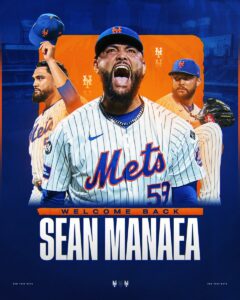 Now? We recall Manaea as our 2024 rotation ace, Stanek as our 2024 bullpen lifesaver, and Winker? We adore that dude! Still do — all of them. When the Mets re-signed each of them, the images the club posted on social media didn’t just illustrate them in on-field action, but reaction. These guys shouted to the high heavens when they and their teammates succeeded, leading us to our own episodes of frenzy. We don’t want to lose what winning feels like. They were part of one of the most lovable teams of our lifetime, so besides keeping three Mets who we consider good at what they do, we don’t have to let go of too much of that 2024 feeling. Now? We recall Manaea as our 2024 rotation ace, Stanek as our 2024 bullpen lifesaver, and Winker? We adore that dude! Still do — all of them. When the Mets re-signed each of them, the images the club posted on social media didn’t just illustrate them in on-field action, but reaction. These guys shouted to the high heavens when they and their teammates succeeded, leading us to our own episodes of frenzy. We don’t want to lose what winning feels like. They were part of one of the most lovable teams of our lifetime, so besides keeping three Mets who we consider good at what they do, we don’t have to let go of too much of that 2024 feeling.
 Had agreement not been reached with Alonso, there would have been many practical reasons to baseball-mourn, but the kick to the emotional gut might have left the deepest mark. A lack of Alonso would have massively changed our connection to what we just did. To a lesser extent, bringing back Manaea, Stanek, and Winker prevents a case of the orange-and-blues. You could take a shot at replicating their statistics through other acquisitions, but were the next starting pitcher, the next setup man, and the next DH-OF going to bring that certain something to Citi? Had agreement not been reached with Alonso, there would have been many practical reasons to baseball-mourn, but the kick to the emotional gut might have left the deepest mark. A lack of Alonso would have massively changed our connection to what we just did. To a lesser extent, bringing back Manaea, Stanek, and Winker prevents a case of the orange-and-blues. You could take a shot at replicating their statistics through other acquisitions, but were the next starting pitcher, the next setup man, and the next DH-OF going to bring that certain something to Citi?
 Maybe. But you just don’t know. Really, you just don’t know how personalities and performance will blend from campaign to campaign. In the history of the New York Mets, the years after years that have yielded postseason play have yielded, uniformly, fewer regular-season wins. The second time around is inevitably a challenge. Still, it’s tough to erase the immediate past and write nearly as satisfying a next chapter from scratch. Maybe. But you just don’t know. Really, you just don’t know how personalities and performance will blend from campaign to campaign. In the history of the New York Mets, the years after years that have yielded postseason play have yielded, uniformly, fewer regular-season wins. The second time around is inevitably a challenge. Still, it’s tough to erase the immediate past and write nearly as satisfying a next chapter from scratch.
The Mets didn’t retain Ed Charles for 1970. Try repeating without the poet laureate of 1969. Gil Hodges liked Joe Foy at third base, and Wayne Garrett earned further reps there, too. But it wasn’t the same.
The Mets didn’t retain Kevin Mitchell or Ray Knight for 1987. There was decent rationale within both decisions. Kevin McReynolds was an absolute get when he was got, and Knight’s position, third base, was crowded with potential in the persons of Howard Johnson and Dave Magadan. I understood both transitions. The Mets loomed as stronger on paper going into 1987 than they might have had they tried to run it back with Mitchell and Knight from 1986. But it wasn’t the same.
Not The Same is a tough barrier to overcome from the Mezzanine or Promenade or wherever you’re consuming Mets baseball. Willie Mays retires. Wally Backman is squeezed out to create space for Gregg Jefferies. Todd Zeile isn’t quite John Olerud. Kevin Appier and Steve Trachsel combined aren’t quite Mike Hampton. Moises Alou replaces Cliff Floyd. Neil Walker replaces Daniel Murphy. Bartolo Colon is born to wander to other destinations. Jacob deGrom takes the money and pitches somewhere else (for a few innings, anyway).
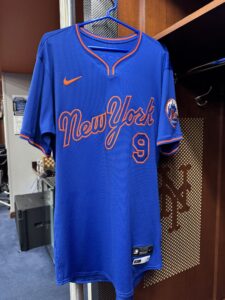 The Mets were already tempting fate by unveiling alternate road jerseys that feature the same script they modeled in 1987, the ultimate Not The Same season in franchise lore. You want to send nine players onto the field in shirts that less read as New York than Nope, Not Again. If enough of the players are the guys who did it in the first place — and they’re augmented by a newly signed stud like Soto and assorted other acquisitions (no offense, likes of Griffin Canning and Jose Siri, but everybody’s bound to be “all other” compared to Juan Soto) — you don’t worry so much about Not The Same, because you believe things will be even better. Never mind that only twice has a Met playoff years been succeeded by a different Met playoff year. Spring Training approaches. We’ve got enough of the band back together. We’re here for the enhanced continuity. We’re here for the believing. The Mets were already tempting fate by unveiling alternate road jerseys that feature the same script they modeled in 1987, the ultimate Not The Same season in franchise lore. You want to send nine players onto the field in shirts that less read as New York than Nope, Not Again. If enough of the players are the guys who did it in the first place — and they’re augmented by a newly signed stud like Soto and assorted other acquisitions (no offense, likes of Griffin Canning and Jose Siri, but everybody’s bound to be “all other” compared to Juan Soto) — you don’t worry so much about Not The Same, because you believe things will be even better. Never mind that only twice has a Met playoff years been succeeded by a different Met playoff year. Spring Training approaches. We’ve got enough of the band back together. We’re here for the enhanced continuity. We’re here for the believing.
A fistful of non-incidental 2024 Mets linger on the free agent market. None among J.D. Martinez, Adam Ottavino, my personal favorite Jose Quintana, or the sidelined-early duo of Brooks Raley and Drew Smith has been mentioned as a possibility to return. I wouldn’t dismiss any of them with “good riddance,” but I get it. Teams move on from players and players move on from teams. I shrugged similarly at the news that Luis Severino landed in Sacramento, Harrison Bader in Minneapolis, and DJ Stewart at the confluence where the Allegheny and the Monongahela form the mighty Ohio. Thank you for your service, fellas. Phil Maton might have been referenced once or twice in mid-winter “should we…?” chatter, but the bullpen appears packed if not stacked (that’s an assessment that’s always up for grabs). Besides, it took me a few weeks after their respective arrivals to remember which one was Stanek and which was Maton. Maton was the one I couldn’t picture shouting like Stanek, Winker, Manaea, or most Mets.
The one überMet of 2024 who’s currently unsigned and carries with him the most appealing Sameness is Jose Iglesias. Jose hit .337 against major league pitching and No. 1 on a couple of Latin music charts. Both were pluses in creating the vibe of the 2024 Mets. I don’t have to spell out what OMG meant to us. I also don’t have to list all the second base candidates this team already maintains under contract, but will: an ascendant Luisangel Acuña; a recovering Ronny Mauricio; a possibly versatile Brett Baty; and a previous champion of batting named Jeff McNeil. Iglesias, 36, is older than the lot of them, just like Knight was senior by a far sight to HoJo and Mags coming off his showstopping 1986.
 Beyond the hitting that won him Comeback Player of the Year honors and the World Series MVP trophy, the chemistry of that Mets team pulsated through Knight. We kind of knew it when he was here. We definitely knew it when he was gone, regardless that Johnson blossomed into 30-30 territory and Magadan’s swung quite sweetly. Mitchell didn’t put up numbers on the level of McReynolds in 1987, but by 1989, Mitchell was the National League’s Most Valuable Player and, in terms of personality, there was never any confusing the two Kevins. Metrics count so much, but character counts as well. Had Knight and Mitchell remained Mets a year longer, maybe that old script New York on the new blue road togs wouldn’t give me shivers. Beyond the hitting that won him Comeback Player of the Year honors and the World Series MVP trophy, the chemistry of that Mets team pulsated through Knight. We kind of knew it when he was here. We definitely knew it when he was gone, regardless that Johnson blossomed into 30-30 territory and Magadan’s swung quite sweetly. Mitchell didn’t put up numbers on the level of McReynolds in 1987, but by 1989, Mitchell was the National League’s Most Valuable Player and, in terms of personality, there was never any confusing the two Kevins. Metrics count so much, but character counts as well. Had Knight and Mitchell remained Mets a year longer, maybe that old script New York on the new blue road togs wouldn’t give me shivers.
When it comes to ballplayers, you can only keep so much yesterday as you build tomorrow. Some of it you don’t have to think about. For example, the talent and character inhabiting Francisco Lindor figures to fit in any Met year or Met uniform, whereas some ballplayers stock only so much magic in addition to ability from year to year. The OMG secret sauce Jose Iglesias stirred — with pinches of so many Mets included — probably can’t be replicated for a second serving. But, man, don’t you sort of want another taste of what he brought? Or would you rather try some of those fresher ingredients in hope that something more delicious can be created? Days before Pitchers & Catchers, there are no wrong answers.
The idea going into 2025 isn’t to do another 2024, no matter how awesome 2024 was. It’s to come up with something that somehow tops it. You never know what exactly the recipe for what’s better will be.
by Greg Prince on 6 February 2025 12:47 am The long, cold winter brightened and warmed with the word Wednesday night that a Polar Bear will continue to prowl among us for the foreseeable future, which is to say one, maybe two years. Foreseeable may be a stretch. You live in the world today. You’ve ascertained that nobody can see very far into the future. The future is now. Now we know we have Pete Alonso for 2025.
Pete and the Mets are together again without ever having left one another, which is the way it should be. The contract that makes Alonso a Met for sure in ’25 and at his discretion in ’26 will give him lots of money, if not as much money as he would have liked when his free agency commenced. Not as many years, either, but he should consider the savings inherent in staying put. For example, he doesn’t have to invest in a new Hagstrom street atlas to cobble a route to a strange ballpark in a different town. Pete knows the way to Flushing Bay.
 Does Pete know the way to Flushing Bay? Apparently so! It’s a great Met move in the short term. The club brought in Juan Soto, which looms as all upside (for this decade, at least), just not as sky high as it could have been until one big question mark was eliminated from the penciling in of lineups. We had Juan. We had Francisco. We had Mark and Brandon and…uh, back up. Weren’t we missing somebody? We were. We won’t miss him anymore.
The Mets’ first baseman remains the Mets’ first baseman. Pete Alonso has filled that position for so long, it might not be easily recalled who last started at first base for the home team before Pete showed up at Citi in 2019. It was Jay Bruce, Closing Day 2018. Jay’s been retired a while. Messing around with Alonso alternatives, even if they distilled down to a relocated Mark Vientos, was going to be a chore. Vientos at first meant “who?” at third. Abbott & Costello didn’t have an obvious answer there, either.
 The A&S Boys can start shopping for RBIs ASAP. Instead, we have the A&S Boys, Alonso & Soto, filling the middle of the lineup and their shopping bags with RBIs. We have Lindor and Nimmo, as ever, along with young yet continually maturing Vientos and Alvarez. An array of other bats and gloves will be sorted. Pitchers will pitch. There’s never enough pitching, but that’s what the President of Baseball Operations is for. David Stearns is always seeking and finding help. He helped himself, with the support of Steve Cohen, to slugging first baseman Pete Alonso, he of the 226 Met homers and the ability to hit at least 27 more before he has the opportunity to opt out. That would give the Polar Bear 253 and the franchise record. Of course I won’t want him to take his record and tour the open market anew next winter, but that’s next winter. There’s a Spring directly ahead. There’s a last winter detail taken care of. Are we sure the weather’s that frigid in New York today?
by Jason Fry on 1 February 2025 5:26 pm Oh, it was a fun year. Such a fun year! The fuel light came on and the engine quit a little ways short of the Promised Land, but what a joyride until then! We got 34 new Mets, five of them making their MLB debuts. Some look like pieces of the future, others remind us that the 2024 team took a while to come into focus, and a few you may not remember at all. But isn’t it always that way?
(Background: I have three binders, long ago dubbed The Holy Books by Greg, that contain a baseball card for every Met on the all-time roster. They’re in order of arrival in a big-league game: Tom Seaver is Class of ’67, Mike Piazza is Class of ’98, Francisco Alvarez is Class of ’22, etc. There are extra pages for the rosters of the two World Series winners, the managers, ghosts, and one for the 1961 Expansion Draft. That page begins with Hobie Landrith and ends with the infamous Lee Walls, the only THB resident who didn’t play for the Mets, manage the Mets, or get stuck with the dubious status of Met ghost.)
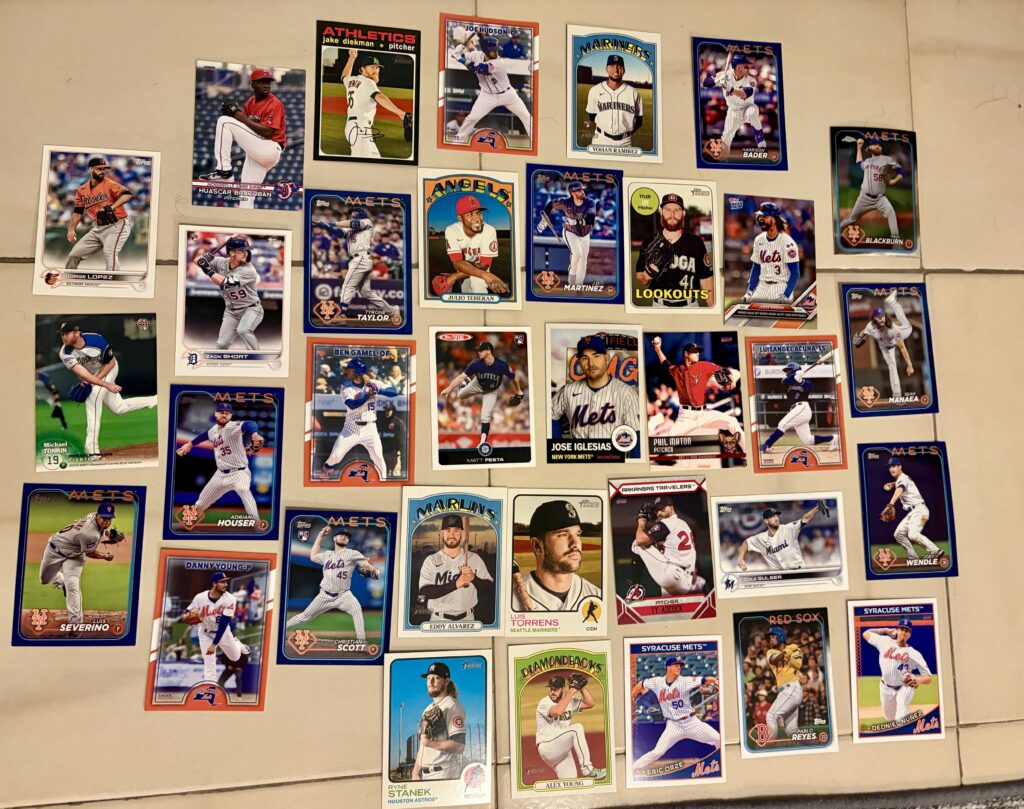 Welcome lads! (If a player gets a Topps card as a Met, I use it unless it’s a truly horrible — Topps was here a decade before there were Mets, so they get to be the card of record. No Mets card by Topps? Then I look for a minor-league card, a non-Topps Mets card, a Topps non-Mets card, or anything else. That means I spend the season scrutinizing new card sets in hopes of finding a) better cards of established Mets; b) cards to stockpile for prospects who might make the Show; and most importantly c) a card for each new big-league Met. Eventually that yields this column, previous versions of which can be found here, here, here, here, here, here, here, here, here, here, here, here, here, here, here, here, here, here and here.)
Let’s get to it, shall we?
Harrison Bader: A superlative center-fielder with a question-mark bat, Bader’s shoulder-waggle strut — cocksure to the point of performative, and complemented by those lilac gloves — made me laugh regardless of scoreboard or standings. I loved doing the Bader Walk in our living room after Harrison did something notable and repurposed an old Simpsons bit in his honor, pretending to be the opposing manager: “Look at him strutting around like he’s cock of the walk! Well, let me tell you, HARRISON BADER IS COCK OF NOTHING!” (Not true: He was one of the merry ringleaders of the Zesty Mets.) Bader is a free agent and headed elsewhere; I hope his new city enjoys him as much as we did. 2024 Topps card in which he’s beardless, a giveaway that it’s a Photoshopped image of him as a Yankee. I’m not happy about it either.
Jorge Lopez: A gawky middle reliever, Lopez’s exit from the roster will go down in team lore as a turning point of the season and a key moment in learning about David Stearns and his regime. Which, to paraphrase Absence of Malice, isn’t true … but is accurate. If the details have grown hazy, Lopez pitched pretty well for the season’s first two months, then got shellacked by the Dodgers on May 29 and ejected. His reaction was to fling his glove over the netting, and a postgame interview made things worse: What Lopez meant to say came out a little mangled, but the gist was that the Mets were the worst team in the whole fucking MLB, or Lopez was the worst teammate in the whole fucking MLB, or some combination of the two. Rather than pounce, the beat reporters gave Lopez chances to clarify his remarks, none of which he took. He was DFA’ed the next day with Carlos Mendoza talking about standards. At that point the Mets had lost 15 of 19 and pretty much were the worst team in the WFMLB. But though we didn’t know it yet, the bad times were over and the dizzy, giddy rocket ride that was the rest of the season was about to begin. That’s the story, but if told fairly it’s not that simple. Lopez was clearly struggling with his emotions after the game, which he had a history of — he’d been put on the 15-day IL as a Twin to address mental health. That’s not a disparagement — baseball has evolved and so have we, and we’re all better for it. Lopez also has a son who suffers from a rare disease requiring regular hospital visits and multiple transplants; cruelly, the day of the implosion was his son’s 11th birthday. None of that was a reason for Lopez to keep his job, but it’s context to keep in mind and be kind about. Happily, Lopez was picked up by the Cubs and pitched well; he’ll be a National in 2025. 2022 Topps card as an Oriole.
Michael Tonkin: Greg and I are both fond of Recidivist Mets, players who return to our roster for another go-round. But Tonkin took earning that status to an extreme. The already much-traveled reliever — Twins, Nippon Ham Fighters, Rangers, Brewers, Long Island Ducks (twice), Diamondbacks, Toros de Tijuana, Braves — pitched in three early games, the second a disaster that was scoreless rolling into the 10th but became a 5-0 loss. Tonkin was excused further duty after one more outing, picked up by the Twins and pitched poorly, then returned to duty with the Mets and was last seen hosing out the stables during a 10-0 loss in LA. He became a Yankee, his third organization (fourth if you want to be pedantic) of a season whose calendar hadn’t turned to May. Tonkin pitched pretty well in the Bronx over the summer (though we hung a loss on him), got designated for assignment, and wound up … back with the Twins. I’m sure he found the whole thing as ridiculous as the rest of us did. An old card as a Ham Fighter. Everyone deserves a card as a Ham Fighter!
Luis Severino: I was not a fan of the Mets signing Severino, a Yankee phenom turned medical chart. That had nothing to do with Severino and everything to do with scar tissue from the Wilpon era. Because what was more Wilponian than happy talk that a broken-down pitcher could return to his glory years? And a former Yankee, no less! But Severino wisely didn’t try to return to what had worked in his youth, instead emphasizing his sinker and pairing it with a sweeper. He pitched somewhere between ably and quite well for the Mets, running out of steam in the postseason but with plenty of company in that regard. He then declined a qualifying offer and signed a hefty contract with the A’s. I personally wouldn’t sign up to pitch in a minor-league park for three years, but nobody’s ever offered me $67 million to do anything, so what do I know? 2024 Topps card as a Photoshopped Yankee. Did Topps have time to get an actual shot of Severino as a Met? Yes, but they’re now a monopoly and the quality has gone in the direction any econ professor would tell you to expect when monopolies are tolerated.
Zack Short: Mark Vientos was one of the best stories for the 2024 Mets, but they sure took their time finding their way to the right answer. Short was one of the false starts, a career .174 hitter who parlayed a solid spring training into a spot on the Opening Day roster over Vientos … then went 1 for 9 and was sold to the Red Sox once J.D. Martinez was ready. Short didn’t do anything in Boston and wound up as a Brave, so of course he hit .370 the rest of the way with a pair of walk-off homers against the Mets … oh wait, that’s the paranoia talking. He actually hit .148 for Atlanta, though he did face us in May and scored two runs off walks, but Brandon Nimmo walked off future Met A.J. Minter so all ended well. 2022 Topps card as a Tiger.
Tyrone Taylor: An import from Milwaukee, Taylor doubled with Bader in the defensive center-fielder/fourth outfielder role, which has been a revolving door for years. Taylor stopped the Mets’ season-opening losing streak by walking off the Tigers and his bat heated up down the stretch, making him a starter and Bader an afterthought. His AB in the Francisco Lindor Game was a critical turning point, a Dunstonesque 11-pitch epic that resulted in a double and sent Spencer Schwellenbach to the showers. He’s the first player in this year’s chronicle who’ll be a Met again in 2025. 2024 Topps Card as a Photoshopped Brewer.
Jake Diekman: A red-bearded itinerant reliever who walked too many guys, Diekman arrived having revived his career as a Tampa Bay Ray. That’s generally begging for trouble, as Rays pitcher whispering tends to stop working once exported, and so it was with Diekman, who caused no end of Met-fan agita before getting DFA’ed near the end of July. With one glorious exception: With the Mets clinging to a 3-2 lead over the Yankees, Diekman was entrusted to retire Trent Grisham, Juan Soto and Aaron Judge and secure the save in the Bronx. Which he somehow did, erasing Judge with a fastball on the hands. It was the best pitch of Diekman’s Mets tenure, and if you ever see him out in the wild, you owe him a beer. Topps Heritage card as an Oakland A.
Yohan Ramirez: A new Mets trend is having relievers earn their stripes with the team by exacting vengeance — see Yoan Lopez a couple of years ago against the Cardinals, and Ramirez in 2024 against old friend Rhys Hoskins. Ramirez’s pitch behind Hoskins’ back earned him an ejection and a suspension … and was probably the most effective pitch he delivered in New York. He was an Oriole by Tax Day, made a Tonkinesque return to New York in May and was terrible again, then was terrible for the Dodgers and Red Sox before signing on with the Pirates. Good luck everybody! Old Topps Heritage card as a Mariner.
Sean Manaea: A lefty hurler with Samoan ancestry and an all-West Coast track record, Manaea arrived in New York trying to rebuild his career after the Giants couldn’t decide what to do with him. Pitched pretty well for the Mets in the first half of the season (though he did cut off his fabulous mane), but really caught fire after he watched Chris Sale mowing hitters down with Atlanta and decided, “I could do that.” And indeed he could: Manaea changed his arm slot and his pitch mix and was electric the rest of the way. (Well, almost: Like lots of other Mets, he looked gassed in October against the Dodgers.) Let’s review: Manaea decided to reinvent himself as a pitcher in the middle of a season in which he’d already been successful … and it worked. That’s having balls the size of church bells. He was also a delight as a teammate, pirouetting with Bader in dugouts as part of his elaborate handshake routine, beaming in Instagram photos with Lindor’s kids, and generally spreading joy. He opted out of his contract at year’s end but will return on a new deal, and I’ll be overjoyed to see him. 2024 Topps card, Photoshopped. Oh well, now he’ll get another one.
Joey Wendle: Boy did that not work out. Wendle arrived with expectations that he’d be a perfectly cromulent utility guy but was jaw-droppingly wretched as a Met. First came a muffed play at second base that led to an implosion against the Tigers; then at the end of April he inexplicably tried to start a double play on a 49 MPH grounder to third with a speedster at bat and the tying run 50 feet from home plate. The former was a physical error and so forgivable; the latter was a mental one and so raised the question of what Wendle was doing on the roster. The Mets came to the same conclusion and Wendle was excused further duty two weeks later. 2024 Topps card, a souvenir of a brighter world that never came to be.
Adrian Houser: Arrived with Tyrone Taylor after looking serviceable as a member of the Brewers’ rotation, another move that didn’t work out. Houser was pretty good in his first start but horrible after that, becoming a Tommy Milone 2.0 metronome of suck. He lost his starting job at the beginning of May and was a bit better in the Mike Maddux role of banished long man, but anything short of “spontaneously combusted while signing autographs for orphans” would have counted as “a bit better.” Houser was DFA’ed in late July and last seen posting a 9+ ERA in Triple-A with the Orioles. Got a 2024 Topps Update card, which annoyed me despite being useful for THB purposes, as I never wanted to think about him again.
Julio Teheran: Here’s a difference between the new regime and the Wilpons. The Mets brought in Teheran, a former Braves star derailed by injuries, to pitch against Atlanta on April 8 and he got tattooed. (Though the Mets somehow won that particular barnburner.) The Wilpons would have kept Teheran around until midsummer, ignoring the can’s scratches and dents and the stack of ever-smaller price tags affixed to it and ignoring questions about whether that gross stuff leaking through a rusty seam was safe for human consumption. The Cohen-Stearns regime thanked Teheran for his lone evening of service and sent him off with what I presume was a thoughtful parting gift. Some old Topps Heritage card as an Angel, secured because I refused to admit him to THB as a Brave.
Cole Sulser: Don’t remember a thing about him. The record shows he put up a 9.64 ERA in four appearances, so that’s for the best. 2022 Topps card as a Marlin. It’s a horizontal; I should probably fix that.
Dedniel Nunez: We’ve already been through such familiar roster niches as the late-inning defensive center fielder and the middle relievers with early-spring sell-by dates. Now for a happier one: the unheralded guy who becomes essential. That was Nunez, a lifelong Met farmhand (not counting a season as a Giants Rule 5 pick that he lost entirely to Tommy John) who’d flunked his initial go-round at Triple-A but got the call after looking a lot better in 2024. Nunez quickly became a reliable arm out of the bullpen, which was badly needed given injuries and ineffectiveness. Unfortunately, he was felled by a strained forearm tendon that limited him to one appearance after late July. Imagine if we’d had a healthy, non-gassed Nunez against the Dodgers! But this is missing the point: Imagine bemoaning this what-if back in spring training when only veteran roster hounds had any idea who Nunez was! Anyway, the last update about Nunez was that he’d thrown some bullpens and BP in the Dominican Republic academy, which … doesn’t sound particularly promising. Got a ridiculous two-person 2024 Topps card in which he shares space with Tyler Jay; I scorned it and used an old Syracuse Mets card instead.
Tyler Jay: Jay made his big-league debut a couple of weeks before his 30th birthday, completing an unlikely journey that included being out of baseball due to what was eventually diagnosed as eosinophilic esophagitis, a scary sounding inflammation of the throat. That made for a nice story, complete with Jay’s refreshingly jockspeak-free interview after his debut. His three-letter name looked mildly ridiculous due to Nike fucking up the 2024 uniforms — years from now we’ll see a 2024 highlight and go, “What the fuck is wrong with … oh yeah, that’s right.” Anyway, Jay only pitched twice for the Mets in April and once in July before winding up as a Brewer, but don’t tell him 2024 wasn’t a helluva year. Chattanooga Lookouts card due to the Topps shenanigans decried above.
J.D. Martinez: Have bat, will travel — think of J.D. as a bubble-gum-card Shane. Martinez signed on with the Mets shortly before Opening Day, taking the DH job away from Vientos, and made his debut in late April. His season was a strange one: a superb May and June (including his first-ever walkoff homer, which seems impossible), a meh July and August, a disastrous September and a not bad postseason. That adds up to a rather wan statistical record but misses his other contributions: Martinez was like another hitting coach, praised as a hitting savant by Alonso and others and serving as a key mentor for Vientos. That last part may soon be viewed as having been worth $12 million all by itself. 2024 Topps Update card, the first in THB to show a Met wearing City Connect togs.
Danny Young: Proved at least a marginally useful lefty reliever after Brooks Raley was lost for the season, despite often looking vaguely frightened about the assignment. Young was good at times and not so good at other times, which is to say he was a middle reliever; I never really trusted him but also didn’t recoil in horror when he’d arrive. Not Alex Young, another black-bearded lefty reliever. I wonder if the Mets had them room them together, a la the two Bob Millers … oh who am I kidding, MLB players haven’t had to double up for a generation. 2024 Syracuse Mets card.
Christian Scott: Hailed as the future, Scott pitched reasonably well but was frequently snakebit and never recorded his first big-league win in an abbreviated season that frankly struck me as a little underwhelming. Maybe this is unfair — and if so I’ll gladly admit it when Scott is our ace — but every time I watched Scott pitch, it felt like GKR talked him up like a trio of nervous matchmaking aunts trying to market a basement-dwelling nephew with weird online interests. Scott will have to wait a while to try again for that first win, as his UCL blew out in July and he had Tommy John surgery. He should return in 2026; who knows what he’ll be when he does? 2024 Topps Update card.
Jose Iglesias: OMG! No player better personified the the Mets’ giddy transformation from car wreck to Lamborghini. (I see you with your hand up; for the last time, Grimace doesn’t count as a player.) Iglesias had a dream season, one even more remarkable because it almost didn’t happen. Always known for good hands and superb instincts, Iglesias had spent years as a starter in waiting, signed by clubs as a utility guy and a stabilizing presence and then ascending to a starting role to fill the kind of need that always arises. But by 2023 it looked like that had stopped working: He became a minor-league free agent in June and this time the phone didn’t ring. Iglesias thought about retiring but gave it one more shot with the Mets, where things also didn’t seem to work: He was passed over for a roster spot and convinced not to opt out by Stearns, who promised he’d be the first callup from Syracuse. That came on Memorial Day, with the Mets 10 games under .500; after Iglesias’ arrival the Mets went on a 26-13 tear, reviving their moribund season. Iglesias was a Baez-esque fielding partner for Lindor (witness this late August sprawl-and-kick force against the Padres) and a terror at the plate, particularly in clutch situations. (The highlight: driving in the go-ahead run in the Edwin Diaz restoration game in Arizona, which provided the one-win margin that put us into the playoffs and not them.) Oh, and as Candelita he became a legit pop star, with the bouncy, infectious “OMG” going from clubhouse soundtrack to home-run celebration to the top of the Latin charts and a staple of national-TV Mets footage. Next time an aging slugger continues to erode or a pitching reclamation project doesn’t work out, remember that a utility infielder called up at the end of May once saved our season, ascended to pop stardom and gave us a You Had to Be There on-field concert with his teammates grooving along the first-base line. (Is the best part Pete Alonso’s endearingly awkward vibing, Harrison Bader’s cutoff Mets tee, or both?) Topps gave Iglesias a card in its Living Set, complete with the OMG sign, and this outweighs so many of my other complaints.
Luis Torrens: A wandering backup catcher (honestly that’s redundant), Torrens arrived after the Mets decided they’d seen enough of Omar Narvaez and paid immediate dividends, providing surprisingly potent offense and taming enemy basestealing. The offense didn’t last but the defense did, and Torrens crafted a season highlight by initiating a game-ending 2-3 double play against the Phillies in London. It’s a play I still marvel at months later, one that required baseball instincts and situational awareness and cool under fire: Nick Castellanos dribbled a Drew Smith pitch out in front of home plate, Torrens grabbed it, whirled to find home plate with his foot, whirled back, found a lane connecting himself with Alonso’s glove at first, and made the throw. It’s a play for the top of any catcher’s CV. Topps Heritage card as a Mariner.
Joe Hudson: A backup catcher, Hudson went to London as part of the taxi squad but didn’t get into a game until a couple of weeks later in Chicago, where he caught the 9th inning of a 11-1 Mets win without getting an plate appearance. (The final Cub batter of that game, if you’re curious? Tomas Nido.) The lack of an AB sounds cruel, but it’s a hazard for third catchers, as is never getting into a game at all and becoming a ghost. BTW the Mets had two 2024 ghosts — Matt Gage and postseason phantom Max Kranick — and their all-time ectoplasmic roster now numbers 15. 2024 Syracuse Mets card.
Ben Gamel: A journeyman outfielder known to Stearns from a stint as a Brewer, Gamel spent a month and a half on the roster, mostly as a defensive replacement late in games, and did nothing particularly praiseworthy or blameworthy. 2024 Syracuse Mets card; he has not one but two unique cards from Topps team sets, which were expensive and annoying to track down. This isn’t Gamel’s fault but I’m still a little ticked.
Ty Adcock: Former Mariner pitched well in his first appearance as Met, less well in his second appearance, then got bombed in his third. There wasn’t a fourth appearance. Some old card as an Arkansas Traveler.
Matt Festa: Made his Mets debut in the 11th inning of a 5-5 tie against the Astros; when he left it was 10-5 Astros. Thus did Festa’s Mets tenure begin and end. Ouch. An old Topps Total card as a Mariner.
Eric Orze: A hulking righty (is there any other kind of righty reliever these days?), Orze had spent the last couple of years at Syracuse, often discussed for a callup but never getting one. He finally got his chance in July against the Pirates and it didn’t go well: a walk and two singles, followed by watching glumly from the dugout as Adrian Houser got obliterated and put more runs onto Orze’s ledger. Orze reduced his ERA from infinity a couple of weeks later mopping up against the Braves, but that was it. He was sent to Tampa Bay in the trade for Jose Siri and will now undoubtedly become a highly useful reliever. (Speaking of which, did you know Edwin Uceta and Tyson Miller emerged as reliable bullpen arms elsewhere this year?) Syracuse Mets card.
Phil Maton: Arrived from Tampa Bay at the trade deadline and stabilized the relief corps, though his needle looked like it was on E come the postseason. Maton’s utter lack of affect went from amusing to mildly worrying over time; in the early days I thought “Phil Maton sure is admirably stoic” but later that became “I hope digging under Phil Maton’s porch wouldn’t lead to a horrifying discovery.” Has never had a Topps card, which feels like a mild injustice; in THB he’s an El Paso Chihuahua. I did the best I could, Phil, so please don’t put me under the porch.
Alex Young: Not Danny Young! Pitched pretty effectively down the stretch, but mostly in low-leverage situations, was left off the postseason roster and non-tendered after the season, and will return to the Reds in 2025. Here’s where I put the annual reminder that there are 1,450+ innings in a big-league season and it takes a lot of arms to get through them. (In last year’s THB this reminder was basically the entirety of Reed Garrett’s entry, so you never know what the future holds.) Old Topps Heritage card as a Diamondback.
Ryne Stanek: Looked terrible after arriving at the trade deadline, but righted the ship and was invaluable down the stretch and in the postseason, and will return in 2025. In addition to pitching well, Stanek taught me a valuable baseball lesson; I can’t find it, but somewhere he talked about the things he’d been working on as a pitcher with help from the coaching staff, and how poor results didn’t necessarily mean progress wasn’t being made. That was a point about patience and process that resonated with me; so was this Stanek line about the hazards of long ABs, from the perspective of the guy on the mound: “You only have so many tricks. It makes the at-bat substantially harder when you’ve exposed everything you’ve got.” Topps Heritage card as an Astro.
Jesse Winker: Before he became a Met at the trade deadline, I would have said — albeit with no particular heat — that Jesse Winker was an asshole. Which is not wrong, from a blinkered perspective that misses the point entirely. In fact Jesse Winker is a kayfabe asshole, who understands that there’s a home team and an opposing team and being on the opposing team means you’re the enemy, so you may as well embrace that role and play to the crowd. And why not? Baseball may be humanity’s highest art form but it’s also goofy theater, and far better when all involved have fun with it. I found it interesting that the Mets were delighted beyond the usual collective-endeavor sentiments to add Winker as a teammate, and that the Citi Field crowd quickly embraced him as well, recategorizing his antics as a long-ago Reds villain according to the philosophy sketched out above. Winker’s season highlight was walking off the Orioles and kicking off one of the more epic home-run celebrations in recent memory, complete with an awesome opening spike of the batting helmet. Brian McCann probably had an embolism watching the clip from the sidelines of some tedious golf course, but too bad: Baseball’s way more fun without all the grim frowny gatekeeping. Topps Now card celebrating the above.
Huascar Brazoban: Another trade-deadline acquisition, Brazoban was 34 but seemed a lot younger, his butterflies forming a visible cloud when he was on the mound. (Think of him as the antimatter Phil Maton.) He was the center of a notable moment in San Diego, saucer-eyed and clearly out of sorts as a decent-sized Met lead became smaller and smaller. Which led to Francisco Lindor clapping madly and exhorting Brazoban to bear down and Francisco Alvarez removing his helmet to bark at him from behind the plate. (By the way, when Alvarez came into this world Brazoban was 12 years old.) Brazoban somehow got the last out and his teammates surrounded him on the mound like they’d all won the World Series; while it wasn’t a moment to make me want to invest in Huascar Brazoban futures, it was also kind of sweet. Some card in which he’s a Jacksonville Jumbo Shrimp.
Paul Blackburn: A cromulent fifth-starter type, Blackburn was rescued from the A’s at the trade deadline and made five starts — three good, two bad — before taking a line drive off the hand. While rehabbing he developed back woes, which turned out to be a leak of cerebrospinal fluid. That sounds terrifying but apparently isn’t as severe as … no, fuck it, that sounds terrifying. Mysteriously got a 2024 Topps Chrome Update card as a Met.
Pablo Reyes: A club’s last few season debuts usually reflect tinkering at the margins of the roster: subbing out a gassed middle reliever, adding a third catcher, or upgrading a utility infielder/fourth outfielder. The Mets needed to fill the dual role of utility guy/speedy pinch-runner and couldn’t seem to decide how best to do that. Their first choice was Reyes, who entered Sept. 1’s game against the White Sox as a pinch-runner, scored five pitches later on a Starling Marte double, and so concluded his Mets career. Somewhere Dave Liddell is smiling. 2024 Topps card as a Red Sock.
Eddy Alvarez: Plan B in Operation Find a September Utility Guy was Alvarez, so far the most notable winner of an Olympic silver medal for speed skating to suit up for the New York Mets. Alvarez played capable defense though he never recorded a hit, ending the year 0 for 9. Strange but true: He wound up with more strikeouts as a Mets pitcher than hits as a Mets batter, somehow fanning poor Weston Wilson during a scoreless ninth that ended a horrific loss against the Phillies. That’s worth a Faith & Fear bronze at least. Old Topps Heritage card as a Marlin.
Luisangel Acuna: “Baby Acuna” (at least that was his name in our house) was summoned when Lindor’s back acted up and he turned out to be a godsend: solid in the field, more pop than we’d anticipated, and a certain unquantifiable electricity that was a welcome September jolt. Beware small sample sizes (that performance came after an up-and-down year with Syracuse) and keep in mind that Acuna is just 22, but the future looks bright. Impress your friends with the factoid that the Acunas’ father, Ronald Sr., was a Mets farmhand and a teammate of David Wright’s. A terrible Syracuse Mets card; Acuna will get something better soon.
|
|