The blog for Mets fans
who like to read
ABOUT US

Faith and Fear in Flushing made its debut on Feb. 16, 2005, the brainchild of two longtime friends and lifelong Met fans.
Greg Prince discovered the Mets when he was 6, during the magical summer of 1969. He is a Long Island-based writer, editor and communications consultant. Contact him here.
Jason Fry is a Brooklyn writer whose first memories include his mom leaping up and down cheering for Rusty Staub. Check out his other writing here.
Got something to say? Leave a comment, or email us at faithandfear@gmail.com. (Sorry, but we have no interest in ads, sponsored content or guest posts.)
Need our RSS feed? It's here.
Visit our Facebook page, or drop by the personal pages for Greg and Jason.
Or follow us on Twitter: Here's Greg, and here's Jason.
|
by Greg Prince on 30 December 2024 3:23 pm I have two favorite stealth statistics from the 2024 season.
1) When the Mets bottomed out at 22-33 on May 29, everybody in the National League, save for the Rockies and Marlins, had a better record than them: the three division leaders, the three Wild Card holders of the moment, and six teams with what appeared to be more reasonable playoff aspirations. A glance at those standings could have easily persuaded a Mets fan to find something better to do with his time in the summer ahead. But a slightly closer examination would have indicated that, despite the pileup atop his favorite club’s head, the Mets were a mere six games behind whoever tentatively claimed the third Wild Card with 107 games to go. Certainly there was a lot of traffic to navigate, but six games in practically two-thirds of a season could be made up, couldn’t it?
2) When Edwin Diaz gave up his second death-blow home run in three games on August 28, the 69-64 Mets sat four games from the third and final Wild Card spot, which represented a tough but doable climb toward October; six games from the second Wild Card spot, by definition a little harder go; and seven games from the team then possessing the top Wild Card spot, which was really asking for trouble — a seven-game deficit with 29 contests remaining. For comparison’s sake, the 1973 Mets, surely our most frequently cited example of a bunch that wasn’t out of it until they were out of it, lagged 6½ games from where they hoped to land when they still had 29 games to play. Yet when all was said and done divisionally in ’73, the Mets — who’d been in sixth/last place on August 30 — made up eight games on the first-place Cardinals in just over a month and qualified for the postseason as the NL East champions on October 1. They were never out of it.
When all was said and done amid the four-team scramble for three consolation playoff spots in 2024, the Mets did what they had to do. They didn’t catch those second-Wild Card Padres, who finished with the first one; they didn’t quite surpass those third-Wild Card Braves, who finished with the second one; but, son of a gun, they caught all the way up to those first-Wild Card Diamondbacks and, because they beat them on August 29 and therefore took the season series to forge a necessary tiebreaker, they a) made up seven games on Arizona in just over a month; and b) went into the postseason, having sunk their claws into the third Wild Card on September 30. The Snakes were out. The Padres, Braves and, yes, Mets were in.
Nobody ever accused the 1973 Mets’ stretch run of being neat and clean, but in those days, it was a simpler assignment: finish first. In 2024, it wasn’t exactly easier in the moment, but in theory you had four shots at breaking into October. Finish first in your division or, failing that, be one of the trio of also-rans to top all the other also-rans in the senior circuit. These days, you pursue what is there to be pursued. In 2024, the Mets pursued whoever and whatever would get their foot in the door.
One toe over the line, sweet Grimace, one toe over the line. They did it. Was there ever any doubt?
Of course there was. Did you see this team in late March, April and May? Did you see them take three encouraging steps forward and two frustrating steps back too often in June and July and August? Did you mutter over the disappearance of the offense at inopportune intervals in September? Did your faith in the pitching staff persevere without pause despite having to depend on a carousel of gig workers to deliver innings? There was always reason to doubt the 2024 Mets.
 But there was never a reason to not believe in them. It was good to be reminded of who we are and who we oughta be, meaning Faith and Fear in Flushing’s Nikon Camera Player of the Year for 2024 — presented to the entity or concept that best symbolizes, illustrates or transcends the year in Metsdom — is Suspension of Disbelief. You Gotta Believe is a living, breathing credo. Any given edition of Mets might not rate a full-throated endorsement when circumstances inspire cynicism, but when a chance rears its pretty head, who are we not to get behind it and boost it? But there was never a reason to not believe in them. It was good to be reminded of who we are and who we oughta be, meaning Faith and Fear in Flushing’s Nikon Camera Player of the Year for 2024 — presented to the entity or concept that best symbolizes, illustrates or transcends the year in Metsdom — is Suspension of Disbelief. You Gotta Believe is a living, breathing credo. Any given edition of Mets might not rate a full-throated endorsement when circumstances inspire cynicism, but when a chance rears its pretty head, who are we not to get behind it and boost it?
To say I never gave up on the 2024 New York Mets would be blog perjury. I gave up on them plenty. Still, once they began making their move — which amounted to a three-game sweep of Washington, escaping London with an unblown ninth inning over the Phillies, and a ceremonial first pitch from a furry creature — they seemed viable. The teams they were wafting above simply didn’t have whatever the Mets had, be it a McDonaldland refugee, “OMG” encapsulating the zeitgeist, or the ability to make the most of a players-only meeting. From bottom of the pile at the end of May to a slight Wild Card advantage as the All-Star break approached, progress was marked.
Then quite a bit of slipping and sliding, if not so much to puncture our belief balloon. Things looked good! Things looked less good! Vibes could be, if I may pervert the vernacular, maculate. Yeah, maybe they’ll stay in it…or maybe not. August 21, the afternoon Jesse Winker blasted a walkoff homer versus Baltimore, turning what I considered an impending defeat into an invigorating victory, became my expiration date for any longer sloughing off losses. I guess I have to take them seriously now. Diaz allowing Jackson Merrill to clobber him in the ninth in San Diego on August 25, followed by the Corbin Carroll grand slam in the desert three nights later, had me coming to grips with what probably wasn’t going to be the happiest of season endings.
 But I was still taking them seriously the very next day. I didn’t have to do that in May. I might not have done it a couple of weeks earlier. On August 29, however, I realized I was all in, which is a dangerous place to be. Resist the pull of the Mets as September nears, the bruises might be less painful. I’m not sure, since I rarely put up any resistance that time of year. But I was still taking them seriously the very next day. I didn’t have to do that in May. I might not have done it a couple of weeks earlier. On August 29, however, I realized I was all in, which is a dangerous place to be. Resist the pull of the Mets as September nears, the bruises might be less painful. I’m not sure, since I rarely put up any resistance that time of year.
The Mets rise like a phoenix in Phoenix, the middle stop of their second endless road trip in a month. David Peterson keeps the Snakes mostly at bay for seven innings. Francisco Lindor whacks a game-tying homer to lead off the sixth. Luis Torrens — that dude from the 2-3 DP to ferry us safely out of England — cuts down Jose Butto’s only baserunner to end the eighth. In the top of the ninth, it’s Winker doubling, Tyrone Taylor pinch-running, and Jose Iglesias recording as big a hit as he had in his 2024 repertoire, a single trickling out of the infield to give the Mets a 3-2 lead. In the bottom of the inning, Diaz proves himself reversed to previous and preferable form. The Mets win the series, which is swell for momentum when traveling. They also win the season series from this particular opponent, which will prove to be the Met-ric equivalent of everything.
We didn’t know it, but it was the beginning of a nine-game winning streak which buried for the rest of 2024 any doubt that September wouldn’t involve the Mets. It didn’t bury Met-related doubt. Doubt inhabits every corner when you’re not, say, 19 up with 17 to play — the situation on 9/17/86. These weren’t the 1986 Mets, but never mind what the 2024 Mets weren’t. As they were taking the third of three from Arizona, then not succumbing to any semblance of letdown when they visited the historically wallowing White Sox, then coming home and sweeping the sagging Red Sox, and then knocking off the Reds twice, they were indicating what they were and what they could be. It was when these Mets had won their sixth in a row, it struck me that they and we could go all the way, something that hadn’t occurred to me throughout their ascent from the depths. Maybe they could make the playoffs, I’d figured. It never crossed my mind anything could come of it.
Nine-game winning streaks end. Ups become downs. Downs become ups, too. Vice-versas ensue from there. Things looked great leaving Citi Field for the last time in this irregular regular season as we kept Philadelphia from clinching. Things were uneasy as we endured one night of stumbling in Atlanta, two nights of postponements, and two even uneasier losses in Milwaukee. But it was too late to not believe in this team. Not after 22-33 didn’t kill them. Not after the two Diaz implosions that left them 69-64 didn’t drive a stake through their heart. Peterson is awesome on the final Sunday. Lindor, after nursing a bad back, is limber once more. They beat the Brewers when they absolutely have to. They fly back to Georgia with the mission of one win in a doubleheader. Two would be more fun, as it would shove the Braves out of a plane sans parachute, but one is what matters. The first would be ideal.
The first proves ideal, even if it is the quintessence of uneasy — Tylor Megill, in whom we trust only because we have no other choice, hangs in there as best he can; we are nonetheless down, 3-0, through six; our sudden 6-3 lead (!) in the eighth is surrendered (!!) on the heels of Diaz not covering first base (#@!); we’re down anew, 7-6; with one out in the top of the ninth, Starling Marte singles; Lindor…who else?…homers to make it Mets 8 Braves 7; and Diaz, bless his Sugary soul, returns to the mound to not blow the whole thing.
 Eight-Seven on the scoreboard over Atlanta. Seven-Six in the fine print over Arizona, who had just as many wins as us, but when we both finished up 89-73 (as did the Braves), they got elbowed out. We were in. Belief was in, too, all the rage, clear up to the Mets facing a three-game elimination at the hands of the Brewers in the Wild Card round, until we executed a ninth-inning about-face for the ages, and it was on to Philadelphia. Within four games, the division champs crumbled before the great Lindor and the approximately as great Vientos, and don’t forget the great Alonso, whose stick caught fire at the last minute in Milwaukee and remained ablaze during the NLDS, and would you look at that? The New York Mets are in the National League Championship Series. Eight-Seven on the scoreboard over Atlanta. Seven-Six in the fine print over Arizona, who had just as many wins as us, but when we both finished up 89-73 (as did the Braves), they got elbowed out. We were in. Belief was in, too, all the rage, clear up to the Mets facing a three-game elimination at the hands of the Brewers in the Wild Card round, until we executed a ninth-inning about-face for the ages, and it was on to Philadelphia. Within four games, the division champs crumbled before the great Lindor and the approximately as great Vientos, and don’t forget the great Alonso, whose stick caught fire at the last minute in Milwaukee and remained ablaze during the NLDS, and would you look at that? The New York Mets are in the National League Championship Series.
I’ll let you in on two secrets to bracket those two facts atop this essay:
1) The Mets may have never been less competitive in a postseason round than they were in the 2024 NLCS. From 1969 through 2016, every time the Mets reached October, they gave a hardy game-by-game accounting of themselves, even in the series they lost. The 2022 NLWCS round was a different story (too many initials, probably), but that was only three games. Against the Dodgers, in the four games they lost, the Mets were pretty much completely annihilated. Through the haze of glitter and glory, it bordered on brutal.
2) Between the winning they did do versus the Dodgers and the confidence they evinced whenever asked about their state of play, I never gave up on the 2024 Mets sustaining themselves, not even as they knocked a little too forcefully at death’s door. Well, maybe somewhat on my way home from deflating Game Four, but then they were out there slugging in Game Five and I was pumped yet again. Mostly I thought the Mets were a team of destiny by the time they flew back to L.A. I never totally shook my certitude from early September. It had been built too strong through too much to go against. Mendoza the manger, Nimmo the veteran, Lindor the leader, and all their minions sounded so certain about what they were here for. Who was I to doubt them? When the Mets made a little perfunctory noise late in the process of being blown out in Game Six, I thought, maybe… until nah insisted on carrying the day. I absolutely felt gut-punched at having come pretty close to a pennant and not retrieving it. Yet the feeling evaporated before the first pitch of the World Series, itself an Amazin’ transition. I’m still shaking off the shortfalls of near-miss autumns that transpired long, long ago. I swear, nothing about October 2024 hurts.
 So we didn’t win a championship. We won the opportunity to keep believing and be rewarded for that decision. Three months have passed since Lindor put us ahead in Atlanta. I didn’t give up when we were behind, and I haven’t come down since. So we didn’t win a championship. We won the opportunity to keep believing and be rewarded for that decision. Three months have passed since Lindor put us ahead in Atlanta. I didn’t give up when we were behind, and I haven’t come down since.
FAITH AND FEAR’S PREVIOUS NIKON CAMERA PLAYERS OF THE YEAR
1980: The Magic*
2005: The WFAN broadcast team of Gary Cohen and Howie Rose
2006: Shea Stadium
2007: Uncertainty
2008: The 162-Game Schedule
2009: Two Hands
2010: Realization
2011: Commitment
2012: No-Hitter Nomenclature
2013: Harvey Days
2014: The Dudafly Effect
2015: Precedent — Or The Lack Thereof
2016: The Home Run
2017: The Disabled List
2018: The Last Days of David Wright
2019: Our Kids
2020: Distance (Nikon Mini)
2021: Trajectories
2022: Something Short of Satisfaction
2023: The White Flag
*Manufacturers Hanover Trust Player of the Year
by Greg Prince on 24 December 2024 2:37 pm “There are certain figures in American history who have passed into the realm of cultural mythology, as if reality could no longer contain their stories: Johnny Appleseed. Wild Bill Hickok. Davy Crockett. Rickey Henderson.”
—Tom Verducci, 2003
Maybe somebody else in baseball or sports or life referred to himself in the third person before Rickey Henderson made it a trademark of his conversation. But it was his public-facing trademark. Everybody else was “I”. Rickey Henderson was “Rickey”.
Rickey’s pronouns were Rickey, Rickey and Rickey’s. Being “Rickey” worked for Rickey. Rickey worked for many a team. There is no “I” in team, you’ve heard it said. When your team had “Rickey,” your team got way more interesting. We speak from first-Rickey experience.
Twenty-six years ago this month, Rickey Henderson signed with the New York Mets. The Mets bringing in an accomplished veteran from the hinterlands was nothing new. The first batter in Mets history was an accomplished veteran, Richie Ashburn. The first batter when next the Mets played would be Rickey Henderson. From Richie to Rickey…why not? Through the years (Duke Snider, Warren Spahn, Ken Boyer, Tommy Davis and so on), it was always worth a shot. Except this was different from all the for better/for worse importations of previous decorated elders. This was Rickey. Rickey was one of a kind.
Rickey had been one of a kind since ascending to the top of the Oakland A’s order on June 24, 1979. Rickey was twenty years old. He was on top to stay. He was about to start leading the American League in everything that was up his alley. Hits. Walks. Runs. Steals. Oh, the steals. Rickey Henderson’s proclivity for stealing bases made him national news. Nobody — not Cobb, not Wills, not Brock, not his less-celebrated, lower-key NL doppelgänger Raines — stole bases like Rickey. He had the single-season record wrapped up in his fourth August as a major leaguer. By his second, it was clear our beloved left fielder Steve would not be his position’s or generation’s leading Henderson.
Rickey owned every record related to Rickey reaching and Rickey running. Rickey did most of this out of a Mets fan’s view, save for All-Star games, postseason series and, when a Mets fan had nothing better to watch, those few years when Rickey was doing Rickey things in New York. If the Mets were idle, a Mets fan might glance at a Yankees game between 1985 and 1989. Rickey, Mattingly, Winfield — how did they never win anything? I mean besides because of not enough pitching?
Rickey had been traded to the Bronx from Oakland because of money. Oakland traded to get him back once they were angling for a world championship (and the Yankees hadn’t won anything). Rickey set the ALCS on fire in ’89. When the playoffs were simply division winners facing off, performances like his stayed with a temporarily affiliated viewer. The A’s were playing the Jays. The Jays had Mookie and Mazzilli, so I preferred they win. The A’s had Rickey Redux, and he made sure they won. Seven steals in the first three games. Two homers in the fourth game. A’s in five.
The next year, Rickey is AL MVP. The year after that, Rickey is the all-time stolen base champ. He passes Lou Brock again. Lou shows up to congratulate him. Rickey pays homage to Lou, then announces to the crowd that now he — Rickey — is the greatest at his core competency. It’s a little gauche. He’s not wrong.
The Nineties endure. Rickey is in and out of an A’s uniform, in and out of favor. Rickey is inevitably Rickey, which was understood. Rickey showed up in Toronto in a hot pennant race. The Blue Jays went to the World Series with him. Rickey led off the ninth of Game Six, Jays down one. Rickey walks. I’m rooting for the Phillies to hold on and force Game Seven (they have Dykstra and I’m watching with an old pal from Philly), but once Rickey walks, I intuit they’re screwed. Molitor singles. Carter homers. Rickey and the Jays are champs.
Still, you couldn’t mold him into exactly the person you wanted him to be, which crossed only the minds of those viewing from a distance, those uncomfortable with his utter Rickeyness. Singularity indicates a character who is one of one. You had to want Rickey as Rickey, which meant the older Rickey, the dinged-up Rickey (everybody else had hamstrings; Rickey had hammies), the Rickey who knew what was best for Rickey and figured out how to most optimally apply it in a given situation. Still reaching base, still taking bases.
Rickey’s not a direct concern of Mets fans until 1996 when Rickey is a Padre. The first time he faces us, he walks. Before the game is out, he singles, steals second and brings home an insurance run. Rickey leads off for San Diego throughout his age 37 season, and the Padres win the NL West. In the first game when he’s 38, Opening Day 1997, Mets at Jack Murphy, Rickey comes off the bench and homers against Pete Harnisch, part of an eleven-run uprising in which Rickey scores twice and Bobby Valentine uses four pitchers.
After a detour to Anaheim, Rickey returns to Oakland — fourth time — when he’s 39 and steals 66 bases, roughly half of the 130 he stole when he set the MLB mark in 1982. He was 23 then. He steals only half as many now? There’s a “what would Ty Cobb bat these days?” retort (“oh about .250 — he’d be over a hundred years old”) in there somewhere. Rickey shows he still has enough so that it could be discerned he’ll keep running forever.
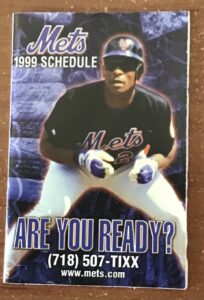 On the eve of his fortieth birthday, he takes off for Queens. In 1998, the year they almost won the Wild Card, the Mets employed ten different hitters in the leadoff slot. To upgrade for 1999, they seek stability at the top of the order. They sign Rickey Henderson, holding a press conference and presenting him a birthday cake a few days before Christmas. It is part of Rickey’s legend that he was born on December 25, Santa’s gift to the game. On the eve of his fortieth birthday, he takes off for Queens. In 1998, the year they almost won the Wild Card, the Mets employed ten different hitters in the leadoff slot. To upgrade for 1999, they seek stability at the top of the order. They sign Rickey Henderson, holding a press conference and presenting him a birthday cake a few days before Christmas. It is part of Rickey’s legend that he was born on December 25, Santa’s gift to the game.
Rickey is Rickey as he returns to New York.
“I love to run and dive into the dirt. Age doesn’t make a difference. I said I can play until I’m 50, so I have another ten years.”
“I’m a winner. I want to be a on a team that wants to win.”
“I think the Mets have a better team because I’m coming here. It’s just the confidence I have, that anything can happen.”
“I’m hoping to create some excitement. If I steal some bases and take that attitude, I can make things happen.”
“We didn’t discuss who the No. 2 hitter will be, but I’ll say he’ll probably have a great year.”
Bobby Valentine’s two-hole hitter in 146 out of 163 games in 1999 was Edgardo Alfonzo. Fonzie drove in 108 runs. He had a great year. The leadoff hitters were mainly Rickey and his baserunning protégé Roger Cedeño, obtained from the Dodgers the same offseason. They were a good match, considering that Roger’s “hero when I was growing up was Rickey Henderson.” Between them, Rickey and Roger stole 103 bases: forty-year-old Rickey 37, Roger a new franchise record 66, or 58 more than he swiped for L.A. the year before. The 1998 Mets pilfered all of 62 bags and crossed the plate 706 times. The 1999 Mets, catalyzed by their most-everyday left fielder, increased those totals to 150 and 853, respectively.
The onslaught of offense wasn’t all Rickey’s doing, but opposing pitchers were facing Rickey (or Roger) to start every game. The opportunities awaited Fonzie, Olerud, Piazza, Ventura. Boy did that crew cash in. True to Rickey’s aspirations, excitement was created and things happened.
• April 7, Rickey’s third game as a New York Met, at Florida. Rickey leads off with a walk. He’s ready to steal. He’s picked off. So what? In his next four plate appearance, he homers to lead off the third; he doubles, gets balked to third and scores on a sac fly in the fifth; he doubles to lead off the seventh and eventually scores; and he homers again as an eighth-inning coup de grâce. Rickey goes 4-for-4 with a walk and scores four runs. Mets win. Rickey is how old, again? Weeks earlier, as Spring Training got underway, Marty Noble noted in Newsday, “Hard, chiseled, ripped, cut. Choose your adjective. Henderson’s physique is the definition of definition.” Talk about staying in shape. “I still work hard, read pitchers and get good jumps,” Rickey assured the press in December. From the looks of him not to mention his early production, he could have been in the best shape of everybody’s life.
• July 10, the Subway Series at Shea. We remember it as The Matt Franco Game, a 9-8 thriller for our side. Franco singles off the untouchable Mariano Rivera with two out in the ninth. He deserves naming rights. But it’s quietly The Rickey Henderson Game. One of oodles in his career, one imagines. He starts it by singling and scoring in the first. He walks to lead off the third. Singles to lead off the fifth. Doubles with one out in the seventh, well-positioned to trot home on Mike Piazza’s three-run bomb off Ramiro Mendoza, the blast that touched down “halfway up the picnic tent roof,” according to Gary Cohen’s satellite tracking on WFAN (Bob Murphy had asked him, “Where did that land?”). That made it 7-6, Mets. That sent me halfway to the moon way the hell up in Section 36. All day Yankees fans are loudmouths. Mike has shut them up…briefly. The other team’s catcher answers with a two-run homer, and we’re losing, 8-7, going to the ninth. Last year’s most oft-used leadoff hitter Brian McRae is the first batter. McRae grounds out. As if to emphasize what an upgrade was undertaken in December, the lineup turns over and this year’s leadoff hitter Rickey is up. He walks. Soon he’s on third, courtesy of Fonzie’s double. Another out is made. An intentional walk is issued to Piazza. Franco pinch-hits for unknown quantity Melvin Mora. That’s where it becomes The Matt Franco Game, what with the benchman’s “LINE DRIVE base hit into right field!” per Cohen. “Henderson scores! Here comes Alfonzo Here comes Alfonzo…here comes O’Neill’s throw to the plate…Alfonzo slides…he’s safe, the Mets win it! THE METS WIN IT!” And while Matt Franco is being “MOBBED BY HIS TEAMMATES!” it can be quickly calculated that Rickey was on five times in this cauldron of a barnburner, with two walks, three hits and three runs.
• October 4, Cinergy Field, known as Riverfront Stadium to most humans. The game is not on your 1999 pocket schedule because it’s been added after 162 have already been played. The Mets are 96-66. Rickey’s team wanted to win, and they’ve won eight games more than in 1998. Only problem was they worked an epic losing streak into the final two weeks of the season, pulling out of it just in time to make sure they wouldn’t be passed by the surging Reds, who also finish 96-66. The two teams are tied for the one available Wild Card. Rickey leads off the win-or-go-home affair. He singles. I’m thinking roughly the same thing I’m thinking in that Blue Jays-Phillies World Series. Rickey is on base, not good news for the team without Rickey. Fortunately the one I’m rooting for now has him. The next batter, Fonzie, caps off his great year with a two-run homer. Al Leiter will do the rest, by shutting out Cincy on two hits, but he has cushion, thanks to Rickey leading off the fifth with a home run. Rickey was known as history’s greatest leadoff slugger. His tablesetting power exploits weren’t confined to first innings. When the game is over, the Mets are in the playoffs for the first time in eleven years, the fifth time in their history. Rickey enters his seventh postseason.
In the first game of the National League Division Series, Rickey goes 0-for-3…while stealing two bases and scoring two runs in the Mets’ 8-4 thumping of Randy Johnson and the Diamondbacks. Rickey was also one of history’s greatest walkers. The Mets couldn’t take Game Two, but Rickey took three more bases — and his sixth of the series in Game Three, a Met romp at Shea (Cedeño also stole one). Decisive Game Four would belong in its nutshell retellings to Todd Pratt, backup to a superstar coming through when it mattered, but let’s not overlook the clutch throw from left field in the eighth inning to nail Jay Bell at the plate. The throw was made by another backup to a superstar, Rickey’s defensive replacement Melvin Mora, rapidly becoming a known quantity amid the melodrama of the Mets’ scramble to keep playing baseball in 1999. Rickey had been aching down the stretch. His batting average took a tumble through September (so had those of most of his teammates), though he finished at .315 in 121 games, complementing his .423 on-base percentage and .466 and slugging percentage, two metrics that didn’t get mentioned a lot at the close of the twentieth century, yet there was Rickey, at forty, putting up numbers in those categories like he did in his early twenties.
When all you can think about is your already pretty good team storming the gates of greatness, you don’t necessarily carve out time to absorb the legends who inhabit your midst. The Mets got Rickey Henderson to make 1999 more successful than 1998? Once in a while, I was capable of stepping back to admire who was suddenly wearing Met snow whites, Met black, occasionally Met pinstripes with too much drop shadowing. Wow, Rickey Henderson is a Met. What became remembered for eternity as the June night Bobby Valentine slipped on dark glasses and a faux mustache to sneak back into the dugout after an ejection during extra innings started with a ride on the 7 with a co-worker I invited along to that game. All this guy, not originally a New Yorker, could talk about was he was going to have a chance to see Rickey Henderson…and the next day, he reiterated how grateful he was he saw Rickey Henderson not just play, but steal a base. This guy wasn’t a Mets fan, so it added a dollop of pride to my hosting him that, yup, we’ve got Rickey Henderson and he steals bases for us.
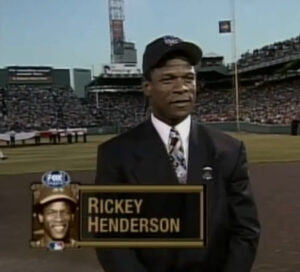 Mostly, though, I wondered over the course of 1999 if Rickey had enough left at his age and within the crankier aspects of his Rickeyness to make a positive difference. Through the long season and the first round of the postseason, he absolutely did. His mentoring of Cedeño when he wasn’t playing provided a second spark to light every game’s fuse. The sight of him sporting a Mets cap when he was introduced among the All-Century 100 at Fenway — he flew up there with Seaver and Kiner — was a reminder of who he’d been and that we were lucky to be getting what he had left. I didn’t initially love that 24 was in circulation after its informal retirement for Willie Mays (Kelvin Torve notwithstanding), but Rickey acknowledged Willie when he put it on and Willie recognized his number being borrowed by somebody whose play was worthy to carry it forward, somebody he called “a good friend”. And when Rickey cringed at his DiamondVision portrayal as a three-eyed Mercury Met, well, you’d cringe, too, if it was revealed to you on an enormous screen that in the future, your forehead could see. Mostly, though, I wondered over the course of 1999 if Rickey had enough left at his age and within the crankier aspects of his Rickeyness to make a positive difference. Through the long season and the first round of the postseason, he absolutely did. His mentoring of Cedeño when he wasn’t playing provided a second spark to light every game’s fuse. The sight of him sporting a Mets cap when he was introduced among the All-Century 100 at Fenway — he flew up there with Seaver and Kiner — was a reminder of who he’d been and that we were lucky to be getting what he had left. I didn’t initially love that 24 was in circulation after its informal retirement for Willie Mays (Kelvin Torve notwithstanding), but Rickey acknowledged Willie when he put it on and Willie recognized his number being borrowed by somebody whose play was worthy to carry it forward, somebody he called “a good friend”. And when Rickey cringed at his DiamondVision portrayal as a three-eyed Mercury Met, well, you’d cringe, too, if it was revealed to you on an enormous screen that in the future, your forehead could see.
Rickey was no ornament to the 1999 Mets. He was critical to revving their engine. His presence was one among many that come to mind. The year in hindsight inevitably returns a fan to The Best Infield Ever, to Piazza, to Leiter’s two-hitter, The Matt Franco Game, The Todd Pratt Game, the varied exploits from out of nowhere Mora, not to mention the collective blessing-countings we totaled on behalf of having Agbayani and Dunston and Cedeño and Hamilton, not to mention Hershiser and Dotel and Yoshii and Mahomes and Benitez before he became, you know, Benitez. It’s hard to picture your primary leadoff hitter and one of your two future Hall-of-Famers getting a little lost in the big picture one paints in one’s mind for 1999, but Rickey’s not the first Met I think of when I think of that team that I’ve thought about a ton for the past twenty-five years.
Still, I think of him fondly. I willingly overlook, after the fact, that for all the runs he scored — 89, or exactly as many as he did in strike-shortened 1981 when he was 22 — he could intermittently show disinterest in running to first or second or third. When he wasn’t legging out ninety feet following a grounder or was misreading the length of a fly ball he’d just belted, I wasn’t seeing a legend. I was seeing a Met not helping matters. When, in the NLCS, he seemed more concerned with his playing time than whether his team was advancing toward its championship goal, it was a bit of a drag. Rickey saw Rickey being on the field as essential to the Mets winning. Bobby V saw an entire roster and gleaned best options for the situation at hand.
I trusted the manager, even after the clumsy defensive switch of Game Four — Rickey took his position to start the eighth only to have to reverse course in front of 55,000 when Valentine was tardy in tapping Mora to sub for him. There’d be some fuming on the part of the legend that didn’t go unnoticed by teammates. “We’re a scrappy bunch because we don’t quit,” Turk Wendell said afterwards. “Except for one person. You’ll find out who soon enough.” In the Daily News recounting, Turk pointed to Rickey’s unoccupied and empty locker. Rickey, in turn, wasn’t too thrilled with the comments Wendell offered reporters when he made himself available to the media for a response prior to Game Five. “I guess Turk doesn’t know me if he thinks I’m a quitter” was the gentlest retort. More pointed, per the News: “If he’s got something to say about it, tell him to meet me. I’ll beat his ass.” The episode couldn’t help but strike a sour note in the jubilant clubhouse on the heels of the Mets avoiding getting swept (thanks in no small part to Mora’s role in the winning rally in the bottom of the eighth). Whether they were issued in the pursuit of peacekeeping or out of sincerity, Valentine and Wendell crafted apologies, and no asses were beaten.
On the other hand, I wasn’t deeply disturbed that Rickey was “caught” playing cards with Bobby Bonilla in the midst of the sixth game of the NLCS at Turner Field, a nugget that dribbled out a little later. They had each played, they had each been removed. Rickey doubled behind Matt Franco in the seventh, when John Smoltz, who’d started three nights earlier, was brought in to put the pennant in a stranglehold for Atlanta. It was 7-3, Braves. Rickey’s RBI made it 7-4. Rickey’s ensuing run — moving to third on Fonzie’s flyout, coming home on Oly’s single — made it 7-5. Then Mike batted and it was 7-7, and after being down, 5-0, we were tied. This was after the Grand Slam Single in Game Five and the Mets getting to Rocker in Game Four, and tell me we weren’t going to win Game Six, then Reed wasn’t going to best Gl@v!ne in Game Seven.
Mora’s pinch-RBI single in the eighth, delivered while batting for Hershiser (our fifth reliever of the night), meant Melvin was already in the game. We led, 8-7, going to the bottom of the inning. We needed a new pitcher. It was John Franco. Franco had to be inserted into the batting order, somewhere harmless. Defense was vital with a one-run lead. Melvin had been making plays all postseason. He’d registered an assist apiece from left, center and right, each of them erasing an enemy at the plate. Bobby wanted him in right, where Agbayani had been camped. Agbayani had led off the Met eighth with a single. It was Benny who scored the go-ahead run. Bobby shifted him to left.
Future Hall of Famer Rickey Henderson was out of the game. Except for the game of hearts or whatever it was he and Bonilla engaged in so Rickey could blow off steam. Per Bonilla many years later, “Rickey says to me, ‘Bo, get the deck of cards, let me relax my mind.’ And the reason we did that, we actually had played cards all year long. This was more to relax Rickey. We had the game on, we’re playing cards.”
That was Bonilla’s recollection in 2017. In 2000, Henderson told Bob Klapisch, then with ESPN, “We were in the clubhouse, that’s true, but that’s because me and Bobby were already out of the game. But there were five pitchers in there with us. How come it was OK for them to be in there, but not us? Why do people only talk about me and Bobby? We played cards before the game, but that’s the same thing we did all year. There was no [card] game going on at the end. We were watching the game.” Yet another Met in the aftermath of the loss to Atlanta recalled seeing their teammates invested in their own game rather than the one that went awry on the field: “We wanted to take a bat to their heads.”
Better optics would have had every Met on the bench as the Mets fought to hold on to their slim lead. Better tactics, perhaps, would have had the eventual all-time leader in walks (until Barry Bonds, who was intentionally passed to extremes, passed Rickey), steals and runs, not to mention collector of 3,000+ hits, in the dugout suggesting something he saw in some Brave’s approach that might provide the needed inch in a series, never mind game, of inches. Better understanding of the human psyche would explain why one of the best baseball players ever felt it was better to stay away from a live, in-person look at one of the best baseball games anybody would ever see.
But Rickey had been removed from that game, and the game continued without him. In another postseason, another player for the ages, Keith Hernandez, repaired to his manager’s office, while what was about to become a game for the ages was still in progress. Found a chair, found a beer, decided his actions were bringing good luck to the proceedings that were progressing in his absence. Superstition sometimes supersedes optics. Still, if you think about it, Keith gave up when there were two outs and nobody on, down two. Gary Carter, Kevin Mitchell, Ray Knight and Mookie Wilson hung in there. Mets won that Game Six, 6-5.
No such fortune for the 1999 Mets, who allowed the Braves to tie their Game Six at 8-8 in the eighth, before the combatants exchanged runs to make it 9-9 in the tenth and the Mets gave up the ultimate fall-behind run in the eleventh to end their pennant quest, 10-9. Had something more gone right, or something less gone wrong, “the deck of cards” would have rated display in the Mets Museum.
Rickey came back for a second season with the Mets. Derek Bell, new to the team, referred to Rickey as “the greatest teammate I ever had. I learned more about basestealing in 30 minutes from Rickey in Spring Training than I did in my whole career. The guy is unbelievable, what he knows, what he sees in a pitcher.” Nonetheless, Rickey didn’t last past the middle of May 2000. One Friday night, Rickey was certain he’d hit a homer and went into his trot. The ball did not leave the park — it hit the base of the left field wall — and Rickey did not run beyond first. By eschewing a sure double, Rickey had written his ticket out of town, getting himself released after the next day’s game, though not before an interlude that, if you remember the Bobby Valentine era with any clarity, could have happened only at Shea.
On Friday May 12, he hits what amounts to the inverse of the Grand Slam Single (a ball that doesn’t go out, but the batter is sure it did). Hell breaks loose in the papers. The manager: “I told him it’s not acceptable. Hit one 400 feet before you pull that crap.” The player: “I hit a ball like that, I think the ball’s going out of the ballpark. What do want me to do, sprint again?” and, better yet, “I’m gonna do it again if I hit one like that.”
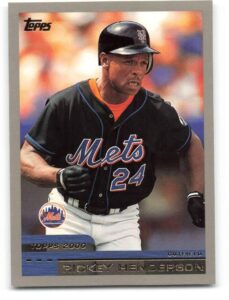 Legend or not, that was that. The release came after the Mets lost to the Marlins on Saturday May 13. Steve Phillips summed the Rickey Henderson experience at its end: “At some point, it becomes too much.” But it’s significant to note the Mets held on to Henderson for that game in between the incident and the release. The morning of the May 13 game happened to be Photo Day at Shea, in which the first 5,000 fans with a ticket, a camera and a cash register receipt from sponsor Genovese Drug Stores got to line the warning track and take pictures of Mets players, conveniently spaced around the outfield for shutterbuggers’ pleasure. This was before people carried phones that could capture images with minimal fuss. This was a big promotion. Legend or not, that was that. The release came after the Mets lost to the Marlins on Saturday May 13. Steve Phillips summed the Rickey Henderson experience at its end: “At some point, it becomes too much.” But it’s significant to note the Mets held on to Henderson for that game in between the incident and the release. The morning of the May 13 game happened to be Photo Day at Shea, in which the first 5,000 fans with a ticket, a camera and a cash register receipt from sponsor Genovese Drug Stores got to line the warning track and take pictures of Mets players, conveniently spaced around the outfield for shutterbuggers’ pleasure. This was before people carried phones that could capture images with minimal fuss. This was a big promotion.
I didn’t partake, but my friend Joe did. Not only did Joe get up early and haul his camera for the event (I’d meet him in the afternoon for the actual game), he’d thoughtfully surprise me months later with an album recording his experiences from that morning, filling it with copies of his snapshots and a typed description of each encounter, from Dennis Cook (“polite, but never left his chair”) to Jon Nunnally (“like a kid in a candy store, full of smiles and accepting well wishes from the fans”) to Mike Piazza (“I had to stand over people to get this candid portrait of him. Then again, no photo of Mike Piazza could ever be a bad one.”). Joe greeted Benny Agbayani with an “aloha,” inspired Rick Reed to dash to the outfield (by recalling the night Reeder played one inning in right) and bonded slightly with Robin Ventura over the stylish 1980s White Sox logo on Joe’s jacket. There is no picture of Todd Pratt, because by the time Joe reached Tank’s station, “I simply ran out of film,” something a person practicing photography in 2000 was prone to do.
I’d forgotten about most of Joe’s encounters, but when I learned about Rickey Henderson’s Friday night passing this past Saturday (December 21, the day of the year with the least sunlight), I immediately thought of that album and Rickey’s inclusion in it. I dug it out to reread what Joe wrote:
Photo Day turned out to be Henderson’s swan song with the Amazins after a turbulent year-and-a-quarter. He, along with Mike Piazza, received the most fans. Surprisingly, Rickey’s visitors were kind and supportive. One woman told him, “Pay no mind to what those reporters say. You just keep doing what you’re doing.” I shook his hand and offered a few seconds of encouragement. He, in turn, smiled for my lens.
Sure enough, there’s Rickey, smiling as a Met, which harmonizes with so much I’ve read and heard since he died a few days short of his 66th birthday. Rickey’s smile has been a common theme in the remembrances from teammates, fans, everybody. And he definitely had a career to smile about. It would keep going despite the unpleasant conclusion of his New York affairs. Seattle picked him up and, lo and behold, Rickey’s helping yet another team the playoffs in 2000, part of the same postseason the Mets made despite having to sort through a dozen leadoff hitters now that they’d said goodbye to Rickey and, for that matter, Cedeño, the young speedster they traded to Houston with Octavio Dotel to bring over Mike Hampton and Derek Bell (Roger never again stole as many as he had under Rickey’s guidance). Late in the year, Bobby V decided on Timo Perez, a sparkplug down the stretch and in the first two rounds of October. Then, in Game One of the World Series, Timo the leadoff hitter, from his vantage point of first base, watches a ball sail to deep left field. Like Rickey in May, he assumes it’s going out. Like Rickey, he is mistaken. The consequences prove dire at home plate. It should also be noted that the Met who hit that ball, Todd Zeile, didn’t exactly bust it out of the box, either. After a generation in which he influenced the game, everybody in baseball seemed to have now and then taken a cue from Rickey Henderson.
While he could still play, Rickey played. Rickey at 42 returned to the Padres for a year, then the Red Sox at 43, then the Dodgers at 44, making it nine franchises in all. Rickey plays his last major league game in 2003, slating him for Cooperstown come 2009. In between, before he briefly served as first base and baserunning coach for the Mets in 2007, he’s in the independent leagues for a couple of seasons. The year this blog started, 2005, he was a San Diego Surf Dawg. The year he started playing professionally was 1976, the year I was bar mitzvahed. Calling him a four-decade player almost undersells his longevity.
Since time in the unaffiliated minors doesn’t interfere with a player’s Hall of Fame eligibility once he’s done with the majors (or the majors are done with him), 2009 indeed became the year Rickey Henderson was certified immortal. Six month before delivering his speech upstate, he appeared on The Late Show with David Letterman along with fellow electee Jim Rice to deliver Top Ten Highlights of My Hall of Fame Baseball Career. Number Five was Rickey’s line:
“Being a Met, a Blue Jay, a Padre, a Dodger…hell, even I cannot remember all the teams I played for.”
That was probably true. When Rickey did speak at Cooperstown, it was all very gracious. I don’t remember him mentioning the Mets. I didn’t take it personally. He had a lot to remember, just as he gave everybody who cherishes baseball a treasure trove of memories. Especially in the place where they named the field for him. “Rickey Henderson Field” at Your Name Here Coliseum was a rare tone-conscious touch for the Athletics in the years ownership began steering the local club out of town. The man himself remained deeply linked to the city of Oakland, where he grew up, despite departing it on numerous occasions for business reasons. Oakland having to say goodbye to Rickey this December after watching the A’s pick up stakes in September brings to mind the sorrow of Brooklyn Dodgers fans in the winter following 1957 when their team flew west to stay and their catcher Roy Campanella suffered a paralyzing automobile accident. The bittersweetness lingered over the borough a long time. Maybe it still does. Nevertheless, they’d had the Dodgers and they’d had Campy behind the plate and the Boys of Summer populating Ebbets Field. As the years went by, Brooklyn Dodgers fans had to smile for how it had been.
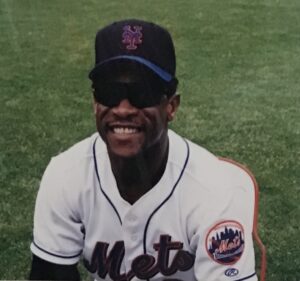 Image courtesy of my friend Joe. Me, I wouldn’t have remembered much in the way of the Rickey smile from his turbulent tenure among us, but I’ve got Joe’s photography to correct my perception. And I maintain the good vibes, whatever hard feelings existed in given moments, of knowing Rickey Henderson was a New York Met. Among his many Hall of Fame qualities that have been remarked upon these last few days — as the baseball-loving world absorbs the loss of yet one more indelible character in the year we’ve said goodbye to Willie Mays, Orlando Cepeda, Luis Tiant, Pete Rose, Rocky Colavito and Fernando Valenzuela (not to mention five 1969 Mets, most recently Jack DiLauro) — was Rickey’s generosity. One of the most heartwarming stories to have been told and shared this week is from Mike Piazza’s memoir, in which the superstar catcher recalled Rickey not getting with the program when it came to doling out postseason shares to short-time players and non-playing team employees who are easy enough for millionaires to miss. Usually, the guys who come and go in the course of a successful season are voted not nearly as much as the roster mainstays.
“Whenever the discussion came around to what we should give one of the fringe people — whether it was a minor leaguer who came up for a few days or the parking lot attendant — Rickey would shout out, ‘Full share!’ We’d argue for a while, and he’d say, ‘Fuck that! You can change somebody’s life!’”
Spoken like somebody who changed the game every time he stood on first and decided he’d rather be on second.
by Greg Prince on 19 December 2024 2:18 pm For those keeping adjustable score of very recent, relatively quiet Met offseason acquisitions at home, you can pencil in the following:
Righthanded pitcher Yuhi Sako.
A southpaw counterpart named Brandon Waddell.
Jared Young, who plays first.
Catcher Chris Williams.
Righty Griffin Canning, who maddeningly contained Met bats one day last summer, so I can say, “Him I’ve heard of.”
If you penciled in onetime All-Star reliever Alex Reyes, erase him. The lately inactive ex-Cardinal was reported in small circles to have signed with the Mets ahead of next year, but that report — too random not to be true, you’d figure — was apparently erroneous. Also, it turns out Alex was an unannounced member of the Met organization last year, never gathering notice for a good reason: he never pitched. He hasn’t pitched since 2021. The whole thing, disseminated and debunked in a matter of Internet hours, at least kept roster-watchers engaged before the Canning news came down a credible pipeline.
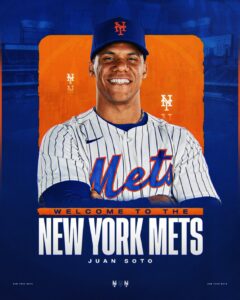
Collectively, this gang of gets, with or without Alex Reyes, doesn’t have quite the same zing to it as the individual Met offseason acquisition about whom word spread like wildfire almost two weeks ago, do they? Yeah, it’s gonna be hard to punch up the list of Met offseason acquisitions with quite as much as oomph as was done for outfielder Juan Soto.
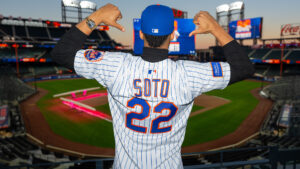
Still…Juan Soto! That happened! Physicals got passed! Conferences got pressed! Jerseys with legible lettering got donned over street clothes! Baseball players wear clothes on the street you can’t wear on the field. Baseball fans wear clothes baseball players wear on the field. We’re all considering an expansion to our wardrobe. We all look sharp in 22.
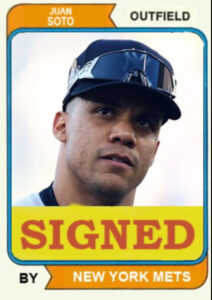 Image courtesy of Ultimate Mets Database. Photoshop, et al, saw us through the unofficial period, when we knew we’d landed a star but it couldn’t be confirmed by the club. The anticipant got creative placing the “reported” acquisition in his correct threads before he could try them on. Who could wait for it to become official? Then it became official, and it’s still official. Juan Soto became a New York Met last week, and Juan Soto is still a New York Met. It bears repeating. We’re slated to repeat it for the next fifteen years. Might as well get used to saying it.
***In some non-Steve Cohen timeline, “Yuhi Sako,” a native of Japan whose professional career includes stints with the Canberra Cavalry in Australia plus two indy league clubs in the US, would be used as a cudgel against us. “The Yankees got Soto, and the Mets got Sako! HA!” It could be worse. “Twenty-five years ago the Mets got beat by Sojo. Now they were beat for Soto! HA!”
Before Cohen, the Mets were habitual HA! magnets. In February 2004, the Mets signed a lefty with a touch of big league experience, Randy Keisler. It’s what teams do as Spring Training approaches. “He has a track record in the majors and we liked what we saw of him at a tryout,” was GM Jim Duquette’s qualified endorsement. “We’ll see what develops.” Turns out nothing developed; despite Duquette’s low-ceiling projections. Keisler, who claimed some local experience, only made it as far as the Norfolk Tides before moving on.
Thing was, the Mets were ready to announce this most minor of moves the same day another team in New York had something to say about another transaction. The Yankees were introducing Alex Rodriguez. “Majors feel shock wave of Yank deal,” heralded the Courier-News in New Jersey, amplifying in its article’s subhed, “Mets answer with signing of ex-Yankee Randy Keisler.” In a small box adjacent to a large picture of the new third baseman in town posing for the cameras ran this headline in Newsday: “Mets Also Add A New Player”. The brief accompanying story led with, “Talk about teams headed in different directions.”
Nah, that’s OK, though to their self-aware credit, according to the Star-Ledger, the Mets issued their news in an e-mail headlined, “Alex Who?”
***What do you get an event for its milestone anniversary? How about an event sharing surface similarities to it? Gary Carter trade, here’s the Juan Soto signing — happy fortieth!
 One of the first (of many) thoughts to pass through my head on the Sunday night we got Soto was the news broke while the NFL was filling a prime time window, much as was the case when we got Carter. Then it was Monday Night Football. Then it took players — Hubie Brooks, Mike Fitzgerald, Herm Winningham and Floyd Youmans — as much as a commitment of currency to land a superstar in Flushing, but let’s not overlook the financial aspect of getting Gary Carter on December 10, 1984. “Carter’s stats last year,” Channel 5 sports anchor Tom McDonald gushed the night the deal went down, “showed why he’s paid $2 million a season.” One of the first (of many) thoughts to pass through my head on the Sunday night we got Soto was the news broke while the NFL was filling a prime time window, much as was the case when we got Carter. Then it was Monday Night Football. Then it took players — Hubie Brooks, Mike Fitzgerald, Herm Winningham and Floyd Youmans — as much as a commitment of currency to land a superstar in Flushing, but let’s not overlook the financial aspect of getting Gary Carter on December 10, 1984. “Carter’s stats last year,” Channel 5 sports anchor Tom McDonald gushed the night the deal went down, “showed why he’s paid $2 million a season.”
Baseball media’s fascination with how much top-flight baseball players make isn’t new, just as the press is pretty blasé about how much baseball franchise owners who aren’t Steve Cohen often aren’t spending to make their teams better. Sports Illustrated during Carter’s first Spring Training as a Met made “The Money Game: Baseball’s Millionaires” a cover story. Most of the cover art was a list of players guaranteed a million bucks or more in 1985. Gary Carter was listed fifth, two slots behind George Foster. Down the line some was Keith Hernandez. Three Mets had seven figures coming their way.
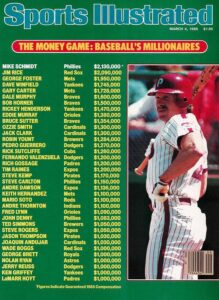 And the Mets won 98 games. Sometimes investing in players pays. And the Mets won 98 games. Sometimes investing in players pays.
***Getting Carter, shortly after the 1984 Winter Meetings concluded, was a game-changer, certainly a game-improver. Time will tell whether the Soto signing supplants the Carter trade as the most monumental December acquisition the Mets have ever made. (Get us a World Series title and you’re up there.) Time will also be asked to gauge whether Soto is the most impactful free agent we’ve ever brought in during any month. The reigning king of that category is Carlos Beltran, lured away in the wee hours of Saturday night/Sunday morning in January 2005. Happy early twentieth to that decision!
Soto is coming to a Mets team that just competed in the NLCS. Carter was coming to a Mets team that had just won 90 games. Beltran was coming to a Mets team wallowing beneath .500 and thirsting for a savior. If they were one or two players away following 2004, those players might as well have been (to steal a line from Dick Young) Babe Ruth and Walter Johnson. We settled for Pedro Martinez and Carlos Beltran.
Nice settlement. Pedro, 33, was a legend, if edging into inevitable creakiness. Nonetheless, we were very happy to have him as our ace in the moment. Carlos, not quite 28, we were over the stratosphere about. He was a multitalented player, all his tools having been on display in the spotlight of the most recent NLCS. That’s where he carried the Astros to the lip of the World Series. That’s where his price tag rose. The Astros would have liked to have kept him. The Mets wanted him more, as in they’d pay more. The Houston offer was a reported seven years, $105 million. The Mets’ terms were same length, $119 million. The Yankees may have been given a chance to swoop in and get in our way, but they abstained, chasing Randy Johnson instead that winter and deciding they could throw only so much monetary weight around. All at once, Carlos Beltran looked at his options and decided he had always wanted to be a New York Met.
Taking in Soto’s delightfully substance-free presser (I don’t particularly care whether any of his erstwhile teammates rang him up while he was being courted), I remembered what a big deal it felt like that when Beltran was introduced, he said that he chose this downtrodden club of ours because under Omar Minaya and Willie Randolph and infused by their will to win, they were now “the New Mets”. Loved the hype. Loved watching Beltran arrive in St. Lucie a couple of days later for the team’s mini-camp, a passing rite of January, as if he couldn’t wait to whip this organization into shape and remold it in his own awesome image.
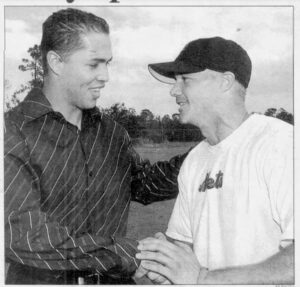 That wasn’t really Beltran’s personality. What did we know from Beltran’s personality? He’d been in Kansas City from 1998 until a month or so before 2004’s trade deadline, the essence of toiling in obscurity. Then he burst upon the postseason. We knew he was good. Suddenly it was clear he was great. Wouldn’t it be something if he was transformative, too? Yet Beltran’s vibe was far different from Martinez’s. Pedro, long an emblematic baseball figure, took over everything about the Mets to the extent he could in 2005. Of course he did. You didn’t need to be a Red Sox fan to know loads about Pedro Martinez. Wherever he went, it was going to be a scene. Low-key Carlos’s best public intentions would need a while to catch up to his inner capabilities. It was all right. There was only one Pedro Martinez. That wasn’t really Beltran’s personality. What did we know from Beltran’s personality? He’d been in Kansas City from 1998 until a month or so before 2004’s trade deadline, the essence of toiling in obscurity. Then he burst upon the postseason. We knew he was good. Suddenly it was clear he was great. Wouldn’t it be something if he was transformative, too? Yet Beltran’s vibe was far different from Martinez’s. Pedro, long an emblematic baseball figure, took over everything about the Mets to the extent he could in 2005. Of course he did. You didn’t need to be a Red Sox fan to know loads about Pedro Martinez. Wherever he went, it was going to be a scene. Low-key Carlos’s best public intentions would need a while to catch up to his inner capabilities. It was all right. There was only one Pedro Martinez.
After 2005, Beltran grew into his leadership role, definitely modeling a formidable veteran presence over time. And he sure went about hitting and fielding once he grew comfortable in New York. But I think we expected the sun and the moon out of a star, to his initial detriment. The superstar required a wingman to produce to his potential. Most superstars do. Beltran didn’t have a Hernandez and Strawberry to take the pressure off the way Carter did, not until Delgado came aboard, and Wright was a year older. Soto has a Lindor. We all have a Lindor, thank goodness. No new saviors necessary this winter. One took up residence here in 2021, even if it took a while to realize we had one…and it took a while for Lindor to realize how to best execute his saviorship.
***As long as we’re reliving game-changing acquisitions and signings, let’s not forget that Mike Piazza was both. We traded for his expiring contract in May 1998. That alone was a statement. We could have waited the seven weeks it took for All-Star catcher Todd Hundley to return to action and I wouldn’t have said boo. Or booed. I thought we had a genuine Wild Card contender and was content to get by with our array of backup catchers until Todd could return to his rightful place behind the plate.
“Nah,” the Mets forced themselves to decide. “We can get Piazza. We gotta get Piazza. We got Piazza.” Then, despite the 1998 aspect of the equation not adding up in terms of earning a playoff berth (not Mike’s doing; he was on fire in September), the Mets convinced Piazza to stick around from 1999 through 2005. Seven years and $91 million would make any person realize how much they liked a particular place, though one assumes the money was gonna be somewhere if Mike wanted to seek it. He liked his new surroundings enough to make them semi-permanent. There’d be a year in San Diego and a year in Oakland much later, but check out the cap on his Hall of Fame plaque. He’s been a New York Met forever since 1998, and the New York Mets are forever better off for it.
The Mets even managed to pool enough dough to lure free agents Robin Ventura and Rickey Henderson onto their roster for 1999, and the hunt for the playoffs remained in full effect. Still, you always felt back then if you attracted hitters, you might not be able to pay pitchers. Little Dutch Boy finger-in-the-dike stuff. I don’t know if that was true. I don’t believe we’re gonna have to worry about prioritizing with Steve Cohen involved.
***The Mets signed a Yankee! A Yankee the Yankees wanted to keep! The more I think about it, the less I find that a reason to deploy exclamation points.
Juan Soto had a helluva year in those other pinstripes, his only year in that outfit. Won his way station a pennant with a dramatic swing. Then he was ready to exit stage Boras and pursue free agency. Sound like anybody we knew for one year once?
Mike Hampton is the answer I’m looking for. Mike Hampton was a top-flight pitcher (22-4) for whom the Mets traded to advance them further into the postseason than they’d gone the year before. It worked. The 1999 NLCS runners-up won the National League championship in 2000. Hampton threw a three-hit shutout to clinch it. Won the MVP of his signature series. Yet Hampton ultimately viewed New York (NL) as his way station between trade and free agency. The Mets offered him a nice contract to put down roots (just as Houston offered such a deal to Beltran). Colorado offered him a nicer one. He took Colorado’s. Even with the infamous “schools” remark, I didn’t take it as an affront. Business brought Hampton to Shea. Business sent him to Denver.
The Soto business is something every team should have sought getting in. The Mets got in. The Yankees wanted to stay in. The Mets prevailed. Technically, we got a Yankee. Really, we got a player. I could see the “how could he leave the Bronx?” angle when Bernie Williams nearly left that crew for Boston between 1998 and 1999. Williams had been there his entire decorated career. Soto was just passing through. It happens every winter.
***The Mets dared compete with the Yankees for a high-level free agent? It hadn’t happened often, but Soto wasn’t the first object of simultaneous interborough affection. Once upon a time, the Mets went hard after Dave Winfield. They were serious bidders, both in intent and moolah. This was December 1980, the end of the first year of Nelson Doubleday and Fred Wilpon partnering in ownership, with Frank Cashen serving as the baseball brains of the operation. They were not the previous regime, for whom free agency — the ability of players to sell their services and therefore benefit from capitalism — was a blasphemic insult to a cherished way of life. They’d forged progress in several meaningful ways in the summer of ’80. Competitive on the field for a spell. Attractive at the box office, relative to how the Seventies wound down. They were moving out of the shadow of their own end zone in terms of not being the joke the brand became from 1977 to 1979.
What better way to prove seriousness than go after the Carlos Beltran of his time? Dave Winfield of the Padres had five tools and the All-American audacity to cash in. The Mets were signaling they planned to be a legitimate entry in the National League for years to come. The Mets under M. Donald Grant sat out the Reggie Jackson sweepstakes and wouldn’t even shop the less pricey aisle and make a real move to lure Gary Matthews in the first year of free agency. Matthews wasn’t a megastar, but he was, in his day, a potential stalwart for a team dedicated to staying above .500, which is where the Mets had maintained residence every year but one since 1969. Tom Seaver wanted the Mets to pursue Matthews. But why would Grant care what his franchise pitcher had to say about elevating the team behind him?
That was 1976 going into 1977 going into the depths. Nineteen Eighty going into 1981 could have represented another step out of hell. A giant leap. The new, enlightened owners were in place. The savvy GM was in place. Traces of talent were in evidence. Now, let’s go get Dave Winfield! The Mets put a reported eight years on the table, a total of $12 million, the psychic equivalent of $765 million over fifteen years then. The entire Metropolitan Baseball Club of New York went for $21.1 million the January before. Winfield could have taken it and taken over a metropolis. He could have stayed in the league he knew and not have to learn new strike zones (this was a concern in those days). He was interested enough to seek assurance from the Mets that he wouldn’t be the extent of the 67-95 ballclub’s reclamation project. Cardinal first baseman Keith Hernandez, a year removed from his co-MVP season, was mentioned as a potential trade target. The pieces were within grasp to create a beautiful marriage.
“It seems to have come down to the Mets and the Yankees,” wrote up and coming Daily News columnist Mike Lupica on December 5, “the first-ever New York, New York confrontation in the marketplace. The Mets need to win this fight. They need to prove to their starving fans that they are some good guys who can win. The Mets have to scrape together a deal at the winter meetings, show Winfield that they mean business. Then they must offer him enough money to keep him in the National League while still bringing him to New York. This is how the Mets can bring National League baseball back to New York.”
George Steinbrenner, implicit in Lupica’s calculation as the opposite of a good guy, came in with more years and more money. Winfield would learn the American League strike zone. He’d also watch the next ticker-tape parade bestowed on a New York World Series champion on television, and not because he overslept it. You wouldn’t have known when the Yankees beat the Mets to Dave Winfield in December 1980 how much New York was about to be enjoying National League baseball in a few short years. A painful interregnum bridging the darkness of de Roulet and the brilliance of Doc & Darryl had to be endured first, but the lights would switch on soon enough.
Dave Winfield might have fit the description of generational ballplayer, a phrase thrown around to identify Juan Soto. By definition, not too many of those come around. Perhaps that’s why the Mets, under their “good guy” ownership of Doubleday and Wilpon for the balance of the occasionally collusive 1980s, didn’t go after big-time free agents. But they did put their resources to work for the betterment of their ballclub. Traded in 1982 for George Foster and extended him for what a player of his caliber (which was high) was worth. Traded in 1983 for Keith Hernandez and then paid him a handsome sum to keep him from contemplating a way out. Assumed Gary Carter’s contract, a substantial package, when they gave up four players to land him in 1984. Nurtured their farm system all the while. The Mets who hadn’t known what to do with free agency when it started became the Mets who worked well within the system that included free agency — without necessarily dipping directly into free agent waters. In between their Grant incarnation starving us and their Cashen incarnation sating us, they attempted to harpoon one offseason’s biggest whale. Their spear was impressive, just not the most effective in the competition.
***I recently listened to Terry Collins’s podcast. Perhaps you didn’t know Terry Collins has a podcast. We live in a future when for 15 minutes we all have a podcast. This was an episode from the middle of the past season, before the past season became the past season we grew to know and love. This was when the past season was struggling to attain ‘meh” status. It certainly predated the Soto signing and the attendant analysis of what a sea change it represented vis-à-vis the Mets rising up for the first time EVER to match let alone outdo the mighty Yankees, per too many media members who believe history started when they first started paying attention.
To counter that notion, I bring you Terry’s guest from that June episode, Howie Rose, who’s been hip to everything about New York baseball since 1961, the year he first started watching. He had twice as much to watch within a year of his introduction, all of which he brought to bear when answering a listener’s e-mailed question about what makes Mets fans unique, especially in light of “their neighbors” having so many championships to crow about.
Howie’s entire answer seems worth repeating all these months later.
“There is a unique identity to the Mets, and younger fans cannot possibly understand what the Mets meant in New York from their very beginning in 1962. You know, the Yankees had just come off of one of the great years in baseball history, 1961. But remember now, there were two fan bases that were disenfranchised when the Dodgers and the Giants left just five years before the Mets played their first game. So whereas you might have thought that with no National League baseball in New York, a lot of those fans would have gravitated to the Yankees, that wasn’t the case. The Yankees’ attendance for those four interim years was flat. They didn’t get any more fans because the Dodgers and Giants left.
“So the creation of the Mets was cause for major celebration. Casey Stengel did an incredible job of selling that team. And even though the Yankees were champions, the Mets, to a large extent, owned New York, even during some of those great years for the Yankees, and then on through until 1969, when the miracle of baseball miracles took place, and comparatively you could not find a Yankee article in the newspapers back in those days, the Mets had such a stranglehold on the city, as they did in the 1980s as well.
“So this whole business about the Mets being the little kid brother to the Yankees could not be anything further from the truth historically. If it’s been lately, that mindset needs to change, and I think under this ownership [it’s going to].”
The Yankees responded to losing Soto by signing Max Fried — thanks for taking him off the NL East’s hands — and trading for Devin Williams and Cody Bellinger. They’ll still spear their share of whales. But so will we. Even if we hadn’t gotten Juan Soto, the fact that Steve Cohen had gone after him with every intention of making it happen filled me with confidence. If not Soto, I figured, then somebody else to fill another need. We won’t be out on anybody we want to be in on.
Had free agency existed in 1962, I imagine that’s how Mrs. Payson would have played things. She wasn’t looking to bring anybody’s “little brother” into this world, let alone this town.
***“Not only does Juan provide historic levels of on field production, but his joy, intensity, and passion for the game mirror our budding culture.”
One sentence in a press release, and that was all I heard or read regarding “Mets” and “culture” this offseason. Every offseason since I don’t remember when has included a press conference in which an owner, a general manager or a manager hailed the culture that was being planned to change the New York Mets from whatever was wrong with them to whatever was going to make them less incorrect. You sort of want to believe it the first time you hear it. Hearing it too many winters tends to frost your windshield.
This offseason, after the playoffs, after the lovin’, in sync with the Soto, it’s one sentence, attributed to the president of baseball operations who doesn’t have to talk up the culture. We all experienced it for real from June on. We’re willing to trust David Stearns to build on what’s been started rather than promise to construct another from scratch.
Not that we wouldn’t like a little more to add to Soto besides Yuhi Sako, Brandon Waddell, Jared Young, Chris Williams and Griffin Canning, if not Alex Reyes.
***The delightful-surprise aspect of 2024, with its dollop of innocence, can’t be repeated in 2025. Unpredicted icons may appear from out of the orange and blue, and we may rally around sets of letters that meant nothing to us in a Metsian context before, but we can’t ask Grimace magic to materialize from the mists, and — whatever becomes of free agent infielder/vocalist Jose Iglesias — “OMG” now belongs to the playlist ages. “L.A. Woman” didn’t make it to 2000, and only Armando Benitez adopting “Who Let The Dogs Out?” as his entrance music kept the Baha Men barking in 2001. “Takin’ Care Of Business” debuted as the Met victory song in 2006 and served honorably through 2014, but it always belonged to 2006.
Each winning team creates its own groove, though some notes resonate through the years. At heart, we’re scrappy as hell. In reality, our culture values signing superstars to fifteen-year contracts paying $765 million. Mets made money in 2024, too, but you’d be forgiven if you believed they were playing ball for the fun of it.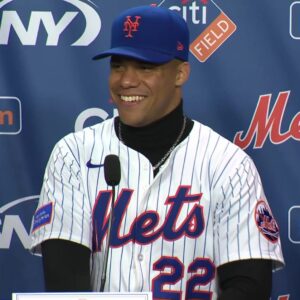
The Soto signing nudged 2024 ever so gently into the past. It happens one way or another when every calendar nears its end. The start of something big rather than a one-off blast is how we hope to recall 2024, meaning 2025 picks up where 2024 leaves off, and lord help it if another 22-33 start befalls us. Newsday reports hotcakes aren’t selling as speedily as tickets to see Soto and associates: “According to the Mets, it took 45 minutes on December 9 for the club to sell more tickets than it did on the entire first day of sales for the 2024 season.” Consumer patience ain’t what it used to be, so a blitz from Opening Day forward is advised.
Though if we require another late-season surge to burst through the gates of October, it will no doubt only add to the legend of those Amazin’, Amazin’, Amazin’, Amazin’ Mets.
***Should Juan Soto not total 253 home runs between 2025 and 2039, it will indicate we signed a helluva singles and doubles hitter. Come to think of it, if Francisco Lindor, whose Met homer sum sits at 110, doesn’t add another 143 over the next seven seasons, that will be undelightfully surprising. Both men should pass Darryl Strawberry’s franchise career record of 252 in due time — and if you wish to dare to dream on the likes of Mark Vientos and Francisco Alvarez refining and maintaining their respective power strokes, those two aren’t unreasonable possibilities to do the same thing, contracts willing.
But there’s an easier way to crown a new all-time Mets home run champ. Sign the guy who’s twenty-six homers away. Pete Alonso’s 226 are so close to Strawberry’s 252 that we can taste it. It’s absolutely Arctic. C’mon, the Polar Bear can’t be permitted to stray from his natural habitat, not when he’s so close and we’ve got a core that won’t be the same without him. It’s like imagining the Washington Nationals without Bryce Harper or the Baltimore Orioles without Manny Machado.
Or any number of teams who grow their own stars but see them leave for greener pastures. The Nats (with Soto) went on to win a World Series sans Harper, with whom Washington stuck until free agency struck. The Orioles’ endless rebuild picked up genuine steam a few years after Machado, traded to L.A. before he could walk away altogether. Your results may vary. I’m not yet fully prepared to reckon with the other side of baseball’s free market, but it’s beginning to occur to me it’s a possibility Alonso wanders off, despite there being no pastures greener than Steve Cohen’s. Maybe Pete sees a better situation for himself somewhere else. Maybe Stearns sees a long game whose outcome works better with another first baseman and premier slugger in Pete’s stead. I see a lifetime Met who, good health willing, will swat in the neighborhood of 400 homers as a Met. I don’t want to see him go away.
Except for the good health element, we never had these problems with David Wright, who was a cinch to pass Darryl had we not all been compelled to Google stenosis. Yet another reminder that one never knows how anything works out.
At least you can have a hunch that they’ll work out better when you’ve got Cohen, Stearns and Soto all on your side. Maybe that’s 2024 going on 2025 talking. I don’t have worst-case scenarios in me right now.
by Greg Prince on 13 December 2024 3:50 pm It’s the 242 home runs, it’s the 1,777 base hits, it’s the seven All-Star appearances, it’s the matching pairs of Gold Gloves and Silver Sluggers, it’s the 30-30, it’s the Captaincy, it’s the four RBIs in his first postseason series, it’s the four RBIs in his final postseason series nine years later, it’s the electric slash lines that sliced through his team’s consecutive notorious Septembers, it’s the 2004 debut that was hotly anticipated when he was fresh and twenty-one because you gotta see this kid, it’s the necessary 2018 au revoir when he was compromised and thirty-five drawing 43,928 into a group hug tight enough to make you forget that an appreciative squeeze of the object of affection was best handled with care, given the condition of his spine.
A figurative embrace for the literal love of our 21st-century lives as Mets fans was how it ended. It was as appropriate a response on our part as it was a reluctant farewell on his part. But it was always gonna be au revoir rather than farewell, because David Wright was never going to stay away. He had been here too much and too long to let a little detail like concluding his playing career get in the way of his ever present presence.
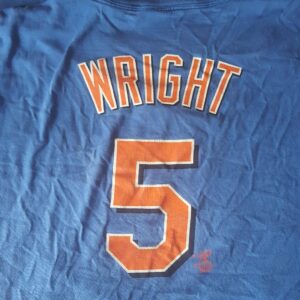 Up above the left field seats at Citi Field is where you’ll find him from July 19 forward, his retired number 5 representing a body of Mets work that is as singular as the digit deemed ready to take its Wrightful place alongside, suddenly, so many others. Long ago, 37, 14 and 41 sat eternally undisturbed by other numerical homages to icons who’d graced the orange and blue. The icons came, went and hovered. The homages were absent. Seemed kind of lonely and chilly in the tangible Metsian stratosphere. 37. 14. 41. Yoo-hoo, is there anybody else up here? The ice broke with 31, and within a few years, the pond of overdue recognition had altogether melted. 36. 17. 24. 16. 18. Up above the left field seats at Citi Field is where you’ll find him from July 19 forward, his retired number 5 representing a body of Mets work that is as singular as the digit deemed ready to take its Wrightful place alongside, suddenly, so many others. Long ago, 37, 14 and 41 sat eternally undisturbed by other numerical homages to icons who’d graced the orange and blue. The icons came, went and hovered. The homages were absent. Seemed kind of lonely and chilly in the tangible Metsian stratosphere. 37. 14. 41. Yoo-hoo, is there anybody else up here? The ice broke with 31, and within a few years, the pond of overdue recognition had altogether melted. 36. 17. 24. 16. 18.
Now 5 makes it ten.
Yes, it’s the statistics, the accolades, the longevity and the one-and-only-one uniform — no arrival from St. Louis; no leaving for Los Angeles; no tearful homecomings, because Flushing was always home — to go along with the one number David wore on his front and back while carving his name atop so many columns of the Met record book that contributed to the inevitable becoming a reality. The ceremonial retirement of 5 could have been penciled in as a TBD event under “when” rather than “if,” same as Wright’s presumed eventual induction into the club Hall of Fame, while David was riding his considerable pre-stenosis peak. Both rituals could have been rubber-stamped the night he bowed out as an active player. Both, we learn in the wake of another joyous offseason bulletin, are happening on one Saturday afternoon in 2025, seven seasons after Wright’s final swing. Only Tom Seaver, barely a year beyond calling off his would-be comeback in 1987, was ushered into utter franchise immortality sooner, his number unveiled and his sculpture (before they replaced HOF busts with plaques) presented on the same summer day in 1988. David therefore joins Tom as the only Mets to receive what amounts to a divine daily double.
Historically, the Mets have been glacial about bestowing finishing touches to their fairly obvious masterpieces. Jerry Koosman retired after the 1985 season. His 36 waited 36 years to be hung, getting rafterized in 2021. Keith Hernandez’s 17 (1990; 2022) waited almost as long. Willie Mays’s 24 (1973; 2022) waited way longer. Doc Gooden’s 16 (2000; 2024) and Darryl Strawberry’s 18 (1999; 2024) waited long enough. Mike Piazza’s 31 (2007; 2016) was veritably fast-tracked, but had to be co-signed by Cooperstown before previous Mets ownership would act. Let’s be glad somebody in charge has figured out you shouldn’t make house legends wait forever.
David’s credentials for the tiers of honor where his legend will now officially reside stack quite handsomely — analytically, anecdotally, absolutely. Yet it’s one more thing, gleaned observationally, that I believe directed David decisively to the Mets Hall of Fame and elevated 5 to the rafters.
From July 21, 2004, to September 29, 2018, David Wright reigned as King of the Grind. For 1,585 major league games, David just kept on grinding. For the hundreds of games that constituted 2009 to 2014 in particular, rooting for the Mets was a grind. You did it, probably, because you’d conditioned yourself to at a tender age. You hoped those years, their stagnation already in progress, wouldn’t grind your spirit for your team to dust. They came awfully close. But there was, whenever physically available, David Wright. David Wright never emitted any sense that playing for the New York Mets was less than a blessing, regardless that watching the New York Mets he fronted bordered on chore.
You chose baseball. You chose the Mets. You didn’t choose it for the relentless mediocrity that set in roughly the same time hired trucks carted away the last debris of Shea Stadium. Fortunately, they left behind a gem. They left Wright. Diamond Dave sparkled all he could in the dross years. Sometimes the surest sign of a star is the ability to show up and keep going. Except for acceding to the realities of a conk on the head in 2009 and a grab of the back in 2011, David grinded and grinded at Citi Field and wherever the string the Mets were playing out took them. David grinded ceaselessly into the promising year of 2015, then grinded to make sure it would be a pennant year. He grinded out of view in 2016 and 2017 and 2018 until we insisted we have our one last look at him. He grinded until he could grind no more. Never ceased serving as face of his franchise, whatever state his franchise found itself in through no fault of his own. Kept hitting, kept running, kept fielding, kept smiling within reason. If he didn’t exactly grin, he never grimaced. David Wright was the essence of happy to be here, quietly but clearly ecstatic to be a New York Met every day he was a New York Met, which, not coincidentally, was every day.
There were too many Met seasons in the midst of David Wright’s career when the Mets didn’t contend. There was a lot to suggest “same old Mets” in those seasons. If you came out to the park and you focused on No. 5 at third base, you knew there was at least one reason to be thankful they were.
by Greg Prince on 9 December 2024 2:20 am I decided to keep a new list for myself this winter, that of offseason additions. Every time the Mets make a move, no matter how minor, I open a Word file and type in the player’s name and his position; I also add his birth info to the conditional section of my all-time roster so if/when player sees action in a Mets uniform, I won’t have to look up any vital stats. I can’t say it’s a time-saving device as much as it’s a way for me to stay engaged with the inevitable personnel shuffle each winter brings. Every February, I find myself mildly flummoxed by various new faces, thus I figure by getting an early jump on these guys’ basic identities, they won’t seem like total strangers to me in St. Lucie, let alone should they make the team come late March.
I’ve added the names in chronological order of acquisition. Names like Chris Devenski and Dylan Covey and Kevin Herget, to name the first three. No, I’d never heard of them, either (they’re righthanded pitchers). Within a couple of weeks, I was decently familiar with some of the talent procured by David Stearns. I surely recognized the outfielder Jose Siri and the first baseman Joey Meneses. Jakson Reetz is a catcher whose spelling rang a bell. Reliever Genesis Cabrera isn’t pronounced like he’s spelled, not to those of us who first acquainted ourselves with Phil Collins in his pre-solo days. Of course Luis Severino replacement Frankie Montas was a name that didn’t need much introduction. Clay Holmes, neither, even if he’s going to have to say hello to the first inning for the first time in a while.
I have twenty names in all on the list so far. The three most recently entered are Edward Olivares, Oliver Ortega and Juan Soto. Entering Olivares, an outfielder, and Ortega, another righty pitcher, was business as usual. When I had reason to type “Juan Soto” on a list of Mets is when I nearly plotzed from realizing Juan Soto can be inserted within a list of Mets and it’s not a typo.
Juan Soto is a New York Met. I wasn’t counting on that. I wasn’t counting against it. I pledged to myself I wouldn’t allow my happiness to hinge on a young millionaire’s thought processes regarding how he was going to be come a slightly older multimillionaire many, many times over. I sure wasn’t against the Mets going after Juan Soto. But I was sure I wasn’t going to let Juan Soto not becoming a Met ruin my state of mind. Soto to the Mets? Great! Soto not to the Mets? Life goes on.
Now we get the best of all worlds, as can be gauged from the second week of December: life goes on with Soto on the Mets. That’s a life I’m willing to try.
 ¡Bienvenido, Juan! Greeting the newest superestrella de Los Mets with open arms. The old adage that “it’s not my money” is why I’m not worried about the staggering numbers that it took to get this deal done: $765 million across 15 years, with allowances for optouts and elevator clauses. Kid’s here a while, at least five seasons. Still a kid at 26. As good a hitter and on-base machine as there is. And he’s on the Mets, with Francisco Lindor and Mark Vientos.
Life goes on and gets better, Metwise. It’s surely got a solid baseline. I don’t know what the rotation will look like. We wouldn’t know that as of the second week of December no matter what Soto decided. I don’t know if our homegrown slugging first baseman will be back. I can’t imagine Pete Alonso won’t get an offer from Steve Cohen that would satisfy a regular person. The Polar Bear might have his own ideas. We’ll see.
We’d see, anyway. We need a fully stocked team and then we need that team to go out and contest all its games, succeeding in enough of them to qualify for another postseason, and in that postseason, succeed some more. Baseball basics right there. Securing the services of Juan Soto isn’t the end of what needs to be done to spark joy.
But, boy oh boy, does it ever start the fire.
The pundit talk in the wake of the news that Juan Soto is a Met (say that three times fast; then three times slow; then as many times as you like at any pace you choose) centered on what it means that the Mets plucked away a player who had been a Yankee, and who the Yankees were intent on keeping. If the Mets could outbid, outcharm, outswag the Yankees, the coalescing conventional wisdom seemed to suggest, everything forever assumed about how baseball works in New York is no longer automatically operative. The ghost of George Steinbrenner no longer wins every battle just by blustering “boo.”
I should be extra delighted that we scored one in the offseason edition of the Subway Series, and I suppose I am, but to be over the moon about that aspect of Juan Soto becoming a New York Met would indicate I believe it’s foreordained that the Yankees maintain an eternal edge in every significant baseball category, save heartbreak. I never have. I know recent decades indicate otherwise, but I have a functioning memory. I remember New York in 1969 and the first half of the 1970s. I remember when worms turned in the mid-1980s and stayed turned until the early 1990s. Though the leagues have been redesigned to be barely distinguishable from one another, I have always clung to the founding principle of the New York Mets — that what at heart was a National League town required a National League team to make itself whole. That DNA never fully dissipates. When we went to the World Series in 2015, the atmosphere around the region harked back. For a couple of weeks this October, I could honestly sense a rumbling that whispered plates were shifting, if just a smidge, to where they belong.
Nevertheless, I recognize the Mets’ failure to fully re-establish themselves as what they were in their most glorious days and the toll it took in the market. We had ownership that got in its own way too often, to put it kindly. We came up short in potentially defining moments. Hearts and minds were there for the capture, and we let them go. I walked along Main St. from the subway station to the hotel where QBC was taking place Saturday — downtown Flushing, for goodness sake — and I spotted I think four Yankees caps. Probably another couple on the 7 and LIRR coming and going. Par for the course most anywhere I’ve been in the Metropolitan Area since let’s say 1996. I didn’t doubt that those caps I saw Saturday were fashion accessories more than they were symbols of unshakable baseball allegiance, but I also knew that the logical alternative to a Yankees cap in New York has not, in the past thirty years, been what you’d call fashionable outside our diehard circles.
And maybe I don’t care about such trends as much as I do who’s gonna fill out the infield and who’s gonna set up Diaz. But I’d sure like to see a few more Mets caps worn on December mornings by people who don’t quite know why they’re wearing them, yet wouldn’t think of leaving their home without one on their head. My long-term goals for this franchise have been 1) win consistently, so reaching October isn’t a novelty; and 2) kill the “little brother” narrative that didn’t exist as a staple of the New York baseball dialogue until the Mets were in their thirties. The first part, with the owner we’ve got and the front office we’ve got and the playoff structure that exists, seems within reach. The second, I figure, will follow.
Luring Juan Soto with ample Cohen currency is part of that. But so was trading for and then signing Lindor long-term. And keeping Diaz. And keeping Nimmo. And cycling out Scherzer and Verlander as fast as they were reeled in once it became apparent their continued presence wasn’t advancing the cause. The cause was getting good and staying good. We got to this offseason good. We got better Sunday night. We signed Soto. He’s a Met. He wouldn’t be on my list if he wasn’t.
It’s sinking in. I’m still plotzing, but no worries. It’s the best plotzing possible.
by Greg Prince on 8 December 2024 12:16 pm Remove some obstacles — like a fence; the Payson Club; construction on the other side of Seaver Way; the Van Wyck; and a creek also identified as a river — and theoretically you could make a direct beeline from right field at Citi Field to Four Points by Sheraton Flushing, the fancy corporate name for the hotel where Queens Baseball Convention set up camp on Saturday. It’s just a long fly ball away from our ballpark, provided the long fly ball was pulled by a lefty slugger.
 The Sheraton is fairly convenient to the last stop on the 7 line, Flushing-Main Street, one stop beyond where I usually detrain, ergo I don’t mind the schlep it takes me to get there every December. The hotel is a ten-minute walk north on Main Street. You cross Northern Blvd., turn right, make your first left, and, provided you don’t walk into the stationary half of a sliding glass door (which a sleepy person might have come awfully close to doing, ahem), you’re an elevator ride away from QBC. The Sheraton is fairly convenient to the last stop on the 7 line, Flushing-Main Street, one stop beyond where I usually detrain, ergo I don’t mind the schlep it takes me to get there every December. The hotel is a ten-minute walk north on Main Street. You cross Northern Blvd., turn right, make your first left, and, provided you don’t walk into the stationary half of a sliding glass door (which a sleepy person might have come awfully close to doing, ahem), you’re an elevator ride away from QBC.
Once you’re at QBC, you’re in baseball again. Never mind that it’s December. Never mind that it’s freezing outside, the temperature unhelped by any winds whipping off the Flushing River/Flushing Creek. You’re inside now, surrounded by baseball fans and baseball warmth. Mets fans. Mets warmth. QBC has materialized most every winter since the one leading into the 2014 season to center a hot stove for our collective benefit. Warm your hands and fill the air with temperate takes.
Many of us who populated the second floor ballroom and associated spaces were in a right field state of mind Saturday on account of two right fielders, even though none of QBC’s four featured guests — Turk Wendell, Gregg Jefferies, Ray Knight and Jose Reyes — inhabited right field as Mets. I didn’t say we weren’t versatile. We could think about relievers and infielders, too. It’s a long winter. Baseball has lots of positions.
But right field, somewhere out the Sheraton window, entered our thoughts because of two right fielders who didn’t join the QBC fun. Juan Soto might someday be a special guest at a Mets fanfest like this. Or he might be a dim memory from that offseason when our owner made a very generous offer that Soto the intensely sought free agent spurned. On Saturday we didn’t know whose offer Soto wouldn’t refuse. We wanted him to accept Steve Cohen’s. It might have come up in conversation once or two-thousand times.
The other right fielder we would have loved to have seen has also never played a home game at Citi Field, but we did know him at Shea Stadium and have kept up with him through a lot of years since. Art Shamsky was the recipient of the 2024 Gil Hodges Unforgettable Fire Award. I was the presenter, filling the role I’ve been assigned since QBC began more than a decade ago. It’s an annual thrill for me to get to stand before a roomful of Mets fans and put somebody’s Met life and career in a bit of historical perspective. It fills me with Met pride to be able to invoke Gil Hodges and connect his too brief but forever impactful Met experience to those individuals QBC has opted to honor.
Art couldn’t join us on Saturday because you know how it is with New Yorkers in winter. Quite a few flee to Florida to escape our persistent chill. Not an unwise move, but we missed Art. I still gave the presentation and was fortunate that one of Art’s several co-authors — my compadre Matthew Silverman, who’s been working with Art on the forthcoming Mets Stories I Only Tell My Friends — was on-site to accept. I hope the applause the crowd gave Mr. Shamsky echoed south.
While we wait to hear whether Juan Soto will be roaming right field at Citi, I thought you might enjoy reading what I shared at QBC about the man who gave us true quality time out there at Shea between 1968 and 1971…especially in 1969. Art Shamsky was a fine player as a Met, and has been an even finer tender of the Met flame.
***I’m here to present the Gil Hodges Unforgettable Fire Award, an honor the Queens Baseball Convention conceived at its founding because we thought Gil Hodges’s contributions to the New York Mets and to baseball were too significant to EVER forget. True Mets fans never would, and now the rest of baseball need only visit Cooperstown or simply look at a list of Hall of Famers in order to be reminded of Gil’s greatness.
I couldn’t help but think of Gil’s finest work this past October. If you’re a Mets fan and it’s October, of course you’re going to think about 1969 — this October in particular, when the 2024 Mets pulled off a mini-miracle of their own. They didn’t go all the way, but they did overcome a world of doubters, they never showed any sign of giving up, and they became only the fifth team in franchise history to win a pair of postseason series. The first was 1969.
The other reason I thought about the 1969 Mets in October of 2024 was when the Mets invited back distinguished alumni to throw out and catch ceremonial first pitches before their five postseason home games, we had the chance to stand and applaud Mets from 2015, 2000, 1986…but not 1969. I don’t think there was anything nefarious about the omission, and for all I know, plans were being made to reach further back in time had the 2024 Mets made the World Series. Mostly, though, I figured it was just a matter of time marching on.
For those of us lucky enough to have experienced 1969 as Mets fans in the moment, we do the math and realize we’re now 55 years past that most Amazin’ of seasons. You then grasp how many 1969 Mets are no longer with us — including four to whom we’ve said goodbye this year: Buddy Harrelson, Jim McAndrew, Jerry Grote and Eddie Kranepool — and that those who are around maybe aren’t able to be around as much as they used to be.
For decades, no big Met occasion, like a postseason first pitch, happened without some direct participation of 1969 Mets. If you grew up in the era between 1969 and 1986 and tuned into a Mets game, you probably didn’t go a week without hearing about our first world champions. It came up reflexively between pitches. It was the best topic there ever was to revisit, so why wouldn’t the Mets revisit it every chance there was?
It might have been easy to take the presence of the 1969 Mets as so-called Old Timers for granted in those years. We’d hear about their exploits regularly and we’d see them pass through Shea no less than annually. I think we’re coming to a point when we understand how precious those experiences are becoming. Again, it’s not as if we as Mets fans will ever forget these miracle workers. It’s just that their collective profile is inevitably lowered, or perhaps obscured, by the passage of time and all that occurs in the span of 55 years going on forever.
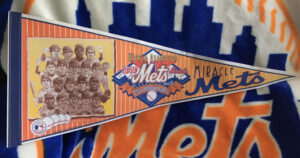 That is why what Art Shamsky has been doing all these years means so much. That is why we’re acknowledging what Art Shamsky has been doing all these years with the 2024 Gil Hodges Unforgettable Fire Award. Talk about keeping a torch lighted. Art has been front and center for decades as what the Sports Illustrated writer Michael Bamberger in 2009 called the unofficial class secretary of the 1969 Mets. He’d shaped the multiple celebrations surrounding their 25th anniversary in 1994. He rode out on a cart with Buddy Harrelson, the last time Buddy was able to make a personal appearance, at the 50th anniversary, in 2019, an expression of friendship that showed the Citi Field crowd how tightly 1969 binds those who made it memorable. He co-wrote two books capturing his and his teammates’ memories of a special time in New York, the second of them, After the Miracle, a poignant recounting of not only 1969 but his efforts to bring a cadre of Mets to California to essentially say goodbye to Tom Seaver in 2017. That is why what Art Shamsky has been doing all these years means so much. That is why we’re acknowledging what Art Shamsky has been doing all these years with the 2024 Gil Hodges Unforgettable Fire Award. Talk about keeping a torch lighted. Art has been front and center for decades as what the Sports Illustrated writer Michael Bamberger in 2009 called the unofficial class secretary of the 1969 Mets. He’d shaped the multiple celebrations surrounding their 25th anniversary in 1994. He rode out on a cart with Buddy Harrelson, the last time Buddy was able to make a personal appearance, at the 50th anniversary, in 2019, an expression of friendship that showed the Citi Field crowd how tightly 1969 binds those who made it memorable. He co-wrote two books capturing his and his teammates’ memories of a special time in New York, the second of them, After the Miracle, a poignant recounting of not only 1969 but his efforts to bring a cadre of Mets to California to essentially say goodbye to Tom Seaver in 2017.
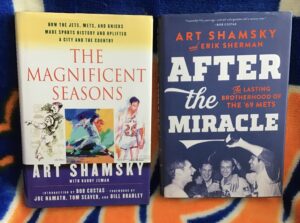 Certainly no player who knew what Gil Hodges was all about spoke more consistently or eloquently on Gil’s behalf prior to Gil’s induction into the Hall in 2022 than Art Shamsky did. Art became a Met in 1968, the first year Gil managed in New York. “The more the season progressed, the more the players knew who was in charge,” Art wrote in his first book, The Magnificent Seasons. Those Mets learned what Art termed “the Gil Hodges way of doing things”: mainly being professional on and off the field. The Gil Hodges way began sinking in, and it was in place in 1969, as Gil gained the trust of a clubhouse that resisted questioning the manager’s judgment, even if that meant less playing time for any individual. Certainly no player who knew what Gil Hodges was all about spoke more consistently or eloquently on Gil’s behalf prior to Gil’s induction into the Hall in 2022 than Art Shamsky did. Art became a Met in 1968, the first year Gil managed in New York. “The more the season progressed, the more the players knew who was in charge,” Art wrote in his first book, The Magnificent Seasons. Those Mets learned what Art termed “the Gil Hodges way of doing things”: mainly being professional on and off the field. The Gil Hodges way began sinking in, and it was in place in 1969, as Gil gained the trust of a clubhouse that resisted questioning the manager’s judgment, even if that meant less playing time for any individual.
That included Art, who split time in right field with Ron Swoboda. Art dominated the NLCS against Atlanta, Rocky was a hero in the World Series against Baltimore. It was a pattern that ran through each of Gil’s platoons. Under Gil Hodges, EVERY player made the Mets champions. And none of the players ever forgot Gil’s influence, certainly not Art, who concluded in After the Miracle that when Gil was hired, “the Mets had found themselves a leader of men.”
We at QBC certainly don’t want to forget Art Shamsky, an excellent hitter across nine years in the majors; an able defender in the outfield and at first base; a thoughtful storyteller in myriad media since hanging up his spikes; and, we take great pride in noting, a two-time attendee without billing of this event. He came our first year to support Gil Hodges Jr. when Gil Jr. accepted this award on behalf of his late father, and he returned a few years later to himself accept on behalf of Seaver, and then made sure to deliver the hardware to Tom personally when he, Buddy, Rocky and Jerry Koosman made that trip to Napa Valley. “Gil,” Art wrote in After the Miracle, “always held a special place in Seaver’s heart, and I knew the honor would mean a lot to him.”
Well, Art Shamsky holds a special place in the heart of the Queens Baseball Convention, and it is our honor to present this year’s Gil Hodges Unforgettable Fire Award to him.
As it happens, Art is in Florida right now — who can blame him in this weather? — but we will make sure he gets his award. We are thankful for his efforts on behalf of generations of Mets fans, on behalf of the legacy of Gil Hodges, and for all he’s meant in keeping the fire burning for the 1969 world champions. That ballclub couldn’t have elected itself a better unofficial class secretary.
by Greg Prince on 5 December 2024 1:41 pm Maybe Billy Joel’s Brenda and Eddie could never go back to the green, but I have no compunction about returning to scenes from my own fields of reality. Therefore, I welcome you anew to MY FAVORITE SEASONS, FROM LEAST FAVORITE TO MOST FAVORITE, 1969-PRESENT, a series counting down just what the title implies. I started this endeavor at the very end of calendar year 2023; continued it for the balance of what remained of the last offseason; took it into Spring Training; and then paused it when the PRESENT encroached on my ruminations.
The PRESENT, in the form of 2024’s Met campaign, carried the potential to complicate matters in terms of my rankings. I had a very definite 55-through-1 order I was working my way up when I stopped at No. 12 in late March to concentrate on Opening Day and the days to come. No biggie, I figured as 2024 got going, because it didn’t appear any great personal revelations would sprout as a result of what the 2024 Mets were up or, more likely, down to. I’d get back to my rock-solid list after the regular season and smush the most recent edition wherever it fit, presumably somewhere in Also Ran Land, hopefully not compelling me to messily rearrange my bottom rung. I figured the season then in progress would rate not much more than a footnote to this entire endeavor.
But then, OMG, 2024 became TWENTY TWENTY-FOUR and may have upended some calculations. Stimulating to live through. Discombobulating to reflect upon in FAVORITE SEASONS context. So here’s my plan: proceed from No. 11 forward as anticipated, then circle back to figure out where the last Met season — a Met season like no other — fits into my scheme of things.
That bit of housekeeping attended to, I bring you below another Met season that was also like no other. That’s a trick designation, because all Met seasons are unique, surface similarities notwithstanding. How they live on in the consciousness of a particular fan is where the singularity comes to play.
***11. 1990
April has been cited traditionally in baseball circles as a month when you shouldn’t necessarily believe your eyes, usually as it pertains to rookies who are the personification of a small sample size. The same applies to teams who stumble or surge out of the gate. If you want to sound sophisticated, say something like, “Let’s see where they are in June.” By June, the thinking goes, you know what you’re looking at.
Come June of one particular year, I saw what I wanted to see, maybe needed to see. Give me a little leeway with the calendar (lop a few days off the front of June, annex a couple of scoops of July), and in the course of my Met-loving existence, I can declare it a month for the ages in what turned out to be the year of a lifetime.
One of them, anyway.
If the assignment is to illustrate myself being a Mets fan at any time, in any place when and where I’ve been a Mets fan, I could pick a lot of times and a lot of places, as could you. But I couldn’t go wrong with a self-image that warms me all over.
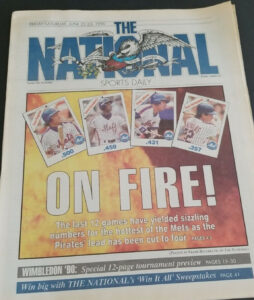 It’s late June 1990. It’s morning. It’s sunny. It’s hot. It’s after I drop my fiancée off at the train station, before I head home to get myself ready for work. It’s imperative that I stop for the papers. The Mets have won last night. The Mets have been winning every night. The Mets are on what will become an eleven-game winning streak. I park on our town’s main drag in a spot that I infer isn’t quite legal, but I’m only gonna be a minute. I run into the let’s call it candy store, though maybe it’s a cigar store or for that matter a luncheonette. I never stick around more than the length of the transaction, scooping up the News, the Post, Newsday, maybe the National and paying. Back in the car, back to our apartment, up to the kitchen table for a few minutes of soaking in another Mets win. It’s late June 1990. It’s morning. It’s sunny. It’s hot. It’s after I drop my fiancée off at the train station, before I head home to get myself ready for work. It’s imperative that I stop for the papers. The Mets have won last night. The Mets have been winning every night. The Mets are on what will become an eleven-game winning streak. I park on our town’s main drag in a spot that I infer isn’t quite legal, but I’m only gonna be a minute. I run into the let’s call it candy store, though maybe it’s a cigar store or for that matter a luncheonette. I never stick around more than the length of the transaction, scooping up the News, the Post, Newsday, maybe the National and paying. Back in the car, back to our apartment, up to the kitchen table for a few minutes of soaking in another Mets win.
So much of what it was like to be me at a given moment crammed into one paragraph.
It’s late June… My mother died on June 17, almost two years after her chronically bad back acted up beyond the usual discomfort and indicated something worse was happening. It was cancer. The end was in sight by February 1990. That the end was a blessing in its way didn’t make it any less of an end. Her funeral was on June 19. Those she was survived by — her husband, her children, their significant others — sat shiva for visitors that night and two more. I went back to work before the week was out. Sitting around being sad wasn’t accomplishing anything. “Things’ll go your way,” Wilson Phillips advised me as I pulled into my company’s parking lot, “if you hold on for one more day.”
I drop my fiancée off at the train station… I slipped a ring on my girlfriend’s finger the previous September. Then she slipped back to college for the completion of one more academic year. Those long months wound down just before April became May. I flew down to Florida, helped pack her up, watched her graduate, and flew with her to our new home. She’d never seen it before and neither of us had ever spent a night there. Yet she was all in. Within a matter of weeks, she’s lined up job interviews. She nails one by mid-June. They ask her if the death of her fiancé’s mother means she’ll need more time before starting. I tell her the active mourning period will expire conveniently. Her first day as a case manager tending to an elderly population on Manhattan’s Upper East Side is June 25. I drop her off for the LIRR, something she’s ridden before, but not to work. Just like that, barely two months removed from student life more than a thousand miles away, my intended is a daily commuter in the Greater New York Metropolitan Area. She’s 22.
Get myself ready for work. I’m 27. I kind of futzed around when I was 22, 23. The Mets were winning. I barely noticed anything else. At 24, I met Stephanie. Engagement was made official the September I was 26, when I’d been holding my first true full-time job for about six months. I needed to do something to afford a (humble) ring let alone that (humble) apartment that would set the stage for our life together. By June of 1990, it’s a comfortable enough situation careeerwise. Probably too comfortable. I’d begin to get a little sick of what I was doing — writing and editing for a trade magazine on Long Island — fairly soon, but not sick enough to do anything about it. Roughly every two years I’d have had enough, then have some more. Comfortable can be comforting when things around you are changing fast. My mother is gone. My fiancée is here. We’re living in this new place, which would require several rounds of moving. The people at work are very understanding when I need a few extra days in the first half of 1990 to take care of personal business. Nobody says anything if I show up at whatever time I do because I needed a few extra minutes to read the papers each morning.
The papers… What else was I going to read if I wanted to dive deep into what was going on with the Mets in June of 1990? Later in the year, Goodfellas came out and the character I related to most was Jimmy Two Times, the wise guy who said everything twice. He was the one who said he was gonna go get the papers, get the papers. That was me, times two. Get the News. Get the Post. Get Newsday. Get the National, even. Tabloid sports section heaven. The National, new in 1990 (and gone by 1991), was nothing but a sports section. They were all essential when the Mets were in season. How else would I know what One Met Said when the Mets were losing? How else would I get a feel for what was going right when the Mets were winning? Looking at your phone in those days meant staring at it waiting for it to ring, and it’s not like Bob Klapisch was calling you personally.
Eleven-game winning streak… Holy crap, the Mets were literally unbeatable. It wasn’t the first time the franchise had gone that long impervious to defeat; eleven was the record set when the 1969 Mets (rising from 18-23 to 29-23) awoke to the possibility that their perpetual lot wasn’t to be a punch line or punching bag, and it was tied in promising 1972 (surging from 14-7 to 25-7) and again in powerful 1986 (shaking off 2-3 to all but clinch the division at 13-3 before May arrived). But the timing here was most impeccable. The 1990 Mets had stumbled through April and May, unbecoming of their perennial contender status. At 20-22, they cost Davey Johnson, their most successful manager ever, his job. They bottomed out at 21-26. Longtime aide Buddy Harrelson, eternally a Met, except when he was passing through the Phillie and Ranger clubhouses — and maybe even then — was now steering the ship, but the early returns weren’t indicating smooth sailing was ahead.
 Then…ahoy, Metsies! On June 5 at Shea, Kevin McReynolds ties the Expos in the eighth with a two-run homer, and come the eleventh, it’s benchwarmer Tom O’Malley taking Dale Mohorcic deep to win the game and light a fuse. The Mets, stuck in fourth 8½ back, go on a 9-3 roll. The offense explodes, especially in Chicago, where we win 19-8, then 15-10, then 9-6. The wind really knew how to blow out in those days. Then…ahoy, Metsies! On June 5 at Shea, Kevin McReynolds ties the Expos in the eighth with a two-run homer, and come the eleventh, it’s benchwarmer Tom O’Malley taking Dale Mohorcic deep to win the game and light a fuse. The Mets, stuck in fourth 8½ back, go on a 9-3 roll. The offense explodes, especially in Chicago, where we win 19-8, then 15-10, then 9-6. The wind really knew how to blow out in those days.
Somehow winning nine of twelve is tantamount to a throat-clearing exercise. In full voice, the 30-29 Mets proceed to win eleven in a row and become the 41-29 Mets. It begins in Pittsburgh, which is important, since they’ve assumed control of first place and therefore require catching, and it begins on June 17, which is important to me, because that’s the day my mother died. The game was over before she breathed her last. Doc went seven, struck out eight and pulled the Mets to within six. The News made much of the Three Rivers speed gun saying Doc’s fastball touched 100 MPH, a Gooden first. Doc, along with Keith, ranked as my mother’s favorite Met. She didn’t make lists like I did, but I could tell. Keith had moved on to Cleveland. Doc was still here for us, firing faster fastballs than ever, and evening his record at 5-5.
 Then ten more Met wins in a row. Five at home, the spine-tingliest among them secured on a Sunday afternoon when Tim Teufel pinch-singled in the tying and winning runs in the bottom of the ninth off Roger McDowell. Three in St. Louis, including another eleven-inning thriller in the middle of the set (John Franco blows the lead in the ninth by allowing a leadoff homer to rookie catcher Todd Zeile, but HoJo comes through with a two-out, two run double to make the streak eight straight). Then back to Shea to take one on a Thursday night from supposedly unstoppable Cincy — they were going wire to wire in the West — and then another on Friday night. Bobby Ojeda scattered ten hits to secure that one, the eleventh consecutive New York victory. It vaulted us three percentage points ahead of the Pirates. Pittsburgh’s one ahead in the win column, but we’re one ahead in the loss column, because we have stopped losing. Then ten more Met wins in a row. Five at home, the spine-tingliest among them secured on a Sunday afternoon when Tim Teufel pinch-singled in the tying and winning runs in the bottom of the ninth off Roger McDowell. Three in St. Louis, including another eleven-inning thriller in the middle of the set (John Franco blows the lead in the ninth by allowing a leadoff homer to rookie catcher Todd Zeile, but HoJo comes through with a two-out, two run double to make the streak eight straight). Then back to Shea to take one on a Thursday night from supposedly unstoppable Cincy — they were going wire to wire in the West — and then another on Friday night. Bobby Ojeda scattered ten hits to secure that one, the eleventh consecutive New York victory. It vaulted us three percentage points ahead of the Pirates. Pittsburgh’s one ahead in the win column, but we’re one ahead in the loss column, because we have stopped losing.
And doesn’t the East know it?
METS VS THE DIVISION, June 5, 1990 – June 27, 1990
vs Montreal 2-0
vs Pittsburgh 5-2
vs Chicago 3-1
vs St. Louis 5-0
vs Philadelphia 3-0
Over a 32-game span that also incorporates interactions with the Reds (4-1), the Astros (2-0) and the Braves (3-1), we go 27-5. None of those five losses are back-to-back. It remains the longest stretch in Mets history to encompass only five losses. The Mets were never better over a 32-game span than they were between June 5 and July 12 of 1990. Baseball success isn’t usually measured by 32-game spans, but this one deserves its props. In the equivalent of one-fifth of a season, the Mets play at an .844 pace. That’s a 137-25 record extrapolated over 162 games.
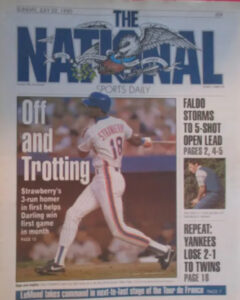 You can extrapolate to your heart’s content, but what happens on the field and how it lands in the actual standings is what counts, and that’s where 1990 drifts off toward the rocks again. It was a massive haul to rise to a virtual tie for first place as June was becoming July. So many Mets were so incredible for more than a month. Gooden kept winning. Frankie “Sweet Music” Viola kept winning. They were backed up by Coney (when he wasn’t arguing with umps while runners crossed plates) and El Sid. Bobby O was still capable of pitching a club into first place. Ron Darling was present as a reluctant recast swingman, though as a broadcaster he seems to prefer to forget he was ever a Met in the 1990s. I missed Randy Myers, who was Nasty in Cincinnati, but John Franco, for whom Randall K was traded the prior December, was born to be a Met, and now he finally was. Between Frankie and Johnny, the postgame interviews never sounded so authentically New York. You can extrapolate to your heart’s content, but what happens on the field and how it lands in the actual standings is what counts, and that’s where 1990 drifts off toward the rocks again. It was a massive haul to rise to a virtual tie for first place as June was becoming July. So many Mets were so incredible for more than a month. Gooden kept winning. Frankie “Sweet Music” Viola kept winning. They were backed up by Coney (when he wasn’t arguing with umps while runners crossed plates) and El Sid. Bobby O was still capable of pitching a club into first place. Ron Darling was present as a reluctant recast swingman, though as a broadcaster he seems to prefer to forget he was ever a Met in the 1990s. I missed Randy Myers, who was Nasty in Cincinnati, but John Franco, for whom Randall K was traded the prior December, was born to be a Met, and now he finally was. Between Frankie and Johnny, the postgame interviews never sounded so authentically New York.
Daryl Boston, who started the year on the White Sox, and Mark Carreon, who started the year on the bench, shared center to exquisite effect. Jefferies, HoJo, K-Mac, Mackey the Slasher, Dave Magadan who made Mike Marshall superfluous, and the crown jewel of the operation Strawberry combined to slug like crazy. Darryl, eight seasons into a career that had been outstanding but never quite brilliant enough to satisfy us fully, was, at last, everything we’d dreamed he’d be when he was drafted out of Crenshaw High a decade before. Made the cover of Sports Illustrated and marked the occasion by banging one off the Shea scoreboard (Boston went nearly as deep in the same inning, two months after Newhart — featuring two brothers named Da(r)ryl — aired its finale).
 Amid this 32-game stretch of 27-5, Strawberry’s individual offense was nearly as unbeatable: 14 homers, 36 ribbies and a .377 average. His OPS, whatever that was in pre-analytics 1990, measured 1.248. Straw was also rounding into form just in time for free agency. Cashen wouldn’t let him go, right? Hmm…Cashen let Davey go, and Davey was the winningest manager we’d ever had, just like Darryl already held the Met career record for home runs. Davey didn’t deserve canning, but you couldn’t complain about a thing Buddy was doing at the helm. He was, apparently, just what these Mets needed. Amid this 32-game stretch of 27-5, Strawberry’s individual offense was nearly as unbeatable: 14 homers, 36 ribbies and a .377 average. His OPS, whatever that was in pre-analytics 1990, measured 1.248. Straw was also rounding into form just in time for free agency. Cashen wouldn’t let him go, right? Hmm…Cashen let Davey go, and Davey was the winningest manager we’d ever had, just like Darryl already held the Met career record for home runs. Davey didn’t deserve canning, but you couldn’t complain about a thing Buddy was doing at the helm. He was, apparently, just what these Mets needed.
And these Mets were, apparently, just what I needed. In the nautical terms I’m suddenly fond of, they kept me anchored. So much transition swirling around me in so-called real life, yet here were the Mets, just as much a part of my existence as ever. There for me in a summer of loss, a summer of discovery, a summer of settling in, a summer of absorbing every word and statistic the papers printed about my Mets. Not only my Mets in name and logo, but my Mets who were permanently (since 1984, at least) competing for a championship. Finished first twice in the previous six seasons. Fought for first four other times, finishing second but knowing we should have been first. We were fighting to get where we belonged again. Playing badly enough in April and May to get their skipper tossed overboard was the aberration. Full speed ahead was more like it.
 It’s what the Mets had been like every season since they straightened themselves out. Since Doc. Since Darryl. No more Keith or Gary (or Mookie or Lenny or Wally, either), but wasn’t this how it was supposed to work? I grew into new circumstances as the ’80s became the ’90s. So did the Mets. Doc and Darryl were veterans. Other youngsters had been cultivated in their wake as the 1980s continued. Like Cone, who zipped from representing pitching inventory in ’87 to winning twenty games in ’88. Like Elster, who set an errorless streak record for shortstops in ’89. Like Magadan, whose ascent to the everyday lineup revealed a .328 hitter who was just waiting for his opportunity. Like Jefferies, the perceived problem child who had no problem when it came to doubling (he would total a league-leading 40 two-baggers by season’s end). They were all younger than thirty. They were all in or approaching their prime. The Mets as a year-in, year-out factor were built to last. Competitive sustainability that transcended players aging out or passing their peak was the beau ideal of baseball, and here it was, coming to fruition in Flushing four years after 1986. It’s what the Mets had been like every season since they straightened themselves out. Since Doc. Since Darryl. No more Keith or Gary (or Mookie or Lenny or Wally, either), but wasn’t this how it was supposed to work? I grew into new circumstances as the ’80s became the ’90s. So did the Mets. Doc and Darryl were veterans. Other youngsters had been cultivated in their wake as the 1980s continued. Like Cone, who zipped from representing pitching inventory in ’87 to winning twenty games in ’88. Like Elster, who set an errorless streak record for shortstops in ’89. Like Magadan, whose ascent to the everyday lineup revealed a .328 hitter who was just waiting for his opportunity. Like Jefferies, the perceived problem child who had no problem when it came to doubling (he would total a league-leading 40 two-baggers by season’s end). They were all younger than thirty. They were all in or approaching their prime. The Mets as a year-in, year-out factor were built to last. Competitive sustainability that transcended players aging out or passing their peak was the beau ideal of baseball, and here it was, coming to fruition in Flushing four years after 1986.
But the .844 pace was unsustainable. Come across any 137-25 teams in your travels lately? More concerning in the moment was the Pirates were proving naggingly indefatigable. Our .003 lead on June 29 — I can still see the standings in our neighborhood Friendly’s house copy of Newsday I couldn’t take my eyes off between patty melt bites — didn’t serve as a launching point to blow away our competition. Our winning streak ended, but our general roll extended: five more in a row, seven out of eight, including the opener of a twi-nighter at Riverfront that got us to 48-31 directly after the All-Star break. But we dropped the nightcap, and the Pirates persevered past the Padres in fifteen. As of the close of business on July 12, we sat a game behind the Buccos. We’d gone 27-5, yet it didn’t earn us as much as a share of first place. We’d made up an ocean’s worth of ground since Tom O’Malley struck lightning, but not enough to compensate for the inevitable market correction.
 Friday the 13th brought a second consecutive loss for the first time in seven weeks. The Mets dropped three of four in Cincinnati, then two of three in Houston. Winning returned to habitual if not constant (including a night at the Vet when a 10-3 laugher became a 10-9 nailbiter of a damn thing), and the Mets passed the Pirates for a few days here, a few days there, but there was no shaking the newest NL East nemesis. Slumps and injuries crept back in the picture. Mackey Sasser, who was always more about hitting than catching (or throwing) was never the same after getting bowled over at the plate in Atlanta in early July. Kevin Elster went out for the season in early August with a torn labrum in his right shoulder. There went dependable defense up the middle. Friday the 13th brought a second consecutive loss for the first time in seven weeks. The Mets dropped three of four in Cincinnati, then two of three in Houston. Winning returned to habitual if not constant (including a night at the Vet when a 10-3 laugher became a 10-9 nailbiter of a damn thing), and the Mets passed the Pirates for a few days here, a few days there, but there was no shaking the newest NL East nemesis. Slumps and injuries crept back in the picture. Mackey Sasser, who was always more about hitting than catching (or throwing) was never the same after getting bowled over at the plate in Atlanta in early July. Kevin Elster went out for the season in early August with a torn labrum in his right shoulder. There went dependable defense up the middle.
Reinforcements shuttled in. Kelvin Torve was promoted in August and scalded the ball, wearing No. 24 until it was rightly judged a sacrilege; he was issued a less fraught set of digits. The postseason-eligibility trade deadline unveiled a pinch-hitter famous for delivering with the bases loaded, Pat Tabler, born too soon to take advantage of any Golden At-Bat innovations; a new defensive specialist catcher, Charlie O’Brien (we went through seven backstops in 1990, including 1970s survivor Alex Treviño and MLBer for a day Dave Liddell); and a new middle infielder, Tommy Herr, whose participation on the wrong side of the Met-Cardinal wars of the ’80s we were willing to overlook. The answer to both Darling and Ojeda not pitching to their respective previous forms as starters was divined in the Triple-A personage of Julio Valera.
 When you wish upon an unproven starter, dreams can sometimes come true. On September 1, a Saturday afternoon affair telecast to the nation by CBS, it all clicked. O’Brien caught Valera for six solid innings. Herr homered. Ojeda and Darling served as effective setup men for Franco, no matter that neither man fancied himself a reliever. Bobby O wasn’t happy: “I will do the best I can to keep my mouth shut.” Ronnie D wasn’t happy: “I am shocked. I am hurt. I never expected this.” Ultimately, Julio V wouldn’t delight Mets fans (he’d make two more starts, neither successful), but the outcome in the short term was unquestionably happy: the Mets beat the Giants, 6-5. Combined with the Pirates’ 2-1 loss in ten at Houston that night, the Mets leapfrogged into first place, perfectly positioned for the stretch drive ahead. When you wish upon an unproven starter, dreams can sometimes come true. On September 1, a Saturday afternoon affair telecast to the nation by CBS, it all clicked. O’Brien caught Valera for six solid innings. Herr homered. Ojeda and Darling served as effective setup men for Franco, no matter that neither man fancied himself a reliever. Bobby O wasn’t happy: “I will do the best I can to keep my mouth shut.” Ronnie D wasn’t happy: “I am shocked. I am hurt. I never expected this.” Ultimately, Julio V wouldn’t delight Mets fans (he’d make two more starts, neither successful), but the outcome in the short term was unquestionably happy: the Mets beat the Giants, 6-5. Combined with the Pirates’ 2-1 loss in ten at Houston that night, the Mets leapfrogged into first place, perfectly positioned for the stretch drive ahead.
Nineteen Ninety marked the seventh consecutive year when September dawned and the Mets were no less than in it. You know…it. First place or a conceivably close second. Finish first, go to the playoffs. Finish second, go home. Finishing first was immensely preferable. Finish second, it was still quite a year, probably. But finish first, OK? Being in it is great. Being around to win it in October is the idea. I thought we’d win the NL East at the outset of September 1990. That may have been June and the first part of July talking, but I also thought we’d win the NL East at the outset of Septembers 1984, 1985, 1987 and 1989. I didn’t have to do much thinking on the subject entering September 1988 or any at all of this nature in the summer leading to September 1986. We’d had two divisions under lock and key; four going on five had been up for grabs. We’d never grabbed any of those we didn’t fully control in this era. September 1990 would have been a good time to start.
The Tommy Herr/Charlie O’Brien/Julio Valera/Pat Tabler-enhanced Mets spent three days in first place, the last three days any Mets team would spend in first place in September until the beginning of September 2000. Three golden days before the month gathered tarnish. The club didn’t exactly fall apart. There was no Terry Pendleton lurking to craft undying narratives. There were some rough losses in the moment — only true heads cringe at the invocation of Brian Barnes and Chris Nabholz — but little that echoes dissonantly down the corridors of time. The assorted letdowns of 1990 did not constitute a name-brand devastation. Conversely, the intervals when challenges were risen to stirringly have also faded from collective memory. In the middle of the Mets not necessarily getting done all that needed to get done, they did sweep a pair from the Pirates at Shea that would have fit snugly inside a sequel to A Year to Remember. The stars aligned where and how they’d been aligning since they rose for real in 1984.
Last dance…
September 12: Dave Magadan doubles into the gap to drive home Gregg Jefferies and Keith Miller in the first inning off John Smiley. David Cone makes those two runs stand up for the full nine in a gripping 2-1 decision. These were the Daves we knew. Barry Bonds surely recognized who he just went hitless against in four at-bats: “Cone pitched great, simply great. He’s a great competitor. He never gave and I don’t think he lost any velocity from one to nine.” These were the Mets we knew en masse, beating the Bucs of Bonds and Bonilla and pulling to within 2½ of first place in front of 48,375 paying customers who know a pennant race when they see one.
Last chance…
September 13: Darryl Strawberry is up in the fourth with Tommy Herr on second and Magadan on first. The Pirates are ahead, 2-0. Doug Drabek is on the mound, in search of his twentieth win. He’s not going to get it tonight, not once Darryl takes Doug deep for the three-run bomb that detonates ecstasy among 51,079. “I know Drabek is a good pitcher,” Darryl, who delivered a walkoff blast versus ace Cardinal closer Lee Smith two nights earlier and three other ribbies the night against Smith’s team the before that, says afterwards, “but man, I’m a good hitter right now.” Also a good pitcher in quite a groove is Doc Gooden, shaking off a shaky first and lasting until there were two out in the eighth to earn a 6-3 win. Doc was 3-5 when the Mets seemed to be going nowhere. He’s now 17-6, and the Mets are a game-and-a-half from first. “I pitched some great games in the playoffs in 1986 and in 1988,” Gooden reflects to reporters, “but I did not win those. This is the biggest game I’ve ever won.”
For love…
Seasons can slog too long and eras can endure not long enough. The season that launched the century’s final decade was, per the way we read calendars, not of the ’80s. It’s also not of a piece with the rest of the ’90s. In retrospect, 1990 — a year of personal reset for this Mets fan — was one big Closing Day for the era it wound up concluding. I can’t say I was sure the Mets would prevail in their pursuit of the pennant, but it didn’t cross my mind they wouldn’t. That was what that era was like, never mind all those second-place finishes that stung while they were burrowing under our skin. You didn’t believe in the Mets for golly-gee whiz rationalizations. You believed in the Mets because you believed the Mets were too good to not win.
No Mets fan who took in the depth and breadth of the victories of September 12 and September 13 would have bet against the 82-61 Mets passing the 84-60 Pirates in a matter of days. Except there were only so many days left to 1990, and Bonds was en route to his first MVP and Drabek nearing his only Cy Young, and the Mets, despite their spectacular homestand, had done too much ebbing when not flowing. Being 82-61 on the heels of a four-game winning streak was swell on the surface, but let’s remember they were once 48-31, meaning they had split sixty games from roughly mid-July to mid-September. The rest of the schedule would find momentum peeking in and out of view, only to go into hiding when you thought it was on our side to stay. There’d be games like the one against the Phillies when Tabler batted with the bases loaded and indeed drove in two runs off eventually ageless Terry Mulholland, but not enough coming through in the clutch on either side of the ball in too many other games. The Mets lost nine of sixteen after their sweep of Pittsburgh. They were eliminated while they were losing the last of them. I didn’t know that until I got off a plane in San Francisco — a conference required covering on my part — and raced to a pay phone to call home to get the score. Stephanie reported the result. Not the one I wanted to hear, but there was nobody else I’d have rather heard it from. My fiancée, albeit by osmosis, had just experienced her first pennant race.
It wouldn’t be her last, though it would be for a while.
Darryl Strawberry took his 37 home runs, his 108 runs batted in and his penchant for meeting a moment and left for Los Angeles as a free agent in November. Stephanie broke that to me, too, and delivered the consolatory hug such a bulletin required. Darryl’s departure should have indicated the Met glory days of the 1980s were unconditionally over, but we were used to thinking big, so maybe we could get by without him in 1991. Strawlessly, the Mets hung within wishing distance of the Pirates until August before altogether collapsing. No pennant race in September. No winning record when the season ended in October. A gaudy shakeup in advance of 1992 yielded mainly embarrassment; then 1993 was somehow exponentially worse; and the next few years amounted to marginally effective damage control. The 1990s no longer bore any resemblance to the high-flying decade that preceded it at Shea, nor the year that served as its bittersweet coda.
 What came after 1990 might have hit me harder than the Grant’s Tomb epoch that followed “I know, let’s trade Seaver!” because I thought we had absolute awfulness licked once the Doubleday-Wilpon-Cashen era shed its growing pains and put down roots. Seven years of pain, 1977 through 1983, were erased by seven years of plenty, 1984 through 1990, featuring one world championship and very few games when something wasn’t on the line. All good things might have to come to an end, but do they have to be shoved off a cliff? In exploring the Mets portion of David Cone’s career in A Pitcher’s Story, Roger Angell wrote, “Second place is hard country.” Try fifth, à la ’91 and ’92. Try seventh, with the expansion Florida Marlins sitting on your head in ’93. We had no inkling success would ever be out of our grasp again, let alone so soon. We had no idea we wouldn’t win more than we lost as a matter of course. We had no idea finishing a heartbreaking close second, pre-Wild Card, would seem like an accomplishment. From 1991 on and for the balance of the Nineties, such a season loomed as aspirational — an unreachable star beyond our reasonable hopes until handfuls of managers and general managers and loads of players came and went and, suddenly, the ’90s were growing late. I’d keep reading whatever was written about this team as the decade wore on, regardless of the news rarely being encouraging. What came after 1990 might have hit me harder than the Grant’s Tomb epoch that followed “I know, let’s trade Seaver!” because I thought we had absolute awfulness licked once the Doubleday-Wilpon-Cashen era shed its growing pains and put down roots. Seven years of pain, 1977 through 1983, were erased by seven years of plenty, 1984 through 1990, featuring one world championship and very few games when something wasn’t on the line. All good things might have to come to an end, but do they have to be shoved off a cliff? In exploring the Mets portion of David Cone’s career in A Pitcher’s Story, Roger Angell wrote, “Second place is hard country.” Try fifth, à la ’91 and ’92. Try seventh, with the expansion Florida Marlins sitting on your head in ’93. We had no inkling success would ever be out of our grasp again, let alone so soon. We had no idea we wouldn’t win more than we lost as a matter of course. We had no idea finishing a heartbreaking close second, pre-Wild Card, would seem like an accomplishment. From 1991 on and for the balance of the Nineties, such a season loomed as aspirational — an unreachable star beyond our reasonable hopes until handfuls of managers and general managers and loads of players came and went and, suddenly, the ’90s were growing late. I’d keep reading whatever was written about this team as the decade wore on, regardless of the news rarely being encouraging.
I lived in 1990 and rooted in 1990 and loved this season enough during and after 1990 to identify it as a more of a personal favorite than some astounding seasons that have come along since, seasons that continued into postseason, which is the essential goal of every regular season, a destination 1990 never reached. “Favorite” is a funny word here. I can’t say I loved the outcome of 1990 more than I loved those of some of the seasons lined up behind it in my esteem, but I know 1990 meant too much to me as it unfolded middle out to hold its shortcomings against it. Not winning at the end doesn’t ruin everything if you’re in it for the long haul. Some years I’m in seasons as much for their Junes and Julys as much as I am for their Septembers and Octobers.
That there wasn’t much on which to hang a Mets hat in the protracted aftermath of 1990 makes 1990 stand up and stand out for me perhaps more than a fifth disappointing runner-up finish in seven years should. That it was the year that served as vibrant backbeat to our first summer in our first apartment — my fiancée’s and mine — no doubt boosts it beyond its bottom line of 91-71, four frustrating paces behind Pittsburgh. Stephanie coming to New York was the move of a lifetime. More than Hearn for Cone. More than Allen for Hernandez, even. She embraced the Mets fandom that informed my mornings getting the papers and my nights watching to the last out and then flipping on Mets Extra for Howie Rose’s interpretation of events. She learned to discern my Metsian wails of agony from those indicating mere physical distress. I’d spent the previous six seasons utterly immersed in a ballclub that was always on the edge of greatness — one big pitch or swing would do it, I swore, and sometimes did. As a seventh coalesced, I didn’t know how to not care deeply about the Mets every single day, even with the presence of somebody else in the picture I cared deeply about making me realize I’d be loving two entities this way for as long as I lived. For better or worse, it was part of me, and not once did my future betrothed (we wedded on the second Sunday of November of 1991, the date chosen so as to ensure no anniversaries would conflict with any World Series) take stock of our shared household and act as if my attachment to baseball was something that would look better stashed in a drawer.
Then again, why would I fall in love and live happily ever after with somebody who’d act like that? And why wouldn’t I stick with a team that gave me a June and part of July like 1990’s? C’mon, they went 27-5! Twenty-seven and five! Happy endings are the best, but don’t sleep on elevated middles. They can take you places that now and then last a lifetime.
PREVIOUS ‘MY FAVORITE SEASONS’ INSTALLMENTS
Nos. 55-44: Lousy Seasons, Redeeming Features
Nos. 43-34: Lookin’ for the Lights (That Silver Lining)
Nos. 33-23: In the Middling Years
Nos. 22-21: Affection in Anonymity
No. 20: No Shirt, Sherlock
No. 19: Not So Heavy Next Time
No. 18: Honorably Discharged
No. 17: Taken Down in Paradise City
No. 16: Thin Degree of Separation
No. 15: We Good?
No. 14: This Thing Is On
No. 13: One of Those Teams
No. 12: (Weird) Dream Season
by Greg Prince on 22 November 2024 5:04 pm Lest unanimity get a bad name, let us forget the myopic groupthink that infected 30 members of the Baseball Writers Association of America and let us all instead commit to a Metsiastically agreeable concept:
No Met was more valuable in 2024 than Francisco Lindor.
Perhaps you have an opposing viewpoint. It takes all kinds, one supposes. In this forum, however, we’re not hearing it. Francisco Lindor is clearly Faith and Fear in Flushing’s Richie Ashburn Most Valuable Met. The vote is by acclamation.
It’s the least we can do for our most valuable player, a Met who received 23 second-place and seven third-place votes in the BBWAA National League MVP voting, a robust showing until you remember first place votes were theoretically available to him, and none of the writers thought what Lindor did was worthy of being considered most Most Valuable in the senior circuit.
Shohei Ohtani posted an offensive season for the ages. Hit 54 home runs. Stole 59 bases. Drove in 130 runs. Prevented no runs. Ohtani wasn’t available to pitch, something he did in the course of winning two American League MVPs, which is what made him a legend the likes of which no living fan had ever watched and what made him so attractive for the long term when he reached the free agent market last winter. Recovery from Tommy John surgery meant all we got in his first year in the NL was Ohtani the DH. And what a DH! Those numbers and plenty of others attest to his otherworldly productivity.
Yet he never put on a glove in a game as a Dodger in 2024. Never saw the field when L.A. was on defense except from the dugout. Didn’t contribute whatsoever to half of every game.
Lindor? He went out to shortstop every day until his back wouldn’t allow him, and then worked it into shape to make sure it would. Played the position brilliantly. Ran the infield. Guided his teammates in the midst of patrolling the busiest of positions. And when not doing so, got better and better at the plate as the season went along, leading a team that needed him in every way and delivering in every way until his ninth-inning home run lifted them to the lip of the postseason.
Two different kinds of value between Ohtani and Lindor, to be sure. An absolutely reasonable case to be made for Shohei the hitter who didn’t pitch and didn’t field on his star-studded squad, just as there was an absolutely reasonable case to be made for Francisco the shortstop who hit and did most everything else for a team he practically willed into the playoffs.
Somehow not one of thirty voting BBWAA members found Lindor’s case more compelling than Ohtani’s. Perhaps Ohtani’s stats short-circuited a system that’s traditionally allowed for interpretation that wasn’t 100% digitally driven. Shortstops who fueled their teams, like Barry Larkin and Jimmy Rollins. Gritty, gutty guys who made a tangible difference like Kirk Gibson and Terry Pendleton. Francisco Lindor’s season was the stuff of a classic MVP choice: 33 homers, 91 RBIs, 107 runs scored, a batting average that soared from nowhere (.190) to beyond respectable (.273) once he took over the leadoff spot. The consistent, stellar defense. The well-documented clubhouse leadership. The clutch — yes, clutch — performances every time you turned around every time you needed it.
Yet not one first-place vote for NL MVP. Go figure.
But all the votes for MVM, we figure. All the votes because we remember that Lindor’s back ached mostly from carrying a team that needed to hop on his shoulders as it ascended the Wild Card standings. Francisco didn’t rest until he absolutely had to, and even then it wasn’t rest so much as rehabilitation so he could return to the field and get the Mets where they needed to go. He’d been there for them despite a miserable slump that could have buried a lesser player early. He’d been there for them day-in, day-out, flu-ridden one afternoon when he won them a game in extras. He was there ensuring a summer of climbing didn’t go to waste at the end of August. This was at Arizona, against a primary rival that was poised to oust them from realistic contention. Lindor homered to tie that one, less than 24 hours after a debacle of a Met ending. Francisco got the Mets all even in the sixth with a leadoff homer, changing their trajectory so they could prevail in the ninth and keep going into September. And speaking of September, how about that no-hitter he ended in the ninth inning in Toronto? Another leadoff homer, another altering of direction, another huge win with his signature all over it.
Then he goes down for more than a week; gets back up; gives everything he has on the final scheduled Sunday in Milwaukee from the literal get-go (leads off; walks; steals second; scores two batters later); eventually homers to put a must-win out of reach; and sets the stage for, the more I think about it, the biggest regular-season home run any Met has ever hit. On the Monday that extended the schedule, in the ballpark where no Mets fan could imagine anything turning out for the best, the club put six on the board in the eighth — Francisco was in the middle of that rally — only to drop behind the Braves in the succeeding half-inning. Lindor is due up third in the ninth with the season as on the line as it could be. With one out, Marte singles…and Lindor homers. Like Ohtani, Lindor doesn’t pitch. But I swear the bottom of the ninth, when he reels in a pop fly for the first out and fields the grounder that becomes the third out minutes after that two-run bomb…give him the save, too.
MVP voting doesn’t take into account the postseason. MVM selection takes into account everything. The grand slam to seal the NLDS triumph over the Phillies therefore gets the credit it deserves. So cool, so calm, so Francisco. Bases loaded, one out, Mets down by a run in the sixth and Lindor up. What’s gonna happen? Something Lindor makes happen. It was obvious he’d drive home at least one Met. Four was an ideal total, accented by the way he rounded the bases — head down, no frills. The game wasn’t over yet. The series wasn’t over yet. The goal Lindor had in mind wasn’t yet reached. All business in an OMG frenzy was the way to go.
Anywhere this man went was the way to follow. We follow him to a second consecutive MVM presentation. In grim 2023, Francisco shared the honor. In celebratory 2024, the honor is all his. Also, ours.
FAITH AND FEAR’S PREVIOUS RICHIE ASHBURN MOST VALUABLE METS
2005: Pedro Martinez (original recording)
2005: Pedro Martinez (deluxe reissue)
2006: Carlos Beltran
2007: David Wright
2008: Johan Santana
2009: Pedro Feliciano
2010: R.A. Dickey
2011: Jose Reyes
2012: R.A. Dickey
2013: Daniel Murphy, Dillon Gee and LaTroy Hawkins
2014: Jacob deGrom
2015: Yoenis Cespedes
2016: Asdrubal Cabrera
2017: Jacob deGrom
2018: Jacob deGrom
2019: Pete Alonso
2020: Michael Conforto and Dom Smith (the RichAshes)
2021: Aaron Loup and the One-Third Troupe
2022: Starling Marte
2023: Francisco Lindor and Kodai Senga
Still to come: The Nikon Camera Player of the Year for 2024.
by Greg Prince on 31 October 2024 9:22 am Elimination Day is a bit like Rosh Hashanah. You never know when exactly it’s going to show up on the calendar, yet it always fits the description of High Holy. This year, Elimination Day — no need to layer it with qualifiers, as there is only one elimination we as a Sheadenfreudic people celebrate perennially and heartily — appeared on Halloween Eve. Perfect timing, given all the sweets within easy reach for those who indulge. Treat yourself to a fun-size bar today. All the bars will be fun this weekend. No Yankee games will be on.
Twenty-six American Leaguers dressed as fundamentally sound baseball players. Their costumes weren’t very convincing. Working the other side of the street, the National League champions pretended they had adequate pitching depth, and here they are, flying all the candy back home.
Congratulations to the Los Angeles Dodgers, a team we might have forgotten to congratulate the last time they completed a series of baseball games. Where were our manners? Not every postseason set-to hits the same. The Dodgers hit plenty all October. We didn’t care for some of it. Personally, I relished the last waves of it.
METS FANS FOR FREDDIE FREEMAN is never going to be a prize-grabbing Banner Day entrant, but you never know who you’re going to wind up rooting for when fall baseball goes on without your direct participation. Let’s just say the New York Liberty had a wonderful ticker-tape parade recently, and I saw no reason for anybody to immediately follow in their confettied tire tracks.
As bases went uncovered, balls clanked off gloves, and fans were escorted out by security, thoughts turned to the National League Runners-Up. This was the third time the senior circuit representative’s road to ultimate reward ran through the New York Mets via the NLCS. The Dodgers in 1988. The Cardinals in 2006. The Dodgers in 2024. I ostentatiously avoided most of those first two World Series. That should be us there, not them. This time, I was less allergic from that standpoint. Maybe because the Series That Was started in Dodger Stadium and the Series That Could Have Been would have started in Yankee Stadium, I didn’t stare out at Game One introductions and mentally insert our guys on the field. We would have hosted Games Three, Four and, if we hadn’t swept, Five. Hypotheticals didn’t tempt me much. After the way we got clobbered in our four losses to L.A., I wasn’t telling myself the worthiest team didn’t win.
When the World Series was over, of course I was delighted by the outcome locally, but I also didn’t mind who was putting on the commemorative t-shirts. The Dodgers loaded up in the offseason, withstood a torrent of injuries, showed themselves to be better and better with each round, and no longer include Chase Utley in their ranks. Instead of that could have been us, I believed after the final out of 2024, that can BE us, as in 2025. I haven’t felt so enthusiastic on our behalf watching somebody else celebrate in a long time.
Maybe that’s the real treat to take away from this postseason. In the meantime, grab yourself another Snickers. Or just snicker.
by Greg Prince on 22 October 2024 3:53 am And yet, it felt fantastical. I wasn’t entirely sure the road I walked was even there anymore. And even if it were there as the map said, and even if I went to walk it again on another day, another season, maybe in a different pair of shoes, it wouldn’t be the same road. I had found a proper seam at the start of that one spring and had slipped into it. The road I walked was there on that one day. Other roads and other seams await. But that road is no longer there.
—Neil King, Jr., American Ramble
I hope to someday awake from a dream postseason to find the dream reached its optimal conclusion, and that my first thought come daybreak is, “I’m really gonna have to get rolling if I wanna make that parade.” Such a morning hasn’t happened for the longest time. Instead, I follow a pattern I inadvertently established a quarter-century ago this week and have repeated as applicable.
The Mets’ valiant attempt to attain a championship lands shy of its goal.
I stew for several wee hours.
I nod off jarred by the reality that has set in.
I rise sleepily to confirm that, after weeks/months spent navigating the edge of heaven, joy has morphed to void.
Postseason has become offseason.
The Mets of this year are, at once, the Mets of last year.
No matter how great it all was — and in the part of 2024 we shall recall as “2024,” all but four miserable NLCS losses of it was great — it ends. The siren song of possibility was extremely loud. The sense of ultimate reward was incredibly close. These opportunities have proven intermittent over the past 25 years. How can the absolute most not be made of them? At minimum, another game should await. At maximum, paper shredders should be revving on our team’s behalf in the office buildings of Lower Broadway a couple of weeks hence to ensure an adequate supply of ticker tape. Instead, there’s no game the next night or any night soon, and we’ll have to wait for another collection of Mets to have garbage thrown out of windows at them with adoration. Another opportunity has gone by the boards, and another inadvertently established pattern takes hold. In our virtual councils, we pat one another on the back. In real life, we graciously accept well-meaning pats on the heads from those outside our immediate sphere of interest. Everywhere, we necessarily move on from what we perceive as a Met job well done, if not thoroughly completed.
After living in a veritable highlight reel for nearly two months, leaving it is a drag. The first day realizing that the montage won’t be added to is inevitably cold and barren, even if we are convinced that inside we should be feeling warm all over. On the Monday after the Sunday that ended the 2024 Mets’ ride through euphoria, I mustered the wherewithal to peer over the horizon toward conceivably happier endings. Maybe, I told myself, we’re the 2015 Cubs, who we were chuffed to watch get swept by the 2015 Mets in that year’s NLCS. Those Cubs didn’t reach a conclusion. They had finished only their prelude to the world championship they went on to capture in 2016. That’s a template I can envision bridging the disappointment I’m sorting through presently and the celebration I seek eventually.
Still, I take my cues from Francisco Lindor. I look at Lindor the way Mr. Thomson, Secretary of the Continental Congress, looked at George Washington in 1776. John Adams wondered whether this man Thomson, whose responsibilities in the movie consisted of calling the roll and reading aloud dispatches delivered from the front, stood with the pro- or anti-independence forces in Congress. “I stand with the General,” Thomson replied. When Adams found this response unsatisfactory, Thomson explained, as he unfurled another military missive from G. Washington, “Well, lately, I’ve had the oddest feeling that he’s been writing to me.” Lindor blasted a grand slam that effectively clinched the Division Series, yet treated his trip around the bases as if it were just another drill in Port St. Lucie: head down; one foot placed in front of the other at a brisk and steady tempo; every base and then home plate touched; priority shifting from offense to defense upon the recording of the third out. Taking a 4-1 lead in the sixth inning and simultaneously dealing a death blow to the Phillies’ chances wasn’t Lindor’s mission. Winning the World Series was. Six games versus Los Angeles later, it still is.
Mine, too. It wasn’t something I considered within reach when 2024 commenced, but there it was, two handfuls of wins away. Too close for consolation pats. I think that’s why I valued our MVP’s trot as much as his blast. So when Lindor was asked, following the Mets’ elimination, if he considered the organization well-positioned to maintain the level to which the club had surprisingly ascended this fall, he expressed positivity, though added quickly, “Nothing’s promised in this game.” He repeated the phrase twice more, and a moment later reminded reporters, “Every year, whether you have the same guys or not, it’s a different year.”
I stand with the shortstop.
He’ll be back. Many if not all of the Mets with whom we made common cause will return, too. Some won’t. We’ll know who’s not here anymore by the way the montages are edited for 2025 viewing. Lindor’s myriad dramatic hits will be included, as will those stroked by Brandon Nimmo and Mark Vientos. Nimmo, like Lindor, is under contract for years to come. Vientos is under team control and won’t be going anywhere, except perhaps across the infield, depending on whether the incumbent first baseman who homered four times in the postseason is afflicted by lucrative wanderlust.
I sure hope Pete Alonso stays. Maybe there can be another postseason without him. It won’t be as awesome a party. Same for the several other key Mets who will file for free agency. You can’t keep everybody, and our discerning president of baseball operations understands that you probably shouldn’t. Nevertheless, who wants to bid adieu to Alonso, Manaea, Severino, Quintana, Iglesias, Winker and whoever else imprinted themselves on our souls over the past few months? Who would ever want what we had going in 2024 to end? Besides the Dodgers, I mean?
It was gonna end sooner or later. It could have ended better. It couldn’t have proceeded with a whole lot more elation. That’s what’s beginning to fill the void for me as the second day of the offseason that used to be the postseason prepares to dawn. This oughta be a time for revel rather than regret. That reel we lived in contained the highest of highlights. Close your eyes and watch them on a loop. You won’t be sorry.
A discussion of how the Mets’ postseason ended and why the end hardly defines the whole is up at National League Town.
|
|






