The blog for Mets fans
who like to read
ABOUT US

Faith and Fear in Flushing made its debut on Feb. 16, 2005, the brainchild of two longtime friends and lifelong Met fans.
Greg Prince discovered the Mets when he was 6, during the magical summer of 1969. He is a Long Island-based writer, editor and communications consultant. Contact him here.
Jason Fry is a Brooklyn writer whose first memories include his mom leaping up and down cheering for Rusty Staub. Check out his other writing here.
Got something to say? Leave a comment, or email us at faithandfear@gmail.com. (Sorry, but we have no interest in ads, sponsored content or guest posts.)
Need our RSS feed? It's here.
Visit our Facebook page, or drop by the personal pages for Greg and Jason.
Or follow us on Twitter: Here's Greg, and here's Jason.
|
by Greg Prince on 9 October 2025 10:03 am Symptomatic of the proliferation of Interleague scheduling, the Mets opened their home season against the Toronto Blue Jays this past April, winning three straight. It was fun in the moment, even if the moment didn’t portend anything special for the 2025 Mets in the long run. It also didn’t indicate there were any obstacles the Blue Jays couldn’t overcome as necessary in New York. Slightly more than six months later, the Jays returned to the city needing to win at least one game to close out somebody else’s postseason, and that they did.
As a result, Elimination Day is in full effect…as if the bright sunshine casting a glow about the New York Metropolitan Area this lovely morning didn’t reveal that a festive annual occasion was underway. The Jays ousted the Yankees, 5-2, in the fourth and final game of their ALDS Wednesday night, and with that joyous piece of business taken care of, the playoffs can continue glorious and free without threat of a municipal nuisance parade. The current autumn included, New York has now avoided MNPs for 24 of the past 25 falls, so on this one very specific count, you’d have to say it’s been a pretty decent quarter-century.
Whatever we contributed to the Blue Jays’ cause by preparing them in April to return to town better equipped in October we were happy to provide. For that matter, we can be proud that we helped the Jays take flight on March 11, 1977, visiting Dunedin for Toronto’s very first Spring Training game. The Mets were thoughtful opponents that Friday afternoon, bowing to their new Florida Suncoast neighbors, 3-1. As you can imagine, the exhibition counted a lot more in the minds of the upstart expansioneers than it did for the blasé veteran assemblage that had bused over from St. Pete. For that one day, the head start on life the Mets enjoyed over the Blue Jays didn’t count at all.
Toronto GM Peter Bavasi: “How can a club two-and-a-half hours old beat an established club sixteen years old?”
Rookie Blue Jays first baseman Doug Ault: “We came out here today to win. We have a lot of young players here who are really hungry.”
Mets starting pitcher Jerry Koosman: “I’ve only heard of three guys on their team.”
The largely unknown Jays migrated to their regular season pretty much as expected, going 54-107 and finishing last. But they were on the major league map, even if they remained stuck in the AL East basement for a half-dozen seasons. They didn’t begin to peek out from down below until 1983, a year before Koosman’s old club — which had descended down the stairs itself in ’77 — emerged from a lengthy hibernation. By the mid-1980s, the forlorn Jays and Mets of yore had evolved into baseball powerhouses, and nobody asked to see their birth certificates. The Mets won a World Series in 1986. The Blue Jays won two, in 1992 and 1993. In between, we loaned them Mookie Wilson and Lee Mazzilli. After both franchises had sunk from contention, the Jays reciprocated by sending us John Olerud.
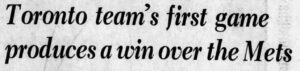 How it started. We’ve shared more than a little cross-pollination across the decades. Perhaps my favorite repository of Immaculate Grid arcana resides within the composition of the 1981 Toronto Blue Jays pitching staff. The Jays used fourteen pitchers in that strike-shortened season, and nearly half of them had been Mets:
Juan Berenguer
Mark Bomback
Nino Espinosa
Roy Lee Jackson
Dale Murray
Jackson Todd
Toronto’s decision to scoop up arms the Mets had given up on during this era might explain why the Jays took a while to become competitive, but the link between the franchises went back even further. Coaching Blue Jays pitchers during their very first Spring was none other than Original Met Bob L. Miller, the same Bob L. Miller who went 1-12 for us in 1962. “This has brought back old memories,” the Bob Miller who wasn’t the other Bob Miller told Joe Donnelly of Newsday. “Just walking around and seeing guys introduce themselves to each other reminds you what it was like.” Miller correctly predicted his 1977 Jays, despite their youth and relative anonymity, would exceed the victory total posted by the initial 40-120 Met edition, which boasted its share of recognizable names from seasons gone by, if not a lot left in their collective tank. “There are so many more ballclubs now,” Bob assessed. “The talent has to have thinned out.”
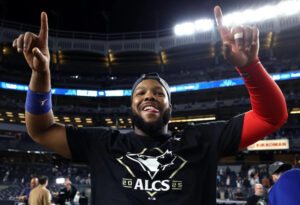 How it’s going. Forty-eight years later, there are four more ballclubs, and eight more teams make the playoffs than was the case in 1977. The Jays were one of them in 2025. They are the only one thus far to have guaranteed themselves a spot in the League Championship Series round. One of their positional mainstays is a former Met, Andrés Giménez, and two former Met pitchers, Max Scherzer and Chris Bassitt, helped them pluck a division title. A few other recent Mets wore Toronto garb in the course of the season, none of whom it’s likely Jerry Koosman has heard of, even if he’s paying close attention these days. The Jays have enough famous stars at the top of their game, and their next game will be the first of those that will determine whether they will appear in the upcoming World Series.
That’s a World Series that won’t take place in New York, which would have sounded like a bummer to us in early April, but today seems just fine.
by Greg Prince on 6 October 2025 5:56 pm The first week without Mets was predictably bumpy. The first week usually is, because life’s essential rhythm has been massively disrupted. There goes early evening’s certainty. There goes first pitch at 7:10. This year, there went the playoffs. Playoff time is already disruptive vis-à-vis established rhythms, because games start whenever TV says they start, and they’re not aired where you’re used to finding them, but you’ll accept the little differences in exchange for the gratification they bring. It’s the playoffs. It’s all about the little differences. October is the Royale with Cheese of baseball.
But these 2025 playoffs commenced sans Mets. Some Octobers that’s not even an adjustment. This didn’t start as one of those Octobers, not after the Mets hovered in a playoff spot for months on end, yet landed adjacent to the playoffs as afterthoughts rather than squarely in them as participants. All things being equal, you’d rather grind down to the 162nd game with a chance to go further than peter out well ahead of the end of the season — yet when you know for a while you’re not going anywhere, you can skip the part where you can’t believe you don’t have playoff baseball of your own on which to obsess, and just focus on not having any baseball of your own on which to obsess.
I’d see the brackets MLB and its broadcast partners posted on social media, and the Reds logo glared out at me from its little 6-seed corner. That’s where a Mets logo had been tacked to the virtual posterboard most of September. Why didn’t we use stickier tape to keep it attached? Honestly, being officially informed the Reds would be playing the Dodgers was a little insulting. You’re going to hold your party without us? Don’t you remember us being the life of your party last year?
Seasons change. Feelings change. Last year’s party was so much of a blast, I barely needed to be coaxed out the door when it was time for us to go. It did occur to me that it’s never good form to leave before making the most out of a postseason appearance, and maybe I should have more deeply regretted our expulsion following the NLCS, but who expected us to appear in the first place? We’d be back the next time they held one of these shindigs, we could tell ourselves by December of 2024, and we’d appear from first place.
Well, none of that happened. First place got away, and that last Wild Card got away, and I found myself peeking in on the Reds and Dodgers, the Dodgers immediately going about the kicking of the Reds’ asses, which made me feel both a little worse (“tell me we’d any less worthy an 83-win representative”) and a little better (“yeah, we probably weren’t going to beat L.A., anyway”). Soon enough, the playoff round the Mets weren’t quite unmediocre enough to qualify for was over, and the team that qualified ahead of them was out, too.
The League Division Series round — the one that still needs a better name — was on, and it still bugged me we weren’t involved. At least during Cincinnati’s short stay, ESPN’s announcers were obliged to mention the Reds were there because the Mets weren’t. One set later, we had faded further into the background. The Dodgers were still the Dodgers, and the Phillies were still the team that zipped past us by August. Anticipating Philadelphia’s first postseason game, I thought maybe seeing them still playing wouldn’t disgust me, for all the reasons I usually conceive for thinking I don’t innately hate the Phillies as much as I innately hate some other teams. Then I actually saw the Phillies, and I wondered what the hell I was thinking, because I really innately hate the sight of the Phlllies. I disdain the Dodgers, too, but they’re 3,000 miles away. The Phillies sit too close for rationalization.
Honestly, I don’t care for either of them (or very much for any National League team that gets to keep playing when we don’t), but on Saturday, when the Dodgers rallied from behind to stun Citizens Bank Park into delicious silence, I clapped not a little. Whatever happens the rest of the way, my anti-rooting interests in this quadrant of the postseason, the one the Mets would be in had they won one more stupid game, are clear.
Saturday evening was probably when the disappearance of the Mets resonated the deepest. I was preparing a turkey and avocado panini as I do virtually every Saturday evening, which from April through September usually means the Mets are on while I’m getting down to panini-ing. A lot of 4:10 starts at home, so the game is winding down by the time I’m messing around in the kitchen. Or maybe the Mets are on the road and just getting down to their own business. If they’re out west, I’m looking forward to whatever it is they’re about to do. This past Saturday evening, no Mets. The panini was satisfying, but it was missing something. I was missing something.
Sunday morning was different. I was out running a few errands and noticed somebody in a Mets shirt. I was wearing a Mets shirt, too. That other Mets fan was on a bike while I was driving my car, so he probably couldn’t see what I had on, and it didn’t seem worth the trouble of exchanging Let’s Go Metses, given that he needed to concentrate on his side of the road like I had to on mine. But I was thinking it was nice that although our shared team had gone down in fairly embarrassing fashion one week earlier, here we were, unashamed and unabashed in our clothing selection. There’ve been Octobers when I asked myself why the bleep I’m out repping this team of mine. Often it feels like courting grief, especially when another local team is still active. Three years ago, sometime after we were eliminated by San Diego, I had my Mets hoodie on and someone with whom I crossed paths offered me his LGM simpatico. I think my reaction was a polite version of “yeah, but they suck.”
That was 2022, which granted us postseason baseball, which was a blessing that morphed into a curse. When it was over, it wasn’t like 2024. I was one big walking recrimination that autumn, incapable of imagining I was going to dive soulfirst into another Mets season when Spring rolled around. Guess what happened: Spring rolled around and I rolled with it. Sometimes it defies belief you’re going to ramp up anew, but there you are, ramped and believing, having compartmentalized whatever made you miserable last fall.
 Nice guys finish seventh on a tiebreaker. Pressure may be a privilege, but on the morning after the first games of the LDS round, out on those errands, I realized that if the Mets were in playoff mode, I totally would have tooted my horn at that bicyclist, and we’d have given each other the thumbs up rather than some other finger. Yet before I could begin to miss the Mets and miss the Mets being in the playoffs, I thought about that churning I get in my stomach when the Mets are immersed in postseason play, and I realized, to my surprise, that I didn’t miss that part of an orange-and-blue October at all. I’d gladly give my postseason acids over to a Mets team that deserved them. This one didn’t.
I continue on as a Mets fan, as we all do, even if they are irrevocably idle. I like being reminded I am a Mets fan. I put on that shirt voluntarily Sunday rather than stuffing it back in the drawer from whence it emerged. When I thought I was done unpacking my groceries a bit past noon, the trunk wasn’t slammed shut a second when I said, “I think I left one soda in there.” My wife responded, “Did you just say you left Juan Soto in there?”
“What would Juan Soto being doing in our trunk?”
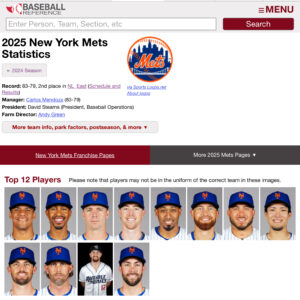
That exchange made me smile on contact. Being reminded the Mets still exist makes me smile in October when the only evidence we have of them are euphemistic personnel announcements and quick explainers from national voices who wish to clarify why exactly it’s the Reds who are getting stomped by the Dodgers. No game yesterday and no game today? Not ideal, but no antacids required. Sunday afternoon, I had the Giants losing to the Saints, with glimpses of the Jets losing to the Cowboys, and I was sports-sated if not particularly jubilant. Sunday night, I settled in with the Mariners and Tigers in the one ALDS I can bear to watch (I know the other one is going swimmingly, but my tuning into it strikes me as a no-win situation) and, for whatever reason, I looked something up on the 2025 Mets’ Baseball-Reference page. There they were again, in all their statistical glory or lack thereof, all of those 2025 Mets whose cause had been my cause for six months, right up to one week earlier. Not only the name-brand Mets who’ve bubbled up in my head during the past week, like One Soda, but the ones who had ceased occurring to me on a daily or hourly basis the way they do when I know there’s gonna be a 7:10 first pitch, or some final pitches as the panini hour beckons.
I skimmed their names, remembered how they performed, and I didn’t smile, not until I realized I was quite content to no longer be watching them or considering them in any kind of depth. I still love the institution, the entity, the overall progress I believe the franchise has made from where they were prior to current ownership, the genuine sense that things will sooner or later end in a less disappointing manner. But the 2025 Mets I had lately spent so much time dwelling on were now the 2025 Mets I was delighted to have moved on from. I didn’t hate any of the players whose names I skimmed, merely how they played as a unit. I will hope that can be corrected in 2026. The playoffs of the moment can be the playoffs in the Mets’ absence. Next year can be next year when the Mets are present, and I plan to be right there with them. This October, I can live just fine Metslessly.
Not that I have a choice on the Metslessness. It’s the coping that’s optional.
by Greg Prince on 4 October 2025 2:20 pm To paraphrase Henry Blake attempting to console Hawkeye Pierce in “Sometimes You Hear the Bullet,” the early episode of M*A*S*H in which Hawkeye grapples with the combat death of an old friend, there are certain rules about a baseball season that doesn’t meet its high expectations.
Rule number one is coaches get tossed aside.
Rule number two is you probably have no real idea whether those coaches deserve to get tossed aside.
But aside they are tossed, nonetheless. Having concluded that a third year of Carlos Mendoza managing remains more promising than his second year of managing could be determined culpable for not meeting high expectations, David Stearns and whoever David Stearns takes counsel from decided something had to be done. Or somebody had to be done in.
As postseason prepared to resume in eight MLB outposts, euphemism season was underway on Friday in Flushing, from whence it was communicated that four coaches “will not return in 2026”; one “has resigned”; one “has announced his retirement”; two “have been given permission to speak to other teams”; and three “have been invited back for the 2026 season”.
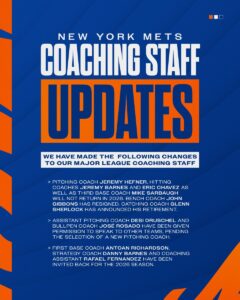 Euphemism season gets underway. My first reaction to so much staff deletion was, “The 2025 Mets, who repeatedly appeared to play as if they had not been coached on how to respond to myriad game situations, had eleven coaches?”
My second was, “I’m sorry for however many of those guys who were just doing what they’ve always done, and it worked in the past, but now it didn’t, and they likely didn’t get any less capable in the season that did not meet high expectations, but trying to make work anew what didn’t work just now probably wasn’t gonna work next year, so, y’know…good luck, fellas.”
A season like that which the entire Mets organization just executed until it had no life left in it calls into question whether anyone in or out of uniform who was tasked with helping the Mets win baseball games knew what they’re doing, and if they did, why didn’t they do it? Being a fan rather than a person for a moment, fine, get rid of pretty much everybody. Reasonable exceptions immediately start being made within such thinking, of course, but being reasonable is hardly a fan’s primary impulse when a fan is still mildly shocked (which is not to say at all surprised) that he is not looking forward to watching Game One of the NLDS with a tangible rooting interest.
The best argument for Mendoza — and maybe Stearns — to return is turnover fatigue. I know I’m tired of looking for new and brilliant leadership every two years. Also, they were the guys who guided us up the mountaintop a year ago. Did they suddenly get less capable? Could be. How do we know it wasn’t Mendy and Stearnsie who weren’t holding back the genius of Jeremy Hefner, Eric Chavez, Jeremy Barnes, and Mike Sarbaugh, the four coaches who were tagged with the “will not return” label? Maybe Glenn Sherlock needed to be talked out of retirement, and John Gibbons’s resignation should not have been accepted, and instead of providing permission to Desi Druschel and Jose Rosado to speak to other teams, they should be the ones to build the next brain trust around.
As is, three Met coaches — Antoan Richardson, Danny Barnes, and Rafael Fernandez — have been asked to maintain their positions. Thanks to the Mets’ lopsided base-stealing to caught-stealing ratio, particularly that of lethally efficient Juan Soto, we can safely infer Richardson is a baserunning instructor savant. If he wishes to fashion himself a Tom Emanski sideline and record a video in which he shares his secrets for getting from first to second, I don’t doubt Soto would endorse it at a discount. I have no idea what the other two guys do, but I’m willing to believe they’re filling their respective euphemistic roles (strategy coach and coaching assistant) professionally.
Most of Met pitching went down the tubes in 2025, so there went pitching coach Hefner, hailed perennially as really good at what he did until the results weren’t there. Chavez and J. Barnes had been deemed keepers before the collective lack of hitting when the Mets really needed some overwhelmed their accumulated goodwill and credentials. Sarbaugh waved many runners home successfully, stopped some others too soon. Sherlock’s catching wisdom got through to Francisco Alvarez and Luis Torrens often, if not always, assuming the catchers took their cues from their coach. Gibby was up on his feet and calling the video replay coordinator after every close play. The Mets won a lot of those challenges.
This is all very round and round. I watched games that got lost and went to bed implicitly unimpressed with the coaching, but not really pinning the losses on faulty instruction. Games that got won? Well, the Mets were supposed to win those games and more games besides. When the Ws flashed from the Citi Field light towers, I knew who got the big hit or strikeout. I didn’t dwell on what might have been suggested by who to get the most out of that critical swing or pitch. Coaches in baseball exist as our idealized umpires do. When you don’t think about them, they’re probably doing a decent job.
Next year, balls and strikes will be confirmed via computerization. Coaches, however, will continue to be nothing but people until further notice. I’ll usually feel bad for people who no longer have their jobs if I don’t have any solid reason to be happy they’ve been dismissed. I’d be happiest of all if Met coaching was still going on this month, whoever was doing it.
by Greg Prince on 29 September 2025 2:43 pm “This summer, the Mets suffered so many difficult, late defeats in close games that no one on the team, surely, could have escaped the chilling interior doubt — the doubt that kills — whispering that their courage and brilliance last summer had been an illusion all the time, had been nothing but luck.”
—Roger Angell, in the wake of the 1970 season
The New York Mets have achieved baseball’s state of intermediate grace, a slot within MLB’s postseason matrix, eleven times in their 64-year history. In every one of the seasons that followed, their subsequent won-lost record paled in comparison to that which merited celebration. On average, Mets teams in those years after won twelve fewer games than they did during the preceding years when champagne flowed at least once.
1969: 100-62
1970: 83-79
1973: 82-79
1974: 71-91
1986: 108-54
1987: 92-70
1988: 100-60
1989: 87-75
1999: 97-66
2000: 94-68
2000: 94-68
2001: 82-80
2006: 97-65
2007: 88-74
2015: 90-72
2016: 87-75
2016: 87-75
2017: 70-92
2022: 101-61
2023: 75-87
2024: 89-73
2025: 83-79
As you can see, not all falls from graces are created equal. A couple of times, the tumbles were modest and hardly mattered — twice the Mets returned to the playoffs in those years after; once they advanced further in those playoffs than they had the year before. This was when playoff spots were more accessible than they had been when the Mets first earned one, if not as accessible as they would become in the most recent season in which the Mets failed to grab one, the season that ended Sunday in Miami with a 4-0 loss to the Marlins.
In 2025, the Mets’ record was 83-79, six games off the pace of the 2024 Mets of increasingly sainted memory. Unlike 2000 and 2016, despite the availability of more postseason berths than ever, this presented a problem. Had the Mets gone 89-73 as they did a year earlier, they would have cruised into the 2025 playoffs. Had they won a single game more, they would have eked in, but that would have been fine, at least until an 84-78 Mets squad was eliminated in due order, because very few teams with so few wins get very far in a postseason. Yet it’s been known to happen, and we were willing to find out if it could again.
Had 83-79 qualified us, we would have taken that, too. It came damn close to doing so. The 83-79 record with which the Mets completed their business was the same as that which will be carried into the postseason by the Cincinnati Reds, a feisty bunch that backed into clinching, pushed giddily into their bubbly by the feistless Mets, ass over teakettle, despite their own last-day 4-2 loss at Milwaukee. The Reds, a couple of hot weeks in September notwithstanding, were no great shakes in 2025. Actually, they were the same shakes as the Mets, except along the way to shaking out with an identical 79 losses, they won the season series between them and us, and that represented the difference between getting to go on or having to go home. There was a time when a tiebreaking game would have been played to determine postseason entry, but that’s simply not done anymore. And, honestly, if we’re determining which 83-79 team deserves to not be a league’s sixth postseason entrant, maybe baseball’s powers that be shouldn’t sanction spending one more minute on it than necessary.
I seem to be obsessing on the won-lost record rather than the game that sealed it. Yes, the Mets played nine more futile innings on Sunday. Yes, it boiled down to one panicked inning of middle relief and one scorching bases-loaded line drive that landed in a glove. Yes, it was the Marlins, official doer-in of last-ditch Met playoff hopes, who did in last-ditch Met playoff hopes once again. Yes, it was the Marlins’ World Series, except unlike in 2003, I wasn’t pulling for them to beat New York.
Give the Marlins credit for coming to play the role of spoiler with zest. Give the Mets another demerit for barely showing up when everything was on the line. Or maybe the Mets played to the best of their 2025 ability, which is a frightening thought. Then again, we were just presented 162 games’ worth of evidence that the Mets weren’t able to get done the minimum that needed doing to get where it once seemed there was no way they weren’t going. Their ability as a unit apparently topped out at 83 wins and 79 losses.
If I may be Dana Carvey’s Grumpy Old Man character for a moment, in my day, our team didn’t play mediocre baseball for the vast majority of six months and still have a chance on the final day to be eligible to win the World Series unless somebody shouted in our face that we had to believe. If we were going to finish barely over .500, we’d simply give up before the last week of September and we liked it — we loved it!
Maybe we didn’t love it, but we lived with it. Flibbity-floo, I grew up rooting for Mets clubs that fell short of falling just short. The 1970 Mets, the first team I ever followed from the beginning of a season to its end, went 83-79. They made the bulk of September painful by discovering ways to lose to the eventual division champion Pirates and almost everybody else down the stretch, a stretch in which their chances expired four days before the season did. When their world title defense got them no higher than third place, I processed third place, even at seven years of age, as where they belonged. Finish first, keep playing. Finish third, keep walking.
Eighty-Three and Seventy-Nine locked in as the Mets trademark record in my mind a year later, 1971. At the last home game of this season, while my friend Ken was still ruing how September 1970 got away (gently ask him about Willie Montañez when he was a callup on the Phillies, I dare ya), I drifted to the next July. The 2025 Mets, as every schoolchild by now knows, started 45-24. Only the AP History classes probably mention that in 1971, the Mets sat in first place with a record of 45-29 on June 30. The next thing I remember — and I really do remember this — was the Mets went out and lost 20 of their next 27 games, exiting the NL East race as they spiraled. At 83-79, they finished tied for third, no tiebreaker of any kind applied to decide whether theirs was the best 83-79 record extant.
The Mets won 83 games in a 156-game strike-shortened season in 1972. It made for a better winning percentage than the previous two years, but proved irrelevant to the pennant race’s conclusion. The Mets won 82 games in 1973, the aberration of all aberrations in the four-division era. In 1975, the Mets won 82 games again, and they had a chance when September started, but by losing significantly more than they won after September 1, they transmitted to their loyalists that 82 wouldn’t be enough. The 86 wins of 1976 were stitched mainly from window dressing that materialized when the lone playoff spot on the table was too many seats up from where we’d positioned ourselves to stay by Memorial Day.
A slightly OK record, shorn of any given season’s context, was always a slightly OK record. You could be disappointed. You could be a rationalist. You could tell yourself next year would be the year we’d get back to where we were in 1969. You would be absolutely wrong about that last one throughout the 1970s, especially the late 1970s, but you recognized that a team that posted a record of or something like 83-79 was probably not going to be a playoff team, and if a team with a record like that did make the playoffs, you were entitled to use the word miracle like it was used in ’69.
That was all before Wild Cards existed. Wild Cards, from the mid-1990s on, have served roughly the same purpose the Mets did in 1962, per what the old Dodger Billy Loes said then upon his brief springtime dalliance with the expansion club:
“The Mets is a very good thing. They give everybody a job. Just like the WPA.”
In the modern baseball sense, the Wild Card makes every half-decent also-ran a potential contender while in the course of also-running. In the Wild Card era, prior to this season, the Mets had one 83-79 finisher, in 2005. That was the first year of this blog. We got our hopes up as August was becoming September, and we had our hopes quashed as the Wild Card we were seeking slipped from even theoretical reach. Still, it was a mostly fun year. The arrow was pointing up from the seasons before, and our next stop was first place in 2006. We didn’t necessarily know it was coming, but we could settle for finishing a little out of the race if we could be convinced better times were directly ahead. The 83-79 Mets of 2005 added Delgado, Wagner, and Lo Duca to Wright, Reyes, Beltran, and Martinez en route to becoming the 97-65 Mets of 2006. It was a very convincing transformation.
The 2025 Mets had something their 1970, 1971, and 2005 predecessors in 83-79 finishes didn’t. They had four shots to make the playoffs. They could win the division, or they could win one of three Wild Cards. Three! They drew none.
None!
Roger Angell wrote of the 1970 club, “Why the Mets failed to survive even this flabby test, falling seventeen games below their record of last year, is easy to explain, but hard to understand.”
Leonard Koppett wrote of the 1971 club, “You couldn’t fairly pinpoint any one fact, or one person” that would help explain or understand why a team that was once sixteen games over .500 landed only four above the break-even point, but he did lament, a couple of seasons later, “Everything considered, 1971 was probably the least satisfying year the Mets had ever experienced.”
Adam Rubin quoted Fred Wilpon on the subject of the 2005 club, “We had times where we were in similar positions in years past, and you didn’t see the same vibrancy on the field I think you do now. I think it’s progress. I’m not sure it’s success unless you are in the playoffs, and we’re not in the playoffs. So that part is a disappointment.”
These were all pretty measured, realistic responses to Met seasons whose records were slightly OK. Conversely, I’m not sure how to respond to this Met season with the very same record, this Met season that echoed the audible post-1969 sighs of 1970 and the post-June swoon of 1971. Despite maintaining the services of several extremely able players for the season and seasons ahead, I don’t sense palpable progress outside of the stuff flashed by a few very inexperienced pitchers, and after the way 2025 didn’t build off 2024, I’m not about to, at this instant, elevate my hopes for 2026. Although there is no more 2025 for the New York Mets, it’s too soon to tell myself next year will be the year we get back to where we were in any of those eleven years that extended into postseason. If I thought about it, I’d think they could, but I thought about it this year and thought they would, and I was dead wrong.
When the Mets won on Saturday via a 5-0 shutout and kept themselves alive for one more day, I did tell myself that no matter what happened Sunday, I’d be at peace with however it ended. I stopped telling myself that by Sunday morning, but it really was gratifying to watch the 2025 Mets one more time — for the 83rd and, as it turned out, final time — be the Mets we thought they’d be. The Mets who did have that Amazin’ start; the Mets who did fill their ballpark and elicit honest enthusiasm; the Mets who intermittently quelled our doubts. Those Mets didn’t show up for Game 162. It was fairly predictable, based on what the Mets had become, but it was still baseball season then, and during baseball season, we do like to imagine somebody is shouting in our face that we have to believe, even if it’s only an irrepressible inner voice we’re straining to hear.
Life is better when it’s baseball season, no matter that some baseball seasons yield nothing better than a slightly OK record, no matter that some baseball seasons crash rather than fall from grace. I didn’t much care for this Mets baseball season within the context of hoping for more Mets baseball, but I hoped for it, regardless. And I cared down the season’s last swing, which generated a 4-6-3 double play off the bat of Francisco Lindor, who cautioned us that this year might not contain the wonders of last year when this year was still next year.
“Nothing’s promised in this game,” Francisco told reporters who gathered around him in the visitors’ clubhouse at Dodger Stadium minutes after the Mets were eliminated from the 2024 NLCS. “Every year, whether you have the same guys or not, it’s a different year.” Lindor and his teammates could do no wrong then. They just couldn’t do everything. In 2025, Lindor and Pete Alonso and Brandon Nimmo and Edwin Diaz, joined by Juan Soto, did much, but they could do only so much, and nobody else could do very much. Or if the lot of them could, they didn’t. Still, for Game 162, I put that learning aside. On the final day of a season when everything’s on the line, nothing that happened before the final day matters…except everything that went right or wrong for 161 games is why the final day plays out as one of those final days when everything matters.
This final day, Closing Day of 2025, played out as its own kind of horrible. It produced precisely the same record as a few seasons that came along way back when, but it felt worse, probably because something was on the line at the very end, probably because it just happened. Give it time. It might not get better, but next year forever remains next year.
Thanks for sitting alongside us for however many seasons you’ve sought out our section since 2005. Last year, this year, next year — we’re always gonna finish here.
by Jason Fry on 28 September 2025 10:21 am What is it with the Mets, the Marlins and Game 161s? (Games 161? Anyway.)
I’m generally allergic to tidy narratives, but this one was undeniable: John Maine in 2007, Johan Santana in 2008 … and now Clay Holmes in 2025.
No, Holmes didn’t go all the way. But that’s nitpicking — he’s a converted reliever who’s way beyond his innings allotment, and has looked gassed in recent outings. Saturday night was his best outing as a Met, and the one his team so desperately needed.
And the Mets backed it up in the other phases of the game, unlike innumerable nights during which they’ve failed to take care of one or all aspects of business. Pete Alonso punished Eury Perez, Jeff McNeil added key insurance, and the lineup gave Edwin Diaz some space late. The relievers were sharp — Diaz has been particularly effective of late — and the defense was sound. And the Mets looked focused, as opposed to whatever it is they were doing Friday night.
It was a complete game for the team if not for Holmes, made even sweeter by the odd spectacle of some 20,000 Mets fans packing Soilmaster Stadium so that the soundtrack would have made you swear you were at Citi Field.
Now here come the caveats.
With the Mets no longer in control of their destiny, they needed help — which the Brewers, already playoff bound and locked into their seeding, did not provide. (And while things like this don’t motivate teams, I doubt any of the Brewers are too broken up about it, seeing how the Mets wrecked a dream season 11 months ago.) Give the Reds credit too — they’ve been a monster down the stretch.
And all this talk of Game 161 inevitably leads us to the Mets, the Marlins and Game 162s. (Games 162? Anyway.)
2007’s Game 162 saw T@m Glav!ne lay an egg and torch his reputation with Mets fans in the clubhouse scrum, earning the unique formatting his name will bear at Faith and Fear forevermore. (BTW, I vote we retroactively give his 300th win to the Braves, seeing how it’s a milestone nobody here wants to remember or celebrate.) 2008’s Game 162 was handed to Oliver Perez, who didn’t pitch badly but wound up on the wrong end of a workaday 4-2 loss that wound up feeling like 40-2. (My lasting memory is of an ashen Howard Johnson enduring the closing ceremonies at Shea before a shocked, mostly silent house.)
No, Game 162s (or is it … oh let’s let this one go) haven’t gone well for us where the Marlins are involved. And, once again, we need help from entities that may prove less than motivated and perhaps even not wholly disinterested.
But that’s where the Mets have put themselves, and us. And at least there’s a last day that matters, a final carousel of desperate wild hopes and superstitions and exhortations and pleas to the baseball gods and everything else brought to the proceedings by us, the fans — who simultaneously care so deeply and can do nothing to affect the outcome of something that means so much to us.
That’s cruel, but it has always been thus.
One more guaranteed day of baseball. What will be will be.
by Greg Prince on 27 September 2025 12:10 pm As a connoisseur of postgame media scrums, I recognize a no-win question when I hear it. No-win questions are asked after brutal losses that carry almost definitive consequences. It almost doesn’t matter how the question is answered. The question just has to be asked.
The no-win question that was asked of Carlos Mendoza following the Mets’ mostly self-inflicted 6-2 loss to the Marlins on Friday night in Miami (though, to be the fair, the Fish did some inflicting, too), regarded the mistakes the Mets made, not only in the preceding innings but for weeks on end and how they have gone uncorrected. Carlos Mendoza prefaced his answer with, “That’s a good question, obviously.”
Unless Mendoza had an actual solution and an explanation for why it wasn’t implemented, there is no good answer…obviously. Then again, the question wasn’t asked to garner a rating of how good the inquiry was.
Mendoza continued:
“It’s on me, it’s on all of us. We continue to make the same mistakes, and it’s costing us games.”
Obviousness won that round, but what do you want from a skipper sinking with his ship? The manager is official spokesman for his team’s shortcomings. To Mendoza’s credit, he doesn’t always try to put a happy face on them. There are no happy faces where the 2025 Mets nearing their end are concerned. There is nothing to be happy about. Maybe for a minute, but just wait until the next minute. To paraphrase Felix Unger’s promise when he served as Oscar Madison’s announcer when Oscar hosted a sports call-in show, the team with the frown is coming around to drag you down to the ground.
As these Mets occasionally do, they got our hopes up early, or at least didn’t dash them for a while. They were coming off a solid win in Chicago that followed a crushing loss that followed an exhilarating win that followed two kicks to the midsection that followed a couple of romps that we might have thought negated whatever had been going wrong before. This is a pattern we should be used to by now. The Mets fell to four games over .500 on September 12. On September 26, Friday night, the Mets dipped again to four games over .500. They were famously 21 games over .500 in this very same season. Perhaps we should be impressed that they’ve stopped plummeting and are now merely bouncing around.
Francisco Lindor led off the game by homering against former Cy Young winner Sandy Alcantara. Two pitches in, we’re up, 1-0. You want to take this as momentum. Lindor being Lindor in the final days of a season is a wonderful thing, we learned during last season’s final days. We’ve seen reminders of it during this season’s final days. The reigning MVP runner-up reaches 31 home runs, besting a recently great pitcher in the process, as the Mets shoo away the best the Marlins have to offer. If we take care of Alcantara on Friday night, we have no reason to fear whoever they throw at us on Saturday and Sunday. Hell, if the Brewers cooperate, maybe we’ll clinch by Saturday night. Then Juan Soto singles and steals, because if Juan Soto is on first, he can’t stand still. He wants into the 40/40 club. He’s at 43/37 as of the first inning and will up his membership bid to 43/38 by the third inning. As long as he doesn’t get thrown out pursuing his individual goal or take the bat out of somebody’s hands while doing so, the extra ninety feet are usually welcome. Two batters later, Pete Alonso doubles Soto home, collecting his 124th RBI for his efforts.
Are you seeing these numbers? Lindor, Soto, and Alonso are posting what they’re supposed to be posting. If superstar statistics electrified the lineup from the first inning to the ninth, Mendoza would be lobbed questions like, “How about those three guys?” That wasn’t the talk of the scrum.
Brandon Sproat went to work, and it was working out great from the first through the fourth. No hits allowed until the fourth. No serious Marlin threats at all. Nolan McLean gave the Mets what was needed Thursday night at Wrigley for a reasonable period of time, now Sproat seemed to be doing the same. Jonah Tong not so much on Wednesday, but two-thirds of Generation MST3K keeping us in orbit is better than none. The Mets looked poised to score some more off Alcantara in the second and third, but a little bad luck was hit into here, and an opportunity was not made the most of there, and going to the bottom of the fifth, the score remained Mets 2 Marlins 0.
In the bottom of the fifth, nothing good happened, except it ended. The season may have ended, too, but that will require hindsight. Give it a day or two. We will know soon enough.
Sproat was hit hard.
Alonso did not make a makeable play.
Gregory Soto was hit hard.
Gregory Soto did not pay enough attention to what was happening on the basepaths.
Ronny Mauricio did not pay attention in general.
I could go into details, but by the time six runs scored to transform a game a Mets fan could see as a continuation of progress into a game that confirmed every Mets fan doubt, details were almost beside the point. Except that the bullpen had to be called on earlier than desired, per usual (meaning we’ll ask another kid, Dylan Ross, to come up and save a portion of our bacon ASAP), and, oh, that part about Mauricio materialized because Brett Baty felt something in his side and had to exit the game and possibly the season, whatever is left of it.
Alcantara found his groove and the Mets didn’t disturb it. He pitched into the eighth without giving up another run. I guess he’s still great. The Mets mounted their final challenge once Sandy departed, loading the bases without a hit, until it came down to closer Tyler Phillips versus pinch-hitter Mark Vientos. Phillips seems to be workshopping a John Rocker or at least Brad “The Animal” Lesley persona; the dude slaps his face on his way in from the pen. If he’s not afraid to inflict punishment on his own visage, you think quelling Vientos is gonna be a problem for him?
It wasn’t. Mark struck out, and, one inning later, it was over. The game, for sure. The brief retention of the third Wild Card would be done when the Reds’ 3-1 lead in Milwaukee went final. (The Diamondbacks lost in San Diego and got themselves altogether eliminated.) Met hopes of making the postseason hang in the immediate balance. We have to win today to stay alive. If we lose, we need Cincy to lose to ensure Sunday isn’t mere bookkeeping. A school of thought suggests that making these intricate calculations are simply motions a fan goes through en route to reaching a glaringly apparent conclusion, and that the team such a fan roots for is going to make these motions and calculations academic by finding a way to bow to the Marlins at least once in these final two days.
This school of thought may not be the school in which we wish to enroll, but I’m pretty sure I hear a bus rumbling down the street to pick us up for the winter semester.
by Jason Fry on 26 September 2025 10:41 am Here’s an interesting exercise: consider how we would have assessed Thursday’s Mets-Cubs finale if it had come in June, or even mid-August.
I probably would have led with an acknowledgment of how much Brett Baty has grown as a player, on both sides of the ball. Baty’s three-run homer off Shota Imanaga in the third made it 6-0 Mets, which seemed like a comfortable margin at the time, though oh just wait. That was significant enough, but it was also an episode of welcome lefty-on-lefty violence. And Baty chipped in a nifty defensive play as well, making a barehanded grab of a little roller and following it with a strong throw.
Baty still has ABs where he looks out of kilter, but all MLB players do and confirmation bias plays a huge role in what we notice and what we don’t; he’s grown into a reliable complementary player in a year that’s seen Mark Vientos deal with growing pains, and that’s a very positive development for the future.
Yep, I might have led with that. Or maybe I’d have dissected Nolan McLean, and waxed philosophical about young pitchers specifically and how maddening the art of pitching is in general. McLean looked electric against the Cubs in the early innings, befuddling them with his sweeper and curve — with two strikes Cub hitters knew what was coming and it didn’t matter, as the horizontal break of McLean’s breaking stuff is just too difficult to track: An apparent middle-middle pitch turns into a dart boring in on the back foot, your bat slashes through where the ball was a second ago but no longer is, and it’s too late.
Given a big lead, McLean started pitching more aggressively, another key starter’s lesson he seems to be learning early — including not to get too flustered if this kind of aggressive mound work yields a solo homer or two. He also looked like he’d ride to the rescue of the beleaguered bullpen — until with one out in the sixth it looked like the tank went from about a third full to E and blinking red all at once.
Seriously, that was a little weird: McLean started the inning by fanning Nico Hoerner on a sinker and then everything decayed, with his location off and the zip on his pitches noticeably diminished. Ten pitches later, there’d been a walk, a ground-rule double and a three-run Seiya Suzuki homer that let the Cubs back in the game and left McLean in the dugout contemplating a start that suddenly looked like a Rorschach test.
But we still have storylines left to go. Maybe I would have given thanks for Tyrone Taylor, who chipped in a two-run double and his usual crisp outfield play. I’m sure Cedric Mullins is a nice guy, but I’d be happy spending the rest of 2025 without seeing him in center again.
Or how about Francisco Lindor? A 30-30 season is something to savor, and Lindor’s career arc in New York is one we’ll talk about for generations. Those thumbs-down gestures and the rat-raccoon nonsense seems so blissfully long ago, with Lindor now a perennial MVP candidate and becoming a civic institution in blue and orange.
I’d like to think I’d have found time to offer a salute to Gary Cohen: Besides his usual sterling play by play, he knew the any-runners-move-up-a-base rule immediately when Dansby Swanson toppled into the stands to corral a first-inning pop-up from Vientos that gave the Mets an unlikely 1-0 lead and Vientos an even more unlikely RBI. Plenty of players and a good number of fine announcers don’t know the rulebook the way Cohen does; his preparation lets him instantly move past sorting out what’s happened to what it means. (I’m still awed by his call of the long ago game-ending unassisted triple play against the Phils: That’s a play no announcer expects to witness in his career, you can’t rehearse it, and it happens instantaneously. Cohen nailed it.)
Yes, all of these things would have been fun building blocks from which to build a recap in June or even mid-August. But not in Game 159, with the Reds breathing down the Mets’ necks and tapping that “We Have the Tiebreaker” sign menacingly.
No, Game 159 meant 6-0 and 8-2 leads still felt too small. It meant bemoaning the incredible defensive showcase put on by the Cubs and swearing emphatically because the Mets could easily have scored 10 or 12. It meant sweating 11 outs to get and exhorting Ryne Stanek and Brooks Raley and Tyler Rogers and Edwin Diaz to get them while feeling spikes of anxiety about how necessary outs will possibly be obtained against Miami. (For the record: All four did their jobs, with Raley looking unhittable and Rogers the best he’s been as a Met.)
It also meant that the joy of a must-win lasted about six seconds before curdling into worry about these three remaining games in Miami. The Marlins are eliminated, a lot later than most anyone thought they would be, but even a late-April game at Soilmaster Stadium feels like a bad idea, and God knows the Marlins have ruined the end of seasons before.
But hey, that’s what happens when you’re pushing through Game 159 with destiny still to be determined. Plenty of good storylines, but right now they’ll wait. Survival is the only thing.
by Greg Prince on 25 September 2025 11:27 am So often tempted to refer to any given Met loss as a “microcosm” of the portion of the season that has been defined by the club’s long, gradual decline from surefire playoff participant to accidental late-September survivor, I wondered if the bigger picture from which microcosm is derived is technically referred to as a “cosm”. It is not. The word I was looking for was “macrocosm,” though cosm would be more satisfying, given that it is a four-letter word, and certainly these Mets inspire a string of those.
I found Wednesday night’s 10-3 debacle versus the Cubs at Wrigley field just another piece of the Met macrocosm that has expanded out into the universe day by day, defeat by defeat, debacle by debacle, interrupted only by the anomalous wins that have — along with various Red and Diamondback inadequacies —mysteriously kept this 81-77 Met team clutching the final Wild Card position in the National League.
The final Wild Card position in the National League is a diplomatic way to say sixth-best record in the circuit. This is what is being fought over. Or actively eschewed by three so-called contenders, if we were suspicious types. The Reds lost in eleven innings Wednesday night. The Diamondbacks also lost in eleven. The Mets didn’t bother making it look close. If trying not to win is the actual aim of this clumsy scrum, the Mets haven’t yet proven themselves quite good enough to intentionally blow it.
We’ll take it on faith they were trying to win on Wednesday night and were not up to the task on almost any front. Starting pitching, via the Jonah Tong from a couple of outings ago, was not viable. Relief pitching, which included a couple of starters, was not effective. Defense, save for one sweet throw home from the reactivated Tyrone Taylor, was mostly absent. Hitting, sans Francisco Alvarez’s best longball efforts, lacked even momentary impact. The manager said some version of “we’re going through it right now” afterwards. That’s one of Carlos Mendoza’s pet phrases, like “traffic” to refer to baserunners and “we’ve got to be better” to refer to the state of things. All the Mets do is go through it. They’ve yet to come out of it.
A microcosm implies the elements of a situation have been distilled into a handy snack pack that allows closer examination and deeper understanding. Nah, losing as the Mets lost on Wednesday night is just one more glob of erratic futility that should have ended the Mets weeks, maybe months ago. But the sixth-best record is still out there for the taking, and the Mets still inexplicably hold it. Stave off explanations for four more games, accidentally win enough of them, and, in the face of the mysteries of the macrocosm, this baseball team actually becomes a bona fide playoff participant.
Will the wonders of the universe every cease? I guess we’ll find out by Sunday.
by Jason Fry on 24 September 2025 12:25 am In the bottom of the fourth, the Cubs tacked on a run when Pete Alonso couldn’t get properly set to take a Jeff McNeil throw from second. The error properly belonged to Pete but went on McNeil’s ledger, becoming his second miscue in as many plays.
More importantly, it made the score 6-1 Cubs, with what looked like a lot of bad road ahead. The Mets hadn’t exactly covered themselves in glory so far Tuesday night: David Peterson was terrible, looking again like a pitcher whose tank is on E, and didn’t make it out of the second; Juan Soto misplayed a flyball into a two-run double; and Francisco Alvarez allowed two steals while concentrating on framing and/or looking for rulings on checked swings.
It was not a crisp game, to say the very least — in fact, it looked a lot like too many games the Mets have played of late, lackadaisical and dispiriting. If you turned it off then and found something better to do with your night, hey, no judgments — that certainly looked like the right call.
I stayed with it, for a few not necessarily related reasons.
- The Mets had hit some balls hard, only to be victimized by buzzard’s luck and solid Cub defense, and I stubbornly thought that might prove important somehow.
- I was keenly aware that just six games remained on the regular-season schedule, and that getting to watch a bad game is marginally better than having no game to watch.
- I was mad at the Mets — my default state since mid-June — and figured I’d glower and mutter at them as long as they were around to absorb my wrath.
- I’m a Mets fan, which one could argue is a terrible life choice, but it’s too late for me. Watching the Mets is what I do.
Seiya Suzuki hit a grounder to Francisco Lindor, who flipped it to McNeil, who didn’t do anything requiring glowering and muttering this time. The Mets came out for the fifth and didn’t look all that different than they had so far — McNeil popped up with Starling Marte on first and then Alvarez hit a grounder to Dansby Swanson at short. A tricky hop, but one Swanson had corralled innumerable times before. It was going to be a double play, ending the inning and leaving the Mets with more misfires behind them than chances left ahead of them.
Except the ball went under Swanson’s glove.
With the Mets given new life, Lindor grounded out to cut the Cubs’ lead from five to an “eh that’s a little better” four; Soto walked; and Pete Alonso hit a sizzling drive to right that struck just below the basket for a very long RBI single that shrunk the deficit to a “hey maybe” three. Craig Counsell summoned Taylor Rogers, twin brother of the Mets’ confounding Tyler Rogers, to face Brandon Nimmo.
Nimmo has become something of a funny hitter since he made the decision to trade OBP for power. He can look hopelessly out of sync for a string of ABs, seemingly constantly on the back foot, but then one swing reminds you of how dangerous he can be — witness his bolt against the Braves in the Day After Game last year, or the one he hit off Wandy Peralta last week. Rogers’ second pitch to Nimmo was a sweeper that sat middle-middle; Nimmo connected for one of those line drives that’s immediately and obviously gone, with its trajectory suggesting it was struck by someone standing on a high-dive platform.
Just like that the Mets had tied it; an inning later they untied it on a Lindor single off Drew Pomeranz that capped a two-out rally. The Mets somehow had wrested a 7-6 lead away from the Cubs; the question now was whether they could keep it.
The answer, alas, was no: In the bottom of the inning Tyler Rogers relieved Gregory Soto with two out and a runner on first; Rogers then allowed a walk and an RBI single to Suzuki for a 7-7 tie. You may recall that the Rogers twins were traded on the same day ahead of the deadline, with Tyler going from the Giants to the Mets and Taylor going from the Reds to the Pirates, who then flipped him to the Cubs. “Mom was having a day,” Tyler said, which was amusing; one assumes Mrs. Rogers had a less amusing day Tuesday, as she had to watch both twins spit the bit in key spots.
It was 7-7, and given the Mets’ serial failings on defense and in relief, I was just holding on for dear life. The seventh passed without events of note and in the eighth Alvarez came up against Caleb Thielbar with Luisangel Acuna as the go-ahead run at first.
Alvarez has looked far more patient of late, largely resisting the urge to expand the strike zone. He ignored two Thielbar pitches just off the strike zone, took a called strike as Acuna stole second, then watched a four-seamer just outside, or at least that’s how it was called. Thielbar’s next four-seamer was in the middle of the plate and Alvarez didn’t miss it, sending it screaming into the bleachers and doing a little screaming of his own before show-ponying his way around the bases.
The Mets led 9-7, and the question was how they were going to get six outs. I hoped they’d go back to Brooks Raley, who’d thrown only five pitches in escaping the seventh, but the top of the Cubs’ lineup was nigh, and Carlos Mendoza opted to ask Edwin Diaz for a six-out save. It was the right call: Diaz looked borderline unhittable, riding a sharp slider to strike out two in the eighth and all three in the ninth.
The Mets won and the Reds finally lost, which puts the Mets back in the wild card, one up on Cincinnati and Arizona. A wonderful win, goodness knows — the team fought back instead of folding their tent, showing a defiance too little in evidence in this strange season. Even a win like that can’t erase everything that we’ve endured: The Mets remain fundamentally untrustworthy, both unpredictable and unreliable. But at least they’ve earned another day to try and change our minds.
by Greg Prince on 22 September 2025 1:47 pm Sunday’s victories were small, specific, and personal. Taking the train in from a different station and everything clicking as a result. Passing through the gate unaccosted and being handed the day’s “first 15,000” premium. Instigating several pregame encounters with total strangers, reminding me fans at a ballpark share a special bond when we start our day in proximity to one another. An unexpected hi and how are ya to a couple of familiar faces. A few planned hellos that came off hitchless. Nine innings alongside someone who totally got what I was talking about and vice-versa. Understanding summer was ending, fall was coming, and dressing to handle both. Going to the final regularly scheduled Mets home game of the season for the thirtieth consecutive non-pandemic year.
Check, check, check. Except it’s not really a matter of fulfilling tasks on a to-do list. I’ll shepherd a streak to keep it alive, but the streak has to be something I want to ride until I can’t no more. Every Closing Day since 1995 still going as of 2025 is my streak of streaks. I wouldn’t have envisioned that stretching out thirty years ago on the Sunday I simply decided I had to be on hand for Game 162. I wouldn’t have thought to think about it.
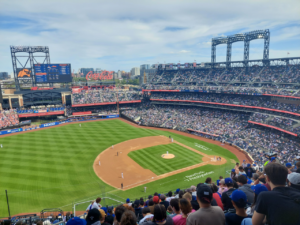 -30- The Mets of the moment as a ballclub are the essence of meh, and that might be a charitable interpretation. The Mets as an entity continue to lure me to their environs year after year, multiple times per year. This year, it was nine games, not a lot historically (I peaked at 44 in 2008), but it was enough. Besides, I finished strong, with three during the final homestand. Before Sunday, the Mets had gone 4-4 since settling in at Citi Field for a week-plus. Before Sunday, my 2025 record at Citi Field was 4-4.
We each needed a win to get over .500. Neither of us got it.
The Mets have bigger problems than righting a small sample size. The Mets have a chance to stop playing baseball by the end of this week, which, if that’s their goal, they made considerable progress toward it Sunday. And Saturday. And too many days to catalogue at the moment. From however many games ahead they’d been however long ago it was, the Mets have fallen an invisible percentage point behind the Cincinnati Reds for the last Wild Card spot available to them. They’re tied with the Reds, but Cincy has the tiebreaker based on the Mets having played too many games versus them the way they played too many games versus the Nationals, the way they’ve played too many games versus everybody, regardless of what the standings suggest a team is.
The standings suggest the Washington Nationals are a last-place club. Wouldn’t have known it this weekend, let alone in the series we played against them last month. The Mets treat everybody like a contender. Everybody except themselves.
That the Mets would find several bizarre ways to effect a 3-2 loss to the Nationals did not seem out of the realm of possibility Sunday morning. I wasn’t counting on it happening, but had I been informed in advance that…
Jacob Young would rob Brett Baty of an extra-base hit by letting a ball bounce out of his glove and off his foot before securing it cleanly…
and later Jacob Young would rob Francisco Alvarez of a home run with a leap and grab that appeared relatively mundane compared to the Baty play…
and earlier Cedric Mullins would get on base because the previous day’s designated dasher of destiny Daylen Lile would not hold onto a ball Mullins hit, yet Mullins would not advance while on base, because he had no clue at all what was going on (the ball was loose and Lile was down)…
and that Mullins, stuck at first rather than advanced to second, would get himself doubled off imminently (had he only been on second, he could have gotten himself doubled off there)…
and that the Nationals would see the Mets’ piggybacking efforts from Sean Manaea and Clay Holmes and raise them — and squelch Mets batters — with two starting pitchers with far higher ERAs than ours…
and whatever else the Mets were going to do badly or not do adequately…
well, I wouldn’t have been surprised, but I wouldn’t have stayed away.
We do love our Mets, for whatever reason we love our Mets. The Mets say 3,182,057 of us loved them or what they were supposed to do enough to buy a ticket to see them in 2025, the highest paid attendance in Citi Field history. We loved giving Pete Alonso, Starling Marte, and Edwin Diaz extra hearty ovations, aware, whether for business reasons or competitive reasons, we might not see them in front of us as Mets again. We nodded empathically at the surprisingly fresh recollection of the 1970 Pirates opportunistically trading for Mudcat Grant while the 1970 Mets added only Ron Herbel and Dean Chance (though that might have been just me responding to a very particular and appropriate prompt from my buddy Ken, who always has a few veteran moves up his sleeve). We allowed ourselves to get our hopes up in the ninth despite the previous eight innings indicating our hopes should stay stashed in our hoodie pockets. We lived up to what George Vecsey wrote about us in 1989’s A Year in the Sun:
“Met fans can be vulgar and unruly, but they have endowed that franchise with amazing goodwill and energy since the team was dropped on New York’s doorstep in 1962.”
Citi Field has mostly tamed the Shea Stadium out of us. We have our outbursts, but they’re not sustained. We mutter rather than maraud after our cheers prove less than inspirational. We show up willingly and joyfully. We go home undefeated. Thanks to a torpid stairway trudge from Promenade to Excelsior dovetailing with construction-altered LIRR timetables, my train strategy on the way out couldn’t execute as well as it had on the way in. Hence, I rode the 7 Super Express past Woodside all the way to Times Square and opted for the 1 to Penn Station before heading east. Lots of Mets fans did more or less same. There weren’t riots in the concourses over the Mets losing by one and the Reds winning by one. There wasn’t audible snarling before our tracks were announced. I did find a couple of empty mini vodka bottles on the three-seater I chose to plop myself down in, but I strongly believe those had been consumed by somebody else with a different agenda (perhaps Meadowlands-bound pilgrims in preparation for the evening’s Giants loss).
Yeah, the Mets are still a fun entity, especially when you share them with the likes of those with whom I shared them at Citi Field Sunday and throughout the week and all season. The Mets as a ballclub will be more fun if they commence a six-game winning streak in Chicago Tuesday night and cross their fingers the Reds lose once. I think they know that. Now they should just go do that.
|
|






