The blog for Mets fans
who like to read
ABOUT US

Faith and Fear in Flushing made its debut on Feb. 16, 2005, the brainchild of two longtime friends and lifelong Met fans.
Greg Prince discovered the Mets when he was 6, during the magical summer of 1969. He is a Long Island-based writer, editor and communications consultant. Contact him here.
Jason Fry is a Brooklyn writer whose first memories include his mom leaping up and down cheering for Rusty Staub. Check out his other writing here.
Got something to say? Leave a comment, or email us at faithandfear@gmail.com. (Sorry, but we have no interest in ads, sponsored content or guest posts.)
Need our RSS feed? It's here.
Visit our Facebook page, or drop by the personal pages for Greg and Jason.
Or follow us on Twitter: Here's Greg, and here's Jason.
|
by Greg Prince on 1 June 2024 11:04 am The alchemy of desperation works in mysterious ways. The Mets…
say their murky goodbye to Jorge Lopez;
have an accountability meeting;
decide they can do better for part-time catching and hitting with Luis Torrens than they any longer will with Omar Narváez;
opt to provide regular reps for Christian Scott at Syracuse rather than let the rookie’s momentum stall amid a flurry of off days before and after London;
squeeze out Opening Day third baseman Brett Baty in the name of bench flexibility;
make up some new base hit gesture;
collect oodles of base hits allowing them to demonstrate the slapping or whapping or whatever it is they do to celebrate themselves;
and win two games in a row at the end of a month when they hadn’t done any such thing in more than weeks.
“Go figure” will work as a nutshell summation here.
The Mets of backup infielder Jose Iglesias (a little rusty with the glove in his start at second base, assuringly frisky with the bat), Chief Accountability Officer Francisco Lindor (two hits to go with the four from the night before), looking-alive Starling Marte (a three-run triple that will have you jumping out of bed seven mornings of every seven), plug-in professional hitter J.D. Martinez (another no-doubter over another fence) and new full-time third baseman Mark Vientos (three hits and two ribbies while not splitting a position with his bud Brett) brought an onslaught upon the Arizona Diamondbacks that suggests Whacking Day is a federal holiday. The D’Backs are defending National League champions, though the mere sight of Citi Field rattles them to their core. That old chestnut about calling your team meetings when your ace is pitching could also apply to the eve of a series versus the one opponent you’ve been handling in your ballpark for years on end.
The Mets have taken 17 of 19 from Los Serpientes in the borough of Queens since May 18, 2018. Little besides Brandon Nimmo connects the Mets from then to now, so let’s not bother trying to figure what’s up with this. Let’s just be glad the Mets poured on ten runs and built a sturdy enough fortress to protect themselves from Snakebites. Four of those nipped at their seemingly impenetrable lead in the ninth, vaulting a semi-laugher into Damn Thing territory. Yet the Mets held on, 10-9. First they ripped, then they gripped, albeit barely. Whatever nervousness rippling through our anxiety receptors as Reed Garrett did not smoothly pick up for Sean Reid-Foley (who had succeeded an adequate Luis Severino and sharpies Dedniel Nuñez and Jake Diekman) didn’t match the frustration D’Back boosters felt in falling short in Flushing yet again.
Even the black uniforms didn’t quite get in the way of a Friday night victory. Go figure, indeed.
***
A proposal was put on the table more than four decades ago. “Here,” it was said, “is the deal — you be the best player we’ve ever come up with, because we’d really, really like that to happen. Just be mind-bogglingly great from the first day of your career and then get better all the time. It will make us extremely happy and possibly satisfied. Sound good?”
The counterproposal: “Well, I don’t know if I can do all of that, certainly not right away. What if I’m far above average most of the time with bursts of the spectacular sprinkled within? I might sort of stop and start in terms of my progress, but I’m going to be worth watching, and definitely more productive than just about anybody you’ve seen from the beginning. I’ll frustrate you now and then, and it will take me a while to mature, given how young I am and all, but you’ll look up one day and realize I’ve put up numbers hardly anybody else wearing this logo can touch and given you memories you’ll always cherish. Does that sound good?”
Negotiations broke off with, “We’ll get back to you.”
We’ve gotten back to Darryl Strawberry by putting up the number from his jersey where those associated with the cream of this franchise’s legends reside. It sounds good and I believe it will look splendid this afternoon when we see 18 slide in next to 16, 24, 17, 36, 31, 41, 14 and 37. The annals of New York Mets baseball at its best are uniquely Strawberry-flavored. Might as well adorn the rafters to reflect reality.
The stupendous presence and production of Straw from 1983 to 1990 was rarely quite enough to sate those who watched him. “More, please” was what we implored from the time he broke in at age 21 to the time he packed his stuff and took what was left of his prime home to Los Angeles. Darryl has said over and over going home to the Dodgers was a mistake, that Shea Stadium was really home. I don’t know how much of this is revisionist people-pleasing, given that the people who ask Darryl to retrace his path are generally coming at him from a Met perspective, and how much of it was arrived at organically. He says it now, though, and we’ll take him at his word. He did enough as a Met and has been through enough as a person that he can say what he wants.
Leaving the Mets was a mistake, of course. I say that from a Met perspective. The Mets were never the same after Darryl left in November of 1990. Of course, they were never the same as they’d been once Darryl arrived in May of 1983. The man was a difference-maker. You knew you were watching somebody making a difference when you watched him do anything on a field, even if it was just standing in deep right field (when maybe he should have come in a few steps). What he did at the plate is most of what we remember. I can think of 252 baseballs that were never the same.
One element of Darryl Strawberry’s reign as all-time Met lightning rod and power source that I think gets overlooked is how much of a winning player this guy was. Darryl showed up on a team that had been stuck in losing forever. Darryl settled in, and the team began to win chronically. Darryl left, and the team essentially disintegrated. Darryl didn’t do the winning alone, but the team didn’t win without Darryl.
Straw homered in 221 games as a Met, sometimes twice in a game, once thrice. The Mets’ record in those games was 156-65. How good is that? It factors out to a winning percentage of .706. In 162-game season terms, that’s equivalent to a mark of 114-48, or six games better than 1986. Difference-making at its finest. Again, you had Keith, you had Doc, you had Kid, you had so many Mets doing so many Amazin’ things while Strawberry was in full bloom. But let’s not deceive ourselves. You had Darryl Strawberry homering, and when that was happening, you had the Mets winning a lot.
You had those first-inning homers that notified the opposing pitcher it was going to be a long night.
You had those second-at-bat homers that had the manager in the other dugout turning his head toward the bullpen phone.
You had those midgame homers that broke ties and put leads out of reach.
You had those late-and-close homers that alerted one and all it was later than they thought and it was no longer that close. The Mets were winning, and the Mets were about to win.
Maybe Darryl lashed a double or stole a bag or leapt a little to rob a would-be version of himself or gunned down an ambitious baserunner who would have been wise to stop at third. Maybe just the sight of Strawberry was enough to rattle a reliever into four balls. The next Met in the lineup automatically got more dangerous. The Straw Man contributed in small ways, too.
But, oh, the big ways. Every home run Darryl Strawberry blasted, launched and/or sent into orbit was big because it was a Darryl Strawberry home run. If you saw him hit one, it was like you got to show everybody you knew the next day that you’d caught a foul ball. This was better, though. Nobody got the ball when Darryl hit it a mile. We all got the thrill.
That cliché about a superstar carrying a team on his back may never have been invoked in these parts as much as it was when Darryl lifted the Mets. He would tear through National League pitching staffs for a couple of weeks and we’d jump on for the ride. He’d do damage. We’d win games. We’d rise in the standings. We’d be sure we were unbeatable. For a couple of weeks, maybe a month, we would be. One year we absolutely were. Another couple of years Darryl could have used a little help.
The career as a Met didn’t last forever. The impact from his Met career lives on. The number being retired reminds us, in case never fully grasped it, that Darryl Strawberrys don’t grow on trees.
by Jason Fry on 30 May 2024 11:51 pm The recap of Wednesday’s debacle belongs in my blog partner’s already pretty big Hall of Fame, because Greg nailed it: That disaster, from its on-field component to its off-field sequel, might or might not be rock bottom for the 2024 season, but it was unquestionably the end of something.
Somehow we all knew it, and I suspect a lot of us spent the day after acting accordingly.
Take your recapper, for instance. When Thursday night’s game started, I was on the East River off a pier in Brooklyn Bridge Park, sitting in a kayak and making sure people in other kayaks didn’t get themselves in trouble while enjoying a lovely spring evening. (Come join us! It’s free!) I knew the game was starting but didn’t trouble myself beyond that – and yes, I remembered it was my recap. So what? I had things to do and the Mets had forfeited their right to be atop the list of those things.
Afterwards, when my kayak buddies opted for pizza and beer I joined them, letting the Mets linger down at the bottom of that list. And I didn’t feel a twinge of guilt about it. They would do what they did and I would do what I did and I would chronicle it afterwards, without apologies for the proportions of baseball and the avoidance of same. But old loyalties die hard: After my pizza came I propped my phone up against my water bottle and put on Gameday. When I registered that the score was AZ 2 NY 1, I rolled my eyes, muttered something about poor Christian Scott getting a hell of initiation, and went back to a conversation made considerably better by a lack of wailing about the Mets.
I don’t remember what the stages or steps are and so I can’t put a number on it, but I’m pretty sure this is acceptance.
And as is often the case, once I quit trying I got rewarded. I registered that the score had become 2-2, investigated and discovered that Francisco Lindor and Pete Alonso had collaborated to turn the 1 into a 2, briefly groused that they hadn’t done that often enough this season, and went back to chatting.
It was only after leaving the restaurant and strolling through Brooklyn Bridge Park that I resumed my usual routine. MLB Audio told me J.D. Martinez was at the plate, and a moment later Howie Rose was very excited, telling me that this one might go, which it did. I did a brief little dance whose emotions are honestly hard to describe: Happiness? Sure. Exasperation? Also sure. Disbelief? Definitely in there. There were a lot of things.
Walking back through Brooklyn Heights, I listened as Reed Garrett walked the leadoff hitter in the ninth, which you don’t have to be a long-suffering Mets fan to know is usually fatal. I called my mother, who I knew would be in front of her TV swearing at Garrett and importuning the baseball gods to quit being such jerks, and told her I was coming over.
Garrett managed not to do what Met relievers have done serially of late, collecting one out and then another, both by way of hit-it-in-a-silo pop-ups. Then, in the elevator up to my mom’s apartment, the game vanished, a victim of the thick walls of the building core. I opened my mom’s door tentatively … did they? Had they?
Nothing had happened yet. I stood in front of the TV in time to see a groundball, hard but right at Jeff McNeil, and the Mets had won.
That was novel. That was good. That meant a lot less than it would have even a week ago. But it still meant something.
* * *
A lot of pixels have been spilled over Jorge Lopez, whose glove-gifting tantrum was followed by a jaw-dropper of a clubhouse interview and then by his excision from the Mets via DFA.
Reading the post-mortems, I found myself lamenting how ill-suited the Twitter age is to any thing resembling substantive commentary about one of the worst hours in a relief pitcher’s life. What happened to and with Lopez demanded nuance, and everything about our digital age is engineered to shove nuance aside as outmoded and boring if not downright cowardly. This is the age of TLDR, in which your take better be instantly available out of the oven, served piping hot and prepared spicy.
Which means we’ve lost something important if we still want to understand the world and, frankly, each other.
Look, Lopez deserved to get DFA’ed, full stop. He embarrassed his employers by representing them horribly in a public forum, after years and years of being taught to know better. The interview in a second language was a bit halting, yes, but Lopez’s standard is to conduct his interviews in English. And while the specifics of what he was saying got a bit hazy, the gist of it was unmistakable. He was offered multiple off-ramps from the bad road he was speeding along. He took none of them.
But that’s not the whole story.
Lopez’s teammates past and current seem to genuinely like him, but they also know him as a guy who’s hard on himself to a worrisome degree, and whose emotions can overwhelm him. You could see it in that clubhouse interview – this was a man who was clearly struggling. And this isn’t new for Lopez: Last year the Twins put him on the IL for 15 days to deal with his mental health, a move no one with a shred of decency should scorn.
Moreover, Lopez has a son named Mikael who suffers from a malady called Familial Mediterranean Fever, which has meant regular hospital visits and multiple transplants, with few opportunities to watch his father pitch. Wednesday, cruelly, was Mikael’s 11th birthday.
The Mets’ decision wasn’t unjust. But let’s not fall into the trap of thinking anything here was simple or straightforward. That does a disservice to not only Jorge Lopez but also to ourselves.
by Greg Prince on 30 May 2024 11:08 am A 4:10 weekday start to conclude a home series against the Dodgers evoked, however briefly, one of the few peaks of the Mets baseball experience in the 2020s. On September 1, 2022, the Mets and Dodgers began play at Citi Field as leaders of their respective divisions. L.A. was running away with the West. The Mets had fashioned a smaller cushion in the East, but were successfully fending off Atlanta. The three games in Queens loomed as an NLCS preview. The Dodgers took the Tuesday night opener, the Mets the second on Wednesday evening in grand and dramatic fashion. Jacob deGrom had thrown seven innings of three-hit ball, assisted on defense by Brandon Nimmo robbing Justin Turner at the center field wall. Starling Marte had homered with a man on. Adam Ottavino pitched a scoreless eighth and, with a 2-1 lead in the balance, Timmy Trumpet — live and in person — heralded the entrance of Edwin Diaz for the ninth. Trea Turner, Freddie Freeman and Will Smith went down in order, setting up the Thursday late-afternoon rubber match. It was at least as huge a deal in New York as whatever Serena Williams was doing across the boardwalk at the US Open in her final professional matches. That’s how immense the Mets had gotten as a ballclub and a story as 2022 had progressed.
The Mets didn’t disappoint in the finale. If their third game versus the Dodgers wasn’t quite as grand and dramatic as the second, it was effective. Chris Bassitt hung in against Clayton Kershaw, exiting after pitching six innings and the Mets trailing, 2-1. Kershaw went only five, opening up possibilities in the bottom of the sixth and seventh. Versus the Dodgers’ pen, the Mets put up two runs one inning, then two runs in the next, with RBI honors performed by Francisco Lindor, Darin Ruf, Nimmo and Marte. Mr. Trumpet had left town, but the man for whom he was musical muse, Mr. Diaz, was deployed successfully enough in the eighth by Buck Showalter (one run allowed versus the heart of the L.A. order) and Ottavino took care of the ninth. To borrow some tennis parlance, the Mets had won this qualifying tournament, 3-4, 2-1, 5-3. The championship round in October was gonna be something else.
Something else got in the way. The Mets sputtered in September. Starling Marte was hit in the hand in Pittsburgh, Atlanta revved its engines, and the Mets entered the postseason as a Wild Card, leaving it before the tournament ever got serious. The 2022 National League Championship Series paired the Phillies and the Padres. Mets-Dodgers at the end of August and beginning of September was not a harbinger of something even greater. In retrospect, from a Met perspective, it was the end of not an era, but an interlude.
We thought we were in the midst of an era for five months of 2022. Something grand. Something dramatic. Something that would grow and endure and fill us with satisfaction that we who’d been Mets fans all our lives, through handfuls of ups and torrents of downs, had stayed Mets fans. We had the kind of team, led by fresh-air ownership, that was as formidable as any in baseball. This is what we’d been waiting so, so long for.
It can now be said with certainty that the wait continues. The very last semblance of what 2022 represented at its heights is dust. Following the late-season and postseason deflations of that year, the mess that was last year, and all that had been going wrong this year, such an assessment might strike you as a rather slowly arrived bulletin. Yet 2022 had earned the Mets enough good will with me that for all of my 2023 dismay and 2024 disgust, I believed somewhere in there was the heart and fiber of a good baseball team, a perennial contender, a top-flight professional enterprise. I no longer believe any of that. I believe the Mets are back to being the Mets of popular, unfriendly imagination. Go ahead, those who peer inside Metsopotamia only to mock — say what you will about how hopeless, ridiculous, whatever these Mets are. After Wednesday’s late-afternoon finale, there’s no reason inside our bubble to dispute any of it.
The Mets lost, 10-3, to the Dodgers, who never more than pause from being a powerhouse. It was 3-3 through seven, which indicated that if the Mets could craft one of their flash-mob walkoff rallies to end a series they had already lost on an upbeat note, they would take bows for never giving up…or if they fell short by a run or two, they could console themselves with how they had stayed in yet another close, hard-fought contest.
Except the Band-Aid was torn off with force. Six Dodger runs in the eighth, another in the ninth. David Peterson’s return to active duty was modestly encouraging in a vacuum (5 IP, 3 R, 7 H, no noticeable hip discomfort). Tomás Nido, who nobody wishes was the primary catcher, belted a two-run homer, and what had been a 3-0 deficit was erased when J.D. Martinez doubled home the tying run in the fifth. It was almost enough to make a person forget that a) Edwin Diaz went on the IL before the game with shoulder impingement issues and b) Pete Alonso left the game in the first inning after his right hand absorbed one of James Paxton’s fastballs.
Diaz, not the closer he was when he was serenaded by international recording stars, is still the closer of record. Being without him for however long represents a return to last year’s situation of every reliever being asked to step up a rung, and we all remember how that went. Alonso, who has personified the word “slump” since launching his 200th career home run more than a month ago, is too much the slugging sun around which this lineup orbits to not miss if he has to sit (x-rays were negative, further imaging to be announced). Besides, the HBP that Pete couldn’t shake was a little too reminiscent for comfort of the one that bruised Starling two Septembers ago.
So it hadn’t been a good Met day Wednesday, but it hadn’t been full-on calamitous until Jorge Lopez drew everybody’s attention. Lopez had passed for a pleasant surprise when there was anything pleasant about watching the 2024 Mets. He’d pitched in more games than any reliever on the club and forewent imploding for the most part. But Wednesday was about to change perceptions.
Lopez was called on to clean up for Ottavino. Ottavino also pitches quite a bit for the 2024 Mets and has also resided on the brighter side of dependable a little more often than not. Wednesday was a different story. The Dodgers, led by Will Smith leading off the eighth, proceeded to light up Otto. Smith homered, par for the course. Jason Heyward tripled with one out. A walk and a steal set the stage for Miguel Rojas to drive in another run. It was 5-3. The game was not beyond repair when Carlos Mendoza made his next call to the bullpen.
A busy signal would have been preferable. Jorge attempted a pickoff at third base that the third baseman, Brett Baty, wasn’t expecting. It hit the third base umpire, Ramon De Jesus. It allowed the baserunner on first to move to second. And it didn’t pick off the baserunner it was intended to trap. The fella at the plate while all that was happening, Miguel Vargas, soon doubled both of those runners in. It was 7-3. One out later, Shohei Ohtani, who had been too quiet for too long, homered. It was 9-3. Versus Freddie Freeman, Lopez didn’t get a strike call he wanted on a checked swing. Lopez barked at De Jesus. De Jesus ejected Lopez. Perhaps the umpire could have been the bigger man, but Lopez had recently hit him with a pitch, so who knows what he was thinking? A more apt question might be what the hell was Lopez thinking when, as he trudged to the dugout, he flung his glove over the protective screen and into the stands.
Josh Walker, who had been optioned before the game to make room for Peterson and then almost immediately recalled when Diaz went on the IL, finished the game, giving up an extra run for good measure. Then the Mets players took it up on themselves to hold an internal airing of grievances. When the media had their chance to read tea leaves, they sought out Nimmo, Ottavino and Lindor for explanations. I listened intently to each of them as they were aired on SNY’s marathon postgame show. I can’t say any of it registered with me, other than when you lose enough games in enough ways and there’s no sign you’ll stop losing games, you kind of have to have a meeting.
Reporters also checked in with Jorge Lopez, who used his platform to talk himself off the team. Maybe the glove toss had opened the door for his departure, but his decision to not publicly regret his behavior, along with muttering something about the Mets being probably “the worst team” in “the whole fucking MLB,” did his standing no favors. His forthcoming designation for assignment, which in the heat of the moment seemed an excellent idea, leaked out. It’s been one of those seasons when DFAs of any three Mets in one swoop wouldn’t make you blink. Lopez’s clubhouse performance may not have stood out as particularly bizarre when set against how players in decades past used to unleash their frustration for notebooks and tape recorders (the Mets are this weekend retiring the number of a player who wasn’t shy in that regard), but we live in a buttoned-up age, when the most any teammate will say about another teammate is some boilerplate about the need to hold each other accountable. Lopez told it like it was, clarifying that they’re all accountable, himself included. Maybe he told it like it was a little too well.
The 2024 Mets now wallow eleven games under .500. A couple of days ago, I looked up incidences of Mets teams that had fallen double-digits below the break-even mark and still carved out a winning record by season’s end. It has happened three times in franchise history: 1973, 2001 and 2019. I offer that tidbit for nothing more than trivia’s sake, given that there’s no way this team is going to be the fourth edition of the Mets to bounce back from below. Likewise, I am no longer concerning myself with the National League playoff picture, multiple Wild Card berths notwithstanding. The Mets aren’t a part of that snapshot as June approaches and won’t be the rest of the way. As a guy who analyzes returns until he can call elections accurately on social media likes to say, I’ve seen enough. Four months remain to 2024. Get out of it what you like, or just get out and do something else.
Circling back to the last game of that Dodgers series from 2022, several of that magical summer’s names are still very much attached to the Mets. There’s definitely been churn, but here we are, citing Diaz, Alonso, Marte, Ottavino, Nimmo, Lindor, along with the likes of Nido, Peterson, Baty, Tylor Megill and Jeff McNeil in the present day. Steve Cohen is still the owner, and if he’s not too distracted by building other things, we’ll assume he’s still committed to building a long-term winner in Flushing. He’s got the president of baseball operations he wants, and David Stearns has a moldable manager of his own choosing. Carlos Mendoza doesn’t have the track record of Buck Showalter, but every skipper hired for the first time had to have impressed somebody to be entrusted with running what is technically a major league team. Injuries are injuries, and to this point, injuries have removed Francisco Alvarez, Kodai Senga, Brooks Raley and Drew Smith from the daily equation, with Diaz added to their ranks. Stearns’s pickups — like Martinez, Sean Manaea, Luis Severino and Harrison Bader — have all had their moments. Christian Scott and Mark Vientos have each shown wisps of the potential we’d been told they carry.
There was a time, maybe even a couple of weeks ago, when I would have considered all of the above and inferred that these elements together, less than two years after that day the Mets took that rubber game from the Dodgers, were, at their core, capable of coalescing into something solid. A lousy record last year, a lousy record thus far this year, but surely they were better than they’d shown. They were so good at the peak of the season before last. Everything that made them that good couldn’t have completely disappeared in a span of roughly 20 months. Could it have?
It did. It’s gone like Jorge Lopez and Jorge Lopez’s glove. Welcome, at last, to the discouraging present, where there’s no sign things were fairly recently a whole lot better.
Let’s Go Future Mets, whoever you are, whenever you get here. You won’t have a tough act to follow.
by Jason Fry on 29 May 2024 1:19 am The Mets looked listless in dropping the second game of Tuesday’s doubleheader against the Dodgers, and that limp display was the highlight of the day. Certainly it was better than the first game, in which a terrific start by Tylor Megill went down the toilet when his teammates couldn’t field, pitch or manage to hit a fly ball a moderate distance.
I could talk more about these two games, but I don’t want to and frankly they’re not deserving of analysis. The Mets are on pace to win 66 games and anyone who’s watched them in May will tell you to take the under. The Mets aren’t merely we thought this would go better bad or trade every contract you possibly can bad; they’re a level of bad where everybody connected with the team should go sit on pillars in the desert for several years, repenting and begging for divine mercy.
* * *
Your recapper was in Phoenix over the long weekend for a sci-fi convention and saw about 20 minutes of the Mets – the 20 minutes I chose was when Saturday’s game against the Giants decayed from “Edwin Diaz save situation” to “latest debacle.” It didn’t exactly make me miss this team.
I slipped away from the con on Friday night to return to Chase Field, home of the Diamondbacks. I found a pretty unique seat on StubHub in a section dubbed RFW. It’s a single row of seats behind the right-field fence in what looks kind of like an unused bullpen. Your toes are an eighth of an inch from the warning track, the right fielder (variously Randal Grichuk and Miami’s Jesus Sanchez) is on the other side of the fence and home plate is some distance that-a-way. A unique view, one that I suppose is available at Citi Field through the Cadillac Club, except the Cadillac Club costs a fortune and comes with complimentary booze and eats, while the RFW is just a row of seats on concrete and if you want a hot dog you take an elevator back up to the concourse to secure one.
It was pretty neat: I chatted amiably with my seatmates, most notably a guy named Keith who came to Arizona from Brooklyn (I swear everyone in Arizona used to live in Brooklyn) and was happy to talk the Dodgers, Roberto Clemente, what’s gone wrong for Corbin Carroll and anything else the game brought to mind. A nice evening, seeing how it didn’t involve the Mets – the only flaws were a) that no ball rattled off the fence with an outfielder just feet away; and b) that Miami’s Braxton Garrett threw a complete-game shutout and so the entire game took an hour and 58 minutes.
My new plan: Next time in Phoenix I’m getting a RFW seat again, but this time I’m coming for batting practice and bringing a glove. And then hoping the game lasts a little longer.
* * *
Not everything is terrible: Angel Hernandez has retired.
That’s the polite way of saying it; in reality he was bought out by MLB, which finally tired of his chronic incompetence, screw-ups gone viral and frivolous lawsuits and decided no price was too high to sever Hernandez’s connection from the national pastime.
A number of people, from his fellow umpires to baseball scribes, took pains to say that Hernandez is a very nice person. I don’t doubt it. It also isn’t faintly relevant: Hernandez was a deeply terrible umpire, unacceptably bad at both the irreducible basics of his job and also at how to do that job without calling attention to himself and thereby embarrassing his employers. He was the bomb under the table that the audience knows will go off, which meant his mere presence on the field was a source of tension that had nothing to do with the game.
Hernandez first became a Mets villain during the last game before the 1998 All-Star break, when he called Michael Tucker safe despite Tucker being thrown out by a couple of feet and never touching the plate, though his spikes sure touched Mike Piazza’s thigh. Piazza called it the worst call he’d ever seen; Hernandez had to flee the field to escape the wrath of a mob of Mets led by an incandescently angry John Franco. (He got suspended for three games.) What made the call part of Hernandez’s legend, though, was that he supposedly had told Piazza to hurry the game along because he had a plane to catch.
Is Hernandez a nice guy? Who cares? Getting him to stop vandalizing baseball games should only be the start: True justice demands that he be barred from attending an MLB game, watching an MLB game, listening to an MLB game, discussing an MLB game, or thinking about an MLB game.
Given the horrors the Mets are inflicting on baseball, it might be a fitting sentence for them too. But one improvement at a time.
by Greg Prince on 27 May 2024 3:43 am John Olerud was at Citi Field for the Mets game on the fourth Sunday in May, just as he was at Shea Stadium for the Mets game on the fourth Sunday in May a quarter-century before…though “just as” might be a stretch. In 2024, Olerud was a visitor, sitting in the stands, brought to the home viewer’s attention via a mid-game interview with Steve Gelbs. Whatever John said on air was drowned out by my shrieking with delight at the sight of the classy first baseman of yore and the memories he evoked from 1999. It was on more or less the same spot on the calendar — and adjacent to the same spot in Flushing — that Olerud came up in the bottom of the ninth in a game the Mets had been losing all day and turned it around for good.
“The pitch to Olerud…line drive…BASE HIT INTO LEFT FIELD!” was the call on the radio via the detailed description of Gary Cohen, then on radio. “In comes Lopez! Here comes Cedeño! Here’s comes Gant’s throw from left field…the slide…SAFE, THE METS WIN IT! THE METS WIN IT! Cedeño slides home under the tag of Mike Lieberthal, a two-run GAME-WINNING single for John Olerud, the Mets score FIVE RUNS off Curt Schilling in the bottom of the ninth inning, and the Mets win it in a REMARKABLE finish!”
I probably didn’t hear every word Gary said live, as it was drowned out by my shrieking with delight. That half-inning, played out on May 23, 1999, began with the Mets down, 4-0, to the Curt Schilling and the Phillies, on one of those days when a bona fide ace was making scoring not only impossible but unimaginable. Fortunately, these were the Mets of Mike Piazza (leadoff single), Robin Ventura (seemingly harmless home run) and Matt Franco (one-out single) to start with. Every 1999 Met could be a force doing some reckoning. Luis Lopez got himself hit, Bobby Valentine pinch-hit for his pitcher with Jermaine Allensworth, and Allensworth singled Franco home from second. It was 4-3, two were on, only one was out and, in a last gasp of how baseball was managed throughout the 20th century, Terry Francona left Schilling in. Francona’s pen wasn’t in great shape, and he decided Schilling was better than anything he had out there. This wouldn’t happen today because Schilling wouldn’t have still been around in the ninth. He probably wouldn’t have been granted the chance to throw an eighth suffocating inning.
Roger Cedeño grounded into a 1-6 fielder’s choice, forcing Allensworth, Schilling fittingly in the center of the action. Cedeño took second on defensive indifference. Edgardo Alfonzo took first on Schilling’s second HBP of the inning. The impossible was becoming imaginable. The next batter was Olerud. Probability was very much on the Mets’ side. As Gary already explained a quarter-century and three days ago, Mets 5 Phillies 4 was the final. The quiet fellow who drove in the tying and winning runs likely wouldn’t protest if naming rights were ceded to the pitcher on the losing side. It can’t help but live on as The Curt Schilling Game.
John Olerud brought so much to the Mets in the final three years of last millennium. The conclusion to The Curt Schilling Game was as big as anything he gave us. His presence at Citi Field this Sunday perhaps transmitted the good vibes necessary to get us through what appeared to be a sixth consecutive loss in the making. The Mets might not win (per usual), but look — it’s Oly! SQUEE! While Gelbs was chatting up the unexpected guest, the Mets were doing more or less versus Logan Webb of the Giants what their predecessors were doing versus Schilling in 1999: nothing much. San Fran was up, 2-1. Sean Manaea was doing OK for himself, but Webb was wired in, per usual. If only Oly could excuse himself, slip on a uniform and, if he had their numbers handy, summon Mike, Robin and the rest of his teammates.
Instead, we settled for the 2024 Mets, which included Manaea hanging in there through five without giving up a whole lot; unlikely long man Adrian Houser going four, touched for only one run; Harrison Bader, reeling back into the field of play a sure home run off the bat of Matt Chapman; and Brett Baty continuing to look intermittently Venturaesque at third. There were some good signs dotted around the diamond at Citi Field for the blue-clad Mets. There are always a few good signs. They are usually overwhelmed by the plethora of bad ones. The worst one of all for the Mets was Logan Webb standing on the mound continuing to deal.
Fortunately, it’s the 21st century, and Logan Webb, who left little to the imagination in terms of imagining the Mets could get to him, was removed after seven innings. Giant skipper Bob Melvin goes back a ways, but he manages in the here and now. He turned the ball over to Ryan Walker in the eighth, which didn’t improve the Mets’ chances whatsoever.
The bottom of the ninth would have been the province of closer Camilo Doval had not the Mets been so (ahem) fiercely competitive Friday night and Saturday afternoon, forcing Melvin to use his main save guy twice. The Mets’ close-shave defeats were not for naught in that regard. I mean they were overall, but at least the Giants relief corps wasn’t lined up to quash them Sunday. Pitching for San Francisco was submariner Tyler Rogers. He’s not their closer and he’s not their No. 1 starter. Rogers was a tough assignment, but he wasn’t impossible.
Imagine away. Imagine that on the day John Olerud swung by to say hi, Brandon Nimmo led off the bottom of the ninth by chopping a bouncer that Rogers leapt for and laid only a fraction of his glove on, and Nimmo landed on first as a result. Then came J.D. Martinez, suddenly mired in a slump that detracts from his professional-hitter reputation. Yet a pro is a pro, and Martinez singled to right. The Mets, down two, had first and second and nobody out. For any team, this qualified as a genuine threat. For the Mets, this loomed as a nightmare. We’d seen versions of their can’t-missery all weekend, golden scoring chances that ultimately missed. The whole week was like that. First and second and nobody out, with the opposition closer unavailable? Stop doing this to us.
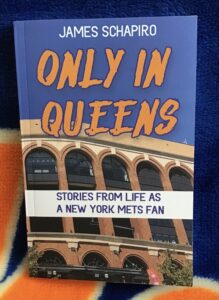 I thought of my friend James Schapiro while trying to decide whether this was a rally worth getting invested in the way I threw myself into the one Olerud capped 25 years before. Those 1999 Mets blended magic and magnificence. They could be a little frustrating in real time, but memory recalls them as capable and inspiring. James, born roughly around the moment in February 1997 that Oly reported to St. Lucie as a Blue Jay expat, recently released a book called Only in Queens: Stories from Life as a New York Mets Fan. I’m in the midst of reading and savoring it, so I can’t yet officially tell you it’s terrific, go buy it for yourself (off the record, it is and you should). James became a Mets fan in 2004 at roughly the same impressionable stage of life I became a Mets fan in 1969. He not only missed 1969, he missed 1999. The launching pad for his fandom was a little different from mine. By the time he reaches 2011, a season he documents in a chapter entitled “Valentino Pascucci and Other Heroes,” he’s 14. James hadn’t been blessed with a miracle world championship out of the gate as I was, nor had the specialness of his Mets experience been cemented with a miracle pennant a quadrennium later. The peak for the kid to that point was staying up as late as he could when he was nine to hear the Mets not win the NL flag in 2006. It was all downhill from there to 2011. I thought of my friend James Schapiro while trying to decide whether this was a rally worth getting invested in the way I threw myself into the one Olerud capped 25 years before. Those 1999 Mets blended magic and magnificence. They could be a little frustrating in real time, but memory recalls them as capable and inspiring. James, born roughly around the moment in February 1997 that Oly reported to St. Lucie as a Blue Jay expat, recently released a book called Only in Queens: Stories from Life as a New York Mets Fan. I’m in the midst of reading and savoring it, so I can’t yet officially tell you it’s terrific, go buy it for yourself (off the record, it is and you should). James became a Mets fan in 2004 at roughly the same impressionable stage of life I became a Mets fan in 1969. He not only missed 1969, he missed 1999. The launching pad for his fandom was a little different from mine. By the time he reaches 2011, a season he documents in a chapter entitled “Valentino Pascucci and Other Heroes,” he’s 14. James hadn’t been blessed with a miracle world championship out of the gate as I was, nor had the specialness of his Mets experience been cemented with a miracle pennant a quadrennium later. The peak for the kid to that point was staying up as late as he could when he was nine to hear the Mets not win the NL flag in 2006. It was all downhill from there to 2011.
Yet there James is, wrapping his arms around Pascucci and Pedro Beato and every other 2011 Met, because, as he puts it in Only in Queens, “There’s a joy in wins during mediocre seasons. I would know. I’m a Mets fan. My experience with enjoying mediocrity is almost unparalleled.”
We should all be able to derive such pleasures from out-of-the-money campaigns, one of which is almost surely going to be 2024. Discerning there would be joy against the Giants required a surge of Olerud-level momentum amid the Mets’ growing assault on Rogers, but on a fourth Sunday in May in the borough the ballclub has called home for six decades, joy can absolutely be built on one exquisite half-inning.
James is in his twenties. I’m confident his instinctive appreciation for a nascent Met uprising hasn’t been ground down by too many trips through the wringer. I’d venture to guess that even those of us who wear t-shirts approximately as old as him could steer ourselves toward elation for what our current crop of mediocrities was in the process of cultivating with Nimmo on second and Martinez on first and nobody out.
Carlos Mendoza replaced Martinez on the basepaths with speedy Starling Marte, a savvy Bobby V-style move.
DJ Stewart lined out, but even Brian McRae had an unhelpful at-bat between Ventura’s homer and Franco’s single.
Jeff McNeil, harnessing the spirit of Lopez and Fonzie, accepted Rogers delivery upon his elbow pad in exchange for a trip to first. Nimmo advances a base. Marte, too. Sacks full.
Bader! Author of the Mets’ previous RBI and the center fielder who made that catch! He doubles! Nimmo scores easily! Marte, faster than Martinez, scores easily, too!
I wasn’t sure my keyboard still had exclamation points.
Bader’s on second, McNeil is on third. Baty is up, but he gets four fingers for his troubles. Bases reloaded. Omar Narváez, who didn’t start Sunday, approaches the plate. The “O” in Omar is literal. He hasn’t had a hit in 27 at-bats thus far this year at Citi Field. Then again, he hasn’t batted in the ninth inning of a game attended by John Olerud, either. He does here.
Gary Cohen is still behind a microphone and still has the right words for an occasion worthy of an Olerud sighting.
“And Narváez PUNCHES one, BASE HIT! AND THE METS WIN IT!! Omar Narváez with his first home hit of the year and it’s a game-WINNER!!!”
Gary does TV now. He doesn’t have to be as detailed as he was in 1999.
It would have been too cruel or too mathematically unfathomable to not think the Mets would manage to pull a 4-3 walkoff win out of everything that was coalescing in their favor once Bader came through to tie the score. Narváez batting while ostentatiously overdue for a simple single within the 718 area code made it only more obvious that the Mets couldn’t lose on Sunday. Yet the 2024 Mets can lose any day, and usually do. Not this time though. The mediocre sometimes rise to remind you they don’t always disintegrate. And sometimes we find ourselves enjoying it happening right before our eyes and our ears, no matter how little fun we’ve been having as this season has curdled, shriveled, and continually bummed us out. Shrieking with delight may be beyond the octave range of those of us who have endured too much dreck to somersault over the moon just because a five-game losing streak didn’t grow to six. But we’ll still make appropriate joyful noises as Met circumstances suggest. Even in a year like this. Especially from an ending like that.
by Greg Prince on 26 May 2024 2:01 am They’re probably not this bad, are they? How could they be? Twenty-two losses in thirty-one games seems to give us all the answer we need, as does the 3-12 stretch that’s unfurled since their last pairing of consecutive wins, not to mention the active streak of five defeats during which the most recent collapse or implosion feels it can’t be bottomed, yet the next day it is. The odds say sooner or later the Mets who are making a science out of finding ways to lose will accidentally win a game, and from there a few balls will bounce in their favor, and suddenly…
Suddenly, what? At best, they’ll soar to the status of not this bad; not a team that lets wins slip away; not a team that leaves almost all of its runners on base; not a team that allows opponents’ runners to come home exactly when they shouldn’t; not a team that swears afterward, in so many words, we’re not this bad. Perhaps I shouldn’t so readily dismiss their habitual recitations of positive-reinforcement affirmations. They’ve been told their whole lives as competitors to shake off whatever went wrong today, hold their head high and go get ’em tomorrow. In theory, it’s a healthy attitude to bring to any task. It’s just a little galling to hear after every loss. I’d gladly take some variation on “We were bad today. We’ve been really bad for weeks. We have to be one of the worst clubs going. I’m sorry our fans have to experience this.” Nobody’s going to say it out loud. Just once I’d like it said. It wouldn’t convert losses to wins, but it would hew somewhere near the reality we are witnessing.
The Mets’ absolve themselves from their wretchedness by noting how close they come to winning most of these games. I honestly don’t believe it works that way. Almost winning on a daily basis is the equivalent of losing day after day. Yes, they’re usually in these games right up until the final pitch or swing (or at least, as on Saturday, until extras roll around). Yippee. You’re professionals. You’re not supposed to be blown out more than a handful of times in a season. You’re also supposed to win more than a few of these close ones. That’s a core competency that’s wafted away from Citi Field in May. It usually takes until June.
I’m past trying to figure out if this team has a chance to creep into the bloated playoff picture. I’m just trying to figure out if this team has a chance to form a handshake line between now and, say, the Fourth of July.
They probably will. Won’t they?
by Greg Prince on 25 May 2024 10:56 am FLUSHING (FAF) — Scientists anxiously monitoring activities at the Flushing Meadows National Laboratory expressed amazement Friday night at the discovery of yet another way for the New York Mets to lose a baseball game, this time by blowing a sizable eighth-inning lead to the San Francisco Giants and then loading the bases in the bottom of the ninth, only to fall short by a run. Observers say what marked this experiment in defeat as a true advancement in humanity’s march toward thoroughly understanding futility was the way it built on a key discovery earlier in the week, wherein Met researchers learned they could hit three home runs in a game on consecutive days and not stop losing.
A spokesperson for the Nobel Prize committee indicated “this may be the most impressive manifestation of losing we’ve seen in modern times. There were and are so many aspects to how the Mets go about both not winning and altogether not succeeding, that ‘staggering’ doesn’t begin to describe it.
“They even thought to wear black.”
Fueled by splendid starting pitching from Christian Scott, the Mets achieved one of what experts call “the all-important losing first step,” wasting a very good outing when they don’t get nearly enough of those to begin with. Scott, a rookie, pitched six innings, giving up only two runs on two hits, theoretically positioning him for his first major league win. He was succeeded to the mound by in-limbo closer Edwin Diaz, receiving his first assignment since his newfound propensity to blow saves sidelined him from high-leverage situations the previous weekend. Diaz persevered through the seventh without giving up any runs.
“That, too, is key,” said another source in the scientific community. “Diaz emerging unscathed after Scott looked so sharp was reason enough to raise the hopes of Mets fans. A real losing team will make a person rooting for them think things are looking up, setting the stage for a tremendous kick in the [expletives].”
The Mets had built a 6-2 lead on three solo home runs — struck by J.D. Martinez, Mark Vientos and Pete Alonso — along with several other key hits. Their batters also hit some balls that traveled far, only to be caught.
“If you were a believer in harbingers,” the scientific source said, “you could begin to see what was ultimately coming. Yet you can’t be fully convinced until the proof is presented to you.”
Reed Garrett, briefly considered a revelation in relief, emerged to pitch the eighth inning. After a pair of somewhat lucky hits (though scientists debate how much “luck” is involved when an opponent is playing the Mets), Garrett’s night began to disintegrate with two outs, as he gave up an RBI double, a walk and, finally, a grand slam to Patrick Bailey, converting what was left of the Mets’ advantage into a one-run deficit. An inning later, Jorge Lopez allowed a solo homer to Mike Yastrzemski to make the score Giants 8 Mets 6.
With the visitors’ insurance run added to their burden and Camilo Doval on to close for San Francisco, the Mets made feints toward a comeback of their own. “Ah,” one scientist was moved to note. “It’s the comeback that can’t miss but does miss that creates a ‘novel loss’. You think you’ve seen it all, but then the Mets show you something you hadn’t thought possible.” Sure enough, a DJ Stewart fly ball that Yastrzemski couldn’t handle in right became a double. Brett Baty, like Stewart a pinch-hitter in the ninth, placed a ball beyond the infield that appeared destined to become a base hit. It took a fairly spectacular play by Thairo Estrada and first baseman LaMonte Wade to retire him, but retire him they did. Stewart went to third, but there was one out.
“A team on the verge of winning has no worse than a two-on, no out situation there,” the Nobel committee spokesperson explained. “Stewart might have even scored. But these were the Mets doing losing things to break new ground in coming up shy of victory. It was astounding.”
It was also only beginning. Francisco Lindor did drive in Stewart to bring the Mets to within 8-7. Succeeding batter Alonso converted the first pitch he saw from Doval into a certain double play ground ball ticketed to end the game. Except San Francisco shortstop Marco Luciano — who had early pulled a baserunning boner — booted the ball to place Lindor on third and Alonso on first. Alonso was switched out for pinch-runner Tyrone Taylor, and Taylor quickly stole second.
“Can’t you see the beauty?” the scientific source asked. “Taylor taking second without a throw was the sort of thing that usually happens to the Mets. He was the potential winning run. No cogent baseball watcher outside the Mets’ sphere of influence would have thought New York wouldn’t win. But the Mets’ ability to harness nature’s ballet to drop what is handed them is what elevated this experience.
“Perhaps Mets fans knew in their bones what was coming. Everybody else had to have chills.”
An intentional walk to Brandon Nimmo loaded the bases with one out. Cleanup hitter Martinez, possessor of a hot bat, was up. The Mets somehow “proceeded to crack the code” on losing, the scientific source said. Not only did Martinez, a proven professional hitter, strike out, but Vientos flicked a roller to third base that would have been impossible for Matt Chapman to handle, let alone make an effective throw on, but Chapman both handled Vientos’s ball and threw him out to end the game.
“The chef’s kiss on all this,” the scientific source said, “was the Mets challenging the call, as if there was even a shred of possibility it would be overturned. A perfect grace note of after-the-fact desperation.”
The Giants had completed their third consecutive road-game comeback of four runs themselves, but it was the Mets, 9-21 in their last thirty games, consistently finding yet another “new and exciting” way to lose that left scientists worldwide buzzing. “The Mets,” said one researcher in Asia, “stand as an inspiration to anybody who doesn’t believe the worst can’t keep happening.”
by Greg Prince on 22 May 2024 8:17 pm If things were going better for them, the Mets would have won a game in Cleveland, maybe two, possibly all three. I realize that’s akin to invoking the old saying that if Carlos Mendoza’s aunt’s frog had wings, then every day would be Christmas; there are a lot of old sayings tantamount to declaring things would be different if only they were. But you know how it is with baseball teams. Ones in a good groove make the most of their situations. If the Mets were currently inhabiting one of those grooves, the scattered positive trendlines detectable here and there would tie together, and suddenly defeats would be victories.
Alas, frogs are still bumping their behinds, dear old Aunt Maria isn’t Uncle Pablo, and Christmas Day still comes only once a year. It surely didn’t arrive on Wednesday afternoon, when the Mets finished their stay in Northeast Ohio packing coal-filled stockings as souvenirs. Despite some bats waking up and several innings appearing well-pitched, the Mets lost, which is something the Mets have been doing a lot of late, no matter who hits and who pitches.
For those who’ve stopped keeping track, the Mets have lost ten of their last thirteen, encompassing four series in which brief individual pulsations haven’t added up to a collective heartbeat. I’m tempted to say it’s one of the most deathly stretches of baseball I’ve seen in 56 seasons watching this franchise, though I know there are veritable dugouts full of orange-and-blue ghosts demanding I hold their dismal beer. It doesn’t really matter that the 2024 Mets are probably better than dozens of previous editions of Mets. It’s the Mets right now who almost daily make one regret an investment of time and commitment.
Thanks to the playoff system that bestows potential contender status on almost everybody on Rob Manfred’s green earth, the season isn’t near over in the figurative sense. Should the Mets find the groove that’s eluded them and start capturing the games and series that mysteriously keep winding up in somebody else’s win column, tunes are designed to be changed. This is where my instinct is to invoke that golden handful of campaigns in which the Mets looked awful before the All-Star break and then made a spirited run to the finish, the lesson being it ain’t over until you believe it is, or however that one goes.
 Yet it’s too early for that framing and there haven’t been enough substantive signs of life to imagine a meaningful turnaround. What would change the tune? Get into that groove. Be watchable for nine consecutive innings, then another nine consecutive innings. Make a habit of good baseball rather than the kind you’ve been playing. Do some actual winning rather than talking about how capable you are of winning and how surprising it is to you that you are losing. At this point, you’re the only ones who are much shocked by what you’ve been doing. Yet it’s too early for that framing and there haven’t been enough substantive signs of life to imagine a meaningful turnaround. What would change the tune? Get into that groove. Be watchable for nine consecutive innings, then another nine consecutive innings. Make a habit of good baseball rather than the kind you’ve been playing. Do some actual winning rather than talking about how capable you are of winning and how surprising it is to you that you are losing. At this point, you’re the only ones who are much shocked by what you’ve been doing.
I’m still watching, but that’s not shocking. Questionable habits are hard to break.
by Jason Fry on 21 May 2024 10:53 pm When the Mets are behind, Keith Raad likes to convey the score to those of us listening on the radio or some radio-adjacent audio product by informing us that they’re chasing whatever the deficit is.
It’s a perfectly fine way to go about one’s business, and Raad has been a good addition to the narrator ranks. But I can feel a vein throb in my temple every time I hear it — because I’m hearing it so often these days.
On Tuesday night I heard it over and over again: “chasing three.” That was the score the Mets fell behind by in the third, when Adrian Houser‘s not bad beginning turned lousy in a fusillade of Guardians’ doubles, assisted by some crummy fielding by Starling Marte. The Mets chased down two of those runs in the fifth, courtesy of a Mark Vientos homer and a flurry of hits that drove fill-in starter Xzavion Curry from the game. (Curry at least spared us the thoroughly depressing spectacle of Houser vs. Carlos Carrasco in a matchup of exasperating fell-off-a-cliff Mets starters.)
Curry was replaced by Nick Sandlin, whom I never want to see again: Much as he did on Monday night, Sandlin walked the first enemy batter but then went to work, fanning Brandon Nimmo with the bases loaded, one out and a gimme run on the board, and then erasing J.D. Martinez. Chasing one … except Houser gave up a two-run homer to Jose Ramirez, and the Mets were immediately chasing three again.
Jeff McNeil had a two-run homer of his own to deploy, cutting the lead back to one. But in the sixth Houser gave up a leadoff single and was replaced by Jake Diekman, who gave up a homer to Cleveland supersub David Fry, no relation as far as I know. And so the Mets were … that’s right, chasing three again.
Diekman left to show a luckless water cooler who was boss; the Mets cut the lead to one yet again on a Marte homer and went into the ninth trying to make up that margin against deadly closer Emmanuel Clase. I didn’t have much hope, not so much because of Clase’s ungodly stats (though they sure didn’t help) but because I’d spent two hours watching the Mets doing this thing wrong and then that other thing wrong and I was pretty sure they had another shortfall in them.
To be fair, they tried in the ninth — none of the Mets’ current woes are due to a lack of trying. Harrison Bader ground out a good AB that ended in a groundout (ahem); Francisco Lindor reached on an infield single; and Pete Alonso smacked a ball to Josh Naylor, who started a nifty 3-6-1 double play to send the Mets morosely back to their hotel. The Guardians played tight defense and collected hits when they needed to, which is what good teams do; the Mets staggered around failing serially at various aspects of baseball, which is what mediocre teams do, and so the outcome felt almost preordained.
Things can change and it’s still only May, but those things better change pretty thoroughly and pretty quickly to avoid the judgment that this is a team in an earlier stage of its transformation than the people who run it hoped. In which case, I wish the powers that be would get on with it already.
Mediocre teams can be watchable if you can see them turning into something better, even if it’s by fits and starts. But it doesn’t feel like the Mets are that kind of mediocre — it feels like most of these current Mets will be gone before that something better arrives. They’re not part of the future but fill-ins and seat-fillers, treading water and spinning their wheels, and watching them do that is as frustrating for us as it must be for them.
by Jason Fry on 20 May 2024 11:02 pm I’d like to put 6:10 pm start times on the list of things that I thought would be good, or at least novel, and turned out to be terrible.
First off, I completely forgot. I was doing something non-baseball-related, noted it was around 6:35 pm, and reflexively went back to what I was doing, because 6:35 pm is too early to be worrying about things that everyone knows kick off at 7:10 pm.
[record scratch]
Oh yeah, that’s right.
I got upstairs to find it was already 2-0 Guardians, with the Mets having done ill-advised things in the outfield. J.D. Martinez doubled and I had a brief happy thought that the worm might be turning: Several times in the last week I’ve arrived at my post with the Mets having made first-inning noise, only to get stage fright and decide further runs are beyond them. So that was nice, at least.
About 45 seconds later, Starling Marte hit a grounder up the middle that looked like it would elude Ben Lively, except Lively speared it and found Martinez between second and third. He was run down by various Guardians, with Marte moving up behind the play to take Martinez’s place at second once he was tagged out. Except — whoops! — Marte wasn’t on second but between first and second, and a moment later he was in the dugout with his teammate, presumably with neither one of them wanting to talk about what had just happened.
That was really it for the game. Tylor Megill pitched OK. Tomas Nido hit a home run. Josh Walker did well in relief. But the Mets looked sleepy and put upon at the plate, and even at 2-1 it didn’t feel like they were much more than the night’s designated opponent. The most noise they made came in the sixth, when Pete Alonso and Brandon Nimmo hit one-out singles. But Lively ended his night by getting Martinez to swing through a high fastball, departing in favor of Nick Sandlin. Sandlin walked Tyrone Taylor, who’d entered when Marte was tossed out for offering a purist’s critique of home-plate ump Manny Gonzalez’s undulating trapezoid of a strike zone, and so Brett Baty came up with the bases loaded and two out.
Sandlin … well, he eviscerated Baty. Two fastballs separated by a splitter, all at different eye levels, no chance. Pretty soon the game was over, only now I was confused because my baseball-oriented biological clock kept insisting it was an hour later than it was.
Honestly, the whole thing was misbegotten from the start. I’ve already done my best to forget this one — which pretty much ensures I’ll smack myself in the forehead at 6:35 pm or so on Tuesday and we’ll have to do this again.
|
|






