The blog for Mets fans
who like to read
ABOUT US

Faith and Fear in Flushing made its debut on Feb. 16, 2005, the brainchild of two longtime friends and lifelong Met fans.
Greg Prince discovered the Mets when he was 6, during the magical summer of 1969. He is a Long Island-based writer, editor and communications consultant. Contact him here.
Jason Fry is a Brooklyn writer whose first memories include his mom leaping up and down cheering for Rusty Staub. Check out his other writing here.
Got something to say? Leave a comment, or email us at faithandfear@gmail.com. (Sorry, but we have no interest in ads, sponsored content or guest posts.)
Need our RSS feed? It's here.
Visit our Facebook page, or drop by the personal pages for Greg and Jason.
Or follow us on Twitter: Here's Greg, and here's Jason.
|
by Jason Fry on 23 February 2010 3:37 pm Back in 2007, the Mets brought up a young man named Carlos Gomez. Gomez could burn — he and Jose Reyes used to race each other out to their positions, which I thought was adorable. He was just 21, but pretty big — the kind of guy you see as a doubles and triples hitter who might mature into a slugger. Meanwhile, the incumbent in right field was Shawn Green. Green was 34 and looked to my eyes like he was 54, particularly in the field, where ball after ball seemed to strike earth and take one gentle hop into his glove. Let’s all pause and remember Scott Speizio’s ball just eluding Green’s grasp, though it was really Guillermo Mota’s fault. Ugh that sucked.
Anyway, I loved Carlos Gomez. He was young. He had promise. He was not Shawn Green.
Greg, stuck sitting beside me on multiple occasions while I yelled at Shawn Green for not being someone else, was more cautious than this. Too many Benny Ayalas and Jay Paytons and Alex Escobars have done too much damage to his psyche for him to get overly excited about callow youth. It wasn’t so much that he was a Shawn Green fan as it was that he wanted to be sure we had a better answer before consigning existing ones to the scrap heap. He’s logical that way. It’s kind of infuriating.
As it turned out, neither one of us can claim much in the way of bragging rights there, not that that’s what we do anyway. Green was done after 2007; Gomez proved periodically talented but mostly maddening as a Minnesota Twin and is now a Milwaukee Brewer.
I know it’s spring training because in recent days I can feel myself coming down with another case of Rookie Fever. Josh Thole, he of the curious inside-out swing and stuff to learn on defense? Well, did you read this awesome New York Times story about him by David Waldstein? He spent the offseason playing for Leones del Caracas and hit .381! The Caracas fans nicknamed him el Infierno — the Inferno! He played in Caracas, which most things you read portray like it’s Grand Theft Auto with better graphics! And he didn’t bat an eye despite growing up in a town the Times called “an Illinois hamlet”! (Though the Times being the Times, that could be anything that isn’t St. Louis.) [Withdrawn. First of all, St. Louis ain’t in Illinois, genius. Second, a pointless, cheap shot about a terrific story and a good get. Not my proudest moment.] And his fiancee sounds like a badass too! After reading Waldstein’s profile, I was not only demanding that Thole be the opening-day catcher but also inclined to suggest that Kathryn Poe immediately replace Luis Castillo.
Or take Ike Davis. He’s an above-average defensively first baseman who says modestly that he has a lot to learn. He’s being respectful of David Wright, who’s taken him under his wing, recalling that Ty Wigginton treated him wonderfully when he might have resented the rookie’s arrival. He can hit! He can field! He’s well-mannered! He’s got a big-league pedigree! He was a Cyclone! I’m getting more and more excited!
We will love Thole and Davis. I’m sure of it. Well, I’m certain we’ll love them … until.
What’s that? You want me to define until? OK, that can be tricky. It might be “until we expire on our deathbeds, thinking of numbers on walls and World Series trophies and trips to Cooperstown.” Seriously, it could happen. But yes, I’ll admit that most of the time until arrives a little more quickly.
We might love Thole and Davis until they commit the sin of revealing themselves to be better than only 99.925% of people on Earth who play baseball instead of 99.975% of those folks. We might love them until they get hurt and are never quite the same. We might love them until they’re traded or seek professional homes closer to their real ones for more money than the Mets feel like offering. We might love them until they get old a little too early for our tastes.
And, yeah, we might love them until they’re competing for jobs with someone just a little bit younger and less defined by reality than they have been. Throughout this discussion Daniel Murphy has been jumping up and down yelling “I’m 24 years old! I was born in freaking 1985!” Quiet down, old man.
That’s the way it goes. But for now, it’s February. Which means Rookie Fever is loose. Just try not to catch it.
by Greg Prince on 21 February 2010 7:50 pm In a post to Twitter, Rick Coutinho of ESPN Radio says RHP Sean Green has modified his delivery, and his sidearm motion is even more pronounced than it was last year.
—A leading indicator (via MetsBlog) that Spring Training is already too long
Anybody who was caught up in the peer pressure of seventh grade in the winter and spring of 1976 will remember dutifully watching Happy Days every Tuesday night at 8 o’clock on Channel 7. Between the aaays and the whoas of Henry Winkler as the Fonz, there was Pat Morita as the eponymous proprietor of Arnold’s Drive-In (and — when “Fearless Fonzarelli” attempted to jump 14 garbage cans on You Wanted To See It — Milwaukee Fried Chicken Stand). Arnold was generally taciturn toward the kids who frequented his establishment, but when something tickled his fancy, he’d let out a cackle that sounded, I swear, something like this:
BA-RA-HA-HA!!
So that’s basically all I know and all I’ve known or thought of when it comes to our prospective new catcher, Rod BA-RA-HA-HA!!s…I mean Barajas. That and he hit seven more home runs than any Met in 2009 without being particularly noted for his slugging prowess. Boy, did the Mets not hit home runs in 2009, and boy, despite the crowd in the clubhouse on the day they and pitchers reported, did the Mets apparently suddenly realize they need an experienced, but hopefully not overripe starting backstop.
All that stands in the way of Barajas squatting as a Met now is a passed physical and a firm contract. Given that these are the Mets we’re talking about — helmed by an owner who called the just completed offseason “torture,” though one presumes he had a say in its composition — nothing’s a done deal until it’s a done deal, but all signs point to yes, Rod Barajas will be catching and batting anywhere from first to ninth come Opening Day.
First to ninth? Remember, these are the Mets, where even leadoff hitters aren’t leadoff hitters.
Oh, rats. I swore I wasn’t going to get sucked into the Great Batting Order Kerfuffle of February 2010. These are the most pointless kerfuffles of any season, kerfuffling as they do six weeks before any manager has to submit any batting order that counts for anything. Didn’t Jerry Manuel make some noise about batting Jose Reyes third last year? Did Jose Reyes ever bat third? The answers are yes and no, respectively. In our first spring of blogging, a spitstorm erupted over Willie Randolph suggesting David Wright might bat eighth once the season started. Care to guess how often Wright batted eighth? Hint: His next time will be his first time.
Once Pitchers & Catchers are in place, it’s only a matter of time before Pollyannas & Cynics follow. Like most fans, I will veer between the two as the footage from St. Lucie grows repetitive and the novelty that somewhere on this continent there are Mets stretching wears off. For example, I caught a moment of Frankie Rodriguez talking up his physical and mental well-being and I imagined one 1-2-3 ninth after another, with “Sandungueoso” blaring, high-fives flying and magic numbers dwindling in our favor. Then, with images of the two walkoff grand slams he surrendered in 2009 slithering through my head, I realized, what the hell else is he going to say? “I really seemed to be losing something off my fastball there by the end, don’tcha think?” What are any of them going to say? Is Johan Santana going to choose anybody besides himself as the N.L. East’s best pitcher? Is the Daveotronic 5000 going to pick anybody besides the Mets to win the division? Is anybody going to take seriously anything Jerry Manuel says right now?
Among the rites of spring is the right to grow quickly jaded, to slide from yayI to yawn without notice. Or as Fonzie’s ABC Thursday night doppelgänger Vinnie Barbarino of Welcome Back Kotter put it when he went on to play Tony Manero in Saturday Night Fever, “I’m bored with it, all right?” Honest to god, how can anybody get worked up over Sean Green modifying his delivery on February 21?
If you don’t get bored with it, you’ll get immersed in nonsense and drown in it long before the games that don’t count are finished (and just wait and see how bored you’ll be with those). The classic case of Spring Training folderol that meant nothing in the long run occurred five years ago when Carlos Delgado wasn’t a Met.
He was going to be. It looked good, in that way you want it to look good when a free agent is left dangling in the marketplace for a long while. Delgado hadn’t signed with anybody entering the fourth week of January 2005. The Mets were very interested. Omar had picked off Pedro Martinez, then Carlos Beltran…by gum, can you believe they might get Delgado, too? Too good to be true, it turned out. Delgado signed with the Marlins during one of the rare offseasons when they were adding rather than shedding players and we summered instead with Doug Mientkiewicz.
It was vastly nothing from nothing as Spring Training commenced until Delgado’s agent David Sloane spread the word that his client was turned off by what Delgado felt was an overemphasis on Omar Minaya’s and Tony Bernazard’s part regarding the Latin heritage they each shared. Sloane was also busy that spring letting it be known Recidivist Marlin Al Leiter had helped lure Carlos to Miami by saying not so kind things about Al’s old club. What made Sloane’s contretemps du jour memorable were less the content than how, after engaging the New York baseball media, he expressed horror that a reporter had the nerve to call him on his cell for comment while he was off enjoying a Joe Cocker concert.
All at once, every Mets fan had the same thought: Joe Cocker in concert? 2005? As Jason asked, “Is David Sloane marching against Vietnam, too?”
It was nonsense, but — no disrespect to Sean Green’s awesome arm angle — at least it was different nonsense.
Whatever misgivings Carlos Delgado felt toward how he was courted as a free agent were rendered meaningless the following November when the Marlins traded his massively backloaded contract to the Mets for latent ’05 wunderkind Mike Jacobs (and Yusmeiro Petit, one of the myriad pitching prospects the Mets have given up who didn’t turn into Scott Kazmir). Jacobs, of course, is a Met again, which is nice for those of us who retain a touch of romanticism about this game. On September 18, 2005, the Mets fielded, from left to right, David Wright at third, Jose Reyes at short, Anderson Hernandez at second and Mike Jacobs at first. It was, by my reckoning, the first all 1980s-born infield in Mets history, the blossoming Met youth movement in microcosm.
Two out of four weren’t bad…literally. Fortunately, the two who were indisputably good stayed. Somehow, because of injuries last year and provisional suspicion of Daniel Murphy this year, Hernandez and Jacobs have found their way home. If they join Reyes and Wright to compose the infield for significant swaths of 2010, it’s probably not the future we were hoping for in late 2005, but once or twice won’t necessarily hurt us.
Delgado? He hurts now, sadly. After spending most of 2009 out with a bad right hip, he’s had it operated on once more and he’s going to be sidelined anywhere from four months to for good as a baseball player. Carlos is approaching 38 years old and will have been inactive at the major league level for more than a year when he’s projected as fully recovered. David Sloane has taken off his earbuds long enough to let one and all know this isn’t stopping Delgado from planning on playing again, but planning and playing are two different things.
Adding Delgado when we did, even if meant parting with young Jacobs just as Jacobs was finding his home run stroke (the only stroke he ever maintained), surely didn’t hurt. No, I’d say it helped a great deal. Even though he wasn’t quite the Carlos Delgado at whom we’d marveled on SportsCenter and in fleeting American League glimpses — seems we use that type of description a lot — he was the right man at the right time for the 2006 Mets.
Willie Randolph didn’t much screw around with the batting order then. Carlos Delgado was his cleanup hitter 124 times. Reyes led off 148 times (missing his only significant time when Jacobs the Fish stepped on his hand and cost him his All-Star start); Paul Lo Duca batted second 118 times; Carlos Beltran was in the three hole 137 times; and Wright hit fifth 117 times. David took a few turns at cleanup, usually moving Delgado to third. Otherwise, it was all very stable from one through five, and the Mets were generally unstoppable.
Is this an endorsement of stability in batting orders? If you have five guys performing at or near their respective peaks, sure. It rarely works that way (which may provide a hint as to why 2006 has been so difficult to replicate). Otherwise, Jerry Manuel will — like any manager — juggle, improvise, pick names out of a hat. The best batting order is the one that works. The trial and error involved tends to bury everybody’s Spring Training quotes.
Still, it sure is nice when you have those first few names regularly present and accounted for. It’s even better when you have eight, but that’s rarely the case. Recall 2008, the last great year of Carlos Delgado. Last great half-year, really, since CD was plagued by the hip through ’07 and the early months of ’08. Then he turned it on, MVP-style, and seemed to carry the Mets into first place for stretches of summer. His hip may have been sore, but his back was strong, his shoulders were broad and oh my, was his swing lethal.
It wasn’t really Carlos Delgado by himself recasting the 2008 Mets from irritating, addled chumps to invigorating, almost champs. Reyes, Beltran and Wright were playing every single day, too. You knew Jose would lead off (159 times) and David would bat third (158 times). Beltran was often fourth (118 times) and sometimes fifth (36 times). Delgado was dropped to sixth 32 times in an effort to let him find himself. Once he did, he was generally entrusted with the five-hole (74 times) or cleanup now and then (40 times).
Batting second? Everybody. Luis Castillo, Endy Chavez, Ryan Church, Nick Evans, Argenis Reyes, Daniel Murphy, Damion Easley, Marlon Anderson, Angel Pagan…whoever worked. As Manuel discovered, none of them did for more than a few games here or a few games there. Perhaps it was telling that with everything on the line in the final weekend of the season, Jerry crafted a front four that may have been the most top-heavy half-lineup in the history of Shea Stadium:
Reyes SS
Beltran CF
Delgado 1B
Wright 3B
One pure leadoff hitter and three sluggers, no muss, no fuss. Not a Millan, a Backman or even a surprisingly powerful Alfonzo in the bunch — just punch.
Batting Beltran second — two hits in the final win, a homer in the final game — wasn’t unprecedented. That’s where he generated his power during his legendary 2004 postseason salary drive and that’s where callers to WFAN have intermittently demanded he be inserted regularly since 2005. The alignment was by no means insane, but it did strike me that Saturday and Sunday as incredibly desperate. Jerry Manuel was down to four offensive players he thought he could trust against any pitcher the Marlins threw at the Mets. Screw it, he seemed to say, I’ll just bat ’em all at the top of the order and hope for the best. A Church who wasn’t slumping, a Castillo who wasn’t hopeless or a Ramon Martinez who might have revealed himself just a touch sooner as untapped dynamite and the lineup wouldn’t have looked so top-heavy. But nobody south of Wright inspired any confidence, thus the makeshift philosophy of Inflict Some Pain, Then Pray For Rain.
Would it have made the difference in how 2008 wound up had Jerry been able to effectively spread the wealth at the end? Who the hell knows? Given a few more games, maybe Manuel would have found the right combination. Unfortunately, you only get 162 games to sort it all out.
I was thinking of that particular lineup construction because of some admittedly esoteric research I recently undertook for another article slated to appear soon in another venue. It started with the foggy recollection that the 1997 Mets, befitting their never-say-die feistiness, were particularly compelling in the eighth inning. It rang a bell considering there’s no better inning than the eighth to decide to not say die. Well, OK, the first through seventh are fine innings on paper, and the ninth is technically not too late, but the eighth is properly dramatic and reasonably pragmatic. You don’t have to win it in the eighth. If you tie it up, you’re doin’ good.
Y’know what? I wasn’t crazy, at least not where my image of the ’97 Mets was concerned. Bobby Valentine’s first club did indeed make the most of their eighth innings. They were, essentially, the best eighth-inning club in baseball that season. They scored in 57 of 162 eighth innings, totaling 114 runs in the process. Only the Indians scored more often in the eighth (58 games) and only the Mariners (124 runs) crossed home plate more. Those were playoff teams. The 88-74 Mets felt like they might be, which, after six consecutive losing seasons, was plenty.
Anyway, as long as I was looking up eighth innings, I decided to see if there was anything to be divined from other innings in Mets history. I found a dozen or so nuggets that I found far more fascinating than Sean Green’s arm angle, but this one item in particular, in light of Manuel’s musings about Reyes batting third and the de facto end of Delgado’s Met tenure, struck me:
The most prolific inning any Mets team has ever enjoyed across a single season was the first inning in 2008.
The 2008 Mets scored 139 runs in first innings two years ago. Not only that, they scored in 74 different first innings, also a Met record for any inning in any year. With Reyes just about invariably leading off, Wright consistently batting third and a Delgado-Beltran combo cleaning up, the Mets went out and put points on the board right away in 46% of their games. That was with nobody in particular batting second, mind you.
Next best inning in Mets history for total runs as well as frequency of scoring? The third inning of…2008. Manuel, when he was a genius, had a batting order that exploded in the first, took a breather in the second and created more noise in the third: 135 runs in 63 games. The Mets would fairly regularly turn over the lineup and produce like it was the first inning once more.
I don’t know that there’s a pattern to be gleaned here. What I’m fond of is the metaphor it presents for the most recent Met club to post a winning record: they were fast starters but dismal finishers. Met pitching — the dreaded 2008 bullpen — was giving up a ton of runs in the seventh, eighth and ninth innings, certainly more than they were scoring. The simplistic view (though I don’t know that it’s altogether inaccurate) is great first- and third-inning production got them 89 wins. It was the rest of the game kept them out of the playoffs. I find it some combination of telling, characteristic and vaguely damning that the 38th of Delgado’s 38 home runs in 2008, cracked in the 158th game of that ultimately unsatisfying season…
a) was a grand slam;
b) was blasted in the third inning;
c) capped a five-run onslaught;
d) was rendered a footnote when Wright couldn’t bring home Murphy from third with nobody out and the score tied in the ninth, as the Mets went on to lose in ten;
e) and represented the final time the 2008 Mets, even with their Big Four intact, scored more than two runs in any one inning — a span covering the last 43 innings of 2008.
Start fast. Finish dismal.
You can read as much as you choose into this sort of thing and you probably wouldn’t be wrong either way. For instance, the most productive ninth-inning team in Mets lore was the 2007 Mets, a unit we tend to consider the quittingest bunch of quitters in the history of quitting. It actually kind of makes sense when you realize the Mets were a distinctly bad home club (41-40) for a technically good overall club (88-74). Losing at home means you’re batting quite a bit in the bottom of the ninth. Know which Mets team scored the most ninth-inning runs in the first quarter-century that there were Mets? The 1962 club, the one that lost 58 games in the Polo Grounds and 62 more elsewhere. Were they never-say-die or just granted ample opportunity to score not quite enough to win very often?
I don’t know. I also don’t know if Delgado will play again. I don’t know if Jacobs will actually be here come April. I don’t know if Reyes batting third in Beltran’s absence is necessarily an unspeakable idea. I don’t know that Barajas will fundamentally alter the Met dynamic. I don’t know how a local greaser is supposed to guide his motorcycle over 14 garbage cans. I don’t know what to make of Sean Green’s pronounced sidearm motion.
It’s the first week of Spring Training. It’s hard to know anything. But it’s tough not to wonder about everything.
by Jason Fry on 19 February 2010 4:14 pm Last night I was at a thing and fell into conversation with a fellow Mets fan. We talked about this and that, with indifferent optimism, and then he asked, “But Reyes is running?”
He wasn’t really asking; he knew. It was more that he was looking for confirmation. And all of a sudden I found myself smiling.
“Reyes is running,” I said. “I mean, he had to get away from the Mets to heal and who knows what’s going to happen and ….”
That was all wrong. I stopped and tried again.
“Reyes is running,” I said. And then I was smiling again.
Close your eyes and you can see him. His head is down and his arms are churning. In another second his helmet will fail to keep pace with the rest of him and fly off for retrieval later, and another second after that he’ll be popping up out of the dust with that huge ear-to-ear grin, slightly pop-eyed, his spiky hair sticking up like a startled cat. If it’s a particularly big moment he’ll smash his hands together a few times in a way that looks like it hurts. He’ll look slightly winded, but mostly he’ll look like you like to imagine you’d look if you could only do what he does. He’ll look like that was an enormous amount of fun and he can’t wait to do it again.
You know what? It’s been a while. Close your eyes and let yourself see that again.
Somewhere, perhaps, Mets front office people are doing something ill-advised.
Somewhere, it’s entirely possible, Mets business people are being cheap and short-sighted.
Somewhere, it may be, Jerry Manuel is chortling when he ought to be listening to someone who’s crunched numbers.
Somewhere, if we’re not lucky, Kelvin Escobar is wincing, Carlos Beltran is limping, or both.
Of late too many of these somewheres have been located too close to home for us to feel at ease. But sometimes somewhere is a good place to find yourself.
Somewhere Jose Reyes is running. Think of that and be not afraid.
by Greg Prince on 18 February 2010 8:19 am “Hello, Mr. Santos. I’m not sure if you remember me…”
“You’re that kid, right? That kid from last September. Holy? Holy Something?”
“Thole, sir. Josh Thole. I just wanted to remake your acquaintance.”
“Yeah, Thole, right. Hey, you don’t have to call me Mr. Santos.”
“Well, it’s just that you’re so much older than I am, and my folks taught me to respect my elders.”
“Listen, Holy..”
“That’s Thole, Mr. Santos. I guess at your age the hearing must begin to go a bit.”
“Thole, how old are you?”
“I’m just a lad of 23.”
“Thole, I ain’t even gonna be 29 until April.”
“Twenty-nine, sir? Can I get you another stool? You must be growing weary putting on all that equipment.”
“Thole, if I didn’t know better, I’d think you were trying to tell me something, like you think being younger than me is gonna win you my job.”
“Gosh, no, Mr. Santos. I mean you’re a veteran and everything. If I remember my SATs right — and I think I do since I didn’t take them all that long ago — the word for you is venerable.”
“Knock it off, kid. I ain’t no venerable veteran or whatever you just called me. I was a rookie last year, just like you are this year.”
“At your advanced age? That’s remarkable, Mr. Santos. You must have spent a lot of years in the minors. A lot.”
“Kid, I worked hard to get here and I earned my position as the No. 1 catcher going into the season. Don’t think a few years between you and me is gonna make that much of a difference.”
“Six years, sir. Say, I think I’m gonna sprint out onto the field with all my gear on to get a head start on the workouts. When you’re as young as me, you have a lot of energy to burn, even after hitting .381 in winter ball. Maybe you remember that feeling, Mr. Santos.”
“It’s Omir, kid. Omir.”
“Hola, fellas. This where we don the tools of ignorance?”
“You must be Mr. Blanco.”
“Mister Blanco? Where you get that from, muchacho? Ain’t we all big leaguers here?”
“Ignore him, Henry. Kid’s playing mind games with us. Geez, look at him run…”
“Yeah, sure. And who are you?”
“Aw, c’mon, Henry. You know me.”
“No offense, bro, but I meet a lotta ballplayers in my line of work. Can’t keep ’em all straight.”
“Dude, I’m Omir Santos!”
“Doesn’t ring a bell.”
“Omir Santos! Topps All-Rookie catcher from last year!”
“From what team?”
“What team? This team, fool!”
“Oh, right. Sorry, pal. Yeah, I guess I’ve heard of ya.”
“C’mon! The home run against Boston?”
“Boston? So you were with the Angels last year?”
“Angels, where you get that from?”
“Home run against Boston, you said. I thought you were talking about the playoffs, like it was something big. Wait a sec…is this the Angels? Is that who signed me?”
“No man, the Mets. You know…New York Mets?”
“Oh. Listen, no offense, Sanchez…”
“San-TOSE. Omir Santos.”
“Look, Omar…”
“O-MEER.”
“Buddy, I’ve caught for seven different teams. I can’t remember from one year to the next who I’m catching for or who I’m catching behind. I just know my agent sent me a plane ticket and directions to camp. I don’t even know who I’m backing up. Who’s the starting catcher here?”
“I am! I’m Omir Santos, dammit. I was on the Topps All-Rookie Team last year!”
“Calm down, amigo. I’m glad you still collect baseball cards. Good for you. What team’s this again?”
“The Mets.”
“Mets, huh? Hey, Piazza still here? It would be an honor to back that guy up.”
“Sigh…no. Just us.”
“Aw, too bad. Well, I’m gonna go hit the field and find out who my pitchers are. Nice to meetcha, Shamir.”
“That’s OH-mir.”
“‘Scuse me, catchers dress over here?”
“Uh-huh. Hey, you’re the guy from Philly, right?”
“Damn right. Chris Coste of the Philadelphia Phillies. And you’re goin’ DOWN, Met boy.”
“What the hell?”
“Oh, sorry, man. Force of habit. I mean, yes, I’m Chris. Chris Coste.”
“Nice to see ya. I’m Omir Santos.”
“Yeah, I know who you are. You’re a Met. And I don’t like Mets.”
“Chris, you all right?”
“Geez, did I do it again? I gotta apologize. I just have this thing. I was in the Phillie organization an awful long time. They were more like family to me than my own family. I can’t help but think of myself as a Phillie.”
“But didn’t they let you go last year? Houston picked you up on waivers, right?”
“YOU TAKE THAT BACK! HOW DARE YOU SAY ANYTHING BAD ABOUT MY BELOVED PHILLIES!”
“Chris, chill!”
“BILL GILES IS A SAINT! CHARLIE MANUEL’S MY FATHER! I DYED MY HAIR GREEN SO IT’S JUST LIKE THE PHANATIC’S!”
“What?”
“Gosh, Omir, I don’t know what comes over me. I guess I’m just such a Phillie, that I think I’m still on their team. And knowing you’re a Met just brings it out in me.”
“Chris, man, you’re a Met, too.”
“You say that one more time, and I swear I’ll pop you right in the face.”
“Whoa, take it easy there.”
“Don’t tell me to take it easy! The Phillies aren’t gonna take it easy on you losers! I’m gonna go get my buddies Chase and Shane and J-Roll…and, oh, don’t get Ryan Howard mad. He’ll mess you up but good! We’re the team to beat!”
“Chris, seriously…”
“And who painted this clubhouse these disgusting shades of blue and orange? Why isn’t it red and white like it always is? How did the Clearwater city authorities allow this?”
“This is Port St. Lucie, Chris. You’re a Met.”
“Oh, that’s it! I’m telling Hamels to come inside on you, and you’re not gonna like it, you choke artist.”
“Chris, I think you need to go see the trainer or something.”
“ENEMY! ENEMY! UNCLEAN! UNCLEAN!”
“Uh-huh…”
“STEVE CARLTON WAS MISQUOTED! BEN CHAPMAN WAS MISUNDERSTOOD! PHILLIES FOREVER! I WILL ALWAYS BE A PHILLIE!”
“Who was that?”
“Just some guy who’s lost, I think.”
“Say, you’re Omir Santos, right?”
“Yeah. Who’re you?”
“Oh, hi. I’m Shawn Riggans. I was with the Rays the last few years. Didn’t play much, though. I just signed a minor league deal with the Mets and I’m looking forward to hopefully being your teammate.”
“You another catcher?”
“Yup.”
“Go screw yourself. You and that guy whose footsteps I hear out in the hall.”
by Jason Fry on 17 February 2010 1:30 pm Tomorrow pitchers and catchers officially report, and I will breathe a small but real sigh of relief. Depending on what’s going on in the winter, the lack of baseball is somewhere between an itch and an ache, but it’s always there somewhere. Tomorrow, we get to scratch. There will still be an agonizingly long stretch of time before there are fake games and an even longer, more agonizing stretch of time before there are real games, but tomorrow the season — with its promise of warm nights and life as it should be — will be in view once again.
What the season will bring is another story, of course.
Back in early December, elevendy-billion feet of snow ago, I reacted to the Mets’ re-signing of Alex Cora and the Red Sox’ pocketing of draft picks for Billy Wagner by vowing that I would print out and eat my just-written blog post on Opening Day if anyone could convince me that the Mets’ offseason reflected some sort of coherent plan. Having seen 10 more weeks of offseason unfold, it’s clear that I’m in no danger of having to choke down a paper meal. The Mets did sign Jason Bay, albeit without much competition, and he should help. But they completely failed to address the need for another reliable pitcher, apparently missing out on Joel Pineiro through simple incompetence. They claimed they weren’t broke, but acted like they were by passing on another chance to acquire Orlando Hudson and eliminate a defensive black hole at second base. Their surplus of backup catchers is a punch line throughout baseball — you know you’re in trouble when everybody agrees importing a guy who just posted a .258 OBP would be an upgrade. Elsewhere, they made small, baffling moves that may not hurt much but don’t seem likely to help. For a first baseman, Mike Jacobs is a heck of a designated hitter, and he’s left-handed — just like Daniel Murphy. Having Gary Matthews Jr. on the roster seems pointless, no matter how little he cost. And what would the off-season have been without the Mets mishandling an injury and engaging in their trademark finger-pointing and bungling?
It actually appears worse than I thought back in December: From what I can see the Mets not only have no plan, but as presently run are incapable of planning.
And yet.
That “and yet” has little to do with Florida sunshine and people showing up in the best shape of their life and lessons having been learned and all the usual spring-training blather, though all of that will make us feel better. Six weeks in Port St. Lucie aren’t likely to turn Mike Jacobs into a first baseman or make Luis Castillo stop fielding like a concrete pylon. Starting with a 0-0 record won’t mean Liggy and Podie have quit the premises, though it will be a lot better than watching those two stumble around when you’re clearly ticketed for 90 losses.
No, the “and yet” has to do with the fact that the Mets still have decent ballplayers at the center of their circus. I expect David Wright’s 2009 will turn out to be an outlier, not a forecast of his future. Escaping the tender mercies of his own employer seems to have allowed Jose Reyes to heal. Defying his own employer ought to bring Carlos Beltran back more quickly. Johan Santana should, with any luck, be Johan Santana. There are loads of qualifiers there, yes, but there’s also a core of talent that more than a few teams would be happy to start with. To that, add Jason Bay, who may not age well but is a far better corner outfielder than anyone from 2009’s corps. And throw in Mike Pelfrey, John Maine, Oliver Perez, and Daniel Murphy — question marks who at least have some recent history of being exclamation points. And while we’re being optimistic, the farm system could actually show dividends relatively soon in Jon Niese and Josh Thole, and Ike Davis might not be too far behind them. (Hey, sometimes the Alex Escobars are interrupted by a Wright or a Reyes.)
As fans and bloggers we think we know everything when we don’t. But from all the reports pointing the same general direction, it sure looks to me like the Mets could have spent the offseason turning themselves into a team that a reasonable person could expect to win around 90 games. That they proved incapable of this is exasperating, to say the least. But we can dwell on that later. With spring training finally about to arrive, I’m reminding myself of something else: Teams that a reasonable person expects to win around 83 games get lucky sometimes.
Will the Mets be one of those teams? I doubt it — one of the many things Branch Rickey was right about is that luck is residue of design. But it’s not impossible. It’s not even wildly improbable. And if the Mets get lucky and/or put their house in order, I and many other Mets fans will proclaim ourselves dead wrong with full-throated glee. That’s one of the pleasures of sports — if you’re shown to be a hopeless pessimist, admitting it is bliss.
Odds are none of this will mean anything by the warm nights of July, but on a frozen afternoon in February it’ll do.
by Greg Prince on 16 February 2010 2:53 pm Happy birthday to us!
Happy birthday to us!
Happy birthday dear FAFIF!
Happy birthday to us!
How old are we now? February 16, 2005 is our blue and orange-letter day, having begun this thing of ours precisely a half-decade ago today. Thus, as we blow out the candles, I’d like to share five reflections on five years of blogging the Mets in this space.
1) In one of my favorite books about television (or anything else), Saturday Night by Doug Hill and Jeff Weingrad, published in 1985, the authors brought readers up to date on what members of the original cast had been doing since leaving SNL. “Gilda Radner,” they wrote, “has said that whenever she watches” reruns of her episodes, “she reverts to the mood she was in the week of that particular show, whether she was in love, or having her period, whatever she was going through at the time.”
I’m with Gilda, at least when it comes to the Mets’ cycles. When I find myself, for whatever reason, looking up one of the nearly 3,000 pieces Jason and I have posted in these past five years, I am shocked at how quickly I shoot right back to where I was when it was written — where I was and where the Mets were. It’s either a gift or a curse that for me no season is ever really completely in the past.
For example, a few weeks ago, on the night the Jets lost the AFC Championship game, MLB Network — a.k.a. The Proustian Channel — was running what appeared at first glance to be a fairly random game from the 1995 season, the Mets at Cincinnati on a sunny Saturday in May. The Mets broke the game open in the middle innings, up 9-2 in the middle of the sixth, 11-4 in the middle of the eighth. The viewer eventually learns that this game wasn’t random. It was being shown because of a gargantuan comeback staged by the Reds. They scored six in the eighth and three in the ninth to win 13-11.
This game took place fifteen years ago, but for me, it didn’t. It was happening in real time as it aired. All at once, the 1995 Mets were the Mets, the only Mets I had. Dallas Green was our manager. Brett Butler was leading off. Bobby Bonilla was hitting cleanup. Edgardo Alfonzo was our promising rookie whose first home run was an inside-the-park job in the fifth. Did Alfonzo go on to hit more homers? Did we ever dig out of the debris the bullpen of Jerry DiPoto and Doug Henry left behind? I know the answers, but that night I couldn’t have. That night, it was that day in Cincinnati. When I watched that rebroadcast, I was in 1995, counting on Butler and Bonilla to lead us into Wild Card contention.
It went beyond reflexively cheering a Mets hit or instinctively cringing at a Mets misplay in a replay of a game you know was put in the books a generation ago. Instinctively, it was May 6, 1995. I could feel it.
That’s what rereading what we’ve written on FAFIF is like for me. I find myself confident for stretches of August and September 2007 all over again, even though I know better about the end of 2007, because I really was confident for stretches of August and September 2007, and it’s reflected in my writing of the time. I find myself desperately warding off uncertainty in May 2006, just before the Mets elevate themselves completely above the pack and take a death grip on the National League East. Hindsight proves my worrying was for nothing in divisional terms, but in those posts, while starting pitching is short and second base is a muddle, I’m not sure about anything.
If it’s not quite the same as watching an old game on TV for the first time since it aired, it’s pretty intense. It’s not a matter of wanting or not wanting to relive a certain game or homestand in recent Mets history. It just happens. And it’s not reliving. It’s living it. I read Faith and Fear from whatever the date, and it is that date.
When I inaugurated the original Flashback Friday series in 2005, I used a phrase on a couple of occasions my underlying rationale for digging into the past: We are the sums of all the seasons that came before the one we’re in now. Five years of FAFIF have only deepened that sense.
And I can still feel what I was feeling when I first wrote that phrase.
2) One minute you’re sitting here excitedly hailing the appearance of Carlos Beltran in a Mets uniform; the next minute, you’re sitting here wondering when, exactly, Carlos Beltran will be appearing in a Mets uniform.
There’s more to that observation than a wisecrack at the expense of the Mets’ most recent public relations debacle. Carlos Beltran was at the center of our thoughts as Mets fans five years ago. Signing Beltran for $119 million was stunning. It wasn’t just the money or the idea of the Mets committing to someone through the far-off 2011 season. Carlos Beltran was acknowledged as the prize of that winter’s free agent class. The Mets had only netted one of those before: Bobby Bonilla. By all indications, Beltran wasn’t Bonilla. The best indication was what had gone on in the last two series Beltran played, the ’04 NLDS against Atlanta and the ’04 NLCS against the Cardinals. Carlos may not have singlehandedly beaten the Braves and nearly done the same to St. Louis, but it was close.
Once again, it was MLB Network that conjured it all up recently when it devoted an hour to remembering 2004. There was Beltran the Astro, owning October. There was Pedro Martinez of Boston, pitching — in tandem with Curt Schilling — the Red Sox to their elusive World Series title. Naturally Boston was all over that show. It started with them losing to the Yankees in the ’03 ALCS and crested with their remarkable comeback against them one postseason later.
The effect of all this was to send a not insignificant chill through me. Proust again. That confluence from October 2004 brought me right back there, specifically to a team whose name wasn’t mentioned at all in this MLBN documentary: the Mets. As thrilled as I was to watch the Red Sox scale that hump, I was saddened all over again thinking about how little the Mets existed as a competitive entity at that moment in time. It led me to remember what it was like to sit at this very desk and absorb the news that the Mets had signed Pedro Martinez in December and Carlos Beltran in January, and how much that thing that had been missing for several seasons was appearing over the Met horizon:
Hope.
That was the mindset in the first weeks of February 2005, informed by the presence of one pitcher who was great but had probably peaked and one player who was great and seemed to be peaking. The player, Beltran, would reach his high point in a Mets uniform. And, on the Wednesday afternoon when my friend of ten years called and said that idea we had, for the blog, well I put it up, try posting something (which was no mean feat, as I was tethered to a very old computer that apparently wasn’t built for blogging), my immediate Met thinking focused squarely on the man…the Met who loomed as the best player in baseball.
The first thing I wrote about was Carlos Beltran arriving in Port St. Lucie. I had no idea how the Mets would do in 2005. I wasn’t necessarily confident that the organization’s facelift — new general manager, new manager and that pair of high-profile acquisitions — would translate into a contender right away, but I could feel the hope. Carlos Beltran gave me that more than anybody else five years ago…gave me more of it than probably any single New Met ever has in any February.
Which is why I felt sad watching the MLBN show. The Beltran who became a Met has been a splendid player, arguably as good over his three best seasons, ’06 to ’08, as any Met position player has ever been. Yet watching highlights of him defeating the Braves and taking the Cardinals to the limit, I wondered how come we never quite got that Carlos Beltran. That’s some bar to set. Clearly those were two series almost nobody in baseball history has ever come close to matching: 8 home runs; 14 runs batted in; 20 hit; 21 runs scored; 6 stolen bases; 1.557 OPS in a dozen games.
Those were superstar levels. Superhuman levels. Not quite the Beltran we’ve seen as a Met, and it’s unfair to think you could get 162 games worth of that every year, year after year. I’ve always been fine with the Beltran we’ve seen as a Met. Yet I found myself wondering how come that October 2004 Beltran never quite made it to the Mets. I rarely think of Carlos in those terms, but this February, five years later, it crossed my mind.
I’m still glad we’ve had him for five years. I’m happy he’s supposed to be here for two more years. I admire his grace and composure as much as his talent. I look forward to his return. Still, I guess I miss the Beltran I imagined on February 16, 2005.
3) For a very long time, my career involved writing for and editing magazines that were usually in some sort of circulation and ad revenue battle with a direct competitor. The mindset was always, “We’re good, they’re bad.” It was how we did business.
I have to confess that attitude carried over into my first brush with blogging. There was no direct competition with anybody, yet I wondered when we were going to prevail in the marketplace. When, I’d ask Jason at least a little seriously, will everybody who reads blogs stop reading those others and start reading ours and our alone? When would everybody else who blogs about the Mets find another topic? I mean, we’re here — they can move on now.
Blogging didn’t and doesn’t work that way, and I couldn’t be happier about it. There are as many Mets blogs as there are grains of sand, and the ocean keeps making more. Yay, to that. Yay to everybody who finds his or her own angle, yay to everybody who churns out a dozen posts a day, yay to everybody who crafts one post every dozen days. Yay to all the perspectives the Mets inspire, and yay to all the new ways of looking at the Mets our blogging community has created.
It’s amused me quite a bit these past few weeks whenever I’ve read one of our blolleagues lament that it’s a “slow news day” where the Mets are concerned. Because of blogdom, we’ve gotten the impression something should always be happening with the Mets. It wasn’t that long ago that winter was winter, and we accepted as a matter of course that nothing happening with the Mets was the norm. That’s what winter was good for: nothing. The blogging community changed that and made being a Mets fan a whole lot more interesting.
I sit here alone and type, but I know I’m part of a community, not just half of a two-man operation. I was reminded of this last week when I sought to increase awareness of something worthwhile one of our readers is up to. I asked a bunch of other bloggers if they’d mind posting a link to the interview with our friend Sharon who’s running the New York City Marathon to raise funds to battle brain cancer. You know how many of them responded affirmatively? Every damn one of them. More than every damn one of them, actually. Some blogs linked to our Tug McGraw Foundation story without my having asked them. This isn’t atypical of Mets bloggers, but it is a reminder how beautiful it is to write in the very real virtual company of these people.
I’ve come to know, to varying degrees, a lot of Mets bloggers through this adventure. They’re not competitors. We’re all in this together. We’re all bound by wanting our team to do well and by wanting to tell the rich and textured story of what it’s like to root for this team. It’s a pleasure and honor being on the same team with them.
For those with whom we blog, I salute you.
4) On my first trip to Citi Field in April, as I groped to come to grips with the existence what was going to be my ballpark for the rest of my life, I was instantly impressed by a couple of things — the food was good and the setting was sociable. One of our readers commented that this didn’t impress him:
Call me an out of touch dinosaur, but I’ve got a million and one places to be social. If I wanted to relax, talk to friends and have some nice food, I’d stay home.
I certainly appreciate the sentiment behind that, but these years of writing Faith and Fear have changed one fundamental thing about going to the ballpark, whichever ballpark it is. There is a more social element to it. I run into people at Mets games in a way I never did before 2005. I meet up with people in the middle of Mets games. This was almost never the case for the first 25 or so years I’d go to Shea, and it wasn’t all that common thereafter. Now, thanks to FAFIF, I see friends at the game. I’m lucky to have friends like these.
I go to the game to see the game first and foremost, of course, but this is another dimension, and I truly value it. Likewise, I write about the Mets here because I like writing about the Mets, but knowing so many of the people on the other end of this series of tubes aren’t just readers but friends — including the proverbial friends I’ve yet to meet — is what makes this blog a passion for me. I thank all of you for your friendship, your readership and your passion.
5) Before the most recent storm of the century, I went to weather.com to check my local forecast. In the box where you’re asked to enter your ZIP Code, I automatically typed in 11368.
I stared at it a moment. It didn’t look right. Then I realized that 11368 isn’t my ZIP Code. It’s Shea Stadium’s ZIP Code.
Geographically speaking, according to MapQuest, I live about 20 miles south and east from the parking lot formerly known as Shea Stadium, but let’s not quibble. The Mets are my psychic home. If you’ve taken the time to visit here on any kind of regular basis, I’m guessing they’re yours, too. Perhaps, then, it’s most accurate to consider Faith and Fear in Flushing an extension onto that home, an extra room for all our Mets stuff: all our anxieties, all our exultations, all our memories, all our analysis, all our flights of fancy, all of our id when it comes to baseball.
I find all Mets seasons unforgettable. That’s my blessing and my curse. But these five seasons…it’s been good to spend them here at home with all of you. I’m gonna go clear some space to make room for whatever the next one brings.
by Greg Prince on 15 February 2010 4:51 pm Fans, it’s the middle of the sixth inning, and you know what that means: It’s time for the Citi Field Fun Run, the forced frivolity we co-opted from Milwaukee, Washington and our own minor league Cyclones!
The Citi Field Fun Run is brought to you by a total lack of imagination on the part of the Mets’ marketing department.
Lining up at third base are our regular contestants:
Liggy, the misdiagnosed ligament!
Podie, the press conference podium!
Empty, the plush green seat from behind home plate!
And Angel Pagan, part-time outfielder!
The object, as every Mets fan knows, is for our four characters to race from third to home without incident. Will this be the night it happens? We’re about to find out.
Mr. Met brings down the green flag and…THEY’RE OFF!
Liggy takes one step and he’s writhing in pain. The Mets’ medical staff rushes out to attend to his cries of anguish.
Podie looks sharp but is suddenly cringing in embarrassment at whatever a Met executive is likely to say next into his microphone.
Empty doesn’t seem to be here. Empty almost never pays attention to what’s going on on the field despite being a great seat.
Angel Pagan tags up at third, apparently unaware of the rules of the Citi Field Fun Run. You can go for home anytime, Angel!
He’s not listening.
Liggy is still on the ground. He doesn’t appear to be in any shape to run anywhere…but the Mets doctor literally rubs some dirt on him, hands him a Band-Aid and props him to his feet. The doc pats him on the rear end and tells him he’s 100% good to go!
Liggy falls down again. The cries of anguish only intensify.
Podie isn’t running, but he is covering his ears, indicating he doesn’t believe a word any member of the Met front office would ever utter for public consumption.
Empty is still AWOL, though we do have a report that…yes, our CitiVision cameras have found Empty! He’s enjoying a cocktail in the Delta Sky360 Club with his pal Pricey.
Angel Pagan has finally gotten word that he doesn’t have to tag up, so he’s sprinting at full speed now. However, he seems to be…yes, Angel Pagan has run from third to second…where he’s tagged up again. You should run the other way, Angel!
He’s still not listening.
It’s the home stretch! It’s anybody’s race! Here they sort of come!
Liggy is limping off the field. The Mets have released a statement that though he appears to now be a torn ligament, Liggy has absorbed no more than a mild bruise, and he should be considered day-to-day…even as Liggy is carted off to a waiting ambulance outside the ballpark.
Keep Liggy in your prayers tonight, Mets fans.
Podie has just tendered his resignation. He says he wishes to spend his career providing support for local politicians and other “more honorable” figures.
Empty is still taking advantage of the amenities offered by Citi Field’s sumptuous private enclaves, the ones that are off-limits to most Mets fans. He’s in the Ebbets Club now…and his back is clearly to the field. Empty will not be watching the rest of tonight’s game.
And with no competition, Angel Pagan has just taken off from second for first…but he’s tagged out en route by an ever alert Eric Bruntlett, who was heading to his position for the start of the next half-inning. It seems that, once again, we will not have a winner here tonight.
But let’s give all our contestants the hand they deserve. Ladies and gentlemen, the Citi Field Fun Run!
by Greg Prince on 14 February 2010 12:16 am Anyone who knows Dan Quayle knows that, given a choice between golf and sex, he’ll choose golf every time.
—Marilyn Quayle
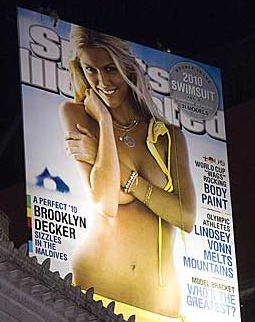
The Sports Illustrated Swimsuit Issue arrives in my mailbox every February to no particular anticipation or fanfare. Certainly its contents are well put together, and I wouldn’t argue they don’t merit an objective hubba-hubba! and a few wolf whistles from those given over to such expressions of approval. Yet I find the Swimsuit Issue disappointing these days because it’s a copy of Sports Illustrated that ain’t got no sports in it.
I’m not kidding. I like sports. I like other things, too, but I don’t like my sports magazines to be scantily clad when it comes to what they usually cover.
Newsstand and ad sales indicate, however, that the Swimsuit Issue is greeted with what might be called broad-based enthusiasm by its reading public, no matter how little there is to read beyond the captions of where the swimsuit models are being languid and who manufactured what little they’re wearing. Indeed, SI hit upon a goldmine when it figured out swimsuit modeling, particularly in the dead of winter and after the Super Bowl, makes for excellent Illustrated, lack of Sports notwithstanding.
Whichever way you wish to classify it, they do a nice job of displaying the merchandise (the swimsuits, I mean). Even if it’s a Brooklyn Decker on the front instead of a Brooklyn Dodger — which had to disappoint Fred Wilpon when he took a second glance at the cover lines — one has to appreciate the photography, the fashion, the artistry…the whatever you like to appreciate.
Even if it ain’t got no sports. Which is what I like in my sports magazines.
Still, I’ve maintained one particularly pleasant memory of a Swimsuit Issue from years gone by. OK, I have a few — I’m not completely made of cork, rubber, wool and stitched white cowhide, y’know — but one edition above the rest stands out: February 9, 1987. Elle MacPherson was on the cover, taking “a dip in the Dominican Republic,” which was as fine as it was dandy, but that’s not the memorable part. It was a two-page spread, shot in the same Caribbean country, described as such:
Kathy and Monika, who waits to bat, are a hit with the Cedeño team, in uniforms by H20 ($72).
I don’t mind telling you that this was a pretty hot picture. Kathy is Kathy Ireland, who was to supermodeling back then what Doc Gooden was to pitching, and you know what she’s wearing besides that “uniform”?
Same thing Doc wore when he was on the cover of SI: a Mets cap.
Now who’s saying Hubba-Hubba?
What made this tableau particularly attractive was the reason Kathy was topped off so stylishly. In the winter of 1987, if you’re posing a model in a baseball motif, you know the ensemble is not complete without royal blue millinery accented by a splash of orange. Baseball, in the winter of 1987, following the fall of 1986, equals Mets.
World Champion New York Mets, if you want to be a model of accuracy.
You’ve got a supermodel? You can’t have her modeling the colors of anything less than a super team. No team loomed as more super or superb at that moment in time than the Mets. It would have been a fashion faux pas to have her in anything less (not that Miss Ireland could have been wearing much less).
Monika, incidentally, is Monika Schnarre; she’s waiting her turn in a Red Sox cap — a perfect pecking order in the wake of ’86.
Kathy Ireland in a Mets cap? With defending champion Pitchers & Catchers barely two weeks away? Suddenly the dead of winter was indisputably springing to life in early February of 1987.
Yes, this is clearly the best illustration in the history of Sports Illustrated Swimsuit Issues, which, back then, weren’t standalones. They had some actual sports in the pages that came after the modeling, which is significant for our purposes as Mets fans because of the sentence that followed the plug for Kathy’s and Monika’s swimsuit designer.
Turn the page for more on the Dominican Republic’s favorite sport.
At si.com/vault, you can actually virtually turn the page of any Sports Illustrated issue, so I took the advice from the spread of pages 150-151 and did what the magazine suggested 23 years ago. And I came upon a story I vaguely recalled but, for some reason, not as vividly as I recalled Kathy Ireland in a Mets cap.
The article is headlined “Standing Tall at Short,” and is written by Steve Wulf. As long as SI was headed to the Dominican to take advantage of its “lush setting” for shooting models, they decided to explore its other great natural resource: shortstops.
There was a point back in the mid- to late ’80s when it seemed every shortstop under the sun hailed from the Dominican Republic. On April 27, 1986, Wulf wrote, nine different Dominicanos played short in the big leagues. One, Rafael Santana, was doing so for the Mets. Two others, Tony Fernandez of the Blue Jays and Julio Franco of the Indians, would eventually become Mets
“Nosotros somos la Tierra de Mediocampistas,” says Felix Acosta Nunez, the sports editor of Santo Domingo’s Listin Diario. “We are the Land of Shortstops.”
Sadly, the setting for those Dominican youths who grew up to play in the majors wasn’t anything close to lush. From Wulf:
In the Dominican Republic, where the average family income is $1,200 a year, poverty is not an isolated problem; it’s the way of life. Also, the quality of education is very low, lower than in the Caribbean’s other pools of baseball talent, Puerto Rico and Venezuela. So the kids don’t stay in school, not when they can be out on the streets or in the fields playing baseball. “It’s very much like the United States in the ’30s, during the Depression,” says Art Stewart, director of scouting for the Kansas City Royals. “Those were sad times, but they produced great ballplayers because baseball was one of the only avenues of escape.”
Talent plus motivation equaled a plethora of shortstops, particularly the San Pedro de Macoris region, from whence seven 1986 major league shortstops hailed. It was a curiosity, all right, but there was more to the story than the trivia of so many players playing the same position from the same relatively obscure area. The men who made the majors — several of whom Wulf gathered for a shortstop summit — provided baseball equipment and hope for the kids who would come up behind them. Alas, there wasn’t always enough of either. “The players who have made it in the big leagues generously buy gear for the kids, but there is never enough to go around,” Wulf writes. “Too often the youngsters must make do with a glove fashioned from a milk carton, a ball that is a sewed-up sock and a bat made from a guava tree limb.”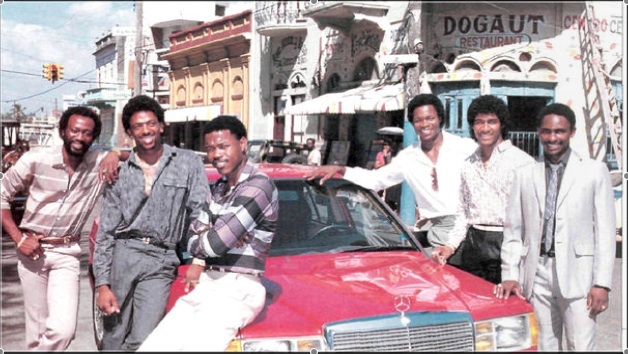
From left to right in the above photo, we meet the cream of the ’86-’87 Dominican shorstop crop: Alfredo Griffin, Julio Franco, Rafael Santana, Tony Fernandez, Mariano Duncan and Jose Uribe. Santana was hardly the star of this Dominican shortstop class; that distinction belonged to Fernandez (whose game mysteriously flickered during his abbreviated 1993 Met tenure). But Ralphie, as his teammates used to call him, shines in the story, nonetheless, quite befitting his status as a World Champion New York Met.
Though he was never considered on the same lofty level with his fellow Dominican shortstops (or ’86 teammates), Wulf describes La Romana native Santana — “the only one with a World Series ring” — glowingly in his piece. He’s the man who “paid [his dues] the longest,” stuck first in the Yankee farm system, then the Cardinals’, where Ozzie Smith left everybody waiting. “Playing in the minors for so long taught me patience,” Santana told Wulf.
You can see the patience in the way he plays shortstop, the way he makes every play close. The Mets finally turned to him in the middle of the ’84 season, and he has been their starter ever since.
 Rafael lasted only one more season as a Met. The organization was high on Kevin Elster and traded the incumbent shortstop after 1987. Santana was steady defensively if indifferent offensively. Demographically, though, he was a sign of shortstops to come. According to Ultimate Mets Database, fifteen of the 107 Mets to play shortstop through 2009 were from the Dominican Republic — nearly 14%. Eleven of them were Santana’s successors. Rafael lasted only one more season as a Met. The organization was high on Kevin Elster and traded the incumbent shortstop after 1987. Santana was steady defensively if indifferent offensively. Demographically, though, he was a sign of shortstops to come. According to Ultimate Mets Database, fifteen of the 107 Mets to play shortstop through 2009 were from the Dominican Republic — nearly 14%. Eleven of them were Santana’s successors.
The most famous and accomplished of them as a Met, at least individually considering he doesn’t yet have a World Series ring, is Villa Gonzalez’s Jose Reyes, hopefully back in the saddle on Opening Day 2010. San Cristobal’s Jose Vizcaino held down the position effectively for a couple of years in the mid-’90s. The rest didn’t necessarily distinguish themselves as Met shortstops.
Chronologically, they were:
• Junior Noboa (1992)
• Tony Fernandez (1993)
• Manny Alexander (1997)
• Wilson Delgado (2004)
• Anderson Hernandez (2005-07, ’09)
• Argenis Reyes (2008-09)
• Fernando Tatis (2009…a pair of emergency cameos)
• Wilson Valdez (2009)
• Angel Berroa (2009)
Before Santana? It had been three years since a Dominican played short for the Mets when Rafael joined the club in ’84. His most direct predecessor was Frank Taveras of Las Matas de Santa Cru. Taveras manned short, not always brilliantly, from ’79 to ’81. Frankie’s stock-in-trade was base-stealing. He set the pre-Mookie single-season record with 42 bags in 1979, despite playing the first two weeks of that year with the Pirates (who — perhaps coincidentally, perhaps not — went on to win the World Series without him). Before Taveras, the most recent Dominican shortstop on the Mets was Barahona-born utilityman deluxe Teddy Martinez, who played six positions in five Met seasons. As the Super Joe McEwing of his day, Ted filled in often at short during Buddy Harrelson’s various injuries in 1973’s pennant campaign.
Prior to Martinez’s 1970-74 stint, there was only one Dominican who played shortstop for the Mets. In fact, he was the first Dominican Met — and the first Dominican shortstop in the majors. I would not have known about him had I not been staring (in disappointment that it ain’t got no sports, I swear) at Brooklyn Decker’s Sports Illustrated cover earlier this week. If I hadn’t seen Brooklyn, I wouldn’t have thought to look for Kathy Ireland in a Mets cap. If I hadn’t tracked Kathy’s picture down, I wouldn’t have revisited Steve Wulf’s profile of Rafael Santana and his contemporaries. And if Wulf hadn’t drawn me in to his tale of San Pedro de Macoris, I wouldn’t have suddenly become aware of the contribution of Amado “Sammy” Samuel to baseball history.
Amazingly, even in the baseball-mad precincts of San Pedro de Macoris in 1987, Samuel was a bit of a prophet without honor. The locals, Wulf reported, thought outfielder Rico Carty was the first Macorista to make the major. Not so — Sammy got to the Braves ahead of him in 1962. Even Wulf concedes his discovery of “the very first Dominican shortstop to reach the big leagues” could be considered underwhelming.
It’s not hard to overlook Amado Samuel. He played in only 144 major league games over three seasons for the Braves and New York Mets, batting .215 with three home runs and not one stolen base. About the only time his name comes up is when some publication lists the 78 men who have played third base for the Mets. Even the Dominican aficionados have lost track of him; some say he is living in New York City, others say he is in Santo Domingo, still others think he has passed away.
Turns out those folks were wrong. Sammy made Louisville his home from the time he played there in the minors in 1961. He married a Louisville lady, picked up a southern accent and went to work after he was done playing ball at the General Electric plant. “I didn’t play too long after the Mets ’cause I tore up my knee in Buffalo,” Samuel, then 48, told Wulf. “Missed out on the big bucks, I guess, but I’m healthy, doing fine, no complaints.” Not only no complaints, but some justifiable pride:
“Now that you ask, I am proud of being the majors’ first Dominican shortstop. I guess there are a lot of them now. You know, one reason there might be so many is the ground they play on. You’ve got to have very good hands to play on those fields.”
About the only thing I knew about Sammy Samuel before Steve Wulf (and Brooklyn Decker, indirectly) got me up to speed was his nickname. I only knew that because my friend Joe Dubin sent me a recording of the first radio broadcast in Shea Stadium history, and Bob Murphy referred to the Mets’ starting shortstop that momentous day as Sammy, not Amado. Murph, Ralph Kiner and Lindsey Nelson were preoccupied by the wonders of freshly opened Shea to spend a lot of time relating Sammy’s story to their audience on April 17, 1964. Ralph, however, had the privilege of calling the first multiple-run, extra-base hit in Shea Stadium history in the fourth inning this way:
“And SAMUEL has put the Mets out in front! Sammy Samuel with a sharp line drive right over the bag that hit in fair territory, right down the left field line.”
Sammy, who wound up on second, drove in Jesse Gonder and Frank Thomas (despite Thomas falling down en route to home). It put the Mets up 3-1 on Bob Friend and the Bucs. It wouldn’t get any better for the Mets that day. They’d lose 4-3 to Pittsburgh.
It wouldn’t get much better for Samuel as Met, either. Despite the two ribbies and a batting average of .364 after three games, Casey Stengel sent Ed Kranepool up to pinch-hit for him in the eighth. Sammy was never quite the same after that. The first shortstop Shea ever saw watched his offense plummet. Within a few weeks of Shea’s opener, Samuel’s average was down below .200. On a team that wasn’t going anyplace but tenth, Sammy’s spot was soon enough on the bench. Eventually, right after Shea hosted its only All-Star Game, it was Buffalo, then (as now) the Mets’ Triple-A affiliate. He never made it back to Flushing.
Amado Samuel was in on some Met history besides his Opening Day onslaught. He came on for defense, replacing Roy McMillan, after the Mets opened a 13-1 lead on the Cubs at Wrigley on May 26, a game that we would hold on to win 19-1. From it was born the legend of the phone call to the newspaper sports desk:
“How’d the Mets do today?”
“They scored 19 runs.”
“Did they win?”
It was 1964. It wasn’t out of line to ask the followup.
Sammy went 0-for-1 in Chicago that day. His next appearance, May 31 at Shea, would net him two hits and a hit-by-pitch, which sounds like a splendid day’s work…except he had seven at-bats…and the game went 23 innings…and the Mets lost 8-6 in the second game of a doubleheader to the Giants…with Sammy flying to right to end it…after losing the first game 5-3. Sammy played second base from the third (Casey had pinch-hit for starter Rod Kanehl in an effort to score early) through the 23rd.
Starting at third base in the opener of another Sunday Shea doubleheader three weeks later, against Philadelphia, Samuel lined out (the New York Times reported Phillie shortstop and future Met coach Cookie Rojas had to jump “about two or three feet” to make the catch) and popped up in two at-bats. He was pinch-hit for by George Altman in the bottom of the ninth. Altman didn’t do any better, striking out. Then John Stephenson struck out. Every Met who batted made out. That was June 21, Jim Bunning’s perfect game. It kind of took the edge off Samuel’s June 20. As Centerfield Maz noted recently, Sammy collected three hits the day before Bunning cooled him off.
For a guy who played in only 53 Mets games total, Amado Samuel was a part of more weirdness than most men experience in a lifetime. Upon coming across his name in Wulf’s 23-year-old Sports Illustrated article, I wondered if there was more Sammy’s Met tenure than Gumplike accidental tourism. So I asked Joe Dubin what he remembered about Samuel. Joe’s been watching the Mets since there were Mets and he seems to have seen everything that I missed.
“I remember having high expectations for him as a Met,” Joe kindly told me. “But for me, that feeling applied to every new player we got. I immediately envisioned Sammy as a potential superstar as I did every other player we obtained. When I was a kid growing up as a New Breeder, everything was seen through rose-colored glasses.”
That’s funny, I thought. I viewed Teddy Martinez the same way. And Frank Taveras. And Rafael Santana. And Jose Vizcaino. And Jose Reyes. Wilson Valdez…not so much. But there’s still time.
I appreciated Joe’s recollection, but still I wondered. I flipped through Bill Ryczek’s essential early-Mets history and learned only that Amado Samuel was, come 1965, part of “probably the sorriest Triple A club in baseball”. For the record, the ’65 Bisons, chock full of discarded ’62-’64 Mets, went 51-96, placed eighth of eight and finished a distant 34½ games out of first. They were even worse than the notoriously bad Bisons of 2009 (a league-worst 56-87 despite being stocked with so many past and future Mets).
The only 1964 Mets yearbook I have is a revised edition, an edition out of which Sammy Samuel was revised right out of once he was demoted to Buffalo. The only 1964 program I have offers no biographical information either, but the scorecard portion offers a happy recap. Thanks to whoever filled it on May 13, I can tell the Mets beat the Milwaukee Braves 5-2, that Jack Fisher beat Tony Cloninger and that Samuel, wore 7, batted eighth, flied out to right, grounded to short, grounded to the pitcher and grounded to third (5, unassisted). I also learned from an advertisement accompanying the scorecard portion of the program that for a Grouchy Stomach or a Nervous Tension Headache, I should take Bromo Seltzer. I suppose with the Mets in the midst of a 53-109 season, the Bromo Seltzer people figured Mets fans were a prime target audience for their product.
Still, nothing much on Samuel. I checked next with Jason. I asked him to pluck Sammy’s 1964 card from The Holy Books and let me know what it said on the back. After declaring it “Strangest. Request. Ever.” he dutifully reported that Topps dutifully reported, “The Mets acquired Amado from the Braves in late ’63. The youngster jumped from Class D to Triple A before coming to the majors in ’62.”
There was also a trivia question regarding the holder of the Giants’ record for hits in one year. Then as now, the answer is Bill Terry.
Before getting completely off track, I discovered the SABR Biography Project had not long ago profiled one Amado Samuel, a.k.a. our Sammy. According to Malcolm Allen’s comprehensive research, major league shortstops have continued to come out of the Dominican Republican at a rapid rate in the two-plus decades since Steve Wulf visited San Pedro de Macoris. By 2007, more than a hundred had taken a turn at the position. And during the games of September 24, 2005, Allen writes, fourteen different Dominicans trotted out to short (including Reyes and his opposite number that night, Cristian Guzman of the Nationals). The author confirmed what Wulf asserted in 1987, that Samuel was indeed the “first Dominican major leaguer to primarily play shortstop, as well as the first big leaguer from San Pedro”.
Allen does a magnificent job of following Samuel’s entire life — which, at age 71 is still going strong in Louisville — including his sale by the Mets back to the Braves after the ’65 season. Samuel needed to be moved out of the organization to make room for a younger shortstop…a fellow by the name of Bud Harrelson.
Thus, in a way, Sammy Samuel is connected to both World Champion New York Met shortstops. His departure created space for Buddy and, regarding his countryman Ralphie, he told Wulf in 1987, “I’ll go to a game in Cincinnati once in a while…but the Mets are still my team. I like the shortstop with the Mets, Santana. He’s pretty good.”
Twenty-three years ago, a retired baseball player who most everybody had forgotten about — and who hadn’t been a Met for twenty-three years to that point — pledged allegiance to the team that let him go and offered an elegant benediction to the unassuming player who followed twice in his footsteps: as a Dominican major league shortstop and as a New York Met shortstop. So it turns out Kathy Ireland in a Mets cap wasn’t the most beautiful thing Sports Illustrated featured in that Swimsuit Issue after all.
Thanks to the blog Condition Poor for unwittingly lending us the image of the 1964 Topps Amado Samuel card.
Please join Frank Messina and me on Tuesday, February 16, 6:00 PM, at the Cornelia Street Cafe in Greenwich Village for a night of Mets Poetry & Prose. Details here, directions here.
by Greg Prince on 12 February 2010 5:48 am “Who can go the distance?” Don Henley asked some thirty years ago before the Eagle answered his own question: “We’ll find out in the long run.”
There’s a long run coming this November, and I have a pretty good hunch about who’s going the distance that day.
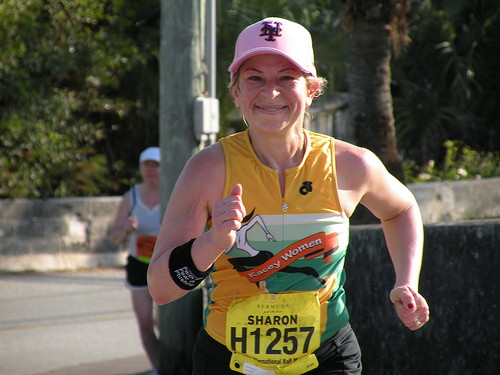
Sharon Chapman, like you a Mets fan and like you a reader of Faith and Fear in Flushing, is training for the New York City Marathon. It’s a long run, all right — 26.2 miles for those of you scoring at home. It’s a run with more than a dash of Met meaning, too, because of what Sharon’s doing while preparing.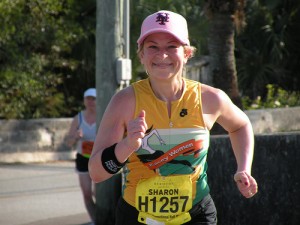
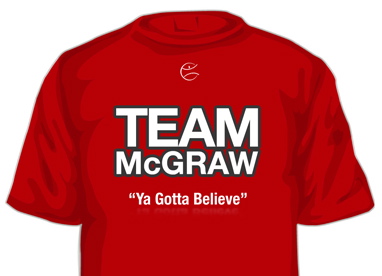
She is using this personally momentous occasion to raise money for the Tug McGraw Foundation, a group devoted to making the lives of people coping with brain cancer, post-traumatic stress disorder and trauma brain injury better. TMF was established as Tug himself — the man who originated the credo “You Gotta Believe” while closing out games for the 1973 National League Champion Mets — was fighting brain cancer. Tug, a Met stalwart from 1965 through 1974, died in January 2004. The Foundation continues to seek solutions to a deadly scourge in his name.
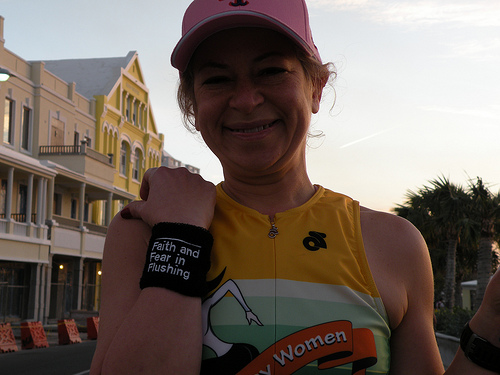
The intersection of Sharon Chapman’s marathon aspirations and the memory of Tug McGraw crosses our doorstep because Sharon reached out to us and asked if she could represent “Faith and Fear Nation” on her journey and wear a wristband with our blog logo. I didn’t even know we had a nation (maybe a dorm), but Jason and I said, sure, we’d be honored.
Since we’re unofficial sponsors, I thought it appropriate to check in with Sharon and find out a little more about how all this came together, how it’s progressing and get a greater sense for her fellow FAFIF readers why a Met legend, her Met fandom — and another Mets fan she has yet to meet — coalesced to make this more than just one woman running one race.
How long have you been running?
I started running in the spring of 1999. I ran three times a week until the fall of 2008; at that time I had started Weight Watchers. Weight Watchers cajoled me into increasing my exercise by allowing me to exchange the earned Activity Points for Food Points, and as a result I started running virtually every day.
How did your running progress from simple exercise to a try at the New York City Marathon?
I blame Valerie Bertinelli. Seriously.
 Even though Valerie is a Jenny Craig spokesperson and I’m a Weight Watchers kind of girl, I attached to Valerie as my weight loss role model. She’s only slightly older than I am, she was looking to lose a similar amount of weight, and she wasn’t looking to become ultra-skinny; I could relate to her. Even though Valerie is a Jenny Craig spokesperson and I’m a Weight Watchers kind of girl, I attached to Valerie as my weight loss role model. She’s only slightly older than I am, she was looking to lose a similar amount of weight, and she wasn’t looking to become ultra-skinny; I could relate to her.
To digress — I promise this comes together — in January 2008 I went to Bermuda and ran the 10K race as part of their International Race Weekend. Except I wasn’t prepared for Bermuda’s steep hills, and I couldn’t run the whole way. I was very disappointed to have done poorly in a race in Bermuda, which is my favorite place in the world.
So flash forward to July 2009. My husband Kevin and I were in the car, and I told him that, now that I was at goal weight and in the best shape of my life, I wanted to return to Bermuda to get the 10K right. I also told him that I had no desire to run anything longer than 10K; I wasn’t interested in running a half marathon or anything like that.
Not 20 minutes later, in my Entertainment Weekly, I read this headline: Valerie Bertinelli Runs Her First Half Marathon! “Damn!” I said. “Now I have to run a half marathon!”
I ran that half marathon in Jersey City in September. At first, I thought that would be it. But then, the idea of running the New York Marathon started hitting me. When Kevin and I were in law school in Boston, I would watch the New York Marathon on television just to watch shots of New York because I was homesick.
To go from wistfully watching the Marathon on television to actually running it is something I never imagined, and I realized that it’s something that I need to try.
And I did go back to Bermuda this past January. Not only did I conquer the hills of Bermuda’s 10K race, but the next day — wearing my FAFIF wristband — I ran the half marathon there as well.
By the way, Valerie Bertinelli is running the Boston Marathon this spring as her first full marathon. So I’m still working on keeping up with her. But if she ever decides to go for a triathlon, she’s on her own.
What has the training been like to this point? What’s ahead?
Initially, the training wasn’t all that different for what I’ve been doing since the Fall of 2008. I just kept running every day. But recently I started increasing my long runs, which also means I need to build a rest day and a cross training day into my schedule. I hit a wall during my first attempt to run 20 miles, so now I’m working on proper nutrition for long runs — making sure I’m eating breakfast on those days, finding out which gel packs I like best, adding electrolytes to the equation, etcetera. I’ve gone from being a recreational jogger to someone who is becoming more knowledgeable about running, which is a transformation I never anticipated going through.
I started panicking about making the New York Marathon my first marathon, so I signed up for the New Jersey Marathon in May. I call it my training marathon; I can make all of my mistakes there so I’ll know what I’m doing in New York. The timing is good. I’ll have six months between the two races. That will give me two months to go back to easier running before I have to train again.
You met and interviewed Tug McGraw once. What were the circumstances? As someone who grew up a Mets fan, watching Tug, describe that experience.
I used to write a column called Fan’s Voice for New York Mets Inside Pitch. In early 2003, I had the opportunity to interview Tug by phone for the magazine. It was a great experience, and an instructive one. I was a novice, and Tug teased me about things like not recording the conversation. He was also very personable, entertaining and witty. The interview was basically everything one would ever expect from the man who coined the phrase “Ya Gotta Believe,” and it was a wonderful experience.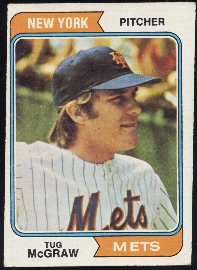
The interview was published a couple of weeks before Tug’s diagnosis that he had a malignant brain tumor. I was absolutely shocked. In retrospect, there may have been two times in our interview that he didn’t have an answer off the top of his head, but for the most part he was sharp and on the ball. It was inconceivable to me that he could have been ill at the time we spoke.
The postscript to this story is that my husband and I attended a Mets-Phillies game in the Phillies suite at Veterans Stadium in September of that year because we were involved in a local Cub Scouts group outing that season. I remember sitting down in my seat, looking over to the next section, and seeing a kid who looked like Tug McGraw’s son Matthew. At second glance, I noticed that it was indeed Matthew, and that Tug was sitting next to him. I went over and introduced myself in person to Tug, who remembered me and was very excited to meet me in person. That was one of the biggest thrills in my life.
How did you find yourself involved with the Tug McGraw Foundation vis-à-vis the marathon? And what is Team McGraw?
Kevin and I have actually attended several Tug McGraw Foundation events since the foundation’s inception. We went to a party at Citizens Bank Park in 2004, and to gala dinners in Philly and in New York. BTW, at the two gala dinners, each time I wanted my husband to take my picture with Tim McGraw, and both times we had camera malfunctions. Maybe one day I’ll get my picture taken with Tim…
But back to your question. When I decided that I wanted to run the New York Marathon, I started researching how I could get in. One cannot count on getting in through the lottery, and I was never going to be fast enough to get in via a qualifying time, but I saw that one could get in by raising money for certain charities that had spaces in the Marathon. I remembered reading about Team McGraw from a Tug McGraw Foundation newsletter, and looked into that. It seemed to me to be the perfect fit; I could achieve my goal of running the New York City Marathon and help an organization that has meaning to me at the same time.
Team McGraw is comprised of runners who participate in races to raise money for the Tug McGraw Foundation. It is headed up by musician Jeff McMahon, who is a distance runner himself and is also Tim McGraw’s keyboardist. The coach is Kevin Leathers, who’s given me some excellent distance running advice. Throughout the year different Team McGraw teams participate in races throughout the country. In fact, in addition to the NYC Marathon, I’m also participating in the NYC Half Marathon on March 21 as part of Team McGraw.
Being able to run the Marathon with a support group is a very comforting feeling. I won’t have to worry about finding my way or figuring out certain things on my own. I’ll have a group of wonderful people guiding me and watching my back. Because, frankly, I’m a little scared about tackling this kind of a distance; having Team McGraw there to support me is making the concept of 26.2 miles much less daunting than it would otherwise be.
You and I were both kids when Tug was traded to the Phillies. What do you remember most about Tug as a Met? Was he one of your favorites?
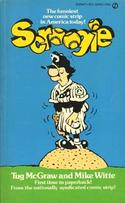 I remember liking him. Everyone loved Tug, but I can’t remember too much about his Met playing career specifically. I do remember reading his Scroogie cartoon in the newspaper, though, and enjoying that very much. That’s the most specific memory of Tug from my childhood that I can muster. I remember liking him. Everyone loved Tug, but I can’t remember too much about his Met playing career specifically. I do remember reading his Scroogie cartoon in the newspaper, though, and enjoying that very much. That’s the most specific memory of Tug from my childhood that I can muster.
Does what you’re doing now give you a new perspective on Tug’s signature phrase?
Ya Gotta Believe it does. That truly is a great motivating phrase. For that matter, it was also a motivator for my Weight Watchers success (I used whatever mind games I could in order to drop those forty pounds). Whenever you need to give yourself a kick in the rear, Ya Gotta Believe is a great motivator.
Tug spent roughly half his career with us, half with the Phillies, and he remained associated with them right up the time of his diagnosis with brain cancer. The Phillies are to be commended for having done a great job supporting the Foundation, no matter the rivalry that’s developed between the two clubs and their fans. Still, how odd is it for you to be wearing red in this context?
It’s odd, for sure. But, as you said, understandable. Tug was a Spring Training coach for the Phillies when he got sick, and spent much of his final year living in the Philly area.
For what it’s worth, while I don’t root for the Phillies, I do have to admit that the organization has always treated me very well. I live in Central New Jersey, and have attended many games in Philadelphia over the past several seasons. The Phillies have always treated me as a valued customer, which, sadly, I can’t say about my own team.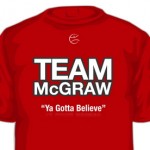
Kevin and I will be attending the Tug McGraw Foundation Awareness Night in Philly on April 30, which will be during a Mets-Phillies game I’m hoping that by wearing my Team McGraw shirt that the Phillies Phans won’t give me too much abuse for wearing my Mets cap to the game.
And how much blue do you hope to inject into the Foundation?
I’m definitely hoping to inject some more blue into TMF. I think that a lot of the TMF personnel are simply unaware of just how evenly split Tug’s career was. Also, it’s to their benefit to court Mets fans, since we’re certainly at least as generous as the Phillies Phans! Everyone who knows me at the Tug McGraw Foundation knows that I’m a passionate Mets fan, and I think that’s a good first step toward getting TMF to be more aware of the fact that Mets fans are a resource they should be approaching more proactively.
Could the Mets be doing more — or something — in this area?
For sure! If the Phillies can do a Team McGraw Awareness Night, it seems like the Mets could do something similar. I’m not sure whether that kind of thing would be initiated by the TMF or the Mets, but someone should look into making that happen. Tug is a member of the Mets Hall of Fame. The team should definitely honor his memory by supporting the foundation that bears his name.
Tell us a little about the young man you’re running for. We understand he’s a Mets fan, too. What does it mean to be “running for” twelve-year-old Connor McKean?
Team McGraw asked whether they could pair me up to run on behalf of one of their members. Ultimately, they paired me up with Connor.
 I haven’t met Connor in person yet, but I have exchanged e-mails with his mom and I hope to meet them sometime this season. Connor was diagnosed with a rare brain tumor called an ependymoma on October 17, 2007. He still suffers from headaches, but is working hard to keep up in school. I chose to run for Connor after I heard that he only wanted to wear his David Wright jersey when he was undergoing chemotherapy. I haven’t met Connor in person yet, but I have exchanged e-mails with his mom and I hope to meet them sometime this season. Connor was diagnosed with a rare brain tumor called an ependymoma on October 17, 2007. He still suffers from headaches, but is working hard to keep up in school. I chose to run for Connor after I heard that he only wanted to wear his David Wright jersey when he was undergoing chemotherapy.
As the parents of two teenage boys and a girl in college, Connor McKean’s situation makes us really appreciate our own kids’ health all the more. It definitely makes running the Marathon for Connor McKean all the more poignant for me, because it could just as easily be one of my own kids going through the treatments and adjustments that he has gone through.
What do you hope you will have accomplished by November after the funds have been raised and the finish line is crossed?
Wow — I really haven’t thought in terms of the Big Picture much. So far I’ve been thinking about all of the small pictures leading up to November 7. For me, personally, I will have the satisfaction of having completed the New York City Marathon. I love this quote by Marathon founder Fred Lebow: “In running, it doesn’t matter whether you come in first, in the middle of the pack or last. You can say, ‘I have finished.’ There is a lot of satisfaction in that.” Since I was never blessed with speed, even as a youngster, I definitely hold this thought dearly.
Obviously I want to raise as much money for the TMF as possible. They are a great organization, and I want to support them. Even after my retirement from long runs, I hope to be able to help support Team McGraw in the future.
I love the concept that I can be the poster child for the idea that anyone can run. Two years ago I was forty pounds overweight and had never run longer than a slow 10K before. If I can run a marathon, then anyone with enough desire and dedication can do it. If that can help motivate other people to strive for things they previously thought were out of reach — just like Tug and Valerie have helped motivate me to strive to lose weight and run marathons — that would be an incredible thing.
You’re about two-thirds of the way to your fundraising goal. What does it mean to you to have elicited so much support from so many different people?
It’s very touching to have received so much support from so many people. Obviously some of it is the result of having picked the right charity to run for — so many people love Tug and want to honor his memory. But it also means a lot that people are supporting me as well. It gives me extra motivation to train seriously for this, because I don’t want to let down all of these generous people!
Finally, the wristband and “Faith and Fear Nation” was all your idea. We’re honored to come along for the run, so to speak, and talk it up, but why us?
Why not you? Well, as you pointed out in “The Wrist of the Story,” I did get the idea from Stephen Colbert and his Colbert Nation. Since I know you’re a fan of The Colbert Report, I figured you’d appreciate the reference. Plus we had discussed the fact that you and Jason would help publicize my fundraising efforts throughout the baseball season, which is something I appreciate very much. It dawned on me that the wristband would be a nice way for me to thank you guys for your support.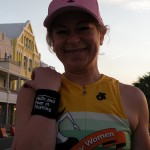
Plus, again, running for the Faith and Fear Nation provides me with even more incentive to take my training seriously so I can finish the Marathon and earn that medal!
If you would like to support Sharon Chapman’s efforts on behalf of the Tug McGraw Foundation, please visit her fundraising page. Any and all contributions are greatly appreciated.
by Greg Prince on 10 February 2010 10:55 pm  The seventh installment of the critically acclaimed (by us, anyway) Mets Yearbook series debuts Thursday night (2/11) at 7:30 on SNY. The year in the spotlight is 1966, the first season in Mets history that was merely bad and not horrific. Of course, everything is relative. A 66-95 ninth-place finish sounds garden variety wretched, but consider this was the first time the Mets didn’t lose at least 109 games and didn’t finish last. A 16½-game turnaround is nothing to sneeze at in any league…even its second division. The seventh installment of the critically acclaimed (by us, anyway) Mets Yearbook series debuts Thursday night (2/11) at 7:30 on SNY. The year in the spotlight is 1966, the first season in Mets history that was merely bad and not horrific. Of course, everything is relative. A 66-95 ninth-place finish sounds garden variety wretched, but consider this was the first time the Mets didn’t lose at least 109 games and didn’t finish last. A 16½-game turnaround is nothing to sneeze at in any league…even its second division.
The propaganda value of improving from 50-112 to 66-95 should prove outstanding. And it’s gotta beat shoveling snow. As a bonus, SNY follows up this world premiere with reruns of Mets Yearbook from 1975, 1976, 1968 and 1984.
Image courtesy of kcmets.com.
Please join Frank Messina and me on Tuesday, February 16, 6:00 PM, at the Cornelia Street Cafe in Greenwich Village for a night of Mets Poetry & Prose. Details here, directions here.
|
|