The blog for Mets fans
who like to read
ABOUT US

Faith and Fear in Flushing made its debut on Feb. 16, 2005, the brainchild of two longtime friends and lifelong Met fans.
Greg Prince discovered the Mets when he was 6, during the magical summer of 1969. He is a Long Island-based writer, editor and communications consultant. Contact him here.
Jason Fry is a Brooklyn writer whose first memories include his mom leaping up and down cheering for Rusty Staub. Check out his other writing here.
Got something to say? Leave a comment, or email us at faithandfear@gmail.com. (Sorry, but we have no interest in ads, sponsored content or guest posts.)
Need our RSS feed? It's here.
Visit our Facebook page, or drop by the personal pages for Greg and Jason.
Or follow us on Twitter: Here's Greg, and here's Jason.
|
by Greg Prince on 16 February 2026 4:24 pm Faith and Fear in Flushing celebrates its 21st birthday today, making this the blog that’s legally old enough to drink. And what better way to toast such a milestone than with a lyrical tribute that would seem at home in any saloon situated within the 11368 ZIP Code?
Based strongly on the genius Stephen Sondheim committed to the 1971 musical Follies, and inspired by the voice of survival herself, Elaine Stritch — you mean every Mets blog isn’t? — we’re here to tell you on this February 16 that, as has been the case since 2005…
WE’RE STILL HERE
Faith times and Fear times
We’ve seen ’em all
And, readers dear
We’re still here
Postseason sometimes
Sometimes a drop toward the rear
But we’re here
We’ve whittled magic numbers
Short of zero
Stranded men on third
When short a hero
Seen our stadium disappear
But we’re here
Felt the sting of
Spinal stenosis
But we’re here
L’s put in the books of
Howie Rose’s
But we’re here
We’ve told each other ‘LFGM’
Put too much trust into each GM
Reach contention or just pretend?
Regardless, we would cheer
Team sold to a big financier
And we’re here
We’ve been through Pedro’s, Johan’s, and R.A.’s flair
And we’re here
Harvey Day, Grandpa Bert, and Noah’s hair
And we’re here
We got through departure of deGOAT
Verlander and Scherzer both boarding a boat
Blew taps on our trumpets
As Diaz flew a jet made by Lear
We lived through Luis Castillo
And we’re here
We’ve gotten through Fred and Jeff Wilpon
Gee, that was fun and a half
When you’ve been through Fred and Jeff Wilpon
Anything else is a laugh
We’ve been through Reyes
We’ve been through Cespedes
And we’re here
Flores and Nimmo
Asdrubal Cabrera
And we’re here
Built our hopes up for Dom Smith and Duda
Applauded along when Conforto was Scooter
Held our breath tightly
When they checked Musgrove’s ear
Still, someone said, “Buck’s sincere”
So we’re here
Murph slugged us to a pennant
His ‘D’ then showed ill effect
But we’re here
Black jerseys Friday
Next day City Connect
But we’re here
First we’d lead the league through all those laps
Then came September
And we’d collapse
We blog night after night, season by season
We can’t say for why or for what is the reason
But we’re here
We’ve gotten through
‘Hey, those Mets had quite a run
Thanks a lot for adding some fun’
Or better yet,
‘Sorry the Mets weren’t much fun,
We’ll look you up when they go on a run’
Faith times and Fear times
We’ve seen ’em all
And, readers dear
We’re still here
An Endy catch sometimes
Sometimes au revoir to a Bear
But we’re here
We’ve run the gamut, Aardsma to Zuber
Grab us a 7, cancel the Uber
We got through all of last year
And we’re here
Lord knows, at least we’ve been there
And we’re here!
Twenty-one years!!
We’re still here!!!
by Greg Prince on 12 February 2026 2:47 pm In the 1978 film Heaven Can Wait, veteran L.A. Rams quarterback Joe Pendleton, played by Warren Beatty, is in the prime of his life — “at my age, in any other business, I’d be young” — when he rides his way into an apparently fatal bicycle accident. An escort from above assigned to monitor such activity (Buck Henry) dutifully swoops up Joe to move him along on his celestial journey. Except the QB knew in his bones the accident wasn’t as fatal as it appeared, and therefore heaven really could wait. His assuredness led to this exchange between Joe and the escort’s supervisor Mr. Jordan (James Mason), the elegant gentleman charged with overseeing cloudbound operations.
JOE PENDLETON: I’m not supposed to be here.
MR. JORDAN: But you are here.
JOE PENDLETON: Well, you guys made a mistake.
Even as our collective attention shifts to hamate bones and positional switches reporting to Port St. Lucie in the company of pitchers, catchers, and everybody else, I’ve found myself thinking about that cinematic exchange from 48 years ago, overcome by the idea that someone winds up where he is not supposed to have been sent. I was directed in my mind to those lines and that thought in the aftermath of learning two one-time Mets had died just ahead of the beginning of Spring Training. “One-time” sounds right here. The first man was a Met for precisely a single season. The second of them was one of us for barely more than a month.
The passing that really brought it home was the second, that of Terrance Gore. Terrance Gore was a Met in 2022. He was 34 years old. Four Mets reporting to this very Spring Training are older. No, he’s not supposed to be here. In my heart, no baseball players are supposed to enter this sort of discussion. Because baseball players wind up as human beings regardless of the profession we grew up exalting, they inevitably wind up here, as any person will eventually.
But, if there’s justice, not a person who was 34. Not a Met from 2022 in 2026. Not someone I stood up to applaud on the final night of what is now a mere four seasons ago when he connected for his only base hit as a Met. Terrance Gore wasn’t a Met so he could bat. Buck Showalter brought him in to be his primary pinch-runner ahead of the playoffs. I trusted Showalter to know personnel the way Rocky Balboa trusted Mickey to train him for his longshot bout versus Apollo Creed. Late in Rocky, Mick tells Rock, “I want you to meet our cutman here, Al Silvani.” No further discussion needed, Al Silvani is the cutman. Early in September of 2022, Buck told us Terrance was in for Travis Jankowski, which is to say he would be in for the likes of Daniel Vogelbach and Tomás Nido should such lumbering Mets reach base.
Jankowski had done a fine job as Showalter’s pinch-runner of record before the Mets squeezed him off the 40-man, but Gore was a bona fide baseball celebrity to baseball fans who paid attention to baseball minutiae. Gore, listed as an outfielder, was the entire industry’s pinch-runner of record. He was famous for running for somebody else and getting rewarded for it handsomely, collecting three World Series rings despite rarely batting or fielding. He understood his mission on those championship rosters — the Braves’ in 2021, the Dodgers’ in 2020, the Royals’ in 2015 (when he had the decency to not enter a single World Series game) — was to be speedy in spots that could alter outcomes.
That was Terrance Gore’s role as a Met. He made it into five late-season games as a Met pinch-runner, plus a few others as a defensive replacement. In the bottom of the eight on a Sunday afternoon, as the Mets attempted to sweep away the pesky Pirates, Terrance put on what could be rightly called a pinch-running clinic.
He comes in to run for Nido.
He steals second.
He takes third as the catcher’s throw sails into center.
He comes home on Brandon Nimmo’s short single to left-center.
The Mets retake the lead.
The Mets win the game.
The essence of successful pinch-running in one quick 270-foot trip.
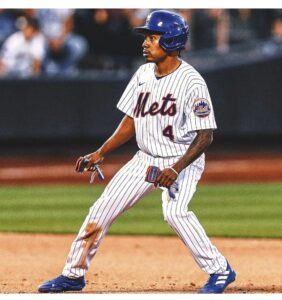
For Game 162 of 2022, Showalter granted Gore an entire nine innings to demonstrate his utility for the impending playoffs. As the starting center fielder, he lined a single into left off Erick Fedde of the Nationals. As baseball fans, we relish jumping to our feet and clapping when a player successfully completes what isn’t his standard assignment. Terrence hadn’t registered a base hit since 2019. It wasn’t his job, but now he had done it in front of us, and we did not hesitate to express our appreciation. We’d only been acquainted with Gore for a month, but we wanted to let him know we liked what he was doing.
The last thing Terrance Gore did, having made the postseason roster, was pinch-run in the second game of the National League Wild Card Series against the Padres. Darin Ruf led off the home sixth by helpfully placing his body between a pitch and the catcher’s mitt. The DH was HBP, and how he’d be PR for. Gore in for Ruf. The Mets were down one in the series and up one in the ballgame. What a perfect situation for a player of Terrance’s skills to make a difference. This was a man who had pinch-run 67 times in regular-season play since coming to the big leagues in 2014, plus eleven more in the postseason with this appearance. He was a specialist and this loomed as a special moment.
Then Nido grounded to second, instigating a 4-3 DP that not even the speediest pinch-runner could upend. Sometimes that’s how the ol’ ballgame goes. Sometimes that turns out to be the last time you see a ballplayer playing ball. Gore, penciled in as designated hitter, would be pinch-hit for when his slot in the order next came around. Buck didn’t have a situation for him in deciding Game Three, the one that eliminated them, and that was the end of Terrance Gore’s Mets career and, as it turned out, baseball career. The Mets wanted to outright Gore to Triple-A. He had the right to refuse and elected free agency. Nobody signed him, and that was that as far as we knew.
Not even three-and-a-half years later, you read Gore has died at 34, reportedly from surgical complications, and you can’t quite fathom it. You never can with ballplayers who were playing for your team just the other year, which might as well be just the other day. Gore is the fifth late Met whose tenure with the club took place entirely in this century, the only one whose breadth of major league experience postdates Shea Stadium. Shea Stadium lingers in the distant enough past that we’re now down to one potentially active MLBer, the as yet unsigned Max Scherzer, who can say he played there. If we mark time by stadia, anything we hear about Terrence Gore lands as relatively current, never mind indisputably recent. The 2022 Mets? I know we just let some of those guys go, but a few are still Mets on the precipice of 2026; Francisco Lindor, Mark Vientos, and Francisco Alvarez were in the starting lineup alongside Gore on October 5, 2022. Citi Field? It’s where we’ll be focusing our attention at the end of March. This March. I was just there in September for Closing Day, just as I was just there in October of 2022 for Terrance Gore’s lone Met hit.
If we imagine our lives as following some kind of path, à la Heaven Can Wait, we could do worse for a roadmap than a baseball diamond. Home to first. First to second. Second to third. Third to home. It may not work that way in life, but it’s kept baseball humming in fine fettle. Terrence Gore didn’t even have to go home to home around the diamond most games. He’d usually start at first base. He was in as a pinch-runner to pick up for the guy who found his way there from home plate. Baseball allows this, somebody fast helping out somebody who’s not. That was what Terrance Gore did so well that teams contending for a title sought him out and showed their faith in him to do it some more.
The bulk of Terrance Gore’s baseball career was about getting from only first to home as fast as possible. By that measurement, somebody owes this man an extra ninety feet.
Before the loss of Gore and one other Met this February, there were a half-dozen far older Mets who died between the end of the 2025 season and the turn of the calendar to 2026: infielders Sandy Alomar, Sr. (81), Larry Burright (88), and Bart Shirley (85); outfielder George Altman (92); first baseman Tim Harkness (87); and starting pitcher Randy Jones (75). I’m also compelled to mention reliever Bill Hepler (79), who died in August without us taking a moment to note his passing. Those were seven Mets from what is unquestionably a long time ago. Six of them were Mets in the 1960s, a decade that hasn’t been active for more than fifty-six years. Alomar and Jones are the only ones I personally remember as major leaguers, and my instinct is to say I’ve been watching baseball almost forever.
Yet it was too soon for all of them to go, because baseball players became baseball players before the primes of their lives even began, and the people who cared most about them were kids whose lives had barely begun. We, those kids, get older and if we think of baseball players from our youth, we don’t see men who’ve aged into their so-called golden years. We see the athletes. We see the Mets. We see ourselves, from the inside out, viewing them as Topps intended. We don’t know it at that age, but those are their own kind of golden years, and a baseball player’s name is license to revisit them any time it occurs to us.
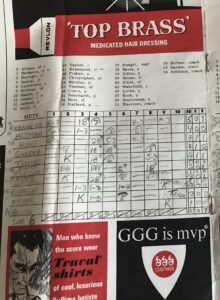 If we were lucky enough to experience it, we see Tim Harkness smashing that walkoff fourteenth-inning grand slam to beat the Cubs at the Polo Grounds in 1963 and summon that untoppable thrill all over again. Or we can reseat ourselves at brand new Shea Stadium on April 17, 1964, peer up at that gigantic scoreboard, and fill out a scorecard with the names of the first nine Mets to start a game there, including HARKNESS 3, leading off and playing first; ALTMAN 9, hitting second and batting right; and BURRIGHT 4, batting eighth and playing second. We could begin to imagine what might be possible in this place. It’s Shea. It’s the present and it’s the future. The World’s Fair is next door and the sky could be the limit…and if the sky is a stretch, considering we’ve spent our first two years in tenth place, then Row V of the Upper Deck will do as a manageable hike. Top to bottom, this is where we and the Mets live. It will never occur to us that someday the National League won’t be stocked with players who will be able to say they played here, because where else would they play when they come to play the Mets? Why, even the best American Leaguers will be dropping by this July for the All-Star Game! If we were lucky enough to experience it, we see Tim Harkness smashing that walkoff fourteenth-inning grand slam to beat the Cubs at the Polo Grounds in 1963 and summon that untoppable thrill all over again. Or we can reseat ourselves at brand new Shea Stadium on April 17, 1964, peer up at that gigantic scoreboard, and fill out a scorecard with the names of the first nine Mets to start a game there, including HARKNESS 3, leading off and playing first; ALTMAN 9, hitting second and batting right; and BURRIGHT 4, batting eighth and playing second. We could begin to imagine what might be possible in this place. It’s Shea. It’s the present and it’s the future. The World’s Fair is next door and the sky could be the limit…and if the sky is a stretch, considering we’ve spent our first two years in tenth place, then Row V of the Upper Deck will do as a manageable hike. Top to bottom, this is where we and the Mets live. It will never occur to us that someday the National League won’t be stocked with players who will be able to say they played here, because where else would they play when they come to play the Mets? Why, even the best American Leaguers will be dropping by this July for the All-Star Game!
Baseball players being human beings in their spare time precludes actual immortality. But isn’t it fun to remember the eternal excitement they evoked when we weren’t particularly judgmental, especially when they wore the uniform of our favorite team? In that respect, Pavlov’s Intro for us of a certain age was surely the highlight montage that ushered onto Channel 9’s air Mets games during the heart of the 1970s, when Shea continued to stand tall. At first sight and sound of that montage, the young Mets fan heart would race and the young Mets fan mouth would salivate. The Mets skyline logo spun into place. The instrumental version of “Meet the Mets” blared. Mets players were in action, and I mean action, with one film clip succeeding another in rapid fire procession.
A Met swinging. A Met throwing. A Met leaping. Finally, a Met sliding into home and scoring to the greatest of musical scores, all in glorious grainy color (or black & white, depending on the TV set available to you). Edits were made to delete or incorporate this Met or that as roster revisions necessitated, but every last Met shown was clearly intrinsic to Team Highlight…except, maybe, for one Met who made the montage one year without ever truly fitting within its pulsating confines.
Before Warner Wolf made doing so fashionable, Mickey Lolich went to the videotape. Mickey’s snippet, spliced into the 1976 introduction, was not on film like everybody else’s. He had never been properly filmed as a Met, thus WOR was compelled to insert a frame or two from the telecast of his first start in April, lest the station stand accused of not keeping current. I wouldn’t say it portrayed the lefty import in action. Lolich, the only new Met on the Shea Stadium scene when that season commenced, stood on the mound for an instant. Maybe he went into his windup. I don’t remember if he threw a pitch. In the mind’s eye, he was just kind of there until we could return to the Mets who looked like they belonged on the Mets.
How’s that for a Met-aphor, vis-à-vis “I’m not supposed to be here”?
Mickey Lolich was the first Met to die this February, a couple of days before Terrance Gore. Lolich was 85, that age when you’re not bowled over by such a bulletin, even if it regards a ballplayer you remember well from when you were 13. With news of his passing, the lefty was acknowledged far and wide in baseball circles as one of the great Detroit Tigers. I heard about his death, and I’ll confess to remembering him near and narrowly as a New York Met from central miscasting — a dependable source of on-field personnel for us through the years. Listen, we’ve had loads of players who just passed through, plenty of others who didn’t live up to their established reputations upon becoming Mets, quite a few who were on the irreversible downside when they donned our duds (former Cy Young winner Randy Jones, for example). The inclination is to tick off a dozen disappointments who have spanned the decades, as if to show each other our rooting scars and congratulate ourselves on our perseverance.
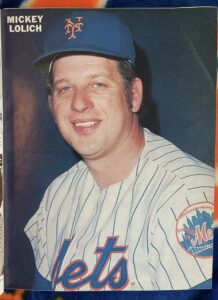 Lolich in 1976, however, felt like his own case study in miscast Metsdom. We didn’t know what he was doing on the Mets. He, it seemed, didn’t know what he was doing on the Mets. Long before the Alex Rodriguez free agent contretemps of 2000, Lolich personified the 24 + 1 equation Steve Phillips floated as the rationale for not signing A-Rod. It wasn’t a matter of Mickey demanding special treatment that would set him apart from his teammates. It was more like he landed as an alien presence in our midst and never quite melted into the montage. Twenty-four Mets. One Mickey Lolich. Lolich in 1976, however, felt like his own case study in miscast Metsdom. We didn’t know what he was doing on the Mets. He, it seemed, didn’t know what he was doing on the Mets. Long before the Alex Rodriguez free agent contretemps of 2000, Lolich personified the 24 + 1 equation Steve Phillips floated as the rationale for not signing A-Rod. It wasn’t a matter of Mickey demanding special treatment that would set him apart from his teammates. It was more like he landed as an alien presence in our midst and never quite melted into the montage. Twenty-four Mets. One Mickey Lolich.
On December 12, 1975, the Mets traded Rusty Staub and minor leaguer Bill Laxton to the Tigers for Mickey Lolich and minor leaguer Billy Baldwin. There, I thought, went so much that was fun about 1975, while simultaneously inferring that 1976’s version of the Mets was diminished before it began. No 12-year-old had ever been as wrapped up in an also-ran as I was in the 1975 Mets, and about half my goodwill had just been tossed aside. Rusty Staub, besides being Rusty Staub to us ever since we traded for him in 1972, had just reached one of those heretofore unreachable statistical stars. Our fixture in right field became the first Met to crash the 100 RBI barrier in ’75. It took fourteen seasons for any Met to drive in triple digits. It took fewer than three months for Mets management to decide such a skill set was disposable. Surprise, surprise, M. Donald Grant didn’t want to keep around a beloved veteran star at the top of his game, one whose strong personality apparently clashed with his idea of how a player should act (which is to say thankful to the opportunity to call Mr. Grant his employer). Had Rusty made it through five years as a Met, he could veto a trade. Player empowerment gave Grant the worst kind of rash. It therefore became GM Joe McDonald’s job to ship Staub somewhere else ASAP and get something of value in return.
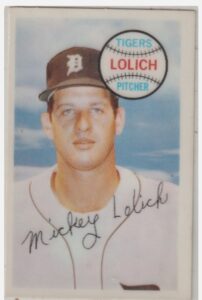
Mickey Lolich was a name. In the American League, his name had been synonymous with 2,679 strikeouts, the most recorded by any lefthanded pitcher in baseball history as of the Bicentennial; three complete-game victories in the 1968 World Series, culminating in his besting Bob Gibson on two days’ rest to take Game Seven (not to mention a home run he hit off Nelson Briles in Game Two); and a pair of 20-win seasons a few years later. Had Vida Blue not been so spellbinding over the first four months of 1971, Lolich could have claimed he was a victim of Cy Young robbery. As was, Mickey, as runner-up, won more games than anybody in the majors in ’71 (25), started more games than anybody in either league (45), struck out the most batters in baseball (308), and posted an innings total 42 frames beyond that of any counterpart (376). He followed all that with a 22-14 mark in 1972, pitching the Tigers to the AL East title and doing his damnedest to get them back to the Fall Classic. In an ALCS recalled today mainly for Bert Campaneris flinging a bat at Lerrin LaGrow in Game Two, Lolich pitched into the eleventh inning of Game One, only to take a hard-luck loss, and was no-decisioned despite going nine innings and giving up a lone run in Game Four.
Jesus, that guy was good. And you would have loved to have that guy from 1968 or 1971 or 1972 on the Mets. What a highlight player he would have been. As 1976 approached, those peaks were fading fast in time’s rearview mirror. Lolich’s last two years as a Tiger saw him lose 39 games, albeit for a team that was altogether past its late-’60s/early-’70s prime. Numbers unavailable to the baseball-consuming public in 1975, particularly his Baseball-Reference WAR of 4.0, indicate he was done no favors by pitching for the 102-loss Tigers. On the other hand, his having turned 35 was a matter of public record. All those innings on all that Lolich (bulky would be a kind description) had to have taken a toll after so many years.
At his age, in any other business, he’d be young. In 1976, in baseball, he was getting on.
Yet the Mets tried to treat him as a get. Convinced of the durability of their Kingman-Unser-Vail outfield, GM Joe McDonald figured a lack of offense, even sans Staub, wasn’t an issue that was going to bedevil the Mets. What the team fronted by Tom Seaver, Jon Matlack, and Jerry Koosman needed to do, according to McDonald, was trade its most reliable stick for another arm. “One of the reasons we didn’t win last year,” McDonald rationalized upon announcing the trade, “is because we didn’t have a solid No. 4 starter. Now we go into a town for a three-game series, and the other team knows they are going to face one of the four in every game.” Too much pitching is rarely any team’s problem, but whither the offense? Whither the 105 RBIs that just went out the door? Whither the foot Mike Vail broke playing basketball during the offseason? Joe McDonald plans, the entity Mr. Jordan works for laughs.
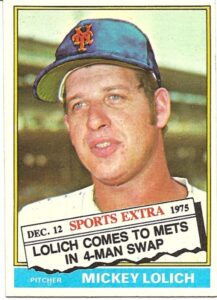 Lolich needed to be persuaded he wanted to be a Met. He already had that 10-and-5 protection — ten years as a big leaguer, five with one team — that the Mets feared Staub would attain. Though he felt disrepected by the Detroit front office, he’d been a Tiger since 1963. The area was what he and his family knew, and he wasn’t necessarily raring to say yes to moving to the city the President of the United States (Michigan’s own Gerald Ford) had just told to drop dead. McDonald needed an answer as the Winter Meetings wound down, not just to help clarify the Mets’ plans, but to beat the then-extant Interleague trading deadline. Come to New York, Mickey, was the big pitch to the big pitcher. A guy with your credentials can do well off the field in the Big Apple. Agreeing there might be commercial benefits tied to pitching in the nation’s largest market, believing the .500-ish Mets were more likely to win than the cellar-dwelling Tigers, and confirming he’d be suitably compensated for packing up and heading east, Lolich signed off on the deal. Lolich needed to be persuaded he wanted to be a Met. He already had that 10-and-5 protection — ten years as a big leaguer, five with one team — that the Mets feared Staub would attain. Though he felt disrepected by the Detroit front office, he’d been a Tiger since 1963. The area was what he and his family knew, and he wasn’t necessarily raring to say yes to moving to the city the President of the United States (Michigan’s own Gerald Ford) had just told to drop dead. McDonald needed an answer as the Winter Meetings wound down, not just to help clarify the Mets’ plans, but to beat the then-extant Interleague trading deadline. Come to New York, Mickey, was the big pitch to the big pitcher. A guy with your credentials can do well off the field in the Big Apple. Agreeing there might be commercial benefits tied to pitching in the nation’s largest market, believing the .500-ish Mets were more likely to win than the cellar-dwelling Tigers, and confirming he’d be suitably compensated for packing up and heading east, Lolich signed off on the deal.
His introduction to the Mets nonetheless represented a shock to his Detroit-defined system, and it was made no smoother by a Spring Training that was delayed past St. Patrick’s Day thanks to an owners’ lockout. Among an informal gathering of stretching and tossing Mets, Cardinals, and Pirates in St. Petersburg, the southpaw admitted nobody in this league was familiar to him, not even on his own team. Of longtime catcher Jerry Grote, who was as much a fixture to the Mets’ staff as Bill Freehan had been to the Tigers’, Lolich told Newsday’s Bill Nack, “If he walked up to me now, I wouldn’t know who he is.”
Yet here came Mr. Lolich, wearing a boxy Mets jersey, starting the third game of the new season. Seaver won on Opening Day. Matlack threw a 1-0 shutout the second day. Lolich couldn’t maintain the momentum, lasting only two innings. He’d made two errors and had given up three Expo runs on one of those trademark windy April Shea afternoons. His spot in the batting order came up in the bottom of the second with the bases loaded and two out. Rather than let Lolich take his first swings since pre-DH 1972, new manager Joe Frazier sent up John Stearns to pinch-hit. Stearns flied out. With the Mets leaving fourteen runners on bases, Frazier and Lolich were both on their way to their first National League losses.
Things would get intermittently less horrific. It took four starts for Mickey Lolich to earn an NL win, but he did it in style on April 26, going the distance and striking out nine Braves, while working harmoniously with Ron Hodges, who, like Grote, he’d eventually met. His wins legitimately impressed. A complete game at San Francisco in mid-June. A shutout over St. Louis as June ended. Another whitewashing when Atlanta returned to town right after the All-Star break. On August 8 in Pittsburgh, as Hurricane Belle bore down on New York, Mickey withstood storm clouds of his own. He gave up eight Pirate hits, walked one Buc, struck out nobody, yet remained on the mound all nine innings in posting a 7-4 victory. It was the third and last time a Met pitcher ever won a complete game with zero strikeouts, and it was done by a pitcher who, entering that season, had struck out more batters than any pitcher in baseball history besides Walter Johnson and Bob Gibson. “Sometimes,” the lefty explained in April, “I’ll change my style of pitching two or three times a game.” Clearly, the veteran could put his versatility to optimal use.
Lolich was the personification of that little girl with the curl cliché Ralph Kiner loved invoking. When he was good, he was very good. Sometimes he’d be more than pretty good but his batters weren’t up to snuff. Lolich threw eighteen quality starts — at least six innings pitched, no more than three earned runs allowed — yet the Mets lost nine of them. Come summer, Bob Murphy was regularly using the word “snakebit” to describe Lolich’s season. Sometimes the bad-luck serpents couldn’t be blamed, as the pitcher who turned 36 on September 12 simply wasn’t able to keep pace with Seaver, Matlack, or soon-to-be Cy Young runner-up (to Randy Jones) Koosman. A fourth starter, no matter how accomplished, tends to perform like a fourth starter. Lolich’s 3.22 ERA wasn’t the sparkling stuff usually posted by Met aces of the day, but it probably deserved better than an 8-13 won-lost record on a third-place club that went 86-76. His ERA+, a metric conceived decades later to provide context for how a pitcher performs among all of his peers, was 101, or ever so slightly above average.
As a 13-year-old Mets fan in 1976, recently Bar Mitzvahed and everything, I’d like to think I had reached the age of reason. I could reason that though Lolich couldn’t keep his earned run average below three and couldn’t compile more wins than losses, that he was not bad. I kept telling myself that. He’s not Seaver, and he’s no longer the guy who gave Vida Blue a run for his money, but he’s OK. He can’t help it if they don’t score for him. And he can’t help it if we never should have traded Rusty Staub. Yeah, I still missed Rusty Staub. Did any Mets fan not? The group of Tigers Rusty went to wasn’t dramatically better than the set Lolich left, but they sure seemed to be a lot more fun than the 1976 Mets. The main reason was Mark “The Bird” Fidrych talking to the ball before throwing it past batters en route to a literally sensational 19-9 year, but don’t overlook the joie de vivre provided by Detroit’s new right fielder and sometimes designated hitter. Staub played 161 games for the Tigers, drove in 96 runs, and was elected to the AL All-Star team by discerning fans everywhere. If Rusty missed us like we missed Rusty — both in the affection and run-production sense — it didn’t show in his stats.
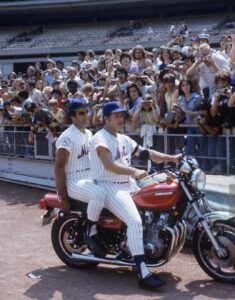 Lolich, meanwhile, failed to find film-clip permanence in New York across his 31 starts. Besides not being Rusty Staub and not pitching as well as his rotationmates, there wasn’t much to mentally scrapbook. Decades later, an image did make the social media rounds. It featured Mickey on a motorcycle on the first base side warning track at Shea, with Joe Torre ready to hitch a ride, Richie Cunningham to Mickey’s Fonz. The Mets were holding Camera Day, and Mickey gave the fans a most unusual pose. Perhaps he was most comfortable on his bike because it allowed him to daydream he was riding the hell away from Flushing. Lolich, meanwhile, failed to find film-clip permanence in New York across his 31 starts. Besides not being Rusty Staub and not pitching as well as his rotationmates, there wasn’t much to mentally scrapbook. Decades later, an image did make the social media rounds. It featured Mickey on a motorcycle on the first base side warning track at Shea, with Joe Torre ready to hitch a ride, Richie Cunningham to Mickey’s Fonz. The Mets were holding Camera Day, and Mickey gave the fans a most unusual pose. Perhaps he was most comfortable on his bike because it allowed him to daydream he was riding the hell away from Flushing.
With a year remaining on his contract, Mickey Lolich let the Mets know whatever they were planning for 1977, they could do it without him. The native Oregonian never stopped missing Michigan. It was home to him and his family. New York was a yearlong business trip. Lolich elaborated on his exit strategy for the Daily News in December of ’76:
“The season was not fun. On the days I wasn’t pitching, life wasn’t fun. I was very happy with the Mets. They were some of the finest players I’ve ever been with, and I got along well with the front office. I was disappointed in my record because I pitched better than that. So did Tom Seaver. People ask, what was wrong? Nothing was wrong. But the Mets definitely need a power hitter to help Dave Kingman.
“And the first two months were difficult with the people ridiculing me and belittling me. I got letters and heard them telling me they wanted Staub there instead of me. Sure, it reflects on me. I’ve been playing in the big leagues for 14 years. Now I want to be home.”
With that, Mickey Lolich was retired. Then, after his Mets contract officially expired, he unretired, filed for that newfangled free agency, and gave pitching one more shot, this time out of the bullpen as a reliever for the San Diego Padres, farther from Michigan than New York was. He toed the Shea mound once in his two Padre years, on August 17, 1978, throwing three shutout innings and notching his first (and only) National League save in support of Gaylord Perry’s 260th career win. Per Don Williams in the Star-Ledger, Mets fans booed Lolich when he entered he game, booed again when he batted, and cheered when he struck out. “Sure I expected it,” the ex-Met said of his reception. “That’s New York.”
At the end of 1979, Lolich decided he was done being a big leaguer for real. Back to Michigan he went for good, occasionally receiving the “where are they now?” treatment as the pitcher who went from putting up zeroes to turning out doughnuts at Lolich’s Donuts & Pastry Shop in Lake Orion, Mich. Hockey great Stan Mikita owned a place like that in Wayne’s World, but his establishment was fictional. Lolich’s new line of work was genuine. The Times visited him when the Tigers made the World Series in 1984, stressing how earning 217 major league wins had been Lolich’s then, while baking “400-dozen doughnuts a day” accounted for his now. Tensions were dissipating between him and the team he was remembered succeeding for, and, as the years went by, the idea Tigers ever traded him away must have seemed as absurd in those parts as it is in our neck of the woods that the Mets felt the need to rid themselves of Rusty Staub.
For the rest of his life, doughnuts or no doughnuts, Mickey Lolich was introduced; referred to; and thought of first, foremost, and practically exclusively as MVP of the 1968 World Series, one of the all-time great Detroit Tigers. However he spent his 1976 was just some fine-print detail. Lolich would make his final appearance at Comerica Park in 2023 as part of a pregame 55th-anniversary celebration of the championship his left arm made possible. He and a handful of his ’68 teammates stuck around to take in a promising performance from emerging Tiger ace Tarik Skubal. Skubal struck out nine, a fairly Lolichian total, but the kid on the verge of back-to-back Cy Youngs went only five innings. They were scoreless, but there weren’t that many of them. Afterward, the young lefty berated himself for not lasting seven — not nine, but seven. When Tarik tossed his first complete game in 2025, it left him 194 shy of Mickey’s career total.
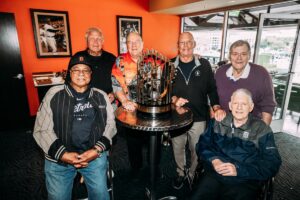 Not surprisingly, Lolich and his fellow champions were provided a suite to watch that Skubal start in 2023. Yet sixteen years after his week in the October 1968 sun, the 1984 Tigers were only “gracious” enough (Mickey’s word) to furnish the hero from their previous World Series run with upper deck tickets for the ALCS clincher at Tiger Stadium versus the Royals. It was the first time he’d been to a game in a few years. Sitting far from the dugout and above the “guys in silk suits” notorious for filling box seats during the postseason opened his eyes a bit. “I finally found what really happens in the stands,” he told Jane Gross in the Times. “How devoted those people are to the ballplayers! How much they adore them!” Not surprisingly, Lolich and his fellow champions were provided a suite to watch that Skubal start in 2023. Yet sixteen years after his week in the October 1968 sun, the 1984 Tigers were only “gracious” enough (Mickey’s word) to furnish the hero from their previous World Series run with upper deck tickets for the ALCS clincher at Tiger Stadium versus the Royals. It was the first time he’d been to a game in a few years. Sitting far from the dugout and above the “guys in silk suits” notorious for filling box seats during the postseason opened his eyes a bit. “I finally found what really happens in the stands,” he told Jane Gross in the Times. “How devoted those people are to the ballplayers! How much they adore them!”
Yes, it’s how we felt about Rusty Staub, and were bound to feel the opposite of when we encountered anybody who got in the way of our devotion to and adoration of Le Grand Orange. Nothing personal, Mickey. That’s New York, too.
by Greg Prince on 28 January 2026 1:48 pm A Mets fan walks into an Applebee’s. That’s not a setup to a quip. It actually happens once a year that I know of, with me as the Mets fan. Applebee’s menu tends to shake out a bit on the salty side for my tastes, but salty is something I’ll never be if somebody is kind enough to take or, more accurately, send me there on the house every January.
My wife’s birthday, you see, was last week, and when my wife’s birthday is nigh, my sister and her husband never fail to send us a generous gift card for Applebee’s, a national chain restaurant conveniently located to where we live. Its proximity is its primary appeal to us. Barely having to drive and not having to pay equals eating good in the neighborhood. More partial to bringing in than dining out, we don’t usually take advantage of the hospitality on-premise, but this January we made an exception. We went to our town’s Applebee’s for lunch last Wednesday. It was the same afternoon the Mets introduced Bo Bichette to the press; the day after the Mets acquired Luis Robert, Jr.; a few hours before the Mets traded for Freddy Peralta. This is how a Mets fan who walks into an Applebee’s has come to mark time this January.
And who should greet Stephanie and me practically inside the door at Applebee’s but Pete Alonso? Specifically, a substantial color photo of the Polar Bear that graced the bulk of a wall adjacent to the hostess station. With each index finger raised in the direction of the crowd, Pete appeared to be celebrating one of his franchise-record 264 home runs. The image must have gone up since last January, the last time I was in there to pick up our gift card’s worth, because had it been up the year before, I would have noticed it. And had this visit been before December of 2025, I would have kvelled without qualification that a name-brand casual dining establishment — or any establishment, really — was devoting a place of prominence to the longtime signature star of the Mets.
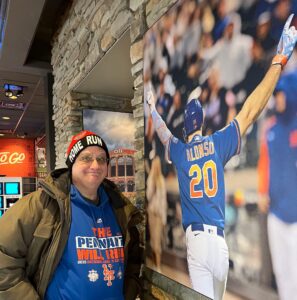 Well, this is awkward. Now, in January of 2026, Big Pete was just another piece of flare that a joint like Applebee’s mandates to imply one of its outlets is suitably sporty and righteously regional. They also have lots of pictures of area Little League and high school athletes up as well. I didn’t check to see who among them has since graduated. I do know Alonso works in Baltimore these days.
Pete will always be a Met icon. A decade from now, that picture, if corporate hasn’t mandated its removal, will stand as a pleasant reminder of a player who did great things for the nearby team and was well-loved while doing it. A sizable portrait of Pete Alonso by then will hit like a sizable portrait of, say, Cleon Jones now. If Cleon was the de facto face of our Applebee’s, you think I’d ask to speak to the manager and request we not be shown somebody who finished his career on the South Side of Chicago, nowhere near our local Applebee’s? Yet stepping right up to greet Pete was not what I was planning on doing last week. I was having a hard enough time getting to know who’s actually on the Mets at the moment.
I wasn’t planning on this, either, but I now root for a team that features Bo Bichette, Luis Robert, Jr., Freddy Peralta, and, if his minor league deal amounts to anything, Craig Kimbrel. Fine. Great. Maybe wonderful. But I wasn’t planning on it. I’ve certainly known their names and something about their games. I didn’t know they were Mets. They weren’t until very recently. Nevertheless, here they come into my life and your life, along with some other fairly familiar ballplayers who played elsewhere in years past. To some extent, that’s every winter on the verge of Spring. Some winters it feels organic. Some winters it feels transformative in a welcome way. This winter it feels almost random. If Leonard Nimoy were still hosting his syndicated program, he’d be in search of context for these Mets.
The Mets as we knew them — the Mets with whom we lost patience on the road from 45-24 to 38-55 — ceased to exist in the segment of the offseason that bridged 2025 and 2026. Then there were a few weeks when there didn’t seem to be much to the Mets at all. A lot of deletion. Sporadic addition. Tempting as it was to lose patience with the lack of progression, that was OK. It was late December and early January. There was no baseball yet. Somebody would be playing as Mets by the end of March.
The Mets as we know them at present, at least the Mets to whom we are being introduced these days? I don’t know. I really don’t. I guess that’s OK, too. Even it isn’t, it’s going to be.
It’s a Citi of strangers, Stephen Sondheim might suggest. They’ve all come to work, come to play. Bo Bichette, a late recast for Kyle Tucker (and owner of our most soap operatic name since Blade Tidwell), evinced believable enthusiasm for becoming a Met as he chatted with the media ahead of us going to Applebee’s. He accepted a large sum in order to express his enthusiasm. He worked in a couple of opt-outs in case being a Met isn’t as awesome as he thought it could be. Shortly after his signing was reported, I got around to watching an MLB Network special dissecting Game Seven from last year’s World Series. I saw through newly opened eyes Bichette belt a three-run homer to put Toronto up early. “Hey,” I thought, “we just got the guy who did that!” Bo wasn’t playing third base for the Blue Jays then or ever; he will be for us. What’s a new season without a sense of defensive adventure?
Luis Robert, Jr., is considered a heckuva center fielder and can count a fabulous season in his not too distant past. I’ll try to forget that also described Cedric Mullins last summer. Robert doesn’t necessarily have to follow directly in the footsteps of White Sox-turned-Mets stars like Tommie Agee and Lance Johnson to succeed in center. By dint of not being a Metsian Mullin, he pencils in as an automatic upgrade. Yet I am genuinely sorry we gave up Luisangel Acuña to nab him from the pale hose, though I’m sure some of that is my pinch-running obsession talking. In 2025, Luisangel Acuña pinch-ran more than any Met but three ever had in a single season? He was inserted 23 times for PR purposes, tying him with Hot Rod Kanehl (1963), Leon “Motor” Brown (1976), and Tim “Bogie” Bogar (1996) for frequency, and he did it without a widely disseminated nickname. Six stolen bases as a pinch-runner, eleven runs scored. Promising enough as an everyday player that during the one month when he received regular reps, mostly at second, he was named April’s National League Rookie of the Month.
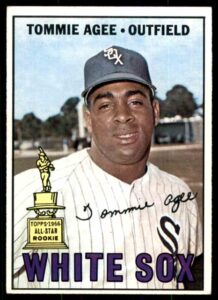 Center fielders who used to be White Sox have been known to become Mets stars. The promise more than the pinch-running record was what made dismissing Acuña sting. When we traded for Luisangel at the 2023 deadline, it was deemed a coup of sorts. He showed up a little ahead of schedule in September 2024 and made himself extremely useful in spurts. Then he got a little lost in a middle infield logjam, and the front office guy who replaced the front office guy who acquired him saw him as no less expendable than Joe McIlvaine judged Tim Bogar. Acuña appeared on our depth chart in the same ad hoc makeover that brought us Drew Gilbert, and Gilbert’s been gone for months, becoming the next center fielder for somebody else instead of us. Yet when the world was slightly younger, Gilbert the outfielder and Acuña the infielder were joining our top draft pick from 2022, Jett Williams, who it was said could play infield and outfield, in making our minor leagues formidable. I saw Williams up close in the Citi Field press conference room when the Mets were presenting their organizational awards at the end of 2023. My private pet name for him immediately emerged: Diamond Stud, inspired by the sparkling earring he modeled. That was a blah season, but soon, I could tell myself, we’d have the Diamond Stud carving out a spot on our diamond, maybe in the same lineup with Acuña and Gilbert.
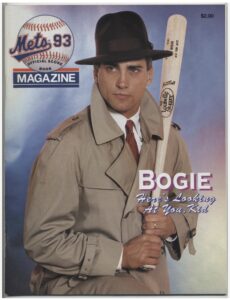 Here’s looking at kids who pinch-ran a lot. They’re all elsewhere now, with two of them never having ascended to the Mets. In my adolescence, I liked leafing to the back of the Official Yearbook to get a gander at our Future Stars, even if they tended to be Butch Benton and Luis Rosado. Anticipation is a baseball fan’s core competency. I had no idea how any of the crop lately blossoming down on the farm were going to actually fit into our big league plans, but I liked knowing they were on their way up. Gilbert went to San Francisco to obtain Tyler Rogers, one of the myriad relievers who couldn’t stem 2025’s tide of futility. Williams went to Milwaukee alongside Brandon Sproat for Freddy Peralta. I’ll no doubt applaud the first strike Peralta throws as the Mets’ 2026 titular ace, probably when he appears on NBC come Opening Day, just as I’ll put my hands together for the first fly ball Robert reels in behind him.
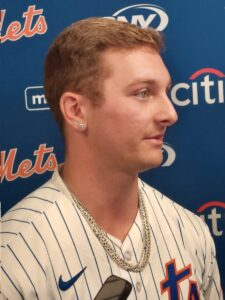 Fare thee well, potential Diamond Stud. Regardless of how well our veteran newcomers mesh with the likes of Lindor and Soto, I’m going to miss the budding future I was anticipating. Williams was a bejeweled anecdote to me. I hoped there’d be more to him. Sproat was already a little something. Four starts of varying return last September, but it was a beginning. I nestled Sproat between Nolan McLean and Jonah Tong to form my ideal youthful pitching core for 2026 and beyond — I dubbed them Generation MST3K as I looked forward to them coming of age and me nurturing their narrative. I was taking on the Gen-K ghost of Izzy, Pulse, and Paul from thirty years before. No, that crew never really set sail, but I had time on my side this time. Or so I dared assume. Oh well, M and T are still here. I suppose Christian Scott can be subbed in as the “S,” but it won’t be quite what I envisioned.
I’m all for improving the present product with relatively proven commodities. As of March 26, I plan to open my arms to Bichette, Robert, Peralta, Marcus Semien, Jorge Polanco, Devin Williams, Luke Weaver, Luis Garcia, Tobias Myers, Grae Kessinger, whoever. I get an extra kick out of Kimbrel being here if only because he’s been around so long that I can remember it being a big deal that David Wright whacked a late-inning dinger off him in Atlanta. I know these new guys without really knowing these new guys. No matter their experience, they’re new as Mets. I’ll get to know them. At the moment they’re mostly whoever. Alonso & Co. were us. Some of Pete’s peers are still on hand. Some of the kids from the proverbial back of the yearbook remain; a few have crept toward the middle and front sections since they were freshmen. Not everybody slated to inhabit Citi soon is a stranger.
Nonetheless, this Met winter has left me feeling a chill on the cusp of Spring. Then again, so did winter twenty years ago. Carlos Delgado was precisely the kind of slugger we prized perennially. Paul Lo Duca figured as the best possible Mike Piazza successor. Billy Wagner was exactly what we needed to caulk all those Looperesque leaks. At Shea in 2006, however, they loomed as strangers, as did the spare parts we seemed intent on amassing post-2005. Endy Chavez? Jose Valentin? Xavier Nady? Duaner Sanchez? Jorge Julio? Darren Oliver? Chad Bradford from Moneyball? Julio Franco from the 1982 Phillies? Some had reputations. Some you’d have labeled lesser-known. They were all bound at some point for Port St. Lucie, itself diluted by something called the World Baseball Classic. On paper, which was something I was in the twilight of buying daily, it looked all right. In my soul, the surroundings were disturbingly unfamiliar. I felt almost isolated from my team. Seriously, who were these guys and how did they get to call themselves Mets?
Then the season started, and most of the aforementioned made great impressions, and the new Mets coalesced with the core Mets from 2005, and the 2006 Mets morphed into a division champion I cherish to this day. Four eventual Hall of Famers played for those Mets, none more brilliantly than the most recently anointed of them, Carlos Beltran, elected to Cooperstown somewhere amid Bichette, Robert, and Peralta alighting in our midst. I hope his plaque portrays him as a Met, but even if it doesn’t, Beltran wore our cap in 2006, which turned out to be quite a year for the collection of players — and fans — who did just that.
Maybe we’ll someday say something of that nature for the Mets who are currently comprised largely of accomplished whoevers. Or we’ll wonder what the hell went wrong the way we have in the wake of strangers looking better in theory than they did on the field. Either way, they’ll have our attention; then our familiarity; then some combination of our esteem and disdain. You know, like Mets every year.
by Jason Fry on 16 January 2026 11:37 am It was a confounding, frustrating season even before we learned it would be a fracture in the Mets’ timeline, with stalwarts we’d grown used to shipped off or allowed to depart and their replacements still yet to take shape. One day it will all seem like a logical story; for now it’s just baffling. But onward we go, in good times and bad as well as times we’re not sure about yet, so it’s time to take stock of the season’s matriculated Mets.
(Background: I have three binders, long ago dubbed The Holy Books by Greg, that contain a baseball card for every Met on the all-time roster. They’re in order of arrival in a big-league game: Tom Seaver is Class of ’67, Mike Piazza is Class of ’98, Francisco Alvarez is Class of ’22, etc. There are extra pages for the rosters of the two World Series winners, the managers, ghosts, and one for the 1961 Expansion Draft. That page begins with Hobie Landrith and ends with the infamous Lee Walls, the only THB resident who didn’t play for the Mets, manage the Mets, or get stuck with the dubious status of Met ghost.)
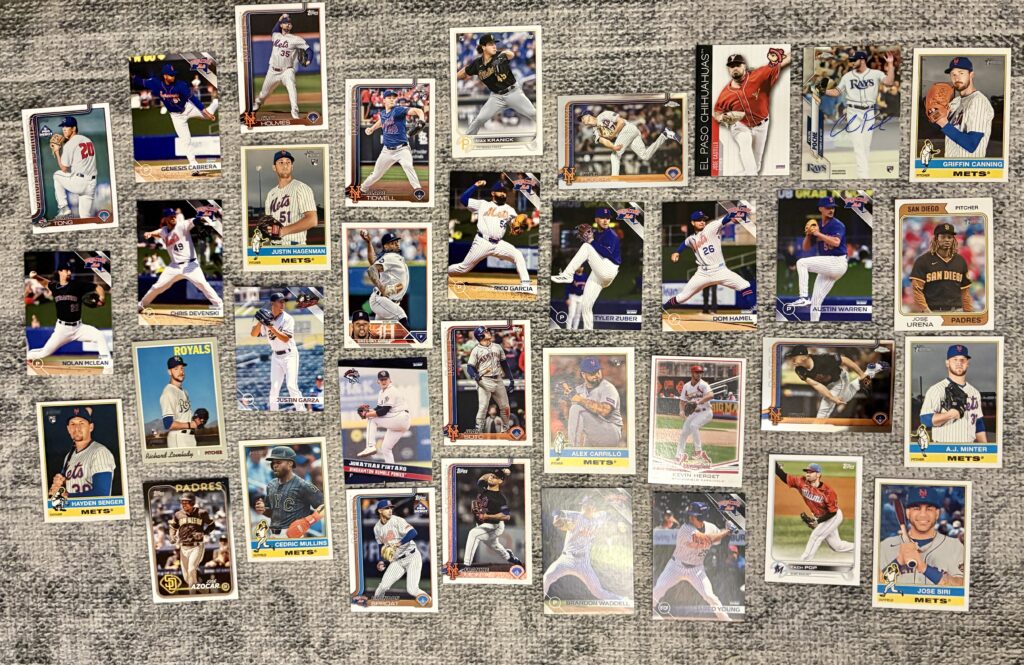 Welcome to the study rug, fellas! (If a player gets a Topps card as a Met, I use it unless it’s a truly horrible — Topps was here a decade before there were Mets, so they get to be the card of record. No Mets card by Topps? Then I look for a minor-league card, a non-Topps Mets card, a Topps non-Mets card, or anything else. That means I spend the season scrutinizing new card sets in hopes of finding a) better cards of established Mets; b) cards to stockpile for prospects who might make the Show; and most importantly c) a card for each new big-league Met. Eventually that yields this column, previous versions of which can be found here, here, here, here, here, here, here, here, here, here, here, here, here, here, here, here, here, here, here and here.)
Off we go into the wild blue and orange yonder….
Juan Soto: It all seemed a little underwhelming somehow. Some of that was gigantic expectations — 15 years, $765 million tends to drown out everything else — and some of that was the season’s curdling into murkiness and then disaster. Soto wound up with 43 homers and 105 RBIs, which is pretty far from a down season, so maybe it’s us. Or maybe it’s that by now we’re braced for impact when it comes to the first season for a high-profile acquisition — ask Carlos Beltran or Francisco Lindor about that. (Hey, their later years turned out pretty well!) Soto’s Met career got off to what in hindsight should have felt like a foreboding note: On Opening Day he came up against Josh Hader with two out in the ninth, runners on first and third, the Mets down a pair of runs and a storybook ending set to be written … and struck out. On the other hand, Soto turned into a base-stealing machine, swiping 38 bags after never stealing more than 12. If you’d like more foreboding, though, that came under the tutelage of Antoan Richardson, who was allowed to go work for the Braves as one of the Mets’ offseason subtractions. Soto gets a 2025 Topps card, which is its own oddity: He’s Photoshopped into an old-style Mets away uniform, which he never wore because the team ditched that classic design for something that looks like it was made in a basement on Canal Street. Good Christ, I have to write how many more of these?
Clay Holmes: Hey, it wasn’t his fault. The hulking former Yankee reliever pitched pretty well as a Mets starter, aside from fatigue that had to be expected given a difficult shift in responsibilities. He saved his best moment for last, coming up big in a Game 161 wipeout of the Marlins. Unfortunately, there was a game the next day too, one that Holmes could only watch. 2025 Topps card.
Hayden Senger: Not all MLB success stories are glittering ones, nor need to be. Senger was drafted in 2018’s 24th round, which no longer exists, and hadn’t exactly got rich as a pro ballplayer: He spent last offseason getting up at 5 am to stock shelves at Whole Foods. He entered 2025 as a glove-first minor-league catcher, the kind of CV that often lacks that final call to the Show, as MLB teams have a maddening habit of finding backup catchers on other MLB rosters instead of in their own ranks. But Francisco Alvarez’s broken hamate bone opened the door for Senger to make the Opening Day roster. His debut came in that fateful ninth inning that ended with a K for Soto; shortly before that Senger was sent to the plate against Hader with the bases loaded and nobody out, looked overmatched, and struck out. He didn’t do much at the plate the rest of the year either, but try and tell him the year wasn’t a success. Topps Heritage card using the ’76 design. 1976 was the first year I collected cards, so the Michigan blue and yellow chosen for the Mets back then look right to me even though I know they aren’t.
A.J. Minter: A burly, bearded ex-Brave, Minter was brought in to give the Mets a reliable lefty arm in the pen and pitched pretty well in April. But in his 13th appearance, he delivered a ball in Washington and came off the mound with an arm shake and a grimace. He’d torn his lat, ending his season and starting a sad parade of injuries to bullpen lefties. Safe to say that wasn’t the plan. Topps gave Minter a Heritage card in its High Numbers series, preventing me from having to admit him to The Holy Books as a Brave.
Griffin Canning: An Angels reclamation project (honestly that sounds like a redundancy these days), Canning looked like a successful Mets reinvention along the lines of Sean Manaea and Luis Severino, riding a reconfigured pitch mix to early-season success. He became an early favorite of mine, too: I loved his mechanics, which were beautifully fluid while also admirably compact. Then it all came crashing down: In late June Canning watched from the mound as Lindor fielded a grounder and by the time the ball smacked into Pete Alonso’s glove, he’d crumpled as if shot and was lying on the infield grass. It was a ruptured Achilles, and the end of his season. Topps Heritage card.
Jose Siri: Siri built a reputation in Tampa Bay as a flashy center-field wizard who struck out a ton but could also hit balls to the moon, but it all went wrong very quickly as a Met: Two weeks into the season, after indeed striking out a ton, Siri fouled a ball off his shin, an innocuous mishap that turned out to be a fractured tibia. He was rusty when he returned in September and endured a nightmare game at Citi Field: Over the course of four pitches, a ball popped in and out of Siri’s glove, ending up as a double, and a bad route turned a single into a triple. Two ABs later, Siri came to the plate with boos raining down and was promptly zapped with a pitch-clock violation. He struck out in that AB, struck out in his next one, and was then pinch-hit for Cedric Mullins, whose arrival was greeted with cheers. (Mullins then … wait for it … struck out.) Siri never had another AB as a Met; he ended up with an .063 average, two hits, and having to remember that fans actually preferred seeing Mullins trudge to the plate instead of him. Now that’s a bad year. Topps Photoshopped him into a Mets uniform for Heritage; they should have added a bag over his head.
Max Kranick: A postseason ghost in 2024, Kranick became corporeal in April and earned early plaudits as a courageous reliever with a talent for wiggling out of tough spots. Unfortunately April was a small sample size; Kranick fell back to Earth in May, got sent down, and soon needed a second Tommy John surgery. Old Topps card as a Pirate.
Justin Hagenman: Turns out his first outing was his best one. Hagenman was pressed into service against the Twins in a mid-April bullpen game and did yeoman work, at least until his statistical line was blemished by after-the-fact crumminess from Jose Butto. (You may remember this game as an early installment in one of my least-favorite 2025 serials, The Revenge Tour of Harrison Bader.) Hagenman appeared now and then later during the season, mostly in mop-up duty. Hey, it’s a living. Topps Heritage card.
Jose Azocar: Collected some hits in April as a fourth outfielder, went zero for May, and became a Brave in June. Have to confess I remember none of that. 2024 Topps card as a Padre.
Jose Urena: A lion-maned veteran reliever, Urena logged one day as a Met, pitching not particularly well during a laugher against the Nats but still earning a save because that’s what the rulebook says. He then spent May as a Blue Jay, June as a Dodger, August as a Twin and September as an Angel. Wheeee! He’s now a Rakuten Golden Eagle. Double wheeee! Old Topps Heritage card as a Padre, one of the few things he wasn’t in 2025.
Kevin Herget: Herget took the baton from Urena in the middle-reliever parade of guys you probably don’t remember either. Middle relief has always been a spaghetti at the wall business, but new rules about options have made managing the last bullpen slots truly ruthless, with teams content to bring a guy up, put him on waivers or release him, then reclaim him after another team’s done the same. The Mets plucked Herget out of the Brewers’ farm system in the 2024 offseason, called him up for a lone appearance at the end of April, put him on waivers, watched (maybe) from afar as he made a lone appearance for the Braves, claimed him from the Braves, used him in five games over three months, made him a free agent at the end of September, then signed him again a week before Christmas. Harget went to Kean University; I own a Kean University beach towel though I have no idea how it came into my possession. Some old card as a (Springfield) Cardinal.
Brandon Waddell: A lefty journeyman who’d pitched in both Korea and China, Waddell stood out (mildly) from the relief mob by logging 11 appearances and being at least reliable-adjacent. Which means you’ll see him again in some uniform next year — possibly even ours — and for whatever subsequent years he shows up and demonstrates that he’s still left-handed. Syracuse Mets card.
Chris Devenski: I first saw him at an unseasonably warm end-of-April bullpen game and my reaction was, “Who the heck is that? When did they call this guy up?” Such are the joys of the reliever parade. Devenski’s end-of-season numbers wound up being pretty good, or at least good enough to get a contract with the Pirates for 2026. Syracuse card.
Genesis Cabrera: Best known for throwing a pitch that hit J.D. Davis in the ankle during a feisty Mets-Cardinals game back in 2022, the prelude to Yoan Lopez drilling Nolan Arenado and a lot of pushing and shoving that saw Alonso tangle with Cabrera and the immortally monikered Stubby Clapp. Honestly that was more memorable than anything Cabrera did in six up-and-down appearances for the Mets in May as they looked for a lefty to replace Danny Young, who’d replaced Minter. Cabrera then collected 2025 paychecks from the Cubs, Pirates and Twins, AKA the Full Urena. Let’s use Cabrera’s Mets tenure as an opportunity to celebrate the inexplicably Canadian Stubby Clapp, whose father and grandfather also went by Stubby; as does his oldest son; and whose wife is named Chastity Clapp. I am not making any of that up. Syracuse card issued after Cabrera had come and gone.
Blade Tidwell: Once a moderately heralded Mets pitching prospect, Tidwell made his debut in May against the Cardinals and it was a pretty typical maiden voyage: some pitches made and some not made on the way to an ugly bottom line that wasn’t as bad as the numbers, provided you squinted a little. Subsequent outings required more squinting and the Mets shipped Tidwell to the Giants at the trade deadline along with Butto and Drew Gilbert. Tidwell’s still young and finding his way, but that felt like the opposite of an endorsement. 2025 Topps card.
Austin Warren: There are 1,450+ innings in a big-league season and it takes a lot of arms to get through them. This bit of wisdom appears in every THB chronicle, because it’s true. Nothing personal, Austin. Syracuse card.
Jose Castillo: A husky lefty reliever, Castillo’s road to the Mets was a bit odd: He imploded against them in late May while pitching for the Diamondbacks and was wearing blue and orange a little more than a week later. Since the beginning of September he’s been employed by the Mariners, the Orioles, the Mets again and is now a free agent. I suppose this is why middle relievers rent instead of buying. A card as an El Paso Chihuahua, which I feel bad about but was the best I could do.
Jared Young: Once-upon-a-time Cubs prospect came over to the Mets after stop-offs in Memphis and Korea and didn’t leave much of an impression. One of a growing number of ballplayers who sneak into Topps sets with autograph-only cards, yet another sign of civilization’s rot. Syracuse card.
Justin Garza: Five June appearances, none of which I remember. A 2025 minor-league card as a … I have no idea what team this is, actually. At least he’s not a Chihuahua.
Tyler Zuber: Pitched two not very good innings for the Mets in June, became a Marlin, and returned to Citi Field at the end of August to face his old team during Jonah Tong’s debut. I was in the stands and registered Zuber’s arrival but had completely forgotten his approximately 20 minutes of Mets service time. Zuber then gave up seven earned runs in a single inning, which I suppose is one way to be memorable. If you’re curious, yes, he displaced Don Zimmer and is currently the 1,287th and last man on the all-time Mets A-Z roster. Syracuse card.
Frankie Montas: Montas looked solid against the Mets as a Brewer in the 2024 wild card series, possibly leading to his signing a two-year deal with New York. It didn’t exactly work out, as Montas was felled by a torn lat in spring training and then pitched abysmally while rehabbing at Triple-A. With no real alternatives, the Mets summoned him to start against the Braves in late June. That went well, but his next start was a shellacking in Pittsburgh (I was lucky enough to see it in person) and he then alternated pedestrian outings with getting lit up, followed by exile to the bullpen. His year ended with the revelation that he needed Tommy John surgery; he was DFA’ed and will get paid $17 million to be hurt next year. 2025 Topps card.
Richard Lovelady: Mets fandom had a titter over the veteran lefty going by “Dicky,” though I wonder if Richard “Stubby” Clapp wanted a word. (Stubby Clapp, unexpected star of the THB Class of 2025!) Exactly what the newest Met wanted to be called led to a spirited discussion on SNY, with Gary Cohen’s eyebrow audibly arched (no really, you could hear it) and someone in the truck presumably told to be aggressive about cutting Keith Hernandez’s mic. Whatever those on a first-name basis called him, Lovelady spent the summer appearing and disappearing from the roster, with not particularly impressive numbers. The Mets must have liked something they saw, though, as they made him their first offseason free-agent signing. Old Topps Heritage card as a Royal.
Jonathan Pintaro: A flaxen-haired reliever who’d opened eyes in indy ball, Pintaro was cuffed around by the Braves in his lone MLB appearance, with Edwin Diaz forced to ride to the rescue at the tail end of a not particularly close game. This is an inherent unfairness of The Holy Books: Pintaro could spend a decade as a reliable contributor and still be stuck with this sour cup of coffee as his entry. Here’s hoping he makes this more than a theoretical injustice. 2025 card as a Binghamton Met.
Colin Poche: I was in the park for Poche’s lone appearance, the middle game of the series in which the Mets stepped on about 50,000 rakes while getting swept by the Pirates. Poche relieved Huascar Brazoban and turned a narrow Pittsburgh lead into an impossibly wide gulf. That sucked, but it isn’t what annoys me most about Poche. That would be his pain-in-the-ass baseball cards. He has a 2020 Chrome autograph card and a 2023 Tampa Bay team-set card, both nonstandard; I wound up needing two copies of the former and haven’t been able to secure the latter. Fortunately this hasn’t cost a lot, since Colin Poche cards aren’t a particularly hot commodity, but I’ve now conservatively spent 10 times the duration of his ineffective Mets tenure trying and failing to secure his annoying baseball cards.
Zach Pop: Another one-gamer, Pop’s second pitch as a Met became a home run onto the Soda Plateau for fucking Austin Wells, who looks like a guy who pesters other Little League dads about buying an above-ground swimming pool. In all, Pop’s Mets career consisted of nine Yankees faced, five of whom hit safely. Not a way to endear yourself to much of anybody, least of all me. Old Topps card as a Marlin.
Rico Garcia: Garcia made his debut in the same game Pop did, and fared better — enough for the Yankees to grab him off waivers from the Mets eight days later. He appeared in one game for the Yankees, returned to the Mets via a tit-for-tat waiver claim, and was soon an Oriole. If it’s this exhausting for us, imagine what it’s like for actual middle relievers. Syracuse card.
Alex Carrillo: Another example of how you can have a good year without good numbers. Before 2025 Carrillo’s organized-baseball career consisted of a few innings of a rookie ball as a Rangers farmhand in 2019. He then spent four years in indy ball, where work with a pitching lab, better nutrition and an improved workout regimen upped his fastball velocity from the mid-80s to triple digits. An acquaintance of Carlos Mendoza’s saw Carrillo pitch in the Venezuelan winter leagues, which led to a Mets contract and a July call-up. It didn’t go too well — a 13.50 ERA will leave a mark — but it’s still a pretty good story. As for baseball cards, Carrillo doesn’t have any, so I had to make him one.
Gregory Soto: Ryan Helsley and Cedric Mullins caught most of the slings and arrows launched by fans upset about the Mets’ trade-deadline debacle, but Soto was quietly terrible too. His numbers looked good but were fundamentally dishonest, as he specialized in letting inherited runners score, with a side gig of not paying attention when he needed to. (That second-to-last loss against the Marlins … oof.) After the season Soto vamoosed to Pittsburgh; they can fucking have him. Old Topps card as a Tiger.
Ryan Helsley: Mind-bogglingly terrible as a Met, with his maladies mostly blamed on pitch tipping and accompanied by an arglebargle of fancy metrics insisting that he was better than he was, which would have been more convincing without nightly evidence that Helsley was not better than anything except throwing oneself down a flight of stairs. (Maybe not even that.) The Mets didn’t help by stubbornly sticking with Helsley’s entrance extravaganza, so jaw-droppingly high camp that Siegfried and Roy might have suggested dialing it back. Eventually the Mets let Helsley’s nightly failures arrive without a concussive light show; by then we just wanted him to go away. Given the fickle nature of relievers, I’m sure he’ll be just fine for the Orioles next year. I also don’t care. A horizontal Topps Chrome Update card. I hate horizontal cards. It’s perfect.
Cedric Mullins: Arrived from Baltimore and immediately made you wonder if he’d been replaced en route by a defective clone. Mullins hit .182, looked meh in center field, and he played with his head up his ass at key moments — witness the sequence against Washington where Daylen Lile ran into a wall, Luis Torrens raced around the bases to score, but Mullins stood around and then got himself belatedly thrown out at second. (Mullins was given a reprieve and returned to first via some mild ump shenanigans, so of course he immediately got doubled off; if you don’t remember, this was the Jacob Young game, perhaps the most tooth-grinding loss in a season that featured plenty of them.) Mullins is now a Ray; when I heard they’d signed him I went full Gollum: “LEAVE NOW … AND NEVER COME BACK!” Re baseball cards, I generally try to pick cards that make the players look good, with rare exceptions: Vince Coleman looks like he just ate a lemon on his 1992 card, and it’s perfect. Mullins’ Topps Heritage card depicts him in asphalt and purple, wearing a ridiculous oven mitt and the sheepish expression of a man who’s just screwed up, and it’s perfect.
Tyler Rogers: A sidewinding reliever, he got traded on the same day as his identical twin brother, which must have been quite the afternoon for Ma Rogers. It’s probably just lingering dismay over how the season crumbled, but I have to ask if he was actually good for the Mets, or just better than Helsley or Soto. When Rogers signed with the Blue Jays I wasn’t sad but also thought, “Has it gotten so bad that no one wants to be a Met?” Topps Chrome Update card; it’s a horizontal but in this case that actually works.
Nolan McLean: A former two-way prospect, McLean was summoned in mid-August with the Mets once again in freefall and immediately looked like he belonged. He beat the Mariners in his first outing (complete with a nifty behind-the-back grab), the Braves in his second, the Phillies in his third (completing a sweep) and the Tigers in his fourth. He finally took an L in his fifth start, a singularly unlikely 1-0 loss in Philly. McLean’s final line? 5-1 with 57 Ks and 16 walks in 48 innings. That will that play. And the intangibles were impressive too: McLean demonstrated he could size up hitters and exploit them, and proved apt at strategizing on the fly when his pitches proved disobedient. A pitcher to dream on, and one I can’t wait to watch again. Syracuse card; he gets a full-fledged Topps offering next month.
Jonah Tong: A Canadian kid with mechanics that looked like a Xerox of Tim Lincecum’s, Tong blitzed his way through the minors in 2025 after adding a change-up to complement his riding fastball and ungodly curve. Was he ready? Given the Mets’ increasingly shaky playoff hopes, by the end of August it didn’t really matter. Tong’s debut at Citi Field saw the Mets pin 19 runs on Miami, the most runs they’d ever scored in a home game, and a flashback to the 17 they’d bequeathed Mike Pelfrey in his debut. (Somewhere in Texas, Jacob deGrom had to be gritting his teeth.) As it turned out, Tong still had things to learn: Of his four subsequent starts, one was good, one was so-so and two were beatdowns. (The opposing pitcher in one of those beatdowns? Jacob deGrom.) So no, he wasn’t ready, but it’s not on Tong that the Mets asked him to be a miracle worker instead of just a promising rookie pitcher. He’ll take his next steps in February, which should be fun to watch. Topps Pro Debut card, he’ll get something better in 2026 Series 1.
Brandon Sproat: The third member of the Mets’ kiddie pitching corps, Sproat looked very much like a work in progress over his first four big-league starts, which it might have been kinder to have him make in 2026. Again, there’s nothing whatsoever wrong with an initial quartet of appearances yielding the assessment “work in progress” — plenty of solid careers have started with less than that. Here’s hoping that Sproat’s maturation process — and that of his two fellow rookies — includes not letting the stench of his teammates’ failures linger. He deserved better. We all did. Topps Pro Debut card.
Dom Hamel: An August call-up yielded no appearances, making Hamel briefly a Met ghost. He escaped ectoplasm the next month with a lone inning against the Padres in which he yielded three hits but escaped being scored on when Luis Arraez was tagged out at second an eyelash before teammate Elias Diaz (told to slow down by a too cool for school Manny Machado) touched home. That was odd; so was Hamel becoming the 46th pitcher the Mets used in 2025 and thereby setting an MLB record. It’s not a record I expect to last given the newfound roster churn we’ve discussed several times already: Relievers Wander Suero and Dylan Ross weren’t called on during a game and so went into the Holy Books as 2025 Met ghosts instead of the 47th and 48th pitchers used. (Bet they’re disappointed not to have a larger role in this extended meditation on lousiness and failure.) Hamel is now Rangers property, so perhaps his talent for escaping jams is real. Syracuse card.
by Greg Prince on 14 January 2026 12:27 am The agate type that used to fill newspapers’ TRANSACTIONS boxes and for all I know still do can change everything — about your team, about the players within, about the course of your expectations and satisfaction as fan. While the Hot Stove barely simmers, Kyle Tucker rumors notwithstanding, I’d like to take this opportunity revisit a few picas worth of Mets transactions through time.
In a particular but not chronological order, nitty-gritty details courtesy of Baseball-Reference…
January 13, 2005: CARLOS BELTRAN signed as a free agent with the New York Mets.
January 13 is the date BB-Ref has for Carlos Beltran signing with the Mets, meaning happy twenty-first anniversary! But it wasn’t January 13, so happy twenty-first-ish anniversary! Maybe January 13 was when the ink officially dried on the contract, but it was learned Beltran was becoming a Met as of the early morning hours of January 9, 2005, shortly after the Jets upset the Chargers in the AFC Divisional playoffs. This, too, was an upset. Beltran seemed likely to either stay in Houston or get paid by the Yankees. Yet Carlos showed up at Shea to join the “New Mets” on January 11, the one day after the Yankees’ consolation prize, Randy Johnson, roughed up a cameraman who had the audacity to film him. Both New York arrivals were on TV that day and in all the papers the next; ours went smoother. By January 13, Beltran’s signing was no longer a bulletin, though the excitement was still fresh. We — the Mets — had lured the biggest, shiniest free agent on the market into our lair. It took a big, shiny, unMetlike offer, but such was tendered and accepted.
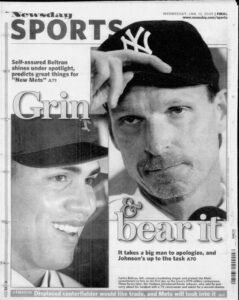
Just like that, Carlos Beltran was a New York Met. Just like that, everything Carlos Beltran did or didn’t do became our business. Just like that, we worried about Carlos Beltran, maybe in generous personal “I hope he’s all right” terms, but mostly in transactional “I hope he gets going/stays hot” terms. It is the Transactions box after all.
In 2005, the first year in which Carlos Beltran became our business, business was so-so. Then, from 2006 until he got hurt in the middle of 2009, business mostly boomed, even if things came to a chilling standstill once or twice. He returned to health after about a year and kept going/stayed hot, straight to the moment in 2011 when it seemed to everybody’s benefit to send him on his way. The seven-year contract was about to be up, the Mets were relatively down, and a Beltran could you get you a piece of future. Carlos by this point had put together a very nice Met past, enough to earn him a spot in the team’s Hall of Fame.
On January 20, 2026, the Baseball Writers Association of America vote for the big Hall of Fame will be announced. Carlos Beltran is the institution’s leading candidate. Those who track the publicly shared ballots (publicly shared partly for transparency’s sake and partly because if you’re going to fill column inches amid the Cold Stove portion of winter, how can you pass up a hardy perennial of a topic?) have calculated Beltran is running way past the 75% barrier required for Cooperstown entry. Even if those BBWAA members who are shy about revealing their choices are not as pro-Beltran as their brethren, the Hall appears his imminent destination. Not a surprise if you watched him for his seven Met seasons. From 2005 to 2011, we had ourselves an every-tool craftsman who, all things considered, made the Mets’ investment of $119 million worthwhile. We not only got ourselves a Silver Slugger, a Gold Glover, and perception-changer, we are on the verge of saying we got ourselves a future Hall of Famer whose Met experience is hardly incidental to the qualifications inspiring all those check marks and X’s.
You can’t always say that, no matter how tantalizing the Transactions box looks the instant it is published.
February 10, 1982: GEORGE FOSTER traded by the Cincinnati Reds to the New York Mets for Greg Harris, Jim Kern, and Alex Treviño.
My brother-in-law goes by the familial code name Mr. Stem, denoting that his level of interest in the Mets is the inverse of mine. Yet Mr. Stem comes through every December 31 for my birthday with what he believes are throwaway baseball items. He sees something old somewhere, he scoops it up, he sticks it in a box — after wrapping it exquisitely and numbering it so the entire presentation can be expertly choreographed — and he sends it to me for video unveiling on New Year’s Eve. This is part of our family tradition every December 31 ever since he and my sister moved to the West Coast. That and me good-naturedly (I swear) reminding them that the last year they lived back East, they sent Stephanie and me home well before midnight because they wanted to go to bed.
The arcana he secures is utterly random. Mr. Stem has a narrow frame of baseball reference, but his instinct for the utterly eclectic is so razor sharp that it could be Razor Shines. Pulp novels from the 1940s. Statistical volumes from the 1960s. Out-of-print histories inevitably prefaced with “you probably already have this”. And, once in a while, something that makes me go SQUEE!
This past birthday, Mr. Stem sent me a comic book with the title George Foster: Man of Dreams, Man With a Purpose.
SQUEE!
GEORGE FOSTER!
A COMIC BOOK VERSION OF GEORGE FOSTER!
GEORGE FOSTER IN A METS UNIFORM ON THE COVER!
GEORGE FOSTER SWINGING A BAT THAT ISN’T HIS TRADEMARK BLACK BAT, DESPITE THE FACT THAT THIS COMIC BOOK IS PUBLISHED BY GEORGE FOSTER ENTERPRISES, INC., THUS YOU’D INFER ACCURACY WOULD BE A GIVEN!
GEORGE FOSTER ACCOMPANIED BY FRED WILPON, NELSON DOUBLEDAY, AND FRANK CASHEN IN THE COMIC BOOK’S FINAL PANEL, NOT DRAWN LIKE THE REST OF THE COMIC BUT PHOTOCOPIED FROM HIS PRESS CONFERENCE WHERE HE’S SIGNING THE CONTRACT THAT’S GONNA MAKE HIM A MET FOR THE NEXT FIVE YEARS, THE MOMENT WHEN EVERYTHING ABOUT GEORGE FOSTER BEING ON THE METS WAS SUCH AN UNSULLIED POSITITVE THAT YOU JUST HAD TO GO OUT AND PUBLISH A COMIC BOOK ABOUT IT!
“If I knew that was going to be such a big hit,” Mr. Stem observed, “I would have saved it for last.”
It was my party and I’d SQUEE! if wanted to. You would SQUEE!, too, if it happened to you.
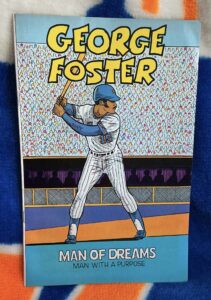 The beauty part of George Foster: Man of Dreams, Man With a Purpose, besides its existence; its sense of opportunism (revisited four years later when Foster foisted “Get Metsmerized” on the rap-listening Mets fan community); the panel that taught us “George and Dave Kingman became good friends while playing in the Little League together”; and the heroism with which it imbues its lead character as he commences his life journey of learning to take math class seriously so he can calculate his batting average between belting home runs, is its timing. Not just the timing of appearing in my hands weeks after the departures of so many Citi Field stalwarts pushed me into a Metsian funk, but the timing of its publication. George Foster Enterprises, Inc., hustled this comic onto the market in 1982. In 1982, we were ripe for believing George Foster’s purpose meshed with our dreams of making the Mets an overnight contender. We’d be disabused of those dreams before 1982 was over. The beauty part of George Foster: Man of Dreams, Man With a Purpose, besides its existence; its sense of opportunism (revisited four years later when Foster foisted “Get Metsmerized” on the rap-listening Mets fan community); the panel that taught us “George and Dave Kingman became good friends while playing in the Little League together”; and the heroism with which it imbues its lead character as he commences his life journey of learning to take math class seriously so he can calculate his batting average between belting home runs, is its timing. Not just the timing of appearing in my hands weeks after the departures of so many Citi Field stalwarts pushed me into a Metsian funk, but the timing of its publication. George Foster Enterprises, Inc., hustled this comic onto the market in 1982. In 1982, we were ripe for believing George Foster’s purpose meshed with our dreams of making the Mets an overnight contender. We’d be disabused of those dreams before 1982 was over.
As I descended slightly from my instant euphoria over holding and leafing through a copy of George Foster: Man of Dreams, Man With a Purpose, I attempted to give my sister and her husband a capsule Metsplanation of the significance of trading for George Foster and shelling out the enormous bucks Cincinnati no longer wished to shell in ’82, which is to say why this comic book got me right in the feels. The Mets, I detailed broadly, had never acquired a player of his caliber, at least not one still more or less in his prime. Foster, I continued, was regularly among the league leaders in all kinds of categories from which the Mets were usually absent. He’d been an MVP not that long before. He was an intrinsic element in something called the Big Red Machine, a contraption that had won championships.
“So what happened when he came to the Mets?” my sister asked.
“He fell of a cliff. Was never as good as he’d been with his old team. Became such an object of disdain that fans outside Shea, when they recognized the stretch limo he took to the ballpark, pelted it with rocks and garbage.”
“Doesn’t that always happen?” A Met trade for a superstar going south, she meant.
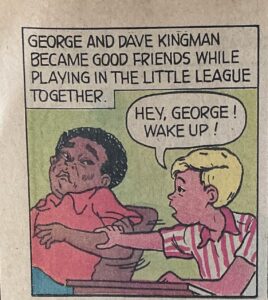 I figured I had about thirty seconds more of their attention before their interest on the subject waned and they’d want me to unwrap the next tchotchke, so I condensed it to “not always, but enough to leave that impression.” I figured I had about thirty seconds more of their attention before their interest on the subject waned and they’d want me to unwrap the next tchotchke, so I condensed it to “not always, but enough to leave that impression.”
Left uncited in my summary was the time the Mets traded a superstar of their own and could be said to have gotten the better of the deal. The catch was their transactional victory didn’t emerge as a certifiable Met win for approximately a third of a century.
March 27, 1987: DAVID CONE traded by the Kansas City Royals with Chris Jelic to the New York Mets for Rick Anderson, Mauro Gozzo, and Ed Hearn.
No, George Foster didn’t resemble a comic book hero as a Met, but he was an important building block in who the Mets were going to become. And after the massive disappointment of 1982, he proved intermittently productive over the following three seasons and helped lift the Mets to their outstanding start the year after that, 1986. Then the cliff beckoned again. He fell off it for good by August, no longer contributing to the ballclub that had grown up around him and showing himself unwilling to accept a reduced role now that he was no longer a Man With a Purpose at Shea.
During the years in between the trade for Foster and the release of Foster, the Mets made mostly outstanding trades. I didn’t get into that with the Stems, but we know they did. We also know that on the other side of the championship the Mets won once Foster talked his way out of town, they had one more dynamite deal up their sleeve.
I’m not the only person with a Mets connection who celebrates a birthday right around New Year’s. David Cone was born two days after me. His Mets connection might be stronger than mine.
True, I beat Coney to this earth by approximately 48 hours and to a deep and abiding interest in who the Mets might trade for by many years, but it was me being all “we got who for Ed Hearn?” as Spring Training 1987 wound down, rather than David Cone being all “what do you mean there’s a Mets fan two days older than me who has no prior awareness of my potential as a starting pitcher?” Cone didn’t know who I was when he came over from Kansas City with eleven games’ worth of big league experience, but I learned about him plenty in the seasons to come. Especially in 1988, when he won 20 games for the division-winning Mets. And 1990, when he shut down the Pirates in the final Big Series of the era (9 IP, 1 ER, enormous W). And 1991, when he led the National League in strikeouts for a second consecutive year, capping it with 19 on Closing Day in Philadelphia. And 1992, when he went to his second All-Star Game as a Met. Hearn the backup catcher for Cone the budding ace worked out very well for the Mets. Only problem was Cone, 28 and on the eve of free agency, would now want to get compensated commensurate to his achievements as he approached the next segment of his career.
August of 1992 found the Mets nearly two years removed from that final Big Series of the era. Despite the future former ESPN commentator’s electric arm, magnetic presence (maybe sometimes a little too magnetic), and ongoing superbness, the Mets had faded from contention in 1991 and imploded altogether amid an on-the-fly reloading the next season, one of those periods when it becomes reasonable to ask, “Doesn’t that always happen?” Whether it does or not, Al Harazin, the GM who succeeded Frank Cashen, decided to take a different approach. Instead of trading for an established star, he’d trade the one he had who was having a helluva year to a formidable team with championship aspirations..
August 27, 1992: JEFF KENT traded by the Toronto Blue Jays with a player to be named later to the New York Mets for David Cone.
We are deep enough into January to take a cue from Larry David and move beyond wishing one another a Happy New Year. The residue from my birthday and David Cone’s birthday has evaporated. We look forward to later January things as January gets going. We, as baseball fans, look forward to the Hall of Fame voting being announced, particularly if we have a rooting interest.
As baseball fans we root for greatness to be properly recognized, but that’s not really our rooting interest when it comes to the Hall of Fame. We root for players we liked when they played and, I’ve come to conclude, we root to tell the Hall of Fame voters they don’t know what the hell they’re doing. On January 20, when the envelope is unsealed on the MLB Network, we might very well cheer that Carlos Beltran has been elected on his fourth ballot; we might offer polite applause if Bobby Abreu or Francisco Rodriguez shows any sign of momentum; we might feel our heart warm if David Wright remains eligible to appear again next year; we will likely be curious to see if Daniel Murphy or Rick Porcello received as much as one vote; and we will certainly be sure somebody is getting overlooked or, worse, overvalued.
The Hall of Fame attempts to honor baseball’s legends, but I’ve become convinced the main reason it’s there is so fans can tell anybody who’ll listen that they’re right and most everybody else with an opinion slightly different from theirs is a clod. Which reminds me — the list of no longer insightful phrases I hope transmit a faint shock to the fingertips of anybody who types them, so as to discourage their rote repletion, now includes:
• “we root for the laundry”;
• “this is why we can’t have nice things”;
• “if the Wild Card existed then, we would have been in the playoffs every year”;
• and, especially in the weeks surrounding New Year’s Eve/Day, “…more like Hall of Very Good”.
To prepare us in our self-assuredness that we’re right and they’re wrong, the Hall of Fame gives us a test run by announcing its Era Committee decision in December. Different Eras are Committee’d in different Decembers. In December 2025, the Contemporary Baseball Era Committee convened. That’s the one that considers players who shone most brightly from 1980 forward who are no longer eligible to be on the writers’ ballot. The other Era Committee is the Classic Baseball Era Committee, covering the days before 1980. There was a lot of classic baseball played from 1980 forward, and the 1980s aren’t particularly contemporary at this time, but never mind that. Those are the names. And the committee with the contemporary name elected one new Hall of Famer last month.
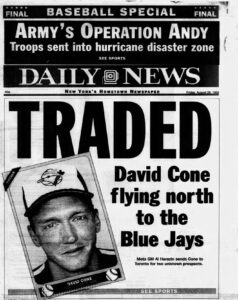 The guy we got for David Cone. Well, we got two guys for David Cone. One was initially a player to be named later, whose name wasn’t Classic or Contemporary. It was Ryan Thompson. High hopes were attached to Ryan Thompson. They weren’t fulfilled, not when he was a Met, not after he was a Met. It happens. They could have waited to name Ryan Thompson all they wanted. He wasn’t making the Hall of Fame. The guy we got for David Cone. Well, we got two guys for David Cone. One was initially a player to be named later, whose name wasn’t Classic or Contemporary. It was Ryan Thompson. High hopes were attached to Ryan Thompson. They weren’t fulfilled, not when he was a Met, not after he was a Met. It happens. They could have waited to name Ryan Thompson all they wanted. He wasn’t making the Hall of Fame.
Jeff Kent, on the other hand, is a Hall of Famer. The Contemporary Baseball Era Committee says so, and who are we to argue with such a thoroughly named committee? When the news of his 1992 acquisition thrust itself onto my radar, I was being all “we got who for David Cone?” The answer was never — not in the immediate aftermath of the news nor at any juncture of the parts of five seasons he was a Met — “we got a future Hall of Famer for David Cone!” But son of a gun, that’s exactly what we did.
Kent, whom the Baseball Writers Association of America resisted electing for ten winters, was on the committee ballot alongside seven other players. The eight of them all had credentials making them worthy of a second thought, which is the whole idea of these committees. The BBWAA has the definitive word, but not necessarily the final one. Not enough writers opted to ink in an X or check mark next to Kent or the other seven — Barry Bonds, Roger Clemens, Carlos Delgado, Don Mattingly, Dale Murphy, Gary Sheffield, and Fernando Valenzuela — thus none of them was ever elected during their prime eligibility period. Writers can miss things. Thus, committees, despite their own capability for missing things (like Keith Hernandez’s qualifications), convene and debate and vote.
In December, they voted for Kent in numbers large enough to immortalize him. They voted for Delgado somewhat, but not quite enough to push our former first baseman (another ex-Blue Jay) over the top. This Carlos’s level of support made for a nice refutation of the writers who ignored him his one year as a BBWAA candidate in 2015, even if it was insufficient for 2026 induction. Murphy and Mattingly, arguably the best players in their leagues at their peak, also won measurable if inadequate support. Bonds and Clemens, inarguably the most prolific hitter and pitcher of their and perhaps all time, didn’t get any reported votes, for presumably the same reasons the writers never came close to selecting them. Nothing of note for Sheffield, one of the most dangerous hitters I ever watched, including when he was in his Met twilight; nothing, either, for Valenzuela, a huge star and a great pitcher.
It could be argued Fernando didn’t do what he did so marvelously long enough. It probably was when the committee met. Same for Murphy and Mattingly. The arguing, official and otherwise, seems to the be the point of every aspect of the Hall of Fame selection process. I couldn’t stand Roger Clemens, but I wouldn’t argue he wasn’t a Hall of Famer in terms of performance, however toxically he put together a good bit of it. That’s what makes me less than ideal as a Hall of Fame consumer. I’m not much for arguing against the merits of great baseball players. If they got far enough to be considered anew after the writers said “nah,” they probably had a lot going for them as players. The existing plaques wouldn’t fall down in shame if a new one was added for any of them. Even — yeech — Clemens.
***Jeff Kent of the New York Mets is going into the Hall of Fame. That probably won’t be how he’s introduced the day he’s inducted, yet I love saying it that way. I love saying it that way as much as I will love saying Carlos Beltran of the New York Mets is going into the Hall of Fame, never mind that I doubt I ever exactly loved Jeff Kent on the New York Mets. Truly, I don’t know that I loved Beltran as much as I loved Beltran’s impact on the Mets becoming a serious team heading into ’05; and his role in making them division-winners in ’06; and his keeping the Mets aloft as best he could down the contracting stretches of ’07 and ’08; and all the grace and stoicism he demonstrated until he was swapped to San Francisco for blue-chip prospect Zack Wheeler in ’11. Let’s say I loved admiring Carlos Beltran as a Met.
It takes a ton of retrospect to apply the L-word to Jeff Kent from when he was a Met. I don’t know that I’ve stockpiled enough. If I call him a flagship Met of the years when the Mets were sinking, it comes off as an unintentional insult. Still, I think of him as kind of the personification of his Mets at their striving best. There were days and nights, you thought those Mets could get better. Those were days and nights when you grabbed a peek at Kent, who was 24 when was traded to us, and thought, maybe, just maybe, we can build a little around this guy. And even if we can’t, he’s already here and he’s not really the reason we’re not great.
If it was somewhere between 1992 and 1996 and you were a Mets fan, that’s pretty much what love was.
At his Met best, which covered roughly the middle of 1993 to the middle of 1994 (slashing .302/.362/.511 over the 162 games the Mets played between 6/22/93 and 6/19/94), he was an All-Star caliber second baseman, despite not being named to either year’s squad. He’d get his NL due later, in another uniform, though by then, I’d be feverishly punching out holes next to second baseman Edgardo Alfonzo’s name in my personal quest to see my favorite Met start ahead of everybody else. Fonzie I absolutely loved. He and his team as one century became another inspired torrents of passion.
Kent I liked OK when he was going well when he was a Met. He surely had his moments. As illustrated in the above paragraph, he had a solid season’s worth. During the second half of 1993, he set a foreshadowy second baseman home run record (most in a single season by any Met playing the position — 20 overall, 19 in games he manned second, eventually broken by Edgardo). His potential was legitimately encouraging to fans and as well as management. With the Mets aiming to grope their way out of last place and their image-makers wishing to communicate their present included glints of sunlight, they included Kent alongside legend-in-residence Doc Gooden on the cover of their 1994 media guide, Norman Rockwell-style. In the foreground Gooden is signing an autograph for a delighted kid. Behind them is Kent, doing the same for a couple of more kids. It was the Mets’ way of saying we have players you’ve loved and players we think you might like. Not pictured: any Met throwing firecrackers at anybody. The Mets may not have been ready to vault out from under .500, but they were gonna be fairly affable.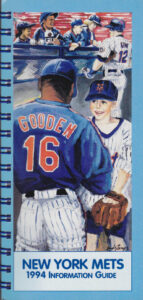
They were gonna be better once ’94 got going, and not only because they couldn’t have been much worse than their 59-103 selves. No Met started the new season hotter than Kent, who earned himself NL Player of the Week Honors for the second week of the year, which encompassed five games — but what games! Six homers! Thirteen RBIs! Start the All-Star voting ASAP! If nothing else, Jeff was making some early takes on the trade that brought him to Flushing look vastly premature and more than a little myopic. To be fair, everybody was in shock at the end of August in ’92, and few were in the mood to learn much about the new kid in town.
Still…
“Good Lord. I can’t believe we didn’t get a proven major league player in return.”
—Dave Magadan
“Ever since they let Straw go, nothing surprises me anymore.”
—Gooden
“They had someone who’d proven he could make it in New York, and they let him get away.”
—Cone himself, though he might have been biased
Kent didn’t keep up the offense as 1994 wound down and then disappeared due to a strike. When baseball re-emerged in 1995, the infielder who made strides beyond the assessment that followed his acquisition — “regarded as a solid and versatile player…but not a spectacular one,” per Tom Verducci in Newsday — failed to progress. And any gestating thoughts I (or any Mets fan) might have incubated about Jeff Kent growing into a future Hall of Famer likewise didn’t materialize.
***Jeff Kent is the 17th Met player to be selected to the Hall of Fame as a player, and the first, I believe, of whom it was never thought “he could make the Hall of Fame” while he was a Met. I don’t know to what extent baseball fans and the baseball community let their minds wander before Cooperstown became a year-round conversation-starter (and online civility-killer), but it had to have been commonly understood that a few of the highly decorated veterans who adorned the Mets in the franchise’s early years certainly had built careers that could conceivably get them enshrined. Tell the denizens of the Grandstand at the doomed Polo Grounds or the Mezzanine of sparkling Shea Stadium amid all the losses from 1962 to 1965 that in Richie Ashburn, Gil Hodges, Duke Snider, Warren Spahn, and Yogi Berra they were glimpsing five eventual Hall of Famers in action (being managed by a Hall of Famer in Casey Stengel, no less), and it might not have jibed with the results on the field, but I can’t imagine there would have been massive pushback. Yeah, those Mets had some great players, albeit after they were done routinely playing at their greatest.
Tom Seaver came along and created a Hall of Fame résumé right before our eyes. Nolan Ryan went to Anaheim and did the same, packing with him what surely somebody between 1966 and 1971 referred to in Queens as Hall of Fame stuff. Willie Mays was Willie Mays. Gary Carter was on the road to Cooperstown the day he became a Met; the championship he helped lead us to allowed him to access the express lane, even if the writers made him sit through six ballots’ worth of traffic. Eddie Murray, who did not elevate the Mets by force of his bat and personality, would pay no penalty for being in the wrong place at the wrong time, having already stamped his first-ballot ticket in Baltimore.
Mike Piazza was a megastar who became larger than life as a Met. Rickey Henderson was on Mount Rickey forever. Roberto Alomar and T#m Gl@v!ne, not personal favorites, couldn’t be denied their destiny. We knew they were “future Hall of Famers,” which made their middling fits (to put it kindly) all the more vexing. Pedro Martinez, who became a personal favorite while in our midst, might as well have signed kids’ programs with “HOF” after his name the moment he came here. Billy Wagner someday becoming a Hall of Famer didn’t seem illogical as he manned the Met mound, even on those occasional afternoons when saves eluded his grasp.
But Jeff Kent? While he was a Met? From August 1992, when he was not yet any kind of name outside Toronto, to July 1996, when it seemed fait accompli that he’d be dealt to somebody somewhere sometime soon (he’d been moved off second base and marooned at third because Jose Vizcaino had been bumped from short and transferred to second in the interest of making room for Rey Ordoñez’s magic glove), there was no inkling that Jeff Kent of the New York Mets would become Jeff Kent of the Hall of Fame. Not even in National League Player of the Week mode, as delicious a week as that was. Not even when the 1995 Mets finished on an unforeseen upswing, going 34-18 and raising unreasonable hopes for 1996. Late ’95 was a whale of a time to be a hopeful Mets fan. Everybody was youthful, everybody was doing something promising.
Unfortunately, that was also the year when a meeting among Mets fans was called and it was decided we were going to mostly boo Jeff Kent as long as he was around (and really let him hear it should he ever go). His pre-strike gleam wore off. The better-angels side of his nature — I seem to recall a “Kent’s Kids” sign over the Picnic Area seats, and he was a spokesman for the No Small Affair organization that served disadvantaged youngsters — didn’t cut much ice against a personality that didn’t mesh with the Hootie & the Blowfish vibe the latest youth movement evinced. “How ’bout them baby Mets?” John Franco was heard to shout with a little love and some tenderness after one particularly uplifting triumph. Those were the Mets of Pulse and Izzy and Rico and Huskey and rookie Fonzie. Kent was among them as well if not exactly of them.
The young Mets played beautifully over the last two months of 1995. Yet amid the proto-OMG emotion of that late summer, Jeff Kent, 27, seemed atonal in relation to the whole “Hold My Hand” arrangement. As that season finished, Marty Noble described Kent’s status for the future as “unclear,” citing “his failure to drive in runs [as] a critical factor in the team’s poor early performance. He made a comeback, but it has been gradual and rarely conspicuous. And the club is quite aware that his square-peg personality grates on his teammates.”
Fair or not, the last couple of years of Kent as a Met and Met mope (the Jeff Can’t phase) set the stage for the reception we’d give him as an opponent, including two postseason interactions — in 2000 and 2006 — when his presence as a losing Giant and then losing Dodger landed as a fringe benefit within Met Division Series victories.
But there he is. Hall of Famer Jeff Kent, no matter what we were thinking when he was New York Met Jeff Kent. For his part, I get the idea that Kent stopped thinking about us a long time ago. He was gracious enough to join Jay Horwitz on the alumni director’s podcast shortly before the Contemporary Era Committee voted, and he mostly pleaded amnesia as regarded his Met years, save for liking Jay and appreciating Dallas Green.
Y’know what, though? Good for that mope of a Met making the Hall. I love in 2026 that the dreadful 1993 Mets were studded by two Hall of Famers, Murray and Kent. There was nothing that felt immortal about attending sixteen games at Shea that season, but one did come away from the whole experience feeling baseball-bulletproof. If this kind of year can’t kill me, nothing can — and I got to see two Hall of Famers over and over!
July 29, 1996: CARLOS BAERGA traded by the Cleveland Indians with Alvaro Espinoza to the New York Mets for Jeff Kent and Jose Vizcaino.
Murray was gone before 1994, off to Cleveland to have the kind of effect — leading a younger team toward the playoffs — he never had in Flushing. Kent carried the Cooperstown banner forward on his own at Shea. Not that it was visible in real time, but we now know it was there, clear to the day he and Vizcaino were traded to Cleveland for former All-Star Carlos Baerga and utilityman Alvaro Espinoza (missing the Baltimore-boomeranged Murray by about a week), a classic trade that didn’t seem to help anybody in the short term. The Indians went to the playoffs with Kent and Vizcaino, but they were going, regardless. Then they got rid of their ex-Mets and kept winning. Cleveland was a way station for more than one young or young-ish Met who’d pick up steam elsewhere. Jeromy Burnitz as a Tribesman in 1995 didn’t contribute much to their successful pennant push. He had to be shipped to Milwaukee to attain the stardom Dallas Green was too impatient to cultivate.
It took a second trade, to San Francisco (again with Vizcaino), to thrust Kent into star territory. In San Francisco, starting with the ’97 season, Kent would hit behind Barry Bonds, see streams of good pitches, hone his power stroke, and begin printing his calling card: most career home runs by a player who primarily played second base, 351 of his 377 total. Not Hornsby. Not Morgan. Not Sandberg. Kent…yeah that Kent. Turns out his 1993 was the start of something big. How big couldn’t be known then. In 2000, he won the National League MVP award for which Piazza was frontrunner deep into summer. Mike caught every day and it caught up with him. Bonds put up Bonds numbers, but that was to be expected. Kent produced stratospheric statistics for a middle infielder: 33 homers, 125 RBIs, a .334 batting average. The Giants finished first. So did he. Between 1997 and 2005, Jeff earned two Silver Sluggers, was named to five All-Star teams, and received MVP votes six separate times.
You may or may not have begun to connect Kent with the Hall of Fame as his career enjoyed its highest heights, bulging with slugging statistics as it was. A lot of sluggers had impressive statistics in the late 1990s and early 2000s. Some seemed less impressive as revelations came to the fore. None attached themselves to Kent. He was the second baseman with the most home runs. After he finished up in 2008, his name tended to get mentioned in the company of those who would be crowding the ballot in 2014. Greg Maddux, Frank Thomas, and Gl@v!ne figured to be locks, and they were. Mike Mussina would creep up the ranks until winning the golden 75% of the BBWAA vote in 2019. Kent went ten years without cracking 50%. Then came the committee, which took a closer examination of his calling card. If he wasn’t the ablest defender or the friendliest teammate, he didn’t have to be. No second baseman hit more home runs.
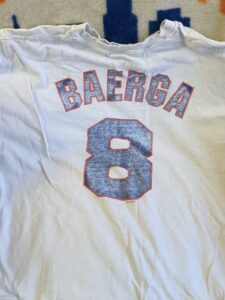 This all followed the Kent-for-Baerga trade. Baerga gave us one solid veteran-leader year during his 1996-1998 stay, coinciding with the Mets’ ascent to contention. When Alfonzo was inducted into the club Hall of Fame in 2021, he invited Baerga to be an honored guest at the ceremony, indicating some genuine impact from the man who was our Carlos B before we came to know Carlos Beltran. Contemporary accounts of the rising 1997 Mets pointed to Carlos Baerga as a clubhouse catalyst, and he definitely chipped in some big hits as the team rose from 71-91 to 88-74. This all followed the Kent-for-Baerga trade. Baerga gave us one solid veteran-leader year during his 1996-1998 stay, coinciding with the Mets’ ascent to contention. When Alfonzo was inducted into the club Hall of Fame in 2021, he invited Baerga to be an honored guest at the ceremony, indicating some genuine impact from the man who was our Carlos B before we came to know Carlos Beltran. Contemporary accounts of the rising 1997 Mets pointed to Carlos Baerga as a clubhouse catalyst, and he definitely chipped in some big hits as the team rose from 71-91 to 88-74.
But with massive hindsight, it’s hard to say we won the second Jeff Kent trade, just as it’s glibly easy to say we won the first one. You trade for a future Hall of Famer before it is sensed he is a future Hall of Famer, you’re entitled to call it a win. You trade one away? Well, that’s the business of baseball. Baerga, who had been really good for Cleveland until he wasn’t, lingered long enough in the bigs to play for the 2005 Washington Nationals. Cone had enough pitches in his right arm to return to the 2003 Mets following some notable successes with Toronto (World Series ring), Kansas City (Cy Young Award), and some other New York team (whatever). Yet they’re not Hall of Famers. Maybe Cone deserved a closer look, but to date he hasn’t. Hell, George Foster hit 348 home runs in an era when that was a ton, and received only negligible Hall support in four elections — and he had his own comic book!
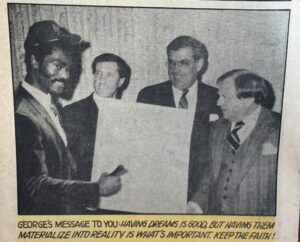 Let’s leave George out of it for the moment. Let’s consider Hearn for Cone for Kent for Baerga, plus Cone coming back to finish up in orange and blue, and Hearn persevering through health issues to make all the 1986 reunions, and whatever it was Baerga taught Fonzie that shaped Edgardo into the most important non-Piazza player we had during the Bobby V years. Let’s say we won the Jeff Kent Trades over and over, even if Kent didn’t make a semblance of a case for immortality until he made it to San Francisco. Let’s leave George out of it for the moment. Let’s consider Hearn for Cone for Kent for Baerga, plus Cone coming back to finish up in orange and blue, and Hearn persevering through health issues to make all the 1986 reunions, and whatever it was Baerga taught Fonzie that shaped Edgardo into the most important non-Piazza player we had during the Bobby V years. Let’s say we won the Jeff Kent Trades over and over, even if Kent didn’t make a semblance of a case for immortality until he made it to San Francisco.
Had he stayed a Met, you imagine the bat would have found a place in that late ’90s lineup, but once we had Fonzie at second and Robin at third, did you miss Jeff Kent whatsoever? For that matter, did you miss Nolan Ryan when we were running Seaver, Matlack, and Koosman to the mound every week? Besides on principle? Transactions are nuanced. They can look bad in the moment and worse with perspective, but not totally disastrous in the scheme of things.
Thus, I am comfortable to declare that it really happened. We traded somebody at the top of his game for a veritable unknown, and the veritable unknown went on to a Hall of Fame career after the Mets got him. Also after he left the Mets. A lot more after he left the Mets than when he was with the Mets. Honestly, an accurate assessment of trading for and away Jeff Kent requires immense nuance. In a comic book universe, however, we can position the facts as we see fit to create the most crowd-pleasing storyline we can.
by Greg Prince on 31 December 2025 1:29 am “It’s great to be young and a New York Giant,” second baseman Larry Doyle declared to Damon Runyon in 1911, the year Doyle turned 25, the season the Giants won the first of three consecutive National League pennants. More than a century later, you could hear an echo of Laughing Larry in the earnest sentiments Jonah Tong expressed into Michelle Margaux’s SNY microphone:
“I love being a Met. It’s truly one of the coolest things I’ve ever done in my entire life.”
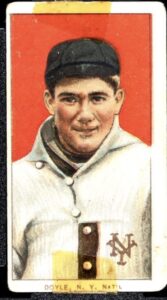 It’s great to be young and a National Leaguer in New York… Tong, at the time, was 22 and dressed as a Christmas elf, helping out at the annual holiday party the New York Mets host for area kids. Perhaps that, too, is truly one of the coolest things he’s done in his entire life. Ballplayers get more done before they’re 23 than a lot of us do before we turn 63, which, incidentally, is what I’m doing today.
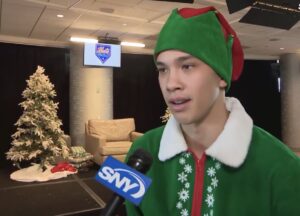 …whatever the uniform. Young Jonah spoke his truth in late 2025, following what we’ll call his first rookie season. He didn’t throw enough innings to use up his freshman eligibility, so he’ll get to be a rookie again in 2026. So will his fellow elves/phenoms Nolan McLean and Brandon Sproat. Sproat and Tong showed flashes of potential, maybe glimpses of brilliance as they answered an unexpected call to the majors. McLean landed ahead of them, chronologically and developmentally, looking like a full-grown ace for the bulk of his 48 frames in the bigs. Fifty would have made him a sophomore next year. We get to get excited about his and his prospective rotationmates’ breaking through all over again in a few months.
McLean, Sproat, and Tong — Generation MST3K to me — couldn’t do enough in their initial MLB go-round after responding to the Mets’ SOS to keep the team from being AWOL during the NLWCS and any further postseason alphabet soup action. Yeah, as if it was their fault. The sneak peek they gave us of their evident talent and gestating poise was sufficient vis-à-vis our anticipation of getting acquainted with them. The Mets thought enough of the trio’s sample size to have had them support Clay Holmes when Holmes dressed up as Santa Claus.
I should have learned, en route to turning 63, not to make assumptions based on past experience, but I can’t help but think introducing 32-year-old Clay Holmes into a rumination on youthful Nolan McLean, Brandon Sproat, and Jonah Tong will someday resonate like remembering that when the Mets had Ron Darling, Walt Terrell, and Dwight Gooden ready to go in 1984 (with Sid Fernandez waiting in the wings), a soon-to-be-released Mike Torrez was their Opening Day starter. Then again, Clay Holmes was our Opening Day starter last year, and pitched pretty well the whole season, give or take some dips. The whole team took some dips, which explains why quite a few Met veterans who could have donned the Santa suit were no longer available for Citi Field events this December.
We love old players when we have come to terms with their careers. Presently, we don’t have any of those kinds of sages under contract, at least not any we know well. We love young players when we are able to imagine their careers — like we do with these kid pitchers and like we have lately with a few position players (Alvarez, Baty, Vientos) currently approaching their respective make-or-break junctures. The players who have ceased being young but are not yet old require some discernment. The Mets discerned they’d be better off going forward without four key players who’d reached their early thirties. That’s baseball middle-age. The ticking of the actuarial clock may not be precisely why Brandon Nimmo, Edwin Diaz, Pete Alonso, and Jeff McNeil weren’t dropping by Mets-run holiday parties in 2025’s waning weeks, but they were here for a long time, and now they’re not.
 Get ready, ’cause here they come (again). Here now and for the foreseeable future (which comes with the caveat that you never know what lies ahead) are McLean, 24; Sproat, 25; and Tong, 22. At the moment, we are Dorothy Boyd to their Jerry Maguire.
We love them!
We love them for the Mets we want them to be.
We love them for the Mets they almost are.
With the Mets idle since the end of September, I’ve occupied myself watching the Giants mostly lose football games and the Nets beginning to occasionally win basketball games. The Giants were effectively eliminated from playoff contention that October Sunday they converted a 26-8 fourth quarter lead at Denver into a 33-32 loss. The Nets commenced their season at 1-11, pretty much torpedoing any thoughts that April will deal me any roundball/hardball conflicts. Yet Brooklyn has gone 9-9 in their past eighteen, buoyed by a couple of capable rookies, Egor Dëmin and Danny Wolf. And the Giants finally won a game the other day, which doesn’t help their draft position, but added to the sense that their first-year quarterback Jaxson Dart, who’s the reason (besides ingrained habit) that I keep tuning in, won’t need replacing under center. Dart can be a real QB. Dëmin and Wolf and the other youngsters among the Flatbush 5 first-round draft class are making the Nets, until further notice, into a real team. It’s real beautiful to watch kids grow up as pros.
McLean, Sproat, and Tong started getting the hang of that in 2025. It was only the beginning of what we want to feel forever, forever being a malleable concept to a Mets fan who’s been around, a Mets fan who keeps coming back for the raising of hopes regardless of prior results. In 2025, I kept waiting for the Mets to sweep me off my feet, but apparently they lacked upper-body strength. Still, there was something about those arms. Those arms (and ingrained habit) will keep me coming back.
I may be old enough to know better than to fall in love with the next fledgling youth movement, but I’m also old enough to know it’s not much fun getting older without a few Met futures to anticipate. It’s truly one of the coolest things I’ve ever done in my entire life…which must be why I keep doing it.
by Greg Prince on 26 December 2025 8:06 pm Previously on Flashback Friday…
A little piece of me is always watching the Mets in 1970.
Mostly I was enchanted with the possibility that the Mets would win the World Series in 1975.
I was in love with the 1980 Mets. They weren’t the first Mets team I was ever hung up on, but I think, given where I was in life, that they were my first love.
I gave myself over to baseball and the Mets in 1985 in a way I never had before.
If there was ever going to be a year when I might have discarded baseball and pleaded no lo contendre to the charge that I allowed myself to be distracted from the Mets by overwhelming matters of substance, 1990 would have been that year. But it wasn’t and I didn’t. Amid a seismic personal shift that separated what came before from what came after, I was just doing what I’d always been doing. I rooted for the Mets like it was life and death. I didn’t know how not to.
In 1995, I was determined to spend as much time at Shea as was humanly possible.
It was the Year 2000, Y2K. Actually, it wasn’t any different from the 1900s, at least not the last few of them. Since 1997, the Bobby Valentine Mets had become my cause, my concern, my reason for being. Even more, I mean. If I had to rate the intensity of my baseball-commitment on a scale from 5 to 10 (let’s face it, it was never going to dip into low single-digits), these were the 9-10 years. The needle never saw 8.
For all the sporadic delight I’ve derived from the Mets since 1969, I don’t think I’ve ever been quite as personally gratified by a season as I’ve been by 2005.
Make no mistake about it: we lived in 2010. Of course we did. We live in every season as if it’s our permanent residence. We inhabit them fully. Each one is the most important season of our lives while it is in progress. Across the entirety of 2010, I sat at this very spot and, in concert with my blogging partner sitting in whatever spot he was in, set in type that entire April-to-October effort. It mattered to me. It mattered to you. Then it mattered no more. Weird how that happens.
There’s nothing better than the year that Feels Different, and before we had a chance to feel anything else, 2015 felt different.
And now: Flashback Friday.
***
Had Major League Baseball not presented its farcical version of a season in 2020 — no games until late July; 60 games in all; zero fans in attendance; everything a little to a lot off — Pete Alonso’s career home run total would have sat at 248 when he left the Mets for the Orioles this month, meaning Darryl Strawberry would still hold the franchise record at 252. That is unless Pete would have been moved at the end of 2025 to stay a Met a little longer for history’s sake, or the Polar Bear had powered up five more times than he actually did in the five seasons that followed the one that theoretically wasn’t played, one I almost wish hadn’t been played.
But that’s all hypothetical. Sort of like “imagine MLB needing to lop more than 100 games off its schedule and conducting its on-field exercises in front of nothing but empty seats and cardboard cutouts, altering its rules along the way, all for reasons that ostensibly had nothing to do with baseball.” Before 2020, I don’t know why anybody would have imagined such a hypothetical. By March of that year, our imaginations were becoming overwhelmed.
What a strange year it was five years ago, mostly outside the realm with which we concern ourselves here, but within the walls of Metsopotamia as well. COVID-19 crept into our collective consciousness in January. Whatever it was, it was said to be dangerous to everybody. By March, it was unstoppable. It stopped Spring Training and then the season’s beginning. It stopped just about everything, so why should baseball have been any different? It surely stopped the sense of momentum the Mets carried over from the end of the previous decade. The 2019 Mets made themselves memorable by finishing strong, clear through to Dom Smith’s rousing final swing on the season’s final day that nurtured optimism for the near future. The offseason leading into 2020 was brightened by the story of how those young, spunky Mets gathered for milk and cookies and hitting talk on the road after games. They were the Cookie Club, and how could you not be optimistic about that? Alas, the “Summer Camp” that prefaced the impending ad hoc season brought a bittersweet update from Jeff McNeil:
“We may have to do some Zoom calls and order in.”
No, it wouldn’t be the same. Once the 2020 season didn’t start on time, and especially once the 2020 seasonette got going, memories of 2019 existed on an island, disconnected from a next step. Yet it was 2020 that was bound to live in true isolation, sheltering in place from what came before and what might come after. Members of Mets teams that earned postseason berths in 2015 and 2016 played alongside members of Mets teams that would go to the playoffs in 2022 and 2024. None of that experience with or capability of success rubbed off on the unit that called itself the 2020 Mets. To be fair, the 2020 Mets didn’t have much runway. The 2019 Mets were past 90 games before they began to coalesce into lovability. The 2020 Mets had only 60 games total. To be just as fair, all they had to be, essentially, was the eighth-best team in their league to be granted a World Series Tournament bid, and they couldn’t manage that much. The Cookie Club and everything else that felt promising prior to 2020 simply crumbled.
It seemed unseemly to complain too much about the Mets’ indifferent results when the world was unsettled by weightier issues. Not that we didn’t complain. With a pandemic in progress, we had not much else to do in 2020. Complaining bitterly and watching empty-stadium baseball became the newest national pastimes. Complaints — legitimate and concocted — were everywhere. Mets baseball was on TV and radio if you wanted something else to get annoyed by.
Remember that most obscure Mets season? It’s OK if you don’t. It was destined for instant obscurity from its delayed outset, and did nothing to divert from its path to nowhere while it went about its abbreviated business. On July 24, 2020, the Mets commenced their condensed NL East/AL East-only schedule with a victory over the Braves. Yoenis Cespedes, anachronistically sharing a box score with Pete Alonso, homered to give the Mets a 1-0 win. Soon Cespedes would decide he preferred to not court the coronavirus and opted out of further baseball. That was something players could do in what the commercials called These Challenging Times. For a couple of days, Cespedes ceased to be the revered slugger from the 2015 pennant surge and became the guy who ghosted on his teammates and, by extension, us. I assume he is more widely remembered now for his heroic entrance onto our stage than his murky exit from it, but in the moment, he made for an easy object of online Mets fan scorn.
Not that Yo would have heard any boos. The only noise at ballparks was piped in, intended to add a lifelike quality to an otherwise desolate atmosphere. Cespedes, when he hit that Opening Day home run, was serving as DH at Citi Field. That was new in 2020. Player health was enough of a potential red flag to let MLB shove the designated hitter into the National League, lest pitchers drop like flies on the basepaths. Same for this new scourge that became known as the ghost runner. You get to extra innings, you put a runner on second base, the maker of the last out from the last inning, specifically. Was it baseball? It was now. Same as doubleheaders whose games were each seven innings…unless they went to extras…meaning the eighth and maybe the ninth.
It was all very bizarre and not particularly welcome. Had the Mets made more of it, it might look different a half-decade later, but the Mets made nothing of it, going 26-34 and finishing in a fourth-place tie. They stayed in mathematical contention to the final weekend mostly because it was almost impossible to not last nearly 60 games. They did their best to opt out of the “pennant race,” but hung in just the same.
The Mets who weren’t a part of better teams before or after 2020 were destined for their own individual pervading obscurity, at least as we define it. Some players who had representative careers just sort of passed through Flushing. That happens every season, but this was the worst possible season to do it if being remembered as a Met was ever your goal. I could tick off close to a dozen names that would draw blank expressions from Mets fans who probably watched the games in which those names were sewn onto the back of Mets uniforms. Forty-seven different players played for the Mets across those 60 games. There was little time for introductions let alone impressions. Of those who showed up at Citi for the first time, maybe two Mets became known as Mets. One was, by 2025, the last of the new-for-2020 Mets, David Peterson. The other was another promising rookie, Andrés Giménez, and he lives on in the Mets consciousness as the primary trade piece exchanged for Francisco Lindor.
That trade, which also sent Amed Rosario to Cleveland, happened in 2021, by which time Steve Cohen had taken over ownership of the club. A different owner employed a different general manager than was on the job in 2020 (there’d be a lot of that). The manager who nominally led the Mets in 2020, Luis Rojas, wouldn’t make it to 2022, though he wasn’t supposed to manage the Mets in 2020 to begin with. Carlos Beltran was Brodie Van Wagenen’s unorthodox hire post-Mickey Callaway, but that choice imploded when it was discovered Beltran played a key role in the Houston Astros’ unorthodox world championship strategy of 2017. Van Wagenen, it will be recalled, was hired by Jeff Wilpon, who would have nothing to do with the Mets after 2020, same as Van Wagenen.
Almost everybody who was here would be gone soon enough. Even more than usual. That was how 2020 and our scant developing memories of it operated. A few moments stand out in my mind, and I could detail them, yet despite my self-imposed obligation to flash back to it in the waning days of 2025 (I have a longstanding thing about Mets seasons that end in “0” and “5”), I don’t see the point in diving a whole lot deeper.
Five years after the fact, the most significance that I can attach to the 2020 Mets season is Pete Alonso belted 16 home runs and set himself up to own the Met record at 264 before bolting to Baltimore. And that Baltimore, where the Mets had just defeated the Orioles on yet another vacant weeknight, served as backdrop for the bulletin that Tom Seaver died, partly from COVID-related complications. Because the Mets were playing a schedule, they would be in a ballpark — their own — the next afternoon, and they would do their best to offer a memorial to Tom. No fans were there, of course, and the organization would attempt more fitting do-overs during their Home Openers in 2021 and 2022, but in 2020, any void that could be filled was a void temporarily vanquished.
The Mets played the Yankees that day in a game that went to extra innings (the tenth), and Pete hit one of his 16 homers to win it, a leadoff blast that drove in two runs, one of those “huh?” constructs we’d start getting used to if we wanted to keep watching and possibly enjoying baseball. Pete had struggled a bit in the first weeks of his sophomore season but would launch ten longballs in September 2020, none more meaningful than the one that ensured missing Tom Seaver wouldn’t feel any worse than it already did.
So I’m glad they played that game. And a few others that flicker through my mind when I think of the 2020 season, which isn’t often, though I did think of it the other night. I’ve been rewatching Mad Men since it came to HBO Max, and I was moved to recall Don Draper’s signature advice to Peggy Olson in a 2008 episode that took place in 1962 with a flashback to 1960, and it seemed relevant to a retrospective of 2020 about to be offered in 2025:
“Get out of here and move forward. This never happened. It will shock you how much it never happened.”
Yet it did happen. Sixty games. No attendance. No playoffs. Faint footprints. But the Mets did play baseball that counted the way baseball counts. Entering that season, that wouldn’t have loomed as an accomplishment. In the rearview mirror, it doesn’t appear much was accomplished.
For a couple of months, the 2020 Mets happened a little. It’s five years ago now. Eventually, it always is.
by Greg Prince on 23 December 2025 3:12 pm The MY FAVORITE SEASONS, FROM LEAST FAVORITE TO MOST FAVORITE, 1969-PRESENT series is predicated on the notion that, essentially, every season is your old apartment. You moved in when the year began. Your lease was up when the year ended. You moved out and moved on. You carry with you the life you lived through that season. You leave; the feeling remains. How much and how deep determines how you divvy up the space you devote to it in your Metsian memory and how hallowed each segment of that space shall be.
I began the countdown of the seasons of my baseball life two Decembers ago, starting at No. 55 and eventually working my way up to No. 3 this past March. By then, because thinking and writing took me longer than I suspected when I started all this, I still wasn’t done, meaning a 56th entry needed to be inserted for the season that had most recently ended at that point. As of this moment, No. 2 is swinging in the on-deck circle, and No. 1 is taking the measure of the pitcher while waiting in the hole, and when those two get their turns at bat (soon, I swear), this particular game will be complete.
But I can’t overlook that a 57th season in my baseball life has transpired during the extended MY FAVORITE process, specifically the season we moved out of at 5:59 PM Eastern Daylight Time on September 28, 2025. On Saturday, December 27, 2025, at 4:35 AM Eastern Standard Time, we will reach the Baseball Equinox, that delicious instant when we stand equidistant between last season and next season (first pitch scheduled for Thursday, March 26, 2026, at 3:10 PM Eastern Daylight Time). Next season hasn’t asked for its security deposit yet. Last season still has a box or two over there in the corner we need to hoist the heck out of here before we return the keys, thus we still have a couple of minutes for closing books and long last looks.
What kind of apartment has it been?
33-B. 2025
In the spirit of fitting 2024 into the countdown at No. 13½ so as not to completely disrupt the established numbering that had already taken place, we’ll affix 2025’s ranking with a qualifier. Except it won’t be with something whimsical like a “½” sign, because this wasn’t 2024, famous in Metsopotamian circles for its air of humor, whimsy, and joy. Something legalistic like 33(b) might be more like it, but I’ve never seen an apartment addressed quite that way.
In practical terms, 2025’s ranking at No. 33-B — really 35th among 57 — slots it just above the tier I identified as the group whose clouds didn’t altogether obscure their silver linings, and just beneath those I judged, based on my lived experience, as middling. Remember, these are FAVORITES, and therefore subjective. There have been, since I commenced calling myself a Mets fan, 22 seasons I liked living in less than 2025, and 34 seasons I preferred to its company.
Perhaps it shows a ton of restraint to say anything other than “2025 was the worst!” following the route from 45-24 to 83-79 via the 38-55 turnoff. Recency bias would allow it, but I have here in my hand a list that includes, from the bottom up, 1977, 2003, 2002, and so on. The worst of the worst, about which I strove to say something nice rather than reflexively spew the usual venom, I categorized as lousy seasons that encompassed redeeming features. That crew sailed on rough waters. The good ship 2025 may have brought on a bout of seasickness, especially toward the end of its journey, but it had its moments when it felt as if fair winds would guide us where we needed to be…and this exercise is as much about feelings as it is results.
In specific countdown terms, I’ve wedged 2025 between No. 34 1971 and No. 33 2007. Two-Thousand Seven is infamous for introducing to us the concept of Worst Collapse Ever, though before it all went to thud, I was having a pretty fun time. I was in my mid-forties, going to lots of games with people I liked, and the Mets held first place for most of the year. Had I gotten up and left before the final seventeen games were played, and displayed zero curiosity regarding what I missed, I’d have just assumed everything had gone according to plan. Maybe I should have tried something like that in 2025.
Nineteen Seventy-One doesn’t maintain an outsize historical profile in the Twenty-First Century, and I’ll admit my memories are painted mostly in the broad strokes that stay with me from the season I was eight. I didn’t go to any games in 1971. I watched on TV and listened on the radio, not necessarily every day and night. I definitely followed the standings, where the Mets sunk from contention before summer was halfway over. Not going all the way, as in 1969, or not staying in the race close to the end, as in 1970, diminished some of my childhood fervor. Eight years old and I was showing signs of cynicism. Yet I had players I liked a lot, they forged a winning record, and the whole Mets thing, which I was still learning about, continued to appeal to me. It all looked like such fun.
Take the best of what I retain about 2007 and 1971; understand that I understand there was plenty that was not best about either season; and contextualize it for contemporary concerns, and that’s how 2025 landed amid their part of the building. We know it could have been a whole lot better this past year. It actually could have been somewhat worse, though “not as bad as it could have been” was hardly the goal at its outset. Nevertheless, in 2025, I had players I liked a lot, they forged a winning record, and the whole Mets thing, which I’m always learning about, continues to appeal to me. Plus there was time in first place, more time in playoff position, nothing but time in pursuit of a playoff spot (never underestimate staying in contention), and I got to go to games with people I liked. The fun was in the eye of the beholder, and you had to squint while covering the other eye, but it still looked like fun if I allowed myself to see the Mets in my early sixties the way I did when I was in single-digits.
Yeah, it definitely could have been worse.
And it definitely could have better.
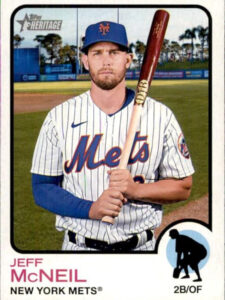 Had it been better, maybe more of the players I liked a lot or at least a good bit would still be Mets as the Equinox approaches. Instead, the offseason that has transpired in 2025’s wake has racked up a body count, with Jeff McNeil thrown atop the outgoing pile just this week. Jeff McNeil played a whole bunch of positions competently and occasionally delivered enormous hits. He was twice an All-Star and once a batting champion. Had you just told me the Mets had acquired a Jeff McNeil type, I’d be excited. We had the Jeff McNeil type, and his time as a Met was deemed up. His extraction from the organization after eight seasons as one of our stalwarts was less surprising than those of Brandon Nimmo, Edwin Diaz, and Pete Alonso — David Stearns basically put him on craigslist before finding a taker in West Sacramento — yet the initial word that he was going might have hit me harder than the news of all of those who preceded him out the door. We’re really doing this, huh? We’re getting rid of everybody. Had it been better, maybe more of the players I liked a lot or at least a good bit would still be Mets as the Equinox approaches. Instead, the offseason that has transpired in 2025’s wake has racked up a body count, with Jeff McNeil thrown atop the outgoing pile just this week. Jeff McNeil played a whole bunch of positions competently and occasionally delivered enormous hits. He was twice an All-Star and once a batting champion. Had you just told me the Mets had acquired a Jeff McNeil type, I’d be excited. We had the Jeff McNeil type, and his time as a Met was deemed up. His extraction from the organization after eight seasons as one of our stalwarts was less surprising than those of Brandon Nimmo, Edwin Diaz, and Pete Alonso — David Stearns basically put him on craigslist before finding a taker in West Sacramento — yet the initial word that he was going might have hit me harder than the news of all of those who preceded him out the door. We’re really doing this, huh? We’re getting rid of everybody.
That’s not supposed to be part of the whole Mets thing that you grow enamored of when you’re eight, but I suppose it’s always been included in the package. Goodbye to this one, hello to that one, where should we put the couch? There’s a reason we move from season to season. It’s probably more of a shock that we had Nimmo, Diaz, Alonso, and McNeil forming a core for as long as they did than that none of them will be here in 2026. Heading into 1971, I was a little thrown off that the Mets traded Ron Swoboda. Had they also decided all at once that they no longer needed, say, Cleon Jones, Bud Harrelson, and Tug McGraw, I have no idea how I would handled it. Here’s to the fiftieth anniversary of free agency becoming the law of the baseball land and players having a say in where they play, but I think getting in on the final few years of the reserve clause helped me get my footing as a fan. In offseasons like this one, I hear Jed Bartlet in the flashback that shows how his campaign team (later his White House staff) came together in The West Wing, complaining to eventual chief of staff Leo McGarry:
“You got rid of all the people I know!”
Leo, as if presaging David Stearns’s tenure in Flushing, replies, “Yeah. Have a good night.”
There are always new people to get to know. In 2025, we got to know a few who figure to be back in 2026 and maybe stick around in the seasons to follow. Then I’ll get attached to them. Then they’ll be sent away or leave of their own volition. And I’ll be thrown off anew. Then I’ll calculate how many days we’re closer to next season than last season. That, too, is part of the whole Mets thing.
PREVIOUS ‘MY FAVORITE SEASONS’ INSTALLMENTS
Nos. 55-44: Lousy Seasons, Redeeming Features
Nos. 43-34: Lookin’ for the Lights (That Silver Lining)
Nos. 33-23: In the Middling Years
Nos. 22-21: Affection in Anonymity
No. 20: No Shirt, Sherlock
No. 19: Not So Heavy Next Time
No. 18: Honorably Discharged
No. 17: Taken Down in Paradise City
No. 16: Thin Degree of Separation
No. 15: We Good?
No. 14: This Thing Is On
No. 13½: Making New History
No. 13: One of Those Teams
No. 12: (Weird) Dream Season
No. 11: Hold On for One More Year
No. 10: Retrospectively Happy Days
No. 9: The September of My Youth
No. 8: First Taste
Nos. 7-5: Three of a Kind
No. 4: Pound for Pound
No. 3: Won and Still Not Done
by Greg Prince on 15 December 2025 5:20 pm I woke up this past Friday with what we’ll politely call a stomach bug. That evening, in the wake of fitful rest, glacial recovery, zero appetite, and sporadic glimpses at my phone, I informed my wife, “Alonso and Diaz had their introductory press conferences with their new teams today.”
“So,” she diagnosed, “that’s why you’ve been throwing up.”
***Once upon a time in the annals of New York National League baseball, Leo Durocher, then managing the Giants, pushed owner Horace Stoneham to purge his roster of its beloved mainstays for what Leo saw as a very practical reason: “It ain’t my kind of team.” If Leo had to wait around for balls to fly out of the Polo Grounds, there wasn’t much managing for him to do. Soon after his midseason hiring in 1948, the transformation was on. Gone would be Stoneham’s hallowed Window Breakers, the slow-footed sluggers who had set home run records in the process of finishing far from a pennant in 1947. Here came the scrappy middle infielders who could turn two in the field while showing themselves on the basepaths to be “scratching, diving, hungry ballplayers who come to kill you,” and a general Giant ethos reflecting the “nice guys finish last” sentiment for which Durocher became most famous. Following a multifaceted career that spanned nearly a half-century, Leo proudly declared, “I never had a boss call me upstairs so he could congratulate me for losing like a gentleman.”
Durocher may have been as obsessed by style when he left the ballpark — wearing “suits with the pockets sewn tight so he wouldn’t be tempted to put something in them to ruin the line,” per his 1990s biographer Gerald Eskenazi — but he didn’t much care whether he was identified as a sweetheart while he was working as a player, coach, manager, or broadcaster, or simply being the all-around baseball man America came to know. Couching opinions at least as sharp as his wardrobe in euphemisms wasn’t his wont. Hell, nobody ever came out more explicitly against niceness. In the chapter of 1975’s Nice Guys Finish Last dissecting the signature swap that created Durocher’s kind of team, the one that netted the Giants shortstop Alvin Dark and second baseman Eddie Stanky from the Boston Braves in December of 1949, Leo didn’t mind letting the reader know that…
• “There are two things that make it difficult to work for Stoneham when he’s drinking. 1) Sometimes you can’t find him. 2) Sometimes you can.”
• Red Webb, a Giants righty the Braves demanded be thrown in along with Sid Gordon, Buddy Kerr, and Willard Marshall, was “a mediocre pitcher” to whom Stoneham was nonetheless attached. “Horace, please,” Leo begged, “I’ll jump in my car and drive out to the woods and get you a dozen Red Webbs.”
• As for the one Kerr in the deal, the fella whose errorless streak at short reached 68 games, a multiseason mark that would remain the big league standard until Kevin Elster topped it more than forty years later, Leo attempted to persuade Horace, “‘I know shortstops, and I think mediocrity is the word for him.’ He didn’t make errors, but he didn’t make plays, either.”
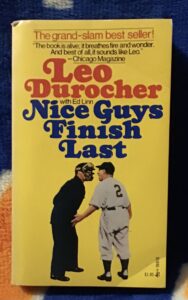 Shy guys don’t write this kind of memoir. Stoneham, Webb, and Kerr (eventually a Mets special assignment scout) all had one thing in common when Durocher’s book was published. They were all still alive. A nice guy might have found a less edgy manner in which to detail a decades-old trade in the interest of not making anybody look or feel unnecessarily bad, but the title was the title, and Durocher was very much Durocher. “Branch Rickey once said of me,” Leo recalled in the memoir he co-authored with Ed Linn, “that I was a man with an infinite capacity for immediately making a bad thing worse. Carve it on my gravestone, Branch. I have to admit it’s sometimes true.”
Later upon a time in the annals of New York National League baseball, a gentleman named David Stearns came along and never once issued a quote remotely as colorful as anything Leo Durocher likely uttered in the course of ordering dinner. Stearns, who favors quarter-zip sweaters over custom-stitched suits, is a modern master of speaking affably while sharing little, which isn’t the least bit surprising in the industry that is baseball in 2025. Perhaps if Durocher had each of his personnel assessments relayed and critiqued instantaneously on myriad platforms as today’s managers and executives do, he might have also communicated in more anodyne English. It ain’t 1948, anymore. Then again, one struggles to imagine David Stearns letting loose to reporters over tumblers of Scotch at Toots Shor’s.
Yet for all the contrasts between Durocher’s rough-and-tumble persona and Stearns’s buttoned-up/quarter-zipped approach, some things in town don’t seem to have changed all that much. Consider Leo’s closing argument to his club owner as to why they should trade away loyal Giants Stoneham counted as personal favorites, stalwarts whose track records convinced the owner, “We can win the championship with this team next year”:
“‘This is a business you’re involved in, and you’re talking like a fan. It makes my pitching look worse than it is because the defense is bad. It’s bad, Horace. All you have to do is look at the figures. We don’t make the double play.’”
Translate it into contemporary corporatespeak, and you can detect the seeds of Stearns’s paeans to run prevention, roster flexibility, and whatever other priorities the Mets’ president of baseball operations will point to as paramount while he attempts — in his third offseason shaping this generation’s New York National League hopeful — to create his kind of team. And maybe ours. We’ll see about that. We can’t see it now. Maybe, in these suddenly Bearless and Sugar-free times, we’re not in the mood to look.
It’s hard not to talk like a fan when we are fans. We try to be dispassionate and analytical and think as a GM might think, but none of that is really our job. Our job is to stay in love with the team we fell for when we were kids, and fall head over heels again and again for players who’ve starred for our team year after year until we can’t fathom them starring for anybody else…or declining from stardom for us.
As a fan, I detest that Edwin Diaz and Pete Alonso are no longer Mets, the same as I remain less than keen on Brandon Nimmo no longer being a Met. At the beginning of the Winter Meetings, I was listening to Stearns go on as he does, answering whatever question he was asked in his trademark substance-redacted manner, when the phrase “when we traded Brandon” jumped out from his word cloud. My thought at that moment became, “That’s right. The Mets traded Brandon Nimmo. What the fuck did they do that for?” Had I been alive 76 years earlier, I probably would have asked myself the same thing regarding Sid Gordon.
This was before Edwin Diaz signed with the Dodgers and — to immediately make a bad thing worse — Pete Alonso signed with the Orioles, which is different from trading Brandon Nimmo to the Rangers for Marcus Semien, but as a fan, what the fuck do I care? As a fan, my instinct is I rooted like hell for Nimmo and Diaz and Alonso year after year, and, despite all my rooting and all Mets fans’ rooting, none will be a Met next year.
What the fuck, indeed.
Listening to Stearns explain the Mets’ offseason — granted, not in depth following the departures of Diaz and Alonso given the “reported” nature of their new affiliations before their new teams could drape them in their respective atonal jerseys — I swear I can hear local philosopher king Billy Joel welcome us back to the age of jive. Our POBO said enough after Nimmo was sent packing so that you don’t need to tap AI on the shoulder to guess his reasoning for why not much (or enough) was done to secure the ongoing services of perhaps the best closer in baseball and definitely the most prolific slugger the Mets have ever had. You knew nice things would be said about the currently former Mets. You knew nicer things would be added about not committing too many resources to players at certain junctures of their careers. And then there’d be something about athleticism.
 What’s the matter with the clothes Diaz and Alonso are wearing? Everything. I’m not certain what constitutes Stearns’s kind of team, but I get the sense he prefers to find out by starting his search with a blank slate. In what feels like a very Stearns sort of move (I’ve seen it referred to as “creative”), veteran American Leaguer Jorge Polanco will attempt to cover a span of our void for the next two years. He’s almost never played first base before, but is apparently going to give it a try for us. How considerate of him.
Whoever’s the next Opening Day starting first baseman, that mystery guest will be the Mets’ first Opening Day starting first baseman not named Pete Alonso since Adrian Gonzalez. Early in his career, Gonzalez played on teams that included Kenny Rogers, who came up in 1989; David Wells, who came up in 1987; and Greg Maddux, who came up in 1986. They were all long retired before Gonzalez finished up as a Met in 2018, but I think the juxtaposition offers an intuitively instructive sense of Alonso’s longevity to know he succeeded somebody who played with somebody (Maddux) who once pitched against somebody (Steve Carlton) who broke in on the same day (April 14, 1965) that Warren Spahn made his Met debut. Spahn, at the time, was 44 and had been a major leaguer since 1942, though he did miss three years in order to serve in World War II.
And it’s not like 2018 is terribly recent.
Beyond Six Degrees longevity, one of the reasons Alonso holds the Mets all-time home run record is because he made himself available to demonstrate his power day in and day out for seven years. You’re not just replacing what Alonso did last year. You’re replacing a veritable Met epoch, 2019 to last week. Even if you agree with Stearns’s implicit judgment that the Polar Age couldn’t be counted on to flourish into the 2030s, the Bear remains a force. However many of his throws to pitchers go awry, his home runs don’t loom as easily replicated.
Nor, despite the insertion of Devin Williams into the ninth-inning lead-protecting role, do a whole lot of saves. Edwin Diaz racked up the third-most in Mets history, behind only John Franco and Armando Benitez, offering a not altogether dissimilar proportion of angst and exultation, but boy, when he was on (which was usually), he was on, and when he was on, he was a thrill on the mound tantamount to Alonso at the plate. I saw a quote from Terry Collins, who somehow predates the both of them, in which our erstwhile skipper spitballed during his TV gig, “This core has not won. So maybe it’s time to go with a different core.” I would counter “has not won” is relative. If “won” means the World Series, shucks, only six different franchises have earned the right to call themselves world champions in the past nine years. I’d prefer the Mets had been one of them. The fans of all teams that weren’t among the sated six would surely say the same thing.
This core won enough to make two postseasons, make a spirited run toward one the first year it began to come together, and fall a frustrating game shy in what turned out to be their final year as a core. The Mets, if nothing else, have been interesting in the years since Steve Cohen came along. Well, they’re always interesting to us, but within the world beyond the borders of Metsopotamia they’ve attracted more attention than they used to, frequently for solid competitive reasons. Because Alonso went deep. Because Diaz inspired trumpets. Because personality and performance meshed, latter portions of 2025 notwithstanding. My darkest fear is less about David Stearns guiding our ballclub toward losing records and more that he will unconsciously shepherd it toward well-deserved obscurity.
Perennial consistency may have eluded the group that featured Alonso, Diaz, and Nimmo, along with, to various extents, McNeil, Lindor, Marte, and Soto, but these are the Mets. They’ve been known, in this century, to go more than a half-decade without a winning record and nearly a decade between playoff appearances. A core can be dismantled in service to a bigger picture, a greater vision, a fresher start. It can also be supplemented by solidifying its strengths and addressing its existing shortfalls. It’s certainly a choice to give up on a productive left fielder, closer, and first baseman from a position of coming fairly close several times over several years, including three of the past four. It may even turn out to be valid. But it is not the altogether obvious choice to make.
Nor does it represent a clean emotional break. December 9 and 10, 2025, socked the solar plexus with enough oomph to serve as the moral equivalent of June 15, 1977, without so much as a Dan Norman or Paul Siebert to show for it. Still, the one-two punch of losing Diaz and Alonso on consecutive days can’t be viewed as unilateral Metropolitan malfeasance. Players have agency they didn’t have in Durocher’s day; they had only begun to have it when Grant traded Seaver and Kingman. Had Edwin Diaz wanted to be a Met more than anything in his life, it could have been arranged. Had Pete Alonso prized everything about Flushing more than the opportunity go get as much as he could on the open market (the latter option hardly a sin), something could have been worked out. Though he doesn’t operate as ultimate baseball shotcaller the way Horace Stoneham did way back when, Steve Cohen presumably had a say in how Stearns did or didn’t make an effort to keep both men Mets. These defections, which is probably not how these moves would be viewed in L.A. or Baltimore, didn’t simply happen. People had to want to go as much as people had to want them to stay. It would be disingenuous to suggest we have an M. David Stearns on our hands.
Lack of proprietary interest in players who are not “yours” is another matter. Diaz was acquired by the Mets I don’t know how many general managers ago and was re-signed by, I think, the last one. Alonso was drafted and nurtured in ancient Aldersonian times. Neither of these legitimate star players emerged as a Met icon on Stearns’s watch. If either was ever somebody Stearns absolutely had to fill in on his slate, it wasn’t going to be for as much as money or as many years as these now ex-Mets got. Flexibility doesn’t need to be written with visible ink. Blank slates give a guy a chance to create his kind of team.
 All’s well that ends well, until somebody moves the franchise. Fueled by Stanky and Dark, the 1950 Giants rose from 73-81 and fifth place to 86-68 and third. The next year, more improvement arrived, which is to say Willie Mays was promoted from Triple-A. “It does your reputation no great harm to have Willie Mays on your side,” Durocher and Linn wrote. In the three years spanning Leo’s intricately detailed organizational report to Stoneham at the end of his first partial season in Upper Manhattan — “back up the truck” — to Bobby Thomson’s Shot Heard ’Round the World, the Giants became Durocher’s kind of team and, more importantly, Giants fans’ kind of team: a pennant-winning team. Three years later, with some further adjustments, it would become a world championship team. Diehards carried forth fond memories of those players who constituted the inventory that was backed up onto the truck so Leo could have his kind of players, and they got to reap the rewards his desired changes wrought. Overlook the move to San Francisco that awaited three years after the 1954 World Series, and you could say everything worked out for those who loved the New York Giants.
Regardless of the cynicism encroaching upon my Metsian worldview as a result of having to say goodbye to Edwin Diaz and Pete Alonso weeks after bidding adieu to Brandon Nimmo, I sincerely believe that whatever it is David Stearns will try to do will be in the perceived best interest of the New York Mets, which is to say as perceived by David Stearns. It may not yield the best outcome in the world. It probably won’t yield the worst outcome in the world. Where it lands between the two poles will tell the tale with a modicum of accuracy. Right now, we’re likely projecting onto Stearns whatever dismay and dissatisfaction we have garnered since OMG dissolved into WTF. There was a time we hailed the POBO as the executive wise enough to see something special in Jose Iglesias. Like Candelita, we’re kind of waiting for a followup sleeper hit.
We tend to like players most when they are good and help our team win (welcome to Fandom 101). Soon enough, if they’re any good at all and help our team more than they hurt it, we decide to like like players. We cheer as they excel in clothes adorned by the same logos our clothes are adorned in, and we beam when they beam, and we hang on their acronyms when they’re interviewed after delivering the big hit, and we choose our favorite instrument based on how effectively it heralded their most clutch strikeout. We identify with them. We follow their social media. We may name a pet after one of them. Naturally, we miss them when they go.
Front office heads, on the other hand, we’re transactional toward, which is appropriate, given that all we really care about from a general manager or like-titled executive are the transactions made at their behest. David Stearns grew up a Mets fan, but he’s all grown up now. Clearly, he put the childish things we continue to cherish away when baseball became his business. How much a Mets fan loves Pete Alonso and Edwin Diaz is incidental to him, at most a data point amid a sea of them in a voluminous PowerPoint deck. If Stearns finds another data point that can be quantified as predictive of marginal success, that he’ll love.
How can you not be romantic about baseball?
It sits within the realm of possibility that we’ll warm ourselves next offseason rhapsodizing over the contributions of Semien, Williams, Polanco, or somebody else Stearns subs in for the Mets he’s sent away or let walk. We don’t know how his blank slate will be filled in. However queasy it made a fan feel after Alonso pledged allegiance to the Orioles and Diaz grinned over being a Dodger, all hope isn’t lost. We can always hope more hope will be found, and we don’t have to feel like suckers for hoping. We do have prospects. We do have in-house options. We do have the implied wherewithal to bring in players who could offer the overall operation a net upgrade. (We know Stearns has a taste for ex-Brewers, but there are only so many of them at large.)
We had a winning team that didn’t win as much we wished. We aren’t coming off a world championship or even a playoff exit. There is room for improvement. Actually, there is a ton of such expanse, considering Stearns passively expunged from our immediate future any further contributions from Alonso and Diaz. I doubt we’ll get anything better than their 2025 numbers out of their respective successors in 2026, but it’s not about individual statistics. It’s about a winning kind of team.
Good luck building one, David. Truly successful GM types have to finish first at some point.
by Greg Prince on 2 December 2025 1:29 pm At any given moment during the baseball season between Opening Day and August 31, there are 780 active players on major league rosters — 30 clubs, each with 26 players. Maybe a few more are scattered about if the 27th Man clause is invoked for a day-night doubleheader or neutral-site contest. On September 1, when rosters expand to 28, the total rises to 840+. Given the steady stream of personnel promotions and corresponding demotions over the course of a campaign, it seems certain that MLB never encompasses the same 780 or 840 players from one day to the next. For example, the team we root for used 63 different players across 162 games in its most recent season, and activated two others who never saw action.
Across the entire 2025 calendar, according to my best reading of Baseball-Reference, well over 1,400 different individuals played in at least one Major League Baseball game. It’s not a snap to suss out an exact figure that doesn’t double-count position players who pitched, or pitchers who might have drifted into the offense portion of box scores through late-inning batting order machinations (let alone whatever handful of pitchers actually did something other than pitch), or players who played for multiple teams. This is not to mention Shohei Ohtani, who is his own category. Without picking apart thirty sets of statistics, I’m confident in asserting there were somewhere between 1,400 and 1,500 ballplayers in the majors last year, probably closer to 1,500.
The exact number isn’t essential, but the point that every player who entered a game at the highest professional stratum of the sport has to be pretty damn good to have done so is. I hark back to Gary Cohen’s response at the press conference preceding his Mets Hall of Fame induction a couple of years ago when I asked what was different about the major league life than he might have imagined when he was aspiring to it.
“Going from being a fan to a broadcaster at the highest level in Major League Baseball, I think the thing that you learn very quickly is what extraordinary athletes these guys are. You know, it’s very easy for people to sit in the stands and watch major league baseball players fail, and it’s a game of failure, but even the last guy on a major league roster is an extraordinarily talented athlete, and just standing behind a batting cage and watching the hand-eye coordination involved, again with the lowliest of major leaguers, is so far beyond the ken of those of us who can’t do those things, I think it makes you appreciate just what this game is, and how difficult it is to play, and how monumentally talented all of these players are. To me, that was the most eye-opening piece.”
Gary said that in 2023, but it’s returned to my consciousness in the wake of 2025, particularly the part about “how monumentally talented all of these players are”. More than 1,400 players, and if they’re not all great, they each can be on this pitch or that swing. If it’s not a wholly level playing field from one team to the next, the difference between competing rosters from day to day is likely smaller than we imagine when we’re making our semi-informed preseason picks.
All of this, rather than what a splendid postseason the Mets had this past year, is in my head because one word kept coming up as the Mets’ chance to keep playing into October slipped away: talent. The Mets, the Mets themselves kept telling us, had too much talent to not make the playoffs. They were too talented to not suddenly rekindle their mysteriously disappeared winning ways. They were too talented to keep reeling off lethal losing streaks. The talent in their clubhouse was too substantial to not coalesce into desired results.
Except it wasn’t. Because everybody’s got talent. Some more than others. Some less than others. Some who it apparently doesn’t matter how much they have, because the talent can’t necessarily be converted to consistent success.
That last cohort includes us. It informs why Faith and Fear in Flushing’s Nikon Camera Player of the Year for 2025 — presented to the entity or concept that best symbolizes, illustrates, or transcends the year in Metsdom — is Talent’s Limitations. If the Mets didn’t have all the talent in the world, they claimed a copious share of it. And it got them nowhere, or at least not where they and we assumed they’d be once the regular season was over.
Why? Because, again, everybody’s got talent. Maybe not what we would have estimated as Met-level talent when the Mets’ talent was registering win after win as a rule, but enough to stay in a game and pull it out late, or take a lead early and maintain it to the end. The 79-83 Marlins could do that, and did it five out of seven times to the Mets in August and September. The 66-96 Nationals could do that, and did it four out of six times to the Mets in August and September. Seventy-nine times in 2025, somebody beat the Mets, leaving them a defeat too far from an opportunity to continue playing. It was counterintuitive to bet against this ballclub, but maybe that’s why some people yearn to build gambling facilities adjacent to ballparks.
Before the losses added up to one too many, the Mets kept reminding everybody, including themselves, that they were too awesome to fail.
“There’s a lot of belief in this group. There’s a lot of talent in this room.”
—Pete Alonso, June 26
“We’re not playing well. But [we have] too much talent. We’re going through a very tough time right now, but there’s a lot of good players there. We haven’t played well, but we’re still pretty much right in the thick of things. We gotta find a way.”
—Carlos Mendoza, August 14
“This is the most talented team I’ve ever played on. So I know exactly what we’re capable of. It’s just going out there and executing it every night.”
—Brandon Nimmo (remember him?), August 26
Funny, but nobody ever mentioned how much skill and aptitude had infiltrated the clubhouse.
If only the 2025 Mets could have thrown their reputations or self-regard out onto the field. Instead, it was the 2025 Mets themselves who had to take care of business, which they missed doing. Continual witnessing of their attempts to maintain a division lead, then a Wild Card edge, then a last gasp advised the attentive observer that this team would not reach any of the thresholds required to keep playing beyond Closing Day.
The 2025 Mets, talented as they were, lost seven games in a row in June; seven games in a row spanning late July and early August; and eight games in a row in the heart of September. They had pretty much inverted Val’s big number from A Chorus Line. For looks — on paper — they might have been a 10, yet when it came to performance between the white lines, particularly the dance down the stretch destined to determine their fate, they were more like a 3. I don’t think the second seven-game losing streak was complete before it occurred to me that an admirable aggregation of talent was swell, but not immune to fomenting disappointment in the long run. The talented team must think. The talented team must execute. It’s preferable that the talented team’s players vibe, but as long as they jibe in terms of winning games, cordial working relationships seem sufficient. When the Mets won, they’d all gather into a festive oval and offer a triumphant group kick. I’m not sure if anybody was delivering figurative kicks in the rear after losses. If they were, they weren’t effective.
In the 93 games the 2025 Mets played after they peaked at 45-24 on June 12, they went 38-55, a disqualifying enough mark. More damning? In the 71 games when the Mets weren’t going 0-22 amid their three signature skids, their cumulative post-June 12 record ran to a mere 38-33, indicating they weren’t doing so terrific during the bulk of the days when everything wasn’t skidding downhill. As a point of comparison, the 1999 Mets endured losing streaks of eight games at midseason and seven games in the second half of September, enough to smother an ordinary team’s postseason dreams. But Bobby V’s extraordinary troupe negated that 0-15 by posting a 96-51 record the rest of the time, enough to qualify them for the one-game play-in versus the Reds that ultimately earned them a playoff berth (back when each league offered one Wild Card rather than three). That Mets team’s Mojo was irrepressibly Risin’. This one’s sagged and stayed sagged.
Still, I bought into the talent notion as much as any fan.
• I heard myself tell a friend of mine during one of the games that followed the first seven-game losing streak, as we bandied about trade deadline possibilities, “I’m taking postseason as a given.”
• As chronically keeping an eye on the Phillies gave way to tracking the Reds’ trajectory, I couldn’t quite accept the need to redirect my scoreboard-watching, as if monitoring Cincinnati was, honestly, a little beneath us.
• In July, I reluctantly accepted a doctor’s appointment for late October, despite my concern I would be too consumed by what the Mets were likely to be doing to keep it.
• When Reed Garrett returned from the injured list and delivered a shaky September outing, I thought to myself, “I don’t know if he should be on the postseason roster,” as if a postseason roster was sure to be constructed.
• In the euphoria enveloping me in the final minutes of my alma mater’s college football conquest for the ages — USF 18 UF 16 via walkoff field goal on September 6 — I not only clicked away from the Mets-Reds game still in progress (something I rarely do during any Mets game, let alone one with playoff implications), but alerted the gods that if the Bulls can pull off this upset of the Gators in Gainesville, “I don’t even care if the Mets lose tonight”…which the Mets were en route to doing, anyway, at the instant I spoke my sacrilege aloud.
I was fully conscious in the moment that I was willing to give away a Mets game against a team they very much needed to defeat. I also caught onto my other multiple karmic faux pas as I said or thought them. The hardened fan in me knows you don’t assume in advance, in deference to what Felix Unger spelling out what it inevitably makes of you and me. Yet, like Alonso and Mendoza and Nimmo and the rest of those who spoke for the Mets, I deep down believed, nah, we can’t possibly blow this.
 Lesson learned yet again. Then it got blown, and it was somehow not a shock. Nor that much of a surprise. A year earlier, it took me a while to come around to the idea that the 2024 Mets were really good. It took me a little longer a year later to come around to the idea that the 2025 Mets might not be that great, but it did sink in. It didn’t quite make surface-sense that the Mets couldn’t flash their credentials and gain admission to the postseason, but their rotation did keep falling apart; and all those relievers who were supposed to provide relief in relief of their relievers who chronically fell short did fall even harder (here’s hoping the next one won’t); and third base did reinstall its ancient revolving door; and center field did prove an utter sinkhole; and slumps weren’t snapped in a timely fashion; and vapor locks occurred nightly; and other teams got on the field and didn’t care that the Mets had so much talent, unless it motivated those other teams to play a little harder.
I’m not sure if piss & vinegar sentiments akin to “so what if they’ve got Soto and Lindor and Alonso and Diaz and all those hyped guys, they ain’t no better than we us!” are actually expressed among the ranks of professional athletes, but watching the Nationals take four of six from the Mets, and the Marlins take five of seven from the Mets, when we were certain there was NO WAY that should have happened over the final six weeks of the season, maybe the alleged dregs of our division did dig a little deeper, while the Mets dug fairly shallow. As was, the Mets dug their own competitive graves while losing seven in a row, seven in a row again, and eight in a row (independent of those Marlins and Nationals debacles), and they jumped right in. The sub-.500 clubs from Washington and Miami, the ones that didn’t have many or maybe any hyped guys, were absolutely capable of kicking a little more dirt on what was left of the Mets’ hopes, and that they did.
The Mets had all that talent. What did it mean in the end? I don’t know. I doubt any of us does.
FAITH AND FEAR’S PREVIOUS NIKON CAMERA PLAYERS OF THE YEAR
1980: The Magic*
2005: The WFAN broadcast team of Gary Cohen and Howie Rose
2006: Shea Stadium
2007: Uncertainty
2008: The 162-Game Schedule
2009: Two Hands
2010: Realization
2011: Commitment
2012: No-Hitter Nomenclature
2013: Harvey Days
2014: The Dudafly Effect
2015: Precedent — Or The Lack Thereof
2016: The Home Run
2017: The Disabled List
2018: The Last Days of David Wright
2019: Our Kids
2020: Distance (Nikon Mini)
2021: Trajectories
2022: Something Short of Satisfaction
2023: The White Flag
2024: Suspension of Disbelief
*Manufacturers Hanover Trust Player of the Year
|
|






