The blog for Mets fans
who like to read
ABOUT US
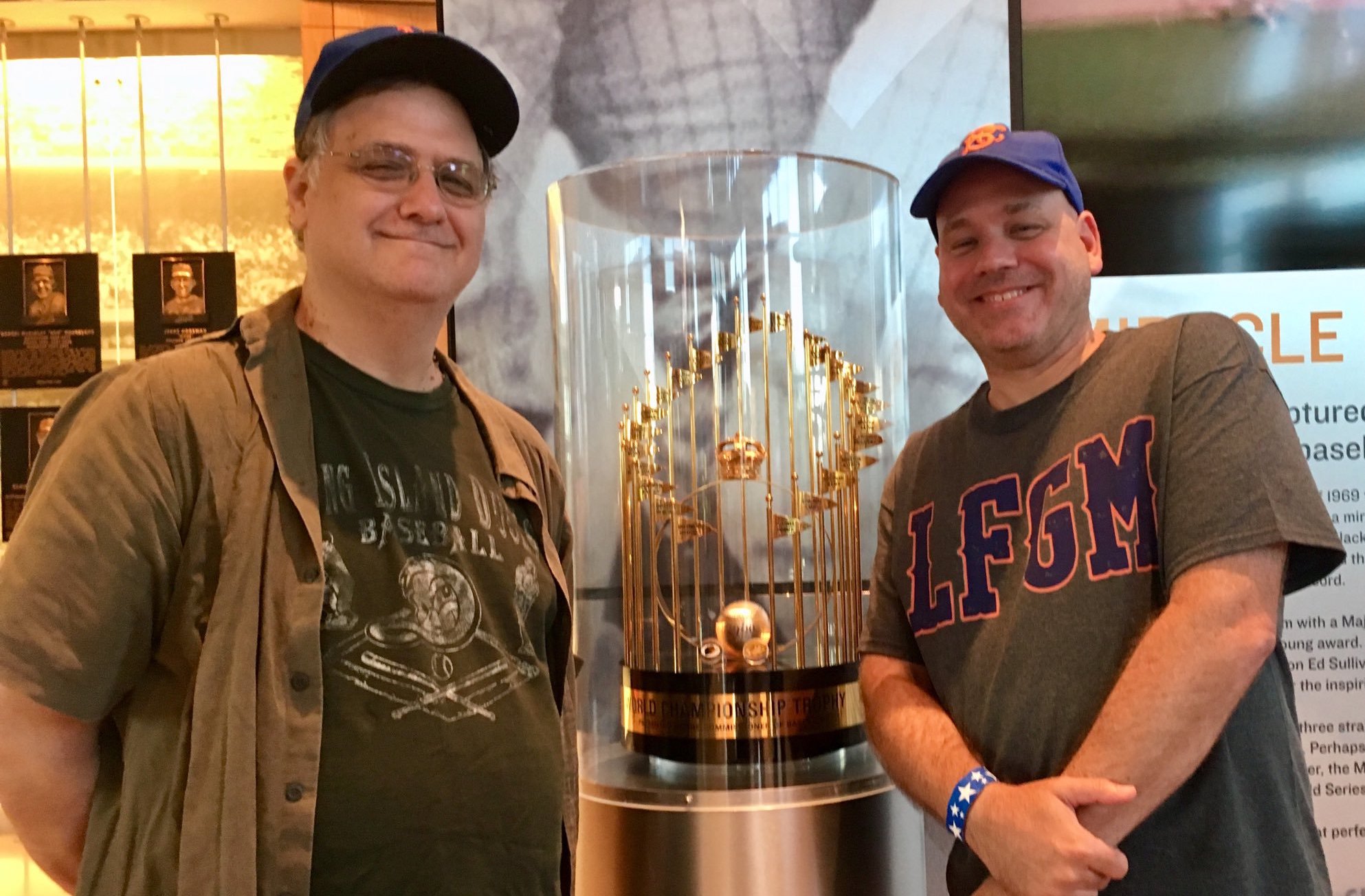
Faith and Fear in Flushing made its debut on Feb. 16, 2005, the brainchild of two longtime friends and lifelong Met fans.
Greg Prince discovered the Mets when he was 6, during the magical summer of 1969. He is a Long Island-based writer, editor and communications consultant. Contact him here.
Jason Fry is a Brooklyn writer whose first memories include his mom leaping up and down cheering for Rusty Staub. Check out his other writing here.
Got something to say? Leave a comment, or email us at faithandfear@gmail.com. (Sorry, but we have no interest in ads, sponsored content or guest posts.)
Need our RSS feed? It's here.
Visit our Facebook page, or drop by the personal pages for Greg and Jason.
Or follow us on Twitter: Here's Greg, and here's Jason.
|
by Greg Prince on 5 June 2023 4:57 pm As noted often in this space, I consider listening to Gary Cohen talking Mets baseball a perk of being a Mets fan. Listening to him on Saturday, both while sitting in the Shannon Forde Press Conference Room as he and his fellow inductees prepared for their big moment on the field, and then from the press box while he stood before the fans who gave him and Howie Rose the applause that have been building up for more than three decades apiece, represented a feast for my auditory senses. Little that Gary says goes in one ear and out the other. It zips its way to the brain, settles there, and gives me more than I counted on thinking about.
Two observations of Gary’s from Saturday stand out for me here on Monday.
1) In response to my fancy reportorial question — posed to the table full of Famers, answered by the announcers — about what really surprises a fully grown youngster who dreamed of making it to the big leagues and then actually did, whether via pitching or hitting or talking, Gary (after Howie spoke thoughtfully and knowingly about the rigors of travel) offered a layer of perspective he admitted to not having while spending all those days and nights in the Upper Deck.
“Going from being a fan to a broadcaster at the highest level in Major League Baseball, I think the thing that you learn very quickly is what extraordinary athletes these guys are. You know, it’s very easy for people to sit in the stands and watch major league baseball players fail, and it’s a game of failure, but even the last guy on a major league roster is an extraordinarily talented athlete, and just standing behind a batting cage and watching the hand-eye coordination involved, again with the lowliest of major leaguers, is so far beyond the ken of those of us who can’t do those things, I think it makes you appreciate just what this game is, and how difficult it is to play, and how monumentally talented all of these players are. To me, that was the most eye-opening piece.”
2) During the speech itself, Gary wished to single out as best he could “so many people who have helped me on my way to this moment,” starting out where one might expect a person might on a day such as this:
“My mom, who passed away earlier this year. She was a Giants fan until the day Willie Mays became a Met. Then she became a Mets fan.”
It’s worth noting that by the time Mrs. Cohen switched allegiances, her son was already ensconced upstairs at Shea. His idol down below was Bud Harrelson. His idol on his transistor radio was Bob Murphy. We know whose path Gary Cohen followed to the big leagues. The rest of us don’t carve out any kind of road to the big leagues beyond going to games or following them over whichever devices are most contemporary. We’re just thrilled to be along for the ride from however far we attempt to breathe it in.
I’m thinking of all this following the weekend when Gary and Howie, in the company of Al Leiter and Howard Johnson, received their due in the Hall of Fame, because of the way baseball goes on. Baseball went on Sunday, the day after those exquisite ceremonies. The Mets played the Blue Jays again, and lost to the Blue Jays again. A fan would have to exercise Cohenesque restraint to not say out loud that the result sucked. But it did. It doesn’t mean the players who came out on the short end three days in a row sucked. They are indeed extraordinary athletes, right down to the last guy on the roster. But sometimes the combined product of the collective efforts of the extraordinary athletes in whom you threw in your lot for life before you turned ten kind of sucks. The Mets lost on consecutive days by scores of 3-0, 2-1 and 6-4. Something wasn’t functioning as well as it could have.
On Sunday, it was the starting pitching, which had been outstanding at Citi Field all week, and sublime all season when it fell to Kodai Senga at home. The secret ingredient to Senga’s Citi success was he was him being the most well-rested cuss in Flushing since whichever mystery member of the maintenance staff who was called on to mop up that perennial puddle in Promenade behind home plate chose to maintain instead his nap. I’m referring to the puddle that I swear just sat there unattended for the bulk of the 2010s, and I’ll have to check on it next time I’m in the neighborhood of Section 514. Kodai, who’s absorbed opponents’ swings and misses regularly during Citi starts, didn’t pitch on four days’ rest in Japan, so the Mets didn’t push him. Yet he was so good starting out this homestand against the Phillies, and the pieces don’t really exist for a six-man rotation that would keep him on extended rest into perpetuity. Thus, Buck pushed him. The lack of rest pushed back. Senga didn’t make it out of the third. The bullpen got leaned on. Much of the relief corps withstood the pressure of having to go a six-and-a-third. Dominic Leone, who gave up the deciding two-run homer to Brandon Belt in the seventh, didn’t.
It was also the sporadic offense not helping matters on Sunday. Huzzahs for four home runs hit by Mets. Raspberries for nobody being on base for any of them, nor any other episode of scoring by any Met that didn’t involve a solo home run. Do you know what always happens when the Mets hit four solo home runs and that accounts for the totality of their scoring? They lose. That’s not an exaggeration. The Mets have launched four solo home runs five times in their history without figuring any other way to put up a run, and every time they have lost. Solo home runs can be very handy. They can also be fool’s gold if you think they’re all you need to thrive.
Still, good for Tommy Pham going deep twice at Citi Field, the first two times he’s done it at home as a Met (it would have been sweet to have followed up the Hall of Fame with the Haul of Pham). Good for Starling Marte flexing his muscles once again. And really good for Pete Alonso taking over the all-time lead from Lucas Duda for most regular-season home runs hit by a Met in the ballpark that’s been open since 2009 and that by 2010 still seemed like Death Valley — or at least Locust Valley — when it came to slugging. Fences have come in a few times since we bemoaned how hard it was for anybody to hit a ball out of Citi Field. It got easier if not easy. On Sunday, Pete needed a replay review that shrugged when asked about orange lines and black backdrops. I didn’t think Pete’s 72nd lifetime Citi dinger left the yard once I watched it bouncing up and not quite over the wall in left a few slow-motion times. But the Blue Jays didn’t ask me to do the reviewing. Pete’s reaction to setting the record was that it was “sick,” which even Kodai Senga doesn’t need a translator to know means swell.
Pete’s bounce above the orange line, wherever it did or didn’t tick, might have been the only bounce or bouncelike element that went the Mets’ way on Sunday. Pham wasn’t as much of a fielder as he was a slugger, not swiftly scooping up an errant Francisco Alvarez throw on a stolen base attempt that instantly became a run. Alvarez might have tagged the runner, Matt Chapman, a nanosecond before any of his toes touched the plate, but the angle that would have proved it conclusively didn’t prove anything. Besides, Chapman felt safe, and go challenge that. Marte also hit a triple that turned into a ground-rule double early on, auguring One of Those Days when the Mets really could have used the different kind.
Again, though, they’re all talented and capable, which makes it that much more aggravating when the talent and capability checks in at .500 after 60 games, just as it checked in at .500 after 54 games…and 50 games…and 46 games…and 34 games…and 32 games…and it’s been One of Those Seasons, hasn’t it?
Yet there have been so many seasons when we, the fans in the stands or on the couches in front of the TV or in the car with the radio tuned to 880, know a stop & start .500 season with talented players and a forgiving playoff qualification format beats the lesser alternative. The lesser alternative, whether we experienced it directly or feel it pulsate within our DNA, could be found in 1962 and 1963 and 1967 and 1978 and 2017, five losing years picked not at random. In a particular order…
2017: It’s the year after a Wild Card season when the Mets have opted to go in a different direction: down. Let’s hope 2023 doesn’t ultimately resemble that year (70-92) too closely. Still, 2017 did introduce us to a recurring supporting character in our ongoing story, a catcher from Puerto Rico named Tomás Nido, a catcher whose first name I always stop to make sure I accent properly when it comes to his “á”. It doesn’t look like that will be a continuing concern for this correspondent, as Nido has been designated for assignment to clear space for the return of Omar Narvaez from the injured list. Narvaez the veteran, Alvarez the phenom; no room at the two-catcher inn any longer for the second-longest tenured Met who never grew into a consistent hitter at the major league level, but, as Gary Cohen reminded us, that doesn’t mean he wasn’t any good. He had a few big hits across his seven mostly partial season in the bigs, and his catching was big league-caliber. Tomás was kind of a throwback — the career backup receiver who could be depended on in a pinch by one organization for a very long time. It’s not what a kid dreams of growing up to be, but sometimes you get that far, you get a little farther. By the end of 2022, Nido was the starting catcher for a playoff team in a pinch. Should we cross paths with him in another uniform, I will be sincere in referring to him as an Old Friend™.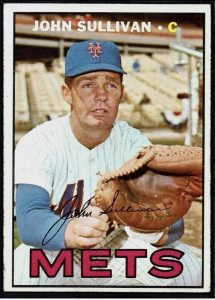
1967: It’s the year every Mets fan should recognize as the season that launched George Thomas Seaver on his way to every Hall of Fame in sight: the one in Flushing, the one in Cooperstown, the one in Cincinnati, even (sigh). Seaver probably launched himself, but, as those who joined him in official Met immortality Saturday emphasized, nobody gets where he’s going by himself. Tom himself made a point of mentioning the most distinguished catchers with whom he’d worked when he accepted his plaque Upstate in 1992: Jerry Grote, Johnny Bench, Carlton Fisk. Also catching Seaver’s sensational pitches when Tom was 22, besides young Grote, was a journeyman named John Sullivan. John’s journey, which ended in the broadest sense when he died at age 82 last week, wound through the 1966 Rule 5 draft from which the Mets selected him and thus had to keep him around all of ’67. Sullivan gave the Mets 65 games of catching, including seven in service to the rookie righty from Fresno. With Sullivan catching, Seaver posted an ERA of 2.55, the lowest Tom registered in tandem with any catcher in his freshman campaign. The very first time Tom totaled double-digit strikeouts (12), it was Sullivan behind the plate framing and cradling every last one of them. John spent only a year in what we’ll call the Nido role in New York. He’d work as the bullpen coach for the Blue Jays long before we had to worry about them on the Mets’ schedule, through the ’80s and into the ’90s, and enjoy a Hall of Fame-worthy moment himself. When Joe Carter hit the home run that won the 1993 World Series for the Jays, it was Sullivan who retrieved the historic horsehide and, though officials from Cooperstown came looking for it, held onto it long enough to hand it to Carter. “Touch ’em all, Joe,” John was essentially saying to Joe about all 108 stitches on that baseball. Few of us will ever be part of a bigger moment.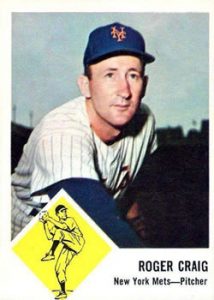
1962 and 1963: These years speak for themselves. Rather, the announcers who set the precedent for Gary and Howie, spoke to us about them in case we missed them. Lindsey Nelson, Bob Murphy and Ralph Kiner filled us slightly younger kids in on the wonders of the Polo Grounds seasons, the legend of Casey Stengel and the players who would be mythical figures if they weren’t real. Thanks to their storytelling, I learned who Roger Craig was. I learned Roger Craig, righthander from North Carolina, was a seminal figure. I learned Roger Craig was the Mets’ very first starting pitcher. I learned Roger Craig pitched without much run support. I learned that yes, Roger Craig lost a lot of ballgames, but it was also drummed into me at an early age that to lose 20+ games in a single season (Craig lost 24 during the first Met year and 22 the second), you have to be pretty good to get the ball and keep going out there and giving it another try. Roger Craig, who died this weekend at 93, helped the Dodgers in Brooklyn and Los Angeles to world championships before there were Mets; as with securing the services of Gil Hodges, Don Zimmer, Clem Labine and Charlie Neal, the new club in New York saw Craig’s presence in Manhattan as a potential lure to Bum-bereft Brooklynites unsure about crossing certain geographic and psychic bridges into the land of Metsdom. Roger also helped the Cardinals to a world championship once the Mets had mercy on his competitive soul and traded him to a contender. He threw more than 230 innings in consecutive seasons as a Met, all while bearing the brunt of just about everything going wrong. Photos from that period suggested a gentleman trying hard not to appear beleaguered. Interviews conducted by Kiner of Craig conveyed a person who’d survived the ordeal of 40-120 and 51-111 just fine. Roger made himself and his recollections available to Ralph plenty during his years as a coach and a manager at various National League stops, right up to his leading the Giants to the World Series in 1989. Our first pitcher visited Citi Field in 2012 on the exact fiftieth anniversary of our first game: April 11 (welcomed home despite teaching Mike Scott the split-finger fastball). On that date in 1962, Roger and the Mets lost, 11-4. On that date in 2012, with Roger Craig tossing out the ceremonial first pitch, Johan Santana and the Mets lost, 4-0. You wouldn’t accuse either of those men of not being a pretty good pitcher.
Roger, an Original Met if ever there’s been one, was the longest-living Met when he passed away. The oldest among our guys now? Gary Cohen’s mom’s favorite player, the Say Hey Kid. Willie Mays, at 92, tops the list, as he tops so many of them.
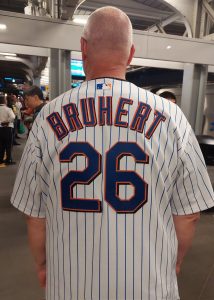 Thanks, Jim. 1978: Mike Bruhert, I’m pleased to announce, is still alive. I’d be even more pleased to announce that I ran into him on the LIRR platform at Jamaica Saturday night after Hall of Fame Day at Citi Field. There was a delay born of a signal problem, and there was a lot of standing around, and then, as if from the cornfield, appeared a man wearing a BRUHERT 26 Mets jersey, honoring one of the Mets’ most electrifying starters — actually from Queens! — from the only electrifying portion of the 1978 season, the first part, when the Mets briefly topped the NL East standings and stayed close to .500 until Memorial Day. I don’t have to look any of that up. I’ve reveled in that too-brief spurt of success for 45 years now. I was 15 then. It made an impression. Bruhert in the rotation and Mardie Cornejo in the bullpen were the big surprises in the big push to respectability following the misery of Seaver’s exit and the rest of 1977. The entire enterprise faded (last place awaited in ’78, just like it had in ’77, just as it would in ’79), but for a few weeks there, it was very exciting and very gratifying and if I had bumped into somebody wearing a BRUHERT 26 jersey then, I would have plotzed. Running into somebody wearing one on Saturday had almost the same effect on me. Never mind that I had just finished being a media representative Saturday afternoon, asking professional-sounding questions at a press conference, and casually ambling along the field before the Hall of Fame ceremonies, and taking notes in the press box without uttering a yea or nay. By Saturday night, I was just me again, a fan who saw BRUHERT 26 and had to ask, after ten minutes of railroad delay made all of us static and therefore readily accessible, “excuse me are you…?”
He wasn’t. Not quite. It was Mike Bruhert’s brother, Jim. It was all I could do to not respond, “OHMIGOD, YOU KNOW MIKE BRUHERT!” I mean, Mike Bruhert’s brother, Jim, is a person in his own right. I should have been delighted to meet him and left it at that. Yet he was honoring his brother, and how do you not follow up on a jersey you simply don’t see every day? Jim was kind enough to tell me he had the jersey made up in 2008, which explains why it carries a drop shadow and a FINAL SEASON patch. Jim, who had just gone to the game with his family, patiently explained between my babbles and burbles that I was the second person to ask him if he was Mike Bruhert. “Only the second?” I thought.
I’m not looking up Mike Bruhert’s career numbers. I don’t have to. He was a Met when I was a kid, which means he remains larger than life; larger than a delay at Jamaica, as aggravating as that can be. Like Gary Cohen said, all these guys are monumentally talented, though when I was 15, I’d like to believe I understood that already.
by Greg Prince on 4 June 2023 11:35 am The Mets really could have used another run Saturday. They crossed the plate once in nine innings. Unless their pitchers were crafting a shutout, that wasn’t going to be enough to win their game against the Blue Jays. Collectively, their pitchers held as much fort as they could, giving up only two runs to a highly capable lineup, but the numbers did them in. Two runs allowed versus one run scored equals a 2-1 loss. We’re still waiting on discovering a 2-1 Met loss that can’t be categorized as frustrating. Oh yeah, this game was frustrating as hell.
Yet Saturday as a whole at Citi Field was anything but. Saturday at Citi Field was Hall of Fame Day. The Mets have held 20 of them since 1981. The Mets’ record is 13-8 on those occasions when they’ve paused from their daily machinations to honor those who’ve exemplified them at their best; the 1986 ceremony took place between games of a doubleheader sweep, which is why there are more Hall of Fame Day results than Hall of Fame Days. I’d argue the Mets are undefeated on any day they celebrate themselves.
When the Mets celebrate themselves, they celebrate us, too. They celebrate us for caring and paying attention and making their brand our identity. They can’t necessarily honor us with a win. There’s another team on the field competing for that win, and there’s also the whole issue of human unpredictability. But they can, even while limiting their run production to a bare minimum, score. This Hall of Fame Day scored like crazy.
Your New York Mets Hall of Fame Class of 2023 was comprised of two outstanding players and two transcendent broadcasters. Outstanding players are usually who get inducted into Halls of Fame. The Mets have made too many outstanding players wait for induction. The Mets have made their fans wait too long between Hall of Fame Days, too. No ceremonies between 2002 and 2010. No ceremonies between 2013 and 2021 (though we’ll excuse them for 2020, which was scheduled but postponed by a pandemic). It feels a little chintzy to bring up the institutional blind spots of past ownership when it came to the Mets Hall, but the new regime is still playing catchup, thanks to the old one falling so far behind.
 Why did Howard Johnson, whose last Met at-bat came in 1993, and Al Leiter, whose last Met pitch occurred in 2004, have to wait until 2023 to be recognized as two of the Met greats? At this point, we’ll defer to the Bud Dry advertising campaign from Hojo’s latter Met seasons and shrug, why ask why? On Hall of Fame Day, recriminations melt away. On Hall of Fame Day, the greats are recognized. On this Hall of Fame Day, we recognized the three-time 30/30 man, the player whose combination of speed and power, coming as it did from a perennially underestimated infielder, fueled the Mets in a trio of seasons when, frankly, they needed all the help they could get. The 1987 Mets, the 1989 Mets and the 1991 Mets came up different degrees of short of making the playoffs. Hojo did all he could, slugging homers and stealing bases and stepping up. He could have used a little help, y’know? Hojo, already a two-time world champion, kept those Mets viable for as long as he could. And if he wasn’t at the core of the 1986 club, he was more than incidental to its rousing success. Ask Todd Worrell. Why did Howard Johnson, whose last Met at-bat came in 1993, and Al Leiter, whose last Met pitch occurred in 2004, have to wait until 2023 to be recognized as two of the Met greats? At this point, we’ll defer to the Bud Dry advertising campaign from Hojo’s latter Met seasons and shrug, why ask why? On Hall of Fame Day, recriminations melt away. On Hall of Fame Day, the greats are recognized. On this Hall of Fame Day, we recognized the three-time 30/30 man, the player whose combination of speed and power, coming as it did from a perennially underestimated infielder, fueled the Mets in a trio of seasons when, frankly, they needed all the help they could get. The 1987 Mets, the 1989 Mets and the 1991 Mets came up different degrees of short of making the playoffs. Hojo did all he could, slugging homers and stealing bases and stepping up. He could have used a little help, y’know? Hojo, already a two-time world champion, kept those Mets viable for as long as he could. And if he wasn’t at the core of the 1986 club, he was more than incidental to its rousing success. Ask Todd Worrell.
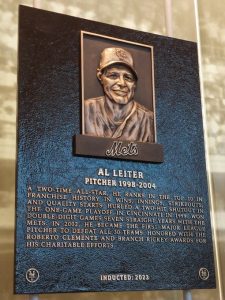 On this Hall of Fame Day, we recognized the lefty who was born to pitch big Met games. Listen to Leiter and he will convince you roving bands of baseball executives kidnapped him at age 18, then age 22, then age 30, all to prevent him from fulfilling his familial destiny. His was a Mets fan family. He spoke our language. He felt our feels. Then, to be a professional, he put up with being a Yankee, a Blue Jay and a Marlin. The first time he pitched at Shea Stadium, in 1996, wasn’t the first time he sat in Shea Stadium. Al, four, was on hand for the raising of the 1969 world championship flag at the Home Opener in 1970. But the seat he talked about taking on Saturday, during the Hall of Fame press conference, was in the visitors’ dugout during Florida’s trip to New York. After his first game pitching against what had always been his team, he returned to that third base dugout to soak in the surroundings, seeing not the ballpark where he’d just triumphed, but the diamond populated by the Mets of his youth. The only thing wrong with that image was the perspective. Al Leiter belonged in the first base dugout at Shea. Two years later, he arrived. The year after that, Al literally pitched his Mets into the postseason. Had a lot to do with returning them there the year after that. On this Hall of Fame Day, we recognized the lefty who was born to pitch big Met games. Listen to Leiter and he will convince you roving bands of baseball executives kidnapped him at age 18, then age 22, then age 30, all to prevent him from fulfilling his familial destiny. His was a Mets fan family. He spoke our language. He felt our feels. Then, to be a professional, he put up with being a Yankee, a Blue Jay and a Marlin. The first time he pitched at Shea Stadium, in 1996, wasn’t the first time he sat in Shea Stadium. Al, four, was on hand for the raising of the 1969 world championship flag at the Home Opener in 1970. But the seat he talked about taking on Saturday, during the Hall of Fame press conference, was in the visitors’ dugout during Florida’s trip to New York. After his first game pitching against what had always been his team, he returned to that third base dugout to soak in the surroundings, seeing not the ballpark where he’d just triumphed, but the diamond populated by the Mets of his youth. The only thing wrong with that image was the perspective. Al Leiter belonged in the first base dugout at Shea. Two years later, he arrived. The year after that, Al literally pitched his Mets into the postseason. Had a lot to do with returning them there the year after that.
Great players, Hojo and Al, but as noted, that’s who Halls of Fames house as a rule. Leiter himself knows enough about Mets history to understand anybody who didn’t work in the first base dugout at Shea had to have been extraordinarily instrumental to our collective story to merit a plaque. One owner, Joan Payson; three front office operators, George Weiss, Johnny Murphy and Frank Cashen; and one mover/shaker Bill Shea are so honored. So, until Saturday, were a total of three broadcasters: Ralph Kiner, Bob Murphy and Lindsey Nelson. As Leiter noted in his acceptance speech, the original three were ushered into the Mets Hall in 1984, the year Al graduated high school in New Jersey. No other announcers were ushered in for nearly four decades. Ushering at Shea could lead some to dicey interactions, particularly if you wished to graduate to a better seat. Maybe that was the problem with the Mets Hall from 1984 to 2023. No palms were greased.
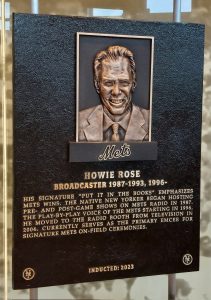 Ah, but Howie Rose and Gary Cohen made it to the Hall the old-fashioned way. They earned it. They sat upstairs, in the Upper Deck. They rooted for the Mets as you and I root for the Mets. They talked about the Mets as you and I talk about the Mets, except at some stage of their young lives, they chose to talk into tape recorders and turn their passion into a skill, and by the end of the 1980s, these kids from the 1960s, were voices of the Mets. Rose hosted the pregame and postgame shows that forever ruined us for any other pregame and postgame shows, Mets Extra. Howie wasn’t a state of the art Mets radio host. He was the art. He created our expectations and upended them pretty much every night over WHN and WFAN. Believe it or not, that wasn’t his goal in life. He wanted to do what Ralph and Bob and Lindsey did. It took a little while to reach their section of Shea Stadium. Ralph and Bob were still pretty well ensconced when he moved down from the Upper Deck and over from whatever ancillary booth he’d occupied. Howie did Mets cable TV for eight seasons, beginning in 1996. He’s done Mets radio exclusively since 2004. In the ensuing 20 years, he’s become Mets radio. Ah, but Howie Rose and Gary Cohen made it to the Hall the old-fashioned way. They earned it. They sat upstairs, in the Upper Deck. They rooted for the Mets as you and I root for the Mets. They talked about the Mets as you and I talk about the Mets, except at some stage of their young lives, they chose to talk into tape recorders and turn their passion into a skill, and by the end of the 1980s, these kids from the 1960s, were voices of the Mets. Rose hosted the pregame and postgame shows that forever ruined us for any other pregame and postgame shows, Mets Extra. Howie wasn’t a state of the art Mets radio host. He was the art. He created our expectations and upended them pretty much every night over WHN and WFAN. Believe it or not, that wasn’t his goal in life. He wanted to do what Ralph and Bob and Lindsey did. It took a little while to reach their section of Shea Stadium. Ralph and Bob were still pretty well ensconced when he moved down from the Upper Deck and over from whatever ancillary booth he’d occupied. Howie did Mets cable TV for eight seasons, beginning in 1996. He’s done Mets radio exclusively since 2004. In the ensuing 20 years, he’s become Mets radio.
 In the ways that count most, Gary Cohen is Howie Rose’s doppelgänger. Mind you, they’re distinct individuals, as we all are, but the ways that count most is their embodiment of Mets fandom and their absorption of Mets experience, which makes you and me their doppelgängers, I suppose, except for the part where they talk about it for a rapt audience that can never get enough of what they have to say. In the realm of individuals who meet that description, I’d say there are two people, and both just went into the Mets Hall of Fame. As with Hojo and Al, they could have been inducted ages ago and it would have been a call as correct as any pair of “OUTTA HERE!s” that emphasize the end of extra innings. The implication that Mets broadcasting was never going to surpass a specific level of excellence after 1984 denied the possibilities that two kids from Queens could take what they had learned from their “uncles” (Howie’s apt word on Saturday for their fellow Mets Hall of Fame broadcasters) and build on it. To me, Howie Rose has been more than a Mets broadcaster. He’s been our spokesman of the soul since Mets Extra in 1987. That’s been Hallworthy from the moment it hit the air and the ear. Honestly, everything since then has been gravy. Or Bigelow Tea. In the ways that count most, Gary Cohen is Howie Rose’s doppelgänger. Mind you, they’re distinct individuals, as we all are, but the ways that count most is their embodiment of Mets fandom and their absorption of Mets experience, which makes you and me their doppelgängers, I suppose, except for the part where they talk about it for a rapt audience that can never get enough of what they have to say. In the realm of individuals who meet that description, I’d say there are two people, and both just went into the Mets Hall of Fame. As with Hojo and Al, they could have been inducted ages ago and it would have been a call as correct as any pair of “OUTTA HERE!s” that emphasize the end of extra innings. The implication that Mets broadcasting was never going to surpass a specific level of excellence after 1984 denied the possibilities that two kids from Queens could take what they had learned from their “uncles” (Howie’s apt word on Saturday for their fellow Mets Hall of Fame broadcasters) and build on it. To me, Howie Rose has been more than a Mets broadcaster. He’s been our spokesman of the soul since Mets Extra in 1987. That’s been Hallworthy from the moment it hit the air and the ear. Honestly, everything since then has been gravy. Or Bigelow Tea.
To me, Gary Cohen doesn’t have to be more than a Mets broadcaster, even if I have the sense he could have thrown himself completely into his basketball sideline and become another Marv Albert (or national affairs and succeeded Walter Cronkite as the most trusted man in America). Seventeen seasons on radio, eighteen seasons on television, thirty-five seasons I swear we’ve shared a baseball brain. I can feel him thinking my Met thoughts nanoseconds before he articulates them. On radio, I needed him to tell me every pertinent detail, and he did, always keeping pleasant company in the process. On television, he’s calibrated his approach to conducting a symphony of analysts and video and whimsy, but man, do I love his company on a given evening more than ever via SNY. In his pregame comments Saturday, when asked about his favorite calls, he explained he believes the brief clips that live on accompanying momentous highlights never concerned him as much as perfecting the hundreds of hours he knows fans commit to listening to him across a season.
Gary’s got some amazing calls in his portfolio, but yes, that’s it. The hundreds, now thousands of hours. TV now. Radio then. As I told him the very first time I met him, at a symposium on baseball broadcasting when I rustled up the nerve to approach him, I really and truly fell in love with what he did during a seventeen-inning game at the end of a dreadful Met year when he and Murph kept me tuned in and riveted, never mind that this was a game with nothing close to a playoff implication.
“You mean the Kenny Greer Game?”
That’s when I knew he was me, or as much me as legally permissible. Gary knows it as well. In his speech, he told the Shea Stadium crowd at Citi Field on Saturday, “I’m one of you.” Far be it from me to edit a Hall of Famer, but no, Gary. You are not one of us. You are us. You and Howie. We’re in this together. Now we’re in the Hall together. Talk about pleasant company.
Al and Hojo were baseball players long enough to know regardless of ability, effort and desire, you can’t win them all. Gary and Howie have witnessed and transmitted that fact of baseball-loving life to us enough that you wouldn’t think we’d require reminding. Jay Horwitz, who received the Mets Hall of Fame Achievement Award as part of the same celebration, surely pitched to reporters his share of stories whose angles averted on-field outcomes following days when the Mets didn’t score enough. On Saturday, the Mets scored enough by inducting their Hall of Famers. For one day, particularly because the bottom line of the box score isn’t about to be tangibly altered, I’ll put that in the books.
by Greg Prince on 3 June 2023 10:48 am On June 18, 2015, an ex-Met pitching for the Blue Jays beat the Mets — not just any ex-Met, but beloved former Cy Young Award winner R.A. Dickey, taking his first turn against his old club since scaling the heights of fame in Flushing. It also wasn’t just any start. Dickey’s dad Harry had died two days earlier. R.A. was headed to the bereavement list, but he had a stop to make: the mound at Rogers Centre, where he was about to go seven-and-a-third innings and give up only one run, one walk and three hits while striking out seven in beating the Mets, 7-1. The singularly articulate pitcher didn’t talk about his father’s passing after the game, leaving it to Jays manager John Gibbons to explain to reporters, “He told me he felt it was important he go out there, honor his dad.”
On June 2, 2023, an ex-Met pitching for the Blue Jays beat the Mets — not just any ex-Met, but Chris Bassitt, the last starter who took the ball in the postseason for the Mets. It also wasn’t just any start. Bassitt’s wife Jessica was in Toronto, going into labor, while the Jays were in New York, going to work. Bassitt signed a big contract in the offseason to pitch for Toronto. Toronto entered the season with big expectations. It was his turn to pitch. The logistics of a bringing a life into a world and the logistics of a major league rotation don’t always mesh. Word was Chris would make his way to a private jet as soon as he was done pitching against his old club, an assignment pushed back by another branch of Mother Nature, in the form of a 91-minute rain delay.
Bassitt versus the Mets for the Blue Jays was more effective than Bassitt versus the Padres for the Mets eight months earlier (though his four-inning stint in the Wild Card Series decider was definitely more airport departure-friendly). The Mets of 2023 dealt with their former teammate about as well as the Mets of 2015 dealt with theirs. Chris’s line was seven-and-two-thirds innings, no walks, three hits, no runs and eight strikeouts. Justin Verlander’s outing for the Mets came up a shade shy of Bassitt’s. He gave up a home run to George Springer to start the game once the game got started at 8:41 PM. That’s all it took for the Mets to be behind all night. Verlander gave up nothing else across a six-inning start that required 117 pitches, but the zeroes kept stringing along on the bottom half of the line score. On Friday night, not even a three-time Cy Young Award winner could match Bassitt.
“He wanted to pitch,” Jays manager John Schneider explained to reporters. “I’m sure there’s a million things that are going through his mind. The mental focus — which he does all the time, he’s very even-keeled — to keep everything in check was really impressive.”
As if forces were collaborating or perhaps conspiring to present a baby gift to the Bassitts, the line of zeroes remained uninterrupted, even after Schneider ended Bassitt’s evening with two outs and nobody on in the eighth. Emblematic of where the Mets weren’t going, Brandon Nimmo was called struck out by home plate ump Nic Lentz on a pitch clock violation, specifically judged two seconds too late in turning to face lefty reliever Tim Mayza amid a two-two count. In the home clubhouse afterward when he was asked about the ruling that truncated his plate appearance, Nimmo used the word “sucks” for public consumption more in one scrum than I can recall him using it across eight seasons as a Met.
That kind of night for the Mets continued in the ninth when Jeff Brigham failed to complement the fine relief work of Dominic Leone and Drew Smith. Leone threw a scoreless seventh. Smith threw a scoreless eighth. Brigham gave up a one-out single to Whit Merrifield and a two-run homer to Daulton Varsho — who lost his mother-in-law Kim to ALS, which didn’t escape his notice as MLB was commemorating Lou Gehrig Day on Friday. “It’s pretty nice to be able to have a special homer knowing that Kim’s probably watching over me and hoping everything’s the best for me,” Varsho said. A warm note for the opposition, no doubt, but from a Met perspective, Citi Field on June 2, 2023, resembled in sagged spirits Citi Field from October 9, 2022, the night Bassitt and the Mets couldn’t keep up with Joe Musgrove and the Padres…except this time, on Fireworks Night, there was a sellout crowd.
There was also a tomorrow, which is now today. The 2023 Mets will play on after losing, 3-0. Chris Bassitt won’t be in the visitors’ dugout to urge the Jays forward in their quest to make it two in a row over the Mets, however. That plane has already flown. Some teammates take precedent over other teammates. Chris wasn’t around to talk to the press after his win. Jessica and the baby-to-be’s outing was already underway; a nearby jet was idling as it awaited its Toronto-bound passenger. Schneider, following “one of the best performances we’ve seen out of anyone, given everything that he had going on” told his starter, simply, “Go be a dad.”
Last year, Chris Bassitt represented the Mets’ last, ultimately shattered defense against playoff elimination. This year, he was their daddy. Some nights you just have to accept are other people’s nights.
by Greg Prince on 2 June 2023 10:20 am When Max Scherzer starts, which Max Scherzer will we get? The one who’s hypercompetitive, hyperintense and hyperfocused en route to a stifling mound performance? Or the one who’s all those things to less Met-positive discernible effect? Both, as Scherzer nears 40, exist in our world. We prefer the former. We have, for various reasons that the righthander does his best to explain, occasionally experienced the latter. On Thursday afternoon at Citi Field, it was the former who announced his presence with authority.
The latter Scherzer did make a brief appearance in the first inning, when, despite the competitiveness, the intensity and the focus, the Phillies posted two runs. Based on viewing Max as ace of Tigers, Nationals and Dodgers rotations from afar, along with our earliest exposure to him in our favorite uniform, we conditioned ourselves to believe two runs were two runs more than any team could possibly score off Scherzer on a given day. Then, based on how bumpy the trail has revealed itself since earliest October of 2022, we conditioned ourselves to prepare for the walls to come crumblin’ down at the first signs of trouble.
Former Max entered the scene, tightened the bolts, and shut the Phillies out after the first and clear through the seventh. When a Met starter pitches six or more innings in 2023, the Mets inevitably win. It’s a statistical fact until it’s not. It helps to score enough runs to shepherd the inevitability into reality. It helps to have Mark Canha in the lineup against the Phillies. Shooting the Phillies out of a Canha proves repeatedly effective for the Met offense. Canha homered twice on a wild Sunday at Citizens Bank Park last August, and the Mets won the damn thing. Canha homered on Wednesday night and the Mets won in calmer fashion. Canha homered on Thursday afternoon and the Mets won again. Starters going deep and Mark Canha going deep. As long as he wasn’t managing the Phillies, Earl Weaver might have approved.
Pitching for Philadelphia and taking the 4-2 loss was Old Friend™ Taijuan Walker, whose heart could be reliably found in the right place when he was a Met. Taijuan represented the Mets at the 2021 All-Star Game. My hunch is he will also represent the Mets in the unanswered portion of Sporcle quizzes and the like that ask a person to name every pitcher who has represented the Mets at an All-Star Game. “Oh right, him. I forgot.” It shouldn’t be forgotten that Taijuan did an overall nice job for two seasons, albeit not as nice a job once he made his one All-Star team as Jacob deGrom’s injury (or “needs to rest up”) replacement in ’21, the post-pandemic season, which was still kind of a pandemic season when it began. Taijuan was at his best as a Met when Citi Field and other ballparks were unlocking the turnstiles but capping attendance out of an abundance of caution. He wasn’t part of the 2020 Silent Generation. He pitched in front of people, not cardboard cutouts. Yet he excelled most in front of necessarily limited crowds, for whatever that was worth. I don’t think his comedown in the second half of 2021, when anybody who wanted could come to a Mets game, related to the number of fans in the stands. The whole second half of 2021 discouraged via the Mets’ execution. I don’t mean to make Walker the avatar for that year’s decline. It was a team effort, not unlike the upsurge of 2022. Tai helped make that happen as well.
I do remember one game in the second half of 2021 when Taijuan was removed at the first sign of trouble, and the reliever who succeeded him turned a potential win into an eventual loss, and the starting pitcher grumbled afterward that he should have been left in because he had trained himself his entire career to last seven innings. I cringed when I heard him say that because what happened to nine innings? Then I remembered it was 2021, not 1971. It’s 2023 now. Walker is a Phillie, and we’re thrilled every time a Met starter goes at least six innings because we now know that’s the key to success. That and Mark Canha.
The Mets are currently riding a three-game winning streak, all at the expense of Philadelphia, which makes it extra special since Philadelphia is a primary division rival, but it’s still just three. The three wins were pleasingly taut — 2-0, 4-1, 4-2; each featured starters whose endurance approached or matched contemporary stamina standards — 7 IP for Senga, 6 IP for Carrasco, 7 IP for Scherzer; and none took very long to complete — 2:20, 2:29, 2:32. In that spirit, I’m not taking very long to revel in this latest turn of fortunes before returning to my own private Missouri. Having grown giddy from rises in 2023 Met fortune and comparably grim from succeeding dips, I’ve chosen to live in a “show me” state and, thus, take these three wins in stride. They’re doing well. They are advised to continuing doing well. One Mets. One Max. The good kinds in both cases, please and thank you.
Empathy for the Mets when the Mets aren’t playing as their best selves can be a difficult commodity to produce, but they’re humans and we’re humans. The humans who host National League Town (that would be Jeff Hysen and me) wonder aloud about empathetic fandom on their (our) latest episode. Also on the bill: a beery field report from Denver and what it is we cherish in particular when we celebrate the members of the New York Mets Hall of Fame Class of 2023. Listen in here or on the podcast platform of your choice.
by Jason Fry on 31 May 2023 11:19 pm The first half of Wednesday’s game burbled vaguely out of my phone from a waterproof pouch around my neck: It was Opening Day for kayak season, so first I was sitting in a boat off a Brooklyn Bridge Park pier making sure people didn’t drown or do anything dopey and then I was hauling racks of boats around and helping put things away. During all this, I registered that some Phillie had homered off Carlos Carrasco, that Carrasco otherwise sounded like he was doing pretty well, and then I noticed that PHI 1 NYM 0 had become PHI 1 NYM 2. Some quick poking at my phone revealed that Mark Canha was the man to thank; a few minutes after I got home, salty and tired but pleased to have been back on the water, Canha roped a two-run single off Aaron Nola to make the score PHI 1 NYM 4 — which was how things ended about an hour later.
I spent that hour appreciating Carrasco and the veteran Met relievers who succeeded him, as well as the sparkling defense turned in by Francisco Lindor and Brett Baty. There’s a lot to unpack in that one sentence, isn’t there?
For openers, while plenty of things haven’t worked out in this weirdo season, the defense has been spectacular. Lindor and Brandon Nimmo have elevated their already impressive games, and Baty and Francisco Alvarez have matured as defenders almost literally before our eyes. In the seventh, Brooks Raley fanned Brandon Marsh (who looks like he’s been living under a bridge like a troll from a storybook) and Edmundo Sosa but was nicked for singles by Knothole Clemens* and Bryson Stott. That brought Trea Turner to the plate as the tying run — the same Trea Turner who’s having an inexplicably horrible year but is still Trea Turner, so God help anyone and everyone in his way when his offense reverts to the mean.
Turner smacked a ground ball to Baty’s backhand — the kind of play where a third baseman has to gather himself and set his feet before putting everything he possibly has behind the throw. Two problems presented themselves at this juncture: a) Trea Turner is fucking fast; and b) that’s the kind of play where young players can get lost in that moment of self-gathering, so you instinctively cover your eyes.
Baty gunned Turner down, no sweat — the kind of play I’m not sure he makes in mid-April, let alone last year. But he’s put in the work, turning repetition into muscle memory, just as his fellow Baby Met Alvarez has.
Baty’s nice play aside, it wasn’t a night for the junior Mets. No, this one belonged to the more grizzled members of the roster, including two whose names have primarily elicited sighs of late. Carrasco has now authored two superb starts in a row, lowering his ERA from north of 8 to north of 5, and that’s definitely progress even if it points to the need for more. Canha is front and center in the ranks of the Milk Carton gang whose bats have gone missing, but driving in all four in a win is definitely a way to make grumpy fans like me say that yes, in fact, I have seen you. The future may belong to Baty and Alvarez, but it hasn’t arrived quite yet. Seeing more of the 2022 vintage Canha and Carrasco — not to mention Starling Marte and Daniel Vogelbach — would certainly help our cause until it does.
* OK, I guess I need to explain this. (Fair warning: It’s not worth it.) One of the many things that I loathed about Roger Clemens, besides his being a PED-addled Neanderthal headhunter, was that he gave all of his children names starting with K, because that’s the kind of thing dim self-aggrandizing assholes do. Confronted with an unwelcome reminder of Clemens’ existence in the form of a young Phillie, I flashed back to how we used to make up unlikely K child names to fill out the Clemens family roster: Kerosene, Kumquat and Koyaanisqatsi are three I remember particularly fondly. But I decided to call whatever child this is Knothole, just to increase the degree of difficulty. And because “knothole” is an intrinsically funny word. So be it: He’s Knothole Clemens, and his dad’s a dushbag.
by Jason Fry on 31 May 2023 12:59 am The Mets’ losing streak is over — and so, as it happens, is mine.
I went 0 for 2022. Every time I attended a Mets game they lost the damn thing, including two playoff games. The only time they won a game for which I held a ticket was Closing Day, and I bailed out of that one before first pitch because I didn’t think first pitch was going to happen. Coincidence? My suggested I was a jinx and by the time I saw the offseason smash into us I wasn’t sure that was wrong.
Well I’m not a jinx, or maybe I was but putting the calendar in the recycling also did away with whatever hoodoo was afflicting me. All I know is I was back at Citi Field on a spring evening that went from crisp to slightly chilly and I got to see the Mets play crisp baseball. That had been lacking of late too.
I can’t tell you much of anything about the game — I was in the front row and way down the left-field line courtesy of my road-tripping friends Mary and William and their kids. (Who also attended a Yankee game and got a ball from Aaron Judge — that’s a pretty good NYC visit.) I’d never sat in those particular seats, and they offered a perspective that was interesting but repeatedly confounded my sense of balls’ trajectory. I could tell Kodai Senga was really good, and that Ranger Suarez was too. More than that, however, I can’t really say — if I needed the up-close details, I’d ask one of you. The game’s about the crowd and experiencing something collectively, emotions rising and falling based on what’s happening at the center. If you want to hone in on the finer points, watch on TV.
I may no longer be a jinx, but my timing isn’t back to All-Star caliber. I was away from my post when Brandon Nimmo made his glorious catch and when Francisco Lindor smacked a home run to put the Mets up 1-0. The Nimmo play revealed an oddity: I heard the crowd’s alarm and so hurried to one of the monitors behind a section in time to see Nimmo find the fence and leap — and while he was still airborne the crowd gasped and cheered — actual life, it seems, is about a third of a second ahead of the A/V system.
The monitors are bigger and brighter and there are more of them. That’s an improvement, as is the fact that the audio feed of the game is now ubiquitous. Once, I confess, I would have sneered at that or at least shrugged, muttering something about priorities. I’m older and calmer now. People get hungry, need to go to the bathroom, have kids with one or both of those needs, or just want a drink. It’s a kindness to ensure they can attend to those duties without losing track of the game. Speaking of drinks, it was a reasonably big crowd but I was able to secure beers (and a decent one at that) without sacrificing multiple half-innings to the quest. There seem to be more choices, and more people ensuring you don’t regret those choices because they eat up a good chunk of the experience you’ve paid to miss.
(One of those people was my beer vendor, encountered while Lindor was doing wonderful things. When I asked for a bag of Cracker Jack he pointed out somewhat gravely that he had Cracker Jill. I shrugged, which prompted him to grumble that “they’ve changed the Bible, too.” Being me, I couldn’t let that go by unchallenged. “They’ve been changing the Bible as long as it’s been around,” I said, and if it hadn’t been 1-0 I would have rattled on about the ambiguity of Hebrew and centuries of fights about Greek and Latin and the evolution of the English Bible and all the heretics that spawned, because obviously that’s the conversation one ought to have at a Mets game. Incidentally Cracker Jill is exactly the same and perhaps a better bet because you know you aren’t getting a bag that’s been in a storeroom since the Carter administration.)
Oh, and yes, the new scoreboard is the size of a small moon. Seriously, the thing’s insane. It’s a little like your first glimpse of HD in that it seems realer than real and you have to tear your eyes away from it, reminding yourself that the actual game is the smaller thing with little people and dimmer lighting.
That actual game went well Tuesday night — it was one of those taut games that you watch with a tinge of vague resentment, a cranky fan’s lament of “Why can’t you do things like this every night?” The answer is because baseball’s difficult and maddeningly random, but the record now shows that the Mets have done praiseworthy things ever so slightly more often than they’ve done things that make you mutter imprecations. That made for a nice night, as did finding that Citi Field was right where I’d left it — and that the Mets could actually do praiseworthy things despite my presence.
by Greg Prince on 29 May 2023 9:58 am One-third of a season. Fifty-four games played. Twenty-seven wins. Twenty-seven losses. Each quantity seems well-earned. They’ve been as good as they’ve looked when they’ve won and as bad as they’ve looked when they’ve lost. They’re having two separate seasons in one. The Mets are the epitome of mediocrity.
Befitting the finale of a series played a mile high in the air, the Mets reached new heights in their signature category Sunday. Ten runs scored! Eleven runs allowed! That offense looked sumptuous. That pitching and defense was repulsive, except it forgot to repel the Rockies. After plastering Austin Gomber for six runs in the top of the fourth inning, the Mets held a formidable 6-2 lead, emblematic of what kind of team they are when they’re winning. Tommy Pham, Eduardo Escobar and especially Czar of the Three-Run Homer Francisco Alvarez all delivered like DoorDash. They overcame an early deficit and asserted Met inevitability. Never mind the Coors Field Game™ the night before. It’s only a Coors Field Game™ when Colorado wins. The Mets were making this a Mets game. Two out of three. Break-even trip. Happy flight. Go home and maintain momentum versus the defending league champion Phillies.
Except this is a mediocre team, and its mediocre starting pitcher Tylor Megill, out of whom you get some pretty good games and some pretty bad games, veered toward the latter, loading the bases and courting doom in the bottom of the fourth. Doom arrived by way of a sinking Ryan McMahon line drive that eluded Starling Marte in center field. Marte was getting his first Met start to the left of right. He’s an accomplished center fielder but also a little out of practice when it comes to something other than the corners. As the liner was sinking, all I could think was, “Nimmo would get to this.” Usual center fielder Brandon was the DH Sunday. Everybody can’t play everywhere they’re most suited daily, I guess. McMahon’s ball falls in, all three baserunners score, and though the Mets are still leading, the game is getting ready to get away. It’s 6-6 once the fourth and Megill’s start are over. It’s 11-6 after Stephen Nogosek has made the least of whatever PitchCom signals Alvarez has sent him in the fifth. The Mets either valiantly fought back to make an 11-10 game of it or were just Coors Fielding the rest of their Sunday away. It was a Coors Field™ Game, after all. The Rockies won, so we can safely say that.
The Mets lost two out of three to a team not considered a contender right after losing two out of three to another team not considered a contender. Their record has settled in at 27-27. After 34 games, they were 17-17. Twenty games later, they’ve won enough and lost enough to make the most of their two simultaneous seasons, being a helluva good team while winning those 27 and hellishly the opposite while losing those 27. Throughout the bumpier segments of what is technically just one season, I’ve heard Memorial Day invoked repeatedly as a potential inflection point. Don’t worry that they’ve just lost and keep losing. Where they are on Memorial Day will give us a much truer idea of how good they really are. When the Mets are off to a flying start, nobody says wait until Memorial Day for their inevitable descent. This year’s calendar-circling struck me as a time-buying exercise to quell the doubts of both the chronically impatient and uncomfortably observant.
Hey, I’m all for time-buying. Who when not having progressed as desired hasn’t wanted more time to prove themselves? Just give me another week or two… Well, it’s Memorial Day and all we know is the Mets have won 27 and lost 27, so feel free to decide that the real inflection point is the Fourth of July or the All-Star Break or September 1. There’s an enormous jumble of teams within reach of the six-seed in the National League Wild Card race/slog. Nobody — not the Cubs, not the Rockies, not the Mets — is out of it. The Mets are a half-game from it. If they have a good week, they clutch it. If they have a bad week, they’re probably still not that far from it. Remember: it’s only Memorial Day.
Thus, if you want to be all realpolitik about 2023 and dismiss the bulk of 162 games as packing peanuts for the handful that will effectively determine postseason eligibility, go ahead. Maybe that’s how it will shake out. Maybe a crummy 2-4 road trip won’t add up to much by October 1. The Mets are playing at an 81-81 pace. A couple of very good weeks down the line can propel a team like this to 87-75, the stuff of also-rans in more merit-driven times, enough to get a random OK team on a hot streak like the Phillies into the playoffs in the current system in 2022. Our team was tearing it up after 54 games last year. We were 35-19. It was awesome. It continued being awesome when we continued the process of winning 101 games, even if that total wasn’t quite enough to clinch the division title. But what’s a division title when the team ultimately capturing the NL flag is a division rival that finished fourteen games behind your awesome record?
When the Phillies won the pennant in 2022, it didn’t feel flukish. It just felt like this — the sixth-best record serving as viable passage past teams with five better records and into the World Series — is the way it can fairly easily be now. If it is, that can be us. It’s not guaranteed we will do that, but it’s Memorial Day and we are 27-27. The season to date still hasn’t told us enough about these Mets other than 108 games remain and they seem capable of winning much more than they have…and seem equally capable of slogging along as they have.
It’s Memorial Day and the Mets aren’t playing today. That should feel like more of shame than it does, baseball having ancestral claim to national holidays in spring and summer — with doubleheaders, even. Honestly, I’m not sorry these Mets aren’t playing today. They play plenty. I seek them out every day they play, yet I don’t need to see them do what they what they’ve been doing this season every single day of my life, even if spring is presently becoming summer and Mets baseball has always been the essential element of both of those seasons for me. I don’t usually feel like I could use a holiday from the Mets. Today might be that day.
by Jason Fry on 28 May 2023 11:25 am Even in this age of humidors, Coors Field still produces games like Saturday night’s, with hits raining down like artillery, big leads proving smaller than they look on paper, a starting pitcher who’s been effective elsewhere left gasping for air, and relievers sawing the bullpen phone off the wall and hiding in that weird little alpine meadow in hopes of escaping their fate.
Honestly, that could be the recap: It’s Coorstown, where they play a game descended not from rounders and other gentle diversions invented on English town greens but from Calvinball, a dizziness generator dreamed up by a chaos-minded child and a stuffed tiger. It’s Coorstown, and for your own sanity you should have a short memory about what befalls you there.
Still, I’ll evade my own advice like a ball up the Coorstown gap for a couple of notes about whatever that was Saturday night.
First off, kudos to Justin Verlander, who got strafed but then hung around, somewhat sparing his bullpen and maybe keeping a horse or two on the right side of the barn doors. Not an outing for Verlander to treasure — in hindsight, his good career numbers in Coorstown should have been accompanied by ominous minor key music — but things could have been a lot worse.
The Rockies’ City Connect jerseys are pretty damn good. Every couple of weeks I catch sight of a team wearing its newfangled alts (which, to be clear, are primarily intended to facilitate the redistribution of income from fans’ pockets to the already bulging ones of Nike and MLB) and I get to worrying about what the Mets will do when their City Connect time comes. Something timid and dull? Something that makes you wish they’d opted for timid and dull? The best City Connects are true alts, departures from a team’s established identity that still tap into something about the city and/or the franchise. They’re interesting what-ifs instead of a slight variant of something already in the team closet. Rather than coming up with Purple 1A unis, the Rockies thought about it, used Colorado’s iconic green license plates as a starting point, and came up with something that’s clearly says Colorado but in a way that hasn’t been said before. (Additional credit because “thought about it” has not exactly been what comes to mind when you review the work of the current Rockies regime.) If you want to go down this rabbit hole, ESPN recently ranked the so-far-unveiled City Connects; my highest marks would go to the Rockies, Marlins, Nats, Red Sox, Padres and Giants, with sad shakes of the head for the Royals, Cubs, Braves and Willy Wonka Blueberries Dodgers.
Reluctant points to Colorado’s Nolan Jones, who had the kind of game Friday that makes you avert your eyes in pity, yet was right back in there a night later and punished the Mets, playing a key role in his club’s victory. That’s not an easy thing for even some veterans; it can be doubly difficult for a player who’s still yet to record his 100th AB.
Two members of the Mets’ HAVE YOU SEEN ME? milk-carton gang actually acquitted themselves well, with Starling Marte chipping in a briefly decisive hit and Mark Canha looking more like his 2022 self at the plate. And in even more positive news, Mark Vientos actually got to start and performed as if being affixed to various benches hadn’t fazed him. Vientos needs to play, an annoyingly large number of Mets Proven Veterans™ have demonstrated no particular evidence that they need to play, and it’s high time to make this next transition.
One transition that is gloriously complete is from various misfit-toys catchers to Francisco Alvarez. I’ve banged on about Alvarez since seeing him up close as a Brooklyn Cyclone, and Saturday night’s game was a showcase for why. Alvarez plays baseball greedily, as if it’s the sweetest air and he wants to gulp down as much of it as possible. (Not a bad idea given the altitude of Coorstown.) You can see it in the little things: his emphatic gesturing to faltering pitchers, the way he uses everything from his setup behind the plate to his framing skills to massage location, and even the way he snaps a hand back for a new ball from the umpire. Alvarez draws eyes to him no matter what he’s doing on the field, playing with what’s definitely swagger but is more than that — there’s a joy and hunger to what he does that even non-Met fans will come to appreciate very quickly. He’s also hungry to learn: Yes, he short-circuited an inning by paying more attention to celebratory gestures than hanging onto the bag after an unlikely triple, resulting in a painful out. Not an unheard of growing pain for a young player, except I’d put $100 down on Alvarez never making that mistake again. Two ABs later, he came up with two on and two out and demolished a curve that Brent Suter left in an ill-advised place for a 435-foot game-tying homer. If you thought his exuberance might be dimmed even a fraction of a watt by his earlier mistake, well, you haven’t watched Francisco Alvarez.
by Jason Fry on 27 May 2023 12:22 am The Rockies has somehow now been around for 30 years. I was at their first-ever game, which they lost to the Mets at Shea. I watched them beat the Mets behind Dante Bichette in extras at Coors Field’s christening. Since then I’ve seen the Mets play at Coors far too often for my liking. I’ve seen them pound various Rockies incarnations by scores that feel more suited to football; I’ve seen them suffer the same indignities. I’ve marveled at the waterfalls and the conifers in the bullpen, I’ve grimaced at the likes of Todd Helton and Larry Walker, I’ve nodded at that the purple line of seats and Dinger’s antics. And regardless of the score, I’ve braced myself for the moment when the baseball train cars jump the rails and any semblance of a normal game winds up jackknifed and on fire in a ravine.
That’s the Coors Field experience, changed only at the margins by humidors and experiments with ground-ball pitching staffs and all the other tweaks and twerks that have been tried since the Clinton administration. It’s an experience that instills a certain wariness which no score can make completely go away. If the Mets are up six in the middle innings during a Coors Field matinee, you regard the normally welcome three-inning baseball nap with trepidation, because you know you might wake up down two. Same thing with some late-night affair you’re tempted to shut off because the Mets are down five — you might wake up in the morning and be annoyed with yourself when it turns out they won by three.
It can be fun; I’m just not sure, even after all these years, that it fully counts as baseball.
What was most notable about Friday night’s game against the Rockies, I suppose, was what didn’t happen. The Rockies don’t look completely ready for prime time this season but didn’t implode. Max Scherzer has had a, well, rocky season so far but didn’t collapse. Dicey situations abounded in the late innings but the Mets somehow kept the roof intact over their own heads. It was like the trope of the detective noting that the dog didn’t bark, except it turned out nobody got murdered.
Scherzer looked much more like Scherzer than he has in most 2023 games (I’ll note here that I never actually saw him pitch against the Guardians), despite not having enough air around his pitches: He was sweaty and perturbed and his mien middlingly psychopathic, which is to say he was the Scherzer we feared as an opponent and were overjoyed to welcome to our side. For me what’s most fun about Scherzer is he’s about the least balletic Hall of Fame pitcher I can imagine: You’ve seen a hundred slow-motion collages of classic power pitchers rocking and coiling and firing, the graceful movement of their long arms and legs accompanied by elegiac music that makes you want to sigh at a sunset. Footage of Scherzer would never fit in one of those: His mechanics are violent and abrupt, like a machine that looks always on the brink of flying apart. He’d somehow never won a game at Coors, but he has now, giving up a solo homer and nothing else and delivering a performance it’s safe to say both he and the Mete needed.
On the offensive side the Mets let a golden opportunity go by in the third, as Pete Alonso and Brett Baty struck out with the bases loaded, but they did enough elsewhere: Brandon Nimmo was on base five times, Francisco Lindor drove in four, Baty collected two hits. You wondered if it would be enough in the ninth, as Brooks Raley didn’t have it and Eduardo Escobar made what looked like a potential dagger of an error at third behind hastily summoned Adam Ottavino. But the Rockies did the Mets an enormous favor when Colorado newcomer Nolan Jones strayed too far past second on Escobar’s boot, giving the Mets a critical second out and leaving Ottavino to face Mike Moustakas, that once-upon-a-time ruiner of nice things, as the tying run/last hope.
Ottavino hasn’t had the best year so far, but he knows how to pitch at Coors and he goes about his business with a certain fatalism perfectly suited to a middle reliever with a sometimes unreliable breaking stuff, whether or not said reliever pitches at an unwise altitude. Ottavino regarded Moustakos with his usual Eeyore expression, got to work, and erased him with an unhittable cutter. The dog hadn’t barked, hijinks hadn’t ensued, and the Mets had emerged not just alive but also victorious.
by Greg Prince on 26 May 2023 12:14 pm Saddled with the understanding that your team is not going to win them all, the best a fan can hope for is an optimal sorting out of the order of inevitable losses. Take the Mets-Cubs series just completed. After competing on a stratospheric high, as the Mets did on their last homestand, they were, because they are human, due for one night of flatness. They plunged back toward terra firma in their first game at Wrigley. Fine. Get it out of the way. Not necessarily scheduled to come next was one of those “tip your hat to the opposing starter” games. They are scattered across any given season, even in this era when starters infrequently stick around to earn such a salute. You wish for them to be few. You prefer they don’t come after the flat games. Alas, the second game at Wrigley became the cap-tipper, as Marcus Stroman threw myriad ground balls that the Met lineup obligingly hit to Cub infielders. If the Mets were grudgingly tipping their caps, Stroman all but threw his in the air Mary Tyler Moore-style after completing his eight suffocating innings. That’s his business. Next time don’t give him the opportunity. This time, tip your cap and move on.
Whatever other kinds of losses is bound to occur over an assortment of 162 games, the one you didn’t want after the first two in Chicago was any kind. That’s the sweep loss, the loss that shows you’re at least temporarily lost, perhaps farblondzhet, which is Yiddish for lost, but so much worse, especially if you’d ever heard my mother drop it into conversation. It’s bad to lose three in a row at any juncture (see the Mets leaving Milwaukee and Detroit emptyhanded). It’s really bad to implicitly announce that all those good vibes from winning five in a row, each in dramatic and satisfying fashion, are now expired. The Mets will lose another game in 2023. They couldn’t do it at the end of their stay at Wrigley.
And they didn’t. Two losses in three games is nothing to text home about, but it’s far more than 33.333% better than what loomed as the alternative entering Thursday night. Behind Carlos Carrasco, the Mets stomped the Cubs, 10-1. In these disturbing DH times, Carrasco had nothing to do with the 10, but was largely responsible for the 1. That’s no small detail. Carrasco has been easy to overlook since he became a Met in 2021. He came over in a trade that was never going to be labeled the Carlos Carrasco Trade, because it was all about getting Francisco Lindor. He didn’t pitch in his first year as a Met until the second half of the season, and most of what one remembers is a string of implosive first innings. He was more dependable in 2022 — 15 wins! — but he also seemed to go unnoticed by those of us who tend to notice everything. We noticed he was left off the postseason roster and also noticed nobody strenuously objected.
Carlos missed some time in 2022, then missed a bunch more after an uninspiring beginning to his 2023. His first start, last Friday night, against his old team, didn’t summon many echoes of his Cleveland glory. When he allowed a game-tying home run to Dansby Swanson in the bottom of the first Thursday, here we seemed to be going again.
Then Cookie found his path back to success and we happily followed. Over six-and-two-thirds, Swanson’s solo shot was the only real damage generated against Carrasco, and we’ve seen enough of Swanson as a Brave to accept whatever he does to the Mets as a cost of doing business. No other Cub bothered him too badly, even in the third, when Chicago loaded the bases and threatened to reduce what had become a three-run Met lead. Happily, Cookie teased a harmless grounder out of Mike Tauchman, and that was it for Cubbie mischief. By the bottom of the seventh, when Carlos exited, the Mets were up by six, and Pete Alonso had widened his lead on the 1980 Mets in the home run column. Pete now has 19 through 51 games; the Mets, at the same juncture of their intermittently Magical season, had 11. There are many entities Pete will be outhomering as he goes along.
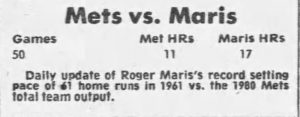 Move over, Maris. Alonso’s the one overpowering the 1980 Mets now. By the ninth, a catcher was pitching for the Cubs, and even Marcus Stroman was probably sitting quietly. The Mets were about to seal a 10-1 win that raised their record to 26-25 at the expense of the Cubs, who were falling to 22-27. That the team with the overall better record and greater expectations had gone 1-2 against a lesser opponent didn’t much matter. In July of 1969, Leo Durocher, whose overwhelmingly favored first-place Cubs had just salvaged the finale of a three-game set against the upstart yet still second-place Mets at Shea (the series that featured Don Young not corralling fly balls and Jimmy Qualls delivering a lonely single), was asked if those were the real Cubs who had just laid a 6-2 beating on the Mets.
“This wasn’t the real Cubs,” the skipper who eschewed excursions to the UN on his trips back to New York sniffed. “It was the real Mets.”
We’ll see about that in a few months, 1969 Leo, but never mind 54 years ago right now. With the Cubs safely ensconced in the NL Central and not presently any more of a factor in the Wild Card derby than anybody else, I’m not worried if “now pitching, the catcher, Tucker Barnhart… represents the real Cubs (though let it be noted Barnhart threw a scoreless frame). I don’t know if I’m convinced the team that executed all facets of baseball as if it knows what it’s doing is the real Mets, but I’m willing to accept it as prima facie evidence, mainly because I’m in the mood to be in a good mood.
Alonso’s towering home run total has me in a good mood. Jeff McNeil’s three hits have me in a good mood. The four consecutive two-out singles that built the Mets’ lead in the third inning — from Jeff, Pete, Brett Baty and Starling Marte — have me in a great mood. Baty was in the middle of a bunch of scoring, whether from the position of batter or baserunner. I love his and his fellow youngster Francisco Alvarez’s confidence out there. Why shouldn’t they be confident? Baty is the starting third baseman on a major league team with legitimate postseason aspirations; he’s nudged a competent professional named Eduardo Escobar to a utility role. Alvarez? He’s the starting catcher on the same team. Gary Sanchez, an idea that might have been worth trying out in a practical sense if there was no better option behind the plate or in the lineup, was designated for assignment Thursday. By the time he got a few reps in 2023, the position he played belonged to the much younger man. Tomás Nido is back in good optic health, and Omar Narvaez will squeeze into the picture soon, but they, too, need to get in line to the rear of Francisco Alvarez for crouches.
At last Friday’s 10-9 barnburner (seriously, you could see the barn smoldering all the way from Astoria), it was clear we as fans have moved on to Baty, Alvarez and, when we get glimpses, Mark Vientos, with Ronny Mauricio on deck in the emerging imagination. Succession, whether planned or organic, is occurring, and it’s working more than it isn’t. There was much joy in the crowd whenever the Mets were storming back versus the Guardians, but the sound the crowd made for the kids boomed stronger than anything generated on behalf of any other Mets, even Pete with the grand slam. There’s something about living with the names of prospects circulating in your subconscious until they have ascended to your field of vision and then proving they deserve a chance to maintain that front-and-center spot right before your eyes. Nido’s seeing better, thankfully, but the de facto starting catcher from 2022 didn’t need eye inserts to read the writing on the organizational wall as it’s developed in 2023. “I’m just ready to help in whatever they need me to,” Tomás graciously said prior to a game where he’d be asked to perform his own mopup duty, catching the ninth so Alvarez could rest up with a nine-run lead. Since rising to the majors in 2017, Nido has probably repeated some version of that sentiment in deference to starting Met catchers from Travis d’Arnaud to James McCann (to Narvaez). This time, it sounds like more than lip service from a good teammate. This time feels like Alvarez time.
But let’s not eschew experience altogether. Let’s circle back to Carrasco, and who waits to pitch next. As in the Cleveland series, we’re looking at Carlos, Max Scherzer and Justin Verlander in succession. That’s Carrasco with 105 career wins, Scherzer with 204 and Verlander with 246. If their presence doesn’t viscerally stir our Mets fan souls the way the core of younger rotations did, that may be our DNA talking. Seaver to Syndergaaard and so many live arms in between, all of them confounding hitters and rising to prominence…that’s how we see ourselves winding up when we look in the mirror. At the moment, however, we glimpse success that’s already occurred and desire it to be replicated. On this staff, at least half the time, pending five/six-man rotational iterations, we’re relying on credentials rather than potential.
When Max takes the hill tonight and Justin follows him on Saturday (pending all the things that can upend probable-pitchers probability), it will mark the 64th time in franchise history that the Mets have trotted out three consecutive starters with at least 100 wins in their respective back pockets. The 63rd time was last weekend. Before that, you had to return to the halcyon days of Pedro Martinez, T#m Gl@v!ne and Steve Trachsel, specifically May 20-23, 2006. We’ll call them halcyon since the ’06 Mets had already taken over first place for good and the Mets’ trio of venerable starters had a great deal to do with their astounding break from the gate. Six times in April of May of 2006, those three village of Flushing elders pitched in succession, stabilizing an element of the Mets that would become modestly, then glaringly unglued as the year continued. Soon, we’d be cycling through journeymen and neophytes, just yearning for five healthy arms, albeit from that first-place perch.
There’s been plenty of splendid pitching since the first third of the 2006 season, but for seventeen seasons until 2023, there were never three 100+ game winners staring in a row (discounting youngsters potentially or eventually on their way to triple-digits, à la Nolan Ryan and the total of 324 earned mostly after his first 29 as a Met). Before 2006, for a few years, it had been a fairly common phenomenon. Pedro, T#m and Steve did it on five occasions down the stretch in the renaissance campaign of 2005 (Trachsel was out until August). In 2004, the wizened trio in residence was Gl@v!ne, Trachsel and future Mets Hall of Famer Al Leiter. They pitched in succession 21 times in 2004. All that winning in their past…and 71 wins in all for the 2004 Mets. Sometimes experience isn’t everything. Or were you not watching in 2003? That was the year when not only did you have Leiter-Trachsel-Gl@v!ne in succession eight times after Steve posted No. 100 on August 7, but you had the only instance in Metropolitan annals of four consecutive 100+ game-winners going consecutively. From April 20 through April 24, Art Howe called on T#m Gl@v!ne, David Cone (in his brief Recidivist Met stint), Al Leiter and Pedro Astacio (before his shoulder gave out). Trachsel was a few months from notching his 100th win. The Mets were lousy with pitchers who’d been winning practically forever. Also, the Mets were lousy, finishing 66-95, but you can’t say their starting pitchers didn’t know how to win.
Funny how that works. Before 2003, the previous season featuring three 100+ game-winners working in succession was 1993. That was the year the Mets lost 103 games, despite ten times throwing at opponents Dwight Gooden, Frank Tanana and Bret Saberhagen. No matter what order Jeff Torborg and Dallas Green threw them, the fates seemed to throw it all back in the Mets’ faces. Still, pretty good backs of baseball cards with which to console ourselves.
The first and only other year when the Mets had a trio so specifically distinguished was otherwise middling 1976. Eleven times, Joe Frazier was able to deploy Tom Seaver, Jerry Koosman and Mickey Lolich in one order or another, but definitely consecutively. The first of those threesomes unfolded between April 21 and 24, the last of them September 8 to 11. Koosman broke the 20-win barrier in ’76, Seaver pitched well enough to go there had the offense supported him (it didn’t, so he didn’t), and Lolich, whose sole New York legacy is the muttering about trading Rusty Staub his name tends to inspire, had one of those classic “pitched better than his record indicated” years. Lolich won eight games in thirty starts as a 1976 Met. We used to get pretty hung up on pitcher wins. Now we point to peripherals for a truer assessment of performance. But wins, if a pitcher can get them, are fun. Carrasco winning on Thursday night in Chicago was fun. Scherzer and Verlander helping the Mets do the same in Denver will be fun, too.
May the real Mets of 2023 be real fun. We could use it more than once every three games.
National League Town offers a view from late-spring turnarounds past, a look at a game from inside the Citi Field press box, and enough staring at a tall stack of pancakes to fill your day off. Give the pod a listen.
|
|