The blog for Mets fans
who like to read
ABOUT US

Faith and Fear in Flushing made its debut on Feb. 16, 2005, the brainchild of two longtime friends and lifelong Met fans.
Greg Prince discovered the Mets when he was 6, during the magical summer of 1969. He is a Long Island-based writer, editor and communications consultant. Contact him here.
Jason Fry is a Brooklyn writer whose first memories include his mom leaping up and down cheering for Rusty Staub. Check out his other writing here.
Got something to say? Leave a comment, or email us at faithandfear@gmail.com. (Sorry, but we have no interest in ads, sponsored content or guest posts.)
Need our RSS feed? It's here.
Visit our Facebook page, or drop by the personal pages for Greg and Jason.
Or follow us on Twitter: Here's Greg, and here's Jason.
|
by Greg Prince on 5 April 2023 9:51 am Having recently conferred “visiting scholar” status upon one Maxwell Martin Scherzer, a righthander who earned his doctorate in pitching long ago, I’ll leave it to the old professor himself to figure out what the hell is wrong with him. If it’s not physical (he says he’s fine), not mental (he won’t use the pitch clock as an excuse), or not chronological (although 38 is 38, he was also 38 when he set down the Brewers last September in his playoff-clinching start), we’ll have to depend on Max and those assigned to coach around him to deduce what has gotten into him and how to get it out of him. “I’ve just got to pitch better,” the professor said in Milwaukee on Tuesday night after he couldn’t have pitched much worse.
Maybe it is physical (not every pitcher comes clean or immediately realizes something’s awry), or is mental (the pitch clock is screwing with literally every experienced player’s routines), or is chronological (38 is definitely 38, and he was 38 in October when he couldn’t withstand the Braves and was shot out of a cannon by the Padres in October). Whatever it is, he’s just got to pitch better. That’s a lot chase-cutting when you’re dealing with a human being who may have who-knows-what going on in his arm or his head or the rest of him. But when your current starting rotation consists of ellipses (Peterson and Megill are going to…); a question mark (how alarmed should we be by the drop in Carrasco’s velocity?); and a slash (Senga was spectacular in his first start/Senga will likely require an adjustment period regardless of his spectacular first start), you have to count on somebody to bring the exclamation point. The Mets signed Max Scherzer because he’s always been Max Scherzer! For almost all of 2022 when he was available to pitch, he was emphatically Max Scherzer!
At whatever Miller Park is now called on Tuesday, the exclamation points were proffered by Rowdy Tellez, Brian Anderson and Garrett Mitchell, three Brewers striking three homers in a row, setting off indoor fireworks (cough, cough) and donning their home run cheeseheads in celebration. It was enough to make a Mets fan lactose-intolerant. Before the sixth inning, Scherzer had overcome a two-run first to settle in competitively versus Wade Miley in a 2-0 staredown. In the sixth, it all went up in smoke for the Mets’ ace.
Worst. Smokeshow. Ever.
Following a walk, Max would be replaced by Denyi Reyes, who replaced Tommy Hunter on the roster. Hunter went on the IL with back spasms, a malady that may plague Mets pitchers as they attempt to carry a team that doesn’t score whatsoever. Reyes got the Mets out of the sixth. In the seventh, with Brooks Raley on, America’s Dairyland stirred to life again, with a three-run homer from Anderson and another solo job by Mitchell. That added up to a final score of 9-0 in favor of the Sausage Kings north of Chicago. The “9” was lavish in light of the “0,” a digit you might remember from the Mets’ 10-0 loss the day before. The Mets intermittently hit the ball hard and had a couple of balls fall in. They also batted into a couple of double plays and left eight runners on base. The defense was pretty sound, except for the inability of Messrs. Canha, Nimmo and Marte to leap high enough to reel in what their pitchers were allowing to be cast out.
Elsewhere in the Metropolitan system, Brett Baty’s thumb came up sore during his game in Syracuse. The youngster, dispatched to Triple-A to improve his fielding, had cultivated an OPS of 1.338 in four games down on the farm before the thumb on which he had surgery in the offseason acted up. Seems appropriate that this would happen to the Met prospect best positioned to respond to a potential SOS. Right now, a Met who could pound the ball consistently would stick out like Brett’s sore thumb.
by Greg Prince on 4 April 2023 9:12 am Carlos Carrasco appeared forlorn, first on the mound, more so in the clubhouse when reporters asked him about his declining velocity, his difficulties adjusting to the timer and everything else that had gone wrong. Tommy Hunter had no choice but to wear a hit-eating grin when the camera found him at his lowest. The pitching pair who just didn’t have it do have in common the same earned run average: 11.25 in 2023. Luis Guillorme’s pitching was effective, but the conditions were in effect to have Luis Guillorme pitch, thus any emotion beyond stoicism would have been a bad look. Then again, a bad look would have matched the tenor of the game the Mets had just lost in Milwaukee, 10-0.
In college basketball terms, Monday afternoon’s debacle was as decisive a loss as national champion UConn pinned on runner-up San Diego State, except at least the Aztecs managed to score. The Mets’ pitching shortfall was the most glaring aspect of the matinee — eight walks, a pitch clock that moved too fast for Carrasco, a fastball that traveled too slow from Carrasco — but that zero on the Mets’ side of 10-0 sat there like a bagel on the road to Passover. You shouldn’t have one around, yet somebody needs to digest it or otherwise get rid of it before we can move on.
The offense never leavened. Three hits. Deceptively quick baserunner Daniel Vogelbach was not quick enough to stretch a single into a double back when it was still a ballgame. Heady Mark Canha was caught staring at the video board for helpful data (vainly searching for the previous pitch’s velocity, something hitters do) two seconds too long, which means a strike if you’re not in the box set to hit in a jif in 2023. Guillorme, after his franchise-most third career outing as not a pitcher pitching, came up to bat in the top of the ninth, which was the most remarkable moment the Mets’ lineup manufactured solely because Luis the infielder had pitched in the bottom of the eighth. Use a position player to pitch, you no longer get to use a DH. Thus, for the first time since the ordained demise of what was left of authenticity in baseball, a Mets pitcher could be said to have hit, if not successfully, as Luis lined out to end the damn thing. That contemporary curiosity, along with sparingly used Tim Locastro managing to get himself hit for a third time four plate appearances into his season (he leads the NL in HBPs), stood as the highlight of the day.
Unless you were the Brewers, in which case the day was nothing but a highlight. Unaligned, I’d say it’s nice to see a team opening its home season give its fans a win. I’m not unaligned and I was hoping the pregame tailgate would be all Brewervolk would have to remember fondly. They got more. They got a third-inning lead, a fourth-inning increase and fifth-inning explosion, cresting with a grand slam surrendered by Hunter to rookie infielder Brice Turang, whose career dates back to last Thursday. No, kid, it’s not always this easy.
The final score rang an atonal bell. Didn’t the Mets lose a Home Opener of their own, 10-0? Indeed, they did, 39 years ago. The 1984 Mets had opened eyes with a 6-3 start on the road and 46,000 at Shea was excited to greet their conquering heroes. Then the Montreal Expos excised all the excitement from Flushing, with a run in the first, a run in the third, another four in the fourth and four to rub it in in the eighth. Most of the damage was done to rookie Ron Darling, not enjoying a Brice Turang coming-out type of afternoon (except for coming out before the fifth). The biggest swing belonged to then-foe Gary Carter, the enviable All-Star catcher who delivered what we would now refer to a Turangian blast, a.k.a. a grand slam home run.
Two Home Openers, two 10-0 losses for the Mets, two four-ribbie four-baggers. Two? Do I hear three? Afraid I do. In April of 2003, after their own season-starting odyssey, the Expos, long after anybody expected them to be any trouble, began their home schedule at Hiram Bithorn Stadium in San Juan. Maybe Montreal’s odyssey wasn’t exactly over. This was during that dark period when the Expos were at sea and were assigned to play a segment of their home schedule on an island far from Quebec. Farther from Montreal than Prince Edward Island, even. By MLB’s reckoning, Puerto Rico served as the site of the Expos’ Home Opener.
By the scoreboard’s reckoning, it was another 10-0 loss for the Mets, with another grand slam allowed, this one thrown by comeback-trailing David Cone and walloped by left fielder Brad Wilkerson. Also homering for Montreal/San Juan was catcher Brian Schneider, who would eventually move on to the Mets like his Expos backstop predecessor Carter. The 2023 Mets have a former Brewers catcher already in Omar Narvaez. Narvaez has hit one career home run against the Mets, in 2021. It was in Milwaukee. It wasn’t a Home Opener. The Mets won.
Narvaez is hitting .300 as a Met. Before Monday, he was hitting .429. Drops and spikes of that nature will happen when the season is young enough to rattle your stats if not your nerves. Before Monday, Brice Turang had one career RBI. After Monday, he’s tied for sixth in the National League with five. Before Monday, Tommy Hunter had a pristine ERA of 0.00. Before Monday, the Mets had absorbed only one loss, a 2-1 affair irritating enough to mentally seek that one pitch or swing that might have turned it around. On Monday, they lost decisively. They lost, 10-0, and all you could do was shrug it off and, if you were so inclined, go to Baseball-Reference and look up how often you and they had experienced that score before. It’s one of those scores you figure has been inflicted on your team rarely enough to not require the deepest of searches.
The Mets are in their 62nd season. They’ve lost, 10-0, on thirteen occasions. Three of those have been Home Openers for one team or another. Another was in a team’s second home game of the year, at actual Montreal (not San Juan) in 2001. It was Steve Trachsel’s Met debut. Steve was known for pitching slowly, but he was in a hole pretty fast. “Steve Trackmeet” I wanted to call him because as soon as he started throwing, the Expos were off to the races. Another was also in April, to the Pirates. I was there that night in 1981. The scoreboard went dark for a spell. The Mets had already given up five runs and would give up five more without crossing the plate themselves. Under the circumstances, the scoreboard was more courteous than the usher who chased my friend and me out of seats we dared to slip down to with few outs remaining and even fewer in attendance.
Each previous 10-0 Mets loss in April could be rationalized away with “It’s early.” So can this one.
by Jason Fry on 3 April 2023 12:04 am Forty-two pitches into his Mets debut, Kodai Senga was in trouble.
Our Japanese import, a feel-good story across that far bigger pond for rising from developmental player (the closest equivalent is “low-A cannon fodder”) to three-time All-Star with five rings, had needed 36 pitches just to get through the first against the Marlins: A single, an RBI double, a walk and another walk preceded a pair of strikeouts and a sharp line drive corralled by Starling Marte. Senga had a 2-1 lead because Trevor Rogers was being tortured by the Mets and by his own defense, but to say things looked dicey was to understate it. Senga was clearly nervous, which was playing havoc with his location, threatening to send a whole line of dominos toppling in ways not to our liking.
Things didn’t start off much better in the second, as Senga began by walking Jacob Stallings — the third guy he’d walked in the first eight batters faced. The next batter was Joey Wendle, and this time ball one was automatic — a pitch-clock violation, of all things. (It’s not visible in the ESPN play by play, but trust me, it happened.)
You didn’t have to be a scarred and calloused Metsian doomsayer to imagine what might happen next: another rough inning, an early departure with the Mets now down 4-2 or 5-2, and lots of shots of Senga trying to look stoic in the dugout but mostly just looking glum. After the game Buck Showalter would be calm and philosophical, teammates would say the right things, and Senga would offer some variation on it being good to get the first one out of the way and how he’d be making adjustments and that of course what he was most looking forward to was taking the ball again in five days’ time.
Except that wasn’t what happened at all.
Having given Wendle a free ball one, Senga sent a fastball through the lower reaches of the strike zone to even the count. Another fastball clipped the bottom of the zone to put him up 1-2. Next came the ghost fork or the splitter, depending on how romantic one feels about naming Senga’s much-hyped out pitch. Wendle slapped it harmlessly to center for an out. Two pitches later, Senga coaxed a double-play ball to retire the seemingly unretireable Luis Arraez and he was out of the inning. Out of the inning and, as it turned out, home free. He worked into the sixth, baffling the Marlins with ghost forks and fastballs and sweepers, with the lone blemish an Arraez single in the fifth. Eighty-eight pitches, just one run allowed, and no reason for Showalter to have to be placid and soothing? That will work.
Senga was only half of the Mets’ story, though. The other half was Tommy Pham, who was 3-for-4 with three RBIs, two of them on a fifth-inning homer off whatever that white corporate structure out there is beyond the Soilmaster Stadium fence. Pham has a genetic condition called keratoconus, in which the collagen in the cornea thins and can develop a vision-impairing bulge. (Amazing the ailments one learns about as a Mets fan — if it ain’t Valley fever it’s spinal stenosis.) Pham has dealt with the condition since 2008; on Friday he got new contact lenses from his Florida-based eye doctor, praising the results as “way different in a good way.”
Pham is the 2023 Met I feel like I know the least about — when he arrived as a fourth outfielder/potential piece of the DH puzzle, my recollection of him was a blur of long-ago Cardinals moments, slapping Joc Pederson over fantasy football and a reputation for being, shall we say, a little edgy. That last part may be true, though I came away from this 2018 Sports Illustrated feature about Pham thinking that a) he’s a complicated cat in an interesting way; and b) some of that running hot seems pretty understandable. If Pham has a run of performances like Sunday’s, we’ll all know a lot more about keratoconus and perhaps even find ourselves advocates for finding reasons to slap Joc Pederson — nothing like winning to make you see things way different.
The rest of it? Jazz Chisholm Jr. made another horrific misplay in center, making you wonder (and not for the first time) if setting up their best player to fail wasn’t exactly the greatest plan, even by Miami Marlins standards. Avisail Garcia, meanwhile, managed to get himself called out on a pitch-clock violation and looked at a third-strike fastball down the middle from Stephen Nogosek when the fastball was rather obviously the only pitch Nogosek was able to throw for a strike. That kind of serial dopiness has been a Marlins fixture in recent years, an unwelcome distraction for a franchise that too often can’t seem to get out of its own way. Marlins fans deserve better — I’ve always felt for them despite being steadfast in my belief that their team is a not particularly funny nihilistic joke — but in the zero-sum game of baseball, we’ll of course take every mistake our opponents care to make.
A last observation, one I’ll count as pencilled in for now: In theory I don’t mind the idea of baseball games not routinely zooming past three hours in duration, but so far the pitch clock has thrown off my own rhythms as a fan in ways I find disconcerting. Decades of fandom have given me a pretty sound sense of how long routine things take, letting me know — for instance — how many seconds it’ll take a hitter who just fouled a mistake pitch straight back to spin out of the box, collect himself, exhale, kick at the dirt a little and then return to duty. But now I need to recalibrate all that. I watched the end of Saturday’s game in a bar with no sound and missed Francisco Lindor‘s double — not because I wasn’t paying attention, but because my internal clock was off.
I’m sure I’ll get used to this, and probably sooner than I think, but right now it’s left me pretty unhappy. Rob Manfred and his merry band of consultants have decried many baseball changes of relatively recent vintage, but it strikes me as a rich irony that their answer to these supposedly ruinous changes has been a blizzard of changes to things a lot more fundamental, including basics of the game I would have thought sacrosanct.
by Greg Prince on 2 April 2023 5:13 am Is it too soon to say we’re living in a golden age of Mets baseball? How about one that is thus far untarnished?
By winning in Miami on Saturday behind Tylor Megill (starting in place of Justin Verlander), Mark Canha (homering like he’s Pete Alonso) and a bullpen cast of thousands (none of them presented by Kwikset), the Mets upped their record to 2-1. Unless you’re contesting a best-of-three playoff series, that’s a pretty inconclusive sample size, but had the Mets lost and fallen to 1-2, well, we would’ve been 1-2, a record easily recognized as under .500.
In case you’ve forgotten, you don’t wanna fall there.
If you’ve forgotten, it’s because it’s been a while. From Game 1 to Game 162 of 2022, we were never below .500. We were never as low as .500. It was the third regular season in Mets history when the ballclub could boast day-in, day-out of a record that was nothing but winning. That may not be what a ballclub boasts about first and foremost — the other Mets teams to achieve 162 consecutive daily winning records did it in 1985 and 2007, and neither of them gets the slightest banner shoutout above right field in Promenade — yet the rarity can’t help but get a curious fan’s attention.
You can have a really good ballclub, the best the franchise has ever had, yet it doesn’t mean that particular ballclub can ask the DJ to spin “All We Do Is Win”. Witness the 2-3 Mets of 1986, who stumbled a few feet out of the gate. True, they picked themselves up, dusted themselves off, started all over again, and never stopped. But 2-3 was 2-3. They are forever champions, but they weren’t forever winning. The first week or two is most treacherous for the team that wishes to never feel statistically inadequate. All it takes is 0-1, 1-2, 2-3, and there goes your non-losing record.
There’s plenty of time to straighten out. The not how you start/how you finish quotient hasn’t yet been disproven for long-term purposes. But who wants to spend even a day under .500? Who wants to look in the mirror of the standings and see doubt staring them back in the face? You knew the 2-3 Mets of 1986 were better than that. Except for their record. And if their record reflected who they were, how the hell was this happening? How the hell do you know 2-3 won’t become 2-4 or that 2-4 won’t become something that plunges until it lands south of 81-81? No matter that you know better, Panic Citi can seem particularly inviting in the inaugural days of a new season.
Thirty-seven years ago, an eleven-game winning streak commenced, and you know the rest, but that very brief stumble dents 1986’s historical stature within the context of this particular feature. This particular feature is devoted to Mets teams that have maintained a daily record of .500 or better across season lines for more than 162 consecutive games. At the moment — for the last 165 moments, actually — we’ve been rooting for one of them. Never as low as .500 last year. Thus far this year, not a day under .500 (albeit across three games). Suddenly, we modern Mets fans are enjoying an era that ranks eighth when measured by Not Losing Streak.
The top seven? Aren’t you glad you asked?
1. September 24, 2005 to April 5, 2008: 337 Games
Try to forget that somewhere in the midst of this run, a third strike was taken to end an NLCS (we’re not counting postseason) and a seven-game lead evaporated with seventeen games to play (you have to be doing pretty well to have a lead to blow late). The Mets rose to 77-77 at the tail end of a season of playing footsie with .500 for the bulk of Willie Randolph’s first year as manager. They were never any “worse” than 1-1 in his second year. They never even dipped to .500 in his third year. After a 2-2 start to 2008, Rando’s Commandoes slipped and slid a bit too much to slough off the finish in ’07 as just one of those horrific things. Willie tried to remain calm, reasoning to reporters he’d been a winner all his life. For the heart of his Met tenure, if you’re not a stickler for details, he wasn’t wrong.
2. April 4, 1984 to April 13, 1986: 327 Games
Davey Johnson’s Mets traveled to Cincinnati for the traditional National League opener and indicated their tradition of not competing — just as they hadn’t under Joe Frazier, Joe Torre, George Bamberger and Frank Howard between 1977 and 1983 — might proceed unabated. They got stomped by the Reds, fell to 0-1, and gave little hint that 1984 would be materially different from the preceding seven years of famine. But they won their second game. And their third game. And kept winning through their seventh game. And, with Davey’s confidence infecting every Met in sight, they never had a losing record at any juncture of 1984 after Opening Day. And they never descended to .500 after starting 1985 5-0. And two wins to kick off 1986 seemed to augur 162-0 was realistic. Two losses occurred. Then a third. That was the 2-3. We already know they picked up on the “And…” theme thereafter. But there was a hiccup. The best cure is holding your breath and waiting for the season to unfurl in earnest.
3. May 10, 1997 to September 27, 1998: 289 Games
Bobby Valentine inherited a crummy team in August of 1996 and they stayed quite crummy in early 1997. Bobby V needed a few weeks to fully shake the crumbs away in his first full season at the helm (he did run a restaurant, after all, so he understood something about busing tables). The franchise weighed down by a daily record that gurgled under .500 almost without pause from August 1991 to April 1997 learned to love Valentine’s days. The romance could be stormy, but the relationship proved mutually beneficial. One weekend in St. Louis, we hit .500 and snuck above it before leaving town. We wouldn’t look below the break-even point for the rest of that year or the whole of the next year, including the portion of 1998 that predated the acquisition of Mike Piazza. Piazza would lift Bobby V’s Mets to another strata. Not high enough to grab a Wild Card that was within reach in September, but learning to elevate fully has been known to take time.
4. June 13, 1970 to August 13, 1971: 221 Games
The defending world champions could not be stopped! Oh wait, they could. It didn’t make sense to watch the infallible 1969 Mets turn into the ordinary 1970 Mets, yet there they were, during the first third of their title defense, legitimately scuffling, not taking off from their .500 plateau until 29-29 became 30-29. Not that they really rose high above it the rest of the way, but at least Mets fans weren’t left thinking 1969 was altogether a dream. Gil Hodges had his club readier to contend as 1971 got rolling, though that group, too, eventually sputtered, if not until summer. Neither the ’70 nor ’71 editions matched the magic of ’69, but they did confirm the Mets now existed as a consistently reliable enterprise rather than a one-year wonder. Your expectations might not be validated every season, but you knew you weren’t deluded to have expectations.
4. June 13, 1990 to August 15, 1991: 221 Games
When Bud Harrleson took over for Davey Johnson, the Mets might as well have been wearing one of those t-shirts Bart Simpson was making so popular: Underachiever and Proud of It. Maybe not a lot of Met pride, but definitely far too much not living up to the talent in the room. Harrelson, who studied under Hodges two decades before, seemed to bring out the best in his Mets as Gil had brought out the best in Buddy & Co. The right manager at the right time spurred the Mets to a surge that had them blow past .500 and duel the Pirates almost to the wire. Come 1991, they kept up their end of the bargain as best as they could until the remnants of their post-1986 powerhouse flickered and went dark.
6. April 18, 1986 to May 8, 1987: 183 Games
The part where the Mets cease being 2-3 and commence to going 108-54 pretty much explains the 1986 portion of this stretch. In 1987, the Mets appeared sluggish, but despite some noticeable absences from the previous October (no Doc until June, no McDowell until May, no Mitchell or Knight at all), their innate awesomeness kept them no worse than treading won-lost water for more than a month. They were bound to take a dip below .500. The shock of a team that could do no wrong going somewhat awry was rough to reckon. We remember the 1987 Mets for not coming through in September. If we think back to how they limped along early, it’s a miracle they made it to September. The innate awesomeness remained evident. It just wasn’t enough to carry the day, let alone the year.
7. April 21, 1972 to May 5, 1973: 177 Games
Before Yogi Berra added an extra layer to his legend by leading the Mets from nowhere to the World Series — also before Yogi wore the onus of not starting George Stone in Game Six of that Fall Classic — he faced an impossible task. He had to follow Gil Hodges directly after Gil Hodges died. He did a helluva job, getting the Mets over .500 to stay almost immediately in 1972, not letting them fall under .500 despite the injuries that piled up, and pushing them successfully into the next season, where they looked fine until they didn’t…until they did, of course.
8. April 7, 2022 to Present: 165 Games and Preferably Counting Into Perpetuity
One assumes Buck Showalter, if he’s aware of it, isn’t particularly impressed by this streak of never having let his Met team settle below .500 for even a day during his tenure. Buck is always looking ahead. Or so it looks from here. Still, not bad having a non-losing record “forever” in Flushing, with “forever” a perilous eternity if the Mets don’t win today, Sunday, because if they don’t, they’ll have to win in Milwaukee on Monday, or the streak ends at 166 games…which Buck won’t care about, because he understands that what gets remembered most is not a 22-23 record on June 1, 1969, or a 2-3 record on April 14, 1986. The 2023 season won’t be distinguished by a brief interval in April. The 2023 season is built to endure. Nevertheless, even as early as the first week of April, it’s really nice to not lose more than you win.
So keep that up please.
by Greg Prince on 1 April 2023 10:43 am Just a reminder that while we wait for Edwin Diaz to rehabilitate from his WBC celebration injury, next weekend brings the first of fourteen Klassik Kloser Saturdays, Presented by Kwikset, the Official Provider of Deadbolts, Knobs and Handlesets of the New York Mets. That’s a mouthful, but closing out games in 2023 will likely require an armful.
As much confidence as David Peterson earned on Opening Day and Adam Ottavino might inspire based on what he accomplished last year, the Mets recognized the ninth inning as the “turnkey to success” and concluded “there’s no substitute for experience” (forgive me for invoking the sponsor’s press release lingo), so in addition to using whichever veterans Buck Showalter, Jeremy Hefner and Dom Chiti deem ready to go the other six days of the week, the manager and his pitching coaches will now have at their disposal, during the latter stages of Saturday home games, one reliever from the franchise’s “ya gotta believable” past.
It seems the idea was planted in the fan demand to bring back Old Timers Day, so if any leads get away on any home Saturdays this season, blame people like me who thought reviving a great tradition was a win-win. Let’s hope it’s a win-save. Steve Cohen heard the people call for Old Timers Day and saw us flock to Citi Field to cheer the alumni in action. For us in the stands, it was an overdue celebration of history. For Cohen, unbeknownst to the 42,000 or so in attendance, the affair doubled as a laboratory of sorts. He saw how warmly the old players were received and couldn’t help but be impressed by how flexible many of them still were. “Spry,” Cohen says in the press release, “didn’t begin to describe it.”
Thus, at Cohen’s direction, Billy Eppler and the medical staff, in conjunction with the Mets’ partners at the Hospital for Special Surgery, forged a new sports physiology and training unit called Metropolitan Transformation, and, for the past few months, all concerned have worked to return to baseball shape a plethora of previous Mets relievers, with some of the same “revolutionary” research not incidentally being applied to Diaz’s knee — speaking of Klassik Klosers and their state-of-the-art body parts. That we’ll have Klassik Klosers taking on some of the ninths that would have belonged to Edwin is fortuitous timing, but given who owns the New York Mets, you also get the sense that luck is the residue of design here. One way (or spelling) or another, we were gonna have Klassik Klosers at Citi Field on Saturdays this year.
Being that this is a Steve Cohen-driven initiative, these aren’t Quadruple-A hangers-on or even standouts from the independent leagues. These are genuine Met closers and their ilk. True, you gotta wonder if they’re up for it after so many years of idleness was interrupted by a sole Old Timers bow, but “it’s just one inning,” Buck said the other day, “and it gives Hef and Dom and the rest of our people some options we didn’t think we had. If they sign the waivers and their families are OK with it, we’re gonna support them as best we can.” Showalter pointed to some of his old favorites from Baltimore the Mets have signed, like Tommy Hunter, who threw a pair of zeroes Friday night, and preached the virtues of familiarity. “You know what you’re getting with these guys, and they know how to get batters out. I’m not asking anybody for ID. It’s not like I’m serving them drinks. I’ll do that after the game if that’s what they want.”
One is tempted to make a crack about Geritol being the beverage of choice in the Met clubhouse, but glass houses prevent a fan who’s about as old as the franchise for which he roots from throwing zingers.
Because Cohen is funneling so many luxury tax dollars to the other MLB owners, he saw opportunity where others might have viewed only penalty. To the principal owner, the so-called “Cohen tax” presented a negotiation position. All right, he essentially said, you want me to enrich your coffers, I want something for my investment. The genius might have been in framing it as a pilot program from which eventually all thirty franchises might benefit. The Mets will be the first to do Klassik Klosers, but don’t be surprised if you see other teams try it…if their owners can figure out how to make it work the way Cohen has. Hell, by the time they catch up to Steve’s thinking, you can bet — probably at a casino he will get built in the parking lot — he’ll have brainstormed something else even more, shall we say, Amazin’.
Much like with second games of doubleheaders, the Mets will get a “27th man” roster exemption in order to activate their Klassik Kloser every home Saturday. Their opponent will get the same, but can only call up somebody already on their 40-man. Fair? Cohen paid for the privilege of bending the rules to his will. And, let’s keep in mind, if it doesn’t work, the visiting team stands to benefit by putting runs on the enormous Citi Field scoreboard (as they will from their share of gate receipts, as this is already apparently proving quite a seat-filler). With all the new rules coming and out of baseball, it’s no wonder this little number got slipped in to scant notice.
The potential drawback, at least for 2023, is if a Klassik Kloser is particularly successful on a given Saturday, Buck and his minions can’t suddenly lean on him come Monday or even the next Saturday. There is one dedicated Klassik Kloser per the Basic Agreement codicil that enables Klassik Kloser Saturdays, Presented by Kwikset, the Official Provider of Deadbolts, Knobs and Handlesets of the New York Mets. He can’t be used in more than one game during this season; that clause might be revisited next season. I’m not sure if the Klassik Kloser can go in two games should there be a doubleheader on a Saturday — when you’d be dealing with a “28th man” — but how often do you see Buck use a pitcher in two consecutive games on two consecutive days? And in case you’re curious, yes, the three-batter rule applies, though no, none of the Klassik Klosers will enter to Timmy Trumpet. In fact, Cohen has hired famed White Sox organist Nancy Faust to play appropriate ditties for when the Kwikset-secured bullpen door swings open, including “Don’t Say You Don’t Remember”; “Yesterday Once More” and, not surprisingly, “Old Days”.
One interesting element from a historical perspective is if a Klassik Kloser is already on the Hall of Fame ballot, this will not affect his candidacy vis-à-vis the standard five-year wait. You might not have gotten the full relief pitcher buy-in to this notion had certain relievers thought this might backfire. But, really, there’s been loads of enthusiasm. These guys loved the late-inning spotlight in their day, and they sure didn’t mind the attention on Old Timers Day last August or, for that matter, Amazin’ Day last weekend.
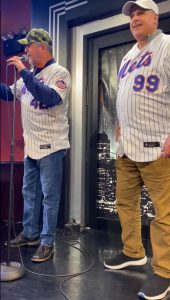 As Amazin’ Day showed, McDowell and Wendell are still at home in the New York spotlight. I’ll admit to a touch of skepticism when I first heard about Klassik Kloser Saturdays, Presented by Kwikset, the Official Provider of Deadbolts, Knobs and Handlesets of the New York Mets, not because I have anything against Kwikset’s fine products or the Kwikset ad patches set to replace the skyline logo on the Mets’ jersey sleeves, but because, let’s face it, not every relief pitcher was a closer when he was active the first time, and it appears they’re trying to pass off a couple of middlemen as if they were firemen. Ah, maybe that’s picking nits at this point. The upside is we get a fresh arm, bionically (or however they do it) engineered to compete anew while making the most of a storehouse of knowledge devoted to retiring batters. I mean retiring them in a game. The uplifting part of all this is the implicit message that “retirement” doesn’t have to be permanent. Life is long. Who wants to stop doing what one wants to do if one can still do it?
The bottom line from the viewpoint of a Mets fan on a Saturday when the club is home is if you buy a ticket to a Saturday game this season, you stand an excellent chance of enjoying relief pitching like it used to be, perhaps relief pitching like it oughta be. Below is the schedule the Mets will announce to the rest of the media on Monday, with all the usual “subject to change/competitive discretion/certain restrictions/no refunds” caveats. Hat tip to alumni director Jay Horwitz for getting us the information in advance and getting these more or less beloved once and future Mets warming up in the pen.
APR 8 vs MIA
John Franco — Well, who else? He’s the Mets’ all-time leader in saves and, you have may have heard, he’s from Brooklyn.
APR 29 vs ATL
Steve Dillon — Dillon pitched before anybody thought in terms of closing, and he was never relied on to do what a Franco did. But did you see Steve at Old Timers Day? At 79, he was in about as good a shape as any pitcher, even backing up home plate on one play. Plus he’s local. I love giving him a shot in this role.
MAY 6 vs COL
Jenrry Mejia — Lifetime bans aren’t what they’re used to be. Call it the Klassik Kloser Redemption Tour. His buddy Familia hooked on in Oakland. Maybe Jenrry has one more comeback beyond this one in him. They might wanna run a test before sending him in, however.
MAY 20 vs CLE
Bobby Parnell — Dude is only 38. And his beard is younger than that.
JUN 3 vs TOR
Billy Wagner — Nice subliminal advertisement for Billy’s HOF chances to have him be the Klassik Kloser on Mets Hall of Fame Day. BBWAA, pay attention to what the lefty still has and always had: heart.
JUN 17 vs STL
Neil Allen — How do you like this for timing? It will be the fortieth anniversary plus two days of the day Allen was sent to the Cardinals for, oh, who was it again? Why, No. 17, as in June 17, come see the reliever who was crafting a pretty good career as a Met reliever before Keith Hernandez became magically available. Hopefully Whitey Herzog will be tuning in from somewhere.
JUL 1 vs SFG
Armando Benitez — I almost think something more is up here, because, as we’ve all been told ad nauseam that July 1 is Bobby Bonilla Day, and we’ve heard Steve Cohen wants to make a real Day of it at Citi Field, presenting Bobby Bo with an oversized check to pay him off what he’s otherwise owed through 2035, and what better grace note for an unlikely homecoming than to bring in as Kloser one of the best righties the Mets have ever featured in ninth innings…and one of the shall we say most polarizing. That’s a nice way of saying Armando’s been gone 20 years and the wounds from his intermittent (cough) missteps are still fresh. But if we’re maybe going to welcome back Bonilla, why not Benitez? Fun fact: the last time Armando pitched in Flushing, he was giving up a game-winning home run to Carlos Delgado while with this July 1’s special guests, the San Francisco Giants.
JUL 15 vs LAD
Jesse Orosco — Alert the FAA! A glove could be falling from the sky somewhere near LaGuardia! Or Jesse could just use a new one. He did pitch for about a hundred years after recording the final out of the 1986 World Series, so we can assume somebody spotted him a new one. (We’ll try to forget Orosco also pitched for those Dodgers, in the 1988 NLCS, and simply enjoy him trying to beat L.A. in 2023.)
JUL 29 vs WAS
Jason Isringhausen — Intriguing choice, as Izzy’s reign as primary Met back-end pen man was brief, just long enough to collect the requisite saves to allow Jason to make it to his 300th in 2011. We think of the young Isringhausen, who was a starter as he set out on what became a long journey in 1995. Izzy’s appearance is scheduled to occur one day shy of the 28th anniversary of his first major league win, itself saved by John Franco. Circle of life, eh?
AUG 12 vs ATL
Randy Myers — I love this on two counts. 1) RANDALL K! The K didn’t stand for Kloser in New York long enough for my taste (no offense, Johnny). 2) If the Mets were looking for a reliever who had no shudder-inducing history versus the Braves, I’m thinking they found their man. The Braves weren’t the Braves as we know them when Randy Myers was getting pumped. No flashbacks, just heat.
AUG 26 vs LAA
Francisco Rodriguez — I’m glad hard feelings have softened. Maybe they already did when K-Rod came back after his “incident” in 2010 to pitch for several more months in 2011. Soon he’d be traded to avoid paying him what he might have been worth (not that we had many games to save in those vesting option/post-Madoff days) and Frankie disappeared from the Met consciousness. Having him come back versus the team he came up with shows somebody is paying attention.
SEP 2 VS SEA
Skip Lockwood — The former Seattle Pilot (is there a current one?) will be in town to show his timeless stuff versus the Seattle Mariners. Lockwood, a heck of an author, by the by, locked down plenty of ballgames for the Mets between 1975 and 1979. I wouldn’t Skip this outing.
SEP 16 vs CIN
Roger McDowell — Watch your feet, Wayne Kirby. Roger had a way with a book of matches and first base coaches’ shoes. I wonder if the Reds’ institutional memory will be disturbed to see the pitcher who snuffed Cincy out as both a reliever and a right fielder on July 22, 1986?
SEP 30 vs PHI
Turk Wendell — A bit of an off choice to Klose out Klassik Klosers? Only in that Turk was the setup guy for Franco, then Benitez before being traded to the Phillies in 2001. But who better among those available to slam the final rosin bag on the first iteration of this innovation? Mr. Wendell is still a popular figure among Mets fans, as gauged by the reaction he drew on Amazin’ Day, and if Steve Cohen is conscious of anything, it’s pleasing a crowd. Also, if a playoff spot is still on the line when September ends, trusting Turk will be second nature.
Oh, should the Met starter on one of these Klassik Kloser Saturdays have a complete game going into the ninth…ha! You almost had me there. We know as sure as we know today’s date that expecting a Met pitcher will be left in to throw nine innings in 2023 amounts to utter foolishness. You’re gonna believe a Met might throw a complete game this year?
Seriously, don’t be so gullible.
by Jason Fry on 31 March 2023 10:58 pm This is the time of firsts, of course. First appearances for Mets old and new. First hits, home runs, stolen bases and, alas, first errors and strikeouts and big chances not converted. First wins — the Mets took care of that category Thursday afternoon — and, nowadays, new additions to the menagerie such as first pitch-clock violations, for and against.
The opening frames of a season move slowly in the beginning — slowly even with men in blue newly deputized to finger-wag baserunners back to their stations and demand split-second decisions on replay challenges. (None of these things particularly needed hurrying along, but my invitation to serve as a consultant for MLB apparently got lost in the mail.) There’s a brief time when you can hold every pitch of the young season in your head at once, followed by a somewhat longer stretch where you can at least recall every AB. We’ve moved beyond both of those as things start accelerating, but for a while we’ll be able remember every game, down to the scores. For a while, but not forever — within a couple of weeks the games will start to blur, and then so will the series, and soon enough our reaction to a mention of some March/April storyline will be belated recognition — “oh yeah, that’s right, I remember that game.”
This happens every year, and I navigate the experience with the odd mix of familiarity and mildly peevish surprise you get when doing something you haven’t done for a full turn around the sun. But in one respect I’m in midseason form already: Friday night’s game was a definite reminder that I hate the Marlins.
Friday night’s game at Tacky Political Grift Park (or whatever it’s called these days, as something tells me I might not be remembering that quite right) had “annoying fucking loss to the annoying fucking Marlins” written all over it from the jump, when the Mets didn’t get a safe call challenging Brandon Nimmo‘s supposed out at first. There were Marlins making plays they had no business making, most notably Jorge Soler out in right field screwing up his pursuit of a Pete Alonso drive just enough to turn it into a spectacular play and later, at a critical moment, making a more authentically fine shoestring grab to rob Starling Marte. Soler also put the Marlins on top with a solo shot off David Peterson, who looked like he was always about to implode but kept staggering out of trouble.
Peterson got help from some nifty/lucky defense on the Mets’ side of the ledger: In the bottom of the first Alonso turned a hot shot down the line from serial Mets torturer Jean Segura into a double play — fortunate, as Garrett Cooper then wound up on third courtesy of a muff by Marte transmuted by hometown scoring into a triple. Peterson escaped, but that was when I started muttering, thinking about how it could easily be 2-0 Marlins with a runner on third and nobody out and Soilmaster Stadium (of course, that’s what it’s called!) about to drop a bucket of teal on the Mets’ fortunes for approximately the 67,000th time since this misbegotten franchise was inflicted on baseball.
Peterson escaped that mess and wriggled free again in the fifth, when Cooper hit a ball off Alonso’s glove only to have Jeff McNeil alertly run it down behind Pete and make a heave home that was both desperate and accurate, plucked by Tomas Nido in time to tag out Jon Berti. But the Mets couldn’t make up that one skinny run, not against an impressive Jesus Luzardo or against relievers JT Chargois or Dylan Floro — though Floro only escaped a blown save in the eighth through Soler’s robbery of Marte. In the bottom of the eighth John Curtiss made his Mets debut a year after a campaign spent rehabbing a torn UCL and pitched pretty well … if we’re not counting a shot into the right-field stands by Jazz Chisholm Jr., which unfortunately even this year’s much-modded rules say we do indeed have to count.
A pause to remind us all that it’s useful to see things from the other guy’s perspective, even if the other guy is wearing a hallucinatory teal belt and is part of the worst collective entity in the history of athletic competition: Chisholm has had a miserable first two days in center field, making misplays each night and looking like he’s playing on skates even when things aren’t going awry. But the guy can hit; given what he’s gone through so far in this young season, his high-stepping post-homer tour of the bases was thoroughly earned.
Thoroughly earned and, as it turned out, enough to beat the Mets: Alonso homered off A.J. Puk in the ninth, but it felt more like another twist of the knife than a gallant attempt at a comeback. Baseball has returned and I’m heartily glad, just as I’m excited to see what the new season will bring. But one thing it’s already brought is an unwelcome reminder that there are Marlins in the world, Ruining Everything™️, as Marlins so often do.
by Greg Prince on 31 March 2023 2:29 am Baseball’s nothing without poetic license, whether or not Rob Manfred wishes to notarize said document. The Commissioner is intent on engineering a game built for speed. Get it over with already yet seemed the Manfred mandate for Opening Day. Start the pitch timer, throw the ball, quit yer lollygagging. It sounds reasonable in concept. It felt forced in practice. So I don’t know if the elapsed time of the Opening Day contest in Miami between the Mets and Marlins of 2:42 would meet with the heartiest of official approval, considering Time of Game in various other venues Thursday measured 2:38, 2:33, 2:32, 2:30, 2:21 and 2:14, but when you step back and realize 2:42 adds up to 162 minutes accumulated in service to the resolution of the first of 162 games, well, how can you not get a numerical chill?
It helps when your team wins. Our team won: 5-3 to be exact. And, at the risk of having my poetic license revoked, what’s the diff how long a Mets win takes as long as it’s a Mets win? As long as it’s a Mets Opening Day win? The Mets, you might reflexively note, ALWAYS win on Opening Day regardless of length or site. Having soaked in a fourteen-inning Opening Day triumph on this very date 25 years ago, I’m tempted to believe the former, but my fealty to accuracy at the expense of burnishing Metropolitan mythology compels me to report that until 2023, the Mets were more futile than not when beginning a year in Florida. The Mets thrice previously visited the Marlins to lead off their campaign, in 1999, 2008 and 2011, and won only the middle game, Johan Santana’s debut. One-hundred sixty-two minutes devoted to defeating these Fish in their own pond to go 1-0 should be treasured…as if we’d take anything about beating the Marlins in any facility on any day for granted.
If you listened closely to the ambient noise on Thursday, you could hear the pitch clock tick. Things moved so swiftly for the first five innings that I was convinced the entire aim of a baseball game is to complete it as quickly as possible. You’d think a matchup pitting Max Scherzer and Sandy Alcantara would be ripe for savoring, yet you can’t gripe when two such polished pitchers are brisk in their approach, no matter that their pace is nudged along by an obtrusive digital countdown. It only felt like the goal of the game was to end it so people who find baseball a drag will be less bothered that it lasts as long as it does. Over those five innings, though, despite the dual mound presence of reigning Cy Young awardee Alcantara and three-time recipient Scherzer, the personages were overshadowed by the pace. Wasn’t it great how fast the thing for which waited all winter to finally get here was escaping into the ether with uncommon alacrity?
Yeah, we guess.
The only run registered across those first five frames was generated by foot. In the best tradition of the Reyes Run and the Rickey Run, we were treated to the Vogelrun. Daniel Vogelbach turned a walk into a score by darting from first to third on Omar Narvaez’s single to right, and third to home on Brandon Nimmo’s sufficiently deep fly to left. I don’t know if the slightly large bases abetted Vogey’s deceptive nimble nature. Perhaps every little inch helps.
Alcantara vs. Scherzer would have loomed as fascinating without somebody constantly resetting a counter and demanding something happen in 20 seconds or not happen at all. The last time before 2023 that the Mets faced a starter on the Opening Day directly after that starter collected a Cy was forty years before, at Shea Stadium in 1983. The opponent on that occasion was Steve Carlton, bested by a Met team led by prodigal immortal Tom Seaver. Plenty of Cys and sighs in evidence that afternoon.
Scherzer had an intriguing precedent going for him as well. Max was the “enemy” on Opening Day 2015, and now he was our guy. Had that ever happened before? Why, yes, once. In 2001, the Mets played their first game of the year at Atlanta. The starter for the Braves was T#m Gl@v!ne. In two years’ time, said lefty would switch sides for a fee and be the Mets’ Opening Day starter, an assignment he’d assume three of the next four Openers.
Excuse me while I wash my fingers out with soap for typing up any link between the mostly revered Scherzer and the mostly reviled Gl@v!ne. Then again, I have to confess that when I first saw Scherzer loosening up in St. Lucie following the lockout the Spring before this one, I involuntarily formulated an unpleasant thought:
“I hope this guy isn’t another Gl@v!ne.”
I wasn’t thinking a surefire Hall of Famer who will help the Mets to a postseason and polish his lifetime totals in the process, or, for that matter, someone who might implode at the absolute worst moment after gaining our trust, but a professional who, for all his credentials and maturity, emits the impression that his affiliation with this thing we love is strictly business.
Say, it appears I’m violating the spirit of the pitch clock by stepping off and pursuing a tangent. If that’s the case I might as well use my one timeout and backtrack to an admittedly ancient grudge…
At first I couldn’t stand T#m Gl@v!ne being on my team because he had been such a goddamn Brave for so long, and nobody who was a Brave a little before or a little after the turn of the millennium was someone a Mets fan was prepared to embrace unconditionally. In retrospect, what I really couldn’t stand about Gl@v!ne being on my team was the way he deigned to be a Met. Never just was a Met. Wore the uniform for five seasons, threw the ball for a thousand innings, took a hike the second it was contractually permissible, didn’t let the door hit him in the ass on the way out. It’s been twenty years since his arrival, more than fifteen since his departure. In between, once I got over my aversion to his innate Atlantaness but before the whole “disappointed, not devastated” debacle, I decided to accept him as one of ours. He wore the uniform. He threw the ball. That’s usually all it takes.
I still regret disregarding my Bravedar.
Scherzer, as ’22 progressed, did not put me in mind of Gl@v!ne whatsoever. Scherzer’s Nationals were never the blood rival Gl@v!ne’s Braves were; Max even had the decency to wait until after we clinched a division title to no-hit us in 2015. He came over to our side after a detour to Los Angeles and provided no reason for regret. Yet as ’23 commenced, I looked at Scherzer anew and still didn’t see “a Met” by instinct. Wears the uniform. Throws the ball. But in the sense of being “ours,” I just don’t feel it. You might dismiss this emphasis on feelings versus data, but I’ve already renewed my poetic license where baseball is concerned. I can only care about what I feel. On Thursday, I began my 55th season as a Mets fan. You don’t last 55 seasons without of lot of caring and a lot of feeling.
My feeling on Scherzer isn’t that he’s a mercenary in the Gl@v!nian mode but something more akin to a visiting scholar. Has his tenure. Opted for a change of scenery (and more than a little pocket change). Likes our campus well enough. Visited the school book store. Bought a couple of sweatshirts. Figures to someday look back on his years in Flushing with a degree of fondness. But we’ll never be his alma mater. As best as I can frame it, Max Scherzer is the Professor Kingsfield of our pennant chase. Our younger and less-accomplished hurlers teach themselves the strike zone, but Scherzer, à la John Houseman’s indelible crusty mentor, trains their minds. They join the staff with a skull full of mush, they enter the rotation thinking like a pitcher.
That’s pretty valuable if not wholly warm and fuzzy. Max is great to have on the Mets. I’m just not convinced he is a Met. Or maybe he’s going to help redefine what it means to be a Met despite me never shaking the notion that he’s almost an alien presence in our midst. I should add that I’m coming to terms with the idea that I’m dealing with abandonment issues where the previous Met ace is concerned, thus I imagine I’m a little wary about getting attached to any Met ace.
Oh, the last guy. I was convinced the last guy was a Met in the Seaver mold, except unlike Tom, the last guy was never going to wear anything but a Mets uniform. That ship sailed for absolute certain on Thursday while Scherzer and Alcantara were busy zipping along for five innings. That ship docked deep in the heart of Texas in December. Its passenger disembarked and put on his Rangers uniform for competitive purposes. I tried not to pay mind to who was pitching against the Phillies in Arlington, for the first time not pitching for the Mets after never pitching for anybody but the Mets.
But I noticed.
Let the record show I now live in a world where Alec Bohm takes Jacob deGrom deep and I greet the news with the sort of fiendish snicker that canine sidekick Muttley would generate when ill fate overtook the most aptly named of drivers on Wacky Races, Dick Dastardly. I also live in a world where if microwaving something for approximately 45 or 50 seconds doesn’t require exactitude, I still set the timer to :48 because the last nine seasons made me adore the sight of that number. There are a lot of unresolved pitching feelings I’m sorting these days, and we’ve played only one game.
The game! That’s right! I’m supposed to be writing about the game. So where was I?
Right, Scherzer vs. Alcantara in the accelerated present, Major League Baseball ushering in the pitch clock era as if we’ve been doing it wrong for the prior 54 or however many seasons we’ve been caring and feeling. We wanted a less schleppy game. Less stepping off. Less stepping out. Fewer commercials (cue Muttley). We hoped it would occur organically, just as we hoped more clever hitters might confound stultifying shifts.
Preaching the taking of the season one game at a time has been a personal mission for a majority of my now 55 seasons on the beat. So maybe I need to take my own advice and take this 55th season one game at a time. The clocked pitching hasn’t had three Mets game’s worth of hours to settle in. Give it, you know, time. If Manfred’s OK with that.
The sixth inning was Opening Day’s artistic salvation, which is to say I tuned into a pitch clock and a baseball game broke out. The bats were broken out just enough to get things percolating. I love a pitchers’ duel. I also love when the hitters duel back. In the top of the sixth, action found its footing. With one out, Alcantara walked Nimmo (the third of four bases on balls Sandy would issue). Starling Marte singled to converted center fielder Jazz Chisholm. Nimmo took a cue from Vogelbach and headed for third. Chisholm’s throw to third was unsuccessful enough to allow Marte to take second. The runners’ placement came in very handy when Francisco Lindor’s fly to Chisholm drove in Brandon and moved up Starling.
One more not exactly intentional walk, to Pete Alonso, followed. The corners were occupied for champion of batting Jeff McNeil. On a foul ball, Pete ran to second, then didn’t exactly hustle back to first in advance of Alcantara’s next pitch. A little game within the game tactic, the runner giving the batter an extra instant to hone his edge. Nothing unusual there.
Until 2023, that is. This year, what Alonso did elicits a penalty, because if Pete gets in the way of the clock being the star of the game, then the game isn’t moving fast enough to be over with so it can be over with, an ethos that would have fried the brain and shattered the zen of former Mets manager Lawrence Peter Berra; it’s not like William Nathaniel Showalter accepted the ruling in good humor. A strike was assessed on McNeil. Buck demanded a cogent explanation. Yogi, a classic bad ball hitter in his playing days, never had to take a strike because the runner on first’s less than zesty motion in the wake of a foul ball dissatisfied a home plate umpire probably just trying to keep up with the sport’s prevailing zeitgeist.
“Most of the strikes I had called on me,” Berra never said but probably would have, “were pitched.”
What a mess…is what one might have said had Squirrel not harnessed the bad vibes and turned them glorious with a single to the first base side of the middle that even a 2022-style shift might not have corralled. Marte trotted home rapidly enough to not irk Larry Vanover, and it was 3-0. Sandy the Cy was done for the day and Max the Sage had a cushion.
Funny thing about some cushions, especially the ones stuffed with down. They can lose their fluff in a hurry, and all you’re left with is a bunch of feathers on the floor. Scherzer, fairly untouchable for five innings, felt the slimy gills of the Marlins all over his stuff in the bottom of the sixth. Jacob Stallings doubled — you’d figure a player with “STALL” stitched on his back would be banned from an enterprise that fancies itself souped up. One out later, Luis Arraez doubled him home to cut Max’s advantage to 3-1. One out after that, a fastball to Garrett Cooper became a home run for Garrett Cooper. The battle of hardware holders morphed into a draw, with Scherzer and Alcantara each having given up three runs.
The combined storylines of the Cy corps and the clock cops faded in the seventh as the relatively familiar mechanics of bullpen vs. bullpen took shape. The Marlins brought out Tanner Scott. Scott’s appearance was to the liking of the following fellows:
• Eduardo Escobar, who singled with one out.
• Narvaez, who walked.
• Nimmo, who sloughed off barely playing during Spring Training, by connecting for a double past miscast center fielder Chisholm.
Jazz used to be a second baseman. Every Marlin used to be a second baseman, yet for all the rule-tinkering, you can still use only one Marlin at second base. While Chisholm chased Brandon’s ball toward the outer reaches of whatever Marlins Park insists on calling itself now, Escobar had no problem scoring and Narvaez modeled no hesitation despite personifying the slow-footed catcher archetype. Omar brought home Brandon’s third RBI all the way from first, and the Mets were up, 5-3.
The bottoms of the seventh, eighth and ninth belonged to, respectively, Drew Smith, Brooks Raley and David Robertson. I don’t mean they pitched those innings for the Mets. I mean they owned those innings and the Marlin batters who attempted to rally. The trio with brio gave up among them one hit while striking out six. The save went to Robertson. The doubts allayed were a credit to all of them. Drew was strong early last year, then injured, then not quite reliable. Raley’s a newcomer, but in emerging as the pen’s resident lefty, indicated he’s a worthy heir to a role previously inhabited by the likes of Feliciano, Byrdak and Loup. The southpaw didn’t pitch in a single exhibition game and couldn’t have looked sharper when the real thing rolled around; remind me of that next Spring when I’m tempted to put stock in a single slice of Grapefruit League scouting. As for Robertson, it was a save situation and his name wasn’t Edwin Diaz, yet that didn’t stop the veteran from doing what he’s done plenty in his own past.
The game didn’t get away toward or at the end.
Some game will.
But we’ll take it one game at a time.
The game moved along agreeably enough.
Some game won’t.
But we’ll take it one game at a time.
The game saw nobody get hurt
Alas, somebody was already hurt before the game started.
Still, we’ll take it one game at a time.
Justin Verlander, speaking of visiting scholar types whose ultimate Metsiness is TBD, pivoted from probable pitcher for both Saturday and next week’s Home Opener (there’s a reason they’re termed “probable”) to a spot on the injured list alongside Diaz, Jose Quintana and four other Met pitchers nobody was necessarily counting on in advance of the season and I won’t list them because, damn, seven pitchers on the injured list? That’ll teach us to count on anybody in advance of anything. Verlander’s situation is, we’re told, less serious than those that have beset Edwin and Jose, pitchers — like Justin — we were definitely counting on. Verlander’s issue is a teres major strain.
“Teres” means “what makes you think I have a degree in anatomy?” “Major” shouldn’t be construed as literal, given that Justin insists he could pitch with it if the playoffs were at hand. “Strain” is never good, but this one is apparently not the worst. Tylor Megill will sub in for Verlander as he subbed in for deGrom last year on Opening Night, pending any further body parts crossing our lips.
by Greg Prince on 29 March 2023 12:34 pm The doubt’s benefit will not be getting its projected workout, as Darin Ruf is no longer part of the Mets’ plans at the outset of the 2023 season. Ruf was designated for assignment on Monday. His assignment prior to that decision was to overcome universal skepticism wrought by contributing next to nothing in his two months as a Met last year and providing even less indication that anything better was in the cards this year. Ruf did not complete the assignment. He wasn’t hitting a lick in exhibition games. Buck Showalter swore Ruf was really socking that ball, hitting those home runs over the wall on some unspecified back field of St. Lucie. Somewhere, Casey Stengel winked.
I was prepared to give Ruf the benefit of the doubt based mostly on it being a new year and Darin not seeming like a bad sort from a distance (also on thinking nobody expected a damn thing out of Ray Knight in 1986 after his own Ruf as hell 1985), but goodwill born of a clean slate needs to be filled in with stats before long. Until he started to produce, if he ever did, Ruf was mostly in line to be our scapegoat. Every team has one, merited or otherwise. Even the good teams have one. At no juncture does a roster of 26 individuals have everybody accomplishing at peak efficiency. If we had 25 Mets going to the All-Star Game and Ruf was the one who wasn’t, Ruf would hear about how he was dragging us down. Fans need a target, best of times, worst of times, baseball times. Somebody else will carry the burden after the first pitch is thrown Thursday. Somebody will go 0-for-4 or 0-for-8 or suddenly be saddled with a fielding percentage below 1.000 at the worst possible instant. Somebody’s ERA will be U-G-L-Y after an outing or two. Stuck in DFA limbo, Darin Ruf will be considering his future, perhaps convinced he should have been given the benefit of the doubt in reality rather than theory. Maybe he’ll be thinking, “I really got hold of that one pitch in that ‘B’ game.” Maybe he’ll keep up on his old team, notice who screwed up, and think, “I’m glad that’s not me.”
 Congratulations 1969 Cardinals, it’s in the bag. I’m glad the Mets are not a whole bunch of other teams. I detest season’s eve projections and predictions as nonsensical exercises in faux prescience — eleven of thirteen Daily News sportswriters were sure the Cardinals would repeat as NL champs in 1969; all of them agreed the 1969 Mets would not finish first — but a general sense is fine to harbor. My general sense is we have a good team that can win a lot of games and therefore win a championship. Can, not necessarily will. None of this is meant to come across as a revelation. Of course the Mets are supposed to be good in 2023. That’s what the Mets are designed to be every year in the Steve Cohen Era. In the Steve Cohen Era, the Mets don’t cling to their scapegoats and wait for the benefit of the doubt to kick in. The scapegoats are DFA’d, their contracts are paid off, and their space is taken by someone deemed more likely to contribute. In the Mets’ case, it will be Tim Locastro, a different kind of player — here to run on the bases and in the outfield rather than be expected to hit — but that jibes with the ethos of the Buck Showalter Era (so many Eras!). Buck looks for every little edge. He and the front office brain trust have deemed Locastro edgy enough to make enough of a difference in a given inning or game. One inning can add up to a win, one game can add up to a title.
I’m not looking that far ahead. I try real hard not to. In 2022, I was convinced by June the division title was in the bag and spent the next four months straining to avoid entertaining contrary possibilities. No division title appeared in October and the Mets didn’t make the most out of their fallback position. The long offseason after the short postseason seemed devoted to making the most out of the next 162 games (not every team operates that way). We, which is to say Cohen, made certain that almost every Met considered essential to winning 101 games last year stuck around unless one really, really wanted to leave, then additions were made. Maybe not every addition that was desired, but there was one that looms as enormous and a few that can be seen as potentially very helpful.
New Mets for Opening Day 2023 unless lightning strikes before 4:10 PM Thursday: Justin Verlander (he’s the enormous addition); David Robertson (bigger than we realized); Kodai Senga; Brooks Raley; John Curtiss; Omar Narvaez; Tommy Pham; the aforementioned Locastro; and Spring acquisition Dennis Santana. Santana is a pitcher we got from the Twins. The last time we got a pitcher named Santana from the Twins, it was an enormous deal. It worked out well.
That other Santana, you might recall, pitched the Mets’ first no-hitter eleven years ago. On Tuesday night, SNY showed the Mets’ second no-hitter, thrown last April by, in order, Tylor Megill; Drew Smith; Joely Rodriguez; Seth Lugo; and Edwin Diaz. Rodriguez and Lugo have moved on. Diaz is infamously on the IL. Megill, last year’s surprise Opening Night starter, is ticketed for Syracuse. Just like that, only one-fifth of our very recent no-hit corps is not around as the succeeding season opens. Neither is that no-hitter’s catcher James McCann (who absorbed some of the scapegoating that managed to elude Ruf). Ten years ago, the season after the first Mets no-hitter opened with neither Johan Santana nor Josh Thole — one injured, one traded — anywhere in sight, save for Mets Classics.
I’m not sure if this indicates pitchers and catchers who want to stick around in Flushing should avoid making the best kind of regular-season batterymate history, or it’s another example of time circling the bases at its own pace. Last week I noticed another recent pickup, Dylan Bundy, warming up wearing No. 67. Seth Lugo was No. 67 forever. He made No. 67 more than a Spring Training number. Now it belongs to Dylan Bundy. That is baseball. I also just saw that Daniel Murphy, an authentic Mets Old-Timer in 2022, has opted to traverse the comeback trail in Central Islip with the Long Island Ducks. He’ll be a teammate of Ruben Tejada, a couple of 2015 National League champions trying to keep going in the Atlantic League in 2023. Murphy turns 38 on Saturday. He thinks there’s a chance he can still hit like he did eight Octobers ago. That, too, is baseball.
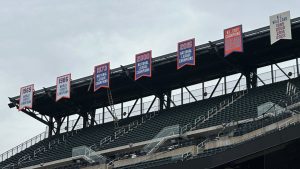 Looking forward to further realignment above right field, but not taking it for granted. The Mets, meanwhile, are Rufless and ready for the new season, a season slated to start truly on time for the first time since 2019. May the start adhere to its schedule and the season encompass one Amazin’ Days after another en route to an indisputably Amazin’ Year à la those that have occurred periodically in our past. The Mets have updated the postseason banner procession above Citi Field’s right field promenade so it acknowledges first the franchise’s two world championships (the first of them from 1969, as later editions of the Daily News would confirm), then its three National League pennants (the last of them clinched when Daniel Murphy was 30 and on a roll), then all six division championships listed on one placard, then the four Wild Cards listed on another, with 2022 receiving its due therein. Seven banners covering ten Amazin’ appearances in October, not all equal in stature, but varying degrees of achievement fairly noted. Even in the Steve Cohen Era, landing in the postseason six months hence is the most you can ask hope for before April.
• First place would be swellest.
• A playoff berth might have to suffice.
• Just get there and then do something with it.
Pete Alonso has mentioned how the heightened stakes of the WBC will have him ready for this October. I’m glad he’s confident. I’m confident. But worry about March 30 versus the Marlins in Miami first and take it from there, Pete…and everybody else. Never take for granted a seventh month will be affixed to a baseball season, no matter what you’re projecting or predicting on the eve of the first month.
For the season about to be in progress, an enormous scoreboard has been installed at Citi Field to post all the zeros imported ace Verlander and incumbent ace Max Scherzer will post, along with the hits and runs that will be registered by the home team as balls fly over the right field fence that’s been pulled in to create space for that fancy “speakeasy” with the fancier price tag. If you can’t afford the membership fee to the Cadillac Club at Payson’s, there is now an eatery/drinkery called the K Korner setting up shop as the in-house saloon where all are welcome to invest and imbibe. Old-timers among the fans recognize the K Korner as a Shea homage. Old-enough timers may reflexively refer to the K Korner’s spot as McFadden’s, which hasn’t operated in several years, except as an injection point for vaccines. Citi Field is entering its fifteenth season. It’s old enough to have old-timers. Remember those impossible to reach black fences? Remember the Ebbets Club? Remember when the Wilpons owned the team and probably wouldn’t pay a Darin Ruf to simply go away?
Time just slid into home and is coming up to bat again.
It’s daybreak on a new baseball season at National League Town.
by Greg Prince on 21 March 2023 8:39 pm The Mets are opening a “speakeasy” out in right field. I think Prohibition has been over roughly 90 years, so I’m not sure why one would need to know a secret password to get in, but why quibble with a concept, especially when the name of this high rollers club is intended as an homage to someone who has long merited an homage at Citi Field?
Welcome to The Cadillac Club at Payson’s. Or welcome to the news that it exists unless you are one of its “25-30 members” and get to fill one of its “only 100 seats,” per the press release announcing its debut. I assume I’ll have a great chance to see it when Steve Gelbs leads SNY viewers on a guided tour. Otherwise, I’ll just have to be happy that Joan Payson’s name graces something that sounds pretty sweet. Joan Payson bought us a National League franchise that’s still here. The least the Mets could do is acknowledge her more strongly than they have. If an automotive sponsor has to be involved, so be it. I’m guessing Mrs. Payson rode to Shea in something more than a compact.
Getting to see and think about Mrs. Payson inevitably takes a historically minded Mets fan back to the beginning of the ballclub, when the principal owner gave her blessing to George Weiss’s plan to bring in familiar figures with whom fans were likely to identify in “I know who that is!” sense. Experience wasn’t lacking. Consider the very first lineup the Mets sported in St. Louis, 61 years ago this April 11:
Ashburn CF (first MLB game 1948)
Mantilla SS (1956)
Neal 2B (1956)
Thomas LF (1951)
Bell RF (1950)
Hodges 1B (1943)
Zimmer 3B (1954)
Landrith C (1950)
Craig P (1955)
Pretty seasoned for a first season. Not a single career among the starting nine began later than 1956. The Original Mets had been around. Wear and tear was implied when players were made available by the other NL enterprises for drafting, signing or trading purposes. Two of the Mets who got the team going, Ashburn and Hodges, are in the Hall of Fame today. But by 1962, many of those guys were already playing like museum pieces.
Another living, breathing icon in uniform, Casey Stengel, understood the veteran lineup would get him only so far. Casey didn’t wish to be underestimated because he was managing in his seventies back when that was considered irrefutably ancient, but he also understood the value of new blood pumping through the Metropolitan veins. Thus Ol’ Case devoted much of his March every March he managed the Mets touting the future in the figures he dubbed the Youth of America. If it was Spring, it was time to look ahead to the prospects who were going to make the Mets sooner or later and make the Mets’ prospects better as soon as possible.
It’s Spring. Sussing out and talking up the Youth of America is still what we do. Granted, we’re coming off a better season than Casey ever helmed in orange and blue, but we can’t be blamed for peeking around the corner of what we’ve already experienced, especially if we have up-and-comers coming up. It’s been a pretty promising month for getting a taste of those who’ve been ripening on the farm.
Mark Vientos has notched eleven RBIs. Ronny Mauricio, before being sent down, bopped four highlight-quality homers. Brett Baty, getting lots of time at third, is batting .342. Francisco Alvarez, not quite healthy when camp started, has slighter numbers, but we can then say, as we say when the veterans are stuck on the Interstate at this juncture of the calendar, it’s only Spring Training. He’s still Francisco Alvarez. He’s still highly touted. The Mets have catchers and at least half a designated hitter. Alvarez can wait.
They can all wait beyond March 30, 2023, in my instinctive judgment. Get really good at fielding or not striking out or whatever it is ya gotta work on. The kids have time. We have time. I think we do. We certainly have experience, if not far too much of it à la 1962.
Let’s write out a pretend but not altogether hypothetical lineup that we might actually see on Opening Day if Brandon Nimmo’s heart of hearts and knee and ankle are all on the same page…
Nimmo CF (first MLB game 2016)
Marte RF (2012)
Lindor SS (2015)
Alonso 1B (2019)
McNeil 2B (2018)
Canha LF (2015)
Vogelbach DH (2016)
Escobar 3B (2011)
Nido C (2017)
That’s the lineup from the last time the Mets played a non-exhibition game — the quiet denouement of last season’s Wild Card Series — and it didn’t generate much offense (one hit), but it was only the playoffs. The sample size from the rest of 2022 was a little bigger, and I’m willing to ride with the guys who hit most (if not all) of last year.
To a point. The kids are coming with the idea that they’ll budge their way into not-so-hypothetical lineups. They’ll alight when the moment is right. New blood. Budding careers. Sooner, later, eventually.
***
In the realm of experience, if you were sentient and a New Yorker on May 8, 1970, you were able to experience a sports moment you will never forget. Willis Reed was hurt. Really hurt. Basketball tends to require the use of two legs. Willis could depend on maybe one. He played Game Seven of the NBA Finals anyway. Got cortisone injected and went for it when nobody was certain he would. I was seven years old. I couldn’t believe Willis wouldn’t play. I’d just spent my first full season of engagement in any team’s fortunes believing in Willis Reed — the center, the Captain — and not believing any opponent could stop him.
Not that I thought in terms of just Willis Reed. Red Holzman didn’t align his Knicks around a single player. We had Frazier and Barnett, DeBusschere and Bradley, the Minutemen (Russell, Stallworth, Riordan) and, in stray minutes, Bowman, Hosket, May and Warren. But Willis was in the middle of it. He was the MVP of everything. He was the leader on the floor and in the locker room. From October of 1969 (after the ticker tape had been swept from Lower Broadway) to May, I was obsessed with Those Knicks like I’d never be obsessed with the Knicks or any non-Mets team again. My parents had season tickets. Some my father used for business. Some I guess he sold. Some games they went to and cheered wildly. They took my sister and me to a few games at the Garden, including one in the playoffs. What a place to be when you’re seven! They had taken us to the circus there as well. I preferred the Knicks. We listened to the home games we didn’t attend on the radio with dinner, my introduction to the velvet vocals of Brooklyn’s own Marv Albert. Road games were on Channel 9. I watched those, even the late night ones on the West Coast, even if it was a school night. Did my mother mind my staying up past midnight for basketball? Who do you think I was watching with? I didn’t get enough sleep, but I got through first grade all right.
Willis Reed, who I kept reading wasn’t really as tall as the 6’ 10” at which he was listed, was revered in our house as a giant. A friendly giant. A fierce center and a good man. The whole crew, straight through to Red’s trusty sidekick trainer Danny Whelan, felt like mishpacha — extended family, but more interesting than our cousins. Sixty wins in an 82-game schedule. The Bullets series, with Willis withstanding Wes Unseld in seven, was a lesson in confident tension. The Bullets were good, but they were from Baltimore, and I’d already seen the Orioles get taken down by the Mets and was up to speed on what happened between the Jets and the Colts. The Bucks series, which we won in five amounted to a coming out party postponed (sorry, Alcindor, not yet). Here came the glamorous Lakers of Wilt Chamberlain and Jerry West and Elgin Baylor with everything on the line. That trio was as imposing as anything. But we were led by Willis Reed, at least until Game Five and an injury that should have made handling Wilt impossible. Holzman had other notions. He wouldn’t have been the coach he was if he didn’t know how to adjust. He deployed DeBusschere, the prototype of a power forward, to stay on the Stilt, and it worked. The Knicks took a 3-2 lead. The next game, the Knicks missed Willis like crazy. Thus, Game Seven.
We hung on bulletins indicating whether Willis was going to be well enough to take the court that fateful Friday night. My mother had to talk me down from my high anxiety that this wonderful team we had watched race to a 23-1 start in the fall might somehow not be the champions. If the Lakers win, she suggested, they’ll have deserved it. They’re a good team, too. All the advice my mother tried to impart to me in the next twenty years of her life, and those are the words of wisdom that I return to most often. When the Mets or any team I root hard for faces a big game, I try to remind myself that there’s another team on the other side, and they are not to be disregarded. It doesn’t always soothe me.
Mostly, I believed Willis was going to play, because Willis seemed incapable of letting us down. Sure enough, Marv told us as we started dinner (home game, therefore blacked out locally, and my father chose not to invest in finals tickets), “Here comes Willis Reed!” Willis would play, Willis would start, Willis would sink two jumpers — on one good leg — and the Knicks were about to revert to form, which is to say the Knicks who won eighteen in a row in October and November. With Clyde turning in the most low-key immortal performance in any Game Seven ever (just 36 points and 19 assists), the Knicks quashed the Lakers. Willis didn’t have to do much more than show up. The game felt won the instant his presence was announced. He and that team were destiny personified.
Those Knicks would just miss making the finals the next spring; go the championship round and lose to the Lakers the spring after that; and then take one more trophy the next spring, in 1973. My parents dropped the season tickets in 1970-71 and 1971-72, but signed up all over again for 1972-73. I got to go to a bunch of games during the regular season and a game in every round that year, including the finals. I was at the Garden for the legendary double-OT Easter Sunday win over the Celtics. It was legend before it was over. My father pounded a tile out of the ceiling over our seats. I’d be telling that story forever after.
There was one more go-round for Those Knicks, but it was obvious to all — including this by now experienced eleven-year-old — that they didn’t have much left. The Celtics took care of them pretty easily in the conference finals. Willis, who had trouble staying in one piece after the first championship, retired. So did DeBusschere and Jerry Lucas, who, like Earl Monroe, brought shimmering individual credentials to Holzman’s Knicks and blended in beautifully. I remained a Knicks fan in the sense that I didn’t become a fan of any other NBA team — the Nets were still in the ABA — but I never cared as much as I did when Willis stood tall in the middle of everything, gradually reducing my rooting interest to sporadic, then non-existent. Something in my heart of hearts told me accept no substitutes.
But, boy, did I love Those Knicks and did I love Willis Reed and did I love sharing him and them with my mom and dad. I read the statistics in the paper, and got that Willis was great. But Dad filled me in on what made Willis great beyond points scored and how Willis made everybody around him better. So did Clyde. So did DeBusschere and Bradley and Barnett and everybody else. That’s the kind of basketball Holzman preached. That’s the kind of team it was. When I learned on Tuesday that Willis Reed died at the age of 80, I at the age of 60 understood it. The seven-year-old version of me only believes that Willis is there when we need him.
by Greg Prince on 20 March 2023 5:17 pm Brandon Nimmo is “week to week” with whatever he did to his right knee and ankle this past Friday night in yet another game that counted only as much you wish it to. The Mets termed it a low-grade sprain. Nimmo, newly signed for eight years, isn’t interested in timetables or diagnoses that indicate anything less than “leading off and playing center field, number nine, Brandon Nimmo” will echo throughout formerly Marlins Park on Thursday March 30 and everywhere else clear to the end of 2030. He’s got “a best-case scenario” going for him, he’s convinced, despite the slide into second that had him limping off the field and all of us dragging a hand down our collective face following the second OMG/WTF moment in about 48 hours. He’s respectfully dismissing the company line Billy Eppler delivered and is instead taking it “day to day,” insisting he felt better Sunday than he did Saturday. He’s consulting with his “heart of hearts” and believing he’ll be “ready for Opening Day,” or at least is “not ruling anything out right now”.
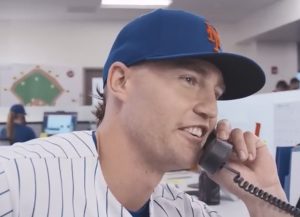 Grin and bear another injury. For such conditional silver lining mining of the clouds over Port St. Lucie, pending, of course, what the doctors have to say on the matter, Brandon Nimmo is my co-player of the year before it begins, sharing never-too-soon honors with Edwin Diaz, who told Eppler in the dark hour the Mets weren’t expecting to arrive on March 15, “Don’t worry. This is going to be fine.” Once the year begins, we’ll start fresh, but that type of attitude registers as a welcome antidote to whatever the rest of us are thinking every time anything befalls a Met…or any time anything might possibly befall a Met. When it was reported in passing on social media over the weekend that Max Scherzer would be hosting a “crawfish boil” for his teammates (I put the event in quotes lest you think I have any idea what a crawfish boil is), I’d say approximately every third Mets fan comment posted in response veered to wondering how many starts Scherzer would miss from burning his tongue on main dish.
Is March a little too early for Pessimism, Skepticism, Cynicism and Fatalism — the Four Horsemen of the Metspocalyspe — to be out and about? With Steve Cohen sending a veritable TLC staff to Diaz’s house to make sure his recovery proceeds apace and, more to the point, capable of doing and willing to do whatever it takes to not let a couple of injuries to a couple of crucial players derail the projected Mets Express? With shreds of evidence suggesting maybe Edwin won’t necessarily be out all of 2023? Perhaps it’s just the painkillers talking when “a person close to Diaz” tells The Athletic, “There is some optimism” on behalf of Edwin’s surgically repaired patellar tendon (and the rest of Sugar) returning to action while there’s still some championship baseball to be contested. I wouldn’t take that to whichever gambling consortium will be carpetbombing its commercials all over Mets telecasts, but it’s a pleasant enough thought. You lose Diaz for the foreseeable future, and Nimmo for an unspecified number of weeks, and Quintana to a tough break that will have him out several months, and whoever else has already been sidelined or will be sidelined in the course of Metsian events, you welcome coming up with whatever it takes to fend off Pessimism, Skepticism, Cynicism and Fatalism. It’s probably the last two that had Scherzer getting too close to the boiling crawfish.
Nimmo, it should be noted, sustained his injury in a Spring Training game. There was no celebrating, just kind of a crummy slide. Yet he and Diaz are both out for a spell or more. Quintana had a lesion on his rib. Sorry it was there. Glad they found it. Thrilled it was benign. All kinds of hell will appear at every turn for a baseball player and a baseball team preparing for the season ahead. Sometimes you’re luckier than hell. Pete Alonso had a serious car accident on his way to camp last March. “A close experience with death,” he called it then. He walked away physically unscathed. Sometimes you catch a break despite another driver running a red light. Sometimes you tear a patellar tendon because somebody’s happy you won what you consider a big game. Sometimes you’re just trying to get from first to second. Never mind bubble wrap. Let’s ask Cohen to get us the best possible players and simply put them on display in the Jackie Robinson Rotunda for us to admire, relatively certain nothing terrible will happen to them if they promise to not budge. The second anybody begins to move a muscle is when we brace for the worst.
That strain of anxiety stems from a shall we say checkered past that ran, then limped through last week. This week we go on. Next week the season starts, without Diaz, without Quintana, probably without Nimmo, Brandon’s heart of hearts notwithstanding. All the Mets won’t be ready to go, though there will be a full complement of Mets, a few unexpected when we began shaping expectations about this year, but that will happen (which is why preseason expectations are best formed out of the most malleable clay available). I hope to unconditionally release those Four Horsemen of the Metspocalypse from of our system by Opening Day, or at least reassign them to crawfish cleanup duty at Max’s place.
|
|






