The blog for Mets fans
who like to read
ABOUT US

Faith and Fear in Flushing made its debut on Feb. 16, 2005, the brainchild of two longtime friends and lifelong Met fans.
Greg Prince discovered the Mets when he was 6, during the magical summer of 1969. He is a Long Island-based writer, editor and communications consultant. Contact him here.
Jason Fry is a Brooklyn writer whose first memories include his mom leaping up and down cheering for Rusty Staub. Check out his other writing here.
Got something to say? Leave a comment, or email us at faithandfear@gmail.com. (Sorry, but we have no interest in ads, sponsored content or guest posts.)
Need our RSS feed? It's here.
Visit our Facebook page, or drop by the personal pages for Greg and Jason.
Or follow us on Twitter: Here's Greg, and here's Jason.
|
by Greg Prince on 6 October 2022 4:02 am I packed an asterisk and a caveat as I set out for my 27th consecutive Closing Day. Unlike water bottles whose caps aren’t fully sealed, security waved them right through.
A rain delay nudged Closing Day into Closing Night. Closing Night closed only so much. The door to Citi Field and the Mets’ ultimate 2022 fortunes was left ajar. Really, that’s the ideal scenario after 81 home games and 162 games overall. Management won’t instruct maintenance to shut our ballpark tight for at least a few more games, hopefully not for several weeks. But the regular season is the regular season, an immersive journey we all anticipate as soon as the last one ends. This one, per usual, grew into our everyday obsession. We lived in it. Then, as ever, it prepared to end.
That end is always worth acknowledging. Dating back to 1995 and winding through every year that fans are welcome on the premises, I actively acknowledge it by attending the final home game on the schedule, original or revised. In 2022, the schedule was revised by The Lockout. Closing Day was initially intended to be Closing Night, and it was supposed to have happened last Wednesday against Miami, before Atlanta (when we were all so much younger and more innocent). These final three games against Washington were March and April refugees, tacked onto the last squares of the grid to make sure every last inning got played. Hence, Game 162 experienced a couple of changes of lives. It was no longer an early-season affair and it was no longer life and death. Games 157, 158 and 159 more or less saw to that.
Did I care that Game 162 was almost a formality? Do I ever let my care fall prey to priorities? Would I show up on 27 consecutive non-pandemic Closing Days if I did? My streak commenced to crawling when I crossed my fingers that the 1995 Mets would finish on a relative high of 69-75 (they’d been 35-57); resigned myself to the 1996 Mets whimpering into winter at 71-91; and cried actual tears of joy that the 1997 Mets were reaching 88-74. None of those Closing Days left any doors ajar.
A game that started as Wednesday night’s did, with a record of 100-61 while providing a conduit to a genuine postseason series, was certainly no less inviting than its 26 predecessors, regardless that the lunge for 101-61 would gain us not another inch of ground in a race for seeding nor a glitzier array of officially licensed merch. The two-seed and the five days of rest and revival accompanying it were out of our grasp. The t-shirts designed to stoke our impulse purchases would never say 2022 DIVISION CHAMPIONS. Overarching squad goals weren’t what this Closing Night would be about. Just the end of the long grind and a bit of a glimpse at the hard sprint ahead.
And a threat of rain. Rain threatened this game like this game had lunch money jingling a little too loudly in its hip pocket on its way to biology class. Rain proved to be nothing more than a bully. Show a little spine, and the rain would get lost, leaving only a delay in its wake. More delay than rain is what fell over Flushing. I swear, it rained for like three minutes at Citi Field a little ahead of what was supposed to be 4:10 first pitch, but the mere threat of rain made those empowered to order a tarp removed quake in their galoshes.
So we waited and we stared at the tarp. The Mets didn’t give us anything else to stare at. The large video screens showed a Mets logo. Not highlights from the 100 wins of 2022. Not highlights from championship seasons past. Not even Freddie Freeman at-bats for those tracking the dropped-from-the-sky duel for the National League batting title in which Jeff McNeil had charged from behind like a maniac while Freeman didn’t do anything wrong, he just couldn’t withstand McNeil’s pace (gee, sound like any two teams you know?).
The Mets didn’t utilize their superb video technology to show any of that. But that logo of theirs was plenty sharp.
I managed to entertain myself for a while during the delay. I grabbed a few distant photos of the recently extended set of retired numbers. When I saw 24 with my very own eyes, I actually smiled; I’ll never not smile that the Mets honored Willie Mays. When I spied a short Shake Shack line, I chose to indulge. Thirteen games at Citi Field this season, not one Shackburger devoured. I cradled bun and beef, protecting it from the three minutes of rain, until I reached a community eating table on the Excelsior level (access to covered seating was another Closing Day indulgence of mine) and savored the very first bite. Then the second. Then the others. Usually at the ballpark, I wolf down food without realizing it. I don’t have any more ballpark meals planned for a while. I really wanted this one to last. I treated a Fan Appreciation Day $5 hot dog with similar reverence.
The portion of the crowd that seated itself during the delay finally got to greet its heroes: the grounds crew. They wore orange and blue and they were taking the field. That was good enough for us to adopt them as our favorite team and applaud them vigorously. It was decided by somebody somewhere that the bone-dry tarp could be lifted. The Citi Field A/V squad sprung into action, too. “Thunderstruck” as the tarp was tackled; “Roll With It” as the tarp was rolled; “Push It” as the tarp was pushed. CitiVision should have shown grounds crew highlights from previous delays. They’re good.
A little prior to six o’clock, there was a ceremonial first pitch. A bit closer to six o’clock, there was a second ceremonial first pitch. And with six o’clock fast approaching, there was a third ceremonial first pitch. Since they were all ceremonial, we’ll let their eerily similar numerical designations slide.
The fourth first pitch was delivered by Mychal Givens, who’d been gone so long, Buck Showalter apparently forgot that Givens is a reliever rather than a starter. Or, more likely, the skipper figured an inning as an opener was good practice for whatever Mychal might contribute in the days ahead now that he’s recovered from his secret IL ailment. The theme of Closing Day turned Closing Night seemed to be “why not?” The Mets fielded a lineup with approximately three regulars, a lineup emblematic of a team going nowhere most years or a team going somewhere and not wanting to risk too many of its essential components en route this year. You could have imagined this being the Met lineup the day after a division-clincher. Maybe you did and tried to imagine something else.
Givens gave Buck the inning he needed to see. Trevor Williams, the projected starter as of 1 o’clock (Showalter’s personnel decisions may as well be troop movements disseminated purely on a need-to-know basis), would take over in the second, but before he’d ceremoniously throw his first pitch, he’d be treated to a lead a starter or even a bulk guy dreams of, courtesy of Mark Canha’s three-run homer inside the left field fair pole; of course it’s the fair pole, it’s a FAIR ball! After Williams had pitched one inning, Francisco Lindor’s three-run double doubled Trevor’s lead. In the bottom of the third, pseudo-regular James McCann, subbing at first base, belted a three-run home run of his own, sending marine biologists who were convinced that if McCann fell out of a boat he wouldn’t hit water back to their labs to adjust their heretofore flawless predictive models.
Just like that, the New York Mets led the Washington Nationals, 9-0. Starter Erick Fedde gave up all nine runs, all earned, the last three to a barely platooning catcher who entered the day batting .182. Fedde was left in to face Terrance Gore, the pinch-runner moonlighting as Game 162’s center fielder. Gore ripped a single to left for his first base hit since literally 2019. That was the bridge too far for Nats manager Davey Martinez. He removed Fedde from the mound. I wished he’d left him there, not so much so the Mets could run up the score some more Wednesday, but so maybe Bob Melvin would draft him to pitch for the Padres Friday night.
If you collected baseball cards in 1974, you know some San Diego players were rebranded members of WASHINGTON “NAT’L LEA.” just in case the Padres followed through on their threat of moving east, a threat that proved as genuine as that which the rain posed to Citi Field Wednesday. In light of that tenuous San Diego-Washington connection, I’m suggesting there would be precedent for Erik Fedde to pitch Game One of the Wild Card series instead of letting Yu Darvish take aim at the Mets.
C’mon, Rob Manfred. Use your “best interests of baseball” authority for something more than tacitly endorsing sponsorships centered on guys making bets on their phones while reigning on their thrones.
A 9-0 lead, even when it became 9-2 somewhere along the way, facilitated flights of fancy. It also carved out an interlude to announce that Freddie Freeman (.325) did not collect enough base hits in Los Angeles to overtake the idle Jeff McNeil (.326). Buck sat Squirrel for his own good. Squirrel stood up long enough for a well-deserved curtain call. We don’t get batting champions every day. When we do, they’ve been known to scoot away before we can get a good look at them.
Williams went six. McNeil entered for defense. Lindor exited to applause after giving 161 games of himself. Francisco Alvarez and Mark Vientos functioned as real major leaguers in the field rather than mono-skilled curiosities. Those fans not seated in Field Level were invited to sit in Field Level. I was quite comfortable in Excelsior (grander name), but many among the not many in attendance took the Mets up on their reasonable offer. Pre-Steve Cohen, even looking at a Field Level seat without a Field Level ticket— regardless of how many empty Field Level seats looked back at you — was grounds for Citi Field dismissal. Maybe policies are loosening up. Maybe somebody noticed it was Fan Appreciation Day and thought it might be nice to appreciate the fans who withstood the two-hour rainless delay.
With Trevor May and Joely Rodriguez brushing aside the last of the modern-day “WASHINGTON NAT’L LEA.”, the Mets posted a 9-2 victory, concluding their schedule at 101-61. Only the 1986 Mets won more regular-season games in franchise history. This is stated as a point of fact, by no means intended to persuade you of the merits of a 101-61 team that finished tied for first in its division if you glance at the standings very quickly and don’t take a magnifying glass to the agate type that denotes the other team that finished tied for first is technically considered division champion. Heavens, no. The 2022 Mets were the worst 101-61 team in the National League East during the 162-game regular season. Keep telling yourself that to make certain you never feel any better about the entirety of the past six months.
Of course that regular season and those six months are now over. I saw its ending for myself. Asterisks and caveats aside, it percolated with good vibes. Personally, I reveled in having just witnessed my 300th regular-season home game at Citi Field, one that raised “my” 2022 record to 10-3, accounting for the best winning percentage (.769) the Mets and I have joined forces on in any year I’ve attended more than two games. The only thing this Closing Night was missing was a true sense of finality. This time of year, I deeply value finality.
But I prefer impending playoffs far more.
The window has closed on the 2022 regular season. But the door has opened on the 2022 postseason. Enter that intriguing portal by listening to the latest episode of National League Town.
by Jason Fry on 5 October 2022 12:33 am On Tuesday morning, pulling up my email in an idle moment at work, I noted that Mets postseason tickets were on sale — and then I deleted the email that had told me that and went back to work. It wasn’t until an hour or so later that what I’d done — or rather, what I hadn’t done — registered.
Wait a minute. Am I so mad at my baseball team for how they got into the playoffs that I’m … not interested in going to a playoff game? What, exactly, am I proving and to whom?
Emily was a voice of wise counsel. So was the co-worker I half-hoped would tell me that playoff tickets were frivolous. A few minutes later, I’d spent a ridiculous amount of money for nine tickets on three dates. Screw it, I figured. If the Mets are going to stomp on my heart, they may as well also kick the shit out of my bank account. But even then, I felt ambivalent, even uneasy — like the guy at the poker table who’s trying to figure out who the sucker is.
What’s happened since Friday night has been a journey — a journey that continued Tuesday afternoon and evening, as the Mets swept a doubleheader from the Nats and watched their division hopes fade to black when the Braves edged the Marlins to clinch the NL East.
And yet, somehow, it’s a journey that’s brought me back where I’d hoped I’d wind up while fearing I might not.
I’ve forgiven the Mets — or maybe that hasn’t quite happened yet but I’ve at least accepted what didn’t come to pass. The important part is my baseball team is hosting wild-card baseball on Friday, and I’m in.
It helped that my baseball team played the kind of games we’d come to appreciate and then (perhaps unwisely) to expect. The Mets beat the Nats in Game 1 behind sharp defense, capable relief and some impressive hitting from Brandon Nimmo and Jeff McNeil, then obliterated them in Game 2, kick-starting the bottom of the first with back-to-back-to-back homers and hanging seven runs on poor Paolo Espino in a third of inning.
It helped that Francisco Alvarez, alternately luckless and jittery in his trial-by-fire debut against Atlanta, found his footing and then some, blasting a mammoth home run in his first Citi Field AB and following that with a rifle-shot double. It’s not exactly a long-shot wager to say those will be the first of many, with Alvarez perhaps becoming a force as early as this weekend.
It helped watching McNeil slash balls all over Citi Field and out of it too, taking the lead on Freddie Freeman in the NL batting race. McNeil has been a joy to watch all season, erasing his lackluster, uncertain 2021 with a campaign that’s married offensive mayhem with much improved defense. A fun game on our couch this year has been “Why Is McNeil/Scherzer Enraged This Time?” — those two are each other’s bookends, playing baseball like twin kettles boiling over, and it’s alternately hilarious and a little scary to watch.
It helped knowing the Mets had reached 100 wins, which might not have been quite enough this year but was a level they’d only reached in three other seasons. Two of those ended with World Series titles and the third expired in dismay and disarray, but that’s baseball.
All of that helped, and when Kenley Jansen coaxed a flyout from Miami’s Jordan Groshans, I did an emotional inventory and found I was … well, one might even say disappointed but no longer devastated. Yes, perhaps you remember those words in another context. That’s my point — baseball would be the death of us all if we weren’t able to turn the page, to put some healthy distance between past unhappinesses and present possibilities. No dedicated baseball fan ever forgets — there are failings and fizzles that play on repeat up there on the ceiling when we’re fuming sleepless at 4 a.m. — but in remembering, you have to make room for the idea that something good might happen one day.
Maybe even one day very soon.
Plenty of Mets seasons have ended with a little ember we’ve had to convince ourselves is a spark that will grow into a bonfire — think what we would have done with two Game 161 hits from a Francisco Alvarez in 1993 or 2004 or some other dismal campaign that we weren’t actually sad to see breathe its last. But this isn’t one of those seasons, however much it may have felt that way this weekend and during our rainy sulking Monday. Someone I know from Twitter asked how a 100-win season could feel so depressing. This was my response: Wipe the slate clean. Win the next four series — even by just a game each — and they’re all immortal.
That would have been courageous but empty talk this weekend or Monday or even between games Tuesday. But by the end of the night I believed it.
I have a ticket for Wednesday’s game. I’d decided before the Braves series — thanks in large part to some wise words from my blog partner — that I wasn’t a jinx and could safely attend. But today and even tonight, I wasn’t sure I wanted to. After all, the game was likely to be meaningless — not to mention cold and dreary. And, well, there was the fact that I was still pissed off.
But somehow that meaninglessness became a selling point once second place was official. Wednesday’s game will be the only stress-free one played in October. It will be a chance — weather permitting, of course — to look around the park and cheer on McNeil’s batting-champ chase and compare notes about roster construction and play amateur scout and fret and kvetch and maybe even dream a little. How could I miss that?
Friday will be different. The slate will be clean — erased of accomplishments and shortcomings alike. And I’ll be all in, both eager and anxious to see what’s written. You should be too.
by Greg Prince on 4 October 2022 2:51 pm Good news: the Mets weren’t eliminated from winning their division Monday night, cleverly getting rained out while Atlanta (you’re not gonna believe this) lost. Not only did the Mets gain ground by not doing anything but pulling a tarp over the field, but Jeff McNeil overtook a declining Freddie Freeman in the batting race simply by not getting wet. WE’RE NO. 1 at something.
Bad news: the Mets weren’t eliminated from winning their division Monday night, which is only bad news if you’re in the get it over with already camp, which I will admit visiting until first pitch in Miami, when my true orange-and-blue instincts took over and snapped me back into wishing the Braves not even incidental goodwill in theoretical service to our desire for clarity. The Marlins seemed unlikely to sweep the Braves heading into their final series. They seemed unlikely to postpone the inevitable at all. But they beat the Braves once and still have two games to go. What the hell? Brew up a mug of Bigelow and tease proudly.
Good news: The Mets are one of three teams from their division going to the playoffs, speaking not only to our still having something to look forward to after the events of the past weekend, but to the strength of the division that has catapulted more than half of its occupants forward toward potentially greater things.
Bad news: We intensely dislike those two other teams from the Mets’ division who will be joining us in the postseason tournament, but we’d intensely dislike them regardless of where everybody finished.
Hail the unusually potent National League East; its Mets; its Braves; and its Phillies, each accomplishing a clinch of some sort in the same season. How unusual is that? If it were the usual, it wouldn’t be noted here. This is the first time we’ve sent three NL Easterners to the playoffs. The NL East has been around since 1969. Three teams from the same division in the playoffs have been a possibility since 2012’s expansion to two Wild Cards per league, yet 2022 (with its expansion to three Wild Cards per league) makes this circumstance a maiden voyage.
Congratulations?
Too soon for anything but the rending of garments over the Mets’ recent momentum shift and the spitting of venom at the Braves and Phillies, especially should we cross paths with either of them later this month, but together, these three are having a good year. Not only are three postseason berths in the NL East a first, reaching the season’s final breaths with three teams having as many wins as these teams can claim is rare. The Mets are at 98 wins and holding. The Braves have a couple more. The Phillies won their 87th on Monday night, which got them their first playoff spot since 2011. How often has the National League East featured three teams with at least 87 wins?
Glad you asked. The last time it happened was 25 years ago, in the golden year of 1997, more teal than gold in light of the world championship captured by the Florida Marlins, who made very good use of their Wild Card (the first achieved by an NL East club), topping the already perennial division-winning Braves in the NLCS. This was only the fourth year of the five-team National League East, only the third that was played to a strike-free conclusion, but the Braves were already making it their happy hunting ground, having taken the title in 1995 and 1996 while preparing to take the title from 1998 through 2005. And nipping at the heels of both? The revivified 1997 Mets, who went 88-74 after a veritable eon in the desert (six consecutive seasons of losing records, but as with all episodes of Met despair, it felt longer). Bobby’s V’s low-profile Mets made a legit run at a playoff spot. They fell short, yet they might have stitched together something even rarer for this franchise than the pouring of champagne. They left you feeling very good despite technically going nowhere but home at regular season’s end. That’s an emotion an 88-74 record that doesn’t rate as much as a six-seed will probably never elicit again.
Following 1997, the National League East shaped up as a powerhouse for years to come, with the 101-61 Braves being, you know, the Braves, and the 92-70 Marlins being stacked. Then Wayne Huizenga decided his defending world champions weren’t likely to draw more than millipedes and centipedes from the South Florida market and went about destacking his talent. This worked out pretty well for the Mets, as it directly provided us Al Leiter and Dennis Cook; indirectly provided us Mike Piazza; and eliminated the Marlins as an archrival, save for a couple of key series a decade later, but you already went there in your head.
For another handful of hours, we situationally root for the Marlins. That will expire as soon as we finish our mug of Bigelow. #TeaseProudly
Prior to 1997, the 87-win barrier being breached three times in an NL East season happened three times. Once was in 1993, when the Mets weren’t one of the three teams — the kooky Phillies, the spunky Expos and the Jefferies Cardinals — with 87 or more wins (87 or more losses is a different story). Once was in 1987, with the 91-71 Expos staying within striking range of the 92-70 Mets and 95-67 Cardinals, though the stretch drive was primarily a two-team derby that doubled as a miserable 1986 hangover headache. Another instance can be said to have sort of happened in 1981, if you prorate the winning percentages of the first-half champion Phillies, second-half champion Expos and overall-for-naught best-record-holder Cardinals across 162 games, which you’d have to for a season that played out minus a middle. Plus the Mets weren’t involved. We can say definitively it didn’t happen.
The only other version of the National League East to contain three teams with at least 87 wins actually had four teams with at least 87 wins, and that was the 1969 National League East, which was the very first National League East and quite the crucible. The defending National League champion Cardinals of Bob Gibson and Lou Brock finished fourth with 87 wins. The not-too-distant-future division champion Pirates of Roberto Clemente and Wilie Stargell finished third with 88 wins (they’d improve to 89 and take the division in ’70). The team that was in first place more days than any other in the East, as if that’s something they give out a prize for, the Chicago Cubs of Fergie Jenkins and Billy Williams and so many more who were thought to be so unbeatable, finished second with 92 wins.
And your 1969 New York Mets finished first with 100 wins. Which is something the 2022 Mets can still do. The finishing first…maybe not so easy (go Marlins!?!?). The 100 wins…that would be nice if it doesn’t rain too much on the Mets and the Nats between today and tomorrow. The title the 1969 Mets are remembered for winning most…thanks to that playoff spot we clinched fifteen long days ago, we can still have the 2022 edition of that to raise up the flagpole on Opening Day 2023. I swear, it won’t even take a miracle.
by Jason Fry on 2 October 2022 10:58 pm Something I do when making real-world decisions is ask, “what’s the worst thing that could happen?” and then adjusting my plans as needed. (“I could get hit by a car that I won’t know is coming around that corner” = maybe don’t do that, while “the weather means the flight’s canceled and I get there in the morning instead of tonight” = don’t stress about it overmuch.)
Well, what just finished happening in Atlanta was, in fact, the worst thing that could happen, and it sucked. The Mets lost all three games, the NL East lead, the NL East tiebreaker, and barring the kind of derailment that hasn’t happened to the Braves since late May, the division.
Like I said, it sucked.
Lining up two aces and a demi-ace didn’t work, as all three failed to deliver the kind of shutdown performance you’d hoped for. (Which is not the same as the kind of shutdown performance that’s guaranteed, let alone that you’re entitled to.) More damagingly, the Mets’ bats were AWOL when really needed, doing almost zip with runners in scoring position — once again, this team really, really misses Starling Marte.
Meanwhile, the Braves did what they’ve done since Memorial Day; hats off to them, however reluctantly, for doing it. Add Dansby Swanson and Matt Olson to the lengthy roster of Met killers, and could someone please tell Travis d’Arnaud that we all hate Jeff Wilpon too, and that’s enough already? I could break down Sunday night’s game beyond that, but I don’t particularly want to and I doubt you want me to either.’
It sucked, and the Mets go home to play three with the Nats (weather permitting, which is its own little bit of irony) watch the Braves clinch at some point and, I dunno, have some sort of sour, perfunctory celebration of Plan B. It’s about as bittersweet an ending to a ~100-win season as I can imagine, one I have no doubt will leave me muttering and clenching my jaw all the way to Friday.
Ah, but there’s the thing: Friday.
The Mets are going to be part of the playoffs. They will play games beyond No. 162 — even if they somehow lose all three against the Nats and we all greet them with boos in their Game 163.
Does that take any of the sting out of “what’s the worst thing that could happen?”
It doesn’t right now, not even a little bit. It won’t when the Braves clinch. It won’t while we’re muttering about failures against the Nats, whether those failures are momentary and ephemeral or conspicuous and decisive.
But come Friday? I think it should. Because the playing field will be reset, the goals will be new and what happened before won’t matter.
Yes, we’ll have a harder road through the playoffs on paper. But I recall looking at a soft September schedule and tallying up likely Ws and Ls, and look how that worked out. No, we won’t be able to line up our top pitchers and have them all rested the way we wanted. But we just lined up our top pitchers, and look how that worked out. And I’m not convinced that rust won’t be a bigger factor than rest — just ask the 2015 Mets about those days off between the Cubs and the Royals.
On Friday everything resets. Focus on that, and not on what might have been. And try not to spend the week letting the gap drive you crazy.
by Greg Prince on 2 October 2022 12:12 pm Using a bookmark is usually a very effective method of keeping your place while reading. No “I was reading this really interesting book, but I seem to have lost my place, whatever will I do?” laments are necessary when you properly employ a bookmark. If you don’t insist on something fancy with a tassel, access to a bookmark requires no additional purchases. Nearly any thin household item that fits decisively but unobtrusively between pages should do the trick. For example, if you’re not planning on ginning up a game of rummy anytime soon, you can pick a card, any card, from a handy deck and, presto, you’ve got a bookmark!
Warning, though: The aces in your deck don’t automatically help you keep your place any better than anything else you use.
For the last two nights, Jacob deGrom and Max Scherzer pitched well enough to propel their team to victory. At the same juncture, they didn’t pitch well enough to unquestionably tilt the hand they held in their team’s favor. We know they’re aces their entire careers. On consecutive nights, they could’ve been mistaken for a pair of threes. Had they been available, you could have slotted, I don’t know, Mike Pelfrey and Dillon Gee in their stead and gotten roughly the same results.
Thing is, when you unseal your deck, deGrom and Scherzer aren’t supposed to look like Pelfrey and Gee or any perfectly decent pitchers from whom you’d be satisfied by three or four runs given up in five or six innings. They’re aces. Aces oughta be most adept at holding your place when your place is first and your opponent has designs on it.
Aces like they oughta be aren’t always what you wind up dealing.
One night after deGrom (6 IP, 3 ER, all on Brave home runs in a 5-2 loss) couldn’t do quite enough to help the Mets keep first place to themselves, Scherzer (5.2 IP, 4 ER, three on Brave home runs in a 4-2 loss) couldn’t do quite enough to allow the Mets to maintain any of it. In the aftermath of deGrom and Scherzer being Pelfrey and Gee — and the players who batted on their behalf bringing early-2010s energy to the table — the Mets have indeed lost their place. The heretofore first-place Mets are presently the second-place Mets.
Not lethal at this very late stage of the season. Not ideal, either, but hardly the end of relevant competitive pursuits. The Mets will play the Braves one more time, and the opportunity remains to:
a) win that meeting tonight;
b) in the process of winning tonight, tie for first place once more;
c) in the process of winning tonight and tying for first place once more, claim the division tiebreaker over Atlanta, thanks to what would be a 10-9 season series advantage;
d) defeat last-place Washington as often over the succeeding three dates as the Braves defeat the Marlins (doing it, not just saying it);
e) finish in first place;
f) exhale;
g) proceed to the Division Series without installing along their potential championship path an additional obstacle called the Wild Card Series, an exercise in which losing two games out of three would be lethal, thus you might as well avoid the extra steps and possible pitfalls inherent in that unforeseen detour if you can.
Should all of those absolutely conceivable events unfold, order up a clinching pizza and pour yourself a nice glass of bubbly. You’ve won the NL East. That’s something to toast and a fitting reward for a long season that, until very recently, has been extremely worthy of celebrating.
And if it doesn’t? If the second-place Mets remain the second-place Mets and go to the playoffs as the top-seeded Wild Card and commence postseason activity several days sooner than desired? Grab a slice and a sip anyway, for the answer lies within the question. The Mets will be in the playoffs. They’ll have to deal with a best-of-three against a quality team capable of knocking them off and out — at the moment, San Diego — and if that’s the draw of the cards between tonight and Wednesday evening, well, the Mets will be ensconced within a playoff structure that has been generously widened to allow for losing first place, provided you haven’t dropped it with a resounding thud and won sufficiently before a little too much ill-timed losing set in.
That’s not just the postseason the Mets are going to regardless of what happens in one more game at Atlanta and three versus Washington at Citi Field. That’s a whole new season, or a series of highly condensed ones. Close to a hundred wins and (hopefully) counting earns you at least that much these days: a chance to extend your winning ways or a chance to freshen up from your visit to the doldrums. Twelve teams out of thirty will be in the playoffs. Eighteen teams won’t. Even if they don’t shake off this sudden fascination with landing in second place, the Mets belong to the party of the first part.
Party like it’s 1999, like it could be 1969. It surely beats moping like it’s 1979.
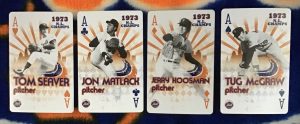 Having more than two aces can help you find your place again. What card do the Mets have up their sleeves to optimize the remainder of their journey? I do believe I see another ace. The name “Chris Bassitt” doesn’t shimmer from a distance the way “Jacob deGrom” and “Max Scherzer” do when they top the GAME TONITE marquee, but if the pitching half of my season came down to just one Met starter in 2022, and I pulled a Bassitt from the deck, I wouldn’t have the slightest inclination to throw it back. I do believe Chris has been the stealth ace of this team from April through September. Righty rather than lefty, I nonetheless get a strong Bobby Ojeda vibe from him. The Mets went 4-0 in postseason games started by Bobby O in 1986. Twice he was masterful. Twice he mastered the challenge of not letting a Game Six get away when it very well could have slipped into oblivion. Gooden, Darling and Fernandez all had All-Star accolades attached to their names headed into October of 1986. Ojeda, who didn’t, was the guy I wanted out there most.
(Bobby Ojeda and a problem with a finger on the eve of another postseason and its disturbing historical parallel to the current status of Starling Marte constitute a different thread for a different day. Not gonna pull on that one right now.)
DeGrom isn’t done because he didn’t outduel Max Fried on Friday night. Scherzer isn’t done because he didn’t outduel Kyle Wright on Saturday night. The Mets aren’t done because they didn’t touch the Brave bullpen enough on Friday or at all on Saturday. This ace talk can be a little simplistic. But aces do get your attention even if they don’t always hold your place.
On to the next pair. Chris Bassitt has the ball tonight. So does Charlie Morton. They’re both pitchers you’d assign a value of no less than jack, queen or king on any given day. Bassitt will have to be better than Morton. Met relievers will have to be better than Brave relievers. Met hitters will have to stir from their stupor. Have faith that these Mets — they of the “98” under W and an indelible “x” or “y” alongside their name depending on where you study your standings — can ace this test. I don’t know that they will, but they can. Faith, like the common household object you might use as a bookmark, is already something you have within easy reach. Don’t give up on it or these Mets. Don’t be overwhelmed by doubt. This is neither the time nor the place.
by Jason Fry on 1 October 2022 12:32 pm It’s a measure of how spoiled we’ve been: Jacob deGrom looks mortal (and for a second start in a row, no less) and we’re all scratching our heads as if God has repealed physics and things are falling up and sticking to ceilings.
DeGrom was better than he was in his confoundingly disastrous Oakland start, and he seemed to find his way in the middle innings, regaining control of the back-foot slider that had been annoyingly AWOL and looking more himself before a blood blister ended his night a little early. (Let’s not worry about that last part until it’s obvious we have to.) But he was still mortal, surrendering consecutive homers to Austin Riley and Matt Olson on pitches left in the middle of the plate, which isn’t a wise strategy against any team and a particularly poor one against an aggressive, powerful lineup like Atlanta’s. (DeGrom surrendered a third homer to Dansby Swanson, but that one was more cap tip than head shake, as it came on a change-up low in the strike zone that Swanson simply went down and got.)
That’s the analysis, but it’s missing the obvious context: Jake was facing the Braves with six games left to go and a division title in the balance, so “seemed to find his way in the middle innings” isn’t the headline. The headline is more like WOE! DOOM! @$#@*$@!!!!
The Mets lost, because deGrom wasn’t immortal and because Tylor Megill made things worse and because their hitters were stymied by Max Fried and a parade of Atlanta relievers. They made a little noise in the ninth, which either made you feel not better enough or added insult to injury, depending on your temperament. They lost and we’re now tied all over again. (It’s been noted before, but once again for posterity: The Mets really, really miss Starling Marte.)
The other storyline of the night was wunderkind Francisco Alvarez being summoned from driving home after Syracuse’s season to take over righty DH duties, with Darin Ruf put on the IL with a neck strain one suspects would prove elusive if investigated by a physician not employed by a baseball team. (Don’t miss Greg’s wonderful curtain-raiser tying Alvarez to another player you’ve heard of.)
I’m always excited to see a Brooklyn Cyclone make the big leagues, but this debut arrived festooned with extra bunting: I was watching Alvarez and fellow Cyclone Brett Baty ply their trade on Coney Island just last year, and they’re still very sharp in my memory. Alvarez in particular struck me when I was watching the Cyclones last summer: He plays with a joyous aggression and swagger that naturally draws your eye to him. (Plus he’s got really fast hands and sends balls a long way.)
Alvarez got frankly undressed in his final at-bat, undone by Kenley Jansen cutters as many, many big leaguers of various tenures have been undone before him. But he looked like he belonged in his other three plate appearances, hitting balls hard though without positive outcomes and in general not seeming overawed by his new surroundings. And there was the sight of his parents in the stands: his Dad beaming but rigid with tension and obviously dying a little inside with every pitch, while his Mom was a portrait of the same emotions expressed in the opposite way, yelling encouragement out of the stands while holding an oversized ballpark can of Miller Lite. The sight of them made me applaud and laugh out loud, feeling lucky to witness a little down payment on all that lies ahead for their son.
The Mets lost a game we really, really didn’t want them to lose, and that was the stuff of muttering. (And a result that stung enough that I wanted to put a night’s sleep between me and it before this recap.) But stay off the well-worn Met fan ledge, folks: Tonight Max Scherzer takes the mound. That would be the same Max Scherzer who would crawl across a mile of broken glass if it were between him and a win, and who knows perfectly well that he was paid an ocean liner full of money to take command of games exactly like tonight’s.
That’s no guarantee of anything — baseball doesn’t work that way — but if I could pick the scenario I want after losing that first game, it would be exactly the one that we’re getting. Trust in Max, keep hope alive, and maybe fortify yourself with an extra Miller Lite.
by Greg Prince on 30 September 2022 4:30 pm Willie Mays showed up at the ballpark this week. It doesn’t matter which ballpark, but for the record, it was Oracle Park in San Francisco, convenient in that Willie lives near San Francisco, appropriate because for those privileged to be in his presence, he is baseball’s oracle. Willie has been a regular at Giant games since the club that traded him to the Mets in the 1970s had the good sense to bring him back in retirement in the 1980s and sign him to a lifetime contract in the 1990s. His duties? Be Willie Mays. He was gonna be that, anyway. If you’re the world’s greatest living ballplayer, you might as well do it at the ballpark.
A few years ago I met a Giant reliever who had joined San Fran the previous offseason. What amazed him more than anything about his new team was fairly regular access to Willie Mays. Willie just showed up at whatever the ballpark was called then and made himself available to the players, the coaches, anybody who was around the team. Same thing in Spring Training. Willie knows he’s Willie. Willie knows what he offers. Willie offers it to those who ask, provided he can deliver it. Before the pandemic, it was easier for him. It was easier for everybody.
John Shea, the San Francisco Chronicle sportswriter whose beat includes keeping up on Willie Mays, reported that the Say Hey Kid’s trip to the ballpark the other day was his first since last year; and there weren’t too many last year; and last year wasn’t ideal, either, considering the COVID restrictions that were still in place. Maybe this year isn’t the most ideal, with Willie continuing to rehabilitate from hip surgery. No. 24 is 91. It wouldn’t be easy under any circumstance, but from reading Shea’s story, one gets the idea that the best thing in the world for Willie Mays is to be in the best place in his world. “I came to see the guys, not to cause any excitement,” Willie said, presumably cognizant that he is a carrier. The Giants maintain a room off their clubhouse that is reserved for Willie’s visits. He’s there to talk baseball, then and now. Per Shea, that’s what he did this week.
“I miss all you guys,” Willie told his assembling court of admirers. “I never missed so many games in my life.” He also read the room accurately and honestly. The Giants didn’t come close to repeating their division championship season of a year ago. “You guys need some help, man,” he told the players. According to Shea, “The players laughed and didn’t disagree.”
Even a team that is still vying for a division title this late in the year might need a little help. The other team that retired No. 24 in Mays’s honor pretty clearly understands that. That team, the New York Mets, is making a move a touch reminiscent of what their National League predecessors in town, the New York Giants, did 71 years earlier. They’re calling up the best player they can.
The 1951 Giants didn’t wait for the end of September. By the end of September, the 1951 Giants were tied with the 1951 Dodgers for first place and facing an unprecedented best-of-three playoff for the National League crown, winding down an incredible race that saw New York chase down Brooklyn from 13½ out in the middle of August. The 1951 Giants likely wouldn’t have gotten within spritzing distance of the 1951 Dodgers had they not made their biggest move possible on May 24 and brought up Willie Mays from Minneapolis to start in center the next day in Philadelphia. Willie had been batting .477 for the Millers. The Giants took out an ad in the Minneapolis Tribune practically apologizing for promoting a highly promising baseball player from the second-highest level of organized baseball to the highest.
No apologies necessary to the folks of Minneapolis in 1951, none necessary to anybody in Syracuse in 2022. The S-Mets are done for the year, and for all we know, they’ll get a longer look at the system’s top-ranked prospect in 2023. There are only six games left in the regular season still in progress. Who knows what they’ll prove regarding the newest bona fide New York Met, Francisco Alvarez?
But, within the context of the six games that remain and however many games follow in the postseason, aren’t you just dying to find out?
Willie was 20 when he was called up, as Francisco is now. As Monte Irvin said when he reflected on Giant personnel maneuvers of the early 1950s four decades later, “What the hell do you care how old he is as long as he can play?” Irvin wasn’t talking about the Giants promoting Mays in 1951. He was remembering that New York wouldn’t bring up Ray Dandridge, then 36, to play third base despite Dandridge being in the midst of his second of three consecutive .300+ seasons at Triple-A. Lest you think this was a case of a player plateauing in the high minors and the big club thinking he couldn’t handle tough pitching, Dandridge had torn up the Negro National League long before 1950. Yeah, now we’re getting to the crux of the matter. Horace Stoneham, like many a major league owner, may have been willing to integrate his ballclub, but not to excess. One or two or three Black players might be fine. No sense overdoing it, though — heaven forbid a team bolster its ranks with the best players possible regardless of race. Hell, when the Giants brought up Mays in ’51, they cleared roster space by sending down Artie Wilson, an infielder of color. Dandridge, like Mays (and unlike Stoneham), is in the Hall of Fame today. He never played an inning in what we used to think of exclusively as the major leagues.
Baseball has always had its prejudices. The most blatant sort, the kind that that directly affected Wilson and Dandridge, has hopefully melted away; the arc of the moral universe bending toward justice and all that. Others, like those based on age, will probably always be with us, on either end of the spectrum. Being 36 in and of itself, as Irvin said, shouldn’t deleteriously impact the evaluation of a player as long as he can play. Darin Ruf is 36. Darin Ruf was playing pretty well a few months ago for the San Francisco Giants. After a replacement-level career in Philadelphia, Ruf bloomed into a veritable superstar in the KBO after turning 30, blasting 86 home runs across three seasons from 2017 through 2019, driving in more than 100 runs in each campaign.
I suspect “good in Korea” might be baseball code for “I’ve got a girlfriend in Canada,” but Ruf appeared to be a real enough deal. His numbers as a Giant were more than decent in the mini 2020 season and downright valuable in 2021, contributing tangibly to the out-of-nowhere 107 wins San Fran compiled a year ago. Sadly, Ruf has personally returned to nowhere since the Mets traded for him in early August, giving up J.D. Davis and three others to get him. When Mays was in the Giant clubhouse this week, he greeted Davis by asking him how many home runs he’d hit this year. When J.D. told him 11 (7 since leaving New York), Willie — author of 660 himself — generously appraised, “That’s not bad.”
Willie Mays would probably be too polite to tell Darin Ruf what he thinks of Ruf’s home run total as a Met, given that it is zero. Then again, he’s not above diagnosing a team that needs help. And you don’t have to be Willie Mays to realize that when you have a player whose primary job is to hit lefthanded pitching and that player is not hitting any pitching whatsoever, help needs to be summoned.
Help is on its way in the form of Alvarez, who might have gotten a call earlier had he not been so gosh darn young. Just as 36-year-olds aren’t necessarily going to get the benefit of the doubt (even in a sport that has traditionally fetishized Veteran Presence), someone as young as Mays in 1951 or Alvarez in 2022 is going to be handled with care, maybe so much that you’ll keep hands off until they’re old enough to legally drink. The Mets haven’t brought up many 20-year-olds of late. The last Met younger than Alvarez to break in was Dilson Herrera in the latter stages of 2014. The Mets weren’t going anywhere at that moment. You used to be able to expand your roster nice and wide to get glimpses of kids you really wanted to see if you felt compelled to wait through the meat of the season. These days rosters expand only from 26 to 28. Not a lot of room for glimpsing’s sake.
The September callup Alvarez puts me in mind of is Gregg Jefferies. Jefferies famously arrived for good in August of ’88, hit his way into the everyday lineup, and made himself unbenchable by the playoffs. But I’m thinking of the taste we got of Jefferies in 1987, in a September pinch-hitting role amid a divisional battle versus the dreaded Cardinals along the lines of the current one against the Braves, except a) we’re in first place instead of second; and b) neither the Mets nor Braves go home when one among them doesn’t finish first. Gregg was a lad of barely 20 and as highly touted as any Met minor leaguer there’s ever been, save for Darryl Strawberry. Davey Johnson brought his new toy along slowly in ’87 — six plate appearances, good for three hits — before unleashing him on a fully suspecting world a year later. Jefferies lived up to every ounce of hype until he didn’t.
Alvarez in the hours and days marking his debut at Truist Park won’t have time to meet all the hype that surrounds him. A few hits this weekend and next week would be lovely for starters. He’s MLB’s No. 1-ranked prospect, not just in the Met system, but everybody’s system. He’s rated an elite hitter, not a bad catcher, but he’s not here to catch just yet. Tonight he’ll be in the lineup batting seventh as DH against lefty Max Fried. Darin Ruf has been moved to the IL with what’s described as a neck strain, something no pitcher experienced as a result of Darin the Met taking him deep. Intermittently, I’ve wondered if Ruf is injured. I’ve wondered the same about James McCann, somebody else who should eventually see his playing time reduced by the rise of Francisco Alvarez. No way can these guys be this bad unless they’re hurting, I sometimes remind myself, but only sometimes, because I’m too busy being annoyed at how little they’re hitting to seek an explanation. I can be a real fan that way.
Right now, we seek results. We seek them from an extremely confident kid who may or may not be ready, but we are. Just being no worse than Ruf and Mark Vientos have been in the righty DH slot will be a step up. Atlanta is always bringing up kids, and they all seem to burst onto the scene as veritable superstars. The Mets brought up Brett Baty in Atlanta in August and he did a little bursting before getting hurt enough to not play anymore. They brought up Vientos a few weeks ago as Ruf was proving himself not an immediate answer. Vientos has thus far struck out so often that he’s left me wondering how his name isn’t spelled with a K. But he’ll likely have better days. He’s certainly eligible to. He, like Baty, is only 22.
The Mets brought up Jay Payton, as esteemed a position player prospect as they nurtured in the 1990s, in September of 1998. A college man hindered by injuries as he climbed the minor league ladder, Payton wasn’t what you’d call a kid in baseball terms. He debuted at 25. Bobby Valentine inserted him as a pinch-runner on a Friday night the last weekend of the season in Atlanta. The game was must-win. Payton got himself thrown out attempting to advance from first to third in the eighth inning. The Mets lost and would go on to get swept and eliminated. Jay would have better days. He couldn’t have had a worse one.
Regardless of what it looks like when the Braves elevate yet another phenom, hardly anybody makes it to the majors fully formed. Willie Mays’s first dozen at-bats in Philadelphia generated a dozen outs. Willie doubted himself. Leo Durocher stuck with him. Willie homered off Warren Spahn (of the Braves) his first time up at the Polo Grounds. It still took time to gain traction, but Willie eventually got the hang of it all. He started every game in center from May 25 forward, won the National League Rookie of the Year Award, and played in the 1951 World Series after the Giants took two out of three from the Dodgers.
Willie was given time. We’ll give Francisco time. Six games at the moment. More later. Francisco Alvarez is the first Met born in the 21st century. The future has arrived. It always does.
by Greg Prince on 29 September 2022 2:35 am When last we were being clever about Metropolitan math, right around the beginning of this month, the Mets had just taken two out of three from the Dodgers, constituting their 30th series win of the season against 8 series losses and 3 series ties. Up ahead on the schedule were cushions, marshmallows and Milwaukee. Competition was hardly stiff.
Yet somehow the Mets were. That supple offense, good for the timely hit and the invigorating comeback, was lost in the summer wind. The certain something that defined 2022’s savoir faire — its intangible effervescence — suffered a case of the ordinaries. Reservations were made for October, though they seemed almost incidental to the reservations we were gathering about our team throughout September.
Then, just before September boarded a plane for parts definitely hostile and weather potentially treacherous, two beautiful sights crossed our radar.
1) A legit 2022 Met-style victory
2) Our math’s integrity
Winning or at least not losing series remains the thing. It’s been the thing since April found its footing. It’s the thing as September, henceforth to be known as the Month of Eduardo Escobar, moves on. For even as September veered a bit to the blahs, the Mets continued to…to what?
To win or at least not lose series. Not all of them, but a majority of them. Between September 2 and September 28, they played eight series. They won five. They lost two. And they tied one, the one that was most important because it was the most recent. It also, as it dramatically concluded, turned into the sweetest.
The Mets won their final series played fully within the confines of September, 1-1. A tie on paper, a win in the soul. A win because losing both games to the Miami Marlins prior to taking on the Atlanta Braves would have been spiritually if not statistically deadly. But it wouldn’t have looked good in the standings, either.
After Tuesday night, when Pete Alonso hit a three-run homer and nobody else did anything or enough to prevent a loss to the freaking Fish, Wednesday night appeared ticketed for the same general destination. Next stop: Nowheresville. Taijuan Walker, while not terrible, was not untouchable, and this was a night that called for a Met starter to be all but perfect, because the Met batters were all but invisible. As of the seventh-inning stretch, the Mets trailed, 4-0. Down in Washington, the Braves didn’t lead the Nationals, but it could be assumed that status was fleeting. Every Brave highlight aired since June has featured a spry lad decked out in yellow elbow armor whacking a home run versus the Nationals. It could be inferred that every game the Braves play is nothing but some rookie called up from Savannah or Marietta or wherever the Braves cultivate their rookies strapping a protective yellow pad to whichever arm faces the pitcher’s mound and then taking the opposing pitcher deep. And the pitcher is always a National, because that’s the only team the Braves have played since June.
Or so it seems.
The Braves actually weren’t leading the Nationals, but that was barely a sidebar at Citi Field until the bottom of the seventh, when following a Jeff McNeil single, Eduardo Escobar homered. As it happened, Escobar’s blast exploded maybe seconds after Aaron Judge’s in Toronto. I wasn’t caught up in the significance of Judge’s. I do know Escobar’s shook the Mets and their fans out of their collective stupor — and what could be a bigger New York baseball story than that?
With the so-so pitching from Walker and Seth Lugo complete, the Mets’ bullpen got serious. Adam Ottavino set down the Marlins in order in the eighth. Eduardo Escobar, not a pitcher, but if he was, he’d be the one I’d want out there in the late innings these days, tied the game in the home half of the frame, singling in Brandon Nimmo and Pete Alonso, each of whom (like Mark Canha) had walked. Nobody but one Met was hitting much. The one Met who did the hitting was carrying the team and smiling while doing so.
Has any Met looked any happier on a going basis than Eduardo Escobar? Maybe Brandon Nimmo, that wonderful Wyoming weirdo who came out of the womb grinning and hasn’t been told he can glower if the mood hits him. Escobar has looked a little glum from time to time, in sync with his performance the first five or so months of his Met career. If he wasn’t slumping, he was injured. Yet if given the slightest opening, we’d see him beam. He was on a first-place team, supporting his teammates and they, along with their manager, supported him. I don’t know if I’ve heard a Met as universally talked up by other Mets as I heard everybody vouch for Eduardo Escobar’s warm and winning ways as a human being. The implicit message from everybody was just wait — Eduardo’s a great guy and not at all a bad ballplayer.
It’s a little like what we heard about Edwin Diaz for a couple of years while Edwin the pitcher who we watched unravel defied any kind of faith. Yet Edwin was named National League Reliever of the Month in the three months directly preceding September, and the only thing holding him back from making it four straight is he’s pitched to maybe four batters since August. A few more, actually, but the Mets haven’t been all that involved in close games let alone save situations. Buck Showalter probably would have sent Diaz to the hill in lopsided affairs just for the exercise if he didn’t fear wearing him out “getting his work in” the night before he really, really needed him.
Buck used Edwin in a fairly hopeless cause Tuesday night. Got his work in. Fortunately, that one inning didn’t exhaust him for Wednesday, because Wednesday, Buck really, really needed Edwin to keep the Marlins from swimming back onto the scoreboard in the top of the ninth. Facing three batters and striking each of them out didn’t seem to tire Diaz too badly in his second consecutive night of action.
The bottom of the ninth had Met magic brewing. Tomás Nido walloped a ball over Bryan De La Cruz’s head in center. Anytime a Met catcher doesn’t pop up, it qualifies as a wallop, but this one was really belted, all the way to the ball. Nido trucked into second with one out, and immediately trucked to the dugout in favor of Legs Diamond, a.k.a. Terrance Gore. Gore is practically a free runner in regulation. All the Mets had to do was nudge him slightly toward third and you knew he was gonna score the winning run.
Only problem was Escobar was not due up immediately in the ninth. Despite a walk to Brandon Nimmo that brought up two-hole hitter Pete Alonso with a golden opportunity awaiting the NL RBI leader, Pete struck out. A still shimmering chance sat for Francisco Lindor’s taking. Lindor, alas, popped up like a Met catcher.
We were going to the tenth. We were going to Drew Smith. That used to sound like a good deal. After Wednesday night, it might again. Smith receded from circle of trust to perimeter of shakiness before taking his act to the injured list. His comeback since resuming active duty has been tenuous. In the tenth, however, it was like he never left April. Three up for Drew, three down for Drew.
Could we finally win this in the tenth? Could we finally take advantage of the unlikeliest Washington outcome since the Chicago Tribune reported Harry Truman wouldn’t be taking a second oath of office? Those early-edition BRAVES DEFEAT NATS headlines we printed in our heads proved premature and ultimately inaccurate. The Nats won in ten. Now all the Mets had to do was the same, and they’d regain sole occupancy of first place in the NL East.
Lindor magically appeared on second base before the inning began. Crazy how that keeps happening when games go to extras. Canha, batting cleanup (don’t ya miss the lineup certainty that reigned when Starling Marte’s finger was hale and hearty?) couldn’t get Lindor home, but maybe McNeil could. Except Don Mattingly, entering his final week as Marlin manager, didn’t want to let one of the National League’s leading batters beat him, and intentionally walked Jeff to set up a possible double play. Sound strategy, unless the next batter up is the one guy who’s been killing you since the seventh inning and killing most everybody all month.
Maybe there’s a reason Don Mattingly is entering his final week as Marlin manager. Walking McNeil meant pitching to Escobar. Pitching to Escobar meant Escobar singling to left. Lindor was off and scampering. Perhaps an on-target throw would have nailed Francisco and sort of vindicated Donnie About to Be Out of Baseball. But the throw was wide of home, Lindor scored, Escobar had driven in his fifth run of the game and tthe alone-in-first-place Mets had won, 5-4.
They needed that. They really needed that. Not only so they’d forge a tie in their two-game series. Not only so they’d raise their season’s worth of series record to 35-10-4. Not only so they’d lead the Braves by a game as showdown weekend approaches. They needed a win like this to remind themselves and maybe/definitely us that they can win these types of games. Winning any type of game is splendid, but winning a game from behind, with verve and panache and never saying die is the mark of a team you believe can do anything when everything is on the line. Guess what — everything is on the line. The division title pretty much hangs in the balance this weekend, rainy nights in Georgia pending, and if it’s not settled by Sunday, there’s the matter of the Mets playing the Nationals (who we’ll stop temporarily appreciating) and the Braves playing the Marlins (who we’ll temporarily stop despising) Monday through Wednesday.
What needs to happen in the next six games is what’s happened for most of the past six months. The Mets need to win series. Win at least two out of three from the Braves, and the Mets not only have a slightly larger lead than they have now, but they have that season-series tiebreaker you might have heard about. Then win at least two out of three from the Nationals, and, no matter what the yellow-armored Braves inflict on the Marlins, that lands us a first-round bye and another shipment of t-shirts, this batch identifying the Mets as division champs. There’s some other math that can get us where we want to be — two of three over the Braves would necessitate simply not being swept by the Nats — but why mess with a winning formula? From here on out, just win series. It’s gotten us this far.
Two out of three. Two out of three. Earn a breather.
Three out of five. Four out of seven. Four out of seven.
Do the math. Winning every series that remains can get us as far as we wish to go.
Meanwhile, National League Town is ready to morph into playoff mode. What is playoff mode? Listen here and find out.
by Jason Fry on 27 September 2022 11:19 pm Carlos Carrasco was bad, inexplicable Mets punching bag Pablo Lopez was good, the Marlins were pesky even by their loathsome standards and the Mets lost a game that had a queasy, out-of-sorts feeling to it from the get-go. And yes, down in D.C. the Braves smacked the crap out of the Nats, and so now we have a tie atop the National League East — one that feels like it’s for all the marbles even though it’s really just for the prettiest marbles and the right to a few idle days to play with them in peace and quiet, seeing how both New York (NL) and Atlanta are going to the playoffs.
The Marlins showing up at the tail end of a season and ruining everything? Wow, imagine that.
Which was your least favorite part of this game? Was it the wild pitch that brought in the Marlins’ second run while fans were still finding their seats? The little poke by someone with the ridiculous name JJ Bleday that carried over Tyler Naquin‘s head and tucked itself into Utleyville to give Miami a 4-0 lead? Or the third consecutive fastball called for by James McCann on an 0-2 count with Jacob Stallings at the plate, the one Trevor Williams left middle-middle and Stalling lashed into right-center to turn the Marlins’ one-run lead back into a three-run lead?
Honestly, it was all pretty disgusting. The Mets tried to fight back, but only got within two runs, with their last tally coming when Richard Bleier was called for three balks in the same at-bat, something I’m pretty sure I’ve never seen before and honestly never want to see again, as baseball would be unwatchable instead of just occasionally turtle-paced. (And, really, it’s not like Jeff McNeil was being pinned at first by Bleier’s trickery.)
Even a horrific baseball game has its pleasures, of course. There was Pete Alonso‘s terrific AB against Lopez, the one that culminated in a change-up golfed into the left-field seats that briefly made us all believe. There was Jerry Blevins filling in for Keith Hernandez on SNY and doing a frankly sensational job, offering commentary that was warm, funny, generous and rich on insights — a terrific debut that I hope is a down payment on a larger role for him. There was the prime seat occupied AGAIN by the creepypasta woman doing viral marketing for a horror movie I refuse to name — an unwelcome sight transformed when Mr. Met was suddenly occupying the same seat and of course wearing a fixed, suddenly deadpan expression of his own. And though you didn’t see it on SNY, there was my kid playing charades with Mr. and Mrs. Met after a chance encounter in one of the tunnels, with Mr. Met pantomiming admiration for my kid’s massive nimbus of teenaged hair and my kid pantomiming his thanks. (His mother and I learned of this encounter via our phones, as we were on the couch at home — Emily because she’d had late-afternoon plans, and me because I’ve been banned from Citi Field on suspicion of being a jinx.)
But would I have traded those nice moments for a different distribution of runs? Of course I would have. The Mets and Braves are all tied up with seven to play and a hurricane about to have its say about when and where they’ll meet, as if this showdown needed an additional jolt of tension. Dread is loose in the land, in far too many guises, and let’s all link arms and assure each other that we’ll make it through this dim, anxious valley to whatever precinct of the autumnal promised land is reserved for us.
by Greg Prince on 26 September 2022 2:59 pm Those graphing skills you may have retained from geometry class will finally come in handy if you are yearning to illustrate the upward trajectory of the Mets’ single-season runs batted in record.
1962: 94 — Frank Thomas
1970: 97 — Donn Clendenon
1975: 105 — Rusty Staub; tied by Gary Carter in 1986
1990: 108 — Darryl Strawberry
1991: 117 — Howard Johnson; tied by Bernard Gilkey in 1996
1999: 124 — Mike Piazza; tied by David Wright in 2008
Each of those totals loomed as singularly impressive until somebody surpassed it (even if somebody matched it). They’re still impressive in and of themselves. Whatever limitations the run batted in might encompass as an indicator of overall offensive production, we still know a high number of runs batted in when we see it. We intrinsically understand that a number must be pretty high if nobody comes along and posts a higher one for quite a while despite every batter’s literal best-case scenario — and therefore every batter’s deep-seated goal when he comes to the plate (even those just trying to get on base) — being that a run scores as a direct result of what he does while batting.
We never in the course of a game think, “I wish our team hadn’t just scored another run.” Everybody who isn’t the opposing pitcher or among those invested in that opposing pitcher’s team’s cause is thrilled to see a run batted in. Advanced though modern statistics may be, the RBI perseveres as aspirational in every game, good or bad, in every season, good or bad. Geez, Thomas’s 94 RBIs on the 1962 Mets are more than twice as many games as the outfit for whom he was driving them in won. A supercut of Frank’s at-bats could have constituted a pretty complete team highlight film in living black and white.
Thomas held the Met RBI record for eight years, Clendenon for five, Rusty for fifteen (four shared with Carter), Straw for one, and Hojo for eight (three shared with Gilkey) until Mike put it out of reach of all but one Met (David) for the next 23 years. It had been ages since somebody smashed or pulled up alongside the Mets runs batted in barrier.
But now we and the Mets Record Book are living in the Age of Alonso, and in the Age of Alonso, we’re gonna need a taller sheet of graph paper.
The most urgent takeaway from Sunday in Oakland was the 13-4 thumping the Mets laid on the A’s. Unless we’re overthinking draft order, we never wish our team hadn’t just won another game. This isn’t a year for draft order thinking. This is a year when every win matters and, as Monty Python might suggest, every run is sacred. There was no saving any of it for tomorrow, currently today. Today’s an off day anyway.
Sunday was largely taken care of in the bottom of every inning Max Scherzer pitched (the first six, with one run allowed) but destined to be defined in the top of the fourth. The Mets already led, 3-0, thanks to a rare RBI from Tyler Naquin and two increasingly common ribbies from Eduardo Escobar. It represented a promising start, but the Mets weren’t finished. They couldn’t be. The Mets led Saturday, 3-0. It didn’t keep. Sunday they added on, first via Francisco Lindor doubling with two runners on (no mean RBI machine himself, Francisco the shortstop’s season sum stands at 103), then Pete Alonso homering with Lindor on second. That gave Pete 125 RBIs, or the most runs any Met had ever driven in within the confines of a single season. More than Piazza in ’99 and Wright in ’08. More than the standard that had stood for so long that a person suspected it was forever unbreakable.
But not as many as Alonso would have by the end of Sunday, specifically after the three-run double he lashed into the right field corner in the eighth turned an 8-1 laugher into an 11-1 howler. Pete Alonso now held a brand new Mets single-season runs batted in record of 128. Chances are that record will rise more than once between tomorrow night and the end of business on October 5.
There is no such thing as too many runs, regardless of lead, regardless of opponent. The Mariners’ 11-2 lead at Kansas City on Sunday became the Royals’ 13-12 victory. The Mets lead the National League East by 1½ games. Alonso leads the NL RBI race by 16. I had to look up the latter standings. I’m not sure I realized Pete was still ahead of all National League batters — Paul Goldschmidt is a distant second — in what has become his signature category in 2022. I don’t spend a waking moment not cognizant of where the Mets stand relative to the Braves. The Mets are barely ahead of Atlanta after 154 games on the shoulders of at least a couple of dozen fellas making the most out of their orange-and-blue opportunities. The strongest of those shoulders belong to the regular first baseman, intermittent DH and tolerable pitchman (he’s more convincing anticipating a delivery of pancakes than he is sneaking up on Nathan in the front seat) we call the Polar Bear and we call when we need a run batted in.
Over the next eight games, we will be pulling hard for the Mets to pull away from the Braves. That’s the prize that counts most, at least until after October 5. Pete putting further distance between himself and everybody else who drives in National League runners for a living, not to mention anybody who ever drove in Met runners before, will amount to a powerful bonus.
|
|






