The blog for Mets fans
who like to read
ABOUT US

Faith and Fear in Flushing made its debut on Feb. 16, 2005, the brainchild of two longtime friends and lifelong Met fans.
Greg Prince discovered the Mets when he was 6, during the magical summer of 1969. He is a Long Island-based writer, editor and communications consultant. Contact him here.
Jason Fry is a Brooklyn writer whose first memories include his mom leaping up and down cheering for Rusty Staub. Check out his other writing here.
Got something to say? Leave a comment, or email us at faithandfear@gmail.com. (Sorry, but we have no interest in ads, sponsored content or guest posts.)
Need our RSS feed? It's here.
Visit our Facebook page, or drop by the personal pages for Greg and Jason.
Or follow us on Twitter: Here's Greg, and here's Jason.
|
by Greg Prince on 31 December 2022 2:53 pm I’ve been trying to reconstruct how we got there. I remember we were in the car. I can see the shopping center parking lot where the exchange is taking place, a dreary Monday night as Monday nights are bound to be as January winds down. We’re turning into the lot from Long Beach’s main drag of Park Street. It’s the shopping center anchored by Waldbaum’s since its opening in 1984. It wasn’t there before I went to college. One summer I came home and it existed. It will always gleam in my mind because it gleamed when I first saw it.
Dad is driving, I’m in the passenger seat. Our destination is the Chinese place we’d been taking out from as often as we’d been taking out from our other two Chinese takeout places, good old Wing Loo and around the corner from us Panda Garden. We had a loose rotation rather than a single go-to. We were like that with diners and Italian places as well. “Spread the wealth,” is how my father wryly explained his lack of fealty to a given outlet. The Chinese place in the shopping center had a less evocative name than Wing Loo or Panda Garden, which is to say I can’t quite recall what it was called. Park something, I wanna say. Or something with a wok. I can see the lettering — modern, lower-case, in line with what the rest of the stores in the shopping center featured if they weren’t connected to a national chain — but I can’t remember the precise letters. It doesn’t matter, I suppose.
It matters that I remember the date: January 23, 1989. No way it wasn’t January 23, 1989. Not that the Princes needed an occasion to bring in Chinese food, but there was an occasion. It was my father’s birthday. His 60th birthday, marking 60 years of my father making small talk with me and others. No doubt he had his share of deep conversations with people in his 60 years to that moment, but I also harbor little doubt he sought no more than his share. If he engaged in any deep conversations with me in the 26 years and 23 days I’d been on the scene, it probably meant I was performing in a manner less than up to snuff and he had been urged by my mother to talk to me about raising my standards. Those dialogues could have been covered by an exchange of business cards.
“WE’RE CONCERNED ABOUT/DISAPPOINTED IN YOU”
“I KNOW/I’M SORRY”
After which, he could have advised me to call his office with any further questions so we could each get back to watching TV. In real life, after a polite interval had lapsed from our Mom-mandated deep conversations, we would resume the small talk that felt pleasant enough at the surface level if unsatisfying deep down. As of January 23, 1989, I was 26 years and 23 days old. What did I know from deep down? I was willing to ride pleasant for all it was worth. Between my parents, Dad was the pleasant one for conversational purposes. Talking to Mom should have come with a sign warning that this area may be laden with land mines. The small talk with Dad was unsatisfying? At least it didn’t blow up in my face. Why would I rock the boat — or the car — with anything smacking of seriousness?
Then again, he was 60 on that day, so I’m pretty sure I felt I was on solid sociable ground to ask him about the round number he’d just reached. Pretty sure. I can hear myself not quite 34 years later asking, more or less, “So, Dad, how does it feel to be 60?” Except that doesn’t at all sound like something I would ask him. It’s certainly more invasive than our chatting would get. Besides, whatever age your father was, it generally fell into the category of old. Your parents were old. They were your parents. They’re old compared to you. I think I first figured out my father’s age when he turned 40. Forty seemed old when I was 6. My mother engineered a surprise party when he turned 50. Fifty seemed old when I was 16. These round numbers seemed a pretty big deal, though. He’d just turned 60. He didn’t seem “old” in any sense one might associate with the word except, you know, he was 60 and I was 26. It wasn’t tangibly different from when he’d been 59 and I was 25 as recently as 24 days earlier, but round is round. Maybe 60 seemed like a milestone enough moment to go there.
“So, Dad, how does it feel to be 60?”
“Inside, I don’t feel any different from when I was 22,” he said, as if he’d been doing aging wrong.
Then he paused.
Then he asked me, with all seriousness, “Is that all right?”
You’re asking me? Dad asked me whether the game was going to be on SportsChannel or Channel 9. Dad asked me if I remembered the name of that actor who was on that show. Dad asked me what year it was when we went to such and such attraction on vacation. I was good for TV listings and familial World Almanac-style indexing. He never asked me to render an opinion on anything more substantial than which Chinese place to take out from tonight and whether we should get beef or chicken lo mein. The rest of the questions he’d direct my way would mostly be along the lines of, “Are you going to be ready soon?”
You’re asking me if I think what you’re feeling inside is all right? As if I would hold the definitive judgment on how a 60-year-old man might react to being a 60-year-old man? What could I tell him?
“I guess so.”
That was my tentative response to my father’s 60th birthday quasi-revelation that he wasn’t quite on board with how it felt or what it meant to be 60. After I delivered it, we parked and picked up the Chinese food. Meanwhile, I’ve been waiting these past 33 years and 342 days to find out if 60 would hit me the way it hit him.
It has. I guess.
***Save for batting practice catchers or anybody coming and going in a less than wholly official for-the-record capacity, reliever Scott Schoeneweis was the first Met to wear 60, in 2007 and 2008. Reliever Mychal Givens was the most recent, in 2022. In between there’ve been reliever Jon Rauch, emergency starter P.J. Conlon, infielder Andres Giménez and outfielder Billy McKinney. Giménez was the only 60 to show genuine promise, and then he was off to Cleveland with Amed Rosario for Francisco Lindor after his 2020 audition from almost out of nowhere in front of absolutely nobody. Had Andres stuck around, I imagine they would have given him a better number. As a Guardian, the kid wears 0. He’s fulfilling his promise but still needs a better number. 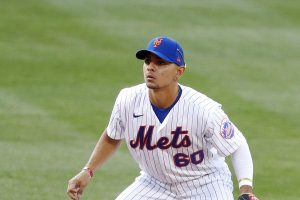
Not that there’s anything wrong with a “6” and a “0” next to one another. It just doesn’t look like a baseball number. Giménez did his best to make it look right for 60 games, but it was a tough sell. The rest of that 60-wearing crew not so much. A wider assortment of 60s would allow a more likely candidate to whom to connect on a 60th birthday. When you’re under a certain age, you can link your age to a Mets uniform number and have fun with it for a few minutes. We all do it, right? Every December, my fellow twelfth-month baby and good friend Kevin and I exchange numerical Met birthday greetings. Kevin’s approximately a generation younger than me. He just turned Ron Hodges years old, though when I finally remembered to send him a text to commemorate his big day, I called it his Jackie Robinson birthday. Seemed most appropriate. He went from Tom Seaver to Jackie Robinson, retired number to retired number, Hall of Famer to Hall of Famer, icon to icon. You can do that in your early 40s. Next year he’ll be R.A. Dickey and still have some top-flight choices immediately ahead of him.
I’m over the certain age. In my 50s, it was mostly coaches, with an occasional Hershiser or Santana dropping in to let me know I still had my stuff. The year I was 52, 52 suddenly became synonymous with Cespedes. Who wouldn’t have wanted to have said they were Cespedes years old in 2015? From here on out, it’s obscurities and novelties. At 60, Andres Giménez from a COVID-shortened season is the best of a non-baseball number the Mets can give me as a numerical nod.
Thus, when I think of 60 in the abstract, I think instead of Florida State Road 60, which I drove to get from where I went to college in Tampa to where my parents set up their winter encampment in Hallandale, roughly halfway between Fort Lauderdale and Miami, a drive of 200-some miles. I’d pick up 60 on the eastern edge of Tampa. It was unremarkable through Brandon, more or less near Plant City, home of the annual Strawberry Festival; ho-hum through Bartow, somewhere outside Lakeland and Winter Haven, datelines I’ll forever associate with the Tigers and Red Sox in March; and no biggie on toward Lake Wales, by which point the Tampa radio stations had morphed into Orlando radio stations, which somehow felt exotic to the ear. East of Lake Wales, you’d pass Indian Lake Estates, with a sign that offered an arrow for the turnoff to Frostproof, which you’d think all of Florida would have been. Since I’d left campus, the drive was a veritable walk in the park.
After Indian Lake Estates, it became terrifying for the final 25 or so miles of 60 I’d have ahead of me. Four lanes became two. The lack of lighting overwhelmed all senses at night, and it was always at night. It was just dark and scary. I preferred to have the road to myself. Headlights coming from the other direction were disconcerting. Headlights coming up from behind me unhinged me. I’d never driven anywhere else where somebody behind you would pass you in a lane not meant for them and it was business as usual. But there were only two lanes and I was capable of driving only so fast. Go ahead, pass me if you’re in such a hurry. Make it quick. I just want to get to Yeehaw Junction in one piece. Yeehaw Junction was the turnoff for the Florida Turnpike. The Florida Turnpike was its own kind of daunting, but it had more than one lane per direction. I was OK with highways in those days. The Turnpike and West Palm Beach stations to I-95, I-95 and Miami stations to Hallandale Beach Boulevard, Hallandale Beach Boulevard to Golden Isles Drive. As I parked in my visitor’s spot and clicked off the radio, I’d relish that I’d really accomplished something steering my way from the West Central part of the state to its southeast corner. I was not made for driving long distances, but I had driven this one. That felt good. Then I’d go upstairs to my parents’ condo and start watching what I say for land mines.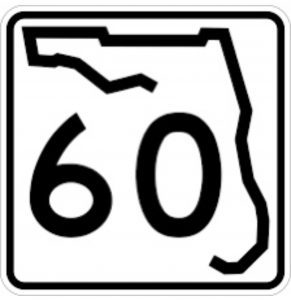
That was 60 to me in the years I neared, turned or was 22. Chances are pretty good at least portions of those trips on 60 were devoted to thinking about the Mets. They were generally out of season when I was driving southeast or returning northwest, but I’d be in the car for several hours alone. If I was alone for several hours, I’d think about the Mets sooner or later.
That’s many years ago now. I’m 60 today. I’m still thinking about the Mets. Sometimes to myself. Sometimes out loud. Sometimes in the car. Sometimes in blog form. So, to my dad, who wondered if it was OK to feel the same inside at 60 that he felt at 22 and who I never definitively answered even though he lived to be 87, I’ll reiterate: I guess.
***Guess is all I can do. I’ve aged but not to some junction where wondering meets enlightenment. Narrow roads or wide lanes, I don’t know what lies ahead.
I didn’t 50 years ago today when I turned 10 and, on December 31, 1972, discovered radio stations counted down the top hits of the year, which pretty much changed how I sliced, diced, categorized and looked at life. Every time I make some kind of list of things that have happened in the year that is ending or choose something as the event of that year, it’s mostly because I sat on the balcony of a room at the Chateau motel in North Miami Beach while my sister was lying down inside because she’d come down with stomach flu and I heard WFUN-AM count down the Top 79 songs of 1972 and wrote down every one of them. I’ve saved the memory if not the list. Gilbert O’Sullivan’s “Alone Again (Naturally)” beat out “The First Time Ever I Saw Your Face” by Roberta Flack for No. 1 if memory serves.
I didn’t 40 years ago today when I turned 20 and, on December 31, 1982, visited a doctor to be cleared to return to school after contracting mononucleosis in the closing weeks of the fall semester of my sophomore year at USF, which was great news, because the runup to my 20th birthday saw me sitting around in Hallandale dealing with swollen glands and dodging beratings from my mother for having contracted mononucleosis and whatever else she was convinced I was doing wrong, even while she was diligent in aiding my physical recovery, regardless of the mental stress she probably didn’t realize she was inflicting. My prescription for recovery was getting the hell out of Hallandale and back to school for the spring semester. I got over the mono, but my relationship with my mother was fraught thereafter, right up until cancer diminished her fire and took her a month before she turned 61, which is to say when she was 60, but let’s refrain from framing the math that way today.
I didn’t 30 years ago today when I turned 30, and on December 31, 1992, was the guest of honor at a surprise party. I was honestly surprised. I had made some stray remark to my wife that I’d sure like a surprise party someday, but that was mostly a life of watching sitcoms talking. I never knew people actually did that, Dad’s 50th notwithstanding. My family — Stephanie with my sister and her husband and my father — organized it. My friends popped out of the shadows alongside them. I never saw it coming. It was wonderful. The unofficial theme seemed to be that I was now a 30-year-old Mets fan, because everybody kept reminding me that’s what I cared about. I cared about other things, but those were side dishes. I was handed 15 pairs of tickets for the 1993 Mets (15 X 2 = 30) as the entrée. I took the tickets and the cue and maybe leaned into Mets fandom as an identity more than it had occurred to me in the years prior to turning 30 when at least subconsciously I thought it was time to put away or at least slightly deemphasize childish things. This is how you people see me? Good enough. Off to Shea I go. Besides, my dad not quite four years before told me at 60 he still felt like he was 22 or something like that. When I was 22, I thought about Doc Gooden pitching and Gary Carter catching. Carter was retired but Gooden was sure to pitch that Opening Day and I had tickets.
I didn’t 20 years ago today when I turned 40, and on December 31, 2002, was still reveling in the aftermath of the birthday party I’d thrown for myself a couple of weeks prior, the only time I’ve ever done something like that. I wanted to celebrate 40 at Bobby V’s in Corona, across the Grand Central from Shea. I wanted it to be Met-themed. I wanted to be surrounded by Mets fans. I didn’t want anybody who patronized or side-eyed what had intensified at the core of my life since I was 30. I had my wife, my cats, my profession as an editor of a trade magazine and my Mets. I wanted to be in a room with only people who got that and got me. I got my wish. Two-plus years later, this blog began, a Mets party still in progress.
I didn’t 10 years ago today when I turned 50, and on December 31, 2012, was only a couple of weeks removed from something similar to how I marked 40, but different. I wasn’t just that guy who liked the Mets seeking out others who liked the Mets. We now existed as a community and I was one of the town criers. They found me as a writer. A friend who became a friend because she found me writing put together a book/birthday party for me. I blew out candles on a cake my doctor wouldn’t want me going near for any other reason and I signed copies of something I wrote for people who would willingly pay for it. A few of the attendees were with me when I turned 30 and/or 40. Most were people I knew because they read what I wrote. That’s who I became. That’s who I still am when I can be.
 The throughline, from 10 to 50, seems to be I didn’t know what was coming in the year or years ahead. The year and years ahead came anyway. It only began to sound unnerving when I got to 50. I just spent ten years in my fifties. I don’t know if I saw or even sensed whatever came coming ten years ago today. I just knew I enjoyed writing about the Mets and I know that continued. I enjoy writing about the Mets not only because they’re the Mets and I’ve rooted for them since I was 6, but because I get to borrow them as my prism for an array of realizations and emotions. They’re never far from top of mind and they make the playoffs once in a while and they rarely fail to tantalize me with the notion that they’ll be better next year or, failing that, one of these years soon, even if I have no idea what the future holds in any year ahead. Here and them I write. The throughline, from 10 to 50, seems to be I didn’t know what was coming in the year or years ahead. The year and years ahead came anyway. It only began to sound unnerving when I got to 50. I just spent ten years in my fifties. I don’t know if I saw or even sensed whatever came coming ten years ago today. I just knew I enjoyed writing about the Mets and I know that continued. I enjoy writing about the Mets not only because they’re the Mets and I’ve rooted for them since I was 6, but because I get to borrow them as my prism for an array of realizations and emotions. They’re never far from top of mind and they make the playoffs once in a while and they rarely fail to tantalize me with the notion that they’ll be better next year or, failing that, one of these years soon, even if I have no idea what the future holds in any year ahead. Here and them I write.
I’m 60. That’s what I’m thinking.
by Greg Prince on 29 December 2022 10:52 am Good news — the Mets made the playoffs in 2022! Less good news — the Mets were bounced from the playoffs very quickly in 2022! Middling news for the 2022 Mets — they get postseason shares!
You go to the postseason, you earn a little extra scratch. It’s how baseball works. You go far in the postseason, the scratch can be significant, even for well-heeled major league baseball players. We saw that in 2015. You go not so far, it’s more a token of esteem. We saw that in 2016. In 2022, the Mets got their foot in the door before the door slammed on them. It was enough for what big leaguers probably consider shoelace money.
As explained by Forbes, each of the four teams eliminated in the first round — the Mets, the Cardinals, the Guardians and the Blue Jays — lost their way to 0.8% of the gate receipts that went into filling MLB’s brimming postseason pot, or $806,331 out of $107,510,840. That’s not $806,331 per player. That’s $806,331 for each of those teams to divide up internally. Your mainstay players do the dividing: full shares, partial shares, cash awards. Team employees, particularly those who work the clubhouse, might be rewarded from this pot as well. It’s a whole thing.
 It wasn’t for naught. More of a thing when you get Win the World Series or at least Get to the World Series money. Probably not that much of a thing when it’s Lost in the First Round Money in an industry where the annual minimum salary is $700,000. But not everybody you saw put on a Mets uniform this year was necessarily living the high life. The Mets dressed 64 players in 2022, 61 of whom played at least once. In some cases, that meant a day or two of service time tacked onto a minor league living. Extra bucks awarded because the team whose dugout they passed through eventually made the National League Wild Card Series aren’t going to be insignificant to the here-and-goners. Every little tangible bit is no doubt appreciated by players on the fringes. I’d guess the concept of getting something for making the playoffs, even if it amounts to a slight bonus that isn’t going to elevate one’s quality of life any higher than it already stands, sits well with all involved, superstars included. It’s the same reason the players can’t wait to put on those commemorative t-shirts they get for clinching. Somebody hands you something not everybody is eligible to receive, you tend to accept it and hopefully remember to say thanks.
The Mets doled out their ’22 postseason shares in real life already. Of course they doled them out in ’15 and ’16, too, but that didn’t stop us from undertaking the exercise as we saw fit. Thus, after circumstances dictated a six-year pause, we now resume our sacred self-imposed responsibility of disbursing Mets Postseason Shares Like They Oughta Be from the pot of $806,331.
Starling Marte — He’s our MVM, he gets the most bountiful scoop: $30,000.
Brandon Nimmo — He’s The Dean, he gets almost as much: $29,500.
Pete Alonso and Francisco Lindor — Everyday studs, basically never missing a game: $29,162 each.
Edwin Diaz — The first Met closer since maybe Jesse Orosco, maybe Tug McGraw, maybe ever who a fan could actually look forward to pitching in a game with that game on the line. Not “not worry too much about,” but relish as a weapon to vanquish the enemy. The trumpets were only part of the sensation and the 32 saves barely begin to describe it: $28,532.
Jeff McNeil — He won a batting title with an average of .326, so let’s make his share $28,326.
Seth Lugo — I’m a sucker for seniority: $27,500 and a fond farewell for Seth’s seven years as a Met.
Adam Ottavino — Effectively took over doing what Lugo used to do and did it effectively: $27,000.
Luis Guillorme and Drew Smith — Their first manager was befuddled rookie skipper Mickey Callaway, so they had to forget whatever they learned in 2018 in order to persevere as they have since. That’s gotta be worth something: $26,018 each.
Eduardo Escobar and Mark Canha — Solid individuals and players, Escobar producing in clumps, Canha a little steadier if not as spectacular: $25,000 each.
Max Scherzer and Chris Bassitt — Super important figures in establishing the frontline pitching strength and tenor of the team, but geez, did both not come through when needed most in Atlanta and against San Diego. Still glad they were here: $22,500 each.
Jacob deGrom — Winner of the only postseason game the 2022 Mets won, loser when it comes to clear-cut legacy by a) bolting and b) making it sound as if the Texas Rangers have cornered the market on “vision”. Oh, and one of the all-time Met greats: $20,048.
Tomás Nido — He’d be pretty good if he could hit as well as he can bunt: $19,500.
Taijuan Walker and Carlos Carrasco — I really wish they had made the postseason rotation decision harder on Buck Showalter. Still, a quality four and five: $19,450 each.
Trevor Williams — He’d go a week or two without pitching and suddenly be out there keeping us in a game, not an easy feat: $19,014.
Tylor Megill and David Peterson — Megill was the Opening Night starter, epitomizing alongside Peterson the security blanket of depth. Would really love to see them get more of a chance before waking up one day in the not too distant future and realizing they’ve been around longer than I’ve realized: $17,500 each.
Joely Rodriguez — To invoke that awful “hill I’ll die on” cliché, the hill I’ll die on, or at least hang out near for a few minutes when it comes to the 2022 Mets, is Joely Rodriguez was a pretty decent lefty to have come out of the pen now and then: $17,000.
Trevor May — Made me more nervous than Rodriguez ever did, came through enough. By all indications, a mensch: $16,500.
Dom Smith and J.D. Davis — We’ll always have 2019, fellas, and you should always have a little piece of 2022: $11,019.
Travis Jankowski and Terrance Gore — Jankowski pinch-ran 13 times before getting squeezed off the roster. Gore is a specialist of the genre and pinch-ran five times during an abbreviated tenure with the club — plus the Mets won all ten games in which he participated in any capacity, which is the most winning games without a loss any Met from any era can claim. Together as the Mets’ primary pinch-runners, they embodied the tactical aggressiveness Buck Showalter brought to bear…which sounds more insightful than admitting I just happen to be fascinated by pinch-running: $11,000 each.
Daniel Vogelbach — Pinch-running is valued here, but designated hitting remains on probation. Still, when the Mets traded for Vogey, they were saying they were taking the half-position more than half-seriously. What he could do he did very well. What he couldn’t do made him and the lineup spot he was acquired to fill less than whole: $10,500.
James McCann — Caught a five-man no-hitter one night, recorded at least five hits the rest of the year: $10,005.
Adonis Medina, Yoan Lopez, Stephen Nogosek and Colin Holderman — Bacon-savers! They saved our bacon! Whether it was getting a few huge outs or soaking up some orphan innings, the members of this bunch took a few for the team and came up big once in a while: $9,500 each.
Mychal Givens — Filled the thankless role of veteran reliever who comes over in a pennant race, gets lit up, garners no goodwill, then pitches pretty OK when available the rest of the way. Also the first Met pitcher to pinch-run since Steven Matz in 2019: $9,000.
Tommy Hunter — One gets the feeling he returned because Buck Showalter liked him in Baltimore. That was probably the reason Givens was here. Didn’t do a ton, but didn’t do much harm: $8,900.
Chasen Shreve — Silent Generation Met (whose only year pitching before the home folks was 2020, which is to say he pitched before no home folks) turned Recidivist Met. The curiosity factor alone made his second stint worthwhile: $8,800.
Patrick Mazeika and Michael Perez — Every game Mazeika ever played felt like a novelty; walloped an enormous homer in May. Perez plugged a hole for a few days in August and made me wonder why he couldn’t stick around. As a friend of mine is fond of saying, catchers, baby, catchers: $8,750 each.
Nick Plummer — Hit the Nick Plummer Home Run one night along with another the next night. Plummers, baby, Plummers: $8,700.
Nate Fisher — Of the eight Mets to take part in exactly one game in 2022, Fisher made the most indelible impression, throwing three shutout innings as part of the mind-boggling 10-9 Damn Thing win in Philadelphia. No Fisher, probably no winning the Damn Thing, after which we couldn’t add with absolute certainty, “…and that’s why the Phillies will never win the pennant this year!” Why Nate wasn’t asked to take part in a second game is too much of a mystery to be answered by something as mundane as “numbers crunch,” though that was probably it: $8,600.
Khalil Lee — Homered in a loss at Angel Stadium the second Saturday of June, but I could swear he homered in a win at Dodger Stadium the first Saturday of June. Let him benefit from my foggy recollection: $8,500.
Brett Baty, Mark Vientos and Francisco Alvarez — An investment in tomorrow: $8,400 each.
Tyler Naquin — Tyler Naquin is the first Met since Craig Paquette to have “qu” in the middle of his last name, the fourth overall. Jose Oquendo and Al Pedrique were the others. Tyler Naquin is better off with this nugget as his calling card rather than any of his statistics from down the stretch: $8,004.
Sean Reid-Foley — Pete Crow-Armstrong seemed a good bet to become the first Met with a hyphenated last name upon his being selected by the Mets in the first round of the 2020 draft. But before the Mets could promote PC-A, they elevated SR-F in 2021. And then they traded PC-A to make the matter moot. SR-F pitched seven times this April before sustaining a partially torn UCL. Sean Reid-Foley will have to work his way back from Tommy John surgery, but he maintains his hyphenated distinction: $5,350.
Ender Inciarte — The Mets’ primary pinch-runner when Jankowski and Gore weren’t. Captured by SNY cameras exchanging warm greetings with Keith Hernandez shortly before Keith took the field for his number retirement ceremonies. Trying to remember anything that isn’t connected to his robbing Yoenis Cespedes of a game-winning home run in 2016 is otherwise futile. But if Keith could be nice to him…: $5,317.
Jake Reed — The competition was fierce, but Reed wins the coveted “I all but forgot he was on the team this year” award. Five games, too! How embarrassing for both of us: $4,905.
Travis Blankenhorn — Played one game as a 2022 Met. He was the DH on July 22, a loss to the Padres. Batting eighth, Travis flied out, struck out and grounded out. Maybe the Mets weren’t going to be the National League team to benefit most from implementation of the designated hitter after all: $4,400.
Matt Reynolds — On the NLCS roster in 2015 but Terry Collins couldn’t figure out a way to get him into a game, costing Matt the rare opportunity to make his MLB debut under the bright lights of the postseason. A Met utilityman in 2016 and 2017 for 115 games. Recidivisted for exactly one game in 2022 before the Cincinnati Reds, an organization comprised largely of utilitymen, picked him up and started him a career-high 67 times. Thanks for passing through again: $3,600.
Deven Marrero and Yolmer Sanchez — Six Mets made their third base debut in 2022. These are the two you don’t remember. No worries; they don’t remember you, either: $3,550 each.
Alex Claudio, Sam Clay and R.J. Alvarez: Three contestants ready for a reboot of To Tell the Truth. They’ve already stumped the panel: $3,533 each.
Bryce Montes de Oca — A pitcher who totaled fewer than four innings but features a name that comes in four parts: $3,504.
Jose Butto — Threw the not promising start that dug the hole that set the stage for the stunning performance of Nate Fisher the pitcher, not to be confused with Nate Fisher the fictional funeral director from Six Feet Under. Butto’s career didn’t die from his emergency audition; he’s still considered a prospect: $3,500.
Rob Zastryzny and Thomas Szapucki — You say Zastryzny, I say Szapucki… Rob’s ERA in one inning of Met relief was 9.00, which appears unsightly until compared to Thomas’s 60.75 compiled in his one Met start. Let’s call the whole thing off: $3,453 each.
Joey Lucchesi — Not one of the 64 Mets who dressed in 2022. On the IL the whole year, which is the epitome of bad timing for a pitcher who introduced us to the word “churve” in 2021. Here’s wishing Lucchesi a full recovery…and a better name for his signature pitch: $3,425.
Gosuke Katoh, Kramer Robertson and the even harder to spot Connor Grey — Suited up as Mets. Never played as Mets. Sent packing as Ghost Mets. Let’s surprise them if we can find them: $650 each.
Darin Ruf — The kindest thing one can say on behalf of Darin Ruf’s two months as a 2022 Met is until rosters expanded, he was only one of 26: $26.
Robinson Cano — He wanted Willie Mays’s number? Fine: $24.
As long as we’re indulging the fantasy of disbursing Met postseason shares, let’s keep the theme going and visit Mets Fantasy Camp via a revealing interview with recent Mets Fantasy Camper Kerby Valladares on National League Town.
by Greg Prince on 27 December 2022 9:13 am In 2022, the Mets finally got the past right. It feels so good to rattle off the roll call of their history-acknowledging triumphs; Nancy Seaver offering her benediction at the reveal of the Tom Seaver Statue on April 15; the retirement of Keith Hernandez’s 17 on July 9; the syncing of Gil Hodges Bobblehead Night with Gil’s induction into the National Baseball Hall of Fame on July 24; and the return of Old Timers Day, which would have been enough to mark August 27 as an orange-and-blue red-letter day for the ages, commemorating as it did sixty years of Mets of baseball by inviting home more than sixty Mets from all ages of the franchise’s existence, yet somehow outdid itself when it placed the cherry of a lifetime upon that Saturday’s sundae and broke the news that No. 24 was now retired for Willie Mays.
The baseball gods smiled at the Mets’ acts of cognizance. The club won its games of April 15, July 9, July 24 and August 27, in each case preserving or extending its lead in the National League East. Had the Mets chosen their fiftieth- rather than their sixtieth-anniversary season to have undertaken each of the above mitzvahs — the only item not in their control was Gil’s election to the Hall (yet they could have handed out a Hodges bobblehead long ago) — the historical conscientiousness would have been most welcome, but it probably wouldn’t have landed as sweetly in 2012 as it did in 2022 for a simple reason: the 2012 Mets were dreadful. They had their moments individually and collectively, and didn’t completely fall apart until the second half kicked in and kicked them, but highlighting your sparkling past while your present presents itself as relentlessly grim is a tough sell. It shouldn’t matter that much, but it does.
I’m convinced each of the commemorative events that made 2022 sing at Citi Field hit its high notes because the 2022 Mets were already in full throat and fine voice. I sat at Shea Stadium for the previous Old Timers Day, commemorating the 25th anniversary of the 1969 Mets’ world championship. Forgive the use of sports talk radio host affectation when I say there was nobody there. Figuratively nobody. Literally, I’d estimate maybe 5,000 seats were filled for the pregame ceremonies commemorating the signature miracle in baseball history, an accomplishment that belonged to every Mets fan. Alas, most every Mets fan wasn’t moved to stop by and pay homage. This was 1994. The year before had been infamous 1993, the year that gave us a team worse than the notorious Worst Team Money Could Buy from 1992, itself assembled upon the ruins of the 1991 dissipation of the dynasty that never quite materialized after 1986. The 1994 Mets weren’t infamous, but they, too, were a tough sell. The residue of the early ’90s wasn’t coming out in the wash until the end of the ’90s, at least not at the box office. The middle ’90s were an attendance desert. Cleon Jones and Jerry Koosman were at Shea to say hi? Good luck convening a minyan to return the greeting.
Twenty-eight years later, there was nothing contemporary keeping Mets fans away from a celebration of past glories. This was a first-place team, a playoffs-bound team, a team that was operated around the idea it was supposed to compete to win. Not every Mets team has worked that way. Not every Major League Baseball team works that way now. The 2022 Mets were Venn Diagramming the sweet spot of which every serious fan dreams: the circle that extolled its accomplishments from decades gone by; the circle that provided nearly nightly thrills nearly every week this very year; the circle that indicated the days ahead would be at least as fruitful and as meaningful as the days we were in at this very moment.
So much intersection.
I sat up in the left field Promenade on Old Timers Day with a prime view of the recently relocated placards marking the postseason berths and achievements of yore over the highest right field seats. Nine banners for nine Octobers, from that 1969 World Championship through the 2016 Wild Card. Two World Series triumphs; three National League pennants besides; four other playoff appearances earned through division championships or by any means necessary. “Good stuff,” was my father’s stock response to things he liked. I liked those nine banners. I liked better the certainty that a tenth would be added as a result of the 2022 season in which we’d been reveling for several months and would be reveling on amid for several more weeks. Great stuff.
There will be something affixed in that space following 1969, 1973, 1986, 1988, 1999, 2000, 2015 and 2016. It won’t say WORLD SERIES CHAMPIONS or NATIONAL LEAGUE CHAMPIONS or N.L. EAST DIVSION CHAMPIONS or WILD CARD & DIVISION SERIES WINNERS, which is the all-inclusive if hardly reflective of all they meant descriptor applied to the 1999 Mets. It can replicate 2016’s NATIONAL LEAGUE WILD CARD and be technically accurate, though in 2016 winning the Wild Card was pretty much all that could be asked when that Mets team was two games beneath .500 entering play on August 20, sitting 5½ games from the nearest playoff spot. Six weeks later, we had clinched a foothold in the postseason. Anything else would have been gravy. In that year’s Wild Card Game, Madison Bumgarner chose not to dish out what he was serving even a little au jus. Getting left high and dry by the lefty whose own Venn Diagram brought Unbeatable in the Post Season and Untouchable at Citi Field into a thickly drawn circle wasn’t tasty, but the prize we chowed down on for going 27-12 and simply getting as far as we did sated my soul. You can’t win ’em all, but we’d won something that went down as tangible. We lost the Wild Card Game, but we’d won a Wild Card.
In 2022, we lost the division before losing the series we were assigned to play in because we lost the division. The Wild Card we won? It was an app that mysteriously showed up on our phone for three days and then disappeared with the next update. Or, to put it in hoary old joke about Chinese food territory, we won 101 games and went to the playoffs, yet a half-hour later, we were still hungry.
***For 2022, Faith and Fear in Flushing chooses as its Nikon Camera Player of the Year — an award presented to the entity or concept that best symbolizes, illustrates or transcends the year in Metsdom — Something Short of Satisfaction. My god, it was a great Met season. My god, the Mets did great things this season. My god, it’s so much better being a Mets fan coming out of this season than it’s been in so long.
But we’re not quite satisfied with what we experienced, are we?
Satisfaction may be as elusive a concept as it is a destination. If we define satisfaction as our team having won it all, well, we haven’t been satisfied very often ever, have we? Yet I don’t think you have to have your players get measured for World Series rings to claim satisfaction. In the rafters of my mind, I display placards for close second-place finishes, surprise playoff lunges that sputtered with weeks to go, coming kind of close to .500 and merely being not as bad as I thought the Mets were going to be. I value context and calibration. I can get some satisfaction through any number of avenues.
Yet here I am, sorting through the emotional aftermath of a season that soared higher than projected and produced a postseason, and I feel…not nothing, but not enough. In bottom line territory, the explanation is fairly self-evident: we won 101 games and have no more than a prospective NATIONAL LEAGUE WILD CARD banner to show for it. I endorse the historical reminder that the 2016 version represents because once that season unfolded, that was good stuff. In 2022, we appeared on the verge of something more. Winner of a division. Winner of at least one postseason series. Winner of a flag. Winner of the whole enchilada. Better stuff.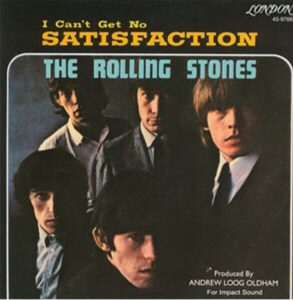
I’m happy that there was a 2022 postseason for the New York Mets, and would prefer the tenth banner in the right field row read NATIONAL LEAGUE POSTSEASON and leave it at that. Some of us would nod with a modicum of understanding that that year up there was really something, and absolutely not nothing (until you begin to pick apart just how lame the Mets’ performance was during two-thirds of their 2022 postseason). Others would not be shy about channeling their inner Nelson Muntz and emitting a loud “HAW-HAW!” at the veritable participation ribbon, as if making the playoffs — when eighteen teams still don’t — isn’t enough of an accomplishment to merit as much as a nod.
The Mets did this to themselves by raising our hopes so propitiously that hopes became expectations. I pinpoint the date when being told that going 101-61 and guaranteeing postseason baseball wasn’t going to be enough. It’s the date to which I can retroactively attach the saddest of all possible words in sports: “if I had told you,” as in “If I had told you that the Mets were going to win 101 games and were going to go to the playoffs, yet it wasn’t going to be particularly satisfying, you probably wouldn’t have believed me.”
It was June 5. The Mets were completing a four-game series at Dodger Stadium. The Dodgers stood as the platinum standard. Gotta go through L.A. if you wanna get anywhere in this league. The Mets went West and looked flat after flattening most comers for two months. We fly across country and lose on a Thursday night. Lose on Friday. But spring back to life Saturday. Sunday, thus, looms as the proving ground between a team everybody knew was gonna be there at season’s end and a team we wanted to believe would be there to meet them.
Sunday, June 5, was the grit and the grind that set expectations. Sunday, it turned out, was prevailing behind Trevor Williams as our starter and Adonis Medina as our closer and J.D. Davis driving in the run that positioned Medina for the save. We did it. We won in ten, 5-4. We split with the mighty Dodgers. We had a better record than the mighty Dodgers. We led our division by 8½ mighty games.
The 2022 Mets felt mightier than all that. The 2022 Mets felt as mighty as they had in a generation, probably two. All they had to do, in my mind, was not fall apart on the rest of their California swing (they didn’t) and they’d be poised for greatness. Much of the rest of the year would indeed be a thrill ride, pausing only to reflect on the best of the sixty preceding years. Stop by the statue and tip a cap to No. 41. Leap to your feet and cheer for No. 17. Be overcome by the warmth emanating from Irene Hodges accepting Hall of Fame enshrinement on behalf of her father and be overwhelmed by the sight of Michael Mays repping his father as the Mets stopped futzing around with No. 24. The generations were coming together in 2022. We were having a season for the ages. What could possibly stop it?
***The nominees are…
The Atlanta Braves, who never stopped coming.
The San Diego Padres, who lay in wait.
Mitch Keller of the Pittsburgh Pirates, who hit the right middle finger of Starling Marte of the New York Mets.
Darin Ruf of the New York Mets, who bore zero resemblance to Darin Ruf of the San Francisco Giants.
This, that and/or the other thing.
The Mets never fell apart. They just stopped coalescing. There really wasn’t that one game with the hair and the tearing of it out from one’s head. Not that one lead that got away in the eighth or ninth. Not that one runner left on third who was the difference between winning and losing. Not that one ball that eluded two gloves and definitively doomed us. The Mets could clinch only so much after two or five months. They seemed so good. They were so good. They just couldn’t keep up all they had to keep up.
Neither could, it should be noted from a postseason perspective, the Atlanta Braves or the San Diego Padres or, for that matter, the mighty Dodgers of Los Angeles. As late as right after Old Timers Day, we took two of three from the Dodgers at Citi Field. That, rather than any regular-season Padres-Phillies series, felt like the NLCS preview. If we couldn’t be as fully convinced about the division title being in hand as we’d been when we’d been to SoCal in early June — the Braves were clinging three back as September dawned — Mets-Dodgers still made sense in our collective gut. On August 31, Jacob deGrom was almost spotless for seven innings, Brandon Nimmo snatched a home run from beyond the center field fence, Adam Ottavino, Edwin Diaz and Timmy Trumpet owned the final innings and the Mets had downed L.A., 2-1, a night after bowing to them, 4-3. In the late-afternoon start of September 1, the Mets continued to not yield. We won, 5-3, behind Chris Bassitt, Trevor May, Diaz and Ottavino. Trumpet had left town, but the melody lingered on. We won the season series. As if we needed more convincing, this more or less convinced us we were set for October.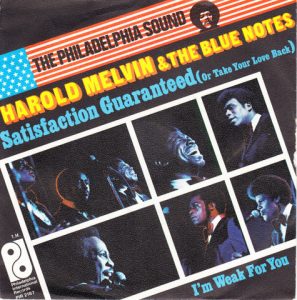
More or less. We needed more convincing. We always needed more convincing. We won 17 of 20 at one point in high summer and we were likely never 100% convinced that this team that had been in first place nearly nonstop since the first pitch of the season was as absolutely a sure thing as we were convinced it should have been. But it was too late to turn back now. Beating the Dodgers was our leading indicator. Problem was, with thirty games to go and three games separating our tail from the Braves’ fingertips, every series still on the schedule was going to be the moral equivalent of a Dodgers series.
Nobody told the Mets. Having risen to the L.A. challenge so valiantly, they played down to the Nationals and the Pirates and the Cubs and the A’s. Again with the understanding that there is no winning ’em all. Even still. Whether it was not having Starling Marte in right field for a month, or leaning on Darin Ruf at DH, or trying to hot-wire the offense with September callups who weren’t on the immediate radar, or whatever everyday stalwart struck out when you were expecting a base hit, or whatever arm didn’t have quite enough to get the job you expected done, or the cobwebs that gathered on Diaz as save opportunities evaded abundance or some box the meticulous Buck Showalter failed to check, it was a season that was losing rather than gathering steam. The playoffs were still a sure thing. The Mets put a mathematical lock on their postseason reservation on September 19. It was a formality. They chose to sip champagne rather than spray it. The 2022 Mets were the third team in franchise history to spend every single day of its season above .500. The 1985 Mets did that, but missed the playoffs by three games. The 2007 Mets did that, but missed the playoffs by one game. The 2022 Mets did that and ensured they’d be in the playoffs.
Who could ask for anything more?
We could. How could we not? How could punching a postseason ticket feel like anything more than a pleasant Monday night in Milwaukee when there were greater worlds to conquer, greater stuff to garner, so let’s not toast too heartily lest we be hungover for work on Tuesday? (Hell, we didn’t flinch at Max Scherzer being pulled from a perfect game bid in deference to the greater good.) Thirteen games sat for the taking following the playoff-clinching versus the Brewers. The Mets proceeded to win one, lose one, win one, lose one, win one, lose one, win one, lose three and win three. No, you can’t win ’em all. But you can win more than seven of thirteen.
The “lose three” was Atlanta. That was the division title in a nutshell. Win one game in Atlanta and we don’t lose one National League East. But we didn’t and we did. That’s how Citi Field gained the privilege of hosting the first ever 4-vs-5 National League Wild Card Series. Home field advantage encompassing all three games was the reward for being better than the other Wild Card qualifiers. Little about it felt rewarding.
Whether they’ve won it all or lost before such an outcome became possible, some postseason Mets teams have felt more magnificent than magical. Conversely, some postseason Mets teams have felt more magical than magnificent. Of course every magnificent Mets team contains an element of magic and every magical Mets team is more magnificent than is fully comprehended. By the end of the 2022 season, the New York Mets, for all their 101 wins, felt neither magnificent nor magical in sufficient quantities. By October 7, Opening Night of the NLWCS, we were left hoping for the best and not knowing what to expect. Then again, we didn’t expect we’d have to start playing postseason baseball until the NLDS began on October 11.
History will show that earning a bye and avoiding the 2022 National League Wild Card Series amounted to no particular advantage in the National League Division Series. The mighty 111-win Dodgers didn’t benefit from not having to play in the newly arranged first round. The irritating 101-win Braves — same total as us! — generated no momentum after their mini-vacation. Both the Dodgers and Braves stand as division winners who exited the playoffs after one lousy win.
The Mets stand as not even that. We did have the one lousy win, which wasn’t lousy when it was achieved, but its satisfaction carried a very quick expiration date. We don’t have a division title from the 2022 season and we don’t have a series win from the 2022 postseason. We have a Wild Card, which was never the idea, and we have 101 wins, which included nine versus Atlanta when we needed ten. We had, I swear, that certain something. Just not enough of it.
***In his diary of the 1978 season, Sparky Lyle, who wasn’t relied on nearly as much as when he won the Cy Young in 1977 and could read the writing on the wall regarding his not being around in 1979, warned George Steinbrenner that if he kept bringing in new Yankees who didn’t have the same intestinal fortitude as old Yankees, he was consigning himself to some frustrating finishes. “He’ll have gotten rid of all his winners,” Lyle wrote with Peter Golenbock in The Bronx Zoo, “and he’ll be left with a team of good ballplayers who have never been on winners. He’ll have a hell of a second-place ballclub. He’ll end up having a club like Boston, a team that wins 99 games but no bananas.”
It was a different world in 1978. You either finished first or called it a day. The Yankees and Red Sox each won 99 games and contested a tiebreaker (a.k.a. the Bucky F’in Dent Game) to determine whose day was done. In 2022, the Mets and Braves decided which 101-61 record was superior by interior math, specifically the 10-9 head-to-head advantage that belonged to Atlanta once Atlanta went 3-0 between September 30 and October 2. I thought of the Lyle passage a lot after that truly abominable Truist Park weekend. The aforementioned Red Sox were the epitome of a team that indeed had good ballplayers yet no bananas to show for it. There’ve been other teams whose high quality resonates as hollow in the collective baseball consciousness since then.
• The post-Sparky Lyle Yankees who were almost always good for posting winning records but stopped winning World Series once he was traded to Texas.
• The Jim Leyland Pirates who lost playoff series, superstars and, eventually, their way.
• The Moneyball A’s whose GM’s bleep doesn’t work in October.
• The Twins in years that include October (eighteen consecutive postseason games lost dating to October 6, 2004).
• The stacked Nationals of the 2010s, their reputation for coming up short as heavy favorites and division-winners not erased until they put a Wild Card to optimal use in 2019.
• The mighty Dodgers of the 2010s, their reputation for coming up short not erased until the shortened pandemic season of 2020 built them the limited runway they needed to shed their baggage.
• The stupid Braves from 1996 through 2020, with sixteen delightful postseason eliminations spanning multiple eras and two millennia.
• The modern-day Yankees who are knocked out postseason after postseason like glorious clockwork (ten postseasons since 2010, zero pennants since 2009).
Seasons spent racking up the wins can be fun. They oughta be fun. Little beats the confidence you gain as a fan from knowing your team is more likely to win than lose on any given day or night. When you’ve sucked up your share of 1993s, you know you should cherish their antitheses. But their endings going awry, particularly if it happens again and again, tends to sap the fun right out of those seasons and diminish the luster of the period in which they are set. The satisfaction, too.
The 2022 Mets really were loads of fun. Surely there’s a formula to be calculated that would show each day this season was as much fun per capita as a Mets fan could have hoped for. Just not as much as we’d grown to expect. That doesn’t have to be a dealbreaker. There have been wonderful seasons that didn’t exactly pan out but never shook that sense of wonder. This one did. This one failed to satisfy.
Maybe that’s OK. Live through it, learn from it, onward and upward until Excelsior isn’t just an overprized section of seats. Upon his introduction to us in the fall of 2020, the man who owns the team and bankrolls our expectations spitballed “three to five years” as his timeframe for winning a World Series, more an off-the-cuff mission statement than an analytic projection. Next year will be Year Three of the Steve Cohen epoch. Year One was a shakedown cruise in which we sustained a torrent of splashback. Year Two was so, so good in so, so many ways, if so-so when it was over. Year Three will have so, so many new Mets acquired in the name of guaranteeing satisfaction (some acquisitions pending completion as of this writing). And if that doesn’t satisfy the lot of us, there’s always Years Four and Five and the rest, assuming we as fans aren’t going anywhere.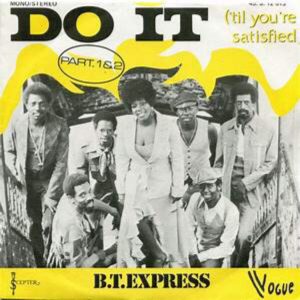
I’m not. When the 2022 NLWCS ended with a whimper, I couldn’t see myself getting excited about 2023 for a while. A while has passed. I’m excited. Not out of my mind excited, but adequately anticipant. Your team’s owner goes out and secures who he’s secured — let’s continue to pencil in Carlos Correa until notified something’s really wrong with his leg or his negotiations — to go with keeping who he’s kept and you owe it to yourself to look forward to Spring Training. You can’t buy a pennant, but you can certainly shop aggressively for one.
Yes, we have some bananas. We’ve also rocketed ahead of where we were as a franchise and a people from before Steve Cohen. After that 2016 Wild Card, we endured a miserable 2017; a miserable 2018; a miserable first half of 2019; a second-half surge in 2019 that was so satisfying you can be forgiven for forgetting we didn’t actually win anything (you don’t necessarily have to win anything to feel satisfied); and a miserable sixty-game 2020 that pretty much wiped away the 2019 vibe and, in retrospect, lasted sixty games too long. Then along came Cohen and a new general manager every other week and a manager who didn’t yet know what he was doing and a cast with roles yet to be optimally filled.
We’re way beyond those gray days as we pivot from 2022 to 2023. That’s satisfying in its own right. Knowing 2023 has a legitimate chance to be better than plenty good 2022 is also satisfying. It can’t recontextualize 2022 until it plays out. Maybe in a year’s time we’ll be satisfied that 2022 served as the 101-win, Wild Card as consolation prize, early playoff elimination steppingstone to definitive higher ground. But we’ll need 2023 or maybe a year to be named later in order to recalibrate our takeaway. As the final dates on the 2022 calendar are crossed off, maybe the closest thing to satisfaction we can divine from the season that didn’t live up to our expectations is to be mined from what Tony Soprano told his family by candlelight at Artie Bucco’s restaurant in the middle of the intense storm that closed Season One of The Sopranos: “If you’re lucky, you’ll remember the little moments — like this — that were good.”
Season Sixty-One of the Mets had more than a few of those.
FAITH AND FEAR’S PREVIOUS NIKON CAMERA PLAYERS OF THE YEAR
1980: The Magic*
2005: The WFAN broadcast team of Gary Cohen and Howie Rose
2006: Shea Stadium
2007: Uncertainty
2008: The 162-Game Schedule
2009: Two Hands
2010: Realization
2011: Commitment
2012: No-Hitter Nomenclature
2013: Harvey Days
2014: The Dudafly Effect
2015: Precedent — Or The Lack Thereof
2016: The Home Run
2017: The Disabled List
2018: The Last Days of David Wright
2019: Our Kids
2020: Distance (Nikon Mini)
2021: Trajectories
*Manufacturers Hanover Trust Player of the Year
National League Town is revisiting its extensive 2022 wish list for the Mets Hall of Fame. Listen here or on the podcast platform of your choice.
by Greg Prince on 23 December 2022 2:37 pm A former major leaguer who I watched pitch against the Mets once but who I can’t say I remember doing so tweeted something eye-opening this week: “In the entire history of baseball, only 22,860 have made it to the major leagues. That total easily fits into any MLB stadium.” An actor who portrays a former major leaguer on stage and on social media shared that nugget with the comment, “Remember this the next time you call an underperforming player on your team a bum.” In the chill of late December, when nobody’s grounding into a double play to kill a rally, I can see the wisdom of what Bob FIle (Toronto Blue Jays pitcher in the early 2000s) and Ken Webster/John Bateman (the former the man paying continual homage to the latter’s career and persona from when the actor grew up admiring the catcher who broke through with the 1966 Astros). Maybe not in the heat of summer, but why not in the spirit of the offseason?
Hence, I’m here to say James McCann, the other night traded to the Baltimore Orioles for the ever popular Player to Be Named Later, was not a bum. Far from it. He is among the 22,860 I’ve tuned into see or hear. Not a few times I ponied up for the privilege of cheering for James McCann to come through as a New York Met. The right to grumble when he didn’t come through, too, but that’s the passion talking trash. I tried to keep it to a whisper. Either way, I didn’t see him filling one of Citi Field’s seats. He was down there, a part of the action, deploying his skills, however they manifested themselves on a given day or night.
Can it be only two years ago that we welcomed James McCann to the New York Mets with something approaching high hopes? Middling hopes? McCann was the next best thing to J.T. Realmuto as catchers on that winter’s free agent market went. Budding prospect Francisco Alvarez was way off on the horizon at the time and Tomás Nido was considered strictly backup material. We were coming off Wilson Ramos’s second year, which was less robust than his first year. Ramos was going for sure. The franchise’s new owner may not have had quite the front office he needed in place to direct his natural instinct to secure the best possible player at a given position. The Mets didn’t pounce on Realmuto. Once J.T. shipped his gear from Miami to Philadelphia, we scooped up McCann instead. If you squinted real hard and perhaps covered both eyes, you could see the two available catchers as somewhat comparable.
It’s two years later. They weren’t. Realmuto is still the best all-around receiver in the National League. McCann has been moved along to the American League, with Steve Cohen shrugging off most of the money he’s still owed. For three days at the beginning of August, the Mets will be paying McCann to play against them. The rest of the year they’ll be paying McCann to play against everybody else for Baltimore. Unless the catcher experiences a crab-fueled renaissance, we’ll likely have to remember to shrug.
James McCann had the good sense to crest in 2019, the final full year before he hit free agency, making the AL All-Star team for the White Sox. He followed up by posting gaudy numbers inside the short sample size of 2020. He wasn’t top of mind outside Detroit prior to ’19. We could believe he’d found himself in Chicago and he’d stay found once he ensconced himself in New York.
There were a few moments here and there, but mostly James got lost as a Met. Or was told by the lot of us to get lost. His defensive flourishes were obscured by a hollow bat. We’d hear pitchers liked throwing to him. We saw five pitchers throw to him one night at the end of April and see none of the hitters they faced recorded hits. The last of the batters to go down in the only combined no-hitter the Mets ever pitched was J.T. Realmuto. McCann caught the Edwin Diaz strike Realmuto couldn’t touch.
If only that was the allegory for the one we got/the one who got away. No, Realmuto recovered from his footnote in Met history, went to the World Series with the team that got no-hit and collected his second Gold Glove and third Silver Slugger. The Phillies have him for three more years and don’t seem to mind.
The Mets, in the midst of collecting one star after another, couldn’t shed McCann soon enough. They needed the roster space. They needed clarity. Maybe James did, too. Everybody concerned had seen enough, two years remaining on his contract notwithstanding. Those of us in the seating bowl or on the couch may not have seen all McCann did to be a well-regarded major league catcher. The value of a catcher has to be the hardest for even the most observant of laymen to discern. He’s got to wear so much more equipment than everybody else. He has to think alongside another player on his team and hope he’s completely in sync with that pitcher. He doesn’t get to stand up while positioned. And then we expect some hitting.
Nobody committing himself to that particular vocation can be dismissed by an epithet. But no fan can ignore an OPS+ of 76 one year and 55 the next. No fan can not notice that Nido, never atop any pecking order since his initial promotion in 2017, was the starting catcher in all three postseason games the Mets played in 2022, with none among Max Scherzer, Jacob deGrom or Chris Bassitt apparently expressing any problem throwing to him rather than McCann. The same fans who welcomed James ahead of 2021 and cheered the throw to second that ended a game in Colorado on a caught stealing and appreciated the unforeseen start at first base when injuries depleted the ranks and got a huge kick out of that five-armed no-hitter can be forgiven for acting unforgiving toward somebody who came to the plate about 600 times in two years and batted .220. James McCann was the Mets’ nominee for the Roberto Clemente Award, reflecting the support he and his wife Jessica lent newborn intensive care units and the nurses who make them run. A normal person would stand and applaud that sort of recognition. A fan gives it a golf clap at most because, well…look! He just grounded into another double play! What a bum!
Not a bum. Just someone who didn’t perform up to the standards we thought he was capable of maintaining. It happens. Sometimes we’re convinced it only happens to us. I won’t pretend I didn’t deliver a high-five in my head to the news that McCann wouldn’t be a Met anymore, but I swear I hope he’s successful as an Oriole, give or take three days in August.
From 1968 through 2006, the Mets sent a catcher to the All-Star Game in 20 of 39 seasons. Since 2007, Met catchers have had a nice midseason break. We’re due to get somebody behind the plate at the front of the line where catching is concerned. We have Nido some more, and he’s got playoff experience now. We have Alvarez still on the rise, still determining by his progress whether his future will encompass as much crouching as slugging, as if the slugging is guaranteed. And we have Omar Narvaez — “All-Star catcher” Omar Narvaez as the Mets were careful to headline their press release (he backed up Realmuto in the 2021 game) detailing the 30-year-old having signed for one year. Omar may be better defensively than McCann. He can’t be worse offensively, you’d think before not saying it out loud, as his OPS+ the past two years haven’t exactly jumped off the page. He’s a lefty swinger, which implies a Nido-Narvaez platoon is nigh. He also happens to be from Venezuela, same as Alvarez. The veteran-rookie mentorship storyline writes itself. Chances are we’ll hear somebody likes throwing to Omar Narvaez. Chances are he’ll do something positive early on and those of us inclined to zip to social media when a Met succeeds will sing his praises until the next grounder to short or wild pitch that could have been corralled.
That will be later. For now, let us sing the praises of catchers who are doing their best, of hitters who are trying to hit, of our fellow persons who put on Met uniforms and don’t mean to underperform. ’Tis the season and all that.
***
Speaking of goodwill toward Mets who are no longer Mets, best of luck to Michael Conforto, newly announced San Francisco Giant. True, not every newly announced San Francisco Giant actually becomes a San Francisco Giant, but we’ll guess Giant ownership is wearing warm enough socks to not contract another case of cold feet. Conforto leaving behind the only professional home he ever knew would hit harder on this side of the railing had it happened last year. But Michael’s physical well-being conflicted with his desired market value, so there was a year in limbo while our outfielder of seven usually productive seasons healed.
There had been some talk that the Mets were interested in resuming their professional relationship with the rookie who added a spark to the 2015 pennant drive, but it was just talk. Conforto’s a Giant, another in the queue of heretofore lifetime Mets definitively making his way to the exit this offseason, after Jacob deGrom left for Texas, after Seth Lugo found open arms in San Diego, before the non-tendered Dom Smith finds his next stop. Brandon Nimmo is a lifetime Met for the foreseeable future, having signed a deal to keep him true to the orange and blue through 2030. Next on the chart of Mets And Only Mets in terms of active longevity behind Nimmo is Nido, who you wouldn’t have guessed was heading in such an exclusive direction when he came up with zero fanfare more than five years ago, a month after former No. 1 pick Smith broke through with something of a bang. Dom hit nine homers after his August recall in ’17. He also batted below .200. He didn’t really seem to have it made on the major league level until he, like Conforto, ate up East Coast pitching amid the compressed regional schedule 2020 gave us.
Turned out neither Dom nor Michael had secured their places on the Mets beyond 2021. Smith did not get a tight grip on a share of DH or a share of first base and was not encouraged to pursue left field before his midseason injury erased him from the 2022 picture. At some point he came off the IL but was consigned to Syracuse for the duration. Two years can go quickly in the big leagues. We saw it with McCann. Sometimes your fortunes rise. Nido was a Gold Glove finalist in 2022. He supplanted a somewhat big deal free agent. He’s still here, still projected as half of the receiving end of a pitching staff that includes two surefire Hall of Famers and the best closer in baseball. Never mind 2017 — you wouldn’t have necessarily seen that coming in 2020.
Sometimes, particularly when a James McCann situation goes awry, you can’t wait for time to fly and take the underperformer with it. Sometimes, when you’ve grown fond of those who you consider a few of your own, you wish time could conspire to keep the deGroms and Lugos and Confortos and Smiths together, at their best and their brightest, even as you inevitably welcome the seeking of highly sought free agents manifesting itself in their becoming Mets, whether for a year or a dozen. (Emotionally, we could all use more roster space.) I’ll miss the Mets I couldn’t imagine not being Mets. I’ll miss them a little less as time goes by. That’s our arrangement with baseball the business. But somewhere deep down I’ll remember them fondly even as this year becomes next year.
Officially, by the way, that will be on Tuesday, January 3, 2023, at 7:11:30 PM Eastern Standard Time. That will be the precise moment of the Baseball Equinox, that dot on the baseball calendar when we are equidistant between the last play of last year (Starling Marte’s groundout to end our toe-dip into postseason waters at 10:13 PM on October 9) and the first pitch of next year (scheduled for March 30, 4:10 PM at Marlins Park, presumably out of the right hand of Sandy Alcantra, but you never know). When you haven’t won everything you’ve wanted to win, it’s never too soon for next year. But let’s enjoy the remainder of this year and the ringing in of the new year as long as they await us. Let’s think good thoughts of the Mets who are going, the Mets who are coming and the Mets who are, before we’re informed otherwise, perennial.
Happy Baseball Equinox, everyone, including Baltimore Orioles catcher James McCann.
by Greg Prince on 21 December 2022 12:59 pm It’s one thing to proceed through an offseason confident that the Mets aren’t “out” on any free agent in whom they have legitimate interest. It’s a different thing from the days of “we signed a hitter, so we probably have to scrounge for a pitcher,” and it’s a welcome departure from those days. It’s another thing altogether to wake up one morning and learn the Mets have gotten a free agent who you and the whole world concluded last week had agreed to terms with another team, pending a physical.
Ah, but in the Steve Cohen Metropolitan Universe, you can’t rule out that there might be means in what pends — and perhaps a conclusion to append via Cohen’s means.
I started thinking about Carlos Correa within the same thought bubble as the Mets late in the evening of December 13 when Ken Rosenthal reported the Mets were “showing interest” in the All-Star shortstop as their potential third baseman of the future. Correa, word had it, was being lured with whatever enormous sum Cohen would offer him to shift from his established position to play alongside his buddy Francisco Lindor, a setup akin to what was envisioned when we thought Javy Baez might stick around and play second next to Lindor. There’d be plenty of money, there’d be a chance to win, there’d be enough sense in the world to this emerging equation that you could almost begin to believe this could really happen.
Until slightly later in the evening when Jeff Passan threw cold water on Rosenthal’s steamy rumor by scooping the field on Correa’s destination of choice: San Francisco. It wasn’t midnight December 14 when we learned the Giants consented to commit $350 million over 13 years to the erstwhile Astro and Twin, and Correa consented to accept it. The money has no meaning to regular people. It’s all beyond our fathoming. The years we can try to understand as fans. That’s a lot of years. That’s a player who signed in 2010 completing his contract in 2022. Seen a whole lot of that in your life as a Mets fan?
The details were San Francisco’s business and the Giants fans’ worry once news spread that Correa would play for them. The thought bubble in these parts popped. On to ruminating over smaller if still meaningful moves like signing catcher Omar Narvaez and bringing back Adam Ottavino to fortify the late innings and clicking on the links for Kodai Senga’s and Justin Verlander’s introductory press conferences. Those filled pretty compelling thought bubbles, too.
Then one morning, about a week after you put Carlos Correa out of your mind, you wake up and hear the Mets are signing Carlos Correa. One fewer year, ‘x’ million dollars lopped off the total, but still plenty of seasons and plenty on the payroll. You heard something about a West Coast presser being put off yesterday because of an issue related to that formality of physical but you didn’t think anything of it. You had Verlander. You had Senga. You had a revamped starting rotation and another catcher and enough reliable relievers to imagine leads wouldn’t get blown on the road to Diaz. You were reasonably content in winter.
Next thing you know, you’re ecstatic. Mostly ecstatic. Twelve years? From 2023 through 2034? How old will Correa be in 2034? How old will I be in 2034? A highly regarded shortstop moving to third base…wasn’t that the Jim Fregosi playbook? Others have done it more successfully more recently, yet certain events maintain a stubborn permanence in a fan’s consciousness. Fregosi was 51 years ago, and nobody gave up Nolan Ryan to get Carlos Correa. Nevertheless. Oh, and hold up: what happened with the physical or its aftermath in San Fran exactly?
Things that don’t worry me: the state of baseball if one owner happens to outspend the competition; the state of my favorite baseball team with its owner spending at a prodigious rate; what will become of the players who were considered likely to play what will now become Correa’s position. In order, there’s likely more money in baseball than we are capable of comprehending; Cohen seems able to juggle his obligations just fine, “luxury tax” included, thank you very much; and I liked what little I saw of Brett Baty after growing fond of Eduardo Escobar’s winning personality and occasional bursts of production, but we just got Carlos Correa. I’d see Carlos Correa in the postseason every year with Houston (even the notorious one) and would be informed continually that Carlos Correa was the bee’s knees. We now have his knees and the rest of him.
We have Correa and Lindor and McNeil and Alonso, and that’s just the infield. I’ve recently gone on at some length on behalf of both Nimmo and Marte, and they’re still here. A lotta pitching, as mentioned. The team that won in triple-digits last year, even allowing for individual ups and downs — and the inevitable pressing an everyday superstar does when he puts on a new uniform at a high price and consciously or otherwise wants to prove he’s worth every penny — certainly projects as no worse in 2023 than it was in 2022. It’s probably better. What that will mean when the Mets begin to play baseball games in the season ahead is to be determined. That’s always an accurate forecast. What that will mean from 2024 to infinity and beyond is completely unknown. Also a safe answer.
We didn’t have Carlos Correa when we shut our eyes last night. When we opened them in the light of day, we were informed we are about to have him. That happens when Steve Cohen owns the New York Mets. That’s as good a reason as any to get out of bed on December 21.
National League Town convened to discuss what happens when the owner of the New York Mets swoops in and intercepts a free agent who’s suddenly there for the taking and paying. You can listen to that lively discussion here or just about any podcast platform.
by Greg Prince on 20 December 2022 12:56 pm Starling Marte needed five pitches to start the Mets’ season. On the fifth pitch he saw from Patrick Corbin, the leadoff hitter singled to right off at Nationals Park. It was April 7, 2022, Opening Night. The Mets had yet to accomplish anything, but they were revved and running. They’d win that night and win a hundred times more. The first win wasn’t necessarily Marte’s doing — he’d be caught stealing shortly after singling and collect no more hits — but there he was, getting these Mets going.
Starling Marte needed six pitches to end the Mets’ season. On the sixth pitch he saw from Josh Hader, the last hope grounded out to third at Citi Field. It was October 9, 2022, the deciding game of the National League Wild Card Series. The Mets were not to accomplish anything more, but they had come very far since Marte had led off in Washington, since Marte was signed the November before. Their collective accomplishments weren’t necessarily Marte’s doing — they had lots of contributors — but there he’d been, keeping these Mets going.
Except for about a month when he wasn’t there, and they stalled without him, and that’s hard to overlook. Just as Starling Marte’s essential nature to the success of the New York Mets is something a Mets fan can’t and wouldn’t want to unsee.
Much as Mets fans soar over the moon when the Mets qualify for the postseason, Faith and Fear in Flushing Awards Committee (FAFIFAC) is inevitably chuffed when it has a bounty, a windfall, a plethora of choices from which to select its Richie Ashburn Most Valuable Met, and that tends to happen mostly when the Mets qualify for the postseason. Other years it’s basically a matter of choosing between Column A or not having any alternatives, because good luck getting two columns of MVM possibilities together in seasons defined by losing.
In 2022, as in 2006, 2015 and 2016, the Mets were defined (until the very end) by their winning, and, as that implies, there were a number of valuable, you might even say most valuable, contributors to their success. The Committee could have gone a number of ways in handing out its hardware.
We’re here to tell you it’s going to right.
***Faith and Fear’s Richie Ashburn Most Valuable Met of 2022 is Starling Marte, right fielder and indispensable cog in the latest make and model of the Big Met Machine. We tip our caps to several Mets who would have fit the bill had we called them our MVM. One Met does not make a 101-win juggernaut. But one Met seemed to make all the difference between a team for which we harbored highest expectations and a team we came to think needed him back ASAP if it was going to go any further whatsoever.
Starling Marte was very valuable when he was present. Good lord did we miss him when he was absent.
In FAFIFAC history, being gone from the field of play can work decisively against a player. Nine years ago, we eased away from bestowing the 2013 MVM upon five-month obvious choice Matt Harvey — National League All-Star starter and undisputed Met ace — and went in another direction once an injured Harvey had to excuse himself from action in late August. The underlying theme of that season’s misfortunes morphed into attrition, and Harvey succumbing to the need for Tommy John surgery said something profound about the bigger picture of Met baseball in that moment, namely that the team was falling apart, piece by piece, until it landed with a thud at 74-88. We wound up saluting instead the three Mets we judged as having kept as much of the Mets together as best they could by being the only three Mets to last from beginning to end that season: Daniel Murphy, Dillon Gee and LaTroy Hawkins. In the aftermath of 2013, their sharing the MVM made all the sense in the world to the Committee (and we found another avenue by which to pay tribute to the Harvey Day phenomenon).
 Will ya look at all these valuable Mets? That was 2013, a sub-.500 year in which value was in the squinting eye of the beholder. This year, 2022, rolled on a different plane. It rolled because of the day-in, day-out excellence of Francisco Lindor; the team-record runs batted in (131!) of Pete Alonso; the sneak-attack batting championship of multifaceted Jeff McNeil; the Trevor Hoffman Award-winning, Timmy Trumpet-soundtracked saving of Edwin Diaz; the personified intensity of Max Scherzer; the platinum infield versatility of Luis Guillorme; the clutch production (and fresh-breeze personality) of Mark Canha; the intermittent sizzle of beloved Eduardo Escobar; the grinding doggedness of Chris Bassitt; the late-inning bridgework of Adam Ottavino; the jack-of-all-tradesmanship of Trevor Williams; the uncanny bunting and Gold Glove-nominated defense of bulk-of-the-catching usurper Tomás Nido; the golden cameos of Nick Plummer, Adonis Medina and Nate Fisher; and the earning power of Brandon Nimmo. If National League Manager of the Year Buck Showalter had any more horses, he’d be reporting for work at Belmont. Value in various quantities was palpable up and down the roster.
And yet, it’s Starling Marte who felt most like the measurable difference between the 2021 Mets who evaporated by August and the 2022 Mets who couldn’t quite bring it home in September and October but had absolutely reached the plateau where we knew they could make our dreams come true. Starling Marte had or was that certain something. When the Mets had it, they had you convinced they were the best team from coast to coast. When the Mets didn’t have it, they drifted off course.
***Perhaps you remember the name Cecil Wiggins. He was a driver charged with operating a vehicle under the influence of alcohol one Miami night at the end of July 2006 while a relief pitcher from out of town rode in a cab on I-95. The relief pitcher’s name you more likely remember: Duaner Sanchez. Wiggins’s unsteady driving took out Sanchez’s taxi. Sanchez got hurt and was out for the season. The thus far nearly perfect Mets team that had taken command of the National League East was collateral damage.
The Met bullpen’s foundation was shaken. With Sanchez on the DL for the rest of the season, the Mets’ front office had to scramble. Right fielder Xavier Nady, one of those pieces that makes a division leader a division leader, was plucked from the starting lineup and sent to Pittsburgh to bring Roberto Hernandez back to Shea Stadium (along with eventual starting rotation staple Oliver Perez). Hernandez had a substantial workhorse kind of year for the Mets in 2005 before departing via free agency. He wasn’t what Duaner Sanchez had become in 2006, though, and he wouldn’t replace the glue Duaner Sanchez brought to the Mets’ pen. Neither would another pickup, Guillermo Mota, a former Met farmhand who’d earned notoriety as a Dodger for throwing at Mike Piazza in Spring Training a few years earlier. Mota had some good moments in 2006, but he wasn’t nearly the consistent force Sanchez had been.
While the road from any given evening’s starting pitcher to Billy Wagner grew rockier, right field wasn’t what it had been with Nady. The Mets made yet another deal in August, nabbing Shawn Green from Arizona. Green, once one of the more fearsome bats in the game, had noticeably less left in the tank than Nady had shown in the first four months of the current season. One role after another was diminished because Cecil Wiggins slammed into Duaner Sanchez’s cab. The 2006 Mets were too far ahead of the pack in the NL East to allow a race to develop in Sanchez’s absence — they were still a very good team — but that sense that this is the bunch that’s sure to get it done, and the accompanying sense that this is the year that’s sure to become the year we’ve been waiting so long for dissipated from the day we discovered we no longer had Duaner Sanchez and Xavier Nady.
Sixteen years later, Mitch Keller emerged as a latter-day Cecil Wiggins. Not as destructive in the real-world sense. No DUI or anything like that, but the Pirate pitcher came up and in on Starling Marte at PNC Park in the first inning on September 6, the night after Labor Day and…ouch. Keller dinged Marte on the right middle finger. Nobody quite grasped at that instant how much of a middle finger that would be to the Mets’ fate. Mets were hit by pitches 112 times in 2022, most in the majors, most in team history. Six Mets were hit at least ten times. Canha was hit a franchise-record 28 times. It occasionally raised Showalter’s hackles, and the team would flock like feisty ducklings out of the dugout as their mama manager bird would squawk in the face of the home plate umpire or other team’s skipper. Tempers would flare, little would come of it.
This HBP, the 89th of the Mets’ season and Marte’s thirteenth, became a bigger and bigger deal as time went on. Starling shook his hand in pain, stood while his manager and trainer and examined it, and trotted to first base as most Mets had the 88 incidents before. Marte even took his position to start the bottom of the first in Pittsburgh, catching the final out of the frame. But that was it for Starling in that game. He’d need a little rest. Day-to-day. Then he’d need a little more rest. Ten days, backdated. He’d go on the IL with what was pronounced as a fracture. Partial. Better than entire, right? Non-displaced. Better than displaced? Amateur orthopedists across Metsopotamia thought so. Overall, it didn’t sound like the worst thing that could happen to a Met who’d gotten plunked.
It may not have been the worst that could happen to the Mets, but it appeared to have that effect. Until early September, the 2022 Mets were whole. Not immune to aches, pains or sags (the game when Marte got hit turned into their third consecutive loss to an NL also-ran), but as tight a unit as we’d seen since that portion of 2006 when Xavier Nady would chip in a couple of key hits and Duaner Sanchez would throw a shutdown eighth. The 2006 Mets clinched their division on September 18 with Green in right, Mota pitching the seventh and Hernandez presumably ready to go if Willie Randolph needed him. The cab accident and Omar Minaya’s reaction to it were not, together, the card removed from a house of them that kept the Mets from having a different deck of Cards tumble all over them in October. They still had so many offensive weapons and a reasonably reliable arsenal of pitchers.
But they were never the same whole, the same tight unit without Sanchez and Nady as 2006 deepened, and without an active Starling Marte, the 2022 Mets simply weren’t as deep as they were when Showalter could count on Marte practically every day.
***You could really count on Starling Marte when he was available. Opening Night in Washington was the harbinger of good things to come, just as the shock and awe of Billy Eppler’s free agent shopping spree on behalf of Steve Cohen the previous Black Friday had been. We’ve seen a lot of purchasing in a short period this offseason, but after Eppler rolled his cart to the checkout counter on November 26, 2021, stocked with an accomplished third baseman in Escobar, a useful corner outfielder in Canha and, most glittering, an all-around stud in Marte, you knew as a Mets fan that offseason expectations were to be recalibrated for the foreseeable future. We couldn’t foresee what would happen that Monday — suddenly we were signing Scherzer — but we couldn’t be surprised that this was how the Steve Cohen Mets shopped.
Marte was truly one of the prizes of the 2021-22 offseason, a span whose front end was truncated by the impending Lockout. The Oakland refugee was talked up as a desirable target for the Mets, a team in need of an outfield makeover, yet how many would-be perfect Mets landed elsewhere once negotiations got hot and heavy in the offseason prior to that one? Such thinking was consigned to ancient history. We were now living in the age of Steve Cohen, the age of Starling Marte.
Before Starling Marte was a Met, he’d been an All-Star a couple of times, a Gold Glove a couple of times, a top-tenner in stolen bases in each league in the same season (22 for the 2021 Marlins, 25 for the 2021 Athletics after the Fish traded him — an MLB-leading 47 in all) and always good for above-average production, especially from a speedy center fielder you could picture batting leadoff for the Mets.
So what did the Mets get? Somebody who wasn’t what he looked like in the offseason, yet somebody who, in the broad scope of the baseball season to follow, likely exceeded expectations. If he wasn’t consistently dazzling, he was dazzlingly consistent. Buck was thinking along with those of us who figured Starling would be a plus batting leadoff, witness Opening Night. Witness it, then forget it, because once the Mets were past facing Corbin, a lefty, Showalter placed the lefty-swinging Nimmo atop his order in Game No. 2 and left him there essentially the rest of the year, with righthanded Marte usually batting directly behind him. He also took to heart the defensive preferences of his pair of potential starting center fielders. Brandon had worked hard to establish himself in center. Starling had earned his four-year, $78-million Met contract after almost exclusively playing center since 2018. Marte made no demands about positioning except for asking his manager not to yank him back and forth. If you want me in right — despite zero games played in right in a major league career that began in 2012 — put me in right…but please leave me in right.
Showalter listened. Buck’s ear gave him a leg up on winning that Manager of the Year trophy. Nimmo dug in his heels in center and became that much more valuable when he briefly hit the open market. Brandon the center fielder, with solid but not extraordinary power numbers, loomed as a more enticing get than Brandon in one corner or the other. It might be a stretch to credit No. 6 in right for making No. 9 in center wealthy (they’re veteran baseball players; they’re all what you’d call comfortable), but Nimmo sending a percentage of his payday to Marte as he does Scott Boras wouldn’t be totally out of line.
Meanwhile, Starling the right fielder was a star right fielder. He had the All-Star invite in July to prove it, but it was more than semantics. You never would have guessed Marte’s experience was only in left when he was breaking in as a major leaguer and in right when he was enhancing his reputation. He had a real feel for right field. He knew how to play the angles. He was rarely flummoxed getting to a ball. He instinctively understood backing up plays. He recorded nine assists as a de facto neophyte on this particular side of up the middle. He and Brandon enhanced each other’s play. No Mookie-and-Lenny or Beltran-and-Cameron situations of two natural center fielders going for a ball and instead crashing into one another.
At bat, Starling fit even better. We are past the era of the automatic assignment of the second slot in the order being made so it’s a scrappy second baseman taking pitches for the burner at the top of the order’s benefit. Marte wasn’t batting second to “handle the bat” and bunt anybody over. He might have thrived anywhere in the lineup. Buck batted him second. The lineup thrived as a result.
When 2006 was revealing itself as “2006,” it started with a top five of Reyes, Lo Duca, Beltran, Delgado and Wright — wow! even now! — and then supported by the likes of Jose Valentin, Cliff Floyd and the esteemed Mr. Nady. A Met lineup has rarely proceeded with such depth or efficiency since then, but you needed to call a bakery this past year because 2022’s lineup would take the cake. The top four generated heat, with Nimmo passing the torch to Marte, Marte handing it off to Lindor, Lindor passing its flame to Alonso and, if Alonso didn’t light a sparkler on contact, there was McNeil waiting in the wings. Or Escobar. Or Canha. Or a little mixing and matching. The first four, though, were the thing of beauty as 2022 was revealing itself as “2022,” and no Met was as beautiful or perhaps as resounding in a vital moment as Starling Marte.
***• It’s April 8, the second game of the year. The second batter of the game is Starling Marte. Marte is not even the second story of this get-together between the Mets and Nats. It’s Max Scherzer’s first start as a Met. It’s Apple TV+’s first interruption of the SNY routine. It’s the first time Buck and the Mets audibly snarl when one of their own — Lindor — gets hit (though it’s already the third HBP the Mets have absorbed). There’s even a fritzing of the lights and a subsequent delay at Nationals Park to make things more interesting. Most interesting, though, is the emergence of Starling Marte as the difference-maker. Starling doubles home Nimmo in the fifth to break a 3-3 tie in the fifth. Starling singles in Canha and McNeil in the sixth to make the score 6-3. Marte and the Mets make winning look routine.
• It’s April 15, the first home game of the year. Tom Seaver’s statue stands tall for all to see out on Mets Plaza. Nancy Seaver offers her benediction. Their grandsons throw out first pitches. Starling Marte, new to Citi Field, but already feeling like kin, blasts a three-run homer to put away the Diamondbacks. The next day the Mets shower similar affection on the children of recently elected Hall of Famer Gil Hodges. They don’t win, but Starling draws them closer with a late home run. What can he say? It’s a family affair.
• The perennially dreaded trip to St. Louis seems less dreadful this year. One night it’s a late rally to upset the Redbirds’ apple cart. The next, April 26, it’s Marte making momentum real, knocking in James McCann from second to extend a lead that becomes a win (it’s true — James McCann once reached second base in 2022). Marte also takes a bases-loaded pitch off the ribs for insurance purposes. The Mets would let the Cardinals know what they thought of their lack of control the following afternoon. For now, Marte’s Mets are the ones in control.
• Is it too soon to identify the pièce de résistance of a regular season that, when it occurs, has five months to go? Oh, let’s treat ourselves to going to the ninth inning trailing the Phillies, 7-1, on May 5, cognizant that the only reason we have even 1 on the board is Starling’s sixth-inning homer off Aaron Nola in the sixth. It’s hopeless, right? So it seems when Marte hustles down the line and beats out a leadoff grounder to short for an infield single. It’s a lot more hopeful when Marte is up again in the very same ninth, scored tied at seven, Nimmo on first, and Starling unleashes what would have to be described as a BOOMING double off the base of the left field wall to put the Mets ahead, 8-7. It is the signature swing of the signature inning of the signature game of 2022. It’s Starling Marte getting the Mets going and over the hump. When Diaz nails down the save, the Mets are 19-9, 5½ ahead of second-place Miami and you know for sure this much: this here in progress is a most special season.
• Still, you can’t let down against the lesser teams. That’s your cue, Nationals. We’re back in Washington on May 12, where Juan Soto and Josh Bell, the best players the Nats have, at least until they trade them, run into a de facto double play facilitated greatly when Marte, the right fielder, you’ll remember, knows enough to keep an eye out for errant throws from the infield. Taijuan Walker, who’d been covering third to make the first putout (it was quite a festival of baserunning) overshot second base with his relay. Ah, but Marte alertly picked up the stray ball and shot it right back to third, where this time Lindor was on point. In your scorecard, the farcical sequence was to be marked 5-6-1, then 9-6; in your heart, you knew the “9” made it magical.
May ended with Marte making the Nats regret their life choices some more, this time with his bat, slugging home runs in consecutive games at Citi, driving in six runs in all and powering the Mets to the wins that would catapult them toward their unsustainable double-digit lead in the East. It would get closer in the division in a blink, but it’s not as if the Mets took the summer off. When they went west to California in early June, one of their biggest gut-check wins of the year happened in large part because the Mets didn’t blink at the odds facing them in a Julio Urias-Trevor Williams matchup. Trea Turner struck soonest with a two-run shot off Williams in the first, but Marte assured Mets fans that there’d be no packing it in on this road tip when he led off the third with a bolt somewhere over Dodger Stadium’s right field fence. This is the game that wound up in the hands of Medina, and it was breath-holding before it was breath-taking, but it was the game that proved the Mets could hold their own with anybody (a.k.a. the Dodgers) in the National League. Once again, it was Starling Marte pushing them forward.
***On the same trip, Starling suffered a tightening of his left quad. More breath-holding. The calendar read June 7. Close enough to June 3, which had been the 50th anniversary of when Rusty Staub was hit in the right wrist by George Stone of the Atlanta Braves. Staub, like Marte, came to the Mets in the midst of an already decorated career to take over right in Flushing and remake a lineup that desperately needed an injection of character. That’s the word Frank Cashen once used to describe Rusty’s brand of lefthanded hitting. Starling bats from the right side, but brought a similar impact to the Mets lineup. The Mets scurried ahead of their division rivals in 1972, thanks in great part to Rusty taking over the cleanup slot and making everybody around him better. What Starling was doing for the first couple of months of 2022 felt very similar. It didn’t hurt that each man evinced a certain elegance at his craft. You loved to watch Rusty Staub in his prime. You loved to watch Starling Marte at a comparable stage.
Staub tried to play through the pain, but ultimately had to miss enormous swaths of time. The Mets’ fantastic start evaporated. Rusty and New York would have their day, but it wouldn’t be in ’72. Marte’s quad required careful management by Starling and Showalter — he’d save his sprints to first for when a base hit was clearly in sight — but he was back in the lineup before long in June. The Braves were catching up, but the Mets weren’t falling into them. This year’s fantastic start continued until it transcended the first ‘x’ games of the year. It was a fantastic Mets season.
Starling Marte continued to help make it so. From the middle of June to the middle of July, he got particularly hot, batting .326 in span of 30 games, reaching base at a near .400 clip and slugging close to .500. His ninth-inning double at Cincinnati on July 6 sent the Mets surging toward a resounding victory in extras. Although he sat it out, Starling joined Alonso, McNeil and Diaz at the All-Star Game (he could be seen chatting up Soto during the Home Run Derby, recruiting him to accept a trade to the Mets, we wished to believe). On the other side of the break, Marte made himself a walkoff and intracity hero all at once, beating the Yankees on July 27 with a ninth-inning ribbie that sealed a Citi Field Subway Series sweep.
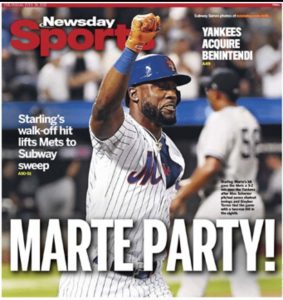 A five-month celebration. Even with one leg not 100%, Starling stole purposefully and led the team with 18 bags taken. Perhaps the most important of them was swiped in the first inning off Nola and the Phillies on August 13. Starling singled, stole second, took third on J.T. Realmuto’s throw and came home on Pete Alonso’s single. That made it Mets 1 Phillies 0, the score it would remain until that game’s end. It was part of another highly effective homestand. The Mets went 9-2 versus Atlanta, Cincinnati and Philadelphia, their NL East lead expanded anew to 5½. A trip to Truist Park awaited them. They were in good enough shape to withstand the worst imaginable in that four-game series. They lost three there — not good, but not as damaging as it could’ve been had they been swept. The one they won will be remembered for Brett Baty going deep in his first major league at-bat. Also worth remembering: Marte’s homer in the first to put the Mets ahead and Marte’s homer leading off the seventh to help ensure a big lead wouldn’t get away (final: Mets 9 Braves 7).
When the Dodgers visited Queens for what one was entitled to imagine was an NLCS preview, Starling showed he was ready to place his deposit on playoff tickets. He drove in at least one run in each segment of the three-game set, homering in two of them. The Mets took two out of three from L.A. and followed up with a win over Washington on Friday night, September 2. The Braves were relentless, but kept at arm’s length. We led them by three games. We could deal with a couple of wan efforts versus the Nats to close out the weekend. We could shrug off a rainout on Labor Day in Pittsburgh. We had 27 games to go. We were in first place. No matter what happened next, we knew we were postseason-bound.
What happened next was Mitch Keller being the Cecil Wiggins of 2022. Or the George Stone of 2022. Every baseball season is a puzzle. When the pieces click into place, it produces a magnificent vista. Take one essential piece out, you begin to wonder what you’ve been futzing around with all these months. Throughout September, we’d hear Starling Marte was working toward coming back. Even with the leg problems, maybe he could come back and pinch-run. He was trying to rejoin his mates for a stretch run that had grown plodding, but gripping was a problem. Starling Marte couldn’t grip a bat and he couldn’t grip a ball. It’s kind of hard to contribute when your core competencies physically elude you.
September 6 at PNC Park turned out to be Marte’s final regular-season game. The Mets’ offense now operated in the part of the house where the Wi-Fi tends to be spotty. Sometimes everything hums along. Too often, it’s difficult to connect. From the moment Marte came out of that Tuesday night game, replaced by Tyler Naquin, the Mets went 16-11. The ninth, tenth and eleven of those losses were to the Braves in Atlanta, the games that effectively ceded the division lead that the Mets had gripped almost ceaselessly all season long. While the Mets were making due with benchman Naquin, failed DH Darin Ruf and indefatigably versatile McNeil in right, the Braves stayed scalding. Or scalding enough. The Mets led the Braves by one game prior to Marte’s HBP at the hands of Keller. They finished the season tied, losing the title on a newly legislated tiebreaker. It only felt like the Braves ran and hid from the Marteless Mets.
***Yet we hadn’t seen the last of either the Mets or Marte in 2022. For goodness sake, the leagues now come equipped with three Wild Cards, and the 101-61 Mets didn’t see their puzzle altogether come disjointed in September. There would be playoffs, if not a playoff bye. And, hallelujah, there would be Starling Marte to participate in them. The man kept working and was declared fit enough to start all three games against the Padres of Juan Soto, Josh Bell and two-dozen other interlopers from San Diego. Maybe Marte wasn’t fully healed, but it was October. It was time to go. Starling knew that. He’d played in the postseason for both the Pirates and the Marlins. There aren’t too many active players who can say that.
“In a situation like this you kind of have to suck up the pain, because it’s a significant situation,” the much-missed right fielder said prior to the Wild Card round series. “You kind of have to fight through it. They asked me how I felt and they trusted me to given them an honest answer. At this point in the season, every player is playing with pain and right now it’s really about going out there and going to play.”
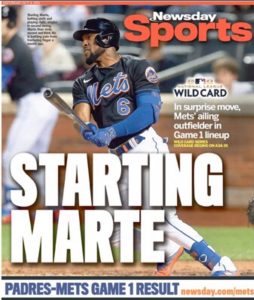 Showing up was half the battle. It would be swell to recall that Starling Marte reappeared as the baseball incarnation of Willis Reed from the 1970 NBA Finals or pulled some version of Rusty Staub gritting his teeth after slamming his shoulder into Shea’s right field wall in the 1973 NLCS and going on to carry the Mets’ load in the World Series. Not so much. Marte, placed in the six-hole in the batting order as a Showalterian precaution, did deliver two singles and steal two bases in Game One of the NLWCS, a 7-1 loss marked mostly by Max Scherzer’s sudden bout of gopheritis, and he handled his position without obvious detriment to the Met cause, but his presence alone, a little more rusty than Rusty, wasn’t enough to stem the brown and yellow tide. Starling came up against Josh Hader with two out in the home ninth at a noticeably not packed Citi Field, nobody on, the Mets trailing the Padres, 6-0. The batter grounded to Manny Machado at third. Machado threw to Wil Myers at first.
Starling Marte had begun the Mets’ season in Washington, and now he ended it in New York. It had been a helluva season until it wasn’t. It had been a reflection of Starling Marte’s presence until it was a reflection of Starling Marte’s absence. The Mets played very well for the most part. Many Mets played very well for the most part. Only one could be said to have made an indelible impact whether he was there or not.
***Two notes from after the Mets’ fade from the postseason itself faded from uppermost consciousness:
1) On November 3, the club announced Starling Marte had undergone surgery to repair a core muscle injury, and that he was expected to be mended in time for Spring Training. The injury was said to have affected him throughout the second half. We knew about the leg difficulties that sidelined him here and there but didn’t throw him off track until the fractured finger overshadowed everything else. The “core” had never been mentioned, although one figures the core bone connects to the quad bone and so forth and so on and what have you (I was never much of a science student). For Starling, a situation in which “you kind of have to suck up the pain” likely describes how he goes after it on a daily basis, certainly in 2022.
2) On November 17, the National League Most Valuable Player was awarded to Paul Goldschmidt of the St. Louis Cardinals, an absolutely worthy choice. My interest in the voting is inevitably downballot, given that a Met has never won the MVP. Pete Alonso came in eighth, with one voter picking him second and 23 others filling in his name somewhere between fifth and tenth. Finishing directly behind Pete was Francisco Lindor, with roughly the same level of support, save for the second-place nod. All of Lindor’s votes ranged from fifth to tenth. Jeff McNeil was named on four ballots, Edwin Diaz on two. And Starling Marte received exactly one tenth-place vote, from longtime writer and columnist Tracy Ringolsby. Ringolsby’s sharp observational skills are likely on a par with whichever BBWAA member in 1967 saw enough out of Mets left fielder Tommy Davis to give Tommy an eighth-place vote. Davis’s excellence may not have jumped off the statistical page — 16 homers, 73 runs batted in, a .302 batting average back when those were the categories that most guided voting — but somebody regularly inhabiting an NL press box had a keen eye. Davis, once one of the best players in the circuit, came to Shea that season, his only season as a Met, and put his nagging leg miseries behind him. He’d go on to continue a productive career and trace it all to his revival in New York, never mind that his Mets lost 101 games.
Starling Marte’s Mets won 101 games. His traditional numbers, compiled in 46 fewer games than Davis played, were comparable to his long-ago corner outfield counterpart: 16 homers, 61 runs batted in, a .292 batting average (Davis placed tenth in the 1967 batting race, Marte placed seventh 55 seasons later). I wasn’t front and center for Tommy Davis’s one Met campaign, but I’ve read up enough on it to understand its inherent excellence, whatever the stats. I was on the scene for all that Starling Marte did in his first Met campaign. It, too, was excellent. There was a lot of excellence on his team. Had this essay been devoted to any among an array of his teammates, it wouldn’t have been the wrong avenue to pursue. The Mets couldn’t have accomplished as much as they did without them.
But the Mets didn’t accomplish as much as they and we wanted once they and we were without Starling Marte. That’s the biggest difference. There’s the most value.
FAITH AND FEAR’S PREVIOUS RICHIE ASHBURN MOST VALUABLE METS
2005: Pedro Martinez (original recording)
2005: Pedro Martinez (deluxe reissue)
2006: Carlos Beltran
2007: David Wright
2008: Johan Santana
2009: Pedro Feliciano
2010: R.A. Dickey
2011: Jose Reyes
2012: R.A. Dickey
2013: Daniel Murphy, Dillon Gee and LaTroy Hawkins
2014: Jacob deGrom
2015: Yoenis Cespedes
2016: Asdrubal Cabrera
2017: Jacob deGrom
2018: Jacob deGrom
2019: Pete Alonso
2020: Michael Conforto and Dom Smith (the RichAshes)
2021: Aaron Loup and the One-Third Troupe
Still to come: The Nikon Camera Player of the Year for 2022.
by Greg Prince on 13 December 2022 3:31 pm On Monday of last week, the Mets signed at top dollar a pitcher on track to land in the Hall of Fame, a pitcher still at the top of his game, a pitcher at the top of the game overall. It made us mostly forget that our best pitcher from the previous nine seasons, our league’s best pitcher from the previous five seasons, had left us the Friday before.
Come Wednesday of last week, the Mets signed what you’d call a solid veteran pitcher who, like that future Hall of Famer, showed his stuff remains up to snuff in postseason play this very October. This lefty’s pending presence in the middle of the rotation was enough to make a Mets fan barely notice that the righty who held down a spot in the middle of the rotation had just left for a division rival. As a chaser to this development, the Mets grabbed a lefty specialist for the bullpen.
Then it was Thursday, and it was the day to ensure the role of The Dean remained filled by a highly regarded longstanding denizen of Flushing, somebody considered to be a very hot item on the open market, but that player — the essential leadoff hitter/center fielder from the previous Met season’s success — chose to stay put in his professional home once his professional considerations were satisfied. Oh, and another chaser: an accomplished closer to serve as setup man for the most brilliant closer in the game at the moment.
Saturday night, traditionally the province of the Bay City Rollers, rolled around, and before you could spell out S-A-T-U-R-D-A-Y twice, the Mets were reported to have reached agreement with one of the plums in the free agent orchard, a pitcher who’s excelled on one continent and is projected to do the same on this one. This Japanese righthander’s repertoire is so tantalizing, word that last year’s No. 3 Met starter was leaving the United States for Canada was greeted with a shrug.
So, to sum up: former Astro Justin Verlander has more or less replaced Texas Ranger Jacob deGrom; former Cardinal Jose Quintana has more or less replaced Philadelphia Phillie Taijuan Walker; former Fukuoka SoftBank Hawk Kodai Senga has more or less replaced Toronto Blue Jay Chris Bassitt; Brooks Raley and David Robertson are filling a potential relief void before it can grow into a gaping bullpen vacuum following the exits of Joely Rodriguez to the Red Sox and Trevor Williams to the Nationals, with the statuses of Seth Lugo, Trevor May and Adam Ottavino yet to be determined; and Brandon Nimmo, like Edwin Diaz, isn’t going anywhere.
Just like that, the Mets have answered many if not all of their questions ahead of 2023 before December 2022 is half over. Just like that, Steve Cohen committed whatever it took to not let the talent level of the team he bought barely two years ago dip from its 100-win level of this year. Just like that, there was little opportunity to wonder if the Mets would do what it would take to continue to contend seriously, because this is serious business the Mets have been conducting.
A pitcher like Verlander would have been a pipe dream before Cohen. A pitcher like Senga would have been one of those “maybe they could…nah” situations that arose so often before Cohen. To have watched the pitchers who left leave would have been a telling blow before Cohen, and one theoretically perfectly good starter like Quintana in the company of an acquired lesser arm, along with whoever emerged from a pile of Quadruple-A possibilities, would have been sold with a straight face as a reasonable succession plan. With Cohen, we move on and at the very least stay on par with where we were and probably improve. If Senga is the real thing, if Quintana keeps up his Cardinal pace, if Verlander is as ageless as he’s seemed, you wouldn’t be quick to turn them down as a package in exchange for deGrom, Walker and Bassitt. That’s pretty much the trade that happened, albeit through three pitchers departing of their own volition to disparate destinations, and three pitchers arriving veritably en masse because all things and payments being something akin to equal, they’re enthusiastically joining the New York Mets.
Plus those bullpen guys (Robertson signed for one year, Raley obtained from Tampa Bay for a promising if far off minor leaguer), alongside the talented Mr. Nimmo opting to not go anywhere. All of this has transpired in a period that had yet to commence two entire weeks ago. This is how the New York Mets of the contemporary era operate. This is our franchise doing very well one year and aiming at doing better the next. This isn’t one of those “win the offseason” sprees easily dismissed. It’s not unlike the last winning offseason, which led to a substanitally winning season, which is now our starting point for constructing a team for the next season, fairly projected as another winning season.
As of this writing, it is Tuesday afternoon. The Mets haven’t made a move since Saturday night. With these Mets, it seems a little odd to have gone so long without one.
This whirlwind of Mets transactional action forms the basis for the latest edition of National League Town, available for your listening pleasure here or pretty much any podcast platform you choose.
by Greg Prince on 10 December 2022 1:57 pm I got a huge kick out of leafing through the 1967 Mets Yearbook years after it was published and finding that even then Ed Kranepool, a mere 24 yet the only Met left from the Mets’ first year of 1962, was referred to as “The Dean” of the Mets in terms of continuous service with the Mets. Until Ed Kranepool ceased playing for the Mets, I had never known a time when Ed Kranepool couldn’t be identified by some phrase indicating that status. He was longest-tenured Met. He was the elder statesman (or statesMet). He had the most seniority among Mets. He was Ed Kranepool and all that implied.
Yet it only seemed like Ed Kranepool was The Dean forever. There was a time before the 1967 yearbook went to press that Eddie’s steadiness may have been noteworthy, but it was yet to be remarkable. Payson Tech had a few The Deans before Ed earned his tenure. There’d be even more in the years beyond the Krane.
Let’s go back to the beginning, to the very first game, to the very first starting lineup. Of the nine men Casey Stengel penciled in that night in St. Louis, April 11, 1962, none would last as long as Casey did in a Mets uniform. Stengel managed his final game on July 24, 1965, whereas the longest-laster among players turned out to be the same gentleman who stands today as the longest-living Met: 93-year-old Frank Thomas. Cleanup hitter Thomas was the only original Original Met from that initial batting order to play for the Mets as late as 1964, specifically through August 5 of the Mets’ third season, until he was traded down the Turnpike to the beef up the Phillies’ pennant drive (a drive that famously careened into a ditch).
Replacing Thomas as The Dean…well, we have to inflict the first of several explanations here, because there was one 1965 Met, post-Thomas, who saw action in the first Met game: Bob Moorhead, who came out of the bullpen in the fourth inning. Moorhead’s claim to fame, certainly to me, is his emergence as the very first Met to make his major league debut as a Met. Bob’s last game of the Mets’ inaugural season was certified as such when he punched a clubhouse door in St. Louis. Moorhead was frustrated with his pitching that September 1 and wound up doing damage to a couple of the fingers on his right hand. In the immortal words of Pete Campbell, “Not great, Bob!” And in the words of the immortal Casey Stengel, “If we were in first or second place, Moorhead would be fined. But we aren’t, so what’s the use?”
Mind you, we’re dredging up Moorhead’s burst of temper here because Moorhead became the only Met to have played in the Mets’ first game and play for the Mets as late as 1965. That makes Moorhead our next The Dean, right?
Not so fast there, Bob. The Dean has to have served continuously within the Mets organization from his Met debut. We’ll allow for stints on the injured list or detours to the minors or other business that can’t be prevented provided that the player in question stayed within the Met realm without interruption. It’s a little murky where Moorhead is concerned. His Baseball-Reference page indicates no transactions casting him out of the Met organization. He pitched for no other major league team besides the Mets. Yet — and it’s a big yet — Moorhead spent all of 1964 pitching for affiliates of the Milwaukee Braves. Even then, it’s not so simple to figure out whether Bob Moorhead altogether stopped being what used to be termed “Met property” and ultimately gets marked down as a Met Once Removed.
I surveyed as many reliable sources as I have at my fingertips and couldn’t nail down a specific trade or sale that connected Bob’s time in the Met system in 1963 (when he was demoted all the way down to Single-A Raleigh) to his sudden shuffle through the rosters of Denver, Toronto and Austin, each of them links in the Brave chain. I found a deal sending Moorhead from Double-A Austin to the Mets’ Triple-A outpost in Buffalo in August of ’64 (a bout of mononucleosis prevented him from reporting ASAP), but it was never quite clear to me how he had found his way to the Braves’ organization in the first place. Nothing in the papers, even in those broadsheets that dutifully printed practically everything that came across the wire. Nothing in The Sporting News, which reported everything of this nature in those days. Nothing by way of expository background in New York media-generated game stories when Bob pitched his way back to the Mets with a newly developed knuckler in ’65 after having “drifted” through the minors for nearly three solid years. Plus it all seemed a little too convenient that this pitcher just happened be traded to Buffalo after a bunch of months away from the Met organization with not even agate-type fanfare to accompany his Brave-tinged stint. It was not wholly uncommon for teams to make arrangements to loan minor leaguers to one another, far from the bright lights of their big league ballparks, but what amounted to practically an entire season of pitching under somebody else’s mortarboard would seem to disqualify Bob Moorhead from assuming his title as The Dean. He can take it up with the academic credentials committee.
If Bob Moorhead doesn’t succeed Frank Thomas as The Dean, who does? We have two worthy candidates in the starting pitcher and starting catcher from the Mets’ third game ever, on April 14, 1962. Al Jackson started that game against the Pirates at the Polo Grounds, throwing the very first pitch to his receiver Chris Cannizzaro. By definition, Jackson (1 in your scorecard) experienced the very first action of that game, just ahead of Cannizzaro (2 in your scorecard). This slicing and dicing of who came first and who came second is relevant in our discussion because, wouldn’t ya know it, Jackson and Cannizzaro also played what appeared to be their final games as Mets on the same date.
But let’s get into appearances. Jackson, the 21st Met overall, gets the nod because he went into the Met annals a few seconds before Cannizzaro, the 22nd Met overall. But Jackson’s apparent final Met game was in the first game of the doubleheader on the final day of the 1965 season, October 3. Cannizzaro took his final Met bow in the second game of that same Sunday, part of a twinbill necessitated by the Mets and Phillies going eighteen scoreless innings at Shea until a city curfew demanded an end to the Saturday night/Sunday morning affair the day/night before (itself the nightcap of a doubleheader). Cannizzaro played one game later than Jackson in 1965, though it’s not like Jackson wasn’t still on the team during what was, when two ties are taken into account, Game 164 of a season that yielded 112 losses.
The fates were penurious with Met wins in that era, so let’s be generous with honorifics and call Jackson and Cannizzaro co-The Deans. And let’s note that while both Al and Chris went on their respective merry Metless way following the 1965 season, Jackson didn’t stay away forever, coming back to the Mets from St. Louis after two years with the Cardinals. As much as we respect the Recidivist Met concept, Jackson, having been a Cardinal in 1966 and 1967, meant he couldn’t resume being The Dean or even co-The Dean. This will come up in our travels through the decades. In the most stark example we can access, Tom Seaver was the only 1983 Met who could say he was a Met as long ago as 1967, but there are pictures offering evidence that Tom was a Cincinnati Red from the middle of 1977 to the end of 1982 (I know, we don’t believe it either). We’ll happily distribute gold stars in the shape of asterisks to Recidivist Mets who went back longer on the calendar than any of their Met teammates despite an interruption to their service, but it wouldn’t be fair to those who never left to rip the cap and gown from their personages.
Tom Seaver is everything to the Mets. But he was never The Dean.
MEANWHILE, there was one more Met who inscribed his name on the all-time roster on April 14, 1962, technically after both Jackson and Cannizzaro, who not only endured to the final games of 1965 but to end of 1966. If we weren’t such sticklers for starting points, we could just say Jim Hickman, who preceded Seaver as the most accomplished of Mets, succeeded Thomas as The Dean, but Hickman didn’t make his Met debut until pinch-hitting in the seventh inning in that third Met game ever, and boy, are we sticklers. Still, Jim got his reward once Al and Chris bolted. He was the last of the truly Original Mets from the very first 28-man roster in April 1962 to stay a Met as late as 1966, playing his fifth and final season for New York before being traded with Ron Hunt to Los Angeles. That swap brought Tommy Davis to the Mets and, as we never tire of pointing out, Davis’s superb 1967 enabled an even more consequential trade: Tommy Davis for Tommie Agee. Most consequential in the context of our discussion is that Hickman’s departure eased the road to The Deandom for Ed Kranepool, who the aforementioned 1967 yearbook noticed had been around since September 22, 1962, when he was a lad of 17, and was already making a habit of never leaving.
I think we’re all pretty familiar with Ed Kranepool’s reign as The Dean. It lasted thirteen full seasons. We won’t hold his 1963 and 1964 optionings for further seasoning nor the brief 1970 demotion to Tidewater manager Gil Hodges thought would snap him out of a mid-career funk against his longevity. It’s not like he was honing his craft with a bunch of Braves prospects à la Bob Moorhead. Ed Kranepool was a Met all the way.
Nonetheless, we come to the end of Eddie’s The Deanship on September 30, 1979, because no Met remains on the active roster forever (though if anybody could, it would be Kranepool) and in 1980 we begin the term that was destined to belong to Ron Hodges, called up to the Mets on June 13, 1973, fortifying a catching corps both banged and bruised. Hodges held his own and presented a professional target for some elite pitchers while Jerry Grote worked his way back from injury. Ron’s highlight was the night he tagged out Dave Augustine on perhaps the most memorable defensive play at the plate in Met history (the ball off the top of the wall, you might know it as) and then drove in the winning run, all of this in the thirteenth inning, all of it in the searing heat of a pennant race so hot that Casey Stengel definitely would have fined a pitcher who chose that evening to bust his fingers punching a clubhouse door.
That night of September 20, 1973, remained Ron’s highlight for a dozen years. Hodges didn’t play all that much from 1974 to 1984, but he was a constant, which really helps a Met become The Dean. The Mets never made a move to get rid of him for an entire decade, so he should indeed have the title for his trouble. And, really, it’s pretty remarkable to realize Ron’s staying power carried him from one of the peaks in the Mets story — the 1973 pennant — to another of the peaks in the Mets story — the 1984 revival and all that ensued — and he had to endure so much valley in between. Well done, The Dean!
The year Ron became The Dean, you wouldn’t have guessed who would ultimately inherit his title, because in 1980, that the future The Dean was down at Jackson after a stint that wasn’t altogether promising once he first dipped his toe into Met waters beginning April 5, 1979. Yet Flushing Meadows remained patient, and once Jesse Orosco returned to town in the second half of 1981, his longevity wouldn’t be far behind. You gotta remember, the Mets had gone through a lot of flux, most of it for the best to get to surefire contending status in 1985. That meant churning through a surfeit of early-’80s players in whom management saw little future and holding onto a precious few while it cultivated its top minor leagues and made savvy trades. Once stalwarts Ron Hodges, Craig Swan and John Stearns had left (all of them in 1984), the only current Mets who dated from the ’70s were Jesse and Rusty Staub. Staub was a Recidivist Met, and as indicated above, continuity is key to The Dean. Orosco’s time as a Tide was essential in finding his groove, and it counts as continuity.
Jesse continued straight through the final strikes of the 1986 National League Championship Series and World Series, and would pitch clear to 2003, but only until the end of 1987 as a Met. After Orosco followed the path of Hickman and was traded to the Dodgers, the torch of The Dean would be passed to one more survivor of the bad old days, Mookie Wilson, who debuted as a Met and major leaguer on September 2, 1980 — same game as Wally Backman, but Mookie led off in L.A., while Wally batted eighth. Further, Mookie outlasted Wally, all the way to the trade deadline of 1989, when the Met whose career was most emblematic of the entire 1980s (he’s the only one to have played as a Met in each year of the decade) moved on to Toronto and another playoff date, because if Mookie is anything, he’s a winner.
In Mookie’s place would come a series of The Deans who barely knew, if they knew it at all, the struggle of being on lousy Mets teams. Darryl Strawberry was promoted to the big club on May 6, 1983, when the Mets could be found at their usual basement address, but in less than a year’s time, they were bona fide contenders. Say, that might have something to do with the presence of Darryl Strawberry! No doubt, whatever the Mets accomplished in the way of a seventh consecutive year of fairly plenty in 1990 (91-71 and another race almost down to the wire) was carried on Darryl’s broad shoulders (37 HRs, 108 RBIs) in what became his walk year.
Darryl indeed walked to his hometown Dodgers, leaving open the slot of The Dean, which brought another upper-case D into the picture: Ron Darling. Ronnie debuted on September 6, 1983, four months after Darryl, and one day in early 1991, he might have turned around and noticed he was the last Met left from the altogether putrid final month of the dismal Met epoch of 1977-1983. Well, Hubie Brooks was at Shea in 1991, but that’s the Recidivism talking. Darling accomplished a lot as a Met, but longevity as The Dean wasn’t on that list. The Mets traded Ron to Montreal in July, which meant there’d be yet another new The Dean in town. It would be somebody who, it was hard to reckon, could be defined by the concept of seniority.
It was Dwight Gooden, forever 19 and 20, in the mind’s eye, but by the second half of 1991, an eight-year veteran, and a Met all eight years, beginning on April 7, 1984. Doc would turn 27 in the coming offseason. Old Man Gooden? For term of continuous service purposes, absolutely. Unfortunately, the teams on whom Doc would elderly state in 1992, 1993 and 1994 would resemble the teams good ol’ Jessie, Mookie, Wally, Hubie, Darryl and Ronnie broke in with more than those on which Doctor K earned his medical degree. Far more unfortunately, a second positive drug test meant a suspension and an abrupt end to Doc’s Met career before the ’94 strike kicked in.
This meant the next The Dean was somebody who you had no problem picturing being the old guy in the clubhouse. We didn’t meet John Franco as a Met until he was 29, and when we did meet him, he wasn’t shy about telling us how he grew up idolizing the likes of Seaver, Koosman and McGraw, so it already felt like he’d been part of the team since at least 1969. Johnny’s career as a Red closer had already been decorated, too, thus he wasn’t an unfamiliar figure by any means when he first took the ball from Davey Johnson on April 11, 1990…and yes, John Franco was here so long that he pitched for the same Davey Johnson we don’t at all associate with the several eras associated with John Franco.
It was a long run as The Dean for Franco, longer than anybody’s after Kranepool’s. No matter what we might have grumbled to ourselves following a save that got away, Johnny wasn’t going anywhere. He was one of us, from Brooklyn and all that. When he finally did leave after the 2004 season, he pitched briefly for Houston, and the sight of it was too weird to wish he’d hung around in another uniform any longer. If anybody who didn’t commence as a Met should have concluded as a Met, it was John Franco.
Fittingly, the All-Star pitcher who came to the Mets and put on No. 31 in 1990 was succeeded as The Dean by a catcher who came to the Mets and put on No. 31 in 1998, the digits courtesy of eventual team captain John Franco. Along with everything else we can say about the great Mike Piazza, we can say he was The Dean in 2005. It was just one year, and it was clearly going to be Mike’s last year, but he was the last direct link to not only the Mets of the 20th century, having debuted in our togs on May 23, 1998, but the last of the Met-hicans from the glorious 1999 and 2000 clubs to still be Metting it up in a decidedly new era. Mike played out his bargain of a seven-year contract on October 2, 2005 (the least official but perhaps most resonant of several Mike Piazza Days), and gave way in the longevity department to somebody most suited to taking one’s time.
Yes! Steve Trachsel! Why the exclamation points? Irony, I suppose. Trachsel came aboard in the fifth year of what this correspondent considers the most gripping five-year period in Mets history, on April 7, 2001, and was still here the next time the Mets ran roughshod over the National League, in 2006. Steve, who pitched our first division-clincher since 1988, would wait out a batter or an umpire or his catcher or the elements between pitches. We would wait with him. We waited six fairly productive if not altogether thrilling seasons with him. It only felt like eighteen years from pitch to pitch.
After not helping the Mets very much in their seven-game NLCS loss to the Cardinals, torpid Trachsel moseyed along and gave way to a The Dean synonymous with speed: Jose Reyes, who raced onto the Met scene on June 10, 2003, or nine months after Pedro Feliciano on September 4, 2002. Famously — in our circles, at least — Perpetual Pedro pitched as a Met as late as 2013 and never pitched for any other MLB team in official competition, but he regularly passed through other organizations (including the Fukuoka Daiei Hawks for all of 2005), so while we appreciate Feliciano’s de facto loyalty to the orange and blue, the continuous service bugaboo that bit Moorhead’s case gets its teeth into Pedro’s situation as well.
Thus, Jose, and he seemed a good bet to keep on The Dean-ing to a ripe, old age considering he came up on the last day he was 19 and he was, you know, Jose Reyes. Except the folks who owned the Mets in the fall of 2011 weren’t Steve Cohen and didn’t have Steve Cohen money and it’s all a Mets fan can do to retcon Steve Cohen into Mets history and have him not only keep Jose a Met his entire career but placate Tom Seaver in 1977 and take on Jim Palmer’s contract as well. The time machine is not currently operable, so we’ll simply acknowledge that young Jose Reyes was the senior Met for five years before moving on (and eventually coming back).
With Jose having gotten a lead off first in New York and sliding into free agency second base in Miami, David Wright took over as The Dean, and who better? “Who better?” in so many ways is a question that can be answered with David Wright. Wright joined the Mets on July 21, 2004, and even through his lengthy injury rehab, never departed. David was named The Captain in Spring Training 2013, he remained The Captain until his final days in 2018 and, as far as I’m concerned, he will always be The Captain. Retiring No. 5 goes without saying. Retiring The Captaincy would work for me, too. There is only one David Wright.
But there would need to be another The Dean once Wright effectively retired with two years remaining on his contract, and the title would go to his fellow Gold Glove-awardee Juan Lagares, a Met since April 23, 2013, and, these eyes here say, the best defensive center fielder the Mets have ever featured (all respect to Messrs. Agee, Beltran and small sample size/large impression Pat Howell). Lagares’s glove was not only where extra-base hits went to die; he robbed Jeurys Familia of The Dean status. Well, not so much Juan but the trade the Mets made in the middle of 2018 to send Familia to Oakland for what amounted to a semester abroad. The Mets picked up Familia at the airport to begin the 2019 season, resuming a Met career that began on September 4, 2012, but being an Athletic, or anything other than a Met for even one game (let alone the 70 Met games Jeurys missed while he wore the green and gold), will derail anybody’s ambitions for being The Dean.
Likewise, Lagares could only serve as The Dean through the 2019 season because he not only tested the free agent waters, he did more than wade in them, signing with San Diego for 2020. Ah, but that’s 2020, and we probably still remember 2020 was a year unlike any other in major league (or contemporary human) history. Bottom line is Juan never actually played for the Padres or any Padres affiliate, the latter impossible, anyway, given that no affiliates were playing anywhere in the COVID season. Somehow, Juan wandered back to the Mets for a dash of Recidivist pinch-running and a couple of cameos in center. It wasn’t the same — they gave him Nos. 87 and 15 rather than the 12 with which he was identified, for cryin’ out loud — and it didn’t renew his tenure as The Dean, for that title had already passed on to…
Jacob deGrom. Or BOO! as I’ve come to think of him when I think of him, which I’m trying not to do, especially since watching his introductory “I’ve always wanted to be a world champion Texas Ranger ever since they paid me to want that” press conference. Before Jacob jilted us, I, like most Met fans, had willingly and lovingly soaked up every inning of his Met career, which began with such promise on May 15, 2014, and continued with such promise all the way to the second game of the 2022 National League Wild Card Series. Someday I won’t be sore when I think about the fella I used to call Jake.
Besides, who can be sore when thinking about a much brighter expression of human emotion, namely smiling? Who isn’t smiling now that we know who the new The Dean is gonna be for as many as the next eight years? Ladies and gentlemen I (and Steve Cohen) give you Brandon Nimmo! That exclamation point is not ironic. I, like most Met fans, am ecstatic that Brandon has been re-signed for 2023 through 2030, even if there’s no knowing what anything beyond today brings. Today we know who our center fielder will be next year, all non-injury, non-pandemic, non-goodness-knows-what things being equal. Conversely, nobody on the market equaled the relatively sure thing Brandon Nimmo represents as our center fielder and leadoff hitter. Since he arrived as a New York Met on June 26, 2016, he’s grinned and he’s grinded (ground in English, grinded in baseball) and he’s gotten better and, when he’s been healthy, he’s crafted himself into a one-of-a-kind OPS threat, particularly the O part from getting on base as he does. I love to watch him play defense. I love to listen to him exude anything. I love that I’ve watched him grow up into the veteran he’s become, definitely coming off as someone who’s been through the Met wringer, but never not happy to be here. He just proved how happy being a Met makes him. One-hundred sixty-two million dollars didn’t hurt, but what a gamer to get “162” in there.
Brandon will play his games, get his walks and his hits and hit-by-pitches, steal his handful of bases, track down his catches, be a fine Met and, most importantly, continue the legacy of The Dean. The Dean is the institutional memory of the clubhouse. The Dean will be able to tell the stories no other uniformed personnel on the premises knows or remembers. When new-for-2023 Mets Justin Verlander, Jose Quintana, Brooks Raley and David Robertson alight in Port St. Lucie, Brandon will take each new face under his wing and show him the ropes. At least that’s what I’d like to imagine will happen. I rather doubt Justin Verlander requires much rope-showing. These other veteran acquisitions, too, but you know if there are questions to be asked, Nimmo will be available in Met colors to answer them.
Seriously, if you have any issues, take them to The Dean. He knows the ropes, he hits the ropes, he flags down the ropes. He’s been around here a while.
THE DEANS: Senior Mets By Continuous Service
Frank Thomas: 4/11/1962; 8/5/1964
Al Jackson: 4/14/1962; 10/3/1965 (1)*
Chris Cannizzaro: 4/14/1962; 10/3/1965 (2)
Jim Hickman: 4/14/1962; 10/2/1966
Ed Kranepool: 9/22/1962; 9/30/1979
Ron Hodges: 6/13/1973; 9/30/1984
Jesse Orosco: 4/5/1979; 10/4/1987
Mookie Wilson: 9/2/1980; 7/31/1989
Darryl Strawberry: 5/6/1983; 9/27/1990
Ron Darling: 9/6/1983; 7/14/1991
Dwight Gooden: 4/7/1984; 6/24/1994
John Franco: 4/11/1990; 10/3/2004
Mike Piazza: 5/23/1998; 10/2/2005
Steve Trachsel: 4/7/2001; 10/14/2006
Jose Reyes: 6/10/2003; 9/28/2011*
David Wright: 7/21/2004; 9/28/2018
Juan Lagares: 4/23/2013; 9/29/2019**
Jacob deGrom: 5/15/2014; 10/8/2022
Brandon Nimmo: 06/26/2016; TBD
First date is player’s first game as a Met. Second date is player’s final game (or final game of his first stint, in the case of Recidivist Mets* or Mets Once Removed**) as a Met, after which the next player on the list takes over as The Dean.
The latest episode of National League Town was recorded before Nimmo laid claim to becoming the nineteenth The Dean in Mets history, but rest assured it revels in the signing of Verlander; ponders the effectiveness of Quintana; and gets something in about Raley. You can listen here or on your podcast platform of choice.
by Greg Prince on 5 December 2022 4:00 pm What I have in common with Baseball Hall of Famer Gil Hodges I could count on very few fingers, but it delights me that one of them is a ring finger. Gil earned three World Series rings, two as a player in 1955 and 1959, one as a manager in 1969. I was presented with what is likely the closest thing I’ll ever claim as a championship ring on Saturday, and it wouldn’t have been possible without Gil Hodges.
Saturday brought around the more or less annual Queens Baseball Convention. QBC has been a staple of the offseason calendar since January of 2014, except when a blizzard canceled it in January of 2016, a Mets-run fanfest in January 2020 rendered it temporarily superfluous, and that pandemic business discouraged crowds from populating indoor spaces a winter later, no matter how much that crowd might have loved the Mets. Other than those pauses, QBC has marched on. Different months some years. Different venues other years. This year it was December in downtown Flushing, at a hotel located a relatively convenient walk (albeit through rain and wind) from the final stop on the 7 train. I almost never take the 7 east of Mets-Willets Point. On Saturday I did and noticed that as you pass Citi Field (the parking lot of which has been transformed into a glittery Christmas village), you get a generous glimpse of the left field Promenade and a full-on view of all those retired numbers the Mets suddenly sport, as if they have a real and proud history.
Which they do, which explains why, other than for fun, I was heading to QBC. My primary role at this offseason gathering spot is to present the Gil Hodges Unforgettable Fire Award, a token of fan recognition for keeping the Met-aphorical torch lit. Recipients prior to this QBC have included Gil himself (presented posthumously to his son Gil Hodges, Jr.), Ed Charles, Bud Harrelson (presented that summer at the Long Island Ducks’ pond in Central Islip, a contingency necessitated by the aforementioned blizzard), Tom Seaver (who couldn’t be there, but his teammate Art Shamsky graciously swung by to pick it up and later bring it to Tom in Napa), Bobby Valentine, David Wright (who accepted it via classy video) and the late communications specialist and friend to all Shannon Forde (with her family on hand to help us pay tribute to her memory). Real and proud history, indeed.
One of the reasons we can feel proud of the Mets, despite sometimes being, you know…the Mets, is the man who holds the titles vice president of alumni relations and team historian for that organization so close to our heart, Jay Horwitz. You can’t ride the rails to Flushing-Main St. and grab that peek at the rafters and not get a sense of some of the work Jay has done. A few years ago it took less time to read the numbers up in the rafters than it did to confirm that there’d once again be no Old Timers Day. Since Jay was appointed to his current positions, we’ve seen three numbers added to the four that sat waiting too long for company. We’ve also stopped confirming that the Mets would never again have an Old Timers Day, because, thanks to Jay’s leadership, Old Timers Day returned in 2022 for the first time since 1994. The vibe associated with the Mets as an entity that lived in the present, was clueless about the future and pretended there was little past to them has done practically a 180 since Jay shifted from public relations to alumni relations. We have a present. We have a future. We salute our past.
That’s worthy of an award. That, the folks who put together QBC decided, was worthy of selecting Jay Horwitz as this year’s recipient of the Gil Hodges Unforgettable Fire Award. They courteously asked me if I agreed. I did. They doubled down on courtesy and asked me if I would present the award to Jay. I agreed to that, too. I’m always up for the ceremonial aspects of baseball. To be a part of this one particular ceremony more or less annually gets my torch lit as is. To do this presentation in the wake of reaching one of the goals of establishing the Gil Hodges Unforgettable Fire Award — contribute in whatever way possible to keeping Gil’s name on people’s minds until he was elected to the Hall of Fame — made the Hot Stove flame burn that much brighter for me.
So through the rain and wind I clomped from the final stop on the 7 to the hotel a little north of Northern Blvd. (getting flummoxed by construction for a few minutes before I found the entrance), shook out my umbrella, stepped into the men’s room and waited to wash my hands behind somebody using the sink on the right when I heard somebody using the sink on the left tell the man using the sink on the right, “IT’S YOU!”
I was standing behind Endy Chavez. Because that’s the sort of thing that happens at QBC. Endy said to the other fellow, “yes” and smiled. When my turn came to wash my hands, I soaped, rinsed and dried quickly so I could casually follow Endy out of the men’s room and blurt the first thing that occurred to me:
“It’s an honor to share a men’s room with you!”
I think Endy smiled. And perhaps picked up his pace to get away from me.
 Just a couple of guys who’ve written Mets books (thanks to my friend Jessie for introducing me to R.A. Dickey). Endy Chavez! R.A. Dickey! Howard Johnson! Bartolo Colon! Nelson Figueroa! DOC GOODEN! Those were the players who were at QBC in one capacity or another. Well, one capacity above others: they were Mets among Mets fans. That goes over pretty well, especially when it’s barely half-a-day since we learned one Met chose to no longer be a Met among Mets fans, even if we agreed to keep our distance and not follow him into or out of men’s rooms. Let’s just say “Jacob deGrom” was no longer a surefire applause line in this environment.
The departure of deGrom (before we knew about the arrival of Verlander) didn’t put any more of a damper on this event than did the howling rain that lasted into mid-afternoon. That was outside. Inside, warmth was in the forecast. People talked Mets. People listened Mets. Mets fans renewed acquaintances. I ran into Dave, a guy I knew in high school. Then, we were two Mets fans happy to find anybody who’d identified as such. There weren’t many of our kind in those days. On this day, “Mets fans” described everybody in sight. For all the procuring of players’ presence, and Mets themselves are certainly a draw, I don’t think it’s the chance to score an autograph or a photograph or even a men’s room sink encounter that makes QBC click. It’s me in my SHEA STADIUM THE GREATEST BALLPARK EVER! hoodie running into Dave from high school in his SEAVER 41 jersey, introducing me to his son who’s a bigger fan than he is, even if unlike his dad and me, he’s still waiting for a world championship — it’s that interaction multiplied by who knows how many hundreds of times in the course of a Saturday. Mets fans running into each other is the lifeblood of a day of this nature.
And, a little bit, it’s prime QBC movers Keith Blacknick and Dan Twohig — aided in their heavy lifting by a raft of volunteers in cleverly designed t-shirts — carving out a few minutes to make sure we talk about Gil Hodges and Mets history. That’s where I come in, and that’s where my championship-style ring comes with me. See, I’m enjoying my impromptu reunion with Dave from high school when Dan pats me on the shoulder and lets me know I’m up next. I excuse myself and, within a couple of moments, I’m sitting on the dais, next to Jay, promising him that I plan to embarrass him with praise any second now. I’m also looking out on the crowd, as we wait for people to sort themselves out after HoJo has given of himself generously in his panel (moderated elegantly by WFAN host and fellow Mets fan Lori Rubinson). In the first row, there’s Irene Hodges. Jay introduced me to Irene, who I recognized from her speech inducting her father at Cooperstown this summer. I shook her hand and thanked her for that. I’m thinking she’s probably heard something like that before, but then again I’m pretty sure HoJo, R.A., Bartolo, Figgie, Doc and Endy have heard what they’re hearing all day before, give or take the men’s room sentiment. I’m gonna guess that they don’t altogether mind the repetition or enthusiasm for aging accomplishments. They agreed to come to a venue for the express purpose of being recalled lovingly to their faces.
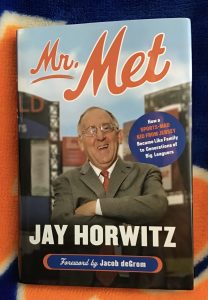 Lest we forget, Jacob deGrom’s Met legacy includes the foreword to an Amazin’ memoir. I’m there for the express purpose of remembering Gil Hodges lovingly. Irene is there to support Jay, which tells you something about Irene as well as a good deal about Jay. Jay stayed in close touch with the Hodges family through the long, long wait for good news from the Hall of Fame. He was a true friend to Mrs. Joan Hodges. He’s a friend to Irene. He’s a friend to more Mets and Mets-affiliated folks that can be counted. If you wanted somebody to say something nice about Jacob deGrom on Saturday, you needed only to turn toward Jay Horwitz if you were lucky enough to be sitting next to him on a dais as you waited to make a formal presentation. Jacob, I reminded him, wrote the foreword to his memoir. Through a bit of a pained expression, Jay acknowledged deGrom’s defection (my word, not his) but wanted to remind me “Jacob’s a very good person.” Well, I said, at least you have another Met alumnus now.
As the room settled down, Dan the co-organizer stood with a mic for a moment and made an announcement. He explained what we were about to do, said a few words about the transcendence of Gil and the worthiness of Jay and that he was about to turn it over to me, but first, he and Keith had something for me: a ring, in appreciation for being QBC’s resident “historian” since the “by the fans, for the fans” fanfest hit the drawing board nearly a decade ago. The ring bears the logo of QBC and evokes the kind of jewelry one receives for winning a title. My title is fan who gets to do the Gil Hodges Unforgettable Fire Award presentation more or less every winter. I wasn’t expecting a ring for doing it. When you’re a Met fan, you learn to never expect a ring, though when one does slip onto your finger, you’re most grateful for what it represents.
 It’s not all about the ring, but it’s pretty nice getting one. I’ve toggled between referring to it for my own amusement as the Gil Flores Unforgettable Fire Award (don’t tell me you’ve forgotten the outfielder who roamed THE GREATEST BALLPARK EVER! when Dave and I were in high school) and the Royce Ring Ring (an homage to both our Closer of the Future c. 2005 and the hastily arranged Francis Scott Key Key from the “Privateers” episode of The West Wing), but mostly I’m touched that Keith and Dan paused amid taking care of the umpteen-thousand details necessary to put on a show of this magnitude and give me this other pat on the shoulder. Or ring finger. Thanks very much, guys. Thanks to everybody who takes a few minutes from roaming around and gabbing excitedly and queuing up for autographs to listen to me doing my Mets historian thing, particularly when I’m doing it with the guy who actually is the Mets historian.
The following is the text I wrote and delivered at this year’s Queens Baseball Convention in honor of Gil Hodges and Jay Horwitz (who made his acceptance remarks all about Gil, because that’s who Jay is). I hope you enjoy it.
***As we close out the 60th anniversary celebration of our New York Mets, I want to wish all of us a Happy Mets Anniversary in the year ahead. Every year is the Mets anniversary of something. In 2023, we will be marking…
• The tenth anniversary of peak Harvey Day and the All-Star Game Matt Harvey and David Wright started at Citi Field;
• The twentieth anniversary of the first base stolen by Jose Reyes and the last broadcast by Bob Murphy;
• The thirtieth anniversary of Anthony Young persevering until he finally won a game after losing 27 in a row;
• The fortieth anniversary of the days we got to Shea hello to Darryl Strawberry, Keith Hernandez and Ron Darling;
• The fiftieth anniversary of Tug McGraw instilling within us the evergreen philosophy, You Gotta Believe;
• And the sixtieth anniversary of a ninth-inning, two-out ground ball to shortstop Al Moran from Jim Davenport of the San Francisco Giants to end the nightcap of a doubleheader at the Polo Grounds on May 5, 1963, a Mets victory sealed when Moran fielded it and threw it to a first baseman you knew would handle just about anything coming his way.
The Mets’ first baseman was Gil Hodges. It was the last play Hodges made in the major leagues, twenty years after his debut for Brooklyn. Gil was an achy 39 in May of 1963, about to be done as an active player. By the end of the month, he’d be traded to the Washington Senators, who immediately appointed him their manager. It was a very quick transition and, from our perspective, made for a very useful apprenticeship. Following the 1967 season, Gil would be traded again, as a manager, back to the New York Mets, and I think we know where this transaction — and this man — would lead us.
When the Queens Baseball Convention conceived of an award to honor members of the Mets community past and present for making us forever proud to be Mets fans, there was only one name that could instantly describe its inspiration: Gil Hodges. At the same time, QBC wanted to make a point of at least once every year calling as much attention as possible to the name Gil Hodges.
Gil, you probably remember, had missed making the Hall of Fame too many times despite being one of the top run-producers and THE premier defensive first baseman of his time before managing the 1969 New York Mets to the most unlikely world championship ever. Not in the record books: the universal esteem in which EVERYBODY in baseball held this man. So we thought maybe, just maybe, we could add our voice to an already strong chorus and raise the volume, however slightly, in service to making sure the unforgettable fire Gil Hodges represents in our Met story would remain lit for all to see.
One year ago this weekend, the fondest wishes of QBC and Mets fans everywhere — really, baseball fans everywhere — came true, and Gil Hodges was elected, AT LAST, to the Baseball Hall of Fame. We got to witness it, his children got to witness it, and, in Brooklyn, Mrs. Joan Hodges, 95 years old and waiting a half-century for the phone call that affirmed the news, got to witness it, and we are so thankful that she lived to see her husband’s election and induction.
I can’t tell you what a thrill it is to sit up here and refer to this symbol of QBC’s affection for contributions to what has made the Mets the Mets in the best sense of the word for more than six decades as the Gil Hodges Unforgettable Fire Award — and to add, it is named for Baseball Hall of Famer Gil Hodges.
I have a feeling Gil would nod in approval at this year’s recipient. This person has given his all to make the Mets better in every way he possibly could. He’s been a team player as long as he’s been with the team. He’s kept the fire burning when it comes to Met history meeting the Met present.
He’s Jay Horwitz, the “sports-mad kid from Jersey,” as the cover of his book “Mr. Met,” foreword by Jacob deGrom, identifies him. Of course he’s from the METropolitan Area. Of course when you see him you think of him as the embodiment of the New York Mets…no offense to the other Mr. Met.
I was a sports-mad kid from Long Island when I first learned who Jay Horwitz was. He’d been in his job as Mets public relations director for less than two months when a Mets game from Pittsburgh went into rain delay, as so many Mets games from Pittsburgh do. While the tarp sat on the field and before Channel 9 fired up — as they invariably did in these situations — the 1969 World Series film and the 1973 World Series film, they needed to fill some time. Thus, invited into the Three Rivers Stadium visiting television booth, alongside Ralph Kiner and Steve Albert, was this fellow who on first glance I mistook for Marvin Kaplan, the character actor who played Henry the lovable telephone repairman on Alice, if that rings a bell.
This guy, however, wasn’t an actor. He was a genuine character. Jay slides into the booth and enthusiastically explains to our announcers and those of us at home that he just came to the Mets from a similar role at Fairleigh Dickinson University, but never mind his story, because he wants to let everybody out there in TV land know what an incredible assortment of personalities is dotting the 1980 Mets roster. Did you know, he asked Ralph and Steve, that Craig Swan has a green thumb for gardening, that Lee Mazzilli was an Olympic-level speed skater, that Doug Flynn has a flair for country music? Jay used his moment in the sun, or technically the rain, to put the players he represented in the best, most fascinating light he knew how, keeping us as Mets fans watching and wanting to know more.
And he’s continued to do exactly that ever since. Jay handled Mets PR for nearly four decades, which meant serving an array of constituencies: a necessarily demanding, deadline-tethered media he strove to inform while building their trust; the hard-working members of his own staff — we were fortunate to honor one of his most wonderful protégés, Shannon Forde, last year; the individuals and groups who benefit enormously from having a friend in Flushing — a shining example being all Jay and the Mets have done and keep doing for the families who lost loved ones in the tragedy of September 11, 2001; the club owners, the front office, FOURTEEN different managers, and hundreds of players who couldn’t help but maintain specific preferences regarding what they wanted or didn’t want publicized; and, in the end, the fans who got to understand the team better because Jay worked so hard to put the Mets in a good yet realistic light. Through no more than simply doing his job, I’d say Jay became as recognizable a face to Mets fans as any Mets player between 1980 and 2018. More recognizable than Marvin Kaplan, certainly.
In 2018, Jay took on a new role, one that was crying to be created, one that he was born to fill, directing Met alumni relations. His efforts and the fruits they have yielded have been a revelation for everybody who cherishes this team, as Jay has connected those of us who love the Mets with Mets who might otherwise not realize that we’ve kept them in our hearts long after they’d played their last game.
Jay won’t take credit for Old Timers Day, and no doubt everybody from current ownership on down helped him make it happen, but give Jay credit for Old Timers Day, the first one the Mets had held in 28 years. Having someone so dedicated to “his players,” which at this point is everybody who’s played for the Mets since 1962, was the difference-maker in bringing us to a party that was unprecedented in Met annals and an event that was SORELY missed by Mets fans in the decades it was absent. Jay also provided a guiding hand in so many of the other signature historically minded moments of 2022: the commemoration of Johan Santana’s no-hitter; the overdue unveiling of the Tom Seaver statue; the overdue retirement of No. 17 for Keith Hernandez; the LONG overdue retirement of No. 24 for Willie Mays; and, through his fervor for a goal we all held dear, the LONG, LONG overdue election of Gil Hodges to the Baseball Hall of Fame. Jay didn’t have a vote, but he did have a voice, and he politely and respectfully raised it at every turn to ensure nobody should forget about Gil and that the Hall of Fame should not go another year without enshrining him.
One other gift Jay gives us on a regular basis is the Amazin’ Mets Alumni Podcast, where he showers attention on Mets and Mets personalities from 1962 forward. When Jay talks into his microphone, he speaks to the soul of this franchise. I also notice Jay introduces nearly every episode as a “special” edition, and he’s absolutely accurate in doing so. It’s truly a portal into living Mets history and I urge you to listen to it, not only because it’s a splendid show for Mets fans like us, but so Jay knows we’re hearing him. I told him once that I really enjoy his podcast. “So you’re the one,” he said. I imagine there’s lots of us, Jay.
I also imagine I could go on about a person who has brought uncommon humility and humanity to the Met cause for so much of his lifetime, but it’s my sense that Jay doesn’t really seek attention, let alone awards. We apologize for giving him both.
On behalf of the Queens Baseball Convention and Mets fans everywhere, it is my privilege to say this year’s SPECIAL EDITION of the Gil Hodges Unforgettable Fire Award goes to the one and only and unforgettable Jay Horwitz.
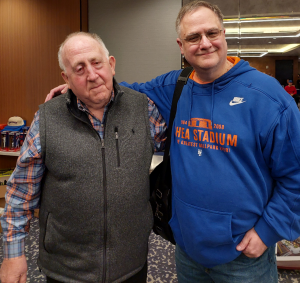 After the awarding, one more moment with Jay. On behalf of Mets fans everywhere, Jeff Hysen and I attempt to put the deGrom defection into something approaching perspective on the latest, hopefully special edition of National League Town. You can listen here or on the podcast platform of your choice.
by Greg Prince on 5 December 2022 1:12 pm I’ll sure miss Jacob deGrom…that is when I’m not watching Justin Verlander pitch for the New York Mets this year and next. So maybe I won’t be actively missing Jacob deGrom quite so much, dashed lifetime Met status notwithstanding.
Yes, the word is out: Justin Verlander will be a Met, landing in a different context from that which the deGrom news did less than three days ago but with the same ratio of surprise/shock to it. We can be surprised. We can’t be shocked. These are the New York Mets of Steve Cohen. Lose one all-time great, go out and replace him with another all-time great. Older, but maybe more durable in the short term. And all-time greater, truthfully. In his most recent term as an Astro, Verlander was a world champion and a Cy Young winner. It wasn’t the first time he’d been either. He comes to a new league and a new city and he’s doing it on the cusp of 40. But he’s Justin Verlander. He’s familiar with Max Scherzer. He’s familiar with getting batters out. He’s expensive, but how is that my problem? (Don’t be a mope and invoke ticket prices and cable subscriptions.)
Friday night was kind of miserable. Monday afternoon is rather ebullient. That’s the opposite of how things are supposed to work. We’re Mets fans who aren’t stuck empty-armed after losing an ace. That’s the opposite of how things used to work. We’ve got Verlander and Scherzer and, I suppose, some other spots to fill. But let’s give ourselves a respite from playing GM. Let the GM do his job. The owner has done his.
Justin Verlander is joining the New York Mets. Enjoy that for today. Enjoy that in 2023. Whatever happens in Texas can stay in Texas. Except for Verlander. He left Houston and is coming to Flushing.
We, too, move on. It’s what we do.
|
|






