The blog for Mets fans
who like to read
ABOUT US

Faith and Fear in Flushing made its debut on Feb. 16, 2005, the brainchild of two longtime friends and lifelong Met fans.
Greg Prince discovered the Mets when he was 6, during the magical summer of 1969. He is a Long Island-based writer, editor and communications consultant. Contact him here.
Jason Fry is a Brooklyn writer whose first memories include his mom leaping up and down cheering for Rusty Staub. Check out his other writing here.
Got something to say? Leave a comment, or email us at faithandfear@gmail.com. (Sorry, but we have no interest in ads, sponsored content or guest posts.)
Need our RSS feed? It's here.
Visit our Facebook page, or drop by the personal pages for Greg and Jason.
Or follow us on Twitter: Here's Greg, and here's Jason.
|
by Greg Prince on 22 August 2022 2:19 am Most of the time you don’t know. Sometimes you know just enough. Sunday I didn’t definitively know if the Mets were dead and buried at 4-0 after one; were alive and well at 4-4 in the middle of the fourth; had dirt kicked on them at 7-4 at the end of four; had sprung back to life at 7-7 in the top of the seventh; or had a stake driven through their hearts at 8-7 in the bottom of the eighth. I did know this, though: when Mark Canha socked his second home run of the day, the two-run shot that catapulted them ahead, 9-8, in the top of then ninth, I knew — knew — they had to score another run ASAP.
Because no lead is safe at Citizens Bank Park, no bullpen arm was a surefire bet, nobody with a bat in his hands wasn’t dangerous? Yeah, yeah, all that. But specifically because of this:
“If Franco can save this one, he has earned his money for the whole year. Here’s the pitch on the way… Line drive — caught! The game is over! The Mets win it! A line drive to Mario Diaz! And the Mets win the ballgame, they win the damn thing by a score of ten to nine!”
Over the many years I’ve taken it upon myself to track, examine and reflect upon Mets history broadly and granularly, I’ve grown very stringent in assigning relevance to precedent. Just because something happened some way once doesn’t mean it’s going to happen the same way again even if some similarities are in the air, and it doesn’t mean “it’s just like that time…”. Faint echoes are not facsimiles. Not every ball through a first baseman’s legs is Buckner. Not every home run robbed over an outfield fence is Endy. Not every shrug-your-shoulders blowout loss is 26-7. Neither every miracle nor every debacle is created equal. Hence, not every back-and-forth, high-scoring barnburner of a ballgame is a Damn Thing.
But when you’re in Philadelphia, and the pinball counters are reading TILT, and the outcome is in serious doubt late, then — and only then — you have a Damn Thing on your hands.
The phrase, as transcribed above, was burned into our collective fan consciousness by Bob Murphy on the night of July 25, 1990 at Veterans Stadium. The situation that developed in that ninth inning on that Wednesday night in the City of Brotherly Love and Utley Disgust, unfolded differently from the scenario unfolding in the same Pennsylvania burg 32 summers later. The 1990 Mets were up, 10-3, in the ninth. All they had to do was not allow seven or more runs before they could record three outs. They almost didn’t achieve this very doable baseline goal. Wally Whitehurst, then Julio Machado, then John Franco not only left the door ajar, they pushed the door wide open. That’s how a 10-3 laugher tightened into a 10-9 heartstopper. Finally, the game came down to Tom Nieto on third, Tommy Herr at bat and a sizzling liner to short, blessedly snagged by Mario Diaz.
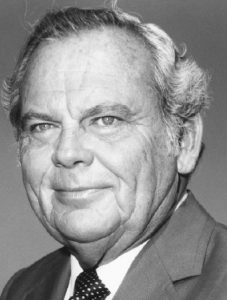 Who’s to say what’s a Damn Thing? This guy! The Mets, Murph reported, won the damn thing by a score of ten to nine. Since that night of “natural reaction” and “honest emotion” (“ball” was usually as far as Bob went with four-letter words), every large lead that threatens to get away but doesn’t might deserve a nod in the Damn Thing direction, but to my strict judgment, circumstances demand a 10-9 final for the label to begin to stick. Entering Sunday, the Mets had followed up the classic Damn Thing of July 25, 1990, with eleven more 10-9 victories (none since a Cincinnati matinee in 2011), but only two of those happened in Philadelphia. The other nine? Evocative by their score, but not Damn Things. The pair in Philadelphia?
Damn Things. One on July 7, 2008, one on September 12, 2009. They were damn special things in their moment, but they’re not Mets-famous like July 25, 1990. Bob Murphy made the mold that night. Then the mold was stored for rare future use.
It seemed worth carefully removing from storage Sunday evening in the ninth inning at Citizens Bank Park. It seemed worth understanding that the 9-8 lead Canha had provided would not be enough. It could not be enough. Not in that town. Not against that opponent. Not when 9-8 could be tied by one run scoring in a place and on a day when one run was absolutely know-in-your-bones gonna score come the bottom of the ninth. Therefore, once I got done jumping up and down and screaming loud and louder after Mark went outta da pa(r)k, I implored the Mets to score another run in the top of the ninth. I implore the Mets to score runs in every inning every game, and they are selective in pretending to hear me, but this wasn’t negotiable. Go ahead, 10-8, or suffer the consequences.
Sometimes you know just enough. Sometimes Brandon Nimmo does just enough. Brandon — we’ve known and loved him since 2016, Ken Davidoff reminds us in an engaging profile of an engaging player — knew enough to lift one extra baseball into the Citizens Bank bleachers in the ninth inning, putting us ahead, 10-8, just as I requested.
So thank you, Brandon Nimmo, who probably wouldn’t let “damn’ cross his lips if a child was within 398 feet of the sound of the crack of his bat. That was the distance of Nimmo’s so-called insurance run. It went damn far, not just far enough over the fence but far toward pushing us into the win column.
The Mets encompassed a damn lot of contributors on Sunday, starting with an unlikely starter whose contribution did not shape up as extraordinary at initial glance. Jose Butto threw the first four innings of the game. It didn’t seem he’d last the first frame. Some major league debuts are electric; witness Brett Baty’s last Wednesday. Most major league debuts speak instead to nerves and inexperience. Butto showed both in falling behind by three runs after three batters and four runs after a first treacherous trip through the Phillie lineup. Butto would be back for the second and the third, calming down and posting consecutive zeroes.
His batterymate got him halfway to even in the second (Michael Perez driving in two and making me wonder what’s so indispensable about each half of Jomás McNido). The batter designated to hit for him edged him closer in the third (Daniel Vogelbach, looking a little tentative on the basepaths but hale and hearty at the plate, delivering an RBI double). His All-Star right fielder completed the preliminary comeback in the fourth (Starling Marte, out there day after day despite at least one leg clearly not operating at 100%, singling in Perez). Butto was, if nothing else, off the hook.
Jose Butto was on the hook again faster than you could say “Thomas Szapucki,” giving up Alec Bohm’s second three-run homer of the game in the fourth, setting the Mets back, 7-4. Most of the contingency starters the Mets have used this season have come through despite little warning or expectation. Butto joined the since-swapped Szapucki in what amounted to self-immolation. Perhaps the Mets shouldn’t try their luck with pitchers whose names at first mention sound like they were made up by middle-schoolers improvising a phony phone call.
Yet Butto ate up four innings on a day when notching twelve of twenty-seven outs was no small feat. Permitting seven earned runs in the process was not optimal, but neither was using a youngster who didn’t appear on anybody’s depth chart until maybe a week ago, or playing eight games in seven days versus your two primary division rivals on the road, the two most recent games having transpired over a span of approximately nine-and-a-half hours that ended barely fourteen hours prior to Sunday’s first pitch. In the week that preceded Butto’s introduction to our awareness, we also suddenly made the acquaintance of (deep breath) Michael Perez, Deven Marrero, R.J. Alvarez, Brett Baty, Sam Clay, Yolmer Sanchez and Rob Zastryzny. And about a minute after Jose Butto gave us the best four innings he was capable of giving us, we met our ninth new Met in seven days.
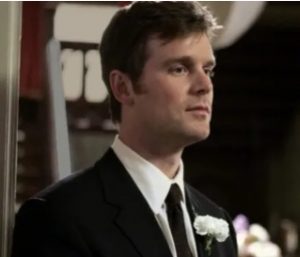 Everything ends, even a nearly four-and-a-half-hour regulation baseball game. It was Nate Fisher. I remembered Nate Fisher as the protagonist from one of my two or three favorite TV dramas ever, Six Feet Under. Nate Fisher died toward the end of Six Feet Under, which isn’t a spoiler, because at the end of Six Feet Under, literally every character dies. (And if you haven’t yet watched a show that ceased production in 2005, I think you’re out of the spoiler zone.)
This wasn’t that Nate Fisher. This was the Nate Fisher who I can honestly say I’d never heard of until Saturday, and then tangentially from scrolling Twitter. I wasn’t alone in my unfamiliarity. Mark Canha admitted he looked in from left in the fifth inning and “didn’t even know who this guy was.” Good to know I’m not the only one not poring over the Syracuse roster.
If Fisher is returned to a farm club Upstate soon, it will be for roster crunch reasons only. We’ve seen how callup relievers who get used to what is considered excess are sent down the next day in favor of a fresher arm. Fisher was indeed used to an extent beyond what was probably projected. He pitched the fifth. He pitched the sixth before it was delayed by rain. He pitched the sixth after play resumed. He pitched the seventh. Nate Fisher not only ate innings and recorded outs, he permitted no runs in his major league debut. Oh, and he was out of baseball and working in the financial services industry not too long ago. (Shades of Todd Pratt managing a Domino’s between backup catching gigs.) Fortunately, the Mets made a wise Fisher investment when they signed the lefty in the offseason. There are no Buttoesque qualifiers necessary here. Nate saved the bullpen’s bacon and kept his strangers-are-just-teammates you haven’t yet met viable in a game you might have thought they were out of twice.
Down 4-0? Down 7-4? Down, yes. Out? Not when Mark goes outta da pa(r)k with two runners on in the seventh. Canha was downright ubiquitous in the Mets’ quest to keep coming back, if not alone in making it happen. Every Met, whether they’ve been around for a while or they’ve just arrived, seems to maintain the values system of a hoarder. They never throw away the slightest opportunity to win a game.
The first Canha homer, the three-run iteration, brought the Mets to 7-7 in the seventh, completing the second preliminary comeback of Sunday. Like the first one, it proved transitory and inconclusive. Fisher had done his duty. Buck Showalter turned to a more familiar reliever, Trevor May, for the eighth. A familiar nightmare, Jean Segura, made the move regrettable, pinch-hitting the home run that put the Phillies up, 8-7. Combine that latest twist/turn with some mounting frustration (the Mets spent all weekend hitting home runs just foul and seemingly leaving two runners on base per inning as if they intended to present themselves as the most generous of tippers), and maybe, you thought, this wasn’t really a 2022 Mets kind of day.
But of course it was. Because the Mets hoard every sliver of every opportunity; and Jeff McNeil doubled to lead off the top of the ninth versus well-worn David Robertson; and Canha took Robertson very deep to left, the 2022 Mets slipped ahead of the 2022 Phillies, 9-8. That was very helpful and very hopeful.
And it clearly wasn’t going to be enough, as noted above. Damn Thing, right? That’s why what Nimmo did by homering off Tyler Cyr (speaking of relievers making big league debuts), putting the Mets up, 10-8, was so crucial, transcending any policy offered by the likes of GEICO, Progressive, Allstate or Liberty Mutual.
The Mets had their so-called insurance run, yet “insurance” doesn’t begin to describe what the Mets needed heading into the bottom of the ninth, and it didn’t matter that trumpets were blowing in from the visitors’ bullpen. The Mets had a thoroughly rested Edwin Diaz, the best reliever in the universe this year, ready to preserve the victory. For twenty-one consecutive appearances, Edwin hadn’t given up a run. Twenty-two in ’22 would have been appropriate.
It was also going to be not possible. Not on this Sunday. Not with the Damn Thing circling Citizens Bank, a lovely structure that for all its red bricks and natural grass nonetheless harbors the rusty nails spirit of the Vet from down the block. It gets instinctively edgy in South Philadelphia when the ninth inning rolls around. The most elite of relievers wasn’t about to simply shoo away the dephlated Phillies. You could take all the precautions — gloveman Sanchez was in for Baty as the 183rd third baseman in Mets history — but you couldn’t avoid trouble. You just had to contain it.
Edwin and the Mets barely contained the threat. J.T. Realmuto singled. Nick Castellanos singled. Bryson Stott’s scary fly ball to deep right pushed Realmuto to third. Nick Maton’s less scary but effective fly to deep center scored Realmuto. Mets 10 Phillies 9. If that was the final, that would have been fine. We still had a ways to go. Segura walked, which was simultaneously discouraging and preferable to Segura homering. Castellanos was now on second.
Sheesh!
This game was already in its fifth hour, not counting the 46-minute rain delay, and it was still in regulation. The Mets had pounded out sixteen hits, seven of which were of the extra-base stripe; collected five walks; featured an unknown rookie tossing three scoreless innings; unfurled what could accurately be described as clutch baseball heroics (both Canha’s go-ahead homer and the bat flip that celebrated it); and executed impressive defensive interludes destined to be obscured by the more obvious offensive fireworks. And the Phillies weren’t exactly spectators. Until the ninth, they never trailed. If this game didn’t have everything, it was bulging with inventory adequate to withstand a disruption to the supply chain. All it required was resolution. From the perspective of the Mets fan, what it really needed was some Sugar poured on it immediately.
Diaz was now facing pinch-hitter Darick Hall. The last time I noticed Darick Hall, he was pitching to save the Phillies’ pen on Saturday afternoon. That seemed months ago. The Phillies’ pen got expended exponentially as the weekend wound on. Same for the Mets’. The notion that Edwin’s was a fresh arm seemed absurd as he worked Hall to one-and-two. On his twenty-first pitch, Diaz threw a fastball that Hall let pass. He probably should’ve tried swinging, as it was called strike three. After four hours and twenty-six minutes, the Mets had prevailed by a score of ten to nine. It was the longest nine-inning win through which the Mets had ever persevered. Whether it was the most uproarious, most lunatic, most emblematic 2022 Mets win accomplished amidst a campaign constructed of chronic winning, you can decide.
Was it the damnedest of Damn Things? I don’t know, but it was up there.
by Jason Fry on 21 August 2022 11:42 am In Game 1 of Saturday’s doubleheader against the Phillies, the Mets’ 2022 formula worked to perfection: grind out at-bats, drive up pitch counts, exploit weaknesses and strike.
Brandon Nimmo led off with a walk against old chum Zack Wheeler, who threw 17 pitches in the first and 20 in the second, unscored upon but with his pitch count rising. Meanwhile, Trevor Williams — the Swiss army knife of the Mets’ pitching corps — was holding his own, and the Phils were dealing with multiple other frustrations, whether it was short-circuiting an inning on the blown double steal the Mets had pulled off Friday night or watching a member of the 7 Line Army throw out the first pitch. In the fifth, Wheeler surrendered a single over the infield to Michael Perez to score two; an inning later a Francisco Lindor triple and a Jeff McNeil single brought in two more, leaving Wheeler to depart and mutter about “cheap hits,” which simultaneously wasn’t wrong and wasn’t a good look. The roof then fell in on the Phillies in the ninth, with Darick Hall pressed into service to spare the bullpen further effort, and the Mets had struck first.
That first game began while we were driving back from our week on LBI, with Garden State Parkway traffic grinding me down like a starter in the City of Brotherly Love; it ended as the Q train bore Emily and me down to Coney Island to check in on the Brooklyn Cyclones, who were squaring off against the Hudson Valley Renegades on Star Wars Night. (A friend who joined us got his picture taken with costumed intergalactic ne’er-do-wells and asked me if I wanted one; my response was “nah, it’s too much like work.”)
Being AWOL, I caught a good chunk of the nightcap as delivered by Howie and Wayne over my phone, tipped up to one ear because I’d forgotten to bring airpods. Honestly, I wish I’d heard less of it. (Also: The Cyclones lost, though Alex Ramirez‘s quick hands and easy power are worth keeping an eye on.)
The Mets seemed poised to repeat Game 1’s formula against some Phillie with the unfortunate name of Bailey Falter, who couldn’t find the plate in the first. With a run already in and the bases loaded, McNeil smacked a sinking liner to the vicinity of Nick Castellanos in right. With Castellanos, “vicinity” generally isn’t enough to yield an out, but this time he crumbled to his knees and somehow emerged with the ball in his glove instead of loping disconsolately after it as various Mets scooted around the bases, an outcome I very much would have preferred. I enjoy playing “Why Is Jeff McNeil Enraged Right Now?” as a quiz accompanying Mets games, but that wasn’t one of the more difficult puzzlers.
A bad omen, as was Falter’s delivery coming from the left side, known in olden times as “sinister.” The Mets couldn’t touch Falter after that and David Peterson looked out of sorts, allowing an RBI single to J.T. Realmuto in the first and (by an inch or so) a two-run double to Alec Bohm in the third. Yet the Phils couldn’t land the knockout blow that Peterson seemed constantly about to receive. Nor could they break through against Stephen Nogosek, who had to battle not only the Phillies but also his teammates’ suddenly inept fielding — made up for, with the game about to get away, by a desperate lunging grab by McNeil. (The scouting report on young Brett Baty has been accurate so far, by the way: He’s ready with a bat in his hands but a work in progress when one of those hands occupies a glove.)
The seventh inning arrived with the Mets somehow still within striking distance, and you could imagine the story turning around and this recap becoming a long meditation on Philadelphia frustration. But it wasn’t to be: The Mets misplayed a Kyle Schwarber double into a hustle triple that became a fourth run and couldn’t get to Jose Alvarado and David Robertson, with a fizzled ninth inning (long foul drive that became part of a strikeout, double and walk setting up a little bounder to third for the final out) serving as a miniature portrait of their troubles. The Braves — those chopping chanting Terminators of our increasingly uneasy dreams — then inevitably survived an epic throwdown with the Astros, and so the Mets will look to young Jose Butto to avoid a split and the possibility of their lead shrinking to two games.
What happens will be chronicled closely here, of course, so I’ll leave you with a bit of roster-trivia sherbet. Saturday brought three Met debuts: Sam Clay, Yolmer Sanchez and Rob Zastryzny, with Clay joining R.J. Alvarez as a recent escapee from Met ghost status and Zastryzny avoiding ectoplasm as a 27th man, which may or may not be easier than navigating the heart of the Phillie order. The roster of 2022 Met ghosts has thus shrunk from a record-setting four (Alvarez, Clay, Gosuke Katoh and Kramer Robertson) to just two. Katoh may yet materialize given infield misadventures; Robertson is once more Cardinals property and thus an unlikely candidate for resurrection. Both played in the big leagues for other clubs earlier this season and so at least can be considered curiosities instead of tragedies.
Hey, somebody’s got to keep track of these things.
by Greg Prince on 20 August 2022 10:12 am OK, lemme see if I got all this. You want the pair of Slugger Milestones — the 100th RBI and the 30th homer, wrap them separately. Yeah, those’ll stay cold. They’re Polar.
You want the Speedy Duo with the Double Steal, the back half being the steal of home. You got it. We keep that on the back of the menu year after year and hardly anybody ever orders it. I don’t know why. Everybody who tries it loves it.
You want the Epic At-Bat resulting in an additional run…yeah, we make that with Squirrel and it brings home even the slowest runner from second.
You want the Further Rookie Heroics with a pair of ribbies. That normally comes with just one ribbie unless it’s a home run, but if you order the Prescient Insertion of a Pinch-Runner, I’ll throw in the other, no charge.
You want a Classic Bulldog Outing, the six-inning kind. You know that has jams spread all over it. Just scrape them off. You might taste a run or two, but the whole thing honestly goes down very easy.
The Classic Bulldog Outing comes with a side of Three Relievers. How are the Three Relievers tonight? I’ll be honest, they can be a little unpredictable, but we’ll do our best. Keep a Pepcid handy if you’re the nervous stomach type.
Want the relievers with Sugar? No Sugar tonight, you’re trying not to do overdo it with the Sugar every night. Sure, long season. Big weekend ahead. Uh-huh.
Anything else? A “taste of redemption”? What kind of redemption? For what happened in Atlanta…and for the Whole Keith Kerfuffle. Listen, you order all this, you’re gonna feel extremely redeemed not to mention extremely full, and Keith’s gonna look like a genius. Right, he always does.
OK, it’s 7:05 now, I can have all this to you to by…busy Friday night, it won’t all be ready until about 10:30. Can you wait that long? Trust me, it’ll be worth it.
Great, I’ll have it all for you at the end of the game. What? Of course we include paper plates, plastic forks and napkins. You think just because this is Philadelphia we just hand you a dripping, hot cheesesteak and expect you to wipe your hands on your jersey? Never mind what you’ve been led to believe, we have civilization down here. See you at 10:30. Maybe leave by ten. Postgame concert and all. Yeah, bye.
Yo! We got a big order to put together. Some joker from New York picking up. Just for laughs, stick a packet of Five Naquin Strikeouts under the ketchup. See if he even notices.
by Jason Fry on 18 August 2022 10:53 pm OK, look: That was a pretty great ballgame.
Two aces squared off — Max Fried and Jacob deGrom — and they were both pretty damn good. But the enemy offenses found the smallest of holes in their defenses. For deGrom, it was a lone inning where his slider was disobedient, refusing to be as sharp as its master wanted, which led to two runs surrendered. For Fried, it was a marathon eight-pitch at-bat by Mark Canha which ended in a two-run homer off an errant slider.
The game turned, similarly, on a pair of quirky hits to the outfield. DeGrom departed in the seventh after an infield hit by Vaughn Grissom, with Seth Lugo reporting to finish the inning against Michael Harris II. With Grissom in motion, Harris snuck a ball through the infield. Brandon Nimmo closed on it and threw it in to Darin Ruf, who relayed it to James McCann at the plate — a whisker behind Grissom’s slide.
The Braves led 3-2, with deGrom shockingly in line for the loss, and turned that lead over to Kenley Jansen in the ninth. For once my paranoia turned out to be justified: The Mets had, in fact, never done anything against Jansen, who was 17 for 17 in save opportunities against them.
It looked momentarily like things might be different, as Francisco Lindor singled and then looked to steal second with Pete Alonso at the plate — Jansen’s haywire mechanics make him tough to pick up but easy to run on. With Lindor halfway to second, Alonso got a high sinker he thought he could drive. He connected, but was under it, lofting a little pop behind the infield.
When the ball plopped in, I couldn’t see Lindor at second and for a gleeful half-second I thought he was on third. But he wasn’t — he was on first, having hustled back there, and so was forced out at second. It wasn’t Lindor’s fault — the ball looked like it was going to be caught, meaning Lindor would have been doubled off first, and the sequence played out almost like one of those canny plays where an infielder drops a ball intentionally to trade a faster runner for a slower one.
Anyway, Lindor was out and just like that, the air had gone out of a certain blue and orange balloon — Jansen struck out Daniel Vogelbach, got a harmless comebacker from Jeff McNeil and the Braves had won. Rather than push the Braves back to where they’d started the series, the Mets saw them gain two games in the standings, answering the 1-4 debacle at Citi Field with a 3-1 counterpunch down south. And all that was determined by two odd little plays. Both went the Braves’ way, and that was enough to decide a speedy, taut and frankly terrific ballgame.
It didn’t end the way we wanted. But there’s no guarantee of that, now is there?
by Greg Prince on 18 August 2022 10:46 am Welcome to the Brett Baty Era of New York Mets baseball. It is fitting that you can’t spell “Bretty Baty” without “era”. After Wednesday night, the same could be said of “Max Scherzer,” “Starling Marte,” “Trevor May,” “Peter Alonso,” “Edwin Orlando Diaz” and “Francisco A. Lindor.” Lindor’s middle name is Miguel, actually, but you can hardly resist giving the man an “A” after all he’s meant in this upbeat era of Mets baseball.
After two downcast, overcast evenings in Cobb County, the metaphorical sun came out on the Mets’ side of the field in their third game this week against the Braves, attributable in large part to the son of Clint and Leslie Baty coming out to play. We know the names of Brett’s parents because they filled supporting roles in SNY’s telecast Wednesday, co-starring as the proud parents of the fresh-faced rookie first making his major league debut, then making his major league debut indelibly memorable for everybody and not just the Baty family. One plate appearance into his Baseball-Reference game log, on the second pitch he ever saw, Brett swung at what Jake Odorizzi threw him in the second inning and sent it on a ride to right field. Kid knew enough to make reservations at the Chop House, apparently, for that’s where the ball he hit went. It was a two-run homer to start a career; a two-run homer to extend an already two-run lead — achieved on back-to-back first-inning solo shots from Marte and Lindor — to 4-0; and with Baty floating on Benny Ayalaesque air and Scherzer resuming his night, the rest of the story prepared to write itself.
Then the story got damp, having left its pencil out in the rain, all the sweet black graphite flowing down. Someone left the mound and the rest of the field out in the rain, too. That meant another delay, just as on Monday, and another veteran starter having to stay loose. Max didn’t look quite as uncoiled as usual before the downpour and he didn’t look too patient waiting for the grounds crew to spruce up his mound after the dirt commenced to drying. Max Scherzer is the eldest Met. He’s seen some rain delays. He can fix his own mound like he can fix a stare.
Thirty-four minutes of waiting ended. Scherzer returned to his craft. It was the bottom of the third, the Mets had a four-run lead and one of the two best pitchers of the Jacob deGrom Era going for them. They had Max’s excellence, Max’s experience and Brett’s injection of hiss and vinegar (expression cleaned up in deference to Brett’s mom sitting in the stands). All the Mets had to do was what they usually do in this era.
Technically, they did. They won. They never trailed. The Braves never really got to Scherzer, but Scherzer never really put them away, either. From the end of the third, after giving up one post-rain run, through the sixth, it appeared Max had locked in as Max will, and the Met lead had built to 6-1, and you figured it was a nice dollop of payback for the previous two nights of figurative and literal pain. Scherzer didn’t have to leave the game early as Carlos Carrasco (oblique strain) and Taijuan Walker (back spasms) had. These Mets added on, with Mark Canha doubling in a run in the sixth and Marte homering for a second time in the seventh. Not only did we finally get around to answering Atlanta’s annoying habit of bringing up young impact players on a monthly basis, but we had that deGrom fellow waiting the wings for the next night. Everything looked wonderful.
Then it looked less so. A tight strike zone betrayed Scherzer. He left with one out and the bases loaded in the bottom of the seventh, handing the ball to Adam Ottavino, whose “0” never looks quite large enough on the back of his jersey and for whom “0” never had a chance to blink onto the scoreboard. For a second there, Adam had us extricated, on a nifty 5-4-3 double play started by none other than Baty, who’d kept swinging a lightning-quick bat (albeit into a couple of outs) and now was showing defensive felicity at his position. Alas, the first DP started by the 182nd third baseman in Mets history and 1,174th Met overall was erased by video replay review on the flimsy pretense that batter Vaughn Grissom barely beat Jeff McNeil’s throw to first. Harumph!
One run scored on the overturned double play, which would have represented an adequate avenue of escape for Ottavino had he in fact found an exit from the jam he inherited. Instead, Robbie Grossman came up next and Grossman grabbed the table next to Baty, homering to Chop House territory in right and, whoa, it was suddenly 6-5. The only thing that saved the pitcher was his catcher, James McCann, who gunned down Ronald Acuña, Jr., trying to steal second after Ottavino walked Acuña after Ottavino gave up the homer to Grossman.
There was nothing to like in them bullpen apples, but Buck Showalter is always one to inspect the orchard he’s got rather than the orchard he wants, so he sprang into managerial action. In the bottom of the eighth, with the Mets still leading by a skinny run, the skipper skipped the setup niceties and went straight to his closer. Edwin Diaz entered to an off-brand version of “In The Air Tonight” rather than “Narco” — William Contreras holds the local rights — but Sugar makes his own kind of music in whichever ballpark he pitches. Facing the heart of an order that is all vital organs, Edwin swiftly put down Dansby Swanson (swinging), Austin Riley (flyout to center) and Matt Olson (looking). It took him ten pitches. The best ninth-inning man in the business can extend his franchise to eighths at will.
Since Diaz needed to exert himself minimally to brush aside further bad Brave behavior, Buck resisted his instinct to get a lesser arm up to protect the one-run edge in the ninth. Another two-inning save was on the horizon. Perhaps it would have implications Thursday and Friday. This was Wednesday. Winning Wednesday was the order of the day on Wednesday. Plans changed, though, when the Mets increased their advantage ASAP, looking very much like the first-place outfit that it took a pair of injuries for Brett Baty to crack. Brandon Nimmo and Lindor each singled. Nimmo dashed to third on Lindor’s hit. Lindor stole second while Alonso hit. Alonso, who could have been intentionally walked at that point, singled instead, which worked great for us. Brandon and Francisco each scored to make it 8-5. Pete stole second, which will happen when a Polar Bear sniffs opportunity. Daniel Vogelbach, who you’d assume has all the letters in his name, whacked a double to right to bring the Bear home. It was 9-5. Diaz could relax.
We couldn’t. It was Trevor May time. No save opportunity. Definitely an opportunity to blow the game. Trevor, reverting to his early-2021 alter ego of Rover T. Yam (the “T” stands for trouble), plunged that four-run lead into grave danger. After striking out Eddie Rosario, Yam gave up a single to “Narco”-thieving Contreras, then another to Michael Harris, who I’m certain has been bedeviling us for a decade yet is somehow younger than Baty, the chronologically youngest Met yet. Contreras was on third, Harris was on first. Then Harris stole second uncontested, positioning him to zip home behind Contreras when Grissom — also younger than Baty — drove them both in.
So much youth in action. Such an old story unfolding. At Turner Field in 1999, the year Baty was born, a game like this ends with Kenny Rogers walking Andruw Jones with the bases loaded (Kenny didn’t require an automatic runner on second in extras). Or if it’s 2001, the year Michael Harris and Vaughn Grissom were born, there’s Brian Jordan waiting in the on-deck circle, licking his lips in anticipation of a walkoff grand slam versus John Franco. Those of us who have been around a long time are familiar with ancient story beats.
New era in progress here. It’s 2022. Rover T. Yam morphed back into Trevor May, striking out Grossman and then flying out Acuña to deep but not too deep right. Mets held on, 9-7, preserving the 199th win in the illustrious career of Max Scherzer, who was born the day Dwight Gooden was definitively making his case for National League Rookie of the Year, and the good taste in the mouth of Brett Baty, who was born less than four weeks after Robin Ventura launched the Grand Slam Single of Metsian lore. Doc and the first-place Mets beating the second-place Cubs on July 27, 1984, when Max first glared at his mother’s obstetrician (“yeah, I was gonna spank him, but he gave me a pretty intense look, so I’m just gonna assume he’s fine”). Ventura was staving off the Braves, elimination and, with less success, Todd Pratt some fifteen years later. High school-age Max was probably watching the Mets and Braves carry on for fifteen innings that rainy Sunday at Shea. He was old enough to stay up late on October 17, 1999. Hell, he’s old enough to have pitched at Shea for the Diamondbacks on June 11, 2008.
Brett, who came into this world on November 12, 1999, was just a kid in 2008, no more than a coming attraction to Clint and Leslie while Robin and the Mets were Risin’ our Mojo. He was a coming attraction to us from the night he was drafted first by the Mets, twelfth in the nation, when we were enduring the dregs of 2019. Even with the battle-tested Mets of 2022 — led exclusively to date by players born in the 1980s and the first half of the 1990s — steadily holding first place all season, a fan can’t help but feel a thrill when a top prospect is promoted from concept to reality. It might mean more when we’re livin’ in desperate times. It’s a welcome sensation anytime. A second-pitch, first-swing home run that facilitates a victory over your closest pursuers and traditional tormentors imbues it with plenty of meaning.
On April 30, 1965, Jim Bethke, then 18, finished a game started by Warren Spahn, then 44. On May 31, 2006, Lastings Milledge, then 21, started a game in which Julio Franco, then 47, pinch-hit. The chasm from Scherzer to Baty isn’t quite as expansive as those generational Met divides, but it’s always something to absorb how these careers and eras overlap, all under the umbrella of a given Mets team, sometimes within the confines of a single Mets box score. I’m ecstatic that Mets Old Timers Day, AWOL for 28 summers, is happening on August 27 because there will be Mets on hand from 1962 and Mets on hand from as recently as 2018, maybe 2020, depending on who RSVPs at the last minute, and Mets from just about every year in between. Gooden will be there. Ventura will be there. We will be there, whether physically or spiritually. As ever, we are the common denominator of these sixty-plus years. We are the Mets fans. Whatever our vintage, it is always our era.
Additional thoughts on the family reunion that will be Old Timers Day, plus a few hosannas for Buck Showalter and the friends who invite you to see his team do its thing, fill out the lineup on the latest episode of National League Town, a podcast a Mets fan can find here and listen to most anywhere.
by Jason Fry on 16 August 2022 10:44 pm One of my odder Met hobbies is keeping track of the franchise’s ghosts — players who are on the active roster but never appear in a game. Going into Tuesday night, the Mets had rostered four ghosts in 2022, which would be a record for a season: Gosuke Katoh, R.J. Alvarez, Sam Clay and Kramer Robertson had all been trapped in ectoplasm, increasing the all-time spooky roster to 13.
Alvarez returned to the active roster Tuesday night as part of the shuffling necessitated by the Mets giving up 13 runs and losing Carlos Carrasco to the IL for a month or so on on Monday, but I didn’t figure on seeing him — and certainly not in the third inning. I was on my way to a bathroom in a restaurant on the north end of Long Beach Island when I did a double-take: A hairy Met reliever was coming out of the bullpen, and my brain stumbled over the fact that a) Trevor Williams was replacing Taijuan Walker; and b) wait a minute that wasn’t Trevor Williams.
No, it was Alvarez (Walker was taken down by back spasms and is headed for the inevitable MRI on Wednesday) and Gameday told me he wasn’t exactly effective. There were the green circles of balls that were way over batters’ heads and too many announcements of IN PLAY, RUN(S). Robbie Grossman took Alvarez deep, and then Matt Olson hit a two-run shot that might wind up worked into the plot of next season’s For All Mankind.
Meanwhile, Charlie Morton was simply obliterating Met hitters, juggling a sweeping curve and a fastball to keep them honest. Inning after inning went in the books with nothing happening, and even though the Mets were within three, you didn’t exactly feel a comeback in the cards. They did bring the tying run to the plate in the seventh, but Dylan Lee fanned Jeff McNeil, and two more Atlanta runs in the bottom of the frame made the rest academic.
The Mets, word has it, are calling up Brett Baty in an effort to give the suddenly moribund offense a jolt — a tactic that’s worked wonders for the Braves, as it happens. That’s reason for hope — and even if Baty’s time on the roster is brief, it’s always fun to get a preview of a future that’s been billed as bright.
More immediate reason for hope, though, is that the next two games will be pitched by Max Scherzer and Jacob deGrom. Win those two and the Mets will have pushed the Braves right back to where they started this series. You’ve probably heard that momentum is tomorrow’s starting pitcher; the Mets, fortunately, will be sending out two of the best on the planet.
by Greg Prince on 16 August 2022 11:52 am The Monday night plan was simple enough: watch the Mets in full; watch the Mets win, if all went as desired; watch the finale of Better Call Saul, recorded while the Mets were winning.
What’s that phrase, “Man Plans, God Laughs”? This year, it’s usually, “Buck Plans, God Notices and says, ‘hmmm…I hadn’t thought of that — very impressive!’” Alas, you can plan for only so much Met success or even Met process on a given Monday night. I hoped they’d play without interruption. Mother Nature had other ideas. I hoped they’d be done by 10:38 PM, so I could get to the DVR the moment my show was done airing live. Rain washed out that hope. I hoped that another Met win would not only boost the Mets’ lead further in the National League East another game, but tie the 2022 Mets with the 1986 Mets after 116 games, a race that’s existed in my Metsian mind and its diligently tended computer files for months. That race will have to wait another day.
Plans. Hopes. Poof! Monday night in Atlanta in August is gonna get you some rain. (Have you ever seen a Southern sky?) The Braves anywhere can be a handful anytime. The Mets, despite having just completed another gleaming homestand in what has thus far been A Year to Remember, are susceptible to pratfalls, just like any group of humans. And anatomy can be a bitch sometimes.
The Mets lost Monday night. They lost by a lot, they may have lost a starting pitcher and they lost a game off their division lead. The last part doesn’t bead much sweat here. In a four-game series versus your closest pursuers, a sweep was gonna be a chore, even if every night sets your sights on going One and Oh. Losses by twelve runs don’t count any more than losses by two runs. Que Sera Sera. The pitcher is another matter. Carlos Carrasco felt something in his side after coming back from the 55-minute soak delay in the second inning. He stayed loose in the pen. Then there was tightness after his final pitch to a batter. You don’t like to hear about sides not feeling right. Max Scherzer felt something in his side. James McCann felt something in his side. They went out for a while. Eduardo Escobar felt something in his side the other day. He’s still playing, albeit compromised in his switch-hitting.
You’d think the Mets would have a side coach.
While we crossed the sides of our fingers that Carrasco will be fairly OK fairly soon and doesn’t join Luis Guillorme as a long-term absentee or Tomás Nido amid officially mysterious circumstances (he’s on the portion of the IL that doesn’t speak COVID’s name), there was still a game to get played and, by the time Carlos exited, lost. The Mets were down, 3-0, already. Two of the runs scored on Brave homers. One scored because the clouds and winds over Truist Park conspired to obscure a fly ball from Mark Canha’s view. Canha came in to make an increasingly difficult catch until he realized the ball was behind him. He turned around to chase it in the other direction. It was already that kind of night before Cookie pronounced himself crumbled.
Then it got much, much more that kind of night. Joely Rodriguez ferried the Mets through the third and two outs into the fourth. So far, so decent, despite no scoring off of self-appointed Met luck monitor Spencer Strider. Then Adonis Medina grabbed the wheel and steered the night into a ditch. Quadruple-A’s towing services can be a little unreliable. By the time it was 8-1 in the sixth, Medina was relieved by Mychal Givens. Once Givens had it up to 9-1, Better Call Saul was recorded in full.
 “Here’s what you’re gonna do. You’re gonna turn on the Mets tonight like last night didn’t happen. They didn’t lose by twelve runs. They didn’t lose a starting pitcher. Say you understand.” Send a message to Mychal: I’m watching my show. I didn’t know how the series I’d been watching since 2015 would turn out. I already basically knew what was going to happen in this Mets game, even as I stuck to my feeling for the Mets season at large. This exchange from Saul strikingly captured my mood vis-à-vis the 2022 campaign.
“So I gotta ask, where do you see this ending?”
“Where do I see it ending…with me on top. Like always.”
Should have I included a “SPOILER ALERT” there?
Endings aren’t just about endings, however. Grace notes are what put the prestige in prestige television, and sometimes losing by a torrent of runs can make for fascinating viewing. A glimpse at the in-progress box score while fast-forwarding past commercials revealed a plot twist I hadn’t seen coming in Atlanta. Not the tally itself, now 13-1, but the participants. There was a catcher making his Met debut, Michael Perez. There was a shortstop making his Met debut, Deven Marrero. And, not altogether unpredictably yet still good for a WHA???, there was a pitcher making his Met debut, Darin Ruf.
I missed the three up and three down Ruf recorded in the bottom of the seventh, which means I also missed the first instance of Perez (catching ball one) and Marrero (picking up a grounder en route to the second out) etching themselves into the annals as Mets No. 1,171 and 1,172, respectively. Ruf was already inscribed as Met No. 1,170 from his standard-issue hitting duties, but now he was the fifteenth position player in Mets history to pitch, marking the eighteenth instance in all of a Met position player toeing the rubber.
Better Call Saul got paused. I hung in there for the Mets’ futile attempts to close the gap on the scoreboard — nothing happened on that count despite Jeff McNeil notching four hits amid enemy carnage — and was rewarded by a second inning of shutout ball from Ruf. It would have been a second perfect inning had first baseman James McCann not thrown away what was hometown-scored an infield hit. McCann was saving Pete Alonso a couple of innings in the field, same as Perez was saving McCann a couple of innings of crouching, same as Marrero was saving wear and tear on Francisco Lindor (Deven is here instead of, say, third base überprospect Bret Baty, because he can field several positions à la Guillorme), same as Ruf was said to be saving the bullpen. It baffles me that in the age of eight-man bullpens and Syracuse shuttles that position players still have to now and then display fairly uncommon versatility, but it happens. Showalter knew Ruf could handle it. Buck plans for eventualities like this. God reportedly continues to be impressed by Buck’s attention to detail.
Darin’s ERA of 0.00 is far more impressive from a Met perspective than was the final of 13-1, another event to be buried under the heading It Happens. Also impressive: despite the cringe-inducement of Monday night, the Mets are 75-41, one historical game behind the 1986 Mets, 76-40 at the same juncture in their dream season. In Game 116 three-dozen years ago, the Mets played their starting catcher at first base to give him a breather. Gary Carter hurt his thumb and would be out a few weeks. The Mets lost that game and their next game — unwittingly placing their intermediary record of 76-41 within reach of some future Queens superteam — but were way ahead of everybody in real time and didn’t really have to worry. Carter came back. The Mets went on. Carrasco will come back. I don’t know when. I’m not a side coach.
Generally speaking, despite the spate of dings to key Met contributors, I am not shaken from my notion that for the club 4½ games out in front and 34 above .500, s’all good, man.
by Jason Fry on 15 August 2022 9:35 am This is the stretch that will send the Mets down one of two postseason roads: a newfangled bye that advances them to the division series, or a dogfight in the scrum of the wild-card round. Three with the Phillies, four with the Braves, four more with the Phillies, two with the Yankees.
Well, so far so good.
Our good friends from Philadelphia came into Citi Field, scored a conventional run off Max Scherzer immediately on Friday night, sent a ghost runner home against the luckless Mychal Givens later that evening, and … oh wait, that was it.
Nothing against Jacob deGrom and three relievers on Saturday. And nothing against Chris Bassitt and four relievers on Sunday.
Bassitt doesn’t have the raw stuff of Scherzer and deGrom, which is no insult whatsoever, but he’s cut from a similar mental cloth: intense, furiously competitive, ornery. There are the long shake-off sessions with catchers, the chess games he likes to play with hitters, and the “grind you till you break” philosophy articulated in spring training and now immortalized in his heavy-rotation Mets profile ad. (Hapless customer: “Uh, sir, I just came to this weird deli to get a pack of smokes — please no grinding or breaking. Also, why is this place infested with ballplayers?”)
I’ve come to admire Bassitt’s gunfighter stare and that violent pitching motion — the knee coming high as the arm cocks low behind him, then whips overhead at a slightly odd angle. Not to mention the array of pitches that might emerge from that delivery: three varieties of fastball, with the sinker most prominent; a slider; and a curve.
Bassitt had all of those pitches working Sunday, and needed them for heavy lifting in the fourth and fifth innings, facing two on and no out in each frame. No matter: In the fourth he fanned J.T. Realmuto on three pitches, got Nick Castellanos to fly out, and elicited a comebacker from Darick Hall; in the fifth, facing second and third, he fanned Matt Vierling and Bryson Stott, walked Rhys Hoskins after a lengthy duel, and erased Alec Bohm on a liner to second.
Runs had been hard to come by for the Mets, too, but on Sunday they finally woke up and swung the lumber against old friend Zack Wheeler, with a four-run fourth putting the game effectively out of reach. That inning’s scoring ended with a bonus run, as Jeff McNeil scrambled home to punish a bit of lackadaisical defense from Brandon Marsh and Jean Segura.
(I’d say Keith Hernandez must have uttered a belated “told you so,” but between Keith’s being elsewhere this weekend and his living in a highly Keith-centric world at all times, I’d put decent money on him having no idea that he gave the Phils bulletin-board material or that they responded by playing essentially airtight defense until then.)
The lone blemish of the Mets’ series win, if you don’t count the Marlins’ pacifism in getting steamrolled by the Braves, was the sight of Luis Guillorme limping home in the Mets’ uprising against Wheeler.
It’s been a joy to watch Guillorme have the breakout season I’d stubbornly insisted he had in him, sometimes without much evidence. That was a long time ago. Now, with two outs, I’ll urge enemy batters who can’t hear me to “hit it to anybody,” but with games on the line my plea is more specific: for some opponent to hit it to Guillorme, because I know he’ll do exactly the right thing. And none of that admiration has touched on his emergence as a useful if not terribly powerful bat; his glorious beard worthy of a Babylonian bas-relief; or his vaguely ironic mien in going about his business.
Guillorme has also been a key to the Mets’ positional flexibility, able to move seamlessly between second, short and third in various infield alignments. Hopefully the Mets will be without him only for a few days as this critical stretch continues. And, hopefully, said critical stretch will continue to be a showcase for smothering starting pitching, hitting in whatever quantity necessary and that most vital currency of all, series wins.
by Greg Prince on 14 August 2022 11:01 am The sound of one hand clapping makes about as much noise as a batter facing Jacob deGrom. Yet at Citi Field when Jacob deGrom pitches, all the hands clap and the noise overwhelms. Not as much as Jake overwhelms. Little can outdo deGrom in that regard.
We bring the sound. Jake brings the fury. The Phillies, like every opponent, bring the best of intentions. Good luck, fellas, I’d tell them, albeit without sincerity. I wish you long, happy, healthy lives, yet in the spirit of full disclosure, nothing but ill will at the plate, in the field or on the mound. On the mound, you’ve been pretty good yourselves for two nights. In the field, you’ve appeared determined to make a certain color analyst recant all the sighs and groans and “throw a tent over that circus” he’s directed at your (until recently) ludicrous leatherwork. But at the plate, you’re still facing Jacob deGrom, and he intends to give you nothing. I doubt the Phillies wanted to see deGrom any more than Keith Hernandez wanted to see the Phillies.
Saturday night at Son of Shea — not only was Citi ramped up to a vintage volume, but my literal vantage point brought to the mind’s eye a way of seeing a game that hasn’t existed since Citi Field was under construction — everybody pitched as well as could be asked from a baseline perspective. Let’s put it this way: Edwin Diaz was, by default, the least impressive of the five arms throwing baseballs for either side, and he gave up neither a run nor a hit en route to notching another enormous save.
Diaz is saved for last. DeGrom throws the first pitch of any home game he works. He appears, we go wild. Not that we needed much of a cue, but once those of us who weren’t in the park last Sunday took in the ace’s warmup on TV, we recognized how special it is just to watch Jake throw the pitches that don’t count. Now we understand those as our portal to deGrominant immersion. Once he gets going for real, against professional victims, our impulse is to segue from Lynyrd Skynyrd’s “Simple Man” to the Dovells’ “You Can’t Sit Down,” except you probably have to sit down, lest the people behind you shame you in a shower of DOWN IN FRONTs.
I mentioned my vantage point. As noted earlier Saturday, Stephanie and I had the honor and pleasure of joining our friends the Spectors at their 27th (25 + 2) anniversary party, thrown at the hottest joint in town, Citi Field. Specifically, we were in the Seaver Suite on the Empire Level. It’s down the right field line, befitting one of the greatest righthanders in baseball history. And what better spiritual post than the Seaver Suite from which to watch the greatest righthander in contemporary baseball?
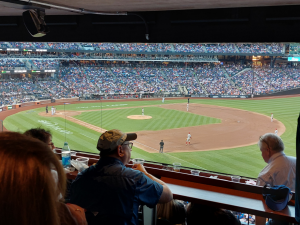 If you could see the mound Saturday, you saw everything. The only issue with the suite life from a viewing standpoint, at least on this occasion in short right field, was if you didn’t elbow out other swell people from the allotted outdoor seating (which we didn’t), you needed to plant yourself at a proper angle to take in as much as you could, cognizant that you had to prioritize. Citi Field geometry almost always subtracts something from your line of sight wherever you sit or stand. Here, the shortfalls in geometry were leavened by magically refilling trays of sliders, franks and fries, free-flowing beverages and the delight of mingling among an array of fine folks in air-conditioned comfort (even Garry and Susan’s Phillies fan friends seemed swell), which is to say who’s complaining if you can’t see the scoreboards or certain swaths of grass? If anything, the experience took me back to those stolen glances from the old subway platform extension, the one demolished prior to the final year of the old ballpark to clear space for the coming new ballpark. You might retroactively refer to it as the original Shea bridge, leading down a spiral staircase to the token booth rotunda. You couldn’t see everything from up there, but you could see enough.
My spot in the suite got me in line with Jacob’s delivery. If you could watch deGrom form his motion and fire, you saw everything you needed to see. That and the plate, where Phillie after Phillie was phlummoxed. That was the fun and game there. My Log tells me this was the 24th time I’ve seen Jake pitch at Citi Field. I don’t know that I was ever quite so focused on him (between burger bites) or nearly as blown away. He must look like hell from the batter’s box.
My seat was a tall bar stool that I staked out a little corner for. It allowed me to rest between pitches, because during pitches, I was up on my feet. There was just enough space for me to pace anxiously without making too much of an obstacle of myself. “Can’t Sit Down” didn’t apply to the Phillies. For six innings — the moderate workload wasn’t surprising despite the sudden appearance of Seth Lugo in the top of the seventh jarring me off of my chair — Philadelphia batters returned to their seats with alacrity.
We roared, Jake released, and nothing happened except exquisite pitching brilliance. Rhys Hoskins singled in the first only to be erased on a forceout. Bryson Stott lined a single to center only to be stranded when Hoskins struck out to end the sixth. And that was the entirety of the Phililes’ offense. No extra-base hits. No walks. Nothing threatening. Ten strikeouts in all.
The third strikes were so much fun to watch. Wow, they really are helpless against him, just like on TV. The occasional fly ball I didn’t really feel the need to follow (which would have necessitated neck-craning and such). I could tell what he was throwing wasn’t traveling too far or in much danger of falling in. I was in sync with Jake. My pacing didn’t drive him off kilter. My frequent applause was just a fraction of the supportive din.
You almost didn’t notice Aaron Nola crafting a gem of his own. At first, you didn’t have to, because the Mets cobbled a run together in their first ups. Starling Marte, as if to make up for Friday night’s ill-advised dash for home, built three-quarters of a run himself by singling, stealing and taking third on a throw into center. Pete Alonso brought him in ASAP.
That was the extent of what Nola gave up. It was too much of a hole to dig against deGrom, but whereas Jake departed after six (it was still only his third start of the year after thirteen months of major league inactivity, you had to keep telling yourself), Nola hung in there. No reason to lift him and no pitcher is pinch-hit for anymore. The Mets’ output after the first was as meager as the Phillies’ through the sixth, leading to the only foreseen drama of the evening. Would we be able to span the gap from deGrom to Diaz?
Seth materialized in the seventh and simply by not being Jake, he was the best chance of the visitors’ night. There was indeed a base hit, via Nick Castellanos’s single, but it came with the bases empty and two out and it was followed immediately by a strikeout. Trevor May succeeded Lugo, resembling the May we heard so much about in his pre-Met incarnation (a little like Diaz the Mariner needing time to find a holistic comfort level in New York, perhaps). Trevor notched two Ks, then didn’t falter when Kyle Schwarber lifted a ball to center. It was caught by Brandon Nimmo, leaving the score Mets 1 Phillies 0. That’s also where Nola left it when he completed his eighth inning of almost spotless work. It occurred to me that if all went well, I’d just seen a complete game thrown by a pitcher on the losing side.
We just needed all to go well. We’ve reached a stage in our lives as fans that we expect all to go well when it’s Diaz time. It’s a 180 from where we sat in 2019 and probably a 135 from where our hearts stubbornly positioned themselves before the reality of 2022 fully kicked in. Edwin’s stats improved so much in 2021 and glittered in the right light in 2020, yet you never really stop mistrusting your closer unless your closer convinces you to do otherwise. Edwin Diaz has become the most convincing Met closer I’ve ever known. The only thing that could mess with the tableau unfolding ahead of the ninth — there’s no DOWN IN FRONT-ing for the raucous “Narco” entrance, because everybody’s up and everybody’s loud — was the looming inevitability of an eventual lesser outing from the master of the three-batter save, that vague but palpable sense of it has to happen sometime. As much as Citi Field throbbed for Jake, it pulsated for Sugar. Their noise’s common denominator was confidence. We turn up the volume because they’ve supplied the certainty, excitement born of trust. Still, you couldn’t completely bar from your head that one nagging question, especially with the thinnest of 1-0 leads, even after Lugo and May had quelled the initial wave of post-Jake doubt.
Would Saturday night be the night the trumpets hit a sour note?
I inserted myself into the suite’s official seating section to get the most expansive view available. Edwin Diaz was not immaculate. He did not flirt with perfection. He didn’t even strike out the first guy he faced, relying instead on Luis Guillorme to field a ground ball and fire it to Alonso for the first out. Then he walked Hoskins, whose pinch runner Edmundo Sosa stole second pretty easily. Alec Bohm flied out to right, which could have been a tag-up problem had Marte not made a strong throw into the infield. Then J.T. Realmuto walked on three-and-two, bringing up Castellanos. It would take seven pitches — during which there’d be a double steal that amounted to defensive indifference in a 1-0 nailbiter because Edwin would not be distracted by baserunning hijinks — but we never for a moment vocalized an iota of regret that we’re all in on Edwin. The closer was trusted to close a one-run lead with runners on second and third amid nary a boo. Our anxiety in the moment was empathetic rather than accusatory. That particular vibe in the ninth inning at a home Mets game has been rare since the Shea subway extension stood. It was by no means common then, either.
The end result was what we sought, and it was multifaceted:
Diaz struck out Castellanos.
Diaz saved the win for deGrom.
Diaz maintained our affection.
The Mets cooled the surging Phillies’ aspirations for one night.
The Let’s Go Metsing was as strong as ever on the short staircase trip from Empire Level to Field Level.
And on the LIRR home, east of Jamaica, no less, we heard “Narco” cranked up on somebody’s phone…and it wasn’t even mine.
The game was long over, but the melody lingered on. Timmy Trumpet blows. Edwin Diaz doesn’t.
Across nineteen innings, these two teams have pitched each other to a 2-2 tie. It doesn’t shake out that way in the standings, but maybe aesthetically should. One night, Ranger Suarez & Co. barely outpointed a Max Scherzer-led mound initiative that was effective enough to have prevailed most nights; and the next night Aaron Nola stayed within a shoelace tip of the deGrom-to-Diaz super express, one that made stops at Lugo and May without encountering delays. Tight games both. From our perspective, the second was the keeper. It looked great from where I stood. It sounded even better.
by Greg Prince on 13 August 2022 4:38 pm On July 22, 1995, the no-name, no-hope New York Mets were hot, having emerged from the All-Star break winning seven of nine. On the soundstage where they shot Star Trek: Voyager, Jeri Ryan presumably looked up, thinking her character was written into a new scene as SportsCenter blared in the background.
Seven of nine! The Mets had spent the first half of that strike-delayed season stashed in last place, as if on the lam, figuring no one would find them if they lodged themselves far enough down the cellar. But now, having shaken off those April-to-June doldrums, they were, reliable sources could have sworn, ready to start climbing in earnest. Instead, on July 22, a Saturday, they lost. Then they lost again on Sunday. They’d go on to lose every day clear through Wednesday.
 Happy Swanniversary! Was this any way to start a marriage? Maybe not the marriage of the Mets and post-1993 respectability, but it worked for Susan Laney and Garry Spector, who were engaging in marriage to each other somewhere in Oklahoma, Susan’s home state as well as that of 1995 Mets Kelly Stinnett and Butch Huskey, along with Mets voice for all seasons Bob Murphy. I didn’t know either Garry or Susan then, but I’m gonna go out on a limb and imagine some time before the first pitch of that Saturday ceremony, Garry checked the box score of the Mets-Rockies game in Colorado from the night before.
I’ll also take the liberty of deciding their honeymoon was perfectly lovely despite the five-game losing streak that probably crossed Garry’s field of vision at some point in the first throes of wedded bliss. I made sure to get married in November so I wouldn’t have to sweat such details. But this isn’t about me. It’s about Garry and Susan getting married when they did and life continuing on for them back in the Northeast, she a world-class oboist (or have you not heard of the Metropolitan Opera?), he a top-flight chemist, if I have his science credentials correct. I’ve rarely seen better chemistry between two people than that which exists between Susan and Garry, so I’m gonna assume I do.
As implied above, Garry’s been a Mets fan for a long time, long before winning seven of nine ranked as an unparalleled achievement for the mid-1995 Mets. Garry’s been a Mets fan long enough to inspect a roster of early-1970s Mets and decide somewhere on there was a defending world champion who’d love to come to his Bar Mitzvah. The act of addressing invitations transcends whether any of them showed. I’m not sure how long Susan has loved the Mets. Perhaps it had something to do at first with loving Garry. She’s her own fan, however. Read her blog Perfect Pitch for confirmation.
They lived as Mets fans, they raised a Mets fan daughter and they invested in the Mets, holding prime season tickets since before Shea went away and after Citi Field opened. You might know them as “the Spectors” of Section 318 — directly in front of the radio booth — if you listen to the games over WCBS with any frequency. Howie knows Susan and Garry are there practically every night. When a foul ball is heading directly back into the crowd, Howie from time to time estimates, “That might reach our friends the Spectors in Section 318.” When your team’s play-by-play announcer has conferred ground rule status upon your presence, you indeed get to a lot of games.
I don’t know who’ll be sitting in those seats tonight for the Mets and Phillies. None among Susan, Garry or daughter Melanie (a Resident Artist with Detroit Opera herself) will be. They’ll be a level below, having taken a suite for the evening. It’s a big suite. It’s a big night. DeGrom is pitching against Nola, but it’s bigger even than that. The Spectors are celebrating an amalgam of their 25th, 26th and 27th anniversaries tonight at Citi Field. If the Mets are at home, where else would the Spectors be?
Your math skills don’t elude you. No. 25 — the Del Unser anniversary, to my thinking — was two years plus a few weeks ago. They planned their Unser down to the D-E-L, or the letter. The only thing the Spectors couldn’t plan on was what 2020 had in store for all of us. No, nobody was going to a ballpark in 2020. Nobody was going much of anywhere. Thus, Del Unser would be double-switched out of the anniversary game for…
That’s right, Dave Kingman, No. 26. They were gonna do in 2021 what they intended do in 2020. But you know how Sky King could be about striking out. The COVID situation was still capable of diving for fly balls and doing something unspeakable to its thumb. Alas, the Kingman anniversary had to take a seat next to the Unser.
It’s a new year, a better year where the Mets are concerned, which is nice. It has a new anniversary going for it: No. 27, Craig Swan. Perfect. Swannie led the league in ERA once. So has Jake. Officially, the Spectors have dubbed the evening “Twenty-Five Plus Two,” which encompasses Swan and Kingman and Unser as I see it. They’ve been kind enough to invite Stephanie and me to join them and their friends and family at Citi Field tonight. We carry the credentials of neither Art Shamsky nor Ron Swoboda nor anybody Garry sought for his Bar Mitzvah, but we are honored to attend.
The best thing I can think to give them is the game of April 28, 1976. It’s not really mine to give them, but it’s not like it’s doing anything else right now but gathering dust in the archives. On that Wednesday afternoon at Shea Stadium, Craig Swan — 27 in your scorecard, folks — took the start against the Atlanta Braves. The game began at 4:05. That was intentional. It’s also probably irrelevant, but the Mets experimenting with 4:05 weekday afternoon starts early in the 1976 seasons sticks with me (M. Donald Grant, what an innovator). Attendance spiked all the way to 7,602 from the day before, which also started at 4:05 PM. On Tuesday April 27, the Mets and Braves drew 4,002. Bruce Boisclair ended that game with a double that drove in Jerry Grote and John Milner with the tying and winning runs. Perhaps the residual Boisclair-generated excitement is what nearly doubled the gate. Maybe young Garry Spector dropped everything he was doing up in Albany, hopped a bus and joined in the fun (probably too long a commute for young Susan Laney out in Oklahoma).
So Swan started and threw a shutout inning. One zero on the board. Versus three-time All-Star Andy Messersmith, a celebrated acquisition for Ted Turner’s Braves (he was the first active pitcher specifically freed from the reserve clause, a remnant of baseball’s moldy past about to be completely consigned to the ash heap of history, and granted the agency to seek employment where he chose — in other words, the majors’ first true free agent), Boisclair led off the first by looking at strike three. I guess Bruce tired of heroics quickly. Felix Millan came up next, choked up on his bat and flied to the shortstop. Two outs, nobody on…but wait! Who’s that coming up to bat?
Why, it’s No. 25, Del Unser. No. 25 is what Susan and Garry set out to celebrate two years ago until COVID walked away with the party. Del retroactively makes it up to us here by walking against Messersmith. Unser’s on first. Batting cleanup for these 1976 Mets? It’s Ed Kranepool. He wears No. 7 and he’s perennial. You can put him in most any Met story between September 1962 and September 1979, and Eddie fits. Eddie singles. Del zips to third.
Which means the five-hole hitter will have a turn at bat in the bottom of the first, and batting fifth, at manager Joe Frazier’s behest, is the holder of the New York Mets’ single-season home run record, established one year earlier and already appearing in danger of extinction in the year ahead. It’s No. 26, Dave Kingman. Kingman has hit eight home runs in the Mets’ first seventeen games. He’s hit them out of Shea, out of Three Rivers, especially out of Wrigley, onto Waveland Avenue, a.k.a. the Cubs’ backyard. One of Kingman’s dingers was reported to have cleared “everything on Waveland Avenue but a treetop”. Another was said to have “hit the porch roof of the third house up the block on Kenmore Street”. Viewers in New York learned so much about Chicago geography from Dave Kingman batting.
Nothing much lurked directly beyond Shea Stadium’s left field fence except the parking lot. After a bunt attempt went for naught — Kingman was a slugger more infatuated with the element of surprise than he was his own raw power — Dave turned his focus to the general direction of the fans’ cars. BAM! (sound effect added), the score was 3-0, Mets. “It wasn’t a home run cut,” the reticent Kingman appraised. Some hitters don’t need to swing as hard as they can. Sky King left the Chryslers and Plymouths undented, reaching only the Braves bullpen, but it was a long enough shot. He now had nine homers in eighteen games, which could be extrapolated to 81 in 162 games. If you don’t think there was a kid on Long Island calculating the record-shattering pace Kingman was on, then you didn’t know me then and don’t me now.
But again, this isn’t about me. This is a celebration of No. 25, who scored the Mets’ first run, and No. 26, who drove in the Mets’ first and only three runs of April 28, and, mostly, No. 27. Craig Swan took his three-run lead and guarded it with his life. Swannie went nine innings, the distance. He struck out eleven Braves, allowing only five singles and one walk. No runs. It became the first complete game of Swannie’s career and, of course, his first shutout. Messersmith, whose free agent availability attracted interest in the offseason from owners who wished there was no such thing as free agency, tipped his cap to his mound opponent:
“I was running into Walter Johnson That kid pitched a hell of a game.”
Even if Swannie never quite lived up to that kind of hype (Walter Johnson won 417 games, Craig won 59), No. 27 seized the day, with a big boost from No. 26 and a little help at the outset from No. 25. I really don’t need much of an excuse to invoke the likes of Craig Swan, Dave Kingman and Del Unser. Nice of Garry and Susan Spector to provide one. Everything about them is nice, actually. They truly deserve the best tonight. It’s appropriate they’re getting Jacob deGrom.
|
|






