The blog for Mets fans
who like to read
ABOUT US

Faith and Fear in Flushing made its debut on Feb. 16, 2005, the brainchild of two longtime friends and lifelong Met fans.
Greg Prince discovered the Mets when he was 6, during the magical summer of 1969. He is a Long Island-based writer, editor and communications consultant. Contact him here.
Jason Fry is a Brooklyn writer whose first memories include his mom leaping up and down cheering for Rusty Staub. Check out his other writing here.
Got something to say? Leave a comment, or email us at faithandfear@gmail.com. (Sorry, but we have no interest in ads, sponsored content or guest posts.)
Need our RSS feed? It's here.
Visit our Facebook page, or drop by the personal pages for Greg and Jason.
Or follow us on Twitter: Here's Greg, and here's Jason.
|
by Greg Prince on 7 June 2021 9:04 am The Mets made it out of San Diego in one piece and first place. The 26 Mets who began the series with two aggravating losses were the 26 Mets who ended it with two energizing wins. Could these be the Mets we come to know and love for more than just a four-day Southern California getaway?
On days that copacetic is the rule rather than the goal, I grow attached to whoever’s filling those Met uniforms (a $50.00 fine to anybody who invokes Jerry Seinfeld and rooting for the laundry as if we all haven’t said it or heard it a thousand times). When Brandon Drury turns a nifty 5-5-3 double play after diving, stopping a grounder, tagging third base with his glove and then throwing across the diamond, Brandon Drury is my third baseman. When Billy McKinney distributes his base hits as if from a variety pack — at least one among doubles, triples and homers before bothering with singles — Billy McKinney is my right fielder. Jose Peraza, who gave Jacob deGrom all the offense Jake needed to notch a win on Saturday night, has been entrenched as my second baseman since he was passed the torch by I wanna say Doug Flynn. In the relative scheme of temp Mets, Jose Peraza is a veritable permanent fixture.
The bounty of emergency Mets you’d barely contemplated are making impressions and the handful of healthy Mets you counted on remembering are coming through, too. On Sunday, as the Mets completed their split with the Padres, Dom Smith homered. That you expected before April. James McCann homered, too. Not a shocking development from the vantage point of winter. You began to wonder during the arid weeks of a wet spring when the likes of Smith and McCann would get hot or even warm, but here they are. It’s an endorsement for patience. It’s also a caution against the impulse a person feels to call WFAN and suggest maybe Conforto shouldn’t get his job back if the Mets keep going good with McKinney in there or similar personnel strategy.
Let us enjoy who’s getting the job done for us while they’re getting the job done for us. Let us enjoy Marcus Stroman on sunny Sundays when Marcus is frustrating the San Diego nine as he’s done to other outfits across the circuit thus far this season. A little trouble here, a little trouble there, adequate extrication from trouble, maybe one fielding play that could have made smoother (not too many tappers back to the mound wind up de facto infield triples), definitely one pitcher’s batting play that couldn’t have been more exciting at Petco Park unless Bartolo Colon was involved (Marcus with an RBI two-bagger like he’s Billy McKinney all of a sudden).
Why not be into these particular Mets? Gleaned from peeks into the dugout and postgame remarks, they’re sure into being these particular Mets, no matter the stresses and indignities and outside forces attempt to inflict upon their vibe. Stroman receives a verbal elbow to the ribs from another team’s retrograde announcer because Stro needs to keep his hair in place under his cap? We won’t stand for it! And Stroman just keeps pitching. Kevin Pillar is subject to nonsense from fans of another team because Pill has to wear a protective shield over his surgically repaired face? We won’t stand for it! And Pillar just keeps hitting. We can’t help ourselves from making smart remarks every time another Travis Blankenhorn is added to our roster? We’ll try to control ourselves. And Blank is one of 26 we lend our support without necessarily asking for it back when he’s done with it. The accessories are just details. The unfamiliarity melts away. We inevitably rally behind Our Guys, especially when Our Guys top those Tough Tatises with 6-2 ease.
Winning makes everybody lovable, but our Mets seem pretty likable even outside the box score. They don’t just play well in those uniforms. They feel right in them for now.
by Greg Prince on 6 June 2021 10:45 am Dear Mr. Elias:
I am returning the earned run average you sent me following my most recent start in San Diego. I hope this causes no difficulties for you in your role as official statistician of Major League Baseball. While I appreciate the diligent recordkeeping that you’ve made synonymous with your globally recognized brand, the truth is I really don’t need an earned run average and I’d hate to think you and your associates at the Sports Bureau are going to the trouble of calculating one on my behalf.
Lest I seem overly altruistic in making my request, I should admit that during the pandemic, I became an adherent of Marie Kondo’s philosophy of keeping only the items that spark joy. As you can imagine from your coverage of so many athletes, we tend to accumulate myriad material goods. Don’t get me wrong. I’m extremely grateful for the possessions to which my pitching as allowed me access. Thank goodness I don’t have to worry about taking care of my family in these uncertain times.
Yet as I take a step back from what my career to date has yielded, I realize the most tangible thing to come out of it (besides my pair of Cy Young Awards) is the satisfaction I derive from competing roughly every fifth day, whether it’s vying against the accomplishments of pitchers who’ve come before me or trying to better my previous personal bests.
Oh, and the batters! Please forgive me for failing to mention their participation in my pitching. There’s nothing incidental about their presence in my games, as I do need somebody to throw my pitches past.
Though I may not be the most diligent student of analytics, I do understand the crux of my job is run prevention. My primary challenge therein is, having solved run prevention as a going issue, I had to find something else to apply my efforts toward. Lately I’m focusing on baserunner prevention. I can’t keep every runner off base yet, though I continue to try if not wholly succeed. In my aforementioned most recent start at San Diego, I did, in fact, allow as many as three runners on base in a single inning and greatly disappointed myself. Fortunately, I proceeded to strike out the succeeding batters and end the inning. It is gratifying for a pitcher to know he maintains such a skill set on the off chance it might be required within the course of standard competition.
I suppose you knew that, as you officially keep track of all the numbers, but at the risk of seeming dismissive of your endeavors, I have to admit I pay minimal attention to those numbers. Honestly, they get in the way of concentrating on my pitching and the joy it sparks for me (and, from what I’m told, others).
After I completed my work at Petco Park, I was informed my season’s earned run average is now 0.62, or sixty-two one-hundredths of an earned run permitted every nine innings. As you can plainly infer, that’s tantamount to not having an earned run average at all, therefore I’m hoping you see my predicament. Creating space in my life for an “ERA” that barely exists strikes me as an existential complication that potentially takes away from the pitching that constructs the “ERA”. I hope you understand the conundrum I’m attempting to untangle here…though the conundrum is proving to be quite an interesting one. To be honest, I needed a new challenge.
Let me reiterate I admire the work you put into your statistics. I know my teammates do as well, and by all means please note the solo home runs hit Saturday night by Jose Peraza and Francisco Lindor off my worthy opponent Mr. Musgrove, the run driven in on a pinch-single by Jonathan Villar, the additional run added later on via Kevin Pillar’s RBI single, and the scoreless inning apiece rendered by relievers Seth Lugo and Edwin Diaz. They, along with the other New York Mets, are no doubt buoyed by their respective numerical accomplishments. Likewise, everybody on the ballclub is very enthusiastic for the greater baseball-following population to know we beat the Padres, 4-0. I include myself in that cohort. While I may compete at a level known only to me, I like to think of myself as “one of the boys” in most other ways.
As for what I did — the seven scoreless innings; the eleven strikeouts; the surpassing of Sid Fernandez for fourth place in strikeouts among all Mets pitchers ever; the three hits and one walk allowed (I apologize for both of those unbecoming besmirchments, even if perhaps I should welcome them as a reminder of our common humanity); and the lowering of my earned run average to 0.62 — I suppose keeping track of it all is what you do. What I do, however, is pitch. Your presentation of my statistics to me, frankly, seems beside the point. Maybe after the conclusion of the 2021 season I’ll be curious, but for now I’d prefer to pursue the perfection of my craft without statistical distraction.
For now, then, please accept the earned run average I’m returning in the spirit intended. Be sure to shake this envelope vigorously to retrieve it. My “ERA” is so small, it may be impossible to detect when you look for it.
Sincerely yours,
Jacob deGrom
Pitcher
by Jason Fry on 5 June 2021 2:31 pm Was Friday night’s late-night tilt against the Padres A) deeply weird; B) snoozy with a side of annoying; C) frustrating; or D) all of the above?
I’m going with D.
For a while it looked like Blake Snell would achieve one of the less impressive no-hitters in baseball history – he gave up a lot of solid contact early, none of which translated to a Met safety, thanks to the Padres’ solid defense but also to plain old-fashioned bad luck. The no-hit bid went by the boards when Francisco Lindor led off the 7th with a dunker in front of Tommy Pham, which Pham played into a triple.
That was highly significant, as Snell only had a 1-0 lead, the one courtesy of a Manny Machado missile to the upper deck in the first inning off Joey Lucchesi. Lucchesi had been open about his unhappiness at being traded by the Padres and getting on-field revenge against his old friends and teammates. In my experience revenge is a best served solely in one’s own imagination, and Lucchesi was clearly overamped in the first, running four 3-2 counts and losing pretty thoroughly in challenging Machado. But with the adrenaline having ebbed he found a good groove, allowing nothing else while pitching into the fifth. Which is how the game wound its way to Lindor standing on third with nobody out in the 7th and Snell looking disappointed.
Then it was our turn to be disappointed: James McCann struck out, Pete Alonso put together a good at-bat but fouled to Eric Hosmer at first, and then Brandon Drury struck out. In the seventh, Jeurys Familia was clearly unhappy about his landing spot on the mound, but didn’t call out the people who get paid to fix such things. He walked in a run to make it 2-0.
Another source of frustration was the strike zone of Quinn Wolcott. The strike zone is supposed to be rectangle, but Wolcott’s was more akin to a tracing of an amoeba, one spastically shooting out pseudopods below the zone and across its inside boundaries, then mysteriously withdrawing them from those boundaries. Wolcott’s inability to do his job properly didn’t just affect the Mets – Billy McKinney walked after being struck out according to any sensible rulebook – but it interfered with the game in the top of the ninth, when McCann was called out on an inside pitch with Lindor on first and one out. That got McCann and Luis Rojas excused further in-person attendance. Alonso singled, but Mark Melancon ate Drury alive with a steady diet of tantalizing curves and a high cutter for the coup de grace. By now I think it goes without saying, but baseball needs to take enforcement of the strike zone away from fallible human beings … well, yesterday.
The game wasn’t much fun, but it was made a lot more palatable by having Gary Cohen and Ron Darling on MLB.tv via iPhone. I drove up to Maine on Wednesday to check on my parents’ summer cottage and get some family stuff done before my son’s high-school graduation (???!!!) on Sunday, and the entire trip has been a lesson in how lucky we are to have the announcers we do – not just Gary, Ron and Keith Hernandez, but also Howie Rose and Wayne Randazzo.
On Wednesday the Mets were playing the Diamondbacks at 3:30 pm, meaning I’d have Howie and Wayne as company for the last couple of hours of the drive. It was a great plan until my rental car blew a tire in Griswold, Conn., and I had to seek refuge in a Park & Ride – should you be traveling and find yourself more bored than I hope you ever are, it’s the one at Exit 24 off of I-395 North.
I was there for a couple of hours, while Avis Roadside Assistance struggled with how to find me (“Griswold. G-R-I-S-W-O-L-D. No, not in New York. In Connecticut.”) and then with how to actually get someone out to help me. With the sun beating down, I took refuge in the shade created by the open tailgate of my Toyota 4Runner turned 3Runner, perching amid boxes of books and waiting for a wrecker to show up. (Before you ask: The tire was gashed open, I didn’t have the proper tools to change tires, and I last wielded a jack during the original Bush administration.) When I realized it was 3:30, I decided to see what kind of video quality my phone could pull down, which was when I remembered this was the game that had been handed over to YouTube.
The video quality was surprisingly good – pretty much HD, somehow. And the announcers weren’t that bad – I smiled at hearing the Brooklynese tones of old friend John Franco, who did a capable job discussing what was wrong with Madison Bumgarner in a nightmarish first. After the Mets scored four in the top of the first, I got back on the phone with Avis to see about the prospect of a rescue, only to discover the request was moving through the bureaucracy with a speed that implied carrier pigeons were involved. A minute ago I’d felt like George Jetson; now I felt like Fred Flintstone. And that was before I turned back to the Mets’ game and saw a score that made me do one of those Is That a Typo? double-takes: AZ 5, NY 4.
More double takes would follow: Avis decided I’d canceled my own request for help, which is when I did what I should have done in the first place. I told Avis Roadside Assistance that while they were indeed Avis and I was most definitely roadside, assistance – which, if you think about it, is the most important word of the three — had been nowhere in evidence and I wasn’t particularly confident that would change. Then I started Google-Mapping service stations and auto-repair places until I found one that could send somebody out to help me. Mikey from A&J Auto was just seven minutes away, knew perfectly well where the Park & Ride was, and didn’t need to wait for a carrier pigeon bearing a note that approved saving me.
My 3Runner was soon a 4Runner again, and I got back on the road in time for the Mets to take the lead, give it back and settle in for a long siege. Now that I was driving, I was able to return to the original blueprint, with Howie and Wayne painting the word picture. Which they did admirably: A few minutes into my resumed ride, Wayne cracked Howie up with a riff on Thurman Munson and Lou Gehrig’s widow that somehow referenced both “It’s a Wonderful Life” and “Captain Phillips.”
Which got me thinking about the YouTube team, and the perils of irregular announcers. It’s not that such announcers are necessarily bad – I thought the YouTube broadcast was fine, though I was comparing it with Avis Roadside Assistance, which isn’t exactly a fair fight. It’s more an issue of familiarity – and how home voices are not only more knowledgeable but also somehow reassuring. It’s like being a little kid and having the babysitter read your favorite book, and you have a tantrum about the way she read it and no one can figure out why, probably not even you. The problem isn’t that she read it badly – probably she did just fine – but that she read it in a way that struck you as wrong, minus the usual rhythms and cadences that had become as much a part of the story as the actual words and plot.
On Thursday night it was Gary and Ron’s turn, covering the game from the Citi Field, a mere 2,800 miles away from San Diego. That seems mildly absurd at this point in the pandemic, and sparked a great line from Darling when his monitor went black: “I looked at it like we had lost an Apollo flight.”
Here’s a partial list of players and bits of baseball history that came up in the conversation Thursday night: Lefty Grove, Denny McLain, Walt “No Neck” Williams, heart attack jackets (the plastic-looking sweat jackets players used to wear in spring training to shed offseason pounds), Ted Williams and Tony Hawk and Tony Gwynn being from San Diego, Babe Ruth’s spring-training regimen, Sandy Koufax, Doc Medich, Harmon Killebrew, Eddie Mathews, Miguel Andujar, Darryl Strawberry, Eric Davis, Alfonso Soriano, Huston Street, Moises Alou, Dick Williams, Matt Kemp, the San Diego Chicken, Joe Sambito, Jeff Musselman, the “billy goat strap” on a catcher’s mask and Doug Sisk. (Not covered: that there’s actually a human being named Jayce Tingler.)
It’s an impressive roster, but it never felt like a forced trip down baseball memory lane; rather, it was like a conversation in the stands with another fan who knows her stuff and is delighted to have a game in front of her to help those memories surface.
And there’s an easy rapport between the two that adds to the conversation. Watching Yu Darvish at the plate, Darling remarked that “Yu, with his seven different pitches, has seven different swings – none of them very good.” Inevitably, Darvish then got a hit, prompting Cohen to note, “that was one of his seven swings. The one that works.”
Darling brought his own career into the mix in discussing Darvish as a pitcher, noting the patience and discipline it takes to be able to throw 96 and mostly throw in the mid-80s. Yet he did so without larding that up with a bunch of “in my day,” wearing his authority lightly but in a way that made it feel more earned. And Cohen was right there with a bit of context, noting how few pitchers are able to follow such a formula.
With a two-man booth, SNY is missing Hernandez’s nightly dose of surrealism and unpredictability, but the conversation flows beautifully with just two poles. Zeroing in on Gary and Ron, I realized Keith is a bonus; his gymnastics work (at least most of the time) because his colleagues give him a net.
And the three of them give us all a net, which we need when the Mets are disappointing us, fate is unkind, or it’s 1 a.m. and we’re wondering why the hell we’re still up. Howie and Wayne do that too, in a different medium but drawing on the same wonderfully deep well. They’re the company I want, whether the Mets are up four or I’m having to process the fact that they were just up four and no longer are. And trust me – when you’re sitting in the back of a wounded 4Runner in the Exit 24 Park & Ride, good company gets very, very important.
by Jason Fry on 4 June 2021 10:58 am Well, at least the pig exited covered with lipstick.
The Mets fell behind 4-0 against a scintillating Yu Darvish on a night when Taijuan Walker didn’t have his best stuff, kept getting into trouble of his own making, and had very little in terms of bullpen and bench behind him – a situation that led to some conservative calls in the dugout by Luis Rojas. And yet they came within a couple of whispers – a great play without a disastrous reversal, a runner’s mad dash getting just a little madder, a sharp hit not hitting the mound – of erasing the deficit and maybe stealing a game from Fernando Tatis Jr. and his supporting cast.
The result was a Rorschach game: Maybe this long journey into Friday morning left you impressed with the pluck and spunk on display in a losing cause; maybe it left you annoyed with Rojas, fate or both; maybe you can’t make up your mind between the two. All valid – the older I get, the less interested I am in telling other people what to feel, and that forbearance goes double for anyone who slogs all the way through a West Coast night game. If you survived you get to pen your own memoir of the journey.
But we can all agree that Tatis is an electric presence, which baseball sorely needs, and that the Padres are a lot of fun, the kind of relentlessly uptempo outfit whose first impression creates lifelong fans. Retiring Tatis on a foul pop in the first felt like getting away with something, and the rest of the game seemed to revolve around him. Meanwhile, the Padres’ grabby, semi-reckless energy was on display from the very first inning: Manny Machado made a tricky play at third to throw out James McCann as if expanding the diamond by 10% was no big deal, and Jurickson Profar arrived at second faster and harder than one would expect on a sure fielder’s choice. Not to mention the crowd’s delight at Darvish’s unlikely hitting heroics – he’s their Al Leiter.
Darvish is one of those pitchers who seems like he should never lose. He’s got an arsenal with the depth of Bret Saberhagen’s and the ability to throw between 67 and 97 with pitches that comes from the same angle and follow the same apparent path before deviating from it too late for hitters to react. Now throw in that strange hesitation in his windup: He pauses with his knee on the way up, then raises it slowly and a little creakily, like an old winch that needs to be babied, and then he’s through his motion and the ball is on you faster than you think.
It was Tatis, of course, who drew first blood for the Padres, but it came with a painful asterisk: In the third, with Machado on first, Tatis hit a high arcing drive to dead center. Mason Williams went up for the ball, which thudded into his glove but also drove it backwards, so that the ball flopped out and went over the fence. Williams was left with his hands on his head in horror, the author of a great catch that somehow became a disaster. (Still, the mischance felt overdue – and the Padres’ post-homer “swag chain” is all kinds of awesome.)
In the fifth, with the Mets down 3-0, Williams got their first hit and the tying run came to the plate with two out. It was Walker, who’d thrown 81 pitches … but Rojas let him hit, mindful of how taxed the bullpen was because of David Peterson’s Wednesday woes and of his short bench. Walker grounded out, which was unfortunate; worse, he then yielded a fourth run (albeit unearned) on a Tatis dash for home on a wild pitch, and departed after five.
I’m not a Rojas detractor – he’s almost preternaturally even-keeled, which I suspect players appreciate even more than they did a generation ago, and his team seems to like him and play hard for him. And he has a far better gauge of his clubhouse’s injuries and levels of exhaustion than any of us do. That said, I would have called for a pinch-hitter in hopes of getting back in the game and worried about tomorrow tomorrow; from the state of Mets Twitter, plenty of my fellow partisans agreed. Rojas might counter that he’ll almost certainly need bullpen length with Joey Lucchesi on the mound tonight and such a move would have been missing the forest for the trees, but I don’t think I agree. This felt like letting a healthy tree get sawed down right in front of you because you were looking way off into that forest — I’ve seen too many seasons come down to a game or two and a regretful look back at the calendar at losses you can’t ever get back.
Still, the Mets hadn’t surrendered. In the sixth, they cut the deficit in half on a two-run homer by McCann that drove in Francisco Lindor, yet another pairing of two high-priced acquisitions a lot of fans would have gladly consigned to a yard sale a week or so ago. For the 400th or so time, don’t make big, confident conclusions in May.
Darvish departed in favor of Tim Hill, a Laredo thrower who confronts batters with impossible arm angles and a following cross-body kick. He walked Billy McKinney and got Brandon Drury to hit a grounder to second, which Tatis dropped in his haste to turn a double play.
Up came Pete Alonso to pinch-hit – the guy many Mets fans had wanted an inning before, now front and center in a perfect spot. Alonso always looks sad at the plate: closing his eyes, looking skyward, and trying to get his breath. I’m sure he’s just visualizing a good outcome, but it looks like he’s in agony – which he really was in after hitting into the DP Tatis had just missed out on.
The Mets got closer in the eighth, when McKinney slammed a ball off the top of the right-field wall to bring in Lindor, with only Machado’s playing deep in the shift beyond second preventing an inside-the-park homer for the tie. (When a team has two right fielders at the optimum moment, maybe it isn’t your night.) In the ninth, Mark Melancon yielded a leadoff single to Tomas Nido and walked Jose Peraza. That’s the one situation where a bunt’s defensible, but Travis Blankenhorn was told to swing away. He put together a very patient at-bat (his second in a row) but hit a grounder to third, which Machado only converted into a lone out. Up stepped Kevin Pillar, who spanked a ball up the middle – one that struck the mound and wound up right where Ha-Seong Kim had shifted.
Ballgame. Exit the pig, covered with blue and orange lipstick and protesting the indignity of such treatment. And exit a ballgame that the Mets had clearly lost and yet then somehow almost won. Might have won, except for the ball assisted over the fence and the second shot at an enemy double play and the backup by a third baseman in right-center and the ball that spent all its energy hitting the mound. Which is to say, the one they didn’t win.
by Greg Prince on 3 June 2021 3:09 am Welcome to YouTube! Based on your viewing history, these videos are specially recommended for you!
DELUGE OF OFFENSE OUT OF THE GATE
Six New York Mets come to bat right away at Chase Field, six New York Mets get hits right away — first time leading off a game since 1979! Jonathan Villar singles; Francisco Lindor singles; James McCann homers (!); Pete Alonso singles; Kevin Pillar singles; Dom Smith singles. The Mets score four first-inning runs!
STILL MAD AFTER ALL THESE YEARS
Madison Bumgarner pitches against the New York Mets for the eleventh time since 2012 and never gets pinned with a loss! Hardly ever gets hit, either! MadBum beats the Mets over and over, including once with an entire postseason on the line! When a Met beats Madison Bumgarner, that Met (Justin Ruggiano with a grand slam) gets injured practically ten minutes later…and the Mets as a whole lose to Bumgarner anyway!
THE PITCHER WHO GAVE UP AN ENORMOUS LEAD
David Peterson is a young and unpredictable pitcher. Occasionally he’s as unhittable as Madison Bumgarner in his prime. More often he’s as hittable as Madison Bumgarner was during the top of the first inning in the Wednesday, June 2, 2021, Mets-Diamondbacks game televised exclusively on YouTube. During the bottom of the first inning in the Wednesday, June 2, 2021, Mets-Diamondbacks game televised exclusively on YouTube — in exactly one-third of an inning — Peterson outdoes Bumgarner, giving up five runs along with the four-run lead his team’s deluge of offense out of the gate provided him!
THE (OTHER) BEARD
Not as famous as James Harden, but longer-tenured in New York, hirsute Robert Gsellman puts his own moves on the Diamondbacks, bailing out the Mets after Peterson’s implosion and keeping the club viable from the first through the fourth, giving up only two hits and no runs of his own!
WHO’S A BUM?
Madison Bumgarner, hero (or villain) of multiple Octobers, cannot survive a June afternoon in the desert. He surrenders a fifth run and leaves after two innings of eight-hit ball to a team that had collected all of 47 hits off him in 72 career innings, the 2016 National League Wild Card Game included!
MORE HITS, ONE RUN
The Mets keep pounding the ball versus Madison Bumgarner’s successor, the less-celebrated Riley Smith. Six hits! But only one run. The one run gives the Mets a 6-5 lead in the fifth. It feels like they should be ahead by more (it always feels like they should be ahead by more!).
TRIUMPHANT RETURNS OF 2021 (UPDATED)
Kevin Pillar in a plastic mask! Pete Alonso going deep! NOW Seth Lugo emerging from mothballs!!! Lugo, the Mets’ most dependable reliever of recent years, comes off the injured list and throws a clean bottom of the fifth. Seth is back and everything is gonna be great!
DISPIRITING ABSENCES OF 2021 (UPDATED)
Met after Met after Met disappears from the playing field, usually in agony. The latest to depart from view is Jonathan Villar, the Mets’ de facto regular leadoff hitter and third baseman. Villar’s hamstring tightens. He is removed from a game that isn’t televised on television, though his hamstring remains tight on all streaming platforms!
MYSTERIOUS DEBUTS OF 2021 (UPDATED)
Travis Blankenhorn follows in the heretofore unforeseen footsteps of Jose Peraza, Patrick Mazeika, Jordan Yamamoto, Tommy Hunter, Jake Hager, Johneshwy Fargas, Khalil Lee, Cameron Maybin, Brandon Drury, Yennsy Diaz, Billy McKinney and Mason Williams, all of whom preceded Blankenhorn into a Mets box score over the previous month. Many are mentored by Hugh Quattlebaum!
QUESTIONABLE BULLPEN STINTS OF 2021 (UPDATED)
New York Mets manager Luis Rojas leaves Seth Lugo in for a second inning during the Wednesday, June 2, 2021, Mets-Diamondbacks game televised exclusively on YouTube despite Lugo not having pitched in 2021 until the Wednesday, June 2, 2021, Mets-Diamondbacks game televised exclusively on YouTube. Seth’s second inning ends differently than his first. (SPOILER ALERT: An Arizona run is involved!)
RANDOM METS SEEN SWINGING BATS, 2021
Jose Peraza strikes out! Billy McKinney strikes out! Travis Blankenhorn strikes out! All in the eighth inning of a 6-6 game because they’re pretty much all the Mets who are available!
RECOGNIZABLE METS SEEN SWINGING BATS, 2021
The New York Mets send three All-Star players — Francisco Lindor, James McCann and Pete Alonso — to bat in the top of a ninth inning of a 6-6 game and it becomes a 7-6 game!
CLOSER CLOSES
Extremely talented yet residually untrustworthy Edwin Diaz pitches the bottom of the ninth inning the day after a bad night and restores faith in his ability and constitution — three up and three down!
MILDLY SURPRISING ENDINGS, 2021
The Mets win, 7-6, which shouldn’t be a surprise, but because the Mets had so many more hits (16) than runs; because the Mets had to use relievers from the first inning onward; and because the Mets insert a new Travis Blankenhorn daily, it’s almost shocking!
HIGH-QUALITY BASEBALL AUDIO
Crack radio broadcasters Howie Rose and Wayne Randazzo provide excellent accounts and descriptions of Wednesday, June 2, 2021, Mets-Diamondbacks game televised exclusively on YouTube. YouTube’s great for going down video rabbit holes, but when it comes to following an SNYless Mets game in progress, stick with the voices that paint word pictures!
by Jason Fry on 2 June 2021 1:49 am To be fair, it’s only natural: As fans, we see everything through a certain-colored lens, in our case one split between blue and orange.
So let’s peer through it and see what’s what: Marcus Stroman was throttling the Diamondbacks, the Mets had the lead, and then everything went south. A minor but chippy on-field dustup between Stro and Josh Rojas looked like a pointless gesture from a team on a 1-15 streak, as Francisco Lindor tripled in a run to make it 3-0 Mets and Dom Smith just missed a three-run homer which would have been his second of the game. But he did miss it, and had to settle for a sacrifice fly. 4-0 seemed like more than enough, but a three-run blast by Pavin Smith that got Arizona back in the game, with Smith’s bat flip indicating a certain degree of unhappiness with the opposition. (I don’t mind bat flips in the least, but that one felt like it had an agenda.) Jeurys Familia shook off a leadoff two-base error from Jonathan Villar to keep the Diamondbacks from tying it and Aaron Loup was terrific, but Edwin Diaz looked a little off from the jump in trying to secure the save. With one out, Nick Ahmed singled and took second base on a Billy McKinney bobble, then moved to third on a groundout. The Mets were one out away, but Rojas — of course it had to be Rojas — drove in the tying run. In the tenth the Mets immediately cashed their free runner on a James McCann double, but proved unable to convert their earned runner, and in the bottom of the inning Trevor May blew up for the second night in a row: walk, two-run double, farcical replay review, ballgame.
That’s a chronicle of the Mets riling up sleeping snakes, failing to add to a lead and seeing their bullpen falter, and seeing that way is perfectly accurate. I’m a Mets fan, after all. And more than that, I’m a Mets fan who finds the Diamondbacks … annoying. There’s their ceaseless quest for the worst uniform in baseball — they’ve now settled on switching color schemes seemingly at random, and the rattlesnake with a baseball in its mouth looks more like a heart than a serpent, which you now won’t be able to unsee either. There’s their weirdly sterile park, their uncanny-valley mascot, their creepy on-field race with former players turned into caricatures, and hovering above it all the general sense that they were born as half of an expansion no one particularly needed. (Sure, they beat the Yankees once, and I’m grateful for that, but enemy of my enemy etc.) I don’t hate the Diamondbacks, because that would require me to take them more seriously than I ever have, but if they moved to Portland or Charlotte or Montreal or Vegas tomorrow I suspect I’d shrug and hope they actually became a franchise with an identity and one I’d feel something about.
But enough with the blue and orange lens. There are Diamondbacks fans, even if you wouldn’t know it from the cascade of pro-Mets noise the last two nights, and they’ve been through a lot in the last month, watching in horror as their team plummeted into one of those baseball abysses that makes you wonder if your team will ever win again.
I don’t know what colored lens those fans would look through, because it’s the Diamondbacks, but put it up to your eye and you’ll see a come-off-the-deck victory, the kind that doesn’t erase a horrific May but at least makes you fantasize about resilience and newfound toughness and all those baseball cliches and a better June. Rojas had had enough and let Stroman know it, Smith showed the kind of emotion you admire in a rookie, and the team came back and stared down a gang of first-place interlopers from the east, shocking them with a walkoff loss.
As fans it’s of course all about us, and there’s nothing whatsoever wrong with that perspective. But it’s not the only point of view. The other guys are trying to win too, and sometimes they do, and sometimes that’s as much the story as your own team’s failures.
by Greg Prince on 1 June 2021 1:16 pm Prior to nine years ago today, I regularly wove fantasies about a New York Met throwing a no-hitter. Then Johan Santana threw The First No-Hitter in New York Mets History, and I didn’t have to fantasize anymore. The Second No-Hitter in New York Mets History — perhaps one a little more spotless than The First — is still out there as a franchise goal, but if it comes, it comes, and if it doesn’t, it doesn’t. I’ve gotten the one I closed my eyes and wished harder than hard for. On this count, I’m good.
Jacob deGrom, on the other hand, is extraordinary. Monday night he was pitching The Second No-Hitter in New York Mets History. The First Perfect Game, too. It was so obvious, it was routine. My muscle memory nudged me to get nervous, to overthink whether I should think this way or that way about what was unfolding in Phoenix. Do I sit over here? Over there? Did I just jinx everything? My contemporary mindset, however, transcended the traditional anxiety attached to following Met no-hit bids in progress.
It’s Jake. He’s got this.
Then he didn’t, after Carson Kelly registered a clean base hit in the fifth inning, yet it was no biggie as far as I was concerned. Maybe had it been deeper into the game, I wouldn’t have had to have just now gone back to the box score to look up which Diamondback it was who sullied Jake’s line. Maybe Kelly would’ve been synonymous already for Qualls or Wallis or Lyttle in my personal vernacular had it been the seventh or later. Maybe had it grown so close to taste, I’d be spitting regret right now.
But nah. Jake gave up a hit in the midst of a no-hit bid. Being Jake, he simply went back to pitching the same game, which felt as good as a no-hitter, minus the angst. Because the Mets are proceeding with commendable caution following his recent visit to the IL, they let him go only six innings anyway. There’d be one more Arizona hit, which could have been ruled an error — Billy McKinney made a nice diving play on a sinking Josh Reddick liner only to wind up dropping the ball — and everything else was deGrom to the nth degree: no walks, eight strikeouts, a run-scoring single of his own, an aura of hitless impenetrability that the two Arizona hits didn’t pierce whatsoever.
Jacob even got a W for his troubles, the beneficiary of other Mets besides himself lighting up the scoreboard, particularly the activated Pete Alonso, thriving in the desert as only this Polar Bear might. Pete homered and drove in four runs. McKinney compensated for his fielding faux pas with a grandstand shot of his own. Newest newcomer Mason Williams had himself a hit and a catch (the latter at the wall) for the first page of his Met scrapbook. Kevin Pillar donned a clear plastic mask to play the field after his brush with hit-by-pitch horror two weeks earlier and discarded it in order to swing and connect for a single in the seventh. The first-place Mets, comprised of a slightly different collection of first-place Mets every time they manage to take the field, played like whichever cast of first-place Mets they continue to be and beat the D’Backs, 6-2. A game that began on May 31 ended with the calendar in New York flipped to June 1 and a happy Johanniversary to what happened on this date in 2012.
DeGrom bookending Santana would have made it a greater story. DeGrom being deGrom made it a great game, per usual. On that count, we’re all good.
by Greg Prince on 31 May 2021 4:47 pm With so many roster transactions involving current Mets — including three more planned tonight to facilitate the deinjuring of a trio of heretofore injured Mets — we can be forgiven for not having taken note of every up and down involving former Mets. Yet we can’t let this AL Central subtraction from April 28 get caught in the breeze and blow away without noting its significance.
Cleveland Indians designated LHP Oliver Perez for assignment.
When next Ollie was heard from, on May 12, it was to say “hola” from Los Toros de Tijuana, where the old bull had signed to be a new Bull slightly south of where the Mets will be swinging through on their present road trip. Oliver Perez, 39 and no longer positioned to benefit from being an ageless lefty in these Three-Batter Rule times, is pitching in the Mexican League. Assuming he doesn’t return north of the border in a professional capacity (and perhaps assume nothing, given the recent renaissance of Wilfredo Tovar), that means we have a new LAMSA in the land.
LAMSA, of course, refers to Longest Ago Met Still Active, specifically in MLB terms. Ollie held the LAMSA title since the beginning of the 2019 season. With David Wright and Jose Reyes effectively retiring in tandem at the end of 2019, only Ollie remained active from the 2006 National League Eastern Division champion New York Mets. Only Ollie could sit in a major league clubhouse and regale youngsters with tales of Game Seven; of Endy with The Strength To Be There; of Edmonds scurrying back from when he came (first base); of a breathtaking twin-killing that Gary Cohen called “the play maybe of the franchise history”; of Ollie’s bacon being saved once the gopher ball he gave up to Scott Rolen was kept in captivity.
Actually, Albert Pujols, Yadier Molina and Adam Wainwright could actively regale with that tale as well, but when Ollie told the story, no doubt it had a happier ending.
That’s all over now. There are no more 2006 Mets in the majors. And combined with Daniel Murphy’s previously announced retirement, we are down to only one Shea Stadium Met still active in either the AL or NL, thereby making him both the new LAMSA and truly the last of his kind.
Ladies and gentlemen, I give you Joe Smith.
The Mets gave us Joe Smith beginning on April 1, 2007, a sidewinder who made the Opening Night roster out of Spring Training at the tender age of 23 (seemed younger) and pitched beyond his years as a Met for the next two seasons, or until Shea closed in 2008. Soon after, Omar Minaya packaged the 17th Met named Joe to Seattle as part of a master plan to secure the services of J.J. Putz. Also included in that complex deal — the Mariners threw in Putz’s bone spur — was Chavez. As long as they were tearing down Shea, Omar figured why not tear out our heart?
Putz, to put it mildly, was a disappointment. Smith, to put it even more mildly, has shown staying power. He recently passed the 800-appearance mark and has tied some guy named Walter Johnson for 49th all-time in games pitched (and is five behind a fellow named Nolan Ryan). The Mets couldn’t have known Smith would have quite the lengthy career ahead of him. They probably should have known about Putz’s bone spur, but that’s another story.
With Ollie having moved on and Joe still doing what’s he’s been doing for more than fourteen years, let us update the chronological LAMSA list.
LONGEST AGO MET STILL ACTIVE: Chronology
• Felix Mantilla, debuted as a Met, 4/11/1962; last game in the major leagues, 10/2/1966
• Al Jackson, 4/14/1962; 9/26/1969
• Chris Cannizzaro, 4/14/1962*; 9/28/1974
• Ed Kranepool, 9/22/1962; 9/30/1979
• Tug McGraw, 4/18/1965; 9/25/1984
• Nolan Ryan, 9/11/1966; 9/22/1993
• Jesse Orosco, 4/5/1979; 9/27/2003
• John Franco, 4/11/1990; 7/1/2005
• Jeff Kent, 8/28/1992; 9/27/2008
• Jason Isringhausen**, 7/17/1995; 9/19/2012
• Octavio Dotel, 6/26/1999; 4/19/2013
• Bruce Chen, 8/1/2001; 5/15/2015
• Jose Reyes, 6/10/2003; 9/30/2018
• Oliver Perez, 8/26/2006; 4/22/2021
• Joe Smith, 04/01/2007; still active
*Cannizzaro was Jackson’s catcher on April 14, 1962, at the Polo Grounds, so for LAMSA purposes, he debuted as a Met after his pitcher.
**During Isringhausen’s extensive injury rehabilitation period, Paul Byrd (debuted as a Met on 7/28/1995); Jay Payton (9/1/1998); and Melvin Mora (5/30/1999) could each temporarily lay claim to LAMSA status, but Izzy ultimately outlasted them all.
Let us also bring up to date the Last Met Standing story, a slightly different cataloguing from the one directly above. Last Met Standing refers to the last Met who is still lacing up his spikes and crossing the foul line in the majors after having done exactly that for a particular Met team. The last 1962 Met, you oughta know and probably do, was Ed Kranepool, a major leaguer until 1979. Eddie was also the last 1963 Met and 1964 Met…but not the last 1965 Met, as you’ll divine below.
LAST MET STANDING: 1962-2011
1962-1964: Ed Kranepool (final MLB game: 9/30/1979)
1965: Tug McGraw (9/25/1984)
1966: Nolan Ryan (9/22/1993)
1967: Tom Seaver (9/19/1986)
1968-1971: Nolan Ryan (9/22/1993)
1972-1974: Tom Seaver (9/19/1986)
1975: Dave Kingman (10/5/1986)
1976-1977: Lee Mazzilli (10/7/1989)
1978: Alex Treviño (9/30/1990)
1979: Jesse Orosco (9/27/2003)
1980: Hubie Brooks (7/2/1994)
1981-1987: Jesse Orosco (9/27/2003)
1988-1989: David Cone (5/28/2003)
1990-1991: John Franco (7/1/2005)
1992-1994: Jeff Kent (9/27/2008)
1995-1997: Jason Isringhausen (9/19/2012)
1998: Jay Payton (10/3/2010)
1999: Octavio Dotel (4/19/2013)
2000: Melvin Mora (6/29/2011)
2001-2002: Bruce Chen (5/15/2015)
2003-2005: Jose Reyes (9/30/2018)
2006: Oliver Perez (4/22/2021)
2007-2008: Joe Smith (still active)
2009: Darren O’Day (still active)
2010-2011: Justin Turner (still active)
WHOA! you oughta be saying after reading to the end of the Last Met Standing. Kranepool, McGraw, Ryan, Seaver and so on — it all passes the smell test (something Shea didn’t always, but we loved it anyway). Now and then over the years, we’ve paused from our day-to-day coverage to salute the later Last Mets Standing once we noticed they were the only ones left upright from their respective classes. When various Mets from the 1990s and early 2000s endured to outlast their contemporaries well into the 2000s and 2010s, it was a sign they and we were getting old, but that’s baseball and life.
But Darren O’Day?
WHOA!
Darren O’Day is the Last Met Standing from 2009?
Seriously?
Seriously. Joe Smith, as mentioned, wasn’t a 2009 Met. Oliver Perez was, but stopped being a 2021 major leaguer as of his final Cleveland appearance on April 22. O’Day, if you didn’t notice, pitched as recently as April 29. He pitched for the Yankees, so you’re forgiven (and congratulated) for not noticing. Then he went on the IL, perhaps to show a tiny little piece of him is still a Met. He may not be active at this very moment, but he’s an active major leaguer in the broader sense, a dozen years since arriving on the Mets and departing from the Mets in pretty much one blink. Darren pitched in four games for the 2009 Mets, all in April. His last one came that April 16, his and my first official visit to Citi Field. I was more interested in the Kozy Shack pudding than I was O’Day’s only home relief appearance as a Met. I don’t know if Citi Field still offers Kozy Shack. I know you can’t find Darren O’Day there.
Omar Minaya — you’ll remember him from such exchanges as Joe Smith and Endy Chavez for J.J. Putz and J.J. Putz’s bone spur — had a bit of a roster backup and decided the best option for unclogging it was to ditch the guy who had a good twelve years ahead of him. Granted, Omar couldn’t have known how long O’Day would last or that he’d be pretty good throughout…but the general manager is supposed to show a little foresight to prevent fans like us from shaking our heads in hindsight.
But let’s not hit Omar over his head too hard with our collective elbow spur. Letting Darren O’Day go for nothing was nothing compared to letting Justin Turner go for nothing, and that was Sandy Alderson’s handiwork. Turner, you probably noticed if you read that last list, is the Last Met Standing from 2010 and 2011, which seems impossible because when did Turner get old enough to be the Last anything? (Other than the last Dodger to show common sense last October.)
Turner was a 25-year-old callup in 2010, filling in for a few days when the Mets were — stop me if you’ve heard this before — a little shorthanded. There’d be ampler opportunity for his services in 2011 once Citi Field’s resident starting third baseman started having back problems. The heretofore indestructible David Wright went on what we used to call the DL and Turner commenced to adequately plug every hole the Mets had for three seasons. When 2013 was over, he was judged utterly disposable by Alderson. The Mets didn’t tender him a contract. The Dodgers sure as shootin’ did.
Justin Turner has gone on to be one of the stars of the game since 2014, making his way to the postseason every season since. The Dodgers and he have been the perfect match. The Mets were left with shaving cream smeared all over their face.
The numbers add up, even though it seems too soon to slot Turner in as Last Met Standing for the first two seasons of his New York tenure given that Justin, whom we first knew at 25, couldn’t possibly be more than maybe 29 by now. But in actuality he is 36, or five years older than Ruben Tejada, who will always look 14. Tejada rates a sidebar shoutout here because the preternaturally youthful infielder was recently signed by the Phillies and assigned to their Lehigh farm club, giving him a theoretical shot at outlasting Turner. It will take Philadelphia getting particularly desperate to put Justin’s status in play. No offense to Ruben, but he’s played in all of 83 major league games since Chase Utley accosted him during the 2015 NLDS, none since his superbrief Recidivist Met stint of 2019. Tejada hasn’t recorded a hit in the majors since 2017, either.
Yet if he makes it back, we’ll take Turner off the Last Met Standing list and leave 2010 and 2011 blank in the interim. We don’t expect we’ll have to. Justin is still in a state resembling his prime and signed through 2022 for what Howie Rose would term a lot of glue, so he’ll probably outlast good ol’ Ruben. It’s just a matter of time.
It always is.
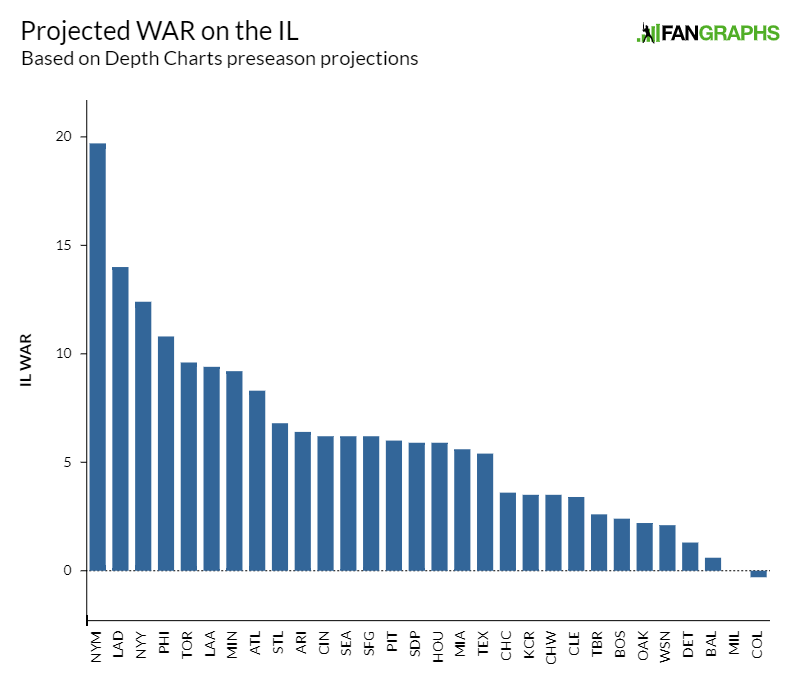
by Jason Fry on 30 May 2021 12:31 pm The Mets’ run of injuries has been Biblical — witness this recent post, from Fangraphs, noting that Mets on the injured list account for nearly 20 WAR, going by preseason predictions.

That’s by far the most WAR lost in the majors and should have been a recipe for disaster. And it still might be! But not so far. The Mets were handed a best-case scenario of “tread water until 26,000 guys are healthy again and maybe some other guys start hitting like we paid them to,” and they’re paddling around pretty happily, not only staying in first place but even opening up a little distance on their similarly battered rivals in the NL East.
How? Well, excellent pitching from starters and relievers sure helps. On Saturday Taijuan Walker looked superb, throttling the Braves over five innings and proving that injured Mets do occasionally return from those dreaded trips down the tunnel. Walker’s ERA is now down to a tidy 1.84, which will do very nicely.
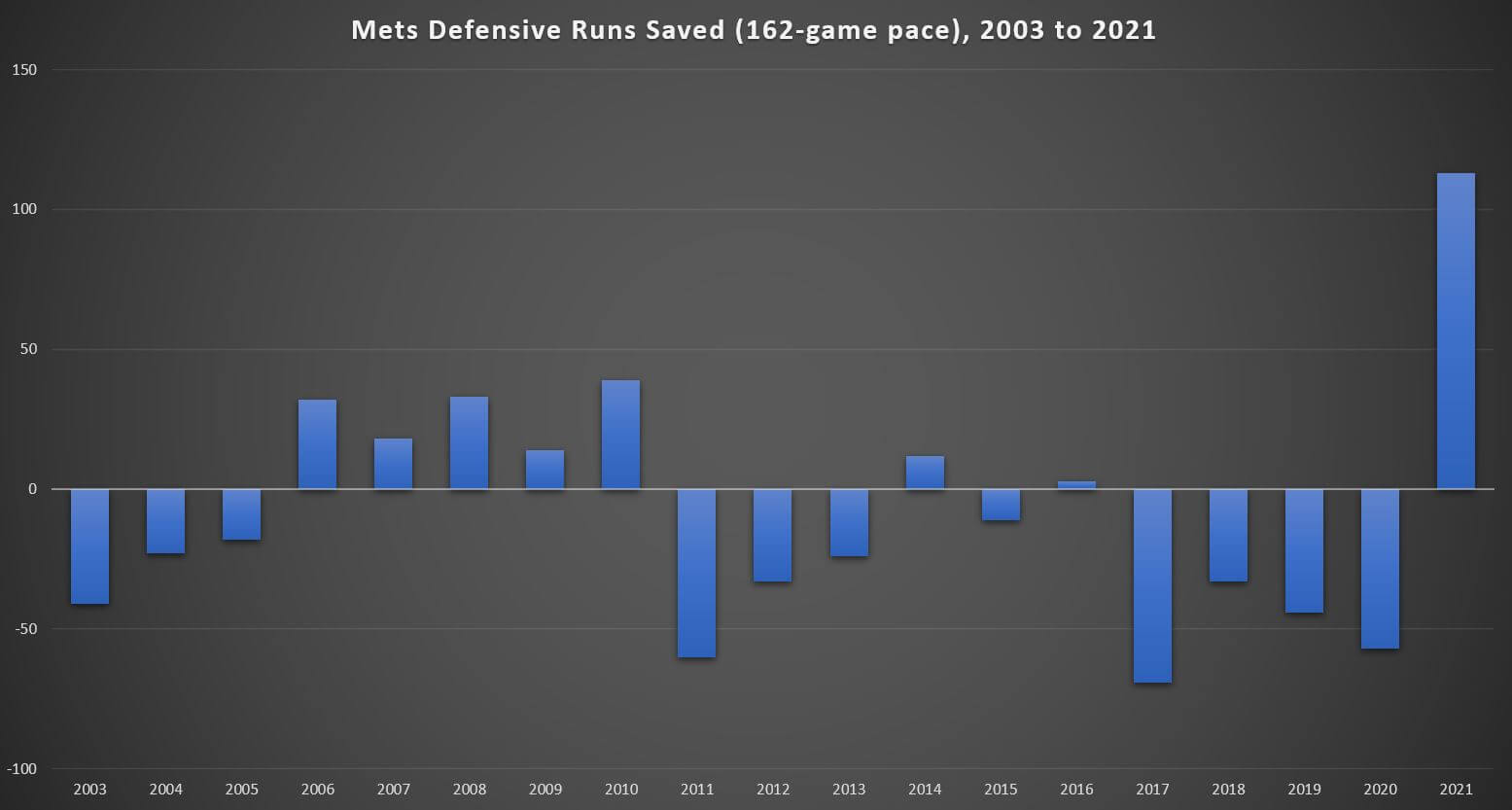
Defense helps too — over at The Athletic on Friday, Tim Britton dug into how the Mets have climbed from the bottom of the MLB ranks in defensive runs saved to third. A key ingredient to the change, which might startle Keith Hernandez, is that they’ve become much more aggressive about shifting, helped by an analytics department that’s been reborn now that the Wilpons have been downgraded from meddlers in chief to paying customers like the rest of us. The Mets hired Ben Zauzmer from the Dodgers, paired him with a couple of Van Wagenen holdovers, and empowered Gary DiSarcina to blend better information with his own instincts and those of his fielders.
While what’s below is still a relatively small sample, so far the results have been pretty good:
(BTW, you should subscribe to The Athletic. It’s worth every penny.)
I know, numbers numbers numbers. But the improved defense passes the eye test too: Before last night’s game became a laugher, it was the Mets’ defense and the Braves’ lack of it that gave them the lead: Tomas Nido gunned down Ronald Acuna Jr. in the first, Jonathan Villar made a diving grab to keep a potential run off the board in the second, and Jose Peraza was perfectly positioned to turn a double play that ended the fourth. Meanwhile, the Braves endured balls that went off Guillermo Heredia‘s glove and through Dansby Swanson.
Then the Mets unloaded, which was of course all sorts of fun: Villar deposited a ball into the Apple Basket (after just missing a grand slam earlier), Brandon Drury hit a two-run pinch-hit homer, and Billy McKinney rocketed a blast into whatever SodaLand is called now. Even James McCann and Francisco Lindor homered, with their bats showing signs of life. Poor Cameron Maybin set a new club mark for futility to begin a Mets career, going 0 for 27 and so topping (or perhaps the term is limbo’ing under) Charley Smith‘s 0-for-26 start in 1964, but then tapped a little swinging bunt up the third-base line to get on base, an accomplishment greeted with rapturous applause from the stands and a flurry of jazz hands from his dugout. Maybin’s smile was a highlight in its own right, starting off low-watt sheepish and then brightening to big and genuine.
That’s the kind of game it was: A guy goes 1-for-28 and it’s a feel-good moment. But it brings up something else about this team, for which I have no graphic: They genuinely seem to like each other and enjoy playing the game, a vibe that begins with Lindor’s effervescent, seemingly slump-proof captaining of the infield but also gets a boost from Marcus Stroman‘s swagger on the mound and the sunny volubility of Pete Alonso and Dom Smith.
Sure, everyone looks happy when you win by 11. Let’s see if the Mets can keep smiling if those defensive numbers erode and the pitching comes back to earth and the injured remain getting treatment for various ailments. But so far, whether through devil magic or winning personalities or a quirk of small sample sizes, Plan B’s been A-OK.
by Greg Prince on 27 May 2021 8:24 pm Dear Student:
The following is your remote learning unit for May 27, 2021. Please complete each assigned exercise, derived from this afternoon’s lesson plan, and submit your answers through your personalized educational portal, using code TWOFORTHURSDAY.
Please stay safe,
New York Metropolitan Teaching Technologies
—
1) A standard scheduled baseball game measures nine innings. How many innings would a doubleheader that takes place on the day that a standard baseball game was originally scheduled contain?
2) “It always rains” is a common refrain when it rains. If “it always rains” is a true statement, why might it be sunny the day after it rains? If it doesn’t always rain, why do people feel the need to say “it always rains”?
3) Explain the relationship between the phrase “keep your feet on the ground and keep reaching for the stars” and former All-Star pitcher Marcus Stroman reaching the end of the sixth inning having thrown mostly ground balls.
4) Jose Peraza leaves a team in Cincinnati, detours through Boston, and then without warning arrives in New York. How long does it take Jose Peraza’s second home run of the year to depart Citi Field?
5) Create a backstory for a fictional character named “Billy McKinney”. Please include details so as to make him seem real. Feel free to includes fictional characters you’ve previously created this term (e.g. “Johneshwy Fargas”).
6) How many saves in how many save opportunities will it take for Edwin Diaz to subtract a phrase like “Jarred Kelenic homered again” from common usage?
7) On the attached anatomical diagram, circle all the body parts NOT injured among the 17 members of the New York Mets currently on the injured list.
8) Calculate the difference between the six weeks Noah Syndergaard has been “shut down” and the period of time it will take Noah Syndergaard to pitch in the major leagues again.
9) If Cameron Maybin comes to bat a given number of times and never gets a base hit, how can Cameron Maybin be said to have a batting average?
10) True or false: $341 million buys a lot of defense and little else. Offer supporting evidence.
11) If a 27th man on a 26-man roster doesn’t participate in either game of a doubleheader, does he make a sound? If so, what kind of sound does he make? If he doesn’t, why not?
12) What is accurate about Connor Joe? (Choose all that apply.)
a) “Connor Joe” is a full name yet somehow feels incomplete.
b) Connor Joe Armstrong would be a more apt name than just “Connor Joe” for a left fielder who demonstrates a strong arm.
c) Connor Joe Wood would be a more apt name than just “Connor Joe” for a batter who gets good wood on the ball.
d) Connor I. Joe would get everybody in attendance at a large, socially distanced gathering up on their feet and clapping.
e) Connor Joe is a perfectly adequate name and any thoughts to the contrary demonstrate a lack of cultural sensitivity.
13) If a pitch is called a “churve” because it is a combination of a changeup and a curve, what would a combination fastball and knuckleball be called?
14) Jeurys Familia and Robert Gsellman are figures of local historical import. Why is it so easy to forget they continue to exist in the present?
15) Agree or disagree with the following statements:
a) Seven-innings games suck
b) Winning them doesn’t
c) The Colorado Rockies aren’t very good
d) Sweeping them is
|
|