The blog for Mets fans
who like to read
ABOUT US

Faith and Fear in Flushing made its debut on Feb. 16, 2005, the brainchild of two longtime friends and lifelong Met fans.
Greg Prince discovered the Mets when he was 6, during the magical summer of 1969. He is a Long Island-based writer, editor and communications consultant. Contact him here.
Jason Fry is a Brooklyn writer whose first memories include his mom leaping up and down cheering for Rusty Staub. Check out his other writing here.
Got something to say? Leave a comment, or email us at faithandfear@gmail.com. (Sorry, but we have no interest in ads, sponsored content or guest posts.)
Need our RSS feed? It's here.
Visit our Facebook page, or drop by the personal pages for Greg and Jason.
Or follow us on Twitter: Here's Greg, and here's Jason.
|
by Greg Prince on 30 October 2020 11:22 pm Welcome to A Met for All Seasons, a series in which we consider a given Met who played in a given season and…well, we’ll see.
I can’t keep looking back at the past, and I have nothing inside of here that is the future.
—Aidy Bryant on her childhood journal, Saturday Night Live at Home, April 24, 2020
The calendar was nine weeks shy of 2021, yet it was clear by October 30, 2020, that Steve Cohen was the Met for next season. True, Cohen, in his capacity as the newly announced owner of the New York Mets — approved by a requisite three-quarters vote of other Major League Baseball owners and blessed as apparently if vaguely necessary by municipal authority — would not actually play in the season ahead. Yet Steve had to neither pitch, hit nor run to emerge as the following season’s defining figure. He and $2.475 billion of his incomparable personal financial worth could catch control of the team its acolytes loved after decades of that same team too often lacking the heart to love them back. That was enough where 2021, in its otherwise to-be-determined state, was concerned. That was enough for Mets fans to accept and embrace Steve Cohen, one of their own, as, shall we say, A Player.
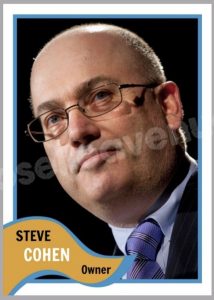 A Player for this moment. (Image courtesy of @roselleavenue.) Opening Day of 2021 was slated for April 1, Closing Day for October 3. Assuming those games and all the games in between were to be contested as scheduled (after 2020, nothing simple would ever seem certain again), there was no doubt from the perspective of the day Steve Cohen bought the Mets that some Met pitcher, Met catcher, Met infielder or Met outfielder would put an indelible stamp on those 162 games or however many wound up getting played. By then, we’d know who the Met for that season was. It might be a Met we knew in 2020. It might be a Met who became a Met because Steve Cohen said, “sure, let’s sign him.”
Until any of that was known, though, Steve Cohen was the symbol of the 2021 Mets. A symbol of hope. A symbol of faith. In lieu of statistics and video highlights, a symbol can be a powerful thing.
The news that Cohen was now the head shotcaller and checkwriter at 41 Seaver Way came down three days after another World Series the Mets didn’t remotely approach and a day before Halloween. There wasn’t a sentient Mets fan around who, amid generally dour times, wasn’t willing to instantly don a costume of cockeyed optimism. We now had Steve Cohen, suddenly the richest owner in all of baseball, and he was working for the cause of our happiness. No trick. Real treat, especially as illustrated in the opening statement he relayed to his fellow Mets fans:
I am humbled that MLB’s owners have approved me to be the next owner of the New York Mets. Owning a team is a great privilege and an awesome responsibility.
[…]
Most of all, I’d like to thank Mets fans for their unwavering support throughout this process.
My family and I are lifelong Mets fans, so we’re really excited about this. With free agency starting Sunday night we will be working towards a quick close.
Let’s go Mets!
The 2020 season, the last one for which Steve Cohen was not majority owner of the New York Mets, had been short and unsatisfying by every measure, save for it having yielded sixty games to watch from afar after four months when a global pandemic had shut down baseball (along with most everything else) altogether. But the Mets’ record of 26-34 and failure to slither inside a bloated playoff tournament seemed almost beside the point. What Mets fans sought in 2020 was not so much a postseason berth but a life after the Wilpons.
The Wilpons were Fred and Jeff. More chairman and CEO Fred than COO and son Jeff, per tenure and the organizational chart; more Jeff than Fred, per the unsympathetic public face of recent years. No matter which Wilpon a Mets fan chose to focus ire upon, neither was what a Mets fan was dying to see. Dying without seeing another Mets world championship — something the Mets hadn’t attained in the nineteen autumns the Wilpon family held full control of the franchise — was an implicit concern for any Mets fan who had come to realize, particularly amid the rampage of COVID-19, that life was precious, finite and too short to sit around and wait for lightning to strike. The Wilpons had neither the resources nor wherewithal to make the Mets a steady contender. They never left the impression that nothing mattered more to them than the Mets winning. Cohen, through a little backstory and a couple of tweets, had already demonstrated more passion for the team than the people who ran it. Plus he had billions and billions of dollars to commit to his passion. Hard not to root for that guy to take over.
Or, after living in the shadow of the Wilpons for so long, anybody, really.
The end of the Wilpon era began to loom almost a year earlier, in December of 2019, when the word “coronavirus” would have drawn stares as blank as the Citi Field scoreboard most late Octobers. A sale to Cohen, who already owned a small Met stake, was officially in the works. But negotiations grew messy, with the Wilpons trying to continue in an approximation of their role as owners without actually owning the ballclub, and eventually it dissolved into a deal undone.
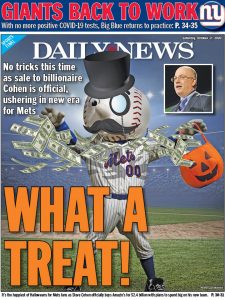 By Halloween 2020, we knew the 2021 Mets wouldn’t be spooked by the same old ownership. Thus, 2020 became one more year with the Wilpons. Fred had been on the scene since 1980, a minority partner with a major say when Doubleday & Co. bought the club from Lorinda de Roulet. In those days, the hook in the media was that the club would be operated under the auspices of a descendant of the mythological inventor of baseball, Abner Doubleday, specifically his great-great-grand-nephew Nelson. Abner never invented a damn thing, but it made for a good story. And the alliance forged between Nelson the chairman and Fred the president presented itself as a harbinger of good things to come for a franchise that had sunk to rockbottom following the death of original Mets owner Joan Payson in 1975.
Doubleday-Wilpon ’80 was the ticket the Mets rode to a renaissance, culminating in the 1986 world championship. The Mets, as built by the general manager the partners brought in, old Oriole hand Frank Cashen, constructed a monster of a roster, and the guys who bought the right to handle the Commissioner’s Trophy came off as sportsmen of the old school. When Jesse Orosco struck out Marty Barrett, flung his glove skyward and embraced Gary Carter, the influence of the owners in reaching the mountaintop may have been profound, but it was also played as subtle. These fellows weren’t interested in a high profile or a screaming headline. Doubleday and Wilpon weren’t George Steinbrenner, which was half the battle of getting good press in that era. Winning the World Series took care of the rest.
Had you told a Mets fan in the giddy aftermath of October 27, 1986, that subduing the Red Sox in seven games would be it in terms of earning ultimate prizes for Doubleday, Wilpon or both, it would have seemed laughable. They were the shepherds of not just the best baseball team in the land, but a smoothly functioning franchise designed to churn out more champs. Cashen had traded for great players, cultivated a farm system that produced even more of them. Why would it stop?
Whyever it would, it did. And though it wouldn’t be fully accurate to date the turning point in Met fortunes to November 14, 1986, it’s hard to swear it’s a coincidence that once Fred Wilpon upped his stake in the Mets from 5 to 50%, as Doubleday & Co. sold its stake to the two individuals who already helmed the franchise, the Mets’ streak of not winning more World Series began.
The Mets remained strong on the field for a few years after the formation of the new partnership. Then, in the early ’90s, the club collapsed, first competitively, then aesthetically. The Mets were populated by underachieving players who projected overbearing personalities. Fred Wilpon stepped up to take responsibility for the Bonillas, Saberhagens and Colemans who made the operation look bad. Doubleday picked his spots to make stands, most notably as the co-owner more obviously insistent on acquiring Mike Piazza.
Wilpon’s and Doubleday’s mutual relationship was brittle by 2000, when the Mets made their first World Series since 1986. Two years later, Nelson sold his half of the club to Fred, which in turn expanded Jeff’s portfolio. Prior to the sale, Jeff was running Sterling Equities, the Wilpon family’s real estate business. When the Wilpons and Fred’s brother-in-law Saul Katz bought out Doubleday, Jeff was elevated to COO of the Mets. Not long after he was out of the picture, Nelson offered one of the most quoted lines of the 21st century regarding the Wilpon scion:
“Mr. Jeff Wilpon has decided he’s going to learn how to run a baseball team and take over at the end of the year. Run for the hills, boys.”
The quote being cited repeatedly for seventeen years reflected a regime that wasn’t exactly basking in success. After the Mets became a purely Wilponian production in 2002, the Mets finished in last place. During their first full post-Doubleday season, the Mets finished in last place again. A year later, the Mets finished in next-to-last place, though not before deciding to fire the first manager Fred Wilpon hired of solely his own volition — charisma-challenged Art Howe, who Fred swore “lit up” the room during the interview process — or declaring that the Mets, en route to a 71-win campaign, aspired to play “meaningful games in September”. If nothing else, the Wilpons left a trail of memorable phrases in their wake.
For a spell in the mid-2000s, it appeared their legacy might be something more. They engineered the founding of a mostly Met-themed regional sports network. They broke ground on a retro-style ballpark to replace creaky Shea Stadium. And they empowered locally sourced general manager Omar Minaya to improve the product on the field at whatever cost necessary. With Pedro Martinez, Carlos Beltran, Carlos Delgado, Billy Wagner and Paul Lo Duca imported to join budding homegrown stars Jose Reyes and David Wright, the dream of the Mets reigning as the large-market force they should have been all along seemed to be coming true. In 2006, the Mets romped to a division title and came within one game of the World Series.
But in 2007 and 2008, the team fell short of the playoffs in ghastly fashion, and when the new ballpark opened in 2009, the club deteriorated as if its brief rise to prominence never occurred. Citi Field, meanwhile, wasn’t welcomed with universal acclaim, with the Ebbets Field motif favored by old Brooklyn Dodger fan Fred landing as tone-deaf to nearly a half-century of Mets history, and the emphasis on amenities lost on the masses who missed Shea’s relative affordability and psychic accessibility.
The biggest blow to the Wilpons’ ownership started coming into view in late 2008 when, just as the Great Recession was hitting, their connection to disreputable pyramid-scheming Bernie Madoff left them unable to operate New York’s National League franchise in a manner suitable to ensuring earnest competition. Cries for the Wilpons to sell the team resounded. The Wilpons, with support from Commissioner Bud Selig, hung on. Minority stakes were sold, though, and, in 2011, an announcement was made that hedge fund manager David Einhorn was on the verge of buying a controlling interest. But that fell apart in a matter of months, and the Wilpons remained attached to the franchise that gave them their primary professional identity and most of their social status.
It also foist upon them a degree of infamy they were unlikely to absorb had they just stuck to real estate. Generally speaking, Mets fans were mad the Wilpons couldn’t or wouldn’t invest enough to create a consistent winner. They groaned every time a story appeared that their front office was behind the times in implementing analytics or was getting in the way of employees (some of them players) just trying to get their jobs done. The grudging nods toward the Mets’ better traditions — a team museum that didn’t open until the Jackie Robinson Rotunda had a year in the sun; team Hall of Fame ceremonies that disappeared for years at a clip, a long-discussed Tom Seaver statue that never got installed during the icon’s lifetime — didn’t help the owners’ image. Nor did news like Jeff Wilpon being credibly accused of discrimination by a former executive who said Jeff harassed her for being pregnant while unmarried.
There was little sense of urgency nor evidence of fervor on the Wilpons’ part when it came to getting the Mets on a permanently positive footing. There was no warmth projected by the owners. When things did work out — such as when the club streaked to a division title and pennant in 2015 under GM Sandy Alderson and manager Terry Collins — the good vibes wore off quickly and the team’s record reverted to substandard.
This is the legacy Steve Cohen would have to exceed once the transfer of power from the Wilpons to himself was to become effective in the days after October 30, 2020. This is why Cohen, another hedge fund type (not without his own issues in the securities trading realm), was greeted as a liberator the moment his pending ownership was no longer a matter of speculation. Though Anybody But the Wilpons would have garnered some degree of applause, it was Cohen who stood as the people’s choice as reporting mounted through 2020 that the Wilpons were still trying to sell the franchise (word was the next generation of Katzes wasn’t keen on hitching its wagon indefinitely to Jeff). Other groups bid or tried to bid. Cohen, though, despite having his first attempt dashed in winter, never let go of his desire to own the Mets and never hesitated to dip into his pockets to make it happen when the opportunity arose anew in summer.
And it happened. The Wilpons and Katz sold him the Mets. That’s all that had to happen for Steve Cohen to be the best thing that ever happened to the Mets on the cusp of 2021. Whether that description would hold once 2021 unfolded in real time…
“Well,” Mets fans could tell one another, “we’ll see.”
If you like the Steve Cohen baseball card displayed above, we suggest you follow @roselleavenue on Twitter to explore the Roselle Avenue Alternate Card Universe, a place like no other on Earth.
PREVIOUS METS FOR ALL SEASONS
1962: Richie Ashburn
1963: Ron Hunt
1964: Rod Kanehl
1965: Ron Swoboda
1966: Shaun Fitzmaurice
1967: Al Schmelz
1968: Cleon Jones
1969: Donn Clendenon
1970: Tommie Agee
1971: Tom Seaver
1972: Gary Gentry
1973: Willie Mays
1974: Tug McGraw
1975: Mike Vail
1976: Mike Phillips
1977: Lenny Randle
1978: Craig Swan
1980: Lee Mazzilli
1981: Mookie Wilson
1982: Rusty Staub
1983: Darryl Strawberry
1985: Dwight Gooden
1986: Keith Hernandez
1987: Lenny Dykstra
1988: Gary Carter
1989: Ron Darling
1990: Gregg Jefferies
1991: Rich Sauveur
1992: Todd Hundley
1993: Joe Orsulak
1994: Rico Brogna
1995: Jason Isringhausen
1996: Rey Ordoñez
1997: Edgardo Alfonzo
1998: Todd Pratt
2000: Melvin Mora
2001: Mike Piazza
2002: Al Leiter
2003: David Cone
2004: Joe Hietpas
2005: Pedro Martinez
2007: Jose Reyes
2008: Johan Santana
2009: Angel Pagan
2010: Ike Davis
2011: David Wright
2012: R.A. Dickey
2013: Wilmer Flores
2014: Jacob deGrom
2015: Michael Conforto
2016: Matt Harvey
2017: Paul Sewald
2018: Noah Syndergaard
2019: Dom Smith
2020: Pete Alonso
by Jason Fry on 28 October 2020 10:00 pm Welcome to A Met for All Seasons, a series in which we consider a given Met who played in a given season and…well, we’ll see.
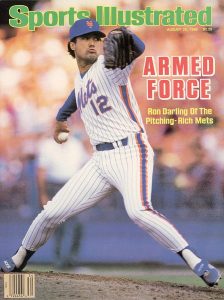
In the mid-80s, while I was off at boarding school, I got a letter from my mother. That wasn’t odd, but what was inside was. My mother had sent me a folded-up article she’d cut out of Cosmopolitan, and amended it with a sentiment more typical of her: Typical Cosmo bullshit, but thought you’d enjoy.
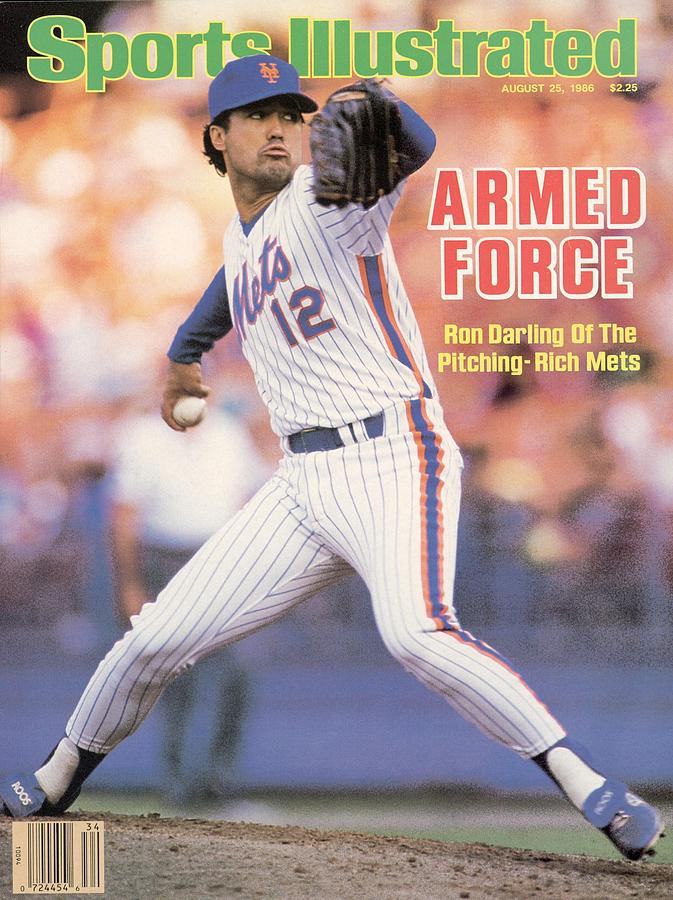
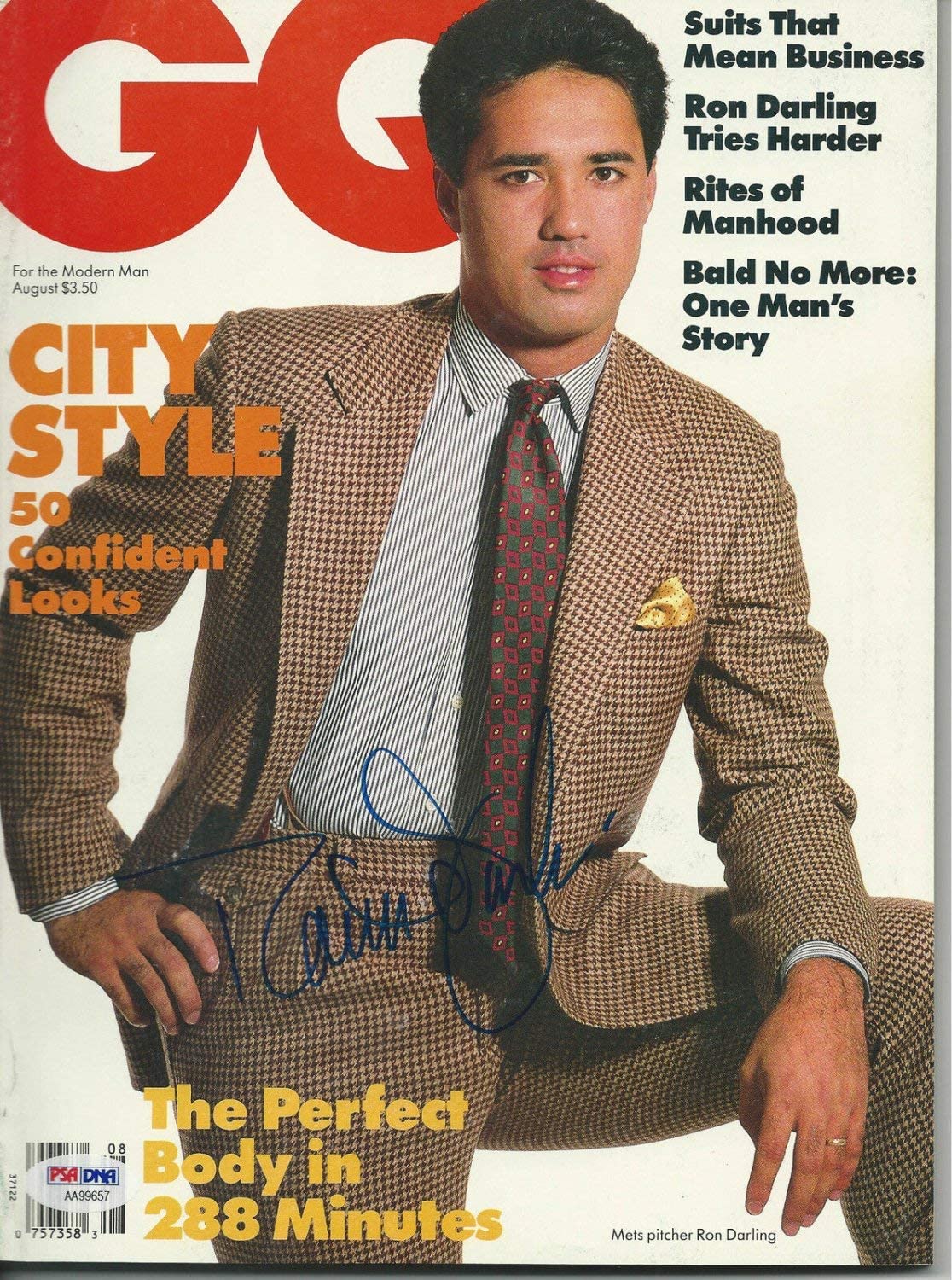
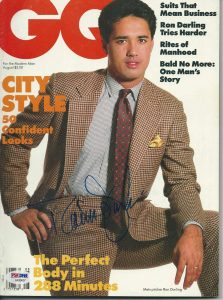
When I unfolded it, I understood — it was about Ron Darling. Darling was a mainstay of such magazines then, and why not? He was a young and handsome star pitcher for the Mets. To those qualities he added a handful of ineffable somethings — style, glamour, and ease with the bright lights. And he had an intriguing background, one not exactly standard for a professional ballplayer. For openers, he was the son of a Chinese-Hawaiian mother and a French-Canadian father, a proto-Benetton ethnic mix that made vaguely cringy references to “exotic good looks” de rigueur when he was written about outside of the sports pages. He spoke French and Chinese, and he’d studied French and Southeastern Asian history at Yale. If I’d told you back then that George Plimpton — he of the Paris Review bylines and the good-schools accent — was going to invent a fictional Mets ballplayer, you’d have expected a creation a lot more like Darling than Sidd Finch. Gary Carter gave Darling the nickname Mister P, short for Mister Perfect, and writers for Cosmo, GQ and other publications fell over themselves to agree.
 Two baseball generations later, Darling is part of the mighty SNY triumvirate with Gary Cohen and Keith Hernandez and a mainstay of postseason broadcasts. But something funny happened along the way. When you think of Hernandez, you draw a straight line between the mustachioed, vaguely piratical first baseman of the mid-80s and the raffish color guy he’s become. But that straight line isn’t as easy to draw with Darling. He’s thicker and grayer, true, but hey, aren’t we all? I think it’s that Darling invokes his career less frequently than Hernandez, typically discussing pitching mechanics and grips without grounding them in his own experiences. And when he does reference his own playing days, he’s generally self-deprecating about himself and his accomplishments. The odd effect is a Mets icon whose triumphant second act has somehow diminished his career instead of enhancing it. Two baseball generations later, Darling is part of the mighty SNY triumvirate with Gary Cohen and Keith Hernandez and a mainstay of postseason broadcasts. But something funny happened along the way. When you think of Hernandez, you draw a straight line between the mustachioed, vaguely piratical first baseman of the mid-80s and the raffish color guy he’s become. But that straight line isn’t as easy to draw with Darling. He’s thicker and grayer, true, but hey, aren’t we all? I think it’s that Darling invokes his career less frequently than Hernandez, typically discussing pitching mechanics and grips without grounding them in his own experiences. And when he does reference his own playing days, he’s generally self-deprecating about himself and his accomplishments. The odd effect is a Mets icon whose triumphant second act has somehow diminished his career instead of enhancing it.
But the Yale pedigree and the Mister P nickname led to a lot of mistaken assumptions to go with that typical Cosmo bullshit. Darling’s father, Ron Sr., was a foster kid who’d spent his childhood being passed around New England farm families. (The nickname R.J. is a back formation of “Ron Jr.”) He served with the Air Force and was stationed in Honolulu, where he met Luciana Mikini Aikala, a teenaged girl being raised by her grandmother because her mother had died in childbirth and her father had left home. Their son would call his parents “stray dogs,” adding that they were “perfect for each other.” When Darling was three, his father was discharged and a former foster family offered him a job in a machine shop in a mill town outside of Worcester. Darling grew up in Millbury, in a development of ranch houses built for servicemen returning from World War II. One of his favorite childhood memories was collecting garbage with his father and taking it to a pig farm — not exactly the stuff of Skull & Bones confessions.
Athletic prowess helped get him to Yale: The Darlings’ Millbury ranch house sat on an acre of land, where Ron Sr. built a baseball diamond. But that also required a lot of hard work, and not just Darling’s. His parents took extra jobs to send four boys to college, and expected that the results would meet their family’s high standards. Darling had been a standout high-school quarterback, but at Yale the job went to someone else and he was put in the secondary, which he disliked. He turned to baseball, where his coach saw his arm at shortstop and turned him into a pitcher. He went 11-2 as a sophomore; the next year, he faced Frank Viola of St. John’s in the NCAA regionals, pitching 11 no-hit innings before losing 1-0 in the 12th on a flurry of small but fatal misfortunes. Among those watching the game were Red Sox legend Smoky Joe Wood and New Yorker legend Roger Angell, who chronicled the Darling-Viola duel in 1981’s “The Web of the Game.”
Darling passed up his last year at Yale to sign with the Rangers; he became a Met, along with Walt Terrell, in an April 1982 trade for Lee Mazzilli. He was called up in September 1983, facing Joe Morgan, Pete Rose and Mike Schmidt as his first three enemy hitters. (Darling loves telling that story, but it’s usually Gary who notes that he struck out Morgan and Rose and got Schmidt to ground out.) The next year, he arrived for keeps, as did the Mets and their instant ace Dwight Gooden.
Gooden is one of the reasons Darling has been able to poor-mouth his career without getting called on it. When you’re pitching behind the best pitcher in baseball, it’s tough to get noticed, but cover Gooden’s blinding numbers and Darling’s shine pretty brightly. In ’85, he was 16-6 with a 2.90 ERA, and threw nine shutout innings in the fabled “clock game” against St. Louis, the one that turned when Darryl Strawberry homered off the Busch Stadium clock in the 11th. In ’86 he was 15-6 with a 2.81 ERA and a 1.53 ERA in three World Series starts, earning his ring by vanquishing the team he grew up rooting for — he’d been at Fenway for Carlton Fisk‘s legendary Game 6 walkoff. He had a deadly pickoff move (particularly for a right-hander) and was a superb fielder, winning a well-deserved Gold Glove in ’89. In all, Darling went 99-70 with a 3.50 ERA as a Met, which are pretty good numbers to plug into any rotation.
 Not being mid-80s Gooden shouldn’t be a sin, but Darling also carried the perception that he could have achieved more than he did. Davey Johnson groused that he walked too many guys; fans groused that he got himself into trouble and wound up with too many no-decisions. Pro and amateur critics saw a common thread — that Darling was too smart and too much of a perfectionist for his own good. Not being mid-80s Gooden shouldn’t be a sin, but Darling also carried the perception that he could have achieved more than he did. Davey Johnson groused that he walked too many guys; fans groused that he got himself into trouble and wound up with too many no-decisions. Pro and amateur critics saw a common thread — that Darling was too smart and too much of a perfectionist for his own good.
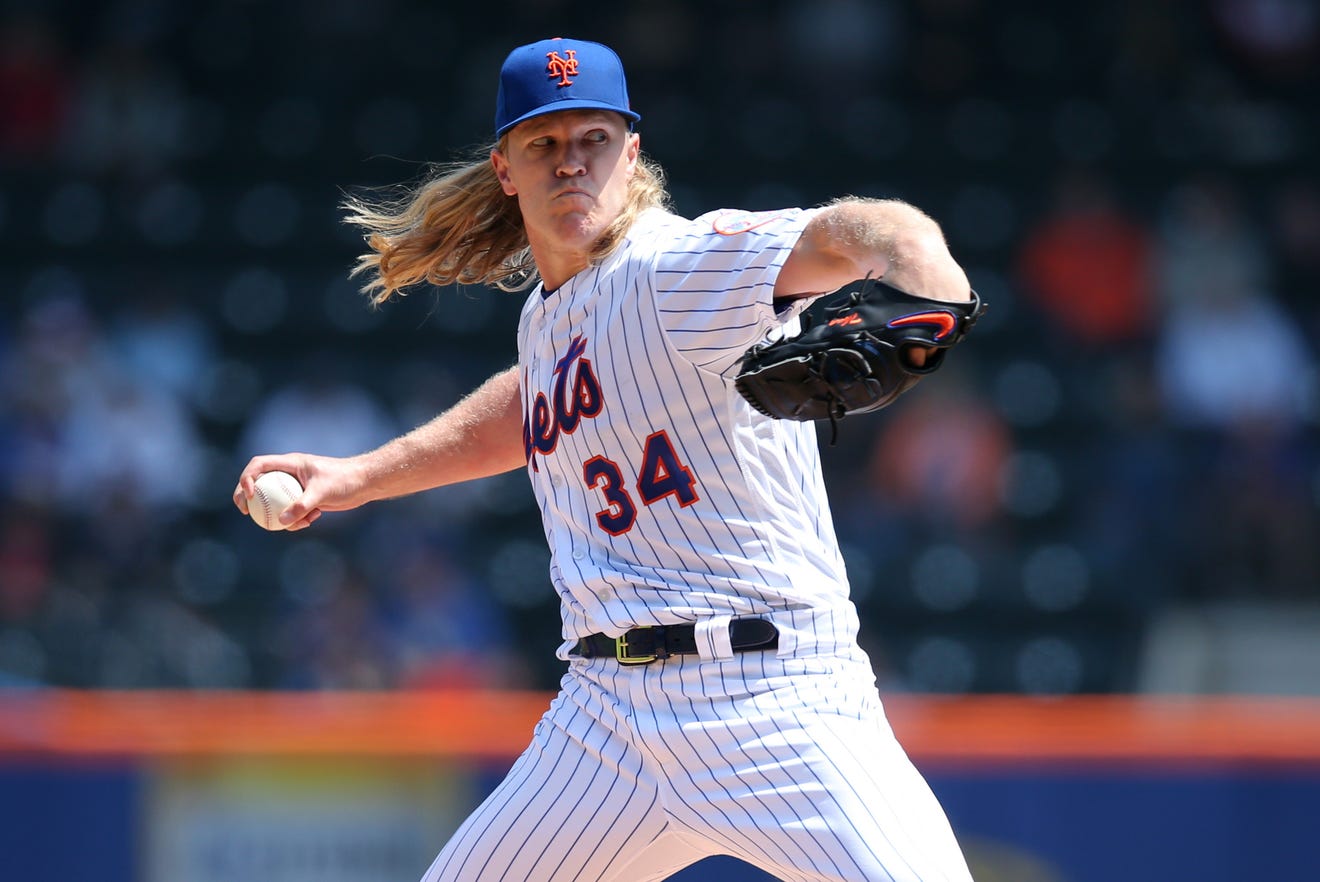
Which was probably true. Darling’s combination of plus fastball, slider and curve was good enough to let him shove hitters around, but he wanted more than that. He wanted to befuddle them, working to arrange at-bats so they’d culminate in the perfect pitch put in the perfect location. Sometimes he’d make that pitch; other times, he’d outthink the hitter so thoroughly that he’d also outthink himself, or miss that perfect location by a fraction of an inch on a three-ball count. Later in his career, he added a split-fingered fastball to his repertoire, and arguably fell too in love with the new pitch, to the detriment of his secondary pitches. Darling wasn’t gifted with Noah Syndergaard‘s firepower, but he strikes me as a forerunner of Noah in one respect: He might have had a higher W-L percentage if he’d had a lower IQ.
Darling represents 1989 in our A Met for All Seasons series, which probably wouldn’t be his pick — he was 14-14 that year and stuck in a clubhouse undergoing a transition it wouldn’t survive, as the baton got fumbled in the handoff between the heroes of ’86 and a new generation of Mets. (Darling did become teammates with Viola, uniting the college adversaries from the game immortalized by Angell.) The next year he wound up in the bullpen and then under the knife, and as the 1991 season cratered the Mets traded him to the Expos for Tim Burke. Darling spent two weeks looking miserable in tricolor motley before being shipped to Oakland, where he won the 100th game that had cruelly eluded him as a Met. He started the final game before the ’94 strike and was released the next year, on his 35th birthday.
The upside of that was Darling avoided his first-ever trip to the disabled list, which was a point of pride for him; the downside was his career was over, and he had to figure out what to do with the rest of his life. He likes to tell a revealing story about coming home hoping to celebrate his newfound freedom with his family, only to find everyone was busy with play dates, tennis matches and other daily routines he knew nothing about. It was a surreal experience that showed him he’d spent years on scholarship while others made daily life work around him. Darling spent a few years decompressing from baseball, then came back to it as a broadcaster for the Nationals’ inaugural 2005 season. A year later, he moved to SNY. His early reviews as a broadcaster weren’t kind, but he worked doggedly at his new profession and was soon hailed as one of the best in the business.
In reaching that level, perhaps Darling has figured out what sometimes eluded him on the mound — that it’s not all on him. He’s the calm axis of the SNY booth, a vital balance point between Cohen’s rock-solid play-by-play and teed-up inquiries and Hernandez’s vortex of fascinating, maddening chaos. It’s a role where he can work deftly and efficiently to make both his partners better — the equivalent, perhaps, of picking a pitch meant to yield a grounder to short rather than a hitter frozen in horror at the plate. Maybe Darling runs down his own career because he sees now what he wishes he had seen then. But I hope he also sees that the lesson was learned — and that his resume is one to be proud of. Even by Darling family standards.
PREVIOUS METS FOR ALL SEASONS
1962: Richie Ashburn
1963: Ron Hunt
1964: Rod Kanehl
1965: Ron Swoboda
1966: Shaun Fitzmaurice
1967: Al Schmelz
1968: Cleon Jones
1969: Donn Clendenon
1970: Tommie Agee
1971: Tom Seaver
1972: Gary Gentry
1973: Willie Mays
1974: Tug McGraw
1975: Mike Vail
1976: Mike Phillips
1977: Lenny Randle
1978: Craig Swan
1980: Lee Mazzilli
1981: Mookie Wilson
1982: Rusty Staub
1983: Darryl Strawberry
1985: Dwight Gooden
1986: Keith Hernandez
1987: Lenny Dykstra
1988: Gary Carter
1990: Gregg Jefferies
1991: Rich Sauveur
1992: Todd Hundley
1993: Joe Orsulak
1994: Rico Brogna
1995: Jason Isringhausen
1996: Rey Ordoñez
1997: Edgardo Alfonzo
1998: Todd Pratt
2000: Melvin Mora
2001: Mike Piazza
2002: Al Leiter
2003: David Cone
2004: Joe Hietpas
2005: Pedro Martinez
2007: Jose Reyes
2008: Johan Santana
2009: Angel Pagan
2010: Ike Davis
2011: David Wright
2012: R.A. Dickey
2013: Wilmer Flores
2014: Jacob deGrom
2015: Michael Conforto
2016: Matt Harvey
2017: Paul Sewald
2018: Noah Syndergaard
2019: Dom Smith
2020: Pete Alonso
by Greg Prince on 28 October 2020 1:01 pm In the final World Series baseball played in the (reportedly) pre-Steve Cohen era of (potential) Metsian salvation, the pitcher who shouldn’t have been removed from the mound came out too soon; the player who had to be removed from the field came back against sound judgment; and the championship tournament appended to a season that seemed unlikely to be played at all ended just in time. This World Series, thus, goes down as a decent idea, an adequate reality and one more Sgt. Esterhaus-style reminder to be careful out there.
The Los Angeles Dodgers, a.k.a. the Vin Scully Avenue Blues, are the winners of the 2020 World Series, which seems about right in terms of getting baseball a champion that requires little effort to wrap one’s head around. Not that anything prior to 2020 was anything quite like 2020, yet the two World Series that followed the two previous living-memory seasons that were noticeably shorter than the norm, in 1981 and 1995, were contested and captured by teams that were chalk picks to make it that far. The Dodgers in ’81 were a perennial contender featuring some of the biggest stars of their time. The Braves in ’95 had gone to each of the three previous postseasons (when that still meant winning a division) and had stuffed a pair of pennants in their pockets. Dodgers-Yankees and Braves-Indians could be viewed as what the sport needed to remind folks estranged from the game in the wake of bitter labor-management disputes what the sport looked like when played by its contemporary flagship franchises.
After the sixty-game sortout that materialized after months of quarantine, 2020’s sixteen-team postseason could have been a crapshoot. Instead we got chalk again. We got the best records from each league. The Dodgers’ credentials were impeccable: eight straight division titles, two Series appearances, talent on top of talent cultivated by savvy management unafraid to spend a buck or zillion. What the Rays lacked in profile or perhaps profit they made up for in calculating how to fiercely compete. The Dodgers are so familiar to October by now that they’re essentially autumn’s home team. The Rays’ reputation transcends the identity of their parts, though their parts make an impression on anybody who spends a few nights watching them accomplish what needs getting done.
It was a perfectly reasonable matchup for incredibly imperfect times, and the series it produced exceeded the better-than-nothingness that was this fall’s baseline mandate. The Dodgers outshone the Rays across six games, though the one game worthy of enshrinement in the all-timer’s club belonged to Tampa Bay, specifically its Daniel Murphy of the month, Randy Arozarena, and its Al Weis of the moment, Brett Phillips. Game Four was already pretty close to being one for the ages before Phillips (a .202 hitter in 153 regular-season games since 2017) batted for the first and only time in World Series competition, with two out in the bottom of the ninth after entering as a pinch-runner in the bottom of the eighth and sticking around as the right fielder in the top of the ninth. When he came to the plate, the Rays were down by a run on the scoreboard and a game in the Series. Kevin Kiermaier, who had singled, was on second. Arozarena, who had walked rather than explode for one of his ten postseason home runs, was on first.
Series dreams are made of this; who was Brett Phillips to disagree? He lined a single into center to score Kiermaier with no fuss and tie the game at seven. The Dodgers’ center fielder, Chris Taylor, mishandled the ball, though, so Arozarena, whose October it was and we were all just living in it, tore around second and was waved home from third. The relay from the outfield was cut off by Max Muncy at first. Muncy threw home. Arozarena stumbled and fell. Recovering quickly, he turned back toward third. Catcher Will Smith, however, didn’t catch what Muncy threw him. In a blink, Arozarena pivoted and turned back toward home while Smith chased what Dodger pitcher Kenley Jansen hadn’t bothered to back up. There was no play at the plate, unless you count the nine poundings Randy gave it to signify that, yes, the Rays had won the damn thing in the ninth inning, 8-7.
That’s a play you rewind repeatedly the second you’ve absorbed what just happened. That’s a play you stay up as late as you can dissecting and, once you awaken, you start looking for highlights so you can analyze it some more. That’s a play that sends you immediately to the precedent file because during the World Series you mentally gravitate to the World Serieses that have preceded it and instinctively orbit that time that was just like this time even if no time was ever like this time, not in the Brett Phillips driving in the tying run/Randy Arozarena falling down and getting up with the winning run sense nor in the World Series being played at a neutral site before a quarter-house after everybody in uniform (if not the stands) had been confined to a bubble for the duration sense.
That’s how you set a new precedent. That’s why you’re glad you stayed up to watch, no matter how frigging long these games lasted.
Game Four is what MLB Network asks Bob Costas and Tom Verducci to discuss for an hour or two over Zoom. Game Six was destined to serve as the rest of the story. The Dodgers had won a calmer Game Five (its chance for nonsectarian elevation into the postseason pantheon was caught at home when Manuel Margot attempted but failed to steal it) and were on the cusp of clinching Tuesday night. Nevertheless, the Rays still had Arozarena, and Arozarena belted yet another homer in the first. He handed the 1-0 lead to Blake Snell, and Snell, who won a Cy Young a mere two years ago, clutched it tightly as could be. Even accounting for the strikeout-strewn landscape of contemporary baseball, Snell was spectacular, blowing away L.A. for five-and-a-third innings, giving up only a single while fanning nine. Then Snell made the mistake of giving up a soft bases-empty, one-out single to Austin Barnes in the sixth, a mistake mostly because Snell pitches for the Rays, and the Rays get as far as they do on limited resources by figuring out with immense certainty what will and won’t work regardless of what the naked eye sees.
The naked eye saw Snell in total command. The Rays, embodied by manager Kevin Cash, saw a pitcher about to face the Dodger order for the third time, which has generally not been optimal for Snell, never mind that Snell couldn’t have been more optimal for the Rays or lethal to the Dodgers. When Cash took out a pitcher whose line was no runs, two hits, no walks, nine Ks and 73 pitches total, Fox’s microphones could pick up the high-fives in the Los Angeles dugout.
Nick Anderson, who is a very good reliever but wasn’t having a particularly good postseason, replaced Snell and, almost as quickly as Arozarena sprang to his feet on Saturday, crystallized every anti-analytic argument from Arlington to Albania. Mookie Betts doubled Barnes to third. With Corey Seager batting, Barnes scored and Betts advanced on a wild pitch. Then Betts whooshed home on Seager’s grounder to first. That — along with a Betts leadoff homer in the eighth and stellar Dodger relief all night — was the game right there. Connoisseurs of World Series pitching debates who are still picking over the passing over of George Stone to start Game Six in 1973 rarely mention that while Tom Seaver on short rest surely wasn’t his sharpest, the Mets never touched Catfish Hunter. No way Cash should have hooked Snell so robotically, but no way Arozarena’s first-inning homer was sufficient support for any Cy Young winner. The final score in that Stoneless Game Six was the final score in this suddenly Snell-deprived Game Six: 3-1.
You can vaguely dislike the Dodgers on any number of levels, but you had to feel good for Clayton Kershaw finally getting fitted for a ring. You can deeply despise the Dodgers for having harbored the criminal Chase Utley, but you couldn’t in all good conscience deny 93-year-old Vin Scully the pleasure of pulling up a chair for his franchise’s seventh world championship, the only one they’ve ever won without him on the active broadcast roster. And as a Mets fan, even if you sided with the Rays for having knocked off the Yankees, you had to wish a celebratory pie would be planted gently in the bushy face of Justin Turner, who shed his utilityman beginnings back east to soar to the top of the San Gabriel Mountains out west. Turner’s been gone so long that the resentful residue left behind by Guy Who Gets Better As Soon As He Leaves Us should be plenty dry by now (at the end of a World Series that, incidentally, pitted two former Travis d’Arnaud employers). Yet when SNY rerairs Johan’s no-hitter, and Santana’s postgame interview with Kevin Burkhardt is interrupted by the giddy redhead with the shaving cream in a towel…well, that’s so Justin. Wherever he filled in or whether he simply sat and cheered between 2010 and 2013, as a Met he was always super useful and superbly supportive. He was the one Dodger for whom a rooting interest came naturally enough.
Then, because he must have a little Met left in him, he became a story that overwhelmed everything that came before him. Bigger than MVP Seager. Bigger than cinch Hall of Famer Kershaw. Bigger than the ability of Arozarena to jump a little lighter. Bigger than discovering Cash is so named because the Dodgers are likely to vote him a full share.
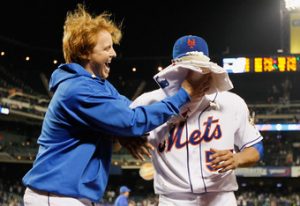 Turner in comparably giddy but exponentially more innocent times. Justin Turner was taken out of Game Six before its conclusion without explanation. If it was the regular season, you’d guess he was traded. Because it’s 2020, it should have occurred to us that he’d tested positive for Covid-19. Yup, that was it. If it can happen to anybody, it can happen to an about-to-be world champion third baseman. What a blow to Turner; to the Dodgers; to MLB, which had just completed, via Rob Manfred’s podium bloviations, patting itself on the back for persevering through an abbreviated schedule and extended playoffs without ever shutting down altogether. It’s hard to imagine a Game Seven proceeding as planned given that nothing Covid touches proceeds as planned. The Rays’ disappointment notwithstanding, the World Series packing up its temporary tent in Texas happened right on time. The most important thing here, of course, was they got Turner’s test result, they acted accordingly, Justin was safely self-isolating, and…
Oh, there’s Justin Turner emerging from his mandatory holding room to join his teammates on the field for pictures and trophy-clutching and championship hugs because how ya gonna tell a player who’d been in the majors since 2009 to celebrate winning his first World Series all by himself? His mingling among the presumably uninfected at Globe Life Field was inadvisable, but a least Justin was wearing a mask, and….nope, he took that off, too.
“I can’t believe what I just saw!” returned to a Dodgers World Series context in a flash.
On one hand, if you were in fact using that hand to cover both eyes, you couldn’t blame Justin, who’s always had an element of big kid to him, for wanting to be out there with his comrades. He’s been a Dodger since 2014, which meant he’d endured one ultimately unsuccessful October after another until now. The Dodgers as a whole hadn’t won the World Series since 1988. For those born in 1989 or later, this was a once-in-a-lifetime event.
On the other hand, Covid-19 is a daily threat to everybody, whether they’ve just won the World Series or not. There’s no science publicly disseminated that indicates those who’ve just tested positive are exempt from spreading the virus because the Dodgers finally got over the hump. Justin Turner zipped from object of sympathy to object of derision (and MLB from admirable to irresponsible) in about as many seconds as it took Arozarena to switch directions twice in Game Four.
A black eye for baseball? A pie in the face at least.
by Jason Fry on 23 October 2020 7:06 pm Welcome to A Met for All Seasons, a series in which we consider a given Met who played in a given season and…well, we’ll see.
In the 2012 offseason, the Mets made a controversial deal, sending knuckleball artist and fan favorite R.A. Dickey to the Blue Jays for a return built around a minor-leaguer who was seen as a can’t-miss prospect.
It’s easy to forget that minor-leaguer was Travis d’Arnaud, billed as a tough catcher with a sweet stroke that generated opposite-field power. D’Arnaud never fulfilled his promise in New York, ground down by a drumbeat of injuries that bordered on Biblical and finally exiled after a Jeff Wilpon hissy fit. The other prospects in the deal were an outfielder named Wuilmer Becerra and a right-handed pitcher named Noah Syndergaard. Both were regarded as lottery tickets — Becerra had power and speed, while Syndergaard had a flamethrower for an arm — but were very much unknown quantities.
Eight years later, Syndergaard is still something of an unknown quantity, if we’re being honest about it. But it’s a different kind of unknown, that comes with a raft of questions. The immediate one is whether Syndergaard’s elbow ligament will reknit the way he and we would like, which isn’t the gamble it once was but is still uncertain. Beyond that, the questions are the same ones that have dogged Michael Conforto: Will Syndergaard ever be great, or do Mets fans need to settle for his merely being really good?
They’re the kind of questions you hope to get to wrestle with — just as Syndergaard is a fascinating pitcher to try to sum up. From his career stats to his potential to his manner on the mound and the workings of his brain, he’s the model of a modern pitcher.
It starts with the arsenal, of course — something that always brings me back to when I was first getting to know Syndergaard. The fastball was nearly 100, with that hard sink that makes hitters feel like they’re trying to connect with a shotput. But we’d known that was coming. We hadn’t known about the evil changeup, the sharp curve, or the slider. Oh God, that slider — on Opening Day 2016 it was coming out of Syndergaard’s hand at 95. Sample scouting report: That shit’s fucking unhittable.
Which gets us to the modern part. If you were a baseball-mad kid in the late Seventies and early Eighties, you could name every pitcher in the big leagues who threw 95. Ninety-five demanded memorization. It was elite bordering on superhuman. Today, I couldn’t name all the pitchers on the Mets roster who throw 95. A fastball hitting 100? Just another day at the office. Meanwhile, the number of pitchers who threw a 95 MPH slider in the early Reagan administration? It was zero. That pitch didn’t exist.
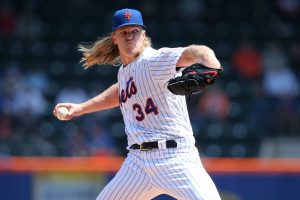 Hammer of the gods, coming at you. That’s what 35 years of nutrition, travel teams, increased attention to mechanics and specialized roles have wrought: secondary pitches with the velocity once reserved for fastballs, and once-legendary fastball velocities become routine. But a lot of today’s pitchers have that raw material. To it, Syndergaard added command, feel and brains. In the fall of 2015, more than one awed observer compared him to a videogame player who’d found the cheat codes. Four plus pitches and a brain that knew what to do with them? How did that even happen?
It helped that he arrived with his own myth, sporting flowing blond locks and the nickname Thor. He hadn’t exactly run away from that persona, either — images of him working out in Thor gear had gone viral while he was still a minor-leaguer. But you know what? The real name was pretty good too. Noah Syndergaard? Really? Old Testament patriarch meets Viking warrior? Who names a kid that, particularly if they don’t have a friendly Norn to drop by the delivery room and say, “Psst, your little bundle of joy’s going to be a baseball-hurling demigod?” (If you’re curious, the name in Denmark was Sondergaard. That slight shift of vowels to something more fiery should also count as a wise mechanical tweak.)
Thor was divine from the get-go, but Noah needed some work. At 14, Syndergaard was just shy of six feet, but encased in baby fat and so clumsy that his family good-naturedly called him Bumpy. His early-teen photos look a lot more like yours or mine than you’d expect — he’s burdened by a terrible haircut, unfortunate glasses, and a palpable sense of dismay about it all. Syndergaard always loved sports, and was on his Texas high school’s freshman baseball team, but he rarely got into a game and was made fun of by his teammates. But oh, how things were about to change. He kept growing — all the way to six-foot-six — decided to remake his diet and his body, and saw his right arm turn into Mjolnir. As origin stories go, that one’s up there with Steve Rogers agreeing to the U.S. Army’s experiment or Peter Parker encountering a radioactive spider.
But Syndergaard, endearingly, has never stopped sounding a bit like his old geeky duckling self even after turning into a fiery, terrifying swan. “My arm is like a trebuchet,” he told reporters during the 2015 playoffs. “It’s got to be loose and whiplike, and you have to use the force of your body to deliver the pitch.” When I read that, I needed a minute. Trebuchet? Really? Who was this kid?
A smart pitcher, for one thing. After his 2015 call-up, Syndergaard leaned heavily on his fastball and was more thrower than pitcher. He soon discovered the limits of that approach, falling into predictable patterns and getting hurt. It’s an adjustment every pitcher has to make, and one many never do. Syndergaard put it behind him at near-record speed, working with Dan Warthen on refining his mechanics and varying his arsenal. He muzzled the Dodgers for a critical inning behind Jacob deGrom in the NLDS clincher, beat the Cubs in Game 2 of the NLCS beatdown, and won Game 3 of the World Series against the Royals. The next year he looked stratosphere-bound, authoring an All-Star campaign that included 14 wins, 200+ Ks and a 2.60 ERA, on the way to his wild-card staredown with Madison Bumgarner.
And he had fun doing it. Syndergaard was an interesting contrast with Matt Harvey. Both enjoyed the spotlight and embraced their highly marketable nicknames, but those nicknames came to seem all too apt: The Dark Knight was tortured and ill at ease, while Thor was sunny and goofy. Both had to deal with the weirdness of being famous for throwing a baseball, but Syndergaard handled it with seeming nonchalance while Harvey twisted himself into a knot. If Harvey went out on the town or flashed a middle finger before surgery, somehow it became a thing for talk radio to fuss over; Syndergaard could roll into Port St. Lucie on a horse he didn’t really know how to ride or call Bryce Harper a douche on Instagram and people would just laugh. Not that he was a lightweight — like Harvey, he brought a necessary meanness to the mound, understanding the psychological value of 100 MPH inside. When the Royals took exception to that, Syndergaard coolly suggested anyone who didn’t like it could meet him on the mound. (He later claimed he’d meant he’d be waiting there to explain his side of the issue, which wasn’t convincing; he also said while he’d never been in a fight, he liked his chances, which was.)
That was Noah Syndergaard going into 2017. What would he do next? To me, the answer seemed clear: He was going to become the best pitcher the Mets had ever had. Yes, better than Tom Seaver or Dwight Gooden or deGrom. It was a big claim, but said it and I meant it. Because I’d never seen an arsenal like that, attached to the body of a god and powered by a brain and a psyche that could deliver on those physical possibilities. Syndergaard made me ask the same question once asked of Bret Saberhagen: How could a pitcher with all that ever lose?
And then, well, things got complicated. Maybe that invocation of Saberhagen should have been a warning.
Things went physically wrong — in 2017 a bulked-up Syndergaard refused to get an MRI for a sore bicep, then wound up tearing a lat and missing most of the year. But things went wrong in other ways, too. That otherworldly slider got a lot more mortal, losing velocity and proving far more hittable. Syndergaard sometimes looked like the work in the progress he’d been as a rookie, cruising along, then blowing up and departing games in frustration. It also didn’t help that he was pitching in front of a chronically shoddy Mets defense — a sinker that produces ground balls isn’t much good without gloves that convert enough of them into outs. And he was competing against his own potential, of course. In 2018 — the year he represents in A Met for All Seasons — he won 13 games with an ERA a hair above three, a campaign that’s only a disappointment if measured against what you figured he was capable of. Which is the yardstick we all used. 2019 was a head scratcher: a 4.28 ERA, fewer strikeouts, more walks, less thunder.
And then, the inevitable arrived at last: a torn UCL and a lost 2020.
Pitchers break — that’s intrinsic to the profession. Every time Syndergaard threw one of those lightning-bolt fastballs or cosmic-prankster sliders, I held my breath a little. I was afraid I’d see him spin on the mound, clutch his elbow, and shake his arm. I hoped for him to cheat the odds, to be Seaver or Bob Gibson or Nolan Ryan or one of the other fireballing aces whose genetics and luck we habitually confuse with character and grit. I hoped for that, even as I waited for the word that he was like nearly everybody else. Cruelly, that news came when no one was looking, a couple of weeks after the coronavirus had shut down spring training. Syndergaard had Tommy John surgery on what was supposed to be Opening Day.
His future? You tell me. There are too many unknowns — his elbow, the state of the Mets, what happens with baseball labor relations, and a whole lot else. Maybe he’ll return and still be Thor. Maybe our next comic-book journey involves new ownership, a revitalized team and a golden-locked hero who’s set his mind on vengeance. Or maybe the Syndergaard of late 2015 and 2016 was the pinnacle of what he could be. Maybe those were the days to savor, and I spent them looking impatiently to a future I should have remembered wasn’t guaranteed.
I don’t know. Anyone who says they do is kidding you. But whatever the case, late at night I go back in time, to the same fork in the road I know I should stop revisiting. It’s Game 5, only this time Lucas Duda makes the throw and Eric Hosmer is out at the plate and the Mets have escaped. That means Game 6 will be in Kansas City. DeGrom’s going to the mound looking to even the Series, eager to avenge his Game 2 misstep. And if he wins, Syndergaard’s waiting in the wings for Game 7. He’s studied that Royals lineup anew. He’s confident in the fastball, and the wipeout change, and the PlayStation slider. He’s even tweeted out a photo or two involving hammers and winged helmets, because this stuff is fun. Is he ready? Ready is for lesser things, for running errands or a night on the town. He’s only been waiting his whole life for this — the moment in which he becomes what he’s always been destined to be.
PREVIOUS METS FOR ALL SEASONS
1962: Richie Ashburn
1963: Ron Hunt
1964: Rod Kanehl
1965: Ron Swoboda
1966: Shaun Fitzmaurice
1967: Al Schmelz
1968: Cleon Jones
1969: Donn Clendenon
1970: Tommie Agee
1971: Tom Seaver
1972: Gary Gentry
1973: Willie Mays
1974: Tug McGraw
1975: Mike Vail
1976: Mike Phillips
1977: Lenny Randle
1978: Craig Swan
1980: Lee Mazzilli
1981: Mookie Wilson
1982: Rusty Staub
1983: Darryl Strawberry
1985: Dwight Gooden
1986: Keith Hernandez
1987: Lenny Dykstra
1988: Gary Carter
1990: Gregg Jefferies
1991: Rich Sauveur
1992: Todd Hundley
1993: Joe Orsulak
1994: Rico Brogna
1995: Jason Isringhausen
1996: Rey Ordoñez
1997: Edgardo Alfonzo
1998: Todd Pratt
2000: Melvin Mora
2001: Mike Piazza
2002: Al Leiter
2003: David Cone
2004: Joe Hietpas
2005: Pedro Martinez
2007: Jose Reyes
2008: Johan Santana
2009: Angel Pagan
2010: Ike Davis
2011: David Wright
2012: R.A. Dickey
2013: Wilmer Flores
2014: Jacob deGrom
2015: Michael Conforto
2016: Matt Harvey
2017: Paul Sewald
2019: Dom Smith
2020: Pete Alonso
by Greg Prince on 20 October 2020 11:02 pm Welcome to A Met for All Seasons, a series in which we consider a given Met who played in a given season and…well, we’ll see.
I’m solid gold
I’ve got the goods
They stand when I walk
Through the neighborhoods
—David Naughton
In 1989’s Field of Dreams, the fresh-faced kid Ray Kinsella and Terence Mann picked up hitchhiking seemed to have emerged from another time. Specifically, as Ray noted to Terence while the young man with baseball ambitions napped in the back seat, “The way he described towns, and finding you a job so you could play on their team. They haven’t done that for years.”
Many moons (and Moonlights) later, it occurs to me another youthful ballplayer, who was most certainly of his time, would seem fairly alien in our time if he materialized in 2020 and shared with us the story that captivated the four-decades-ago version of us.
“Yo, thanks for the lift,” you can imagine him saying if we picked him up by the side of the BQE today. “Turns out my Trans-Am needs a tune-up and I didn’t wanna take the subway to the ballpark in Queens. I get recognized from the pictures of me they got up in all the cars. I’m from Brooklyn, see, and the team is relying on me to not only be their best player, but their biggest star. I don’t wanna sound like I’m bragging, but people treat me like a pretty huge deal around here, what with me being a hometown guy, hitting a little over .300 once, getting my homer total in the mid-teens annually and generally driving in close to eighty runs. I also run pretty good, make occasional fancy-looking catches and wear my uniform so it practically sticks to me. Listen, you can drop me off outside when we get there. The guards’ll let me in. They know me. Everybody knows me.”
Lee Mazzilli in 1980 was an idol the likes of which we just don’t have today, yet he was surely who we reveled in idolizing back then. If deconstructing the whole Archie Graham/Burt Lancaster dynamic challenged the sanity of the contemporary characters played by Kevin Costner and James Earl Jones at the end of the ’80s, we began the ’80s confident Mazzilli was the Met on whom the sun and moon rose and set, and it didn’t seem the least bit crazy in our world.
Lee Mazzilli lit up our Mets fan lives, such as they were.
I don’t want to imply Lee Mazzilli wasn’t a good ballplayer. He was a fine ballplayer. The advanced statistics which didn’t exist at the height of his Met fame indicate we weren’t overstating his skills merely because we didn’t have anybody else to get terribly excited about. For three years — 1978, 1979, 1980 — Mazzilli’s OPS+ topped 120, the sign of a hitter performing well above average. In 1979, the season he went to the All-Star Game and made us extremely proud, he finished sixth among all National Leaguers in offensive WAR, per Baseball-Reference. Nobody in the NL cobbled together a better power-speed number (accounting for combined home run-stolen base prowess) in 1980 than Mazz. Granted, I feel a bit like Disco Stu trying to impress investors in a 1997 episode of The Simpsons by citing how healthy disco record sales were in 1976, but when Mazzilli was at his best, he was quite good.
But from the vantage point of what the game looks like in 2020, it’s difficult to imagine that Lee Mazzilli having anything close to the same impact. Hardly anybody leads a team with 16 home runs anymore unless the season is 60 games long. Hardly anybody is greenlighted to steal 41 bases anymore, nor risk getting thrown out 15 times trying. No franchise attempts to appeal to the largest possible cohort of customers by building itself around a 6’ 1”, 180-lb. center fielder/first baseman whose numbers are better than OK, but never mind his numbers because a) he’s a looker and b) he’s local.
He’s from Brooklyn!
He’s Italian!
You gotta come see him in Queens!
We’ll give you his poster!
This was the essence of the Mets’ sales pitch c. 1980. It worked on those of us predisposed to buy whatever it was the Mets were selling.
 Yo, what more do you need to know? Mazz — rather than Maz, because two z’s equaled more pizzazz — was born in Brooklyn in 1955, which coincidentally was the year the Dodgers won their only World Series in Brooklyn. Or was it a coincidence? Mazzilli was drafted in the first round by the Mets out of Lincoln High School in Sheepshead Bay in 1973, one year after The Boys of Summer was published. Whatever his intention with his literary masterpiece, Roger Kahn tapped into something almost tangible that spoke to a larger temporal truth. After the municipal havoc of the late ’60s and early ’70s, the New York air — including in the suburbs, where a lot of former Brooklynites had migrated — was thick with wistfulness for a lost age, baseball’s and otherwise. Chronologically, we weren’t so far removed from what is often reflexively referred to as the golden age of New York baseball, when the Yankees were a flannel-clad dynasty who blew cigar smoke at the Copacabana and the Giants were a more stolid outfit, but a couple of times they were very surprising and very exciting. Yet it was the Dodgers who were the Boys of Summer, the Dodgers who remained retroactively aspirational. The Brooklyn Dodgers of the 1950s were a vibrant if sepia-toned living memory a generation after they ceased to exist — and the 1950s of the Brooklyn Dodgers a place that seemed real enough if people who remembered it talked about it enough. There were no more Brooklyn Dodgers in the 1970s, but a ballplayer from Brooklyn showing up to play ball in Queens…a ballplayer who plays the same position as Mays, Mantle, Snider and, for that matter, DiMaggio…hey, you can hear somebody thinking, that’s something we can sell.
I doubt compelling biography is why the Mets drafted fourteenth in the nation the ambidextrous speedskater who snuck into Shea with his friends in the middle of the night in 1969. There’s no way it was because his dad had been a welterweight boxer before turning to piano-tuning that called up Lee to stay in 1976 and presented him with the center field job in the spring of 1977 despite his hitting only .195 during his previous September’s audition (albeit with a couple of ninth-inning homers, one of them a walkoff shot that torpedoed the Pirates’ faint pennant hopes). Yet once Mazzilli put down roots at Shea, it was hard to miss the inherent qualities he had coming and going in disparate directions, suitable for someone who knew how to use both hands. He innocently represented a link to the nebulous good old days in Flatbush as much as he potentially pointed toward a more fortuitous future in Flushing for a franchise that needed anything it could that would make people forget about the endless and endlessly abysmal present.
A stream of Brooklyn-bred ballplayers have populated Met clubhouses dating to the Mets’ beginnings, spanning Piggy (Joe Pignatano) to Figgy (Nelson Figueroa) and beyond, depending on how you view Dellin Betances of Manhattan having played scholastic ball across the East River at Grand Street Campus. John Franco went to Lafayette, like Bob Aspromonte before him and Kevin Baez after him. Willie Randolph went to Tilden. Shawon Dunston went to Thomas Jefferson. Tommy Davis was a man among lads at Boys High School. Ed Lynch and Paul Lo Duca were born in the borough (Paul’s dad was Lee’s sandlot coach), though they grew up elsewhere. Before Todd Frazier was from Toms River and Neil Walker was from Pittsburgh, Met announcers reminding you which Mets were from Brooklyn could have constituted its own version of Wayne Randazzo’s #HowieBingo card.
Also, the fella who’s owned part or essentially all of the team these past forty years, you might have noticed the last time you were in a certain Rotunda, is originally from Brooklyn.
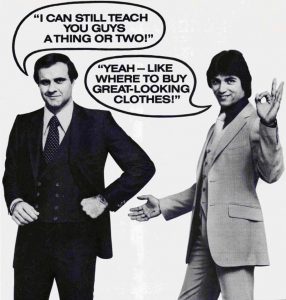 Every Mets fan was crazy for a sharp-dressed Mazz. Birthplace or where a player spent his youth is a briefly referenced biographical note these days, give or take the occasional overdose of Neil Walker or Todd Frazier info. But being from Brooklyn when it was learned who Mazzilli was really seemed to mean something, especially within the media when the wounds from when the Dodgers deserted the borough still lingered in the collective Metropolitan Area psyche. Dick Young and Jack Lang covered those Dodgers. Maury Allen and Steve Jacobson rooted for those Dodgers. Given how regularly Mazzilli’s background was mentioned in stories and during broadcasts, I find it impossible to believe being The Kid From Brooklyn didn’t give him a leg and two arms up on standard ambidextrous rookies who hit .250.
In a city whose baseball stars in previous eras included DiMaggio, Berra, Rizzuto, Camilli, Furillo and Antonelli, to name a bunch, being Italian-American didn’t hurt, either, at least in terms of fomenting an image for a 22-year-old ballplayer who was tabbed starting center fielder the same month Rocky won Best Picture at the Oscars. You know what Rocky Balboa nicknamed himself in the movie, right? The Italian Stallion. You know what everybody started calling Lee Mazzilli during his first full season? The way baseball had worked for a century, it didn’t hit the ear as impolitically as it does today. Carl Furillo was “Skoonj” to his Dodger teammates, short for scungilli (he ran the bases as slow as a snail). Al Rosen was the Hebrew Hammer in the ’50s. Juan Marichal was the Dominican Dandy in the ’60s. Emil Frederick Meusel, who played left for John McGraw’s Giants in the ’20s, was called Irish because he was said to “look Irish”.
Still, for all the marquee Italian surnames that have graced Met rosters — Franco, Piazza, Conforto, to name three — no Met was ever quite cast in the role of Great Paisan Hope the way Mazzilli was. Pignatano was the longtime bullpen coach when Mazz arrived. Joe Torre was Lee’s mentor as a teammate before being named Met manager. Pete Falcone and John Pacella joined the pitching staff in due time. But only Lee Mazzilli from Brooklyn was the Italian Stallion. At a cultural moment when Sylvester Stallone was starring in the film that won the Academy Award and John Travolta was dancing like nobody’s business as Tony Manero — in Bay Ridge, no less — maybe the Italian Stallion wasn’t such a bad thing to be known as. Salute!
In those days, anything for a hook, anything for a story, anything to make you forget sixth place. These days, low-key pregame heritage theme nights notwithstanding, I’m failing at fathoming any individual player being promoted quite so sincerely ethnically, even if it’s as well-intended as could be. This year I saw a segment on the MLB Network, recorded during Spring Training, wherein Mark DeRosa queried Michael Conforto as to whether he preferred calling what he put on his pasta “sauce” or “gravy,” and the question was a little jarring to my 2020 sensibilities. Honestly, it never occurred to me whether Conforto, a Met since 2015, was anything but Metropolitan-American. I knew he was from somewhere in the Pacific Northwest. I had no idea whether he was or wasn’t Italian, even if the last name is something of a giveaway (FYI, Michael chose “sauce”).
Long before Conforto was born in 1993, but well after the Dodgers left town in 1957, you had this Italian kid from Brooklyn who wanted to play baseball more than anything. When Lee was coming of age, youth soccer had yet to be widely organized and video games had yet to be invented. Football may have been in the process of surpassing baseball as a television sport, but nobody strenuously challenged baseball’s claim as “the national pastime” any more than anybody thought there was anything a little off-color in calling a baseball player “the Italian Stallion”. Mazzilli could have pursued the Winter Olympics as a teen; he was that good a speedskater. But Lee was a baseball man in the making all along. “I played stickball, punchball, slapball, softball,” he recalled for Steve Serby in the Post in 2007. “Played ’em all.” What could have been a more All-American New York baseball story than Lee Mazzilli’s? Whose story could have been truer to what New York’s romantic self-image had been throughout the twentieth century?
Contrast the recollections of Mazzilli’s hardly misspent youth with this 2017 report on the continuing decline in youth baseball across the five boroughs: “No one culprit is blamed for this loss. Instead, it’s pinned on an array of factors: competition from other sports like soccer, the increased popularity of digital devices, rising league fees, longer school days and even immigration, which has in some neighborhoods replaced the Louisville Slugger with a cricket bat. The sport itself, from the recent rise of travel teams to the age-old quirks of baseball — its pace, its difficulty — also gets blamed.”
In other words, good luck trying get a slapball game going on a block near you. (And this was before the pandemic.)
So, sure, we still have ballplayers of Italian descent, like Mazzilli is. And sure, we still have ballplayers who went to high school in Brooklyn, like Mazzilli did. And yes, though they’re in short supply and haven’t made much impact of late — the last three on the Mets were Billy Hamilton, Sam Haggerty and the presumed alive Jed Lowrie — we still have ballplayers who aim to hit both lefthanded and righthanded like Mazzilli could. Yet I’m having a hard time living in the modern era and imagining somebody coming to the fore now the way Mazzilli did then and having somebody weave a narrative around him the way it was done. “Italian Stallion from Sheepshead Bay trackin’ ’em down in center, swipin’ bags, beltin’ one out now ‘n’ then — and the ladies can’t take their eyes off him!” sounds like a 1950s Madison Avenue ad man’s dream.
Jerry Della Femina was a Madison Avenue ad man in 1980, in the business since the 1960s. He was also born in Brooklyn, in 1936, and he became the Mets’ ad man when Nelson Doubleday and his Brooklyn-born minority partner Fred Wilpon bought the team. The Mets hadn’t much advertised prior to 1980. Casey Stengel was all the salesman they needed in 1962, then big, beautiful Shea Stadium sold itself long enough to attract attendance until the Mets won a World Series. For a while after 1969, it was enough to make sure the papers printed the time the game started. But by 1979, at the end of a decade when the Mets couldn’t have hemorrhaged more ticket-buyers had they tried, the goodwill was gone. (Shockingly, 1977’s hastily created “Bring Your Kids to See Our Kids” campaign, despite featuring Mazzilli and his demographic peers, didn’t much move the needle following the trade of Tom Seaver.)
The new owners turned to Della Femina, who conjured “The Magic is Back” as the Mets’ slogan. Print ads played up that these new Mets will be sort of like those old Dodgers you, Mr. Maybe Ticket Buyer, remember from the ’50s in that they’ll make you care when they inevitably break your heart. The 1980 Mets weren’t far enough along to get beat by modern-day Bobby Thomsons and Don Larsens in October, but one miracle at time. Implicit in the pitch was these new Mets, or at least these Mets you haven’t looked too closely at lately, have some guys who can make a little Magic en route to getting competitive. As 1980 dawned, the first player Della Femina thought of to illustrate the point was the Met who mesmerized what was left of the masses in Flushing in 1979. That was Mazzilli, a.k.a. the Italian Stallion, coming off the season that not only earned him his All-Star berth but his poster day.
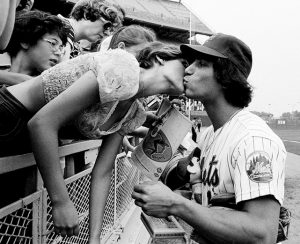 Social distancing be damned. Lee Mazzilli Poster Day predated the Mets’ more consolidated marketing efforts. It was a one-off. They weren’t having them for Kevin Kobel or Bruce Boisclair. Lee was among the batting average leaders coming out of the gate in ’79, and if nobody was coming to the park to see him in person based on his hitting, perhaps they’d schlep to Shea to get a big damn poster of the guy they were hopefully watching on TV. Lee was photographed posing on the dugout steps, hatless and handsome. Saturday July 7 vs. the Padres was chosen for the giveaway. It was also San Diego Chicken Day — and the day the name Mettle was announced as the identity of the team mule (you’d think they’d have invested in a stallion). The promotional onslaught drew 14,048. The Mets lost, 11-3. Lee went 1-for-3, leaving his average at .332.
Ten days later, bespectacled Lee wore his cap and his rather tight road uniform in Seattle, representing the Mets on the National League All-Star Team alongside last-minute injury replacement John Stearns. Pinch-hitting for Gary Matthews, who had subbed in for starter George Foster, Mazzilli stepped in to lead off the eighth and whack an opposite-field home run off the Rangers’ Jim Kern to tie the game for the NL. Lee batted left, lined it to left and hopped on home plate after circling the bases. Waiting to congratulate him was the cream of the senior circuit: Dave Winfield of the Padres; Joe Morgan of the Reds; Ron Cey of the Dodgers; Pete Rose of the Phillies; Keith Hernandez of the Cardinals; Gary Carter of the Expos. In the NBC booth that night, Cincinnati ace Tom Seaver — usually in uniform for these affairs — praised his former teammate. “I had the pleasure of playing with him in New York for a couple of years when I was still with the New York Mets,” Seaver said over a replay. “He’s really become a fine hitter, he’s really learned the strike zone, and he goes with the pitch now, he’ll go with that ball, a lot of strength.”
“There are not too many players in All-Star Game history who did what Mazzilli just did,” Tony Kubek added. “First All-Star at-bat, and he hits a home run.”
Because this was the era when the National League never lost to the American League, it was just a matter of staying tuned and finding out how the NL would pull it out. In the top of the ninth, Kern walked the bases loaded, and with two out, was relieved by Ron Guidry of the Yankees. Batting for the National League? Lee Mazzilli of the Mets, this time from the right side. It was a miniature Mayor’s Trophy Game at the Kingdome. Mazz, having learned the strike zone, just like Seaver said he had, worked the count to three-and-one before calmly taking ball four. Mazzilli did a baton move with the bat, twirling it as he tossed it, much as he might have with a broom handle beating his buddy at stickball back home. It was only a walk, but it was the go-ahead RBI just the same. When the National League held on in the bottom of the inning, it stood as the winning RBI.
For a few minutes, you could forget the Mets were stuck in the basement of the NL East for a third consecutive year. You could forget the Yankees had won the last two world championships. You could overlook the All-Star Game MVP award being voted to Dave Parker for his two breathtaking outfield assists. You didn’t care that Mazzilli’s average had been steadily dropping since they gave out his poster. On the stage where the attention of every baseball fan in North America was focused, Lee Mazzilli was the star among Stars. He was ours. The kid from Brooklyn. The kid from Queens. The Met who belonged up there. We hadn’t had anybody who made us feel this way since Tom Seaver had the pleasure of playing with him in New York.
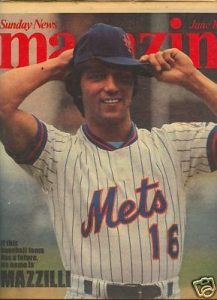 No, that uniform could not be any tighter. All Mazzilli had to do the rest of 1979 was not get hurt (Dan Norman crashed into him in the outfield but Mazz missed little time) and not finish below .300 (his average landed at .303), and we’d fully believe what the Daily News plastered on the cover of its Sunday magazine in June: “If this baseball team has a future, its name is MAZZILLI.”
***Della Femina apparently believed it, too, for when he got the Mets account, he was determined to make sure everybody who wasn’t already clued in aware that Lee Mazzilli was the present, the future, the biggest star in the biggest city. Or as the ad man said in the press in April of 1980, just as the “The Magic is Back” slogan was taking flight (and eliciting giggles following an offseason when the 63-99 Mets of the year before hadn’t been noticeably improved upon), “New York is a town where we had to settle for Reggie Jackson. I would rather have a clean-cut kid who talks to kids,” meaning Mazzilli, who, Della Femina clarified, featured “Bucky Dent’s good looks, but he can hit.”
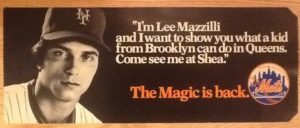
Not too much pressure to put on the now 25-year-old Mazzilli, though Della Femina Travisano & Partners certainly tried, making him one of the centerpieces of The Magic is Back’s transit advertising. Lee’s head shot greeted MTA riders with the pull quote intended to boil down his most Metsian appeal: “I’m Lee Mazzilli and I want to show you what a kid from Brooklyn can do in Queens. Come see me at Shea.”
Slowly but surely, some did. Attendance increased. So did the wins. The Mets started to transfer the Magic from conceptual to concrete, closing in on .500. There was a string of abracadabra wins, highlighted by the one on June 14 when Steve Henderson socked the three-run, bottom-of-the-ninth homer that completed a dazzling comeback from down 0-6 for a 7-6 win over the Giants. Though that case of Saturday night pennant fever is rightly remembered as The Steve Henderson Game, it was Mazz who, with two out, drove in the first run the Mets posted in the ninth, and it was Mazz who scored the second, when he came home on new Met Claudell Washington’s single.
Lee didn’t return to the All-Star Game in 1980, having gotten off to a slow start, but July turned out to be The Lee Mazzilli Month. He homered on the first of July, then the second, then the third, then in the first game of a July 4 doubleheader. He walloped 11 home runs in all in July to go with 25 RBIs. His OPS measured 1.136, even if that was an unidentified metric at the time. On July 15 in Atlanta, the night the Mets were finally prepared to even their record — something they hadn’t done this late in a season since Mazzilli was a September 1976 callup — Lee did something better than hit. He hit back.
With the 41-42 Mets ahead by five runs in the top of the ninth and Doug Flynn on first, Torre instructed starting pitcher Pat Zachry to lay down a bunt. The sight of somebody squaring with his team comfortably in front apparently got under the skin of Braves reliever Al Hrabosky. The Mad Hungarian (speaking of nicknames that likely wouldn’t gain traction in 2020) registered his disapproval by sailing a pitch over Zachry’s head. It didn’t come close to plunking Pat, but it was clearly aimed nowhere near the plate.
On deck was Mazzilli. He didn’t care for Hrabosky’s sudden loss of control and was ready to channel the feistier side of his Stallion persona. Jawing ensued, benches emptied and, after Zachry’s final bunt attempt went for strike three, Mazzilli got even and then some, blasting his ninth home run of the month out of Fulton County Stadium. It felt as good as the previous eight combined.
Lee watched his homer take off into orbit; he outright moseyed around the bases; and he called to the Mad Hungarian as he crossed the plate, “How’d you like that? Don’t be throwing at my pitcher.” The Mad Hungarian grew madder still and the benches emptied again, but the Mets would not be denied their 42nd win against 42 losses. “I can’t say I was right,” Mazzilli admitted upon reflection. “I probably was wrong, but I’d do it again.”
The Mets wouldn’t do much again of what they’d been doing in the high summer of 1980. From 42-42, they got to 43-43, then a few weeks later to 56-57. Then the bottom dropped out of their no longer Magical season, with injuries to just about everybody (except durable Mazzilli) taking their toll. The Mets lost 38 of their final 49 games, the Magic allusions reverted to a punch line and, despite overall good numbers, Lee’s legacy as a New York star in the specific mold of Willie, Mickey, the Duke and Joltin’ Joe became something very quickly shunted into the past tense. The kid from Brooklyn started in center the Old Timers Day in 1977 when the four center field icons strode through Shea’s center field gate together and inspired Terry Cashman to pen his paean to 1950s New York baseball royalty. The same kid was still out there on Old Timers Day in 1980 when the Mets honored Duke Snider on the occasion of his induction into the Hall of Fame and his 1955 Dodgers for the 25th anniversary of their lone Kings County championship (did we mention Fred Wilpon was one of the owners by then?).
But it hadn’t been a steady throughline in center for Mazzilli from the summer of 1977 to the summer of 1980 because the Mets knew they had another center fielder coming, a speedy minor leaguer named Mookie Wilson. Also, they had a void at first base as 1979 wound down once they traded erstwhile 96-RBI man Willie Montañez to Texas. Thus Torre, who made his initial mark in the bigs as a catcher, asked his home-borough protégé to do as he once did: learn to play first base at the major league level. Lee considered himself “born to play center field”. He had modeled himself on his former Met coach Mays, going for the basket catch as often as he could. But Lee didn’t really have a great arm at a position where that mattered, no doubt a symptom of having grown up using both of them equally.
When 1980 began, with 15 September starts in ’79 behind him, Lee Mazzilli was the Mets’ Opening Day first baseman. For close to two months he remained anchored in the infield. Come June, Torre opted to entrust first to defensive whiz (and Queens boy) Mike Jorgensen and sent Mazz back to what he considered his natural position. All was centered in Lee’s world until Wilson was promoted from Tidewater in September. Henceforth, Mazzilli was a first baseman for the rest of 1980.
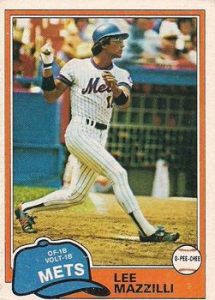 A man with more than one position is sometimes a man with none. Lee was back in center to begin 1981, but by mid-May, that was Mookie’s pasture for keeps, before and after that year’s strike. Lee began to see time in left because first base was now where Torre sought playing time for a couple of Recidivist Mets less limber than Mazz or Jorgy. Rusty Staub had been a splendid right fielder before he was shipped to Detroit five years earlier. Now, at 37, Le Grand Orange was a recovering designated hitter whose bat was considered too valuable to bench. Dave Kingman, meanwhile, hadn’t improved defensively while he’d been away from Shea, so after his return to left field went awry, Torre opted for his big slugger to play first, which meant Staub was going to be a pinch-hitter deluxe.
Amid all of Torre’s maneuvers, Lee Mazzilli, the Met at the heart of their 1980 advertising, no longer stood front and center in the Mets’ plans. He wasn’t hitting, he wasn’t comfortable fielding (one night he groped helplessly as he lost a ball in Shea’s lights) and the clean-cut kid had grown a mustache. Not that the mustache had anything to do with his average dropping from .280 in ’80 to .228 in ’81, but the kid sure suddenly seemed much older.
More changes were in order once the split season proved no panacea. Torre was let go as manager at the end of 1981. GM Frank Cashen brought in his old Oriole compadre George Bamberger of Staten Island. The Verrazzano-Narrows connection to Mazzilli didn’t mean much to the new skipper or the wary GM. Cashen, who inherited Mazzilli, spent the winter trying to make over a ballclub that had not contended in a full season since Lee was a Single-A prospect in Visalia. Come December, Cashen would trade Flynn for Kern, the pitcher who gave up the All-Star home run to Mazz. Kern never pitched for the Mets, because he was packaged in February, along with backup catcher Alex Treviño and ambidextrous pitcher Greg Harris, for the player who started that 1979 All-Star Game in left for the National League, the player who was replaced by Gary Matthews who, in turn, was pinch-hit for by Lee Mazzilli.
The Mets had gotten George Foster. It was a bombshell. Foster had led the NL in RBIs three years running, from 1976 to 1978. He drove in 90 in ’81, a season that was shortened by about a third by the strike. He had the kind of all-around run-producing power that…well, basically nobody with the Mets ever had. Combine him with Kingman and Ellis Valentine, who Cashen had picked up the year before, and that’s a helluva middle of the order Bamberger could look forward to writing in. Foster was the left fielder, to be sure. Valentine, when he was healthy, was a top-notch right fielder, with every bit the caliber of cannon Parker showed off in the Seattle All-Star Game. They’d each flank Wilson, who had established himself as the center fielder for the foreseeable future. Kingman’s glove they’d stick at first and, if the Mets had a lead (and why wouldn’t they, with all this hitting?), they could take him out and insert Jorgensen for defense. Rusty, now a player-coach, would continue to lurk as a late-innings weapon.
And Lee Mazzilli? Where the hell would Lee Mazzilli, the Brooklyn kid who’d invited straphangers to come see what he could do in Queens less than two years before, play?
There was some taking of ground balls in the middle infield in St. Pete, but Mazzilli had never played there before and the Mets had plenty of second basemen and shortstops in camp, so the answer turned out to be Texas. Before Spring Training was over, on April Fool’s Day 1982, Cashen sent the Metinee idol of the late ’70s and the earliest ’80s to the Rangers for two minor league pitchers. That they were highly regarded minor league pitchers didn’t fully cushion the shock waves from Lee Mazzilli going from main man of the Mets to excess baggage to ex-Met in almost no time at all. It wasn’t quite as stunning as the Mets getting George Foster, but it was close.
***Less of a stunner, but certainly an episode that called for the rubbing of one’s eyes, came four years and four months later. In August of 1986, the New York Mets signed Lee Mazzilli anew.
This was perfect. Mazzilli was a 31-year-old veteran now, released by Pittsburgh, where he’d been since 1983 after his ’82 with Texas proved a short stay. The Rangers traded him to the Yankees for none other than fellow fading pin-up Bucky Dent. It was a trade that helped nobody. One could cynically say the same for Cashen’s big move to acquire Foster and sign him for five years, but that would be oversimplification. No, Foster wasn’t nearly the power hitter for the Mets as he’d been for the Reds, especially in his first miserable perception-sealing year, but he did help shift the Mets to the edge of the map, buying the GM time to put the club there to stay. George had been reasonably productive for the Mets from 1983 until the first part of 1986, and with the Mets having transformed themselves in the intervening years into the dominant force in their division, the ol’ left fielder could probably glide to the postseason with his teammates and be celebrated as a champion should they get that far.
But Foster was unhappy with reduced playing time and asserted to reporters that he thought a racial element influenced Davey Johnson’s decision to use him less. It seemed unnecessary to point out that of the three productive outfielders for whom Johnson was striving to ensure playing time, two — Wilson and Kevin Mitchell — were Black. However Foster’s dismay was portrayed, the first-place club decided the .227 batting average that accompanied it was eminently dispensable.
Another bat in his stead couldn’t hurt, even if the bat the Mets chose hadn’t been exactly tearing up Three Rivers Stadium. But Mazzilli was more than the sum of his stats. He was Lee Mazzilli. He was as good a story in 1986 as he was in 1980. Better, maybe, because instead of his having to fill the role of a star, the vet from Brooklyn could just chip in. From the moment he returned, he did that in several ways down whatever stretch the Mets needed to clinch the NL East. He homered to tie the Cardinals in the ninth inning one Saturday afternoon in a game NBC was covering. Bob Costas intimated Saturday Night Fever was back at Shea. Overall, Mazz hit .276 in reserve duty. He also mock-socked “sportscaster” Joe Piscopo in the human bobblehead portion of “Let’s Go Mets!” video. Not that you make roster decisions based on such plays, but it’s hard to imagine George Foster doing that.
For those of us who were diehard Mets fans when Lee Mazzilli was our biggest star, those of us who would have been diehard Mets fans in any year basking in the glow of anybody they told us was our biggest star, Lee’s homecoming was as big a spiritual victory as any the 1986 regular season had to offer. Fans like us wore our fealty to the Mets of Flynn, Taveras, Stearns, Henderson, Youngblood, Swan, Zachry, Allen and, most of all, Lee Mazzilli as a badge of honor. We hadn’t ditched the Mets just because they sucked. We just died harder as circumstances dictated. Believe me, amidst the curtain calls, high-fives and high-profile music videos, nothing was sweeter than getting to redeem that badge in exchange for the redemption of Mazzilli’s career.
From 1976 to 1981, the kid from Brooklyn never got closer to a World Series than his TV. Same from 1982 to 1985 during his exile from 126th Street. Ah, but in October of 1986, in an actual World Series taking place at actual Shea Stadium, Lee Mazzilli, batting lefty, pinch-singled to start the eighth-inning rally that tied Game Six, which the Mets would go on to win, and, batting righty, pinch-singled to start the sixth-inning rally that tied Game Seven, which the Mets would go on to win. At last, Lee and we knew what the Magic was.
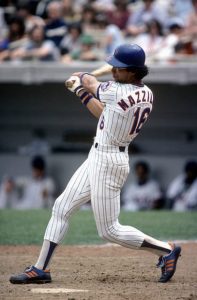 We had no idea this was what the final piece of a world champion would look like. There was a lot to take in during the 1986 World Series, but watching Mazz and Mookie score in rapid succession on Keith Hernandez’s single off Bruce Hurst in Game Seven stood out for me. It was like watching a decade of Mets baseball cross the plate all at once. Mazzilli was at the heart of a half-assed rebuilding that lacked mortar. Wilson was the Met who’d begun to make him superfluous. Mazz was pinch-hitting for Sid Fernandez, who’d taken over for Ron Darling, the starter in the seventh game who simply didn’t have it that night the way he did in Games One and Four. Darling was a Met in 1986 because in 1982 Cashen traded Mazzilli to get him — him and Walt Terrell, the latter of whom was traded for Howard Johnson, who was also a Met in 1986. Darling and HoJo and Mookie all contributed substantially throughout the year to what was three innings from becoming a world championship baseball club. But here, too, was Mazzilli, broken free of the past, not representing a mythic Brooklyn that no longer existed if it ever did. He was Mazzilli in the present, at a Shea Stadium full of fans who needed no come-ons to jam the joint. Here was Lee Mazzilli, 1986 New York Met, having come up with literally one big hit after another to help win us win the World Series, just like we dreamed of in 1980 on those days and nights when we began to permit ourselves to dream such crazy dreams.
It’s the most timeless Lee Mazzilli tale of all.
For a comprehensive look at Lee Mazzilli’s life and career in and out of baseball, I recommend the excellent SABR biography written by Friend of FAFIF Jon Springer. You can find it here.
PREVIOUS METS FOR ALL SEASONS
1962: Richie Ashburn
1963: Ron Hunt
1964: Rod Kanehl
1965: Ron Swoboda
1966: Shaun Fitzmaurice
1967: Al Schmelz
1968: Cleon Jones
1969: Donn Clendenon
1970: Tommie Agee
1971: Tom Seaver
1972: Gary Gentry
1973: Willie Mays
1974: Tug McGraw
1975: Mike Vail
1976: Mike Phillips
1977: Lenny Randle
1978: Craig Swan
1981: Mookie Wilson
1982: Rusty Staub
1983: Darryl Strawberry
1985: Dwight Gooden
1986: Keith Hernandez
1987: Lenny Dykstra
1988: Gary Carter
1990: Gregg Jefferies
1991: Rich Sauveur
1992: Todd Hundley
1993: Joe Orsulak
1994: Rico Brogna
1995: Jason Isringhausen
1996: Rey Ordoñez
1997: Edgardo Alfonzo
1998: Todd Pratt
2000: Melvin Mora
2001: Mike Piazza
2002: Al Leiter
2003: David Cone
2004: Joe Hietpas
2005: Pedro Martinez
2007: Jose Reyes
2008: Johan Santana
2009: Angel Pagan
2010: Ike Davis
2011: David Wright
2012: R.A. Dickey
2013: Wilmer Flores
2014: Jacob deGrom
2015: Michael Conforto
2016: Matt Harvey
2017: Paul Sewald
2019: Dom Smith
2020: Pete Alonso
by Greg Prince on 18 October 2020 12:49 pm They were 89 moments in the sun, 89 moments under the spotlight, 89 days and nights of our lives when little else mattered to us. I mean more than usual.
“The Mets go melodramatic in October,” Roger Angell once wrote. “It’s in their genes.” Here we inspect the DNA and report the findings. Here we do what I don’t think I’ve ever seen done before. Here we rank every postseason game the New York Mets have ever played.
Rank them based on what? Excellent question.
The Mets have played 89 postseason games, winning 51 and losing 38. When each was played, each was the biggest game of all time to us. That’s how the postseason is when our team is involved. But when we pull back, years and decades following 89 final pitches, not all throb with the same meaning we attached to them as they alighted and unfolded in 1969, 1973, 1986, 1988, 1999, 2000, 2006, 2015, and 2016. Some we talk about constantly when we talk about the Mets. Some we think about probably every day since they happened. Some we attribute all kinds of enduring mishegas to even if they were only one game. Some thrust us forward. Some stopped us cold. Some dictated much of what came next. Some are memorialized and revered. Some, somehow, were plowed under by the games and seasons that came next. Each, in one way or another, informs who we are as Mets fans and how we consider the Mets when we consider the Mets…which is what people like us do with as little pause possible.
There’s no statistical formula to this, just loads of paying attention and 89 episodes of revisitation. The following exercise is rendered in good faith, sans fear. It’s not a My Favorites list, regardless of the subjectivity inherent. It’s not a Best Games list, exactly, though aesthetics certainly influenced the contemplation. It’s not a wholly YAY METS list, either. Each of the 89 postseason games the Mets have played tells a story to us as Mets fans and to all as baseball fans: the impressions they left, the legends they created, the myths they made, the resonance that resounds, the history that lives on. These are 89 games that explain us and define us, for better and for worse.
The 38 Met losses, unfortunate as it is that they exist, are intermingled here with the 51 Met wins. No harm to any Mets fan’s psyche is intended by being brutally inclusive. Our self-perception, as well as that the world at large has developed of our ballclub, is based largely on these autumnal successes and the not-quite-successes. To play in postseason implies success to begin with. Failure may not be an option, but it’s also not the right word to describe any team that gets as far as these nine Met teams did. Still, sometimes history turned on the games that got away. Or at least seemed as if it did.
Maybe next year, next ownership, we’ll have the opportunity to expand the list and revise the rankings. Until then, we present the New York Mets from October 4, 1969, to October 5, 2016, and a stab at what the 89 Met postseason dates have meant, one date at a time (two where applicable).
 89. OCTOBER 14, 2000 — NLCS Game Three: Cardinals 8 METS 2 89. OCTOBER 14, 2000 — NLCS Game Three: Cardinals 8 METS 2
The weather was great, with temperatures peaking in the high seventies. The Mets came in with all the momentum inherent in a two-nil series lead. Then they were clobbered. Rick Reed threw his only bad postseason start. The Mets’ only two runs scored on double play groundouts. Yet when it was over, the Mets still maintained their momentum, with two more home games directly in front of them. It made for a sunny forecast.
88. OCTOBER 6, 1999 — NLDS Game Two: DIAMONDBACKS 7 Mets 1
Adrenaline carried the Mets through four absolute must-win games over Pittsburgh and Cincinnati to get them into the playoffs and propelled them high above Randy Johnson & Co. to grab a series lead once they landed in Arizona. They likely needed a breather. Versus Todd Stottlemyre and the Snakes, they took a nap.
87. OCTOBER 4, 2000 — NLDS Game One: GIANTS 5 Mets 1
This one played to the form expected in some circles. The top-seeded Giants jumped on the Wild Card Mets to stake themselves to an early advantage. Past World Series MVP Livàn Hernandez handled the Mets with ease. Derek Bell sustained an ankle injury that ended his postseason. By the time this NLDS was done, Hernandez’s mastery and Bell’s absence would barely be footnotes.
86. OCTOBER 15, 2006 — NLCS Game Four: Mets 12 CARDINALS 5
Oliver Perez made his first postseason start. David Wright hit his first postseason home run. Carlos Beltran went deep twice. The Mets set a franchise record (since bettered) for most runs in a postseason game. Most importantly, they evened a series that threatened to get away from them. And nobody ever brings any of it up.
85. OCTOBER 20, 2015 — NLCS Game Three: Mets 5 CUBS 2
How about that time Jorge Soler fell down in right and allowed Wilmer Flores’s ball to roll all the way to the wall, letting Wilmer scoot to third and scoring Michael Conforto all the way from first, extending the Mets’ sixth-inning lead to 4-2? If you remember that, it’s your mind playing tricks on you, or perhaps you stepped away while the ball was deemed to be stuck under the ivy. The potentially highly memorable moment was downgraded to a ground rule double, sending Conforto back to third. Neither baserunner scored and Jacob deGrom got back to silencing the Cubs regardless.
 84. OCTOBER 5, 2006 — NLDS Game Two: METS 4 Dodgers 1 84. OCTOBER 5, 2006 — NLDS Game Two: METS 4 Dodgers 1
83. OCTOBER 12, 2006 — NLCS Game One: METS 2 Cardinals 0
Tom Glavine’s finest moments as a Met, so fine we have opted for the spelling by which he was identified prior to 9/30/2007. Six innings to chill the Dodgers one Thursday. Seven innings to ice the Cardinals one Thursday later. Shea Stadium roared in support of its lefty ace twice. This really happened, less than a year before Tom Glavine became T#m Gl@v!ne.
82. OCTOBER 8, 1999 — NLDS Game Three: METS 9 Diamondbacks 2
Shea’s first postseason action in eleven years was destined to be overshadowed by Shea’s next postseason action the following afternoon. This Friday night featured Todd Pratt’s first postseason start, which itself was overshadowed by the reason Tank was starting, namely the unavailability of the usual starting catcher, Mike Piazza. For the record, Pratt walked twice and scored a run. It wasn’t Pratt’s finest hour (that would come in less than 24 hours).
81. OCTOBER 14, 2006 — NLCS Game Three: CARDINALS 5 Mets 0
It deserves to be remembered parochially as the Darren Oliver Game, so named for the six innings of scoreless relief the ageless lefty gave Willie Randolph from the second through the seventh. If it’s remembered at all, it’s for the five runs Steve Trachsel gave up in the first. Really, it’s not remembered much.
80. OCTOBER 28, 2015 — WS Game Two: ROYALS 7 Mets 1
Jacob deGrom was on his way to emerging as one of the premier starter of his generation, yet his first (and thus far only) World Series start is the most obscure game among five his team played in their most recent and perhaps most star-crossed Fall Classic.
 79. OCTOBER 17, 2006 — NLCS Game Five: CARDINALS 4 Mets 2 79. OCTOBER 17, 2006 — NLCS Game Five: CARDINALS 4 Mets 2
Game Five in a seven-game series is either decisive or pivotal. In hindsight, this one was both, backing the Mets to a wall from which they would never effectively detach. Yet this particular T#m Gl@v!ne disappointment (4 IP, 7 H, 3 BB, 3 ER) escapes collective memory, while Jeff Weaver (6 IP, 6 H, 2 BB, 2 ER) is rarely berated in the realm of opposition villainy.
78. OCTOBER 18, 2015 — NLCS Game Two: METS 4 Cubs 1
The set of contests that determined where the 2015 National League pennant would fly has settled in memory into a blur of Daniel Murphy home runs. This game definitely featured one of those.
77. OCTOBER 13, 1999 — NLCS Game Two: BRAVES 4 Mets 3
76. OCTOBER 12, 1999 — NLCS Game One: BRAVES 4 Mets 2
Setbacks at Turner Field, even in October, all looked alike for a dismal spell there in the late ’90s. The second showdown in Atlanta sticks out a little more than the first thanks to it including Melvin Mora’s first major league home run (and, if one wishes to be Metsochistic, the loss going to Kenny Rogers).
75. OCTOBER 9, 1986 — NLCS Game Two: Mets 5 ASTROS 1
In the fifth inning, Nolan Ryan knocked down Lenny Dykstra. Lenny Dykstra got up and singled off Nolan Ryan. Lenny Dykstra would score after Wally Backman singled and Keith Hernandez tripled off Nolan Ryan. Immortals. Legends. Characters. Drama! And together the whole thing usually rates, at most, a paragraph in retellings of this sizzling series.
 74. OCTOBER 12, 1986 — NLCS Game Four: ASTROS 3 Mets 1 74. OCTOBER 12, 1986 — NLCS Game Four: ASTROS 3 Mets 1
The yellow highlighter of the 1986 NLCS. It made sure you would remember “Scott” was crucial in knowing what to study for in preparing for the big test.
73. OCTOBER 23, 1986 — WS Game Five: RED SOX 4 Mets 2
Roger Angell was impressed by this one because it was Fenway Park’s last chance to exude enthusiasm for the year; “less than a classic, perhaps, but there was spirit and pleasure to it.” Surely there were also visiting-team charms to be derived from it, as Tim Teufel homered and doubled in the Mets’ only runs, and Sid Fernandez turned in four foreshadowy innings from the pen, but any footprints Game Five left behind were about to be stomped out but good.
72. OCTOBER 15, 1999 — NLCS Game Three: Braves 1 METS 0
Gl@v!ne outpitches Leiter. Rocker taunts the howling masses. The Mets face elimination. A series that appears to be out of breath gasps ahead of its second wind.
71. OCTOBER 12, 2000 — NLCS Game Two: Mets 6 CARDINALS 5
Close, back-and-forth, see-saw affair, with the Mets eking out a lead in the top of the ninth and Armando Benitez holding tight to it for a commanding series lead. The Mets couldn’t do any better in terms of results, but for an outfit that does postseason drama as a matter of course, it doesn’t particularly pop.
70. OCTOBER 13, 2015 — NLDS Game Four: Dodgers 3 METS 1
Clayton Kershaw picks this opportunity to shed his postseason reputation for not-so-hotness, keeping the Mets from clinching a series at home, but in defeat, Daniel Murphy makes it a night to begin a historic streak to remember.
 69. OCTOBER 11, 1988 — NLCS Game Six: Mets 5 DODGERS 1 69. OCTOBER 11, 1988 — NLCS Game Six: Mets 5 DODGERS 1
68. OCTOBER 18, 2006 — NLCS Game Six: METS 4 Cardinals 2
October’s Mets are known to their fans for the splendor of their Game Six efforts. These were indeed splendid, yet they’re not nearly so well known, their residue vacuumed up as they were by the Game Seven results to follow. Still, let us appreciate David Cone (CG five-hitter) and Jose Reyes (leadoff HR; 3 H; 2 R) carrying the Mets to necessary ties eighteen years apart.
67. OCTOBER 18, 1973 — WS Game Five: METS 2 A’s 0
Little is more Metsian than Jerry Koosman coming through in the postseason. Nothing is more Metsian than Tug McGraw slamming his glove to his thigh upon closing out a win. Together, the legendary lefties crafted a most Metsian shutout and pushed their club to the brink of a world championship.
66. OCTOBER 17, 2015 — NLCS Game One: METS 4 Cubs 2
Harvey outpitches Lester. Murphy goes deep. D’Arnaud dents the Apple. Mets never trail. After seven losses to the Cubs in seven regular-season contests, the tone between the two teams is reset.
65. OCTOBER 7, 2006 — NLDS Game Three: Mets 9 DODGERS 5
The previous instance in which Greg Maddux started a postseason game against the Mets, Game Five of the ’99 NLCS, day turned to night, the innings totaled fifteen, a fair ball that left the park was ruled something less than a home run and, when it was all over, Atlanta’s lock future Hall of Famer was demoted to an afterthought no more obvious to the outcome than his New York counterpart, Masato Yoshii. The forty-year-old Maddux of 2006 who threw only four innings in what loomed as the Division Series finale might have no longer been the Cy Young-in-residence of the 1990s, but it was still gratifying to watch the Mets outlast an old nemesis. Between withstanding Maddux and sweeping the Dodgers, this game should probably stand out more in Mets lore. It didn’t necessarily stand out in that night’s scores, because the Mets advanced on the same day that the Yankees were eliminated in their ALDS, their dismissal a bigger New York story in the moment. To be fair, watching the Yankees exit, no matter that they stole some Metsian spotlight (and weren’t what they used to be, either), was also pretty gratifying. Or as Manny Acta and Jose Reyes said in call & response fashion in the postgame celebration out west, “Party in Queens, entierro in the Bronx.” Entierro, not incidentally, is Español for burial.
 64. OCTOBER 8, 1988 — NLCS Game Three: METS 8 Dodgers 4 64. OCTOBER 8, 1988 — NLCS Game Three: METS 8 Dodgers 4
63. OCTOBER 17, 1973 — WS Game Four: METS 6 A’s 1
It was the heat of the moment that defined a couple of frigid dates at Shea. In the moment, the heat got intensely hot. The controversy of 1988 involved Dodgers closer Jay Howell going to his glove for pine tar, which earned him a suspension from National League president Bart Giamatti. While L.A. argued the punishment did not fit the crime, the Mets emerged in the frozen muck of Flushing with the go-ahead game that seemed to swing momentum New York’s way. Fifteen years before, the man in the spotlight within a Series of legitimate stars was backup A’s infielder Mike Andrews, a pawn amid Charlie Finley’s ever-shifting manipulations. Commissioner Bowie Kuhn wouldn’t let Finley officially scapegoat Andrews, whose fielding had contributed to the A’s loss in Game Two, off Oakland’s active roster, so when Mike came up to pinch-hit in a game the Mets had well in hand (sore-shouldered Rusty Staub homered and drove in five), he was accorded a standing ovation by righteous Mets fans. Good sportsmanship, however it arrived, was by no means dead in Queens.
62. OCTOBER 18, 1986 — WS Game One: Red Sox 1 METS 0
61. OCTOBER 13, 1973 — WS Game One: A’S 2 Mets 1
Was this any way to start a World Series? In either case, no way. In both cases, the images that lingered were that of Met second basemen who couldn’t pick up simple ground balls: Felix Millan in ’73, Tim Teufel in ’86. Each E-4 led to an opposition run that made all the difference in getting off on the right foot versus shooting themselves in it. It was just one game twice…but a one-game deficit ASAP.
60. OCTOBER 24, 2000 — WS Game Three: METS 4 Yankees 2
Lost amid the epic frustration of four losses that each stick in the craw for its own specific reason is the one Met win of the 2000 Fall Classic. It oughta be the other way around given all the compelling elements: Rick Reed strikes out eight in six; Robin Ventura homers; Todd Zeile doubles in the tying run; Benny Agbayani chases the heretofore indomitable El Duque; Brooklyn’s own John Franco gets the win; Armando Benitez, whose allergies clearly included October, garners the first Met World Series save since Jesse Orosco. And the Mets beat the Yankees! What more could a Mets fans want from a Subway Series? Three games more like it.
 59. OCTOBER 10, 1988 — NLCS Game Five: Dodgers 7 METS 4 59. OCTOBER 10, 1988 — NLCS Game Five: Dodgers 7 METS 4
It was supposed to be a travel day. In a sense it was, as the Mets seemed to stand in the terminal waving goodbye to their chances to make their second World Series in three years. Rain the previous Friday forced the series into a Monday makeup barely enough hours removed from Sunday night’s twelfth-inning conclusion to have sleep rubbed from the home team’s eyes. The Dodgers, on the other hand, were all adrenaline, taking a 6-0 lead by the fifth. The Mets’ last best hope was snuffed in the bottom of the eighth when wunderkind Gregg Jefferies got himself called out by running into a batted ball. Shea mostly cheering an injury to Kirk Gibson turned karma in the same direction as momentum — against the Mets.
58. OCTOBER 5, 1969 — NLCS Game Two: Mets 11 BRAVES 6
57. OCTOBER 4, 1969 — NLCS Game One: Mets 9 BRAVES 5
Silly Mets thought they could get by on their sparkling young pitching and anemic offense. Sagacious Braves would teach Tom Seaver and Jerry Koosman about the pressure of October. Sure enough, neither of the aces who combined to record 42 wins in ’69 could escape the hammer of Hank Aaron and his Atlanta accomplices. Maybe taking down the champions of the Western Division was going to take more than a couple of talented arms. So the Mets brought more. Lots more. Twenty runs, divided almost evenly, carried the weekend and launched the Mets from the Launching Pad and toward a pennant (Art Shamsky alone had six hits). Seems it was the Braves who were taught a lesson, namely that when you get to October and face the Mets, expect the unexpected.
56. OCTOBER 13, 2006 — NLCS Game Two: Cardinals 9 METS 6
The Mets led the series, 1-0. They led the Cardinals at various junctures of Game Two by scores of 3-0, 4-2 and 6-4. They were using home field advantage to its fullest force. Then the Mets’ bullpen got a little too involved. Guillermo Mota, until Game Two a savvy pickup, imploded. Billy Wagner, most of 2006 a brilliant closer, did much the same. Throw in some shoddy outfield defense from Shawn Green and a little too much pluck and spunk from the likes of Scott Spiezio and So Taguchi, and, well, leads proved to be precarious things.
55. OCTOBER 5, 1988 — NLCS Game Two: DODGERS 6 Mets 3
Come and listen to a story by a man named Cone
Twenty-game winner couldn’t leave an edge alone
Before Game Two in his column with his ghost
Wrote himself some words that perturbed his playoff host
Tattooed he was
Vengeful style
Next thing you know David Cone is oh-and-one
Having a byline wasn’t any fun
Said, ‘Hey, Bob Klapisch — this column ain’t for me’
The Mets hopped on their flight, all tied for Game Three
 54. OCTOBER 11, 2000 — NLCS Game One: Mets 6 CARDINALS 2 54. OCTOBER 11, 2000 — NLCS Game One: Mets 6 CARDINALS 2
Mike Piazza had been a regular-season beast his entire career, but postseason opponents had yet to fully feel his wrath. Then, in the course of opening the series that would determine the pennant, Mike whacked a first-inning RBI double off Darryl Kile that inspired third base coach John Stearns to shout into his Fox clip-on mic, “The Monster is out of the cage!” By invoking for national consumption his fellow hard-nosed catcher’s clubhouse nickname, Bad Dude had enhanced Piazza’s legend. More importantly, Piazza, en route to batting .412 and slugging .941, had enhanced the Mets’ chances to take command of the NLCS. (Mike Hampton’s seven shutout innings didn’t hurt, either.)
53. OCTOBER 4, 1988 — NLCS Game One: Mets 3 DODGERS 2
The invincible Orel Hershiser, he of the 59-inning scoreless streak that he rode to the end of the season, loomed large. But the Mets were on a roll of sorts, too. Not only had they come into the 1988 playoffs after tearing off 29 wins in 37 games, they hadn’t lost a postseason contest since a certain ball rolled through a certain Red Sox first baseman’s legs. This was a different October, but that old Met magic was brought to bear at Dodger Stadium. In the top of the ninth, with Hershiser ahead, 2-0, the Mets went to work like it was 1986. Darryl Strawberry cracked Orel’s latest string of goose eggs with a run-scoring double, and Gary Carter — the same Kid who started that tenth-inning rally versus Boston in Game Six two years before — stroked a double into center field to bring home Straw and Kevin McReynolds for a 3-2 New York edge. When Randy Myers set down L.A. in order in the bottom of the ninth, the Mets were up where they belonged: one-nothing over the Dodgers and three games from a presumed return to the World Series.
52. OCTOBER 19, 1986 — WS Game Two: Red Sox 9 METS 3
Fans of elite starting pitching couldn’t have asked for a better matchup to salivate over: the best of 1985, Dwight Gooden, versus the best of 1986, Roger Clemens. When the epitome of “highly anticipated” was over, connoisseurs of hurling were spitting the bad taste out of their mouths. Clemens, the 24-4 dynamo of the regular season, was a few shades shy or ordinary, not lasting long enough to earn a win. But there was a win for Boston, given that Red Sox batters more than made up for Clemens’s 4⅓ innings of five-hit, four-walk, three-run ball. The likes of Boggs, Barrett and Buckner jumped ugly all over Gooden, whose 24-4 slate from ’85 might as well have occurred in the prior decade. Doc’s six earned runs allowed all but buried the Mets by the fifth inning, and the throwback effectiveness of erstwhile Bosox closer Bob Stanley (3 IP, 0 R) prevented any chance of resurrection. The Mets were down oh-two in the World Series and could have been easily mistaken for dead.
51. OCTOBER 9, 1973 — NLCS Game Four: Reds 2 METS 1 (12)
The villain gets his vengeance in what turns into the penultimate chapter of a playoff potboiler, as Pete Rose’s twelfth-inning homer off Harry Parker proves the difference. Rose’s sprint around the bases, as he raised a fist in the air to Shea’s vocal displeasure, cemented his role as Flushing’s quintessential heel. Of course the game was still in progress, with the home team in line to clinch a pennant, thanks to Rusty Staub’s dramatic robbery of Dan Driessen at the right field wall in the eleventh. Ironically, the Met crowd got more Rose and less Staub from the bargain, for Rusty wrecked his right shoulder and was doomed to sit out deciding Game Five, which was going to provide its own page-turning chapter to the proceedings. Obscured in the passions of Game Four: four-and-a-third scoreless innings of relief from Tug McGraw on top of six-and-two-thirds frames from George Stone that were marred by only a Tony Perez solo blast. Alas, the Mets could do next to nothing (1 R, 3 H) versus Red hurlers Fred Norman, Don Gullett, Clay Carroll and Pedro Borbon.
50. OCTOBER 9, 2015 — NLDS Game One: Mets 3 DODGERS 1
When the Mets were scuffling at midseason, they rated only one National League All-Star, Jacob deGrom. When the Mets roared to a division title, there were many who performed in stellar fashion, but there was no overlooking the guy who’d been great for them all along. Starting the Mets’ first postseason game in nine years, the NL’s most recent Rookie of the Year lived up to all his burgeoning billing, going seven strong innings, striking out thirteen Dodgers, and outdueling defending Cy Young/MVP Clayton Kershaw. Jake’s supporting cast, featuring Daniel Murphy (a leadoff homer in the fourth) and David Wright (a two-RBI single in the seventh), made sure the Mets ace’s best efforts weren’t for naught.
 49. OCTOBER 25, 2000 — WS Game Four: Yankees 3 METS 2 49. OCTOBER 25, 2000 — WS Game Four: Yankees 3 METS 2
With the Mets back in the Subway Series following their Game Three victory, two battles within the battle within the intracity war defined the fourth game. First — meaning upon the very first pitch in the top of the very first inning — Derek Jeter took Bobby Jones deep to give the Yankees an immediate lead. A one-run deficit shouldn’t have seemed impossible to overcome, but it would be, even when the Mets encountered their most glittering opportunity of the night. Come the bottom of the fifth inning, with the Mets trailing, 3-2, and Mike Piazza coming to the plate having already homered in the third off Denny Neagle, Joe Torre lifted his starter in favor of David Cone. This wasn’t the 20-3 Cone from 1988 who rescued the Mets from the brink in Game Six of that year’s NLCS, nor was it the Cone who was so indispensable to three Bronx world championships over the previous four Octobers. This was David Cone with a regular-season ERA pushing seven, removed from the rotation, and all but shunted to the shadows for the balance of this postseason. Yet Torre called on his 37-year-old veteran for one mano-a-mano at-bat. As Jeter was versus Jones, Cone proved to be, shall we say, the mano against Piazza, gaining the upper hand as he induced an inning-ending popout. Four innings remained, but, per on-field pregame entertainers the Baha Men, the Mets’ chances to do anything constructive had, like the dogs, been let out.
48. OCTOBER 16, 1973 — WS Game Three: A’s 3 METS 2 (11)
47. OCTOBER 6, 1973 — NLCS Game One: REDS 2 Mets 1
Twenty-seven times between his 1967 debut and the end of the 1973 regular season, Tom Seaver had gone at least eight innings, given up no more than two runs, and won nothing. The postseason isn’t the ideal setting for manufacturing microcosms, but in October of ’73, a larger baseball audience got a taste of what Mets fans had seen beset Seaver repeatedly during the first stages of his Hall of Fame tenure. Tom at his most Terrific; the Mets not scoring; the Franchise not winning; and the franchise losing. As part of the coda to his stressful second Cy Young season, Seaver unfurled two superhuman efforts versus two of the signature squads of the Seventies: 8⅓ IP, 2 ER, 6 H, 0 BB, 13 SO at Cincinnati; 8 IP, 2 ER, 7 H, 1 BB, 12 SO against Oakland. For his troubles, Tom came away with a loss and a no-decision, with the Mets losing the latter in extra innings at frigid Shea. In the NLCS at Riverfront, Tom threw a wrench into the Big Red Machine for seven shutout innings (and doubled in the Mets’ lone run in the second) before Pete Rose nailed him for the tying homer in the eighth and Johnny Bench beat him the same way in the ninth. In the World Series, meanwhile, after Seaver had won the pennant-clincher over the Reds, the Mets’ ace held the Swingin’ A’s at bay as long as he could, carrying a precarious 2-0 lead to the sixth and a 2-1 lead to the eighth. This time, there were no opposition longballs, though the opponents’ most famous power hitter would offer words of praise after first-hand exposure. “Blind people,” Reggie Jackson marveled, “come to the park just to listen to him pitch.” What people watching and listening saw and heard after Seaver left Game Three was the A’s weave a go-ahead run in the eleventh inning on a walk, a missed strike three and a single. According to Baseball-Reference, only five postseason pitchers approximated Seaver’s lines from those two games versus the Reds and A’s in 1973 during the rest of Seaver’s lifetime, and none of them did it more than once.
46. OCTOBER 22, 1986 — WS Game Four: Mets 6 RED SOX 2
45. OCTOBER 21, 1986 — WS Game Three: Mets 7 RED SOX 1
Tourists who visit Boston are often drawn to the Freedom Trail, a walkable exploration of sixteen historic sites designed to tell a story of America’s founding. That wasn’t the trail the Mets were seeking out on their trip north in the middle of the 1986 World Series. Trailing two games to none, they were concerned only with the comeback trail. They found it immediately, starting with Lenny Dykstra leading off Game Three with a homer around Fenway Park’s right field foul pole, continuing through the Red Sox’ blown rundown play later in the first inning, and culminating in a pair of victories that re-established the 1986 Mets as the threat they had been dating back to Opening Day. Two starting pitchers who came embroidered with a Red Sox storyline — Bobby Ojeda who used to pitch for them and Ron Darling who grew up rooting for them — shut down Boston’s bats, while Gary Carter belted two home runs and totaled six RBIs. New England entered the middle portion of the Series blanketing itself in sweep dreams. New York’s invasion surely changed the course of Red Sox events.
 44. OCTOBER 16, 2000 — NLCS Game Five: METS 7 Cardinals 0 44. OCTOBER 16, 2000 — NLCS Game Five: METS 7 Cardinals 0
Mike Hampton unwittingly threaded a needle of accomplishment and perception, giving Mets fans something they’d very badly wanted for a long time yet garnering very little in the way of lasting gratitude. Hampton had been imported from Houston to push the Mets past the heartbreak of having their postseason end in the NLCS as it did in 1999. The lefty had won 22 games for the Astros. He seemed a good bet to make the difference another lefty, Kenny Rogers, couldn’t. In the fifth game of the 2000 NLCS, Hampton delivered, authoring a shutout that clinched the Mets’ fourth pennant. His three-hitter stamped the Mets’ ticket to their first World Series in fourteen years and, when paired with a similar splendid outing in Game One, earned him MVP honors for the League Championship round. When Hampton had finished being his best self, the idea of participating in the 2000 Fall Classic loomed as an unalloyed positive — the ALCS was still in progress, so its outcome might have meant a trip to Seattle — and Mike was, naturally, still under contract to the Mets. Nobody knew how the World Series would unfold and nobody knew where Hampton, with free agency pending, would decide to pitch in 2001…or how inartfully he’d articulate his choice. You won’t learn any of that in any school (in Denver or anywhere else), but it doesn’t hurt to review how much Mike meant to the Mets at one very important franchise peak just in case there’s an exam.
43. OCTOBER 12, 1969 — WS Game Two: Mets 2 ORIOLES 1
Wasn’t it enough that the Miracle Mets had reached the World Series? No man among their ranks would have said yes, and after losing their first game in Baltimore, they set out to guarantee they’d snare more than a runners-up trophy for 1969. Jerry Koosman was so determined to put the Mets on the board that he kept the Orioles completely off it, no-hitting the home team until the seventh. Donn Clendenon had given Kooz a one-run lead in the fourth with a leadoff homer and it stood tall until three innings later when Brooks Robinson singled home Paul Blair from second. The less-celebrated of starting third basemen, Ed Charles, instigated a two-out, ninth-inning rally. The Glider registered a base hit, raced to third on a Jerry Grote single, and crossed the plate when Al Weis singled to left. In the bottom of the ninth, with two out and Ron Taylor on, it was Ed topping Brooks one more time, as Charles grabbed Robinson’s grounder and threw it to Clendenon to close out the Mets’ first-ever World Series win.
42. OCTOBER 5, 1999 — NLDS Game One: Mets 8 DIAMONDBACKS 4
Who’s afraid of the Big Bad Unit? Anybody with any sense while Randy Johnson was in his lengthy prime, but the ’99 Mets didn’t have time to fully consider their mound opponent’s perennial Cy Young credentials as they arrived in the postseason essentially after the last minute. Having completed their 162-game season knotted with the Reds for the NL’s final playoff spot, they had to contest and capture a tiebreaker in Cincinnati to qualify for the Wild Card. Well, they did that, as Al Leiter blanked the Reds, 5-0. A quick champagne shower and long westward flight later, they were in Phoenix to take on the Western Division champions. The most venomous Snake in Arizona, who had struck out 364 batters in 1999, awaited them. The Mets didn’t wait to get to whacking. Two-hole batter Edgardo Alfonzo homered to give the Mets a quick lead in the first. John Olerud, in an episode of lefty-on-lefty crime to which the Unit was rarely victimized, bopped a two-run dinger in the third to increase the Mets’ edge to 3-0. The Mets led until the sixth, when their starter, Masato Yoshii, ran out of gas. Having survived the initial New York onslaught and granted a cleanish slate via a 4-4 tie, Johnson got characteristically tough. Through eight, the Big Unit had racked up eleven strikeouts. Randy’s late-game magic finally evaporated as the Mets loaded the bases in the top of the ninth. The Unit exited. Bobby Chouinard entered. With two outs, Fonzie returned, detonating a grand slam that ensured the Mets would attain the advantage in their first postseason series since 1988.
41. OCTOBER 16, 1999 — NLCS Game Four: METS 3 Braves 2
They were off the mat. They had life in them. They were naturalized citizens of Cliché Stadium. However you termed it, the Mets absolutely needed to win what could have been their last game of the twentieth century, and they did. As was the case regarding basically everything in 1999, it wasn’t easy. Rick Reed dueled John Smoltz effectively for most of seven innings, but a couple of solo home runs left Reed and the Mets behind, 2-1, in the top of the eighth. The backs/wall ratio was overwhelming, but it wasn’t over until it was over, and it most definitely wasn’t over. In the bottom of the eighth, Roger Cedeño, Melvin Mora and John Olerud (who had earlier homered) engineered a breath-holding rally that not only created the necessary two runs to constitute a comeback, but they scored the tying and go-ahead runs with John Rocker on the mound, which made the resuscitation even sweeter. Armando Benitez held Fort Ninth Inning for the save and, yup, the Mets lived another day.
40. OCTOBER 4, 2006 — NLDS Game One: METS 6 Dodgers 5
In an echo of the NBA’s old “three to make two rule,” the Mets improvised a scenario that indicated the ball was destined to bounce their way in their first postseason appearance in six years. John Maine, a surprise starter with Orlando “El Duque” Hernandez sidelined by a calf injury, allowed the first two runners of the second inning on base via singles. With Jeff Kent on second and J.D. Drew on first, the Dodger threat was palpable this late afternoon in Flushing. When Russell Martin lashed a ball to the right field corner, Kent seemed a sure bet to score. But Shawn Green handled it cleanly off the wall and made a quick relay to second baseman Jose Valentin, who in turn unleashed a dart to Paul Lo Duca. Lo Duca turned and tagged ex-Met Kent, who did not get a very good jump off second. If one out wasn’t enough to electrify the Shea crowd, what happened a beat later did the trick. Drew kept charging and ran into the Met catcher’s second tag of the play, touching off an jolt of joy as loud as anything takeoffs out of or landings into LaGuardia could produce. Martin took second amid the breathtaking pair of home plate outs and scored on Marlon Anderson’s ensuing double, but the Dodgers taking a 1-0 lead felt like a Los Angeles letdown. Though there’d be some back-and-forth on offense — Carlos Delgado doing the most to carry the Mets forth by going 4-for-5 with a homer — the 9-4-2 chain of DP events instigated by three former Dodgers defined the day in the Mets’ favor and set the series’ trajectory on its way.
 39. OCTOBER 6, 1969 — NLCS Game Three: METS 7 Braves 4 39. OCTOBER 6, 1969 — NLCS Game Three: METS 7 Braves 4
Had 1969 taken place in 1968, this step would have been unnecessary, but the Mets’ place in 1968 was ninth, while in 1969, the only thing the best record in the National League won you was a spot in something called the Championship Series. The 100-62 record the Mets notched in the regular season was indeed tops in the senior circuit, but for the first time since the NL was founded in 1876, the best record wouldn’t necessarily add up to a league pennant. For that honor, the Mets would have to complete their business against the Atlanta Braves, the 93-69 team with the best record in the division opposite them. In this inaugural showdown between East and West, the Mets showed the Braves on whom the league’s sun rose and set. Henry Aaron may have put the visitors out front in the first (he homered in every NLCS game) and Gary Gentry may have been less than his sharpest thirteen days after throwing the shutout that clinched the division, but the Mets would not be denied. Tommie Agee, Ken Boswell and Wayne Garrett all homered. Nolan Ryan threw a mere seven innings of relief. And, in the ninth inning, with two out and the Mets up by three, when Tony Gonzalez grounded to third baseman Garrett, who threw to Ed Kranepool at first, Ralph Kiner explained the result simply and succinctly: “The Mets are National League champions!” The team that had never remotely challenged for any kind of title — other than worst ballclub ever — had now earned its second flag of 1969 and was poised to compete for its third and ultimate.
38. OCTOBER 10, 2015 — NLDS Game Two: DODGERS 5 Mets 2
For thirteen regular seasons, the name Chase Utley elicited little worse than grumbles among Mets fans who had grown used to the Phillies’ All-Star second baseman occasionally contributing to defeats of their beloveds (it wasn’t for nothing that the area by the right field foul pole at brand new Citi Field had been grudgingly dubbed Utley’s Corner). But by the second week of October 2015, the Mets were beyond the regular season and Utley was no longer a Phillie. The Dodgers had traded for the six-time All-Star second baseman, and fate would pit the former division rival against the NL East champions…and then fate would really bring it on where these two entities were concerned. Utley was on first base in the home seventh at Dodger Stadium, with Kiké Hernandez on third, as Bartolo Colon came on to relieve Noah Syndergaard and protect a 2-1 Met lead. Howie Kendrick’s chopper to second scored Hernandez and unleashed havoc. Daniel Murphy’s attempt to start a 4-6-3 double play went for naught as Utley slid into shortstop Ruben Tejada rather than the bag Tejada was straddling. Tejada suffered a broken leg. Utley incurred the wrath of Mets fans a continent away. Worse, from a New York perspective, Utley was awarded second despite never touching the base he nominally sought. The mess spiraled into a four-run rally for L.A. and hard feelings that would not dissipate soon or, really, ever.
37. OCTOBER 5, 2000 — NLDS Game Two: Mets 5 GIANTS 4 (10)
Several Mets played the roles those who intensely observed them expected to see. Al Leiter threw eight strong innings, allowing only two runs. Edgardo Alfonzo ripped a clutch ninth-inning home run to extend the Mets’ lead to three runs. And Armando Benitez…well, Armando was Armando, the closer who shut down most every ninth inning except for the ones that seemed a little more important than the rest. J.T. Snow drove a three-run homer out of Pac Bell Park to tie the contest and send it to extras. But then a couple of additional characters got their hands on the script. With two outs in the top of the tenth, Darryl Hamilton doubled and Jay Payton followed immediately with a run-scoring single to regain the lead for New York. Finally, it came down to two new names deeply known by anybody who’d been watching the Mets vie for victory over the past decade-plus. In the batter’s box, with a runner on first and two out, was Barry Bonds, about as dangerous a lefty hitter as baseball history had to offer. On the mound, John Franco, the veteran southpaw whose career was dedicated to putting the clamps on the most lethal of lefthanded batters. Franco vs. Bonds worked its way to a full count. Finally, on a fairly borderline pitch, Bonds was called out looking. Strikeout and win to Franco, split in San Francisco for the Mets before both teams would split for the airport and a trip to Shea.
36. OCTOBER 27, 2015 — WS Game One: ROYALS 5 Mets 4 (14)
35. OCTOBER 21, 2000 — WS Game One: YANKEES 4 Mets 3 (12)
For a franchise that made a habit of waiting forever to get back to the Fall Classic, the Mets sure had a knack for sticking around on the nights they arrived. The opener of the 2000 World Series, an event for which they hadn’t qualified since 1986, was an antsy affair in the Bronx. Despite several opportunities unredeemed (most notably one wasted on Timo Perez not hustling his head off from first to home on a Todd Zeile double that just missed going out), the Mets nursed a 3-2 lead to the bottom of the ninth. Alas, Armando Benitez lost a ten-pitch battle to Paul O’Neill and, after walking the Yankee right fielder, eventually let him score. The Mets hung around Game One until the twelfth, when, with two outs and the bases loaded, their former shortstop, Jose Vizcaino, singled in Tino Martinez to put the Mets in a one-game hole. If it wasn’t exactly déjà vu all over again fifteen years later, the next time the Mets started a World Series generated an eerily similar storyline. This time it was a 4-3 lead at Kansas City gone awry when Alex Gordon lined a Jeurys Familia quick pitch over the Kaufman Stadium wall to tie things up. Tied they stayed into the fourteenth, until Eric Hosmer put everybody to bed via a bases-loaded sac fly. Two very long nights (ten hours total), two deceptively deep one-nothing deficits.
 34. OCTOBER 21, 2015 — NLCS Game Four: Mets 8 CUBS 3 34. OCTOBER 21, 2015 — NLCS Game Four: Mets 8 CUBS 3
The Cubs had a billy goat. They had a cinematic omen. They had ivy, romance, perhaps the heart of America on their side. But the Mets had Lucas Duda, and Duda didn’t care that in the 1989 feature film Back to the Future II, this date in Mets history was the date the Chicago Cubs finally won a Fall Classic. The Mets’ slugger wasn’t in a movie, though he certainly earned a starring role in highlight reels by bashing the first-inning grand slam that sent the North Side’s world championshipless streak at least another year into the future. The Mets took that 4-0 lead and embellished it ASAP when Travis d’Arnaud added a solo home run. The Mets never trailed in the game, just as they never trailed in the series. When Jeurys Familia struck out Dexter Fowler in the ninth — after NLCS MVP Daniel Murphy had homered for a record sixth consecutive postseason game (and the ghost of the goat of 1945 legend named Murphy failed to haunt Wrigley with any kind of good home team luck) — it was the Mets who had accomplished the stuff of modern myth: a four-game sweep and their fifth National League pennant.
33. OCTOBER 31, 2015 — WS Game Four: Royals 5 METS 3
The Mets had been flipping Daniel Murphy’s coin throughout the 2015 postseason, and it had come up heads more often than not. One too many flips, however, left the ballclub on its tail. With seven home runs in the NLDS and NLCS behind him, it was easy to forget that Murph’s defense at second base had never been his strong suit. Yet in the eighth inning of the fourth game of the World Series, all of Metsopotamia was reminded that the extraordinary autumnal offensive performer had generally always lacked a position. He had made himself a suitable second baseman, but then a ground ball confounded him. The Mets were clinging to a 3-2 lead, as Tyler Clippard walked Ben Zobrist, then Lorenzo Cain with one out. Jeurys Familia took over and got the desired result from Eric Hosmer. It was a grounder to second. Except it was mishandled by the Mets’ second baseman, and Zobrist scored the tying run. Two singles to right followed and the Royals a built a two-run lead. Daniel attempted to make amends for his error with a one-out single in the bottom of the ninth, but Yoenis Cespedes (speaking of 2015 heroes running out of steam) would get caught off first on Lucas Duda’s game-ending line drive to third and the Mets landed a game away from elimination.
32. OCTOBER 21, 1973 — WS Game Seven: A’S 5 Mets 2
The name “Oakland” doesn’t translate in some ancient tongue to “land beyond belief,” but that’s where the Mets wound up. The team that rode stifling starting pitching and the You Gotta Believe mantra from last place most of the summer to the precipice of a second world championship came up one game short in the Oakland Coliseum. Jon Matlack, who had been so good in Games One and Four, not to mention Game Two of the NLCS, didn’t have his best stuff. The lefty didn’t last three innings, having been taken deep for a pair of two-run homers by Bert Campaneris and soon-to-be-named MVP Reggie Jackson. Ken Holtzman and Rollie Fingers teamed to tame the Mets into the ninth inning, but apropos of the way the 1973 Mets kept pushing from the rear, New York brought one run in and put two runners on in the ninth, provoking Dick Williams to call on Darold Knowles to extinguish their final fire. Knowles became the first pitcher to appear in all seven games of a World Series. With everything on the line, he could have faced potential pinch-hitter Willie Mays, the legend on the edge of retirement, but Yogi Berra stuck with regularly scheduled batter Wayne Garrett. Garrett popped up and the A’s finally deflated the Met balloon that stayed aloft longer than anybody would have guessed when they themselves were stuck in the basement as late as August 30.
31. OCTOBER 12, 1988 — NLCS Game Seven: DODGERS 6 Mets 0
The Dodgers moved from Brooklyn to Los Angeles in 1958, which gave them thirty years to understand how Hollywood stories were supposed to climax. The Mets of New York apparently had no idea, and 3,000 miles removed from their Queens stage, they performed several levels shy of Broadway-caliber. They were off-off their game from the second inning on. A five-run debacle, including four L.A. hits, a pair of Met errors and the replacement of stunned starter Ron Darling with never-before reliever Dwight Gooden, all but closed the curtain on what had been a blockbuster season. Once the inning was over, the Mets were down by six. Orel Hershiser would seal his NLCS MVP honor by going the distance on a five-hitter, striking out Howard Johnson looking to grab for the ’88 Dodgers the mantel of miracle-workers. The Dodgers had a date with the A’s and destiny. The Mets were destined to wait a very long time to see a postseason again.
30. OCTOBER 15, 2015 — NLDS Game Five: Mets 3 DODGERS 2
After he put himself and his team on the postseason map in Game One, there was little doubt Jacob deGrom could measure up to Zack Grienke when it came time to contest the deciding game of the Mets’ first playoff round in nine years. Yet after the Mets nicked the usually impervious Greinke for a run in the top of the first, deGrom struggled. The Dodgers sent seven batters to the plate, scoring twice. As Greinke settled in, deGrom squirmed some more, as Los Angeles steered a man to scoring position in each of the next four innings. Terry Collins left Jake on the mound, and Jake wriggled out of every jam. Greinke, meanwhile, mostly displayed the form that saw him unfurl a 45⅔-inning scoreless streak during midsummer. Then again, it was the Mets (with deGrom as the batter) who broke that streak, so leave it to this ballclub to find a way against the former Cy Young Award winner. In the fourth, Daniel Murphy pretty much stole a run, taking third from first on a Lucas Duda walk and coming home on Travis d’Arnaud’s foul ball sac fly. In the sixth, Murphy belted a home run to push the Mets ahead, 3-2. Jacob finally gave Collins his first clean inning and then turned the pitching over to Noah Syndergaard — Thor’s first relief appearance — and Jeurys Familia. The result was a breath-holding series-finale victory that transformed the 2015 Mets from postseason guests to the home field hosts for the start of the NLCS.
 29. OCTOBER 7, 1973 — NLCS Game Two: Mets 5 REDS 0 29. OCTOBER 7, 1973 — NLCS Game Two: Mets 5 REDS 0
The Big Red Machine had cranked out only two runs the afternoon before, but it was enough to sneak by Tom Seaver. Cincinnati was about to find out two runs was the most any Met pitcher would allow them in any of the days ahead. On Sunday, they discovered Jon Matlack was every bit as ready as Seaver to clog the Machine’s valves. The Western Division champs of Pete Rose, Joe Morgan, Tony Perez and Johnny Bench produced exactly a pair of base hits — and it was second-string outfielder Andy Kosco who rapped those out. Otherwise, it was all zeroes for Cincy. The Mets’ lineup wasn’t having a ton more luck versus Red lefty Don Gullett, subsisting for quite a while on only a Rusty Staub solo homer in the fifth. New York’s 1-0 edge expanded to more than comfortable via four ninth-inning runs, after which Matlack put away Morgan, Perez, Bench and any notion that these 99-win Reds would be too much for these 82-win Mets.
28. OCTOBER 12, 2015 — NLDS Game Three: METS 13 Dodgers 7
Citi Field opened in 2009, yet needed seven seasons to immerse itself in the baptismal waters of October intensity. Nobody in Flushing wished to wait that long, but it’s hard to say the first post-Shea playoff game in Mets history wasn’t worth hanging in there for. The pregame festivities could have netted the price of admission themselves, encompassing as they did two particular introductions. When the Dodgers came out to figuratively tip their cap, one visitor in particular received a rousing reception. With Game Two villain Chase Utley appealing his suspension, he was eligible to line up and take his vocal medicine from the 44,276 who had rejected his appeal altogether. Received 180 degrees more warmly was Utley’s victim, sidelined shortstop Ruben Tejada, limping out of the home dugout with a Mets-logoed cane to uproarious approval. Thus inspired, the Mets pounded Brett Anderson and Alex Wood for ten runs total in the second, third and fourth innings, with Yoenis Cespedes tearing the metaphorical roof off the proverbial sucker with his game-breaking, rip-roaring, bat-flipping, three-run blast to the distant seats of the Left Field Landing. Not that anybody in any section was much sitting this night, which was different from all other in October when Citi Field seats sat vacant as a matter of course because the playoffs had passed over the Mets. Postseason had arrived in the house at last.
27. OCTOBER 15, 2000 — NLCS Game Four: METS 10 Cardinals 6
Good vibrations abounded at Shea Stadium. Very good vibrations. Very vibrant vibrations. If you were there, as 55,665 were, you feel it still. It’s the stuff of oral history, passed along by word of mouth, not that a Mets fan could much hear what the Mets fan to the side of either ear was saying. It was that tumultuous. It was that tremendous. It was, after Bobby Jones spotted the Cardinals a pair or runs, a barrage of five doubles off Darryl Kile to put four runs on the board in the home first, followed by another three runs in the second. By the time Todd Zeile produced the Mets’ sixth double, the entire Upper Deck felt ready to either soar into orbit or plop down atop Field Level. Either way, gravity was rendered all but immaterial. Such was the force of the jumping around that turned Shea Stadium into a house of pain for the Cards and a pleasure palace for patrons of the Mets. Home field advantage has rarely been as voracious. When Citi Field on its most boisterous days is said to have grown as loud as Shea, this is the Shea Mets fans have in mind.
26. OCTOBER 5, 2016 — NL Wild Card Game: Giants 3 METS 0
If reaching the 2016 postseason embodied the concept of sprint over marathon for the New York Mets, the team’s experience in the playoffs amounted to once around the track and out. Following a rush of 27 wins in 39 games to emerge from under .500 in late August to clinch a Wild Card on October 1, all the Mets got for their efforts was one guaranteed date, versus the league’s other Wild Card, the San Francisco Giants. Win that, and move on to a deeper version of October, but that was the epitome of easier said than won. True, the Mets earned hosting rights, but considering that the Giants’ postseason master Madison Bumgarner was regularly virtually unhittable at Citi Field, the site didn’t seem to much matter. The Mets’ best pitcher of 2016, Noah Syndergaard, was equal to the task and to his opponent for seven innings; defensive support from Curtis Granderson in center certainly didn’t hurt. Eventually, however, the scoreless tie shifted into the hands of the Met bullpen, and from there it slipped. In the top of the ninth, Jeurys Familia, he of the team-record 51 regular-season saves, surrendered a leadoff double to Brandon Crawford, a one-out walk to Joe Panik, and the cruelest blow of all, a three-run homer to Conor Gillaspie. Gillaspie’s postseason bona fides were non-existent entering the evening, but in the moment they became every bit as substantive as Bumgarner’s. In the bottom of the ninth, the World Series MVP from 2014 showed his standard October stuff, completing the five-hit shutout and closing the door on the briefest of the Mets’ nine postseason appearances thus far.
25. OCTOBER 8, 2000 — NLDS Game Four: METS 4 Giants 0
Bobby Jones going for the Mets in, say, 1997, would have loomed as a formidable obstacle for any team, but by 2000, Jones was three years removed from his All-Star form, plagued by inconsistency and injury. In the middle of the first summer of the new millennium, Jones took a trip to Norfolk to right himself as a Triple-A Tide once his MLB ERA bloated to 10.19. Back in New York, his second half showed notable improvement, so when Bobby Valentine needed a pitcher for a potential NLDS clincher, it was within the realm of rational to expect a serviceable start from his No. 4 starter. Yet nobody claiming sanity could have anticipated what Jones’s next nine innings would yield: one Giant hit — a Jeff Kent double to left to lead off the fifth, lined just a little too high to meet the vertical leap of Robin Ventura — and absolutely nothing else. San Francisco would load the bases on walks but make no hay in the fifth, nor any other inning. Ventura had stroked a two-run homer in the first. Edgardo Alfonzo doubled the Mets’ lead with a two-run double following Jones’s escape act. The rest of the game was all about Mr. Jones. The second-most famous righthander ever to emerge from the Fresno pitching scene squelched the Giants right down to their bitter end, reached when Barry Bonds (a .688 slugger in the regular season, but a .176 hitter in this series) lined to Jay Payton in center to send San Fran home and the Mets to a chance at bigger and better things. As Bob Murphy summed it over WFAN, “A one-hit shutout for Bobby Jones…what a magnificent game. The Mets have never had a better ballgame pitched in their thirty-nine year history than this game pitched by Bobby Jones.”
 24. OCTOBER 8, 1986 — NLCS Game One: ASTROS 1 Mets 0 24. OCTOBER 8, 1986 — NLCS Game One: ASTROS 1 Mets 0
The best-hitting team in the National League — tops in batting average, on-base percentage and slugging percentage — met its match on a mound deep in the heart of Texas. It was a match nobody in New York wanted much part of to start the postseason. The Mets were also the best-pitching team in the National League, at least as measured by full-season ERA, but as 1986 ended, no staff presented itself as scarier than that of the Houston Astros, and nobody could cast a more frightening specter than their ace, Mike Scott. Scott didn’t just throw a shutout to clinch the Western Division title, he threw a no-hitter. The ex-Met proved every bit as daunting as his momentum indicated, going the distance, striking out, 14 and getting inside the Mets’ heads with a split-finger fastball that the Eastern champs were sure had more than just skill propelling it into catcher Andy Ashby’s mitt. Though in the box score it says the margin of victory was provided by Glenn Davis’s second-inning solo homer off Dwight Gooden, the night may have been decided in the first when Gary Carter couldn’t convince home plate ump Doug Harvey that Scott’s pitches were scuffed. However the Astros did it, they grabbed the series lead and their pitcher donned an aura of presumed invincibility.
23. OCTOBER 11, 1969 — WS Game One: ORIOLES 4 Mets 1
Oddsmakers said there was no way Cinderella’s darlings and everybody’s underdog were going to touch the team with the best record in baseball. The Baltimore Orioles had been installed by Las Vegas oddsmakers as an 8-5 favorite to collect their second world championship in four years. For one day, listening to what the house said seemed to be the best bet. In the bottom of the first inning of the first World Series game the New York Mets ever played, the first batter to face them, Don Buford, homered. That the ball he hit off Tom Seaver barely eluded Ron Swoboda’s jump at the right field fence didn’t make it count any less. The Mets, predicted months earlier by nobody to be joining as imposing an outfit as the Orioles in October, were down, 1-0. After nine innings, they were down, 1-0, on the larger Series scoreboard. Down, but hardly out. The Mets were new to Fall Classics, but the odds were they understood it would take four wins to crown a champion.
22. OCTOBER 10, 1973 — NLCS Game Five: METS 7 Reds 2
In the first do-or-die postseason game the Mets ever played, the Mets most decidedly did. Yogi Berra’s makeshift lineup might have indicated it was going to be an unusual afternoon. Cleon Jones was in right instead of left. Ed Kranepool was in left instead of at first. Rusty Staub was on the shelf with an aching shoulder. And dethawed from cold storage, not having played in more than a month, was 42-year-old Willie Mays, who’d received gifts and hosannas upon announcing his retirement in September, yet was still technically active. More than technically, actually. Amid a fifth-inning rally that saw the Mets break a 2-2 tie, Willie came up with the bases loaded and did something he’d been doing since 1951: he drove in a key run and helped push his team toward victory. The five-run fifth fortified Tom Seaver, who pitched into the ninth, handing the ball with one out to Tug McGraw, who had saved so many big wins down the stretch. You had to believe Tug got the final two outs and, on the same day Spiro Agnew resigned the vice presidency of the United States, the New York Mets accepted the nomination of the National League to represent the senior circuit in the World Series. Judging by the thousands who poured onto the field when the result went final, you might say the Mets won by acclamation.
21. OCTOBER 26, 2000 — WS Game Five: Yankees 4 METS 2
The Subway Series functioned better as hype than it did happy ending from a Met perspective. All the games were close, but only one of them could be termed successful. With one more opportunity to reroute momentum, Al Leiter conducted the train at Shea as best and as long (142 pitches) as he could, nursing a slim lead from the second through the fifth, then maintaining a tie into the ninth. But after registering two swinging strikeouts to start the ninth, Al got squeezed in at-bat that became a walk to Jorge Posada. Following a single from Scott Brosius, Leiter induced backup infielder Luis Sojo to tap a routine ground ball that might have been harmless had it not cleverly sussed out for itself a narrow hole between short and second. Posada and Brosius each scored, leaving the New York home team two runs behind the visitors from nearby. The Mets’ final chance in the bottom of the ninth died in the heavy night air of Flushing, as Mike Piazza’s deep fly ball to center flew not quite deep enough. The Subway Series was out of service. Last stop: close but no cigar.
20. OCTOBER 30, 2015 — WS Game Three: METS 9 Royals 3
David Wright’s twelfth major league season was his first as a World Series participant. It didn’t take Noah Syndergaard but five-and-a-half months to arrive in the brightest lights of October. But together they strove to immediately erase the glaring zero that had followed the Mets home from Kansas city. To begin the game, Syndergaard brushed back Royals leadoff hitter Alicides Escobar, a pesky type who swung at every first pitch except the ceremonial kind. Message sent…and if the visitors didn’t like it, Noah stressed, “they can meet me sixty feet, six inches away.” David spoke softly and carried his big stick to the plate in the bottom of the first, erasing KC’s 1-0 lead with a two-run homer. It was the first in Citi Field World Series history and the first of a career that had inspired Hall of Fame talk before spinal stenosis changed the conversation. Though the Royals snatched the lead back in the second, Curtis Granderson put the Mets ahead to stay with his own two-run homer in the third, and David extended the home team’s lead with a two-run single in the sixth. For one night, all was Wright with the World Series.
 19. OCTOBER 14, 1986 — NLCS Game Five: METS 2 Astros 1 (12) 19. OCTOBER 14, 1986 — NLCS Game Five: METS 2 Astros 1 (12)
The marquee didn’t lie. For most of this Tuesday afternoon makeup game, it really was a battle between two superstar starting flamethrowers delivering their pitches from opposing demographic poles. Doc Gooden, 21, went ten innings for the first time in his brilliant three-year career, scattering nine hits and giving up only one run. Nolan Ryan, 39, who’d been pitching in the majors since 1966 — including a memorable relief appearance during the 1969 World Series — went nine, struck out twelve, and gave up only two hits. Unfortunately for him, one was a ball Darryl Strawberry guided over the right field fence. The 1-1 tie was handled with care by both bullpens until the bottom of the twelfth, when Wally Backman reached first against Charlie Kerfeld and took second on a pickoff throw gone awry. Kerfeld intentionally walked Keith Hernandez to face Gary Carter, not as much of a matter of picking one’s poison as it reads, since Carter was mired in the deepest of October slumps (1-for-21). Properly disrespected, Kid — who Kerfeld made look very bad two games before — was determined to unslump. True to character, the catcher lined a three-two pitch into center to score Backman and lift the Mets to within one game of the franchise’s second World Series since Ryan was in New York’s bullpen.
18. OCTOBER 7, 2000 — NLDS Game Three: METS 3 Giants 2 (13)
Sheer stubbornness carried the day, even as the Flushing day carried on into night. After the Giants pushed two runs across the plate off Rick Reed in the fourth inning, Reeder and five relievers simply refused to give up another San Francisco run. Meanwhile, Mets batters chipped away for a tally in the sixth (Timo Perez driving in Mike Bordick, who had walked) and another in the eighth (Edgardo Alfonzo doubling home Lenny Harris, who had reached on a fielder’s choice and then stole second). The ninth inning passed. Then the tenth. And so on, clear into the thirteenth when, with one out and five hours and twenty-two minutes logged, Benny Agbayani belted an Aaron Fultz pitch practically to his hometown of Honolulu.
17. OCTOBER 11, 1986 — NLCS Game Three: METS 6 Astros 5
A chilly afternoon at Shea grew positively frosty as Ron Darling was rocked for four early runs. The Mets being the Mets of the year that it was rocked back in the sixth, tying the game on Darryl Strawberry’s three-run bomb to right. As soon as the Mets drew even, they fell behind again, and stayed behind until the ninth. Facing Dave Smith, a top-notch closer against every National League club except the one he needed to shut down ASAP, Wally Backman led off with a bunt that got him to first. A passed ball sent him to second. One out later, it was time for Backman’s companion top-of-the-order pest Lenny Dykstra to wreak havoc. Usually Lenny did it on the basepaths. This time Nails hammered Smith over the wall with as unlikely a game-winning, two-run homer as anybody on hand could have imagined. It was a game the Mets had never led until it was over, and now they held an edge in the series for the first time yet.
16. OCTOBER 19, 1999 — NLCS Game Six: BRAVES 10 Mets 9 (11)
Just to land in the eleventh inning of this mustest-win game of a year pretty much spent with their backs against the wall the whole time took some doing for the 1999 Mets. Al Leiter dug the Mets a five-run hole in the first inning. Long reliever Pat Mahomes shoveled the dirt right back in the Braves’ faces for four scoreless innings, but it was hard to believe it wasn’t too late. Then again, the Mets are all about believing in October, even at Turner Field. Three sixth-inning runs snuck the Mets back into the game. Though the Braves would grab two back in the bottom of the inning, the top of the seventh revealed a beating heart and pounding pulse emanating from the New York dugout. Rickey Henderson and John Olerud each drove in a run and Mike Piazza smashed a line drive two-run homer to tie this Met gala at seven. Given that the Mets had withstood starter Kevin Millwood and obliterated miscast setup man John Smoltz, it seemed momentum was on their side and perhaps destiny favored them in the last place it had ever done them any favors. Sure enough, Melvin Mora produced the go-ahead run in the eighth. The Mets at last led…but not for long, as the Braves stitched together a tying run off John Franco. In the tenth, it was Todd Pratt’s turn to shove the Mets in front once more, 9-8. Alas, in the bottom of the inning, it was Armando Benitez’s turn to let it get tied again. Finally, in the eleventh inning, another starter coming in from the bullpen cracked, as Kenny Rogers allowed a double, a sac bunt and two intentional walks. With the bases loaded, Andruw Jones received a fourth ball that wasn’t issued on purpose. The 1999 Braves won the pennant. The 1999 Mets captured forever the heart of anybody who lived and ultimately died with them.
15. OCTOBER 22, 2000 — WS Game Two: YANKEES 6 Mets 5
It is only slight hyperbole to estimate the countdown to this game began 106 days earlier when Roger Clemens, frustrated at his inability to keep Mike Piazza from hitting balls very hard and very far — .583 batting average against in Interleague play, highlighted by three home runs — simply hit the Mets catcher. Piazza hit the ground, the Mets hit the roof, and from July 8 forward, the baseball nation and the city that served as its turn-of-the-millennium capital looked forward to a possible second close encounter between the two megastars. Here it was, on a Sunday night in the Bronx, in the first inning. On one hand, there was neither another beanball nor longball. On the other hand, we had wood. Piazza fouled off a pitch and broke his bat. The bat splintered. Its barrel flew toward Clemens. Piazza jogged toward first before realizing the ball wasn’t in play. Then he found he had the sizable bat shard thrown at him by Clemens. As a sequel to their midsummer exchange, it was bizarre. By itself, it was unprecedented. What pitcher throws a broken bat after a foul ball at the batter? The Mets’ and Yankees’ benches emptied, jaws were exercised, interborough tempers flared, but nothing of substance came of it, other than Clemens’s testimony that, gosh, he thought he was tossing the ball out of play and Piazza just happened to get in the way. After the Yankees leapt to a six-zip lead and the Mets fell short of tying them in a furious ninth-inning rally, the Piazza-Clemens interlude went down as the Subway Series in miniature — the Yankees got away with another one and no Mets fan wished to abide by the outcome.
 14. OCTOBER 14, 1973 — WS Game Two: Mets 10 A’S 7 (12) 14. OCTOBER 14, 1973 — WS Game Two: Mets 10 A’S 7 (12)
Willie Mays’s career encompassed enough hitting, running, catching and throwing to render the phrase “signature moment” inadequate. There were enough signature plays across 22 seasons to fill an autograph book. Yet a period imprinted itself on the end of his nonpareil story, whether it deserved punctuating or not. The well-worn phrase, “Willie Mays fell down in center field” was born this overly sunny Sunday afternoon in Oakland, which was less about a defensive miscue and more about symbolism. Mays, 42, had no more than a week remaining as an active player. He hadn’t played much in his final year, but Yogi Berra turned to his unmatched experience and residual excellence to help carry the Mets toward a Series tie. Willie didn’t look great tracking a fly ball that he admitted he couldn’t see. The Say Hey Kid stumbled. The ball, hit by Deron Johnson, fell in. Aging athletes ought to get out before the getting gets less than good, went the narrative that was born immediately and re-emerges every instant an immortal dares to show a little mortality. A companion Game Two image, portraying sad old Willie down on his knees adjacent to home plate reinforced the talking point when presented without context; in reality, Mays was theatrically beseeching umpire Augie Donatelli to reverse a dreadful call ruling Buddy Harrelson out, supporting his teammate and being as into the game as any player at any age could be. Less bandied about in the decades that followed: the run that served to put the Mets ahead for good in what was then the longest World Series game ever (4:13) was driven in off eventual Hall of Fame reliever Rollie Fingers by Hall of Fame shoe-in Willie Mays. You could make quite a fuss about a man at the end falling down, but you couldn’t ignore the manner in which he got back up.
13. OCTOBER 8, 1973 — NLCS Game Three: METS 9 Reds 2
What began as a routine enough 3-6-3 double play wound up cementing more than one reputation in legend. The technical instigator was a simple ground ball, bounced to John Milner by Joe Morgan in the fifth inning of a 9-2 game, the Mets the team ahead by seven. Milner, at first base, diligently fielded it and zipped it to shortstop Buddy Harrelson for a force play at second. Harrelson, twice an All-Star and once a Gold Glove, naturally threw it right back to Milner to retire Morgan. The unnatural element in all this was the baserunner from first, Pete Rose, barreling not so much into second to try to break up the DP but hurling himself into the lithe Harrelson in an effort to fire up the Reds or perhaps take out the Reds’ frustrations on a slender Met. Whatever the motivation, it got very physical very fast between both teams. Bob Murphy noted that “Jerry Koosman is in the middle of the fight,” which is exactly where you don’t want your starting pitcher to situate himself. The hostilities extended to an undercard featuring home team reliever Buzz Capra and visiting counterpart Pedro Borbon — with Borbon mistakenly donning a Mets cap in the confusion and then trying to tear it apart with his teeth. The melee painted forevermore Harrelson as the hero of the little guy, Rose as the big Red meanie and, just when it might have seemed tensions calmed, Shea as a stadium that was prepared to devour its most despised foes by any means necessary. The fans in left field took to showering Rose with every object reachable. The Mets’ comfortable lead was suddenly in jeopardy of transforming into a forfeit. A peace delegation of Yogi Berra, Tom Seaver, Rusty Staub (who’d homered twice), Cleon Jones and Willie Mays had to march out to left and urge a ceasefire. The debris stopped flying. The game kept going. The animus toward Rose in Flushing never quite died down.
12. NOVEMBER 1, 2015 — WS Game Five: Royals 7 METS 2 (12)
11. OCTOBER 20, 1973 — WS Game Six: A’S 3 Mets 1
Regrets, Mets fans have had a few. More than a few, actually. But two stand out for the what-iffery that informs the pitching choices that have never stopped serving as the source of heartfelt regret or at least hardy debate for more than a few Mets fans. In 2015, there was the pitcher who was going too well to take a seat. In 1973, it was the pitcher who had gone too well to not take a start. The context for Matt Harvey was the most urgent. Down three games to one, the Mets had to have Game Five, and for eight innings, Harvey had darn well gone out and gotten it for them, shutting out the Royals while striking out nine of them. Now it was time to…what, exactly? Terry Collins was ready to call Harvey’s night complete. Harvey was not so agreeable. Neither was the Citi Field throng. Matt emerged from the Met dugout to start the ninth. He didn’t finish it. Instead, the Royals got to him for one run, Jeurys Familia (and some shaky fielding) for another, and the game the Mets had to have was no longer theirs. What if Harvey had simply taken a seat and Familia had taken the ball? And what if, 42 autumns earlier, Yogi Berra had not opted for another righty ace who might not have had enough left when he had a conceivably better option standing by. George Stone was a 12-3 fourth starter for the 1973 Mets, but for Berra in the World Series, he was assigned to contingency status. The manager felt more comfortable relying on another George to potentially close out the Mets’ second world championship. George Thomas Seaver would soon be voted a second Cy Young and had mostly overwhelmed the A’s in Game Three. Why wouldn’t you want Tom out there on the Coliseum mound with all the marbles in your grasp? Perhaps because since April he had thrown more than 300 innings, and going on short rest when there was a very good option available wasn’t necessarily optimal. It’s not as if Seaver got lit up, but Reggie Jackson beat him with doubles twice in the first three innings and the Mets barely touched Catfish Hunter. In Game Seven, when Seaver could have gone on full rest had Stone not hypothetically finished the Series, Berra went with Jon Matlack, also with just three days off and clearly less than was needed in his tank. For nearly a half-century, no discussion of the Mets’ near 1973 miss gathers moss before Stone’s name rolls to the fore.
10. OCTOBER 9, 1999 — NLDS Game Four: METS 4 Diamondbacks 3 (10)
Six days earlier, when Melvin Mora raced home with the walkoff run on a wild pitch to push the Mets into the one-game playoff that determined the National League Wild Card, it was hard to escape the historical overtones of the date: October 3 — the 48th anniversary of Bobby Thomson’s Shot Heard ’Round the World — nor the irony inherent in the moment. Bobby Valentine’s father-in-law was Ralph Branca, the Dodger pitcher who gave up the home run that made Russ Hodges shout euphorically and repeatedly, “the Giants win the pennant!” when Brooklyn and New York dueled in their tiebreaking three-game 1951 series. “Win or lose,” Branca said from the manager’s office after the 10/3/99 game, “I wanted to be here. I was saying October 3 owes this family one and I was hoping I was right.” With Branca’s blessing secured, maybe it was time for the spirit of Thomson to inhabit Shea as well. Playing the role of the Flying Scot for the Mets in the tenth inning was the man known as Tank, Todd Pratt. The backup catcher who wouldn’t have been playing if not for an injury to Mike Piazza (and a ballplayer who gave up the game altogether three years earlier) stepped up with the stadium tense and the score tied and drove a pitch from fireballing Arizona closer Matt Mantei to deepest center field, just over the 410 sign that indicated a leaping Steve Finley had run out of room. It was the fourth walkoff home run to decide a postseason series in baseball history, including those launched by Bill Mazeroski, Chris Chambliss and Joe Carter, but not counting Thomson’s because Thomson’s technically took place at the extended end of the regular season. By the same token, the Mets didn’t “win the pennant!” that Pratt-powered Saturday afternoon, yet as October shots that catapulted the New York (NL) team forward on just one swing went, nobody’s ever ruled out the possibility that a gust coming in from Coogan’s Bluff is what blew that ball inches beyond the reach of Finley’s glove.
 9. OCTOBER 15, 1969 — WS Game Four: METS 2 Orioles 1 (10) 9. OCTOBER 15, 1969 — WS Game Four: METS 2 Orioles 1 (10)
8. OCTOBER 14, 1969 — WS Game Three: METS 5 Orioles 0
A team that won its division by eight games and swept its pennant round in three shouldn’t have been considered any kind of historical accident. Yet the sobriquet Miracle Mets proved it permanently fit 1969’s Metus Operandi not only for whence the Mets had come from prior to ’69 but for how they proved they belonged where they’d climbed. The miracles within the Miracle — the episodes that keep the Miracle Mets a topic of awed conversation more than a half-century after the fact — unfolded in earnest once the club returned to Shea Stadium after splitting two games with the Orioles in Baltimore. Games Three and Four were the days of miracle and wonder, the days of Agee and Swoboda, most specifically — though hardly exclusively. Tommie reaching out in center twice and swiping approximately five runs total from the Birds in Game Three (while keynoting the affair with a leadoff home run) and Rocky sprawling inelegantly and preserving brilliantly the gem polished to a high gloss by Tom Seaver in Game Four certified the Miracle as actual and the real as spectacular. Because these were the 1969 Mets, they weren’t alone in executing indelible exploits. First baseman Ed Kranpeool homered one day. First baseman Clendenon homered the next. Nolan Ryan held the fort out of the pen for Gary Gentry one day. A three-man relay, with the baton passing from Jerry Grote (hustly bloop double) to Rod Gaspar (heady pinch-runner) to J.C. Martin (wristy pinch-bunter) captured a ten-inning thriller for Seaver the next. There was so much to catch those two afternoons, so much for a Mets fan to never let go of.
7. OCTOBER 17, 1999 — NLCS Game Five: METS 4 Braves 3 (15)
The long haul is what a true fan signs up for. However long it takes for your team to near the heights, you will agree to stick close by. If it takes more than a decade. If it takes all season, no matter how often the stressful impedes the ebullient. If it takes several brushes with elimination. If it takes extra inning upon extra inning…in the rain. If it takes one final reincarnative rally to provide life anew. Whatever it takes is what you’ll endure, up to and including: ancient import Shawon Dunston working a 12-pitch at-bat, matching the number on the back of his jersey, until he singles to put a leadoff runner on, down one in the bottom of the fifteenth; Dunston stealing second; ace pinch-hitter Matt Franco patiently pinch-walking; Edgardo Alfonzo (he of the 108 regular-season RBIs) bunting them along for the calculated greatest good; John Olerud receiving an intentional bases-loading walk instead of a chance to drive home the tying run; Roger Cedeño, his back still sore from jubilantly stomping on home plate in the previous night’s death-defying maneuvers, pinch-running for Franco at third; Todd Pratt, who eight days earlier was a series-deciding walkoff home run hero, settling for a less climactic contribution by taking game-tying ball four from rookie Kevin McGlinchy in his lone NLCS appearance — McGlinchy was Bobby Cox’s sixth pitcher against Bobby Valentine’s nine; and Robin Ventura, aching and far off his regular-season MVP form (0-for-16 in the series until the eleventh inning of the fifth game), yet comfortable enough to swing at a two-one pitch and send it over the right field wall for what Gary Cohen prematurely called “a game-winning grand slam home run,” a call in need of immediate clarification because, as Cohen himself immediately observed amid what should have been, if you’ll excuse the inadequacy of the adjective, a routine game-winning trot around the bases in the fifteenth inning of an elimination-averting five-hour, forty-six minute spectacle of the gruelingest grit imaginable, “They’re mobbing him before he can get to second base.” That improvised conclave was a matter of Pratt turning from second to tackle Ventura after he rounded first to not wait one second longer than necessary to smother him in ecstasy, and all of their teammates following suit. Once it was confirmed every Met who was required by regulation to move up exactly ninety feet had indeed touched at least one base, the grand slam home run was downgraded in the official scorekeeping to what became referred to in franchise lore as the Grand Slam Single. When you’re in it for this long and this epic a haul, a traditional slam would surely suffice, but perhaps you’re entitled to something somehow grander, not to mention singular.
6. OCTOBER 9, 1988 — NLCS Game Four: Dodgers 5 METS 4 (12)
A team doesn’t lose a best-of-seven series when the team leading that series two games to one goes from leading the fourth game late to having it tied. But does that team lose something intangible enough that doesn’t show up in the line score of the moment? Eleven years before another Mets club made much of their mojo risin’, that certain indescribable quality seemed to slip from the franchise’s grasp in the ninth inning of the fourth game of an NLCS going their way until it wasn’t. Darryl Strawberry and Kevin McReynolds homered in succession in the fourth to give the Mets a one-run lead. Gary Carter expanded the edge to two on a sixth-inning triple (though was left stranded after landing on third with nobody out). Dwight Gooden made the Mets’ advantage hold up through eight and was given every opportunity to finish what he started. The visitors’ ninth started with John Shelby battling for nine pitches until he walked. The home bullpen remained silent. Mike Scioscia turned on the very first pitch he saw from Gooden and lofted it over the right field fence, into the Mets’ inactive pen. Scioscia batted more than 400 times in 1988 and homered only thrice, but a bat in the hand is worth all the stats in the bush. Three outs from a three-one lead in the series, the Mets were now even with the Dodgers in a game that grew instantly pivotal and eventually aggravating. The Mets left a runner on first in the tenth and two on in the eleventh. Kirk Gibson grabbed L.A. the lead with a two-out solo homer off Roger McDowell in the twelfth. The Mets responded by loading the bases in the bottom of the inning but failing — against three different pitchers, concluding with the previous afternoon’s starter, Orel Hershiser — to drive any of them in. Game Four turned on Scioscia’s swing. Despite three more innings and three more games, so did the series. Maybe the Met dynasty that had seemed like destiny also found out it wasn’t going to happen that night. Nineteen Eighty-Eight appeared primed to restore the Mets to the throne they’d unintentionally vacated after 1986. They were 100-60 against everybody in the regular season, 10-1 against the Dodgers. They were loaded. Yet the Mets of Doc, Darryl and the rest of this star-studded production didn’t win their second pennant and never returned to the postseason. In a matter of three years, what was left of these Mets fell completely from contention, then plummeted from grace. Had lefty Randy Myers been warming during Shelby’s AB to face lefty Scioscia…or had Gooden gotten strike three over on Shelby…or had things played out to the statistical form embodied by Scioscia’s career batting average to date versus Gooden of .184…but none of that happened, and the next Mets’ World Series trip was postponed by a dozen years. Sometimes what doesn’t happen is a direct result of what does happen. Sometimes what does happen, however, is just one of those things you wish hadn’t happened.
5. OCTOBER 15, 1986 — NLCS Game Six: Mets 7 ASTROS 6 (16)
Mike Scott didn’t strike out any of the Mets in Game Six. Striking fear into the depths of their souls was enough. The Mets were in front three games to two yet proceeded as if behind the eight ball. Lose Game Six, invite Scott to the mound in Game Seven. Play Game Seven, then you’re playing Russian roulette with the deadliest bullet rattling around in Astro manager Hal Lanier’s chamber. No, don’t go there if you can help it. But could they help themselves at the Astrodome against Bob Knepper, the Game Six starter and a lefty who carried his own ability to smoke them? For eight innings, the Mets’ bats sawed wood. Knepper had lulled them to sleep in making a 3-0 lead achieved in the first inning hold up. Bobby Ojeda and Rick Aguilera kept the hole shallow, but the way Knepper was going — two hits, one walk — the Mets may as well have been stuck down a well. The climb up and out took forever to commence and then happened all at once. Lenny Dykstra pinch-hit to lead off the ninth and tripled. Mookie Wilson singled him home. Kevin Mitchell grounded out, but moved Mookie to second. Keith Hernandez doubled Wilson in. At 3-2, Knepper exited and Dave Smith, the closer for whom the Mets were Kryptonite, entered. “Super,” the men in orange and blue said. Gary Carter walked. Darryl Strawberry walked. Ray Knight flied deep enough to right to score Hernandez. It was a whole new ballgame, one much better than the first one. It stayed 3-3 through thirteen, thanks primarily to the five innings of shutout relief provided by Roger McDowell. In the top of the fourteenth, the Mets scratched out the run that put them ahead to stay…until there was one out in the bottom of the fourteenth and Billy Hatcher had his say, Fisking a ball off the left field foul pole to tie the game anew at four. Jesse Orosco, who gave up Hatcher’s dinger, hung in for the rest of the inning and the next one, keeping the game tied long enough for the Mets to explode for three runs in the top of the sixteenth. With Jesse on fumes (he’d thrown two innings the day before to win Game Five at Shea), the Astros mounted one more assault. Two were out, but two were across the plate, two more were on base and Kevin Bass, Houston’s best hitter, was at the plate. It was enough to freeze all of New York — this game started at three o’clock in the afternoon Eastern Time, rendering rush hour in the Metropolitan Area an oxymoron — and elicit beelines to the mound from Orosco’s catcher, Carter, and the battery’s first baseman, Hernandez. It was generally agreed, allegedly under the threat of violence from Hernandez, that Jesse throw only sliders. So he did. Six in all. The first five elevated the count on Bass to three-and-two and blood pressure readings everywhere off the chart. The sixth went for strike three. The Mets won the National League pennant and a reprieve from Mike Scott. The desperation and drama involved implied they were highly uncertain they could have one without the other. Scott (18 IP, 2-0, 0.50 ERA) was named NLCS MVP. As Orosco flung his glove to the Astrodome roof and his teammates Metpiled all over him, no one bothered to argue that the award for the series’s key player was handed to somebody from the losing side. Given the motivation inherent in not facing him, it was likely as sound a decision as not throwing Bass a single fastball.
 4. OCTOBER 19, 2006 — NLCS Game Seven: Cardinals 3 METS 1 4. OCTOBER 19, 2006 — NLCS Game Seven: Cardinals 3 METS 1
When the tightest of seventh-game ties is broken on a ninth-inning home run, and that swing ranks as no greater than the third-most dramatic interlude of that seventh game — a distant third — you’re probably talking about a night that sets up somebody’s fans for massive disappointment. Yet setups have rarely loomed as more perfect than a pair that materialized at Shea Stadium as the Mets sought a World Series berth that appeared for months a confirmed appointment. In the top of the sixth inning, when Game Seven had already been tied since the top of the second, the Cardinals appeared inches from taking a 3-1 lead versus usually shaky but somehow holding it together starter Oliver Perez. After Jim Edmonds walked with one out, Scott Rolen rocketed a ball over Shea’s left field fence. The only problem for Rolen was the Mets had in the vicinity a rocket interceptor named Endy Chavez, who dashed to the wall, “went to the apex of his leap,” per Gary Cohen, and took away the sure home run for one out — and fired the erstwhile rocket into the infield with just as much force as it had been hit to effect a double play on Edmonds. Shea Stadium still rippled from its brush with defensive perfection in the bottom of the sixth when the Mets prepared to untie the game off Jeff Suppan. They loaded the bases with one out, bringing up Jose Valentin, who’d handled the relay from Chavez. But Valentin struck out. That was perhaps OK because up next was none other than Endy, and who better to generate a Met lead than the man who minutes earlier prevented a Met deficit? But Endy flied out, and the tie continued until the ninth, when it was Aaron Heilman pitching and Yadier Molina ripping into one with Rolen on first. This was uncatchable and became the 3-1 lead Chavez had taken away three innings before. Ah, but in the bottom of the ninth, Valentin led off versus rookie closer Adam Wainwright with a single, and Chavez followed with the same. This setup was conceivably just as good as the one from the sixth. Runners on first and second, nobody out and here came the Met attack that powered the club to 97 regular-season wins (14 more than the Cardinals), a breeze through the NL East and a sweep of the Dodgers in the NLDS. But the offense had blinked on and off through the NLCS, and plugging it in was no sure thing. Cliff Floyd, who had never registered a pinch-hit in four years as a Met, struck out off the bench. Jose Reyes lined a dangerous-looking drive into center, but it was grabbed by perennial Gold Glover Edmonds. Paul Lo Duca walked, however (with Anderson Hernandez inserted to pinch-run), meaning the bases were loaded for the best all-around Met of 2006, Carlos Beltran. Beltran had homered 41 times during the year and three times more during the playoffs. He didn’t need to homer, necessarily. At the very least, he needed to keep this rally going. But against the rookie with the deadly curveball, Beltran did what can be without judgment referred to as nothing. Carlos took a strike, fouled off a pitch and, on oh-and-two, looked at strike three. One could reasonably argue that Beltran hadn’t ascended to the top of his profession without trusting his batting eye, but one could just as reasonably counter that protecting the plate was paramount with two strikes, two outs and no more chances guaranteed. The Cardinals were National League champions. The Mets were done for 2006, one theoretical swing from the World Series. When 2007 and 2008 imploded across consecutive Septembers, the image of possible future Hall of Famer Beltran’s bat remaining on possible future Hall of Famer Beltran’s shoulder hardened as a popular symbol of where a burgeoning era of Met dominance went awry. Called Strike Three harshly cast Beltran’s seven generally stellar seasons as a Met as something less than a net-positive and haunted a generation of Mets fans with the notion that “nice things” were meant to chronically elude them…an idea that didn’t (mostly) dissipate until the successful pennant run of 2015. Though replays of it lingered after the fact as no more than a nifty consolation prize, Chavez’s catch — “the play maybe of the franchise history,” Cohen assessed — remained beyond reproach, every bit as cherished as the 1969 grabs executed by Tommie Agee and Ron Swoboda, with the only difference being that Endy’s came in a loss, dammit.
3. OCTOBER 27, 1986 — WS Game Seven: METS 8 Red Sox 5
Greatness assumed is greatness unearned. The greatest of greatness, at any rate. On raw numbers, there was no arguing whether the 1986 Mets were great. Regular season wins: 108. Winning percentage: .667. Division-winning margin: 21½ games. Then came the postseason and they kept up the pace, eliminating a highly formidable Houston club in six extremely hard-fought games. All of it by itself was pretty damn good, but the most it earned an enterprise striving for its kind of greatness was one final chance to earn it. In any year, that means winning the World Series. In 1986, that meant going to a seventh game against an obstinate opponent from Boston, falling behind early, refusing — via Sid Fernandez’s two-and-a-third innings of shutdown relief— to let the Red Sox bury them, and then coming alive en route to becoming immortal. Three runs in the sixth inning to tie Game Seven. Three runs in the seventh to take a lead they wouldn’t relinquish. Another pair in the eighth to secure what they were determined to earn. Every Met who came to the plate in those final three innings the Mets batted did something useful. Lee Mazzilli, a Met from 1976 through 1981, then exiled until August, started the fire with a pinch-single in the sixth. Mookie Wilson, whose emergence in 1980 pointed Mazz toward the center field exit, followed Lee with a single of his own. Keith Hernandez got the Mets off the schneid by chasing both Mets of tenure home. Gary Carter drove in Mex with the run to make the evening even. Ray Knight lined the home run to put the home team ahead and clinch himself the MVP prize. Darryl Strawberry launched the moon shot that would have served as the exclamation point had not Jesse Orosco, of all people, driven in the game’s final run (and the final RBI of a career that would last another 17 seasons). Jesse wasn’t done, however, for it was Orosco, a.k.a. the player to be named later from the Jerry Koosman deal eight winters earlier, who’d become the second man to stand on the mound at Shea Stadium and throw the pitch that would make the Mets world champions. He threw it past Marty Barrett, Carter caught it, and there it was: greatness. Three-and-a-half decades later, its kind has yet to be replicated in Flushing.
2. OCTOBER 16, 1969 — WS Game Five: METS 5 Orioles 3
Casey Stengel termed his ability-deprived, fundamentals-averse Mets “Amazin’” in 1962, and, in the felicity of phrasing with which the Ol’ Perfesser was gifted, he nailed the franchise’s identity as it grappled with learning to crawl, never mind walk. Six years and 648 losses later, Gil Hodges commenced teaching a barely evolved band of Mets to stop dropping the ball and everybody else to stop dropping a ‘g’. Under Hodges, the Amazin’ Mets grew into something simply amazing. Still underdogs in the eyes of the world; still lovable to those who’d embraced them when they’d made acquaintances at the bottom of the standings; but, as a season and postseason that boggled minds from Teaneck to Timbuktu soared to its conclusion, unquestionably unbeatable. Three Oriole runs in the third inning (both on homers, one from opposing pitcher Dave McNally) didn’t derail Jerry Koosman. A call in the sixth inning that a pitch didn’t hit Cleon Jones when Jones and Hodges were convinced he was nicked didn’t deter either man. Hodges produced a ball flecked with shoe polish, umpire Lou DiMuro reversed his call, Jones jogged to first, and the on-deck hitter, Donn Clendenon, made the whole scene mythic, and himself MVP, by belting a two-run homer. The bottom of the seventh offered another long ball by one of the several non-sluggers the Mets carried on their roster, Al Weis. Weis had homered six times in his career, not at all since July, and never before (nor ever again) at Shea Stadium. Here he led off and tied the game the Mets needed to clinch the World Series. In the eighth, Jones doubled to lead off; Ron Swoboda doubled him home with one out; and Swoboda scored when a potential 1-3 putout got dropped — the sort of thing that happened to the Mets before 1969. Going to the ninth, the Mets led, 5-3, and the favored Orioles found themselves down to their final chance. Second baseman Dave Johnson drove Jerry Koosman’s two-one fastball to deep left, in front of the warning track, into the glove of Cleon Jones. Just like that, the Amazin’ Mets were world champions. The franchise Stengel accurately dubbed might never fully shake off the laughable roots of 1962, but no one could ever take away from them the title they captured in 1969. Those Mets remain the most amazing team ever.
1. OCTOBER 25, 1986 — WS Game Six: METS 6 Red Sox 5 (10)
Eddie Van Buren, manager of the Washington Senators of fiction, sung to his players that you gotta have heart. A little luck, however, doesn’t hurt your cause. Oh, and talent, though by the sixth game of the World Series, the presence of that essential element of penultimate success should be apparent. Down three games to two and therefore absolutely, positively requiring a win this gut-check of a Saturday night, we knew the Mets had the talent to get to Game Six, and would find out they were capable of, in nothing else, getting Game Six to a tenth inning. That alone had been a monumental accomplishment, itself encompassing an array of impressive microaccomplishments. Withstanding 24-game-winner Roger Clemens, who’d no-hit them for four innings…tying the game at two in the fifth…Bobby Ojeda fending off further damage through six…overcoming the Red Sox slipping ahead again in the seventh on an unearned run with five Met batters stringing together another tying run in the eighth…Rick Aguilera setting down the Red Sox in the ninth…entering extra innings, because nine, no matter how eventful, were not enough. (There was also a man with a parachute, but he didn’t show up in the box score.) The tenth, though, appeared to be too much, and that was the inning that was needed to get Game Six in the win column and keep the Mets alive in the World Series. Dave Henderson socked Aguilera’s second pitch of extras just fair but amply over the left field fence. Now the Mets were behind in the game they had to have in order to prevent their season of dominance from devolving to dust. Then the Mets fell a little further behind, thanks to AL batting champ Wade Boggs doubling and the scalding Marty Barrett singling Boggs in. The bottom of the tenth and perhaps an ignominious ending to 1986 beckoned. Wally Backman’s and Keith Hernandez’s attempts at playing hero resulted in fly ball outs. Hence, this was it. One more chance remained for the Mets’ talent to show its heart. Gary Carter singled. Kevin Mitchell, pinch-hitting, singled, too. Ray Knight produced a third consecutive single, sending Carter home and Mitchell to third. The Red Sox’ closer, ex-Met Calvin Schiraldi, just couldn’t slam shut the door that would have left the Mets out in the cold, so John McNamara called on Schiraldi’s predecessor in the job, Bob Stanley. Stanley’s immediate assignment, hopefully from a Boston standpoint, was retiring Mookie Wilson. Do that and the Red Sox would be world champions for the first time in 68 years. Wilson was blatantly uncooperative, building a count to two-and-two after six pitches. The seventh pitch was ball three and then some. It squirted away from catcher Rich Gedman, far enough to spur third base coach Buddy Harrelson to urge Mitchell to dash home. The wild pitch made it a tie game and, not incidentally, moved Knight up to second. If nothing else, the Mets guaranteed themselves at least one more inning of life. But the Mets didn’t storm into 1986 seeking only to survive. Mookie fouled off another of Stanley’s pitches. Then another. Then, on the tenth pitch of the at-bat, Wilson made fair contact. It was a ball trickling up the first base line, according to Bob Murphy’s description, a little roller by Vin Scully’s reckoning. It appeared to be a matter of Red Sox first baseman Bill Buckner bending down, picking it up and beating the speedy Wilson to the first base bag. Undetectable in whatever analytics existed then: luck. It entered the picture for the Mets just as Buckner went about doing what he’d been doing in professional baseball since 1968: picking up a batted ball. Except this one eluded his grasp, trickling, rolling and bouncing between his legs and into right field before slowing and stopping on the Shea Stadium grass to plant itself in history. It was the ball that scored Knight to win the Mets Game Six; to keep the Mets alive for Game Seven; to shine Shea’s brightest light on the heart displayed by Carter, Mitchell, Knight and, finally, Wilson; to let the talent of the 1986 Mets regain its traction and resume pursuit of the championship that had been its goal for a year. There were incalculable ways they could have arrived where they were going. The path they chose — that is if the path didn’t choose them — was bizarre enough to be unimaginable. Yet it happened. It couldn’t have, but it did. It happened, and it happened for keeps. It’s ours. Can you imagine that? You don’t have to. Game Six of the 1986 World Series is the Mets simultaneously being everything we’ve ever wanted them to be. They’re the team that has to overcome a Met-ric ton of improbability in order to disprove a universe of doubts. They’re the team that is too blatantly good to ever be beat when it counts most. They’re the Mets in every best sense of the word.
by Greg Prince on 16 October 2020 4:19 am Welcome to A Met for All Seasons, a series in which we consider a given Met who played in a given season and…well, we’ll see.
Oh yeah
Life goes on
Long after the thrill
Of livin’ is gone
—John Mellencamp
FLUSHING (FAF) — Matt Harvey, one of the towering New York Met figures of his time, may opt out of participating in the A Met for All Seasons series, Harvey’s agent Scott Boras says, due to the former superstar’s reluctance be profiled within the context of 2016.
“We see Matt as a 2012, 2013, 2015 kind of Met,” the ever lyrical Boras told reporters Friday, offering a three-ring binder laden with statistics and contemporary reporting in support of his assertion. “Matt is most definitely not a 2016 kind of Met and should not be consigned to the ash heap of history, not after igniting what Fitzgerald called the Valley of Ashes.”
Boras’s objections to Harvey’s assignment to the 2016 season in the A Met for All Seasons series stem from the lesser performance his client delivered during the year in question — a 4-10 won-lost record, a 4.86 earned run average and a campaign cut roughly in half by surgery to address the righthander’s thoracic outlet syndrome — as well as the tone the agent believes a 2016 profile would cast.
“Let me guess — ‘Matt Harvey was once great, had seen better days, was at a crossroads, what a shame,’” Boras said in a mocking fashion of how he believed the onetime Met ace would be framed if the A Met for All Seasons series goes ahead as planned. “Let’s make one thing clear. Matt Harvey is not a sad story, not a frustrating story, not a pitiable story. Matt Harvey is a triumphant story. He’s previously a major motion picture.”
The agent didn’t elaborate as to whether he was referring to the 2015 ESPN documentary Matt Harvey: The Dark Knight Rises, or the general Dark Knight persona adopted after Sports Illustrated’s Tom Verducci applied the nickname to the pitcher in a 2013 cover story when Harvey was rocketing to the height of his baseball fame. The Mets’ then-ace went so far as to have a Batman silhouette logo affixed to his bat handles.
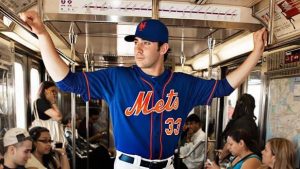 Harvey riding high. Sandy Alderson, Mets general manager for most of Harvey’s New York career and consultant to the A Met for All Season series, refuted Boras’s aversion regarding what year the 2013 National League All-Star Game starting pitcher’s ups and downs are filtered through. “This feels like the innings-limit controversy all over again,” Alderson said Friday, alluding to Boras’s threat to pull Harvey from the mound in 2015 ahead of that year’s postseason. Animus then arose from Boras’s concern that his client, one year removed from Tommy John surgery, was on track to exceed the previously mutually agreed-to 180 innings ceiling Harvey would work and possibly interfere with is future earnings potential. At the time, the Mets were headed for a division title and Boras’s pronouncement landed as a distraction in the middle of an otherwise unalloyed feelgood story.
“This agent has traditionally made a lot of noise,” Alderson said, reflecting on the September 2015 ruckus, “and that’s fine. That’s what agents do. But at the end of the day, the pitcher pitches for the team, and the team and the pitcher will get together and decide to do what is best for all concerned.” Bringing it back to the present, Alderson said that “in this case, the best is that Matt Harvey represents A Met for All Seasons for 2016, and our job is to support him as best we can to put him in a favorable light for himself and a realistic light for our readers.”
Other Harvey seasons, particularly the ones Boras singled out as more appropriate to the Harvey story, were ruled out as A Met for All Seasons candidates by Alderson, though he was vague on the reasons why.
“Look, the Mets are a franchise whose roster in any given season is comprised of 25 players at most times, sometimes more, depending on the time of the season,” Alderson explained. “I guess it’s 26 or 28 as of 2020. Anyway, would we, given the historical complexities of A Met for All Seasons, reconfigure our shall we say historical roster to perhaps place Matt in a position where he and his agent are more comfortable? That’s a question that can be asked but can’t necessarily be answered, and I’d argue doesn’t have to be answered.
“Matt Harvey was indeed a Met, which makes him eligible for A Met for All Seasons, and that includes the 2016 season. I’d expect Matt and his representatives to honor their obligation to Met history and go along with our plan.”
Alderson’s response was unsatisfactory to Boras, who noted that a simple swap might have solved Harvey’s misgivings. “Matt was the pitcher of the moment in 2013, probably the pitcher of the year until Tommy John caught up with him,” the agent said. “He embodied 2013 when no other Met could fit the uniform. No offense to the A Met for All Seasons occupying that slot, but trading the 2013 guy to 2016 and sending Matt back where he had the greatest chance to shine would have ameliorated all our misgivings. But that might have beyond the skill set of this general manager.”
Boras’s remarks seemed to be a dig at the trade Alderson attempted but couldn’t pull off in 2015, the one that would have sent Wilmer Flores — the 2013 A Met for All Seasons — to Milwaukee for Carlos Gomez. The trade was widely reported as a done deal but was then called off amid enormous public and media confusion.
“Wilmer Flores was an important part of the Mets when he came up in 2013,” Alderson said in defense of the choice. “And he continued to be an important part of the Mets in all the seasons he played, including 2016. But moving him to one year merely to accommodate a player who wants to be situated in another year is not how you build a winning team, which is what we did here in 2015. As somebody once said, sometimes the best trades you make are the ones you don’t make at all.”
Harvey entered 2016 retaining the informal title of ace of the defending National League champion Mets, selected by manager Terry Collins to start on Opening Night in Kansas City, which turned out to be a rematch of the previous fall’s World Series and a reminder of Harvey’s outsize role in it. After agreeing in September 2015 to set aside the predetermined 180-innings limit, Harvey pitched well for the Mets down the stretch, including in the clinching of the NL East title at Cincinnati. He also won the third game of the NLDS versus the Dodgers and Game One of the NLCS against the Cubs, both at a raucous Citi Field.
The Dark Knight’s autumn took a turn for the worse in the first game of the World Series, at Kaufman Stadium, where the Royals tagged Harvey for three runs over six innings, starting with a leadoff inside-the-park home run from Alcides Escobar, though the unorthodox four-bagger was enabled by sloppy outfield play from Mets center fielder Yoenis Cespedes, the slugger Alderson acquired once the Flores trade fell through. The Mets lost Game One of the World Series in extra innings and trailed three games to one heading into Harvey’s next start in Game Five.
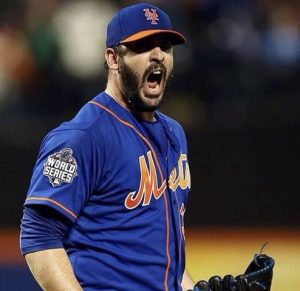 This guy wasn’t going anywhere. In Game Five, Harvey was magnificent for eight innings, again firing up the Citi Field crowd, this time to such an extent that the roars of nearly 45,000 in attendance, along with the pitcher’s nationally televised pleas to manager Terry Collins, seemed to earn Harvey the opportunity to complete a game he led, 2-0, despite his having thrown more than 100 pitches and closer Jeurys Familia being ready to enter from the bullpen.
With a tiring Harvey on the mound, Lorenzo Cain worked out a seven-pitch walk and stole second before Eric Hosmer doubled to left to put the Royals on the board. With Kansas City poised to tie the game, Collins removed Harvey. Soon, Familia and errant infield defense allowed the Royals their second run. Kansas City went on to win the game and the Series in twelve.
That Harvey was pitching and for a long time winning the decisive game of the World Series one year removed from his rehabilitation from Tommy John surgery was testament to the righty’s talent and determination. Inactive from August 2013 until the beginning of 2015, Harvey played a major role in lifting the Mets from perennial also-rans to league champs, posting thirteen wins and an ERA of 2.71. Along with sophomore Jacob deGrom and rookies Noah Syndergaard and Steven Matz, Harvey was at the heart of a young, hard-throwing rotation that led the Mets to 90 regular-season wins and entry into the postseason.
It was quite a change of fortunes for the franchise from July 26, 2012, the date Harvey made his major league debut in Phoenix apparently fully formed. The six-foot, four-inch rookie joined a rotation helmed by veterans R.A. Dickey, enjoying his Cy Young year, and Johan Santana, in the aftermath of his no-hitter, the Mets’ first. Santana, however, would soon be lost to injury and Dickey would be traded in the offseason. Come 2013, following his promising first two months — including eleven strikeouts in his first outing and a 2.73 ERA in ten starts — Mets fans anticipated a breakthrough first full year from the pitcher the club drafted with the seventh pick in the nation in 2010.
What they received in 2013 surpassed their highest hopes. With each of the 24-year-old’s starts termed “Harvey Day,” the righthander broke from the gate in spectacular fashion. In his first outing, Harvey held the San Diego Padres to one hit in seven innings while striking out ten. In his next start, he thoroughly outpitched eventual Hall of Famer Roy Halladay; followed that with a no-hit bid in Minnesota; and culminated his burst upon the baseball scene by eliciting spontaneous chants of “HARVEY’S BETTER” when he beat Stephen Strasburg and the Washington Nationals on April 19 at Citi Field. In May, he flirted with a perfect game even as his nose bled when the Chicago White Sox visited New York. Before the second month of the season was out, Harvey graced the cover of Sports Illustrated as “the Dark Knight of Gotham,” and Harvey Day was an entrenched element of every Mets fan’s calendar.
 “And pitching for the National League…” In the SI cover story, Verducci wrote Harvey favored “blunt, old-school hardball,” including a “97-MPH blowtorch of a fastball at the top of the strike zone, […] a roundhouse 1-to-7 curveball, a changeup that seems to float into the ether and a tight, hard slider that reaches 92.” With his entire arsenal clicking and his team hosting its first All-Star game since 1964, it was little wonder Harvey was named to start for the National League in July. It also made perfect sense for Mets fans to elevate the second-year pitcher into a pantheon that included the Mets’ two previous All-Star Game starting pitchers, Tom Seaver and Dwight Gooden, and picture confidence-exuding Harvey as the natural heir to the legacy established by the franchise’s two previous great homegrown righthanded pitching aces. With Seaver delivering the ceremonial first pitch at the Midsummer Classic and Gooden looking on from a box seat, Harvey striding in from the bullpen to begin the game confirmed the perception of the trio as peers.
Harvey’s phenomenal 2013 season (9-5, 2.27 ERA, more than a strikeout per inning) screeched to a halt on August 26 when the Mets announced a partial UCL tear in Harvey’s right arm. Tommy John surgery and a year or more of rehabilitation seemed the obvious remedy, though Harvey — perhaps unwilling to easily let go of a season that had won him admiration and accolades — hesitated to agree to the procedure. It wasn’t the first time in 2013 that the righty was less than amenable with the news surrounding him. In July, when he could have chosen to bask in the glow of his All-Star aura, he lashed out at Men’s Journal for portraying him as someone as interested in living the high life as he was ringing up a high strikeout total. In the article, Harvey was quoted as saying, “I’m young, I’m single. I want to be in the mix,” and went on about his fondness for a good time. It seemed to mesh with his presence in the company of supermodel dates and didn’t interfere with his superstar pitching, so the image seemed to make him only more appealing. “The way I was portrayed is not who I am and not the person I am,” Harvey nonetheless protested.
Once Harvey crossed paths with off-the-field adversity, he seemed continually less grounded. He eventually consented to Tommy John surgery, though a hospital room photo of Harvey flipping the bird in preparation raised eyebrows. His rehab, scheduled to take place at the Mets’ facility in Port St. Lucie, Fla., became a point of contention once Harvey expressed distaste for being away from New York and his teammates for an entire season. In September of 2014, on a night when the Mets were playing in Washington, Harvey was spotted in the stands at Yankee Stadium, watching the last game of Derek Jeter, his childhood idol and someone he pointed to as a role model in that Men’s Journal piece. Though his location on a given evening didn’t have any impact on his rehabilitation from surgery, it was perceived in some quarters as a bad look for the titular Mets ace.
While Harvey’s image entering 2015 might not have been as pristine as it was before he was forced to the sidelines in 2013, Mets fans welcomed him back warmly and surely enjoyed his output as the club’s renaissance year went along, at least until the innings limit story overshadowed the Mets’ final push toward their division flag. The team’s success and their pitcher’s role reduced it to a subplot as September progressed and it seemed all but forgotten until October. Harvey’s absence from a mandatory team workout similarly came and went as a headline.
This recounting of Harvey at perhaps a step or two down from his peak was cited by Boras as a reason he wishes to keep his client from being A Met for All Seasons subject for 2016. “They always seem to do something like this,” Boras said Friday. “They love to build up their players and then tear them down. ‘He was the Mets’ hope until he wasn’t. He was the greatest until he wasn’t.’ Look at Gooden 1985. Look at [Jason] Isringhausen 1995. They relish this kind of story so much they spread it on their Nathan’s frankfurters.” Boras’s reference was to two previous A Met for All Season entries in which two other Met pitchers enjoyed their best Met moments early and struggled to maintain their status. “At least,” the agent added, “those guys got to be spotlighted in their best years.”
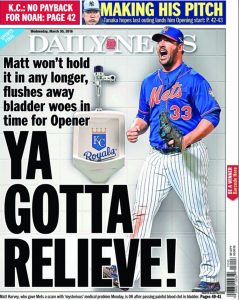 Taste wasn’t everything. Harvey in 2016 never found his footing. He lost on Opening Night in Kansas City, an outing itself preceded by another tabloid to-do involving a bladder infection that threatened to postpone his mound assignment. The Mets lost seven of Harvey’s first ten starts as the righty’s command abandoned him, his velocity diminished and his earned run average rose above six. it wasn’t until Memorial Day that he put together a start of a piece with the kind he threw regularly in 2012, 2013 and 2015, and he soon fell back from that 2016 pinnacle.
“I think you’re making the argument for us,” Boras said. “The years you’re referencing are the true Harvey Years. Yet you want to stick him in 2016, bring up the tasteless back pages with the stream of urination jokes, frame him as a fallen idol. This is not who Matt Harvey was or is or should be to the New York Mets.”
Alderson deflected the charges in a style familiar to those who observed the former GM in New York: “Matt had supermodel girlfriends. He had a superagent representative. He was, for a time, a superstar pitcher. He draped himself in a superhero persona. Well, sometimes even the superlatives that define us bump up against the more ordinary intervals of a career. I like Matt a lot. But I liked Matt a lot just as much when he wasn’t so super. That goes for 2016 as much as any of those other seasons of his.
“It’s not like Adam Wilk is the A Met for All Seasons for 2017,” Alderson added in a presumed wink to the Sunday the season after Harvey returned from his thoracic outlet syndrome surgery but didn’t show up at Citi Field for his scheduled start. The AWOL situation compelled the Mets to call up on little notice Wilk, a Triple-A righty who was demolished by the Miami Marlins in Harvey’s stead. What made the absence extra inflammatory was the lack of a straight answer regarding Harvey’s whereabouts.
“That was another season,” Alderson acknowledged, “and we don’t have to focus on another season, but I think the point here is ‘all seasons’ means all seasons, and telling Matt Harvey’s story eventually reins in all the highs and lows, if not the lowest of the lows. It wouldn’t be fair to make this about Matt missing a start and juggling his alibis in 2017. Would it be ideal to go back to 2013? Maybe. But that ship sailed. The way we mapped this out is it’s 2016 or nothing, and when you step back and consider A Met for All Seasons, Matt Harvey was not nothing. Matt Harvey was definitely something.”
Harvey lasted only until early July in 2016, missing the Mets’ second consecutive trip to the postseason. Perhaps overlooking the severity of recovering from the thoracic outlet condition — arising less than three years after Tommy John and involving the removal of a rib — the Mets counted on Harvey to join deGrom, Syndergaard and Matz in anchoring their 2017 rotation, but the results were hardly the same.
“There — there you go again,” Boras interjected. “‘It wasn’t the same.’ You guys and that trope. It wasn’t the same for Gooden after 1985. It wasn’t the same for Izzy after 1995. It wasn’t the same for Tug McGraw after 1973 or Ike Davis after 2010 or Pete Alonso even after one year because the second wasn’t record-setting. Next time I’ll have my client bring a note from home. ‘Please excuse Matt Harvey for being human, please excuse Matt Harvey for being physically fragile, please excuse Matt Harvey for donating his body not to science, but to the New York Mets so they could win a pennant for the first time in fifteen years.’”
The righthander, by then 28, endured another injury in 2017, this one a stress fracture in his scapula. He’d be gone from the middle of June to the beginning of September and pitch very poorly upon his return. The 2018 season got off similarly badly and the former ace was dispatched to the bullpen by new manager Mickey Callaway, a shift that didn’t agree with Harvey. In a matter of weeks, the Connecticut native was dealt to the Reds for catcher Devin Mesoraco, the Mets having completely moved on from the pitcher largely responsible for whatever success they enjoyed five years earlier. Meanwhile, deGrom, whom Harvey identified as his best friend on the Mets, fully blossomed as a superstar, ascending to the Seaver-Gooden level in Mets fans’ estimation, capturing the first of two consecutive Cy Young Awards and particularly thriving in 2018 with Mesoraco as his batterymate.
Since leaving New York, Harvey has struggled to recapture the form that captivated the Big Apple in the mid-2010s, bouncing from Cincinnati to Anaheim to Oakland’s minor league system to, in a touch of irony, Kansas City in 2020, where during the pandemic-shortened season he found little luck. The Dark Knight drifted in the span of a few seasons from a major storyline for the Mets to a suddenly faded piece of their history.
“A Met for All Seasons is right,” Boras insisted. “Matt Harvey as an outsize Met figure is right. But we know what seasons were the most right. The seasons that were less right we’d prefer he not be a part of.” Alderson countered, “Us neither. Sometimes, however, you play the ball where it lies, and sometimes you pitch the pitcher there, too.”
PREVIOUS METS FOR ALL SEASONS
1962: Richie Ashburn
1963: Ron Hunt
1964: Rod Kanehl
1965: Ron Swoboda
1966: Shaun Fitzmaurice
1967: Al Schmelz
1968: Cleon Jones
1969: Donn Clendenon
1970: Tommie Agee
1971: Tom Seaver
1972: Gary Gentry
1973: Willie Mays
1974: Tug McGraw
1975: Mike Vail
1976: Mike Phillips
1977: Lenny Randle
1978: Craig Swan
1981: Mookie Wilson
1982: Rusty Staub
1983: Darryl Strawberry
1985: Dwight Gooden
1986: Keith Hernandez
1987: Lenny Dykstra
1988: Gary Carter
1990: Gregg Jefferies
1991: Rich Sauveur
1992: Todd Hundley
1993: Joe Orsulak
1994: Rico Brogna
1995: Jason Isringhausen
1996: Rey Ordoñez
1997: Edgardo Alfonzo
1998: Todd Pratt
2000: Melvin Mora
2001: Mike Piazza
2002: Al Leiter
2003: David Cone
2004: Joe Hietpas
2005: Pedro Martinez
2007: Jose Reyes
2008: Johan Santana
2009: Angel Pagan
2010: Ike Davis
2011: David Wright
2012: R.A. Dickey
2013: Wilmer Flores
2014: Jacob deGrom
2015: Michael Conforto
2017: Paul Sewald
2019: Dom Smith
2020: Pete Alonso
by Jason Fry on 14 October 2020 12:43 am Welcome to A Met for All Seasons, a series in which we consider a given Met who played in a given season and…well, we’ll see.
The biggest moment in Mets history is also one of the quietest. You’ve seen it: With two outs in the ninth of Game 5 of the 1969 World Series, Davey Johnson hits a fly ball to left. At first the ball looks like it has the distance to be trouble, but the peril is illusory. Its momentum dies in the cool air of October and gravity pulls it down, to where Cleon Jones is waiting at the edge of the warning track. He catches it with two hands, almost gingerly, and then both his glove and his knee come down, until his knee brushes the dirt and his hands are clasped — as if in prayer, or benediction, or a little of both.
The celebration begins — Jerry Koosman jacknifed in Jerry Grote‘s arms while Ed Charles dances happily alongside, fans pouring onto the field, Jones and Tommie Agee seeking safety in the visitors’ bullpen — but first there’s a moment of stillness, of hush. That moment’s simultaneously gone in a blink and seems to linger, to draw in everything that led up to it.
 At the top of the world. Which was quite a lot — for the franchise, for those who knew its tragicomic and star-crossed history, but also for the author of that quietly moving and strangely elastic moment. Cleon Jones arrived during one ignominious era of Mets history and departed during another, and was treated unfairly coming and going. In between, he won a World Series and a pennant, ascended to the top of the team’s record books, and forged what should have been an enduring legacy. And he did it facing obstacles few of us can imagine.
Jones made his debut at the end of 1963, as the Polo Grounds neared its demise. He was barely 21 and wrapping up his first year of pro ball, having played in the low minors in Raleigh, N.C., and Auburn, N.Y. Sizing up the Mets’ new outfielder, the beat writers found a shy young man who was sensitive about the deep scar that seamed one side of his face (left over from a car accident when he was a teenager) and spoke so softly he could barely be heard, when he spoke at all.
If that sounds like too much too soon, well, you don’t know the half. Jones would admit later that he was scared to death, plucked from his hometown of Mobile, Ala., and dropped into a world he had no idea how to navigate.
The Mobile of the early 1960s was the heart of the Jim Crow south, with Black and white lives kept rigidly apart. Stepping over those lines brought unease at minimum, with the threat of far worse. The threat of racial violence had shaped Jones’s childhood — he was raised by his grandmother because of an incident involving his parents that had happened when was a baby. Jones’ parents had been waiting in line for a bus when a white person in the line objected to being behind them. A yank on Jones’ mother’s hair caused his father to raise his fists. The Joneses fled north, aware of what might happen if they stayed. Jones’ mother died when he was 12, having never returned home. “I never saw my mother except in photographs,” her son recalled.
Jones wasn’t alone in having a childhood so shaped. His best friend in Mobile was Agee, who was five days younger than Jones and the other half of a formidable combination on the gridiron. While Jones’ family had been in Mobile since the 1850s, Agee had grown up in Magnolia, about two hours north. The Agees had hurriedly pulled up stakes after Tommie’s sisters fought with white children who lived nearby, causing their father to get his shotgun and threaten to kill his Black neighbors.
Black Mobile was an insular world defined by strict racial boundaries, but for those willing to stay within them, that little world had its pleasures — particularly if you were a young athlete. Jones threw right-handed but batted lefty, an oddity that was a product of the field where he’d played baseball as a kid: He hit so many balls into a creek that his friends refused to let him hit from his natural side. Mobile was fertile ground for Black baseball stars — besides Jones and Agee, its fields and lots produced the Aaron brothers, Satchel Paige, Willie McCovey, Billy Williams and Amos Otis. Jones and Agee, however, were best known as football stars. At Mobile County Training School, Jones was a running back and Agee a wide receiver for a team that lost just one game in three years. One of their favorite plays was an option where Jones would take the ball from the quarterback and hit Agee downfield. Agee and Jones took their show to Grambling, with Agee departing first, signing a baseball contract with the Indians in 1961. Jones transferred to Alabama A&M before signing on with the Mets in 1962.
Even in such a small world, Jones’ neighborhood of Plateau stood out. Plateau was known chiefly for the miasma from its paper mills, but it had another name: Africatown. For once, that wasn’t a disparaging nickname bestowed by whites. Africatown was settled by Blacks who’d arrived not generations earlier, but in 1860 aboard the Clotilda, the last slave ship to sail to America. The Clotilda survivors banded together after the Civil War, founding a town and pooling their money to return to Africa. That dream never came to pass, but they held onto their language and traditions — in Africatown’s cemetery, all graves faced east, towards their lost homeland. After his playing days were over, Jones returned home and built a brick house on the same lot where he’d grown up in a shotgun shack. “I can’t imagine being anywhere else,” he’d tell many a visitor.
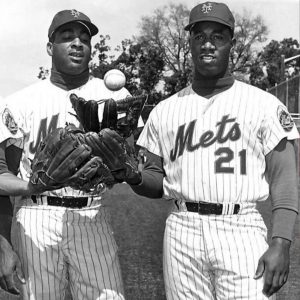 The Mets from Mobile. In 1963, though, he was most definitely somewhere else. Jackie Robinson had blazed a trail for Black ballplayers, but the road to the big leagues remained a difficult one. In writing about Jones and Africatown, I’m indebted to Wayne Coffey’s terrific book from a few years back, They Said It Couldn’t Be Done. One of the best things about that book is that it doesn’t shy away from what Jones, Agee, Charles and Donn Clendenon faced on the way to getting their World Series rings — horrific racial abuse from fans, restaurants that wouldn’t serve them, having to board in gyms or decrepit housing, and much more besides. Young ballplayers still struggle when playing a supremely difficult game far from their families and friends; Jones and others in the post-Robinson generation had to do all that while dealing with searing daily reminders that they weren’t welcome playing the game they loved.
The Mets at least, knew that Jones wasn’t ready. He spent all of ’64 and most of ’65 in the minors before moving up to the big club for keeps in ’66 as part of the Mets’ vaunted, largely fruitless Youth of America. Jones’ talent was obvious — he provided both power and speed at the plate and was a superb defensive outfielder — but he was dogged by questions about his commitment and work ethic, and his shy, awkward manner made him a figure of fun in the press box.
But in 1968 — the year Jones represents in A Met for All Seasons — it all came together. After a slow start, Jones wound up hitting .297 with 29 doubles and 23 stolen bases, the latter mark breaking his own club record. Part of that was simple maturation, but he was also helped by two new arrivals to the Mets. The first was Gil Hodges, who mentored Jones where Wes Westrum had hectored him, and helped create a clubhouse remarkably free of the racial tensions and resentments of the era. The other was Agee, whose career had stalled with the White Sox but had been brought to New York on the new manager’s recommendation.
1968 went a lot better for Jones than it did for his boyhood friend — an anxious, discombobulated Agee hit just .217. In the offseason, Jones and Agee spent the afternoons fishing and talking hitting, then went out to take swings with Tommie Aaron. In 1969, that hard work would pay off. Jones finished third in the National League at .340, a Met record that would stand for nearly three decades. Agee rebounded too, hitting .271 with 26 homers. And, of course, they won the World Series, with the two Mets from Mobile at the center of much of that lore — and Jones giving us that indelible moment of quiet genuflection.
Besides securing the final out, Jones had a ringside seat for Agee’s two circus catches, though he insists neither surprised him: In both cases, he saw Agee pound his glove, something his buddy never did unless he was sure he’d make the catch. The famous shoe-polish play? That was Jones’ foot that the ball hit on its way to the Mets dugout and whatever might have happened between the time it rolled in there and when Hodges brought it out for Lou DiMuro’s inspection. (Coffey’s book has an answer, by the way.)
And then there’s Hodges’ long walk — the one part of the ’69 lore that’s been so thoroughly bent by the power of storytelling that it’s come to mean the opposite of what it actually did.
It happened at the end of July, on a soggy and decidedly less-than-miraculous day for the Mets: The Astros had beaten New York 16-3 in the first game of a double header, then scored six in the third inning of the nightcap, all with two out. Johnny Edwards doubled down the left-field line, with Jones pursuing the ball half-heartedly and throwing a little parachute back to the infield. Hodges came out of the dugout, walking with his usual deliberate pace, passed the mound and the infield, and kept going until he reached Jones. After a brief conversation, he turned and walked slowly back to the dugout, trailed by his .346-hitting star.
The incident would become part of the Hodges legend and proof of his steely reputation: The manager demanded his players give their all, no matter who they were or what the situation was, and embarrassing Cleon Jones was the proof of it. And Jones himself has burnished that legend over the years.
But it’s a profound misreading of the incident. The corollary to the story of Hodges’ long walk is that nearly every other story is about him handing out discipline quietly, either behind closed doors or by opting for a long stare and/or a few choice words. It’s Ron Swoboda calling Hodges out and then being unable to pee because he could feel his manager’s eyes boring into his back. It’s Charles coming sheepishly into Hodges’ office without being asked so he could apologize for slamming a bat into the rack — and Hodges remarking that he knew Charles would come. It’s Hodges quietly but pointedly rebuking Ron Santo — not even his own player — at home plate, with no one to know but the two of them and an umpire.
How Hodges handled Jones has been misused because it’s convenient shorthand for something that was so rarely visible. But rather than exemplify Hodges’s toughness and wisdom, that day in July was a rare mistake born out of frustration — one that could have derailed a fine season from a sensitive player the Mets couldn’t afford to lose. After the incident, Hodges was more himself — he challenged Jones behind the closed door of his office, made vague excuses to the writers about a bad foot, kept his star player on the bench for a few days, then declared that bad foot healed once he knew the point had been made. That was much more his style. On occasion Jones hasn’t obeyed the script written long ago and been more forthright about his feelings: “I thought it could have been done another way. I was upset and hurt.” He wasn’t alone. When Hodges came home after the doubleheader, a stunned Joan Hodges had a pointed question for her husband: “Whatever possessed you to do it?”
As we all know, the Mets won, with Jones hitting .429 against the Braves and catching that final out. And he’d remain a mainstay of the team for the next several years, becoming the Mets’ all-time leader in hits, runs, steals and RBIs in 1971, becoming the first Met to 1,000 hits in 1973, and playing a key role in the Ya Gotta Believe charge to an unlikely World Series berth — Jones hit six homers in the last 10 games of ’73 and was the man in the middle of Dave Augustine‘s famous “ball off the wall.” But his knee was betraying him, and ended his season early in August 1974.
The next year, Jones remained in St. Petersburg, Fla., to rehab his knee after the Mets went north. What followed was one of the most shameful incidents in team history. It started in early May, when police arrested Jones on indecent-exposure charges. The cops said he’d been found sleeping naked in the back of a station wagon with a 21-year-old white woman, also naked, who was carrying narcotics — and yes, the racial identification was most certainly relevant in Florida in 1975.
The story quickly fell apart. The station wagon morphed into a panel van, casting doubt on the idea that anyone had been exposed according to any standard of decency. The narcotics turned out to be a joint and a couple of pot pipes in the woman’s purse. Jones insisted that the only part of him that had been naked had been his feet. The charges were dropped.
At that point, whatever happened in Florida should have been no one’s business outside of the Jones house, but the Mets wouldn’t let it go. M. Donald Grant fined Jones $2,000 and forced him to hold a press conference at Shea before his teammates and his wife. He was made to read an apology written by the front office, with mea culpas addressed to not only his wife and children but also “all Mets fans and to baseball in general.” Union boss Marvin Miller accurately called out Grant’s stunt as “a tasteless display of economic power.” Grant’s ouster of Tom Seaver would be remembered with more bitterness, but no part of that sordid affair was as cruel and demeaning as what he did to Jones. Reporters who were there would reference the palpable unease in the room for the rest of their careers.
It was the beginning of the end. Jones returned to the Mets, but Dave Kingman had taken his job, his knee still wasn’t right, and Grant had it in for him. Jones’ doctor told him not to do calisthenics with the team, which got twisted into more evidence that Jones was lazy. Things came to a head in July, when Yogi Berra sent Jones up to pinch-hit and to take over outfield duties. Jones refused — because he’d been stuck on the bench and was angry about it, but also because he hadn’t taped up his balky knee, as he did whenever he knew he was going to play defense.
Berra accused Jones of disrespect and insubordination, and told Grant it was the outfielder or him. The Mets tried to trade Jones, who refused two proposed deals (as was his right as a 10-and-5 man), then released him. A couple of weeks later, after Seaver told Grant Berra had lost the clubhouse, they got rid of the manager as well. Jones would return for a cameo with the White Sox in 1976, then retire. He was only 33. Thirty-three, a World Series hero, and the man who held several Mets’ offensive records. He deserved better — but then even a cup-of-coffee guy deserved better than what Grant did.
Time would heal some of the wounds — Jones returned briefly as a minor-league hitting instructor in the early 1980s, with Darryl Strawberry one of his star pupils. But with a little better health and a lot less Grant and Berra, he might have been Strawberry’s teammate — a legendary pinch-hitter who briefly overlapped with a budding superstar, knitting two eras and two titles together.
Instead, he went home to Africatown — where he’s still hard at work, fixing houses and seeking business deals and serving as the town’s unofficial mayor. When reporters chat with Jones these days, he sounds different than the instinctively accommodating player who excused Hodges’ worst day as manager, or downplayed Grant’s cruelty to him. “Growing up in the Jim Crow south, I learned my lane,” he said earlier this year. “Hell yes, I stayed in that lane. Now every lane is ours, and we have changes to make.”
It’s easy to overthink Jones’s little genuflection in the outfield — a baseball season is a grueling marathon, and he was a hard-nosed athlete looking to put away a last out in a magical season. That’s enough. But I don’t think it’s too much to imagine that at least some of those other things informed his reaction. He’s standing next to his boyhood friend — Jones even pounds the glove as the ball descends, nicking Agee’s habit. They’re a long way from Mobile, in a world that hasn’t always been kind to them. But they’re there, and once that ball finishes its journey, they’re going to be atop that world. That’s not going to change everything — nothing’s ever that simple — but if something like that can happen, what else might be possible one day?
“Come on down, baby,” Jones tells the ball, and it does.
PREVIOUS METS FOR ALL SEASONS
1962: Richie Ashburn
1963: Ron Hunt
1964: Rod Kanehl
1965: Ron Swoboda
1966: Shaun Fitzmaurice
1967: Al Schmelz
1969: Donn Clendenon
1970: Tommie Agee
1971: Tom Seaver
1972: Gary Gentry
1973: Willie Mays
1974: Tug McGraw
1975: Mike Vail
1976: Mike Phillips
1977: Lenny Randle
1978: Craig Swan
1981: Mookie Wilson
1982: Rusty Staub
1983: Darryl Strawberry
1985: Dwight Gooden
1986: Keith Hernandez
1987: Lenny Dykstra
1988: Gary Carter
1990: Gregg Jefferies
1991: Rich Sauveur
1992: Todd Hundley
1993: Joe Orsulak
1994: Rico Brogna
1995: Jason Isringhausen
1996: Rey Ordoñez
1997: Edgardo Alfonzo
1998: Todd Pratt
2000: Melvin Mora
2001: Mike Piazza
2002: Al Leiter
2003: David Cone
2004: Joe Hietpas
2005: Pedro Martinez
2007: Jose Reyes
2008: Johan Santana
2009: Angel Pagan
2010: Ike Davis
2011: David Wright
2012: R.A. Dickey
2013: Wilmer Flores
2014: Jacob deGrom
2015: Michael Conforto
2017: Paul Sewald
2019: Dom Smith
2020: Pete Alonso
by Jason Fry on 10 October 2020 12:08 am Welcome to A Met for All Seasons, a series in which we consider a given Met who played in a given season and…well, we’ll see.
In the summer of 2015, an undermanned and shoddily constructed Mets club stumbled along, refusing to fall entirely out of contention despite scoring the fewest runs in the National League, battling injuries, and having to navigate the usual headwinds of being owned by the Wilpons. On July 22, the Mets blew a 3-1 lead in the 8th against the Nationals, a gut punch of a loss, but one that left them still just three behind a Nats team that couldn’t seem to get out of its own way. The next day, Clayton Kershaw and the Dodgers came to town and the Mets sent this lineup out to meet them: Granderson, Tejada, Flores, Mayberry, Campbell, Duda, Lagares, Recker, Colon. Murderers’ Row? This wasn’t even Mutterers of Vague Threats Row. The cleanup hitter, Mayberry, was hitting .170, and protected — to bend a definition so far past its actual meaning that it instantly breaks — by Campbell, a guy hitting .179. It was the kind of lineup that would encourage you to make other plans if announced for a March matinee in Kissimmee, except this was July and the Mets were in a pennant race, however dimly they seemed to perceive that.
If the gambit was to lull Kershaw into a snoozy sense of ease, it didn’t work — the Dodgers’ ace was perfect through six and wound up fanning 11, walking nobody and giving up a grand total of three hits. Honestly, it was a surprise he gave up any.
And yet, for all that, the Nats dropped a game in Pittsburgh and the Mets were still just three out.
Fans were screaming for someone to do something — a reaction GM Sandy Alderson had dismissed earlier that month as Panic City. But after pacifism failed to intimidate Kershaw, Alderson finally admitted the team he’d constructed was at least living in Panic City’s iffy suburb, Concern. Michael Cuddyer had hurt his knee in late June but remained entrenched on the roster; now he was finally put on the DL, replaced by a young left fielder named Michael Conforto.
It was a move fans had been campaigning for, but also a sign of desperation. Conforto was 22 and had logged just 45 games with Double-A Binghamton after being promoted from Single-A St. Lucie. Ten months earlier, he’d been a Brooklyn Cyclone; three months before that, he’d been an Oregon State Beaver. Scouts reported the bat was ready, but warned that Conforto was slow on the bases and in the field, with poor range and a weak arm. He’d likely to be an improvement over the various one-legged and/or sub-Mendoza line alternatives, but it was far from clear that he was ready for the big leagues, or that the audition was the best thing for his development as a player.
I simultaneously dismissed the call-up as an ill-advised publicity stunt and welcomed it: In Panic City, beggars can’t be choosers. Besides, I’d seen several of Conforto’s games on Coney Island the previous summer and remembered him well. That was new territory for me, as most Mets’ Cyclone tenures had washed out of my memory by the time the players reached Shea or Citi Field. I know I saw the likes of Ike Davis, Lucas Duda and Pete Alonso as Cyclones, but can’t recall any particulars.
I was also excited because Conforto would become a milestone player in franchise history even if he never did more than cameo as a pinch-hitter. He was slated to be the 1,000th player to appear in a game for the Mets, a landmark Greg and I had seen coming and wondered and worried about more than was healthy. Obviously I had no experience in commemorating such an event, but it was obvious to me that the 1,000th Met — the M Met, let’s call him — should be someone significant. Steven Matz had been the 999th Met and would have been a fine choice for No. 1,000, particularly after his debut came with hitting heroics and Grandpa Bert having the time of his life celebrating them. Noah Syndergaard had been the 995th Met; Thor would have been fine too. But between Syndergaard and Matz we’d been introduced to Darrell Ceciliani, Akeel Morris and Logan Verrett — fine gentlemen, I’m sure, but players whose ceilings were somewhere between Answer to Unfair Trivia Question and Oh Yeah, That Guy. I would have worked up enthusiasm for the 1,000th Met even if he’d been a backup catcher, a hair-on-fire reliever or a good-glove, no-bat shortstop, but oh it would have been disappointing. A real prospect assuming the mantle was so much more satisfying.
Conforto made his debut against lefty Ian Thomas and went 0-for-4, but collected his first RBI with a groundout to the right side that brought in Duda. The Mets lost, but my publicity-stunt worries proved unfounded — Alderson was about to be very busy. For starters, he engineered a trade with the Braves to bring in Kelly Johnson and Juan Uribe, competent veterans who were also ambulatory. They arrived the next day and Conforto went 4-for-4 as the Mets bombarded the Dodgers. We didn’t know it yet, but the rocket was about to lift off and leave Panic City far behind: Ahead of us lay the non-trade for Carlos Gomez, the arrival of Yoenis Cespedes, Wilmer Flores‘ elevation to folk hero, David Wright‘s brief but thrilling recovery, the obliteration of the Nationals, and a long-awaited return to the postseason. The Mets played 12 weeks of gravity-defying baseball, a run that was both giddy and glorious, taking them past the Dodgers and over the hapless Cubs and into the World Series. (That meant a 13th week of baseball, which turned to be neither giddy nor glorious, but them’s the breaks.)
Conforto was front and center. That swing was as pretty as I’d remembered from Brooklyn, and the M Met had a precocious understanding of the strike zone. But he also looked a lot better than we’d feared in the outfield — he wasn’t fleet, exactly, but he had good enough instincts to maximize his range, and the arm was fine. Conforto capped off his rookie season with a pair of home runs in Game 4 of the World Series, connecting off old friend Chris Young and lefty Danny Duffy, and just missed what would have been a 10th-inning walkoff homer in Game 5 off Luke Hochevar, catching a 3-2 cutter a little too low on the barrel.
(If he’d connected, the history of the Mets — and, who knows, perhaps the last five years — might be far brighter. I will now go off and sulk for a little while.)
Conforto didn’t hit a walkoff. He got one more 2015 at-bat, singling in the 12th off Wade Davis, but by then the Royals had done terrible things to Addison Reed and Bartolo Colon and it was 7-2. Conforto was on second when Flores struck out and the season ended. But he’d arrived and seemed destined for stardom as part of the young core of a rising team.
In 2016, Conforto got off to a hot start, but then was flummoxed by a succession of wicked lefties, fell into a slump and was sent down to the minors to get his breath and earn his place, returning with a better game plan and some much-needed mental toughness, leading to…
Oh wait — I copy-pasted that from The Big Book of Baseball Cliches. Sorry. That’s always a danger in the baseball-chronicling trade.
What actually happened was the Mets did their damnedest to screw Conforto up, and he relied on the mental toughness he already possessed to survive his employer’s negligence.
Confort had hit .274 against lefties in 180 minor-league plate appearances. In 2015 and early 2016 he hit .188 against them … in a grand total of 34 plate appearances.
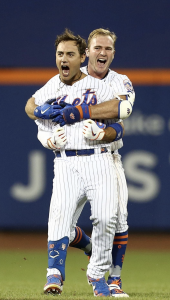 A city, busted in half. Thirty-four plate appearances shouldn’t be enough to convince anyone of anything, but it was enough to make Terry Collins believe Conforto couldn’t hit lefties — after all, he was left-handed and young. Conforto started 26 of the Mets’ first 27 games in 2016, hitting the hell out of the ball, but Collins turned him into a platoon player. He was benched for 13 of the next 45. Denied regular playing time — something young players really do need — he started pressing. The hot start turned lukewarm and then ice cold, given an assist by an unsustainable .167 BABIP. To be fair, it’s not like Conforto never saw a lefty — for instance, Collins sent him up as a pinch-hitter against one at the end of May. That lefty was Kershaw.
Collins’ mishandling of Conforto led to him not being able to hit anybody, which led to his being banished to the minors, which led to him hitting like his old self because he got to play every day and his luck turned and Collins wasn’t around to fuck with him, which led to his recall, which led to a ridiculous Just So story about what had happened and the supposed lesson of it. But the Mets weren’t done — they tried to turn Conforto into a center fielder, a position for which his ceiling was “heroic adequacy.” They did pretty much everything they could to derail him, but somehow he survived, making the All-Star team in 2017 and looking like even the Mets couldn’t mess him up. Then, on Aug. 24, his season screeched to a halt when he dislocated a shoulder on an innocent-looking swing.
Conforto was expected to miss the first couple of months of 2018, but was only late reporting for duty by a week. That looked like good fortune, but it wasn’t — he clearly wasn’t himself, both in terms of his swing and his approach to at-bats. The season was a struggle, but in 2019 Conforto rebounded, rising above the 30-homer plateau for the first time and providing several great moments, from the “Scooter and the Big Man” game (as instantly immortalized by Gary Cohen), to the walkoff single that capped a frantic comeback against the Nats in August.
Even as he became a Mets mainstay, though, Conforto was dogged by grumbling that he wasn’t clutch, that he was too streaky, and so forth. Which made me roll my eyes (or worse), but I came to see it as a backhanded compliment. That picture-perfect swing looks like it should deliver 30-homer, 100-RBI seasons routinely, if only for the fact that baseball isn’t quite that simple. No one was frustrated with, say, Eric Campbell‘s failure to launch, but Conforto has always competed against his own potential.
He’s been my favorite player since he arrived — but in my own way, I too have sold Conforto short. He isn’t flashy at the plate or afield, and he’s affected a measured, deliberately dull style in postgame media scrums. Deprived of his shirt by Alonso, he looked faintly embarrassed by the whole thing. I’ve taken him for granted, assuming that he’ll be in there every day, and waiting for his talents to truly take flight.
2020, while a miserable year, did give us Conforto taking the next step as a hitter. Left alone in right field, he hit .322 (and .284 against lefties), with nary a whisper about clutch. And it became clear that he’d become a leader in the clubhouse — a maturation never more clear than when he took the lead role addressing the media the night the Mets and Marlins chose not to play. It’s easy to forget that he’ll still be shy of his 28th birthday when the Mets return to spring training; I don’t want to think about the fact that he’ll be eligible for free agency when they disperse at season’s end.
Maybe Conforto will never be the superstar he’s clearly capable of becoming — maybe he’ll just remain a very good player, the kind you hope to be able to slot into the middle of a lineup. But I wouldn’t bet against him. He’s already survived Collins’ meddling and life as a Wilpon employee, after all. I can’t think of a better way for the Steve Cohen era to begin than to ensure Conforto will be part of the Mets’ plan through his prime — and I can’t wait to see what other numbers will be significant when we look back at the M Met and his career.
PREVIOUS METS FOR ALL SEASONS
1962: Richie Ashburn
1963: Ron Hunt
1964: Rod Kanehl
1965: Ron Swoboda
1966: Shaun Fitzmaurice
1967: Al Schmelz
1969: Donn Clendenon
1970: Tommie Agee
1971: Tom Seaver
1972: Gary Gentry
1973: Willie Mays
1974: Tug McGraw
1975: Mike Vail
1976: Mike Phillips
1977: Lenny Randle
1978: Craig Swan
1981: Mookie Wilson
1982: Rusty Staub
1983: Darryl Strawberry
1985: Dwight Gooden
1986: Keith Hernandez
1987: Lenny Dykstra
1988: Gary Carter
1990: Gregg Jefferies
1991: Rich Sauveur
1992: Todd Hundley
1993: Joe Orsulak
1994: Rico Brogna
1995: Jason Isringhausen
1996: Rey Ordoñez
1997: Edgardo Alfonzo
1998: Todd Pratt
2000: Melvin Mora
2001: Mike Piazza
2002: Al Leiter
2003: David Cone
2004: Joe Hietpas
2005: Pedro Martinez
2007: Jose Reyes
2008: Johan Santana
2009: Angel Pagan
2010: Ike Davis
2011: David Wright
2012: R.A. Dickey
2013: Wilmer Flores
2014: Jacob deGrom
2017: Paul Sewald
2019: Dom Smith
2020: Pete Alonso
by Greg Prince on 9 October 2020 10:53 pm We’ve had little to rejoice in this year, so let us rejoice in the postseason elimination of others. Not just any others, but the others we wish eliminated annually. Daily, really.
Happy Elimination Day, civilized world! Hell, take the whole weekend!
Congratulations, Rays. Congratulations, all of us.
|
|