The blog for Mets fans
who like to read
ABOUT US

Faith and Fear in Flushing made its debut on Feb. 16, 2005, the brainchild of two longtime friends and lifelong Met fans.
Greg Prince discovered the Mets when he was 6, during the magical summer of 1969. He is a Long Island-based writer, editor and communications consultant. Contact him here.
Jason Fry is a Brooklyn writer whose first memories include his mom leaping up and down cheering for Rusty Staub. Check out his other writing here.
Got something to say? Leave a comment, or email us at faithandfear@gmail.com. (Sorry, but we have no interest in ads, sponsored content or guest posts.)
Need our RSS feed? It's here.
Visit our Facebook page, or drop by the personal pages for Greg and Jason.
Or follow us on Twitter: Here's Greg, and here's Jason.
|
by Greg Prince on 14 August 2017 10:49 am When you’ve heard your team won a game by the score of 2-0, you assume there was very good pitching. When you’ve heard your team won a game by the score of 9-5, you assume there was a good bit of hitting. When you’ve heard your team won a game by the score of 6-2, you assume…what? Your team was probably in control, they pitched well enough, they hit well enough, there was likely an inning that definitively separated the two teams from a more nerve-wracking outcome. Somebody must have scored some runs to put the game away. Somebody must have prevented some runs that would have made things tighter. Mostly you assume it wasn’t the most compelling of games. You won by four. Good. Next!
The Mets beat the Phillies on Sunday, 6-2. It wasn’t the most compelling of games. Chris Flexen and four relievers pitched well enough. Curtis Granderson and Michael Conforto in particular (a homer each, five RBIs between them), hit well enough. The Phillies — mostly Odubel Herrera, attempting to tag up to an occupied base — ran themselves out of a potentially bountiful fifth. The Mets scored six. The Phillies scored two. It took three hours and thirty minutes, but it got the job done. A 6-2 win, three out of four in the series, on to the bus, and off to the Bronx.
And I wouldn’t dwell too much on the final, except, because I keep track of how often the Mets win by whatever score they win by, I discovered that Sunday’s 6-2 win was the Mets’ 100th 6-2 regular-season win in their history.
Happy Hundredth!
Yeah, I don’t know what to make of it either, but a round number is a round number, even when applied to a score that isn’t round and doesn’t instantly imply much beyond eight runs were distributed in a satisfying manner. Earlier this season, the Mets also notched the 100th 6-3 regular-season win in their history, and while it wasn’t a terribly memorable game, a scan of the scrolls showed the Mets had made plenty of their previous 99 6-3 wins indelible.
Bartolo Colon’s lone home run was in service to a 6-3 Mets win. So was Jeremy Hefner’s. The first time a Met hit three home runs in one game — Jim Hickman in 1965 — the Mets beat the Cardinals, 6-3. When the Mets tied their team record for most consecutive wins, eleven, in 2015, it was on a 6-3 victory over the Braves. Frank Viola’s 20th win was 6-3. Matt Harvey’s return from Tommy John surgery was 6-3. The first Met ever taken in an amateur draft, Les Rohr, got his professional career off to a promising start by defeating the Dodgers, 6-3, at the tail end of 1967. Ike Davis’s last great Met moment, his ninth-inning, come-from-behind, pinch-hit grand slam that shocked the Reds, resulted in a 6-3 triumph. Darryl Strawberry’s last great Met moment, when he blasted Doug Drabek and the Pirates practically out of Shea Stadium in September 1990’s end-of-an-era pennant race, presaged a 6-3 final. And perhaps the most mind-bogglingly craziest game the Mets ever played that didn’t end at 3:55 in the morning, the one in Cincinnati on July 22, 1986, with Dave Parker dropping the presumptive last out, Eric Davis and Ray Knight exchanging punches, Jesse Orosco and Roger McDowell swapping right field, Gary Carter playing third, Keith Hernandez fielding a bunt about six inches in front of the plate and Howard Johnson blasting a three-run homer in the fourteenth…that was a 6-3 Mets win.
Even the first 6-3 win the Mets ever managed was pretty Amazin’. They downed Don Drysdale and the Dodgers at the Polo Grounds on August 24, 1962, the first time they beat the former Brooklynites in New York. Drysdale won 25 games and the Cy Young that season, and the Dodgers wound up tied with the Giants after 162 games, setting the stage for the three-game playoff that gave San Francisco the pennant. If those Original Mets, who were 40-120 overall and 2-16 against their otherwise most overwhelming opponent, hadn’t decided to uncharacteristically jump up and bite L.A. with a 6-3 nip, the Dodgers (theoretically) would have gone to the World Series instead. The 1962 Mets weren’t so much Giant-killers as they were Dodger-doomers.
Six-Three encompasses a world of Met wonder. Six-Two, by comparison, lacks regular-season historical intrigue. The Mets won the fourth game of the 1986 World Series, 6-2, and the first game of the 2000 NLCS, 6-2, but in the regular season, I would nominate, as most anomalously exciting 6-2 win, Mets 6 Dodgers 2, June 11, 1980, better known as the Mike Jorgensen Game.
The Mike Jorgensen Game? You probably had to be there, or at least have been watching it or listening to it to understand its significance. The game was at Shea and it ran ten innings, and if you don’t mind indulging in a little arithmetic, you will thus infer the game ended on a grand slam if the margin of victory was four runs at home in extras. It dramatically concluded off the bat of Jorgensen, a Met then in his second Flushing go-round. Jorgy graduated from nearby Frances Lewis High School and the Mets, that particular week (as New York State regents exams loomed), were matriculating toward .500, a.k.a. the unreachable star. This was the week when The Magic Is Back, up to that point a silly advertising slogan, became the mantra of Mets fans everywhere. The eternally crummy Mets had begun the season 9-18. Comebacks like this one — engineered against teams considered far better than ours — had pulled us to the edge of respectability. The Mets climbed to 25-27 on Mike’s four-run four-bagger off future tormentor Rick Sutcliffe. It was, quite seriously, Magical.
So why haven’t you heard more about this most massive 6-2 moment in Mets history? Because three nights later, Steve Henderson would hit an even more Magical home run — for three runs off Allen Ripley — capping a ninth-inning comeback from five runs down to beat the Giants, 7-6, and it became the emblematic victory of a generation. Seven-Six automatically tells you something spectacular occurred. Six-Two suggests you need to take a closer look and bring a calculator.
There have been a few other 6-2 wins of surpassing situational interest over the past 56 seasons. Joe Torre’s first managerial outing, an oasis of optimism amid the ongoing desert of Queens crumminess, was won by that score on May 31, 1977. When the Mets clinched their second consecutive Wild Card, on September 27, 2000, it was by beating the Braves, 6-2. The win unleashed the most ambivalent clinching celebration in Met history given that we really wanted to win the division from the Braves in 2000…and the Braves had won the division directly from us the night before. But we were in the playoffs again and 6-2 did it.
Six-Two was also the score attached to an outcome that was either emblematic of its time or just a triviality. On April 5, 1994, the day after the exponentially more famous Tuffy Rhodes Game, the Mets won, for the first time, a game in which they fielded a starting lineup consisting of nine players who were each born after April 11, 1962, which is to say after the franchise itself was born. Seeing as how the Mets’ image desperately required rehabilitation after 1993 was marked by a tendency to play with parking lot firecrackers and bleach-filled Super Soakers, it was nice to know the Mets were sort of growing up at last. Behind Jose Vizcaino, David Segui, Joe Orsulak, Bobby Bonilla, Jeff Kent, Jeromy Burnitz, Kelly Stinnett, Ryan Thompson and Pete Smith, the Mets beat the Cubs at Wrigley Field, 6-2. The next time the Mets won by that score was August 10, 1994. The next day, the Mets played their last game of the season as a strike cancelled the rest of the schedule.
Six-Two is a shy kind of score, apparently. It doesn’t always want to come out to play. The Mets didn’t win a 6-2 game until they’d won 103 other games. Its first appearance on behalf of a Mets victory came Saturday, May 30, 1964, at Shea Stadium against the Giants. Jack Fisher went nine. Charley Smith went deep. Willie Mays went to third on a triple, but he was with the other team then. Buoyed by the 6-2 sensation, the Mets rushed right back to Shea the next afternoon for a Sunday doubleheader and wouldn’t surrender the field until it was nearly Monday morning. They played 32 innings, the final 23 in the nightcap. The Mets scored six off San Francisco pitching again, but gave up eight. Willie Mays played shortstop for the other team.
From 1966 to 1974, the Mets won only one 6-2 game, over Atlanta on May 21, 1971. It was also at Shea. Nolan Ryan gave up a home run to Hank Aaron but was otherwise good enough to raise his record to 5-1, lower his ERA to 1.32 and attract the interest of California Angels scouts. Once Ryan bloomed in Anaheim, the Mets may have decided winning 6-2 only led to bad trades, thus explaining the one such victory in an eight-year span. Since the mid-1970s, however, 6-2 wins have been a recurring feature of Met seasons. Only in 2011 and 2013 have the Mets not won a 6-2 game. As recently as 2009 they won four of them. The first was achieved in rather mundane fashion versus the Yankees the day after the Mets lost on Luis Castillo’s one-handed grab at infamy. That was a 9-8 loss. You can tell by 9-8 that it was exciting. Some days you prefer mundane. Tonight at Yankee Stadium a mundane 6-2 win would be just fine. The use of two hands on pop flies would also be appreciated. It always is.
by Greg Prince on 13 August 2017 8:45 am Steven Matz looked all right for a change for four innings Saturday night; looked a little too much like Jonathon Niese in the fifth inning; and never made it out of the sixth. Unlike Niese, the Mets’ latest vexingly underperforming lefty stalwart didn’t blame anybody but himself for his shortfall. He never does. Yoenis Cespedes hit a monstrous home run in his club’s best at-bat, versus the otherwise masterful Aaron Nola in the fourth, yet struck out with two on and two out to dash his club’s best hope, versus Ricardo Pinto in the eighth. By then, the Mets were down to the Phillies, 2-1. Chasen Bradford (1.1 IP, 0 R) had kept the Mets within a run after Matz’s departure. Erik Goeddel (1 IP, 1 R) pushed them back by two runs, which is where the game ended, at 3-1, the actual home team of Citizens Bank Park finally topping the home away from home team from New York. Somewhere in all of this, Amed Rosario showed off his backhand, his throwing arm and his bat — the first two to rob Ryan Hoskins of his potential first major league hit, the last to land himself on second with his own first double. His feet, however, did him no favor as he got himself thrown out at home on the back end of a delayed double-steal attempt in the second.
That was the game. It was a loss flecked with moments of encouragement and frustration. There figures to be ample amounts of both as the Mets continue to break in youngsters and shed veterans. Rosario is now a fixture. Dom (or Dominic) Smith started again at first. Brandon Nimmo was elevated from extended in-game interview duty to lead off and play right. And perpetually youthful if not exactly fresh-faced Jose Reyes was the late-announced starter at second, taking over for Neil Walker. Walker joined the exodus of experienced players who are no longer of use to a team out of a race but, in one of those cognitively dissonant realities of the sport, is judged useful by a team in a race.
The destination for Walker is Milwaukee, where Neil is headed in exchange for a player who already has a name, but it will be learned by us later. The Mets are also sending the Brewers cash, which seems at odds with their way of executing trades, but every deal is different in detail if not tone. The tone here, as it was in the respective dispatchings of Lucas Duda, Addison Reed and Jay Bruce, was we need to figure out who we are for next year, and whoever we will be almost certainly won’t include you and your salary, so if you don’t mind clearing out your locker a little early to make our decisionmaking process a wee bit less complicated…yeah, thanks.
Neil Walker, who is from Pittsburgh, was pretty much who we thought he’d be when he came over from Pittsburgh in exchange for the unlamented Niese (who also came over or at least back from Pittsburgh, come to think of it). He hit pretty well. He fielded decently. He was, by all accounts, a heckuva guy. He just didn’t avoid injury and he forgot to morph into Rogers Hornsby, which is what his Met second base predecessor did the second he left New York. By not keeping offensive pace with Daniel Murphy, Neil Walker’s Met legacy became not having been Daniel Murphy.
This is where I’d love to interject, “But being Neil Walker was good enough.” Well, they did get to the playoffs in 2016 without Daniel Murphy, but also without Neil Walker when it mattered most. Neil certainly helped keep the Mets aloft amidst their fallow period last summer, but just as they were revving up, he went down with a bad back and never played after late August, thus excusing himself from direct Wild Card association. He sat out more time this year, though his partially torn left hamstring was hardly the difference between another run to postseason and wherever the current campaign winds up. By moving on to Milwaukee, Neil will miss another September in New York, leaving him what I’m going to assume is a club record. Neil hit 33 home runs as a Met, the 61st-most in franchise history (tied with Ramon Castro and Jay Payton) and likely the most by any Met who never hit one in September. Was he that unclutch? No, just that absent. Neil never had a Met at-bat in September, which thoroughly explains his complete lack of power down the stretch.
Not quite the right man in the right place at the right time. But a heckuva guy. And did we mention he’s from Pittsburgh?
by Greg Prince on 12 August 2017 11:12 am One of the things I’ve enjoyed about this Mets era — 2015, 2016, 2017 — is the sense that even when these guys aren’t quite playing good ball, they know how to be good ballplayers, particularly good teammates. That probably comes from a proliferation of decent fellas playing the game for a decent interval. Live and learn and pass along what you’ve learned seems to be the prevailing ethos, and it’s heartening to watch it in action. For example, after the top of the fourth was over Friday night, and Dominic Smith was converting from baserunner to fielder in the wake of his having collected his first major league hit, you could see the warm veteran influence blanket the newest Met. There was Yoenis Cespedes congratulating him, elder to youngster. And Neil Walker doing the same. And three-time All-Star Curtis Granderson, who’s in his fourteenth season. And one-time All-Star (so far) Michael Conforto, who’s in his third. And, of course, good old Amed Rosario.
Amed Rosario is a veteran of ten games, but I’m pretty sure he came into the world a big leaguer.
Friday night against the fifth-place Phillies was exciting on principle because it was Smith’s major league debut. Dominic (or Dom — somebody will have to clear up his Chase/Chasen issue) was born on June 15, 1995. Joe Orsulak won the game the Mets played at Shea against the Marlins on that date, singling home pinch-runner Tim Bogar in the tenth after helping along a three-run rally in the ninth with an RBI double that plated young Edgardo Alfonzo. I once heard Joe Orsulak referred to as “the club pro,” the epitome of calm, cool, sweet-swinging veteran presence wherever he alighted, including his three seasons as a Met. I could think of worse things for a future Met than to have been born under the Sign of Orsulak.
Someday, maybe, Smith will be spoken of in such terms. If he lasts as long as he should — first-round Met draft choice of 2013, second-rated Met prospect of 2017 — and remains as ebullient as he appeared just from the sensation of being here, he’ll be the one knocking in winning runs and delivering brotherly hugs. It won’t necessarily take long for Smith to begin building that kind of sterling reputation. Based on what we witnessed Friday night, it took Rosario a week-and-a-half.
Every player needs to be viewed as an individual, and no two trajectories are going to run precisely parallel, but it’s difficult to resist suggesting that if first baseman Smith follows shortstop Rosario’s example, he will be a heckuva Met soon. The only thing biologically young Amed — born five months after Smith (and seven months after Orsulak took his last Met swing) — hadn’t done much since rising from Triple-A was hit consistently. On Friday night, he at least temporarily took care of that perception with a pair of singles and, oh yeah, the ninth-inning home run that broke a 6-6 tie and positioned the Mets to win an intermittently sloppy slog of a ballgame at home away from home Citizens Bank Park, 7-6.
Conforto went deep for one in the second. Cespedes went deep for three in the third. Seth Lugo went not quite six, shaky early, stable eventually, departing ahead by two. Wilmer Flores attempted to go from second to third in the eighth, apparently uncertain of how many outs there were. When René Rivera struck out, there were two; when Flores inexplicably took off toward the next available base, there’d be three, leaving the Mets clinging to a one-run lead, a tenuous edge about to be wiped out by Cesar Hernandez’s one-out solo shot in the bottom of the inning off Jerry Blevins.
We’ve all tacitly agreed that wins and losses at this stage of 2017 aren’t imbued with the garment-rending importance we attached to results during the previous two Augusts, but the games do get played, and while they’re getting played, it’s way preferable to win. You didn’t want to lose on the night of Dominic or Dom Smith’s major league debut. You didn’t want to lose on the night Dom’s mom beamed so darn hard for her 1-for-3 son (he was double-switched out with Lugo in the sixth). You also didn’t want to lose on the night Brandon Nimmo, still in his extended initiation phase of big league life, heroically withstood a half-inning deluge of sunflower seeds and assorted other projectiles while conducting the longest legitimate in-game interview regarding pinch-hitting preparation anybody has ever seen. Brandon sat with SNY headphones on, helpfully dissecting every detailed question Gary Cohen and Keith Hernandez suddenly had to have answered in the bottom of the second. Asdrubal Cabrera flung everything but the on-deck circle in his general vicinity. Tom Goodwin floated by with an impressive videobomb. The shoulders of Nimmo’s jersey grew suspiciously damp. Yet he sat and he smiled and he explained how critical Kelly Johnson and Jay Bruce — veteran presence! — were to his development as a hitter off the bench and, six innings later, he made like Le Brand Orange and delivered the pinch-single that sent Flores to second, from whence Wilmer would take off obliviously for third.
Hmmm. Maybe that was part of the gag.
Blevins, so dependable for so much of the season, surrendered two more singles. Jerry had to be rescued by Hansel Robles, which is not usually how Met relief proceeds, but baseball dares you to make assumptions. Hansel retired the last two Phillies of the eighth, setting the stage for Rosario to become the 59th Mets position player to have hit exactly one home run in his Met career. That’s a list that encompasses short-timers and “in there for his glove” types. It’s a list that will probably say goodbye to Rosario soon, perhaps as quickly as the ball Amed launched off Hector Neris landed in the right-center field stands. We knew Rosario could field. We knew Rosario could run. We’re getting the idea Rosario can hit and hit with power.
With AJ Ramos showing us he can indeed cleanly save a game, Robles garnered his seventh win (second on the club to Jacob deGrom in that make-of-it-what you-will statistic) and the Mets emerged victorious where they almost always emerge victorious, but if there was going to be a night when they didn’t, this one looked like it. They fell behind early, gave up the tying run late, wasted a golden add-on opportunity…but nah. Not in Philadelphia. Not with Smith joining the cast. Not on Rosario’s watch.
by Greg Prince on 11 August 2017 9:06 am The Mets can’t beat the Dodgers, the best team in baseball. The Dodgers have been beating everybody regularly, though they’ve looked human against the Braves. The Braves can’t beat the Phillies. The Phillies, particularly at home, can’t beat the Mets.
Hey — did we just become the best team in baseball?
Pythagoras called and said I’m deriving a faulty conclusion from random quirks. I told him to not to be such a buzzkill. Mets Squared plus Phillies Squared divided by Citizens Bank Park equals an uncommonly satisfying result. Or a commonly satisfying result if we pretend we never play anywhere else.
Any way we can play 81 games there without becoming a Philadelphia team? Hell, can we play our entire schedule there? It’s the one place where the Mets are nearly infallible.
At some point during SNY’s telecast of Thursday night’s thoroughly enjoyable beatdown, a Reds-Padres score flitted across the bottom of the screen. “Wow,” I thought, “you’d really have to love baseball to want to watch the Reds and Padres.” I thought this while watching the Mets and Phillies, the kind of game people committedly watching the Reds and Padres would think, “Wow, you’d really have to love baseball to want to watch the Mets and Phillies.” Yet what’s not to love when the Mets play the Phillies at Citizens Bank Park?
You might not have dared venture such a thought ten years ago this month, but it ain’t ten years ago anymore, certainly not in Philadelphia. SNY ran a promotional spot hyping the next game between these fierce “rivals”. Geography aside, the Met-Phillie rivalry, which tilted mainly in the wrong direction at its brief peak, is a conceit more accurately consigned to the previous decade. We see the Mets enough to know their biggest rival/worst enemy is themselves. In glances at the Phillies, we see absolutely nothing reminiscent of their long-shattered National League East preeminence.
On August 24, 2011, in the last game they played at Citizens Bank Park that year, the visiting Mets defeated the Phillies, 7-2. It hardly mattered in the scheme of the season, which was running according to the era’s prevailing norms. The Phillies were 83-45, the Mets 61-68. The Phillies were cruising toward their fifth consecutive division title. Having fortified their rotation with every formidable Roy in sight — Halladay, Oswalt, Rogers probably — they were a lock to go to their third World Series in four years and parade another trophy through the City of Utleyish Love.
A funny thing happened on the way to Market Street. The Phillies were tripped up by the unlikely Wild Card club of 2011, the periodically animal-rallied Cardinals, and were eliminated from the NLDS in five games. The only parade route mapped for them since has been downward. Perhaps the harbinger of their fortunes was embedded in that innocent loss to the Mets on August 24 a half-dozen years ago. Mike Pelfrey went six innings, Nick Evans drove in four runs and the tables turned imperceptibly but definitively. Starting with that game, the Mets have won 38 of 52 in Philadelphia. Four of the fourteen losses came after the Mets had clinched playoff spots, which is the ultimate expression of dominance: winning so much that losing makes you no nevermind. Prorated to 162 games, the 38-14 stretch — added on to Thursday night when the Mets whomped the Phillies, 10-0 — translates to a full season’s record of 118-44, even better than the pace being set by the mostly unstoppable 2017 Dodgers.
Hold on…Pythagoras is texting me, telling me to knock it off. I’ll ignore him.
The commute would be a hassle, but “the New York Mets of South Philadelphia” might be worth considering for the greater good. The Mets play like champions adjacent to the intersection of Broad and Pattison. It doesn’t hurt that the 42-70 Phillies (31-68 when not mysteriously sticking it to the Braves) play like the Phillies, so we’d have to figure out a way to keep them on the payroll. The Mets are more about shedding payroll at the moment, so this away-from-home home park scheme is as full of holes as Swiss cheese, and almost everybody knows you don’t order a Philadelphia cheesesteak with Swiss
Let’s just stick with the current mode of scheduling and try to extend the good times at Citizens Bank for as long as we’re in residence. Jacob deGrom was having a very good time, sailing toward his thirteenth win with two out in the seventh when a Nick Williams liner Citizens Banked off his right triceps muscle. Out went deGrom, who would later insist he felt fine, contusion notwithstanding. Every Met starting pitcher feels fine until he disappears to Dr. James Andrews’s waiting room, but if we’re going to believe any Met starting pitcher, we’ll take the word of deGrom, who surely spoke the truth postgame when he said “trying to locate well” accounted for his six-and-two-third innings of four-hit shutout ball (9 SO, 0 BB). Jake knows there’s no better place for a Met to locate to for an evening than Citizens Bank Park.
The Phriendly Confines even encompassed a touch of tantalizing transactional news, as Sandy Alderson announced pregame that Dom Smith will join the crew on Friday night. To make room for the first baseman of tomorrow (technically today), Fernando Salas was DFA’d. Human decency won’t permit me to lump a person being disinvited from the ranks of his profession as a necessarily happy development, so let’s wish Fernando well and hope the Phillies pick him up ASAP.
When the Mets traded Jay Bruce, I was briefly disappointed in that he wouldn’t have an immediate opportunity to hit more home runs at Citizens Bank Park. In two series there as a Met, he went deep three times. Then I remembered every Met hits home runs at Citizens Bank Park, so what’s one slugger fewer? Sure enough, four Met bashers had no problem discovering the other side of the fence Thursday: Michael Conforto as newly anointed cleanup hitter; Wilmer Flores as first baseman of the transitory present; and Neil Walker (4-for-5) and Curtis Granderson as potential enhancers of trade value.
Wait a sec…we’re still in the business of looking to trade guys away? But we just won a ballgame ten-nothing! Oh yeah, that’s right, we’re not really a .731 juggernaut. Alas, we are moved to remember that for all the walloping the Mets do to the Phillies in this one particular phacility, the locationally invincible Mets remain the 51-61 Mets everywhere else.
But the Mets aren’t anywhere else this weekend. They’re at Citizens Bank Park. Hence, a small request to the Mets who are just arriving, the Mets who might soon be departing and the Mets who figure to stick around for a while: please keep taking advantage of that Philadelphia hospitality before it goes out of style.
Never out of style: the ALL-NEW Faith and Fear t-shirt, commemorating the retired numbers 31, 41, 14, 37 and 42. This blue baby is available in ladies’ sizes here and gentlemen’s sizes here. For more information on the fellow whose exploits made a revised edition of the classic FAFIF tee necessary, I humbly suggest this book here.
by Greg Prince on 10 August 2017 12:40 pm The season is lost. The Mets are lost. We as Mets fans are lost. A dark forest surrounds us. It is wilderness out there.
Who’s going to lead us somewhere worth going? Judging by Wednesday afternoon’s thuddingly morose loss to Texas, probably not Rafael Montero. Judging by Wednesday night’s trade, definitely not Jay Bruce. Montero has been a Met starting pitcher longer than anybody could have imagined or would reason to suggest. Bruce has stopped being a Met outfielder and slugger at about the August 2017 juncture we might have guessed. Montero has accomplished little in a Mets uniform and will continue to be invited to do so for the foreseeable future (not that we who are lost can foresee much). Bruce was having a surprisingly good year, the “surprise” part stemming from how Monteroish he became shortly after he got here in August of 2016. Before he was a Met, he wasn’t bad. Once he stayed a Met, he was pretty good. Very good, at times.
That Bruce confounded the general expectations for him was in line with how he went about being a Met in 2017. I called him the Contrarian. He wouldn’t give reporters the answers they seemed ready to jot down, whether it was about having surely been uncomfortable playing in New York initially, or arriving in St. Lucie haunted by the knowledge that he wasn’t truly wanted there, or if he was surprised that he was hitting or fielding or coping as well as he was. He was fine being a New York Met was his story, and he stuck to it. Played like he meant it, too.
But we don’t know where we’re going, so holding on to someone of Bruce’s ilk — experienced lefthanded right fielder with an expiring contract of some heft — is itself contrary to the sense of wherever it is we’re eventually going. Twenty-nine home runs and seventy-five runs batted in became thickets that needed clearing so we could get a better picture of what lies ahead. We’re so lost that we no longer have practical use for Jay’s brand of production.
Bruce numbers aren’t worth much to a solidly out-of-contention fourth-place enterprise. They were worth something to the AL Central-leading Cleveland Indians, though. You’d figure more than a Single-A relief pitcher who was drafted low and has yet to be rated high, but this August’s trade market is another place where we get lost. Jay Bruce for Ryder Ryan? That doesn’t quite look right, but it got dark early here, so it’s tough to see clearly. The Tribe took on the remainder of Bruce’s salary, letting the Mets off the hook for several million dollars.
Ah, I can see clearly now.
Having not been in on the negotiations among the Mets and their various suitors — only the Indians and the Yankees have been identified as interested — I don’t know for sure there was a better all-around deal to be had for Bruce. “All-around” implies the Mets not having to eat any of Bruce’s contract. That’s probably important in the uppermost echelons of Mets decisionmaking, and you can probably read “probably” there the same way you read “probably” above regarding Montero’s ability to lead the Mets anywhere worth going. No, the Mets definitely wanted someone else to pay Bruce all he was due. Any prospect-level minor leaguers who got bundled in from there were presumably considered a bonus.
We’re still lost. What remains to be found in this season’s final fifty-one games is compelling evidence of who can do what for 2018. No matter how many home runs, no matter how many RBIs, thirty-year-old Bruce wasn’t likely to be a part of that. Others whose names will circle the rumorsphere won’t, either. You know who you’ll be looking to show us at least a little of the way between now and Game 162. You hope that along the wilderness trail we won’t trail too often or too much. The short-term journey to nowhere in particular is more enjoyable when we win now and then.
by Greg Prince on 9 August 2017 6:44 am No matter how many ballgames you go to, it is often mentioned, you’ll see something you haven’t seen before. Sure enough, I experienced a plethora of firsts on Tuesday night, which was by no means my first ballgame.
Let’s see what I saw that I hadn’t seen previously…
• The pat-you-down security guy hassling me about my open bottle of water. Usually you’re free and clear once the search-your-bag security guy misses it, but I was probably a little cocky in my handling of it between their respective stations, or at least didn’t show my usual paranoia that Citi Field’s entire security theater apparatus isn’t designed to deprive me of between four and eight ounces of undrunk packaged hydro. Tuesday it was. Mouths attached to fingers on buttons make fast and loose with comments about fire and fury, but it’s my water that’s gonna kill us all. Sure.
• The gravy not ready at Mama’s of Corona in the World’s Fare Market. The Turkey and Mozzarella with gravy and mushrooms is the essence of Citi Field dependability, yet one of the components was not prepared for my rendezvous with it. I’d say, “go figure,” but I don’t even know how to calculate the chances Mama’s would make me wait. Or make anybody wait. Was a network stooge not giving Mama’s gravy the go-ahead? Everybody who came after me was struck with the same befuddlement. The gravy isn’t ready? But the gravy’s always ready! Befuddled is one thing, but If you’ve remained loyal to Mama’s since Shea (when she and fellow World’s Fare stalwart Daruma of Great Neck were basically all you could count on), you don’t betray the local instinct for impatience. You wait a couple of minutes for Mama’s to finish the gravy. She’s worth it.
• Chris Flexen. I saw him on TV, but never in person, never for The Log II purposes. Now he has been inked and penciled in — Flexen (ink) 1 (pencil) — and he’s on the same line as the W 5-4 indicating the Mets’ victory Tuesday night. The kid from Binghamton bent but didn’t break, carrying that ethic clear into the sixth inning, or four innings further than I assumed he would. Remake my assumptions, Chris. If I can wait for gravy, I can wait for you.
• The ball flying OUTTA THERE as if air traffic control at LaGuardia was giving multiple thumbs-up. Three Met homers (including the first for Travis d’Arnaud at home this year), three for the Rangers (including one from presumptive future Hall of Famer Adrian Beltre, whose recent ascension to the 3,000-hit club I meant to honor with a round of first at-bat applause, but I forgot to). Nine runs scored total, eight of them on round-trippers. We’ve come a long way since the daunting dimensions of 2009, haven’t we?
• Amed Rosario. It wasn’t the savior’s first Flushing appearance, but it was mine with him in my Citi Field of vision. He was the only Met infielder playing his actual position. He played it noticeably well, catching my attention once on a slick double play, once scooping up a grounder on the grass. A sprint down the line that didn’t amount to anything made for a few fun seconds as well. Mostly I liked looking down during a pitching change and watching ROSARIO 1 loitering behind the mound like a big leaguer, clearly belonging amid his environs.
• ROSARIO 1 on the back of a t-shirt. There were probably several of those in the house, but I spotted just one (or 1) in the stands so far. Also caught sight of a CHURCH 19 in the same section. I’m gonna go out on a limb and project that the ROSARIO 1 to CHURCH 19 ratio will never again be so even in any portion of Citi Field ever again.
• Neil Walker starting at first base. The Mets don’t have a first baseman since they sent Lucas Duda away, so everybody’s getting a little more versatile. Neil had never started at first in the majors, not for Pittsburgh (where he’s from), not for New York, not anywhere. The only thing I noticed — and it had to be pointed out to me — that when Neil finished the ritual pre-inning round of catch with his third baseman (Asdrubal Cabrera, not a third baseman), his shortstop (Rosario) and his second baseman (Jose Reyes, not a second baseman), he turned to toss the ball to the fans behind the Mets dugout. Except the new almost-invisible netting shields the fans from such projectiles, so all that happens is the ball hits the net and rolls down into the dugout. Was Neil taunting the fans? Or is the netting so invisible that he just doesn’t know where the ball is going? He’s new to first, so who knows? When a double-switch ensued and Wilmer Flores (not a first baseman) came into play first, Wilmer did the same thing, so there must be an extra layer of ritual I need explained to me.
• Cabrera not exactly stealing third base. Asdrubal’s idea seemed interesting when it materialized in the seventh. There was a shift on, so the bag was basically uncovered, so Asdrubal, having recently doubled, took off, while Jay Bruce batted. Beltre pivoted back into position, received the throw from catcher Robinson Chirinos, caught up to Cabrera, tagged him out and got him again when Asdrubal overslid the bag by many, many feet. Since Cabrera had just doubled home what proved to be the all-important insurance run, we’ll overlook what we saw. But yeesh.
• AJ Ramos getting a save for the Mets. His first for us anywhere. He gave up a home run to make it seem less than worth noting, but they keep track of such things. But also yeesh.
• A win over the Rangers to inscribe in The Log II. I’d seen Texas play the Mets only once before, in 2014, when the Mets were busy dipping to eleven games below .500 for the last time that year and the last time until this year. The final wasn’t as fine then as it was this time.
• A honest-to-god postgame brawl on the Long Island Rail Road, between Woodside and Jamaica. Best as could be discerned, this was young, drunken Mets fan on young, drunken Mets fan violence, perhaps stemming from the realization that a one-run win like we all just witnessed would have been more satisfying in service to a playoff chase, thus steam simply had to be blown off. Or probably it had more to do with youth and drinking. A change at Jamaica was in order anyway.
Those were the firsts. There was also an eighth. It was Stephanie’s and my eighth annual Tuesday night in August game with Rob and Ryder Chasin, our friends of many a Citi Field summer. It was Ryder who alerted me to Walker’s and Flores’s mysterious net-flinging. He was also the one who clarified for me that I wasn’t watching Andrew Cashner give up home runs to Michael Conforto, Yoenis Cespedes and d’Arnaud. I hadn’t heard Cashner was scratched or that A.J. Griffin would be starting for the Rangers on short notice. I just thought Cashner had grown his hair really long. Ryder, whom I met when he was 13, is about to enter his senior year at Northwestern. I assume he’s majoring in being observant. He and his dad Rob (not to mention his mom Holly, texting updates from home) already have advanced degrees in thoughtfulness. They thought to make the Tuesday night in August game an annual event, one Stephanie and I still look forward to every year. This could be a better Met season. We couldn’t have asked for a better Met night.
Well, maybe I could have held on to my bottle of water, but that’s on me.
by Greg Prince on 7 August 2017 2:58 pm Thanks to Baseball Reference, everybody’s an ace researcher today, hence data points that previously only obsessives like me were aware of become instantly disseminated fact. On Sunday night, after the Mets lost to the Dodgers — and I should have a key on my computer that will type out “the Mets lost to the Dodgers” via a single keystroke — it was widely reported that the Mets had fallen to eleven games below .500 for the first time since July 5, 2014.
In a warped way, I’d been waiting for this particular depressing shoe to drop, as I keep a list of the last junctures at which the Mets were exactly this or that many games above or below .500. The last couple of seasons had been about upward motion. As the Mets forged a winning record in 2015, they set new recent standards clear up to 22 Games Over .500 (last hit on September 27, 2015, at 89-67). This was exciting to track. Prior to 2015, the Mets hadn’t spent a day as many as 12 games over .500 since residing at Shea Stadium in 2008. 2015’s progress allowed me to delete and replace stubborn entries from 2012, 2010, 2008, even a couple from the semi-sainted year of 2006.
The 2016 season didn’t soar quite as high as 2015’s, but it made headway, providing most-recents up to 13 Games Over .500 (87-74 last October 1). I figured that once 2017 got going, it would steamroll 2016’s relatively small potatoes, take aim at 2015’s impressive margins and, should the Mets be on the roll almost universally predicted for them, make further inroads into the numbers still on the books from 2006, everything from exactly 23 Games Over .500 on August 16 to the ’06 peak of exactly 35 Games Over .500, last reached on September 13.
Ten games into 2017, the Mets climbed to 7-3, permitting the record to show the last time the Mets were 4 Games Over .500 was April 13. Child’s play for a contender like the ’17 Mets. Soon I’d be updating the listings for 5 Games Over .500 and 6 Games Over .500 and…well, you can do the math.
That is if you are up to date on subtraction. The Mets lost on April 14, meaning we had a new most recent 3 Games Over .500 at 7-4. Fine. We’ll just make up for it by winning the next game. No, actually, the Mets lost their next game, so we had a new most recent 2 Games Over .500 at 7-5. A couple more losses followed, but then a win let me type that the last time the Mets were 1 Game Over .500 was April 19, 2017 (8-7).
Enough screwing around, fellas. We have ground to make up here.
We did, except in the wrong direction. My file has been telling me for nearly the past four months that the last time the Mets were exactly 1 Game Over .500 was April 19, 2017 (8-7). It continues to tell me that. And that the last time they were At .500 was May 9, 2017 (16-16). And that that they haven’t been as few as three games under .500 since May 13 (16-19). Several times they’ve struggled to 4 Games Under .500, most recently on July 25 (47-51).
And since then, it’s been the wrong end of a thrill ride. On Saturday, the Mets matched their low-water mark for the season, replacing the 10 Games Under .500 record of 31-41 from June 22 (“achieved,” if you will, when the Mets lost to the Dodgers), with 49-59 on August 5.
Sitting directly beneath it, right where it had been lounging blissfully undisturbed for three years and a month, was 38-49, July 5, 2014. It wasn’t just a statistical notation to me. It was a reminder that you never can precisely tell when things are going to start getting better for your team. In the wake of July 5, 2014, I assumed the Mets would soon be exactly 12 Games Under .500 for the first time since September 25, 2013 (73-85) and then exactly 13 Games Under .500 for the first time since September 26, 2013 (73-86) and…well, you can do the math.
That was if you were up to date on addition. The Mets ignored my expectations and went in the preferred direction during the rest of 2014. It wasn’t a straight upward trajectory, but they revealed that they had reached a bottoming out, at least where that year was concerned. Their record for the final 75 games of ’14 was 41-34. Winning baseball. A hint, perhaps, of good things to come. We weren’t headed for 2013. We were headed for 2015 and all it would come to imply. We were on our way.
You couldn’t have known that on July 5, 2014, after the Mets lost to Texas, 5-3, at Citi Field, but we found out in a matter of days. The Mets started winning more than they lost, and we left all but the uppermost reaches of Under .500 in the dust until 2017. Now it’s all 2017 until you get to 12 Games Under .500, which I wouldn’t bet against becoming 2017’s too.
The unmourned Met campaign of 2013, sadly, is on notice. That season bottomed out at 17 Games Under .500 on September 14 (65-82; first game of a doubleheader). Everything from 18 Games Under .500 on September 13 (63-81, night half of a doubleheader) to 25 Games Under .500 on September 30 (67-92) is property of injury-riddled, karma-targeted 2009, and, based on how the Mets have looked since the middle of the San Diego series when they last touched 4 Games Under .500, almost any descent seems possible.
Beyond 2009, is 2003, from 26 Games Under .500 (63-89 on September 18) to 29 Games Under .500 (season-ending 66-95 on September 28). Then comes the dreaded year of 1993, a place that I, in every sense of the word, don’t want to go, and I doubt the 2017 Mets will visit. To brush up — or down — against as many as 30 games under .500, the Mets would have to be as ceaselessly dreadful against almost everybody as they were against the Dodgers. Thank heavens, they’re done playing the Dodgers for 2017.
Their next game is against Texas at Citi Field, just like it was when they plunged to 11 Games Under .500 on July 5, 2014. I was there that night. I’ll be there tomorrow night. I’d say I’ll do what I can to stem the downward tide, but I don’t determine these outcomes. I just keep lists of them.
by Greg Prince on 6 August 2017 11:11 am As the Mets were getting underway Friday night in Flushing, I was situated well north of Citi Field, holding down half of a table at the Annual Sharon Summer Book Signing in Connecticut, a fundraiser for the grand old Hotchkiss Library, founded 124 years ago next month. The other half of the table was occupied by the author of a book about canoeing in Maine. Based on the local response to our respective works, it is my observation that Sharon, Conn., is demonstrably more of a canoeing town than it is a Piazza hotbed. It’s not like it was a contest — we and our thirty or so fellow authors and illustrators donated our time for the benefit of the library. Sell a book, help the cause of reading. We were all in this thing together.
Full disclosure compels me to report that had it been a contest, the book about canoeing would have been the Dodgers and mine would have been the Mets. We’re all glad Mike went into the Hall of Fame as a Met rather than as a Dodger…but that’s not what I mean by invoking the competitive fortunes of the contemporary Dodgers and the contemporary Mets.
I should point out that the book about canoeing is not just a book about canoeing. It’s also a book about relationships — and Henry David Thoreau. I heard my affable tablemate’s pitch repeatedly, and it was as effective a pitch as any Rich Hill delivered after the first inning Saturday. Our man Mike’s home runs traveled far, but maybe his Met legend is more of a draw in Greater Metsopotamia than it is where WOR’s signal crackles with static. Those Northwest Connecticut booklovers whose browse brought them into inadvertent contact with my offering either sternly let me know they were Red Sox fans or pardoned themselves once they realized they misread the title.
“So it’s not about pizza?”
No, sorry, not pizza. Piazza. He’s the iconic figure who arrived in New York under unlikely circumstances and transformed the fortunes of a previously downtrodden franchise. The book explores the journey they and we took together into the third millennium en route to the title character’s at last receiving the baseball immortality he earned over sixteen seasons of blood, sweat and tears, and…no, it’s not about pizza.
A book about pizza might have been a hot item, though not as hot as a book about canoeing. My signing partner and I were the Mathewson Brothers of the event. Christy Mathewson won 373 games in his illustrious big league career. Henry Mathewson’s lifetime record was 0-1. I’ll leave it to you to infer which Mathewson I was.
When my new pal wasn’t signing copies of his popular canoeing book and I wasn’t fiddling with my solidly consistent display, we talked baseball. We could have talked about canoeing, except it would have been a rather one-sided conversation. The only thing I know about canoeing (other than the people of Sharon hold an outsize fondness for it) is there used to be a cologne named for its conveyance. As a kid I thought its commercial — “Canoe Canoe?” — was quite clever. I decided against bringing it up. Also as a kid, I got whacked in the ear by a sailboat rudder in day camp, which I was going to bring up, since it’s as close to a canoe story as I have handy. But I resisted.
Baseball, even in canoeing-crazed Connecticut, is universal enough a tongue to bind two strangers for two hours. My temporary buddy has been enough of a fan through his life to speak the language. Born in Brooklyn to a Dodgers family on Opening Day of their only world championship year. Migrated over time to New England and its resident Nation, but still speaks fondly of his early Metsian exposure. Maintains an affinity for Ed Kranepool. Believes no broadcasting crew ever outdid Bob, Ralph and Lindsey. And speaks reverently of the day he went to Shea as a youngster and watched Sandy Koufax shut out the Mets. It was part of a doubleheader, he said, back when “they scheduled doubleheaders”.
People who saw Sandy Koufax pitch love to tell you they saw Sandy Koufax pitch. They can be Dodgers fans, Mets fans, Red Sox fans. Doesn’t matter. He was Sandy Koufax. I went to a game in 2013 in which the Mets played the Royals. A guy in front of me paused his running critique of Terry Collins’s strategic missteps to volunteer that he once saw Koufax pitch. Go to enough games, you see loads of starting pitchers. Go to a game started by Sandy Koufax, you never forget who you saw.
When I got home late Friday night, I looked up what my canoeing colleague remembered. He’d said 1965. Further reader-generated research indicates he may have meant 1966. For the record, the Mets did play a doubleheader versus the Dodgers at Shea on Sunday, June 13, 1965. L.A. swept. The winning pitchers were Claude Osteen in the opener and reliever Ron Perranoski in the nightcap. Koufax indeed shut out the Mets that weekend, 5-0 on five hits, but it was a single game on Saturday the 12th. However memory flows after fifty-some years, a man whose primary interest isn’t baseball can be forgiven for a touch of potential conflation. I can understand how Mets-Dodgers affairs would have blurred together in those days, seeing as how they all came out about the same.
In these days as well.
On Friday night, with me listening to the latter innings on the long Metro-North trip down the Harlem Line to Grand Central, the Mets lost to the Dodgers for the seventh consecutive time. The postgame notes the Mets communications staff compiles when the team is home revealed directly after that the Mets hadn’t lost that many games in a row to the Dodgers since 1965, during a streak that encompassed both Koufax’s June 12 gem and the doubleheader that followed. As Friday’s innings went on and on like the southbound railroad tracks, — and the necessary play-by-play only got in the way of Howie and Josh’s otherwise entertaining conversation — I thought this must be what it felt like listening to the Mets lose to the Dodgers circa 1965. There was never any hope let alone chance of the Mets winning on Friday. You didn’t need the clearest of signals to decipher precisely what was going on.
There was some hope and some chance of the Mets winning on Saturday. The Mets led 3-0 after one. Three Mets had homered with nobody on base. Seth Lugo pitched close to perfect for four innings, throwing what you might loosely call a Koufax going through five. It was still 3-0 heading to the sixth.
Soon, though, goodbye shutout, goodbye lead. It was 3-3 by the middle of the sixth; 4-3 in favor of the Dodgers come the seventh; 5-3 in the eighth; 7-3 in the ninth. A stray solo homer in the last half-inning allowed the Mets to pull within 7-4, where the score stayed until it was final. The next postgame set of notes complied by the Mets communications staff included this nugget: the Mets are now on their longest losing streak against L.A. since 1964, when they also dropped eight straight — though in those days you could work in a rain-shortened tie, which the two clubs did.
The 2017 Mets haven’t managed that much versus the Dodgers. No rain and no ties that don’t become losses. Nor did the 2016 Mets do any better the last couple of times they played the 2016 Dodgers. The Mets haven’t beaten the Dodgers since the night before David Wright felt a twinge in his neck. David was scratched, he hasn’t played since, and the Mets haven’t defeated the Dodgers since. A lead nursed for five innings while taking on a team that’s 46 games above .500 is perhaps the modern-day moral equivalent of a win. Or an official tie.
Hill, who recovered nicely after his first-inning bout of gopheritis, wasn’t Koufax on Saturday. Rich blanked the Mets over the next four but pitched only five total. Yu Darvish might as well have been Koufax on Friday based on the numbers he put up (7 IP, 0 R, 3 H, 1 BB, 10 SO), but there’s only one Koufax. The impressionable children who’ve attended this weekend’s series and grow up to write the regionally robust canoeing books of tomorrow are most likely to regale future fleeting acquaintances with tales of Dodger power, if only because there’s been so much of it produced at the expense of Mets pitching. All seven of L.A.’s runs Saturday plated on Dodger homers. Justin Turner hit one of them. Justin Turner always hits something against the Mets. Justin Turner seemingly uses a canoe paddle rather than a baseball bat. Daniel Murphy watches Justin Turner hit against the Mets and calls Pete McCarthy to ask how the Mets could have let him get away.
There were also homers from Yasiel Puig and Chris Taylor and Cody Bellinger and Corey Seager and, I have to double-check, but maybe Claude Osteen. Anybody else? Carl Crawford? Carl Furillo? Carl Erskine? Cal Worthington for Cal Worthington Ford? Hard to keep all these slugging Southern Californian types straight, seeing as how all these homers and all these losses blur together.
If you’ve been a Mets fan long enough (and you may be tempted to define any time period encompassing 2017 as “long enough”), you are likely familiar with the historical intersection of Sandy Koufax and Tug McGraw. Koufax was regularly filling the memories of young New Yorkers with his exploits against the Mets in the early and middle 1960s. His exploits weren’t limited to mastery of the Mets, but given his Brooklyn background and the general helplessness of the new team in town, Sandy’s dominance at the Polo Grounds and Shea Stadium was particularly pronounced. Over the Mets at Dodger Stadium, too. The Dodger Stadium mound was thought to be taller and thus more imposing than any other. Maybe it was because Sandy Koufax stood upon it.
The first time Sandy Koufax faced the Mets, on June 30, 1962, he no-hit them and struck out thirteen. The fourteenth time Sandy Koufax faced the Mets, on August 10, 1965, he seven-hit them and struck out fourteen. Sandy’s record against the Mets over those first fourteen career starts was 13-0. The Mets snuck a no-decision in against him on July 30, 1964, though they lost that one, too (to Bob L. Miller, who lost his first twelve as a Met in 1962, proving ex-Mets wreaking revenge didn’t begin with Turner and Murphy). There seemed little reason for optimism that the Mets would do anything different to Sandy Koufax on August 26, 1965, at Shea than they’d done anywhere else anytime else. The tenth-place Mets were 31½ games behind the first-place Dodgers. Koufax was 21-5. The Mets rookie starter, McGraw, could also boast of a 21. It was his age. He had fewer major league starts to date, two, than Koufax had losses on the year. And Koufax didn’t have many losses.
Yet with all those factors lining up logically, the ensuing nine innings yielded a thoroughly illogical result: Mets 5 Dodgers 2. The winning pitcher was Tug McGraw. The losing pitcher was Sandy Koufax. The Mets had beaten Sandy Koufax. The Mets had beaten hardly anybody for four seasons. Now they had defeated the pitcher who would remain the avatar of excellence in pitching for at least the next half-century, not to mention the team that had regularly handled them, a team on its way to a world championship that fall. And they did it with a starter four days from his 22nd birthday, a starter who wouldn’t stick in the majors until he was converted into a reliever by a manager who played first base for the Dodgers on the night in 1955 that Sandy Koufax made his professional debut.
You had to believe? That would come later in the Tug story, but for a night in 1965, you had to recalibrate what you knew was certain. You were sure the Mets would rarely best the Dodgers and never solve Koufax. Yet you just learned different. Wes Westrum and not Gil Hodges was managing, yet this might have been the first Met miracle — the miracle of realizing anything is possible.
When Tug and the Mets beat Sandy and the Dodgers, the Mets narrowed the margin between themselves and their daunting opponents to 30½ games. When Seth and the Mets lost to Justin and the Dodgers, the gap between New York and Los Angeles expanded to 28 games. The Mets aren’t necessarily as uniformly overmatched against quality competition as they were in 1965, but the Dodgers appear to be as awesome as they’ve ever been, and they’ve been pretty good plenty across their now 128 National League seasons of operation (though Brooklyn lost to St. Louis, 3-2, on September 13, 1893, the day the Hotchkiss Library opened its doors for the first time). Nevertheless, anything continues to be possible. A lefty from around here will be wearing No. 32 and pitching in tonight’s Mets-Dodgers game. Maybe Steven Matz won’t lose to Los Angeles. Maybe he won’t give up multiple homers. Maybe Justin Turner will be contained to a single. You never truly know.
If you wish to purchase a revised FAFIF t-shirt featuring all the Mets’ retired numbers, click here for more information.
by Jason Fry on 4 August 2017 11:52 pm The Mets returned home from Colorado to face the unfathomable juggernaut that is the 2017 Dodgers, and looked listless as they slogged through a deeply boring game in which they were little more than anonymous cannon fodder to be dispatched. Jacob deGrom was the closest thing the team had to an offensive highlight, collecting one of the Mets’ four hits and stealing his first-ever base. (Amed Rosario also grabbed his first big-league steal.)
Those things were fun. They also accounted for about 90 seconds’ worth of ballgame. The other 11,130 seconds were a drag — new L.A. acquisition Yu Darvish throttled the Mets and Chase Utley hit a long home run into the soda deck above Utleyville, to name two particular lowlights.
And so on we trudge, rousing ourselves when Rosario or Conforto are batting and otherwise waiting for Dom Smith, potential waiver deals and the return of injured players who will arrive too late to help, if they arrive at all.
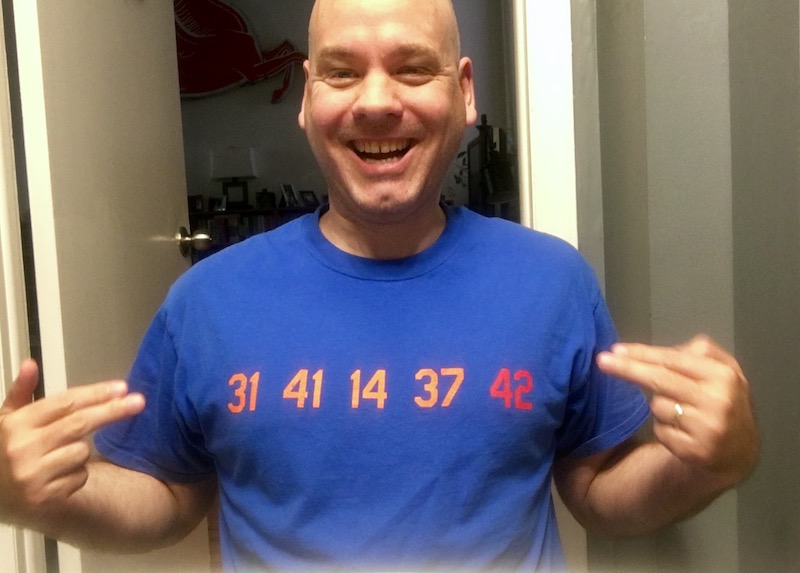
 Some things are improving, however. We’re excited to announce the return of our retired-numbers shirt, now upgraded with Mike Piazza’s No. 31, the sequence you’ll see if you look up at Citi Field, and a more accurate font. You can pick up a men’s shirt from T-Shirt Mojo, our supplier, right here for $24.08 — they take care of everything from the production to the shipping. We’re also finally meeting a longstanding request and offering the numbers shirt in a women’s style — same price, also from T-Shirt Mojo. (If we run out of either, don’t worry — we’ll order more.) Some things are improving, however. We’re excited to announce the return of our retired-numbers shirt, now upgraded with Mike Piazza’s No. 31, the sequence you’ll see if you look up at Citi Field, and a more accurate font. You can pick up a men’s shirt from T-Shirt Mojo, our supplier, right here for $24.08 — they take care of everything from the production to the shipping. We’re also finally meeting a longstanding request and offering the numbers shirt in a women’s style — same price, also from T-Shirt Mojo. (If we run out of either, don’t worry — we’ll order more.)
That’s what the men’s shirt looks like, modeled by yours truly. If it looks that good on an old bald wreck of a human being, just think how sharp it will look on an actually attractive person such as yourself.
Anyway, we hope you’ll be interested in upgrading your old Faith and Fear shirt or grabbing yourself a new, up-to-date one. Either way, thank you — we’re not making a fortune on these, but they will help defray our escalating server costs.
As for the Mets themselves, they’re beyond our help, sartorial or otherwise. But here’s to new players, new seasons, new hope … and one day new numbers to wear proudly across our chests.
by Jason Fry on 4 August 2017 8:42 am It’s an inadvertent law of roster construction that every team have one reliever whose niche — the one assigned to him by the baseball deities, as opposed to envisioned for him by management — is to be the guy in the aluminum suit who stands on the roof during lightning storms.
You know him. He’s Rich Rodriguez or Mike Maddux, Barry Manuel or Felix Heredia, Manny Acosta or Ramon Ramirez. He can be a young, promising reliever who’s so far failed to thrive, a veteran who’s tumbled off a cliff no one thought to mark, or (occasionally) one of those Plan D guys who keeps stubbornly hanging around other teams’ Triple-A squads before your team inexplicably takes a flier on him. (Oh, he’s most definitely Neil Ramirez.)
Good teams are often good despite being unable to shake an aluminum-suit guy, whom you only see in games that sane fans turned off half an hour ago. Bad teams have aluminum suits to spare.
The Mets, it must be said at this point, have Hansel Robles.
Robles wasn’t always the sadsack yelling into his phone that IT’S GETTING DANGEROUS UP HERE BOSS. He was reasonably competent in 2015 and 2016, with a certain pissiness that most of the time we weren’t opposed to. This year, though, has been an unmitigated disaster, one that’s sent him tumbling down the trustworthiness ranks until the mere sight of him leaves you braced for impact.
Robles has already achieved immortality in the 2017 anti-highlight reel for pointing jauntily skyward on a ball hit by St. Louis’s Tommy Pham as if he’d induced a pop fly, which was correct if balls landing in the Azores can be counted as pop flies. But on Thursday afternoon he amazed even himself.
Before then, the Mets and Rockies had played a reasonably entertaining game that avoided the Coors Field script, with the Rockies taking a narrow lead, the Mets fighting back to tie and the Rockies immediately reclaiming that narrow lead. Watching the Mets lunge for this perpetually just-out-of-reach carrot, I had a bad feeling that things would end with a box propped on a forked stick, cartoon-style.
But things are only post-ordained in baseball. We all say “WE KNEW IT!” once the story is concluded, but we don’t — we just sift memory accordingly. Until that point, we had Rafael Montero to wonder about, once again pitching just well enough to make you think the Mets totally shouldn’t give up on him despite his long history of seeing give-up-onable, which isn’t a word but no one reading this is confused about what I mean. You had Amed Rosario continuing to look like what he is, which is a promising but very young rookie — in Column A we’ll place a stand-up triple and a nifty relay throw, and in Column B we’ll place some overly aggressive, over-and-out at-bats. You had Yoenis Cespedes connecting for a classically Cespedian lightning bolt of a home run, but also coming up conspicuously empty in big at-bats and looking a bit lackadaisical in the outfield, a failing that must also be called Cespedian.
And then you had Robles.
When he arrived to handle the bottom of the 8th in a 4-4 game, I offered him a snarky Twitter greeting and then watched with the grimly blank expression one generally brings to a performance by an elementary-school orchestra. So of course Robles turned in an eight-pitch inning.
Wow! Didn’t I feel bad!
Well, not really. Among the (minor) perils of prophecy is being correct but early. Robles started the ninth by hitting Jonathan Lucroy on a 1-2 pitch, was handed an out on a sacrifice, walked Charlie Blackmon intentionally (for which brief duty Blackmon reported, amusingly, without a bat), walked D.J. LeMahieu unintentionally, and stared in at Nolan Arenado.
(Oh, and somewhere in there Robles appeared to tweak his groin, though it turned out after the game he’d merely done something awkward and had male parts wind up in their own way. The proprietors apologize for the kind of clunky foreshadowing an editor with greater authority might have seen to.)
Arenado beat Robles in much the same situation on Tuesday, and if you expected a different outcome two days later I’d like to know how you maintain a sunny outlook on life. This time Robles couldn’t find the plate at all — balls were sailing all over the place, leaving you worried about not just the final score of the game but also Arenado’s safety.
(We’ll step out of time again to report that after the game Robles said his fingers had gone numb during the Lucroy at-bat. That’s no laughing matter — it can be a precursor to surgery — but I’ll confess my reservoirs of instinctive sympathy are pretty much tapped. First of all, even without baseball’s macho omerta, isn’t that the kind of thing you should tell the trainer while he’s standing two feet from you inquiring about your health? Beyond that, I admit the 2017 Mets one-more-damn-thinged me into submission sometime in early June.)
The final pitch was extraordinary even by Mets standards — it sailed over Arenado, Travis d’Arnaud, Jim Reynolds and everybody except Dinger. (Which wouldn’t have been the worst way to lose a game.) The ballgame was as over as a ballgame gets, that had happened, and Hansel Robles had contributed a new one to the aluminum-suit-guy annals.
|
|