The blog for Mets fans
who like to read
ABOUT US

Faith and Fear in Flushing made its debut on Feb. 16, 2005, the brainchild of two longtime friends and lifelong Met fans.
Greg Prince discovered the Mets when he was 6, during the magical summer of 1969. He is a Long Island-based writer, editor and communications consultant. Contact him here.
Jason Fry is a Brooklyn writer whose first memories include his mom leaping up and down cheering for Rusty Staub. Check out his other writing here.
Got something to say? Leave a comment, or email us at faithandfear@gmail.com. (Sorry, but we have no interest in ads, sponsored content or guest posts.)
Need our RSS feed? It's here.
Visit our Facebook page, or drop by the personal pages for Greg and Jason.
Or follow us on Twitter: Here's Greg, and here's Jason.
|
by Greg Prince on 11 May 2024 6:12 am Good call Friday night wearing the reimagined (apparently during a bout of gloom) black jerseys in which the Mets wordmark, the player name and the numbers on the front and back sink forlornly into the fabric as if they followed Carole King’s example of staying in bed all morning just to pass the time. The rain was an apt touch as well.
The Mets started their game late, fell behind fairly early and feinted toward catching up late, only to fall to their ostensible archrivals from Atlanta. Competitively, the Braves play in a different league, but the last time we vied for anything of substance, we vied with them. So humor us.
Jose Quintana had one bad inning, the third, but one bad inning is all it takes when it consists of giving up three home runs in a span of four batters, with a walk thrown in between dingers two and three. That’ll bury a team that can’t do anything against Charlie Morton. Morton went seven, sullied only by a solo blast off the stylish bat of Francisco Lindor in the seventh. At that point, it was 4-1. A rally-like series of plate appearances, highlighted by a ball struck by J.D. Martinez that for half-a-second appeared to be going out but sailed foul instead, made the final 4-2. Spiritually, it was mostly a shutout.
Quintana did correct himself in the fourth and fifth, and there was representative bullpen work from unusual suspects — Recidivist reliever Yohan Ramirez, doing his best Michael Tonkin impression, and recast starter Adrian Houser. There was Pete Alonso maintaining his newfound ability to make contact and reach base as a result. There was Brett Baty diving and tumbling over a rolled-up tarp to catch a foul pop, shaken in the process and pinch-hit for shortly after, but reportedly unharmed by the encounter with some padding by the third base railing.
Mostly there was dampness, defeat and those dreadful black jerseys, suitable for mourning. The Mets, in conjunction with Nike, Fanatics and Grim Rob Manfred, removed the white outline that made the alternate tops comparatively cheerful in both their original incarnation and their reboot a few years ago. This version resembles those knockoffs at your local Bob’s Stores you’d buy in the late ’90s because they said Mets and it was close enough. Soon the Mets will be wearing the unlicensed Bugs Bunny in sunglasses t-shirts that spring up for sale on Opening Day in the parking lot, except they’ll be licensed and expensive.
Today, current avatar of hope Christian Scott will make his Citi Field debut. On the first occasion he was a major leaguer in his home park, he suited up in black. On the mound, he will wear dark gray and “NYC” across his chest. If he hangs in there, maybe someday he’ll get to dress like a Met.
by Jason Fry on 8 May 2024 12:39 am Baseball makes no sense.
Just ask the Mets, who went into the second inning at Busch Stadium Tuesday night down 3-0 to the Cardinals, as Jose Butto couldn’t command his fastball and St. Louis was whacking his pitches all over the ballpark. It sure looked like Monday night’s relatively streamlined, professional win was the exception to the recent rule and the Mets were once again mired in the frustrations that dominated the Tampa Bay series.
So of course the Mets went ham in the top of the fifth. Jeff McNeil led off with a little soft single that Nolan Arenado couldn’t convert into an out despite that being pretty much what Arenado does. Tomas Nido singled and Brandon Nimmo unloaded, tomahawking a Miles Mikolas slider into the stands to tie the game. And the Mets weren’t done: Starling Marte doubled, Francisco Lindor singled, and Pete Alonso sent a double the opposite way for a two-run lead. Yes, the same Alonso who spent three days at the Trop looking like a boy who’d lost his puppy and so was benched for his sanity once the Mets arrived in Missouri. A J.D. Martinez single brought in one more run and the Mets somehow led 6-3. It was one of those exhalation innings that teams and tortured fanbases both need every now and then – an explosion that erases a long track record of frustration and leaves everything thinking, “Oh, so this is what it’s like to actually breathe – I’ve missed this.”
The Mets made defensive changes in the bottom of the fifth, primarily getting poor DJ Stewart out of left before some horrific pratfall put him on the IL. That was wise but also a reminder that there was a lot of ballgame to go, and ample time for things to go wrong.
Said things went wrong when Sean Reid-Foley got in trouble in the seventh and Jose Lopez arrived with two on, one out and the tying run on first. Lopez immediately yielded a single to Ivan Herrera, who’d come in when Martinez’s backswing broke Willson Contreras’ forearm on a gruesome case of catcher’s interference. Bases loaded, Arenado and Paul Goldschmidt coming to the plate, and once again nobody with Mets rooting interests could get enough air.
But remember our thesis: Baseball makes no sense. Lopez left a sinker up in the zone to Arenado, who fouled it back and then popped out. He then left a slider up in the zone to Goldschmidt, who fouled it back and then struck out. I was simultaneously relieved and pretty sure I didn’t want to know how many alternate universes featured Arenado and/or Goldschmidt not missing those pitches.
In the ninth, Alonso took MLB newcomer Chris Roycroft deep: reassurance for the suddenly doubt-stricken Polar Bear, insurance for the Mets. SNY had a good time showing Roycroft’s family in the stands: They were gleeful when Roycroft struck out Francisco Lindor, then turned philosophical when the Alonso AB had a different conclusion. That endeared them to me, despite the ample Cardinal red and baby blue on display: Every pitcher winds up turning around in dismay after the occasional pitch that didn’t do what it should have, and while that was Roycroft’s first such pitch in the big leagues, it won’t be his last. His cheering section were also baseball lifers, and they knew this perfectly well.
Anyway, it was 7-4, but the question was how the Mets were going to secure three highly necessary remaining outs with no properly rested, reliable relievers. (Oh wait, there was Adrian Houser, ha ha ha.) Carlos Mendoza opted for Adam Ottavino, whose recent workload was more than 50 pitches, and it was buckle-up time.
Ottavino retired Brendan Donovan, but Lars Nootbar homered, Herrera singled and Arenado walked on four pitches.
The bad news about Ottavino was he was a) obviously gassed and b) therefore stuck with a disobedient sweeper. The good news about Ottavino is that he may or may not get beaten but I’ve never seen him panic: He goes about his business with an Eeyore-like affect and a certain existential heaviness that comes from knowing the universe has already decided the outcome and he’s just along for the ride.
Fortunately for Ottavino and for us, Goldschmidt was the next hitter and he’s lost in the same nightmare that has been plaguing Alonso, a deep slump that leaves a hitter feeling like he might as well be playing blindfolded. Ottavino threw two sinkers more or less down the middle, almost erased Goldschmidt on a third that sat just wide, gave him something to think about with a changeup, and then threw a fastball that Goldschmidt couldn’t have hit with an oar. He tried anyway and missed.
That left Alec Burleson, who hung in there as Ottavino sent everything but a bunch of balled-up hot dog wrappers and the kitchen sink his way, hoping some offering – any offering – would yield an out and let Ottavino go collapse in a dark room until Friday. The fifth pitch was a sinker up and away at the top of the zone; Burleson’s bat ticked it backwards, it found Nido’s mitt and went no farther, and the Mets had won.
Won using the usual blueprint, of course: Starter gets clobbered, team that can’t hit ambushes opponent, slugger lost in the weeds staggers out of them blinking and amazed, reliever goes unpunished for throwing two hangers, exhausted reliever finds just enough in himself to push the car into the service station.
What do you mean that’s not the usual blueprint? Hey, take it up with the powers that be — I already told you baseball makes no sense.
by Greg Prince on 7 May 2024 9:40 am After a weekend when the Mets sought out and discovered multiple ways to lose in St. Petersburg, it was a pleasant change of pace to watch them figure out how to win one in St. Louis.
They sat Pete Alonso. Given the Polar Bear’s roughly 2-for-a-thousand slump, they kind of had to.
They inserted DJ Stewart in Alonso’s stead, and though Stewart is not a first baseman, he played first base without incident and knocked in the night’s first run, in the first inning.
They stuck Jeff McNeil in left field, one of the positions he used to fill with a flourish, and he made a trademark Flying Squirrel catch.
They had Tomás Nido collecting two hits, bunting a runner over once and not getting stolen on.
They generated two runs in the fifth as one imagines the Gashouse Gang might have in the same town ninety years ago, minus dust or fuss: a single; a single; taking advantage of an outfield error on the second single to grab another ninety feet apiece; a run-scoring groundout to the right side that drove the lead runner home and moved up the trail runner as well; a sacrifice fly to bring home the second of two runs and build a 3-0 lead.
They relied on Sean Manaea for six innings. The first five yielded zeroes. The sixth ended tied on three runs scored, but gosh it was nice to see only one walk. No wonder it was the kind of start labeled quality.
They took back the edge as soon as Brandon Nimmo came up in the seventh. Nimmo has mostly walked and gotten hit when not batting in tough luck in 2024. The clubhouse’s elder statesMet is still capable of getting hold of one and nobody getting hold of it. When he did on Monday, the ball he whacked didn’t stick around and the visitors were up, 4-3.
They slipped Alonso back in for defense as the evening progressed (with Stewart moving to left, McNeil to second and Joey Wendle to towel off early), which was a heady maneuver, both because Pete has played lots of first base and he shouldn’t sit and stew over his hitting for too long.
They deployed a bullpen that’s earned plaudits and was ready to deliver results. Jake Diekman gave up an isolated double, Adam Ottavino just one single, and Edwin Diaz nothing at all.
The closer had a save. The starter had a win. The team was victorious. It’s been known to happen. It just did.
by Jason Fry on 6 May 2024 8:35 am I don’t know if therapy rays are actually a thing (they probably are), but I’ve been to Tropicana Field, which has the affect of the world’s largest basement rec room and smells vaguely like pool cleaner, and the most interesting part of the stadium is the oft-shown pool where cownose rays swim around in a circle. You can reach in and pet the rays, and while I doubt it’s a fulfilling experience for them — this classic Onion bit comes to mind — I found it mildly diverting.
Not mildly diverting? Sunday’s Mets-Rays matinee at the Trop — or, for that matter, the entire series. Or for that matter, the Mets going to the Trop at all — I believe Gary Cohen said the Mets are winless in St. Petersburg since the reign of Elizabeth I. Sunday’s game brought to mind Wes Westrum and his go-to postgame comment: “Oh my God, wasn’t that awful?” You could see the disaster brewing early on, and when it arrived it still managed to be horrible, and now I never want to think about it again.
The Mets jumped out to an instant 2-0 lead on a Francisco Lindor homer — Lindor, at least, looks like he’s shaken off his woes at bat — but Luis Severino, like Jose Quintana before him, followed up a terrific game with a clunker, walking the ballpark. The teams went back and forth, exchanging leads or perhaps indicating they didn’t deserve them — the Rays are lucky they faced the Mets in one of their valleys, as the home team played both lethargically and dopily this weekend. Mets pitchers seemed studiously uninterested in looking runners back to their bases or even admitting they existed, letting basestealers run wild — at one point Lindor spoke for us all when he smashed his glove into the ground repeatedly in teeth-grinding annoyance. Pete Alonso looks absolutely lost at the plate, which because baseball is cruel of course meant he kept getting handed bases-loaded situations where he looked helpless. Even Brett Baty suffered, coming off his best defensive game with one where you could see him thinking again in the field, something Baty should never be doing.
But perhaps we should save the biggest concern for Edwin Diaz. Diaz arrived for the ninth to protect a 5-4 lead and started off his day by throwing sliders: He threw 13 in a row, in fact. Which was sufficient to retire Richie Palacios and Isaac Paredes, but the Lucky 13th slider was a 3-2 pitch to Randy Arozarena that got too much plate, and which Arozarena clobbered into the stands. (After the game, Arozarena said he was looking for another slider. Gee, you think?) Diaz’s post-layoff fastball velocity is down, but the slider has also lacked that extra little bit of bite it needs, and it’s officially a problem.
Farce followed tragedy, as it does. The Mets got a 10th inning reprieve from the baseball governor when a crew-chief review revealed Brandon Nimmo had crossed first base as Yandy Diaz was letting a ball that looked like it was in his glove bounce on the ground, turning the third out of the inning into a momentary Mets lead. But we all knew it was not to last, not with the pitchers opting for nonviolent resistance in combatting enemy basestealing. With runners on first and third and nobody out Jonny DeLuca lofted a ball to center, where Harrison Bader decided it was best not to prolong everyone’s misery and so dove for a ball when he should have stayed on his feet. He missed it by at least the length of a cownose ray and the pain was over, or at least it was for another day.
by Greg Prince on 5 May 2024 1:31 am A dozen or so decades ago, the toast of New York National League baseball was a teetotaler projecting such a wholesome image, he was occasionally referred to in the press as the Christian Gentleman, though more readily as Matty or perhaps Big Six. Mostly, he was recognized as the indisputable ace of the Giants. His Hall of Fame plaque identifies him as Christy Mathewson, “greatest of all the great pitchers in the 20th century’s first quarter”. If your current New York National League franchise is winding down the first quarter of the next century by promoting a pitcher who puts a person in mind of Christy Mathewson, even a tiny little bit, it could be doing something right.
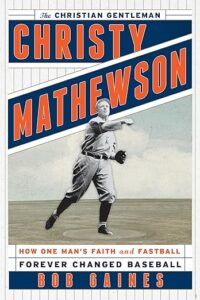 Too soon? Granted, the link at this moment is no more than name deep. John McGraw deployed the Christian Gentleman? Carlos Mendoza had at his disposal Saturday night Christian Scott. They both pitch for NY in the NL, both use their right arm, and to suggest any further similarities, a lot of staying power will be required by the current model. Christy Mathewson won 373 games. Christian Scott has one no-decision.
Still, this young gentleman Christian…I couldn’t help but notice the glove he wore during his first major league start had “Psalm 118:14” imprinted upon it. For those scoring at home, “The Lord is my strength and my defense; he has become my salvation,” or words to that effect, is the text of said Psalm, per what I will assume are informed sources I looked up online. The only so-called Bible I ever read with any regularity was the Bible of Baseball, a.k.a. the Sporting News, and by then, it covered other sports.
You have a brand new pitcher, one you’ve heard so much good about in a fairly short span, one you weren’t expecting to descend from the heavens/ascend from the minors so soon, you get curious about the kid. Unusual first name for a Met. Unusual inscription on his glove. Poise I can’t say I’ve seen in ages. The kid didn’t just appear to handle his assignment professionally. He looked like he was having fun out there, especially the way he made the strike zone his plaything. I know I was having fun watching him.
The first few batters Scott faced in St. Petersburg indicated a different story might unfold. Three consecutive hits, one run in, a Rays threat clear enough that it could be discerned on the back of their otherwise illegible jerseys. You didn’t need a scorecard to recognize Randy Arozarena coming up with runners on first and third and nobody out. The Mets’ early 1-0 advantage had already been thrown back into the water, and now their phenom was in danger of being filleted.
Eight pitches later, it was Arozarena who was gutted, striking out on a full-count four-seamer. A slider and double play grounder followed immediately thereafter. Onward Christian Scott! The neophyte succeeding as might a veteran spurred me to recall what Leo McGarry advised Jed Bartlet in the Book of Sorkin 2:1 (the first episode of the second season of The West Wing, that is):
“Act as if ye have faith and faith shall be given to you. Put it another way, fake it ’til you make it. You did good tonight.”
Escaping the first inning with limited damage was a great night’s work for your average 24-year-old whose previous experience in MLB was bupkis. But Scott, doing right by Zack Wheeler’s heretofore hard-to-fill 45, kept doing good. Inning after inning, the Rays didn’t touch Scott, much to the delight of his personal cheering section and vocal pockets of visiting New Yorkers at Tropicana Field. Unfortunately, Met batters treated Scott’s opposite number Zack Littell with disturbing reverence (or maybe the Rays’ starter was inspired by his own family in attendance). A pitching duel ensued, the kind in which Met hurlers seem to engage with regularity, either because we have great pitching and other teams have great pitching, or, you know, we spend too many nights not hitting. A team that scored seven in victory on Thursday and eight in defeat on Friday is certainly capable of generating offense. Let’s say Littell and Scott were equal to their respective tasks Saturday and leave getting hung up on our rampant scorelessness for another day.
Let’s also say Scott being a kid who comes to the majors and goes six-and-two-thirds giving up just that first-inning run and leaving only one baserunner behind for Reed Garrett to brush aside provides an incredible boost, even on an evening when the final score didn’t work out. Adam Ottavino competed like crazy in the eighth (with Adam Amin and Adam Wainwright on FOX offering narration worthy of October), but despite a genuinely Ordoñezesque 6-2 putout on Francisco Lindor’s part exemplifying strength and defense if not salvation, Otto couldn’t quite squirm out of his imperfect control. The Rays plated two runs on consecutive bases-loaded walks, the second of them issued by Sean Reid-Foley. The Mets were behind, 3-1, heading to the ninth, and against the Rays’ pen — or a Bic pen — that loomed as an insurmountable margin.
But between you and me, for one night, so what? The Mets’ top pitching prospect, who burst both into our collective consciousness and then onto the active roster faster than I can remember any top Met pitching prospect doing (don’t we usually have to devote a few months to wondering what’s taking so long to bring up the next savior?) pitched like he belonged at this level, pitched like you wanted to immediately calculate when his next start will be. Not too many pitchers look that good straight out of the box. Too many pitchers don’t look this good after years on the job. Such a performance should be a prime cause for faith among we who are practicing Metsopotamians. Seaver. Gooden. deGrom. We built this city on strikes and outs.
There’s no time like the present to embrace a future that rushes to meet you with such enthusiasm. This may very well be the time of Christian Scott. Who knew it would arrive so soon?
by Jason Fry on 3 May 2024 10:57 pm Jose Quintana reported for work without any of the essentials, got bombed, and the Mets fought back gallantly but it wasn’t enough, the end.
That would suffice for a bite-sized recap, I suppose — this felt like one of the 50 or 60 or however many it is games that you’re guaranteed to lose, with the only asterisk being that the Mets scored a bunch of runs.
The rest? I had trouble coming to any firm conclusions, not that any baseball fan with any sense should draw even mushy conclusions from a single game.
Quintana was bad; the last time we saw in him on a mound he was good as he’s ever been as a Met. So we’ll let that one slide as the kind of nightmare that afflicts every pitcher now and again. He’s no Adrian Houser, who at least for the moment has been demoted to member of the bullpen. Hopefully the Mets can get Houser straightened out to the point that we’re tempted to speak well of him; even as we’re praising Jose Butto and starry-eyed over Christian Scott despite his never having thrown a big-league pitch (or because of that fact), the Mets are going to need Houser to get anywhere this year. Just like they’ll need Tylor Megill, and David Peterson, and probably Joey Lucchesi and a bunch of others.
Brett Baty keeps growing. The prospect turned suspect turned something else hit a pair of home runs, the first of which vanished from view to land on a catwalk or vanish into a wormhole or who knows what, and made a couple of sparkling defensive plays, continuing to look sure-handed and aggressive in the field. Even if the Mets wind up without October plans, the Mets may look back on 2024 as a successful season if it’s a pivot point for Baty and his running buddy Francisco Alvarez, one that turns them into dependable big-league regulars. Which raises the question of why the Mets didn’t go for the trifecta and give Mark Vientos a full season to prove himself, but that’s an argument for another recap.
Starling Marte is such a curious player. The Mets’ mini-renaissance fizzled out when Marte broke his hand in late 2022, robbing them of not just a valuable bat but also a certain measure of intensity, and it’s been immensely reassuring to see him looking mostly like his old self again. That said, Marte is confounding in the moment. He can look so hopeless that you catch yourself wondering if he’s trying (he is, they all are, stop that), like he did in the final plate appearance against Tampa Bay, and then he’ll look locked in and deadly the next time up. Francisco Lindor is the same way, though even when slumping Lindor is clearly the captain of the infield and you can see his intensity in that regard, while Marte’s easy to miss out there in right field. It’s a curious case of perception, and baggage we bring with us, and I don’t have more to say about it at the moment except that I keep thinking about it.
The Rays’ City Connect uniforms have the same problem ours do — the designers appear not to have viewed them from a distance. The top of the ray on the hat is the Sunshine Skyway bridge, which I know very well as it was framed by my bedroom window when I was a teenager, yet that fun little detail is invisible unless the camera’s so zoomed in that all you’re looking at is the hat. The uniform has splashes of neon color, yet the numbers are dark voids. Seriously, why didn’t anyone stop the proceedings and say, “Hmm, maybe we should see how this design reads from the upper deck?”
There’s one difference, though: The Rays have won in their new alts, while the Mets have yet to. Grrr.
by Greg Prince on 2 May 2024 5:39 pm Francisco Lindor didn’t start Thursday afternoon’s game, much as he didn’t finish Wednesday night’s. He was said to be suffering from flulike symptoms. As someone who’s been enduring some of those myself, I can relate. I don’t have a Joey Wendle standing by to fill in for me, however. Wendle was an All-Star as recently as 2021, Lindor not since 2019. Without knowing anything else about their respective skill sets, you’d have to say shortstop was in good hands despite Francisco’s absence.
We know anything else. We know Wendle is…not an optimal infielder for nine innings this week, maybe not for any innings. Wendle had a rough defensive series, including on Thursday when he didn’t get what appeared to be a fairly routine forceout accomplished. It wasn’t as egregious as the double play attempt he made when a throw home was in order the other night, but it didn’t help. Wendle’s also had a rough offensive year. That doesn’t leave a whole lot of room for much else. The Mets must have seen something in Wendle in the offseason, something that still sparkled from that golden summer of 2021 when Joey was an apple of some American League decisionmaker’s eye.
Carlos Mendoza saw him and looked for a way to get Lindor in the game as soon as possible, congestion, coughing and runny nose notwithstanding. The usual starter replaced the caddy in the sixth inning, and not a sneeze too soon. The Mets had two runners on and trailed by three. If Lindor could stand, he could pinch-hit. He did and he doubled. The Mets, dressed as Mets for a change, were back in a game that seemed out of their grasp early — a nice way of saying Adrian Houser started — yet never got away. The Mets were down, 4-0 in the fifth when Brandon Nimmo and Starling Marte each singled in runs. The Cubs, who I’m as sick of as I am sick in general (how are four-game series considered short in the postseason when they are so endless in the regular season?), snuck one more onto the scoreboard. Enough with their catlike third baseman and their center fielder who touches bases with his batting helmet and their catchers who are immune to plate-blocking regulations. Enough with the pitcher who thinks New York is the place where Spider-Man lives.
Then along came Lindor, readied by the trainers and intestinal fortitude and whatever it took. Or maybe it was such a nice day he insisted on coming out to play. Whatever. Francisco, despite not having been chosen as an All-Star in this decade the way Joey’s been, was the upgrade needed in the sixth…and the eleventh.
In between, there was Nimmo tying the game by driving in Lindor rather than letting him come down with a chill from being left on base; there were familiar Met relievers — Jake Diekman, Reed Garrett, Edwin Diaz (2 IP!) — holding the fort; there was an unfamiliar Met reliever — Danny Young — doing his best; and there were a pair of 9-2 putouts, Marte to Omar Narváez, one that extinguished a rally in the tenth, the other that kept another, in the eleventh, from raging out of control. The Cubs had already taken a 6-5 lead, but if we’ve learned anything from how extras operate in the Rob Manfred Dystopia, it’s that one run is often the new no runs after nine.
Mendoza wanted this game enough to use Diaz for two frames for the first time since his return to health, to use Lindor when maybe Lindor could have used a day in bed, to use a pinch-runner, even. The Mets hadn’t pinch-run since the seventh game of the season, when Zack Short, now with the Red Sox, was our go-to pair of feet. Tyrone Taylor running for J.D. Martinez as the ghost in the tenth didn’t lead anywhere, but it certainly indicated an awareness that losing three out of four loomed as unacceptable…just as calling up top pitching prospect Christian Scott for Saturday to stretch out the rotation, give Luis Severino an extra day, and maybe find a path away from Houser’s every-fifth-day carousel of runners says something positive about priorities.
It all sounds great when it all works out. In the bottom of the eleventh, Brett Baty was abra-ca-dabra’d to second; Harrison Bader was HBP’d; and Lindor, flulike symptoms and all, did some slashing down the left field line. Here came the tying run, here came the winning run, here came the ice water pouring onto the sick guy. We’ll assume that was a gesture of celebratory affection rather than wishing Francisco into the CVS.
by Jason Fry on 1 May 2024 11:59 pm Pete was actually out, and no, Miguel Amaya wasn’t blocking the plate, or at least not sufficiently to arouse the ire of officialdom. And even if he had been blocking the plate, the Buster Posey rule is stupid. Good decision to send Pete — unfortunately Nick Madrigal made a perfect relay throw, and so he was out by an eyelash of a whisper. It happens.
Boy, that was really exciting watching the Mets and Cubs stand around while umpires put hands over their earpieces and waited for other people to look at TV. They’ll be replaying that thrilling finish for years.
On the other hand (or is it the other other hand by now), it was pretty funny that the umpire’s mic stayed hot as Carlos Mendoza lost his mind. I kept waiting for the Terry Collins moment, and while it wasn’t quite Terry showing up in Tom Hallion’s audio with flames shooting out of his ears and 10- and 12-letter profanities filling the air, I cackled when Mendoza’s “that’s bullshit!” went out to all of Citi Field and SNY, because it was inevitable.
The Mets are winless when dressed as chimney sweeps. If this keeps up I’ll start thinking ballplayers should be a little more superstitious.
Jose Butto continues to be superb. I love not only the results but also how emphatic he is on the mound, and it’s difficult to take myself back to my first sight of him, hanging on for dear life against the Phillies, saucer-eyed in an audition he wasn’t ready for. We forget sometimes that young players are still developing and it’s a process that takes time. Butto’s on the other side of that now and it’s really fun to watch what he’s becoming.
Shota Imanaga, dang. A 0.78 ERA over your first six starts will play. Plus I learned he sang “Go Cubs Go!” at his introductory press conference, which is downright adorable.
Brett Baty hasn’t hit much since he tweaked his hamstring, but I’m not concerned: The defense has remained sound (and aggressive, which has clearly helped with the results) and Baty continues to put together solid at-bats, even if he’s not seeing the payoff as often as he (and we) would like.
Ian Happ ought to play the Lotto. There was the Joey Wendle drive that popped out of his mitt in left only to obediently pop back in before he hit the fence (oh what might have been) and about 20 minutes later he plopped a ball just inside the third-base line for what an amused Keith Hernandez called the worst hit he’d ever seen. Hernandez said it with an affection borne of a decade and a half of learning that the line drives get caught and the dunkers fall in, because (wait for it) it’s an unfair game.
When I was a kid, the Cubs were the team I hated — the Braves were an oddball outfit that employed Chief Noc-a-Homa and played in the National League West and so only vaguely mattered. It still strikes me as faintly strange that the Cubs are irregular visitors to my consciousness and I’m supposed to work myself up into a froth about the Braves. (The Phillies are a different story — they were always around but they were never good when we were and so never really in our way.) I’ve mostly accepted that the Cubs’ exit from relevance is the way of the world, but these last three games have kicked up the embers of my mostly dormant snarling about the Cubs as a menace that must be eradicated. Replay-induced standing around aside, all of these games been great: Severino’s triumph to tragedy on Monday, DJ Stewart‘s no-doubt shot on Tuesday, and now a nail-biter that ended with a play at the plate and a magnifying glass required to sort it out. If the Mets and Cubs keep playing thrillers like these, maybe I’ll find myself spitting mad about Ron Santo and Leo Durocher and Ron Cey and Keith Moreland and Rick Sutcliffe all over again.
by Greg Prince on 1 May 2024 10:53 am That DJ Stewart home run in the sixth inning was a thing of beauty. Soaring on a friendly trajectory. Pulled, but easily fair. For all the times fans overreact to any ball in the air, the crowd occasionally gets one that makes its Pavlovian anticipation worthwhile.
Going, going…no doubt about it, it was gone. Stewart had hit a three-run homer up onto Carbonation Ridge, the Mets led the Cubs, 4-1, and if the relievers who followed Sean Reid-Foley — who’d followed five innings of Sean Manaea — could do their job, the rest of the way would be a breeze. One fine frame from Revelatory Reed Garrett, one perfecto from Adam Ottavino, and only a touch of eyewash splattered on Jorge Lopez confirmed Stewart as the main man of Tuesday night. The Mets won, 4-2. Stewart won another day of confidence from all who care about the Mets and, by extension, care about him.
“This is the big leagues,” was part of the slugger’s postgame summation. “You have to earn your opportunities every single day.” Those weren’t clichés being spouted by an athlete feigning humility. This guy is a Met in good standing because he has made himself one and keeps making himself one.
We care about DJ Stewart mainly because he occasionally hits home runs like the one he bopped off Adbert Alzolay. He hit them in a bulging bunch last August. This April, he spread four throughout the season’s first month. Evidence suggests he has a stroke built for Citi Field. Stewart’s sent nine balls rocketing out of what’s become his home park since arriving as a Met last July.
How much at home can a player with a big, shiny option sitting in his contractual status feel, though? DJ was the cult hero of the second half of a Met season for which there wasn’t much of a cult, roughly allegorical in 2023 to what Benny Agbayani was in 1999, except 1999 had stakes that piled as high as Shea’s Upper Deck, and by the time Stewart poured his version of Hawaiian Punch last year (the dude’s from Florida), it seemed to matter little what the Mets did or didn’t do. No way Stewart couldn’t have impressed his manager and general manager as the season wound down, but if Buck Showalter and Billy Eppler loomed as his champions, DJ could only hope they left nice notes on his behalf for Carlos Mendoza and David Stearns.
In 2024, Stewart might as well have been a blank slate to the new brain trust, and he was treated as such in Spring Training. Who are you and what are you to us? Stewart didn’t light up St. Lucie and barely made the team, reminded on his way north that it might be a short-term arrangement. Had J.D. Martinez been healthy, chances are it would have been reintroduced to Syracuse.
When the Mets opened their 2000 season in Japan, Agbayani had about as much rope available to him as Stewart did 24 years later. The roster was in flux, and what Benny did the year prior to the century’s turn was history. “After being a major contributor to the team the year before,” he wrote with Shayne Fujii in Big League Survivor, “it wasn’t much fun being the forgotten man on the bench.” He could come along to Tokyo, but it didn’t mean he should plan to stay at Shea. Even in those days, minor league options like the one attached to Agbayani gave general managers a rush of adrenaline. Still, as the Mets battled the Cubs approximately a million time zones from New York, Benny whacked a decisive extra-inning pinch-hit grand slam and began to cement his status as someone who looked better in a Mets rather than a Tides uniform. Injuries to a couple of teammates didn’t hurt Agbayani’s cause, either. Players considered on the fringe will take all the breaks they can get. Benny and the Mets stayed together for all of 2000, right through the World Series.
It’s only May, but Stewart is still here, and at least once, he’s been the undisputed star of a game. Roots get put down slowly until, suddenly, you’re part of the team permanently, or as permanently as an option will allow. Hitting has a lot to do with permanence.
Listening to DJ answer reporters’ questions Tuesday night, two of his responses caught my attention. One was that he said he holds himself to a high standard, “higher than a lot of people”. I don’t think he meant the standards he holds himself to are higher than those an Alonso or a Lindor have set for themselves. Rather, he doesn’t perceive many expect much out of a Stewart. Good for him exceeding such expectations.
The other answer encompassed a retracing of his steps since being told he couldn’t be guaranteed as permanent a role as would have liked. After acknowledging that J.D. Martinez makes the team “way better,” he added, “but I think I can do that as well in the situations and times I get opportunities,” and elaborated that it had been “very difficult just not knowing” where he and his loved ones were going to be spending their summer. “That’s the biggest thing, obviously.” If he was “frustrated,” it was from “wanting to know where my family’s going to be”.
Last season, amid his home run tear, DJ identified his daughter as a motivation for keeping him swinging through callups and send-downs: “I have a little girl, and diapers aren’t cheap.” He laughed when he said it, but it was a reminder, just as what he said Tuesday night was, that ballplayers are people, too, especially ballplayers who live their lives on the edge of the transactions column. If DJ Stewart isn’t hitting home runs for the New York Mets, I’m not as invested in his everyday problems and his internal struggles. But here he is, going deep now and then, and sounding like somebody I’m glad to know is getting something out of hanging in there.
A new episode of National League Town is out now.
by Jason Fry on 29 April 2024 11:41 pm I know you don’t want to hear it right now, but that was a great game.
It zipped along taut and tense, it featured a great pitchers’ duel and a brush with history, it turned on a player’s split-second decision, and it ended with a crushing reversal of fortune. If you were in the park — and I was — you got your money’s worth, even if the outcome wasn’t what you desired. It ought to say that on the back of the ticket: DESIRED OUTCOME NOT GUARANTEED.
Luis Severino does not get tossed on the pyre with the other feckless nibblers in the Mets’ rotation. He was aggressive and confident as he stalked history, taking a no-hitter to the 8th with enough gas in the tank to get there. That was drama enough, but the Mets were also clinging to a 1-0 lead, with the one courtesy of a leadoff Brandon Nimmo homer off the Cubs’ Jameson Taillon, who was almost as good as Severino and even more efficient. Losing the no-hitter wouldn’t just thwart Severino’s quest for a place in the history books; it would also threaten to turn the game around.
And that’s what happened, over two excruciating innings. Leading off the eighth, Severino walked Michael Busch on seven pitches, a couple of which didn’t go his way. He lost the no-hitter when Dansby Swanson served a single over the infield, moving Busch to second. Swanson was erased on what became a fielder’s choice, with batter Matt Mervis and Severino getting tangled up at first. First and third, one out, and the game in the balance.
I was horrified at the idea of facing Yan Gomes, who’s ruined things before for the Mets, and was actually relieved when Craig Counsell sent up Nick Madrigal instead. Severino’s third pitch to Madrigal broke his bat and came off said disassembling lumber at 49 MPH. It went to Joey Wendle, brought in as Mark Vientos‘s defensive replacement at third. To reiterate, 49 MPH exit velo, broken bat. Wendle had Busch dead to rights at home but decided to try and go around the horn for a double play. It didn’t work and the Cubs had tied it.
Even up in the 300 level, a fair distance from the field, there was muttering and sidelong looks and hands thrown skyward. A couple of hours later, here at my desk on recap duty, I just completed another round of muttering and sidelong looks and hands thrown skyward. Wendle is on the roster to play defense; if he’s going to make mental errors doing that … nope, I’ve got nothing. Luis Guillorme may have stopped hitting and apparently did something to wear out his welcome here, but he would have gone home 1,000 times out of 1,000.
Anyway. Wendle made a bad decision and the Cubs had tied it. Nimmo nearly restored order with a long fly to left off Mark Leiter Jr., but came up short. In the ninth, Edwin Diaz reported for duty and was once again not himself, which has to be at least cause for concern. Diaz’s fastball has been down a crucial couple of ticks and his slider has been spotty. Facing Christopher Morel with a runner on, Diaz got screwed on an 0-1 call that was a strike but was called a ball. That turned the at-bat; Morel worked the count to 3-1, got a fastball that sat in the middle of the plate (can’t pin that one on the ump) and hit it to Mars, turning a shocked Citi Field into Wrigley East as thousands of heretofore quiet Cubs fans began making racket like baseball-fan cicadas.
And you know what? As they should have. If you go from “oh God, we’re going to get no-hit” to “we took Edwin Diaz deep and we’re going to win,” you should make as much noise as you possibly can. You should jump around, wear a popcorn bucket on your head and scream WOOO till your vision goes blurry. Because baseball is cruel and games like that don’t come around very often.
Which leads me to an odd postscript: The Cubs have done this before to the Mets. In September 1975 Tom Seaver dueled with Rick Reuschel at a nearly empty Wrigley Field: Both pitchers worked into the ninth without allowing a run, Seaver without allowing a hit. With two outs, Seaver surrendered a single to right on an 0-2 pitch to Joe Wallis; the Mets lost in the 12th on a Skip Lockwood bases-loaded walk.
The Joe Wallis game. I knew about it, but only by that bit of shorthand — one of Seaver’s maddening near-misses in search of the first-ever Mets no-hitter. I didn’t know the rest of the story until I looked it up just now.
I bet that one hurt too.
|
|






