The blog for Mets fans
who like to read
ABOUT US

Faith and Fear in Flushing made its debut on Feb. 16, 2005, the brainchild of two longtime friends and lifelong Met fans.
Greg Prince discovered the Mets when he was 6, during the magical summer of 1969. He is a Long Island-based writer, editor and communications consultant. Contact him here.
Jason Fry is a Brooklyn writer whose first memories include his mom leaping up and down cheering for Rusty Staub. Check out his other writing here.
Got something to say? Leave a comment, or email us at faithandfear@gmail.com. (Sorry, but we have no interest in ads, sponsored content or guest posts.)
Need our RSS feed? It's here.
Visit our Facebook page, or drop by the personal pages for Greg and Jason.
Or follow us on Twitter: Here's Greg, and here's Jason.
|
by Jason Fry on 27 August 2023 8:17 am The Mets lost, which is once again what they do: Carlos Carrasco was awful again and at this point one has to conclude he’s hurt, done or both; the bullpen was superb but it didn’t matter, as the offense didn’t hit enough or hit when it would have been useful.
The dregs of the game brought a jolt when Pete Alonso got hit below the helmet by Jose Soriano — a breaking ball, but an 88 MPH breaking ball, as this is 2020s baseball. (Seriously, by 2033 changeups will be delivered at 103 MPH. Shit’s insane.) Alonso took offense and there was some milling around and close talking; after the game, Buck Showalter fumed and talked about not saying certain things in public, which kind of sounded like retaliation is forthcoming.
Now there’s a way to complicate the Mets’ potential pursuit of Shohei Ohtani, the baseball unicorn looking at a year or so of settling for mere legendary thoroughbred status.
Which got me thinking….
Ohtani, late 2033: “With free agency upon me I had decided — though for obvious reasons I couldn’t tell anyone — that I wanted to be a New York Met. The fandom is so intense and knowledgeable, and I wanted to be final piece of the puzzle in returning that club to its rightful spot atop the baseball hierarchy. But then some pitcher of theirs — was it Peterson? Megill? honestly I could never tell them apart — hit me in the finale of this super-meaningless series, and I just lost all respect for them. I mean, hit O’Hoppe or, I dunno, drop Phil Nevin during the lineup exchange, but you’re going to risk injuring the reason everyone came to the park because some million-dollar arm, ten-cent head kid couldn’t control his breaking stuff? Does that really make sense? Plus the game was played at like dawn and was on some ridiculous network called Peacock, so I was already in a bad mood. Anyway, they made their choices and I made mine. And, well, my choices meant the Texas Rangers became a dynasty, starting with the late-career renaissances of deGrom and Scherzer, and their choices … let’s just say it’s sad to see what that club’s become.”
Or I dunno, maybe Ohtani, late 2033: “With free agency upon me I had decided — though for obvious reasons I couldn’t tell anyone — that I wanted to be a Seattle Mariner. There’s so much great coffee there, and I just love the Space Needle as an example of brash, optimistic architecture. But then, in the finale of this super-meaningless series against the New York Mets, their pitcher Peterson dropped me with a fastball in my first AB. He was defending the Polar Bear, who’d been hit the night before by one of those million-dollar arm, ten-cent head guys on our roster. So as I was lying there looking up at the belly of Delta 5696 to Charleston I thought, ‘This is the kind of fighting spirit that’s been lacking in southern California,’ plus I realized I could not only get coffee anywhere but was also about to have enough money to straight-up purchase Colombia. So I decided to sign with the Mets. I taught Peterson and Megill a few things and, well, the last decade kind of speaks for itself, doesn’t it? No, winning the World Series doesn’t get old. Oh, and I did buy Colombia and am very proud to have made it into the high-tech mecca and showcase of primary education it is today. Want a coffee?”
Hey, like the man once said, you never know.
by Jason Fry on 26 August 2023 1:32 pm After a brief flurry of optimism or at least acceptance, garbage time is officially back. Before the season, a late August Mets-Angels tilt looked like one to circle on the calendar. Who wouldn’t exult in the prospect of watching Pete Alonso and Kodai Senga go up against Shohei Ohtani and Mike Trout on two playoff-bound teams?
It didn’t exactly work out that way. Trout is on the shelf as per the unfortunate usual, Ohtani’s UCL injury has produced a cloud of questions ahead of his assault on the free-agent record books, and both teams have seen their seasons curdle into things you carry out to the can with your arm stretched out as far as you can and as stoic a look as you can muster.
Senga pitched well — there’s one Met roll of the dice that’s worked splendidly — and Ohtani showed off his sizzling bat speed and deceptive speed afoot, but this was a game that faded into the lost-season blur seconds after it ended. I kept waiting for the Mets to come back and pay homage to the Marlon Anderson Game, one of the first gems we got to chronicle as rookie bloggers, but that never happened. The closest the Mets got was Joey Cora‘s seventh-inning decision to send Danny Mendick homeward as the prospective tying run on Brando Nimmo’s not very deep fly to left. Right call because Randal Grichuk would have to make a very good throw to get Mendick and it’s not like the Mets were getting a bevy of chances? Wrong call because Francisco Lindor was up next and Grichuk would make the catch practically breathing on the shortstop’s neck? Whatever your opinion, the historical record will show that the ball beat Mendick by a country mile, Mendick came into home as if arriving for tea, and the Mets were done.
Done, and in last place at the end of the evening. Which is kind of amazing — the GDP of a decent-sized nation was spent for this? — and yet not surprising at all to those of us who keep watching this train wreck for some unfathomable reason. Ask your therapist if masochism is indeed right for you, as treatment is available and covered by many insurance plans!
* * *
In happier news, the Mets announced that they’ll retire 16 and 18 next year for Dwight Gooden and Darryl Strawberry, a revelation that Greg weighed in on here. Which got me thinking about retired numbers, a baseball topic that’s dear to my heart.
Teams are, of course, all over the map in terms of retired-numbers philosophy, from the stinginess of the Dodgers and Mariners to the ludicrous bacchanal of the Yankees, which has spurred at least semi-serious talk of stripping managers and coaches of numbers and/or players wearing triple digits. The Mets started off in the stingy camp, retiring just 37 14 41 and Jackie Robinson‘s 42, but have since done an about-face, removing 31, 17, 36 and 24 from circulation before giving the nod (or maybe it’s the shake of the head) to 16 and 18.
Read this next part with this big flashing light in your head: There’s a BUT coming.
I mostly agreed with the Mets’ stay-small philosophy on retired numbers, even while suspecting it was more about the Wilpons’ cheapness and Dodger fetishizing than any kind of coherent world view. Before it happened I thought they should retire 17 for Keith Hernandez, but only because of his second act as a broadcaster — his record in uniform, while marked by a title, struck me as a bit too slight for a retired number on those grounds alone. I was fine with the idea of putting away 31 for Mike Piazza, the icon of his Mets era, but figured the Mets would get to it eventually. I saw Jerry Koosman as a companion star whose light was always lost in Tom Seaver‘s glare, which isn’t fair but is also relevant to this particular discussion. Willie Mays‘s time at Shea was, to me, simultaneously a lovely tribute to his indelible career and an object lesson in the perils of staying too long at the fair — fascinating but not obviously the stuff of retired numbers. And Doc and Darryl, while Mets immortals to me, were sadly more examples of what could have been than what was. Retire 8 for Gary Carter? My view was that while I’d always love Carter as a Met legend and see him as a Hall of Fame person, the numbers from his tenure were frankly pretty skimpy.
That stance was indelibly shaped by something else: I liked the tacit philosophy the Mets held for years, which was to have certain numbers unofficially retired — the Kelvin Torve farce aside, 24 was mothballed except for generational players such as Rickey Henderson and Robinson Cano. I liked that as a secret status because it was a nod to team history that was also a deep cut — a reward earned as one grew into more of a Mets fan and delved into the team history. If anything, it was a stance I wished the Mets would employ with other numbers: Koosman’s 36 was a prime candidate in my mind, as was 45. Put those two things together and I was pretty happy with the state of affairs.
(OK, here it comes)
BUT
When the Mets retired 31 for Piazza I wasn’t mad. I was delighted. Same for Koosman, and Hernandez, and the masterfully executed ceremony in honor of Mays. And when the announcement came about Doc and Darryl my first thought was, “that’s awesome.”
This is why I think retired-numbers arguments might be the only truly good arguments in baseball. I feel passionately about my own position on the subject, but the Mets have gone in another direction and each time they’ve put that new direction into practice I’ve thought, “let me see if I can get tickets.” Every semi-reasonable outcome is a perfectly good one, a chance to celebrate the team, its players and its history. It matters in a way that’s fun to debate, but it Matters not at all. And that’s a relief.
Where do the Mets go from here? It’s a lock that they’ll put 5 up in the rafters for David Wright, which I just hope comes with a nod to Davey Johnson — if the wild card had existed back in the 1980s it’s entirely possible Davey never gets fired and 5 never becomes available. I’m sure they’ll retire 8 now that Keith and Doc and Darryl are being honored, and that’s as it should be. I think they ought to retire 45 in tandem for Tug McGraw and John Franco, who are linked by not only their roles as closers but also their status as clubhouse leaders.
In my mind that would be enough. Though if the Mets keep going and put aside, say, Jesse Orosco‘s 47 or Howard Johnson‘s 20 or Al Leiter‘s 22 or whichever number it’s concluded Ron Darling wore most often? I’ll think that’s awesome too.
by Greg Prince on 25 August 2023 11:55 am Darryl Strawberry was coiled to swing. Doc Gooden was set to fire. The seconds in which they locked in constituted the most compelling moments in sport, maybe life, in their time at the core of our consciousness. The results tended to tell you why, but it was the anticipation that had us leaning forward. Anticipation will do that.
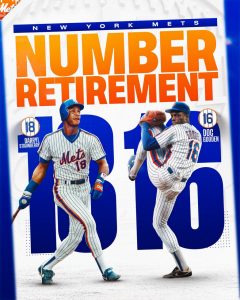 Hold your head up. Keep your head up. Movin’ on. I anticipate 2024 for the raising of Strawberry’s 18 and Gooden’s 16 to Citi Field’s bustling rafters, two retirement ceremonies whose announcement appropriately came a little out of left field on Thursday, unless you were watching the Mets intently (was there any other way?) in the days of Darryl and Doc. Had you been magically transported from 1984 forty years forward and landed to witness 18 and 16 hanging high atop a facility in the general vicinity of Shea Stadium, one of your most logical questions might be, “How do they keep those placards so immaculate, so looking like new, considering how long ago the Mets must have retired the numbers of the most spectacular hitter and the most spectacular pitcher they ever brought to the majors?”
Then, once you got your bearings, maybe you’d ask why the Mets are so modestly displaying only a single championship banner from the decade when Doc and Straw broke in. You’d probably have lots of questions.
What we know in the present, with four decades of hindsight, is that Darryl Strawberry was the most phenomenal position player the Mets ever developed or acquired in their first sixty years of operations, and that nobody ever regularly took control of a baseball game with such total unhittability on behalf of the Mets as Dwight Gooden. In order of the efficacy of his five tools, Straw hit with power, ran, threw, hit and fielded, very much able to do it all, very often doing tons of it. Doc needed two pitches to get batters out, and routinely took care of almost all of them with a high fastball and a curve that dove as if on an underwater treasure hunt.
To call them both electric is validation for Thomas Edison’s wildest hopes and dreams. To call them successful speaks to what they contributed to our decreasingly wild hopes and dreams as the early 1980s gave way to the middle 1980s. When Bob Murphy closed his call of the final out of the 1986 World Series with, “The dream has come true,” there was nothing generic to Murph’s championship coda. The Mets fan dreamed of a reality like the one forged largely by Darryl and Doc before the Mets fan ever heard of Darryl and Doc, before Darryl and Doc ever heard of the Mets. It and what these two young men represented stood impossibly far away before we encountered and embraced them individually, professionally and in the company of teammates assembled, in practice, to make the most of what they had to offer. When they channeled their respective talents and mastered their respective crafts, the world in which we yearned to live — wherein everything was about the Mets, not just for us but for everybody who peeked their head into big league doings — came to exist. The Mets were its centerpiece, its capital, the axis on which it spun. As of October 27, 1986, the Mets were its champions.
But much of the real fun was in the anticipation, the hoping, the dreaming, and all of it coming to pass, first via the uncoiling of Strawberry’s bat in 1983 (when he won Rookie of the Year) and then the firing of Doc’s first deliveries in 1984 (when he won Rookie of the Year). The Mets climbed from Nowheresville, where they’d resided approximately forever, to somewhere close to winning it all, then even closer, then winning all of it. That was Darryl swinging, Doc throwing, not a few other very important Mets doing their things, and the chemistry and appeal and excitement and immersion generated by this New York Mets scene jumping off the charts. If you were to choose, you’d choose never to retire from the era in which Darryl was up with a chance to some damage and Doc was a strike away from setting down the side in order.
It felt like it would last forever. It didn’t. They felt like they’d last forever. They couldn’t. They couldn’t last as Mets and they couldn’t last as the best at what they did for as long as every concerned party, from the most seasoned scout to a reasonably discerning fan, would have projected. Darryl Strawberry and Dwight Gooden were people. People who were absolutely great at playing baseball, people who played absolutely great baseball in tandem, people who played absolutely great baseball on an absolutely great baseball team. They didn’t do it forever. They did remain people.
The 1986 Mets’ world championship banner sits adjacent to the 1969 Mets’ world championship banner over in the right field rafters. Then the championship banner parade glides down a notch to National League championships, none won from the days of Darryl and Doc or any of their contemporaries. Squint and you’ll see something about a division title a couple of years later. Go back to the area over the left field seats next year, and there will be Nos. 18 and 16, anyway. They did so much, just not everything. They won the big one, just not multiples of them. They were who they were. They have persevered as people and were around Thursday to accept the news about their numbers with gratitude and pride.
Their numbers, once they are hung, will be the eighth and ninth retired specifically by the New York Mets. Two — 37 and 14 — rose to rafters to honor managers, so we’re talking seven players out of 1,216 Mets overall, as of the day the Strawberry/Gooden announcement was issued, receiving the franchise’s ultimate honor. One, 24, is a category of its own. So let’s take Willie Mays out of the equation. Willie Mays will always belong in his own category as a baseball player. Willie Mays defies equations.
Of their 1,215 baseball players who weren’t Willie Mays, the Mets have now opted to retire numbers to commemorate the careers and contributions of six of them (with the understanding that revered manager Gil Hodges wore 14 as a Mets player, too). This implies the Mets have retired one number for a little more than every 200 players who’s donned the orange and blue, which is to say that of every 200 or so Mets who come along, the organization recognizes one as incredibly special in the sweep of its history.
Two, 41 and 36, belong to the one-two pitching punch that made that first world championship banner and so much more possible…plus 41 is a category of its own in a Metsian context.
One, 31, belongs to the singular icon of his very if not ultimately successful Met age.
One, 17, is a flag planted in the lunar soil on behalf of the greatest of Met eras, and it was right that 17 was affixed to the rafters first among Mets of his generation, for it was Keith Hernandez who led the Mets’ mid-1980s expedition to the moon and the stars.
But that crew didn’t get there just from its captain’s savvy, clutchness and ability to corral everything hit to him around first base. The 1986 (and 1985 and 1984) Mets revolved around Darryl Strawberry coming of age and Dwight Gooden arriving almost fully formed and the two of them getting us to look up, up and sometimes away. Their numbers, 18 and 16, are going to be up there now.
I’ll look; and I’ll look back on looking ahead; and I’ll look back again, and I’ll love what I see for what I saw when the sky was their limit. ’Cause, y’know, they reached it for us plenty.
by Greg Prince on 24 August 2023 9:36 am SNY spotlighted a clubhouse interview after Wednesday night’s game as if it was news. Francisco Lindor said the Braves were better than the Mets. This is news in the sense that this just in: Studies Show Pleasure Preferable to Pain.
What’s the scoop here? That one of the Mets’ leading players recognized that the team that beat his 10 of 13 times in 2023 and leads his by 24 games in the standings might maintain an edge by way of head-to-head comparison? I watched all 13 Mets-Braves games this year. I’m still wondering how we won three of them.
Since Atlanta moved to the National League East in 1994, they have finished with a lesser record than New York exactly five times: 2006, 2007, 2008, 2015 and 2016. Twice the two clubs tied: 2014 and 2022, although the latter tie isn’t really recognized as such. Once 2023 is over, the Braves will be 23-5-2 in this regard, though I doubt they spend a lot of time regarding themselves vis-à-vis the Mets. Conversely, when Steve Cohen bought the franchise and pointed to the Dodgers as his role model for consistency, perhaps he should have stayed within the division for aspiration. Atlanta is about to win its sixth consecutive NL East title and 18th overall…and they didn’t even arrive here until 25 years after the division was founded.
That’s a great team over there and this one over here is not. Of the ten Met losses to the Braves this season, Tuesday night’s 3-2 would-be heartbreaker (had we any heart left to break) was an exception in that it felt like it just got away or was there for the Mets’ taking. I know there were a few other close ones when the season was younger and not so obviously over, yet I was almost always permeated by the sense that the Braves were going to come along and grab them — including that dizzying night in June when the Mets took or increased a lead in five separate innings yet the game ended 13-10 in the Braves’ favor — because that’s what that team does. They’re talented, they’re deep, they’re relentless and they expect to win games. It’s what they do, it’s who they are.
Wednesday’s adios to Atlanta was close until it wasn’t, which is another hallmark of Mets-Braves games. Jose Quintana struggled somewhat but kept the Mets in it until he couldn’t and they weren’t. The Mets did next to nothing against Charlie Morton, a veteran I never realize is as grizzled as he is. You couldn’t tell from his pitching. The 39-year-old (who relieved for the Braves in a September game the Mets really had to have in 2008) struck out eleven over seven innings and would have had a no-hitter going if not for the double stylings of DJ Stewart. His two two-base hits and continued hot hitting burnished one of the legit feelgood stories of the dog days of August, though it felt less good when DJ stumbled after the first of them while taking a subsequent lead and got picked off second by catcher Sean Murphy.
That was in the fifth, when the score was only 1-0, Braves. By the end of the sixth, it was 5-0, Braves. Marcell Ozuna, who had a Troy Tulowitzki of a series, did damage. So did Murphy. So did pretty much every Brave. The final wound up 7-0, but the vibe was very much 21-3 from two weekends ago at Citi Field. These Braves may not score plenty early, but they score frequently eventually. One saving grace is they were ahead by enough and perhaps bored enough to go down in order in the eighth inning, which meant Sean Reid-Foley could claim a successful comeback from Tommy John surgery. Reid-Foley last pitched in the majors sixteen months ago, when the Braves were four-time defending NL East champions. Perhaps it was comforting for Sean to know, that for all he’s gone through in terms of rehabilitation and for all the new rules that have been codified within the sport in his absence, some things about baseball never change.
A new episode of National League Town is on tap. Fill your mug and enjoy!
by Greg Prince on 23 August 2023 9:12 am ATLANTA (FAF) — Domestic champagne flowed freely, dousing the freshly issued hats and t-shirts worn in the visiting clubhouse by celebratory New York Mets players Tuesday night, as a baseball team raucously toasted its bad fortune.
It’s not every day when a 59-68 ballclub gets to celebrate, but a 3-2 loss that on its surface appeared agonizing served as the occasion for it. Thus, the issuing of shirts emblazoned with the team’s rallying cry of IT JUST DOESN’T MATTER, adopted from the 1979 Bill Murray movie Meatballs, and the caps that feature an image of Mr. Met shrugging.
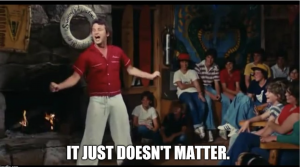 The Mojo Risin’ of 2023. “That kind of loss,” manager Buck Showalter said, “is the kind of loss that will absolutely punch you in your gut in a tight pennant or playoff race, but these guys don’t have to worry, which is in itself kind of a cause for celebration. Imagine how bad this loss would feel if any of this mattered anymore.”
Showalter was referring to the defeat completed just moments earlier at Truist Field, where the first-place Braves held on to down the fourth-place Mets by a run despite Mets pitchers escaping several jams and Mets batters forging a handful of scoring opportunities that ultimately went by the wayside.
“A game of this magnitude, coming up short like that, would have absolutely killed us, absolutely slayed us,” said first baseman Pete Alonso, who went 0-for-3 with a hit-by-pitch. “I mean, last year when we came in here and they handed us our lunch, I wasn’t even in the mood for a pancake single play, let alone all three. Tonight, when I get back to the hotel, I’m probably gonna order some room service.”
When the season began, the Mets and Braves were projected to duel for the National League East crown just as they had in 2022, when the Mets led the division most of the season, only to be swept in this same ballpark on the schedule’s final weekend. New York lost the East on a tiebreaker despite both clubs holding identical 101-61 records. Each team would be eliminated in its respective first postseason series.
While the Braves’ regular-season momentum from last season never paused, the Mets fell out of divisional contention in 2023 once they were swept again by Atlanta this June. “I guess the Wild Card standings say we still have an outside chance,” Showalter said, as his players let loose, “but that’s more of a wild canard. What are we — seven games out with 35 to play, something like that? Our analytics folks used to send me updated probabilities and percentages about where we stood relative to everybody else. I asked them to stop.”
The Mets indeed remain on the fringes of a scramble for the National League’s final playoff spot, but the players who were whooping it up didn’t seem to let that fact get them down.
“Oh, this would have been a terrible night, brutal,” said Francisco Lindor, who doubled, walked, stole a base and scored on a Daniel Vogelbach homer. “Imagine losing to the Braves by one run with all those chances, especially in the ninth, and imagine trying to get up and do it again tomorrow. Now our imaginations can rest. It’s just another game.”
The Mets sealed their 68th loss of the season against 59 wins in a ninth inning that would have gone down as one of the worst of the year had there been much in the way of competitive implications. Vogelbach led off by walking on four pitches versus Atlanta closer Rafael Iglesias. With Tim Locastro pinch-running for Vogelbach, DJ Stewart singled to center, but not deep enough to risk sending the speedy Locastro to third, lest strong-armed Michael Harris II throw him out attempting to advance. Thus, Locastro stood at second much as Vogelbach might have.
Francisco Alvarez, mired in a deep slump, came to bat with runners on first and second, continuing his encouraging pattern of at least making opposing pitchers work. The rookie ran a full count with the bases loaded in the fourth before lining out to end that inning versus Brave starter and winner Bryce Elder. In the ninth, Alvarez fouled off three pitches before grounding sharply to third base, where Austin Riley availed himself of an easy force play on Locastro before throwing across the diamond to retire Alvarez. In doing so, Riley passed on a potential triple play opportunity, as he could have conceivably gotten Stewart at second, with time left for a relay to first, but he opted for the sure two outs.
Rafael Ortega, who earlier came close to an extra-base hit on a ball to the right field wall that struck the padding inches from the foul line, grounded to shortstop Orlando Arcia to end the game and set off the Mets’ line of handshakes and hugs.
With the Phillies’ walkoff win at home versus the Giants, the Braves maintained their 12½-game lead in the NL East.
“Personally, I’m bothered that I couldn’t do a little better and last a little longer,” said starting pitcher Tylor Megill, who absorbed the loss after persevering four-and-two-thirds innings while giving up three runs on homers to Eddie Rosario and Marcell Ozuna, but otherwise escaped the damage that allowing eight hits and two walks along with unleashing four wild pitches might imply. “Yet I’m really happy for us as a team. We don’t have to be bothered by what, under circumstances like last year’s race, would be a real [expletive] of a loss. We should feel good about that.”
Megill left Braves in scoring position in each of the four innings he completed, while the first reliever to follow the righty out of the Mets’ bullpen, recent acquisition Adam Kolarek, grounded out Nicky Lopez to end the first-and-second threat Megill bequeathed him in the fifth. When the Mets began the sixth with Lindor’s double and Vogelbach’s eleventh home run of the season to cut Atlanta’s lead to 3-2, a game that played as frustrating for the New Yorkers turned to perhaps promising. Yet despite the continued effective relief pitching of Kolarek, Reed Garrett and Brooks Raley, a trio who combined for three-and-a-third scoreless innings, the Mets never could plate the tying run. New York’s offense was 1-for-9 with runners in scoring position, and not even keeping former Met Travis d’Arnaud hitless in four at-bats despite the former Met hitting the ball hard a couple of times, augured an upturn for the visitors.
“They’re celebrating over there, huh?” d’Arnaud, a lifetime .326 hitter versus his old team, asked in the Brave clubhouse. “Yeah, I get it. We had some bad years when I was there, though not usually so bad that we were simply relieved that the losing didn’t hurt as much as it could have. You do what you can to get through a long season sometimes.”
D’Arnaud paused and pointed to his teammates calmly dressing after another victory. “The guys in here,” the veteran catcher said, “probably don’t know what it’s like. All they do is win. It’s been like that since I got here” in 2020. Atlanta, owner of the best record in baseball, is on pace for its sixth consecutive division title.
“We have great fans,” d’Arnaud added, “but so do the Mets. I feel bad for those people if the best they can feel tonight is that a tough loss would have been a lot worse had it mattered more.”
by Jason Fry on 22 August 2023 12:22 am Let’s put a big asterisk on this one right away: There’s no such thing as revenge when one team is a cool 23 games ahead in the standings. The Braves losing a game to the Mets is like getting a mosquito bite on your way to the car after a bug-free picnic: You’ll scowl and maybe scratch at the welt a time or two, but that’s about the extent of it.
But away with your unasked-for asterisks and your downer similes and all the rest of this depressing nonsense, recapper! Do your job! Remind the people that the Mets beat the Braves, at White Flight Stadium no less, and it was awesome.
Indeed it was. The game kicked off with a flurry of can-you-top-this defense: Brandon Nimmo and Francisco Lindor started the Mets’ offense with what looked like back-to-back doubles, except Kevin Pillar and Michael Harris II reeled both drives in. (Jeff McNeil then followed with a little excuse-me hit, as a reminder that baseball is inherently ridiculous.) The Mets then did the same thing to the Braves in the bottom of the frame: Ronald Acuna Jr. played the McNeil role with a soft hit against the defense, but Nimmo robbed Harris with a diving catch in center. A double play later, the Braves were somehow not off to a fast start for once and left the field muttering.
The ReplaceMets then stepped up against former Met farmhand Allan Winans, who found starting against his old club not quite as easy as it was back in Queens. DJ Stewart mashed a solo homer and Rafael Ortega followed that with a two-run shot, giving the Mets a 3-0 lead. They’d coughed that up by the fourth, not so much because David Peterson was bad as because the Braves are a squad made up of beasts, the most impressive offensive contingent in the game. Still, it was only 4-3 Braves, which felt like something of a moral victory given how things have gone this year.
But for once the Mets were after an actual victory. A walk and four straight singles off Winans was followed by a Stewart safety squeeze (a little too cute, but we’ll allow it) and the Mets had gone up 7-4; an inning later, a three-run shot from Francisco Lindor sealed the deal, with the Braves playing the rest of the game with something of a collective shrug.
One game. A mosquito bite. But it was fun to see the Mets take an actual lead against their tormentors and then dust themselves off and do it again and then run off and hide. OK, maybe it wasn’t magically worth 23 games in the standings. But there are all manner of enchantments, and this one provided a welcome sprinkling of pixie dust over a sticky summer night.
by Jason Fry on 21 August 2023 8:34 am Ah well.
A nightmarish inning of bullpenning, combined with Paul Goldschmidt realizing, “Hey I’m Paul Goldschmidt,” did away with the Mets’ modest winning streak and hopes of sweeping the Cardinals, and I was first surprised and then a little heartened to register that I was annoyed. I didn’t think I was still capable of that, not after the selloff and with garbage time upon us.
Well, you know what? It’s good to be annoyed — or, to be more specific, it sure is better than being numb.
It’s also good to realize you were wrong. I greeted the arrival of DJ Stewart, Rafael Ortega and Jonathan Arauz with disdain, declaring them the sort of Quad-A fill-ins whose only function is to tell you things have gone disastrously wrong. (Stewart actually arrived pre-selloff, but work with me here.) That’s not wrong, exactly, but it was dismissive in a way that missed some things.
Stewart is a barrel-shaped player out of the Vogelbach sample book — since he’s never been a Milwaukee Brewer we can only conclude he will be one before his career ends — and while it’s no surprise to discover he has some thump, he’s also a much better defender than you’d guess. He’s not exactly lithe and graceful out there in right, but he gets to balls you’d assume he wouldn’t, his instincts are sound and he’s got a good arm. Ortega (who was genuinely useful a couple of years back as a Cub and so perhaps shouldn’t have been a total shock) is a capable center fielder, has speed and can spray the ball around. Arauz — who’s only 25 — hasn’t hit, but has brought some much-needed stability to third base now that Brett Baty, Mark Vientos and Eduardo Escobar are elsewhere, and he’s proven sound at the other two infield positions too.
There’s some hypocrisy here, of course — if your team wins, you discover all sorts of positive qualities in players that proved elusive when your team was losing. But it’s been a valuable lesson to realize Stewart, Ortega and Arauz are a little better than my first scouting report, the one that relied more on the spleen than the eyes.
Not that I think the reconstituted Mets are going anywhere — they’ve beaten up on terrible teams and the talent ceiling has still been substantially lowered by the Steve Cohen Supplemental Draft. But that’s OK. The floor is higher than I’d thought, and that’s a relief given how much baseball there is left to play.
I still have no use for Trevor Gott, but give me another winning streak and maybe we’ll talk.
by Greg Prince on 20 August 2023 6:21 am Pete Alonso homered Saturday night in St. Louis. We know that’s not a first. DJ Stewart homered Saturday night in St. Louis. We know from his no longer wholly unexpected production that that wasn’t a first. Daniel Vogelbach launched a grand slam to pretty much bury St. Louis on Saturday night. We can pretend Daniel Vogelbach has never done nothin’ for nobody Metwise, but we also know he’s hit a home run before while draped in orange and blue. On the pitching side, we know Kodai Senga has won a decent amount of games. This one, Saturday night in St. Louis, he won by quite a decent margin, 13-2. As that romp of a score would indicate, no save opportunity emerged.
A lovely win for the Metsies, their sixth in seven games. But not much in the way of firsts. That’s OK, though, because there was quite a spate of firsts from two nights earlier that call for sipping, savoring and digesting slowly.
They were big.
How big?
Bigger than the surprise of Stewart belting five home runs for the Mets this year.
Bigger than Alonso’s heart in making right Friday night’s faux pas vis-à-vis flinging the ball from Masyn Winn’s first career hit into the Busch Stadium crowd (Pete ponied up for a bottle of high-end tequila and provided a souvenir for anybody who happened to be sitting 466 feet from home plate).
Bigger than Senga performing as the rock of a rotation that was rocked to its core at the trading deadline.
Bigger than Vogelbach, even.
When Trevor Gott closed out Thursday night’s game on behalf of Jose Quintana, defending a 4-2 lead that been buttressed by a Tim Locastro shot over the center field fence, three 1’s lined up to shake hands:
Quintana had his 1st win as a Met.
Gott had his 1st save as a Met.
Locastro had his 1st home run as a Met.
Jose Quintana, pitching as if he really were acquired to bolster a rotation grinding its way toward the playoffs, had been a notable victim of hard luck ever since making his long-delayed debut in July. In his first five starts, once he was fully recovered from the rib surgery that derailed his Spring Training, the Mets scored three runs for Jose while he was pitcher of record, leaving that record 0-4 despite an ERA barely a tick above three. We may have dismissed for all time the efficacy of the pitcher win during the reign of deGrom, but c’mon. Jose Quintana pitched winning baseball. The least his teammates could have given him was enough offense to facilitate a win.
Trevor Gott also came into this season as a second-act character. The Mets traded for him during that brief interregnum when they couldn’t decide whether or not they were a contender, and maybe it would be nice to have an extra proven arm on call in the bullpen. The trade that brought him here from Seattle for Zack Muckenhirn was most noteworthy for the guy who accompanied him partway on the trip. The Mets were also taking Chris Flexen off Seattle’s hands, with no intention of using Flexen to pitch because all the Mariners wanted was to be rid of Flexen’s salary, and who better to launder an unwanted contract than Steve Cohen? (Flexen got good in Korea after floundering for us for a couple of years, kept it up upon returning to America, then reverted to form, Darin Ruf-style.) Flexen moved on to Colorado. Gott faded into Met middle innings. Of the six runners he inherited between July 18 and August 6, he allowed five of them to score. Leverage for Trevor understandably diminished. He’s seemed to pitch better lately than he did initially. On this team, when middle innings can begin alarmingly early, who can tell?
Tim Locastro was never a Met for his bat. His legs were his stock in trade. “One of the things we looked at, analytically, over the weekend,” Billy Eppler explained regarding the topic of “building the diversity of the bench” as Spring Training ended, “was just how often do situations happen in the sixth, seventh, eighth, ninth inning, where somebody that we might pinch-run for would get on first base with second base open, and how many times that occurs, and being able to give Buck that bullet to fire as he sees fit, we just felt that was important.” The translation to all that is incumbent Daniel Vogelbach was viewed as inert as a tree trunk when he’s not connecting for grand slams. From March 31 to April 16, Locastro was sent to bat ten times (0-for-7, 3 HBP) and used as a pinch-runner on five occasions, thrice for Vogelbach. Nice work if you can get it, except injuries — back spasms, then a torn UCL in his right thumb — prevented Tim from keeping it. When he returned a week ago, three months removed from making himself familiar to us, the overriding impulse was to tell him, hey, I think we used to have a guy with your name here. (One also imagines Vogelbach crying tears of joy to have somebody take off for second in his stead on those intermittent occasions when Daniel draws a walk or makes successful contact.)
“Journeyman” isn’t the most flattering phrase in baseball, and it might not exactly apply to Quintana, a 2016 All-Star and a postseason starter as recently as last October, but Jose is on his seventh major league team since debuting in 2012 (putting aside the Mets signed him to his very first professional contract — and proceeded to release him not that long after — while Shea Stadium still stood). The Mets are Trevor’s sixth club dating back to his first trip to the mound from the pen in 2015. Tim, around since 2017, is a Met after having worn three other uniforms. Locastro turned 31 while rehabbing last month. Gott will turn the same next weekend. Quintana is 34. All these guys have their stripes, their hashmarks, their roles. They’ve all had their journeys.
It struck an attentive fan as remarkable that their journeys would converge in the same box score in an almost virginal manner. One win for Quintana. One save for Gott. One home run for Locastro. Not just one of each of these feats in the season already in progress, but one total in their careers as Mets. Granted, those careers as Mets haven’t been as lengthy as their overall CVs. Jose was making his sixth start as a Met, Trevor was making his 19th appearance as a Met and Tim was playing in his seventeenth game as a Met. Quintana was run-deprived. Gott’s responsibilities didn’t usually include ninth innings — and the Mets didn’t usually have leads by then — and Locastro was rarely asked to hit (and obliged as such, going 0-for-4 after his IL exile until going deep Thursday…as a pinch-hitter for the decidedly more power-oriented Stewart, no less). Still, these are categories we notice. Who got the win? Who got the save? Did anybody homer? And if there was a win, a save and/or a home run, how many is that for that/those guy(s)?
W — Quintana (1)
S — Gott (1)
HR — Locastro (1)
That, the attentive fan decided, had to be unusual. The fan couldn’t remember seeing that particular row of 1s at a game’s end since…well, he couldn’t remember that, either. Not just firsts in a particular season, but firsts as Mets. It must have happened, though…right? Maybe not with veterans in the middle of August, veterans who weren’t just the day before acquired in one trade deadline spasm. Certainly in April, it had to have happened. New Mets notching accomplishments for the first time as Mets. Surely some combination of offseason arrivals and promising rookies had converged with their first Met win, their first Met save and their first Met home run.
410 Met pitchers have recorded a first win as a Met.
193 Met pitchers have recorded a first save as a Met.
468 Met hitters have recorded a first home run as a Met.
What were the odds the three events hadn’t coincided before August 17, 2023 on a ballclub that had existed since April 11, 1962?
This was a job for curiosity, aided by a feel for Baseball-Reference. The curious fan figured out what to do:
• Go to good ol’ BB-Ref’s 1962 Mets schedule page;
• Align it by the W/L column (which would thus display Met wins chronologically before listing all those pesky losses);
• Shift focus to the Save column;
• And then be discerning.
When you see a name you haven’t seen before, such as Roger Craig’s, move your eyeballs to the Win column. Who had the win? Craig Anderson? It’s May 6, 1962. The Mets are new. They’ve had very few wins let alone saves. You already know Roger Craig’s is the very first save in Met history and therefore it has to be his first Met save. Roger is the ace of the staff, but the game goes 12 innings and Casey Stengel isn’t fooling around, given the Mets’ 3-16 record entering this particular Sunday in Philadelphia. You’re also already cognizant that Craig Anderson doesn’t have one of the Original Mets’ original three wins, but you confirm it because you don’t want to assume anything. It is indeed Craig Anderson’s first Met win (achieved in relief), setting up the opportunity for Roger Craig’s first Met save, which Roger cashed in.
Great! We’re two-thirds of the way there! Now all you have to do is click on the May 6 box score and check to see if any Met has hit his very first home run as a Met against the Phillies. You click, and…nope. No Met home runs in the 7-5 Met victory. Oh well, that’s all right, we have an entire first season of Mets baseball ahead of us to optically scan, so there has to be at least one instance of a first Mets win, a first Mets save and a first Mets home run all coming in the same game. There are only 40 Met wins overall, but everybody is new this year. It had to happen.
Yet it didn’t.
• On May 19, Anderson’s first Met save protected Ken MacKenzie’s first Mets win, but the only Met homer was Frank Thomas’s tenth.
• Dave Hillman’s first and only Met save on June 9 backed up Willard Hunter’s first Mets win, but Cliff Cook had to go and spoil it all by having his home run in that game be his second as a Met. (Imagine getting mad at a Met for homering too much 61 years ago.)
• When on June 10 MacKenzie joined the corps of relievers to earn a save in these non-closer days, Roger Craig was the winner, and Roger was already in the win column, so no need to check on the home run situation.
• The next time a Met pulled down a save, it was luckless starter Bob L. Miller (1-12 by year’s end) doing the honors on July 2, but the pitcher of record on the long side was MacKenzie, who we’ve already established had previously won (Ken was famously the only Met with a record over .500, finishing 5-4).
The Mets collected precisely two more saves in 1962, and they were recorded by Anderson (Craig) and Craig (Roger), and we’ve already seen their names, so if there was a first Met homer hit in those games, the homer is moot.
You’ve just gone through a season of Mets baseball, the very first one, but you can’t find an episode that serves as precedent for the Quintana-Gott-Locastro Trifecta.
Fine. You’ll just go through the next 61 seasons of Mets baseball and keep looking until you find every example of a first Mets win, a first Mets save and a first Mets home run all coming in the same game.
Well, you won’t. But I did. That’s what I did late Thursday night, and it’s what I did first chance I got Friday morning. And this is what I found:
What Quintana, Gott and Locastro combined to do is very rare.
It didn’t happen in 1963.
It didn’t happen in 1964.
It didn’t happen in 1965.
It wasn’t as daunting to look up as it might sound, especially when there weren’t many entries in the Save column. The Mets weren’t winning much more in their toddler years than they were as infants, and saves simply weren’t a thing. They were coming — instituted as an official statistic in 1969 after a growing sense that relief pitchers’ contributions were undervalued (Retrosheet and Baseball-Reference apply them retroactively for games before then, yet like sacks in the NFL prior to 1982, they existed in common practice before they were fully recognized by powers that be) — but these were still the halcyon days of starters being expected to go nine. In 1968, when Bob Gibson won 22 games, there were no saves registered in any of them. Gibby may present the most stark example (he completed 28 games, or six more than he won), but it’s not like those Cardinals didn’t strategically employ relievers. Joe Hoerner posted 17 saves for the NL champions. in the aptly named Year of the Pitcher. Late-inning relieving was on the rise, but it wasn’t baked into the equation as it is today.
When examining the Mets’ schedule pages from their first few years, I had to be extra diligent because the proto-modern reliever had yet to be invented. I don’t know those guys from first-hand spectating experience, so I can’t speak to their usage patterns without looking them up. Not that there was a lot to look up. Craig Anderson led the Mets with four saves in 1962, same number as Larry Bearnarth led the pen with in 1963. Willard Hunter set the pace with five in 1964, then it’s Dennis Ribant with three in 1965. None of them corresponded his first Met save with both somebody else’s first Met win and another player’s first Met home run.
It’s not until Jack Hamilton collects 13 saves in 1966 that we get a taste of what would become the relied-upon fireman, forerunner to the closer. Hamilton was a staple of the Met rotation until the middle of June. Jack lasted a single ugly inning on June 9 before pitching what looks, in 21st-century terms, very solidly four days later, going seven innings, giving up two runs and retiring his final 15 batters, which, per Gabe Buonauro of the Bergen Record constituted “a shaky start” (men were men). “Right now,” manager Wes Westrum said after Jack’s 4-1 loss to the Cardinals on June 13 as he sorted among a rare surfeit of starting pitching candidates, “I’m contemplating putting Hamilton in the bullpen. He’s just right in our situation now.” When asked about Jack coming into games with men on base, Wes replied, “If you give him room to work, he’ll be all right.”
Such an endorsement! The skipper amplified it a bit a few days later, as reported by Dick Young in the Daily News: “I need somebody out there I can depend on. I need somebody who can come in often and hold them at the end, and it looks like Hamilton is my best bet. He’s the strongest son of a gun in the world.” The Mets had recently brought in veterans Bob Shaw and Bob Friend, while rookie Dick Rusteck shocked the world by shutting out the Reds in his very first major league outing. “I have enough starters right now,” Westrum said. “What we have to beef up is the relief. Hamilton can save a lot of games.”
Young went on to opine, “Hamilton is no different than any other man who plays baseball for a living. He would prefer to start. That’s where the money is, and the big glory, and the good life. Starters take a night on the town after they work, and they know they won’t be working again until four days later. You adjust your social calendar to that sort of thing. A reliever does the town at his own risk. He might be in there on short sleep the next day, and with a head doesn’t quite squeeze into the batting helmet.”
Times were different, huh? But Hamilton had a timeless quote for Young. “I don’t care,” he said about his role. “Whenever Wes wants to use me, that’s fine. Where I can help most.” Players still say they just want to help the team, whether they absolutely mean it or not. Transferred to the bullpen, Jack was assigned the ninth inning on June 15 in Atlanta with the Mets ahead by one. He popped out Joe Torre and Gene Oliver before surrendering a single and a pair of walks. The bases were loaded and Hank Aaron strode to the plate. Bad Henry — at the time leading the majors in homers and RBIs — flied out to Cleon Jones in center to end the game. Hamilton had his first Met save, and an even better quote for Young:
“Never in doubt.”
But also never denting the First Met Win/First Met Save/First Met Home Run column, because although reliever Bill Hepler notched his first Met win in the very same game that Jack Hamilton earned his first Met save, the only Met homer of the night flew off the bat of Eddie Bressoud…his fourth as a Met.
So, no, no Quintana/Gott/Locastro forebears in 1966, either.
To do a little chase-cutting here, as complete games became increasingly rarer birds until they grew practically extinct, and relief pitchers began to find the money and the glory (one wonders how Dick Young would processed Edwin Diaz and Timmy Trumpet), sussing out First Met Saves became both easier and somehow less fruitful. Beginning with Hamilton’s transformation in 1966, one combing Baseball-Reference’s Mets schedule pages knew he’d see only a handful of names notching saves in a given year. Those names tended to gain incumbent status, meaning one save begat many and you weren’t getting too many chances to link First Met Saves to First Met Wins, let alone First Met Home Runs. You’ve seen one “Franco,” you’ve seen them all for the purposes of this pursuit. (John Franco’s first Met save was for Frank Viola, who’d safely tucked his first Met win away the year before.)
You still had to keep an eagle eye open for the newcomers — like Francisco Rodriguez in 2009 (first Met save for Johan Santana, who, like Viola, had started winning as a Met a year earlier) and, more keenly, for Circumstantial Savers, like bona fide journeyman Raul Valdes — a 32-year-old rookie from Cuba who had been pitching professionally since he was 19 — on the night in 2010 when Valdes was asked to pick up for R.A. Dickey — whose journeyman bona fides need no introduction in this room. R.A., ND’d in his first Met start six days earlier, went six before Jerry Manuel lifted him for a pinch-hitter while Dickey held a 4-0 lead over the Phillies at Citi Field. PH Chris Carter made it a comfy 5-0. Raul was trusted to finish up for a three-inning save once the Mets blew the game open to 8-0; no need to wake Francisco Rodriguez for that one.
This game…it was all coming back to me now…
I was at this game!
R.A.’s first home start!
R.A.’s first home postgame quote!
“I feel like I’m 27 in knuckleball years because I started throwing it in ’05. It’s been a nice journey for me with this pitch.”
The first full-on indicator that R.A. Dickey was a revelation during and after his outings!
And R.A.’s first win as a Met!
Valdez did not give it up, thus it was Raul’s first Met save!
This was part of the legendary (for about five minutes) Goose Egg Sweep, when Mets pitching posted 27 consecutive zeros versus the reigning National League champs and persistent Met nemeses!
Fine, fine. But did some Met his first Met homer in this game?
No, no Met did. Jose Reyes tripled and David Wright doubled, but neither of those were novel events by 2010. Valdes doubled and scored, too, which he never did before in the majors and would never do again. That’s also fine, but that’s not what we’re looking for.
What Quintana, Gott and Locastro did in tri-cornered tandem did not happen in any Mets game in 2010 any more than it happened in any Mets game between 1962 and 1966. It didn’t happen on any nights Franco took off during the decade he strangleheld the closer’s role, not even when John was out with an elbow injury in 1992 and redeployed starter Anthony Young came along and nailed his first Met save, with Lee Guetterman grabbing his first Met win on July 1. Hey, ya think somebody hit his first Met homer in the same game?
Nope. Bobby Bonilla did go yard for his ninth of the year, however. Bobby Bonilla always did have a predilection for July 1.
Did I say I was cutting to the chase? OK, let’s do it, really. Before Jose Quintana, Trevor Gott and Tim Locastro got their respective first Met win, save and home run in the same game, it happened exactly twice in Mets history. The reason I couldn’t remember any of it is because it happened before I began watching the Mets, which was in 1969. Imagine that: what we witnessed the other night hadn’t occurred for at least 54 years.
Longer, actually. You have to go back to 1967 for the last time a Met pitcher recorded his first Met win, a Met reliever registered his first save and a Met batter whacked his first Met home run. And there are a few kickers besides.
1) It not only happened last in 1967, it happened twice in 1967.
2) It not only happened twice in 1967, it happened a week apart in 1967.
3) Involved in each game was only the greatest player in Mets history.
As kickers go, Adam Vinatieri can take a back seat. Lionel Messi can take a back seat, too. Hell, Paul O’Neill can take a back seat, and he once kicked a ball from right field directly to his first baseman (it happened when he was with the Reds; John Franco was pitching and wound up with the loss).
It’s April 13, 1967. Tom Seaver is making his very first major league start, at Shea Stadium. But, no, it’s not Tom Seaver who fills the First Win as a Met bucket. That would have been something, considering it was the second game of the season, and Westrum trusted a mere rookie with only one year in the minor leagues to take the ball so soon. “I’ll admit he doesn’t have much experience,” Wes said of the 22-year-old from Fresno. “But he gets people out.” He got Oriole people out over five shutout innings in Spring, and those were defending world champion people. He gave up only one run in the Grapefruit League. Westrum probably didn’t have to explain himself, but nobody had yet seen Tom Seaver navigate a regular-season contest.
Tom did OK, if not yet Terrific. Five-and-a-third versus Pittsburgh, six hits and four walks, but only two runs, burnished by eight strikeouts. When he gave up a double to opposing pitcher Vern Law and hit Matty Alou, Westrum decided it was time to pull the freshman who was barely a year removed from USC. In came another product of Central California, former Oriole Chuck Estrada to extricate the Mets from the sixth and keep the game a 2-2 tie. Like Quintana, Estrada had an All-Star selection in his past, though, like Quintana, Estrada’s was a while ago by the time he got to the Mets. Chuck won 18 games that year, 1960, though he’d lose 17 in 1962 and, after injuries had taken their toll on his career trajectory, no longer be among the Birds by the time they flew to their highest heights in ’66. After Estrada alighted with the Cubs for half a season, the Mets signed him and invited him to the same camp where Seaver impressed.
With no guarantee of a roster spot, Chuck made the team. Now he was following none other than Tom Seaver to the mound, though on April 13, 1967, all that meant was trying to hold the score even at two after some rookie ran out of gas. The Mets’ two runs to that point came as a result of a two-run homer by second baseman Jerry Buchek. Buchek was also not on any kind of depth chart entering Spring Training. The Mets traded for him with ten days to go before Opening Day, sending the unusually powerful shortstop Bressoud to St. Louis along with Danny “Vive la France!” Napoleon to get him. Bressoud, whose ten home runs as a shortstop would be a Met record for a long time, wound up a part of the Orioles’ successors as world champs in ’67. Buchek settled in as a Met and showed his own pop, belting 14 homers for the Mets, ten more than he’d totaled in any previous season.
His first came in his second game as a Met, the same game that marked the major league debut of Seaver and the Met debut of Estrada. Estrada stayed out there for Westrum in the seventh and eighth, allowing only a single, maintaining that tie. In the home eighth, Buchek continued to shine, singling, taking second on a Jerry Grote sac bunt and moving to third on a right-side groundout from Larry Stahl. Westrum proceeded to remove Estrada in favor of pinch-hitter Chuck Hiller and was rewarded for his decision, as Hiller doubled and Buchek crossed the plate. Chuck Estrada was now the pitcher of record. All he needed was the next arm out of the bullpen to work as well as his had.
That arm belonged to righthander Ron Taylor, a veteran reliever the Mets purchased from the Astros in February. Ron had pitched one very big game in New York previously. It was in the World Series, in the Bronx, in 1964. Ron entered Game Four in the sixth inning, asked to ensure safe passage of a one-run lead clear through the ninth. Now that’s a save situation. The future doctor operated successfully on Yankee bats for four scoreless innings, and the 4-3 advantage became a 4-3 win, and Ron Taylor indeed had himself a World Series save. The World Series win in Game Four, pivotal toward the Cards capturing the title in seven, went to none other than the first Met who ever got himself a save: Roger Craig, who started 19 games for the National League champs but also came out of the bullpen 20 times. Craig relieved another pitcher with Met connections, one who didn’t get out of the first and wouldn’t get to the Mets until 1970, Ray Sadecki.
The year before Sadecki joined the Mets, Ron Taylor was the primary fireman for another world champion, teaming with converted lefty starter Tug McGraw to shut down ninth innings that weren’t being steered to the finish line by the formidable young starters nurtured by Gil Hodges and Rube Walker. The Mets staff posted 51 complete games and 35 saves in 1969. Good luck finding that ratio in 2023.
There was good luck in finding Taylor at Shea. If he fell from grace in St. Louis, and if Houston didn’t know what to do with him, the Mets were happy to have him serve as the foundation of a bullpen that would sprout save opportunities as much as did tomatoes once Joe Pignatano came to town with Hodges, Walker and Eddie Yost. But that was a little later. Yet it really all started on April 13, 1967, when Ron came in to nurse this one-run lead. Or would that be doctor a one-run lead in light of Taylor’s ultimate profession? Doctor, nurse…it was all in the name of wellness, and Taylor provided excellent preventive care. Ron induced Maury Wills to line out, struck out Roberto Clemente looking and threw a pitch that Willie Stargell grounded to third. Scary lineup those Pirates had, but in the words of Jack Hamilton, never in doubt.
First Met save for Taylor.
First Met win for Estrada.
First Met home run for Buchek.
Jackpot!!! We have a winner!!! We also have Tom Seaver becoming a major leaguer on the same day!!! We really had a winner!!!
In one week’s time, we’d do it all over again, and this time, it would be Seaver posting his first Met (and major league) win in a game whose scoring included Tommy Davis’s first Met home run. Davis was another former World Series champion who came to the Mets on the downside of a distinguished career — a tradition started in 1962 by 1955 Brooklyn Dodger Roger Craig, among others — and sought revival in Queens. That first home run on April 20 would send Davis, a perennial MVP candidate until a broken ankle dimmed his stardom, on the comeback trail. He’d lead the 1967 Mets in home runs (16) and runs batted in (73) and reset a path that would see him keep playing until 1976.
But did we mention this was Tom Seaver’s first win? It probably bears repeating, given that he’s Tom Seaver. He might not have yet been TOM SEAVER, but this was his first marker, obtained by seven-and-a-third innings of one-run ball versus the Cubs, with no walks allowed and eight hits scattered. Most telling was the rookie admitting to Westrum in the eighth that he was again out of gas, as much a sign of maturity as fatigue. Ahead, 3-1 and with Don Kessinger standing on first base, Tom couldn’t finish what he started. Somebody else would have to.
That somebody was another rookie, reliever Don Shaw. Don Shaw, a southpaw, was not to be confused with Bob Shaw, who came from the right side. Bob had been on the scene since 1957 and started more than 200 games in the previous decade. Bob held a spot in Westrum’s rotation. Don not only accepted his relief role, he embraced it as a vocation rather than a comedown from starting, no matter what Dick Young had to say about starters living the life. “It used to be,” Bob Rubin wrote in Newsday, “that young pitchers automatically wanted to be starters. But this is an era of specialization.” It was about to be, at any rate.
Like fellow reliever Estrada, Don had to impress management in order to trek north from St. Petersburg. Mission accomplished. His first appearance came on Opening Day, in relief of Don Cardwell. It wasn’t pretty, leaving him with a lifetime ERA of 9.00. But it was just one outing. His next two chances went better, earning him the opportunity no other pitcher can ever claim.
Don Shaw was going to try to save Tom Seaver’s first win.
It was likely no reflection of Tom’s faith in his teammate that he couldn’t bear to watch. Seaver preferred to pitch his own game. If stamina was an issue on the mound, nerves were an issue in the dugout. Tom took to the clubhouse and listened on the radio.
What he heard was mighty pleasing. Shaw, possessor of a sinker coach Yogi Berra referred to as a “worm killer,” teased a ground ball from Billy Williams, who had earlier tripled in the only run off Seaver. This time Billy rapped the pitch to Buchek at second, who started a 4-3 double play to calm Seaver’s nerves. The Mets added three runs to their lead in the bottom of the eighth, making everybody breathe easier. Don returned to the mound and set down Ron Santo, Ernie Banks and Randy Hundley in order for his first Met (and major league) save. “What a job Don did,” Tom told reporters after hearing all about it over flagship station WJRZ, before reiterating, “of course, I’d rather finish myself.”
Seaver’s attitude toward handling his business, evident as he rued for reporters that he had dared to let his tank run dry, echoed eighteen years later, when at age 39, he took care of all 27 outs en route to his 300th career win. By then, he’d figured out how to preserve his petroleum. His third career start, on April 25, 1967, was a complete game win that required ten innings. Yeah, Tom was a fast learner. Tom would complete 18 games in his Rookie of the Year campaign and 231 across twenty seasons. Westrum, demonstrating astounding mastery of the obvious, said of the kid wearing No. 41, “I think we’ve found a good one.”
Shaw’s numbers wouldn’t pile up more than a fraction as high as Seaver’s. There’d be military service, injuries, a move to Montreal with the expansion draft and only six saves in a career that ended in 1972 with a cameo on the eventual world champion A’s, but the first of those saves couldn’t have come in support of a more portentous victory. Don Shaw saved Tom Seaver’s first win. And Don did it when his accomplishment still required a bit of an explanation, at least in the Daily News, where Norm Miller informed readers, “Since the score was 3-1 when Shaw came on and he faced the potential tying run with Williams at the plate with a man on base, the 23-year-old lefty earned himself the save.” The accompanying box score did not denote the stat, but the agate in The Sporting News was more thorough, as “(Save 1)” sat adjacent to the name “D. Shaw”.
So to recap:
First Met win for Seaver.
First Met save for Shaw.
First Met home run for Davis.
Three fairly glamorous Met firsts on April 20, just like on April 13. If it was going to be a weekly occurrence, it probably didn’t merit exclamation points, but if it was known nothing quite like this synchronization of firsts would happen for a trio of Mets for another 56 years, you might have said WOW!!!
 The short version of the story, as shared with and featured in the Mets’ game notes the other night. Trust me, I kept looking for evidence that it had happened between 1967 and 2023. I got momentarily excited when I arrived in the first week of 1968 and found Danny Frisella posted his first Met/career save in the same game that Nolan Ryan posted his first Met/career win, a 4-0 shutout in the Astrodome. I clicked hopefully on the box score. Tommie Agee was new to the team in 1968. So was Art Shamsky. So was J.C. Martin. So was Al Weis, though I knew Al held off on power displays until 1969. Maybe one of the others, though…nah. The Mets scored their four runs on April 14, 1968, without benefit of a home run. They also exhausted their offensive supply for the series, because the next night, they played 24 innings and lost, 1-0. Seaver went ten, but got no-decisioned for his trouble. Year of the Pitcher indeed.
I don’t know what this is the year of, but if it included the harmonic convergence of Quintana’s first Met win, Gott’s first Met save and Locastro’s first Met homer amid a week when the Mets were winning six of seven, this can’t be the year of all bad.
Knock wood, 2023 won’t be confused with 2003. You can relive that year of mostly not great (with a few leavening moments) as part of the It Happens in Threes series on the newest episode of National League Town.
by Jason Fry on 19 August 2023 8:57 am From the beginning, I’ve loved watching Jeff McNeil play baseball — somehow never more so than when things don’t go his way.
McNeil responds to any misfortune in an AB — an umpire’s poor judgment, his own excessive haste, a perfectly executed enemy pitch, a great play by a defender, a quirk of fate — with barely concealed fury. Lenny Dykstra, another member of the How Can a Just God Allow Such Atrocities? fraternity, specialized in a post-out “disbelieving, Rumpelstiltskin stamp of rage,” to quote the great Roger Angell; McNeil’s signature is the little whirl after crossing first base and being told he’s not being permitted to stay there, followed by a cold, disbelieving stare, the mouth opening and the guy in the truck hurriedly turning down any on-field mics. (McNeil may single-handedly keep the era of MLB hot-micing everybody and his brother at bay for the duration of his career.)
It’s a bit Dykstra, it’s a bit Al Leiter, and it’s more than a bit hilarious. As with Leiter, you can never be angry with McNeil for failing on the baseball diamond because he’s invariably so much angrier about it than you are; there’s nowhere to escalate, so you just skip ahead to forgiving him. The line in our house is “Why is Jeff McNeil enraged this time?” and there’s never a short list of reasons.
McNeil could have achieved his legend just by being a Daniel Murphy “I hit third” type, but he’s more than that: He’s become an accomplished and versatile fielder almost without anybody noticing, going from “eh, he’ll outhit his mistakes” at second to sure-handed and sound not only there but also in either outfield corner. Unsurprisingly, he’s brought a certain cussedness to those proceedings too: I don’t know the root of the farcical rat/raccoon dispute with Francisco Lindor, but I’d bet it sprang from McNeil taking pride in his own defensive abilities and not appreciating some newcomer from a jumped-up beer league appointing himself as his infield instructor.
2023, though, hasn’t been fun for McNeil. (Or for his fellow Mets, or for us.) The defense has stayed sound, but the power’s been missing and it feels like so many balls that used to drop over the infield or punch through it have wound up in gloves. McNeil’s rage has even cooled to a simmer — not even he can’t maintain a full boil during a season-long bad dream.
Of late, though, McNeil’s looked like he’s woken up and discovered he’s still McNeil. There was the almost homer/almost enemy out double Thursday night, and then Friday night McNeil spanked a two-out single early to drive in Lindor with the Mets’ second run and then iced the game with a three-run homer late, hitting the ball a few critical feet farther than the night before and so keeping Jordan Walker out of the equation.
That was enough to support Joey Lucchesi, who looked superb in his return from the minors and injuries, torturing Paul Goldschmidt with the churve. (We’re only halfway through this series, but so far Goldschmidt is not enjoying himself.) Francisco Alvarez got kudos from Lucchesi for his preparation, which has never waned; he also broke out of his recent funk with an RBI single of his own. Brandon Nimmo cracked a leadoff homer, Tim Locastro and Lindor and Rafael Ortega had two hits each … it was a night where we could be happy for plenty of Mets.
Even Pete Alonso, who fueled a little contretemps when he unthinkingly tossed the first major-league hit from rifle-armed St. Louis shortstop Masyn Winn into the stands, provoking a fusillade of fury from Miles Mikolas (who really needs to calm down) as well as an extended, performative display of dudgeon from the supposed Best Fans in Baseball. All turned out fine: Winn got the ball back following one of those in-stands negotiations, Alonso’s postgame mea culpa was so thoroughly and comically hangdog that it would have convinced Whitey Herzog back in the days of the white-hot Mets-Cards rivalry, and no one cares what Miles Mikolas thinks.
So Cardinals fans got a peek at a promising future during a lost year, the Mets got a victory that can somehow be described as another victory (hey, five out of six) and even Jeff McNeil found no cause for outrage. I’ll call that a good evening.
by Jason Fry on 18 August 2023 10:37 am A grab bag of Mets drawing Adam Wainwright during his farewell tour, with John Smoltz and Fox painting the word picture? Hasn’t 2023 been mean enough already?
That’s what we got Thursday night, with the only reasonable source of hope that baseball’s innate cussedness and delight in confounding storylines would come to the fore.
Which, in fact, was what happened.
Wainwright is just shy of 42 and in his final season, having authored a track record sufficiently impressive that some years ago he crossed the line between Villain Who Ruined Everything to Respected Adversary, one of those borders that’s unmarked but you somehow always know has been stepped over. Of late Wainwright has looked like he’s stayed too long at the fair, gathering tarnish as he staggers toward 200 wins, but in the early innings against the Mets he looked entirely too much like the Wainwright of old, leaning on that fabled curve to dispatch Buck Showalter‘s lineup without appearing to break much of a sweat.
This is a good place for a reminder that it’s not all about us. Other teams have their own devoted fans who craft narratives out of the season’s ebbs and flows, and the Cardinals are having a year every bit as discouraging as ours — more so, in fact. They’re hopelessly below .500, in last place in a crummy division, and you better believe there are Cardinals fans (a couple of them are even friends of mine) who tuned in last night thinking, “Oh great, now we have to watch the Mets ruin things for Waino and listen to John Smoltz? Hasn’t 2023 been mean enough already?”
Wainwright matched zeroes with a sharp-looking Jose Quintana into the fourth, but Jeff McNeil hit a drive to the fence that looked like it would be a home run and then an out stolen by Jordan Walker and wound up as a double. That brought up Pete Alonso, who did terrible things to a Wainwright sinker, redirecting it 437 feet away to center and giving the Mets a 2-0 lead.
The Mets added another run and backed up Quintana with solid defense — Jonathan Arauz has been quite good at third, not that we aren’t ready to hold our breaths again watching Brett Baty think about things when he shouldn’t — but Quintana ran out of gas to start the seventh, surrendering a homer, a walk and a single to put the tying runs on base with nobody out.
That put the Mets in a familiar, undesirable spot: looking for nine outs’ worth of firefighting from an assortment of arsonists. Drew Smith was first up and limited the Cards to a sacrifice fly, cutting the Mets’ lead to one but leaving us thinking things could have gone a lot worse.
Enter Grant Hartwig, whose initial impression of competence and grit has been replaced by sighs and chronic worrying, which is to say he’s simultaneously a rookie and a middle reliever. Hartwig’s location was best described as theoretical, with the always demonstrative Francisco Alvarez coaxing him through the inning looking like a slightly insane orchestra conductor. Somehow — and this morning I’m still not sure exactly how — Hartwig emerged unscathed.
The Mets got an insurance run from the unlikeliest of sources, as Tim Locastro mashed a 419-foot shot to center for his first Mets hit, which is definitely damning with faint praise but hey, good timing. Closing things out fell to Trevor Gott, whose own location was also abysmal. Gott immediately surrendered a single, but then got a foul flyout courtesy of a nice play by Brandon Nimmo and retired Cardinal newcomer Richie Palacios on a scorcher hit right at DJ Stewart.
Two outs the hard way, and a Tommy Edman single brought up Paul Goldschmidt — not exactly the guy in this lineup you’d pick to face while showing no ability to command your pitches. Gott in Himmel!
Gott got (sorry) a strike on what was actually a ball, tried a pair of bait cutters in that same location without success, and then left a cutter in the center of the plate which Goldschmidt should have turned into a walkoff souvenir, except he missed it. As Gott came set, I braced myself for Gott in Hölle and counseled myself that it would be undignified to throw things after a garbage-time loss.
So of course, Gott threw his best pitch of the inning and possibly his only good one: a sinker that caught the outside corner at the bottom of the strike zone. Goldschmidt looked at it, straightened up in dismay and trundled off to think about the unfairness of the universe.
Because baseball, and because it’s not always about us.
|
|






