The blog for Mets fans
who like to read
ABOUT US

Faith and Fear in Flushing made its debut on Feb. 16, 2005, the brainchild of two longtime friends and lifelong Met fans.
Greg Prince discovered the Mets when he was 6, during the magical summer of 1969. He is a Long Island-based writer, editor and communications consultant. Contact him here.
Jason Fry is a Brooklyn writer whose first memories include his mom leaping up and down cheering for Rusty Staub. Check out his other writing here.
Got something to say? Leave a comment, or email us at faithandfear@gmail.com. (Sorry, but we have no interest in ads, sponsored content or guest posts.)
Need our RSS feed? It's here.
Visit our Facebook page, or drop by the personal pages for Greg and Jason.
Or follow us on Twitter: Here's Greg, and here's Jason.
|
by Greg Prince on 25 October 2022 11:17 am The New York weather report Monday? Cloudy, with falling confetti. Technically it rained on and off yesterday, but you couldn’t tell from the sense of sunshine pervading what has become the most reliably joyous event on the Metropolitan Area October calendar, the Elimination Day Parade.
Goodbye gloom, hello Elimination!
This year’s Elimination Day Parade may have been the best one yet, which is high praise, indeed, considering they’ve been held annually 1903 (except for the 27 times it was cancelled by circumstances beyond the organizers’ control). I’m always surprised Elimination Day has never been codified as a federal, state and/or municipal holiday, given the celebration of the human spirit it embodies. Government offices were open, mail was delivered, banks did business, alternate side of the street parking was in effect and sanitation pickups were made. The last part was most understandable in light of the theme of this year’s Elimination Day Parade: A Clean Sweep. I believe they used that in 2012, 1980, 1976 and 1963, too, but if you’ve got a winner, why not run it out there as often as possible?
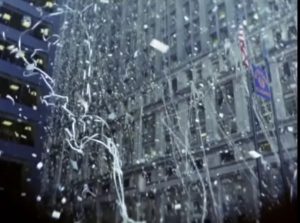 Kudos to the Sheadenfreude Commission. I realize some purists quibble with the creeping commercialization of the Elimination Day Parade, harking back to the era when John McGraw stood on the steps of City Hall and scowled haughtily while the masses roared their approval, but I thought enlisting corporate sponsor Primatene MIST, a brand that invites users to Breathe Easy Again, was most appropriate for the occasion. And thanks should go out as well to the broom-producing members of the American Brush Manufacturers Association; the Canyon of Zeroes never looked spiffier. As for how the scene sounded, it goes without saying that the legendary horn section of the visiting Lake Erie Marching Midge Band had everybody buzzing.
Grand Marshal Troy Glaus — so honored in commemoration of the 20th anniversary of his three home runs and 1.264 OPS in the 2002 ALDS — demonstrated fine form leading the procession. Dignitaries Sandy Koufax, Johnny Bench, Ken Griffey, Jr., and Josh Beckett beamed with pride from the reviewing stand, knowing the cause they stood for so heroically has strode on without interruption every autumn from 2010 forward. You’ve probably seen the photos taken by Elimination Day Parade Most Valuable Photographer Randy Johnson. So many smiles on so many faces…
It’s hard to say which moment elicited the biggest cheer.
Maybe it was when the Salute to ALCS MVPs Whose Names Begin With J float, upon which Jeremy Peña, Jose Altuve, Justin Verlander and Josh Hamilton each stood and raised his trophy high in the air, rolled by.
Maybe it was when Dusty Baker ascended to the podium and unbuttoned the jersey he wore managing his team to victory in the 2022 ALCS to reveal underneath the jersey he wore while playing in and winning the 1981 World Series.
Maybe it was when an enormous mechanical gavel, festooned with 62 Bronx-cultivated corpse flowers — once designated the official flower of New York’s northernmost borough — flailed atop the Sweet Justice float and absolutely nobody rose.
Maybe it was when a sudden gust of wind seemed to blow closed the retractable roof on the always dependable, ever popular Alibi Express bus, a staple of every Elimination Day Parade. Truly a technological marvel.
Or maybe people were most happy to simply partake of the frothy treats from the Big Papi Papaya Parfait Pop Up Shops placed every couple of blocks along the route. You can’t have an Elimination Day Parade without tasting the influence of David Ortiz.
Ah, Elimination Day. It makes every fall land just a little more softly. Kudos to the Sheadenfreude Commission for once more giving the good citizens of the Metropolitan Area something to revel in. There hasn’t been much otherwise lately.
by Greg Prince on 16 October 2022 3:48 pm The Phillies and the Padres fought the instinct to kick me out of bed this morning, which I appreciate. Strange as it is, they became my bedfellows on Saturday, the day I resumed an ability to watch baseball and not hate everything about it. Postseason will make people otherwise at odds find common cause.
Our cause (mine, certainly) was theirs, if only out of spite for the Braves and the Dodgers. I’m lousy with spite. No, I’m terrific with spite. That Phillies fans wish a pox on our house doesn’t stop me from having wished them the best of luck with heaping a bigger pox on the Braves’ house. I’ll chance a crimson shade of smug oozing into Citi Field next summer. The Phillies may be the Phillies, but the Braves are the Braves.
Correction: the Braves were the Braves. Now they’re as done as we are. Well done. Let’s check the final, FINAL records of the top two finishers from the now defunct, incredibly irrelevant 2022 regular season in the National League East, postseason results included for the sake of spite:
New York Mets 102-63
Atlanta Braves 102-64
What’s that? It doesn’t work that way? It doesn’t work at all, said the maintenance staff at Citi Field regarding the postseason bells and whistles that went ringless and silent. When it comes to These Mets, I’ll take what I can get. What I got was Those Braves going home.
Taken!
As for the Padres, who were rude visitors to Flushing what seems like a month ago, I’ll share the spiritual bed with them a little longer, having climbed in uninvited. Maybe they’re a team of destiny, in which case, who were our presumptuous 101-game winners to have stood in their way? When the Pads were at Dodger Stadium, they wore the same road uniforms in which they did their dastardly deed to the Mets. Too soon. Then they went home, put on their whites and browns and yellows for the adoring home folks who hadn’t had a chance to adore them in person in any October since 2006, and I chose to see them in a different light: lovable underdog with a slingshot in their back pocket. Down goes Goliath! While I know I have every reason to hate the Braves due to divisional warfare, I realize I hate the geographically distant Dodgers solely on merit. I’ve looked at their haughty asses in the postseason every postseason for a solid decade. They and their 111 wins can take a seat for the duration. They can sit a row ahead of us if it makes them feel any more vindicated.
Crazy system, huh? The four National League teams with the most wins (remember the Cardinals?) will join the nine National League teams who didn’t make the playoffs in not playing for the pennant. San Diego of the 89 wins and Philadelphia of the 87 wins now vie for the flag in a triumph of the pretty good who got very hot. If MLB tugs uncomfortably at its collar at the optics, it should rethink inviting 5-seeds and 6-seeds to its medieval fair. The Padres and Phillies didn’t know they were supposed to be jousting fodder. But they optimized their opportunities. I wouldn’t have said it a week ago, but good for them.
Over in the American League, sorry to Seattle, who did everything they could do across three games except keep the Astros off the board at the end of Game One and put themselves on the board for eighteen innings in Game Three (with a standard-issue loss tucked into Game Two). There’s been an epidemic of “the last time the Mariners were in the playoffs, gas was 29 cents a gallon and Rudolph Valentino was cinema’s reigning heartthrob” contextualization, but a dearth of postseason participation for 21 years speaks for itself. Now it doesn’t speak at all. Glad for the M’s fans who experienced their rebirth, no matter how cruelly the candles on their cake were snuffed.
Oh, and go Cleveland!
by Greg Prince on 13 October 2022 11:24 pm The pain of love
I’ll accept it all
As long as you’ll join
Me in that emotion
—Carly Simon
A couple of hours prior to the first pitch of the National League Wild Card Series, I thought about my cat Avery. I think about my cat Avery every day, several times a day, since he died last December. I miss him every day, several times a day.
Avery died on a Saturday, the same Saturday Buck Showalter was named Mets manager. I was too consumed by the logistics of dealing with the body of a cat who died on a Saturday night and a vet who wasn’t going to be open until Monday morning to fully absorb his passing. Maybe I still haven’t. Mourning would have to wait a couple of days. Tuesday I mourned hard. I was by myself the whole day, beset by a depth of sadness I’d never before felt, not after losing three previous cats, not after losing each of my parents. An unmovable cloud settled over my head. I let it wash over me or do whatever it is that sadness does. Then, before leaving the house to meet Stephanie’s train, I called our local Chinese takeout place and ordered basically everything I could think of.
“How come you got Chinese?” Stephanie asked, inspecting the contents of two bulging brown bags.
“We’re in mourning,” I said. “When you’re in mourning, somebody should cook for you.”
That’s also how I handled the night following my father’s memorial service. Beef lo mein and mourning. That was in 2016. I think I stopped mourning my father around 2018. No kidding. Not black armband mourning, not bursting into tears mourning, just an acute awareness of his presence in my mind despite his absence from this earth. It ran a couple of years. It hasn’t fully gone away, and that’s quite all right by me. I do the Times crossword like he did, and I wonder at what point contemporary clues — anything that assumed familiarity with acronyms like LOL — had him leaving squares blank. I listen to New Standards with Paul Cavalconte on WNYC Saturday nights and its app Sunday afternoons and laugh a little that for all the Top 40 inclinations of my youth, my dad inadvertently seeded an appreciation of Tony Bennett and Sarah Vaughan in me while I sat in the backseat of our old Chrysler (I also imagine trying to explain “the WNYC app” to him). I slice a tomato for a sandwich, which wasn’t something I used to routinely do, and remember Dad routinely sliced tomatoes for his sandwiches. Those insurance commercials about not turning into your parents…there are worse things.
I still have brief conversations with my father in my head. I mean really brief. “Did you see the Jets game yesterday?” is about it. That’s about all the conversing we did before he took ill. My conversations with Avery aren’t much deeper, but I probably still have those, too. From that dark Tuesday in December until the middle of September, I was kind of convinced he was simply taking a nap, perhaps cuddled up under the blanket he used to sleep atop in the living room. I knew he wasn’t, but I liked to think he was. I’d close my office door so he wouldn’t unexpectedly trot in and pick a pile of my flotsam to disturb. His stack of canned cat food remained and remains at the ready, along with an unopened bag of litter. If someone came along and revealed he or she had a cat that could really use a supply of Fancy Feast and a refresh on the Jonny Cat, of course I’d hand it off. But for now, we paid for it, it’s Avery’s.
In the middle of September, though, it hit me that Avery was in the past. No great bolt of lightning struck. Stephanie and I were sitting on the couch, TV on, each of us scrolling our tablet or phone and I was thinking, “It’s just the two of us, isn’t it?” Avery wasn’t under a blanky or standing by in the kitchen awaiting dinner or plotting trouble upstairs. He had gone from not here but here to here but not here. The difference is more than subtle.
Yet I remain in several times a day thinking of him mode. Like the late afternoon of last Friday, when most of my attention was directed to the Mets and the Padres, specifically the Mets. I thought the Mets would win their best-of-three series, but I wasn’t sure. There are no certainties in the postseason, I told myself. I told myself and asked myself lots of things. One of those questions plopped onto my lap as Avery would in the course of his sixteen years as my favorite kitty ever:
“I can’t bear to start in with a new cat knowing how new cats inevitably become old cats and what that entails. How will I start over with this team next year if they don’t win the World Series?”
Missing from the picture of Cat Person in Mourning is a successor cat. Stephanie and I were catful from October 31, 1992, to December 18, 2021. Usually we had two: an heir and a spare. Bernie and Casey. Bernie and Hozzie. Hozzie and Avery. After the passing of Avery’s big brother in 2017, we didn’t install a younger sibling. Avery was a solo act at heart, bathing in the spotlight of every ounce of our attention. I honestly believe he mourned Hozzie for 30 seconds and then jumped onto Stephanie’s lap with the gusto of the Heather in Heathers who grabbed the dead Heather’s scrunchie and essentially declared herself queen of the Heathers. Hence, we rode Avery’s singularity for all it was worth, and it was worth plenty.
I sort of imagined that the second Avery left this mortal coil that there’d be a knock at our front door and we’d find two adorable kittens in a basket waiting for us. The knock never came. Nor did we seek to identify the next cat in the Prince Line. It wasn’t that we stopped being cat people. Once a cat person, always a cat person. I can’t count how many Likes I’ve issued to pictures and videos of other people’s cats (especially the goofy ones) these past ten months. But all I can think about when it comes to having a cat is not the sixteen years Avery gave us or how they ended on December 18 of last year, but November 22, the date we took Avery to the vet for his checkup. Our vet looked him over, felt him up and let us know time was suddenly growing short for our cat. Short after sixteen years, yet sudden nonetheless. Signs that Avery wasn’t his spry kitten self 24/7 had been hard to ignore, but I didn’t think he’d be on his way out before Christmas. “Pets,” our vet casually reminded us, “don’t live forever.” Thanks for the tutorial, chief.
I once read that every kitten or puppy given a small child is the beginning of a tragedy. We cared for and loved three cats before Avery. Each of them proved our vet’s truism. We wrote it off as the cost of doing business. Avery lived longest of all of them. Avery burrowed deeper into our hearts than any of them (and those other three were absolute first-ballot feline Hall of Famers). All I can think of when I begin to think of a new kitten is the day — probably many years, countless smiles and much soul-burrowing later — we go to the vet and are told pets don’t live forever.
I’m not ready to set out on that journey again. Maybe someday. Not yet.
Spring Training will come around in mid-February. I guess. I haven’t checked the schedule. A friend mentioned the date of the first exhibition game to me. I couldn’t process it as news I could use. I will eventually look up Opening Day and calculate the Baseball Equinox, because that’s what I always do, but I’m not moved to as much as estimate the midpoint from last season to next season. I’m sure I’ve read a hopeful invocation this week of however many days away Pitchers & Catchers is. It didn’t make me feel any better. Neither has anything A. Bartlett Giamatti ever put forward on the subject of pastimes designed to break your heart.
The fact that Mets baseball will come around again and the 99.999999% probability that I will be there for it doesn’t make me feel any better. It makes me feel like a bit of a chump at the moment. The losing enough through most seasons so it prevents a premature playoff exit may be the most effective inoculation against the disgustappointment that’s pervaded my mood since Sunday night. Of course that kind of losing doesn’t really do anything to brighten an outlook. It just keeps hope in check.
Which isn’t something to relish, just like choosing to go catless isn’t the key to better living simply because the inevitable loss of a hypothetical cat shadows my consciousness every day, several times a day. I didn’t become the Mets fan I became to minimize the disgust or disappointment that arises every season that hope nudges open a door I forgot to shut. I became the Mets fan I became exactly for the kind of season 2022 was from its first pitch until its final 257 (Game Three’s total for both sides). I became a Mets fan in 1969. The Mets in 1969 won 100 games and went to the playoffs. The Mets in 2022 did one better in the former and, if we agree to skim over details, equaled the latter.
I really did have high hopes throughout this season. I checked them here and there, but decided I preferred to maintain an almost relentless upbeat drumbeat on behalf of this team. They never lost more than three in a row, so I believed I could treat every L as an anomaly. That record of 101-61 was not a typo. It and they really were very good.
They weren’t the best they could be. Or they were as good as they could be and it wasn’t enough to get them to be the best there is, which emerged as a reasonable, attainable Met goal in 2022. It wasn’t enough to get them from the round of twelve to the round of eight. I’ve watched my Mets fall short in postseason contexts before. I fumed and fretted and, yes, mourned. Then I moved on, more than willing to give the team that fell short its flowers. I’m not feeling particularly floral about this team despite throwing roses at its feet for six months. Maybe someday. Not yet.
I tell ya what, though. I don’t regret the journey despite my misgivings toward the ending. I wouldn’t trade those sixteen years with Avery, either. I loved believing this team was the one that was going to add to that flagpole that has waved only two banners for too long. 1969. 1986. 2022. I didn’t know it in my bones, but I believed in my head and heart from April to early October that it was altogether possible and highly probable. Head and heart have been known to err.
The bigger mistake would have been to not give them both over to these Mets as I did despite my currently turning my back on them for at least a little longer. Time will heal that wound, even if the wound will fester until the National League Wild Card Series — and its spiritual dress rehearsal in Atlanta the weekend before — cease lingering in the atmosphere. I think I stopped mourning the outcome of the 2006 NLCS in 2008. No kidding. But 2006 as the flag that was going to accompany 1969 and 1986 is something I knew in my bones. Bones make errors, too.
To co-opt a phrase Steve Rushin crafted ages ago, I had more fun than a barrel of Mookies for most of 2022. We were the first-place Mets almost every day, says the master of compartmentalization. Even still. That was a ride. That was something to believe in. And it did get us to the precipice of where we needed to be. Perhaps the new playoff format and whatever new playoff format expands upon this playoff format will dilute the thrill of qualifying to play beyond the 162nd game. I’ve watched enough first-round exits by so-so Nets and Islanders clubs to not blink when my basketball and hockey seasons end quickly. Then again, those aren’t baseball.
When the Mets were on the verge of clinching their division in 2006, I visited our local liquor store, bought a decent-sized bottle of champagne and, the night after the clinch (I was at Shea when the blessed event happened), I toasted the Mets’ good fortune with my wife. It had been six years since our last October appointment, yet it also felt like it had been forever. Maybe because 2006 was an in-my-bones year, I knew we had to celebrate like the Mets celebrated. We wouldn’t pour any bubbly over each other’s heads, but a little buzz seemed appropriate. I didn’t know I was going to start making an earnest toast in the middle of our kitchen, but that’s what came out of my mouth, something about how much it meant to share this wonderful season, how I didn’t think it would be so long between division titles. Stephanie and I met in 1987. They won the East in 1988…and not again until 2006. I’m pretty sure she gave me a look of “oh, you’re really doing this” at my ad hoc stab at eloquence, and then she got in the spirit of the gesture. Hozzie and Avery evinced their usual apathy.
The toast became a clinching tradition, which is to say it didn’t happen again until 2015, a year when the division came into sight in August and was a foregone conclusion by September, so there was ample time to lay in something sparkling and, because the clinch came on a Saturday evening, run out for a nice pizza. A very nice pizza. A very nice toast. For the Mets, 2015 was a very nice year. One of the flagpoles was augmented, albeit the one with 1973 and 2000. You toast what you can get.
In 2016, the Mets rushed to a Wild Card. It was the most fun rush of its kind I’ve experienced since I started taking it upon myself to write about the Mets. I loved that late August-September surge of 2016 in a way I hadn’t loved a late August-September surge since 1973. The prize was less than a division title. The postseason would be only one game. Still, that Saturday was worth a pizza and a toast. That July, when my father died, I impulsively bought my first twelve-pack of beer since college. I’m thinking there were no fewer than nine cans from that pack still in the fridge by October 1, the day the Mets clinched. So we toasted with Blue Point Toasted Lager. (We never drank the rest, but one can remains shoved in the back of the refrigerator for the same reason 40 cans of cat food remain stacked next to the microwave.)
When the Mets clinched their 2022 playoff berth in Milwaukee, it merited a partial celebration by the clinchers themselves. More clinching ahead, so the party was subdued. After twenty raucous champagne showers for postseason participation and every series victory that followed in its wake, this was just a tasteful toast. Splendid job, men. Back at it tomorrow. The real pre-playoff party would come when we won the division. Well, you know how that went. And in our kitchen, it went nowhere from September 19 — too late on a Monday night to pop corks or order pizza — until October 5, when the regular season ended with what landed as a consolation prize.
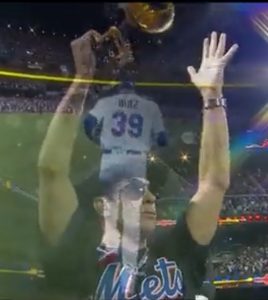 Play it again, Tim. But I’d be damned if I let 2022 get away without the acknowledgement it deserved before we might decide it deserved no more than a cold glass of water. I bought the smallest bottle of champagne that our local liquor store sells; it’s 187 milliliters, called a Mini Moët. I called for the usual-size pizza, toppings and all, same as in ’15 and ’16. And on Friday night, October 7, somewhere between wondering how I’d ever conjure enthusiasm for next year if this year wound up going awry and Max Scherzer throwing the first pitch of the game that indicated awry was where this year was going, I proposed my traditional toast. We raised our glasses to the trip the Mets had taken us on this year, to the opportunity to venture a little further in the days and weeks ahead and, implicitly, to being the kind of Mets fans who do something like this when the Mets do something like they’d done. That they wouldn’t do much worth toasting in Game One let alone Game Three didn’t make the toast (or the pie) any less sumptuous or, to me, any less necessary. Wait too long to toast or trumpet those intermittent accomplishments that give you substantial dollops of joy, you’ll be waiting 36 going on 37 years. The Moët’s gonna be mighty flat by then.
This is what we do. We root. We recap. We rationalize. We revel. We regret. We rue. We reconsider. We recover. We mourn a beautiful season’s untimely passing, fully cognizant that it is not life or death. But it is baseball, so we’ll be excused for treating it as both. We do it together every year, right here, whether we can imagine doing it all over again or not, because we can’t imagine not doing it.
Hey, fellow Mets fans: here’s to us.
And here’s a little something to listen to if you’re up for it.
by Jason Fry on 10 October 2022 1:42 am You’ve probably heard this before, but baseball is designed to break your heart.
Twenty-nine of 30 fanbases are destined to have their teams’ seasons end other than the way they’d wanted — with a victory that doesn’t mean anything or a loss that means everything. If you’re one of the unlucky 29, there comes an afternoon or evening when your fervent hopes, pinch-me dreams and wild imaginings are all snuffed out over three or four fatal hours, replaced with months of winter and silence.
For a long time in 2022, we were among the dreamers — cheering on a team built to win and able to live up to its blueprint, with that intangible more-than-the-sum-of-its-parts something that says, “Psst, you’re gonna want to keep your October calendar free. Because this could be the year.”
Until the night that the verdict was delivered that it wasn’t.
I was there for that night, also known as Game 3 of the Wild Card Series. I was at Citi Field up in 527 with my wife and kid, and at least I can report that it was a beautiful evening, not at all the chilly ordeal I’d braced and dressed for, with a searchlight of a full moon in the sky and Jupiter riding shotgun. Unlike Game 1, we had good neighbors — knowledgeable about the game, passionate about the Mets, and philosophical and mournful instead of vengeful and irrational once things spun out of control. My favorite neighbor was in the row below me, a kid about seven or eight in a pint-sized ALONSO 20 jersey. He was still waving his THESE METS towel and chirping Let’s Go Mets!, enthusiasm not at all diminished, with two out in the ninth and the Mets down by six. Nobody gave him so much as a side eye even as the rest of us huddled in our own misery — his optimism was so simple and unassailable that I think it made more than a few of us wonder when, exactly, we’d set that aside in our own lives.
Ah, the game. Sigh.
Look, I was 500 feet from home plate. I can’t tell you anything about Joe Musgrove‘s stuff or location or the Mets’ obviously futile approach to countering it — all I know is Mets kept coming to the plate and leaving in consternation and/or dejection. What was apparent even from 500 feet away, though, was that the Padres flat-out beat the Mets. They pitched better, they played sterling defense, they took advantage of their offensive chances. That’ll do it.
I also can’t tell you anything about Musgrove’s shiny ears or the rest of that whole contretemps. (I’d gone to the bathroom and was nonplussed to emerge and discover a gaggle of players and umps at the mound.) As the umpires were examining Musgrove’s various body parts, our section started tilting phone screens for neighbors to see and then passing them around, showing charts of spin rates and discussions of Vaseline and Red Hot and pitchers’ baseline sweatiness and opinions from Jerry Blevins and Andrew McCutchen and video clips and freeze frames from the broadcast — an impromptu amateur digital investigation. (I’m just happy that in the end the consensus was that Musgrove was innocent, because an alternate conclusion would have been a huge mess and we’d all just be more unhappy.)
It was interesting being part of a baseball hive mind, but my memory flashed back to a very different game, one from May 1996 and the pre-cellphone era. Emily and I were in the Shea stands for an epic brawl between the Mets and Cubs on the day the Mets were lauding John Franco for his recently achieved 300th career save. Back then the Mets maintained a stuffy wanna-be patrician reserve about fights, refusing to acknowledge they were happening and afterwards not imparting information such as who’d been ejected. This became important when the Mets took a two-run lead to the ninth but didn’t bring in the closer they’d just honored, sending those of us who had transistor radios or AM/FM Walkmen to WFAN to figure out what on earth had happened. Which enough of us did so that eventually everyone in our precinct of the stands had been informed that yes, John Franco had been ejected on John Franco Day. (The Mets blew the lead but won on a Rico Brogna walkoff homer. Good times.)
Anyway, to return to more recent history, the Mets lost one and then won one and then their opponents played better and so they lost a rubber game. There’s nothing earth-shaking about that — I could have just described several chunks of any season, even a 101-win one. But because this particular rubber game came in October, people will try and tell you it means everything. They’ll turn it into a referendum on the entire season, or say risible stuff about 26 guys wanting it more than 26 other guys, or opine about who was battle-tested or possessed the will to win. And it will all be nonsense. The Mets lost a rubber game in an exhibition series. It’s disappointing and I’m sad about it, but fundamentally that’s all that happened and all this other … stuff encrusting that fact is more than a little ridiculous. The postseason is a series of coin flips that we spin into Just So stories, and the more baseball I watch, the more resistant I am to the whole narrative industrial complex that surrounds the games.
It’s after midnight and I’m tired and sad. I’ll leave the elegies and the lyrical flights of fancy for another day — our calendars are suddenly clear, after all. But I do want to leave you with two thoughts.
First of all, don’t let losing an exhibition series sour you on a 101-win campaign that was marvelous fun for six months. I guarantee you there will be multiple sleepless nights when I’ll realize I’m fuming about Trent Grisham running down Mark Canha‘s line drive, or about having to remember that Trent Grisham existed in the first place. But that won’t stop me from also remembering Brandon Nimmo robbing Justin Turner, or the Mets’ ninth-inning ambush of the Cardinals, or the furious comeback against the Phillies, or Canha saving us twice in Philadelphia the day we discovered Nate Fisher was on the roster, or Francisco Lindor walking off the Giants, or Eduardo Escobar singlehandedly beating the Marlins, or that goofball combined no-hitter, or Nick Plummer‘s first big-league hit, or Brett Baty‘s first swing, or Francisco Alvarez unloading for his first Citi Field homer, or the day Adonis Medina faced down the Dodgers, or the crazy walkoff on Keith Hernandez Day (at least he couldn’t be ejected), or Escobar and J.D. Davis combining for an unlikely game-saving play at Wrigley, or a dozen Luis Guillorme plays that looked like special effects, or Jeff McNeil beaming with a batting title secured. Or so many other wonderful moments from 2022 that you shouldn’t forget. (Here’s a wonderful Twitter thread to bookmark, for starters.)
Second, don’t let disappointment keep you away from these last couple of weeks of baseball. We’ve already seen an astonishing Mariners comeback, a marathon win for the Guardians and the last bow for two generational St. Louis Cardinals, and we’re just three games in. Yes, these series are exhibitions, and it’s unfortunate that they turn regular seasons into footnotes instead of the other way around — but hey, I never said they weren’t fun exhibitions. Before you know it, we’ll be down to two teams and four to seven baseball games and then one team and no games at all. The lights will be off and the talk will be about player options and salaries and budgets and competitive balance taxes, and it will all be boring and it will feel like winter is never, ever going to go away.
It will — I promise — but not for a while. So stockpile all the baseball you can, even if the team we love to distraction and delirium and occasional dismay won’t be a part of what’s left.
by Greg Prince on 9 October 2022 11:57 am According to mathematics from whichever grade I learned percentages, three is fifty percent greater than two. According to how I felt waking up this morning to the knowledge the Mets would have a Game Three in the Wild Card Series versus how I felt yesterday morning when Game Two loomed as the conclusion to our 2022 postseason, three is exponentially greater than two. To quote Tom Seaver to Lindsey Nelson following the Mets winning the fifth game of the 1969 World Series, it’s the greatest feeling in the world!
Being alive will feel that way when the abyss stares at you from a distance of 27 outs.
Rather than concluding, the Mets continued on Saturday night, hanging inning for inning with the formidable San Diego Padres until putting together an inning that separated the sudden rivals once and for all for an evening and reminded viewers and listeners that not only did the Mets lose 61 games this regular season, they won 101. In the bottom of the seventh, with the Mets leading by an inadequate 3-2, two Padres pitchers threw fifty pitches to nine Mets hitters, the end result being four additional Met runs. It took about 45 minutes, which I might not have been aware of had ESPN not posted a graphic and Howie Rose (seconds ahead of the television, appropriate since the broadcasting acumen of Mets radio is light years ahead of national interlopers) not righteously kvetched about the pace of game slowing to a crawl.
Pace of game, brought to you by PitchCom Molasses. PitchCom Molasses: for when your next pitch absolutely, positively has to be there overnight. Spread it all over a reliever holding his cap close to his head in hopes of someday finding out what his catcher wants him to deliver next.
It was a little messy for the Padres’ Adrian Morejón in the Mets’ seventh, what with PitchCom maybe not functioning as Rob Manfred envisioned and the Citi Field crowd gleefully interjecting aural interference, but a San Diego mess is a New York blessing. Following Friday night’s deprivation of runs, good fortune and anything resembling Mojo, we’d take everything we could get. We’d take a Series-saving 7-3 victory, however it was pieced together, regardless that it required four hours and thirteen minutes. We’d take an on-ramp to Game Three, the new must-win segment of this portion of the playoffs. We just want to get out of Dayton.
Dayton? Dayton’s where the NCAA plays its “First Four,” determining how college basketball whittles its Field of 68 to a more numerically pleasing Field of 64. I’ve had my alma mater go to Dayton and survive. They were a real NCAA participant once in Dayton, but they were really in the Big Dance once they got out of Dayton.
The Mets need to get out of Dayton tonight. They need to book that flight to Los Angeles they anticipated the minute they got coy about who was gonna pitch Game Two, acting as if it would be dependent on what happened in Game One. In Game One, Max Scherzer got shelled. In Game Two, they turned to Jacob deGrom, definitively depriving themselves of the ideal starter for Game One of the Division Series, but granting themselves the best chance they had to make their flight.
Prior to Game One, I dealt with the usual postseason emotions (“usual” a questionable word to use when your team usually absents itself from the postseason altogether) of not being able to deal with the idea that two wrong moves would eliminate the Mets from the playoffs before the playoffs really got going. After Game One, I evolved quickly to philosophical about early rounds of playoffs bouncing out of your hands, something I’ve had drilled into me as a Nets fan, and life going on regardless, perhaps giving in a bit to the most vexing of the Four Horsemen of the Metpocalypse: Fatalism. I’d successfully averted the entreaties of the other three: Skepticism, Pessimism and Cynicism. I was particularly proud of dodging Cynicism. My contribution to the Game One Mets Social Media Discourse — always a pleasant arena for calm, reasoned chat — was pointing out to anybody who would listen that five times the Mets had lost Game One of a postseason series before rebounding to win that series. Some took heart in that historical nugget. Others, donning the dark, menacing mask of Cynicism, couldn’t wait to advise me that none of those situations involved a best two-out-of-three scenario.
“WHAT, YOU DON’T THINK I DON’T KNOW THAT, YOU METSIE COME LATELY CYNICAL FOR A BRAND PUNK? I’VE GIVEN MY LAST 54 SUMMERS TO LOVING AND UNDERSTANDING THIS TEAM AND KNOW MORE ABOUT THEM IN MY LITTLE FINGER THAN YOU WILL IN YOUR ENTIRE BODY EVEN IF YOU LIVE AN ETERNITY AND SOMEONE BEQUEATHES YOU AN ENTIRE BASEBALL LIBRARY OF METS MEDIA GUIDES DATING BACK TO 1962!” is not what I typed to the Reply Guys I didn’t know from a tweet in the wall. Instead, I calmly retorted that in four of the five series I referenced (1969 World Series, 1973 National League Championship Series, 1986 National League Championship Series and 2000 National League Division Series), the Mets who’d fallen behind 0-1 took a 2-1 lead (in the 1986 World Series, we needed to come back from 0-2). Once I’d repeated this about a dozen times, I blocked a few people and muted the entire conversation.
Such is the price of attempting to avert Fatalism.
Despite my if you’ll excuse the expression brave front, I wasn’t certain the Mets would continue on from their Game One debacle to see a Game Three. I just knew that Game Two hadn’t been played yet. You didn’t need a master’s degree in Metropolitan Studies to divine that much. I’m frankly amazed by the Mets fan state of mind as it stands after sixty-one years, particularly the sixty-first. If the Mets are ahead, don’t act as if they’ve won anything (agreed). If the Mets are behind, they’re automatically doomed (get bent, you fatalistic prick). I’m not interested in the defense mechanisms you claim to have erected against potentially impending disappointment or the scars you bear from seven up with seventeen to play or Beltran taking strike three or Scioscia going yard or Yogi not pitching Stone. You think I don’t have them? You think I don’t feel them as deeply as you do? I’m not even saying You Gotta Believe it’s a sure thing the Mets will come back. I’m saying You Gotta Believe that It Ain’t Over ’Til It’s Over, particularly before it’s barely begun.
Here’s another historical nugget: all teams are 0-0 in games yet to be played. The Mets hadn’t played Game Two. The company with the ads with the guy on the toilet placing bets (which is our new household euphemism for having to excuse ourselves to the water closet) could take those chances to the app and let it ride.
DeGrom let it ride in the first inning Saturday night at Citi Field, throwing with everything he had and smothering the Padres as he smothered most comers between 2018 and his first several starts of 2022. Along the way, he dipped in and out of trouble, giving up a pair of runs, one on a solo homer to Trent Grisham in the third, one when Grisham walked, took second on a bunt and zipped home on Jurickson Profar’s single in the fifth. In both cases, however, Jake’s dabble with mortality proved nothing close to toxic, as the Mets had given Jake a run before he gave up that first run — Francisco Lindor homered with nobody on in the first — and a second before he gave up that second — Brandon Nimmo singling home Eduardo Escobar. The Mets were leaving too many runners on base, but they also kept getting runners on base, which isn’t a note I picked from the Pollyanna Broadcasting System. Unlike the night before, when the Mets put their bats back in their racks after a couple of innings of not quite getting to Yu Darvish, they kept coming after Blake Snell. Snell wasn’t overwhelming them and it didn’t appear he was going to outlast them.
DeGrom himself lasted six. He’d ceased overpowering Padres like he had in the first, relying more on sliders than fastballs as he went along, but he appeared back in full Jake mode as he brought his night’s work home, striking out Manny Machado and Josh Bell to end the fifth and dismissing his final three batters with ease in the sixth. In his first Citi Field postseason start, Jacob departed in position to be the winning pitcher, thanks not only to his 99 pitches of overall effectiveness but to Pete Alonso providing him a third run on a massive leadoff homer to commence the bottom of the fifth.
The Mets never score for deGrom.
The Mets mostly lose deGrom’s starts.
DeGrom isn’t really deGrom anymore.
Be gone, Metpocalyptic horsemen!
DeGrom won’t be available for Game One of the NLDS should there be a Game One of the NLDS. That one I’ll concede. DeGrom will never pitch for the Mets again. That remains to be seen. The opt-out is out there. Jake’s been the greatest pitcher in the world for a long time while wearing No. 48, but this offseason he’ll be looking out for No. 1, and I don’t mean Jeff McNeil. The balance between never wanting to see Jake in any uniform but the Mets variety and figuring out his future value past his current age of 34 (he’s older now than David Wright was in the 2015 postseason, and David Wright in the 2015 postseason seemed positively venerable) is a balance to be struck when there’s no more Mets baseball to be played in 2022. At least a few innings remained when Jake exited after six in Game Two. At least nine more remain as of this moment. Maybe more than nine after tonight.
Edwin Diaz came on in the seventh, a little ahead of schedule. Whatever spectacular playoff flourishes the Citi Field A/V staff planned for Edwin’s entrance in the postseason had to be deferred because the grounds crew was on the field tidyiing up the dirt along the basepaths. That’s the postseason for you. Diaz came on when he needed to come on, with an eye toward protecting a one-run lead with the most dangerous elements of the San Diego order up around the bend. The inning to close this game was not the ninth or the eighth. It was the seventh.
Four batters, two putouts at first around a single off the shortstop’s glove and then a 1-3 assist to retire Juan Soto may not have been as sexy as three straight strikeouts with trumpets blaring and lights flashing, but boy did it get the job done. Edwin Diaz posted his save right there, no matter what you read in the box score.
Then, in the bottom of the seventh, the Met offense went about protecting their lead, saving their game and persevering their postseason a whole lot more. It was an inning you recognized from any given game between April and the better parts of September. It was the Mets working the bleep out of counts. It was Alonso seeing ten pitches before taking a walk with Lindor already on second, it was Mark Canha taking ten pitches before taking a walk to load the bases and, most deliciously, it was batting champion Jeff McNeil doing what batting champions do and doubling in Lindor and Alonso. Maybe Morejón couldn’t hear Austin Nola’s signals in PitchCom, but the Padres could certainly see what was becoming of their series lead.
The Mets were up, 5-2 in Game Two. New reliever Pierce Johnson’s third pitch was turned into a run-scoring single by Escobar. His eighth pitch was converted into a sacrifice fly by Daniel Vogelbach, pinch-hitting for Terrance Gore, who had pinch-run for Darin Ruf, who had been on base twice as the DH via a walk and a hit-by-pitch, but what do you care how Darin Ruf gets on base so long as he’s not making unproductive outs? When the fifty-pitch dust settled over Citi after seven, the Mets were ahead of the Padres, 7-2, and still had Edwin Diaz in the game.
Diaz was well-rested from a September and early October that involved precious few save situations, so why not keep his arm warm and leave him in to face what remained of the heart of the San Diego order? The Mets led by five. On Saturday afternoon, in a game that stretched into Saturday evening and briefly pushed the Mets from ESPN to HGTV (you had to go to your doctor’s waiting room to watch it), the Blue Jays held a seven-run lead on the Mariners. The Mariners are going to the American League Division Series, having erased that seven-run lead of the Blue Jays. No time to take anything for granted. Buck Showalter asked Edwin to take care of Machado, Bell and Jake Cronenworth. He grounded out Machado right back to the mound (run, Manny, run!), surrendered a four-pitch walk to Bell and Narco’d Jake Cronenworth on three consecutive strikes. Edwin Diaz threw 28 pitches. Kenley Jansen pitched every ninth of the series we vaguely recall in Atlanta. Diaz will pitch again if needed.
Now that Trevor Williams has been removed from the NLWC roster for tactical reasons and Joely Rodriguez has been shifted to the IL for shoulder reasons (the Mets wishing Taijuan Walker be available to shoulder a little additional load), Adam Ottavino stands as the lone Met pitcher to be active for every single game of the 2022 season and postseason. Ottavino has been as close to an unsung hero as the Mets have had this year. We’re free to sing the praises of Ottavino at any time, but usually his contribution boils down to “after Adam Ottavino pitched a scoreless eighth, it was Edwin Diaz time” or words to that effect. This would be a wonderful time to sing Ottavino’s praises exclusively and fulsomely.
That would be if his Game Two performance were praiseworthy. After he struck out Old Friend Brandon Drury to end the eighth, the ninth, with the Mets still ahead by five, represented a ploddingly developing minefield for Adam. He struck out He-Seong Kim, but then hit Grisham; walked Nola; flied out Profar deep enough to advance Grisham; walked Soto; and walked Machado (who prefers not to run). Now it was 7-3, the bases were loaded and the song to sing was whatever Seth Lugo would respond to.
It warmed my heart to see Seth Lugo on the mound one out from conclusion, not so much because he’d be my choice for a Met to end a life-or-death playoff game — “Narco” is a truly catchy tune — but because Seth Lugo has been here forever, embodying the kind of continuity a fan cherishes from his ballclub. Like Nimmo. Like McNeil and Alonso all of a sudden. Like deGrom, lest you’ve forgotten 2014. Like Tomás Nido, even, never mind Nido not laying down one of his signature bunts earlier when it would have come in handy, and Nido swinging away with Gore on first when the whole reason for Gore being on first was for Gore to steal (it became a double play). The homegrown guys had waited the longest for a game like this, and we’d waited alongside them. Only Jake had ever pitched in a postseason game for the Mets, and never at home. He was injured for their one-night stand in 2016 after willing the Mets through the treacherous portions of the fifth game of the NLDS in 2015. Nimmo and Lugo were callups in 2016, only watching Noah Syndergaard and Curtis Granderson doing what they could to stave off the Giants. Nido appeared on the Mets in September 2017 in the most depressing series I can remember from the most depressing year I can remember from the previous decade. The Mets were in Chicago for three nights, not even days. They were swept three games. The combined score was Cubs 39 Mets 14. The last of those losses dropped the Mets’ record to 63-83. Welcome to the big leagues, Tomás Nido!
But Nido hung around, backed up every catcher in sight and, eventually, emerged as the No. 1 catcher (maybe 1A; even still) on a playoff team, a team that won 101 regular-season games, a team that with one more out and one more win would be slipping the surly bonds of Dayton and flying toward the Final Four of the National League for real. Making these playoffs as the Wild Card registered, before it started, as being shunted to the kids’ table. Weren’t we a little tall to be sitting with these non-division winners? Check the book again: we had the same record as the Braves, we belong over there, with the grown-ups.
That was a few days ago, when the last of the second-place wounds were licked. No time for that now. Game Two of the Wild Card Series was still Game Two of a postseason series, and here at Citi Field, it featured enough New York Mets from all those seasons without postseasons to make this additional step feel more than worthwhile. Nido was behind the plate waiting for a delivery from Lugo. Lugo was facing Josh Bell with the bases loaded. All romantic notions aside, Lugo had to get Josh Bell out. He most certainly had to not give up a grand slam that would have tied the game at seven. I’m none among skeptical, pessimistic or cynical and I’ve already established I’m not fatalistic. But I do get nervous. I haven’t been a Mets fan as long as I have to rule out any possibility.
I never ruled out that the Mets weren’t done after losing Game One. That got me to Game Two. The Mets themselves did the rest. Lugo induced a grounder to Alonso. Alonso flipped it to Lugo. There would be Game Three. That was an absolute certainty.
The Mets’ survival to Game Three rates its very own episode of National League Town, as does every Mets postseason game, but the one after Game Two is cheerier than the one after Game One.
by Jason Fry on 8 October 2022 1:27 am The good part is that Citi Field still knows how to bring the noise for a postseason game. I was there Friday night for Game 1 of the Wild Card Series (or whatever it’s called, I don’t really care), and the stadium was loud bordering on deafening — not just the A/V system, though that was certainly supercharged, but also 40,000-odd fired-up rooters. We roared out “Let’s Go Mets,” we shouted accolades for the Mets assembled on the first-base line whether assistant trainers or batting champs, we carried on as you’d hope a big October crowd would.
One thing I quickly remembered from my last playoff game, now somehow seven years removed, was that few individuals who make up the crowd realize that they cannot, in fact, scream for three straight hours. That typically sinks in around the second or third inning — the pandemonium becomes dotted with pauses, which grow longer and longer, until the crowd, having tired itself out, finally sounds more like what you find at a regular game.
Game 1 was extra-pandemoniac (this is possibly not a word but oh well) because the first inning was action-packed, and unfortunately not in a good way. Max Scherzer gave up a leadoff hit to the annoying Jurickson Profar, looked like he’d get out of the inning, but then surrendered a two-run shot to former teammate Josh Bell to put the Mets in an early hole. Up in section 528, right under Willie Mays‘s 24, my neighbors were vocal about their unhappiness. The Mets made some noise in the bottom of the first against Yu Darvish, he of the lankily hesitant delivery and loaded arsenal of pitches, but the sound and fury signified nothing, as Pete Alonso struck out with a runner on third and one out (don’t do that) and Daniel Vogelbach hit a ball down the right-field line that briefly looked like it would sneak into Utleyville but came up short.
Scherzer gave up a solo homer in the second and the Mets again showed signs of life in response, as the blissfully returned Starling Marte snuck a leadoff single through the infield and then stole second and third. But his teammates once again failed to convert a one-out runner on third — this time it was Eduardo Escobar who struck out — and another promising inning yielded nothing. Up in 528 the roaring had turned into muttering and a sour mood had crept over the proceedings as everyone got the feeling that this might not be our night.
The crowd would achieve full liftoff again, but unfortunately, that was after the roof caved in on Scherzer in a horrific fifth. As he trudged off the mound, the boos that had slowly accumulated during the inning became an avalanche. I was surprised, which I suppose is on me given what I’ve had to admit about human nature over the last few years. Really? Of course we’re all shocked and frustrated, but are you seriously booing Max Scherzer? After what you’ve seen him bring to this team? Do you think he isn’t trying? Do you think he isn’t angrier than you are about what’s happened?
It was shameful. I’ll leave it at that.
The mildest of silver linings was that a lot of the trash then took itself out, leaving mostly diehards who had more measured reactions to the proceedings — and an appreciation for the little things. Some of which were little indeed: Luis Guillorme got cheered just for showing up, Mark Canha for grinding out a long at-bat, and Francisco Alvarez for being part of the presumed future. (Lest things get too treacly around here, none of those episodes actually resulted in a Met hit.)
I heard something else in the diehards’ applause, though — the unhappy but unavoidable knowledge that the end may be near. The postseason is a funny thing — a small slice of the baseball year whose significance distorts the normal ebb and flow of games. A Hall of Fame pitcher shows up missing the “ride” on his fastball and gets strafed. That happens. Not surprisingly, his team loses because of it. But because the game is part of this particular slice of the year, Saturday’s game is suddenly everything. A two-game losing streak against the Padres means the Mets’ season is over. A Mets win Saturday doesn’t set up a rubber game as we think about one from April through September, but a showdown after which 100-odd people get to continue doing what they do while another 100-odd people go home for the winter.
Whatever happens, for at least one more day it’ll be loud. Here’s hoping it’s the better kind of noise — the kind that barely got to be heard on Friday night.
by Greg Prince on 7 October 2022 2:23 pm At 2:37 PM Thursday, 29½ hours before first pitch of Game One, I felt it. I was thinking about Sunday, potential Game Three, and how its start time is up to the dictates of television, reportedly fluctuating between its penciled-in 7:37 PM and its apparently ESPN-desired 4:07 PM, a slot that would become available if the Guardians sweep the Rays or the Rays sweep the Guardians. The uncertainty seemed unnecessary, particularly in a month when everything but the bare minimum of action is couched in terms of If Necessary. I began to think of what it would be like on Sunday if the Mets-Padres Wild Card Series is not settled, and my stomach began to reflect that lack of precision. Make us wait? Push us up? Not tell us? Aarrgghh!!
There it is, I realized. Dread. Postseason dread. Postseason anxiety. Playoff mode. Whatever you want to call it. Nice to have you back, no matter that a person won’t be able to take you anymore by first pitch. The only thing worse than not handling the dread is not having the dread because that means you’re not having your team in the playoffs.
The MLB logo this time of year should feature a batter popping Pepcid. Antacid For All! would be quite the pitch to viewers who understand.
For now, there is Game One, tonight, 8:07 PM. Oddly timed starts, yet rather exact. Max Scherzer will drape himself in Friday night black and face nine Padres batters. Yu Darvish will face nine Mets batters also draped in black. No mourning permitted; black is the new celebratory hue of Mets baseball. It is shorthand to say it will Scherzer vs. Darvish. It is also not wholly accurate. The starting pitcher never faces the other starting pitcher. Especially in the era of the designated hitter (boo, after six months of living with it, Vogie or not), baseball games now encompass two alternating baseball games. We pitch to your guys, you pitch to our guys, we’ll tally up the runs when everybody’s done. It didn’t feel like that before the DH, when the pitcher batted once every nine batters, when the offense and defense organically intertwined. I came to this conclusion in 2020. I’m revisiting it out of antsiness for First Pitch, just now promoted to upper-case institution.
The Mets released their roster late this morning, presumably because Buck Showalter is not allowed to keep it inside his windbreaker. He’d rather maintain the element of surprise at every turn. That, presumably, is why he never lets us see his uniform top. The element of surprise on this roster is the presence of Starling Marte, which qualifies as a nice surprise, assuming Starling is a gripping machine again. We also have Francisco Alvarez active for the postseason one week after making his big league debut. Kid can swing a bat. He is poised — and poised to start Game One on the bench alongside Darin Ruf, back from the IL/dead, and Terrance Gore, who’s hit a little better than Ruf recently but is here for his wheels. Tylor Megill, a paper injured list occupant for 48 hours, has also been resurrected.
Not invited to the ball for round one: Mark Vientos, Tyler Naquin, Trevor Williams, Carlos Carrasco and Taijuan Walker. Vientos and Naquin had to fall victim to the numbers game so Gore, Alvarez and Ruf (who has hit some key Padre pitchers well) could be ensured space. Williams took one for the team in the form of soaking up six soggy innings on Closing Day and wouldn’t be available for his intermittent heroics anyway. Back-end starters Carrasco and Walker won’t be needed in a series that will go no more than three games, not with a heartily stocked bullpen of in no particular order except for the name that closes the list Megill, Ottavino, Lugo, Peterson, Rodriguez, Smith, May, Givens and Diaz supporting Scherzer in Game One and whoever starts Game Two.
Yeah, we don’t know who will start Game Two. Buck presumably knows if he’s going to assign that very necessary start to Jacob deGrom or Chris Bassitt, or if he’s going to save Chris Bassitt or Jacob deGrom for Game Three if Game Three is necessary, or is he hoping he can hold deGrom out for Game One of the thus far mythical National League Division Series between the Mets and Dodgers which, as we learned in New Format School, won’t be played unless the Mets take two games from the Padres?
This is good if evanescent obsess-on stuff for the hours before First Pitch of Game One because at the moment I started writing, the only baseball happening was that between the Rays and Guardians and, despite my best wishes by text to my dear old Cleveland-fan friend a couple of hours ago, I can’t say I’m terribly engaged by the progress at Progressive Field other than my ears perking up at the mention of Amed Rosario hitting and fielding. No Rays or Guards are at fault here. They might as well black out all other series while the Mets are on the clock in October (or Clocktober). They don’t register for me while I’m immersed in that sweet dread unique to Met autumnal participation.
Will Jake check in at the starter’s desk for Game Two? Only if the Mets lose tonight. I think. I don’t know. Buck does, and as long as he tells the pitcher who needs to know and maybe the catcher, all will be cool. My imagination has meandered to wonder if the Showalter-deGrom relationship is all one wishes it to be. Buck steered a Met ship to the top of the division without Jake. Every manager who had deGrom between 2014 and 2021 (there were a slew if we count Beltran) seemed over the moon about having deGoat at his disposal. Showalter never seems particularly impressed by that. He does seem to enjoy chatting with Max on the bench when Max isn’t pitching. If there’s such a thing as being a Scherzer Guy or a deGrom Guy, the sense I get from listening to Showalter take questions of the “wasn’t Jake amazing today?” nature after deGrom’s better starts is he’s not a diehard deGrom Guy, that deGrom isn’t one of his guys, the way managers have their guys whether they’d ever admit to it or not.
I may be seeking soap opera entertainment where there is none. Yet Buck’s not starting deGoat in Game One of a postseason series, which, recent Jake outings and careerlong Max pedigree notwithstanding, rubs me ever so slightly the wrong way. I know Max is Max, and I love that Max is a Met. But Jake was one of us when nobody else on this staff was anywhere near us. I’ll always veer to the most authentic Met available if given a choice.
Side note: on the rosters of Wild Card Series clubs: deGrom, Matz, Syndergaard and the heretofore missing from October action Wheeler. Pride in Met pitching pervades a little piece of me, regardless that three-quarters of that quartet pitch for teams I’d shove off a cliff if I could. A slightly littler piece of me wonders how Matt Harvey is doing these nights.
Then again, Buck (and whoever collaborates with him on vital decisions; this is 2022, when even established managers aren’t left solely to their own personnel instincts) shook up the rotation enough to start Jake in the first game of that last Brave series, which actually gave me bad vibes despite being a deGrom Guy of the first order, because it reminded me of the pressure put on Davey Johnson — from telegrams sent by fans, which was something that actually used to happen — to switch Darling and Gooden for the big series in St. Louis the last week of 1985. Popular sentiment swelled in Doc’s direction for the opener because Doc was never more Doc than he was in 1985 and Darling, scheduled to open that series at Busch Stadium, simply wasn’t Gooden. Nobody was. The Mets were three behind the Cardinals with six to play. How could you not go with your best?
But Darling was Darling, who was very good himself usually. Johnson kept the rotation intact. Ronnie threw nine shutout innings, and the Mets won; Doc pitched the next night, and the Mets won; and had Rick Aguilera been a little more seasoned or Tom Seaver not been lost in the compensation draft…let it go, it’s 37 years already. And had the Met rotation of Bassitt, deGrom and Scherzer rotated as previously rotating before Atlanta and produced results in the first two games like Darling and Gooden did in 1985…let it go, it’s a week already.
Or maybe Jake just needs to take care of that blood blister.
You’re listening to my interior monologue. Clocktober is coming up on five hours to First Pitch. Scherzer will throw it. I will cheer him with all the gusto I would deGrom. Nine Mets will attempt to hit. I will cheer them similarly. Marte is eligible to be one of those nine. I’m cheered by that. A whole lot of professional relievers will be on high alert. Forty-three thousand fans in the ballpark and who knows how many more (this correspondent included) watching/listening away from Flushing will be the same.
The dread. The anxiety. The need to go up 1-0 or tie 1-1 or come out ahead however many games it takes.
It’s a day since I first felt it. It’s increased quite a bit.
by Greg Prince on 6 October 2022 4:02 am I packed an asterisk and a caveat as I set out for my 27th consecutive Closing Day. Unlike water bottles whose caps aren’t fully sealed, security waved them right through.
A rain delay nudged Closing Day into Closing Night. Closing Night closed only so much. The door to Citi Field and the Mets’ ultimate 2022 fortunes was left ajar. Really, that’s the ideal scenario after 81 home games and 162 games overall. Management won’t instruct maintenance to shut our ballpark tight for at least a few more games, hopefully not for several weeks. But the regular season is the regular season, an immersive journey we all anticipate as soon as the last one ends. This one, per usual, grew into our everyday obsession. We lived in it. Then, as ever, it prepared to end.
That end is always worth acknowledging. Dating back to 1995 and winding through every year that fans are welcome on the premises, I actively acknowledge it by attending the final home game on the schedule, original or revised. In 2022, the schedule was revised by The Lockout. Closing Day was initially intended to be Closing Night, and it was supposed to have happened last Wednesday against Miami, before Atlanta (when we were all so much younger and more innocent). These final three games against Washington were March and April refugees, tacked onto the last squares of the grid to make sure every last inning got played. Hence, Game 162 experienced a couple of changes of lives. It was no longer an early-season affair and it was no longer life and death. Games 157, 158 and 159 more or less saw to that.
Did I care that Game 162 was almost a formality? Do I ever let my care fall prey to priorities? Would I show up on 27 consecutive non-pandemic Closing Days if I did? My streak commenced to crawling when I crossed my fingers that the 1995 Mets would finish on a relative high of 69-75 (they’d been 35-57); resigned myself to the 1996 Mets whimpering into winter at 71-91; and cried actual tears of joy that the 1997 Mets were reaching 88-74. None of those Closing Days left any doors ajar.
A game that started as Wednesday night’s did, with a record of 100-61 while providing a conduit to a genuine postseason series, was certainly no less inviting than its 26 predecessors, regardless that the lunge for 101-61 would gain us not another inch of ground in a race for seeding nor a glitzier array of officially licensed merch. The two-seed and the five days of rest and revival accompanying it were out of our grasp. The t-shirts designed to stoke our impulse purchases would never say 2022 DIVISION CHAMPIONS. Overarching squad goals weren’t what this Closing Night would be about. Just the end of the long grind and a bit of a glimpse at the hard sprint ahead.
And a threat of rain. Rain threatened this game like this game had lunch money jingling a little too loudly in its hip pocket on its way to biology class. Rain proved to be nothing more than a bully. Show a little spine, and the rain would get lost, leaving only a delay in its wake. More delay than rain is what fell over Flushing. I swear, it rained for like three minutes at Citi Field a little ahead of what was supposed to be 4:10 first pitch, but the mere threat of rain made those empowered to order a tarp removed quake in their galoshes.
So we waited and we stared at the tarp. The Mets didn’t give us anything else to stare at. The large video screens showed a Mets logo. Not highlights from the 100 wins of 2022. Not highlights from championship seasons past. Not even Freddie Freeman at-bats for those tracking the dropped-from-the-sky duel for the National League batting title in which Jeff McNeil had charged from behind like a maniac while Freeman didn’t do anything wrong, he just couldn’t withstand McNeil’s pace (gee, sound like any two teams you know?).
The Mets didn’t utilize their superb video technology to show any of that. But that logo of theirs was plenty sharp.
I managed to entertain myself for a while during the delay. I grabbed a few distant photos of the recently extended set of retired numbers. When I saw 24 with my very own eyes, I actually smiled; I’ll never not smile that the Mets honored Willie Mays. When I spied a short Shake Shack line, I chose to indulge. Thirteen games at Citi Field this season, not one Shackburger devoured. I cradled bun and beef, protecting it from the three minutes of rain, until I reached a community eating table on the Excelsior level (access to covered seating was another Closing Day indulgence of mine) and savored the very first bite. Then the second. Then the others. Usually at the ballpark, I wolf down food without realizing it. I don’t have any more ballpark meals planned for a while. I really wanted this one to last. I treated a Fan Appreciation Day $5 hot dog with similar reverence.
The portion of the crowd that seated itself during the delay finally got to greet its heroes: the grounds crew. They wore orange and blue and they were taking the field. That was good enough for us to adopt them as our favorite team and applaud them vigorously. It was decided by somebody somewhere that the bone-dry tarp could be lifted. The Citi Field A/V squad sprung into action, too. “Thunderstruck” as the tarp was tackled; “Roll With It” as the tarp was rolled; “Push It” as the tarp was pushed. CitiVision should have shown grounds crew highlights from previous delays. They’re good.
A little prior to six o’clock, there was a ceremonial first pitch. A bit closer to six o’clock, there was a second ceremonial first pitch. And with six o’clock fast approaching, there was a third ceremonial first pitch. Since they were all ceremonial, we’ll let their eerily similar numerical designations slide.
The fourth first pitch was delivered by Mychal Givens, who’d been gone so long, Buck Showalter apparently forgot that Givens is a reliever rather than a starter. Or, more likely, the skipper figured an inning as an opener was good practice for whatever Mychal might contribute in the days ahead now that he’s recovered from his secret IL ailment. The theme of Closing Day turned Closing Night seemed to be “why not?” The Mets fielded a lineup with approximately three regulars, a lineup emblematic of a team going nowhere most years or a team going somewhere and not wanting to risk too many of its essential components en route this year. You could have imagined this being the Met lineup the day after a division-clincher. Maybe you did and tried to imagine something else.
Givens gave Buck the inning he needed to see. Trevor Williams, the projected starter as of 1 o’clock (Showalter’s personnel decisions may as well be troop movements disseminated purely on a need-to-know basis), would take over in the second, but before he’d ceremoniously throw his first pitch, he’d be treated to a lead a starter or even a bulk guy dreams of, courtesy of Mark Canha’s three-run homer inside the left field fair pole; of course it’s the fair pole, it’s a FAIR ball! After Williams had pitched one inning, Francisco Lindor’s three-run double doubled Trevor’s lead. In the bottom of the third, pseudo-regular James McCann, subbing at first base, belted a three-run home run of his own, sending marine biologists who were convinced that if McCann fell out of a boat he wouldn’t hit water back to their labs to adjust their heretofore flawless predictive models.
Just like that, the New York Mets led the Washington Nationals, 9-0. Starter Erick Fedde gave up all nine runs, all earned, the last three to a barely platooning catcher who entered the day batting .182. Fedde was left in to face Terrance Gore, the pinch-runner moonlighting as Game 162’s center fielder. Gore ripped a single to left for his first base hit since literally 2019. That was the bridge too far for Nats manager Davey Martinez. He removed Fedde from the mound. I wished he’d left him there, not so much so the Mets could run up the score some more Wednesday, but so maybe Bob Melvin would draft him to pitch for the Padres Friday night.
If you collected baseball cards in 1974, you know some San Diego players were rebranded members of WASHINGTON “NAT’L LEA.” just in case the Padres followed through on their threat of moving east, a threat that proved as genuine as that which the rain posed to Citi Field Wednesday. In light of that tenuous San Diego-Washington connection, I’m suggesting there would be precedent for Erik Fedde to pitch Game One of the Wild Card series instead of letting Yu Darvish take aim at the Mets.
C’mon, Rob Manfred. Use your “best interests of baseball” authority for something more than tacitly endorsing sponsorships centered on guys making bets on their phones while reigning on their thrones.
A 9-0 lead, even when it became 9-2 somewhere along the way, facilitated flights of fancy. It also carved out an interlude to announce that Freddie Freeman (.325) did not collect enough base hits in Los Angeles to overtake the idle Jeff McNeil (.326). Buck sat Squirrel for his own good. Squirrel stood up long enough for a well-deserved curtain call. We don’t get batting champions every day. When we do, they’ve been known to scoot away before we can get a good look at them.
Williams went six. McNeil entered for defense. Lindor exited to applause after giving 161 games of himself. Francisco Alvarez and Mark Vientos functioned as real major leaguers in the field rather than mono-skilled curiosities. Those fans not seated in Field Level were invited to sit in Field Level. I was quite comfortable in Excelsior (grander name), but many among the not many in attendance took the Mets up on their reasonable offer. Pre-Steve Cohen, even looking at a Field Level seat without a Field Level ticket— regardless of how many empty Field Level seats looked back at you — was grounds for Citi Field dismissal. Maybe policies are loosening up. Maybe somebody noticed it was Fan Appreciation Day and thought it might be nice to appreciate the fans who withstood the two-hour rainless delay.
With Trevor May and Joely Rodriguez brushing aside the last of the modern-day “WASHINGTON NAT’L LEA.”, the Mets posted a 9-2 victory, concluding their schedule at 101-61. Only the 1986 Mets won more regular-season games in franchise history. This is stated as a point of fact, by no means intended to persuade you of the merits of a 101-61 team that finished tied for first in its division if you glance at the standings very quickly and don’t take a magnifying glass to the agate type that denotes the other team that finished tied for first is technically considered division champion. Heavens, no. The 2022 Mets were the worst 101-61 team in the National League East during the 162-game regular season. Keep telling yourself that to make certain you never feel any better about the entirety of the past six months.
Of course that regular season and those six months are now over. I saw its ending for myself. Asterisks and caveats aside, it percolated with good vibes. Personally, I reveled in having just witnessed my 300th regular-season home game at Citi Field, one that raised “my” 2022 record to 10-3, accounting for the best winning percentage (.769) the Mets and I have joined forces on in any year I’ve attended more than two games. The only thing this Closing Night was missing was a true sense of finality. This time of year, I deeply value finality.
But I prefer impending playoffs far more.
The window has closed on the 2022 regular season. But the door has opened on the 2022 postseason. Enter that intriguing portal by listening to the latest episode of National League Town.
by Jason Fry on 5 October 2022 12:33 am On Tuesday morning, pulling up my email in an idle moment at work, I noted that Mets postseason tickets were on sale — and then I deleted the email that had told me that and went back to work. It wasn’t until an hour or so later that what I’d done — or rather, what I hadn’t done — registered.
Wait a minute. Am I so mad at my baseball team for how they got into the playoffs that I’m … not interested in going to a playoff game? What, exactly, am I proving and to whom?
Emily was a voice of wise counsel. So was the co-worker I half-hoped would tell me that playoff tickets were frivolous. A few minutes later, I’d spent a ridiculous amount of money for nine tickets on three dates. Screw it, I figured. If the Mets are going to stomp on my heart, they may as well also kick the shit out of my bank account. But even then, I felt ambivalent, even uneasy — like the guy at the poker table who’s trying to figure out who the sucker is.
What’s happened since Friday night has been a journey — a journey that continued Tuesday afternoon and evening, as the Mets swept a doubleheader from the Nats and watched their division hopes fade to black when the Braves edged the Marlins to clinch the NL East.
And yet, somehow, it’s a journey that’s brought me back where I’d hoped I’d wind up while fearing I might not.
I’ve forgiven the Mets — or maybe that hasn’t quite happened yet but I’ve at least accepted what didn’t come to pass. The important part is my baseball team is hosting wild-card baseball on Friday, and I’m in.
It helped that my baseball team played the kind of games we’d come to appreciate and then (perhaps unwisely) to expect. The Mets beat the Nats in Game 1 behind sharp defense, capable relief and some impressive hitting from Brandon Nimmo and Jeff McNeil, then obliterated them in Game 2, kick-starting the bottom of the first with back-to-back-to-back homers and hanging seven runs on poor Paolo Espino in a third of inning.
It helped that Francisco Alvarez, alternately luckless and jittery in his trial-by-fire debut against Atlanta, found his footing and then some, blasting a mammoth home run in his first Citi Field AB and following that with a rifle-shot double. It’s not exactly a long-shot wager to say those will be the first of many, with Alvarez perhaps becoming a force as early as this weekend.
It helped watching McNeil slash balls all over Citi Field and out of it too, taking the lead on Freddie Freeman in the NL batting race. McNeil has been a joy to watch all season, erasing his lackluster, uncertain 2021 with a campaign that’s married offensive mayhem with much improved defense. A fun game on our couch this year has been “Why Is McNeil/Scherzer Enraged This Time?” — those two are each other’s bookends, playing baseball like twin kettles boiling over, and it’s alternately hilarious and a little scary to watch.
It helped knowing the Mets had reached 100 wins, which might not have been quite enough this year but was a level they’d only reached in three other seasons. Two of those ended with World Series titles and the third expired in dismay and disarray, but that’s baseball.
All of that helped, and when Kenley Jansen coaxed a flyout from Miami’s Jordan Groshans, I did an emotional inventory and found I was … well, one might even say disappointed but no longer devastated. Yes, perhaps you remember those words in another context. That’s my point — baseball would be the death of us all if we weren’t able to turn the page, to put some healthy distance between past unhappinesses and present possibilities. No dedicated baseball fan ever forgets — there are failings and fizzles that play on repeat up there on the ceiling when we’re fuming sleepless at 4 a.m. — but in remembering, you have to make room for the idea that something good might happen one day.
Maybe even one day very soon.
Plenty of Mets seasons have ended with a little ember we’ve had to convince ourselves is a spark that will grow into a bonfire — think what we would have done with two Game 161 hits from a Francisco Alvarez in 1993 or 2004 or some other dismal campaign that we weren’t actually sad to see breathe its last. But this isn’t one of those seasons, however much it may have felt that way this weekend and during our rainy sulking Monday. Someone I know from Twitter asked how a 100-win season could feel so depressing. This was my response: Wipe the slate clean. Win the next four series — even by just a game each — and they’re all immortal.
That would have been courageous but empty talk this weekend or Monday or even between games Tuesday. But by the end of the night I believed it.
I have a ticket for Wednesday’s game. I’d decided before the Braves series — thanks in large part to some wise words from my blog partner — that I wasn’t a jinx and could safely attend. But today and even tonight, I wasn’t sure I wanted to. After all, the game was likely to be meaningless — not to mention cold and dreary. And, well, there was the fact that I was still pissed off.
But somehow that meaninglessness became a selling point once second place was official. Wednesday’s game will be the only stress-free one played in October. It will be a chance — weather permitting, of course — to look around the park and cheer on McNeil’s batting-champ chase and compare notes about roster construction and play amateur scout and fret and kvetch and maybe even dream a little. How could I miss that?
Friday will be different. The slate will be clean — erased of accomplishments and shortcomings alike. And I’ll be all in, both eager and anxious to see what’s written. You should be too.
by Greg Prince on 4 October 2022 2:51 pm Good news: the Mets weren’t eliminated from winning their division Monday night, cleverly getting rained out while Atlanta (you’re not gonna believe this) lost. Not only did the Mets gain ground by not doing anything but pulling a tarp over the field, but Jeff McNeil overtook a declining Freddie Freeman in the batting race simply by not getting wet. WE’RE NO. 1 at something.
Bad news: the Mets weren’t eliminated from winning their division Monday night, which is only bad news if you’re in the get it over with already camp, which I will admit visiting until first pitch in Miami, when my true orange-and-blue instincts took over and snapped me back into wishing the Braves not even incidental goodwill in theoretical service to our desire for clarity. The Marlins seemed unlikely to sweep the Braves heading into their final series. They seemed unlikely to postpone the inevitable at all. But they beat the Braves once and still have two games to go. What the hell? Brew up a mug of Bigelow and tease proudly.
Good news: The Mets are one of three teams from their division going to the playoffs, speaking not only to our still having something to look forward to after the events of the past weekend, but to the strength of the division that has catapulted more than half of its occupants forward toward potentially greater things.
Bad news: We intensely dislike those two other teams from the Mets’ division who will be joining us in the postseason tournament, but we’d intensely dislike them regardless of where everybody finished.
Hail the unusually potent National League East; its Mets; its Braves; and its Phillies, each accomplishing a clinch of some sort in the same season. How unusual is that? If it were the usual, it wouldn’t be noted here. This is the first time we’ve sent three NL Easterners to the playoffs. The NL East has been around since 1969. Three teams from the same division in the playoffs have been a possibility since 2012’s expansion to two Wild Cards per league, yet 2022 (with its expansion to three Wild Cards per league) makes this circumstance a maiden voyage.
Congratulations?
Too soon for anything but the rending of garments over the Mets’ recent momentum shift and the spitting of venom at the Braves and Phillies, especially should we cross paths with either of them later this month, but together, these three are having a good year. Not only are three postseason berths in the NL East a first, reaching the season’s final breaths with three teams having as many wins as these teams can claim is rare. The Mets are at 98 wins and holding. The Braves have a couple more. The Phillies won their 87th on Monday night, which got them their first playoff spot since 2011. How often has the National League East featured three teams with at least 87 wins?
Glad you asked. The last time it happened was 25 years ago, in the golden year of 1997, more teal than gold in light of the world championship captured by the Florida Marlins, who made very good use of their Wild Card (the first achieved by an NL East club), topping the already perennial division-winning Braves in the NLCS. This was only the fourth year of the five-team National League East, only the third that was played to a strike-free conclusion, but the Braves were already making it their happy hunting ground, having taken the title in 1995 and 1996 while preparing to take the title from 1998 through 2005. And nipping at the heels of both? The revivified 1997 Mets, who went 88-74 after a veritable eon in the desert (six consecutive seasons of losing records, but as with all episodes of Met despair, it felt longer). Bobby’s V’s low-profile Mets made a legit run at a playoff spot. They fell short, yet they might have stitched together something even rarer for this franchise than the pouring of champagne. They left you feeling very good despite technically going nowhere but home at regular season’s end. That’s an emotion an 88-74 record that doesn’t rate as much as a six-seed will probably never elicit again.
Following 1997, the National League East shaped up as a powerhouse for years to come, with the 101-61 Braves being, you know, the Braves, and the 92-70 Marlins being stacked. Then Wayne Huizenga decided his defending world champions weren’t likely to draw more than millipedes and centipedes from the South Florida market and went about destacking his talent. This worked out pretty well for the Mets, as it directly provided us Al Leiter and Dennis Cook; indirectly provided us Mike Piazza; and eliminated the Marlins as an archrival, save for a couple of key series a decade later, but you already went there in your head.
For another handful of hours, we situationally root for the Marlins. That will expire as soon as we finish our mug of Bigelow. #TeaseProudly
Prior to 1997, the 87-win barrier being breached three times in an NL East season happened three times. Once was in 1993, when the Mets weren’t one of the three teams — the kooky Phillies, the spunky Expos and the Jefferies Cardinals — with 87 or more wins (87 or more losses is a different story). Once was in 1987, with the 91-71 Expos staying within striking range of the 92-70 Mets and 95-67 Cardinals, though the stretch drive was primarily a two-team derby that doubled as a miserable 1986 hangover headache. Another instance can be said to have sort of happened in 1981, if you prorate the winning percentages of the first-half champion Phillies, second-half champion Expos and overall-for-naught best-record-holder Cardinals across 162 games, which you’d have to for a season that played out minus a middle. Plus the Mets weren’t involved. We can say definitively it didn’t happen.
The only other version of the National League East to contain three teams with at least 87 wins actually had four teams with at least 87 wins, and that was the 1969 National League East, which was the very first National League East and quite the crucible. The defending National League champion Cardinals of Bob Gibson and Lou Brock finished fourth with 87 wins. The not-too-distant-future division champion Pirates of Roberto Clemente and Wilie Stargell finished third with 88 wins (they’d improve to 89 and take the division in ’70). The team that was in first place more days than any other in the East, as if that’s something they give out a prize for, the Chicago Cubs of Fergie Jenkins and Billy Williams and so many more who were thought to be so unbeatable, finished second with 92 wins.
And your 1969 New York Mets finished first with 100 wins. Which is something the 2022 Mets can still do. The finishing first…maybe not so easy (go Marlins!?!?). The 100 wins…that would be nice if it doesn’t rain too much on the Mets and the Nats between today and tomorrow. The title the 1969 Mets are remembered for winning most…thanks to that playoff spot we clinched fifteen long days ago, we can still have the 2022 edition of that to raise up the flagpole on Opening Day 2023. I swear, it won’t even take a miracle.
|
|






