The blog for Mets fans
who like to read
ABOUT US

Faith and Fear in Flushing made its debut on Feb. 16, 2005, the brainchild of two longtime friends and lifelong Met fans.
Greg Prince discovered the Mets when he was 6, during the magical summer of 1969. He is a Long Island-based writer, editor and communications consultant. Contact him here.
Jason Fry is a Brooklyn writer whose first memories include his mom leaping up and down cheering for Rusty Staub. Check out his other writing here.
Got something to say? Leave a comment, or email us at faithandfear@gmail.com. (Sorry, but we have no interest in ads, sponsored content or guest posts.)
Need our RSS feed? It's here.
Visit our Facebook page, or drop by the personal pages for Greg and Jason.
Or follow us on Twitter: Here's Greg, and here's Jason.
|
by Greg Prince on 7 September 2022 8:16 am 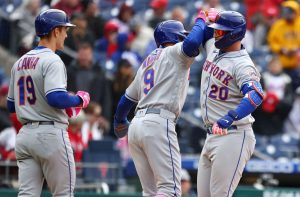 MISSING: Sole proprietorship of first place in the National League East. MISSING: Sole proprietorship of first place in the National League East.
AGE: Approximately 5 months.
ANSWERS TO: Let’s Go Mets, LFGM or “Not Again”.
LAST SEEN: Leaving PNC Park following a third consecutive barely competitive loss to a last-place team.
RECOGNIZABLE MARKINGS: World-class starting pitching, unrelenting middle-of-the-order production, indestructible right fielder, preternatural ability to quash lesser opponents.
***PLEASE LOOK HARD FOR THESE DISTINGUISHING CHARACTERISTICS — THEY MAY BE HARD TO DETECT IN THE HARSH GLARE OF SEPTEMBER.***
ALLERGIES: Driving in runs, keeping games close late, out-of-town scoreboard updates involving ATL.
REWARD: Division championship, Wild Card round bye, collective sense of self-esteem.
PLEASE CONTACT: Bat to ball in useful manner.
by Jason Fry on 4 September 2022 6:50 pm OK, there isn’t a plan — baseball routinely makes a mockery of plans — but there is a blueprint a team tries to follow, and I’m pretty sure the Mets’ blueprint wasn’t labeled LOSE WITH BARELY A WHIMPER TO PATRICK CORBIN AND ERICK FEDDE. I flashed back to 1990, when the Mets’ quest for a division title was derailed by a disastrous three-game sweep at the hands of the Expos, capped by a 6-0 whitewashing with Chris Nabholz on the mound.
That was 32 years ago, and I still sometimes catch myself staring at the ceiling and fuming about it.
Chris Nabholz, really?
The Expos have become the Nats, but Nabholz was a rookie then, an unknown quantity, whereas Fedde was thoroughly known yet somehow kryptonite for Met bats on Sunday.
Just a little frustrating.
/recapper bends laptop while apparently ‘just a little frustrated’
I suppose if you squint a little, or a lot, there were good things to be discerned amidst Sunday’s wreckage. Trevor Williams pitched very well in relief, continuing his year of being quietly useful in a range of roles, and the Mets played some adept defense late. But “late” is best understood there as the second half of “too late” — by then the Nats had brought the hammer down on Carlos Carrasco and extended their lead on a homer after Williams was forced to throw strike four (fuck it, we weren’t winning anyway), and you knew the Mets were toast long before you heard the ding from the kitchen.
(They tried, but had an inning short-circuited by a dropped fly ball in left that turned into a double play thanks to some unfortunate umpiring, but if that play sent you to the barricades, I have to ask if you were watching earlier. It’s right there in the earliest baseball laws inscribed by Abner Doubleday: When you’re going horseshit, they fuck you.)
Anyway, the Mets took two out of three from the Dodgers and then dropped two out of three to the Nats, and any rational fan knows such head-scratchings are part of the ebb and flow of a long season, and the view through a three-day magnifying glass is pretty much the worst way to maintain one’s perspective. All of which is true, except the Mets are in a pennant race and the Braves stubbornly refuse to lose games and have now drawn within one skinny, lousy, aggravating, horrifying game of our heroes (I assume — I can’t bear to check the scoreboard), and anyone who delivers a lecture on perspective at this juncture deserves to be doused in beer for his troubles, because read the room already.
/recapper douses self in beer
Anyway. Tomorrow is a new day, lots of baseball left, many paths to the playoffs, but that wasn’t exactly the plan, and the Mets would be strongly advised to ball up the LOSE TO CORBIN AND FEDDE blueprint, throw it in the trash, and find something new posthaste.
by Greg Prince on 4 September 2022 11:29 am The barrage of Rob Manfred-encouraged ya gotta gamble on baseball! entreaties overwhelming SNY’s airwaves in some incarnation seemingly every half-inning (never mind that Major League Baseball in the minuscule personage of Bowie Kuhn once cast out Willie Mays and Mickey Mantle — in retirement — for accepting jobs that required them to golf with a casino’s clients), whether they feature…
• Steve Gelbs ducking in and updating live odds, presumably because the sponsor wasn’t happy with Gary Cohen’s contempt-dripping minimalist read of its copy;
• Drew Brees pretending to hang out in a sports bar with a trio of randos we’re supposed to believe are his bosom buddies (I’ve seen more of Drew Brees than I have Drew Smith in the second half);
• a fake sports anchor interviewing a fake sports fan about how real happy he is to have hypothetically cashed in on his hypothetical bet;
• or the guy who comes on to shout at those of us whose most pleasant hours of any day are largely informed by watching baseball that, contrary to what everybody is saying, baseball isn’t dying
…are totally lost on me. I don’t wish to gamble on baseball. The more I am advised by the baseball gambling consortia that it’s what smiling, energetic people do, the less I am inclined to entertain their proposals. I’m satisfied with remaining dour and lethargic by comparison to the actors in the commercials. I’m satisfied with caring about the outcome of a baseball game and its myriad components on the merits already inherent in baseball. I’ve stayed with baseball for love of the game, not the winning of money.
Also, I’d be terrible at it. I don’t mean the winning of money. Just the process of choosing how to lose the money. Saturday night’s Mets-Nationals game was a prime example of what I would face.
Bet on the Mets? How could I not bet on the Mets? Max Scherzer is going for the Mets. Max Scherzer is going for his 200th win. Max Scherzer pitched well enough to win his 200th last time out, he just wasn’t supported in his effort. This time Scherzer is facing his old team, his old team that has been full-out dreadful all season without him (and without everybody else who won a championship barely three years ago). Narrative City, baby! And the one Washington National who would be recognizable to anybody from the 2019 World Series, Patrick Corbin, is starting for the Nats, and he’s become synonymous with veteran starter who’s completely lost his way: 5-17, 6.56 ERA and a piñata to Mets batters. The first-place Mets are rolling, they’re at home, the Nationals are the worst team in the sport — the only question is which MLB-sanctioned tout service do I utilize to place my surefire wager?
Except, save for the betting part, I didn’t think all of the above solely. I also thought this:
Bet on the Mets? Against the Nationals? You mean like betting on the Mets in September of 1985 against the Pirates, who were that year’s version of the Nationals? The Mets were in a heated pennant race with the Cardinals and had everything to play for and they were at Shea, where a New York attendance record was being established, and the Pirates barely existed, with their manager on the way out and nobodies dotting their lineup…and the Pirates took two out of three that weekend, behind, among others, rookie starter Bob Kipper (career ERA 14.04 before facing a single Met and commencing to lower his earned run average by six runs); rookie shortstop Sammy Khalifa (who hadn’t driven in a run since September 14, yet totaled four RBIs the weekend that spanned September 20-22); rookie third baseman Danny Gonzalez (two base hits and a run scored in Friday night’s Pittsburgh win; eleven base hits and nine runs scored over the course of the remainder of his entire career); and Jose DeLeon (season’s record 2-18 before the series, yet he proceeded to notch his very first save of ’85 versus us).
I’m gonna bet against the legendary Max Scherzer and my mighty Metropolitans? Hell no!
I’m gonna bet against the slight possibility that a team in the present day might replicate the performance of a crew of washed-ups and no-names from 37 years ago that rattles around in my brain just in case the Mets should find themselves at the top of their division and taking on a supposed hapless opponent? Honestly, no.
I’d bet anything can happen in a baseball game, not that anything will happen. This is why my wallet stays in my pocket every time one of those ads runs. This is why I’m poorer only from an experiential standpoint that Max Scherzer and the Mets lost to Patrick Corbin and the Nationals, 7-1, on Saturday night. All I bet was my time, and that’s baked into a perpetual “let it ride” quinella with gambling my emotions. I was simultaneously surprised that the Mets would show themselves to be utterly unsuccessful and unfortunate in taking care of business as logically anticipated while not terribly taken aback that the Nationals would rise up and appear hapful for a night. It happens, even for the hapless.
Corbin was back to his presumed-dead previous self for seven innings of three-hit mastery. Scherzer left after five with “fatigue” in his left side, which the righty later reassured us we shouldn’t worry about, and why would any of us worry about a Met co-ace who missed time from oblique issues taking himself out of a 1-1 pitchers’ duel in September? The Met bullpen was solid until it turned squishy and then, accompanied by an ill-timed outbreak of loosey-goosey defense, went splat! — Adonis Medina, thank you for your intermittent service, but you can pick up your one-way ticket to Syracuse at the departure gate; Bryce Montes de Oca, we’ll talk later — while no Met hitter besides Eduardo Escobar (second consecutive game homering) did anything against anybody clad in gray and red.
The 1985 New York Mets lost two out of three to the 1985 Pittsburgh Pirates in September. It was a bad sign for a team destined to finish three games out in the days when you either won the division or went home. The 2022 New York Mets lost one to the 2022 Washington Nationals on a September night at the outset of the playoff multiverse era (when the 2022 Atlanta Braves defeated the 2022 Miami Marlins on a bases-loaded ninth-inning walk, as if something like that had never happened before) after winning one from the 2022 Washington Nationals the September night before after a season of stomping on the Washington Nationals and their cellar-dwelling ilk, many of whom we’ll be meeting in the weeks ahead. I’d bet it’s not a sign, just a game. I’d bet that the schedule, imbued with a depth of softness that Downy only wishes it could legally promise your fabric, will prove beneficial in the short and long run.
That is if I bet on baseball. I wouldn’t.
by Jason Fry on 3 September 2022 12:04 pm A hangover game for the Mets would have been annoying but forgivable Friday night, what with the team having just taken a series — immediate and season — from the mighty Dodgers, AKA the Probably Inevitable NLCS Level Boss.
Happily, the Mets didn’t have one — or perhaps they did but the innate lousiness of the stripped-down Nationals was effective in hiding its symptoms.
Either way, they won — and got contributions from a trio of players whom we’d at least begun to worry about.
Eduardo Escobar was first, smacking a two-run homer off a Josiah Gray curveball in the second to get the Mets pointed in the right direction. Escobar’s been vital in the clubhouse and valuable in the field but lacking at the plate; a late-season reversion to his career mean would certainly be a welcome addition to the lineup.
Next came Mychal Givens, who hasn’t exactly been the relief addition we’d clamored for at the deadline. (While it’s not Givens’ fault that he’s right-handed, it pretty much is his fault that the numbers he’s put up have been mostly wrong-footed.) But Givens pitched well against Los Angeles and even better against the Nats, coming in to direct water at a man-on-second, one-out, tie-game blaze after David Peterson ran out of gas in the sixth. Givens did so, was handed a lead, pitched an effective seventh and earned a well-deserved win.
Thirdly, we had Pete Alonso, who’s looked desperately like a man in need of a head-clearing day off of late, doing more damage through bat-snapping shows of self-loathing than to the guys in the other uniforms. But Alonso came to the plate against Gray in the seventh with the Mets having just surrendered the lead and gave immediate notice that such an indignity would not stand, swatting the second pitch into the left-field seats and kicking off an inning that ballooned once the Nats commenced to play stupid.
(For the record, I still think a day off would be a good idea.)
The Braves won, so the Mets were thwarted in stretching their lead, and the gap between the two teams is too entirely too slim to ponder magic numbers and what-not. (I’ve peeked and you probably have too; let’s limit it to peeking for now.)
Whatever happens with the NL East standings, though, the Mets have won 85 games, which is worth a moment’s reflection.
I’d call 85 wins the lower bounds of a good year — definitely something to build on, if you get there from below. But it’s not even Labor Day. Now, I don’t think the Mets will wind up with 114 wins (though it’s not impossible), but those 29 remaining games are mostly against weak competition and the Mets look fundamentally sound with the stretch run upon them.
Numerical achievements don’t translate to flags — just ask the 2001 Mariners — but they’re still worth noting. And what the Mets are on track to do is notable indeed.
by Greg Prince on 1 September 2022 11:39 pm Some things don’t change even as the calendar pages do. Back in April, emphasis placed on winning series was emphasis well-directed We have now entered September. Winning series is still a very good thing. A very good goal, too, though I wouldn’t want to get too far ahead of myself. Take every day, even the days with doubleheaders, one game at a time and each series will take care of itself. Take the series(es), and the rest of the season figures to fall in line.
Early on, it was noted the Mets hadn’t lost a single series to any team. Then they lost one here and there and maybe split a few, but kept on winning most of them. The last time I recall checking in on the series scoreboard, as we entered the All-Star break, the Mets had won 21 of their first 29 series, splitting three others while losing only five. They’ve played a dozen more series since. They’ve lost three. They’ve won nine. Overall, that makes them 30-8-3 when measured by series, or 84-48 when measured by the games by which those series were comprised.
When measured by their thirtieth series win of 2022, the Mets appear ready for September and beyond. Or infinity and beyond. This series win — two games out of three — was over the Dodgers. For a moment, let us allow ourselves to be over the moon about it. But just for a moment. As far as grids full of white and shaded boxes can tell, a series against Los Angeles is just one more subset en route to collecting the complete set of 162 games, however they’re distributed, no different from having played four and won three from Colorado last weekend or whatever will happen versus Washington across three games this weekend.
But, c’mon. This was the Dodgers. This was the team that’s been to the playoffs every single year since the last year that Justin Turner was a Met. This was the team that won all there was to win just two years ago, as a cap on the head of a Dodgers fan reminded me on the 7 Super Express the other night. I stared at the interloper’s 2020 World Series logo and thought it looked a little oversized. Given that the 2020 postseason followed on the heels of a 60-game seasonette, perhaps the World Series logo should have been no bigger than the cap’s squatchee.
Give the Dodgers a full-sized season and you get a legitimate World Series contender as a matter of course. Give the Dodgers this full-sized season, and you get Ron Turcotte atop Secretariat looking over his shoulder curious to see if anybody’s remotely on his mount’s tail at the Belmont. In the National League West, the Dodgers’ lead is 18 games. Not even the team with the best record in the rest of the National League — that would be us — is particularly close to the Dodgers’ current record of 90-40.
Let the record show, however, that L.A. came to NYC 89-38 and are flying home carrying a 1-2 in their most recent three games, all against the Mets, and a 3-4 in their now-completed season series against the very same Gothamites.
Or would that be Kryptonites? Ah, I wouldn’t go that far. The Dodgers are probably plenty confident they could beat the Mets should there be one more series between the teams that hold the two best records in the National League. But, of more local import here, the Mets are probably plenty confident they could beat the Dodgers should there be one more showdown on the order of what we’ve just seen. We, the Mets fans, should share that confidence. I imagine some of you won’t, because you’re Mets fans who revert at slightest provocation to fretting over what has gone wrong (“we lost one out of three!”) and what could go wrong, but, my friends, that’s your problem.
The Mets won’t have a problem if they face the Dodgers again. They will have a challenge, because that’s a darn good team out there, but the Mets have beaten them four times the last five times they’ve played them. The Dodgers concern me. They don’t worry me, just like the Braves concern me but don’t worry me. The Braves are three games behind the Mets, which also means the Mets are three games ahead of the Braves. Funny how that works.
Beautiful how Thursday’s late-afternoon finale against the Dodgers worked. The Dodgers threw Clayton Kershaw at the Mets. Kershaw had either been on the IL or was just coming back from Cooperstown where I assume he was checking on the progress of his plaque. The future Hall of Famer (the “future” descriptor is a formality) had a tough first inning. Gave up a walk, then a single, then a walk, then got an out, then gave up his third walk of the inning. Dinosaurs walking the earth might have been used to Kershaw walking in a run, because he hadn’t done it since they were around, but, whoa, the Mets were up, 1-0, on an immortal in our midst.
Then they were behind, 2-1, in the second inning, but not more. Justin Turner started a rally with a double, just to remind us that he was asked to vacate these very premises in 2013, and Chris Bassitt had his own issue with a hit and a walk before Chris Taylor dumped a single somewhere toward the right field corner. Turner was definitely gonna score from third. Starling Marte got the ball into second, which may have facilitated Gavin Lux scoring from that very base, but it also allowed Francisco Lindor, who handled Marte’s relay, to accurately deliver the ball home so James McCann could tag out Trayce Thompson, who thought he could make it all the way around from first. He couldn’t.
We’re used to moaning about how little the Mets get out of their best threats. Well, the Dodgers had the bases loaded and one out and got only two runs from a seemingly stacked deck. So there. Then again, Clayton Kershaw possessed both the lead and the feel that eluded him in the first. Dude went five and didn’t give up any more runs. Bassitt could say the same about the rest of his day, pitching through six (enduring a funky home plate discussion delay among umpires and managers over whether the lights should be on as daylight commenced to fade in the fourth inning from a 4:10 PM start). We arrived in the bottom of the sixth still down, 2-1. Given that the two previous games had finished 4-3 and 2-1, a person could be forgiven for wondering if the only remaining runs in Flushing this week were going to belong to Serena Williams and Daniil Medvedev.
Wonder no more, the Mets reassured a person. With Chris Martin on in relief, Starling Marte beat out an infield grounder, which is no small feat given Marte’s nagging leg issues. Watching Marte manage his running has been as rewarding as watching Buck Showalter manage an entire season. Starling can’t always run full out, so he doesn’t when common sense negates visually pleasing hustle. But when a ball can be tracked down or a base hit can be sniffed out, the man turns it on. And man, did he to open the sixth…and did he some more when Lindor doubled to center. Starling was off and striding straight to the plate and suddenly Clayton Kershaw’s 193rd career win was gonna hafta wait at least another start (his problem). It was 2-2, with Lindor on second.
Did I say second? More like third once the slick-fielding shortstop stole the next base in front of him. I held my breath a little, because something about making outs at third is worse than making outs anywhere else, but Francisco read his situation perfectly. Darin Ruf was batting, not Daniel Vogelbach, a righty batter instead of a lefty, meaning the throw to third would be that much harder for Will Smith. Buck had decoyed Vogie in the on-deck circle but stuck with Darin against the righty, even if Vogie is on hand to destroy righties and even though the only entities Ruf had destroyed lately were rallies.
But with Lindor on third and only one out, all Darin needed to do was lift a fly ball deep enough to score a fast runner. That, I’m delighted to report, Ruf did. I felt very good for a Met with whom it was easy to lose patience, given that the designated hitter has one job, and when that one job goes undone, a person (the same person from a few paragraphs ago) is left to wonder what exactly is his value.
Darin Ruf was worth one very clutch run batted in and a one-run lead after six. Trevor May was worth his weight in perceived doubts as well, setting aside the Dodgers in the top of the seventh. The bottom of the seventh presented a museum-quality exhibit on opportunity. The Mets and Dodgers collaborated to create one, first on a two-out James McCann double (no, wise guy, the ball was not taken out of play and transferred to an authenticator to verify a once-in-a-lifetime event), then on a Brandon Nimmo pop fly that, thanks to indecision between Lux and Mookie Betts on the order of Danny’s Kaye’s “Miller-Hiller-Haller Hallelujah Twist,” fell in for a Brandon Nimmo double. McCann motored home. Nimmo stormed into second. Next, there was That Man again, Starling Marte — same initials as Stan Musial — lining a single to left to score Brandon.
The Mets were up, 5-2, and Buck was gonna go with Edwin Diaz to impede the heart of the Dodger order in the eighth. To be fair, every segment of L.A.’s lineup might as well be the heart of the Dodger order. Also to be fair, there seemed to be a touch of indecision on Showalter’s part, as Diaz was getting up, standing aside, then warming with renewed purpose while the score changed in the seventh. I believe that’s called dry humping, which is too bad, because baseball is a family game. Anyway, Diaz came on in the eighth, to recorded musical accompaniment only, and sounded a couple of rare sour notes. He walked Freddie Freeman and plunked Smith. Ouch. First and second. There’d be a deep fly to center, but it was caught by Nimmo, who catches everything. Freaking Freeman moved to third. Justin Turner also flied to Nimmo, though the out was Dodger-productive as it brought in freaking Freeman and placed Smith on second.
Then Edwin remembered he was Edwin and struck out Lux, strike three coming on a pitch that registered at nearly 103 MPH at Citi Field and probably showed up on the serve speedometer at Arthur Ashe, too.
The Mets led, 5-3. They tried to add to it in the home eighth by pinch-hitting Vogelbach, who walked, then pinch-running latest Met and professional speedster Terrance Gore, who stole. Vogelbach and Gore could constitute a two-headed monster in this month of expanded rosters, though to size them up, they might be better described as Vogelbach-Plus. Nice to see speed put to such electric use, even if Gore wasn’t driven in (what, he couldn’t steal third and home?). Adam Ottavino switched roles with Sugar and took the ninth. No live musicians for Otto’s entrance, either, but he made his own sweet sounds: two strikeouts and a flyout. The Mets had themselves game, set and match.
If there’s a rematch and another set of games pitting the Mets and Dodgers…wait, we take them one game at a time around here, and ten series encompassing thirty games remain in 2022’s regular season. I wanna get too far ahead of the Braves, not myself.
Beat the Nationals Friday night. That will do for now.
The first Old Timers Day in nearly three decades did very nicely by Mets fans last weekend. Listen to Jeff Hysen and me relive it lovingly on the latest episode of National League Town, available on all podcast platforms or the baseball time machine of your choice.
by Jason Fry on 31 August 2022 11:44 pm So said Buck Showalter, engaging the media after the Mets’ 2-1 win over the Dodgers, and as usual Buck was right.
It was fun, wasn’t it? Fun with a side of heart-stopping terror, or at least severe spikes of anxiety, but then that’s baseball.
Fun was Jacob deGrom looking every inch the debonair assassin, carving up baseball’s best team with his fastball and slider. The Dodgers fought him pitch by pitch, grinding through relentless at-bats and forcing deGrom to engage a different gear than he usually needs, but that’s what the Dodgers do. Jake’s slider turned unruly in the last couple of innings, with Mookie Betts annihilating one that sat middle-middle and Will Smith just missing another, but he was his usual pleasure to watch even with the occasional blemish.
He might have been stuck with a no-decision, though, if not for the play of Brandon Nimmo‘s life. With one out in the seventh, Justin Turner tattooed a fastball that got too much plate, clubbing it on a menacing line to right-center and, it seemed, beyond.
A few years ago, Nimmo’s playing shallow and at best gets there in time to crash against the wall as the ball thuds down beyond it, tying the game. But Nimmo spent the COVID layoff dedicated himself to a workout regimen that made him a little faster and answered the Mets’ entreaties to play deeper, and that’s let him watch long fly balls come his way instead of trying to track them over his shoulder. Nimmo arrived at the warning track with the ball still in flight, moving sideways as he sized up its trajectory, made his leap and snagged the ball above the orange line — then, in a marvelous bit of showmanship born of perfect execution, came down on both feet, fist pumped and yelling in jubilation. It was an Inciarte level of robbery — just below Endy Chavez‘s stay-of-execution grab with a pennant on the line — but unlike Inciarte’s reverse walk-off, it was in service of good. I’ve seen Nimmo steal one before, but I’ve never seen emotion like that from him — or from deGrom, who threw both hands in the air and doffed his cap.
If Jacob deGrom tips his cap to you, rest assured you’ve done something pretty extraordinary.
Oh yeah, that was fun too.
So was Starling Marte proving not all Mets are roadkill against lefties — even lefties with herky-jerky, impossible to read mechanics like Tyler Anderson‘s. Marte’s two-run homer was a welcome tonic, to be sure, but with deGrom out of the game and Nimmo having pulled a rabbit back over the fence and into his hat, the Mets had six outs to get, and you knew the Dodgers would fight tooth and nail for each and every one of them. (It’s not news, but boy are they a good team.)
Adam Ottavino navigating his inning wasn’t fun, exactly — setup men’s tours of duty are mostly just anxiety, and my anxiety was loose and howling at the moon as Ottavino fought for every pitch in a thrilling duel against Betts, one that ended with Ottavino throwing a slider that had one of the sport’s best hitters spinning helplessly like a top.
OK, so that part really was fun.
And then, the most fun of all: Take Two of Timmy Trumpet getting to play Edwin Diaz‘s entrance music live.
In the early innings, when “Narco” was still a hope and not yet a plan, I wondered which Met official had drawn the assignment of explaining to an Australian star musician still getting used to this baseball thing that while he was welcome for a second night, his services might not actually be required this time either. The Mets had to be winning, or at least tied, but not winning by too much, more specifically they had to be … oh, let’s just say the save rule is a lot.
But the stars aligned and there was Mr. Trumpet, flanked by Mr. and Mrs. Met, aiming the bell of his trumpet at the stars and having the time of his life. It was electric, it was a little goofy, and it was most definitely fun — which is everything baseball should be.
Because I’m a Mets fan and so can’t help it, when the music was over I turned to my kid and said, “We’ll all feel a little stupid if Trea Turner hits the first pitch over the fence.”
“That would actually be hilarious,” was my kid’s somewhat alarmed response.
And hey, it would have been hilarious … eventually. Like maybe in 2042.
Diaz, though, seemed even more amped at having his theme music come to life. Trea was no Justin in the Turner department, fanning on three pitches and so requiring no Nimmo intervention, and Diaz then got Freddie Freeman and Smith to ground out, sending the Mets off the field in jubilation in a tidy 2:19, out-jubilanted by a packed house that had been in full roar all night.
Yes, Buck, all of that most certainly was fun.
It was fun, and hey, the season series is now tied 3-3. Which means that the Mets and Dodgers are playing Game 7 on Thursday. That’s interesting, isn’t it?
by Greg Prince on 31 August 2022 1:48 am Timmy Trumpet, deprived by impending circumstances of a stage to serenade Edwin Diaz with “Narco” in the ninth, made the most out of the seventh-inning stretch. Brandon Nimmo and Starling Marte teamed up on first-inning hijinks that scored a run on what was about to be a foul ball. Marte homered and played some solid defense. Mark Canha homered. Mychal Givens threw probably his best two innings as a Met. The worst of the rain held off until the hustle to the 7, and even then it wasn’t all that wet.
Honestly, though, when you lead with “Take Me Out to the Ballgame,” no matter how scintillating the interpretation, you’re cherry-picking highlights.
I was at Tuesday night’s 4-3 loss to the Dodgers. I regret to inform you I had a pretty nice time since my nice time doesn’t do anything for our frustrating team. So be it. Stephanie and I joined father and son Rob and Ryder Chasin for a thirteenth consecutive Tuesday night in August outing (twelve, really; one was over Zoom). The four of us have built a cherished tradition out of seeing the Mets on a Tuesday night in August every August, and it’s tough to extract misery from an annual good time with people close to our hearts.
But for your sake, I’ll try.
Damn, that was a frustrating game. Those first two baserunners, Nimmo on first, Marte bunting, indicated something spectacular might be in the works. Andrew Heaney picking up Marte’s bunt and throwing it away when all he had to do was let it roll harmlessly into foul territory was not what one expected from the all-world Dodgers. But there it was, with Nimmo sliding across the plate and Marte making it all the way to third. Hallelujah, it was 1-0, with 2-0 a mere ninety feet away and nobody out.
Then nothing. Nothing more in the way of runs in the bottom of the first and little more in the way of momentum and no sense that Mr. Trumpet, on hand to throw out a first ball (not the way Heaney had) and then, if appropriate, herald Edwin Diaz’s entry into the game for a save situation, would be favoring us with his signature sound. Except for “Take Me Out to the Ballgame.” That was well done.
The Mets, however, were fried. Taijuan Walker’s slick first two innings got lost in a messy third. Hitting Joey Gallo with the bases loaded was a real foot-shooter. Joey Gallo is the essence of Three True Outcomes. There was no need to invent a fourth. The two-run Gavin Lux single that followed felt inevitable. Walker eventually righted himself to maintain the illusion of a game that was up for grabs — he went five-and-a-third, unhooked by the solo homers from his corner outfielders Marte (who looked particularly smooth in right) and Canha, but if you were going by vibe, it was all sour notes.
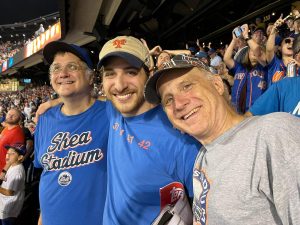 The faces of frustration. At least I learned why Taijuan Walker shouldn’t pitch against the Dodgers. It’s because, according to a helpful gentleman one row in front of us, Tai went to high school in Southern California and therefore likes the Dodgers too much. As theories go, that’s certainly one of them.
Walker the de facto Dodger-lover left with a runner on a second and one out in the sixth. Seth Lugo extricated the Mets from the inherited jam. A chance to break a 3-3 tie directly presented itself in the form of Heath Hembree, a 2021 Met who is now a 2022 Dodger. The Old Friend syndrome was in play. Hembree the journeyman made little impression here a year ago. The least we could do is make him pay for his vague familiarity. No dice. (The guy in the row ahead of us failed to mention where Hembree is from.)
The conclusion of Tuesday night’s affairs came into view in the visitors’ seventh, with Freddie Freeman lacing a leadoff double down the unprotected left field line. Maybe it wasn’t laced as much as it found an enormous hole between Eduardo Escobar’s positioning and the third base bag and then veered unhelpfully long enough to let freaking Freeman take second. Sadly, Andrew Heaney wasn’t around to grab it and throw it somewhere that would have benefited the Mets. Joely Rodriguez, lefthanded specialist on to negate lefthanded batters, left us a run behind. A Max Muncy grounder to the right side pushed Freeman to third. An intentional walk to Will Smith (who pinch-hit for Gallo, who could have stayed in and simply be hit again) set up a potential double play. Potential was never reached. Instead, Lux singled to center to score freaking Freeman. It was 4-3 and it was never going to stop being 4-3.
Tommy Hunter picked up for his fallen comrade Rodriguez and got us out of the top of the seventh and into Timmy Trumpet’s hot zone. Givens pitched the eighth and ninth and kept it close, but the Met offense did not nudge it from being anything more than close. Nothing of substance emerged out of the top, middle or bottom of the Met order after Canha’s fourth-inning dinger. Closing matters out for Los Angeles was another Old Friend, Jake Reed. The Dodgers certainly know how to put extraneous ex-Mets to optimal use.
Fortunately, the Braves lost. The Citi Field revolving out-of-town scoreboard, which carousels every game in the majors so you better be paying attention for the four minutes the score you care about is being displayed because it will disappear for three minutes (I timed it on Saturday), delivered promising news while the events in front of us delivered only dismay. Some dude on the 7 Super Express was kind enough to share his phone screen with interested onlookers for the satisfying final frame in Atlanta. We were watching the Braves go down to the Rockies live and in living color as we sped to Woodside. It was a far cry from caressing the AM dial for updates in years of yore. Back then, I was probably trying to find out if the Braves lost so we could catch them. This year, it was trying to keep the Braves from catching us. And that we’ve done so far.
Timmy’s gonna stick around one more night, hoping for the opportunity to accompany an Edwin jog to the mound live. If he does, that would likely mean the Mets are ahead of the Dodgers after eight innings Wednesday. That would sound awesome. The way the Mets played Tuesday, it sounds a little outside the realm of possibility. But only a little.
Jacob deGrom is from Central Florida. So I guess it’s OK if he takes on a team from Southern California.
Besides maintaining FAFIF legend status thirteen years since turning thirteen, Ryder Chasin is a gifted writer and performer, proof of which was presented last winter on The Tonight Show Starring Jimmy Fallon. Watch his NBC star turn and you’ll never think of testing for “the Cove” the same way again.
by Greg Prince on 30 August 2022 8:38 am I looked at Jon Matlack from a Promenade’s distance on Saturday and thought of the Jon Matlack game I inevitably think of when I think of Jon Matlack: the 1-0 loss to Chicago on the final Sunday in 1973, emblematic of tough luck among very good Mets pitchers and a reminder that a 1-0 loss, even in the heat (or dampness, as was the case at Wrigley Field that September 30) of a pennant race, doesn’t necessarily indicate somebody hasn’t done his job.
Max Scherzer did his job Sunday. He held the Colorado Rockies to one run over seven innings, the 2022 equivalent of Jon Matlack holding the Cubs to one run over eight innings nearly fifty years ago. Matlack and the Mets survived then — they’d win the nightcap of their doubleheader, then the game that clinched the East on Monday afternoon — and the Mets will survive now. Give us seven innings of Max Scherzer striking out eleven, walking one and allowing only four hits every time, and we’ll take our chances that the Mets will score two or more runs to make Max’s effort as worthwhile as possible.
On Sunday, they scored no runs. German Marquez and two relievers held the Mets in check, resulting in that timeless neo-classic, the 1-0 defeat. We’ve grown to almost expect such a score when Jacob deGrom is dealing. Now he has a comrade in unrequited excellence. Yet deGrom keeps bringing it, Scherzer keeps bringing it and the Mets, we can rightly believe, will keep bringing it, whether it’s against the mighty Dodgers in the three games ahead or all those teams that aren’t the Dodgers in the weeks to follow.
And we’ll keep looking at old Mets and thinking of old games and drawing parallels and conclusions and memories from them. That is why, or is one of the umpteen reasons why, Old Timers Day was such a blowout victory for this organization.
 More to come. As noted in the space allotted mainly to celebrating the Mets’ retirement of No. 24 for Willie Mays (I can’t repeat enough that such a thing actually happened), I attended Old Timers Day this year. I hadn’t attended an Old Timers Day since 1994. No Mets fan had, at least not the Mets kind. Before Saturday, I had been to seven Mets Old Timers Days. The figure hadn’t budged in 28 years. I never expected it to budge. We all had experience at shouting into a veritable void that Old Timers Day should make a comeback, that Mets fans would cherish the opportunity to toast our own history, that there was Mets history to gulp by the gallon. Jason can confirm that we brought it up, face-to-face, to former Mets decisionmakers. The former Mets decisionmakers said, in so many words, tish-tosh and poppycock to the concept of Mets Old Timers Day.
Aren’t you glad those are former Mets decisionmakers?
Before we immerse ourselves anew in battling potential playoff opponents and, for that matter, securing playoff participation, I just have to express once more how absolutely frigging awesome it was to have Old Timers Day back on Saturday. Mays and 24 you know about and hopefully read about. But all the stuff before and after Willie was so fun and so joyous and so moving, too.
Such as? Such as…
• John Stearns making it in from Colorado in not the best of health, but try keeping Bad Dude from throwing himself into the middle of the action.
• Long Island’s Own Steve Dillon (LIOSD) not only pitching at age 79, but backing up home plate on a run-scoring single because he’s a pitcher, never mind that he’s 79.
• Endy Chavez apparently still active, based on the way he chased down fly balls and snagged line drives.
• The enmeshing of family members of Mets who couldn’t be on hand with the Mets who could use an escort to the foul line, and everybody being a part of the Met family.
• The guts, the gauntness, the gaits, the gray…listen, we all age, yet all Mets stay Mets.
 More to come. • A handful of 1962 Mets, which is pretty good considering how long ago 1962 was.
• A handful of 1969 Mets, which seems pretty light until you consider how long ago 1969 was.
• Another handful of Mets from 1973, including the aforementioned Mr. Matlack (who won the start after losing 1-0 by prevailing 5-0 and throwing an NLCS two-hitter in the process).
• Ed Kranepool, common denominator of the 1962, 1969 and 1973 Mets, still with us and still standing with the aid of a cane festooned by curly orange NYs.
• Shea Stadium’s Queen of Melody Jane Jarvis, albeit recorded, with the national anthem on the Thomas Organ.
• STEVE HENDERSON!!!
• RICO BROGNA!!!
• PEDRO!!! (Pedro Martinez’s calling card may not be his Met years, but geez, when he shows up, he’s gonna make sure you think of him as yours and only yours.)
• DOC!!!
• FONZIE!!!
• EVERY OLD TIMER, ACTUALLY!!!
• The 1986 gang getting to wear the de facto Met uniform of record and at first looking a little underdressed, then looking just right in button-down home pinstripes.
• First-pitch honors for Jay Hook, who pitched the first game the Mets ever won, on April 23, 1962, never mind how many losses were incurred before that W went up on the board, but let’s just say the Mets had been trying to win one since April 11, 1962.
• My exaggerated applause for the likes of Mike Hampton, Doug Sisk, Steve Trachsel and Joe Torre to counteract any stray booer incapable of setting one’s memory to “selective” for a love-in like it oughta be.
• All the sometimes Yankees who in at least a little piece or perhaps a larger portion of their hearts will always or sometimes be Mets — I particularly found myself modestly sentimental for 1969 Mets fan, 1992 Mets second baseman and 2006 Mets division champion manager Willie Randolph, conveniently remembering only the biographical notes that enabled the warmest of welcomes.
• A sudden bout of amnesia regarding which players played with which players when, because on Saturday, I swear Daniel Murphy must have been on the same team with Benny Agbayani, and Kevin Elster surely played behind Turk Wendell, and Todd Hundley had to have caught Bartolo Colon, and didn’t Bobby Valentine manage both Rafael Santana and Jose Reyes?
• The fans, the fans, the fans — there were not only a ton of us, but we were so absolutely into it, from the massive lines to get into the park before the gates opened when they weren’t giving anything away to the veritable Museum Collection of fabrics and identities represented on so many backs.
 More to come. You could tell how happy the Mets from all eras were. You could tell how happy the Mets fans from all eras were. We came together in the present to honor the past and we’ll be talking about this day well into the future.
Amazin’ coordination, Jay Horwitz. Amazin’ stewardship, Steve Cohen. Amazin’ seeing you, everybody I saw on Saturday. Amazin’ day, eternally.
by Jason Fry on 29 August 2022 6:20 pm Your recapper began Sunday’s finale against the Rockies in an odd place: sitting inside a kayak in the East River. Well, more properly, the embayment between piers at Brooklyn Bridge Park, where I’m a safety boater for the park’s free kayaking program. This means I offer some basic paddling instruction, intervene when people have trouble, and tow people out of the pilings or other inconvenient places should things go truly wrong — I’m more tow-truck driver than state trooper.
Such double duty makes for an interesting perspective: You’re bobbing up and down in the waves, maybe dipping a foot in the water, and paddling towards potential trouble while somewhere not so far away, bats are cracking and mitts are thumping and Howie Rose and Wayne Randazzo are painting the word picture for you. (I don’t make fun of Randazzo’s rundown of uniform components because a) he should get to have his thing; and b) when I’ve got no visuals, I really do like assembling the picture in my head.)
That’s one of my favorite aspects of baseball: Given a little planning, technological preparedness and a bit of stealth, you can ensure the game accompanies you most anywhere. Sneaking a transistor radio into school in the mid-60s hasn’t really gone away — it’s just been replaced by a phone, an app, a single airpod and good concentration.
Over the years I’ve gotten pretty good at “one-earing” it, which is what I was doing on the water in deference to my far more important responsibilities. Whatever the occasion, the game is there, low but present, as an undercurrent to what else you’re doing, happily proceeding and available for whatever moments arose when you can give it closer attention.
Alas, on Sunday the concept was more fun than the execution. The sounds of Citi Field and Howie and Wayne’s narration were welcome, but the story they told me needed a better ending. Max Scherzer was in fine form, and I happily imagined him securing that suddenly elusive 200th win with me in … well, let’s call it very semi-attendance. But the Rockies’ dented and dinged ace, German Marquez, seemed very much the rising star he’d always been against New York, sending Met after Met back to the dugout after a brief engagement at home plate.
In the fifth, it sure sounded like the Mets were writing the kind of ending I wanted: Jeff McNeil led off with a single and then tormented Marquez into a balk, only to be left stranded by a pop to third, strikeout and loud but ineffective liner to center. In the seventh Scherzer did impressive work when faced with bases loaded and nobody out, giving up just a lone run.
But that was one more run than the Mets had.
It couldn’t end that way, surely.
The bottom of the eighth, which came as I was finishing my shift on the water and preparing for a trip paddling down to Red Hook, suggested it wouldn’t: Brett Baty hit a one-out single and moved into scoring position on a wild pitch. But Starling Marte and Brandon Nimmo — whom I trust in whatever order they bat — struck out. Mychal Givens survived a tough top of the ninth while I silently fumed and exhorted him to get over whatever’s ailing him, but a few minutes later Pete Alonso‘s ninth-inning single also came to naught and the ballgame was over.
It was over and the Mets had lost — and by a 1-0 score, no less.
The day had many pleasures — a couple of hours later I was rowing towards the Statue of Liberty and the sunset, finding myself inside a postcard come to life. And I was glad I was able to squeeze the Mets into my aquatic adventures. But I can think of one way things could have been even better.
by Greg Prince on 28 August 2022 11:58 am Having rooted for the Mets for more than a half-century, I’ve developed a pattern that allows me to cope with the possibility of obvious failure transforming eventually into ultimate success. First, there’s no way it will happen. The Mets are losing by a lot, ergo they will lose. Hopes are not gotten up, disappointment is not invited into the unoccupied seat next to me. Signs to the contrary of what I’ve conditioned myself to expect, that this apparent final inning somehow may not end the way I was sure it was going to go, are allowed to pass without comment or commitment. Yeah, there aren’t three outs yet. Yeah, another Met just reached base. “So what? They’re still gonna lose.” In contemporary baseball parlance, you might say I spit on those sliders off the plate.
But the coalescing comeback won’t go away. It’s going to hang around whether I’m comfortable with its presence or convinced of its intentions. The Mets are still losing, but by a little less. An inflection point approaches. I entered the inning deciding there’s no chance. Then there’s little chance. But a run or two scores and the gap is closed and little chance becomes legitimate chance.
Ah, fuck, the little inner voice grumbles beneath the growing outer chorus of LET’S GO METS!, now, I gotta take this seriously. Moments ago, I was resigned to the inevitable. Now evitability is rearing its alluring head. I don’t wanna buy in. I don’t wanna be let down. I already made my deal with defeat. Now defeat wants to flip its bat and show me up.
Too late. In for a penny, in for a pound. Or in relevant exchange rates, go ahead, break my heart, Mets. Fill my balloon with air. I understand it can deflate with one swing. I signed that waiver the second I began to believe this improbable come-from-behind effort might succeed.
But, you know, you gotta believe.
For every dozen or hundred or thousand Ls that stay Ls, you allow yourself to be tugged toward believing there’s a W in there somewhere. You are susceptible to the siren song of momentum. You dip a toe into the rally. Then you have no choice but to dive in. A 6-2 deficit that was 6-0 is suddenly 6-4, two are on and Steve Henderson is at the plate. Trailing 5-3 with two out and nobody on in the bottom of the tenth, with only the entire season about to shut down, in three blinks of an eye becomes 5-4 with Kevin Mitchell on third, Ray Knight on first and Mookie Wilson coming to bat. What was 8-1, Braves, on a night Mike Hampton didn’t have it, grinds and grinds until it becomes 8-6, the bases loaded, your most clutch hitter Edgardo Alfonzo ready to try his hand at keeping the upward hill climb progressing and your most dramatic batter Mike Piazza waiting in the on-deck circle.
Defense mechanisms melt away in the heat of formerly flickering, now smoldering hope. Probability has opted to beat the stampede down the ramps. Possibility is now your companion. If only possibility could be more definitive. But then it wouldn’t be mere possibility, would it?
I was in a place late Saturday afternoon where I could have sought expert consultation on what to do when it’s obvious what you want to happen from the Mets has no chance of happening, yet obvious begins to fade in the face of growing chance. I was at Citi Field. It was Old Timers Day. Steve Henderson himself was there. So were Kevin Mitchell, Ray Knight and Mookie Wilson. So were Mike Hampton, Edgardo Alfonzo and Mike Piazza. Come to think of it, so was Old Timers Day itself, an event I had long ago given up hope on ever again materializing in any ballpark the Mets call home.
Their collective attendance was why I was in attendance. A whole bunch of Mets who aren’t Mets in 2022 were home to be Mets once more. Some among 65 erstwhile players from my favorite team had been around periodically in one context or another. Some you simply would never see without an affair of this nature. Steve Henderson appears regularly in my recollections. He’s never on the scene in front of me in real time.
New scene in 2022. We’ve got Old Timers Day again. We get Old Timers, a phrase we wouldn’t use cavalierly to describe active older adults of a senior nature in these better-be-careful what we call who times. But this is baseball. It’s understood we’re being affectionate toward our retirees. We love Old Timers, particularly on Old Timers Day. We love Old Timers Day. We loved it when it existed almost without pause from 1962 to 1994. We yearned for it once we noticed it missing. We grumbled when our requests for its revival fell on hearing-impaired ears. The Mets weren’t interested in bringing back Old Timers Day. We stopped rooting for it.
Until the lineup was rejiggered. Erase the name of the owner(s) who didn’t care about Old Timers Day. Pencil in the new decisionmaker(s). The Wilpons couldn’t be bothered. The Cohens bought the Mets from them so they could be bothered with details that float fans’ boats. Can you bring back Old Timers Day?
In WilponWorld, the answer was “nah.” Under the CohenDome, the response is “sure.” Though there was more work to it than “…and just like that, Mets Old Timers Day was back,” we quite suddenly got to commune with a panoply of what we’ll loosely term our heroes. We learned more than twenty years ago not to throw around phrases like “heroes” to describe men who play a child’s game, no matter how skilled they are at it or how high their skills can lift our emotions. But following the first Old Timers Day the Mets have held in 28 years, we can play fast and loose with the language. Our heroes were in our midst again.
Heroes who defined a franchise where there was none before 1962. Heroes who engineered a miracle in 1969. Heroes who were on hand for a notable chapter of Tugging and Believing in 1973. Heroes who didn’t accept two down, two out, nobody on and near-zero statistical opportunity as precipice to a conclusion. Heroes for whom fifteen innings of rain and an impending loss wasn’t going to end everything just yet in 1999. And if “heroes” sometimes exaggerates the roles these Mets played in our lives, “old friends” doesn’t seem out of line to describe our relationship to them. Some Met from 1963 or 1994 or 2005 or some other year that is never emblazoned on commemorative merchandise is as welcome in this atmosphere as anybody wearing a championship ring.
Sixty-five Mets of yore. Sixty-five Mets who composed a significant portion of our baseball consciousness. Sixty-five Mets who drilled into us episodically that nothing is over until they say it’s over.
Thus, when Howie Rose completed his introductions of every Met from every era, starting with lone holder of a winning pitching record from 1962 Ken MacKenzie and ending with greatest home run-hitting catcher and Hall of Famer Mike Piazza, you should have accepted as gospel anything you wish would happen and believe should happen and hold conviction that it must happen could still happen.
Especially when the evidence is being laid out in front of you.
Once Howie completed his introductions of Mets Old Timers, he asked those of us in the sellout crowd to direct our attention to CitiVision for a “very, very special video”. What could be more special than 65 different Mets joining us to celebrate the 60th anniversary of a franchise that has acted, in its 61st year, utterly reborn? What could be as or more special than what we’ve already experienced in 2022 both on and off the field? We have a steady first-place team that continues to withstand an Atlantan assault. We have a Tom Seaver statue. We have a plaque bearing Gil Hodges’s likeness hanging in Cooperstown. We have Keith Hernandez’s 17 in the rafters, no longer distributed willy nilly to the next journeyman reliever or utility infielder (not that we don’t embrace journeymen relievers and utility infielders). We have frigging Old Timers Day. I’ve directed my attention to CitiVision on countless occasions. Usually CitiVision is loudly trying to sell me something I don’t want. What could be so very, very special about this video?
Well, it started with Willie Mays. That sold me on watching closely. Specifically, there was an image of Willie Mays in a New York Mets uniform and a narration invoking the many transcendent qualities of Willie Mays and a conscious effort to link every hot button I nurture in my soul — New York, National League, Say Hey, Polo Grounds, Greatest Player Ever, Came Home, Mrs. Payson, Mets — and I began to think like I thought on June 14, 1980; on October 25, 1986 (technically October 26 by the time the bottom of the tenth rolled around); especially on June 30, 2000. The Ten-Run Inning. Losing by seven becoming losing by six, then five, then less and less and fighting the impulse to fully believe because I fully anticipated that belief to be futile, but here we are, down by only two with Fonzie coming up and, if Fonzie keeps it going (there are two out), Mike.
I see this tribute to Willie Mays of the New York Mets and I don’t want to let myself believe what has to be unfolding in front of my eyes. First I tell myself there’s going to be somebody after Mays they’re going to spotlight, that this is about to be a montage of great players who wore the Mets uniform. But, no, it’s just Willie Mays. OK, then, it’s going to be about a greater truth, how the Dodgers in Brooklyn but also the Giants in Manhattan had to disappear from our reach so the Mets could alight in Queens and touch us as they do. No, that’s not the message. Well, maybe they just thought it wouldn’t be a perfect Old Timers Day without us hearing from Willie Mays, a Met in 1972 and 1973, a New York legend from 1951 forward, the plausible answer to any query that asks who was the greatest baseball player ever. One of the signature highlights of the many Mets Old Timers Days before there stopped being Mets Old Timers Day was Willie Mays striding through Shea’s center field gate with his fellow five-borough center fielders of renown. DiMaggio and Mantle and Snider could all cover a lot of ground. You could imagine Willie racing from the South Shore of Staten Island to the northern border of Riverdale to track down a fly ball. You couldn’t have Mickey or the Duke let alone Joe D. show up in 2022. Willie’s 91 and ensconced in California. Maybe he taped something and they wanted us to look at and listen to that.
No, that wasn’t it. None of it was what I tried to tell myself what it was because I couldn’t quite bring myself to believe what so obviously it was, just as I needed convincing that Steve Henderson was going to hit that home run; that Kevin Mitchell was going to score from third on a wild pitch while Ray Knight moved up to second just before Mookie Wilson made fair contact in the direction of first base; that Edgardo Alfonzo could punch a single through the left side, bringing home two more runs to completely erase an 8-1 deficit, tie the game against the Braves, 8-8, take Mike Hampton off the hook, and bring up Mike Piazza with me barely hanging onto my last shred of disbelief lest this whole thing still somehow blow up. But then Mike lines Terry Mulholland’s first pitch above the left field wall at Shea and Shea explodes, my disbelief with it. Mets 11 Braves 8. Mets 6 Red Sox 5. Mets 7 Giants 6. This sort of thing happens. It just doesn’t happen enough.
 24, home at last. (Photo by Life magazine) Mays 24. That happened in 1972 and 1973 at Shea Stadium. It defied belief that something like that could never happen. Willie was back in New York to stay. It meant everything. Everything. Willie said hello with thunder (a game-winning home run versus those San Francisco transplants with whom he had been associated once the Giants departed New York after 1957) and said goodbye to America with tears. No longer playing for the Mets, he coached for the Mets. Willie wore 24. You couldn’t imagine anybody else wearing it after you’d seen Willie Mays don it most every day for most of eight seasons, not after he’d been Willie Mays in a nation’s consciousness for nearly three decades.
Then Willie Mays wasn’t around anymore. He’d visit a little, he’d put on his Met uniform, say hey, then say see ya later. There’d be 24 hours, but not 24 daily, and those who hadn’t seen 24 at all as a Met didn’t get much or any of the fuss when those of who felt it in our bones would bring it up now and again. Not that it had much reason to come up. For the most part, those who issued uniform numbers had the good taste to keep 24 on a shelf. Once it slipped onto the back of one of those journeymen. It was noticed. Kelvin Torve was given a different number. Once a pretty fair legend of an era after Willie Mays, Rickey Henderson, joined the Mets. Rickey liked to wear 24. Rickey asked Willie if it was OK. Willie told Rickey yes, but also mentioned to a reporter that the late Joan Payson, the first owner of the New York Mets and a diehard lover of the New York Giants’ legacy (which, by the end of the 20th century, was essentially Willie Mays), pledged no Met after Willie would ever again wear No. 24; that it would be officially retired; that, presumably, there would be ceremony and fanfare to square the circle that was Willie Mays’ National League career and impact in the City of New York.
But Mrs. Payson died in 1975, and nobody took up her cause, and the club was sold, and Willie moved on, and time moved on, and the issue, such as it was, never gained traction. Rickey wore 24 in 1999 and 2000. When he left, 24 returned to inactive status. Now and then, someone like me would write an impassioned plea to the Mets to retire 24. Some with a sense of New York baseball history and culture would nod their heads in agreement. Others with less sense of who Willie Mays was would politely or, frankly, obnoxiously dissent that a guy with less than two full seasons as a Met shouldn’t be feted so fulsomely when [fill-in-the-blank] hasn’t yet received comparable treatment. The issue became even less of an issue. You didn’t see 24 on any Met. You didn’t hear any talk anymore about what might be done with it.
In 2018, the Mets made a trade for Edwin Diaz. That’s how it should go down, based on what we’ve come to appreciate in 2022. That’s not how it was reported in 2018. The story then was the Mets got the old Yankee Robinson Cano. Robinson Cano was in the latter stages of a potential Hall of Fame career. It would have more than potential to it had Cano not been suspended for PEDs, but you serve your time, you deserve a clean slate. Robinson Cano had had a helluva run since 2005. Maybe he deserved the benefit of the doubt. He probably deserved the number he’d been wearing as he established himself as a superstar.
That number was 24. The general manager who acquired him was the agent who had previously represented him, a handsome fella named Brodie Van Wagenen. I don’t mean to imbue “handsome” with devious qualities. He was good-looking, though, which went with the smoothness. He’d brought us Robinson Cano. We traded a top minor leaguer and brought in a legit closer in the process. We should all be grateful to the handsome Brodie Van Wagenen was the implication, just like we should all be thrilled to have the accomplished Robinson Cano. We shouldn’t mind that Robinson Cano in 2019 was going to be the first Met since Rickey Henderson in 2000, who himself was the first Met since Kelvin Torve in 1990, to wear 24, which was sorta, kinda, but not really ever retired for Willie Mays, who wore it while being Willie Mays and a New York Met player and coach from 1972 to 1979. Kelvin was a veritable clerical error. Rickey asked permission. Brodie and Robbie just did what they felt like from what could be discerned. Much homage was dispensed toward No. 42, Jackie Robinson, the idol for whom Robinson Cano was named. You can’t wear 42 in Major League Baseball since 1997. It’s retired everywhere. It was retired first at Shea Stadium. It is honored lavishly at Citi Field. If you can’t wear the “4” and “2” to directly honor Jackie Robinson, the next best thing for a Robinson Cano is to transpose the digits. The Yankees didn’t have a problem with it. Seattle already had 24 on ice for Ken Griffey, Jr., so Cano settled for 22.
The Mets? Robbie wouldn’t have to settle. It’s not like 24 was retired.
“My dad told me all the things Jackie Robinson went through, the barriers he broke for future generations,” Cano told John Shea, co-author of 24: Life Stories and Lessons from the Say Hey Kid, the 2020 book that set out to frame for a whole new generation who Willie Mays was and what he meant. Cano was not completely unaware: “Every time you think about number 24, you go back and think about Willie Mays. He was the one who gave real value to the number. I mean, he’s a legend. There is no other word for him. That is what 24 represents to me.”
I appreciate that Shea went to the trouble of asking Cano about Mays. I would have appreciated it more had Cano or Van Wagenen paid as much as lip service to Willie Mays when they flashed Cano’s new Mets uniform bearing 24. They didn’t. They did the unveiling at the 42 sculpture in the Jackie Robinson Rotunda.
Edwin Diaz has been great for the Mets this year. He may make us never again mind the trading of a kid named Jarred Kelenic. Cano is now destined to go down as incidental in the transactional equation. He was a Met for four seasons. Three seasons, really. There was one season when he was suspended from playing due to a second finding of PEDs. And the fourth season ended quickly when rosters had to be pared and an unproductive Cano was DFA’d.
So no Met was wearing 24, at least until the next time a set of numbers needed to be assigned more than forty years since Mays last wore that set as a Met coach, almost fifty years since Mays last wore them as a player. They’d been effectively restricted from random circulation, but you never knew. And nothing was ever said. Willie Mays was still alive and relatively well on the West Coast. He was still hailed when discussions about Greatest Ever arose. He had passed 90. 24 lingered in limbo back east.
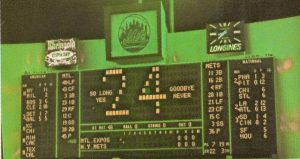 A number the Mets couldn’t honor enough, so they opted not to honor it at all. What I wanted to believe, what I was overcome by the thought of believing, was that the video to which Howie Rose had directed our attention was telling me the story I yearned to hear, the story I repeatedly told on the off chance anybody was directing any attention to the likes of me or anybody like me in this realm, the story that served to place before Metkind the common sense of the subject in terms so plain and firm as to command their assent (that’s from 1776, another set of numbers meaningful to me).
First the video, then Howie at the podium set it all out there for 40,000-plus to hear. Willie Mays was Willie Mays. Willie Mays was New York. Willie Mays was National League New York. Willie Mays was a New York Met. Willie Mays was told by Joan Payson that Willie Mays would have his number retired by the New York Mets. Willie Mays’s New York Mets teammates — several were among the 65 Old Timers — had “urged” its retirement.
It was happening. The 1980 Mets were closing the gap on the Giants. The 1986 Mets were overcoming the Red Sox. The 2000 Mets were completing the comeback on the Braves. It was really happening. They were doing it.
The Mets were retiring No. 24 for Willie Mays. After not doing it at every opportunity that could have presented itself, the New York Mets under Steve Cohen said this ends here. The “iconic” No. 24 won’t be worn by any other Met ever again. Just like that, years and years of forthright advocacy greeted by utter indifference simply blew out to center. For every old New York Giants fan who became a New York Mets fan. For every New York Mets fan who became a Willie Mays fan. For everybody who appreciated the thread that runs through a city, a league and a team. For everybody who cares deeply about this stuff. For everybody who couldn’t believe anybody didn’t see how plain and firm this case was. The case had at last been made by an entity with the authority to make it and make it stick.
A sheet was removed. A 24 was unveiled, white and orange and blue. Michael Mays, the son of Willie Mays, walked out to accept on behalf of his father. A continent away, Willie Mays, Howie Rose assured us, was watching. Willie sent along remarks of gratitude. They were posted on CitiVision and recited by Howie. By tone and tenor, you knew they were authentically Willie. Mays thanked a pair of Mets owners, one distant past, one vibrantly present. He thanked old friends from Shea and new friends at Citi. He acknowledged all New York and Mets fans and this specific act meant to him. And with that, the Mets, after ignoring what they had right in front of them for half-a-century, laid rightful claim to their piece of Willie Mays’s New York National League legacy, at last realizing bookending the legendary 42 with the legendary 24 and aligning it alongside 37, 14, 41, 31, 36 and 17 made all the sense in our world, common and uncommon.
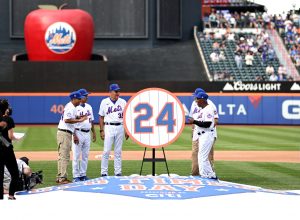 It shouldn’t have taken a miracle, but we got a miraculous ending. Then the Mets Old Timers played a beautiful game whose score didn’t matter and the current Mets played a beautiful game whose score did matter — Mets 3 Rockies 0 — and I left Citi Field in a blissful state of total belief.
|
|






