The blog for Mets fans
who like to read
ABOUT US

Faith and Fear in Flushing made its debut on Feb. 16, 2005, the brainchild of two longtime friends and lifelong Met fans.
Greg Prince discovered the Mets when he was 6, during the magical summer of 1969. He is a Long Island-based writer, editor and communications consultant. Contact him here.
Jason Fry is a Brooklyn writer whose first memories include his mom leaping up and down cheering for Rusty Staub. Check out his other writing here.
Got something to say? Leave a comment, or email us at faithandfear@gmail.com. (Sorry, but we have no interest in ads, sponsored content or guest posts.)
Need our RSS feed? It's here.
Visit our Facebook page, or drop by the personal pages for Greg and Jason.
Or follow us on Twitter: Here's Greg, and here's Jason.
|
by Jason Fry on 18 September 2022 10:51 am Saturday night’s Mets win over the Pirates had a certain family resemblance to Friday night’s win: smothering starting pitching, enough offense to secure the victory, not enough offense to feel secure about said victory.
The margin was more comfortable, to be sure, but once again the Mets proved curiously allergic to the tack-on hit that would have made the rest of the game a formality: Eduardo Escobar‘s three-run homer started the scoring, but the remaining two runs came on bases-loaded walks to Brandon Nimmo and Pete Alonso.
But a critical thing to internalize as a baseball fan (and keep remembering every time you forget it) is that there are no style points. Wins don’t come with asterisks to indicate a whew or a meh, just as losses aren’t classified differently if an awww or an attaboy is involved. You win or you lose, full stop.
So let’s review:
- The key words up there are smothering starting pitching. If you get that night after night, most other flaws will prove forgivable. Chris Bassitt was terrific as he so often is, using his Saberhagenesque arsenal to carve up the Pirates. His line looks uneventful, but Bassitt fanned hitters with runners on to finish the third, fourth and sixth innings. (His obliteration of Ke’Bryan Hayes to finish his start was particularly cruel.) To cite an antique, now derided stat that remains stubbornly dear to my heart, Bassitt now has 14 wins with a little season left to run, and he’s in good company: Carlos Carrasco has 15 and Taijuan Walker has 12, with the two-headed, oft-sidelined beast of Scherzer/deGrom combining for 14 more.
- An Alonso bases-loaded walk may not feel like thunder for the highlight reel, but just a week or so ago he was clearly out of sorts at the plate, with the greatest impacts coming from his bat meeting his knee while steam came out of his ears. Alonso not expanding the zone and taking what pitchers give him instead of chasing unobtainable heroics is the foundation for what we all want, even if it means he only trots only a quarter of the distance we have in mind. (More antique stats: He’s also still on pace to break the Mets’ single-season RBI record, though at current rates he’d edge it rather than obliterating it. Style points again!)
The Mets beat the Pirates. That’s what matters. Hopefully they’ll beat them again in a few hours. That matters too. The mechanics of a win’s construction are fun to dissect, whether giddily or with a side of fretfulness, but they’re of secondary importance to whether or not there’s something to dissect in the first place.
by Jason Fry on 16 September 2022 11:55 pm On Friday night the Mets played one of those OBJECTS IN MIRROR ARE CLOSER THAN THEY APPEAR games: They seemed to have the Pittsburgh Pirates well in hand for a second straight night, starting with Taijuan Walker not giving up a hit until the fourth. The Mets repeatedly looked on the verge of knocking the Pirates out, but that decisive blow never landed — the membrane between “hard fought” and “laugher” remained stubbornly impermeable.
Walker pitched ably into the eighth but ran out of gas, giving up a rapid-fire single and then a homer to Oneil Cruz. Cruz is going to be a superstar — he’s an action figure cloaked in human form, with a wonderfully expressive face and lightning in his throwing arm and wrists — but first he needs to go through the struggles many a young player experiences. The Mets have seen the greatness he’s capable of along with the lesser moments he hasn’t yet escaped; with one swing, Cruz brought the Pirates within a single skinny run.
Edwin Diaz — yes, he does still pitch for the Mets — kept the Pirates at bay in the eighth, but the Mets let another chance go by, and when Diaz returned for the ninth, the layoff had clearly not been to his benefit.
Diaz walked leadoff hitter Ben Gamel, who was replaced by speedster Greg Allen — who promptly stole second. Luis Guillorme, who’d taken the throw, immediately called for a review.
Guillorme is often emphatic in such respects, but the Mets had nothing to lose, so they sent their case a little west for Chelsea for review. Said review quickly determined that Guillorme was seeing the world as it was and not as he merely wished it to be — he had dropped his leg in front of the base, allowing Allen to touch that and not his actual goal. (My goodness did we miss Guillorme.) The Pirates’ runner in scoring position ceased to be, Diaz fanned Ke’Bryan Hayes, and Cal Mitchell hit a drive to the fence but only to it, no farther.
The Mets had survived, emerging victorious not by administering a bludgeoning but by making slightly fewer mistakes than the opposition. Which still counts as a win — the most valuable commodity imaginable as September bears us on the way to wherever it is we’re headed.
* * *
 Greg noted the death of John Stearns, the speedy and tough catcher who was one of the rare reasons to watch the Mets of the post-Massacre era. Like my blog partner, I was thrilled to see Stearns at Old-Timers Day, tragically reduced by the illness that would claim his life but obviously pleased to be among his peers. I blanched at the idea of what the effort must have cost him, unaware of how right that was — and how few days remained to Stearns. Greg noted the death of John Stearns, the speedy and tough catcher who was one of the rare reasons to watch the Mets of the post-Massacre era. Like my blog partner, I was thrilled to see Stearns at Old-Timers Day, tragically reduced by the illness that would claim his life but obviously pleased to be among his peers. I blanched at the idea of what the effort must have cost him, unaware of how right that was — and how few days remained to Stearns.
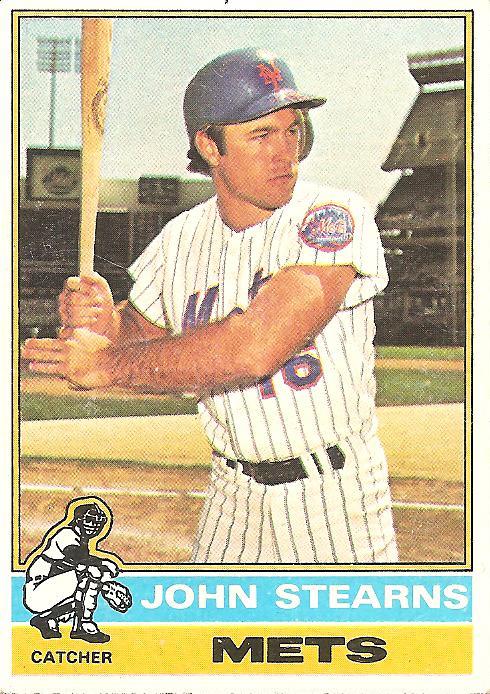
My first memory of Stearns came not from a ballgame but from a baseball card — Stearns’ ’76 Topps card, in which he’s represented by the Michigan blue and maize that still read to me as semi-official Mets colors.
It’s a posed shot, of course, but an awfully good one: The fingers of Stearns’ bottom hand have come off the bat, as if eager for trouble; his body is coiled, poised for imminent violence; and his expression suggests he’s more than ready for “imminent” to become “here and now.” As a kid and a newcomer to baseball, I was fascinated by that card — and pleased to discover the man pictured was worthy of it.
Stearns played one game for the Phillies before coming to the Mets as the best piece of the Tug McGraw trade and was a four-time All-Star for us, a legendarily tough catcher unafraid to mix it up with Gary Carter, Dave Parker or anyone else who dared challenge his guardianship of home plate. A bad elbow ended his career just as the Mets were returning to relevancy — he appeared briefly at the tail end of ’84, but the team’s mid-80s revival took place without him. But he stayed with the game, serving as third-base coach for the 2000 Mets and famously exulting about Mike Piazza that “the monster’s out of the cage!”
To younger Mets fans of that era, maybe, he was just a coach. But I cherished him as a survivor of a barren era, one who’d missed the first glory period after his career but been rewarded for staying the course and granted a role in the next one. For veteran fans like me, that made him something of a kindred spirit — even if we never played the game and could only watch those who, like Stearns, did so with such skill and ferocity.
by Greg Prince on 16 September 2022 11:03 am A 7-1 win is, by nature, convincing. Thursday night at Citi Field, the Mets got the 7, the Pirates got the 1 — the Mets won by a lot, no doubt about it. Very convincing.
Very convincing for Thursday night, at least. Every win the Mets have racked up since September 2, within the parameters of the nine innings of those wins, could convince the hell out of even the most skeptical cynic or cynical skeptic that most everything is hunky-dory, and what isn’t rates as no less than okey-dokey. The Mets’ winning scores these past weeks have been 7-3, 5-1, 10-0, 11-3, 9-3 and now 7-1. Convinced?
Not if your conviction is those victories, no matter how they satisfy as they turn final, aren’t the end of the story. And how can you be convinced otherwise when those episodes of resounding triumph intermingle with the convincing losses that have piled up since September 3: 7-1, 7-1 again, 8-2, 6-3, 5-2, 4-1 and 6-3? Three six-run losses, three three-run losses, with the three-run losses feeling little different from the six-run losses when Ls were said and done.
I’ve heard myself think as we reached the mid-point of September, even after the completion of a resounding W like Thursday’s, that I’d sure like to win some close games, if only because that’s what the Mets were doing before the wildly uneven (allegedly easy) portion of the schedule took hold, back when I was absolutely convinced that everything was gonna turn out fine. The Mets’ six wins prior to lowering themselves to the depths of the National League only to discover how easily they fit in with the competition were accomplished by scores of 10-9, 3-1, 7-6, 3-0, 2-1 and 5-3. Close wins, one after the other, indicate a team constructed of uncommon mental toughness…or so we might convince ourselves because it sounds good in our head. It sounds great, actually, now that the Mets have lately ceased winning and even playing tight games. The Mets lost several heartbreakers, too, as August closed: 4-2, 4-2 again, 1-0 and 4-3. Maybe we were convinced we were rooting for one kind of team, a team that toughs it out every night and emerges ahead more often than not, only to have that conviction shattered when every game became either a lopsided win or a somnambulant loss.
The taking of one game at a time, still one of the best bromides baseball has ever produced, seems most advisable, though with 145 games already taken as a whole, it’s difficult to convince yourself that every day is an unknowable adventure. We see trends! We see patterns! We see games whose conclusions can be detected and projected before the games begin! (I see fertile terrain for the gambling entity that advertises you should place bets on your phone as you while away spare minutes on your toilet.)
The one game at a time we took Thursday night felt good as it built to 7-1, and it certainly felt spectacular to have won, 7-1, with the Met win column welcoming its first new member since Sunday, bringing its total for the season to a crisp 90. Amazing how lonely those first 89 were beginning to look. The Mets team that posted Win No. 90 resembled the Mets team that didn’t worry a person too much for the first five months of the season. Familiar figures Carlos Carrasco (6 IP, 1 ER, 11 SO) and Francisco Lindor (a two-run homer in the third) provided the foundation. Cleverly added newcomers Daniel Vogelbach (3 RBIs) and Mark Vientos (a run driven in on his first major league hit) contributed to the fortification. Everything you liked about the 2022 Mets was on display, especially the final score, even if you’ve reached the stage of September when even a perfectly desirable final score leaves you a tad shy of convinced.
***The half of Faith and Fear in Flushing who hasn’t self-imposed a ban on attending Mets home games was at Citi Field Thursday night. I made it to my 700th regular-season Mets home game, to be precise. That’s 700 since July 11, 1973. It would have been hard to have squeezed them all into one night. The Mets’ record with me in attendance climbed to 388-312 lifetime, which works out to roughly 90 wins in a hypothetical 162-game season. Given that the 700th game coincided with the 90th win for these Mets, perhaps it was kismet that I was there.
I showed up less because I consider myself some kind of lucky charm (though in 2022, the Mets have gone 8-3 with me on hand) than because of the gesture the Mets and Pirates were making toward baseball history and extraordinary humanity. I wanted to be there on Roberto Clemente Night (having missed the first one in Queens in 1971). I wanted to be there to remember No. 21, which was going to be facilitated by every Met and every Pirate wearing No. 21. One Met wearing 21 is nothing new; we look forward to Max Scherzer wearing it again real soon. But any Pirate, let alone all of them, wearing it was stunning. We haven’t seen a Pirate wear 21 since 1972.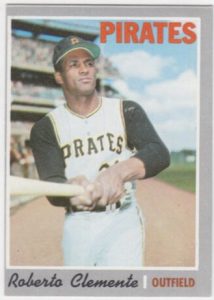
Roberto Clemente was one of the pillars of my youth. Mays. Aaron. Clemente. That was National League baseball at its finest, the National League baseball that offered the context around the team I fell in love with. Sometimes Tom Seaver or Jerry Koosman or Gary Gentry had to face an all-time great. It was hard to believe that somebody like Roberto Clemente with his slashing bat, lightning legs, cannon arm and unmatched determination strode the earth just like everybody else on a baseball card. One of my first cards, from 1967, was of “Bob” Clemente. When I started watching games, there was a Roberto Clemente. Same guy? Same guy, previously mislabeled. He was Roberto all the way. Topps’s Anglicization department didn’t know what it was talking about.
As I’ve continued to read about Clemente in the years since he went down in a plane crash while rushing to the aid of earthquake victims in Nicaragua on my tenth birthday, I’ve learned Topps wasn’t alone. Clemente was singular in his impact on the direction baseball took. He was the first dark-skinned Latin superstar but surely not the last who wouldn’t be fully understood by the English-speaking press. He surely wasn’t the last to encounter discrimination in the USA, but he absorbed a ton of it so maybe things would get a little easier for those players who’d follow in his wake from his part of the world. He was already an idol in Puerto Rico before he died. It’s fifty years since his tragic passing, and his legend has only grown stronger there and everywhere. MLB gives out an award annually to the player who performs with selflessness off the field in the spirit of Roberto Clemente. He rates a Day every year. His example rates a Day every day.
I applied for and received media credentials Thursday night because a long line of previous Roberto Clemente Award winners was going to unfurl at Citi Field and a subset of those gentlemen were going to speak to reporters before the game. I wanted to experience that first-hand. It was indeed an experience. Seven of them sat down at a podium flanking Luis Clemente, one of Roberto’s sons. On the left were three Mets who won the award: Al Leiter, Carlos Delgado and Curtis Granderson. On the right, four more players who needed no introduction: Jim Thome, Steve Garvey, Harold Reynolds and Dave Winfield. Talk about your packs of cards coming to life. Every one of them, regardless of when they played or where they called home, spoke to the meaningfulness of being honored by receiving the Roberto Clemente Award. “I’m not here if it’s not for community,” Grandy explained about wanting to do for others from the perch of MLB stardom. Only Garvey played as something of a contemporary of Clemente’s, but they all felt his impact and were compelled to carry on his legacy.
Every player in 21 for one night made quite the statement. Once I got past the “when did Lucas Duda come back?” reflex reaction to seeing No. 21 run out a ground ball (“oh right, that’s James McCann”), I thought it was beautiful. Same for the pregame ceremonies that included Roberto’s toddler grandson throwing out a first ball while displaying what could be best described as the family arm. Jose Feliciano stumbled a bit on the Star Spangled Banner, but his performance in his native tongue and mere presence added an unmistakable grace note to the proceedings. Former Clemente winner Carlos Beltran, whose Met managing career was snuffed before it could start, was cheered every bit as much as the other honored guests — save for Jimmy Rollins, whose good works may not have been appreciated by a Met crowd on any occasion. The movement spurred by Latin players to have 21 receive the 42 treatment and be retired leaguewide in recognition of Roberto’s transcendence didn’t culminate in any momentous announcement Thursday night, but I imagine it gained some traction. That, too, would be quite a gesture.
***A moving night of baseball came to a close in the wee hours with word that John Stearns had died. We knew he’d been ill. He made it to Old Timers Day on August 29, traveling from Colorado in a condition that could best be described as frail. In a day crafted of feelgreat moments, Stearns’s may have felt best of all. The man wanted to be back in Queens one more time, wanted to wear the Mets uniform one more time, wanted to respond to the cheers of Mets fans one more time. He got all that less than three weeks before he passed away.
 If you were a Mets fan during the heyday of John Stearns, one word comes to mind: indefatigable. John Stearns was not to be defeated. He might play on a bunch of losing teams, teams for whom six-run losses were the norm, but John Stearns wasn’t going to accept it as inevitable. John Stearns strove to play winning baseball. On one of those nights when I was notching one of my thus far 700 games in attendance, I clearly remember telling my friend Joel, just as we were stepping outside Shea Stadium, that everything there is to like about this team is embodied by John Stearns. I didn’t use those words exactly (the Mets had just lost), but I remember believing he was the best of us. If you were a Mets fan during the heyday of John Stearns, one word comes to mind: indefatigable. John Stearns was not to be defeated. He might play on a bunch of losing teams, teams for whom six-run losses were the norm, but John Stearns wasn’t going to accept it as inevitable. John Stearns strove to play winning baseball. On one of those nights when I was notching one of my thus far 700 games in attendance, I clearly remember telling my friend Joel, just as we were stepping outside Shea Stadium, that everything there is to like about this team is embodied by John Stearns. I didn’t use those words exactly (the Mets had just lost), but I remember believing he was the best of us.
John Stearns was the player I wished every Met could be. Tough. Talented. Driven. Not taken down by anything that wasn’t physical, and even then he fought off aches and pains as he did onrushing baserunners (not to mention stray interlopers to his place of business). Stearns went to the All-Star Game four times as a Met. He set a league stolen base mark for catchers when he wasn’t cutting down attempted thievery. He wouldn’t take lose for an answer, even when the test wasn’t multiple choice. On the final weekend of his major league career, John planted himself behind the plate and caught the 90th win of the Mets’ renaissance season of 1984. By then the veteran who’d been in the bigs since 1974 and never sniffed the playoffs had been injured for most of two years. Yet here he was, if not turning back time, then definitely not allowing it to bowl him over or jar the ball from his mitt. We dreamed of rooting for a Mets team that would win that many games in a year. We dreamed that such a Mets team would include John Stearns.
If I could buy a ticket to Shea Stadium one more time, look up at the mighty scoreboard to learn the lineup, and find “12 C” listed within the heart of the order, I’d get my money’s worth. Of that I’m thoroughly convinced.
A new episode of National League Town is out. As always, I’d be honored if you’d listen.
by Jason Fry on 15 September 2022 12:36 am Not by the Mets — I was at least a reasonably well-behaved guest up in section 339 with my work colleagues, a long way from home plate and the pitches David Peterson didn’t throw in sufficient proximity to it. Rather, I’ve been banned by my kid on suspicion of being a jinx.
I’m 0-for-4 in outings to see the Mets this year, but it’s more the nature of the season-long oh-fer that’s generated concern. When I go, the Mets don’t just lose — they play like they guzzled a gallon of cough syrup in the clubhouse. They walk guys, give up big hits, play sloppy defense, fail to hit when it’s desperately needed, run the bases in a shoddy matter, and walk around muttering under their own little black cloud of crumminess.
That was front and center in Tuesday night’s loss to the Cubs, which started out unlucky and turned alternately boring and frustrating. And then Wednesday night was worse, as Peterson endured a Charlie Brown-style undressing at the hands of the Cubs and the Mets were stymied in their sputtering attempts to come back. It was endless and perplexing and tooth-grinding and frustrating and a lot of other words you don’t want attached to your ballgame experience.
My kid issued the warning Tuesday night, and that crooked number in the first made me think he had a point. As did something that happened a little later: I checked my phone at around 10, expecting to see the Braves had put up a run or three in the first in San Francisco, and discovered to my surprise that the game had already concluded. (The Giants won; we’re grateful to them and to old friend J.D. Davis.)
My God, I thought. If I’d known I would have checked … and that would have gone badly too.
I know this is nonsense. I can’t affect the outcome of a game from 500 feet away. You may as well blame the Mets’ recent run of ineptitude on the spotted lanternfly or the restless shade of Queen Elizabeth II. (Not that you asked, but I mostly blame bad luck — plus the absence of Starling Marte, who lengthens the lineup and brings a certain swagger to the proceedings.)
But as I do fairly often in trying to make sense of baseball, I’ll rely on the counsel of Crash Davis. As Crash told Nuke Laloosh and then Annie Savoy, you respect a streak. And OK, that means I’m banned. I have a ticket for the Oct. 5 finale, and I’ll only go if the Mets’ fate has already been determined. Otherwise, it’s the couch for me — and if these games keep going the way they have, by Oct. 5 I’ll be watching what happens while peeking out from behind it.
by Greg Prince on 14 September 2022 9:45 am Periodically this season the 2022 Mets have evoked statistical or emotional comparisons to some of their greatest years. On Tuesday night, the 2022 Mets welcomed our memories to 2018. You remember what would happen in 2018: Jacob deGrom would pitch very well and too much would go wrong otherwise to make anything of it. On nights deGrom didn’t pitch, most everything would go wrong. The only 2018 element missing Tuesday was Mickey Callaway (reportedly) sending lewd texts, at least from Citi Field.
By September of 2018, the Mets, elevated by the callup of minor league slasher Jeff McNeil, were playing a little better. It was too late to boost them into a playoff race, but it gave us a little something to look forward to for 2019. Of course the way contemporary offseasons go, the 2019 team looked different from 2018 and the flow of events washed over the minutia of what quickly became “last season” and then became long ago. Come to think of it, maybe you don’t remember what would happen in 2018.
Me, I got a serious 2018 vibe out of the 2022 Mets on Tuesday night. The 2018 Mets were a 77-85 disaster, and that was with the aforementioned strong finish (18-10) and historically dominant start (11-1, when we were convinced Callaway was a paragon of clean living and managerial brilliance). That was also with deGrom in his Super Cy Young mode, whittling his ERA lower and lower every start, rarely getting the win to go with it, which made his performance pop even further. Jake gave up nothing every fifth day and got nothing from his team except their gratitude for allowing them to dress in the same clubhouse as him. Since the stakes for the Mets as a whole were nonexistent, we could marvel at Jake, gnash our teeth at the offense that took his starts off and feel certain that a 10-game winner absolutely deserved every honor in the books.
More innocent times, huh?
The Mets of September 2022 have thus far not lived up to the Mets of September 2018. The Jacob deGrom of September 2022 has been through the physical wringer the last couple of years, but still gives the Mets transcendent innings in bunches. Maybe there’ll be a hiccup in the form of an opposition home run, but otherwise he strikes out more batters than ever and never, ever doesn’t keep his team in the game. On Tuesday night, he did what he’s done for 39 starts in a row dating back to September 2019: he gave up no more than three earned runs, tying a record nobody knew existed. In 1913 and 1914, Jim Scott of the White Sox went 39 consecutive starts giving up no more than three earned runs in any of them. I’ll confess to never knowing Jim Scott existed until it was disseminated what milestone Jake was on the cusp of reaching. The season that encompassed most of Scott’s streak, 1913, saw Jim win 20 games and post an ERA of 1.90, the latter mark in league with Jake’s 1.70 from 2018. He also lost 21 for those White Sox, indicating that maybe the Pale Hose supported him about as well as Jake’s mates have habitually come to his offensive aid. (The 1913 Sox were managed by a man named Callahan, rather than Callaway, and won 78 games rather than 77; I’m leaving that rabbit hole now.)
Some slice of history is always being wrapped up for at-home consumption where Jacob deGrom’s pitching is concerned. One hopes he will make the greatest kind of history in October 2022. The Mets will get there. Barring a prorated replay of June 2018 the rest of the way (5-21), they’re in. At the moment, they’re still a first-place club, no matter what they’ve looked like about as many nights as not since August ended.
The problem Tuesday night wasn’t merely that the solo home run Jake surrendered to Ian Happ leading off the visitors’ second nor that the Mets didn’t answer the Cubs with a single run until the ninth when Pete Alonso went deep. The “they never score for Jake” plaint is baked into every deGrom start. At this point it’s more urban myth than fact of life. In his last start, the Mets scored ten runs. If this had been a simple episode of run starvation for The Ace, well, that wouldn’t have been groovy, either, but you deal with those.
No, this was a crummy game that went sideways from the bottom of the first and never hinted it would get back on track. There were a lot of those in 2018. Other years, too, but ’18 is where my mind went. Brandon Nimmo managing to get himself hit between first and second by a hot McNeil shot ticketed for right field was both an omen and a boner (the way we used to use that phrase before the age of Mickey Callaway). Pete Alonso’s massive would-be home run that refused to hit the fair pole — Warner Wolf knew what to call it — spoke more volumes than we needed to hear. Alonso rounding the bases on a ball that had been called foul what just weird. So was whatever jawing Pete engaged in with Cubs starter Adrian Sampson. The half-inning would have continued on the hard-to-handle dribbler Daniel Vogelbach produced…had anybody in the world besides Vogelbach been chugging to first base. Wilson Ramos, a.k.a. the Buffalo, would have stampeded that into a base hit. Instead, Vogey was out, the first was done and, though you wouldn’t have necessarily given PointsKing or DraftBet or whoever sponsors all the gambling Rob Manfred welcomes your money on it, so was the Mets’ best chance to tally meaningful runs.
We move ahead in the action to the top of the fourth, as the SNY voiceover might put it in the condensed version of the game they air at dawn. This was the half-inning where it got all 2018 up in here. Two are on. Nobody is out. Michael Hermosillo, taking over a plate appearance for a bunting Rafael Ortega (hit in the act of bunting), lays down a sacrifice. James McCann leaps on it and fires to Alonso. Alonso never gets the ball because Hermosillo transforms himself into a moving obstacle, sprinting on grass and nothing but grass, and McCann’s throw bounces off the runner’s helmet. That’s interference to the naked eye, the educated eye of Buck Showalter and everybody blessed with a working eye. Umpire Laz Diaz judges otherwise. Somewhere Nancy Faust tickles the organ to the tune of “Three Blind Mice”.
And with that tear in the Jake-Time Continuum, the Cubs pour on as much as a team can possibly pour on Jake, which is to say two more earned runs, one on a sacrifice fly to McNeil in right (where he doesn’t usually play; he didn’t throw home) and one on another bunt that Alonso didn’t shovel with optimal aim and alacrity to McCann. The Mets were down, 3-0. It felt like they were losing by 2018.
Jacob straightened up and flew right to end the fourth before obliterating the Cubs in the fifth and sixth. Once he had thrown his almost 100 pitches, he had recorded 10 strikeouts, giving up nothing else along the way. But the way was irreparably wayward. Seth Lugo allowed a line drive that carried over the over the right-center field fence to David Bote (Nimmo seemed as surprised as anybody that it wasn’t in his glove) to make it 4-0 in the seventh. Pete’s solo blast in the ninth dressed only the tiniest section of the smallest window. The Mets lost with neither punch nor luck on their side, 4-1, accounting for their sixth loss in their last ten games, all of which have been played versus second- and perhaps third-division teams. The Braves would down the Giants on the West Coast while New Yorkers nodded off, reducing the Mets’ East lead to a half-game, the divisional equivalent of Jake’s ERA four years ago. The Ace’s earned run average is pretty stellar now, actually (2.01 after eight starts), as is the Mets record despite the September sag (35 over .500). But when you make an unscheduled stop in the unmissed past, nothing amid the Metscape looks particularly appealing.
by Jason Fry on 12 September 2022 11:20 pm To review, these days the Mets play two kinds of games, which for simplicity’s sake we’ll tally up in separate columns.
In Column A, we record games like these, to quote some dumbass blogger: “ones in which they lose seemingly winnable affairs in horribly frustrating ways”.
Column B is the home for games like these: “ones in which they beat the absolute tar out of their opponents without breaking too much of a sweat.”
So let’s assess Monday night’s game against the normally downtrodden Chicago Cubs.
- The Mets faced Javier Assad, a rookie pitcher without much of a prospect pedigree, and did next to nothing against him. (Though, to be fair at the expense of a good narrative, from my tactically superior position on my couch this didn’t look like one of the Mets’ infamous Full Nabholzes against an unknown quantity — Assad had good stuff, built around a sharp cutter.
- Chris Bassitt had a rare stinker of a performance, reporting for duty with basically no command of anything. His expressions on the mound charted the Cubs’ lead as it grew from annoying to concerning to thoroughly dispiriting: a look skyward, a grim glower of self-loathing, an irritable snap of the glove, rinse lather repeat.
- The Mets failed to come through in big spots. Mark Canha struck out twice with the bases loaded, the second time making the first out of a bases-loaded-no-out fizzle that yielded zippo. But Canha had plenty of company, as Brandon Nimmo and Tyler Naquin and Eduardo Escobar and poor star-crossed Darin Ruf all failed to come through in big moments.
- Rearrange the game a little here and there and you can see a better one trying to emerge: Nimmo and Naquin and Ruf chip away at the Cubs’ lead and maybe Francisco Lindor‘s lipstick-on-a-pig homer in the ninth is a far grander moment. But that game belongs to some other reality, not this one.
- The last couple of innings were played in the rain, and I have to assume at least a couple of dogs went from Bark in the Park to the 7 train, after which they shook themselves (as dogs do) and spritzed Mets fans whose spirits were already a little damp.
So, quick review: Does this delightful game go in Column A or Column B?
Seems like it’s unanimous: Column A.
by Greg Prince on 12 September 2022 11:11 am Angel Hernandez, a master of ruining endings of baseball games, was ready to roll early Sunday afternoon, out to ruin a baseball game that had barely begun. It took him all of five pitches to pull a Sparky Lyle by dropping trou and planting his bare bottom on the Mets-Marlins finale birthday cake. Brandon Nimmo, batting leadoff, lashed a ball into the left field corner. See Brandon run! Run, Brandon, run! Brandon ran all the way to third for a triple to set the Mets in motion toward a fruitful first inning.
Wait a sec, signaled Angel Hernandez from about as far away as an umpire could stand from the inflection point of a play. That ball Nimmo hit got stuck under the fence, hence that’s a ground rule double, meaning Brandon would have to trot in reverse, lose ninety feet from his journey and stand on second.
That happens sometimes in a game, a ball being inaccessible to an outfielder because of the physical imperfections of barriers and whatnot. Thing is, Brandon’s ball didn’t get stuck under anything. It traveled as far as it could and sat where it landed. No Marlin threw two hands in the air. No Marlin projected helplessness. No ball was stuck.
Angel saw it differently. Angel sees many things differently in the course of a baseball game. This time he opted to set the baseball game off course from its first batter. Replays showed Angel was misguided. Chatter with his fellow umpires couldn’t budge him. Educational efforts from the walking rule book Buck Showalter didn’t persuade him. An official Met challenge didn’t change anything; I believe the ruling from the replay crew in New York was, Oh, that’s just Angel being Angel.
Nimmo on second rather than third. And though the Mets might not have driven in a Nimmo hypothetically taking a lead off third in the first, they surely didn’t drive him in from second. Mets nothing, Marlins coming to bat, the Angel of Aloof Incompetence with one more innocent baseball game in his nefarious clutches.
If the Mets of September 2022 were the Mets of September 2022 we’ve reflexively considered them when things haven’t broken their way, Angel Hernandez’s miscall might have broken them. We would have had only the satisfaction of Max Scherzer earning ejection from the dugout for giving Angel an earful. Scherzer standing up for all that is correct is fun, but it’s small solace if a game is going to turn on a triple being reduced to a double and leading to a zero.
Ah, but the Mets of September 2022 are roughly the same outfit that has presented itself through all of 2022, which is to say a different fit from other Septembers and other years when adversity would have hung a crooked number on the scoreboard against them in the wake of an Angel Hernandez error of judgment and procedure. These Mets, now in their recordbreaking sixth month of thrilling audiences from coast to coast (or East Side to West Side at least), didn’t fume. They caught fire.
We lost a base to Angel Hernandez? We got it back and then some. Brandon Nimmo got a whole bunch of bases as Sunday progressed. In the second, with two on and two out, Brandon blasted a three-run homer. Hernandez didn’t find a fan interfering after or detect a timeout call before Jesus Luzardo delivered the pitch Nimmo whacked. Nope, it was a genuine three-run homer. Brandon was now only a single and an Angel short of the cycle.
Nimmo didn’t get that far on Sunday, but he kept making up for what Hernandez took away. He walked in the fourth, part of building another Met run. He batted on the heels of a two-run Tomás Nido double in the fifth, working out another walk during a plate appearance highlighted by Nido moving up to third on a wild pitch. This meant second base was unoccupied, which hasn’t meant much to Brandon standing on first all year, but this was a day for Nimmo and the Mets to add base upon base to their ledger, a sharp strategy considering they’d been deducted a base they’d earned to start the game.
Brandon Nimmo stole second. It was his first stolen base of 2022. It is September. Brandon Nimmo bats leadoff virtually every day. Brandon Nimmo is not slow. Yet Brandon Nimmo doesn’t attempt to steal. But having witnessed how effective Angel Hernandez was at snatching something that shouldn’t have been his to take away, Nimmo perhaps adjusted his values system.
Total bases aren’t calculated this way, but that so-called ground rule double, the home run, the two walks and the stolen base…that sums to a total of too many bases for even Angel Hernandez to reduce to nothing. The rest of the Mets were inspired, too. You may have noticed that bit about Nido doubling in two runs. Hold on to your facemask, because Nido also homered. Nido homers about as often as Nimmo steals. A more likely candidate to go deep, certainly in recent weeks, Eduardo Escobar, chipped in a homer as well. Escobar spent most of 2022 replicating 1985 third baseman Ray Knight (.218 and a candidate for release the following Spring). Then he went on the IL, came off it and turned into 1986 third baseman Ray Knight (.298, The Sporting News Comeback Player of the Year and MVP in the World Series). Given his switch-hitting abilities, maybe he’ll be slugging like 1987 third baseman Howard Johnson by next year (even if he steals less often than Nimmo).
Offense wasn’t a problem for the Mets on Sunday. All the bases piled up to nine runs. Starting pitching also wasn’t a problem. Taijuan Walker, for whom second halves have been his own Angel Hernandez (which is to say a pox on competitive baseball), righted himself to the tune of seven one-run innings, one of the catchiest tunes you’ve ever heard. Only Brian Anderson was a thorn for both Taijuan and Seth Lugo. Anderson homered off each of them, driving in all three Marlin runs. If you’re pinpricked by only one Marlin in the course of nine innings, you’re having a very good day.
The Mets’ Sunday was grand enough with the 9-3 win in their pocket, but it got a lot better later when our temporary favorite American League team the Seattle Mariners held off the Atlanta Braves, 8-7. It wasn’t really a “held off” situation. The M’s were up, 6-2, heading to the ninth, which was the last time I checked. I wasn’t following closely — I hesitate to watch or listen to games in which I’m more interested in who I want to lose than who I want to win (karma’s my program guide) — so imagine my surprise when I digested that final score. The Braves scored five in the ninth, which meant they went ahead in a game that seemed, to the extent that “seemed” carries any weight, settled.
Settle this, said the Braves. But unsettle this, the Mariners answered. Atlanta’s raucous comeback to 7-6 was obliterated by two homers off Kenley Jansen, one from wunderkind Julio Rodriguez, the next from Cincinnati expatriate Eugenio Suarez. I watched the highlight of the latter. I whooped as if I didn’t know what it contained.
After the angst of the Mets’ brief sag into second place, they are first in the East again, an entire game-and-a-half ahead of the Braves. They’ve won their last two series. Had they captured one of the two games they lost against the Nationals last weekend, we’d be talking about a team that relentlessly keeps winning series. Instead, they made the mistake of briefly faltering and we all more or less decided they were cooked. Maybe they were just on a low simmer. September has a way of turning up the heat on all of us. Nobody’s judgment is flawless this time of year.
Just ask anybody who’s watched Angel Hernandez in action.
by Jason Fry on 10 September 2022 11:17 pm The Mets, of late, play two kinds of games: ones in which they lose seemingly winnable affairs in horribly frustrating ways and ones in which they beat the absolute tar out of their opponents without breaking too much of a sweat. We’re a third of the way through September, and I’m not sure I can take a full slate of grinding torments and giddy laughers — it’s giving me a case of emotional whiplash when I’m a little raw already.
At least Saturday night’s tilt in Miami was one of the laughers. The Mets started off looking a lot like they did Friday night, turned aside by lousy sequencing and a double play en route to falling behind the Marlins. But all was not lost, even if it felt that way to all of us grinding our teeth on our couches. The Mets tied the game in the third on a Jeff McNeil RBI single, then unloaded on Pablo Lopez an inning later, with the knockout blow a Mark Canha grand slam that greeted Lopez’s replacement Andrew Nardi. Canha has been one of the abiding pleasures of a wonderful year, a professional hitter whose at-bats remind me of his antecedents in bat artistry, from Dave Magadan to John Olerud and Edgardo Alfonzo.
Canha’s blast gave the Mets sufficient margin for error to allow the rest of the game to drift along vaguely accompanied by an increasingly Dada broadcast from Gary, Keith and Ron. (That’s said with affection.) Eduardo Escobar and Francisco Lindor each homered on three-hit nights, Carlos Carrasco did his job on the mound and was backed up by JV relievers who didn’t do anything too terrible, and much-requested call-up Mark Vientos sparked his new teammates to an 11-run outburst without even needing to set foot on the field.
The mood swings of such nights are much harder on fans than on players — unable to affect the outcome on the field, we’re left to beg, plead, follow superstitious rituals and remind ourselves when nothing works that the wall would not, in fact, look better with a new hole in it the size and shape of the remote. That’s always true in a pennant race, but this recent stretch, I venture, has been a little harder still. The feast-or-famine games are a trial, as is trying to read the tea leaves of a single W or L each night, not to mention waiting grimly to hear that the Braves won again. It’s all too much, which is why we’re tying ourselves into knots about bullpen management, slumps and streaks, who’s trying too hard and who might not be trying hard enough, whether the trade deadline should be relitigated yet again, and a dozen or so other unhelpful pursuits.
Honestly, the Mets’ only real sin is not playing .700 ball, as the Braves have somehow done since the weather’s gotten warm. But that’s not a story, just math we don’t like. Like fans since time immemorial, we need a story, and so we construct any number of them to fill the gap. It’s what we do — baseball isn’t much fun if you turn off the set every night and are gently philosophical about what’s transpired — but it’s not good for our health. Probably not ever and certainly not now.
My advice is to at least try and pace yourself: The terrors and joys of October still await, in whatever measures they’re parcelled out to us. But our path there isn’t mapped yet, and the only way to find that path is to walk it along with the players whose successes and failures will dictate our happiness for the coming weeks. (Of which we devoutly hope there are eight that matter.) What I just outlined is good advice that I won’t be able to follow myself. More heart attack nights lie ahead.
by Greg Prince on 10 September 2022 11:55 am As long as Rob Manfred is announcing that extreme shifting will be a thing of the past in 2023, let’s retroactively get rid of double plays. In the spirit of the pitch clock that will redefine the imposition of time within the confines of the once-timeless game of baseball, let’s turn the overall clock back 24 hours and declare that any ground ball fielded by an infielder with at least two runners on base and one of them on third can result in no more than one out. Since there’s no time to test it in the Atlantic League, just apply it to the geographically southernmost game played in the majors Friday night. Explain that it’s for competitive reasons or necessary to appeal to an action-oriented youth market that won’t tolerate rally-killing. “The best of interests of baseball” is a dependable chestnut. Whatever flimsy rationale Manfred manufactures will suffice. The bottom line is you can still have double plays, just not from a ground ball inside the parameters of the infield and not with a runner on third.
According to the Manfred Revision, which has just been ratified by unanimous vote in my head, if a team is up in the top of, say, the third inning, with a runner on first and a runner on third and one out, and the batter grounds to the first baseman, once the first baseman throws to second to force the runner coming from first, that’s it. No more throwing. The runner from third scores.
Another example: It’s the top of the seventh with one out. The bases are loaded. A sharp ground ball is hit to third. The third baseman throws to second and records one out. That’s it again. The runner from third scores.
On the other hand, in the hypothetical bottom of the seventh, a team has one runner on, on first with one out. The batter hits a ground ball. Go nuts, defense. Get two outs if you can.
Under this scenario in a not so hypothetical game I might have watched last night, the Mets, who trailed, 4-3, after completing a 1-6-4-3 double play to end the seventh, would be ahead at least 5-4 after seven. Then, in the bottom of the eighth inning, another of Rob Manfred’s new rules — so new it hasn’t even been committed to press release — could be invoked:
Never use Joely Rodriguez late in a one-run game again. That one pretty much explains itself.
So we exchange an out for a run in the top of the third…and exchange another out for another run in the top of the seventh…and we get over this fetish for spreading Joely too thin…and, hey, look, we just won, 5-4, and the Mets are still in first place.
Nice going, Commissioner!
Alas, the rules for which I am lobbying after the fact do not exist, not yet, anyway. Perhaps if a gambling consortium sponsored them and branded them with élan — the Lucky Ball; the Lefty Sit — they’d be MLB law. Instead, we have the ability to ground into double plays with runners on third and we have the unfettered compulsion to deploy shaky southpaws, and we don’t have a Mets 5-4 win over the Marlins. We have, instead, a 6-3 loss in Miami, which, when coupled with a 6-4 Braves win in Seattle, places the erstwhile division-leading Mets second in the National League East.
Which, in turn, doesn’t mean all that much with more than three weeks to go in the regular season and means only so much in light of almost everybody and their uncle going to the playoffs provided they don’t out-and-out suck for 162 games. That’s right: Rob Manfred has essentially legislated crashing and burning from perilous heights out of our Septembers. Seven teams meet the bare minimum standard of winning more than they’ve lost in the National League this year. Four of them are postseason locks, including (and you’re not going to believe this) the Mets, who, appearances to the contrary, aren’t going to blow their date in October. They may have it pushed up, but the Commish ensured their participation by making Wild Card qualification practically blowproof for any team whose sucking has been, at worst, intermittent, episodic and fairly recent.
Thanks, Rob!
Francisco Lindor, who hit into one of the two peskily legal double plays that made Friday night too steep a hurdle to clear versus a supposedly lesser opponent, framed the Mets’ difficulties after the game. He’s too polite to say “we shouldn’t have used Joely Rodriguez to go from being behind by one run to go to being behind by three runs in the eighth inning” and he wasn’t specific about his own seventh-inning double play or Jeff McNeil’s in the third. Instead, he posited, “I think it’s just baseball. I think it’s that time of the year, you know? A lot of us kind of hit the wall. We’ve got to find ways to break through the wall, and do it together. That’s what good teams do, and I’m sure we’re gonna do it.”
That’s a reasonable assessment in September, if an alarming one when set against the experience of a rival that burst through its wall in June and never stopped bursting, but that’s OK. It gives Rob Manfred a chance for more creativity.
Let’s remove walls!
Retroactively by 24 hours, of course. That way the two two-run homers the Marlins blasted over walls — one by Garrett Cooper off David Peterson in the first, the other by Charles Leblanc off the theoretically ineligible Rodriguez in the eighth — might have been caught. As for Pete Alonso’s own two-run dinger in the sixth, nobody can run down a Polar blast!
I’m using a surfeit of exclamation points in this essay to convince myself that any of what I’m suggesting is remotely workable. On the off chance it’s not, here are two final suggestions before tonight’s game and the fresh energy I will devote to suddenly contemplating the Mets’ potential opponent in a 4-vs-5 best-of-three first-round matchup (if we play the Phillies three times at Citi Field, Noah Syndergaard presumably plans to use the occasion as an opportunity to gather extra rest):
1. If you have to put Starling Marte on the IL, which from more than a thousand miles away seems like the healing move, promote Triple-A bopper Mark Vientos already. I don’t usually join minor league savior choruses, generally figuring seasoning is what makes a prospect well done, but every time I turn around, he’s hitting a ball out of Syracuse and into Canada. Besides, give or take other roster machinations, it’s a three-week window, not to see “what he can do” (the song of Septembers far sadder than this), but to maybe, just maybe, catch lightning in a bottle. Three-plus weeks of Tidewater callup Mike Vail helped keep the Mets viable into September of 1975. And you know who has the same initials as “Mets viable” and “Mike Vail”? Mark Vientos, who could prove most valuable. Also, Mo Vaughn, and he injected some pretty distant mood vaccinators into our bloodstream, too. Either way, it’s not like there’s no room in our offensive inventory for bottled lightning.
2. The Doors graciously furnished us with the Mojo Risin’ refrain in 1999. Thanks to Francisco, they’re being called on again. We tried to run (away from the Braves); we tried to hide (from the Braves). Now?
Break on through to the other side, fellas. Use your bats. It’s quicker that way.
by Greg Prince on 8 September 2022 11:48 am You score 15 runs, what do you get? Enough peace of mind to carry you through an off day, I hope.
The New York Mets, who entered Wednesday tied for first place in the National League East, exited Wednesday a half-game ahead of their closest competition. Not bad for a team declared deceased by a vocal plurality of its antsiest supporters.
Great to have fans who’ll stick by you in thick and thicker, eh?
To paraphrase 1988 vice presidential nominee Lloyd Bentsen as he took his younger counterpart Dan Quayle to debate school, September 2022, I lived with September 2007, I knew September 2007, September 2007 was a bane of mine.
September 2022, you’re no September 2007.
I don’t think so, anyway. I’ll cop to thinking after the most recent Mets-Braves series, the one in which three out of four games were lost, that I briefly flashed back to not The Worst Collapse Ever, but its preamble, the four-game sweep suffered at Citizens Bank Park in late August, a.k.a. the Jimmy Rollins Series. That quartet of defeats delivered a tangible bruising to the lingering sense of Met inevitability that had hung over 2007, but then came calming series wins over the (fading) Braves, the Reds and Astros. At Shea, in the minutes before Pedro Martinez manned the mound for the first time all year, on September 9, DiamondVision played a montage of what had gone wrong in Philadelphia, followed by highlights from the good things that ensued elsewhere, all to the musical accompaniment of “pick yourself up/dust yourself off/and start all over again”. Then Pedro went out, threw five shutout innings, doubled, scored a run and the Mets won once more.
And within a week, The Worst Collapse Ever commenced, serving as a reminder, perhaps, that nothing is clinched until it is clinched — or, perhaps, when one takes into account the ten wins in twelve games bracketed by calamity (0-4 at CBP) and disaster (5-12 to finish) — that nothing is blown until is blown. After the Truist Park stumble this August, the Mets won three of four at Philadelphia, culminating in Damn Thing IV, one of about twenty candidates for Game of the Year this year. An immediate stumble at Yankee Stadium was obliterated by three uplifting victories over Colorado, the last of those wrapped in the emotional high of Old Timers Day. Then they don’t score for two days before picking themselves up, dusting themselves off and polishing off the Dodgers all over again, winning that series and then staving off any hint of a letdown by summarily stomping on Washington less than a week ago.
Losing three games in a row, each by six runs, to last-place teams, was certainly concerning in the moment, maybe concerning as part of a greater pattern of scoring only in dribs and drabs. As a leading indicator of where the entire season was headed, it probably didn’t have enough sample size to it (0-3), nor did it have an adequate sense of near-term memory (85-48 prior to 0-3) let alone institutional memory. You wanna harp on 2007? How about that September night the Mets let a portion of their first-place lead slip away to an also-ran Pirates club, when the Mets were blown out and there was a three-game losing streak, and talk about a lack of hitting — the Mets were no-hit!
Or have you forgotten about the 1969 Mets? They were swept in a twi-night doubleheader at Shea on Friday, September 19, 8-2 (a familiar score) and 8-0, then came back to work on Saturday the 20th only to have Bob Moose shut them down on zero hits. None among starters Nolan Ryan, Jim McAndrew and Gary Gentry could tame the Bucco bats. Cleon Jones was out nursing an injury. The veteran-laden, star-spangled Cubs were picking up ground, inching back to four out with ten to play.
Things worked out OK for the 1969 Mets. Things will probably work out some version of OK for the 2022 Mets. You might question the relevance of taking solace in 1969 vis-à-vis 2022, which is fair, but if you do, you probably also need to ask yourself the point of being haunted by 2007 every time a very good Mets team loses three consecutive games late in a very good season.
The picking up, dusting off, starting all over again that occurred Wednesday afternoon and evening wasn’t only about five runs in one win (5-1) and ten runs in the other (10-0). It was about pitching. At night, it was about The Ace, Jacob deGrom, throwing seven shutout innings without prime command of his deadly slider. Good thing Jacob can kill with any number of pitches. By the time he handed matters over to a cobweb-gathering Adam Ottavino and the fresh, violent left arm of Alex Claudio, the old wives’ tale of the Mets never scoring for Jake had gone upstairs to bed, at least for another five or six days. The Mets notched 17 hits, six of them doubles, none of them homers. Toss in seven walks and a non-injurious hit by pitch, and you saw the Mets successfully stringing together rally upon rally as if that’s something they have some experience doing.
DeGrom was building upon the fine work compiled by The Stealth Ace, Chris Bassitt, the persnickety rock upon which the 2022 rotation has been built, even if his name is planted below the title on the Met pitching marquee. Since the middle of June, this guy has been mostly marvelous: 14 outings, a 2.32 ERA, 11 Mets wins and at least six innings consumed 13 times. You could do worse than turning to Chris if you have to turn to one pitcher with something heavy on the line the rest of this season or what lies directly beyond it. Bassitt had only half as many runs lavished on him as deGrom did, but those were plenty. Three came on one swing from Tyler Naquin, whose offensive capabilities, like those of Eduardo Escobar and James McCann, suddenly aren’t as defunct as once thought.
Because no day featuring two wins should lack for something to bring a Mets fan down to Earth (as if the gravitational pull of contemporary Mets fandom would allow for floating even a half-game above the ground), the Braves won again. But they played only once, hence we’re in first alone. Also, the IL claimed another Met, The Co-Ace, Max Scherzer, which seemed more a procedural move in deference to letting an extremely valuable left side rest up than a signal to panic. An abundance of imaging on Starling Marte’s right middle finger has revealed Starling absorbed a non-displaced fracture when he was hit by a Mitch Keller fastball Tuesday night. Meaning? I’ll let you know as soon as I complete my orthopedics degree, but the consensus seems to be it’s not that bad, unless we find out otherwise…which could describe any interval along the Mets’ journey if we want it to.
Superstition, Stevie Wonder once made clear, ain’t the way, but if you’re a baseball fan, you can’t help yourself from thinking one wrong move on your part might lead to a dozen missteps by your team. That’s the crux of this week’s discussion between Jeff Hysen and me on National League Town, the podcast devoted to Mets Fandom, Mets History, Mets Life. You can listen to it here. Just press pause should you find yourself walking underneath a ladder while doing so. Not that I’m superstitious or anything.
|
|