The blog for Mets fans
who like to read
ABOUT US

Faith and Fear in Flushing made its debut on Feb. 16, 2005, the brainchild of two longtime friends and lifelong Met fans.
Greg Prince discovered the Mets when he was 6, during the magical summer of 1969. He is a Long Island-based writer, editor and communications consultant. Contact him here.
Jason Fry is a Brooklyn writer whose first memories include his mom leaping up and down cheering for Rusty Staub. Check out his other writing here.
Got something to say? Leave a comment, or email us at faithandfear@gmail.com. (Sorry, but we have no interest in ads, sponsored content or guest posts.)
Need our RSS feed? It's here.
Visit our Facebook page, or drop by the personal pages for Greg and Jason.
Or follow us on Twitter: Here's Greg, and here's Jason.
|
by Greg Prince on 4 May 2022 9:51 am You get an early lead, which is good. You sweat an early lead, which is natural. You hold an early lead, which is satisfying. You do it all over again a couple of hours later and you’ve really got something there.
In a parallel universe, perhaps the Braves come back on the Mets in one or both games of Tuesday’s semi-twinight doubleheader, with the three o’clock high of bolting to a 2-0 advantage in the first inning of the opener melting away under the pressure applied by a formidable opponent — experienced starting pitcher buckling down rather than buckling under; lineup loaded with certified Met-killers; discomfitingly recent world championship pedigree — and/or the lonesome runs in the nightcap just sitting there on the scoreboard crying out for company, because how long can our starter keep squirming out of trouble?
You know where that parallel universe is? In the receding corners of our Metsian anxieties. It’s gonna be there, but it’s gonna cast less and less light as this season goes along if this season continues to go along if it continues to go along as it has thus far gone along. If it goes along in what has emerged as 2022 Mets fashion, we’ll get along.
In Game One, the Mets indeed have a 2-0 lead after one, and a 4-1 lead after two, and a 5-1 lead after four, yet before you can commence contemplating the chances of a sweep, David Peterson allows a single to lead off the top of the fifth, makes a one-out error as a fielder and allows a three-run bomb to Matt Olson (as if we needed a new applicant for a Met-killing license) directly thereafter. Now it’s 5-4, the youngster returned to the roster for the express purpose of starting this game might be rattled and here are the bleeping Braves of Charlie Morton (still in there), Austin Riley (always lurking), Travis d’Arnaud (apparently vengeful) and Ronald Acuña (not playing but menacingly available), ready to slip their World Series rings on their fingers and take it to us, as they took it to us the night before after we led, 2-0.
Except the night before, like the year before, was ancient history as Tuesday afternoon pedaled toward Tuesday evening. Peterson did give up a hit to Riley after the homer to Olson, but Marcell Ozuna popped up and d’Arnaud, familiarity with Citi Field notwithstanding, struck out, and Peterson got through five with a lead.
The lead was never relinquished, not by Adam Ottavino after a perfect sixth, not by Drew Smith after a scoreless seventh and eighth, and not by trustworthy Edwin Diaz in the ninth. Trustworthy Edwin Diaz is indeed the same Edwin Diaz who used to stoke trauma. The difference is he went in for No-Hitter Therapy last Friday, and since then, you can’t look at Diaz like you used to. You can if you must, but that, too, is ancient history. Not every combined pitching effort calls for lavish group hugs. Sometimes it’s just a matter of everybody doing their job very well. Nine Met hitters scored five runs. Four Met pitchers allowed only four. That’ll lift a lid to your liking.
The nightcap was a dollop of Dom Smith early — two-run double in the first inning — and a torrent of Carlos Carrasco all night long. Carrasco’s night was lengthy, encompassing eight innings and 96 pitches, and it might not have been what you’d think of as classically efficient (Braves reached base to lead off the first, second, third and sixth), but Cookie eventually found his groove en route to a win that required a mere 2:18 to bookify. The Braves didn’t touch him when it mattered. Pete Alonso touched Kyle Wright when it definitely helped matters, socking an opposite-field homer to pad Carrasco’s lead to 3-0 in the sixth. Nervous was understandable. Apoplectic seemed out of fashion. By the time auxiliary fireman Seth Lugo came into close, you remembered that “defending world champion” sounds impressive, but every season is a new season. In the current season, Ozzie Albies nicked Lugo for an infield single, but Adam Duvall flied out and Travis Demeritte grounded into a 5-4-3 double play.
Suddenly, the Mets had swept the Braves. Suddenly, the Mets were 18-8, a record no Mets team had carved after 26 games in this century. Suddenly, for what it was worth, the Mets were in position to win another series if they could take Wednesday’s game. The finale was TBD, as is everything before it happens, yet we could already determine that these Mets were solidly in first place, not at all resembling last season’s accidental tourists who mysteriously stumbled into the top spot of the division and quite explicably tumbled out of it.
Every Mets team holds our hopes in their hands. Few Mets teams hold leads twice as they did in Tuesday’s doubleheader. Few Mets teams have looked like this one. Makes a fan want to keep watching.
The topic of relaxing a little even as we hold on for dear life 162 times a year bats lead off in the latest episode of National League Town, with Teddy Martinez, Sergio Ferrer, Nationals Park and Nora Ephron batting further down the order. Listen to all of it here or wherever you seek 1970s Met utilityman talk.
by Jason Fry on 3 May 2022 12:04 am After the Mets rose up in indignation to snatch a win away from the Cardinals, I said it was the kind of unlikely comeback that would keep me on my couch for umpteen nights when no such good fortune was coming out way.
Nights like Monday, in other words.
How many things do you want to stew about?
For openers, can we have robot umps already? In the fifth inning, with a 2-0 lead, Chris Bassitt threw a perfect 2-2 sinker to Dansby Swanson. It was one of those magic pitches where the pitcher’s leaving the mound while the ball’s in flight with his infielders moving along with him — the batter’s guessed wrong, he’s locked up and can’t swing, and a couple of seconds from now he’ll be standing glumly at the plate with the umpire and a bunch of surplus gear while the scoreboard starts up the usual between-innings folderol.
Chad Fairchild, inexplicably, called it ball four three.
Bassitt, understandably flustered, lost his command, walking Swanson and hitting Ronald Acuna Jr. before getting Matt Olson to pop out. Fairchild then did what umpires rarely do — he got Bassitt’s attention and patted his chest, telling anyone and everyone that he’d missed the pitch. Which was indeed a decent gesture, but I’m pre-weary of the pixels it will generate about honor and accountability and the human element and a bunch of other blather. The fact is that Fairchild missed it, Bassitt had to throw extra high-stress pitches, and when he went back out for the sixth he was facing the middle of the order. The Braves didn’t exactly hit him hard in the sixth, but they hit him, and before you could blink the Mets were down 3-2. Bad umpiring is more than just a thumb on the scale — it’s added weight the pitcher is never going to be able to subtract, with ripple effects beyond one batter or inning.
More things to stew about? How about the Mets commencing to run the bases as if they were blindfolded — both Brandon Nimmo and Jeff McNeil uncharacteristically failed to take extra bases. Or the performance of Trevor May, who’s looked utterly lost so far this year, caught in a spiral of overthrowing and missed execution and self-loathing and further overthrowing.
But here I should note that a common trap of recaps in particular and fandom in general is that a loss gets picked apart for things your side failed to do, which ignores the half of the game that consists of the other guys trying to win. And those other guys did plenty, from Max Fried‘s solid outing and old friend Collin McHugh using his cutter to all but undress Mark Canha with the bases loaded to Austin Riley — not quite Schwarberesque in his Met mastication but too close for my liking — going deep off Bassitt.
And there was Travis d’Arnaud. You’re forgiven if you’ve blocked this out given the owner-related PTSD, but d’Arnaud’s Mets tenure ended when Jeff Wilpon had a hissy fit that a player recuperating from Tommy John surgery was still rusty and engineered his release after 25 at-bats. With a fully healed elbow, d’Arnaud’s been productive for the Rays and Braves, earned himself a World Series ring … and absolutely destroyed the Mets. His first double on Monday night tied the game against Bassitt; his second one put it out of reach against May. Could someone please tell Travis that a) the Wilpons are gone; and b) we all hated them too?
OK, that’s back to something our guys failed to do, or more properly did when they should have known better, which I just said was something to guard against. But it was that kind of night. Even the most magical season will have 20 to 30 teeth-grinders where you wind up too dispirited to even heave the remote in a foolish direction. This was one of them. There will be others. Try not to let any of them drive you crazy.
And if you figure out how to do that, please let me know.
by Greg Prince on 2 May 2022 10:50 am You can’t argue with the numbers. I mean you can, because somebody always wants to argue something, but you’d have to dig pretty deep for a debate let alone a dispute when the Mets are steaming along as they have thus far this young season.
The Mets have won 16 of their first 23 games, a mark previous Metropolitan editions have exceeded only once (19-4 in sui generis 1986) and have achieved only thrice: 1972, 1988 and 2006. We know the clip established in 1988 and 2006 augured highly successful regular seasons, and we can compartmentalize 1972 as one of those injury-riddled years. The thing I really like about 16-7 at the moment is 2022 after 23 games has now surpassed the pace set by 2018 at the same interval. Four years ago, Mickey Callaway’s swift starters were already reverting to the mean at 15-8 after bolting from the gate at 11-1. Once you get past the first few weeks of a season — and most every Jacob deGrom start — 2018 as a precedent serves only as a downer.
The Mets have won their first seven series, something no previous Mets team has done. It’s one of those records it didn’t occur to a person was a record, because who thinks about the record for most consecutive series won? Series vary in number of games, and enough of them are of the two- or four-game variety to change series wins in a row to, at best, series won or split in a row, with the unsatisfying sibling-smooching that implies. Streaks of series victories are something striven for more in theory than in actuality: “Just keep winning series,” you hear to shoo away anxieties over losing the third game of a three-game set after taking the first two. Substantial winning streaks in the traditional sense are thrilling as long as they continue, but stoke anxiety regarding the instant they end and the market correction one fears will follow. The Mets have yet to win more than three consecutive games in 2022. I’ve rationalized this as an encouraging development because, well, they haven’t lost a series…and they’ve gotten this far without the substantial winning streak of more than three games in a row that inevitably awaits every team.
Max Scherzer hasn’t lost a regular-season start since last May. Until this April, that was of little interest to us. Now we’re riding Max’s winning ways for as long as we have his permission, which, when you glimpse him on the nights he pitches, we’ll just go ahead and take as implicit, because we’re not bothering this guy on the nights he pitches. The security people at Fort Knox envy how locked in Scherzer gets when he’s on the mound and when he’s in the dugout in the other halves of innings. On Sunday night versus Philadelphia, Max focus meant leaving the Phillies completely hopeless most of the time. There were three home runs for the visitors to Citi Field, but I choose to process those as long fly balls that permit the pitcher breathers between strikeouts (and anything slugged by Kyle Schwarber versus any pitcher in a Mets uniform barely counts as an extraordinary event). Scherzer went six strong innings — nine muscular strikeouts, four earned runs all tallied via pesky homers, a lead when he left. Technically, it wasn’t a quality start. Max is 4-0 and the Mets are 5-0 when he takes the ball. Tell me that’s not quality.
The Phillies indeed outhomered the Mets four to zero, yet the Mets outscored the Phillies, 10-6. Intermittent festivals of frustration like Saturday’s notwithstanding, the Mets’ offense generally functions in a state of relentlessness. There are too many good hitters bound to get hits. They strung fifteen hits across eight innings. Six came with runners in scoring position, which will generate some runs. Anybody you saw in the lineup Sunday night you don’t want to see plenty of? Jeff McNeil, who I was ready to trade in the offseason, had four hits and is hitting .361. Dom Smith, to whom I was growing unattached during our winter of lockout discontent, batted 1.000 in his four at-bats and timed his explosion to coincide with Roster Cutdown Eve. I assume Billy Eppler noticed. Buck Showalter surely did. Showalter, we have learned, notices everything.
Robinson Cano did not contribute to the rousing Sunday night victory. There’s an “I never miss it, ’cause I never watch it!” punch line in there given that there’s been little Cano contribution evident in most of these series wins. If the Mets had been playing all along with 26 players, Cano’s presence would seem more than a little atonal from a box score perspective. With 28, we could enjoy the presumed benefit his elder statesman role has yielded from the perch of first place. But 28 becomes 26 today. One pitcher, designated enforcer Yoan Lopez, will definitely go, and one position player will have to depart as well. It’s a real reality show wrinkle to a season that hasn’t lacked for twists and turns. Robinson Cano would be the absolutely obvious choice if he weren’t Robinson Cano. Player X with his production wouldn’t require much in the way of comparative analytics. Player X is slashing .195/.233/.268, with a 40th birthday on the horizon and a recent backstory that explains why 2021 is a blank on his career stat sheet. Unless Player Y is playing with a spike through his head, there’s not much comparison to be done if a roster spot is on the line.
Yet he’s Robinson Cano, which speaks volumes internally never mind financially. We can bandy the phrase “sunk costs” all we like, as if we’ve crammed the night away for our microeconomics final — it was very popular in the waning days of Luis Castillo and Oliver Perez — but something tells me Steve Cohen didn’t get to be Steve Cohen by cavalierly dismissing (even for him) absurd amounts of dollars owed. Plus Robinson Cano, as cold as ice as he is and old as dirt as he appears, is not a batch of widgets. People, as they say over in Sociology 101, are people. Cano is definitely one of them. One with 2,632 hits.
None of this should be construed as an endorsement of demoting a more productive option who has options. I’d rather have Smith than Cano; J.D. Davis than Cano; Luis Guillorme than Cano; or Travis Jankowski (no options) than Cano. I’ve just never cared for how venomous we as Mets fans get when we smell the blood of our own. George Foster in 1986. Kaz Matsui in 2006. Cano volubly booed every plate appearance on Friday night before the combined no-hitter diverted our attention. When the team sucks and a given player really sucks, we can live with it because the team sucks, so what’s one more practitioner of the sucky arts? But when we perceive ourselves on the verge of greatness, how dare a player with a track record of achievement require a little extra patience when he’s going badly? He’s getting in our way! Thus, the floe is gleefully prepared. I don’t necessarily mind the decisions that ultimately separate the unproductive player from the aspirational team. I don’t love the mindset that accompanies it so much.
And as long as I’m tilting at attitudinal windmills, I was a tad disappointed the Mets did not devote sixty seconds of CitiVision/social media hat-tipping to Jeurys Familia. A few highlights of key strikeouts, a few clips of giving back to the community, a circle squared before reverting to our competitive postures. Famiia was a Met for eleven seasons, minus a couple of months in Oakland. Familia set the franchise’s single-season save record and threw a fistful of clinching pitches. He was imperfect in certain situations and I don’t particularly miss his right arm in this year’s bullpen, but I’ve always appreciated the philosophy behind the “thanks, ex-Met” videos. They did it for Matt Harvey despite Matt Harvey leaving in a cloud of murkiness. They did it for Asdrubal Cabrera despite trading Asdrubal Cabrera to a division rival based ninety miles south. They did it for Zack Wheeler, albeit in an empty stadium, never mind that Zack voluntarily signed with Philadelphia. It’s a classy thing to do and show. I don’t know if this is a new regime thing — if you’re not with us, you’re against us — or was skipped because the marketing department took its blather about Rivalry Weekend overly seriously. I detest the Phillies, but I can handle a minute of gratitude expressed toward a current Phillie who was very much a Met who mattered for a decade.
Mattering less until it matters again: Sunday Night Baseball brought to us by ESPN and ESPN 2. The regular SNB broadcast was on the so-called mothership, which I gave a whirl more than I usually do because I thought the crew did OK the week before in a non-Mets context. Karl Ravech, Eduardo Perez and David Cone are not an automatic turn-off for this viewer. They would have been helped by the blessedly abandoned seven-inning doubleheader rule, though, because by the ninth, I couldn’t take them anymore. I think it had something to do with them falling back on yammering about where the Mets fit in the New York baseball scheme of things. Fellas, the Mets fit at the top of the NL East, which is all the ranking I need right now. Over on the Deuce, I sampled the KayRodCast, partly to see Keith Hernandez and Hadji, partly out of morbid curiosity. I dug the Manningcast, upon which this variation is based, during football season, far preferring Eli and Peyton to whoever was doing the main feed of the Monday night games, probably because I didn’t particularly care about Monday Night Football and I will always adore Eli Manning. Michael Kay and Alex Rodriguez alongside even a guest you might actually want to hear from is probably a dicey proposition under any circumstances. While a Mets game was in progress, it was not optimal. Their lines of conversation with Mets-friendly guests like Keith and Hank Azaria might have made for a tolerable hot stove chat. The season is underway, however. As was the game.
The radio remains handy for the next Sunday night Met date. And, should the Mets keep winning series, postseason as well.
UPDATE: Robinson Cano has been designated for assignment. Empathy remains, but no argument here.
by Jason Fry on 1 May 2022 12:40 pm You cannot, in fact, win them all.
To be clear, 15-7 with April in the books is pretty good — that’s a 110-win pace according to the dictates of not particularly advanced math. And it’s hard to get too sore about losing a day after watching a no-hitter, even if you’re a fan of a club for which no-nos don’t feel like total solar eclipses.
Saturday night’s loss to the Phillies felt a little like a strange inversion of that combined no-hitter, in fact — Phillies pitchers walked eight Mets and seemed to be perpetually on the wrong side of deep counts, but the enemy hits proved inexplicably absent, this time for the most part instead of totally. The Mets had their chances — second and third with two out in the first, first and third with two out in the fourth, bases loaded with a run in and just one out in the fifth, and bases loaded with two out in the eighth — and one of the reasons we’re fond of the 2022 incarnation of this club is they’ve been excellent at converting such opportunities where the 2021 Mets were maddeningly terrible at it. But on Saturday night, not a single one of those 10 Met runners came home. Meanwhile, the Phillies overcame some dunderheaded early baserunning and belatedly rose from Friday night’s strange slumber as Kyle Schwarber launched an absolute missile off Adam Ottavino in the seventh, with Odubel Herrera and Rhys Hoskins offering insurance the visitors turned out not to need.
There were reasons for optimism beyond the philosophical, most notably that Taijuan Walker returned from the IL and looked sharper than Buck Showalter could have hoped. (He’s also sporting a new hairstyle that makes him look a little like Bartolo Colon — Big Sexy may be gone but there’s certainly nothing wrong with some Medium Sexy.) But that was it on an off-night that also saw Sean Reid-Foley — he of the sumo meets gunslinger mound stance — signal immediately to the dugout after failing to be able to finish a slider, a painful moment that sent me back to Victor Zambrano leaving the Shea Stadium mound knowing something was terribly wrong with his arm. That injury effectively ended Zambrano’s career; I hope Reid-Foley is OK but am pretty sure that he isn’t.
If you want to be callous about that (which you shouldn’t be), the Mets have had one of their decisions taken out of their hands ahead of the Monday deadline to reduce the active roster from 28 to 26. Who gets that second black spot will be a very interesting read on Steve Cohen and his philosophy. It should be Robinson Cano, whose bat speed has decayed precipitously and is taking at-bats away from two guys who look like they could use them in Dom Smith and J.D. Davis. But it might not be — Cano is making a fortune, for one, and commands the respect of Showalter and his teammates as a mentor and clubhouse presence. Still, if any baseball owner understands the concept of a sunk cost, it ought to be Cohen.
That will be interesting, to say the least. But the whole season’s been pretty interesting so far, hasn’t it?
by Greg Prince on 30 April 2022 1:03 pm No-hitters can leave you speechless in the moment but have you saying all kinds of things you hadn’t previously uttered in the days, weeks, months and years that follow. As Mets fans, we found ourselves speaking both excitedly and differently after June 1, 2012. When your focus turns from “when are we gonna get one of these?” to “we got one of these,” your thought processes and speech patterns will inexorably alter.
Much as we had phrases like “Nohan,” “134 pitches” and “Mike Baxter” infiltrate our lexicon ten years ago, we have one overwhelmingly beautiful word to bandy about now: since.
The Mets have their first no-hitter since 2012.
The Mets have their first no-hitter since Johan Santana’s.
We are celebrating a no-hitter for the first time since the first one.
Which is to say we have two, which is twice as good. And it wasn’t the Friday Night Game of the Week on Apple TV+, which is even better.
If No-Hitter I unfolded in operatic fashion — an umpire pleasing the gods by committing a narrative-altering faux pas; a left fielder writhing in agony as he preserves the integrity of the libretto; a manager practically rending his garments in the shadows, mentally tortured by the twist of fate that has fallen into his lap; the heroic figure at the center of the action who shall give his left shoulder to reach the destiny his people wished for him and themselves; plus some wind and rain for atmosphere — I found No-Hitter II, with its five arms to hold it, akin to an irresistible remix engineered to get the club up on its feet. A quintet of the hottest producers in the business went into the studio and added an array of bells, whistles and pulsations to a familiar number. The sum of hits per nine innings was still zero. The end result simply sounded different from what we’d come to expect.
When Arthur Baker deconstructed and reconstructed Bruce Springsteen’s “Dancing in the Dark” into its Blaster Mix form in the summer of ’84, every rock guy I knew raced to call it “fun,” but more to rationalize it than celebrate it, as if AOR talking points had been distributed nationwide. Baker had turned a Springsteen song that was already the toast of (heaven forefend) pop radio into what five years earlier might have been referred to as a disco record. By 1984, of course, disco was dead in name, yet rock guys couldn’t stand to be reminded it ever thrived, let alone continued under other guises. When one of their own — The Boss! — signed off on the reimagining of one of his compositions as something with a good beat you could dance to…don’t worry, they assured one another. It’s fun.
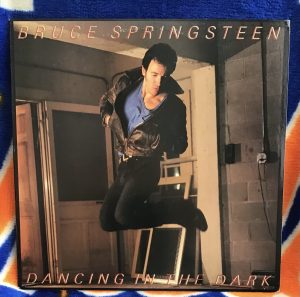 Who doesn’t love a pulsating remix? A combined no-hitter is fun, too, as we’ve already established. It’s unapologetically happy and peppy and bursting with love. The weight of the world doesn’t have to sit squarely on the surgically repaired anterior capsule of a single decorated southpaw enlisted in a futility-battered quest grimly passed down through generations that had wasted their summers praying in vain for a savior to rise from these streets, or perhaps a trade for an ace from Minnesota, for a hitless outing to resonate. Opera, Dick Clark suggested to his WZAZ listeners in the episode of The Odd Couple where Felix and Oscar win a car, is “music with a lot of killing”. Indeed, Johan slew all those no no-hitters ghosts that had haunted us from 1962 forward. We shook that world off our shoulders in 2012.
 Who doesn’t love appetizing combinations? Ten years later, a merry band of men in black — Tylor Megill, Drew Smith, Joely Rodriguez, Seth Lugo and Edwin Diaz — animated our spirits. Who doesn’t love a no-hitter? Who doesn’t prefer to smile rather than stress? Who doesn’t love the teamwork when it has a chance to make the dream work, even if few of us entered Friday night dreaming this specific dream? Once it was clear Tylor wasn’t going to be permitted to compete beyond the first five frames (88 pitches, short Spring Training, chilly April evening, comparatively slight track record of career innings notched, no argument), everything else was a matter of deciding how badly we wanted to consume this particular combo meal. A side of Drew…a dab of Joely…a large Seth (easy on the ice)…and pour some Sugar on it. It may not have gone down quite like a prime cut of Santana, but it grew more and more appetizing as the night wore on.
 Who doesn’t love teamwork? If the Mets somehow didn’t get the order exactly right, there’d still be some fries in the bag, there’d still be a win over the Phillies, and there’d still be that pristine Nohan safely encased in glass. The combined no-hitter would go nicely next to it, but obtaining it wasn’t the matter of life or death that getting that first one felt like for more than half-a-century. Turns out we got a little extra life.
A no-hitter every ten years. A fan could get used to this.
National League Town commemorated The Second No-Hitter in New York Mets History with a twelve-minute spasm of audio giddiness. You and four of your Circle of Trust colleagues can listen here.
by Jason Fry on 30 April 2022 1:47 am Back in the endless days of weird frustration before Johan Santana, before IT HAD HAPPENED, I had a thought that would sneak into my head — despite my earnest attempts to shoo it away — when a Mets pitcher was in doomed pursuit of the franchise’s seemingly unobtainable first no-hitter.
Please don’t let our first no-hitter be a combined one. Because that would be lame.
That felt snobby and entitled — as a diehard fan of a franchise that was pitching rich yet inexplicably no-hitter poor, who was I to be choosy? And if that’s the way things had unfolded, I bet I would have made it work. I would have been leaping up and down and stalking around and repeating little rituals, the way I did that night in June 2012 when I found myself in an ESPN Zone at Disney World, somehow the only person in the place who knew what was on the line as Santana stared down the Cardinals.
Still, I’m glad the Mets put only one name in the record books when their time finally came. Because as young baseball fans, that’s what we’re trained to expect a no-hitter to be — a grueling contest in which one man has to stare down nine others at least three times, increasingly tired and essentially alone. Close your eyes and tell me what you see. Maybe it’s the starter sitting in the dugout as his teammates bat before he faces the final three hitters, his expression cycling between weariness and determination and perhaps now and again a flare of impatience. He’s alone, superstition having thrown up a force field around him that no teammate is allowed to violate.
That’s the model. But if you watch enough baseball you learn it’s not always quite like that.
After he left the Mets, Tom Seaver threw a no-hitter wearing a Reds uniform, and watching the aftermath on This Week in Baseball I thought something seemed strange about it — the famously stoic Franchise looked oddly giddy, his air less that of a man who’d achieved some degree of immortality than that of a man who’d found a winning lottery ticket in the wastebasket. Which was pretty much what had happened: Seaver cheerfully admitted he’d had basically nothing and improvised, passing up strikeouts he couldn’t get (he only had three in the game) in favor of coaxing grounders from the Cardinals. The man who’d been frustrated by Jimmy Qualls and Leron Lee and Joe Wallis on nights when he had his entire arsenal working had somehow pitched a no-hitter when those weapons were missing.
That was an early lesson that baseball could be really weird. A couple of years after Seaver’s no-hitter, Len Barker pitched the 10th perfect game in big-league history. I knew my baseball cards, so I was dumbfounded: Len Barker? What was he doing pitching a perfect game? (That game also produced one of my favorite baseball stories: When Barker called his grandmother to explain that he’d faced 27 batters and retired them all, she said “that’s wonderful, Lenny — I hope you do even better next time.”)
I finally saw a no-hitter a couple of months after Barker’s perfect game — Nolan Ryan no-hit the Dodgers in a game of the week on national TV, the fifth of his career. I was thrilled — and let myself daydream about what it would be like to see one in person one day. Eventually I got my chance — though not exactly how I’d dreamed of it. In 2015 the Mets were on the short end of no-hitters twice, and Emily and I were at Citi Field both times: first for Chris Heston of the Giants, and then for Max Scherzer of the Nats. Scherzer finishing the job wasn’t a surprise, as he had ungodly stuff and the Mets looked shell-shocked the entire game, but Heston doing so was — the Mets played patty cake with the Giants infielders all night, which generally yields at least an excuse-me-single somewhere along the line. But by then I knew this could happen: I’d read about Seaver on his off-night, and Barker’s perfecto, and later ham-and-eggers whom the baseball gods had made golden for a night. (Looking at you, Philip Humber!)
By the time the Heston-Scherzer double down rolled around, the Mets had their no-no at last, which meant I was a bit more sanguine about such things. Their weird asterisk had been removed, so I figured I could let go of years’ worth of agony — Kiss my ass, Kit Pellow! Suck on this, Paul Hoover! — and wait with relative equanimity for destiny to come calling again.
Which is pretty much what happened.
Now that I’ve seen a second Mets no-hitter — and a combined one at that — I can report that it’s pretty fun, and surprisingly low-stress. If Joely Rodriguez or Seth Lugo or Edwin Diaz had yielded a little parachute over the infield I think I would have said, “well, that’s too bad” and gotten back to wishing we’d put up more runs, because the Phillies are a terrifying mix of hitters who destroy everybody and hitters who specifically destroy us. Instead, we got the weird combo platter of Tylor Megill, Drew Smith, Rodriguez, Lugo and Diaz, horse-whispered across the line by James McCann, and it was wonderful. Wonderful, and full of the ironies and echoes and grace notes that baseball specializes in.
Like Megill not looking particularly sharp in comparison with his other 2022 starts. His location was off and the Phillies kept grinding through long at-bats, driving his pitch count up and leaving me convinced that outcomes were about to revert to the mean in unpleasant ways, except they never did, because baseball is weird.
His successors pitched solidly, and by the time Lugo arrived I was obeying superstition, making sure I said “C’mon, [name of pitcher] — c’mon baby” before every pitch, adding a heartfelt “hit it to anybody” once there were two outs. That’s an overlay on my every-game ritual of noting “24 to go” after a scoreless first and then updating by threes as long as there’s reason to. Back in 2012 I had a minor jolt of existential panic when Santana reached the ninth: Should I break form and say “two to go” and “one to go,” or would the baseball gods notice that and smite Johan for my crime? I solved that by following my usual ninth-inning ritual — one finger raised and displayed to my fellow outfielders (who don’t exist), then the forefinger/pinkie combo to indicate two outs, and then it doesn’t matter what you do. In 2012 the baseball gods decided that was the correct form, obviously. (You’re welcome.)
This time around my biggest worry was Diaz, whom I do not trust for reasons fair and un-. In the eighth, I all but pleaded with the Mets to push another run across, so that Diaz wouldn’t have two things to fuck up (as I put it honestly if unkindly on Twitter). They didn’t and so Diaz came on to the sound of trumpets to face Bryce Harper and Nick Castellanos and J.T. Realmuto, which is about as tough an assignment as it gets. I could easily imagine, say, Harper walking and Castellanos rapping a ball between two dismayed infielders and the crowd moaning and then reluctantly cheering and then lapsing into shocked silence as Realmuto slammed a ball into the bullpen, followed by sackcloth and ashes and a blood-red moon and witches and bats wheeling overhead in place of the planes heading for La Guardia.
Except Diaz was pretty goddamn close to immaculate, striking out all three Phillies, with Realmuto dispatched on a trio of unhittable sliders. Sometimes it’s not just OK but wonderful to be wrong.
When it was over the Mets didn’t seem quite sure what to do, settling for a minor to moderate hugging scrum that was gleeful but not quite on the level of a hard-fought walkoff, followed by the usual postgame hijinks. Pete Alonso and Brandon Nimmo dumped a barrel of energy drink on Megill, perhaps after doing the math and concluding it was too complicated to throw 5/9ths of the barrel on Megill and 4/27ths of it on Smith and then … oh screw it where’s Tylor? There was an endearing interview with Buck Showalter, who noted that Jim Abbott was on the verge of being dropped from the Yankees’ rotation when he threw a no-hitter on his watch (there’s that weirdness again) and then declared that the scribes didn’t really want to talk to him and vamoosed. The hurler quintet and McCann sat for questions, a session notable mostly for revealing that Megill and Smith hadn’t realized what was happening (or at least they claimed not to — I wonder if that’s some weird pitcher omerta) and for McCann’s musings that a combined no-hitter is different because you’re changing your approach to the hitters multiple times.
And of course there were those echoes and grace notes. Like the Mets throwing a no-hitter wearing their black uniforms, the same combination worn by Santana that night. a familiar sight in Santana’s day. Or the fact that it was Gary Cohen’s birthday, which he’d dismiss as unimportant despite none of us agreeing.
In a few months or years, what stories will we spin out of this in discussing the 2022 Mets or the pitchers involved? I have no idea, because how could I? But I’ll let myself daydream.
Remember how they lost that testy game in St. Louis with everybody getting thrown out taking extra bases and there was the near-fight and then they went home and no-hit the Phillies? Boy, that was an indication this was going to be a special year.
Tylor Megill smothering the Phils on that cold night at the end of April was a sign — he showed us he could win without his best stuff, that he was really learning to pitch.
Wow, that was the night we really started to trust Smith and Rodriguez. And just look at them now!
What I remember is that was when I decided I’d been unfair to Diaz. A week later I was calling him Sugar, and a week after that I meant it.
OK, maybe not that last one. And maybe not any of them. Baseball’s weird, after all. Weird, but often also a lot of fun — like when five guys team up to blitz a slugging lineup and you clap your hands and beam at all the silly postgame stuff and try out saying “combined no-hitter” and decide it’s not lame at all, but pretty wonderful.
by Greg Prince on 28 April 2022 8:45 am Yoan Lopez came up and in on Nolan Arenado in the eighth inning of Wednesday afternoon’s almost incidental Mets loss to the Cardinals. Like what Shawn Estes threw in the greater geographic vicinity of Roger Clemens’s backside twenty years ago, Lopez’s pitch didn’t touch the batter he was facing. Unlike with Estes, Lopez’s pitch did what it was supposed to. It transmitted a message. We’ll see if anybody receives it.
Before the 10-5 downer to end an otherwise successful road trip was in the books — Carlos Carrasco wasn’t Cookie-crisp; England Dan and Sean Reid-Foley wasn’t the answer; Long Island’s Own Steven Matz withstood one shaky frame in four; and the lofty baserunning ambitions of Mark Canha and Luis Guillorme refused to be fully realized (each man was thrown out going for an extra ninety feet in the sixth while the Mets trailed sizably) — Lopez did what every baseball fan intrinsically understands to be the right thing. He brushed back the other team’s usual third baseman after the Mets’ third baseman, J.D. Davis, had been struck where his left ankle meets his left foot. Davis had a full count on him at the time. As Ron Darling asked regarding Genesis Cabrera’s errant delivery, “How can you miss that badly on a three-two pitch — honestly?”
Honestly, after nineteen instances of one pitcher or another missing badly and instead hitting Mets over the season’s first twenty games, Buck Showalter was no longer interested in rationales. Instead, through whatever wink, nod or direct instruction was necessary, the manager let it be known to Lopez, who’d never pitched for the Mets before but surely rates a warm greeting at Citi Field if he’s not optioned to Syracuse by Friday, to do a little something about the HBP epidemic that’s been on the Mets’ minds and bodies all season long.
Thus, the pitch up and in on Arenado, who it should be noted isn’t a pitcher. The pitcher doesn’t bat in the National League anymore. By the bottom of the eighth of a 10-5 game, no pitcher was going to bat even if the NL had retained real baseball rules in 2022. Perhaps it’s poetic justice that Arenado, payback target du jour, was serving as designated hitter. More likely, it was a matter of Arenado leading off to start the home half of the inning. He was the first guy the Mets had a chance to move off the plate, which is what a pitcher is supposed to do in that situation.
Personally, I’d prefer some variation on the demented lunch-period game we’d play in high school. It was called asses-up handball. If you were the first combatant out, you faced the wall and somebody got a shot at your buttocks. It was stupid then, but at least it was direct. Like Roger Clemens at Shea in the early (if not early enough) 2000s, it should have been Genesis Cabrera putting himself in the box and on the line. Arenado didn’t throw at Davis. I’m not sure Cabrera threw “at” Davis. We can be certain too many pitches have gotten away from too many pitchers. Somebody has to face the wall and the music.
Arenado, to be clear, wasn’t hit. He didn’t have to limp away as Davis did minutes prior. He didn’t have to be tested for a concussion as Pete Alonso had the night before. He didn’t have to handle his rib cage with care as Starling Marte did that same night. Nolan Arenado was simply the proxy for the rest of the league. This one’s a warning, fellas. We’re winning most of our games, but we are rapidly losing patience.
Instead of stepping out, glaring briefly, and getting on with his at-bat, Arenado disrupted the kabuki. The batter used his outdoor voice and then some. Next thing you know, all the St. Louis Cardinals and all the New York Mets are on the field, sorta, kinda going at it. Most every man fancied himself a peacemaker. Maybe not Cardinal first base coach Stubby Clapp, who went after Alonso (just what Pete needs: a case of the Clapp). Coach Stubby was ejected. Arenado was ejected. Everybody fumed. We hated the Cardinals again. I mean more than we already did for 1985, 1987 and 2006. Some grudges are simply dormant until reignited.
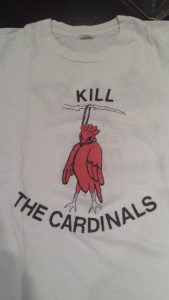 Timeless advice. (Courtesy of the Gary Nusbaum archives.) In situations such as these, we reflexively become Romans rooting for the lions, which is more rewarding than what people in Detroit doing the same thing get for their troubles every fall. “GET ‘EM!” is a perfectly valid reaction from the sidelines. Nineteen passes to first or not, it stings to watch the guys you root for take nineteen for the team. I don’t blame Buck for telling Yoan to experience the briefest of control issues. It was a ball, by the way, not a hit by pitch. Gotta keep saying that. Nolan, who has been known to field splendidly in his time, mishandled his reaction to the pitch that got him snarling. His rookie manager, Oli Marmol, clutched his own pearls a little too tightly, too: “When you come up top like that and jeopardize someone’s career and life, yeah, I take exception to that.”
Showalter, veteran of a few rodeos, sounded more serene and sane. “I’ll let them handle their players,” Buck said about St. Louis’s protestations. “I know our player [Alonso] got hit in the head and went to first base.” While everybody else is playing checkers, Showalter is managing baseball.
Lopez’s unremarkable role in the ongoing 2022 subplot of these Mets being hit and not enjoying it couldn’t help but bring to mind Shawn Estes’s wayward payback pitch at one of the all-time villains in Met lore. In 2002, when Estes, after missing Roger Clemens’s humongous ass, whacked his two-run homer off the man who’d thrown a ball and a bat at his current batterymate Mike Piazza in 2000, it may have been the only instance in the history of baseball where your pitcher takes their pitcher — both a despised opponent and one of the best the game had ever seen — over the wall and it registers as a consolation prize. Never mind that Estes wasn’t a 2000 Met (he was one of the Giants the Mets defeated in the NLDS on their way to meet Clemens in the World Series). Yoan Lopez had been a Met for an inning and change when he was assigned the task of clearing his new ballclub’s collective throat over being hit nineteen times. Yoan said, with one pitch and so many words, “AHEM” and “OK.”
That’s how you do it, the fan who’s been watching baseball longer than Buck Showalter’s been managing baseball says from the proverbial cheap seats. It’s easy to dismiss Arenado’s flared temper when it’s not a 94-MPH fastball coming near us. But it’s also what we do. Sort of like detesting the Cardinals.
Hot Rod Kanehl and Miguel Cabrera get together in this week’s National League Town. Go up and in to your favorite podcast platform or listen here.
by Greg Prince on 27 April 2022 8:57 am Word to the National League: stop hitting the Mets. It’s not helping your cause. You’re getting them angry. And you’re getting yourselves beat.
The Mets have taken pitches to the body more than any other NL team. The Mets have also piled up more wins than any other NL team. Perhaps there’s a connection. If you’re trying to impede the Mets’ winning ways by hitting them before they can achieve another victory, it’s not working.
Even if this is all one big non-conspiratorial coincidence, you’re only making the Mets more determined to do damage to you.
On Tuesday night in St. Louis, Cardinal pitchers let three get away, including one toward the face of Pete Alonso, fortunately deflected by his helmet’s C-Flap, and one into the ribs of Starling Marte. Marte’s came with the bases loaded, automatically driving in a run. Obviously not intentional, we assume.
Both times, the Met batter in question took exception, as did the Met manager and those populating the Met dugout. The Mets are fuming at being dinged. They occasionally emerge onto the field to make their feelings known. They express themselves best on the scoreboard.
The Cardinals riled the Mets twice? The Mets defeated the Cardinals a second night in a row, 3-0. Chris Bassitt shut out the Redbirds for six innings, three relievers took care of the rest of business. Two runs were driven in by conventional methods of bat hitting ball, not ball hitting body. Throwing near if not necessarily at Mets isn’t working for the opposition. The Mets might be stopped by better pitching, better hitting, better deployment of traditional tools. They’re not being stopped by HBPs. A little bruised, not at all battered. Competitively, they’re splendid. Physically, they’re fine. But baseballs thrown at high speeds are not benign projectiles.
Somebody needs to determine if there’s something about the balls used when the Mets are hitting that lets them go so askew. Meanwhile, get a grip, pitchers in other uniforms. Figure out why your throws are so errant. Work with your catchers on direction. We don’t mind your putting Mets on base. We have a problem with how you’ve done it a few too many instances. As do the Mets, apparently.
Nineteen games in, the Mets are 14-5. No, hitting them isn’t working. Try something else if you dare.
by Jason Fry on 26 April 2022 12:35 am Pitchers’ duels are one of the earliest tests of budding baseball fandom — dull to the casual observer who wants action and doesn’t get why those around him are oohing and aahing over hitters swinging and missing or just looking flustered at balls zipping from hurlers’ hands to places they weren’t expected to wind up. It takes a certain amount of time watching the game to understand that there’s a whole lot of something underpinning what looks like nothing — a labor demanding incredible physical skill as well as tactical cunning and laser focus.
And when both starting pitchers are operating at that level, it’s something special. One of my fondest baseball memories is standing in a bar on a beautiful May night in Rockaway Beach watching Pedro Martinez and Roger Clemens battle it out at Yankee Stadium — a pitchers’ duel so riveting that diehards and casual fans alike instinctively arranged themselves into perfect rows, as if the bar had become baseball church and we’d assigned ourselves to invisible pews.
But pitchers’ duels are premised on the promise that one of the combatants will yield, cruelly but inevitably. Someone will tire or make a lone inexplicable mistake or be done in by bad luck — two pitchers deserve to win, but only one can. That’s the classic template, but sometimes the game doesn’t cooperate.
Sometimes it’s a draw, which means the duel ends without a resolution, giving way to the anticlimax of middle relievers alternating to see who’ll draw the black spot. Which can be entertaining baseball but is lousy storytelling: Picture a showdown on a dusty western street where the guy in the white hat and the guy in the black hat stagger away, wounded but alive, allowing a parade of drunks to take turns blasting away at nothing in particular. Or a battle of the bands where the headliners never return for encores, leaving the opening acts to come on and say they guess they’ll play a few songs you’ve never heard of.
And sometimes the script gets torn up into little pieces and you get insanity.
Max Scherzer — he of the chewing-up-glass intensity, terminal hat head and relentless dugout pacing — simply annihilated the Cardinals’ tough lineup, trotting up his ungodly array of pitches and looking like he could do whatever he wanted with them. His counterpart, Miles Mikolas, might not have been as flashy but was every bit as good, befuddling a tough Mets lineup. (I felt vaguely bad for knowing almost nothing about Mikolas, and a little better when I realized his track record against us consists of a single start two years ago — he won — and a lone inning long before that as a baby Padre.)
Both Mikolas and Scherzer were done after seven, meaning it was time for reliever roulette. The Cards’ Genesis Cabrera — whose name I now know isn’t pronounced like the start of something — passed his test while Trevor May did not, giving up a leadoff single to perpetual nemesis Yadier Molina and another to lavishly locked Harrison Bader. May is the Mets’ most Jekyll-and-Hyde reliever and this was one of his unfortunate transformations — the Mets scratched and clawed through various defensive and pitching strategies but to no avail, as May left an offspeed pitch in the middle of the plate for Tyler O’Neill to whack into the outfield for a two-run single.
That looked fatal, particularly after Robinson Cano flied out as the tying run in the ninth — perhaps when the team doctors get done poring over Jacob deGrom‘s MRI they can evaluate Cano and what sure looks to me like a case of utensil-spinal impingement.
Mark Canha was the Mets’ final chance against Giovanny Gallegos, whose pace on the mound makes one want to give Rob Manfred permission to institute the pitch clock a year early. Canha has been an intriguing player so far, an Olerud-like professional hitter with a calm demeanor and a sneakily ironic sensibility. (This bit of MVP deadpan is from an interview as a A’s rookie.) He fell behind against two Gallegos sliders, refused to bite at three out of the strike zone, and then slapped Gallegos’s seventh pitch up the third-base line. That looked like a solid AB with an unfortunate outcome — it was a tough play for many third basemen, but not typically for Nolan Arenado.
Arenado, though, couldn’t get the handle. He took extra steps searching for the grip, ran out of time and uncorked a high throw to first, making the score 2-1 and leaving the Mets still alive. Travis Jankowski took over for Canha at first and took off when Jeff McNeil laced a pitch down the right-field line. Jankowski flew around second and steamed into the neighborhood of third, the precinct of the so far famously aggressive Joey Cora. Cora held him — which made me gasp in dismay, though the replay showed that to have been a good decision. And so the game would come down to Dom Smith, who’s been saying all the right things or rather not saying any of the wrong things despite finding playing time hard to come by.
Smith smacked a Gallegos fastball up the right-field line, where it was smothered behind the bag by one of the Cardinals’ many annoying Gold Glovers, in this case Paul Goldschmidt. But Gallegos had been caught spectating. Dom hustled to first as Gallegos tried to close ground and then dove in safely — the one time in approximately 5,000 where diving into first is indeed the right play. Gallegos belatedly looked home, just in time to see McNeil diving across the plate in Jankowski’s wake as the go-ahead run.
That was it for Gallegos but not for the Mets; SNY wasn’t quite back from break when Brandon Nimmo slammed T.J. McFarland‘s first offering into the right-field stands for a two-run homer. The Mets led 5-2, and while the much-ballyhooed best fans in baseball weren’t booing, it was only because they were as shocked as everyone else. Edwin Diaz navigated the bottom of the ninth with only minor fuss and they’d won somehow — I mean, just look at this record scratch of a win-probability chart.
If the Mets make something of this season, we’ll tell Just So stories about this game and throw around words like fire and grit and heart. And even if they don’t, that was the kind of game that keeps you in your seat for dozens and dozens of grindingly dull non-comebacks, waiting for the karmic wheel to come back to that giddy, gleeful space that makes all the misfires worthwhile.
by Jason Fry on 24 April 2022 10:05 pm We’ve been where the Diamondbacks are now — a team with hope for the future that’s trying to remind itself that future can’t be hurried. The guys who could be a part of it need to get there at their own pace, with all the growing pains implied; the caretaker players are important as teachers and public faces but will be gone by the time that day arrives. If it arrives, baseball being unpredictable in many ways but cruelly reliable in its ability to spill ink on blueprints.
We’ve been there, but mercy isn’t part of the equation. And so the Mets did what we hoped they would, not getting in Arizona’s way as the D-Backs made a whole bunch of mistakes that essentially handed the visitors a 6-2 win. So far the Mets have won five season series and lost none, and while I don’t claim to be a statistical savant, I suspect if they do that all year we’ll all wind up happy.
They won’t, of course — I’ll step on the moment by reminding us that the 2018 Mets also won their first five series en route to winning a grand total of 77 games. If you go back into the Faith and Fear archives, you’ll find all sorts of giddy posts about 11-1 starts, 17-9 Aprils and Mickey Callaway‘s Midas touch.
(In other words, don’t go back into the archives.)
Still. 12-5 will work nicely, with the record backed up by the eye test. Tylor Megill would have been forgiven if he’d spent the winter resting up after a season that took his arm places it had never been; instead, he reinvented his delivery and his approach to pitching, with great results so far. (Megill still got beat on his second-best pitch for his final act of the day, but hey, Rome and building schedules etc.) Francisco Lindor got two hits and nobody particularly noticed, which is a sign of how different his year has been so far. J.D. Davis whacked a home run into the right-field stands, which is an excellent way for making himself a bigger part of the plan. There was nifty fielding by the tragically Samson’ed Luis Guillorme, an impromptu game of leap frog by Starling Marte, and no Edwin Diaz to make my stomach turn gymnast. Oh, and the Mets pulled off the routine 1-2-3 put-out, thanks to a terrific play by James McCann on a ball that caromed off Seth Lugo‘s foot and somehow shot straight back at his catcher.
With so much going right, seeing Buck Showalter‘s Resting Pissed Face in the dugout only added to the entertainment. Buck will never be able to match Dallas Green for Managerial Facial Expressions You Don’t Want to See — Dallas witnessed a lot of baseball slapstick inflicted by his charges on the paying customers, and his helpless, gape-mouthed incredulity in response was the only good part of a lot of bad nights. Buck has a much better club and a slower resting heartbeat, so you mostly get steely glares over tight lips — but seriously, doesn’t Jeremy Hefner look a bit nervous every time Buck starts melting laser-beam trails in the field with his eyes?
Anyway, on the Mets go to St. Louis, somehow finished for the year with all things related to the Diamondbacks, states that stay on rebel time out of some kind of weird cowboy-hangover surliness, Madison Bumgarner, Sedona red and other annoying colors that don’t belong on uniforms, D. Baxter the Bobcat and his adventures in the uncanny valley, and games in an ill-lit stadium that looks like someone roofed over a second-tier mall. (Seriously, if you ever go to a Diamondbacks game … it’s deeply weird.)
It will be interesting to see what the Diamondbacks have become by 2023, what with Nick Ahmed and Christian Walker and Pavin Smith and Seth Beer and Sergio Alcantara. Maybe they will have taken a step forward or maybe they will have gone sideways, in which case Torey Lovullo will have started exhibiting a few of Dallas Green’s expressions. We’ll find out then; for now, they’re other clubs’ problem. We’re on to St. Louis, successful formula in hand and fingers crossed.
|
|






