The blog for Mets fans
who like to read
ABOUT US

Faith and Fear in Flushing made its debut on Feb. 16, 2005, the brainchild of two longtime friends and lifelong Met fans.
Greg Prince discovered the Mets when he was 6, during the magical summer of 1969. He is a Long Island-based writer, editor and communications consultant. Contact him here.
Jason Fry is a Brooklyn writer whose first memories include his mom leaping up and down cheering for Rusty Staub. Check out his other writing here.
Got something to say? Leave a comment, or email us at faithandfear@gmail.com. (Sorry, but we have no interest in ads, sponsored content or guest posts.)
Need our RSS feed? It's here.
Visit our Facebook page, or drop by the personal pages for Greg and Jason.
Or follow us on Twitter: Here's Greg, and here's Jason.
|
by Greg Prince on 10 September 2020 8:18 am They’re messing with us, right? The Mets getting us to take them semi-seriously for another day is part of a larger prank, right? They look moribund half the time. They give up late-inning leads the other half. They play in a depressing cartoon atmosphere where balls travel a thousand feet and the fans in the stands, who never move and never emote, appear as if painted by Hanna-Barbera. They have one starting pitcher, one former starting pitcher turned former reliever, and after that, per Dom DeLuise’s short-lived sitcom, it’s Lotsa Luck.
This is what they’re putting out there as a playoff contender of sorts in September? This is what gets somebody like Jake Marisnick, who helped the Houston Astros win Rob Manfred’s memorial piece of tin in 2017, to say, “this team’s too good to not make the playoffs”? He said that two nights ago, after the Mets were blitzed by the Orioles, 11-2, the day after the Mets coughed up a comeback to the Phillies, 9-8. The 2020 Mets remind me of what Whitey Herzog said about the Mets coming into 1986 off a pair of bridesmaid finishes: “They think they won the last two years, anyway.”
The Mets haven’t lacked for outward displays of confidence. They’ve lacked for wins. They haven’t won more than they’ve lost since this delayed season was less than a week old. They frustrate us. They irritate us. They let us down more than they lift us up.
Then, as on Wednesday night at perpetually vacant Citi Field, they mess with us. They fall behind by what seems like a hundred runs early, except it’s only four, and they come back — and this time they come back without giving up what they came back to get. They catch balls they’re nowhere near, they make dazzling throws from distant precincts, they launch moon shots at will and, just as amazingly, Edwin Diaz gets three outs without giving up a single run.
In the end, behind Michael Conforto, who is hitting .340, perfecting running basket catches and would be hearing serenades of “M-V-P!” if serenaders were allowed in attendance; behind Jeff McNeil, who is hitting .315 and has left the Squirrely doldrums of August in the dust; behind Andrés Giménez and Luis Guillorme, who’ve got gloves and know how to use them; behind Pete Alonso, who breaks ties as deftly as he assigns nicknames (Conforto is now Silky Elk); and, well, behind everybody not named Rick Porcello, the Mets won in scintillating fashion, 7-6, after trailing by scores of 5-1 and 6-3 to a Baltimore bunch that poured on waves of offense yet somehow kept getting hung out to dry. The Orioles pounded 14 hits and left 13 runners on base. Didn’t we used to do that?
Maybe we still do. Maybe we just didn’t for one night. We do enough things right and scintillate in encouraging proportions so that we find us believing in us, which is what we chronically do in September if given any reason at all. If you can remember as far back to last September (it was the one that had people in the stands), we were both never exactly in it yet never fully out of it until mathematical elimination tapped us on the shoulder (which nobody is allowed to do anybody anymore), thus we took ourselves — the Mets, that is — semi-seriously and then some.
Right now, if you’ve bothered to examine the standings, we’re not exactly in it, but we’re not fully out of it. We’re a little less fully out of it today because we were never completely out of it last night. This condition doesn’t demand to be taken seriously as contention. This condition demands to be taken seriously by a therapist.
They’re messing with us, right? Mess with us again like that real soon.
by Jason Fry on 9 September 2020 10:30 am Re Tuesday’s game: Blah blah blah Michael Wacha blah blah blah Orioles blah blah Robert Gsellman blah blah blah blah blah blah five games under .500 blah blah blah blah blah sinking fast.
I could have expanded that to 800 words, but why? Here’s the only analysis that matters: The Mets have 30 percent of a starting pitching staff. Jacob deGrom is Jacob deGrom, whose only flaw is he can’t start the other 80 percent of his team’s games. Seth Lugo is a solid starting pitcher who’s still ramping up to the pitch count demanded, and with a bad elbow. David Peterson is learning to navigate his first big-league season. Steven Matz has disintegrated and vanished. Wacha and Rick Porcello have struggled to pitch around the giant forks sticking out of their backs. Meanwhile, Noah Syndergaard‘s UCL exploded, Marcus Stroman opted out and Zack Wheeler was allowed to go to Philadelphia with no resistance from the Mets, unless catty quotes to beat reporters count.
In a given five-day stretch the Mets can count on a reliable start the first day, hope for one the second day, hold their breath the third day, and on the fourth and fifth days they brace for impact the moment the starter makes contact with the rubber. That’s a fatal flaw for any baseball team with contending hopes in a normal season and it sure looks like an equally fatal one in this weirdo season. Which makes sense: two hoary pieces of baseball wisdom hold that you never have enough starting pitching and momentum is the next day’s starter. Both of those have been proved correct repeatedly this year, beginning with the Mets surveying their wrecked rotation and carrying through with the Mets’ inability to get on any kind of a roll, largely because they’re down by three or four runs before the fifth inning more often than not.
Baseball teams can tinker around the margins and fix stuff, but there aren’t enough shovels to fill a crater in the middle of a starting rotation. You can’t patchwork enough relief to fix it, you can’t reliably outhit it, and no number of socially distanced team meetings, overturned Zoom cameras or lineup tweaks will make it go away. Which means that every other problem, ultimately, is just so much blah blah blah.
by Greg Prince on 8 September 2020 5:33 pm Welcome to A Met for All Seasons, a series in which we consider a given Met who played in a given season and…well, we’ll see.
Keep on searching now
Got to look up
Don’t look down
Keep the faith
—Little Richard
As baseball’s Winter Meetings approached in 1974, the Mets’ new general manager, Joe McDonald, drew some attention when he told reporters that he’d be aggressive in the trade market and that the only players he would consider “untouchable” were his big three starting pitchers: Tom Seaver, Jerry Koosman and Jon Matlack. I guess it was a newsworthy enough statement that my sixth-grade teacher incorporated the anecdote into an upcoming vocabulary lesson.
“The Mets said they have only three ‘untouchable’ players,” Mr. Schneider told us. “Tom Seaver, Jerry Koosman and Tug McGraw.”
On one hand, I was delighted that the Mets had broken through the elementary school wall and had become part of our curriculum. On the other, Mr. Schneider’s inaccuracy played like fingernails on our blackboard to my ears. Clearly Mr. Schneider had read the same article I had. Mr. Schneider was a prototypical cool teacher; a year later, Gabe Kaplan would play a version of him on television. But c’mon, Mr. S., get your facts straight.
In our casual open classroom atmosphere, I didn’t bother raising my hand. I just called out, “Jon Matlack, not Tug McGraw.” I did that a couple of times. Mr. Schneider ignored me. His point was his point, whatever it was. The implication, however, is what stays with me to this day. Tug McGraw seemed untouchable because the idea of the Mets trading Tug McGraw seemed unimaginable.
Yet on December 3, 1974, Tug McGraw proved touchable. McDonald and the Mets traded him.
It’s still unimaginable.
Three years after the Original Mets made their unique impression, along came a man who could only be termed the Met original. Within the realm of “there’s nobody like him,” there was nobody like Tug McGraw — not playing for this franchise in the 1960s and 1970s, not doing anything for anybody anywhere, probably. Amid a stream of characters who’ve defined what’s it meant to be Mets, Tug stands out as one of a kind.
He was a goof.
He was a wit.
He had a soul which often came to the fore
He had a heart which he inevitably wore on his sleeve.
He mastered a pitch few threw.
He coined a phrase everybody knew.
He was Tug McGraw.
Of the Mets.
And the Mets traded him.
In December of 1974, if you could pull yourself back from remembering who he was, you could imagine it. Except you couldn’t pull yourself back from remembering who he was. You couldn’t imagine doing that. Why would you? A thirty-year-old reliever coming off a dismal season after having been not so hot most (but not all) of the previous season, especially if you could fill a couple of holes by trading him…him you’d trade.
But if his name was Tug McGraw, and he’d been Tug McGraw of the Mets for nearly a decade and you understood what that had meant on the field, off the field and to the fans?
What the hell? They traded Tug McGraw?
I graduated sixth grade more than 45 years ago. I still haven’t solved the emotional equation that allowed for the trade of the pitcher who wore No. 45.
***Above all else, Tug McGraw came with a user’s manual. Not at first, but, for me, just after the Mets could use him. It was called Screwball. What Catcher in the Rye was for so many, Screwball was for me. It was the book that told me, at the transitional age of twelve, that I wasn’t the only one like that. It was the book that told me it was all right to feel a little off. Screwball showed me screwing up isn’t fatal. Maybe it gave me a little too much carte blanche to try it. As adolescence overcame me, I kind of got used to screwing up.
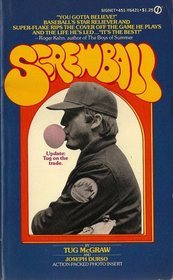 A book almost as good as the pitcher pictured. I didn’t read Screwball until it was out in paperback, which wasn’t released until the co-author (McGraw wrote it with Joe Durso) was no longer wearing the outfit he modeled on the cover. The cover, in fact, promised that in this edition we’d get “Tug on the trade.” That covered just a couple of pages up front. The rest was what was published following the 1973 season, when it was concluded that people would want to read what some lefty relief pitcher had to say about his life and everything around him. Following the 1973 season and postseason, Tug was a figure of immense public interest.
We’d been into Tug one way or another since a 20-year-old southpaw from somewhere in California showed up in St. Petersburg and introduced himself to Casey Stengel. The Mets were making room for myriad young arms in New York. None of them was lifting the 1965 Mets from the cellar. One of them, however, beat Sandy Koufax. Tug took his lumps plenty before August 26, before doing his first version of the unbelievable. Koufax, the premier pitcher of his generation and perhaps his century, had defeated the Mets thirteen times since 1962. The Mets had defeated him never. Given that one entity was at his peak and the other was permanently in the pits, who could possibly reverse the pattern?
Frank Edwin McGraw, Jr., that’s who. Not that anybody ever called Tug that except to let you know he wasn’t technically a born Tug. Almost born that way, but not quite. According to Screwball, Frank became Tug based on his behavior when “my mother used to nurse me when I was a baby and it was chow time. I guess she began calling me her little Tugger, and as time went by, everybody began using that name. While I was growing up, that’s what I thought my name really was.”
Tug followed his older brother Hank (Frank, Hank; it could get very confusing among the McGraws) into sports, then into baseball, then to the Mets. Hank never made it out of the minor leagues. Tug got his big break in 1965 when the Mets attempted to portray their Youth of America as in full bloom, regardless of their individual states of readiness. Sixteen of 43 players used that year were 23 or younger when the calendar flipped to ’65; ten of them were making their major league debut that year. One of them, Greg Goossen, was destined to go down in baseball history as the crux of one of Stengel’s best and last lines, said to have gone something like this:
“And we’ve got this kid who’s twenty who in ten years has a chance to be thirty.”
Except Greg wasn’t even twenty yet. Goossen made his MLB debut at 19. Jim Bethke and Kevin Collins commenced playing in the big leagues in 1965 at 18. Tug, a little more than two months the senior of veritable veteran Ed Kranepool, was an old man of 20 when Casey handed him the ball in the eighth inning at still-spanking new Shea Stadium on April 18. Relieving Jack Fisher, who had relieved Al Jackson, Tug McGraw entered his name in the Met annals by striking out Orlando Cepeda with the bases full of San Francisco Giants. “I jumped up in the air and started walking around like we’d just won the World Series or something,” he’d recall. Except that was only the second out of the inning. After retiring opposing pitcher Bob Shaw to fully escape the jam, Tug was literally shaking. Trainer Gus Mauch handed him a couple of tranquilizers.
The real excitement came four months later, McGraw vs. Koufax, Tug having been assigned to the starting rotation by Stengel’s successor Wes Westrum only recently. When that one went final in favor of the Mets, “I started jumping up and down when it ended, going crazy as usual, but this time the rest of the guys didn’t shake their heads or anything, and nobody went around the locker room saying McGraw’s some strange cat.”
He was, though, in the best sense possible. When I read Screwball, I realized conformity was overrated and that sedation wasn’t necessarily advisable. McGraw didn’t turn 21 until a few days after beating Koufax, though he didn’t have a straight line to success in front of him directly thereafter. Tug’s rookie year yielded a 2-7 record. Beating Sandy Koufax came four days prior to his 21st birthday and four days after his first win. The decisions would pile up in September in the wrong direction. Then came a detour into the Marine Corps to fulfill his service obligations. The USMC wasn’t exactly Tug’s bag.
Tug’s baseball career didn’t march in formation for the next three seasons. He experienced injuries. He experienced setbacks. Besting Koufax made for a great trivia question, but by 1968, there wasn’t a whole lot else to his CV. The lefty was studying barbering in case baseball wasn’t a long-term bet. The new manager, a Marine vet named Gil Hodges, sent him to Triple-A Jacksonville in hopes the now 23-year-old — married to a lady named Phyllis, taking care of a pooch named Pucci, and honing a pitch he referred to as a screwjie — would come down with a case of latent maturity.
In 1969, Hodges found room in his bullpen for an older and reasonably wiser McGraw, and McGraw contributed substantially to what was about to become known as a Miracle. It was the dawn of an era when a good relief pitcher was understood to be something more than a failed starter. Tug thrived in the later innings, or whenever Hodges decided he needed Tug. In 1969, when the likes of Seaver, Koosman and Gentry weren’t finishing everything they started, McGraw relieved 38 times, posting eight wins from the pen along with a dozen saves. Tug didn’t get into any of the games versus Atlanta or Baltimore in the postseason, but as lefty partner to righty Ron Taylor (9 W, 13 S), he provided an extra measure of certainty that the Mets would get there.
Plus his teammates appreciated him. Consider Art Shamsky in 2020 reflecting on what he remembered from playing behind and being around Tug McGraw some 50 years earlier (I asked Art about Tug when I spoke to him last week):
“Tug might’ve been the greatest character I’ve ever met in the game, and there were a lot of characters I’ve met over the years. Tug was the kind of person who, any time, any situation, any place, any circumstance, would say what’s on his mind. He was such an outgoing, gregarious, full-of-life person. He was just very, very special. A fun teammate, a great guy to be around, always seemed to be in a good mood. Just made everybody around him laugh. Along with Koosman on that team, just two of the best teammates you could want. He loved life. A special friend. A special guy.”
The early ’70s should have been Tug’s time. In many ways, they were. He was established reliever with a World Series ring to his credit. The screwjie, or scroogie, however he chose to spell it, got better and better. In 1971 and 1972, he unfurled ERAs of 1.70 in consecutive years, and before you kick that relief pitcher earned run averages don’t tell us much, understand that in those two seasons, Tug threw a combined 217 innings, or precisely as many as Jacob deGrom threw in 2018, when he posted his mind-boggling 1.70 ERA. In ’72, Tug saved 27 games, by far a Mets record (it would go unsurpassed at Shea until Jesse Orosco topped it in 1984) and made the All-Star team, the first Mets reliever to do so.
But Tug wasn’t necessarily the type to feed off success without a struggle. He’d been that way since he was earning his nickname in infancy. One of the most affecting chapters in Screwball revolves around a Mets road trip that took Tug to California in 1970. His parents, already divorced, were around, and he could feel the tension. The shootings of student protesters at Kent State by members of the Ohio National Guard had happened, and Tug couldn’t quickly or quietly tune them out. “I never could believe that the country had reached the point where National Guard guys would have to shoot other people,” he wrote. And the pitcher’s mound didn’t necessarily offer refuge. Even after rescuing the team from a jam at Candlestick Park, Tug found himself “wobbl[ing] into the clubhouse. I got the hell out of sight somewhere in a corner and started sobbing again.”
Tug tried to sum up his feelings in his diary: “I really don’t know in which direction to head or what to do. Why? Because I’m a people and I’m screwed up.”
***Deep into the summer of 1973, no Mets fan would have argued with that assessment. Tug, as personable a people as the Mets had, was screwed up on the mound. He was our most reliable reliever from the previous four seasons, outlasting Taylor and Danny Frisella until he was unquestionably the Fireman of Flushing. Only problem was, in ’73, Tug was downright flammable. Actually, that wasn’t the only problem. The Mets, who’d been a champion once and perfectly competent since, had slid to the basement of the National League East. It wasn’t all McGraw’s fault, but a fireman who extinguished chances to win could be labeled a primary culprit.
When things appeared their bleakest, Tug encountered the power of positive thinking in the person of Joe Badamo. As Tug put it in Screwball, “He sells insurance. Insurance and motivation.” Tug knew Joe through Duffy Dyer, who, along with some other Mets, was introduced to him by Hodges. Badamo may not have been a guru, but Tug was willing to follow what he had to say.
“We rapped a while,” Tug wrote, eventually coming around to the twinned subjects of confidence and concentration, and the only way the motivator said the pitcher could ensure having both was “to believe in yourself. Realize that you haven’t lost your ability. Start thinking positively. Damn the torpedoes, and all that jazz.”
Tug took it to heart. “I said, ‘You gotta believe. That’s it, I guess, you gotta believe.’”
From one conversation with one person, a movement was born. Tug threw “You Gotta Believe” to a few fans and they threw it back to him as if in a game of catch. He brought it into the clubhouse, and it caught on. Without thinking, he blurted it in the middle of a pep talk delivered by chairman of the board M. Donald Grant (and later had to convince the stodgy executive he wasn’t mocking him). “You Gotta Believe” took root in July, when the injury-riddled Mets were still in last place, when Tug was still in his epic 1973 slump.
 The spirit that captured New York and conquered the National League was alive and well at Shea Stadium in 1973. It took on a life of its own in September, as the Mets made their move from last place to first place in the space of less than a month. Tug’s year was reborn. Tug on, if you will, this statistical beauty: From September 5 to September 25, as the Mets took 15 of 19, McGraw made a dozen appearances. Every one of them was a personal and team success: he saved nine games and won three more. Eight of the outings were at least two innings long.
The Mets were on their way to the division title, the pennant and a seven-game World Series duel that fell just a touch short of dethroning the Oakland A’s mid-dynasty. Tug was more than a beloved teammate and character by the time it was over. He was a folk hero, a legend, the personification of Belief. By shouting and leaping and pounding his glove to his thigh (and getting batters out by the bushel), he was the Met who made 1973 a miracle of its own. The Mets have never retired “You Gotta Believe” as a catchphrase since then. When things get dark enough to allow in only the slightest glint of light, it’s the light that takes precedence in our collective inner Tug. We gotta believe, we keep telling one another, because in 1973, that’s what Tug told us. Those words would live with us forever.
Yet somehow, Tug McGraw would stay in our immediate company only one year longer.
***The 1974 Mets were the personification of lackluster. Whatever clicked in 1973 failed to make a sound. Same basic cast, same midseason trajectory (a lot of muddling along), but no September magic. Tug didn’t have it again and all the positive thinking in the world couldn’t conjure a miracle. Yogi Berra tried to shake him out of his doldrums by starting him a few games. It worked a little in 1973, before the unbelievable stretch run occurred. It had its moments in 1974, too. On September 1, he blanked the Braves, 3-0, going the distance. It was the last time any Met faced Hank Aaron, who earlier in the year had become baseball’s all-time home run king. It was also the last time Tug McGraw won a game for the Mets. He’d lose several in September to finish 6-11 with a 4.16 ERA and all of three saves. Still, he was embroidered in the fabric of what it meant to love the New York Mets. Tug loved being a New York Met. Didn’t know how to be anything else.
“If I got traded,” he said in Steve Jacobson’s book, The Pitching Staff, “I wouldn’t even know how to put another uniform on.”
He’d get practice.
Joe McDonald touched him and traded him. Tug McGraw, Don Hahn and Dave Schneck to the Philadelphia Phillies for Mac Scarce, Del Unser and John Stearns, not necessarily in that order. Scarce, to be 26 on Opening Day 1975, projected as the direct replacement for McGraw, at least in theory. He was a lefty the Mets had seen plenty over the years. Scarce’s ERA versus New York between 1972 and 1974, covering 13 appearances, was a scant 1.37. If Mac could do something like that against everybody else, you couldn’t say he wouldn’t represent something approximating an upgrade over an older pitcher who’d mostly flailed for two years (save, of course, for a memorable September and October).
Unser, turning 30 himself, was a pro’s pro type. Got to balls in center, made contact at the plate. Hahn wasn’t the answer in New York. Schneck, my own fixation on his name when he came up from the minors in 1972 notwithstanding (I loved that we had a guy named Dave Schneck), never made much of multiple auditions on the major league level. Combined with another fall 1974 acquisition, Gene Clines from Pittsburgh, Del Unser meant the Mets were upgrading their outfield for ’75 for sure.
John Stearns was the real prize if you had a telescope. That was the sell from McDonald. The Phillies had drafted Stearns out of the University of Colorado second in the nation in 1973. He was a football star, but was channeling that aggressiveness into baseball, specifically at catcher, a position where the Mets couldn’t rely on Jerry Grote into eternity. Stearns was 23 at the time of the trade. In ten years, he had a chance to be star.
This was a wise trade on paper. Center field was improved immediately. Catcher was taken care of for the future, at least as much as one could see ahead. The new bullpen lefty certainly hadn’t put up numbers that would make you believe they would be any worse than what you were replacing.
This was a horrible trade in the heart and soul. The Mets traded their heart and soul and threw in a spirit to be missed later. Tug McGraw told us we had to believe. Forgive us if we couldn’t believe this was happening.
The trade from December 3, 1974, proved to be the most frustrating kind. There were no winners. Or, more specifically, there were no losers. Trades where you can gloat that you stole somebody and gave up nobody are the ones you take pleasure in citing for eternity. We cite the Keith Hernandez trade that way. Angels fans cite the Nolan Ryan trade that way, presumably. I wouldn’t blame Phillies fans for feeling perpetually good about getting Tug McGraw as they did. They had a catcher, Bob Boone. They had, after another trade, Garry Maddox in center. They weren’t missing Unser or Stearns. In fact they’d get Unser back down the line.
We wouldn’t miss Hahn or Schneck. Unser was very good in 1975. Batted .294. Gave us defense the likes of which we hadn’t enjoyed since the height of Tommie Agee. Should have made the All-Star team, I will always insist. Then the Mets traded him to Montreal in 1976, sending Del and Wayne Garrett north for Pepe Mangual, Jim Dwyer and a dose of incredulity. Maybe he’d never have another 1975, but Unser’s value as a bench player would endure into the next decade. He’d be part of a certain Phillies team that won a certain world championship.
The Phils didn’t miss Scarce. Neither would we after his exactly one appearance as a Met. It didn’t go well, losing a game as it did. Then Mac was knifed from the Mets’ plans, traded to the Reds for Tom “The Blade” Hall. I honestly thought Scarce wouldn’t be bad. I at least thought he wouldn’t be scarce.
The idea of Stearns taking over behind the plate for the Mets was a great one. It wasn’t only a great idea, it proved a fine reality. After backing up Grote in ’75 and volunteering to get better at Tidewater most of ’76, Stearns became the No. 1 catcher Flushing in ’77. He also became an All-Star for the first time — the first of four times as a Met. Granted, John’s All-Star selections generally fell in that “we have to take a Met” category, somewhere behind the Benches, Simmonses and Carters of the National League, but an All-Star is an All-Star. Bad Dude, as he was called, was solid behind the plate. Took no guff. Didn’t care for losing, which, unfortunately, the Mets of his era did a lot. That wasn’t John’s fault. When he was healthy (which wasn’t always), John led those Mets as far as they could be led. He hung on long enough to see the Mets turn the corner into contention in 1984. He deserved to be part of the kind of team they were becoming. He was one of my favorites of his time.
Any trade that brought us John Stearns and left him with us for a stretch of ten seasons could not be considered terrible. It wasn’t Ryan-for-Fregosi or Otis-for-Foy or any others you care to rue. But it’s hard to say it was a win for New York. New York sent Tug McGraw to another city. That it was a nearby city whose team competed in the same division, and that team was already getting better, and that they’d be in the playoffs perennially, and in the World Series in 1980, and winning the championship that year, and that the man on the mound for the first last out in Philadelphia World Series history would be Tug McGraw…
That’s not a win for us. That’s a win for them. That’s a win for Tug, who had his shoulder fixed once he got down to Philadelphia and pitched very well for essentially the same period that Stearns caught very well. They both lasted until 1984. McGraw, by the time he was done, had passed forty. He lasted a long time. Casey Stengel would have been impressed.
***In the non-aligned popular baseball imagination, I wouldn’t be surprised if Tug McGraw is mainly remembered as a Philadelphia Phillie folk hero, jumping around as he did when they won that World Series. He pitched for them more than he did for us. The video from his Philly exploits is less grainy than the clips from New York. He settled in the Delaware Valley. Did television in the market. Was a regular in Clearwater every Spring. The Phillies embraced him as their own. So did the Mets when a milestone anniversary rolled around, but not as much. It was, in retrospect, similar to Mike Piazza enduring in more minds as a Met rather than a Dodger when all is said and done. Win some, lose some.
Of course, we won’t take the perceptual loss without filing a protest here. We had Tug first. We had Tug plenty. Tug gave us his all before the Phillies were anything to him but another opponent. Tug said, “You Gotta Believe” to us and we never stopped believing. When Tug was diagnosed with brain cancer in 2003, in Clearwater, we felt it in our bones. When Tug died in January 2004, too soon, at the age of 59, it was our loss. It was the Phillies fans’ loss, too. It was a blow to anybody who ever connected heart, soul and baseball.
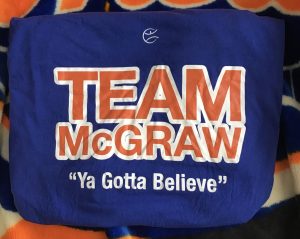 “Tug is OURS,” says any fan who can claim his legacy. He was ours, but I guess we could share him.
Screwball, coming into my paperback possession as it did in 1975, made those Phillies years better because as long as I could read about Tug being a Met, it was as if he never totally left. Hell, the first time he came back to pitch at Shea, he instinctively headed into the home dugout following the third out of his first visiting inning. Maybe he never fully believed he wasn’t with us. I read Screwball and offered a book report on it in sixth grade. Then in eighth grade. Then in tenth grade. Then it fell off the back of my bike, and I was probably more heartbroken than I was when Tug was traded. In adulthood, I eventually stumbled into a hardcover copy in a used bookstore down the block from Wrigley Field and cherish its words if not its format to this day.
The paperback was as prized a possession as I ever had baseballwise. I prize, too, that I got to tell Tug McGraw about it. By some great turn of fortune, I was given a ticket to a baseball alumni dinner in 1999. One of the old-timers on hand was Tug, then 55. He was gregarious as ever. I went up to him with a baseball for an autograph, as was encouraged by the organizers. I’m sorry I didn’t have a copy of the book on me, any copy. But I did tell him about it. I told him I read Screwball over and over and over, and I did three book reports on it, and that I probably would have kept doing book reports on it had it not gone missing.
Tug McGraw stared into my eyes and told me, “You’re scarin’ me, man!” and laughed uproariously as he handed me back the baseball. You believe that?
PREVIOUS METS FOR ALL SEASONS
1962: Richie Ashburn
1963: Ron Hunt
1964: Rod Kanehl
1965: Ron Swoboda
1966: Shaun Fitzmaurice
1967: Al Schmelz
1969: Donn Clendenon
1970: Tommie Agee
1971: Tom Seaver
1972: Gary Gentry
1973: Willie Mays
1977: Lenny Randle
1978: Craig Swan
1981: Mookie Wilson
1982: Rusty Staub
1983: Darryl Strawberry
1986: Keith Hernandez
1988: Gary Carter
1990: Gregg Jefferies
1991: Rich Sauveur
1992: Todd Hundley
1993: Joe Orsulak
1994: Rico Brogna
1995: Jason Isringhausen
1996: Rey Ordoñez
1998: Todd Pratt
2000: Melvin Mora
2001: Mike Piazza
2002: Al Leiter
2003: David Cone
2004: Joe Hietpas
2005: Pedro Martinez
2007: Jose Reyes
2008: Johan Santana
2009: Angel Pagan
2010: Ike Davis
2012: R.A. Dickey
2013: Wilmer Flores
2014: Jacob deGrom
2019: Dom Smith
by Greg Prince on 7 September 2020 11:25 pm “Whoa, there he is! Whadda you doin’ around here?”
“I had’ta take a walk, get outta the house. I love my wife and kids, honest to God I do, but I love ’em more with a little ‘social distance’ now and then, get my drift?”
“I hear that. It’s been a long year this week.”
“What about you? What brings you out here to the park?”
“Labor Day picnic. Don’t you remember? We would do this every year.”
“Labor Day — right. I can’t remember from one day to the next what day is what. So they’re still doin’ this? Remember, I haven’t been with the company in like three years.”
“Yup. The bosses thought they’d do us a big favor one last time.”
“Last time? What’s up?”
“You hadn’t heard? They’re sellin’ the company.”
“For real? We used’ta hear those rumors all the time, but I learned to drown ’em out.”
“Supposedly it’s all frank and earnest. I mean nothin’s official, but it’s what everybody’s sayin’. Real rich guy takin’ over. We’ll see.”
“No kiddin’. Remember, we were always sayin’ ‘they oughta sell, but they never will.’”
“I hear that. But it looks like it’s goin’ down, and soon.”
“So they’re havin’ one last Labor Day blowout for the employees, huh? Mighty big of them.”
“They got sentimental, I guess. I didn’t think they’d be doin’ anything this year, with everything crazy, but here they are, gettin’ ready for the tournament, or so they hope.”
“What tournament?”
“You been outta the loop, huh? There’s a whole thing. Top eight teams go. We may or not make it. So what should just be fun today is gettin’ kinda serious out there.”
“Yeah, I haven’t really paid attention in a few years. It’s hard to see from here who’s playin’.”
“I know. They won’t let us get too close. It’s weird that they’re havin’ this without anybody allowed to watch.”
“Everything’s weird these days. God, I guess I haven’t been by in ages. Hey, is that Zack? How’s he doin’?”
“He’s doin’ great, but take a closer look at his shirt. He ain’t with us no more.”
“No, I guess he’s not. What gives with that?”
“Zack wanted a raise. The bosses told him no dice, Zack went across the street.”
“He got his raise, huh?”
“And then some. I think he’s takin’ some pleasure today in stickin’ it to the old gang.”
“Well, good for him. I’d do it if I could.”
“Who wouldn’t? Loyalty is whatever gets ya to the first of the next month.”
“Who ya got instead of Zack?”
“Some kid who looked good for a while earlier, but today not so much. They replaced him as soon as they could with somebody I don’t really know. He’s listed as a journeyman in the company directory, but from what I can tell, he’s doin’ good for himself.”
“I’m tryin’ to make out his name from here. I think it’s written in marker.”
“Yeah, he wasn’t even supposed to be here today.”
“Erasmus? Is that it? I had an aunt or great aunt or something who went to high school there, in Brooklyn. Erasmus Hall.”
“Whatever his name is, he seems OK.”
“Jake still here, or did he want a raise, too.”
“Oh, Jake’s still here. Him they gave a raise. He was worth it. They probably wish they could have him out there every day.”
“The union wouldn’t go for that, I’ll bet.”
“Management couldn’t fuck up Jake. Give them a chance, they’ll try.”
“Yeesh. Hey, what about that guy I heard about, the Polish Bear?”
“Watch it. Nobody has a sense of humor about that stuff anymore.”
“What? What did I say? I didn’t mean anything by it.”
“It’s Polar Bear. Between you and me, nobody’s really talkin’ about him that much this year.”
“Where is he? Is he on the field?”
“Not today. I mean he’s playin’, but he doesn’t have what you or I would call a position.”
“They’re doin’ that now? Oh, for…”
“Uh-huh. All kinds’a weird shit this year. They said it’s because of the Corona. I don’t know.”
“What about that big klutz they brought in? You know, with the bat sometimes, but really raw. Good kid, but seemed lost.”
“Dom?”
“Yeah, Dom, that’s it. He still here?”
“He’s still here. I didn’t have a lot of faith in him either, but he’s kind of figured out what he’s doin’. It’s good to see. The guys really like him.”
“Great. And Michael? He was gonna be good, but that manager we had was all weird about trustin’ him.”
“That was fuckin’ bizarre, wasn’t it? Yeah, Michael’s still here. They leave him alone and let him do his thing, and they’re better off for it.”
“And that skinny kid from out west, always pointin’ to the sky?”
“Brandon?”
“That’s it — Brandon.”
“He’s still here. Still pointin’ to the sky. Funny guy, sorta, but he makes himself useful.”
“Great. Hey, what about that other kid, the one everybody was gettin’ all excited about for a while. Anwar…Amstel…”
“Amed?”
“That’s right, Amed. Everybody was all, ‘can’t wait for Amed, Amed’s gonna be the man.’ How’d that work out?”
“Funny you mention that. Amed’s probably gonna hafta go to HR pretty soon.”
“What, did he make a Polish Bear joke, too?”
“Nah, they just gotta find another job for him or transfer him or something.”
“What happened to his old job? Automation?”
“Take a look out there. See that kid runnin’ around, gettin’ to everything, takin’ charge, just fuckin’ knowin’ what he’s doin’ like he was born to do it?”
“Oh yeah. Nice. Who is that?”
“That’s Andrés. He’s pretty much got Amed’s job now.”
“I can see why. Jeez, he’s smooth. How old is he anyway?”
“Just turned 22. He’s gonna make everybody look bad by comparison — or make the whole department look good if they let him handle everything like he’s doin’ today.”
“Holy crap, 22. That’s young. How old is Amed?”
“Amed’s 24.”
“That ain’t old either.”
“It ain’t. But ya know how this business is. It’s what’ve ya done for me lately, whaddaya gonna do for me tomorrow? André’s got today on lock and he’s got tomorrow right in front of him.”
“Not a bad place to be.”
“Not bad at all.”
“Crazy.”
“Uh-huh.”
“So they gonna win or what?”
“The rest of the way? Who knows? Today? Uh…nah, doesn’t look like it. I don’t even know who we’ve got on the mound right now. I think he joined the company right around the time Erasmus Hall did. I can’t keep track of everybody the bosses hire and fire.”
“Still a lotta turnover here, huh?”
“You don’t know the half of it. This guy pitching, though, they may let him go before the inning is over.”
“Not good, huh?”
“Maybe, maybe not. Who can tell anymore?”
“Hey, when did he put a runner on second? Seriously, I didn’t even see that. Weren’t they just ahead? Didn’t that guy they were all yellin’ ‘SQUIRREL!’ at do something and everybody was goin’ nuts?”
“I don’t know. I never know. Everything changes so fast. Blame it on this fuckin’ year. It’s crazy.”
“I hear that.”
by Greg Prince on 6 September 2020 8:18 pm In a sixty-game season with all the irregularities passed off as the new normal, it wouldn’t have been terrible to have halted Sunday afternoon’s Mets-Phillies game once it went official. Not for the usual reason that the Mets led after four-and-a-half and the bullpen later blew up, but because, in the middle of fifth inning of the 41st game on the schedule, the Mets led, 4-1, with the Mets’ pitcher of record the closest thing we’ve seen in some time to No. 41.
The Mets kept playing, the Mets kept scoring and we’d have to “settle” for a 14-1 Mets win, which is close enough to the numerical Tom Seaver salute I had in mind (to say the least). The presence of Sunday’s No. 41 stand-in might have worn No. 48, but Jacob deGrom channeled the Seaverian spirit as well as could have been hoped for.
This was the Met tribute I’d been waiting for since we learned of Tom’s passing. Moments of silence, smudges of dirt and patches in black were all properly respectful, but nothing could pay most Terrific homage like a most Terrific outing by the reigning Met ace. We surely had the right man on the Citi Field mound to take care of the stylistic and statistical details.
Jacob deGrom was about as good as he usually is, which is to say he was the best pitcher in baseball on Sunday. He went seven innings, the 2020 equivalent of nine, and he all but shut down the Phillies, allowing one run on three hits (Andrew Knapp’s first-inning homer the only actual damage). Dealing fastballs and sliders, Jake walked two and struck out twelve. Seventy-four of deGrom’s 108 pitches were strikes; thirty-five of his 74 strikes were swung on and missed. Nobody had eluded that many bats in a major league game in more than four years.
Pretty much baseball as usual for Jacob, except he got a win for his trouble. I’d love to announce his record was raised to 4-1, but no, let’s not go crazy. The best at what he does in his sport has three wins against one loss forty-one games into a season that has but nineteen games and not nearly enough deGrom starts remaining. But an ace win is an ace win in the shadow of the passing of someone whom Jake himself referred to during his postgame Zoom as “the all-time great here.” A self-evident description of Tom Seaver, perhaps, but deGrom had been asked where he saw himself when compared to the Franchise. It’s a mouthful of a topic but perfectly understandable given what deGrom’s put on the board since 2014 — particularly since 2018 — and how thoughts of Tom hover over our all our Flushing pitching musings these days.
Jake looked a little embarrassed by the question. “It’s an honor to be compared to somebody like Tom and what he was able to accomplish in his career,” Sunday’s winner said, “but as far as that goes…how he was appreciated here, how he treated the fans, he’s definitely somebody I looked up to, but he’s probably got me beat here.”
Not too many other pitchers let alone opponents can say anything close. A little help from the hitters is always welcome and fourteen runs of support is more than Jake usually sees in a month. The Mets hit five homers. Pete Alonso smashed two of them and underscored the spirit of the afternoon by opening the first official DeGrom for Cooperstown office when he spoke to the media. “He should be a Hall of Famer,” Pete said of his teammate, overlooking eligibility requirements demand three more seasons of playing and five years of waiting once the playing is done. We’re not in any rush to usher Jacob to immortality just yet. He’s got a 1.69 ERA to build on. Or build down from. For now, with fewer than three weeks to go in this irregular season, we’ll be delighted to hang in there with Jake and Pete and every other Met who was looking great Sunday and see how far they and their talents take us.
___
As if losing one Hall of Famer in a week isn’t sad enough, word came down Sunday evening that Lou Brock has died at the age of 81. Brock was a Cub who homered into the right-center field bleachers against the Mets at the Polo Grounds, and if you’ve seen Willie Mays go back on Vic Wertz, you know that was a blast. Brock, then 23, took Al Jackson unconscionably deep on June 17, 1962, the same day Marv Throneberry didn’t touch second or first when he pulled into third with what he thought a triple. Brock’s blast was just as legendary, considering that other than Joe Adcock, Hank Aaron and Luke Easter, nobody else ever hit one in that vicinity going back multiple decades.
Brock’s early promise in Chicago got the attention of the folks down in St. Louis, and they traded for the outfielder in 1964. Only history changed as a result. When the Cardinals acquired Lou Brock for former twenty-game winner Ernie Broglio, both the team and the player were off and running. The Redbirds won three pennants and two World Series in their first five seasons with Lou. Brock shattered the standards for base-stealers in the 1970s, breaking Maury Wills’s single-season mark in 1974, with 118 bags, and bettering Ty Cobb’s career mark by 1977, piling up 938 in all before retiring a couple of years later. By then he’d also passed 3,000 hits and mentored the next generation’s very impressive Cardinal hitter, Keith Hernandez, to the cusp of stardom.
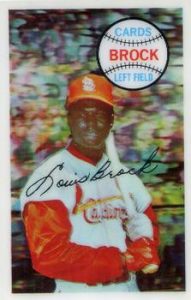 Lou Brock jumped out of a cereal box for me when I was seven years old, in all his three-dimensional glory. It was almost as exciting as watching him run. Lou stole 97 bases against the Mets in his career, his fourth-highest total versus any team. It might have been more, except for the balance of Brock’s speedster heyday, we had Jerry Grote catching, and one of Jerry Grote’s core competencies was throwing Lou Brock out at second. Those were great duels, a game within the game, the top arm behind the plate challenged by the most devastating set of legs on the basepaths. I never wanted Brock to be safe, of course, but, my goodness, I was blown away by his unparalleled tools and how he used them. With a couple of exceptions when I was a kid, I didn’t really scorn great opponents. I admired them. It didn’t cost any extra to acknowledge to myself that, wow, that’s Lou Brock, he’s fantastic — now let’s get him out.
Maybe that’s why I so loved the All-Star Game. It was a chance for one night to root for all the greats of the National League and know no matter what happened, the Mets couldn’t lose. The 1967 All-Star Game left us perhaps the most charming Midsummer Classic legacy this side of Ron Hunt starting and Lee Mazzilli walking. It was Tom Seaver’s first All-Star Game, and the 22-year-old rookie was showing his age as he entered the visitors clubhouse at Anaheim Stadium, which was to say not a lot of it.
As Tom and Lou each enjoyed retelling, Brock saw Seaver and instructed him to grab him a leading brand of cola. Brock thought the Mets’ representative to the All-Star team — the Franchise in the making! — was the clubhouse boy. Seaver did as told, fetching the soft drink, and then introduced himself. No hard feelings. They’d share plenty of All-Star clubhouses in years to come, plenty of pitcher-hitter battles and that small patch of real estate few ballplayers will ever know, up on that stage in Upstate New York where a man is handed a plaque and is enshrined as among the very best in his business for all time. Lou Brock and Tom Seaver are together in the Hall of Fame. One would like to believe they’ll be sharing a beverage and a few laughs again soon.
by Jason Fry on 6 September 2020 12:31 am Breaking news: Mets starting pitcher actually gets win!
A Mets starter hadn’t done that in 19 games, tying a club record set in the less than sterling 1980 season. Seth Lugo said “no more” Saturday night, allowing just a solo homer to Rhys Hoskins over five innings and fanning eight. Of course, if Lugo’s starting that means there’s a big hole at closer, with the uncertainty spreading from there into every other relief role. For one night at least, that wasn’t a problem — Jeurys Familia, Justin Wilson, Miguel Castro and even Edwin Diaz turned in scoreless frames, though Diaz seemed hellbent on letting the Phillies back in the game and needed a Come to Jesus conversation with pitching coach Jeremy Hefner to regain his focus. Whatever Hefner said, it worked.
Not so long ago a Met starter getting a win wouldn’t have seemed too unlikely, unless it was the star-crossed Jacob deGrom, but then the Mets’ starting corps has gone from team strength to black hole in record time. DeGrom’s still deGrom and Lugo has succeeded after being pressed into service, but the Mets foolishly let Zack Wheeler walk (and of course put arrows in his back as he left), Noah Syndergaard blew out his elbow, Marcus Stroman opted out and Steven Matz‘s season has been a smoking crater. David Peterson has shown hints of being a useful back-end guy, but Michael Wacha and Rick Porcello have been dismal, and day after day the Mets have been reduced to making stuff up — witness poor Ariel Jurado being sent out to pitch batting practice in Baltimore. A decade or two from now, perhaps we’ll look back at the list of 2020 starters and scratch our heads, similar to the reactions when fans look at 1987 and see the world champs turned to the likes of Don Schulze, Tom Edens, and John Candelaria to start games. (Two of the ’87 fill-ins weren’t so bad — Terry Leach won 11 games, and David Cone showed signs of the pitcher he’d become the next year.)
But there will be a lot of head-scratching about this season, won’t there? The leaderboard will look puzzling even in comparison with the strike years, of course. So will the footage of cardboard fans and phantom high-fives and dugouts with more surgical masks than the operating room in M*A*S*H. We’ll also wonder about the seven-inning doubleheaders, the games in Buffalo, Pete Alonso‘s leadoff two-run homer and more. There will be uniform-number trivia questions concerning recidivist Mets: Juan Lagares‘s 87 and 15 (which were quickly followed by the end of his cameo) and Todd Frazier‘s couple of days donning 33. Odds are there will be new Met ghosts — Patrick Mazeika was the 29th man for a couple of days, never got into a game and is now behind a new catcher on the depth chart. Erasmo Ramirez is on the active roster but so far ectoplasmic as well. Whatever happens to Ramirez, at least he has big-league stat lines already; Mazeika’s a 26-year-old Double-A player who’s never hit much, making it possible his best chance to be a big leaguer has already come and gone. With expanded rosters and few days off, other players from the Brooklyn “alternate site” (another term that will require explanation) may face similarly spooky fates.
Will we remember what the Mets did in 2020’s odd college-basketball-style playoff? It’s not impossible — the team certainly hasn’t done much to convince you they’re a playoff team, but if half the teams are playoff teams the definition gets pretty stretchy. Even if we don’t get to enjoy that particular memory — and I’m betting we don’t — there will be some good things to recall from a year we’d rather forget: the emergence of Dominic Smith as a frontline player and team leader; Michael Conforto fulfilling the promise his backers always saw in him, despite the Mets’ best efforts to derail their own player; the unity the team showed the night they and the Marlins chose not to play; and the grace with which they honored the passing of Tom Seaver.
And I suspect whatever the record or the final standings, we’ll remember that they did play games and those games were a welcome distraction after a spring in which baseball seemed like an impossible dream. On Saturday night my wife and kid and I sat outside at a Korean restaurant we love in Gowanus. The tables were far apart, the servers were masked (as were we when close interaction with the staff was needed), and everything was a little strange. But between bites I’d look down by my knee and check on what the Mets and Phillies were up to on Gameday — getting early previews of news both good and bad, since my son Joshua’s notifications were a few seconds ahead of my phone’s simulated pitches. After dinner we walked over to Ample Hills for ice cream, masked up again and were told when we could enter the store to place our order and where we should stand when we did. By now I’d switched to the radio, and as we strolled back across Brooklyn we heard Bryce Harper get excused further duty and Met relievers not mess up and Met hitters score more runs but not as many as we wanted them too. And then we were home for the last three innings, sprawled on our couch with the familiar SNY crew narrating the action.
It wasn’t normal, but it was at least sort of normal adjacent, and a big part of that was having the Mets as company. I want to see big crowds on TV again and big crowds around me at Citi Field and watch players trade ridiculously complicated dugout handshakes and know what the lower half of our manager’s face looks like and check in with the Brooklyn Cyclones and do so many other things I used to take for granted about baseball and now miss terribly. But it was a beautiful summer night, I got to spend it with my family, the Mets were our faithful companions, and they actually won. Even a terrible year can have its good nights, and I’m grateful for each and every one of them.
by Jason Fry on 5 September 2020 12:19 pm It’s a point that arrives in every season. The game where…
…your head and heart aren’t really in it.
…you have a feeling that comeback you’re dreaming of is going to remain just a dream.
…the loss, when it comes, feels both foreordained and like a herald of more to come.
Turns out that point arrives in shortened little improv seasons too.
The Mets lost to the Phillies on Friday night, 5-3. Rick Porcello, who’s pretty much been terrible all season, pitched quite well. Everything I just wrote about Porcello could also be written about his opponent, Jake Arrieta. If there was any novelty to this game, it was the sight of two former Cy Young Award winners reduced to whittling away at their sky-high ERAs, like finding a pair of rich-guy sports cars under the rotted-out, flapping remnants of tarps in the corner of some particularly motley junkyard.
Jared Hughes surrendered the go-ahead run on a sharp little grounder by Roman Quinn off the hand of a diving Andres Gimenez — not an error but one of those plays you’d like to see made that wasn’t. Another run came in on a throw Dom Smith couldn’t handle at first. Brad Brach hit a batter with the bases loaded. Michael Conforto hit a two-run homer, continuing his remarkable season, but the Mets’ chances evaporated in the eighth, when Rhys Hoskins dove to snag a line drive off the bat of Robinson Cano that was ticketed for the right-field corner. The Mets were down two with runners on first and second and one out when Hoskins made the play; instead of being down one with a gimme run on third, they were in the same situation with two out. That play, for all intents and purposes, was the ballgame.
Afterwards, Luis Rojas told the media via Zoom that “there’s some mistakes we have got to minimize in the amount of games we have left. We have 21 games left. We are not thinking time is running out or anything like that, but we do have to play clean baseball. We have to play good baseball.”
Managers are paid to say obvious, vaguely dopey things after losses like this one. Often, they don’t really believe those things and nobody who knows the game and the media rituals around it expects them to. But yes, time is running out. Yes, the Mets are definitely thinking that and some associated things like it. Yes, the Mets have to play clean/good baseball. But for most of this curtailed season they haven’t done that, and there’s nothing obvious to make you think that’s about to change.
by Greg Prince on 4 September 2020 3:05 pm Welcome to A Met for All Seasons, a series in which we consider a given Met who played in a given season and…well, we’ll see.
For me, baseball provides constant challenge, a new mental and physical test every game.
For me, baseball also provides tremendous satisfaction, a realization that all the work and dedication and concentration I’ve put into the game since I was a youngster haven’t been wasted.
—Tom Seaver, with Dick Schaap
It was very important in the summer of 1971 that when I was assigned to a Long Beach Recreation Center Pee Wee League baseball team that I got to wear 41. I worried that because of my late registration (our family tended to be late for everything) that I’d miss out on the plum number because, c’mon, it was 1971 and didn’t every kid want to wear 41? Wasn’t every eight-year-old’s favorite player Tom Seaver?
My conception of organized baseball was formed from watching it on television. There were starters. There were bench players. There was a bullpen. There were uniforms. I did the calculations and assumed that each team would have a minimum of 18 players. One in the field for each position. One on the bench to back up at each position. One to be ready in the bullpen in case the starting pitcher faltered. I could see myself in my spiffy uniform, No. 41, warming up in the bullpen. I knew Pee Wee League wasn’t the big leagues, but I’d seen enough sitcoms to notice that little leaguers got to wear uniforms like just like the big leaguers. If Greg Brady was wearing a real baseball uniform, why wouldn’t Greg Prince?
Ah, but Greg Brady and all those Hollywood scriptwriters didn’t know from the operations of the Long Beach Recreation Center Pee Wee League. There was no bullpen. There weren’t as many as 18 players per team. There were however many as signed up and if a kid didn’t start one day, he’d have to start the next day. Nobody could be a “sub” more than one game in a row, at least according to the rules. As for uniforms, there were no pants. I mean, yeah, we wore pants, but nothing regulation. All we got to identify us as members of a particular team was a t-shirt and perhaps a cap. I say “perhaps,” because they were out of my team’s caps by the time I was registered and taken to Mister Sports. Mister Sports had the shirts. Mister Sports was the official t-shirt supplier of the Rec League. I don’t know who else would have been in Long Beach.
I was an Ace. I could have been a Comet, a Leopard, a Lion or one of two other things that were team names I forget, but they put me on the team with green t-shirts, which was fine as far as it went. I liked green. The A’s of Vida Blue wore green. Mister Sports — or the man I assume was the proprietor of Mister Sports but had a different last name — asked if I wanted a number on the back.
Yes, I said, bracing for potential disappointment that I couldn’t have the number I wanted. I wanted 41, I said. I doubt I had to explain its significance to a man known as Sport in 1971
Mister Sports handed my mother a white felt “4” and a white felt “1” and was instructed where to sew them on. Mister Sports wasn’t full-service. Numbers were extra to begin with. Two were more than one, but I had to be 41. Mom, who didn’t watch a lot of baseball and didn’t do a lot of sewing, nevertheless dipped into her bowl of needles and thread, and made it happen. I looked ready to play for the Aces. I would be representing an ace among Aces.
I was No. 41.
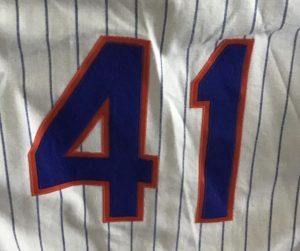 My No. 41 is no longer in stock. I hope Tom’s will do. In 1971, I was in my third season as a Mets fan, my second full season. Late summer 1969 was my entrée. What a way to begin. 1970 was the real thing, a full campaign, Spring Training to the World Series, the latter of which proceeded without the participation of the Mets, unlike 1969. I grasped my favorite team couldn’t win every year. I grasped less gracefully, by the time 1970 was over, that my favorite player, Tom Seaver, couldn’t win every start. Or he could but sometimes didn’t. Sometimes the Mets didn’t score enough for him. Sometimes, somehow, he’d give up a run or two too many. He had gone 25-7 in 1969 and seemed to be en route to something similar in 1970. But he stalled in August. Tom won only 18 games despite leading the National League in both strikeouts and earned run average. The Mets won only 83 games despite having Tom Seaver.
Two years, two sets of results, one that enthralled me, one that I accepted somewhat reluctantly. But by then, I was in for life. I didn’t know it, given that life wasn’t yet eight full years, but I could have guessed. Why would I stop loving the Mets or Tom Seaver?
The 1971 Mets were a lot more like the 1970 Mets than the 1969 Mets. They were OK. For a while they were more than that, dueling the Pirates for first place through June. Then they came down with a terrible case of the blahs. They lost 20 of 29 in July and slipped below .500 for a few days in August. When it came to competitiveness, the Mets of No. 41, Tom Seaver, weren’t doing quite as well as the Aces of No. 41, me.
At no point during the 1971 Pee Wee League season would have the Aces been described as being “of me,” but since I’m the only Ace telling this story, consider them my team. Now, because I’m trying to be a reliable narrator, I will tell you that this No. 41 of the Aces — there were at least a couple more, as nobody was really fussy about number assignments; some kids didn’t even bother with numbers — wasn’t a particularly good baseball player. Or Tee-ball player. That’s what we were playing. I’d never heard of it until I showed up for my first game, after that game had started, at least one game after that season had started. My only previous experience with slightly organized ball was an afterschool program in recently completed second grade. We played all kinds of sports. I was all kinds of not good, but I loved to play. In spring, we played baseball. My mother bought me a glove at TSS. Somebody decided I was a first baseman, probably due to decent height for an eight-year-old. But my glove wasn’t a first baseman’s mitt, so soon I was labeled a third baseman. Less chance to get me and my glove involved in the action.
Come summer and the Aces’ second or later game of the season, I show up with my glove and my No. 41 shirt and no cap and I’m asked what position I play. “Third base,” I say confidently. All right, I’m told, go play third base.
You know that phrase you’ve heard down the corridors of time with the Mets regarding “the third base experiment”? For all those converted first basemen or outfielders who were drafted for third base duty in those “79 men on third” days when nobody could fill the gaping hot corner hole for more than a week, maybe less? “The third base experiment didn’t last very long,” that sort of description?
The third base experiment didn’t last very long with me. I clearly remember a ball getting by me, bouncing past an open chain-link gate and me chasing it onto an adjacent street where men working some kind of road construction kindly pointed me toward my rolling object of desire. I got the ball back into the infield. The batter had rounded the bases by then. The batter might have rounded the bases twice. It took me a while to make the play.
That was the extent of the third base experiment for me on the Aces. Soon I was consigned to “sub” duty half the time and half the time directed to the pitcher’s mound. No. 41 on the mound! It was the stuff of my Channel 9 dreams. Or at least The Brady Bunch. Except in none of that programming did the batters bat off tees, rendering the “pitcher” utterly — and I mean utterly — pointless, save for an occasional grounder up the middle, and even then.
I was wearing 41, just like Tom Seaver. I was the pitcher, just like Tom Seaver. Except I was nothing like Tom Seaver. Tom Seaver looked in for the sign. Tom Seaver went to his windup, hands above his head, his body unfurling with fury, his right knee hitting the dirt, his right hand firing a pitch, probably a strike, to his catcher. Tom Seaver actually got to throw the ball. Tom Seaver wasn’t switched after a couple of games to catcher. In the league where Tom Seaver played, the catcher — Jerry Grote most starts, Duffy Dyer sometimes — kept busy catching. In Tee-ball, the catcher got to wear extra gear and stand (not crouch) behind the plate while the other team’s batter swung at a ball that was not pitched. So except for an inning of experimentation at third, my role as a 1971 Ace was pitcher/catcher/sub.
I was cursed with versatility.
Seaver, on the other hand, was blessed with the right arm that was the envy of his contemporaries. He did more than wear 41. He modeled it for the aspirational youth of the age. By the All-Star break of 1971, even with the Mets crumbling, Seaver stood out. He had ten wins, halfway to the twenty he didn’t get in 1970. He’d been stuck on ten for a couple of weeks. The Mets were no help. Still, you didn’t have an All-Star Game without Tom Seaver. Seaver had been a National Leaguer for five seasons and was making the All-Star team his fifth time. He started in 1970, and the NL won. He wasn’t used in 1971, and the NL lost. There’s a valuable lesson in there.
I loved All-Star teams and All-Star Games. The Rec Center put up a sign that they’d be having one. I saw that it would be Thursday. Hey, Mom, can we go? It meant cutting short her sitting at the beach, which she quite enjoyed, but she agreed. I looked forward to cheering on my teammates who made the All-Stars the way I cheered on Seaver and Bud Harrelson when they were introduced at Tiger Stadium. Except I had read the sign wrong. The game had been last Thursday. The Rec Center’s diamonds were quiet, except for somebody’s mother loudly pointing out her son was something of an idiot.
That interruption of a perfectly lovely beach day had not gone over big with my Pee Wee League mom, and I sure heard about it, but otherwise, she was surprisingly supportive of my venture. On sunny mornings she’d sit in the stands under an umbrella and voice encouragement. “Throw the hat, not the bat” was her chant, conceived to teach me to stop throwing the bat if I managed to hit the ball off a tee. You were called out for throwing the bat. The communal helmet they didn’t seem to think posed as much of a danger. (Also, we all shared one batting helmet, which I don’t want to think about too much.) She suggested to our best player that he could help his well-meaning teammate, No. 41 here, improve if he played a little catch with him, over there, where they’re building the skating rink, when the Aces weren’t in the field and neither of us was batting. To my surprise, the best player on the team became my warmup partner.
The Aces were actually pretty good, my sporadic contributions notwithstanding. Once karma smiled on me and allowed me the kind of trip around the bases some kid enjoyed at my expense when a ball with which I made contact mysteriously slipped away from another eight-year-old and then some. I didn’t have the perspective to appreciate just what unsure bets eight-year-old glovemen were. I counted it as one of the 35 home runs I hit in 1971. Thirty-four were in my backyard, alone.
I would’ve preferred to play more for the Aces — and not strap on a chest protector, a mask and purpose-free shin guards when I did — but I had some nice conversations on the bench. When not chatting, I tried to be a holler guy. One time I hollered at the coach when he attempted to convince me that “for the good of the team” I should allow him to waive the league rules and sit for a second consecutive game. Every kid had to play at least every other game. I wasn’t putting up with his illegal roster management. Neither was my mother. She got a big kick out of me pointing out to the coach that while other players, like myself, were rotated on and off the bench, his son always started, always played center and always batted leadoff. I think I wanted to add “…and your son isn’t really that great,” but I wanted to maintain my status as a good teammate.
My fellow substitutes appreciated my speaking up on behalf of the forgotten children. I wonder if the pitchers Gil Hodges reflexively skipped over so Tom Seaver could always pitch when his turn came up were any more understanding of their slights than I was of mine. I doubt any of them raised their voice to Gil. Then again, nobody on our team, whatever our level of success in 1971, was a budding Tom Seaver.
Four teams made the Pee Wee League playoffs, ours included. The Aces beat the Comets in the semis; somebody’s mom took the team to Jahn’s for ice cream. We earned the right to face the Lions in the finals. They had defeated the Leopards. I was a designated bench guy for the championship game. I didn’t argue. One of the other subs brought a bottle of lemon-lime soda from the nearby A&P. Green bottle, to match our t-shirts. We passed it back and forth and took swigs, just like we shared a batting helmet. I was hoping we were going to save some to douse each other in victory, same as Tom Seaver and his teammates did with champagne when they clinched every championship they won in 1969. It would be sticky, I figured, but it would be worth it.
Turned out we didn’t need to save any A&P Lemon-Lime Soda for a postgame celebration. We lost to the Lions. I don’t recall the score. I don’t recall terrible disappointment. I was a Mets fan. I knew you couldn’t emerge as champions every season. Being pretty good was good enough sometimes. I also knew my mother was inviting the team to Gino’s for consolation pizza, which was terrific.
***It was very important in the summer of 1971 that when my mother and I wandered into a bookstore at Roosevelt Field and I picked up a paperback book with my favorite player on the cover that I have it. The Perfect Game: Tom Seaver and the Mets it was called, “by Tom Seaver with Dick Schaap”. The Dick Schaap part was in smaller letters. I knew Schaap from doing the sports on Channel 4. I didn’t know he wrote, too. I didn’t know Seaver wrote at all, but how surprising could that be? To me, Tom Seaver could do it all.
The cover promised “The marvelous story of the team that couldn’t win, the pitcher who wouldn’t lose, and The Perfect Game”. Plus it was “Fully illustrated!” All that for 95 cents. I don’t think I had to ask Mom too hard.
 Reading about Tom Seaver is fundamental. I owned a few sports books by the time I was eight, but this was the first one completely devoted to the Mets, or to a Met. It was about both Seaver and his team. A lot more about Seaver, given the authoring arrangement. As I dug in, I contemplated how the process worked. Did Schaap come over to Seaver’s house? Probably. Seaver’s house looked like my house in my mind because mine was the only house I knew well. They probably sat in the dining room, situated where our dining room was, Seaver talking, Schaap taking notes, Nancy — I already knew from Nancy Seaver — coming in courteously asking if anybody wanted coffee.
However Seaver and Schaap pulled it off, they told a story that mesmerized me. They told me about Tom being from Fresno. Tom going to USC. Tom joining the Marines. Tom pitching for the Alaska Goldpanners. Tom being drafted by the Atlanta Braves, then being told not so fast there, Tom because the college season had already started and USC’s own Tom Seaver was still on campus.
They told me about a hat and a lottery and a slip of paper that said New York Mets, which was where the chronology got really good, because it meant Seaver would pitch for us. First, a year in Jacksonville, rooming with Wilbur Huckle. Then 1967, his rookie season, his All-Star season, his Rookie of the Year season, followed by 1968, when making the All-Star team became a way of Tom’s life.
Then 1969, which was the whole reason there was a book by and about Tom Seaver. Up to the day I brought The Perfect Game home, I remembered a few highlights personally from when I was six and had picked up some more from studying baseball cards, listening to Ralph Kiner, Bob Murphy and Lindsey Nelson and watching (as the short preceding The Out of Towners at the Laurel Theater) Look Who’s No. 1 when I was seven. Now, at eight, I was getting the inside dope from the main man, from No. 41 himself. I got to learn about how he couldn’t get a decent breakfast before he started the first game of the World Series — the hotel coffee shop was crazy busy in Baltimore — so he had to grab a roast beef on white with mayo. It apparently wasn’t nourishing enough because he gave up a leadoff homer to Don Buford and lost Game One.
The Perfect Game was organized around Game Four. That was the title game. I thought it would be about that perfect game he didn’t quite get versus the Cubs on July 9, 1969, the one Jimmy Qualls broke up in the ninth inning. No, it was Game Four. It was more perfect to Seaver because he was trying to win a championship. The Mets were up two games to one in the Series. He was disappointed in that first start. He was going to make up for it, even if it took ten innings.
Which it did. Tom Seaver went the distance, beating the Orioles, 2-1. Gil didn’t take him out until his turn to bat came up in the tenth. J.C. Martin pinch-hit for him and bunted. Running fortuitously in a baseline of his own creation, Martin’s wrist deflected Pete Richert’s throw to first. Pinch-runner Rod Gaspar scored from second. Hodges didn’t make his subs sit very long.
That night, Tom Seaver celebrated his first World Series victory at Lum’s, a Chinese restaurant on Northern Boulevard, near where he and Nancy lived in Flushing. Mr. Lum (presumably no relation to Mr. Sport) told the Seavers he thought that by the time the Mets were in the World Series that his beard would be down to the floor.
Mr. Lum, Seaver and Schaap pointed out, didn’t have a beard at all.
I consumed what Tom ate, what Tom breathed, what Tom thought, what Tom did. I read The Perfect Game and then I read it again. I was so proprietary of its facts and figures (it was fully illustrated with statistics) that when my sister gave me a rubber stamp and ink pad with my name, I stamped GREG all over the back and side of the book.
TOM had already imprinted his name on my brain. For years, any book I saw that was “by” Seaver or about Seaver was one I had to have, even when the price rose above a dollar. Same for books about the rest of the Mets. All I wanted to do was read about my favorite player and my favorite team. Maybe someday I’d write about them.
***It was very important to me in the summer of 1971, especially as summer slid into fall, that when the Mets’ season was over, it end with Tom Seaver winning 20 games. The Mets’ season would be over on September 30, a Thursday night at Shea Stadium versus St. Louis. I knew their season wouldn’t extend into the playoffs. The Cardinals had surpassed the Mets for second place, and the Pirates had run away with the NL East. I’d be happy if the Mets could finish no lower than third. I’d be ecstatic if Seaver was a 20-game winner.
How could he not be? Something went awry last year, 1970. Tom was 16-5 at one point, 17-6 a little thereafter. Then he stopped winning games. It bothered me the whole offseason. The Cy Young voters didn’t care that his ERA was lowest in the league (even if it was kind of high for a league leader, at 2.82) or that his strikeouts were the most (283, more than any righty in NL history). They honored Bob Gibson instead. Tom finished seventh. Seventh! Pitchers with earned run averages over three (three!) finished higher. But most of them had won 20 or more games. That was the Cy Young standard. I knew Tom Seaver was the best pitcher going. But one number would speak loudest on his behalf.
Twenty wins in 1971 was both a badge of honor and not altogether inaccessible. Fourteen different pitchers were on their way to a record of 20 and something. Most dazzling in his pursuit of the dynamic digits was Vida Blue of the Oakland A’s. When I wasn’t focused on Seaver and the Mets, I was taken by Blue and the A’s. They wore green, just like the Aces. Blue piled up wins out of the gate in 1971 like Seaver had in 1970. Vida was 6-1 by the end of April, 10-2 at the close of May, 16-3 when June concluded. Even slowing down a little, he was fantastic, notching his 20th win on August 7. Vida Blue was a revelation.
Yet he didn’t lead the American League in wins. Vida finished 24-8. Mickey Lolich of the Tigers came on like gangbusters (you learn a lot of terms when you’re eight and paying attention to sports) and finished 25-14. Lolich, a lefty like Blue, pitched a lot. A lot. Vida started 39 games and completed 24. Mickey started 45 and completed 29. These would have been crazy totals to me had I had much context, but I was in my third season of watching baseball, my second full season. This is what aces when they went out to pitch.
The Orioles had four aces, or, more precisely, four 20-game winners. Nobody really thought of Pat Dobson as an ace, yet Baltimore’s fourth starter won 20 games, as many as Mike Cuellar and Jim Palmer, one fewer than Dave McNally. Cuellar and McNally had won a Cy Young previously. Palmer had a few in his future. Yet they were essentially footnotes behind Blue and Lolich — and Lolich only pulled himself into the Blue-tinged conversation by pitching what seemed like every third day.
Blue’s teammate Catfish Hunter won 21 games. Lolich’s teammate Joe Coleman won 20 games. A White Sox knuckleballer named Wilbur Wood won 22. Andy Messersmith won 20 for the California Angels. The American League was lousy with 20-game winners. For what it was worth, Hunter was a pretty good hitter as well.
I followed the AL leaders because they played baseball, too, but the NL is what really mattered to me. The NL — or senior circuit, as it was sometimes called in the papers — was a little more choosy. Al Downing, who’d been around a while with limited distinction, suddenly won 20 for the Dodgers. Steve Carlton, who I knew mostly from the story about him striking out 19 Mets yet losing that game when Ron Swoboda homered off him twice (the Mets had since traded Swoboda — comprehending that a 1969 Met hero could be traded was tough when I was eight), won 20 for the Cardinals. Gibson was absent from the list this year, but another perennial 20-game winner, Ferguson Jenkins of the Cubs, was accumulating a couple of dozen victories for a Chicago team no less so-so than ours in New York. Jenkins would wind up with 24 wins. He’d also lose 13 and complete 30. Leo Durocher was not shy about pushing his starters.
Gil Hodges was more careful with Tom Seaver. In 1970, he started his ace on three days’ rest a few too many times for comfort. It didn’t work. Back to the five-man rotation Gil and pitching coach Rube Walker had fashioned to bring the Mets to prominence. Tom would get four days of rest as a rule. Sometimes it rained and somebody would sit so Tom didn’t have to idle. Hopefully those non-Seaver Met pitchers were of good cheer rooting on Tom.
As of July 17, in his first start after the All-Star Game, Tom Seaver sported as good a non-Blue ERA as you could ask for from an ace pitcher in 1971 or, really, any year: 2.32. But his won-lost record, the first and sometimes only thing busy baseball writers examined when evaluating who was good, who was great and who was the best when deciding who’d win an award, was 10-7. The seventh loss came when Seaver pitched into the ninth at the Astrodome. He’d given up one run on four hits over eight innings, walking nobody and striking out ten. The score was 1-1 despite his best efforts. In the ninth, Roger Metzger led off by singling, Joe Morgan bunted him to second and Jim Wynn, a.k.a. the Toy Cannon, was issued an intentional walk. Gil told Tom to go after the promising Houston center fielder, Cesar Cedeño instead. Cedeño, all of 20 years old, beat savvy 26-year-old Tom with a single that scored Metzger.
 Tom Seaver made it to his 1972 card a two-time 20-game winner. The card has survived with me 48 years. That was the kind of outing Tom Seaver would lose for the 1971 Mets. He’d go eight, strike out eight and lose, 3-1. Or he’d go nine, strike out ten and be no-decisioned despite giving up no runs. Pitching into the tenth inning didn’t necessarily get him a win. What would become identified down the line as “quality starts” didn’t by any means guarantee him a W.
In early August, with Seaver’s record at 11-8 and his ERA at 2.26, Jack Lang, one of the beat reporters who’d tracked Tom since Tom was a rookie, made the kind of pronouncement that made a certain kind of sense in the year of Blue and Lolich and Jenkins:
“One thing is clear. It is not Tom Seaver’s year.”
Perhaps Tom Seaver took inspiration from Lang’s appraisal, because when his next start came around, 1971 very much became Tom Seaver’s year. Even the Mets must’ve been reading, because they scored nine runs on his behalf; the Mets won, 9-1, with Seaver going all the way. He was now 12-8.
Tom followed up with another ten brilliant innings (0 R, 14 SO)…and a no-decision in San Diego. But it was too late to turn back now. The pitcher who crushed the 20-win mark in 1969 and fell short of it in 1970 was on a mission. A shutout over the Dodgers raised Tom’s mark to 13-8. Three consecutive complete-game triumphs in his next three starts boosted him to 16-8. Then, not just a complete game, but a shutout over the Expos. 17-8. Nine more innings, another win, this times versus the Philies. 18-8 on September 11.
Then, frustration. A 1-0 loss to the Cubs, with the only run scored when opposing starter Juan Pizarro homered in the eighth. Tom would be outpitched by a Cub again, this time rookie Burt Hooton. Seaver’s ERA was down to 1.81. His “record,” the only figure anybody referred to as a pitcher’s signature, was 18-10. Eight games remained in the season. Under usual circumstances, Seaver would have but one start left.
On September 26, Tom took on the division champion Pirates at Shea. Perhaps he was moonlighting with the grounds crew, because Seaver was mowing down every Buc batter he faced. Three up, three down in the first; three up, three down in the second; three up, three down in the third.
Tom Seaver was pitching a perfect game against the Pittsburgh Pirates. Roberto Clemente had the day off, but Danny Murtaugh had started several of his dangerous-hitting regulars: Willie Stargell, Al Oliver, Bob Robertson, Dave Cash. Seaver was setting down every Pirate he saw. The strikeouts were piling up. He had fanned ten in the first six innings. Win No. 19 was in sight, and it might come on the wings of the first no-hitter in Mets history…the first perfect game in Mets history.
This might call for another book!
Those particular literary wings were clipped as soon as the seventh got underway. Cash walked to end the bid for perfection. Then Vic Davalillo, playing in place of Clemente, stroked a clean single to center that chased Cash to third. There went the no-hitter. Oliver’s run-scoring fly ball to center spoiled the shutout, too. Now there was the matter of holding onto the lead. A runner was on, only one was out and Stargell, who already had 47 home runs (and had been clobbering the Mets literally since the day Shea opened), was up next.
Tom opted for a sinking fastball. His desire was to get Wilver to pound one into the ground and set up an inning-ending double play. True to the way Seaver planned and executed his pitching over the last two months of 1971, that’s precisely what happened: 1-6-3, Seaver to Harrelson to Donn Clendenon.
“That’s exactly what I was trying to do,” Seaver said after the game. “I know that sounds egocentric, but that’s damn good pitching.”
Tom and the Mets stayed ahead. And Seaver returned to flawlessness thereafter. He retired the final six batters to win his nineteenth, 3-1. His only blemishes were that walk to Cash and that single to Davalillo. Because of the DP, he wound up facing just one batter over the minimum.
But he was still one victory under the minimum for what was universally accepted as part and parcel of the definition of greatness…even though nobody was arguing Seaver wasn’t as great a pitcher as could be found. None of us who had grown to love him, though, would be fully satisfied if Tom didn’t get his greatness statistically certified. Tom certainly wouldn’t be. The Mets’ middling ways’ notwithstanding, Tom was not the type to accept pretty good as good enough. Not even very, very good would do it. Thus, three days of rest was not too few for Hodges to give him the ball one more time. It’s not like there were playoffs for which to save him. It’s hard to believe Seaver had to prove anything to anybody by the final game of 1971, but Tom Seaver was the toughest audience Tom Seaver had.
“The numbers come close to saying, yes, George Thomas Seaver is the best pitcher in baseball,” Vic Ziegel wrote as the Mets’ season otherwise limped to its conclusion. “There is, Seaver understands, only one more number he must add to the list.” No. 20 loomed large in the public imagination where No. 41 was concerned.
Unlike Game Four of the 1969 World Series, there was virtually nothing on the line for the Mets as a team in Game 162 of 1971. A piece of third place remained available, and nobody would mind the few extra bucks that would net each Met, but really, this was about Tom Seaver winning a game for Tom Seaver. And for me, at eight, or any age, that was all I needed to hear. You root for the whole team, you root just a little harder for your favorite player. Single-mindedness is what lifts a competitor above his peers, and Seaver’s drive elevated him to a plane where he had few, maybe no peers. (It also elevated the Mets to a World Championship two years earlier, when nobody outside of Baltimore seemed to mind how badly he wanted to win.) Of course Seaver wanted to pitch the final game of the year. Of course Gil Hodges would let him. And of course he’d win it, attaining No. 20 in a brilliant complete game stifling of the Cardinals, 6-1, striking out 13 Redbirds along the way.
I watched that game and I celebrated the last out. Not with anybody and not with lemon-lime soda, but savoring delicious confirmation that nobody could say Tom Seaver wasn’t a 20-game winner and nobody who looked at all of the other numbers — a 1.76 ERA that was lower than everybody’s in the majors, including Blue’s; 289 strikeouts, breaking his own senior circuit righty mark — could possibly say Seaver wasn’t the best at what he did. Make room in the man’s trophy case. A second Cy is surely on its way!
Ah, they gave it to Jenkins. Whatever. I knew Tom Seaver was the best in 1971. I knew it before 1971. I’ve known it ever since. That’s the very important thing.
PREVIOUS METS FOR ALL SEASONS
1962: Richie Ashburn
1963: Ron Hunt
1964: Rod Kanehl
1965: Ron Swoboda
1966: Shaun Fitzmaurice
1967: Al Schmelz
1969: Donn Clendenon
1970: Tommie Agee
1972: Gary Gentry
1973: Willie Mays
1977: Lenny Randle
1978: Craig Swan
1981: Mookie Wilson
1982: Rusty Staub
1983: Darryl Strawberry
1986: Keith Hernandez
1988: Gary Carter
1990: Gregg Jefferies
1991: Rich Sauveur
1992: Todd Hundley
1993: Joe Orsulak
1994: Rico Brogna
1995: Jason Isringhausen
1996: Rey Ordoñez
1998: Todd Pratt
2000: Melvin Mora
2001: Mike Piazza
2002: Al Leiter
2003: David Cone
2004: Joe Hietpas
2005: Pedro Martinez
2007: Jose Reyes
2008: Johan Santana
2009: Angel Pagan
2010: Ike Davis
2012: R.A. Dickey
2013: Wilmer Flores
2014: Jacob deGrom
2019: Dom Smith
by Jason Fry on 4 September 2020 12:06 am The Mets were supposed to be off Thursday, which would have been fitting given the sad news Wednesday night that Tom Seaver — No. 41, the Franchise, the most essential and irreplaceable figure in team history — had died Monday at 75. Thursday would have been a day to mourn and reflect on the memory and legacy of player and man alike, a day appropriately empty of anything else.
But it was not to be — not with COVID forcing a makeup game against the Yankees — the same Yankees who, hollowed out by injuries as they are, yanked the Mets’ momentum to a halt last weekend and put a hole below the waterline of their season. Was this really necessary? Yes, it was, and so out they went to Citi Field, with Seaver’s retired No. 41 looking down on them from atop the stadium.
Before the hostilities commenced, the Mets remembered their ace with grace, holding a moment of silence, hanging a 41 uniform in the dugout, tipping their caps to his number and — in a truly inspired touch — adorning their right knees with dirt in imitation of Seaver’s drop-and-drive mechanics. (Seriously, I’d like to know who came up with that — it’s worthy of a genius grant.)
And then they went out to play the Yankees and for some time I was grimly certain that my post would be an elaboration on “they did everything right and then blew it by playing baseball.”
Robert Gsellman took the mound without his breaking stuff and got knocked around, departing before the second inning was done after surrendering four runs. The Mets clawed back, however, and against J.A. Happ, no less — he’d looked untouchable in their last meeting (also against Gsellman) but was decidedly mortal this time. Recidivist Met Todd Frazier started the comeback with a home run, with a Jake Marisnick double and singles from Amed Rosario and Jeff McNeil evening the score. Meanwhile, the bullpen held the line valiantly, at least until Miguel Castro proved shaky in the seventh, allowing a pair of two-out hits that created a two-run deficit. (On Wednesday afternoon I was in a kayak on the East River, so I heard Castro pitch but didn’t see him; my conclusion after actually viewing him is that someone should buy him a cheeseburger.)
The last hit against Castro could have just as easily been called an error on Pete Alonso, as he was in position to field it but watched it scoot under his glove and go down the right-field line. It’s been a miserable season for Alonso both at the plate and in the field — in fact, it’s pretty much been the season we were warned to expect in 2019, with homers punctuating stretches with far too many strikeouts and shaky defense at first. Frazier’s reacquisition, I’m half-convinced, was less about getting a bat to employ against lefties than about giving the Polar Bear a cheerful veteran voice that might lift him out of his sophomore doldrums.
Justin Wilson — so reliable last year, not so much now — gave up another run and things looked truly dire. But the Mets, once again, fought back. A Rosario single brought them within a run, they survived letting Edwin Diaz anywhere near the ninth, and then watched as McNeil led off the bottom of the inning with a walk off Aroldis Chapman.
Enter Billy Hamilton, who took second on a balk, promptly tried to steal third and was gunned down while J.D. Davis stood there glumly watching. Seriously? Hamilton seems like a good teammate, and it isn’t his fault he can’t hit — major-league baseball is full of at least marginally useful players who couldn’t hit. But he also seems to have no feel for the game — that was a moment for patience, for seeing if Davis could move the runner in any number of ways, or at least to size up Chapman and choose the ideal pitch to make a break on a soggy track. Instead, Hamilton removed himself from the equation.
So of course Davis hit the next pitch — an 0-2 pitch, nonetheless — over the center-field fence. I never recall being angry about a game-tying homer in the ninth before, but somehow I was this time, because it should have been yet another walkoff against Chapman, and administered by the guy he’d recently nailed in the hip, no less.
The Mets sent Diaz back out for the 10th, survived that with a little help from automatic runner Tyler Wade, who somehow thought a humpbacked liner to Michael Conforto would drop in, and sent Dom Smith to second as their own automatic runner. I prepared myself for a long and futile siege or some other imminent embarrassment, but Alonso hit Albert Abreu‘s second pitch over the left-field fence, one of those drives that’s immediately and obviously gone before the bat is dropped. Alonso floated around the bases to celebrate his first career walkoff homer (a leadoff two-run shot, because 2020), and despite fits and starts and their own missteps, the Mets had ended the day with their heads held high.
* * *
In remembering Tom Seaver, you should of course start with my blog partner, who was on the case yesterday. I’ll limit myself to a couple of words and links. First off, a tip of the cap to Mets owner-in-waiting Steve Cohen, whose tribute to Seaver was a welcome departure from the usual PR-massaged vagaries. This is a fan talking, with humorous rue and real feeling, and while none of us knows anything substantive about Cohen yet, it’s a pretty good first impression.
I also highly recommend this Tom Verducci article on Seaver in his twilight — it’s a wonderful story, shifting ably between his glorious youth and a visit to Calistoga, Calif., by his Miracle Met teammates late in his life. Beautiful, heartbreaking and awfully close to definitive. And don’t miss this tweet, from Keith Olbermann, about Seaver’s place in history. You may be speechless too.
One of my favorite Seaver stories gets to the heart of how competitive and cerebral he was: One day, the Mets were playing the Pirates in the rain, Manny Sanguillen was at the plate, and Seaver was taking an inordinate amount of time between pitches. A wet and puzzled Jerry Grote finally went out to the mound to ask his pitcher what was taking so long. Seaver’s response? He was watching the water pool on the bill of Sanguillen’s helmet, and waiting to start his delivery until the water was ready to form a droplet that would hang and quiver right in Sanguillen’s view. Who notices that in the first place? Who then decides to leverage it for an extra bit of advantage? Tom Seaver, of course.
But there are so many such stories — Seaver and Bob Gibson trading HBPs during a testy spring-training game, his contempt at the idea of celebrating a .500 record, the 1978 day where he reported for duty with his fastball MIA and so out-thought the Cardinals all the way to his lone career no-hitter. Seaver’s death wasn’t a surprise, exactly — we’d known of his retreat from public life, his mind cruelly plundered by dementia — and yet it still seems impossible. How can the New York Mets still exist without Tom Seaver in the world? No nickname was ever more perfect than The Franchise. He was that and still is and always will be.
by Greg Prince on 2 September 2020 9:56 pm Terrific only began to say it.
Tom Seaver was everything to the New York Mets. Everything. He was everything to me. Everything. And I know I’m not alone in that assessment.
Seaver’s death Monday at the age of 75 was announced tonight shortly after the current Mets’ win at Baltimore. I watched that game, as I watch practically every game, probably because I watched the Mets play their way to Baltimore and the World Series 51 years ago next month. The Mets played their way to Baltimore in October of 1969, taking on and taking down the mighty Orioles, in large part because they had the good sense to ask the commissioner of baseball to write their name on a slip of paper and stick it in a hat in the spring of 1966. The Mets’ name emerged. The perennially bottom-scraping Mets didn’t know it, but they were soon to follow.
Seaver made the Mets a year later. Then he made the Mets over.
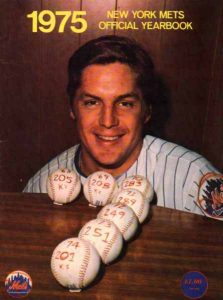 Tom Terrific, 1944-2020. There are and have been many avenues into loving this team, a team hobbled by expansion when they were born and perversely celebrated as lovable losers as they barely learned to crawl let alone walk. We understand imperfection. We revel in humanity. We root for the underdog because we fancy ourselves the underdog.
But then we got somebody who shattered every paradigm about what it meant to be the New York Mets and to love the New York Mets. Somebody who was as far from losing as first place was from tenth. Somebody who not so much flirted with perfection but set up shop just down the block from it. Somebody who was human, yes, but performed in a superhuman manner, leaving behind an indelible image of a pitcher and a person who could not be beat.
That ethos and ability took Tom Seaver to the major leagues, then to its top, where he stayed for the balance of two decades as an active player and then forever after as an immortal. Find me a better pitcher than Tom Seaver. I’ve been a fan of this sport for 52 seasons. I haven’t found one, though to be fair, I stopped looking after I found No. 41.
Seaver played baseball for as long as he could, then checked in and out of the game as he chose. After his retirement, we saw him both reasonably often and not nearly enough. He held a few titles as an emeritus Met, but living legend amply covered his portfolio.
Half of that all-purpose descriptor is gone now, with Tom a victim of complications from Lyme disease, dementia and COVID-19. We knew about how the first one brought on the second. I hadn’t heard anything about the third, but this is 2020, and when more than 180,000 of our countrymen have died from a virus, one or more is bound to be somebody you can’t believe could be ended. We couldn’t believe Tom Seaver had to retire from public life in the first place, in 2019. He was too strong, too much the champion. Nobody filled out the spot atop a pitching rubber like Tom Seaver. I don’t know jack about wine, but I’m sure nobody filled out a vineyard like Tom Seaver, either.
I came to loving the Mets in 1969. Tom Seaver was instantly my favorite Met of all time. All time has yet to expire where my affection is concerned. He was the best when the Mets were the best, and perhaps as a six-year-old that was all I needed to know. Soon the Mets wouldn’t be so much the best, but Tom never ceased, not as far as I could reckon. He won twenty games for us four times and five times overall. He won the Cy Young three times. He pitched in two World Series. He lifted us to our first world championship, the world’s least probable, earned to an Amazin’ extent on the right arm of the man observed by anybody with any sense of the game as the most likely to succeed. When the time came for his ticket to be stamped for Cooperstown, the process couldn’t have been more of a formality: 311 wins; a 2.86 ERA over twenty seasons; and 3,640 strikeouts translated to a 98.8% Hall of Fame approval rating, the highest any starting pitcher has ever drawn.
I’m always citing numbers with Seaver. I can’t help myself. They were so astounding to me, so far beyond what anybody else was posting. You can wake me up on Christmas morning, as the saying goes, and I can rattle them off: 16-13; 16-12; 25-7; 18-12; 20-10; 21-12; 19-10; 11-11; 22-9; 14-11; 7-3. Then 6/15/77. Then 4/5/83. Some numbers in between and thereafter for three other teams. Then 41 on the wall, 425 out of 430 votes from the BBWAA and, honestly, I can swim in those numbers for hours.
But you can look those up on Baseball-Reference or anywhere. Tom Seaver transcended his statistics. The professionalism. The striving. The striding. The knee in the dirt as he drove the ball toward home plate, to whichever spot he judged optimal for the achievement of an out. The fastball that blew as many as ten batters in a row away. The reimagining of his arsenal as he grasped that his inherent physical talents were diminishing. The Franchise, obviously. A man who showed up at Shea in 1967, refusing to suffer losing gladly. A man who put away his gear in 1987, declining to compete at a level that wouldn’t permit him every chance to win and win again. For a generation, he was the personification of winning. I knew it. His teammates knew it. The opposing batters knew it. Magnificence cross-bred with consistency leavened with the intensely cerebral and the indefatigably competitive. Oh, brother, Tom was more than terrific.
Terrific only began to say it. Yet it says so much.
|
|






