The blog for Mets fans
who like to read
ABOUT US

Faith and Fear in Flushing made its debut on Feb. 16, 2005, the brainchild of two longtime friends and lifelong Met fans.
Greg Prince discovered the Mets when he was 6, during the magical summer of 1969. He is a Long Island-based writer, editor and communications consultant. Contact him here.
Jason Fry is a Brooklyn writer whose first memories include his mom leaping up and down cheering for Rusty Staub. Check out his other writing here.
Got something to say? Leave a comment, or email us at faithandfear@gmail.com. (Sorry, but we have no interest in ads, sponsored content or guest posts.)
Need our RSS feed? It's here.
Visit our Facebook page, or drop by the personal pages for Greg and Jason.
Or follow us on Twitter: Here's Greg, and here's Jason.
|
by Greg Prince on 25 May 2025 2:28 pm All hail David Peterson, who lasted seven-and-two-thirds innings in the game that directly followed the Mets playing thirteen. On its face, that scans as a highly commendable effort, especially since the Mets won Peterson’s Saturday night start over the Dodgers, 5-2, but consider the context and ramp up your commendations. The face of contemporary baseball makes a pained expression at the suggestion that as many as thirteen innings would ever be played, what with phony-baloney ghost runners populating second base and the MLB-mandated intention of getting ties unbroken ASAP. And seven-and-two-thirds? In the mid-2020s, that rates as something out of the age of Iron Man McGinnity.
Iron Man McGinnity would likely scoff at the comparison. Joe “Iron Man” McGinnity completed 314 starts in a career that spanned 1899 to 1908 and led his league in innings pitched four separate times, tossing more than 300 innings in nine different seasons and more than 400 in two of them. His 314 complete games still rank as thirty-third all time.
David “Petey” Peterson isn’t challenging any of that, but he was iron enough for a staff whose eight relievers each saw action the night before. That’s eight relievers, which doesn’t even take into account all the starters who didn’t pitch. Iron Man McGinnity would have shaken his head in his dismay. His right arm might have fallen off while doing so, but he had his personal experience, and he seemed to have his everlasting convictions drawn from them.
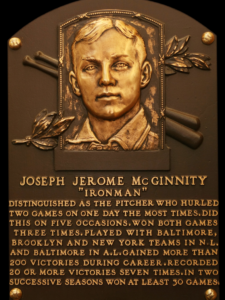 The David “Petey” Peterson of his time. Remarking on the use of mere ten-man pitching staffs in 1926, McGinnity couldn’t believe that iron men were no longer iron men the way they were when he was Iron Man: “This policy has had a psychological effect upon the pitchers. They have been influenced into the belief that they should not have to work without a long rest and that they can’t be effective without that rest.”
Balancing rest and effectiveness came into play after Friday’s 98-minute rain delay limited dependable Griffin Canning to two-and-two-thirds (McGinnity would probably scoff at that, too), when Carlos Mendoza saw fit to use every bullpen arm he had over the succeeding ten-and-two-thirds. One was left to wonder which modern-day manager between Mendy and Dave Roberts would have thrown the white flag rather than dip into his starter reserves had the game gone fourteen or, heaven forefend, fifteen.
Baseball games are designed to get extra innings the hell over with since 2020. It’s a fraud and a travesty and, for that matter, a fravesty. But that’s how it is, so when you get a thirteen-inning game for the first time since the last decade, and you are determined to use no reliever any longer than two innings (even though you don’t have to bat for any of them anymore, speaking of designated fravesties…no offense to new DH Jared Young), that’s how thirteen innings becomes an unfathomable burden on your pitching depth rather than just one of those things that add up now and then.
If we are to accept the notion that a thirteen-inning game today is the equivalent of no less than a seventeen-inning game from when the only way to have a runner on second was to have him reach base by his skills/wits/luck, then Peterson coming through to save Mendoza from plundering his bullpen two consecutive nights was an awesome achievement. David gave up only two runs early and set the stage for Edwin Diaz in his lately unhittable incarnation to do the rest. Brett Baty and Juan Soto — kindred spirits within the 22 club — provided most of the offense, and the Dodgers were summarily knocked off their defending world champions perch. We now trail an extended version of last year’s NLCS five games to three, even it’s not healthy to think of it in those grudgy terms.
by Jason Fry on 24 May 2025 1:48 pm Friday night’s game … goodness, where do you even start?
Let’s start with the weather. It wasn’t supposed to rain in New York, or at least not seriously enough to matter, but it’s done nothing but rain in New York all May, so if it isn’t doing that you check and see if it just did or looks like it’s about to. The skies had been pewter-colored and heavy all day, so I had my suspicions beyond the recent baseline paranoia.
When the rain did come, it was enough to drive Griffin Canning and Clayton Kershaw from the game and send a fireworks night crowd to seek cover. (And watch the Knicks on the JumboTron.) To be honest Emily and I didn’t particularly mind, as we’d just gotten off the highway in Brewster to find something to eat — from our perhaps selfish perspective the rain delay was both perfectly timed and of perfect duration.
Well, until we entered a cellular dead zone in an unfamiliar part of western Connecticut. Lots of twists and turns in the darkness, but no Mets. (At least Google Maps kept working.) When we got reception back four runs had scored — one for us, three for the Dodgers — and Max Kranick was plying his trade.
And the game was getting weirder. We’d heard (via Howie and Keith in the car, no Apple TV for us this time) the strange play where Michael Conforto tagged up after an odd near-collision between Tyrone Taylor and Juan Soto sent a ball briefly airborne before being corralled. The Mets thought they had an out because Conforto had left too early; in fact the rule is you can tag on first touch, not final possession.
If you knew that, congratulations: I didn’t, Howie and Keith didn’t, and at least half the players on the field didn’t. (We’ll let all the umpires involved take the fifth.)
Once we got reception back, the Mets cut the deficit to 3-2 on another strange play: Teoscar Hernandez threw Starling Marte out trying to score from third, but Marte was ruled safe on obstruction. Not on Will Smith, who’d tagged Marte out, but on Max Muncy, who’d never touched him. The ruling was that Muncy had obstructed Marte by getting in his line of sight with Hernandez. Who even knew that was a rule?
The Dodgers scored two more runs after that to leave the Mets down by three again and frankly things looked fairly hopeless, as Dodger relievers dispatched our high-octane, empty-tank offense with little fuss. But then the Mets did something very un-Mets-like in the ninth, rising up against Tanner Scott. With one out and runners on first and second, Jeff McNeil tripled in two runs, then was chased home on a Taylor single into the corner.
The game was tied … alas, we didn’t know it yet but that was the high-water mark of the night. Taylor played it safe and wound up with a single — which loomed large two batters later, when Brett Baty‘s single only sent Taylor to third. Luisangel Acuna had a chance to win it, but Alex Vesia lured him into swinging at a high fastball and we were off to extra innings.
Extra innings, the other side of midnight in New York, and certifiable bonkersness ensuing. The effect of the stupid ghost runner has been to end nearly all games in a 10th inning, but Friday night’s game turned apparently unwinnable, defying all efforts at being driven to a conclusion.
First came Edwin Diaz, who loaded the bases with nobody out and had to face Teoscar Hernandez, one of many Dodgers you may remember killing us in October. Diaz got a ground ball to Pete Alonso, who this time threw to the catcher instead of above the catcher, cutting down the go-ahead run at the plate. Diaz then got Muncy — another October tormenter — to hit into a double play.
The Mets couldn’t take advantage: Francisco Lindor and Soto failed in the 10th, and Alonso made the last out of the inning on a flyball that came within a whisker of being a homer run, which doesn’t count even if it’s really late and the fans just want to see fireworks and go home.
Reed Garrett was spotless in the top of the 11th; in the bottom of the inning the Mets had the bases loaded with two out, but Acuna came up empty once again, unable to beat out a grounder to third.
By now, sprawled on the couch at my in-laws in Connecticut (no Apple TV there either) I had dispensed with all my usual rituals — no bringing on the enemy pitcher, no urging the forces of good to just get on base. There didn’t seem to be a point: The game had entered a strange country, one impervious to both logic and superstition, and we were all being dragged along in its wake.
Garrett got through the 12th, despite Shohei Ohtani and Mookie Betts and Freddie Freeman (oh my); in the bottom of the 12th a Marte sacrifice put Mets on second and third with one out. Sensibly enough, the Dodgers intentionally walked Soto to face Luis Torrens (who was now playing first base, because of course). Torrens is one of the few Mets not afflicted with whatever malady has made the team allergic to getting big hits, but he grounded into a double play.
And then, in the 13th, it all came crashing down. The Dodgers scored twice; the Mets succumbed meekly, and I presume fireworks were the reward of the hardy souls who’d endured all that. Unless it rained again. Did it? You know what, I really don’t want to know.
by Greg Prince on 22 May 2025 12:50 pm “Thank you for sharing, Baltimore O, and thank you for offering Baltimore O your empathy, Pittsburgh P. Having to replace a manager so early in the season is always difficult. Remember, at Losing Baseball Teams Anonymous, we’re here to help one another without rendering judgment. Do you have anything you wish to add, Chicago WS?”
“Hi, everybody. I’m Chicago WS, and I’m a losing baseball team.”
“Hi, Chicago WS!!”
“I’m still going through some rough times, though not as rough as the times I was going through in 2024. I’ve been winning at about the same pace as I was last year…”
“Chicago WS, in these meetings, we’re not ashamed to use the L-word.”
“Very well. I’ve been losing at about the same pace as I was last year, but it doesn’t feel as bad as it did. I think it might have something to do with learning one of my fans recently got a new job leading one of the world’s major religions.”
“Hey, that’s great to hear about ‘leading’ from you rather than being behind most of the time. Let’s give Chicago WS a round of applause for a step forward, even if it doesn’t show up in the standings.”
“Yeah, thanks. Also, I don’t feel so bad about myself because I’m clearly no longer the biggest loser in the room.”
“Was that a shot at me?
“OK, Colorado R. You have the floor.”
“Hi, I’m Colorado R, and I’m a losing baseball team.”
“Hi, Colorado R!!”
“Um, it’s been kind of a difficult period. I’m 8 and 41 at the moment. And, yes, that’s worse than Chicago WS, or anybody else here.”
“How does that make you feel, Colorado R?”
“Less than mile-high, to be honest. I thought that playing where I do, the elevation would lift me up or at least give me some kind of home-field advantage. It hasn’t really worked out that way.”
“The important thing, Colorado R, is you maintain your self-esteem. You mentioned elevation, as if there are times you feel above it all. That’s positive. Chicago WS says he has some sort of religious figure on his side. Do you have anybody like that you can point to.”
“John Denver wrote a really nice song years ago. When I stand on the mound, I can relate to seeing it raining fire in the sky.”
“That’s super. Everybody, we have someone new at our meeting tonight. Please welcome him.”
“Um, hello.”
“We all introduce ourselves to the group.”
“Oh, sorry. Hello, everybody. I’m New York M.”
“Hi, New York M!!”
“Hi. For the last week, I’ve been a losing baseball team.”
“New York M, why don’t you tell us more?”
“It all started last week when I stopped hitting. I mean cold. I pitched OK most of the time, but the hitting was basically a cold turkey situation.”
“It’s hard to try to quit all at once. One day at a time, brother.”
“Every day was a day not to hit for me. No hitting with runners on base. No home runs whatsoever. Every long fly ball I hit would have been out of every ballpark in the majors except whichever one I happened to be in, and every long fly ball I gave up would have been an out except for where I was actually pitching.”
“Don’t feel ashamed, New York M. The important thing is you keep trying.”
“I have to confess there were times I didn’t really feel like trying. I’d jog more than run. Everybody noticed that I was moving at half-speed. It was all very discouraging.”
“We’re here to help you. Sacramento A, did you have something to say?”
“It’s just ‘A,’ now.”
“Sorry, ‘A’.”
“No problem. First off, welcome New York M. Second, I’m sorry if you’re having to get used to a minor league ballpark.”
“Oh, no. That’s not a problem for me.”
“Lucky you.”
“Can I chime in on this?”
“Of course, Pittsburgh P.”
“Welcome, New York M. It must be difficult to compete with such a limited budget.”
“No, my budget’s ample. More than ample, actually.”
“How much more than ample.”
“Amply more.”
“How your stadium view?”
“It’s OK.”
“Yeah, well mine’s SPECTACULAR.”
“Pittsburgh P, we’re here to be supportive, not combative. Miami M, do you have something to say?”
“New York M, are you suffering from a chronic lack of fan support or interest?”
“Not at all. I’ve got lots of fans coming out to see me. When I’m home, pretty much everything is great.”
“How about rain delays? ’Cause I haven’t had any rain delays since 2012.”
“It rains sometimes where I am.”
“Well, I’ve got a roof, and let me tell you, when my fans show up, they don’t get wet. Four-digit gates and no umbrellas needed. Put that in your pipe and smoke it!”
“Supportive, people…”
“May I ask a question?”
“Of course, Los Angeles of Anaheim A.”
“It’s just Los Angeles A.”
“Sorry about that. It’s hard to remember from one of your names to the next.”
“Not really, but anyway, New York M, if I may be blunt, what are you doing here?”
“The sign outside said all are welcome.”
“I know what the sign says. I’ve been looking at that sign for years. Everybody in this room is a losing baseball team with chronic or deep-seated difficulties. Me, I never go to the playoffs and you can see that nobody quite knows where I play.”
“Oh, I don’t have that problem. I went to the playoffs just last year. It was a lot of fun. And I think people know where I play.”
“In that case, New York M, and I don’t mean to be judgmental, but it doesn’t sound as if you have it so bad.”
“Well, I did lose three in a row, and five of six. And I wasn’t kidding about the lack of power-hitting or hitting of any kind.”
“So you fear this is the beginning of a long-term downward trend?”
“I don’t know about that. I mean I won my most recent game in pretty rousing fashion. I hit with runners on base for a change, I hit a ball over a very tall wall, and I shut down the opposition quite effectively.”
“Point of order?”
“Go ahead, Colorado R.”
“New York M, these meetings are for baseball teams that are truly down in the dumps. Do you understand in 2025 what it means for a baseball team to be truly down in the dumps?”
“I was a little off stride. It felt weird.”
“Did it feel 8 and 41 weird?”
“God, no, I’m 30 and 20.”
“New York M, with all due respect, you don’t belong in this room.”
“I don’t?”
“I have something to say to New York M.”
“Go ahead.”
“Hi, everybody, I’m Tampa Bay R. That’s Tampa BAY R. I know you guys are always calling me TAMPA R, but I identify as Tampa BAY.”
“Yes, Tampa Bay R. What do you have to say to New York M. This is a safe space.”
“New York M, I don’t even play in my own stadium anymore. It was practically destroyed in a hurricane. I play in a Spring Training stadium with the most loathsome name imaginable. Like Miami M, there never seems to be a whole lot of reason for my existence if you look at attendance figures. Like ‘A,’ I don’t know where I’ll be in a couple of years.”
“Um, I told you. I’ll be in Las Vegas. Sweet new ballpark they’re gonna build for me right on the Strip.”
“Sure. What I’m saying, New York M, is if you don’t have these identity issues, and you do have a lot of fans showing up to see you, and you’ve been in the playoffs lately, and you have your own big league ballpark, and apparently a sizable payroll…”
“Between you and me, it’s huge.”
“AND you’re — how many games above .500?”
“Ten.”
“All due respect, New York M, what in the name of Al Lang are you doing here?”
“I get what all you fellas are saying, and I don’t mean to intrude on what you’ve got going on in here. It’s just that when I do lose in small, concentrated, intense doses, I seem to inspire a lot of kvetching.”
“Qu’est-ce que c’est ‘kvetching’?”
“Huh?”
“Our legacy international member Montreal E wants to know what you mean by kvetching”
“You know — kvetching. Griping. Complaining.”
“Ah, oui.”
“The kvetching when I have a bad week makes me question who I am. But maybe that week is over. Like I said, I just won. Did I mention the score was 5 to 1?”
“You didn’t, but thanks for the detail, New York M. I will take the bold step of speaking for the group when I say your feelings are valid, and we respect the emotional turbulence you’re currently experiencing, and we truly wish you well. But I have to agree with what others have said. Maybe you’d feel more comfortable working on your self-esteem issues by simply playing your next series and seeing how that goes.”
“My next series is against Los Angeles D.”
“Good luck with that. Meeting adjourned.”
by Jason Fry on 21 May 2025 8:04 am Savor this.
That’s always the warning when your baseball team is playing taut, crackling ball at a pinch me level. It seems inconceivable, but the good times will end. The hits will stop falling in, balls will start just eluding gloves, relievers will enter jams and emerge scathed. Baseball’s karmic wheel will turn and somehow joy will become dismay.
We never really believe it. Surely this incarnation of the team — these hard-working, plucky, never-say-die boys, all them patriots who wear clean underwear and love their mothers — has found a formula for walking on water, and why would anyone give up a method of transportation so novel, daring and so just plain fun?
And then somehow one goes from the surface of the lake to beneath it, sputtering and thrashing.
The Mets, until recently the stuff of ready smiles and jaunty steps, are now unwatchable. The hitters have two modes: no luck and bad luck. Without an offense, the rest of the machine is either inert or breaking down. Tension has crept into the postgame pressers, with the reassurances taking on a certain Baconesque flavor. Fans like us are muttering and sighing and wondering — once again — how any people can endure such misery.
On Tuesday, the Met bats actually showed some signs of sizzle — impressive exit velos were credited to the likes of Mark Vientos, Brett Baty, Brandon Nimmo, Juan Soto and Pete Alonso. But the trajectories were almost invariably tragic — balls zipping straight into the gloves of Boston Red Sox positioned where you didn’t want them to see them. That was true against Walker Buehler before his early ejection, and true against the six relievers who followed him — four of them relievers the Mets hadn’t been able to touch on Monday night either. It added up to a grand total of zero runs scored, which made a loser out of Clay Holmes for the sin of surrendering a pair of solo shots over the Green Monster. The only moment of the game one wanted to remember — if you don’t count soft-glow Fenway nostalgia — was a seed of a throw by Nimmo to nail Nick Sogard at the plate. Those five seconds? Pretty awesome. The other two hours and change? Not so much.
I know it seems impossible to believe right now, but the Mets will be fine. Their current three-game losing streak is the first time they’ve lost three straight all season, a deal you would have signed on for in a heartbeat if offered it in March. Statistical oddities will even out and ebbs will transform into flows. Balls will find grass and postgame press conferences will come without heavy treads and thousand-mile stares. The wheel will turn again and these days will be either remembered with shrugs and shakes of the head or happily forgotten.
Just don’t ask when. It doesn’t work that way — never has and never will. All we can do is endure.
by Greg Prince on 20 May 2025 11:18 am The Mets haven’t lost more than two consecutive games all year. But they sure do pack a lot of defeat into their brief losing streaks.
Sunday…yeech. Monday… more of that. The back-to-back scores — 8-2 and 3-1 — were dissimilar, but the trajectory duplicated itself. Mets fall behind. Mets stay in it. Mets loiter in it. Mets lose. Mets fan asks, “What has been done with my heretofore awesome team, and when it will it be returned to its formerly pleasing state?”
In the chilly state known provincially as the Commonwealth of Massachusetts, the Mets appeared all but invisible versus the Red Sox, probably because they didn’t show up until after their presence was kindly requested. They certainly didn’t show themselves to be a first-place team, which made sense, given that by the end of the evening’s Phillies business, they had slipped into second. Kodai Senga got to pitching like Kodai Senga a little late. As with David Peterson the night before in New York City’s northernmost borough, he shook off early runs and acquitted himself well over the relative long term, but maybe next time give up absolutely nothing from beginning to end, because your hitters are hardly going to help you at all.
Pete Alonso didn’t hit a home run. Juan Soto didn’t hit a home run. No big whoop on either slugger, except they each thought they hit home runs and responded accordingly, as in not sprinting their backsides off for a few precious feet until they knew for absolute certain their respective balls had soared clean out of sight…which they didn’t. Those are big “whoops!” Perhaps they’ve heard of that very tall green wall in left field that prevents home runs as a matter of course, so maybe don’t assume the long, high fly ball you’ve struck is Lansdowne-bound. As the old saying goes, when you assume, you either get thrown out at second desperately trying to stretch your distant single into a double (Pete) or you have to grab the extra base on a steal after casually settling for your Monster single (Juan). Either way, no runs involving those fellas at Fenway.
Besides not dashing with urgency, the top of the order, including Francisco Lindor, was stuck in place altogether. Soto gave an unsatisfying answer about his concept of hustle after the game. Alonso made an unfathomable throw over Senga’s head during it. The A&S Boys will come around. Lindor, too. It’s just hard to watch while they stall as a unit. To seek solace, you had to travel to the bottom of the order, which was highlighted by Francisco Alvarez and Tyrone Taylor creating the Mets’ only run, in the third, which cut the Red Sox’ lead to 3-1. That two-run deficit yawned clear to the final out. Kodai eventually made his start quality (6 IP, 3 ER), and the newest bullpen lefty, Jose Castillo — the franchise’s twenty-first Jose and fifth-ever Castillo — debuted without a run allowed in the eighth. The franchise’s fifteenth Jose and thus far one and only Butto pitched unscathed as well. As on Sunday, the Mets nurtured the illusion they could rally. Sunday the illusion shattered via the other team’s six-run eighth. Monday it got caught in a gust and wafted away.
Amid the Mets’ last ups, Carlos Mendoza pinch-hit Starling Marte for Brett Baty. Aroldis Chapman was on for the save by then, and it was noted on SNY that Marte was 5-for-15 lifetime versus Chapman. Sure enough, Marte singled. Sure enough, he was erased on a game-ending double play, because this is the world’s grindingest two-game losing streak, but I mention the switch and its success because the manager saw an opportunity and took advantage. I don’t remember the Mets hitter and opposition pitcher from Mickey Callaway’s tenure, but the Mets one weeknight in 2018 or 2019 were facing somebody against whom some Met reserve had outstanding numbers over something like twenty at-bats, yet Callaway didn’t put him in the lineup. Mickey eschewed the small sample size as not a valid reason to play his one potentially hot hand. The inevitable eschewing of Mickey couldn’t come soon enough.
In Boston, where the gale-force winds have been howling hard, the Mets could use some hot hands. They’re pretty fricking cold right now, and it ain’t pretty. An icy Sunday. A frigid Monday. Though it’s only two games, the sample size feels larger, probably because this is their fourth two-game losing streak over the past three weeks. Losing in tiny, recurring clusters certainly beats losing without interruption, but it still involves a bit too much not winning. You don’t have to assume that’s a drag. You’ve felt the Mets dragging for yourself.
by Jason Fry on 18 May 2025 11:38 pm As it turned out, the Mets played one classic in the first leg of the 2025 Subway Series, sandwiched by a pair of duds.
Sunday night’s finale, narrated by an irritating ESPN crew that licked every Yankee uniform until it was shiny and clean, looked like it was in the running to be a classic for a while — it was 2-2 going to the bottom of the eighth, though the Yankees had collected their two runs in supremely irritating fashion against David Peterson back in the first.
Peterson endured this sequence: error by Mark Vientos, flyout, a little slice by Aaron Judge that went for a ground-rule double, grounder to first that Pete Alonso couldn’t handle because he was playing in and so also went for a double. After facing four batters Peterson had done nothing wrong but was down 2-0.
The Mets put together good ABs against Max Fried, who’s always struck me as vaguely dissolute looking, with the furtive, weaselly mien of a back-alley hood known for hot-wiring beater cars. (Given Fried’s employment as a Brave and then a Yankee, I’m sure there’s no bias at work there — nope, none at all.) The Mets nicked Fried for a run in the second and another in the fifth, with the latter coming home on a wild pitch with Juan Soto standing at the plate.
I’m obligated to note for the record that Soto did not have a good game — he loafed it up the line on a ball to the infield that the Yankees mishandled, overthrew a cutoff man, and generally looked less than fully engaged. It’s not worth making a federal case out of, but it wasn’t ideal. At least Soto’s night was better than home-plate ump Adam Hamari’s — Hamari’s strike zone had a little extra curl on the outside corner, which victimized Starling Marte and Trent Grisham; he also punched out Clay Bellinger on a pitch that was clearly inside and blew a key pitch against Brandon Nimmo. The kindest thing one can say is that Hamari was equitable in being terrible at his job.
Anyhow, with the game out of the starters’ hands after six it was time for reliever roulette. The Mets couldn’t do anything with Jonathan Loaisiga (who stuff looks like he never left) or Devin Williams; Huascar Brazoban somehow pulled a Houdini act to escape the seventh but Ryne Stanek wouldn’t be so lucky in the eighth.
As fans our routine lens for viewing a loss is that our guys failed, sometimes accompanied by a moral judgment we think explains that failure. So let’s be fair in chronicling the eighth: The Yankees put together terrific ABs against Stanek, forcing him to work deep counts and ending up with second and third, one out and rookie Jorbit Vivas at the plate.
That might have seemed like a mismatch, but Vivas battled Stanek for 11 pitches, hanging in there against 100 and 101 MPH gas. As the AB ground along I was screaming for Stanek to go back to the splitter, as Vivas clearly had the fastball measured; Stanek didn’t do that but did get the outcome he wanted, a groundball to Alonso playing in.
Against the speed of Jasson Dominguez Alonso had to hurry. He did so, and threw the ball over Francisco Alvarez‘s head before you could say “Duda to d’Arnaud.” That put the Mets a run behind, Paul Goldschmidt singled in a second run, and the Mets summoned Genesis Cabrera.
A while back Jeremy Hefner discussed Cabrera (whom he inevitably referred to as “Cabby”) as a project similar to Brazoban last year, with the Mets having to essentially rebuild him after neglect and misfortune elsewhere, starting with convincing Cabrera to trust his stuff. That’s worked better than we would have bet with Brazoban, so we should take the long view and be patient with Cabrera’s progress, or lack thereof. But patience isn’t the same as liking what happened Sunday: Cabrera walked Grisham, took advantage of a rare overly aggressive AB from Judge to strike him out, and then yielded an all-she-wrote grand slam to Bellinger. It would have been a flyout in a park with dimensions not suited for a flea circus, but that’s sour grapes: The fences were the same distance when the Mets were hitting, and they didn’t hit a single ball out of Yankee Stadium this weekend.
And so the series ended on a sour note, with bad fundies bookending a reasonably taut middle. The Yankees scored eight runs, four of them unearned, and now I never want to think about this one again. For Pete’s sake, fellas!
by Greg Prince on 18 May 2025 3:39 pm Who could or would be happy that the Mets beat the Yankees in the Bronx on Saturday? Us, obviously. The Mets beating the Yankees is a thing for us. We’re Mets fans. We like when the Mets beat anybody. We especially like the Mets beating the Yankees.
We like Griffin Canning, he of the 2.47 ERA, continuing to start games the Mets win; it’s probably not a coincidence that that happens. Griffin gave up only two solo home runs (one that could have been featured in one of those SNY salutes to local little leagues) over five-and-a-third.
We like Huascar Brazoban bailing out Canning from his spot of trouble in the sixth and then taking care of that inning and the next one. Brazoban’s in that splendid middle relief zone where his praises are sung after each effective outing, yet because of the nature of his role, we tell each other he’s unsung.
We like Juan Soto, baserunner, a character we didn’t know Steve Cohen was paying for. When the opposition isn’t paying attention — turning their back to him, you might say — Juan swipes a bag. It’s like something out of Daniel Murphy’s sack of invisible tricks. Saturday, as he stood on second following Pete Alonso’s RBI single in the fourth, Juan thought it would be better to stand on third. He was right, for soon, after he stole third, he was able to run home on Mark Vientos’s sac fly to left.
We like Reed Garrett, the Met whose face-camouflaging beard complemented that otherwise atonal Armed Forces Weekend cap, squirming from a jam like he holds a grudge against Smucker’s. Walk the leadoff hitter in the eighth? Get a double play grounder. Load the bases by sandwiching a double around two more walks? End the inning by eliciting a lineout from DJ LeMaheieu (who hit that fly ball earlier that cleared the backyard fence in shortest right).
We like the good eye from Luis Torrens, who knew enough to take ball four in the top of the ninth, and the good sense from Carlos Mendoza to pinch-run Luisangel Acuña. After Acuña makes his way to third, he scores on a not terribly deep fly ball Francisco Lindor lifts to left field, giving the Mets a 3-2 lead. Luisangel’s baserunning isn’t stealth à la Soto’s. It’s understood he’s to be noticed on the basepaths, yet his ability still carries the potential for delightful surprise. We like that, too.
Oh, and we really like Edwin Diaz when he’s not in hang on, Sloopy! mode. Charged with protecting a one-run lead in the bottom of the ninth, there was little sense of screwing around. A strikeout on a full count to Austin Wells. A lineout of Ben Rice. And then, just that Aaron Judge fella. The Mets-inclined viewer would be grateful for anything that wasn’t a tying home runs Edwin works Aaron to three-and-two before blowing a fastball by the swinging superstar.
We like Mets 3 Yankees 2 on a Saturday afternoon. A lot.
Who else might like it?
I’d like to think Jim Marshall might like the Mets having beaten the Yankees on Saturday afternoon. Jim Marshall is the oldest-living Met. On May 25, Jim is scheduled to celebrate his 94th birthday. Something about being born in May seems to agree with Met longevity. Yogi Berra, who made his birth necessary on May 12, 1925, lived to 90. Willie Mays, who first said “hey” on May 6, 1931, made it to 93. Marshall didn’t have their careers, but he was in the lineup for the very first New York Mets game, on April 11, 1962, and he is the sole survivor from the night the franchise came kicking and screaming into the National League (Cards 11 Mets 4). When the Mets were in Phoenix a couple of weeks ago, the Diamondbacks facilitated an on-field celebration of Jim’s status as the Oldest Living Met. As Marshall, who has lived a helluva baseball life, said to Bob Nightengale in an engaging USA Today profile, he always dreamed of “being No. 1. Well, I finally made it.”
I’d like to think Ralph Kiner might have liked the Mets beating the Yankees on Saturday afternoon. Of course he would have. Ralph was in the booth for that very first Mets game and so many more. He was in the Channel 9 booth alongside Tim McCarver and Gary Thorne for the first regular-season Mets-Yankees game in 1997, and he sounded pretty stoked at the way Dave Mlicki was shoving that magical Monday night. Ralph’s spirit was in if not on the air this past week when the Pirates were in town, and the Mets arranged a meeting between Ralph’s son Scott and their somewhat distant relation Isiah Kiner-Falefa. It was all too perfect not to happen. Kiner-Falefa, now Pittsburgh’s shortstop, had been to exactly one randomly chosen Mets game as a kid, in 2007. It was Ralph Kiner Night, and the kicker was the youngster had no idea such a ceremony was going to take place when he showed up at Shea that Saturday. Or was the kicker that Kiner-Falefa made like Kiner on Monday and homered for the first time all year, in the same ballpark where Ralph’s name and microphone hangs from the rafters, shortly after his family reunion with Scott, whom he’d never met until it happened in Flushing? The Mets won that game, permitting a Mets fan to gin up enough grace to actually enjoy Kiner-Falefa’s unlikely trip around the bases in retrospect…once that Mets win went final.
I’d like to think that if it got his attention, Jim Gosger might have liked the Mets beating the Yankees on Saturday afternoon, though the 83-year-old former outfielder could be forgiven for having another sporting event filling his focus. Gosger, who played bit parts for the 1969 and 1973 Mets, okayed the use of his name for a racehorse that was running in the Preakness. It’s a sweet story, told in detail here, but the bottom line is that Gosger the horse, who went off with long odds, finished in the money at Pimlico, coming in second to Journalism. Journalism tells sweet stories in detail, too. The detail that stays with Mets fans in modern times regarding Gosger the ballplayer is that in 2019, at Citi Field’s fiftieth-anniversary celebration of the Miracle Mets, Gosger was honored in the club’s In Memoriam reel. Jim was quite surprised, given that he was alive and well and living in Michigan. Still is.
I’d like to think one of Gosger’s 1969 teammates liked the Mets beating the Yankees on Saturday afternoon, and based on recent evidence, I’m guessing it totally got his attention. On the podcast called The Terry Collins Show, co-host John Arezzi conducted a blessedly long interview with 80-year-old Ron Swoboda. Ron wasn’t promoting anything except stories of his time playing for Gil Hodges and his time before that playing for Casey Stengel and anything Arezzi asked him about. Swoboda, as ever, was deep and thoughtful and generous with his reflections. The discussion was recorded very early this season, which you can tell, because Rocky offered observations about every Mets game he’d been watching down in New Orleans, which seemed to be all of them. You love knowing a Met (who played a little for the Yankees) is still so attached to the Mets. You love hearing the excitement of a kid from 1966 who grew up rooting for Swoboda getting to talk to him at length. Arezzi with Swoboda is a treat for the ears on your favorite podcast platform, and is available for watching on YouTube.
If he wasn’t preoccupied by ramping up for his umpteenth major league comeback, I’d like to think Rich Hill liked the Mets beating the Yankees on Saturday afternoon. Rich Hill was a Met in 2021, which means he played with a few of the Mets who helped beat the Yankees, which is all well and good for the record, but I hold Hill in esteem for emerging at this late date as the LASPSA: Longest Ago Shea Player Still Active. As noted last September, when he had just pitched in relief for the Red Sox at Citi Field, Rich Hill took the mound at Shea for the Cubs in 2005. Clayton Kershaw is off the IL for the Dodgers; he pitched at Shea in 2008. Max Scherzer is on the IL for the Blue Jays; he pitched at Shea in 2008. But Hill, whose 45-year-old left arm just signed a minor league deal with the Royals, has them both bested in terms of longevity Sheawise and earthwise. Rich was born before either of those future Hall of Famers and not only pitched in our old ballpark before either of them, he did so when there wasn’t as much a stake in the ground for the ballpark that would replace Shea. Judging by Kansas City trusting in his timelessness, there’s no replacing Rich Hill on the major league radar.
If he took a glance at the out-of-town scoreboard, I’d like to think Jacob deGrom like the Mets beating the Yankees on Saturday afternoon. DeGrom, suddenly verging on his 37th birthday, is actually healthy again and pitching like he’s always pitching when physically unencumbered. This past Thursday, he dueled Hunter Brown of the Astros, topping him, 1-0. Jake went eight for the Rangers win in Arlington. Brown also went eight, which gave him a complete game loss, something you hardly see anymore. MLB Network was showing this game, which I didn’t necessarily plan to watch, but I turned it on in the sixth, with the sound down, and found myself absorbed by deGrom being deGrom again. Struck out seven, walked one, scattered five hits, made me think of 2018 through 2021 when Jacob deGrom of the New York Mets was the best pitcher on the planet, and he was lucky if his teammates gave him as much as one run to work with. It suddenly became very important to me on May 15, 2025, that deGrom get this 1-0 win for Texas, a little like on the night of May 14, 1996, when I rooted for the Yankees to prevail for the first and only time in my life, because that was Dwight Gooden on the mound for them throwing a no-hitter. I have nothing against the Texas Rangers, not even them luring deGrom away with a contract not even Steve Cohen was of a mind to match, so this presented no inherent conflict of interests. If anything, it reminded me of what we had when we had deGrom. It seems long ago enough now that I could probably convince myself Jake pitched for us at Shea, maybe against Rich Hill.
Finally, I know Brooklyn’s own Mike Lecolant would have liked the Mets beating the Yankees on Saturday afternoon. Mike was a big Mets fan, albeit with the asterisk that he didn’t quite despise the Yankees the way most of us do. I went to one game with Mike, a fabulous night in 2019, when he explained his family had rooting interests that spanned the boroughs, so while he was a Mets fan the way I was a Mets fan, he simply wasn’t the same kind of Yankee-hater. He even cherished a childhood memory connected to his favorite Yankee, Carlos May. Carlos May — why Carlos May? If I remember correctly, he was taken to Bat Day at the Stadium, and that’s whose model bat Mike was handed. He could be a loyal guy that way.
 Mike Lecolant, a terrific Mets voice. Mike was someone I knew from being on a podcast he hosted alongside two other really good guys, Sam Maxwell and Rich Sparago. I was essentially their go-to guest when they couldn’t find anybody else, and we always had a good time. Mike got three of the four of us together on a Saturday night six years ago for a game at Citi Field through a connection I had no idea he had. Mike was related to the Cora brothers, as in Alex and Joey Cora. Alex played for the Mets in 2009 and 2010 and went on to manage the Red Sox to a world championship. Joey, also an experienced MLB player, became a respected third base coach, eventually for the Mets under Buck Showalter. In 2019, this Cora was with the Pirates, and the Pirates were on the schedule for us. Joey offered Mike tickets in the visitors’ family section, and Mike invited me to join him. I said yes.
It was a great night of Mets baseball and Mets baseball talk. I learned about the Cora connection. I learned about the Carlos May connection. I learned Mike was a warm human being beyond the persona he offered as a podcaster. On those pre-Zoom conference calls, he addressed every topic in full paragraphs, with genuine authority. Not a know-it-all, just somebody who would give whatever he was asked real thought, and then express his belief without equivocation. He was always willing to listen to differing opinions and respond respectfully — he shifted seamlessly from monologue to dialogue — but I admired that he had what he was going to say figured out and could express it without any hint of artifice. Mike the podcaster didn’t put on.
On our Saturday night at Citi Field, Mike the Mets fan who didn’t despise the Yankees was plenty easygoing, a pleasure to spend nine innings in the company of. I told him I was sort of in awe of the voice he presented. He was shocked that anybody noticed. He swore he wasn’t aware he was doing anything special. I’m glad I could communicate to him that communicating Mets and baseball thoughts to others with authenticity and élan was a gift in our world, and that I appreciated the way he went about delivering that part of himself. I could say the same for his writing, which he pursued under the guise of the Brooklyn Trolley Blogger. Mike covered the waterfront of New York sports, past and present, and he wrote on the Web like he talked on the pod. Check out his tribute to his youthful idolizing of Tom Seaver. If you thought you’d read everything there was to read about how a Mets fan might miss Tom Terrific nearly five years ago, you’ll find out you still maintain untapped emotions.
As Mike wrote in September of 2020, “Time has no mercy. We know this well. We’re just never ready for news like this. It needs a moment to sink in, then in rushes the heartbreaking sense of loss.” That was Mike Lecolant on Tom Seaver. It also described what it was like for me to learn that Mike Lecolant died earlier this month at age 58. I suppose I knew it was coming. Mike contacted me on the eve of the 2022 season to tell me had been diagnosed with ALS. He wasn’t telling me out of any sense of self-pity, but because now, while he had time and was still able to do some things, he had a few questions about researching a baseball topic close to his heart and maybe putting together a book. I offered a few thoughts, and he thanked me. I’d be on A Metsian Podcast with him a couple more times after that. His literal voice was still strong the first time, not so much the last time.
When Sam let me know of Mike Lecolant’s passing on May 7, it wasn’t surprising, but it still packed a punch. Knowing it was coming didn’t soften the blow. But knowing Mike through his felicity with the spoken word and the written word, not to mention quite a few friendly words between us, was a blessing. I’m happy the Mets beat the Yankees on Saturday afternoon. I’m happy I knew Mike Lecolant. I’m happy Mike Lecolant found room in his heart for both Tom Seaver of the Mets and Carlos May of the Yankees. Any time is a good time to count various blessings.
by Jason Fry on 16 May 2025 11:19 pm Tylor Megill looked Niesean Friday night against the Yankees. If you know me and/or are a long-time reader, you know that’s pretty close to a deadly insult.
Megill suffered some bad luck along the way to giving up four earned runs in 2 2/3 laborious innings in the Bronx: In the fatal third inning (which took an interminable 27 minutes that felt like 27 days), Clay Bellinger hit a little roller that was too slow for Mark Vientos to turn into an out, followed by a Sotoesque (Luis, not Juan) billion-hopper up the middle by Paul Goldschmidt that brought in the first two enemy runs. But it wasn’t all bad luck: Megill also walked five guys, including the first and last Yankees he faced. And most damningly, nothing he throw seemed to have conviction behind it. To my admittedly annoyed eyes, he kind of trudged around while bad things happened, waiting for someone to tell him he was excused.
Disappointing, to say the least — Megill had looked like he’d figured something out and was finally harnessing his considerable talent, famously telling Jeremy Hefner in spring training to opt for tough love: “If I was pitching like shit, I wanted him to yell at me.” Tonight, he looked like Niese, the Alibi Ike of the 2010s Mets, who never met a bit of bad luck he couldn’t make into an excuse for why he’d fallen apart. (By the way, did you know Niese is only 38?)
Anyway, Megill pitched like shit and so hopefully Hefner will do as he was directed down in Port St. Lucie.
The rest of the game wasn’t particularly worth noting: With the Yankees out to a big lead and the Mets continuing to look flat, both teams pretty much went through the motions the rest of the way. And the Mets do look flat all of a sudden: I was at Wednesday night’s soggy sleepwalk and was so disgusted that I left after five, which I don’t think I’ve done since a 1999 debacle that saw Matt Franco take the mound. I’ll put up with dreary conditions and I’ll put up with dreary baseball, but it turns out I won’t put up with both.
Back to Friday, when much was made of Yankee fans booing Juan Soto in his return to the Bronx. But that struck me as performative New York sports opera, a fan molehill that the usual sports-talk grifters will make into a mountain. The Mets’ teensy moral victory was forcing Aaron Boone to call on closer Luke Weaver, which happened after Yerry De Los Santos pitched timidly with a five-run lead. Keith Hernandez and Ron Darling were disgusted with De Los Santos, and they weren’t wrong; I bet Boone wasn’t particularly pleased either. Maybe those Weaver pitches that shouldn’t have been needed will come into play during the rest of the series, but that seems like cold comfort now.
Oh, and everybody was forced to wear dumb-looking hats for Armed Forces Day Weekend. I don’t know how a day can also be a weekend, and I also don’t know how looking terrible shows support for a worthy cause. But now I’m making my own mountains out of molehills. That’s what happens when you’ve been forced to spend the evening thinking about Jon Niese.
by Greg Prince on 15 May 2025 2:49 pm If you were curious as to what a 2025 New York Mets lineup that doesn’t feature Juan Soto would have looked like, you got a glimpse Wednesday night at Citi Field. Carlos Mendoza rested his right fielder, the fellow who’s batted second every game since Opening Day, the guy who — whether he’s raking or not — changes the complexion of the top of the Met order by his mere presence. Just a night off, the manager said, followed by a teamwide off day, followed by the road portion of the Subway Series, where Juan will be greeted loudly if not universally warmly. One full game sat approximately every quarter-of-a-season seems reasonable. Only Felix Millan in 1975 and Pete Alonso in 2024 never missed a Mets game. Heck, even the immortal Chris Majkowski, who produced 5,010 consecutive broadcasts from August 1993 to just the other day, is briefly sidelined from the Audacy Mets radio booth.
Sitting Soto didn’t seem helpful to the immediate goal of sweeping the Pirates, but in a long season, everybody merits a breather and, more importantly, everybody who usually sits needs to play now and then. Plus, if we can be a bit haughty about it, you shouldn’t have to deploy your entire “A” team to beat the Buccos. Pittsburgh entered Wednesday’s action at 14-29, on their second manager of the year. We were 28-15, sporting the best record in all of baseball, tied with the Tigers and a half-game better than the Dodgers. Most relevantly, we were three up on the second-place Phillies in our division. If you were ever tempted to gently lift a pinky toe from the gas pedal, this was a prime opportunity.
Jose Azocar played in Soto’s stead. Jose Azocar almost never plays, unless it’s to run for a less speedy Met. I don’t think this upfront substitution was entirely the reason the Mets didn’t win one game on one rainy night in May, but I wouldn’t do this again if I could help it. Nothing against Azocar. Good teams need pinch-runners, and pinch-runners oughta test the rest of their skill sets against live competition so they stay fresh for when called on to be complete players. Someday, you might need Azocar to do something besides stretch his legs.
Maybe do it in left or center field next time, though.
Wednesday, without Juan, the Mets lost, 4-0. It wasn’t as simple as going Sotoless, nor should the defeat be directly attributed to Azocar. Jose trapped rather than caught a ball in right; got picked off after drawing a walk; and flied out with the bases loaded to end the only genuine Met threat of the night, but he’s not the one who made the ball slicker than preferred for Clay Holmes, and he’s not the one who may have squeezed Holmes on balls and strikes, and he’s not the only one who didn’t drive in any Mets.
It was an uncommonly blah 2025 Mets game. Sitting out any further dwelling on it seems the wise move.
by Greg Prince on 14 May 2025 2:18 pm The 1986 Mets were so good that they couldn’t be stopped by a ball landing in a glove; the ball staying in the glove; and the glove and the ball being tossed as one to record a putout against them. All of that happened when Keith Hernandez grounded a ball back to Giants pitcher Terry Mulholland. Mulholland, then a rookie, simply could not extract that little white devil from his brown leather. Thinking fast, he took the whole package and threw to it first baseman Bob Brenly. It was legal. It was effective. Hernandez was out.
Mulholland: “I tried three times to get the ball out of my glove. Finally, in desperation, I just threw it.”
Hernandez: “That was a first for me.”
Davey Johnson added that he thought about arguing the call with first base ump Ed Montague, “but I didn’t know what to argue about. I figured the play was funny enough without me arguing.”
We could laugh about it after it happened, at Shea Stadium, on September 3, 1986, because a) the Mets were already ahead of the Giants when the play took place (up 2-0 in the third); b) the Mets added a run in the very inning the play took place; c) the Mets went on to win the game by a score of 4-2; and d) the Mets were in first place by twenty games. Baseball bloopers in which your team is the one getting blooped can be amusing when they don’t hurt whatsoever.
The 2025 Mets are good enough right now that they weren’t stopped Tuesday night at Citi Field by a ball whooshing through a glove. The ball was hit by an opponent. The glove belonged to one of their own players. The slo-mo replay confirmed it was worse, or at least more embarrassing, than it appeared. It extended an inning that should have been over, led to a starting pitcher who deserved better departing before he could finish the job at hand, and set up a run that turned a Met lead into a Met-Pirate tie.
Yet it didn’t stop them from winning. Its This Week in Baseball worthiness would probably tickle our fancy if the glove had been attached to a fielder on any other team. It was less hilarious that it happened to Mark Vientos.
Ah, Vietnos. Hard as he works to tame the position made infamous by “79 Men on Third” (the count has since reached 191), he’s in there for his bat to begin with. It’s quite often a helluva bat. His defense, however, had already taken one ding in this game — his chest, specifically, when a hard grounder banged off it and into left. Hot shot, damp night, weird double; nothing is declared an error, anymore. That was in the third inning. Kodai Senga got out of it. We were up, 1-0, thanks to Juan Soto (single; steal) and Brandon Nimmo (double) in the first. It would be a bruise for Mark and hardly a black mark against anybody in the course of an evening let alone a season. Hell, he got an assist on the play that ended the inning two batters later, handling a grounder that did not assault him so much.
Vientos wouldn’t be so lucky in the sixth when he encountered something else that sizzled. This ground ball, struck by Jared Triolo, with Alexander Carnario on first and two out, was ripe for backhanding. Observed in real time, it looked like it ticked off Mark’s glove. Several balls have been ticking off several gloves in this series. Just one of those weeks, perhaps.
But, no, this was beyond an ordinary oopsie. What the ball actually did was scoot directly through the webbing of Vientos’s eyecatchingly colorful leather. Seriously, it is a very attractive piece of fielding equipment the man models, replete with robin’s egg blue base and pop-art bursts (“POW!” “BAM!”) that might have made Pittsburgh’s own Andy Warhol proud. It certainly lives up to the proprietor’s nickname inscribed on its back: Swaggy V.
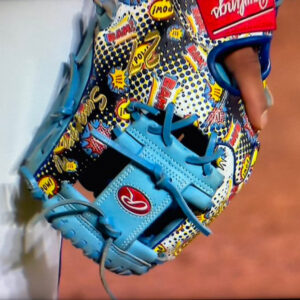 Swagginess it does have. The webbing was a different story. Yet, as slow-motion replay indicated, it had a veritable hole in it, the result of loose webbing. You can’t play third base with a glove like that on your left hand, no matter how gorgeous. You can try, but the evidence indicates it isn’t a good idea. Triolo chased Canario to third with what turned into a double.
The glove that could be seen through had done its damage. Senga should have been out of the inning, but was instead removed after 102 pitches with runners on second and third. To that juncture, the ghost-forker had nursed a 1-0 lead through 102 pitches. Two walks from his successor, Reed Garrett, proceeded to load the bases and then tie the game. The longtime baseball watcher’s inclination was empathy for the starting pitcher, but Senga’s instinct was to pat Vientos on the back as he departed the mound.
Coincidentally, David Wright, the franchise’s premier third baseman, happened to be on the premises Tuesday night, and before the game he was asked about the emerging dynamic between Vientos, who earned third base from the way he swung his stick last year, and Brett Baty, who’s earning a second look by dint of his own offensive upsurge of his late. Of course David, who has only good things to say about everybody, cheered them both on: “I know Mark’s off to kind of a slow start, but Brett’s picked him up. And if Brett gets in a little rut, Mark will be right there to pick him up.”
The Captain knows from picking up. Baty, who was playing second, batted in the seventh and made sure we could mostly forget about the adventures of the glove of Swaggy V by lining an opposite-field homer to torpedo Pirate starter Mitch Keller. It clanged off the iron fence that fronts the party area, ensuring the rainy night wouldn’t feel remotely funereal. The game ended with Baty moved over to third, Luisangel Acuña (who’s recently dipped his toe into the ever-roiling waters of third base) at second, and Vientos on the bench. Mark’s glove’s webbing had been tightened by clubhouse personnel following the sixth, but now it and he were left to watch Acuña make a nifty play on the final ground ball Edwin Diaz threw to ensure a 2-1 win, exemplary defense sealing all leaks and forgiving all residual sins.
After Brett exploded at the plate over the weekend, Mark — whose own power exploits from last October remain fresh in the mind’s eye — was asked if he’d be willing to become more of a designated hitter if it meant inserting Baty’s hot bat in the lineup. Baty’s an adequate second baseman, but third was always what he was supposed to play. And Acuña’s clearly a superb second baseman on the rise, somebody whose glove you really want to see out there most innings. Mark’s answer was succinct.
“Absolutely.”
That subject matter will likely intensify as conversational fodder after Baty’s long and timely hit became the main focus of cheerful postgame chatter Tuesday night. Carlos Mendoza saw a former prospect who had teetered on the edge of Met extinction becoming a potential fixture in Flushing. “Every player’s different,” the manager observed. “For Baty, I’m just finally glad that he’s settling in.” Senga, through his interpreter, expressed delight at what he saw after exiting, especially since Brett is on his side: “If he was an opposing hitter, I think any pitcher would not like to face him at this point.” Brett himself didn’t want to delve too deeply into his hot streak. “I’ve always thought I’m capable of doing whatever I want to accomplish in this game,” the slugger of the moment philosophized. “I’m just having some success right now, and it’s nice.”
Within the realm of the Bill Gallo cartoon universe, we had ourselves a hero and didn’t need to fit any first-place Met for goat horns. Still, it was difficult to forget the image of the ball that zipped through Vientos’s glove. From his vantage point, Mendoza said, “it happened so fast, I didn’t know what happened. Somebody told me it went through the webbing, and I was like, ‘Man, tough break there.’”
Make sure the webbing’s good and fixed, and maybe we can laugh about it in, say, six months.
|
|






