The blog for Mets fans
who like to read
ABOUT US

Faith and Fear in Flushing made its debut on Feb. 16, 2005, the brainchild of two longtime friends and lifelong Met fans.
Greg Prince discovered the Mets when he was 6, during the magical summer of 1969. He is a Long Island-based writer, editor and communications consultant. Contact him here.
Jason Fry is a Brooklyn writer whose first memories include his mom leaping up and down cheering for Rusty Staub. Check out his other writing here.
Got something to say? Leave a comment, or email us at faithandfear@gmail.com. (Sorry, but we have no interest in ads, sponsored content or guest posts.)
Need our RSS feed? It's here.
Visit our Facebook page, or drop by the personal pages for Greg and Jason.
Or follow us on Twitter: Here's Greg, and here's Jason.
|
by Jason Fry on 17 April 2024 1:22 am How do you know things are going well? Here’s a sign: You take the lead off an opposing pitcher before he even throws a pitch.
The Mets somehow did that Tuesday night, the culmination of several unlikely events. They were down 1-0 to the Pirates in the seventh after being smothered by Pittsburgh’s Jared Jones and watching that lone Pirate run come home on an excuse-me bleeder off the bat of Bryan Reynolds, the kind of evening that makes you think this time the deck is too stacked for you to find your way to safety. But with one out in the seventh Francisco Lindor walked and Pete Alonso singled him to third. Brett Baty should have been next up, but he’d recently exited with a tweaked hamstring. (Baty is … wait for it … day to day.) Instead of Baty, we got the so far relatively unassuming Joey Wendle — who of course spanked a double into the left-field corner off Luis Ortiz to tie the game. Francisco Alvarez flied out, the second time in the game he’d stranded a gimme run at third, and Jose Hernandez relieved Ortiz.
From my vantage point up in 423, what happened next was … well, it was confusing. There were umpires running around and Jeff McNeil was conversing intensely with Henry Davis and then Alonso was happily trotting home and Hernandez hadn’t thrown a pitch yet the Mets had taken the lead. OK then! When Hernandez finally did get to actually pitch things didn’t go much better: McNeil served a ball into short left that fell in and gave the Mets an insurance run, and eventually a 3-1 win.
There was more to it than that, starting with my late afternoon decision that I ought to go to the game, because it was a warm spring night and going to the game is what I do, or at least what I used to do — a mournful realization but one I decided had an easy remedy. I secured a pretty good StubHub ticket for a whopping $13.61 (that’s with fees), got to Citi Field early and amused myself strolling around before finding my way to my seat, where I was soon happy Emily wasn’t with me.
I better explain that last part: If I determine someone within earshot is a baseball ignoramus or otherwise detracting from my evening, I calibrate my ears accordingly and essentially erase them from my audio experience. (Yes, it’s a gift.) My wife, on the the other hand, has what baseball players call rabbit ears as well as an unfortunate ability to attract dummies like a magnet. The guy mansplaining while getting basic facts wrong? The shrieking child on Day 1,724 of not being told no? The leather lung confidently calling balls and strikes from an oblique angle in the Promenade? In a typical game you’ll find at least one and possibly all three of them directly behind Emily; it’s usually around the fourth inning that she boils over and I (who’ve noticed nothing due to the aforementioned calibration) am soon thanking God she isn’t armed.
Now, a bunch of my neighbors for Tuesday night were actually Mets fans, and none of them were bad people — one Dad was even diligent about keeping hyperactive kids in their seats and out of the sightlines of those behind them, a rare courtesy these days. But the kids were part of a birthday party which inevitably turned distracted and sugar-addled, behind the kids was an assemblage of vaguely Goth kids whose primary interest seemed to be vaping, behind me were two girls yammering away in rapid-fire French … entire innings passed during which I was pretty sure I was the only person in the section watching the game, and it was taking considerable effort to not get swept away by the aggressive non-game-watching surrounding me. If my wife had been there I might be dictating this to Greg from jail.
Oh, and I was also getting cold — two unseasonably warm April afternoons lulled me into forgetting that a night game before May isn’t to be taken lightly. How soon we forget!
Between the yammering and the shivering I was beginning to think the night would go down as a cautionary tale, with baseball part of the lesson: Jose Quintana was annoyingly inefficient and I kept waiting for the roof to cave in on him as it eventually had on Adrian Houser. That didn’t really happen, in part because for a second night the Pirates kept getting in their own way. A Connor Joe baserunning blunder short-circuited their first inning, they inexplicably played the infield in against Alvarez with the score 0-0, and they pulled Jones after five innings.
It turned out after the game that was the plan, and Jones even expressed appreciation for the kid gloves, and while I roll my eyes at Once Pitchers Were Manly Men nonsense, I have to admit reading that made me feel 10,000 years old. Jones was unhittable and fearless: He threw 59 pitches and 50 of them were strikes, for Christ’s sake! He was clearly better than anyone else the Pirates could have put out there, as Ortiz and Hernandez soon demonstrated. And yet 59 pitches and a 1-0 lead was enough, somehow. The Pirates arrived at Citi Field as an early-season success story, and I’m happy for their long-suffering fans, but they’ve spent the last two nights taking aim at their own feet.
The Mets, on the other hand, keep scratching and clawing and doing enough things right so that they could fall into a little luck. Reed Garrett recorded all six of his outs via Ks, Jorge Lopez navigated a spotless eighth and Drew Smith looked as good as I can recall seeing him, filling in for Edwin Diaz as closer. They got some nifty defense from Alonso and Baty and Harrison Bader. And of course they took the lead without a pitch being thrown. It was a night for getting reacquainted with old habits, but that was a new one.
by Jason Fry on 15 April 2024 11:40 pm The Mets are suddenly good.
Well, not good exactly. Statistically speaking, they’re average. But in the vibes column — which you won’t find in your paper, on MLB.com or Baseball Reference, so don’t look for it — the Mets are killing it.
They rose to average statistically and red hot vibe-istically by beating the Pirates in an odd affair on Jackie Robinson Night, with both Mets and Bucs wearing blue 42s on their backs and their meeting blessed by the regal presence of Rachel Robinson, now 101. She, of course, was very much a partner in Jackie Robinson’s drama, which is somehow both long ago and ever-present given how much his work remains unfinished; seeing her greeted pregame by the likes of Pete Alonso, Francisco Lindor and Brandon Nimmo gave me that same chill that a rich baseball connection always inspires.
By the way, I was Shea in April 1997 on the night MLB announced mid-game that 42 was being retired, up in the upper deck watching Bud Selig, Rachel Robinson and President Clinton. It’s the coldest I’ve ever been at a baseball game, if you don’t count one May afternoon in Candlestick Park. I remember three pretty random facts: being so cold that my misery ebbed into a worrisome “To Build a Fire” lethargy; that Selig mentioned Butch Huskey would get to keep wearing 42 and that I was pretty sure that was the only time Bud Selig had ever said or would ever say Butch Huskey’s name; and that Toby Borland did his best work as a Met that night, much to the relief of all of us turning into freeze-dried corpses up in the tundralike red seats.
It was just a little warmer Monday night, in the high 60s after a sparkling spring day that had seen the mercury approach 80. The Mets and Pirates picked up where the Mets and Royals had left off, with neither team able to push across a run. Which was statistically similar to what Jose Butto and Cole Ragans had done on Dwight Gooden‘s special day, except Butto’s great stuff had been obvious and I had no idea how Adrian Houser was surviving: He kept walking guys and leaving pitches in the middle of the plate, which were somehow missed by increasingly exasperated Pirates.
Houser’s luck ran out, as one had figured it would, in the sixth: Andrew McCutchen got a second lease on life when home-plate ump Edwin Moscoso called a sinker that caught the bottom of the strike zone a ball. (Hey you: foreshadowing.) Two pitches later Houser left a sinker in the middle of the plate and this time his largesse was accepted: McCutchen spanked it through the infield to give the Pirates a 1-0 lead and end Houser’s night. Drew Smith came on and was lousy, pushing Pittsburgh’s lead up to 3-0, and Citi Field had become a sea of mutterings.
But the Mets equalized things in a hurry in the bottom of the inning, scoring three runs of their own in rapid succession on a Francisco Alvarez bases-loaded walk, a Jeff McNeil sac fly enabled by Connor Joe inexplicably spiking the ball into the turf, and a DJ Stewart pinch-hit double scorched over Joe’s head. The Mets got exemplary work from Brooks Raley and Adam Ottavino, whose slider/sweeper has never looked sharper than it has the last two nights, and then the Pirates imploded.
2024 has been good to Pittsburgh so far, but the eighth inning was the stuff of nightmares, one of those games you find yourself fuming about at 3 am weeks later. Aroldis Chapman got Alvarez looking at a third strike, but the putaway came three pitches after Moscoso clearly missed a previous third strike. That left Chapman clearly in a state of at least moderate agitation. He struck out McNeil on a slider in the dirt, but it eluded Henry Davis and so got McNeil to first. Stewart walked, with three of the balls granted extremely close, and now Chapman had gone from simmering to roiling. McNeil and Stewart pulled off a double steal and Harrison Bader ripped a double down the left-field line to give the Mets a two-run lead and earn Chapman a shower after jawing with Moscoso for his previous sins.
The Pirates weren’t done with their pratfalls: Bader stole third off Roansy Contreras basically uncontested, and after the Pirates belatedly brought the infield in, he streaked for home on a bounder by Nimmo to the second baseman. The ball went all of 110 feet but Bader slipped beneath Davis’s tag, popped up with the sixth run and swaggered into the dugout — not quite Trea Turner‘s Fred Astaire move through the plate on the cool factor scale, but pretty close. Bader looks healthy for the first time in years, he’s mashing lefties, and he slathers any play he’s involved in with a little mustard. And I’m starting to love him, for those reasons as well as for his marvelous Lindoresque pink batting gloves, his giddy dugout yammering in the direction of anyone who might be listening, and the mean center field he plays.
Edwin Diaz came in, and truth be told he once again didn’t look quite himself, which might be a thing to watch. But it was the lone blemish on a night that started as celebratory but solemn and ended in gleeful abandon. The Mets are .500, but their vibes differential suggests a better record than that. Which is a bit of advanced stats I can get behind.
by Greg Prince on 15 April 2024 12:36 pm I wish I had brought some string with me. An enormous spool of string. Had I, I could have offered some to each player I saw in the Shannon Forde Press Conference Room Sunday morning and asked him to align himself just so in order to form the most Amazin’ live-action Immaculate Grid you could ever hope to see.
Mike Torrez of the Mets in 1983 and 1984, you also played for the Cardinals and the Expos and the A’s and the Orioles and the Red Sox and the Yankees. Please stand in the upper left.
Gary Sheffield of the 2009 Mets, you came up with the Brewers and preceded to touch down with the Padres, Marlins, Dodgers, Braves, Yankees and Tigers. Would you mind heading over to middle-right?
Barry Lyons, whose Met service spanned 1986 to 1990, I know you have some Dodgers, Angels and White Sox on your ledger. You’d go great in the bottom row, thanks.
Mookie Wilson was a Blue Jay; Roger McDowell a Phillie, a Dodger, a Ranger and an Oriole; Rafael Santana a Cardinal, a Yankee and an Indian. If I needed a Met who was a Pirate, I had Lee Mazzilli. A Met who was a Twin? There’s Tim Teufel. Met-Rockie or Met-Cub? I could use Howard Johnson. Would Sandy Carter mind standing in for her husband Gary if a Met-Giant was necessary? Wait, I could use Darryl Strawberry there. And I could use Jesse Orosco practically anywhere.
I could have done this all day, but putting baseball players in a box was not why I was there or they were there. This was about a round icon for a true icon, a circle with a 16 in the middle of it, and teammates who were happy to revolve around the man who it represents.
This was number-retirement day for Dwight Gooden, better known as Doc, only known as Doc, based on how he was addressed and referred to. That’s how it is with teammates, fans and onlookers who like to think they know what’s what. I was in the latter category most of Sunday, a media member by my credential, though a fan through and through. There’s Doc! There’s Straw! There’s Mazz and HoJo and, yeah, that’s Sheff! It’s hard to believe people bother with given names in real life.
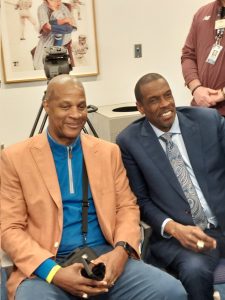 There’s Straw! There’s Doc! Doc was real life for us from 1984 to 1994, as unreal as he could be on the mound for the first phase of that tenure. He hadn’t thrown a pitch for the Mets in thirty years as of Sunday. He’d been waiting for Sunday for thirty years as of Sunday, not so much to be the center of attention, but, as he said in the morning, to “make it right” between himself and the fans.
I think he did right by us.
Later he would stand stand amid an ill-timed shower in short center field, ignoring the gusts and speaking through the irony of how a little rain must fall on all our lives, even those who seem to have the world in their right hand. He reminded everybody who saw fit to celebrate with him that he couldn’t have done what he did without us cheering him at his best and sticking with him through everything else.
“I’m a Met, I’m a Met,” he said, a fact so nice it deserved to be mentioned twice.
Of course Doc had to clarify on that count since he also mentioned another association he had with another ballclub in town (twice), which isn’t necessarily a dealbreaker in the aftermath of anybody’s career. Torrez, Santana, Mazzilli, Sheffield, Strawberry, even the current manager Carlos Mendoza and a few of his charges…we’ll look past past identities if you come around here some more. At any rate, it wasn’t a day for recriminations, even if this day should have happened sooner than thirty years after the Mets and Doc initially “cut ties,” to use his phrase. He shared with the fans a story I’ve heard him tell in other settings, that he tried to come back to Shea as a pitcher when he thought he still had a little something left, but management rebuffed him. It was the late 1990s and the very early 2000s when he asked, twice. The Mets were doing well enough that it was a reasonable enough business decision that maybe a reunion didn’t make pitching sense. It also wasn’t that far removed from the time “business” reasons may have left a cloud over the Doc-Mets relationship.
The part that kills you is the Mets declining to do the one-day contract bit he’d requested when he was done, a ceremonial signing that would have allowed the pitcher who embodied them at their 1980s best to “retire as a Met” and get the new century off on the right foot. Teams and players of note make that kind of arrangement every now and then. It’s always a feelgood moment for all involved, a reminder that contracts and transactions are secondary to who you feel you are and how you wish to be remembered. Dwight Gooden pitched for the Yankees, the Indians, the Astros, the Devil Rays and the Yankees again. He was a Met “always,” he said. How about a gesture to make that clear to all concerned?
The Mets told him no, they weren’t going to do that. Fast-forward nearly a quarter-century and you could almost hear a mobile device ringing, and the reply when it was answered:
“New management, who dis?”
It was Steve Cohen on the line, telling Doc that No. 16 would be going up in the space Doc reserved for it back when Citi Field was Shea Stadium’s parking lot. Thus, Doc was back where he always belonged, give or take a stadium footprint. So was lots of his family, his nephew Gary Sheffield among them, along with lots of his teammates. The guys from the press conference room were on the field with him, as were Keith Hernandez and Ron Darling, who work there. Strawberry had a heart attack during Spring Training. His making it back really told you what this day meant to everybody who played with Doc.
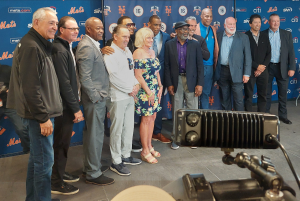 There’s everybody! Some of these Mets from the Eighties you’re used to seeing congregating in Flushing; other than Torrez, who Doc credits with mentoring him through his first months in the majors, nobody was a complete stranger to contemporary Met environs. Yet it’s breathtaking to realize they’re right in front of you as a group. Above the stairs of the Jackie Robinson Rotunda, where the Mets Hall of Fame now lives and breathes among the fans (not to be confused with the relocated Mets Museum, which now sits in an unused wardrobe closet somewhere on the edge of Northern Blvd.), orange and blue flowers adorned the plaques of Buddy Harrelson and Jerry Grote. Buddy died in January, Jerry just over a week ago. You used to see those guys and their 1969 teammates plenty at Shea and sometimes at Citi. Only a relative few are available to visit in 2024. What I’m saying is that when World Champion Mets are around you, open your eyes and your ears and, if you’re lucky enough to be issued an official tag of some sort, your notebook.
During the press conference, where most of the players beamed proudly as they sat against a side wall (and Jay Horwitz went into PR guy mode clearing a little space between encroaching photographers and Darryl and Doc enjoying a brief chat), I asked the guest of honor what it meant to know his 16 was about to be installed next door to 24 and down the block from 41. All the Mets who have numbers retired are franchise royalty, but Willie Mays and Tom Seaver — that’s baseball stratosphere. Doc picked up on my implication, told us Tom was “a friend of mine” and that he got to know Willie “a little bit,” too, but to him, an honor like this is “for all of us”. For Keith. For Ron. For Darryl. For everybody on that wall over there, especially for the 1986 crew, including the 1986 Met who is no longer with us. Or as I overheard Sandy Carter say later, “I know Gary’s with us in spirit.”
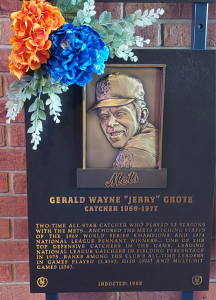 A couple of catchers were with us in spirit. After Doc moved on to other pre-festivities obligations, media was invited to spend time with Doc’s teammates, most of whom helpfully hung around to be pestered by the likes of me. As baseball’s particular attention to uniform numbers provided the excuse for us to have been here in the first place, I sought out Rafael Santana and asked “Raffy” (it seemed the thing to call him) about his relationship with Buddy, the man who coached him and shared 3 with him. Raffy told me Buddy was not only a great help to him but that when Raffy asked if he could give 3 back to him — Harrelson had been managing in the minors when he was installed as a lieutenant of Davey Johnson’s — Buddy told him, no, it’s more important that you have your number now, and the third base coach was fine wearing 23 in ’85 and ’86. Raffy affirmed it was meaningful to him to be in the exclusive club of two, Harrelson and Santana, who could say they were the shortstops on the diamond when the Mets became world champions.
Offering numbers to those who used to have them was a resonant subject. Doc asked Mazz, upon his return from Pittsburgh in 1986, if he wanted 16 back. Mazzilli was a big deal as 16 in Queens pre-Gooden, but Lee demurred, telling Doc it was his now. For that matter, none other than Whitey Ford let Doc know in 1996 that if he wished to wear 16 with his new club, he’d OK the Yankees unretiring it for him. That’s how big a deal Doc had always been in New York (and how much of a mensch Whitey Ford was). Doc couldn’t say yes to that.
“Respect for those people who came before you” was a theme that surfaced when I asked “Rog” McDowell about the number he wore, which, as I pointed out to him, we’d be seeing plenty the next day, Monday, April 15. Jackie Robinson Day was coming and every Met and every player in the major leagues would wear 42. I told him that every year on this occasion Mets fans like me couldn’t help but think of him, of Butch Huskey, of Ron Taylor, of the late Ron Hodges. McDowell definitely appreciated the connection, and it didn’t take Bud Selig’s declaration that 42 would be retired for everybody everywhere in 1997. Sure, he wore 42 simply because it was the number “Charlie Samuels gave me,” but he understood whose it was long before he and Doc were drafted together to be Mets in 1982.
Roger explained his father instilled in him that respect for those who preceded him, and that Mel Allen taught him history lessons on This Week in Baseball. The show and the homegrown curiosity sent young Rog to the local library to check out books on Jackie Robinson (and Ted Williams, Tom Seaver, Carl Yastrzemski and Babe Ruth as well) to learn all he could about the endeavor he would someday enter. He knew about Jackie at UCLA. He knew about Jackie in the military. Fans, he says, sometimes ask him to adorn his autograph with his number. Roger told me he’s “hesitant” to do so. It’s Jackie Robinson’s number.
I didn’t get a chance to ask Mookie Wilson anything, but I did hear him say that thing that all retired ballplayers seem to say when they talk about getting together with old teammates: “the lies get bigger” as the years go by. It’s always said with a chuckle, much as the observation of veteran players that younger players don’t sit around and talk about the game like we used to do is inevitably uttered with an undercurrent of scorn. No scorn on Sunday, though. Doc appeared happy and incredibly relaxed. Happy is understandable. Relaxed was a little surprising. Doc never wasn’t courteous to the press or anybody in a public setting, but the kid who was dealing with an army of microphones and cameras from age 19 on endured the attention in his youth as if he wished he could squirm away from it all. We know from the detours his life took that it probably wasn’t the ideal way for a young man to transition into full adulthood. On the cusp of 60, maybe it shouldn’t be surprising that Doc Gooden showed up Sunday as the old pro, as polished as a Seaver or a Mays in elder statesmanship, but we still reflexively think of him as being 20 winning 20. He seems to be winning his days nowadays. Those are the victories that count most going forward.
After the ceremonies and a 46-minute rain delay, the sun came out and the Mets won a game that you figure can’t but help them going forward.
It certainly couldn’t hurt.
You couldn’t miss Jose Butto paying proper homage to Dr. K with no runs and nine strikeouts in six innings.
You would have preferred KC’s Cole Ragans didn’t nearly match him by fanning eight and allowing nothing of consequence in six and therefore keeping the scoreboard a little too immaculate.
You were grateful to recently dormant Adam Ottavino and Brooks Raley for keeping Royals bats waving at air (2 Ks each in an inning apiece).
You were delighted that Francisco Lindor, in his long-term bid to join Buddy and Raffy as Met shortstops who will one day reunite with his world champion teammates, processed the standing-ovation encouragement the crowds are giving him into a couple of base hits.
You were relieved, despite lingering distaste for Kansas City’s misdeeds in New York in the fall of 2015, that the last of those world champion Royals still on these Royals, Salvador Perez, was able to stand up after a slam-bam play at the plate, even if the venerable backstop had to exit the action.
You were, if you were of my vintage, very much into hearing hits from the ’80s on the PA all day, a perfect accompaniment to a day devoted to a pitcher who prevented hits in the ’80s.
You were, if you were stoically pro-Mets while behaving yourself in the press box, quietly ecstatic that an eighth-inning rally built mainly on walks and punctuated by ex-Yankee Harrison Bader’s infield squib turned into two Met runs, literally enough of a cushion for trumpets to blare and Edwin Diaz to convert a save opportunity.
You weren’t really worried when Diaz gave up a solo home run with two outs. Really you weren’t. Edwin got the last out and we had a 2-1 Mets triumph over the Royals that was the only fitting way to cap off a day such as this. It didn’t alter the result of the 2015 World Series, nor did it instigate a cosmic do-over that would have had Doc facing Bret Saberhagen in Games One, Four and possibly Seven of the 1985 World Series, but we got a win on the field and a 16 in the rafters.
When you get a day like this, its rarity score is off the charts.
by Greg Prince on 14 April 2024 6:27 am Sometimes you stumble into something that catapults you toward something else. Shortly before the Mets, amid Sean Manaea’s off afternoon and a surfeit of Bobby Witt, stumbled Saturday into their 11-7 loss to the Royals, I stumbled into a nugget of information totally new to me. Sixty years ago, on April 13, 1964, the Mets held a season’s eve workout, itself nothing unusual. The club was about to travel to Philadelphia to begin its third year of existence, so they figured they’d get the last of their Spring Training in at home.
Except home wasn’t ready. Shea Stadium would open on April 17, and those who were finishing it up needed every last minute to put every detail in place. Hence, the Mets held their workout at Hofstra University in Hempstead. Hofstra! The same Hofstra a few Meadowbrook Parkway exits from where I grew up, the same Hofstra literally down the block from the home of the Nets (1972-1977), the same Hofstra that served as summer camp and base of operations for the Jets (1968-2008). But the Mets? As far as I knew until this weekend, Hofstra held only two connections to the Mets.
1) My friend Dana Brand, who defined what it meant to be a Mets Fan, taught American Literature there.
2) Dana organized an academic conference devoted to the Mets that coincided with their 50th anniversary in 2012, one year after Dana died without warning. That wonderful event had Dana’s imprint all over it.
Now, I had a third reason to connect Hofstra and the Mets: the 1964 workout that, according to Newsday, had the same effect on the neighborhood’s baseball fans that the Beatles showing up in Manhattan had on the musically inclined two months earlier.
 “The scene at Hofstra — where a crowd of about 1,500, mostly small boys, turned up — was one of joyful pandemonium,” Joe Donnelly reported. “With no fences along the foul lines, it was every Met for himself against three-dozen or so boys who came equipped with gloves and engaged their idols in glove-to-glove war for every loose ball.” “The scene at Hofstra — where a crowd of about 1,500, mostly small boys, turned up — was one of joyful pandemonium,” Joe Donnelly reported. “With no fences along the foul lines, it was every Met for himself against three-dozen or so boys who came equipped with gloves and engaged their idols in glove-to-glove war for every loose ball.”
It’s not that the Mets didn’t want to be generous. It’s that the Mets brought all of sixty baseballs to practice with and, well, they were gonna run out before every player could take his swings. The Mets’ paucity was the fans’ potential bounty. Aching for a foul ball from the stands was one thing, but this was the horsehide equivalent of scheming for a few locks of hair off the heads of the Lads from Liverpool and magically being granted a barber’s license.
“They’d knock you down for a ball,” 19-year-old Ed Kranepool told Donnelly. “They’re friendly enough — but they want souvenirs.” The Mets responded, per Donnelly, by playing some of their most diligent defense to date. “As the supply of baseballs dwindled,” he wrote, “certain Mets, who wanted another batting practice turn, gave their greatest fielding exhibitions as they hustled to retain baseballs.”
Desired keepsakes included the players’ caps or maybe the players themselves, for once BP could be extended no further, the “friendly enough” kids chased the Mets, presumably out of adoration, to their temporary clubhouse beyond left field so they could shower, dress and prepare for the season ahead in one piece. Coach Wes Westrum, who caught for the Giants when the Giants belonged to New York, compared the scene that ensued at day’s end to the jubilant hordes at the Polo Grounds who poured onto the field when Bobby Thomson launched his Shot Heard ’Round the World in 1951, “only there were many more cops to hold the fans back that day.”
Duke Snider, who was about to have his wish to move to a contender granted with the sale of his contract to San Francisco, summed it up:
“This was a typical Met afternoon.”
Let us hope a couple of difficult but not impossible fly balls that couldn’t be caught — one clanking off the glove of Starling Marte for three bases, another barely out of the grasp of Brandon Nimmo en route to it becoming a home run for Salvador Perez — doesn’t represent a typical Met afternoon nowadays. If Saturday’s matinee was, save for Pete Alonso going deep twice, atypical, Sunday’s finale versus Kansas City looms as extraordinary for what will precede it.
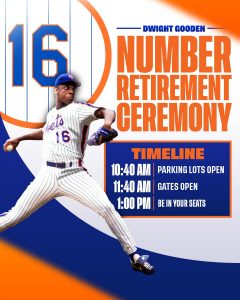 On Sunday, the Mets are retiring 16 for Dwight Gooden. The last time the Mets retired a uniform number on a Sunday afternoon, it was 1988, the number was 41, and its bearer was Tom Seaver. The vagaries of scheduling presumably accounts for Doc’s honor landing on the same day of the week as Tom’s, but it sure seems appropriate. In the annals of Met acedom, there’s Tom, then Doc. On Sunday, the Mets are retiring 16 for Dwight Gooden. The last time the Mets retired a uniform number on a Sunday afternoon, it was 1988, the number was 41, and its bearer was Tom Seaver. The vagaries of scheduling presumably accounts for Doc’s honor landing on the same day of the week as Tom’s, but it sure seems appropriate. In the annals of Met acedom, there’s Tom, then Doc.
The Mets retired 41 the season after Seaver brushed the last of the dirt from his right knee and hung up his glove for good. They waited nearly a quarter-century after Gooden’s final professional pitch to hoist 16 to the rafters. The organization used to be slow about these things if your name wasn’t Tom Seaver. The organization was also slow to recover from the time it stumbled mightily and traded Tom Seaver. That happened in 1977. The Mets weren’t remotely the same again until Dwight Gooden came along in 1984, throwing fast and going places faster. “There’s Tom, then Doc” worked as an irrefutable Metsian construct by 1985.
But let’s not be too harsh on the subject of stumbling. Stumbling into that Mets-at-Hofstra interlude indeed catapulted me into something else. Once I had Hofstra and Dana Brand on the brain, I picked up Dana’s first book to read how he framed the arrival of Dwight Gooden onto the Mets’ heretofore arid landscape and the explosion of Dwight Gooden into our everlasting consciousness. Professor Brand’s interpretations were and are consistently delightful and reliably insightful.
Dana quoted an array of statistics from 1984 and 1985 that translate as enormous now as they were to experience then, before concluding that, while baseball isn’t only “about numbers,” sometimes “the only language we have” for expressing “the sublime, the beautiful terror of magnitude” of output like Doc’s “is numbers”.
One of the greatest pleasures I have had as a Mets fan was seeing Gooden when he was 19 and 20. I remember the games behind these numbers. I remember him striking out the side in his first All-Star game appearance. I remember him striking out 16 batters in two consecutive games. I remember how perfectly unhittable he was. I remember how excited I was. I remember what it felt like as these unprecedented numbers assumed their permanent form. I savored them, I thought of them over and over. I couldn’t believe that I was alive to see this. I couldn’t believe that this was being done by a Met.
Me from 1985 couldn’t believe it, either. Me from 1986 through 1994 never believed the same Doc wasn’t still pitching for the Mets. Of course he was. A little less spectacular as the years went by, a little worn down by time and travails, but still Doc. Then one day he wasn’t a Met, and 16, so indelibly associated with one player and one phenomenon, eventually landed on the jerseys of those who were Mets. If Dwight Gooden wasn’t going to wear it, somebody had to, it was supposed. A few times it was issued to players (Derek Bell, David Cone during his brief comeback, Rick Ankiel), who wished to pay homage to the No. 16 who used to strike out 16 at a clip. A few other times, a player would show up who could claim his own history with the digits (Hideo Nomo, Doug Minetkiewicz, Paul Lo Duca) and have his personal preferences deferred to. But after a while, it became just another number that got issued to commonfolk just passing through (Rob Johnson, Danny Muno, Kevin Kaczmarski). Pinch-runner deluxe Travis Jankowski was the most recent Met to wear 16, in 2022.
Last August, the Mets announced their institutional amnesia had been cured. Me from 1985 couldn’t believe how common 16 had become. Me in 2023 was a mixture of relieved and elated when it was announced 16 would no longer be thrown into the uniform lottery every February. It deserved better. He deserved better.
If we frame what Dwight Gooden did as a Met in Hollywood terms, Doc was the major studio release that proved a summertime blockbuster, completely exceeding the most optimistic of industry forecasts. They then made a sequel, and Doc II did even better, shattering box office records, drawing critical raves and winning every major award. Doc loomed as a lucrative franchise.
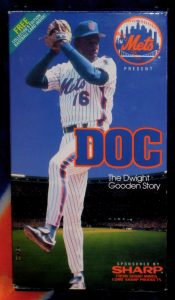 So they kept making sequels. Doc III, which opened to massive expectations in 1986, did all right by most standards, but fell short of what diehards were anticipating. Doc IV had problems in production, let’s say, and didn’t hit screens until June 1987. It did OK, but nobody embraced the turn the main character had taken. The controversial climactic scene of 1988’s Doc V detracted from what had been a good, solid popcorn flick; you wish they could fiddle with CGI and release a Scioscialess cut. A loyal following ensured there’d continue to be an audience for Doc content, though by the mid-1990s, everything this studio was putting out carried a straight-to-video stigma. So they kept making sequels. Doc III, which opened to massive expectations in 1986, did all right by most standards, but fell short of what diehards were anticipating. Doc IV had problems in production, let’s say, and didn’t hit screens until June 1987. It did OK, but nobody embraced the turn the main character had taken. The controversial climactic scene of 1988’s Doc V detracted from what had been a good, solid popcorn flick; you wish they could fiddle with CGI and release a Scioscialess cut. A loyal following ensured there’d continue to be an audience for Doc content, though by the mid-1990s, everything this studio was putting out carried a straight-to-video stigma.
Nobody much worries that the latter versions of Jaws didn’t live up to the original. I understand if you get on a tram at Universal Studios, you’ll still be exposed to a mechanical shark. Whatever isn’t beloved about The Godfather Part III doesn’t keep anybody from quoting the first two films with reverence. Rocky V…you get the picture. Sometimes there may be every business reason to keep churning out sequels, even if they don’t hold up as well as what preceded and inspired them.
Thing is, Dwight Gooden wasn’t only 1984 and 1985. The nine-season coda to the two-season tour de force that made him a legend was still the stuff of upper-level mortals. Doc won 157 games for the Mets, more than anybody else not named Tom Seaver. He didn’t win them all at once. It only feels like he did because what he did out of the box overwhelms whatever else was packed into his Met career. He pitched spectacularly for a couple of years. He pitched well for long time.
The Doc who will be at the ceremonial center of Sunday started 303 regular-season games for the Mets, which means some other pitcher started against him 303 times. Pitchers talk about facing opposing lineups, but we as fans love to dive into pitchers versus pitchers — mound opponents, mound duels. When we think about pitchers going up against each other, the fellows with the bats seem almost incidental. Given the magnitude 16 is about to take on, I rifled through Gooden’s game logs on Baseball Reference in search of one statistic in particular:
How often did Doc go up against a starting pitcher who went on to have his number retired?
As we’ve seen by the way the Mets have gone about it, number retirement is more art than science, and more impressionism than any other art form. There are no leaguewide regulations governing who may be deemed worthy. Every franchise has its own reasons for bestowing or not bestowing its own ultimate in-universe honor upon a given player, until the rules are bent or rewritten or cast aside, because some things you just know in your gut are the right things to do.
Doc faced off against a lot of really good pitchers in his Met tenure, pitchers I could imagine having their numbers retired under the right circumstances. Some of Gooden’s most distinguished mound opponents earned praise and accolades and took home serious hardware at their peak, but it didn’t usher them onto whatever wall or rafter a team for whom they excelled uses to display its most indelible mark of distinction. Free agency may have been a boon to players, but it’s also meant less sticking around long enough to cement the kind of bond that leads to a team retiring a number.
You know who were outstanding pitchers active at some point in the National League between 1984 and 1994? To name a few, there were Joaquin Andujar; John Tudor; Doug Drabek; Charlie Hough; Rick Reuschel; Mario Soto; Rick Sutcliffe; Dennis Martinez; Tom Browning; Orel Hershiser; Vida Blue. None of them has a number retired by a major league franchise. It doesn’t make any of their careers less excellent in retrospect. At their best, each of them was a tough son of a gun, and I know I never relished the prospect of Mets batters facing any of them.
Dwight Gooden pitched against each of them, however, and I would take Dwight Gooden over every single of one of them, just as I took Dwight Gooden over every single of them when he faced every single one of them. Until we knew 16 would be looking down from the left field corner of Citi Field, those guys qualified as the de facto peers of Dwight Gooden. Really and truly good, just not considered among the very, very best by some team entrusted to pass judgment on whether they were among that team’s best ever.
There was the level of talent and accomplishment exemplified by pitchers of that ilk, and then there was the level above it. In slightly more that one out of every ten of his Met starts, 31 times in all, Dwight Gooden went up against a guy from that tier: a starting pitcher who eventually did have his number retired by somebody. In chronological order of the first time Gooden faced them, that circle includes:
Nolan Ryan
Fernando Valenzuela
Mike Scott
Steve Carlton
Jerry Koosman
Dennis Eckersley
T#m Gl@v!ne
Don Sutton
Greg Maddux
John Smoltz
Pedro Martinez
Those are all great pitchers, but a caveat applies here. Few of these pitchers were at their apogee when they swapped half-innings with Doc, and not every one of these pitchers had his number retired by the team he pitched for when Doc was his mound opponent. Koosman, for example, was in his last go-round, as a Phillie, wearing a number, 24, that we don’t associate him with at all. We know him as No. 36 for the Mets, an identity reinforced when that very number was added to the Met pantheon in 2021, a sign that the Mets were doing their own bit of bending, rewriting or casting aside “rules” because they knew in their gut that Kooz, who won more games for the Mets than anybody not named Tom Seaver or Dwight Gooden, belonged up there.
Jerry was of the same generation as Ryan and Carlton and Sutton, all coming along in the 1960s. Eckersley, who’d succeeded as a starter but excelled as a reliever, was a product of the 1970s, the same decade that offered a first rough (if not yet sandpaper-rough) glimpse of Scott. Valenzuela preceded Doc to the majors by four seasons, coming up in late 1980 and inspiring a mania all his own in 1981. Maddux, Gl@v!ne, Smoltz and Martinez all debuted during the Doc sequel years. The box scores confirm that every one of them was, for at least a spell, a contemporary of Gooden’s. Steve Carlton goes back so far that the Polo Grounds still stood when he signed his first pro contract. Pedro Martinez is recent enough that he pitched at Citi Field.
Yet, regardless of date of birth or date of debut or date of last pitch thrown, none exactly strikes me as a peer of his, and I think I understand why. Because as a Mets fan who lapped up every thing Doc did in 1984 and 1985 and doesn’t disown his performance from the other years, I believe Gooden had no peers. He was Doc. He was ours. He was the best when he was doing what he was doing, especially but not exclusively at the outset. In my heart, Doc was never anything less than a blockbuster.
Those mound opponents of Doc’s, the ones with their numbers retired by somebody, were absolutely some of the best of their time, maybe all time. Eight of them have their names on the kind of plaque Dwight Gooden will likely never have. Yet I took Doc over every single of them when Doc faced them, and I would take Doc over single one of them in the abstract, even the ones whose résumés lapped his.
I’d take Doc over any pitcher he ever faced, which in the days Doc was pitching for the Mets meant only pitchers who pitched for other National League teams. From 1984 to 1986, prime Gooden time, one pitcher who certainly belongs atop any list of greats from any era happened to be finishing his career in the American League, first with the White Sox, then with the Red Sox. There was no head-to-head between Doc and him, thus no reason to envision a contemporary mound duel for the ages. Still, I have to ask myself one more question, one I can’t look up on Baseball Reference:
In the abstract, would I take Doc Gooden over Tom Seaver?
Answer: I don’t have to. Sunday will make official what we’ve known in our collective gut for nearly forty years. There’s Tom, then Doc. There’s no taking one over the other, because they go together. If you’re not feeling it in your gut, get a gander at 41 and 16. From now on, you’ll know precisely where to find them both.
by Jason Fry on 13 April 2024 8:47 am When your team’s bad you spend a lot of time fuming about how it should be made good. This guy who’s failed too often needs to lose his job to this guy who hasn’t failed yet, any fool can see the lineup should be revamped so it works like this, etc.
I’m not generally one for half-measures, so my favorite proposed remedy is to declare that the Powers That Be should DFA everybody, which has never happen but would indeed sure show ’em. I have on occasion gone a step further and advocated that the Mets be contracted, though that usually requires them to have offended me by doing something truly dreadful, such as losing six of seven.
That’s the formula for bad times. When your team’s good, on the other hand? Lips tend to stay zipped. Nobody wants to offend the baseball gods, those capricious beings capable of directing batted balls past or into gloves. And, really, what is there to say?
On Friday night the Mets beat the Kansas City Royals, who’d won seven straight and attracted all sorts of accolades for their youth and dynamism, by the rather convincing score of 6-1. They got key hits and airtight defense from Brett Baty, solid work from Luis Severino and the bullpen, a no-doubter of a homer from Pete Alonso, and a ridiculous number of two-out hits. Seriously, the last part was mildly absurd: Ten of the Mets’ 14 hits came with two outs, and five of those timely tallies drove in runs. No wonder Michael Wacha, our old friend from the bell jar 2020 season, spent a good chunk of the evening stamping around the mound looking consternated.
“Don’t make a third out” isn’t a particularly replicable formula, so maybe just shrug and enjoy that part, but it wasn’t all the baseball gods deciding to scatter rose petals: Beyond Baty’s welcome continuing maturation (or at least his continuing run of confidence-breeding good results), Jeff McNeil looks more like his old self of late and Harrison Bader‘s bat has come alive. Severino’s pitches didn’t strike me as particularly sharp, and he lost the plate at times, but his last act was to fan Royals phenom Bobby Witt Jr. with KC threatening to make it a game again, and that final line is undeniable regardless of how many caveats you attach to it.
It’s also not like the Mets are firing on all cylinders. The baseball gods have apparently forgiven Brandon Nimmo, but both Starling Marte and Francisco Lindor have hit in oddly poor luck. Oddly for them, of course; it’s not odd at all for someone in the lineup to be suffering a run of misfortune, just as it isn’t odd for someone else in that lineup to be enjoying unexpectedly good results when meeting ball with bat. (Not to ruin a good story, but so far in 2024 that’s Baty.)
The fans greeted Lindor with standing Os, offering an antidote to some vile social-media drive-bys on his family; there hasn’t been the same mutterings or poor behavior about Marte, probably because everyone’s still glad to see him hale and hearty again and he’s less of a heart-on-his-sleeve player than Lindor, which gives onlookers less to react to. (Also: Even if I were reincarnated as a skeevy Internet troll, I would prefer to not have Starling Marte angry at me.)
Lindor expressed his gratitude, saying being cheered “fills my heart” (aw); one imagines a few more balls touching down on grass would have the same effect. Maybe the baseball gods will grant that wish next. Or maybe they won’t. We’d never presume to tell them what to do, after all.
by Greg Prince on 11 April 2024 8:37 pm The season began with plenty of warning, yet I found myself scrambling in the hours before and after Opening Day to update all the things I keep track of once the season is underway. The files I maintain for my and occasionally your amusement/edification looked like the aftermath of a party nobody had bother cleaning up from before turning out the lights on 2023. Damn, I had all winter to get these ready, yet I haven’t touched them since early October. Some things I monitor are germane to the dawn of a new year, others specific to baseball’s daily nature, others kept in reserve for when a specific oddity occurs.
It took me a few games to regain my keeping-track rhythm, but now I’ve returned to my groove. And, oh by the way, so have the Mets! On Thursday afternoon in Atlanta, they appeared to be the team that too often creams them, winning by a score of 16-4 while simultaneously pinning a loss on the Braves by — what a coincidence — that very same score. I may have been hallucinating, but I could swear I saw an awfully familiar utility infielder pitching for the team that was hopelessly behind.
The Braves are rarely hopelessly behind the Mets, either in a game or in a season, but some days surprisingly don’t belong to them. This one was the Mets’. My track-keeping fetishes and I happily shared it.
Facts that fascinated me in and around a matinee:
• The Mets were delayed by 42 minutes at the start. Not so fascinating, but it became their first rain delay of 2024 not to become a rainout (they’ve had four of those already). After a particularly soggy spring and summer a few seasons back, I began keeping track of how many minutes the Mets are delayed in a year. In 2023, we stood around and stared at our shoes for more than eighteen hours before somebody, one way or another, said ball could or couldn’t be played.
• After the offense had woven enough of a cushion in support of Jose Quintana and Drew Smith, Carlos Mendoza was confident enough to tell 29-year-old rookie lefty Tyler Jay to come on in, the lead is wide. Jay is a journeyman’s journeyman who persevered through quite a journey to replace Dedniel Nuñez on the roster and become a) the 1,233rd Met overall; b) the 427th player to make his major league debut as a Met; and c) the eighth Met in this century to feature a last name that ends in “ay”, joining Ruben Gotay (whose pronunciation of choice didn’t prepare him for this little club), Darren O’Day, Lance Broadway, Jason Bay, Trevor May, Sam Clay and Anthony Kay. Also, Jay, the latest temp to punch the clock in our gig economy bullpen, gave up a run while recording six outs, which stands as his most vital statistic, but you can track down that information anywhere.
• Luis Guillorme (pity it’s not GuillormAY) became the fifth Old Friend™ to compete versus the Mets this season, though the only position player to pitch against them thus far. In the non-trademarked Almost Acquainted category, we saw Allan Winans, a former Met farmhand, start for the Braves. We also lit him up for five innings. (Neither Travis d’Arnaud nor Jarred Kelenic were involved in this game, though they did show their faces earlier this week.)
• Amidst this backdrop of romping giddiness, word arrived that Julio Teheran, a Met in whom we invested our allegiance for the very first time a whole three nights earlier, was outrighted to Syracuse, declined the assignment and declared free agency. This means Julio — pending a Recidivistesque turn of events — has been set aside for next year’s edition of the annual Mets Who Have Left Us salute, a holding area where Phil Bickford (let go during the latter stages of St. Lucie sorting, only to fall in with a bad crowd), Michael Tonkin (swapped to the Twins for Cash Considerations, a name that must have been hell to carry around the schoolyard) and Yohan Ramirez (not good enough for us, but suddenly worthy of being an Oriole) find themselves loitering. Keeping track also means looking ahead.
• The 16-4 victory, enabled by 16 Met base hits and nearly as many Brave misplays, was the first 16-4 victory for the Mets since April 19, 2005. Our blog was just over two months old; Tyler Jay was celebrating his 11th birthday. The Mets hit seven home runs that night in Philadelphia, then a franchise record. On Thursday, only DJ Stewart and Tyrone Taylor went deep, but Stewart had a man on and Taylor’s was a grand slam. Sweet Sixteen, indeed.
• The Mets have now played one-dozen games in 2024, or their 2,988th dating to Opening Day 2005. When they play another dozen, Faith and Fear in Flushing will reach a triply grand milestone: 3,000 consecutive regular-season Met games blogged. THREE-THOUSAND CONSECUTIVE GAMES BLOGGED?!?! Really and truly. It sounds like a lot. It is a lot. It’s what happens when you stay with something relentlessly into a twentieth season. But you have to keep track of things to be aware of what you’ve done.
by Jason Fry on 10 April 2024 12:18 am It’s a tenet of our blog that there are no moral victories in baseball — the loss column comes without asterisks, parentheses or stuff in superscript. Moral victories are losses.
Well, except when one of us declares that moral victories do too exist.
Maybe I was just in a good mood: Monday night’s game found me and Emily in Buffalo, where we’d gone to visit an old friend and hopefully experience a total eclipse. The eclipse part was largely spoiled by a blanket of clouds, though even without a clear view of totality the experience was still pretty cool: three minutes of nighttime followed by the light coming back up like God had flipped a cosmic dimmer switch. (Though two hours later the skies over Buffalo were totally blue, grrr.) The rest of the visit was great fun, though — so much that I left Julio Teheran to his struggles for dinner, then returned to the fold after a surreptitious glance at Gameday informed me of the heroics of Brandon Nimmo and DJ Stewart. I watched the ninth on my phone, without sound, and this morning had to double-check that they’d actually won, because what I’d seen seemed so profoundly unlikely.
It was a win to put a little extra pep in one’s step, so much so that I largely shrugged off Adrian Houser getting tattooed when Tuesday night came around. I’d prefer Houser not do things like that of course, but the current incarnation of the Braves may be the most terrifying offense I’ve ever seen assembled, and it’s more of a surprise when a Met hurler doesn’t get mauled by them. I was less philosophical about the Mets repeatedly short-circuiting their own offense in particularly frustrating fashion, with leadoff baserunners erased through mischance or their own dunderheadedness, but hey, don’t watch baseball if you can’t handle the idea that the universe is perverse and cruel.
I was also cheered by the subtraction of Teheran, though I mean no slight against him or his long-ago Bravedom. Rather, it’s that I was cheered by the Mets evidently concluding that young, homegrown Jose Butto deserves that chance more than a retread whose ceiling is that he can give you innings, whatever that means. It wasn’t so long ago that the Mets sent Tommy Milone to the mound over and over again to be a metronome of suck, leaving me spluttering in rage by the end of the summer. Those Mets would have given Teheran the ball until Tylor Megill or perhaps Kodai Senga returned, greeting each loss with wide-eyed horseshit about veteran leadership and clubhouse presence; these Mets thanked him for his service and moved on after that first trial balloon deflated.
And there was Dedniel Nunez, thrown into the lion’s den in his first big-league go-round. Nunez showed both good stuff and admirable poise: Most pitchers making their debut look like they’re on the verge of hyperventilating through their first batter, if not their entire appearance, but he stayed cool and collected even as bad luck and his defense conspired against him. Collecting your first three big-league outs by retiring Ozzie Albies, Austin Riley and Matt Olson? That’s doing it the hard way.
And all that came before the Mets awoke from having slumbered through the pitching tenure of journeyman Reynaldo Lopez. Pete Alonso‘s three-run homer cut the deficit in half in the eighth, and the Mets added two more runs in the ninth via the unlikely combination of Harrison Bader and Omar Narvaez. Alonso batted with the game suddenly to be decided and it turned out he didn’t have a second thunderbolt in him: He went down on a nasty changeup from Raisel Iglesias, putting this one in the books with the Mets a run in arrears.
But still. An encouraging debut, a roster move to applaud, and a spirited comeback that forced the Braves to use personnel they’d have preferred to keep far from the action? That’s not a win, granted, but it’s not unpraiseworthy.
Or, like I said, maybe I was just in a good mood.
by Greg Prince on 9 April 2024 11:24 am By some stroke of coincidence, the Mets have visited Atlanta on the 30th, 40th and 50th anniversaries of Hank Aaron’s 715th career home run, which is swell, because what decent baseball fan doesn’t adore and revere the legacy of Hank Aaron? The Mets have to play the Braves at some point of every season. Might as well do it when one of the greatest players and achievements the sport has ever known is being commemorated.
The Mets weren’t mere spectators for this particular celebration of Hammerin’ Hank. They paid their own tribute by recreating the final score of the final game in which Aaron himself homered against them. That one, on July 17, 1973, finished up Mets 8 Braves 7 at what was then known as Atlanta Stadium, with not only Bad Henry contributing to the Atlanta offense in trademark fashion, but his fellow legend Willie Mays driving in what proved to be the winning run. For twenty seasons, so much of what made the National League special was defined by this duo. Aaron, now with 698 home runs, continued on his march toward surpassing Babe Ruth’s record the following April 8. Mays, who was sitting on 657 of an eventual 660 home runs, wound down toward saying Goodbye to America on September 25. They never again shared a box score.
The long view shouldn’t obscure what a tremendous comeback the Mets forged that night in a season that would have an even bigger one for them waiting come fall. Tug McGraw started, itself a story in that Tug was having the worst relief season of his life and Yogi Berra assigned him this start to snap him out of whatever was messing with the screwballer’s mind. Tug threw six innings and gave up seven runs but began to find himself. Meanwhile, with Aaron, Ralph Garr and Marty Perez all going deep, McGraw and the Mets fell into a 7-1 hole. Their 8-7 victory implies they dug their way out. They absolutely did, via a seven-run ninth. Rusty Staub homered with a man. John Milner — who was known as the Hammer, an homage to Hank — homered with a man on. Ultimately, Willie did his thing to give the Mets the lead heading to the bottom of the ninth. This is where a Mets fan of the early ’70s would expect Tug McGraw to come in and attempt to slam the door. Ah, but as noted, Tug started, so Yogi called on Harry Parker for the save opportunity. Harry struck out Darrell Evans and Sonny Jackson before getting Dusty Baker to foul out to Milner at first.
Mets 8 Braves 7. It reads so nice, the franchise decided to do it twice…technically an eighth time, as the Mets have beaten the Braves by this exact score on more occasions than you’d suspect, but let’s not get in the way of history rhyming, if not repeating.
With Aaron’s legacy in the spotlight and Baker visiting the SNY booth, the Mets a little too respectfully fell behind Atlanta, 4-0, early. Julio Teheran, whose name is familiar within the realm of Mets-Braves recaps, pitched in road grays while toeing a rubber he presumably knows well. Two innings as the Mets’ starter of next resort went all right. The third went about as well for the Mets on the 50th anniversary of 715 as the fourth went well for the Mets on the 30th anniversary of 715.
I should probably explain that.
On April 8, 2004, Dan Wheeler was the emergency starter for Art Howe’s Mets, forced into action when Scott Erickson, at the Julio Teheran stage of his career by then, was the latest of late scratches. Wheeler, a reliever who would pitch in the majors until 2012 without ever starting again, defused the perennial defending division champs’ offense wonderfully through the first, the second and the third. Staked to a 2-0 lead by a Ty Wigginton home run, a Mets fan thought his team might actually get away with something here. Then, in the fourth, Wheeler allowed a two-run double to Met-killer Johnny Estrada. The Mets took the lead back in the fifth, and Howe trusted Wheeler to stay in. Rafael Furcal doubled to lead off, ending Wheeler’s surprise start and opening the floodgates. The Mets went on to lose, 10-8.
In present-day Georgia, Teheran didn’t last as long as Wheeler, not after he yielded a two-run double to Ozzie Albies and a two-run homer to Marcell Ozuna. Two and two-thirds was all Julio could provide Carlos Mendoza, forcing Mendy to manage a bullpen game in which he was determined to not use the three relievers associated with the Mets holding leads…which didn’t seem like that much of a problem, considering the Mets trailed by four and this was Atlanta.
Hank Aaron slugged 40 home runs at age 40 in 1973, and it was, as viewed through orange-and-blue colored glasses, only the second-most remarkable feat in the National League that year. The Braves honored Hank Aaron on Monday night, and it turned out to be only the second-most gratifying event of the evening. We’re always happy to eclipse big doings in Atlanta. A single run in the top of the fourth, delivered by Starling Marte driving in Pete Alonso, didn’t hint that the spotlight would shift so dramatically. Brandon Nimmo taking Charlie Morton deep with two runners on in the fifth, however, indicated something was up, if not as far up as Brandon blasted his first homer of the season.
You watch the Mets at Truist Park, and you expect Travis d’Arnaud to do something harmful to them. Sure enough, he does that in the sixth, driving in the go-ahead run for the Braves off another pitcher-come-lately, Cole Sulser. Sulser replaced Yohan Ramirez on the roster Monday afternoon. Sulser didn’t give up anything else, though, same as Reed Garrett hadn’t given up anything at all once he took over for Teheran. Those relievers who are used when the manager doesn’t want to use the relievers he’d rather use sometimes come through somewhat.
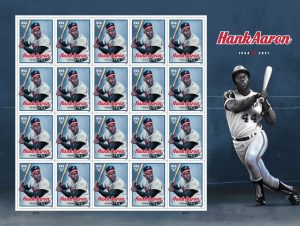 Absolutely honor Aaron, but stamp the game as Nimmo’s. Back to Brandon Nimmo: he hit his second home run of the season, in the seventh inning. It was also hit very far. Nimmo trails Aaron’s career total of 755 by 666, but his two wallops Monday night indicate neither he nor his team should be counted out too soon.
Speaking of players who might have been counted out too soon, do you remember DJ Stewart? He approximated heroic for the 2023 Mets after all hope was lost for that sorry squad. Last August he drove in scads of runs before cooling off. DJ had a tepid Spring and was off to an icy 0-for-12 start, his ability to stand in the lefthanders’ batter’s box basically the only thing suggesting he’ll still be a Met once J.D. Martinez is ready to compete. But now those who make personnel calculations will be compelled to factor in the two-run homer Stewart produced in the eighth inning. It put the Mets up, 7-5, and it reminded onlookers that, right, right, not everybody who doesn’t hit for a week-and-a-half doesn’t hit forever. Recent home runs from Jeff McNeil, Francisco Lindor and Brandon Nimmo might have already told us that, but we require frequent reminders.
Hey, did somebody just mention Brandon Nimmo again? Well, they should have, because after Brian Snitker brought in lefty Jesse Chavez to face Nimmo, Nimmo knocked in his fifth run of what had turned into a robust affair. The Mets were up in the eighth, 8-5, and with Raley, Ottavino and Diaz out in the bullpen…
Oh yeah, they weren’t going to be used, because wins in Atlanta aren’t valued as much as resting relievers. So who else we got?
Jake Diekman, who followed Sulser in the seventh after Sulser followed Garrett in the sixth after Garrett followed Teheran in the third, walked the leadoff batter to begin the bottom of the eighth. Drew Smith, who’s edged into Circle of Trust territory of late, was rested enough to be judged eighthworthy. He followed Diekman. There was a lot of “traffic,” to use this year’s trendy vernacular, with walks and a wild pitch and acids in pits of stomachs, but Drew left the bases loaded, albeit after allowing one runner to walk home. The Braves had pulled to within 8-6.
The bottom of the ninth was not Edwin Diaz time or Tug McGraw time or Harry Parker time. The closer de la nuit was Jorge Lopez. Lopey, as Mendy calls him, has done some saving in his past, so why not? The retort might have been a) Matt Olson doubling and b) Ozuna doing something at least as bad had not Tyrone Taylor made a sparkling catch by the left field wall to keep Olson on the basepaths. Michael Harris singled to bring him home, and then Harris stole second, but a night that seemed poised to end as badly as possible got its groove back. Lopez induced a popout from Orlando Arcia and Old Friend™ d’Arnaud to fly out, and the scoreboard read at the end Mets 8 Braves 7.
Use it at will. It looks good in any year.
by Greg Prince on 8 April 2024 10:40 am “I was very fortunate to win three-hundred and eleven games, and not many people in the wonderful history of baseball were able to go past three-hundred,” said the man in the suit at the podium. “And you wonder why it happened? All you have to do is look at the individuals that were sixty feet, six inches away from me through a twenty-year career. How very fortunate I was to have three people that were my basic catchers through a twenty-year career, starting with Jerry Grote, ten-and-a-half years with the New York Mets.”
The man in the suit taking the time at the podium on a day that served as the capstone of his magnificent career to single out three catchers was Tom Seaver. The podium’s location was Cooperstown, New York. And sixty feet, six inches away from the location he stood when he was making his case to someday be accepting induction into the National Baseball Hall of Fame was indeed his catcher, Jerry Grote.
Nothing basic about Grote as a catcher, though. Tom knew that. We all knew that.
The mere fact that Jerry Grote was being mentioned as one-third of a triumvirate that included Carlton Fisk, who would be accepting the same honor as Seaver eight years down the line, and Johnny Bench, already enshrined as a member of the same exclusive club three years by then, spoke volumes. Close your eyes, and you can see Fisk and Bench hitting massive home runs. Keep your eyes closed and picture Grote. He’s catching.
He’s catching Tom Seaver. He’s catching Jerry Koosman. He’s catching Nolan Ryan. He’s catching Gary Gentry. He’s catching Don Cardwell. He’s catching Jon Matlack. He’s catching veterans. He’s catching rookies. He’s catching every Mets starting pitcher you can picture from 1966 to 1977, beginning with Jack Fisher (after Grote was practically stolen from Houston) and ending with Nino Espinosa (before Grote was mercifully traded to L.A.).
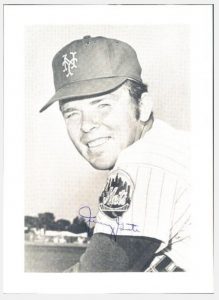 He’s the catcher to a generation and then some. We see him behind the plate. We see him up and at ’em, perhaps more than any Met ever got up and at ’em. Up and out of his crouch and after a foul fly. Up and out of his crouch and gunning a throw to second. Up and out of his crouch to get his pitcher on the right page. Up and on to great things for his team. Up and off to a splendid career of his own, one that earned him inclusion in the Mets Hall of Fame, where he is, per Seaver’s equation, one of three. Gary Carter is in there. He came later. Mike Piazza is in there. He came later. As with Bench and Fisk, they have plaques in Cooperstown. As with Bench and Fisk, they went deep dramatically and regularly. He’s the catcher to a generation and then some. We see him behind the plate. We see him up and at ’em, perhaps more than any Met ever got up and at ’em. Up and out of his crouch and after a foul fly. Up and out of his crouch and gunning a throw to second. Up and out of his crouch to get his pitcher on the right page. Up and on to great things for his team. Up and off to a splendid career of his own, one that earned him inclusion in the Mets Hall of Fame, where he is, per Seaver’s equation, one of three. Gary Carter is in there. He came later. Mike Piazza is in there. He came later. As with Bench and Fisk, they have plaques in Cooperstown. As with Bench and Fisk, they went deep dramatically and regularly.
Grote could hit some, but all you really see is the catcher. Grote could talk some, all his pitchers would confirm with a knowing chuckle, but they listened, because he was the catcher. Basic? Primary. He had some capable backups, but with everything on the line, Gil Hodges (who came up as a catcher) and Yogi Berra (in the Hall himself as a catcher) never looked beyond No. 15 from San Antonio. The Mets played twenty postseason games with Grote on their roster. Every inning and every pitch was handled behind the plate by one man.
I have a new favorite Jerry Grote stat, one I was moved to confirm on Sunday night, a few hours after the Mets had beaten the Reds in Cincinnati by a pitching-friendly score of 3-1, minutes after learning Jerry had passed away at 81. The legend of the 1973 Mets centers on their pedestrian regular-season record, inevitably processed as the best of a so-so assortment of contenders, implying they were some kind of fluke. Yes, they went 82-79, which in pre-Wild Card times usually meant you weren’t going to the playoffs. And, yes, the Mets had to pull themselves out of the last-place muck to get where they needed to go practically in a blink. One of the elements of the pennant drive that has survived anecdotally, at least among the Met faithful, is the Mets got going once they had their regulars healthy again.
How does that translate from anecdotal to statistical? Well, on May 11, the night Grote was hit by a Ramon Hernandez pitch and suffered a fracture to a bone his right arm, the Mets were above .500, sitting in second place, a couple of games from the division lead. The next time Jerry was in the starting lineup, on July 13, the Mets were languishing in last, way under .500, far removed from first place. Yet first place, with Jerry Grote taking every start down the stretch, is where the Mets ended up.
To borrow from Tom Seaver, “and you wonder why it happened?”
When Jerry Grote was in the starting lineup for the 1973 New York Mets, the record of the 1973 New York Mets was 47-29, the kind of pace that captures pennants. Jerry Grote made his pitchers better and made his team better. He also made his competitors’ eyes pop. Bench the slugger, who won ten consecutive Gold Gloves for the Reds from 1968 to 1977, famously said that had Grote been in Cincy, he himself would have been the third baseman. Lou Brock, the sultan of stolen bases, identified Jerry as his most effective nemesis. “He’s the toughest catcher in the league to try and steal against,” Lou said in 1968, the year NL players voted Grote to start the All-Star Game (Bench was his backup).
It was rewarding to know Grote won the respect of so many peers and rivals, but it was even better when you were a kid growing up as a Met fan to see the man in action. The way they used to televise baseball games, from behind home plate, No. 15 usually had his back to us. He’d be the first Met we saw. Then one of his pitchers would throw him a strike. We’d take in the entire picture and we’d figure out that the Mets stood an excellent chance of winning as long as our catcher was where we counted on him to be. Jerry Grote’s presence told us all that.
by Greg Prince on 7 April 2024 5:43 am As soon as you understand that a manager is going to try to “stay away” from using the relievers he relies on most, you also understand you’re going to need either a spit-ton of runs from your lineup or a comparable amount of innings from your starting pitcher. By the middle of the sixth inning on Saturday in Cincinnati, once it became clear the Mets’ starter was done, you understood the five runs the Mets had scored to that point, along with the three-run lead the Mets were holding, might be insufficient if your goal was victory.
And it wasn’t. Luis Severino gave Carlos Mendoza five gutty innings, which is to say one of them, the second, was a mess that did not quite spiral into something worse. The admirable work Luis — I’m not yet at the “Sevy” stage — put into extricating himself from the bases being loaded after two runs were home paid off in the short term, but almost guaranteed the long term wouldn’t be long enough. After 99 pitches through five, Severino was done.
The Mets led, 5-2, which was swell, given that the Mets hadn’t scored as many as five runs in a game in a week, but here came the “B” team out of the bullpen to back up the departed starter. Granted, the “A” team at any given moment might give you pause, and it’s quite possible that soon enough some pitcher on the “A” team might be relegated and a corresponding arm on the “B” team might be promoted, but for now, the vaunted Circle of Trust is real. For now, after so much recent usage of Drew Smith, Brooks Raley, Adam Ottavino and Edwin Diaz, Bob Murphy’s traditional ninth-inning instructions to fasten our seat belts carried extra resonance, and it was only the sixth.
Jake Diekman, one of our savvier offseason gets, per the assessment of those who make those pronouncements, came out of the pen with twelve outs to go. Two quick outs ensued. Great. Then Diekman walks Elly De La Cruz, hits Spencer Steer, and we’re antsily adjusting our shoulder harnesses. Pinch-hitter Stuart Fairchild singles to make it 5-3. Then there’s a steal of second that spawns a steal of home when nobody in road gray executes with big league precision, and it’s 5-4. Diekman squirms out of further trouble in could-have-been-worse fashion, yet you know in your bones it’s going to be worse.
It gets there, in the eighth, the second inning of work for Yohan Ramirez, whose seventh was effective. You wish for a reliever who can calmly deliver two solid innings and keep registering zeroes. It’s not impossible. Reed Garrett clamped down on the Tigers for three the other day (meaning he wasn’t available, either). Ramirez’s introduction to Mets fans was his taking one for the team by taking aim at the area behind Rhys Hoskins in the season’s first series. He heroically served a suspension. He was back to do something of greater value: get three goddamn outs and deliver the ninth inning intact to whoever was going to let Edwin rest.
Preservation of Diaz swiftly moved down the chain of priorities once the Reds and the eighth got through with Ramirez. Eight games into the season, it’s fair to call the bottom of the eighth Saturday a prototypical 2024 Mets defensive inning. Pitches missed when they needed to land. Fielders missed when they needed to grab. Bounces were unfriendly. And a big blow detonated. Without having the intestinal fortitude to pick apart the gruesome details, the tenuous 5-4 Met lead Ramirez was tasked with steering into the ninth transformed rather inevitably into a 9-5 deficit. The Met offense stirred in the ninth to add a run to its previously encouraging total, but the eighth and maybe the sixth had already told the tale.
New manager, new relievers, same problem in contemporary baseball, specifically contemporary Met baseball. Even when you have relievers you trust, you can’t send them out there every single day, yet you almost have to, because nearly every single day, starting pitchers thrill you if they get through five innings. Jose Quintana didn’t quite finish six on Friday night, a good outing, but an outing that led to calling on Smith and Raley and Ottavino and Diaz. Each of them had pitched on Thursday as well. The fan who’s been watching forever yearned for a Turk Wendell or a Roger McDowell to simply get up, get warm, get into the game and get the Mets through however many innings remained. Managers, whether they’re old hands like Buck Showalter or fresh faces like Carlos Mendoza, don’t do that sort of thing anymore. Also, it used to be unusual to have to get anybody cranking before the seventh. Contemporary baseball, Met or otherwise, operates differently.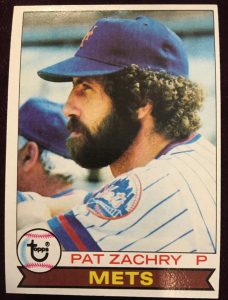
One necessarily comes to appreciate a pitcher like the late Pat Zachry even more against this tableau. Zachry, who pitched for the Reds and the Mets, died on Thursday a little shy of his 72nd birthday, following illness and personal tragedy. He was traded to New York on June 15, 1977, a date that still lives in infamy for Mets fans, though not because of anything related to the pitching or persona of Pat. You don’t replace Tom Seaver on the New York Mets in the middle of a season. You just hope to succeed him and that your best will occasionally surpass adequate.
To say Zachry was no Seaver is an exercise in obviousness. There was only one Tom Seaver, especially on the Mets. But Pat Zachry as Pat Zachry was pretty darn good. There’d be nights and stretches where you didn’t forget Tom, but you were happy to root for Pat. He didn’t make the All-Star team by accident in 1978 and he didn’t rate the Opening Day start merely by default in 1981. In tandem with Craig Swan, Zachry made us think, “OK, at least we still have some bona fide starting pitching.” You wished he’d stayed in one piece more often, because when he was healthy, he’d give you length and quality and confidence, the last of those elements too often lacking on the Mets clubs of his era.
 No, no Tom Seaver, but go check out a few all-time career leaderboards where Met pitching is concerned. The tall Texan remains in the Top 25 in innings pitched and games started and ranks thirteenth in both complete games and shutouts. Complete games? What are those? Between 1977 and 1982, Pat Zachry defined the concept on a recurring basis, and every time he finished what he started, it meant one more day when Joe Torre or George Bamberger didn’t have to worry about who would have to be used in the sixth or seventh or eighth or ninth. The manager had his answer out there on the mound. No, no Tom Seaver, but go check out a few all-time career leaderboards where Met pitching is concerned. The tall Texan remains in the Top 25 in innings pitched and games started and ranks thirteenth in both complete games and shutouts. Complete games? What are those? Between 1977 and 1982, Pat Zachry defined the concept on a recurring basis, and every time he finished what he started, it meant one more day when Joe Torre or George Bamberger didn’t have to worry about who would have to be used in the sixth or seventh or eighth or ninth. The manager had his answer out there on the mound.
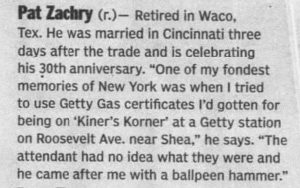 Most importantly, beyond statistics, Pat adjusted to life in a big city that was never on his radar, maintained good humor about some less than ideal professional circumstances (competitive intensity notwithstanding) and came across as a warm and decent soul to those who had the pleasure to get to know him even a little. That phrase about two seemingly contradictory things being true at the same time comes to mind: the Tom Seaver trade never should have happened, and we were lucky to have Pat Zachry. Most importantly, beyond statistics, Pat adjusted to life in a big city that was never on his radar, maintained good humor about some less than ideal professional circumstances (competitive intensity notwithstanding) and came across as a warm and decent soul to those who had the pleasure to get to know him even a little. That phrase about two seemingly contradictory things being true at the same time comes to mind: the Tom Seaver trade never should have happened, and we were lucky to have Pat Zachry.
|
|






