The blog for Mets fans
who like to read
ABOUT US

Faith and Fear in Flushing made its debut on Feb. 16, 2005, the brainchild of two longtime friends and lifelong Met fans.
Greg Prince discovered the Mets when he was 6, during the magical summer of 1969. He is a Long Island-based writer, editor and communications consultant. Contact him here.
Jason Fry is a Brooklyn writer whose first memories include his mom leaping up and down cheering for Rusty Staub. Check out his other writing here.
Got something to say? Leave a comment, or email us at faithandfear@gmail.com. (Sorry, but we have no interest in ads, sponsored content or guest posts.)
Need our RSS feed? It's here.
Visit our Facebook page, or drop by the personal pages for Greg and Jason.
Or follow us on Twitter: Here's Greg, and here's Jason.
|
by Jason Fry on 6 April 2024 12:51 am Baseball — perhaps you’ve heard — is a game of contrasts.
Take Hunter Greene vs. Jose Quintana, the starters for Friday night’s game in chilly Cincinnati. Greene is young, enormous and all but dripping talent, in possession of a high-90s fastball he can throw past big-league hitters as well as an evil slider tailor-made for embarrassing them. He used both to great effect against the Mets, retiring 10 in a row at one stretch and looking borderline unhittable in doing so. I can think of one bad slider that Greene threw all night — the one he hung to Starling Marte in the middle of the plate in the sixth. Marte’s swing caught too much of the bottom of the ball, and his look of disgust told you he knew that was the best swing the Mets were likely to have against Greene all night.
Quintana isn’t the physical specimen that Greene is, he isn’t young, and his arsenal isn’t one to elicit oohs and ahhs. And yet he matched Greene, bedeviling the Reds by shaving away at the edges of the plate and the upper and lower boundaries of the strike zone. Quintana was badly hurt on only one pitch: a first-inning sinker that didn’t sink, and that Spencer Steer sent away with a ticket to Kentucky, or near enough for a Reds’ run.
Another contrast came with two young infielders, Brett Baty and Elly De La Cruz, whose paths through the big leagues have been rocky in different ways. De La Cruz arrived as a jolt of human electricity, bringing power and speed and high-stepping flair, and looked like the game was too easy for him. Until the game reasserted itself and smacked him in the face. The flair is still present, but De La Cruz amasses strikeouts in bushels and his fielding has become hold-your-breath erratic.
Baty arrived with a home run in his first AB, but that was pretty much the last crackle of electricity — the rest of his rookie season was a humbling experience and his sophomore season was worse, both in terms of statistical results and in terms of intangibles that became distressingly tangible. You could see Baty thinking out there and you could also see that the thinking wasn’t helping him: the game speeding up as a grounder hopped in his direction, the strike zone expanding with a two-strike count, first base suddenly retreating to a million miles away when a throw needed to be made. By the time Baty was installed at third base this year, he was perilously close to going from prospect to suspect and getting labeled as one of those players who was never able to get out of his own way.
And who knows? Maybe that will be the verdict on Baty when verdicts get written. But Friday he had the kind of game you’d imagined for him from the beginning: a couple of hits, hard contact when making outs, and no ABs that snowballed and ran him over. And he was even better in the field, particularly in the sixth when De La Cruz smacked a ball to third. It was a tough chance for even the most sure-handed and confident infielder; as Baty moved to intercept it I was urging him don’t think don’t think don’t think. He didn’t — he scooped it up and fired a seed over to first, retiring De La Cruz by a step. A little run of games like that and maybe, finally, Baty will relax and become what all the scouting reports have said he can be.
When I wasn’t thinking about contrasts I was tempted to watch the game through the shutters of my fingers, because it was grinding and quietly terrifying. The Mets tied it at 1 on a sacrifice fly, converting a run out of an inning that featured a lone single, then took the lead on a what should have been a crusher of a double play off the bat of Pete Alonso that De La Cruz muffed.
It sure didn’t feel like it would be enough, particularly given recent late-game disasters. The Reds kept coming at the Mets and that skinny lead, with Drew Smith and Brooks Raley escaping trouble. The eighth inning, oddly, seemed to have parachuted in from some blissfully less stressful game, as Jeff McNeil lined a homer for a 3-1 run and Adam Ottavino looked the sharpest he’s been all year. But then Edwin Diaz was given an actual save to try and lock down and looked nervous and out of sorts. Diaz’s error on a comebacker put Jonathan India on first; he walked Steer; the Mets got just one out on what should have been a double play when Lindor and McNeil got their wires crossed at second; a sacrifice fly marked the second out but brought the Reds within one; and Diaz’s location was spotty against pinch-hitter Jake Fraley, with a wild pitch moving the tying run to third.
Disaster appeared nigh, but baseball is nothing if not a confounder of expectations. Somehow Diaz found a perfect slider — the Sugar Special that had been missing all inning. It might have been the only good one he threw all night, but it was the one he needed to retire Fraley. I’m not quite sure how the Mets won, but they did — you could look it up. They did just enough, perhaps, but just enough still counts as enough.
by Greg Prince on 5 April 2024 11:43 am It had rained for forty consecutive nights. The Mets had lost their previous fifty games. They had been no-hit for sixty innings in a row. Their most storied slugger was so desperate to effect change that he swung at a pitch seventy feet below sea level.
With one crack of the bat, the earth shook (eventually) and reality set in (immediately). It had been only two rainy nights, a five-game losing streak to start the season, and thirteen straight innings without a hit (and that little drought was snapped an entire inning earlier). Pete Alonso did swing at a pitch relatively close to the ground, but definitely above the dirt, and he made essential contact with it, driving it up in the air and over the fence in the ninth inning of a game the Mets were losing, in that way the Mets had been losing every game: hopelessly, lifelessly, chancelessly.
Now, however, the Mets had hope, had life, had a chance. They were tied with the Tigers, one apiece, in the bottom of the ninth at frigid, unpopulated Citi Field. Someday, perhaps, 500 people will claim they were there. After Alonso resuscitated the Mets’ DOA 2024 season with his second home run of the year and the 500th RBI of his career, actual baseball things began to happen for his baseball club…besides it finding a way to lose again. Brett Baty worked a walk. Starling Marte put the Mets’ new bunting craze to good use and moved Baty to second. And Tyrone Taylor — whose two prior base hits on the season placed him ahead of three bona fide Met regulars — lashed a low, outside slider well above the third baseman’s head and down the left field line, far enough to easily score Baty with what archaeologists classified the winning run.
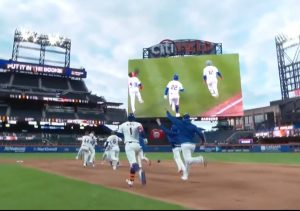 Experts on ancient artifacts had to be called in for clarification, as nothing like it had been found on these premises in ages. Experts on ancient artifacts had to be called in for clarification, as nothing like it had been found on these premises in ages.
Alonso went down and got his pitch. Taylor went down and got his pitch. These Mets really did have to dig deep to excavate a single win on Thursday, a day they played twice and, until the ninth inning of the second game, produced little, except doubts. There was splendid home team starting pitching during the makeup doubleheader — five one-run innings from Adrian Houser in the opener and six from Jose Butto in the nightcap — but all that admirable hurling only seemed to accentuate how wretched the hitting had become. The Mets actually held a 3-0 lead in the first game, an advantage the Mets ceded slowly (single Tiger tallies in the sixth, seventh and eighth), before surrendering the contest all at once (luckless Michael Tonkin bending, then breaking in the eleventh). The meltdown portion en route to the 6-3 defeat was best captured by a text I received from Chuck, my best friend these last four decades:
Dude, seriously, I don’t know how u hang in there year in and year out. I am exhausted and it is only April 4.
It remained April 4 for the second game, but it might as well have been September 29, the scheduled date of the last game of this season, should the Mets endure as a going concern that long. The year was five games old and already felt over, no matter how repeatedly one muttered to oneself, “It’s still early.” The first eight innings of the nightcap — featuring a lone Met hit, from Harrison Bader — did nothing to disrupt the gloom.
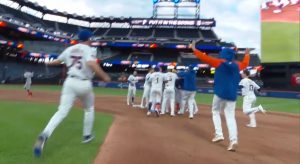 Then Pete got ahold of one for one run, and the other fellows did what they did to build the other run, and the efforts of Butto and Reed Garrett in mostly shutting down the Tigers proved not in vain. The Mets, ahead 2-1 with an ‘F’ that could be repeated in polite company next to the score, came charging out of the dugout to heartily congratulate one another on finally winning something before retreating inside to fete Carlos Mendoza, a.k.a. Mendy, who now rates his clubhouse nickname, because a manager who has at last managed a win suddenly radiates humanity. Then Pete got ahold of one for one run, and the other fellows did what they did to build the other run, and the efforts of Butto and Reed Garrett in mostly shutting down the Tigers proved not in vain. The Mets, ahead 2-1 with an ‘F’ that could be repeated in polite company next to the score, came charging out of the dugout to heartily congratulate one another on finally winning something before retreating inside to fete Carlos Mendoza, a.k.a. Mendy, who now rates his clubhouse nickname, because a manager who has at last managed a win suddenly radiates humanity.
Watching the onrush of Mets in the wake of their walkoff, I took in what amounted to the first unposed team picture of 2024. 21? 13? 44? 75? I’m aware of which players wear which numbers, but in context, I was jolted into “who the hell are these guys?” mode. Right, right, they’re Mets I am depending on for brightening my outlook intermittently, blended in with 20 and 6 and 12 and 9 and 1 and 4 and 22, the guys whose identities I don’t have to question, except to wonder why 12 and 9 and 1 are 3-for-60 combined and what the hell ever happened to Lindor and Nimmo and McNeil.
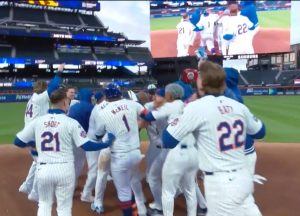 Despite improving to 1-5 instead of declining to 0-6, Mendy and his Metted Men have a mountain to scale, and the Marlins (0-8) to thank for keeping them clear of the cellar. The starting pitching has been more than competent, but its depth is shallow enough to have created a need for Julio Teheran, a Met-killer of long ago, currently an arm whose most attractive aspect is availability. The relief pitching, Garrett’s scoreless three frames notwithstanding, tends to turn spotty at the worst moments. The fielding hasn’t done enough to keep bad innings from getting worse. And did we mention all that not getting a hit? Friday morning’s Metropolitan Area tremor surely wasn’t an aftershock from a torrent of Met offense. Despite improving to 1-5 instead of declining to 0-6, Mendy and his Metted Men have a mountain to scale, and the Marlins (0-8) to thank for keeping them clear of the cellar. The starting pitching has been more than competent, but its depth is shallow enough to have created a need for Julio Teheran, a Met-killer of long ago, currently an arm whose most attractive aspect is availability. The relief pitching, Garrett’s scoreless three frames notwithstanding, tends to turn spotty at the worst moments. The fielding hasn’t done enough to keep bad innings from getting worse. And did we mention all that not getting a hit? Friday morning’s Metropolitan Area tremor surely wasn’t an aftershock from a torrent of Met offense.
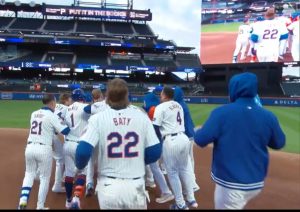 Yet it’s still early. And we’ve got a win. That’s the truth. Yet it’s still early. And we’ve got a win. That’s the truth.
by Jason Fry on 2 April 2024 12:09 am We could talk about Sean Manaea looking superb in a way that no Met starter looked against the Brewers, pitching aggressively and keeping the Tigers bothered and bewildered for six innings, with the lone blemish a sharp Andy Ibanez single to left with two out in the fifth — though that situation happily healed itself almost instantly, as Brandon Nimmo threw Carson Kelly out at the plate to preserve what was then a 0-0 tie. By the way, you want to be a catcher? Kelly — who plays that position for Detroit — slid hard into Francisco Alvarez at the plate, wrenching Alvarez’s head and neck to the side, got tagged hard in the nuts or uncomfortably thereabouts, and watched as his counterpart held onto the ball.
We could talk about Alvarez, who coolly made the kind of play it feels like catchers don’t make anymore, then showed the most offensive life the Mets displayed all night with a hustle double a few minutes after his close encounter with Kelly, not to mention a growing awareness of the strike zone and the need not to expand it in his other at-bats.
We could talk about Starling Marte, who looks better than he’s looked since that dreadful day two Septembers ago when a Mitch Keller fastball hit him in the hand and we didn’t yet know the Mets’ rocket ride had reached its apogee. We could talk about Brett Baty, who turned in a couple of crisp plays at third and looked like he had a plan at the plate, making you hope he’s finally ready to get out of his own way.
We could talk about those things, but who’d listen? Because the top of the 10th inning erased them all. With one out and the idiotic Manfred man having moved to third, Michael Tonkin in rapid succession a) hit old friend Mark Canha (this time at least the pitch behind an opponent’s back actually did get away); b) watched Joey Wendle make a dreadful error at second; c) instinctively tried to spear a high bounder from Gio Urshela and so turned an inning-ending double play into all hands being safe; d) almost managed the impossible task of walking Javier Baez, forcing himself to shrink the strike zone and giving up a sac fly; and e) surrendered a three-run bomb to Kelly that left the Mets five runs down and the fans jamming in the aisles in their haste to reach a safe distance.
Tonkin will have better days … well, provided he didn’t use them all up last year as a Brave, which is the kind of thing I think about all too often. Wendle can’t really do worse than a Mets debut that would make Mac Scarce or Chan Ho Park blanch, or at least I really hope he can’t.
Hell, I don’t know what will happen to those two: Baseball is cruel and confounding, with this 0-4 start just the latest reminder of that essential truth. What I do know is the Mets’ season is less than a week old and I’m relieved that they’re unlikely to be able to play baseball for the next two nights.
To be clear, I mean play baseball in the sense of “stand at the plate gripping a bat without being in danger of drowning,” not play baseball in the sense of “compete against another baseball team without it ending with an embarrassing and/or infuriating outcome.” So far the 2024 Mets have shown no indication that they can accomplish the latter in any kind of weather.
by Greg Prince on 1 April 2024 11:04 am Three games into the new season, and I already don’t want to dwell on the most recent baseball game the Mets played and lost. For the record, Tylor Megill labored for four innings Sunday and left with tenderness in his shoulder, slating him for an MRI. Carlos Mendoza served a suspension for Yohan Ramirez throwing in the general airspace around Rhys Hoskins the day before. Ramirez was suspended for three games but opted to appeal it, so fill-in manager John Gibbons used Yohan for three innings, a sure sign of an appeal likely to be dropped. The Mets did load the bases for a tantalizing moment in the fourth inning, albeit with two out. Omar Narvaez, the nine-hole hitter, was up, and I began to dream of Rusty Staub being deployed to pinch-hit, until I remembered a) Francisco Alvarez was the DH, so that meant — because we carry only two catchers — Alvarez would have to move behind the plate and we’d therefore lose the DH (stupid non-position that it is); and b) Rusty Staub hasn’t been available to pinch-hit in quite a while. Anyway, Narvaez hit for himself and gave a Colin Rea pitch a good ride, but his bid for a grand slam died at the warning track, as did the Mets’ last honest-to-goodness rally in their listless 4-1 loss to the now hated Brewers.
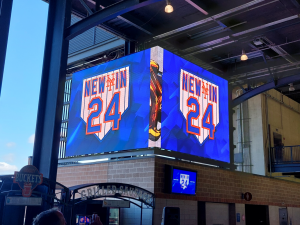
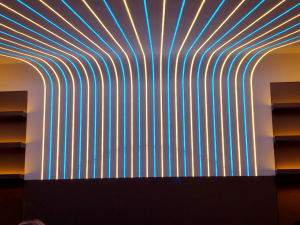 Stare into the neon and forget about the runs you can’t find on the scoreboard. The Mets must know how little we want to dwell on how they play, because they built many distractions into their season ahead of time. I saw a lot of what they were planning when they unveiled for the media their “NEW IN 24” chazerai, to use a word my mother would sprinkle into conversation when she wished to refer to random stuff, but do it with a touch of Yiddish. Citi Field’s chazerai is the stuff on the margins of baseball, like the way the 0-3 Mets will be lucky to be on the margins of the playoff race. Stuff like neon lights in upscale club spaces, and LED displays around every corner, and expanded retail operations, and more convenient ways to book a suite. Oh, and food, glorious food. Citi Field’s food has always been a winner, and a generous sampling by this reporter indicates it will continue to be so. (Pro tip: seek out Empanada Mama behind Section 103.)
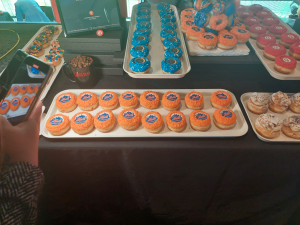 Met donuts don’t have as many holes as the Met lineup. The Mets were also kind enough to give visitors that chilly March day a sneak preview of the Queens Crew. The Queens Crew is the dance troupe you might have heard about. It’s a reflex reaction among Mets fans of a certain age to groan at the idea that dancers are being added to the baseball menu, because they didn’t have that in our day, let alone at our Shea. But y’know what? Time dances on, and maybe, as long as it’s between innings and the PA volume isn’t on blast, some people who aren’t me will enjoy it a lot. And I have to give these kids in the Queens Crew props for dancing in their thin getups on such a frigid morning. Seriously, they presented their first number in the left field corner, with the wind howling in so ferociously that it would have knocked down a Pete Alonso moonshot. Some of the young ladies (it’s a co-ed bunch) were sporting bare midriffs, and I was hoping somebody from one of the myriad team stores would appear when the music ceased to wrap them in blankets.
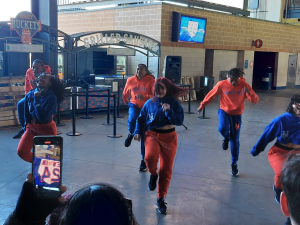 At least the Mets’ dancers showed up some pep in March. Despite accompanying my wife to the ballet a few Sundays a year many years ago, I’m no judge of dance, but these dancers showed some real skill and tons of enthusiasm. No, it’s not traditional baseball, but maybe we could use another distraction this season. Plus, there is a legitimate nostalgic element to bringing out a dance team at select home games in 2024. What wasn’t widely reported, but I’ve since learned, is that the Queens Crew is part of a reboot of one of the great Met anthems associated with the greatest of Met years.
That’s right: they’re bringing back “Get Metsmerized”.
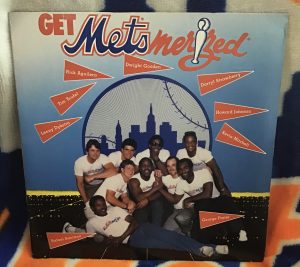 This Queens Crew truly knew how to kick it. Well, not bringing it back, exactly. They’re updating the song made famous during the 1986 season, the Mets’ bold entry into hip-hop, in which about a third of the roster — led by George Foster and including Darryl Strawberry, Dwight Gooden, Lenny Dykstra, Rafael Santana, Rick Aguilera, Kevin Mitchell, Tim Teufel and Howard Johnson — rapped their intentions to dominate the National League East and then some. You can’t say they didn’t make good on their prose or their promise.
The new version is called “Dance Metsmerized! 2024,” and it has quite a story behind it, per the Mets’ own hype. “‘Get Metsmerized’ was a landmark in the cross-pollenation between professional sports and an emerging art form,” the Mets’ press release detailing the new beats explains. “With ‘Dance Metsmerized! 2024,’ we’re adding a whole new layer to the timeless concept of ‘getting Metsmerized’. It provides us the opportunity to let our fans intimately know our newest personnel in a fresh and contemporary manner informed by old-school overtones, while providing a thumping soundtrack to the Queens Crew routines we’re confident Citi Field crowds will come to embrace. It’s baseball and diversity at its most ‘Amazin’!’”
Save a spot on your calendars for a “Dance Metsmerized! 2024” Day sometime this summer, sponsored by Danskin, Official Dancewear Partner of the New York Mets, with the first 15,000 fans through the gates getting sent to their devices a link that will allow them to download the song and its various remixes. By midseason, a vinyl version will be on sale at Citi Field concessions and through Mets.com, with all proceeds benefiting the great work done by the Amazin’ Mets Foundation.
“‘Dance Metsmerized! 2024’ strikes just the right balance of swagger and humility that the Mets have always been known for,” the release elaborates. “It may not be 1986 on the field, but you can bet at Caesars Sportsbook at the Metropolitan Market located on the Excelsior level that Citi Field’s world-class sound system will be pumping with ‘big league’ phrasing while the Queens Crew’s steps as they dance their hearts out atop the home team dugout will prove an inside-the-park home run!”
It’s admittedly a lot to digest. For copyright reasons, the actual music isn’t available for sharing yet, but fortunately, you can get a taste of “Dance Metsmerized! 2024” from the lyrics the Mets have furnished to various outlets (like ours). And you really do get to know better some of the new people the Mets brought in over the winter so they’re not just names on a stat sheet.
Honestly, with the Mets’ decision to play this little ditty “five or six times per game, including on our television and radio broadcasts, plus whenever fans engage with our social media accounts,” it would be foolish today or any day to think this baby won’t eventually be worming its way into all of our ears
***‘DANCE METSMERIZED! 2024’ OFFICIAL LYRICS
PRESENTED BY DANSKIN,
OFFICIAL DANCEWEAR PARTNER OF THE NEW YORK METS
QUEENS CREW
IN THE HOUSE!
QUEENS CREW
PLEASE ANNOUNCE!
Dance Metsmerized!
Twenty Twenty-Four!
Dance Metsmerized!
Get ready for more!
Dance Metsmerized!
Hoofin’ on the roof!
Dance Metsmerized!
Get ready for truth!
David Stearns
My passion burns
For baseball operations
Local guy
I’m flyin’ high
Makin’ calculations
Bringin’ in
Slight upgrades
At this an’ that position
We might compete
For a Wild Card
If we can’t win our division
Dance Metsmerized!
Twenty Twenty-Four!
Dance Metsmerized!
Get ready for more!
Dance Metsmerized!
Hoofin’ on the roof!
Dance Metsmerized!
Get ready for truth!
It ain’t where I came from
It’s where I’m goin’
I’m Carlos Mendoza
I impressed Steve Cohen
We’ll soon be better
At catchin’ and throwin’
And we’ll get bunt singles
If they’re not lawn-mowin’
Dance Metsmerized!
Twenty Twenty-Four!
Dance Metsmerized!
Get ready for more!
Dance Metsmerized!
Hoofin’ on the roof!
Dance Metsmerized!
Get ready for truth!
You say sooner
I say later
You say your name
I say Bader…
MY NAME!
BADER!
Hailin’ from
The Nine One Four
I’m the Mets’
Boy next door
Got my schoolin’
At Horace Mann
If you like defense
You’ll be my fan
Dance Metsmerized!
Twenty Twenty-Four!
Dance Metsmerized!
Get ready for more!
Dance Metsmerized!
Hoofin’ on the roof!
Dance Metsmerized!
Get ready for truth!
Some ask when-a
Some ask why-a
Don’t ask me
I’m Sean Manaea
My locks are shorn
My beard is shaved
Relax, Met-lovers
Your season’s saved
Dance Metsmerized!
Twenty Twenty-Four!
Dance Metsmerized!
Get ready for more!
Dance Metsmerized!
Hoofin’ on the roof!
Dance Metsmerized!
Get ready for truth!
‘YO, ADRIAN!’
I’ve heard it a lot
‘YO, ADRIAN!’
Feel free to stop
If ya wanna greet me
That’s okay
Just gimme a nod
Or gimme a ‘hey’
‘How’s it goin’, Houser?’
I’ll acknowledge, whatever
But that ‘Rocky’ bit?
Yo, it’s not clever
Dance Metsmerized!
Twenty Twenty-Four!
Dance Metsmerized!
Get ready for more!
Dance Metsmerized!
Hoofin’ on the roof!
Dance Metsmerized!
Get ready for truth!
I’m Joey Wendle
And I’m Zack Short
Some fantasy players
Can’t tell us apart
We’re utility guys
We know what we’re doing
We’ll try to be super
Like old Joe McEwing
Dance Metsmerized!
Twenty Twenty-Four!
Dance Metsmerized!
Get ready for more!
Dance Metsmerized!
Hoofin’ on the roof!
Dance Metsmerized!
Get ready for truth!
Popeye the Sailor
Lived on the sea
Tyrone A. Taylor
Yeah, that’s me
Flushing Bay’s
My port of call
Swing at everything
That’s my ball
Dance Metsmerized!
Twenty Twenty-Four!
Dance Metsmerized!
Get ready for more!
Dance Metsmerized!
Hoofin’ on the roof!
Dance Metsmerized!
Get ready for truth!
Severino, I used to be good
Severino, perhaps I still could
Severino, my price was alright
Severino, I go five tonight
Dance Metsmerized!
Twenty Twenty-Four!
Dance Metsmerized!
Get ready for more!
Dance Metsmerized!
Hoofin’ on the roof!
Dance Metsmerized!
Get ready for truth!
We’d introduce ourselves
But we’re just relievers
In this organization
We have few believers
If we give up earned runs
Then we’re off the team
We’re replaceable cogs
In the Met machine
Dance Metsmerized!
Twenty Twenty-Four!
Dance Metsmerized!
Get ready for more!
Dance Metsmerized!
Hoofin’ on the roof!
Dance Metsmerized!
Get ready for truth!
I’d be there with you
If they’d got me quickly
Without me there
The hitting’s sickly
I’m J.D. Martinez
A proven batter
I’ll be there soon
(It might not matter)
Dance Metsmerized!
Twenty Twenty-Four!
Dance Metsmerized!
Get ready for more!
Dance Metsmerized!
Hoofin’ on the roof!
Dance Metsmerized!
Get ready for truth!
Now you’ve met
All our new faces
We could finish
In one of three places
Hope for the best
Don’t expect a whole lot
Mets fans know
The club they’ve got
QUEENS CREW IS OUT!
by Jason Fry on 31 March 2024 12:12 am Years ago, after too many not-yet-spring days spent at Shea watching it rain, waiting in horrible lines for bad coffee or both, my wife instituted a rule: No ballpark visits before May. In recent years, as I’ve become older and grumpier and more fragile, I’ve made her rule my own. I hope Opening Day is lovely, but I’ll see you when the trees have green leaves and the conversation is about returning the heaviest coats to the back of the closet.
So I was surprised bordering on shocked when Emily looked at the weather report and said it was going to be 60 and sunny on Saturday and we ought to go to the game. Off to StubHub I went, and at 1:40 pm we were sitting down the third base line in abundant sunshine, waiting to see how the Mets might fare in a second go-round with the Milwaukee Brewers.
The answer? Not to our satisfaction, though we’ll get to that. And maybe stick an asterisk or two on the verdict. We’ll get to that too.
One of the joys of the early baseball season is a simple one: getting used to the world reorienting itself around the game. Your nights and scattered afternoons are booked. Your phone alerts and Google searches return to looking up schedules and checking on prospects and fretting over medical reports. The first time back at the park is like that too, whether the visit comes in May or (gulp) late March: Is there going to be a 7 express? How do we do this again? And do the old routines, once remembered, still apply? Is there a byzantine new rule about things you can or cannot bring into the ballpark? Are there new displays? Attractions? Things to eat?
We got ourselves to the ballpark just fine (no 7 express though) and found the lineup now announces itself on video boards as you ascend the escalator. (A little gaudy but not bad.) The Mets museum has been relocated to beyond center field in favor of a far larger team store. (Eh, commerce gonna commerce.) We found some birra tacos and sweet corn (tasty), drank a cider and a beer and then got down to witnessing the business on the field.
From where I was down the third-base line I had no idea that Luis Severino‘s location was lousy, which it was — all I saw was baseballs struck by Brewers not finding their way into the right gloves at the right time. A lot of the contact was soft early — even the newly villainous Rhys Hoskins‘ first-inning double was more about location than velocity — but the later contact was not soft at all. When Hoskins connected in the third I didn’t even bother watching the ball’s flight, but just said a bad word and kicked at the cement.
The Mets fought back in fits and starts, with Francisco Alvarez socking a no-doubter home run in the second and high-stepping around the bases like a show pony, a sight that always makes me laugh and that I’d sorely missed. But the Brewers just kept pouring it on, with their crisp defense a sharp contrast to the Mets’ sloppiness, and by the time Severino was excused further misadventures I was just hoping someone in blue and orange would put some lipstick on this pig.
Lo and behold, the last three innings turned out to be pretty exciting.
The headline, inevitably, is that Yohan Ramirez threw behind Hoskins, a blatant bit of retaliation that earned him an ejection and a standing ovation from a crowd heartily sick of a steady diet of crow served up by our new least favorite former Phillie. The cheers for the heretofore anonymous Ramirez made me think back to Yoan Lopez earning plaudits from his teammates two Aprils ago for buzzing Nolan Arenado after Cardinal pitchers kept hitting Mets with baseballs. But I also needed to look up the details to remember Lopez had been the earner of said plaudits — my brain supplied “guy who was Adonis Medina before Adonis Medina.” Which, ehhh, really isn’t wrong.
As for the rest of the contretemps, I was amused to see Carlos Mendoza peddle the inevitable “no intent, pitch just got away” bullshit like a 10-year veteran skipper. Nothing that’s happened in the last two days has struck me as news: Rhys Hoskins straddles the hard to define but very real line between “hard-nosed competitor” and “kind of a dick;” Jeff McNeil‘s incessant chirping doesn’t endear him to his fellow players (ambush Francisco Lindor with some truth serum and see what information you return with); teams will protect their own and then swear, wide-eyed as choir boys, that they did no such thing; and retribution is pretty cold comfort when you’re getting your brains beat in.
When Adam Ottavino let in yet another run in the eighth I just sighed, and even let myself be mildly amused by Ottavino’s Eeyore demeanor, which is his affect even when things go well. Who knew that said run would turn out to be kind of important?
An amusing Fry family factoid: My mother watches every game, lives and dies on every pitch, and loves the Mets. But she cannot stand Brett Baty, whose serial failings draw a cold stare and a scornful “chew some more bubble gum, Baty.” So when Baty stepped into the box against Hoby Milner in the eighth I just shook my head, knowing my mother wouldn’t grade Baty on the curve for having to come off the bench to face a guy who’s not only a lefty but also a sidearmer. I still have no idea how Baty did what he did, but after he finished circling the bases I texted my mom a bunch of exclamation points, which she replied to with an only mildly grudging “OK Brett. Take a bow.”
Edwin Diaz entered to pitch the ninth, which was a nice moment even if a) he didn’t look his sharpest and b) there’s always something a little embarrassing about closer pomp and circumstance when there’s nothing to save. Though I must confess that when Diaz faced Hoskins I had a dreadful vision: Diaz would drill Hoskins, there’d be a brawl, and Diaz would emerge from it with his knee busted again — maybe the same knee, maybe the other knee, hell why not both knees? This is the kind of thing one imagines telling a therapist who’d then suggest that there are 29 other baseball teams and surely not all of them go about their business attended by an apparently permanent black cloud.
The bottom of the ninth saw the Mets get to within 7-6 but no closer, but that was another little personal victory: the one run (when we needed two) came on a Pete Alonso homer into the left-field stands, not a classic high arcing shot but a line drive whose destination was never in doubt. I’ve long mourned never seeing an Alonso homer live, which actually isn’t true: Greg (who knows these things) tells me I have seen one, though he allowed that it required replay review. I’ve now unambiguously and undeniably seen the Polar Bear doing what he was put on this earth to do, and it made me happy even when Starling Marte swung through a slider a few minutes later and it was time to go home.
The Mets lost, but they’re playing baseball again, Emily and I got to sit in the sun and see that baseball right in front of us, and the game was not without its pleasures and even offered a few surprises. Besides the ones covered, did you know the Mets now offer the 50-50 raffle? When I first encountered a 50-50 raffle at some park now forgotten I assumed it was an amusing local tradition; it took me a while to understand it’s a ballpark thing pretty much everywhere except New York. Now that that’s changed, there was no question that I was in for five tickets (or that I wouldn’t win, but oh well).
The Mets also inexplicably decided not to rig the ballpark singalong vote, leading to the man-bites-dog sight of “Piano Man” coming in behind the Killers’ “Mr. Brightside.” To be honest, “Mr. Brightside” moves at too speedy a clip to work as a singalong, plus everybody thinks they know the words but they actually don’t. No matter: It’s not “Piano Man,” which I’d rather be waterboarded than have to listen to. The Mets lost, but I was spared having to endure my least favorite song, and that’s not a bad way to start the year, even if other statistics point to work that needs to be done.
by Greg Prince on 30 March 2024 9:44 am Care for an omen? The Mets lost their last game of the season in 1968, a home game. They then lost their first game of the season in 1969, also a home game. That particular unpromising strand of homestanding Closing Day/Opening Day synergy hadn’t transpired again until they lost, 9-1, at home last October 1 to finish 2023 and then lost, 3-1, at home, on Friday to start 2024. Not all calendar-spanning two-game losing streaks are created equal. Some serve as prologue to unlikely world championships.
And some are just two losses in two different seasons. We’ll have plenty of opportunity to find out more of what the latest sample portends in the 161 games that follow.
 One of the many Met coaches introduced on Opening Day might want to advise the hitters to start generating some electricity. If you don’t care for an omen, mostly what you got out of Opening Day 2024, beyond a plethora of pageantry and a return to routine, was Carlos Mendoza’s inaugural edition of the New York Mets being one-hit and their second baseman being slid into in chippy fashion. The one hit was Starling Marte’s second-inning home run, a good sign to all who remember those halcyon days of Marte’s considerable skills not being compromised by injury. The chippiness was furnished by former Phillie Rhys Hoskins, now wearing the Cub Scout garb of the Milwaukee Brewers after a year of rehabbing a torn ACL. You can take the Hoskins out of the Phillies, but Chase Utley proved Buttleyness lingers anywhere. Hoskins, charging from first on a grounder to third in the eighth, took Jeff McNeil out after an infield force. Jeff himself said he wasn’t going for the double play, so he didn’t know what the hell Hoskins was doing coming at him spikes up, other than being Hoskins.
Umpire review confirmed the slide was legal. In a previous era, it might not have raised an eyebrow, but sliding directly into a guy’s left leg is generally frowned upon in today’s preservation-minded version of the sport. I don’t blame McNeil, who plays now and not a hundred year ago, for expressing displeasure, nor the benches for emptying Harrelson-Rose style in response to the escalating yaps. As for Hoskins making a wah-wah! gesture from the safety of the visiting dugout, there’s no rule against McNeil bunting up the first base line today, is there? Pity if he runs straight into the Milwaukee first baseman. What’s his name again? He used to the play for the Phillies, I believe.
The Brewers’ starting pitcher, Freddy Peralta, was magnificent. The Mets’ starting pitcher, Jose Quintana, mostly navigated through trouble. We got some good relief from Drew Smith and Michael Tonkin, less good relief from Jorge Lopez. As Opening Day usually offers, there was a lot of window dressing. Festive as it is, it loses a little oomph when your lineup is all but impotent and your second baseman is mistaken for second base.
Maybe we all need time to get our act together. Early on, I watched a Francisco Lindor fly ball travel to right and decided it had a chance to leave the park. Maybe it was the wind, maybe it was my out-of-practice perception, but the ball was headed nowhere near the fence. In a split second, my thought process shifted from “keep going!” to “don’t go so far, maybe you’ll fall in!” It wound up caught by a Brewer, but it was comforting to know I’m still on speaking terms with baseballs.
A bad omen for Opening Day might have shown itself in living color when the Mets couldn’t get through their pregame In Memoriam tribute without an unforced error. In attempting to remember lefthanded pitcher Ken MacKenzie (1934-2023), they displayed a picture of lefthanded pitcher Bobby Ojeda (1957- ). MacKenzie pitched for the Mets in 1962 and 1963 and died in December. Ojeda pitched for the Mets from 1986 to 1990 and, at last check, is still with us.
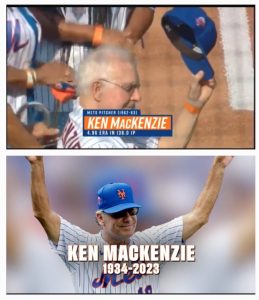 Top: Ken MacKenzie. Bottom: not Ken MacKenzie. The mistake that took a routine good intention and dropped it on the transfer — when will the Mets ever again have reason to devote enormous video screen bandwidth to their first winning pitcher, a gentleman who cherished his Met affiliation? — is almost understandable if you know that MacKenzie and Ojeda each wore No. 19 at Old Timers Day in 2022, just as they did in their Met tenures. The picture of Ojeda is that of a fellow above standard playing age wearing No. 19 standing and waving to the crowd on that occasion. It’s a nice picture. But it’s of Ojeda, not MacKenzie (who needed to be wheeled to the foul line to take part in those 2022 ceremonies). The Mets made this same mistake in initially announcing MacKenzie’s passing, but corrected it shortly thereafter, if not permanently within their files. Quality control that amounts to “I’m doing a search for an old dude who wore No. 19 less than two years ago in this very ballpark” apparently nets you more than one match.
by Greg Prince on 29 March 2024 3:48 am “What a break,” the player said. “Wow! This is great. I can hardly believe it. Imagine going to a club like the Phillies. I feel like I’ve been born again.”
The player was Buddy Harrelson, on the occasion of his trade from the Mets in Spring Training 1978. The Mets were founded in 1962 and were headed into their seventeenth season. Harrelson had signed with them in their second and had never been associated with anybody else. Born again? He was practically born a Met. How does somebody like that take such glee in assuming another identity?
“I kinda wondered about all that family stuff I’d been hearing for years. I thought I was a member of that family, but they didn’t have the decency to let me know they were getting someone to take my place.”
That quote is also Harrelson’s, uttered on the same occasion. During the preceding winter, the Mets dealt for Tim Foli, himself an ex-Met. Harrelson, 33 and oft-injured, understood the last-place Mets were going in a different direction. He didn’t understand why he couldn’t have been given a heads-up about Foli taking his spot while he was still on the roster. Thirteen seasons in a Met uniform didn’t mean much in the wake of 1977.
“If the Mets said I could have a lifetime contract to be a coach, I’d be crazy not to.”
The proprietor of that particular limited ambition? Mets coach Buddy Harrelson, August 1988. Buddy had filled in briefly for Davey Johnson and the Mets won the series he skippered. By then, Buddy had been back in the Met fold since the fall of 1981. A new Mets management structure recognized who Harrelson was and what he meant to the franchise. He’d been delighted to have been sent to a contender in Philadelphia, but “I never stopped being a Mets fan,” Buddy admitted when he came back the first time, “even when I was traded.” He also knew his baseball, and the Mets were smart enough to put what he’d accumulated to good use. He coached for George Bamberger. He announced over SportsChannel. He managed at Little Falls. He was in the third base box to urge Kevin Mitchell to bolt for home when a pitch got away from Rich Gedman and, a couple of moments later, he shadowed Ray Knight down the line. Now he was Davey’s right hand in the dugout. He wasn’t bucking for a promotion.
“The team was going to Philadelphia and I was going home to Long Island. I could have finished the week. The writers would have asked, ‘What about Harrelson?’ and they could have said they were deciding. In the winter they could have said, ‘He’s going to be a scout.’ That’s what hurt. They knew the heart of who I am and how I am. I earned better treatment than that.”
That’s Buddy Harrelson reflecting in 2000 on how the managing gig he wasn’t seeking in 1988 ended with seven games remaining in 1991. Frank Cashen was giving way to Al Harazin in the GM role, and it was decided somewhere upstairs that it would provide a fresher start for Harazin if he didn’t have to make his first official act the firing of Harrelson. Buddy had taken over for Davey in 1990 and led the perennially underachieving Mets’ charge into the thick of an ending era’s final pennant race. No, Buddy wasn’t gonna be back in 1992, nor, if you experienced 1991’s Met crash to earth, would have you thought he should be. But did they have to cut him loose with a week to go?
Between 1992 and 2000, Harrelson had been back to Shea plenty, no hard feelings evident, though “that’s what hurt” indicates some feelings remained harder than others. He’d even been enlisted, alongside Mookie Wilson, as a Mets community outreach representative after the disastrous 1993 season, when if any Mets were known for reaching out, it was so they could get better rotation on the firecrackers they were throwing. What more positive faces could you put on the Mets at any time than those of Mookie and Buddy?
“I never really wanted to manage. I’ve moved on.”
Harrelson’s direct association with the Mets was over by 2000, which was when he added the above thought. He was helping to start up and run the Long Island Ducks, an independent professional baseball team technically operating within the same Metropolitan Area where the Mets sold tickets, but the Ducks stressed they weren’t intending to take a bite out of any big league entity’s box office. Ticket prices were lower out in Suffolk. “We’re competition for the movies,” Buddy said. He had stayed on Long Island, and now he was doing something for his community. The Mets were his past. “This” — the Ducks — “might end up being my baseball legacy.”
Due respect to the pretty ballpark in Central Islip and the four Atlantic League championship teams to which it’s been home and however many kids who were introduced to baseball there because of the affordable tickets and cozy atmosphere, but no, that’s not Bud Harrelson’s baseball legacy. It’s great that Buddy had an enormous hand in creating, popularizing and sustaining the Long Island Ducks, but we know Buddy’s legacy is what he did as shortstop for the New York Mets, particularly the year the Mets first won it all and the year the Mets almost did that again. We might also add that the arc of his baseball life past those peaks of 1969 and 1973 speaks well for the idea that in this sport that begins again today in Flushing, you can go home again. You don’t have to be an alert third base coach to know the object of baseball is to go home.
Buddy Harrelson belonged in a Mets uniform, at the Mets’ ballpark. When the circumstances allowed it, he returned. Not only after he was traded as a player, not only after he was fired as a manager. When his calling card read Ducks, he’d still slip into something orange and blue and come home. In 2000, the same year the Ducks were first flapping their wings, Harrelson took a Sunday off to join his long-ago teammates at Shea Stadium. The occasion was the unveiling of the Ten Greatest Moments in Mets history, as determined by an online vote of the fans. When Buddy’s name was announced amid a slew of ’69ers, I had the sense (from his closeup on DiamondVision) that he was a little uncomfortable on the premises, as if someone in a suit might have intimated he was siphoning off business with that new Long Island team of his. But he showed up. He showed up on the final day of Shea Stadium, hopping atop home plate during the postgame ceremonies, and he was as special a guest as any alum during the 2009 and 2019 reunions of the 1969 champs at Citi Field.
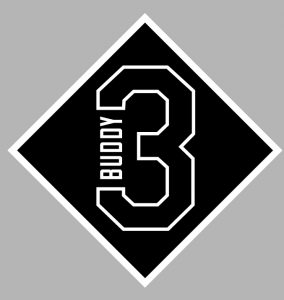 And in 2024, the Mets will wear a memorial patch with his nickname and his number to commemorate his life and his legacy, because while a lot of things happen in baseball that don’t go down well in the moment — like being traded or being fired or being suspect — some people ultimately withstand and transcend those rough patches. Buddy Harrelson, No. 3, New York Mets. That’s who we remember. That’s how we’ll remember him. And in 2024, the Mets will wear a memorial patch with his nickname and his number to commemorate his life and his legacy, because while a lot of things happen in baseball that don’t go down well in the moment — like being traded or being fired or being suspect — some people ultimately withstand and transcend those rough patches. Buddy Harrelson, No. 3, New York Mets. That’s who we remember. That’s how we’ll remember him.
Eleven of the Mets who will wear the uniform that will feature the BUDDY 3 insignia, per the announced 26-man roster, will be brand new to the ballclub: starting pitchers Luis Severino, Sean Manaea and Adrian Houser; relievers Yohan Ramirez, Jorge Lopez, Jake Diekman and Michael Tonkin; infielders Zack Short and Joey Wendle; and outfielders Harrison Bader and Tyrone Taylor. A twelfth new Met, J.D. Martinez, will join them once he swings himself into shape. Martinez will be depended on to hit and to mentor, notably Mark Vientos, the promising youngster whose prospective job J.D. was signed to take. Vientos won’t be one of the Mets wearing the BUDDY 3 patch on Opening Day, either, as he’s been sent down to Syracuse. He figures to be back soon enough, and Martinez says he’ll be available to talk hitting with him or any teammate. “I’m an open book,” he said in St. Lucie. “That’s my passion. That’s what I do.”
The Mets are our passion, which is why we mope when our scheduled Opening Day is rained out, and we brighten when we realize tomorrow was only a day away. Citi Field, I can attest from a visit there last week, waited capably through the endless offseason and will be there to welcome our flock anew (plus it now has dancers!). What we do is revel in baseball’s arrival. That’s the theme entering today.
Then, at the first signs of adversity, perhaps before today is done, we grow antsy. It’s very likely in this ongoing era of roster churn that we won’t have to wait long to learn somebody among those ten new Mets has become an ex-Met…and his name will barely ring a bell months, maybe weeks later. It’s just as likely that one of the new Mets who sticks won’t succeed and mention of his name will wind up striking an unpleasant chord years from now.
Hopefully not the guy who sat on the market for months despite posting one overwhelmingly positive OPS+ after another for the past decade unless a pandemic happened to be shortening a season. Once March grew late, J.D. Martinez was simply too available to pass up, no matter the winter’s prevailing “let’s see what the kids can do” philosophy. May he bring to the (regrettable) DH role the kind of production and stability the Mets have lacked since the National League consented to have its rules bastardized. And if he can offer valuable insights to his designated successor, all the better.
“It’s part of the baseball tradition. They come up with new things in baseball, nowadays swing path and different things. There are things I can’t teach him. But at least I have experience. There are things I’ve lived and done. I definitely can share my experiences and knowledge with him. I can tell him what has worked and what hasn’t.”
What a gracious thing for 36-year-old J.D. Martinez to say about how he plans to relate to 24-year-old Mark Vientos. Except that quote isn’t from Martinez and it isn’t about Vientos and it’s not even from 2024. It was 35-year-old Adrian Gonzalez in 2018 looking forward to guiding 22-year-old Dom Smith. Different baseball players, yet similar baseball elements and sentiments, expressed a mere six years ago. When was the last time you thought about Adrian Gonzalez of the New York Mets? Or marveled at how well Dom Smith was doing?
 It’s not the most hopeful of notes to scrawl across the clean slate of a new season, but we know how one minute you’re delighted that the only clouds on the horizon are puffy and cumulus, and the next minute a tarp is covering the infield. New Mets are offed in favor of newer Mets. Accomplished veterans impart only so much wisdom and have only so much left physically. Prospects fizzle. Franchises inevitably let legends leave in unseemly fashion — still. But like Bud Harrelson, who had every reason to remain disenchanted with his former employers, we never stop being Mets fans and we never stop coming back. All that family stuff proves real to us, season after season. It’s not the most hopeful of notes to scrawl across the clean slate of a new season, but we know how one minute you’re delighted that the only clouds on the horizon are puffy and cumulus, and the next minute a tarp is covering the infield. New Mets are offed in favor of newer Mets. Accomplished veterans impart only so much wisdom and have only so much left physically. Prospects fizzle. Franchises inevitably let legends leave in unseemly fashion — still. But like Bud Harrelson, who had every reason to remain disenchanted with his former employers, we never stop being Mets fans and we never stop coming back. All that family stuff proves real to us, season after season.
Happy new year. May you someday recall it well and recall it fondly.
A new episode of National League Town greets the new year. Listen to it here.
by Greg Prince on 27 March 2024 1:13 am Today we reach that year in the MY FAVORITE SEASONS, FROM LEAST FAVORITE TO MOST FAVORITE, 1969-PRESENT countdown when I have to admit I went to sleep sometime in early April and woke up sometime in early November. That must be what happened, because I don’t seem to have any memories of anything that could have actually happened.
Fortunately, I stirred often enough over those seven months to keep a dream journal, writing down some of the surreal things, Metwise and otherwise, that apparently occurred in my subconscious. As I reviewed it for this series, I was struck by how surreal it reads. Like, I guess it could have happened, but, no, even now it comes off as a little too strange for reality.
Nonetheless, I’m sharing some excerpts below. I wouldn’t necessarily call them bad dreams. Far from it, for the most part. But I’d definitely call them weird dreams.
What a season I seem to have imagined…
***12. 2015
APRIL 6: I dreamed the Mets won on Opening Day in Washington, which doesn’t exactly feel like a dream, since they usually win on Opening Day, but the save went to journeyman Buddy Carlyle, which I wouldn’t have expected in my waking hours. Where’s last year’s closer Jenrry Mejia? I wonder if this is a harbinger of strange dreams to come.
APRIL 9: Matt Harvey is back, if my dreams are to be believed. He’s beating Stephen Strasburg again, just like that game I went to in real life in 2013 when we all chanted “HARVEY’S BETTER,” which is the only thing I can remember ever chanting at Citi Field. Are my dreams in reruns? No, this took place in Washington. Also, a guy named Alex Torres wore an oversized hat and pitched in relief for us, and I never saw a hat like that before. Also, isn’t the Torres who pitches for the Mets named Carlos? I don’t know if I need more sleep, but I need better sleep.
APRIL 11: Where was last year’s closer Jenrry Mejia on Opening Day? Per my latest dream, he’s been suspended for PEDs. Also, the Mets lost in Atlanta to drop their record to 2-3. Even in my dreams, the Mets can’t catch a break.
APRIL 14: I’m at Citi Field for Harvey Night. It’s the first Harvey Night since 2013. It doesn’t seem weird that Harvey is pitching again. We spent the bulk of last year reading every update about his Tommy John rehab. What’s weird is a) Chase Utley — we’re playing the Phillies — homers off him in the first inning (I must’ve been thinking about Utley’s Corner), as if Harvey gives up home runs; b) Harvey hits Utley in the fifth (do the Mets ever retaliate?); c) Utley hits another homer, this time off a pitcher named “Sean Gilmartin” (a combination of Gil Hodges and Billy Martin, maybe, reflecting my unease about Terry Collins still managing this team for a fifth straight season); d) David Wright steals a base, but then has to leave with some kind of injury (the words “day to day” float through my ears; e) Anthony Recker, the good-looking catcher (why do I notice he’s good looking in my dreams?) has to play third base in his stead, which is REALLY surreal even though the Mets have that crazy “79 Men on Third” history with that position, which David Wright seemed to have rendered moot; and f) the Mets win despite all the weirdness.
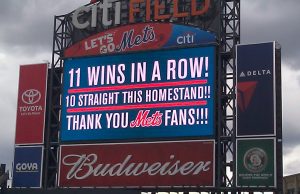
APRIL 23: I’m at Citi Field again, a weekday afternoon game. Wright still isn’t playing. The Mets are trying to tie their consecutive wins streak record at eleven, a mark they set in 1969 and have tied three times since but never broken. When they win eleven in a row, they always wind up having a winning record, which would be a nice change from what I’m used to as a Mets fan, having experienced nothing but losing seasons dating back to 2009 and the opening of the new ballpark. What are the Mets doing being unbeatable? In the dream, if the Mets win, they will have swept an entire three-team, ten-game homestand: the Phillies, the Marlins and the Braves, all hated divisional rivals. So many questions. Also, it is freezing, yet I am up and I am clapping and feeling very optimistic about the Mets, something I haven’t felt for more than five minutes in maybe seven years, probably longer. It’s like my cynicism has taken a holiday. “We’ll have to change our jaded ways,” Billy Joel once said, and I seem to have listened. Toward the end of the dream, the Mets do win their eleventh consecutive game — and our new closer Jeurys Familia saves his eighth, making it seem as if Mejia never existed. I’m loving these days?
 MAY 6: Jacob deGrom, last year’s Rookie of the Year, beats the Orioles one night after Bartolo Colon does the same. I really like deGrom, though I find Colon a little too much of an Internet meme. “Jake and the Fatman,” I muse, and then tweet a picture of William Conrad. Good line, if a little pot calling the kettle black insensitive on my part. Can I help what material I come up with in my dreams? MAY 6: Jacob deGrom, last year’s Rookie of the Year, beats the Orioles one night after Bartolo Colon does the same. I really like deGrom, though I find Colon a little too much of an Internet meme. “Jake and the Fatman,” I muse, and then tweet a picture of William Conrad. Good line, if a little pot calling the kettle black insensitive on my part. Can I help what material I come up with in my dreams?
MAY 17: Back at Citi Field, a sunny Sunday afternoon. Noah Syndergaard is making his home debut. A lot of guys have brought toy hammers, like hammers of the gods from Norse Mythology, I assume, because his nickname is Thor. I must be dreaming, because I can’t believe security would let those through. Before I drifted off during Spring Training, I think there was something about Syndergaard (or “Thor”) eating lunch in the clubhouse during an exhibition game and David Wright telling him that’s a no-no, rook, and Bobby Parnell tossing it into the trash. Anyway, “Thor” is a Met now, according to my dream. Maybe he replaced Dillon Gee, who I don’t see anywhere. Gee, I always liked him.
MAY 20: My dreaming takes a dark turn. I’m supposed to be at tonight’s game, but I can’t go. Turns out the Mets get shellacked by the Cardinals and fall out of first place — the Mets are in first place? — but that’s hardly the center of the dream. In the morning, I get a call that my father’s been taken to the hospital, which gets me and my sister together to drive first to one hospital, then another until we find out which one he’s in. He fell at home, apparently. He’s there all day into the night, so I just can’t take off for a ballgame. Honestly, in the dream, I’m not too worried about the Mets. My father is checked in and staying for a while. Oh, and if all of this isn’t weird enough, this is the night David Letterman ends his talk show, three days after Mad Men airs its finale. I vaguely recall making small talk with my father about Mad Men while he’s lying on a gurnee in a hospital corridor. And wasn’t one of Letterman’s directors named Hal Gurnee? My dreams are getting weirder.
MAY 23: My worlds must be meshing because in addition to dreaming my father is a) still in the hospital and b) had to have brain surgery to remove as much could be removed of a glioblastoma, I learn David Wright — who hasn’t played in more than a month — will be out indefinitely with something back-related I have to Google (it’s something nobody’s heard of, but it’s not good). To make it all stranger, I seem to be driving back and forth from the South Shore, where I live in real life, to the North Shore, where my father’s recuperating, and I almost never drive any kind of distance. It’s all a little scary.
MAY 24: I’m visiting my dad in the hospital again. The Mets are on a TV, losing in Pittsburgh by a score of 9-1. The Mets won their first game ever in Pittsburgh by a score of 9-1. That was the year I was born, and here, in my dreams, I’m trying to get closer to my father, but somehow finding time to keep an eye on the Mets game and worry about Wright’s “stenosis” I think it’s called. What does it all mean?
MAY 30: I go the Mets game by myself. It’s all connected to my father being in the hospital in the dream. Everything about his condition and recovery and the family (ours and his girlfriend’s) is kind of closing in, and I just have to get back to something familiar, something with a different form of attachment. In the dream, I’ve chosen Pepsi Towel Day. I have a longstanding relationship to the beverage business, and Pepsi has a Porch at Citi Field, but the kicker in the dream is they run out of towels by the time I get to the ballpark. The Mets lose to the Marlins. That, somehow, doesn’t sound surreal.
JUNE 1 I dreamed an article ran in the New York Times about the Mets’ ancient third base problems and how they’ve revived with Wright out, how they’re suddenly using Ruben Tejada there. Thing is, in the dream they get the all-time number of Mets third basemen wrong — the article said 144 and I KNOW it’s 156 because I keep track — and it drives me crazy, even though I have bigger things to worry about, like my dad. I keep sending e-mails and tweets to the sports editor and the guy who wrote the story, even including Baseball-Reference links to support my assertion, yet they don’t do anything about it. Later in the dream, the writer winds up blocking me on Twitter and they never run a correction. But, for the record, I was right…or do I mean Wright?
JUNE 9: OK, this one might call for therapy. I’m visiting my father in the hospital, or whichever facility he’s in now. I come to see him almost every day, which is quite a switch of how it was when he was healthy. He’s coming along, which seems like an understatement — he had brain surgery less than two weeks ago (on the night THAT was happening, according to a dreamed memory I must’ve repressed, I was watching Noah Syndergaard pitch against another young fireballer, Gerrit Cole, as if it was important that I stay on top of the Mets), yet we’re holding conversations and they’re teaching him to get the hang of walking again. Anyway, toward the end of our visit, I tell him I’m going to the Beacon Theatre for an offseason football Giants event. Eli Manning’s gonna be there. Tom Coughlin’s gonna be there. My father gets a kick out of this, so it seems like a worthwhile fact for me to share with him. Next thing I know, after the Giants thing is over, I’m out on the street listening to the Mets game and I hear the Mets playing the BASEBALL Giants at Citi Field and some guy I’ve never heard of is throwing a no-hitter against the Mets. I’m totally confused by what all of this means. Is it because I’m fascinated by New York Giants baseball history and it’s split off in multiple directions? Is my father’s situation casting a giant shadow over the season? Am I worried that the Mets aren’t hitting and will therefore never hit again? The dream winds up with me listening to Howie Rose calling the play-by-play first outside Penn Station, then on a train home.
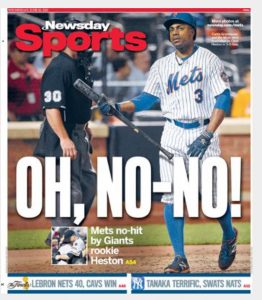 JUNE 10: I’m still having no-hitter dreams. I find Howie Rose’s ninth-inning play-by-play online somewhere and I decide to transcribe it, first on Twitter, then on the blog. I lose Twitter followers who don’t want to be reminded, and some blog readers tell me they don’t love being reminded. Yet in the dream I did it to be complimentary toward Howie’s play-by-play, particularly that he called it with the right amount of drama, never mind it was happening to rather than for the Mets, like Bob Murphy might have. The kicker to this dream? Howie Rose e-mailed me to thank me for making the comparison. No, this couldn’t have happened. MEANWHILE (yes, it’s one of those long and winding dreams), I go to a game that night, at Citi Field, against the Giants. It’s with a guy from California who tells me he’s moved to Queens for the season JUST so he can go to every Mets home game. I know, right? The guy, who tells me a book I wrote helped inspire him to do this, has very good seats not far from the field, the cushy green ones. At one point, I stand up, then sit down, and the seat collapses with me in it. In my dreams, this six-year-old ballpark is falling apart. JUNE 10: I’m still having no-hitter dreams. I find Howie Rose’s ninth-inning play-by-play online somewhere and I decide to transcribe it, first on Twitter, then on the blog. I lose Twitter followers who don’t want to be reminded, and some blog readers tell me they don’t love being reminded. Yet in the dream I did it to be complimentary toward Howie’s play-by-play, particularly that he called it with the right amount of drama, never mind it was happening to rather than for the Mets, like Bob Murphy might have. The kicker to this dream? Howie Rose e-mailed me to thank me for making the comparison. No, this couldn’t have happened. MEANWHILE (yes, it’s one of those long and winding dreams), I go to a game that night, at Citi Field, against the Giants. It’s with a guy from California who tells me he’s moved to Queens for the season JUST so he can go to every Mets home game. I know, right? The guy, who tells me a book I wrote helped inspire him to do this, has very good seats not far from the field, the cushy green ones. At one point, I stand up, then sit down, and the seat collapses with me in it. In my dreams, this six-year-old ballpark is falling apart.
JUNE 14: In this dream, the Mets blew a lead yesterday, with the guy with the big hat (one of the Torreses, I think, still) blowing the save in the ninth and a guy wearing a normal-sized hat (the other Torres?) taking the loss in the eleventh; a horse named American Pharoah — spelled just like that — won the first horse racing Triple Crown in 37 years; and then the Mets storm from behind today to win. The racing metaphor must have something to do with the pennant race. That would make sense. Less logical are some of the names that keep filtering through my subconscious. According to the box score in my dream, one of the four Mets to hit a homer in the win was “Darrell Ceciliani”. Your guess is as good as mine as to who that is.
JUNE 18: This one feels like the culmination of a few things. There’s been a four-game series against the Blue Jays — two at home, two on the road. (Do they do that in real life?) First off, there’s a lot of Jose Reyes in this dream. He was traded at some point from the Marlins to the Jays, but deep down I’ve never stopped missing him on the Mets. Then, in the middle of a large Mets loss, there are two pitchers named “Jack Leathersich” and “Akeel Morris”. Where do these names keep coming from? Next, there’s R.A. Dickey beating us in Toronto. He’s another guy I’ve never quite made my peace with having been gone. But what really catapults this one into strange-dream territory is John Gibbons, the Blue Jays manager (and an ex-Met, make of that what you will), reveals that Dickey was pitching shortly after his father died. It’s too eerily similar to what I’m going through with my dad not to give me chills.
JUNE 25: The standings in my dreams indicate the Mets have slipped below .500, yet here they are for a change winning. DeGrom not only pitched eight shutout innings, but he gets a hit and scores the insurance run…and I’m listening to it in the lobby of a hospital that isn’t the one my father’s been in. We — me, him, my sister, his girlfriend — have just come to this other place for him to be examined and told he’s coming along. For a moment, I feel like I’m talking to my dad in some “normal” situation that just happens to be a hospital lobby. I take this to mean that they will be sending home soon, or that the Mets will be sending more runners home soon. Whatever it is, it’s one of the less disturbing dreams I’ve had of late.
JUNE 26: Latest bizarre setting in dreamland? One of those suites at Citi Field. What am I doing in a suite? Well, best as I can make out, a friend’s daughter is having her high school graduation party there. I know, go figure. I show up with my wife, and who do I see in the suite? Howie Rose AND Josh Lewin. Before I can say a word, Howie waves to me and says, “Hi Greg,” which is something I wouldn’t have dreamed when I started listening to him on the radio in 1987. I call my father from the hallway outside the suite. I’m a little cagey about where I am because I feel weird being at a game while he’s still in the hospital this Friday night. While we’re chatting, a very tall man walks by with an entourage. He’s wearing a Mets jersey but he’s supposed to be the Knicks’ first-round draft pick. Kristaps something. He’s from Europe and he’s throwing out the first pitch. These dreams’ details are heading off the charts.
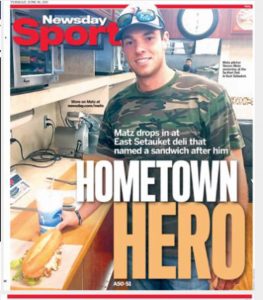
JUNE 28: My subconscious ain’t seen nothing yet. Today’s dream was a LONG one. I’m back at Citi Field, not for a doubleheader, but kind of a doubleheader, because apparently it rained a lot yesterday and that game was suspended — in the dream, I was there for that, too; it was a cold rain and the people behind me castigated me for opening my umbrella. Anyway, they have to finish the day before’s game, and that takes forever, because the Mets don’t hit, but they somehow win it. Lucas Duda drives in the winning run, which doesn’t sound like anything unusual, except in the dream, they gave out a “growth chart” with his picture on it. Then they play the regularly scheduled game, which is started for the Mets by a kid named Matz (a little on the nose) who’s supposed to be from Suffolk County, and everybody’s excited that he grew up a Mets fan. Not only does he pitch well, but he gets three hits and drives in four runs while his grandfather becomes a TV sensation by going nuts for the SNY cameras. So we sweep the pseudo-doubleheader and I stick around afterwards because STEVE MILLER? is playing a concert to like 200 people. He’s good, but it’s been a long day and I guess everybody else is itching to go home. In the dream, Steve Miller makes mention of “Stevie” Matz, like that’s what he’s called? I’m none among a joker, toker or midnight smoker, but I am confused.
 JULY 2: My dad is out of the hospital and the Mets are being swept three by the Cubs while scoring exactly one run. Disappointing Met overtones asides, this qualifies as a good dream. JULY 2: My dad is out of the hospital and the Mets are being swept three by the Cubs while scoring exactly one run. Disappointing Met overtones asides, this qualifies as a good dream.
JULY 6: The Mets are in San Francisco. “Johnny Monell” breaks up a scoreless tie and we win. Where do these total strangers keep coming up and what do they mean?
JULY 11: Maybe because this is the same date that I went to my first game in 1973, I get a good dream for the occasion. I’m at Citi Field and Matt Harvey homers. Pitchers really do hit in my subconscious. I hate the designated hitter THAT much. I fuzzily recall Noah Syndergaard homering in late May, too, but that happened when my dad took ill, so I wasn’t able to dwell on it.
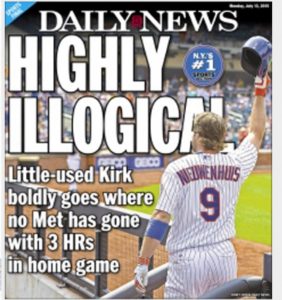
JULY 12: It’s the last game before the All-Star break and KIRK NIEUWENHUIS, who I think I dreamed wasn’t even on the team for a while this year, hits THREE HOME RUNS in a single home game, the first Met to ever do that at Citi Field or Shea Stadium or the Polo Grounds. Not Wright or Piazza or Strawberry or even the original Frank Thomas. Kirk Nieuwenhuis. Tell me I’m not dreaming.
 JULY 19: It’s the Sunday after the All-Star break in this one. The Mets are in St. Louis and they play EIGHTEEN innings. I think the Mets won. I know Keith Hernandez got impatient (a very lifelike detail to have retained). JULY 19: It’s the Sunday after the All-Star break in this one. The Mets are in St. Louis and they play EIGHTEEN innings. I think the Mets won. I know Keith Hernandez got impatient (a very lifelike detail to have retained).
JULY 23: In this dream, the Mets are facing Clayton Kershaw, last year’s NL Cy Young and MVP. Who are they sending out to bat against him? I see names on a TV screen: Mayberry (didn’t he play for the Royals in the ’70s?); Campbell (am I secretly craving soup?); Recker (the catcher who played third base in my April dream). Bartolo Colon is the starting pitcher for us and he doesn’t even have the lowest batting average of the bunch. The Mets miraculously pound out three hits while Kershaw tosses an eleven-strikeout shutout. If somebody were awake while he came up with this Met lineup, I’d call it a nightmare.
JULY 24: I dreamed the Mets called up last year’s top draft choice Michael Conforto. The Mets never call up last year’s draft choice, so I must be dreaming. Unless they had the same nightmare about the lineup the night before that I did.
JULY 25: I wonder if I was sweating when I rolled over and went back to sleep, because this one feels like a fever dream. First of all, the Mets traded for major league help: Kelly Johnson and Juan Uribe. Random baseball names for my subconscious, but at least I’ve heard of them. Then the Mets, with me in attendance, stomp all over the Dodgers, 15-2, with those new guys helping AND Conforto getting four hits. Oh, and HEART — you know, “Magic Man” — plays a show afterward. The summer heat must be getting to me.
JULY 26: We’re still playing the Dodgers in my dreams. I’m at this game, too. I’m in the right field corner of Field Level with my wife and a bunch of people from where she works. That’s happened in real life, but on a Sunday afternoon? Against the Dodgers? Anything goes in a dream. Zack Greinke is pitching for L.A. and has this long scoreless innings streak, but who should drive in the run that snaps it? Jacob deGrom. He pitches great, but Familia blows the lead, it rains a little, and in the dream I’m really fatalistic. But then Jenrry Mejia, like from out of nowhere in my subconscious, returns to throw a scoreless inning, and Uribe drives in the winning run in the tenth inning. It’s also apparently the same day Pedro Martinez is inducted into the Hall of Fame, where he says something very nice about Mets fans. That’s the kind of thing I always dream of.
JULY 29: This dream starts in a doctor’s examining room. My father’s been getting radiation and taking chemo since leaving the hospital. The whole family is crowded in with him for a followup. He’s told he’s doing very well and can go about his life. He’s 86, but asks the doctor if he’s good for another “10 or 11 years”. The doctor doesn’t quite respond. I celebrate by letting a friend of mine know I will go to the game with him that night. Lucas Duda hits three home runs, just like Kirk Nieuwenhuis did a couple of weeks ago, but nobody notices, because the trade deadline is approaching and word spreads around the ballpark that the Mets are trading Wilmer Flores and Zack Wheeler (who’s been injured this whole time) to Milwaukee for Carlos Gomez, the guy we traded in a package to get Johan Santana in 2008. CARLOS GOMEZ? I don’t know where that name came from. The kicker is word spreads to the Mets dugout and somebody tells Flores, who’s getting appreciative applause from the stands, and he gets all sad and the TV cameras pick up that he’s playing with tears in his eyes and my friend and I ask each other what the hell he’s doing in the game? Then, maybe just before I woke up, Sandy Alderson shows up to say there is no trade. Holy crap, go figure that one out.
JULY 30: I’m at Citi Field yet again for an afternoon game. Everybody’s talking about Flores, but he isn’t playing. The Mets are beating the Padres, which is great, except it starts to get overcast, and there’s a late rain delay, and Familia comes out to get the save, but he doesn’t get it. One of the Uptons (I forget which one) hits a home run to put the Padres in the lead and it starts to rain again, really hard, and I give up and go home. Next thing I dream, I walk into my living room and turn on the radio to hear the Mets are still in rain delay. They eventually lose. Funny thing about this dream is everybody seems convinced the Mets are cursed, yet I notice they’re still close to Washington in the standings and I’m almost serene about the whole thing. In dreams, right?
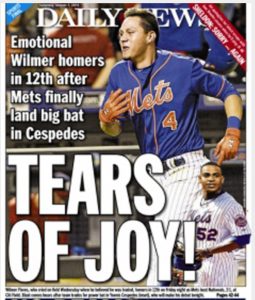
JULY 31: If I weren’t already seated while I’m entering this into my dream journal, I’d suggest I sit down for this. Shoot, maybe I’ll just stand up. Lemme see…the dream starts with a trade. At like a few minutes to four, right before the deadline, I dreamed the Mets got Yoenis Cespedes from the Tigers (wasn’t he with the A’s?). I’m excited, everybody’s excited. Then we’re playing the Nationals, which is a big deal because they’re in first place and we’re in second place, which is one of those things I’m still getting used to in my dreamscape after a real life in which they’ve won the division three times in the past five years and we’ve finished far from it. Matt Harvey is pitching for us. He pitches against them a lot in these dreams, doesn’t he? He’s going really well, but the Met who’s getting everybody’s attention at Citi Field is Wilmer Flores. Nobody’s trading him. They continue to applaud him. We go to extra innings and it’s Wilmer who hits the game-winning home run. Definitely a dream scenario.
 AUGUST 2: One more Mets-Nationals dream. This time it’s Sunday Night Baseball, which is usually akin to a nightmare, but crazily enough, the Mets can’t stop hitting home runs, at least in the third inning. Granderson — home run! Murphy — home run! Duda — home run! The Thor guy goes eight. Tyler Clippard, who my subconscious vaguely recalls as a Yankee who came out of nowhere to beat us on Sunday Night Baseball a long time ago, gets the save for us. We’re in a “virtual tie” for first. I’m beginning to wish I was awake for more of this. AUGUST 2: One more Mets-Nationals dream. This time it’s Sunday Night Baseball, which is usually akin to a nightmare, but crazily enough, the Mets can’t stop hitting home runs, at least in the third inning. Granderson — home run! Murphy — home run! Duda — home run! The Thor guy goes eight. Tyler Clippard, who my subconscious vaguely recalls as a Yankee who came out of nowhere to beat us on Sunday Night Baseball a long time ago, gets the save for us. We’re in a “virtual tie” for first. I’m beginning to wish I was awake for more of this.
AUGUST 3: The Mets go to Miami and stomp all over the Marlins while the Nationals lose and we’re alone in first place. Don’t wake me.
AUGUST 8: That guy from California shows up again. It’s his birthday, and I’m taking him to lunch (we’re eating in this place that is showing the night before’s Mets win), then on the subway up to the site of the Polo Grounds to show him around because Willie Mays is his all-time favorite player. I’m telling him I kind of know where I’m going — though I admit I got lost the last time I came here the month before — and eventually, we wander around enough so I get my bearings and I can show him the rededicated John T. Brush Stairway and then the street where Willie used to play stickball. We part ways at Penn Station. The dream includes him telling me he got a parking ticket at the LIRR station near where he’s been staying.
AUGUST 11: I’m wandering around Citi Field before another Mets win (they’re all Mets wins lately) and somebody hands me a flier for Slomin’s Home Heating Oil. Am I dreaming that winter is coming before I know it?
AUGUST 12: For this dream, I’m in the Promenade with a few people I’ve either known well in my past or known a little, but we’re a group tonight and the Mets are winning and Citi Field is noisy like I’ve never heard it for just another weeknight game. I must really want the Mets to be as good as I’m dreaming they are.
AUGUST 14: Once more with the California guy. He tells me he won some kind of special pass to get us (which includes yet another California guy, somebody I’ve never seen before and will never see again) on the field pregame. Curtis Granderson walks by signing autographs for everybody. Michael Conforto comes out and poses for a picture with the California guys, with the one I know wearing a t-shirt with Conforto’s name and number on it. My California friend tells me he never wears that kind of shirt, but he was kind of stoked about the rookie, and this happens. There’s a lot of “this happens” in these dreams I’ve been having in 2015. The game, against the Pirates, gets to the ninth inning tied, and with two out, the same Michael Conforto blasts a fly ball to deep left field that we think is going out, but it doesn’t. We lose in ten. Somewhere in the middle of all this, I buy each of us (me and the California guys, but not the actual Conforto) a tall can of Heineken to show my appreciation for the invitation. I realize I drink very little beer when I’m actually awake, because in the dream I’m shocked at how much beer costs, at least at the ballpark.
AUGUST 19: It’s early evening, and I’m driving home from picking up dinner for my wife and me at a local Italian place, when my cell phone rings. I never talk on the phone in my car, since it’s an old car and a relatively old phone, but I glance and see it’s my father’s girlfriend’s daughter. I answer. She tells me my father is back in the hospital. This dream again. I go home, drop the food off, and my wife and I drive to the hospital, nervously and anxiously, if that makes sense. This time my father has a really bad cough to go with whatever else is bothering him, something like pneumonia. We stay with him for several hours until after he’s checked in. I slip away at one point to a lounge where the Mets are playing the Orioles. Carlos Torres gives up a game-winning home run. We get home very late and heat up some of the Italian food.
AUGUST 21: I visit my dad and watch preseason football with him while trying to keep up with the Mets on one device or another. In the dream, he sort of notices that my attention is divided and I try to play it off like, no, not really, but he knows. Cespedes, who we got a few weeks ago, goes crazy at Colorado, where it’s easy to go crazy. The Mets win, 14-9, which I somehow know they’ve never done before.
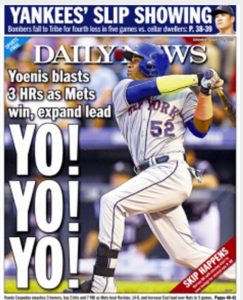 AUGUST 22: It’s the next night, and the Mets have beaten the Rockies again by THE EXACT SAME SCORE of 14-9, which must mean I’m dreaming in a loop. AUGUST 22: It’s the next night, and the Mets have beaten the Rockies again by THE EXACT SAME SCORE of 14-9, which must mean I’m dreaming in a loop.
AUGUST 24: A funny thing is happening in these dreams: my father is taking an interest in the Mets a little bit. He truly hasn’t cared what they’ve been up to since my mother died in 1990. But he’s noticed that I show up and stick around if the Mets game is on. I doubt I wouldn’t stick around if we watched something else, but I’m not gonna argue with a hospital patient, so we put the game on. And what a game I dreamed up for this night: David Wright is suddenly playing for the Mets again! And he hits a home run his first time up! Everybody hits a home run for the Mets, it seems. They hit a team-record eight and beat the Phillies, 16-7 (another new score), in Philadelphia. To prove it’s a dream, even the Phillies fans applaud David Wright for coming back with a bang. To prove my dreams are getting even weirder, I don’t see Wright’s home run the instant it’s hit because I’m emptying my father’s bedside urinal for him. It’s only when I return from disposing what needs to be disposed that I notice Wright is accepting his teammates’ congratulations. A surreal tradeoff for having David back and watching with my dad. I’ll take it.
AUGUST 25: Tonight’s twist: somebody comes to my father’s room and tells him he has to get something scanned. He’s against this. Even in my dreams, I don’t know how he puts up with the poking and prodding that I suppose is necessary. While he protests that he won’t go, I come up with the craziest thing I’ve ever said, awake or asleep. “Dad, if you don’t get better, you can’t go home, and if you can’t go home, I can’t come over to watch the World Series with you.” It seems he’s been aware of how well the Mets are doing and he’s already skipped ahead to October. HE’S the one who mentioned the World Series to ME — in AUGUST. I don’t know where I got the nerve to dictate terms to him and throw in baseball, but son of a gun (was that Freudian?), it worked. He puts up with the scan. Hopefully it’s all part of getting better.
AUGUST 27: There’s a play in tonight’s game nobody could have dreamed up: Jeff Francoeur (the Met from 2010 who I’m now dreaming plays for the Phillies) lines a ball off Carlos Torres’s foot, and Daniel Murphy retrieves it and flips it to Torres without looking, trusting Torres is covering first, and he is, and Francoeur is out. I’m dreaming I’m watching in my dad’s hospital room and Gary Cohen calls it “a play you’ve never seen before and you may never see again.” Even if it’s just in my subconscious, it’s incredible. Next thing I know, I’m driving home on a deserted road, the Mets win in thirteen and I applaud at the wheel and I can hear the echo come back to me through my car window.
AUGUST 28: The phone rings on a Friday afternoon. It’s my dad. He wants to make sure I’m coming up to watch that night’s game with him. That’s never happened before in my dreams or in my life.
AUGUST 29: I find the time in my dreams to head back to Citi Field. They’re giving away Jesse Orosco bobbleheads and playing the Red Sox. Now tell me who’s skipping ahead. There’s an insanely long line to be one of the first however-many thousand. Of course there is. My Met dreams are insanity practically every night.
SEPTEMBER 2: Ruben Tejada hits an inside-the-park home run, because what else HAVEN’T I dreamed this year?
SEPTEMBER 4: Matt Harvey’s agent says Matt won’t pitch in the playoffs if he’s exceeded his post-surgery innings limit. Didn’t they pull the same thing with Strasburg and the Nationals? Why would this filter into my subconscious? Why I am already deep-down dreading something going wrong in the postseason? Can’t I have a clear head for all of this?
SEPTEMBER 5: Watching the Mets with my father again, and Bartolo Colon is pitching at Miami. He throws a guy out at first by tossing the ball behind his back. I guess this qualifies as clearing my head.
SEPTEMBER 7: The Mets are playing a huge Labor Day game at Washington. We’re still in first place, but this is the Nationals’ big chance. Yet we win. I’m glad my subconscious hasn’t lost the pennant race thread.
SEPTEMBER 8: The Mets are still in Washington, and Harvey is getting lit up, but the Mets come from way behind and win again. In the parking lot at the hospital, where I’ve been watching in this dream, I let out a howl at the moon. That has to be symbolic of something.
SEPTEMBER 9: Last game in Washington. Kelly Johnson hits a late home run. Yoenis Cepedes hits a later home run (he hits a lot of them). The Mets sweep the Nationals and, in my dreams, they’ve all but clinched the division and made the ghosts of 2007 go away. It’s not too early in September for that, I hope.
SEPTEMBER 13: I’m home watching a Mets game on a Sunday afternoon from Turner Field, so I’d expect something terrible to happen. Indeed, in my dream, the Mets are losing by three runs with two out in the ninth, but then Daniel Murphy hits a three-run homer and Gary Cohen says the Mets don’t know how to lose. In point of fact, they win in the tenth inning, and I can’t imagine I’ll be any happier the rest of the season. Then the phone rings, and it’s my sister, who’s visiting my father, telling me Dad wants to know when I’ll be there, so I leave and drive up, and the postgame show on the radio ends, and there’s no Mets in the car, then no Mets at the hospital, and he’s in a bad mood (I can’t blame him) and I can’t even get him interested in the Giants and Cowboys on Sunday Night Football, and I leave feeling a little miserable about everything. I’ve really got to learn to wake up at the peak of these dreams.
SEPTEMBER 25: Most of the family is together in the hospital room this afternoon. Dad and his girlfriend are cheerful at first. They’re both aware the Mets have a dwindling magic number and tell me they’re happy for me. Then a doctor with not much of a bedside manner comes in to tell us the next step is palliative care. Dad tries to wrap his head around this. And, for reasons unknown to me, on TV they’re talking about the Pope visiting Philadelphia (the Mets are in Cincinnati).
SEPTEMBER 26: The Mets have clinched their first division title since 2006. I couldn’t have dreamed this at the outset of April. I’m watching it at home, I’m going out to bring back pizza, I’m opening Champagne, I’m toasting with my wife. Nothing is going to ruin this for me.
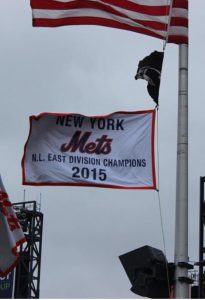 SEPTEMBER 27: My wife and I visit my dad. He’s in the ICU all of a sudden. He’s only vaguely aware of the Mets being division champions and drifts off a lot. The dream ends with us sitting around his bed watching 60 Minutes. SEPTEMBER 27: My wife and I visit my dad. He’s in the ICU all of a sudden. He’s only vaguely aware of the Mets being division champions and drifts off a lot. The dream ends with us sitting around his bed watching 60 Minutes.
OCTOBER 4: Dad has moved into a new facility, in line with the palliative care, and I’m at Citi Field for the final game of the season. Even in my dreams I go to Closing Day. The Mets win their 90th game (didn’t Sandy Alderson say that’s what this perennially sub-.500 team was going to do back in Spring Training, before I found it so difficult to stay awake?) and David Wright addresses the crowd, which seems unusual, but whatever. Also, we were apparently no-hit again the night before. Bring it on, subconscious. We’ve got playoffs, I think.
OCTOBER 9: We do have playoffs, Mets at Los Angeles. We win Game One. Daniel Murphy hits a home run off Clayton Kershaw, burning his name from his bat into the ball. Jacob deGrom strikes out 13. Such specificity. Also, deGrom plays a prank on Murphy during the postgame press conference, lowering his chair.
OCTOBER 10: Chase Utley, who is mysteriously a Dodger now, breaks Ruben Tejada’s leg by sliding into second base. Now I’m experiencing revenge dreams within my dreams at Utley’s expense. Mets lose.
OCTOBER 12: In what may be the weirdest dream of 2015 to date (and that’s saying something), I’m at Citi Field for the third game of the National League Division Series. Six seasons of Citi Field before this one, and I’ve never imagined, let alone dreamed, this place that so isn’t Shea Stadium, would either host one of these or get revved up for one of these. But, brother, is it ever. We’ve been waiting a long time to get loud, so it’s very loud — especially when Utley comes out as part of the introductions (we’ve all had revenge dreams) and then when Tejada comes out with the aid of cane festooned with Met logos. Best part of the dream is Cespedes hits a monster home run, the Mets win by a lot with Harvey pitching despite his agent’s protestations, and they’re one game from taking the series.
OCTOBER 13: The Mets are still one game from taking the series, since Clayton Kershaw beats them in this edition of my playoff dreams. Daniel Murphy hits another home run, though. And, oh, I’m there, like going to Citi Field for playoff games is now something I do.
OCTOBER 14: Guess which venue just showed up in my dreams again. Nope, not Citi Field — the Beacon Theatre. Am I looking for a beacon of light to guide the Mets safely to victory tomorrow night? For the record, I’m at a Steely Dan concert, and when they get to the part of “My Old School” that goes “California/tumbles into the sea…” I (in my Mets jacket) cheer, and I’m pretty sure I’m not the only one.
OCTOBER 15: I’m at the new place, with my dad. Whether the Mets advance in the postseason is at stake, and I’m watching on a palliative care facility TV. Not how I pictured it in my dreams, but that’ll show you what dreams know. The Mets are in trouble early. I must be having REM cycle problems sleeping. But Terry Collins stays with Jacob deGrom, Jacob deGrom hangs tough, Daniel Murphy both homers and does goofy stuff on the bases (that pays off) and, with some help from Syndergaard in relief, then Familia, we win. I mean, we win! I don’t know if I should shout too loud in this dream, given that there are probably a few older folks trying to sleep. Ah, what the hell — YIPPEE!!
OCTOBER 16: I dream there’s a picture going around the Internet of two Mets fans, one who was on the front page of the Daily News after the collapse of 2007, and one of another who was on the front page a year later after the collapse of 2008. They were both at Dodger Stadium looking really happy. Maybe my subconscious is no longer haunted by bad endings and Shea Stadium.
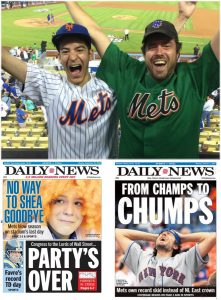 OCTOBER 17: Instead of being haunted by Shea, I am haunting Citi, site of Game One of the NLCS, Mets versus Cubs. How odd that it’s the Cubs in my dream. The Mets trying to catch the Cubs is where it all started for me as a fan, spurred on by my reading the Post my father would bring home every night. I’d see the standings and I’d see a cartoon on the back page, where the Cubs were the bear and the Mets were a bird of some sort, and now this? Does it mean some kind of full-circle in my relationship with my dad? While I ponder that, I note that my first NLCS game since 2006 (the Mets’ too, I guess) goes swimmingly. Murphy keeps hitting homers and we win. OCTOBER 17: Instead of being haunted by Shea, I am haunting Citi, site of Game One of the NLCS, Mets versus Cubs. How odd that it’s the Cubs in my dream. The Mets trying to catch the Cubs is where it all started for me as a fan, spurred on by my reading the Post my father would bring home every night. I’d see the standings and I’d see a cartoon on the back page, where the Cubs were the bear and the Mets were a bird of some sort, and now this? Does it mean some kind of full-circle in my relationship with my dad? While I ponder that, I note that my first NLCS game since 2006 (the Mets’ too, I guess) goes swimmingly. Murphy keeps hitting homers and we win.
OCTOBER 20: This dream says Game Three, at Wrigley. At the place where my father is hanging out, too. He’s sort of into the game when he’s awake (I should talk — I seem to be mostly into it when I’m asleep). The Mets take a three-oh series lead. Did I mention Murphy hit ANOTHER home run? And that the announcers in my dream said he hit one in Game Two? I don’t remember Daniel Murphy being this much of a power hitter.
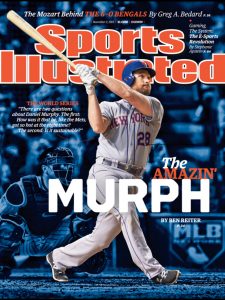 OCTOBER 21: I’ve never seen all of Back to the Future II, but in my dream, it’s significant that this is October 21, 2015, because apparently the Cubs win the World Series on this date in, you know, the future. (In, you know, the movie.) But never mind the movies. Let’s screen what I’ve been dreaming: the Mets win the pennant! Yes, Murphy has hit a home run in his sixth consecutive dream…I mean game. And though I’m watching from home, I get to share it with my father, as he calls me a few minutes after it happens. The strange part is he’s been calling me at all hours confused about whether it’s day or night, but in this part of the dream, he’s not only totally lucid, but simply calls to congratulate me, like he knows this is important to me, and that it was important to him to let me know that. OCTOBER 21: I’ve never seen all of Back to the Future II, but in my dream, it’s significant that this is October 21, 2015, because apparently the Cubs win the World Series on this date in, you know, the future. (In, you know, the movie.) But never mind the movies. Let’s screen what I’ve been dreaming: the Mets win the pennant! Yes, Murphy has hit a home run in his sixth consecutive dream…I mean game. And though I’m watching from home, I get to share it with my father, as he calls me a few minutes after it happens. The strange part is he’s been calling me at all hours confused about whether it’s day or night, but in this part of the dream, he’s not only totally lucid, but simply calls to congratulate me, like he knows this is important to me, and that it was important to him to let me know that.
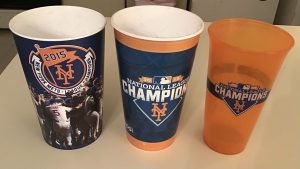 OCTOBER 25: I’m going up to my father’s place with a bag from Burger King. In my dream, my sister told me I should bring him a couple of cheeseburgers, that he likes Burger King cheeseburgers. I’ve avoided Burger King and its Golden Arched-brethren for years, but in my dream I go to the drive-through and order some cheeseburgers. On my way up there, I notice Mets flags flying in people’s front yards. There’s something different in the air, and it’s not just the Burger King aroma. There’s no ballgame on, so it’s not much of a visit, and he’s not that into the cheeseburger. On my way home, my car is making a noise. I barely steer it into the parking lot. My driving has improved throughout these dreams, probably out of necessity. But it’s still an old car, just like my dad is an old dad. I eat the leftover cheeseburger. It doesn’t sit well. OCTOBER 25: I’m going up to my father’s place with a bag from Burger King. In my dream, my sister told me I should bring him a couple of cheeseburgers, that he likes Burger King cheeseburgers. I’ve avoided Burger King and its Golden Arched-brethren for years, but in my dream I go to the drive-through and order some cheeseburgers. On my way up there, I notice Mets flags flying in people’s front yards. There’s something different in the air, and it’s not just the Burger King aroma. There’s no ballgame on, so it’s not much of a visit, and he’s not that into the cheeseburger. On my way home, my car is making a noise. I barely steer it into the parking lot. My driving has improved throughout these dreams, probably out of necessity. But it’s still an old car, just like my dad is an old dad. I eat the leftover cheeseburger. It doesn’t sit well.
OCTOBER 26: I call my mechanic in my dream and he wants to talk baseball, which I should relish, since he’s a Yankees fan and I’ve got a team in the World Series, but I get to the point, that my car has been making a noise and then some. Next thing I dream, it’s towed to his garage and I get a call that it’s the transmission, and he’s talking about me letting go of it, but with the Mets going to the World Series and me somehow making good on my word to my dad that I’m going to watch it with him (even if he’s not home, exactly), I’m not up for letting go of longstanding attachments. It’s going to cost a stupid amount of money, but I say go ahead, fix it.
OCTOBER 27-28: In my dream, I’m still without my car, so I have to take the Long Island Rail Road in several different directions to get to my dad’s. Not how I would have pictured watching the Mets in their first World Series in fifteen years, but I make it. We’re on the road playing Kansas City, a team I liked in that American League way when I was a kid, but now they’re my nemesis. Game One doesn’t go well. There’s an inside-the-parker from the Royals’ leadoff hitter, not a good sign. Something’s weird with the TV feed, which isn’t helping my father’s concentration. Fortunately it comes back, as do the Mets. It’s 3-3 in the eighth when the Royals’ first baseman, who has the same name as one of my cats, makes an error and we take the lead. Maybe I’m dreaming of Buckner and 1986, when my parents were as into the Mets as I was (but what New Yorker wasn’t?). Any chance this was gonna be a good dream goes out the window when Jeurys Familia gives up a ninth-inning home run, and it’s tied, and the night goes on and on and we lose in the fourteenth and I have to take an expensive cab ride home well after midnight.
 OCTOBER 30: The Mets are down oh-two in the Series, but I’m not giving up, because, according to the latest tributary of my dreamscape, I’m writing a book about the 2015 Mets, but it will only be published if they win. I’m working furiously on it before Game Three so I can have some of the chapters done and THEN walk to the train station and head for MY FIRST WORLD SERIES GAME. Not even in my dreams did I see the Mets in person in the Series in 1969, 1973, 1986 or 2000, but here I am, coming down the staircase from the 7 and taking in all the World Seriesness of it. I see a number of friends in the parking lot beforehand, including the California guy. It’s like we’re all getting our reward for our patience, and it makes me feel really good. Between one of the innings, they tell us to hold up our Stand Up 2 Cancer cards, which I do. I’ve written my father’s name on it. Daniel Murphy doesn’t hit a home run, but David Wright does. So does Curtis Granderson, but I don’t see it, because in this dream, the whole thing is almost too much and I have to get up and do a lap around Field Level. What else happened? Oh, Syndergaard! He’s brushed back that pesky leadoff Royals hitter, which was a welcome sight. Thor pitched well and we scored a lot and we won! I’ve seen the Mets win a World Series game in my dreams! Close enough to reality, I figure. OCTOBER 30: The Mets are down oh-two in the Series, but I’m not giving up, because, according to the latest tributary of my dreamscape, I’m writing a book about the 2015 Mets, but it will only be published if they win. I’m working furiously on it before Game Three so I can have some of the chapters done and THEN walk to the train station and head for MY FIRST WORLD SERIES GAME. Not even in my dreams did I see the Mets in person in the Series in 1969, 1973, 1986 or 2000, but here I am, coming down the staircase from the 7 and taking in all the World Seriesness of it. I see a number of friends in the parking lot beforehand, including the California guy. It’s like we’re all getting our reward for our patience, and it makes me feel really good. Between one of the innings, they tell us to hold up our Stand Up 2 Cancer cards, which I do. I’ve written my father’s name on it. Daniel Murphy doesn’t hit a home run, but David Wright does. So does Curtis Granderson, but I don’t see it, because in this dream, the whole thing is almost too much and I have to get up and do a lap around Field Level. What else happened? Oh, Syndergaard! He’s brushed back that pesky leadoff Royals hitter, which was a welcome sight. Thor pitched well and we scored a lot and we won! I’ve seen the Mets win a World Series game in my dreams! Close enough to reality, I figure.
OCTOBER 31: I’m back at Citi Field. I’m meeting up with people who have the tickets for Game Four. I see Bartolo Colon through a glass door. Someone in my dream yells BIG SEXY! at him and Colon waves without looking up. It’s Halloween, and people have come to the ballgame in costume. I run into a father and son who tell me they’re the ghosts of World Series past, dressed as “1969” and “1986”. I miss another home run, this one by Conforto, because I got up to go the bathroom and then opted for a slice of overpriced pizza (shortest line), but Conforto hits two, and I see the second. Unfortunately, all the nice dreams I’ve been having seem to catch up with me. Daniel Murphy, who’s on the cover of Sports Illustrated (cursed?) is no longer hitting, but he does make a crucial error. Cespedes gets himself doubled off base, too. The Mets lose and are one game from elimination. I just stand around a while as the ballpark empties out. It can be very lonely in my dreams.
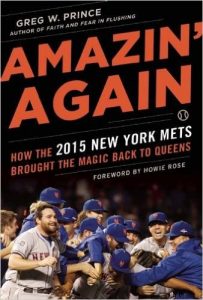 NOVEMBER 1-2: I never dreamed of the Mets playing in November, but here they are, trying to not lose the World Series, no matter what the calendar says. My car’s still in the shop. so I’m commuting by rail to get to my father’s. Matt Harvey is pitching really well. Granderson homers. Dad naps in and out of the action. It’s actually going pretty fast. Maybe I can make a decent-hour LIRR and wind my way home and then we can plan for Game Six. Maybe I shouldn’t have been thinking about such things prematurely because suddenly Harvey is on the mound in the ninth after yelling at Terry Collins in the dugout (I think he was gonna be taken out) and this long, painful drip of a Royals rally ensues. I’m not sure of the details. I may have blocked them out, but I do know it’s tied and we’re in extra innings again, and my father’s asleep and I’m texting with my sister which is REALLY weird, because she’s never cared about baseball, but in my mind in my dream I’m remembering my very first World Series memory: me and her running errands with Dad with Game One against the Orioles on the radio for my benefit. Don Buford homers off Tom Seaver, but Dad tells me it’s all right, there’s still a long way to go. We lose that game, but we win that Series. It, like the business about the Post and the standings and the cartoon, is the touchstone of my fandom. Full-circle? Going in circles? Why would my sister be watching the World Series? Not to see the Mets win, apparently. I dream the Royals score a ton of runs, again via details I block out, and Wilmer Flores, who everybody embraced back in July, takes strike three to end it. My father is awake by now and offers some condolences blended with some encouragement. He’s lying there in bed, unable to get up and walk out as I’m sure he’d prefer, and he’s telling me everything’s gonna be all right, just like in the Chrysler in 1969. I think I tell him I was glad to watch so much baseball with him. Or did I forget to mention that? I should’ve said something profound, but we’ve never talked to each other like that, so why make him uncomfortable with emotions? I don’t know. I have to take another expensive cab ride home, during which me and the driver end up talking about Carmelo Anthony for some reason. Then, in the dream, I get home, I write a whole lot about how much this weird dream of a season meant to me, I fall asleep (sleeping while I’m sleeping; I can’t make sense of anything anymore), and when I wake up, I learn my car is fixed, so I better pick it up, and they’re gonna publish my book despite the Mets losing, so I better finish it. NOVEMBER 1-2: I never dreamed of the Mets playing in November, but here they are, trying to not lose the World Series, no matter what the calendar says. My car’s still in the shop. so I’m commuting by rail to get to my father’s. Matt Harvey is pitching really well. Granderson homers. Dad naps in and out of the action. It’s actually going pretty fast. Maybe I can make a decent-hour LIRR and wind my way home and then we can plan for Game Six. Maybe I shouldn’t have been thinking about such things prematurely because suddenly Harvey is on the mound in the ninth after yelling at Terry Collins in the dugout (I think he was gonna be taken out) and this long, painful drip of a Royals rally ensues. I’m not sure of the details. I may have blocked them out, but I do know it’s tied and we’re in extra innings again, and my father’s asleep and I’m texting with my sister which is REALLY weird, because she’s never cared about baseball, but in my mind in my dream I’m remembering my very first World Series memory: me and her running errands with Dad with Game One against the Orioles on the radio for my benefit. Don Buford homers off Tom Seaver, but Dad tells me it’s all right, there’s still a long way to go. We lose that game, but we win that Series. It, like the business about the Post and the standings and the cartoon, is the touchstone of my fandom. Full-circle? Going in circles? Why would my sister be watching the World Series? Not to see the Mets win, apparently. I dream the Royals score a ton of runs, again via details I block out, and Wilmer Flores, who everybody embraced back in July, takes strike three to end it. My father is awake by now and offers some condolences blended with some encouragement. He’s lying there in bed, unable to get up and walk out as I’m sure he’d prefer, and he’s telling me everything’s gonna be all right, just like in the Chrysler in 1969. I think I tell him I was glad to watch so much baseball with him. Or did I forget to mention that? I should’ve said something profound, but we’ve never talked to each other like that, so why make him uncomfortable with emotions? I don’t know. I have to take another expensive cab ride home, during which me and the driver end up talking about Carmelo Anthony for some reason. Then, in the dream, I get home, I write a whole lot about how much this weird dream of a season meant to me, I fall asleep (sleeping while I’m sleeping; I can’t make sense of anything anymore), and when I wake up, I learn my car is fixed, so I better pick it up, and they’re gonna publish my book despite the Mets losing, so I better finish it.
That was the last entry. Everything must have returned to some semblance of normal after that. I don’t think I’ve experienced anything remotely like all of that since then, in my dreams or wide awake.
PREVIOUS ‘MY FAVORITE SEASONS’ INSTALLMENTS
Nos. 55-44: Lousy Seasons, Redeeming Features
Nos. 43-34: Lookin’ for the Lights (That Silver Lining)
Nos. 33-23: In the Middling Years
Nos. 22-21: Affection in Anonymity
No. 20: No Shirt, Sherlock
No. 19: Not So Heavy Next Time
No. 18: Honorably Discharged
No. 17: Taken Down in Paradise City
No. 16: Thin Degree of Separation
No. 15: We Good?
No. 14: This Thing Is On
No. 13: One of Those Teams
by Greg Prince on 22 March 2024 3:30 pm One of the core tenets to emerge amid the MY FAVORITE SEASONS, FROM LEAST FAVORITE TO MOST FAVORITE, 1969-PRESENT countdown is that the bromide “it’s not where you start, it’s where you finish” lacks foolproofitude. Sometimes the best part of a season is the start. Sometimes it’s somewhere in the middle. Sometimes it’s in the anticipation, like when you learn about a big-name signing to fill a gaping void on the eve of the next season, though what you’d really like is some follow-through once that season gets underway. If you’re extremely lucky, it is indeed where you finish, though you may have caught on that the Mets haven’t been extremely lucky all that often in this century.
Sometimes it’s where you spend the bulk of the regular season, the end of the regular season, a good bit of the postseason, and — if your head takes you there — the succeeding offseason. Sometimes, a fan makes the most of everything good that comes his way and learns to step around the unavoidable not-so-good. The not-so-good is always going to be unavoidable, but trust me: you can map out a detour.
***13. 2006
It’s January of 2024. My wife and I are watching the NFC Championship Game, the Lions at the 49ers, actually into it rather than simply having it on in the background while we scroll away on our devices. Every year at this time, bereft of baseball for months, I care more about football than I’d have suspected the previous summer. Stephanie thinks football looks good on TV and is capable of dipping into its spectacle on any given Sunday, especially if the HD picture is enhanced with a compelling storyline. This January, we have a doozy. Like all non-gambling Americans who are ostensibly unaffiliated in this matchup, we are Lions fans for the duration. Nothing against the Niners, but how can you NOT root for the team that has NEVER been to any of the previous LVII Super Bowls when they have an honest-to-goodness opportunity to make it to Super Bowl LVIII?
The Lions roar to a 24-7 lead and we offer sincere huzzahs for their (alas temporary) good fortune. We express genuine excitment for Michiganders we’ve never met. We don’t know any longtime, hardcore Lions fans, but today we are their auxiliary cheering section. Warming to the theme of the evening, we soon find ourselves sorting through teams that have waited so, so long to win the big one. In football, this automatically means the Lions and the Browns, two venerable franchises that have been on the clock ever since the 1970 NFL-AFL merger. No Supe for Detroit, ever; they haven’t gotten even this far since January of 1992, when Stephanie and I had been married precisely nine weeks. No Supe for Cleveland, ever…unless you count the Browns that became the Ravens…which, of course, you don’t. The last Browns team to win a National Football League championshp did so when I was turning two and Stephanie was, shall we say, not quite minus-three.
The Lions and the Browns, however, are hardly alone in Roger Goodell’s antsy waiting room. The Arizona Cardinals snuck into one Super Bowl, lost it late, and have to reach back to their Chicago incarnation and 1947 for their most recent NFL championship. The Atlanta Falcons have been been in the Super Bowl twice, led one of them by 25 points, yet have nothing in the way of an ultimate reward to show for their 1966 hatching. The Jets — for whom my “I’m more of a Giants fan, but I root for them, too” affinity has been on pause after sitting through a rain-soaked intraswamp debacle at the end of October — have gone cold for 55 years. The Dolphins, whose dynasty briefly captured my youthful fancy, just passed the half-century mark without augmenting their pair of Vince Lombardi trophies and are now four decades removed from their most recent trip to the Big Game (I can’t say I mind). The Cowboys have retained their glamour but haven’t gotten near a Super Bowl since their last win there XXVIII seasons ago (no complaints here). Washington was considered a jewel franchise, but their last significant celebration came the same January the Princes were newlyweds and the Lions last peaked. The then-Skins beat the Buffalo Bills to win it all that Sunday; the Bills are their own star-crossed story. As are, with less fanfare, the Bengals. And the Chargers. And the Vikings. And whatever happened to the Raiders? Didn’t they used to be an avatar of excellence? And didn’t they used to play in California?
These “haven’t since…” or “have never” totals can sneak up on fans and impartial observers alike. They can also disappear in a flash. Chiefs fans waited 50 years to re-enter the Kingdom of champions. Taylor Swift issues aside, when was the last time you conjured deep empathy for their cause? Hell, the Patriots, mostly futile from their founding in 1960 until a former Montreal Expos draft pick trotted into the huddle to relieve Drew Bledsoe in 2001, once presented a sympathetic face to the sporting world.
Natch, even before the Niners rally to ruin the Lions’ bid to cement their status as America’s Adopted Team (and two weeks before San Francisco guarantees it will extend its stealth Super Bowl championship drought to three decades), the conversation in our living room shifts to baseball. I am moved to catalogue the contact buzzes I’ve allowed myself as one overlong championship dearth of 40 or more years after another fell by the wayside ater the turn of the millennium: the Angels in 2002 (Stephanie joined me on that bandwagon, purchasing a few off-brand Rally Monkeys at our neighborhood Pathmark to send the Halos good vibes), the Red Sox in 2004, the White Sox in 2005, the Giants in 2010, the Cubs in 2016, and, to a lesser extent, the Astros in 2017 (extent lessened because of what came to light regarding their methods a couple of years later) and the Rangers in 2023 (I was rooting for the Diamondbacks, but it was still cool to see loyal Arlingtonians sip from their first goblet of glory after 52 seasons of building up a thirst). All this talk got me estimating how long is too long; when a wait becomes a drought; and when your team unquestionably becomes One of Those Teams everybody knows has been on the outside looking in forever.
Like the Lions, whose last NFL championship occurred in 1957.
Like the Browns, winners of it all most recently in 1964.
Like the Jets, I suppose. I’m just old enough to vaguely recall their standing as defending Super Bowl champions, but “January 12, 1969,” serves as much as a cudgel for the cruel these days as it does a milestone for the faithful, like “1940” did for hockey’s Rangers until 1994 (which wasn’t as long as it’s been for the Jets).
Like the Indians/Guardians, whose fans had to keep suffering toward and eventually past a seventh decade in order for the burden to be lifted from the shoulders of Cubs-lovers after 108 years.
Of course this led me to the Mets and how the 17 years between 1969 and 1986 represented a personal eternity, given that I waited between the ages of 6 and 23 for the second world championship. That’s being in first grade for the first one and being out of college a year-and-a-half by the second one. Even the wait between World Series appearances, from ’73 to ’86 was endless at that stage of my existence.
Thing is, I continued, every year without a championship is one year too many, but you have to be reasonable about it. Yeah, it sucked immensely to not win again in 1987, having now had a fresh taste of the top and then been denied an immediate next helping, but that was just one year. Boo-hoo, I’ve gone nearly 365 days without a ticker-tape parade. I could have made similar rationales to myself during the near misses and close calls that followed in ’88, ’89 and ’90 had I not been so aggravated by the near misses and close calls that followed in ’88, ’89 and ’90. It wasn’t until October 27, 1991, which happened to be the night the Twins and Braves were playing Game Seven of their World Series, that I really developed an inkling that length was coming into play. It was the fifth anniversary of our Game Seven victory, the one that vaulted 1986 onto the plane it shared with 1969 and no other Mets team. The Channel 4 news showed a clip of Jesse Orosco striking out Marty Barrett to commemorate the milestone. I was already aware of what date it was and what had happened five years ago tonight and what hadn’t happened since. Now it was This Date In History. For the first time since October 27, 1986, that world championship plane of ours was beginning to feel overly underoccupied.
I drifted from the Lions and Niners in front of us and heard myself reflecting aloud. I got older, I told Stephanie, and I waited for the Mets to make it back to the World Series. That took until 2000. Fourteen years, a pretty arid dry spell, I said. Stephanie nodded. She was there. She remembered. It was great to get where we got, but we didn’t win what there was to win, and the wait just kept getting longer. We passed 2003 emptyhanded, I added, noting that meant we would mathematically exceed those 17 years that spanned ’69 to ’86, and the next time we got to the World Series, in 2015 (also great), it was nearly 30 years — and when we didn’t win that one, it grew to exactly 30 years. It’s only grown longer since then.
The time I really thought we’d get it done, though, the time I decided was going to be perfect to get it done, I Metsplained to my wife (for not the first time, but she’s a good audience for reruns), the wait had already been long, but not as long as it would become. Not necessarily too long — not if it was going to come to an abrupt end, which I really and truly believed it would. The wait, at that point, was a 20-year wait. I was very ready for it to end after 20 years. So very ready. It should have. Twenty years was long enough.
But it didn’t end that year. It just kept going. It’s still going.
I started to detail why it should have happened for us that season and postseason, but I couldn’t quite get more than few words out without something get caught in my throat and something else welling up in my eyes. Stephanie understood. She was there then, too; she’s been with me a lot of seasons. I went silent for a moment, as if listening to the football play-by-play demanded my utmost attention. At last, I steered the subject into the long-term parking garage.
“Anyway, you don’t want to be One of Those Teams.”
Had the New York Mets won the World Series in 2006 and not again as of the Spring of 2024, it would be too long. Definitely too long. Longer than 1969 to 1986. But it wouldn’t be nearly as long as it is now, and the thought of the Mets being One of Those Teams wouldn’t have crossed my mind during the most recent NFC Championship Game or any time. That topic would be fodder for the Guardians fans (76 years since their last world championship in 1948) and the Pirates fans (45 years since 1979) and the Orioles and Tigers fans (41 and 40 years since 1983 and 1984, respectively) and the thus far altogether unrewarded followers of the Padres (born 1969), Brewers (relocated from Seattle 1970), Mariners (replacing the Pilots in 1977), Rockies (expansion class of 1993) and Rays (close but no cigar twice since swimming into being in 1998) AND it would be for the fans of any ballclub whose last World Series title came anywhere between 1987 and 2005. Our 18-year dry spell wouldn’t speak well for us in 2024, but at least we wouldn’t be wandering through the desert twice as long as we have been since 1986.
And who knows? We win in 2006, maybe we get the hang of it for 2007 and/or 2008. Maybe we stay on a perennial pennant path and don’t recede for eras at a time. Maybe we become One of Those Teams in a totally different sense of the phrase.
But we didn’t. We could have. We should have. We didn’t.
It’s 38 years and counting.
 Of every Met year to have transpired after 1986, I’ve been absolutely convinced during only one of them that the Mets of the moment were on the verge of achieving their third world championship. In 2006, I knew as much as a fan could think he knows it that THIS would be our year. Maybe not before it started, but before April was over I sensed strongly that we had a real shot. There were moments in May when we/I had to negotiate a pocket of uncertainty, but we/I made it through the month without a fatal stumble, and faster than you might say “hey, did you see where Pat Mahomes’s kid plays quarterback for Kansas City?” we took off and we never looked back. The divisional race was over by the middle of June, with us at the front of it, coasting in the direction of October, now and then revving our motor to demonstrate to any doubters we were capable of doing whatever it took to win whatever there was to win. Of every Met year to have transpired after 1986, I’ve been absolutely convinced during only one of them that the Mets of the moment were on the verge of achieving their third world championship. In 2006, I knew as much as a fan could think he knows it that THIS would be our year. Maybe not before it started, but before April was over I sensed strongly that we had a real shot. There were moments in May when we/I had to negotiate a pocket of uncertainty, but we/I made it through the month without a fatal stumble, and faster than you might say “hey, did you see where Pat Mahomes’s kid plays quarterback for Kansas City?” we took off and we never looked back. The divisional race was over by the middle of June, with us at the front of it, coasting in the direction of October, now and then revving our motor to demonstrate to any doubters we were capable of doing whatever it took to win whatever there was to win.
I LOVED living in the heart of 2006. We won on Opening Day (helped by the lack of video replay review on a play at the plate; go tell it to a time machine), lost our second game in irritating fashion (perhaps the gods’ way of imbuing us with humility) and won our third game to take sole possession of first place. It was an item we held for the rest of the year. The Braves, who’d bullied us since suddenly remembering they played in the eastern half of the United States, had at last crumbled. We were five games ahead of them after the twelfth game of the season, and they were done. The Phillies, who annually boasted talent but lacked cohesiveness, could never quite get their act together. They had crept as close to 3½ games behind us as of June 7. By the afternoon we finished a three-game visit to Citizens Bank Park on June 15, we led them, our closest competitors, by 9½. Soon our margin over the pack was double-digits and it never slipped into singles.
For the first time since we’d pulled away from the Pirates in August of 1988, I knew — I mean knew — we were going to win our division. The 2006 Mets were NL East champs-in-waiting for more than half a season. The Wild Card, our treasured prize in 1999 and 2000, was for the rabble to fuss over. We’d effectively clinched first place.
 All at once, we were larger than life. It was such a step up from 2005 that I might have asked myself if this wasn’t all happening too soon (especially given that it was the second year of our blog, when I tended to pinch myself that we got to write about this kind of joyride), but then I’d remember twenty years was hardly too soon. So I got back to taking in all our enormity and reveling in it nonstop. Five Mets graced the cover of Sports Illustrated. Six Mets populated the National League All-Stars. Our new television network was a cable TV sensation. Our new ballpark was putting down stakes in Shea’s parking lot. Our Team, Our Time, as our goofy yet zeitgeisty attempt at an anthem put it. When the 1986 Mets swung by Shea in August to celebrate their china anniversary, they could have been forgiven for doing a double-take if they thought they were glimpsing a version of their younger selves. We were in the midst of a seven-game winning streak. We were nursing a 14-game lead. We were days away from swatting dramatic home runs to unnerve the Cardinals. By the end of the month, we’d have the best record in baseball. All at once, we were larger than life. It was such a step up from 2005 that I might have asked myself if this wasn’t all happening too soon (especially given that it was the second year of our blog, when I tended to pinch myself that we got to write about this kind of joyride), but then I’d remember twenty years was hardly too soon. So I got back to taking in all our enormity and reveling in it nonstop. Five Mets graced the cover of Sports Illustrated. Six Mets populated the National League All-Stars. Our new television network was a cable TV sensation. Our new ballpark was putting down stakes in Shea’s parking lot. Our Team, Our Time, as our goofy yet zeitgeisty attempt at an anthem put it. When the 1986 Mets swung by Shea in August to celebrate their china anniversary, they could have been forgiven for doing a double-take if they thought they were glimpsing a version of their younger selves. We were in the midst of a seven-game winning streak. We were nursing a 14-game lead. We were days away from swatting dramatic home runs to unnerve the Cardinals. By the end of the month, we’d have the best record in baseball.
Baseball Like It Oughta Be. Again.
 Jose Reyes and David Wright had blossomed into the superstardom that had been projected for them. Paul Lo Duca (Captain Red Ass, per SI) made us more or less forget Mike Piazza was still active and playing for somebody else. Carlos Beltran shook off his first-year New York tentativeness and put up MVP numbers. Carlos Delgado represented more of a good Carlos thing; between them, Belgado stroked 79 homers and drove in 230 runs. ¡Dos Carloses son mejores quen uno! Nobody saw Jose Valentin coming, yet he was hitting home runs regularly and filling the gap that had yawned at second base. Dos Joses, tambien. Nobody saw Endy Chavez coming, yet the erstwhile Met-killer (and, before that, Met farmhand) arrived to fill in all over the outifeld with defensive aplomb and timely hititng. Ancient Julio Franco revived as a pinch-hitter and team leader. Lastings Milledge showed a sample of his first-round stuff. Jose Reyes and David Wright had blossomed into the superstardom that had been projected for them. Paul Lo Duca (Captain Red Ass, per SI) made us more or less forget Mike Piazza was still active and playing for somebody else. Carlos Beltran shook off his first-year New York tentativeness and put up MVP numbers. Carlos Delgado represented more of a good Carlos thing; between them, Belgado stroked 79 homers and drove in 230 runs. ¡Dos Carloses son mejores quen uno! Nobody saw Jose Valentin coming, yet he was hitting home runs regularly and filling the gap that had yawned at second base. Dos Joses, tambien. Nobody saw Endy Chavez coming, yet the erstwhile Met-killer (and, before that, Met farmhand) arrived to fill in all over the outifeld with defensive aplomb and timely hititng. Ancient Julio Franco revived as a pinch-hitter and team leader. Lastings Milledge showed a sample of his first-round stuff.
 Were there reasons to worry? There are always reasons to worry. Fandom without worry is just wearing t-shirts that have a logo you like. The Cliff Floyd of 2006 wasn’t the Cliff Floyd of 2005, but there were definitely some big hits residing in his bat. He’d be fine. A taxi accident in Miami injured Duaner Sanchez and undermined the strength of our bullpen, motivating Omar Minaya to trade dependable right fielder Xavier Nady for relief depth, but we had a lot of arms out there, plus experienced hitter (and the most accomplished Jewish slugger since Hank Greenberg) Shawn Green on the way to replace ex-Met X-Man. We’d be fine. The starting pitching could be creaky at times, but among Pedro, Gl@v!ne, Trachsel, El Duque and whoever was the fifth starter in whichever week it was, it wasn’t like Willie Randolph couldn’t rely on guile and pedigree, along with blips of promise from younger fellows. We’d be fine. Were there reasons to worry? There are always reasons to worry. Fandom without worry is just wearing t-shirts that have a logo you like. The Cliff Floyd of 2006 wasn’t the Cliff Floyd of 2005, but there were definitely some big hits residing in his bat. He’d be fine. A taxi accident in Miami injured Duaner Sanchez and undermined the strength of our bullpen, motivating Omar Minaya to trade dependable right fielder Xavier Nady for relief depth, but we had a lot of arms out there, plus experienced hitter (and the most accomplished Jewish slugger since Hank Greenberg) Shawn Green on the way to replace ex-Met X-Man. We’d be fine. The starting pitching could be creaky at times, but among Pedro, Gl@v!ne, Trachsel, El Duque and whoever was the fifth starter in whichever week it was, it wasn’t like Willie Randolph couldn’t rely on guile and pedigree, along with blips of promise from younger fellows. We’d be fine.
You get through August with so much fine, you begin to feel invincible. We entered September with the best record in baseball. We were the first team to clinch — actually clinch — a division title. We nailed home-field advantage for the NL playoffs. What could stop us?
 Pedro Martinez’s health had taken a turn for the worse. Between a bad calf and a worse rotator cuff, Pedro would be out for the postseason. That wasn’t good, but if we were being honest, though Pedro had made the All-Star team and had given us a robust push from April to June — and contributed to an extraordinarily satisfying burial of the Braves in July — we’d done a lot of what we’d done without him available. We could get by without Pedro if we absolutely had to. Pedro Martinez’s health had taken a turn for the worse. Between a bad calf and a worse rotator cuff, Pedro would be out for the postseason. That wasn’t good, but if we were being honest, though Pedro had made the All-Star team and had given us a robust push from April to June — and contributed to an extraordinarily satisfying burial of the Braves in July — we’d done a lot of what we’d done without him available. We could get by without Pedro if we absolutely had to.
Then there was something about El Duque’s calf acting up just before we were to play L.A. in the Division Series, and that was even less good, because El Duque had been so ageless and had picked up so much slack for the rotation when it looked wobbly. He was also a legendary postseason presence. Oof. But this is why we had more than a couple of pitchers. This is why John Maine had been readied. Maine started Game One of the NLDS and acquitted himself sufficiently (4.1 IP, 1 ER). So did Delgado (4-for-5, with a homer and two ribbies) and Floyd (a dinger of his own). And, oh, a defensive play for the ages, when three ex-Dodgers — Green in right, Valentin at second, Lo Duca at home — combined to retire two current Dodgers (Jeff Kent and Russell Martin) on the same play on consecutive tags at the plate. Shea Stadium, to my trained ears, had never been so loud, nor had it quaked so much. They may have had to have repounded those new-ballpark stakes in the parking lot after the way the old joint shook on 9-4-2 squared.
Gl@v!ne, who’d grown downright dependable in his fourth Met season, took care of L.A. in the second game. We flew west and finished off the sweep (our first in a postseason since ’69), with the offense abusing Greg Maddux, and Billy Wagner nailing the last out. Maddux and Gl@v!ne weren’t Braves? Wagner wasn’t an Astro? Me from the late ’90s would have had a hard time with the scorecards, but this was 2006, and everything was going as it was supposed to. We were moving on to the League Championship Series…the only New York team going so far, I don’t mind pointing out.
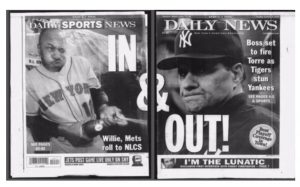 We took Game One of the NLCS from the Cardinals. Beltran socked a two-run homer, and the rest was handled by the capable arms of Gl@v!ne for seven, Guillermo Mota (an old Piazza nemesis we decided to tolerate for a spell) in the eighth and Wagner in the ninth. We’d now won four consecutive playoff games, on top of the final four during the regular season. Word was El Duque would be ready for the World Series, which was only three wins away. The October before, when the White Sox set fire to their 88-year drought, they lost only once en route to the title. Impressive, but not as impressive as we were being. As I joined a mob chanting “LET’S GO METS” when we weren’t singing “HoZAY! HoZAY HoZAY HoZAY!!! HoZAY! HoZAY!” en route to Game Two from the LIRR’s Shea Stadium stop, I dared to think — and it didn’t seem like much of a dare — “we’re gonna go eleven-and-oh.” We took Game One of the NLCS from the Cardinals. Beltran socked a two-run homer, and the rest was handled by the capable arms of Gl@v!ne for seven, Guillermo Mota (an old Piazza nemesis we decided to tolerate for a spell) in the eighth and Wagner in the ninth. We’d now won four consecutive playoff games, on top of the final four during the regular season. Word was El Duque would be ready for the World Series, which was only three wins away. The October before, when the White Sox set fire to their 88-year drought, they lost only once en route to the title. Impressive, but not as impressive as we were being. As I joined a mob chanting “LET’S GO METS” when we weren’t singing “HoZAY! HoZAY HoZAY HoZAY!!! HoZAY! HoZAY!” en route to Game Two from the LIRR’s Shea Stadium stop, I dared to think — and it didn’t seem like much of a dare — “we’re gonna go eleven-and-oh.”
I’d always been too superstitious to be so bold, but this team was rolling. The Cardinals drifted into the postseason with an 83-78 record. They had Albert Pujols, sure, but there was otherwise little about them that suggested destiny was propelling them. In the AL, the Tigers (who had been kind enough to take out the Yankees in the first round) were in the process of sweeping the A’s. We were already outclassing St. Louis. Detroit? Whatever. Twenty years had been enough in this part of New York. Two-Thousand Six was ours.
What could stop us?
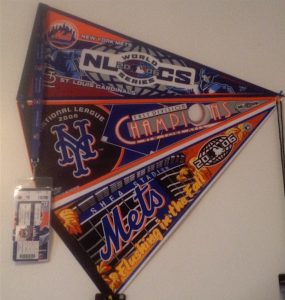 Maybe my hubris? Maybe Floyd going out of the lineup with his achilles bothering him? Randolph could have shelved him but didn’t before the NLCS began. Maybe our thinner than I cared to admit starting pitching? Maine wasn’t as adequate in Game Two against the Cardinals as he’d been the week before, letting an immediate 3-0 lead melt into a 4-4 tie. Maybe our well-worn bullpen? Neither Mota nor Wagner came through when it mattered most. Maybe our right field defense? Green in October sure looked a lot older than Nady had in the heady days of April. Maybe the Cardinals and whatever destiny the likes of So Taguchi (go-ahead homer) and Scott Spiezio (a torch of a triple in the eighth, a dagger of a double in the ninth) had packed? We lost the second game, 9-6, and the series was tied at one. So much for visions of 11-0. Maybe my hubris? Maybe Floyd going out of the lineup with his achilles bothering him? Randolph could have shelved him but didn’t before the NLCS began. Maybe our thinner than I cared to admit starting pitching? Maine wasn’t as adequate in Game Two against the Cardinals as he’d been the week before, letting an immediate 3-0 lead melt into a 4-4 tie. Maybe our well-worn bullpen? Neither Mota nor Wagner came through when it mattered most. Maybe our right field defense? Green in October sure looked a lot older than Nady had in the heady days of April. Maybe the Cardinals and whatever destiny the likes of So Taguchi (go-ahead homer) and Scott Spiezio (a torch of a triple in the eighth, a dagger of a double in the ninth) had packed? We lost the second game, 9-6, and the series was tied at one. So much for visions of 11-0.
Game Three in St. Louis was Steve Trachsel lasting one and Jeff Suppan lasting eight; we lost, 5-0, and trailed in the NLCS. We hadn’t trailed in any kind of standings since the second game of the season. We had 160 games to make up for it then. We basically had Game Four to reconvene our poise pronto. Our starter was Oliver Perez, one of the pieces moved Queensward in the post-Sanchez panic of the trade deadline. Perez was what was known as a project. Pittsburgh, which could have used all the help it could get, didn’t have the patience for him and packaged him along with Roberto Hernandez in the Nady swap. The Mets didn’t have to use him much down the stretch. He did throw a shutout in September, but even with Pedro and El Duque out, nobody was particularly counting on Ollie for October.
Now we had to count on Ollie. Ollie, in turn, counted on the Met offense, which withstood the Cardinals’ contingency starter, Anthony Reyes (ERA over 5), and then strafed three relievers. Perez carried an 11-3 lead into the sixth, and we breezed to an 11-5 finish in Game Four. Game Five would be future Hall of Famer Gl@v!ne versus historically shaky Jeff Weaver. T#m does what T#m’s been doing, and we keep hitting like we hit in support of Ollie, and “fine” returns to the forefront of Met fortunes.
But that didn’t happen. Weaver lasted longer than Gl@v!ne and gave up fewer runs. There was no particular salvation to be found in the bullpen portion of Game Five, either. The Mets, who’d scored at least six runs in four of their previous seven postseason contests, lost, 4-2. Our pitching was nothing special. Our hitting was inconsistent. Our fielding was hardly airtight. We were one game from elimination.
Then, back at Shea, everything exceeds fine for eight innings. Jose acknowledges all the HoZAYing by leading off with a homer versus Chris Carpenter. Green drives in a run, Lo Duca knocks home two, Maine and three relievers scatter baserunners and Wagner gets the ball for the ninth. It’s not a save situation, except for our season needing to be saved. Just three outs without four runs, Billy. Let’s go.
Billy, in the best tradition of those Met closers you kept telling yourself were really, really good despite your bones knowing the Met closer was never as good as you wished, put two on, got two out, then gave up a two-run double. Finally, a third out sealed it, 4-2. I stood in front of my seat throughout the top of the ninth. I fell into my seat when it was over.
Hubris was gone. Stayin’ alive was where it was at. The series was knotted at three.
My stomach might have been knotted, too.
I’d been in a splendid postseason groove in terms of passing through the gates of Valhalla, a.k.a. Shea. The Mets had played five home games thus far, and I was there for all of them. That wouldn’t be the case for Game Seven. This left me churning all day October 19 and not knowing what to do with myself once Perez threw the first pitch on TV. Sit? Stand? Wander in a small circle? I did it all, constantly. For a change, it was my cats not understanding my irrational movements.
It was 1-1 in the top of the sixth. I can tell you how it got that way, but it doesn’t matter. Ollie was pitching the game of his life and our lives, which was a blessing. Suppan was at least as effective, which was a problem. We weren’t looking for villains. With Jim Edmonds on second with one out and Scott Rolen up, we were holding out for a hero.
We got one — right, Gary Cohen?
Perez deals.
Fastball hit in the air to left field, that’s deep.
Back goes Chavez, back near the wall…leaping…and…
HE MADE THE CATCH!
HE TOOK A HOME RUN AWAY FROM ROLEN!
Trying to get back to first Edmonds…
HE’S DOUBLED OFF!
AND THE INNING IS OVER!
ENDY CHAVEZ SAVED THE DAY!
He reached high over the left field wall, right in front of the visitors’ bullpen and pulled back a two-run homer.
He went to the apex of his leap and caught it in the webbing of his glove with his elbow up above the fence, a MIRACULOUS play by Endy Chavez, and then Edmonds is doubled off first and Oliver Perez escapes the sixth inning.
The play of the year, the play, maybe, of the franchise history for Endy Chavez, the inning is over.
The apex of his leap. The apex of our year. The apex, maybe, of the franchise history. For a moment, nothing from 1962 forward felt bigger. We were living in it right here and now. No Met was ever more heroic on a baseball field, certainly in front of the left field wall at Shea Stadium, than Endy Chavez.
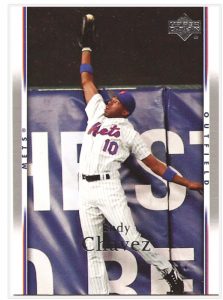 It was still 1-1. It was still 1-1.
My confidence soared. Then it plummeted. Up. Down. Standing. Sitting. Pacing. Shrieking. Silent. Probably yowling. Irking the kitties. I zipped back and forth for the next three-and-a-half innings between IT’S MEANT TO BE and WE’RE SCREWED, depending on what happened with each pitch, each swing, each take. WE’RE SCREWED took the pennant in seven games.
I’ve never made it from the beginning to the end of Staying Alive, the ill-conceived 1983 sequel to Saturday Night Fever, but I have managed to catch the coda to the movie’s climax, in which John Travolta as Tony Manero, now a Broadway dancer, asks his girlfriend, “Do you know what I wanna do? You know what I wanna do?”
“What?” she queries helpfully.
“Strut.”
And he hits the streets to the strains of the Bee Gees like he did back in 1977, when he was the king of the disco.
 In the fall of 2006, once I compartmentalized my immediate heartbreak, you could tell by the way I used my walk that my team had executed a monumentally wonderful regular season-plus and had us on the brink of even more. Privately, I moped and mourned. To the outside world, I strutted around like I had in the fall of 1986. I wore my Mets jacket whenever feasible and stuck my chest out and used every bit of body language at my disposal to tell passersby that I was a self-appointed ambassador for the best damn baseball team in New York this year and you just watch what we’re gonna do next year. We weren’t world champions, but we might as well have been. In the fall of 2006, once I compartmentalized my immediate heartbreak, you could tell by the way I used my walk that my team had executed a monumentally wonderful regular season-plus and had us on the brink of even more. Privately, I moped and mourned. To the outside world, I strutted around like I had in the fall of 1986. I wore my Mets jacket whenever feasible and stuck my chest out and used every bit of body language at my disposal to tell passersby that I was a self-appointed ambassador for the best damn baseball team in New York this year and you just watch what we’re gonna do next year. We weren’t world champions, but we might as well have been.
More than a runner-up. More than a runner-up to me.
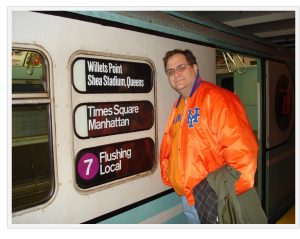 I really believed the front I was putting on. Give our team a little more time. This 2006 season will prove only the beginning of Met things to come. We’re gonna move on from Game Seven. We’re gonna withstand Suppan shutting us down in the sixth (with the bases loaded) and the seventh, and lefty Randy Flores doing the same to us in the eighth. We’re gonna get over Aaron Heilman giving up a two-run homer to Yadier Molina in the top of the ninth and the Cardinals shushing Shea, 3-1. We’re gonna render to a textured footnote the entire bottom of the ninth. I really believed the front I was putting on. Give our team a little more time. This 2006 season will prove only the beginning of Met things to come. We’re gonna move on from Game Seven. We’re gonna withstand Suppan shutting us down in the sixth (with the bases loaded) and the seventh, and lefty Randy Flores doing the same to us in the eighth. We’re gonna get over Aaron Heilman giving up a two-run homer to Yadier Molina in the top of the ninth and the Cardinals shushing Shea, 3-1. We’re gonna render to a textured footnote the entire bottom of the ninth.
The leadoff single from Valentin.
The single right behind him from Chavez.
Floyd hobbling to the plate only to strike out.
Edmonds robbing Reyes of a sinking-liner base hit that would have at least loaded the bases and likely scored Valentin from second (Edmonds’s thievery was not as dramatic as Chavez’s, but game is impelled to reluctantly recognize game).
Lo Duca walking to load the bases with two out, Anderson Hernandez pinch-running for the catcher whose walkup music happened to be Stayin’ Alive.
Rookie closer Adam Wainwright (in this role only because Old Friend™ Jason Isringhausen was sidelined with an aching hip) reinventing the curveball on the fly.
Carlos Beltran — who had detonated a walkoff bomb at Izzy’s expense in August — being perhaps a touch too selective on oh-and-two with two out (though you try hitting that curve).
All that? It was gonna serve as prologue for the real story, the multiple happy endings still to come for the post-2006 Mets. We lost a game and a series and a chance to go all the way ASAP, but we didn’t lose our future.
Reyes. Wright. The Carloses. The dazzling horizon. The whole thing was still right there in front of us. If I believed otherwise, would I be wearing this jacket with such conviction?
By the way, when I say I wore my Mets jacket, of course I had more than one. I had been hoping to add another to my wardrobe before 2007 arrived. At the last regular-season home game of 2006, when everything that could have been clinched had already been clinched and the postseason beckoned with so much promise, I saw somebody a few rows ahead of me wearing a varsity-style jacket commemorating on its back two world championships with two patches: one for 1969 and one for 1986. My companion that evening remarked it was quite an attractive jacket. Yeah, I said, but I wanna wait to get the revised version, the one with the third patch. I’m sure I wouldn’t have been the only one lining up to grab that jacket.
We’re still waiting.
PREVIOUS ‘MY FAVORITE SEASONS’ INSTALLMENTS
Nos. 55-44: Lousy Seasons, Redeeming Features
Nos. 43-34: Lookin’ for the Lights (That Silver Lining)
Nos. 33-23: In the Middling Years
Nos. 22-21: Affection in Anonymity
No. 20: No Shirt, Sherlock
No. 19: Not So Heavy Next Time
No. 18: Honorably Discharged
No. 17: Taken Down in Paradise City
No. 16: Thin Degree of Separation
No. 15: We Good?
No. 14: This Thing Is On
by Greg Prince on 19 March 2024 2:51 am For someone who writes plenty in the first-person, there’s nonetheless a phrase I try to avoid: “As I’ve written before…” It strikes me as self-aggrandizing, and to this point in the MY FAVORITE SEASONS, FROM LEAST FAVORITE TO MOST FAVORITE, 1969-PRESENT countdown, I have resisted the temptation to use it or, save for the winking inclusion of a screenshotted headline, explicitly refer to anything I’ve previously written on this blog.
But the season we’re about to revisit lives on for me mostly because it was the season I began to write on this blog. In the season when what you’re looking at all started, writing on this blog began to redefine me and my relationship to my team. I would never again consume Mets baseball without thinking of how I would put what I was experiencing into words.
As I’ve written before, the link between me and the Mets reached a whole new level of inextricable that year.
***
14. 2005
When the 2005 season ended, I thought I was one lucky sumbitch. What a year to construct, alongside a very good friend, a perch from which those two people could share their thoughts daily on what their favorite baseball team was up to. Our baseball team was up to so much!
Thinking back on it, had Faith and Fear in Flushing begun in 2003 or 2004 — years the Mets were trying to erase as they set their sights on what amounted to a total 2005 image reboot — there would have been a surfeit of material, too. Same for any season to which a hardcore fan/chronicler chooses to devote himself. It’s the Mets. We care. The story is always yearning to be put into words.
Nevertheless, I still believe 2005 was the perfect season for Jason and me to commence doing what we’ve spent the past nineteen seasons doing. I don’t know how in vogue the phrase “content” was among the media-savvy then, but brother, did 2005 give us content: content that made a fan/chronicler content, and content capable of filling a fan/chronicler with discontent.
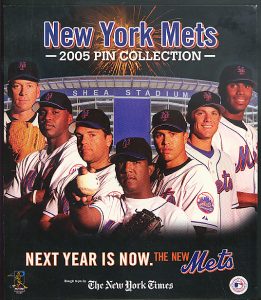 Downers in the course of 162 games were inevitable, but as a launching point, a team that finished four games above .500 and vied on the fringes of the Wild Card race until September grew serious manifested itself in everything a first-year blogger could have wanted — and wasn’t too bad for a longtime rooter, either. On its own merits, even if you didn’t commit to writing it up, 2005 was a quality season. Winning more games than you lose is always positive. Winning a whole lot of games is always preferable, but probably not reasonable to expect when you’ve just muddled through the previous two seasons losing 95 and 91, respectively. The 2005 Mets weren’t too hot. The 2005 Mets weren’t too cold. The 83-79 output of Team Just Right (featuring more than just Wright) sufficed. Besides, experiencing highs and lows provides a new blog with a bounty of storylines. Downers in the course of 162 games were inevitable, but as a launching point, a team that finished four games above .500 and vied on the fringes of the Wild Card race until September grew serious manifested itself in everything a first-year blogger could have wanted — and wasn’t too bad for a longtime rooter, either. On its own merits, even if you didn’t commit to writing it up, 2005 was a quality season. Winning more games than you lose is always positive. Winning a whole lot of games is always preferable, but probably not reasonable to expect when you’ve just muddled through the previous two seasons losing 95 and 91, respectively. The 2005 Mets weren’t too hot. The 2005 Mets weren’t too cold. The 83-79 output of Team Just Right (featuring more than just Wright) sufficed. Besides, experiencing highs and lows provides a new blog with a bounty of storylines.
Not that there weren’t already storylines galore awaiting us when we turned this thing on on February 16, 2005.
• Ace pitcher Pedro Martinez suddenly and shockingly descending from the stratosphere of superstardom to serve as face of this recently misbegotten franchise.
• Center fielder Carlos Beltran, coming off the postseason performance of a lifetime, and accepting a lucrative offer from a team that rarely proffered lucrative offers.
• The first true full seasons of shortstop Jose Reyes, 21, and third baseman David Wright, 22, avatars of homegrown promise and perhaps harbingers of a day when the likes of Martinez and Beltran wouldn’t have to be convinced too strenuously to join the humble Mets (and maybe we wouldn’t have to rely on glamorous free agents if we could keep growing players like these two kids).
• The approaching Met twilight of 36-year-old icon Mike Piazza, who had one year left on his contract, the wear and tear associated with a career full of catching, and no desire to return to his previous encampment at first base.
• The simultaneous lidlifting on the eras of Willie Randolph — respected New York baseball lifer at last receiving a chance to manage — and Omar Minaya — admired front-office mind tasked to run the whole show in Flushing.
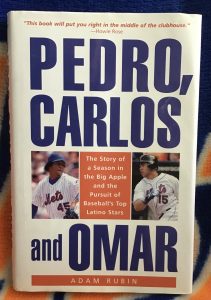 And those were just the storylines spelled out in advance. The season got into gear, and there was Cliff Floyd staying healthy while making pitchers sick; Beltran’s center field predecessor Mike Cameron reluctantly accepting reassignment to right; T#m Gl@v!ne seemingly settling in as an actual Met after two years working undercover as The Manchurian Brave; word that the Mets would soon air their own dedicated cable network; word that ownership and the city would collaborate on building a glittering new ballpark befitting these glittering New Mets (in conjunction with a bid for the 2012 Summer Olympics that were totally coming to NYC); and an onslaught of anxiety applied to a supporting cast whose identities were of paramount importance in 2005, even if hindsight suggests they were simply ballplayers trying to perform to the best of their ability and not necessarily meeting that goal on a sustained basis. And those were just the storylines spelled out in advance. The season got into gear, and there was Cliff Floyd staying healthy while making pitchers sick; Beltran’s center field predecessor Mike Cameron reluctantly accepting reassignment to right; T#m Gl@v!ne seemingly settling in as an actual Met after two years working undercover as The Manchurian Brave; word that the Mets would soon air their own dedicated cable network; word that ownership and the city would collaborate on building a glittering new ballpark befitting these glittering New Mets (in conjunction with a bid for the 2012 Summer Olympics that were totally coming to NYC); and an onslaught of anxiety applied to a supporting cast whose identities were of paramount importance in 2005, even if hindsight suggests they were simply ballplayers trying to perform to the best of their ability and not necessarily meeting that goal on a sustained basis.
As fans, we responded as we usually did when a starter didn’t last enough innings, or a reliever coughed up a lead, or a borderline veteran was taking at-bats that an unproven rookie could be using to prove himself. As fan/chroniclers, however, it was all new. So, we told ourselves, let’s form and share opinions about people whose names screamed relevance down the corridors of 2005, yet now whisper, “hey, remember how significant my effectiveness and/or production seemed to you when you were writing about me all those years ago?”
Less Miguel Cairo! More Anderson Hernandez!
Less Gerald Williams! More Victor Diaz!
Enough with Doug Mientkiewicz! Permanently install Mike Jacobs!
What the hell’s the deal with Kaz Ishii? Kris Benson? Victor Zambrano?
No, don’t bring in Felix Heredia…or Manny Aybar…or Mike Matthews…or Mike DeJean…or Danny Graves…or Tim Hamulack…or Shingo Takatsu.
WHEN ARE THEY GOING TO GIVE ROYCE RING THE BALL IN THE NINTH?
You can swap out most of those names for Mets who preceded or succeeded them in the middles of rotations or backs of bullpens or ends of benches to fill similar roles with modest results. Some things about 2005 weren’t as altogether eye-opening as they appeared. A gripe or a cause will always come along in the course of a season. I probably understood that innately then.
Yet I wrote as if everything the Mets did and every Met who did it was enormous. Because from my new perch as half of a Web site that endeavored to speak the Mets fan language to those who were fluent, it was. And they were. You had to love and had to obsess on this team, component by component, if you were going to make the most of this perch. It never occurred to me there was another way go about blogging our first season.
Besides, we had some highlights truly worth obsessing over.
Like that time that Aaron Heilman, en route from serving as a failed starter to a somewhat reliable reliever, snapped off a complete game one-hitter against Josh Beckett (when he was a big deal) and the Marlins (not yet having eviscerated their fairly recent world championship credentials). The only hit Aaron surrendered was a fourth-inning infield single to Luis Castillo, a name that doesn’t survive in Met lore as that guy who prevented our first no-hitter, for reasons that would become clear four years and one pop fly hence.
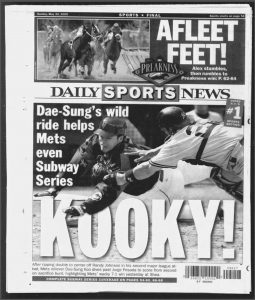 Like that time Dae-Sung Koo, a Korean working in America for this season and this season only, took his literal first swing in the major leagues — he’d struck out with the bat never leaving his shoulder in his only other plate appearance — and not only did it turn into a ringing double off Randy Johnson (when Johnson was mysteriously pitching for the Yankees), but Mr. Koo immediately thereafter came around from second on a bunt from Jose Reyes. Did we mention Mr. Koo, who legally had to be referred to as Mr. Koo, was a pitcher? Never won, lost or saved a game in 33 outings, and never batted again, either. Like that time Dae-Sung Koo, a Korean working in America for this season and this season only, took his literal first swing in the major leagues — he’d struck out with the bat never leaving his shoulder in his only other plate appearance — and not only did it turn into a ringing double off Randy Johnson (when Johnson was mysteriously pitching for the Yankees), but Mr. Koo immediately thereafter came around from second on a bunt from Jose Reyes. Did we mention Mr. Koo, who legally had to be referred to as Mr. Koo, was a pitcher? Never won, lost or saved a game in 33 outings, and never batted again, either.
Like that time journeyman Marlon Anderson pinch-hit a ninth-inning, game-tying inside-the-park home run, necessitating the acronym ITPPHHR for the first (and still only) instant in Mets history, finding the time during his 360-foot journey home to blow a bubble while gasping for air.
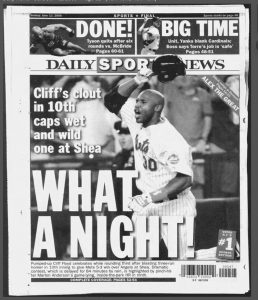 Like Cliff Floyd winning that very same ITPPHHR game with a more conventional shot over the wall in the bottom of the tenth. Like Cliff Floyd winning that very same ITPPHHR game with a more conventional shot over the wall in the bottom of the tenth.
Like Victor Zambrano, whom almost nobody trusted, outpitching Carlos Zambrano (no relation in any sense of the word) on Sunday Night Baseball.
Like Steve Trachsel, speaking of uninspiring starters, emerging from the DL in San Francisco to stymie the Giants by a score of 1-0, thanks to David Wright homering, that rare night when it was we who had the young differencemaker in our lineup.
Like preternaturally grizzled Roberto Hernandez stranding two runners and silencing tens and thousands of voluble doubters on a sweltering Shea afternoon when he struck out dangerous Derrek Lee to preserve a shutout started by Jae Seo.
Like Seo, never granted more than a rotation toehold, three months earlier throwing seven one-hit innings while knowing he was going to be sent back to Norfolk ASAP (roster-juggling has always been more art than science in these parts).
Like presumed-obsolete Miguel Cairo delivering a walkoff single as the Mets withstood impending elimination.
Like the great Pedro Martinez utlimately overwhelming an overwhelming John Smoltz on Easter Sunday.
Like the great Mike Piazza taking what amounted to a seven-minute curtain call on the final day of the season.
Like Chris Woodward, usually an infielder, making a dazzling catch in the outfield in a critical eighth inning.
Like Ramon Castro, usually a backup, belting a go-ahead dinger in another critical eighth inning.
Like Mike Cameron, for a time adjusting to right, slipping on grass, sticking out his glove, and snaring a sinking liner.
Like Kaz Ishii holding own versus Roger Clemens the last time Roger Clemens dared show his unpleasant Astro ass on the Shea Stadium mound, a night that proceeded with the starters exchanging seven zeroes apiece and ended with Jose Reyes driving in the game’s only run in the eleventh.
Like the Mets’ first win ever over an entity called the Washington Nationals, an enterprise that bore a modest resemblance to an outfit called the Montreal Expos.
Like the Mets’ first win at the Oakland Coliseum, or whatever corporate name it had that week, since the 1973 World Series.
Like the Mets’ last win the last time they would ever play at what was about to become old Busch Stadium, site of so much mutual snarling in the 1980s.
Like four consecutive Met wins at Bank One Ballpark by the composite romp of 39-7, a sweep so complete that a month later the Diamondbacks changed its name to Chase Field, presumably in the hope that the marauding band of New Yorkers wouldn’t be able to find the joint when they came back to administer more punishment in 2006.
Like so many times some Met, whether instantly or vaguely recognizable from the perspective of nearly two decades on, did something that seemed momentous and unforgettable in 2005 — yet momentum faded, and a memory hole opened and swallowed up most of what I would’ve sworn wouldn’t be easily forgotten.
 Sometimes I wonder whatever became of 2005, beyond the turning of the calendar. Oh, the calendar turned, all right. When the Mets arrived at their new home in 2009, only Reyes, Wright and Beltran remained on a continuing basis from four seasons prior, and each of them had accomplished enough in 2006, 2007 and 2008 to shroud in Citi Field fog whatever they’d achieved across 2005. Other than David’s barehanded grab of a fly ball in San Diego, not much among what the final three did way back then ever got replayed or widely referenced again. Video of Mr. Koo’s wild ride was a hardy Subway Series perennial, but Mr. Koo was back in Korea. Marlon Anderson did a Recidivist Met stint, but saw his ITPPHHR goodwill lapse during one collapse or another. Aaron Heilman’s incarnation as a somewhat reliable reliever post-one-hitter also carried an expiration date, and he was traded the winter Shea was being demolished. Pedro Martinez’s first and only outing at Citi was in a Phillies uniform, for crissake. Sometimes I wonder whatever became of 2005, beyond the turning of the calendar. Oh, the calendar turned, all right. When the Mets arrived at their new home in 2009, only Reyes, Wright and Beltran remained on a continuing basis from four seasons prior, and each of them had accomplished enough in 2006, 2007 and 2008 to shroud in Citi Field fog whatever they’d achieved across 2005. Other than David’s barehanded grab of a fly ball in San Diego, not much among what the final three did way back then ever got replayed or widely referenced again. Video of Mr. Koo’s wild ride was a hardy Subway Series perennial, but Mr. Koo was back in Korea. Marlon Anderson did a Recidivist Met stint, but saw his ITPPHHR goodwill lapse during one collapse or another. Aaron Heilman’s incarnation as a somewhat reliable reliever post-one-hitter also carried an expiration date, and he was traded the winter Shea was being demolished. Pedro Martinez’s first and only outing at Citi was in a Phillies uniform, for crissake.
Yet I’m convinced there was something more at work than time going undefeated contributing to what I’m willing to label insidious if inadvertent 2005 Mets Erasure.
My hastily cobbled theory suggests virality may have existed on the Internet as a concept, but things weren’t as shareable as they’d soon become. Message boards brought Mets fans together in community (it was how Jason and I first crossed paths in the mid-1990s) and comments sections were attached to Web sites in order to promote polite discourse of relevant topics and issues among strangers who claimed common interests, but if you didn’t stumble into Mets material on your computer, you had to work a little to find it. When Jason initially proposed we begin a blog, I went to Google and typed in “Mets” and “blog”. Facebook was something only high school and college students used; YouTube was just launching; and Twitter was a year away. Watching Met highlights meant tuning into local newscasts if you were in New York, or waiting for ESPN to get around to that night’s Mets game if you weren’t. Most 21st-century Mets action that aired prior to the 2006 creation of SNY (if it didn’t involve Mike Piazza hitting a home run on September 21, 2001) wound up receding into video archives that would go largely undisturbed, as if psychically the Mets had packed for the future but never got around to fully unboxing their stuff once they moved there. If a person said he read something a diligent beat writer like Adam Rubin wrote that morning, chances were pretty decent it meant that person bought a physical copy of the Daily News and turned actual pages of a sports section, usually past too many Bronx-focused column inches. Clipping and saving was becoming a lost, then different art.
The times, they were a-changin’ — as times always are — but at the confluence of our Met and media concerns, the times where 2005 reside belong to a transition period where only one foot appears firmly planted on the precipice of what is now the present. My perspective might be skewed by the fact that I am sitting in the same room and at the same desk where I sat when I wrote my first post for Faith and Fear. The first time Jason hit “publish” on my behalf (I wouldn’t learn to do that for myself for a few weeks), I became an online content creator. Mentally, however I was still dragging my feet out of what was left of the past. Hell, I’d keep going out and buying the News until 2007.
In the first year this blog operated, everything was so fresh and so urgent. There were arcs and trajectories and spurts and streaks and curiosities and quirks and kicks to the gut and reasons to believe unfurling in every direction until the season’s conclusion demanded they land at a dead end. There were trades rumored but not made. There were grudges molded and held between Opening Day and Closing Day, only to be set free, because, honestly, you’d sound like a lunatic today if you tried to convince somebody you once got up in arms about old Miguel Cairo getting at-bats that could have been going to young Anderson Hernandez.
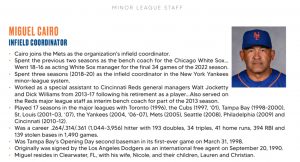 In September of 2023, I heard Howie Rose mention that Miguel Cairo, then the Mets’ minor league infield coordinator, had worked closely with Ronny Mauricio in advance of Ronny’s callup to the majors. Cairo was a veteran utilityman by 2005 and not all that productive per the ascendant advanced metrics of the era or, to be honest, any old-school statistics you could find in the paper. I seem to recall a groupthink developed within the budding ecosystem we called the Mets blogosphere that something was very wrong with your team’s philosophy if it depended on somebody like Miguel Cairo, which, in turn made me empathetic to the guy — he was 31, I was 42, each of us kind of old for what we were doing — while concurrently making me wonder if maybe he didn’t need to be soaking up a roster spot on a team that could benefit from a nice youthful infusion (ah, gray area). As Howie explained in 2023 how helpful Cairo had been to Mauricio and Mark Vientos and Brett Baty, I remembered there was a time the mere mention of Miguel would represent a virtual red cape inside an online bullring. In September of 2023, I heard Howie Rose mention that Miguel Cairo, then the Mets’ minor league infield coordinator, had worked closely with Ronny Mauricio in advance of Ronny’s callup to the majors. Cairo was a veteran utilityman by 2005 and not all that productive per the ascendant advanced metrics of the era or, to be honest, any old-school statistics you could find in the paper. I seem to recall a groupthink developed within the budding ecosystem we called the Mets blogosphere that something was very wrong with your team’s philosophy if it depended on somebody like Miguel Cairo, which, in turn made me empathetic to the guy — he was 31, I was 42, each of us kind of old for what we were doing — while concurrently making me wonder if maybe he didn’t need to be soaking up a roster spot on a team that could benefit from a nice youthful infusion (ah, gray area). As Howie explained in 2023 how helpful Cairo had been to Mauricio and Mark Vientos and Brett Baty, I remembered there was a time the mere mention of Miguel would represent a virtual red cape inside an online bullring.
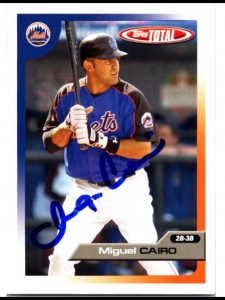 Now it was many years later, and Miguel Cairo, who last played in the majors in 2012 (two years later than Anderson Hernandez did), was part of some rising rookie’s story, and Howie didn’t see fit to elaborate on Cairo’s 2005. I doubt any listener began to fume at the mention of the man’s name or rue his FanGraphs WAR of -0.5, because, well, that was a long time ago. It’s likely some Mets fan somewhere is still steaming at some 2005 Met or perhaps the entirety of the 2005 Mets for not coming through when crucial victory was a pitch or hit away (we were a half-game out of the Wild Card on August 30), but I find it hard to believe anybody instinctively or theatrically recoils at the possibility of being reminded of the shortfalls that loomed so large in the moment the way “1987” evokes Pendleton or “1988” evokes Scioscia. At most, a then-crushing defeat, like Braden Looper blowing an unblowable lead on a Friday night in Pittsburgh, looms in miniature, and only for somebody who relishes remembering to begin with. Now it was many years later, and Miguel Cairo, who last played in the majors in 2012 (two years later than Anderson Hernandez did), was part of some rising rookie’s story, and Howie didn’t see fit to elaborate on Cairo’s 2005. I doubt any listener began to fume at the mention of the man’s name or rue his FanGraphs WAR of -0.5, because, well, that was a long time ago. It’s likely some Mets fan somewhere is still steaming at some 2005 Met or perhaps the entirety of the 2005 Mets for not coming through when crucial victory was a pitch or hit away (we were a half-game out of the Wild Card on August 30), but I find it hard to believe anybody instinctively or theatrically recoils at the possibility of being reminded of the shortfalls that loomed so large in the moment the way “1987” evokes Pendleton or “1988” evokes Scioscia. At most, a then-crushing defeat, like Braden Looper blowing an unblowable lead on a Friday night in Pittsburgh, looms in miniature, and only for somebody who relishes remembering to begin with.
Yet, damn, 2005 happened for a whole year, I mean really happened, and we printed receipts.
Faith and Fear in Flushing preceded by a few months a notable format change on New York radio. It was one of those stories, akin to so many developments within a baseball season: huge in its day, yet recalled rarely outside the province of obsessives once that day grew distant. On June 3, 2005, WCBS-FM gave up on what remained of its long-running oldies format and flipped to JACK-FM. JACK-FM, which had attracted listeners in other markets, was terrestrial radio’s response to the iPod craze. It was supposed to be a music format that didn’t adhere to a music format. The slogan was Playing What We Want.
 Here at FAFIF-FM, we played what we wanted in stereo…or wrote what we wanted the way we wanted. We didn’t pretend to be newspaper reporters or, god forbid, talk radio hosts. We were fans/chroniclers. We chronicled the Mets, but we also chronicled being Mets fans. What it was like watching the Mets on MSG or Fox Sports Net New York or Channel 11. What it was like listening to the Mets on WFAN, if they weren’t bumped to a more staticky frequency. What it was like to go to Shea Stadium, as one would after pushing out of the 7 local at the Willets Point-Shea Stadium station and streaming with the throng headed down the spiral staircase that left a ticketholder in the shadow of Gate E. I’d take out my ticket, hope security wouldn’t bother my bag too much, shove my raincheck in my back pocket (I knew where I was going) and trusted the escalators supposedly gliding up toward Loge, Mezzanine or the Upper Deck were in working order. I bitched about the schlep every bit as much as I embraced my destination, warts and all. My, yes, there were warts. The PA was too loud. The food was too cold or hard or depressing, yet somehow costly. The puddle in the concourse — there was always a puddle in the concourse — was too much like a lake. The know-it-all in my row, the one who repeatedly insisted he would do a better job of batting than Carlos Beltran, was too much. Here at FAFIF-FM, we played what we wanted in stereo…or wrote what we wanted the way we wanted. We didn’t pretend to be newspaper reporters or, god forbid, talk radio hosts. We were fans/chroniclers. We chronicled the Mets, but we also chronicled being Mets fans. What it was like watching the Mets on MSG or Fox Sports Net New York or Channel 11. What it was like listening to the Mets on WFAN, if they weren’t bumped to a more staticky frequency. What it was like to go to Shea Stadium, as one would after pushing out of the 7 local at the Willets Point-Shea Stadium station and streaming with the throng headed down the spiral staircase that left a ticketholder in the shadow of Gate E. I’d take out my ticket, hope security wouldn’t bother my bag too much, shove my raincheck in my back pocket (I knew where I was going) and trusted the escalators supposedly gliding up toward Loge, Mezzanine or the Upper Deck were in working order. I bitched about the schlep every bit as much as I embraced my destination, warts and all. My, yes, there were warts. The PA was too loud. The food was too cold or hard or depressing, yet somehow costly. The puddle in the concourse — there was always a puddle in the concourse — was too much like a lake. The know-it-all in my row, the one who repeatedly insisted he would do a better job of batting than Carlos Beltran, was too much.
And there was still nowhere else I wanted to be. Let me tell you about it…
Maybe once a year one of the papers would write a ballpark feature. Usually we in the stands were just “the crowd” or “the fans”. We were said to have cheered or booed or maybe chanted something clever or obscene. We weren’t the story. We weren’t in the box score. At Faith and Fear (and, depending on their respective missions, at our compatriot blogs that had sprung up in the same Spring ours did), we made ourselves as much the story as the players and the game. We made what it meant to be a fan central to the story, not only when we went to Shea, but when we got home, when we got up the next morning, and whenever we found ourselves thinking about the Mets, which was, we didn’t mind telling anybody who was reading, almost all of the time. How a baseball fan functioned was the lifeblood of a baseball season, and I swear it felt like we had an exclusive in delivering that reality.
We weren’t JACK-FM. JACK-FM’s calling card, besides supposedly playing what they wanted, was having no personalities talking between songs (the gimmick didn’t last; whoever owned the 101.1 frequency switched it back to something approximating the old WCBS-FM two years later). We aspired to let who we were seep through the ball talk. It wasn’t enough to communicate that Beltran had gone deep or Reyes had stolen a base or Pedro had quashed a threat. We had to tell you where we were, what we were thinking, how it elevated our hopes, how those hopes were validated or dashed, and maybe what we had for dinner. It was fans chronicling fandom. It was what we wanted to do. It was what readers connected with. The most resonant feedback we received in 2005 — and still sometimes hear, if not as much now that social media exists and everybody can express themselves for an audience — was some version of “I thought it was just me who was like that about the Mets.”
Baseball seasons are long affairs. Even with a game filling a roughly three-hour block on a given night or day 162 nights or days per year, that leaves waking hours without baseball being played, waking hours with thoughts of baseball orbiting the brain. It hardly seemed efficient to have this wonderful perch and fire it up only after a Mets game was over.
Informally first, then as a weekly feature dubbed Flashback Friday, I opened a portal to my past that intertwined with the Mets’ past. My journey was mine, but it wasn’t dissimilar to that of anybody reading about it. It wasn’t just me who was like that about the Mets. We’d all had that journey leading up to 2005. We’d all started somewhere as Mets fans. We all exulted, depending on vintage, in 1986 and 1969. We were all overcome by gloom in 1993 and 1979 and years like those. But you didn’t read about it in the papers. On this blog, you read about it as a matter of course. It’s how baseball worked in my head and probably your head. I didn’t see how I could spend 2005 writing about the Mets and limit myself to writing about the 2005 Mets.
And now 2005 is one of those long-ago seasons that I invite to intrude on the present.
 At the risk of loading a description, I haven’t been a “normal” fan since 2005. It rarely occurs to me to not filter my life through an orange-and-blue prism and muse if this or that is something that belongs on Faith and Fear. And that’s just life. It’s never occurred to me over these nineteen years to not care about everything the Mets do, though I’ve probably developed discernment over how much inherent value any single bulletin carries for blogging purposes. I certainly haven’t watched a game without instinctively thinking about what I will write, whether it’s a game for which I’m the designated recapper or not, because there’s always something to write eventually. Everything became and continues to be content. My ever present past lingers as prelude for what I might write tomorrow. If I stopped to realize how much older I am now than I was in 2005, it could give me pause, but it probably wouldn’t. I relish having lived through so much Metwise, but age as a figure simply doesn’t resonate for me in this realm. In this realm, I’m as old as I feel. At the risk of loading a description, I haven’t been a “normal” fan since 2005. It rarely occurs to me to not filter my life through an orange-and-blue prism and muse if this or that is something that belongs on Faith and Fear. And that’s just life. It’s never occurred to me over these nineteen years to not care about everything the Mets do, though I’ve probably developed discernment over how much inherent value any single bulletin carries for blogging purposes. I certainly haven’t watched a game without instinctively thinking about what I will write, whether it’s a game for which I’m the designated recapper or not, because there’s always something to write eventually. Everything became and continues to be content. My ever present past lingers as prelude for what I might write tomorrow. If I stopped to realize how much older I am now than I was in 2005, it could give me pause, but it probably wouldn’t. I relish having lived through so much Metwise, but age as a figure simply doesn’t resonate for me in this realm. In this realm, I’m as old as I feel.
As in 2005, I feel like writing about the Mets.
PREVIOUS ‘MY FAVORITE SEASONS’ INSTALLMENTS
Nos. 55-44: Lousy Seasons, Redeeming Features
Nos. 43-34: Lookin’ for the Lights (That Silver Lining)
Nos. 33-23: In the Middling Years
Nos. 22-21: Affection in Anonymity
No. 20: No Shirt, Sherlock
No. 19: Not So Heavy Next Time
No. 18: Honorably Discharged
No. 17: Taken Down in Paradise City
No. 16: Thin Degree of Separation
No. 15: We Good?
|
|






