The blog for Mets fans
who like to read
ABOUT US
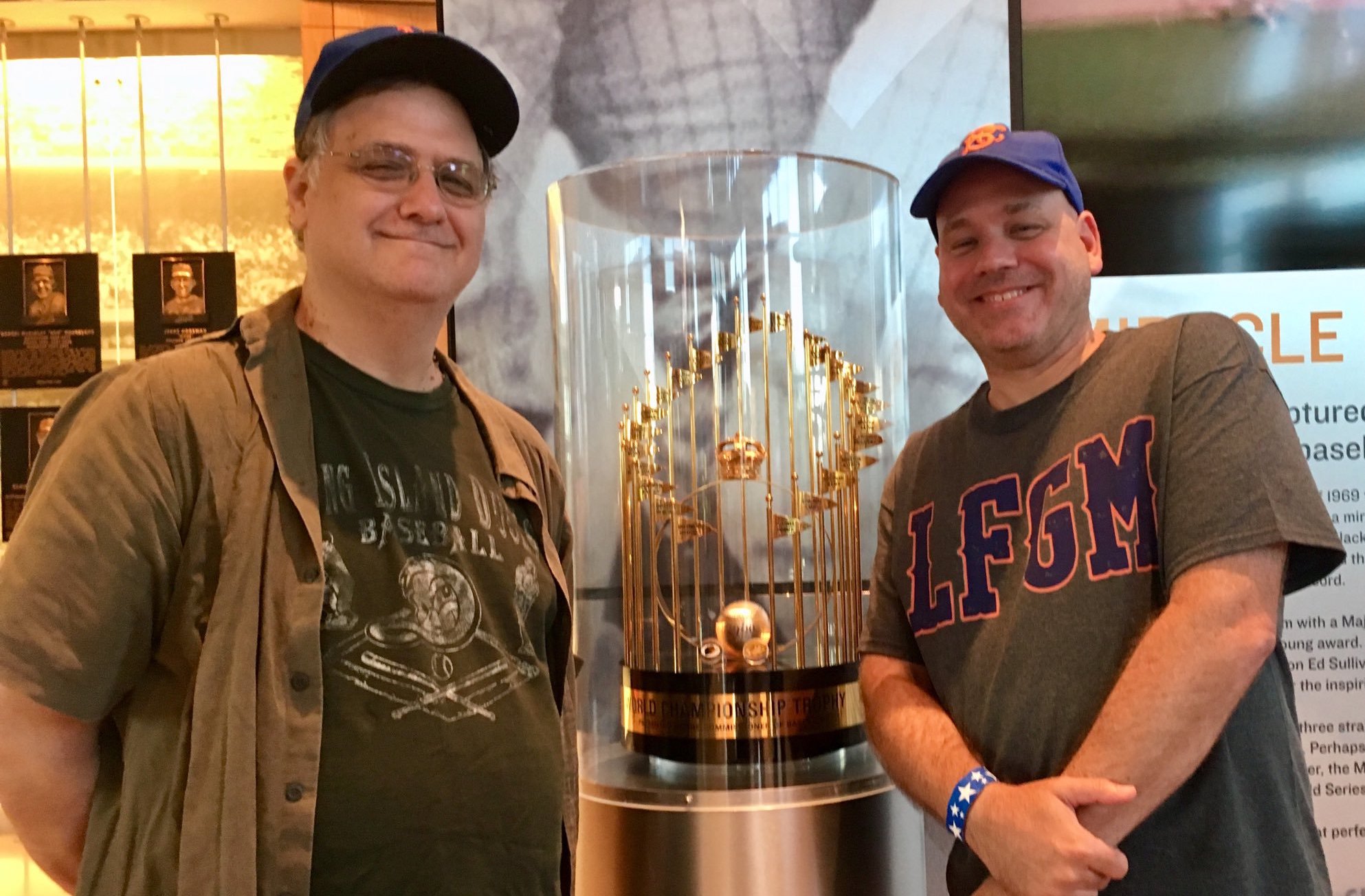
Faith and Fear in Flushing made its debut on Feb. 16, 2005, the brainchild of two longtime friends and lifelong Met fans.
Greg Prince discovered the Mets when he was 6, during the magical summer of 1969. He is a Long Island-based writer, editor and communications consultant. Contact him here.
Jason Fry is a Brooklyn writer whose first memories include his mom leaping up and down cheering for Rusty Staub. Check out his other writing here.
Got something to say? Leave a comment, or email us at faithandfear@gmail.com. (Sorry, but we have no interest in ads, sponsored content or guest posts.)
Need our RSS feed? It's here.
Visit our Facebook page, or drop by the personal pages for Greg and Jason.
Or follow us on Twitter: Here's Greg, and here's Jason.
|
by Greg Prince on 31 May 2021 4:47 pm With so many roster transactions involving current Mets — including three more planned tonight to facilitate the deinjuring of a trio of heretofore injured Mets — we can be forgiven for not having taken note of every up and down involving former Mets. Yet we can’t let this AL Central subtraction from April 28 get caught in the breeze and blow away without noting its significance.
Cleveland Indians designated LHP Oliver Perez for assignment.
When next Ollie was heard from, on May 12, it was to say “hola” from Los Toros de Tijuana, where the old bull had signed to be a new Bull slightly south of where the Mets will be swinging through on their present road trip. Oliver Perez, 39 and no longer positioned to benefit from being an ageless lefty in these Three-Batter Rule times, is pitching in the Mexican League. Assuming he doesn’t return north of the border in a professional capacity (and perhaps assume nothing, given the recent renaissance of Wilfredo Tovar), that means we have a new LAMSA in the land.
LAMSA, of course, refers to Longest Ago Met Still Active, specifically in MLB terms. Ollie held the LAMSA title since the beginning of the 2019 season. With David Wright and Jose Reyes effectively retiring in tandem at the end of 2019, only Ollie remained active from the 2006 National League Eastern Division champion New York Mets. Only Ollie could sit in a major league clubhouse and regale youngsters with tales of Game Seven; of Endy with The Strength To Be There; of Edmonds scurrying back from when he came (first base); of a breathtaking twin-killing that Gary Cohen called “the play maybe of the franchise history”; of Ollie’s bacon being saved once the gopher ball he gave up to Scott Rolen was kept in captivity.
Actually, Albert Pujols, Yadier Molina and Adam Wainwright could actively regale with that tale as well, but when Ollie told the story, no doubt it had a happier ending.
That’s all over now. There are no more 2006 Mets in the majors. And combined with Daniel Murphy’s previously announced retirement, we are down to only one Shea Stadium Met still active in either the AL or NL, thereby making him both the new LAMSA and truly the last of his kind.
Ladies and gentlemen, I give you Joe Smith.
The Mets gave us Joe Smith beginning on April 1, 2007, a sidewinder who made the Opening Night roster out of Spring Training at the tender age of 23 (seemed younger) and pitched beyond his years as a Met for the next two seasons, or until Shea closed in 2008. Soon after, Omar Minaya packaged the 17th Met named Joe to Seattle as part of a master plan to secure the services of J.J. Putz. Also included in that complex deal — the Mariners threw in Putz’s bone spur — was Chavez. As long as they were tearing down Shea, Omar figured why not tear out our heart?
Putz, to put it mildly, was a disappointment. Smith, to put it even more mildly, has shown staying power. He recently passed the 800-appearance mark and has tied some guy named Walter Johnson for 49th all-time in games pitched (and is five behind a fellow named Nolan Ryan). The Mets couldn’t have known Smith would have quite the lengthy career ahead of him. They probably should have known about Putz’s bone spur, but that’s another story.
With Ollie having moved on and Joe still doing what’s he’s been doing for more than fourteen years, let us update the chronological LAMSA list.
LONGEST AGO MET STILL ACTIVE: Chronology
• Felix Mantilla, debuted as a Met, 4/11/1962; last game in the major leagues, 10/2/1966
• Al Jackson, 4/14/1962; 9/26/1969
• Chris Cannizzaro, 4/14/1962*; 9/28/1974
• Ed Kranepool, 9/22/1962; 9/30/1979
• Tug McGraw, 4/18/1965; 9/25/1984
• Nolan Ryan, 9/11/1966; 9/22/1993
• Jesse Orosco, 4/5/1979; 9/27/2003
• John Franco, 4/11/1990; 7/1/2005
• Jeff Kent, 8/28/1992; 9/27/2008
• Jason Isringhausen**, 7/17/1995; 9/19/2012
• Octavio Dotel, 6/26/1999; 4/19/2013
• Bruce Chen, 8/1/2001; 5/15/2015
• Jose Reyes, 6/10/2003; 9/30/2018
• Oliver Perez, 8/26/2006; 4/22/2021
• Joe Smith, 04/01/2007; still active
*Cannizzaro was Jackson’s catcher on April 14, 1962, at the Polo Grounds, so for LAMSA purposes, he debuted as a Met after his pitcher.
**During Isringhausen’s extensive injury rehabilitation period, Paul Byrd (debuted as a Met on 7/28/1995); Jay Payton (9/1/1998); and Melvin Mora (5/30/1999) could each temporarily lay claim to LAMSA status, but Izzy ultimately outlasted them all.
Let us also bring up to date the Last Met Standing story, a slightly different cataloguing from the one directly above. Last Met Standing refers to the last Met who is still lacing up his spikes and crossing the foul line in the majors after having done exactly that for a particular Met team. The last 1962 Met, you oughta know and probably do, was Ed Kranepool, a major leaguer until 1979. Eddie was also the last 1963 Met and 1964 Met…but not the last 1965 Met, as you’ll divine below.
LAST MET STANDING: 1962-2011
1962-1964: Ed Kranepool (final MLB game: 9/30/1979)
1965: Tug McGraw (9/25/1984)
1966: Nolan Ryan (9/22/1993)
1967: Tom Seaver (9/19/1986)
1968-1971: Nolan Ryan (9/22/1993)
1972-1974: Tom Seaver (9/19/1986)
1975: Dave Kingman (10/5/1986)
1976-1977: Lee Mazzilli (10/7/1989)
1978: Alex Treviño (9/30/1990)
1979: Jesse Orosco (9/27/2003)
1980: Hubie Brooks (7/2/1994)
1981-1987: Jesse Orosco (9/27/2003)
1988-1989: David Cone (5/28/2003)
1990-1991: John Franco (7/1/2005)
1992-1994: Jeff Kent (9/27/2008)
1995-1997: Jason Isringhausen (9/19/2012)
1998: Jay Payton (10/3/2010)
1999: Octavio Dotel (4/19/2013)
2000: Melvin Mora (6/29/2011)
2001-2002: Bruce Chen (5/15/2015)
2003-2005: Jose Reyes (9/30/2018)
2006: Oliver Perez (4/22/2021)
2007-2008: Joe Smith (still active)
2009: Darren O’Day (still active)
2010-2011: Justin Turner (still active)
WHOA! you oughta be saying after reading to the end of the Last Met Standing. Kranepool, McGraw, Ryan, Seaver and so on — it all passes the smell test (something Shea didn’t always, but we loved it anyway). Now and then over the years, we’ve paused from our day-to-day coverage to salute the later Last Mets Standing once we noticed they were the only ones left upright from their respective classes. When various Mets from the 1990s and early 2000s endured to outlast their contemporaries well into the 2000s and 2010s, it was a sign they and we were getting old, but that’s baseball and life.
But Darren O’Day?
WHOA!
Darren O’Day is the Last Met Standing from 2009?
Seriously?
Seriously. Joe Smith, as mentioned, wasn’t a 2009 Met. Oliver Perez was, but stopped being a 2021 major leaguer as of his final Cleveland appearance on April 22. O’Day, if you didn’t notice, pitched as recently as April 29. He pitched for the Yankees, so you’re forgiven (and congratulated) for not noticing. Then he went on the IL, perhaps to show a tiny little piece of him is still a Met. He may not be active at this very moment, but he’s an active major leaguer in the broader sense, a dozen years since arriving on the Mets and departing from the Mets in pretty much one blink. Darren pitched in four games for the 2009 Mets, all in April. His last one came that April 16, his and my first official visit to Citi Field. I was more interested in the Kozy Shack pudding than I was O’Day’s only home relief appearance as a Met. I don’t know if Citi Field still offers Kozy Shack. I know you can’t find Darren O’Day there.
Omar Minaya — you’ll remember him from such exchanges as Joe Smith and Endy Chavez for J.J. Putz and J.J. Putz’s bone spur — had a bit of a roster backup and decided the best option for unclogging it was to ditch the guy who had a good twelve years ahead of him. Granted, Omar couldn’t have known how long O’Day would last or that he’d be pretty good throughout…but the general manager is supposed to show a little foresight to prevent fans like us from shaking our heads in hindsight.
But let’s not hit Omar over his head too hard with our collective elbow spur. Letting Darren O’Day go for nothing was nothing compared to letting Justin Turner go for nothing, and that was Sandy Alderson’s handiwork. Turner, you probably noticed if you read that last list, is the Last Met Standing from 2010 and 2011, which seems impossible because when did Turner get old enough to be the Last anything? (Other than the last Dodger to show common sense last October.)
Turner was a 25-year-old callup in 2010, filling in for a few days when the Mets were — stop me if you’ve heard this before — a little shorthanded. There’d be ampler opportunity for his services in 2011 once Citi Field’s resident starting third baseman started having back problems. The heretofore indestructible David Wright went on what we used to call the DL and Turner commenced to adequately plug every hole the Mets had for three seasons. When 2013 was over, he was judged utterly disposable by Alderson. The Mets didn’t tender him a contract. The Dodgers sure as shootin’ did.
Justin Turner has gone on to be one of the stars of the game since 2014, making his way to the postseason every season since. The Dodgers and he have been the perfect match. The Mets were left with shaving cream smeared all over their face.
The numbers add up, even though it seems too soon to slot Turner in as Last Met Standing for the first two seasons of his New York tenure given that Justin, whom we first knew at 25, couldn’t possibly be more than maybe 29 by now. But in actuality he is 36, or five years older than Ruben Tejada, who will always look 14. Tejada rates a sidebar shoutout here because the preternaturally youthful infielder was recently signed by the Phillies and assigned to their Lehigh farm club, giving him a theoretical shot at outlasting Turner. It will take Philadelphia getting particularly desperate to put Justin’s status in play. No offense to Ruben, but he’s played in all of 83 major league games since Chase Utley accosted him during the 2015 NLDS, none since his superbrief Recidivist Met stint of 2019. Tejada hasn’t recorded a hit in the majors since 2017, either.
Yet if he makes it back, we’ll take Turner off the Last Met Standing list and leave 2010 and 2011 blank in the interim. We don’t expect we’ll have to. Justin is still in a state resembling his prime and signed through 2022 for what Howie Rose would term a lot of glue, so he’ll probably outlast good ol’ Ruben. It’s just a matter of time.
It always is.
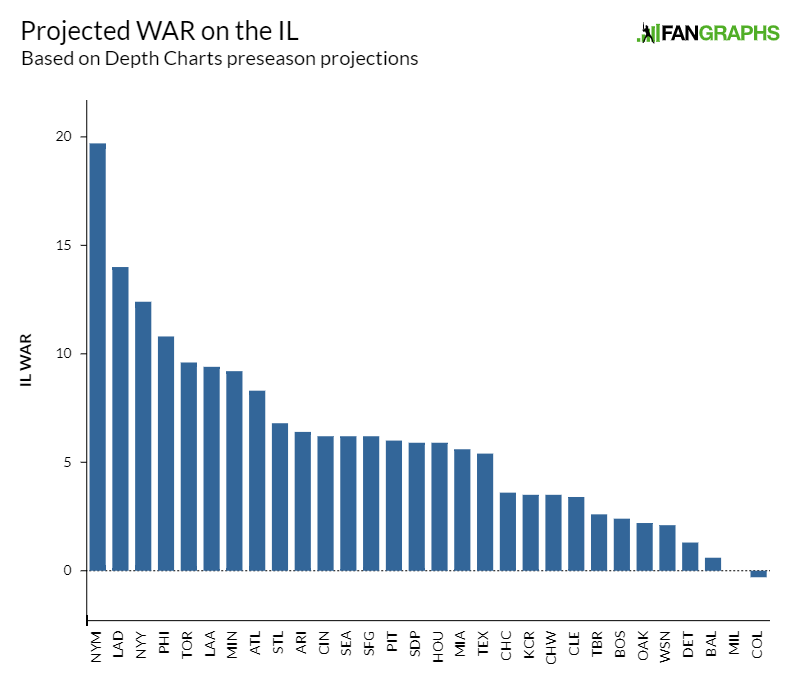
by Jason Fry on 30 May 2021 12:31 pm The Mets’ run of injuries has been Biblical — witness this recent post, from Fangraphs, noting that Mets on the injured list account for nearly 20 WAR, going by preseason predictions.

That’s by far the most WAR lost in the majors and should have been a recipe for disaster. And it still might be! But not so far. The Mets were handed a best-case scenario of “tread water until 26,000 guys are healthy again and maybe some other guys start hitting like we paid them to,” and they’re paddling around pretty happily, not only staying in first place but even opening up a little distance on their similarly battered rivals in the NL East.
How? Well, excellent pitching from starters and relievers sure helps. On Saturday Taijuan Walker looked superb, throttling the Braves over five innings and proving that injured Mets do occasionally return from those dreaded trips down the tunnel. Walker’s ERA is now down to a tidy 1.84, which will do very nicely.
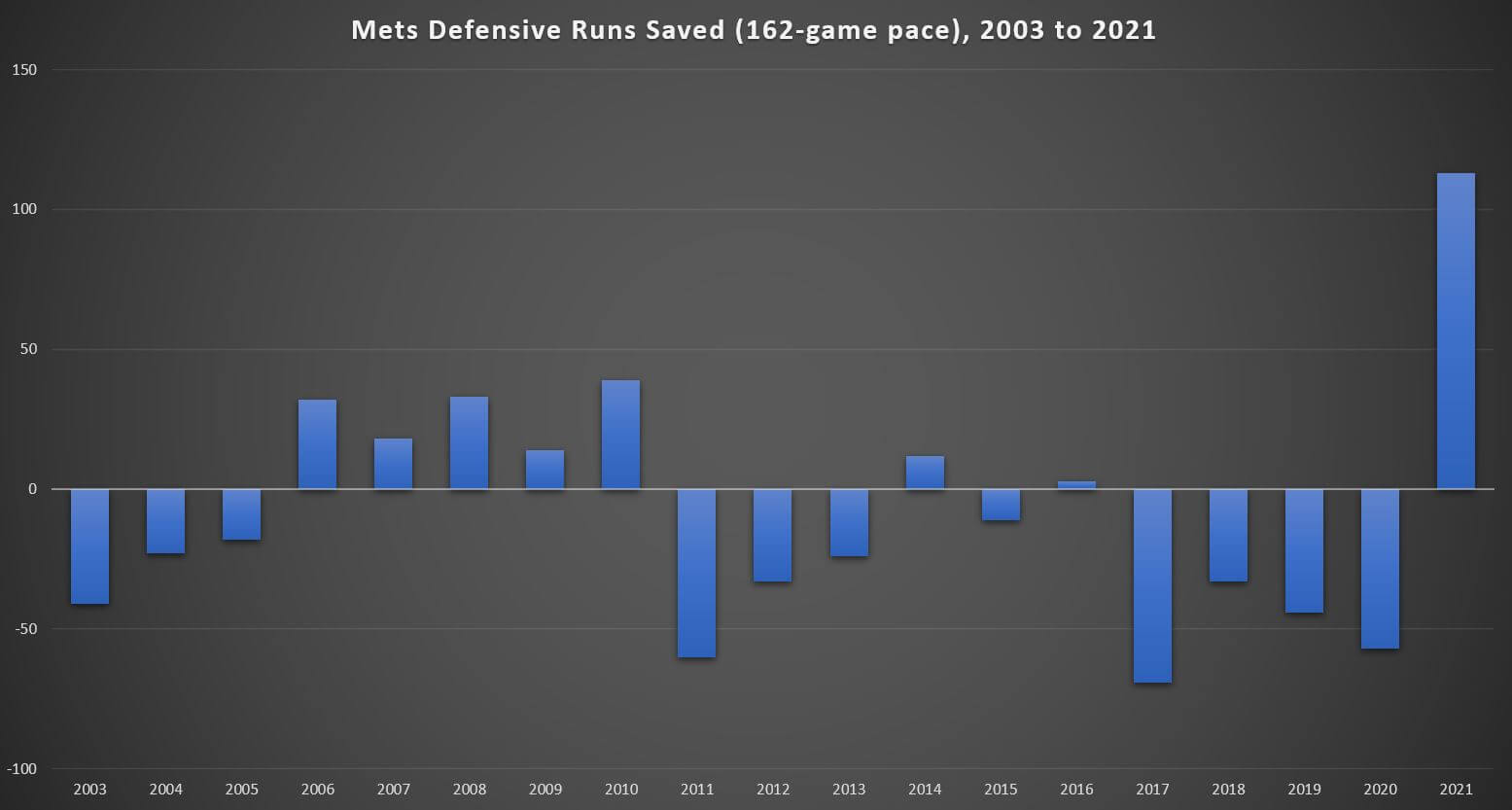
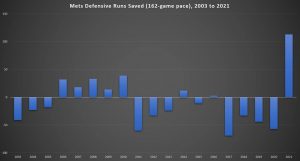
Defense helps too — over at The Athletic on Friday, Tim Britton dug into how the Mets have climbed from the bottom of the MLB ranks in defensive runs saved to third. A key ingredient to the change, which might startle Keith Hernandez, is that they’ve become much more aggressive about shifting, helped by an analytics department that’s been reborn now that the Wilpons have been downgraded from meddlers in chief to paying customers like the rest of us. The Mets hired Ben Zauzmer from the Dodgers, paired him with a couple of Van Wagenen holdovers, and empowered Gary DiSarcina to blend better information with his own instincts and those of his fielders.
While what’s below is still a relatively small sample, so far the results have been pretty good:
(BTW, you should subscribe to The Athletic. It’s worth every penny.)
I know, numbers numbers numbers. But the improved defense passes the eye test too: Before last night’s game became a laugher, it was the Mets’ defense and the Braves’ lack of it that gave them the lead: Tomas Nido gunned down Ronald Acuna Jr. in the first, Jonathan Villar made a diving grab to keep a potential run off the board in the second, and Jose Peraza was perfectly positioned to turn a double play that ended the fourth. Meanwhile, the Braves endured balls that went off Guillermo Heredia‘s glove and through Dansby Swanson.
Then the Mets unloaded, which was of course all sorts of fun: Villar deposited a ball into the Apple Basket (after just missing a grand slam earlier), Brandon Drury hit a two-run pinch-hit homer, and Billy McKinney rocketed a blast into whatever SodaLand is called now. Even James McCann and Francisco Lindor homered, with their bats showing signs of life. Poor Cameron Maybin set a new club mark for futility to begin a Mets career, going 0 for 27 and so topping (or perhaps the term is limbo’ing under) Charley Smith‘s 0-for-26 start in 1964, but then tapped a little swinging bunt up the third-base line to get on base, an accomplishment greeted with rapturous applause from the stands and a flurry of jazz hands from his dugout. Maybin’s smile was a highlight in its own right, starting off low-watt sheepish and then brightening to big and genuine.
That’s the kind of game it was: A guy goes 1-for-28 and it’s a feel-good moment. But it brings up something else about this team, for which I have no graphic: They genuinely seem to like each other and enjoy playing the game, a vibe that begins with Lindor’s effervescent, seemingly slump-proof captaining of the infield but also gets a boost from Marcus Stroman‘s swagger on the mound and the sunny volubility of Pete Alonso and Dom Smith.
Sure, everyone looks happy when you win by 11. Let’s see if the Mets can keep smiling if those defensive numbers erode and the pitching comes back to earth and the injured remain getting treatment for various ailments. But so far, whether through devil magic or winning personalities or a quirk of small sample sizes, Plan B’s been A-OK.
by Greg Prince on 27 May 2021 8:24 pm Dear Student:
The following is your remote learning unit for May 27, 2021. Please complete each assigned exercise, derived from this afternoon’s lesson plan, and submit your answers through your personalized educational portal, using code TWOFORTHURSDAY.
Please stay safe,
New York Metropolitan Teaching Technologies
—
1) A standard scheduled baseball game measures nine innings. How many innings would a doubleheader that takes place on the day that a standard baseball game was originally scheduled contain?
2) “It always rains” is a common refrain when it rains. If “it always rains” is a true statement, why might it be sunny the day after it rains? If it doesn’t always rain, why do people feel the need to say “it always rains”?
3) Explain the relationship between the phrase “keep your feet on the ground and keep reaching for the stars” and former All-Star pitcher Marcus Stroman reaching the end of the sixth inning having thrown mostly ground balls.
4) Jose Peraza leaves a team in Cincinnati, detours through Boston, and then without warning arrives in New York. How long does it take Jose Peraza’s second home run of the year to depart Citi Field?
5) Create a backstory for a fictional character named “Billy McKinney”. Please include details so as to make him seem real. Feel free to includes fictional characters you’ve previously created this term (e.g. “Johneshwy Fargas”).
6) How many saves in how many save opportunities will it take for Edwin Diaz to subtract a phrase like “Jarred Kelenic homered again” from common usage?
7) On the attached anatomical diagram, circle all the body parts NOT injured among the 17 members of the New York Mets currently on the injured list.
8) Calculate the difference between the six weeks Noah Syndergaard has been “shut down” and the period of time it will take Noah Syndergaard to pitch in the major leagues again.
9) If Cameron Maybin comes to bat a given number of times and never gets a base hit, how can Cameron Maybin be said to have a batting average?
10) True or false: $341 million buys a lot of defense and little else. Offer supporting evidence.
11) If a 27th man on a 26-man roster doesn’t participate in either game of a doubleheader, does he make a sound? If so, what kind of sound does he make? If he doesn’t, why not?
12) What is accurate about Connor Joe? (Choose all that apply.)
a) “Connor Joe” is a full name yet somehow feels incomplete.
b) Connor Joe Armstrong would be a more apt name than just “Connor Joe” for a left fielder who demonstrates a strong arm.
c) Connor Joe Wood would be a more apt name than just “Connor Joe” for a batter who gets good wood on the ball.
d) Connor I. Joe would get everybody in attendance at a large, socially distanced gathering up on their feet and clapping.
e) Connor Joe is a perfectly adequate name and any thoughts to the contrary demonstrate a lack of cultural sensitivity.
13) If a pitch is called a “churve” because it is a combination of a changeup and a curve, what would a combination fastball and knuckleball be called?
14) Jeurys Familia and Robert Gsellman are figures of local historical import. Why is it so easy to forget they continue to exist in the present?
15) Agree or disagree with the following statements:
a) Seven-innings games suck
b) Winning them doesn’t
c) The Colorado Rockies aren’t very good
d) Sweeping them is
by Jason Fry on 26 May 2021 2:16 am I went off to California for a week and while I was out there the Mets underwent some renovations, to say the very least.
Deep breath.
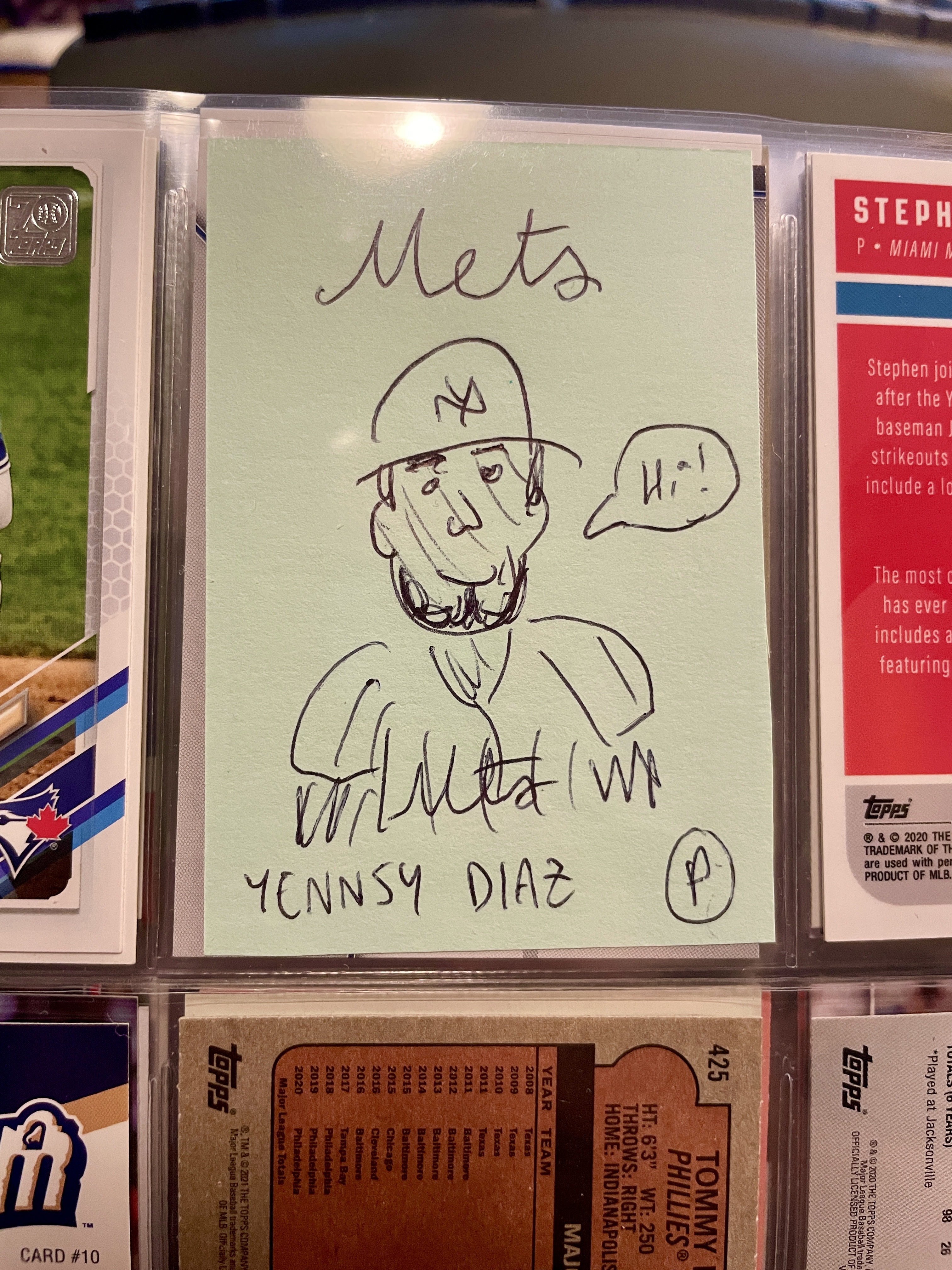
I’d barely registered the arrival of Jake Hager before he got his first big-league hit and then was subtracted from the roster. The minorly heralded Khalil Lee arrived, swung and missed a whole bunch, then collected his first hit when the Mets sorely needed it. Just before Lee’s arrival came that of speedy, skinny Johneshwy Fargas, who recorded his first hit and a marvelous catch or two but had joined the ranks of the battered before I returned. Cameron Maybin showed up, and he isn’t new but his first Mets hit will be, and it’s taking long enough that one suspects a contributing factor is that Maybin is, well, old. Brandon Drury joined the team and hit a rousing home run in a losing cause about half an hour after I stepped off a plane at JFK; Wilfredo Tovar returned but almost counts as new because his first orange-and-blue go-round was a long time ago and not particularly memorable. Yennsy Diaz showed up, and he was the guy for which I had no Holy Books card, a situation typically remedied by popping over to eBay — except Yennsy Diaz cards are few, far between and oddly expensive. He’ll probably have a Syracuse card in a month or so, so I decided to improvise — an effort that caught the latest Met’s eye on Twitter, and won his approval, or at least his good-natured acceptance.
That’s a lot for one road trip!
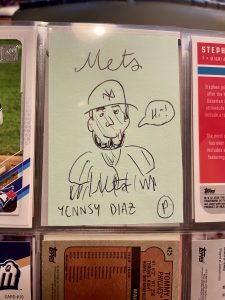 I doubt six new Mets in seven days is any kind of record, what with Midnight Massacres and September call-ups and all, but I wouldn’t be shocked if it is a club mark for late May. The Mets have already used 23 new players this season, tied for the fourth-most they’ve used in a Citi Field season, and again, it’s only May, which makes you wonder if the non-’62 club record of 35 is safe. I doubt six new Mets in seven days is any kind of record, what with Midnight Massacres and September call-ups and all, but I wouldn’t be shocked if it is a club mark for late May. The Mets have already used 23 new players this season, tied for the fourth-most they’ve used in a Citi Field season, and again, it’s only May, which makes you wonder if the non-’62 club record of 35 is safe.
You know what? Give it a week — after Tuesday night’s game they swung a dog-and-cat deal with the Brewers for Billy McKinney, a recently DFA’ed but presumably ambulatory corner outfielder. He’ll be No. 24 on the list of arrivals, if not in our hearts.
While I was away, the Mets went 3-3, which isn’t bad for a team getting shorn of one or two players a night. But we all knew it was doubtful that they could keep treading water with lineups more suited to a split-squad game in March than a regular-season affair two months after that. So it was a relief to see at least one casualty return to the battlefield — and a greater relief by far to have that returnee be the best pitcher on the planet.
Jacob deGrom only pitched five innings Tuesday, caution being what it is, but he was scintillating even by deGrom standards. He gave up a Ryan McMahon homer, but the blemish seemed to annoy him, and goad him into honing his slider into a magic trick that started at the hands of Rockies hitters before diving at their back feet. Couple that with a 100 MPH fastball and the competition hardly seemed fair. The Mets, meanwhile, had clearly ordered their makeshift lineup to be aggressive, seeking to maximize the few opportunities that could be generated. This strategy might have worked except for dastardly replay review, which revealed Jonathan Villar momentarily losing contact with third base as he stole it and deGrom ever so slightly lifting a foot above second in the act of stretching a single into a double.
Give me a moment, please.
OK. This is not what replay review is for, and every sentient baseball fan knows it. Replay review should be for correcting gross injustices (such as those umpires now routinely inflict on teams at first base) and for settling game-turning calls where someone’s safe or out by a whisper and the naked eye can only guess. Instead, replay review has become a wretched pantopticon that makes federal cases out of ticky-tack violations, setting technology against not only decades of sound judgment but also the very laws of momentum. It’s absurd — and not just when it goes against the forces of good.
Baseball could stop the madness with a simple remedy that would also curtail a related run of insanity: take challenges out of the game. Smart, reasonably observant folks are already watching all the games at MLB’s nerve center in New York, with umpires nearby. Instead of challenges, go to a centralized system where a potentially wrong call triggers a yellow light from New York, long enough for a quick review and — if necessary — an umpire’s appraisal. Take the teams understandably hunting for the slightest advantage out of the equation and there will be a lot less searching for slivers of light between the bottom of feet and the top of bases, or pondering whether a ball surrounded by a first baseman’s mitt is in said mitt or only about to be. Fix the obviously mistaken and the impossible to judge but critical, ignore the rest, and move on.
The Mets had no choice to move on; deGrom departed with his usual farcical no-decision and the game came down to the bullpens. But then we got a reminder that good things can happen, even to the Mets.
Tomás Nido didn’t make much of an impression when he arrived as the final new Met of 2017 (he was merely the 17th new Met that year, by the way). About two minutes after recording his first hit, he got tagged out some 25 feet shy of home plate to end a game against the Cubs, which isn’t exactly what you want fans to recall years later. He won a game a couple of years ago, walking off the Pirates with a homer in the 13th inning, but mostly attracted the kind of attention backup catchers attract, which is to be observed arriving from or departing to Triple-A and to have people wonder about your job security. Last year Nido hit a little more than we were used to, but a bout with COVID-19 scotched any chance of making a further impression, and early this year he struggled for playing time behind expensive new arrival James McCann.
But McCann hasn’t hit and Nido has, which has meant more playing time and the possibility of moments like Tuesday night’s sixth inning, when Nido walloped a Chi Chi Gonzalez slider over the center-field fence. The umpires signaled that it was in play, leading to Dom Smith belly-flopping across home in the vicinity of a tag while Nido gesticulated unhappily at second and the Mets’ dugout became a Greek chorus of gnashing and wailing.
That really is what replay review is for, but the crew realized the mistake without technological help, sending Nido home and giving the Mets a 3-1 lead.
But Nido wasn’t done contributing. In the ninth, Edwin Diaz fanned Charlie Blackmon with a nasty slider, but then walked C.J. Cron to set up a confrontation with McMahon. The slider then turned finicky on Diaz, who knew all too well what McMahon could do with an errant one. On 1-2, Nido called for a slider that could have been called a strike at the bottom of the zone but wasn’t. The next one was high and inside, and Diaz clearly wanted to throw something else. But Nido wasn’t having it, stepping out from behind home plate to make his case. Diaz’s third straight slider was just off the outside corner, an unhittable pitch that McMahon swung through. Five pitches later, Brendan Rodgers had been fanned as well and the Mets had won.
They’d won because Nido connected for a homer and because he coaxed an anxious closer through the toughest out in the enemy lineup — a sequence that reminded me of Rene Rivera playing horse whisperer to a chronically spooked Jeurys Familia. They won despite the Plan E lineup and rumblings of achy elbows in Florida and hand treatments needed in New York and other worrisome tidings.
They won and they’re in first place. For now, one says automatically, but history is made of for nows, isn’t it? Sometimes guys heal up as well as getting hurt. Sometimes backup catchers figure stuff out. Good things can happen, even to the Mets.
by Greg Prince on 25 May 2021 8:32 am It’s presumptuous to project thoughts onto the deceased. The deceased can’t speak for themselves, yet we the living haughtily decide what they might be thinking if they were still with us. I do anyway. For a decade now, I’ve done it with Dana Brand.
Though it’s presumptuous as hell, I do it because I miss Dana. Dana was a wonderful Mets writer and a wonderful Mets companion and a wonderful Mets fan. We actively knew each other for only a few years before he passed away out of nowhere at the age of 56 ten years ago today. We spiritually knew each other as Mets fans all our lives.
So forgive my presumptuousness when now and then since May 25, 2011, I find myself thinking, “Dana would love this,” even if I am confident that when he crosses my mind in this regard I’m hardly reaching to match projected emotion to absent emotee. When Johan Santana gave us our first no-hitter, there is no chance Dana wouldn’t have loved that. When the Mets rampaged to a National League pennant on the backs of Cespedes, Murphy and all that young pitching, there is no chance Dana wouldn’t have reveled in the result, let alone the process. Kirk Nieuwenhuis? Juan Uribe? This kid Conforto, the fresh prince of Binghamton? Lunky Lucas Duda? Wilmer Flores in tears? Grumpy, soulful Terry Collins? Those were Dana’s kinds of characters.
Dana never got to describe a Harvey Day or deGrom’s unforeseen ascent or the mythology of Thor. He would have been all over those guys. Same for Matz’s debut in front of Grandpa Bert and Bartolo’s world tour of the bases in San Diego and Cabrera’s bat flip that Tugged at our miracle instincts and Pete the powerful Polar Bear. Those were all Dana Brand essays waiting to happen. He’d have ruminated on the ‘F’ that infiltrated LGM. He’d have embraced from a safe social distance Dom Smith when Dom felt all alone on Zoom. He’d have said a proper goodbye to David Wright and Jose Reyes, the last of the Mets still on the Mets from when Dana and I went to games at Shea together.
I mean I think he would have. I can’t say for sure. But I do, because it makes me feel better to have his voice in my head. That goes for great Met moments and blah Met moments. The blah has outweighed the great for much of the past ten years. Dana, I believe, wouldn’t have had a problem coping with that. He understood the Mets weren’t designed to secrete success on a nightly basis. When they were good, they gave us something special. When they weren’t, they gave us themselves, and if it wasn’t always special, it was life. The right man picked the right team to interpret.
I’ll tiptoe a little further out onto the limb of presumptuousness and tell you I think Dana would have gotten Monday night’s 3-2 loss to the visiting Rockies, an evening when the blah (as engineered by Colorado starter Austin Gomber) was in full effect. Wouldn’t have loved it, but he would’ve gotten it. The absurd wave of injuries — learning Conforto and Jeff McNeil will be out far longer than initially suspected, seeing Johneshwy Fargas crash frighteningly into the same wall that took the measure of Albert Almora — would have left him grasping for answers, whether scientific or supernatural. The repositioning of heretofore hapless James McCann at first base and McCann responding to the challenge with a diving stop in the field and a home run at bat would have tickled his karmic fancy. Tomás Nido retrieving a passed ball/wild pitch before it became either because it bounced off the backstop bricks and into his bare hand, allowing the catcher who supplanted McCann to cut down a Rockie runner who’d naturally assumed third base was his would have provided the basis for a morality play. David Peterson’s intermittent struggles would have elicited Dana’s empathy. Francisco Lindor’s continuing struggles would have strained it.
And then, the bottom of the ninth. I can feel Dana next to me at Citi Field in the bottom of the ninth. Never mind that I wasn’t there and he wasn’t there. In my mind, we were both there. Rising and cheering as Brandon Drury pinch-hit and pinch-homered to lead off. Staring at each other with the same wisfhul thoughts in our eyes as Patrick Mazeika (with a beard totally unlike Dana’s, but nevertheless bearded like Dana) delivered a single off the bench. This was where Shea in 2007 and 2008 and Citi from 2009 to earliest 2011 would get loud around us and we’d begin to gameplan the possibilities of a stirring Mets comeback drawn to its giddiest conclusion.
It’s also where it would sink in just as quickly for each of us that, no, they’re doing it to us again. They’re raising our hopes only to inadvertently pinprick them before they rose too high. The Mets weren’t being malevolent, Dana and I would communicate either garrulously or wordlessly. They were just being the Mets. Losing 3-1 entering the ninth. Catching up to 3-2 two batters into the ninth, but with the pinch-homer coming before the pinch-single and the complement of unlikely “pinch me!” heroes used up and the disappointing regulars all who were left, ultimately left to disappoint us.
Unless they didn’t! We’d allow for that possibility, no matter that we deep down knew different…and we didn’t have to plunge that deep to know it. Jonathan Villar strikes out looking (but that’s OK, it’s only one out). Lindor just gets under one but predictably flies out (still, that was a pretty good swing, maybe he’s coming around). McCann, the focal point and lightning rod of our night, is up to push the point clear up to our face. He’s anxious. He’s aware we expect him to be the hero. He has to forget that. Still, the resolution we desire is so close we can taste it. A wild pitch moves Mazeika to second. James the Met so clearly from somewhere else has a chance to become a true New York icon here, to elevate Drury and Mazeika alongside him into legend, to turn around his season and our season, as if our season has ever stopped spinning topsy-turvy since it commenced. If only the count weren’t one-and-two.
Dana and I knew McCann would strike out to end the game. I mean we just knew it. I mean I think I know that we both just knew it.
Technically, I knew it, and I’m otherwise projecting on behalf of the deceased again. I’m presumptuously projecting that ten years since he died Dana Brand and I are still in touch, still talking Mets, still going to Mets games in one another’s company, still telling one another that once Mazeika singled after Drury homered that they’d depleted their reserves of ninth-inning mojo and we knew it, but we kept rooting and kept believing because we’re Mets fans.
I can’t prove it. But I do it anyway. I like having those moments with my late friend.
by Greg Prince on 23 May 2021 5:24 pm Six hits. Five for singles. Only two — the lone double, followed by one of the singles — were grouped in helpful proximity to one another, generating an entire run to cut the scoreboard deficit from gaping to yawning, but either way insurmountable most of the afternoon.
Sit indoors on a sunny Sunday in New York and watch the Mets play indoors on a sunny Sunday in Miami, and that’s what you get. One run produced by a bunch of batters not performing as hitters, few of whom you’d more than barely heard of or thought about weeks ago. Plus a pitcher who seems like a really nice guy, which wouldn’t be the first thing you’d say about him if he seemed like a really good pitcher. Or fielder.
Nobody’s really good among those who don uniforms indicating their affiliation with the New York Mets right now, including the few who’ve been here since the season began. We keep up with them anyway. It’s not hard. They’re only six hits better than us.
I kid. I kid because I love. Of course they could beat me and eight people off the street at a game of baseball. Implicit in that appraisal is the Mets come across as nine people off the street, but baseball is their profession. They’ve got that on we who note their shortcomings for free. They get paid for 5-1 losses to the Marlins. Theirs is not a performance-based compensation system from series to series. Thank goodness, for their sake.
Jordan Yamamoto (who seems like a really nice guy) had a rough second inning, featuring a couple of misplays he had a hand in, and five runs crossed the plate against him. He also has a sore shoulder. All of the above is enough to make a pitcher at least the No. 4 starter on the New York Mets this week. The Marlins let him go. I can see why, if only because between Pablo Lopez on Saturday and Cody Poteet on Sunday, they wouldn’t have room for a righty who can provide three pretty good innings and one sorta unlucky frame in between. Lopez and Poteen pitched very well versus the Mets this weekend. I guess they did.
It was the Mets, after all.
Ouch! Again, I kid. Not really, but the Mets remain in first place, which is the preferred destination for any baseball team in any division, even this one. It is the National League East, after all. I doubt we can count on the prevailing mediocrity of our semi-circuit as a mitigating factor much longer, however. We also can’t point to the daily presence of the “C” team as a Met-igating factor much longer if we choose to take the Mets seriously as a contender in 2021. Games remain scheduled whether or not you come prepared with an optimal assortment of players. It’s not the fault of the journeymen who are populating the roster currently that they were nobody’s first or second choice to be “the Mets” of the moment. They arrived in the organization as depth. They hoped they’d avoid alternate sites and get a call individually, but they didn’t expect to ascend to the majors en masse. I doubt they rallied one another in St. Lucie or Syracuse or wherever they crossed paths and said, “Wouldn’t it be great if all of us among the overlooked, undernoticed and generally dismissed got our chance together?”
But they have. Sometimes, as on Friday, it works. Sometimes, as on Saturday, it almost works. Sometimes it’s Sunday, when Johneshwy Fargas doubles, Wilfredo Tovar singles him in and Yennsy Diaz looks good for an inning…and that’s it, basically. Throw in perennial holdover Robert Gsellman pitching some decent relief and that’s really it. The Mets couldn’t withstand the Marlins defensively and they could barely bother the Marlins offensively and, geez, it’s the Marlins, though at this point who are we to overlook, undernotice or dismiss any opponent?
by Greg Prince on 22 May 2021 9:30 pm Did ya see how the bottom of the eighth between the Mets and Marlins ended on Saturday? Dom Smith made a hellacious dive with two out to corral a grounder from Miguel Rojas, rolled over on his rear end and rid himself of the ball before retrieving his bearings, guiding it to Miguel Castro at first base for the third out of the inning and preserving a tense 1-1 tie in Miami.
It was the best play you were gonna see all day…until one Met defensive out later.
Did ya see how the bottom of the ninth between the Mets and Marlins began on Saturday? Jesus Aguilar lined a ball into the gap between center and right. It would take two kinds of Tommie Agee efforts to reel it in: the kind where Agee dove to rob Paul Blair and the kind where Agee hung on in his webbing to rob Elrod Hendricks. Those were two of the most stupendous catches in World Series history. Amid stakes admittedly a few hundred notches lower, Johneshwy Fargas incorporated the most breathtaking aspects of each to nab from Aguilar a leadoff double and, as Smith did minutes earlier, keep the score knotted at one. Running and diving and gaining proximity to the ball would have been impressive as hell. The ball ticking off the top of Johneshwy’s glove would have been reluctantly understandable. But, nope, Fargas was gonna have his scoop and lick it, too. As so-called ice cream cone catches go, this one melted in your mouth and made your eyes water with joy.
What was it late-’70s mid-tempo duo England Dan and Sean Reid-Foley said in their final hit of the decade? Ah yes, “(G)love is the Answer.” What’s that? Sorry, that was John Ford Coley sharing billing on Billboard with England Dan, later known simply as Dan Seals, who went on to enjoy a successful country music career, highlighted by the crossover hit “Bop”.
Bop. Hit. Neither came up much for the Mets on Saturday. Smith generated an RBI single to drive home bruised pinch-hitter Jose Peraza in the top of the eighth, just when you thought the visitors were afraid to track mud all over home plate, but that was about it for Mets doing anything noteworthy with their bats. To be fair, little bopping or hitting or scoring was happening for the Marlins, either, not with defense like that delivered by Dom and Johneshwy and not with pitching like that delivered by almost every Met arm, particularly st/opener Joey Lucchesi.
If Lucchesi can throw a churve, I can call him a st/opener. Luis Rojas and whoever confers with Luis Rojas to make organizational decisions opted to treat Lucchesi as neither a traditional starter nor a contemporary opener, so let’s say a new category was invented, one in which the pitcher who begins the game throws lights out for four innings — too long to be an opener — yet is removed sans injury because somehow asking a well-rested fella who’s shutting down the opposition on no runs, one hit, no walks and eight K’s to hang around for more than four innings or 43 pitches doesn’t jibe with whatever the plan of the day was.
So goodbye Joey, after the best start (or st/open) of your life, hello Sean, who on most occasions we’d really love to see tonight. The reliable Reid-Foley gave up just one run, and even that was nearly prevented by tremendous defense. Cameron Maybin unleashed a sensational throw from left and Tomás Nido attempted to lay down a timely tag on sliding Brian Anderson in the seventh, but the ball refused to nestle in Nido’s mitt. Only so many Met fielders can cue up for ice cream.
That sac fly from Corey Dickerson and the aforementioned Dom Smith ribbie were the extent of the collective scoring for eight-and-a-half innings and then some. Fargas’s catch, made in support of Drew Smith, seemed to augur we’d get to extra innings, unearned runners on second and another chance at the havoc that won us Friday night’s game. Except Drew drew only one more out of the Marlin lineup. Anderson got annoying again with two out by singling through the right side and Garrett Cooper bopped like a bastard, launching the two-run homer that ended the late-afternoon affair in the Marlins’ favor, 3-1.
Should you see Smith’s fling from the dirt and Fargas’s streak through center within a highlight montage at any point in the future, forget the greater context of the Met loss. They were game-winning plays. They just weren’t enough by themselves to win a game.
by Greg Prince on 22 May 2021 1:30 pm Never mind the cliché about a team beset by injuries resembling a M*A*S*H unit. The Mets of the moment — with 16 players on their injured list — are closer to a M*A*S*H episode. A specific M*A*S*H episode in my mind, the one titled “Carry On, Hawkeye,” from the second season of the series. In it, a flu epidemic sweeps through the 4077th, flooring every surgeon but Hawkeye. Henry can’t operate. Trapper can’t operate. Frank can’t operate (Frank never could operate). Thus, it’s basically up to Hawkeye and Margaret to hold the OR together as wave after wave of wounded are choppered in because war waits for no epidemic.
I thought of this episode Friday night, after Pete Alonso and Tommy Hunter went on the IL, after Jose Peraza got hit with a pitch and had to leave the game, before the Mets put surgical scrubs on Father Mulcahy and Radar O’Reilly because when you’re down doctors, nurses and corpsmen, everybody’s gotta lend a hand. Who, I wondered, was going to be the Mets’ Hawkeye Pierce, the wisecracking healer who almost never loses his composure and almost never loses a patient while all around him are either terribly sick or potentially dying?
Not that I take baseball games seriously as death.
The answer became nobody, even if enough Mets cobbled themselves together to save the day and night. The primary heroes, if we may use such a word for a baseball game, wound up being the approximate Igor, Zale and Rizzo of the roster. No, wait, not even that’s an apt M*A*S*H analogy for the roles played by Jake Hager, Khalil Lee and Johneshwy Fargas in the twelfth inning at Terrible Corporate Name for Marlins Park Friday night. Peraza was a supporting player. Kevin Pillar was a supporting player. If we’d been simply down to the Met supporting player equivalents of Igor, Zale and Rizzo, our chances wouldn’t have looked scant. But our supporting players were confined to their metaphorical beds.
So it was down to the background players — the extras — to come to the forefront and carry the story to its pleasing conclusion. Hager, who had pinch-run in the tenth for unearned runner Tomás Nido, leading off and delivering his very first base hit in the majors and singling Dom Smith, unearned runner in the twelfth, to third. One Wilfredo Tovar out later (to reiterate, Wilfredo Tovar is back from seven years ago), it was Khalil Lee pinch-hitting for Drew Smith. Khali Lee had the distinction of being both the last guy you’d think of to pinch-hit, considering he was 0-for-8 with eight strikeouts in his brief career, and the last guy you had who roughly answered to the description of “hitter” left on the bench. Lee therefore was distinct enough to get the chance to break his ohfer.
And he did, doubling like he’d done it before, driving in Dom to give the Mets a 4-3 lead. After two first major league base hits had been strung together, veritable veteran Johneshwy Fargas, who got his “get him the ball!” moment out of the way four nights and three career hits earlier, tripled to score Hager and Lee and provide whoever would be the next of Luis Rojas’s non-Lucchesi relievers some breathing room. Johneshwy could have used some, too, as he nervily attempted to turn his triple into an inside-the-park home run. What the hell, he’s young, he’s fast…he was out. Nevertheless, the guys in the background of the guys in support roles had put the Mets up, 6-3, in the twelfth inning, as if twelfth innings happen anymore.
Ah, but they do. For all of MLB’s attempts to make everybody go home no more than one inning after regulation (lest they have to pay their cockeyed umpires overtime), this tie squirmed away from the immediate resolution the placement of unearned runners on second base is designed to induce. The game itself got away from the Mets in the seventh, when Luis ordered Marcus Stroman to stop pitching at the first sign of trouble. The Mets were ahead, 3-1, Stroman was basically cruising, but then he made the mistake of walking Brian Anderson on a full count. It was only a mistake in the sense that his manager pulled him at 89 pitches, replacing him with Miguel Castro, who wasn’t necessarily going to give up a two-run homer to Garrett Cooper, but did. There went the 3-1 lead, built aggressively in the first by recognizable cast members Jonathan Villar, Francisco Lindor and Dom Smith, and bolstered in the third by breakout character actor Nido. Stroman was well-positioned to be the Hawkeye of this production, giving us the heroic, nearly deGrommish performance we craved, but his commanding officer dismissed him a tad too soon for the script’s taste.
The Mets, as we note nightly, are amazingly undermanned. The Marlins, we don’t care, operate in a perpetual state of blank space. Do they even have 26 men on their roster? We asked the same last year and they rode their anonymity to the jury-rigged playoffs. Like us, the retrofitted Sugar Kings found guys and put them on the field. Like us, the red-clad opposition didn’t go away. They seemed poised to take one of those aggravating trademark Marlin leads in the eighth when Tim Timmons helped Trevor May walk a pair of batters. Timmons is not some Donnie Stevenson-style figment of South Florida imagination. He was the home plate ump with a strike zone as loopy as the Clevelander night club that used to throb beyond the outfield fence. Somehow May escaped a bases-loaded jam not entirely of his own making. Jeurys Familia put on two baserunners in the ninth as well, but also managed to stretch a velvet rope in front of home plate.
Despite Rob Manfred’s dumbest efforts, the tenth came and went. Same for the eleventh. The scoring column had become as difficult to get into as Studio 54 in its heyday. Whatever purpose there was to slotting a runner on second to start every extra half-inning was coming to naught. Both sides were running out of players. The Marlins in particular essentially ran out of pitchers. Don Mattingly had tried to engineer a bullpen game from the start, because what are the odds you’ll need your bullpen to do a bunch of bullpen things much later? True, the Mets hadn’t played an eleventh inning since Closing Day of 2019, with the dopey new runner-on-second rule having prevented periodic detours to Sudolvania, but eventually you were going to approach the outskirts of a marathon. In 2021, a twelfth inning looms as the 26th mile.
Finally, against Adam Cimber, working a (GASP!!!) second inning of relief, we had Hager come through and Lee come through and Fargas come through. Maybe the Mets would just keep ripping heaters all night long. Then, however, James McCann came up, reminding us that if hitting is contagious, James McCann is fully vaccinated. The catcher who nowadays caddies for Nido grounded out and sent us to the bottom of the twelfth.
Aaron Loup and those pesky Marlins disguised as regal Sugar Kings wouldn’t let the game go gentle into that good night. Jazz Chisolm, which is something your great grandfather warned your grandmother against, singled Miami’s unearned runner Magneuris Sierra to third. Miguel Rojas singled Sierra home to make it 6-4. Chisolm zipped to third. Corey Dickerson then shot a ball up the middle, guaranteeing speedy Jazz would improvise his way across the dish and…and nothing else, somehow. That’s because Lindor, who’s been almost as disappointing as McCann, pivoted sharply to grab Dickerson’s hot grounder; secure a forceout at second; and fire the ball to Smith at first. Smith, who’s quietly been almost as disappointing as Lindor and McCann, did some nice digging in the dirt to prevent catastrophe on the relay. It became a double play that averted disaster.
Smith is a first baseman by trade.
Alonso is the first baseman unless Alonso is hurt.
Alonso is hurt.
Smith started in left field.
Brandon Drury started at first base.
Brandon Drury is on the Mets.
Go figure.
Maybe Lindor was our Hawkeye at the end. That was some sweet shortstop orchestration of a twin-killing to reduce the threat of our own demise. And you know that buried somewhere beneath his infinitesimal production is a megastar leader struggling to emerge. Francisco actually embraced Dom at the mound while the infield gathered for the ritual shooing away of Aaron Loup while Rojas summoned Jacob Barnes. That is not the sign of someone stuck in own head until he starts hitting for real. Lindor may not have earned his Captain’s bars in New York yet, but he’s still conducting himself as chief surgeon of the infield. As with McCann when stationed behind the plate and Smith when transferred temporarily to first, Lindor’s ability to contribute through defense shouldn’t be overlooked just because of his glaring lack of offense.
Lindor did get two hits Friday night, or as many as Fargas did. Lindor did make a keen extra-inning, game-saving play, or as many as Cameron Maybin had. In the eleventh, Cimber, Mattingly’s tenth pitcher, lined a ball to right field with runners on second and third. It was May 21, 2021, the sixteenth anniversary of Dae-Sung Koo’s double and subsequent trip around the bases off Randy Johnson. Don’t doubt what can happen when relief pitchers swing a bat on May 21. Maybin (0-for-5) snagged Cimber’s liner and kept us going until we could stagger to the twelfth and revel in the exploits of Hager, Lee and Fargas in the top of the inning and Lindor and Smith in the bottom of the inning. Oh, Barnes, too. Jacob flied out Adam Duvall to say goodbye, farewell and amen to the Marlins in a mere four hours and thirty-eight minutes (or the approximate running time of the egregiously padded M*A*S*H finale “Goodbye, Farewell and Amen”).
Commendations all around. Drinks in the swamp are on Lindor.
by Greg Prince on 20 May 2021 11:15 am “Please cover your left eye and tell me what you saw Wednesday night from Atlanta.”
“David Peterson carrying a no-hitter into the fifth inning, showing the promise that gets us so excited about him … defensive prodigy Khalil Lee making his second sensational catch in two nights … Cameron Maybin using his wheels and wits to race from home to third without a base hit to set up the potential go-ahead run … James McCann’s bullet of a throw nailing Dansby Swanson and snuffing out the biggest threat within a burgeoning Braves rally … a huge hit from one of the Mets’ three catchers, which strikes me as the ideal number for a club to carry … Jacob Barnes courageously rescuing the Mets in relief .. .Mets pitchers continuing to neutralize the ever dangerous Ronald Acuña, Jr. … and the plucky Mets going to the ninth with every chance to sweep a series despite having almost no business winning this game. God, I can’t get enough of this team!”
“All right, now please cover your right eye and tell me what you saw Wednesday night from Atlanta.”
“David Peterson imploding in the fifth inning, showing the limitations that gets us so frustrated with him … offensive naïf Khalil Lee doing literally nothing but striking out … Cameron Maybin having no bat whatsoever, either … James McCann not so much as lifting a lousy sacrifice fly that would have scored Maybin after Maybin converted a strikeout into first base via wild pitch, second base via a steal and third base via another wild pitch … Tomás Nido sitting on the bench after he delivered his big pinch-hit earlier instead of having been in the game the whole time, which seemed ridiculous considering how hot he’s been and how useless McCann has been, so how about managing your three catchers properly? … Jacob Barnes giving up the walkoff homer in a tie game on the first pitch of the ninth after somehow wriggling out of the mess Aaron Loup left him in the eighth … Ronald Acuña, Jr., breaking his serieslong schneid by torching Barnes to beat the Mets, 5-4 … and the stupid Mets blowing multiple chances to win a game they had absolutely no business losing. God, I’ve had enough of this team!”
“OK, I’d say your vision is 2021.”
“Huh? I’ve heard of 20/20, but not 20/21.”
“Your vision is a condition specific to Mets fans this season. It’s ‘2021 Mets’.”
“Is it rare?”
“Actually, there seems to be an epidemic of it among certain segments of the baseball-watching population.”
“Is it serious?”
“I’d call it seasonal. I see a variant of it most years.”
“How does a person know if he has it?”
“The defining symptom of ‘2021 Mets’ is an unreasonable view that these particular Mets, despite all of their injuries and the dizzying turnover of their roster, shouldn’t lose any game they seem to have a reasonable chance of winning.”
“What do you mean ‘unreasonable’? They were ahead, 1-0, on Villar’s homer! They were ahead, 4-3, on Peraza’s double and Nido’s two-ribbie single! They had Maybin on third in a tie game and all they needed was a frigging fly ball! Luis had outsmarted Snitker to get Morton out of the game! They had Acuña contained! Lee already deserves the Gold Glove! Dom played first like a real first baseman! And Peterson had a no-hitter going before anybody gave a second thought to Corey Kluber!”
“You didn’t let me finish my diagnosis. When your vision is ‘2021 Mets,’ it is unreasonable to see the Mets as a team that’s going to win every game they’re in, but it won’t seem unreasonable as long as the Mets remain doggedly competitive.”
“They’re a major league team! They’re supposed to compete!”
“Try these lenses. Tell me what you see.”
“I see … I see minor leaguers and other teams’ castoffs. Maybin really looks cooked. Lee looks totally overmatched at the plate. Loup looks like he’s the one who should’ve retired instead of Blevins. Peterson looks more inexperienced than I think of him as. Through these lenses, I see a team that does nothing but let me down.”
“What don’t you see?”
“Um, no Conforto. No Nimmo. No McNeil. Wow, now, I don’t even see Alonso. Jesus, they don’t look like they can possibly compete!”
“Uh-huh. Now try these lenses.”
“Hey, that’s much better!”
“What do you see?”
“I see … I see bench guys coming through and callups surprising me occasionally and pretty clutch defense and relievers providing relief despite being used so much and, hey, Maybin’s speed really stands out. Through these lenses, I see a team that’s managed to withstand crazy adversity and remain in first place.”
“Different lenses, different visions.”
“What can you give me so I can see the 2021 Mets for what they really are?”
“I’m writing you a prescription for 125 more games. Take them one at a time.”
by Greg Prince on 19 May 2021 11:44 am (Presented with eternal affection for the timeless creation of Ruth Roberts and Bill Katz)
Meet this Met
Meet that Met
Every day we meet more Mets
There’s Tommy Hunter
And his first hit
There’s Khalil Lee
Who can field quite a bit
Johneshwy Fargas
Roaming in center
Starting relievers
So new arms must enter
Toe!
Más!
Knee!
Doe!
Suddenly’s a power bat
His clutch home run
Just beat the Braves
Get a load of that!
Oh Pillar’s somehow jokin’
Though his nose is sadly broken
Shallow in depth —
We cheer these Mets!
Oh Villar in the lineup
Means a dinger’s comin’ right up
Long as they win —
We’ll dig these Mets!
Wilfredo Tovar
From Twenty Fourteen
Hurry south
If you please
Otherwise
We’ll have no ballclub
For lack
Of warm bodies
Give us some help!
Give us a hand!
We might be signing players
From the stand!
Come on and…
Meet these Mets
First-place Mets
Cameron Maybin’s
Next a Met
The Fish who caught
The last out at Shea
Whom I’ve resented
Since that dreary day
Because the Mets will take
Whoever can breathe
Save Trev Hildenberger —
They asked him to leave
Thiiiis Met…
Thaaaat Met…
Keepin’ track’s a constant choooore…
When Mets go down with injuries
Don’t fret —
There’s more!
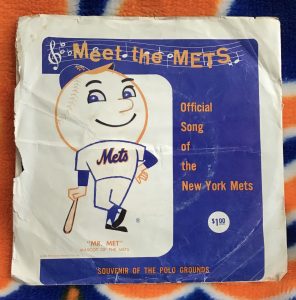 Can’t beat the original, but that doesn’t mean we can’t try to keep up with the times.
|
|