The blog for Mets fans
who like to read
ABOUT US
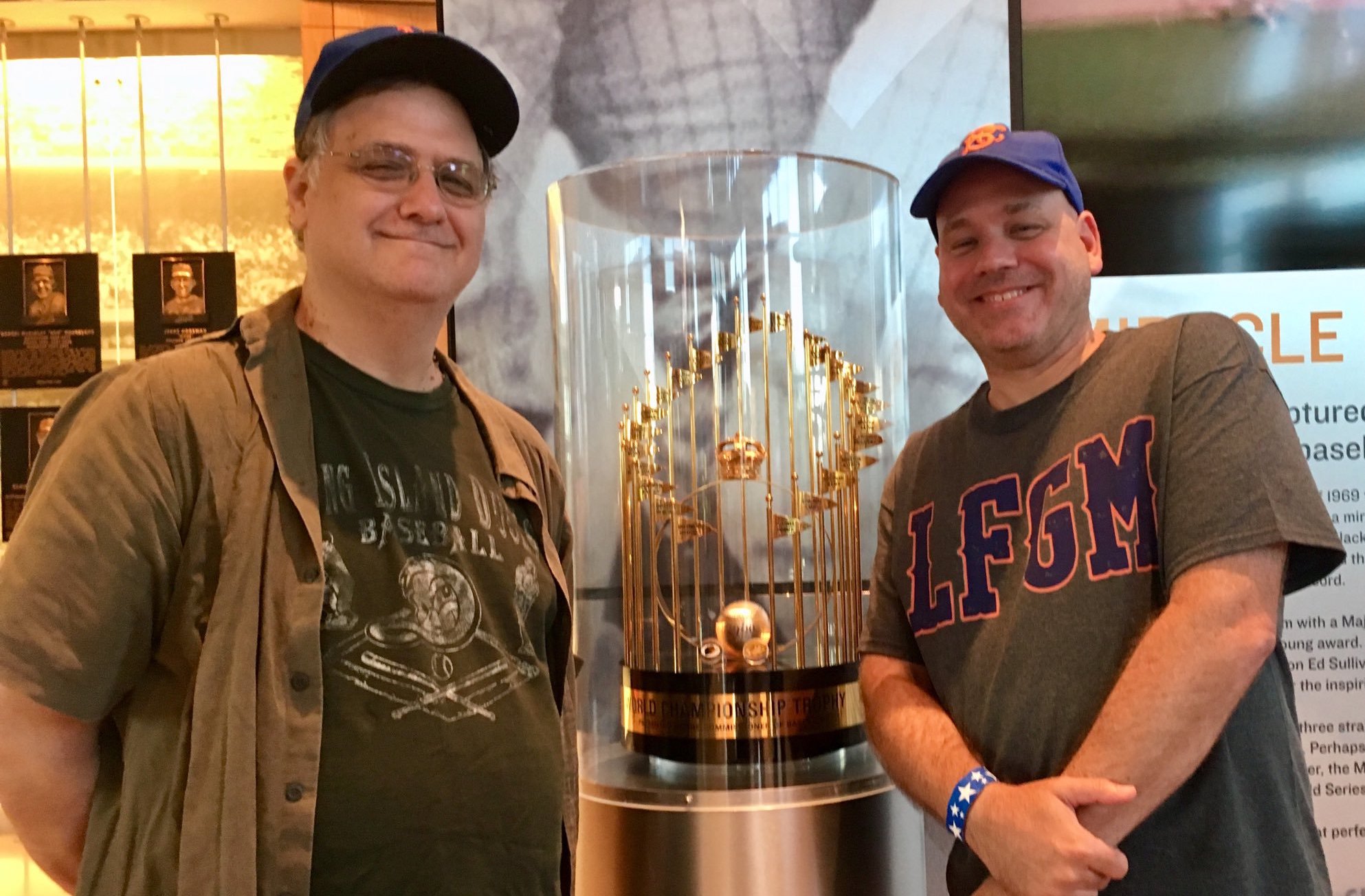
Faith and Fear in Flushing made its debut on Feb. 16, 2005, the brainchild of two longtime friends and lifelong Met fans.
Greg Prince discovered the Mets when he was 6, during the magical summer of 1969. He is a Long Island-based writer, editor and communications consultant. Contact him here.
Jason Fry is a Brooklyn writer whose first memories include his mom leaping up and down cheering for Rusty Staub. Check out his other writing here.
Got something to say? Leave a comment, or email us at faithandfear@gmail.com. (Sorry, but we have no interest in ads, sponsored content or guest posts.)
Need our RSS feed? It's here.
Visit our Facebook page, or drop by the personal pages for Greg and Jason.
Or follow us on Twitter: Here's Greg, and here's Jason.
|
by Jason Fry on 8 January 2021 6:41 pm You remember where you were for the truly big trades that reorder a franchise, the ones that you know are lines between before and after.
The winter day when I saw in the newspaper that Gary Carter, the ebullient yet tough-as-nails All-Star catcher for the Montreal Expos, was coming to the Mets.
The summer afternoon spent eyeing the wire feed in my office until the cascade of rumor turned into a single, amazing fact: Preternaturally gifted slugger and pop-culture icon Mike Piazza had been sprung from his brief captivity in Miami and was on his way to Flushing.
The night I was walking around with friends at a bachelor party in Las Vegas and spied on a betting parlor’s TV that Johan Santana, the Twins’ Cy Young winner and indomitable leader, would indeed be a Met.
And, of course, the frenzied afternoon/evening of bombardment via Twitter and sports radio and SNY and probably random planes equipped for skywriting that the Mets had somehow fallen backwards out of a deal for Carlos Gomez and into one for the Tigers’ monstrous destroyer of baseballs, Yoenis Cespedes.
Each time, what I remember most is the happy sense of satisfaction and how it immediately had to make room for anticipation: They’re going for it. Oh this is gonna be fun.
The Mets — you’ve probably heard — struck a deal with the Indians for Francisco Lindor and Carlos Carrasco, sending back Andres Gimenez, Amed Rosario and a pair of lottery tickets from the low minors in Josh Wolf and Isaiah Greene. Carrasco — 2020’s Comeback Player of the Year after battling leukemia — will slot in behind Jacob deGrom and Marcus Stroman in a rotation that badly needed upgrades. And Lindor? Well, he’s only one of the best players in the sport, electric on offense and defense and the kind of guy who lights up highlight reels, scoreboards and social-media feeds with his joy for the game. And he’s only 27!
Cleveland is heartbroken, and I feel for fans of the team that will soon no longer be the Indians — their franchise hasn’t celebrated a title since 1948, and they’re in a weak division that certainly seemed within their reach. The current team is being torn down despite its owner — Larry Dolan, uncle of the thoroughly loathsome James — being worth $600 million.
That’s a disgrace, plain and simple.
But it’s also baseball. And we’re all too familiar with such disgraces. We’ve just been sprung from the dungeon of Wilpon ownership, freed from their daily displays of dishonesty, incompetence, interference, nepotism, paranoia and stupidity. If you live in Cleveland and you’ve ever teared up at a video of shocked animals tentatively exploring impossibly soft grass after being sprung from puppy mills or factory farms, well, that’s our fanbase right now. Sorry, Cleveland. It shouldn’t be this way, for any of us, but since we can’t change the rules, let us have this. Goodness knows we’ve done our time.
So we promise to take good care of Lindor, hopefully after a contract extension to ensure he’ll stay for a long time. We’ll embrace Cookie. And we’ll wish the best for Gimenez and Rosario. I know it’s no consolation, but you’re going to appreciate Gimenez’s instincts for the game, nodding at how he’s always in the right place on the field and wondering how he just seems to know how to do that. Be patient with Rosario and you may find yourself — as we did at intervals — enjoying a slash-and-burn hitter who makes everybody’s tempo a little quicker. Here’s hoping they’re part of the team that rises in the place of the one being dismantled, and that it’s soon.
The Lindor-Carrasco news came in an awful hurry, moving startlingly quickly from one report to two and then three and then a couple of iterations of the personnel involved and then to a WELCOME TO NEW YORK graphic complete with Photoshopped new Mets. (Among other things, the Steve Cohen regime is so far pretty watertight as far as leaks.) And it arrived as a lot of us were cooped up in front of our computers, trapped by the pandemic and winter and profound worries about our country.
Under those circumstances, I would have been grateful for the distraction of a waiver-wire deal for a potentially still canny pinch-hitter or an nonroster invitation to camp for some lefty reliever who looked good as a minor leaguer a few years ago. But this? This was just a little different.
This was the arrival of a high-wattage star who’ll look perfect in Mets pinstripes, whether he’s going into the hole for a grounder or flying around second with his eye on more — and a big piece of the answer to the pesky question of who’s going to pitch. And this was the formal acknowledgment that things really are different — that we no longer have to grouse about the scratch-and-dent aisle, or nickels in the couch, or parse disingenuous garbage from serial liars in search of hints of a plan, despite our suspicion that there isn’t one.
The Mets are going for it. Oh this is gonna be fun.
by Greg Prince on 6 January 2021 9:02 pm
by Greg Prince on 31 December 2020 3:05 pm When the planes hit the Twin Towers, as far as I know, none of the phone calls from the people on board were messages of hate or revenge — they were all messages of love.
—David, Prime Minister of the United Kingdom, Love, Actually
Today I turn the age Jenrry Mejia was wearing when he was suspended from baseball for life after testing positive for ingestion of performance-enhancing substances. Jenrry’s still alive and he’s no longer suspended from baseball, so maybe there’s hope for us all.
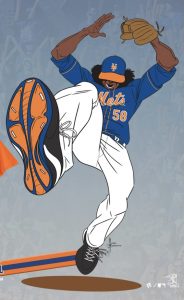 Ol’ No. 58. I can relate. (Image by The 7 Line.) We shall expel 2020 from the present in a matter of hours. Our collective problems will not magically disappear, but we can pretend at least for a couple of days that a new year can alter the course of time. Dick Clark built an additional wing onto his empire by appealing to such Rockin’ Eve thinking.
With the last day of 2020, the one of which I feel most proprietary on an annual basis, I wish to offer a little co-director’s commentary regarding thirty people whose times and lives I also grew a little proprietary about in recent months. Those would be My Guys, as I came to think of them: the subjects of my A Met for All Seasons essays.
You know the series. Gosh, I hope you do. Jason and I offered it up twice a week for thirty weeks, from sometime in April to sometime in November, partly because we’d mulled doing something like it for about nine years, more because in April there was no baseball to write about from a fierce urgency of now standpoint. Looking back was all we could do. I’m comfortable with that direction. When you reach the age reflected on Jenrry Mejia’s most recent Mets uniform top, hindsight beats 2020.
I spent seven months thinking about My Guys. I’ve continued to think about My Guys. I haven’t been out much, so I haven’t had much opportunity to talk about them out loud. It’s my birthday. Indulge me for another thirty paragraphs, would you?
***My first guy and the first we presented overall, on April 21, was Rico Brogna, representing 1994. Rico was the AMFAS pilot episode in my mind, one I kind of had in the can. I’ve been telling what I think of as my Rico Brogna story since the 1994-95 strike, and it seemed uncommonly pertinent to the present day. He was the midsummer revelation of a year that suddenly stopped and left me wondering when baseball would be back, specifically because I had one thing to look forward to: the return of Rico Brogna. My first recurring theme was embodied by that first AMFAS season as well. I’m fond of the less-remembered Met years and bringing to light what was considered a relatively big deal in its time. “Less remembered” is not to be confused with forgotten (which I don’t think any Met ever is completely) or shall we say obscure (which is more Jason’s beat than mine).
Donn Clendenon, on May 1, came with an agenda. My agenda, that is. I wished to poke a hole in a phrase that had come to bug me. “Without so-and-so, such-and-such never would have happened.” It bugged me because why do we assume we had to do “without” so-and-so? I realize it’s a term of appreciation and acknowledgement, but after a while, it struck me as an unnecessary tic. In 1969, we were with Donn Clendenon. That’s what mattered. His impact on 1969 mattered. His whole life mattered as well, and it was pretty substantial, but I made a conscious decision to not retell it when others had told it more deeply. I was inevitably more about the Season than I was the Met.
Willie Mays, on May 5, was another agenda item, sort of. I had tired of the reflex social media reaction to pictures of players in uniforms with which they are not universally associated. Willie Mays is the subject of a lot of that ironic “legend” stuff, as in “Mets legend Willie Mays,” it’s funny because he was mostly a Giant and, besides, he was old when he ended his career as a Met in 1973 (though sixteen years younger than I am now, and I’m just a kid). I’ve always been defensive on Willie Mays’s Mets behalf, as if claiming perhaps the greatest ballplayer ever as one of your own requires a brief. Also, May 5 was one day before Willie’s birthday, and I’m not beyond a cheap calendar-driven hook.
Al Leiter, on May 15, represented my first challenge. I had him for 2002, which was a mostly crappy year. Al wasn’t crappy in 2002, but it wasn’t exactly “his” year. So I thought about Al Leiter in 2002, and the first thing I thought of was him starting on Opening Day that year and me being there and being satisfied that he and I were together, which led me to check my notes and confirm Al had started with me at a game more than any Met pitcher had. Satisfaction wasn’t guaranteed, but I rarely left Shea disgusted.
Ah, Melvin Mora, May 19, the 2000 entrant. I say “ah,” because nobody left a comment, which tells me either nobody cared or I did a less than compelling job of making people care. Ah, whaddaya gonna do? Melvin occupies a very specific moment in time for the Mets. He was here for two seasons, yet not at the beginning of his first nor the end of his second. They happened to be two of the most momentous seasons in modern Met times: 1999 and 2000. Melvin played a pivotal role late in the first of his seasons and was sent away before he could do more in he second of them. I fell in love with him in the interim, yet didn’t really mourn his departure. We needed a shortstop, and Melvin, who could do it all, couldn’t really play short. Thus, Melvin Mora for Mike Bordick. Which led to a whole other thing I couldn’t get behind: hating the trade that brought us Mike Bordick because Bordick was here, not monumentally effective, then gone, while Mora thrived in Baltimore. As the series went on, I came to hate hating trades. It’s too easy and ultimately pointless to be pissed off all the time.
R.A. Dickey, on May 29, was my first AMFAS from the FAFIF era (so many acronyms!). Anybody I’d already written about a lot as he was being a Met was going to take some thinking. I didn’t want to fully recycle the Best of Dickey or whatever from 2010 to 2012 (his last season was his essay season). I wanted to provide fresh takes by doing this stuff. I split the difference for R.A., repurposing a few lines here and there to celebrate the way the knuckleballer made the language dance. That was what attracted me to R.A. ten years earlier.
Johan Santana, June 2, was, to me, something of a copout. I didn’t tell you anything I hadn’t already told you about the man whose uniform number my age was repping until midnight last night. I tried to do it a little differently than I had before, peeling layer by layer the onion that was Johan’s finest 2008 hour, his last start and our last win at Shea, but I was doing Johan on June 2 for one reason: because I couldn’t get otherwise interested in writing about the Mets during the George Floyd protests. I had planned to do Pedro Martinez on that day, but little seemed more irrelevant than thousands of words on a retired pitcher who did whatever whenever while America was trying to figure itself out in the present. The calendar reminded me we had just passed the anniversary of Johan’s no-hitter, and, like I said, I’m not beyond a cheap hook. I think what I wrote was fine, but my heart was not in the exercise that day.
Lenny Randle, June 12, was the manifestation of a determination I’d made during the preceding offseason that there was something to like about every Mets season, even the seasons we instantly dismiss or smolderingly detest. Lenny’s big year was 1977. I liked that he joined our ranks and flourished and gave me something to root for. I can’t just spit at seasons and eras. There are too many microclimates. Cloudy with a chance of Randle is sometimes all there is to enjoy. Enjoy it, I figure.
Jason Isringhausen, June 16, sort of picked up on the Randle theme in that for nearly a quarter-of-a-century you can’t mention Isringhausen and his running mates of popular imagination Bill Pulsipher and Paul Wilson without eliciting groans from Mets fans. I think when I began to write about Izzy and 1995, my headspace overlapped with the dismay that Generation K didn’t pan out. But as I got into the story, I found myself grateful for what Izzy (and Pulse) gave us in ’95. They gave us hope. We didn’t know that they wouldn’t engender a whole lot of it down the line. It was just a great scintilla of time to be a Mets fan, that hour when you’re sure something is about to get better. I doubt I’d convince too many people that it’s OK to be happy for what there was rather than rueful for what there wasn’t, but I was happy basking anew in the glow of young Izzy and all that seemed to be transpiring around him. Writing this essay was a turning point of sorts for me as a fan. My cup measured as half-full.
Mookie Wilson, on June 26, became the second of My Guys to bump Pedro Martinez. The schedule for better-late-than-never 2020 had just been issued. It was gonna be a short season, almost as short as the last time baseball jury-rigged itself in miniature, the second half of 1981. The terrain was ideal to go back to that split season and the biggest swing Mookie ever took…until five years later. Before 2020, I had a real soft spot for the less-remembered Met exploits of the shortened seasons. 1981. 1994. 1995. My cup’s not nearly as half-full for 2020.
Craig Swan, on June 30, got to be 1978’s AMFAS because he won the ERA title when few Mets were winning anything. Because of the ERA title, I’ve carried an image of Swan as one of the best pitchers the Mets have ever had. Was he? Define “best” and “ever” narrowly, and absolutely. He was definitely around a long time and I got a kick out of exploring a Met I hadn’t thought that much about over the preceding 36 years.
Now, on July 10, Pedro Martinez was ready for his closeup. The longer he waited, the longer his essay grew. I’d been wanting to do right by Pedro every fall for the preceding decade, because every fall in presenting the Most Valuable Met winner, I’d list the previous winners — just like the papers would when awards were announced — and I’d be reminded I’d long ago given Pedro one lousy paragraph for his sublime 2005. This is an example of me not getting out much even in non-pandemics because, yeah, I really thought about this. Pedro had kind of a Swan vibe to me; to truly get what he meant at his Met peak, you had to have lived it. I hope what I wrote got that across.
Tommie Agee, on July 14, was essentially written by a seven-year-old, as told to a 57-year-old. I sometimes ghost for others in my day job, so why not ghost for my younger self? The best way for me to present Agee to you was how I processed him in 1970. Plus some later stuff. Call it a collaboration between me at seven and me fifty years later.
Jacob deGrom, on July 24, became the easiest scheduling decision of the series for me. He was pitching on July 24. Ohmigod, somebody was pitching on a day in 2020! In practical terms, the coming of belated Opening Day meant fitting AMFAS around our game stories. I have to admit I felt the Mets of “now” were getting in the way of the Mets of “then,” but I guess it was good to have baseball back. Writing about Jacob deGrom, as I’d been doing since 2014 (his year in our spotlight), wasn’t much of a chore. There wasn’t a whole lot new to say, and I didn’t pretend to try to find a novel truth. It’s always a good day to write about Jacob deGrom. And an even better day to watch him pitch.
Darryl Strawberry, on July 28, is where time came to matter most to me in this series. My season of choice was 1983, and that meant looking at Darryl through the prism of looking forward to his debut, which was a preoccupation for three years as a Mets fan. Had I drawn 1987 or 1990, I would have approached Darryl differently. I liked hanging out with his potential in ’83. I loved knowing we were on the verge of something special with him and his team. I loved that we couldn’t be sure of it then because you can never be sure. I loved not defaulting to something I’ve really come to disdain, the bit where a Mets fan can’t look at the 1986 Mets without grumbling that they should’ve won more. We won in 1986. I would’ve liked more. Who wouldn’t? But that’s postscript. The story was and is Darryl Strawberry was frigging amazing.
What I wrote about Ron Hunt, on August 7, was a year in the making, you might say, though he wasn’t even my original draft choice for 1963 (apologies, Tim Harkness). On August 9, 2019, I had the good fortune to spend a little time in the presence of Ron and his family as he greeted fans at Citi Field. I hadn’t written one word about it here because that was the night Todd Frazier hit his three-run homer off Sean Doolittle, Michael Conforto whacked a walkoff hit, Pete Alonso grabbed Conforto’s shirt, and a rapidly developing playoff chase took precedence. I kept meaning to write about the rest of that night, which was amazing to live through on so many levels, but never got around to it. The Hunt portion, still in my notebook, dovetailed with this assignment, the only one that involved a Met I never saw play as a Met. Instead of it being an academic exercise, I got to take it personally, and I’m delighted I had that opportunity.
I already did meta for Joe Orsulak, AMFAS subject for 1993. As I wrote on August 11, I wasn’t completely certain why I wanted to profile Joe, other than I’d always said he was one of my favorite Mets…except I still wasn’t sure why he so rose in my esteem. And I’m still not, but I do like him and I did like thinking about him again.
Ike Davis, on August 21, was a vestige of another age. When I selected him in the AMFAS draft of 2011, I congratulated myself on the coup. I had our future superstar! I’d have so much to write about! That was based on Ike’s rookie season of 2010 and all the expectations it raised. Fast-forward nine years. Ike Davis’s Met career was long over and faded into the background. I’d written probably twice a year about his ultimate shortcomings while Ike was not living up to expectations about his arc. I didn’t want to write about the same damn thing. I remembered that my late friend Dana Brand, who lived only long enough to see Ike fall down in Denver and essentially never get up, was once kind enough to praise my “unusual techniques and genres to present the experience of the Mets: lists, dialogues, fantasies, glossaries, etc.” Well, I reasoned, if it was good enough for Dana, it was good enough for Davis, thus instead of another expository essay, I imagined some wise guy at the track giving me a can’t-miss tip on this kid running in the ’10th. Paired with my epigram of choice that day — the Guys & Dolls number about having “the horse right here” (a favorite of my mother’s) — it allowed me to fashion an old tale in a new light. Thank you, Dana.
When I got to Jose Reyes on August 25, I had a plan. Each of my next four Tuesdays starting with that one would encompass sort of a mini-countdown: second-favorite position player; second-favorite pitcher; favorite position player; favorite pitcher. Events would disrupt my planning, just as events disrupted Jose’s road to unimpeachable Met immortality. I chose 2007 for Jose because it demonstrated the absolute apogee of his abilities and indicated the beginning of realizing he was far from perfect. Still close enough to the innocent Jose of whom I’d grown so fond that I felt comfortable being mostly effusive about Reyes before having to get real. I still love the guy. That might be dangerous.
Tom Seaver was not slated for September 4, but how was I gonna write about any other Met two days after we learned of Tom’s death? Gil Hodges would regularly bump other pitchers to accommodate Seaver, so I guess it was appropriate that Tug McGraw had to wait another few days. I had decided to write about Tom in 1971, but how exactly? By transporting myself back to 1971. There was no point in telling the whole Seaver story that day because for two days we’d all been doing that. Instead, I got very specific. Tom the idol whose number I had to wear in Pee Wee League. Tom the “author” whose book I had to read as soon as my mother bought it for me. Tom the pitcher whose win total had to reach 20 games by the end of the year. That was the Tom Seaver I lived with in 1971. That was the Tom Seaver I called my favorite player then. I realized that was the Tom Seaver I call my favorite player still.
Tug McGraw came in from the bullpen on September 8. Just as his essay was postponed, “his” year was pushed back, at least from where it should have been. He’d have been better slotted in 1973, except we had Willie Mays there. Willie could have fit well in 1972, except we had Gary Gentry there. Gary would have been ideal for 1969, except we had Donn Clendenon there. Donn might have been just as at home in 1970, except we had Tommie Agee there. Tommie came over in 1968, but we had Cleon Jones there. And nobody was touching Tom Seaver in 1971. Musical chairs were a fact of AMFAS life for the Mets who contributed to our most memorable miracles (apologies to the seatless Met greats of the era). Anyway, I was doing the year Tug was traded, 1974, maybe the last Met season for which my detailed memories are fuzzier than they are clear. I do remember the Mets being a big letdown in general, nobody more so than McGraw, which is why when it came to writing about ’74, I pegged Tug to his trade as much as the career that preceded it. That I remember very well and that was the unusual trade in Met history where both teams involved made out pretty well. It also gave me an excuse to say a few words about John Stearns, the one Met I was genuinely sorry I didn’t find a season for in all this.
Mike Vail was September 1975 for me, so profiling him in September 2020 was a must. I noticed that when I wrote about Vail on September 18, I could feel my AMFAS voice changing, just as I suppose it was doing when I was 12 going on 13. My understanding of the Mets was deepening as I moved into adolescence. I was a little less childlike, just slightly more adult. I don’t know that I’ve progressed all that much even at this late date.
“FONZIE WAS SO GREAT!” and “FONZIE’S TEAMS WERE SO GREAT!” probably would have covered all I had to say on September 22, but I attempted to be a little more articulate than that regarding Edgardo Alfonzo and 1997. Not much more articulate, though. That’s a symptom of how viscerally I cherish Fonzie and that first year when his Mets broke through. Do the Fonzie, indeed.
Pete Alonso on October 2 endured a bit of the Ike Davis syndrome, as doctors call it. When I grabbed Pete in the AMFAS supplemental draft Jason and I conducted in March, I was excited that I was gonna get to write about the most dynamic contemporary Met in captivity. Months later, the Polar Bear had melted a little in the heat. I waited until the 2020 season was over to assess where he stood after two years in the majors. It was more fun doing the part where I revisited the feats of his unprecedented rookie year. This is what you run into trying to take the long view of a career still in progress.
Dwight Gooden was first going to appear in July, adjacent to my mother’s birthday because she liked him so much. But he kept getting pushed back. He was going to appear for sure on September 8 because of that countdown-within-a-countdown plan I described above, but Seaver’s passing changed all that. Getting to Doc on October 6 was fine. He’d completed his singular 1985 in early October. His 1985 was so singular as a whole that, while it’s often cited as the best individual Met season ever, its elements are never really dissected, which is what I set out to do. It’s also impossible to write about Doc without “…and then, he tested positive,” but I swear I don’t see that as the defining episode of Doc’s Met career. I’m Team Half-Full.
Matt Harvey was such a tabloid drama that I thought that was the best way to approach him and his 2016 on October 16. Bringing “Scott Boras” and “Sandy Alderson” into the story — and going as meta as I could get away with — turned a potential frown upside down.
Lee Mazzilli, profiled on October 20, was an outsize figure for someone who was a fairly average ballplayer. Such was the context of rooting for the Mets when Mazzilli was at his best. I’m particularly gratified that Lee had a 1986 coda to his 1980 story. I didn’t write much in this series about the Mets when they were in their larger-than-life phase — Jason covered 1986 through 1992 — but getting to ride along with My Guys of that period in earlier, slighter times (Mookie and Mazz in particular) and feeling them experience the ultimate World Series payoff was vicariously gratifying. I wish the Mets won a lot more than they did as I was fitfully coming of age as what we’ll call an adult, but I gotta tell ya, I wouldn’t trade the journey from the late ’70s to 1986 for anything.
Steve Cohen interrupted what I was deep in the midst of writing on October 30. He also changed my long-term plan for the AMFAS finale. But on the Friday that he was approved by MLB’s owners to buy the Mets, there was no other story I could see me dropping in our readers’ laps. Thus, Steve Cohen became A Met for All Seasons, 2021 edition. My original notion was to give that honor to To Be Determined. It was gonna be a whole thing. I’ll gladly swap the conceptual for the reality.
John Olerud, bumped to November 3 by Cohen, was given room to run. As if Oly (cycle notwithstanding) could run. Then again, we did run to glory with John batting third almost every day in 1999. This was my last chance to really dwell in what may be my favorite era of Mets baseball — though sometimes I think whichever one I’m writing about is my favorite — and I wanted to make it count. Who better to drive us in than Olerud? (Side note: this published on Election Day, and I was determined to get Oly’s essay up before other, more pressing issues distracted even the hardest-core among us from Mets of the past.)
Ed Kranepool had to end the series. Never mind To Be Determined, my initially penciled-in entrant for November 13. Ed was and is the personification of A Met for All Seasons. Though any notion that I had a maximum word count for any given column disappeared back in spring, I really let my Krane flag fly as I traveled to his and the series’s final year of 1979. Midway through I decided I wanted to explicitly mention each year Ed played. When I got to the end, I realized I forgot to specify 1963, so I went back and put it in. I had so much fun doing this one. I had fun doing all of them, really. And I had fun sharing them with you.
Thirty-first paragraph alert: Thank you for your indulgence today, thank you reading year-round. See you in 2021.
by Greg Prince on 30 December 2020 7:08 pm Ray Daviault first came out of the bullpen for Casey Stengel on April 13, 1962. the second reliever used in the New York Mets’ first-ever home game. Ray’s mere presence made him the first Canadian in a Mets uniform. On July 7, after Marv Throneberry delivered a pinch-hit two-run homer in the bottom of the ninth at the Polo Grounds, Ray had his first win on this or any continent.
Les Rohr was the first player the Mets ever chose in an amateur draft, the second player chosen overall in 1965. On September 19, 1967, he became a big leaguer for the first time, beating the Dodgers at Shea Stadium, 6-3. Les would finish the year with his second win, besting Don Drysdale in Los Angeles come September 30.
Rick Baldwin would have had enough of a challenge reaching the majors at age 21. Assigning him No. 45 could have only added to the pressure. Forty-Five had just been vacated by Tug McGraw, traded in the preceding offseason. Being the first to follow a legend, even numerically, is the definition of a tough act to follow. Yet in his first appearance, on April 10, 1975, Rick threw a scoreless inning of relief and he settled in nicely, pitching in a third of all Mets games that season.
Claudell Washington had no act to follow. He was a trailblazer in his time, his time being 1980 in terms of the Met clock. He was the first acquisition of the Doubleday-Wilpon regime and, through his part in a Magic summer, Claudell indicated the new general manager Frank Cashen knew what he was doing when it came to reeling in talent.
Tony Fernandez was supposed to help make things better in 1993. Honestly, he didn’t, which was too bad, not only for the 1993 Mets, but for a shortstop who had distinguished himself greatly as a Blue Jay and Padre. The Mets would trade Tony to Toronto after a couple of months and Tony would help make things even better for the defending world champions, helping the Jays to their second consecutive Series win. Like Claudell Washington, Tony Fernandez enjoyed a long post-Mets playing career.
Phil Linz’s calling card was a last. It was his off-field playing, of a harmonica, that was credited in legend for spurring the Yankees to the final pennant of their seemingly endless American League dynasty. With Phil tooting away on the mouth harp on the team bus; manager Yogi Berra telling him to, in so many words, put the damn thing away; and Mickey Mantle making sure Phil heard differently (“Yogi says play it louder”), the backup infielder caused the usually mellow Berra to blow his stack. The slumping Yankees suddenly caught fire and Phil Linz was forever a musical icon.
That was in 1964. In 1967, with the Yankee empire too far gone to be saved by a charming anecdote, Phil Linz became a Met. He’d keep company for a season-and-a-half with beloved Mets coach Yogi Berra, the two of them posing happily for photographers once reunited at the Mayor’s Trophy Game. Unsurprisingly, a harmonica was in the picture. The Mets released Linz after the 1968 season, though Gil Hodges invited him to Spring Training for the following year. Phil declined, seeing as how he had thriving nightspot Mr. Laffs to tend to in the city. And besides, as the former New York/New York player put it to author Bill Ryczek decades later, “I was tired of sitting on the bench for a ninth-place team.”
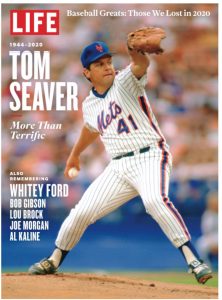 The Mets wouldn’t be a ninth-place team in 1969. Gil Hodges had plenty to do with that. So did his ace pitcher, Tom Seaver. Tom Seaver had a lot to do with everything from 1967 until almost the middle of 1977 and then again in 1983. How completely did Tom dominate the Met scene during his long, if interrupted tenure? Let’s answer that literally. Seaver started 395 games for the New York Mets and completed 171 of them. By comparison, since 1992 — the year Tom Seaver became the first player inducted into the Hall of Fame bearing a Mets cap on his plaque — 148 different pitchers have started 4,528 games for the Mets and together they completed 167 of them. The Mets wouldn’t be a ninth-place team in 1969. Gil Hodges had plenty to do with that. So did his ace pitcher, Tom Seaver. Tom Seaver had a lot to do with everything from 1967 until almost the middle of 1977 and then again in 1983. How completely did Tom dominate the Met scene during his long, if interrupted tenure? Let’s answer that literally. Seaver started 395 games for the New York Mets and completed 171 of them. By comparison, since 1992 — the year Tom Seaver became the first player inducted into the Hall of Fame bearing a Mets cap on his plaque — 148 different pitchers have started 4,528 games for the Mets and together they completed 167 of them.
Whoever said they don’t make ’em like that anymore wasn’t kidding.
 Image by Warren Zvon. Numbers say so much on behalf of Tom Seaver. So do images, such as those designed by the fabulous illustrator Warren Fottrell (a.k.a. Warren Zvon), a beautiful soul we lost in 2020. Warren did most of his speaking through graphic art, but he stopped by our blog on the occasion of Tom’s 75th birthday and left this comment:
Some people have a special type of integrity that can’t be described with words. Tom, throughout all his years in the spotlight, before and beyond, has been this type of person. Not only true to himself but true to the world around him. Not afraid to speak the truth. He wanted to be a winner but knew that the only way to truly be one was to take responsibility for being a loser when that was a required truth.
Over the years I’ve learned a lot from the mightiest of Mets aces, things he never intended to teach me and things I never set out to learn.
As a kid going to Shea, watching the Mets play, I wasn’t as big a fan as I am now. I took George Thomas Seaver for granted then.
He was simply our best pitcher.
But now, because of the way he has lived his life, the way he has consistently been the person he strives to be, I no longer do. I’ve learned that he is so much more than just a great Mets pitcher of the past, and when he goes a piece of me will go with him. A big piece.
So, yeah, Tom was the complete package, the greatest Met we’ve ever known, the greatest Met we’ll ever know. But his death is not the complete story when we look back at this year that has had far too much sadness, baseball-related or not. We are well aware we lost The Franchise in 2020. We should also remember the six other Mets who passed away this less than terrific year. Ray Daviault. Rick Baldwin. Les Rohr. Claudell Washington. Phil Linz. Mets fans rooted for them when they entered a game. Mets fans applauded when they did something good. Mets fans might have wished each of them had done a little more or stayed a little longer as Mets, but what they did in our uniform of choice deserves acknowledgement and another round of applause.
Seaver shared an affiliation with those guys, just as he shared an affiliation with the half-dozen Hall of Famers beside himself who died in 2020. I can’t imagine this year didn’t set a record for most baseball fans left mourning the loss of a personal favorite. Every player who’s ever played is some fan’s favorite, probably, but this year saw the passing of not just those we dare to call immortals, but those who defined their ballclubs.
Bob Gibson. Lou Brock. Joe Morgan. Whitey Ford. Al Kaline. Phil Niekro. They, like Seaver, were ballplayers kids idolized and adults revered. Gibson with the ERA nobody’s surpassed (the only figures lower were the batters he sent sprawling to the dirt). Brock who ran on everybody and collected more bags than Carrie Bradshaw. Morgan who sent the Big Red Machine into a whole other gear and made necessary the split screen for postseason telecasts, just so NBC could keep showing him leading off first. Ford with the World Series performances that were so historic that they knocked Babe Ruth out of the record books (the pitching record books). Kaline who won a batting title as a veritable baby and kept piling up base hits into middle age. Niekro the eternal elder who practically never stopped getting outs on the pitch he mastered better than anybody who’d ever lived.
It wasn’t just that they, like Seaver, were great. They were epic. They left indelible impressions on anybody who loved the game.
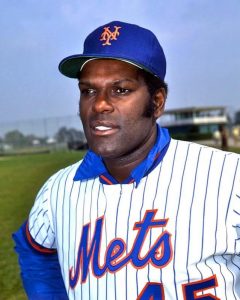 Bob Gibson became our assistant pitching coach, you might recall. It was 1981. Old teammate Joe Torre recruited him to give the Mets staff some attitude. It was not transferable, but the thrill of Gibby in a Mets uniform was something to behold. I was less thrilled at the thought of him knocking down an Agee here or a Milner there, but Bob had his reasons. Also, he was wearing a Cardinals uniform then. I wasn’t supposed to like him. Bob Gibson became our assistant pitching coach, you might recall. It was 1981. Old teammate Joe Torre recruited him to give the Mets staff some attitude. It was not transferable, but the thrill of Gibby in a Mets uniform was something to behold. I was less thrilled at the thought of him knocking down an Agee here or a Milner there, but Bob had his reasons. Also, he was wearing a Cardinals uniform then. I wasn’t supposed to like him.
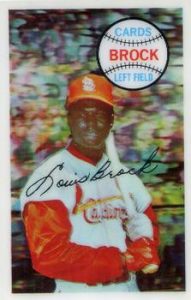
Lou Brock I never stopped liking, even on those occasions he was sliding into second ahead of the tag on a bullet delivered by Jerry Grote. Brock v. Grote never was fully settled, but we knew it was a case of the premier base stealer in the land versus an arm that was the envy of his catching peers. Only one of the people at the center of the battle that mesmerized Mets and Cardinals fans for a generation smiled much. Hence, though I pulled for Jerry to throw him out, I could never dislike Lou.
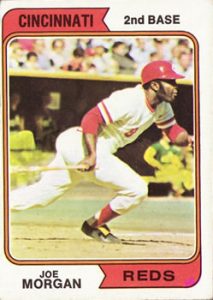 Joe Morgan was something else. At his height (no pun intended), Little Joe was a bigger deal on those powerhouse Reds than any of his co-stars, and his co-stars were frigging Pete Rose, Johnny Bench and Tony Perez. Getting Morgan to Cincinnati was like adding whipped cream to ice cream and syrup. It was already fantastic, but now you won’t believe what this concoction tastes like. I can still see him breaking from the box on his 1974 card. He’s probably gonna come all the way around. Joe Morgan was something else. At his height (no pun intended), Little Joe was a bigger deal on those powerhouse Reds than any of his co-stars, and his co-stars were frigging Pete Rose, Johnny Bench and Tony Perez. Getting Morgan to Cincinnati was like adding whipped cream to ice cream and syrup. It was already fantastic, but now you won’t believe what this concoction tastes like. I can still see him breaking from the box on his 1974 card. He’s probably gonna come all the way around.
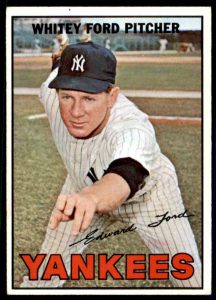 Whitey Ford was a name out of the past when I first heard of him, so far out of the past that my father said he saw him in high school. Not “went to see the Chairman of the Board at the Stadium” see him in high school, mind you. My dad was in high school and Ford was in high school and their schools played each other on one diamond or another. They were contemporaries, a couple of kids from Queens. Ford retired two years before I started watching baseball, which I found hard to believe once I learned his career spanned 1950 to 1967. I had scattered memories of 1967. My dad was my dad. Hard to put that together when you’re barely more than a tyke. I discovered not too long ago that Ford tried a comeback of sorts in 1968, pitching at Shea in the Mayor’s Trophy Game against the Mets. They didn’t score off him. Not too many did. Whitey Ford was a name out of the past when I first heard of him, so far out of the past that my father said he saw him in high school. Not “went to see the Chairman of the Board at the Stadium” see him in high school, mind you. My dad was in high school and Ford was in high school and their schools played each other on one diamond or another. They were contemporaries, a couple of kids from Queens. Ford retired two years before I started watching baseball, which I found hard to believe once I learned his career spanned 1950 to 1967. I had scattered memories of 1967. My dad was my dad. Hard to put that together when you’re barely more than a tyke. I discovered not too long ago that Ford tried a comeback of sorts in 1968, pitching at Shea in the Mayor’s Trophy Game against the Mets. They didn’t score off him. Not too many did.
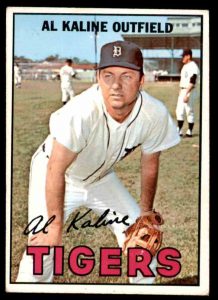 Al Kaline was part of the foundation of my baseball cognizance, one of the ’67 Topps my sister bequeathed me once it was clear I cared about the cards and she never would again. I gleaned from the back that he was the Tiger among all Tigers. He remained so into 1974 as he chased 3,000 hits and 400 homers. The former he got, the latter he missed by one (a moderate-sized disappointment to me the summer I was eleven and tracking his progress). Also in his last year playing for Detroit, I stared intently at a battery. It had the name of a great ballplayer. Alkaline. To this day I revel a bit when I pick up an alkaline battery. “It’s Al Kaline!” Al Kaline was part of the foundation of my baseball cognizance, one of the ’67 Topps my sister bequeathed me once it was clear I cared about the cards and she never would again. I gleaned from the back that he was the Tiger among all Tigers. He remained so into 1974 as he chased 3,000 hits and 400 homers. The former he got, the latter he missed by one (a moderate-sized disappointment to me the summer I was eleven and tracking his progress). Also in his last year playing for Detroit, I stared intently at a battery. It had the name of a great ballplayer. Alkaline. To this day I revel a bit when I pick up an alkaline battery. “It’s Al Kaline!”
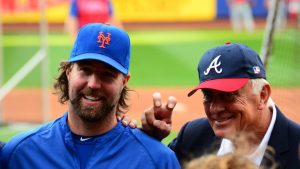 Photo by Sharon Chapman. Phil Niekro dared stand in the way of Met destiny in 1969, throwing the very first pitch they’d ever seen in a postseason game. Fortunately, the Mets persevered in Game One of that maiden NLCS, but the outcome was no given, considering Niekro won 23 games that year (finishing second to Seaver for the Cy Young) and was on a path that would take him past 300 before he was done. He was another of those opponents I couldn’t help rooting for on the side. When I attended college in Florida, Phil was still pitching for the Braves, whose games I listened to on the radio. This was when Torre had taken over in Atlanta and I felt a kinship with his new club. I rooted hard for the 1982 Braves to win the pennant, mainly so Phil Niekro could finally pitch in a World Series. The Braves lost that NLCS, too, making Phil 0-for-2 in his best stabs at a championship. Nevertheless, he made the Hall of Fame without a ring. He also made it to Citi Field one September day in 2012 to help promote a documentary called Knuckleball! His role, on film and in actuality, was to mentor another late bloomer named R.A. Dickey. Watching them reunite during BP was a joy, as was the chance to ask Niekro a question about what it was like facing Seaver in the playoffs. He threw me a curve, telling me he saw his assignment as facing the Met hitters and “Seaver batted ninth.”
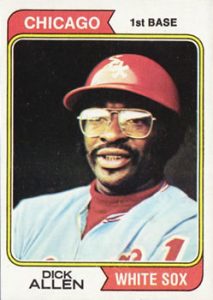 Maybe someday soon when we remember Hall of Famers who left us in 2020, we’ll add Dick Allen to the discussion. Allen isn’t in, but he’s come close via a veterans committee vote and is considered a favorite to cross the plate eventually. To Phillies fans in the ’60s, Allen was every bit the immortal that Seaver was to us and the aforementioned six were where they reigned. True, Allen didn’t necessarily mesh with Philly during his initial go-round, but those were complicated times. Nobody doubted he could mash (especially against the Mets), and everybody saw him put it together once he landed on the White Sox in 1972. When he died, I was moved to call up the image of his 1974 card. There he was, relaxed in the dugout and looking as he was to me when I was eleven: the coolest man in the majors. Maybe someday soon when we remember Hall of Famers who left us in 2020, we’ll add Dick Allen to the discussion. Allen isn’t in, but he’s come close via a veterans committee vote and is considered a favorite to cross the plate eventually. To Phillies fans in the ’60s, Allen was every bit the immortal that Seaver was to us and the aforementioned six were where they reigned. True, Allen didn’t necessarily mesh with Philly during his initial go-round, but those were complicated times. Nobody doubted he could mash (especially against the Mets), and everybody saw him put it together once he landed on the White Sox in 1972. When he died, I was moved to call up the image of his 1974 card. There he was, relaxed in the dugout and looking as he was to me when I was eleven: the coolest man in the majors.
Qualifying for Cooperstown isn’t a prerequisite for leaving an impression, not when you were a kid who collected cards and listened to games and took the announcers at their word. Bob and Ralph and Lindsey were always respectful of and effusive over the likes of Denis Menke and Bob Watson and Glenn Beckert (even if he was a Cub) and Lindy McDaniel (who always seemed to be notching a save for the Yankees) and of course Jimmy Wynn the Toy Cannon, as if it that was how it appeared on his driver’s license. Jay Johnstone was considered a real card (even if he never played for St. Louis). Biff Pocoroba caught in Atlanta and got a rise out of everybody when they heard his mellifluous name called. Horace Clarke was a misunderstood staple in the Bronx at second. Roger Moret was almost unbeatable for a spell in Boston. I had plenty of Bart Johnsons and Ed Farmers in my shoeboxes. I probably had a few Adrian Devines, too. Tony Taylor was endlessly dependable. Ron Perranoski helped revolutionize relieving. A little before my time but just in time for me to cherish his ’67 card was Lou Johnson of the Dodgers. A little later, but just in time to frustrate the Mets for the final time during the 1986 regular season, was the Expos’ Bob Sebra, who outdueled Ron Darling the final week of the year to remember.
Kim Batiste of the Phillies. Damaso Garcia of the Blue Jays. Matt Keough of the A’s. Ted Cox who stirred prospect hype with the Red Sox before they traded him to Cleveland. Tommy Sandt. Ed Sprague. Bob Oliver. Mike Ryan. They were pictured on cardboard. They were performing on television. They were important because we love baseball. They were important to those who knew and loved them, too, of course. For their families and friends, they didn’t have to be baseball players on baseball cards. Isn’t it something that actual people stand behind those images?
Eddie Kasko, who I remember as a manager of the Red Sox, died in 2020. John McNamara, who we all remember as a manager of the Red Sox, died in 2020. Billy DeMars, who I remember coaching for the Phillies forever, died in 2020. Jim Frey, batting coach and father figure to rookie Darryl Strawberry before he left to steer the Cubs past the Mets in ’84. Hal Smith, who isn’t the hero of the 1960 World Series but made it possible for Bill Mazeroski to be because he also hit a dramatic home run. Don Larsen, who threw a perfect game in the World Series in 1956 (as if that’s a sentence to type in a nonchalant font).
Four of the heretofore 17 surviving New York Giants: Gil Coan, Johnny Antonelli, Mike McCormick, Foster Castleman. Antonelli won 25 games for the 1954 world champions; the Mets acquired him for 1962, but Antonelli opted to retire. McCormick won a Cy Young in ’67, still a Giant in San Francisco. Now there are 13 surviving New York Baseball Giants. I get together with other lovers of the New York Baseball Giants over Zoom these days. We used to get together at an East Side bar called Finnerty’s, an establishment usually devoted to serving Bay Area fans. That place, like too many that depend on people being out and about, didn’t survive 2020’s pandemic ravages. Same for a Midtown sports bar very close to the hearts of myriad New York baseball fans, yours truly included, Foley’s.
“Young man!”
That was my favorite line from the movie 42 because it was what the actor playing Jackie Robinson said to the actor playing a young Ed Charles. We know who mature Ed Charles grew up to be. We also got to know the actor playing Jackie Robinson as one of cinema’s brightest stars, Chadwick Boseman. He died on rescheduled Jackie Robinson Night in 2020 at the age of 43.
Young man, indeed.
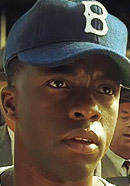 I went to a game in 2019, which seemed unremarkable as an event because going to a game is what a person who loves baseball routinely did prior to 2020, except this was kind of a special game for numerous reasons. One of them was I found myself sitting in the same section as the family and friends of the visiting Pittsburgh Pirates, right next to the wife and child of outfielder Starling Marte. Mrs. Marte urged her youngster to cheer “Daddy” on every time he batted. Steven Matz was pitching a shutout, so I didn’t particularly want Marte to succeed, but I have to admit I did get a kick out of the cry. When Big Daddy Marte was rumored to maybe be coming to the Mets, I hoped a little it would happen given my (admittedly tenuous) connection. When I learned in May that Noelia Marte, all of 32, had died of a heart attack, I felt the connection again. I went to a game in 2019, which seemed unremarkable as an event because going to a game is what a person who loves baseball routinely did prior to 2020, except this was kind of a special game for numerous reasons. One of them was I found myself sitting in the same section as the family and friends of the visiting Pittsburgh Pirates, right next to the wife and child of outfielder Starling Marte. Mrs. Marte urged her youngster to cheer “Daddy” on every time he batted. Steven Matz was pitching a shutout, so I didn’t particularly want Marte to succeed, but I have to admit I did get a kick out of the cry. When Big Daddy Marte was rumored to maybe be coming to the Mets, I hoped a little it would happen given my (admittedly tenuous) connection. When I learned in May that Noelia Marte, all of 32, had died of a heart attack, I felt the connection again.
“Pat Cawley of Glendale” was the State Farm Agent of the Day on basically every SNY telecast for years; Gary, Keith and Ron spoke of him as if he was a relation. Suddenly one night this offseason I saw Pat passed away. He was only 55. Luke Gasparre greeted me and who knows how many fans from his post atop Section 310 at Citi Field. Luke ushered at Shea Stadium for the life of the old ballpark and did the same through the first decade of the new ballpark. The World War II veteran died this year, too, having lived to be 95. Claire Shulman became Queens borough president in 1986 and had the honor of presiding as the Commissioner’s Trophy came home to Flushing — she also showed homeland loyalty by making municipal bets on behalf of the Mets during various Subway Series conflicts. Shulman died in 2020 at 94. Roger Kahn, who made Brooklyn even more famous than it already was via The Boys of Summer, signed off the beat for good at 92.
“As an old National League fan,” Pete Hamill reflected in 2000 of the interborough Fall Classic just completed, “I was rooting for the Mets.” Hamill’s report in The Subway Series Reader, which was maddeningly evenhanded, took the time to celebrate the Mets’ lone win, in Game Three, particularly Benny Agbayani’s exploits. “Instantly,” Hamill wrote, “hope rose for millions of Mets fans.” Sort of like it did for readers every time they saw Pete Hamill’s byline. We wouldn’t see it again after his passing in 2020 at the age of 85.
In the midst of that World Series, I wrote as much as I could to every Mets fan whose e-mail address I had. One of those fellow Subway Series travelers was a former colleague named Jim Ryan. Jim had sold advertising at the magazine I edited. He wasn’t a me-level Mets fan, but Shea was where his sympathies resided, which was no small thing when you worked in an office in New York in the Baseball Chernobyl years that followed 1996. I still remember Jim’s reply to whatever I wrote coming out of Game Three. He scored a ticket for the game and reported on a peanut vendor who, like Berra to Linz in 1964, told some overly loud Yankee bellower to stick it. Jim was so impressed that he claimed to have bought out the vendor’s entire stock on the spot.
Jim knew how to execute a grand Met gesture. Two years earlier, in 1998, Jim asked a friend of his who worked for the Mets to arrange for a dream of mine to come true. The dream was embedded so deeply in my subconscious that I don’t know that I dared speak it unless specifically asked. In the course of conversation, however, I revealed to Jim that I had never set foot on the field at Shea Stadium. Others would have nodded and shrugged. Jim made it happen. He arranged through his friend to get us on the VIP list for the DynaMets Dash one Sunday after the Mets played the Braves. We were very big kids to be taking part in this decidedly youth-oriented promotion, but they didn’t have the dash when I was 14 & under. So we ran the bases as if we weren’t too old for such glorious nonsense.
When I divined in September that Jim Ryan, 54, died of a heart attack, I was back on the field with him again, each of us dashing (he was way more dashing than I was), each of us laughing that we were part of this. I was in the office with Jim, too, sharing a stray moment related to some client of his or some story of mine or some ’70s song we both loved. When word spread through channels that Jim had passed away far, far too young, I noticed two of my fellow co-workers from those days used the same term to describe Jim: a friend to all. It was true. Everybody liked him and nobody didn’t like him. We were never incredibly close, but in those passing minutes that make a day and a week and a big chunk of your life before you know it, he was a friend to me, and I appreciated it. I still do.
by Greg Prince on 29 December 2020 1:34 pm Considering he didn’t file a single column all year, Oscar Madison had a pretty good 2020. You might even say he showed up ready to play more often than Jed Lowrie did…but who among us in a Mets cap didn’t?
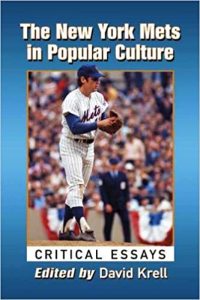 Oscar and his milieu enjoyed a recurring role across the pages of The New York Mets in Popular Culture, a recently published buffet of eclectic “critical essays” edited by the diligent David Krell. Leaning on the academic side of the street, a little up the block from what we do in this space, the book explores the margins of the Mets baseball experience. The more ephemeral it goes, the better it gets. The essays in which the Mets-loving reader learns more about Rheingold; Joan Payson; Bob Murphy’s beginnings; the truly original Mets of the American Association; calling Sports Phone, winning the Mayor’s Trophy; and one man’s adoration of Dave Kingman make this, as Murph might have put it, an excellent addition to your baseball library. The Mets-curious reader receives as well a bit of an anthropological explanation for what makes the Mets the Mets in movies and other media. Krell and his collaborators make a thoughtful case for the Mets mattering in every corner of the universe they touch — and The Odd Couple indeed gets its due in its various incarnations. Oscar and his milieu enjoyed a recurring role across the pages of The New York Mets in Popular Culture, a recently published buffet of eclectic “critical essays” edited by the diligent David Krell. Leaning on the academic side of the street, a little up the block from what we do in this space, the book explores the margins of the Mets baseball experience. The more ephemeral it goes, the better it gets. The essays in which the Mets-loving reader learns more about Rheingold; Joan Payson; Bob Murphy’s beginnings; the truly original Mets of the American Association; calling Sports Phone, winning the Mayor’s Trophy; and one man’s adoration of Dave Kingman make this, as Murph might have put it, an excellent addition to your baseball library. The Mets-curious reader receives as well a bit of an anthropological explanation for what makes the Mets the Mets in movies and other media. Krell and his collaborators make a thoughtful case for the Mets mattering in every corner of the universe they touch — and The Odd Couple indeed gets its due in its various incarnations.
The fiftieth anniversary of The Odd Couple series was celebrated by that living, breathing Smithsonian Institution of show business, Gilbert Gottfried’s Amazing Colossal Podcast when Gilbert and his co-host Frank Santopadre (a devoted if inevitably disgusted Mets fan I’m delighted to call my friend) invited on the sons of Jack Klugman, Adam and David, to recall how their dad and Tony Randall made television history as Oscar and his reluctantly tolerated roommate Felix Unger.
In an even more specific district of the podcast universe, diehard OC fans like myself were introduced to 1049 Park Avenue, in which Ted Linhart and Garrett Eisler began to painstakingly break down every episode of the ABC sitcom. Well, not every episode. They have little use for the first, laughtracked season, and they’re a little choosy about the second season. Also, they’re not at all into sports, which I find odd since Oscar’s a sportswriter who we revere for wearing a Mets cap, but to each podcast its own. Though the title — taken from Oscar’s fancy Manhattan address — is quite clever, my wife expressed surprise they don’t call their show The Pod Couple. (I did a search. The title was already taken.)
As you can see, regardless of what’s on the air in a given year, Oscar lives, whether a person likes baseball or not, just as Felix lives, opera buffdom optional. Still, it never hurts to idealize Oscar. Take it from one of his press box successors, so-called real-life division, Sports Illustrated all-timer Steve Rushin, whose second coming-of-age memoir, Nights in White Castle came to paperback in 2020 and therefore into my price range. “Marriage,” Steve recalls through the filter of his college-age thinking, “seems inevitable and impossible. Even my literary hero, the divorced sportswriter Oscar Madison on The Odd Couple, had to get married before he became single, free to roam — in his Mets cap and sweatshirt, sandwich in hand — through his eight-room apartment in Manhattan.”
A little subtler sighting, but a sighting is a sighting: In The Happy Days of Garry Marshall, a tribute aired on ABC, May 12, 2020, a publicity shot from The Odd Couple features Oscar Madison in his Mets cap. (Another still photo shows Marshall — who wore a lot of baseball caps — wearing a 2000 Subway Series cap, which included the Mets NY logo.)
An Oscar named de la Renta was world-renowned in the realm of fashion, but it’s Oscar Madison’s headwear choice that remains eternal. We wouldn’t let a year go by, even a year such as 2020, without grabbing a sandwich for ourselves and rewinding to all the times we sighted the New York Mets in the popular culture. When we do, whether it’s from art produced in the year just past or from art from a ways back that became evident to us over the preceding twelve months, we tip Oscar’s Cap.
The 2020 Oscar’s Cap Awards, our ninth such annual salute, got the earliest possible start, on a New Year’s Eve that seemed like it was ushering in just any other year. It was then, at Barclays Center, that the Strokes rung out 2019 by debuting a song called “Ode to the Mets”. It would soon appear on their 2020 albumThe New Abnormal, produced by Rick Rubin (known far and wide as a musical icon, known to me in second grade as new kid in the class Ricky, who borrowed and diligently returned my copy of Kosher Comics). The Mets aren’t actually mentioned in the lyrics, but lead singer Julian Casablancas said he wrote the song on the Mets-Willets Point subway platform after what The Athletic termed “a disheartening trip to Citi Field”. The motivator was eventually revealed to be the 3-0 loss inflicted by Madison Bumgarner in the 2016 Wild Card Game. “I’ve had my heart broken many times, obviously, as a Mets fan,” Casablancas told mlb.com.
More evidence that people used to routinely take trips to Citi Field, or at least on the 7 train to somewhere, emerged in January when commuters had the chance to hear the following over MTA-approved speakers: “This is Mets-Willets Point — HOME OF THE METS! I love the Mets, ’cause I’m from Queens, and you’re riding the 7 train.” That was Awkwafina, promoting her very funny Comedy Central show Awkwafina is Nora From Queens. You can tell it’s from January because nowhere in her announcement does she remind you to wear a mask. On the show itself, in the fifth episode of the first season (February 19, 2020), one of the dads at the Elmhurst Community Center laid this bit of emotion on its viewers:
“He’s got his little Mets cap on, and he just pulls away from me, darts across the street, runs right at me, jumps in my arms. So that was the first time Timmy hugged me after the divorce.”
The Late Show with Stephen Colbert senior producer Jake Plunkett wore a Mets cap while he drove his mother Bootsie to meet Dr. James Hamblin to learn more about the coronavirus on March 16, 2020. To be sure, by March we learned 2020 was a good time to, if you weren’t deemed essential to others’ well-being, stay home, catch up on one’s streaming or, better yet, reading. Sure, you couldn’t take a cruise, but thanks to Friend of FAFIF Kevin Chapman, you could definitely be a passenger on Lethal Voyage, the third book in the Mike Stoneman detective series. And as long as you’re setting a course for adventure with Det. Stoneman, you might as well sit in on board for a hand of poker with 1986 world champion New York Met Lenny Dykstra — wearing his championship ring as he sails the high seas, no less. Mike, addressing Lenny as Nails, tells him, “I just want to say that I always appreciated your hustle on the field. When you hit that home run off Houston in game 3, I jumped three feet off my bar stool.” Gosh, who didn’t?
Just as there was no cruising to a game in Flushing this summer, there were no jaunts to the U.S. Open across the boardwalk. Yet that doesn’t mean there wasn’t Two For Tennis (The Adventures of Mark) by Michael Elias, another author we’re proud to count in our community of readers and commenters. In Michael’s book, protagonist Mark seeks solace and distraction in the doings of the Mets before and after the last days of Shea. Mark follows his favorite ballclub’s pursuit of playoff berth redemption behind Johan Santana and Carlos Delgado in September of 2008; sees the Mets fall short in their Wild Card bid on Shea’s last day and realizes while doing a crossword realizes that the 41-down clue for “Stadium in Queens” is ASHE rather than SHEA. Nelson Figueroa also gets a shoutout.
We’ll give a shoutout to Steve Cohen for maybe sparing us lines like these in the future: “Married a Mets fan. He’s a glutton for punishment.” That view of the world was stated by Jerry Orbach as Lennie Briscoe on Law & Order, referring to Rafael Celaya (who “loves the Mets, always listening to their games in the summer”). That’s from “Couples,” Season 13, Episode 23, May 21, 2003, just as the Fred & Jeff Wilpon ownership cabal was making its presence truly felt. Its vibe was still being felt on May 7, 2020, when Seth Myers devoted his “A Closer Look” segment on Late Night to baseball’s pandemic-fueled absence:
“Who are we supposed to root for when baseball comes back, the Mets? I mean, they’re the only team that’s doing better during quarantine. I’m pretty sure the last president they met with was William Henry Harrison, and then he died ten days later. That was the year Mr. Met caught typhoid.”
This endorsement of the way Wilpon things were followed directly on the heels of the finale of the brilliant Brockmire, which aired May 6, 2020, in which title character Jim Brockmire (portrayed by Mets fan Hank Azaria) begged protégé-turned-tycoon Charles, “Oh please buy the New York Mets. Somebody should. Those people have suffered for long enough.” (“The Long Offseason,” Season 4, Episode 8). It didn’t take a sharp eye to notice a large portrait of Shea Stadium’s upper deck hangs in a conference room during the final season of Brockmire.
“Can you buy the Yankees?
“No.”
“Can you buy the Mets?”
“Oh yeah!”
—Dell Scott (Kevin Hart) determining just how rich his fabulously wealthy employer Philip Lacasse (Bryan Cranston) is in 2017’s The Upside
On Patriot Act with Hasan Minhaj (Volume 2, Episode 2, released May 24, 2020), the host explains the dollar value of the legal marijuana marketplace in the US as such: “With that much money, you could buy the Mets thirteen times.”
Yet for all the grief the Mets took right up until Cohen took over, contemporary creative types can’t resist paying homage.
On Netflix’s Big Mouth, Andrew has a Mets poster in his room featuring the ’80s racing stripe.
Rapper Tobe Nwigwe posted a picture of himself wearing a black Mets jersey to his Facebook page in October 2019.
In the 2020 documentary Miss Americana, Taylor Swift is spotted with Jack Antonoff in a Mets cap about 42 minutes in.
A framed blue Mets jersey appears in the background when Fred (Seth Rogen) visits the office of his friend Lance (O’Shea Jackson) in the 2019 comedy Long Shot.
In the Netflix series Unorthodox (2020), a character with the unfortunate name Yanky wears what can be best described as a weird Mets cap.
In 2020’s interactive Unbreakable Kimmy Schmidt interactive special Kimmy vs. the Reverend, Mikey appears to tell the viewer that a wrong decision was made, and adds, “the Mets don’t suck, you suck!”
In the third episode of the 2020 HBO Max series Love Life, Danny Two Phones (Gus Halper) invites Darby Carter (Anna Kendrick) on a date to Friday night’s Mets game, which is bucket hat night. Darby demurs.
“We heard the heartbeat for our little Mets fan.”
—Chris Fischer, wearing a Mets cap, regarding his wife’s pregnancy, Expecting Amy, Episode 1, HBO Max 2020 documentary series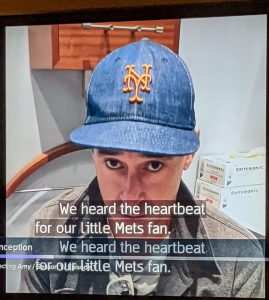
In the Season 32 premiere of The Simpsons (“Undercover Burns”; September 27, 2020), Mr. Burns assumes an incognito persona by the name of Fred Kranepool.
Here’s an exchange from The Outsider, “Dark Uncle,” Episode 3, January 19, 2020 (HBO); while a Cubs game is on at a bar:
ALEC PELLEY: The first game my Dad ever took me to was at Wrigley. 1985, Cubbies-Mets, must’ve been towards the end of the season somewhere. After all these years, who can remember the date?
HOLLY GIBNEY: Did they win or lose?
ALEC: Cubbies lost.
HOLLY: September 26.
ALEC: September 26. I wish I could remember who was pitching.
HOLLY: Johnny Abrego started for the Cubs, but was knocked out in the fourth. He was relieved by Ron Meridith, Steve Engel and Jay Baller. Dwight Gooden, on the other hand, threw a complete game shutout for the Mets.
You’ve heard of a political football? The Mets are sometimes a political baseball.
• Mr. Met was listed as part of the festivities for the opening of Mike Bloomberg’s Bayside field office, February 6, 2020, when the ex-mayor ever so briefly ran for president. Earlier, while campaigning in Oakland, Bloomberg had made a reference to how being the Mets manager — as opposed to the position he’d filled in New York or the one he seemed to want in Washington — is the hardest job in America.
• On June 20, 2020, celebrity Mets fan John Leguizamo sent out a fundraising email for Long Island Congressional candidate Perry Gershon in which both the endorser and the endorsee wore Mets caps. Gershon was seen often on the campaign trail in an orange cap with a blue NY, matching the motif of his signage and Web site. Alas, the candidate most likely to introduce resolutions praising the “valiance and vitality of the New York Mets” in the House of Representatives lost his primary. But Leguizamo’s garb was not incidental; John also wore a Mets cap during a Zoom panel presented by Variety dedicated to Latinx creatives, released October 15, 2020.
• “I couldn’t be a better pitcher for the New York Mets than Jacob deGrom.”
—Chris Christie on The Late Show with Stephen Colbert February 25, 2020
• Paterson, N.J., mayor André Sayegh appeared on MSNBC’s All In With Chris Hayes on May 21, 2020, to discuss his city’s success with COVID-19 contact tracing, wore a Mets hoodie — blue, with a big orange NY — while addressing the topic.
• On Full Frontal with Samantha Bee, September 30, 2020, one day after the first presidential debate, Bee countered Donald Trump’s charge that Joe Biden wears the biggest mask he’s ever seen, offering Mr. Met and his mask as evidence to the contrary.
More real life than politics: The scheduled guest on Late Night with Seth Meyers when NBC News broke in to announce Trump tested positive for COVID-19 at around 1 AM, October 2, 2020, was David Wright, promoting his upcoming book, The Captain. After the initial report, anchored by Brian Williams, the network rejoined Late Night, with the previously recorded Wright interview already in progress.
As if I have to tell you, the Mets and elections interacting is hardly a recent phenomenon. One excavated-in-2020 example comes from the October 14, 2000, Saturday Night Live presidential debate sketch, moderator Jim Lehrer (Chris Parnell) grew so disengaged by Al Gore and George Bush that he tuned into the Mets-Cardinals playoff game on his monitor (that year’s second debate and Game One took place on the same night, October 11).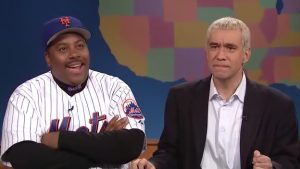 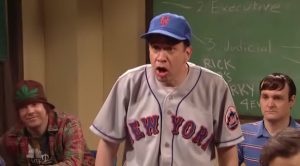
Here a few other Mets sightings from the SNL archives, including a couple from very recent times:
In his first appearance as a Saturday Night Live cast member, during host Jack Black’s monologue/musical number on October 4, 2003, Kenan Thompson wears a contemporary Mets road jersey.
“A Manhattan eye surgeon is offering free LASIK Eye Surgery in exchange for a pair of Mets playoff tickets. Here’s some advice: If someone can’t afford baseball tickets, don’t let them operate on your eyes. With lasers.”
—Seth Meyers, Weekend Update, SNL, October 7, 2006 (when Mets swept Dodgers in NLDS); Season 32, Episode 2
“I love the Mets! But every time I suggest a Mets-themed prom, you guys look at me like I’m crazy! Well, here I go — final effort: Let’s do a Mets prom! Blue and orange streamers, hot dogs! My uncle knows Mookie Wilson. He can come! Therefore, my theme is, ‘Remember the Night We Mets?’ Thank you.”
—Fred Armisen (wearing a Mets road jersey and a blue Mets cap) as Billy Zerillo, in a prom committee meeting, Saturday Night Live, May 19, 2007 (Season 32, Episode 20)
On Saturday Night Live, October 6, 2007 (Season 33, Episode 2), Fred Armisen as Omar Minaya and Kenan Thompson as Willie Randolph take to the Weekend Update desk to unsuccessfully explain away the Mets’ late-season collapse (with Thompson in a home Mets uniform and blue cap).
Kenan Thompson wears a blue Tom Seaver throwback batting practice jersey in the “Driving School” sketch on Saturday Night Live, March 8, 2008 (Season 33, Episode 7)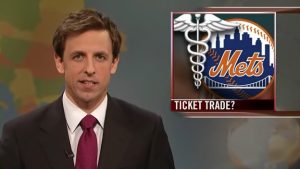 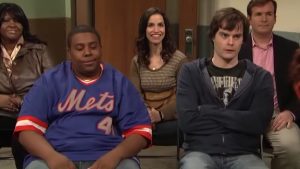
An egg wearing a tiny Mets cap was part of a bumper during the 2019-20 season finale of Saturday Night Live (S. 45, E. 18), May 9, 2020.
On Saturday Night Live, October 31, 2020 (Season 46, Episode 5), in another of the big John Mulaney-led musical sketches celebrating New York’s weirdness, Maya Rudolph appeared as the Statue of Liberty channeling Elaine Stritch by singing, in an updated version of “I’m Still Here”: “Danced for the ’86 Mets and broke my ankle, but I’m still here.”
“I had my first New Year’s Eve kiss with Mr. Met’s daughter. Stacy Met. Sweet girl. Big head.”
—Timothée Chalamet, monologue, hosting Saturday Night Live, Season 46, Episode 8, December 12, 2020
The death of the artist Christo (1935-2020) brings to mind Fred Armisen as Tom Jankeloff visiting The Gates in Central Park on Saturday Night Live, February 19, 2005 (Season 30, Episode 13), while wearing a windbreaker displaying the Mets script logo and the number 31. All that was missing was a blue cap to complement the onslaught of orange fabric.
A couple of other passings in the realm of pop culture and the Mets are worth noting here. Richard Herd (1932-2020) was Matt Wilhelm, George Costanza’s boss with a New York baseball team on Seinfeld. In “The Millennium” (Season 8, Episode 20; May 1, 1997), Mr. Wilhelm departed that organization to take on a new role: head scouting director for the New York Mets — the job George wanted. And Jerry Stiller (1927-2020), when he wasn’t George Costanza’s Festivus-inventing father Frank, played characteristically none too pleased as Arthur Spooner when his son-in-law Doug Heffernan (Kevin James) took him to Shea Stadium on The King of Queens (“Doug Out”; Season 2, Episode 6; October 25, 1999), though he did cheer up when Doug leapt onto the field to attempt to retrieve a foul ball for him. Alas, Doug was thrown in “Mets jail” for his would-be good deed.
Now let’s spend a few moments with Philip Roth’s 1997 novel American Pastoral:
One night in the Summer of 1985, while visiting New York, I went out to see the Mets play the Astros, and while circling the stadium with my friends, looking for the gate to our seats, I saw the Swede, thirty-six years older than when I’d watched him play ball for Upsala. He wore a white shirt, a striped tie, and a charcoal-gray summer suit, and he was still terrifically handsome.
[…]
“You’re Zuckerman?”, he replied, vigorously shaking my hand. “The author?”
[…]
“These are my friends,” I said, sweeping an arm out to introduce the three people with me. “And this man”, I said to them, “is the greatest athlete in the history of Weequahic High. A real artist in three sports. Played first base like Keith Hernandez — thinking. A line drive doubles hitter. Do you know that?” I said to his son. “Your dad was our Hernandez.”
“Hernandez’s a lefty,” he replied.
[…]
The following letter reached me by way of my publisher a couple of weeks before Memorial Day, 1995.
Dear Skip Zuckerman:
I apologize for any inconvenience this letter may cause you. You may not remember our meeting at Shea Stadium. I was with my oldest son (now a first year college student) and you were out with some friends to see the Mets. That was ten years ago, the era of Carter-Gooden-Hernandez, when you could still watch the Mets. You can’t anymore.
[…]
Sincerely,
Seymour “Swede” Levov, WHS 1945
Need a few more reminders that 1986 is eternal?
In the 2020 Long Island-set film Standing Up, Falling Down, Marty, a dermatologist played by Billy Crystal, watches the 1986 World Series, calls the son from whom he is estranged and mentions that Ron Darling is his son’s favorite player.
“What a great-looking crowd — so many stars, so much cocaine. Is the is the Emmys or the Mets’ locker room?”
—David Letterman, 2020 Emmys (9/20/2020), reading jokes ostensibly left in his tuxedo pocket from when he last wore it, hosting the 1986 Emmys
ESPN announced a multipart documentary delving into the 1986 Mets, their city and the times in which they conquered the world will appear in 2021. It is being crafted by Friend of FAFIF Nick Davis and I have a feeling it will be very much worth watching.
Need another reminder of what life was like ten years after 1986?
From Mystery Science Theater 3000, Episode 704 (February 24, 1996), during the opening scene to the The Incredible Melting Man, amid a countdown to launch:
VOICEOVER: T-minus 25 seconds.
CROW T. ROBOT: The Mets lost today.
The Oakland Mets (whose uniforms looked more softball than baseball) lost to the California Stars when Ralph Hinkley homered for the California Stars in Season 2, Episode 1 of The Greatest American Hero, “The Two-Hundred-Mile-an-Hour Fast Ball,” November 4, 1981. No, we’re not sure what a team called the “Mets” was doing playing as “Oakland”. We are, however, certain the Mets were nowhere near a World Series in the late ’70s, but a stock photo of a Mets game at Shea Stadium (wide angle, probably from the ballpark’s early days) appears in a TV Guide ad for the March 20, 1977, premiere of the ABC movie Murder at the World Series, which itself filmed its baseball sequences at the Astrodome, as the World Series in question pit the Astros versus the A’s. Maybe somewhere in here was the seed of the idea that became Major League Baseball’s 2020 postseason bubble.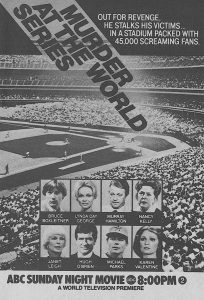
And maybe, had the Mets provided season tickets to one of the leading songstresses of the late ’70s, they would have been invincible, because “of the fifteen New York Met games she’s attended, the Mets have won all fifteen.” The lady in question was Gloria Gaynor, whose great baseball luck was mentioned by Casey Kasem as he introduced “I Will Survive” as the No. 1 song on American Top 40, March 17, 1979. Casey had been telling a story of how Gaynor’s South American tour crossed paths with that of New York Cosmos, and how her pregame concert may have helped the Cosmos break their winless streak (the Cosmos resented the idea they needed an opening act let alone the kind of luck Gloria claimed to bring her teams). Nine years earlier, in his very first AT40 (July 4, 1970, based on the Billboard chart of July 11, 1970), Casey talked up “Everything Is Beautiful” by Ray Stevens at No. 29 this way: “If success contained calories, this guy would outweigh the New York Mets.”
In those days, the Mets were defending world champions, a fact that didn’t escape the showrunners of That Girl at the time:
“There are a lot of great men. There’s the infield of the Mets…”
—Donald Hollinger, That Girl, “Easy Faller,” Season 4, Episode 25, March 19, 1970
“When I can explain why I can miss an entire inning of a Mets baseball game because I’ve been staring at your picture on my television set […] then I’ll be able to explain why I love you.”
—Donald Hollinger’s note to Ann Marie, That Girl, “All’s Well That Ends,” Season 4, Episode 26, March 26, 1970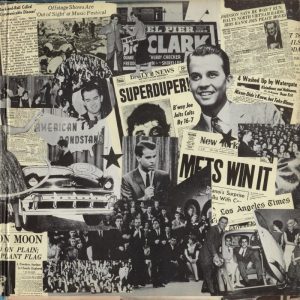
The Dick Clark 20 Years of Rock N’ Roll double album from 1973 included the front page of the Post announcing the Mets’ world championship in 1969 part of its gatefold art, indicative of what a surpassing cultural moment, not just pop cultural, the Mets winning it all was. Though they didn’t make it as tracks in the Clark-curated collection, two songs in the aftermath of the 1969 World Series that celebrated the most unlikely championship ever made themselves known to us a mere 51 years later: the Calypso-flavored “Mets” by the San Joe Trio (which namechecked several of the champs); and the garage-rocker “The Mets Special” by Rodd Keith (sounds a little like Eric Burdon and the Animals).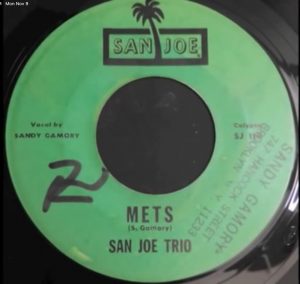 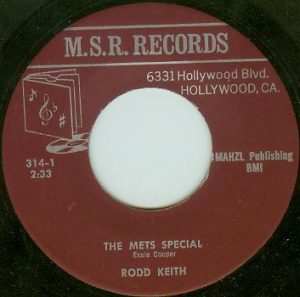
To understand just how far the Mets came to get where they got as the ’60 ended, here are a couple of instances of how they were portrayed just a few short years earlier:
• The 1963 Off-Broadway revue Put It In Writing included a song, written by Fred Ebb and Norman Martin, that included the following lyrics: “When you run for a ball run right into the stands/Don’t forget, you’re a Met/When a grounder arrives let it slip through your hands/Don’t forget, you’re a Met,” asserting Mets fans preferred their new team lose.
• George Carlin on The Merv Griffin Show in 1965 referred to his character Lyle O. Higley, head of a chapter of the John Birch Society, as “a veteran of two wars, a depression and a Mets doubleheader”.
More recently from the world of big-time talk shows, especially those helmed by Mets fans and/or hosting Mets fans…
• Jerry Seinfeld joined Jimmy Kimmel on May 5, 2020, and compared notes on throwing out first pitches at Citi Field.
• Bill Maher’s suit jacket lining displayed the Mets skyline logo on Real Time, October 23, 2020. Four weeks later, on the eighteenth-season finale of his show (November 20, 2020), Bill’s montage of audiences applauding — a symptom of doing pandemic shows in front of nobody — included a clip from the Polo Grounds of fans behind a LET’S GO METS banner. Maher had been a minority owner under the Wilpons; Steve Cohen had just bought the ballclub when this episode aired.
• And on May 7, 2020, over on The Late Show with Stephen Colbert, Pete Alonso appeared in the extended (142-part) version of The Last Dance, ESPN’s Michael Jordan documentary, offering this rumination: “I remember him. He played baseball for the Birmingham Barons. He also played basketball? That makes sense. He was pretty tall?”
He was, Pete, he was.
Archie Bunker may have been a Mets fan from Astoria, but nobody could accuse him of having been a particularly progressive Mets fan. One wonders what he might have made of Kim Ng being named Miami Marlins general manager in 2020 after hearing him express disgust to son-in-law and philosophical foil Michael Stivic that neighbor Irene Lorenzo was about to receive pay equal to his own: “Whaddaya gonna say when a woman is managing the Mets?” (All In The Family, “Archie’s Helping Hand,” Season 5, Episode 6; October 19, 1974).
It’s just a guess, but he probably would have said what he said less than a year later:
“I gotta go down to Kelsey’s and watch the Mets play ball.”
That pressing appointment came up on September 15, 1975 (“Alone At Last,” Season 6, Episode 2), on a night when in real life Mike Vail tied the franchise and league rookie hitting record versus the Expos. In TV Land, “I won on a ballgame,” the betting Bunker reports to wife Edith. “The Mets beat them San Diego Padres.”
Think Archie took in a lot of Broadway? Probably not, but to appeal to the widest possible audience, there was this radio ad copy for the explicitly gay-themed production Torch Song Trilogy that ran on the New York airwaves in 1982:
“…which then leaves the rest of us non-gays who will be immediately threatened and say, ‘Torch Song Trilogy? No way, nah, listen, I’m going out to Shea Stadium to catch the Mets and squash beer cans with my bare fists.’”
Once you’ve squashed beer cans with your bare fists, what’s left to do except tick off a bunch more Mets pop culture sightings to close out the year?
In the series finale of Anthony Bourdain: No Reservations, “Brooklyn,” Season 8, Episode 16, November 5, 2012, there are two Mets sightings: a green Mets cap on a waiter at Pok Pok, a Thai restaurant; and a Mets beer mat in the garage of a collector in Red Hook.
In his 2013 novel Dissident Gardens, set largely in Queens, Mets fan Jonathan Lethem has one of his characters, Lenny Angrush, try to convince Bill Shea to name the Mets the Sunnyside Proletariats.
On Flea Market Flip, Season 8, Episode 11, “Zen and the Art of Flipping” (February 19, 2017), a fella wearing a Mets cap backwards (adorned by upside-down sunglasses, no less) is spotted browsing for bargains.
In the 1988 film Rocket Gibraltar, very young Macaulay Culkin plays Cy Blue Black, a kid who wears a Mets t-shirt and a Mets cap.
In Billy On The Street, Season 2, Episode 4 (January 4, 2013), a bystander named Jonathan is asked to help a contestant answer a question, and Jonathan is wearing a blue Mets t-shirt (Mets script logo on front).
“I’ve watched a Met game from the owner’s box and partied with Gooden and Strawberry afterwards.”
—Matt Bromley (James Van Der Beek), Pose, Season 1, Episode 1, June 3, 2018
Ron Darling made two appearances on Sesame Street in 1985: walking in on Telly (who’s wearing a Mets cap) just as Telly is looking at his Ron Darling baseball card (from the Mets MVP Club series) on April 26, 1985; and teaching Big Bird how to throw a fastball on May 15, 1985. In each instance, Ron is wearing No. 44, which he wore in 1984. By the time these episodes aired, he had switched to No. 12.
The final shootout of 1987’s Deadly Illusion, starring Billy Dee Williams as private detective Hamberger, takes place at Shea Stadium.
Deacon King Kong, a 2020 novel by James McBride, takes place in Brooklyn in September 1969, with the New York Mets embroidered within the story.
On Mad About You, “The Spy Girl Who Loved Me,” Season 1, Episode 20 (May 8, 1993), Ira Buchman (Paul’s cousin) identifies Ron Swoboda and Ed Kranepool as a couple of people he used to worship.
Tom and Nancy Seaver hosted the Detroit (J.L. Hudson’s) portion of The CBS All-American Thanksgiving Day Parades, November 26, 1970
As for Metsian pop culture worth looking forward to, in 2020 it was announced Calico Joe, a John Grisham novel that included a Mets angle, would be made into a motion picture, and photos released from the upcoming Coming 2 America showed Prince Akeem (Eddie Murphy) will once again don his varsity-style Mets jacket from the 1988 original, replete with a pin announcing, “I’M A METS FAN”.
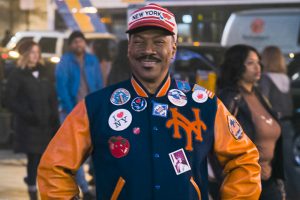
And because it’s likely everybody who’s read this far is A METS FAN, we’ll conclude on what we process at the end of 2020 as a most optimistic sighting:
In the Law & Order episode “Navy Blues” (Season 8, Episode 3; October 15, 1997), Det. Lenny Briscoe (Jerry Orbach) tells a slow-moving shopkeeper who’s searching for a receipt, “Hurry up. I have Mets tickets next month.”
Imagine having Mets tickets next year and going to a Mets game. Or watching a Mets game that has in-the-flesh, three-dimensional Mets fans like you in attendance. Pretty nice to think about, eh?
But when the Mets aren’t on, in whatever form their games do or don’t take, keep watching, keep reading, keep listening to whatever tickles your fancy and, should you see something Mets-related appear outside a baseball context, let us know what you saw. This annual feature’s depth (to say nothing of its extreme frivolousness) is made possible by a bevy of contributors who are kind enough to drop us a line when they see some show, hear some song or pick up on something that we might have missed despite our trying to see, hear and pick up on everything. Thank you all for feeding us the ball so cleanly and allowing us to make the pivot from there.
Particular thanks are due One SNL A Day for both its aspirational obsessiveness in recounting and reviewing every single episode of Saturday Night Live and for all the Metsian asides and screen captures the site has posted along the way.
by Greg Prince on 25 December 2020 5:04 pm Previously on Flashback Friday…
A little piece of me is always watching the Mets in 1970.
Mostly I was enchanted with the possibility that the Mets would win the World Series in 1975.
I was in love with the 1980 Mets. They weren’t the first Mets team I was ever hung up on, but I think, given where I was in life, that they were my first love.
I gave myself over to baseball and the Mets in 1985 in a way I never had before.
If there was ever going to be a year when I might have discarded baseball and pleaded no lo contendre to the charge that I allowed myself to be distracted from the Mets by overwhelming matters of substance, 1990 would have been that year. But it wasn’t and I didn’t. Amid a seismic personal shift that separated what came before from what came after, I was just doing what I’d always been doing. I rooted for the Mets like it was life and death. I didn’t know how not to.
In 1995, I was determined to spend as much time at Shea as was humanly possible.
It was the Year 2000, Y2K. Actually, it wasn’t any different from the 1900s, at least not the last few of them. Since 1997, the Bobby Valentine Mets had become my cause, my concern, my reason for being. Even more, I mean. If I had to rate the intensity of my baseball-commitment on a scale from 5 to 10 (let’s face it, it was never going to dip into low single-digits), these were the 9-10 years. The needle never saw 8.
For all the sporadic delight I’ve derived from the Mets since 1969, I don’t think I’ve ever been quite as personally gratified by a season as I’ve been by 2005.
Make no mistake about it: we lived in 2010. Of course we did. We live in every season as if it’s our permanent residence. We inhabit them fully. Each one is the most important season of our lives while it is in progress. Across the entirety of 2010, I sat at this very spot and, in concert with my blogging partner sitting in whatever spot he was in, set in type that entire April-to-October effort. It mattered to me. It mattered to you. Then it mattered no more. Weird how that happens.
And now: Flashback Friday.
***It’s five years later. It’s eventually always five years later. Right now, it’s five years beyond 2015, a season that resides only in retrospect. That’s technically been the case since a little after 12:30 AM on November 2, 2015, when Wilmer Flores looked at strike three from Wade Davis, and the Kansas City Royals ended the only Met season that lasted into the eleventh month of a calendar — and yet another season that ended too soon.
It stopped being the 2015 season right then and there, but the feeling of winning the pennant and going to the World Series lingered all winter. A flag was raised the following April to remind us all over again of what 2015 had been. Soon, 2016 unfurled in a fashion unlike 2015 but rallied, with a substantially (if provisionally) revamped cast, to insert itself into every relevant informational sentence thereafter. In 2015 and 2016, the Mets went to the postseason in consecutive years.
That was the era. It was over in a practical sense before April ended in 2017. Some residual emotion now and then resurfaced. Who could look at Wilmer Flores continuing to belt walkoff homers as late as 2018 and not think of 2015? Who could spot Yoenis Cespedes striding to the plate during his short-lived 2020 return, as blindingly fluorescent as he was preternaturally powerful (when he made contact), and not think of 2015? YOPENING DAY, as at least one back page called it, came and went, as did Yoenis, but he was a reminder. So, to a certain extent, have been the continuing contributions of the handful of 2015 Mets who figure to be 2021 Mets: Jeurys Familia, Jacob deGrom, Steven Matz, Michael Conforto and, once he’s fully rehabbed from Tommy John surgery, Noah Syndergaard. Roster construction subject to change, of course, at the discretion of Sandy Alderson, who, like Familia, had left for Oakland at some point but then returned from a checkered Met past whose most decorated squares were planted on the board in, yes, 2015.
Honestly, though, despite the presence of a few living, breathing participants from the 2015 Mets in Mets seasons of the future, it hasn’t been a whole lot like 2015 for the Mets since 2015. That was a sui generis year in Flushing. Unprecedented, somebody insisted. Inimitable since. Maybe someday soon its accomplishments will be matched and surpassed. That’s the plan under new ownership. That’s the hope always. Don’t kid yourself, though. Just getting a 2015 up in here is no mean feat. Good luck to us all getting more.
I don’t necessarily visit 2015 that much in my head, but it comes to see me once in a while. I’m happy for the get-togethers. These days, we put on masks and we reminisce.
***We remember that before it began, our expectations for it were limited, as were our imaginations regarding how good it could be. We’d conditioned ourselves since the end of Shea Stadium to dream small.
Still, my informal predictions for 2015 were vaguely positive. I thought the Mets would be better than the clutch of unsatisfying seasons that preceded it from a baseball standpoint. How much better, I wouldn’t have guessed. We still relied on Jonathon Niese and Dillon Gee. We signed Michael Cuddyer to middling fanfare. We had yet to fully replace Jose Reyes at short by my reckoning, and Jose Reyes hadn’t been a Met since 2011. Bartolo Colon shaped up as more effective than most pitchers about to turn 42, but he was about to turn 42. Curtis Granderson, like Colon, had come over in 2014 and, like Colon, was somebody you loved rooting for, but like Colon, Granderson didn’t hit for average (.227 in ’14).
There were signs, however. DeGrom, with barely a dab of advance heralding, had won NL Rookie of the Year even if the Mets didn’t score enough to net him more than nine measly wins. Juan Lagares tracked everything down in center, including a Gold Glove. Jenrry Mejia was a heartstopping but ultimately lockdown closer, especially with Familia setting up for him. Travis d’Arnaud was showing enough of the stuff that made him worth trading R.A. Dickey for, so we’d be set at catcher for a while. Second baseman Daniel Murphy couldn’t field, but he could surely hit. Lucas Duda could slug and wasn’t bad at first base. David Wright was very much The Captain and forever the third baseman. Matt Harvey was very much returning from TJS and ready to resume his acedom in tandem with young Jacob. Zack Wheeler, like Josh Edgin and future closer Vic Black, would be out, but Gee and Niese were still around.
Bottom-line types might have concluded that a person who devoted his mental capacities to the fortunes of the Mets of 2009 through 2014 had not put his brain to its best use. Yet the early part of the 2015 season undermined the Mets’ handy image as a waste of time, assuming you were already partial to devoting time to a baseball team. These Mets took off like no Mets in ages. From a 2-3 start that followed a 453-519 epoch that dated to the season Citi Field opened (not to mention the pair of September collapses that shuttered Shea), the Mets presented themselves as unbeatable. For eleven games, including an entire ten-game homestand in April, the Mets went 11-0. That was stuff out of 1969 and 1986, and that got a Mets fan revved up for the rest of the season.
There’s nothing better than the year that Feels Different, and before we had a chance to feel anything else, 2015 felt different. We were no longer entering games as a decided underdog. Three of the teams we battered at home in April — the Phillies, the Marlins and the Braves — had slipped into rebuilding mode (the Marlins lived there). We had already done rebuilding. When we weren’t looking, or perhaps when we were looking but not fully processing, we had rebuilt, at least to the extent that we needed to be taken seriously and the extent we needed to take ourselves seriously. Who knew it was just a matter of adding Michael Cuddyer?
Before long, the ease of April would find muck in May and get jammed in June. The injury bug, an inevitable if uninvited Met guest, would arrive. Presumed stalwarts headed for the disabled list. Reinforcements appeared. Some, like the kind you applied around the holes on your loose leaf paper, stuck. The rest didn’t. Somehow the Mets didn’t come totally unglued. There were days and nights when the shallow depth of the lineup threatened to drown them, but they stayed afloat. It helped that it wasn’t a tough division, with only the Nationals seeming imposing (without being as imposing as they seemed). It helped that the Mets were deep in pitching. Jenrry Mejia tested positive for PEDs? Jeurys Familia merely changed his address from the eighth to the ninth inning. Dillon Gee faded onto the DL, practically never to be heard from again? Noah Syndergaard emerged from the wings, a Thor fully formed. A glint of a void opened up in the shadows of deGrom, Harvey and Syndergaard? Somebody call Steven Matz of Stony Brook and tell him to bring his bat.
The pitchers were pitching and often hitting. Those relied on to hit were another matter after a while. Batting orders were makeshift. Batting results shifted into neutral, then nil. Things began to feel desperate, yet not hopeless. Vive la différence after a brisk start (15-5) that provided just enough cushion for the plunge back to Earth (21-32). The Mets hung in there in all ways applicable: around .500, around the division lead, around the Wild Card race if a side door to glory was deemed necessary. The fresh air of April had not grown totally stale. It was there for the breathing. Sucking into our lungs that we no longer sucked…it didn’t suck.
Nor did having the Mets as an outlet when 2015 got sad and serious in a context I couldn’t foresee.
***When I’m with 2015, I’m also with my father quite a bit. I wouldn’t have predicted that when 2015 began.
Early one morning in May I saw my phone blinking. Florence, my father’s girlfriend of 23 years, was trying to reach me. My 86-year-old father had to go to the hospital. Something about him falling. I got in touch with my sister. In a matter of minutes were on our way to North Shore in Syosset before learning, no, now he’s at North Shore in Manhasset. So we were on way there.
When we caught up to him, Dad seemed relatively unbothered by his circumstances, a passenger taking note of his journey while lying on a gurney in front of an admissions desk. It wasn’t his first choice for a destination, but he put up with it. We made small talk as we usually did. Something about the NBA draft lottery. The final episode of Mad Men (he thought it was “OK”). Later, when he was transferred temporarily to a small room where testing proceeded, he grew antsier and antsier. He demanded to be taken to the bathroom across the hall, which he was told was off limits. “If you’ll pardon the expression, I have to take a piss.” I’d never heard him use the phrase. He was also getting hungry and began reciting the dishes he could really go for if they would just let him out so he could go home and eat like a healthy person, which he was asserting he was. He’d like a western omelet. Some barbecued spare ribs. I would’ve loved to have run out and rustled some up. I wasn’t particularly useful otherwise.
This was a Wednesday morning and afternoon, leading into the night I was supposed to be at Citi Field but had to bow out of previously made plans. On Friday, when a mound duel in Pittsburgh between young guns Gerrit Cole and Noah Syndergaard failed to engage me (but it was my night to recap), Dad had brain surgery. Wednesday he wakes up in a state of normality. Less than sixty hours later, they’re opening his head. Jesus, that’s quick, but I guess you don’t wait when you find something wrong. He was seeing visitors on Saturday. A doctor came by and asked me to step into the hall and introduced me to the word glioblastoma. That’s what was like 99% removed. But it could grow back.
This is the thick line of 2015. Some years demarcate themselves definitively from the past. Before that morning in May, family business as usual was cordial but distant. I’m guessing the last time we had all gotten together as a family — Dad and Florence; my sister Suzan and her husband Mark; my wife Stephanie and me — before the hospital was in January. Or maybe the previous June. Or previous January. Our holiday, birthday and just-because get-togethers had condensed over the years. Stephanie, Suzan and Dad had birthdays that coalesced over a three-day period in January, so that was usually it. Unless it snowed a lot, then we’d postpone it. And if the postponement bumped up against the Super Bowl, maybe we’d just push it off to Father’s Day, though maybe Father’s Day would encompass just four of us, depending on who was miffed at who.
Actually, it occurs to me we may not have gotten together as a family in toto the entire time my father was in and out of hospitals, rehabilitative facilities and, ultimately, whatever name they used for a nursing home in 2015 and 2016. There was quite a bit of tag-teaming keeping Dad company, pending people’s availability, proximity and tolerance for one another. I seemed to show up mostly on weekday afternoons at first, especially once he was transferred to Glen Cove to recover his sea legs thinking and his land legs walking. I’d take a train to Jamaica then transfer north and east on the Oyster Bay line. Driving any kind of distance had presented a challenge to my anxieties over the previous two decades. One small offshoot of Dad’s eventual transfer to the final place he lived, in Woodbury, and my determination to visit him regularly was it got me back behind the wheel whether I wanted to be or not. I became a competent and reasonably confident driver again. Not on highways, but I’m OK on side roads.
The improved driving came later. In June, it was the train, bringing Dad the Times so he could try to do the crossword and get his brain going. We’d sit together, engage in the best possible version of the idle chit-chat we’d perfected over the past quarter-century of midweek phone calls and take in whatever show Steve Harvey was hosting (Dad had developed a love of Steve Harvey hosting anything). If he napped after lunch and before ambulatory sessions, I’d wander into my iPad. Up in Glen Cove, during the dreaded San Diego-Arizona trip — dreaded annually by this blog for the lateness of the games and the lameness of the action — I had gotten unreasonably excited over something I noticed the night before. Four-ninths of the Mets’ lineup wore a double-digit uniform number: Ruben Tejada in 11; Kevin Plawecki in 22; Matt Harvey in 33; and John Mayberry in 44. In a previous era, all that double-vision would have sent me scurrying to get the papers, get the papers to see if there was anything on it. But neither the Times with its fancy crossword nor any of the tabloids covered esoterica the way blogs did. I knew it was up to me to track this minutiae down. So I sat by my father’s bed and scrolled all the usual suspect sites for background. Had the Mets ever run out players clad in 11, 22, 33 and 44 in the same game before? Had they done it in this century? My inquiring mind needed to know.
As I intently cross-referenced uniform data with box scores, Dad stirred. Whatcha doing, he asked me.
“Research.”
***Sandy Alderson did his research, too. Took his sweet time doing so from where I and millions of my fellow Mets fans sat. By July, as my father got the green light to return home (with near-daily trips for radiation mandated and a pill for chemotherapy prescribed), the Mets’ pulse beat haltingly. These were the days of John Mayberry and Johnny Monell and Eric “Soup” Campbell and Danny Muno and just after the days of Dilson Herrera and Darrell Ceciliani. It seems bad sport to call out a stream of Mets who combined for a trickle of base hits just to prove that offensive times were getting hard, but we were trying so hard to think of ourselves as contenders. Instead, we contended with batting averages for which snuff was eternally elusive.
Get us up to snuff, Sandy. Get us some hitters to go with our pitchers. Get us some depth. We’re doing this without David, without Travis, without Daniel. We’re going oomphless in pursuit of a playoff spot. How we’re still talking playoffs is a credit to the rotation, the closer and Curtis Granderson’s ability to draw walks. Yo, a little help?
Yo, we’ll get to in a minute, but cavalry was coming. Last year’s No. 1 draft pick Michael Conforto alighted ahead of schedule and not a minute too soon, one day after Clayton Kershaw toyed with a lineup whose No. 9 hitter, Bartolo Colon, brandished only the eighth-lowest average (he had Anthony Recker beat by ten points). Conforto was 22 and born to hit. Kelly Johnson and Juan Uribe, nabbed from Atlanta, were much older but professionally skilled enough to make a difference in depth. And Carlos Gomez…
We were trading for Carlos Gomez, the ex-Met we dealt for Johan Santana ages before. Gomez had bloomed into a legitimate star for Milwaukee. It would be good to have him back, even if we’d have to give up baby-faced, sometimes-slugging Wilmer Flores, the infielder without a position. Gomez could run, Gomez could hit, Gomez could field. He’d be an upgrade.
Except reports of Flores’s departure proved not only premature, but inaccurate. The exchange between New York and Milwaukee got called off if it was ever truly on. It would go down as an unmade trade, little harm, little foul, if not for the fact that Twitter, in full swing on the night of July 29, linked Citi Field seatholders (myself among them) with the news that Flores was as good as gone. We delivered unto him the bulletin and a warm ovation.
Flores had no idea he was traded. Terry Collins had no idea he was traded. Sandy Alderson had not traded him. Big misunderstanding, but not harmless. Wilmer, likable enough to that moment, transformed into instantly beloved because he shed a tear or two, as detected by SNY when he thought he was outta here. He wasn’t. We were glad.
Except we didn’t get Carlos Gomez and we still needed another player and not only did we lose on the night of the bizarre non-trade, we lost the next day in soaking, excruciating fashion in the ninth inning when Familia imploded versus the Padres. We had held the fort for as long as we could. We clearly required another bolt to secure it.
It came from out of the blue. Detroit, anyway. Yoenis Cespedes — Yo! — was acquired for real and for two minor league pitchers. This was the addition onto our house that Alderson had never made in the middle of a season before. An impact player for an impact season. We got word on Friday afternoon that Yoenis would be here Saturday. In the interim, during the second-place Mets’ Friday night showdown with first-place Washington, Wilmer Flores was embraced as perhaps no Met ever, certainly as no Met ever whose major achievement to date was public emoting.
Flores was so touched by the affection that he responded by winning the game on a twelfth-inning home run. From not outta here to triumphantly OUTTA HERE! The Mets, if we hadn’t figured it out yet, were also for real. Cespedes pulled into town on Saturday and things got realer. By Sunday night, the reality was a sweep of the Nationals and a virtual tie for first place. The real thing, first all for ourselves, followed in very short order.
One of the elements of baseball fandom that never fails to fascinate me is how quickly we can change our concerns and perceptions as the fates demand. For six seasons we’d been this lumpy punching bag of a franchise, either completely out of it or only tentatively and ultimately fleetingly in it. The “it” in question was the quest for a berth in the postseason tournament to determine a champion. We hadn’t been truly sincere about contending since September 28, 2008, the last day of Shea, and it translated to our attitude toward our Mets and ourselves. They were not winners. We were not happy. But at least we could relax.
The months leading up to July 31, 2015 — the date we got Cespedes and the date Flores went deep — had seeded the ground a little for a change in the way we saw ourselves and our team, but that weekend, followed by our commandeering of the National League East lead, catapulted us full-force into a new and dizzying headspace. We are winners. We are happy. We can’t relax because now, suddenly, every single game and every single pitch matter. Not just in the caring about the Mets, therefore of course it matters sense, but in the holy crap, we can actually go places this year sense.
It was a beautiful place to be.
***Less beautiful: That hospital in Manhasset on a Wednesday night in August. Dad’s clearance from the woods proved temporary. I suppose that was predictable. On July 29, the same day Wilmer Flores wasn’t traded, he’d gotten something of a clean bill of health after his month of radiation and chemo. At 86, it would have been a bit much to expect a long-term thumbs-up (at some point he sought assurances from an oncologist that he’d be fine for the next “eleven or twelve years”), but it would have been nice if he could have enjoyed something resembling normality for more than three weeks.
There had been another fall and another need to call. Stephanie and I helped settle him into his next room until maybe two in the morning. I’d be back Friday evening. The Mets were in Colorado. Cespedes led them to a 14-9 win, something that the Mets, in their 54-season history, had never statistically notched. I was back Saturday night. The Mets were still in Colorado and the Mets were winning again by a score of 14-9. The big “go figure” of 2015 was on. Go figure, the Mets keep sweeping series. Go figure, Dad can’t stay out of the hospital.
When the weekend in Denver and Manhasset began, the Mets existed on the periphery of my father’s consciousness. They were something I stepped out into the hall to keep tabs on while he grudgingly got felt up by a nurse. We watched Jeopardy or The Big Bang Theory reruns or NFL exhibitions on his TV. I glanced at my iPad for updates from Coors Field. “Big Met doings?” he’d ask. I’d half-apologize for my first-place distraction. He didn’t seem overly put off.
My dad couldn’t have cared less what the Mets were doing had he thought to care at all when the 2015 season began. He was at home with Florence, grooving to Steve Harvey and whatever he pleased whenever he pleased. If we talked about the Mets, it was to confirm that I was still devoting an outsize portion of my consciousness to them despite the diminishing returns he believed I was collecting for my passion. The blog and a couple of books had convinced him I was at least getting some use out of being a Mets fan, but on the telephone line between me and him, the Mets were essentially handy conversation-filler in our irregular chats, a box to be checked. “So, are you going to any Mets games? I see they lost again in heartbreaking fashion.”
Despite my trying to keep them politely isolated in the hall, the Mets seeped into his room, and then his consciousness. On the Monday after Colorado, the Mets were in Philadelphia. Dad suggested turning on the game so we could watch together. I did and we did. It wasn’t a perfect viewing situation — I was emptying his urinal while David Wright was homering in his return from spinal stenosis — but it was a good time. It woke up the echoes of 1986, when Dad, like Mom, was into the Mets like all of New York was into the Mets. That interest dissipated almost overnight when Mom died in 1990 and the Mets fell away from contention. But now it was all coming together again. The Mets were hot, Dad was into it and I was the facilitator. By Friday, he was calling me at home asking when I’d be over to watch tonight’s game.
I couldn’t make what was ailing him (lots) go away, but I could give him something to take his mind off it (a little). I could give him more of me than I had managed to peel off in recent years. I could give him more Mets than I ever dreamed he wanted. I liked that I could do that. I’m sorry it took this to get it done. I liked that the Mets were so good in 2015 that there was no way they couldn’t or wouldn’t be involved.
***The Mets clinched the National League East on September 26. The Nationals, so hyped in the preseason, never really challenged them after the Flores/Cespedes series. In early September, we descended upon Washington and swept the last evidence of fight right out of them (except, maybe, for their fighting with one another). Then we went to Atlanta and kicked the Braves’ ass all over Turner Field, an activity that was never out of favor. The finale of that series looked to be a loss until Daniel Murphy smashed an unlikely ninth-inning home run to tie it. We won in ten. It was after Murph went yard that Gary Cohen proclaimed these Mets didn’t know how to lose. After so many seasons and so many Septembers when the opposite was true, it was a thrilling pronouncement.
Plus, it had the benefit of being essentially true. The Mets at one point tore off 31 wins in 42 games. Good enough for the divisional flag, hoisted in Cincinnati on a Saturday afternoon. Good enough for a feeling of near-invincibility. We had been Mets fans too long to believe we were permanently unbeatable, but here we were, owning the East and heading to the playoffs. We kept pinching one another. It didn’t sting in the slightest.
The Mets would play 14 postseason games. Five I experienced at Citi Field, which seemed impossible to grasp until I was at the first of them, Game Three versus the Dodgers in the NLDS. Citi Field had been a big mope from its opening in 2009. That first genuine October night, as we booed Chase Utley for dismantling Ruben Tejada’s leg and cheered Ruben Tejada for enduring Chase Utley’s venom, it became Shea the Second. All it had been missing all those years was our most vocal support and a reason to express it.
My good fortune to be in Flushing in the fall extended to the World Series, Games Three and Four. It was better than any World Series game I’d ever experienced at Shea because I’d never had that opportunity. Citi Field is indisputably the best place I’ve ever seen a World Series game. The park doesn’t play like Coors Field, but I swear the atmosphere was elevated. If I hadn’t known there’s nothing like a World Series, I discovered it for myself, and that will stay with me forever.
As will the four postseason games of 2015 I watched with my dad, one versus L.A., one versus the Cubs and, most of all, the two against the Royals in the World Series. It wasn’t crazy that the division champion, 90-win Mets persevered through two playoff series to win the pennant. They were a very good team firing on all cylinders, especially the one marked Murph (seven homers in nine games). What was crazy was a remark I made from thin air in August to calm my father down as he resisted yet another invasion of his person by medical personnel. Appealing to his well-honed logic wasn’t working — though after months of doctors and nurses, maybe the most logical thing was to resist another poke or probe — so I held out a carrot. If you don’t get better, Dad, I dared to say as if speaking to a child, then I won’t be able to watch the World Series with you.
Like I had the World Series in my pocket or in the trunk of my car and needed only his cooperation to dispense it. The Mets hadn’t clinched anything when I said that. The Nationals were still viable. The Dodgers, Cubs, Cardinals and Pirates all loomed as obstacles. Hell, all four of the other NL playoff teams would wind up with better records. But I inadvertently uttered magic words before there was even a magic number. “The World Series” spoke to my father. He grew up in a New York when there was always a World Series nearby. He supposedly rooted for the Dodgers as a kid though he rarely emitted any Boys of Summer vibes. His father liked the Yankees so much that he himself couldn’t stand being dragged to any more games after he was a teenager. Some weirdo in his high school was loyal to the schleppy Giants of the Forties (he once told me I reminded him of that guy). He used withholding the 1969 World Series as a threat on me so I’d take eye drops from an eye doctor when I was six, but the difference was the Mets were already in that World Series.
“The World Series” stayed aloft in our dialogue from late August on. My dad, with whatever faculties he maintained, decided it was coming. We watched the Mets win the NLDS together as a necessary step. He called me in a rare moment of peak lucidity after the Mets won the NLCS, impressed by their attainment of “the pennant,” another word that stayed with him from childhood on. And now, on October 27, we had a World Series to watch.
I still don’t know how I pulled that off.
The Mets lost our two World Series games, Games One and Five, each of which went on far too long. The Mets were defeated in Kansas City in 14 innings in Game One and again in decisive Game Five in 12 innings. They went on far too long because a) we lost and b) my car was in the shop, so getting to my father’s nursing home and getting back home thereafter was, to borrow Pete Campbell’s phrase, an epic poem. Still, it was worth the trip. My father enjoyed it as much as he could. Naps were needed as the innings piled up. I filled his sleepy intervals by texting back and forth with my sister, the Prince least susceptible to baseball’s gravitational pull. Suzan empathetically climbed aboard the bandwagon just the same.
GAME ONE, AROUND MIDNIGHT
S; U still watching there?
G: Yes. W/O car; in shop. Big fan CHP sleeping last several (most) innings.
S: Ugh, and xtra innings too. What’s w/ ur car? Maybe take cab home? Either that or lie down in one of the empty rms (!)
G: Will take cab.
S: Glad ur taking cab. Still cheaper than scalper tix.
G: More impressive: u know what’s going on in game.
S: Lovin’ it especially crotch signals. Cant other team see them on tv?
G: Other team isn’t watching TV, doesn’t know what crotch signals mean.
S: Ok, will take ur word for that.
GAME FIVE, AS THINGS GO IRREVERSIBLY AWRY
S: Oh no Charlie Brown!
G: My fault. I was looking at train schedules.
S: Get out ur sleeping bag.
G: Go big or go home.
S: Yeah man. Here goes nuttin. Ain’t over til it’s over, or so I’ve heard…
G: Your bromides are inspirational.
S: Cliches help in trying to stay awake. Oy vey dis is not looking good.
G: That’s the way Drake’s Coffee Cake crumbles.
S: Hope for best expect worst.
G: Wind up with the Mets.
S: Yup. Still alive, barely.
G: Have a Niese Day.
S: Ha I get it! Could Mets mgr chew gum any harder?
G: Four out of five dentists agree.
S: Ho ho. Dad asleep?
G: Totally. Woke only briefly when I detonated my f-bombs in the 9th.
S: That’s funny, kinda. Looks like u cn shred train schedule…
***It went on too long and it was over too quickly. The World Series needed to go seven or at least encompass three additional Met wins. That’s math when you’ve lost four games to one. That’s 2015, too, the Met portion. That July day that brought Cespedes to Flushing. That July night that launched Flores into legend. That August and September in first place. That October capturing the pennant. Those three months lasted as long as it says right there, three months, but they lasted about three minutes. Or so it feels five years later. Still, I’m delighted to dwell in them and on them whenever the mood hits. It does sometimes. Because 2015 landed in our midst without much buildup — no 1984 and 1985 foreshadowing its stab at 1986 — and because it didn’t birth a run of lasting, even modest success — no 1970-1972 competence bracketed by 1969- and 1973-style miracles — it feels detached from the overall Met narrative. Sure, there was the Wild Card spurt in 2016, but that postseason lasted exactly nine innings, and then the cliff beckoned. Our Wile E. Coyote ballclub couldn’t zoom off its farthest edge fast enough.
Sandy Alderson, when baseball was in its 2020 sleep mode (and before he was rehired by Steve Cohen), joined Tim Britton and Pete McCarthy on the Athletic’s Met podcast the Metrospective. In a wide-ranging conversation, Alderson touched on how swiftly Metsian attitudes changed by his last season as GM, in 2018, once 2015 became definitively past-tense: “The team got off to such a poor start, and when that happens, people typically go back to their default positions. In the case of the Mets — I don’t mean internally but externally: cynicism, skepticism, negativity, and they never really recovered. […] When you are faced immediately with an overwhelming number of losses, you lose that momentum and you default back to where you once were.”
Like I said, we do quickly change our concerns and perceptions as the fates demand. Pointing out the awesomeness of 2015 by 2018 (really, by 2017) was about as relevant to those contemporary Mets as bringing up ’69 and ’86. It was fine and fun for nostalgic purposes, but it was in a past that left faint footprints and exhibited short tentacles. Even 2006 had a couple of full years of contention in front of it, never mind how they melted. Twenty Fifteen didn’t so much belong to an era as serve as the baseball equivalent of Rudy in Rudy getting that Hostess cupcake with a candle in it in the break room at the steel mill from his best friend for his birthday. It’s a thoughtful gesture. Rudy blows the candle out. Not much later, Rudy’s friend dies in an explosion.
The movie, it should be noted, has a happy ending. Rudy gets to go to Notre Dame, makes the football team and runs out of the tunnel, fulfilling his dream. Us? We didn’t get a world championship in 2015 and we didn’t get an era surrounding 2015, but I don’t feel shortchanged. We still have proof the usual narrative can be disrupted, and boy did we need that. We still have that pennant, which is not to be confused with a fluttering handkerchief (nothing to blow one’s nose at). We still have Conforto, deGrom and Syndergaard, each with postseason spurs earned, each potentially leading another batch of Mets back near and maybe to the promised land. I’ll never not have that eleven-game winning streak in April; the invigorating Citi Field debuts of Thor and Matz; the injection of talent exactly when we needed it; the stomping of the Nats twice; the thousands of words with friends of the “can you believe this?” nature; and the toasting and drinking of champagne with Stephanie every time we clinched something. I don’t have my dad anymore, but I have that World Series with him.
Funny, I feel surprisingly nonspecific about Game Five in terms of the parts that are supposed to hurt worst. Collins left Harvey in a batter or two too long. Wright threw to first instead of home. Duda threw to Corona instead of d’Arnaud. We scored nothing in the tenth, eleventh and twelfth. The Royals scored five and I vehemently resent them for it, yet the loss doesn’t really grab me by the throat. I recently came across this Times photo feature that ran the following spring. They found a bunch of fans standing behind home plate with agonized expressions etched on their faces and asked them to elaborate on how awful it was that Hosmer scored the tying run in the ninth. That’s right, I thought anew, that was awful. That was the Series right there. Fuck, I guess.
But it felt less awful to look at it in 2020 than it did when it first ran in 2016, and though it was absolutely awful to live through on November 1, 2015, I don’t feel defeated by it, and I don’t feel 2015 was defined by it. I was with my dad when it happened. He had nodded off, but we were together. And the Mets were in the World Series.
That was 2015. It’s five years ago now.
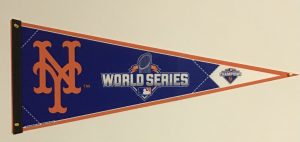
by Greg Prince on 22 December 2020 1:15 pm Here we are, as in olden days, happy golden days of yore. It’s December. Snow lingers on the ground. We reflexively marvel at a picture of it on a baseball diamond. Photographing such a landscape is an irresistible rite of wintertime passage. It’s the oxymoron of the hot stove league, a winter classic, like that New Year’s Day the Rangers and Sabres skated at Citi Field. It’s not what we’re used to in the context of the setting, but it comes, it goes, and we move on to what really belongs on all that grass and dirt. Not snow. Not hockey. Baseball.
The Baseball Equinox, that exact moment when we are as close to the first pitch of next season as we are to the final out of last season, is slated to arrive Thursday, December 24, 2020, at 6:55 PM Eastern Standard Time. It’s a mark we hit without fail. We do it here every year. We did it last year because we knew when the final out of 2019 was made and we knew when the first pitch of 2020 was to be thrown.
Or we thought we did.
The Baseball Equinox proved retroactively fallible last March through no fault of its own. The first pitch of what was then “next season” was postponed indefinitely. By the time it left Jacob deGrom’s right hand on July 24, the Equinox drifted from the end of December to…I don’t know. Somewhere in Spring Training, I guess, which also made a mockery of Spring Training’s stated purpose to get baseball ready for the immediately upcoming season. But that wasn’t Spring Training’s fault, just as the Baseball Equinox losing its chronological footing wasn’t a stumble on the part of a date on the calendar. While we’re not assigning blame, maybe take it easy on cursing out “2020” as if it was a knowing perpetrator of disappointment and devastation in our collective existence. The year was the field, not the game.
An Opening Night for the 2021 Mets has indeed been announced, at Nationals Park on ESPN, April 1, 7:08 PM EDT, 186 days and 26 minutes since the Nats finished pounding the Mets on Closing Day 2020. A Spring Training schedule has been announced, too, with the Mets hosting the Marlins in the first Grapefruit League game on February 27. Be sure to take your blood pressure medication if applicable, because all such schedules come with copious grains of salt.
As we learned in 2020, schedules aren’t necessarily worth the paper they’re rarely printed on anymore. Pandemics are the new rainouts. Vaccines are angling to be the new tarps. They’re also the big “we’ll see” of the baseball season. The NBA is tipping off tonight. The NHL drops its puck next month. They’re both showing up later than usual and playing through the public health raindrops, preparing to produce television content rather than the traditional shared fan experience. One way or another, we’re all still bubble-wrapped.
Baseball has a schedule but no certainty. Maybe Spring Training starts in February. Or later. Maybe Opening Day comes on April 1. Or later. Seats will be filled. Or not. The “terms and conditions” relating to ticket sales on mets.com includes a lengthy section regarding “COVID-19 and Other Infectious and/or Communicable Diseases, Viruses, Bacteria or Illnesses”. Things are somewhat hopeful (tickets are on sale), but nothing is guaranteed. Nothing was ever guaranteed, but it used to be you counted on a few things. One season ended, another was coming right on time. Time plays in its own league now.
Perhaps there’s no point counting down precisely to Pitchers & Catchers or Opening Day. But there’s always reason to look forward. You can believe in the Baseball Equinox. You just can’t take it as gospel. Then again, by the luck of the draw, it does show up on Christmas Eve this year. Maybe on December 24, come five to seven at night if you’re not otherwise distracted, look to the star of your choice to guide you forward.
I tend to look to deGrom, but that’s me.
by Greg Prince on 16 December 2020 9:26 am Someday maybe, maybe someday soon, Jared Porter will be “Jared” to us. For now, he is “Porter,” and that fits. America has been saddled with enough celebrity Jareds of late.
We’ve also had our run of celebrity general managers. “Brodie” came to us a master of hype — wasn’t he loudly threatening to guide Jacob deGrom to greener pastures than Flushing Meadows mere months before he persuaded Jeff Wilpon to let him switch sides? “Sandy” was a more orthodox choice for GM, but in context carried outsize fame and symbolic weight (godfathering Moneyball before it was a fully recognizable phenomenon). “Omar” was Met-famous as a Steve Phillips aide and well-known to any baseball fan paying modest attention when MLB dropped the withering Montreal Expos in his lap, only to have Omar revitalize them for a couple of summers. After as he returned to Shea, the Kid from Queens narrative soared to LaGuardia takeoff levels. Mind you, there’s nothing necessarily wrong with camera-ready charisma. It surely helps a person get attention before a single throat is cleared.
Jared Porter? If you’d ever heard of him before his name arose as a leading candidate for Met GM, you’re either playing in a front office fantasy league or you worked with the guy in baseball. In professional circles, he’s apparently a star, his glow attained the old-fashioned way. He earned it.
After seventeen seasons elsewhere doing what baseball people do — a little of everything — Jared Porter is now a GM for the first time. From the Red Sox to the Cubs to the Diamondbacks to us, in this role. It’s a path heretofore untrod by the thirteen previous Met GMs. We’ve had GMs who were GMs for other teams. We’ve had GMs who worked their way up the company ladder here. We even tried a fellow who negotiated player contracts on the other end of the table.
It wasn’t too long ago that Brodie Van Wagenen was someone we took seriously in terms of trusting him with sorting through the details of our future happiness. His era hasn’t been over sixty days, yet his tenure already seems destined for clickbait content on the likes of Cracked.com. “23 Crazy Baseball Things That Actually Happened!”. The AGENT Who Became GM and Gave a HUGE Contract to his Ex-Client Who had SEVEN ABs in TWO YEARS! would slot snuggly somewhere between The VERY Diminutive Pinch-Hitter Bill Veeck Sent to the Plate WITHOUT a Strike Zone! and The Team That Sold Beer for TEN CENTS and DIDN’T Expect a Riot!
Yet Brodie was our GM for a pair of officially regulation campaigns and we came to accept the seemingly oddball arrangement pretty quickly as business as usual. Some of his business he conducted well to our semi-trained eye, some less so. Who’s to say we won’t discover some innovation he implemented at the sub-Jed Lowrie level, after his hiring in the offseason following 2018 and before his dismissal in the offseason following 2020, wasn’t effective and won’t be deemed to have paid off down the line? Who’s to say, should the Mets ascend relatively soon, there won’t be spirited online debates over how much of it was Brodie’s doing, the way a rearguard faction seemed obsessed in 2015 with noting how many Mets of the moment had been drafted by Omar rather than acquired by Sandy? Who’s to say Brodie, had he been retained, wasn’t going to ultimately make Jeff Wilpon appear visionary?
Alas, we won’t know how Brodie Van Wagenen might have pursued the immediate Met future, because this time we went to Jared. Jared Porter, that is.
Preconceived notions are few. Endorsements are myriad. Peter Gammons loves the guy. Bill James loves the guy. Everybody who’s come in contact with him loves the guy. Or they love the work the guy’s put in and the results his work has yielded, which is the important thing. I watched Porter introduce himself to the media the new-fashioned way, via Zoom. He came off as somebody I’ll readily trust with the post-Brodie, post-Wilpon fortunes of my franchise. No sloganeering. No over-the-top promises. An amiable enough baseball person who appeared ready to get back to depth charts as soon as he could log off the call. An actual GM for virtual times.
Maybe, like Brodie, he’ll sit with The Seven Line Army for a game. Maybe, like Sandy, icon status will attach itself to him. Maybe, like Omar, he’ll be promoted as a major selling point. Or maybe none of these. It could matter greatly across the great sweep of Metropolitan history that Jared Porter is GM. Or it could prove a well-intended footnote. Tom Seaver won three Cy Youngs for the Mets under three different general managers. You think Tom worried himself over whether it was Johnny Murphy, Bob Scheffing or Joe McDonald up in the front office? (It was only the unyielding presence of the corrosive chairman of the board that proved a fatal distraction.)
Jared Porter’s appointment is fine. Fine is what we’re all striving to be as 2020 gathers its strength for a final push to next year. Get us to 2021 and we can start to believe COVID-19 will be properly vaccinated away and baseball will start anew and somewhat normally not long after. We can, like Porter, choose to enthusiastically buy into Steve Cohen’s timeline of three to five years for a world championship despite the lack of guarantees therein. When Steve, a first-namer to be sure, did his first Zoom, his estimate of when he’d like to handle the Commissioner’s Trophy sounded offhanded yet not unreasonable. It’s what an optimistic fan who’d just bought a decently talented team and was used to succeeding might throw out there as a best-case estimate. Maybe it will happen. Maybe it won’t. If we get and stay close — finishing first occasionally and contending for the playoffs perennially — I won’t demand an emotional refund. Steve Cohen as owner, Sandy Alderson as team president and now Jared Porter as general manager, along with Luis Rojas, the skipper who chronologically predates each of them despite technically reporting to all of them, are going to invest themselves in designing and staffing an infrastructure that’s built to last. Do that, and we’ll clear every October on our calendar in good faith.
The people putting together the Mets can only make so many promises and we who wish to believe they know what they’re doing can make only so many projections. Also fine. Do your best and we’ll at least verge on being satisfied.
by Greg Prince on 12 December 2020 6:13 pm The Ages of Lo Duca, Schneider, Santos, Barajas, Thole, Buck, d’Arnaud, Plawecki, Mesoraco and Ramos (to say nothing of the intervals of more than a score of backups) have given way now to The Age of McCann. James McCann, that is, starting backstop for your New York Mets, a franchise that hasn’t fully filled its Piazza-sized hole behind the plate never mind in the lineup since the Greatest Hitting Catcher Ever completed the terms of his seven-year contract on October 2, 2005; took a seven-minute seventh-inning stretch curtain call; and packed his gear for San Diego. Mike would be back to help close Shea in 2008, be inducted into the team Hall of Fame in 2013 and have his number retired in 2016, and the Mets would still be cycling through successors every time Mike dropped by for a ceremonial first pitch. Whoever caught the actual pitches on those days and nights proved to be, at best, a short-timer or inevitable letdown.
McCann isn’t here to make us forget Piazza (fat chance). He’s here to make our pitchers comfortable and us confident. He’s here to get to more balls in the dirt than landed in Wilson Ramos’s sadly flailing grasp. He’s also here to continue riding the defensive and offensive trajectories that transformed him from somebody the Tigers didn’t see the need to keep a couple of years ago to the most attractive free agent catcher this winter this side of J.T. Realmuto.
The Mets believe in the 30-year-old McCann enough to have signed him from the White Sox, where he was an All-Star in 2019 and Gold Glove finalist in 2020, reportedly snagging him for four years at the cost of plenty-sufficient Cohen currency. The Mets fan intermittently immersed in hot stove hype isn’t quite certain why Realmuto wasn’t the prime target, but trusts the Mets will tell us their reasoning soon enough, and trusts even more that heretofore prohibitively priced targets at other positions have been identified and will be sincerely and successfully pursued.
Steve and Alex Cohen were at Citi Field Saturday afternoon as reports lit up Twitter that McCann was becoming a Met. The couple that owns the Mets were out front greeting season ticket holders and distributing last season’s bobbleheads. Nobody got any trinkets last year, as we know. We also know we got little out of Ramos in 2020. Little production, little protection, zero confidence. The Buffalo stampeded opposing pitchers in 2019 and was good enough to shepherd that deGrom fellow toward another Cy Young, so maybe ’20 was just an off year for him the same way it’s been an off year for the bulk of the world. Regardless, Wilson wasn’t coming back in 2021 and we really needed a catcher.
If McCann plays like a more cheerful Charlie O’Brien, a guy who knows what he’s doing while wearing all that equipment and brings over some of his good South Side vibes, that would be minimal. He’s being entrusted to do more, but doesn’t have to be Piazza or, for that matter, Carter with the bat. Just keep the fellas on the mound in their zone; be simpatico with the umps; stay nimble on your feet; place and/or move your mitt precisely where it needs to be; and…geez, that’s a lot. It’s amazing catchers are elevated to Cooperstown mostly based on hitting.
Anyway, thanks for the catcher, Steve and Alex. What else ya got for us? Besides a new GM?
by Greg Prince on 3 December 2020 6:42 pm This time his observations were outrunning his understanding. This vague America he was now reporting was swelling with strange, vague forms which his thinking could no longer shape into clean stories. No piling up of more reportorial facts, no teasing anecdote, no embracing concept, could hide from him what was wrong: his old ideas no longer stretched over the real world as he saw and sensed it to be. Thus, as the campaign wore on, he found himself more and more bewildered. How had America come to this strange time in its history, and he with it?
—Theodore White, In Search of History, 1978
Ah, good old familiar baseball, especially its tension and drama. It’s timeless. Can’t ya just picture it?
It’s the last inning, meaning it’s ninth inning.
Unless there’s another game scheduled, in which case it’s the seventh inning.
Let’s just say it’s the last inning, whichever it is, unless there’s an extra inning, in which case we’ll play a tenth.
Or an eighth.
With a runner on second before anybody bats.
If it’s the bottom of the inning, at least we know the home team is batting.
Unless hastily cobbled rearrangements dictate that the visiting team is batting last.
Pitching is whoever was pitching for the previous two batters, no matter what, basically.
Batting ninth for whichever team is hitting is likely whoever was batting ninth all game long, and certainly not because their pitcher is pitching a complete game.
Warming up in the pen, however, could be just about anybody these days, and somehow anybody will eventually come in.
It makes ya wonder who might be doing what in the minors — wait, are there still minors?
Anyway, whatever play is made here will get no reaction from anybody in the stands, because they are literally a bunch of stiffs.
Yet there sure is a lot of crowd noise.
Maybe whoever’s up in the broadcast booth can make sense of this…provided they’re up in the broadcast booth of the same ballpark in which this game is being played.
Whatever happens in this inning, the key thing here is we still have a chance to be one of the…how many teams make the playoffs again?
***So all right, it’s not timeless. It’s clearly 2020. From a baseball standpoint, I’m thankful it’s no longer going on. From a baseball game standpoint, I’m surprised the average game from the year we can’t put in the rearview mirror fast enough isn’t still going on.
Thanks, baseball. You’ve got me on lawn patrol at last. Get off mine with your changes nobody invited.
Admittedly, I’m veering into Crotchety Old Columnist territory here, and I’m about to ramble a bit, as a person who’s not meaningfully interacted with people outside of a screen, a phone or a doctor’s office very much for many months might, but I assure you my kvetching emanates from a place of authenticity. As much as I comprehend the desperate contingency that went into creating a sixty-game schedule gussied up with atonal bells and off-key whistles, the parts that masqueraded as progress made feel something in 2020 that I never before felt quite so acutely in my 52 seasons as a baseball fan. I felt estranged from the game I love. The stubbornly timeless game had a surfeit of change shoved down its throat to a point where even if I could recognize it as essentially the same game that captivated me in my youth, it became more difficult than ever to engage it on the same level where I’d embraced it for decades.
The season was too short. And the games dragged on too long. Somewhere within, emotions trembled, but not often. Maybe not until the end. On suddenly arrived Closing Day, SNY reran the tribute video the Mets produced after Tom Seaver died. I teared up. When the game was over, credits rolled over a montage of cheering crowds from 2019. Not the players, just the fans. That made me tear up more. Soon after, the club e-mailed out its annual thank you video, with highlights from the season just concluded. In the background, I saw empty seats and cutouts.
Tears turned to dismay. Distance returned. Go away, 2020 season. Keep going, please and thank you.
In late July, baseball came on television again after several months of sensible absence. I attempted to process it, interpret it, absorb it and generate passion to want more of it. It only partially took. That went for Mets baseball as much as it went for all baseball. The result made me yearn for the replacement of Rob Manfred as commissioner with Paulie from Goodfellas. I yearned to hear Paul Sorvino’s boss of a character giving it straight to MLB about what to not do next:
I don’t want any more of that shit…just stay away from the garbage, you know what I mean…I’m not talkin’ about what you did inside. You did what you had to do. I’m talkin’ about now. Now, here and now…don’t make a jerk out of me. Just don’t do it. Just don’t do it.
I suppose I’m preternaturally resistant to change, but during the 2010s, I came to see the wisdom of baserunners not slamming into catchers. I like the idea of video replay review if not the logistics. Middle infielders as targets should have gone out long before Chase Utley came along. I don’t hate the Wild Card. I’m fine with new, hopefully enlightening statistics entering our general conversation. Tradition flecked with progress keeps tradition fresh. Yet there was nothing about the 2020 baseball season that wasn’t around in 2019 (give or take Andrés Giménez) that I wished to pack up and ship ahead in care of 2021.
I’m going to project a little here and decide I can’t possibly have been the only one to have experienced such a “this is not my beautiful game” disconnect, and I’m going to declare the Nikon Mini Camera Player of the Year award — dedicated annually to the entity or concept that best symbolizes, illustrates or transcends the year in Metsdom (amended this year to acknowledge how briefly the campaign ran) — belongs to the sensation of Distance. Reaching out and touching someone was a bad idea if you wanted to stay well. But not being able to get a feel for the thing you were certain you knew?
So far away. Doesn’t baseball stay in one place anymore?
Distance, whether expressed in terms social, physical or mental, was an overriding fact of 2020 life, imposed with the noble aspiration of avoiding more 2020 death. Don’t stand so close to me. Or me. Or me. Nothing personal. We get it and we got it in the hopes that we wouldn’t catch it. It would be disingenuous to say the least strange element of baseball this past year was that it was played without fans in the stands in deference to COVID-19. It was awfully strange, yet to have baseball at all was to understand the isolation of players and coaches from the rest of baseball’s usual citizenry had to be baked in. Little media. Skeleton staff. Zero spectators. Play ball?
We can be as adaptable as phonographs when we have to be, and after a while, baseball played in front of empty seats disguised as fans seemed provisionally normal. When the neutral site doors of Globe Life Field in Arlington were opened to a capped quantity of ticketed customers for the NLCS and World Series, and the biggest games of 2020 were played in front of a quarter-full house, the weird part was having anybody at all on hand — and their hands high-fiving, presumably sans sanitizer.
The ballpark-as-studio conceit was as eerie as it was necessary. Getting used to it was likely more depressing than encountering it (from a distance) the first dozen or so times. It wasn’t so much that I missed being at games. I missed anybody being at games. Jacob deGrom leaving the mound after striking out 14 in his final 2020 start should have received a standing ovation. But corrugated cutouts, whatever they’re made out of, are notoriously unresponsive.
But, again, per Paul Cicero, they did what they had to do, assuming we had to have baseball, as if it delivering it to us was an essential service. Having had it, I can’t say it wasn’t better than having none at all. On the other hand, I had resigned myself in March to not having any and was going along relatively fine without it. I had my share of Tuesday/Friday essays to occupy my Met muscles. I had a fairly fresh passel of Mets Classics on SNY. I had a half-century of Mets baseball coursing through my brain. What was I missing exactly? The chance to obsess over whoever the Jason Vargas of the 2020 Mets was going to be?
“The thought crept in,” Teddy White, the author of four Making of the President books, acknowledged to himself when he realized he didn’t quite have it in him to go out on the road and make a fifth, “it was probably more useful to go back than to go on.”
But we went on when baseball said it could, when the public health forecast was looking up, or at least across, so I went along for the virtual ride, the one with…
• the DH invading the National League (a vile experiment the AL neglected to unplug in 1973);
• the doubleheaders with seven innings apiece;
• the runner magically appearing on second base to start each extra half-inning;
• the shuttling in of mysterious characters from “alternate sites”;
• the looking live at Citizens Bank or Nationals Park with the voices of Gary, Howie and their cohort reporting live from Citi Field;
• the seeing plenty of the Rays and Jays with no glimpses of the Padres or Pirates;
• and the corrugated cutouts frozenly cheering the whole deal on.
Compared to all of that, pushing a shopping cart while wearing a mask and having to wait six feet from the customer ahead of me at checkout was perfectly normal.
Not everything about baseball in 2020 was a product of attempting to avoid a potentially deadly virus. They were ready already to mess around with relief pitching, with the constraining three-batter rule previously sketched out. They were ready already to take an axe to the minors and kill off dozens of affiliates. Too many strikeouts and a proliferation of home runs didn’t materialize with the turn of the decade. Yet within the eerie confines of the empty ballparks, even the distant home runs felt cheap, and the thrills they were intended to give us felt distant.
And no matter what they did, the relatively regulation games dragged into perpetuity. I think the Mets are still playing the Braves from a few month ago (it’s the bottom of the sixth).
This baseball season, even while in as much progress as it could muster, felt uncommonly far away. It was removed from looking like, sounding like and feeling like the game we fell in love with. Certainly the game I fell in love with. If I were a conspiracy theorist, I would theorize baseball was conspiring to detach me from baseball. Take the DH (please) for example. The arguments for endorsing it as its fulltime adoption probably grows inevitable are becoming ubiquitous in our neck of the woods mainly because we have two power-hitting first basemen. Will getting a few swings out of Pete Alonso without sending Dom Smith to left or the bench benefit us? Often it will, I imagine. Will the designated hitter also help some other team with excess boppers and a finite number of defensive outposts and might it help them, to the hindrance of our pitchers? Most coins have at least two sides.
But never mind the transactional component. I won’t even play the “strategy” card, even though, yeah, there is some thinking that’s missing by not having deGrom on deck in the sixth or seventh of a tie game. What I discovered I really disliked about the DH was it unhinged the tops and bottoms of innings from one another. Here’s the game where the Mets are batting. Here’s the game where the Mets are in the field. They don’t meet in the middle. The flow is disrupted. The action is unmoored. There’s a game where we bat, there’s another game that takes place in an inset, like a pitcher-in-picture. It’s not what a pitcher does while batting that I miss. It’s that the pitcher bats at all. It’s that the pitcher isn’t off conducting his own game apart from his teammates. Call me old-fashioned. I like my team presenting itself in unison. If the manager doesn’t want the pitcher to bat, pinch-hit for him and bring in a new pitcher.
On the other hand, stop bringing in so many pitchers so soon. Let starters extend themselves long enough to make their at-bats an issue. Your bullpen will appreciate the breather. Your viewers will appreciate the continuity. Reliever after reliever — even with the manager being told he has to stick with one reliever until he has a third out in an inning — takes its toll. Arms get weary. The roster-replacing gets dizzying. You couldn’t tell the players without a scorecard in a year when nobody printed any. The Mets needed 25 pitchers to win 26 games and lose 34 of them. And two of the pitchers were position players.
If keeping track of the 30-, 28- or whatever-it-was-man roster on a given day was difficult for the team a fan followed, it would have taken a data dump worthy of Statcast to have a handle on who was elsewhere in the majors, especially in a season when it was decided (not illogically) that the COVID environment wasn’t suitable for loads of travel. So the Mets played their own division and their geographic counterparts in the AL East. Even if it was reasonable, it was another cause for detachment.
There was a Sunday in September when I learned a Cub was pitching a no-hitter. I tuned to MLB Network to see if the pitcher would get it. I realized I didn’t recognize the pitcher (Alec Mills), and that the batters he was facing on the Brewers were 2020 strangers. I hadn’t seen either of these teams play the Mets, which meant I hadn’t seen either of these teams play at all. One of the satisfactions of a regular season is the tour through the league’s opponents. What’s new with L.A.? San Fran? Cincinnati? And so on. The Central and the West were rumors and the occasional highlight.
It would take the arrival of postseason to see some teams that didn’t play in the Easts, yet October left me as cold as anything else. Teams I didn’t know playing in vacant lots, with lots of synthetic noise and those damn cutouts. I mostly skipped the tacked-on first round. I tried to involve myself in the LDS as an October tourist, the way I always have, getting caught up in somebody else’s storyline for a couple of weeks. It didn’t really take, save for being happy the Yankees stopped being involved. I rooted for the Rays to beat the Dodgers in the World Series. The Dodgers, whom I’ve reflexively despised since Utley brutalized Ruben Tejada, won. I shrugged.
Eight playoff teams per league. Neither league’s playoffs encompassed the Mets. Can’t blame 2020 for that, but it’s not a feather in the year’s cap, either.
***Now that I’ve bahhed and humbugged about the distance I felt from a sport that stood so close to me for more than fifty years, let me seek some proximity.
First off, I’m still here. I wasn’t going anywhere. It would take a lot to altogether turn me off. That’s not a dare to Rob Manfred, mind you, but it’s a fact. Baseball’s got the Mets. I can’t quit them, as illustrated by this conversation between my wife and me one weekend while the 2020 Mets were playing and losing:
“This team gives me such a headache.”
“Maybe you shouldn’t watch them.”
This is usually where I would scoff at such a curative notion. Instead, I insisted, “I’m pretty close to not watching them!”
Then I went back to watching them, with a headache. Eventually they lost. After thorough disgust had overtaken me, I needed a shower. I went to grab a clean t-shirt. It was a Mets t-shirt. I flung it on the bed and remarked how this was not the cause I needed to represent at this moment. My wife helpfully suggested I could pick another shirt from my drawer, as I do have a few that aren’t inscribed with the Mets wordmark or logo.
Nah, I said.
Granted, it wasn’t much of a rallying cry, but, nah, I wouldn’t think of not representing the orange and blue, even if it’s only in quarantine.
A few days after the World Series, there was definitive word that our team would be run by a new owner, a Mets fan who didn’t have to pick and choose among free agent targets. Dismounting the carousel as the Steve Cohen Age kicks in would be self-defeating. Not that I’d be exiting even if one Wilpon was leading to another Wilpon, which was what I thought it was always gonna be. Granularly, I didn’t feel 2020. But in the great journey through Metsdom, my path’s end point defies distance. I don’t believe it’s out there. Lately I might’ve had my fill, but I feel it still (just let us kick it like it’s 1986 once in a great while).
When Cohen was announced as on the verge of taking over, the date was October 30. Instinctively, I assumed it was March. Man, I thought, I could really go for some Spring Training right about now. If eighteen years of sole Wilpon control — with the eighteenth of them shapeless, rhythmless and no more than semi-relatable — couldn’t douse the embers of my childlike enthusiasm, chances were they could only be stoked.
Then there was my yearbook. My 2020 yearbook. As noted above, you couldn’t buy a scorecard or even pick up a pocket schedule, but the Mets did print some yearbooks. They put them on sale via their Web site and offered to ship you one if you really wanted to buy it.
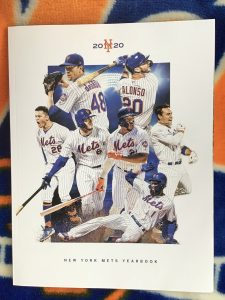 Salvation lies within? I really wanted to buy it. The desire wafted in on a breeze from 1972, the year of my first yearbook, the year before I first went to Shea, so I had to send away for it, to 123-01 Roosevelt Avenue, Flushing, NY 11368. It costs quite a bit more than it did back then, but it’s not prohibitive. I pick one up every year at Citi Field even though there is less and less content worth ponying up for. I leaf through it on the train ride home. I leaf through it a couple of more times once I get home. Then it lands on my pile of checked boxes. Like playing those teams from the other divisions, having the yearbook is just something that makes a season complete.
My 2020 yearbook came to me, just like the Mets said it would. It still has no content worth savoring. Some nice four-color photography, as Bob Murphy might have touted, including from early in the 2020 season (a.k.a. late July). No text beyond the basics. No special sections commemorating anything. Just pretty pictures and compulsory corporate cheerfulness.
This I savored. I savored having it in my hands. It had been accessible via download for a while, but leafing through it on an iPad wasn’t the same. That was just more distance. This was something to have and hold. This was the Mets in one bound volume, like the Mets of any year. Sometimes you just want something tangible to remind you that something is or was real. True, there were players featured who barely existed in the present tense, players I’d all but forgotten since summer turned to fall. Brian Dozier had a page. So did Eduardo Nuñez. And what piece of official Mets propaganda would be complete without a straight-faced salute to Jed Lowrie?
They were all there, and I was happy to see them where they belonged.
Knock scientific wood, we’ll get through the pandemic. We’ll get a vaccine, we’ll get inoculated, we’ll cease being so careful of getting in each other’s way and maybe we’ll get out to the old ballpark. Of the many items on Steve Cohen’s punch list, I hope, is the elimination of the stupid rule about bringing in backpacks or any bag remotely considered a backpack. It should be way down his list, but now that Trevor May has been signed, maybe bag policy climbs a notch. (My brief scouting report on Trevor May: he’s just a couple of smart moves away from being an anagram for Mayor’s Trophy.)
I’d all but forgotten that I had to adjust my routine in 2019, that I couldn’t carry my schlep bag, that I had to dig out a tote bag instead. It occurred to me during what little 2020 season there was that I wasn’t certain where my game tote bag was. Surely it was under a pile of stuff — and it was — but even once I found it, would I remember that I was supposed to take it with me the next game I go to? Would I remember how to go to a game? The getting on a train, the getting off a train, repeating the process until it got me to what is now called 41 Seaver Way, the approaching the entrance, the stiffening up prior to being searched (get rid of that, too, Steve).
Can you imagine, in 2021, going out to a game? Going out to a Mets game? Being that close to the Mets and Mets fans again so soon?
I’m still working on it.
FAITH AND FEAR’S PREVIOUS NIKON CAMERA PLAYERS OF THE YEAR
1980: The Magic*
2005: The WFAN broadcast team of Gary Cohen and Howie Rose
2006: Shea Stadium
2007: Uncertainty
2008: The 162-Game Schedule
2009: Two Hands
2010: Realization
2011: Commitment
2012: No-Hitter Nomenclature
2013: Harvey Days
2014: The Dudafly Effect
2015: Precedent — Or The Lack Thereof
2016: The Home Run
2017: The Disabled List
2018: The Last Days of David Wright
2019: Our Kids
*Manufacturers Hanover Trust Player of the Year
|
|