The blog for Mets fans
who like to read
ABOUT US

Faith and Fear in Flushing made its debut on Feb. 16, 2005, the brainchild of two longtime friends and lifelong Met fans.
Greg Prince discovered the Mets when he was 6, during the magical summer of 1969. He is a Long Island-based writer, editor and communications consultant. Contact him here.
Jason Fry is a Brooklyn writer whose first memories include his mom leaping up and down cheering for Rusty Staub. Check out his other writing here.
Got something to say? Leave a comment, or email us at faithandfear@gmail.com. (Sorry, but we have no interest in ads, sponsored content or guest posts.)
Need our RSS feed? It's here.
Visit our Facebook page, or drop by the personal pages for Greg and Jason.
Or follow us on Twitter: Here's Greg, and here's Jason.
|
by Jason Fry on 29 March 2025 9:00 am Friday night’s game ended with the sweetest of words. Am I referring to “Mets win” or to “put it in the books?” To quote the tyke from the Internet meme, “Why not both?”
On Thursday the Mets did a lot of things right — hitters refused to expand the strike zone and heretofore suspect relievers pitched with conviction — with the nagging exception of winning the game, as some mean-spirited person ripped out the storybook ending and replaced it with a picture of a sad trombone and a blatted note.
On Friday they once again did a lot of things right, and this time it worked out. The hitters were selective again — Pete Alonso in particular has kept his aggression channeled, avoiding the panicky, I ALONE CAN FIX IT ABs he too often falls prey to. Juan Soto looks, well, Sotoesque, which is wonderful to see up close on a nightly basis. I love the way his plate appearances become these odd running conversations in which he seems to be workshopping his approach with the umpire, the catcher and the hitting coach in his head — and I was predictably overjoyed when Soto hit his first Mets home run, an easy-power line drive off the facing of the right-field deck. That extended a 2-0 Mets lead built with the help of some Houston infield slapstick to 3-0, which didn’t feel like enough but was obviously better than looking uphill all Thursday evening.
On the pitching side, at least for one night Tylor Megill looked like the Tylor Megill that the sabermetrically inclined keep insisting is in there somewhere. Megill trusted his stuff and went after the Astros lineup, keeping his pitch count manageable. It looked like the wheels might come off in the fourth, when Jose Altuve and Isaac Paredes singled to bring up Yordan Alvarez with nobody out. But Megill got Alvarez to fly out to center (a sac fly but nothing more), then struck out Christian Walker and Yainer Diaz with sliders at the bottom of the zone.
That was the kind of inning I was used to seeing get away from Megill — too much nibbling, too little conviction, a mounting pitch count, a ball with too much plate, a dejected trudge off the mound. Not this time — and Megill then navigated the fifth with minimal fuss and deserved better in the sixth. He fanned Jake Meyers to start the inning but watched Meyers scamper to first when the ball kicked off Luis Torrens‘ glove, then got a ground ball from Altuve only to see it elude Francisco Lindor. A little better luck and Megill might have been looking at completing six; instead he had to watch from the dugout as Reed Garrett took over with the game hanging the balance.
Garrett was up to the task, bedeviling the Astros with sinkers, sliders and sweepers to keep the lead at two. “REED FUCKING GARRETT!” I yelled as Garrett marched off the mound, looking like he was yelling something similar.
The Apple TV+ broadcasts aren’t my favorite — the churning probabilities are witless clutter, the fonts all feel too small, and the general feeling is that you’re trapped in some sort of baseball-adjacent app instead of a broadcast. But I do marvel at the fact that you can sync up the picture with either team’s radio feed. That’s a genuine kindness offered to fans, and it actually works — which I mean not in the sense of “the world is so terrible that I’m amazed something functions” but in the sense of “syncing feeds like that sounds super-difficult and the result is flawless, how did they do that?”
Howie Rose and Keith Raad were particularly welcome company because the torpor of spring training had tricked me into forgetting how stressful this all is. First I was barking at Garrett, then I was barking at A.J. Minter (who will probably look out of uniform until late May), then I was barking at Ryne Stanek, and then I was encouraging Edwin Diaz with dread perilously close to the surface, which is a fancy way of saying I was barking at him too. At several points during the barkfest I thought to myself, “My God, it isn’t even April yet.” Like the ad says, ask your doctor if your heart is healthy enough for Mets.
An eye doctor might have been useful too, as the kindest thing one can say about Rob Drake’s strike zone is that it was equitably random. Anything on the outer edge or the bottom border of the strike zone was a coin flip, sometimes not even consistent within at at-bat, but roughly equal numbers of guys in Mets uniforms and Astros uniforms wound up rolling their eyes or huffing in disbelief, so it was more farce than tragedy.
Speaking of uniforms, I hate the Mets’ new road togs. The Mets’ away uniform was both iconic and had a lengthy history; the replacement looks like a knockoff you’d find on Canal Street. The little racing stripes are unnecessary and half-hearted, calling to mind the elusive glories of the de Roulet era, and NEW YORK looks floaty and adrift without the yoke of piping to anchor it. There was no reason to futz with something that worked so beautifully, which I’d thought was something the current regime understood.
Still, win enough games in the new grays and I’ll forgive the unnecessary tinkering. The Mets did that — Diaz was even refreshingly non-terrifying in working a 1-2-3 ninth — and that’s something I could get used to.
by Greg Prince on 28 March 2025 12:14 pm The Mets played to five ties in Spring Training. You can’t do that in the regular season, eight long-ago curfew/rain-related exceptions to the rule notwithstanding,. Therefore, Opening Day 2025 was going to be either a win or a loss, meaning we were bound to process it, in very basic terms, as good or bad.
Loss equals bad, so there ya go. But if you like nuance, it wasn’t that bad. True, a 3-1 loss in the Mets’ first road Opener in an American League park since 2016 — Kansas City, also a loss — isn’t good. Oh-and-one as a record isn’t good. Anticipation resulting in regret isn’t good. Hard to fill the glass to half-full when you’re pouring all factors considered.
But we almost won. That sounds like something you say on behalf of a team that didn’t sign Juan Soto to a record-breaking contract, but the top of the ninth, when one more wave of anticipation built, veered toward pretty good for March 27. The Mets’ offense taking on Framber Valdez was mostly dead all day, if not as dead as on Opening Day from a year earlier (we were one-hit at home). We loaded the bases in the eighth and scored nothing, and that was pretty much our biggest threat to that point.
The ninth, though, felt like the Mets team we loved last September and October, the one we looked forward to through Spring. Versus the accomplished Josh Hader, Starling Marte leads off with a single and Tyrone Taylor follows with the same. Second baseman Luisangel Acuña is up. Acuña as the Opening Day second baseman was a bit of a surprise, as 24 hours earlier it wasn’t clear he’d make the roster. Then again, the alternative, Brett Baty, wasn’t a second baseman a year ago, so either way, it’s not quite how things were being drawn up in Metsopotamian heads. Also, Acuña stood out in the course of the game as the fielder who threw a double play ball past the reach of Pete Alonso for one of the Astros’ three runs. It wasn’t exactly the differencemaker — the Mets had scored none — but it wasn’t inspiring.
What was inspiring was the plate appearance Luisangel proceeded to have against Hader: a dozen pitches, six foul-offs, and, ultimately, four balls. The kid looked like he did when he was brought up to fill in down the stretch last year. He looked like he belonged.
This is where the glass began to approach the half-full mark in earnest. Clay Holmes did not constitute a great advertisement for reliever conversion (he lasted four-and-two-thirds), and there had been a certain crispness lacking all day, but here we were. Bases loaded, nobody out, and any of the next three batters could write a storybook next sentence.
The first didn’t seem likely, but did it seem likely that Hayden Senger would be playing on Opening Day in the major leagues? This is the guy who’s been in the Met system since 2018 and has never exactly hit for much. He was in because Carlos Mendoza opted to shoot his shot pinch-hitting for Luis Torrens with Jesse Winker to lead off the eighth (which didn’t work). All the bench had left was Baty and Jose Siri, neither of them a catcher and, to be fair, neither of them Rusty Staub. Senger versus Hader? As long as he doesn’t hit into a double play, you’ll take your chances.
Senger struck out. Not totally unexpected, and not the worst outcome, because the lineup turns over, and it’s the non-Ohtani MVP of the National League up, Francisco Lindor. Hand Francisco the pen. Any next sentence that includes Lindor is promising.
Sure enough, Francisco drives one to center. Francisco driving one to center has meant some marvelous turns of events in recent memory. A drive to center effectively clinched a playoff berth in Atlanta. Another, a little to right-center, more or less won a playoff series at Citi Field. This drive to center was a flyout, good enough only to push Marte home and Taylor to third. That meant one run, but two outs.
That also meant Juan Soto was coming up with two men on. Soto’s Met debut thus far had been fruitful if not impactful. One single. Two walks. No runs facilitated, but you could say that about every Met batter prior to the ninth. This was a pivot point, however. Not for fifteen years. Just for Opening Day.
Hader had been on the ropes through five batters and twenty-nine pitches. Even Senger didn’t make it very easy on the Astro closer. He seemed gettable, and who better to do the getting than Soto? Sure enough, Juan worked a two-and-oh count, which ascended to three-and-two. What were the odds Hader could sneak something past Soto and end the game?
I imagine one of those gambling apps would have told me in advance. I wouldn’t have bet against Juan, though if I had, I would have collected. Hader threw a slider that tailed away from the plate. Juan guessed wrong on it and swung in desperation. No go. Strike three. Ballgame. Ouch.
Only so much ouch. It was just one game. True, it was the only game we’ve had all year, so the 0-1 record didn’t sit well as I attempted to digest it and dinner. But Juan will get more cracks and probably prevail plenty in comparably deep at-bats. And Holmes wasn’t so out of his element that I don’t believe he’s miscast as a starting pitcher. And hey, how about Huascar Brazoban coming in and shutting down the Astros for two-and-a-third? He wasn’t guaranteed a spot in the bullpen, yet he, along with Danny Young, kept the game viable post-Holmes. And that Acuña time up really was a sight to behold.
Mix in the reasonable conclusion that the Mets won’t post an ohfer with runners in scoring position into perpetuity nor leave ten runners on base for every one they score, and you have to be almost satisfied that the Mets almost came back. And did we mention it’s baseball season again? And that the new road togs looked sharp? It is and they did.
The glass came ever so close to topping the half-full line. Another chance awaits to fill it to brimming.
by Greg Prince on 27 March 2025 1:53 pm It was 34 degrees this morning in New York because it’s March 27, and on March 27, about a week beyond winter, you’re as likely as not to get a very chilly morning. Days with mornings with that low a temperature don’t exactly scream baseball weather.
But the Mets were in Florida for a month-and-a-half (where they compiled an identical number of wins and losses, which seems to be the proper way to handle Spring Training) and now are in Houston, where there’s a retractable roof. So play ball on March 27. And March 28. And so on and so on until the weather is uniformly chilly again, sometime in the heart of fall.
Welcome to the dawn of a new season, even if new seasons oughta start in April. A lot of traditional baseball oughtas get flattened by progress’s army of steamrollers and erased like a blackboard. Houston used to be in the National League, and maybe still oughta. We didn’t used to open seasons let alone play in the regular season versus American League teams, and probably still shouldn’t oughta. No need coming back to the pox on strategy that remains the designated hitter, a quasi-position that spread to the NL for good in 2022 and isn’t going away. “Baseball has marked the time,” Terence Mann declared in Field of Dreams. The time is March 27.
Too soon? Probably. Glad to greet it today? Absolutely.
March 27 marks the 32nd birthday of the Mets’ Opening Day starting pitcher, Clay Holmes. Clay Holmes is starting on Opening Day? I used to get hung up on who takes the ball on Opening Day because Tom Seaver takes the ball on Opening Day, and if you don’t have him, Dwight Gooden takes the ball on Opening Day. This Opening Day, the hill is manned by the former closer of a team from another league, someone who’s never been a Met or an ace before. Blasphemy? The Mets’ rotation isn’t deep enough for standing on ceremony. Holmes looked good in Spring and was deployed so his birthday would be his throw day and, besides, starting pitchers don’t go that deep most days, so what the hell? Have a happy birthday, Clay Holmes. Give us five or six innings we can celebrate.
It is also Brandon Nimmo’s 32nd birthday. As soon as Brandon steps into the box score, he reaches the baseline qualification for Hall of Fame consideration. This season is Nimmo’s tenth in the big leagues. That should rate more of a “wow!” than I’m willing to give it. I feel we’ve watched Brandon age in real time, which is to say for a while he was a very young player, then he was a player who was still young but had gained experience, and now he’s a solid veteran in the solid prime of his solid career. We are predisposed to love a lifetime Met. That’s what Brandon has been and will hopefully remain without pause.
Prior to David Wright, Eddie Kranepool was our primary example of a lifetime Met. Came up with us. Stayed with us. Never played for anybody but us. Plus he was Eddie Kranepool. We lost Eddie last September. Given his eighteen seasons — which included an Opening Day start in right field at the age of 18 on April 9, 1963, at the Polo Grounds, along with six more at first base spanning 1965 to 1977 — our memories of the Krane should and will live on without much prompting. A sleeve patch affixed to our jerseys will underscore for us Eddie’s eternal Met presence in 2025. A check of Baseball-Reference reminds us Eddie was usually ready for the season to start every season, whether he was starting or not. Mr. Kranepool, from the year he was a veritable kid to the last year he played as a grizzled vet, in 1979, batted .295 in April, his best month hitting. He didn’t have any at-bats in March. Baseball didn’t commence so early back then.
 Since last summer, which was winding down when we said goodbye to Ed — having already bid adieu in 2024 to Bud Harrelson, Jim McAndrew, Pat Zachry, Jerry Grote, and Willie Mays — too many other Mets have passed away. They won’t get patches, because sleeve space is limited, but let’s remember them for a moment. Since last summer, which was winding down when we said goodbye to Ed — having already bid adieu in 2024 to Bud Harrelson, Jim McAndrew, Pat Zachry, Jerry Grote, and Willie Mays — too many other Mets have passed away. They won’t get patches, because sleeve space is limited, but let’s remember them for a moment.
Wayne Graham, our infielder from 1964 who went on to a long and distinguished college coaching career at Rice University (one of his charges was eventual Met Phil Humber);
Ron Locke, who pitched for us in 1964, something I learned when I picked up his 1965 baseball card in 1975 at the first baseball card show I ever attended;
Jack DiLauro, whose contribution to the 1969 Mets I wouldn’t have known about from the front of the 1970 baseball card I pulled from a pack as a kid because he’d been traded over the winter and his cap was blank (I had to flip it over to grasp he’d been one of ours);
Bob Gallagher, the 1975 Met outfielder who we received in exchange for another Miracle man, Ken Boswell;
Lenny Randle, one of the few Met reasons to have felt good about 1977;
Mark Bradley, the toolsy 1983 Mets outfielder who holds the distinction of being the first Met I ever photographed with my own camera, on a rainy Saturday afternoon in St. Petersburg (the game was cancelled, but I know I have the picture somewhere);
Rickey Henderson, the leadoff man of leadoff men who requires no reintroduction from his eventful days with us in 1999 and 2000 (the A’s, wherever they play now, will wear a patch in his honor);
Felix Mantilla, who lasted all of 1962 as an Original Met and ninety years in all;
Tommie Reynolds, an infielder-outfielder who crouched behind the plate in a classic and absurd emergency catcher situation in 1967;
Mike Cubbage, a Met player for one season, in 1981 (he homered for us in his final MLB AB), a Met coach under five different dugout administrations, and about as interim as an interim manager could be, steering the ship home for the final week of 1991 before returning to assisting;
and Jeff Torborg, a well-regarded baseball man whose best work probably wasn’t as Met manager in 1992 and 1993, but when he passed, I read nothing but kind words from those who knew him, so maybe it just wasn’t the right fit here.
Going back prior to last summer, in May, Bill Murphy, referred to in his playing days as Billy, passed on. Murphy was a Rule 5 player who stuck through 1966 in order for the Mets to hold on to him. I began to research his story and found some fascinating threads, but never got around to weaving them together. I hope to give Bill his due before long.
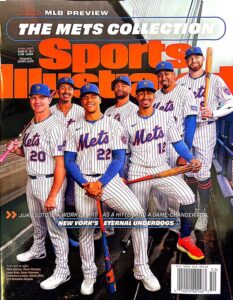
For now, thanks to all the Mets who’ve come before, a sum that measured 1,252 overall (Ashburn to Acuña) through 2024. The all-time quantity can increase by as many as seven while the Mets are in Houston, as the first 26-man roster of 2025 includes Holmes; similarly reoptimized starter Griffin Canning; backup catcher/Whole Foods utilityman Hayden Senger; childhood Mets fan who grew up to relieve for his favorite team Max Kranick; defensive whiz and pun waiting to be run into the ground Jose Siri; former division rival A.J. Minter; and somebody named Juan Soto. More will emerge, but these are the half-dozen poised to make their Met debuts late this March, and I look forward to welcoming them. Especially that Soto fellow.
Fitting enough we’re packing seven potential first-time Mets in Houston as this is the first Opening Day that has pitted the Mets versus the Astros. One Shea Home Opener (2005, this blog’s first April and that ballpark’s fourth-from-last), but nothing that led off a season. We each began life as expansion franchises in the same April, but not only have we never been until now each other’s first opponent, we’ve competed against one another in a season’s first week only six times, no such series more recent than 1994. In 1968, in our fifth game of the year, we and they did play 24 innings. The Astros scored once, the Mets not at all; the 1968 Mets lacked the equivalent of Lindor, Soto, Alonso, Nimmo, and Vientos to get things going on the offensive foot. Drop that crew into 1968, and it might not have become known as The Year of the Pitcher…at least in theory.
 All that has been theoretical about this club leading into 2025 is about to turn actual. All the excitement a lot of us have been feeling is about to be put on the line. I’ve been up for other seasons to start — all of them, really — but this one has a legit April-in-March sense to it. Like it really couldn’t wait another day. Good thing it’s arriving when it is. All that has been theoretical about this club leading into 2025 is about to turn actual. All the excitement a lot of us have been feeling is about to be put on the line. I’ve been up for other seasons to start — all of them, really — but this one has a legit April-in-March sense to it. Like it really couldn’t wait another day. Good thing it’s arriving when it is.
by Greg Prince on 24 March 2025 6:24 pm Baseball seasons run only so many games and so many months long. Yet if you’re lucky, they last forever. Also, if you’re a little unlucky after the fact, they stick around without a peer emerging to join them where you left them. The season that lands at No. 3 among MY FAVORITE SEASONS, FROM LEAST FAVORITE TO MOST FAVORITE, 1969-PRESENT but surely gave me my hands-down favorite result did its best to set itself apart from anything that could have come after it. As far as I’m concerned, it’s done everything it’s had to do since its moment in the spotlight, even if it’s had to carry on with a status we never dreamed it would maintain for decades.
When it was coming along, we had dreamed only of the season it would give us when it was giving it to us. Boy, did it deliver.
3. 1986
It’s late one morning in May. I look up at a clock. It’s around 11:30. All I can think is, “Eight hours until the Mets game tonight.”
That was 1986 to me while it was going on. Watching the clock and waiting for the Mets equaled winning time. It occurs to me I didn’t have a lot else going on in my life that didn’t involve counting down to tonight’s game. It wasn’t an ideal route to personal fulfillment, waiting on a team of total strangers to report to work and make me ebullient, but I have no baseball-related regrets. I couldn’t stand for time to stand still because I wanted the game to get here. When the game got here, the Mets would probably win it, and by probably, I mean almost certainly. Once that game was won, I wanted another. The hours between wins dragged because the hours while the games were being won were, per the recording talents of George Foster, Metsmerizing.
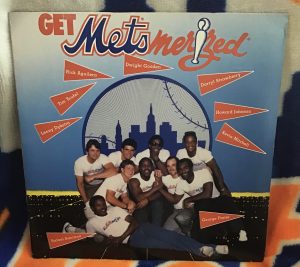 With hindsight, maybe we’d appreciate those hours dragging. Don’t go away so quickly, season that had no Met precedent and has produced no worthy Met successor! What Mets fan wouldn’t want to continue living inside the baseball world that was 1986? If every season could be 1986, I wouldn’t argue with the outcome. But every season can’t be 1986. It would be too much to ask, maybe too much to take. Besides, how would you be able to differentiate it from all the other seasons? With hindsight, maybe we’d appreciate those hours dragging. Don’t go away so quickly, season that had no Met precedent and has produced no worthy Met successor! What Mets fan wouldn’t want to continue living inside the baseball world that was 1986? If every season could be 1986, I wouldn’t argue with the outcome. But every season can’t be 1986. It would be too much to ask, maybe too much to take. Besides, how would you be able to differentiate it from all the other seasons?
In the great flight of Mets history, nothing else looks like 1986, and nothing else competes with 1986. That the Mets were celebrating their 25th anniversary all year brought the poles into stark relief (the kind Casey Stengel was usually saddled with in 1962 as soon he removed his starting pitcher). The full Met CV —108 regular-season wins; a divisional margin of 21½ games beyond any rival’s reach; an NLCS that couldn’t have been tighter for six games (but we won four of ’em); and a World Series that teetered on defeat but literally couldn’t be lost — has no remotely Metropolitan doppelgänger. There have been occasional subsequent invigorating roughshod rides through spring and summer that ultimately sagged in fall. There had been one previous world championship, but consensus pegs that one as a surprise for the ages, maybe the surprise for all ages. The 1986 Mets’ final acts versus Houston and Boston would have fit neatly in any highlight reel produced in miraculous 1969 or nearly as unbelievable 1973, but where they led was no stunner once you remembered these were the 1986 Mets. The 1986 Mets existed to win everything in sight, to take care of business like nobody’s business, with dominance and prominence, to say nothing of verve and panache.
That they did. Every day had you sneaking peeks at nearby clocks in anticipation. Looking forward to first pitches and last outs was how we lived. The Mets we rooted for were far and away the team in baseball. It took a little while to sink in that this was us. Eventually, we stopped pinching ourselves.
Yeah, we had a team like that once. Just once. Requesting another world championship after nearly forty years doesn’t seem greedy, but I doubt there can ever be another 1986 in this lifetime. My lifetime has encompassed one 1986. It oughta sate me. It makes me want a sequel. Sequels rarely measure up to the original, but I’d be willing to try another year like it on for size.
I wish us good luck casting the parts.
PART I — BECOMING THE 1986 METS IN 1986
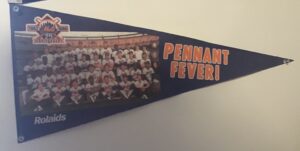
Taking the long view, you’re usually safe starting with January 24, 1980, and the sale of the downtrodden Metropolitan Baseball Club of New York, Inc., to Doubleday & Company, fronted by Abner Doubleday descendant Nelson Doubleday, with Fred Wilpon on board holding a minority stake. They talk about reviving National League baseball in New York. They are greeted as liberators. They hire Frank Cashen, the GM in Baltimore from when they were a powerhouse (except for a five-game series in October of 1969), and Cashen goes to work. It doesn’t show in the standings for several seasons, but the farm system gets replenished. It begins to bloom. The crops are transported to New York. A manager from the Met minor leagues — also with Oriole pedigree — is promoted. Davey Johnson leads a young, talented team that has been augmented by a couple of imported superstars out of the utter wilderness and into serious contention. As 1986 arrives, the Mets are pretty much right there to greet it and grab it.
Taking the granular view, I’d say the 1986 Mets began to reveal they had become The 1986 Mets in boldface type on the dreary Monday evening of April 21, a rainy night in Flushing when paid attendance for the game against the Pirates (in those days actual turnstile count) was the lowest it would be all year. It was also the last time the Mets would enter action behind Pittsburgh in the NL East. Not that that was the yardstick anybody planned on using to measure 1986. Still, the Buccos, otherwise experiencing their own franchise doldrums, were 6-2. The Mets were 5-3. The Mets had been 2-3. Won their first two. Lost their next three. In retrospect, the first week of the season was the opening minutes of a first-round high-seed/low-seed March Madness matchup. The high seed comes out cold. The low seed hits a few baskets. Fans of the true blue blood programs understand there’s a long way to go in this game, not to mention tournament. Just give it a few more minutes.
Orange and blue blood didn’t necessarily circulate to our brains that way. Every game was precious. Every opponent was dangerous. The Pirates? The Pirates, coming off 104 losses the year before, had taken eight of eighteen from us, including three of six in September when us winning every game was imperative. We had built a one-game lead on St. Louis on September 12 after we bested them two out of three at Shea, yet finished three games in back of them. Down the stretch in 1985, the Cardinals dusted their cursed red feathers off and returned to winning. We futzed around and found out that you had to beat the Pirates and Cubs and Expos and Phillies, too. Gathering even a touch of panic at the idea of being 2-3 on April 14, or feeling a scintilla of anxiety that we were sitting in back of Pittsburgh starting play on April 21, required no hindsight to negate. Of course it was silly.
Or was it? We hadn’t learned how not to be nervous yet. Examining our roster and simply relaxing didn’t come easily. Not after coming close in 1984 and coming even closer in 1985. April wasn’t only close to March. It still carried the whiff of the near-misses of the previous two years. A certain strain of Mets madness infiltrated April’s air.
Then, on April 21, the Mets pulled into a second-place tie with the Pirates. Again, not the goal of the season whose competitive contours were still gestating, but significant for how we got there. The Mets trailed, 2-0, after a half-inning; 4-2 in the middle of the eighth; and 5-4 heading to the bottom of the ninth. Two comebacks, each on two-run homers off the scalding bats of demonstrative teammates — Gary Carter (.351) in the third, Ray Knight (.391) in the eighth — were poised to go to waste. Or would have in another year.
This wasn’t another year. This was 1986. This was Lenny Dykstra singling to lead off the home ninth, Kevin Mitchell bunting him to second, Tim Teufel doubling Dykstra home to tie the score at five apiece, and, within two batters, Carter driving home Teufel. Mets win, 6-5, in their first walkoff triumph of the young year. Now tied with Pittsburgh in the standings, the Mets would sweep the two-game set the next night; the season series versus Pittsburgh would turn out Mets 17 Pirates 1. No more futzing around. The Mets were on a five-game wining streak. An off day Wednesday, combined with a Cardinal loss, allowed us to nose into first place all by ourselves as we alighted at Busch Stadium for four critical games, Thursday through Sunday. Critical? In April? After last October, and our winning only two of three when we required one more in St. Louis in that season’s penultimate series, yes.
By the end of Sunday the 27th, once ex-Met Clint Hurdle lofted the last of new Met Bobby Ojeda’s pitches into star Met Darryl Strawberry’s glove, the Mets completed confirming they were The 1986 Mets. It hadn’t been a week since we trailed the Pirates, but now we led the team we had to lead by four-and-a-half games. We swept the Cardinals. I mean, we swept the hell out of the Cardinals. Thursday’s affair was another “nope, not this year”-style comeback, featuring Howard Johnson’s game-tying two-run homer off Todd Worrell in the ninth. Friday’s game was a pure whitewashing, Doc Gooden going the distance in a 9-0 breeze. Saturday’s game ended in one of those ninths that didn’t get away, with a 4-0 first-inning lead staying undisturbed until the final inning, when an eerily familiar Cardinal rally (three singles, one double and a sac bunt) fell short as Wally Backman turned the clutchest of 4-6-3 DPs. And Sunday’s game was the kind of coup de grâce that The 1986 Mets were honing into their specialty. Ojeda, picked up in an offseason trade we had no idea would bring us our winningest pitcher, threw a complete game. Rookie outfielder-third baseman Kevin Mitchell filled in at shortstop because Davey decided he could play it just fine. Mitchell homered, as did Teufel, the righthanded second baseman the Mets lacked in 1985 (Backman could do everything you wanted except handle lefties). These three added to Doc and Darryl and Keith and Gary and everybody else? The Mets were clearly improved. The Cardinals were clearly done.
The Mets left Missouri on a nine-game winning streak that grew to eleven. After a lone loss in Atlanta, they won another seven straight. The 2-3 Mets of April 14 morphed into the 20-4 Mets of May 10, a top seed turning all prospective NL East Cinderellas into pumpkins. Nobody in the division loomed as very concerning. Now and then, the Expos would present a theoretical obstacle — they drew as close as 2½ out on a West Coast afternoon in late May, and took two of three from us twice in June — but nothing insurmountable. We were playing from ahead in the standings from the instant we took the field in St. Louis on April 24, far ahead soon enough.
My favorite quote of the season came not from a Met, but from somebody who used to be one. In that second Expo series, at Shea, Montreal had pulled to within eight games of us after winning the first two. This was June 25, with well over a half-season remaining. The second-place Expos had their eyes on not just a sweep, but a statement. Instead, they saw a 2-0 lead in the Wednesday matinee finale turn into 5-2 loss. Instead of making up enough ground to get to within seven games of the Mets, they had fallen back to nine.
“Nine out is so damn close to ten,” their shortstop Hubie Brooks admitted after the loss. “Seven out is so damn close to five. I think we did good, but it’s too bad we couldn’t be better than nine out.”
 I read that and thought, that’s it. That’s the concession speech. The Mets had played 68 of 162 games, and they had essentially clinched their division. To celebrate, they built a new eight-game winning streak. I guess this is where the Mets left zero doubt about being The 1986 Mets. Microspells of not stomping on opponents were capable of raising Mets fan eyebrows, because, well, our eyebrows hovered over eyes that had seen first-place Met clubs not finish on top in ’84 and ’85. You didn’t fully shake off your tendency to doubt, because you lived the previous years. I read that and thought, that’s it. That’s the concession speech. The Mets had played 68 of 162 games, and they had essentially clinched their division. To celebrate, they built a new eight-game winning streak. I guess this is where the Mets left zero doubt about being The 1986 Mets. Microspells of not stomping on opponents were capable of raising Mets fan eyebrows, because, well, our eyebrows hovered over eyes that had seen first-place Met clubs not finish on top in ’84 and ’85. You didn’t fully shake off your tendency to doubt, because you lived the previous years.
But, really, you didn’t have any doubt.
PART II — BEING THE 1986 METS IN 1986
The above is the on-field stuff. The substance. What separates The 1986 Mets in the mind’s eye is the flair. The fights. The twelve-inch dance mixes. The video productions. The curtain calls. The high-fives that would send the hands of mere mortals flying into Field Level. The aura. The top of the order. The heart of the order. The bench. The rotation. The back end of the bullpen. The speed. The power. The savvy. The rally caps. The hot foots/feet. The woman in the wedding dress brandishing a MARRY ME LENNY placard in the stands. The women and everything else we didn’t know about until the books and the documentaries came out much later. The best action in any sport being analyzed by the brightest mind in any booth, Tim McCarver’s. Ralph Kiner was in fine fettle, too, and Steve Zabriskie provided understated balance to McCarver’s brilliance and Kiner’s gleam. Bob Murphy was atop his game on WHN, paired with a worthy partner in Gary Thorne. Sure, some nights you had to put up with Fran Healy on Sportschannel, and no, they never did rustle up a dependable lefty specialist. Honestly, though, if those are your biggest problems, you don’t have problems.
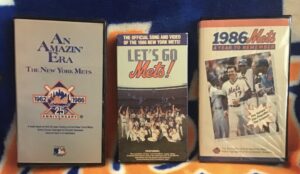 I suppose the rest of the league didn’t love how the Mets took one game at a time and framed each as museum-quality. The 1986 Mets really loved being as good as they were. They didn’t act as if they’d been there before. Keith Hernandez had been to the mountaintop, as a Cardinal in 1982. Mex’s intensity was different from Kid’s; Carter blew the roof off open-air stadia with his exultations. Nobody besides Keith had won a World Series. These guys were all hungry to be the best and didn’t mind reveling in their status as the provisional kings of any mountain they scaled. It was infectious from a distance. We hadn’t made the playoffs in thirteen years. We had never carried around baseball’s best record or biggest lead day after day, week after week. They were excited? We were excited! I suppose the rest of the league didn’t love how the Mets took one game at a time and framed each as museum-quality. The 1986 Mets really loved being as good as they were. They didn’t act as if they’d been there before. Keith Hernandez had been to the mountaintop, as a Cardinal in 1982. Mex’s intensity was different from Kid’s; Carter blew the roof off open-air stadia with his exultations. Nobody besides Keith had won a World Series. These guys were all hungry to be the best and didn’t mind reveling in their status as the provisional kings of any mountain they scaled. It was infectious from a distance. We hadn’t made the playoffs in thirteen years. We had never carried around baseball’s best record or biggest lead day after day, week after week. They were excited? We were excited!
Put another way, we had the teamwork to make the dream work.
Dissent could be discernible from an odd corner or two. For example, New York’s leading aficionado of underdogs Jimmy Breslin, who helped make the Original Mets as famous as could be for chronic failure via Can’t Anybody Here Play This Game?, registered a vote of protest against The 1986 Mets’ rampaging success. “[T]his year,” Breslin wrote in the News in August, “with the Mets winning so many games, it is embarrassing, for they resemble the old Yankees.” A month later, as the Mets closed in on their inevitable mathematical clinching, he expounded on the theme:
“When I sit alone, of course, I fanatically root for the Mets to lose. What do I need with a boring winner, with a first baseman, Hernandez, whom I don’t like personally but who can field the bunt and start a double play by throwing the lead runner out at third. My sports love still is the 1962 Mets, who lost 120 games, and who had as a first baseman, Marvin Throneberry. I still could see Throneberry in my mind on Friday night, Marvin Throneberry bent over, glove ready, eagerly looking at a ground ball, his mouth wide open, ready to bite the ball if it took a hop, eagerly watching, watching, watching as the ground ball went under his glove and through his legs and into right field.”
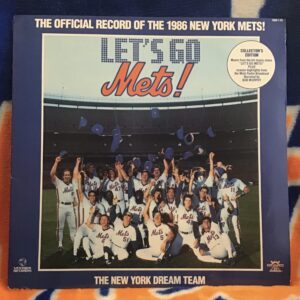 Mass huzzahs for the modern-day Mets ensued despite the columnist’s protestations. In the making-of video that accompanied the music video the Mets made in tribute to their awesomeness (because how else were you going to know the video had been made?), perhaps a member of Twisted Sister who wasn’t Dee Snider put it best: “Isn’t it nice to turn on the television and not have to worry that they may lose this evening — they’re still twenty games ahead! Think about that, they’re twenty games ahead, even if they lose once in a while. That’s what you call luxury! That’s almost as good as having a rent control apartment in Manhattan.” Mass huzzahs for the modern-day Mets ensued despite the columnist’s protestations. In the making-of video that accompanied the music video the Mets made in tribute to their awesomeness (because how else were you going to know the video had been made?), perhaps a member of Twisted Sister who wasn’t Dee Snider put it best: “Isn’t it nice to turn on the television and not have to worry that they may lose this evening — they’re still twenty games ahead! Think about that, they’re twenty games ahead, even if they lose once in a while. That’s what you call luxury! That’s almost as good as having a rent control apartment in Manhattan.”
Let’s Go Mets Go, indeed.
PART III — STAYING THE 1986 METS IN 1986
One-hundred eight wins weren’t going to amount to a pitcher’s mound of beans if The 1986 Mets didn’t deliver in October. I don’t live in a world where they didn’t beat the Astros or the Red Sox, so I don’t know how I’d look back on them had they not brushed aside the best efforts of Bob Knepper and Dave Smith in Game Three of the National League Championship Series; or if Darryl Strawberry hadn’t connected off Nolan Ryan in Game Five, leading eventually to Gary Carter avenging Charlie Kerfeld in the twelfth inning; or if they hadn’t won…deep breath…Game Six. Ohmigod, Game Six. Ohmigod, and I don’t mean OMG. If anybody thought the Mets made 1986 look too easy for six months, Game Six in the Astrodome, culminating in a 7-6 win in sixteen innings and, oh yes, the National League pennant, reminded one and all that this team constantly created laurels rather than sat on them.
It could have gone the other way. The Astros could have held on in Game Three or Game Five or Game Six. They could have forced Game Seven, with Mike Scott on the hill, the Mets having every chance to look like fools swinging and missing at the ex-Met’s totally legitimate split-finger fastball whose movements weren’t enhanced by any foreign object, no sir. Or they could have sapped Scott of his strength and won the flag in seven. I wouldn’t have put anything past The 1986 Mets while they were being The 1986 Mets.
Not that I was pining to find out. Mets in six in the NLCS was sufficient. Bring on Boston!
Boston was brought on with a bit much velocity. The Mets endured the last of their Astrodome marathon on Wednesday, October 15. That gave them time to fly home (while tearing apart their airplane), rest up, work out, and, apparently, not be ready to play optimal ball on Saturday, October 18. Ron Darling pitched swell in Game One of the World Series. Bruce Hurst was a little sweller and won, 1-0. The next night, the hyped Dwight Gooden-Roger Clemens duel faltered on both ends, but faltered more for Gooden. A lot more. We lost, 9-3. Suddenly, the best team in the sport was down zero games to two in a best-of-seven situation.
What could have happened against Houston but didn’t was now in the process of happening against Boston. Then came Games Three and Four, and no frigging way was it going to happen. We won Game Three with ease (7-1), Game Four with essentially the same (6-2). Now we just had to win two out of a possible three. You’re gonna tell me we’re not gonna win two out of a possible three? That’s all we did all year. Two out of three fifty-four times in the regular season. Two out of three twice against the Astros. Hurst, the new Scott in practicality if not sandpaper, shut us down in Game Five, 4-2. So now we had to go back to Shea and win two of two. Shoot, we can win two of two.
First, however, we had to win one of one, because we trailed the World Series three games to two, meaning we faced a Game Six that literally could not be lost. Another Game Six? Didn’t we just do this in Houston? That was basically the greatest baseball game you thought you’d ever see, but it was ten days and a postseason lifetime ago. Plus, Scott or not, we’d led that series three games to two. This next Game Six had no hypothetical give to it. Could you imagine these robust, indefatigable, making-of-video-making Mets going down in six games to the Boston Red Sox? You didn’t have to imagine. It was happening in front of us for four-and-a-half innings, Red Sox 2 Mets 0, some dude parachuting from out of the sky, 24-game winner Clemens riding a no-hitter. Doubt was permissible in infinitesimal doses. We tied it in the fifth (phew!). We gave a one-run lead back in the seventh (damn!). We retied it in the eighth (yay!). We had a genuine chance to win it in the ninth, but didn’t (hmm…). We gave up two runs in the top of the tenth.
Expletive implied.
Suffice it to say, the bottom of the tenth of Game Six of the 1986 World Series took care of itself. The Red Sox led, 5-3, with two outs and no Mets on base. DiamondVision flickered discouraging word that it was all over. Yet The 1986 Mets, who’d already revealed and confirmed themselves The 1986 Mets, still maintained one out with which to play and a veritable Baseball Bugs conga line of individuals capable of making the most of a little leeway. Gary Carter singles. Kevin Mitchell singles. Ray Knight singles. A run scores. The Red Sox lead, 5-4. Mitchell is on third. Knight is on first. Former Met Calvin Schiraldi, the current Red Sox closer, is replaced by Bob Stanley, the Red Sox’ former closer. Mookie Wilson, drafted by the Mets on June 7, 1977, eight days before Tom Seaver (a current Red Sock) was traded, is up. Stanley throws a wild pitch. Mitchell dashes home. The game is tied. Knight moves up to second. Wilson continues to be up.
At this moment, within this at-bat, the World Series literally couldn’t be lost. Carter, Mitchell, Knight, Schiraldi, Stanley and perhaps catcher Rich Gedman saw to that. It had all been on a beautiful, silver platter for the Red Sox, and the Mets took it away. Maybe in the eleventh inning, the situation would change, and the Mets literally could lose. But not in the tenth.
Wilson fouled off everything until he didn’t. His fair contact — a little roller up along first, per Vin Scully — was adequate for no more than a sprinter’s chance to beat out an infield base hit. If Mookie made it to first base safely, Knight would be on third, and Howard Johnson would be up. You couldn’t ask for more than that in the nanosecond you watched Mookie’s grounder trickle.
A nanosecond later, you got more than you asked for. You got the Red Sox’ first baseman, Bill Buckner, playing the part of Jimmy Breslin’s beau ideal of a first baseman, Marv Throneberry. The ground ball went under his glove and through his legs and into right field.
Mets 6 Red Sox 5. Series tied at three. Both teams have a chance to win this thing in seven.
But the Mets are going to win it. The Red Sox sure as hell aren’t going to. They take an early 3-0 lead off Darling, and Hurst holds us scoreless through five, but we’re The 1986 Mets. Fueled particularly by that trademark Mex brand of intensity (a tide-turning two-run single off Hurst after his brother gives him the high sign from the stands), we score three in the sixth. Then, two in the seventh, with Knight socking the tiebreaking home run over the wall. Boston gets two back in the top of the eighth, and that should make us uncomfortable, but nah. The Mets add two in the bottom of the eighth to make it 8-5. Jesse Orosco is on, just as he was in Houston when brass tacks were everywhere. He barely survived an Astro onslaught under the Dome. At Shea, nobody has to threaten him to throw nothing but sliders. He’s got this. So do Carter and Hernandez and Backman and Santana and Knight and Wilson and Dykstra and Strawberry. Davey has his platoons and his hunches, but here and now, you get the feeling he has precisely who he would want on the field to win a World Series.
Not that you wouldn’t trust any of the understudies right now. Everything about The 1986 Mets was, as Billy Joel reminded us regularly as summer seeped into fall, a matter of trust. Hearn the good-natured reserve. Heep the old pro. Mazzilli in his surprise second term. Elster, fresh from the bushes, smooth in the field. Teufel, not as much of a dirt-eater as Backman at second, but absolutely the slugger who walked off the Phillies in extras with a grand slam. Mitchell, brandishing numerous gloves to go with a potent bat. HoJo, who not only mortally wounded Worrell and the Redbirds in April, but won that crazy July game in Cincinnati, the one in which, as Breslin noticed, Hernandez fielded the bunt and started a double play by throwing the lead runner out at third…which happened to be manned by Carter. Howard Johnson had three 30-30 seasons in his near future. On the days and nights Mitchell didn’t start (85 games in all), the bench included 1989’s National League MVP. Come to think of it, on the nights Dykstra didn’t start (64 games in all), it had the guy who would in 1993 place second to Barry Bonds for Most Valuable honors. Deep depth abounded just about everywhere you surveyed.
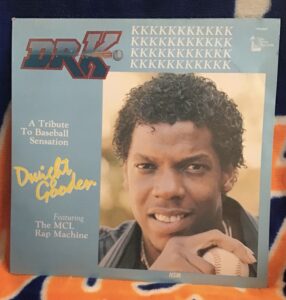 Darling (15-6) and McDowell (14-9, 22 saves) weren’t at their sharpest in this game, nor Gooden (17-6) in this series, but we wouldn’t be The 1986 Mets without any of them. And how about El Sid (16-6) holding the potentially crumbling fort in crucial middle relief? How about Ojeda (18-5) starting both Game Sixes and writing a new definition of withstand? How about Aguilera, if you allow yourself to look past the leadoff home run he allowed Dave Henderson in the tenth inning of Game Six? Aggie won ten games as the rotation’s forgotten man and kept Game Six of the NLCS scoreless for the three innings bridging Bobby O and Roger McD. How about Doug Sisk, despite the slump he sunk into in July of ’84 and seemed to come out of only intermittently? Sisk faced 312 batters in 1986 and gave up no home runs — no Met pitcher has come away from more encounters with batters in any season gopher-free. Hey, how about Randy Niemann, the personification of not the answer in lefty specializing? He did win his one start, in an August doubleheader, and Frank Cashen himself singled him out as a premier sprayer of champagne in Houston. Darling (15-6) and McDowell (14-9, 22 saves) weren’t at their sharpest in this game, nor Gooden (17-6) in this series, but we wouldn’t be The 1986 Mets without any of them. And how about El Sid (16-6) holding the potentially crumbling fort in crucial middle relief? How about Ojeda (18-5) starting both Game Sixes and writing a new definition of withstand? How about Aguilera, if you allow yourself to look past the leadoff home run he allowed Dave Henderson in the tenth inning of Game Six? Aggie won ten games as the rotation’s forgotten man and kept Game Six of the NLCS scoreless for the three innings bridging Bobby O and Roger McD. How about Doug Sisk, despite the slump he sunk into in July of ’84 and seemed to come out of only intermittently? Sisk faced 312 batters in 1986 and gave up no home runs — no Met pitcher has come away from more encounters with batters in any season gopher-free. Hey, how about Randy Niemann, the personification of not the answer in lefty specializing? He did win his one start, in an August doubleheader, and Frank Cashen himself singled him out as a premier sprayer of champagne in Houston.
These were the days of the 24-man roster. Those were the 24 men the Mets suited up for the 1986 World Series. A dozen others played in the course of the year: George Foster, who went deep thirteen times before talking himself out of town; wunderkind hitter Dave Magadan, the All About Eve story of the September 17 division-clincher; Ed Lynch, the veteran righty who didn’t make it out of April; Bruce Berenyi, the once-prized acquisition who last pitched in July, then never again in the majors; Randy Myers, John Mitchell, and Terry Leach, pitchers whose biggest moments awaited a year or more down the road; Rick Anderson, the minor league lifer who capably soaked up handfuls of innings when the need arose; Barry Lyons, the catcher who gave way to Ed Hearn as Carter’s backup (reclaiming that role come 1987 and serving the Mets honorably into 1990); John Gibbons, the catcher who backed up Hearn when Carter briefly went down in August (serving the Mets in 2025 as Carlos Mendoza’s bench coach); Stanley Jefferson, the next in what appeared a long line of fleet center fielders (serving New York later in the NYPD); and Tim Corcoran, the Keith Hernandez first base insurance policy, in case Keith served a yearlong suspension at the behest of Peter Ueberroth rather than take the deal the commissioner was offering after the Pittsburgh drug trials. Corcoran wound up playing in six games. Lynch, whose tenure dated back to the shadows of September 1980, pitched in only one before circumstances compelled him to be sent packing. In Jeff Pearlman’s The Bad Guys Won, good ol’ Ed likened it to “living with a family the whole year and getting thrown out of the house on Christmas Eve”.
They were all 1986 Mets, and we would gratefully thank each of them for being 1986 Mets if we bumped into any of them, but The 1986 Mets who manned the positions around Orosco (21 saves in the regular season, three wins in the NLCS) were exactly who you wanted to see out there as a world championship settled within our grasp late on Monday night, October 27. Carter crouching behind the plate. Hernandez, Backman, Santana, and Knight spread across the diamond. Wilson, Dykstra, and Strawberry covering the outfield. Good lord, that team really existed. Twenty-seven weeks had passed since that Monday night versus the Pirates in April. The Mets had won everything within reach for more than half-a-year. All that was left was three outs.
Ed Romero fouled out to Keith Hernandez.
Wade Boggs bounced out to Wally Backman.
Jesse Orosco struck out Marty Barrett.
Jesse Orosco’s glove flew into the air.
Gary Carter flew onto Jesse Orosco.
And that was that. The 1986 Mets had now won everything. They were world champions. Champions of the world. Winners of the World Series. World Series champions. Keep finding ways to say it. They are all accurate and wonderful.
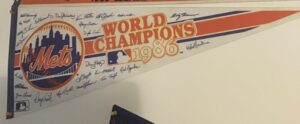 This hadn’t happened for the Mets since 1969. I was six then. It was great, but I was six. This time I was twenty-three. I knew my baseball. I knew my Mets. Not as much as I would come to know baseball or the Mets, but more than enough to appreciate and retain every bit of what was going on around me and on television. As much as I expected this to happen, and as much as I had nurtured emotional muscle memory from ’69, I was newly delirious with joy, whooping and hugging and maybe having enough sense to shed a couple of tears. Nothing quite like this had ever happened to us or me. This had been the sui generis of Met seasons, capped off as it had to be capped off. “The dream has come true,” Bob Murphy summed the scene on the radio. Exactly, Murph. The dream worked. This was our dream. Winning the World Series is everything a baseball fan hopes for, and it had just happened. It was supposed to happen after 1984 and 1985 and waiting an interminable seventeen years overall. These were The 1986 Mets. This hadn’t happened for the Mets since 1969. I was six then. It was great, but I was six. This time I was twenty-three. I knew my baseball. I knew my Mets. Not as much as I would come to know baseball or the Mets, but more than enough to appreciate and retain every bit of what was going on around me and on television. As much as I expected this to happen, and as much as I had nurtured emotional muscle memory from ’69, I was newly delirious with joy, whooping and hugging and maybe having enough sense to shed a couple of tears. Nothing quite like this had ever happened to us or me. This had been the sui generis of Met seasons, capped off as it had to be capped off. “The dream has come true,” Bob Murphy summed the scene on the radio. Exactly, Murph. The dream worked. This was our dream. Winning the World Series is everything a baseball fan hopes for, and it had just happened. It was supposed to happen after 1984 and 1985 and waiting an interminable seventeen years overall. These were The 1986 Mets.
Were? Try are. The present-tense extended for as long as they piled on one another on the field, and then sprayed bubbly one at another in the clubhouse, and then rode (sans one notable pitcher) in their downtown caravan the next day, where I couldn’t see a whole lot but could feel everything. The championship designation remained intact after the ticker-tape was cleaned up. The 1986 Mets are still champions.
Even if they can’t help that it’s not 1986 anymore.
PART IV — STAYING THE 1986 METS BEYOND 1986
Jimmy Breslin was no longer a sportswriter by 1986, but he found the occasional Met angle for his Daily News column. One summer Sunday, he visited with Marc Gold of Staten Island. Much later, Gold would gain cachet as a Met superfan. His family business was the leading maker and marketer of horseradish, and Gold’s sponsored many a Met bobblehead day at Shea, then Citi Field. The players immortalized on the Gold’s mini-statues tended to get injured or fall apart in other ways, which wasn’t the fault of the horseradish or the proprietor.
Really, Marc was a pretty super fan from the get-go, keeping scrapbooks on everything the expansion club did and publishing his own newsletter, Met Maze. That was in ’62. In ’86, he was simply a businessman who recalled falling in love with the Mets the same year Breslin was making the most out of Casey Stengel’s quotes. Marc was 14 in 1962. The Mets were 40-120. His obsessiveness with them and their lousiness in general took a toll on his psyche. “Everybody made a joke of the Mets,” Breslin wrote, “but it wasn’t funny to a 14-year-old.” The 1962 Mets took precedence over his studies. His grades suffered. His future went in directions he hadn’t planned, and not necessarily for the better.
“Through all those years,” Breslin explained, “Marc, scarred in his youth, stayed away from baseball.” But then he got a look at Doc Gooden and started watching the Mets anew. He was back in the fold. “I deserve this!” he told Breslin. “I deserve this feeling I’m having.” Marc Gold spoke for all of us, even if we didn’t all go back to the beginning. I didn’t stay away from baseball between 1977 and 1983. I was the age Gold was in 1962 in 1977, the year the Mets traded Tom Seaver. “You can’t be 14 years old and have the team you root for lose three out of every four games they play. What a number that does on a poor kid,” Marc said. The 1977 Mets didn’t lose quite that often, but they chose to give away The Franchise rather than bobbleheads. What a number that does on a poor kid, too.
By 1986, any residual bemoaning was over ancient agony. Everything in the present was sunny and bright and double-digit games ahead of everybody else. Still, Gold cautioned, “I’m looking around me today. All these kids who root for the Mets, I want to see what this does to them 25 years from now. I want to see how they stand up under too much success.”
Turned out Marc Gold or anybody else didn’t have much to worry about vis-à-vis the warping of the values of the next iteration of the Youth of America. Young Mets fans didn’t have much of a chance to be spoiled by success. Mets fans who qualified as young adults didn’t, either. I went from 23 to 24 in 1987. I figured we’d keep winning. We sort of did for a few years, if you define winning as playing games and not losing as many as you win as a rule. The Mets’ records from 1987 through 1990 remained impressive, if not as impressive as 108-54: 92-70; 100-60; 87-75; 91-71. One of them was good enough for another division title. None of them led to another world championship.
Then came a half-dozen years without a single winning record (1991-1996), followed by five years with winning records (1997-2001) and two crackling postseason appearances facilitated by the implementation of the Wild Card (1999 and 2000), followed by three fallow years of losing (2002-2004), followed by four years (2005-2008) whose winning records rang rather hollow (one division title, one postseason series victory, each in 2006), followed by another six years of famine (2009-2014), the middle of which took us to 2011, which was 25 years after 1986, and I sensed no evidence of Gold’s concern coming to fruition. If Mets fans struggled to figuratively stand up, it wasn’t from too much success.
And so it has gone. Some good years here and there, especially lately, but nothing that provided precisely what 1986 provided. No world championship and only fleetingly a sense of rooting for an enterprise that was unbeatable. Those of us still standing still root for the descendants of 1986. And not a few of us take comfort that that the actual 1986 Mets continue to be The 1986 Mets.
In Spring Training of 1987, after a couple of contretemps various Mets wished to dismiss as no big thing, Dave Anderson in the Times suggested the club use the outer rim of Shea Stadium to advertise not “Baseball Like It Oughta Be” or “The Magic Is Back” or even (as it now read) “1986 World Champs,” but “We’ve Put That Behind Us.” Words to that effect were being uttered in St. Petersburg a little too frequently. I thought it also reflected the Mets’ policy of handling the immediate future. Was 1986 grand? It was the grandest. But it was no longer the present, therefore it was no longer where the Mets could look. Over the offseason, the club had traded Kevin Mitchell, said goodbye to Ray Knight, and altogether turned over nearly a quarter of the World Series roster. That was before Roger McDowell was diagnosed with a hernia that would keep him out for close to two months, and before, in the biggest blow of all, Doc tested positive for cocaine. The Mets who lined up to receive their rings on Opening Day at Shea weren’t unrecognizable from the Mets who embraced after Orosco tossed his glove the previous October, but when combined with their new teammates, they constituted a different bunch.
It was a bunch that had to put 1986 behind them. There’d be a lot of that as the 1980s wound down and the 1990s dawned. Some beloved familiar players aged out of the Mets’ plans. Some others weren’t content with limited roles and were traded for what was rationalized as the mutual good. Some seemed to management to not have the correct temperament to pursue the next world championship.
The next world championship has yet to present itself. Maybe the Mets did have to shed the immediate past and refocus with other types of players. Or maybe what had worked in 1986 should have been trusted a little longer. After a while, it didn’t matter. Everybody from 1986 wasn’t going to stay forever as active players. Yet before time could gracefully take its course, the Mets as a business seemed to develop an allergy about acknowledging 1986 as a blueprint for future success and shunned The 1986 Mets as attitudinal role models for their young players. When you reread The Worst Team Money Could Buy by Bob Klapisch and John Harper, the salaciousness surrounding the 1992 Mets isn’t the shocker. It’s how badly the people who ran the Mets by 1992 wanted to forget about 1986, or at least the character that permeated 1986.
“Cashen and the others,” the authors wrote, “didn’t realize or care that Knight and Mitchell, both legitimate tough guys, had been the muscle behind the Mets’ strut. But that was just the beginning.” Vocal Mets became disappeared Mets, including Davey Johnson, the most successful skipper the Mets ever had, dismissed in May of 1990 as if he was just another manager. “Owner Fred Wilpon, in particular, wanted to homogenize his ballclub […] and began to assert more influence on the baseball decisions as the Mets’ glory faded.” You’d see a clip of a ball bouncing through an opposing first baseman’s legs played on DiamondVision during a rain delay, maybe. You wouldn’t see much other evidence of 1986 as the 1990s wore on.
 That amnesia couldn’t last forever, because 1986 was destined to live forever. Some players came back as coaches at the major and minor league level or as Spring Training instructors. They didn’t always last in those roles, but they were at least given a shot. Old Timers Day went away after 1994 (not to return until 2022), but when the Mets, from 2000 onward, did host the occasional event spotlighting their history, 1986 Mets were in bountiful attendance and usually the most warmly received of any alumni en masse. A couple of 1986 Mets became club broadcasters and got very good and very popular doing it. The twentieth-anniversary celebration of The 1986 Mets in 2006, by which time they were all retired, couldn’t have been more electric. The thirtieth-anniversary bash in 2016 was just as much of a hoot. Not every 1986 Met has shown up for every get-together in Flushing these past two decades, but everybody seems to have made his peace with an organization that clearly values the connection. That amnesia couldn’t last forever, because 1986 was destined to live forever. Some players came back as coaches at the major and minor league level or as Spring Training instructors. They didn’t always last in those roles, but they were at least given a shot. Old Timers Day went away after 1994 (not to return until 2022), but when the Mets, from 2000 onward, did host the occasional event spotlighting their history, 1986 Mets were in bountiful attendance and usually the most warmly received of any alumni en masse. A couple of 1986 Mets became club broadcasters and got very good and very popular doing it. The twentieth-anniversary celebration of The 1986 Mets in 2006, by which time they were all retired, couldn’t have been more electric. The thirtieth-anniversary bash in 2016 was just as much of a hoot. Not every 1986 Met has shown up for every get-together in Flushing these past two decades, but everybody seems to have made his peace with an organization that clearly values the connection.
 What wasn’t intended to live forever was 1986’s status as the most recent world championship season the Mets have had. If you lived through and loved the 1986 season, you will always love being reminded of it. Yet you’re not thrilled being reminded, however implicitly, that its signature accomplishment has not been matched. It hits me in little ways. For example, every October MLB Network runs a promotional montage featuring its band of former players turned analysts achieving something in a postseason. The footage of Ron Darling pitching in the 1986 World Series is clearly grainier than everybody else’s clips. Yeah, 1986! My god, that was so long ago. Nevertheless, I stood and applauded at the twentieth-anniversary reunion as if twenty years wasn’t more than twenty minutes ago, same as I did at the thirtieth-anniversary reunion, same as I did for every 1986 Met who showed up to commemorate the franchise’s sixtieth anniversary, same as I did when a slew of those guys showed up to support Keith, Doc, and Darryl when their numbers were retired. Blessedly, almost all of The 1986 Mets are still around, something you wouldn’t have bet on had you known the stories that later came out about their off-field exploits. I miss Gary Carter, but I’m grateful each of his 1986 teammates is available to tell us again what a good man he was. What wasn’t intended to live forever was 1986’s status as the most recent world championship season the Mets have had. If you lived through and loved the 1986 season, you will always love being reminded of it. Yet you’re not thrilled being reminded, however implicitly, that its signature accomplishment has not been matched. It hits me in little ways. For example, every October MLB Network runs a promotional montage featuring its band of former players turned analysts achieving something in a postseason. The footage of Ron Darling pitching in the 1986 World Series is clearly grainier than everybody else’s clips. Yeah, 1986! My god, that was so long ago. Nevertheless, I stood and applauded at the twentieth-anniversary reunion as if twenty years wasn’t more than twenty minutes ago, same as I did at the thirtieth-anniversary reunion, same as I did for every 1986 Met who showed up to commemorate the franchise’s sixtieth anniversary, same as I did when a slew of those guys showed up to support Keith, Doc, and Darryl when their numbers were retired. Blessedly, almost all of The 1986 Mets are still around, something you wouldn’t have bet on had you known the stories that later came out about their off-field exploits. I miss Gary Carter, but I’m grateful each of his 1986 teammates is available to tell us again what a good man he was.
 A few of them have experienced some very public issues (to put it kindly), but as a unit, The 1986 Mets have demonstrated incredible staying power. This is a group that will always be asked about that pitch or that swing or that little roller, and nearly four decades later, they appear content to revisit that slice of their life. All former ballplayers carry such a burden, and maybe it’s hardly a burden. When was the last time anybody asked a normal person to relive some day at the office from more than half-a-lifetime ago because what that person did way back when continues to make other people happy? Still, they have to be The 1986 Mets in a way I don’t think the 1969 Mets have to fill their own exalted role. Oh, the Shamskys and Swobodas are asked about their year in the sun every single day they are recognized, but the 1969 Mets aren’t “the most recent,” and there isn’t that lingering sense of there should have been something more from them and their colleagues when they come up in conversation. Besides, no matter how good the 1969 Mets really were (100 wins, nothing to sneeze at), they are perceived as the wonder of wonders, miracle of miracles, whereas the talent that constituted the 1986 Mets seems too good to be confined to one year of winning everything. They won “only once,” as if one team in one season could have won more, let alone with more élan or authority. Perhaps the era for which 1986 is convenient shorthand should have yielded another trophy, but once it stopped being 1986, those specific Mets couldn’t put anything else in the win column. The 1986 Mets were done playing ball the moment Orosco struck out Barrett. A few of them have experienced some very public issues (to put it kindly), but as a unit, The 1986 Mets have demonstrated incredible staying power. This is a group that will always be asked about that pitch or that swing or that little roller, and nearly four decades later, they appear content to revisit that slice of their life. All former ballplayers carry such a burden, and maybe it’s hardly a burden. When was the last time anybody asked a normal person to relive some day at the office from more than half-a-lifetime ago because what that person did way back when continues to make other people happy? Still, they have to be The 1986 Mets in a way I don’t think the 1969 Mets have to fill their own exalted role. Oh, the Shamskys and Swobodas are asked about their year in the sun every single day they are recognized, but the 1969 Mets aren’t “the most recent,” and there isn’t that lingering sense of there should have been something more from them and their colleagues when they come up in conversation. Besides, no matter how good the 1969 Mets really were (100 wins, nothing to sneeze at), they are perceived as the wonder of wonders, miracle of miracles, whereas the talent that constituted the 1986 Mets seems too good to be confined to one year of winning everything. They won “only once,” as if one team in one season could have won more, let alone with more élan or authority. Perhaps the era for which 1986 is convenient shorthand should have yielded another trophy, but once it stopped being 1986, those specific Mets couldn’t put anything else in the win column. The 1986 Mets were done playing ball the moment Orosco struck out Barrett.
All those wins across six pulsating months. All that heartstopping melodrama in October. All that confetti that deluged Lower Manhattan. They won enough in their year to last us nearly forty years. It’s up to another Mets team to relieve them of the “most recent” onus. The 1986 team was built to win a world championship in 1986. It wasn’t built to be the last Mets team to win a world championship, whether you qualify “last” with a “since” or not. Their title, like 1969’s did until 1986, was supposed to serve as an aspirational example before the next one(s) came along. We’re still aspiring for a third Mets team to join the both of them. And we’re still using “since 1986” in our sentences, which I’d definitely like to stop. No time like the present, right?
I have confidence in the current Met club. I’ve had confidence in other Met clubs, too. Yet only one Met club ever has had me counting the minutes eight hours to first pitch.
PREVIOUS ‘MY FAVORITE SEASONS’ INSTALLMENTS
Nos. 55-44: Lousy Seasons, Redeeming Features
Nos. 43-34: Lookin’ for the Lights (That Silver Lining)
Nos. 33-23: In the Middling Years
Nos. 22-21: Affection in Anonymity
No. 20: No Shirt, Sherlock
No. 19: Not So Heavy Next Time
No. 18: Honorably Discharged
No. 17: Taken Down in Paradise City
No. 16: Thin Degree of Separation
No. 15: We Good?
No. 14: This Thing Is On
No. 13½: Making New History
No. 13: One of Those Teams
No. 12: (Weird) Dream Season
No. 11: Hold On for One More Year
No. 10: Retrospectively Happy Days
No. 9: The September of My Youth
No. 8: First Taste
Nos. 7-5: Three of a Kind
No. 4: Pound for Pound
by Greg Prince on 17 March 2025 1:43 pm Flies who’ve watched Spring Training shake their buzzy little heads and remark on unfortunate colleagues dropping like Mets. Down goes Alvarez (hand). Down goes McNeil (oblique). Down already went Montas and Manaea and the backup infielder Madrigal who wasn’t hyped enough to be saddled with Jed Lowrie comparisons, so at least he’s got that going for him. Ronny Mauricio still isn’t playing from his baserunning mishap the winter league season from now two winters ago. A.J. Minter, Dedniel Nuñez and Starling Marte are working their way back into good health, which implies a starting point of less than good health. Brandon Nimmo has intermittently let us know he’s running on a leg that’s precisely 91.9% or somewhere south of a hundred, and now a sore knee may confine his early-season services to DH’ing. Jesse Winker appeared to something to his lower half on St. Patrick’s Day. Clay Holmes has been tabbed to start Opening Day because Kodai Senga won’t be quite ready (and David Peterson is lefthanded). Best shapes of Met lives may be in short supply.
But Spring is for Training, right? And enthusiasm. Some Springs inspire more enthusiasm than others. This one, despite the dings — especially the ding to Alvarez’s hamate bone — has maintained an incandescent glow of anticipation.
It might have something to do with the light that remains lit from the fall and summer that kept us going through winter.
13½. 2024
You can’t demand a season be one of the most spectacular you’ve believed ever lived through, let alone the most spectacular. It being spectacular while it’s going on, especially as it’s getting on, is a plenty robust goal. The 2024 Mets sprinted through the tape toward that one. Overcoming inertia, adversity, the Diamondbacks, the Braves, the Brewers, and the Phillies in style, they were that brand of winner that neither won it all nor needed to for us to appreciate them like crazy. After all we went through together, them and us, it might sound impossibly demanding for a Mets fan to process their season as anything less than one of their absolute, tippy-top greatest ever. When you are moved to dwell on that season once it’s history, hopefully it will take you somewhere special. That’s where thinking about the seasons we’ve lived through should take us. We all have our own processing mechanism for aligning seasons in our own grand scheme of things. Mine has culminated in a countdown that now requires a U-turn for nuanced context’s sake.
We’re going somewhere special. How special has its limits.
If a Met year is lousy, it doesn’t take long to decide just how lousy it was. If a Met year is good, some thought is required. Twenty Twenty-Four turned into a very good year for the Mets, so I had to think. Honestly, within the parameters of this exercise, it would have been easier had 2024 gone on its dismal way. It’s easy to take shots at lousy seasons. Age seems to give us license to come clean about the teams, players, and seasons of our youth. Dear Messrs. Kiner, Murphy and Nelson: I must lodge an official complaint regarding the product you were selling me as I came of baseball age in the 1970s, as it turns out the following young men whose prospects you touted amounted to very little relative to the rest of the National League… If we can drain the romance out of the Mets we idolized as kids, being harsh realists about the Mets who let us down as we, let’s say ripen, is a breeze.
Yet when I started this LEAST FAVORITE TO MOST FAVORITE series, I wanted to go easy on the recriminations. Yes, I had teams, players, and seasons I wasn’t crazy about, but fish in a barrel are easy targets. The wording LEAST FAVORITE was chosen after careful deliberation. I didn’t want to scorn anew Met seasons that sucked long ago. I know which Tides washed out in the 1970s and I’ve probably identified them before. I set out, instead, to celebrate that Met seasons that sucked nevertheless had a little something going for them.
Met seasons that stop sucking in midstream are a different kettle of fish. So let’s get the present up to date. Let’s fit last season into MY FAVORITE SEASONS, FROM LEAST FAVORITE TO MOST FAVORITE, 1969-PRESENT. Let’s back up from where the countdown left off last and slot 2024 where I’ve decided it belongs. My countdown, my ranking. My fondness for 2024 is real. It’s also relative.
I’ve got 2024 at No. 13½ out of the 56 seasons I’ve experienced as a Mets fan. In traditional numbering, that’s No. 14, with everything I ranked No. 14 to No. 55 since I started this series at the very end of 2023 sliding down one notch, except I don’t want to revise the articles I’ve already written, so let’s call 2024 No. 13½, which actually works well to my way of thinking.
I dig 2024 carrying a “½” designation, given that there were times when the season seemed the absolute worst, and times when the season built toward feeling like the absolute best. Average those sensations out, and a “½” scans as appropriate. Plus, at its most unbelievable, the season had that Being John Malkovich 7½th floor sense of surreality surrounding it.
I appreciate that the only Met to eschew superstition and wear 13 during the franchise’s first nineteen seasons was Roger Craig, who switched to it in the summer of 1963 in order to change his luck amid an epic personal losing streak. Craig’s pitching had been so unlucky, he leaned into the supposedly unluckiest number available. When Craig found good fortune by getting traded to St. Louis ahead of their 1964 championship drive, his situationally lucky number went back into proverbial mothballs until the early 1980s — or maybe the likes of Herb Norman and Nick Torman really used mothballs to keep unselected numbers fresh.
Since 1981, 13 has graced the uniforms of a Met who is going to the Hall of Fame (Billy Wagner); a Met who is in the club’s Hall of Fame (Edgardo Alfonzo); and the Met who served as primary trade chip to acquire somebody who is in the latter Hall but also belongs in the former (Neil Allen, who took his digits to St. Louis so we could have Keith Hernandez). We won a 16-13 game in 1985 and a 13-12 game in 1963. There is something mighty Metsian about the number 13, and there was something mighty Metsian about the 2024 season.
I like where 13½ lands among MY FAVORITE SEASONS, right between 2005 at No. 14 and 2006 at No. 13. Those two consecutive seasons, representing the dawn and early maturation of FAFIF, have been a matched set in my mind ever since they transpired, and I was hesitant to break them up on my list, but I think 2005 me would understand. The first year we blogged, I bled pixels in hope those Mets would make an exhilarating, dramatic playoff run, a concept that still played well in the twentieth year of Faith and Fear. Playoffs are the aspiration of every fan every regular season, and the 2024 Mets became only the eleventh Met unit to reach that goal.
As for coming in just behind 2006, which came in just behind No. 12 2015, that says something, too. That says in all the years that have followed 2000, it takes a ton for me to discover myself rooting the way I did in the century preceding this one.
My patterns and norms and capacity for “oh wow!” took hold in 1969; established themselves deeply in the 1970s, 1980s, and 1990s; and, in their way, peaked with the coming of the new millennium. The Mets’ comprehensive imprinting on me was just about done by 2000. For anything else to expand my universe for the better — not just remind me of something great, but be something great — it had to land as pretty frigging amazing, let alone Amazin’. The last Met season of pure, unadulterated, soaking in it without having to think about it joy for me was 2006. The only year that elevated me higher since — once I fully got over the hesitation that infected my rooting system down the fetid stretch of 2007 and stuck around in residual form for multiple seasons — was 2015. I was into ’06 and ’15 and felt rewarded within those Met years like they had a 19 in front of them. Those were start-to-finish rides, respective bumpy final scenes notwithstanding, that soared for me for months and months. I know Beltran took strike three. I know Harvey was permitted to stay in a batter or two too long. I don’t usually think about those endings when I think about those seasons.
Twenty Twenty-Four backloaded its tonnage of thrills and chills to such a degree you’d assume the Dodgers negotiated the terms. The season delivered the goods, but they took their sweet time getting whey needed to be. My patience was tested in April and May and not necessarily sated amid the promise of June and July (impatience can be brandished as a shield against disappointment). If I’m being real, August didn’t begin to convince me until it was almost September…and September tended to undermine its most convincing arguments a little too forcefully.
But, eventually, 2024 won me over. When it did, that was genuine sweet time, some of the sweetest I’ve experienced since the millennium turned.
I just thought I’d throw all that out there upfront, because I’ve heard so many Mets fans of tenure tell me directly or otherwise that they thought 2024 was “the best” or something like that. Me gauging 2024 as a strong third among all seasons from 2001 forward seems a little stringent by comparison. Yet it’s where I am, and from where I am, that, I assure you, is high praise. Within this world I’ve created for FAVORITEs and rankings, 2024 “competes” within the 21st century. Framing it as No. 3 in the years following 2000 may do it more justice than calling it No. 13½ overall.
Despite any given season necessarily standing as a distinct organism, a fan’s response to that given season builds on the seasons that came before it. I have to figure my take on 2024, for quite a while, was the product of the two seasons that had most recently occurred. There was 2022, which I really loved until I didn’t, and there was 2023, which never gave me much of a chance to grow enamored of it. I wished to believe 2022 and its towering pile of regular-season wins represented the new normal. I clung to that perception for as long as I could into 2024, trying to rationalize 2023’s epic downturn from 101-61 to 75-87 as an aberration attributable to our closer getting a little too excited in the World Baseball Classic; the revolutionary pitch clock serving as perhaps too challenging a new trick for our pair of old-dog aces; and the losses-cutting strategy of the trade deadline, clever for the long-term, dispiriting for the nothingness if left in its immediate wake. Given a cleaner slate post-2023, surely we’d snap back into 2022 form.
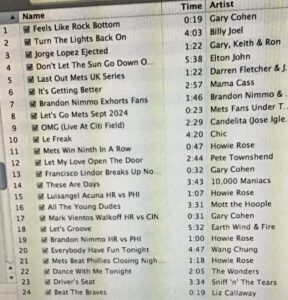 But the first two months of 2024 grinded on like 2023 never ended. Different manager, different general manager, some different personnel, same case of the Mondays. From April 22, 2023, through May 29, 2024, the Mets compiled a record of 83-113. Only the Rockies, the White Sox and the A’s were worse over that span, and none of them had a relief pitcher fire a glove into the stands as exclamation point to their sustained stretch of lousiness. Whether Jorge Lopez said the Mets were the worst team in Major league Baseball or he was the worst teammate in Major League Baseball in the minutes between his fling and his release, the operative word was “worst”. That’s what watching the Mets felt like on the heels of 2023, with a third of 2024 gone. An old impulse of which I’m not proud had taken hold yet again. In every sputtering season since 2007 that goes south (and I turned cynical), a part of me is almost ready to sit back and see just how bad this team gets…which isn’t why I fell in love with baseball. But 2024 was leaving a lot to desire. But the first two months of 2024 grinded on like 2023 never ended. Different manager, different general manager, some different personnel, same case of the Mondays. From April 22, 2023, through May 29, 2024, the Mets compiled a record of 83-113. Only the Rockies, the White Sox and the A’s were worse over that span, and none of them had a relief pitcher fire a glove into the stands as exclamation point to their sustained stretch of lousiness. Whether Jorge Lopez said the Mets were the worst team in Major league Baseball or he was the worst teammate in Major League Baseball in the minutes between his fling and his release, the operative word was “worst”. That’s what watching the Mets felt like on the heels of 2023, with a third of 2024 gone. An old impulse of which I’m not proud had taken hold yet again. In every sputtering season since 2007 that goes south (and I turned cynical), a part of me is almost ready to sit back and see just how bad this team gets…which isn’t why I fell in love with baseball. But 2024 was leaving a lot to desire.
If I’d come into 2024 about when I came into 1969, late August/early September without knowing what came before, I imagine I might have been hooked for life, no questions asked. But I did experience the precursor (never mind the years before), and I wasn’t as spellbound by what 2024 showed signs of becoming when June began to erase May. Maybe even the most magical of Met seasons are incapable of imprinting on me more than lightly at this stage of my life.
Still, I don’t go in for the “long-suffering” Mets fan identifier. It’s baseball. We watch it and listen to it and live for it of our own volition. We don’t suffer. Maybe we endure without fulfillment. Maybe we decide to endure a little less heartily. After a little too much lousy baseball, my commitment to orthodox Metsopotamianism may have slid back toward conservative. If ever there was a year I was looking to not be much of a Mets fan anymore, 2024 shaped up through May as the one to pick. Every team I root for in other sports has had those eras in which I realize I still like the team but I know relatively few of its players. Should they get hot, I’ll contract playoff fever. When that’s over, I’ll remember it was fun, but won’t follow their offseason breathlessly and it won’t tee me up for the season ahead. Of course other sports aren’t baseball and no team is the Mets.
Legendarily, the 2024 Mets shook off their malaise in the standings soon enough, but the residue of what immediately preceded it remained in my mind longer than maybe it should have. When they started winning, I wondered if winning was a true indicator of quality — if the Mets were suddenly winning baseball games, how hard could winning baseball games be? Twenty-Three stuck like gum to a shoe. Are we sure, absolutely sure, that the way we played over more than seven months bridging two seasons isn’t what we are? I wasn’t. And once I was mostly certain that the pervasive crumminess had been overcome, and Mets fans were jumping up and down at what 2024 was bringing like they were Edwin Diaz in the WBC, I couldn’t help but wonder, “Didn’t we just do this?”
The 2024 Mets, it’s been mentioned quite a bit, loved each other and cared for each other and played for each other. This didn’t strike me as unique. I saw players be into each other before, just not with as much choreography. Didn’t we spend the bulk of 2022 resolute that These Mets were better than and different from anything we’d ever seen? Weren’t we in love with the Mets of Mark Canha and Eduardo Escobar and Nick Plummer and Adonis Medina and Chris Bassitt and Max Scherzer and Timmy Trumpet? Weren’t they the team that was never out of a game, the team that would inevitably find a way to win? Come to think of it, didn’t that describe the shirt-torn, walkoff-heroic Mets of Dom Smith and Michael Conforto and J.D. Davis and all the young guns of 2019, who came on like gangbusters down a stretch that everybody thought was gonna be no more than a string? And weren’t we enthralled by the run to the Wild Card made by the eclectic 2016 Mets — Asdrubal Cabrera, T.J. Rivera, James Loney, Jose Reyes 2.0 and the no-notice rookie starting pitching duo of Seth Lugo and Robert Gsellman? And I know our summer of loving 2015, with its Tears of Joy homer and its Five Days in Flushing arc and Yoenis Cespedes’s neon-green compression sleeve and accompanying rally parakeet, not to mention Steven Matz’s Grandpa Bert and the exploits of Murph and Thor and Bartolo, wasn’t really a dream.
 There had never been anything like the 2024 Mets? I get the concept of recency bias, but FOUR TIMES in the preceding decade there’d been something enough like the 2024 Mets to kind of make me roll my eyes at the apparently singular excitement building on their behalf. I was happy for those who created their own Grimace costumes. I was happy for the guy who carved an OMG sign and saw his work go viral. I was happy that Jose Iglesias was climbing two kinds of singles charts. I was happy that Sean Manaea made a mid-season adjustment and tested it out in Central Park over the All-Star break. I was happy to stop looking at several ex-Yankees (including the manager) as ex-Yankees and begin appreciating them as current Mets. I wasn’t disdainful that we brought in Jesse Winker and recast him from heel to face. I gathered satisfaction at the Mets’ rise over .500 and insertion in the playoff race. I applauded the palpable momentum. Satisfaction is satisfying, if not exhilarating. There had never been anything like the 2024 Mets? I get the concept of recency bias, but FOUR TIMES in the preceding decade there’d been something enough like the 2024 Mets to kind of make me roll my eyes at the apparently singular excitement building on their behalf. I was happy for those who created their own Grimace costumes. I was happy for the guy who carved an OMG sign and saw his work go viral. I was happy that Jose Iglesias was climbing two kinds of singles charts. I was happy that Sean Manaea made a mid-season adjustment and tested it out in Central Park over the All-Star break. I was happy to stop looking at several ex-Yankees (including the manager) as ex-Yankees and begin appreciating them as current Mets. I wasn’t disdainful that we brought in Jesse Winker and recast him from heel to face. I gathered satisfaction at the Mets’ rise over .500 and insertion in the playoff race. I applauded the palpable momentum. Satisfaction is satisfying, if not exhilarating.
In terms of ranking a season below popular perception, 2024 was not a 1969 or 1973 situation for me personally in which I don’t remember enough or I was preoccupied by other pursuits. I remember everything about 2024. I had no competing diversions in 2024. I lived through a frustrating first two months, then two-and-a-half months that were alternately promising and frustrating. It began to feel real in late August. By then, the fast-food mascot was entrenched and the wood-cut signs were old hat. I just wanted a baseball team that would succeed. I got that. I got some thrills, too. I don’t discount the thrills.
I’ve discovered across time I’m apparently a connoisseur of moments and games and stretches and seasons that “will never be forgotten” that get forgot. Over and over, we plow under what came before. I relish touring what’s come before — determining that what we dismiss as horrible could actually be pretty decent in its day, and, as necessary, learning the perceived best of times encompassed some dark nights. As long as my newspapers.com and stathead.com subscriptions are up to date, I can spend a very happy evening foraging down a Mets history rabbit hole. All things being equal, I prefer getting caught up in the history more than trying to comment on the contemporary…though I like doing the contemporary because every Mets game brings new history. I understand Mets history. I understand Mets wins and Mets losses. Mets vibes can be to taste.
When I was a kid, I didn’t exactly aspire to be the Sign Man, but I saw going to Shea Stadium and holding up placards attesting to how THERE ARE NO WORDS as vaguely aspirational. That’s the kind of a fan I’d like to be. But maybe less showy…and with loads of words. I’m long past the stage of life where I’m going to pretend I want to dress up like Grimace. That’s not for me. Aren’t they hot in there? I think I was operating on a wavelength of my own as last season became what it became. Everybody else listened to the 2024 Mets on their flagship station (WOMG?). I tuned in one of the staticky affiliates. I heard what I heard. The stakes of the season faded in and out for me, as if I was trying to tune it in from another town on my car radio. The signal didn’t truly begin to come in clearly until mid- to late August. It was full-on 50,000 watts as September wound down.
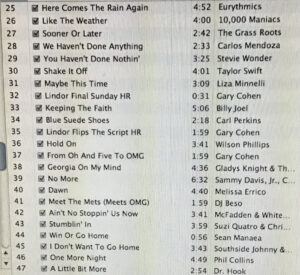 So it took me quite a while to catch up to where it seemed everybody else in Metsopotamia was. They were over the moon. I kept my feet on the ground, wary of reaching for the stars. Hanging in there with the Mets hanging in there was sufficient for me. Relearning to trust them — Wild Card or no Wild Card, they had risen above just plain sucking — might have to be my reward. Other people’s ecstasy that THIS season was SO special left me with little more than a contact high. Into my sixth decade as a fan and my seventh decade overall, I think I lacked the performativeness to vault in a lunar direction. Grimace and OMG and all that stuff…for me, that was what Oakland’s twenty-game winning streak in Moneyball was to Billy Beane: “This kind of thing, it’s fun for the fans.” So it took me quite a while to catch up to where it seemed everybody else in Metsopotamia was. They were over the moon. I kept my feet on the ground, wary of reaching for the stars. Hanging in there with the Mets hanging in there was sufficient for me. Relearning to trust them — Wild Card or no Wild Card, they had risen above just plain sucking — might have to be my reward. Other people’s ecstasy that THIS season was SO special left me with little more than a contact high. Into my sixth decade as a fan and my seventh decade overall, I think I lacked the performativeness to vault in a lunar direction. Grimace and OMG and all that stuff…for me, that was what Oakland’s twenty-game winning streak in Moneyball was to Billy Beane: “This kind of thing, it’s fun for the fans.”
When the Mets approached the World Series in 2015, I thought to myself that I wished for another world championship for all the Mets fans who’ve never had one. A third one for me, too, but I believe I cherished it more as an opportunity for them to experience what I already had twice. Maybe that’s what 2024 was for, to test the theory. Others were loving this more than I was? That was OK, I guessed.
I’m a fan, though, right? Have been, forever, inclusive to this moment. For my birthday this past December, my wife gave me a personalized beach towel that proclaims I’m the “#1 FAN” of the Mets. Stephanie was drawn to this MLB Shop item because adjacent to several iterations of our team’s logo is the year of the franchise’s birth, 1962, same as mine. As a curio, it works. It flatters me every time I walk by where I’ve hung it. I just wonder, despite a lifetime (at least since I was six) operating as the de facto biggest Mets fan anybody knew, if I still deserved the title the towel bestowed on me. I mean, I don’t even have a Grimace costume. Rooting like hell so everyone sees you and hears you is a younger fan’s game.
 Then again, you’re only as young as you feel. For the bulk of 2024’s ascent, I was delighted about the Mets. I got a kick out of the Mets. Such adult phrasing. My father got a kick out of things. To realize this was how I was relating to the Mets even as they giddily imploded Win Probability graphs (more like win improbability, amirite?) suggests a bit of remove from the vibe shift that shook up Flushing. Yet Casey Kasem’s wisdom about staying grounded is eternal. Maybe because I didn’t go bananas over the Mets as they approached, turned, and tentatively backtracked from various corners, I was ready for the onslaught of emotion when it hit in earnest. My date with Met destiny was a night in early September when the Mets didn’t blow a game to the Red Sox. There was a half-inning, the top of the eighth, when an out wasn’t made, and it set up a run for the opponent, and the entire house of cards that had been building for more than three months emitted an impending tumbling-down sense of doom. Then again, you’re only as young as you feel. For the bulk of 2024’s ascent, I was delighted about the Mets. I got a kick out of the Mets. Such adult phrasing. My father got a kick out of things. To realize this was how I was relating to the Mets even as they giddily imploded Win Probability graphs (more like win improbability, amirite?) suggests a bit of remove from the vibe shift that shook up Flushing. Yet Casey Kasem’s wisdom about staying grounded is eternal. Maybe because I didn’t go bananas over the Mets as they approached, turned, and tentatively backtracked from various corners, I was ready for the onslaught of emotion when it hit in earnest. My date with Met destiny was a night in early September when the Mets didn’t blow a game to the Red Sox. There was a half-inning, the top of the eighth, when an out wasn’t made, and it set up a run for the opponent, and the entire house of cards that had been building for more than three months emitted an impending tumbling-down sense of doom.
Then Jose Butto induced a ground ball, and Jose Iglesias picked it up, and Francisco Lindor received Iglesias’s toss to convert an out at second, and Lindor sent the ball next to Pete Alonso at first to complete the 4-6-3 double play that kept the Mets ahead of Boston, 3-2. In the next half-inning, Lindor was in the middle of a rally that produced four insurance runs, and a half-inning after that, the Mets nailed down their sixth of an eventual nine wins in a row. I didn’t know about the seventh, eighth and ninth wins yet. I didn’t know about what would happen after that. I did know, with the Mets a half-game out of the final Wild Card slot, that we (we) were going to the playoffs and was almost as sure that we (we) were going to win the World Series.
For the longest time, there was nothing inevitable about the 2024 Mets. Kvetching about losses comes as second-nature to a fan, but I don’t think we collectively believed in the patently possible until very late in the game. Watching the September 11 near no-hitter in Toronto as a Mets Classic on SNY is an unintended exercise in Amazin’ hindsight. The Mets are slumping. They haven’t homered in days. The daunting Phillies are on the schedule the following two weekends. And, yes, a no-hitter is in progress for eight innings before LINSANITY! saves the day. I wanted to yell, months later, “It’s going to be all right! We’re going to get through this game and so much more!” But you don’t know that before it happens.
The Metzvahmobile had gotten hold of me in September, as the emotions of that Red Sox game stayed with me for the duration. Doubt would make cameo appearances in the weeks ahead; it wouldn’t be a playoff chase if there wasn’t doubt. But I was as in as I needed to be. When the Citi Field portion of the regular season ended on a Sunday night, the Mets holding on to fend off the once-mighty Phillies, my seat was technically in Promenade, but it might as well have been over the moon. When the succeeding week brought defeat and rain in Atlanta, followed by more defeat in roof-covered Milwaukee, I refused to plummet to earth. I didn’t care that the Mets had squandered their division title at Truist Park in 2022. I didn’t care that American Family Field was a stealth death pit for this franchise. The stars were now within reach. I wasn’t going to stop reaching.
We, together, grabbed what needed to be grabbed on September 30, Game 161, the first game of that doubleheader, the one game we had to have to ensure 2024 didn’t suddenly halt. It had come too far since May 29 to not keep going. That was the game — I’d call it The Francisco Lindor Game, though I’d need to be more specific than that — that launched 2024 into the stratosphere of 21st-century Mets seasons. I understand if it tops the all-time lists of others. As a single day and a single game and a single swing and a manifestation of a single set of emotions, I’ll put September 30, 2024, up against anything I’ve been through as a Mets fan, even if I suspect I would have make the same claim on behalf of precious moments from 2022 and 2019 and 2016 and 2015 and on back through my life with the Mets.
I didn’t throw in the towel when the Mets fell behind twice on September 30. I believe I earned the #1 FAN towel that day. We all did, including those Mets who made it happen in synchronicity with us. There was practical magic to the 2024 Mets that transcended a clutch hit here or a key strikeout there. One fewer win, and “OMG” is a snappy earworm rather than a rallying cry for the ages. Our clubhouse seemed to contain 26 proud-to-be-a-Met Shawon Dunstons at any given moment, and they gave us the chance to discover their true orange-and-blue colors in full.
We wear players’ jerseys and such, but when we and they hang around together for a full season (or full seasons when it comes to the Nimmos, Lindors and Alonsos), they are a manifestation of us just as much. The Mets, when clicking, are forever young and forever a little silly. Being a Met doesn’t work with a scowl. And treating 2024 simply like a baseball season, even a highly successful baseball season, probably doesn’t take into account all of what made 2024 such a blast for so many Mets fans. Deep down, for the most part, I treated it like a baseball season. A highly successful baseball season, engineered by a highly appealing collection of baseball players. Successful seasons usually make baseball players seem appealing. Success is appealing.
I occasionally mutter to myself, “there are ways and there are ways,” meaning I find one way to get something done clearly preferable to another. I don’t know if such a mutter applies to ways the Mets win. For example, in 2022, under manager Buck Showalter and with veteran ace Max Scherzer setting the tone, the starting pitchers would congregate in the dugout when an effective outing was over, huddle in a corner, and confer intensely on what was to be learned from the pitcher who had just pitched. In 2024, under manager Carlos Mendoza and nobody necessarily assuming the mantle of veteran ace as Scherzer had, the starting pitchers gathered in the dugout when an effective outing was over, embrace in a circle, and hop together giddily. Which response is right? Who’s to say?
By not automatically opting for giddiness, I’m probably discounting the impact the ephemera had on people. I’ve seen enough shenanigans in enough dugouts in recent years to not think the guys holding the OMG sign, or the pitchers painting each other’s numbers on their faces, was that much a break from the norm. For all my fits of floating and flying over a team whose persona sometimes wafted off the charts — “no, they don’t usually have a concert led by a recently added utility infielder after a game with each of his teammates joining in” — I could be very literal-minded about the seasonlong slog. Sometimes I saw a team get off to a wretched start and then occasionally muddle through to its league’s sixth-best record. But treat it like a “regular” year, you probably miss its essential poetry. We all interpret and frame our Mets through our own prism. Mine pushes and pulls between poetic and prosaic.
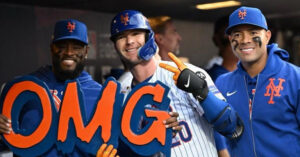 Ultimately, I wound up more than delighted people were capable of finding extra joy in experiencing something that was happening again like it was happening for the first time. I got an enormous kick out of our players not simply nodding grimly at one another after succeeding. I couldn’t have been more all in on this team and how it was all in and how my fellow fans were all in. What a way to be, being a #1 FAN. I hope they made lots of those towels this offseason. However we rooted, we all deserve one. Ultimately, I wound up more than delighted people were capable of finding extra joy in experiencing something that was happening again like it was happening for the first time. I got an enormous kick out of our players not simply nodding grimly at one another after succeeding. I couldn’t have been more all in on this team and how it was all in and how my fellow fans were all in. What a way to be, being a #1 FAN. I hope they made lots of those towels this offseason. However we rooted, we all deserve one.
The weeks after September 30 were Amazin’, too. Losing to the Brewers would have taken some of the shine off winning the final available Wild Card. But we beat the Brewers, and we continued to shine on. Losing to the Phillies…HA! We weren’t going to lose to the Phillies, never mind that they won our division. I was more sure of that than I was our not losing to the Brewers. Doubt lingered, but it wasn’t seated in the front row of my consciousness. In October, you just have to deal with doubt and drown doubt out. As a fan, you have to keep bringing it. You know…it. Your team just won its biggest game of the year, yet there’s a whole new game right after, and the last one is of no use. Conversely, your team just lost its biggest game of the year, and you almost surely cannot give up, because unless it eliminated you, you’re still on the caring clock.
I cared so much by the end of the loss of the Dodger series on October 20 that I would I describe myself without hyperbole as crushed. I listened to Howie Rose in the ninth inning — “once the immediate disappointment, if they don’t pull off some kind of magical comeback here, wears off, you’ll realize what an incredible ride this team took you for his year,” and Gary Cohen on the postgame show — “there are great days to come for this franchise ahead,” yet I was still crushed. The high priests of Mets fandom were giving it to me straight, but elimination is elimination. The Dodgers were going to the World Series. The Mets were going home. I had told myself and anybody reading between my lines after the aforementioned Red Sox game of September 3 that we were going to the World Series. My hopes had been aloft for nearly seven weeks. The air coming out was bound to create blowback.
 But it proved minimal. Beating Atlanta on September 30, beating Milwaukee on October 3, and beating Philadelphia on October 9 sealed this as a most special season. Only five Mets teams have won two postseason series. The 2024 Mets are one of those five. Coming up short in any of their do-or-die situations would have diminished previous accomplishments and left at least a hint of a bad taste. They did rather than died time and again. Conversely, getting clobbered by Los Angeles four times in six games could be brushed off our shoulders without deploying a Helmac-brand lint roller. It hurt for a minute, but it didn’t sting for long. There was no sour note. There was no lower-case goat. There is yet to be regret-tinged long-term aftermath. There are no hard feelings that we know about. A season is more than the sum of its highlights, but since the final out of October 20, I find myself only playing the good parts in my head. But it proved minimal. Beating Atlanta on September 30, beating Milwaukee on October 3, and beating Philadelphia on October 9 sealed this as a most special season. Only five Mets teams have won two postseason series. The 2024 Mets are one of those five. Coming up short in any of their do-or-die situations would have diminished previous accomplishments and left at least a hint of a bad taste. They did rather than died time and again. Conversely, getting clobbered by Los Angeles four times in six games could be brushed off our shoulders without deploying a Helmac-brand lint roller. It hurt for a minute, but it didn’t sting for long. There was no sour note. There was no lower-case goat. There is yet to be regret-tinged long-term aftermath. There are no hard feelings that we know about. A season is more than the sum of its highlights, but since the final out of October 20, I find myself only playing the good parts in my head.
All of that equals No. 13½ by my estimation. The season 2024 nudged ahead of among my favorites, 2005, was one I understood as seminal as soon as it was complete…and favorite can be synonymous with meaningful the higher up we go, regardless of results. Writing in this medium about the team I love on a regular basis altered the act of rooting for me. To borrow from Artie on The Larry Sanders Show, it changed me into a figure out of Greek mythology: half-man/half-link. That transformation was bigger than the 2005 Mets going 83-79 and running out of Wild Card gas in early September. It represented a rebirth or reaffirmation of sorts. The commonality with 2024? This past season’s trajectory definitely reaffirmed my…I oughta say faith here, but I think it was commitment. My commitment, recapping games roughly every other night and then some, should be self-evident. But I know myself. My commitment dragged after 2023 and kept dragging through the start to 2024.
At 2024’s regular season morphed into the 2024 postseason, I could gaze into my soul as Ralph Malph did at Arnold’s men’s room mirror and declare with conviction, I still got it! Which “it” was this? Call “it” passion crossed with that extra layer of devotion that takes over when the Mets are on another level and your life is determined to reflect what they’re up to.
 If I didn’t still got it, then there’d be no 94-track playlist on my computer. I think of it as Mark and Francisco’s Infinite Playlist. Lindor, our Most Vibeful Player, inspired it. Vientos, our fall breakout player, inspired it. Everybody inspired it. This collection of songs (I can hear any song and make it about the Mets), snippets of play-by-play, pregame and postgame interviews, and ambient noise recorded below the tracks of the 7 train suggests nothing could have meant more to me than the 2024 Mets, not in 2024, not ever. It’s a personal expression of immersion and affection I couldn’t have ginned up had the emotion behind it not been authentic. Yet its authenticity is an outflow of what built up over the preceding 55 seasons. It’s always like that, though. Every Met year builds on its predecessors. If I didn’t still got it, then there’d be no 94-track playlist on my computer. I think of it as Mark and Francisco’s Infinite Playlist. Lindor, our Most Vibeful Player, inspired it. Vientos, our fall breakout player, inspired it. Everybody inspired it. This collection of songs (I can hear any song and make it about the Mets), snippets of play-by-play, pregame and postgame interviews, and ambient noise recorded below the tracks of the 7 train suggests nothing could have meant more to me than the 2024 Mets, not in 2024, not ever. It’s a personal expression of immersion and affection I couldn’t have ginned up had the emotion behind it not been authentic. Yet its authenticity is an outflow of what built up over the preceding 55 seasons. It’s always like that, though. Every Met year builds on its predecessors.
Met-iculously crafting a 94-track playlist that both comments on the action and urges it in a Metsward direction is my version of wearing a Grimace costume to the ballpark. It didn’t matter that nobody but me was going to play it or hear it; every bit of its four hours and twenty-five minutes makes sense to me. In my head is my favorite perch from which to watch games, anyway. The playlist’s construction was an appropriate response to what was going on around me, because, in a way, I was playing the hits in late September and October. I knew what a playoff chase felt like. I knew what a postseason felt like. Being super into the Mets once 2024 got serious wasn’t far off from how it felt in 2015 or 2006 or any year marked by champagne showers and gripping tension. (This wasn’t my first season/postseason-inspired playlist, either.) I’m not sure what I felt in 2024 was new or revelatory, but the unexpected coda to what shaped up as an ordinary season was real. And it was spectacular.
PREVIOUS ‘MY FAVORITE SEASONS’ INSTALLMENTS
Nos. 55-44: Lousy Seasons, Redeeming Features
Nos. 43-34: Lookin’ for the Lights (That Silver Lining)
Nos. 33-23: In the Middling Years
Nos. 22-21: Affection in Anonymity
No. 20: No Shirt, Sherlock
No. 19: Not So Heavy Next Time
No. 18: Honorably Discharged
No. 17: Taken Down in Paradise City
No. 16: Thin Degree of Separation
No. 15: We Good?
No. 14: This Thing Is On
No. 13: One of Those Teams
No. 12: (Weird) Dream Season
No. 11: Hold On for One More Year
No. 10: Retrospectively Happy Days
No. 9: The September of My Youth
No. 8: First Taste
Nos. 7-5: Three of a Kind
No. 4: Pound for Pound
by Greg Prince on 7 March 2025 2:18 pm Before he incurred infamy for the two words he uttered to communicate he wanted no more of his 1980 rematch versus Sugar Ray Leonard — “no más” — Roberto Duran was mainly recognized as the fighter who was “pound for pound” the best in the world. Duran is the reason I learned that phrase. For years, it was all I knew about the man. He won titles in four different weight classes, none of them heavyweight. Heavyweights were who were on TV when I was growing up, so I knew about Ali and Frazier and Foreman and Holmes and Norton and Spinks. I didn’t really know about anybody trimmer. Ah, the boxing writers would tell me through their columns, there is a fighter who outshines them all, “pound for pound”. You couldn’t expect Duran to get into the ring against those much bigger men, but when you took into consideration everything about who could do what within the confines of the squared circle and the sweet science, pound for pound, he was the best.
 I’ve got a Mets season that answers the bell to such a description. For most of 162 games, it punched far above its weight class. When it inevitably went down for the count, I wasn’t ready to throw in its towel. Más, por favor. Mucho más. I’ve got a Mets season that answers the bell to such a description. For most of 162 games, it punched far above its weight class. When it inevitably went down for the count, I wasn’t ready to throw in its towel. Más, por favor. Mucho más.
Pound for pound, no Mets season has ever made me happier.
4. 1997
I’ll always remember what somebody with whom I’d someday write a blog e-mailed me during a Spring when little good was forecast for the shared object of our affections. I wasn’t particularly optimistic. My friend made me look like the hopeful one.
“Bobby Valentine’s a terrible manager,” he assessed. “The Mets are gonna lose a hundred games.”
When I brought his words up to him months later, his prediction no longer mathematically viable, he responded that there may be nothing better than being proven wrong about how bad your baseball team is going to be.
That was a page Jason and I were both on long before we grabbed this here URL.
Nobody saw them coming. I doubt many remember them staying. But there they were, for as long as they existed as an active entity, progenitors of perhaps the most satisfying, least gaudy season in Mets history. That’s a subjective call. But I’m the one making the call on this subject, as I have been throughout MY FAVORITE SEASONS, FROM LEAST FAVORITE TO MOST FAVORITE, 1969-‘PRESENT’ (with 2024’s slotting TBD). The only aspect of the season turned in by the 1997 Mets that didn’t satisfy me, for a while, was how obscure it became shortly after its conclusion. That bothers me less now.
I didn’t intend it to be, but 1997 seems to be my little secret. An open secret, available to the Mets-loving world at large, but one destined to move along quietly in the historical shadows. The larger Metropolitan narrative pretends Mike Piazza smote the ground the second he stepped off his plane at LaGuardia on May 23, 1998, and out sprang a Mets club fully grown and ready to accomplish audacious things. Getting Piazza was huge. What happened after Piazza was gotten was huge. But something beautiful was blossoming a year prior to Piazza, before many were paying attention — regardless that there was much of a captivating nature already in progress.
It was the same year the Will Smith/Bernard Gilkey vehicle Men In Black was in theaters. Erasing memories must have been all the rage.
 Though I’m not a big fan of the word “forgettable,” I wouldn’t have anticipated 1997 becoming a memorable Met season. Maybe because of the months that followed, I’ve never forgotten the first tableau to make an impression on me that year, during Spring Training. Pitchers & Catchers were reporting on February 14. The senior pitcher and senior catcher in terms of Met service, John Franco and Todd Hundley, thought it appropriate to welcome their manager to Port St. Lucie with a cake bearing his name. The gesture appeared a little suspicious despite it being Valentine’s Day. Valentine’s Day usually involves candy rather than cake. Though I’m not a big fan of the word “forgettable,” I wouldn’t have anticipated 1997 becoming a memorable Met season. Maybe because of the months that followed, I’ve never forgotten the first tableau to make an impression on me that year, during Spring Training. Pitchers & Catchers were reporting on February 14. The senior pitcher and senior catcher in terms of Met service, John Franco and Todd Hundley, thought it appropriate to welcome their manager to Port St. Lucie with a cake bearing his name. The gesture appeared a little suspicious despite it being Valentine’s Day. Valentine’s Day usually involves candy rather than cake.
But you can’t smush an unsuspecting recipient’s face into a box of chocolates. That was the clubhouse gag. John and Todd, the only players extant who could remember what it was like to play on a Mets team with a winning record, way back in 1990, lured Bobby Valentine into their frosted trap, and next thing he knew, the skipper was wiping icing from his forehead and chin.
Bobby V, as he was universally called, became the manager the August before, as the latest losing campaign led by Dallas Green wound down. To be fair to Green, he wasn’t doing markedly worse with the Mets than his several predecessors had. The last time Spring Training served as prelude to a statistically successful Met season, Davey Johnson was ensconced in the manager’s office. By 1997, Davey’s 1984-1990 Met tenure seemed ages ago. Its only relevance in the present was when it began, it included Bobby Valentine as third base coach.
Bobby was part of Davey’s staff before he getting the opportunity to manage in Texas. He took over the slumbering Rangers in 1985, roused them to authentic contention in 1986, but never boosted them to the playoffs. The team owner and President George Bush’s eldest son, also named George Bush, let him go in ’92. Valentine managed Triple-A Norfolk for one year, left for Japan to lead the Chiba Lotte Marines for one year, and then returned to the Tides. He was a phone call away in case the Mets decided they’d had enough of Green, a fate waiting to befall every manager. On August 26, 1996, with the Mets floundering at 59-72, Dallas was thanked for his service.
We’d been through Buddy Harrelson, Mike Cubbage and Jeff Torborg before Dallas’s once-welcome tough-guy act wore out. Bobby, the clever Connecticut native who played for Joe Torre’s Mets, had been angling for another MLB shot ever since his Arlington goodwill expired. “The most unfair criticism is I never won,” Bobby said when he took the helm in late summer. “At the same time it’s the most factual.” My friend Jason’s idea that Valentine might not be the answer for 1997 wasn’t exactly iconoclastic. Bobby V’s dugout decorum was disdained in ingrained baseball circles as that of a “top step” character, a little too ostentatiously into the game, a little too convinced he’d invented it. “So often accused of being a major league know-it-all” is how Marty Noble reintroduced the Mets manager to his Newsday readers in February.
The end of ’96, when he oversaw a 12-19 conclusion to the ongoing doldrums, gave him a glimpse of a club he knew required reshaping. He came into his first camp as Met manager preaching preparation and awareness, likely determined to come off as less of a hardass than his predecessor. Franco and Hundley did all right under Green. Preparation? “I know what I have to do to get ready,” Todd said. Maybe they thought they’d heard it all before. Todd, who was unhappy Valentine was banning smoking in the clubhouse, casually dismissed the new-ish manager’s breath of fresh air aspirations: “That’s the way every camp starts. Then, after the first day, it’s chaos.” On the other hand, the less-established Butch Huskey anticipated a leader who “relates to young players better than Dallas did” and would stress the basics. “We got beat on the fundamentals last year more than anything.”
Depending on who you asked circa Valentine’s Day 1997, Bobby V’s managerial prowess might as well have been that box of chocolates of which Forrest Gump had been so fond a few years before. Maybe we didn’t know what we were going to get out of the first Met squad he molded rather than inherited. Yet between two managers in 1996, the Mets lost 91 games, and it was hard to spot any serious personnel upgrades in the ensuing offseason. A hundred losses? It didn’t seem out of the realm of possibility.
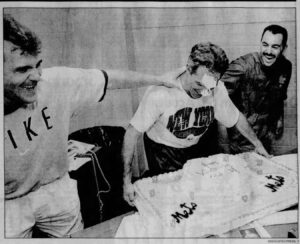 Still, here was Valentine, in the midst of attempting to change Met culture, being a good sport about the cake. And here were Franco and Hundley having a laugh at their manager’s expense despite being the constants of six consecutive seasons that left little to laugh about. I saw the coverage in the papers the day after Valentine went down and kind of wondered, amid the in-his-face quality of the joke, why any of this was supposed to be funny. Still, here was Valentine, in the midst of attempting to change Met culture, being a good sport about the cake. And here were Franco and Hundley having a laugh at their manager’s expense despite being the constants of six consecutive seasons that left little to laugh about. I saw the coverage in the papers the day after Valentine went down and kind of wondered, amid the in-his-face quality of the joke, why any of this was supposed to be funny.
On Opening Day, there was even less that rated a chuckle. The Mets started the season on the West Coast so as to avoid the Northeastern climate. First up were the Padres, on April 1. Another too on-the-nose occasion for what was about to transpire. Hundley’s two-run homer in the top of the third staked Pete Harnisch to a 2-0 lead. Gilkey added two more via a bases-loaded single. Mets up, 4-0, going to the bottom of the sixth. Looks like one sweet Opening Day, huh?
APRIL FOOLS!
Harnisch gives up a homer to Chris Gomez to lead off the inning. Hey, that’ll happen. Rickey Henderson follows directly with another home run. Well, he is Rickey Henderson. Quilvio Veras, a former Mets farmhand, homers right after Henderson. The 4-0 lead is now 4-3, and no amount of Southern California warmth can cut the chill infiltrating the visitors’ dugout. Valentine removes Harnisch in favor of Yorkis Perez. The Padre bats are very much in favor of the decision, as another run is manufactured in the course of three hitters. Tie game. Toby Borland comes on to pitch; he walks three of his four opponents, and now it’s 5-4, Padres. The fourth pitcher of the sixth, Barry Manuel, enters. Barry finishes the inning by permitting six more runs en route to the third out.
An eleven-run inning. The Mets, regardless of urban myth, don’t win every Opening Day. The California trip is mostly a disaster. The club goes 3-6 in San Diego, San Francisco, and Los Angeles. They fly home to commence the home portion of their schedule on Saturday the 12th. Why on a Saturday? Because the other New York team had also begun its season out west and slated its Home Opener for Friday, and Mets management didn’t want their big event completely overwhelmed by a flag-raising on the other side of town. Their thanks for ceding the spotlight? A rainout Saturday, a de facto Home Opening Day doubleheader sweep at the hands of the Giants Sunday (attracting fewer than 22,000), and a Monday afternoon defeat to shove the Mets out of the gate at 3-9. Only in 1962 and 1964 had the Mets been worse after a dozen games. Those were hundred-loss seasons, to be sure.
If you were considering purchasing stock in the Mets’ chances, it was a classic buy-low inflection point. If you were a savvy investor, you might have noticed a couple of positive indicators. John Olerud, the faded batting champion the Blue Jays were happy to pawn off on the Mets, took a liking to National League pitching, posting a .373 batting average (and quickly replacing previous first baseman Rico Brogna as a fan favorite). Journeyman Rick Reed, noted mostly for having participated in MLB’s replacement player farce a couple of Springs earlier while on a minor league contract with the Reds (his mom needed insulin, he patiently explained), emerged as an effective control artist on the Western swing, delivering twelve unrewarded scoreless innings as a starter and reliever. Valentine had the 32-year-old in Norfolk the season before and saw him as something more than a Quadruple-A hanger-on. And if you liked the idea of a team capable of rising to something approximating a big moment, the next game the 3-9 Mets played was the first Jackie Robinson Night. Shea Stadium was sold out. President Clinton was on hand. In honor of the fiftieth anniversary of Robinson shattering baseball’s color line, No. 42 was announced midgame as henceforth retired throughout Major League Baseball. Not incidentally, the Mets shut out the Dodgers, 5-0.
OK, so the Mets were now 4-9. The next day, they barely managed to avoid being no-hit by Pedro Astacio and three L.A. relievers, leaving them 4-10. These numbers defied the notion that a turnaround was nigh. But when the Mets next played, they beat a team clearly worse than them, the 0-13 Cubs. Make that the 0-14 Cubs, when the 6-10 Mets did it again. Finally, Chicago took two from New York, which wasn’t good, but it did help lead Bobby V to a critical lineup alteration.
On April 22, with the Reds in town, Valentine installed Edgardo Alfonzo at third base in the field and the two-hole in the lineup. Huskey had received the bulk of the playing time at the Mets’ perpetually troublesome hot corner. He’d already accumulated six errors, while batting .149. Fonzie, as he was referred to when he was referred to at all, was somehow hitting worse in limited action — .129 — but had earned a reputation for headiness during his utilityman apprenticeship under Green. The 23-year-old’s first chance to prove himself offensively came against longtime Met nemesis John Smiley with the bases loaded in the fourth inning. Alfonzo lined a three-run double into the right-center gap, providing plenty of cushion for Reed to go the distance and beat his previous organization, 7-2. The next night, Fonzie was in there again. He went 3-for-3, as the Mets won, 10-2. It wasn’t precisely a coronation, but it was close enough. For the rest of the season, as long as injuries didn’t skew form, Alfonzo regularly batted second and regularly played third.
Fonzie at third. Oly at first. Reeder in the rotation. Nicknames as signs of familiarity and affection. The Bobby V Mets were beginning to differentiate themselves from what preceded them, save for the matter of the W and L columns. Two losses to the Expos had cooled the building momentum from the two wins over the Reds. They were 8-14 entering their Sunday finale at Olympic Stadium on April 27, the product of two weeks of .500 ball since their miserable start. Not a single team in Mets history to have started 8-14 or worse after 22 games — there were ten of them to this point — had finished with a winning record. Trendlines didn’t suggest this one was going to be any different, and a 3-3 tie yielded no resolution through nine in Canada. In the top of the tenth, however, Rey Ordoñez, he of the glittering glove and unremarkable bat, stroked a single into right field with the sacks full. Two runners came home. John Franco protected the 5-3 lead. The Mets left Montreal with a one-game winning streak.
Hindsight would reveal it as the biggest one-game winning streak since the dawn of the decade. One win in Montreal became four in a row and six of seven. A case of the ol’ win-one/lose-ones frustrated efforts to touch .500, but the Mets shook that off in due order. On May 10, a surging Bobby Jones, who’d been around quietly grinding since 1993, combined with Franco on a three-hit shutout in St. Louis. Jones was 6-2. The Mets were 18-18. The next day, they rode consecutive ninth-inning pinch-homers from Carl Everett and Huskey to a 6-4 lead, an edge again handed off to Franco, who once more secured the victory. The 1997 Mets were 19-18.
It was only the beginning. Four in a row. Seven of nine. By the time June got going, the Mets were 31-23. A third of the season was in the books. The standings listed the Mets as a half-game out of the Wild Card.
I was in heaven.
Granted, after what the Nineties had been for the Mets, my version of heaven didn’t have much of a barrier to entry. Maybe this wasn’t 1969 or 1984, but for me, it might as well have been. I was at least a few months too young to comprehend 1969 while it was becoming 1969. I was a few too many miles removed from New York to completely absorb 1984 becoming 1984. As come-out-of-nowhere seasons went, 1997 was the one that grabbed me and embraced me from the second its arms began to widen. I hugged it right back.
 Every morning with the papers was a thrill. Every morning measuring the distance between us and the Marlins — cosplaying as a large-market, high-payroll powerhouse — was an obsession. Every night that there was Mets baseball, there was little else I thought about. Where once the Mets offered emptiness, they now created possibility. I loved Oly. I loved Reeder. I loved Fonzie like I’d never loved a position player in my life. I adored everybody on the 1997 Mets. I adored adjusting my worldview from hoping the Mets might win their next game to believing the Mets could win their next game (to intermittently expecting they’d win). I revered Bobby Valentine, who seemed to get everybody into games and fill them with whatever it took to come through in those games, particularly late in those games. I appreciated his instilling in his charges an attitude that the biggest game the team was going to play this year was the one right in front of them, because it was “the only one we’re playing,” and preaching, “It’s not the best team that wins, it’s the team that plays best.” I didn’t care what step he stood on. I didn’t care that a player here or a reporter there let it be known he could be a bit much. I didn’t mind his riling up the opposition. Bobby Valentine was a terrific manager. Every morning with the papers was a thrill. Every morning measuring the distance between us and the Marlins — cosplaying as a large-market, high-payroll powerhouse — was an obsession. Every night that there was Mets baseball, there was little else I thought about. Where once the Mets offered emptiness, they now created possibility. I loved Oly. I loved Reeder. I loved Fonzie like I’d never loved a position player in my life. I adored everybody on the 1997 Mets. I adored adjusting my worldview from hoping the Mets might win their next game to believing the Mets could win their next game (to intermittently expecting they’d win). I revered Bobby Valentine, who seemed to get everybody into games and fill them with whatever it took to come through in those games, particularly late in those games. I appreciated his instilling in his charges an attitude that the biggest game the team was going to play this year was the one right in front of them, because it was “the only one we’re playing,” and preaching, “It’s not the best team that wins, it’s the team that plays best.” I didn’t care what step he stood on. I didn’t care that a player here or a reporter there let it be known he could be a bit much. I didn’t mind his riling up the opposition. Bobby Valentine was a terrific manager.
And we haven’t even gotten to June 16 yet.
The Mets of 1969 had never won before. At all. When they took their first giant steps in May and June, however, they were already the team in their city. New York was a National League town; Shea retained its Space Age sheen and accompanying sense of joie de vivre; and there wasn’t much in the way of municipal competition for share of baseball mind. The Yankees had their fans, but not as many as the Mets. The remainder of 1969 would ensure the balance would tilt irreversibly toward the Mets not just for the rest of that Amazin’ year, but well into the 1970s. They’d have to tear down, rebuild, and reopen Yankee Stadium in 1976 to redirect attendance in the other direction…and the Mets would have to be run into the ground of their own volition.
Not only did the 1984 Mets climb out of their self-inflicted 1977-1983 wreckage and up the National League East standings, they nudged New York’s National League rooting muscles awake. The Yankees, despite having their hopes mauled by the rampaging Tigers, weren’t dismal over the course of ’84, but they failed to any longer be as compelling as they had been when winning the back pages of the late 1970s and early 1980s. The Metropolitan Area was due for a sea change. Davey Johnson’s Mets swept in and swept aside that other team, becoming the “A” story of every season for seasons to come.
I’d love to report that the 1997 Mets’ unexpected success had the same long-term impact on the local baseball scene. It didn’t. The Yankees were in their latest imperial phase and weren’t going anywhere. Defending world champions. Young, homegrown core. Enough resources and wherewithal to buy stars as needed. Steinbrenner finally figuring out how to be Steinbrenner to beneficial effect for his enterprise. They constructed a wall of perception the Mets of that period were never going to crack. That was the one piece missing from this segment of the 1969-1984-1997 triad. There’s never a bad time to start getting good, yet you might say we waited a tad too long to ascend toward something special if we were going to take back our town. I’m still waiting on the next sea change.
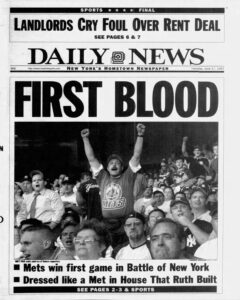 Oh, but not on June 16, 1997. On June 16, 1997, we were it, baby. We were in the Bronx for a latter-day incarnation of the Mayor’s Trophy Game, except it wasn’t the Mayor’s Trophy Game. It was an actual game in the middle portion of the schedule. It was Interleague play, one of those theoretical what-ifs I’d read about in Baseball Digest as a kid. What if the National League’s teams played the American League’s teams in the regular season? It was right there with predictions that all games would be played under domes, on artificial turf, on other planets. I didn’t think much of the what-if, ’cause I didn’t believe it would ever happen. Oh, but not on June 16, 1997. On June 16, 1997, we were it, baby. We were in the Bronx for a latter-day incarnation of the Mayor’s Trophy Game, except it wasn’t the Mayor’s Trophy Game. It was an actual game in the middle portion of the schedule. It was Interleague play, one of those theoretical what-ifs I’d read about in Baseball Digest as a kid. What if the National League’s teams played the American League’s teams in the regular season? It was right there with predictions that all games would be played under domes, on artificial turf, on other planets. I didn’t think much of the what-if, ’cause I didn’t believe it would ever happen.
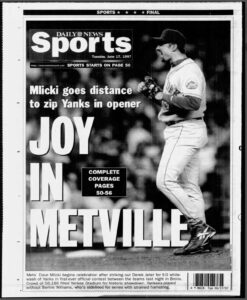 It happened. It happened first the prior Friday, at Shea, the Mets hosting the Red Sox, its own historical overtones implicit. The Mets lost two of three to Boston. A mere undercard to Monday night, June 16, Mets at Yankees, the first of a three-game series in a rivalry that used to be limited to exhibitions and imagination. What if the Mets played the Yankees for real? It happened. It happened first the prior Friday, at Shea, the Mets hosting the Red Sox, its own historical overtones implicit. The Mets lost two of three to Boston. A mere undercard to Monday night, June 16, Mets at Yankees, the first of a three-game series in a rivalry that used to be limited to exhibitions and imagination. What if the Mets played the Yankees for real?
What if the Mets beat the Yankees like it was no big deal? Of course it was a very big deal, but let’s remember that one baseball game is one baseball game. Any one team can beat another. The Mets entered this Monday night 36-30, the Yankees 37-29. Two teams within a game of each other. Logic would tell you that’s a pick ’em situation.
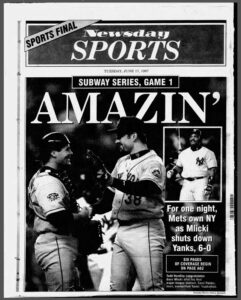 So why was it treated as a shock, for better and less better, that the Mets beat the Yankees the first time they played a game that counted? Mets 6 Yankees 0. One of 162. But one above all. The novelty of it — first game between New York teams from separate circuits that got kept track of since the Brooklyn Dodgers couldn’t quite repeat as world champs in 1956 — explains a lot of it, maybe most of it. Erratic Dave Mlicki’s role as crafter of a complete game shutout also can’t be diminished. If this was the best performance of Mlicki’s career, eternal kudos to the Ohio native for choosing June 16, 1997, to share it with us. Had baseball shut down permanently prior to the scheduled first pitch of the next night, we’d always have the all-time edge in intracity affairs, and I’d always have the memory of a pair of Yankee fan co-workers greeting my sunny “good morning!” of June 17 with expletives. So why was it treated as a shock, for better and less better, that the Mets beat the Yankees the first time they played a game that counted? Mets 6 Yankees 0. One of 162. But one above all. The novelty of it — first game between New York teams from separate circuits that got kept track of since the Brooklyn Dodgers couldn’t quite repeat as world champs in 1956 — explains a lot of it, maybe most of it. Erratic Dave Mlicki’s role as crafter of a complete game shutout also can’t be diminished. If this was the best performance of Mlicki’s career, eternal kudos to the Ohio native for choosing June 16, 1997, to share it with us. Had baseball shut down permanently prior to the scheduled first pitch of the next night, we’d always have the all-time edge in intracity affairs, and I’d always have the memory of a pair of Yankee fan co-workers greeting my sunny “good morning!” of June 17 with expletives.
A tad bothersome in the moment and in memory to me was the idea that everybody should have been shocked the New York Mets could win a single baseball game from the New York Yankees — with audible vocal support outside Queens, no less. Never mind any team being capable of beating any team on a given night. The New York Mets were now 37-30, same as the almighty New York Yankees. They were contending in their league, and we were contending in ours.
 No need for shock. But plenty of reason for excitement. After the Subway Series, the Mets reeled off six consecutive wins, every one of them spine-tingling in its way. The last of them came against another foe that loomed as larger than life: the Atlanta Braves. The last time the Mets faced the Braves with much on the line for each of them, Nolan Ryan had come out of the bullpen to sew up the pennant. We had hewed to our respective lanes until the Braves were realigned into the NL East, another incident illustrative of bad timing. The once-sorry Braves had established their own imperial phase, coming into 1997 as winner of five division titles since 1991. It didn’t matter if they were West or East. They were Atlanta, and they’d been playing in a league above the Mets for years. No need for shock. But plenty of reason for excitement. After the Subway Series, the Mets reeled off six consecutive wins, every one of them spine-tingling in its way. The last of them came against another foe that loomed as larger than life: the Atlanta Braves. The last time the Mets faced the Braves with much on the line for each of them, Nolan Ryan had come out of the bullpen to sew up the pennant. We had hewed to our respective lanes until the Braves were realigned into the NL East, another incident illustrative of bad timing. The once-sorry Braves had established their own imperial phase, coming into 1997 as winner of five division titles since 1991. It didn’t matter if they were West or East. They were Atlanta, and they’d been playing in a league above the Mets for years.
Not this June, though. The Mets took two of three from the Braves at Shea. It was the second of them that stands out. Somebody should have saved the tape. It’s the essence of a Mets Classic. Mets tie it at three in the sixth. Braves nose ahead by two in the seventh. Carlos Baerga homers with Carl Everett on to tie it anew in the eighth. Ex-Brave Greg McMichael strands his former teammates on all three bases to escape the top of the ninth. Baerga walks it off, singling in Everett. Jason, I learn the next day via e-mail, stood on his seat and high-fived a total stranger taking the same stance as the winning run crossed the plate.
The night “was made big by Baerga,” Noble declared in Newsday. Carlos had slid from key member of the Tribe when Cleveland rose to prominence a few years earlier to utterly dispensable by the Cuyahoga. We got him the previous summer along with Alvaro Espinoza in exchange for Jeff Kent and Jose Vizcaino, one of those change-of-scenery trades in which maybe somebody will regain their vitality. Nothing of a sort happened for Baerga in New York in 1996 (.193 in 26 games), and his 1997 limped to an unpromising start, not unlike that of his team. Now? As Baerga went, so went the Mets, and vice-versa.
King Carlos, the back page of the Daily News crowned him. He was overjoyed to have bested “the team of the ’90s,” a.k.a. the franchise that denied his Indians a world title (and maybe that title) two Octobers before. His “dream,” he added, was to “have this team in the playoffs, playing them again. I’d like to get a couple of hits and take this team to a championship.”
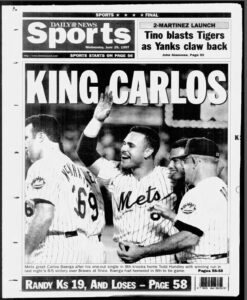 This is how the Mets talked and thought behind somebody else’s castoff in the middle of the year nobody saw coming. “Baerga is growing as the Mets’ primary figure,” Noble wrote. “He’s becoming our emotional leader,” McMichael agreed. “It does make you think anything is possible when we have Carlos doing it,” Huskey affirmed. “There’s no better man to have up there. He’s changing the way we think.” This is how the Mets talked and thought behind somebody else’s castoff in the middle of the year nobody saw coming. “Baerga is growing as the Mets’ primary figure,” Noble wrote. “He’s becoming our emotional leader,” McMichael agreed. “It does make you think anything is possible when we have Carlos doing it,” Huskey affirmed. “There’s no better man to have up there. He’s changing the way we think.”
And what were the Mets thinking as they suddenly sat four games out of first place, not to mention a game-and-a-half from the Wild Card? Elder statesman Franco saw the East in play: “I’d take it if we won the division. Why not think that way? We’re close enough and we’re playing well enough that we can think about both. But why not think about the division?”
The revival of Baerga and Olerud, alongside the sustained emergence of Reed, Jones, and Alfonzo, plus contributions from the likes of Everett, Matt Franco, Jason Hardtke, Cory Lidle and, well, just about everybody who wasn’t one of those Opening Day relievers, made anything and everything seem possible as summer set in. Perhaps the Met-themed back pages weren’t plentiful, given who else locally was already established as a postseason aspirant, and maybe the turnstiles in Flushing weren’t clicking with the desired velocity — none of the three Brave games drew 30,000 — but if you knew, you knew, and you jumped up on a seat. “It’s time to come out and see what’s going on,” fireman Franco urged. He didn’t intend to save games as part of New York’s best-kept open secret, a hidden gem in plain sight.
Yet that might have been the accidental charm of 1997. We who knew did know. We had persevered from 1991 through 1996 with zero reward and commensurate buzz. If you were still a Mets fan coming into 1997 despite those around you congratulating themselves for boarding the Bronx bandwagon, you recognized the beauty of a team scrapping away daily and nightly, a team that forgot it was supposed to be doomed, a team that eventually lost sight of first place (curse that team of the ’90s) but stayed vigilant and diligent in pursuit of the other potential playoff berth. The Wild Card had been inaugurated as a prize in strike-shortened 1994, doled out in earnest for the first time in strike-solved 1995. The Mets fell too far off the pace to convince a fan it could be pursued in earnest in either of those years. For a hot minute in July of ’96, just before Baerga came over, the Mets drew kind of close. Then they fell away, spiraling out of even conceptual contention, ultimately getting Green fired.
That all seemed so long ago by July of 1997. The Mets were in this thing in the present, staying on Florida’s heels, sticking it out to eighth and ninth and extra innings, storming from behind over and over. We changed GMs midstream, swapping out Joe McIlvaine (who helped get us here) for Steve Phillips for “skill set” reasons that seemed murky. Phillips engineered a six-player trade that I didn’t quite grasp, either. Lance Johnson, possessor of 1996’s wonderbat, went to the Cubs in the company of hardy starter Mark Clark and valuable bench guy Manny Alexander, and in return came back a less exciting center fielder, Brian McRae, and two relievers who weren’t necessarily getting it done in Chicago, Mel Rojas and Turk Wendell. I took it on faith that this ilk of dice roll is what contenders who need a little something try when July becomes August. It had been so long since I’d rooted for one, I wasn’t sure.
The slightly retooled Mets continued to have their moments, but they also stalled a bit as summer grew late. The Marlins were within reach, but they had a lot of talent and enough of a lead to fend us off. I still believed we’d catch them. We were the 1997 Mets.
Yes, we. I was too connected to this team to view them with detachment. I’d exchanged my own hellacious high-fives with total strangers, at Shea and online. I’d shivered in the Upper Deck when the Mets did Jackie Robinson Night proud, I’d disregarded Ed Coleman’s warnings that a rainout was imminent in order to sit in the emptiest (but perfectly dry) Field Level I’d ever encountered one early-May Saturday. There were so few people there that I could pick myself out when Sportschannel aired its condensed version of the game that night. I’d sweltered sweetly on a Sunday afternoon until Everett sent us home 12-9 winners in ten. When I couldn’t be at the ballpark, I was tuned in like I hadn’t been tuned in in years…and it’s not like I had ever tuned the Mets out.
This was different, though. This was the Mets as a way of life. As my way of life. Of all the branches I can trace that explain why I’ve been the Mets fan I’ve been and have stayed the Mets fan I stay, the one that stems forward from 1997 may be the sturdiest. In 1997, the Mets provided me a backbeat that’s remained steady ever since. The volume now and then lowers, but it’s always there. I watched and listened to games in the lousy years that preceded it, but that was me watching and listening to an entity distinct from myself. The 1997 Mets and I were intertwined. We were in this thing together. Backbeat and forefront. A tone was set. Priorities were reset, then set in stone. All in and locked in.
I was 34 that year. The last time the Mets were good, I was 27, still riding the Met high that arrived when I was 21. In my late twenties and early thirties, I’d had decent excuse to drift away to a state of mind where the Mets existed but mattered only so much. Marriage. Work. Cats. Maturity, possibly. I had never stopped being a Mets fan, yet it still represented a great leap forward to get where I got in 1997 from where I’d been in the desolation that developed after Davey and before Bobby V. I liked this new, more intense level of fandom that I found. Or did it find me? Either way, my foothold in it grew firm, especially in the succeeding half-decade. I’m still more or less there.
The Marlins slipped away from us in September. I think I knew deep down in August we weren’t going to reel in that Wild Card, but as long as I could rationally reason we were about to get hot and they were about to go cold, I never gave up. The baseline of playoff chase anxiety that usually informs a fighting final month was mostly absent. They’d already given me so much, they couldn’t give me agita. I will admit that while watching from home on September 13, I came as close to giving up on the year as I could. We were down to the Expos at Shea, 6-0, heading to the bottom of the ninth. We’d cut it to 6-2 and loaded the bases. Everett was up and belted a long fly ball just foul. You don’t get one of those and then get the chance to straighten it out.
Before Carl could swing again, my wife reminded mopey me, “You Gotta Believe,” which itself felt like a miracle. Stephanie had been supportive enough of my obsessiveness through the summer, but this was stepping up down the stretch. She’d never quoted Tug McGraw to me before.
Reminded how to act by an unlikely source, I Believed. Everett got another pitch he liked and sent it soaring out of Shea for a game-tying grand slam. I’ve been blessed to witness more dramatic, more impactful clutch connections go deep since, including one that couldn’t have been more dramatic or impactful on the final day of the most recent regular season. I don’t know that any of them has moved me as much as Carl Everett’s grand slam. A couple of innings later, Gilkey walloped the game-winner. Somebody was gonna do it. We weren’t losing The Carl Everett Game.
Likewise, I wasn’t missing the final game of the year, September 28. Bought a ticket from a guy outside the ballpark looking to get rid of one, maybe 15 rows behind home plate. Imagine somebody not wanting to be at the final Mets game of 1997. Paid attendance indicates roughly half of Shea Stadium’s seats went unoccupied or at least unsold, par for a year when the Mets outdrew only four National League teams. Somebody must have inadvertently clicked “private” on the season’s settings.
We weren’t losing on Closing Day, either. The division champion Braves were the opponents, eternally tuning up for the playoffs. We’d been eliminated at the beginning of the week, after leaving Miami with three wins in a four-game series. They thought they’d clinch against us. We didn’t allow them to, yet another sign that these Mets would stand tall to the very end. “There’s nothing to be sorry about,” the writer Jonathan Yardley told his wife as she attempted to comfort him as his Orioles faced their final outs in the World Series of 1979, the year he plunged head over heels in love with his baseball team. “It was a wonderful summer.”
In sports talk radio parlance, you’d immediately sign for a season like that. More than the collection of statistics that encouraged me toward 1998 and beyond, I had the memories of players who’d melded into one inspirational unit. They inspired me to stick with them night after night and day after day for my own wonderful summer. It can be dangerous to decide who’s a “good guy” or a “bad guy” from a distance, but my 1997 Mets, together, felt like the good guys. They even wore those white “ice cream” caps for a spell to signal their cause was righteous. “On other teams I played on,” middle reliever and spot starter Brian Bohanon said at September’s end, “White guys stuck with the White guys, Latin guys stuck with Latin guys, and Black guys stuck with Black guys. Here, everyone mixes with everyone. That’s one of the things that makes this team different.”
The collection of statistics was pretty good, too. Olerud came into Game 162 in search of his hundredth RBI. He got it and then some. John finished at .294, Carlos at .284, Butch at .287. Ordoñez didn’t hit, but he tracked down his first Gold Glove. Alfonzo — Fonzie forevermore — fielded exquisitely at third and batted .315, earning scattered MVP support. Reed — Reeder forevermore — shunted aside the replacement player storyline by turning irreplaceable in the rotation. His ERA of 2.89 was sixth-best in the league. Bobby Jones cooled off in the second half, but he would always have his All-Star appearance, the one in which he struck out Ken Griffey and Mark McGwire in succession. John Franco posted 36 saves. Todd Hundley belted 30 home runs.
The sum of Met parts amounted to 88 wins, 17 more than the year before and the most the club had notched since 1990; they went 80-60 after that 8-14 start. The sum of Met parts finished four games behind the hastily constructed Marlins, who went on to capture the World Series and then be disassembled in a blink; had geography been more malleable, the Mets’ winning percentage would have been sufficient to clinch the NL Central and the AL Central (as long as Interleague play existed, we’re entitled to put forth broad hypotheticals). The sum of Met parts did not go gently into winter. Not only did they take care of the Braves for Win No. 88, but they and we engaged in one final hug. In the ninth inning on September 28, those of us who had the good sense to fill some Shea Stadium seats stood and applauded and chanted LET’S GO METS. We started with one out. We kept it going through the third out and maintained our expression of gratitude as the players eschewed handshakes and threw their arms around each other. Rather than leave the field, everyone mixed with everyone, turned to us, and acknowledged us. We kept acknowledging them. Conscious of Jason’s June example, I climbed atop my seat. Others did the same. How had I never noticed seat-climbing was a thing?
 DiamondVision played a video, cramming in as many spectacular moments as could fit the length of “Reach” by Gloria Estefan. I was already crying before the first clip; I was drowning in tears by the conclusion. I came to the game solo, but I wasn’t alone in this regard, not in the stands and not on the field. “This was more emotional for me than winning in Cleveland, the way we played together,” Baerga insisted. Valentine was affected, too: “I had some goose bumps. I had some emotion. There were so many images going through my head.” Me, I saw no need to dry out until my train ride home was complete. The waterworks resumed once I walked in the door to tell Stephanie about what I experienced. DiamondVision played a video, cramming in as many spectacular moments as could fit the length of “Reach” by Gloria Estefan. I was already crying before the first clip; I was drowning in tears by the conclusion. I came to the game solo, but I wasn’t alone in this regard, not in the stands and not on the field. “This was more emotional for me than winning in Cleveland, the way we played together,” Baerga insisted. Valentine was affected, too: “I had some goose bumps. I had some emotion. There were so many images going through my head.” Me, I saw no need to dry out until my train ride home was complete. The waterworks resumed once I walked in the door to tell Stephanie about what I experienced.
 I know I’ll never love this way again. I’m good with that. No other season can take me by surprise in the best manner possible. I’ve lived a few seasons in this century when the Mets far exceeded expectations (mine and everybody’s), and they excited me in their own fashion, but my path was already paved. When a 2015 or 2019 or 2024 hops out from behind a bush, slaps me on the back, and shouts “SURPRISE!” I no more than modestly startle. I intrinsically understand that invigorating Met years — not just uplifting Met endings — can come out of nowhere. Despite 1969 and 1984, I don’t think I truly understood that before 1997. Similarly, I don’t go into years that are projected as dim completely convinced the lights will stay off. I can be cynical and pessimistic, but, thanks to 1997, I see no need to predict how bad things might go. Or how good. If somebody wants to tell me in advance that the Mets are going to lose 100 games or win 100 games, I’ll shrug. Let things be. See what happens. Feel what happens. I know I’ll never love this way again. I’m good with that. No other season can take me by surprise in the best manner possible. I’ve lived a few seasons in this century when the Mets far exceeded expectations (mine and everybody’s), and they excited me in their own fashion, but my path was already paved. When a 2015 or 2019 or 2024 hops out from behind a bush, slaps me on the back, and shouts “SURPRISE!” I no more than modestly startle. I intrinsically understand that invigorating Met years — not just uplifting Met endings — can come out of nowhere. Despite 1969 and 1984, I don’t think I truly understood that before 1997. Similarly, I don’t go into years that are projected as dim completely convinced the lights will stay off. I can be cynical and pessimistic, but, thanks to 1997, I see no need to predict how bad things might go. Or how good. If somebody wants to tell me in advance that the Mets are going to lose 100 games or win 100 games, I’ll shrug. Let things be. See what happens. Feel what happens.
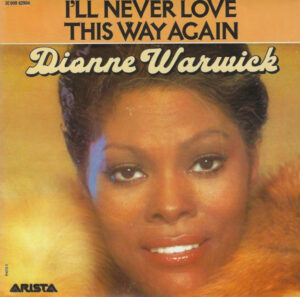 At a glance, what happened in 1997 was an 88-74 team didn’t make the playoffs when playoff spots weren’t as plentiful as they would later become. That, I suppose, is why the 1997 Mets built no historical profile and encompass no historical cachet. They were close to October, but not achingly close. They had productive players, but no Piazza. The rebirth of the franchise as a legitimate on-field entity, not to mention the resumption of the fans’ ability to take the team seriously, definitely occurred, but the emotional/competitive payoff was a couple of years from bearing tangible fruit. Their achievement appears pedestrian by numbers. Their vibe preceded the sorts of mechanisms that would put the feelings they generated in their time on an easily accessible loop. The Mlicki shutout comes up some summers on the eve of an impending Subway Series, but nothing else tends to get mentioned widely. Our Queens-coded radio and TV guys who’ve seen it all and reference plenty never bring up 1997 to illustrate a point or relate an anecdote. The years directly after it, yes, but not the year that turned the team around. They’ve called a lot of ballgames, so perhaps it’s excusable that one particular year’s worth that doesn’t have a place on a banner and happened quite a while ago falls by the wayside…perhaps. At a glance, what happened in 1997 was an 88-74 team didn’t make the playoffs when playoff spots weren’t as plentiful as they would later become. That, I suppose, is why the 1997 Mets built no historical profile and encompass no historical cachet. They were close to October, but not achingly close. They had productive players, but no Piazza. The rebirth of the franchise as a legitimate on-field entity, not to mention the resumption of the fans’ ability to take the team seriously, definitely occurred, but the emotional/competitive payoff was a couple of years from bearing tangible fruit. Their achievement appears pedestrian by numbers. Their vibe preceded the sorts of mechanisms that would put the feelings they generated in their time on an easily accessible loop. The Mlicki shutout comes up some summers on the eve of an impending Subway Series, but nothing else tends to get mentioned widely. Our Queens-coded radio and TV guys who’ve seen it all and reference plenty never bring up 1997 to illustrate a point or relate an anecdote. The years directly after it, yes, but not the year that turned the team around. They’ve called a lot of ballgames, so perhaps it’s excusable that one particular year’s worth that doesn’t have a place on a banner and happened quite a while ago falls by the wayside…perhaps.
I’ve come to mostly accept 1997’s undeserved obscurity as a badge of honor. Other seasons I hold comparably dear produced heftier accomplishments. This one, though, made the most of what it managed to do, even if it didn’t do quite as much. Pound for pound, that’s a title no other Mets season can ever take away from this one. Pound for pound, no other Mets season could ever give me more.
PREVIOUS ‘MY FAVORITE SEASONS’ INSTALLMENTS
Nos. 55-44: Lousy Seasons, Redeeming Features
Nos. 43-34: Lookin’ for the Lights (That Silver Lining)
Nos. 33-23: In the Middling Years
Nos. 22-21: Affection in Anonymity
No. 20: No Shirt, Sherlock
No. 19: Not So Heavy Next Time
No. 18: Honorably Discharged
No. 17: Taken Down in Paradise City
No. 16: Thin Degree of Separation
No. 15: We Good?
No. 14: This Thing Is On
No. 13: One of Those Teams
No. 12: (Weird) Dream Season
No. 11: Hold On for One More Year
No. 10: Retrospectively Happy Days
No. 9: The September of My Youth
No. 8: First Taste
Nos. 7-5: Three of a Kind
by Greg Prince on 3 March 2025 2:39 pm Academy Award winners deemed guilty of defying brevity in their acceptance speeches Sunday night heard the orchestra subtly nudging them off the Dolby Theatre stage. New York Mets receive a more definitive elbow toward the rideshare area on Seaver Way when the powers that be decide it’s their time to go. Designated for assignment. Waived. Released. Granted free agency. Traded. Traded for cash considerations, which used to be referred to as sold. However a Met becoming a former Met winds up classified, it has to feel as if something wicked has befallen any ballplayer once he is cast out of the Emerald Citi.
Yet each of them, from the fleetingest of complete unknown cameoists to those who filled substantive supporting and leading roles, deserves an encore in our consciousness. Hence, as we’ve done in the aftermath of every Oscars ceremony since 2007, we now take a moment to remember the Mets who have left us — in the baseball sense — in the past year.
Cue the montage.
___
JORGE YABIEL LOPEZ
Relief Pitcher
March 29, 2024 – May 29, 2024
One out later, Shohei Ohtani, who had been too quiet for too long, homered. It was 9-3. Versus Freddie Freeman, Lopez didn’t get a strike call he wanted on a checked swing. Lopez barked at De Jesus. De Jesus ejected Lopez. Perhaps the umpire could have been the bigger man, but Lopez had recently hit him with a pitch, so who knows what he was thinking? A more apt question might be what the hell was Lopez thinking when, as he trudged to the dugout, he flung his glove over the protective screen and into the stands.
—May 30, 2024
(Released, 6/5/2024; signed with Cubs, 6/12/2024)
___
JOSEPH THADDEUS “Joe” HUDSON
Catcher
June 21, 2024
We saw Joe Hudson, a career journeyman on a weekend pass to the majors because Luis Torrens took a couple of days of paternity leave. Hudson caught the Mets’ final defensive half-inning, action enough to qualify him as Lifetime Met No. 1,239. Joe didn’t get to bat in what might be his only Mets game, temporarily placing him in the company of another Joe H. who crouched behind the plate without getting to stand beside it, the immortal Joe Hietpas amid the last wisps of 2004, a decidedly less jubilant season-ending occasion than the one that soaked Mays in 1973 (though Hietpas can probably still taste the cup of coffee and consider it champagne).
—June 22, 2024
(Free agent, 10/21/2024; signed with Astros, 12/9/2024)
___
MATTHEW JOSEPH “Matt” FESTA
Relief Pitcher
June 30, 2023
They brought in Matt Festa, whom I’d never heard of before today and learned was a Met around 4 pm. The roof caved in on Festa: three singles, a pair of lineouts, a double. Gameday’s version of this was a steady drumbeat of IN PLAY, RUN(S).
—June 30, 2024
(Free agent, 7/5/2024; signed with Rangers, 7/11/2024)
___
BENJAMIN JOSEPH “Ben” GAMEL
Outfielder
June 26, 2024 – August 15, 2024
Harrison Bader pinch-ran. Ben Gamel (still on the team, apparently) and Tyrone Taylor walked. Then Lindor came through to make it 4-2. One out later, Jesse Winker, who to this point in his Met tenure hadn’t been any more a factor in any day’s Met offense than Ben Gamel, singled for insurance.
—August 8, 2024
(Claimed off waivers by Astros, 8/20/2024)
___
JULIO ALBERTO TEHERAN
Starting Pitcher
April 8, 2024
With Aaron’s legacy in the spotlight and Baker visiting the SNY booth, the Mets a little too respectfully fell behind Atlanta, 4-0, early. Julio Teheran, whose name is familiar within the realm of Mets-Braves recaps, pitched in road grays while toeing a rubber he presumably knows well. Two innings as the Mets’ starter of next resort went all right. The third went about as well for the Mets on the 50th anniversary of 715 as the fourth went well for the Mets on the 30th anniversary of 715. I should probably explain that.
—April 9, 2024
(Free agent, 4/11/2024; signed with Cubs, 4/15/2024)
___
COLE YOUNG SULSER
Relief Pitcher
April 8, 2024 – May 7, 2024
You watch the Mets at Truist Park, and you expect Travis d’Arnaud to do something harmful to them. Sure enough, he does that in the sixth, driving in the go-ahead run for the Braves off another pitcher-come-lately, Cole Sulser. Sulser replaced Yohan Ramirez on the roster Monday afternoon. Sulser didn’t give up anything else, though, same as Reed Garrett hadn’t given up anything at all once he took over for Teheran. Those relievers who are used when the manager doesn’t want to use the relievers he’d rather use sometimes come through somewhat.
—April 9, 2024
(Traded to Rays, 7/26/2024)
___
PHILLIP ROGER “Phil” BICKFORD
Relief Pitcher
August 2, 2023 – September 30, 2023
The bottom of the ninth beckoned, and because it was tied, Buck beckoned Bickford…Phil Bickford. Perhaps from warming up alongside Adam Ottavino and then being called on, Bickford took Showalter’s selection as less a vote of confidence than a saveless sigh. If a lead was to be preserved, Otto would be signaled in. The implicit message to Phil: just don’t blow it here, OK pal? Phil just blew it here. He hasn’t blown so many that we have to borrow some Gott-brand vitriol and direct it toward Bickford. I mean, two months ago, how high was your Phil Bickford Awareness Quotient? I kind of knew he’d been a Dodger, but before we traded for him, I was as likely to think “Phil Bickford” was SNY’s State Farm Agent of the Day. Either way, Phil walked Carter Kieboom on as few pitches as possible without simply waving him toward first; hit Jake Alu on an oh-two pitch, with the first strike having been the gift of clock violation; allowed a seamless sac bunt from Ildemaro Vargas (when did bunting become in vogue again?); and, inevitably, gave up the winning infield-in hit to Jacob Young. This projects as last time this season I plan to list a plethora of Washington Nationals in one paragraph.
—September 7, 2023
(Released, 3/26/2024; signed with Yankees, 4/2/2024)
___
MICHAEL HARVEY TONKIN 1.0
Relief Pitcher
March 29, 2024 – April 4, 2024
The Mets actually held a 3-0 lead in the first game, an advantage the Mets ceded slowly (single Tiger tallies in the sixth, seventh and eighth), before surrendering the contest all at once (luckless Michael Tonkin bending, then breaking in the eleventh).
—April 5, 2024
(Traded to Twins, 4/9/2024)
___
YOHAN MANUEL RAMIREZ 1.0
Relief Pitcher
March 30, 2024 – April 6, 2024
Three games into the new season, and I already don’t want to dwell on the most recent baseball game the Mets played and lost. For the record, Tylor Megill labored for four innings Sunday and left with tenderness in his shoulder, slating him for an MRI. Carlos Mendoza served a suspension for Yohan Ramirez throwing in the general airspace around Rhys Hoskins the day before. Ramirez was suspended for three games but opted to appeal it, so fill-in manager John Gibbons used Yohan for three innings, a sure sign of an appeal likely to be dropped.
—April 1, 2024
(Traded to Orioles, 4/11/2024)
___
MICHAEL HARVEY TONKIN 2.0
Relief Pitcher
April 20, 2024 – April 21, 2024
Go figure, Michael Tonkin is a Met again (his between-stints limbo that included one outing as a Twin qualifies him for Recidivist status; his absence of 15 games is the shortest for any of the 56 in the boomerang subgenre).
—April 21, 2024
(Claimed off waivers by Yankees, 4/25/2024)
___
YOHAN MANUEL RAMIREZ 2.0
Relief Pitcher
May 10, 2024 – May 14, 2024
Quintana did correct himself in the fourth and fifth, and there was representative bullpen work from unusual suspects — Recidivist reliever Yohan Ramirez doing his best Michael Tonkin impression…
—May 11, 2024
(Traded to Dodgers, 5/20/2024)
___
TYLER RYAN JAY
Relief Pitcher
April 11, 2024 – July 1, 2024
After the offense had woven enough of a cushion in support of Jose Quintana and Drew Smith, Carlos Mendoza was confident enough to tell 29-year-old rookie lefty Tyler Jay to come on in, the lead is wide. Jay is a journeyman’s journeyman who persevered through quite a journey to replace Dedniel Nuñez on the roster and become a) the 1,233rd Met overall; b) the 427th player to make his major league debut as a Met; and c) the eighth Met in this century to feature a last name that ends in “ay”, joining Ruben Gotay (whose pronunciation of choice didn’t prepare him for this little club), Darren O’Day, Lance Broadway, Jason Bay, Trevor May, Sam Clay and Anthony Kay. Also, Jay, the latest temp to punch the clock in our gig economy bullpen, gave up a run while recording six outs, which stands as his most vital statistic, but you can track down that information anywhere.
—April 11, 2024
(Traded to Brewers, 7/21/2024)
___
ERIC PAUL ORZE
Relief Pitcher
July 8, 2024 – July 26, 2024
Back in the present, Orze walked Matt Olson, marking the fifth big-league hitter he’d faced without retiring anybody. But the worm was turning: Travis d’Arnaud flied out to right, and having experienced the joys of getting outs Orze indulged himself, recording four more of them in completing his two innings of work. His career ERA now stands at 21.60, not ideal but at least finite.
—July 27, 2024
(Traded to Rays, 11/19/2024)
___
PABLO ISRAEL REYES
Pinch-Runner
September 1, 2024
[A]nd pinch-runner Pablo took off, leading me to discover “C’MON REYES!” is one of those things you never forget how to yell at your television. This Reyes scored his first Met run, leaving him only 884 behind Jose for Reyes franchise leadership (Argenis Reyes totaled 13 runs during his 2008-2009 stay; 2023 pitcher Denyi Reyes ran smack into the adoption of the universal DH and was never invited to test his speed on the basepaths).
—September 2, 2024
(Free agent, 10/21/2024; signed with Yankees, 11/18/2024)
___
ZACHARY RYAN “Zack” SHORT
Infielder
March 30, 2024 – April 21, 2024
I’m Joey Wendle
And I’m Zack Short
Some fantasy players
Can’t tell us apart
We’re utility guys
We know what we’re doing
We’ll try to be super
Like old Joe McEwing
—April 1, 2024
(Traded to Red Sox, 5/1/2024)
___
JOSEPH PATRICK “Joey” WENDLE
Infielder
April 1, 2024 – May 14, 2024
Wendle had a rough defensive series, including on Thursday when he didn’t get what appeared to be a fairly routine forceout accomplished. It wasn’t as egregious as the double play attempt he made when a throw home was in order the other night, but it didn’t help. Wendle’s also had a rough offensive year. That doesn’t leave a whole lot of room for much else.
—May 2, 2024
(Released, 5/20/2024; signed with Braves, 5/24/2024)
___
JOSHUA TODD “Josh” WALKER
Relief Pitcher
May 16, 2023 – June 1, 2024
Turning to rookie lefty Josh Walker to get outs with a three-run lead didn’t work out. At all. A walk. A single. A walk. An exit.
—June 26, 2023
(Traded to Pirates, 7/30/2024)
___
ADRIAN DAVID HOUSER
Pitcher
April 4, 2024 – July 24, 2024
The game in a nutshell: it’s nothing-nothing at the outset of the bottom of the eighth. I wander into the kitchen, half-listening to the TV audio from the living room. I hear Gary Cohen identify a Nationals batter as someone who has hit five career home runs off Adrian Houser. I do a quick calculation and assume he’s talking about ex-Red Jesse Winker, since who else on the Nats would have faced ex-Brewer Houser often enough to hit five home runs off him? A moment later, I’m watching Winker Dinger No. 6 fly over a fence. I not only saw it, but I saw it coming…as, I imagine, did every Mets fan who processed the foreshadowing.
—July 4, 2024
(Released, 7/31/2024; signed with Cubs, 8/6/2024)
___
BROOKS LEE RALEY
Relief Pitcher
March 30, 2023 – April 19, 2024
But danged, as Pete likely wouldn’t say, if three singles stitched together by McNeil, Baty and Pham — none of them calling for the kind of Statcast tape-measuring Alonso’s hits require — don’t also sometime get the job done. Same for three innings of unglamorous but mostly effective relief pitching, this time around from Brooks Raley, Jeff Brigham and David Robertson. Tampa Bay put a runner on first in the eighth and another runner on second in the ninth. I was prepared for the dang dam to burst at any given moment, with Rays runs swimming everywhere, but I was just as prepared to stay dry. Each arm did what it was asked to do. No Ray scored after the sixth. The Mets had just won two in a row.
—May 19, 2024
(Free agent, 10/31/2024; currently unsigned)
___
JACOB TANNER “Jake” DIEKMAN
Relief Pitcher
March 30, 2024 – July 28, 2024
I was under the impression Jake Diekman was one of those veteran lefties who would be über-dependable à la Brooks Raley. Alas, not all southpaws who’ve been in circulation forever are created equal. We miss the contributions of Raley. We’re still waiting for some on a consistent basis from Diekman, who was characteristically wild before giving way to Reid Garrett.
—June 30, 2024
(Released 8/3/2024; signed with Braves, 2/11/2024)
___
EDUARDO CORTES “Eddy” ALVAREZ
Infielder
September 9, 2024 – September 30, 2024
“Carlos Mendoza shook up the batting order a little bit, but it didn’t really work. Can you remember the last time the Mets got a big hit?”
“Certainly before they had two guys named Alvarez in the lineup. Thanks for the question. Next caller, you’re on.”
—September 11, 2024
(Free agent, 10/21/2024; signed with Braves, 1/7/25)
___
ALEXANDER EDWARD “Alex” YOUNG
Relief Pitcher
July 23, 2024 – September 27, 2024
Megill departed in the fifth. The relievers of most relevance were any Mets who could throw double play ground balls. As it happened, we had three of them. Alex Young in the fifth, Huascar Brazoban in the sixth, and Danny Young in the seventh each escaped a jam by coordinating with his infielders on lead-preserving GIDPs. Three different pitchers. Three different innings. Three double play grounders. Somebody disseminated the info that that had happened once before in Mets history. At Shea, of course. I say “of course” out of affection for Shea as the kind of place where all the fun things happened. Like 1986. Like 1969. Like the trio of happy ground balls that were elicited on August 7, 1966, in the first game of a Banner Day (fun!) doubleheader versus the St. Louis Cardinals.
—September 5, 2024
(Free agent, 11/22/2024; signed with Reds, 1/20/2025)
___
OMAR DAVID NARVÁEZ
Catcher
March 30, 2023 – May 30, 2024
The only thing I told any kid, a girl sitting directly behind me, was “Alvarez is DH’ing” when she absorbed the home team defense and asked, with Mets fan awareness that made my heart soar, “Where’s Alvarez?” (Don’t think it didn’t pain me to casually use “DH” in a sentence in a National League ballpark.) The girl didn’t respond and I decided to let her figure the rest out for herself. Thus, when Omar Narváez stepped into the box, and she greeted his appearance with, “Who’s that?” and Omar the Infrequent announced his presence with authority via his first Met home run, it made for a delightful surprise.
—July 21, 2023
(Released, 6/5/2024; signed with Astros, 6/26/2024)
___
DEMETRIUS JEROME “DJ” STEWART
Outfielder
July 4, 2023 – September 10, 2024
Last season, amid his home run tear, DJ identified his daughter as a motivation for keeping him swinging through callups and send-downs: “I have a little girl, and diapers aren’t cheap.” He laughed when he said it, but it was a reminder, just as what he said Tuesday night was, that ballplayers are people, too, especially ballplayers who live their lives on the edge of the transactions column. If DJ Stewart isn’t hitting home runs for the New York Mets, I’m not as invested in his everyday problems and his internal struggles. But here he is, going deep now and then, and sounding like somebody I’m glad to know is getting something out of hanging in there.
—May 1, 2024
(Free agent, 11/4/2024; signed with Pirates, 1/16/2025)
___
PHILLIP LOUIS “Phil” MATON
Relief Pitcher
July 11, 2024 – October 20, 2024
This one still needed a little shepherding to the final outs. In the bottom of the eighth, Mendoza called on Phil Maton, and Maton rather than the imposter wearing No. 88 in Milwaukee materialized. Phil struck out Schwarber, struck out Trea Turner, allowed a double to Bryce Harper (into each life a little Bryce must fall), but then grounded out Alec Bohm.
—October 6, 2024
(Free agent, 11/4/2024; signed with Cardinals, 3/13/2025)
___
JOSEPH GEORGE “Joey” LUCCHESI
Starting Pitcher
April 7, 2021 – May 15, 2024
“The bulk guy” Joey Lucchesi, however, wasn’t able to ride his signature churve to a successful outing. On one hand, that’s bad, because we needed quality or at least bulk from Lucchesi. On the other hand, I don’t ever want to hear the word “churve” again, so the sooner Lucchesi is chased from the mound, the sooner “churve” hits the showers. Nothing against the pitcher. Nothing against the pitch, even. Everything against a word that sets my nerves on edge every instant it’s spoken. “Churve” sounds like a preppie pronunciation for what is commonly mixed with sour cream atop a baked potato. Muffy, whatever have you done with Joey’s churve?
—May 15, 2021
(Free agent, 11/4/2024; signed with Giants, 1/20/2025)
___
HARRISON JOSEPH BADER
Outfielder
March 29, 2024 – October 18, 2024
Then we’re back to Bader, the pinch-runner for the left fielder who wouldn’t have played if not for the left fielder with the stomach bug. Bader doubles. It’s at least as big as Martinez’s single, even though it doesn’t knock in a run. It might have had there been a pinch-runner available, but the Mets were playing with a three-man bench, and all Mendoza had left to run for Martinez was his backup catcher, so no dice. Yet it was critical that J.D. got to third, which Harrison made happen, because after two more Met strikeouts, Phillies reliever Jose Alvarado uncorked a wild pitch, which was enough to bring Martinez home with a second eleventh-inning run. Connoisseurs of contemporary extras comprehend two runs in the top of an inning after the ninth is exponentially better than just one run. In the bottom of the eleventh, Jake Diekman gave up one run — but not two. One we could handle, thanks to what the pinch-runner did with the bat twice. Sometimes a player comes off the bench and does something outstanding. Bader came off the bench to do one thing and wound up doing two things that had nothing to do with that one thing, and it made all the difference. The previous pinch-runner to make an offensive impact with his lumber rather than his fee, if you can think back this far, was Nimmo, on Sunday, What Bader did, while not as definitive as Brandon’s Esix Snead-style walkoff homer, was pretty rare in Met annals. Only seven Mets have entered a game as a pinch-runner and proceeded to connect for two hits and drive in a run or more.
— May 17, 2024
(Free agent, 10/31/2024; signed with Twins, 2/5/2025)
___
JULIO DANIEL “J.D.” MARTINEZ
Designated Hitter
April 26, 2024 – October 17, 2024
J.D. the DH was the HR hero the night before, and it was his 2B that provided the pair of Rs the Mets posted on the scoreboard Friday en route to their 2-1 W. A cynic might observe Martinez is the only Met driving anybody in these days. A cynic should go outside and check to see if it’s raining.
—June 15, 2024
(Free agent, 10/31/2024; currently unsigned)
___
LUIS SEVERINO
Starting Pitcher
March 30, 2024 – October 16, 2024
Luis Severino gave Carlos Mendoza five gutty innings, which is to say one of them, the second, was a mess that did not quite spiral into something worse. The admirable work Luis — I’m not yet at the “Sevy” stage — put into extricating himself from the bases being loaded after two runs were home paid off in the short term, but almost guaranteed the long term wouldn’t be long enough. After 99 pitches through five, Severino was done.
—April 7, 2024
(Free agent, 10/31/2024; signed with Athletics, 12/5/2024)
___
ADAM ROBERT OTTAVINO
Relief Pitcher
April 7, 2022 – September 30, 2024
Now that Trevor Williams has been removed from the NLWC roster for tactical reasons and Joely Rodriguez has been shifted to the IL for shoulder reasons (the Mets wishing Taijuan Walker be available to shoulder a little additional load), Adam Ottavino stands as the lone Met pitcher to be active for every single game of the 2022 season and postseason. Ottavino has been as close to an unsung hero as the Mets have had this year. We’re free to sing the praises of Ottavino at any time, but usually his contribution boils down to “after Adam Ottavino pitched a scoreless eighth, it was Edwin Diaz time” or words to that effect. This would be a wonderful time to sing Ottavino’s praises exclusively and fulsomely. That would be if his Game Two performance were praiseworthy. After he struck out Old Friend Brandon Drury to end the eighth, the ninth, with the Mets still ahead by five, represented a ploddingly developing minefield for Adam. He struck out He-Seong Kim, but then hit Grisham; walked Nola; flied out Profar deep enough to advance Grisham; walked Soto; and walked Machado (who prefers not to run). Now it was 7-3, the bases were loaded and the song to sing was whatever Seth Lugo would respond to.
—October 9, 2022
(Free agent, 10/31/2024; signed with Red Sox, 2/18/2025)
___
TOMÁS ENRIQUE NIDO
Catcher
September 13, 2017 – June 4, 2024
Narváez the veteran, Alvarez the phenom; no room at the two-catcher inn any longer for the second-longest tenured Met who never grew into a consistent hitter at the major league level, but, as Gary Cohen reminded us, that doesn’t mean he wasn’t any good. He had a few big hits across his seven mostly partial season in the bigs, and his catching was big league-caliber. Tomás was kind of a throwback — the career backup receiver who could be depended on in a pinch by one organization for a very long time. It’s not what a kid dreams of growing up to be, but sometimes you get that far, you get a little farther. By the end of 2022, Nido was the starting catcher for a playoff team in a pinch. Should we cross paths with him in another uniform, I will be sincere in referring to him as an Old Friend™.
—June 5, 2023
(Released, 6/17/2024; signed with Cubs, 6/19/2024)
___
JOSE GUILLERMO QUINTANA
Starting Pitcher
July 20, 2024 – October 17, 2024
[A]nybody watching was absolutely certain Mendoza was about to take out a starting pitcher who had retired his previous ten batters and looked capable of getting his eleventh. Quintana conveyed to his manager that he was good to keep going. Mendoza said OK, it’s yours. I have to admit I was a little sleepy around this point of the afternoon and wouldn’t have minded drifting off, but this woke me up. A manager leaving in a starter because the starter was rolling and the starter — a mature pitcher not obviously swept up in the moment (it’s not like this was Game Five of the World Series), but someone whose self-assessment you sensed you could trust, if you didn’t already trust your very own eyes — not wanting to leave. OK, it was Quintana’s. And Quintana struck out Contreras to end the eighth, a performance that transcended mere satisfaction that a Met starter went deep. A Met starter was permitted to go deep. A Met manager acted situationally rather than automatically. One fewer third of an inning from a relief corps that, no matter how solid it’s been, pitches far too much felt WAY bigger than 0.1 IP in the box score.
—April 29, 2024
(Free agent, 10/31/2024; signed with Brewers, 3/3/2025)
___
JOSE ANTONIO IGLESIAS
Infielder
May 31, 2024 – October 18, 2024
I wanted to go home from Friday night’s game sick of “OMG”. I wanted it to be forced down my throat and stuck in my ear. I wanted it to be played to within an inch of my life. I want the Mets’ home run song to be blared incessantly because I want the Mets to homer incessantly. There was indeed a ton of “OMG” at Citi Field, but we never reached the saturation point. Close enough, however, will do for now. The Mets bashed five home runs Friday. Jose Iglesias therefore belted out his chorus in a veritable loop, including within two self-serenades. There was also the matter of his walk-up accompaniment, which happens to be the very same smash hit. Bring it, Candelita.
—July 13, 2024
(Free agent, 10/31/2024; signed with Padres, 3/5/2025)
by Greg Prince on 25 February 2025 11:45 am Spring Training, you gotta stop making real news. Frankie Montas’s lat last week. Nick Madrigal’s shoulder over the weekend. Sean Manaea’s oblique as the Monday surprise du jour. We’re here for bright skies and optimism and megastars presenting vehicles to would-be stars in exchange for jersey numbers. That’s the news we can consume and smile about.
All injuries come at the wrong time. All injuries are unfortunate. Some come at a worse time than others. Some are more unfortunate than others. Aesthetically, Spring is a bad time for injuries. As a practical matter, the earlier an injury occurs, the longer there is the opportunity for recovery or, if necessary, replacement. If you lose for a while a player who rates as replaceable…well, let’s not treat human beings as commodities if we can help ourselves. Still, as Anthony DiComo pointed out, the Mets have 68 guys in camp; plus there are a couple of familiar fellows out there who are still unengaged by any organization; and we just picked up an outfielder named Alexander Canario from the Cubs, which, I suppose means we have 69 guys in camp. Nobody’s a commodity, but it’s nice to have alternatives.
Montas goes down for a while? Good thing we have pitching depth. Manaea goes down, likely for less while, but still a while? The depth isn’t as deep, and Manaea is inarguably most vital to the Mets’ pitching plans. Clay Holmes looked good Saturday, Max Kranick pretty solid on Sunday. People step up. People earn closer looks. We’re better off with Manaea’s oblique clearing up. But somebody’s gonna have to pitch in his stead for a spell. No wonder reports of Jose Quintana withdrawing from Colombia’s WBC qualifier team raised multiple antennae Monday night.
Madrigal we barely know except that he was brought in as an infield backup instead of Jose Iglesias. Something about options and flexibility. Now Madrigal’s out “for a long time” with a fracture, per Carlos Mendoza, and you’re left to wonder when Iglesias stopped being an excellent defender and reliable hitter. Then you remember, oh right, options and flexibility. Youth as well. I, too, would like to see more Luisangel Acuña. Not sure bench guy is his ideal role from jump in 2025. Or maybe sitting behind major leaguers in April beats starting every day in Syracuse.
Here I am, immersed in actual Met news and its impact before March. No, that’s not what you want a lot of in Spring. You want stories about numbers on the backs of jerseys and what it takes to shift them to the backs of other jerseys.
Saturday, Juan Soto homered the first time ever we saw him swing as a Met, a cause for instant celebration for those of us tuning in from anywhere for a taste of Spring. Further down the lineup in that very same inning, we could be pretty happy that Brett Baty beat out an infield grounder by motoring to first base. Of course he motored. Brett Baty has a sweet new ride, a situation directly related to Juan Soto not having to get confused when he dresses. Win-Win!
Soto, who’s worn 22 at every major league stop before arriving at what we hope is his last and most glorious, came to a team where that number was assigned to a former first-round draft choice whose development has stalled like he trusts his sweet new ride won’t. Baty’s worn 22 since he was 22 and hinting that he’d be the Mets’ third baseman for the foreseeable future. That was in ’22. Times, it is said, change. Numbers, it should also be said, players need to be malleable about.
Before Christmas of 2024, there was Soto trying on 22 at Citi Field, as clearly his as it was Donn Clendenon’s and Ray Knight’s while they were proving themselves Most Valuable in the cause of the Mets winning World Series. Donn hit .357 with three homers in 1969. Ray hit .391 with an enormous Game Seven dinger in 1986. Clendenon and Knight earning their respective WS MVP honors wearing the number that they did has given 22 a little extra historical oomph in Met annals. It also belonged to as valuable a performer as the Mets had in another Fall Classic, Al Leiter: two starts, one hard-luck no-decision in Game One, one heartbreaking defeat in Game Five, a combined 268 pitches’ worth of blood, sweat and tears trickling across two boroughs’ mounds in his wake. Things go a little better in 2000, we probably have three 22s getting presented an October MVP.
For the record, Juan hit .333 with three homers in a World Series his team won, and .313 with another longball in a World Series his team lost. Think hard before betting against 22 when fall comes to Flushing.
The same digits Clendenon, Knight, Leiter and Soto have made memorable also made a habit of gracing the backs of players who engendered high hopes unmet somewhere between various Aprils and Septembers. Witness mid-’90s five-tooler Alex Ochoa; future closer of the 2000s Royce Ring; 2013 top pick Dom Smith. Ochoa cycled through a few moments in 22 before getting shipped to Minnesota for Rich Becker. Ring as 22 notched no saves for us, or anybody else in any number. Smith, in 22 between 2017 and 2019, produced some big hits before dropping a 2 in deference to former Cy Young Award winner Rick Porcello. Got a few more wearing just 2 until fading from our scene in 2022. Dom put a lot together as a Met, but fell a little shy of putting it all together.
Like any number, 22’s success rate has depended on who’s been wearing it when. Few Mets could be more rewarding to watch than No. 22, Kevin McReynolds, at his 1988 peak. Few could be more disappointing to watch than No. 22, Kevin McReynolds, as he descended from that peak. We experienced Porcello long past his Cy status, in 22 in what there was of 2020; Willie Harris after he was done robbing us with regularity, in 22 for the duration of 2011; Ender Inciarte after he was done robbing us with regularity, in 22 for two pre-Baty weeks in 2022; and Brett Butler, four years after signing him as our leadoff hitter would have been a capital idea, in 22 for not quite four months in 1995. Jose Valentin was awesome all year in 18 in 2006, less so after switching to 22 in 2007, a year he got injured in July and never played again.
Conversely, Jack Fisher was sturdy as hell for 133 starts over four seasons in 22. Eric Young, Jr., swiped a stolen bases crown in 22. Mike Jorgensen did defensive wonders at first base and once won a game on a walkoff grand slam in 22. If forces hadn’t conspired to send Duaner Sanchez out for a late-night cab ride in Miami, I’m convinced Xavier Nady would have worn 22 in the 2006 World Series. Instead, he was traded to Pittsburgh because we needed Roberto Hernandez to reinforce the bullpen in Sanchez’s absence. The next time we were in the World Series, the Met in 22 was Kevin Plawecki, who caught only ceremonial pitches through three rounds of postseason inaction in 2015, suggesting that betting on 22 when fall comes to Flushing can be a bit of a crapshoot.
All those ups and downs for 22, from Bob Moorhead in 1962 to Brett Baty in 2024, but Soto had to have it. Juan wasn’t signing a record-breaking deal with the Mets to feel the slightest bit uncomfortable. Fortunately, Baty, whose grip on his number grew more tenuous than his grip on his roster spot, wasn’t going to be made to feel discomfort, either. Should Brett actually be a Met in the season ahead (third base is otherwise occupied), he will do it as No. 7, a selfless selection Brett said he went for in deference to his youthful affinity for one Met legend and one Hall of Famer.
Had things worked out perfectly, those would both identify Jose Reyes, but the Hall of Famer in Baty’s esteem is Joe Mauer. Before Baty’s switch, good ol’ 7 was out of circulation in these parts for several seasons. Marcus Stroman last wore it for the Mets, in 2019, then said it didn’t seem proper because it truly belonged in Queens to his former Blue Jay teammate Reyes — by then no longer playing — and switched to 0. With numbers being retired with surprising frequency in recent years, I wondered if 7 was being set aside for its own day of honor, whether for Jose, or our all-time avatar of tenure Eddie Kranepool, or the two of them in tandem Berra-Dickey style. Now it’s back on the field, and, honestly, it looks good on Brett.
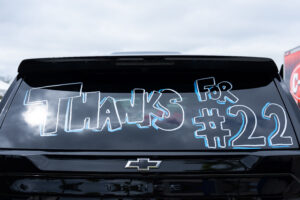 Even better-looking from Baty’s perspective is what resides in his parking space: a spanking new Chevy Tahoe, courtesy of the newest 22 in camp. The SUV is Soto’s “thanks, dude” to Baty for being so accommodating with his digits. Brett has until now been driving what he considers a hardy old Toyota, specifically a 4Runner. It’s a 2016. I drive an old Toyota that’s proven plenty hardy, despite it being smaller than Brett’s vehicle and considerably older than Brett himself. I’d say we Toyota guys have to stick together, but there’s the kid moving into his new model. Good for Baty. Good for Soto. Good for us. As baseball fans, we are primed to love numbers and cherish camaraderie. Whatever makes our guys happy and brings them together and revs them toward a winning season, right? Even better-looking from Baty’s perspective is what resides in his parking space: a spanking new Chevy Tahoe, courtesy of the newest 22 in camp. The SUV is Soto’s “thanks, dude” to Baty for being so accommodating with his digits. Brett has until now been driving what he considers a hardy old Toyota, specifically a 4Runner. It’s a 2016. I drive an old Toyota that’s proven plenty hardy, despite it being smaller than Brett’s vehicle and considerably older than Brett himself. I’d say we Toyota guys have to stick together, but there’s the kid moving into his new model. Good for Baty. Good for Soto. Good for us. As baseball fans, we are primed to love numbers and cherish camaraderie. Whatever makes our guys happy and brings them together and revs them toward a winning season, right?
Wright.
David Wright just pulled into the alumni parking lot of my mind, because the last time I gave uniform numbers much thought was last month when David was humbly conducting his media Zoom call regarding the forthcoming retirement of 5, a number beyond even the compensatory powers of Juan Soto. Naturally David did his press availability humbly. It’s how he’s forever done everything.
Had David been left to retire 5, he would have done it for Ed Charles or Davey Johnson or John Olerud or Chico Escuela. There are barrels of fun 5s in Mets history. David might not know of everybody to have worn it before him, but to listen to him reflecting on his career, he’d believe anybody would deserve the highest honor a franchise could bestow before he should receive it.
“I don’t think it’s hit me,” he said on the cold afternoon of January 8. “I don’t think it’s ever gonna hit me. I truly feel like it’s a bit undeserved, given the skill and accomplishments of some of the numbers I’ll be amongst up there. I joke that I think there should be a special section for my number because it’s probably not deserving of being amongst the really, really good players in the organization.”
In Wright’s world of accomplishment, he somehow fancies himself Wayne and/or Garth. “I’m not worthy! I’m not worthy!” You can’t read a list of Met career totals in just about any offensive category and not run into WRIGHT right away. But that’s the same David who stood in front of his locker after wins uninterested in burnishing his base hits or runs batted in because all that mattered was the team won, the same David who took losses upon himself, never mind that baseball is a team game and too often his team was stocked with players not on his level.
 Now his level will be up there “amongst” Seaver and Strawberry and the rest of the Metropolitan immortals. I could name them all, but reciting Met numerical retirees now takes a minute. Live long enough, huh? I lived too long with the Mets ignoring their past to not adore them embracing it. It’s how we show our respect, and I have affection for the acknowledgment. Whether they rediscovered 36, remembered 24 or took care of the teens, 5 was a gimme from the time it was hung up by The Captain in 2018. As of July 19, David Wright, age 42, will be the youngest Met to have his number retired. He still had to wait too long. Now his level will be up there “amongst” Seaver and Strawberry and the rest of the Metropolitan immortals. I could name them all, but reciting Met numerical retirees now takes a minute. Live long enough, huh? I lived too long with the Mets ignoring their past to not adore them embracing it. It’s how we show our respect, and I have affection for the acknowledgment. Whether they rediscovered 36, remembered 24 or took care of the teens, 5 was a gimme from the time it was hung up by The Captain in 2018. As of July 19, David Wright, age 42, will be the youngest Met to have his number retired. He still had to wait too long.
It was five accompli, wasn’t it? They never gave out Wright’s number, just like they never gave out Stengel’s, Hodges’s, Seaver’s or Piazza’s once they were done (whereas 36 was issued to 27 different Met players plus Mickey Callaway in the four decades following Jerry Koosman’s departure from Shea). We didn’t have to dwell on it too long while it wasn’t happening or stew about its worthiness once it did happen. This was pretty close to old school number-retirement, fitting for an old-school player.
Another fitting juxtaposition from my early-January perspective was that Wright was directed to sit and be reminded by reporters of how marvelous a career he’d conducted one day before the nation had the privilege of being reminded what a person we once elected president.
In baseball, when appropriate, we retire a number. In America, when a prominent individual’s time arrives, we conduct a state funeral. It’s how we show our respect and, unless we’re made of stone, express our affection. Circumstances presented an intersection of aspects of both rituals in deepest winter. They each got my attention. A day after David of Virginia delivered his eternally sincere aw-shucks self-appraisal, national remembrance for President Jimmy Carter concluded. One Southern gentleman given his flowers in his forties, another passing at a triple-digits age and being remembered warmly in the aftermath of a remarkable life.
Both men always exuded graciousness in their time in the spotlight. Carter wasn’t as humble as Wright, but who is? Also, Jimmy Carter rooted for the Atlanta Braves, which may have been the only policy position of his I viewed as beyond the pale. He came by it honestly, however, being from Georgia and all. The man could count Henry Aaron as a friend. Pretty classy company when those two Peach State icons got together.
 No doubt somebody who shows up to applaud Wright in July will have grumbled way back when that he couldn’t lift a simple fly ball with a man on third and nobody out. The strikeouts and popups of yore are easily obscured in a toast to the long run. Politics can be a tougher sell for the act of forgiving and forgetting, which is what makes a state funeral such an stupendous occasion. People who had no more than modest use for you in life say nice things about you. People who are on record as saying terrible things about each other come together in comity. It’s like we’ve all grabbed a stool at Cheers and George Wendt has walked in. Norms! They can come off as a tad hypocritical if you have a memory. They can also come off as a civil and comforting. No doubt somebody who shows up to applaud Wright in July will have grumbled way back when that he couldn’t lift a simple fly ball with a man on third and nobody out. The strikeouts and popups of yore are easily obscured in a toast to the long run. Politics can be a tougher sell for the act of forgiving and forgetting, which is what makes a state funeral such an stupendous occasion. People who had no more than modest use for you in life say nice things about you. People who are on record as saying terrible things about each other come together in comity. It’s like we’ve all grabbed a stool at Cheers and George Wendt has walked in. Norms! They can come off as a tad hypocritical if you have a memory. They can also come off as a civil and comforting.
Our 39th president died on December 29. Ceremonies at different sites commenced within a week and continued through January 9. Seems like ages ago this happened in Washington. It was only last month. The goodbye was long, as was the nation’s preparation, given that Carter was announced as going into hospice care nearly two years before. The life was incredibly long in every sense. Jimmy lived to be 100, long for anybody, record-breaking for a president. The post-presidency beat everybody else’s, too. It went on for nearly 44 years and it was packed full of initiative and accomplishment. We should all make the most of our second, third and however many acts we get.
In the same way David Wright’s career pushed temporal boundaries for a Met, Jimmy Carter’s stay in the public consciousness outdid just about everybody’s as a going concern. Among the several touching eulogies delivered at the National Cathedral were a pair prepared by men who preceded President Carter in death. When the next generation is sent in to read the words of their fathers, that says something about how long the deceased hung in there.
Steven Ford, for his late father, President Gerald Ford:
“Inspired by his faith, he pursued brotherhood across boundaries of nationhood, across boundaries of tradition, across boundaries of caste, in America’s urban neighborhoods and in rural villages around the world. He reminded us that Christ had been a carpenter. And in Third World villages, he successfully campaigned, not for votes but for the eradication of diseases of diseases that shame the developed world as they ravage the undeveloped one.”
Ted Mondale, for his late father, Vice President Walter Mondale:
“Towards the end of our time in the White House, the president and I were talking about how we might describe what we tried to accomplish in office. We came up with a sentence which remains an important summary of our work. We told the truth, we obeyed the law, and we kept the peace. That we did, Mr. President. I will always be proud and grateful to have had the chance to work with you towards noble ends.”
Other eulogists were able to speak eloquently for themselves. There was plenty nice to say from the pulpit. There was plenty nice to feel from afar. Scheduled with little notice but planned to a tee, every state funeral for a president, even the presidents I wasn’t necessarily crazy about, I allow myself a generosity of spirit while they’re in progress. It’s a moment to be an American rather than a partisan. Nixon was a complex thinker; Reagan radiated sunniness when the cameras rolled; Ford was a tonic for our collective soul when we needed it; the first Bush really adored his grandchildren and threw out a couple of first pitches at Shea.
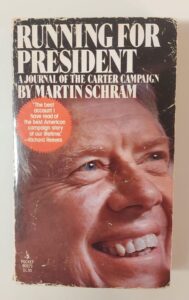 Carter I actually was crazy about, handing out campaign literature on his behalf on Election Day 1976. I have a poster from that fall somewhere in a closet along with a couple of campaign buttons. He wasn’t my first choice in ’76 — I was a Scoop Jackson kid, initially — but I could see why his bandwagon rolled and I was happy to jump on board in summer. As his tenure in the White House wore on, I maintained my loyalty to and confidence in him to the end, sort of like I did for someone else whose reviews turned mixed after taking office in 1977: Met manager Joe Torre. The only thing I was running as they took on what I perceived as the two most important jobs in the world was a high school newspaper. I think I looked up to each of the commonalities implicit in their leadership styles, which seemed to amount to, “I know you’ve got problems with the results right now, but trust me, I know what I’m doing here.” Neither stayed in his role past 1981, the year I graduated from managing the Tide. Carter I actually was crazy about, handing out campaign literature on his behalf on Election Day 1976. I have a poster from that fall somewhere in a closet along with a couple of campaign buttons. He wasn’t my first choice in ’76 — I was a Scoop Jackson kid, initially — but I could see why his bandwagon rolled and I was happy to jump on board in summer. As his tenure in the White House wore on, I maintained my loyalty to and confidence in him to the end, sort of like I did for someone else whose reviews turned mixed after taking office in 1977: Met manager Joe Torre. The only thing I was running as they took on what I perceived as the two most important jobs in the world was a high school newspaper. I think I looked up to each of the commonalities implicit in their leadership styles, which seemed to amount to, “I know you’ve got problems with the results right now, but trust me, I know what I’m doing here.” Neither stayed in his role past 1981, the year I graduated from managing the Tide.
They each generated far better press for themselves in the decades that followed. Former President Carter won the Nobel Peace Prize and global admiration. Torre’s in the Hall of Fame for non-Met reasons, though it says NEW YORK N.L. somewhere on his plaque if you look closely.
Keep an eye on those next acts. The Mets will begin theirs before March ends. In the meantime, enjoy Spring and hope its remaining news rarely exceeds the trivial.
by Greg Prince on 19 February 2025 6:13 pm “Welcome everybody to Kiner’s Korner, brought to you by Mitsubishi Motors. I’m your host, Ralph Kiner, and today we have three very special guests. My producer told me they would be No. 7, No. 6 and No. 5, so I had my questions ready for Eddie Kranepool, Al Weis, and the Glider, Ed Charles, but apparently we got our signals crossed.”
***7. 1970
6. 1975
5. 1980
“I have to confess I feel a little like one of our previous guests, Marvelous Marv Throneberry, in those beer commercials. I’m still not sure what you’re why you’re on this episode of Kiner’s Korner. Maybe one of you seasons can help me out. 1970?”
“Happy to, Ralph. Greg thought it might be instructive to get the three of us together to talk about our seasons at once, since we all have so much in common in terms of how he’s telling his MY FAVORITE SEASONS, FROM LEAST FAVORITE TO MOST FAVORITE, 1969-‘PRESENT’ (with 2024’s slotting TBD) story. Isn’t that right, 1975?”
“Yeah, I think you got it. Greg’s been doing all the talking about all the seasons, so today we get to tell it from our perspective a little.”
 “Well, we’ve had Choo Choo Coleman on and I managed to understand him, so I guess I understand this. Why don’t we start with you, 1970? You went 83-79, finished in third place, six games behind the Pittsburgh Pirates, which is not bad, but it was kind of a comedown from the year before, when the Mets won the World Series. Yet Greg has you ahead of 1969 in his estimation?” “Well, we’ve had Choo Choo Coleman on and I managed to understand him, so I guess I understand this. Why don’t we start with you, 1970? You went 83-79, finished in third place, six games behind the Pittsburgh Pirates, which is not bad, but it was kind of a comedown from the year before, when the Mets won the World Series. Yet Greg has you ahead of 1969 in his estimation?”
“That’s right, Ralph. I’m No. 7, just ahead of 1969 at No. 8.”
“Why do you suppose that is? It kind of goes against the grain.”
“Ralph, for Greg, 1970 was something of an extension of 1969. In a way, it was his 1969.”
“1970, I feel like I’m listening to you in Stengelese.”
“It’s like this, Ralph. Greg was only six in 1969 and experienced only a little bit of that year, which is the first year he watched the Mets. He loves what he remembers, but he doesn’t remember that much. So really, I was his first full season. Six to seven makes a big difference.”
“I don’t usually incorporate sabermetrics into these chats, but it is a difference of only one year.”
“Correct, Ralph, but it was a big year. Greg came into my season ready to be a Mets fan from beginning to end and make it his way of life. He caught on to Opening Day, the All-Star break, that you stay tuned after the game for your show,. It was the first time he saw how all 162 games play out. He began to know all the players.”
“Many of whom were still Mets from 1969.”
“That’s right, Ralph. What really helped seal the deal for Greg was he really got into baseball cards in 1970, which had the 1969 statistics on the back and pictures of the players wearing the MLB patch on the front, which he figured out meant they were photographed in 1969. Between the cards and Channel 9 showing highlights from the previous year’s World Series and the Mets being ‘defending world champions’ and all the afterglow and popularity that carried over from ’69, to Greg it was all one long, unbroken thread in a way. He was completely captivated.”
“Even though the 1970 Mets came in third.”
“In a weird way, I think that helped. Greg understood instinctively that 1969 was incredibly special. My year, 1970, we contended, but we came up short. Greg didn’t love that we didn’t finish first or go back to the playoffs, but it was ultimately OK with him. He knew we won more than we lost, that we were in it, that there was always next year.”
“We’re gonna get to our next year right now, which for us is 1975. 1975, you went 82-80 and tied for third place, 10½ games behind Pittsburgh, which won the National League East again. Those Pirates were much better than when I was there. Their stars got paid more than I did, too, probably because Branch Rickey was long gone. Anyway, 1975, why do you suppose you’re No. 6 on Greg’s list?”
“Great to be on your show, Ralph. I feel a little like 1970 in that I may rate as high as I do because of how Greg experienced a previous year, in my case 1973.”
“That was the year the Mets came from last place at the end of August to win not only the division title but the National League pennant against Cincinnati. Greg ranked that as No. 9, yet you’re three spots ahead and you didn’t win anything.”
“Well, like 1970 vis-à-vis 1969…”
“Vis-à-vis? Have you been talking to Le Grand Orange?”
“Good one, Ralph. Let me put it in plainer English. Because Greg saw how the Mets could come on late in a season and do unbelievable things in 1973, he got it in his head that a good Mets team — and mine was pretty good — could turn it on in September and pass teams like the Pirates or whoever was in front of them and again win the East.”
“So why not rate 1973 higher?”
“You gotta remember, Ralph, that Greg was distracted by other things when he was ten years old in ’73. By the time he gets to 1975, he’s twelve and he’s narrowed his focus. He’s all about baseball and all about the Mets. Plus he’s old enough now to read everything in sight. He starts reading the Sporting News. He’s reading Baseball Digest every month. He’s loading up on preseason magazines. And as far as baseball cards are concerned, he collects them all in 1975. Commitment is a big part of Greg’s story where my year is concerned.”
 “Sounds like somebody could be committed for worrying so much about the Mets, which brings us to our final guest today, No. 5, 1980.” “Sounds like somebody could be committed for worrying so much about the Mets, which brings us to our final guest today, No. 5, 1980.”
“Hi Ralph.”
“1980, your record was 67-95, which was good for fifth place, 24 games behind another Pennsylvania team, the Phillies this time. Listen, 1980, I played on some bad Pirates teams in my day, and I don’t know if anybody besides Joe Garagiola was talking them up a whole lot of years later. These other seasons sitting next to you at least finished over .500. What does Greg see in you to rate you as high as he does on his list of all-time favorite seasons?”
“You got a minute, Ralph?”
“My producer says we don’t have any commercial breaks.”
“Funny you should mention commercials, Ralph, because an advertising slogan has a lot to do with Greg’s love affair with the 1980 season.”
“My beer is Rheingold the dry beer.”
“Not that one, Ralph.”
“No, my producer just let me know I had to say that so we didn’t have to go to commercial. Please continue, 1980.”
“Maybe you remember ‘The Magic is Back,’ the slogan the Mets used in their ads when my year began.”
“I do. Bob Murphy, Steve Albert, and I had a good laugh about it off-camera when we first saw it.”
“You weren’t alone, Ralph. A lot of people thought it was a joke, what with the Mets having been so terrible for the few years before 1980 and then not getting off to a very good start.”
“Yet I seem to remember there was more to the ‘Magic’ thing than misleading advertising.”
“You’re as sharp as your suits, Ralph.”
“You should have seen Lindsey’s.”
“He wasn’t here when I was, Ralph. The Magic was, though. See, that little tagline was about hope coming to Shea Stadium, that the Mets might be good again. The club had been sold that winter…”
“From the de Roulets to Abner Doubleday.”
“Nelson Doubleday, Ralph. And his friend Fred Wilpon.”
“Nice men.”
“Folks were just happy that maybe something was going to change. What they couldn’t have known was that in the middle of May, the Mets started playing really well, and all of a sudden, Greg didn’t feel like such a sap for loving the Mets as he did.”
“If I could just chime in here…”
“Go ahead, 1975.”
“When Ralph reads our records and how far we finished out of the top spot, it kind of misses what our seasons were about, especially from Greg’s perspective. My year was in the race until September. 1970 hung in there until the second-to-last weekend. And you, uh…were you ever actually in the race, 1980?”
“Yes and no. I mean, not in the traditional sense. We were kind of close in July, and not all the way out of it as of mid-August, but the point about that is Greg was thrilled we were decent at all. To him, the fact that we were winning more than we were losing for a few months, and the fact that a lot of those games were come-from-behind victories, made the Magic theme come to life.”
“My producer is telling me that in 1980, Greg was seventeen years old. Do you mean to tell me that at age he believed in Magic?”
“In a baseball sense, Ralph, yes.”
“Seventeen seems a little old to be that involved in baseball unless you’re a prospect being scouted by a major league team. Was Greg a player of any sort?”
“Just in gym class and nothing special, to put it very charitably. But he loved the game, Ralph. And he loved the Mets. He loved being old enough to go to games on his own. He loved that he understood so much more about the Mets and their history than when we was seven or twelve. Those were great years for him, but he felt now like he was a new level of his life, his next level of fandom. Kind of like that shot in Goodfellas where you’re introduced to Ray Liotta and Joe Pesci as the adult versions of their characters you’ve only seen as kids to that point.”
“I met a lot of movie stars during my career. I even dated Elizabeth Taylor.”
“To Greg in 1980, the Mets were movie stars.”
 “Let’s talk about that, specifically Greg’s favorite player from each of your years. We’ll start with you, 1970.” “Let’s talk about that, specifically Greg’s favorite player from each of your years. We’ll start with you, 1970.”
“Tom Seaver. Greg idolized him.”
“1975?”
“Tom Seaver. Greg still idolized him.”
“1980?”
“Tom Seaver. Greg didn’t care that he wasn’t on the Mets by then. Greg never stopped idolizing him.”
“Tom was on my show many times, so I can see why Greg grew so attached to him. He was a Hall of Fame pitcher and one of the all-time greats. His number was the first the Mets retired for a player. But were there any players who weren’t especially great who Greg gravitated to in 1970, 1975, and 1980? We’ll start this time with 1980.”
“Greg really liked when you had Lee Mazzilli and Steve Henderson on your show, Ralph. He actually did a passable impression of both them talking with you in high school.”
“I’m glad he had such an active social life as a teenager. What about you, 1975?”
“Greg got really excited about Mike Vail toward the end of my season. He hit in 23 consecutive games shortly after being called up from Tidewater.”
“Tying Richie Ashburn for the National League rookie record, Richie being an Original Met. And you, 1970, any Greg favorites who weren’t Tom Seaver?”
“He had an affinity for Ray Sadecki, who went 8-4 my year. I think Greg liked that your partner Murph pronounced Ray’s name as one word. ‘Raceadecki.’ Somehow, in 1971, Greg was even more impressed that Ray went 7-7, which, to his eight-year-old mind made him ‘consistent’.”
“And they say I’m prone to malapropisms. What about big moments from each of your years? Let’s start with 1975.”
“September 1, Ralph. Seaver shuts out the Pirates and closes the gap to four games. Tom strikes out his 200th batter for the eighth consecutive year, a record. Vail homers for the first time. And Buddy Harrelson comes off the Disabled List, as it used to be called. Greg was sure 1973 was in the process of being reincarnated, but with better power. Kingman had all those home runs, Rusty all those RBIs, Felix Millan played every day and set the club mark for hits. It was all coming together.”
“Quite a day. Does Greg have one to match it from your perspective, 1970?”
“He’s got five of them, Ralph — the five-game sweep of the Cubs at Wrigley Field in late June, somewhere between school ending and day camp starting. They were all day games on the Near North Side of Chicago, of course, so that accounted for Greg’s afternoons over the better part of a week. By the time the series was done, the Mets had overtaken the Cubs for first place. What a way for a seven-year-old to start his summer.”
“Five-game sweeps are very rare. Was there anything like that in 1980?”
“To be honest, Ralph, my year had a tough time putting together winning streaks, though for Greg, the 47-39 stretch from the middle of May to the middle of August felt like one long climb to the top.”
“Did the 1980 Mets spend any time in first place?”
“Unless you count Opening Day, no.”
“Longtime Mets fans will remember the Mets didn’t win on Opening Day until 1970, and then they won most every year to start the season.”
“Thanks for pointing that out, Ralph. But even though the Mets didn’t get any closer to first place in the heart of the season than three-and-a-half out on July 5, there is one game that resides in Greg’s heart and mind as a veritable pennant-winner.”
“Veritable?”
“Greg was studying for the SAT in 1980.”
“I see.”
“But like 1970, the memory that Greg cherishes from my year came from right around the end of school, with a Regents exam or two left. It was a Saturday night, June 14. The Mets were losing all night. Getting no-hit, in fact. Then they roared back from 6-0 and pulled it out in the ninth, 7-6, over the Giants.”
“Oh, I remember that one. It was The Ken Henderson Game.”
“Steve Henderson, Ralph.”
 “Either way, Hendu did do, and it was a great night for the New York Mets, and Greg was indeed lucky to have experienced the games you seasons are talking about. Still, he also saw 1969 and 1973 and later successful seasons. I guess I’m still a little baffled he remains especially fond of years that, with all due respect to some of the players and some of the games, came up shy of a big payoff.” “Either way, Hendu did do, and it was a great night for the New York Mets, and Greg was indeed lucky to have experienced the games you seasons are talking about. Still, he also saw 1969 and 1973 and later successful seasons. I guess I’m still a little baffled he remains especially fond of years that, with all due respect to some of the players and some of the games, came up shy of a big payoff.”
“Well, Ralph, if I may speak for my older friends 1970 and 1975, I think we are what we are to Greg because he’s able to reflect back so many years later and see what each of us meant to his future as a Mets fan.”
“Interesting assessment, 1980. You agree with that, 1970?”
“Oh, absolutely, Ralph. I’m noticing a trend, actually. 1975 is five years after my year, then 1980 is five years after that. It’s like Greg was learning, synthesizing, advancing, almost renewing his license to root every five years. And correct me if I’m wrong, 1980, wasn’t your year the year Greg got his driver’s license?”
“Absolutely right, 1970.”
“Does all of that sound right to you, 1975?”
“Sure does, Ralph. Remember, in my year, away from baseball, Muhammad Ali was the heavyweight champ. Right after the season, he and Joe Frazier fought the Thrilla in Manilla. Ali liked to rhyme, so I’ll say there was something ‘formative and normative’ about our seasons for Greg.”
“Joe Frazier, of course, managed the New York Mets at one time.”
“Different Joe Frazier, Ralph.”
 “The Mets have always had colorful managers going back to Casey Stengel and of course the great Gil Hodges. 1980, you look like you have a final thought.” “The Mets have always had colorful managers going back to Casey Stengel and of course the great Gil Hodges. 1980, you look like you have a final thought.”
“Just that our respective roles as significant seasons in Greg’s life weren’t just about memories he’s held onto and emotions he can summon in a second. It’s that after our seasons, both immediately after and decades after for him and the Mets, there was always more to come.”
“And there’ll be more to come tomorrow as the Mets take the field and hit the airwaves. Our guests have been three of Greg’s favorite seasons, 1970, 1975, and 1980. They’ll receive Getty Gasoline gift certificates, as all guests of Kiner’s Korner do. You’ve come this far. Getty can help you go even further. And if you can’t make it out to the ballpark, we imagine we’ll see you right here. Seriously, we do a lot of imagining on this show.”
PREVIOUS ‘MY FAVORITE SEASONS’ INSTALLMENTS
Nos. 55-44: Lousy Seasons, Redeeming Features
Nos. 43-34: Lookin’ for the Lights (That Silver Lining)
Nos. 33-23: In the Middling Years
Nos. 22-21: Affection in Anonymity
No. 20: No Shirt, Sherlock
No. 19: Not So Heavy Next Time
No. 18: Honorably Discharged
No. 17: Taken Down in Paradise City
No. 16: Thin Degree of Separation
No. 15: We Good?
No. 14: This Thing Is On
No. 13: One of Those Teams
No. 12: (Weird) Dream Season
No. 11: Hold On for One More Year
No. 10: Retrospectively Happy Days
No. 9: The September of My Youth
No. 8: First Taste
by Greg Prince on 18 February 2025 7:17 pm For years, I never forgot where I was when J.C. Martin laid down the bunt that led to the winning run that gave the Mets Game Four and a commanding Three-One lead in the 1969 World Series. I was in the Cozy Nook, the all-purpose luncheonette where I bought most of my baseball cards, magazines and occasional Milky Way bars. My mother was in a booth that afternoon with a friend of hers, the two of them no doubt drinking coffee and one of them surely smoking cigarettes. I got bored and wandered up front toward the cashier. Then I rushed back to tell them what I had just learned happened in Game Four: Martin bunts, the Orioles pitcher picks up the ball and throws, the throw flicks off J.C.’s wrist, the ball bounces away, and Rod Gaspar scores. What a memory.
Except it never happened that way. Oh, I was in the Cozy Nook, along with my mother and her chimney of a chum Betty when I saw Martin in the 1969 World Series, and the Mets did win Game Four that way…except what I was remembering for the longest time was the day in 1970 that I opened a pack of baseball cards I had just purchased at the cash register and was so delighted to find the card with the Sporting News logo on top and the caption “MARTIN’S BUNT ENDS DEADLOCK!” on the bottom that I was compelled to dash back to the booth and announce it to Mom, while Betty puffed away. Further details — Gaspar on second, pinch-running for Grote; Grote having blooped a double into left to start the rally; Pete Richert making the errant throw; Martin running within the baseline, possibly illegally on a path then immune to the vagaries of yet-to-be-fathomed replay review — came together in the early 1970s as I studied further accounts and descriptions. Eventually, I filled in all the gaps of what I may not have been cognizant of at the moment I pulled the World Series card. It was Moratorium Day. Vietnam protests intertwined with Tom Seaver starting at Shea. Seaver pitched ten innings. Donn Clendenon homered. Ron Swoboda made a catch that he said was “as big a surprise” to him “as it was to anyone in the stands”. I did my 1969 homework diligently from 1970 onward. It’s the kind of homework I didn’t have to be nagged into doing. Somehow I convinced myself I saw everything when everything happened.
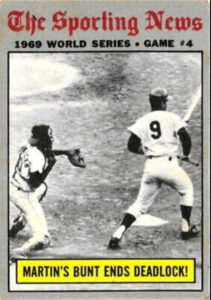 As for what I really remember about Game Four of the 1969 World Series in real time, I remember nothing. Nothing at all. I was six then. I had just discovered the Mets in the weeks prior to the World Series. I remember a little of this and a little of that directly from 1969. I don’t remember a whole lot of anything from having experienced it. Yet before I neared adolescence, I decided I was fully Met-conscious for one of its signature moments, and treasured knowing that I was. But I wasn’t. As for what I really remember about Game Four of the 1969 World Series in real time, I remember nothing. Nothing at all. I was six then. I had just discovered the Mets in the weeks prior to the World Series. I remember a little of this and a little of that directly from 1969. I don’t remember a whole lot of anything from having experienced it. Yet before I neared adolescence, I decided I was fully Met-conscious for one of its signature moments, and treasured knowing that I was. But I wasn’t.
Sociologists refer to this phenomenon as the J.C. Martin Effect.
***8. 1969
If I’d been born a few years earlier, 1969 probably would be way the hell up in this countdown. WAY the hell up. If I’d been born even a year earlier, I bet I’d remember Game Four, not to mention Games Three and Two, plus a lot of what led up to October. A birth of a few months earlier likely opens my eyes to the Mets a few months sooner, and my reminiscences of 1969 are ‘x’ percent more tangible now and forever.
Instead, I was born when I was born, and I don’t regret that, because if a butterfly flaps its wings in South America, maybe I think baseball is stupid. I was born right on time, just in time. I opened my eyes to the Mets whenever I opened my eyes to the Mets, sometime in late summer of 1969, to the best I can determine. I love telling the story. My dad would bring home the Post from the city, where he worked at some job that required riding a train, wearing a suit and carrying a briefcase. There was a recurring cartoon on the back page, the Mets as a lovable duck, the Cubs as a fearsome bear. There were standings inside providing a geographical and numerical explainer: Chicago (the bear) ahead of New York (the duck, and where I knew we lived), but the gap was closing daily. That was enough to pique my interest so that I wanted to examine the paper every night. Things begin to get specific in September. The Mets pass the Cubs. The Mets clinch the division. The Mets play the Braves. The Mets win the pennant. Then come the Orioles, with my lived experience of Game One and Game Five that I recall from reality, and the ultimate World Series outcome that certified the 1969 Mets as the best, and me as hooked for eternity.
I knew what was going on, kind of. I caught on to what it meant, sort of. I loved it all at once, truly. Still, my personal 1969 Metwise is scant in the mind’s eye. I can’t help it. I was six. I didn’t know enough to take notes. I didn’t even know how to take notes. Did I mention I was six? I was as present for the 1969 Mets as Ed Kranepool was for the 1962 Mets. Eddie played three games at the end of the Mets’ first year, but for the rest of his days, he didn’t correct those who identified him as an Original Met.
Presence is presence. I’ll always tell you I’ve been a Mets fan since 1969. Geez, look at the title of this series: MY FAVORITE SEASONS, FROM LEAST FAVORITE TO MOST FAVORITE, 1969-‘PRESENT’ (with 2024’s slotting TBD). This all had to start somewhere. Could it have started anywhere better?
It feels odd as a lifelong Mets fan, never mind a self-styled Mets historian, to rank 1969 at No. 8 among MY FAVORITE SEASONS, because, c’mon, it’s 1969! It was always 1969 from the instant I adjusted my antenna toward Flushing. Details I had to piece together, but the headline was always the headline. The Mets won the World Series! The Mets were the world champions! People were thrilled! I was thrilled! That I remember with clarity. That is actual. Everything that came after 1969 for me materialized because 1969 arrived first.
The Miracle Mets — not that I understood why they were called that while they were being called that — contained all the qualities that make for a personally dear season. It was influential. It was formative. It was meaningful. I’ll throw in historically resonant and, obviously, quite Amazin’. Yet eighth is where it must rank for me. My 1969 is light on counting stats. To rate it any higher, given the seasons I’m going to write about from No. 7 to No. 1, would amount to stealing valor. I lived the bejeesus out of those later seasons. In 1969, I wasn’t doing more than dipping my first toe, hence I can’t tell you much about it first-hand. I feel almost guilty about that. Maybe if I were more like Marilu Henner (even more, I mean), I’d remember more about 1969 for myself rather than through books and such. “For God’s sake, Alvy,” a classmate told young Woody Allen in Annie Hall, “even Freud speaks of a latency period.” Fifty-six years later, I’m still grappling with mine.
I didn’t take stock of Gil Hodges’s projections in Spring Training that we were gonna be a much better team this year, or have any notion of what the Mets had been before this new, promising year.
I wasn’t watching or listening when the expansion Expos came in for Opening Day and therefore didn’t cringe that we lost to them, 11-10.
I didn’t exult in us climbing to .500 after thirty-six games, something no previous Mets team had done after two games.
I didn’t faint from joy at the Oedipal eleven-game patricidal winning streak that came mainly at the expense of the Giants and Dodgers; I also didn’t know the backstories of those teams from San Francisco and Los Angeles.
I didn’t pump a fist at the news that we acquired a legitimate slugger in Clendenon.
I didn’t jump up and down when Don Young didn’t catch two fly balls.
I didn’t feel my heart break when Jimmy Qualls singled to left-center.
I didn’t begin to lose hope when the Astros spanked us so hard that Hodges had to take star left fielder Cleon Jones out to send a message to his entire squad.
As I began to wade into the shallow end of my duck pond in September, I wasn’t granular enough to absorb the 19-strikeout game in St. Louis or the pair of 1-0 wins versus Pittsburgh. The black cat may been genuine to Ron Santo and Leo Durocher, but it was merely mythic to me. I could LOOK WHO’S NO. 1, but not elaborate on why that was so astounding, only grasp that NO. 1 was a big deal.
 I’m missing the depth, texture and personal context to process 1969 as a season I lived through with my heart and soul. I know it was A Magic Summer, even if my version was not much more than a sneak preview of the summers that would highlight my years ahead. When I look at who’s No. 7 through No. 1 on my MY FAVORITE SEASONS list, I’m grateful I lived through those with my heart and soul, something I can’t imagine would have happened without coming in where I came in. My heart and soul were invented on the spot in 1969. No runway, no preamble. Just an inner voice urging me on. This is your favorite sport, this is your favorite team — GO! I’m missing the depth, texture and personal context to process 1969 as a season I lived through with my heart and soul. I know it was A Magic Summer, even if my version was not much more than a sneak preview of the summers that would highlight my years ahead. When I look at who’s No. 7 through No. 1 on my MY FAVORITE SEASONS list, I’m grateful I lived through those with my heart and soul, something I can’t imagine would have happened without coming in where I came in. My heart and soul were invented on the spot in 1969. No runway, no preamble. Just an inner voice urging me on. This is your favorite sport, this is your favorite team — GO!
Gladly!
PREVIOUS ‘MY FAVORITE SEASONS’ INSTALLMENTS
Nos. 55-44: Lousy Seasons, Redeeming Features
Nos. 43-34: Lookin’ for the Lights (That Silver Lining)
Nos. 33-23: In the Middling Years
Nos. 22-21: Affection in Anonymity
No. 20: No Shirt, Sherlock
No. 19: Not So Heavy Next Time
No. 18: Honorably Discharged
No. 17: Taken Down in Paradise City
No. 16: Thin Degree of Separation
No. 15: We Good?
No. 14: This Thing Is On
No. 13: One of Those Teams
No. 12: (Weird) Dream Season
No. 11: Hold On for One More Year
No. 10: Retrospectively Happy Days
No. 9: The September of My Youth
|
|






