The blog for Mets fans
who like to read
ABOUT US

Faith and Fear in Flushing made its debut on Feb. 16, 2005, the brainchild of two longtime friends and lifelong Met fans.
Greg Prince discovered the Mets when he was 6, during the magical summer of 1969. He is a Long Island-based writer, editor and communications consultant. Contact him here.
Jason Fry is a Brooklyn writer whose first memories include his mom leaping up and down cheering for Rusty Staub. Check out his other writing here.
Got something to say? Leave a comment, or email us at faithandfear@gmail.com. (Sorry, but we have no interest in ads, sponsored content or guest posts.)
Need our RSS feed? It's here.
Visit our Facebook page, or drop by the personal pages for Greg and Jason.
Or follow us on Twitter: Here's Greg, and here's Jason.
|
by Greg Prince on 1 October 2010 1:34 am Go while the going is good
Knowing when to leave
May be the smartest thing
Anyone can learn
Go…
—Burt Bacharach
Mr. G was wrong. The grand upperclassman of New York weather forecasters said it was going to rain cats and dogs over the Metropolitan area Thursday and that Citi Field would be one big poodle. His colleagues agreed and the murky skies didn’t offer much rebuttal. My friend Sharon and I caucused the meteorological matter and came away convinced Irv Gikofsky wouldn’t lie to us.
Thus, despite holding tickets for the hotly awaited Mets-Brewers duel to the depths, discretion became the better part of fandom and we decided to take a pass. They’re not gonna play, we agreed, and even if they do, it was going to be five miserable innings of dancing through raindrops until the deluge came. We’d better not go.
So we didn’t go, yet it didn’t rain. There was no deluge, unless you count the torrent of Met misplays. That made Thursday night my first phantom game at Citi Field — the announced attendance says I was there, reality says otherwise. Reality and the announced attendance (24,661) are barely acquainted.
On one hand, I’m never listening to a weather forecaster again, at least if a baseball game is on the line and a tornado isn’t. Dillon Gee may have lost, but he acquitted himself better than Mr. G. Sharon was nice enough to invite me, I was delighted to accept and I’m sorry our arrangements imploded in the face of a faulty Doppler radar.
On the other hand, if you were going to miss one game you were sure you were attending in 2010, this one would have been tied for first with about 50 others. While I was home during the “action,” I nodded off briefly. If I were at the game, I would have fallen dead asleep.
 The 2010 Mets: Your season has overstayed its welcome. If I can borrow a third hand, geez, I’m tired of this Mets season. It’s the thing that wouldn’t leave, even though I know it’s headed for the exits in less than 72 hours.
As early as next week, I’ll go through those horrible offseason pangs of wishing for Mets baseball when 7:10 PM rolls around, no matter how much it’s raining, no matter how much it’s snowing. But let’s be clear — as clear as this particular night is windy: I will not be wishing for the 2010 season to rematerialize. This season has to go away and go away now.
This season has to be sent to a farm upstate to play with the 2009 season.
I’m beginning to have my doubts about the need for a 162-game schedule. This Met season, like last Met season, was truly too damn long. I’m not saying that just because they now permanently share losing records as a depressing common denominator. Other than last weekend when it seemed mildly important that we keep the Phillies from clinching for a couple of days, the Mets have had nothing to play for, and it’s shown. Once in a while, there’s been an encouraging pitching performance or a key ninth-inning hit and it’s provided five minutes of happy distraction. Otherwise, the phrase that keeps coming to mind is “amorphous blob”. The past six weeks or two months or maybe the whole second half has felt shapeless and formless. Games start, games finish, the Mets are involved in some undefined way, nothing actually happens.
This is the part of baseball Ken Burns never bothers to tell you about (perhaps because he’s too busy telling you about the Red Sox).
I’ve lived through losing seasons before this current spate of them — I think two is enough to qualify as a spate by now — and they don’t all feel this empty. Some years you get a player worth following to the end, and his at-bats or turns in the rotation make you forget how unmemorable the rest of it is. Some years you sense a change coming for the better, so you reason away the losses as a down payment on a brighter tomorrow. And then there are the years that just won’t go away. That’s what this year blobbed into ages ago.
This one is three eyeblinks from expiring. Knee-jerk sadness notwithstanding, it can’t vanish soon enough. I’ll miss baseball because baseball is what I do when given the opportunity to choose. I’ll miss the Mets and Mets games because that’s where I live spiritually. But this particular set of Mets and Mets games has been devoid of a reason for being since before the flood.
In a way, it’s too bad it didn’t rain Thursday night. This season needs washing away at once.
Maybe the perfect Mets bobblehead would cheer us up. Mark Simon of ESPN New York took a survey and shares the responses — including mine — right here.
by Greg Prince on 30 September 2010 12:24 am The makeup doubleheader begins at 4:10, when everything else begins again, and it blossoms at 5:40, filling the late afternoon and the early evening, and then as soon as Manny Acosta comes in, it stops and leaves you to face the nightcap alone.
You counted on it, relied on it to buffer the passage of time, to keep the memory of a transient 7-6 lead alive, and then just when the opener is all defeat, when you need it to go away most, it drags interminably into a second game.
Last night, September 29, a Wednesday before a Thursday of rain and broken branches and leaf-clogged drains and slick streets, it just went on and on and on. Then it stopped, and our chances of finishing with a winning record were gone.
The 2010 Mets leave you numb. They were designed to leave you numb.
(Apologies to A. Bartlett Giamatti, though I doubt he’d have been so elegiac had he spent nearly seven hours paying attention to this particular team on this particular day.)
by Greg Prince on 29 September 2010 9:26 am On September 28, 2010, Ruben Tejada came to bat in the bottom of the ninth inning with a pair of runners on base and the Mets down 3-2 to the Milwaukee Brewers. He belted a double to deep left field. Ike Davis scored from third. Pinch-runner Luis Castillo chugged home from first. The Mets, already mathematically eliminated from contention, won 4-3.
Now consider the essentials of the aforementioned scenario:
• Last week of the season.
• Mets out of the race.
• Bottom of the ninth.
• Mets trail.
• Rookie swings.
• Mets win.
Do you know how many times before last night these precise circumstances aligned and culminated in such a favorable Met result?
Never. It never happened before. Never has a rookie come up in the bottom of the ninth at the tail end of a kaput season with the Mets behind and put them ahead. Of all the walkoff wins the Mets could hope for in a non-contending context, this has to be the most uplifting type of walkoff win imaginable.
If you still have any imagination left when a season is so foregone.
This is a new type of walkoff, so it requires a new name, one reflecting all it potentially represents. I know! Let’s call it…
The Ruben™: A heaping helping of hope sandwiched between two slices of despair.
Better yet, serve it open-faced so as to see only the hope.
The Ruben™ — gosh, I feel like Homer Simpson after he discovered a meal between breakfast and brunch.
***
Congratulations to the National League Central Division champion Cincinnati Reds, qualifiers for the postseason for the first time since 1995. As if those fifteen years weren’t long enough, the Reds snapped another lengthy streak of a dubious nature. On October 4, 1999, Cincinnati had a chance to make the postseason as N.L. Wild Card with a win in what is alternately referred to as a one-game playoff or a play-in. Either way, they lost….to the Mets, of course, 5-0 on an Al Leiter two-hit gem. Their ensuing eleven-year wait was longer than any other one-game/play-in loser in the divisional era has had to endure to overcome the sting of almost making it.
1978: Boston Red Sox lose to New York Yankees
1986: Boston Red Sox next make playoffs 8 YEARS LATER
1980: Houston Astros lose to Los Angeles Dodgers
1981: Houston Astros next make playoffs 1 YEAR LATER
1995: California Angels lose to Seattle Mariners
2002: Anaheim Angels next make playoffs 7 YEARS LATER
1998: San Francisco Giants lose to Chicago Cubs
2000: San Francisco Giants next make playoffs 2 YEARS LATER
1999: Cincinnati Reds lose to New York Mets
2010: Cincinnati Reds next make playoffs 11 YEARS LATER
2007: San Diego Padres lose to Colorado Rockies
SAN DIEGO PADRES STILL WAITING; 3 YEARS AS OF 2010
2008: Minnesota Twins lose to Chicago White Sox
2009: Minnesota Twins next make playoffs 1 YEAR LATER
2009: Detroit Tigers lose to Minnesota Twins
DETROIT TIGERS STILL WAITING; 2 YEARS AS OF 2011
Even if you throw in losing teams from pre-divisional tiebreakers, the Reds waited longer to reach — and surpass — the postseason precipice than almost everybody who came up short before them.
The 1946 Brooklyn Dodgers were avenged 1 year after their heartbreak against the St. Louis Cardinals, as were the 1951 Brooklyn Dodgers following their legendary defeat at the hands of the New York Giants.
The 1959 Milwaukee Braves needed 10 years, a move south and the slicing of the National League into two divisions to get over their loss to the Los Angeles Dodgers. By then, they were the 1969 Atlanta Braves, losers of the first National League Championship Series (to the New York Mets).
The 1962 Los Angeles Dodgers lost a devastating tiebreaker series to the San Francisco Giants — or did they? The devastation was plowed under 1 year later in the 1963 World Series as the Dodgers swept the Yankees in four straight.
The 1948 Boston Red Sox, however, waited longer than anybody to be dug out of their tiebreaker hole. They lost a one-game playoff to the Cleveland Indians and didn’t have their defeat avenged until 1967 — 19 years later.
Anyway, I’m happy that the Reds have finally shaken off that loss to the 1999 New York Mets. Cincy shouldn’t feel bad it took them this long. The Atlanta Braves have never been the same juggernaut since the Mets battled them to a bittersweet end in that season’s NLCS.
***
Congratulations are also in order for the Texas Rangers, A.L. West champs and postseason participants for the first time since 1999. Who says a team can’t win anything with Alex Cora and Jeff Francoeur on its roster? Come to think of it, two teams have traded for Jeff Francoeur and one is in the playoffs. Two teams have traded away Jeff Francoeur, and if Atlanta holds on to its slim Wild Card lead over San Diego, it can also be said that one team that has dispatched Jeff Francoeur is in the playoffs.
Then there’s the Mets, who traded for Jeff Francoeur and traded away Jeff Francoeur, yet all they’ve got on their plate at this moment is a Ruben™.
Aside from our erstwhile right fielder and utility infielder/team leader; two of our former relievers, Darren O’Day and Darren Oliver; our almost catcher, Bengie Molina; two of our alumni who are now two of their coaches, Clint Hurdle and Mike Maddux; and the Never Met superstar whom we could have had for a relative free agent song when he could still play the outfield, Vladimir Guerrero (oh, and our young fireballing righty turned their team president, Lynn Nolan Ryan), we share something else of a contemporary nature with the Texas Rangers. And, in a way, it spools back more than two decades.
6/2/1987: Mets draft Tim Bogar.
3/31/1997: Mets trade Tim Bogar to the Houston Astros for Luis Lopez.
1/21/2000: Mets trade Luis Lopez to the Milwaukee Brewers for Bill Pulsipher.
6/2/2000: Mets trade Bill Pulsipher to the Arizona Diamondbacks for Lenny Harris.
1/21/2002: Mets trade Lenny Harris to Milwaukee for Jeromy Burnitz (part of a three-team, eleven-player transaction).
7/14/2003: Mets trade Jeromy Burnitz to the Los Angeles Dodgers for Victor Diaz.
8/30/2006: Mets trade Victor Diaz to Texas for Mike Nickeas.
Nickeas then burrowed into deepest minor league obscurity until making his surprise major league debut with the Mets on September 4, 2010. He returned to obscurity after his most recent appearance, on September 6, 2010, but at least he’s obscure on a major league roster. I saw him among the revelers congratulating Ruben Tejada last night on his Ruben™.
Victor Diaz, if you’re wondering, isn’t in the Texas organization or with any MLB club any longer. He spent his summer playing for Rojos del Aguila de Veracruz, leading the Mexican League in home runs (29) and runs batted in (96). As a Met rookie on September 25, 2004, another season in which the Mets were out of it, he hit a three-run homer in the bottom of ninth inning to tie the contending Cubs and send the game to extra innings. Another Met rookie, Craig Brazell, homered to win it in the eleventh. Because it wasn’t a ninth-inning, come-from-behind, one-swing win, and it wasn’t the last week of the season, we can’t call it a Ruben™ — but it was close enough to Rubenesque.
The same might be said of Victor Diaz’s physique; his figures look pretty good south of the border.
Incidentally, Bill Pulsipher, who is somehow still not yet 37 years old, went 5-1 in 11 appearances for the Somerset Patriots of the Atlantic League this season. He also won his only start in the playoffs. Like Diaz, he put up good numbers in the minors in 2010.
Like Diaz, he’d trade them in a heartbeat for where Mike Nickeas is this week.
As long as we’re on the subject of ancient Met trade threads, you know that guy on Toronto who’s hits 52 home runs? We had him. We really did. We had Jose Bautista. I had no idea until I read about it on Studious Metsimus.
That’s an impressive Met history lesson right there. Maybe Ed Leyro (and Joey) should guide tours of Citi Field.
***
More congratulations, to the playoff-clinching, first-place Tampa Bay Rays. And here’s to their ownership attempting to defuse controversy by giving away 20,000 tickets to their final regular-season home game tonight. The Rays are drawing flies even as they are compiling what is, at present, baseball’s best record. The fan in me says it’s disgraceful that 12,446 showed up one night with a playoff spot imminent and that 17,891 came the next night when it was secured. The human being in me, however, never tells other people how to spend their money, particularly in a sad economy.
Evan Longoria and David Price expressed their frustration at receiving sparse visible support at Tropicana Field. Can’t say I blame them for feeling that way, but you don’t win customers to your cause by shaming them, certainly not when you personally outgross your physical fan base on any given night.
Still, you have to give away 20,000 tickets to get people to come see the best team in baseball? That’s frightening for the future of Tampa Bay baseball, which saddens me a little, as I went to college in the area, albeit too long ago for it to be highly relevant to the current state of affairs down there. There were no Rays in my day. There weren’t even Devil Rays. But there were Rowdies — the Tampa Bay Rowdies of the NASL. Professional soccer was on its last legs, and there were $5 tickets being sold on campus for a weeknight game at Tampa Stadium against the Toronto Blizzard. I bought one, mostly because the offer included a 98 ROCK t-shirt. No playoff spot was on the line, it was dull as could be, yet the Rowdies and the Blizzard drew about 16,000…or almost as many as the Rays got for winning their division.
I’ve read dozens of comments on the Tampa Tribune and St. Petersburg Times Web sites as to why attendance is so low. The theories/gripes are generally these:
1) The stadium’s too inaccessible. The Rays shouldn’t be playing all the way over in St. Pete. Build a new stadium in Tampa. (This is presented against the backdrop of a simmering threatdown in which the Rays keep fear alive and hint they might pack up and vamoose altogether if they don’t get a better ballpark on better terms for them.)
2) Why should I pay all that money — money that’s tight to begin with — to go to a game at a lousy stadium that’s far away when I can watch on TV?
3) Too many people in Tampa-St. Pete are from somewhere else and have remained loyal to their teams, making it difficult for a 13-year-old franchise to take root.
On the first point: I’ve never been to the Trop, but I understand its location is far from desirable. Your call if you don’t want to make the schlep.
On the second point: universal complaint, perfectly legitimate; cable bills are high enough, might as well get some use out of it.
On the third point…I sort of get it even if I sort of don’t.
I lived in Tampa for four years and never developed any affinity for the Rowdies, the Bucs of the NFL or the Bandits of the USFL, who were a big deal during their brief existence (Burt Reynolds owned a piece of the team, Jerry Reed recorded an unforgettable theme song and Loni Anderson posed for a very popular poster — trust me when I say this was early 1980s Tampa Bay heaven). If I had stayed after graduation, I doubt I would have converted to any of the local teams. Had I still been a Tampan in 1998, I might have adopted the Devil Rays as my A.L. club, but I can’t fathom ever having transferred my primary rooting interest to them from the Mets.
Yet in a metropolitan area of more than 2.7 million people, you’re going to tell me all you have are transplanted New Yorkers, New Englanders, Midwesterners and others who were never won over to the home team? Nobody who grew up in Hillsborough or Pinellas County immune to the charms of teams from somewhere else? There are such creatures as native Floridians, believe it or not. And what about a good, old-fashioned bandwagon? The Rays are rolling..no hop-ons?
During my time in the Tampa Bay region, Major League Baseball was a dream. The dream came true. For a decade, the D-Rays were a nightmare, yet now the Rays are surreally good. I can understand 12,000, if that many, for the Mets and Brewers these nights, but for the Rays and a playoff spot? Kind of a special occasion, I would think. Granted, it was a Silver game by the Rays’ reckoning (versus the Orioles…sounds Bronze to me), but unless you’re a certain other American League East team which has now qualified for the postseason 49 frigging times, how often do nights like these come along?
The Mets clinched postseason berths at Shea five times. Here was their paid attendance for those blessed events:
1969: 54,928
1986: 47,823
1988: 45,274
2000: 48,858
2006: 46,729
Remember, the first three were actual turnstile counts and didn’t include comps. The latter two were tickets sold, but I can assure you from having been on hand, in ’00 and ’06 that Shea felt very, very full both nights.
Maybe it’s Big Apples and Florida oranges to compare New York and Tampa Bay. I could point out the Mets were newer in 1969 than the Rays are now, but that would be specious. The Mets were no ordinary expansion franchise. They were filling a void left by two long-lived National League clubs that had been gone a mere four seasons, whereas the Tampa Bay Devil Rays were marking previously uncharted territory at the time of their birth. Passion’s another difference. We’re New York. They’re Tampa Bay. There’s a good chance we’re going to chafe at that comparison in a few weeks, pending the ALCS matchup, but it’s true.
Just ask Jerry Manuel, which is what Mike Francesa did on Tuesday in what was, in all likelihood, the final weekly afternoon drivetime chat Manuel will give WFAN in his capacity as Mets manager. Francesa asked him if New York was what he expected. Here’s Manuel’s answer:
I didn’t realize how great the passion was here. I didn’t realize how knowledgeable the fan was here. This is, to me, the Mecca of baseball.
If Jerry weren’t on the clock, I imagine the Post would run a front page headline highlighting that “Mecca” remark and demanding to know why the Mets hate America. That aside, yes, of course, he’s right, and not because his portrayal flatters us. Baseball is what we do in New York. If we had any reasonable chance of doing it in Queens beyond this Sunday, we’d be doing it like crazy all week this week at Citi Field. The Mets reported 24,666 were in attendance last night for Ruben Tejada’s Ruben™. The Mets are funny that way.
Nevertheless, we had more invisible fans in the park Tuesday than the Rays did in reality Monday, and the Rays are playing for much more.
Boy am I glad I didn’t stay in Tampa.
by Jason Fry on 28 September 2010 11:29 pm If I’d told you back in March that September 28’s game would come down to whether somebody named John Axford could survive ninth-inning confrontations with Ike Davis, Nick Evans, Josh Thole and Ruben Tejada, you probably would have deduced that September 28’s game wouldn’t mean very much. And you would have been right, for this was Brewers-Mets, for a complete absence of marbles: one hitherto anonymous porn-stached young closer against a quartet of guys who were Plan Bs for the Mets at the beginning of 2010. (Though OK, Evans would love to be a Plan B in an organization that until a couple of weeks ago had forgotten he existed. You need Greek letters to express how far down the ladder of plans poor Nick had fallen.)
But the great thing about baseball is that it can still be a lot of fun even when it doesn’t matter in the slightest. The Mets and Brewers let the string play out speedily between their fingers, trading mammoth shots from Corey Hart and David Wright. One of my favorite replays in Mets history is watching Gary Carter’s eyes pop when he sees a fat pitch from Al Nipper one October night at Fenway Park — he looks, to quote Joe Garagiola’s rather odd remark, “like somebody stuck a quarter in his nose.” I flashed back to that when Wright turned saucer-eyed at the sight of a Randy Wolf meatball approaching, a meatball he promptly blasted down the left-field line to touch down a satisfying distance past the Great Wall of Flushing. (If you’re scoring at home, for God’s sake stop — but yes, those were his 97th and 98th RBIs of the year.) Hart has few discernable facial expressions beneath his ridiculous facial hair — he looks like a D&D character drawn by a junior-high kid — but he would have been forgiven an ear-to-ear grin after Mike Pelfrey offered him a fat fastball that he smashed over the center-field fence with such violence that it bounced the length of the batter’s eye.
Still, it’s possible neither ball was struck as hard as the one Ike Davis hit leading off the ninth. But Citi Field being Citi Field, that one just clanked off a fence 416 feet away for a double. Evans struck out chasing an eyebrow-high fastball and slunk back to the dugout in misery; Thole dropped a grotesque little mistake hit into the outfield that left him grinning in embarrassment; and then Tejada dispensed with all but the required drama by rocketing Axford’s first (and last) pitch up the left-field alley to win the game. Hooray Mets!
Did this immortal contest raise questions that will haunt us for months? No, not a one — at best we got momentarily diverting issues. What inspired Keith and Ron to try out being homers for a half-inning (Keith’s squeal of “Go fair!” on a little foul squibber was the funniest), and why was Gary so grimly determined to drag them, like guilty schoolboys, back to more serious commentary? Why couldn’t Jerry Manuel let Pelfrey try to escape his own eighth-inning mess, given the utter nothingness of what was at stake? Is Tejada’s recent string of excellent at-bats is evidence he’s turned a developmental corner, or just garbage time in action?
No matter, really. We got two out-of-it teams bashing away at each other as the last wisps of summer dissolved. It meant absolutely nothing, and it sure was fun to watch.
by Greg Prince on 28 September 2010 7:50 am It’s a Sunday afternoon in September 1996. I’m at Shea Stadium with my best friend Chuck, diehard Met sympathizer, but better described as a bandwagon rider in terms of his actual Met fandom. Yet in September 1996, there is no bandwagon. There’s just me guilting him into joining me for a game against the Braves. Paul Wilson pitches well. T#m Gl@v!ne pitches better. Mets lose, 3-2.
Still, a nice afternoon at the place where I always want to go, a place to which I have no idea how much I’ll be going over the next dozen seasons. In 1996, a trip to Shea is still just a little bit of a novelty for me — only eight times all year, the last time I’ll go less than ten. It’s too special to leave so soon so late in this mostly lost season. I’m here; my best friend is here; “our” team is slipping away. Mark Wohlers comes on to strike out Andy Tomberlin and ends the game. But our day lingers just a little longer. Chuck and I both understand a season requires savoring, even if it’s the 1996 Mets’ season.
So we sit for a couple of minutes after the final pitch in our Mezzanine seats, resigned to baseball winding down and summer winding down and us getting a little older. We’re mostly taking one last long look around.
We’re interrupted. It’s an usher. “C’mon,” he says. “You guys gotta go.”
Huh? It’s no more than two minutes since Tomberlin whiffed. There is no night half of a doubleheader coming up, no concert, no soccer match, no Bar Mitzvah. Nobody’s tearing the place down for another dozen years. Yet there’s no time to dawdle. Shea Stadium must be vacated at once.
Jesus.
***
It’s a Saturday night in August 2010. I’m at Citi Field with my wife and our dear friends the Haineses. Jim’s been disgusted with the Mets for all nine years I’ve known him, which is to say he’s as big a fan as I am. We’ve just watched The Last Play at Shea, a movie I’ve now seen three times, the first two at the Tribeca Film Festival in April. After the second viewing there, I suggested to Dana Brand (who, like me, appears in the film) that they really ought to show this at Citi Field. From my lips to somebody’s ear…or it was just too obvious an idea not to be hatched in multiple minds.
The movie’s over. It’s been roundly enjoyed by all among us taking it in for the third (me), second (Stephanie) or first (Jim and Daria) time. As with every movie I’ve ever gone to see, there’s a bathroom scene as soon as it’s over. Jim and I go to the men’s room on the third base side of the Excelsior level, Daria and Stephanie to the ladies’. Stephanie’s a little slower to come out than the rest of us, so the other three among us do what three people do after a movie, no matter where it’s projected — we wait nearby for our fourth.
It’s no more than a couple of minutes that we’re standing and chatting, the personification of minding our own business, when a Citi Field guard comes over to us and tells us we have to move along. He addresses us as if we are teens loitering outside the 7-Eleven, as if standing around a stadium that is otherwise filing out is our nefarious goal, as if we are planning on hiding inside the Caesar’s Club until the Mets return home from their seven-game road trip.
I tell him we’re waiting for my wife to come out of the ladies room.
Oh, he said, that’s OK, and walks away.
Jesus. The wrong things never change, do they?
***
Shea Stadium was emptied for good two years ago today, but part of me has never left it. Part of me never will. Part of me only recently stopped dwelling daily on the last time I moved along, on September 28, 2008. I’ve wanted it to exist again almost every day since then. I’ve wanted it to be tangible. And I’ve wanted it in Flushing.
I understand that’s impossible, but I’ll take what I can get. The Last Play at Shea, playing at Citi Field, was about all I could hope for.
Citi Field and Shea Stadium never felt closer than on the night of August 21. The showing of the movie ensured that, but even more comforting were the trivia questions that were asked to keep us entertained before the lights went down. They were all about Shea Stadium. Alex Anthony was compelled to keep repeating the phrase: “Shea Stadium.” It felt so good to hear those words again in something approaching an official capacity in this space.
On August 21, Shea was an honored guest at Citi, no longer shamed with nonperson status at Orwellian Park. For a couple of hours, I wasn’t sitting in the anti-Shea of 2009, a structure erected with every intention of blotting out every memory of the previous 45 years. I was sitting in the place that came after Shea — its successor, not its replacement.
There’s a great deal of difference.
***
The movie starts with an overhead shot of Shea Stadium. And a roar goes up, at least as voluble as anything greeting, say, Jason Bay in the course of this baseball season. The Mets are in Pittsburgh tonight. For the first time I can recall, NYM is on the out-of-town scoreboard. When a couple of highlights are shown before the movie starts, there is approval that the Mets are winning. The crowd is a Met crowd as much as it’s a Billy Joel crowd (couldn’t definitively say the same, sadly, on the first night Billy played Shea in July ’08). But what this really is is a Shea crowd. Tom Seaver and Keith Hernandez and Mike Piazza and Bill Buckner all receive hearty applause. So does Billy Joel, of course, though Pete Flynn might be the bigger rock star here. But nothing makes people as happy here as seeing Shea Stadium go above the marquee inside Citi Field. There was some kind of hunger for this moment, for this validation. I’m convinced of that.
 With the Mets away, the movie would play. The 2010 version of Citi Field learned a few things after 2009. I’m convinced of that, too. The greatest lesson is on display in the New York Mets Hall of Fame & Museum that now anchors the Jackie Robinson Rotunda. The spirit of Shea informs just about everything in there. It has to. All but three of previous Met years happened there. The Shea Bridge, too, is a grand embellishment of Citi Field’s sophomore season. Its stated purpose (besides connecting the Verizon Studio to the Catch of the Day) is honoring Bill Shea, but the plaques on either side of it have chiseled into them an image of his stadium, not his face. The bridge debuted without a name when the stadium opened. It took a year to do the right thing, same as it did unveiling the museum.
The Mets take their sweet time on a lot of matters that would make them look and feel better if they got to them sooner. Reviving actual Hall of Fame inductions took eight years. When the first Citi Field class of Cashen, Johnson, Gooden and Strawberry made their acceptance speeches, the phrase “Shea Stadium” was uttered over and over. That’s where those guys’ triumphs took place, just as they did for Seaver and Hernandez and Piazza and Joel and John, Paul, George and Ringo, and, to whatever limited extent they achieved them, the Fab Three of Beltran, Reyes and Wright.
***
When I filmed my interview for The Last Play at Shea during Shea’s last week, I was asked what the stadium meant to me. I said Shea Stadium had forever been my “destination”. That was the word that came to me in late September 2008. It was always about going to Shea or wanting to go to Shea or planning to go to Shea or yearning to go to Shea. I started going to Shea so often at some point in its final decade that it stopped amazing me that it literally was my destination on a regular basis. It was all coming back to me by the last week of its existence. There’d be no more going to Shea Stadium. I would no longer have my destination.
That didn’t get used in the movie, but I thought of it again after seeing the film a third time. Citi Field seamlessly (albeit with a little psychic kicking and screaming) has taken over as my destination, even if it could never quite fill the role as brilliantly as Shea. Citi Field was destined to be Roger Moore to Shea’s Sean Connery. Yet it’s where I go as much as I can. I don’t dream about it the same way, I don’t reflexively answer that it’s where I want to be. If there’s a threat of rain before a game to which I hold a ticket, I still say something to the effect of “I’m going to check the weather at Shea,” not to be contrary, but just because that’s where I’ve always looked.
It can rain all it wants on Citi Field. I instinctively crave blue skies and a few harmless puffy cumulus clouds over Shea.
***
It took a second season for Citi Field to acknowledge Shea Stadium. It’s been two years since there was a Shea Stadium. I still grope around for it, any sign of it, same as I do the Polo Grounds. The Polo Grounds last hosted baseball in 1963. I never saw a game there, but they’re both in the same boat now. The boat’s a ghost ship. You can’t see it, so you have to feel it.
Sunday night on Mad Men, Don told his 12-year-old daughter he was taking her to Shea Stadium to see the Beatles. Sally Draper screamed. So did I. We had different reasons. An affable production called The Rocker plugged amiably along on HBO a few weeks ago. It doesn’t matter what the plot was, except Rainn Wilson — playing an over-the-hill heavy metal drummer — admonished his much younger and more reticent bandmates that the Beatles didn’t ask permission from their parents to play “a little pub called Shea Stadium”. It was the best part of The Rocker. I sat through one solid hour of a piece of dreck called Old Dogs recently because I’d been promised it included a scene filmed at Shea Stadium. Indeed, for maybe one minute, while John Travolta, Robin Williams and two intolerable child actors frolicked in a Flushing stadium that no longer exists, it was four-star movie.
Then there was a serendipitous DVD viewing Stephanie and I had of Small Time Crooks, Woody Allen’s 2000 screwball comedy caper, which was a little moldy in its sensibilities, but captured Shea Stadium at dusk brilliantly. Woody and Elaine May show up at a Mets game. The greens of Mezzanine; the blues of Loge; the misty-water-colored memories…it doesn’t matter that at the moment Woody’s crowd is cheering, Sammy Sosa has just hit a home run of Masato Yoshii. It’s Merengue Night 1999, and the Mets come back and win.
At Shea. I was there.
So yeah, they bring a documentary about Shea Stadium to Citi Field, and they show me scenes from a Shea Stadium concert at Citi Field, and they set the final heartbreaking moments of September 28, 2008 to “This Is The Time” — Damion Easley walks; Ryan Church swings; Cameron Maybin closes his mitt…the ghost ship rides again. It’s the only way Shea sets sail these days. If it takes reliving its unhappiest of endings, so be it.
***
I’m a fan of last long looks around. After the first Billy Joel show in 2008 (the one that turned out to be the penultimate play at Shea), I waited in the right field corner of Field Level for Stephanie to emerge from the rest room. I also waited for someone to tell me to get moving, but no one did. I marveled at how Shea was set up for this unusual event, how there were all these chairs in the outfield, how there was this enormous stage, how on earth they’d cart everything away and make it look presentable for games the next week. I marveled at how the formidable Shea scoreboard was obscured by the concert apparatus, never fathoming that cameras would capture that signature Shea landmark falling to the ground three months later and that it would represent the gut punch of the movie Billy Joel’s people were making even more than Church’s flyout would.
And I marveled again that no one told me to move it, buddy.
The longest last look around came 74 days after the concert, after the Mets lost to the Marlins, after Tom Seaver and Mike Piazza walked through the center field gate, after the final recorded music every played at Shea Stadium — “New York State of Mind” — wound down. I stayed in one place after a game as long as I ever did at Shea.
Part of me is still there. Part of me has moved on, but honestly, not that much. My inner GPS’s default setting is still set where it was set ages ago. It’s recalibrated itself to make Citi Field my de facto destination, and that’s fine. I have a nice time in spite of (or sometimes because of) the Mets when I’m there and then I go home.
The new destination isn’t home. But it will have to do.
***
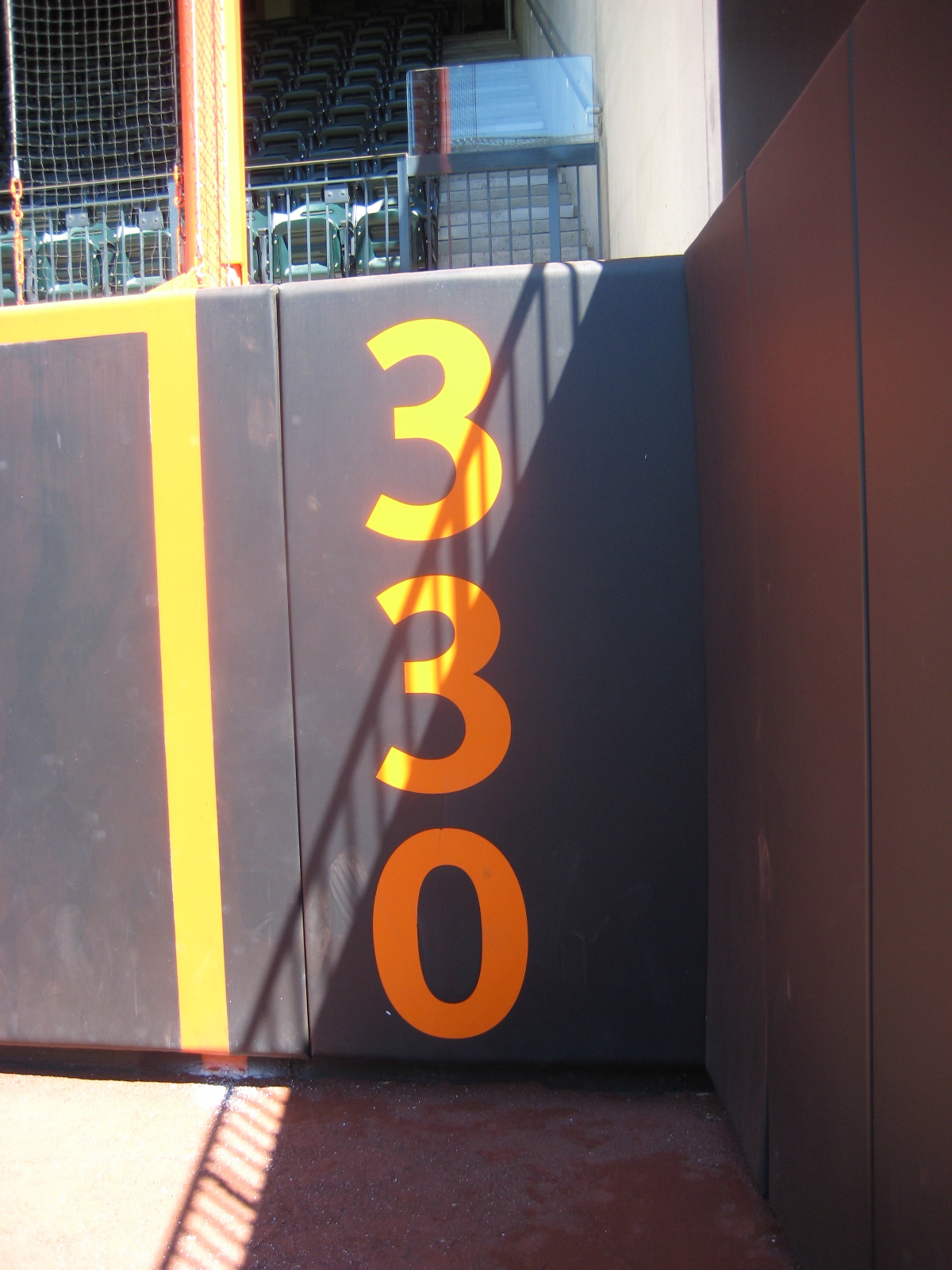
They give tours of Citi Field. It’s a good idea executed with mixed results. I took one on Labor Day weekend. Some of it is impossible to screw up, like the part where you’re taken to the warning track behind home plate, then into the dugout and down the first base line; you linger in front of the 330 sign in the right field corner and then by the Mets bullpen before you’re led through the home clubhouse. That part works very nicely.
 The way the Mets run certain things, is it ever really a new era? Too much of it, however, is devoted to showing you the suites and the clubs to which you, the average Mets fan, won’t otherwise be gaining admission. Our tour guide was an absolute disaster during the parts of the tour that didn’t involve the playing surface. A few examples of the letdown factor:
• She dismissed the pictures of great New York sports journalists in the press box as “some old guys you’ve never heard of”.
• She sneered at the notion that anybody would actually want to have a wedding at Citi Field, while informing you that you could.
• She pointed to the oversized baseball cards on the Empire level with a brusque “there are some baseball cards” as opposed to taking two minutes and walking us through a brief history of the Mets from 1962 through 2009 (the just-traded Jeff Francouer had been removed and no 2010 card had yet taken his place).
No effort was made to explain the origins of the club, why it plays in Queens, what happened in the parking lot to our left in 1969 and 1986 — she didn’t even bother pointing out the window at the five markers that signify home, first, second, third and the mound.
I have a friend who gave tours of Shea Stadium during the five minutes when tours were given of Shea Stadium, in 1994. He carried a baseball in his pocket. A baseball marked with shoe polish. He then explained its significance, how a ball hit Cleon Jones on the foot and how Gil Hodges proved it with a ball just like this one, and the Mets went on to win their first World Series. Both Gil and my friend used their wits to create and tell Mets history, respectively.
There was little wit served up and no history to be learned on this tour, other than a pool table in the players’ lounge once belonged to the Rolling Stones. The presentation was shoddy, it was shabby and it was largely inaccurate. She carried a script but had clearly memorized only a few random bullet points. Nothing was mentioned of why Citi Field is designed as it is, what ballpark’s architecture inspired it, no “wow!” factoids about how many bricks it took to build the place. Our guide kept telling us there was ample opportunity to sneak into the well-guarded precincts of the Delta 360 Whatever It’s Called Club and other high-end eateries when, in fact, they’d sooner shoot you than not redirect you to where you belong if you’re a peon of the Promenade.
And why do they always think all we want to do is sneak into places?
***
If you’ve dealt with Citi Field personnel on any kind of going basis, it shouldn’t surprise you to know our tour guide seemed distracted and impatient with having to guide a tour. While she wasn’t rude (and offered to take on-field pictures for anyone who wanted to pose), it was clear this young lady had better things to do on this Sunday than her job. That’s how it is most Sundays at Citi Field when there’s a game. Most other days, too.
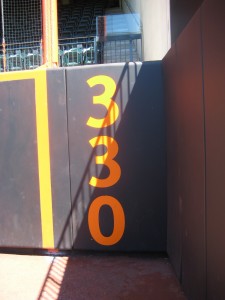 The Mets rarely go the extra 330 feet. Cripes, somebody’s small child needed to use a bathroom. The guide discovered the bathroom where we were standing was locked. Next place we went, same thing. The Mets had not thought to make a single bathroom available even though they had tours going through all day and chances are somebody was going to need to use one. Our group was accompanied by a security guard (because people who pay ten bucks to take a tour of a ballpark must be guarded at all times). Neither the guide nor the guard thought to check in with HQ and ask can we get a key up here for a kid who needs to use a bathroom? That would be going not so much the extra mile but just a lousy ninety feet.
You’ve seen the Mets in action. You know they don’t go an extra ninety feet if they can help it.
***
We had started in the Rotunda — Jackie Robinson; great American; let’s go upstairs — and we ended in the Rotunda — there’s the museum, knock yourselves out — and that was that. The only employee in the museum was another guard, skulking in silence. You’d think maybe a team that gives tours and brings you to its neato museum at the end would have somebody on duty to answer questions, some kind of resident historian, somebody to enhance the experience.
Yeah, you’d think.
You’d also think this wasn’t possible: During one leg of the tour when we were broken into two mini-groups and had to ride in two separate elevators, the guide’s group (mine) arrived at the next point ahead of the guard’s group. The guide had to ad-lib for a minute or two and seemed flummoxed. She went to a staple of these sorts of events and asked if anybody had any questions. When nobody did at that moment, she continued, “Anybody have any favorite Met memories?”
One man spoke up. Last game at Shea, he said. What an experience, what an unforgettable day, they had to drag me out of that place. The guide warmed to his recollection and agreed yes, sometimes the old ballparks mean the most to us because that’s where we have our memories and…uh…
She didn’t know what else to say, so she asked the same man another question.
“Did the Mets win or lose that game?”
***
I was the last tour member to leave the museum. I wanted to soak it up, take a few pictures, watch the video (whose script I wrote) in relative peace. I had to be my own historian. I’m a tough crowd on the subject of Mets history, but I honestly wouldn’t have minded somebody else telling me something I didn’t know. As it was, I took it upon myself to answer various and sundry questions the guide and guards couldn’t — including is there an open bathroom around here? Yes, I said, upstairs in the subway station.
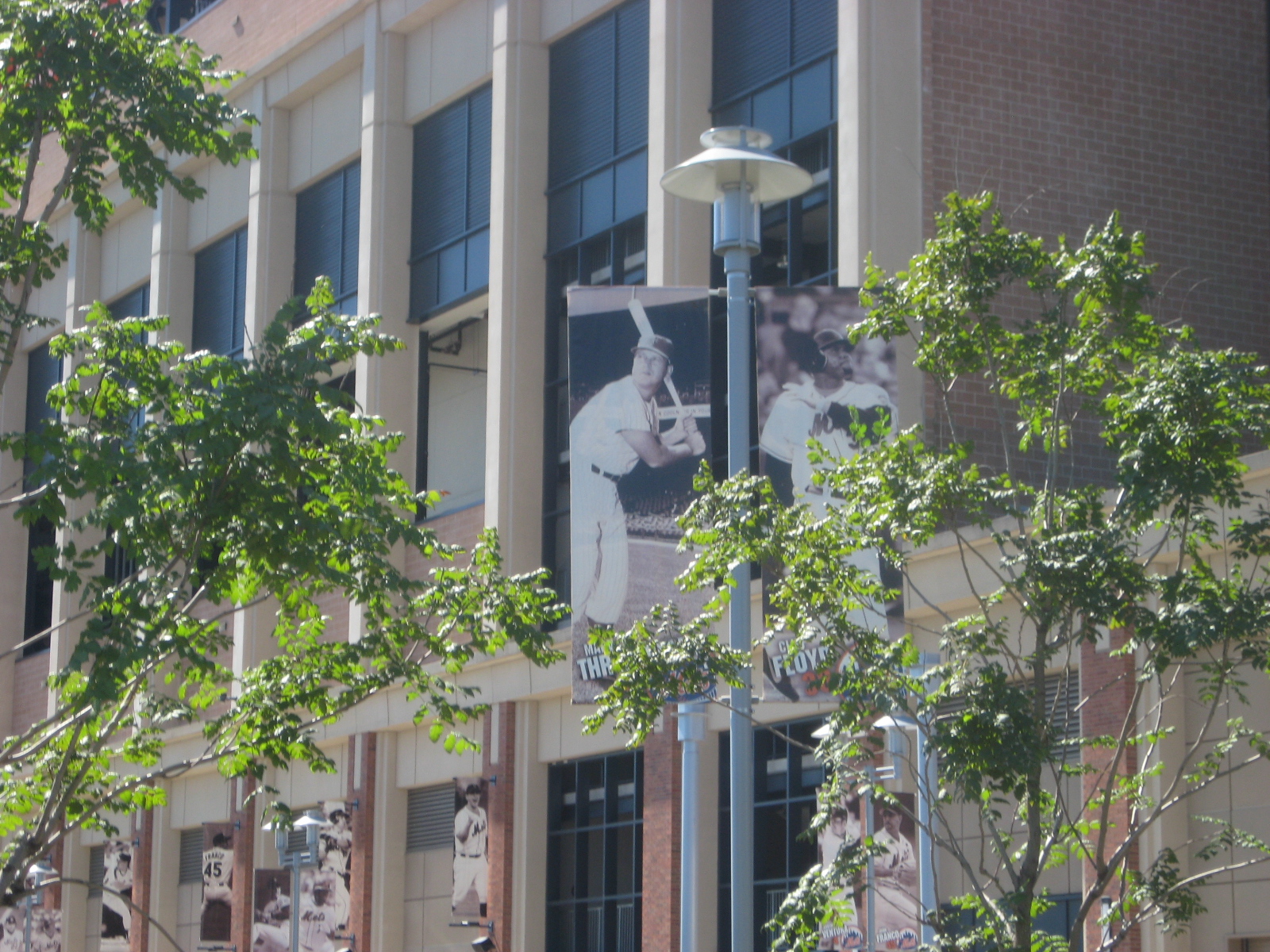
When I left, I was genuinely bummed out. What a lousy tour. What a lousy sense of the Met self. They put up this great museum — I’m still shocked at how absolutely on target it is — and they lined the plaza and park and parking lots with those great banners of Met legends. To me, they’re all legends. They don’t have to be superstars. They just had to be Mets.
LIke Marv Throneberry.
Marv’s banner ranks as one of my favorite discoveries of 2010. It was as if somebody with the Mets was paying attention or hadn’t forgotten. Marvelous Marv did not personify Excellence Again and Again or Six Sigma or anything that would mistaken for the Mets’ wanna-be corporate soul of the 21st century. Marv was a Manhattan Met, the ironic idol of the Polo Grounds, he who got cheered despite his epic ineptitude. He got booed, too, but nobody’s perfect, not even a 1962 Mets fan.
The Mets saw fit to put up a banner of Marv Throneberry, the slugger who hit 16 home runs and the first baseman who committed 17 errors. The Met who more famously than any of his expansion teammates could not Play This Game. He was the baserunner who would have had a triple had he chosen to touch bags other than third. He was the fielder for whom rundowns were drills that used live grenades. He was the feller who wasn’t given a piece of birthday cake because Ol’ Case wuz afraid he’d drop it.
Marv Throneberry flies from a lamp post outside Citi Field, and long may he wave.
***
On this eerily quiet afternoon that followed the dreadfully disappointing tour, I wanted to commune with the first Met folk hero. I wanted to get up close to the Marv Throneberry banner and take its picture. That, I decided, would cheer me up.
Except it turns out Marv’s banner isn’t in just any parking lot. It’s in the players’ parking lot and somebody’s stationed at its entrance to keep you out, even if you explain all you want to do is take a picture of the Throneberry flag. I suppose that sounds weird, but I’m outside the Mets ballpark; it should sound like a perfectly reasonable request.
It wasn’t taken that way.
The guard was cordial, but despite being old enough to have quite possibly guarded Marv Throneberry’s automobile (or even Richie Ashburn’s), he didn’t let me in. “We can’t have David Wright’s car getting scratched up,” he told me.
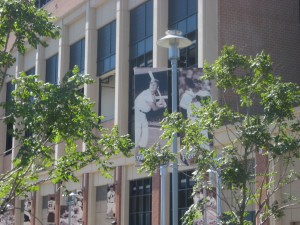 The Marv Throneberry banner: Don't get any closer, buddy. I couldn’t argue with that logic, even though the last thing I’d want to do is cause harm to an innocent Lincoln. I accepted that this man was just doing his job and walked a few steps away before exploding in that way I have of losing my cool after bottling up my dismay for a few minutes too many.
“THIS PLACE IS RUN LIKE SOME KIND OF FUCKING PRISON!” I said, realizing that was a little over-the-top, considering my problem wasn’t getting out, but getting in. I instantly apologized with my standard “I don’t mean to get mad at you…” but he didn’t seem upset with my outburst. In fact, he kind of nodded in agreement at my assessment of Citi Field’s penitentiary leitmotif. Nevertheless, I would have to take my picture of Marv Throneberry’s banner from a distance, over a chain link fence.
Oh Marv, I thought as I snapped my photo, what’s become of our Mets? In your day they were lovable losers. Now they’re only half of that. Why must they be like this? And I’m pretty sure I could hear him answering back from somewhere beyond that lamp post:
“I still don’t know why they didn’t let you stay in your seat a couple of minutes longer in 1996.”
by Jason Fry on 27 September 2010 1:32 am In the last two games against the Phillies, one player has gone 5 for 8 with two home runs, a diving catch, a statement made on the field and fiery talk off the field. This player has raised his average 46 points since September 3. He’s not a September call-up or a rookie, but a familiar face.
His name is Carlos Beltran. He’s nearing the end of its sixth season with the Mets, with questions about whether there will be a seventh. Looking back at his time in orange and blue, two things stand out:
1) He is a remarkably good baseball player.
2) He has been treated horribly by a ridiculous organization and too many of its fans.
Beltran’s 2009 was marred by injuries, as were the seasons of many of his teammates. But he came back late in the year, and I had hope that he might be whole in 2010. But then January brought unhappy news: Beltran had opted for knee surgery in Colorado, and wouldn’t resume baseball activities until April. The Mets were livid, fuming that he hadn’t had permission.
My reaction was pretty straightforward: I was disappointed, but then I remembered how the Mets had handled injuries to Jose Reyes and other players during the horror show of 2009. Remember all that? Remember how players were day-to-day, would sit on the bench without going on the DL, would re-emerge for a brief, ineffective game or two, then go on the DL for lengthy periods? Remember how medical diagnoses relating to the Mets seemed to have more to do with spin than reality? After all that, and the pussyfooting around Madoff, and Dave Howard’s word games about obstructed views, I wasn’t inclined to believe a word the Mets said.
Beltran didn’t come back from knee surgery until the All-Star break, joining the Mets in San Francisco for an 11-game West Coast swing. The Mets went 2-9, and if you listened to talk radio you’d have immediately concluded that the problem was Beltran. (Without Beltran, by the way, the Mets had ended the first half of the season with a 3-9 skid.)
Yes, it was pretty obvious that Beltran had returned too soon from a long layoff — his timing wasn’t there and he’d lost a step in the outfield, hampered by the surgery or his knee brace or both. But the analysis from the troglodyte wing of the city’s columnists and the mouth-breathers on the FAN had little to do with his surgically repaired knee and a lot to do with the supposed quality of his heart. It was the same barber-chair stuff it’s always been: Beltran plays without passion, he’s listless, he’s passive, not a leader but a cancer.
One of the great things about advanced stats is they allow you to test your impressions against reality, showing you where your gut is correct and where your eyes are deceiving you or your prejudices are getting in the way. This stuff will never be even fifth or sixth nature to me, let alone second, but one stat I love is WAR, or Wins Above Replacement. It’s an ideal tool for figuring out how rosters should be constructed, and for seeing who’s worth his salary and who isn’t. (Here’s a basic guide to WAR from our new pals at Yahoo Sports’ Big League Stew, and here’s Joe Posnanski on why he likes WAR.)
So here’s Carlos Beltran. Basically, a player with a WAR of 2.0 or above is worthy of being an everyday player, and one with a WAR above 5.0 is a star. But don’t worry about that too much — remember Wins Above Replacement, and think how many guys the Mets have run out in recent seasons who definitely qualified as “Replacement.”
What do we see? We probably remember that Beltran struggled in 2005, and WAR backs that up: He put up a 2.2 WAR, which is OK but by no means impossible to find, and certainly not what you want from the first year of a seven-year megadeal. But after that? Holy God. In 2006 his WAR was 7.5, and the only player who did better was named Pujols. In 2007 he put up a 5.1 WAR; in 2008 he was ninth in all of MLB with a 7.1 WAR. In 2009 his WAR was 3.1, injuries and all. That’s two monster seasons, a very good one, one that was probably better than you figured, and one that was underwhelming but OK. Here are the Mets’ all-time leading hitters as measured by WAR through June. Beltran’s fourth, right up there with Keith Hernandez. And if you convert the stat to WAR per 700 plate appearances, he stands alone. Fangraphs also tries to assign a dollar value to players based on their WAR, which you’ll find at the bottom of Beltran’s player page. I know advanced-stats folks consider those valuations kind of wonky (and all advanced stats are works in progress), but it’s still a useful guide for figuring out if a player is worth his salary. By Fangraph’s calculations, Beltran has been worth the money and then some.
So that’s Carlos Beltran according to statistics. Now let’s wade into the intangibles, which is where the conversation about Beltran often becomes full of yeah buts.
I’ve never particularly understood this. I’ve always thought that the complaints about Beltran lacking passion were based on fan interpretations of his body language, which seems slightly more reliable than phrenology in assessing a ballplayer. In the field Beltran has always been superb at positioning himself, reading balls off the bat and taking that first step necessary to be in position to corral drives into the gap or against the fence. If his first step were slower and he had to lunge or dive for balls instead of catching them on the run, would that be playing with passion? If he tarted up good catches with hotdoggy pratfalls, a la the loathsome Jim Edmonds, would that be intensity? Was his stumbling, game-saving snag against the Astros halfway up Tal’s Hill unsatisfying because he didn’t grit his teeth or come off the field whooping and hollering? Why isn’t his headfirst collision with Mike Cameron — which could have ended both careers if it had gone slightly differently — remembered as proof of his grit or toughness?
I suspect Beltran’s entire Mets career would be regarded differently if he’d swung and missed the final pitch of the 2006 playoffs instead of taking it for a called third strike, even though it would have changed absolutely nothing. But if this proves anything, it’s that a lot of fans are crazy. Being fooled by a 12-to-6 knee-buckler of a curve isn’t a sign of passivity, but a sign that a very good pitcher made a perfect pitch. Players get to two strikes, look fastball and get erased by perfectly thrown curveballs every goddamn day. Sometimes it happens while you’re in the can or around the corner getting Doritos, and sometimes it happens in the ninth inning of Game 7 of the League Championship Series. Should Beltran have swung too late to show he really cared? Should he have smashed himself in the face with the bat to express his grief? Does the case against Carlos Beltran really come down to the fact that he doesn’t grimace enough? And if it does, whom is that an indictment of: Beltran, or columnists and fans who judge a player’s value to a team by facial expressions?
The Walter Reed incident was particularly distasteful on many levels. Mets officials anonymously threw Beltran, Luis Castillo and Oliver Perez — three players they were unhappy with — to the wolves, setting them up for a public shaming. (Here’s Matthew Callan’s great post from back then.) Beltran, though, had a reason he hadn’t been there — he’d had a lunch meeting about a school his foundation was building in Puerto Rico. I never heard a New York scribe challenge that, even though it would have sold a ton of papers. A couple of days later, Beltran’s agent Scott Boras had this to say about Beltran’s treatment by the Mets: “The team has a duty to run the organization professionally. Giving the players [short] notice, knowing they have plans or obligations in their personal lives, and then to admonish the players without checking, it’s totally unprofessional on all fronts.” I don’t particularly like Boras, but take a moment to think back on how many times the Mets have come across as dysfunctional and/or disorganized in recent years and tell me he’s wrong.
None of this mattered to New York columnists, who criticized Beltran’s attitude and work habits despite the fact that he’d been pretty thoroughly absolved. Here’s a sample from Mike Lupica: “All athletes worry about their next contracts when they get close to the end of their current ones. It is why Beltran wanted to get back on the field, even in his current diminished capacity, hoping he would look better than he has before his walk year, worried about what happens to him when he comes to the end of his $100 million contract a year from now.”
Really? Beltran returned early from knee surgery because he was worried about his 2011 performance? Beyond the character assassination by generalization (“all athletes”), it’s not even a logical charge. If Lupica were correct about Beltran’s motives (he doesn’t offer a shred of evidence that he is), wouldn’t Beltran have been better served sitting out for all of 2010 to avoid putting up subpar numbers and potentially reinjuring himself? Couldn’t you just as plausibly claim that Beltran talked himself into thinking he was more ready than he was because he loves to play baseball and wanted to help his teammates? I don’t know that that’s true, but why is Lupica’s version more believable than that?
And if you care about such things, Beltran has evidenced plenty of passion in talking with reporters. He’s the guy who called the Mets the team to beat in 2008. Just two days ago, he was the one who was most upset with Chase Utley’s takeout slide of Ruben Tejada, and admitted trying to take out Utley and Wilson Valdez. Contrast that with, say, David Wright’s purse-lipped, vaguely corporate bromides after awful losses, and ask which player you’d expect to be crucified for a lack of passion.
Carlos Beltran is one of the greatest players to ever wear a Mets uniform. If there’s anything shameful about his years in New York, it’s not that he had a subpar first season by his high standards, or that he got fooled by a great curveball when we really wish he hadn’t, or that he had the misfortune to be betrayed by his knee, or that he employs an agent fans dislike, or that he plays baseball with grace and ease instead of flailing Francoeuresque fire. What’s shameful is that he’s been treated shabbily and sometimes viciously by an organization and a fanbase that doesn’t appreciate him.
by Greg Prince on 26 September 2010 7:28 pm Let’s not mistake this for a triumph. A triumph is clinching your division. The Phillies will know triumph very soon.
But they don’t know it yet.
You can only win what’s in front of you on a given day. The Mets won a ballgame they didn’t want to lose, one I’m pretty sure none of us wanted them to lose. We can create our own unflattering Met narratives, thus we didn’t need an obvious storyline hitting us over the head like so many flying corks in somebody else’s clubhouse. METS WATCH PHILLIES CLINCH was one to be avoided at all costs.
So now what? The Mets will return to desolate Citi Field Monday night, probably play with less passion and purpose against the Brewers and Nationals than they generated against the Phillies, and we’ll find reasons to feel less than impressed. Should they somehow sweep the next two homestands, finish above .500, finish ahead of the Marlins (they’re one game behind in the largely ignored race for third place), all that will do is irk us into asking where this was when it might have done us some real good. Either way, ten minutes later, the manager will be fired — unless a season-ending hot streak somehow saves his job, in which case we’ll scream bloody murder because we’ll know it’s all a mirage.
Yet Sunday at Citizens Bank Park wasn’t a figment of our imagination or speculation. It was a baseball game between two baseball teams: no Davids, no Goliaths, nobody vocally scrounging for pride or revenge. Just a baseball game conducted by professional baseball clubs. Both sides seemed a little tight, they both made some mistakes, but one recovered its poise and did enough good things to outlast the other. Most notably, Carlos Beltran truly returned to Carlos Beltran form (3-for-5, 2 home runs, mobility in the field) for the first time since early 2009. Was that a mirage? Or have the past 15 months been the outlier? Dude was a pretty great ballplayer for a decade before his knees kicked him in the groin, so to speak. We won’t find out for sure if his form is permanent in the final week of 2010, but gosh, for one afternoon in Philadelphia, he was a grand spectacle like that we once knew and generally cherished.
Other sweet sights: the enduring rebirth of Nick Evans; the surprising stinginess of our bullpen (Green, Acosta, Feliciano, Dessens and Takahashi gave up nothing, aided in no small part by Nick and Carlos’s infinite play list); and a line of Mets slapping hands when it was done. When we were the about-to-clinch club in 1986, I rolled my eyes a lot at Mike Schmidt’s declaration that nobody was going to drink champagne in his also-ran face. Those Mets traveled to the Vet needing to win one game to officially secure their division title. With three weeks remaining and a 22-game lead in their back pockets, there was never a more foregone conclusion than the outcome of the 1986 regular season. But the Mets went 0-3, and while it didn’t matter once the Mets were in the heart of October, I still remember being annoyed about it. I’m annoyed about it still. I’m annoyed, still, that the Mets were swept in Pittsburgh in 2006 with a crown waiting to be worn. That it meant I could go to Shea and witness the coronation first-hand never lessened the transient frustration of not getting it done when it could get done.
These Mets today saw to it that the eventual N.L. East champion Phillies couldn’t get it done. They’ll schlep their t-shirts and their bubbly to D.C., and their pleasant and gracious fans will have to make an extra trip on a school/work night. In the end, they’ll have what they came for. But not at our expense, not today.
It’s not a triumph. But it will have to do.
by Greg Prince on 26 September 2010 2:27 am “Making an entrance after the president. That’s just not how we play bridge. It’s not how we say cricket.”
–Toby Ziegler, The West Wing, regarding breaches of protocol
Instead of veering wide of second base, Carlos Beltran directed his legs straight toward those of Chase Utley and Wilson Valdez. Instead of leaving three runners on base, Lucas Duda drove them all home. Instead of melting down after a poor first inning, Dillon Gee toughened up for the next six.
Instead of losing in Philadelphia, the Mets won. That was a nice change of pace.
It’s not like the Mets hadn’t won before at Citizens Bank Park in 2010; it only feels that way. We’re 3-5 there, which isn’t great, but it ain’t 0-8. The Phillies are a very good team, but they’re not unbeatable. Nobody is. Glad the Mets finally figured that out.
After the 5-2 victory that snapped the Mets’ six-game losing streak and the Phillies’ eleven-game winning streak — and kept the Phils from clinching a tie for the division title — Josh Thole told Kevin Burkhardt it was like the Mets got their “pride” back. Josh is 23 (and appears 14), so he may be given to wide-eyed overstatement. But he’s one of the Mets, so I’ll take his word for it: The Mets got their pride back by beating Philadelphia at Philadelphia and by one of the Mets making a harder slide than he usually does.
Two questions regarding the return of this “pride”:
1) That’s all it took?
2) Where the hell was it before?
Beltran’s slide was good fundamental baseball. It broke up a potential double play. It scattered Utley and Valdez and it allowed the Mets to build what became their winning rally. If there hadn’t been uncommon amounts of chit-chat about Utley’s hard slide the night before, I would not have noticed anything unusual about Carlos’s “retaliation”. Beltran’s slide looked like a thousand slides I’ve seen the Mets make in my life, if not that many lately.
If that’s what fills the Mets with pride, so be it. I’d like to think the paychecks, the uniforms and the fact that a couple of million people follow their every move would make a fella proud to be a Met, but at 75-79, we’ll take what we can get.
From a young Gee’s perspective, this was a big win. He’s only made four starts in the major leagues, so they should all be big. Gee’s postgame comments were in line with this weekend’s narrative about how great it is for the Mets to play in the Citizens Bank “atmosphere”. I don’t mean to get hung up on what is said after games as opposed to what happens during them (though the Mets are generally more interesting talking than playing), but again, why should this all seem like such a step up in class for the Mets? You’re all in the same league, even if you don’t all have similar records. Let’s not invest opponents with any more mystique than they need. The Boston Garden’s been torn down a long time — until another one’s built, make yourself at home wherever you play. The bases are 90 feet apart no matter which park you visit.
Fortunately, Gee pitched as if he doesn’t distinguish among the Nationals, the Phillies or the 1985-86 Celtics (50-1 at home, regular season and playoffs combined). Ryan Howard took him on a very long ride in the first, but after that, no Phillies went anywhere on Dillon’s watch. Hard to say what it means for his long-term chances, but there is no long term at the moment, there’s just September. Dillon Gee is here because it’s September, and he just pitched a wonderful game. Lucas Duda is here because it’s September, and he delivered the Mets’ first big hit in literally ten days. Gee, Duda, Thole, the rest of the kids…they can be proud of being Mets without somebody signing permission slips.
They’re young, but they’re not that young.
by Greg Prince on 25 September 2010 1:00 pm The 2010 Mets are a temporary condition. Mets fandom, however, is a lifetime proposition. Some dispatches from around Metsopotamia, most of them showing us again that blue and orange waters run deep.
• Faith and Fear reader Tim Hanley wrote in to let us know he and his home movie of Ron Swoboda’s Game Four catch in the 1969 World Series will be included in the forthcoming Baseball: A New York Love Story, with his segment premiering on Channel 13, Wednesday, September 29, at 10:30 PM and Channel 21 Thursday, September 30, at 12:30 AM. This is part of a multichapter documentary WNET produced in conjunction with Baseball: The Tenth Inning, which itself debuts Tuesday. Ken Burns’s work picks up where his original masterpiece left off, in the early ’90s. If there are 30 seconds devoted to the Mets in these four new hours, I’ll be shocked.
• Faith and Fear reader Sharon Chapman is running diligently toward the New York City Marathon in early November. When not training, she’s been raising funds (with the help of viewers like you) for the Tug McGraw Foundation, collecting nearly $5,400 to date for a most worthy cause. Her most recent warmup race was the Rock ‘n’ Roll Philadelphia Half Marathon and her wristband of choice, naturally, bore the imprint of your favorite blog. To donate to Tug’s foundation and help fight brain tumors, please click here.
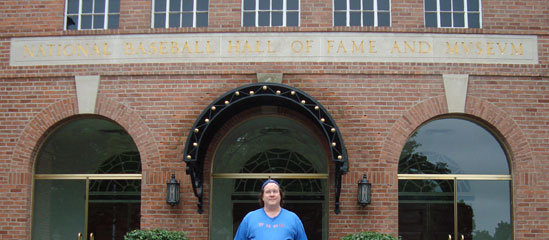
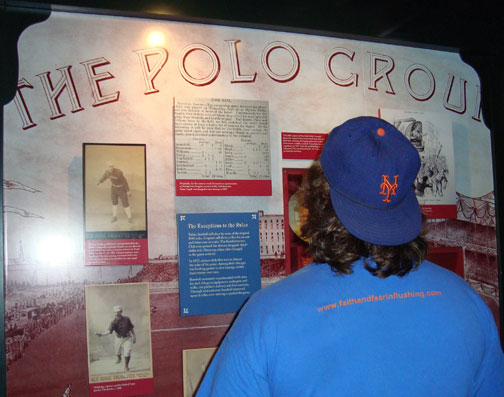
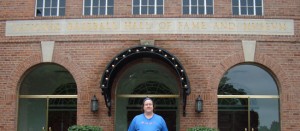 Hey guy! The FAFIF tee takes its place alongside the likes of Stan the Man in Cooperstown. • We can now say the Faith and Fear t-shirt has made it to the Hall of Fame. Inducted? Not quite, but ace illustrator Jim Haines was kind enough to don our garment of choice when visiting Cooperstown this summer and thorough enough to let everyone checking out the ballparks exhibit the URL you all need to know. Note that Jim has stopped off at the Polo Grounds; that was the first home of the Mets in case anybody in Mets ownership needs to be reminded.
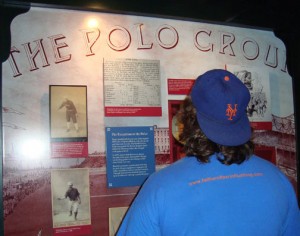 The rarely photographed back of our shirt, pictured in front of images rarely invoked at Citi Field. • There are no actual Elimination shirts, but Randy Medina at the Apple knew there ought to be. And they were a hit! Hopefully the Fourth Place Clinching shirts are right around the corner.
• The Apple’s Elimination apparel line may be pure fiction, but you can actually still get a Gary Sheffield 500th Home Run cap on mets.com for some unfathomable reason along with $19.97 plus shipping and handling. $19.97 for a Gary Sheffield 500th Home Run cap? That’s about $17.97 more than it should be (if it should be at all), but take heart: it’s marked down from $24.99.
• Can’t let the subject of Metwear go by without tipping you off to Metstradamus’s investigative report from an Old Navy location in Queens. Let’s just say it’s a great place to get your hands on a Marlins tee.
• Belated congratulations to savvy Mets GM nominee Howard Megdal who swept all his primaries (including ours) and has since taken the next step of letting the Mets know about it. We look forward to a Megdal administration, both for the wins and the poems we’re sure it will produce.
• One of the greatest World Series games ever has just turned up intact on kinescope, thanks to Bing Crosby’s superstition and meticulousness. You’ve gotta read Richard Sandomir’s story in the Times of how we’ll finally get to see the Yankees lose Game Seven of the 1960 Fall Classic to Bill Mazeroski and the Pirates. How is this Mets-related? C’mon…
• Throughout this mostly desultory year, Matt Silverman has been rebuilding the season-by-season history of New York Mets, even the seasons that were akin to 2010 (spoiler alert: there were a lot of them). Visit Met Silverman and catch up, starting with the most recent installment, a salute to 1982 that far exceeds the 65-97 campaign itself.
• Finally, a reluctant farewell to 1979 Met pitcher Wayne Twitchell, who died too young (62, from cancer) earlier this month in his native Oregon. Aaron Fentress of the Oregonian captures his life before, during and after his time as a major leaguer, most of which he spent with the Phillies. I was on hand for his one and only Met home start, which wasn’t the greatest night for either him or me, but it’s all part of the tapestry. Our condolences go out to his loving family.
by Greg Prince on 25 September 2010 3:47 am The Mets have lost six in a row for the first time all season and have fallen five games below .500 for the first time all season. It is said you shouldn’t necessarily trust everything you see out of a team in September, yet I find it surprising we didn’t see this kind of downward spiral manifest in all its utter ugliness until now.
It’s also said you’re never as bad as you look when you’re losing. But the Mets have looked bad for a very long time; they just somehow once in a while avoided losing. That brand of luck appears to have been pulled from the shelf.
It will get worse before it can possibly get better. The Mets are likely to taste the nadir of their profession when the team they’ve considered their primary rival for the past four seasons clinches its fourth consecutive division title in their faces. It could happen Saturday night if the Braves lose their afternoon game in Washington. If not Saturday, then Sunday. The Phillies’ magic number is 2. After observing these two franchises for four seasons, to say nothing of nine innings Friday night, can you possibly doubt a clinching isn’t in the immediate offing?
The Phillies play to win, and they won. The Mets play until they don’t have to anymore. They have nine games remaining. If someone told them they could stay out on a field and plow through 81 consecutive innings to fulfill their contractual commitment, I honestly think they’d take a deep breath and bear down as much as they are capable of bearing down until they grounded into 243 outs if that’s what it would take to get their season over any quicker.
Among the many things one can find to irritate oneself from watching the Mets have the string played out around them these days, I took particular note of comments made by Jerry Manuel before Friday night’s inevitable loss. The subject was the impact a series like this — played in such a raucous atmosphere — might have on his young, impressionable players. Manuel went on about how it would be good for them to see what it’s like to compete inside the steaming cauldron that is Citizens Bank Park when a potential division-clinching is on the line.
It wasn’t so much Manuel agreeing with the premise, as posed by Kevin Burkhardt, that got me — it was that the Mets are suddenly going to learn about this now? Like this should be a novelty for them? They’re the New York Mets. They shouldn’t have to go to Philadelphia or anywhere to learn what it means to be hard-nosed or psyched up or whatever you want to call it. It wasn’t that long ago (though it feels like an eternity) when the Mets would occasionally blame a letdown in a place like Miami on their not being used to empty ballparks because they were so accustomed to more dynamic surroundings. The Mets would put a charge into Shea, Shea — we — would put a charge into the Mets and the collective energy level would reach as high as the Keyspan sign in left.
So now the Mets arrive from No Life Stadium, where they were swept in environs befitting their tepid pulse rate, and Philadelphia is supposed to provide some kind of lesson in how to get fired up. And they lose again anyway. The Mets don’t win when nobody (other than the Pirates) is on hand and nothing is at stake, and the Mets don’t win when they’re taking on a chronically motivated opponent in front of 45,000 red-clad brayers tased out of their minds on success.
Geez, whatever. Whatever the excuse of the night is, throw it on the pile.
Much was made afterwards Friday night about the hard, chippy slide Chase Utley took toward the body of Ruben Tejada in the fifth inning in the midst of a 5-4-3 double play. If this were an era in which the Mets also slide hard and chippily, it would have probably gone unnoticed, yet because the Mets lack familiarity with playing to win, it came off as unsporting or worse. Tejada, to his everlasting credit, not only turned the double play (despite a lousy throw from David Wright) but brushed the whole thing off as baseball being baseball.
If the Mets are pissed off about it, as their postgame quotes indicate, great. Go out and find the other team’s second baseman. And when you’ve done more than not saying “pardon me” by Mr. Utley on our way to high tea, keep it up elsewhere. You don’t have to start throwing elbows or knockdowns every other inning, but don’t treat getting riled up like it’s that suit you only put on for special occasions. Every game is supposed to be a special occasion. Every game is an occasion to get riled up. Every game is a game to play to win.
After Chase sent Ruben heels over head, the Mets “began yelling at Utley from the bench,” according to Andy Martino in the News. That I do find surprising, for it indicates the Mets actually watch the games they’re nominally playing.
If we’re sitting here in some future September examining yet another Mets win and we’re poring over quotes from battle-tested veterans like Tejada and Thole and Davis about how it all started for them that night in Philadelphia in 2010 — when they were rookies getting regularly pulverized and posterized until it dawned on them how the game was supposed to be played because they saw Chase Utley take nothing for granted…then I’ll believe the business about this being a good experience. For the time being, it’s just more of the same: The Phillies won and the Mets landed on their ass.
And if former second baseman and current Brooklyn Cyclones manager Wally Backman happened to be watching the postgame show, how far do you suppose he threw his TV when Wright said “cooler heads prevailed” and “we’ll re-evaluate the way we go into second base”? Enough with the cooler heads and the Committee to Re-Evaluate Slides, David Wright, chairman. Just shut up and take somebody out already.
As for R.A. Dickey, he could have pitched more effectively, but he had another MVP night when it came to offering analysis of why the Mets lost. Words and phrases R.A. used in a sentence as he stood by his locker answering questions:
• etiquette
• grotesque
• refined palate
• culture
• deem
• formidable
• Petri dish
• oblivion
• vortex
Granted, “that sure was a good no-hitter I just threw” would have sounded better than any of that, but barring unforeseen events like the Mets winning games the rest of the season, R.A. Dickey’s Every Fifth Day Impromptu SAT Prep Course is the best, last reason to stay tuned to this team.
As if we don’t do this sort of thing everyday, Jason and I collaborated on a “Dear John” letter kissing the 2010 Mets goodbye at Yahoo! Sports’ Big League Stew. You can feel our scorn and read us spurn here.
|
|