The blog for Mets fans
who like to read
ABOUT US

Faith and Fear in Flushing made its debut on Feb. 16, 2005, the brainchild of two longtime friends and lifelong Met fans.
Greg Prince discovered the Mets when he was 6, during the magical summer of 1969. He is a Long Island-based writer, editor and communications consultant. Contact him here.
Jason Fry is a Brooklyn writer whose first memories include his mom leaping up and down cheering for Rusty Staub. Check out his other writing here.
Got something to say? Leave a comment, or email us at faithandfear@gmail.com. (Sorry, but we have no interest in ads, sponsored content or guest posts.)
Need our RSS feed? It's here.
Visit our Facebook page, or drop by the personal pages for Greg and Jason.
Or follow us on Twitter: Here's Greg, and here's Jason.
|
by Greg Prince on 24 September 2020 12:08 pm We want people to be able to watch sports, to the extent that people are still staying home. It gives people something to do. It’s a return to normalcy.
—Gov. Andrew Cuomo, May 24, 2020
On Sunday afternoon, August 7, 1994, the Mets lost to the Marlins, 2-0, at Shea Stadium. Had I known the outcome in advance, I wouldn’t have wanted to have been there to witness it. But bereft of inside dope, I sort of did want to be on hand because the deadline the Players Association set for a strike was later in the week, and absolutely nobody was optimistic that a work stoppage could be avoided. The Mets were going on the road the next day, so this Sunday game was, in all likelihood, the final opportunity to go see the Mets for quite a while. I mused out loud that morning that maybe I should get on a train and head out to Shea.
“Why don’t you?” my wife asked.
“I’m tired,” I said.
That’s my excuse for lots of things, though this particular invocation of my most reliable alibi came from a place of earned weariness. We had just three days earlier returned from a ballpark-laden jaunt to the Midwest: White Sox on Sunday; Brewers on Tuesday night; Cubs on Wednesday afternoon. It was a whirlwind. I couldn’t say I hadn’t had plenty of in-person baseball to see me through the upcoming void. Besides, the Mets were on TV. So, on August 7, 1994, I stayed home and watched what became the final home game of the season.
Last night, Wednesday, September 23, 2020, was the first time in 26 years I could say I did the same thing. In the interim, encompassing the final home games of the regular seasons from 1995 to 2019, I attended every single date at Shea Stadium and Citi Field that fit the description of final home game of the regular season. It became a point of pride with me; if there was one game I was gonna be at, it was that game. Then again, it was never the one game I was gonna be at because there had been plenty of games preceding it. That was the beauty of what I came to call Closing Day before anybody else did. The season was leading me there. We’d been through this thing together, the Mets and me. We were one in April, we were one all summer, and now, on the day or night it was time for us to split off, we’d be one one more time.
Then came 2020, when the Mets and I (and everybody else) kept our distance by necessity and public health mandate. I haven’t been out to Citi Field to see them. Nobody has. Not even the “788,905” version of nobody that counted as the official attendance in 1979. The Mets of 2020 have been, by design of contingency, a television show. Not a great one in substance, but a steady one since July 24 — and always presented entertainingly. Same for the radio rendition.
Thus, when Closing Night 2020 rolled around, it was just another game to watch at home. None of the emotions attendant to a final visit to the ballpark. None of that sense that this is the last time I’m getting on the LIRR to change at Jamaica for Woodside…this is the last time I’m getting on the 7 to Flushing…this is the last time I stop by my brick, the last time I get felt up by security, the last time somebody hands me a nick-nack, the last time… There were no last times like the last 25 times to be had.
There were the Mets and Rays, in living color, courtesy of SNY and me paying my cable bill. There was Michael Wacha looking kind of promising for a while until the promise broke. There were home runs from Andrés Giménez, who will keep getting better; and Dom Smith, who has gotten marvelous; and Todd Frazier, who’s from New Jersey. There were the Rays being far more able, as Met opponents have generally been, wherever the show is telecast from. The only twist to this episode is Tampa Bay got to pop a little confetti when it was over because by defeating the Mets, 8-5, they had clinched their division, which is in another league, but that’s the 2020 schedule for ya.
The 2020 schedule for the Mets has been brief and unhelpful from a confetti-popping standpoint. Others pop. We don’t. We’re not eliminated, but we will be. We won’t be playing any more home games, but what’s the difference? It’s not like we get to go to any of them.
by Jason Fry on 23 September 2020 12:09 pm So Seth Lugo faced the Phillies last week and let’s just say it didn’t go well.
Lugo got strafed. He started out the game fanning Andrew McCutchen, but then gave up back-to-back-to-back homers, also yielding a triple and a run-scoring single in the inning while fanning two more. Can you strike out the side and have a horrible inning? Yes you can. Things went no better in the second: flyout, lineout, home run (that landed on Mars), double, hit by pitch, single, early shower.
It was a stunning sequence of futility, and doubly stunning because it happened to Lugo, who has a terrific arsenal and the brainpower to know how to make the most use of it. But that night he looked essentially unarmed: He was missing several MPH off his fastball, his location was poor, and the Phillie hitters were on seemingly everything he threw. My fear, as he made his early departure, was that he was hurt — which wouldn’t have been a shock, given the elbow damage he’s pitched with for some time, but also would have been more bad starting-pitcher news for a team that can’t afford any more going into 2021.
So I sat down Tuesday night with some trepidation. Would Lugo continue to look like a guy who couldn’t wake up from a nightmare? Could he fix whatever was ailing him against the Rays, a thoroughly impressive team whose players make very few mistakes and always seem to have a plan?
Happily, Lugo looked like the Lugo we’ve foolishly come to take pretty much for granted. The oomph on the fastball was still mostly missing, which may simply be the cost of moving from the bullpen to the starting rotation, but everything else was working. Including, perhaps, a tweak that mostly was left out of conversations: The chatter in the SNY booth (on an entertainingly pointed and perky night for Gary, Keith and Ron) was that Lugo may have been tipping his pitches in Philadelphia.
Meanwhile, Tampa Bay’s Blake Snell got a little squeezed by the umpire (and complained about it a lot) and a little unlucky, which was enough to make him the loser. Robinson Cano — who’s had a wonderful year and done so much to wash away the murk and muck of his first campaign — started the Mets off with a solo homer, and then Pete Alonso got into the act with a fourth-inning homer of his own. Alonso brought in two more runs later in the game and looked like he was actually enjoying playing baseball for once. The batting average isn’t there and the fielding has slipped — in fact, the Polar Bear has looked a lot more like the feast-or-famine guy scouting reports warned we’d get in 2019 than the Rookie of the Year we so thoroughly enjoyed — but we should recall that Alonso’s still working on what would be a 37-homer season in a full campaign. That will play; throw in some more smiles from the BABIP gods and it will play very nicely.
(Oh, and the heretofore anonymous Guillermo Heredia — whose first name I still can’t remember without asking Google or my wife — went deep, proving that he not only really does exist but might actually be good for something.)
Then there was Todd Frazier. I’ve done a lot of grousing about Frazier’s return from the omniscient vantage point of my couch, which is a stance that’s far from controversial — he’s hitting a robust .212, though there is that 0.00 ERA — but admittedly has been amplified by my own prejudices. I’ve always been inclined to favor young players with theoretically bright futures over aging veterans with long, mostly complete tenures, and I’ve been an enormous fan of Luis Guillorme‘s throughout his time with the Mets, convinced he’d succeed if granted regular playing time. So I felt a little guilty when Frazier started a nifty double play in the sixth, short-circuiting a dangerous situation for the Mets. I started to grumble that Guillorme would have made the play too, then chided myself for crossing the line between prejudice and absurdity.
Shortly thereafter, Frazier had a chance for another DP and promptly muffed it. Sometimes baseball forces you to reexamine your own blind spots and biases, and sometimes, well, it shamelessly enables them. FREE LUIS GUILLORME!
by Greg Prince on 22 September 2020 5:55 pm Welcome to A Met for All Seasons, a series in which we consider a given Met who played in a given season and…well, we’ll see.
Everybody scream and shout
Do the Fonzie
Come on
Do the Fonzie with me
—Leather Tuscadero
In 1997, Edgardo Alfonzo came to the plate 68 times in eighth innings. In those eighth innings, he batted .482, reached base at a clip of .545 and slugged .714 for an eighth-inning OPS of 1.260.
Is that good? In 1997 in the National League, it was unmatched. Baseball-Reference allowed me to check. I looked at every single NL team’s eighth-inning statistics (BB-Ref is a miracle). No player with a comparable number of eighth-inning plate appearances came close to Fonzie’s fitness and fortitude when the going got tough. Five other hitters topped 1.000 OPS in the penultimate inning of regulation — Barry Bonds, Craig Biggio, Jeff Bagwell, Mark Grace and Al Martin — yet none of them was within a hundred points of Edgardo. Biggio and Bagwell are in the Hall of Fame, as are Tony Gwynn, Larry Walker and Mike Piazza. You can certainly make a case for Bonds. There was a ton of lumber in the National League twenty-three years ago, and that’s not even taking into account St. Louis trading for Mark McGwire at the deadline. I looked up all the stars, all the sluggers, all the regulars. I looked basically everybody up. Nobody could touch Fonzie when it came to producing in the eighth inning.
Now, you may be asking, “What’s the big deal about the eighth inning?” That’s a fair question. Here is my answer:
The eighth inning was the inning for the 1997 New York Mets. The Mets did more scoring in the eighth inning than they did in any other inning. The Mets did more scoring than any National League team did in the eighth inning. You could chalk it up to random statitude. I say it’s a sign of outstanding character.
No Met demonstrated more outstanding character across his eight seasons in New York than Edgardo Alfonzo. Or probably ever. Nobody filled me with a greater sense of calm and confidence than Fonzie. Nobody made me think that it was all gonna be all right while leaving less room for doubt. Fonzie’s got this was as good a guiding principle as you could adhere to from 1995 to 2002, never more so than in 1997.
Ohmigod, 1997. I loved 1997. I still love 1997. I still love the 1997 Mets, both the season and the team. There’s a delineation to be made between seasons and teams, but in this case I want to throw my arms around both of them and all of them, even the Mets who needed to peel off early so the rest of the Mets could catapult into legitimate contention.
It was legitimate, you know. In September of 1997, I rooted for the Mets to make the playoffs, something I hadn’t been able to do with a straight face in any September since September of 1990. That the rooting didn’t lead to the playoffs, and that it was already kind of a long shot when September began, is beside the point. They were hanging in there, having won more than they’d lost for the first time in seven years, being the kind of team that couldn’t instinctively be viewed as the team most unlikely to win whatever game they were in. The Mets of the ’90s had tumbled into an orange-and-blue abyss around August of 1991. They were stuck down there a couple of weeks into April of 1997.
Then Bobby Valentine made Edgardo Alfonzo his everyday third baseman and everything changed. That’s my version of events. Fonzie off the bench and to third. Huskey was off third and out to right. Huskey wasn’t needed at first anymore because we had gotten Olerud. Butch and John were important, too. So was the pitcher who the Mets picked up from post-strike purgatory, Rick Reed, and the pitcher who had spent four years being just fine suddenly blossoming into the second-best arm to ever emerge from Fresno, Bobby Jones. Rey Ordoñez made all the plays, not just the spectacular ones, at short. Todd Hundley was still knocking those home runs over the wall. Carl Everett had a grasp on opposing pitchers if not always reality. John Franco had help in the bullpen for a change: Greg McMichael, Cory Lidle, Takashi Kashiwada. Carlos Baerga had a little something left. Dave Mlicki had a big night in the Bronx. Bobby V juggled a Jason Hardtke here, a Matt Franco there and made magic as needed.
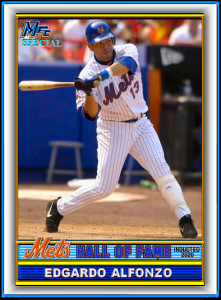 Fonzie by Zvon. But it all came back to Fonzie and those wondrous eighth innings. Fonzie — the kid was from Venezuela and had never seen an episode of Happy Days — was a natural shortstop. So was Ordoñez, which meant Fonzie needed to be something else. He’d play anywhere he was asked. He did so for Dallas Green, who didn’t play him all that much. Valentine took over and saw a third baseman. Fonzie saw a regular gig develop around him. He made it his own. Fonzie and Rey-Rey on the left side of the infield constituted the original Great Wall of Flushing.
Good glove. Good bat? During his first two seasons as a part-timer, Fonzie hit .269 overall with four home runs each year. Given the chance to show his stuff, he flourished, batting .315, with 10 homers and 72 RBIs. His OPS+, which didn’t exist as far as I knew in 1997, was 119. Hundley’s, with power that was a known quantity after his record-setting ’96, was 148. Ordoñez’s, with a bat that presumably came free with a fill-up of Sunoco unleaded, was 36. Fonzie was closer to Hundley than Ordoñez on offense, no piker next to Rey on defense.
As the year went on, anybody who relished watching the Mets daily realized there wasn’t anything Edgardo Alfonzo couldn’t do well. He wasn’t particularly fast, but he wouldn’t get himself thrown out unnecessarily. If you needed a runner moved along, he could handle the bat. There was pop. There was savvy. There was silky smoothness at a position that had been missing dexterity since…well, forever. The Mets had steadily received some fine production out of third base dating back to the days of Hubie Brooks, but nobody stationed at the hot corner — not Brooks, not HoJo, not Knight or Magadan or Bonilla or Kent — was assigned its challenges in deference to defensive skill. Third wasn’t even Fonzie’s first position, but you would have thought he was born to play it.
As the Mets ascended from a typical 8-14 start to a rousing 88-74 finish, it was Fonzie who led them from nowhere to somewhere. He placed ninth in the league in hitting and thirteenth in MVP balloting for a team that almost nobody noticed was building itself into a winner. One of my fondest memories of Fonzie, 1997 and eighth innings was when the three of them converged on a FOX Saturday affair at Shea, Mets versus Pittsburgh, the home team trailing, 2-1. Tim McCarver, who saw enough of Fonzie to understand that this was a special player, explained to Joe Buck that as National League third basemen of the moment went, Edgardo Alfonzo, batting with Hardtke on first, was having as good a season as any of them. Buck, who probably flew in that morning, practically guffawed at the notion that this nobody could be somebody he had to take seriously.
Then Fonzie homered to left-center to give the Mets the lead and ultimately the win. Listening to Buck swallow his dismissive words was a delight.
Eighth innings, as noted, were a Met specialty in 1997. It was the “we’re not giving up” inning, the indicator that you don’t dare dismiss us until we’ve had every last up. Sure, the ninth inning gets all the walkoff glory that extra innings don’t, but don’t sleep on eighth innings. The Mets were walkup winners repeatedly in ’97, walking up and swiping a win from an unsuspecting foe eighth after eighth. “HEY!” I would have warned the rest of the league had I not wanted to keep our core competency on the down low lest it be discovered and neutralized, “WE’RE NOT DONE HERE YET!” That’s the outstanding character I alluded to above. Finish your homework. Clean your plate. Make sure you take advantage of every last opportunity to score. The 1997 Mets were raised right.
The Mets were tied or behind entering the eighth inning 95 times in 1997, yet they went on to win more than a quarter of those games. Overall, they won from behind 47 times, more than anybody in either league. Sometimes it was dramatic, but often it was reasonably too quiet for the likes of Baseball Tonight to amplify at a high volume. You can’t pound the bearer of the go-ahead run in the top or bottom of the eighth on the back or urge him to fling his helmet in triumph because, fellas, we’ve still got a little work to do here.
Nobody had to tell Fonzie. I’m sure Edgardo enjoyed giving and receiving a high-five as much as anybody, but his demeanor always expressed wariness. We might need to score more. One of us may need to make a diving stop. Johnny from Bensonhurst might not close this thing out so easily. Fonzie stayed ready.
In 1999, he was ready to move to second base when asked, a request motivated by the offseason signing of Robin Ventura. Fonzie did the shift. The Mets, who’d seen their progress stall in 1998, were better off for having Fonzie play second. What a DP combination he formed with Ordoñez! What an infield with Ventura and Olerud at the corners! Best ever, according to a national magazine! In the interim, between 1997 and 1999, the Mets had picked up one of the players who finished ahead of Alfonzo in the MVP race. Yeah, that guy, Piazza, helped. Plenty of turnover in two years’ time, but Fonzie was at the heart of that 1999 team that made the playoffs, just as Fonzie was at the heart of that 1997 team that first allowed us to dream of getting there. He may have been even better in 2000 when we went even further.
In 2002, because the chance to land Roberto Alomar seemed too good to pass up rather than too good to be true, Fonzie graciously bid adieu to second base and greeted third anew. Talk about a splendid team man. Talk about a lousy response in return. When Edgardo Alfonzo became a free agent after ’02, GM Steve Phillips decided Fonzie was too low-key a character to merit a significant commitment. Phillips like marquee names. Fonzie’s whole thing was being underrated and overlooked. Fonzie just did his job. As did Olerud, who was allowed to leave as a free agent after 1999. As did Reed, who was traded at the first dip in team fortunes during 2001. Phillips tended to get stars in his eyes and mostly ignore the glittering performers on his roster.
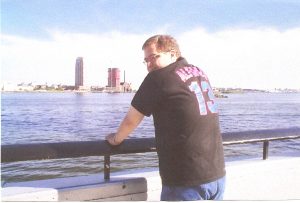 Repping 13 then and now. I never forgave the Mets for letting Edgardo Alfonzo go, at least not within the narrowly defined parameters relating to forgiving the Mets for letting Edgardo Alfonzo go. I mean, yeah, I’m still a Mets fan and never stopped being a Mets fan, but I spent all of 2003 being sore that Fonzie was a San Francisco Giant more than I did being enthusiastic about anybody who was a New York Met. Part of 2004, too. I don’t particularly care that Fonzie as a Giant was not the force he was as a Met, that his back was giving him trouble, that he bounced around during the last year of his lucrative four-year contract. Screw you, I say to nobody and everybody, he’s Fonzie. On the all-time team of Never Should’ve Worn Another Uniform, Fonzie is my starting second baseman, just as he was named the starting second baseman on the Mets’ 40th and then 50th anniversary teams. Fonzie should have been around to nurture Reyes and mentor Wright. It should have been Fonzie’s all-time team hit record that the two of them chased and surpassed. It shouldn’t have taken until 2008 to have Fonzie return to Shea Stadium in a Mets jersey, then only ceremonially to Shea Goodbye. This was six years after the departing player said goodbye by taking out ads atop yellow cabs, letting us know FONZIE ♥ NY.
Again, outstanding character!
The Mets signed him to a Triple-A contract in 2006 yet somehow failed to call him up in September; I don’t forgive that, either. And what was up with letting him go as Cyclones manager last year after winning a championship in Brooklyn? While we’re doing an impromptu airing of heretofore repressed grievances, how did it never occur to anybody to invite Henry Winkler to Shea for a Fonzie summit? That would have been worth the price of an entire yearbook. Well, maybe when they officially induct Edgardo Alfonzo into the team’s Hall of Fame, which was supposed to happen in 2020 and should have happened no later than 2015. I was gonna be there this year for Fonzie. If they let people into the ballpark, I promise I will be there next year for Fonzie.
When it comes to Fonzie, my favorite position player ever, I say what Cheap Trick said about whatever it was Cheap Trick was singing about in 1988. I will be the flame. I will carry the torch. The spark was lit in 1997. It’s burned quietly ever since.
PREVIOUS METS FOR ALL SEASONS
1962: Richie Ashburn
1963: Ron Hunt
1964: Rod Kanehl
1965: Ron Swoboda
1966: Shaun Fitzmaurice
1967: Al Schmelz
1969: Donn Clendenon
1970: Tommie Agee
1971: Tom Seaver
1972: Gary Gentry
1973: Willie Mays
1974: Tug McGraw
1975: Mike Vail
1977: Lenny Randle
1978: Craig Swan
1981: Mookie Wilson
1982: Rusty Staub
1983: Darryl Strawberry
1986: Keith Hernandez
1988: Gary Carter
1990: Gregg Jefferies
1991: Rich Sauveur
1992: Todd Hundley
1993: Joe Orsulak
1994: Rico Brogna
1995: Jason Isringhausen
1996: Rey Ordoñez
1998: Todd Pratt
2000: Melvin Mora
2001: Mike Piazza
2002: Al Leiter
2003: David Cone
2004: Joe Hietpas
2005: Pedro Martinez
2007: Jose Reyes
2008: Johan Santana
2009: Angel Pagan
2010: Ike Davis
2011: David Wright
2012: R.A. Dickey
2013: Wilmer Flores
2014: Jacob deGrom
2017: Paul Sewald
2019: Dom Smith
by Greg Prince on 22 September 2020 11:26 am Somehow, the summer seemed to slip by faster this time.
—A. Bartlett Giamatti
Meteorological summer ended on September 1 at midnight. Astronomical summer ended this morning, September 22, at 9:30. The Mets’ summer barely happened at all.
The baseball season, such as it’s been, began July 24 and if it didn’t end last night, we know it’s going, going, gone as of Sunday. It will continue tournament-style for sixteen of thirty major league teams next week. The Mets will be one of the fourteen uninvolved. Mathematical elimination has got its mask over its mouth. The nose will be covered any night now.
It’s been a substantial disappointment when you look at the record (24-30) and recall all the opportunities to garner momentum that went awry. With six games to go, the Mets have yet to win more than three in a row. All they can do from here until Sunday is win three in a row and three in a row again. That will leave them with as many losses as wins and no guarantee that such a stretch will lift them into the NL’s top eight. And though they finished out the two most dreadful seasons for which I’ve been baseball-conscious, 1979 and 1993, on six-game winning streaks, I don’t see how this 2020 team suddenly catches fire and puts it to good use as fall takes full effect.
Still, the Mets of the summer of ’20 haven’t been wholly for naught. The Mets of the summer of ’20 gave us regular appointments with Jacob deGrom, and when you’ve got Jake, you’ve got it all. Except a win, maybe, but we memorized the lyrics to that summer song many moons ago. On Monday night, Jake was close to his usual self. He struck out 14 Tampa Bay Rays in seven innings and lit up the Citi Field radar while doing so. Jacob deGrom is 32 and throwing harder than ever. The late start to both his major league career and his 2020 campaign have apparently served his velocity well. Of 112 pitches delivered, maybe a couple were what deGrom termed “mistakes”. UPS should be so accurate with its deliveries. Giving up four hits while being otherwise overwhelming and winding up with a loss as a result evokes the line about the 1985 Mets finishing three games out: surely they’d have taken the division if not for 24-game winner Doc Gooden losing those four times.
The visiting Rays have their ways, even against literally the best of pitchers. Most of us have no idea who they are until they’re done bumping elbows in victory, yet anonymity seems to work in their favor. The about-to-be AL East champs touched down in Flushing and proceeded to do just enough to edge their opponents, 2-1. They countered deGrom with a walk, a double and a sac fly in the second; a leadoff home run from Nate Lowe-household name Nate Lowe in the fourth; some smothering defense — specifically Willy Adames diving and keeping Jeff McNeil’s ball up the middle from leaving the infield with the bases loaded in the fifth, thereby preventing a second, tying run from scoring; and a grab bag of relievers who tamed the Mets from the evening’s first pitch through its last.
The Mets had Jacob deGrom going seven and fanning fourteen? The Rays had Pete Fairbanks, Ryan Thompson, Josh Fleming, Diego Castillo, Ryan Sherriff and Nick Anderson. Our certified awesome one against their relatively random six shouldn’t have been a fair fight, but the Rays are skilled at opening (openering?) and bullpenning lineups to death. The St. Pete sextet shut down the Mets on a shared four-hitter. Pete Alonso looked more lost than usual. Michael Conforto was unavailable altogether. Guillermo Heredia…who? If you never heard of Guillermo Heredia, Met No. 1,111 on your chronological franchise scorecard, before last night, perhaps all you need to know is he used to be a Ray, so no wonder you never heard of him before last night.
Guillermo Heredia played center for the Mets Monday, having been called up to replace Jake Marisnick, who has a tight hamstring, and then inserted for Conforto, who also has a tight hamstring. A good, loose hamstring goes a long way in getting a person into the Mets lineup these dwindling days of 2020. A decent sense of the moment will have the rest of us in front of our television or by our radio for the duration. It hasn’t been much of a summer, but we might as well savor what little autumn we’re about to get before it vanishes from our midst.
by Jason Fry on 21 September 2020 9:56 am Most of Sunday afternoon’s game was must-see TV: a taut duel between starting pitchers you didn’t think had it in them. Rick Porcello had his best start as a Met, looking like the pitcher he was before his baffling, seemingly self-inflicted transformation into a pinata. The Braves’ Kyle Wright was fabulous too, throwing strikes and delivering the kind of start that can be a north star for a young pitcher trying to figure it out. With fall in the air and the wind blowing in, the game looked like it would be decided by the smallest of differences: Wilson Ramos hit a double that would have been out on a warmer day and Brandon Nimmo hit a ball that seemed gone but came down just inside the fence, while Ronald Acuna Jr. hit a ball to right that wiggled and wobbled its way through the air, moving steadily and inexorably and maddeingly towards the foul pole and away from Michael Conforto before dropping just into Utleyville.
A wonderful game, in other words, except for the pesky detail of the scoreboard showing Braves 1, Mets 0 instead of the reverse.
And then, well, it turned into a 2020 Mets game.
First came Travis d’Arnaud, who dropped a ball into the corner in the eighth inning off Jeurys Familia for a double and two more runs.
D’Arnaud’s rampage against his former club is evidence that, at least in baseball, the arc of the moral universe really does bend towards justice.
In case you’ve suppressed what the Mets did to d’Arnaud, he lost most of 2018 to Tommy John surgery but was given a contract to be Ramos’s backup to begin 2019. His arm strength clearly wasn’t all the way back, his reactions were rusty, and at the end of April he had a miserable game against the Brewers both behind the plate and on the bases. Twenty-five plate appearances in, the Mets shed the guy who’d been the centerpiece of the R. A. Dickey trade with Toronto.
Now, in an effort to fight against the perfection of hindsight, it must be noted that a) TdA had had a truly wretched game, one of those putrid nights that leaves fans stewing and looking for someone to blame; and b) between his bizarre collection of injuries and overall failure to launch, our collective patience with d’Arnaud was pretty much exhausted. Suffice it to say that as a fanbase we didn’t mourn his departure overmuch. (Though Greg did offer a nicely nuanced farewell.) Still, with a little time and distance that decision — call it the TdA DfA — came to look less like a wise jettisoning of sunk costs and more like a … well, perhaps you might call it a spasm of petty, vindictive pique, one that may as well have hit the media room with FROM THE DESK OF FAILSON across the top of it.
The Mets either should have let d’Arnaud knit ligaments and shake off his rust on someone else’s dime, or acknowledged that there’d be such days but they still believed in him blah blah blah blah. Instead, they split the difference in the dumbest possible way, paying for the project but letting someone else get the dividends. Once freed from the Mets, d’Arnaud touched down with the Dodgers for approximately a second, went on to the Rays, got healthy and non-rusty and had a pretty good year, and then signed on for two years with Atlanta and embarked on a new hobby: beating the ever-loving shit out of the Mets at pretty much each and every opportunity.
Honestly, good for him. I think of Jeff Wilpon wincing with every run scored (or, more likely, insisting a little more loudly to an empty room that someone else is to blame), and that makes it hurt a bit less.
Anyway, d’Arnaud’s 509th …AND TAKE THAT! of the 2020 season made it 3-0 Braves; in the ninth the roof caved in, the scoreboard said 7-0 and something was on fire outside Citi Field, sending a plume of noxious smoke drifting over the cutouts and the field and causing the jokes to once again write themselves. Perhaps what was being reduced to particulates was the Mets’ last hope of playing a role other than observer in the 2020 Baseball Cup: Sunday’s loss downgraded their chances from “very slim” to “now you’re really joking.”
And yet I found I’d reached the “acceptance” step in the program. At their best, the 2020 Mets looked like one of those poorly constructed assemblages that occasionally manages to outhit the rest of its pretty obvious flaws; at anything less than their best, they looked like they did Sunday afternoon. And yet, the noxious Wilpons really are finally about to go up in smoke themselves. We got an improvised but reasonably complete baseball season when I wasn’t expecting one at all and then was pretty sure the improvisation wouldn’t stick. And despite the judgment of scoreboard and standings, that Let’s Make It Up As We Go campaign was pretty goddamn fun sometimes and a much-needed diversion-cum-distraction the rest of the time.
Given what else 2020 has brought us, I’ll take it — even if it came with the occasional Sunday afternoon that began taut with tension and at least vaguely plausible possibility and ended without either.
by Greg Prince on 20 September 2020 3:07 am We finally have a marginally useful statistical comparison of sorts for this season that is statistically, logistically and aesthetically absolutely like no other. With the 2020 Mets having played 52 of a projected 60 games, we can line their season to date up against the only season when the Mets played 52 games in total, the only other season in Mets history when we knew what was done after 52 games defined most or all of what that season amounted to. That was the second season of 1981, the year when a strike spurred the splitting of the schedule into two roughly equal parts, a pair of seasons like no other(s), not until this baby came along.
The 52-game season in question followed a 51-game season that was downright abysmal in Flushing, though the 51-game season didn’t quite define in the same manner most or all of what that season amounted to because, after 51 games, we didn’t know it was a 51-game season. The Mets were 17-34 on June 12, looking forward to drearily completing the usual 162-game campaign. Then the strike occurred. It was presumed that when the strike ended, everything would just pick up where it left off. But the strike lingered through June and all of July before a settlement was reached. Hence, when everybody started over on August 10, they started at 0-0, basically because baseball’s dealmakers decided few potential customers would willingly pay for the privilege of watching teams try to go, say, 18-34 after nearly two months of distasteful discord left them watching nothing.
The second-season 1981 Mets thrilled at least one 18-year-old fan because they took their best shot at winning a mini-division title that was suddenly very much in play. Even though it was only a 52-game season, it was still a matter of finishing first or going home — and the Mets honestly challenged for first. Ultimately, it proved an illusory challenge, but it was real enough while it lasted; it was certainly better than restarting from 17-34. Their final record of 24-28 didn’t get them anywhere because a final record of 24-28 shouldn’t get you anywhere. When it was over, they landed in fourth place in the National League East, 5½ games out of first.
Thirty-nine years later, the Mets after 52 games are also 24-28. They’re also in fourth place in the National League East. They are 6 games out of first. But they are arithmetically a playoff contender because their 24-28 record isn’t final. It’s close to being final, but it’s not yet done. They have eight games left. And they have options that were unavailable to their 1981 second-season predecessors.
In ’81, it was first place or bust. It was that way in the first half, even though nobody knew on June 12 that a “season” had been completed. It was that way in the second half. First-half champ in each division played that division’s second-half champ in the playoffs to determine the division champ that would play the league’s other division champ for the pennant. If somebody won both halves, they would play the division’s second-place team from the second half, but that didn’t happen in any of the four major league divisions.
In ’20, you can finish first and make the playoffs. You can finish second and make the playoffs. You have three divisions in each league, so that’s six playoff positions in the NL, six in the AL. And then there are two Wild Cards, giving us eight here and eight there for sixteen overall. It was considered the fairest way to apportion opportunity in a season surrounded by the unfairness wrought by a pandemic. With eight games left to play, four games under .500 after 52 games makes you more of a contender than a team that finished four games under .500 in a 52-game season 39 years ago could have ever dreamed of being. At least in the NL it does.
The second-half Mets of 1981 compiled the 9th-best record in the 12-team, two-division National League between August 10 and October 4, though what went on in the NL West standings didn’t factor in figuring their playoff chances because there was no such thing as a Wild Card. The short-season Mets of 2020 currently claim the 11th-best record in the 15-team, three-division National League since league play commenced on July 23. They need be very much concerned with the actions of several teams in their circuit’s other two divisions, the West and the Central, because they are not really pursuing first place in the East. They are pursuing whoever has the second-best non-second-place record among everybody in the East, West and Central, for that equals one of the two Wild Cards. (Never mind that, for COVID contingency’s sake, they haven’t played and won’t play anybody from the NL Central or NL West yet still have three games remaining versus the AL East-leading Rays.)
Within those perfectly clear parameters, the Mets are running fourth in the playoff race, 1½ games behind the Reds, who at the moment, hold an advantage of .001 over both the Brewers and Giants, so the Mets are also 1½ games behind each of them. Then there’s us. There’s maybe one more arithmetically viable team behind us (the Rockies) and a little action above the Reds (among the Cards, the Phils and the Marlins) that might directly affect the scrap for the second Wild Card if enough losses befall somebody in that higher quasi-bracket.
We’re still alive. We’re still conceivably a very hot and extremely lucky week from making the playoffs as the 8-seed. Given the right quantities of heat and luck, we might waft up to the 5-seed, but chances are the 8-seed is as high as we can set our sights, if we are of a mind to set them at all.
We’re still 24-28. Just like those 1981 second-season Mets who had nowhere to go but home after playing 52 games. Just like the Mets of 1968, 1978, 2011 and 2014, all of whom had 110 games to go after playing 52, so they were hardly in a similar boat to the Mets in 2020 or the Mets in the second season of 1981, though it’s worth noting none of those Mets went on to finish with as much as a .500 record. Their 52-game marks, however, serve to remind us 24-28 teams generally aren’t on their way to the playoffs no matter how long or short their season.
On Saturday night, the Mets climbed from 23-28 to 24-28 by beating the Braves, 7-2, at Citi Field. The Braves are the team in first place in the NL East, so the Mets picking up ground and moving within six of them probably didn’t cross the visitors’ minds. Given that they haven’t clinched anything yet, the Braves no doubt would have preferred winning, but losing to the Mets wouldn’t seem to represent a tangible dent to their fortunes.
The Mets could be particularly satisfied that they received their first legitimately splendid starting pitching performance since two Friday nights ago in Buffalo and the first that lasted longer than a cup of Bigelow Green Tea since Tuesday in Philadelphia. This rare pleasant turn of the rotation was brought to us by David Peterson, whose rookie season has been more up than down, particularly against the Braves. David went six innings, struck out ten and gave up only one run. It was reminiscent (if anyone actually wishes to reminisce about 2020) of Peterson’s first start against Atlanta, when he also went six and struck out eight. Should the Mets and Braves both make the playoffs and meet in the second (NLDS) or third (NLCS) round, it would behoove Luis Rojas to align his pitching to have Peterson ready to face Atlanta in either Houston or Arlington, as all NL playoff games beyond the Wild Card round will take place in Texas.
In a 60-game season in which 16 teams are invited to the postseason, even a 24-28 team never knows.
by Jason Fry on 19 September 2020 1:07 pm The Mets followed two unlikely good nights in which they got lousy, abbreviated starts but hit and relieved their way out of the mess with a thoroughly bad one: no hitting, no relief, and no help on the scoreboard. None of which is ever good, all of which is really bad when the season’s down to a count-them-on-your-fingers number of games.
Of all the damaging developments for the Mets’ recently solid starting pitching, some of which have been self-inflicted and some of which have been lousy luck, Steven Matz‘s disintegration must rank as the most perplexing. Is Matz hurt, as he has been so often during his professional career? Is he oil to Jeremy Hefner‘s water? Is he personally at sea because of a year that has so many of us looking for life jackets?
Whatever the malady or maladies, Matz arrived for duty basically unarmed, missing a few necessary MPH off his fastball and unable to control any of his pitches. He survived the first by giving up only a single run, thanks to some sleight of foot by Todd Frazier, who blocked Freddie Freeman off third, and Austin Riley guessing wrong and locking up on a 3-2 curve that broke over the heart of the plate. But the roof fell in an inning later: Matz threw a sinker to Marcell Ozuna that did no sinking and Ozuna hit it approximately to Portugal.
The Mets were down 5-0, and while big deficits haven’t been fatal this week, the Braves are a lot better than the Phillies. They kept pouring it on, cuffing Matz around over a further two-thirds of an inning, then unloading on Franklyn Kilome and Jared Hughes. The Mets’ lone 1-2-3 inning of the night was turned in by Frazier, who once upon a time pitched a New Jersey team to a Little League championship, as perhaps you’ve heard. Frazier wasn’t throwing pitches that would have received a speeding ticket on the highway, which is something perhaps more Mets should try. Frazier also shouldn’t be on the roster, despite that cannily positioned foot: A 1-2-3 inning from a position player is literally something Luis Guillorme can also do, but Guillorme was renditioned to the Mets’ black site (I may not have this 2020 terminology quite correct) despite a .347 average and being better than Frazier at everything else. The Mets’ Pleistocene belief in Proven Veterans™ is just one of many things I hope vanishes with the departure of Wilpons père et fails.
As it is, the Mets lost when they needed to win, and were left gazing helplessly at the scoreboard as it reported that the Cardinals and Phillies had both swept doubleheaders and the Reds and Brewers had won as well. The Mets aren’t done, at least not mathematically, but if you’re one of the teams they’re chasing, they’re one of those objects in the rearview mirror that’s actually farther than it appears.
* * *
On a brighter note, today is Roger Angell’s 100th birthday, and here’s a tip of the cap and a deep bow to the man without whom we wouldn’t exist.
Angell did more than anyone to impart a love of baseball to me as a child — after I discovered the Mets, I devoured The Summer Game and everything else he wrote. Those books taught me the game’s history, imparted a deep respect for its players, and showed me that baseball seasons form a continuous fabric in which an astute observer can happily spend a lifetime spotting patterns and following threads. He’s also the trailblazer for what we and so many others do in the digital age — Angell started covering baseball for the New Yorker from the dual perspective of professional and partisan, something no one else was doing at the time or had even imagined doing. That double vision is hard to maintain, requiring you to be both clear-eyed and at least reasonably neutral about what happens while also putting your fannish heart out there in all its messiness as part of the chronicle. Should I ever feel that dual focus slipping, all I need to do is go back to my baseball library and see how Angell did it. Which also gives me another chance to dream that once, just once, I’ll manage to write a bit of emotional or physical description that’s half as good as what Angell comes up in each and every column.
by Greg Prince on 18 September 2020 4:47 pm Welcome to A Met for All Seasons, a series in which we consider a given Met who played in a given season and…well, we’ll see.
The golden age of baseball coincides neatly with when one happened to be twelve years old.
—John Thorn, Official Historian, MLB
If first base is childhood and second base is adolescence, the summer you’re twelve years old is your indecisive third base coach putting on and taking off the steal sign so often that you might want to call time. The summer I was twelve years old, 1975, I stayed close to first, but I had my eye on second. No wonder, then, that as summer grew late, I took off for second — and, as summer was turning to fall, ran straight toward the newest of Met stars, Mike Vail.
As Met metaphors go, you had to be there, and I was. I was with the Mets practically every minute of every day in 1975, treasuring the successes of the lingering icons of my childhood while savoring the accomplishments of the unusually large quantity of newcomers who had joined them. Seventeen Mets made their team debuts in ’75, the most in any season since notoriously transient ’67. They were breaths of fresh air, though I don’t mean to imply the extant atmosphere was wholly stale, for I also took comfort that the foundation of 1975 was formed by figures so familiar to me.
It could still be 1969 if you wanted it to be. Tom Seaver pitched as Terrific as ever (22-9; 2.38 ERA; a league-leading 235 strikeouts). Jerry Grote regularly caught the two- going on three-time Cy Young winner. Bud Harrelson was still around, at least when the disabled list didn’t beckon. Wayne Garrett, too, no matter how often they tried to replace him. It could be any year in Mets history when you saw Eddie Kranepool grab a bat and emerge in the on-deck circle. Jerry Koosman notched a couple of saves, once stole second base and pulled down 14 wins. Cleon Jones, who’d been piling up hits for the Mets since 1963, missed time early, but eventually returned. By July of ’75, Jones’s collection of singles, doubles, triples and homers was up to 1,188, the most in Met history.
It could still be 1973, too. Felix Millan played in every game. Rusty Staub drove in runs at a franchise-record pace en route to becoming the first Met burst past a hundred ribbies. Jon Matlack was so good, he wasn’t only an All-Star, he was the Midsummer Classic’s co-MVP, with Bill Madlock, because who could resist the homophonic possibilities? John Milner was on hand, if in a slump. Ron Hodges was in the minors, but not permanently. Harry Parker had put down stakes in the bullpen. The callups from a couple of years earlier were making strides — Bob Apodaca (13 saves) more so than Craig Swan (6.39 ERA), but strides were strides. George Stone, who might have been asked by Yogi Berra to start at least one more game in a recent October, was thought more or less recovered from arm problems. Yogi managed as he had in 1973, though apparently not enough, because he didn’t last the duration of 1975. Then again, neither did Jones, who had a falling out with Berra, which led to an unconditional release that reads as unthinkable in retrospect, but real time didn’t sit still to take stock of how good a player used to be. Jones was, in the middle of 1975, a .240 hitter judged insubordinate by his manager. Berra was a manager whose alleged contenders trailed Pittsburgh by 9½ at the two-thirds mark. Berra was next an ex-manager, replaced by coach Roy McMillan.
Cleon and Yogi had had it already by the summer of ’75, but they weren’t the only ones for whom it had been called a day in Flushing. The all-time Met hit king, who had batted .340 in ’69 and sizzled through September of ’73, was shown the door not only weeks before Yogi was told it was over for him, but also not so many months after Tug McGraw, Ken Boswell, Duffy Dyer, Don Hahn and Ray Sadecki were dispatched to distant precincts following the massive Met disappointment of ’74. They’d all been heroes of or at least contributors to pennant drives past. But past was past. Thank you for your service. The present is presently all that is accounted for.
So maybe most days it couldn’t be 1969 or 1973, but as a 12-year-old, maybe I didn’t want 1975 to be moored solely to what had been. I loved all we’d pulled off when I was 6 and again when I was 10 — it helped explain why I’d been a Mets fan literally half my life — but I sort of wanted to move forward, to race toward second, as it were. I didn’t want to be merely satisfied by the presence of old faces. I wanted to be excited by new faces. Old faces that looked different once they were under a Mets cap would suffice just as well.
Joe Torre, whose 1967 baseball card was my first, now wore a Mets cap as he attempted to dislodge Garrett from third. So did Jesus Alou, who had played in the same outfield with his brothers in 1963, against the Mets, just after Cleon Jones was initially promoted. Alou was a .350 pinch-hitter from the right side, complementing Kranepool’s .400 clip from the left. Del Unser had been around. Now he was a Met, and a superb one at that; should’ve made the All-Star team, I’ll never tire of mentioning. Gene Clines was always a Pirate. Now he, too, was a Met. Likewise former Astro Bob Gallagher, former Giant Mike Phillips, former Red Tom Hall and a couple of American League relievers who existed for me mostly in the pages of Baseball Digest: Ken Sanders and Skip Lockwood. Big Dave Kingman, who in 1971 simultaneously socked a home run off both Jerry Koosman and a bus minding its own business in the Shea Stadium parking lot when visiting from San Francisco, was suddenly a Met, purchased in Spring Training. Soon Sky King (don’t call him Kong) owned our all-time single-season franchise home run record, a mark I assumed by law would always belong to Original Frank Thomas.
We had imports representing varying degrees of exotica and we had kids of our own breaking through the grass ceiling and introducing themselves as Mets in full. Rick Baldwin, 21, put on Tug McGraw’s 45 and got warm in the pen. Randy Tate was almost as young and just as new; he wore 48 and almost threw a no-hitter (which is to say he didn’t, but still). Another rookie, John Stearns, accompanied old Del Unser and fairly familiar if frighteningly fleeting one-game wonder Mac Scarce from Philadelphia, so technically Stearns wasn’t homegrown, but he was as fresh-faced as it got behind the plate on the days Grote wasn’t catching. If you read the Sporting News, as I began to the summer I was twelve, you salivated at the realization that we had a third baseman coming along who was leading the International League in runs batted in. His name was Roy Staiger and he, too, would be elevated to the majors by the Mets in 1975.
Move over, Garrett. Move over, Torre. Staiger’s here! Oh, the things I thought when I was twelve.
This blended roster-family of old, new and newish gave me many a moment and milestone across my seventh season as a fan. But the player who punctuated all this dizzying activity most tantalizingly — not with a period, but with an ellipsis, as if to indicate there was more to come — was Mike Vail, a heretofore underpublicized August callup who electrified September. There was no deafening buzz that I can recall soundtracking the promotion of Mike Vail. Vail hadn’t habitually haunted the back pages of the Official Yearbook. He wasn’t hailed as a Future Star and had never gotten our hopes up.
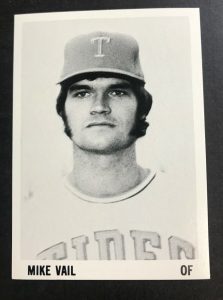 Hold Tide. Mike’s coming. Unless you were tracking the St. Louis Cardinals’ farm system (where he’d been fellow Northern Californian Keith Hernandez’s roommate), you probably hadn’t heard of him a year earlier. I’d heard of him only the previous fall when I’d read that he was the throw-in to the deal that sent utilityman and 1973 alumnus Teddy Martinez to the Cards for utilityman and former Indian Jack Heidemann. If you’re considered the extra guy in a trade that swaps who’s slated to sit, you’re just asking to be overlooked. For whatever reason, Vail’s name, however small the type it might have been printed in when the papers first reported his acquisition, stuck with me immediately and stayed with me indefinitely. Yeah, I thought, we got a lot of new guys for next year, but nobody’s talking about Mike Vail. I was feeling a little pride of propriety in his forthcoming fortunes. Maybe I figured we who sported punchy two-syllable names had to stick together.
Coming into 1975, Vail was 23 and a four-year minor league veteran. It’s not as if the numbers implied he couldn’t hit. In ’74, the righty batted a combined .334 at Single-A Modesto and Double-A Arkansas, but promising outfielders in the Cardinal system had to wait in line behind Lou Brock, Bake McBride and Reggie Smith. St. Louis was set. Vail grew antsy and requested a trade. To show just how sophisticated the scouting of prospects could be in bygone decades, GM Joe McDonald detailed for the Sporting News the intricate strategizing he undertook with his Cardinal counterpart, Bing Devine, in order to land Mike on the Mets.
“When Bing and I decided to swap Martinez and Heidemann,” Joe said, “I felt we needed another player in the deal. I asked for Vail, and Bing said OK.”
The 1975 yearbook’s YOUNG MEN WITH A FUTURE page featured eight players; none was Mike Vail. Instead, Vail rolled in with the Tides. He proved high Tide. Highest International Leaguer, in fact. Mike hit .342 at Triple-A, better than every player in his circuit (Pirate infield hopeful Willie Randolph was IL runner-up, with a .339 average; Ellis Valentine in the Expo chain finished fifth, at .306). A big chunk of that .342 was built on a 19-game hitting streak that pretty much compelled his callup. His AAA season was enough to earn him International League MVP honors, a prize never before won by a Tide and something snagged the year before by Jim Rice, who was only propelling the Red Sox to first place in the AL East this year. Thus, despite no springtime hype, and no play on page 58 among the rising Brock Pemberton, Rich Puig and Luis Rosado types, Vail hit his way to New York, debuting on August 18 and validating my determination to let his name rattle around in my consciousness all summer.
At the time, the Mets’ outfield seemed to invite little in the way of flux. They may not have been Brock/McBride/Smith, but in right, incumbent Staub was on his way to pounding out those team-record 105 RBIs; in center, former Phillie Unser had settled in nicely en route to posting a .294 average; and in left, Kingman was taking dead aim at Thomas’s franchise mark of 34 home runs, a total that had sat undisturbed since 1962. Then again, Kingman (who had usurped Jones’s position before Cleon’s tenure met an ignominious end) was said to be versatile, having played first and third for the Giants…and, quite frankly, he wasn’t putting down defensive roots in left. The Mets were scuffling to remain viable in the division race, hovering a little above .500 and clinging unconvincingly to wishing distance of the first-place Pirates. A team in the Mets’ position could hardly turn down a .342 batting average, regardless of its league of origin.
Mike, whose publicity photo revealed a Prince Valiant haircut, had to take his first NL swing inside the Astrodome against fireballer J.R. Richard, as intimidating an hombre as any rookie could encounter. Talk about being welcomed to the big time. Yet Vail announced his presence with authority, producing a pinch-hit single. Logging a 1-for-1 and holding a 1.000 batting average was not an inauspicious way to get Vail’s party started.
Soon Mike’s soirée became a full-time affair. He got his first start in left on August 20. The position became his for keeps on August 25. With corner outfielders Vail and Staub flanking a platoon of Unser and Clines, the Mets commenced contending in earnest. The club that had faded behind Berra discovered depth behind McMillan. Late August wound down with a five-game winning streak in Southern California and the Mets creeping to within four lengths of the Pirates. Seaver, Koosman and Matlack threw complete games in succession. Kingman was up to 28 homers. Staub had 90 RBIs.
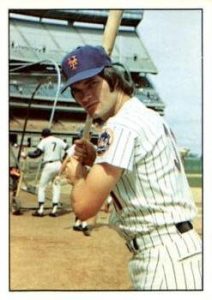 The future looks like this SSPC card when you’re of a certain age. And Mike Vail was the hottest Met of all. In San Diego, he went 9-for-14. In L.A., he notched a hit a day. When the Mets returned to Shea to open September, Vail belted his first home run, off John Candelaria, to give Tom Seaver a 1-0 first-inning lead. It was all Tom would need en route to completing a four-hit shutout. It was not only Seaver’s 20th win of the year, it included his 200th strikeout of the season, the eighth consecutive season he’d fanned at least that many. It was an all-time baseball record and it rightly received the lion’s share of attention that Labor Day afternoon.
But if you were paying attention, you couldn’t help but notice that Mike Vail had hit in nine games in a row. And once the Mets leveled off and unfortunately fell away from their chase of the Pirates, you mostly noticed that Vail had kept hitting, at least one hit in every game as September got going. On September 3, the day I started junior high, Vail’s streak reached ten. On September 7, as the Mets finished a dishearteningly dreadful homestand (they’d won both of Seaver’s starts but dropped their four other contests), the streak stood at 14. A three-game sweep by the Expos at Jarry Park essentially buried the Mets’ divisional aspirations — they were nine out with eighteen to play — but Mike just kept getting mightier. He hit in every game in Canada and now claimed a hitting streak of 17.
Did you know what the record for a Met hitting streak was? In the course of 1975, we’d been reminded that among Mets Tommie Agee had collected the most hits in a season (185), Donn Clendenon had driven in the most runs (97) and, of course, Frank Thomas had the most homers (34). Those standards were in the course of being refashioned by Millan (191), Staub (105) and Kingman (36). But streaks don’t build over a season. They appear out of nowhere, not unlike their architects sometimes. Vail was a throw-in when Felix, Rusty and Sky, not to mention Tom, Jerry and Jon were excelling. Now Mike was front and center for us, and Jack Heidemann (.214 in limited action) could be considered the throw-in to the Vail trade.
The record for a Met hitting streak was 23, established by erstwhile Met left fielder Cleon Jones in 1970. This was getting mentioned regularly. Ditto for another nugget: the record for a hitting streak by a National League rookie was also 23, shared by Joe “Goldie” Rapp of the 1921 Phillies and equaled in 1948 by another Phillie — and Original Met — Richie Ashburn. The division title hopes were gone. Seaver’s quest for the Cy Young appeared secure. There was time for Staub and Kingman and Millan to do what they were trying to do; even Millan’s goal (or our goal for him) of playing every single game, something no Met had ever done, would have to wait to unfold, one by one, until it got to 162. What Mike Vail was doing was all about immediacy, the fierce urgency of now. He was, as a new late-night television show set to debut in about a month would announce itself, live from New York.
Mike Vail had breathed life into the cause surrounding a team otherwise running out of time. As fans, even when we’re 12-year-old fans, maybe especially when we’re 12-year-old fans, we need a cause. In September of 1975, we needed Mike Vail’s hitting streak to keep on keepin’ on.
On September 10, the Mets traveled to Pittsburgh for a two-game series that no longer much mattered in the standings. Seaver lost the first game. Koosman won the second. Vail hit in both. The streak reached 19. The succeeding weekend brought them to St. Louis. Folks at Busch Stadium got to see what Devine deemed expendable. Vail went 1-for-3 on Friday the 12th; 2-for-5 on Saturday the 13th; and 1-for-4 on Sunday the 14th. The former Cardinal farmhand was now a lifetime .347 major league hitter riding a hitting streak of 22 games.
On Monday, September 15, the Mets welcomed Montreal to Shea Stadium. Steve Rogers was the opposing pitcher. Rogers retired Vail on a grounder in the first and a hard liner in the fourth. In the sixth, however, with the Mets trailing by two and Unser on second, Mike’s golden rap came at last. It was a single to center. The Mets halved the Expos’ lead but, honestly, more important was all at once Vail tied Goldie Rapp, Richie Ashburn and Cleon Jones. It was as long a hitting streak as ever forged by an NL rookie; by a New York Met; or any player anywhere in 1975 — the longest in that last category.
I, alone in my bedroom, went suitably nuts. The sparse Shea crowd of 7,259 that had been chanting, “LET’S GO MIKE!” stood and applauded for two solid minutes. But they’d have a little more to cheer two innings later when, with the score tied, Vail came up again, this time with runners on first and second, and stroked another single off Rogers, this one to left. Gene Clines came home to give the Mets a 3-2 edge, one maintained in the ninth on Skip Lockwood’s first Met save.
What a maiden voyage into the big leagues for Michael Lewis Vail. In crafting his record-tying streak, he batted .364, with 36 hits in 99 at-bats — a “steady rat-atat-tat of base hits,” in Jack Lang’s beat-writer lingo. Better than the numbers was the hope he represented. The Mets hadn’t developed many hitters in their 14-year history, hardly anybody beyond Cleon Jones and Ed Kranepool when it came to Met longevity. Mike might not have been seeded on the farm, but he did hone his skills as a Tide, and we Mets fans embraced him as our shiningest future light.
The streak ended the next night in an eighteen-inning game (Mike went 0-for-8), but the brief rookie campaign had worked its magic. Vail concluded 1975 with a .302 batting average and a grip on the Metsian imagination. When Joe Frazier, his skipper with the Tides, was introduced as the Mets’ next full-time manager, one of the questions Frazier received was whether he had any more Vails down there. Joe and everybody at the press conference laughed, because, yes, that’s exactly what we needed. More Mike Vails. More record hitting streaks. More future. We’d seen so many icons of 1969 and 1973 go. The day after the ’75 season ended, our first manager, Casey Stengel, died. On the day the ’75 playoffs started, our only owner, Joan Payson, passed on, too. Yes, we could really use some future around here.
 Vail’s 1975 was truly a treat. Instead, we got a slap in the face come December when McDonald’s track record for offseason heists went off the rails. At the urging of de facto showrunner M. Donald Grant, the GM got rid of Rusty Staub before Rusty Staub accrued the contractual ability to veto trades. The news was dispiriting as all get out: Staub and Tide pitcher Bill Laxton to Detroit for Mickey Lolich and minor league outfielder Billy Baldwin. Lolich, 35, had been a helluva lefty for the Tigers…several years earlier. Staub, 31, was at his peak as a Met, both as an icon and as a hitter. He’d stay at his peak in Detroit. After driving in 105 runs for the Mets in ’75, he’d average 106 runs batted in for the Tigers across 1976, 1977 and 1978. (And, by the by, Baldwin wasn’t destined to morph from throw-in to steal.)
The only aspect of the Staub trade that made the transaction remotely palatable didn’t emanate from contemplating whatever Lolich might do in a new league. It was from knowing that at least the way had been paved for Mike Vail to continue developing as an everyday player. True, he’d played left for the final month-plus of 1975, and he’d be assigned Rusty’s old perch in right in ’76, but if Dave Kingman could be versatile, so could Vail. At least we’d have that to look forward to.
Except, no, not really, because Mike played a little hoops in the offseason and dislocated his right foot on the court. The damaged Achilles tendon kept him off the baseball field until June. The Mike Vail who returned wasn’t the Mike Vail we remembered. He batted .217 as a part-timer and never strung together more than five consecutive games with at least one base hit in all of 1976.
Meanwhile, Frazier’s management style didn’t win many games after ’76, nor did it retain the confidence of those making the decisions above him. He was gone before June of ’77. Others would be gone in June of ’77. The less said about the post-Payson ownership situation in the late 1970s, the better. The future that awaited Mike Vail and the Mets was not much future at all. Mike didn’t light up anybody’s life in 1977, leaving him to be claimed off waivers by Cleveland in the Spring of ’78. We’d see him again quite a bit as a Cub, for whom he once blasted an eleventh-inning grand slam off Dale Murray that somehow didn’t beat us.
Mike wound up playing for seven different teams in a career that spanned ten seasons, compiling 447 base hits in all, or 447 more than anybody writing or reading this ever has or ever will. His last year, with the Dodgers, came in 1984, or one year before Rusty took his final bow, fortunately in a Mets uniform, with new management having reacquired him five years after the previous regime shipped him to Michigan.
The story of Mike Vail’s Metsian journey, if you venture beyond the ellipsis, tends to curdle (as too many Met stories do), so let’s rewind it to where it was its most delightful. Let’s abide by what was written on Mike’s behalf in the 1976 yearbook, when his 1975 exploits were still fresh in everybody’s recollections…
“Collected more ink and superlatives than any rookie in Met history after reporting from Tidewater.”
I wasn’t baseball-conscious in 1967 when Tom Seaver first dropped by from Jacksonville, but putting aside that possible freshman-sensation omission, yeah, it’s true. Mike Vail came out of the box ready-made and astounding. I was older at the end of the 1975 season than I was at its beginning — a hazard of aging, it seems — but I was still 12. At 12, my analytical approach to the game allowed me to project forward with utmost confidence that if this guy is this good for us now, he’s gonna keep being great for us forever, or for however long he plays for us, which will clearly be for a very long time. I was sure of it. I was sure of Vail.
“It definitely for me has a ‘my favorite year’ quality to it,” Conan O’Brien once said of his experience writing for Saturday Night Live, a program that debuted on October 11, 1975. “I’ll never be that young and naïve again.” In the fall of 1975, I was that young and naïve, and I had years of Mike Vail to look forward to.
In my heart, sometimes, I still am and I still do.
PREVIOUS METS FOR ALL SEASONS
1962: Richie Ashburn
1963: Ron Hunt
1964: Rod Kanehl
1965: Ron Swoboda
1966: Shaun Fitzmaurice
1967: Al Schmelz
1969: Donn Clendenon
1970: Tommie Agee
1971: Tom Seaver
1972: Gary Gentry
1973: Willie Mays
1974: Tug McGraw
1977: Lenny Randle
1978: Craig Swan
1981: Mookie Wilson
1982: Rusty Staub
1983: Darryl Strawberry
1986: Keith Hernandez
1988: Gary Carter
1990: Gregg Jefferies
1991: Rich Sauveur
1992: Todd Hundley
1993: Joe Orsulak
1994: Rico Brogna
1995: Jason Isringhausen
1996: Rey Ordoñez
1998: Todd Pratt
2000: Melvin Mora
2001: Mike Piazza
2002: Al Leiter
2003: David Cone
2004: Joe Hietpas
2005: Pedro Martinez
2007: Jose Reyes
2008: Johan Santana
2009: Angel Pagan
2010: Ike Davis
2011: David Wright
2012: R.A. Dickey
2013: Wilmer Flores
2014: Jacob deGrom
2017: Paul Sewald
2019: Dom Smith
by Greg Prince on 18 September 2020 12:22 pm Jules, y’know, honey, this isn’t real. You know what it is? It’s St. Elmo’s Fire. Electric flashes of light that appear in dark skies out of nowhere. Sailors would guide entire journeys by it, but the joke was on them. There was no fire. There wasn’t even a St. Elmo. They made it up. They made it up because they thought they needed it to keep ’em going when times got tough, just like you’re making up all of this.
We’re all going through this. It’s our time on the edge.
—Rob Lowe as Billy Hicks
The 1993 Jets were supposed to be better than they were. They’d made big-deal offseason acquisitions. Boomer Esiason. Ronnie Lott. Then they went out and played as the Jets tend to play, losing four of their first six games…after which safety Brian Washington defiantly declared they were “the best 2-4 team in football”. While this pronouncement didn’t go down well in the New York media, it’s difficult to mount an argument regarding a status nobody had previously ever thought of contesting before.
With that in mind, I’m here to tell you that after 50 games, the Mets are the best 23-27 team in baseball. Also, they’re the only 23-27 team in baseball, so that probably makes them the worst of their kind as well. How it is we have thirty baseball teams and only one with this precise record is probably a bigger mystery than how the Mets, at four games under .500, are still something of a playoff contender, but let’s assume the game totals will more or less even out by next Sunday. For now, let’s celebrate the surge that has brought the Mets to their unquestioned position atop the mountain of 23-27 teams in baseball.
WOO!
Honestly, it’s been pretty invigorating watching this team both not lose and somehow win these past two nights, considering the one undeniable strong suit they thought they had going for them — the upper echelon of their starting rotation — got its asset kicked. Yet they survived the thrashing and battled on, just like a real team with something to play for in the third week of September. Wednesday, it was Cy deGrom and his amazing, colossal, spasming hamstring splattering our time-tested formula for competing all over the Delaware Valley. But then the Met relief corps, under the direction of bullpen coach Nancy Walker, acted as the quicker picker-upper, and the Met offense proceeded to score just enough to wipe Jake’s and our slate clean.
Thursday night, there was another fine mess that had to be absorbed ASAP, this one spilled by the heretofore reliable Seth Lugo. We’ve long considered Seth a competitor to the leading national brands of starters, but sadly he proved too soggy to be of much use. After the Mets had put three on the board in the top of the first, Lugo took to the mound and got supergenerous with the givebacks. A homer to Harper. A homer to Bohm. A homer to Gregorius. A triple to Segura, who usually homers against Met pitching, but that’s OK, because here came Adam Haseley to drive him in.
After one, it was Phillies 4 Mets 3. Before Lugo could slither out of the second, it was Phillies 6 Mets 3, with Bryce bashing another dinger along the way, and did you hear Seth’s hamstring barking? Me, neither, but after an inning-and-two-thirds of this Citizens Band Box horror show, you wouldn’t have blamed Luis Rojas for invoking any malady he could think of and bringing out the hook. Just as deGrom blessedly swears he’s fine after his spasm revelation, Lugo claims he is physically well. He just sucked was all. “I made some bad pitches, but I also made some pitches that got hit, too,” Seth said, shedding absolutely no light on the situation.
Erasmo Ramirez, on the other hand, was nothing but light. Light so bright than no smoke from a distant fire could dim his effect on our fortunes. Like Michael Wacha the night before, Ramirez strolled in and clamped down the Philadelphia chaos. Erasmo for two-and-a-third, followed by Chasen Shreve for two-and-a-third, followed by Jeurys Familia for one-and-a-third. Put all these ones and two and thirds together, and suddenly you’re back in a game you were plummeting from a few full innings before.
In the top of the sixth, the Mets opted to stop being impressed by Phillie starter Aaron Nola and returned to attacking him successfully. Pete Alonso, who was so desperate for a big hit the night before that he tried batting and chewing gum at the same time, regenerated his swing and blew a bubble right in his Nola’s face by launching a bomb to left field. Pete can still do that. He has 12 home runs in this year and, I’m guessing, about 16 hits in all. Still, when he connects, he detonates, and after Jeff McNeil worked out the Mets’ fifth walk of the night off Nola, Joe Girardi replaced his ace with pure dynamite.
It doesn’t really matter who Girardi brings in from the Phillie bullpen. They’re all potentially explosive to the touch. Blake Parker was ol’ Joe’s choice. Andrés Giménez patiently ignored the ticking device and took a walk. Soon enough, though, Brandon Nimmo lit the fuse: tripling in both McNeil and Giménez and tying a game that appeared lost in the second. Except these are the Mets in Philadelphia, where few leads sit undisturbed for long. The only thing more common than games there getting tied and untied is the SNY shot of cheesesteaks sizzling. And because the SNY camera crew is not in attendance on the road this year, we didn’t even get that.
The 6-6 tie stayed in effect until the ninth when another Phillie reliever burst into flaming wreckage. Brandon Workman threw. Brandon Nimmo swung. We had a Brandon new pair of roller skates and Nimmo was the Brandon new key. Our Wyoming Walloper blasted it so far that he didn’t even bother sprinting to first, which may be a Nimmo first.
“The guys had two choices,” Nimmo would say later. “Give up, or keep fighting. The guys chose to keep fighting.” God, I love that inspirational introspection when it comes out of the mouths of Mets. As the Mother Superior in Pee-wee’s Big Adventure might have put it, “Oh, Brandon, you are an inspiration to us all!” To which the next several hitters in the Mets lineup essentially replied, “We’ll say! We’re going to start a paper route right now.”
Read all about it: Michael Conforto singled; one out later, Dom Smith tripled; immediately thereafter, Robinson Cano homered. It was a bounty of runs, indeed. By the time Cano extended the Met lead to four, Garrett Cleavinger had replaced Brandon Workman, but it barely mattered. Phillie pitching provided the gravy for this delicious dish of savory offense piled over a steaming bed of scoreless innings. With no cheesesteaks in evidence, the Mets had to find another way to feast. Ramirez. Shreve. Familia. Justin Wilson in and out of a little trouble but ultimately unscathed. And, at 10-6 and with no save opportunity in sight (unless he created one for somebody else), Edwin Diaz came in and finished the job. The job got tense — Sugar may have been on third-day fumes — but it got done. The Mets emerged from a series they couldn’t lose by winning it. DeGrom was no good. Lugo was lousy. Yet the Mets took two of three to become…
THE
BEST
23-27 TEAM
IN BASEBALL!
Which gets them…what? Maybe nothing. Probably nothing. They inched a little closer to something than they were 24 hours earlier (which is about how long this game took), but there are still a few too many bodies between them and whatever it is they’re trying to grab, which, by the way, can be defined as the second-best sub-second place record in the National League, a status nobody had ever thought of contesting before. Talk about an inspiration to us all.
That said, when a camera briefly spotted Todd Frazier looking pleased with the outcome, I thought to myself, “I wonder if they’d put him on the postseason roster,” a postseason roster we’ll make up because we think we need it to keep us going. Maybe we do.
by Greg Prince on 17 September 2020 11:23 am Jacob deGrom gets hit like Jacob deGrom never gets hit. Then Jacob deGrom leaves with an injury like Jacob deGrom does in our worst nightmares. Then the Mets, down by three in the third, turn to Michael Wacha, a lapsed starter the Mets resist turning to as a matter of course. Then the Mets run the bases without regard for doing it well.
Then the Mets win?
Yes, then the Mets win. They won Wednesday night’s game against the Phillies and won the Go Figure Cup, awarded annually to the team that has no earthly business winning a game they were so clearly destined to lose.
Destiny took a holiday for a change. The Mets have lost enough games they seemed moments from winning that it was about time they had one mysteriously float over from the ‘L’ column. And it’s not like they weren’t proactive about making it happen. Wacha hung in for four very solid innings, giving up only a solo homer to Jean Segura in the third, which made the Mets’ deficit 4-0 and the Mets’ likelihood of prevailing highly unlikely.
But this whole season has been unlikely, so why not keep watching and divine whatever good news there was to be discerned? Like Jake was gone not for the season but probably for no more than the five days until his next scheduled start because all that ailed him was a hamstring spasm. I sometimes get those sitting at my desk typing, but I don’t use my legs nearly as much as Jake does. Jake’s Cy Young chances may wind up falling outside the razor-thin margin for error, given that his ERA shot up above 2 during his two uncharacteristic non-deGrominant innings, but if he doesn’t win it, we can dismiss the awarding of a Cy as rather silly in a sixty-game sprint.
And if he does somehow win it despite an earned run average of 2.09 (gasp!) with no more than two starts remaining, we’ll change our tune without missing a beat and revert to singing the praises of the wisdom of the BBWAA.
Besides, no matter what happens with the Cy, we’ve already captured the Go Figure Cup. Go figure, Wacha was fine after Segura crushed him, and so were Justin Wilson, Miguel Castro and the recently less cringe-inducing Edwin Diaz for an inning apiece after Wacha left. Go figure, J.D. Davis, playing this strange position wherein he bats several times a game yet doesn’t trot out to the field at all, homered and drove in three runs. J.D. going deep may not sound worthy of going figuring, but Mr. Davis had not hit one out since August 18, or nearly a month before, for those of you who no longer bother with niceties like calendars.
One of the runs J.D. drove in, the one that tied the game at four in the eighth, scored via the seemingly disinterested feet of Michael Conforto. Michael had walked with two out. J.D. doubled to center. Michael only sort of ran from first because he didn’t seem aware that there were two out. What should have been a fairly easy tally became uncomfortably close at the plate. It was still a run, but it was a little too typical of how the Mets have run themselves out of innings of late.
There’d be more of that in the ninth: more scoring, more running without thinking the process through. The good part was built on Robinson Cano converting a Hector Neris quick pitch into a single up the middle; pinch-runner Amed Rosario taking second on a Neris balk; and Andrés Giménez taking advantage of Joe Girardi’s decision to intentionally walk Jeff McNeil to instead take on the rookie. Giménez responded with the tie-breaking single, as Rosario sped home without incident from second. The abhorrent part came during the succeeding at-bat, as Jake Marisnick struck out; the ball got away just a little from catcher Andrew Knapp; Giménez took off prematurely from his base; Knapp threw to second; McNeil took off from third; and McNeil got himself tagged out attempting to dive into home by second baseman Scott Kingery, who rushed in with the ball to end the inning.
Yet the Mets didn’t suffer for their foibles and misfortunes. Davis got to Zack Wheeler, Cano and Giménez got to Neris (as does every Met, eventually) and Diaz in particular got the ball over the plate in mostly unhittable fashion, recording three swinging strikeouts that rendered a single somewhere in between shockingly harmless.
Mets 5 Phillies 4. Go figure. Mets still sort of in the playoff picture. They’re two-and-a-half out of a playoff spot with eleven to play and three teams between them and the team they have to reach. Go figure that if you are so inclined. Or just be thankful for small favors and spasms that aren’t fatal.
|
|






