The blog for Mets fans
who like to read
ABOUT US

Faith and Fear in Flushing made its debut on Feb. 16, 2005, the brainchild of two longtime friends and lifelong Met fans.
Greg Prince discovered the Mets when he was 6, during the magical summer of 1969. He is a Long Island-based writer, editor and communications consultant. Contact him here.
Jason Fry is a Brooklyn writer whose first memories include his mom leaping up and down cheering for Rusty Staub. Check out his other writing here.
Got something to say? Leave a comment, or email us at faithandfear@gmail.com. (Sorry, but we have no interest in ads, sponsored content or guest posts.)
Need our RSS feed? It's here.
Visit our Facebook page, or drop by the personal pages for Greg and Jason.
Or follow us on Twitter: Here's Greg, and here's Jason.
|
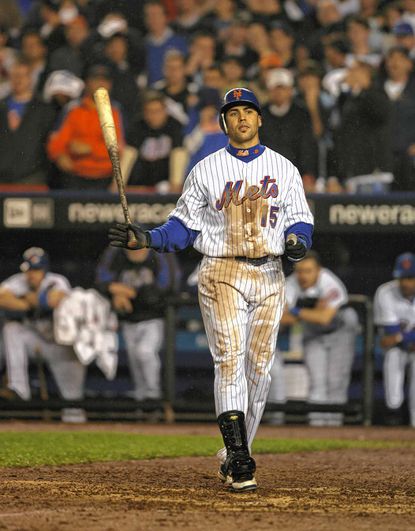
by Jason Fry on 10 November 2020 11:48 pm Welcome to A Met for All Seasons, a series in which we consider a given Met who played in a given season and…well, we’ll see.
It would be an exaggeration to say that Faith and Fear in Flushing exists because the Mets signed Carlos Beltran in January 2005.
But it wouldn’t be an enormous exaggeration.
In 2005 the Mets already had a reputation for Wilponian meddling and aiming the gun at their own feet, but they hadn’t yet been wrecked by their Madoff misadventure or Major League Baseball’s determination to keep their hamstrung ownership in place. Beltran was a homegrown star who’d outgrown the Royals and logged half a season as a 27-year-old mercenary with the Astros, ending the year by lighting up the 2004 playoffs: a .435 average, 14 RBIs, 21 runs scored, and homers in five straight games.
It was a performance destined to make him very rich, he was the best player on the free-agent market, and the Mets wanted him. Back then, that was enough. The Mets inked Beltran to a seven-year, $119 million deal — not eye-popping now, but a gargantuan sum and commitment then. An exciting new era of Mets baseball was under way, Beltran was going to be its centerpiece, and two lunatic Mets fans decided it was time to turn their daily email kvetching, flights of nostalgic fancy and occasional moments of happiness into something public.
We were a long way from finding our tone, rhythm or anything else — those early posts are just us talking to each other, as we’d been doing over email. But Beltran was on our minds from the start. And in the second-ever Faith and Fear post, Greg offered a prescient warning:
Nevertheless, we will tire of Carlos Beltran. Let me be the first to welcome him to Flushing and show him the door. Not for at least five years, I hope, but it’ll happen. He or his swing will slow down. The strange breezes and thunderous flight path to LaGuardia will get to him. He won’t lead us to the promised land nearly enough and his salary will become unmanageable. He will get booed. Not now, but eventually. It always happens.
What we didn’t imagine was how quickly it would happen. Beltran was hobbled by a quad injury, played through it or was pushed to play through it (you never know, given the Mets) when he probably shouldn’t have, and put up a first season that wasn’t bad — a 2.9 WAR — but wasn’t otherworldly. The fanbase, understandably, wanted otherworldly; a chunk of that fanbase, less understandably, felt entitled to it. Beltran was booed vociferously and complained about endlessly on the airwaves and in the comment sections of the ever-expanding constellation of blogs about the Mets.
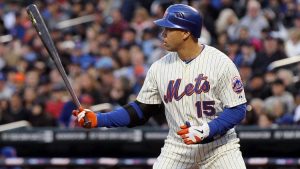 Most of those complaints were typical of people who can only see baseball in terms of effort and grit and the will to win and other rah-rah bushwah accepted as intellectual currency by dolts. (Because the universe is malign, these people inevitably sit within two rows of me and are the loudest in their section.) Ironically, Beltran might have won these fans over if he hadn’t been so good in center field — he had an encyclopedic knowledge of positioning and excelled at reading balls off the bat and taking first steps, which let him glide into the gap or back to the fence and corral a lot of drives without lunging or diving, as lesser center fielders needed to do. Fewer showy plays; less balls falling in. That’s the way it’s supposed to work, even if it means you’re not on as many highlight reels. Most of those complaints were typical of people who can only see baseball in terms of effort and grit and the will to win and other rah-rah bushwah accepted as intellectual currency by dolts. (Because the universe is malign, these people inevitably sit within two rows of me and are the loudest in their section.) Ironically, Beltran might have won these fans over if he hadn’t been so good in center field — he had an encyclopedic knowledge of positioning and excelled at reading balls off the bat and taking first steps, which let him glide into the gap or back to the fence and corral a lot of drives without lunging or diving, as lesser center fielders needed to do. Fewer showy plays; less balls falling in. That’s the way it’s supposed to work, even if it means you’re not on as many highlight reels.
One ball Beltran did dive for could have cost him his career — in August 2005, he collided head-to-head with right fielder Mike Cameron in San Diego, one of the most frightening outfield mishaps I’ve seen in more than four decades of watching baseball. Beltran suffered a fractured cheekbone, sustained a concussion that left him unable to remember the next few hours, and contended with bouts of vertigo. He returned to the field six days later and played every game remaining on the schedule. His naysayers would spend the next half-decade deriding him as fragile anyway.
There was also an ugly undertone to that first year. With Omar Minaya at the front-office helm, the Mets were championed (and eventually marketed) as Los Mets, a showcase for Latin superstars such as Beltran, Pedro Martinez and Carlos Delgado. That didn’t sit well with some fans, who saw “Los Mets” not as a way to invite in fans who’d felt little noticed or left out, but as a calculated affront aimed at shoving them aside.
In 2006 Beltran reported for duty healthy, but got off to a slow start, and heard the boos again. That all changed on April 6, one of the more interesting early-season games in franchise history. It was a chippy affair between the Mets and the Nationals, with lead changes and batters taking balls to the ribs. In the seventh, with the Mets up by one, Beltran hit a two-run homer and circled the bases to cheers from the Shea crowd. His face remained impassive, and he plunked himself down on the bench, stone-faced as the fans demanded a curtain call.
It was a peace offering, but Beltran showed zero interest in accepting it. The moment went on, increasingly uncomfortably, until Julio Franco got up from his seat and spoke quietly but pointedly to his teammate. Beltran listened and popped out of the dugout to wave. It was a perfunctory gesture, but the war was over and a magical season (which Beltran represents in A Met for All Seasons) had begun. Beltran tied a club mark with 41 homers, drove in 116, won his first Gold Glove, and put up 8.2 of WAR — an MVP-caliber season. Along the way there were a pair of celebrated walkoffs — a May drive off Philadelphia’s Ryan Madson at 12:33 a.m. in the 16th inning (Gary Cohen exulted that “we’re going home!”) and an August bottom-of-the-ninth homer off St. Louis’s Jason Isringhausen. (Cohen: “HE RIPS IT TO DEEP RIGHT! THAT BALL IS OUTTA HERE! OUTTA HERE! THE METS WIN THE BALLGAME!”)
In the NLCS, Beltran won Game 1 for the Mets with a 430-foot drive off Jeff Weaver and went deep twice in Game 4. He hit .296 for the series … but all anyone remembers is his final at-bat in Game 7. That came with rookie Adam Wainwright on the mound — ironically, he’d stepped in as closer for an injured Isringhausen — and Yadier Molina (then somehow just 24 years old) behind the plate.
It was Cardinals 3, Mets 1, but Wainwright started the bottom of the ninth by giving up back-to-back singles to Jose Valentin and hero-in-waiting Endy Chavez, got Cliff Floyd looking on a curve, then threw Jose Reyes a 1-2 curve — one Reyes lined to center but saw hang up for Jim Edmonds. He then walked Paul Lo Duca, with Anderson Hernandez taking Lo Duca’s place as a pinch-runner. It would come down to Wainwright and Beltran.
As Beltran gathered himself, Molina went to the mound — his third visit of the inning — and told Wainwright to start with a sinker. He then changed his mind and called for a change-up. Wainwright hit the inside corner for strike one, a perfect pitch. Molina called for the curveball inside, another tough pitch that Wainwright executed. Beltran fouled it off for an 0-2 count. Molina decided to double up on the curve, and this time he set up on the outside edge. Wainwright threw what he later said was the best pitch he’d ever thrown for a called strike three, the game and the pennant.
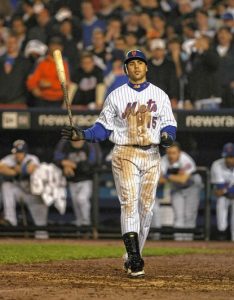 And then this happened. Wainwright would ride that curve to a very successful career, but he’d had trouble harnessing it that inning, throwing two high curves to Valentin and hanging one to Reyes, which unfortunately wound up hit right at Edmonds. He’d gotten the pitch over to strike out Floyd, but the sequence he dropped on Beltran came after an inning in which he’d scuffled and battled. But at the critical moment, with a lot of help from a precocious young catcher showing you why he’d be a Hall of Famer, Wainwright made the pitches he needed to make.
John Smoltz called the called strike “the perfect pitch at the perfect time to the perfect place,” which was true. But it wasn’t like Wainwright had engineered a never-before-seen, unhittable pitch in a lab and waited until then to break it out. Watch baseball and actually pay attention to it and you’ll see pitches like that one all the time: a hitter gets to two strikes, looks fastball and gets a 12-to-6 curve instead. His knees lock up, the hands freeze, the back goes rigid in dismay, and that little moment tells the pitcher and the catcher that the out is secured even before it hits the glove. What follows can look like a magic trick, with pitcher and catcher headed to the dugout even before the pitch breaks and the hitter left standing with the ump as he records the punch-out for posterity.
Cue the outraged calls to the FAN: “Yeah, but you can’t get caught looking in a big moment like that!” Oh please. Baseball doesn’t work that way — players don’t save a higher gear for big moments, and anyone who says otherwise has succumbed to magical thinking. If anything, players succeed by putting aside the stakes of a moment, along with every other distraction; as Ray Knight put it, “concentration is the ability to think about absolutely nothing when it is absolutely necessary.” It’s not like Beltran stands alone, either — in 2010, both League Championship Series ended on called third strikes, with Alex Rodriguez caught looking for the Yankees and Ryan Howard for the Phillies.
I suspect Beltran’s entire Mets career would be regarded differently if he’d swung and missed that final pitch instead of taking it, even though it would have changed nothing. Should he have swung too late to show he really cared? Smashed himself in the face with the bat to express his grief? Does Beltran remain unappreciated because he didn’t grimace enough? If that’s the case, who does it indict: Beltran, or columnists and fans who judge a player’s value by modern-day phrenology?
Still, that moment has been useful to me as a fan. If your takeaway from that pitch is anything like the stuff above, I’ll smile and chit-chat with you, and we’ll even high-five if the Mets score, but I’m not going to take you or anything you say about baseball seriously, because you’ve shown me that would be a waste of my time.
Beltran followed his amazing 2006 season with All-Star campaigns in 2007 and 2008, and was solid down the stretch in both seasons as the Mets collapsed around him. And he kept supplying highlights — a game-saving, 14th-inning catch nearly all the way up Tal’s Hill in Houston in 2007, a two-out, ninth-inning, come-from-behind grand slam off the Marlins the next year.
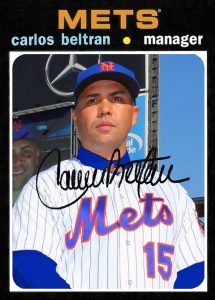 A card that got away for a job that did the same. Beltran’s 2009 was wrecked by injuries; in January 2010 he opted for knee surgery against the wishes of the Mets, and didn’t return until the All-Star break. That was probably too soon, as he’d pretty clearly lost a step in center and was rusty at the plate. The dispute kicked off a war with his employers, one that would last for the rest of his Mets tenure. Given the Mets’ approach to handling injuries at the time, best described as a combination of negligence, incompetence and bullying, I knew whose side I was on. But the anti-Beltran brigade blamed him, calling him selfish and fragile. Just like they blamed him later in 2010, when the Mets publicly called him out, along with Luis Castillo and Oliver Perez, for skipping a trip to Walter Reed Army Medical Center in D.C.
It was a shameful display of bullying regardless of the circumstances: The Mets were unhappy with all three players and decided to sic the press and fans on them for a public shaming. It turned out Beltran had missed the visit because he had a lunch meeting about a school his foundation was building in Puerto Rico, which is a lot better excuse than I’ve ever brought to the table. A couple of days after that, agent Scott Boras nailed the real problem: “The team has a duty to run the organization professionally. Giving the players [short] notice, knowing they have plans or obligations in their personal lives, and then to admonish the players without checking, it’s totally unprofessional on all fronts.” I’m not particularly a fan of Boras, but if you’d like to contest the accuracy of that judgment, look back at the Mets of the early Citi Field era and get back to me.
The next season, the knives were out again amid speculation that Beltran wouldn’t cede center field to Angel Pagan. But he did, saying that he felt he could still play there but “this is not about Carlos — this is about the team.” Healthy again, he put up excellent numbers, good enough for the Mets to trade the stub of his contract to the Giants for Zack Wheeler in a steal of a deal. After six and a half tumultuous years, his time in New York was over. Beltran would play six more seasons as a baseball nomad, suiting up for the Cardinals, Yankees and Rangers before ending his career with a return to the Astros and a 2017 World Series ring. He exited as a sure-fire Hall of Famer, praised not just for his accomplishments on the field but also for his value as a mentor in the dugout and the clubhouse. (Though hold that thought.) And his place in the Mets record books was impressive then and now: Beltran is third in career WAR and Win Probability Added, trailing only David Wright and Darryl Strawberry.
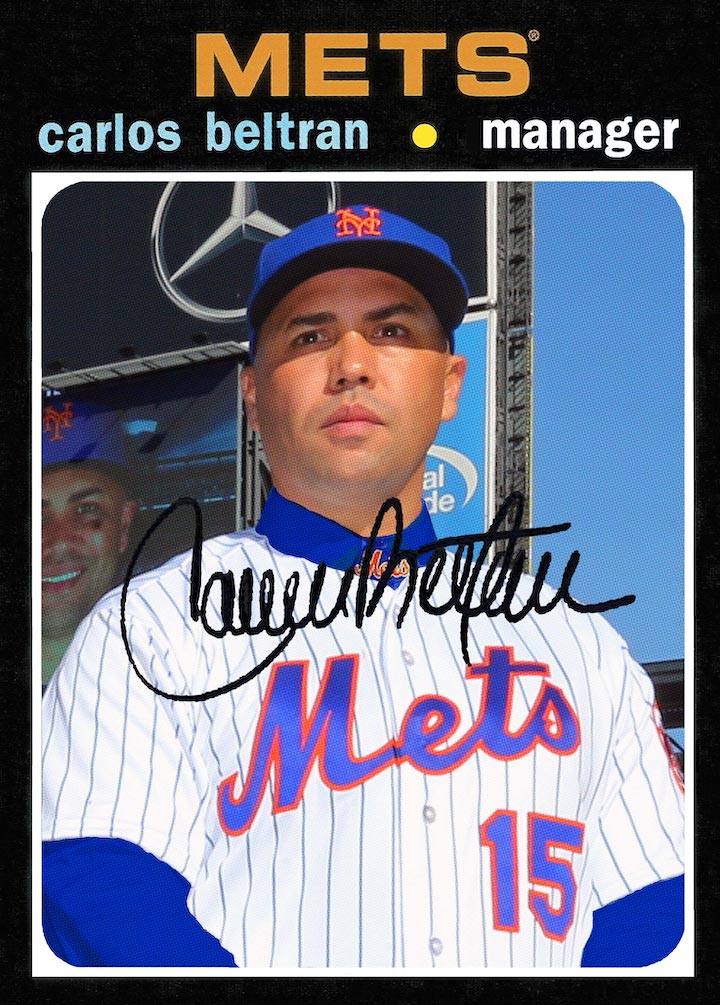
The passage of time healed the wounds between Beltran and his former team, and in November 2019 the Mets hired him as manager, replacing the hapless Mickey Callaway. But the timing was terrible: Not long after his introductory press conference, Beltran was swept up in the scandal around the Astros, who’d had employees steal catchers’ signs via video, then pass them to hitters by signals, most famously by thumping on a trash can. Beltran at first denied that the Astros had stolen signs, but investigations revealed that they had, and he and bench coach Alex Cora had been the ringleaders. That cost Cora his job as manager of the Red Sox, A.J. Hinch his job as the Astros’ skipper, and Beltran his return engagement with the Mets, before it ever began. For once, the Mets made the right decision: The hectoring would have never stopped, causing ample distractions in a year fated to have no shortage of them.
Since then, Hinch and Cora have returned to the managerial ranks; so far, Beltran remains out in the cold, with the Mets signaling that Luis Rojas will most likely return as skipper in 2021. I don’t disagree with that, but I do hope that if Beltran is properly penitent — as he needs to be — he gets another chance to manage.
I want that for reasons both praiseworthy and petty. It would give Beltran a chance to showcase his deep understanding of and love for the game, in a role where I think he’d excel. But I’d also love to shove that success into the faces of his detractors, the ones who still dislike one of this franchise’s greatest players for his supposed sins. For not showboating when he could glide, for not throwing tantrums when he failed, for not trusting his health to the Mets’ idiot doctors and cheapskate owners, for not managing to hit an impossible 12-to-6 curve when geared up for a fastball, for being injured, for being rich, for being Carlos Beltran.
PREVIOUS METS FOR ALL SEASONS
1962: Richie Ashburn
1963: Ron Hunt
1964: Rod Kanehl
1965: Ron Swoboda
1966: Shaun Fitzmaurice
1967: Al Schmelz
1968: Cleon Jones
1969: Donn Clendenon
1970: Tommie Agee
1971: Tom Seaver
1972: Gary Gentry
1973: Willie Mays
1974: Tug McGraw
1975: Mike Vail
1976: Mike Phillips
1977: Lenny Randle
1978: Craig Swan
1980: Lee Mazzilli
1981: Mookie Wilson
1982: Rusty Staub
1983: Darryl Strawberry
1984: Wally Backman
1985: Dwight Gooden
1986: Keith Hernandez
1987: Lenny Dykstra
1988: Gary Carter
1989: Ron Darling
1990: Gregg Jefferies
1991: Rich Sauveur
1992: Todd Hundley
1993: Joe Orsulak
1994: Rico Brogna
1995: Jason Isringhausen
1996: Rey Ordoñez
1997: Edgardo Alfonzo
1998: Todd Pratt
1999: John Olerud
2000: Melvin Mora
2001: Mike Piazza
2002: Al Leiter
2003: David Cone
2004: Joe Hietpas
2005: Pedro Martinez
2007: Jose Reyes
2008: Johan Santana
2009: Angel Pagan
2010: Ike Davis
2011: David Wright
2012: R.A. Dickey
2013: Wilmer Flores
2014: Jacob deGrom
2015: Michael Conforto
2016: Matt Harvey
2017: Paul Sewald
2018: Noah Syndergaard
2019: Dom Smith
2020: Pete Alonso
2021: Steve Cohen
by Greg Prince on 10 November 2020 5:53 pm Steve Cohen further casually introduced himself to us Tuesday afternoon, after tweeting back and forth among us on and off for a week. We’d definitely like to hang out in his company some more.
The new owner of the New York Mets, decidedly not the old owner of the New York Mets, took to Zoom to chat with the media (and, by extension, all of Metsopotamia) and sent us zipping toward the future. There were sentimentally superb nods to the past — his first Mets game at the Polo Grounds; his many games in the Upper Deck at Shea Stadium; his fond recollections of Cleon, Tom and Mookie from ’69 and ’86; and his confirmation that reviving Old Timers Day is indeed a fine idea — but the most encouraging portion of his Q&A was forward-looking, with his sights clearly set on a brighter tomorrow.
How could they not be? The Wilpon clouds have parted and their replacement by the guy who rode the Port Washington line to Shea before making his billions is auguring blue skies smiling on us. He’s got the will to win a World Series in a time span equivalent to how long it’s been since were last in one, and he’s got the financial wherewithal to convert our shared wishes and dreams into uplifting reality…or at least push us a whole lot closer to meeting heightened expectations. Plus he seems pretty cool about the whole thing. Overall, Cohen is here to take our sad song and make it better.
Hey, Steve, don’t be afraid. You were made to go out and get us some players, fortify an organization and generally elevate us to perennial powerhouse status. And you’ve got Sandy to pitch in.
Yes, Sandy Alderson 2.0 has arrived, like Bobby Ewing from out of the shower in Dallas. Brodie Van Wagenen was never here if you close your eyes real hard and then open them real fast; Luis Rojas will probably still be here when we look around come Spring of 2021, but that’s OK for now. Unlike the fall of 2010 until the summer of 2018, Sandy will not be the GM, but he will oversee operations, asking only for the chance to shop high-end and to receive “a seat at the table,” which should be easily accessible to him, assuming Brodie didn’t throw it through a wall on his way out.
Any situation like this is going to be chock full of happy talk and pledges to recreate “the culture,” but we’re primed to take just about everything Steve and Sandy said literally, seriously and to heart. The game has changed. This is not your slightly younger self’s offseason press availability. We will no longer listen to Alderson speculate on what might be done while we shake grains of salt on his perhapses and maybes, because he’s got somebody backing him who’s prepared to grant him leeway and resources, two items we’re pretty certain he didn’t have within his regular grasp pre-Cohen. We’ll no longer cringe when we hear from the owner , because the owner is no longer somebody whose only public statements are scheduled for self-congratulations or damage control.
The Mets, Alderson said, have been “storied”. The Mets’ goal from this day forward is to be “iconic”. Cohen said he’s “all in”. Who here isn’t?
by Jason Fry on 6 November 2020 9:15 pm Welcome to A Met for All Seasons, a series in which we consider a given Met who played in a given season and…well, we’ll see.
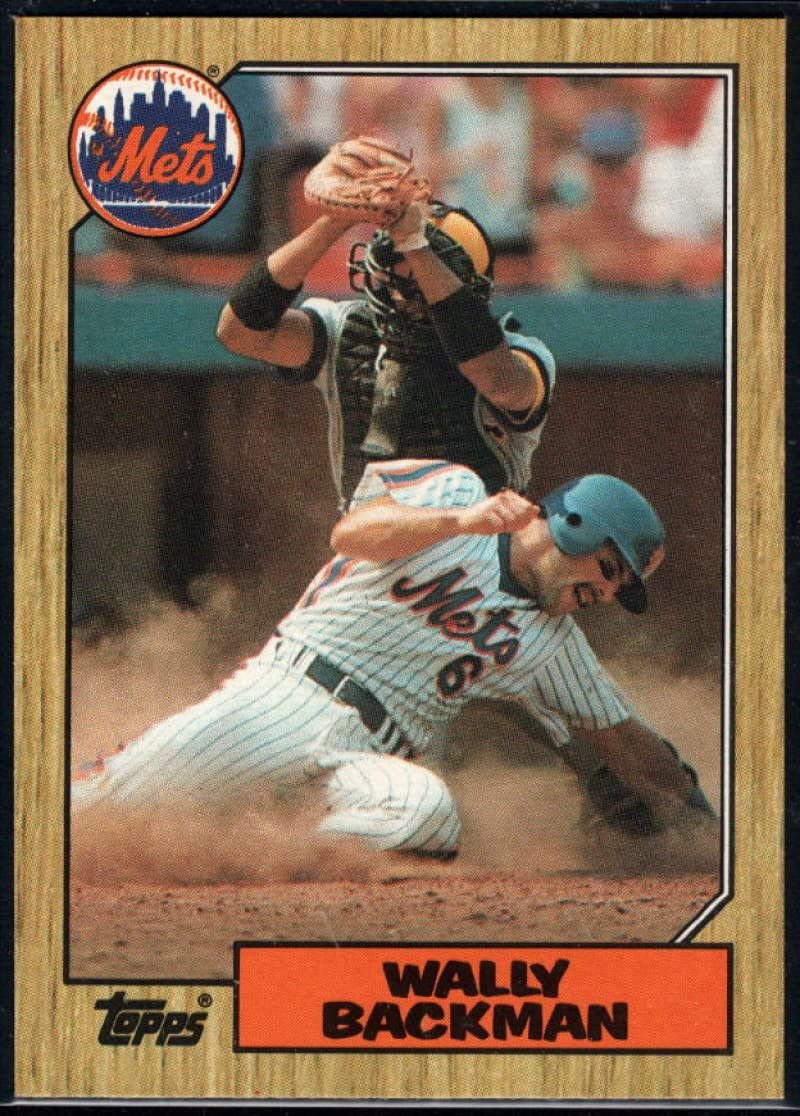
Looks back at the ’86 Mets often pair Wally Backman with Lenny Dykstra, his fellow partner in grime (and co-star in the ’86 year-in-review video’s super-cringey “Wild Boys” montage). Which makes sense: Backman and Dykstra were both undersized players who seemed able to will themselves on base, inevitably getting their uniforms filthy in the process, and were blunt-spoken to the point of brashness and often far beyond it. And both players’ heroic stints in New York were followed by more difficult chapters, ones that made their legacies uncomfortable.
But Backman deserves more than to be remembered as half of a scrappy/hustling platoon with Dykstra. He deserves his own reckoning — as not only a throwback player but also a throwback manager, hyper-aggressive in confronting umpires and dissecting enemy skippers. Backman could have been dropped in any of a number of baseball eras, transplanted perfectly to jittery old black-and-white newsreels or faded 60s film — a fitting contemporary for John McGraw, Earl Weaver, or Billy Martin. Unfortunately for him, he’s one of the last of that lineage — these days, front offices aren’t looking for the next Billy Martin, particularly when they fear such a hire would come with off-field baggage. That baggage is part of Backman’s legacy too.
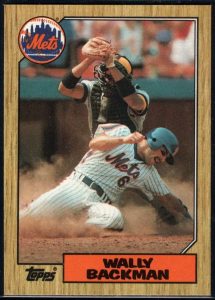 Doing Wally Backman things But let’s go back to the beginning. Walter Wayne Backman grew up as a baseball rat in Beaverton, Ore., spending untold hours in a vacant lot his parents had turned into a regulation-sized baseball field for the neighborhood kids — and honing his skills under the eye of his father, a railroad switchman who’d briefly been a Pirates farmhand. The Mets drafted him in 1977, and he hit .325 for Little Falls as a 17-year-old shortstop.
The bat was there. So was the gritty, no-prisoners style. The fielding, however, was not — which would be an ongoing problem as the Mets tried to figure out where Backman fit. In 1978 Backman hit .302 in Lynchburg and won a league championship, but he also had a .947 fielding percentage and led the league in errors.
The Mets shifted Backman to second base, which is where teams hide middle infielders who can’t field, knowing all too well that a lot of balls still pass through second basemen’s hands, sometimes literally. Still, Backman’s glove was less of a problem there than at short, and his other talents were undeniable. He hit .323 for Tidewater in 1980, and when Doug Flynn hurt his wrist, Backman got the call. He made his debut on Sept. 2, the same day as Mookie Wilson, singling in his first at-bat off Dave Goltz and driving in Claudell Washington. He still couldn’t take a legal drink.
That’s another thing about Backman: He was one of the old-guard Mets from the ’86 club, preceded only by Wilson (by a few minutes) and Jesse Orosco (by a year). They’d be followed by a second wave of ’83 and ’84 players as the team found its focus under Davey Johnson, then bolstered by the ’85 and ’86 arrivals. Dykstra belonged to that third wave — when Backman made his Mets debut, Dykstra was still playing high-school ball.
Backman’s first tour was promising — he hit in 18 of 26 games — but 1981 was a washout, as he struggled for playing time and tore his rotator cuff. The injury lingered into 1982, which was unfortunate: The Mets had cleared the middle infield for Backman and Ron Gardenhire by shipping out Flynn and Frank Taveras, but Backman’s fielding was poor and his season was cut short by a broken collarbone. 1983 started off promisingly, but soon turned sour, as Backman agitated for a trade after being sent down to Tidewater in May.
He didn’t know his career was about to turn around. At Tidewater Backman found a champion in Johnson, who called him “a foxhole player, a guy who will keep grinding and grinding until the job is done.” His new skipper showed confidence in him as a second baseman too, tutoring him at the same position he’d held down as an Oriole. When Johnson got the call as Mets manager for 1984, our year in question, Backman came with him.
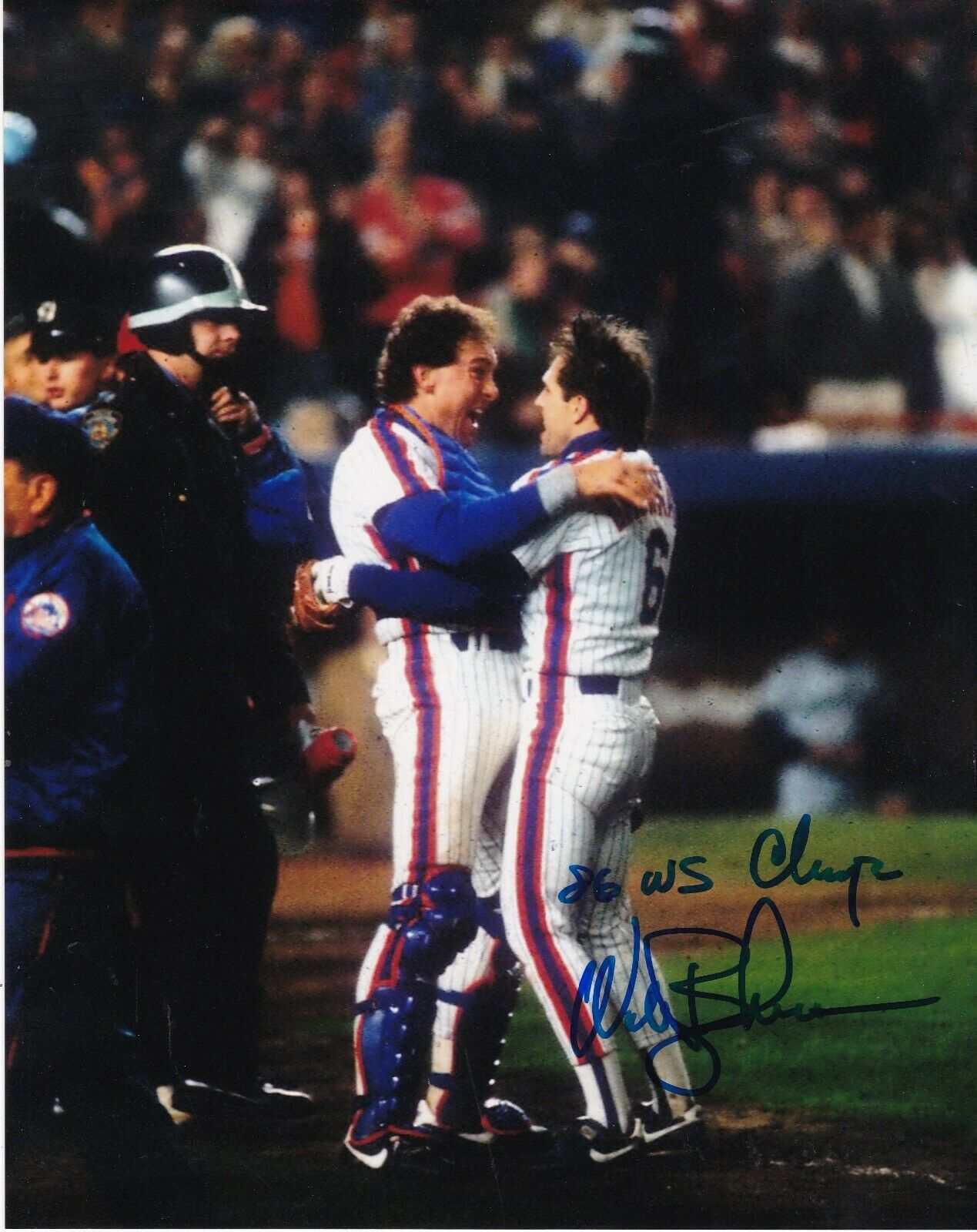
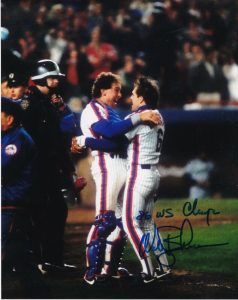 Johnson was also a believer in the value of platoons, which maximized Backman’s value. His scrappy superpowers didn’t work against lefties — for his career, Backman hit .294 right-handed but just .165 as a southpaw. Under Johnson Backman split time with Kelvin Chapman and then with Tim Teufel in 1986. That season would make him a legend — his drag bunt leading off the bottom of the ninth in Game 3 of the NLCS set up Dykstra’s walkoff, Gary Carter drove him in as the winning run in Game 5, and he scored what would eventually prove the decisive run in the epic Game 6. One of my favorite shots of the World Series comes from the on-field celebration after Game 7 — a hug amid the scrum that united the grimy, sweaty Backman and a beaming Carter. Johnson was also a believer in the value of platoons, which maximized Backman’s value. His scrappy superpowers didn’t work against lefties — for his career, Backman hit .294 right-handed but just .165 as a southpaw. Under Johnson Backman split time with Kelvin Chapman and then with Tim Teufel in 1986. That season would make him a legend — his drag bunt leading off the bottom of the ninth in Game 3 of the NLCS set up Dykstra’s walkoff, Gary Carter drove him in as the winning run in Game 5, and he scored what would eventually prove the decisive run in the epic Game 6. One of my favorite shots of the World Series comes from the on-field celebration after Game 7 — a hug amid the scrum that united the grimy, sweaty Backman and a beaming Carter.
The next season the always blunt Backman would be front and center in Mets dramas, calling out Darryl Strawberry‘s absences by telling the press that “nobody I know gets sick 25 times a year.” Strawberry threatened to punch Backman in the face, calling him “that little redneck” — an escalation that took an odd turn when Backman didn’t know what a redneck was. “Is it like a red-ass?” he asked, using baseball argot for a hothead. (Brought up to speed by reporters, he seemed genuinely hurt by the accusation.) Such tunnel vision seems baffling, until you remember that Backman was a lifelong baseball rat who’d been playing pro ball since he was 17.
The Mets traded Backman after ’88 to make room for Gregg Jefferies — in part because Johnson was certain he could tutor Jefferies at second the way he’d taught Backman. That didn’t work, and Backman’s departure would be much mourned as the increasingly colorless Mets drifted and stumbled and then collapsed. But for all the talk of grit and fire, it’s doubtful Backman would have made a difference: He had good numbers for the Pirates in 1990, but was a part-timer otherwise, and his career came to an end when the Mariners released him in May 1993. He was just 33.
If that had been the end of Backman’s baseball life, it would still be a pretty interesting one: a 5-foot-9 platoon guy who couldn’t really field but bit and clawed and scraped his way to a 14-year big-league career, a World Series ring, and never having to buy his own beer in New York. But Backman had a second act as a manager, which would prove … complicated.
Like a lot of former players, Backman needed a couple of years away from the game to decompress. But he returned to it in 1997 as manager of the Catskill Cougars, a team in the independent Northeast League. From there Backman went on to manage the Bend Bandits and the Tri-City Posse. He managed like he played: aggressive, combative, and endlessly hustling, a combination that became known as Wally Ball. But it wasn’t all dirty uniforms — Backman also gained a reputation as an able teacher of young players and an astute judge of enemy managers’ weaknesses. Billy Martin is the obvious comparison, but his real model was Johnson. Johnson, in turn, had learned at the knee of Earl Weaver, who’d tutored him as a minor-league infielder in the Baltimore system. A Backmanesque figure in his own right, Weaver quite literally grew up in the Browns’ and Cardinals’ clubhouses of the 1930s — his father had handled both St. Louis teams’ dry-cleaning. Backman would have been perfectly at home there.
Backman’s independent-league success got him a job in the White Sox farm system, where he succeeded in Winston-Salem and Birmingham but then was let go after campaigning a little too openly for Jerry Manuel‘s job in Chicago. He jumped to the Diamondbacks and the California League, where he was the 2004 Minor League Manager of the Year with the Lancaster JetHawks. He was in the running to replace Art Howe in New York, but dropped out amid rumblings that he’d get the Diamondbacks’ job instead. That happened in November 2004: Wally Ball was coming to the Show.
At least until it wasn’t. Backman’s managerial tenure lasted four days. The issue was a New York Times piece about Backman’s hiring, one that noted his off-field troubles: a DUI arrest, a restraining order connected to his first marriage, an arrest following a 2001 drunken altercation with his second wife, and a bankruptcy declaration. What’s interesting is the off-field messes weren’t the focus of the Times story, but its end — it was basically color to show that Backman was intense.
The problem was that the Diamondbacks hadn’t known about that stuff.
They belatedly did due diligence on the manager they’d hired and decided to unhire him, a moment that has loomed over the rest of Backman’s life. Backman protested about the unfairness of it all, pointing out that George W. Bush had a DUI and was president; three years later, his second wife, Sandi, told ESPN’s Jeff Pearlman that “I hope for nothing but [the D-Backs] to lose every game.”
And on the surface it did seem a bit unfair. The restraining order had been obtained ex parte, meaning only the party seeking it need be present when granted, and such orders aren’t uncommon in bitter divorces. Sandi Backman said the 2001 incident had been overblown, and the idea that Wally would hit her was “comical.” When the Diamondbacks inquired, a friend of Sandi Backman’s who’d been involved in the drunken altercation blamed herself for escalating things, saying she’d been out of line.
But the Diamondbacks found the police report alarming reading — among other things, it said the friend had resorted to keeping Backman away from Sandi with a baseball bat, breaking his forearm with it. (The bat was from the ’86 Series; Backman still has a titanium plate in his arm.) Backman had been on probation for the DUI, and officials in the Washington county where it happened found out about the 2001 incident through the Times. It was a violation of Backman’s parole, raising the possibility that the Diamondbacks’ new manager would soon be in jail. (Backman said he hadn’t known he was on probation.) More fundamentally, the Diamondbacks felt Backman had a problem with alcohol that he refused to address and had been less than truthful with them.
When the Backmans sat down with Karl Taro Greenfeld for a 2005 Sports Illustrated profile, they doggedly went through Wally’s legal troubles point by point. There were a lot of points. Confronted with a fair-sized pile of paper, Greenfeld wisely stopped considering each tree to admit that he was in a forest. “It is impossible not to wonder,” he wrote, “how one man could generate so much paperwork.”
(An unwelcome sequel: In the summer of 2019, Backman was arrested after a fight with his girlfriend and accused of taking her phone so she couldn’t call the cops. The girlfriend turned out to have a fair number of skeletons in her own closet and Backman was cleared of charges, but the case sounded unhappily familiar, and put a bunch more papers on that pile.)
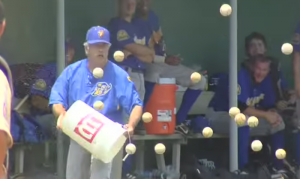 Video immortality Backman started working his way back to the majors in 2007, returning to the independent leagues to manage the South Georgia Peanuts and splitting $40,000 in salary with three coaches. His comeback was documented in Playing for Peanuts, and a video of a miked-up Backman being ejected will live forever. And justifiably so: After berating umpires for tossing out one of his players, Backman litters the field with bats and balls, screaming, “Pick that shit up, you dumb motherfuckers!” (An oddly courtly moment in his tantrum comes as he pauses to warn the opposing catcher to get out of the way.) The bats and balls sit on the field, untouched to avoid another eruption, as Backman tells his ejected player they’ll go get a beer and then hunts for a clipper to deal with the fingernail he just split. The aftermath, though, was less entertaining: Backman heard that the Peanuts’ 22-year-old radio announcer had described his fit as an embarrassment and burst into the press box to berate him and threaten to shove the mike up his ass. Asked by Pearlman why he’d done that, Backman struggled for an answer and settled on “I have lots of pride.”
Still, five Peanuts got pro contracts — Backman hadn’t lost his touch as a baseball instructor. In late 2009 the Mets offered him a road back, hiring him to manage the Brooklyn Cyclones. When the team parted ways with Manuel, Backman was a finalist for the job in Flushing, but wound up in Binghamton instead. The big-league job went to Terry Collins — another fiery skipper who will live on in video legend. Backman moved up to manage Buffalo and Las Vegas, where he helped prepare Matt Harvey, Noah Syndergaard, Wilmer Flores and Brandon Nimmo for the big leagues. (Temperament aside, you can see some of Backman in how Nimmo attacks a plate appearance.)
Backman thought he was in line to be Collins’s successor, and there were fans who wanted him to be, campaigning at any sign of trouble for the old ’86 hero to show up screaming and overturning buffets. Except, well, when’s the last time you saw a manager do that? The game had changed, with front offices taking greater control of lineups and tactics and managerial duties becoming more about dealing with clubhouses and the media. Hell, Collins himself had changed, remaking himself from the high-strung skipper who’d burned out clubhouses in Houston and Anaheim into a far more even-keeled leader. (Well, OK, mostly.)
Was Backman still the right personality for the job he’d always wanted? I wondered. After one Las Vegas season ended, Backman was brought in as a September coach, and chose 86 as his number — the only time, I believe, that’s adorned a Met back in a regular-season game. It was nice to see, but also a little sad — because I had the feeling that was as close as Backman was fated to get.
At the end of 2016 Backman resigned under a self-created cloud, claiming he’d been forced out by Sandy Alderson and blackballed in trying to find a job with another organization. Was that true? Who knows? But by airing his employers’ dirty laundry, Backman did an excellent job of blackballing himself. He returned to the independent leagues, managing in Mexico, in New Britain, and then with the Long Island Ducks. There, this most old school of skippers found himself dealing with experimental rules, such as a prohibition on mound visits and shifts. His pitching coach, former teammate Ed Lynch, said that it was “like John McGraw dropped into the middle of our clubhouse.”
I’d be surprised if Backman ever gets the second chance he hungers for, but I’m not willing to concede that’s an injustice — that pile of papers is hard to unsee. But I find pleasure in his trail of managerial addresses, which could be transplanted to the back of a baseball card from the 50s or 60s: Mountaindale, Bend, Tri-City, Winston-Salem, Birmingham, Lancaster, Albany, Joliet, Brooklyn, Binghamton, Buffalo, Las Vegas, Monclova, New Britain, Islip. It’s a baseball rat’s pedigree — maybe not the one Backman wanted, but an honorable one I hope brings him some joy. And, in time, a little solace.
PREVIOUS METS FOR ALL SEASONS
1962: Richie Ashburn
1963: Ron Hunt
1964: Rod Kanehl
1965: Ron Swoboda
1966: Shaun Fitzmaurice
1967: Al Schmelz
1968: Cleon Jones
1969: Donn Clendenon
1970: Tommie Agee
1971: Tom Seaver
1972: Gary Gentry
1973: Willie Mays
1974: Tug McGraw
1975: Mike Vail
1976: Mike Phillips
1977: Lenny Randle
1978: Craig Swan
1980: Lee Mazzilli
1981: Mookie Wilson
1982: Rusty Staub
1983: Darryl Strawberry
1985: Dwight Gooden
1986: Keith Hernandez
1987: Lenny Dykstra
1988: Gary Carter
1989: Ron Darling
1990: Gregg Jefferies
1991: Rich Sauveur
1992: Todd Hundley
1993: Joe Orsulak
1994: Rico Brogna
1995: Jason Isringhausen
1996: Rey Ordoñez
1997: Edgardo Alfonzo
1998: Todd Pratt
1999: John Olerud
2000: Melvin Mora
2001: Mike Piazza
2002: Al Leiter
2003: David Cone
2004: Joe Hietpas
2005: Pedro Martinez
2007: Jose Reyes
2008: Johan Santana
2009: Angel Pagan
2010: Ike Davis
2011: David Wright
2012: R.A. Dickey
2013: Wilmer Flores
2014: Jacob deGrom
2015: Michael Conforto
2016: Matt Harvey
2017: Paul Sewald
2018: Noah Syndergaard
2019: Dom Smith
2020: Pete Alonso
2021: Steve Cohen
by Greg Prince on 6 November 2020 3:15 pm If following the beginnings of more than one transition at a time is too overwhelming to contemplate, a quick note to keep you updated: Steve Cohen now owns the New York Mets, lock, stock and Brad Brach. The deal we anticipated for a nearly a year and celebrated for a week — and the addition by subtraction we craved for at least a decade — closed on Friday afternoon. Or as the deWilponizer himself put it in a not so lawyerly statement, “This is a significant milestone in the history of this storied franchise. I want to thank everybody who helped make this happen. The 2021 season is right around the corner and we’ve got a lot of work to do, so I’m excited to get started. Let’s go Mets!”
Amens all around, especially that last sentence.
Also leaving the premises via the front office exit: Brodie Van Wagenen; Omar Minaya; Allard Baird; Adam Guttridge; and Jarred Banner. Brodie and Omar, you know well. Or knew well. Team president Sandy Alderson (never count out all the familiar figures in our Met lives) announced their departure, and has, per a press release, “begun the process of building a new Baseball leadership group.” The caps on Baseball is theirs. We’ll amen that emphasis, too.
by Greg Prince on 3 November 2020 4:59 pm Welcome to A Met for All Seasons, a series in which we consider a given Met who played in a given season and…well, we’ll see.
Not every man’s a talker, John.
—Howard Da Silva as Benjamin Franklin to William Daniels as John Adams, 1776
On August 13, 1997, Comedy Central debuted a new animated series called South Park. In its premiere episode, “Cartman Gets An Anal Probe,” uh…well, you pretty much got the major plot point right there. The fourth-grade kids who would soon take over basic cable entered the cartoon world pretty thoroughly fleshed out and remain recognizable from their original form twenty-three years later. At no point, however, did breakout character Eric Cartman drop into small-town Colorado conversation on his first evening on the air what would soon become his and one of the more ubiquitous overall catchphrases of the era this side of Austin Powers’s “yeah, baby”:
“Sweet!”
Several channels over on certain cable systems that fateful Wednesday night in television, the New York Mets were playing and defeating the St. Louis Cardinals, 5-4. It would require ten innings and include four singles by a first baseman whose swing had come to be universally described one way above all others:
“Sweet!”
South Park continues to air to this day, but it was a true cultural influencer in the late ’90s. Its initial wave of popularity culminated two years after its unveiling in the release of a movie subtitled Bigger, Longer & Uncut, which somehow brings to mind that first baseman again, the one whose production as a Met couldn’t have been bigger; whose career as a Met should’ve been longer; and whose place in the upper echelon of Met history deserves to be uncut.
By 1999, both Eric Cartman and John Olerud were at the top of their games. Sure, Cartman was unabashedly foulmouthed while Olerud tended toward the closemouthed, but each had a way of grabbing the attention of those who knew that sooner or later they’d each make their presence felt — and that you’d hardly ever see either of them without a hat.
 Eric Cartman always could recognize swings. Cartoon or not, the South Park feature film — an old-fashioned, albeit quite profane movie musical — was an enormous hit in the summer of 1999, drawing boffo box office receipts, winning critical raves and attracting a Best Original Song nomination from the Oscars for the show-stopping “Blame Canada” (“with all their hockey hullabaloo/and that bitch Anne Murray, too”). Robin Williams was tabbed to sing it at the Oscars on March 26, 2000, which was three days before the next Met season was to begin, in Tokyo as well as in something of a state of mourning, for by 2000, John Olerud’s days as a Met were over. Yet instead of dwelling in sadness that he was gone, we really needed to smile that he was here among us for three sweet seasons.
And for Olerud arriving on the shores of Flushing Bay, thank Canada.
***By December of 1996, John Olerud’s future appeared to be as the subject of a “Where Are They Now?” profile, as in do you remember that guy in the batting helmet, even when he played in the field, who flirted with becoming the first major league batter to hit .400 since Ted Williams? Actually, by December of 1996, that was a good question in the present. Whatever happened to that guy whose sweet swing — “so sweet it should be poured on pancakes,” as Phil Taylor’s memorable Sports Illustrated phrase framed it — was the toast of a continent?
In the summer of 1993, John Olerud of the defending world champion Toronto Blue Jays was causing a run on pocket calculators. Though he was enough of a prodigy to leap from his home state Washington State University to the Jays without minor league grooming, and his first three MLB seasons were good enough to earn him regular playing time for an absolute powerhouse of a ballclub, Olerud’s combined batting average from his 1989 cup of coffee to Toronto’s first pennant in 1992 was .269. Nice, maybe, but not particularly noteworthy.
Next thing you know, the guy you never saw without a helmet — a precaution born of the aneurysm he suffered in college — emerged in ’93 as the most dangerous man in North America whenever he held a bat. At the end of April, John was hitting .450. At the beginning of June, he was still at .400. Fans voted him to start the All-Star Game, at which point he was five points from the magic number. On the first night of August, he was two points over it.
“We’re still trying to figure out to pitch to him,” White Sox manager Gene Lamont told Taylor as Olymania was taking hold in the AL. “When Olerud’s hitting well, he’s one of those guys who doesn’t seem to have a hole. There’s no place to attack him, and he won’t help a pitcher by going after the balls out of the strike zone. A tape of him hitting ought to be mandatory viewing for young lefthanded hitters.”
The Jays kept soaring even as their first baseman leveled off. Olerud’s average cooled to .363, but it was plenty high enough to win the American League batting title, topping his teammate Paul Molitor by more than 30 points for what we love to call the crown. More than a decade before people began enthusiastically adding on-base percentage to slugging percentage and calling it OPS, Olerud was the best in his league at that, compiling a 1.072. Most Valuable Player Frank Thomas finished second. Most popular player Ken Griffey finished third. And the Blue Jays of WAMO — Devon White, Roberto Alomar, Molitor and Olerud — finished as world champions yet again.
So whatever happened to that guy to make as brilliant a batsman in baseball practically trivial three years later? For one, the Blue Jays stopped contending for world championships pretty quickly, with their drop in status coinciding with the before & after of the 1994-95 baseball strike. The Blue Jays were an attendance magnet the first five years they played in the super futuristic SkyDome. Soon enough, the novelty wore off. Coming up the ranks, hopefully to help lead a Jaynaissance, was a power-hitting catcher-outfielder who wasn’t really much on catching or the outfield, and when the DH slot got otherwise filled (by 1993 World Series hero Joe Carter), he needed a new position. That kid, Carlos Delgado, was a comer by 1996, with 25 homers and 92 rabies to his credit. That made Olerud, whose average had steadily dropped until it was nearly 90 points off its ’93 apex, a goner. That, and the fact that John’s power never matched what Delgado was demonstrating, which didn’t go over so well with manager Cito Gaston. That, and John’s contractually guaranteed compensation being deemed too heavy for an increasingly light bat.
A non-contender in a heretofore big market that decided the market had downgraded to middling did what teams of that ilk often do. It sought a taker for a contract it no longer wanted to pay — and paid much of the freight to have it taken off its hands. Shortly before Christmas of ’96, the Jays found their match in the Mets, who’d recently parted with first baseman Rico Brogna. They sent Olerud and $5 million (then a record for cash included in a trade) of the $6.5 million their former batting champ was owed to New York in exchange for pitcher Robert Person.
The next time you’re tempted to mope about all the horrific trades the Mets habitually make, please remember the Mets once traded Robert Person for John Olerud and received $5 million in the bargain. No offense to Robert Person. Loads of offense from John Olerud.
Where was John Olerud now? He was exactly where he needed to be — where we needed him to be, too, not incidentally.
***What made John Olerud’s swing so darn sweet? In 1997, the first baseman explained to John Altavilla of the Hartford Courant that at his Ontario peak, “I used to be able to hit the ball where it was pitched really well. If the pitch was in, I pulled it. If it was away, I went with it.” Then the ’90s went deep and greater power was deemed a necessity. “After a while,” Olerud continued, his former team “started working with me to pull the ball, and I lost the feel for the outside pitch.”
When the lefty brought his bat through customs, the Mets were content to let the swing and the swinger be. Bobby Valentine noticed that John (whom the Mets drafted out of high school in 1986, before he opted for college) had “tried to change and drive the ball to right field in an attempt to hit more home runs. I don’t see that as a necessity when the guy can get a .400 on-base percentage and produce the amount of extra-base hits he has in the past.”
 Good guy in a white hat. “Once I got to New York,” Olerud agreed a few weeks into his Met career, “I found I was able to concentrate better on getting my swing down and being able to cover the plate.” Comfortable again at last, the tall fella in the hard hat began banging the ball like it was 1993. In his first month as a Met, John batted .356. It was a harbinger of the 1997 Mets’ renaissance. The team that had wallowed below .500 for six seasons was newly competitive, rising to an 88-74 record that nipped at the heels of the Wild Card-winning and eventual world champion Florida Marlins. Though Oly’s average dipped below .300 in the second half (landing at .294), he continued to deliver extra-base hits (34 doubles, 22 homers), drive in runs (passing 100 on the season’s final day) and, improbably, generate a cycle.
Mind you, it took an injured rookie outfielder playing out of position (future Hall of Farmer Vladimir Guerrero, in center instead of right and dealing with a sore hamstring) to help create the triple portion, but John was preternaturally pokey on the basepaths, so fair is fair. Besides, there was no questioning the single, double and homered he also hit on September 11, 1997. The triple was the only three-bagger of the year for Olerud, yet it came in the company of the other varieties of hit. Go figure.
And go figure what Cito Gaston anticipated for the quiet player the Jays were only too happy to have the Mets take off their hands: “John doesn’t look like he’s having fun playing,” his former manager said after the trade, suggesting that maybe once he played out the final year of his contract, Olerud would rather retire than play in the hostile environs of New York.
That, in the patois of the 21st-century Internet, proved a freezing cold take.
***John Olerud and his wife Kelly took to New York like fishes to water. It was that natural. They set up their home in Manhattan, they took in the opera at Lincoln Center at the other Met, they walked all over the place, unless it was to get out to Shea, in which case you might spy No. 5 for the New York Mets on the No. 7 eastbound. Those vicious fans Gaston fretted might eat the low-key out-of-towner alive? We embraced him.
Especially his batting average, which was something the Mets had literally never seen from one of their own before. In 1998, in the first year of a new two-year contract Olerud signed quite voluntarily, John shattered a club record that had lasted as long as the one Babe Ruth held for home runs. In 1935, Ruth finished his legendary run with 714 dingers. Thirty-nine years later, Henry Aaron topped his equally legendary total. Though not as famous as “714,” Cleon Jones’s .340 from 1969 seemed just as unassailable to Mets fans and for just as long. To put it in perspective, the average second-highest behind Jones’s ’69 figure for 20 years belonged to…Jones: Cleon’s .319 in ’71. That .340 wasn’t remotely approached until Dave Magadan got hot in 1990 and stroked to a tune of .328. Lance Johnson smashed the club record for most base hits in a season with 227 in 1996, yet his average fell seven points shy of .340.
Along came Olerud’s 1998. John hit .354 for the Mets. It was not only fourteen points better than any average that had come before it, it is still fourteen points better than any Met average behind it. This was the Olerud of 1993 returned to full possession of that sweet swing and all the delicious hitting that poured from its spout. Except for an aberrantly dry June, John batted above .350 in every single month of the season. In September, when every game proceeded as if it would be the difference between the Mets’ breaking their decadelong playoff drought and going hunting & fishing per usual, John channeled Ted Williams, hitting .413. Against righties across the year, Olerud’s batted .346. Versus lefties, presumably a tougher matchup, he batted .375. And in case you didn’t notice him — this was, within the realm of NL first basemen, the Age of McGwire — he made sure you paid attention by connecting for nine hits in nine at-bats and reaching base fifteen times in fifteen consecutive plate appearances…in September…in a pennant race…in New York. When he wasn’t hitting, he was walking. John started 152 games; he reached bases in 144 of them.
After watching him for 160 out of a possible 162 games in 1998, the surprise wasn’t that John Olerud batted .354. The surprise was that .646 somehow got left on the table. When Olerud was hot, he was getting a hit or at least a walk. When he wasn’t hot, it was June, and that was over in thirty days.
The Mets wound up one game from a postseason berth after their schedule elapsed, dropping their final five to fall behind both the Cubs and Giants, who engaged in a tiebreaker to determine a Wild Card. Before anybody’d ever heard of the 2007 Mets, the 1998 Mets were judged to have collapsed. As a team, perhaps. But individually, Olerud never wavered one inch. John finished second to Larry Walker in the National League batting race in 1998, nine points behind a man who took half his swings not at pitcher-friendly Shea Stadium but thin-air Coors Field. The Met who’d supplanted Cleon Jones also finished second (to Barry Bonds) in WAR among NL position players; second (to Mark McGwire) in on-base percentage; and third (to McGwire and Bonds) in adjusted OPS+. Somehow, despite playing in the nation’s largest market for a ballclub that contended to its very last out, John Olerud received only enough votes to finish 12th in MVP voting. It was the year of Big Mac socking seventy balls out of ballyards and Sammy Sosa doing the same 66 times. A very good hitter whose case was best illustrated by more intricate calculations stood little chance of standing out.
 Good guy in a black hat. For someone who measured 6’5” and had no compunction about being seen out and about on public transportation, Oly sure had a way of keeping a low profile.
***Technically, the 1999 Mets became the 1999 Mets on Opening Day in Miami. Spiritually, I’d date the idea that the 1999 Mets were surely the most special Mets ballclub since 1986 — and just as unmatched for specialness in the two-plus decades that have followed — to the bottom of the ninth inning on Sunday, May 23, 1999. That was The Curt Schilling Game, one of those wins you name for an opponent because the presence of the opponent greatly explains why you won.
That was the day the 1999 Mets became the 1999 Mets.
The Mets were trailing the Phillies on a gray, desultory Sunday, 4-0, going to the bottom of the ninth at Shea. There’d been a rain delay to begin the day, and the ending had fait accompli hovering over it. Schilling had handled the Mets with no discernible resistance for eight innings. Starting the ninth was exactly what an ace of his caliber would be asked to do.
Mike Piazza singled to lead off and Robin Ventura homered directly thereafter. Now it was 4-2, but “even still,” as they liked to say on The Sopranos. Instead of losing by four, they’d lose by two. Brian McRae’s groundout made that much obvious. Then, though, Matt Franco singled and Schilling hit Luis Lopez. Say, a person with a Met rooting interest might think, the tying runs are on base. How the [bleep] did that happen?
Yet Schilling was still on the mound. These weren’t Old Days so old that starters weren’t removed when in trouble in the ninth. But Phillies manager Terry Francona didn’t make a move. His closer, Jeff Brantley, was unavailable and Schilling, by the skipper’s reckoning, appeared “in complete control”.
Yet the next batter, Jermaine Allensworth, pinch-hitting for Rigo Beltran (how are those for 1999 Met names?), singled to left and brought Franco home to make it a one-run game. Allensworth, however, was about to be erased on a 1-5 fielder’s choice at second, meaning the Mets had Lopez on third and Roger Cedeño, the batter who’d provided Schilling with his fielding choice, on first. With Edgardo Alfonzo up, Cedeño dashed to second. With Fonzie up a little longer, Schilling hit his second batter of the inning. Edgardo took first.
So here we were: the bases loaded, two out, a teetering Schilling continuing to be trusted by Francona and, at bat, John Olerud, the .354 hitter from the year before. In 1999, through Saturday, May 22, he was at .357. On Sunday, through eight innings, he had two singles. Now, in the ninth, over WFAN, Gary Cohen called what became of the first pitch Schilling threw to Olerud, the 28th of the inning, and the 136th of the game.
“The pitch to Olerud…line drive…BASE HIT INTO LEFT FIELD! In comes Lopez! Here comes Cedeño! Here’s comes Gant’s throw from left field…the slide…SAFE, THE METS WIN IT! THE METS WIN IT! Cedeño slides home under the tag of Mike Lieberthal, a two-run GAME-WINNING single for John Olerud, the Mets score FIVE RUNS off Curt Schilling in the bottom of the ninth inning, and the Mets win it in a REMARKABLE finish!”
While it wasn’t the first REMARKABLE finish the Mets crafted in 1999 — they had topped the Brewers three days earlier, 11-10, in a doubleheader during which Robin Ventura hit a grand slam in each half — it was the one that confirmed that this was the season when the Mets would be doing their best Pippin impression. They had magic to do just for us; miracle plays to play; parts to perform; hearts to warm; kings and things to take by storm. In the middle of the magic and the madness and the myriad ups and dangerous downs and the holding on to of hats (hard and otherwise) was a stoic figure whose big stick/soft speaking literally went without saying. Quiet John Olerud bested voluble Curt Schilling and was now batting .366.
When one recited the top of 1999 Mets’ lineup, unprecedented for power and production in Flushing, Olerud’s was inevitably the third name to come up. On its most bountiful days, it went Rickey Henderson, Alfonzo, Olerud, then Piazza and Ventura. Robin, Mike and Edgardo finished 6-7-8 in the NL MVP voting, and Rickey was practically in the Hall of Fame already. Olerud’s 19 homers and 96 ribbies were there, too. When we got to talking defense, John was necessarily a quarter of the conversation. Around the horn, from left to right, it went Ventura, Rey Ordoñez, Alfonzo, Olerud, every last one of them deft as all get out with the leather, though one of them maybe a little easier to miss. Robin, Rey-Rey and Fonzie attracted passels of praise for leaping, diving and performing sleights of hand. Less explicitly stated was that somebody had to reel in everything fired from odd angles to first. Ventura and Ordoñez won Gold Gloves. Alfonzo finished second to Pokey Reese. Olerud’s glove was there, too. His face joined the others on the cover of SI as well, no matter that the primary focus of the accompanying article was on Ventura.
John Olerud, content to hit and field without a lot of muss and fuss, went relatively unnoticed in 1999 as the Mets chased that playoff spot that eluded them in 1998. Mojo rose in his midst. He played in every game but one, starting all but four the Mets played. Opposing pitchers presumably kept an eye on him just as Olerud watched what they were doing quite closely. He walked 125 times in ’99, taking as gospel the bromide about it being just as good as getting a hit. It would figure that in the season cleanup man Mike Piazza set the franchise RBI record and five-hole hitter Robin Ventura drove in more runs than any Met ever other than Piazza, somebody would be on base a lot just ahead of them. Oly, you know, batted third in 159 games.
On July 10, when the Mets were somehow engineering a comeback at least as REMARKABLE as the one they mounted against Schilling, John Olerud batted in the ninth inning again. The score at the time was 8-7, the Mets with the 7. The other team was the Yankees, so, yeah, it was kind of a big deal in the moment. There was one out when Henderson walked and Alfonzo doubled over Bernie Williams’s head. Second and third, and Oly was up. Because Piazza was on deck, Rivera was forced to face Olerud. Talk about picking your poison.
John grounded to second. I bring that up here because I was shocked that Olerud didn’t win the game right then and there. We had to wait through an intentional walk to Mike and a pinch-single from Matt Franco to take it, 9-8. From the instant Fonzie beat Paul O’Neill’s throw from right, it became The Matt Franco Game, and quite rightly. But after two-and-a-half years of exposure to Olerud, I was convinced John would take care of Rivera the way I was continually confident John would take care of business, embodying BTO seven years before anybody thought to habitually blast “TCB” at Shea. Amid the oft-roiled waters of the Bobby Valentine epoch, Olerud was a sea of tranquility. It was rare when he spoke up, and if he spoke up, he had a good reason for it.
In early June of 1999, not that long after The Curt Schill…er, John Olerud Game, the heretofore hellacious Mets ceased to do much correctly. Bruised from an eight-game losing streak, Steve Phillips sent up a warning flare to his archnemesis Bobby V, purging three of the manager’s coaches, including the man in charge of helping the hitters, Tom Robson. Robson had helped no hitter as much as he’d aided Olerud. They’d been together since 1997, not coincidentally coinciding with Oly emerging from his downward Toronto spiral.
“He was the perfect hitting coach,” Olerud said after the dismissal. “He helped save my career. We came from the same philosophical school of hitting — hit the ball where it’s pitched — and we really hit it off.”
Olerud was so angry about having his mentor snatched from him that two months later, he said of Robson’s successor, Mickey Brantley, “We’ve been working together and he’s helped me with a few things.”
 A team player doesn’t have to say much. That was Oly, politely saying just enough to reporters when asked (no Steve Carlton media boycotter he), but refusing to stir the pot. It was no wonder that when John was drafted to appear in the classic Nike NY vs. NY stickball ads, his most memorable contribution was wearing a blue batting helmet and silently contemplating whatever Masato Yoshii just told him in Japanese.
In the course of playing almost every game of every season for three seasons, John just did his job and did it extremely well. He’d get to the ball. He’d dig out the throw. He’d drive in the run. He’d reach base. He’d be John Olerud, and everything would be OK.
• Like that time Greg McMichael gave up an eighth-inning lead to the Rockies, just as the Mets were asserting their contending aspirations for real in May of ’97, and Oly rode to the rescue with a ninth-inning walkoff homer.
• Like that time he started and all but ensured a triple play. It was in August of ’98, with the Giants in town. Those charmers Jeff Kent (first) and Barry Bonds (third) were on base. J.T. Snow grounded to Olerud. Olerud threw to Ordoñez to get Kent. Ordoñez threw to Olerud to get Snow. Bonds? He got daring and dashed for home. John took note and threw to Todd Pratt. Bonds was out, 3-6-3-2, in the first triple play the Mets had turned in nine years. Score it two assists for the first baseman.
• Like that time in August of ’99 when most eyes at Shea gravitated to the visiting first baseman, McGwire. Ah yes, Mark McGwire. Even during that game the Mets beat the Cards two years earlier, on the night South Park premiered, McGwire seemed intent on stealing Olerud’s unassuming thunder. Olerud had four hits in a win? McGwire, still new to the National League, crushed two homers, including one off Mel Rojas — big surprise — to tie the game in the eighth. (Mark wasn’t chemically enhanced; like Cartman, he was just big-boned.) Now Big Mac was at it again, smashing a ball so hard and so high up the Shea scoreboard in the very first inning that it took out a light bulb. Who could compete with that? Try Oly, whose eighth-inning grand slam highlighted yet another REMARKABLE comeback.
The Mets steadied themselves to such a state of excellence by September of 1999, that the only thing that would have seemed remarkable would have been their falling apart just when everything they’d been striving for was in their grasp. As it turned out, ya couldn’t say the 1999 Mets weren’t remarkable in every way possible because, as if on cue, the Mets descended once more. This time it was into a seven-game losing streak that a) cost them their shot at dethroning divisionally dynastic Atlanta from first place and b) was killing their chance at the Wild Card. Everybody, even good old reliable John Olerud, was in a miserable slump at the worst juncture imaginable. Nothing was going right.
The Mets were bound to stop beating themselves. Wisely, with less than a week to go, they chose instead to beat Greg Maddux. Good choice! At first, it wasn’t so obvious that this night would be any different from the preceding nights and days of woe. Maddux was out in front, 2-1, going to the bottom of the fourth. But a blooper here, a bleeder there, and the Mets began to chip away. Even Al Leiter, whose batting average was generally as low as his pitch count was high, singled. There’d been six singles in all, allowing the Mets to cobble together three runs and load the bases.
Up came Olerud to swat a grand slam off the four-time Cy Young winner and blow the roof off of Shea Stadium. (What, you didn’t know Shea used to have a roof?) The Mets would go on to pummel the Braves and breathe life into themselves, setting us up for a final unlikely weekend. All our team would have to do is sweep the Bucs and hope a bunch that somebody somewhere else did us a favor.
The solid came from Milwaukee, where the Brewers beat the Reds Friday and Saturday. (Thanks, Crew.) By Sunday, with the Mets having taken two of two from Pittsburgh, we knew that if we could win one more game, the 162nd on the schedule, we’d see another day, maybe more. In the third inning, with the Mets down, 1-0, Olerud reached base and scored. In the ninth, with the score still tied at one, John came up with the most urgent game the Mets had played in more than a decade on the line. Melvin Mora was on third base. Edgardo Alfonzo was on first. All 124 RBIs of Mike Piazza were on deck. There was one out.
Bucs manager Gene Lamont — the same man who six years earlier described Olerud as a hitter without a hole — decided he’d rather take his chances with Mighty Mike than Big Bad John. Olerud was intentionally walked. This was about to become The Melvin Mora Game, courtesy of a Brad Clontz wild pitch and a savvy break off third from Melvin, but again, as in July against Mariano Rivera, or any time against any pitcher, really, I never didn’t have confidence that if somebody challenged John Olerud, John Olerud and thus the Mets would emerge victorious.
 Mojo wouldn’t have risen nearly so high without Olerud in the picture. What needed to get done got done. Clontz with the wild pitch, Mora with the scamper home, the Mets off to Cincinnati for this year’s sudden-death one-game tiebreaker, then, with that pocketed, to Arizona with the wildest of Wild Cards stowed securely in the overhead compartment. The 1999 postseason was about to feature the Mets.
And starring for the Mets in the course of two series, ten games and nine extra innings was John Olerud. Oly’s slash line was .349/.417/.558. His timing was exquisite, starting with Game One of the NLDS. In Arizona, he clobbered Randy Johnson for a homer, which was supposedly something lefty batters didn’t do to the lefty Unit. At Shea, before The Todd Pratt Game was properly named, it was Olerud who kept the sixth-inning rally that Al Leiter would nurse until the eighth going, and it was Olerud who lofted the fly ball to right that Tony Womack couldn’t find, setting up the tying run after Leiter (and Armando Benitez) couldn’t nurse that lead any longer. When the Mets were one loss from having their 1999 expire at the hands of the hated, hated, hated Braves in the next round, Olerud almost singlehandedly altered the prognosis. In NLCS Game Four, he homered off John Smoltz to give Rick Reed a lead in the sixth and, in the eighth, he wiped the smirk off John Smoltz’s loathsome face with the single that brought in the tying and go-ahead runs en route to the Mets’ literal must win.
The next day, Maddux returned to Queens, and just guess who couldn’t wait to greet him. Oly indeed got him for another home run. If nothing else, it would give Mad Dog something to stew over when he got to chatting with Smoltz and Johnson someday at Cooperstown. “Yup, we’re all in the Hall of Fame, yet John Olerud homered off each of us in the same postseason when the stakes were highest. That guy sure could hit.”
He sure could. Oly’d collect another hit in what was about to become The Grand Slam Single Game, though not the titular blow itself. In the fifteenth, with runners on second and third, Bobby Cox pulled a Gene Lamont and chose to intentionally pass Olerud, sensing in his wet, tired bones that John was likely to get on base no matter what. It was Olerud on first who trotted to second on Todd Pratt’s game-tying walk. It was Olerud on second who trotted to third on Robin Ventura’s very long hit over the right field fence, not that anybody noticed once Pratt turned from second to tackle Ventura, who’d blessedly touched first.
That was one time you couldn’t blame anybody for not noticing John Olerud.
In Game Six, John was in the middle of the Mets’ first rally, singling on the heels of Fonzie’s double in the sixth, which led to three of the most vital runs in franchise history. The Mets had been down, 5-0, and dead. Of course the Mets didn’t play dead very well in 1999, so it their fatal condition was only temporary. In the seventh, with the deficit four runs, Olerud once again warded off coroners, singling Henderson home (off Smoltz) to make it 7-5. Piazza followed with the frozenest rope of a home run you’ve ever seen, knotting the game at seven and setting the Mets up for Game Seven.
Strangely, that game never got played. Game Six kept going as long as it could, tied at nine heading to the eleventh. The Mets had let go of 8-7 and 9-8 leads by then, but I was confident we’d go back out in front in a matter of batters. John Olerud was leading off the top of the eleventh. John Olerud’s on-base percentage in the three seasons he’d been a Met was .425. It was the best in team history. (Heading into 2021, it’s still the best in team history). John Olerud’s batting average in the three seasons he’d been a Met was .315 (also the best ever by a Met with at least a thousand at-bats). Maybe he’d put the Mets ahead by himself or place himself in scoring position (of those who qualified over the first 38 seasons of Mets baseball, only Darryl Strawberry had posted a higher slugging percentage).
I just assumed John Olerud — whose lifetime Met OPS would add up to .926, a number no other Met has yet matched — would figure out a way to push the Mets into Game Seven, and after the Mets won that seventh game after trailing the series three games to none, John Olerud would, in the company of the rest of the never-say-die 1999 Mets, figure out how to win us a World Series. From there, it would just be a matter of calling into work to let them know I’m not coming in today because I’ve got a parade to go to.
Except John Olerud couldn’t do it all, at least not in the top of the eleventh. Versus Russ Springer, he flied out. The Mets who followed him to the plate, Shawon Dunston and Robin Ventura, also surprised me by not succeeding. I swear, I had so much confidence in those 1999 Mets. Alas, three up, three down. In the bottom of the eleventh…well, let’s just say there wasn’t a parade on my or the Mets’ agenda, though I did wind up calling the office after the Mets lost Game Six, 10-9, and leaving a voice mail that I was gonna be out sick.
The Braves, you see, they killed Kenny.
***Give or take an ill-timed spate of Kenny Rogers wildness, I didn’t regret a second of the 1999 Mets. That was the kind of season you live for as a fan. John Olerud was the kind of player you live for as a fan. I swear he did nothing wrong for three years. Not that he didn’t leave the occasional runner on base, but he never let the Mets down. You could trust John Olerud right down to the nub of the only millennium you’d ever known.
Then, when the next one began, he was a Seattle Mariner, for crissake. I guess it was his idea. I kept reading how he and Kelly wanted to raise their family in the vicinity of their respective parents. The babysitting came a lot cheaper that way. Maybe if the Mets had made an offer as spectacular as Olerud’s 1998 season had been, he could have been lured back. Or maybe not.
“[W]e have our son now who is fifteen months old,” Olerud explained when he decided to sign with Seattle, and “as a husband and a father, I want to be characterized as a guy who puts family first, and that was a real big priority.” Nevertheless, he added, leaving New York did not come easy. “I had a great experience there, John said. “Everybody in the organization, people in the front office — the clubhouse and the players were all great. We really enjoyed the city as well. The fans treated us fantastic and the tough series we went through last year developed real camaraderie.”
“He just wanted to go home,” Jim Duquette, then the Mets’ farm director, recalled for the Athletic in 2020. “His agent was pretty upfront it would just have to take a huge offer for us to keep him. Even if we did that, he wasn’t sure he would stay in New York.”
MAYBE DO THAT AND SEE WHAT HAPPENS???
Sorry, I’m yelling at the past again, which doesn’t really change the results from any already completed Mets games, seasons or eras, including the trajectory of the era the Mets were in as 1999 turned to 2000. They had come fairly close to the playoffs in 1997, then achingly close in 1998, then they landed at the doorstep of the doorstep to the World Series in 1999. That ’99 team may not have been perfect, but it was beautiful. Nobody was more beautiful than John Olerud. Without Olerud to marvel at, the eye of the beholder in 2000 simply couldn’t find them nearly so alluring.
You could have told us, Oly, our world was never meant for one as beautiful as you.
Instead, we got Todd Zeile. And Zeile was not Olerud. Zeile wasn’t even a first baseman most of the time. He’d come up as a catcher and settled in at third for the approximately forty or fifty clubs in whose clubhouse he’d briefly set down his suitcases. An ESPN assessment of the Mets’ options in the days after letting John walk (he always could walk) declared Todd “an awful option…a player whose numbers always look better on paper than they do in person. More importantly, he is a defensive liability regardless of what position he plays.”
Yeah, so like I said, we got Zeile. He wasn’t awful. But, to reiterate, he wasn’t Olerud. Sports Illustrated was no longer tempted to laud the Mets’ infield as perhaps the “best ever” on its cover. “On base” was no longer a guaranteed destination for the first baseman, either. The Mets were different without Olerud. They were less fluid. They were clunky. They were also, for a year, more ultimately successful, reaching the World Series with Zeile. Todd put up some solid numbers during the season and some spectacular stats during the postseason. He was not quiet. He was one of those guys who came over and spoke up for the team when needed. He was, honestly, a very good Met for a pennant-winning club and, eventually, a well-liked Met, especially when he retired as a Recidivist Met, after a few more trips to a few other teams, in 2004.
And he still wasn’t John Olerud. Nobody was John Olerud except John Olerud. John Olerud kept being John Olerud as a Mariner. He was an All-Star his first year there, something the National League forgot to designate him as a Met. He was a big part of a 116-win juggernaut. He would win three Gold Gloves for them, too. When the M’s released him and he could stay home no longer, he’d make stops as a Yankee (BOO!) and a Red Sock (for whom he’d have to tune up in the minors for the first time in his life). In all, he’d play parts of seventeen major league seasons, retiring after the 2005 campaign. He was 37 then and had made Cito Gaston’s predictive capabilities look pretty shoddy. When he reached the Hall of Fame ballot in 2011, a decent sabermetric case was made for John’s consideration. Olerud could be seen as a harbinger of what baseball would value in terms of offense, what with getting on base nearly 40% of his plate appearances. Combine that with intermittent heights as high as Mt. Rainier, and why wouldn’t Olerud at least be the kind of player worthy of serious mulling for a few winters?
He got four votes and disappeared from the ballot ASAP.
Cooperstown’s loss, just like letting John go prior to 2000 was our loss. At the risk of cycling back to a few paragraphs ago, yeah the Mets with Zeile were real good just like the Mets with Olerud were real good, but man, it was just not as good. Or as elevating. Or as breathtaking. Or, yes, as beautiful. In a time of heated Met passions, John generated such warm affection. I wouldn’t call Oly the most popular Met ever, but I can’t think of any Met of tenure who was less unpopular. I don’t remember a discouraging word muttered or shouted in his direction from 1997 to 1999, and I’ve never heard anybody since 1999 declare relief he was replaced. Nobody seemed to not like him a ton. Nobody seemed to want him to leave. He didn’t come close to overstaying his welcome.
I would welcome watching John Olerud swinging several times a day every day. What a delight that I got to do exactly that for three years running. How sweet it was.
PREVIOUS METS FOR ALL SEASONS
1962: Richie Ashburn
1963: Ron Hunt
1964: Rod Kanehl
1965: Ron Swoboda
1966: Shaun Fitzmaurice
1967: Al Schmelz
1968: Cleon Jones
1969: Donn Clendenon
1970: Tommie Agee
1971: Tom Seaver
1972: Gary Gentry
1973: Willie Mays
1974: Tug McGraw
1975: Mike Vail
1976: Mike Phillips
1977: Lenny Randle
1978: Craig Swan
1980: Lee Mazzilli
1981: Mookie Wilson
1982: Rusty Staub
1983: Darryl Strawberry
1985: Dwight Gooden
1986: Keith Hernandez
1987: Lenny Dykstra
1988: Gary Carter
1989: Ron Darling
1990: Gregg Jefferies
1991: Rich Sauveur
1992: Todd Hundley
1993: Joe Orsulak
1994: Rico Brogna
1995: Jason Isringhausen
1996: Rey Ordoñez
1997: Edgardo Alfonzo
1998: Todd Pratt
2000: Melvin Mora
2001: Mike Piazza
2002: Al Leiter
2003: David Cone
2004: Joe Hietpas
2005: Pedro Martinez
2007: Jose Reyes
2008: Johan Santana
2009: Angel Pagan
2010: Ike Davis
2011: David Wright
2012: R.A. Dickey
2013: Wilmer Flores
2014: Jacob deGrom
2015: Michael Conforto
2016: Matt Harvey
2017: Paul Sewald
2018: Noah Syndergaard
2019: Dom Smith
2020: Pete Alonso
2021: Steve Cohen
by Greg Prince on 30 October 2020 11:22 pm Welcome to A Met for All Seasons, a series in which we consider a given Met who played in a given season and…well, we’ll see.
I can’t keep looking back at the past, and I have nothing inside of here that is the future.
—Aidy Bryant on her childhood journal, Saturday Night Live at Home, April 24, 2020
The calendar was nine weeks shy of 2021, yet it was clear by October 30, 2020, that Steve Cohen was the Met for next season. True, Cohen, in his capacity as the newly announced owner of the New York Mets — approved by a requisite three-quarters vote of other Major League Baseball owners and blessed as apparently if vaguely necessary by municipal authority — would not actually play in the season ahead. Yet Steve had to neither pitch, hit nor run to emerge as the following season’s defining figure. He and $2.475 billion of his incomparable personal financial worth could catch control of the team its acolytes loved after decades of that same team too often lacking the heart to love them back. That was enough where 2021, in its otherwise to-be-determined state, was concerned. That was enough for Mets fans to accept and embrace Steve Cohen, one of their own, as, shall we say, A Player.
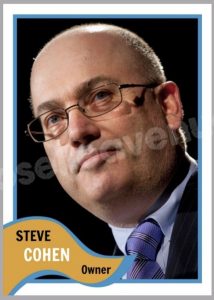 A Player for this moment. (Image courtesy of @roselleavenue.) Opening Day of 2021 was slated for April 1, Closing Day for October 3. Assuming those games and all the games in between were to be contested as scheduled (after 2020, nothing simple would ever seem certain again), there was no doubt from the perspective of the day Steve Cohen bought the Mets that some Met pitcher, Met catcher, Met infielder or Met outfielder would put an indelible stamp on those 162 games or however many wound up getting played. By then, we’d know who the Met for that season was. It might be a Met we knew in 2020. It might be a Met who became a Met because Steve Cohen said, “sure, let’s sign him.”
Until any of that was known, though, Steve Cohen was the symbol of the 2021 Mets. A symbol of hope. A symbol of faith. In lieu of statistics and video highlights, a symbol can be a powerful thing.
The news that Cohen was now the head shotcaller and checkwriter at 41 Seaver Way came down three days after another World Series the Mets didn’t remotely approach and a day before Halloween. There wasn’t a sentient Mets fan around who, amid generally dour times, wasn’t willing to instantly don a costume of cockeyed optimism. We now had Steve Cohen, suddenly the richest owner in all of baseball, and he was working for the cause of our happiness. No trick. Real treat, especially as illustrated in the opening statement he relayed to his fellow Mets fans:
I am humbled that MLB’s owners have approved me to be the next owner of the New York Mets. Owning a team is a great privilege and an awesome responsibility.
[…]
Most of all, I’d like to thank Mets fans for their unwavering support throughout this process.
My family and I are lifelong Mets fans, so we’re really excited about this. With free agency starting Sunday night we will be working towards a quick close.
Let’s go Mets!
The 2020 season, the last one for which Steve Cohen was not majority owner of the New York Mets, had been short and unsatisfying by every measure, save for it having yielded sixty games to watch from afar after four months when a global pandemic had shut down baseball (along with most everything else) altogether. But the Mets’ record of 26-34 and failure to slither inside a bloated playoff tournament seemed almost beside the point. What Mets fans sought in 2020 was not so much a postseason berth but a life after the Wilpons.
The Wilpons were Fred and Jeff. More chairman and CEO Fred than COO and son Jeff, per tenure and the organizational chart; more Jeff than Fred, per the unsympathetic public face of recent years. No matter which Wilpon a Mets fan chose to focus ire upon, neither was what a Mets fan was dying to see. Dying without seeing another Mets world championship — something the Mets hadn’t attained in the nineteen autumns the Wilpon family held full control of the franchise — was an implicit concern for any Mets fan who had come to realize, particularly amid the rampage of COVID-19, that life was precious, finite and too short to sit around and wait for lightning to strike. The Wilpons had neither the resources nor wherewithal to make the Mets a steady contender. They never left the impression that nothing mattered more to them than the Mets winning. Cohen, through a little backstory and a couple of tweets, had already demonstrated more passion for the team than the people who ran it. Plus he had billions and billions of dollars to commit to his passion. Hard not to root for that guy to take over.
Or, after living in the shadow of the Wilpons for so long, anybody, really.
The end of the Wilpon era began to loom almost a year earlier, in December of 2019, when the word “coronavirus” would have drawn stares as blank as the Citi Field scoreboard most late Octobers. A sale to Cohen, who already owned a small Met stake, was officially in the works. But negotiations grew messy, with the Wilpons trying to continue in an approximation of their role as owners without actually owning the ballclub, and eventually it dissolved into a deal undone.
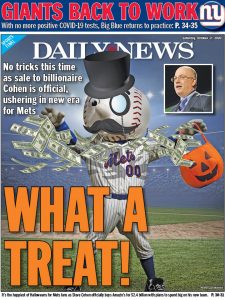 By Halloween 2020, we knew the 2021 Mets wouldn’t be spooked by the same old ownership. Thus, 2020 became one more year with the Wilpons. Fred had been on the scene since 1980, a minority partner with a major say when Doubleday & Co. bought the club from Lorinda de Roulet. In those days, the hook in the media was that the club would be operated under the auspices of a descendant of the mythological inventor of baseball, Abner Doubleday, specifically his great-great-grand-nephew Nelson. Abner never invented a damn thing, but it made for a good story. And the alliance forged between Nelson the chairman and Fred the president presented itself as a harbinger of good things to come for a franchise that had sunk to rockbottom following the death of original Mets owner Joan Payson in 1975.
Doubleday-Wilpon ’80 was the ticket the Mets rode to a renaissance, culminating in the 1986 world championship. The Mets, as built by the general manager the partners brought in, old Oriole hand Frank Cashen, constructed a monster of a roster, and the guys who bought the right to handle the Commissioner’s Trophy came off as sportsmen of the old school. When Jesse Orosco struck out Marty Barrett, flung his glove skyward and embraced Gary Carter, the influence of the owners in reaching the mountaintop may have been profound, but it was also played as subtle. These fellows weren’t interested in a high profile or a screaming headline. Doubleday and Wilpon weren’t George Steinbrenner, which was half the battle of getting good press in that era. Winning the World Series took care of the rest.
Had you told a Mets fan in the giddy aftermath of October 27, 1986, that subduing the Red Sox in seven games would be it in terms of earning ultimate prizes for Doubleday, Wilpon or both, it would have seemed laughable. They were the shepherds of not just the best baseball team in the land, but a smoothly functioning franchise designed to churn out more champs. Cashen had traded for great players, cultivated a farm system that produced even more of them. Why would it stop?
Whyever it would, it did. And though it wouldn’t be fully accurate to date the turning point in Met fortunes to November 14, 1986, it’s hard to swear it’s a coincidence that once Fred Wilpon upped his stake in the Mets from 5 to 50%, as Doubleday & Co. sold its stake to the two individuals who already helmed the franchise, the Mets’ streak of not winning more World Series began.
The Mets remained strong on the field for a few years after the formation of the new partnership. Then, in the early ’90s, the club collapsed, first competitively, then aesthetically. The Mets were populated by underachieving players who projected overbearing personalities. Fred Wilpon stepped up to take responsibility for the Bonillas, Saberhagens and Colemans who made the operation look bad. Doubleday picked his spots to make stands, most notably as the co-owner more obviously insistent on acquiring Mike Piazza.
Wilpon’s and Doubleday’s mutual relationship was brittle by 2000, when the Mets made their first World Series since 1986. Two years later, Nelson sold his half of the club to Fred, which in turn expanded Jeff’s portfolio. Prior to the sale, Jeff was running Sterling Equities, the Wilpon family’s real estate business. When the Wilpons and Fred’s brother-in-law Saul Katz bought out Doubleday, Jeff was elevated to COO of the Mets. Not long after he was out of the picture, Nelson offered one of the most quoted lines of the 21st century regarding the Wilpon scion:
“Mr. Jeff Wilpon has decided he’s going to learn how to run a baseball team and take over at the end of the year. Run for the hills, boys.”
The quote being cited repeatedly for seventeen years reflected a regime that wasn’t exactly basking in success. After the Mets became a purely Wilponian production in 2002, the Mets finished in last place. During their first full post-Doubleday season, the Mets finished in last place again. A year later, the Mets finished in next-to-last place, though not before deciding to fire the first manager Fred Wilpon hired of solely his own volition — charisma-challenged Art Howe, who Fred swore “lit up” the room during the interview process — or declaring that the Mets, en route to a 71-win campaign, aspired to play “meaningful games in September”. If nothing else, the Wilpons left a trail of memorable phrases in their wake.
For a spell in the mid-2000s, it appeared their legacy might be something more. They engineered the founding of a mostly Met-themed regional sports network. They broke ground on a retro-style ballpark to replace creaky Shea Stadium. And they empowered locally sourced general manager Omar Minaya to improve the product on the field at whatever cost necessary. With Pedro Martinez, Carlos Beltran, Carlos Delgado, Billy Wagner and Paul Lo Duca imported to join budding homegrown stars Jose Reyes and David Wright, the dream of the Mets reigning as the large-market force they should have been all along seemed to be coming true. In 2006, the Mets romped to a division title and came within one game of the World Series.
But in 2007 and 2008, the team fell short of the playoffs in ghastly fashion, and when the new ballpark opened in 2009, the club deteriorated as if its brief rise to prominence never occurred. Citi Field, meanwhile, wasn’t welcomed with universal acclaim, with the Ebbets Field motif favored by old Brooklyn Dodger fan Fred landing as tone-deaf to nearly a half-century of Mets history, and the emphasis on amenities lost on the masses who missed Shea’s relative affordability and psychic accessibility.
The biggest blow to the Wilpons’ ownership started coming into view in late 2008 when, just as the Great Recession was hitting, their connection to disreputable pyramid-scheming Bernie Madoff left them unable to operate New York’s National League franchise in a manner suitable to ensuring earnest competition. Cries for the Wilpons to sell the team resounded. The Wilpons, with support from Commissioner Bud Selig, hung on. Minority stakes were sold, though, and, in 2011, an announcement was made that hedge fund manager David Einhorn was on the verge of buying a controlling interest. But that fell apart in a matter of months, and the Wilpons remained attached to the franchise that gave them their primary professional identity and most of their social status.
It also foist upon them a degree of infamy they were unlikely to absorb had they just stuck to real estate. Generally speaking, Mets fans were mad the Wilpons couldn’t or wouldn’t invest enough to create a consistent winner. They groaned every time a story appeared that their front office was behind the times in implementing analytics or was getting in the way of employees (some of them players) just trying to get their jobs done. The grudging nods toward the Mets’ better traditions — a team museum that didn’t open until the Jackie Robinson Rotunda had a year in the sun; team Hall of Fame ceremonies that disappeared for years at a clip, a long-discussed Tom Seaver statue that never got installed during the icon’s lifetime — didn’t help the owners’ image. Nor did news like Jeff Wilpon being credibly accused of discrimination by a former executive who said Jeff harassed her for being pregnant while unmarried.
There was little sense of urgency nor evidence of fervor on the Wilpons’ part when it came to getting the Mets on a permanently positive footing. There was no warmth projected by the owners. When things did work out — such as when the club streaked to a division title and pennant in 2015 under GM Sandy Alderson and manager Terry Collins — the good vibes wore off quickly and the team’s record reverted to substandard.
This is the legacy Steve Cohen would have to exceed once the transfer of power from the Wilpons to himself was to become effective in the days after October 30, 2020. This is why Cohen, another hedge fund type (not without his own issues in the securities trading realm), was greeted as a liberator the moment his pending ownership was no longer a matter of speculation. Though Anybody But the Wilpons would have garnered some degree of applause, it was Cohen who stood as the people’s choice as reporting mounted through 2020 that the Wilpons were still trying to sell the franchise (word was the next generation of Katzes wasn’t keen on hitching its wagon indefinitely to Jeff). Other groups bid or tried to bid. Cohen, though, despite having his first attempt dashed in winter, never let go of his desire to own the Mets and never hesitated to dip into his pockets to make it happen when the opportunity arose anew in summer.
And it happened. The Wilpons and Katz sold him the Mets. That’s all that had to happen for Steve Cohen to be the best thing that ever happened to the Mets on the cusp of 2021. Whether that description would hold once 2021 unfolded in real time…
“Well,” Mets fans could tell one another, “we’ll see.”
If you like the Steve Cohen baseball card displayed above, we suggest you follow @roselleavenue on Twitter to explore the Roselle Avenue Alternate Card Universe, a place like no other on Earth.
PREVIOUS METS FOR ALL SEASONS
1962: Richie Ashburn
1963: Ron Hunt
1964: Rod Kanehl
1965: Ron Swoboda
1966: Shaun Fitzmaurice
1967: Al Schmelz
1968: Cleon Jones
1969: Donn Clendenon
1970: Tommie Agee
1971: Tom Seaver
1972: Gary Gentry
1973: Willie Mays
1974: Tug McGraw
1975: Mike Vail
1976: Mike Phillips
1977: Lenny Randle
1978: Craig Swan
1980: Lee Mazzilli
1981: Mookie Wilson
1982: Rusty Staub
1983: Darryl Strawberry
1985: Dwight Gooden
1986: Keith Hernandez
1987: Lenny Dykstra
1988: Gary Carter
1989: Ron Darling
1990: Gregg Jefferies
1991: Rich Sauveur
1992: Todd Hundley
1993: Joe Orsulak
1994: Rico Brogna
1995: Jason Isringhausen
1996: Rey Ordoñez
1997: Edgardo Alfonzo
1998: Todd Pratt
2000: Melvin Mora
2001: Mike Piazza
2002: Al Leiter
2003: David Cone
2004: Joe Hietpas
2005: Pedro Martinez
2007: Jose Reyes
2008: Johan Santana
2009: Angel Pagan
2010: Ike Davis
2011: David Wright
2012: R.A. Dickey
2013: Wilmer Flores
2014: Jacob deGrom
2015: Michael Conforto
2016: Matt Harvey
2017: Paul Sewald
2018: Noah Syndergaard
2019: Dom Smith
2020: Pete Alonso
by Jason Fry on 28 October 2020 10:00 pm Welcome to A Met for All Seasons, a series in which we consider a given Met who played in a given season and…well, we’ll see.
In the mid-80s, while I was off at boarding school, I got a letter from my mother. That wasn’t odd, but what was inside was. My mother had sent me a folded-up article she’d cut out of Cosmopolitan, and amended it with a sentiment more typical of her: Typical Cosmo bullshit, but thought you’d enjoy.
When I unfolded it, I understood — it was about Ron Darling. Darling was a mainstay of such magazines then, and why not? He was a young and handsome star pitcher for the Mets. To those qualities he added a handful of ineffable somethings — style, glamour, and ease with the bright lights. And he had an intriguing background, one not exactly standard for a professional ballplayer. For openers, he was the son of a Chinese-Hawaiian mother and a French-Canadian father, a proto-Benetton ethnic mix that made vaguely cringy references to “exotic good looks” de rigueur when he was written about outside of the sports pages. He spoke French and Chinese, and he’d studied French and Southeastern Asian history at Yale. If I’d told you back then that George Plimpton — he of the Paris Review bylines and the good-schools accent — was going to invent a fictional Mets ballplayer, you’d have expected a creation a lot more like Darling than Sidd Finch. Gary Carter gave Darling the nickname Mister P, short for Mister Perfect, and writers for Cosmo, GQ and other publications fell over themselves to agree.
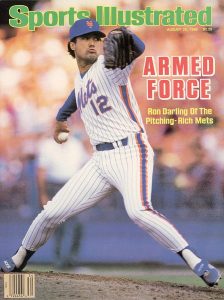 Two baseball generations later, Darling is part of the mighty SNY triumvirate with Gary Cohen and Keith Hernandez and a mainstay of postseason broadcasts. But something funny happened along the way. When you think of Hernandez, you draw a straight line between the mustachioed, vaguely piratical first baseman of the mid-80s and the raffish color guy he’s become. But that straight line isn’t as easy to draw with Darling. He’s thicker and grayer, true, but hey, aren’t we all? I think it’s that Darling invokes his career less frequently than Hernandez, typically discussing pitching mechanics and grips without grounding them in his own experiences. And when he does reference his own playing days, he’s generally self-deprecating about himself and his accomplishments. The odd effect is a Mets icon whose triumphant second act has somehow diminished his career instead of enhancing it. Two baseball generations later, Darling is part of the mighty SNY triumvirate with Gary Cohen and Keith Hernandez and a mainstay of postseason broadcasts. But something funny happened along the way. When you think of Hernandez, you draw a straight line between the mustachioed, vaguely piratical first baseman of the mid-80s and the raffish color guy he’s become. But that straight line isn’t as easy to draw with Darling. He’s thicker and grayer, true, but hey, aren’t we all? I think it’s that Darling invokes his career less frequently than Hernandez, typically discussing pitching mechanics and grips without grounding them in his own experiences. And when he does reference his own playing days, he’s generally self-deprecating about himself and his accomplishments. The odd effect is a Mets icon whose triumphant second act has somehow diminished his career instead of enhancing it.
But the Yale pedigree and the Mister P nickname led to a lot of mistaken assumptions to go with that typical Cosmo bullshit. Darling’s father, Ron Sr., was a foster kid who’d spent his childhood being passed around New England farm families. (The nickname R.J. is a back formation of “Ron Jr.”) He served with the Air Force and was stationed in Honolulu, where he met Luciana Mikini Aikala, a teenaged girl being raised by her grandmother because her mother had died in childbirth and her father had left home. Their son would call his parents “stray dogs,” adding that they were “perfect for each other.” When Darling was three, his father was discharged and a former foster family offered him a job in a machine shop in a mill town outside of Worcester. Darling grew up in Millbury, in a development of ranch houses built for servicemen returning from World War II. One of his favorite childhood memories was collecting garbage with his father and taking it to a pig farm — not exactly the stuff of Skull & Bones confessions.
Athletic prowess helped get him to Yale: The Darlings’ Millbury ranch house sat on an acre of land, where Ron Sr. built a baseball diamond. But that also required a lot of hard work, and not just Darling’s. His parents took extra jobs to send four boys to college, and expected that the results would meet their family’s high standards. Darling had been a standout high-school quarterback, but at Yale the job went to someone else and he was put in the secondary, which he disliked. He turned to baseball, where his coach saw his arm at shortstop and turned him into a pitcher. He went 11-2 as a sophomore; the next year, he faced Frank Viola of St. John’s in the NCAA regionals, pitching 11 no-hit innings before losing 1-0 in the 12th on a flurry of small but fatal misfortunes. Among those watching the game were Red Sox legend Smoky Joe Wood and New Yorker legend Roger Angell, who chronicled the Darling-Viola duel in 1981’s “The Web of the Game.”
Darling passed up his last year at Yale to sign with the Rangers; he became a Met, along with Walt Terrell, in an April 1982 trade for Lee Mazzilli. He was called up in September 1983, facing Joe Morgan, Pete Rose and Mike Schmidt as his first three enemy hitters. (Darling loves telling that story, but it’s usually Gary who notes that he struck out Morgan and Rose and got Schmidt to ground out.) The next year, he arrived for keeps, as did the Mets and their instant ace Dwight Gooden.
Gooden is one of the reasons Darling has been able to poor-mouth his career without getting called on it. When you’re pitching behind the best pitcher in baseball, it’s tough to get noticed, but cover Gooden’s blinding numbers and Darling’s shine pretty brightly. In ’85, he was 16-6 with a 2.90 ERA, and threw nine shutout innings in the fabled “clock game” against St. Louis, the one that turned when Darryl Strawberry homered off the Busch Stadium clock in the 11th. In ’86 he was 15-6 with a 2.81 ERA and a 1.53 ERA in three World Series starts, earning his ring by vanquishing the team he grew up rooting for — he’d been at Fenway for Carlton Fisk‘s legendary Game 6 walkoff. He had a deadly pickoff move (particularly for a right-hander) and was a superb fielder, winning a well-deserved Gold Glove in ’89. In all, Darling went 99-70 with a 3.50 ERA as a Met, which are pretty good numbers to plug into any rotation.
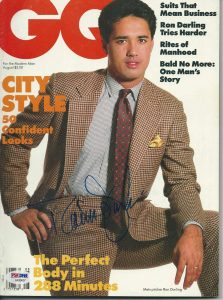 Not being mid-80s Gooden shouldn’t be a sin, but Darling also carried the perception that he could have achieved more than he did. Davey Johnson groused that he walked too many guys; fans groused that he got himself into trouble and wound up with too many no-decisions. Pro and amateur critics saw a common thread — that Darling was too smart and too much of a perfectionist for his own good. Not being mid-80s Gooden shouldn’t be a sin, but Darling also carried the perception that he could have achieved more than he did. Davey Johnson groused that he walked too many guys; fans groused that he got himself into trouble and wound up with too many no-decisions. Pro and amateur critics saw a common thread — that Darling was too smart and too much of a perfectionist for his own good.
Which was probably true. Darling’s combination of plus fastball, slider and curve was good enough to let him shove hitters around, but he wanted more than that. He wanted to befuddle them, working to arrange at-bats so they’d culminate in the perfect pitch put in the perfect location. Sometimes he’d make that pitch; other times, he’d outthink the hitter so thoroughly that he’d also outthink himself, or miss that perfect location by a fraction of an inch on a three-ball count. Later in his career, he added a split-fingered fastball to his repertoire, and arguably fell too in love with the new pitch, to the detriment of his secondary pitches. Darling wasn’t gifted with Noah Syndergaard‘s firepower, but he strikes me as a forerunner of Noah in one respect: He might have had a higher W-L percentage if he’d had a lower IQ.
Darling represents 1989 in our A Met for All Seasons series, which probably wouldn’t be his pick — he was 14-14 that year and stuck in a clubhouse undergoing a transition it wouldn’t survive, as the baton got fumbled in the handoff between the heroes of ’86 and a new generation of Mets. (Darling did become teammates with Viola, uniting the college adversaries from the game immortalized by Angell.) The next year he wound up in the bullpen and then under the knife, and as the 1991 season cratered the Mets traded him to the Expos for Tim Burke. Darling spent two weeks looking miserable in tricolor motley before being shipped to Oakland, where he won the 100th game that had cruelly eluded him as a Met. He started the final game before the ’94 strike and was released the next year, on his 35th birthday.
The upside of that was Darling avoided his first-ever trip to the disabled list, which was a point of pride for him; the downside was his career was over, and he had to figure out what to do with the rest of his life. He likes to tell a revealing story about coming home hoping to celebrate his newfound freedom with his family, only to find everyone was busy with play dates, tennis matches and other daily routines he knew nothing about. It was a surreal experience that showed him he’d spent years on scholarship while others made daily life work around him. Darling spent a few years decompressing from baseball, then came back to it as a broadcaster for the Nationals’ inaugural 2005 season. A year later, he moved to SNY. His early reviews as a broadcaster weren’t kind, but he worked doggedly at his new profession and was soon hailed as one of the best in the business.
In reaching that level, perhaps Darling has figured out what sometimes eluded him on the mound — that it’s not all on him. He’s the calm axis of the SNY booth, a vital balance point between Cohen’s rock-solid play-by-play and teed-up inquiries and Hernandez’s vortex of fascinating, maddening chaos. It’s a role where he can work deftly and efficiently to make both his partners better — the equivalent, perhaps, of picking a pitch meant to yield a grounder to short rather than a hitter frozen in horror at the plate. Maybe Darling runs down his own career because he sees now what he wishes he had seen then. But I hope he also sees that the lesson was learned — and that his resume is one to be proud of. Even by Darling family standards.
PREVIOUS METS FOR ALL SEASONS
1962: Richie Ashburn
1963: Ron Hunt
1964: Rod Kanehl
1965: Ron Swoboda
1966: Shaun Fitzmaurice
1967: Al Schmelz
1968: Cleon Jones
1969: Donn Clendenon
1970: Tommie Agee
1971: Tom Seaver
1972: Gary Gentry
1973: Willie Mays
1974: Tug McGraw
1975: Mike Vail
1976: Mike Phillips
1977: Lenny Randle
1978: Craig Swan
1980: Lee Mazzilli
1981: Mookie Wilson
1982: Rusty Staub
1983: Darryl Strawberry
1985: Dwight Gooden
1986: Keith Hernandez
1987: Lenny Dykstra
1988: Gary Carter
1990: Gregg Jefferies
1991: Rich Sauveur
1992: Todd Hundley
1993: Joe Orsulak
1994: Rico Brogna
1995: Jason Isringhausen
1996: Rey Ordoñez
1997: Edgardo Alfonzo
1998: Todd Pratt
2000: Melvin Mora
2001: Mike Piazza
2002: Al Leiter
2003: David Cone
2004: Joe Hietpas
2005: Pedro Martinez
2007: Jose Reyes
2008: Johan Santana
2009: Angel Pagan
2010: Ike Davis
2011: David Wright
2012: R.A. Dickey
2013: Wilmer Flores
2014: Jacob deGrom
2015: Michael Conforto
2016: Matt Harvey
2017: Paul Sewald
2018: Noah Syndergaard
2019: Dom Smith
2020: Pete Alonso
by Greg Prince on 28 October 2020 1:01 pm In the final World Series baseball played in the (reportedly) pre-Steve Cohen era of (potential) Metsian salvation, the pitcher who shouldn’t have been removed from the mound came out too soon; the player who had to be removed from the field came back against sound judgment; and the championship tournament appended to a season that seemed unlikely to be played at all ended just in time. This World Series, thus, goes down as a decent idea, an adequate reality and one more Sgt. Esterhaus-style reminder to be careful out there.
The Los Angeles Dodgers, a.k.a. the Vin Scully Avenue Blues, are the winners of the 2020 World Series, which seems about right in terms of getting baseball a champion that requires little effort to wrap one’s head around. Not that anything prior to 2020 was anything quite like 2020, yet the two World Series that followed the two previous living-memory seasons that were noticeably shorter than the norm, in 1981 and 1995, were contested and captured by teams that were chalk picks to make it that far. The Dodgers in ’81 were a perennial contender featuring some of the biggest stars of their time. The Braves in ’95 had gone to each of the three previous postseasons (when that still meant winning a division) and had stuffed a pair of pennants in their pockets. Dodgers-Yankees and Braves-Indians could be viewed as what the sport needed to remind folks estranged from the game in the wake of bitter labor-management disputes what the sport looked like when played by its contemporary flagship franchises.
After the sixty-game sortout that materialized after months of quarantine, 2020’s sixteen-team postseason could have been a crapshoot. Instead we got chalk again. We got the best records from each league. The Dodgers’ credentials were impeccable: eight straight division titles, two Series appearances, talent on top of talent cultivated by savvy management unafraid to spend a buck or zillion. What the Rays lacked in profile or perhaps profit they made up for in calculating how to fiercely compete. The Dodgers are so familiar to October by now that they’re essentially autumn’s home team. The Rays’ reputation transcends the identity of their parts, though their parts make an impression on anybody who spends a few nights watching them accomplish what needs getting done.
It was a perfectly reasonable matchup for incredibly imperfect times, and the series it produced exceeded the better-than-nothingness that was this fall’s baseline mandate. The Dodgers outshone the Rays across six games, though the one game worthy of enshrinement in the all-timer’s club belonged to Tampa Bay, specifically its Daniel Murphy of the month, Randy Arozarena, and its Al Weis of the moment, Brett Phillips. Game Four was already pretty close to being one for the ages before Phillips (a .202 hitter in 153 regular-season games since 2017) batted for the first and only time in World Series competition, with two out in the bottom of the ninth after entering as a pinch-runner in the bottom of the eighth and sticking around as the right fielder in the top of the ninth. When he came to the plate, the Rays were down by a run on the scoreboard and a game in the Series. Kevin Kiermaier, who had singled, was on second. Arozarena, who had walked rather than explode for one of his ten postseason home runs, was on first.
Series dreams are made of this; who was Brett Phillips to disagree? He lined a single into center to score Kiermaier with no fuss and tie the game at seven. The Dodgers’ center fielder, Chris Taylor, mishandled the ball, though, so Arozarena, whose October it was and we were all just living in it, tore around second and was waved home from third. The relay from the outfield was cut off by Max Muncy at first. Muncy threw home. Arozarena stumbled and fell. Recovering quickly, he turned back toward third. Catcher Will Smith, however, didn’t catch what Muncy threw him. In a blink, Arozarena pivoted and turned back toward home while Smith chased what Dodger pitcher Kenley Jansen hadn’t bothered to back up. There was no play at the plate, unless you count the nine poundings Randy gave it to signify that, yes, the Rays had won the damn thing in the ninth inning, 8-7.
That’s a play you rewind repeatedly the second you’ve absorbed what just happened. That’s a play you stay up as late as you can dissecting and, once you awaken, you start looking for highlights so you can analyze it some more. That’s a play that sends you immediately to the precedent file because during the World Series you mentally gravitate to the World Serieses that have preceded it and instinctively orbit that time that was just like this time even if no time was ever like this time, not in the Brett Phillips driving in the tying run/Randy Arozarena falling down and getting up with the winning run sense nor in the World Series being played at a neutral site before a quarter-house after everybody in uniform (if not the stands) had been confined to a bubble for the duration sense.
That’s how you set a new precedent. That’s why you’re glad you stayed up to watch, no matter how frigging long these games lasted.
Game Four is what MLB Network asks Bob Costas and Tom Verducci to discuss for an hour or two over Zoom. Game Six was destined to serve as the rest of the story. The Dodgers had won a calmer Game Five (its chance for nonsectarian elevation into the postseason pantheon was caught at home when Manuel Margot attempted but failed to steal it) and were on the cusp of clinching Tuesday night. Nevertheless, the Rays still had Arozarena, and Arozarena belted yet another homer in the first. He handed the 1-0 lead to Blake Snell, and Snell, who won a Cy Young a mere two years ago, clutched it tightly as could be. Even accounting for the strikeout-strewn landscape of contemporary baseball, Snell was spectacular, blowing away L.A. for five-and-a-third innings, giving up only a single while fanning nine. Then Snell made the mistake of giving up a soft bases-empty, one-out single to Austin Barnes in the sixth, a mistake mostly because Snell pitches for the Rays, and the Rays get as far as they do on limited resources by figuring out with immense certainty what will and won’t work regardless of what the naked eye sees.
The naked eye saw Snell in total command. The Rays, embodied by manager Kevin Cash, saw a pitcher about to face the Dodger order for the third time, which has generally not been optimal for Snell, never mind that Snell couldn’t have been more optimal for the Rays or lethal to the Dodgers. When Cash took out a pitcher whose line was no runs, two hits, no walks, nine Ks and 73 pitches total, Fox’s microphones could pick up the high-fives in the Los Angeles dugout.
Nick Anderson, who is a very good reliever but wasn’t having a particularly good postseason, replaced Snell and, almost as quickly as Arozarena sprang to his feet on Saturday, crystallized every anti-analytic argument from Arlington to Albania. Mookie Betts doubled Barnes to third. With Corey Seager batting, Barnes scored and Betts advanced on a wild pitch. Then Betts whooshed home on Seager’s grounder to first. That — along with a Betts leadoff homer in the eighth and stellar Dodger relief all night — was the game right there. Connoisseurs of World Series pitching debates who are still picking over the passing over of George Stone to start Game Six in 1973 rarely mention that while Tom Seaver on short rest surely wasn’t his sharpest, the Mets never touched Catfish Hunter. No way Cash should have hooked Snell so robotically, but no way Arozarena’s first-inning homer was sufficient support for any Cy Young winner. The final score in that Stoneless Game Six was the final score in this suddenly Snell-deprived Game Six: 3-1.
You can vaguely dislike the Dodgers on any number of levels, but you had to feel good for Clayton Kershaw finally getting fitted for a ring. You can deeply despise the Dodgers for having harbored the criminal Chase Utley, but you couldn’t in all good conscience deny 93-year-old Vin Scully the pleasure of pulling up a chair for his franchise’s seventh world championship, the only one they’ve ever won without him on the active broadcast roster. And as a Mets fan, even if you sided with the Rays for having knocked off the Yankees, you had to wish a celebratory pie would be planted gently in the bushy face of Justin Turner, who shed his utilityman beginnings back east to soar to the top of the San Gabriel Mountains out west. Turner’s been gone so long that the resentful residue left behind by Guy Who Gets Better As Soon As He Leaves Us should be plenty dry by now (at the end of a World Series that, incidentally, pitted two former Travis d’Arnaud employers). Yet when SNY rerairs Johan’s no-hitter, and Santana’s postgame interview with Kevin Burkhardt is interrupted by the giddy redhead with the shaving cream in a towel…well, that’s so Justin. Wherever he filled in or whether he simply sat and cheered between 2010 and 2013, as a Met he was always super useful and superbly supportive. He was the one Dodger for whom a rooting interest came naturally enough.
Then, because he must have a little Met left in him, he became a story that overwhelmed everything that came before him. Bigger than MVP Seager. Bigger than cinch Hall of Famer Kershaw. Bigger than the ability of Arozarena to jump a little lighter. Bigger than discovering Cash is so named because the Dodgers are likely to vote him a full share.
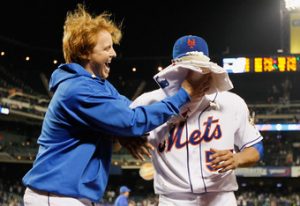 Turner in comparably giddy but exponentially more innocent times. Justin Turner was taken out of Game Six before its conclusion without explanation. If it was the regular season, you’d guess he was traded. Because it’s 2020, it should have occurred to us that he’d tested positive for Covid-19. Yup, that was it. If it can happen to anybody, it can happen to an about-to-be world champion third baseman. What a blow to Turner; to the Dodgers; to MLB, which had just completed, via Rob Manfred’s podium bloviations, patting itself on the back for persevering through an abbreviated schedule and extended playoffs without ever shutting down altogether. It’s hard to imagine a Game Seven proceeding as planned given that nothing Covid touches proceeds as planned. The Rays’ disappointment notwithstanding, the World Series packing up its temporary tent in Texas happened right on time. The most important thing here, of course, was they got Turner’s test result, they acted accordingly, Justin was safely self-isolating, and…
Oh, there’s Justin Turner emerging from his mandatory holding room to join his teammates on the field for pictures and trophy-clutching and championship hugs because how ya gonna tell a player who’d been in the majors since 2009 to celebrate winning his first World Series all by himself? His mingling among the presumably uninfected at Globe Life Field was inadvisable, but a least Justin was wearing a mask, and….nope, he took that off, too.
“I can’t believe what I just saw!” returned to a Dodgers World Series context in a flash.
On one hand, if you were in fact using that hand to cover both eyes, you couldn’t blame Justin, who’s always had an element of big kid to him, for wanting to be out there with his comrades. He’s been a Dodger since 2014, which meant he’d endured one ultimately unsuccessful October after another until now. The Dodgers as a whole hadn’t won the World Series since 1988. For those born in 1989 or later, this was a once-in-a-lifetime event.
On the other hand, Covid-19 is a daily threat to everybody, whether they’ve just won the World Series or not. There’s no science publicly disseminated that indicates those who’ve just tested positive are exempt from spreading the virus because the Dodgers finally got over the hump. Justin Turner zipped from object of sympathy to object of derision (and MLB from admirable to irresponsible) in about as many seconds as it took Arozarena to switch directions twice in Game Four.
A black eye for baseball? A pie in the face at least.
by Jason Fry on 23 October 2020 7:06 pm Welcome to A Met for All Seasons, a series in which we consider a given Met who played in a given season and…well, we’ll see.
In the 2012 offseason, the Mets made a controversial deal, sending knuckleball artist and fan favorite R.A. Dickey to the Blue Jays for a return built around a minor-leaguer who was seen as a can’t-miss prospect.
It’s easy to forget that minor-leaguer was Travis d’Arnaud, billed as a tough catcher with a sweet stroke that generated opposite-field power. D’Arnaud never fulfilled his promise in New York, ground down by a drumbeat of injuries that bordered on Biblical and finally exiled after a Jeff Wilpon hissy fit. The other prospects in the deal were an outfielder named Wuilmer Becerra and a right-handed pitcher named Noah Syndergaard. Both were regarded as lottery tickets — Becerra had power and speed, while Syndergaard had a flamethrower for an arm — but were very much unknown quantities.
Eight years later, Syndergaard is still something of an unknown quantity, if we’re being honest about it. But it’s a different kind of unknown, that comes with a raft of questions. The immediate one is whether Syndergaard’s elbow ligament will reknit the way he and we would like, which isn’t the gamble it once was but is still uncertain. Beyond that, the questions are the same ones that have dogged Michael Conforto: Will Syndergaard ever be great, or do Mets fans need to settle for his merely being really good?
They’re the kind of questions you hope to get to wrestle with — just as Syndergaard is a fascinating pitcher to try to sum up. From his career stats to his potential to his manner on the mound and the workings of his brain, he’s the model of a modern pitcher.
It starts with the arsenal, of course — something that always brings me back to when I was first getting to know Syndergaard. The fastball was nearly 100, with that hard sink that makes hitters feel like they’re trying to connect with a shotput. But we’d known that was coming. We hadn’t known about the evil changeup, the sharp curve, or the slider. Oh God, that slider — on Opening Day 2016 it was coming out of Syndergaard’s hand at 95. Sample scouting report: That shit’s fucking unhittable.
Which gets us to the modern part. If you were a baseball-mad kid in the late Seventies and early Eighties, you could name every pitcher in the big leagues who threw 95. Ninety-five demanded memorization. It was elite bordering on superhuman. Today, I couldn’t name all the pitchers on the Mets roster who throw 95. A fastball hitting 100? Just another day at the office. Meanwhile, the number of pitchers who threw a 95 MPH slider in the early Reagan administration? It was zero. That pitch didn’t exist.
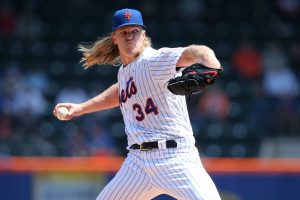 Hammer of the gods, coming at you. That’s what 35 years of nutrition, travel teams, increased attention to mechanics and specialized roles have wrought: secondary pitches with the velocity once reserved for fastballs, and once-legendary fastball velocities become routine. But a lot of today’s pitchers have that raw material. To it, Syndergaard added command, feel and brains. In the fall of 2015, more than one awed observer compared him to a videogame player who’d found the cheat codes. Four plus pitches and a brain that knew what to do with them? How did that even happen?
It helped that he arrived with his own myth, sporting flowing blond locks and the nickname Thor. He hadn’t exactly run away from that persona, either — images of him working out in Thor gear had gone viral while he was still a minor-leaguer. But you know what? The real name was pretty good too. Noah Syndergaard? Really? Old Testament patriarch meets Viking warrior? Who names a kid that, particularly if they don’t have a friendly Norn to drop by the delivery room and say, “Psst, your little bundle of joy’s going to be a baseball-hurling demigod?” (If you’re curious, the name in Denmark was Sondergaard. That slight shift of vowels to something more fiery should also count as a wise mechanical tweak.)
Thor was divine from the get-go, but Noah needed some work. At 14, Syndergaard was just shy of six feet, but encased in baby fat and so clumsy that his family good-naturedly called him Bumpy. His early-teen photos look a lot more like yours or mine than you’d expect — he’s burdened by a terrible haircut, unfortunate glasses, and a palpable sense of dismay about it all. Syndergaard always loved sports, and was on his Texas high school’s freshman baseball team, but he rarely got into a game and was made fun of by his teammates. But oh, how things were about to change. He kept growing — all the way to six-foot-six — decided to remake his diet and his body, and saw his right arm turn into Mjolnir. As origin stories go, that one’s up there with Steve Rogers agreeing to the U.S. Army’s experiment or Peter Parker encountering a radioactive spider.
But Syndergaard, endearingly, has never stopped sounding a bit like his old geeky duckling self even after turning into a fiery, terrifying swan. “My arm is like a trebuchet,” he told reporters during the 2015 playoffs. “It’s got to be loose and whiplike, and you have to use the force of your body to deliver the pitch.” When I read that, I needed a minute. Trebuchet? Really? Who was this kid?
A smart pitcher, for one thing. After his 2015 call-up, Syndergaard leaned heavily on his fastball and was more thrower than pitcher. He soon discovered the limits of that approach, falling into predictable patterns and getting hurt. It’s an adjustment every pitcher has to make, and one many never do. Syndergaard put it behind him at near-record speed, working with Dan Warthen on refining his mechanics and varying his arsenal. He muzzled the Dodgers for a critical inning behind Jacob deGrom in the NLDS clincher, beat the Cubs in Game 2 of the NLCS beatdown, and won Game 3 of the World Series against the Royals. The next year he looked stratosphere-bound, authoring an All-Star campaign that included 14 wins, 200+ Ks and a 2.60 ERA, on the way to his wild-card staredown with Madison Bumgarner.
And he had fun doing it. Syndergaard was an interesting contrast with Matt Harvey. Both enjoyed the spotlight and embraced their highly marketable nicknames, but those nicknames came to seem all too apt: The Dark Knight was tortured and ill at ease, while Thor was sunny and goofy. Both had to deal with the weirdness of being famous for throwing a baseball, but Syndergaard handled it with seeming nonchalance while Harvey twisted himself into a knot. If Harvey went out on the town or flashed a middle finger before surgery, somehow it became a thing for talk radio to fuss over; Syndergaard could roll into Port St. Lucie on a horse he didn’t really know how to ride or call Bryce Harper a douche on Instagram and people would just laugh. Not that he was a lightweight — like Harvey, he brought a necessary meanness to the mound, understanding the psychological value of 100 MPH inside. When the Royals took exception to that, Syndergaard coolly suggested anyone who didn’t like it could meet him on the mound. (He later claimed he’d meant he’d be waiting there to explain his side of the issue, which wasn’t convincing; he also said while he’d never been in a fight, he liked his chances, which was.)
That was Noah Syndergaard going into 2017. What would he do next? To me, the answer seemed clear: He was going to become the best pitcher the Mets had ever had. Yes, better than Tom Seaver or Dwight Gooden or deGrom. It was a big claim, but said it and I meant it. Because I’d never seen an arsenal like that, attached to the body of a god and powered by a brain and a psyche that could deliver on those physical possibilities. Syndergaard made me ask the same question once asked of Bret Saberhagen: How could a pitcher with all that ever lose?
And then, well, things got complicated. Maybe that invocation of Saberhagen should have been a warning.
Things went physically wrong — in 2017 a bulked-up Syndergaard refused to get an MRI for a sore bicep, then wound up tearing a lat and missing most of the year. But things went wrong in other ways, too. That otherworldly slider got a lot more mortal, losing velocity and proving far more hittable. Syndergaard sometimes looked like the work in the progress he’d been as a rookie, cruising along, then blowing up and departing games in frustration. It also didn’t help that he was pitching in front of a chronically shoddy Mets defense — a sinker that produces ground balls isn’t much good without gloves that convert enough of them into outs. And he was competing against his own potential, of course. In 2018 — the year he represents in A Met for All Seasons — he won 13 games with an ERA a hair above three, a campaign that’s only a disappointment if measured against what you figured he was capable of. Which is the yardstick we all used. 2019 was a head scratcher: a 4.28 ERA, fewer strikeouts, more walks, less thunder.
And then, the inevitable arrived at last: a torn UCL and a lost 2020.
Pitchers break — that’s intrinsic to the profession. Every time Syndergaard threw one of those lightning-bolt fastballs or cosmic-prankster sliders, I held my breath a little. I was afraid I’d see him spin on the mound, clutch his elbow, and shake his arm. I hoped for him to cheat the odds, to be Seaver or Bob Gibson or Nolan Ryan or one of the other fireballing aces whose genetics and luck we habitually confuse with character and grit. I hoped for that, even as I waited for the word that he was like nearly everybody else. Cruelly, that news came when no one was looking, a couple of weeks after the coronavirus had shut down spring training. Syndergaard had Tommy John surgery on what was supposed to be Opening Day.
His future? You tell me. There are too many unknowns — his elbow, the state of the Mets, what happens with baseball labor relations, and a whole lot else. Maybe he’ll return and still be Thor. Maybe our next comic-book journey involves new ownership, a revitalized team and a golden-locked hero who’s set his mind on vengeance. Or maybe the Syndergaard of late 2015 and 2016 was the pinnacle of what he could be. Maybe those were the days to savor, and I spent them looking impatiently to a future I should have remembered wasn’t guaranteed.
I don’t know. Anyone who says they do is kidding you. But whatever the case, late at night I go back in time, to the same fork in the road I know I should stop revisiting. It’s Game 5, only this time Lucas Duda makes the throw and Eric Hosmer is out at the plate and the Mets have escaped. That means Game 6 will be in Kansas City. DeGrom’s going to the mound looking to even the Series, eager to avenge his Game 2 misstep. And if he wins, Syndergaard’s waiting in the wings for Game 7. He’s studied that Royals lineup anew. He’s confident in the fastball, and the wipeout change, and the PlayStation slider. He’s even tweeted out a photo or two involving hammers and winged helmets, because this stuff is fun. Is he ready? Ready is for lesser things, for running errands or a night on the town. He’s only been waiting his whole life for this — the moment in which he becomes what he’s always been destined to be.
PREVIOUS METS FOR ALL SEASONS
1962: Richie Ashburn
1963: Ron Hunt
1964: Rod Kanehl
1965: Ron Swoboda
1966: Shaun Fitzmaurice
1967: Al Schmelz
1968: Cleon Jones
1969: Donn Clendenon
1970: Tommie Agee
1971: Tom Seaver
1972: Gary Gentry
1973: Willie Mays
1974: Tug McGraw
1975: Mike Vail
1976: Mike Phillips
1977: Lenny Randle
1978: Craig Swan
1980: Lee Mazzilli
1981: Mookie Wilson
1982: Rusty Staub
1983: Darryl Strawberry
1985: Dwight Gooden
1986: Keith Hernandez
1987: Lenny Dykstra
1988: Gary Carter
1990: Gregg Jefferies
1991: Rich Sauveur
1992: Todd Hundley
1993: Joe Orsulak
1994: Rico Brogna
1995: Jason Isringhausen
1996: Rey Ordoñez
1997: Edgardo Alfonzo
1998: Todd Pratt
2000: Melvin Mora
2001: Mike Piazza
2002: Al Leiter
2003: David Cone
2004: Joe Hietpas
2005: Pedro Martinez
2007: Jose Reyes
2008: Johan Santana
2009: Angel Pagan
2010: Ike Davis
2011: David Wright
2012: R.A. Dickey
2013: Wilmer Flores
2014: Jacob deGrom
2015: Michael Conforto
2016: Matt Harvey
2017: Paul Sewald
2019: Dom Smith
2020: Pete Alonso
by Greg Prince on 20 October 2020 11:02 pm Welcome to A Met for All Seasons, a series in which we consider a given Met who played in a given season and…well, we’ll see.
I’m solid gold
I’ve got the goods
They stand when I walk
Through the neighborhoods
—David Naughton
In 1989’s Field of Dreams, the fresh-faced kid Ray Kinsella and Terence Mann picked up hitchhiking seemed to have emerged from another time. Specifically, as Ray noted to Terence while the young man with baseball ambitions napped in the back seat, “The way he described towns, and finding you a job so you could play on their team. They haven’t done that for years.”
Many moons (and Moonlights) later, it occurs to me another youthful ballplayer, who was most certainly of his time, would seem fairly alien in our time if he materialized in 2020 and shared with us the story that captivated the four-decades-ago version of us.
“Yo, thanks for the lift,” you can imagine him saying if we picked him up by the side of the BQE today. “Turns out my Trans-Am needs a tune-up and I didn’t wanna take the subway to the ballpark in Queens. I get recognized from the pictures of me they got up in all the cars. I’m from Brooklyn, see, and the team is relying on me to not only be their best player, but their biggest star. I don’t wanna sound like I’m bragging, but people treat me like a pretty huge deal around here, what with me being a hometown guy, hitting a little over .300 once, getting my homer total in the mid-teens annually and generally driving in close to eighty runs. I also run pretty good, make occasional fancy-looking catches and wear my uniform so it practically sticks to me. Listen, you can drop me off outside when we get there. The guards’ll let me in. They know me. Everybody knows me.”
Lee Mazzilli in 1980 was an idol the likes of which we just don’t have today, yet he was surely who we reveled in idolizing back then. If deconstructing the whole Archie Graham/Burt Lancaster dynamic challenged the sanity of the contemporary characters played by Kevin Costner and James Earl Jones at the end of the ’80s, we began the ’80s confident Mazzilli was the Met on whom the sun and moon rose and set, and it didn’t seem the least bit crazy in our world.
Lee Mazzilli lit up our Mets fan lives, such as they were.
I don’t want to imply Lee Mazzilli wasn’t a good ballplayer. He was a fine ballplayer. The advanced statistics which didn’t exist at the height of his Met fame indicate we weren’t overstating his skills merely because we didn’t have anybody else to get terribly excited about. For three years — 1978, 1979, 1980 — Mazzilli’s OPS+ topped 120, the sign of a hitter performing well above average. In 1979, the season he went to the All-Star Game and made us extremely proud, he finished sixth among all National Leaguers in offensive WAR, per Baseball-Reference. Nobody in the NL cobbled together a better power-speed number (accounting for combined home run-stolen base prowess) in 1980 than Mazz. Granted, I feel a bit like Disco Stu trying to impress investors in a 1997 episode of The Simpsons by citing how healthy disco record sales were in 1976, but when Mazzilli was at his best, he was quite good.
But from the vantage point of what the game looks like in 2020, it’s difficult to imagine that Lee Mazzilli having anything close to the same impact. Hardly anybody leads a team with 16 home runs anymore unless the season is 60 games long. Hardly anybody is greenlighted to steal 41 bases anymore, nor risk getting thrown out 15 times trying. No franchise attempts to appeal to the largest possible cohort of customers by building itself around a 6’ 1”, 180-lb. center fielder/first baseman whose numbers are better than OK, but never mind his numbers because a) he’s a looker and b) he’s local.
He’s from Brooklyn!
He’s Italian!
You gotta come see him in Queens!
We’ll give you his poster!
This was the essence of the Mets’ sales pitch c. 1980. It worked on those of us predisposed to buy whatever it was the Mets were selling.
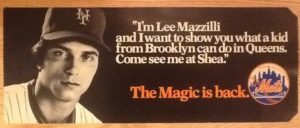 Yo, what more do you need to know? Mazz — rather than Maz, because two z’s equaled more pizzazz — was born in Brooklyn in 1955, which coincidentally was the year the Dodgers won their only World Series in Brooklyn. Or was it a coincidence? Mazzilli was drafted in the first round by the Mets out of Lincoln High School in Sheepshead Bay in 1973, one year after The Boys of Summer was published. Whatever his intention with his literary masterpiece, Roger Kahn tapped into something almost tangible that spoke to a larger temporal truth. After the municipal havoc of the late ’60s and early ’70s, the New York air — including in the suburbs, where a lot of former Brooklynites had migrated — was thick with wistfulness for a lost age, baseball’s and otherwise. Chronologically, we weren’t so far removed from what is often reflexively referred to as the golden age of New York baseball, when the Yankees were a flannel-clad dynasty who blew cigar smoke at the Copacabana and the Giants were a more stolid outfit, but a couple of times they were very surprising and very exciting. Yet it was the Dodgers who were the Boys of Summer, the Dodgers who remained retroactively aspirational. The Brooklyn Dodgers of the 1950s were a vibrant if sepia-toned living memory a generation after they ceased to exist — and the 1950s of the Brooklyn Dodgers a place that seemed real enough if people who remembered it talked about it enough. There were no more Brooklyn Dodgers in the 1970s, but a ballplayer from Brooklyn showing up to play ball in Queens…a ballplayer who plays the same position as Mays, Mantle, Snider and, for that matter, DiMaggio…hey, you can hear somebody thinking, that’s something we can sell.
I doubt compelling biography is why the Mets drafted fourteenth in the nation the ambidextrous speedskater who snuck into Shea with his friends in the middle of the night in 1969. There’s no way it was because his dad had been a welterweight boxer before turning to piano-tuning that called up Lee to stay in 1976 and presented him with the center field job in the spring of 1977 despite his hitting only .195 during his previous September’s audition (albeit with a couple of ninth-inning homers, one of them a walkoff shot that torpedoed the Pirates’ faint pennant hopes). Yet once Mazzilli put down roots at Shea, it was hard to miss the inherent qualities he had coming and going in disparate directions, suitable for someone who knew how to use both hands. He innocently represented a link to the nebulous good old days in Flatbush as much as he potentially pointed toward a more fortuitous future in Flushing for a franchise that needed anything it could that would make people forget about the endless and endlessly abysmal present.
A stream of Brooklyn-bred ballplayers have populated Met clubhouses dating to the Mets’ beginnings, spanning Piggy (Joe Pignatano) to Figgy (Nelson Figueroa) and beyond, depending on how you view Dellin Betances of Manhattan having played scholastic ball across the East River at Grand Street Campus. John Franco went to Lafayette, like Bob Aspromonte before him and Kevin Baez after him. Willie Randolph went to Tilden. Shawon Dunston went to Thomas Jefferson. Tommy Davis was a man among lads at Boys High School. Ed Lynch and Paul Lo Duca were born in the borough (Paul’s dad was Lee’s sandlot coach), though they grew up elsewhere. Before Todd Frazier was from Toms River and Neil Walker was from Pittsburgh, Met announcers reminding you which Mets were from Brooklyn could have constituted its own version of Wayne Randazzo’s #HowieBingo card.
Also, the fella who’s owned part or essentially all of the team these past forty years, you might have noticed the last time you were in a certain Rotunda, is originally from Brooklyn.
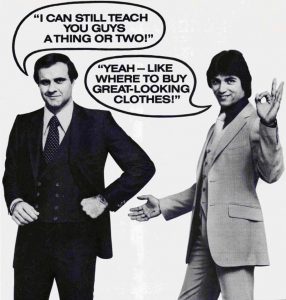 Every Mets fan was crazy for a sharp-dressed Mazz. Birthplace or where a player spent his youth is a briefly referenced biographical note these days, give or take the occasional overdose of Neil Walker or Todd Frazier info. But being from Brooklyn when it was learned who Mazzilli was really seemed to mean something, especially within the media when the wounds from when the Dodgers deserted the borough still lingered in the collective Metropolitan Area psyche. Dick Young and Jack Lang covered those Dodgers. Maury Allen and Steve Jacobson rooted for those Dodgers. Given how regularly Mazzilli’s background was mentioned in stories and during broadcasts, I find it impossible to believe being The Kid From Brooklyn didn’t give him a leg and two arms up on standard ambidextrous rookies who hit .250.
In a city whose baseball stars in previous eras included DiMaggio, Berra, Rizzuto, Camilli, Furillo and Antonelli, to name a bunch, being Italian-American didn’t hurt, either, at least in terms of fomenting an image for a 22-year-old ballplayer who was tabbed starting center fielder the same month Rocky won Best Picture at the Oscars. You know what Rocky Balboa nicknamed himself in the movie, right? The Italian Stallion. You know what everybody started calling Lee Mazzilli during his first full season? The way baseball had worked for a century, it didn’t hit the ear as impolitically as it does today. Carl Furillo was “Skoonj” to his Dodger teammates, short for scungilli (he ran the bases as slow as a snail). Al Rosen was the Hebrew Hammer in the ’50s. Juan Marichal was the Dominican Dandy in the ’60s. Emil Frederick Meusel, who played left for John McGraw’s Giants in the ’20s, was called Irish because he was said to “look Irish”.
Still, for all the marquee Italian surnames that have graced Met rosters — Franco, Piazza, Conforto, to name three — no Met was ever quite cast in the role of Great Paisan Hope the way Mazzilli was. Pignatano was the longtime bullpen coach when Mazz arrived. Joe Torre was Lee’s mentor as a teammate before being named Met manager. Pete Falcone and John Pacella joined the pitching staff in due time. But only Lee Mazzilli from Brooklyn was the Italian Stallion. At a cultural moment when Sylvester Stallone was starring in the film that won the Academy Award and John Travolta was dancing like nobody’s business as Tony Manero — in Bay Ridge, no less — maybe the Italian Stallion wasn’t such a bad thing to be known as. Salute!
In those days, anything for a hook, anything for a story, anything to make you forget sixth place. These days, low-key pregame heritage theme nights notwithstanding, I’m failing at fathoming any individual player being promoted quite so sincerely ethnically, even if it’s as well-intended as could be. This year I saw a segment on the MLB Network, recorded during Spring Training, wherein Mark DeRosa queried Michael Conforto as to whether he preferred calling what he put on his pasta “sauce” or “gravy,” and the question was a little jarring to my 2020 sensibilities. Honestly, it never occurred to me whether Conforto, a Met since 2015, was anything but Metropolitan-American. I knew he was from somewhere in the Pacific Northwest. I had no idea whether he was or wasn’t Italian, even if the last name is something of a giveaway (FYI, Michael chose “sauce”).
Long before Conforto was born in 1993, but well after the Dodgers left town in 1957, you had this Italian kid from Brooklyn who wanted to play baseball more than anything. When Lee was coming of age, youth soccer had yet to be widely organized and video games had yet to be invented. Football may have been in the process of surpassing baseball as a television sport, but nobody strenuously challenged baseball’s claim as “the national pastime” any more than anybody thought there was anything a little off-color in calling a baseball player “the Italian Stallion”. Mazzilli could have pursued the Winter Olympics as a teen; he was that good a speedskater. But Lee was a baseball man in the making all along. “I played stickball, punchball, slapball, softball,” he recalled for Steve Serby in the Post in 2007. “Played ’em all.” What could have been a more All-American New York baseball story than Lee Mazzilli’s? Whose story could have been truer to what New York’s romantic self-image had been throughout the twentieth century?
Contrast the recollections of Mazzilli’s hardly misspent youth with this 2017 report on the continuing decline in youth baseball across the five boroughs: “No one culprit is blamed for this loss. Instead, it’s pinned on an array of factors: competition from other sports like soccer, the increased popularity of digital devices, rising league fees, longer school days and even immigration, which has in some neighborhoods replaced the Louisville Slugger with a cricket bat. The sport itself, from the recent rise of travel teams to the age-old quirks of baseball — its pace, its difficulty — also gets blamed.”
In other words, good luck trying get a slapball game going on a block near you. (And this was before the pandemic.)
So, sure, we still have ballplayers of Italian descent, like Mazzilli is. And sure, we still have ballplayers who went to high school in Brooklyn, like Mazzilli did. And yes, though they’re in short supply and haven’t made much impact of late — the last three on the Mets were Billy Hamilton, Sam Haggerty and the presumed alive Jed Lowrie — we still have ballplayers who aim to hit both lefthanded and righthanded like Mazzilli could. Yet I’m having a hard time living in the modern era and imagining somebody coming to the fore now the way Mazzilli did then and having somebody weave a narrative around him the way it was done. “Italian Stallion from Sheepshead Bay trackin’ ’em down in center, swipin’ bags, beltin’ one out now ‘n’ then — and the ladies can’t take their eyes off him!” sounds like a 1950s Madison Avenue ad man’s dream.
Jerry Della Femina was a Madison Avenue ad man in 1980, in the business since the 1960s. He was also born in Brooklyn, in 1936, and he became the Mets’ ad man when Nelson Doubleday and his Brooklyn-born minority partner Fred Wilpon bought the team. The Mets hadn’t much advertised prior to 1980. Casey Stengel was all the salesman they needed in 1962, then big, beautiful Shea Stadium sold itself long enough to attract attendance until the Mets won a World Series. For a while after 1969, it was enough to make sure the papers printed the time the game started. But by 1979, at the end of a decade when the Mets couldn’t have hemorrhaged more ticket-buyers had they tried, the goodwill was gone. (Shockingly, 1977’s hastily created “Bring Your Kids to See Our Kids” campaign, despite featuring Mazzilli and his demographic peers, didn’t much move the needle following the trade of Tom Seaver.)
The new owners turned to Della Femina, who conjured “The Magic is Back” as the Mets’ slogan. Print ads played up that these new Mets will be sort of like those old Dodgers you, Mr. Maybe Ticket Buyer, remember from the ’50s in that they’ll make you care when they inevitably break your heart. The 1980 Mets weren’t far enough along to get beat by modern-day Bobby Thomsons and Don Larsens in October, but one miracle at time. Implicit in the pitch was these new Mets, or at least these Mets you haven’t looked too closely at lately, have some guys who can make a little Magic en route to getting competitive. As 1980 dawned, the first player Della Femina thought of to illustrate the point was the Met who mesmerized what was left of the masses in Flushing in 1979. That was Mazzilli, a.k.a. the Italian Stallion, coming off the season that not only earned him his All-Star berth but his poster day.
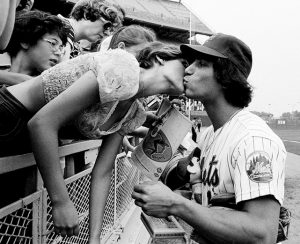 Social distancing be damned. Lee Mazzilli Poster Day predated the Mets’ more consolidated marketing efforts. It was a one-off. They weren’t having them for Kevin Kobel or Bruce Boisclair. Lee was among the batting average leaders coming out of the gate in ’79, and if nobody was coming to the park to see him in person based on his hitting, perhaps they’d schlep to Shea to get a big damn poster of the guy they were hopefully watching on TV. Lee was photographed posing on the dugout steps, hatless and handsome. Saturday July 7 vs. the Padres was chosen for the giveaway. It was also San Diego Chicken Day — and the day the name Mettle was announced as the identity of the team mule (you’d think they’d have invested in a stallion). The promotional onslaught drew 14,048. The Mets lost, 11-3. Lee went 1-for-3, leaving his average at .332.
Ten days later, bespectacled Lee wore his cap and his rather tight road uniform in Seattle, representing the Mets on the National League All-Star Team alongside last-minute injury replacement John Stearns. Pinch-hitting for Gary Matthews, who had subbed in for starter George Foster, Mazzilli stepped in to lead off the eighth and whack an opposite-field home run off the Rangers’ Jim Kern to tie the game for the NL. Lee batted left, lined it to left and hopped on home plate after circling the bases. Waiting to congratulate him was the cream of the senior circuit: Dave Winfield of the Padres; Joe Morgan of the Reds; Ron Cey of the Dodgers; Pete Rose of the Phillies; Keith Hernandez of the Cardinals; Gary Carter of the Expos. In the NBC booth that night, Cincinnati ace Tom Seaver — usually in uniform for these affairs — praised his former teammate. “I had the pleasure of playing with him in New York for a couple of years when I was still with the New York Mets,” Seaver said over a replay. “He’s really become a fine hitter, he’s really learned the strike zone, and he goes with the pitch now, he’ll go with that ball, a lot of strength.”
“There are not too many players in All-Star Game history who did what Mazzilli just did,” Tony Kubek added. “First All-Star at-bat, and he hits a home run.”
Because this was the era when the National League never lost to the American League, it was just a matter of staying tuned and finding out how the NL would pull it out. In the top of the ninth, Kern walked the bases loaded, and with two out, was relieved by Ron Guidry of the Yankees. Batting for the National League? Lee Mazzilli of the Mets, this time from the right side. It was a miniature Mayor’s Trophy Game at the Kingdome. Mazz, having learned the strike zone, just like Seaver said he had, worked the count to three-and-one before calmly taking ball four. Mazzilli did a baton move with the bat, twirling it as he tossed it, much as he might have with a broom handle beating his buddy at stickball back home. It was only a walk, but it was the go-ahead RBI just the same. When the National League held on in the bottom of the inning, it stood as the winning RBI.
For a few minutes, you could forget the Mets were stuck in the basement of the NL East for a third consecutive year. You could forget the Yankees had won the last two world championships. You could overlook the All-Star Game MVP award being voted to Dave Parker for his two breathtaking outfield assists. You didn’t care that Mazzilli’s average had been steadily dropping since they gave out his poster. On the stage where the attention of every baseball fan in North America was focused, Lee Mazzilli was the star among Stars. He was ours. The kid from Brooklyn. The kid from Queens. The Met who belonged up there. We hadn’t had anybody who made us feel this way since Tom Seaver had the pleasure of playing with him in New York.
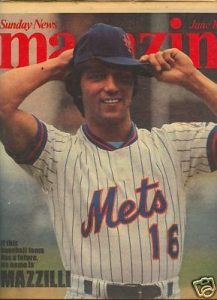 No, that uniform could not be any tighter. All Mazzilli had to do the rest of 1979 was not get hurt (Dan Norman crashed into him in the outfield but Mazz missed little time) and not finish below .300 (his average landed at .303), and we’d fully believe what the Daily News plastered on the cover of its Sunday magazine in June: “If this baseball team has a future, its name is MAZZILLI.”
***Della Femina apparently believed it, too, for when he got the Mets account, he was determined to make sure everybody who wasn’t already clued in aware that Lee Mazzilli was the present, the future, the biggest star in the biggest city. Or as the ad man said in the press in April of 1980, just as the “The Magic is Back” slogan was taking flight (and eliciting giggles following an offseason when the 63-99 Mets of the year before hadn’t been noticeably improved upon), “New York is a town where we had to settle for Reggie Jackson. I would rather have a clean-cut kid who talks to kids,” meaning Mazzilli, who, Della Femina clarified, featured “Bucky Dent’s good looks, but he can hit.”
Not too much pressure to put on the now 25-year-old Mazzilli, though Della Femina Travisano & Partners certainly tried, making him one of the centerpieces of The Magic is Back’s transit advertising. Lee’s head shot greeted MTA riders with the pull quote intended to boil down his most Metsian appeal: “I’m Lee Mazzilli and I want to show you what a kid from Brooklyn can do in Queens. Come see me at Shea.”
Slowly but surely, some did. Attendance increased. So did the wins. The Mets started to transfer the Magic from conceptual to concrete, closing in on .500. There was a string of abracadabra wins, highlighted by the one on June 14 when Steve Henderson socked the three-run, bottom-of-the-ninth homer that completed a dazzling comeback from down 0-6 for a 7-6 win over the Giants. Though that case of Saturday night pennant fever is rightly remembered as The Steve Henderson Game, it was Mazz who, with two out, drove in the first run the Mets posted in the ninth, and it was Mazz who scored the second, when he came home on new Met Claudell Washington’s single.
Lee didn’t return to the All-Star Game in 1980, having gotten off to a slow start, but July turned out to be The Lee Mazzilli Month. He homered on the first of July, then the second, then the third, then in the first game of a July 4 doubleheader. He walloped 11 home runs in all in July to go with 25 RBIs. His OPS measured 1.136, even if that was an unidentified metric at the time. On July 15 in Atlanta, the night the Mets were finally prepared to even their record — something they hadn’t done this late in a season since Mazzilli was a September 1976 callup — Lee did something better than hit. He hit back.
With the 41-42 Mets ahead by five runs in the top of the ninth and Doug Flynn on first, Torre instructed starting pitcher Pat Zachry to lay down a bunt. The sight of somebody squaring with his team comfortably in front apparently got under the skin of Braves reliever Al Hrabosky. The Mad Hungarian (speaking of nicknames that likely wouldn’t gain traction in 2020) registered his disapproval by sailing a pitch over Zachry’s head. It didn’t come close to plunking Pat, but it was clearly aimed nowhere near the plate.
On deck was Mazzilli. He didn’t care for Hrabosky’s sudden loss of control and was ready to channel the feistier side of his Stallion persona. Jawing ensued, benches emptied and, after Zachry’s final bunt attempt went for strike three, Mazzilli got even and then some, blasting his ninth home run of the month out of Fulton County Stadium. It felt as good as the previous eight combined.
Lee watched his homer take off into orbit; he outright moseyed around the bases; and he called to the Mad Hungarian as he crossed the plate, “How’d you like that? Don’t be throwing at my pitcher.” The Mad Hungarian grew madder still and the benches emptied again, but the Mets would not be denied their 42nd win against 42 losses. “I can’t say I was right,” Mazzilli admitted upon reflection. “I probably was wrong, but I’d do it again.”
The Mets wouldn’t do much again of what they’d been doing in the high summer of 1980. From 42-42, they got to 43-43, then a few weeks later to 56-57. Then the bottom dropped out of their no longer Magical season, with injuries to just about everybody (except durable Mazzilli) taking their toll. The Mets lost 38 of their final 49 games, the Magic allusions reverted to a punch line and, despite overall good numbers, Lee’s legacy as a New York star in the specific mold of Willie, Mickey, the Duke and Joltin’ Joe became something very quickly shunted into the past tense. The kid from Brooklyn started in center the Old Timers Day in 1977 when the four center field icons strode through Shea’s center field gate together and inspired Terry Cashman to pen his paean to 1950s New York baseball royalty. The same kid was still out there on Old Timers Day in 1980 when the Mets honored Duke Snider on the occasion of his induction into the Hall of Fame and his 1955 Dodgers for the 25th anniversary of their lone Kings County championship (did we mention Fred Wilpon was one of the owners by then?).
But it hadn’t been a steady throughline in center for Mazzilli from the summer of 1977 to the summer of 1980 because the Mets knew they had another center fielder coming, a speedy minor leaguer named Mookie Wilson. Also, they had a void at first base as 1979 wound down once they traded erstwhile 96-RBI man Willie Montañez to Texas. Thus Torre, who made his initial mark in the bigs as a catcher, asked his home-borough protégé to do as he once did: learn to play first base at the major league level. Lee considered himself “born to play center field”. He had modeled himself on his former Met coach Mays, going for the basket catch as often as he could. But Lee didn’t really have a great arm at a position where that mattered, no doubt a symptom of having grown up using both of them equally.
When 1980 began, with 15 September starts in ’79 behind him, Lee Mazzilli was the Mets’ Opening Day first baseman. For close to two months he remained anchored in the infield. Come June, Torre opted to entrust first to defensive whiz (and Queens boy) Mike Jorgensen and sent Mazz back to what he considered his natural position. All was centered in Lee’s world until Wilson was promoted from Tidewater in September. Henceforth, Mazzilli was a first baseman for the rest of 1980.
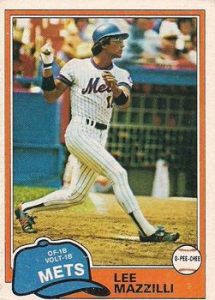 A man with more than one position is sometimes a man with none. Lee was back in center to begin 1981, but by mid-May, that was Mookie’s pasture for keeps, before and after that year’s strike. Lee began to see time in left because first base was now where Torre sought playing time for a couple of Recidivist Mets less limber than Mazz or Jorgy. Rusty Staub had been a splendid right fielder before he was shipped to Detroit five years earlier. Now, at 37, Le Grand Orange was a recovering designated hitter whose bat was considered too valuable to bench. Dave Kingman, meanwhile, hadn’t improved defensively while he’d been away from Shea, so after his return to left field went awry, Torre opted for his big slugger to play first, which meant Staub was going to be a pinch-hitter deluxe.
Amid all of Torre’s maneuvers, Lee Mazzilli, the Met at the heart of their 1980 advertising, no longer stood front and center in the Mets’ plans. He wasn’t hitting, he wasn’t comfortable fielding (one night he groped helplessly as he lost a ball in Shea’s lights) and the clean-cut kid had grown a mustache. Not that the mustache had anything to do with his average dropping from .280 in ’80 to .228 in ’81, but the kid sure suddenly seemed much older.
More changes were in order once the split season proved no panacea. Torre was let go as manager at the end of 1981. GM Frank Cashen brought in his old Oriole compadre George Bamberger of Staten Island. The Verrazzano-Narrows connection to Mazzilli didn’t mean much to the new skipper or the wary GM. Cashen, who inherited Mazzilli, spent the winter trying to make over a ballclub that had not contended in a full season since Lee was a Single-A prospect in Visalia. Come December, Cashen would trade Flynn for Kern, the pitcher who gave up the All-Star home run to Mazz. Kern never pitched for the Mets, because he was packaged in February, along with backup catcher Alex Treviño and ambidextrous pitcher Greg Harris, for the player who started that 1979 All-Star Game in left for the National League, the player who was replaced by Gary Matthews who, in turn, was pinch-hit for by Lee Mazzilli.
The Mets had gotten George Foster. It was a bombshell. Foster had led the NL in RBIs three years running, from 1976 to 1978. He drove in 90 in ’81, a season that was shortened by about a third by the strike. He had the kind of all-around run-producing power that…well, basically nobody with the Mets ever had. Combine him with Kingman and Ellis Valentine, who Cashen had picked up the year before, and that’s a helluva middle of the order Bamberger could look forward to writing in. Foster was the left fielder, to be sure. Valentine, when he was healthy, was a top-notch right fielder, with every bit the caliber of cannon Parker showed off in the Seattle All-Star Game. They’d each flank Wilson, who had established himself as the center fielder for the foreseeable future. Kingman’s glove they’d stick at first and, if the Mets had a lead (and why wouldn’t they, with all this hitting?), they could take him out and insert Jorgensen for defense. Rusty, now a player-coach, would continue to lurk as a late-innings weapon.
And Lee Mazzilli? Where the hell would Lee Mazzilli, the Brooklyn kid who’d invited straphangers to come see what he could do in Queens less than two years before, play?
There was some taking of ground balls in the middle infield in St. Pete, but Mazzilli had never played there before and the Mets had plenty of second basemen and shortstops in camp, so the answer turned out to be Texas. Before Spring Training was over, on April Fool’s Day 1982, Cashen sent the Metinee idol of the late ’70s and the earliest ’80s to the Rangers for two minor league pitchers. That they were highly regarded minor league pitchers didn’t fully cushion the shock waves from Lee Mazzilli going from main man of the Mets to excess baggage to ex-Met in almost no time at all. It wasn’t quite as stunning as the Mets getting George Foster, but it was close.
***Less of a stunner, but certainly an episode that called for the rubbing of one’s eyes, came four years and four months later. In August of 1986, the New York Mets signed Lee Mazzilli anew.
This was perfect. Mazzilli was a 31-year-old veteran now, released by Pittsburgh, where he’d been since 1983 after his ’82 with Texas proved a short stay. The Rangers traded him to the Yankees for none other than fellow fading pin-up Bucky Dent. It was a trade that helped nobody. One could cynically say the same for Cashen’s big move to acquire Foster and sign him for five years, but that would be oversimplification. No, Foster wasn’t nearly the power hitter for the Mets as he’d been for the Reds, especially in his first miserable perception-sealing year, but he did help shift the Mets to the edge of the map, buying the GM time to put the club there to stay. George had been reasonably productive for the Mets from 1983 until the first part of 1986, and with the Mets having transformed themselves in the intervening years into the dominant force in their division, the ol’ left fielder could probably glide to the postseason with his teammates and be celebrated as a champion should they get that far.
But Foster was unhappy with reduced playing time and asserted to reporters that he thought a racial element influenced Davey Johnson’s decision to use him less. It seemed unnecessary to point out that of the three productive outfielders for whom Johnson was striving to ensure playing time, two — Wilson and Kevin Mitchell — were Black. However Foster’s dismay was portrayed, the first-place club decided the .227 batting average that accompanied it was eminently dispensable.
Another bat in his stead couldn’t hurt, even if the bat the Mets chose hadn’t been exactly tearing up Three Rivers Stadium. But Mazzilli was more than the sum of his stats. He was Lee Mazzilli. He was as good a story in 1986 as he was in 1980. Better, maybe, because instead of his having to fill the role of a star, the vet from Brooklyn could just chip in. From the moment he returned, he did that in several ways down whatever stretch the Mets needed to clinch the NL East. He homered to tie the Cardinals in the ninth inning one Saturday afternoon in a game NBC was covering. Bob Costas intimated Saturday Night Fever was back at Shea. Overall, Mazz hit .276 in reserve duty. He also mock-socked “sportscaster” Joe Piscopo in the human bobblehead portion of “Let’s Go Mets!” video. Not that you make roster decisions based on such plays, but it’s hard to imagine George Foster doing that.
For those of us who were diehard Mets fans when Lee Mazzilli was our biggest star, those of us who would have been diehard Mets fans in any year basking in the glow of anybody they told us was our biggest star, Lee’s homecoming was as big a spiritual victory as any the 1986 regular season had to offer. Fans like us wore our fealty to the Mets of Flynn, Taveras, Stearns, Henderson, Youngblood, Swan, Zachry, Allen and, most of all, Lee Mazzilli as a badge of honor. We hadn’t ditched the Mets just because they sucked. We just died harder as circumstances dictated. Believe me, amidst the curtain calls, high-fives and high-profile music videos, nothing was sweeter than getting to redeem that badge in exchange for the redemption of Mazzilli’s career.
From 1976 to 1981, the kid from Brooklyn never got closer to a World Series than his TV. Same from 1982 to 1985 during his exile from 126th Street. Ah, but in October of 1986, in an actual World Series taking place at actual Shea Stadium, Lee Mazzilli, batting lefty, pinch-singled to start the eighth-inning rally that tied Game Six, which the Mets would go on to win, and, batting righty, pinch-singled to start the sixth-inning rally that tied Game Seven, which the Mets would go on to win. At last, Lee and we knew what the Magic was.
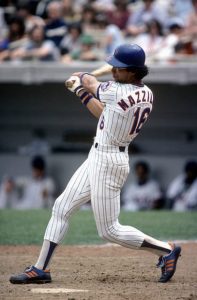 We had no idea this was what the final piece of a world champion would look like. There was a lot to take in during the 1986 World Series, but watching Mazz and Mookie score in rapid succession on Keith Hernandez’s single off Bruce Hurst in Game Seven stood out for me. It was like watching a decade of Mets baseball cross the plate all at once. Mazzilli was at the heart of a half-assed rebuilding that lacked mortar. Wilson was the Met who’d begun to make him superfluous. Mazz was pinch-hitting for Sid Fernandez, who’d taken over for Ron Darling, the starter in the seventh game who simply didn’t have it that night the way he did in Games One and Four. Darling was a Met in 1986 because in 1982 Cashen traded Mazzilli to get him — him and Walt Terrell, the latter of whom was traded for Howard Johnson, who was also a Met in 1986. Darling and HoJo and Mookie all contributed substantially throughout the year to what was three innings from becoming a world championship baseball club. But here, too, was Mazzilli, broken free of the past, not representing a mythic Brooklyn that no longer existed if it ever did. He was Mazzilli in the present, at a Shea Stadium full of fans who needed no come-ons to jam the joint. Here was Lee Mazzilli, 1986 New York Met, having come up with literally one big hit after another to help win us win the World Series, just like we dreamed of in 1980 on those days and nights when we began to permit ourselves to dream such crazy dreams.
It’s the most timeless Lee Mazzilli tale of all.
For a comprehensive look at Lee Mazzilli’s life and career in and out of baseball, I recommend the excellent SABR biography written by Friend of FAFIF Jon Springer. You can find it here.
PREVIOUS METS FOR ALL SEASONS
1962: Richie Ashburn
1963: Ron Hunt
1964: Rod Kanehl
1965: Ron Swoboda
1966: Shaun Fitzmaurice
1967: Al Schmelz
1968: Cleon Jones
1969: Donn Clendenon
1970: Tommie Agee
1971: Tom Seaver
1972: Gary Gentry
1973: Willie Mays
1974: Tug McGraw
1975: Mike Vail
1976: Mike Phillips
1977: Lenny Randle
1978: Craig Swan
1981: Mookie Wilson
1982: Rusty Staub
1983: Darryl Strawberry
1985: Dwight Gooden
1986: Keith Hernandez
1987: Lenny Dykstra
1988: Gary Carter
1990: Gregg Jefferies
1991: Rich Sauveur
1992: Todd Hundley
1993: Joe Orsulak
1994: Rico Brogna
1995: Jason Isringhausen
1996: Rey Ordoñez
1997: Edgardo Alfonzo
1998: Todd Pratt
2000: Melvin Mora
2001: Mike Piazza
2002: Al Leiter
2003: David Cone
2004: Joe Hietpas
2005: Pedro Martinez
2007: Jose Reyes
2008: Johan Santana
2009: Angel Pagan
2010: Ike Davis
2011: David Wright
2012: R.A. Dickey
2013: Wilmer Flores
2014: Jacob deGrom
2015: Michael Conforto
2016: Matt Harvey
2017: Paul Sewald
2019: Dom Smith
2020: Pete Alonso
|
|

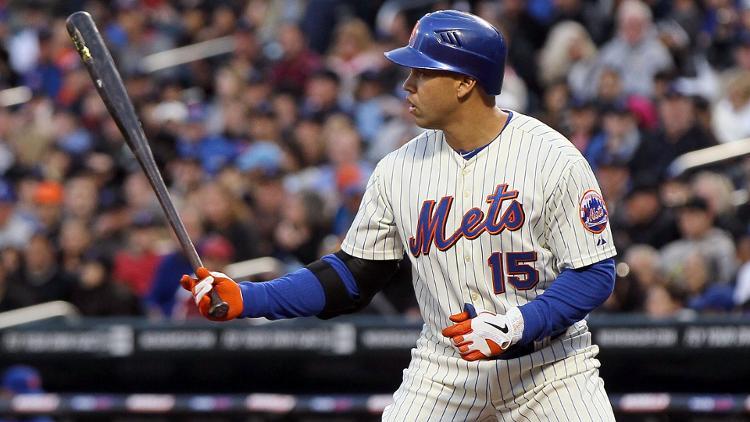 Most of those complaints were typical of people who can only see baseball in terms of effort and grit and the will to win and other rah-rah bushwah accepted as intellectual currency by dolts. (Because the universe is malign, these people inevitably sit within two rows of me and are the loudest in their section.) Ironically, Beltran might have won these fans over if he hadn’t been so good in center field — he had an encyclopedic knowledge of positioning and excelled at reading balls off the bat and taking first steps, which let him glide into the gap or back to the fence and corral a lot of drives without lunging or diving, as lesser center fielders needed to do. Fewer showy plays; less balls falling in. That’s the way it’s supposed to work, even if it means you’re not on as many highlight reels.