The blog for Mets fans
who like to read
ABOUT US

Faith and Fear in Flushing made its debut on Feb. 16, 2005, the brainchild of two longtime friends and lifelong Met fans.
Greg Prince discovered the Mets when he was 6, during the magical summer of 1969. He is a Long Island-based writer, editor and communications consultant. Contact him here.
Jason Fry is a Brooklyn writer whose first memories include his mom leaping up and down cheering for Rusty Staub. Check out his other writing here.
Got something to say? Leave a comment, or email us at faithandfear@gmail.com. (Sorry, but we have no interest in ads, sponsored content or guest posts.)
Need our RSS feed? It's here.
Visit our Facebook page, or drop by the personal pages for Greg and Jason.
Or follow us on Twitter: Here's Greg, and here's Jason.
|
by Jason Fry on 4 September 2020 12:06 am The Mets were supposed to be off Thursday, which would have been fitting given the sad news Wednesday night that Tom Seaver — No. 41, the Franchise, the most essential and irreplaceable figure in team history — had died Monday at 75. Thursday would have been a day to mourn and reflect on the memory and legacy of player and man alike, a day appropriately empty of anything else.
But it was not to be — not with COVID forcing a makeup game against the Yankees — the same Yankees who, hollowed out by injuries as they are, yanked the Mets’ momentum to a halt last weekend and put a hole below the waterline of their season. Was this really necessary? Yes, it was, and so out they went to Citi Field, with Seaver’s retired No. 41 looking down on them from atop the stadium.
Before the hostilities commenced, the Mets remembered their ace with grace, holding a moment of silence, hanging a 41 uniform in the dugout, tipping their caps to his number and — in a truly inspired touch — adorning their right knees with dirt in imitation of Seaver’s drop-and-drive mechanics. (Seriously, I’d like to know who came up with that — it’s worthy of a genius grant.)
And then they went out to play the Yankees and for some time I was grimly certain that my post would be an elaboration on “they did everything right and then blew it by playing baseball.”
Robert Gsellman took the mound without his breaking stuff and got knocked around, departing before the second inning was done after surrendering four runs. The Mets clawed back, however, and against J.A. Happ, no less — he’d looked untouchable in their last meeting (also against Gsellman) but was decidedly mortal this time. Recidivist Met Todd Frazier started the comeback with a home run, with a Jake Marisnick double and singles from Amed Rosario and Jeff McNeil evening the score. Meanwhile, the bullpen held the line valiantly, at least until Miguel Castro proved shaky in the seventh, allowing a pair of two-out hits that created a two-run deficit. (On Wednesday afternoon I was in a kayak on the East River, so I heard Castro pitch but didn’t see him; my conclusion after actually viewing him is that someone should buy him a cheeseburger.)
The last hit against Castro could have just as easily been called an error on Pete Alonso, as he was in position to field it but watched it scoot under his glove and go down the right-field line. It’s been a miserable season for Alonso both at the plate and in the field — in fact, it’s pretty much been the season we were warned to expect in 2019, with homers punctuating stretches with far too many strikeouts and shaky defense at first. Frazier’s reacquisition, I’m half-convinced, was less about getting a bat to employ against lefties than about giving the Polar Bear a cheerful veteran voice that might lift him out of his sophomore doldrums.
Justin Wilson — so reliable last year, not so much now — gave up another run and things looked truly dire. But the Mets, once again, fought back. A Rosario single brought them within a run, they survived letting Edwin Diaz anywhere near the ninth, and then watched as McNeil led off the bottom of the inning with a walk off Aroldis Chapman.
Enter Billy Hamilton, who took second on a balk, promptly tried to steal third and was gunned down while J.D. Davis stood there glumly watching. Seriously? Hamilton seems like a good teammate, and it isn’t his fault he can’t hit — major-league baseball is full of at least marginally useful players who couldn’t hit. But he also seems to have no feel for the game — that was a moment for patience, for seeing if Davis could move the runner in any number of ways, or at least to size up Chapman and choose the ideal pitch to make a break on a soggy track. Instead, Hamilton removed himself from the equation.
So of course Davis hit the next pitch — an 0-2 pitch, nonetheless — over the center-field fence. I never recall being angry about a game-tying homer in the ninth before, but somehow I was this time, because it should have been yet another walkoff against Chapman, and administered by the guy he’d recently nailed in the hip, no less.
The Mets sent Diaz back out for the 10th, survived that with a little help from automatic runner Tyler Wade, who somehow thought a humpbacked liner to Michael Conforto would drop in, and sent Dom Smith to second as their own automatic runner. I prepared myself for a long and futile siege or some other imminent embarrassment, but Alonso hit Albert Abreu‘s second pitch over the left-field fence, one of those drives that’s immediately and obviously gone before the bat is dropped. Alonso floated around the bases to celebrate his first career walkoff homer (a leadoff two-run shot, because 2020), and despite fits and starts and their own missteps, the Mets had ended the day with their heads held high.
* * *
In remembering Tom Seaver, you should of course start with my blog partner, who was on the case yesterday. I’ll limit myself to a couple of words and links. First off, a tip of the cap to Mets owner-in-waiting Steve Cohen, whose tribute to Seaver was a welcome departure from the usual PR-massaged vagaries. This is a fan talking, with humorous rue and real feeling, and while none of us knows anything substantive about Cohen yet, it’s a pretty good first impression.
I also highly recommend this Tom Verducci article on Seaver in his twilight — it’s a wonderful story, shifting ably between his glorious youth and a visit to Calistoga, Calif., by his Miracle Met teammates late in his life. Beautiful, heartbreaking and awfully close to definitive. And don’t miss this tweet, from Keith Olbermann, about Seaver’s place in history. You may be speechless too.
One of my favorite Seaver stories gets to the heart of how competitive and cerebral he was: One day, the Mets were playing the Pirates in the rain, Manny Sanguillen was at the plate, and Seaver was taking an inordinate amount of time between pitches. A wet and puzzled Jerry Grote finally went out to the mound to ask his pitcher what was taking so long. Seaver’s response? He was watching the water pool on the bill of Sanguillen’s helmet, and waiting to start his delivery until the water was ready to form a droplet that would hang and quiver right in Sanguillen’s view. Who notices that in the first place? Who then decides to leverage it for an extra bit of advantage? Tom Seaver, of course.
But there are so many such stories — Seaver and Bob Gibson trading HBPs during a testy spring-training game, his contempt at the idea of celebrating a .500 record, the 1978 day where he reported for duty with his fastball MIA and so out-thought the Cardinals all the way to his lone career no-hitter. Seaver’s death wasn’t a surprise, exactly — we’d known of his retreat from public life, his mind cruelly plundered by dementia — and yet it still seems impossible. How can the New York Mets still exist without Tom Seaver in the world? No nickname was ever more perfect than The Franchise. He was that and still is and always will be.
by Greg Prince on 2 September 2020 9:56 pm Terrific only began to say it.
Tom Seaver was everything to the New York Mets. Everything. He was everything to me. Everything. And I know I’m not alone in that assessment.
Seaver’s death Monday at the age of 75 was announced tonight shortly after the current Mets’ win at Baltimore. I watched that game, as I watch practically every game, probably because I watched the Mets play their way to Baltimore and the World Series 51 years ago next month. The Mets played their way to Baltimore in October of 1969, taking on and taking down the mighty Orioles, in large part because they had the good sense to ask the commissioner of baseball to write their name on a slip of paper and stick it in a hat in the spring of 1966. The Mets’ name emerged. The perennially bottom-scraping Mets didn’t know it, but they were soon to follow.
Seaver made the Mets a year later. Then he made the Mets over.
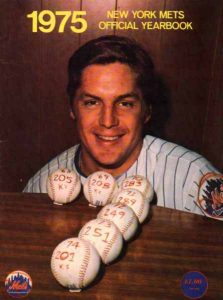 Tom Terrific, 1944-2020. There are and have been many avenues into loving this team, a team hobbled by expansion when they were born and perversely celebrated as lovable losers as they barely learned to crawl let alone walk. We understand imperfection. We revel in humanity. We root for the underdog because we fancy ourselves the underdog.
But then we got somebody who shattered every paradigm about what it meant to be the New York Mets and to love the New York Mets. Somebody who was as far from losing as first place was from tenth. Somebody who not so much flirted with perfection but set up shop just down the block from it. Somebody who was human, yes, but performed in a superhuman manner, leaving behind an indelible image of a pitcher and a person who could not be beat.
That ethos and ability took Tom Seaver to the major leagues, then to its top, where he stayed for the balance of two decades as an active player and then forever after as an immortal. Find me a better pitcher than Tom Seaver. I’ve been a fan of this sport for 52 seasons. I haven’t found one, though to be fair, I stopped looking after I found No. 41.
Seaver played baseball for as long as he could, then checked in and out of the game as he chose. After his retirement, we saw him both reasonably often and not nearly enough. He held a few titles as an emeritus Met, but living legend amply covered his portfolio.
Half of that all-purpose descriptor is gone now, with Tom a victim of complications from Lyme disease, dementia and COVID-19. We knew about how the first one brought on the second. I hadn’t heard anything about the third, but this is 2020, and when more than 180,000 of our countrymen have died from a virus, one or more is bound to be somebody you can’t believe could be ended. We couldn’t believe Tom Seaver had to retire from public life in the first place, in 2019. He was too strong, too much the champion. Nobody filled out the spot atop a pitching rubber like Tom Seaver. I don’t know jack about wine, but I’m sure nobody filled out a vineyard like Tom Seaver, either.
I came to loving the Mets in 1969. Tom Seaver was instantly my favorite Met of all time. All time has yet to expire where my affection is concerned. He was the best when the Mets were the best, and perhaps as a six-year-old that was all I needed to know. Soon the Mets wouldn’t be so much the best, but Tom never ceased, not as far as I could reckon. He won twenty games for us four times and five times overall. He won the Cy Young three times. He pitched in two World Series. He lifted us to our first world championship, the world’s least probable, earned to an Amazin’ extent on the right arm of the man observed by anybody with any sense of the game as the most likely to succeed. When the time came for his ticket to be stamped for Cooperstown, the process couldn’t have been more of a formality: 311 wins; a 2.86 ERA over twenty seasons; and 3,640 strikeouts translated to a 98.8% Hall of Fame approval rating, the highest any starting pitcher has ever drawn.
I’m always citing numbers with Seaver. I can’t help myself. They were so astounding to me, so far beyond what anybody else was posting. You can wake me up on Christmas morning, as the saying goes, and I can rattle them off: 16-13; 16-12; 25-7; 18-12; 20-10; 21-12; 19-10; 11-11; 22-9; 14-11; 7-3. Then 6/15/77. Then 4/5/83. Some numbers in between and thereafter for three other teams. Then 41 on the wall, 425 out of 430 votes from the BBWAA and, honestly, I can swim in those numbers for hours.
But you can look those up on Baseball-Reference or anywhere. Tom Seaver transcended his statistics. The professionalism. The striving. The striding. The knee in the dirt as he drove the ball toward home plate, to whichever spot he judged optimal for the achievement of an out. The fastball that blew as many as ten batters in a row away. The reimagining of his arsenal as he grasped that his inherent physical talents were diminishing. The Franchise, obviously. A man who showed up at Shea in 1967, refusing to suffer losing gladly. A man who put away his gear in 1987, declining to compete at a level that wouldn’t permit him every chance to win and win again. For a generation, he was the personification of winning. I knew it. His teammates knew it. The opposing batters knew it. Magnificence cross-bred with consistency leavened with the intensely cerebral and the indefatigably competitive. Oh, brother, Tom was more than terrific.
Terrific only began to say it. Yet it says so much.
by Greg Prince on 2 September 2020 12:17 pm Perhaps someday I’ll find myself engaged in conversation with Ariel Jurado. We’ll likely talk about his baseball career; how it brought him to the Mets; and the challenges he endured, particularly that night in Baltimore in 2020 when, in the process of becoming the franchise’s 1,107th player overall and that season’s tenth Met starting pitcher 36 games into a 60-game campaign, he experienced what Wayne Randazzo termed a “bloodbath”: six hits allowed his first time through the Oriole order, punctuated by a three-run homer from Renato Nuñez. Or maybe we’ll gloss over that part and focus on his final two innings, for after giving up five runs in the first and second, Jurado gave up no runs in the third and fourth. True, it still calculated to an 11.25 ERA and the Mets were en route to a 9-5 defeat, their fifth consecutive loss, but I’d like to think that tact is the better part of discretion. Hopefully, in this hypothetical scenario, Ariel and I will find happier topics to talk about.
Honestly, chances are I’ll never chat with ex-Texas Ranger Ariel Jurado, who wound up no-decisioned because the Mets hit some for a while and tied the game after he left (Franklyn Kilome took the L), but you never know. For example, as I began my lifelong devotion to the New York Mets more than fifty years ago, I never would have imagined I’d someday spend forty minutes on the telephone with one of the players I spoke to then only through the television.
On April 10, 1968, Art Shamsky became the 160th player in Mets history. Like Jurado, Shamsky’s Met career commenced with a defeat, 5-4 at San Francisco. Better days were ahead. One of them included a 9-5 Mets win, in Atlanta, in the first game of the playoffs a year later. Art had three hits that day, three hits the next day and another the day after that. In the 1969 National League Championship Series, Shamsky batted .538 as the Mets swept the Braves. That performance spurred them to a pennant and earned them a trip to the same city where Ariel pitched last night.
Different Orioles. Different Mets. Different times. The games — five in the World Series; four of them won by the Mets — didn’t take nearly as long back then, but the memories they generated endure indefinitely. As has Art Shamsky, who fits my concept of too big a deal to give me the time of day, yet graciously gave me that and plenty more earlier this week.
We were talking because these days Art Shamsky, outfielder/first baseman for the Mets from 1968 through 1971, hosts an eponymous podcast and he wants to make sure Mets fans know it’s available for listening and enjoying. The Art Shamsky Podcast is indeed a very pleasant conversation. Art started the show a few months ago to bring a little light to dark days. Nothing earth-shattering, just good, solid talk with people you’re delighted to hear from. “I just want to try to make it as casual as possible,” Art told me. “We’re just having a conversation.”
Joe Namath’s joined Art’s conversation. So have Bob Costas and Al Roker. Phil Rosenthal, the sitcom creator who put Shamsky on Everybody Loves Raymond (and named the show’s bulldog after him), returned the favor and guested. “Not only sports people,” Art explained. “I’m interested in other professions.” Nevertheless, Ed Kranepool, Jay Horwitz and Howie Rose have also appeared, catering somewhat to those of us primarily interested in one particular line of work.
 A podcast can hardly heal a world in pain, but listening to Art Shamsky’s might make a Mets fan feel a little better for a little while. Why does Art Shamsky host a podcast? Other than “why not?” If you’ve been a consumer of New York sports media going back a ways, you aren’t surprised to hear Shamsky conducting these interviews because you remember this is what Art has been doing on and off since retiring from baseball in 1972. His foot nudged through the broadcasting door on June 18, 1977, when he was hired by NBC for a last-minute call of a Reds-Expos game in Montreal. It wasn’t just any Game of the Week. It was Tom Seaver’s first start for Cincinnati. Art teamed with Marv Albert that Saturday afternoon, and things clicked pretty well for a first attempt at a new endeavor.
“I thought it was really easy,” Art admits. “In reality, it was not easy.”
The Art Shamsky name, accompanied as it was by a World Series ring, opened more doors, but he worked at improving his game, just as he did across eight seasons as a major leaguer. When Mets fans discovered an entity called SportsChannel was showing the games that had been confined previously to radio, they heard Art offering analysis alongside Bob Goldsholl. That was in 1979, when cable TV was a novelty through much of the Metropolitan Area, making Shamsky a pioneer — and, when you think about it, the first forebear of Keith Hernandez and Ron Darling. For three seasons, Art called games on cable; in the last of those years, 1981, he rotated among the Channel 9 and WMCA booths as well as SportsChannel’s, working with Steve Albert, not to mention a couple of Hall of Famers in Ralph Kiner and Bob Murphy. “Just a wonderful experience,” Art calls it to this day, even if the Mets teams he announced weren’t quite ready for prime time.
Art also channeled his budding talents into the groundbreaking Channel 5 show Sports Extra, serving as correspondent for a program that was about as must-see to a New York sports fan in its heyday as Kiner’s Korner. For a half-hour on Sunday nights, you received sports news, sports features, sports talk, all about New York, all much deeper than you got anywhere else. For the 10:30 touchstone, Art honed his conversational skills as he traversed the Tri-State, dealing with jubilant and desultory locker rooms alike. “You go into a clubhouse after a tough loss and try to interview somebody,” he says, “it’s a learning experience.” Recounting assignments that brought him into contact with everybody from the dynastic Islanders to tennis phenom Tracy Austin, Art considers the Sports Extra experience “wonderful years,” and is quick to credit producer Norman Ross and on-air colleagues Bill Mazer and John Dockery among the “wonderful, top-notch people I got to work with. I learned a lot.”
The veteran New York sports fan ear recognizes Art’s voice as well from the original WFAN, 1050 on your AM dial, where he hosted the station’s first midday show in 1987 from his restaurant. There were other stops along the way, including Channel 11 and ESPN. Though he may have started behind the microphone and in front of a camera with little journalism experience, being an athlete in the biggest media market in the nation couldn’t help but prepare him for this next chapters.
“When I played in Cincinnati, you had two writers and maybe one from Dayton,” Art recalls. “In New York, it was a different story: 10, 12, 15 writers from all the different papers, UPI, AP.” Art interacted with all of them, and his assessment remains “they were fair to me.” Maury Allen helped him ghostwrite a column for the Post that appeared on Saturdays, but that didn’t stop him from forging respectful working relationships with Allen’s competition. “Dick Young, Red Foley [of the Daily News], all of the great writers from the New York Times, Newsday, the Long Island Press, the New Jersey papers — they were all fair to me.”
Appreciating what goes into a reporter’s job allowed Art to develop the insights it took to take up the profession himself. His experience as a ballplayer in turbulent times gives him an inkling of an idea of what it’s like on the field in 2020. “There are some things that are similar,” he says of then and now. “The late ’60s and early ’70s were some awful times. The war in Vietnam, the city was down, in bad shape, morally and spiritually.” Against that backdrop, the 1969 Mets played ball so dazzlingly that a galvanized citizenry was grateful for the distraction. Today, with the world “upside down,” Shamsky acknowledges “there are a lot of problems” impossible to ignore, no matter how much one wishes to focus on fun and games. “In some ways, the world is still in a crazy situation.” Sportswise, “this year’s situation, with teams addressing social unrest and players taking stands is different in some ways, regarding what they’re trying to do in terms of making people’s lives better. Whether it works or not remains to be seen.”
In 1969, when New York had the Mets to lift its mood, those Mets had 162 games to pursue their elevation. The vault from ninth place to first place made it a season for the ages. Art hears regularly from people telling him, “you guys made me feel a lot better, if just for a brief period of time.” Nobody’s really asking for, let alone expecting, such miracles from the 2020 Mets, and it would be a bit much to believe any baseball team could mean as much to their times as the 1969 Mets meant to theirs. Conceding that he might be a bit subjective in his view, he asserts his team was no ordinary champion, not the kind of ballclub you have to look up in a list. “Most people,” Shamsky says, “will always remember the 1969 Mets won the World Series,” what with their legacy handed down to at least two generations. If last year’s fiftieth anniversary celebration is any indication, there are probably more to come.
“The fans treated us so wonderfully last year,” Art says, adding his gratitude for the serendipity that had the surviving ’69ers reuniting in a pre-pandemic atmosphere. “Kids not born yet know about that team from their parents and grandparents. They ask me about the black cat, Tom Seaver’s imperfect game, the Steve Carlton 19-strikeout game, the pair of games we won 1-0 in the doubleheader. They want to talk about it and they want to hear more about it.”
Many folks, he adds, will always remember being at Shea Stadium for the moment those Mets became world champions, on October 16, 1969, even if chances are they were physically elsewhere. “I think I’ve had 100,000 people tell me they were at the final game,” Shamsky estimates. “Now the ballpark held about 53,000, but if they were there in their mind or in some capacity, that’s fine with me.”
It would also be fine with Art if you accessed the Art Shamsky Podcast from any popular podcasting platform; follow Art on Twitter via @Art Shamsky; keep up with all he’s up to at artshamsky.com; and, if you want to give the gift of Art, arrange a video message from No. 24 for the special Mets fan in your life at cameo.com.
by Jason Fry on 1 September 2020 5:06 pm Welcome to A Met for All Seasons, a series in which we consider a given Met who played in a given season and…well, we’ll see.
Hark ye yet again—the little lower layer. All visible objects, man, are but as pasteboard masks. But in each event—in the living act, the undoubted deed—there, some unknown but still reasoning thing puts forth the mouldings of its features from behind the unreasoning mask. If man will strike, strike through the mask! How can the prisoner reach outside except by thrusting through the wall? To me, the white whale is that wall, shoved near to me. Sometimes I think there’s naught beyond. But ’tis enough. He tasks me; he heaps me; I see in him outrageous strength, with an inscrutable malice sinewing it.
1967 was a strange year for the New York Mets.
The 1966 club had achieved a pair of rather dubious high-water marks, losing fewer than 100 games for the first time in its history and escaping the National League cellar. (They lost 95 and finished 7.5 games ahead of the Cubs.) The end of that season marked a turning point, as original general manager George Weiss retired and handed over the reins to Cardinals import Bing Devine.
Devine immediately took a buzzsaw to the roster, cutting players and striking deals. Before spring training, Devine had traded away Ron Hunt, the team’s first non-ironic homegrown star; original Met Jim Hickman; and Dennis Ribant. And he kept tinkering throughout the season — 54 players appeared in a game for the ’67 Mets, including 27 pitchers, which tied a big-league record. Thirty-five of those players were making their Met debuts; 12 were making their big-league debuts. The constant turnover annoyed fans, who showed up at Shea in reduced numbers, and helped precipitate the early departure of manager Wes Westrum. He resigned before the club’s final road trip, telling the press that “I just don’t want to manage this club anymore.”
Devine’s tenure would only last a single season; he returned to St. Louis after Stan Musial stepped down as GM, replaced in New York by Johnny Murphy, a former Yankees star reliever who’d been Weiss’s top scout. Devine’s ’67 Mets landed back in the basement, managing 61 wins, or 1.13 per Met. Still, Devine did lay the groundwork for better days. He moved Whitey Herzog from the third-base coach’s box to the front office, where he’d build a phenomenal farm system (which should had been the precursor for his managing the ’72 club, but that’s another post). And Devine’s new Mets included ones who’d soon ascend to immortality: Tom Seaver, Jerry Koosman, Don Cardwell, Ed Charles, Cal Koonce and Ron Taylor. (As well as one who got away, Amos Otis.)
They weren’t all gems, of course, as that 61-101 record might have told you. There was Don Bosch, a center fielder hyped as the second coming of Mickey Mantle who turned out to be about half the Commerce Comet’s size; Phil Linz, famous as a harmonica-wielding Yankee agent of chaos; and a host of answers to future trivia questions, such as Dennis Bennett, Bill Graham, Joe Grzenda, Joe Moock, Les Rohr, Bart Shirley and Billy Wynne.
One such trivia question might involve Al Schmelz. Schmelz was recalled from Jacksonville at the end of August and made his big-league debut at Shea on Sept. 7, relieving Jerry Hinsley in a game the Mets were losing 8-2. The first batter Schmelz faced was Tim McCarver, who flied to right. He gave up a double to Mike Shannon, who got thrown out at third, and then surrendered a long home run to Julian Javier. His final line was 2 IP 3H 1 R 1 ER 1 BB 2 K. Schmelz then sat in the bullpen for more than two weeks before being called upon to pitch the top of the ninth in Houston. He allowed a triple to Chuck Harrison but contributed a scoreless inning; the Mets lost, 4-2.
And that was Schmelz’s career.
Of course, a player’s stint in the big leagues isn’t the entirety of his career — it’s more like the part of the iceberg above the waterline, a bright spot that gives little hint of what might be underneath. I began my seriocomic, largely doomed exploration of that career because of baseball cards.
It started the summer before college, when I ill-advisedly traded a Rickey Henderson rookie card to a pair of neighborhood kids in return for “every Met card you have.” That made the kids go away, which is all I’d wanted, but also left me with a grab bag of mid-80s Mets cards. I’d collected from 1976 through 1981, and had the singularly terrible idea of bridging the gap between my childhood collection and the new cards that had fallen into my lap — one of those light-bulb-going-off moments, except the light bulb is a warning that you’re going to spend thousands and thousands of dollars on a hobby you’ll never be able to escape.
That bad idea sent me foraging in St. Petersburg, Fla.’s baseball-card shops, until I had every Met from ’76 on. And then the dominoes started falling in grim succession: Why not get every Mets card released by Topps back to 1962? Why not get every Met card released by Fleer, Donruss, Score and Upper Deck? Why not get Topps cards for guys who were on the Mets’ roster in a given year but never actually got a Mets card? Why not get the Topps cards for Mets from all their non-Met years? I didn’t know about high numbers, or what rookie cards cost, or that Al Weis shared a rookie card with Pete Rose. But I’d learn. Oh boy, would I learn.
One thing I learned was that 34 of 1967’s 35 new Mets had baseball cards in one form or another, even if they came with asterisks attached. Some appeared attired as members of other teams: Bennett (Red Sox), Shirley (Dodgers), Nick Willhite and Wynne (Angels). Hal Reniff, sad to say, is a Yankee. Rohr shared a 1968 rookie card with Ivan Murrell, a Houston outfielder wearing one of Topps’ blank black hats; future pitching coach Billy Connors shared a ’67 rookie card with fellow Cub Dave Dowling.
Graham and Moock never got Topps cards, and their careers ended before minor-league baseball cards became common. Enter a veteran card dealer named Larry Fritsch. Fritsch had connections at Topps and issued several series of cards he called One Year Winners, giving cardboard immortality to players who’d never had a card before, and using photos shot by Topps back in the day. His efforts saved Graham and Moock from anonymity — Graham as a Tiger, Moock as a Met.
But there was no card for Schmelz. Just as there was no card for Francisco Estrada, Lute Barnes, Bob Rauch, Greg Harts, or Rich Puig. Those unfortunate players became the core of what I called the Lost Mets — a grim fraternity filled out by Brian Ostrosser, Leon Brown and Tommy Moore. (Ostrosser and Brown got minor-league cards so dismal they would have been better off with nothing; Moore got a lone card during his tenure with Florida’s late-80s Senior League circuit. Greg still thinks that card should count, an obvious error of aesthetic judgment I have chosen to forgive. I have that card, of course — my hypocrisy is of the flexible variety.)
I cobbled together cards for the Lost Mets using a Xerox machine to copy taped-together assemblages of old black-and-white team photos, computer print-outs and a Xerox of the ruffled pages of a phone book, which I felt looked old-timey but actually just looked weird. That was another bad idea that opened a chasm beneath my feet. Inevitably, I decided those paper cards wouldn’t do — the Lost Mets needed cards that looked like actual baseball cards, at least to an untrained and/or mildly forgiving eye. And so I started hacking around on Photoshop — a complex program about which I knew absolutely nothing — to create them.
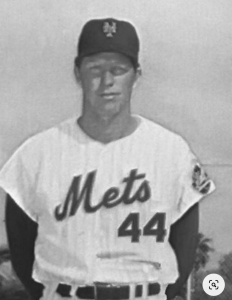 My original terrible Frankenschmelz, decolorized and haunting Pinterest. The problem, I soon discovered, was that it was easier to find Jimmy Hoffa than to locate a decent color photo of Al Schmelz in a baseball uniform. A couple of Mets yearbooks had pictures of him grouped with other guys invited to camp — but they were always small and in black and white. He’s in the team photos — in glorious color, no less — in the ’67 and ’68 yearbooks, but of course he’s in the back, almost completely blocked by his teammates.
So I did the best I could. I took apart the ’67 team photo to make Frankenschmelz — Schmelz’s face, upper chest and arms, combined with Cardwell’s stomach and belt, and the 4 from Ken Boyer‘s uniform number, used twice. As a Photoshop noob, I had no idea about image quality or how to bend and distort pixels so pasted bits of another photo don’t look like they’re floating atop the original. The result is horrible — and, to my shame, it’s still one of the top results if you Google Schmelz. (“Al Schmelz,” by the way, also seems to be German for “aluminum smelter,” which for years made Googling him even stranger.)
A decent Schmelz photo became my white whale, and I the grim Ahab hell-bent on finding it. I even wrote to the man himself — twice — with no luck.
At some point during this increasingly insane pursuit, I realized I’d lost sight of the man behind that maddeningly nonexistent photo, and so I tried to figure that out. Here too Schmelz proved elusive, with only the barest outlines of his college and minor-league career emerging from articles that interchangeably referred to him as Al and Alan.
A hulking California kid, he transferred from junior college to Arizona State, where he starred in both basketball and baseball before concentrating on the latter. 1965 was his breakthrough — he won a College World Series title as a Sun Devils, with his teammates including Sal Bando, Rick Monday and Duffy Dyer, then followed that by playing for the Sioux Falls Packers of the Basin League and the Alaska Goldpanners, where he was part of a formidable starting rotation: Schmelz, Seaver, Danny Frisella and Andy Messersmith.
At the time the Basin League and the Goldpanners were showcases for amateur players who were either honing their skills or trying to catch scouts’ eyes. It worked for Schmelz, who was signed by the Mets in 1966 and went 12-0 for Auburn, fanning 133 in 113 innings. A promotion to Williamsport didn’t go as well — Schmelz walked far too many hitters in both stops — but the talent was obviously there, and during 1967’s spring training Westrum talked up the big right-hander as a possible member of his relief corps.
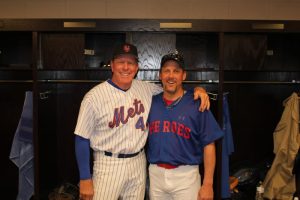 Better than nothing? Not by much. Schmelz’s 1967 tenure with Williamsport was largely the same as his time in ’66, but up he came for his cup of coffee. It was after that that things get murky. In the offseason he was one of three players offered to the Senators for the right to make Gil Hodges the Mets’ manager, with Washington choosing Bill Denehy over Schmelz and Tug McGraw. Schmelz was cut in spring training in 1968 and then went 0-11 pitching for Jacksonville, Vancouver and Memphis. His season ended on Aug. 28, when the Mets sent him home with the vague but ominous diagnosis of “a sore arm.”
In 1969 Schmelz pitched for Memphis, Pompano Beach and York. The results were unimpressive and in December the Mets sold his contract to the Royals. He never appeared in a professional game again, his career over at 26. He became a commercial real-estate broker in the Phoenix area, showing up in occasional accounts of Sun Devils alumni events, baseball charity functions and fantasy camps. I’ve never seen a retrospective of his career or a quote from him in a newspaper.
I can figure out the basics well enough — Schmelz suffered an arm injury in an era where they couldn’t be repaired, like so many pitchers did. The Mets hoped he’d regain his form, or learn to pitch differently, and so they shuffled him between different minor-league outposts and lent him out to other organizations — Vancouver and York were affiliates of the A’s and Pirates at the time. But beyond that I know nothing — not what he threw, not what the Mets thought of him, and not how he views his career. Even his page for the wonderful SABR Bio Project turns out to be a frustrating tease. He’s a visible object that’s but a pasteboard mask.
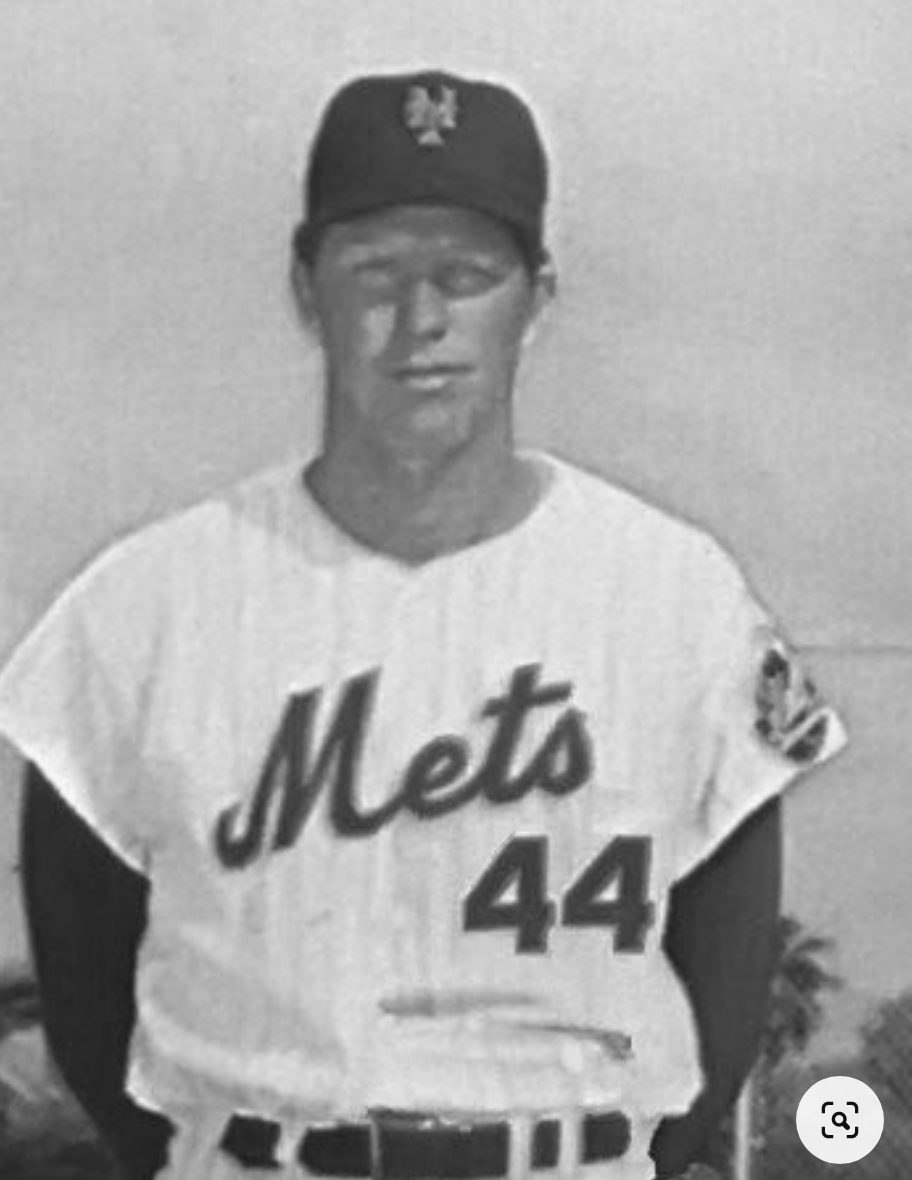
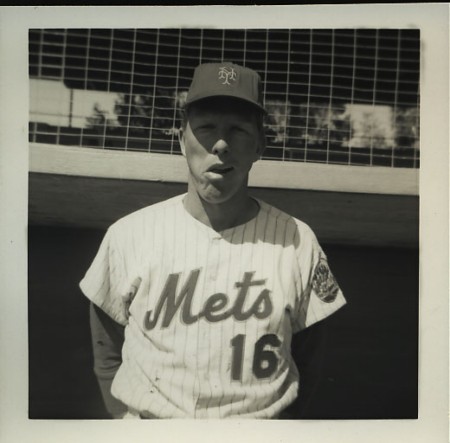
And so I kept doggedly looking for that elusive photo. Schmelz popped up in shots taken at a baseball fantasy camp in Arizona, but beyond the fact that he was decades past his playing days, he was wearing a 1990s Met hat and what I interpreted as a faintly mocking smile. In 2010 a snapshot showed up on eBay showing Schmelz wearing 16 instead of his more familiar 44. Of course it was in black and white. Inevitably, Schmelz’s face was mottled by shadows, his expression suggesting he’d just had a gulp of expired milk. I bought it anyway, added color and turned it into a new Lost Mets card to replace the Frankenschmelz. It was an improvement. It still looked terrible.
 Oh come on. I took some solace in discovering I wasn’t the only Schmelz hunter out there. There’s a thriving subculture of baseball hobbyists whose quest is to assemble photos of everyone who’s ever played big-league ball, in every uniform they wore, and Schmelz is one of the names that elicits sighs.
One of that subculture’s leading figures is Keith Olbermann, who combines impressive investigative skills with an amazing memory for details. Olbermann had helped me in the earliest days of my Schmelz quest, noting (apparently from memory) where Schmelz could be found in the team photos. He was familiar with Topps’ simultaneously voluminous and haphazard photo archives, whose contents are the gold standard for baseball photo hunters, and reported that there was nothing for Schmelz. That was disappointing but no surprise — in 1967, as one of its early labor actions, the nascent players’ union told its members to stop posing for Topps. That’s why late-60s Topps cards feature lots of old photos and hatless shots in airbrushed uniforms.
As my quest continued, Olbermann became an eagerly awaited herald of Schmelz sightings. He unearthed a casual shot of our quarry on the grass in spring training with other Mets pitchers. It was in color — eureka! — but not very good — ugh! A group shot from the Instructional League came to light — apparently that’s when Schmelz wore 16. I found black-and-white photos from his Goldpanners tenure. But nothing was revealed that might let me end my hunt.
And then finally, in late 2016, the white whale was sighted and the crews were able to land a harpoon. Olbermann found and shared a Dexter Press shot of Schmelz, this time wearing 48.
A shot in color.
A shot where Schmelz is facing the camera.
A shot where Schmelz doesn’t look like he’s been kneed in the groin or is trying to make a hasty getaway.
Of course I made a new Lost Mets card — I honestly can’t remember if it was the third, the fourth or some even higher number. By now I was pretty good at Photoshop, adept at sharpening and color-correcting and other subtleties the program offers. And the image Olbermann had so kindly shared was big enough and clear enough to work with.
It came out OK. But only OK. Somewhere in the transition from digital image to card stock, Schmelz’s face wound up a little too red, and fuzziness crept into the formerly sharp details. Holding the finished card in my hand, I sighed and reached for my keyboard to open Photoshop and try again. And then I stopped myself. What I had was better than anything I’d had before, and better than what I’d recently imagined might be out there. More than that, I sensed, simply wasn’t possible with the mysterious Alan George Schmelz.
So the crews reeled in their harpoons and rowed back to the ship, and the great white whale vanished beneath the waves again. I assume he flipped his tail derisively as he went. That’s OK, as is the fact that I know he’s out there somewhere. Maybe I’ll run across him one day; for now, I’m content to stay in port.
PREVIOUS METS FOR ALL SEASONS
1962: Richie Ashburn
1963: Ron Hunt
1964: Rod Kanehl
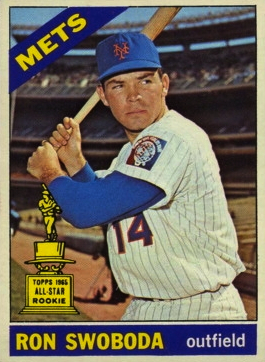
1965: Ron Swoboda
1966: Shaun Fitzmaurice
1969: Donn Clendenon
1970: Tommie Agee
1972: Gary Gentry
1973: Willie Mays
1977: Lenny Randle
1978: Craig Swan
1981: Mookie Wilson
1982: Rusty Staub
1983: Darryl Strawberry
1986: Keith Hernandez
1988: Gary Carter
1990: Gregg Jefferies
1991: Rich Sauveur
1992: Todd Hundley
1993: Joe Orsulak
1994: Rico Brogna
1995: Jason Isringhausen
1996: Rey Ordoñez
1998: Todd Pratt
2000: Melvin Mora
2001: Mike Piazza
2002: Al Leiter
2003: David Cone
2004: Joe Hietpas
2005: Pedro Martinez
2007: Jose Reyes
2008: Johan Santana
2009: Angel Pagan
2010: Ike Davis
2012: R.A. Dickey
2013: Wilmer Flores
2014: Jacob deGrom
2019: Dom Smith
by Jason Fry on 31 August 2020 9:07 pm You know things have really taken a turn for the worse when even Jacob deGrom can’t save the Mets.
The Mets and Marlins reported for makeup duty a little after 1 pm Monday, with Miami not particularly excited at having to fly up and back to New York in a single day, and presumably even less excited to face the best pitcher in the National League. The Mets didn’t look terribly excited about the matinee either, having just had their season holed below the waterline by a mostly anonymous band of Plan B Yankees and now being required to make a home stopover before heading to Baltimore. The early innings fairly whizzed by, with 18 different guys not looking terribly interested in hanging around the batter’s box longer than necessary, and I had the same thought I think a lot of Mets fans had: DeGrom is dealing, the Marlins don’t want to be here, this could be a special day.
Call that Exhibit No. 954 in the continuing series, Don’t Try to Outguess Baseball. DeGrom gave up an infield single in the third to Lewis Brinson on a ball perfectly placed to confound both Andres Gimenez and Amed Rosario, was staked to a 2-0 lead in the bottom of the third, and then had the roof cave in come the sixth. Yes, there was an error by Pete Alonso that made three of the four runs unearned, but there were also too many balls left over the middle and hit a long way — deGrom has absorbed an absurd amount of unfairness during his tenure as the Mets’ ace, but he was beaten fair and square on this day. Shocking though it was to watch, even Superman occasionally flies into things.
After the game, the Mets made some head-scratching moves, acquiring Robinson Chirinos and Miguel Castro and reacquiring Todd Frazier, who left the team about five minutes ago. Chirinos is a backup catcher who seems to have forgotten how to hit in 2020, Castro is a reliever who throws a 98 MPH sinker but still somehow gets lit up a lot, and Todd Frazier is Todd Frazier. None of the acquisitions did much of anything to fill holes; Frazier, while a genial sort, threatens to block players who deserve playing time more than he does. We don’t know what the Mets gave up to get this underwhelming haul, beyond marginal prospect Kevin Smith, but I trust neither Brodie Van Wagenen nor the Wilpons in their red-giant phase.
The pleasures of the game were faint. There was the fact that it happened it all, I suppose, which really ought not to be nothing — it wasn’t so long ago that the idea of baseball as a distraction would have seemed like deliverance, regardless of the final score. And there was Robinson Cano, who may not like DHing but sure seems suited for it. In a season full of sighs and grumbling, Cano has looked a lot more like the Hall of Fame bat he once was than the player who stumbled and gimped through a foggy first season as a Met; it’s not enough to make the trade that brought him here a winner by any means, but seeing how that’s a sunk cost, anything that makes the deal more palatable is welcome.
But again, faint pleasures. The Mets aren’t out of it — it’s hard to be out of it in this weird sprint of a season — but it certainly feels like their chances are slipping away, and nothing they did at the trading deadline changed that dispiriting equation overmuch. To steal a beat from Sunday’s post, today wasn’t a good day either.
by Jason Fry on 31 August 2020 1:35 am Shot. Chaser.
If I were a kind recapper, this paragraph wouldn’t exist. All you need to know is right up there, and why do you want to get riled up all over again? Go outside. Pet your dog. Call your mom. Do something else. Do anything else.
All right. The rest of you weird masochists can keep reading and absorb the earthshaking analysis that no one connected to the New York Mets had a good Sunday.
Even those whose statistics say they didn’t do anything terrible had a lousy day — that’s what happens when you drop both ends of a doubleheader, the first game in jaw-droppingly excruciating fashion, the second more mildly but still pathetically. Those blue and orange uniforms had some extra stink on them by the time the Mets got on the bus taking them the hell away from Yankee Stadium, or trudged through the streets of the Bronx ashamed of themselves, or whatever it is they had to do to go home and play the Marlins again (oh boy) tomorrow.
Rick Porcello, unexpectedly, was not one of the Mets who had a day to be embarrassed about, unless you count the company he kept, in which case yes, he probably should rethink his life choices. Porcello wasn’t great, exactly — the Yankees missed some pitches you’d expect them to barrel — but there are more mistakes than you might guess in nearly every start a pitcher makes. Once upon a time this blog post was going to be a deep dive into how Porcello is trying to return to the sinkerballer he was before growing deeply confused about his strengths, and ponder whether his 2016 Cy Young award caused everyone to overlook the fact that he wasn’t very good in Boston otherwise. I’ll save that one for a future post, should I or anyone else still care; for now, suffice it to say that Porcello actually showed signs of improvement. The Mets could sorely use that, given that this is an organization suddenly lamenting that the immortal Walker Lockett had to be DFA’ed.
But the seventh, oh boy the seventh. It started with an error by Andres Gimenez, whose bat has cooled but whose fielding skills seemed impervious to slumping. Not a good start, but Jared Hughes got the next two hitters and all seemed well — the Mets were up 7-2 and their winning probability was a cool 99.8 percent.
Unfortunately, there are no awards for getting the first 26 outs — oops, make that 20 outs — and all hell was about to break loose. A walk and a hit batsman brought up Luke Voit, who checked his swing but hit a little bleeder straight to where the second baseman is normally stationed, except Robinson Cano was covering the bag. The ball trickled through and was scooped up by Michael Conforto, who noticed Thairo Estrada chugging rather nonchalantly towards third, and not sliding. Conforto fired the ball to Gimenez with Estrada — the final out — still a couple of steps from the bag.
Gimenez didn’t field it. He most definitely did not have a good day.
The Mets brought in Edwin Diaz, whose first pitch was wild and brought in a run. Diaz squared off against Aaron Hicks, worked a 2-2 count and threw a bait slider. It was not just low but in the dirt, which seemed to rattle Diaz. Much as he did on the season’s second day, against Marcell Ozuna, Diaz retreated to the fastball, which had too much plate — and just as Ozuna did, Hicks hit it over the fence for a game-tying, possibly season-destroying home run. In a development that surprised absolutely no one, Diaz then blew the game the next inning, as Gio Urshela‘s single fell in front of Conforto, whose throw home was a bit too far up the third-base line for Wilson Ramos — who’s increasingly a statue on plays at home as it is — to turn into a putout on Mike Tauchman. Disaster complete. Diaz didn’t have a good day, but is anyone shocked?
Between games — because this was definitely a day you wanted to play two — Luis Rojas was asked why he went to the heavily used Hughes with the Mets up five, instead of opting for Drew Smith, who’d been recalled from Brooklyn to give the Mets another bullpen arm. Rojas said Smith had just been recalled and hadn’t been in games for a while, while a tired sinkerballer can be a good thing. I’ll skip ahead and note that Smith was called upon in the nightcap with the game tied and gave up a grand slam to Gary Sanchez, whose season has been so miserable the Mendoza line looks like the peak of Everest. Nope, Luis Rojas didn’t have a good day either.
(You know who did have a good day? Deivi Garcia, the young, Stroman-statured Yankee rookie who made his big-league debut in Game 2. He was very impressive, combining a solid arsenal with admirable poise. He didn’t get the win, thanks to a Voit misplay that let the Mets tie the game, but he certainly deserved it. I may instinctively snarl at the mere sight of a Yankee uniform, but my love of this game is big enough to appreciate what must have been a thrilling day for a pitcher whom I suspect has more thrilling days to come.)
The crowning joke of all of this is this is a year where a .500 record probably gets you a National League playoff spot — the Mets would have qualified for one if the season had ended Saturday morning, which given everything that’s happened this year isn’t the kind of meaningless statement it usually is. Even amid the rubble of Sunday, it’s not impossible to imagine them scratching and clawing their way into the postseason despite habitually aiming at the gun at their own feet. And if they do manage that, they’ll be in short-series, small-sample-size territory, where anyone can be king.
It’s not impossible. And if it happens, I will cheer and run around and say silly things and look back on it from some happily mundane maskless future and smile. But it seems far more likely that the Mets will have more days like Sunday, days in which the machine jams and smoke starts pouring out of the vents and BOOM! you wind up staring saucer-eyed at the world out of a faceful of soot, like Wile E. Coyote after his latest misadventure. The Mets have already had too many facefuls of soot during this strange little season. It seems wildly optimistic to think they won’t have more.
by Jason Fry on 30 August 2020 2:12 am Friday was, thoroughly unexpectedly, one of the better days in recent Mets history. The Mets beat the Yankees twice in one day, coming from behind both times, and Steve Cohen was left as the last man standing in the competition to purchase of the team, despite repeated Wilpon hissy fits thrown in an effort to create another endgame where none could be created. Cohen isn’t across the finish line yet, as there are owners to convince, and his CV has a few things that make you wince, but it’s possible the dead hand of the Wilpons will be lifted from this team by next season, whatever form that season may take, and I’m willing to do more than a little wincing to get to that day.
But after every great party comes a hungover morning where you have to get back to the workaday world, and so Saturday came and the Mets went back out to play the Yankees again. This time we got a nine-inning game, with no confusion about who was the home team, which would have been mildly refreshing except COVIDball and its inherent wackiness had worked out pretty well for the Mets the day before. Saturday’s game unfolded under leaden skies, with the feel of a hot stormy summer day minus the rain, and Robert Gsellman heading to the mound to square off against J.A. Happ.
Gsellman gave up a first-inning homer to Luke Voit but then settled in nicely before tiring in the fourth. It looked like the roof would cave in, but the Mets saved themselves thanks to glovework from J.D. Davis and Wilson Ramos, which is what exactly no scouts would have predicted. With a runner on third and one out, Clint Frazier smacked a grounder that Davis came in on, firing to Ramos to nail Mike Tauchman at the plate. The next batter, Brett Gardner, hit a long drive to center that almost went out but came back to Billy Hamilton, who threw the ball in to Amed Rosario, who threw home to get Frazier by the slimmest of margins and keep the score 1-0.
Gsellman was pretty good but Happ was better, mixing his pitches, dotting the outer margins of the strike zone and keeping Met hitters befuddled — a performance to be admired, except for the fact that the performer was the wrong guy and wearing the wrong livery. As Happ rolled along, seemingly invincible, the Mets countered with a kitchen sink of relievers. Steven Matz looked sharp — a welcome change from pretty much all of 2020 — but only contributed a single inning, departing with shoulder discomfort and forcing the Mets to improvise. Jared Hughes used his sinker effectively for a lone frame and passed the baton to Brad Brach, who didn’t have it. He got two outs but also walked three, with a wild pitch thrown in for good measure, and was excused further duty in favor of Jeurys Familia, called upon with the bases loaded and D. J. LeMahieu, the best hitter in a suddenly diminished Yankee lineup, at the plate.
Their battle was a mini-classic in its own right. Familia immediately ran a 3-0 count, which definitely had the stomach acid churning, but an optimist might have noted he was just missing the edges of the plate. He got a OK-do-that-again strike on a fastball, threw a perfect sinker to get to strike two, got a foul on the next pitch, and then threw LeMahieu a slider. It was up a bit, but the difference in speed was enough to spoil a dangerous hitter’s timing. LeMahieu tapped it to Davis.
This, I thought to myself, is quietly a heckuva ballgame.
It deserved a packed house, of course, with 40-odd thousand living and dying on every pitch. Instead, it was played in warehouse-like conditions, with tarps covering the superpriced Yankee Stadium box seats usually occupied by smirking hedge-fund bros, oil-state potentates ducking extradition treaties, flinty-eyed cluster-bomb manufacturers and whatever other varieties of Yankee fans exist in the world. Citi Field’s cardboard cutouts and energetically fake crowd noise are a bit cheesy, granted, but I’ll take it over the void that surrounded this game. It felt like the teams were playing in a mausoleum.
Happ got Robinson Cano to ground out leading off the eighth and then departed with 90 pitches thrown, which felt like a gift — the more so when Ramos banged Adam Ottavino‘s third pitch off the left-field foul pole. We were all even, and I started wondering how this would end. Would the Mets hurriedly sign Steve Bieser to be their designated runner in scoring position for the top of the 10th, bunting him to third and waiting for him to cause chaos? Would the Yankees sign Luis Castillo and make him our second baseman through some dastardly COVID loophole that had gone undetected? What ghost of Subway Series past would materialize to put its spectral stamp on this one?
The answer was none of the above. Dellin Betances came in against his old team in the ninth and had nothing. He was unarmed — not just a guy who’d brought a knife to a gunfight but a guy who’d brought a knife to a gunfight and discovered that — whoops! — the knife was actually one of those switchblade novelty combs. With runners on first and third and one out, Betances’s second pitch to Erik Kratz was of the Hit the Bull variety, sailing over Ramos’s head and allowing Frazier to scamper home unmolested.
A walkoff wild pitch, hooray. So much — at least for a day — for reaching the relatively mundane promised land of .500. (Which really is a promised land given the National League standings right now, but that’s a post for another time.) So much for continuing this unlikely party on enemy turf. The record came off the needle and that was that. I shut the game off immediately, neither wanting nor needing Keith or Todd Zeile to tell me that unfortunate things were unfortunate.
Still, it really was a heckuva game — taut and tense, well-pitched and unpredictable. Well, if I may borrow a line from my long-ago review of Our American Cousin, at least until that happened.
by Greg Prince on 29 August 2020 10:44 am When the 2020 season was in the uncertain talking stage — after Spring Training, before Summer Camp — I was pretty sure of one thing: other than for historical perspective purposes, I would never want to see highlights of whatever transpired on the field once the Mets started playing, if they started playing. And once they started playing, little occurred to change my mind, not so much because of how stubbornly mediocre the 2020 Mets were insisting on being, but because there was little I’d want to relive about what 2020 looked and sounded like in the baseball sense.
Or most other senses, but for the moment, let’s stick to our sport.
I didn’t want to see video of the empty stadiums ever again.
I didn’t want to hear audio of the synthetic crowd noise ever again.
I didn’t want to listen to clips of even our outstanding announcers hesitantly crafting calls of plays taking place in one ballpark while sitting in a booth in another ballpark ever again.
I didn’t want sift through designated hitters in every single game ever again.
I didn’t want to reckon with runners trotting to second base to begin any extra inning ever again.
I didn’t want to make sense of a surfeit of road teams playing as home teams in myriad makeup games ever again.
I didn’t want to revisit the dubious contingency plan of doubleheaders in which no more than seven innings of baseball per game were scheduled ever again.
Turns out I might want to see again a little of some of the above…particularly one of those dopey shortened doubleheaders…especially the way it concluded.
 Belated congratulations to the Met rookie class of August 2017. On Friday night, the Mets swept the Yankees at Yankee Stadium in one of these new fun-sized twinbills, coming from behind late in both ends, doing so in their final at-bat in the second game. If you’re a Mets fan fortunate enough to not be dead outside, you’d have to be dead inside to not want to relive that kind of outcome at least a couple more times in your life.
The top of the sixth inning of the opener will likely make for fine repeat viewing as well, what with the Mets trailing, 4-1, before proceeding to open three drums of industrial-strength whoopass on Chad Green, one of those components of a Yankee bullpen generally considered to be unwhoopable. His ass told a different story after the sixth.
Free with every drum of Met-brand whoopass comes a compelling narrative.
• There’s the one that has erstwhile all-world freshman Pete Alonso emerging from his sophomore doldrums to blast a three-run homer to socially distant center to tie the game at four.
• There’s the one that has Dom Smith, whose pain and cause became that of his teammates 24 hours earlier, launching the home run that put the Mets ahead, 5-4.
• There’s the one, manufactured in limited-edition form, that has Jake Marisnick, recently of the injured list, stepping up directly after Dom and going essentially as deep off Green to make it 6-4.
The last time we saw ex-Astro Marisnick, it was for approximately a minute in July before he limped off into presumed Lowrie-like oblivion. Unlike with good ol’ Jed, we’ve been suddenly reminded Jake is both alive and well. The last time the Yankees had seen him, Marisnick was on deck during Jose Altuve’s shot heard above the trash can din. Maybe the sighting spooked them.
Terrific stories, each and every one of them. Collect them all! And top it with Sugar! Yes, we’ll use Edwin Diaz’s sweet nickname because we have no reason to be sour on our once and present closer. Sugar poured some heat on the Yankees in the seventh/final inning, facing three batters and striking out three batters, following in the reliable relief footsteps of Dellin Betances from the sixth and Walker Lockett from the fourth and fifth. As Lockett had been the last Mets pitcher to leave the mound before the sixth-inning onslaught, he picked up the W. As this is 2020, when rosters churn without end, Lockett was also handed a DFA. If we don’t see Walker again, we thank him for his service (same for the also-shuffled off to nowheresville Juan Lagares, last listed as No. 15 for one game after having been No. 87 for one game after having been No. 12 for seven years). When see Edwin again, we promise not to cringe in advance.
That was a great first game. You could forget that Michael Wacha was ineffective in his first start off the IL. You could forget that doubleheaders in which seventh innings act as ninth innings are literally bush league. You could look past the dark clouds that were going to widen the already expansive between-games break deemed necessary for the players to safely prepare themselves to play a second game. Of course it rained amid the interregnum. Does it ever not rain on 2020, literally or figuratively?
Taking that first win and going home didn’t sound bad, actually. When has any good ever come of playing a second Subway Series game in a day? The Mets and Yankees had forged four previous twinbills in their shotgun shared history, all necessitated by inclement weather. The Mets were 0-3-1 overall — 0-4 in nightcaps. There were no fans at Yankee Stadium and there were few stars in pinstripes, but why push our luck at the usually braying tar pit?
Why? Because sometimes luck is there to be pushed. The Mets pushed theirs in the second game in the Bronx. David Peterson, like Wacha, was back from a brief injury respite. Like Wacha, Peterson couldn’t quite shake off the rust, though he gave his team a little more than his predecessor (4 IP, 3 ER vs. 3 IP, 4 ER). The Mets survived a Familia Fifth, in which Jeurys loaded the bases but declined to let them unload on his head, and made optimal use of two doubles to create one run in the bottom of the inning to pull within 3-2.
Reminder: the bottoms of innings were when the Mets, in road grays, batted. They were the home team despite being away because… oh, you know. Because 2020.
After Brad Brach and Jared Hughes each provided Luis Rojas with a perfect inning — our bullpen was nothing but solid for seven scoreless doubleheader frames; that is not a misprint — the Mets still trailed by a run heading into what we used to automatically consider their third-to-final opportunity. It was the bottom of the seventh. The presence of Aroldis Chapman pitching meant it was the ninth somewhere. Last chance and all that.
Jeff McNeil led off determined to not make the first out. I’m sure all batters leading off innings maintain that sort of preference, but this was different. This was, nah, I’m getting on base, I don’t care who you are on the mound. Perhaps it was the icky surroundings and the flipping of which team was granted last-est licks, but damned if McNeil wasn’t playing Paul O’Neill to Chapman’s Armando Benitez in my mind. In Game One of the 2000 World Series, you just knew that if O’Neill somehow got on versus Benitez, something dreadful would occur to the team in the field. He did and it did. I picked up almost the same vibe in almost the same ballpark twenty years later (different facilities, similarly charmless). I was sure that if McNeil bested Chapman, we were going to win.
I should interject that in the 31st game of this season — the halfway point, we now call it — it was the first time I’d found myself having an overriding feeling about a game other than feeling baseball in 2020 is virtually pointless. For thirty games, up to and including the pleasant result in the first game of the doubleheader, I was mostly “I guess I hope the Mets win, but this whole thing is a farce, so whatever.” During McNeil’s at-bat, I was so invested in what he’d do that I had to tell myself to stop thinking positively on his behalf lest I jinx him to perform negatively.
And I only do that when I’m convinced what the Mets are doing matters.
For eight pitches, it mattered to me that Jeff McNeil reached base. On the eighth pitch, Jeff McNeil took ball four. At that instant, I was convinced the Mets would win.
Before I could fully weigh the detrimental impact of my unspoken thoughts on the course of events in an athletic contest taking place on my television, Billy Hamilton came in to pinch-run for McNeil. Before Chapman could fully process the danger Hamilton’s two legs encompassed to the work of his left arm, Billy was off to second base. Because Chapman threw to first base as Hamilton ran, it can be said, technically, that the pitcher had the runner picked off first. But, no, not really, because Hamilton — whose already indefatigable speed seemed kicked up a notch by the presence of 42, twice Billy’s usual 21, on his back — was pretty easily safe. He was now a runner in scoring position. Most nights, having one of those doesn’t fill a Mets fan’s confidence coffers.
But this night was different from most other nights. This night was the night after the Mets took their stand, standing with Smith and Hamilton and a whole lot of people who wish everybody can simply live a fairer life in this country we love, no matter how anybody appears to the uninformed eye. And this night, Jackie Robinson Night across Major League Baseball, was the night Smith had continued to excel as a Mets batter, not only with that homer in the first game, but via two more hits in the second, including one that drove in the Mets’ first run; and the night when Hamilton, entering for the express purpose of moving the Mets forward when they needed it most did exactly that; and the night Amed Rosario pinch-hit for Luis Guillorme with Billy Hamilton taking a lead off first…make that second.
Guillorme (.419 BA) started at short in the second game. Guillorme has raked enough to keep all five boroughs leaf-free. Rosario’s season has mostly dangled pathetically from a branch; he was batting .207 through the opener. But Luis is a lefty, Amed’s a righty, Chapman’s a lefty, and some percentages outplay some other percentages, thus it was Rosario at the plate while Hamilton rushed into scoring position.
Then it was Rosario following Hamilton across the plate, for it turned out that with Amed hitting off Chapman, he, too, was in scoring position. He sent a slider flying over the left field wall, turning a 3-2 Met deficit into a 4-3 Met win. Amed’s swing created a rousing walkoff two innings before that sort of thing is usually possible, a transfer at Grand Central shy of such an ending being normally imaginable. But, as you know, normal stepped out for pack of masks five months ago and has yet to be spotted since.
It was the first home run Chapman had surrendered since the one Altuve hit to snatch the pennant for Houston. Given how quiet it was at Yankee Stadium, you could have heard a trash can banging, but no such sound could be detected. Just a burst of happy yelping from a bunch of jubilant Mets.
Friday’s finale was a win all Mets fans who hadn’t rashly declared being “done” with their team the night before could fully revel in. It had that Cookie Club energy, that taste of 2019, maybe the slightest soupçon of comparably good if not better days ahead…days that will maybe soon feature a pinch-owner who will come in to run with this franchise’s fortunes like Hamilton went whoosh on that first pitch. One miracle at a time where Steve Cohen is concerned, perhaps. It’s still 2020. Rain is in the forecast for Saturday, and 2020 has mostly done nothing but present itself as all wet.
In event of precipitation, grab a towel and rewind Friday night’s doubleheader. It’s worth experiencing over and over for a change.
by Jason Fry on 28 August 2020 10:30 am Welcome to A Met for All Seasons, a series in which we consider a given Met who played in a given season and…well, we’ll see.
“People like to see human error when it’s honest. When people see you swing and miss, they start to root for you.”
— Paul Westerberg
I became a Mets fan in 1976, when the team had perfected an imperfect formula: combine superb pitching and defense with no offense and finish third. Miracle Met stalwarts Tom Seaver and Jerry Koosman were still around, as were Jerry Grote, Wayne Garrett, Buddy Harrelson and Ed Kranepool, who’d always been around and one assumed always would be. Joining them were representatives of the Little Miracle — guys like Jon Matlack and John Milner and Rusty Staub.
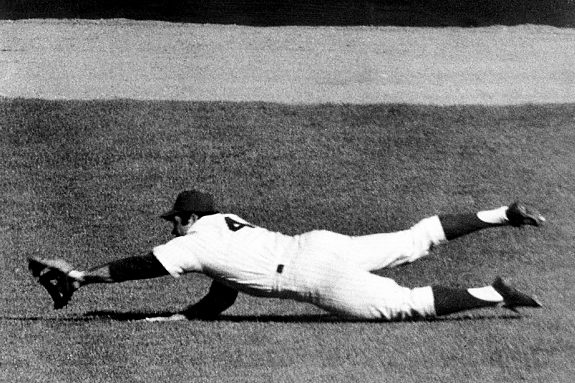
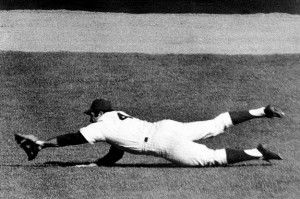
Staub was my favorite player, though of course I loved Seaver, rooted for Harrelson and appreciated Kranepool. But as a newly minted Mets fan with a dorky, proto-blogger’s bent, I hungered for history. Desperate to know what I’d missed, I inhaled books about my team — if the Emma S. Clark Memorial Library had a quickie book about the ’69 or ’73 team (or any other year), I read it and then immediately wanted to read it again. With DVDs and online video yet to arrive, I got most of my postseason lore from the written word and static pictures, from descriptions and reminiscences and snapshots and sportswriters’ flights of fancy. Tommie Agee in awkward mid-stride, a plume of white at the end of his arm. The unhurried way Gil Hodges strolled from the dugout to visit Lou DiMuro with a baseball in one big hand. Tug McGraw dodging and diving and weaving and bulling his way to the dugout. Willie Mays on his knees in vain supplication. Koosman jackknifed in Grote’s arms, with Ed Charles in the early stages of liftoff nearby. And, of course, Ron Swoboda — fully outstretched and parallel to the right-field grass, approaching an uncertain intersection with the ground and a baseball.
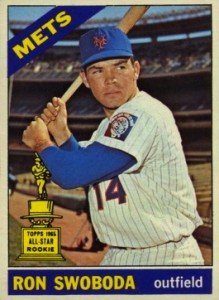
Swoboda was gone by 1976, but in every account of the ’69 Mets he loomed large. Not just because of The Catch, but because he was smart and funny and reflective and complicated. Which, though I didn’t know it yet, made him my prototype for what I wanted every baseball player to be.
The lore was pretty thick around Swoboda even before 1969. He signed with the Mets for $35,000 in 1963 as a 19-year-old from the University of Maryland. (Ironically, given what came later, Swoboda was born and raised in Baltimore and had played high-school exhibitions in Memorial Stadium.) His last name is Ukrainian for “freedom.” In 1964, he caught Casey Stengel’s eye — the young slugger reminded Casey of Mickey Mantle — and was hyped as part of the Mets’ about-to-arrive Youth of America.
Casey pronounced his name Suh-boda, which stuck with fans. Teammates called him Rocky, a reference to his mental lapses in the field and his ability to say the wrong thing at the wrong time off of it. He came to the Mets to stay in 1965 — a callup he would come to regret — and became a fan favorite. Writers loved the fact that he had a Chinese grandfather, which wasn’t really true — his grandmother had married the owner of a Baltimore Chinese restaurant. Fans loved his ability to hit long home runs and sympathized with his outfield misadventures — you were never quite sure what Swoboda might do out there, but you were pretty sure it would be memorable. In his first big-league at-bat, a terrified Swoboda fell into an 0-2 hole against Don Drysdale, and considered it a triumph that he lined out to second. (“I felt like a fish that had been dragged into the boat and somehow managed to flop back out,” he’d remember.) Two days later, his second big-league at-bat produced a home run. RON SWOBODA IS STRONGER THAN DIRT, fans proclaimed at Banner Day.
In one game, Swoboda forgot his sunglasses, misplayed a Dal Maxvill fly ball into a triple, returned to the dugout in a fury, and stomped on a batting helmet. The helmet got stuck on his cleats and left Swoboda hopping around trying to dislodge it while Stengel turned the color of a ripe tomato. Casey pulled Swoboda from the game, asking, “Do I go around breaking up his property?” Another time, Casey groused that Swoboda “thinks he’s being unlucky, but he’ll be unlucky his whole life if he don’t change,” a bit of baseball wisdom I recycled later in life for Come to Jesus conversations with wayward journalists. Yet for all his misadventures, Swoboda hit 19 home runs in 1965 — a Met rookie record that stood until Darryl Strawberry eclipsed it 18 years later.
Swoboda managed the difficult and dubious feat of hurting his development as a ballplayer by alternately thinking too much and not at all. (Years after he retired, he admitted he still had nightmares about facing one of the great hurlers of the ’60s and not being able to get set in the batter’s box.) He wasn’t always popular with teammates, who were annoyed by his on-field mistakes and his off-field gift of gab. When reporters entered the clubhouse after a Met win, it wasn’t uncommon to hear someone yell out “Tell them about it, Rocky!” It should come as no surprise that one of his best friends on the team was the irrepressible, quotable McGraw. (The other was Kranepool.) But Swoboda was pretty quotable himself: In ’69, he was booed after striking out five times in one game, and opined that “if we lost, I’d be eating my heart out. But since we won, I’ll only eat one ventricle.”
1965, the year Swoboda represents in A Met For All Seasons, was a template for everything that followed — heroic moments mixed with ignoble ones. Four years later, it was still true: On Sept. 15, Steve Carlton struck out 19 Mets, with Swoboda accounting for two of the Ks … as well as the two home runs that beat Carlton. And, of course, there was The Catch. It wasn’t a particularly smart play — obviously he should have played it on a hop — except for the fact that hey, he actually caught it. “I had no time for conscious thought or judgment,” he’d recall. “The ball was out there too fast. I took off with the crack of the bat and dove. My body was stretched full out, and I felt as if I was disappearing into another world. … Somehow it happened. Somehow I got it. A miracle? Wasn’t the entire season a miracle?” In that one play the ignoble and the heroic did battle, the heroic came out on top, and because of that Ron Swoboda was a baseball immortal. As Tigers manager Mayo Smith put it, “Swoboda is what happens when a team wins a pennant.”
Two years after the Mets’ champagne celebration (“they’ve sprayed all the imported and now we have to drink the domestic,” he griped cheerfully, which became one of my go-to lines as a child even though I had no idea what it meant), Swoboda was traded to Montreal after one complaint too many about playing time. He hung around for a bit with the Yankees, failed to catch on with the Braves and was out of baseball by 29. He then began a long career as a broadcaster, one that would take him to New York and Milwaukee and Phoenix and New Orleans.
He was a sportscaster in New Orleans when I arrived there in 1989 as a pathetically green Times-Picayune intern, and a lot of people I came to know at the newspaper knew him. This finally registered with me when the woman I was dating mentioned in passing some bantering exchange she’d had with him. She had no idea that I was a Mets fan, and must have wondered why I stared at her in amazement. She knows Ron Swoboda. Which means I could meet Ron Swoboda.
The idea terrified me — I was a kid, and incapable of thinking of him as a fellow journalist. I’d read about him and looked at pictures of him since I was seven years old. He was a Met, a World Series hero, the man who made the Catch. He was Ron Swoboda. Meet him? And then what? It would have been like chatting with Zeus. (I did meet him a couple of years ago, after a ’69 Mets panel in midtown, and while he was perfectly nice, it was brief and dopey. In an uncharacteristically wise move, I didn’t mention having avoided him in New Orleans.)
When we grouse that ballplayers don’t seem smart, most of the time what we’re really lamenting is that they aren’t much for self-reflection. There’s an entertaining W.P. Kinsella story called “How I Got My Nickname” in which the ’51 Giants are all hyperliterate gents given to pondering the cosmos, a story that works because it’s immediately and obviously a fantasy. Back in ’92, Kelly Candaele (Casey’s sister) penned a great piece in the Times in which, among other things, she wondered about the fact that her brother and his teammates didn’t lie awake thinking about their purpose in life. When she asked Astros shortstop Rafael Ramirez about that, his answer was, “When I wake up in the middle of the night, it’s because I want a sandwich.”
I don’t assume baseball players are dumb — I’m amazed at how many of them can analyze pitch sequences and find little tells during the game, and how they remember at-bats in vivid detail years later. Beyond their superhuman physical talents, many of them have an extraordinary ability to focus that most of us don’t know enough to understand we lack. But self-reflection? I suspect most of them are like Ramirez, and probably better for it. When you make a living playing a supremely difficult, maddeningly unfair game, self-reflection isn’t necessarily an asset — better to let the moment go and start fresh.
There are exceptions. Players like Seaver or Darling or Keith Hernandez can dissect baseball like generals or prize-winning academics and focus that same lens on themselves. The 2000 Mets had three such players in Al Leiter, Mike Piazza and Todd Zeile — all smart, complicated guys who weren’t afraid of being interesting. But those players are exceptions that prove the disappointing rule.
The first Met I knew of who was exceptional like that? It was Swoboda.
It’s clear that he spent his share of middle of the nights lying awake, and not because he wanted a sandwich. He isn’t just a good quote, but also bracingly honest about himself. (You’ll find great interviews with him — the sources of many of this post’s quotes — in Stanley Cohen’s A Magic Summer and Maury Allen’s After the Miracle.) He’s talked wistfully about he never got along with Seaver, admitting that he was the one who sabotaged any chance at friendship. “I wanted to be the best in the game at my position; I wasn’t,” he said. “He just made it look so easy, was so good — and it just frustrated me so much.” And he’s told the story of confronting Hodges in the clubhouse bathroom over his use of Kranepool — after which, feeling his manager’s glower on his back, “I was standing against the urinal and I couldn’t pee.”
Of course, Swoboda will always be bound up with 1969 and the Miracle Mets — a bit of typecasting he has accepted cheerfully. (“How long am I going to make a living off of one catch? How long have I got left?”) That’s no surprise, but Swoboda’s reflections on ’69 have almost invariably been interesting, too. “We were ingenues,” he recalled once. “We had that wonderful, clear-minded innocence of not having the responsibility of winning it, of not having to doubt ourselves if we stumbled, and that’s a marvelous state to achieve.” Another time, he said that 1969 “wasn’t destiny. I don’t believe in destiny. What I believe is you can get to a state where you are not interfering with the possibilities.” That’s a long way from taking them one game at a time, pulling together as a team and all the other rote nonsense players have been taught to say so that reporters go away as quickly as possible.
And Swoboda has always understood what that summer meant to the fans, and refused to see what he did and what we did as disconnected. He has always been willing to bridge that gap, and make us feel like it doesn’t have to exist, even though he and we know better. “I never felt above anyone who bought a ticket — I just had a different role than they did,” he’s said. “We were part of the same phenomenon.”
The ’69 team was heralded at Citi Field during its first summer, and I of course cheered for all of them. I applauded the McAndrews and Gaspars and Dyers, cheered for the departed Tug and Gil and Donn and Don and Cal and Tommie and Rube, and gave Seaver and Koosman and Ryan their due, as one must. But the player I cheered longest and loudest for from that team?
It was Ron Swoboda. It always has been.
If you’re a veteran reader with a sense of deja vu, no, you’re not going crazy — this post appeared in much the same form back in 2010. Hey, I got it right the first time.
PREVIOUS METS FOR ALL SEASONS
1962: Richie Ashburn
1963: Ron Hunt
1964: Rod Kanehl
1966: Shaun Fitzmaurice
1969: Donn Clendenon
1970: Tommie Agee
1972: Gary Gentry
1973: Willie Mays
1977: Lenny Randle
1978: Craig Swan
1981: Mookie Wilson
1982: Rusty Staub
1983: Darryl Strawberry
1986: Keith Hernandez
1988: Gary Carter
1990: Gregg Jefferies
1991: Rich Sauveur
1992: Todd Hundley
1993: Joe Orsulak
1994: Rico Brogna
1995: Jason Isringhausen
1996: Rey Ordoñez
1998: Todd Pratt
2000: Melvin Mora
2001: Mike Piazza
2002: Al Leiter
2003: David Cone
2004: Joe Hietpas
2005: Pedro Martinez
2007: Jose Reyes
2008: Johan Santana
2009: Angel Pagan
2010: Ike Davis
2012: R.A. Dickey
2013: Wilmer Flores
2014: Jacob deGrom
2019: Dom Smith
by Jason Fry on 27 August 2020 11:45 pm The Mets and Marlins didn’t play Thursday night.
After some milling around in front of both dugouts, the Mets ran out to their positions, led by Dominic Smith and Billy Hamilton. Miami’s Lewis Brinson stepped to the plate. Caps came off. The other players on both teams came out of the dugouts to stand in a line. After 42 seconds of silence, both teams left the field, leaving behind a Black Lives Matter shirt on home plate.
It was a powerful moment, covered with care and, yes, grace by SNY. Afterwards, Michael Conforto, Smith, Robinson Cano and Dellin Betances addressed the media, masks on as per COVID necessity. SNY threw it to Gary Apple and Todd Zeile, who spoke from the heart. Brodie Van Wagenen talked to the media — more on that in a moment — and then Steve Gelbs conducted a poignant, sometimes raw interview with Smith. It was surreal and confusing and moving all at the same time.
The Mets being the Mets, there had to be a sideshow. Last night, people started sniping at each other on Twitter over Smith’s decision to take a knee Wednesday night and the Mets’ having tweeted the message UNITED FOR CHANGE. That’s the tagline that’s been handed down by Major League Baseball, but it made for an awkward show of support: How united could the Mets be if Smith had acted alone?
Then, a couple of hours before the game that wasn’t, video somehow went out to the world of Van Wagenen having a private conversation with two people off-camera in which he said Rob Manfred, citing scheduling concerns, was pushing Jeff Wilpon to have the teams to walk off the field at 7:10 but return at 8:10. Van Wagenen reacted with a mix of incredulity and exasperation, saying that Manfred doesn’t get it “at that leadership level.” I was simultaneously embarrassed that someone with Van Wagenen’s CV would get tripped up by a hot-mic moment and struck that it was most honest and genuine that the Mets’ general manager had ever sounded. After the game was postponed, Van Wagenen issued a statement saying the idea for an hour’s delay was Wilpon’s and not Manfred’s, and apologizing to the commissioner. I don’t believe for a second that’s what actually happened (though Wilpon-Manfred isn’t exactly the Thrilla in Manila of credibility bouts), but I also thought it was an adept way to save face.
As for the Mets, they seem to have been caught off guard by Smith’s gesture on Wednesday, but more than made up for it a day later, supporting him and his efforts to call attention to the racial injustices he’s spoken about with candor and vulnerability and passion. Wednesday’s tweet may not have matched what we saw before the game, but a day later it was a perfect fit. The Mets also reached out to the Marlins to create a shared moment, with the 42-second hold an idea that came from Miguel Rojas. And all involved — from the players in the press conference to Van Wagenen — spoke eloquently about the need for change in ways I wouldn’t have dreamed possible from baseball just a couple of years ago. The execution might have been both messy and Metsy, but in the end I was proud of my team.
After the game, because I can’t stop myself from touching hot stoves, I waded into the dumpster fire of replies on Twitter. While cathartically blocking people I wish weren’t Mets fans, I kept seeing the same complaint — that the teams had created a spectacle.
Well, that was the point. Not a tweet or a press release that you might wave away, but a moment where you had to pay attention because you were expecting a first pitch and instead got something you had to engage with. That’s how protest works — it disrupts routines so the gesture can’t be ignored. This is what those still complaining about Colin Kaepernick and those he’s inspired either don’t see or refuse to see — that a protest is ineffective and frankly means a lot less if it’s done when no one’s watching. The goal isn’t disrespect — Kaepernick started taking a knee after talking with a former Green Beret who’d objected to his initial decision to sit during the anthem — but discomfort, as a means of generating awareness, sparking conversation and driving change. However strangely the Mets and Marlins arrived there, they certainly reached that goal.
I was also reminded that while there’s a segment of fans who reliably bray for athletes to stick to sports, sports have always been arenas in which we’re forced to confront questions about race relations, fair labor practices, freedom of association, safety standards, gender attitudes and a whole lot else besides. Sure, part of sports’ lure is that they let us put aside the cares of the day and watch a simple morality play — I want this team of obvious gentlemen to beat that team of thorough evildoers. But to treat sports only as that morality play is to be willfully blind to so much around us, and to denigrate the athletes we just got done exalting. Telling athletes to “shut up and dribble” or to “stick to sports” is to dismiss them as hired help. (For the last couple of generations they’ve been extravagantly well-paid hired help, which adds a queasy note to the proceedings without changing the underlying issue.)
Whether we like it or not, the larger world is always present — and sometimes it comes smashing through the frame. The biggest story of baseball’s 20th century was Jackie Robinson‘s bravery in breaking racial barriers that had impoverished the game, and what that lonely effort cost him. The second biggest story of the century was the players’ long battle to be treated as something other than chattel and paid accordingly, a struggle that cost Curt Flood dearly as its pioneer. And we haven’t seen the last such story — there are gay players on big-league rosters today, but you don’t know who any of them are, because they know stepping forward would cost them dearly. One of these days one of those players will decide they’ve had enough and speak up while still in uniform, and you better believe it will be intensely political. One of these days a female amateur athlete will show off a hellacious knuckleball or some other monetizable talent and get signed, and the furor will be both exhilarating and exhausting.
The Mets have been a part of this, because how couldn’t they be? There’s a plausible case to be made that Reggie Jackson was never a Met because he dated outside his race, which was most certainly and shamefully political in the mid-1960s. In 1968, the Mets refused to play after the deaths of Martin Luther King Jr. and Robert F. Kennedy, with the latter decision causing a showdown with Giants owner Horace Stoneham, who wanted the big gate that came with Bat Day. Tom Seaver caught hell for having an opinion about Vietnam, and I guarantee someone told him to shut up and pitch. Rusty Staub and Seaver were traded away for being union activists, with M. Donald Grant demanding to know where Seaver got the temerity to think he could join the Greenwich Country Club. That’s a small sample — hot-button political issues, charged assumptions, unfortunate prejudices and societal fears have shaped our team’s history just like it has every other team’s.
This morning, before so much happened, I read the terrific SABR biography of Donn Clendenon. (Whose A Met For All Seasons entry is here — and will be joined by a salute to a teammate on Friday.) If you don’t know much about Clendenon besides his having been a Pirate and homering after the shoe-polish play, you should read it. A few of many highlights:
- Clendenon’s mentor at Morehouse College was Martin Luther King Jr.
- He was tutored as a ballplayer by the likes of Satchel Paige, Nish Williams (his stepfather), Roy Campanella, Robinson and Joe Black
- Clendenon was interested in playing football for the Cleveland Browns, but steered back to baseball by his stepfather, who arranged to seat him between Robinson and Branch Rickey at an Atlanta awards banquet.
- The general manager for Pittsburgh’s Grand Forks, N.D., affiliate set Clendenon up with the daughter of the only black family within miles so he’d stay away from white women; Clendenon turned the tables when he agreed to take on the clubhouse duty of shining shoes and doing laundry, tasks he promptly subcontracted to high-school kids for a profit.
- The next season, Clendenon was demoted from the Pirates’ Wilson, N.C., affiliate because it was their second year as an integrated team and they were seen as having too many Black stars. He quit, threatened to jump to a Canadian league, and had to be coaxed into returning.
- Determined to have a career after baseball, Clendenon attended Duquesne University’s law school while playing for the Pirates, winning a senatorial scholarship and clerking for a judge. He recalled that there were two other Blacks at the law school: his con-law professor and the janitor.
- One offseason, Clendenon worked for the Scripto Pen Company, where he led a union drive and brought in Dr. King and Stokely Carmichael to stiffen the workers’ resolve.
- Clendenon has two 1969 baseball cards — one as an Expo, the other with “Houston.” That happened because he was traded to the Astros but refused to be reunited with his old manager Harry “The Hat” Walker, viewed by many Black players as an incorrigible racist. Clendenon insisted he’d retire, and the teams worked out a deal to keep him an Expo — at least until he was traded to the Mets.
- One I’d never heard before — according to his SABR biography, Clendenon was given 22 as a Met (he’d worn 17 for his two earlier teams) because the equipment manager told him he was a “double deuce,” derived from “number two” being slang for a Black person. With the Mets Tommie Agee wore 20 while Cleon Jones wore 21. Hmm.
Clendenon played before free agency and taking a knee, but his baseball career and his life were shaped by both racial attitudes and hot-button politics. And you don’t have to be a fiery progressive to guess how many indignities and injustices his capsule biography must leave out. He died of leukemia in 2005, when Dom Smith was just 10 years old. I wish they could have had a conversation about the issues of both their careers — and that we might have been allowed to listen in. I think we would have been illuminated and challenged and inspired, as Mets fans and as people. Even if that conversation didn’t stick to sports.
|
|