The blog for Mets fans
who like to read
ABOUT US

Faith and Fear in Flushing made its debut on Feb. 16, 2005, the brainchild of two longtime friends and lifelong Met fans.
Greg Prince discovered the Mets when he was 6, during the magical summer of 1969. He is a Long Island-based writer, editor and communications consultant. Contact him here.
Jason Fry is a Brooklyn writer whose first memories include his mom leaping up and down cheering for Rusty Staub. Check out his other writing here.
Got something to say? Leave a comment, or email us at faithandfear@gmail.com. (Sorry, but we have no interest in ads, sponsored content or guest posts.)
Need our RSS feed? It's here.
Visit our Facebook page, or drop by the personal pages for Greg and Jason.
Or follow us on Twitter: Here's Greg, and here's Jason.
|
by Greg Prince on 25 October 2010 11:01 am We are on the cusp of the Blessedly Likable World Series, featuring two teams that carry little baggage in our weary eyes. We’re not rooting against anybody; instead we’re choosing between the team that took out the Yankees and the team that took out the Phillies. How can we not like both of them?
Pulling back from our Met myopia, the Series pits teams supported by two fan bases who have gone forever without. The big Without. No world championship in the 52 seasons prior to this one for the San Francisco Giants. No world championship in the 38 seasons prior to this one for the Texas Rangers. Somebody’s schneid will be abandoned very soon. Who deserves it more from a long-suffering standpoint?
Who doesn’t?
Between them, the Giants and the Rangers can mourn 90 seasons without ultimate reward. San Francisco has a 14-year head start, but once you start piling up double-digits, long enough is long enough. There is no dishonor in not being able to claim quite as many as fallow years when all the years involved are solidly fallow.
Once the Red Sox and White Sox shook off their respective eight- or nine-decade slumps, it rather surprised me to realize that the chronological pecking order went Cubs (1908), Indians (1948) and then Giants, 0-for-San Francisco since quitting New York in advance of 1958. I’m fully aware of how long their fans have waited, yet gut instinct doesn’t quite comprehend that they have, in the fanly sense, suffered.
Joe Posnanski of Sports Illustrated took similar notice last week, writing that for all the sympathy baseball fans are capable of generating for teams enduring epic title droughts, “the national group hug never seems open for the Giants.” I don’t think it’s because there’s widespread anti-Giant animus (excepting those who’ve ever listened to Christopher Russo speak into a microphone). It may be because there’s suffering and then there’s suffering.
The San Francisco Giants have failed to fail miserably. There was a lot of finishing second there for a while (every year from 1965 to 1970), and there was a definite falloff in contention once Willie Mays returned home to New York, but utter San Francisco lousiness never completely set in for terribly long. The Giants didn’t finish last out west until 1984 and have only done it five times, losing 90 or more games just eight times. This postseason is their tenth dating back to 1962, their sixth since 1997.
Plus, it’s almost always sunny at Phone Company Park; they did get to ooh and aah at five in-their-prime Hall of Famers during the 1960s (Mays, McCovey, Marichal, Perry and Cepeda); they didn’t complain too loudly when Barry Bonds was breaking home run records in their midst; and, for what it’s worth, San Francisco is San Francisco. It doesn’t matter in the standings, but it’s got to take a little of the edge off not winning a World Series.
To be fair, one can never truly know how much any team’s fan base suffers without being among them. There’s probably some random game from some random season that we’ve never heard of that could drive Giants fans straight into McCovey Cove if they dwelled on it. They also have neighbor issues, though on a different scale than we have.
Everybody needs a championship now and then, if not sooner. But I’ve always maintained that the most you can reasonably ask from your team is it not leave you parched for playoff relief for interminable periods. That doesn’t guarantee you’ll finally win an elusive Game Seven, but it’s better than being pounded into perpetual Pirate pain.
Contend regularly and enter the tournament periodically — if your team does that, then you have it pretty good. You certainly have it better than many. By that standard, you know who’s had it very good for an extraordinarily long time? Longer than anybody?
I know who you’re gonna say, but let me apply a standard that even the Yankees can’t match.
Making the playoffs every year might sound like bliss, but we can see it spoils fan bases. Nothing but eleven wins every October will seem satisfactory after a couple of years. There are no nice tries, no deriving small pleasures from getting close. It’s just win or go home, you losers. What probably works better in the long run is making the playoffs often.
How often is often?
Let’s use, as our rule of thumb, two presidential terms: eight years. A shorter interval might be preferable, but eight years tests your resolve without casting you out into eternal darkness. Eras can overlap across eight years; there’s likely a player or two left over from the last time your team made the tournament. You haven’t waited forever. You get your legitimate modicum of suffering in, but not so much that you’re cruelly deprived. Chances are your team hasn’t been uninterruptedly pathetic for the seven seasons in between, either. There was probably a little coming down off the last high and a little building up to the next one.
It bears repeating that this is a rule of thumb. If, by chance, your last playoff year ended in extremely dismaying circumstances…and it was followed by the blowing of a massive divisional lead on the last day of the season…and then your team replicates that pattern on the last day of the next season…which coincides with the permanent closing of your team’s stadium…and then your team descends below .500 and into an utter shame spiral…
If this happens, consult a physician.
But if all things can possibly be equal, a maximum eight-year wait between playoff appearances — not always as many as eight years, but never more than eight years — seems reasonable. By that criteria, what fans have been dealt with most reasonably of all the longest by their team’s competitive trajectories?
The answer is the Los Angeles Dodgers. If you’re a Southern Californian born in the early 1950s, and you gravitated to the first major league baseball team you ever saw, this has been your reward:
A world championship the second year you ever had a team;
a world championship four years later;
a world championship two years after that;
a pennant the year after that;
a pennant eight years after that;
a pennant three years after that;
a pennant the year after that;
a world championship three years after that;
a division title two years after that;
a division title two years after that;
a world championship three years after that;
a division title seven years after that;
a Wild Card berth the year after that;
a division title eight years after that;
a Wild Card berth two years after that;
a division title two years after that;
and a division title the year that.
Let’s spell those Dodger postseason appearances out: 1959, 1963, 1965, 1966, 1974, 1977, 1978, 1981, 1983, 1985, 1988, 1995, 1996, 2004, 2006, 2008 and 2009. That’s 17 times Dodgers fans have had something to look forward to once the regular season ended without ever having to wait more than eight years for their next big chance.
That strikes me as excellent fortune. Dodger fans might gripe they haven’t won the big one since 1988 and, if they’ve been around long enough, they might speak of the scars they bear from losing the three-game pennant playoff in 1962 and/or the sudden-death play-in game of 1980…but screw them on that count. They are, by the reasonable two-term standard, never without playoffs for very long.
The team with the second-longest streak of this nature is the Oakland A’s, starting in 1971 and continuing through 1972, 1973, 1974, 1975, 1981, 1988, 1989, 1990, 1992, 2000, 2001, 2002, 2003 and 2006. Four world championships are wrapped up in there, though none in more than 20 years — and when the A’s aren’t swinging into the playoffs, they’re usually in something approaching tatters. But see above regarding the screwing of fan bases who would complain for very long if they’re making the playoffs reasonably often.
As for the Giants, their immediate neighbors are the Oakland A’s and their nearest division rivals are their ancient enemies, the Los Angeles Dodgers. Even if the Giants/A’s split isn’t as acrimonious as the rifts that exist in other two-team markets (remember those half-Giant/half-Athletic caps from the 1989 Series?), and the Giants have generally existed as a more secure entity in the Bay Area market than the A’s, Oakland’s four-decade record of resiliency must gnaw a little. And, presumably, any reminder that the Dodgers never fully fall apart is unwelcome news in Giant circles.
But I don’t know that it constitutes suffering.
As for the Rangers, their pre-2010 ledger is 38 years with one cluster of division titles that earned them no playoff series wins and, otherwise, just about nothing in the way of legitimate contention. Objectively speaking, their diehard fans have suffered more than the Giants’ diehard fans. It’s no contest. The Rangers have no Dodger-equivalent in their existences (and whatever antipathy the Astros generate, it’s not like Houston can hold any substantial prize over Arlington’s head), but Texas doesn’t need a formal rival. It’s been battling poor circumstances and unwise decisionmaking most of its existence…and it’s been losing to both.
At no point besides 1996-1999 was there ever a runaway Rangers bandwagon on which to jump. If you developed your taste for Rangers baseball between 1972 and 1995 or 2000 and 2009 — or if you didn’t step away after the limited success of the late ’90s proved fleeting — then this week is for you. You’ve had zero for more than a decade and barely anything for forty years. Your biggest star was Alex Rodriguez, and 156 tainted home runs notwithstanding, the biggest thrill you got out of him occurred Friday night when Neftali Feliz struck him out to clinch your first American League pennant.
Barry Bonds’s home runs were likely tainted, too, but at least he wanted to stick around San Francisco. A-Rod took the money, juiced up, led Texas nowhere and then begged out of the state. I imagine Rangers fans will be rewinding that final ALCS pitch a few hundred more times.
Rangers fans have suffered more than Giants fans. But does that make them more deserving of a World Series championship? I couldn’t say. It’s a shame either fan base will have to leave this summit unsatisfied. They’ve both waited through plenty of presidencies let alone presidential terms for what’s within their immediate grasp right now. Unless something comes along to influence my rooting interest as the Series unfolds, I think I’ll feel as bad for the losers as I will good for the winners.
And I hope the winners are…
Longtime readers might assume I’d veer directly to the Giants given their New York roots and my affinity for that history. But that’s murky territory in my view. The San Francisco Giants did pick up where the New York Giants left off, and they’ve been respectful of their heritage (why shouldn’t they be?), but the unavoidable fact is they left New York — not for New Jersey, but for the other side of the country. It’s hard to reward them with my temporary allegiance for having been the team I probably would have lived for had I been born a generation earlier. That also means they would have crushed me in 1957.
I take my guidance in these matters from the writings of the late, great columnist Vic Ziegel, a gentleman who never passed up an opportunity to reflect on his childhood team, the New York Giants. In 2002, he covered the San Francisco Giants’ last World Series, the one they lost in fairly excruciating fashion to the Anaheim Angels. I’m going to quote liberally from the column he wrote for the Daily News the day after that year’s seventh game partly because it’s relevant to our conversation, but mostly because I love and terribly miss the writing of Vic Ziegel.
It doesn’t take much prodding to get me to write about the Giants. The baseball Giants. The baseball team that played in New York through 1957. Those Giants.
Not these other Giants, the ones who just gave away the World Series. So shame on them, whoever they are. I know this: They aren’t my Giants. How could they be?
My Giants were the World Series winners in 1954, a four-game sweep against the almighty Indians of Cleveland, who won 111 out of 154 games and were going to make easy work of the Giants. It was nonsense, of course. The Indians played in the wrong league, the vanilla league, I told my friends, and winning 111 games from that crowd was a lot easier than finishing ahead of the Dodgers.
Since I grew up in the Bronx, two subway stops from Yankee Stadium, and my friends were all Yankee fans, I was finally getting a chance to rub their pinstripes in it. I’m a rotten winner.
That was the best year. Three years later, when stories began circulating about the Giants leaving New York, I refused to believe it. Other teams left other cities. Not the Giants. You knew that the same way you knew your phone number. And that Little Richard had more to offer than Pat Boone. And you didn’t make egg creams in paper cups. And salami came from heaven. And Mickey Mantle’s rookie card was something you pitched to the wall. The New York Giants weren’t going anywhere. Period. Simple.
[…]
I was in San Francisco for the League Championship Series against St. Louis. Pac Bell Park is a beauty. The rust doesn’t fall off the rafters the way it did at the Polo Grounds. They sell French fries with garlic. They sell large lattes for $4.50. There’s a statue of Willie Mays on the grounds. I walked along a corridor, made a turn, and found myself staring at framed photos of New York Giants — Carl Hubbell, Mel Ott, Christy Mathewson.
It’s a kidnapping. What are they doing there? Why are they in San Francisco, an ocean away from where they belong? There’s a Brooklyn Dodger museum in the Coney Island stadium where the Cyclones play. There are plans for a Dodger Hall of Fame. If Fred Wilpon ever gets to build the new Shea he keeps talking about, he wants it to resemble Ebbets Field.
There is nothing to remind us of where the Giants played, those ridiculously short foul lines at the Polo Grounds, a long fly ball from the Harlem River at 155th St. The Giants might as well be the Incas. This was the team that owned New York until that Babe Ruth chap came along. Bobby Thomson’s home run in the 1951 playoffs is baseball’s greatest moment. Nothing else is close. But it didn’t get enough votes to land in the Top 10. How can this be?
And now a team that calls itself Giants gets into the World Series, and the TV people show clips of Leo Durocher and Thomson jumping home and Willie’s catch — you know, the catch. They must think there’s a connection.
They kept saying a win would be the first for the Giants since 1954. What are they talking about?
People who know I was a Giants fan ask how I feel about the Giants coming so close to being world champions again. The truth? There is no again. I don’t feel a thing.
That affected me in 2002 (though I’d been rooting for the Angels anyway) and it affects me today. I can’t quite use the New York Giants as an excuse to root for the San Francisco Giants. When I first encountered the San Francisco Giants, they were just another team the Mets had to beat. At base, they don’t mean anything more than that to me.
But because there were New York Giants, and because I’m always seeking out as much first-hand knowledge of those Giants as I can find, I’ve come into contact over the years with a lot of New York-based San Francisco Giants fans — the kind of New Yorkers Vic Ziegel didn’t get. They’re good people, from what I’ve found, and if it makes them happy to see a team they still follow get this far, then I can’t root against that.
Then again, I’m not rooting against anybody in this Series. The rooting against was for the LCS round and for 2009. This is about the quest to root for.
I don’t know any Ranger diehards, but I do know there are a few Met fingerprints on the Texas team. The most recent of them belong to Jeff Francoeur, the most mythic of them belong to Nolan Ryan and some incidental sets can be traced to the likes of Darren Oliver, Darren O’Day and, if you want to stretch, coaches Clint Hurdle and Mike Maddux.
I like Met DNA as much as the next guy, but honestly, none of these people ever excited me when they wore blue and orange. I flat out detested the presence of Mike Maddux in our bullpen in 1993 and 1994 (a performance-based judgment, not at all personal). O’Day came and went in a flash. Oliver was a valiant one-year wonder who proved a former GM wrong on the subject of career sustainability, but I didn’t bemoan Omar Minaya’s decision to let him walk after 2006. Clint Hurdle, last a Met in 1987, doesn’t really move the needle one way or another.
Francoeur landed softly on a division leader at the trade deadline, and good for him. Let others bash Frenchy (plenty are willing). I didn’t see any point in his remaining a Met, and he stopped being one on August 31. We embrace Ryan’s Met beginnings more than Ryan himself seems to. The more 1969 stories his presence in the World Series spotlight generates, the better, I suppose, but Nolan’s never shown much sign of particularly cherishing his time here. That’s his prerogative — and it was eons ago — but it leaves me feeling less than warm and fuzzy when the cameras track him down.
The Giants are managed by a former Met. Bruce Bochy’s Shea tenure was so brief that he may have forgotten about it. It lasted 17 games, from August to October 1982. The Mets were mired in a miserable losing streak when the journeyman catcher was brought up from Tidewater, and they remained mired in a miserable losing streak immediately thereafter. The ’82 Mets’ record with Bochy in residence was 5-12. Bochy’s helmet size was, per Ralph Kiner and Lorn Brown, enormous. The same could not be said of the impact he made on a team that wound up 65-97, buried in last place.
Talk about suffering.
The Giants are the National League representative in the 2010 World Series, so that’ll probably break the tie. Nothing against the Rangers, however. Nothing against anybody (not even, for the duration, the hate firm of Cain, Ross & Burrell). If Texas wins, good for them; there should be a little simpatico among expansion brethren. If Cliff Lee drives his price up, good for him, too. We’re not gonna be the ones paying it anyway. If San Francisco wins, the Polo Grounds will be invoked a few hundred times and — apologies to Mr. Ziegel — that won’t be a bad thing. If there’s a parade in San Francisco, I imagine Willie Mays will ride in a convertible or at least wave from a podium. That won’t be bad, either.
Nothing bad about this matchup. Bad was swept out over the weekend. It’s all good from here.
by Greg Prince on 24 October 2010 1:06 am Mets fans will be nobody’s World Series sidebar in 2010, and that’s all right by me.
Not The Yankees qualified Friday night. Not The Phillies sealed the deal Saturday night. The Texas Rangers and the San Francisco Giants deserve a dual round of applause from all of us for making us happily irrelevant over the next week or two.
More irrelevant than fans of a 79-83 team already are at this stage of the calendar.
Last October/November was Hades on Earth. Its repercussions resonated clear to this past August when, sitting among hordes of gracious defending National League Champion Phillies fans in Citizens Bank Park, I had one of the most detestable thoughts I’ve ever had in my four-plus decades of loving the game of baseball:
I’m glad the Yankees beat you last year.
With the exception of Dwight Gooden’s 1996 no-hitter and, begrudgingly, the night Bobby Murcer drove home two ninth-inning runs to honor his late friend Thurman Munson in 1979, I’ve never been glad the Yankees beat anybody, certainly not in a proactive sense, definitely not in a retroactive sense. I instantly reconsidered and withdrew that nominally pro-Yankees thought, but I didn’t replace it with I’m sorry you didn’t beat the Yankees last year.
I’m incapable of wishing any good for any Phillies fan after the last few years…and I don’t hate the Phillies with anything close to the passion that I hate the Yankees. I still maintain the Phillies are a bit of a passing phancy in terms of blood rivalry. If we’re ever in another Wild Card scrap with the Cubs, for instance, I’ll probably despise them just as much as I have our neighbors to the south. But don’t mistake that for leniency toward Philadelphia or the slightest bit of empathy regarding the removal of their National League crown Saturday night.
It’s good that the Phillies lost — it’s every bit as good as the Yankees having lost. No team, no matter how admirably they are said to play the game, doesn’t get on everybody else’s nerves by winning regularly. It happened to the likable 49ers when they had an NFL dynasty. It happened to the onetime underdog Patriots. When the Braves were winning pennants in the ’90s, they began to wear out their welcome. And the Yankees, even if you’d never heard of them before they reignited their winning ways fifteen years ago (and I’m pretty sure a lot of their latter-day loyalists hadn’t), could not help but engender disgust after a couple of World Series triumphs.
Unless you were an authentic day-in, day-out fan of a team before it landed in the midst of a great run (children who are just discovering sports excepted), you have little business associating yourself with that team. You’re a Philies fan from Pennsylvania? You’re a Yankees fan from Westchester? We may want nothing to do with you, but you are who you are. But you’re some success-lover from somewhere else who thinks this is the way to go just because there’s winning involved? Get lost right now. And you know there are tons of Yankees fans from nowhere near New York and not a few kilos of Phillies fans from nowhere near Philadelphia who have come into their franchise of choice just because they’ve been winning…until this weekend, anyway.
Technology may have eliminated plenty of geographic barriers to fandom, but I still believe you need a damn good alibi to be a fan of a high-flying team from a place you have absolutely no connection to beyond “they win a lot.” (I don’t much care about the NBA, but I already hate anybody not from South Florida who’s suddenly a huge Miami Heat fan.)
There has to be something organic about loving a team. And then, no matter where you’re from, you have to hang in there after the glitter fades. When the Phillies aren’t defending champions of anything anymore, not even our division (and they are still definitely that), let me know what a fantastic home-field advantage Citizens Bank Park is. Let me know if those towels are still waving. Let me know if their minions are still finding their way to Flushing. My guess is probably not. The hardcore Phillies fans, the ones who aren’t police blotter fodder, will solider on. But it’s likely to get lonelier down there after a fashion, and it’s likely to become football season a lot sooner, the way it was happening not very long ago.
We’re just happy there will be no more baseball games there this year, just as there will be none at Yankee Stadium III…just as there are none at Citi Field and 25 other big league venues. We all have our biases. Ours is for a team that’s currently idle and against a couple of others who are also currently idle.
The Giants and the Rangers deserve our respect and consideration on their own merit. They have the former and we’ll surely give them the latter as the World Series approaches and ensues. But for right now, it’s enough that they were Not The Phillies and Not The Yankees across two sets of six games apiece. They were magnificent in those roles.
by Greg Prince on 22 October 2010 11:46 pm 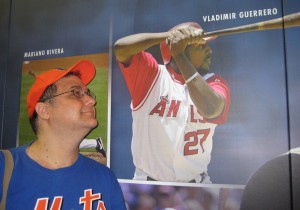 I can’t believe they walked somebody to get to you. Not The Yankees got the job done. Congratulations Texas Rangers for coming into your own. Congratulations to my favorite player who’s never been a Met, who — had free agency been more wisely deployed in the winter of 2004 — could have been a Met, who used to beat the Mets more than I cared for and is now going to his first World Series.
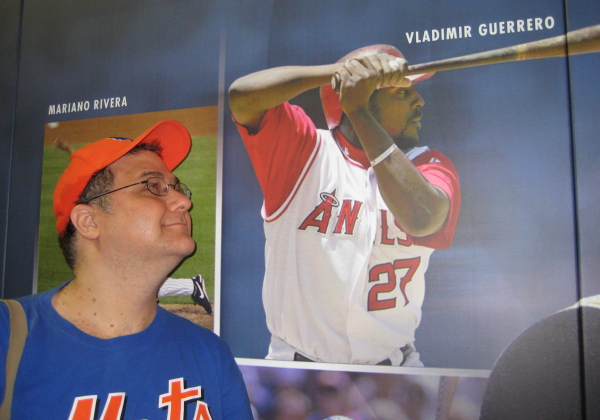
It’s a little late to fully introduce Vladimir Guerrero to America (especially the precincts of the nation served by Cablevision). The Vlad I always admired — whom, during his Montreal heyday, I sardonically referred to as The Greatest Player Who Ever Lived, in deference to the kudos Met announcers regularly showered on his gunk-covered helmet — isn’t around anymore. That Vlad had five, six, maybe a dozen tools. Age and injury has reduced him to a designated hitter. But when he swings, no matter what he swings at, he’s still Vlad Guerrero to me.
Ex-Expo, Ex-Angel, Never Met and now American League Champion Texas Ranger, the DH who drove in the go-ahead runs that turned the defending World Champions into last year’s news.
Which would make just about anybody my favorite player right now.
by Greg Prince on 22 October 2010 12:05 am Oh, we didn’t think it would be easy, did we? We diehard Not The Yankees and Not The Phillies fans didn’t really believe our favorite teams would put away their opposition in five fussless games, did we?
Would have been nice, though.
Yes, it would have been outstanding if Not The Yankees could have flown home to Arlington soaked in ginger ale, but they still retain a excellent chance this weekend to gLee-ful-Lee open Canada Dry and get Texas wet. And it would have been just about as equally outstanding had Not The Phillies been able to keep their hearts, bats and gloves in San Francisco until Game One of the World Series. But Not The Phillies, like Not The Yankees, still have a one-game lead in their League Championship Series, with just more win needed to clinch.
Our teams still have have pennants in their respective grasps. Grasp them, Not The Yankees and Not The Phillies. What you grasp in your hands, you keep out of their hands. That’s why we root for you.
Now we get, at minimum, two six-game series when we would have preferred five-game sets once Not The Yankees and Not The Phillies each went up 3-1. We love all the baseball we can get, but we’ve had enough of the Yankees and the Phillies for one lifetime. We want them removed from the stage ASAP. We want it not just for Not The Yankees and Not The Phillies, but we want it for us.
We all know the reigning worst-case scenario; we lived through it last year, we want no part of it this year. But on the bright side of Not The Yankees and Not The Phillies needing six games (at least) to nail down their championship series, more baseball is guaranteed to take place. Games Five, Six and Seven going into this round are always tagged with asterisks, as in *if necessary. Fifth games became necessary early in each series, and now sixth games are on the schedule, no asterisks required. That’s two extra games. Two games with Yankees and Phillies, unfortunately, but games nonetheless.
Baseball games.
Finish off the Yankees. Finish off the Phillies. But find a way to keep the baseball coming. Depending on the course the NLCS, the ALCS and the World Series take, there are as many as eleven baseball games left in 2010, as few as six. Then there will be none. I’ve managed (no thanks to Cablevision and Fox) to immerse myself in this postseason enough to have only barely and recently realized that it’s late October and that the pastime we adore so immensely won’t be here much longer, no matter who wins the last of it.
Get your series over with, Not The Yankees and Not The Phillies. Take down the Yankees in six. Take down the Phillies in six. Play crisp, play clean, don’t drag it out. But, if you’ll indulge a touch of the contradictory, please figure out a way to make the baseball last.
by Greg Prince on 20 October 2010 9:08 am Hi, I’m a New York Mets fan, and I count among my favorite players of the past 24 hours Pat Burrell, Cody Ross, Matt Cain and a catcher named Molina who came to New York dressed in gray and struck a mighty home run over a left field fence.
Quite obviously baseball for a Mets fan on October 19, 2010, wasn’t the most expansive of buffets — you’ll take what we’re serving up, said the cranky cafeteria lady, dipping her ladle into trays of Giants and Rangers we wouldn’t be tempted to touch during the regular season. Yet it turned out what there was to choose from yesterday was really quite delectable.
Even if some of the ingredients didn’t agree with us historically.
October 19 does not carry with it the cheeriest of connotations. The Mets are 0-3 when they play on yesterday’s date: World Series Game Two in 1986 (dreary then, water under the Buckner bridge ultimately); National League Championship Series Game Six in 1999 (Kenny Rogers blotting out what had been the greatest game I ever felt a part of, and I was just watching on TV); and, most recently and obviously, National League Championship Series Game Seven in 2006.
Yeah, that.
The baseball smorgasbord from Tuesday commenced with a tasty appetizer, the Giants’ blanking of the Phillies (enjoyed over ESPN Radio and some finagled Internet video stream). The afternoon game didn’t elicit any ghosts of October 19 past. I wasn’t thinking about the Mets losing to the Cardinals. That’s an uncheery connotation. I was thinking, instead, of how quickly I was melting on the subject of three otherwise unsavory characters in Giants uniforms…or should I say not in Phillies uniforms.
Pat Burrell: What do Willie Stargell, Mike Schmidt, Willie McCovey, Hank Aaron and Chipper Jones have in common? They’re the only major league baseball players to have hit more home runs against the New York Mets than Pat Burrell. The first four of those gentlemen are in the Hall of Fame. Jones probably will be. Pat Burrell has more home runs against the Mets than Willie Mays, Barry Bonds, Andre Dawson, Billy Williams…those are the guys just behind Burrell — three more Hall of Famers and one whose statistics still scream Cooperstown even as they whisper PED. Pat Burrell will never be confused with any of those players. Pat Burrell has had a more-than-decent career, but it wouldn’t have been much more than decent if he hadn’t decided every ball pitched by every Met between 2000 and 2008 was as big and juicy as an Indian River grapefruit. Pat Burrell hit 42 home runs against the Mets before splitting for Tampa Bay in 2009. Pat Burrell was the epitome of a Met Killer.
But now he’s a Giant attempting to kill the Phillies, and he’s chipped in on both Phillie defeats in the 2010 NLCS, doubling in a run in Game One, scoring another in Game Three. Pat Burrell is quite suddenly all right by me.
Cody Ross: Baseball Reference says Cody Ross is a lifetime .263 batter against the Mets. That’s impossible. His little sneer alone is batting .450. My perception of him as a Met killer isn’t all imagination. He has driven in more runs against our pitchers than anybody else’s. And no team has yielded more total bases to his nasty little feet than ours. But there’s more than raw data to Cody Ross versus the Mets. There’s the sneer, to start with. When he was a Marlin, he was a dyspeptic David Eckstein. I’ve always hated what Eckstein does to us, but I could never quite despise the kid himself. If I were in a focus group charged with judging baseball players on gut instinct, however, I’d turn the dial to LOATHE at the first sight of Cody Ross. Even the name…he took somebody’s lunch money at the bus stop in first grade, you just know he did. I didn’t have lunch today — Cody Ross asked to look at my dollar and then he didn’t give it back. Also, he doubled in three runs in the top of the first inning on the final day of 2007, pushing the Marlins ahead of the Mets 4-0. I guess I resent him for taking our lunch money.
But now he’s a Giant picking on Phillies morning, noon and night. His two homers shocked Philadelphia in Game One. His fourth-inning single provided all the runs (one) the Giants would need Tuesday. He even threw in a homer in a losing cause in Game Two just for kicks. Cody Ross is also quite suddenly all right by me.
Matt Cain: I don’t hold beaning David Wright against Matt Cain. That 2009 pitch got away. It was highly unfortunate and we’re lucky it wasn’t tragic. Nobody not named David Wright felt worse about that fastball to the batting helmet than Matt Cain. But when the Citi Field fans expressed their legitimate displeasure with Cain, Cain didn’t have to taunt back at them by sarcastically tipping his cap en route to the Giant dugout. It was bad form at the very least, a dick move at the very most. Hard to see Matt Cain and not think of David Wright being loaded into an ambulance. It would be less hard had Cain simply kept walking without reacting. Maybe I shouldn’t hold a stupid reaction in a moment of stress against someone who was all of 24 years old at the time, likely already guilt-wracked, probably overwhelmed by the moment and the instant infamy his errant pitch sparked. But I do — I’m a Mets fan, he hit our best player and his most public act was not one of contrition but provocation.
But now, as a Giant, he’s throwing his fastball past Phillies. In Game Three he did it frequently and effectively, giving up two hits, three walks and no runs over seven innings. Assuming David Wright has no lingering headaches, Matt Cain is provisionally all right by me.
I actually came into this series with surprisingly unclear intentions. I mean, yeah, I didn’t want the Phillies to win, but the Giants had Burrell and Ross and Cain. They (and Guillermo Mota, for that matter) have been major turnoffs in my Met life for years. The Mets, however, are idle, and I gotta root for someone. I gotta root, in this round certainly, for Not The Phillies.
The Giants are handling their responsibility quite nicely. I think I’m beginning to root for them as much as I’m rooting against their opponents. I didn’t think that would occur quite this easily, but October makes strange Metfellows.
Which is where the latest Molina comes in.
Oh brother, do I not care for Yadier Molina. Yadier Molina is the exception to my rule about not rooting for injuries, and I’m not talking about some random hip flexor. Yadier Molina can be out of baseball for twenty years and I will root for calamity to befall him. Ideally, Roger Clemens will plunge from the sky and crush him (don’t worry, Clemens dies, too). Yadier Molina brandished the smoking gun in the gangland-style execution of the dream of 2006, of the pennant that was slated to fly over Shea Stadium…or the World Champions flag in which it was destined to be implied.
Yadier Molina was never convicted of that crime. Instead, he was rewarded with a World Series ring. There is no justice.
No brother, I do not care for Yadier Molina and the misdeed he committed against Metsopotamia on October 19, 2006, but I’ve got nothing against his pokey brother Bengie.
October 19, 2010 and October 19, 2006 shared a few similarities beyond the Molina factor. A.J. Burnett was cast in the role of Oliver Perez — not the 2010 what’s he still doing here? Ollie, but the Ollie of four years ago, with the electric left arm and the world of talent and the streaks of good flecking the miserable ERA and, most vitally, the availability. You may recall entering October 19, 2006, Oliver Perez was all we had in the way of a starting pitcher; entering October 15, 2006, NLCS Game Four, he was an almost totally unknown Met quantity.
We had seen a few token starts in August and September, but they provided little guidance as to what we had in Oliver Perez — in one outing he shut down the Braves completely for nine innings; in another, Atlanta pounded him for six runs on seven hits and three walks, and he was gone by the sixth. Those were, however, essentially auditions for the 2007 rotation. Perez wasn’t supposed to be our fourth starter in the ’06 playoffs. But Pedro Martinez went down and Orlando Hernandez went down. Oliver Perez was called to step up.
Which he sort of did.
Ollie was adequacy personified in that fourth game we needed so badly: seven hits and three runs in five fort-holding innings, just good enough and long enough for the cavalry to come to his and our rescue. The Mets scored six in the top of the sixth, gave Ollie an 11-3 lead to nurse and he instantly gave up two solo home runs (one to the Cardinal catcher, Yadier Molina). No harm done, though. We were still up 11-5 when Willie Randolph removed him with two outs in the inning. Ollie’s keeping the Cardinals at bay was crucial as we knotted the series at two.
It wasn’t convincing proof, however, that we should feel comfortable trusting our playoff life to Oliver Perez in Game Seven. But what choice did we have? Steve Trachsel wrote his Game Three start in disappearing ink — he bequeathed an 0-3 deficit and a bases-loaded mess to Darren Oliver in the second inning and promptly turned invisible. With Trachsel missing in plain sight, it was Oll’ or nothing in that seventh game.
Perez went out there and pitched a little better than adequately. Not overpowering for five innings, but clearly competent. Ollie gave up just one run despite putting Cardinals on base in four of those innings. He had his team tied with Jeff Suppan’s going to the sixth.
Burnett? I hear he had a bad season. I understand he hadn’t pitched much lately. I don’t really follow his team, but I got that he wasn’t inspiring confidence among those who would be compelled to root for him Tuesday night.
Seemed all right from what I could tell. Three up, three down twice. A little shaky in the third, but escaped with just one Texas run. Fine in the fourth. Fine in the fifth.
Five innings, two runs, a one-run lead…about all anyone could expect from A.J. Burnett. The guy hadn’t pitched in seventeen days. Five innings, get him out of there ahead, don’t press your luck, Girardi — put down the chalupa and pick up the bullpen phone.
But Burnett went out to start the sixth, just as Perez did four years before. Ollie’s sixth, in dry numerical terms, was uneventful: twelve pitches, three batters, no runs. Ho-hum, right?
If A.J. Burnett’s presence at the center of a must win was evocative of Oliver Perez’s on another October 19, mention must be made that on this October 19, last night’s, Nelson Cruz attempted his very best impression of another corner outfielder, one with loads of equity from the date in question. Cruz’s try — a potentially sensational leaping grab of an all-but-certain home run — was thwarted not by fate or by wind, but by some murky combination of busy hands and lax enforcement of video replay.
In the second inning Tuesday night, Robinson Cano hit a ball that would have been a flyout in most right fields without jutting bleachers, and might have been a flyout at Yankee Stadium had Cruz’s glove not been impeded in the act of catching the ball. With Yankees fans making every effort to be in his way and the ball coming down on the top of the fence, it might have been to the benefit of accuracy for the six-man umpiring crew to have asked for a little help. God knows enough cameras covered the game. But right field ump Jim Reynolds, the crew chief no less, covered his eyes, ears and mouth when approached by Ranger manager Ron Washington. Cano’s fly ball did not become the subject of video review, and Cruz did not get to make a catch for the ages.
There was no official video replay four years ago. There was also no brilliant juxtaposition of fans inches from the field of play at Shea Stadium. Thus, when Oliver Perez threw his twelfth pitch of the sixth inning, and Scott Rolen belted it significantly farther than Robinson Cano belted his, there was nothing to serve as an obstacle to Mets left fielder Endy Chavez.
Except for the odds that anybody could bring a ball so obviously gone back into the field of play. When Rolen hit that 88th pitch of Perez’s on October 19, 2006, it was about to be 3-1 Cardinals. I mean there was just no way…
WAY!
How great does a catch have to be to live on individually, of a context all its own, when it served only as a footnote in the final score? Endy Chavez sproings into action, ascends over the fence, snares Rolen’s home ran — well it wasn’t a home run — and then, because he was Endy Chavez, fired the damn thing back to the infield where Jim Edmonds could be doubled off first, 7-4-3 (called out by Jim Joyce). It was so great a catch, detail isn’t necessary in describing it on the occasion of its fourth Endyversary.
It was so great a catch, you can watch it in the mind’s eye and almost forget that nothing good happened for the Mets afterwards: not in the next three innings, not in the next four years. Yadier Molina’s home run happened in the top of the ninth…a two-run catch too tall for Endy to make. Adam Wainwright’s curveball happened in the bottom of the ninth. The future followed — and not the one I dared imagine.
On October 19, 2010, Burnett goes out to pitch his bottom of the sixth, as Perez did. He digs a bit of a hole, but it’s no mine shaft. A.J. has recorded two outs but finds Cruz, who reached on a fielder’s choice, standing on second (where the bleacherites can’t impede him). A percentage move ensues: not the removal of A.J. Burnett after you’ve gotten all you can ask out of him, but an intentional walk. Burnett’s a righty, David Murphy’s a lefty, Bengie Molina’s a righty. It all makes sense to Joe Girardi.
He also probably thinks that chalupa commercial is hilarious.
Bengie Molina…this is not your brother’s villain. He was a member in good standing of those Angel hit squads that took out the Yankees in 2002 and 2005. He was a Giant for a few years (Matt Cain’s catcher when Wright went down). Omar Minaya lusted after his services twice, but never secured them. Buster Posey squeezed him out of San Francisco, and here he was at Yankee Stadium, in the gray double-knits of the Texas Rangers…a Molina swinging for the fences in the playoffs in New York.
This time, our kind of Molina.
Bengie Molina one-upped his brother: a three-run homer. It came earlier on this October 19, but it was no less decisive. Ten Endys standing on one another’s shoulders could not have caught it. A.J. Burnett knew it was gone — his two hands clutching his head as it flew beyond very deep left was the definitive tell (pretty emotional reaction on the mound…just like the pitcher the Mets once upon a time traded him for). The 2010 Yankee version of Oliver Perez lasted exactly as long as ours had. Nobody complained when Ollie went six innings and gave up one run that, but for the grace of Endy Chavez, could have easily been three. Burnett’s sixth, however, eclipsed the way he hung in through his first five.
But he didn’t pitch too badly…at least not until he did.
The Rangers’ Molina, meanwhile, sucked the life out of that stadium, same as the other one did to Shea in 2006. All in all on our October 19, the Mets gave up three runs and lost by two. The Yankees on theirs scored three runs but lost by seven. We were eliminated. They’re barely hanging on.
October 19, 2006 still looms large in the Mets fan’s consciousness. Until something comes along to challenge or exceed it, it was our last postseason night, the unwanted period at the end of what we thought would be our championship sentence. As a rule, we expect so very little out of our team, but 2006 was an exception. We dared to anticipate a happier ending to Game Seven and then as many as seven games besides. El Duque was going to come back, Ollie could have helped out in long relief, we could have at last had a few words with Kenny Rogers of the American League Champion Tigers. Deprived of that opportunity, we transferred our expectations to 2007, but they were non-transferable. We learned that for good as the Phillies rushed by us and Cody Ross ran interference for them.
What will October 19, 2010 mean to Yankees fans? Probably nothing, no matter what happens today in Game Five. The Yankee mindset seems to be that every season starts with 162 wins, and every loss is the result of some replaceable employee’s careless accounting of inventory. You could almost admire the striving for excellence and the emphasis on accountability if it weren’t so damned myopic.
Listen to Michael Kay emit haught and disgust after a postseason loss when he is called on to analyze one on YES’s postgame show. (Seriously, it’s worth it.) Molina didn’t hit a home run — Burnett dared to give it up. The Rangers didn’t outplay the Yankees — Girardi dared to not anticipate their every move. Cliff Lee’s pitching was unhittable — so why isn’t he a Yankee already? The intonation is always there: the Yankees don’t lose their games; the Yankees are denied their wins.
I had a social studies teacher in high school, a man I haven’t thought of in ages. His name was Mr. Friend, and he was certainly cordial. Mr. Friend was very good at challenging our assumptions. For example, one right-leaning classmate complained of the United States “losing China” in the 1940s. “We didn’t lose China,” Mr. Friend countered “because it wasn’t ours to lose.”
Too bad Mr. Friend didn’t teach baseball.
Now and then I feel a smidgen of dismay over the fuss accorded Endy Chavez’s catch. We voted it one of Shea’s ten greatest moments, and it was one of the few events in Met history to be commemorated upon the opening of otherwise amnesic Citi Field. If you haven’t checked out the Left Field gate, be sure to swing by that way next year. Can’t find it? Just look for the silhouette of the outfielder leaping and reaching with all his might. Why shouldn’t we love that?
Because we lost, I suppose. Endy’s catch was one putout. His throw resulted in another putout. OK, two outs from that catch. Two outs out of 27 in a defeat that meant the pennant. We moan about Molina and we bitch about Beltran yet we never edge away from Endy. The reel of phenomenal World Series catches that unspools every October — Mays in ’54, Amoros in ’55, Agee, Agee and Swoboda in ’69 — developed in light of wins. Those catches became legend because those outfielders contributed to victories in the games in which they went acrobatic, and the games eventually became components of world championships. Carlton Fisk hit a famous home run for a team that lost a World Series, but the home run at least won his team the game.
We, on the other hand, love a catch that did no more than keep a 1-1 game tied after six. In dry numerical terms, that’s all it did.
But we know better. Or at least we’ve decided we do. I suppose I would trade the Endy catch for the 2006 pennant if I could, but I don’t think it works that way. The National League championship seemed so in our grasp, yet maybe we didn’t lose what we didn’t have. Or maybe that’s only applicable when you’re talking about Chiang Kai-shek.
The best I can come up with is Endy Chavez made as great a catch and throw as I’ll ever witness; he made it for the Mets; it never fails to amaze me when I see a clip of it; and I’ll hold the feeling I get from it dear as long as I can remember it. It can’t be traded for Molina not taking Heilman deep in the top of the ninth, or Floyd, Reyes or Beltran delivering the one key hit we so desperately needed in the bottom of the ninth. It’ll just have to remain with us as a remnant of what could have been and a moment that will always be.
In lieu of all other possibilities, I’ll take it.
by Greg Prince on 19 October 2010 5:00 am Tough break for Andy Pettitte, who pitched a fine game Monday night. Cliff Lee pitched a monster game. Monster wins. Still, nice outing for Pettitte, a very good pitcher who’s acquitted himself well in many postseason games since coming to the big leagues fifteen years ago.
But now he might not make the Hall of Fame. That’s according to Reggie Jackson by way of ESPN’s Ian O’Connor before the third game of the 2010 American League Championship Series:
“I think [beating Lee] would just make people more aware,” Jackson said, “because the media will start to single out all the great confrontations and moments he’s had. So I think if Andy beats him, he’ll be over the hump. There are guys already in the Hall of Fame he has outperformed.”
O’Connor essentially agreed, despite Pettitte rarely registering among the top pitchers in the game across his solid career. What seems to make Jackson’s and O’Connor’s case is Pettitte has won a ton of ALDS, ALCS and World Series games. He’s had more opportunities than most pitchers to win them, but winning is winning.
“It’s going to be hard to keep Andy Pettitte out of the Hall,” Jackson offered, to which O’Connor assented:
[A] win over Cliff Lee would make it harder, as in a lot.
Pettitte, a veteran of 30 different postseason series, didn’t get his 20th postseason win against the Rangers. Does that mean he’s no longer a Hall of Famer? I doubt it. Those who would make his case will still do so. He’s Andy Pettitte, after all. Just ask Harvey Araton in Sunday’s Times:
Pettitte’s team has long slept peacefully on the nights before most of his 41 postseason starts, but matchups have a way of altering perception, if not reality. The school of thought that contended Girardi should not waste Pettitte against the likes of Lee probably doubled in enrollment after Hughes was no match for the immortal Colby Lewis on Saturday.
For his part, Pettitte, a proud Texan, indicated he would show up on Monday night, his cap pulled characteristically low, staring down a challenge he sees as a career microcosm.
It’s generally worked before — not always (Pettitte has now lost 10 postseason starts, including one as an Astro), but enough to make the man with the cap and the stare believe it would work again. After coming out on the short end of the latest Leextravaganza, Pettitte said he’s used to more offensive support and the inevitable misstep by the opposing pitcher: “I just think we are going to get a guy on, and he’ll make a mistake, and we’ll pop one out. To tell you the truth, it’s just what you expect here. You just come to expect it. I hate to say that.”
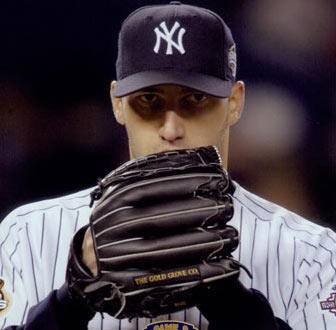
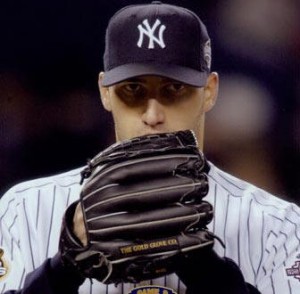 Only Andy Pettitte stares like this. I’ve come to expect the Yankeecentric media to construct thick marble pedestals for Yankees. It’s not enough to admire a Yankee. He needs to be immortalized. He needs to be enshrined. He needs to be more than he is. Andy Pettitte’s not reasonably dependable; he’s melatonin personified. He’s riding into town menacingly staring down unworthy adversaries barely worth the Bombers’ bother…not just concentrating like any pitcher might.
Pettitte’s been very good. 240-win good. Not great, not really. His career ERA is near 4, above every Hall of Fame starter to date, which O’Connor pardons because he’s pitched mostly in the “rough and tumble American League East” (which has included oodles of games against undermanned Oriole, Blue Jay and Devil Ray rosters). There’s usually been a Cone or a Wells or a Mussina or a Clemens or a Sabathia ahead of him in the pecking order in a given Yankee year. Pettitte’s been a hell of a No. 2 starter, though.
It’s nothing to be ashamed of, it’s not a knock, it’s not bad at all. It’s just not necessarily the stuff of legend when you step away from it a little.
But let’s not assume too much based on the “L” that landed next to his name after Lee was invulnerable Monday. Pettitte might pitch again in this series. He might win. He might even beat Lee. If that happens, why wait for the Hall talk to reignite? Let’s get a jump on it right now.
Let’s make our bid to build our own marble pedestal for Andy Pettitte.
***
The stare. It’s not the thousand-yard stare of battle, but it is battle-hardened. This stare’s ultimate gaze measures 139 miles, the distance from the Bronx northward, clear up to the humble hamlet of Cooperstown, New York, where humility is appropriate given the quiet sincerity of the gentleman warrior who will be making his way upstate five years after his adoring public wipes away the final tear it sheds from absorbing the news that he will pitch in Pinstripes no longer (although it may require a case of Kleenex to thoroughly dry that much melancholy).
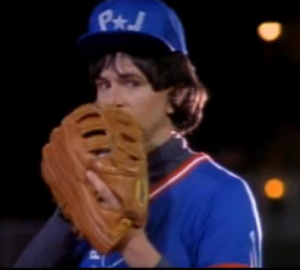 Or maybe others stare like this. Andy Pettitte’s looking at induction into the Baseball Hall of Fame.
It’s as clear as the stoic stare on the tested Texan’s face.
You may not see it in his stats, but leave his numbers where they belong, on the page. Look, instead, into Andy Pettitte’s dark, brooding eyes. It’s what opposing batters and national television audiences have been doing nearly every fifth autumn evening since 1995.
It’s been their pleasure.
Oh, those eyes. Within them you are granted entry into the soul of specialness. It’s like being on a first date with Yankee greatness, a date you wish would never end.
The good news is it won’t. There will be no awkward “will he or won’t he?” scene at the front step, no kiss-off of this superlative southpaw. The Baseball Writers Association of America, having been granted the time of its life across so many Octobers (and not a few early Novembers), will invite Andy Pettitte upstairs for coffee.
And he’ll be staying the night.
Baseball fans everywhere will sleep easier knowing Pettitte is forever snug in immortality’s embrace. He’s earned it, just as surely as Mariano Rivera has earned the soft rain of adulation.
The Captain, Derek Jeter, led them here. Jeter, who burns to win like cinnamon burns the mouth, brought Pettitte, Rivera and Jorge Posada to this core foursome, this unsurpassed quartet where the price of admission is five World Series rings and a lifetime of memories. Now they will clasp hands in Cooperstown for as long as there are fans who hold baseball — Yankee baseball (as if there is any other kind) — dear in their hearts.
It is an unbreakable bond, a chain of excellence in which Pettitte’s link is secure.
The only question that remains is when will the voting writers wake up? When will they smell the triumphant coffee and add more Yankees who are long eligible but have been thus far criminally ignored? What, for example, of spiritual leader Jim Leyritz, a Pete Rose type who never gambled on baseball but always cashed in winning bets? Surely he and others — the Knoblauchs, the Nelsons, the Neagles — are entitled to join in this menage à treméndous at once.
And how much longer will it take until The Boss — tapping his wristwatch, waiting impatiently, but inevitably glowing that warm paternal pride born of victory and, yes, love — is there to greet them? Should George Steinbrenner get the call to Cooperstown, do you doubt he’ll find a way to be there that warm, overdue summer’s day?
It’s supposed to be the National Baseball Hall of Fame. That’s what it says on the building. Yet can it really be more than a repository for a pile of used jockstraps if a Yankee — any Yankee — is ever excluded from the induction each and every one of them so richly deserves?
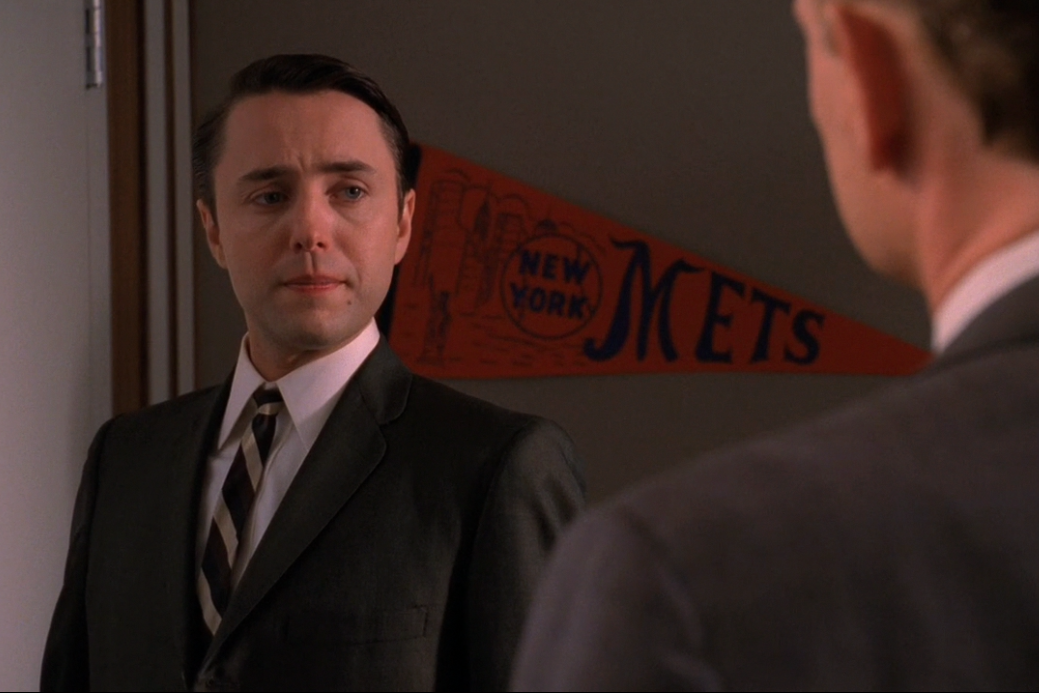
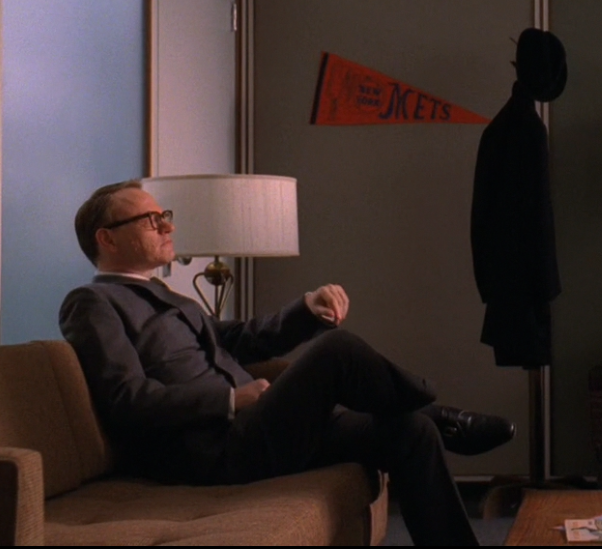
by Greg Prince on 17 October 2010 8:54 am On a Sunday night in late August, viewers of Mad Men (whose season finale airs tonight at 10 on AMC) discovered Lane Pryce, British financial maven for ad agency Sterling Cooper Draper Pryce, had tacked on his office wall a New York Mets pennant, the period-appropriate kind he might have bought at Shea Stadium or maybe a 30 Rock gift shop proximate to SCDP’s Time & Life Building headquarters.
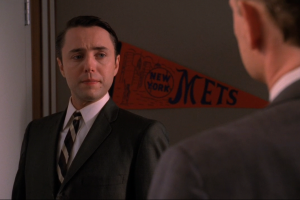 Pete Campbell, hoping the 1965 Mets can turn it around. I hold a theory that Lane and account man Kenneth Cosgrove attended a win over the Phillies in early May of ’65; 2-1, Al Jackson striking out eleven. They were, by my calculations, using the Birds Eye seats on Field Level (third base side); Kenny, who’s been going to Mets games since 1962, procured them so he could smooth out the details of his imminent return to the agency/show. Lane and Ken probably sealed the deal over drinks in the Charcoal Room, which, Leonard Koppett wrote in The New York Mets: The Whole Story, was “a nightspot in its own right. After a night game, it became the scene of an impromptu party” for season box holders.
At the center of the high-roller festivities? None other than Shea’s own Queen of Melody, Jane Jarvis. There was an organ “at the end of the long bar,” Koppett recounted, “and Jane would play that for a while after the game. The sing-alongs would echo far into the night sometimes, and why not?”
Yes, why not?
I’m pretty certain the sight of that pennant was the highlight of 2010 for me — I know it took a show set in 1965 to get me to squeal with Met delight by late August.
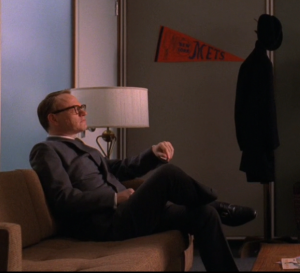 Lane Pryce, deciding Al Jackson deserves a raise. Kudos to the fictional Lane and the actual Mad Men creator Matt Wiener for deciding that a firm and a show aching to place its finger on the pulse of mid-‘60s Manhattan should have a character whose unformed affinity for baseball would logically flow to the Mets. The Mets were fresh and vivid and all too human. Those Mets were prefect for their times. They were perfect for Lane Pryce. They were perfect for Mad Men.
But could Mad Men — specifically the creative services rendered by Sterling Cooper Draper Pryce — be perfect for the Mets?
***
The 1965 New York Mets needed plenty of help on the field, compiling a record 29 games worse than the benighted 2010 club, but they were plenty popular, all 50-112 things considered. Met attendance 45 years ago totaled 1,768,389, a phenomenal figure considering Shea was no longer brand new and the Mets remained in tenth place. Casey Stengel’s final (and Wes Westrum’s first) club outdrew every other team in the majors except the eventual world champion Los Angeles Dodgers and the novelty-riding Houston Astros, who had the world’s first indoor stadium/Eighth Wonder as a selling point.
The Mets sold themselves in 1965, despite all the losing, and they kept the turnstiles clicking more frequently than almost anybody else in baseball, no matter the staggering regularity of their defeats:
• Second to only the Dodgers in 1966 (66-95; ninth place)
• Fourth only to the Cardinals, Red Sox and Dodgers in 1967 (61-101; tenth place)
• Fourth only to the Tigers, Cardinals and Red Sox in 1968 (73-89; ninth place)
Every one of those teams that outdrew the Mets from ’66 to ’68 was either winning or defending a pennant. The Mets weren’t doing more than reaching ninth place. Yet relative to the rest of the sport, in terms of attracting customers, the Mets qualified as one of the elites.
So, no, Sterling Cooper Draper Pryce did not need to be called into pump up Mets attendance as the mid-‘60s became the late ’60s. Then 1969 came along — the Mets led the majors in attendance and world championships. They were now a solid brand and an unsurpassed product…they were their own best advertisement.
Not really the case these days, is it?
***
As evidenced by the essentially unprecedented dual removal of their general manager and manager and the in-progress search to replace the former (and eventually the latter), the Mets are at an obvious crossroads. The quality of the on-field product spoke sadly for itself in 2010. And the brand couldn’t be sagging much more if Linda de Roulet herself were steering it into the ground.
Attendance isn’t everything, but it’s a pretty decent indicator of how far the Metly have fallen.
The Mets sell more tickets as a rule than they did in the 1960s — everybody does — but they pale in comparison to other ballclubs, which was never the case when the Mets were still fully establishing themselves. In 2010, the second year of Citi Field, another losing year when, à la 1965 at Shea, sheer novelty could no longer be depended upon to get folks through the door, the Mets were twelfth in the major leagues in paid attendance. The 1965 Mets actually improved on their attendance by 2.1% over 1964. The 2010 Mets sold 2,559,738 tickets, which sounds great compared to 1965, but let’s remember a couple of things:
1) Tickets sold wasn’t the National League attendance metric until 1993. A paid attendance of 20,000 in 1965 meant 20,000 people showed up, made noise, bought hot dogs and (in a few cases) partook of the hospitality of the Charcoal Room. Anybody who showed up at Citi in September amid gatherings that were listed in the neighborhood of 24,000 or 27,000 or 30,000 knows that neighborhood was as authentic as Don Draper’s identity…which, for the uninitiated, was snatched from a dead army officer in Korea.
2) Single-admission doubleheaders were a staple for every team in the 1960s. They were scheduled regularly and nobody around here was day-nighting makeup doubleheaders. The 2010 Mets actually hosted 79 dates at Citi Field. The 1965 Mets hosted 68.
The average per-date attendance at Shea Stadium in its second year for a 50-win, last-place team coming off a 53-win, last-place season was 26,006.
The average per-date tickets sold figure (hard to call it attendance when so many weren’t attending) at Citi Field in its second year for a 79-win, next-to-last place team coming off a 70-win, next-to-last place season was 32,402.
The 2010 Mets weren’t really competing with the 1965 Mets, but given that we’re in an era when (despite the economy of the past two years) attendance routinely dwarfs what was reported throughout the majors four-and-a-half decades ago, it seems the spread should be better than approximately 6,400 a game.
Those Mets of yore may have been held to a lower competitive standard, but that was because they had no on-field equity of which to speak. They didn’t have a Johan Santana or a David Wright, which the modern-day Mets do; they didn’t maintain a winning record as late as the 147th game of the season, which the most recent Mets did; they weren’t reasonably considered legitimate contenders in midseason, which the 2010 Mets certainly were — they were tied for first in the National League Wild Card race as late as July 8.
Those Mets of 1965 merely had to pull up the gates at Shea Stadium, and people would stream through convinced there was something worth being a part of. The Mets of 2010 could not do that. They weren’t nearly as depressing as the Mets of 2009 (at least until August kicked in), yet they could only retain four of every five ticket buyers from Citi Field’s inaugural year. The Mets’ 2010 paid attendance was 80.8% of what it had been in 2009.
They pulled up the gates at Citi Field, and even the crickets couldn’t be bothered after a while…not even the crickets holding tickets.
***
Too many seat bottoms lacked fan bottoms: that was the “bottoms” line these past two seasons. It doesn’t describe every malady that ails the Mets’ brand as we make the turn toward 2011 and the naming of a new chief miracle worker, but it’s a leading indicator, every bit as much as 79-83 and anecdotal observations like that which John Coppinger filed at Metstradamus in September. John visited an Old Navy store in Queens and found no Mets t-shirts amid shelves chock full of Yankee, Giant, Jet, Cowboy, Red Sock, Cub, Phillie and Marlin apparel.
The Mets want casual fans. Well, people who shop at Old Navy are as casual as they get. And they’re not going to wear Mets shirts because they’re not here to be sold. They’re not here to be sold probably because Old Navy forgot that there’s another team in New York. They forgot there was another team in New York because that other team in New York has run itself into the ground with meticulous and well-crafted stupidity.
I reiterate: Queens, NY.
More proof that the Mets are losing this city one t-shirt at a time.
John revisited the store six days later and did find a small pile of Mets shirts were now available “on a fairly prominent shelf,” though all were small or extra-small.
So much for cultivating big fans.
***
The Mets do seem fully aware, at last, that the brand isn’t doing great, not at Old Navy, not at new Citi. The careful hunt for the right GM is great news for us. Put that guy in place and go after the right manager. When the Mets start winning, there’ll be no better embellishment for their faded image. There is no greater advertisement in baseball than winning consistently.
But that will probably take a little while. The diehards among us will be patient to a point if we are convinced a plan is coming together and steps are being taken to implement it in earnest. It takes a lot to kill off the diehard Mets fan.
The casual fan is a different story. The casual fan, or, more pressingly, the lapsed diehard will need convincing. He or she will need attracting. That drifting soul will have to be given a reason to come back to the Mets in 2011 and to keep coming back to Citi Field. Somebody will have to make a truly compelling case to that person.
This is where we need Sterling Cooper Draper Pryce. This is where we need Don Draper.
Don is creative director for SCDP, one of the most admired minds in all of advertising. His agency has been going through some tough sledding — Lucky Strike bolted for BBDO, you may have heard — but he’s still the man who won the Clio for his innovative work on Glo-Coat. He’s still the man who lured Honda away from Cutler, Gleason & Chaough.
He’s still The Man.
I don’t know who should be the next general manager of the New York Mets, but I do know who should handle their advertising. Never mind that he exists only on AMC. Judging by actual attendance at Citi Field, most Mets fans have come to believe the Mets exist only on SNY. Never mind that he’s from 1965. If the Mets can be seriously considering a GM candidate who hasn’t run a team since 1997, what does that matter? Never mind that he’s really Dick Whitman and has gone to extraordinary lengths to conceal the way he morphed into Don Draper. If ever a team need to think about transforming its identity, it’s these Mets.
The powers that be at 120-01 Roosevelt Avenue are quite busy these days, so I thought I’d do them a favor. I arranged a meeting with Don Draper to discuss how he might fix the Mets’ image in 2011. Though I told Don up front that I’m just a fan and a chronicler of the team, I suggested for the purpose of our chat, he consider me as representing the Mets’ interests. Whatever he might say to Met brass, he could say to me.
We set the meeting, I took care to fully stock my office wet bar and I welcomed Don Draper to what could be the most important hypothetical interview the Mets ever conduct.
***
Hello Don, good to see you. I was expecting you a little earlier, actually.
Maybe I’m late because I was spending time with my family reading the Bible.
That’s fine, Don. We believe in “faith” here, but we’re also filled these days with a little too much “fear”.
It’s your life. You don’t know how long it’s gonna be but you know it’s got a bad ending.
See, that’s exactly the kind of honest assessment I was hoping to get regarding the New York Mets organization from an objective outside source.
You have to move forward. As soon as you can figure out what that is.
That’s what this meeting is about. We definitely want to put this current troubled era of Mets baseball behind us.
This never happened. It will shock you how much it never happened.
Well, we sure do want our fans to forget 2010, though we felt we had made genuine progress in certain areas.
When you try to forget something, you have to forget everything.
So you’re counseling more of an overhaul, perhaps, than we anticipated.
If you don’t like what’s being said, change the conversation.
To be honest, we didn’t see the situation as completely dire. We’re pretty satisfied with certain aspects of our operation.
No one thinks you’re happy. They think you’re foolish.
We do all right here.
You need to decide what kind of company you want to be. Comfortable and dead, or risky and possibly rich.
Laying it on the line for us, I see. Fair enough. Still, it’s not like we’ve been a total disaster since moving into Citi Field.
Maybe I’m not as comfortable being powerless as you are.
Listen, we don’t feel that way at all. We understand we have an image problem…
This is the greatest advertising opportunity since the invention of cereal.
That’s why we called you in, but you should keep in mind that we do know a few things. We did sell 2,559,738 tickets last year.
The unpleasant truth is, you don’t have anything. Your customers cannot be depended on anymore.
That seems a little harsh, Don, but we asked you here to be the truth-teller. So tell us: how would you describe the New York Mets as a product when it comes to the customers we can depend on?
A product for which good work is irrelevant, because people can’t stop themselves from buying it. A product that never improves, that causes illness, and makes people unhappy.
If our hardcore fan base isn’t the issue, what about the people who used to come to Mets games but now want no part of us?
There are people out there who buy things, people like you and me. And something happened. Something terrible. And the way that they saw themselves is gone. And nobody understands that.
Don, I’m not sure I follow. The Mets have been around a long time and just two years ago we drew more than 4 million fans.
You can’t tell how people are going to behave based on how they have behaved.
But we’re the scrappy underdog. People have always loved the scrappy underdog.
Is that what you want, or is that what people expect of you?
What we mostly want is whatever will work. Whatever identity you can help us come up with has to make a statement. Doesn’t it?
It’s a label on a can. And it will be true because it will promise the quality of the product that’s inside.
So you’re saying it’s all about communications? We sent out an e-mail the other day telling our fans about how our search for a new head of baseball operations is going. How do you suppose we should follow up on that when we make the actual decision?
Everything’s going to be okay. We have a new president, and we’re all going to be sad for a little bit.
Not raising expectations too high the first year, huh? Sounds reasonable in theory, though I don’t know if even a great Madison Avenue mind like yours is going to be able to sell that.
Who the hell is in charge, a bunch of accountants trying to make a dollar into a dollar ten?
Please, Don, let’s leave ticket prices out of this for the time being. We still have to be seen as a viable contender entering 2011, not some kind of also-ran.
A man is shamed by being openly ridiculed and rejected. It requires an audience.
So you’re saying we shouldn’t worry about attendance too much until we have a team that people will want to pay to see?
Limit your exposure.
That’s easy to say now, but the whole idea is to fill Citi Field as soon as possible, isn’t it?
There will be fat years, and there will be lean years. But it is going to rain.
The weather in April does present a problem. So maybe you’re telling us if we’re going to lose some games, we should get it out of the way early in the season, and then when it gets warmer, we put a better product on the field and people will be more likely to come.
I told you to stop talking.
Technically, Don, you didn’t, but I don’t want to get in the way of your creative thought process. Would it help if you jotted down some ideas on an iPad and I came around later to look at them?
My mind is a jumble. I can’t organize my thoughts. And typing feels like work.
Let’s keep this nice and casual then. Let me freshen your drink and maybe go over some of our personnel with you. I have to start with our poster boy, David Wright. What do you see when you look at him?
I think he’s a winner. Square jaw, false modesty, it’s like he just took off his letterman jacket.
We’re agreed there. You might have heard the press conference where a reporter asked if we’d ever consider trading him. I think the question was baiting us. We had to say everything’s an option, but we didn’t mean we’d trade our biggest star. We put a lot on that young man’s shoulders.
I think I’m glad I’m not that kid.
What about some other names on the roster. Any thoughts on Jenrry Mejia? We used him as a reliever. Then we sent him down. Then he got hurt. Then he pitched well. Then we called him back up and started him. He got hurt again.
He’s only a baby, and we don’t know who he is yet, or who he’s going to be. And that is a wonderful thing.
So maybe we don’t include him in our 2011 marketing. Let’s see who else we’re thinking about… What are your impressions of Hisanori Takahashi?
People tell you who they are but we ignore it, because we want them to be who we want them to be.
We definitely see him as a reliever, but he wants to try starting again. He’s a free agent, you know.
Negotiating is a bore.
I know what you mean, but we do have some decisions to make in that area. Pedro Feliciano will be on the open market this winter. We’ve sure used him a lot the last few years.
Get out of here and move forward.
We do have our concerns about his arm being ready to fall off. Just curious, as long as we’re talking about Felicianos, what about the other one — the outfielder?
Listen, I’m not here to tell you about Jesus. You already know about Jesus. Either he lives in your heart or he doesn’t.
Yeah, I agree. If you’re not committed to a guy off the bench, you should be prepared to cut bait.
I’ll say whatever you think I should say, but I’m not going to fight with you.
We’ve really strayed from the whole point of our meeting, which is advertising. It’s just that I’m so interested in your opinions of every facet of what the Mets do.
Does it make you feel better to think that I’m like you?
Humor me, just for a sec. Let me ask you about a potential double-steal attempt. The other team has runners on first and third with less than two out. You see the runner from first breaking for second. If you’re pitching, do you try to pick him off and risk the runner breaking from third?
I will always come home.
I’ll get word passed through to the new pitching coach, if we have one.
Believe me, I will ruin him.
You’re too modest. I’d really like your input, informally of course, on the GM thing. We really don’t know who we’re hiring. Any ideas about how we might bring in the best possible person for the job?
You need to charm him. I need you to be shiny and bright.
I wonder if we need a really strong presence whom everybody in the industry recognizes, somebody like Sandy Alderson.
You want some respect, go out there and get it for yourself.
Geez, you don’t sound that enthusiastic about the guy. Everybody speaks so highly about him.
He hated me and I hated him: That’s the memory.
Well, if we give your agency our account, I’ll see to it you don’t have to deal directly with Alderson.
I’d like that in writing.
Isn’t that a little premature, considering we’re just talking at this stage of the game?
I can’t make any mistakes right now.
That makes two of us — you and the Mets. Maybe we should have you on the search committee to help us choose the new general manager.
I’m usually part of the meeting before the meeting.
No, you’re right. It wouldn’t be fair to drag you into this mess when the process is this far along. Besides, your bailiwick is advertising. If we agree to work together, we’ll want you to think about not just making the team look better, but all of Citi Field. For example, we want to burnish the reputation of our clubs: the Delta 360, the Acela, the Caesars…you’ve been in all of them. What was your experience?
Fancy people would go there, they’d get loud, they’d get drunk.
Well, we did have a slightly more upscale demographic in mind when we opened the clubs. It may not have worked out as we hoped. I guess we have to admit 2009 and 2010 didn’t live up to all the expectations we set.
You manage people’s expectations.
We try, but after 2006, we thought we had a dynasty in the making. We came so close that year. It still hurts.
Mourning is just extended self-pity. In New Guinea, pygmies grind up their ancestors and drink the powder in a beer.
Hmmm…imagine how much we could get for that at the Beers of the World stand.
Bringing in business is the key to your salary, your status, and your self-worth.
We do get bonuses based on producing the most unique ideas.
Just think about it. Deeply. Then forget it. And an idea will jump up in your face.
That’s good advice, Don. Let me freshen your drink…say, can I order in lunch or anything for you? We’ve had a few since we sat down and I thought maybe some food would help clear our heads.
I eat a lot of apples.
That’s good to know — we have a couple of really big ones around here.
You know what? There’s a way out of this room we don’t know about.
Sorry, bad joke. I know your time is valuable.
I just want to see the city disappearing behind me.
I hear that. Let’s wrap this up so we can knock off already. But I’ve gotta ask some big questions before we’re done here. Let’s say you’re in charge of the whole ball of wax. What do you do with the Mets?
We don’t know what’s really going on. You know that.
The Madoff issue? I think we have to take ownership’s word on that. By the same token, we’re probably not looking at the payroll getting any bigger.
You have a great fortune, and that’s not just money, it’s the future.
You mean like our minor leaguers? ’Cause I gotta tell ya, having already brought up Davis and Mejia and Thole and Tejada last year, I don’t know how much we have left down there.
There is no system.
So what’s so great about our future?
There is the rare occasion when the public can be engaged on a level beyond flash, if they have a sentimental bond with the product.
Yeah, but how much is that worth after these past few years? How can we use that kind of pull to draw in fans who’ve lost their zeal for the Mets? How do we get that customer from, say, Astoria back to Flushing?
In Greek, nostalgia literally means the pain from an old wound. It’s a twinge in your heart, far more powerful than memory alone.
So our future is our past?
This device isn’t a spaceship, it’s a time machine. Goes backwards, forwards, and takes us to a place where we ache to go again.
We’ve only won the two championships, Don. Sometimes it feels like the Mets brand is hollow, like we don’t have all that much to offer our potential public.
You are the product. You, feeling something. That’s what sells. Not them.
So we shouldn’t be afraid to be the Mets? The Mets haven’t exactly been synonymous with success lately. We were talking upstairs about maybe taking out a full-page ad in all the papers saying we’re sorry for screwing up as badly as we have.
It’s not about apologies for what happened.
Then is it about just capturing people’s imaginations with something clever? You can come up with something like that, right? Something better than “Your Season Has Come”?
There has to be advertising for people who don’t have a sense of humor.
“We Believe In Home Field Advantage” wasn’t particularly amusing, but we did win a lot of games at home in 2010. Not that we drew a lot of fans…
I keep going places and ending up somewhere I’ve already been.
I know, Don, I know. It’s like going in circles dealing with the Mets. You said we should avoid apologies, but the whole thing…
Goes backwards, forwards, and takes us to a place where we ache to go again. It’s not called “The Wheel,” it’s called “The Carousel.” It lets us travel the way a child travels, round and around and back home again, to a place where we know we are loved.
So we find a way to improve, but at the same time we remind people why they loved Mets baseball in the first place? That’s brilliant, Don! Brilliant! But what about changing the conversation and the label on the can and all that other stuff you were saying?
And let’s also say that change is neither good or bad, it simply is. It can be greeted with terror or joy. A tantrum that says “I want it the way it was,” or a dance that says “Look, something new.”
Don, this has been a fantastic meeting. You brought so much to the table today, and I feel like this could be the beginning of an incredible partnership between Sterling Cooper Draper Pryce and the New York Mets. It’s like we’ve had some kind of breakthrough. I hope you feel the same way toward our organization. You do agree we’ve reached some kind of tipping point here, don’t you?
Now that I can finally understand you, I am less impressed with what you have to say.
***
Each of Don’s answers is actually an excerpt of dialogue from Mad Men’s first four seasons, and for the accurate transcription of such, a sincere tip of the fedora to Basket of Kisses, THE blog for Mad Men obsessives.
Not that I would know what one of those is like.
by Greg Prince on 17 October 2010 12:48 am Welcome to a special weekend playoff edition of Flashback Friday: Take Me Out to 34 Ballparks, a celebration, critique and countdown of every major league ballpark one baseball fan has been fortunate enough to visit in a lifetime of going to ballgames.
BALLPARK: Pacific Bell Park
LATER KNOWN AS: AT&T Park
HOME TEAM: San Francisco Giants
VISITS: 1
VISITED: July 6, 2001
CHRONOLOGY: 24th of 34
RANKING: 8th of 34
As Stephanie and I took our seats in the last row of Pac Bell Park —the View seats as they were cleverly dubbed — we came upon one of the few imperfections detectable in an otherwise magnificent setting. There were stickers on each cupholder advertising an online grocery concern, blights that were soon going to have be removed as that company, Webvan, was declaring bankruptcy, ending its grocery runs. The tech boom was going bust in 2001, and locally headquartered Webvan would go down with it.
 A shame for the people who worked there. Tough luck for the Giants losing a sponsor. But the presence of the stickers for such a theoretically forward-thinking outfit was somehow appropriate given the Silicon Valley zeitgeist surrounding Pac Bell Park, a park that (under another name) would later become the first Wi-Fi field in the majors. This place was Retro Version 2.0, an upgrade from the generation of trendsetting ballparks that preceded it. Pac Bell was evidence that nothing was static in this fast-moving era, that progress was only a mouse click or a Barry Bonds swing away. A shame for the people who worked there. Tough luck for the Giants losing a sponsor. But the presence of the stickers for such a theoretically forward-thinking outfit was somehow appropriate given the Silicon Valley zeitgeist surrounding Pac Bell Park, a park that (under another name) would later become the first Wi-Fi field in the majors. This place was Retro Version 2.0, an upgrade from the generation of trendsetting ballparks that preceded it. Pac Bell was evidence that nothing was static in this fast-moving era, that progress was only a mouse click or a Barry Bonds swing away.
Camden Yards had been state-of-the-art just eight years earlier. Now baseball seemed poised to trade in their Camdens for Pac Bells.
That’s how it felt up in the last row. As hackneyed an expression as “state-of-the-art” had become by 2001, it fit Pac Bell. Actually, maybe you could make do just by calling it “art”.
Wow, what a venue for baseball. Privately financed, as the lady P.A. announcer saw fit to mention, which maybe explains why they decided to besmirch it with the unsightly Webvan stickers. But it was a small blight on an otherwise pristine landscape.
Why shouldn’t San Francisco’s ballpark be up to San Franciscan standards?
If I may detour slightly from my ultimate destination and fall for some well-worn propaganda, San Francisco is such a gorgeous city, I could almost forgive it for absconding with the Giants. My parents lived there when they were first married in deference to Uncle Sam stationing my father in the area during his army stint. They became enamored of the place. Years later, we took several family trips out there, the last of them concluding the day after my 14th birthday. Except for one business excursion, I hadn’t spent any quality time in San Fran in 25 years when we decided to knock Pac Bell (and the Oakland Coliseum) off our to-do list.
When we touched down on the Fourth of July, San Francisco turned out to be the sweatshirt in the back of the closet that somehow still fit. It felt familiar to me in ways that it shouldn’t have. I had never lived there and had only visited a half-dozen times, yet I somehow knew San Francisco for the few days we were there. San Francisco’s air is its own. Maybe it’s Fisherman’s Wharf, maybe it’s the sourdough, maybe it’s the lightheadedness from walking up all those damn hills. But boy did I enjoy being back.
Had things broken correctly three or so decades earlier, this series would be called Take Me Out to 35 Ballparks, because I almost talked my parents into taking us to Candlestick Park one of the summers we were out there. We could see it from the highway and there was some definite interest gathering on their part. I don’t remember why it was ultimately rejected; they weren’t fans, but they were usually up for adventures on vacation.
Just as well, maybe, that we didn’t go since by universal assent, Candlestick may have been the worst place on the planet for baseball, deserts and oceans included.
The weather, by Roger Angell:
The game that Stoneham and had fixed upon was a midweek afternoon meeting between the Giants and the San Diego Padres — a brilliant, sunshiny day at Candlestick Park, it turned out, and almost the perfect temperature for a curling match.
The atmosphere, by Richard Grossinger:
It took him a number of trips in different seasons to see that Shea was still relatively good-natured compared to Candlestick. The Giants of that era evoked racist anger and redneck fervor from an urban area generally thought of as hip and liberal. It wasn’t. The South San Francisco gay-bashing crowd were as ornery and mean a group of Americans as there are. Add in the Daly City/Brisbane low-rider tailgate partiers and you have a zoo. I don’t think at Shea you’d find the fat woman who sat behind me one day, drinking beer and kicking my seat with some force because I was rooting for the Mets. “You’re in public now, you prick,” she said, in answer to my objections. “You can’t tell me what to do.”
Can’t say I was sorry to have missed Candlestick. But I didn’t want to miss Pac Bell. It was so sumptuous in my first glances at it on SportsCenter in 2000 that I actually took a personal day during the Mets’ first trip in so I could watch a day game live on FSNY. I’ve never been one for remarking on the greenness of the grass at a given ballpark, but Pac Bell, on TV, had the greenest grass I ever saw…and it’s not like I had a high-definition television in 2000.
The Mets got swept in their one four-game set that May. Then they lost in irritating fashion to Liván Hernandez in Game One of the NLDS, another telecast I stayed home from work to watch. Pac Bell was Turner West where the Mets were concerned, but I still loved to stare at it through the screen. The Pac Bell curse lifted in Game Two moments after it truly, nearly did us in when J.T. Snow snuck a score-tying three-run homer just over the right field fence off Armando Benitez in the bottom of the ninth. Jay Payton and Darryl Hamilton (and John Franco) rescued us from twenty kinds of hell in the tenth, but I have a sense I still would have wanted to have seen Pac Bell before long no matter how the playoffs played out.
It was just too damn pretty.
The very day in February that Giants tickets went on sale, Stephanie jumped online and ordered two for a game against the low-demand Brewers from tickets.com. That’s not a small detail. The A’s tickets we ordered the same day came in no time at all. But the Giants’ didn’t. We waited and waited. April became May became June and our flight was just around the corner. Finally, she got in touch with customer service. They told her the tickets had been sent to her address…in Medford, Oregon. Seems somebody with the same first name and last name ordered tickets to the same game.
As San Francisco Giants fan Charles Schulz would have had somebody say, “AAUUGGHH!!” What blockheads.
We were told to show up at a certain ticket window with proper ID and we’d be taken care of. As Mets fans, we didn’t believe it, but we had our plane reservations, so we followed through. Flew to San Francisco; wandered through Chinatown; took cable cars; made a BART excursion to Oakland; took a bus to what we refer to as the “other” USF (University of San Francisco, unwitting sister school to our alma mater); met with friends in Haight-Ashbury; lingered in Golden Gate Park; and eventually got on the MUNI light rail, getting off at palm tree-lined 24 Willie Mays Plaza, just off of downtown San Francisco.
There it was: Pac Bell Park. And it took my breath away for a minute. Then I had to get it back for the interminable wait at Will Call and the argument we were in for with the snarling clerk behind the counter.
Except the line moved quickly and it was a perfectly amenable transaction. The Giants were sold out every night, they didn’t need our 3,000-miles-away business, but they were competent and courteous as they resolved the ticket snafu.
Imagine that. And wouldn’t Will Call be a good name for a mascot?
That extraordinarily vital task completed, now we could get back to sizing up Pac Bell and letting go of our breath.
Gorgeous…just like the city. So gorgeous I didn’t mind the lamp post banner featuring J.T. Snow triumphantly rounding first after his homer off Armando (what the hell, we won). So gorgeous I didn’t hear anybody snorting at my 2000 World Series Mets cap “in public” (what the hell, we won). So gorgeous that I could have caressed every brick.
What a happy, ignited place Pac Bell was to circle in the summer of 2001. Every game was sold out; every night was energized by a home run chase — Bonds outpacing McGwire; everybody, you sensed, feeling lucky to be where they were. Indeed, this was the place to be, to explore, to not rush inside from.
So we strolled. We strolled to the Willie Mays statue, an event unto itself. I grew up hearing San Francisco never fully appreciated or accepted Willie as their own because he had the temerity to bring his star with him from New York. I guess that wore off after a while because the Willie Mays statue was a pretty damn popular attraction. Inspired by Willie, or perhaps the NY on my black cap, I sort of elbowed others out of the way so I could take a picture in peace with Mr. Mays.
We left Willie but then spent plenty of time/currency in the store constructed in his shadow. It was two levels and it was brimming with merchandise I had no idea I needed. Stephanie was charmed by the selection and came away with a San Francisco Seals t-shirt. She had no idea who the San Francisco Seals were, but once I told her the shirt was a nod to the city’s Pacific Coast League past, she was even more charmed. Likewise when we visited Seals Plaza with a seal statue (actual mascot name: Lou Seal; I like Will Call better). This brought us to the cusp of already renowned McCovey Cove, where fly balls occasionally dropped in for a drink. Some folks had parked themselves on the water, setting themselves to wait for a potential homer. We waved to them. They waved back. Then we turned around and kept walking, eventually peeking inside the chain link fence the Giants carved out beyond right field for passersby who wanted a glimpse — free! — inside the park while the game was going on.
This was an incredible baseball canvas the Giants painted. And we weren’t even inside yet.
It was pretty freaking great within the walls of the park, too. I missed whatever escalator they have and led us up too many stairs for comfort (though the hills had been good practice). Good thing this was one of those “intimate” parks where the climbing wasn’t as endless as we would have suspected. Finally, we reached our level and…garlic fries! I heard about those, too. Then I saw the line and passed. I will, per Tony Bennett, climb halfway to the stars while in San Francisco, but I won’t wait long for fries, no matter how pervasive their aroma.
There were other places that would sell you food, at least one of them evoking the good old New York Giants. It was named for John McGraw. I didn’t partake, but I took it as a good sign — just like the sign out on one of the plazas that tells you how many miles you were from old Giant haunts, including the Polo Grounds. New York Giant nods were mixed in everywhere: the championship flags from back east; the retired NYs for Muggsy and Matty along with the numbers for Hubbell and Ott; and, in the 50th anniversary year of his Shot, a concourse banner celebrating Bobby Thomson.
I felt at home here.
This was all fantastic, and I still wasn’t in my seat. We had a little more hiking to do, all the way up to Row 18, the height of the View polloi…top row.
Magnificent.
They ain’t called View seats just to distract you from how far you sit from the field. It’s a great view. You get that green, green grass, so lush that I could imagine sleeping on it under Tony Bennett’s stars (and I’ve never gone anything like camping in my life). You’re overwhelmed by the lattice work of the scoreboard, the arches carved into the outfield walls, the perfectly placed clock. You get the water: the Cove, China Basin, San Francisco Bay…whatever it was we were looking at, it was intoxicating as sunset approached. Where, I wondered, was Steve Perry? I was playing A/V director for Pac Bell Park and decided that around the sixth inning or whenever it began growing dark that we should all hear Journey:
When the lights
Go down
In the City
And the sun shines on
The bay
Now that I read those lyrics closely, they seem to be more about morning than evening, but it fit the mood up there. (So does this right now.)
You know what else fit? Every warm piece of clothing we brought with us. I had heard continually over the first season-and-a-half that perhaps the best of all the good things about Pac Bell was it wasn’t as bone-chillingly windy here as it was at Candlestick, then we wouldn’t freeze our tuchuses off in this part of town.
Hogwash. It was freezing. It was Shea in October freezing. The last time I’d seen the Giants in person was nine months earlier when Bobby Jones was one-hitting them to close out the 2000 NLDS. I sat in the last row of Mezzanine in the second-to-last section of left field, and a gale from the general direction of LaGuardia iced me the entire game. I literally wore four layers on my upper half and my back still shivered.
This, in July, was almost as bad.
Granted, I hadn’t schlepped my parka to San Francisco, but I thought I had prepared adequately. While visiting the other USF, I purchased a green and gold lined, pullover windbreaker (their school colors were miraculously the same as our school colors). I understood San Francisco weather enough to know my hoodie from home wouldn’t be enough. But surely, now that I had a couple of articles of autumnal gear, I’d get by.
It was barely adequate, and only because we had traveled 3,000 miles to be here. Stephanie had a substantial jacket, but she wasn’t faring that well. I vamoosed from the 18th row to the first concession I could find to buy her a pair of black wool gloves with an orange SF logo. They helped, a little.
The cold kind of took the momentum out of us. We were into the game as much as we could be for two people who were marveling more at the scenery than the show. It was great scenery, but it just kept getting colder as the sun stopped shining on the bay. When you’re gathering icicles in July — July! — you begin to grow a bit impatient. You find yourself not loving everything. You find yourself annoyed by the Webvan stickers; and the P.A. lady’s slight overdoing every announcement; and her calling it “the best experience in the majors” (let us decide what’s best, thank you); and the cheering for Jeff Kent. True, he was a Giant player and these were Giant fans, but we need to maintain some objective standards.
Stephanie and I agreed to tough it out through the seventh-inning stretch, or until Bonds batted again. Our end point was his groundout to start the bottom of the eighth (Barry was in his one power slump of the season at that point; sorry kayakers).
We left our seats but not the park, opting to explore where it was a little less windy. We took in the view from an unrestricted concourse with a cutesy name (the Promenade) and it, too, was spectacular. We ambled behind the outfield seats, which was like a carnival without the creepiness. That’s where the kitschy oversized glove and the oversized cola bottle sit. There’s a parked cable car there, too. Lots of youths hanging around in there, bordering on restless, maybe even rowdy. I got a bit of a Candlestick vibe from that crowd, so I kept us moving until we were eventually back outside, riding the conveniently located MUNI to Union Square. From there, we hopped a cable car to our hotel. We listened to Brooklyn’s own Rich Aurilia drive in the winning run in the eleventh on KNBR in relative warmth.
A lot to see everywhere at Pac Bell. A fine, fine place to enjoy the game if you can stay focused on baseball; a person probably needs two games to fully appreciate everything it has to offer — and two parkas. Maybe it’s a bit precious or pretentious here and there, but Pac Bell Park wouldn’t have been San Francisco if it hadn’t been.
And it was, without a doubt, San Francisco.
In case you’re interested, a little more Giants history here, from my first piece for the New York Times Bats blog, regarding Christy Mathewson, NLCS Game One winning pitcher Tim Lincecum and the historical parallels that linked them in Philadelphia.
by Greg Prince on 16 October 2010 6:15 pm If you’re lucky enough to not be a Cablevision subscriber, enjoy Game One of the 2010 NLCS tonight on Fox. If you’re like me, you’re rushing off to a radio to hear Tim Lincecum square off against Roy Halladay in one of the few matchups that fairly screams “PITCHING DUEL!” in advance (which means it will probably be 8-7 after three).
As long as the two aces are evoking a time gone by (staticky AM reception included), take a trip back to 1905 with me, to the last time a Giants pitcher traveled to Philadelphia for a postseason game — I wrote about Christy Mathewson, the Philadelphia Athletics and some historical parallels with young Mr. Lincecum on the New York Times Bats blog on Friday here. I hope you enjoy it more than I’ll enjoy not being able to see Halladay and Lincecum tonight.
And happy tenth anniversary to this postseason classic, remembered here by Matthew Callan. Come to think of it, I’ve never seen Game Five of the 2000 NLCS on television either, but I had a good excuse.
by Greg Prince on 15 October 2010 8:23 am Our all-time favorite American League team since the other night, the Texas Rangers, will be making its first League Championship Series appearance in its 39 years of existence.
Just wanted to get that on the record — and let the second edition of the Washington Senators off the hook.
(Oh, the things one thinks about when one’s favorite National League team hasn’t played in twelve days.)
I’ve seen it asserted (by nimrods as well as decent people) that the Texas Rangers franchise has waited 50 years for this moment, but I don’t think that’s practically accurate or exactly fair. It’s not completely wrong to say it; it may even be technically right. Yet it doesn’t quite ring true.
The Washington Senators were refounded in 1961 as a sop to politicians who might have otherwise stripped away baseball’s antitrust exemption once the previous Washington Senators (1901-1960) were permitted to transplant their operations and assets — most notably young Harmon Killebrew and Jim Kaat — in Minnesota. While they and a few other promising players would go on to blossom in Bloomington, the second Senators were left to fend for themselves as expansioneers, one year ahead of the Mets.
Those Senators never blossomed. They barely filibustered. Eleven seasons of Senators II yielded no more than 86 wins in any one year — 1969, their only winning campaign — and not a single finish in what we used to call the first division. They didn’t win, they didn’t draw (never attracting as many as a million fans in a season to D.C./RFK Stadium) and they didn’t stay in Washington. In 1972, they became the Texas Rangers and ceased to be the Washington Senators.
Or did they? Well, yes…the uniforms and the locale said they were no longer the Washington Senators. That was the whole idea of moving. Owner Bob Short, not a glorious figure by any means, said he couldn’t make a go of baseball in the nation’s capital and resettled in Arlington, Texas. But the Texas Rangers — like the Minnesota Twins — didn’t materialize from thin air. They came from somewhere.
So at what point is a franchise that leaves a town and a name behind no longer that franchise? Is it that franchise into perpetuity? If the second Senators didn’t simply trail off into the ether but rather assumed a new identity, were they and are they not, on some level, still that Senators franchise?
On some level, yes. On a tangible level, no, not really.
My bible when it comes to such philosophical questions is the 2005 volume Total Ballclubs by Donald Dewey and Nicholas Acocella, an indispensable history of every single franchise that has ever been tabbed as major league: National and American as well as four defunct circuits: American Association, Union Association, Players League and Federal League. It is Total Ballclubs’ contention that once a team leaves its immediate geography, it’s not the team it used to be.
[A]nyone who holds that the Brooklyn Dodgers-Los Angeles Dodgers or Seattle Pilots-Milwaukee Brewers constitute the same club has not talked to a native of Brooklyn or Seattle.
I buy that reasoning more than I don’t. When a franchise maintains at least the same name and makes an ongoing effort to keep its chronology intact, it’s a nice gesture toward history. Walter O’Malley hauled the Dodgers to L.A. — not the shell of a failed franchise, but a brand brimming with equity, something that would attract Southern Californians beyond the mere concept of a blank slate baseball team. On the other hand, he killed the Brooklyn Dodgers. The aftermath couldn’t help but yield a substantially new entity.
Ditto for the Dodgers’ ancient rivals. You’ll hear much in the coming days that the Giants haven’t won a World Series since 1954. I’d counter that the San Francisco Giants have never won a World Series, but that the New York Giants won five, the last of them in 1954, three years before their colors and heritage were dragged ignominiously across the country by Horace Stoneham.
Yet I can see where some would see that differently. If they’re the Giants now, they’re directly traceable to the Giants then, whatever coast they’re nearest. The Giants, like the Dodgers, celebrate their past and never explicitly disavowed it. That should be worth something if not everything.
The Rangers, however, shed their Washington baggage as soon as they could. As Total Ballclubs points out, the two most saleable individuals Short brought to Arlington were manager Ted Williams and slugger Frank Howard. Williams led the Senators to that one winning season in ’69, and Howard — New York Met manager for 116 games in 1983, in case you’ve forgotten — hit 136 home runs from 1968 through 1970. Yet both were gone from Texas before 1973 began. The Rangers, for better, worse or primarily the same, were intent on ditching their Dick Whitmanesque past in Arlington (also, Short didn’t want to keep paying Williams and Howard).
The Texas Rangers weren’t automatically 25 Don Drapers just because they changed their name. They didn’t win very much for a very long time, but they elected to proceed as an essentially new franchise. View it within the realm of what the Rangers had been before 1972: a United States senator’s term in office is six years; the only Senator to serve that long, in uninterrupted fashion, in Texas, was Toby Harrah. He stayed a Ranger through 1978 and returned for a House of Representatives-length stint in 1985 and ’86. That put Harrah, a four-time All-Star, in the same trivial conversation with 1970s Mets Willie Mays and Bob Aspromonte. They were, respectively, the last active New York Giant and Brooklyn Dodger to play in the bigs, just as Harrah was the final Washington Senator. Jim Kaat, should you be wondering, was the last pre-Twin Senator on whom the gavel came down — Kitty came up in 1959 and hung on until 1983. Toby, though, finished up a Ranger, saying goodbye to America in a way Mays, Aspromonte, Kaat didn’t do with their once-transient franchises.
Last Harrahs not withstanding, it can’t be said Washington became a distant memory in Arlington, because Arlington had no reason to remember Washington in the first place. The Rangers were a new concern in the Dallas-Fort Worth Metroplex; the Senators of 1961-1971 never happened for them, except, perhaps, at the bottom of the American League standings, assuming anybody in the area was looking for them. They didn’t use the Senators as a platform for growth as L.A. did with the Dodgers or San Fran sort of did with the Giants. What got shipped to Texas was indeed the shell of a failed franchise. The shell would be filled with more failure across most of the next four decades, but it was Texas-bred failure.
Now flip the coin: If the Washington Senators didn’t matter much to Texas fans, did the Texas Rangers merit sentimental attachment back in Washington?
Though they were jilted en masse by their franchise’s owners, handfuls of Dodger and Giant loyalists persevere to this day in our Metropolitan midst, never taking the opportunity to get on board the Amazin’ express, not in 1962, not ever. Some of those who hang in there gamely grew up with the Brooklyn Dodgers and New York Giants, and some inherited the gene. The New York Mets fan in me finds living in New York while rooting for a California club kind of crazy, but the New York Giants fan I profess to have been in another life sort of understands it. There was a long and hallowed history there, and as one of my Giants friends once told me, he was a Giants fan as long as he could remember, long before 1958…why should he quit on them just because they quit on him?
But the Washington Senators? The Senators of 1961 to 1971, specifically? The Senators who couldn’t rise above fourth place and exceeded .500 only once? Did they inspire any residual hometown allegiance once they filed a change-of-address card? Could there possibly still be Texas Rangers fans in Washington, D.C., even now, 39 years after the Senators left and going on six years since the Nationals arrived?
Anything is possible, but somehow I doubt it. Some folks in Washington cling tightly to their memories of both versions of the departed Senators (each of whom the ex-Expos acknowledge as municipal and spiritual forebears), but Texas was Texas, and the Rangers were quickly something else altogether. Perhaps it’s best to defer to the great Tom Boswell on this matter:
Washington baseball fans have had prickly Ranger feelings for ages. They, and especially under-financed, incompetent owner Bob Short, who moved the Senators to Texas after the ’71 season, are a primary reason the town went without a team for so long.
Boswell, for so long a bard of baseball in a town that lacked a team, betrays no latent attachment to the Senators Emeriti, even if he thinks it’s fine they’ve reached their heretofore unreachable star. “Good for the Texas Rangers,” he wrote in Thursday’s Washington Post. “They suffered long enough. At last, they’ve won their first postseason series. It took 39 seasons. […] To me, 39 seasons is just about right for stealing my childhood team and damaging Washington’s reputation so much the town did not get a club for decades. See, I’m not the type to hold a grudge.”
Tom Boswell says the Texas Rangers required 39 years before making it to an LCS — 39, not 50. Long enough for Tom, long enough for Texas, good enough for me.
Now on to winning their first American League pennant.
|
|