The blog for Mets fans
who like to read
ABOUT US

Faith and Fear in Flushing made its debut on Feb. 16, 2005, the brainchild of two longtime friends and lifelong Met fans.
Greg Prince discovered the Mets when he was 6, during the magical summer of 1969. He is a Long Island-based writer, editor and communications consultant. Contact him here.
Jason Fry is a Brooklyn writer whose first memories include his mom leaping up and down cheering for Rusty Staub. Check out his other writing here.
Got something to say? Leave a comment, or email us at faithandfear@gmail.com. (Sorry, but we have no interest in ads, sponsored content or guest posts.)
Need our RSS feed? It's here.
Visit our Facebook page, or drop by the personal pages for Greg and Jason.
Or follow us on Twitter: Here's Greg, and here's Jason.
|
by Jason Fry on 11 April 2022 12:27 am One of the earliest lessons for a baseball fan is that you cannot, in fact, win them all.
The Mets proved that to themselves and fans new and old Sunday afternoon, falling 4-2 to the Nationals. Squint a little and there was a lot to like, most importantly an encouraging performance by Carlos Carrasco, whose 2021 was undone by lingering injuries and then by a baffling failure to perform, problems which might or might not have been the same thing. On Sunday Carrasco looked much more like the inspirational figure who’d been a Cleveland favorite, giving up a solo homer to the ageless Nelson Cruz (a long-ago paper Met) and a single to Josh Bell in the first but nothing whatsoever after that. Francisco Lindor hit a solo homer of his own, hit machine Mark Canha drove in a run to put the good guys up 2-1, and we all waited for the Mets to follow that up with a big inning that put the Nationals away once again.
We waited, and it didn’t happen.
Instead, there were failures to move runners over and then a disastrous inning in which Chasen Shreve and Trevor Williams got three runs hung on them. That brought the season’s first second-guessing of Buck Showalter, whose Sunday included neither pinch-hitting for Robinson Cano or bringing in more front-line relievers than Shreve and Williams. But hey, Shreve got in trouble by giving up a hit to a lefty, a rare occurrence that confounded the percentage play, and Williams would have escaped unscathed if not for two lousy plays in the field by Pete Alonso, which cost the Mets an out at home plate and then a double play. Lest we be too hard on Pete, let’s remember his first-ever grand slam was not even 24 hours old when he was undone on defensive woes, and not do that.
The Mets won three out of four in Washington, an excellent blueprint they’re welcome to carry throughout the rest of the year. The starters have been pretty close to spotless and the relievers not bad at all. The hitters have ground their way through at-bats and delivered two-out hits a lot more frequently than previous incarnations of the team. Players and coaches and manager have shown proper fire and indignation in the face of probably accidental beanballs, which isn’t quantifiable but still something you like to see.
There are reasons to worry, beyond the spaces in between good things that got them in trouble on Sunday. Jacob deGrom is probably the key to the Mets’ season and likely to be MIA for some time, and the starters behind the superlative JdG carry worrisome amounts of injuries, mileage or inexperience on their resumes. But there are always reasons to worry — that’s as much a baseball lesson as the unfortunate inability to win them all. The Mets head for Philadelphia having won three of four and giving us reason to hope that may be more the rule than the exception, and whatever may lie ahead, that’s not a bad way to start a season.
by Jason Fry on 10 April 2022 10:50 am It’s an axiomatic to what we do here at Faith and Fear that the Mets are front and center in life for at least six months a year, with 1:10 pm and 7:05 pm the times around which calendars get constructed, not to mention all the oddball 10s and 05s on the clock necessitated by road trips, holidays and television-partner arrangements.
But “front and center” doesn’t always mean “to the exclusion of all else.” Sometimes the rest of life gets in the way, even at 7:05 pm and even when there’s yet another prized new starting pitcher to be formally introduced.
Saturday night was the Mets debut of Chris Bassitt, recently arrived from the Oakland A’s and having introduced himself to me with an endearingly blunt assessment of why he pays an agent. But when 7:05 pm came, my phone — now the key to all Mets interactions if I can’t be in front of a TV or in a stadium seat — had been pressed into service to play music for a fundraiser at a distillery up here in Connecticut.
It was spoken for and so was I, making conversation and being pleasant company. If this sounds like a hardship, sign me up for more of them — I was at a distillery and had all the fancy bourbon I wanted, not to mention enough cheeses, meats and miscellaneous dainties to supply an army. But after some conversation and listening to a couple of speeches, I noted that the room where my phone was playing music had emptied out and most everyone in the room with me had chosen their conversational partners.
So could I … I decided I could.
Technology’s march isn’t always a succession of triumphs — witness the mixed reviews for baseball on Apple TV+. (Personally, I liked the crisp graphics, disliked the dopey parade of probabilities and thought the announcers were pleasant enough but excessively gabby.) But SNY’s new app is a very good thing. Once you’ve verified you give money to a sanctioned TV provider, you can watch it wherever you like — even, Heaven forfend, within the holy blackout zones that reduce MLB.tv largely to a vehicle for late-night baseball tourism. The SNY app includes the Channel 11 games, and if you leave the area, you can watch for a month before it requires you to toe-tap back into your home turf.
All very reasonable, particularly given the usual draconian nonsense of blackouts and exclusive territories. Pair it with a modern iPhone and well, then you’re really cooking.
I turned off the music, flipped over to the SNY app and there were the Mets, in miniature but perfect HD. (On a phone! I felt like George Jetson!) It was the fifth inning, there was no score, and Francisco Lindor — who’d subtracted a bit of tooth enamel but added a newfound regard for his teammates — had just worked out a walk to load the bases. Up stepped Pete Alonso, whose propensity for long balls has made him an All-Star Derby icon nationwide and a rewriter of record books here at home, but whose resume was missing a grand slam — an oddity akin to, I don’t know, being a traveling magician who’s somehow never extracted a bunny from a hat.
As I and a couple of interested onlookers peered down at my phone, Pete connected off Joan Adon, about whom I knew nothing except that he must have done something right given the score. It wasn’t a majestic blast, attended immediately by disconsolate outfielders or souvenir seekers in distant precincts. Still, Pete seemed pretty pleased with himself, flipping his bat away as he departed for first and hopefully beyond.
Had he? I recalled Gary Sanchez flipping his bat away as a Twin newcomer, leaving home a self-anointed hero only to discover that Target Field’s dimensions aren’t quite as laughable as those of new Yankee Stadium, which meant he was the game’s final out. It wasn’t a pleasant thing to recall, but the mind of a worried Met fan specializes in such associations.
Not to worry. The ball plopped down over the fence, beyond Lane Thomas‘s ability to have a say in the matter. Alonso had his first grand slam and the Mets and Bassitt had a 4-0 lead.
Here, we’ll add an additional bit of spice. I was watching without sound, as the best way to get to keep flouting convention is to do so in moderation. But I’d forgotten that my phone was still in music mode, supplying audio to a Bluetooth speaker in the other room.
In that room was a teenaged kid who’d been pressed into service handing out goody bags to departing fundraiser guests. Said kid, it turned out, was a Mets fan, and had been following the game on his phone as best he could. So imagine his reaction when some bearded old guy shut off the old-people music and took his phone away, only to have Gary, Keith and Ron materialize out of the aether and begin describing wonderful things to an audience of one.
I saw a little of Bassitt, with my three-minute scouting report consisting of “about a million different pitches and a peculiar arm angle that looks like mechanical hell but apparently works.” I saw Met relievers including newcomer Joely Rodriguez comport themselves blamelessly after Bassitt’s departure. I saw Brandon Nimmo do some ninth-inning hitting and scampering to tack on an additional run. I did not see Met batters lying in the dirt or having to provide up-close negative reviews about stuff vs. pitchability to a Nationals audience.
And I saw the Mets win — for the third time in the new year and the Buck Showalter era. Or the Chris Bassitt era, the Joely Rodriguez era, the Travis Jankowski era, or the Wayne Kirby coaching first while presumably unaware that I own the Mets uniform pants he wore as a lithe big-league player decades ago era.
Define this era however you like. Celebrate it while it’s the stuff of perfection. That won’t last — it never does. I’ve learned that about baseball. But I’ve also learned that means you should bask in these stretches when all is in perfect alignment and as it should be. This is the good stuff, necessarily finite and perhaps all the more enjoyable for that.
by Greg Prince on 9 April 2022 11:06 am Nationals Park was a little dim, I heard over the car radio. The stadium bulbs weren’t firing as intended, so Friday night’s game wasn’t commencing when intended. Fine by me, having mistimed my errands and running late toward what I’d looked forward to both all day and since late November. Now I’d get to hear and maybe see the Mets of Max Scherzer and the Nationals of no longer Max Scherzer from the beginning, depending on local traffic and the bringing upstairs of groceries.
I brightened up with anticipation, only to have my enthusiasm flicker a tad once I got a gander at Apple TV+’s Friday Night Baseball. Oh, it looked sharp, as far I could tell. Our household is not equipped to go wide on a production of this nature, what with perfectly functional televisions that didn’t get their master’s degrees in advanced technology, so I was eyeballing an iPad for video. The chatter from the tablet convinced me WCBS should remain my audio for the evening. It wouldn’t sync with what I’d be glancing at, but I had Howie Rose and Wayne Randazzo painting the word picture. I’d have the iPad for visual amplification. And I’d have the TV on to follow the Nets, contesting the Cavaliers for play-in seeding (busy night).
This wasn’t how Max Scherzer’s First Start as a New York Met was drawn up. This should have been a full-focus event, preferably at Citi Field, definitely aired over SNY, ideally following Jacob deGrom’s Opening Day mastery with a bookend shutout or something close to it. Not too many weeks ago, deGrom and Scherzer pitched in the same Spring Training game. Jake went three, Max went six. It was one of the more scintillating exhibitions in St. Lucie history.
But those visions were history by Friday. However one was to consume this Met milestone, the important thing is that it was happening. And it certainly did. Max Scherzer gave the Mets six splendid innings. The Nats cobbled together one run in the second, and Josh Bell nailed him for a two-run homer in the fourth (he gives those up sometimes), but otherwise three runs for a first start — particularly after the hamstring alert that pinged in Florida — was plenty satisfying for Scherzer and us. Max managed the emotions of returning in a new uniform to the scene of so many previous triumphs quite professionally.
Professionalism is rampant with Buck Showalter in the dugout…and Buck Showalter purposefully out of the dugout.
Showalter’s major move Friday night should have been writing “SCHERZER” wherever pitchers are listed on lineup cards now that one can’t say “in the ninth place in the batting order”. Scherzer’s night turned out to be not primarily Scherzer’s night. He went his six, he got his win and he is officially a Met in reality, not just on paper or in Photoshop. Those are accomplishments.
Leading your team is an accomplishment, too. Max will do that in his way. Various players will do the same, if differently. And the manager? The manager is the man in whom we invest all sorts of leadership qualities, only to be told these days that, nah, a manager doesn’t do what you think he does. Decisionmaking is cooperative and collegial with the front office and its analytics people. Players aren’t managed so much as they are handled. So manage your managerial expectations and don’t pin on Buck as much blame as you pinned on his predecessors when something eventually goes wrong.
Yet I’m ready to credit Buck coming out of the gate here in 2022 because I heard — then saw — Buck come charging out of the dugout in the top of the fifth inning Friday night after Francisco Lindor was hit on the C-flap of his batting helmet with a rising fastball from Steve Cishek. Lindor was down on the ground in an instant. Showalter was on the field wanting to know “WTF?” in so many words an instant after that.
Four Mets had been hit in the first fourteen innings of the season. Showalter knew that. More Mets seem to be hit per capita than members of anybody else in the majors. Over the past four seasons, no team has taken more hits to the body, with the Mets taking 307 for the team between 2018 and 2021. Add in the three from Opening Night, then Lindor, and that adds up to too many. Only so many pitches can be chalked up to having simply “got away” from so many pitchers. We don’t mind the base the batsman is awarded. We’re fed up with how the batsman (or his pinch-runner) finds himself there.
Buck’s been the manager since December organizationally and since Thursday night practically. But you think he doesn’t know the epidemic proportions of HBPs to which the Mets have been subject? You think there’s anything relevant Buck doesn’t know? Friday night he knew it was time to say something, say it immediately and say it loudly.
The umpires listened. The players on both sides heard it. In a blink, everybody was on the field. Lindor, thankfully, was up on his feet and feeling (he said) no ill effects. No punches were thrown. Provocation was in the air. Bloodlust maybe not so much. The point was the Mets were sick of being human dartboards, no matter that the targeting may have been unintentional. Throw your pitches better, was Buck’s essential message to the Nationals. “I don’t really want to hear about intent,” Showalter elaborated afterward. “When you’re throwing up in there, those things can’t happen.” The man is so savvy, he can manage two teams at once.
I don’t believe Cishek was aiming at Lindor. I don’t believe any Nat was aiming at any Met the night before. I also believe you can’t just pick yourself up, dust yourself off and trot to first without at least one highly audible ahem. That’s what Showalter brought to the field. That’s what his players brought in support. “There’s not one guy I didn’t see,” Lindor said about being surrounded by so many Mets, “and I appreciate that. That, to me, shows unity.” The umpires interpreted the collective throat-clearing correctly. They tossed Cishek as an “aggressor” amid the hopped-up milling about (not so much for the actual pitch) and they sent ex-Met coach Gary DiSarcina, now in the Nats’ employ, to join Cishek in selling seashells by the seashore for what they judged pot-stirring motions. Showalter wasn’t ejected or told about asses in jackpots. Buck made a defensible baseball decision. He did the right thing.
Buck may not have been seeking ownership, but Friday indeed became Showalter’s night. He changed the tenor of the evening, the series, potentially the season. “I’m super proud to be a New York Met,” Lindor said later. The whole scene, once it appeared Francisco didn’t incur injury, was reassuring to process, whatever media platform one chose to absorb it via. No less reassuring was Scherzer — warned not to retaliate — going out for the bottom of the fifth and mowing the Nationals down on a dozen efficient pitches.
The Mets were leading before the dust coalesced; they were leading when the dust settled; and they led after the game that had at started at dusk and ended near midnight turned to dust destined to be put in the books (or iBooks). A ninth-inning downpour didn’t help MLB in its attempt to showcase whatever it was trying to prove with its streaming exclusive. The game may have looked sleek on devices worldwide, but baseball will take its sweet time when the lights won’t work, when the tarp comes out, when the teams have to be separated from one another, and when a new pitcher has to be called in to replace an ejected teammate. The Mets devoted a hefty share of the three hours and forty-three minutes it took to play this game — not counting fifty-two minutes of electrical and meteorological delays — scoring seven runs, using five separate innings to effectively grind their offense and post their tallies. That was pretty sweet, too.
Jeff McNeil celebrated his birthday with his and the team’s first home run of the season, blowing out the candles for three RBIs in all. Robinson Cano had a big hit. Starling Marte had a couple. The relievers who followed Scherzer — Drew Smith, Seth Lugo and Sean Reid-Foley — allowed no runs among them. We’d complain if they had, so we should acknowledge they didn’t. Oh, and the Nets beat the Cavs; Durant scored 36. (Like I said, busy night.)
The 7-3 victory sounded crisp on the radio because we have Howie and Wayne, and theirs is a crystal clear stream of accounts and descriptions, intermittent AM static notwithstanding. I would have liked the option of the usual Met-centered telecast, but it wasn’t there. Apple apparently wants to stamp these productions with their own talent, otherwise they might want to think about putting to good use announcers who are already in town, maybe pairing one of the available visiting voices with a home team counterpart, thus giving everybody who’s actually interested in the game the most pertinent insights available. It was the only good thing the mid-’90s debacle known as The Baseball Network ever tried (it even got Bob Murphy back on television for a few nights).
I don’t want to be totally dismissive of this effort to “grow the game”. Perhaps somebody was genuinely excited that Apple TV+ had the Mets-Nationals game on its app and perked up to the broadcasters they hired to call and comment on the action. Maybe I missed out on the ground floor of something historic — besides Max Scherzer’s first pitch as a Met while putting away paper napkins and kidney beans. I’m good with that. Again, I had Howie and Wayne. The supermarket where I did my pregame shopping sits around the corner from an evangelical church. They had a sign out front that said HE IS RISEN. No, I thought later, HE IS ROSE. And when it comes to the Mets, his word is gospel.
by Greg Prince on 8 April 2022 10:37 am Wait. Wait a little more. Wait just a little more.
Now. Now you can have your Opening Day. I mean Opening Night. I mean Opening Night win. It’s yours. No strings. No hamstrings even, as far as we know. It arrived in our laps a little bruised, a little soggy and a little too late to be accepted in total alertitude, but at the end of the day/night and on the morning after, it’s clean and it counts.
Are you happy? Why shouldn’t you be? Because instead of COVID-19 locking everybody in until late July, as it did in 2020, or just the positive-testing Nationals with the Mets as collateral bystanders, as it did in 2021, the Major League owners conspired to lock everybody out until the middle of March? That? That was so one month ago. Spring Training simultaneously waited and rushed. It didn’t rush quickly enough to get us to the previously agreed upon date that was going to open 2022. So we waited an extra week. Opening at home on March 31 at one in the afternoon was out. Opening at Washington on April 7 at four in the afternoon was in.
Except rain was in the DC forecast, so four o’clock became seven o’clock, a sensible move. The forecast was righter than rain, so first pitch had to be pushed back another 76 minutes. The Nationals needed not only to dry the field but extravagantly introduce approximately every member of their support staff plus most of the residents of the region known colloquially as the DMV (for the District, Maryland and Virginia, not for sitting through ceremonies taking as long to complete as a trip to renew one’s motor vehicle registration). If the Nats were to lose, it wouldn’t be for lack of acknowledgment of support staff. After Nationals Park public address announcer Jerome Hruska dug deep to discover syllables in “JOSH BELL” that the Nats’ first baseman had no idea he had in either his first or last name — we wish Mr. Hruska’s throat well — and both pomp and circumstance dutifully tipped their caps, it was time to…oh, what was it we were waiting for the Mets to do for so long?
Right. Play ball. I mean PLAY BALL! You don’t need to be Jerome Hruska to cry those words out in excitement.
At 8:21 PM Eastern Rainlight Time, we proceeded. Starling Marte stepped in. Patrick Corbin delivered. And we were off on what projects as a 162-game journey. The Mets didn’t play 162 games on Thursday night. It only felt like it took six months.
Nah, it was a mere three hours and thirty-one minutes, and if you didn’t nod off briefly during the duration (which I must admit I did), you came away beaming from five runs for the Mets and only one for the Nationals. That’s a 5-1 Mets win, in case you’re out of practice remembering how this stuff works. The Nats were the losers here, and the Braves lost their first game, too. The Phillies and Marlins were idle. The Mets are alone in first place. In a wet spring when everything’s been late, it’s never too early to enjoy whatever we can.
Game One might have loomed as too early from a starting pitching standpoint, what with Jacob deGrom likely available no sooner than June and Max Scherzer needing an extra day to certify his hammy sufficiently loose to stick it to his former team, but you can’t say Tylor Megill wasn’t right on time for this affair, whenever it started. Megill’s Opening Night in the majors was only last June. I saw him before I really knew who he was. I was impressed then. I’m more impressed now. Unmoved by the season’s inaugural ceremoniousness and unwilling to succumb to self-imposed pressure, Tylor simply dealt. He shut out the Nationals of Juan Soto, Nelson Cruz and whoever else Hruska thrust into the vocal stratosphere for five innings, outpitching and outlasting the exponentially more decorated Patrick Corbin. Score one for the “just another game” crowd this Opening Night. Still, let’s not treat what Tylor did as ordinary. It was Opening Night! That’s something to rope off and treat with white gloves. Given the sense of occasion that belongs only to Game One, let’s call Megill just another Seaver, Gooden and deGrom, to name three starting pitchers who’ve tidily racked up Ws to commence Met campaigns.
Five of the Mets’ eight new players played and their collective contributions were palpable. Right fielder Marte, third baseman Eduardo Escobar (the Mets’ 179th man on third) and center fielder Mark Canha combined for four hits and displayed sound defense. Middle reliever Adam Ottavino threw a scoreless seventh. Travis Jankowski entered as a pinch-runner for someone simultaneously old and new, Robinson Cano, playing again at 39 after a year’s suspension for PED use. Cano had two hits, including a beauty of a bunt that laughed in the face of a Nationals’ shift. Cano belongs in that conversation of ballplayers who can fall out of bed and line a single to right in the dead of winter, assuming he’s eligible to lace up his slippers.
The Mets as a unit rapped out a dozen hits, worked four walks and absorbed three baseballs to the body. One wishes to assume each pitch got away from whichever Nat threw it. One also hopes Buck Showalter and Jeremy Hefner suggest a little high-and-tightness to Scherzer when he goes tonight. One believes Scherzer won’t have to be told. (Ah, pastoral baseball, where we only thirst for blood when we perceive we’ve been wronged.) James McCann was plunked twice, the first time on the foot with the bases loaded, so that surely wasn’t intentional. The pitch that dinged Pete Alonso looked as if it could have been serious, and he exited to be examined. As everybody’s favorite diagnosis goes, they looked at Pete’s head and found nothing.
This first game featured the first regularly scheduled designated hitter in Mets National League history, if we don’t count Interleague interruptions or the improvisation of 2020. That claptrap is here to stay, permanently upsetting longtime fans who use phrases like “claptrap”. I’ve decided to not be an ostentatious lost-causer about the removal of the bat from the pitcher’s hands. I mean, yeah, at heart, I will never give up on the notion that the ninth spot will rise again, but for practical purposes, I can’t bang the traditionalist’s drum every single game that has a DH because, well, every single game has a DH and you can only make so much noise to no purpose for so long (ask Jerome Hruska). J.D. Davis, who has always scalded Corbin, got the gig on Night One and chipped in a double, initially supporting the theory that the Mets have always built their roster with a surfeit of designated hitter types.
Megill, incidentally, was the last Mets pitcher to get a hit, in Atlanta last October. Just sayin’, as they say.
Showalter, meanwhile, surpassed Carlos Beltran, you, me and your uncle (unless your uncle is Joe Torre) on the all-time Mets wins managed list, notching his first. I look for Mike Cubbage and Salty Parker to be breezed by pretty soon. Buck, if you haven’t noticed, has been around. Every win for a while will seem the product of his wisdom and experience. I’m willing to go with that until we have some reason to derive dissatisfaction from his reassuring presence. We’re Mets fans. We’ll find one. I thought it might be Buck’s opting to insert Edwin Diaz into the ninth inning despite it not being a save situation and the non-save situation transpiring at National Park, where Diaz’s lifetime ERA is pretty close to infinity. The manager and the reliever got away with that one. Or maybe they’re both better at what they do when we believe we would be.
Whatever our irks, we are conditioned cheer a solid win like Thursday night’s; a triumphant return like that of Gary, Keith and Ron to on-site road telecasts; and the knowledge that even if 1-0 won’t necessarily become 2-0 (and we won’t see it without activating Apple TV+, automatically pre-empting GKR) baseball is back. No matter the indignities of lengthy lockouts, nearly as lengthy replay reviews (whose imperfect outcomes are now at least announced by umpires, as if that’s an innovation) and ubiquitous ads informing us we’d sure enjoy this rite of renewal a lot more if we put some money on it —all you kids out there, bet the over on time of game — we flocked back for this and most of us will keep flocking regardless of routine-disrupting streaming, gambling come-ons, rule changes we didn’t ask for and general slogginess.
We love coming together for a baseball season. We are forever flocked that way.
by Greg Prince on 7 April 2022 1:50 pm Steve Martin as Navin R. Johnson exclaiming, “The new phone book’s here!” in The Jerk has nothing on us in terms of ginning up excitement over the mundane, which is to say, the new roster’s here!
Specifically, the active roster of 28 players the Mets will carry into battle (or the first baseball game of the year; enough with the militaristic metaphors). This much-anticipated directory lists eight Mets who’ve never been Mets before, yet as soon as they take the field, the mound, a plate appearance, they will be Mets for real. Soon you’ll know them by their Met deeds. Welcome aboard to…
Eduardo Escobar
Mark Canha
Starling Marte (whom Ralph Kiner likely would have called Steve Martin at least once)
Chris Bassitt
Adam Ottavino
Travis Jankowski
Joely Rodriguez (the lefty reliever acquired over the weekend for Miguel Castro, whose only sin in these expansive bullpen days was not being a lefty)
Oh, and that Max Scherzer fellow!
If you’re scoring at home (or even if you’re alone), we enter 2022 with 1,153 Mets on the all-time roster, a document Navin Johnson would faint over. Doing the math will be your pleasure as to what that total will be once each of the aforementioned gets in a game.
Welcome aboard anew to Chasen Shreve, the 2020 Met slated to become the 54th Recidivist Met in franchise history (Recidivist Mets are Mets who left the club, played for another big league club, then came to his senses and back to us in that order.)
Welcome back is also due for Robinson Cano, who took off 2021 at the suggestion of the commissioner.
Two Mets among the 28 active remain from Mets playoff clubs of the past: Brandon Nimmo and Seth Lugo, neither of whom have yet played in a Mets playoff game, but they were here in 2016 and they had something to do with us winning our most recent Wild Card. Jacob DeGrom, who debuted in 2014, is the elder franchise longevity statesman and the only Met at the moment to know what it’s like to participate in a Mets postseason (four starts, all on the road in 2015), but our ace of aces, as you might have guessed, starts the season on the IL.
From the 2017 Mets and joining us for 2022, are Dom Smith and Tomás Nido.
From 2018 and still here: Luis Guillorme, Drew Smith and Jeff McNeil.
The 2019 debut crew, besides Cano: Pete Alonso, Edwin Diaz and J.D. Davis.
Except for Shreve, nobody who became a Met in 2020 is a Met in 2022.
And your new-for-2021 Mets who managed to stick it out for the new year: Francisco Lindor, James McCann, Trevor May, Taijuan Walker, Sean Reid-Foley, Opening Night starter Tylor Megill (I wonder if the Official Sports Betting Partner of the New York Mets gave odds on that), Carlos Carrasco and Trevor Williams.
Time flies, huh? Will the Mets soar along with it and put the majority of these guys in the playoffs as Mets six months from now? The telling begins tonight in Washington.
Remove the tarp ASAP and play ball already yet!
National League Town can help you fill the additional hours bad weather in Washington is making you wait for first pitch. Listen to Jeff Hysen and me mull over the season ahead here or at the podcast platform of your liking.
by Greg Prince on 6 April 2022 5:32 pm Baseball said goodbye this week to 83-year-old Tommy Davis, the two-time National League batting champ, the RBI king whose 153 in 1962 were the most in the NL in 25 years and would be the most in the NL for another 36 years, and the first American League hitter to make the most out of being designated on a daily basis (as an O, he was the only regular DH to crack .300 in the unfortunate experiment’s first year of 1973). There were any number of angles from which fans could remember and appreciate Davis and the career that encompassed 18 seasons spent with 10 teams.
I remember Tommy Davis as my gateway Met — his 1967 Topps card may very well have been the first picture I ever held in my hands where the word “METS” caught my attention — and I appreciate him for that. It doesn’t matter that by the time I understood what the Mets were and that I couldn’t live without them Tommy was no longer among them. It didn’t matter that once I had a little actual fandom under my belt and circled back to my 1967 Tommy Davis card I discerned he wasn’t wearing any item of clothing with a Mets or New York insignia. Not so much as a pinstripe was in evidence. Topps knew how to take a picture of a ballplayer from the shoulders up, hat removed, just in case that ballplayer moved on from where he was being photographed.
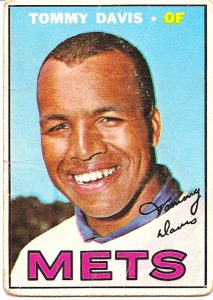 “Hey, kid, wanna root for my new team?” But I didn’t know that when I initially encountered Tommy Davis of the METS. The card said he was part of the outfit for which I was developing the first flickers of affinity. The jerseys and caps I’d latch onto later. For now, “METS” sufficed to entice me, with Tommy Davis their smiling emissary to a child who wanted in on whatever was making this man on the card appear so gosh darn happy.
The Mets were Davis’s second major league stop. He was a kid from Brooklyn, an alumnus of Boys High, Class of ’56, who did what any boy from Bed-Stuy might have done if given the opportunity at the time: He signed with the Dodgers. In those pre-amateur draft days, he was pursued by more than one club. Recruiting on the home team’s behalf was Jackie Robinson. The kid from Brooklyn was swayed.
Unfortunately, the team from Brooklyn picked up stakes and moved to Los Angeles. Davis’s debut came toward the end of L.A.’s first West Coast pennant race as a fourth-inning pinch-hitter in St. Louis. It was a wild game. Tommy was batting in place of Clem Labine, who was Walter Alston’s third pitcher of the night (his first was Sandy Koufax, who gave up four runs in two-thirds of an inning). The youngster struck out in what became an 11-10 Los Angeles loss. The Dodgers recovered to reach and win the 1959 World Series.
Davis kept moving up, too, breaking through as an outfielder who’d force his way into the Dodger lineup any way he could, starting as many as 59 games at third base in a season. The OF-3B experiment didn’t really take, as Davis remembered for his SABR biographers Paul Hirsch and Mark Stewart, “They never really explained to me how you had to short-arm the ball at third. I was throwing it like an outfielder and the ball was sailing over Hodges’s head.” That bat of his would play anywhere, though, and it looked like a sure bet to be on display in the 1962 World Series. The Dodgers had developed a star-studded cast worthy of the Hollywood glitterati that flocked to their new stadium. Maury Wills was shattering stolen base records. Don Drysdale was winning 25 games. Sandy Koufax was being Sandy Koufax (no-hitting the infant Mets along the way, almost literally taking candy from a baby). Big Frank Howard busted out with his first 30-plus home run season. And knocking everybody in, not to mention every pitch he saw, was Tommy Davis.
Tommy was “probably the best pure hitter I ever saw,” Dodger broadcaster Jerry Doggett recalled three decades later for author David Plaut. “A great clutch hitter,” teammate Ed Roebuck attested. Koufax took notice, too: “Every time there was a man on base, he’d knock him in. And every time there were two men on base, he’d hit a double and knock them both in.”
“When I see those ribbies on the bases,” Davis confirmed, “it means more money in the bank. When I see men, I see ’em as dollar signs.” Whichever teller handled Tommy’s account was kept extraordinarily busy in 1962. Let us repeat that runs batted in total: 153. It was a sum unheard of in the senior circuit since the 1937 peak of Joe “Ducky” Medwick and not surpassed again until Sammy Sosa did it in 1998. Davis’s batting average smoldered at .346, on 230 base hits, a figure not reached in the NL since Stan Musial in 1948 and not topped since Medwick in 1937. The Dodgers rode Tommy’s bat to a first-place lead that looked impenetrable. After 149 games, the Dodgers led the Giants by four games. The Dodgers turned cold immediately thereafter, however, allowing their rivals to catch them at the finish line and force a three-game playoff that echoed the New York-Brooklyn dynamic of eleven Septembers earlier. Now, with the foes having morphed into San Franciscans and Los Angelenos, history repeated itself, with the transplanted Jints sticking it to the uprooted Bums in trademark dramatic fashion.
Down a stretch that lives in the same tier of Dodger infamy where 1951’s resides, Tommy Davis, from Game 150 through Game 165 (that playoff set counted as a regular-season series), hit .394 and drove in 14 runs. He didn’t get the MVP — Wills’ 104 steals were too obviously history-making; and he didn’t go to the Fall Classic — Willie Mays led the Giants there with his own Most Valuable-caliber campaign (49 homers and 141 RBIs not to mention being Willie Mays in center field); but Davis could lay as much claim
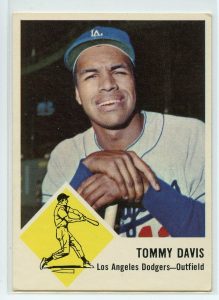 Being in New York suited a star who originally signed with his hometown Brooklyn Dodgers. to 1962 as anybody this side of Casey Stengel.
To say Davis would never repeat 1962 is to say nothing that diminishes the rest of his career. If 230 base hits and 153 RBIs were easy to replicate, they would have been garnered far more often by many others. Tommy’s 1963 encore was good for another batting crown (.326) and a no-doubt pennant en route to a four-game sweep of the Yankees in the World Series, a World Series that saw Davis lead all hitters with a .400 average.
Tommy Davis was at the top of the baseball world in the fall of ’63. Three years later, a span that included a gruesome broken ankle that derailed his prime, he’d be traded to the Mets. The Dodgers won the 1965 World Series without him and another flag in 1966 with him (when he batted .313 in 100 post-injury games). They were the Dodgers, the flagship name in their sport, whereas the Mets were…you know, the Mets. His stock had plummeted, à la John Olerud’s on his trip from Toronto batting and world champ to suddenly a Met in the mid-’90s. But coming to the Mets was OK by Davis, because it meant he was coming home. When he was asked about such a trade in theory, while still at work in Southern California, Tommy wasn’t reticent to embrace the notion — a geographic inverse of the sentiment that would frame Darryl Strawberry in a less than glowing light in 1988: “I love New York,” he told a couple of reporters from back east who were visiting Dodger Stadium in the midst of that last L.A. pennant chase. (He also maintained a special rapport with the gentlemen of the press from the media capital of the world. As George Vecsey recalled this week, “As soon as he sighted familiar faces — or heard familiar Noo Yawk accents — Tommy would turn to his teammates and announce, ‘Hey, these guys are from my hometown.’”)
If you believe in reasonably happy endings, the second stop of Tommy Davis’s baseball career should have been his last, or at least among his longest. Kid from Brooklyn, now an older/wiser veteran, setting up shop in Queens. He can still hit. He can tutor the outfielders of the Youth of America Cleon Jones and Ron Swoboda. The Mets climbed all the way to ninth place in 1966. Would it be too much to ask that fate position Davis and the Mets in harmonic convergence as the Mets reach for the moon, with Tommy guiding his juniors on their lunar mission?
Yeah, it would be. If things worked poetically, the main Met traded to the Dodgers to get Davis, Ron Hunt (who went west with Jim Hickman), would have stayed a Met long enough to help directly instigate 1969. Hunt was the Mets’ first more or less homegrown star. Hunt was supposed to be a harbinger of truly better times ahead, not sent away when 95 losses represented vast improvement. But Wes Westrum wasn’t as crazy about Hunt as Stengel had been and Alston was never too crazy about Davis and the deal got made shortly after Thanksgiving weekend of ’66.
“New York is my hometown and I’ve always loved the fans,” is how Tommy greeted the news. “My mother still lives in Brooklyn and all my relatives have been calling her and congratulating her that I’m coming home. So you’ll see I’ll be playing in familiar surroundings.”
Local Huntlessness notwithstanding, Davis’s return to the five boroughs — he was a lifetime .389 hitter in 54 Shea Stadium ABs and something about the baseball cards of his that were shot at the Polo Grounds always looked just right — made so much sense. As George Vecsey speculated in Newsday, this new acquisition “could be a solid hitter for the Mets, who have never had a solid hitter.” The Mets had been in business five years. It wasn’t much of an exaggeration.
“Davis will be in left field and he’ll play every day,” Westrum announced, offering Tommy a better deal than he was receiving in L.A. under Alston. “I can’t hit unless I play regularly,” had been Davis’s gripe (shared by most players). Now, on a new team and taking stock of the homey atmosphere, Tommy added, “I expect to go the full season and play to my capacity.” By Spring Training, he was also ready to fill that ideal role of veteran mentor, telling Jim Selman of the Tampa Tribune he liked what he was seeing from his fellow Met outfielders, “I see a lot of potential here. Take Cleon Jones. […] Ron Swoboda hits the ball good. If Jones and Swoboda can improve their fielding, they could be 10-year men.”
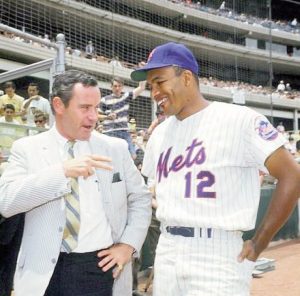 The Mets and Davis were hardly an odd coupling. Westrum indeed played Davis regularly and Davis returned the Met manager’s confidence by going the full season and playing to his capacity. In 154 games — 149 of them as the starting left fielder, Tommy batted .302. Only Ron Hunt in his All-Star starting season of 1964 (.303) had topped him among Mets with enough plate appearances to qualify for the batting title. Davis’s 73 RBIs were the third-best by any Met to date, bettered only by Frank Thomas’s 94 in ’62 and Joe Christopher’s 76. His 16 home runs led the 1967 Mets, whose most satisfying victory among 61 may have been the May night when Jack Fisher went 11 innings for a complete game W captured in walkoff fashion by Tommy Davis’s walkoff dinger. No Met pitcher had ever gone longer in service a route-going triumph, and no Met pitcher would ever go longer and be rewarded with a win. Yet Fisher couldn’t have been any more satisfied than Davis after he crossed home plate at Shea Stadium to beat the Reds.
“This,” he said, “is the first time I’ve had anything to cheer about since 1963.”
All of what Davis did in 1967 wasn’t enough to keep the Mets from sliding back into the basement and nothing the Mets could do, including promoting Rookie of the Year Tom Seaver, was enough to keep Wes Westrum from resigning in September before he’d find himself fired, but the comeback performance got some BBWAA member’s attention, because when the MVP voting came out after the season, Tommy Davis landed in eighth place on one writer’s ballot. It was a far cry from the 20 first-place votes Orlando Cepeda attracted in winning the award unanimously, but the tenth-place Mets finished 40 games behind Cepeda’s eventual world champion Cardinals. As small miracles go, Davis emerging from a severe ankle injury in ’65 and Walt Alston’s afterthoughts in ’66 to gain mention among the most valuable players in the National League in ’67 for a ballclub whose record nobody much valued rates as more than a footnote.
So does Tommy Davis’s one year as a Met. One year was all it was, but it was a very complete year in a very specific sense. Fifty or so players have been Mets for exactly one season. That is one season from Opening Day to Closing Day, no demotions to the minors, no time on the DL/IL, no military service, not even paternity or bereavement leave. They were brought up or brought in; they did their part for the orange and blue to their capacity, as Davis put it prior to 1967; and then, for one reason or another, they were gone. The reason was usually the business of baseball. In Davis’s case, the business was about filling center field, a void that during the 1960s vexed the Mets the way catcher did until Jerry Grote and third base until…well, that would vex on and off for a while.
Despite Davis’s rock-solid presence in left for six months, the 1967 Mets were a team in flux. They used 54 players, the most they’d use in a single season until 2018. Their manager, as noted, quit. Their general manager, the skilled Bing Devine, longed for home in St. Louis, sort of the way Davis had for home in New York. Executives had more agency than players. Before Devine departed, he laid the groundwork for a trade very much meeting with the approval of the new and highly valued manager of the Mets, Gil Hodges (the same Hodges to whom Davis had trouble throwing accurately when they were corner infielders together in L.A. early in the decade).
Gil Hodges very much wanted Tommie Agee in center field. He’d seen him look dashing in the American League, when Hodges managed the Senators and Agee flashed onto the scene for the White Sox. Chicago was willing to give up on Agee, the 1966 AL Rookie of the Year, because of his perceived offensive shortcomings after the Sox fell shy of the pennant in ’67. “The first thing Hodges wanted to do when he became manager,” Johnny Murphy, who succeeded Devine as Met GM, explained. “was to acquire Tommie Agee. He wanted a guy to bat leadoff with speed and that could hit for power. He also…needed a guy in center to run the ball down.” This was in the wake of one more Met center field experiment — the briefly ballyhooed Don Bosch — deteriorating on contact. Bosch started in center on Opening Day 1967, keeping the job for 15 of the Mets’ first 20 games, the 20th of which was on May 4. He’d get three more starts out there over the next month and then disappear from the lineup until September. Bosch’s batting average for the season (when he wasn’t shuttled to Jacksonville) was .140. So, yeah, the Mets were still keeping an eye peeled.
“We had to plug the hole in center field,” Murphy elaborated. “We’ve never had a center fielder. We’ve tried to develop our own and to trade for one, but we have never had any success. Now we’re getting a fellow we know can field and run and hit for power.” It was nothing personal toward Davis that as the best chip the Mets were willing to exchange, he was gonna be the outfielder the White Sox would get back. “Tommy did a good job,” Murphy affirmed. “Nobody here is mad at him. He played hard, and he played twice as many games as anyone expected. We simply are dealing for a need, a center fielder.”
The trade went down in December: Davis, Fisher, pitcher Billy Wynne and catcher Buddy Booker for Agee and infielder Al Weis. If you’ve read this far, you know the trade worked out spectacularly for the Mets. Agee had a rough 1968 but a transcendent 1969. Jones, who moved over to left, blossomed, too. Swoboda may not have had quite as long a career in store as Davis predicted for him (only nine years in the bigs), but boy, was he about to have his moments. The miracle these outfielders and their teammates — very much including Weis with his .455 World Series batting average — would overshadow essentially all of the incremental progress the Mets who didn’t make it to the mountaintop with them had forged. The Mets’ story, unless you were willing to get granular, was they were born a laughingstock; they languished; and then, as if out of nowhere, they rose to an apex unmatched in the annals of human achievement.
I’m fairly comfortable with that story in broad strokes, but granularity and the knowledge that the 1969 Mets didn’t exactly come out of nowhere has its appeal. I wasn’t watching in 1962; Channel 9 didn’t air in utero. I missed the extended infancy and toddler years. But sometime before fully discovering the Mets, perhaps when I was four, maybe five, I shuffled through my older sister’s short stack of baseball cards and decided Tommy Davis and METS were for me. As would be the cards once she grew bored with them. Maybe I’ll never fully appreciate how futile the Mets felt prior to 1969, but I’d like to think I can appreciate that there were Mets prior to 1969, and some of them, like Tommy Davis, left their mark on their times as best they could.
Could have the Mets won their division, their pennant and their world championship without Tommie Agee and Al Weis? It’s never occurred to me to ask. Why would I want the Mets to have been one iota different from what they were when they were at their most miraculous? Yet a person who’s familiarized himself after the fact with the Mets from when they attempted to master the conversion of their unsteady crawling skills into walking does wish, with loads of hindsight, that somehow Tommy Davis could have stuck around a little longer and been a part of 1969 and 1970 and kept being at home in New York (this same person also wishes Ron Hunt could have enjoyed the fruits of what his pre-trade contributions sowed, yet there’s not an alternate timeline handy that will accomplish every ancillary wish). Tommy joked more than once that because he played such an intrinsic role in building the ’69 roster, maybe the Mets should have awarded him something like half a World Series ring. “You’d think the Mets would send me something for helping them win,” he told his SABR biographers. He was no more than half-serious. I don’t know if he was any less.
Tommy Davis’s career was about half-over when he left the Mets. He may not have been in the best mood when he was told his tenure at Shea would be limited to one year. “Puppets have no feelings,” he said in the middle of December 1967. “We just have to go where our livelihood is. I’m glad to go with any major league club that wants me.” Yet, by the reckoning of Joe Donnelly in Newsday, Tommy was putting a stoic face on the situation because “a few nights” before the transaction, Davis declared, “I want to stay with the Mets. The club has been great to me. The fans, well, they’re unbelievable. I want to be an Ernie Banks.”
Banks had been a mainstay with the Cubs since 1953 and would be through 1971. Even in 1967, before the reserve clause was lifted, that kind of staying power was tough to cobble together for a baseball player, no matter how immortal. Banks would stay in one place. Mays wouldn’t. Hank Aaron wouldn’t. Frank Robinson had already been traded once and would be traded again. Tommy Davis was going to his third team. The second team, despite not being ready for prime time, gave Tommy the time he needed to prove himself anew. “By having a decent year,” he reflected in 2011, “I was able to play until 1976. I was certified good enough to play, thanks to 1967 with the Mets.” For that reason, Davis told his SABR biographers that he considered 1967, regardless of the ring he earned in 1963 (and the ring he wouldn’t be sent in 1969), the most significant year of his career.
Prospective contenders would continue to covet Tommy Davis, and he moved town to town, up and down the standings, forever a cog in somebody’s machine (though never Cincinnati’s). After his year with the White Sox, there’d be stints with some pretty good to very good Astros, Cubs, A’s, Orioles and Royals clubs, along with the Angels as he approached the end of his line. The Yankees, who missed out on him in 1956 when Jackie Robinson convinced him to be a Dodger, gave him a Spring Training look-see on the eve of their pennant run in 1976. “The designated hitter is taking care of this old man,” he said as he reached the twilight of his career. “It sure has helped me bring home the paychecks.”
In 1969, there was a stretch with the expansion Seattle Pilots, meaning there was a supporting part for him in the most influential baseball book of the twentieth century, a project to which he gave his blessing (not every ballplayer mentioned was so generous). “Jim Bouton was my teammate in both Seattle and Houston,” Davis told This Great Game in 2005, “and he mentioned me a few times in his book, Ball Four. […] Many players believe that anything that happens in the locker room should stay there, but I’m not an advocate of that. But, I’m not mad at him and I never was, because everything he wrote was accurate and he was honest. I know the Pilots manager Joe Schultz thought it was a distraction, but I thought it was well-written and damn funny.”
In all, Davis played one game shy of 2,000 and recorded more than 2,100 hits. He retired in the winter of 1977, just as the first class of free agents was able to hit the market and find the best deals for themselves. For many years, he’d work in community relations for the Dodgers, even if the Los Angeles community wasn’t initially his home. To be fair, even when he missed New York, he did admit he adored the Pacific Coast weather. No doubt the SoCal sun shone brilliantly on Tommy Davis when his star shone brightest. When he died, he was remembered primarily for what he did in 1962 and 1963. Still, we shouldn’t forget the year of his professional life he gave us in 1967. I’d say that even if I didn’t always love that baseball card.
by Greg Prince on 2 April 2022 9:48 am Pity the newsbreaker tasked with delivering momentous tidings on April 1, a date which, for some strange reason, gives everyone processing such information pause to wonder if it’s real. Indeed, it would be swell if the bulletin from the late afternoon of April 1, 2022 — that Jacob deGrom’s right shoulder is something short of shipshape and Bristol fashion — were standard lazy gag fare.
But, of course, it’s not. We were prepped for the sharp elbow to the face the night before when word went forth that Jake’s business shoulder was feeling tight, serving as a harbinger for the condition of the pit of our stomachs approximately seven seconds later. Jake wouldn’t be pitching Friday’s pretend game. Would Jake be pitching the following Thursday’s real game, the one slated to start the already delayed season?
We learned Friday he won’t be. Or any games for a while. How long that while will last can be calculated via the Metropolitan abacus or whichever app you have handy. Take how long they say he needs to rest (four weeks); add how long you’d figure working out and ramping up will take (at least a month); factor in setbacks (because when aren’t there setbacks?); remember this is the Mets we’re talking about; and it was nice knowing you, Jacob.
I don’t really want to be that way. It’s a stress reaction in deGrom’s right scapula, not a tree falling in the forest directly on his head. Nevertheless, we make a sound akin to “AAUUGGHH!!” no matter how conditioned we are to learning Jake will miss his next start(s). This was going to be The Year of the Two Aces, the best pitcher in the world who’s always been ours and the other best pitcher in the world who somehow is also ours. DeGrom and Scherzer/and to opposing batters murder! The good news is Max Scherzer’s hamstring tweak is said to be no real issue.
The bad news is WHAT DID YOU JUST SAY ABOUT MAX SCHERZER’S HAMSTRING?
Welcome to the Mets, Max. You probably didn’t even know you had hamstrings until you got here. We didn’t know the human anatomy comes equipped with all kinds of fragile doodads until we became Mets fans. Take the scapula, that bone that connects the humerous with the clavicle (now I hear the word of the Lord). The scapula sounded familiar when Jacob’s was diagnosed. Matt Harvey had a scapula. I suppose we all have them, but it was Harvey’s scapula that, among other things, kept Matt from continuing to be Matt in 2017. He was out a couple of months and very shy of pitching remotely like the same Matt Harvey we’d known and idolized once he came back. Not that Matt Harvey by then more than loitered at that level, so let’s not lump all Met scapulas into one enormous pile of deGromified anxiety.
Have you ever heard of a scapula in any context other than a Mets pitcher having problems with one?
“Hey, Ted, how’s the scapula?”
“My scapula’s doin’ great, Harry — thanks for asking!”
Nope, never happens. No wonder the word “scapula” has such a low Q rating.
DeGrom’s popularity, on the other hand (the one he’ll have to use if he wishes to pick up a baseball in April), has always been stratospheric with the likes of us. We love Jacob deGrom. We wish Jacob deGrom could pitch every fifth day and then some. Jake and Max and three days of Jake because we can’t get enough Jake. Now, as far as we can tell, it will be Max, followed by that nice Chris Bassitt fellow — his first start to beam over Apple TV+, apparently — then Taijuan Walker, Carlos Carrasco, Tylor Megill/Trevor Williams/David Peterson or whoever doesn’t have a scapula reacting to stress. Trade talks are in the air as well. So who knows?
We knew we had Jacob deGrom to throw our first pitch of 2022. Now we know less than we used to. Here’s to a speedy and comprehensive recovery for Jake. And for us.
by Greg Prince on 1 April 2022 8:39 am For those who instinctively turn their dial to Channel 9 on Saturday afternoons at 2 o’clock expecting Mets baseball, I feel ya. Old habits are hard to break, particularly in a courageous new world. I know the phrase is brave new world, but after five consecutive division titles and a world championship, enough with everything Brave. And I know televisions no longer come with dials. I’m cognizant of what century it is. I don’t have to acknowledge everything about it all the time.
The coming of cable was a good baseball thing in that it meant pretty much every Met game would be televised. The coming of your cable bill was a less good thing, but at least you got what you paid for. In the beginning, there was SportsChannel, which was a name that told you what you were getting, even if it didn’t mention Fran Healy came with it. The later Met melange of Fox Sports Net-New York, which really rolled off the tongue (they shoulda stuck with SportsChannel) and MSG gave way to SNY and GKR, which, despite initial reservations, we’ve enjoyed wholeheartedly since 2006. This longstanding arrangement, give or take some weekends when Gary Cohen takes a break, has been true value in action. Except for those dates nibbled away by Fox or ESPN. Funny how once you didn’t have Vin Scully on NBC or Al Michaels on ABC calling the action, the “honor” of your team being on national TV began to feel like a burden.
Then came games snatched by Facebook and YouTube, which served some alleged purpose that I’ve been slow to grasp, but they were weekday afternoons and if somebody planted behind a desk somewhere was able to sneak peeks they couldn’t otherwise (because not everybody everywhere is an MLB.tv subscriber), well, it’s a weekday afternoon. Baseball happening on a weekday afternoon is gift enough. If its images are not beamed to us directly from Wrigley Field with Ralph Kiner explaining how the winds are blowing out to Waveland Ave., mainlining the Mets by radio oughta suffice.
Nowadays, though? We still have Fox and FS1 depleting the quality of random Saturdays. We still have whatever ESPN will put us through next on select Sundays. TBS’s forthcoming deal for Tuesday nights isn’t exclusive, but they do pull Ron Darling away from Cohen and Keith Hernandez, and that, as we’d say when the Captain didn’t play, ain’t Wright. Now a stream of streaming — exclusive in nature — aspires to prove itself all wet.
Apple TV+ is taking over Friday nights, or at least the games it chooses to devour, commencing with merely what is slated to be, Jacob deGrom’s right shoulder willing, Max Scherzer’s first start as a Met a week from tonight. Wouldn’t you love to hear what our announcers have to say about this historic outing? We’ll have to savor their perspective when it’s offered only in the past tense. Peacock is poised to pluck its share of Met games, too, swooping in on Sunday mornings, as if ESPN doesn’t do enough to denigrate Sunday evenings. (Amazon Prime is also doing something, but it’s something we don’t much care about, so they can leave it out on the front steps.)
I fear the streaming that will have us screaming is Paramount+ having dibs on whichever Thursday night games it chooses, all of which Rob Manfred has mandated must start at 9:30 PM local time, in deference to MLB’s agreement to vigorously promote the sitcom Ghosts, which airs on CBS Thursdays at nine, streaming the next day on, you guessed it, Paramount+. I’ve seen a few episodes of Ghosts. Parts of episodes, really. As network situation comedies in the present day go, it’s no Young Rock, but it’s OK. I’d like it better if it stayed in its lane.
The worst part of the Paramount+ tie-in, which you may have read about if you keep up on these depressing sports media matters, is difficult to choose, because the more you look at it, the worse it gets.
• There’s the late first pitch. West Coast games will stream live starting at 12:30 AM EDT, more like 12:40 once they do all the folderol. Seth Meyers and James Corden, beware.
• There’s the dreaded exclusivity’s impact on the booth. We won’t be hearing from Gary Cohen. We won’t be hearing from Gary Thorne, who did a decent job filling in for his namesake last summer. We won’t be hearing from Gary Apple, even. The Paramount+ announcers will be Ghosts series stars Rose McIver and Utkarsh Ambudkar, calling the games in character as Sam the writer who sees ghosts and Jay her husband who doesn’t, alongside ubiquitous plague on ears everywhere Matt Vasgersian, on loan from MLB Network (I’d prefer the actors). I don’t wish to prejudge, but broadcasting baseball games, regardless of platform, might work better with baseball professionals behind the mic (including Vasgersian, I count none here).
• Then there’s the rules change. Ohmigod, the rules change. If there’s any good news in what they’re doing to the rule book, it’s that this will only apply to these Paramount+ games. The bad news is these games count.
 Ghosts runners. Now we’ve seen everything. Unless we can’t see them. You think you hate the concept of ghost runners as we’ve seen it in 2020 and 2021 for extra innings? The same ghost runners we thought we’d be spared from after the lockout, then learned were returning to second base to start the tenth in case of a tie after regulation? You ain’t seen nothing yet. Literally. On these Thursday games that run on Paramount+, we’ll have Ghosts runners. The plural is no accident.
Let’s say Francisco Lindor leads off an inning and doubles. You and I and Buck Showalter may all be satisfied with Lindor’s speed, but Lindor has to be automatically removed for a Ghosts runner, meaning one of the supporting characters from the show will go to second in Francisco’s stead. Sam will see it; Jay won’t; Matt will strain to be sardonic; but the cameras will do the great favor of transmitting it…after first futzing around with some fuzziness because, you got it, they’re ghosts. According to a release from MLB, “the identity of the Ghosts runner will be determined by a special algorithm developed in accordance with the personality of the player who has doubled to lead off an inning (or reached second via a two-base fielding error or any defensive miscue that allows the batter to reach second base before the second batter of the inning steps into the batter’s box to begin the next plate appearance) and how well it meshes with the uproarious cast of Ghosts, which airs on CBS Thursday night at nine and streams the next day on Paramount+.”
That, by the way, is how all announcers employed by Major League Baseball rights holders, local and national, are required to explain the rule in their own broadcasts. So far, our beloved Gare has resisted, and I didn’t hear if Wayne Randazzo succumbed this week in St. Lucie, but watching some other teams’ Spring games on MLBN, I’ve heard the whole mouthful. It should come with mouthwash.
So Lindor won’t be on second. Despite doubling. Despite being Lindor. Despite being under contract to the Mets through 2031. The runner (they don’t pay me to call it “the Ghosts runner” at every turn) could be Trevor or Flower or Alberta or Hetty or Thorfinn or Sasappis or Captain Isaac Higgintoot or Pete. Not Pete Alonso, but Pete Martino — no relation to SNY reporter Andy Martino, as far as I know (Andy thinks this change is “just the shot in the arm baseball needs,” by the way; big surprise). Pete, like the aforementioned, is a character on Ghosts. They are collectively the Ghosts in the show title, the Ghosts who live with Sam and Jay. This is information you didn’t think you’d need to know to follow the Mets this season, but here we are.
 Pete, at least, represents the spirit of a Mets fan. Each of the Ghosts has a goofy backstory that works in the context of their sitcom yet has nothing to do with baseball. True, bespectacled Pete was a Mets fan during his pre-Ghosts lifetime, but that doesn’t tell us how well he’ll pick up signs from third base coach Joey Cora (also, he has an arrow lodged in and sticking out his neck). They will be in character and they will appear in costume rather than the uniform of which ever team on whose behalf they spookily materialize. It’s unclear as to whether their names will show up in the official box scores since they’re, well, Ghosts, but the decision to insert them as Ghosts runners is not subject to replay or umpire review.
Even if the given Ghosts have blazing speed — who doubts every one of them will run harder for home than Robinson Cano does to first on a ground ball to second? — there’s no guarantee they’ll score. As you try to wrap your head around this alteration to the tattered remains of what used to be our National Pastime, you might reason there’s never any guarantee that any runner will score from second. Which is fine, except if Captain Isaac Higgintoot (he’s the Ghost who died in the Revolutionary War) doesn’t score, then Lindor in this case or whoever doubled to lead off an inning has to leave the game.
Manfred’s explanation, via MLB’s release:
“Our research indicates ‘desirables’ and other youthful potential baseball-adjacent consumers who are engaged by fantasy, E-Sports and virtual activities will be intrigued by the exclusive opportunity to watch a runner suddenly ‘disappear’ from view, especially when it streams on a platform that requires an additional fee. Thus, any player who reaches second on a fair hit or error to lead off an inning must ‘vanish’ and be replaced by one of the Ghosts, who viewers of all demographics are welcome to watch pull hilarious hijinks every Thursday night at nine on CBS, streaming the next day on Paramount+. The Ghosts runners may have already lost the fight for their own lives, but now they, in conjunction with the team lineups that will attempt to ‘drive them in,’ can battle to keep some of the biggest stars the MLB has to offer in these exclusively streamed games. Truly, this is content in the best sense of the word.”
Gotta love how Manfred is calling his own sport “the MLB” now. And why does he put a baseball term like “drive them in” in quotes? I’m getting the sneaking suspicion Rob Manfred neither likes nor knows that which he commissioners.
Anyway, if the Ghosts runner scores, the hitter stays in the game and goes back to his position for the next half-inning (and is safe from “vanishment banishment” for the rest of the game), but not before McIver, Ambudkar and Vasgersian exclaim, “That’s bed…and breakfast!” Sam and Jay run a B&B on the show, in case you haven’t tuned in. Lest you think the would-be cutesy catchphrase is incidental, think again. Because they’re starting the games so late, Paramount+ and MLB (no the, “Commissioner”) are doing a tie-in with Airbnb. “Getting tired? Next time, reserve more than a room…” Something like that. Aaron Judge and Aaron Boone are supposed to be in the first commercial as “the sharin’ Aarons,” sharing the short-term rental. No doubt that one will run every half-inning of every Mets game Paramount+ hijacks.
Do you believe this nonsense? Do you believe the Players Association agreed to this? The universal designated hitter was bad enough. The extra-inning rule was bad enough. But implementing the Ghosts runner is beyond comprehension. Granted, it’s the reason rosters have been expanded to 28 for the first month of the season, ostensibly in order to give managers more Thursday night flexibility and get used to the vanishing act where leadoff baserunners disappear if their streaming replacements don’t score (Luis Guillorme is advised to stay ready to go in on defense at multiple positions), and that translates to 60 extra temporary jobs and perhaps unlocks a surfeit of service time for the union’s membership, but Tony Clark and whoever else negotiated this wrinkle really should have ironed it out. I already know the owners don’t care. I already know Manfred will allow anything for a buck. I guess the players, already willing to wear advertising on their uniforms (including the Peacock logo suggestively below their belt buckles in those Sunday morning games), aren’t going to make a fuss at this point.
We’re six days from the beginning of the season, but what difference does it make what day it is when Major League Baseball doesn’t give its actual fans a ghost of a chance?
by Greg Prince on 30 March 2022 11:50 am Where do you go after you’ve traded Amos Otis for Joe Foy? Not to the heights of the hot corner, we learned in 1970. As we pick up the thread of our OF-3B/3B-OF series, we shake off the Mets’ decision to swap a promising outfielder who didn’t appear promising at third for a third baseman who didn’t have much left at third, and attempt to reset.
The Mets, as we learned in the first part of this series, practically came into this world eyeing the outfield to solve their genetic third base shortfall. By the end of the second part of this series, we saw that they continued to devote serious consideration to the concept as the 1960s wore on — before entering the ’70s with a bona fide third baseman in tow who didn’t work out. That was Foy, traded to New York for Otis. Otis, as we’ve explored, wasn’t a third baseman, but was a very good player. He was also not a Met when the full discovery regarding his talents was made.
Oh well, said the Mets, back to the drawing board. Having detoured in the third part of this series to the intriguing world of catchers who got caught in the web of OF-3B/3B-OF, we shall return to our drawing board and watch where the quest to spark third base joy after Joe Foy takes the Mets. By 1975, something tells us they’ll be attempting to scale the heights with an uncommonly tall, particularly powerful third-sacker. Or, more specifically, a first baseman-outfielder who will play third base for them.
***Though 1970 was the year it didn’t work out with a veteran 3B, the Mets in 1971 were content to work the same gimmick with a different veteran 3B. Out went Foy, in came Bob Aspromonte. Aspromonte’s “hey, I know something about him” fact is he was the last Brooklyn Dodger to play in the major leagues. The boys one associates with The Boys of Summer were all retired by the 1970s. Even the fellas one doesn’t instantly associate with the legendary squad that left Kings County behind because their biggest moments awaited them in L.A. — your Koufax, your Drysdale, their catcher Roseboro — were done. Aspromonte outlasted them all. The borough native’s Flatbush experience was a single at-bat as an 18-year-old in a 17-2 blowout of the Cardinals in September 1956, but it counted. “My knees were shaking,” he’d recall, but Aspromonte appears in the very same box score as Pee Wee Reese, Duke Snider, Jackie Robinson, Roy Campanella and his future manager Gil Hodges, all putting in just another day of work en route to the Hall of Fame. “Gil took me under his wing in the early days when it was tough,” Bob remembered. “You really didn’t belong, but you had to be there.” Fifteen years later, at the tail end of a solid career for the Dodgers, Colt .45s/Astros and Braves, the Lafayette High School graduate came home again, or close to it.
Returning to pretty close to where it all started had been on Aspromonte’s mind for a while. When the deal that sent Ron Herbel to Atlanta to get Bob went down, Newsday’s Tim Moriarty recalled Aspro, then an Astro, pestering some reporters in the Mets’ traveling party around the batting cage in Houston, “When are the Mets going to make that trade and bring me back to New York?” When it finally happened, his manager in Atlanta, Lum Harris, sent him on his way with what amounted to a half-throated endorsement. “Sure he can play,” Harris said of the 32-year-old who’d batted .213 in 1970. “The reason we can let him go is we have Clete Boyer at third base,” which, in 1970 fielding terms, was like saying you had Nolan Arenado at third base. “The Mets don’t have a Clete Boyer at third base, do they?”
No, the Mets didn’t even have Joe Foy at third base anymore, having let him go to the Senators in the Rule 5 draft. They did, as they had since the suddenly distant but eternally golden year of 1969, have Wayne Garrett, but Garrett was scheduled to serve out his National Guard commitment for more than half of the 1971 season. Like the Washington Senators, that’s something that doesn’t enter a lot of contemporary baseball stories these days.
“When one thinks of Sandy Koufax,” Bill Travers wrote in the Daily News on Christmas Eve 1970 in a lament for Lafayette’s athletics department’s budgetary woes, “he thinks of one of the greatest pitchers in history. When one thinks of Bob Aspromonte, he thinks of the new Met third baseman who might cure their hot corner ills.” The shared alma mater of the two old Dodgers (and Fred Wilpon) would eventually get its baseball program back on sound financial footing, as evidenced by the development of future Met closer John Franco. And Koufax would forever be Koufax in every pitching conversation.
Few think of Bob Aspromonte as having cured the Mets’ hot corner ills. After one underwhelming season of Aspro (.225/.285/.301), the Mets moved on. Bob himself retired, ensuring the Brooklyn Dodger presence on active MLB rosters was history. Garrett, having done his Guard stint, was still around, as were a couple of young infielders who’d reported for duty at both third and in the outfield: former overall No. 1 draft choice Tim Foli and the über-useful Teddy Martinez. But whatever awaited on their respective horizons, none flashed the power a team wishes from its third baseman. Among them, in 682 plate appearances, the trio combined for two home runs in 1971 — or four fewer than Clete Boyer hit in 30 games for the Braves.
***The Mets instead replaced a veteran named Bob at third base with a veteran named Jim at third base. Except veteran Jim wasn’t really a third baseman or, for that matter, an outfielder. And not really a power hitter, either, having topped 20 homers just once since coming to the majors in 1961. This is where we meet Jim Fregosi, who the Mets acquired from California for that Ryan kid.
Actually, it was that Ryan kid plus three others, as if GM Bob Scheffing wanted to tell the Otis-for-Foy trade, “Hold my beer.”
We know about Nolan Ryan blossoming into the greatest strikeout pitcher of all time about five seconds after leaving the Mets. We know that one of the three others dispatched to the Angels to get Fregosi, outfielder Leroy Stanton, went on to a more than respectable career in the American League. We know Jim Fregosi, the American League’s long-running All-Star shortstop, wasn’t the answer at third base for the Mets during what became an ill-fated Shea stopover of less than two years when:
• he broke a thumb in his first Spring Training;
• he ranked by latter-day metrics as the least valuable defensive third baseman in the National League of his day;
• and he hit fewer home runs in his entire Met tenure than Stanton did in his first year as an Angel.
One could have hoped for the best out of Fregosi, turning 30 and coming off an injury-affected season in Anaheim, but one could look at all that was being given up and wondered what the hell? If you had to trade Ryan and all his potential on the eve of his age-25 season, might you not find a surer thing than an aching shortstop who’d have to learn a new position in a new league? And would you have to throw in three other players to make it happen? Steve Jacobson of Newsday predicted the day after the trade was made, “Unless Fregosi has a very good year, it won’t seem like a fair exchange,” which might explain why Steve Jacobson endured as a top-flight baseball writer into the next century.
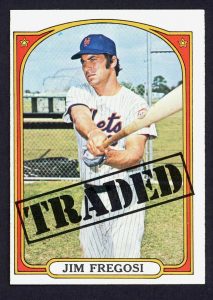 One could have hoped for the best even as one wondered what the hell? Of all the things we know about Ryan-for-Fregosi, are we aware that on June 5, 1973, versus the Reds in Cincinnati, Fregosi took a turn in left field for the Mets? If we didn’t, we do now. Cleon Jones was injured and trying anything that might work topped Yogi Berra’s agenda. Fregosi, carrying a .194 average through the games of June 4, had played left seven times for the Angels, all in 1971, his eleventh season in the majors. It was seven times more than he’d played third base prior to coming to the Mets in 1972.
Fregosi-to-left wasn’t a disaster, which is one of the few contexts for which “it wasn’t a disaster” fits anything related to trading Nolan Ryan for Jim Fregosi. The man started, drove in a run, played into the tenth, and was removed for defense once the Mets took a 5-2 lead (which Tug McGraw and Phil Hennigan proceeded to blow). No balls were hit to him, thus he made no catches, but committed no errors. Not convinced of Jim’s utility, Berra never deployed Fregosi in the outfield again, perhaps because with Bud Harrelson also out hurt, Yogi needed Fregosi to reacquaint himself with shortstop. A month or so later, as neither Fregosi’s presence nor performance still wasn’t letting anyone forget the Nolan Ryan deal, the Mets sold the former star’s contract to Texas…the same franchise for which Nolan Ryan would be pitching twenty years later…when Jim Fregosi was managing the Phillies to the World Series. (Win-win for everybody except the Mets.)
***Garrett, meanwhile, was about to do something the Mets’ front office hadn’t envisioned while it was off collecting and eventually discarding Foy, Aspromonte and Fregosi. He established himself as the everyday third baseman the Mets always needed. Wayne was there all along and now, down the unlikely stretch of 1973, the Mets noticed. From the late-August night the Mets climbed out of the NL East cellar to the October afternoon they clinched their second division title, Garrett slashed .320/.405/.590 and proved himself one of the main reasons the club rushed from worst to first in just over a month’s time. In recognition of his abilities, the Mets left third base alone entering 1974. It was Garrett’s to have; to hold; and, alas, to lose.
Across a full season, Wayne saw his batting average sink more than thirty points, his power numbers regress and his defense, which was more than decent (fourth in the NL in fielding percentage at third, for what that’s worth), not make the case for his continued incumbency. “Let Wayne Garrett play every day and he’ll hit .230,” Fregosi had ruefully predicted when he himself was under fire in New York, overestimating the redhead’s average by six points. Almost as soon as ’74 ended, the Mets made another move for a veteran. Unlike Foy, he knew the National League. Unlike Fregosi, he knew third base. Like Aspromonte, he knew the neighborhood.
It was Brooklyn’s own Joe Torre, forever rumored to be en route in one big trade or another. The haul the Mets sent to St. Louis on October 13, 1974, to secure him at last wasn’t really that big — veteran swingman Ray Sadecki and perennial pitching prospect Tommy Joe Moore — but maybe his bat could be. “Right now, I picture Torre for third base,” Berra said, as if staring straight through Garrett. “He has a couple of good years left.” Torre, as a Brave and a Cardinal in a career that dated back to 1960, had socked 240 homers and driven in 1,110 runs. As recently as 1971, while playing third base for the Cards, he hit .363 and was voted the National League MVP. He didn’t even wait for Spring Training to start playing for Mets. The ballclub was making a goodwill tour of Japan in the autumn the Mets got him, so he went along, put on the uniform and got the folks back home excited ahead of 1975.
One fellow may have been less than enthused. “I’m just going to be a utilityman, I guess,” Garrett, entering his seventh season as a Met, said in Spring Training after an offseason when he saw 1969 teammates Ken Boswell, Duffy Dyer and Tug McGraw get traded. Longevity at Shea was no guarantee of a future.
The thrill of veteran Joe Torre at third base — a position he’d eased away from as he transitioned to first his last couple of years as a Redbird — didn’t last long. Turning 35 in ’75, Joe may not have been the most mobile of third sackers. The pop that once produced 36 homers in a season (mostly as a catcher) fizzled. Torre went deep only six times in his first season as a Met, only once more than Fregosi had in ’72. The overriding memory of Torre as a player at Shea became the game when Felix Millan singled four times, only to find himself forced at second four times because Joe Torre, batting directly behind him, grounded into four consecutive double plays. It set a record.
As 1975, like Torre, wore down, we began to see Garrett, still only 27, rise anew and take starts by the bunch at third; his batting average rose to a career-best .266, as he homered exactly as much as Torre and drove in only one run fewer. We began to see the latest infield phenom from Tidewater, Roy Staiger, who led the International League in RBIs, get a shot. And, most tantalizingly, we began to wonder if something too good to be true could enter the realm of the possible. Might it be that the player who had solved the most glaring offensive void that had plagued the franchise almost since its beginning would also be the player to solve the most glaring defensive void that had plagued the franchise absolutely from its beginning?
The answer was embodied within six feet and six inches of intermittent thunder that went by the name of Dave Kingman.
***Dave Kingman loomed as a revelation when the Mets sent a brimming basket of cash to Horace Stoneham in San Francisco in order to obtain Kingman’s services. Kingman, tagged with the “sensitive” label as a Giant, was a bona fide home run threat — which was something no Met had approached being since Frank Thomas swatted 34 in 1962 — and he consistently hit some of the longest home runs anybody had ever seen, even if he was an inconsistent hitter in general. The Mets saw the breathtaking aspect of his game for themselves. In August of his rookie year, 1971, Kingman dinged both the ERA of Jerry Koosman and the roof of a bus parked behind the visitors’ bullpen in left. The Mets won the game and, as the victors, they later got to write the history. In the 1975 yearbook, on the page their new acquisition shared with reliever Jerry Cram, the Mets called that home run “an estimated 500-foot Shea shot”.
 Dave Kingman, preparing to play his best position. When that kind of power can be at your disposal and there’s an array of body shops nearby, why wouldn’t you grab yourself some Dave Kingman if all it takes is 150-grand and tolerance for his perceived shortcomings? When they purchased his contract from San Fran early in Spring Training, the Mets appeared set at all the positions 26-year-old Kingman played, having made a passel of offseason moves after trading for Torre, but a big bat was a big bat, even if it had struck out 422 times in 409 big league games. Dave’s gargantuan wood left mouths agape when it took Catfish Hunter deep into what might as well have been the Everglades in one game televised back to New York from Fort Lauderdale. “I’ve never seen one hit further,” swore Mickey Mantle, who hit more than a few pretty far. So, yeah, that stick of Dave’s would stick somewhere.
“If Yogi Berra’s cast were working in the American League,” one wire story mused in late March, “Dave Kingman would be a perfect designated hitter. But the NL doesn’t have the DH, so Kingman has to bring his baseball glove to the ballpark along with his bat. That’s trouble.” Pirate manager Danny Murtaugh’s measured praise was “Kingman has power, he runs and he throws superbly, and that’s what you look for in superstars. Now he’s got to learn to play ball,” a.k.a. defense. Dick Young chimed in, “He is an exciting outfielder, lending the thrill of uncertainty to the pursuit of a fly ball every so often.” His former San Francisco teammate, Mets coach Willie Mays, was more understanding: “He’s happy and that’s the main thing because everything will come then. He’ll hit and he’s willing to play any place. His best position is first, but I told him wait and see” for, among other things, how well Mays might tutor him in the outfield.
Ah, the good old days, when a glove, too, had to find a place to play.
***Yogi brought his team to Shea and let Kingman feel his way on the field. Early on, with Rusty Staub nursing an injury, Dave Kingman took a couple of turns in right and produced two home runs, winning over the crowd as a whole (“I never played anywhere where the fans are so enthusiastic”) and, noticeably, their spiritual leader. Sign Man Karl Ehrhardt brandished a SUPER WHIIFF! placard when Dave struck out, but switched to KONG! in approval of his first Met swat. Rusty soon returned to the lineup and Dave shifted to left, since 1968 the province of Cleon Jones but temporarily vacant while Cleon dealt with his own knee problems. Dave put his third through eighth homers into orbit as the starting left fielder, the position he claimed as his own more days than not.
By June, Sky King — our announcers informed us that if we had to call the 6’ 6” Kingman by nickname, he preferred Sky King to Kong — was occasionally whiling away the gloved portions of his innings at first base, spelling Ed Kranepool and John Milner. Two of the swings he took during that interlude connected for home runs nine and ten. Shea’s air traffic, however, wasn’t exactly drowned out by the cacophony from Sky King’s connections. As June drew to a close, RF-LF-1B Dave Kingman had totaled a respectable eleven homers. It was a pretty good pace Metwise, considering no Met had hit as many as 25 home runs since 1969, but a Mets fan really had to squint to not notice his .219 batting average nor the 47 strikeouts that had piled up.
Come July, there was no missing what Dave Kingman was doing, no matter that some of it was missing the ball altogether at the plate or in the field, for when he did make contact, it was buses beware. Planes, too.
A home run on July 4.
A home run on July 5.
A home run on July 7.
A home run on July 8.
After the All-Star break, a home run on July 17.
A pair of home runs on July 20 — a three-run job to catapult the Mets back into a game they trailed by six and a two-run bomb that sealed a 10-9 comeback win.
Then some more home runs for the mostly left fielder and intermittent first baseman until Kingman finished July with 13 for the month (the Month the National League named him its Player of) and 24 on the season. A year that increasingly couldn’t get out of its own way at Shea — Jones was disgracefully released and Berra was about to get fired — at least contained a potential highlight four at-bats per game. Dave’s batting average soared to .260, which was nice, if not the statistic upon which you dwelled when balls were leaving the yard. His strikeout sum was up to 84, but that we accepted as the cost of doing Sky King business.
***As Dave brought his power to bear, one couldn’t help but be curious about one element of Kingman’s biography. We’d seen him in left and right. We’d seen him at first. What about third? Wasn’t that on his San Francisco résumé? Indeed, between 1972 and 1974, Sky played 140 games at third and hit 36 homers as the Giants’ third baseman, including one off Ray Sadecki at Shea in ’73. He was the Opening Day third baseman at Candlestick the year before he came to the Mets. Yet after April, he rarely set foot near third in ’74, unless it was on his trot from second to home.
Yogi was asked when the Mets purchased Kingman’s contract in Spring Training whether the position the Mets could never solve was a feasible fit now that they were about to harness the thump they’d sorely lacked. “What I saw of him at third base, I don’t like,” Yogi grumbled. A little later in Florida, the skipper reiterated, “He had 26 errors in 20 games at third base,” not quite nailing Kingman’s 1974 defensive record — it was 12 errors in 21 games — but the crux was understood. “First base I don’t like him too much, either.”
What Berra preferred, though, was no longer salient at Shea once he was dismissed in early August. By that same month there was another factor to consider: Mike Vail, hot-hitting rookie outfielder. Vail, who’d led the IL in batting (.342) took over in left, with he and Staub trusted to flank Del Unser. With Vail’s National League rookie record 23-game hitting streak about to unfurl, it appeared Mike would never be dislodged. Rusty around in right was having a dynamite season, heading for 105 RBIs, while Unser stuck close to .300 and provided the best center field defense Shea had seen since Tommie Agee. The outfield was occupied.
At one corner of the infield, Milner was having a horrible, injury-wracked year that would see his batting average plummet beneath .200 and his home runs dwindle to single-digits. Kranepool, despite a renaissance campaign (batting .318 as a starter) found himself reassigned to his customary pinch-hitting duty as the Mets forged a wishful August push toward their third division title. Kingman was suddenly the full-time first baseman — while Torre was less and less the full-time third baseman. Familiar default resort Garrett received some reps at third, as trusty Red inevitably did. Prospect Staiger was given a whirl, too, but young Roy must have forgotten to pack his lumber upon leaving Virginia (he batted .158 after his callup).
Come the middle of September, interim manager Roy McMillan resisted lingering possibility no longer. Dave Kingman, he of the 44 errors in 140 career games at third base, would play third base. At the time he was pointed to the left side of the infield, Dave was sitting on 34 home runs, having knotted Thomas’s previously unassailable 1962 mark. In his fourth game as the Mets starting third baseman, Kingman dislodged Thomas from the record books, an OF-3B taking over for the Original OF-3B…except by the time Kingman came through with No. 35, which happily happened to be the bottom of the ninth for a walkoff win, McMillan had shuffled his personnel and Dave was technically playing first. Sky had one more 1975 homer in him. That Kingman dinger, a solo shot on September 26, unquestionably came as a third baseman. It also came the half-inning after Dave made an error that led to an unearned run that proved the difference in a 4-3 loss. In all, Kingman tried his glove at third in a dozen games and committed three errors…or three times as many home runs as he hit as the Mets’ third baseman.
So maybe an outfielder whose least worst position was first base wasn’t the answer at third, but he did hit 36 home runs, and that pretty much overshadowed all defensive shortcomings, not to mention his 153 strikeouts (making a prophet of Karl Ehrhardt) and .231 average. Sky King was content in Queens. “I’m very happy,” he said late in his first Met season. “I always wondered would happen if I was given the chance to play regularly. I feel I’ve improved in a number of areas because I’ve been given that chance.”
 He tried. When the 1976 yearbook came out, three-quarters of Kingman’s bio and stat page, graphically speaking, was devoted to Kingman’s defense. There were pictures of him — with scraps of box scores serving as additional evidence — playing some first, some left and some third. “VERSATILITY,” the caption gushed. “Dave Kingman moves glove around in addition to his bat.” The snapshot of Dave at third shows a ball getting by him. Not mentioned in any of the agate type: detailed fielding statistics.
After 1975, Dave Kingman would hit 118 more home runs for the New York Mets…and never play third base for the New York Mets again.
A multiplayer pileup is about to transpire at that ever blazing hot corner, encompassing Met outfielders, Met third basemen and, yes, Met catchers. The next article in our series, endeavoring to sort out who played what and who didn’t want to play where, is coming soon.
THE METS OF-3B/3B-OF CLUB
That ’70s Show Gets Underway (1970-1975)
15. Tim Foli
Mets 3B Debut: September 12, 1970
Mets CF Debut: September 7, 1971
16. Teddy Martinez
Mets 3B Debut: July 6, 1971
Mets LF Debut: September 12, 1971
17. Jerry Grote
Mets 3B Debut: August 3, 1966
Mets RF Debut: July 12, 1972
18. Jim Fregosi
Mets 3B Debut: April 15, 1972
Mets LF Debut: June 5, 1973
19. Ken Boswell
Mets 3B Debut: September 18, 1967
Mets RF Debut: August 19, 1974
20. Dave Kingman
Mets RF Debut: April 8, 1975
Mets 3B Debut: September 15, 1975
Mets who’ve played both at third base and in the outfield represent one of my favorite things. As the new season approaches, Jeff Hysen and I swap a few others we love about baseball at National League Town. Listen here or on your podcast platform of choice.
by Greg Prince on 28 March 2022 10:21 am It got a little lost during Sunday night’s Academy Awards telecast, coming as it did after celebrity Mets fan Chris Rock was so rudely interrupted, but the Oscars aired their annual tribute (such as it was) to those no longer with us, which means, come the Monday morning after, we do the same. Except in our case, we mean it in the baseball transactional sense.
Here, then, for the sixteenth consecutive Spring, is our heartfully produced, hopefully inclusive montage saluting the Mets who have left us — the organization, not this earth — in the past year. At press time, we still don’t know where each of these now former Mets will wind up, but we do know that not long ago, whether for an evening or an era, they definitely Metsed among us.
We will remember you, albeit some more than others.
___
LUIS E. ROJAS
Manager
July 24, 2020 – October 3, 2021
I’d suggest Luis Rojas do whatever a manager can do with a compromised coaching staff and drill into his lads a few things about how to compete in every baseball game they play and how to win a bunch more than they have. At the very least, Luis, maybe let Lugo get up to set down more batters when he’s proving himself unhittable.
—August 26, 2020
(Relieved of duties, 10/4/2021; named Yankees third base coach, 11/15/2021)
___
AKEEM MAURICE BOSTICK
Relief Pitcher
July 29, 2021
For the silver lining-lovers out there, Miguel Castro continued on his journey back to sharpness with a scoreless sixth; Aaron Loup threw an ale of an eighth; and, making his major league debut, righty Akeem Bostick kept the Braves from inflicting superfluous ninth-inning damage. My scouting report on Akeem Bostick consisted of me learning after I got home from Wednesday night’s game that Akeem Bostick had been situated in the bullpen during Wednesday night’s game, having replaced Jerad Eickhoff on the active roster. Previous Mets to have replaced Jerad Eickhoff on the active roster in 2021 were Thomas Szapucki and Robert Stock. Have you seen Szapucki or Stock lately? Hopefully Bostick won’t be disappeared to wherever it is pitchers who dare to occupy the flip side of Eickhoff’s DFAs. wind up. He was obviously a happy young man when he tweeted, postgame, “I can FINALLY say ‘I’M A BIG LEAGUER!’” Akeem should indeed shout his newly earned status to the heavens. It’s a very special designation to have earned, even among Mets, a team that has habitually enlisted Jerad Eickhoff to start baseball games.
—July 29, 2021
(Free agent, 11/7/2021; signed with Kansas City Monarchs (American Association), 1/24/2022)
___
TREVOR SEAN HILDENBERGER
Relief Pitcher
April 17, 2021 – April 21, 2021
[N]ew export Trevor Hildenberger looked pretty good when he arrived and now he’s departed, because middle relievers.
—April 23, 2021
(Selected off waivers by Giants, 5/18/2021)
___
DANIEL JAMES ZAMORA
Relief Pitcher
August 17, 2018 – September 29, 2019
We knew Daniel Zamora, called up from Binghamton to replace DL’d Bobby Wahl, was our 54th Met of 2018. As with the 24 runs, this was big-time record-setting, or at least record-tying. The answer to the question some of us have been asking ourselves since 1967 — “Met 54, where are you?” — was finally answered. Knowing this milestone had been touched made us authorities on Daniel Zamora compared to not only Phillies fans but Mets fans in our section, which is understandable. There must have been a flock of Temple Owls in the house because Zamora was greeted primarily with “who? who?” It’s a common refrain at Mets games everywhere these days.
—August 18, 2018
(Selected off waivers by Mariners, 5/22/2021)
___
WILFREDO JOSE TOVAR
Infielder
September 22, 2013 – September 28, 2014
May 21, 2021 – May 29, 2021
Games remain scheduled whether or not you come prepared with an optimal assortment of players. It’s not the fault of the journeymen who are populating the roster currently that they were nobody’s first or second choice to be “the Mets” of the moment. They arrived in the organization as depth. They hoped they’d avoid alternate sites and get a call individually, but they didn’t expect to ascend to the majors en masse. I doubt they rallied one another in St. Lucie or Syracuse or wherever they crossed paths and said, “Wouldn’t it be great if all of us among the overlooked, undernoticed and generally dismissed got our chance together?” But they have. Sometimes, as on Friday, it works. Sometimes, as on Saturday, it almost works. Sometimes it’s Sunday, when Johneshwy Fargas doubles, Wilfredo Tovar singles him in and Yennsy Diaz looks good for an inning…and that’s it, basically.
—May 23, 2021
(Free agent, 10/4/2021; currently unsigned)
___
FRANKLYN KILOME
Relief Pitcher
August 1, 2020 – September 18, 2020
Franklyn Kilome got twelve batters out in his one outing, yet was optioned to Elba, but that transaction was primarily a function of churn. Go four innings as a reliever one night and you can’t be used for a couple of days, so go ice your arm by the beach, kid. Kilome might be back by Wednesday in time to take what had been Wacha’s turn, which comes after that of Rick Porcello.
—August 9, 2020
(Free agent, 11/7/2021; currently unsigned)
___
JAKE WILLIAM HAGER
Utilityman
May 15, 2021 – May 21, 2021
It was the first major league at-bat of Hager’s ten-year professional career and the first time any Met player wore 86, a pair of digits — like the city of St. Petersburg itself — that contains some Amazin’ championship cachet. New No. 86 Jake Hager finally getting this kind of chance was a reason to stay tuned, a reason to remain engaged, a reason to feel good. Hager proceeded to fly out, thus ending the positive evocation portion of our program.
—May 15, 2021
(Selected off waivers by Brewers, 5/25/2021)
___
JACOB ANDREW BARNES
Relief Pitcher
April 7, 2021 – June 13, 2021
[…] Jacob Barnes relieved Peterson and gave up a three-run homer on his first pitch delivered as a Met, a badge of insta-futility not donned since John Candelaria’s debut as a Plan H or I starter in the cursed ’87 season. Barnes also settled down, though by now the barn was in flames and the horses weren’t even bothering to flee but insouciantly hanging around to light cigarettes from the embers.
—April 7, 2021
(Traded to Blue Jays, 6/19/2021)
___
MASON JORDAN WILLIAMS
Outfielder
May 31, 2021 – June 19, 2021
Defensive replacement Mason Williams defended against a last-gasp Cub rally with a diving grab that made his insertion an instance of brilliant managing by Luis Rojas. The win, our third consecutive, pushed the Mets to ten above .500 for the first time since the end of 2019 and kept us five ahead of the NL East pack. Very nice. And excruciatingly irrelevant versus the only thing anybody is really talking about the day after.
—June 17, 2021
(Free agent, 11/7/2021; currently unsigned)
___
WILLIAM LANDIS “Billy” McKINNEY
Outfielder
May 27, 2021 – July 11, 2021
When Billy McKinney distributes his base hits as if from a variety pack — at least one among doubles, triples and homers before bothering with singles — Billy McKinney is my right fielder.
—June 7, 2021
(Traded to Dodgers, 7/21/2021)
___
STEPHEN NICHOLAS TARPLEY
Relief Pitcher
April 24, 2021
Perhaps Tarpley should have remained on another plane of existence — he threw 14 pitches and got nobody out, and now sits in the Met record books with an ERA of infinity. Spooky!
—April 25, 2021
(Released, 7/16/2021; currently unsigned
UPDATE: Signed with Long Island Ducks (Atlantic League), 4/22/2022)
___
RICHARD HEATH HEMBREE
Relief Pitcher
August 24, 2021 – October 2, 2021
Except there’s another game Wednesday night, and if the Mets win that (it’s possible), they’ll cut a half-game off the idle Braves’ lead. And if they somehow win Thursday night (it’s not over before it’s started), that’s another half-game, with Atlanta mysteriously on hiatus two days in a row. Now we’re 5½ out and the Braves’ schedule toughens, while ours lightens up, and Francisco didn’t look bad at the plate by any means, and Pete is hitting pretty consistently, and Brandon keeps getting on base, and Jeff was pretty good in the outfield in 2019, and nobody can blame the Heath Hembree-enhanced bullpen very much, and the more Carrasco pitches the more he’s bound to find his form, and isn’t Syndergaard about to begin a rehab assignment? It will be all over mathematically eventually and over beyond semantics soon enough. Until then, you never know and can’t help yourself from hoping accordingly. Even if you pretty much know it’s hopeless.
—August 25, 2021
(Free agent, 11/3/2021; signed with Pirates, 3/15/2022)
___
DELLIN BETANCES
Relief Pitcher
July 25, 2020 – April 7, 2021
Entering the bottom of the eighth, the Mets were leading, 10-6. No pitchers needed to be pinch-hit for because the National League no longer exists in such a natural state, yet the Mets were on their fourth pitcher of the night, Dellin Betances. In brief, it didn’t go well, and it went on extra long because two replay reviews ensued, neither of them amounting to a reversal of declining Met fortunes and both of them combining to eventually push the game into to its eighth half-hour. Betances left with the Mets’ edge reduced to 10-8 and Braves occupying first and third.
—August 1, 2020
(Free agent, 11/3/2021; currently unsigned
UPDATE: Signed with Dodgers, 4/5/2022)
___
CHANCE THOMAS LEO SISCO
Catcher
August 18, 2021 – September 3, 2021
And, for fun, McNeil doubled and Chance Sisco, a Triple-A name that hadn’t crept into our consciousness until the contingency backup catcher’s emergency backup was activated from the taxi squad, doubled on the first pitch he saw as a Met to make it 6-2. Ready to take a Chance again, indeed!
—August 19, 2021
(Free agent, 10/5/2021; signed with Mariners, 3/16/2022)
___
RAYMOND THOMAS “Tommy” HUNTER
Relief Pitcher
May 7, 2021 – May 18, 2021
Meet this Met
Meet that Met
Every day we meet more Mets
There’s Tommy Hunter
And his first hit
There’s Khalil Lee
Who can field quite a bit
—May 19, 2021
(Traded to Rays, 7/23/2021)
___
BRADLEY RICHARD “Brad” HAND
Relief Pitcher
September 4, 2021 – October 2, 2021
Hell, maybe the front office and its flawed parade of GM types knew what they were doing long enough to bring in the Villars, Pillars and Loups who have levitated the season just enough above sea level so that it hasn’t altogether drowned. Somebody in authority just signed off on bringing in Brad Hand. From a thumb to a Hand and nobody making a fist in a week’s time. That’s progress.
—September 3, 2021
(Free agent, 11/3/2021; signed with Phillies, 3/14/2022)
___
JERAD JOSEPH EICKHOFF
Starting Pitcher
June 21, 2021 – July 27 , 2021
Jerad gets us nervous, but mostly because we just met him, we’re not confident we can spell him and we know he wouldn’t be here if we had somebody more obviously qualified to do what he does. He calmed us down eventually, but we definitely had the feeling he and we got lucky. He’s welcome to come back soon. It’s not like we won’t have room for him.
—June 22, 2021
(Free agent, 10/6/2021; signed with Pirates, 11/29/2021)
___
FRANK ANTHONY BANDA
Relief Pitcher
July 19, 2021 – July 30, 2021
The Mets cashed in their ghost runner, but with Trevor May and Jeurys Familia and Aaron Loup all gassed, they handed the ball to the briefly aforementioned Banda. To call Banda unassuming would be putting it mildly — he looks like a fan who won a Closer for a Day! contest.
—July 20, 2021
(Selected off waivers by Pirates, 8/2/2021)
___
ROBERT ANTHONY STOCK
Starting Pitcher
July 7, 2021 – July 20, 2021
The Mets’ track record of winning first games and not winning second games hung heavy in the air, just like the air hung heavy in the air. Succeeding deGrom as starting pitcher was Robert Stock, the 1,141st Met ever and the first to wear 89. “Just give me whatever the temperature is at first pitch,” Stock presumably requested of clubhouse manager Kevin Kierst.
—July 8, 2021
(Free agent, 10/29/2021; signed with Doosan Bears (KBO League), 1/4/2022)
___
NICHOLAS PAUL “Nick” TROPEANO
Relief Pitcher
July 9, 2021
Stock started because, what, ya got somebody else handy? Shallow rotation depth is the soft underbelly of the first-place Mets (and I say that as one who knows from having a soft underbelly). It was either the guy the Cubs decided didn’t fit their needs anymore, or Nick Tropeano — a.k.a. Nicky the Trope; a.k.a. The 27th Man; a.k.a Guy Who Gets to Dress but Never Gets to Pitch.
—July 8, 2021
(Free agent, 8/4/2021; signed with Dodgers, 8/6/2021)
___
GEOFFREY THOMAS “Geoff” HARTLIEB
Relief Pitcher
July 20, 2021 – August 15, 2021
Geoff Hartlieb being activated as the extra player for a shortened game whose start was delayed by rain when it wasn’t raining before getting rained out and then being optioned before the next day’s pair of shortened games began may go down as the quintessential 2021 Mets transaction.
—August 13, 2021
(Selected off waivers by Red Sox, 9/4/2021)
___
CAMERON KEITH MAYBIN
Outfielder
May 19, 2021 – May 29, 2021
Poor Cameron Maybin set a new club mark for futility to begin a Mets career, going 0 for 27 and so topping (or perhaps the term is limbo’ing under) Charley Smith’s 0-for-26 start in 1964, but then tapped a little swinging bunt up the third-base line to get on base, an accomplishment greeted with rapturous applause from the stands and a flurry of jazz hands from his dugout. Maybin’s smile was a highlight in its own right, starting off low-watt sheepish and then brightening to big and genuine.
—May 30, 2021
(Free agent, 10/4/2021; retired, 1/3/2022)
___
COREY EDWARD OSWALT
Pitcher
April 25, 2018 – July 4, 2021
The Mets last week lost a game started by Steven Matz, 25-4. Five days later, because Matz was injured, they started Corey Oswalt in his place. […] Oswalt pitched much better than Matz did last Tuesday. Oswalt also pitches much better than Jason Vargas any day of the week. Yet Oswalt is considered to start only when somebody is injured. Despite Oswalt pitching well, the Mets lost, 5-4. That looks much better than 25-4, but it is still a loss. I wouldn’t discourage Oswalt from continuing to pitch well, nor the Mets from keeping their margins of defeat reasonable, but the real key to success for the team is not losing. This is a fundamental of baseball of which the Mets are likely aware, but given how infrequently they win, posting an occasional reminder seems necessary.
—August 6, 2018
(Free agent, 10/19/2021; signed with Giants, 1/12/2022)
___
REINALDO ALBERT ALMORA, Jr.
Outfielder
April 6, 2021 – September 14, 2021
J.D. was not alone in doing great things that involved the Citi Field fence. […] Albert Almora, Jr. took off toward it like Endy Chavez and slammed his body à la Mike Baxter into it, robbing Kyle Schwarber with a flair that was all Almora. Albert with the championship pedigree walked away in one piece unlike Mike from Bayside and will dress for a game again very soon, which unfortunately Endy didn’t following the Endy Catch. Chavez’s team had reached its end when he made his grab in 2006. Almora’s team is just getting going.
—April 26, 2021
(Free agent, 10/6/2021; signed with Reds, 3/20/2022)
___
JOSE FRANCISCO PERAZA
Infielder
May 2, 2021 – October 3, 2021
Jose Peraza leaves a team in Cincinnati, detours through Boston, and then without warning arrives in New York. How long does it take Jose Peraza’s second home run of the year to depart Citi Field?
—May 27, 2021
(Free agent, 10/29/2021; signed with Yankees, 11/29/2021)
___
RICHARD JOSEPH “Rich” HILL
Starting Pitcher
July 25, 2021 – September 30, 2021
Hill bunted and sacrificed McCann to second, just as NL hurlers have been asked to do for all but one of the past 145 years, or since Rich Hill was a lad. He had done his pitcherly duty, and I leapt to my feet to applaud. Then, armed with a 6-3 lead, he went out to work the fifth, throw his “69 MPH UNKNOWN” (by the scoreboard’s reckoning) and qualify for the decision. He preserved that lead — his lead — and left as the pitcher of record on the winning side. I stood and applauded again. Like autumn’s chill, a generosity of spirit pervaded the air.
—October 1, 2021
(Free agent, 11/3/2021; signed with Red Sox, 12/1/2021)
___
BRANDON SHANE DRURY
Utilityman
May 21, 2021 – August 31, 2021
[…] Luis Cessa gave up a walkoff single to Brandon Drury, and the everybody’s-the-hero Mets defeated the Reds, 5-4. Mets fans, I can report with accuracy, went nuts with appreciation. It didn’t appear we were “supposed” to win, but what was Brandon Drury supposed to do other than record yet another humongous hit? After all, Drury’s OPS in July was infinity. I could look up the real number, but I’m a Mets fan. I know pretty incredible statistics off the top of my head.
—August 1, 2021
(Free agent, 10/14/2021; signed with Reds, 3/21/2022)
___
EDNEL JAVIER “Javy” BAEZ
Second Baseman
July 31, 2021 – October 1, 2021
We might not remember how Baez helped the Mets in his first ten games in our colors because when he wasn’t sparking us toward a couple of victories, he was weighing us down badly (.171/.216/.343) as we commenced losing chronically. It thus dawned on me Sunday that Javy Baez is something akin to our Howard Cosell. He’s the best player we have on the field when he’s not playing worse than everybody else. He’s Henry Wadsworth Longfellow’s little girl with the curl to whom Ralph Kiner was so fond of referring. “When she was good, she was very good,” Ralph liked to say. When she wasn’t, she struck out a lot and threw wide of first.
—August 22, 2021
(Free agent, 11/3/2021; signed with Tigers, 11/30/2021)
___
KEVIN ANDREW PILLAR
Outfielder
April 4, 2021 – October 2, 2021
It’s a hit by pitch and a run batted in, yet the scorekeeping is irrelevant. It’s a person down in the dirt bleeding badly, requiring medical attention and in no condition to rise and do something as presumably effortless as jog to first base. Watching on television, also in about a second, your priorities switch from let’s get at least another run here, it’s only 1-0, we need all the help we can get, c’mon Pillar to yikes! or interjections to that effect. You just want the blood to stop and the person on the ground to get up and, if you can find it in your heart to worry about the mental well-being of the pitcher whose fastball got away, the person on the mound to grab a seat and get ahold of himself, whatever form that takes.
—May 18, 2021
(Free agent, 11/5/2021; signed with Dodgers, 3/22/2022)
___
JONATHAN RAPHAEL VILLAR
Infielder
April 5, 2021 – October 3, 2021
I was never more home than with the Mets game coming out of my shirt pocket on the boardwalk in Long Beach in 2021. This was me in the summers off from high school and junior high and elementary school. Wayne Randazzo narrating a Jonathan Villar homer meshed with the soft crash of the waves. It sounded like my life. That baseball radio play-by-play was emanating from my person didn’t merit commentary from my wife, who is very used to the sounds my body makes, nor from my old pal Fred, who knows what I’m all about. The first thing I can ever recall Fred and I doing outside of school involved a walk and a Mets game on my transistor radio. I told him I don’t like to miss the Mets when they’re playing, and I never had to tell him again.
—July 15, 2021
(Free agent, 11/3/2021; signed with Cubs, 3/17/2022)
___
AARON CHRISTOPHER LOUP
Relief Pitcher
April 5, 2021 – September 29, 2021
Aaron gave up two Pirate hits and hit ex-Met Phillip Evans to begin the bottom of the sixth. That’s what is referred to in certain circles as a sticky wicket. But you know that stuff you see commercials for to resolve stickiness? It’s called Loup. Spray it on the toughest jams and it strikes batters right out! I know, it sounds like a scam, but it works. Loup struck out Adam Frazier, struck out Wilmer Difo and struck out Bryan Reynolds, thus leaving the bases loaded. “Wow,” you might be wondering, “can I get a can of that Loup for my sticky wickets?” Sorry, they’re all sold out.
—July 19, 2021
(Free agent, 11/3/2021; signed with Angels, 11/22/2021)
___
MARCUS EARL STROMAN
Starting Pitcher
August 3, 2019 – September 28, 2021
In Sunday’s finale, Marcus Stroman took the mound. Marcus Stroman isn’t Jacob deGrom, and not because nobody is Jacob deGrom except Jacob deGrom. Nobody who isn’t Marcus Stroman is Marcus Stroman, either. We’re not talking about asking for ID. Stroman approaches his outings like nobody I’ve ever seen in more than fifty years of watching Mets baseball. He doesn’t “attack” the batter or the strike zone. He attacks the entire game. If a top rope surrounded the rubber, he’d climb atop it, jump off of it, pin the batter he’s startled and egg the crowd on to chant his name. That’s “his attitude,” Conforto said of his 3-0 teammate in Sunday’s postgame Zoom, “the ultimate confidence in himself, and I think that can be contagious sometimes.” Rooting for our first-place team, we should all come down with a case of that kind of self-belief.
—April 19, 2021
(Free agent, 11/3/2021; signed with Cubs, 12/1/2021)
___
ROBERT JOHN GSELLMAN
Pitcher
August 23, 2016 – October 3, 2021
If Gsellman isn’t overpowering, he is effective. And the effect is electric. Instead of woe-is-us’ing the days away, we move up in the standings. What was more unlikely — the Mets being one game out of playoff qualification or knowing who the Gs-hell Robert Gsellman is at all? Given the pallor left behind by the previous 48 hours, focused mostly on Jacob deGrom and his mysteriously barking forearm, how could you not embrace this shaggy incarnation of vintage [Marty] Bystrom?
—September 4, 2016
(Free agent, 11/30/2021; signed with Cubs, 3/17/2022)
___
JEURYS FAMILIA
Relief Pitcher
September 4, 2012 – July 14, 2018
March 28, 2019 – October 1, 2021
With no cushion provided, Familia returned to the mound for the ninth with the same 3-2 lead that had been effect since the sixth. His first assignment was retiring the loathsome Chase Utley, who shouldn’t have been wearing any uniform this week other than an orange jumpsuit. Utley gave a ball a ride to right, but then the ball said, no thanks, I’ll get out here, and fell into Granderson’s glove. Met karma intact, Jeurys reared back and struck out A.J. Ellis and then Kendrick. Oh, by the way, that was the 27th out. The Mets had won the game and the series, both by a score of 3-2. The next sight you saw was their entire roster forming a ball of human Silly Putty. The next sound you heard was — for the 18th time in franchise history — the spritzing of champagne over everybody and everything orange, blue and otherwise. The next thought you had was “tonight the Dodgers, Saturday the Cubs.”
—October 16, 2015
(Free agent, 11/3/2021; signed with Phillies, 3/12/2022)
___
NOAH SETH SYNDERGAARD
Starting Pitcher
May 12, 2015 – October 3, 2021
For that matter, you only noticed the eleven runs a little, because all your focus was on Noah Syndergaard. Over eight innings, he registered as many strikeouts as the Mets plated runners: eleven K’s to go with no walks and no runs. There were three Pirate singles scattered, one in the first, two in the sixth. By the sixth, when Syndergaard shrugged off the mild threat by fanning Andrew McCutchen looking for Strikeout No. 8, the Mets led, 7-0. There was no danger. There was only Thor, tossing what could be best described as a Thor-hitter. Come the bottom of the eighth, Syndergaard batted, an excellent sign of what he’d be doing in the ninth. Sure enough, in the ninth, we got what we stayed for. We got Thor on the mound for another inning. All he needed was three outs to add to his previous 24. If he could proceed in mussless, fussless fashion, we’d be telling each other on the way out that we had just seen Noah Syndergaard’s first complete game and Noah Syndergaard’s first shutout. We already talk of Thor so much we need new material. We wanted it like he wanted it. We would have accepted simple groundouts or pop flies, though if it were put to a text poll, we would have entered “K” for another round of emphatic door-slamming, Pirate-pounding strikeouts. We wanted him to go out in blazes of glory and flourishes of phenomenal. We wanted Rivera cradling that last 97-MPH fastball, leaping to his feet and embracing his pitcher. We couldn’t wait to tweet that perfect-partnership image and hashtag it #Thorvera. That would have been something, but it will have to be something for another game.
—June 16, 2016
(Free agent, 11/3/2021; signed with Angels, 11/16/2021)
___
MICHAEL THOMAS CONFORTO
Outfielder
July 24, 2015 – October 3, 2021
After I got home and watched the replay, Michael Conforto’s one-on, two-out, ninth-inning drive to left-center proved ordinary. It was a deep fly ball but quite catchable, and sure enough Andrew McCutchen caught it to send Friday’s Mets-Pirates game to the tenth inning, knotted at one. From Row 21 of Section 109, however, it looked perfect. Too perfect, in retrospect. Who wouldn’t want the Mets’ top draft pick of 2014 to deliver a signature blow and add another chapter to 2015’s improbable first-place story? And if you happened to be monitoring the flight of the ball alongside somebody who was wearing a recently purchased CONFORTO 30 t-shirt…somebody who had a few hours earlier posed for a picture with his shirt’s namesake…c’mon, who could ask for anything more? So we — that would be me and Citi Field goodwill ambassador Skid (who swears he never wears shirts with players’ names normally, but on impulse he bought the rookie’s) and Mike, who’s visiting Skid from California — asked for simply that. We asked for Michael Conforto, in his fifteenth major league game and his second pinch-hitting appearance, to provide the proverbial storybook ending. The ball he hit appeared standsbound off the bat. We wished it and we hoped it toward the Party City Deck. We wanted it to be a gala ball. But it wasn’t. It was an out. The rule about not always getting what you want held, just like the 1-1 score, at least until the tenth. […] What is easy to see is that unlike the other new, likely rented faces you had to gawk at twice to recognize fully during BP because they haven’t been Mets very long (and they, too, wore unnumbered warmups), Michael is slated to be a Met for years to come. Conforto will drive other balls to deep left center. A few are bound to keep traveling.
—August 15, 2015
(Free agent, 11/3/2021; currently unsigned)
|
|






